Page de titre
A MASTER-KEY TO FREE-MASONRY; By which all the SECRETS of the SOCIETY are LAID OPEN; and their PRETENDED MYSTERIES Exposed to the PUBLIC. With an accurate ACCOUNT of the EXAMINATION of the Apprentice, Fellow-Craft, and Master.
Quicquid sub terra est in apricum proferet aetas. HOR.
Your Secrets, Sirs, will rise, Tho' all the Earth o'erwhelm them to Men's Eyes.
N.B. The Public may depend upon this being a genuine Account of their whole Secrets, by which a Person may gain Admittance into a Lodge.
LONDON, Printed for J. BURD, at the Temple-Exchange, Coffee-House, Fleet-Street. MDCCLX. [Price One Shilling.]
Dédicace : To the Free-Masons
TO THE FREE-MASONS.
GENTLEMEN,
I will candidly confess to you that you are betrayed, but at the same time must confess to you that I am not the traitor. I came to the knowledge of your secrets in this manner. You must know, I brought a very inquisitive and prying temper into the world with me. It was therefore natural that your secrets should pique my curiosity. The shortest way to gratify this inclination was to have entered myself a member of your society, but, as you exact an oath of secrecy, and as I could never look upon oaths as things of as little consequence, as they are thought by some Custom-house officers, I was obliged to have recourse to another expedient. I made it my business to seek out one of your unworthy members, for every society has some, and found means to draw from him a full and complete detail of your secrets. I made the experiment of the signs I learned from him upon many of your brethren, upon whom I had the good fortune to pass myself for a Free-Mason. Emboldened by this success, I went so far as to frequent your Lodges, and by so doing for ten years successively, I have acquired such thorough information concerning every thing that relates to your order, that I may say, without vanity, that I am as completely initiated into your mysteries as the most profound of your doctors. If you doubt of this you may easily be satisfied by applying to my publisher, who will communicate to you my answers to all such questions as you think proper to propose. Gentlemen, if you are ingenuous enough to own, that what I advance in this work is true, you will, I make no doubt, have recourse to the subterfuge of saying, that this is not all, that I have not disclosed in what the grand secret of your order consists, and that it is impossible it should ever be divulged. You will in all probability, Gentlemen, avail yourselves of this artifice, and, I must own, you will be in the right in so doing. This is your best method of imposing upon the public, who will not think your mysteries quite as serious and important as you would have them thought. However, Gentlemen, your consciences bear witness to the truth of what I advance; and I consent to be looked upon as the most despicable of impostors, if your society has any other secrets but those contained in this book. I here deviate from the style of a dedication, Gentlemen, but to make you some amends, I must own, that it is but doing justice to your Order to acknowledge, that there belong to it a great number of persons, of all ranks, highly respectable for their virtues and their personal qualifications. I am
GENTLEMEN,
Your most obedient, Humble Servant,
THE AUTHOR.
A Master-Key to Free-Masonry, &c.
A MASTER-KEY TO FREE-MASONRY, &c.
As my intention is to introduce the reader into the assemblies of Free-Masons, I shall begin by explaining the terms made use of by the order, which I look upon as indispensably necessary to enable the reader to understand what follows.
The society of Free-Masons was in its origin, a society of persons who unitedly made a vow to rebuild Solomon's Temple. It does not seem probable, that the modern Free-Masons have any thoughts of putting this design into execution; if they have, their society must last a long time; for it does not seem probable, that this event will take place for many years. But the truth of it is, that this name of Free-Masons is entirely allegorical, the real design of the establishment of this society is to mend the heart, to inform the understanding, and act in every respect, according to the laws of decency and good order; this is denoted by the principal emblems of the Free-Masons, which are the rule and compass.
In former times there was but one Grand Master, and he was an Englishman; at present every country where Free-Masonry is established, has its peculiar Grand Master. He that is invested with this dignity, is called Right Worshipful: 'tis his business to deliver the constitutions to the Masters who preside over particular assemblies. Their constitutions are always signed by a principal officer of the order, namely, by the Secretary General.
'Tis at the discretion of the Grand Masters to hold an assembly or Lodge whenever they think proper: the only regular and constant assemblies, are those that are held on the second Saturday of every month. Tho' all the assemblies of Free-Masons are commonly called Lodges, this name properly belongs to none but such as have a Master nominated by the Grand Master. These Lodges are distinguished by the names of those that preside in them; thus it is customary to say, I have been received in Mr. N's lodge.
As all Free-Masons are at liberty to assemble whenever they think proper; they elect a President by the plurality of voices, when he who is appointed by the Grand Master happens not to be in the way. However, if any of the principal officers who attend the Grand Master should happen to be present, he is generally preferred before others. I shall hereafter inform the reader who these officers are.
The number of persons of which a Lodge is composed is indeterminate; but no assembly of Free-Masons is looked upon as a Lodge, unless there are present two Masters, three Fellow-Crafts, and two Apprentices. We shall hereafter explain to the reader the meaning of these titles, in our description of the reception of a Free-Mason.
When a Lodge is held, there are two principal officers under the Master, these are called Assistants: their business is to cause the laws of the society to be put into execution, and to give the word of command when ordered by the Grand Master. Every Lodge has likewise it's Treasurer, in whose hands are deposited the funds of the society. The charges of the company are defrayed by him, and in every assembly held on the first of a Month he is obliged to lay his accounts before the Brothers. There is moreover a Secretary, whose duty is to collect the principal deliberations of the Lodge, in order to impart them to the Secretary General of the order. The authority of a Master, tho' chief of a Lodge, has influence no farther than he is himself a zealous observer of the statutes; for if he should enfringe any of them, the Brethren do not let him pass uncensured. When an accident of this kind happens, each Brother has his vote upon the occasion, and the punishment prescribed is more or less severe, according to the nature of the offence. This is sometimes carried so far, as to depose the Master and exclude him from the Lodges.
When a Brother has prevaricated, the Master reproves him, and he may fine him by his private authority; this fine must be pay'd directly, and is always set apart to relieve the poor. The Master however, does not punish any but slight faults in this manner, when they happen to be of greater importance he is obliged to call an assembly in order to deliberate thereupon. We shall hereafter lay before the reader the ceremony observed upon the expulsion of a Brother. I shall only just observe at present, that when a Brother is excluded, or has given the society occasion to treat him with rigour, he is not obliged to quit the Lodge directly, but notice is given that it is shut. The reader may perhaps imagine, that by shutting the Lodge is meant, shutting the door of the Lodge; 'tis the very reverse. When a Lodge is said to be shut, any body that is not a Free-Mason has free access to it; he is admitted to eat and drink there, and talk of the news of the day. To open a Lodge in the Free-Mason's language signifies, that 'tis allowed to speak openly of the mysteries of Free-Masonry, and of whatever concerns the order: at such a time none of the profane (so all but Free-Masons are called by the society) are admitted, and if any intruder should enter, the Lodge would be immediately shut; that is to say, a profound silence would be observed, with regard to the affairs of the Free-Masons. 'Tis to be observ'd however, that there is no danger of interruptions, except in the particular assemblies; for when a Grand Lodge is held, all the entrances are guarded that none of the profane can get in: if however, notwithstanding all the precautions taken, any body should have the address to introduce himself, or any suspected Apprentice should make his appearance while the mysteries of Free-Masonry are treated of, whoever should first perceive it, would not fail to apprise the Brothers, by telling them 'Tis raining; the meaning of which words is, that 'tis not safe to speak any longer of what concerns Free-Masonry. At these solemn assemblies every Brother has an apron made of a white skin, and the strings are made of skin likewise. The aprons of some are simple, and without any ornament; others wear aprons bordered with blue ribbon: with the apron they carry the rule and compass, which are the emblems of the order.
When they sit down to the table, the Master is seated in the first place on the east-side: the first and second Assistants are seated opposite to him on the west-side; if 'tis the day of a reception, the candidates have the honourable place, that is to say, they are seated on the right and left hand of the Master.
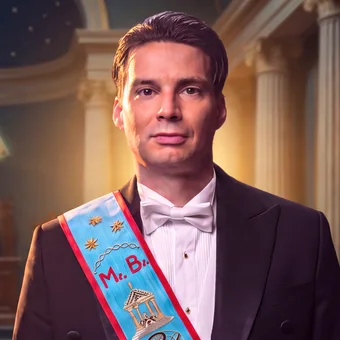
On the days of reception, the Master, the two Assistants, the Secretary, and the Treasurer of the order, wear about their necks a blue ribbon of a triangular figure. By the Master's ribbon hang a rule and a compass, which should be made of gold, or at least gilt: the Assistants and other officers carry the compass alone.
The candles that are placed upon the table, must always be placed in the form of a triangle; nay, there are many Lodges in which the candlesticks are of a triangular figure: they are usually made of wood, and carved with allegorical figures, alluding to Free-Masonry. However, this is not universally observed. Upon the table are always placed three, five, seven or nine dishes.
When the whole company is seated, every body is at liberty to call for his bottle; all the terms which they make use of in drinking are borrowed from artillery: the bottle they call a barrel, water and wine they call powder, with this difference, that they call the former white, and the latter red. The exercise observed in drinking, does not allow them to make use of glasses; their glasses would be broke whenever they drink: they make use of bowls, which they call cannons. When they drink in ceremony they use this expression, Give us powder, every body rises, and then the Grand Master says, Charge: they hereupon fill their bowls, and the Grand Master says, Handle your arms — present — fire: thus are the three different actions which they observe in drinking distinguished. In the first, they lay their hands on their bowls; in the second, they hold them out as it were to present their arms; and in the third, they all drink. In drinking they all keep their eyes upon the Grand Master, in order to perform the exercise together; when they have drank, they hold their bowls out before them, then lay them upon the left breast, and afterwards upon the right, and this is done three times: they then lay their bowls three times upon the table, strike their hands together three times, and each member cries out three times, Vivat. Their drinking in this manner makes the prettiest sight imaginable; and it may be said, to the praise of the Free-Masons, that there is no military school in which the exercise is performed with greater exactness. Let the assembly be ever so numerous, the motion of one is always for the motion of all the rest; no one is ever seen to be behind hand; and as soon as ever the word of command is given, the exercise is performed with a uniformity, that resembles enchantment. The noise which is heard when they lay their bowls upon the table is very considerable, but not confused; 'tis but one single stroke, but it is strong enough to break any vessels not made of solid metal: if any one failed in the exercise they would begin again, but they would not fill their bowls a-new; this happens but seldom, but it happens sometimes: such blunders are generally committed by members newly received, who are not accustomed to the exercise.
The King's health is the first they drink; they next drink that of the Grand Master; then that of the first and second Assistants, and then that of the Brothers in general. When there are new members present their health is drank immediately after that of the Assistants; the same distinction is paid to the Brother Visitors, who happen to be in the Lodge; they give this name to the Free-Masons of another Lodge, who come to communicate with their Brethren. The quality of Brethren made evident by the signs of the order, intitles them to an honourable reception in all the Lodges.
'Tis to be noted, that when they drink in ceremony, they all drink standing; when the Grand Master quits the Lodge about any business of importance, the first Assistant takes his place; hereupon the second Assistant takes the place of the first, and one of the Brothers becomes second Assistant, so that these places are never vacant. The first Assistant thus becomes Grand Master, proposes the health of him who has just quitted, and takes care not to forget his mistress: this is done with the greatest solemnity imaginable. The reader shall have a description of it when I speak of the ceremony of a reception: if the Grand Master returns to the Lodge during the ceremony, he is not to take his place again; he is obliged to stand till the ceremony is over.
I must here observe, with regard to women, that tho' they are excluded the assemblies of Free-Masons, honourable mention is always made of them there. On the day of a reception, at the same time that they give the apron to the new member, they give him two pair of gloves, one for himself and one for his mistress or wife, if he be a married man. The society is however, very reserved with regard to women, for in their assemblies, as well solemn as particular, they speak of them in very decent and very concise terms; they drink their health, and present them with gloves, and that is all the notice that is taken of them by the society. Tho' decency and sobriety are always exactly observed at the entertainments of the Free-Masons; they do not however, exclude gaiety and mirth: their conversations are sufficiently animated, but 'tis the tenderness and brotherly affection that prevail in them, that render them most highly entertaining.
When the Brethren after having conversed for some time, appear disposed to sing the happiness of the society, the Grand Master employs for that purpose either the second Assistant, or which ever of the Brethren he thinks best qualified to acquit himself to general satisfaction. In the first-rate Lodges, when the Grand Master orders a song, it is accompanied by a concert of French-horns and other instruments, whose harmonious sounds are simbols of the union and good intelligence, in which the happiness of the Brothers consists. This concert being ended, they sing the hymns of the fraternity. These hymns are of several sorts: some are for the Assistants, others for the Master, others for the Fellow-Crafts, and they at last finish by those of Apprentices. Whenever a Lodge is held, the songs of the Fellow-Crafts and the Apprentices are sung; when the last song is sung, the servants who are called Serving-Brethren, and who are likewise of the order, come to the Master's table, and bring with them their cannons charged; (we have already explained this term above) they lay them upon the Master's table, and seat themselves amongst them. They all stand up, and form a chain, that is to say, they hold each other by the hand, in a manner somewhat singular and extraordinary. He that stands on the right, holds the left hand of his neighbour, and he that stands on the left, holds the right hand of his: thus they form a chain around the table. They then sing the following air:
Air chanté à la chaîne
YE Brethren all, Whom Free-Masons men call, Without care or strife, In joy pass this life. Be a full brimmer still, Your defence 'gainst all ill, And the jovial glass fill, To the health of all, Free Masons all, We are Brethren, both great and small.
Suite du traité
When they have sung this catch they drink in ceremony, excepting that they do not cry Vivat. They then sing other catches, and at the last they drink without omitting any of the ceremonies.
This whimsical jumble of servants and Masters seems at first sight odd and extravagant: however, if we consider it in its true light, we must acknowledge that it does great honour to humanity in general, and to the society of Free-Masons in particular. 'Tis just to say, that equality of Brethren is real amongst them, and not a vain denomination. Amongst Free-Masons, the Serving-Brethren taste the same pleasures with their Masters, they enjoy the same privileges, and this must reflect the highest honour upon the society.
Having thus given a general idea of what passes in the assemblies of Free-Masons, I shall proceed to lay before the reader the ceremonies observed upon the reception of a Free-Mason. Whoever is desirous of being received a Free-Mason, must endeavour to get acquainted with a member of the society, who is obliged to give an account of the life and manners of the candidate. He that undertakes to introduce a new member must begin by informing the Brethren of the good qualities of the person who desires to be admitted of the society: when the Brethren have given their answer, the candidate is at liberty to present himself: the Brother who speaks of the candidate to the society, is called the Proposer; and on the day appointed for the reception, he stands God-father.
The Lodge in which the ceremony of reception is performed, consists of several different apartments, one of which should be totally dark. The God-father conducts the candidate into this first: he is first asked whether he is conscious of having the vocation necessary to be received: he answers yes; he is then asked his name, sirname, and condition. When he has answered these questions, whatever he has about him made of any sort of metal is taken off, as buckles, buttons, rings, boxes, &c. There are some Lodges where the members are so exact in this respect, that they make a candidate to pull off his clothes if there be lace on them; they then make him uncover his right knee, and put his left foot with his shoe on, into a slipper; they then hoodwink him, and leave him to his reflection for about an hour. The chamber in which he is, is guarded within and without by Brothers, who have their swords drawn in their hands to keep off the profane, if any of them should approach. The God-father stays in the room with the candidate, but he does not speak to him: when this time of silence is over, the God-father goes and knocks three times at the door of the apartment in which the ceremony of reception is to be performed: the Grand Master answers from within by three strokes, and then orders the door to be opened.
The God-father then tells him that a gentleman named N—— offers himself, and begs to be admitted a member of the society: the Master says hereupon, Ask him if he has a vocation. The God-father does as he is directed, and soon after returns with the answer of the candidate: the Grand Master then orders that he should be admitted; the Assistants crowd round in order to conduct him.
We must here take notice, that there is in the midst of the apartment a large space, upon which two pillars of the Temple of Solomon are drawn. On each side of this space are drawn likewise a capital J, and a capital B: the explanation of these letters is not given till the candidate is received: three lighted tapers placed in the form of a triangle, are set in the midst of the space between the pillars abovementioned.
The candidate is introduced blindfold into the apartment by the Assistants, whose business it is to conduct him. There are some Lodges in which, as soon as the candidate enters the apartment where the ceremony is to be performed, 'tis customary to throw powder or rozin, the illumination of which has always some effect, tho' the person is blindfold.
The candidate is carried three times round the space in the midst of the chamber. In some Lodges the candidate is obliged to go nine times round this space; whilst he is making this circuit, the Assistant-Brothers make a sort of a noise by striking constantly upon the attributes of the order, which hang to the blue ribbon, which they wear about their necks. There are some Lodges where this custom is not observed; those who have gone thro' this ceremony declare, that nothing can be more painful than making this circuit blindfold; one is as much fatigued when it is finished, as after a long journey.
When all these ceremonies are over, the candidate is led to the midst of the abovementioned space; he is then brought three times before the Grand Master, who is at the upper-end behind an arm-chair, upon which is placed the Gospel according to St. John. The Grand Master then puts this question to the candidate, Do you find that you have a vocation to be received a member of this society? The candidate answers, Yes. Let him see the light, says the Grand Master thereupon, he has been deprived of it long enough. They then take the bandage from his eyes, and whilst they are so doing, the Brethren form a circle round him with their swords drawn in their hands, the points of which they present to his breast. The lights, the glitter of the swords, the fantastick ornaments borne by the grand officers, the appearance of all the Brethren in white aprons, all this together makes a dazzling sight for a person who has been two hours in the dark, and whose eyes are moreover extremely fatigued by the bandage. The darkness which the candidate has been so long kept in, and his uncertainty concerning what is to be done for his reception must, no doubt, throw his mind into a perplexity, which cannot but occasion an extreme surprise at the moment that the light is restored to his eyes. When the bandage is taken off, the candidate is obliged to come three times up to a stool, which is placed at the foot of the arm-chair: upon this stool are placed a rule and a compass: then the Brother, who is dignified with the title of Speaker, because he is obliged to make a speech at the reception, says to the candidate, You are going to enter into a respectable society, which is more serious and important than you imagine. It admits of nothing contrary to law, religion or morality, nor does it allow of anything inconsistent with the allegiance due to his Majesty: the Worshipful Grand Master will tell you the rest. 'Tis evident from this speech, that the orators of the societies of Free-Masons are studious of brevity.
'Tis however left to the direction of the Speaker to add something to the usual form; but what he adds, must be very concise: this is a law established by the founders of the order, who very prudently thought proper to banish every thing tedious and unnecessary: they foresaw, no doubt, that a more extensive liberty would introduce amongst them, as it has elsewhere, the tiresome custom of making long and insipid harangues, the extravagant jargon of which has long offended the ears of the judicious.
The duty of a Free-Mason is to live amicably with his Brethren, to observe punctually the institutions of the society, and above all a profound secrecy, with regard to its mysteries. There is no occasion for a long discourse to instruct candidates upon this head. When the Speaker has ended his speech, the candidate is desired to put his knee upon the stool: he must kneel upon his right knee, which is bare as I said above. According to the antient form of reception, the candidate, tho' kneeling upon his right knee, should have his left foot in the air: this position appears to me a little troublesome; 'tis probable it has been thought so by others, for in many Lodges it is not insisted upon; 'tis thought sufficient to put the left foot, with the shoe on, into a slipper.
Whilst the candidate is in this posture, the Worshipful Grand Master speaks to him as follows: Do you promise never to tell, write, or disclose in any manner whatever, the secrets of Free-Masons and of Free-Masonry, except to a Brother at the Lodge, and in the presence of the Worshipful Grand Master? Everybody must be sensible, that whoever has taken the trouble to offer himself, promises whatever is required of him. Then his breast is opened, lest a woman should offer herself, and tho' there are women who are not better provided in that respect than some men, the Brethren are satisfied with this slight inspection: they then place the point of a pair of compasses upon the left breast of the candidate; he himself holds it with his left hand; his right he lays upon the Gospel, and he promises to observe all that has been enjoined him by the Worshipful Grand Master; he then pronounces the following oath; if I break these rules I consent, that my xxxxx be xxxxxxx out of xxxxxxx, my xxxxx torn, my xxxx xxxxxx and reduced to xxxxx, and the xxxxx xxxxxxxxx in the air, that no farther mention may be made of me amongst men; So help me God, and this Holy Gospel. When the candidate has pronounced this oath, he is obliged to kiss the book: this being done, the Worshipful Grand Master places him at his side: he then receives the Free-Mason's apron, of which I have spoken above; a present is likewise made him of a pair of gloves for himself, and another for his mistress or wife.
When the ceremony of giving the apron and gloves is finished, they teach the new Brother the Free-Masons signs, and explain to him the letters drawn on the space in the midst of the chamber, that is to say, J, which stands for xxxxx. They then teach him the first sign, by which he may know the Brethren, and be known by them. This sign is called Guttural; 'tis made by raising the xxxxx xxxx to the xxxx in such a manner, that the xxxxx raised perpendicularly on the xxxx of the xxxx, which should be as near as possible on a horizontal line, may form a rule. The xxxxx xxxx being thus raised to the xxxx xxxx of the xxxx begins the sign; then they lower it and bring it down to the xxxxx xxxx, and strike a blow on the coat, on the same side: this signal immediately raises the attention of a Free-Mason, if any of the society should happen to be present; he makes the same sign himself, and then they approach. If the first answers, there follows another sign: they take each others hands, and in so doing, they mutually lay the xxxxx xxxxx upon the xxxxx and xxxxxxx xxxxx of the xxxx xxxxx, and approach as it were to confer. Upon this occasion they pronounce the word xxxxx: these signs characterise prentices; however, they are the first signs made by Free-Masons when they meet.
The second is called the Manual: when the Brethren have taught the Apprentice the signs of the order and the word xxxxx, which may be looked upon as one of the sacramental terms of the fraternity, they teach him another manner of pronouncing it. It was thought necessary to have recourse to this expedient, to prevent being taken in by such of the profane, as by diligent inquiry might discover the signs and terms of Free-Masonry. When therefore a Brother has any suspicion, that a person who makes the signs of the society does not belong to it, he desires him to xxxxx; he does not explain himself any farther, every Free-Mason knows what is meant by this. Then one says J, the other is to answer x; the first says x, the second x, and then the first says x, which makes the word xxxxx. 'Tis in this manner Free-Masons come to know each other: 'Tis true, indeed, that these first signs denote only an Apprentice; there are others for the Fellow-Crafts and the Masters: I shall here in few words explain them to the readers.
The ceremony of the installation of an Apprentice into the order of Fellow-Crafts, is always performed in a Grand Lodge: the Grand Master and the Assistants appear with all the ornaments of their dignity: the figures are drawn with a pencil upon the ceiling of the chamber in which the ceremony of reception is performed, and instead of a misshapen stone, which is drawn at the reception of an Apprentice, as it were to give him to understand, that he is fit for coarse work only, a stone fit to sharpen tools is represented, in order to denote, that he is now qualified to polish his work and bring it to perfection. He is not obliged to repeat the oath which he had taken before, it is sufficiently intimated by a sign, which is called Pectoral. The candidate is taught to lay his hand upon his xxxxxx in such a manner, as to represent a rule: this position denotes a tacit oath, by virtue of which the Apprentice, who is to be received a Fellow-Craft, promises, upon the word of a Brother, never to reveal the secrets of Free-Masonry. They then explain to him the meaning of the great B drawn on the same space on which the pillars of Solomon's Temple are represented. This letter stands for xxxx: 'tis customary to xxxxx it in the same manner with the word xxxxx, when there is any room to apprehend that a person, who would make himself pass for a Brother, is not really of the society.
The mysteries of the reception of a Master consist only in a ceremony somewhat singular, with regard to which I can inform even some Masters, long since received, of certain particulars, which they are altogether ignorant of. When a Master is to be received, the Hall of Reception is adorned in the same manner as at the reception of an Apprentice or Fellow-Craft; but there are more figures represented on the middle space; besides the tapers placed in the form of a triangle, and the two famous pillars abovementioned, something that resembles a building, which they call a Mosaic palace, is described there with the utmost exactness. They also paint there two other figures, one of which is called the Laced Tuft, and the other the Throne beset with stars: there is also represented a perpendicular line in the form of a Mason's instrument, commonly called by workmen a Plumb-line. There is moreover another figure which denotes the Tomb of Hiram. The Free-Masons with great ceremony lament the death of this Hiram, who has been dead almost three thousand years.
There are many Free-Masons, who know only the name of this Hiram, without knowing who he was: some take him for Hiram King of Tyre, who made an alliance with King Solomon, and furnished him with all the materials for building the Temple. The Brethren think that tears are due to the memory of a prince, who helped to build an edifice, which they intend to rebuild. The Hiram in question was very far from being King of Tyre: he was an excellent workman in all sorts of metals, as gold, silver and copper: he was son of a Tyrian, and a woman of the tribe of Nephtali. Solomon sent for him to Tyre, in order to employ him in adorning the Temple. In the fourth book of Kings, the reader will find an account of what he did for the embellishment of that edifice. Amongst other works, mention is made in Scripture of the two copper pillars, each of which was eighteen cubits high and twelve round, over which were cornices graven in the form of lillies. It was he that gave names to these two pillars; he called that on the right hand xxxxx, and that on the left xxxx; this is the Hiram who is now so much regretted by the society.
The reception of a Master is little more than a ceremony; scarce any thing new is learned at it, except a new sign, which is called Pedestal. 'Tis made by placing the feet in such a manner, as to represent a rule: this figure is explained allegorically; it intimates, that a Brother ought always to have equity and justice in view, be faithful to his King, and irreprehensible in his morals.
These then are the four principal signs that characterise the Free-Masons. The Guttural, so called because it is made by xxxxxxx the hand to the xxxxxx, in order to make the sign of a rule. The Manual, in which the Brethren touch the xxxxxx of xxxx xxxxxx xxxxxxx. The Pectoral, which is made by laying the xxxx upon the xxxxx in form of a rule; and the Pedestal, which takes it's name from the position of the xxxx. The Masters have no words to distinguish them from the Fellow-Crafts; they only observe the custom of laying the arm upon the shoulder when they embrace each other: this is their distinguishing mark, which is followed by the Pedestal sign.
In all the assemblies of Free-Masons, the ceremony of drinking healths, takes up much of their time: however, there still remains enough for them to contribute to their mutual edification, by proposing questions. When a question is proposed to a Brother, which he has not skill enough to answer, he lays his hand in the form of a rule upon his xxxxxx and bows his head, to intimate that he desires to be excused from answering; then the Grand Master addresses himself to one of more experience in such terms as these; Brother how many are required to form a Lodge? The Brother answers, Worshipful Grand Master, three form it, five compose it, and seven make it perfect. Questions of a much higher nature are proposed to the Masters, or rather the Master when interrogated upon the most simple question answers, in terms altogether sublime. For example, the Worshipful Grand Master says to one of the Assistants: Brother whence come you? The other answers, Worshipful Grand Master, from St. John's Lodge. The Grand Master then asks him, What did you see there, when your eyes were uncovered? The Assistant answers, I saw three great lights, the Mosaic palace, the Canopy beset with stars, the Laced-Tuft, Plumb-line, &c. Nothing can be more circumstantial than this answer; and tho' it may be thought somewhat obscure, it gives perfect satisfaction to the Brethren who hear it, and gives the most lively pleasure to the whole company. The Free-Masons signs are made from time to time: the Adepts make them with a facility that charms the spectators, and those who have not been sufficiently exercised, or who are awkward in their address, sometimes divert the Brethren not a little, by the confusion and perplexity which they discover. 'Tis unnecessary to enter into a longer detail concerning the subjects, upon which the instructions or conversations of the Free-Masons generally turn; they are generally much of the same nature with those I have just mentioned.
'Tis then in vain that calumny has endeavoured to blacken the Free-Masons, by the most infamous aspersions; the pleasures which they enjoy together, have nothing of an impure nature in them, and the uniformity which reigns in their assemblies, is no ways tiresome, or disgusting, because they tenderly love one another. I am sensible that any body but a Free-Mason would take but little pleasure, in what gives the society the highest delight: but to a Free-Mason, every thing that concerns the order is most important and interesting; what would be perfectly insipid to one of the profane, is an exquisite pleasure to a Free-Mason: this is a remarkable proof of the great influence of the society.
'Tis evident therefore, that there is nothing but what is perfectly harmless and innocent in the conversations, which the Free-Masons hold at their assemblies; and the purity of sentiments which distinguishes this society from all others, derives a new lustre from the joyous hymns which the Brethren sing after they have been sometime at table.
'Tis well known, that the character of each individual appears manifest in the songs which he sings. It happens sometimes, for example, that a person on account of his age or condition, observes for a time the utmost reserve; but when once warm'd with the juice of the grape, thinks he may dispense with the laws of decency, and indulge himself in the most gross obscenity. 'Tis a maxim pretty generally received, that singers should be free from all restrictions: this maxim the Free-Masons have never thought proper to adopt, and their songs, as pure and innocent as their discourse, breathe nothing but gaiety and goodness of heart.
'Tis in all companies looked upon as a breach of politeness to whisper, but 'tis generally speaking, looked upon only as a breach of politeness; by the Free-Masons it is looked upon as a crime, which is punished with greater or less severity according as the offending party is more or less in liquor.
The form observed at the expulsion of a Free-Mason, is as follows: The Grand Master does not immediately proceed with the utmost rigour; but begins by a gentle admonition, and if the faulty Brother returns to his duty, he is only condemned in a fine. I observed above, that it was always applied to the relief of the poor; this has been always the practice among the Free-Masons. Some Lodges have, however, thought proper to keep the money to spend it at merry meetings.
When the Brother who has been admonished, pays no regard to the remonstrances of the Grand Master, they proceed against him with rigour, if the case seems to require it. The Grand Master calls a council, the members proceed to vote, and if the majority vote for the expulsion of a Brother, 'tis done after this manner. The Grand Master strikes upon the table, and cries out, Listen to the order Brethren: the Assistants strike also, and repeat what the Grand Master has said: when every body present appears attentive to the order, the Grand Master lays his hand upon his breast in the form of a rule, and addressing himself to the first or second Assistant, says to him, Brother, why did you get yourself received into the society of Free-Masons? He that is questioned, answers as follows: Worshipful Grand Master, it was because I was in the dark, and was desirous of seeing the light. The Grand Master then asks him, How were you received a Free-Mason? To which he answers thus, Worshipful Grand Master, by three great strokes. The Grand Master asks him next, What do these three strokes signify? To which he answers, Knock, and it will be opened to you, ask and you shall receive; offer yourself, and you shall be accepted. The Master then puts this question, What did you see when you were received? To which he answers, Nothing that I could comprehend. Grand Master asks, How were you dressed when you were received at the Lodge? Answer, Worshipful Grand Master I was neither naked nor richly dressed, but decently only. Grand Master asks, Where did the Grand Master stand when you were received? Answer, On the east-side. Grand Master asks, Why on the east-side? Answer, Worshipful Grand Master, because as the sun rises in the east the Grand Master should stand on that side, in order to open to the workmen, and instruct the Lodge. Grand Master asks, Where did the Assistants stand? Answer, Worshipful Grand Master on the west-side. Grand Master asks, Why on the west-side? Answer, Because as the sun sets in the west, the Assistants should stand there to pay the workmen, and shut the Lodge.
The Grand Master then pronounces the sentence of expulsion in these terms: First and second Assistant, Brethren, and Fellow-Crafts of this Lodge, the Lodge is shut: this the Assistants repeat. The Grand Master then tells the Brother that is in fault, that the Lodge is shut on account of the crime he has committed, and neglected to make proper reparation for. From that time, he that has received this reprimand is excluded from the order; no farther mention is made of him, when the Brethren are invited to assist at a reception; and care is at the same time taken to intimate to the other Lodges the bad qualities of him who has been treated with this severity: 'tis then a rule to admit him no where; this is one of the statutes of the order.
However, a Brother must carry his obstinacy very far, to oblige the society to treat him with such rigour: an order so remarkable for its mildness, tranquillity, and peacable disposition, does not suffer this rigorous sentence to be pronounced against any of its members, without having first tried every method to bring about a reconciliation: such a disagreeable interruption must considerably diminish the pleasure, which the Brethren take in singing the hymns of the order. However, as 'tis a rule to sing in the ordinary assemblies, their songs are resumed as soon as a perfect tranquility is restored. I have already observed, that they concluded by the Apprentices song, and I have taken notice, that the Serving-Brothers at that time, seat themselves by their Masters. In the same place I described the forms observed in the last ceremony; for which reasons I think it unnecessary to enlarge upon them at present.
Having thus laid before the reader the ceremonies of the Free-Masons, and explained their signs, I think it absolutely necessary to give him a concise history of Hiram, Adoniram or Adoram, architect of the Temple of Solomon, as the society was formed in order to rebuild that Temple. Hiram the chief architect of Solomon's Temple, had so great a number of workmen to pay, that he could not possibly know them all; he therefore gave each of the chief of them a particular sign to distinguish them. The Apprentices word was xxxxx, the name of one of the xxxxxx xxxxxxx at the xxxx of the Temple, at which they were wont to assemble in order to receive their pay. They made their sign by laying their xxxxx xxxx upon their xxxx xxxxxxxx, then turning it to the right, and letting it fall upon the xxxxx, and this was to be done at two different times. The word of the partners or Fellow-Crafts was xxxx; for that was the name of the other xxxxxx xxxxxx at the Temple xxxx, where they likewise met to receive their salary. They made their sign by laying their xxxxx xxxx upon their xxxx xxxxxx, their four xxxxxxx being joined together and stretched out, whilst the xxxxx made a right angle with them. The Master had his peculiar word to distinguish him from those I have just mentioned, and that was the name xxxxxxx, but this was altered after the death of Adoniram. We shall here give the Free-Masons oath at full length, as we have given only a general idea of it in our account of a reception, and with it we shall conclude our narrative.
The OATH made by the FREE-MASONS on the first day of their reception.
I Promise and engage upon the word of a gentleman, before God and this honourable company, never to reveal the xxxxxx of the Free-Masons, and of Free-Masonry, nor to be directly or indirectly the cause of revealing, printing, or graving the said xxxxxx in any language, or in any character whatever. I likewise promise never to speak of Free-Masonry, except to a Brother, and that after having strictly examin'd him. This I promise upon pain of having my xxx xxx, my xxxx xxx, my xxxxxxxxx, and my xxxx xxx xxx and xxxxx, and the xxxxx xxxx through the air, so that my memory may no longer remain amongst men, or amongst Free-Masons.
This is the substance of the oath, the sense is always the same, though there may be some difference in the expressions. For example, in a certain Lodge, which I shall not name, instead of saying, I promise before GOD, their expression is, I promise before the GREAT ARCHITECT OF THE UNIVERSE.
Appendix
APPENDIX.
I SHALL here give a recapitulation of the signs, words, and manner of touching of the Free-Masons, and explain the true use of them, as it has not been done with all the care which it required in the course of this work. It will moreover be a satisfaction to the reader to find them united in one point of view, as that will save him the trouble of looking for them in different parts of the treatise. The first sign made by the apprentices is the Guttural. They make it by placing the xxxxx xxxx on the xxxxxxx of the xxxx under the xxxx. The xxxx must be placed in an xxxx line, the xxxxxxx xxx kept close together, and the xxxxx lowered so as to form a rule. They then draw back the xxxx on the same line to the xxxx of the xxxx, and they last of all let the xxxx fall upon the xxxxx and strike their coats. The second sign, which is called the manual sign is made by laying the xxxxx xxxxx upon the xxxxx xxxxx of the xxxx xxxxx of the xxxxx xxxx. The sign made, the brethren xxxxx the xxxx xxxxx in the manner described above. The pass word of the apprentices is xxxxx xxxx. The Fellow-crafts sign consists in laying the xxxxx xxxx upon the xxxxxx near the xxxx of the xxxxx, the xxxx xxxxxxx being stretched out and kept close together, the xxxxx being kept at some distance in the form of a rule, and the xxxxx at some distance from the body, so as to make the xxxxx jut out. This is the pectoral sign. The Fellow-Crafts touch is the same with that of the apprentices, excepting only that it is made upon the xxxxx xxxx. The word xxxx they spell and pronounce in the same manner with the word xxxxx. The pass word to the Fellow-Crafts is xxxxxxxx. The Masters make use of the same signs, the same touch, and the same word with the Fellow-Crafts. They have a pass-word, which is xxxx—xxxxxx. However they have a word, a touch, and a sign peculiar to themselves. The word is xxxxxx, but it is seldom pronounced, because it is looked upon as sacred. The Master's touch is not in frequent use either. It is made by putting the xxxxx xxxxx between the xxxxx and xxxxxx xxxx of the person touched, and taking hold of the xxxxxx part of his xxxxx with the remaining xxxx xxxxxxx, which must be kept at some distance. They then approach and embrace, as has been said above. The master's sign consists in making the rule with the xxxx in the manner already explained several times, in raising it horizontally to the xxx of the xxxx, and in laying the xxx of the xxxxx upon the xxxxxxxx, then bringing it down in the same position below the xxxxxx, and putting the xxx of the xxxxx into the xxx of the xxxxxxx. This sign is made use of only in a lodge and at the reception of Masters. There is one sign more which is seldom made use of except in a lodge, though it is used indiscriminately by the Apprentices, the Fellow-Crafts, and the Masters. 'Tis the pedestal, this is made by placing the xxxxx contiguous to each other; and keeping the ends of the xxxx asunder so as to form a rule. With regard to the manner in which Free-Masons write to each other, they seldom use any other form than this: I salute you by the number 3 and then join 3 &c. But when one lodge writes to another, the word Sir is wrote in the form of a rule. S I R. And to this is added some symbol of the society.
An Apology for the Free-Masons
An APOLOGY for the FREE-MASONS.
MUST then our society still be abus'd, And traduc'd by the vile and unjust; Since by the profane we're so often accus'd At last we must answer, we must. Since to calumny's tongue we've so long been expos'd, Our cause we must now justify; Since so long by our foes we have all been oppos'd 'Tis proper to make a reply.
Know then that the brethren all duties attend, That they're true to the king and the state; A Free-Mason ever is true to his friend, Which makes all his virtues complete. Fair Liberty still in our lodges presides, But ne'er violates decency's laws; We true pleasures enjoy and whatever betides, We all have the same common cause.
Tho' our pleasures from public view are conceal'd, Our rules are still strict and austere, Our mysteries ever remain unreveal'd; No prying inquirers we fear. Our purpose is only true bliss to obtain, And the golden age to restore; On earth to renew Astrea's blest reign, And make mortals as blest as of yore.
Conclusion
To convince the reader that these boasts of the Free-Masons are not altogether empty and ostentatious, it is proper to say a word concerning the manner in which they assist their poor. In this respect they make no manner of difference between foreigners and fellow citizens; and this is, no doubt, highly laudable. There are many more songs composed by Free-Masons upon their affairs, but as they turn, for the most part, upon the same topicks, we apprehend, that a single instance will be sufficient to give the reader an idea of them.
FINIS.
Reproduction intégrale de la transcription citée en tête de page, dans l'orthographe d'origine, sans commentaire ni modernisation. Les titres et notes d'époque sont conservés ; l'appareil éditorial moderne a été écarté.