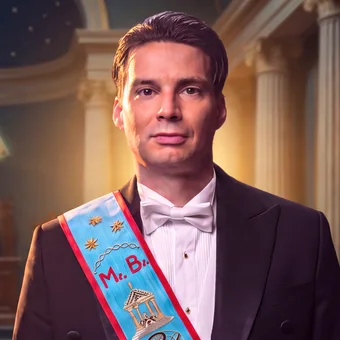
THE GRAND MYSTERY LAID OPEN ; or the Free-Masons Signs and Word discovered.
All Secrets till they once are known, Are wonder'd at by every one, But when once known we cease to wonder, Tis Equal then to fart or Thunder.
WHEN any Person is admitted a Member into this noble and Ancient Fraternity, He is instructed to answer to the following Questions, viz.
How many Signs has a true Free Mason, Nine, which are distinguish'd into Spiritual and Temporal. How many Temporal Signs are there ? Three. The first is a Grip by the two first Fingers, and is call'd Jachin and Boaz ; the second is a Grip by the Wrist, and call'd Gibboam and Gibberum ; the third is a Grip by the Elbow, and is called Thimbulum and Timbulum. Have the six Spiritual Signs any Names ? Yes, but are not divulged to any new admitted Member, because they are Cabalisttical ? What are these Signs, The first is Foot to Foot, the second is Knee to Knee, the third is Breast to Breast, the fourth is Hand to Back, the fifth is Cheek to Cheek, the sixth is Face to Face. Who is the Grand Master of all the Lodges in the World ? INRI. What is the meaning of that Name ? Each distinct Letter stands for a whole Word, and is very mysterious. How is the Master of every particular Lodge called ? Oakecharing a Tocholochy.
By what Name are all the Members distinguish'd ? By the Name of Istowlawleys. Who is your Founder ? God and the Square. What is God called ? Laylah Illallah, which is there is no other God but God. What is the Square called ? Whosly Powu Tigwawtubby which signifies the Excellency of Excellencies. What posture were you in when you receiv'd the secret Word ? I sat on my Right Knee with the Holy Bible at my Breast. Why do you hold the Holy Bible at your Breast ? for the Enjoyning Secrecy, and because in it is contained the Grand Secret of Masonry. Who was the first Mason ? Laylah Illallah. Who invented the secret Word ? Checchehabeddin Jatmouny. What is it ? It is a Cabalistical Word composed of a Letter out of each of the Names of Laylah Illallah as mentioned in the Holy Bible.
Where sat King John in the Morning when he assembled the Society ? He sat in the East Window of the Temple in a Chair of Marble waiting the rising Sun. Where sat He in the Evening when He dismissed it ? At the West End of the Temple in the same Chair waiting the setting Sun.
Why was St. John called King ? Because He was Head of all the Christian Lodges, and from his Superiour knowledge in the wonderfull Art of Masonry. What are the Day and Night made for ? The Day is made for Man to see in, the Night is made for Man to hear in. What is the most usfull Member ? The Ear, because Men ought to hear more than they speak. What are the Tools requisite for a Free-Mason ? The Hammer and Trowel, the one to seperate, the other to join. What Names are given to them ? Asphahani and Talagaica. By what Oath did you Swear to conceal the secret Word ? By God, the Square, the King, and the Master.
At the Installation of any Member the Person to be admited drest with an Apron before Him, a Trowel in his right Hand, and a Hammer in his left, kneels on his right knee with a Bible on his Breast, supported by the Trowel, and in this Posture He Swears to keep secret the Word and Signs by which a Free-Mason is known over all the World, the Privileges they enjoy by being admitted Members into this Ancient Society are very great, for a Member of any Lodge is oblig'd to Furnish another Member tho' of a different Lodge, with all Necessaries in his distress and support Him to the utmost of his Power.
Printed in the Year, 1726.
Reproduction intégrale de la transcription citée en tête de page, dans l'orthographe d'origine, sans commentaire ni modernisation. Les titres et notes d'époque sont conservés ; l'appareil éditorial moderne a été écarté.