Chaque version du rituel est donnée dans l'état de sa source, de la plus
ancienne à la plus récente. Choisissez une version pour la lire ; sélectionnez-en une
seconde pour les comparer côte à côte. Fiche du grade :
le REAA du 4e au 33e degré.
Les textes issus de numérisations anciennes ont été corrigés automatiquement
(césures, ligatures, mots collés) puis relus : des coquilles peuvent subsister. D'autres
versions inventoriées au corpus (Francken 1783, Pyron 1811, rituels de Charleston ) rejoindront
cette page à mesure de l'établissement de leur texte.
Le manuscrit Quesada (Mss 7834 de la Bibliothèque Nationale d'Espagne) : copie (1813-1821) d'un état du Rite de 1804, voire antérieur, tel que pratiqué dans la mouvance du Suprême Conseil d'Amérique. Les didascalies du manuscrit sont en italique. Le texte est celui de l'édition Latomia, donnée en vis-à-vis du fac-similé du manuscrit : l'apparat critique de cette édition est repris ici, de même que les repères de folio du manuscrit.
Texte intégral sur ce site · transcription C. M. & P. T., Latomia / Chantier de fouilles maçonniques, d'après le Mss 7834 de la BNE
Folio 244 recto
Décoration
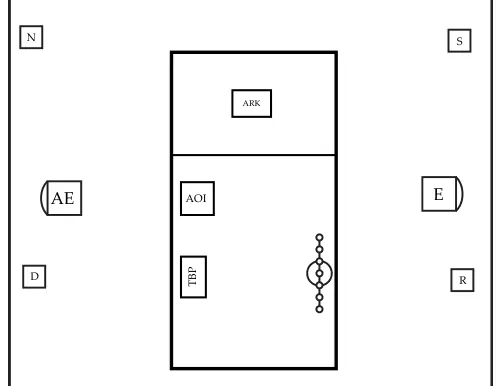
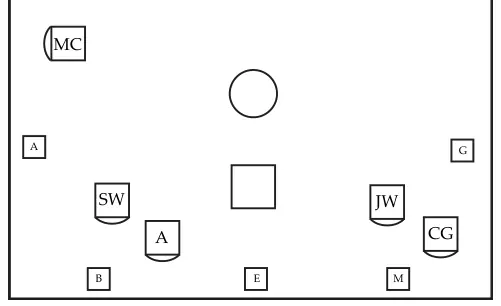
La L∴ est tendue de blanc ornée de Colonnes rouges et noires, rangées par deux de distance en distance, le sanctuaire sera séparé par une balustrade qui joindra d’un côté le Midi et de l’autre le Nord, laissant une entrée à l’Or∴ l’Autel est rouge, dessus l’Autel sera le Livre de la Sagesse & un poignard il y aura 7 degrés pour monter au trône, l’Arche d’Alliance et la gloire du Gd∴ Archte∴ de l’Un∴ en élévation au-dessus le Soleil et la Lune aux deux côtés, l’Autel des holocaustes & celui des parfums à côté du Gd∴ Archte∴ de l’Un∴ 699 le premier à droite et l’autre à gauche à l’Occidt∴ il y aura deux chandeliers à cinq lumières à chaque, placés en triangle à l’O∴ un chandelier qui n’aura que deux lumières le sanctuaire sera couvert par un grand voile qui puisse s’ouvrir en deux
par le milieu. ( Voyez la Planche figure ).
Habillement
Tous les FF∴ seront vêtus de robes blanches écharpes rouges au bout des franges de l’écharpe sera attaché un cordon noir qui soutiendra un encensoir le Vble∴ sera revêtu d’une robe rouge et d’une robe jaune qu’il passera dans les bras et une écharpe noire à laquelle sera attaché un poignard avec un cordon rouge. Il sera accompagné de deux Off∴ FF∴ vêtus de même, ils auront tous trois un bonnet de Grand Prêtre avec un triangle rouge et le nom du G∴ A∴ d∴ l’Un∴ dedans placé à l’O∴ devant l’Autel. Le Vble∴ se nomme Gd∴ Souv∴ Sacrificateur, les FF∴ qui sont à ses côtés se nomment Grands Prêtres Folio 245 recto.
Folio 244 verso
Chambre obscure.
Elle est tendue de noir, un Autel une lampe trois têtes sur cet autel un tabouret un squelette réel si faire se peut qui a en main cette inscription Si tu es lâche sors d’ici, il ne
faut parmi nous que des hommes qui bravent tous les dangers sans abandonner la Vertu.
Le Souverain Sacrificateur frappe un coup répété par les 2 ders∴ 700 Prêtres & dit :
F∴ Survt∴ quelle heure est-il ? D∴
R∴ Le jour & l’heure que le fils d’Hiram doit venir pour sacrifier au Gd∴ Arch te∴ de l’Un∴
Le Souv∴ Sacrif∴ dit : Puisque cet heureux jour est arrivé
je vais commencer le sacrifice apprêté depuis tant d’années mais auparavant F∴Survt∴ faites voir par le F∴ Introd∴ si le Temple est à couvert et prenez de tous les FF∴ les Signes Mots & Attouchements que vous viendrez
Ceci exécuté le Souv∴ Sacrificateur me rendre par le Septentrion.
dit : FF∴ Survts∴ et Introd∴ puisque tout est en ordre avertissez chacun sur vos rangs respectifs que le sacrifice est prêt et que la L∴ de Chef de Tabernacle est ouverte.
Il frappe ensuite trois coups répétés par les Survts∴ et dit :
À moi mes FF∴ : 701 F∴ 1 er∴ Survt∴ pourquoi sommes-nous assemblés ? D∴
R∴ Pour l’arrivée du fils d’Hiram.
Le Souv∴ Gd∴ Sacrif∴ dit : F∴ Survt∴ annoncez au F∴ Introducteur
qu’il aille voir dans le dehors du Temple s’il est venu et qu’il le conduise dans la chambre obscure les yeux bandés.
Ordre de réception
Le F∴ Introd∴ va trouver le Cand∴ dans la chambre de prépon∴ & lui dit :
D∴ Êtes-vous fils d’Hiram ?
Le Cand∴ répond : Oui je le suis, puis il lui bande les R∴ yeux, le conduit à la chambre obscure, lui défend de se découvrir qu’au coup qu’il entendra frapper à la porte le fait mettre à genoux sur le tabouret devant l’Autel, ferme la porte rentre dans le Temple et se place à l’Occidt∴Le Souv∴ Sacrif∴ dit :
D∴ D’où venez-vous ?
R∴ De dehors du Temple.
D∴ Avez-vous trouvé le fils d’Hiram ?
R∴ Je l’ai introduit dans la chambre obscure.
Le Souv∴ Sacrif∴ dit : Puisqu’il est introduit allez
lui faire voir la Lumière après quoi vous le ferez parvenir à la
Folio 245 recto
porte du Temple.Le F∴ Introd∴ sort donne le signal au Cand∴ qui se découvre la vue et aperçoit ce qui est devant lui un instant après le F∴ Introd∴ entre le poignard à la main & dit : inst 702 Avez-vous bien réfléchi mon F∴ sur le grade que
vous allez recevoir. Êtes-vous bien sûr de vous-même.
Il attend sa réponse, après sa réponse le F∴ Introducteur le dépouille de toute arme offensive et défensive à la réserve du poignard qui est à son cordon noir, le conduit à la porte du Temple où il frappe 2 coups en Prince du Liban ceci annoncé le Souv∴ Sacrif∴ et703 703 dit :
F∴ Survt∴ voyez qui c’est si c’est le Cand∴ faites-le entrer à la manière accoutumée, il va ouvrir la porte et dit au Cand∴
D∴ Que voulez-vous ?
R∴ La grâce de parler au Souv∴ Sacrificateur
D∴ Qui êtes-vous ?
Le Survt∴ ferme la porte
R∴ Le fils d’Hiram.
va se placer à l’Occidt et dit :
Souv∴ Sacrif∴ c’est le fils d’Hiram
Le Souv∴ Sacrif∴ frappe un coup tous les FF∴ se lèvent puis il descend du Trône, accompagné des deux Grands Prêtres se place au dehors du sanctuaire au milieu704 704 & dit :
Puisque c’est le fils d’Hiram que nous avons en si grande vénération nous ne pouvons le recevoir qu’avec honneur, il vient sans doute pour accomplir les vœux promis, ainsi F∴ Survt∴ faites le entrer à la manière accoutumée.
Le F∴ Introd∴ conduit le Cand∴ en L∴ les deux mains croisées sur l’estomac, le place au Septentrion vis-à-vis le Sacrif∴ ensuite le Surv∴ dit : Souv∴ Sacrif∴ le fils de ce Gd∴ Homme est introduit. Le Souv∴ Sacrif∴ dit :
D∴ Que demandez-vous mon Frère ?
R∴ La grâce d’accomplir les vœux si longtemps promis.
Le Souv∴ Sacrif∴ dit : Puisqu’une cause si juste vous amène
nous allons combler vos vœux & souhaits. F∴ Survt∴ dépouillez cet homme des habits profanes habillez-le avec les ornements nécessaires
Il exécute l’ordre lui ôtant son habit pour un tel sacrifice sa veste & son chapeau. Le F∴ Introd∴ lui met une aube blanche et une écharpe rouge lui donne un encensoir avec du feu dedans le conduit à l’Occ∴ où il le fait mettre à genoux Le Souv∴ Sacrif∴ dit : Mon F∴ avant que de passer plus avant
il faut que vous prêtiez de nouveau l’obligation d’App∴ceci exécuté
le Survt∴ le retourne le dos à l’Or∴ les yeux couverts, des deux mains. Le Souv∴ Sacrif∴ accompagné des deux Folio 246 recto Folio 245 verso
Grands Prêtres passe en silence dans le sanctuaire et se place Le Souv∴ Sacrif∴ frappe un coup et le Survt∴ au Trône. retourne le Cand∴ à l’Or∴ toujours sa vue couverte. Le Souv∴ Sacrif∴ frappe deux coups, le voile disparait le sanctuaire parait tout éclatant de Lumière. Le Souv∴ Sacrif∴ frappe trois coups 705 le Cand∴ se découvre la vue, le Souv∴ Sacrif∴ dit : F∴ Survt∴ faites avancer le Cand∴
à l’Autel par cinq coups 706 égaux pour y prêter son obligation.
Etant arrivé à l’Autel il se met à genoux sa main droite sur le Livre de la Sagesse il prête l’obligation en ces termes.
Obligation
Je m’engage sur ma parole d’honneur de ne faire connaître à qui que ce soit les secrets qui vont m’être confiés en cas d’infraction je consens d’être sacrifié aux mânes de mon père et que ma tête soit mise au-dessus du Gd∴ Portail du Temple pour servir d’exemple aux indiscrets, ainsi que Dieu me soit en aide.
Après quoi le Souv∴ Sacrif∴ descend du Trône pour faire relever le Cand∴ le mène à l’Autel des Sacrifices où il se met à genoux et fait une courte prière en ces termes.
Grand Dieu lorsque le sacrifice que le fils d’Hiram te fait te peut être agréable je 707 ne peux non plus venir d’une main plus innocente et plus pure. Ensuite il se lève conduit
la Cand∴ à l’Occid∴ le fait encenser 708 l’Or∴ le ramène à l’Autel des Sacrifices, où il met le feu aussitôt la flamme [.?.] 709 tous les FF∴ se lèvent applaudissent par 3 coups égaux et crient Mohabon. Le vœu est accompli et le sacrifice consommé. Souvt Alors le Sacrif∴ remonte au Trône où il fait monter le Cand∴ jusqu’au 3e∴ degré et le constitue en ces termes.
Par le pouvoir que me donne la sainte Cité je vous élève à l’éminent grade de Chef du Tabernacle il lui frappe trois
coups de poignard le premier sur le tête le deuxième sur l’épaule gauche et le 3e∴ sur l’épaule droite ensuite il lui donne les Signes & Mots & Attouchements
Signe, il se fait en avançant le pied droit et portant la main droite à l’encensoir. Attouchement se prendre mutuellement le coude gauche en ployant le bras pour former une espèce de cercle . Mot de Passe Auriel 710Nom de l’ange
Folio 246 recto
du feu qui préside à l’encensoir.
Réponse…. Le Tabernacle des vérités révélées. Batterie. Six & un.
L’attribut est un encensoir attaché à une écharpe rouge. après quoi il se place au Midi & un des Grands Prêtres fait alors le discours suivant
Mon F∴ le grade que vous venez d’acquérir vous montre que Hiram a été vengé par la mort des malheureux Compons et que c’est vous qui représentez son fils pour accomplir les vœux si longtemps promis quoi qu’Hiram ait été vengé on ne laisse pas de lui sacrifier tous les indiscrets les lâches et les vicieux et s’il s’en est déjà trouvé un nombre infini il s’en trouve encore tous les jours, mais pour vous mon F∴ nous sommes persuadés que vous ne serez jamais au nombre, c’est ce que je vous souhaite avec l’assistance du Gd∴ Arch te∴ de l’Un∴
Ce discours fini le Souverain Sacrificateur frappe un coup & fait l’instruction suivante.
Instruction
D∴ Qui êtes-vous ?
R∴ J’ai l’avantage d’être Chef du Tabernacle.
D∴ Comment êtes-vous parvenu à ce grade ? Après le Gd∴ Sacrifice. R∴
D∴ Que signifie le sacrifice ? L’action de grâces rendue au Gd∴ Arch te∴ de l’Un∴ en mémoire R∴ de la vengeance prise sur les assistances711 711 d’Hiram
D∴ Comment êtes-vous entré dans le Sanctuaire ? Par deux coups égaux712. 712 R∴
D∴ Qu’avez-vous aperçu dans le Sanctuaire ? L’Arche d’Alliance et la gloire du Gd∴Archte∴de l’Un∴l’Autel des Parfums et celui des R∴ Holocaustes
D∴ A quoi sert l’Autel des Holocaustes ? Il était réservé pour y brûler les sacrifices qu’on y brûlait 713 et y offrait. R∴
D∴ Où avez-vous été conduit avant d’entrer au Temple ?
R∴ Un F∴ m’a bandé les yeux et m’a conduit dans un endroit ténébreux
D∴ Que vous a-t-il dit ensuite ?
R∴ Il m’a défendu de me découvrir la vue qu’au coup que j’entendrai frapper
D∴ Après ce coup qu’avez-vous aperçu ?
R∴ Un squelette qui tenait une inscription.
D∴ Que signifient la tenture blanche et les Colonnes rouges & noires ?
R∴ Le blanc signifie l’innocence, le rouge le sang répandu et le noir la trahison
D∴ Où avez-vous été constitué ?
R∴ Dans le Sanctuaire par trois coups
D∴ Que signifient ces trois coups ?
R∴ Les trois coups que l’innocence reçut dans le Temple Folio supplémentaire LVIFolio 247 recto.
Folio 246 verso
D∴ Que signifie le Mot Sacré ? La liberté des Maçons d’à présent. 714 R∴
D∴ Que signifie la marche ? Le nom de l’innocence 715 qui est le père du Chef du Tabernacle R∴
D∴ Que signifie le Signe ? Que nous devons toujours être prêts à adorer le Gd∴ Arch te∴ de R∴ l’Un∴ et faire les premiers pas pour assister les indigents.
Clôture
Le Souv∴ Gd∴ Sacrif∴ dit :
F∴ Survt∴ quelle heure est-il ? D∴
R∴ Le jour & l’heure que le sacrifice apprêté depuis tant d’années est consommé.
Le Souv∴ Sacrif∴ dit :
Puisque cet heureux moment est enfin arrivé, F∴ Survt∴ & F∴ Introd∴ avertissez chacun sur vos rangs respectifs que la L∴ de Chef de Tabernacle est fermée.
703. Erreur du copiste A : mot excédentaire, cf. Kloss.
704. Erreur du copiste A. Le mot exact est « midi », cf. Kloss et Pyron 1812.
711. Erreur du copiste A. Le mot exact est « assassins », cf. Kloss et Pyron 1812.
712. Cinq coups pour Kloss ; cinq pas pour Pyron 1812. La version Quesada semble correcte.
713. Erreur du copiste A. Ce mot est en trop ; l’expression exacte est « qu’on y offrait », cf. Kloss et Pyron 1812.
716. Erreur du copiste A. Le mot exact est « en », cf. Kloss et Pyron 1812.
725. Oubli du copiste A : il manque l’adjectif « séducteur », cf. Kloss et Pyron 1812.
726. Erreur du copiste A : le mot exact est « exécrable », cf. Kloss et Pyron 1812.
727. Erreur du copiste A : il s’agit bien sûr de « Moloch », cf. Kloss et Pyron 1812.
Delaulnaye 1813
tuileur imprimé · 467 mots
Le « Thuileur des trente-trois degrés de l'Écossisme » de Delaulnaye (Paris, 1813), premier tuileur imprimé du REAA constitué : mots, signes, décors et remarques du grade. Texte relu mot à mot sur le fac-similé, mots hébreux restitués. Pages 167-172 de l'édition originale.
Les quatre grades suivants n'ont jamais été établis en France, et, il faut en convenir, c'est cette rareté qui fait leur seul mérite. Au reste, nous garantissons l'exactitude du thuilage suivant.
Décoration de la Loge.
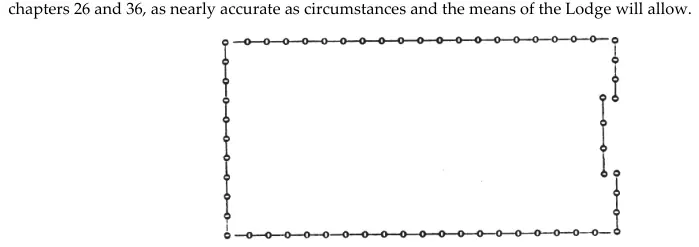
Deux appartements : le premier, nommé Vestibule, sert de Vestiaire, et est décoré d'attributs maçonniques. Le deuxième, la Loge, doit être rendu parfaitement rond au moyen de la tenture. La décoration en varie aux trois
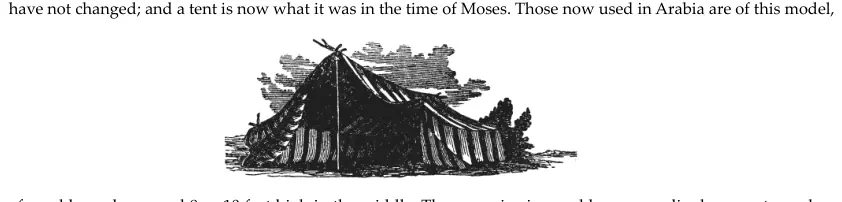
(1) Le Tabernacle que Moïse fit construire dans le désert, par ordre du Seigneur, est appelé en hébreu MISCHKAN, מִשְׁכַּן (habitaculum). On en trouvera la description, Exod. c. 26 et 36, et au troisième livre, c. 5, de l'histoire de Josephe.
[p. 168]
points de la réception. Au milieu est le chandelier à sept branches, allumé.
Quarante-neuf Lumières.
Titres.
La Loge est dite Hiérarchie. Le Maître est appelé Très-Puissant ; et les Surveillants, Puissants. Ils sont au nombre de Trois, au midi, au couchant et au nord.
Signe de Reconnoissance,
dit aussi du Cordon.
Lever les yeux au ciel, et les couvrir ensuite de la main gauche, main droite sur la poitrine, la tête inclinée. Ce Signe rappelle celui de l'Écossois à la vue du Delta.
Signe de Clôture.
Former un triangle avec les deux index, les mains tendues et renversées (Écoss.).
[p. 169]
Attouchement.
Se prendre mutuellement le coude gauche, en pliant le bras, pour former une espèce de cercle.
Batterie.
Sept Coups (six et un).
○ ○ ○ ○ ○ ○——○
Marche.
Six pas égaux et un plus grand (sept).
Mot Sacré.
IEHOVAH.
Mot de Passe.
OURIEL, אוּרִיאֵל, (ignis domini), nom de l'Ange du feu, qui préside à l'encensoir.
Réponse :
LE TABERNACLE DES VÉRITÉS RÉVELÉES
Habillement.
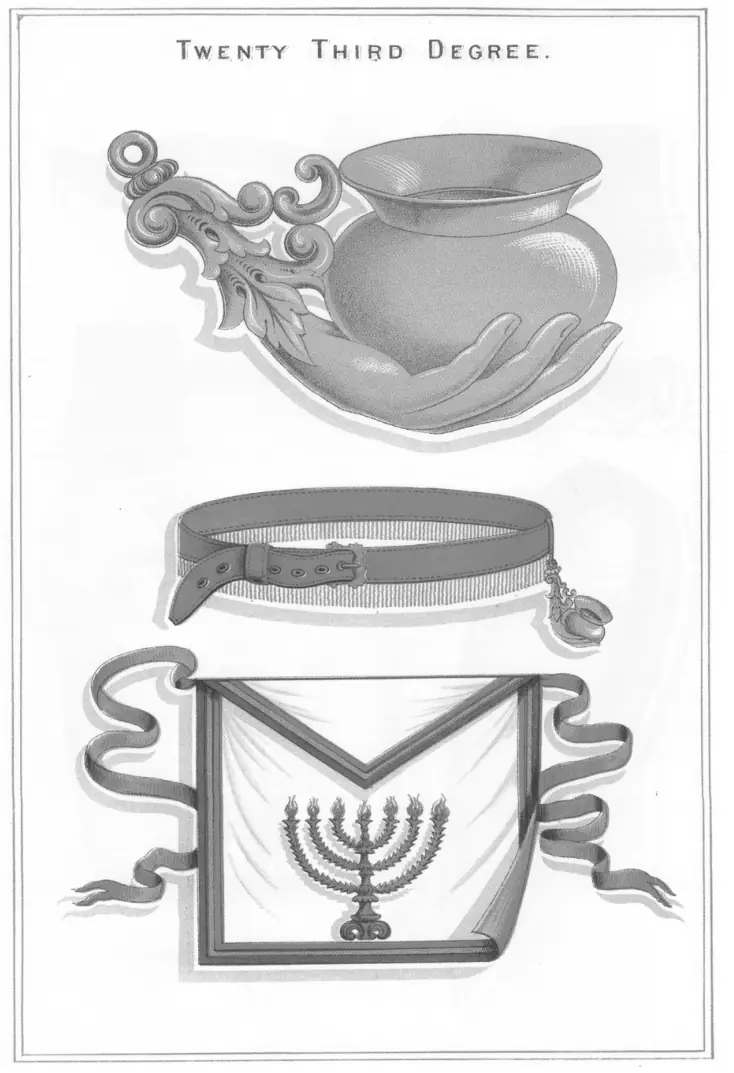
Une aube de taffetas Bleu, dont le collet est [p. 170] garni de rayons en gaze d'or, imitant ceux du Soleil, et le surplus est parsemé d'étoiles d'or. Sur la tête, une couronne fermée, surmontée d'un Triangle, et parsemée d'étoiles(1).
Cordon.
Ruban ponceau, moiré, en sautoir, ou en écharpe de droite à gauche.
Tablier.
Blanc, doublé de Ponceau.
Heure.
La première, pour ouvrir, et la dernière, pour fermer, du Jour de Vie et de Suavité.
(1) Cet habillement, on le voit, diffère beaucoup de celui que Dieu prescrivit pour Aaron, lequel étoit composé d'un caleçon, d'une tunique étroite, d'une robe par-dessus, de l'Éphod, du Pectoral, de la Mitre, et de la Ceinture. L'or, l'hyacinthe, la pourpre, l'écarlate teinte deux fois, et le fin lin retors étoient employés dans ces vêtements.
[p. 171]
On commémore dans ce grade l'erreur de Salomon qui sacrifia aux idoles, et perdit ainsi la communication qu'il avoit avec le Seigneur par l'Urim et le Thummim. Le Récipiendaire est soumis à une semblable épreuve ; il en sort triomphant, etc.
[p. 172]
Vuillaume 1820
tuileur imprimé · 544 mots
Le tuileur de Claude-André Vuillaume, « Manuel maçonnique, ou Tuileur de tous les rites de maçonnerie pratiqués en France » (Paris, Delaunay et Hubert, 1820) : décoration, titres, signes, attouchement, marche, batterie, âge, mots, habillement du grade, avec l'étymologie et l'interprétation des mots hébreux. Texte établi sur le fac-similé et relu mot à mot sur les images : océrisation à 600 dpi du volume numérisé, fusion avec la couche texte de la numérisation Gallica, puis relecture page par page. Orthographe de 1820 conservée, hébreu et grec restitués, batteries rendues comme l'imprimé les note, pagination de l'original. Pages 159 à 162.
Tenture blanche, soutenue par des colonnes rouges et des colonnes noires, accouplées, et placées à distances, selon le goût de l'architecte.
Au fond, est le sanctuaire, séparé du reste par une balustrade, et par un rideau rouge, relevé de chaque côté.
Dans le sanctuaire, est un trône élevé sur une estrade de sept degrés ; devant le trône est un autel couvert d'une étoffe rouge. Sur l'autel est le livre de la sagesse, et un poignard.
Au-dessus du trône est l'arche d'alliance, surmontée d'une gloire, au milieu de laquelle est le nom de Dieu (יְהֹוָה), et sur les côtés, les images du soleil et de la lune.
Sur la droite du premier autel, et un peu en avant, est l'autel des holocaustes ; en face, à la gauche, est celui des parfums.
[p. 160]
A l'ouest, sont deux chandeliers à cinq branches, en forme pyramidale ; à l'est, est un chandelier à deux branches.
Le président se place sur le trône, et les deux surveillans en avant de l'autel.
Pour les réceptions, il y a une chambre obscure, au milieu de laquelle est un autel. Sur cet autel est une lampe, et trois têtes de mort. Au-devant de l'autel est un squelette humain.
TITRES.
Le président prend le titre de grand souverain sacrificateur ; les deux sur∴ prennent celui de grands-prêtres ; les autres frères sont nommés lévites.
La loge est désignée sous le titre de hiérarchie.
SIGNE.
Avancer le pied gauche, en faisant le mouvement de saisir de la main droite l'encensoir que l'on est censé tenir de la gauche.
ATTOUCHEMENT.
Se prendre mutuellement le coude gauche avec la main droite, en arrondissant le bras pour former un peu le cercle.
[p. 161]
BATTERIE.
Sept coups, par six et un : ● ● ● ● ● ○ — ●
HEURES DE SERVICE.
Pour commencer. — L'heure où le fils de Hiram doit venir pour sacrifier;
Pour fermer. — L'heure où le sacrifice est consommé.
HABILLEMENT.
Le grand sacrificateur porte une longue robe rouge, par-dessus est une autre robe jaune, plus courte que la première, et sans manches ; il est coiffé d'une mitre fermée, en étoffe d'or, au-devant de laquelle est peint ou brodé en rouge, un delta, avec le nom ineffable. Par-dessus son vêtement, est une écharpe noire à franges d'argent, au bas de laquelle est attaché, par une rosette rouge, un poignard ; elle se porte de gauche à droite.
Les deux surveillans, grands-prêtres, ont le même costume, à l'exception du delta sur la mitre, qu'ils ne portent pas.
Les lévites sont vêtus d'une robe blanche, par-dessus laquelle est une écharpe rouge à franges en or. Au bas de l'écharpe est suspendu [p. 162] avec une rosette noire, un encensoir pour bijou.
MOT DE PASSE.
URIEL. ( héb. אוּרִיאֵל Ouriel, ignis Domini, nom de l'ange du feu, qui préside à l'encensoir.)
En réponse, on dit : LE TABERNACLE DES VÉRITÉS RÉVÉLÉES (1).
MOT SACRÉ.
JEHOVAH. On ne le prononce pas, on l'épelle.
(1) Le tabernacle que Moïse fit construire dans le désert, par l'ordre du Seigneur, est nommé dans la Bible מִשְׁכָּן misch'chan habitaculum (Exod., ch. 26, v. 36).
Pike 1857
rituel imprimé · en anglais · 11 319 mots
« The Magnum Opus or Great Work » (1857) : le premier corps complet de rituels révisés par Albert Pike pour la Juridiction Sud des États-Unis. Texte en anglais, établi par reconnaissance optique corrigée : des coquilles subsistent.
D'après la réimpression Kessinger de l'édition de 1857 (numérisation archive.org)
THE LODGE, ITS DECORATIONS, ETC.
Lodges in this Degree are styled Assemblies, The hangings are white, supported by red and black columns, by twos, placed here and there, according to the taste of the architect. In the eastern part of the room, & sanctuary is separated from the rest of the room, by o balustrade, and a crimson curtain in front of the balustrade, looped up on each side.
In the East of the sanctuary is a throne, to which you ascend by seven steps. Before the throne is a table covered with a crimson cloth. On this is the roll of the Book of the Law, and by that a poniard.
Above the throne in a' representation of the Ark of the Covenant, crowned with a glory, in the centre whereof is the Tetragrammaton in Hebrew characters ; and on either side of the Ark are the Sun and the
Moon... .*
To the right of the first table, and more to the West, is the horned altar of sacrifices. To the left, and more to the West, the altar of perfumes. In the West are two chandeliers, each with five branches; and in the East one with two branches.
During a reception, there is a dark apartment, with an altar in the centre of it, near which are placed o light and three.skulls. In front of the altar is a human skeleton.
The Presiding Officer sits upon the throne. lie represents Aaron, the High Priest, and is styled Af. Excellent High Priest. The Wardens sit in front of the altar, and represent his two sons, Eleazar and Ithamar. They are styled Excellent Priests; and all the other members, JForthy Levites. .
The High Priest wears a large red tunic, over which is placed a shorter one of white, without sleeves. On his head is a close mitre of cloth of gold; on the front of which is o painted or embroidered delta, enclosing the Ineffable Name in Hebrew characters. Over the dress he wears o black sash, with silver fringe, from which hangs by a red rosette a dagger. The sash is worn from left to right. Suspended on his breast is the breastplate, or Urim and Thummim.
The two Wardens have the same dress, except the delta on the mitre, and the breastplate.
The Levites wear a white tunic, cinctured with a red belt, fringed with gold. From this belt, by s black rosette, is suspended a censer, of silver, which is the jewel of the Degree.
The apron is white, lined with deep scarlet, and bordered with red, blue and purple ribbons. In the middle it has a gold chandelier, with seven branches; and on the fap 4 myrtle-tree of violet colour.
The Battery of the Degree is £— by ???,
XXUT... 2
TO OPEN.
The IL'. P.*. gives two raps, and says: "Eleazar, my son, what is the hour?"
Elcaz.*, My father, it is the hour to replenish the fire that burns continually upon the altar of burnt offering, and to prepare for the morning sacrifice. °
H.. Ps. Bro.*, Jun. Deacon, what is the first care of the Chiefs of-the Tabernacle when about to assemble ? -
Jun., Deac... To see that the Tabernacle is duly guarded; that none may approach thereto, save those to whom its care and service are entrusted.
Hf. P.. Attend to that duty, and inform the Captain of the Guards that we are about to open this Assembly, to carry forth the ashes from the altar, and to prepare for the morning sacrifice; and instruct him to gee that none approach, save those appointed for that service, lest they die. ,
[The Jun.*. Deacon goes out, returns again, and says]: " M.*. Exe.*. IL*. Priest, the Tabernacle i is duly guarded, and none,can approach but those that have the proper Pass-word."
H.. Ps. Eleazar, my son, ara all present Chiefs of the Tabernacle?
Elea.:. My father, all present have been initiated in the first degree, and know the sacred 1 nome of the God of Israel, of which the letters only can be pronounced.
H.. P.. What is that name?
Elea.*. The Ineffable, at which the fallen angels tremble.
Z., P.. Will you give it to me?
Elca.*. Icannot. It is forbidden to pronounce it, except dnce each year by the High Priest, and in conformity to the ancient usage.
IM-. Exc. Pronounce the letters, then, with Ithamar.
at:. Exe, Great is Apoxt, Lord of the Auuin, who was known to our fathers only by Tis nome At Surer: the only True God, that Is that which He Was and Strane Be: Father and Lord of Earth and Ieayen! .Ithamar, my son, give notice to the Levites that I am about to open. this Assembly, that they.may prepare to discharge the duties for which they hare been set apart.
Jun. Wo. My Brethren, the M.°. Exc.*. I'. Priest is about to open this Assembly of Chiefs of the Tabernacle. You will.take due notice, and prepare to discharge your appropriate duties,
Mf. Exe, The sign, my children!
(All give the sign. The M.°. Exe.*. raps?—the Son.-, W.'.?2—the Jun.*. W.'.t—and the M.*, Exo.*. ,—and the M.°. Exc., declares the Assembly open].
RECEPTION.
The Candidate represents Lliasaph, the son of Gael, Chief of the House of Gershon, the son of Levi. Tha Sen.*. Deacon, who represents Moses, prepares him, by bandaging his eyes, and leads him to the door of the Lodge, where he gives £ raps, by 2??? and ,--and the door is opened by the Jun.*. Deacon, representing Joshua, who inquires, 'Who comes here ?"
Sen.*. Deac.". Eliasaph, the son of Gael, and Chief of the House of Gershon, the son of Levi; who desires to be prepared to do the service of the people of the Lord in the Tabernacle of the Congregation, and to make an atonement for the children of Israel.
Jun., Deae.*. Does be of his own accord and cheerfully make this request? |
Sen. D.. He does.
June. Do. Tahoe duly prepared and worthy to receive so great an honour?
Sen. Duo. le is.
Jun. D.. Is his soul prepared to receive and digest the truth ?
Sens. Dv. tis.
Anvil .. 3
Jun. D.. By what further right does he expect to obtain so great a privilege ?
Sen. D... Because the Lord has given him, and those numbered with him, as a gift to Aaron and his sons, from among the children of Israel; and he and his brethren have been taken by the Lord, instead of all the first-born among the children of Israel.
Jun. Do. It is well, Let him wait a time with patience, until the M.:. Excellent High Priest is informed of his request, and his answer received.
[The Jun.:, Deacon closes the dour, goes to the East and raps 6, 1; and the same questions are asked and like answers returned as at the door]. _
H:. P.. Its well; since he comes endowed with these necessary qualifications, let him be conducted to the cell of probation and purification.
. [The Jun.*. Deacon goes to the door, and repeats this order. The candidate is then conducted to the dark apartment, and seated upon the floor, in front of the altar and skeleton. The apartment must be entirely without light. The Sen.. Deacon says to him: " My Brother, I leave you fora time. After you have counted . 3, 5, 7 and 9, remove the bandage from your eyes, and await with patience and fortitude whatever shall befall you." Ie then goes out, and closes the door, leaving him alone. .
_, Another voice cries aloud: " Flee, children of Israel, for there hath come a fire from the Lord, and consumed the two hundred and fifty men that offered incense." ; .
Another voice cries; 'The children of Israel have murmured against the Lord, and against Moses and Aaron, for the death of Korah and his company; and Be hath sent the plague upon them, and many thou- 'sands have died thereof; and the whole people is about to be destroyed."
'A profound silence continues for some minutes, and then, by means of a wicket prepared for the purpose, at.the bottom of the door, a single feeble light is introduced, and the wicket silently closed again. Immediately » gong is sounded loudly by the door; it thunders again, and chains are rattled together and dashed loudly on the floor. This is followed by groans and cries as of persons in extreme agony ; and then by silence. yo Then the wicket is partly opened, and one in s disguised voice says to the candidate, through the wicket, , Host thou repented of thy sins ?''] °
Cand., Have.
Voice.. Pray then to the God of Israel for mercy and forgiveness, lest he consume thee with fire, as he both consumed Nadab and Abihu, the sons of Aaron the High Priest.
[After a pause of a few minutes, the voice asks, "* Has thou bowed thee to the earth and prayed?"
__ If the candidate answers in the affirmative (and if he does not, the question is repeated at intervals, until he does), the door is opened, and the Sen.°. Deacon enters, and says to him; " My Brother, thou bast heard of the awful punishment with which God hath visited these who, not being duly qualified, have presumptuously intermeddled with holy things. Take heed that thou do not so likewise; for as God hath said that nu atranger, not of the seed of Aaron, shall approach to offer incense before the Lord, that he be not dealt with rv Korah and his company; even so, if thou approaches our mysteries, except with o pure heart, thy sins repented of, and a sincere desire to serve God and thy fellow-men, will their fate or a worse overtake thee. Most thou now dare to proceed? , a |
"., The candidate assenting, the Sen.". Deacon sprinkles him with water, and cuts off a Jock of his hair, saying "I sprinkle thee with this pure water in token of that purity of heart and blamelessness of life which must hereafter characterize thee as a Levite without guile: and as I sever from thy lend this lock of hair, 'even so must thou divest thyself of every selfish and sordid feeling, and devote thyself hereafter to the service
'of God, and the welfare, happiness, and improvement of mankind."
Saint. . 4
He then clothes him in a white tunic and white drawers, with sandals on his feet, and a white cloth over his head, covering his eyes so as to prevent him from seeing, and then conducts him to the door of the Assembly, where, rapping 222, he is admitted. Upon entering, the-Jun.. Warden meets him, opens the tunic, and marks the sign of the cross upon his breast, saying, ** Upon thy entrance into this [Holy Place, thou art marked with the sign of the cross, which, pointing to the four quarters of the compass, is a symbol of the Universe of which God is the Soul; and it teaches you how insignificant is man, and bow continually he should humble himself in the presence of that Great Being who knows his inmost thoughts." :
Te is then conducted three times around the room, from East to West, by the way of the South, while the If.:. P.*. reads:
"O Mighty and Ingerutable Being, greater than Brahma, and of whom Be and Amun are but personifications of an attribute; we bow down before Thee as the Primitive Creator, that with o thought midst from Thyself utter all the worlds! Eternal Father, of whose thought the Universe is but a mode! Infinite in attributes, of which each ?s infinite! Incorruptible! coeval with Time, and co-extensive with space! The ancient Absolute, and sole original Existence; whose laws of Ilarmony guide the motivns of the suns and stars! Thou art the All; and in Thee all things exist."
At the end of the 3d Circuit, the Sen.*. Dencon and the Candidate halt in the East, where the Sen.. "gives 2.22, raps; and the HL', P.*, asks]:
Eu. Pe. Whom bring you hither with you, worthy Sen.*, Deacon ?
Sen.°, Dea", Eliasaph the son of Gael, Chief of the House of Gershon son of Levi; whom God has given as a gift to thee and to thy sons, from among the children of Israel; to do the service of the children of Israel in the Tabernacle of the Congregation ; and to make atonement for the children of Israel.
H.. P.. Unto be prayed in the silence and darkness of the cell of probation and purification ?
Sen. D.. He has.
Hi. P.. Tath he heard the thunder of the Lord, and the roar of the Earthquake; and repented of his sins?
Sen. D.. He bas.
. By. P.. Hath he been sprinkled with the water of purification, and passed through the other necessary ceremonies to prepare him to receive the mysteries?
Seno. D.*. Ie has.
H,. P... East thou been warned that thou must enter here, and seek to know our mysteries, with a pure heart, and a sincere desire to serve God and thy fellow-men ?
Cand.*. I hare,
H:. P., And art thou willing henceforward to devote thyself to that service; to eschew and avoid vice and iniquity, and practice virtue, charity and truth?
Cand. Lam, * . » Bacellent
H.. P., Bro.'. Sen.*. Deacon, why do you travel from the East to the West, by the way of the South?
Sen. D.. We oy the example of the Sun; and follow his beneficent course.
H.. P.. 1s is well, He is the fountain of light, and an emblem of the kind beneficence of the Deity. Like him, let this Candidate hereafter shine among men, blessing all within his sphere of action, and returning good fur evil. Return now to the West; and thence approach the altar-by seven regular steps, and place the Candidate in due position to receive the obligation of a Levite or Chief of the Tabernacle.
The Candidate is re-conducted to the West, and made to reach the altar by seven steps, stepping first with the left foot; at the altar he kneels, with his hands open upon the Iuly Bible, Square and Compasses, the right wrist over the left at right angles, furming across. The brethren surround him, each crossing his arms upon his breast; and he repeuts the fulluwing
OBLIGATION.
J,A..... Bo... in the presence of the God of Israel, do herzl.y and hereon most solemnly and sincerely promise and swear, that I will never reveal any of the Secrets of this Degree to any person Dot legally authorized to receive them, nor without due authority warranting me to do so.
ANI... 5
T furthermore promise and swear that I will be tractable and obedient to my superiors; that I will keep my body pure, and receive obediently the doctrines and mysteries of this Order. . .
I furthermore promise and swear that I will henceforth, to the best of my ability.and knowledge, obey the laws of God, and serve, and labour to do good to, my fellow-men.
To all of which Do most solemnly swear; binding myself under no less a penalty than that of having the earth open under my feet, and being swallowed up alive, like Korah, Dathan and Abiram. So help me God; and keep me steadfast!
One of the Brethren places the sharp point of a sword against the Candidate's left breast: and the H.-. P.. asks: "My brother, what fellest thou 2" Upon hearing his answer he says, "It is the sword of Vengeance in the hand of a Brother: and as it now pains the flesh, remember that if thou most violate thine obligation, the sharp arrows of conscience and keen remorse will pierce thee through, and torture thee forever. _To whom
'most thou look for strength to enable thee to keep thy vows and escape this punishment?"
Cand... To God. .
H.. P. Its well, In Him alone, and not in our own fleeting and evanescent resolution there is safety. What now dust thou desire? -
Cand.*. Light.
H..Ps. Light is the gift of God, and common to all men. Be thou henceforth a Son of Light.
Sen.". W.". God is one; unapproachable, single, eternal and unchanging; and not that supposed God of Nature, Dionusos, Sabazius, Zagreus or Zeus, whose manifold power was imagined to be immediately revealed to the Senses in the incessant round of movement, life and death. -
Jun. W. The Manifold is an infinite illustration of the One. The forces of Nature are the laws enacted by the Absolute Untreated Existence. In the absence of Creation by Slim, no attribute could have been appended to His Name. By the emanations of [is Omnipotence we become conscious of [His Abstract Being : and the Elohim, by means of which he created all that is, are His Creative Powers, and a portion of those Emanations. ; .
Sen.. Wi, Aland Be and Chemosh and Osiris, and all the other Gods of the Heathen are false idols; because, being but men's attributes enlarged and personified, they are wholly unreal and have no existence.
- There is but one God, Infinite and Incomprehensible, to whom no human attribute can be assigned, even when imagined to be infinite: one God, to attain to a conception of whom all ideas of all other supposed Gods are but ineffectual attempts, falling infinitely more short of the mark at which they aim than an arrow shot at the Sun. — ,
Jun. W.. The world is not God, but the work of God: norare the Sun and Moon and the Starry Armies
- of Heaven, Gods or Elohim, but creatures of God, moulded by His Powers out of matter created by Him. 'The Powers of God are not Persons nor Beings separate from Him, but His Thoughts, immaterial as our Thoughts, and existing in [Him as Thought exists in our own Souls.
"Sen. We. God is the Soul of the World, separate from and superior to the universe of things, as the Soul of Man is-separate from and superior to his frail body. '
Jun. Wo. He is neither jealous nor revengeful, nor changeable. Ie doth not hate nor repent nor give way to anger; but remains in ever undisturbed serenity and repose; and what is otherwise said of Him is but language accommodated to the rude intellects of the Common People, who demand a God with their own passions and infirmities; and to whom any other is an unrenlity. :
Sen. We. There is no rival God ever at war with the Ineffable; nor any independent and Self-existent Evil Principle in rebellion against Him. The universe is great whole, in which everything tends to good result, through an infinite series of things, like 1 great harmony in which discords and concords mingle, and which without cither would be imperfect.
Jun. W.. Man, tuo feeblo of intellect to comprehend these mysteries, must believe: and simple faith is wiser than all the vain speculations of Philosophy. "Believe that God is a Spirit, the Soul of the Great Uni-
verse; its Creator, Ruler and Preserver: that one great Jaw of Harmony governs all things: that all evil Deities and Demons are but imaginary: and all the vulgar ideas of God, mere idle and feeble attempts to
conceive of Him and His Attributes. °
Sen.. Wr, Believe this; and trust in Him, and in his Goodness and Mercy. Be sincere and true, and
humble and patient; and thou shalt hereafter, in His good time, learn the meaning of the great mystery and
riddle of existence.
(The cloth is now removed from the Brother's eyes; and being raised he receives the Sign, Token and
Words.
Siew: ... Advance the ¢}W9% ¥ and with the right hand make 3 motion as if taking something from ~ECIFCWYY. Tt alludes to the manner in which the H.*. Priest bore the Holy Oil to feed the Sacred fire, when he entered the Tabernacle to perform the sacrifices.
Token: ... Mutually take the TECiMLY 2 of each other with the H&0=0, orseemairecd
BL, Exe.t. accept and receive you, my Brother, as Levite and Chief of the Tabernacle, and consecrate and devote you henceforth to the Service of The Children of Light; and I now invest you with the tunic and belt, the jewel and apron of this degree. The jewel, or censer of silver, is ever to remind you to offer up unceasingly to God the incense of good deeds and charitable actions dictated by a pure and upright heart.
The three colours, crimson, blue and purple, with which the white apron is bordered, are symbols—the. first [from nx, red, splendid] of the splendour and glory of God: the second, [from noon, blue, the same as. ivan, perfection], of Ilis infinite Perfection: and the third, [from 225, the Imperial Colour], of His Infinite Majesty and Power.
The Candlestick with seven branches, upon the apron, represents what were anciently known as the seven planets or principal Heavenly Bodies, Saturn, Jupiter, Mars, the Sun, Moon, Venus and Mercury: and
_the Seven Angels that the Hebrews assigned to their government: .. To Saturn, Michael, [Mic-Ax]: to Jupiter, Gabriel (Gebri-AL}]: To Mars, Muriel [Auri-At]: to the Sun, Zerachiel [Zerekhi-Ax]: to the Moon, Saphiel [Staph-At]: to Venus, Hamaliel [Khmali-A1J: and to Mercury, Raphael [Reps-At]: signifying, in Hebrew, respectively, the Semblance, the Strength, the Fire, the Rising, the Messenger, the Mercy and the Healing, of Ax, the great Semitic God of the Ancient Patriarchs: as to whom and these planets and Angels, and their connection with Masonry, you will be more fully instructed as you advance.
The myrtle-tree, of violet colour, embroidered on the flap of the apron, is a symbol of the immortality of the Soul; o doctrine not found in the books of Moses; but taught to the initiates, in the Hebrew, as it was
in the Egyptian, Indian, Phoonician, Samothracian and Eleusinian Mysteries,
Hear now the Lecture of this Degree.
LECTURE.
in addition to their public worship, a private one styled
Among most of the Ancient Nations there was,
be had been prepared by certain ceremonies called
the Mysteries; to which those only were admitted w
initiations.
XXUI.. 7
The most widely disseminated of the ancient worships were those of Isis, Orpheus, Dionusos, Ceres and Mithras. Many barbarous nations received the knowledge of the mysteries in honour of these divinities from the Egyptians, before they arrived in Greece: and even inthe British Isles the Druids celebrated those of Dionusos, learned by them from the Egyptians.
The Mysteries of Eleusis, celebrated at Athens in honour of Ceres, swallowed: up, as it were, all the others, All the neighbouring nations neglected their own, to celebrate those of Eleusis ; and in a little while all Greece and Asia Minor were filled with the initiates. They spread into the Roman Empire, and even beyond its limits, "those holy and august Eleusinian 3fysterics," said Cicero, 'in which the people of the remotest lands are initiated." Zosimus says that they embraced the whole human race; and Aristides termed them the common temple of the whole world.
There were, in the Eleusinian feasts, two sorts of Mysteries, the great and the little. The latter were a kind of preparation for the furmer; and everybody was admitted to them. Ordinarily there was a novitiate of three, and sometimes of four years. . ,
Clemens of Alexandria says that what was taught in the great mysteries concerned the universe, and was the completion and perfection of all instruction ; wherein things were seen as they were, and nature and | her works were made known.
The ancients said that the Initiates would be more happy after death than other mortals; and that, while the souls of the Profane, on leaving their bodies, would be plunged in the mircand remain buried in darkness, those of the Initiates would fly to the Fortunate Isles, the abode of the Gods.
Plato said that the object of the mysteries was to re-establish the soul in its primitive purity, and in that state of perfection which it had lost. Epictetus said, "whatever is met with therein, has been instituted by our Masters, for the instruction of man and the correction of morals."
Proelus held that initiation elevated the soul, from a material, sensual and purely human life, to communion and celestial intercourse with the Gods: and that a variety of things, forms and species were shown initiates representing the first generation of the Gods. uo
Purity of morals and elevation of soul were required of the Initiates, Candidates were required to be of spotless reputation, and irreproachable virtue. Nero, after murdering his mother, did not dare to be present at the celebration of the mysteries: and Antony presented himself to be initiated, os the most infallible mode of proving his innocence of the death of Avidius Cassius.
The initiates were regarded as thé only fortunate men. "It is upon us alone," says Aristophanes, "shineth the beneficent day-star. We ulone receive. pleasure from the influence of his rays; we, who are initiated, and who practise towards citizen and stranger every possible act of justice and piety." And it is therefore not
'surprising that, in time, initiation came to be considered as necessary, as baptism afterwards was to the Christians; and that not to have been admitted to the Mysteries was held a dishonour.
"Itseems to me," says the great orator, philosopher, and moralist, Cicero, "that Athens, among many
- excellent inventions, divine, and very useful to the human family, has produced none comparable to the Mysteries; which for a wild and ferocious life hare substituted humanity, and urbanity of manners. It is with good reason they use the term initiation; for it is through them that we in reality have learned the first principles of life; and they not only teach us to live in a manner more consoling and agreeable, but they soften the pains of death by the hope of a better life hereafter." °
Where the Mysteries originated is not known. It is supposed that they came from India, by the way of Chaldes, into Egypt, and thence were carried into Greece. Wherever they arose, they were practised among all the ancient nations; and, as was usual, the Thracians, Cretins and Athenians each claimed the honour of invention, and each insisted that they had borrowed nothing from any other people. .
-In Egypt and the East, all religion, oven in its most poetical forms, was more or less 2 mystery; and the chief reason why in Greece a distinct name and office were assigned to the mysteries, was because the superficial popular theology left a want unsatisfied, which religion in o wider sense alone could supply. They were practical acknowledgments of the insufficiency of the popular religion to satisfy the deeper thoughts and aspirations of the mind. The vagueness of symbolism might perhaps reach what a more palpable and conventional creed could nut. The former, by its indefiniteness, acknowledged the abstruseness of its subject; it
XAIIL .. 8
treated a mysterious subject mystically ; it endeavoured to illustrate what it could not explain, to excite an appropriate feeling, if it could not develop an adequate idea, and made the image a mere subordinate conveyance for the conception which itself never became too obvious or familiar.
The instruction now conveyed by books and letters was of old conveyed by symbols; and the priest had to Invent or to perpetuate a display of rites and exhibitions, which were not only more attractive to the eye than words, but often to the mind more suggestive and pregnant with meaning.
Afterwards, the institution became rather moral and political, than religious, The civil magistrates shaped the ceremonies to political ends in Egypt: the sages who carried them from that country to Asia, Greece and the North of Europe, were all kings or legislators. The chief magistrate presided at those of Eleusis, represented by an officer styled Aing: and the Priest played but a subordinate part.
The Powers revered in the Mysteries were all in reality Nature-Gods; none of whom could be consistently addressed as mere heroes, because their nature was confessedly super-heroic. The Mysteries, only in facts more solemn expression of the religion of the ancient poetry, taught that doctrine of the Theocracia or Divine Oneness, which even poetry does not entirely conceal. They were not in any open hostility with the popular religion, but only a more solemn exhibition of its symbols; or rather a part of itself in a more impressive form. The essence of all mysteries, as of all polytheism, consists in this, that the conception of an unapproachable Being, single, eternal and unchanging, and that of 2 God of Nature whose manifold power is immediately revealed to the senses in the incessant round of movement, life and death, fell asunder in the treatment, and were separately symbolized. They offered » perpetual problem ty excite curiosity, and contributed to satisfy the all-pervading religious sentiment, which, if it obtain no nourishment among the simple and intelligible, finds compensating excitement in a reverential contemplation of the obscure. —
Nature is as fsco from dogmatism as from tyranny; and the earliest instructors of mankind not only adopted her lessons, but as far as possible adhered to her method of imparting them. They attempted to reach the understanding through the eye; and the greater part of all religious teaching was conveyed through this ancient and most impressive mode of "exhibition" or demonstration, The Mysteries were a sacred drama, exhibiting some legend significant of nature's change, of the visible universe in which the Divinity is revealed, and whose import was in many respects as open to the Pagan as to the Christian.. Beyond the current
traditions or sacred recitals of the temple, few explanations were given to the spectators, who were left, as-in-.
the school of nature, to make inferences for themselves. .
The method of indirect suggestion, by allegory or symbol, is a more efficacious instrument of instruction
than plain didactic language; since we are habitually indifferent to that which is acquired without effort: "The initiated are few, though many bear the thyrsus." And it would have been impossible to provide o lesson suited to every degree of cultivation and capacity, unless it were one framed after Nature's example, or rather a representation of Nature herself, employing her universal symbolism instead of technicalities of language, inviting endless research, yet rewarding the humblest inquirer, and disclosing its secrets to every one in proportion to his preparatory training and power to comprehend them.
Even if destitute of any formal or official enunciation of those important truths, which even in a cultivated age it was often found inexpedient to assert except under a veil of allegory, and which moreover lose their dignity and value in proportion as they are learned mechanically as dogmas, the shows of the mysteries certainly contained suggestions if not lessons, which in the opinion not of one competent witness only but of were adapted to elevate the character of the spectators, enabling them to augur something of the
purposes of existence, as well as of the means of improving it, to live better and to did happier. ;
Unlike the religion of books or creeds, these mystic shows and performances were not the reading of a lecture, but the opening of a problem, implying neither exemption from research, nor hostility to philosophy : for on the contrary, philosophy is the great Mrstagogue or Arch-Expounded of symbolism: though the interpretations by the Grecian Philosophy of the old myths and symbols were in many instances as ill-founded, as
in others they are correct.
No better means could he devised to rouse a
addressed it through the imagination; which instead of condom
many,
dormant intellect, than those impressive exhibitions, which
nine it to a prescribed routine of creed, invited
MAUL. . 9
it to seek, compare and judge. The alteration from symbol to dogma is as fatal to beauty of expression, as that from faith to dagnes is tu truth and wholesomeness of thought.
_ The first philosophy often reverted to the natural mode of teaching; and Socrates, in particular, is said to have eschewed dogmas, endeavouring, like the mysteries, rather to awaken and develop in the minds of his bearers the ideas with which they were already endowed or pregnant, than to fill them with ready-made adventitious opinions. —
So Masonry still follows the ancient manner of teaching. Iler symbols are the instruction she_gives; and the lectures are but often partial and insufficierit one-sided endonvours to interpret those symbols. Ilo who would become an accomplished Mason, must nut be content merely to hear or even to understand the lectures, but must, aided by them, and they having as it were marked out the way for him, study, interpret, and develop the symbols for himself. .
The earliest speculation endeavoured to express far more than it could distinctly comprehend ; and the vague impressions of the mind found in the mysterious analogies of phenomena their most apt and energetic representations. The Mysteries, like the symbols of Masonry, were but an image of the eloquent analogies of Nature; both those and these revealing no new secret to such a3 were or are unprepared, or incapable of interpreting their significance. :
Everywhere in the Old Mysteries, and in all the symbolism and ceremonial of the Hierophant was found the same mythical personage, who, like [[hermes or Zoroaster, unites human Attributes with Divine, and is himself the God whose worship he introduced, teaching rude men the commencements of civilization through the influence of song, and connecting with the symbol of his death, emblematic of that of Nature, the most esséntial consolations of religion. . .
' The Mysteries embraced the three great doctrines of Ancient Theosophy.. They treated of God, Man
and Nature. Dionusos, whose Mysteries Orpheus is said to hare founded, was the God of Nature, or of the
- moisture which is the life of Nature, who prepares in darkness the return of life and vegetation, or who is himself the Light and Change evolving their varieties. He was theologically one with Hermes, Prometheus and Poseidon. In the Egean Islands he is Butes, Dardanus, Iimeros, or Imbros. In Crete he appears as Iasius or Zeus, whose worship remaining unveiled by the usual forms of mystery betrayed to profane curiosity the symbols which if irreverently contemplated, were sure to be misunderstood. In Asia he is the
- long-stoled Bassareus coalescing with the Sabazius of the Phrygian Corybantes ; the same with the mystic Incehus, nursing or son of Ceres, and with the dismembered Zagreus, son of Persephone. .
In symbolical forms the mysteries exhibited TILE ONE, of which rae xanirotp is an infinite illustration, containing a moral lesson, calculated to guide the soul through life and to cheer' it in death, Thestory of Dionusos was profoundly significant. Ie was not only creator of the world, but guardian, liberator, and saviour of the soul, God of the many-coloured mantle, he was the resulting manifestation personified, the'all in the many, the varied year, life passing into innumerable forms.
The spiritual regeneration of man, was typified in the Mysteries by the second birth of Dionusos as off-, spring of the Highest; and the agents and symbols of that regeneration were the elements that effected Nature's periodical purification—the air, indicated by the mystic fan or winnow; the fire, signified by the' torch; and the baptismal water; for water is not only cleanser of all things, but the genesis or source of all.
These notions clothed in ritual suggested the soul's reformation and training, the moral purity formally proclaimed at Eleusis. If only was invited to approach, who was "of clean hands and ingenuous speech,: free from all pollution, and with a clear conscience." 'Happy the man," say the initiated in Euripides and Aristophanes, " who purifies his life, and who reverently consecrates his soul in the thiasus of the God. ~Let him take heed to his lips that he utter no profane word ; let him be just and kind to the stranger and to his' neighbour; let him give way to no vicious excess, lest he make dull and heavy the organs of thespirit. Far from the mystic dance of the thiasus be the impure, the evil speaker, the seditious citizen, the selfish hunter after gain, the traitor; all those, in short, whose practices are more akin to the riot of Titans than to the regulated life of the Orphici, or the Curetan order of the Priests of Idacun Zeus."
The votary, elevated beyond the sphere of his ordinary faculties, and unable
which overpowered him, seemed to become divine in proportion as he ceased to be human, to be o denon or
to account for the agitation
god. Already, in imagination, the initiated were numbered among the beatified. They alone enjoyed the true life, the Sun's true lustre, while they hymned their God beneath the mystic groves of a mimic Elysium, and were really renovated or regenerated under the genial influence of their dances.
"They whom Proserpine guides in her mysteries," it was said, '' who imbibe her instruction and spiritual nourishment, rest from their labours and know strife no more. Happy they who witness and comprehend these sacred ceremonies! They are made to know the meaning of the riddle of existence by observing its aim and termination as appointed by Zeus; they partake a benefit more valuable and enduring than the grain bestowed by Ceres; for they are exalted in the scale of intellectual existence, and obtain sweet hopes to console them at their death." . .
No doubt the ceremonies of Initiation were originally few and simple. As the great truths of the primi-_ five revelation faded out of the memories of the masses of the People, and wickedness became rife upon the earth, it became necessary to discriminate, to require longer probation and satisfactory teats of the candidates, and by spreading around what at first were rather schools of instruction than mysteries, the veil of secrecy, and the pomp of ceremony, to heighten the opinion of their value and importance. .
Whatever pictures later and especially Christian writers may draw of,the Mysteries, they must, not only originally, but for many ages, have continued pure; and the doctrines of natural religion and morals there taught, have been of the-highest importance; because both the most virtuous as well os the most learned and philosophic of the ancients speak of them in the loftiest terms. That they ultimately became degraded from their high estate, and.corrupted, we know. Sys
The rites of Initiation became progressively more complicated. Signs and tokens were invented by
which the Children of Light could with facility make themselves known to each other. Different degrees were invented, as the-number of initiates enlarged, in order that there might be in the inner apartment of the Temple a favoured few, to whom alone the more valuable secrets were entrusted, and who could wield effectually the influence and power of the Order. .
Originally the mysteries were meant to be the beginning of a new life of reasonand virtue. The initiated . or esoteric companions were taught the doctrine of the One Supreme God, the theory of death and eternity, the hidden mysteries of Nature, the prospect of the ultimate restoration of the soul to that state of perfection from which it bad fallen, its immortality, and the states of reward and punishment after death.. The . uninitiated were deemed Profane, unworthy of public employment or private confidence, sometimes proscribed - as Atheists, and certain of everlasting punishment beyond the grave.
All persons were initiated into the lesser mysteries ; but few attained the greater, in which the true spirit of them, and most of their secret doctrines were hidden. The veil of secrecy was impenetrable, sealed by oaths and penalties the most tremendous and appalling. It was by initiation only that a knowledge of the Hieroglyphics could be obtained, with which the walls, columns and ceilings of the Temples were decorated, and which, believed to have been communicated to the Priests by revelation from the celestial deities, the youth of all ranks were laudably ambitious of deciphering. ,
The ceremonies were performed st dead of night, generally in apartments under ground, but sometimes in the centre of a vast pyramid, with every appliance that could alarm and excite the candidate. Innumerable ceremonies, wild and romantic, dreadful and appalling, had by degrees been added to the few expressive symbols of primitive observance, under which there were instances in which the terrified aspirant actually expired with fear. .
The pyramids were probably used for the purposes of initiation, as were caverns, pagodas and labyrinths ; for the ceremonies required many apartments and cells, long passages and wells. - In Egypt a principal place for the mysteries was the island of While on the Nile, whore a magnificent Temple of Osiris stood, and his relics were said to be preserved.
With their natural proclivities, the Priesthood, that select and exclusive class, in Egypt, India, Phoenicia, Judea and Greece, as well as in Britain and Rome, and wherever else the mysteries were known, made use of them to build wider and higher the fabric of their own power. The purity of no religion continues long. Rank and dignities succeed to the primitive simplicity. Unprincipled, vain, insolent, corrupt and venal men put on God's livery to serve the Devil withal; and luxury, vice, intolerance and pride depose frugality, virtue.
ANI... 11
gentleness and humility; and change the altar where they should be servants, to a throne on which they reign.
But the Kings, Philosophers and Statesmen, the wise and great and good who were admitted to the mysteries, long postponed their ultimate self-destruction, and restrained the natural tendencies of the Priesthood. And accordingly Zosimus thought that the neglect of the mysteries after Diocletian abdicated, was the chief cause of the decline of the Roman Empire: and in the year 364, the Proconsul of Greece would not close the mysteries, notwithstanding a law of the Emperor Valentinian, lest the people should be driven to desperation, if prevented from performing them; upon which, as they believed, the welfare of mankind wholly depended. They were practised in Athens until the 8th century, in Greece and Rome for several centuries after Christ; and in Wales and Scotland down to the 12th century.
The inhabitants of India originally practised the Patriarchal religion. Even the later worship of Vishnu was cheerful and social; accompanied with the festive song, the sprightly dance, and the resounding cymbal, with libations of milk and honey, garlands, and perfumes from aromatic woods and gums.
There perhaps the mysteries commenced: and in them, under allegories, were taught the primitive
truths. We cannot, within the limits of this lecture, detail the ceremonies of initiation; and shall use general language, except where something from those old mysteries still remains in Masonry.
The Initiate was invested with a cord of three threads, so twined as to make three times three, and called gennar. Hence comes our cable-tow. It was an emblem of their tri-one Deity, the remembrance of whom we also preserve in the three chief officers of our Lodges, presiding in the three quarters of that Universe which 'our Lodges represent; in our three greater and three lesser lights, our three moveable and three immoveable jewels, and the three pillars that support our Lodges.
The Indian mysteries were celebrated in subterranean caverns and grottos hewn in the solid rock; and the Initiates adored the Deity, symbolized by the solar fire. The Candidate, long wandering in darkness, truly wanted Light, and the worship taught him was the worship of God, the Source of Light. The vast Temple of Elepbanta, perhaps the oldest in the world, hewn out of the rock, and 135 feet square, was used for initiations 5-8 wore the still vaster caverns of Sulsette, with their 300 apartments.
'The-periods of initiation were regulated by the increase and decrease of the moon. The mysteries were . divided into four steps or degrees, The Candidate might receive the first at eight years of age, when he was invested with the zennar. -Each degree dispensed something of perfection. 'Let the wretched man," says the Hitopadesa, " practise virtue, whenever he enjoys one of the three or four religious degrees; let him be even-minded with all created things, and that disposition will be the source of virtue."
After various ceremonies, chiefly relating to the unity and trinity of the Godhead, the Candidate was
clothed in a linen garment without o seam, and remained under the care of o Brahmin until he was twenty years of age, constantly studying and practising the most rigid virtue. Then he underwent the severest pro. bation for the second degree, in which he was sanctified by the sign of the cross, which, pointing to the four quarters of the compass, was honoured as a striking symbol of the universe by many nations of antiquity, and was imitated by the Indians in the shape of their temples.
- + Then he was admitted to the Iuly Cavern, blazing with light, where, in costly robes, sat, in the East, West and South, the three chief Wierophants, representing the Indian tri-one Deity, The ceremonies there commenced with on anthem to the Great God of Nature; and then followed this apostrophe: "O mighty Being! greater than Brahmal we bow down before Thee as the primal Creator! Eternal God of Gods!
The World's Mansion! Thou art the Incorruptible Being, distinct from all things transient! Thou art before all Gods, the Ancient Absolute Existence, and the Supreme Supporter of the Universe! Thou art the Supreme Mansion; and by Thee, O Infinite Form, the Universe was spread abroad."
The Candidate, thus taught the first great primitive truth, was called upon to make a formal declaration, that he would be tractable and obedient to his superiors; that he would keep his body pure; govern his tongue, and observe a passive obedience in receiving the doctrines and traditions of the order; and the firmest secrecy in maintaining inviolable its hidden and abstruse mysteries. Then he was sprinkled with water (whence our baptism); certain words, now unknown, were whispered in his ear; and he was divested of his shoes, and
made to go three times around the cavern. Hence our three circuits; hence we were neither barefoot nor shod; and the words were the Passwords of that Indian degree.
The Gynnosophist Priests came from the banks of the Euphrates into Ethiopia, and brought with them their sciences and their doctrines. Their principal College was at Meroe, and their mysteries were celebrated. in the Temple of Amun, renowned for his oracle, -Ethiopia was then a powerful State, which preceded Egypt in. civilization, and had a theocratic government. Above the King was the Priest; and could put him .to death in the name of the Deity. Egypt was then composed of the Thebaid only. Middle Egypt and the Delta were a gulf of the Mediterranean. The Nile by degrees formed on immense marsh, which, afterwards drained by the labour of man, formed Lowér Egypt; and was for many centuries governed by the Ethiopian Sacerdotal Caste, of Arabic origin; afterwards displaced by a dynasty of warriors. The magnificent ruins of Axoum, with its obelisks and hieroglyphics, temples, vast tombs and pyramids, around ancient Meroe, are far older than the pyramids near Memphis.
The Priests, taught by Hermes, embodied in books the occult and hermetic sciences, with their own discoveries and the revelations of the Sibyls. They studied particularly the most abstract sciences, discovered the famous geometrical theorems which Pythagoras afterwards learned from them, calculated eclipses, and regulated, nineteen centuries before Cesar, the Julian year. They descended to practical investigations as to the necessities of life, and made known their discoveries to the people; they cultivated the fine arts, and inspired the people with that enthusiasm which produced the avenues of Thebes, the Labyrinth, the Temples of Karnac, Denderah, Edfvu, and Pails, the monolithic obelisks, and the great Lake Morris, the fertilizer of the country. - . .
The wisdom of the Egyptian Initiates, the high sciences and lofty morality which they taught, and their 'immense knowledge, excited the emulation of the most eminent men, whatever their rank and fortune; and led them, despite the complicated and terrible trials to be undergone, to seek admission into the mysteries of Osiris and Isis.
From Egypt, the mysteries went to Phoenicia, and were celebrated at Tyre. Osiris changed his name,
"and became Adoni or Dionusos, still the representative of the Sun; and afterwards these mysteries were introduced successively into Assyria, Babylon, Persia, Greece, Sicily, and Italy. . In Greece and Sicily, Osiris -took the name of Bacchus, and Isis that of Ceres, Cybele, Rhea and Venus. .
_Bar Iebraeus says; "Enoch was the first who invented books and different sorts of writing. The ancient Greeks declare that Enoch is the same as Mercury Trismegistus [Hermes], ond that be taught the sons of 'men the art of building cities, and enacted some admirable laws. . . He discovered the knowledge of the Zodiac, and the course of the Planets ; and he pointed out to the sons of men, that they should worship God, that they should fast, that they should pray, that they should give alms, votive offerings and tenths. . Ile reprobates abominable foods and drunkenness, and appointed festivals for sacrifices to the Sun, at each of the Zodiacal Signs." .
Manetho extracted his history from certain pillars which he discovered in Egypt, whereon inscriptions had been made by Thoth, or the first Mercury, (or Hermes], in the sacred letters and dialect: but which were after the flood, translated from that dialect into the Greek tongue, and laid up in the private recesses of the Egyptian Temples. These pillars were found in subterranean caverns, near Thebes and beyond the Nile, not far from the sounding statue of Memnon, in a place called Syringes ; which are described to be certain winding apartments underground; made, it is suid, by those who were skilled in ancient rites; who, foreseeing the coming of the Deluge, and fearing lest the memory of their ceremonies should be obliterated, built and contrived vaults, dug with vast labour, in several places.
From the bosom of Egypt sprang a man of consummate wisdom, initiated in the secret knowledge of India, of Persia and of Ethiopia, named Thoth or Phtha by his compatriots, Taaut by the Phonnicians, Hermes Trismegistus by the Greeks, and Atria by the Robbins. Nature seemed to have chosen him for her favourite, and to have lavished on him all the qualities necessary to enable him to study her and to know her thoroughly. The Deity had, so to say, infused into him the sciences and the arts, in order that he might instruct the whole
world, .
IIo invented many things necessary for the uses of life, and gave them suitable names; he taught men
SKIT. . . 13
how to write down their thoughts and arrange their speech; he instituted the ceremonies to be observed in the worship of each of the Gods; he observed the courses of the stars; he invented music, the different bodily exercises, arithmetic, medicine, the art of working in metals, the lyre with three strings; he regulated the three tones of the voice, the sharp, taken from autumn, the grave from winter and the middle from spring, there being then but three seasons. It was he who taught the Greeks the mode of interpreting terms and things, whence they gave him the name of 'Epuxs [Hermes] which signifies Interpreter.
- In Egypt he instituted hieroglyphics: he selected a certain number of persons whom he judged fittest to be the depositories of his secrets, of such only as were- capable of attaining the throne and the first offices in the mysteries; he united them ina body, created them Priests of the Living God, instructed them in the sciences and arts, and explained to them the symbols by which they were veiled. Egypt, 1500 years before the time of Moses, revered in the mysteries Oxg Supreme Gop, called the Onty Uncrzaten. Under Him.it paid homage to seven principal deities. It is to [Hermes, who lived at that period, that we must attribute the concealment or teiling [velation] of the Indian worship, which Moses unveiled or revealed, changing nothing of the laws of Hermes, except the plurality of his mystic Gods.
The Egyptian Priests related that Hermes, dying, said: 'Hitherto I have lived an exile from my true - country: now I return thither. Do not weep for me: I return to that celestial country whither each goes in his turn. There is God. This life is but a death." This is precisely the creed of the old Buddhists or Samaneans, who believed that from time to time God sent Buddhas on earth, to reform men, to wean them from their vices, and lead them back into the paths of virtue.
Among the sciences taught by Hermes, there were secrets which he communicated to the Initiates only upon condition that they should bind themselves, by a terrible oath, never to divulge them, except to those who, alter long trial, should be found worthy to succeed them. The Kings even prohibited the revelation of them eu pain of death. This secret was styled the Sacerdotal Art, and included alchemy, astrology, maoism {magic}, the science of spirits, &e. He gave them the key to the Hieroglyphics of all these secret sciences, which. were regarded as sacred, and kept concealed in the most secret places of the Temple.
'The great secrecy observed by the initiated Priests, for many years, and the lofty sciences which they professed, caused them to be honoured and respected throughout all Egypt, which was regarded by othernations 'as the college, the sanctuary, of the sciences and arts. The mystery which surrounded them strongly excited curiosity.: Orpheus metamorphosed himself, so to easy, intoan Egyptian. He was initiated into Theology and Physics. . And he so completely made the ideas and seasonings of his teachers his own, that his Hymns rather bespeak an Egyptian Priest than a Grecian Poet: and he was the first who carried into Greece the Egyptian fables.
_, The Initiates in a particular science, having been instructed by fables, enigmas, allegories, and hieroglyphics, wrote mysteriously whenever in their works they touched the subject of the Mysteries, and continued 40 conceal science under a veil of fictions.
When the destruction by Cambyses of many cities, and the ruin of nearly all Egypt, in the year 528 before our era, dispersed most of the Priests into Greece and elsewhere, they bore with them their sciences, which they continued to teach enigmatically, that is to say, ever enveloped in the obscurities of fables and hieroglyphics; to the end that the vulgar herd, seeing, might see nothing, and hearing might comprehend 'nothing. ll the writers drew from this source: but these mysteries, concealed under so many unexplained envelopes, ended in giving birth to a swarm of absurdities, which from Greece, spread over the whole Earth.
In the Grecian Mysteries, as established by Pythagoras, there were three degrees. A preparation of five years' abstinence and silence was required. If the candidate were found to be passionate or intemperate, contentions, or ambitious of worldly honours and distinctions, he was rejected.
-, In his lectures, Pythagoras taught the mathematics, as a medium whereby to prove the existence of Goa from observation and by means of reason; grammar, rhetoric and logic, to cultivate and improve that reason ; arithmetic, because he conceived that the ultimate benefit of man consisted in the science of numbers; and
To
ZXUL..1
geometry, music and astronomy, because he conceived that man is indebted to them for s knowledge of what is really good and useful. eee
He taught the true method of obtaining a knowledge' of the Divine laws; to purify the soul from its imperfections, to search for truth, and to practise virtue; thus imitating the perfections of God. He thought his system vain, if it did not contribute to expel vice and introduce virtue into the mind. He taught that the two most excellent things were, to speak the truth, and to render benefits to one another, Particularly he inculcated Silence, Temperance, Fortitude, Prudence and Justice. He taught the immortality of the soul, the Omnipotence of God, and the necessity of personal holiness to qualify a man for admission into the Society of the Gods. -
Thus we owe the particular mode of instruction in the Degree of Fellow-Craft to Pythagoras; and that degree is but an imperfect reproduction of his lectures. From him, too, we have many of our explanations of the symbols. Ie arranged his assemblies due East and West, because he held that Motion began in the East and proceeded to the West. Our Lodges are said to be due East and West, because the Master represents the rising Sun, and of course must be in the East. The pyramids, too, were built precisely by the four cardinal points. And our expression, that our Lodges extend upwards to the Heavens, comes from the Persian and Druidic custom of having to their Temples no roofs but the sky.
Plato developed and spiritualized the philosophy of Pythagoras. Even Eusebius the Christian admits, that he reached to the vestibule of Truth, and stood upon its threshold.
The Druidical ceremonies undoubtedly came from India; and the Druids were originally Buddhists.
The word Druids, like the word Magi, signifies wise or learned men; and they were of once philosophers, magistrates and divines.
- There was a surprising uniformity in the Temples, Priests, doctrines and worship of the Persian Magi and British Druids. The Gods of Britain were the nine as the Cabiri of Samothrace. Osiris and Isis appeared in their Mysteries, under the names of Ilu and Ceridwen; and like those of the primitive Persians, their Temples were enclosures of huge unhewn stones, some of which still remain, and are regarded by the common people with fear and veneration. They were generally either circular or oval. Some were in the shape of a
. circle to which a vast serpent was attached. The circle was an Eastern symbol of the Universe, governed by an Omnipotent Deity whose centre is everywhere, and his circumference nowhere: and the egg was a universal symbol of the world. Some of the Temples were winged, and some in the shape of across; the winged. ones referring to Knepb, the winged Serpent-Deity of Egypt; whence the name of Nureséock, where one of them stood. Temples in the shape of a cross were also found in Ireland and Scotland, The length of one of these vast structures, in the shape of a serpent, was nearly three miles.
The grand periods for initiation into the Druidical mysteries, were quarterly; at the equinoxes and solstices. In the remote times when they originated, these were the times corresponding with the 13th of February, lst of May, 19th of August, and Ist of November. The time of annual celebration was May-Eve, and the ceremonial preparations commenced at midnight, on the 29th of April. When the initiations were over, on May-Eve, fires were kindled on all the cairns and cromlechs in the island, which burned all night to introduce the sports of May-day. The festival was in honour of the Sun. The initiations were performed at midnight; and there were three degrees. .
The Gothic mysteries were carried Northward from the East, by Odin; who, being & grent warrior,
modelled and varied them to suit his purposes and the genius of his people. Ile placed over their celebration twelve [ierophants, who were alike Priests, Counsellors of State, and Judges from whose decision there was no appeal.
vote held the numbers three and nine in peculiar veneration ; and was probably himself the Indian Buddha. Every thrice-three months, thrice-three victims were sacrificed to the tri-one God.
The Goths had three great festivals ; the most magnificent of which commenced at the winter Solstice, and _ was celebrated in honour of Thor, the Prince of the Power of the Air. That being the longest night in the year, and the one after which the Sun comes Northward, it was commemorative of the Creation; and they termed it mother-night, as the one in which the creation of the world and light from the primitive darkness took place. This was the Vide, Jund or Yell feast, which afterwards became Christmas. At'this feast the —
'XXUI.. 15
initiations were celebrated. Thor was the Sun, the Egyptian Osiris and Kneph, the Phosnician Be or Baal. The initiations were had in huge intricate caverns, terminating, as all the Mithriac caverns did, in a spacious vault, where the Candidate was brought to light. ,
Joseph was undoubtedly initiated. After he had interpreted Pharaoh's dream, that Monarch made him his Prime Minister, let him ride in his second chariot, while they proclaimed before him, Asrecn!; and set him over the land of Egypt. [In addition to this, the King gave him a new name, Tsaphnath-Paineach, and married him to As'nath, daughter of Putipherah a Priest of On or Hieropolis, where was the Temple of Athom-Re, the Great God of Egypt; thus completely naturalizing him. He could not have contracted this marriage, nor have exercised that high dignity, without being first initiated in the mysteries. When his Brethren came to Egypt the second time, the Egyptians of his court could not eat with them, as that would have been abomination ; though they ate with Joseph ; who was therefore regarded not as a foreigner; but as one of themselves; and when he sent and brought his brethren back, and charged them with taking his cup, he said, " Know ye not that a man like me practises divination?" thus assuming the Egyptian of high rank initiated into the mysteries, and as such conversant with the occult sciences. . :
And in the institution of the Hebrew Priesthood, in the powers and privileges, a9 well a3 the immunities - and sanctity which he conferred upon them, he closely imitated the Egyptian institutions; making public the worship of that Deity whom the Egyptian Initiates worshipped in private; and strenuously endeavouring to keep the people from relapsing into their old mixture of Chaldaic and Egyptian superstition and idul-worship, as they were ever ready and inclined to do; even Aaron, upon their first clamorous discontent, restoring the worship of Apis, as an image of which Egyptian God he made the golden calf.
The Egyptian Priests taught in their great mysteries, that there was one God, Supreme and Unapproachable, who had conceived the Universe by Ilia Intelligence, before Be created it by his Power and Will, Theywere no Materialists nor Pantheists; but taught that Matter was not eternal or co-existent with the great First Cause, but created by Him. .
The early Christians, taught by the founder of their Religion, but in greater perfection, those primitive truths that from the Egyptians had passed to the Jews, and been preserved among the latter by the Essenes, received also the institution of the Mysteries; adopting as their object the building of the symbolic Temple, preserving the old Scriptures of the Jews as their sacred book, and as the fundamental law, which furnished the new veil of Initiation with the Hebraic words and formulas, which, corrupted and disfigured by time and — ignorance, appear in many of our degrees. .
Such, my Brother, is the doctrine of the first degree of the Mysteries, or that of Chief of the Tabernacle, to which you have now been admitted: and the moral lesson of which is, devotion to the service of God, and disinterested zeal and constant endeavour fur the welfare of men. You have here received only hints of the true objects and purposes of the Mysteries. Hereafter, if you are permitted to advance, you will arrive at more complete understanding of them and of the sublime doctrines which they teach. Be content, therefore, with that which you have seen and heard, and await patiently the advent of the greater light, .
And. . 16
TO CLOSE.
I. P:. Eleazar, my son, what is the hour?
Eile, The sacrifices are concluded, and the fire burns brightly upon the altar of burnt-offering.
H.. P.. Of what are the sacrifices symbolical ?
Elea.*. Of the sacrifice of our personal féelings and of our pleasures upon the altar of Duty.
If, P.. Of what is the ever-burning fire symbolical?
Eles.", Of the never-ceasing mercy and goodness of God; and of that zeal and devotion to his service and the welfare of men, which ought never to burn low or feebly in the bosom of a Chief of the Tabernacle.
By. Po. Of what is the Tabernacle symbolical?
Elea.. OF the Universe: in which God dwells, as the soul of man dwelleth in his body.
it, P. Of what are the six branches of the candlestick of gold symbolical?
Elea.. Of the six months of light; and the six days in which God created the Universe.
H.. Po. Of what are the seven lamps symbolical ?
Elea,,, Of the 7 planets; and of the 7 great stars that pointed the people of Israel to the North.
H.. P.. What are the colours of the hangings of the Tabernacle ?
Elea., White, blue, purple and scarlet.
H.. P.*. Of what are these colours the symbols to the Chiefs of the Tabernacle?
Sen.. W.. White of the candour, innocence and purity, which are indispensable to a Levite: and Red of the Glory and Splendour, Blue of the Infinite Perfection, and Purple of the Majesty and Power of that Great Deity to whose service the Levite is dedicated.
.. P.. What now remains to be done? :
Sen.'. 1¥.°. To meditate in silence, and prepare for the duties of the morrow.
H:. P.. That we may retire and do so, Jet this Assembly now be closed. The sign, my Sons!
[The sign is given, and the battery as at opening; and the In.-. P.>. declares the Chapter closed].
FINIS.
Ragon 1861
tuileur imprimé · 602 mots
Le « Tuileur général de la Franc-Maçonnerie ou Manuel de l'initié » de Jean-Marie Ragon (Paris, 1861), dernier grand tuileur français du siècle : décoration, titres, ordre, signes, mots, marche, âge, batterie et décors du grade, avec les notes critiques de Ragon sur les mots altérés par la tradition. Pages 147-149 de l'édition originale.
Tenture blanche soutenue par des colonnes rouges et des colonnes noires, accouplées et placées à distance, selon le goût du F∴ Architecte.
Au fond, est le sanctuaire, séparé du reste par une balustrade, et par un rideau rouge relevé de chaque côté.
Dans le sanctuaire est un trône élevé sur une estrade de sept degrés ; devant le trône est un autel couvert d'une étoffe rouge. Sur l'autel, est le livre de la Sagesse et un poignard ou une épée.
Au-dessus du trône, est l'Arche d'alliance, surmontée d'une gloire, au milieu de laquelle est le nom de Dieu, Jéhovah, et, sur les côtés, les images du soleil et de la lune.
Sur la droite du premier autel, et un peu en avant, est l'autel des holocaustes ; en face, à la gauche, est celui des parfums.
A l'ouest, sont deux chandeliers à cinq branches, en forme pyramidale ; à l'est, est un chandelier à deux branches.
[p. 148]
Le Président se place sur le trône, et les deux Surveillants en avant de l'autel.
Pour les réceptions, il y a une chambre obscure, au milieu est un autel sur lequel sont placées une lampe et trois têtes de mort. Au-devant de l'autel est un squelette humain.
Titres.
Le président se nomme Grand-Souverain sacrificateur ; ses deux assistants, placés à ses côtés, ont le titre de Grands-Prêtres. Les autres frères sont appelés Lévites, ou Grands-Sacrificateurs.
La Loge est désignée sous le titre de Hiérarchie.
Signe.
Avancer le pied gauche, en faisant le mouvement de saisir de la main droite l'encensoir que l'on est censé tenir de la gauche.
Attouchement.
Se prendre mutuellement le coude gauche avec la main droite, en arrondissant le bras pour former un peu le cercle.
Mot de passe.
URIEL (en hébreu Ouriel, ignis Domini, nom de l'ange du feu qui préside à l'encensoir). En réponse, on dit : TABERNACLE DES VÉRITÉS RÉVÉLÉES¹.
Mot sacré.
JÉHOVAH. On ne le prononce pas, on l'épelle par syllabe. D'autres Maçons disent IRAM (Hiram).
Âge.
Point.
Marche.
Point ; ou 6 pas égaux, et 1 plus grand.
Batterie.
Sept coups, par 6 + 1 = ○ ○ ○ ○ ○ ○ ○ ! ou 3 coups égaux.
Heures de service.
Pour commencer. L'heure où le fils d'Hiram doit venir pour sacrifier.
Pour fermer. L'heure où le sacrifice est consommé.
Questions d'ordre.
Il n'est pas d'usage que le F∴ Tuileur fasse des questions sur le grade au frère visiteur.
Habillement.
Le Grand-Sacrificateur porte une longue robe rouge, par-dessus est une autre robe jaune, plus courte que la première et sans manches ; il est coiffé d'une mitre fermée, en
1 Le tabernacle que Moïse fit construire dans le désert, par l'ordre de Dieu, est nommé, dans la Bible, Misch'chan, habitaculum (Exod. ch. XXVI, v. 36.)
MOT DE PASSE chez quelques-uns : HAPHTZIEL (voluntas Dei). En réponse : DARAHIEL (Directio Dei).
[p. 149]
étoffe d'or, au devant de laquelle est peint ou brodé en rouge un delta, avec le nom ineffable. Par-dessus son vêtement, est une écharpe noire à franges d'argent, au bas de laquelle est attaché, par une rosette rouge, un poignard ; elle se porte de gauche à droite.
Les deux assistants, Grands-Prêtres, ont le même costume, à l'exception du delta sur la mitre, qu'ils ne portent pas.
Les Lévites sont vêtus d'une robe blanche, par-dessus laquelle est une écharpe rouge à franges en or. Au bas de l'écharpe est suspendu, avec une rosette noire, un encensoir pour bijou.
Bijou.
Un encensoir (dans quelque grade, un delta).
Pike 1884
rituel définitif · en anglais · 16 592 mots
Le rituel définitif d'Albert Pike tel que pratiqué par la Juridiction Sud des États-Unis (état final des révisions, v. 1884 ; recomposition numérique de 2020). Texte en anglais, établi directement sur la composition d'origine : ligatures rétablies, italiques de l'imprimé conservées, hébreu, phénicien et samaritain rendus dans leur écriture, pagination de l'original. Les partitions musicales, les plans d'atelier et les planches de décors sont reproduits en fac-similé à leur place dans le texte. Pages 589 à 610 de l'édition.
Ritual of the Scottish Rite, Supreme Council, S. J. (recomposition 2020), p. 589-610
[p. 589]
Planche [p. 589]
[p. 590]
The Lodge—its Decorations, etc.
Lodges in this degree are styled Courts. The hangings are white, supported by red and black columns, by twos, placed at intervals, according to the taste of the architect. The Court represents an encampment of the Twelve Tribes, in the desert, near Sinai. The standards of the Tribes, made after the following model,
Vignette [p. 590]
are planted round the room near the walls, in the following order: In the East, that of Judah; the color of the standard being crimson, in stripes or waves; and the device a Lion, couchant, between a Crown and Scepter.
Next to Judah, on the side toward the North, that of Issachar: color of the standard, greenish yellow; device. an Ass couchant, between two burdens or packs.
Next to Judah, on the side toward the South, that of Zebulon; color, light green, and device a Ship. Next toward the South, that of Simeon: color, yellow; device, a naked Sword. In the South, that of Reuben: color, a brilliant crimson; device, a Man. Next to Reuben, on the side toward the West, that of Gad: color, bluish green; device, a field covered with Stars. Next toward the West, that of Manasseh: color, variegated, like agate; device, a Vine running over a wall. In the West, that of Ephraim: color, variegated, like opal; device, a Bull. Next toward the North, that of Benjamin: color, violet; device, a Wolf. Next toward the North, that of Asher: color, blue; device a Tree in full leaf. In the North, that of Dan: color, that of the gold-stone; device an Eagle, holding a serpent in his beak. Next to Dan, toward the East, that of Naphtali: color, bluish-green; device a female Deer running at speed. In the center of the Lodge is a representation, reduced in size, of the Tabernacle of Moses, described in Exodus, chapters 26 and 36, as nearly accurate as circumstances and the means of the Lodge will allow.
Planche [p. 590]
[p. 591]
First comes the Court of the Tabernacle, which was a rectangular enclosure, 150 feet long from East to West (if the cubit be taken to have been 18 inches), and 75 feet wide, from North to South. It was formed (except the gate or entrance) by curtains of white linen, 7½ feet high, supported by pillars of acacia wood, set in brass sockets, and with hooks and fillets of silver. There were of these pillars, 20 on the North side, 20 in the South, and 10 in the West. On the East, the white curtains on each side of the entrance measured 22½ feet, and were supported by three pillars on each side. The gate itself was 30 feet wide, formed by curtains of tapestry, of blue, scarlet, purple, and white linen thread, wrought with admirable skill in needle-work.
Within the Court, the Tabernacle [ ן, כשׁמMascan,] was set. It was a double tent, the foregoing word particularly applying to the inner curtains, and ל, האAhel, to the outer curtains of goat’s hair. The Tabernacle is also termed ש, דקמ Makadosh or Sanctuary. It was constructed of curtains, woven of fine thread, of white linen, blue, purple, and scarlet, embroidered with cherubim. The length of each curtain was 28 cubits or 42 feet, and each was 6 feet in width. They were 10 in number; and 5 of them were coupled or sewed together in one piece, and 5 in another; and these two were so arranged that they could be fastened together along their edges, by 50 loops on one edge of each, and 50 hooks of gold; so that “it should become one Tabernacle.”
Over this Tabernacle was a Tent [ ל, האAhel], or cover, of cloth of goat’s hair, composed of eleven, curtains, each 30 cubits or 45 feet long, and 6 feet wide. Of these, 5 were coupled together in one piece, and 6 in another; and the two pieces were so arranged, with 50 loops on one edge of each, and 50 hooks of brass, that they could be fastened together, “that it might be one.”
This junction of the two parts, both of the inner and outer curtains, must have been in the West; and in the East, which was the front, the whole width of the tent must have been open.
The excess in width of the outer tent, over that of the inner Tabernacle, seems to have been so disposed of as to lap over in front and rear.
Then there was a covering for the outer tent of sheepskins, dyed red; and over that again a covering of what are supposed to have been seal’s skins.
There were also 48 boards of acacia wood, prepared to be set up endwise on the ground, each with two tenons setting into two sockets of silver at the bottom. These boards were each 15 feet high and 2 feet 3 inches wide. There were 20, we are told, “for the Tabernacle, on the South side southward;” 20 for “the other side of the Tabernacle, toward the North corner;” 6 for “the sides of the Tabernacle westward;” and 2 “for the corners of the Tabernacle on the two sides.” These two were “coupled beneath, and coupled together at the head thereof, to one ring.”
There were also bars of acacia wood; 5 “for the boards on the North side, 5 for those on the South, and 5 for the two sides westward.” The middle bar shot through the boards from one end to the other; or, “in the midst of the boards reached from end to end.” The boards and bars were overlaid with gold; and the bars fitted into rings of gold.
Within and across the Tabernacle, dividing it into two parts, was a veil or curtain, to be drawn aside with cords each way, of blue, purple, scarlet and fine white linen thread, artistically embroidered with cherubim and otherwise, and hung by gold hooks in sockets of silver on 4 pillars of acacia wood. Exodus 26:31, 36:35.
And for the door of the tent there was a hanging curtain, of blue, purple, scarlet and fine white linen, embroidered in needle-work, supported by 5 pillars of acacia wood, overlaid with gold, and hung by golden hooks; but their sockets of brass. Exodus 26:36; 36:37.
No description of the shape of the tent is given: but in the East, and especially in Arabia, customs and fashions have not changed; and a tent is now what it was in the time of Moses. Those now used in Arabia are of this model,
Planche [p. 591]
of an oblong shape, and 8 or 10 feet high in the middle. They vary in size, and have accordingly a greater or less number of poles to support them—from 3 to 9. And it is usual for one large tent to be divided into two or more apartments by curtains, for the different portions of the family.
The tents of the Bedouins are not conical, as they are often represented in pictures, but have a roof edged with drop-curtains, or such curtains as might be made from the dark tanned skins of goats, hung around the eaves.
[p. 592]
Most writers who have undertaken to describe the Tabernacle say, with Kitto, that its frame-work consisted of the perpendicular gilded boards of acacia wood, fixed into silver sockets, and kept together by means of gold rings, through which transverse bars were passed: and that over this frame-work the coverings were spread; the inner curtains being suspended by hooks and eyes within the frame-work, and the outer one, of goats’ hair, hanging over it on the outside.
But besides that the boards, with all their work of gold, would thus be entirely hidden, it is impossible to make the measurements given agree with this idea.
There were 20 boards on the North, and the same number on the South of the Tabernacle, and 8 on the West and at the two corners. Each of these was 1½ cubits wide, or in all 72 cubits, for the measurement, on this supposition, inside of the tent, of the North, West and South sides of it. This would make the length of the tent more than 30 cubits; Whereas it was made of curtains, 5 on each side, and 4 cubits wide, making but 40 cubits for the measurement of the same sides of the tent, if the curtains hung down on the inside. And if it is supposed that the curtains were stretched lengthwise, we still have but twice 28 cubits, or 56, instead of 72, for the same measurement. Below is a drawing of a Bedouin tent, used by a family on a farming trip, with a little fence surrounding it. We find no evidence anywhere of a custom to have a frame-work of boards within the tent: and the text of Exodus says nothing of the kind.
Planche [p. 592]
And therefore it is not doubtful that the boards of acacia wood, gilded, and with their gilded bars and hooks and plates of gold, formed such a fence, 10 cubits, or from 15 to 17½ feet high, on the outside of the Tabernacle, and on its North, South and West, in this shape:
Vignette [p. 592]
preventing anyone from improperly approaching the Tabernacle, except in front.
As the fence extended on each side some distance beyond the front of the tent, and as the boards were fastened together by bars and rings, its extremities could perhaps be brought together in front, so as entirely to enclose the tent, or be turned off each way at right angles.
Thus the Tabernacle in the Lodge-room should represent a tent, oblong in shape, stretched upon a frame of poles and forks, one pole in the middle serving as a ridge-pole. Over this, hanging to the floor, on the North and South sides, and the rear or West, and reaching on top, on each side, to and over the ridge-pole, should be two curtains, joining together by hooks and loops in the middle of the rear, of white, blue, scarlet and purple linen or cotton thread woven together, and embroidered with cherubim, or animals with the bodies of lions, the feet of oxen, the faces of men, and the wings of eagles. Over this should be similar curtains of grey woolen stuff: and on top, as a covering, red morocco, and over that, tanned leather.
The hanging curtain at the mouth of the tent, and the veil dividing the Tabernacle into two parts, should be as above described; as also should the enclosure of the Court, if not the fence.
The furniture of the Lodge is as follows: In front of, and perhaps ten feet from the entrance of the Tabernacle, is the altar of sacrifice, made of white softwood, hollow, and plated on top with brass. It is to be 2¾ feet high, and 2¾ feet square, with projections in the shape of tongues of flame (called horns in the Bible) at each corner, standing upright. It is made to be carried by staves of light wood, banded with brass, passing through rings in two of the sides.
Between this altar and the Tabernacle is a laver or large basin of bronze, with a foot to it, filled with water. In the front part of the tent, in front of the vail, on the North side, is the Table of the Presence or Shew-bread. It is made of white wood, and is 2½ feet long, 1½ broad, and 2½ high, the top covered with plates of brass, gilded, and with a gilded rim or border round its edge on the top. Below the top is a strip of wood 4 inches wide, with a similar rim or border round its lower edge. A little lower down, at equal distances from the top, is a ring, gold-plated, on each leg, through which gilded staves pass to carry it.
[p. 593]
On this table are twelve small loaves of wheat bread, in two piles of six each, sprinkled with frankincense and salt; and a large bowl of pure wine.
On the South side of the tent, opposite the table, is the candelabrum, all gilded, to represent pure gold. It consists of an ornamented base, of a shaft rising out of it, and six arms, coming out by threes from two opposite sides of the shaft, each two arms equidistant from the central shaft forming a semicircle, and all being in one line, and of equal height or level on top. On the summit of the central shaft, and on those of the six arms, are lamps, not candles, all in globular shades, but the central one being much the largest. These lamps are to be fed with pure olive-oil alone.
Before the middle of the veil, and in the outer part of the tent, is the altar of incense, 18 inches square, and 3 feet high, with flames or horns of brass at each corner, the top covered with a plate of yellow metal, imitating gold, with a rim of the same round it, and two gold rings on each of two opposite sides, below the rim, for gilded staves or rods to pass through, by which to carry it.
In the center of the inner portion of the tent (the ם, ישׁדק שׁדקKadosh Kadoshim, or Holy of Holies,) stands the Ark of the Covenant, a box of white wood, 3¾ feet long, 2¼ broad, and 2¼ high, with short feet at each corner. It is plated within and without with brass or tin galvanized, so as to appear like pure gold, and has round its upper edge a rim or cornice all round, gilded to represent gold. On the two longer sides at the corners, are four rings, gilded, to receive the staves of white wood, gilded, by which it is carried.
On the Ark is a lid, called the Expiatory (or Mercy-Seat), as long and wide as the Ark, and representing solid gold. At each end is, also, as of solid gold, a cherub, or winged figure of a lion, each with two wings long enough to meet half-way between them, higher than their heads. Their heads should he bent down, as though looking upon the Expiatory.
On the altar of incense are the roll of the Book of the Law and a poniard; and on the Book of the Law, the Square and Compasses.
The presiding officer sits in the East, represents Aaron, and is styled “Venerable High Priest.” The Wardens sit in the West, and represent his two sons, Eleazar and Ithamar, and are styled “Excellent Priests.” The Orator, Secretary and Treasurer sit on the East of the Tabernacle, the Master of Ceremonies on the West of it, the Expert on the South of it, and the Assistant Expert on the North. The other officers and members sit on the North, South and West of it. All except the first three officers are styled “Levites.”
The presiding officer wears a pair of linen drawers, reaching from the waist to the middle of the thighs; a robe or gown, of pure white linen, reaching to the feet, fitting close to the body, with loose sleeves coming as low as the elbows; covering the shoulders, and closed round the neck with strings. This is girded to the body, just under the breast, by a girdle four fingers broad, wound round and round the body from the breasts to the navel, and the ends hanging down to the ankles. The robe is embroidered with needle-work, in different colors; and the girdle is of loosely woven white cotton, embroidered with flowers of blue, scarlet and purple. Over the robe or gown is the “robe of the Aphod,” an Egyptian tunic of blue stuff, woven in one piece, with an aperture for the neck in the middle of it, and apertures for the arms; without sleeves, large and loose, and reaching to the knees. Round the hem, at the bottom, is a fringe of blue, scarlet and purple tassels, in the form of pomegranates, with a small gilded bell between each two; this is also tied round with a girdle, white, embroidered with blue, scarlet and purple, and gold interwoven.
He wears also the Aphod, a short cloak with sleeves, of gold, blue, purple, scarlet and fine linen thread, embroidered richly, and covering the shoulders, by shoulder pieces that unite the back and front parts, which are separate. On each shoulder of it is an imitation of an agate, set in gold, and each having upon it six names of the tribes, according to precedence of birth. This Aphod has strings, that go out from each side, and tie it to the body.
He also wears the breastplate or gorget, ten inches square, of the same sort of cloth as the Aphod, doubled so as to form a kind of pouch, to hold the Aurim and Themim On its outside are twelve precious stones, in four rows, as they are named in Exodus 28:17–20; on each of which is engraved the name of one of the tribes. This is fastened to the front of the Aphod by means of dark blue ribbons, tied in four rings of gold at the corners of the breastplate, and four that meet them on the Aphod itself. The rings at the upper corners are on the inside of the breastplate, but those below are outside. There are also two other rings of gold, larger, at the upper corners, on the outside, from which cords of twisted gold-thread reach and fasten to the agates on the shoulders. And it is further fastened by a sash or girdle, of the same stuff as itself, to which the lower side is attached, and which is tied in front of the body and hangs down to the lower edge of the Aphod.
The Urim or Aurim, and Thummim or Themim, carried in the pouch or breastplate, are small images of sapphire (or blue stone), of Re and Thmei, Light and Truth, in a sitting posture, each holding the tau cross.
The bonnet is a turban of fine white linen, circular, covering half the head, something like a crown, of thick linen swathes doubled round many times, and sewed together, surrounded by a linen cover, to hide the seams of the swathes. The miter of the High Priest is this turban, with another above it, of swathes of blue, embroidered, so that
[p. 594]
the whole is conical in shape. In front of this turban, on the forehead, is a plate of gold, extending from one ear to the other, fastened by strings tied behind, and also by a blue ribbon attached to the miter; on which is engraved the inscription:
𐤒𐤃𐤔 𐤋𐤉𐤄𐤅𐤄 Kadosh l’IHUH, “Holiness to the Lord!”
The two Wardens wear the same dress in all respects, except the breastplate, and the miter, instead of which they wear the bonnet or turban of white linen.
The High Priest and Wardens wear no apron. The other officers and members wear a white apron, lined with scarlet, and bordered with red, blue and purple ribbons. In the middle is painted or embroidered the golden candelabrum with seven lights.
They also wear a red leather belt, fringed along the lower edge with gold; from which hangs a small silver censer, or ornamented cup, with a long handle, the end whereof, on which the cup sits, is shaped like an open hand. This is also the form of the jewel of the degree.
For receptions, there is also a dark apartment, with an altar in the center, on which are placed a feeble light and three skulls. In front of the altar is a skeleton.
Plan de l’atelier [p. 594]Plan de l’atelier [p. 594]Plan de l’atelier [p. 594]
[p. 595]
To Open.
The High Priest gives two raps, and says: HP—•• Eleazar, my son, what is the hour?
SW—My father, it is the hour to replenish the fire that burns continually upon the altar of burnt offering, and to prepare for the morning sacrifice.
HP—Brother Assistant Expert, what is the first care of the Chiefs of the Tabernacle when about to assemble?
AE—To see that the Tabernacle is duly guarded; that none may approach thereto, save those to whom its care and service are entrusted.
HP—Attend to that duty, and inform the Captain of the Guards that we are about to prepare for the morning sacrifice; and instruct him to see that none approach, save those appointed for that service, lest they die.
The Assistant Expert goes out, returns again, and says: AE—Venerable High-Priest, the Tabernacle is duly guarded, and none can approach but those that have the proper password.
HP—Eleazar, my son, are all present Chiefs of the Tabernacle?
SW—My father, all present have been initiated in the first degree, and know the sacred Name of the God of Israel.
HP—What is that Name?
SW—The Ineffable, at which the fallen angels tremble.
HP—Will you give it to me?
SW—I cannot. It is forbidden to pronounce it, except in conformity to the ancient usage.
HP—Pronounce it so, then, with Ithamar. The Wardens pronounce alternately the four letters. HP—Great is Adonai, Lord of the Alohim, who was known to our fathers only by his name Al Shadai: the only true God, Who IS that which HE Was and Shall Be! Ithamar, my son, give notice to the Levites that I am about to open this Court, that they may prepare to discharge the duties for which they have been set apart.
JW—My Brethren the Venerable High Priest is about to open this Court of Chiefs of the Tabernacle. You will take due notice, and prepare to discharge your appropriate duties.
HP—The sign, my children! All give the sign. HP—•• SW—•• JW—•• HP—• Under the auspices, under the auspices of the Supreme Council of the Thirty-Third Degree of the Ancient and Accepted Scottish Rite of Freemasonry for the Southern Jurisdiction of the United States, whose See is in Charleston, in the state of South Carolina, and by virtue of the powers in me vested as High Priest, I declare this Court open.
Reception.
The Candidate represents Eliasaph, the son of Lael, Chief of the House of Gershon, the son of Levi. The Expert prepares him, by bandaging his eyes, and leads him to the door of the Court, where he gives the battery, and the door is opened by the Assistant Expert, who inquires:
AE—Who comes here?
E—Eliasaph, the son of Lael, and Chief of the House of Gershon, the son of Levi; who desires to be prepared to do the service of the people of the Lord in the Tabernacle of the Congregation, and to make atonement for the children of Israel.
AE—Does he of his own accord make this request?
E—He does.
AE—Is he worthy to receive so great an honor?
E—I believe him to be so.
AE—Is he prepared to receive and digest the truth?
E—He professes to be.
AE—By what further right does he expect to obtain so great a privilege?
E—The LORD hath given him, and those numbered with him, as a gift to Aaron and his sons, from among the children of Israel; and they have been taken by the Lord, instead of all the first-born among the children of Israel.
[p. 596]
AE—It is well. Let him wait a time with patience, until the Venerable High-Priest is informed of his request, and his answer received.
The Assistant Expert closes the door, goes to the East and raps •• •• •• •. HP—Who comes here?
E—Eliasaph, the son of Lael, and Chief of the House of Gershon, the son of Levi; who desires to be prepared to do the service of the people of the Lord in the Tabernacle of the Congregation, and to make atonement for the children of Israel.
HP—Does he of his own accord make this request?
AE—He does.
HP—Is he worthy to receive so great an honor?
AE—I believe him to be so.
HP—Is he prepared to receive and digest the truth?
AE—He professes to be.
HP—By what further right does he expect to obtain so great a privilege?
AE—The LORD hath given him, and those numbered with him, as a gift to Aaron and his sons, from among the children of Israel; and they have been taken by the Lord, instead of all the first-born among the children of Israel.
HP—It is well; since he comes endowed with these necessary qualifications, let him be conducted to the cell of probation and purification.
The Assistant Expert goes to the door and repeats this order. The Candidate is then conducted to the dark apartment, and seated upon the floor, in front of the altar and skeleton. The apartment must be entirely without light. The Expert says to him:
E—My Brother, I leave you for a time. After you have counted 3, 5, 7 and 9, remove the bandage from your eyes, and await with patience and fortitude whatever shall befall you.
He then goes out, and closes the door, leaving him alone. After a little time a loud crash of thunder is imitated, near the door of the apartment, succeeded by a profound silence. This is repeated three times; and then, in the profound stillness, one cries with a loud voice:
Korah, Dathan and Abiram, and their company, have put strange fire in their censers, and laid incense thereon, and stood in the door of the Tabernacle, before the Lord: and the Lord hath done a new thing, for the Earth hath opened her mouth, and hath swallowed them up, for their presumption, with all that appertained to them; and they have gone down alive into the chasm, and the earth has closed upon them, and they have perished from among the congregation.
Another voice cries aloud: Flee, children of Israel, for there hath come a fire from the Lord, and consumed the two hundred and fifty men that offered incense.
Another voice cries: The children of Israel have murmured against the Lord, and against Moses and Aaron, for the death of Korah and his company; and He hath sent the plague upon them, and many thousands have died thereof; and the whole people is about to be destroyed.
A profound silence continues for some minutes, and then, by means of a wicket prepared for the purpose, at the bottom of the door, a single feeble light is introduced, and the wicket silently closed again. Immediately a gong is sounded loudly by the door; it thunders again, and chains are rattled together and dashed loudly on the floor. This is followed by groans and cries as of persons in extreme agony; and then by silence. Then the wicket is partly opened, and the Master of Ceremonies in a disguised voice, says to the Candidate, through the wicket:
MC—Hast thou repented of thy sins?
C—I have.
MC—Pray then to the God of Israel for mercy and forgiveness, lest he consume thee with fire, as he hath consumed Nadab and Abihu, the sons of Aaron, the High-Priest.
After a pause of a few minutes, the Master of Ceremonies asks: MC—Hast thou bowed thee to the earth and prayed? If the Candidate answers in the affirmative (and if he does not, the question is repeated at intervals, until he does), the door is opened, and the Master of Ceremonies enters, and says to him:
MC—My Brother, thou hast heard of the awful punishment with which God hath visited those who, not being duly qualified, have presumptuously intermeddled with holy things. Take heed that thou do not so likewise; for as God hath said that no stranger, not of the seed of Aaron, shall approach to offer incense before the Lord, that he be not dealt with as Korah and his company; even so, if thou approachest our mysteries, except with a pure heart, thy sins repented of, and a sincere desire to serve God and thy fellow-men, their fate or a worse will overtake thee. Dost thou now dare to proceed?
The Candidate assenting, the Master of Ceremonies sprinkles him with water, and cuts off a lock of his hair, saying:
[p. 597]
MC—I sprinkle thee with this pure water in token of that purity of heart and blamelessness of life which must hereafter characterize thee as a Levite without guile: and as I sever from thy head this lock of hair even so must thou divest thyself of every selfish and sordid feeling, and devote thyself hereafter to the service of God, and the welfare, happiness and improvement of mankind.
He then clothes him in a white tunic and white drawers, his feet bare, and a white cloth over his head, covering his eyes so as to prevent him from seeing, and then conducts him to the door of the Assembly, where, giving the battery, he is admitted. Upon entering, the Assistant Expert meets him, opens the tunic, and marks the sign of the Tau cross (×) upon his breast, saying:
AE—Upon thy entrance into this Holy Place, thou art marked with the sign of the cross, which, pointing to the four quarters of the compass, is a symbol of the Universe of which God is the Soul; and it teaches thee how insignificant is man, and how continually he should humble himself in the presence of that Great Being who knows his inmost thoughts.
He is then conducted to the East, and thence three times around the room, by the South, West and North, while the Junior Warden (Ithamar) reads:
JW—(First circuit) Thus shalt thou say to the House of Jacob, and tell the children of Israel: Ye have seen what I did unto the Mitzrayim, and how I bare you on the wings of eagles, and brought you unto myself.
(Second circuit) Now, therefore, if ye will obey my voice indeed, and keep my covenant, then ye shall be a peculiar treasure unto me, above all people; for all the earth is mine.
(Third circuit) And ye shall be unto me a kingdom of Priests, and a Holy Nation. These are the words which thou shalt speak unto the children of Israel.
At the end of the Third Circuit, the Master of Ceremonies and the Candidate halt in the East, where the Master of Ceremonies gives the battery, and the High Priest asks:
HP—Whom bring you hither with you, Brother Master of Ceremonies?
MC—Eliasaph the son of Lael, Chief of the House of Gershon, son of Levi; whom God has given as a gift to thee and thy sons, from among the children of Israel, to do the service of the children of Israel in the Tabernacle of the Congregation; and to make atonement for the children of Israel.
HP—Hath he prayed in the cell of probation and purification?
MC—He has.
HP—Hath he heard the thunder of the Lord, and the earthquake; and repented of his sins?
MC—He has.
HP—Hath he been sprinkled with the water of purification, and passed through the other necessary ceremonies to prepare him to receive the mysteries?
MC—He has.
HP—Hast thou been warned that thou must enter here, and seek to know our mysteries, with a pure heart, and a sincere desire to serve God and thy fellowmen?
C—I have.
HP—And art thou willing henceforward to devote thyself to that service; to eschew vice, and practice virtue, charity and truth?
C—I am.
HP—Then, if thou wouldst inherit the promises of the God of Israel, and become hereafter Kadosh, one of his holy people, kneel and unite with us in reverent prayer to him!
All kneel on one knee, and the High Priest reads the following
invocation:
HP—O Mighty and Inscrutable Being, for whose Very Self there is no name whatever, and even the Ineffable Word expresses a limitation of thy Infinite Essence! of whom all the Deities of all the nations are but personifications of single attributes; we bow down unto thee as the simple Absolute Existence, that with a thought didst from thyself utter all the worlds! Eternal Father, of whose thought the universe is but a mode! Unchangeable! Coæval with Time, and co-extensive with Space! whose Laws of Harmony, that thy will is, rule all the movements of the suns and worlds! Thou art the All: in thee all things exist. O guide and guard us, and lead us safely toward thee, that we faint not by the wayside, nor wander into the darkness like lost children. Amen.
All—So mote it be!
HP—Brother Master of Ceremonies, why do you travel from the East to the West, by the way of the South?
MC—We copy the example of the Sun; and follow his beneficent course.
[p. 598]
HP—It is well. He is the fountain of light, and an emblem of the kind beneficence of the Deity. Let this Candidate now rise, and purify himself in the brazen laver, that he may be fitted to draw near to our holy altar and there be prepared hereafter to shine among men, blessing all within the circle of his influence, and returning good for evil.
The Candidate is conducted to the brazen laver, and there caused to wash his hands and feet. When this has been done, he is placed in charge of the Expert, who says:
E—Venerable High-Priest, the Candidate is duly purified.
HP—Return then with him, my Brother, to the altar, approaching it by seven regular steps; and place him in due position to receive the obligation of a Levite.
The Candidate is re-conducted to the West, and made to reach the altar by seven steps, stepping first with the left foot; at the altar he kneels, with his hands open upon the Square and Compasses, the right wrist over the left at such an angle as to form a cross. The brethren surround him, each crossing his arms upon his breast; and he repeats the following
obligation:
I, A. B., in the presence of the God of Israel, do hereby and hereon most solemnly and sincerely promise and vow that I will never reveal any of the secrets of this degree to any person not legally authorized to receive them, nor without due authority warranting me to do so.
I furthermore promise and vow that I will be obedient to my superiors; that I will keep my body pure, and receive submissively the doctrines and mysteries of this Order; and that I will henceforth, to the best of my ability and knowledge, obey the laws of God, and labor to do good to my fellow-men.
All of which I do most solemnly vow; binding myself under no less a penalty than that of being swallowed up alive, like Korah, Dathan and Abiram. So help me GOD! Amen.
One of the Brethren places the point of the poniard against the Candidate’s left breast; and the High Priest asks: HP—My Brother, what feelest thou? Upon hearing his answer he says: HP—It is the weapon of Vengeance in the hand of a Brother: and as it now pains the flesh, remember that if thou dost violate thine obligation, the sharp arrows of conscience and keen remorse will pierce thee through, and torture thee forever. To whom dost thou look for strength to enable thee to keep thy vows and escape this punishment?
C—To God.
HP—It is well. In Him alone, and not in our own feeble resolution, there is safety. What now dost thou desire?
C—Light.
HP—Light is the gift of God, and common to all men. Be thou henceforth a Son of Light! The bandage is removed from his eyes, and he is raised. O—God is one; unapproachable, single, eternal and unchanging; and not that supposed God of Nature, whose manifold power was imagined to be immediately revealed to the senses in the incessant round of movement, life and death.
JW—The Manifold is an infinite illustration of the One. The forces of Nature are the laws enacted by the Absolute Uncreated Existence. In the absence of creation by Him, no attribute could have been appended to his name. By the emanations of His Omnipotence we become conscious of His abstract being: and the Alohim, by means of which He created all that is, are His creative powers, and a portion of those emanations.
SW—Al and Bel and Chemosh and Osiris, and all the other Gods of the Heathen are false idols; because, being but men’s attributes enlarged and personified, they are wholly unreal. There is but one God, infinite and incomprehensible, to whom no attribute can be assigned, even when imagined to be infinite: one God, to attain to a conception of Whom all ideas of all other supposed Gods are but ineffectual attempts.
O—The world is not God, but the work of God: and the sun and moon and starry armies of heaven are creatures of God, molded by His powers out of matter created by Him. The powers of God are not persons nor beings separate from Him, but His thoughts, immaterial as our thoughts, and existing in Him as His will, as thoughts exist in our souls.
JW—God is the soul of the world, separate from and superior to the Universe of things, as the soul of man is separate from and superior to his frail body.
SW—He is neither jealous nor revengeful nor changeable. He doth not hate nor repent nor give way to anger; but remains in ever undisturbed serenity and repose: and what is otherwise said of Him is but language accommodated to the rude intellects of the common people, who demand a God with their own passions and infirmities; and to whom any other is an unreality.
O—There is no rival God ever at war with the Ineffable; nor any independent or self-existent Evil Principle in rebellion against Him. The Universe is a great whole, in which everything tends to good result, through an infinite
[p. 599]
series of things, like a great harmony in which discords and concords mingle, and which without either would be imperfect.
JW—Man, too feeble of intellect to comprehend these mysteries, must believe: and simple faith is wiser than all the vain speculations of Philosophy. Believe that God is a Spirit, the Soul of the Great Universe; its Creator, Ruler and Preserver: that one great law of harmony governs all things: that all evil deities and demons are but imaginary; and all the vulgar ideas of God, mere idle attempts to conceive of Him and His attributes.
SW—Believe this; and trust in Him, and in His goodness and mercy. Be sincere and true, and humble and patient; and thou shalt hereafter, in his good time, learn the meaning of the great mystery and riddle of existence.
HP—What did the Candidate do in the ancient initiations? He unreservedly surrendered his life and liberty to the Masters of the Temples of Thebes or of Memphis. He advanced resolutely through innumerable terrors, that might well have made him conclude there was a premeditated attempt to slay him. He passed through the executioner’s fires, swam torrents of black and turbid water, hung suspended by unknown machinery over bottomless precipices. That was blind obedience, in the fullest sense of the term. To abjure one’s liberty for the moment, in order to attain a lofty emancipation, is this not the most perfect exercise of very liberty? Art thou prepared to do this?
C—I am.
HP—Receive then the Sign, Token and Word of this degree. The Sign is to advance the left foot and with the right hand make a motion as if taking something from the left. It alludes to the manner in which the High-Priest bore the holy oil to feed the sacred fire, when he entered the Tabernacle to perform the sacrifices.
The Token is to mutually take the left elbow of each other with the right hand, arching the arms so as to form a kind of circle.
The Password is given thus: One says Aurai-Al. The other answers Tabernacle of Revealed Truth. The Sacred Word is Yod He Vav He. I accept and receive you, my Brother, as a Levite and Chief of the Tabernacle, and consecrate and devote you henceforth to the service of The Children of Light; and I now invest you with the belt, jewel and apron of this degree. The jewel, or censer of silver, is ever to remind you to offer up unceasingly to GOD the incense of good deeds and charitable actions dictated by a pure and upright heart.
Josephus tells us that the mixture of materials in the curtains of the Tabernacle and the clothing of the Priests, was not without design. “It served,” he says, “as a symbol of the universe. For the scarlet seemed emblematical of fire, the fine linen of the earth, the blue of the air, and the purple of the sea; two of them being thus compared for their color; the fine linen and the purple on account of their origin, as the earth produces the one and the sea the other.”
To us, in this degree, the White of the apron, its principal and chief color, is symbolical of the infinite Beneficence of God; the Blue, of his profound and perfect Wisdom; the Crimson, of his Glory; and the Purple, of his Power.
The candelabrum with seven branches, upon the apron, wrought in gold, represents to us, as it represented to the ancient Hebrews, what were known in the earlier ages as the seven planets, or principal heavenly bodies, the Sun in the middle, with Mars, Jupiter and Saturn on one side, and Venus, Mercury and the Moon on the other. It also represents the seven archangels whom the Hebrews assigned to the government of those planets; Zerakhial, the Dawn, or Rising of God, to the Sun; Auri-al, the Light of God, to Mars; Gabari-al, the Strength of God, to Jupiter; Mayak-al, the Semblance of God, to Saturn; Khamali-al, the Mercy of God, to Venus; Raph-al, the Healing of God, to Mercury; and Tsaph-al, the Messenger of God, to the Moon: of whom Mayak-al, or Michael, was represented with the head of a Lion; Auri-al, or Auriel, with that of an Ox; Raph-al, or Raphael, with a Human head and the body of a Serpent; and Gabari-al, or Gabriel, with that of an Eagle: and all of the seven being attributes and manifestations of AL, the great Semitic Nature-God of the ancient Patriarchs; as to whom, and these planets and angels, and their connection with Masonry, you will be more fully instructed as you advance.
The number 7 is the sacred number in all theogonies and in all symbolisms. It is the Spirit, assisted by all the elementary Powers; the Soul, served by Nature; the Holy Empire, [Sanctum Regnum], spoken of in the clavicules of Solomon. It reappears every where in the Hebrew writings and in the Apocalypse; and here, particularly, in the seven lamps of the candelabrum. Under the symbols of the seven planets which it represents, the ancients figured the seven virtues, so peculiarly Masonic.
Faith, that aspiration toward the Infinite, was represented by the Sun; Hope, by the Moon; Charity, by Venus; Force [or Fortitude], always victor over rage or anger, by Mars; Prudence, by Mercury; Temperance, by Saturn; and Justice, by Jupiter, (Tsadūc, the Just,) conqueror of the Titans.
The world, the ancients believed, is governed by seven secondary causes; and these are the universal Forces designated by Moses under the plural name ALOHIM, The Gods. These Forces, analogous and contrary the one to the other, by their counteraction produce the equilibrium, and regulate the movements of the spheres. The Hebrews
[p. 600]
called them the Seven Great Archangels. The seven planets correspond with the seven colors of the prism, and the seven notes of the musical octave. The seven sacraments are also referred to in this great universal number of the Master Mason.
We see in all this the sanctity and perpetuity of a single dogma, continually reproduced in the universal symbolism of successive religious forms. We comprehend the permanent revelation transmitted to the soul of man by the harmonies of nature; and we do not see, as many have seen, a series of errors in this chain of ingenious images and eternal truths.
Hear, now, the Lecture of this degree:
Lecture.
O—Among most of the Ancient Nations there was, in addition to their public worship, a private one styled the Mysteries; to which those only were admitted who had been prepared by certain ceremonies called initiations.
The most widely disseminated of the ancient worships were those of Isis, Orpheus, Dionusos, Ceres and Mithras. Many barbarous nations received the knowledge of the Mysteries in honor of these divinities from the Egyptians, before they arrived in Greece; and even in the British Isles the Druids celebrated those of Dionusos, learned by them from the Egyptians.
The Mysteries of Eleusis, celebrated at Athens in honor of Ceres, swallowed up, as it were, all the others. All the neighboring nations neglected their own, to celebrate those of Eleusis; and in a little while all Greece and Asia Minor were filled with the Initiates. They spread into the Roman Empire, and even beyond its limits, “those holy and august Eleusinian Mysteries,” said Cicero, “in which the people of the remotest lands are initiated.” Zosimus says that they embraced the whole human race; and Aristides termed them the common temple of the whole world.
There were, in the Eleusinian feasts, two sorts of Mysteries, the great, and the little. The latter were a kind of preparation for the former; and everybody was admitted to them. Ordinarily there was a novitiate of three, and sometimes of four years.
Clemens of Alexandria says that what was taught in the great Mysteries concerned the Universe, and was the completion and perfection of all instruction; wherein things were seen as they were, and nature and her works were made known.
The ancients said that the Initiates would be more happy after death than other mortals; and that, while the souls of the Profane on leaving their bodies, would be plunged in the mire, and remain buried in darkness, those of the Initiates would fly to the Fortunate Isles, the abode of the Gods.
Plato said that the object of the Mysteries was to re-establish the soul in its primitive purity, and in that state of perfection which it had lost. Epictetus said, “whatever is met with therein has been instituted by our Masters, for the instruction of man and the correction of morals.”
Proclus held that initiation elevated the soul, from a material, sensual, and purely human life, to a communion and celestial intercourse with the Gods; and that a variety of things, forms, and species were shown Initiates, representing the first generation of the Gods.
Purity of morals and elevation of soul were required of the Initiates. Candidates were required to be of spotless reputation and irreproachable virtue. Nero, after murdering his mother, did not dare to be present at the celebration of the Mysteries: and Antony presented himself to be initiated, as the most infallible mode of proving his innocence of the death of Avidius Cassius.
The Initiates were regarded as the only fortunate men. “It is upon us alone,” says Aristophanes, “shineth the beneficent day-star. We alone receive pleasure from the influence of his rays; we, who are initiated, and who practise toward citizen and stranger every possible act of justice and piety.” And it is therefore not surprising that, in time, initiation came to be considered as necessary as baptism afterward was to the Christians; and that not to have been admitted to the Mysteries was held a dishonor.
“It seems to me,” says the great orator, philosopher, and moralist, Cicero, “that Athens, among many excellent inventions, divine and very useful to the human family, has produced none comparable to the Mysteries, which for a wild and ferocious life have substituted humanity and urbanity of manners. It is with good reason they use the term initiation; for it is through them that we in reality have learned the first principles of life; and they not only teach us to live in a manner more consoling and agreeable, but they soften the pains of death by the hope of a better life hereafter.”
Where the Mysteries originated is not known. It is supposed that they came from India, by the way of Chaldæa, into Egypt, and thence were carried into Greece. Wherever they arose, they were practised among all the ancient nations; and, as was usual, the Thracians, Cretans, and Athenians each claimed the honor of invention, and each insisted that they had borrowed nothing from any other people.
[p. 601]
In Egypt and the East, all religion, even in its most poetical forms, was more or less a mystery; and the chief reason why, in Greece, a distinct name and office were assigned to the Mysteries, was because the superficial popular theology left a want unsatisfied, which religion in a wider sense alone could supply. They were practical acknowledgments of the insufficiency of the popular religion to satisfy the deeper thoughts and aspirations of the mind. The vagueness of symbolism might perhaps reach what a more palpable and conventional creed could not. The former, by its indefiniteness, acknowledged the abstruseness of its subject; it treated a mysterious subject mystically; it endeavored to illustrate what it could not explain; to excite an appropriate feeling, if it could not develop an adequate idea; and made the image a mere subordinate conveyance for the conception, which itself never became too obvious or familiar.
The instruction now conveyed by books and letters was of old conveyed by symbols; and the priest had to invent or to perpetuate a display of rites and exhibitions, which were not only more attractive to the eye than words, but often to the mind more suggestive and pregnant with meaning.
Afterward, the institution became rather moral and political, than religious. The civil magistrates shaped the ceremonies to political ends in Egypt; the sages who carried them from that country to Asia, Greece, and the North of Europe, were all kings or legislators. The chief magistrate presided at those of Eleusis, represented by an officer styled King: and the Priest played but a subordinate part.
The Powers revered in the Mysteries were all in reality Nature-Gods; none of whom could be consistently addressed as mere heroes, because their nature was confessedly super-heroic. The Mysteries, only in fact a more solemn expression of the religion of the ancient poetry, taught that doctrine of the Theocracia or Divine Oneness, which even poetry does not entirely conceal. They were not in any open hostility with the popular religion,. but only a more solemn exhibition of its symbols; or rather a part of itself in a more impressive form. The essence of all Mysteries, as of all polytheism, consists in this, that the conception of an unapproachable Being, single, eternal, and unchanging, and, that of a God of Nature, whose manifold power is immediately revealed to the senses in the incessant round of movement, life, and death, fell asunder in the treatment, and were separately symbolized. They offered a perpetual problem to excite curiosity, and contributed to satisfy the all-pervading religious sentiment, which if it obtain no nourishment among the simple and intelligible, finds compensating excitement in a reverential contemplation of the obscure.
Nature is as free from dogmatism as from tyranny; and the earliest instructors of mankind not only adopted her lessons, but as far as possible adhered to her method of imparting them. They attempted to reach the understanding through the eye; and the greater part of all religious teaching was conveyed through this ancient and most impressive mode of “exhibition” or demonstration. The Mysteries were a sacred drama, exhibiting some legend significant of Nature’s change, of the visible Universe in which the divinity is revealed, and whose import was in many respects as open to the Pagan, as to the Christian. Beyond the current traditions or sacred recitals of the temple, few explanations were given to the spectators, who were left, as in the school of nature, to make inferences for themselves.
The method of indirect suggestion, by allegory or symbol, is a more efficacious instrument of instruction than plain didactic language; since we are habitually indifferent to that which is acquired without effort: “The initiated are few, though many bear the thyrsus.” And it would have been impossible to provide a lesson suited to every degree of cultivation and capacity, unless it were one framed after Nature’s example, or rather a representation of Nature herself, employing her universal symbolism instead of technicalities of language, inviting endless research, yet rewarding the humblest inquirer, and disclosing its secrets to every one in proportion to his preparatory training and power to comprehend them.
Even if destitute of any formal or official enunciation of those important truths, which even in a cultivated age it was often found inexpedient to assert except under a veil of allegory, and which moreover lose their dignity and value in proportion as they are learned mechanically as dogmas, the shows of the Mysteries certainly contained suggestions if not lessons, which in the opinion not of one competent witness only, but of many, were adapted to elevate the character of the spectators. enabling them to augur something of the purposes of existence, as well as of the means of improving it, to live better and to die happier.
Unlike the religion of books or creeds, these mystic shows and performances were not the reading of a lecture, but the opening of a problem, implying neither exemption from research, nor hostility to philosophy: for, on the contrary, philosophy is the great Mystagogue or Arch-Expounder of symbolism: though the interpretations by the Grecian Philosophy of the old myths and symbols were in many instances as ill-founded, as in others they are correct.
No better means could be devised to rouse a dormant intellect, than those impressive exhibitions, which addressed it through the imagination: which, instead of condemning it to a prescribed routine of creed, invited it to
[p. 602]
seek, compare, and judge. The alteration from symbol to dogma is as fatal to beauty of expression, as that from faith to dogma is to truth and wholesomeness of thought.
The first philosophy often reverted to the natural mode of teaching; and Socrates, in particular, is said to have eschewed dogmas, endeavoring, like the Mysteries, rather to awaken and develop in the minds of his hearers the ideas with which they were already endowed or pregnant, than to fill them with ready-made adventitious opinions.
So Masonry still follows the ancient manner of teaching. Her symbols are the instruction she gives; and the lectures are but often partial and insufficient one-sided endeavors to interpret those symbols. He who would become an accomplished Mason, must not be content merely to hear or even to understand the lectures, but must, aided by them, and they having as it were marked out the way for him, study, interpret, and develop the symbols for himself.
The earliest speculation endeavored to express far more than it could distinctly comprehend; and the vague impressions of the mind found in the mysterious analogies of phenomena their most apt and energetic representations. The Mysteries, like the symbols of Masonry, were but an image of the eloquent analogies of Nature; both those and these revealing no new secret to such as were or are unprepared, or incapable of interpreting their significance.
Everywhere in the old Mysteries, and in all the symbolisms and ceremonial of the Hierophant was found the same mythical personage, who, like Hermes, or Zoroaster, unites Human Attributes with Divine, and is himself the God whose worship he introduced, teaching rude men the commencements of civilization through the influence of song, and connecting with the symbol of his death, emblematic of that of Nature, the most essential consolations of religion.
The Mysteries embraced the three great doctrines of Ancient Theosophy. They treated of God, Man, and Nature. Dionusos, whose Mysteries Orpheus is said to have founded, was the God of Nature, or of the moisture which is the life of Nature, who prepares in darkness the return of life and vegetation, or who is himself the Light and Change evolving their varieties. He was theologically one with Hermes, Prometheus, and Poseidon. In the Egean Islands he is Butes, Dardanus, Himeros, or Imbros. In Crete he appears as Iasius or Zeus, whose worship remaining unveiled by the usual forms of mystery, betrayed to profane curiosity the symbols, which, if irreverently contemplated, were sure to be misunderstood. In Asia he is the long-stoled Bassareus coalescing with the Sabazius of the Phrygian Corybantes: the same with the mystic Iacchus, nursling or son of Ceres, and with the dismembered Zagreus, son of Persephoné.
In symbolical forms the Mysteries exhibited THE ONE, of which THE MANIFOLD is an infinite illustration, containing a moral lesson, calculated to guide the soul through life, and to cheer it in death. The story of Dionusos was profoundly significant. He was not only creator of the world, but guardian, liberator, and Savior of the soul. God of the many-colored mantle, he was the resulting manifestation personified, the all in the many, the varied year, life passing into innumerable forms.
The spiritual regeneration of man was typified in the Mysteries by the second birth of Dionusos as offspring of the Highest; and the agents and symbols of that regeneration were the elements that affected Nature’s periodical purification--the air, indicated by the mystic fan or winnow; the fire, signified by the torch; and the baptismal water, for water is not only cleanser of all things, but the genesis or source of all.
These notions, clothed in ritual, suggested the soul’s reformation and training, the moral purity formally proclaimed at Eleusis. He only was invited to approach, who was “of clean hands and ingenuous speech, free from all pollution, and with a clear conscience.” “Happy the man,” say the initiated in Euripides and Aristophanes, “who purifies his life, and who reverently consecrates his soul in the thia^sos of the God. Let him take heed to his lips that he utter no profane word; let him be just and kind to the stranger, and to his neighbor; let him give way to no vicious excess, lest he make dull and heavy the organs of the spirit. Far from the mystic dance of the thia^sos be the impure, the evil speaker, the seditious citizen, the selfish hunter after gain, the traitor; all those, in short, whose practices are more akin to the riot of Titans than to the regulated life of the Orphici, or the Curetan order of the Priests of Idæan Zeus.”
The votary, elevated beyond the sphere of his ordinary faculties, and unable to account for the agitation which overpowered him, seemed to become divine in proportion as he ceased to be human; to be a dæmon or god. Already, in imagination, the initiated were numbered among the beatified. They alone enjoyed the true life, the Sun’s true lustre, while they hymned their God beneath the mystic groves of a mimic Elysium, and were really renovated or regenerated under the genial influence of their dances.
“They whom Proserpina guides in her mysteries,” it was said, “who imbibed her instruction and spiritual nourishment, rest from their labors and know strife no more. Happy they who witness and comprehend these sacred ceremonies! They are made to know the meaning of the riddle of existence by observing its aim and termination as appointed by Zeus; they partake a benefit more valuable and enduring than the grain bestowed by Ceres; for they are exalted in the scale of intellectual existence, and obtain sweet hopes to console them at their death.”
[p. 603]
No doubt the ceremonies of initiation were originally few and simple. As the great truths of the primitive revelation faded out of the memories of the masses of the People, and wickedness became rife upon the earth, it became necessary to discriminate, to require longer probation and satisfactory tests of the candidates, and by spreading around what at first were rather schools of instruction than mysteries, the veil of secrecy, and the pomp of ceremony, to heighten the opinion of their value and importance.
Whatever pictures later and especially Christian writers may draw of the Mysteries, they must, not only originally, but for many ages, have continued pure; and the doctrines of natural religion and morals there taught, have been of the highest importance; because both the most virtuous as well as the most learned and philosophic of the ancients speak of them in the loftiest terms. That they ultimately became degraded from their high estate, and corrupted, we know.
The rites of initiation became progressively more complicated. Signs and tokens were invented by which the Children of Light could with facility make themselves known to each other. Different Degrees were invented, as the number of Initiates enlarged, in order that there might be in the inner apartment of the Temple a favored few, to whom alone the more valuable secrets were entrusted, and who could wield effectually the influence and power of the Order.
Originally the Mysteries were meant to be the beginning of a new life of reason and virtue. The initiated or esoteric companions were taught the doctrine of the One Supreme God, the theory of death and eternity, the hidden mysteries of Nature, the prospect of the ultimate restoration of the soul to that state of perfection from which it had fallen, its immortality, and the states of reward and punishment after death. The uninitiated were deemed Profane, unworthy of public employment or private confidence, sometimes proscribed as Atheists, and certain of ever-lasting punishment beyond the grave.
All persons were initiated into the lesser Mysteries; but few attained the greater, in which the true spirit of them, and most of their secret doctrines were hidden. The veil of secrecy was impenetrable, sealed by oaths and penalties the most tremendous and appalling. It was by initiation only, that a knowledge of the Hieroglyphics could be obtained, with which the walls, columns, and ceilings of the Temples were decorated, and which, believed to have been communicated to the Priests by revelation from the celestial deities, the youth of all ranks were laudably ambitious of deciphering.
The ceremonies were performed at dead of night, generally in apartments under-ground, but sometimes in the centre of a vast pyramid, with every appliance that could alarm and excite the candidate. Innumerable ceremonies, wild and romantic, dreadful and appalling, had by degrees been added to the few expressive symbols of primitive observances, under which there were instances in which the terrified aspirant actually expired with fear. The pyramids were probably used for the purposes of initiation, as were caverns, pagodas, and labyrinths; for the ceremonies required many apartments and cells, long passages and wells. In Egypt a principal place for the Mysteries was the island of Philæ on the Nile, where a magnificent Temple of Osiris stood, and his relics were said to be preserved.
With their natural proclivities, the Priesthood, that select and exclusive class, in Egypt, India, Phœnicia, Judea and Greece, as well as in Britain and Rome, and wherever else the Mysteries were known, made use of them to build wider and higher the fabric of their own power. The purity of no religion continues long. Rank and dignities succeed to the primitive simplicity. Unprincipled, vain, insolent, corrupt, and venal men put on God’s livery to serve the Devil withal; and luxury, vice, intolerance, and pride depose frugality, virtue, gentleness, and humility, and change the altar where they should be servants, to a throne on which they reign.
But the Kings, Philosophers, and Statesmen, the wise and great and good who were admitted to the Mysteries, long postponed their ultimate self-destruction, and restrained the natural tendencies of the Priesthood. And accordingly Zosimus thought that the neglect of the Mysteries after Diocletian abdicated, was the chief cause of the decline of the Roman Empire; and in the year 364, the Proconsul of Greece would not close the Mysteries, notwithstanding a law of the Emperor Valentinian, lest the people should be driven to desperation, if prevented from performing them; upon which, as they believed, the welfare of mankind wholly depended. They were practised in Athens until the 8th century, in Greece and Rome for several centuries after Christ; and in Wales and Scotland down to the 12th century.
The inhabitants of India originally practised the Patriarchal religion. Even the later worship of Vishnu was cheerful and social; accompanied with the festive song, the sprightly dance, and the resounding cymbal, with libations of milk and honey, garlands, and perfumes from aromatic woods and gums.
There perhaps the Mysteries commenced; and in them, under allegories, were taught the primitive truths. We cannot, within the limits of this lecture, detail the ceremonies of initiation; and shall use general language, except where something from those old Mysteries still remains in Masonry.
The Initiate was invested with a cord of three threads, so twined as to make three times three, and called zennar. Hence comes our cable-tow. It was an emblem of their tri-une Deity, the remembrance of whom we also preserve in
[p. 604]
the three chief officers of our Lodges, presiding in the three quarters of that Universe which our Lodges represent; in our three greater and three lesser lights, our three movable and three immovable jewels, and the three pillars that support our Lodges.
The Indian Mysteries were celebrated in subterranean caverns and grottos hewn in the solid rock; and the Initiates adored the Deity, symbolized by the solar fire. The candidate, long wandering in darkness, truly wanted Light, and the worship taught him was the worship of God, the Source of Light. The vast Temple of Elephanta, perhaps the oldest in the world, hewn out of the rock, and 135 feet square, was used for initiations; as were the still vaster caverns of Salsette, with their 300 apartments.
The periods of initiation were regulated by the increase and decrease of the moon. The Mysteries were divided into four steps or Degrees. The candidate might receive the first at eight years of age, when he was invested with the zennar. Each Degree dispensed something of perfection. “Let the wretched man,” says the Hitopadesa, “practise virtue, whenever he enjoys one of the three or four religious Degrees; let him be even-minded with all created things, and that disposition will be the source of virtue.”
After various ceremonies, chiefly relating to the unity and trinity of the Godhead, the candidate was clothed in a linen garment without a seam, and remained under the care of a Brahmin until he was twenty years of age, constantly studying and practising the most rigid virtue. Then he underwent the severest probation for the second Degree, in which he was sanctified by the sign of the cross, which, pointing to the four quarters of the compass, was honored as a striking symbol of the Universe by many nations of antiquity, and was imitated by the Indians in the shape of their temples.
Then he was admitted to the Holy Cavern, blazing with light, where, in costly robes, sat, in the East, West, and South, the three chief Hierophants, representing the Indian tri-une Deity. The ceremonies there commenced with an anthem to the Great God of Nature; and then followed this apostrophe: “O mighty Being! greater than Brahma! we bow down before Thee as the primal Creator! Eternal God of Gods! The World’s Mansion! Thou art the Incorruptible Being, distinct from all things transient! Thou art before all Gods, the Ancient Absolute Existence, and the Supreme Supporter of the Universe! Thou art the Supreme Mansion; and by Thee, O Infinite Form, the Universe was spread abroad.”
The candidate, thus taught the first great primitive truth, was called upon to make a formal declaration, that he would be tract-able and obedient to his superiors; that he would keep his body pure; govern his tongue, and observe a passive obedience in receiving the doctrines and traditions of the Order; and the firmest secrecy in maintaining inviolable its hidden and abstruse mysteries. Then he was sprinkled with water (whence our baptism); certain words, now unknown, were whispered in his ear; and he was divested of his shoes, and made to go three times around the cavern. Hence our three circuits; hence we were neither barefoot nor shod: and the words were the Pass-words of that Indian Degree.
The Gymnosophist Priests came from the banks of the Euphrates into Ethiopia, and brought with them their sciences and their doctrines. Their principal College was at Meroe, and their Mysteries were celebrated in the Temple of Amun, renowned for his oracle. Ethiopia was then a powerful State, which preceded Egypt in civilization, and had a theocratic government. Above the King was the Priest, who could put him to death in the name of the Deity. Egypt was then composed of the Thebaid only. Middle Egypt and the Delta were a gulf of the Mediterranean. The Nile by degrees formed an immense marsh, which, afterward drained by the labor of man, formed Lower Egypt; and was for many centuries governed by the Ethiopian Sacerdotal Caste, of Arabic origin; afterward displaced by a dynasty of warriors. The magnificent ruins of Axoum, with its obelisks and hieroglyphics, temples, vast tombs and pyramids, around ancient Meroe, are far older than the pyramids near Memphis.
The Priests, taught by Hermes, embodied in books the occult and hermetic sciences, with their own discoveries and the revelations of the Sibyls. They studied particularly the most abstract sciences, discovered the famous geometrical theorems which Pythagoras afterward learned from them, calculated eclipses, and regulated, nineteen centuries before Cæsar, the Julian year. They descended to practical investigations as to the necessities of life, and made known their discoveries to the people; they cultivated the fine arts, and inspired the people with that enthusiasm which produced the avenues of Thebes, the Labyrinth, the Temples of Karnac, Denderah, Edfou, and Philæ, the monolithic obelisks, and the great Lake Moeris, the fertilizer of the country.
The wisdom of the Egyptian Initiates, the high sciences and lofty morality which they taught, and their immense knowledge, excited the emulation of the most eminent men, whatever their rank and fortune; and led them, despite the complicated and terrible trials to be undergone, to seek admission into the Mysteries of Osiris and Isis.
From Egypt, the Mysteries went to Phœnicia, and were celebrated at Tyre. Osiris changed his name, and become Adoni or Dionusos, still the representative of the Sun; and afterward these Mysteries were introduced successively into Assyria, Babylon, Persia, Greece, Sicily, and Italy. In Greece and Sicily, Osiris took the name of Bacchus, and Isis that of Ceres, Cybele, Rhea and Venus.
[p. 605]
Bar Hebraeus says: “Enoch was the first who invented books and different sorts of writing. The ancient Greeks declare that Enoch is the same as Mercury Trismegistus [Hermes], and that he taught the sons of men the art of building cities, and enacted some admirable laws. . . He discovered the knowledge of the Zodiac, and the course of the Planets; and he pointed out to the sons of men, that they should worship God, that they should fast, that they should pray, that they should give alms, votive offerings, and tenths. He reprobated abominable foods and drunkenness, and appointed festivals for sacrifices to the Sun, at each of the Zodiacal Signs.”
Manetho extracted his history from certain pillars which he discovered in Egypt, whereon inscriptions had been made by Thoth, or the first Mercury [or Hermes], in the sacred letters and dialect: but which were after the flood translated from that dialect into the Greek tongue, and laid up in the private recesses of the Egyptian Temples. These pillars were found in subterranean caverns, near Thebes and beyond the Nile, not far from the sounding statue of Memnon, in a place called Syringes; which are described to be certain winding apartments underground; made, it is said, by those who were skilled in ancient rites; who, foreseeing the coming of the Deluge, and fearing lest the memory of their ceremonies should be obliterated, built and contrived vaults, dug with vast labor, in several places.
From the bosom of Egypt sprang a man of consummate wisdom, initiated in the secret knowledge of India, of Persia, and of Ethiopia, named Thoth or Phtha by his compatriots, Taut by the Phœnicians, Hermes Trismegistus by the Greeks, and Adris by the Rabbins. Nature seemed to have chosen him for her favorite, and to have lavished on him all the qualities necessary to enable him to study her and to know her thoroughly. The Deity had, so to say, infused into him the sciences and the arts, in order that he might instruct the whole world.
He invented many things necessary for the uses of life, and gave them suitable names; he taught men how to write down their thoughts and arrange their speech; he instituted the ceremonies to be observed in the worship of each of the Gods; he observed the course of the stars; he invented music, the different bodily exercises, arithmetic, medicine, the art of working in metals, the lyre with three strings; he regulated the three tones of the voice, the sharp, taken from autumn, the grave from winter, and the middle from spring, there being then but three seasons. It was he who taught the Greeks the mode of interpreting terms and things, whence they gave him the name of Ἑρμης [Hermes], which signifies Interpreter.
In Egypt he instituted hieroglyphics: he selected a certain number of persons whom he judged fitted to be the depositaries of his secrets, of such only as were capable of attaining the throne and the first offices in the Mysteries; he united them in a body, created them Priests of the Living God, instructed them in the sciences and arts, and explained to them the symbols by which they were veiled. Egypt, 1500 years before the time of Moses, revered in the Mysteries ONE SUPREME GOD, called the ONLY UNCREATED. Under Him it paid homage to seven principal deities. It is to Hermes, who lived at that period, that we must attribute the concealment or veiling [velation] of the Indian worship, which Moses unveiled or revealed, changing nothing of the laws of Hermes, except the plurality of his mystic Gods.
The Egyptian Priests related that Hermes, dying, said: “Hitherto I have lived an exile from my true country: now I return thither. Do not weep for me: I return to that celestial country whither each goes in his turn. There is God. This life is but a death.” This is precisely the creed of the old Buddhists of Samaneans, who believed that from time to time God sent Buddhas on earth, to reform men, to wean them from their vices, and lead them back into the paths of virtue.
Among the sciences taught by Hermes, there were secrets which he communicated to the Initiates only upon condition that they should bind themselves, by a terrible oath, never to divulge them, except to those who, after long trial, should be found worthy to succeed them. The Kings even prohibited the revelation of them on pain of death. This secret was styled the Sacerdotal Art, and included alchemy, astrology, magism [magic], the science of spirits, etc. He gave them the key to the Hieroglyphics of all these secret sciences, which were regarded as sacred, and kept concealed in the most secret places of the Temple.
The great secrecy observed by the initiated Priests, for many years, and the lofty sciences which they professed, caused them to be honored and respected throughout all Egypt, which was regarded by other nations as the college, the sanctuary, of the sciences and arts. The mystery which surrounded them strongly excited curiosity. Orpheus metamorphosed himself, so to say, into an Egyptian. He was initiated into Theology and Physics. And he so completely made the ideas and reasonings of his teachers his own, that his Hymns rather bespeak an Egyptian Priest than a Grecian Poet: and the was the first who carried into Greece the Egyptian fables.
Pythagoras, ever thirsty for learning, consented even to be circumcised, in order to become one of the Initiates: and the occult sciences were revealed to him in the innermost part of the sanctuary.
The Initiates in a particular science, having been instructed by fables, enigmas, allegories, and hieroglyphics, wrote mysteriously whenever in their works they touched the subject of the Mysteries, and continued to conceal science under a veil of fictions.
[p. 606]
When the destruction by Cambyses of many cities, and the ruin of nearly all Egypt, in the year 528 before our era, dispersed most of the Priests into Greece and elsewhere, they bore with them their sciences, which they continued to teach enigmatically, that is to say, ever enveloped in the obscurities of fables and hieroglyphics; to the end that the vulgar herd, seeing, might see nothing, and hearing, might comprehend nothing. All the writers drew from this source: but these Mysteries, concealed under so many unexplained envelopes, ended in giving birth to a swarm of absurdities, which, from Greece, spread over the whole earth.
In the Grecian Mysteries, as established by Pythagoras, there were three Degrees. A preparation of five years’ abstinence and silence was required. If the candidate was found to be passionate or intemperate, contentious, or ambitious of worldly honors and distinctions, he was rejected.
In his lectures, Pythagoras taught the mathematics, as a medium whereby to prove the existence of God from observation and by means of reason; grammar, rhetoric, and logic, to cultivate and improve that reason, arithmetic, because he conceived that the ultimate benefit of man consisted in the science of numbers, and geometry, music, and astronomy, because he conceived that man is indebted to them for a knowledge of what is really good and useful.
He taught the true method of obtaining a knowledge of the Divine laws of purifying the soul from its imperfections, of searching for truth, and of practising virtue; thus imitating the perfections of God. He thought his system vain, if it did not contribute to expel vice and introduce virtue into the mind. He taught that the two most excellent things were, to speak the truth, and to render benefits to one another. Particularly he inculcated Silence, Temperance, Fortitude, Prudence, and Justice. He taught the immortality of the soul, the Omnipotence of God, and the necessity of personal holiness to qualify a man for admission into the Society of the Gods.
Thus we owe the particular mode of instruction in the Degree of Fellow-Craft to Pythagoras; and that Degree is but an imperfect reproduction of his lectures. From him, too, we have many of our explanations of the symbols. He arranged his assemblies due East and West, because he held that Motion began in the East and proceeded to the West. Our Lodges are said to be due East and West, because the Master represents the rising Sun, and of course must be in the East. The pyramids, too, were built precisely by the four cardinal points. And our expression, that our Lodges extend upward to the Heavens, comes from the Persian and Druidic custom of having to their Temples no roofs but the sky.
Plato developed and spiritualized the philosophy of Pythagoras. Even Eusebius the Christian admits, that he reached to the vestibule of Truth, and stood upon its threshold.
The Druidical ceremonies undoubtedly came from India; and the Druids were originally Buddhists. The word Druidh, like the word Magi, signifies wise or learned men; and they were at once philosophers, magistrates, and divines.
There was a surprising uniformity in the Temples, Priests, doctrines, and worship of the Persian Magi and British Druids. The Gods of Britain were the same as the Cabiri of Samothrace. Osiris and Isis appeared in their Mysteries, under the names of Hu and Ceridwen; and like those of the primitive Persians, their Temples were enclosures of huge unhewn stones, some of which still remain, and are regarded by the common people with fear and veneration. They were generally either circular or oval. Some were in the shape of a circle to which a vast serpent was attached. The circle was an Eastern symbol of the Universe, governed by an Omnipotent Deity whose centre is everywhere, and his circumference nowhere: and the egg was an universal symbol of the world. Some of the Temples were winged, and some in the shape of a cross; the winged ones referring to Kneph, the winged Serpent-Deity of Egypt; whence the name of Navestock, where one of them stood. Temples in the shape of a cross were also found in Ireland and Scotland. The length of one of these vast structures, in the shape of a serpent, was nearly three miles.
The grand periods for initiation into the Druidical Mysteries, were quarterly; at the equinoxes and solstices. In the remote times when they originated, these were the times corresponding with the 13th of February, 1st of May, 19th of August, and 1st of November. The time of annual celebration was May-Eve, and the ceremonial preparations commenced at midnight, on the 29th of April. When the initiations were over, on May-Eve, fires were kindled on all the cairns and cromlechs in the island, which burned all night to introduce the sports of May-day. The festival was in honor of the Sun. The initiations were performed at midnight; and there were three Degrees.
The Gothic Mysteries were carried Northward from the East, by Odin; who, being a great warrior, modelled and varied them to suit his purposes and the genius of his people. He placed over their celebration twelve Hierophants, who were alike Priests, Counsellors of State, and Judges from whose decision there was no appeal.
He held the numbers three and nine in peculiar veneration, and was probably himself the Indian Buddha. Every thrice-three months, thrice-three victims were sacrificed to the triune God.
The Goths had three great festivals; the most magnificent of which commenced at the winter solstice, and was celebrated in honor of Thor, the Prince of the Power of the Air. That being the longest night in the year, and the one after which the Sun comes Northward, it was commemorative of the Creation; and they termed it mother-night, as
[p. 607]
the one in which the creation of the world and light from the primitive darkness took place. This was the Yule, Juul, or Yeol feast, which afterward became Christmas. At this feast the initiations were celebrated. Thor was the Sun, the Egyptian Osiris and Kneph, the Phœnician Bel or Baal. The initiations were had in huge intricate caverns, terminating, as all the Mithriac caverns did, in a spacious vault, where the candidate was brought to light.
Joseph was undoubtedly initiated. After he had interpreted Pharaoh’s dream, that Monarch made him his Prime Minister, let him ride in his second chariot, while they proclaimed before him, ABRECH! 1 and set him over the land of Egypt. In addition to this, the King gave him a new name, Tsapanat-Paänakh, and married him to Asanat, daughter of Potai Parang, a Priest of An or Hieropolis, where was the Temple of Athom-Re, the Great God of Egypt; thus completely naturalizing him. He could not have contracted this marriage, nor have exercised that high dignity, without being first initiated in the Mysteries. When his Brethren came to Egypt the second time, the Egyptians of his court could not eat with them, as that would have been abomination, though they ate with Joseph; who was therefore regarded not as a foreigner, but as one of themselves: and when he sent and brought his brethren back, and charged them with taking his cup, he said, “Know ye not that a man like me practices divination?” thus assuming the Egyptian of high rank initiated into the Mysteries, and as such conversant with the occult sciences.
So also must Moses have been initiated: for he was not only brought up in the court of the King, as the adopted son of the King’s daughter, until he was forty years of age; but he was instructed in all the learning of the Egyptians, and married afterward the daughter of Yethrū, a Priest of An likewise. Strabo and Diodorus both assert that he was himself a Priest of Heliopolis. Before he went into the Desert, there were intimate relations between him and the Priesthood; and he had successfully commanded, Josephus informs us, an army sent by the King against the Ethiopians. Simplicius asserts that Moses received from the Egyptians, in the Mysteries, the doctrines which he taught to the Hebrews: and Clemens of Alexandria and Philo say that he was a Theologian and Prophet, and interpreter of the Sacred Laws. Manetho, cited by Josephus, says he was a Priest of Heliopolis, and that his true and original (Egyptian) name was Asersaph or Osarsiph.
And in the institution of the Hebrew Priesthood, in the powers and privileges, as well as the immunities and sanctity which he conferred upon them, he closely imitated the Egyptian institutions; making public the worship of that Deity whom the Egyptian Initiates worshipped in private; and strenuously endeavoring to keep the people from relapsing into their old mixture of Chaldaic and Egyptian superstition and idol-worship, as they were ever ready and inclined to do; even Aharūn, upon their first clamorous discontent, restoring the worship of Apis; as an image of which Egyptian God he made the golden calf.
The Egyptian Priests taught in their great Mysteries, that there was one God, Supreme and Unapproachable, who had conceived the Universe by His Intelligence, before He created it by His Power and Will. They were no Materialists nor Pantheists; but taught that Matter was not eternal or co-existent with the great First Cause, but created by Him.
The early Christians, taught by the founder of their Religion, but in greater perfection, those primitive truths that from the Egyptians had passed to the Jews, and been preserved among the latter by the Essenes, received also the institution of the Mysteries; adopting as their object the building of the symbolic Temple, preserving the old Scriptures of the Jews as their sacred book, and as the fundamental law, which furnished the new veil of initiation with the Hebraic words and formulas, that, corrupted and disfigured by time and ignorance, appear in many of our Degrees.
Such, my Brother, is the doctrine of the first Degree of, the Mysteries, or that of Chief of the Tabernacle, to which you have now been admitted, and the moral lesson of which is, devotion to the service of God, and disinterested zeal and constant endeavor for the welfare of men. You have here received only hints of the true objects and purposes of the Mysteries. Hereafter, if you are permitted to advance, you will arrive at a more complete understanding of them and of the sublime doctrines which they teach. Be content, therefore, with that which you have seen and heard, and await patiently the advent of the greater light.
To Close.
[HP—• Eleazar, my son, have you anything to offer or propose to this Court of Chiefs of the Tabernacle, for the benefit of the Ancient and Accepted Scottish Rite or of this Court? If so, the floor is yours.
SW—(Rising and bowing, he addresses the High Priest, offering or proposing what he desires; or if he has nothing, says:) Nothing, Venerable High Priest.
HP—Ithamar, my son, have you anything to offer or propose to this Court of Chiefs of the Tabernacle, for the benefit of the Ancient and Accepted Scottish Rite or of this Court? If so, the floor is yours.
JW—(Rising and bowing, he addresses the High Priest, offering or proposing what he desires; or if he has nothing, says:) Nothing, Venerable High Priest.
[p. 608]
HP—Eleazar and Ithamar, my sons, please inform the Chiefs of the Tabernacle in your respective valleys, that if anyone desires to offer or propose anything in the Court, for the benefit of the Ancient and Accepted Scottish Rite or of this Court, the floor is his.
SW—Brethren Chiefs of the Tabernacle of my valley, the Venerable High Priest informs you, that if anyone desires to offer or propose anything in the Court, for the benefit of the Ancient and Accepted Scottish Rite or of this Court, the floor is his.
JW—Brethren Chiefs of the Tabernacle of my valley, the Venerable High Priest informs you, that if anyone desires to offer or propose anything in the Court, for the benefit of the Ancient and Accepted Scottish Rite or of this Court, the floor is his.
JW—(When no one desires to speak or everything is disposed of) Brother Eleazar, silence prevails in my valley.
SW—Venerable High Priest, silence prevails in both valleys.
HP—My sons, inform the brethren in both valleys that the Box of Fraternal Assistance is about to be presented to them.
SW—Brethren Chiefs of the Tabernacle in my valley, the Venerable High Priest informs you that the Box of Fraternal Assistance is about to be presented to you.
JW—Brethren Chiefs of the Tabernacle in my valley, the Venerable High Priest informs you that the Box of Fraternal Assistance is about to be presented to you.
HP—Brother Master of Ceremonies, present the Box of Fraternal Assistance to all. It is passed around. After the collection,] HP—Eleazar, my son, what is the hour?
SW—The sacrifices are concluded, and the fire burns upon the altar of burnt-offering.
HP—Of what are the sacrifices symbolical?
SW—Of the sacrifice of our personal feelings and pleasures upon the altar of Duty.
HP—Of what is the ever-burning fire symbolical?
SW—Of the never-ceasing mercy and goodness of God; and of that zeal and devotion to his service and the welfare of men, which ought ever to burn in the bosom of a Chief of the Tabernacle.
HP—Of what is the Tabernacle symbolical?
SW—Of the Universe: in which God dwells, as the soul of man in his body.
HP—Of what are the six branches of the candelabrum of gold symbolical?
SW—Of the six months of light; and the six days in which God created the Universe.
HP—Of what are the seven lamps symbolical?
SW—Of the seven planets; and of the seven great stars that pointed out to the people of Israel the North.
HP—What are the colors of the hangings of the Tabernacle?
SW—White, blue, crimson and purple.
HP—Of what are those colors symbolical to a Priest of the Tabernacle?
SW—White, of the infinite Beneficence of God; Blue, of his profound and perfect Wisdom; Crimson, of his Glory; and Purple, of his Power.
HP—What now remains to be done?
SW—To meditate in silence and prepare for the duties of the morrow.
HP—That we may retire and do so, let this Court now be closed. The sign, my Sons! All give the sign. HP—•• SW—•• JW—•• HP—• This Court is closed. [But before we separate, let each vow not to reveal anything whatever that has here been said or done, that is not proper to be made known.
The High Priest descends from his seat and holds the hilt out in front of him. The brethren all pass by him, from south to north, each as he passes laying his hand on the hilt of the sword, and saying, “I vow.” Once this is concluded:
HP—The Court is closed. My brethren, depart in peace!]
[p. 609]
Legenda.
In Greece every person who came to the solemn sacrifices was purified by water. To which end, at the entrance of the temples there was commonly placed a vessel full of holy water. This water was consecrated by putting into it a burning torch taken from the altar. The same torch was sometimes made use of to besprinkle those who entered into the temple. Thus we find in Euripides:
Μελλων δε δαλον χειρι δεξιᾳ Φερειν, εις χερνιβ’ ὡς βαψειεν, Αλκμηνης τοκος “Alcmene’s son now being about to bear; In his right hand the torch, unto the holy water, Then to wash.”
Also in Aristophanes:
Φερε δη, το δᾳδιον τοδ’ εμβαψω λαβων. “Bring now the torch! I, taking it, will immerse it.”
Where the scholiast observes, that this torch was used because of the quality of fire, which is thought to purify all things. Instead of the torches, they sometimes used a branch of laurel, as we find in Pliny. Thus Sozomen, where he speaks of Valentinian following Julian into a pagan temple, relates, that when they were about to enter, a priest, “holding certain green boughs dropping water, besprinkled them after the Grecian manner.” Instead of laurel, olive was sometimes used. Thus we find in Virgil:
Idem ter socios purâ circumtulit undâ, Spargens rore levi et ramo felicis olivæ. “Old Corynœus compass’d thrice the crew, And dipp’d an olive branch in holy dew.”
This custom of surrounding, here expressed, was so constant in purifying, that most of the terms which relate to any sort of purification are compounded with peri, around. Thus perirrainein, perimattesthai, peritheioun, peragnizein; “to sprinkle round about, to purify all round, to fumigate all round, to wash or purify all round,” etc. The vessel which contained the water of purification was termed perirranterion. And the Latin word lustrare, which signifies to purify or expiate, came hence to be a general word for any sort of surrounding or encompassing. Thus it is used by Virgil:
dum montibus umbræ lustrabunt convexo “While the shadows from the mountains shall in the convex expanse wander around.”
Spandanus tells us that before the sacrifices of the celestial gods, the worshippers had their whole bodies washed, or if that could not be, at least their hands; but for those that performed the sacred rites of the infernal gods, a small sprinkling was sufficient. Sometimes the feet were washed as well as the hands; whence came the proverbs:, “with unwashed hands,” and, “with unwashed feet,” in Latin illotis manibus, and illotis pedibus, which are usually applied to men who undertake anything without due care and preparation. Porphyry tells us there was a programma fixed up, that no man should go beyond the perirrenterion till he had washed his hands; and so great a crime was it accounted to omit this ceremony, that Timarchides hath related a story of one Asterius, who was struck dead with thunder because he had approached the altar of Jupiter with unwashed hands. Nor was this custom only used at solemn sacrifices, but also at the smallest parts of their worship. Hector tells us he was afraid to make so much as a libation to Jupiter before he had washed:
Χερςὶ δ’ ἀνίπτοισιν Διὶ λείβειν αἰθοπα οἰνον ἅζομαϊ. “I dread with unwashed hands to bring my incensed wine to Jove an offering.”
And Telemachus is said in Homer’s Odysseis to have washed his hands before he adventured to pray to the gods. This they did out of a conceit that thereby they were purified from their sins; and withal signifying, that nothing impure ought to approach the deities. On the same account they sometimes washed their clothes, as Homer relates of Penelope before she offered prayers to the gods. The water used in purification was required to be clear and without mud and all other impurities. It was commonly fetched from fountains and rivers. The water of lakes or standing ponds was unfit for this purpose. So was also the purest stream, if it had been a considerable time separated from its source. Hence recens aqua, fresh water, is applied to this use in Virgil:
Occupat Æneas aditum, corpusque recenti / Spargit aqua, ramumque adverso in limine figit. “Aeneas did the entrance occupy, and with fresh water there his body sprinkle, and hung the branch upon the threshold’s side.”
The same custom prevailed in other countries. The Jewish Essenes made use of “the purer sort of water for cleansing,” as we are informed by Porphyry. The Apostle seems to allude to the same practice in the following words: “Let us draw near…, having our hearts sprinkled from an evil conscience, and our bodies washed with pure water.” The Prophet Ezekiel, in like manner: “Then I will sprinkle clean water upon you, and ye shall be clean; from
[p. 610]
all your filthiness, and from all your idols, will I cleanse you.” But if sea-water could be procured, it was preferred before all others, because by reason of its saltness, “the water of the sea is naturally cleansing,” as we are informed by the scholiast upon Homer. Hence Aristæus reports concerning some of the Jews who lived near the sea, that every day before matins they used aponipsasthaï thalasse tas cheiras. The Argonauts in Appollonius are said to find Circe washing her head in the sea:
“Here saw they Circe, as in Ocean’s bed, Dismayed with nightly dreams she plunged her head.”
And that saying of Euripides, that “the cleansing sea removes all human ills,” is applied to superstitious men, “who purified themselves in the sea,” according to Stobæus. When sea-water could not easily be procured, they sometimes mixed the water with salt, and to that they frequently added brimstone, which also was thought to be endued with a purifying quality, whence peritheioun signifies to purify. In Theocritus a house is thus purified:
“First with pure sulfur fumigate the house: Then with a laurel-branch to sprinkle all the house around with water pure, mingled with salt, the custom is.”
The same custom is also mentioned by Juvenal:
“They would be eager to be purified, if sulfur were, with torches, furnished them, and if there were moist laurel.”
It may be further observed that the purified person was thrice besprinkled, the number three being commonly observed in the performance of religious ceremonies.
Thus in Ovid:
“Terque senem flamma, ter aquâ ter sulphure lustrat.” “Thrice doth the flame the old man purify. The water thrice, and thrice the sulphur.”
There are two ways of purifying mentioned in the Moral Characters of Theophrastus, which differ from those already described. The first by drawing round the person purified, a squill, or sea-onion, of which rite Lucian hath also taken notice. The second, called periskulakismos, from skulax, “a whelp,” which was drawn about the purified person. This method was used by almost the whole Greek nation, as we are informed by Plutarch. Grangæus, in his commentary on the fore-mentioned passage of Juvenal, mentions another way of purifying, by fanning in the air.
Rosen 1886
tuileur imprimé · 214 mots
Le Tuileur des trente-trois grades du Rite Écossais Ancien et Accepté arrêté par le Convent universel de Lausanne et certifié le 1er juillet 1876 par le Suprême Conseil de Suisse, publié en 1886 par Paul Rosen dans sa « Maçonnerie pratique ». Décoration, titres, signes, attouchement, marche, batterie, âge, mots, tablier, cordon et bijou du grade. Les mots y sont imprimés en caractères de convention : leur déchiffrement est ajouté en fin de fiche. Le chiffre est un Vigenère sur un alphabet de vingt-cinq lettres, sans W, avec un mot-clef par groupe de degrés. Pages 385-386 de l'édition originale.
Tenture blanche, avec colonnes accouplées rouges et noires. Au fond, le Sanctuaire devant lequel est un rideau rouge. Au-dessus du trône, l'Arche de l'Alliance, avec le Jehovah ; sur les côtés, le soleil et la lune. A droite, l'autel des Holocaustes ; à gauche celui des Parfums.
A l'Occident, deux chandeliers à cinq branches en pyramide ; à l'Orient, un chandelier à deux branches.
Titres.
La Loge est dite Hiérarchie. Le Maître est appelé Grand-Souverain Sacrificateur ; les Surveillants, Grands-Prêtres ; et les FF∴, Lévites.
Signe.
Avancer le pied gauche, en feignant de prendre de la main droite l'encensoir que l'on est censé tenir de la main gauche.
Attouchement.
Se prendre mutuellement le coude gauche avec la main droite, en arrondissant le bras, pour former une espèce de cercle.
[p. 386]
Batterie.
Sept coups, six et un : ○ ○ ○ ○ ○ ○ — ○.
Marche.
Six pas égaux et un plus grand.
Mot Sacré.
PRVHESN.
Mot de Passe.
UIGBME.
Réponse : ANPXAGGPAXLXZJSKQMKGGXEXRRSL.
Cordon.
De gauche à droite. Le Grand Sacrificateur porte une écharpe noire à franges d'argent, à laquelle, par une rosette rouge, est suspendu un poignard.
Les Lévites ont une écharpe rouge, frangée d'or, à laquelle pend le bijou.