Chaque version du rituel est donnée dans l'état de sa source, de la plus
ancienne à la plus récente. Choisissez une version pour la lire ; sélectionnez-en une
seconde pour les comparer côte à côte. Fiche du grade :
le REAA du 4e au 33e degré.
Les textes issus de numérisations anciennes ont été corrigés automatiquement
(césures, ligatures, mots collés) puis relus : des coquilles peuvent subsister. D'autres
versions inventoriées au corpus (Francken 1783, Pyron 1811, rituels de Charleston ) rejoindront
cette page à mesure de l'établissement de leur texte.
Le manuscrit Quesada (Mss 7834 de la Bibliothèque Nationale d'Espagne) : copie (1813-1821) d'un état du Rite de 1804, voire antérieur, tel que pratiqué dans la mouvance du Suprême Conseil d'Amérique. Les didascalies du manuscrit sont en italique. Le texte est celui de l'édition Latomia, donnée en vis-à-vis du fac-similé du manuscrit : l'apparat critique de cette édition est repris ici, de même que les repères de folio du manuscrit.
Texte intégral sur ce site · transcription C. M. & P. T., Latomia / Chantier de fouilles maçonniques, d'après le Mss 7834 de la BNE
Folio 253 recto
Serpent d’Airain
Décorations
La L∴ est tendue en rouge comme au grade du Souv∴ Prince Rose Croix au-dessus du Trône du Président, doit être peint en transparent un Buisson Ardent au milieu le Jéhovah dans un triangle, un seul flambeau ou torche éclaire la
L∴( Voyez la planche. figure ) La L780∴ 780
Titres
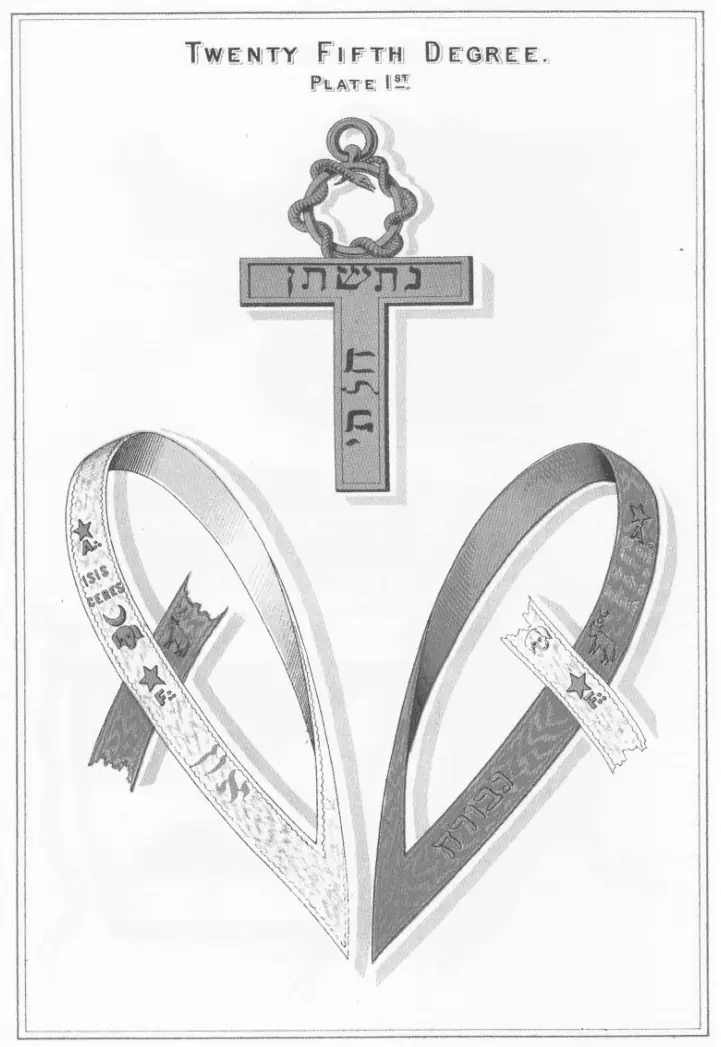
La L∴ s’appelle Cour de Sinaï le Vble∴ qui la préside se nomme Très Puissant Gd∴ Me∴ les FF∴ 1er∴ & 2e∴ Survts∴ 1er∴ et 2e∴ Ministres l’Orateur Gd∴ Pontife le secrétaire Gd∴ Ciseleur il y a au-dessus un Gd∴ Trésorier un F∴ Examinateur & un F∴ Voyageur tous les FF∴ indistinctement ont le titre de Chev∴ ils781 781 sont décorés d’un cordon rouge en sautoir sur lequel sont brodés ces mots
Vertu & Courage. ( Voyez la planche figure )
Le Bijou suspendu à l’extrémité du cordon est un serpent
d’airain autour d’une baguette d’or terminée en croix ( Voyez P. fig )
Ouverture des Travaux
Tous les Chev∴ étant à leurs places respectives le T∴ P∴ Gd∴ Me∴ frappe 9 coups par 5 3 & 1 avec le pommeau de son épée sur l’Autel & dit :
F∴ 1 er∴ et 2 e∴ Ministre, où se réunissent les Chev∴ du D∴ Serpent d’Airain, le 1er∴ :sur le Mont. Le 2e∴ : Sinaï
Le T∴ Puissant Gd∴ Me∴ dit : D∴Quel est v tre∴ devoir F∴ 1 er∴ M tre
R∴ C’est de m’assurer si tous les Chev∴ présents dans la Cour de Sinaï se portent bien. Faites-vous en assurer FF∴ 1 er∴ & 2 e∴ M tres
Les Ministres ayant reçu le Mot Sacré sur leurs colonnes
respectives le 1er∴ dit : T∴ Puissant Gd∴ Me∴ les Chev∴ qui bordent Folio 254 recto
Folio 253 verso
les rangs du Nord et du Sud, ont vu le Serpent d’Airain et sont parvenus d’eux-mêmes sur la montagne de la Vertu. A quelle heure s’ouvre notre cour F∴ 2 e∴ Ministre ? D∴ A une heure F∴ Prince 782 Gd∴ Me∴. Puisque la santé de nos FF∴ R∴ n’est plus en danger et que l’heure de nos conquêtes est venue annoncez aux Chev∴ qui bordent les rangs du Nord & du Sud, qu’au 1 er∴ coup de mon glaive
Les deux Ministres annoncent la Cour de Sinaï sera ouverte. alternativement l’annonce le T∴ P∴ Gd∴ Me∴ frappe un coup de son glaive & dit : Debout et à l’Ordre Chevrs∴tous se lèvent se mettent à à l’ordre font le Signe & la Batterie puis le Gd∴ Me∴ dit :
La Cour de Sinaï est ouverte prenez place mes FF∴
Réception
Au milieu de la L∴ doit être une espèce de cône fabriqué en planches tronquées par le haut de manière qu’un homme puisse alternativement 783 se tenir debout, le cône doit avoir environ six pieds de diamètre à la base et il doit être au moins de 5 pieds de hauteur, on peut le peindre comme si c’était un rocher escarpé quoiqu’il soit en effet très uni. Quand le Cand∴ a été proposé et que la Cour l’a jugé digne d’obtenir la grade qu’il demande le F∴ Voyageur le fait mettre dans le cabinet noir ensuite sur l’ordre du T∴ Puissant Gd∴ Me∴ il fait déchausser le Cand et lui entoure le corps avec de fortes chaînes de fer dont le poids doit toujours excéder trente livres. Le F∴ Voyageur amène après cela le Cand∴ pieds nus à la porte de la Cour où il frappe sept coups. = Le T∴ Pt∴ Gd∴ Me∴ dit : F∴ 1 er∴ & 2 e∴ Ministre, informez-vous de ce que veux l’imp t∴ qui ose se présenter au pied du Mont Sinaï.Le 1er Ministre transmet la demande au 2e∴ qui la fait au F∴ Examinateur et la réponse revient de même au premier qui dit : T∴ Puissant Gd∴ Me∴ c’est
un Prince du Tabernacle qui demande à parvenir sur la montagne mystérieuse.
D∴ Demandez-lui s’il peut nous guérir du mal contagieux qui nous dévore & s’il en a la volonté. La réponse parvenue au 1er∴ Me∴ il dit : 784 Cela étant Chevaliers, faisons notre devoir : aussitôt tous les Chevaliers
se couchent sur les colonnes comme s’ils étaient malades, le F∴ Pr∴ 785 s’assied sur un coussin la tête appuyée sur la main gauche puis il dit :
Faites donner au Cand∴ l’entrée de la Cour. Le F∴ Voyageur introduit le Cand∴
le T∴ P∴ dit : Tu vois mortel l’état de souffrance dans lequel
nous sommes tous plongés, une maladie contagieuse plane sur les enfants d’Israël, et la mort fait parmi nous d’affreux ravages toi seul peut nous secourir, si ton âme est pure et si tes forces sont suffisantes gravis cette montagne escarpée tu trouveras dessus son sommet l’herbe salutaire qui peut seule nous donner 786 la vie
D∴ Te sens-tu le courage de tenter l’épreuve. R∴Oui. Monte donc il est temps. Le Cand∴ essaye de monter sur le
cône, mais le poids de ses chaînes l’en empêche, si cet obstacle n’était pas assez grand le F∴ Voyageur doit avoir soin de le retenir sans qu’il
∴∴∴
∴∴∴ ∴∴ Folio 254 recto
s’en aperçoive soit par ses chaînes ou par le bout de la corde le Très Puissant dit : Insensé, comment veux-tu vaincre les obstacles
qui t’arrêtent tant que tu seras chargé de chaînes, demande à ton guide l’euphorbe qui a le pouvoir de rompre le fer tu recouvreras la liberté787 787
Le F∴ Voyageur frappe les chaînes avec une tige d’euphorbe artificielle et les lui ôte ensuite. Le T∴ P∴ dit : Tu peux maintenant arriver
au sommet de Sinaï ne crains plus rien. Le Cand∴ monte sur
le cône le T∴ Pt∴ dit :
D∴ Eh ! bien qu’aperçoit-tu ?
R∴ J’ai vu un serpent d’airain qui mange une herbe. Empare-toi de ce reptile sans rien craindre et descend aussitôt
de la montagne,le Cand∴ prend le serpent d’airain, descend de la montagne l’attache à une baguette terminée en croix que lui présente le F∴ Voyageur Le T∴ P∴ lui dit : Élève ce trophée et voyage trois fois autour de la montagne. Le Cand∴ fait trois fois le tour de la montagne et tenant le serpent d’airain élevé tous les Chev∴ paraissent recouvrir la santé et se lèvent le T∴ Puissant se remet à sa place & dit : Nous
sommes satisfaits nous t’avons délivré de la captivité tu nous arraché788 788 à la mort certaine, la liberté vaut la vie, viens cependant recevoir le prix de notre reconnaissance F∴ Voyageur amenez le Cand∴ au pied de l’Autel pour y prêter son obligation. Il lui fait faire789 789 le genou gauche à terre la main droite sur le glaive, le T∴ P∴ dit : Prête avec moi ton obligation :
Serment
Je jure sur ce que j’ai de plus cher au monde sur l’honneur de ne jamais révéler les secrets de ce sublime grade sans y être autorisé et je consens si je fais jamais de mal directement à un de mes FF∴ d’être d’être 790 poignardé. Amen.
Le T∴ Puisst∴ lui met un glaive sur la tête & dit :
Au nom de Dieu, sous les auspices du Gd∴ Me∴ de l’Ordre et en vertu des pouvoir qui m’ont été donnés par le Suprême Conseil du 33 e degré et par cette cour souveraine, je vous crée et constitue Chev∴ du Serpent d’Airain, pour par vous jouir des prérogatives attachées au 25 e g de de la Maçonnerie Écossaise. Il frappe 7 coups sur l’épée avec la main Relevez-vous mon F∴ reprenez votre chaussure vous êtes Chev∴
libre, venez recevoir le baiser de l’amitiéle T∴ Puissant l’embrasse quand il a remis sa chaussure et lui ceint un glaive en disant
Le glaive est le symbole de nos conquêtes rappelez-vous que l’esprit divin vous anime dans ce moment et ne tirez jamais ce fer que pour servir votre patrie, faites respecter nos mystères et portez la loi du Très Haut au bout de l’Univers, souvenez-vous aussi que si un de nos FF∴ est jamais captif vous devez lui rendre la liberté au prix de votre vie Voici maintenant la Marche les Signes Folio 255 recto.
Folio 254 verso
Paroles et Attouchements du grade, la marche se fait par sept 791 pas en serpentant, l’Ordre est d’indiquer avec l’index de la main droite comme pour désigner une plante.
Le Signe est de faire un signe de croix. Le Mot de Passe est : INRI. Le Mot Couvert, Johannes. Ralp. Le Mot SacréMoïse. Il s’épelle. L’Attouchement se fait étant à la droite de l’examinateur
en lui prenant le poignet gauche avec la main droite.
Ensuite on l’envoie le faire aux FF∴ 1er∴ et 2e∴ Mtres∴ après cela le T∴ Puissant fait applaudir à l’initiation du nouveau Cand∴ le F∴ Voyageur remercie avec lui, tous les Chevaliers étant à leurs places, le nouvel initié à côté du T∴ Pt∴ pour cette fois seulement le F∴ Pontife demande la parole, à moins que le T∴ Puissant veuille lire le discours suivant lui-même.
Discours historique
Les Israélites ayant mérité la punition du ciel par leurs crimes Dieu les frappa de la peste dans le désert, il en périt un nombre considérable Cependant Moïse se rendit sur le Mont Sinaï il invoqua le T∴ Puissant pour faire cesser les maux affreux répandus sur son peuple à peine sa prière était-elle finie qu’il apparut un grand serpent qui se glissait entre les broussailles, il le suivit doucement il fut témoin d’une chose extraordinaire arrivé sur un large quartier de roc le serpent s’étant arrêté Moïse vit près de lui un autre serpent qui ayant reçu plusieurs blessures d’où le sang sortait avec abondance était sur le point d’expirer il vit le premier qui s’était offert à ses yeux frotter à plusieurs reprises le corps de celui qui était malade avec une herbe dont il ignorait le nom et ce dernier revenir à lui & agir comme s’il n’avait jamais été malade et s’enfuir avec son bienfaiteur en poussant des sifflements de joie, Moïse s’empressa de ramasser cette plante précieuse la referma dans son sein et se rendit dans son camp auprès des Israélites, ce sage observateur alla trouver un vieillard malade la lui posa légèrement sur les ulcères enflammés et il le vit à sa grande satisfaction se lever de lui-même et montrer tous les signes de la santé. Moïse ayant obtenu un si grand succès remercia le Seigneur qui avait exaucé ses vœux, il divisa le brin d’herbe en deux parties en donna une au vieillard et après avoir fait la même opération sur tous les Israélites ils se convainquirent que la contagion avait totalement cessée et au bout de trois jours il ne resta plus aucune trace de ce fléau, Moïse ordonna aux Israélites de rendre des actions de grâces au Tout Puissant, et en mémoire de la
Folio 255 recto
guérison qu’il avait obtenue il fit un grand serpent d’airain qu’on promena dans le camp après l’avoir fixé autour d’une large pièce perche en forme de croix c’est ce qui a fait dire que la vue du serpent d’airain avait opéré la guérison des Israélites le serpent fut longtemps conservé dans les trésors de Moïse. Ce fut quelque temps après cet événement que Moïse quelques amis fidèles s’attachera et entre autres le vieillard afin de les initier dans les sciences qu’il possédait il lui 793 expliqua comment il avait acquis l’herbe dont le serpent n’était que l’emblème et il les conduisit sur le Mont Sinaï pour aller à sa recherche, telle est la traduction794 794 qui fut transmise d’âge en âge au peuple jusqu’à l’époque de la première croisade à laquelle remonte l’origine des Chevaliers du Serpent d’Airain. Quelque temps après la prise de Jérusalem les croisés ayant été chassés de la Terre Sainte plusieurs d’entre eux se retirèrent dans les vastes déserts d’Égypte, durant le voyage ils parvinrent à délivrer un grand nombre de leurs compagnons d’armes qui étaient tombés au pouvoir des Infidèles. L’histoire rapporte que le combat le plus sanglant et le plus mémorable qu’ils livrèrent aux barbares dura depuis une heure jusqu’à 4 heures du soir ainsi les valeureux guerriers conservèrent-ils toujours dans l’institution qu’ils formèrent le souvenir de ces heures mémorables quand ils eurent vaincu les ennemis, les Croisés marchant vers les sources de Moïse, ils y arrivèrent au nombre de 300 et se dirigèrent ensuite vers le Mont Sinaï sur lequel ils construisirent un couvent qui existe encore de nos jours Ces pieux chevaliers animés par la foi et remplis d’un noble courage se dévouèrent entièrement à l’étude des sciences au culte du vrai dieu, et à la délivrance des cond re∴ captifs, ils choisirent pour les le seigneur Jean de Ralp qui par sa valeur et ses vertus était digne de leur confiance Connaissant la traduction795 795 dont nous avons parlé, et se trouvant sur le Mont Sinaï où Moïse avait trouvé l’herbe au serpent d’airain ils instituèrent le sublime grade que nous possédons. Le Gd∴ Me∴ fit des règlements et fixa les obligations que chacun aurait à remplir il exigea d’eux un serment terrible, cent Chev∴ du Serpent d’Airain devaient pendant six mois se porter sur les confins de la Palestine afin de protéger les pèlerins et d’arracher de l’esclavage ceux que les Infidèles avaient réduits à la captivité, les six mois expirés ils revenaient au Mont Liban ils étaient remplacés par d’autres, ces Chevaliers s’occupaient à la recherche des simples, et autres herbes précieuses propres à confectionner des remèdes spécifiques, le reste des Chev∴ s’occupaient à des exercices de piété tous les ans ils députaient 4 missionnaires chargés de prêcher la morale de la Folio 256 recto
Folio 255 verso
religion chrétienne dans les 4 parties du monde, ces missionnaires revenaient au Mont Sinaï, le temps limité pour être remplacés par d’autres ils admettaient à l’initiation, des Chev∴ chrétiens délivrés par les Chev∴ qui par leurs vertus étaient jugés dignes de cette faveur ainsi fut fondé l’Ordre des Chev∴ du Serpent d’Airain qui depuis reprit vigueur en Écosse et qui constitua le 25 e g de∴ de la Maçonnerie Écossaise.
Catéchisme
D∴ Êtes-vous Chev∴ du Serpent d’Airain ? R∴Oui je le suis. Quel motif v∴ a porté à v s∴ faire recevoir ? R∴Le seul plaisir de porter le joug de mes FF∴. D∴
D∴ N’avez-vous pas un autre motif ? R∴Animé de l’esprit de venger notre patrie à faire respecter nos mystères et à porter la loi du Très Haut aux 4 parties du monde, m’y ont déterminé.
D∴ Pourquoi faites-vous 9 pas en serpentant ?
R∴ Pour montrer que nous sommes parvenus qu’avec peine et persévérance dans le bien. D∴Que désignent les chaînes ?
R∴ Le titre de ce grade qui est de délivrer les captifs. Comment se nomme le président de la Cour ? R∴T∴ Puissant Gd∴ Me∴. D∴ Comment nomme-t-on les Survts∴ ? R∴1 er∴ & 2 e∴ Ministre. D∴
D∴ Quel est l’attouchement ?
R∴ Il se donne étant à la droite de l’examinateur en lui prenant le poignet gauche avec la main droite, il y répond de même en prenant le poignet droit avec la même main.
D∴ Quel est l’Ordre ?R∴D’indiquer la terre avec l’index comme pour désigner une plante.
D∴ Quel est le Signe R∴De faire le Signe de la Croix.
D∴ Quel est le Mot de Passe R∴INRI. Qui désigne qu’on est R∴∴.
D∴ Quel est le Mot Couvert. R∴Johannes Ralp. fondateur de l’Ordre.
D∴ Quel est le Mot Sacré R∴Moïse
D∴ Comment se donne-t-il R∴En épelant.
D∴ À quelle heure s’ouvre la Cour R∴À une heure.
D∴ À quelle heure se ferme-t-elle ? À quatre heures 796 à laquelle nos conquêtes furent accomplies. R∴
D∴ Quelle est la Batterie ? 5 coups lents 3 précipités et 797 en tout 9. coups. R∴
D∴ Quelle est la devise des Chev∴ du Serpent d’Airain ?
Vertu & Courage. R∴
Que signifie le Buisson Ardent avec le Temple 798? D∴
Dieu. R∴
Que signifie l’unique flambeau qui est à 799 la Cour ? D∴
Dieu. R∴
D∴ Que signifie le Serpent d’Airain ?
Dieu R∴
Folio 256 recto
Clôture
Le T∴ Puissant Gd∴ Me∴ frappe 9 coups du pommeau de son
épée & dit : FF∴ 1 er∴ & 2 e∴ Surveillants et Ministres demandez aux Chev∴ qui bordent les rangs du Nord au Sud si leurs recherches sont finies.L’annonce faite le 1er∴ Ministre dit : Très Puissant Gd∴ Me∴ le silence règne sur les deux rangs les Chevaliers ont trouvé ce qu’ils cherchaient FF∴ 1 er∴ et 2 e∴ Ministres assurez-vous si les Chev∴ qui vous sont soumis ont
recouvré la santé.Sur l’annonce du 2e∴ Ministre le 1er dit :
Très Puissant Gd∴ Me∴ tous les Chevaliers n’ont plus rien à désirer A quelle heure se ferme notre Cour F∴ 2 e∴ Ministre ? D∴ A quatre heures T∴ Pt∴ Gd∴ Me∴ heure à laquelle nos R∴
conquêtes furent accomplies.Le T∴ Puissant dit :
L’heure du repos étant arrivée joignez-vous à moi Illustres Chevaliers pour m’aider à fermer la Suprême Cour de Sinaï.
Tous font le Signe et la Batterie puis le T∴ P∴ G∴ Me∴ dit :
Les Travaux de la Suprême Cour de Sinaï sont fermés, Chevaliers la paix soit avec vous Folio 257 recto.
Folio supplémentaire LX
Apparat critique de l’édition Latomia
780. Erreur du copiste A : anticipation de la ligne suivante.
781. Kloss et Pyron 1812 précisent qu’ils sont armés d’un glaive.
787. Kloss et Pyron 1812 rajoutent ici : « F∴ voyageur venez à son secours ».
788. Erreur du copiste A : lire « arraches », cf. Kloss et Pyron 1812.
789. Erreur du copiste A : le mot exact est « mettre », cf. Kloss et Pyron 1812.
790. Erreur du copiste A : doublon.
793. Erreur du copiste A : le pronom exact est « leur », cf. Kloss et Pyron 1812.
794. Pyron 1812 utilise le même mot. Kloss corrige en « tradition ». « Traduction » peut avoir ici le sens de son synonyme « version ».
800. Erreur du copiste A : le mot exact est « Trinitaire », cf. tuileurs ( Vuillaume, Delaulnaye)
801. Même si les descriptions de cette page sont semblables à celles de Kloss et Pyron 1812, les expressions utilisées sont différentes, alors que les textes de Kloss et Pyron 1812 sont rigoureusement identiques. Cela implique que le texte recopié par Quesada est d’une origine différente.
Delaulnaye 1813
tuileur imprimé · 400 mots
Le « Thuileur des trente-trois degrés de l'Écossisme » de Delaulnaye (Paris, 1813), premier tuileur imprimé du REAA constitué : mots, signes, décors et remarques du grade. Texte relu mot à mot sur le fac-similé, mots hébreux restitués. Pages 174-179 de l'édition originale.
Tenture Rouge. On aperçoit le buisson ardent, au milieu duquel est le Iehovah.
Une seule Lumière.
Titres.
La Loge se nomme Cour du Sinaï ; le Chef est appelé Très-Puissant-Grand-Maître ; les Surveillants, premier et second Ministres ; l'Orateur, Pontife ; le Secrétaire, Grand Ciseleur, et tous les Frères Chevaliers. Il y a un Examinateur, un Voyageur, etc.
Signe.
Celui de la Croix.
[p. 175]
Ordre.
Indiquer la terre avec l'index, comme montrant une plante.
Attouchement.
Se placer à la droite de celui que l'on thuile, et lui prendre le poignet gauche avec la main gauche. On répond en prenant le poignet droit du Frère avec la main droite.
Batterie.
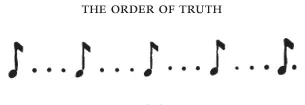
Neuf Coups, par cinq lents, trois précipités, et un, avec le pommeau du glaive.
○ ○ ○ ○ ○——○ ○ ○——○
Marche.
Neuf pas en serpentant, pour montrer qu'on ne parvient au but qu'avec peine et par la persévérance dans le bien.
[p. 176]
Mot Couvert.
JOANNES RALP, nom du fondateur de l'ordre.
Mot Sacré.
Moyse, hébr. MOSCHEH, מֹשֶׁה.
(assumptus)
Mot de Passe.
I·N·R·I, qui prouve que l'on a reçu le titre de Rose-Croix.
Heure.
La Cour s'ouvre à une heure, et se ferme à quatre, heure à laquelle ses conquêtes furent terminées.
Cordon.
Rouge, en sautoir, sur lequel est brodé Vertu et Courage.
[p. 177]
Bijou.
Le Serpent d'Airain, entortillé autour d'une croix.
Les chaînes qui couvrent le Récipiendaire, et dont le poids doit être au moins de trente livres, désignent que le but de ce grade, est la délivrance des captifs.
Le plaisir de porter le joug de nos Frères, en nous ressouvenant qu'ils sont nos semblables, et que nous ne pouvons tous être blessés que des mêmes traits, doit nous déterminer à recevoir ce grade. Nous devons être en outre animés par l'esprit divin à venger notre patrie, à faire respecter nos mystères, à porter la loi du Très-Haut aux quatre coins de l'univers, etc.
Le Serpent d'Airain, élevé par Moïse pour guérir les Israélites de la morsure des serpents, devint dans la suite l'objet de leur idolâtrie. Son nom hébreu est NECHUSCHTHAN נְחֻשְׁתָּן,
[p. 178]
qui signifie à la fois Æneus, Serpens et Augurans, parceque la superstition des Juifs en tiroit des oracles. Ézéchias, roi de Juda, le fit mettre en pièces (RÉG. l. 4, c. 18, v. 4).
[p. 179]
Vuillaume 1820
tuileur imprimé · 418 mots
Le tuileur de Claude-André Vuillaume, « Manuel maçonnique, ou Tuileur de tous les rites de maçonnerie pratiqués en France » (Paris, Delaunay et Hubert, 1820) : décoration, titres, signes, attouchement, marche, batterie, âge, mots, habillement du grade, avec l'étymologie et l'interprétation des mots hébreux. Texte établi sur le fac-similé et relu mot à mot sur les images : océrisation à 600 dpi du volume numérisé, fusion avec la couche texte de la numérisation Gallica, puis relecture page par page. Orthographe de 1820 conservée, hébreu et grec restitués, batteries rendues comme l'imprimé les note, pagination de l'original. Pages 168 à 170.
Au-dessus du trône est un transparent où l'on voit un buisson ardent, au milieu duquel est Jehovah.
Au milieu de la loge est une montagne haute d'environ cinq pieds, elle a la forme d'un cône tronqué.
Un seul flambeau ou torche éclaire la loge.
TITRES.
La loge se nomme la cour de Sinaï.
Le président prend le titre de Très-puissant grand-maître ; les surveillans, celui de Ministres ; l'orateur, celui de Pontife ; le secrétaire est nommé Grand Ciseleur, et tous les frères sont qualifiés Chevaliers.
Il y a en outre un Examinateur ; le récipiendaire est un Voyageur.
[p. 169]
SIGNES.
D'ordre. — Incliner la tête, et indiquer un objet à terre, avec l'index de la main droite ;
De reconnaissance. — Faire le signe de la croix sur soi-même.
ATTOUCHEMENT.
Se plaçant à la droite du Tuileur, lui prendre le poignet gauche avec la main gauche ; en réponse, le Tuileur prend le poignet droit du premier avec la main droite.
BATTERIE.
Neuf coups, cinq lents, trois précipités et un séparé : ○ ○ ○ ○ ○ — ● ● ○ — ○ !
MARCHE.
Neuf pas en serpentant.
HEURES DU TRAVAIL.
La cour s'ouvre à une heure et se ferme à quatre.
HABILLEMENT.
Cordon rouge en sautoir, sur lequel est peinte ou brodée la devise : Vertu et courage.
Le bijou est un serpent entortillé autour [p. 170] d'une baguette terminée en T. C'est l'image du serpent que Moïse fit élever dans le camp des Israélites, et dont la vue avait la vertu de guérir la morsure des serpens dont ils avaient été poursuivis dans le désert (Nomb., chap. 21, vers. 9). Le serpent d'airain avait été, depuis, conservé avec soin dans le temple ; mais, comme il devint dans la suite un objet d'idolâtrie pour les Juifs, Ezéchias, roi de Juda, le fit mettre en pièces ; et, dans son indignation, le nomma נְחֻשְׁתָּן (nehhus'tan, æneus serpens) vieux cuivre à mettre à la fonte ; vile matière. (Rois, 4 chap. 18, vers. 4.)
MOT DE PASSE.
J. N. R. J.
MOT COUVERT.
JOHANNES RALP ; c'est le nom du fondateur de l'ordre.
MOT SACRÉ.
MOÏSE. Il s'épelle. (héb. מֹשֶׁה moscheh, assumptus.) Il fut le chef et le législateur des Hébreux. Il mourut sur la montagne Nebo. (Deut., chap. 34.) On n'a jamais pu découvrir le lieu de sa sépulture. On fixe l'époque de sa mort au dernier jour de la lune d'Adar, dernier de l'an du monde 2553, et 1451 avant Jésus-Christ.
Pike 1857
rituel imprimé · en anglais · 41 864 mots
« The Magnum Opus or Great Work » (1857) : le premier corps complet de rituels révisés par Albert Pike pour la Juridiction Sud des États-Unis. Texte en anglais, établi par reconnaissance optique corrigée : des coquilles subsistent.
D'après la réimpression Kessinger de l'édition de 1857 (numérisation archive.org)
THE LODGE: ITS DECORATIONS, ETC.
The Lodge, in this Degree, is styled The Council; and represents that held near Mount Sinai, when the New Moon occurred at the Vernal Equinox, in the last year of the journeying of the children of Israel in the desert. The hangings are red and blue. In the East is a throne, over which is a transparency; and on that is painted « burning bush, having in its centre the word mirv. Besides this transparency, the Lodge has seven lights, extending from East to West, and the centre one being 3 great globular light in the centre of "the room,.representing the sun. The other lights are of was, three on each side of the central light; and over the seven are suspended the following emblems, arranged from Bast to West:.. hk... Y...%
se Does 9 oe. Bue eo Ds. thais,... Sarunzy, Jupiter, Mars, Taz Sun, Venus, Mercury, Txz
'Moon.. Around the Lodge are twelve columns, each having on its capital one of the zodiacal signs, commencing in the East with Taurus, and going round by the North, West and South in regular order.
In the North is o painting, representing Mount Sinai, with the tents of the Hebrews in the foreground. The Lodge is supposed to be in the open air, at daybreak, in front of the tent of Moses, where he gave audience to the people who came to prefer their complaints and grievances. The arched ceiling overhead should represent the morning sky. °
Over the seat of the Presiding Officer is a winged globe encircled by 2 Serpent: and on each side of him is a short column on which is a Serpent, his body coiled in folds, and his head and neck erect above the folds.
_ 'The Presiding Officer represents MosEs and OSIRIS, and is styled Most Potent Leader. He sits in the East, 'The Senior Warden represents Josava and Horus, and sits on his right. The Junior Warden represents 'Carzy, or Anuses, and sits in the West. He is styled Lieutenant Commander, and the Sen. ~ Warden, Com- _ mander of the Host, The Orator is styled High Priest, represents Erzazar and Onion, and sits in the South.
The Secretary is styled Register, and sits on the right of Joshua. The Treasurer sits on the left of the Presiding officer. The Sen.*. Deacon is styled Examiner, and the Junior Deacon, Archer.
: The order is a crimson ribbon, on which are embroidered the words, one under the other, . . OSIRIS...
ORMUZD :.» OSARSIPH . . MOSES . . and under them a Bull, with a disk, surmounted by a crescent,
"between his horns. This is worn from left to right: and across it, from right to left, is worn s brood, white, watered ribbon ;. on which are the words .. ISIS .; CERES .. over a dog's head and a crescent. On the right breast, on the left breast, and at the crossing of these orders is a star of gold. Under that on the right breast is the letter A.°. [for Aldebaran]: under that on the left breast the letter A.~. [for Antares]: and under that at the crossing of the orders, the letter F.*. [for Fomalhaut]. On the crimson cordon is the word n'133 '[GBURH—Valor] ; 3 and on the white, }iX & [An—Virtue] . . meaning Active Energy, or Generative power,
and Passive Energy or Capacity to produce.
- The jewel is a Tau-Cross surmounted by a circle,—the Cruz Ansata,—round which a. serpent is entwined.
XXV. se 2
On the cross is engraved the word 'nun (KuaLaTI; He has suffered or been wounded], on the upright part of the cross: and on the arms the word Jnim), [NeKuuSuTaN . . the brazen serpent].
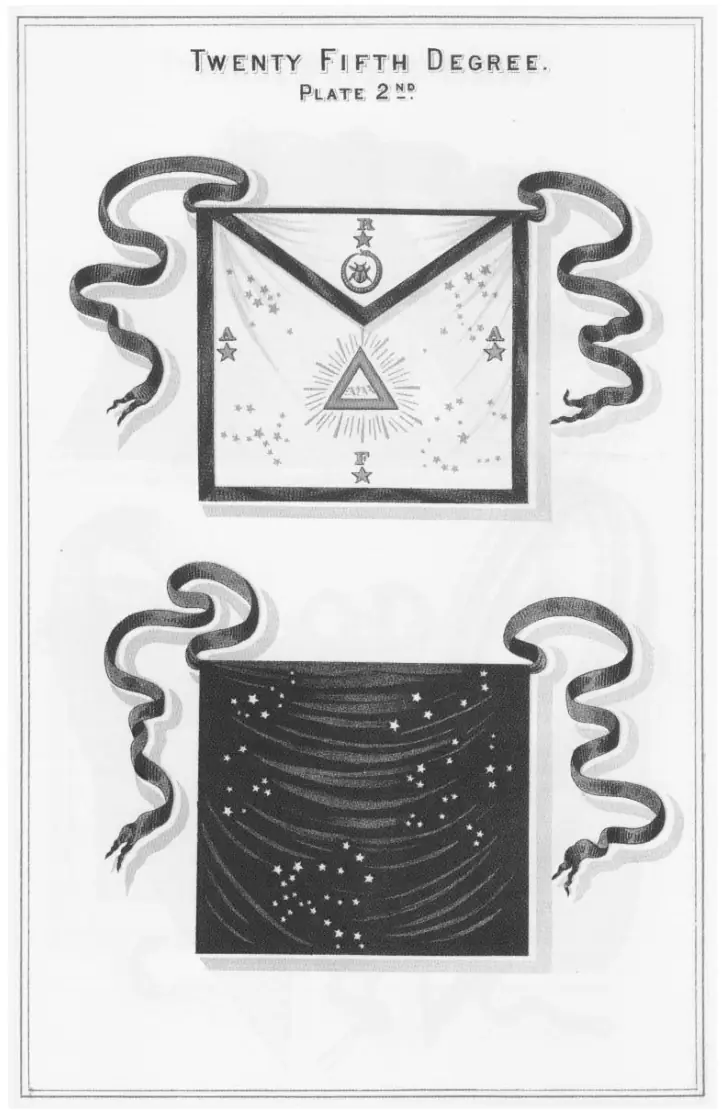
The apron is white, lined and edged with black; the white side spotted with golden stars, and the black aide with silver ones. Those on the white side represent, by their positions and distances, the Pleiades, the 'Hyades, Orion and Capella. Those on the black side represent the stars of Perseus, Scorpio and Bootes. 'In the middle of the white side is a triangle ins glory, in the centre of which is the word min'. On the flap is a serpent in a circle, with his tail in his mouth, and in the centre Of the circle so formed, a scarabmus or beetle. Over this is a star of gold, with the letter R.-. [Regulus] over it: on the right side of the apron another, with the letter A.*. [Aldebaran] over it; on the left side another, with the letter A.-. Ldnéares] over it: and at the bottom of the apron another, with the letter F.-. [Fomalhaut] over it.
The battery is z — by i slow ; quick and,
T0 OPEN.
If. P.. Brethren, Princes of the Tabernacle and Knights of the Brazen Serpent, if the day and the hour have arrived, I propose to open here a Council of Knights of the Brazen Serpent, for mutual instruction and the performance of the necessary duties. Be clothed; and await, each in his place or station, the customary orders.
[The brethren are clothed, and the officers assume their stations].
Af. P.. Bro.*. Examiner, it is our first duty to see that we are secure from intrusion. See that the
guards are set, and inform them that we are about to open this Council, that they may keep watch and ward as they should do.
: Sen. D.. Bro. Archer, set the guards without the doors of the Council, and. advise them that it is about to be opened; that they may keep watch and ward as they should do, and allow none who are not entitled to approach.
" [The Archer goes out, returns, gives the alarm of the degree, which: is:answered:from without, and. . reports]:
Jun. D.*. Most Respectable Examiner, the guards are posted, and duly informed as to their duties, and
We are secure against intrusion.
Sen... D.. M.". Potent Leader, the guards are posted, and duly informed as to their duties; and we are
secure against intrusion.
Mf, Po. Bro. Lt, Commander, are all present Knights ofthe Brazen Serpent? Be certain of that,
by receiving the pass-word from each.
(The Jun... Warden goes round, receives the pass-word from each Brother, returns to his place, and
says]:
'Jun. We. Mo. Pi, Leader, all present have the Pass-word, and I recognize them as Knights of the
Brazen Serpent.
Al'. P.. Thanks, my Brother! Bro., Commander of the Host, what is the hour?
Sen.. IV... Most Potent Leader, it is the break of day, of the morning of the Vernal Equinox. The God-like child sits upon the waters in the gates of the Orient, not yet arisen; while the Earth awaits to rejoice at the blessing of his smiles. The Circle surmounted by the Crescent.shines in the Heavens; and in the sign of the Celestial Bull, House of Venus and place of the Moon's Exaltation, the Sun, mighty with a new life, and the New Moon are in conjunction, and open the New Year and the Chaldean Saros: while,
'plushing and reluctant, the beautiful Star Amalthes rises with the Sun in the East.
Mt. P.. If that be the hour, its time to open this Council. Whom does our brother Eleazar represent
Rigel at his feet, and i in his belt three Kingly Stars, known of old time to mariner and husbandman: Orton,
AV... 8
' visible to all the habitable world; who follows the Celestial Bull, and: with him comes to the Meridian, ever in vain pursuit, enamored of Merope, who with her sister Pleiads ever floes before her ardent lover.
Mf. P.. Whom does our brother Caleb represent here?
Seno. We. Srrivs, called by the Egyptians Anubis and Sprats, and by the ITebrews Cares Anupacd ; who, as the Sun enters the Celestial Bull and meets the joyous Pleiades, sweet Virgins of the Spring, rises with the King of Day, and doubles the activity of his fires and his solstitial ardour; who, rising with Cancer, will at the Summer Solstice bring enervating heat, fever and hydrophobia, and the Etesian winds; and with his setting, sharp cold, and frosts, wrinkling earth's haggard face, and chilling the blood in all her ancient veins.
Mf. P.. And whom do you, my Brother, represent here?
Sen., W.. Torus, the son of Isis and Osiris; before whom Syphon the Malignant Serpent of the Northern Pole and Power of Evil fees aghast, and sinks in the dark Western Ocean, as Aldebaran leads the starry armies of Heaven up the sky's eastern slope, and the dogs of Orion climb upward, straining at the leash, while the foul Scorpion shudders on the world's western edge, and hears the loud bay of Orion's hounds, Sirius and Procyon, urging her to the fatal plunge.
Mf-. P.. Whom does the Most Potent Leader represent ?
Sen.*. W.:. Osiris, King of the Starry influences of Light and Life; Ormuzo, Great Principle of Good ; Arrs, Adonis, Diowusos, Backus, Arot.o;—all Deities that in all ages have represented with most feeble expression the Divine Source of good, the Eternal, [Infinite, Incomprehensible, Father of Light and Life.
M.. P., Alas! Iam his most feeble and inconsiderable creature; and even as I am, sois the Sun of Spring, that the Ancients deemed a God and the Source of life and generation; and so were Osiris, Ormuzd, Ttys, Saba-Zeus, Be and Amun, and all the mighty Deities imagined by those who watched the stars in Ethiopia and Egypt, on the Chaldean plains and upon the slopes of the Himalayas Mountains, Iam but a poor, feeble, erring, fallible man, who need your aid, my brethren, your countenance, your encouragement, - "your counsel, to enable me to perform aright the duties that hers devolve upon me. Bro... Com. of the Host, "are you a Knight of the Brazen Serpent?
Sen.", Wo. M.-. Potent, I know the meaning of the Cross around which twines the Serpent, and of the coiled basilisc. ;
; U.. P., Where obtained you that degree?
Sens. Wo. Ina legal Council of Knights of the Brazen Serpent, held in a Place representing the open - space in front of the Tent of Moses near Mount Sinai.
Hf. P. When was the first Council of Knights of the Brazen Serpent held?
Ans:*, In the fortieth year of the journeying of the people of Israel, at the Vernal Equinox, when the days of Moses were almost an hundred and twenty years, and the end of his pilgrimage drew nigh; and when the people of Israel murmured and complained that he had brought them up from Egypt to die there in the wilderness.
Qu.", At what hour?
Ans... At the first dawn of day; when Aldebaran, preceded by Orion and his dogs, led up the glittering
host of Heaven in the East, and Capella gleagzed also on the Eastern margin of the Desert; while low in the West Antares shone malignant, and Fomalhaut ' the South looked calmly on the land of Canaan:—when the people were gathering the manna, and the cloud still rested on the Tabernacle.
Qu.'. - What are our duties, as Knights of the Brazen Serpent?
- Ans..: To purify the soul of its alloy uf earthiness, that through the gate of Capricorn and the seven spheres it may at length ascend to its eternal home beyond the Stars; and to preserve and perpetuate the
great truths enveloped in the symbols and allegories of the Ancient Mysteries.
M:. Ps. That we may perform these duties, Valiant Commander of the Host, it is my pleasure that
this Council be now opened. This you will make known to the Exc.*. Lt, Commander, and he to the Knights,
that all may have due notice.
Sens. We. Exe.*. Lt.. Commander, it is the pleasure of the M.°. Potent Leader, that this Council be now
13p
opened, in order that the duties incumbent upon us here may be performed. This yon will make known to the Knights, that they, having due notice, may aid in opening the same.
Jun'. We, (Rapping; ] Knights and Masons, you will be pleased to give duo attention, while the BL', Potent Leader with our aid opens this Council; that we may here proceed to perform the duties that devolve upon us.
Mf. P.. Let the Seven Mystic Lights dispel the darkness of the Council!
{The Jun.*. Warden lights in succession the three lights on the West of the Central Light, ssying, os
he lights each, beginning on the West, as follows] :
June. We. The Moon shines in our Council; and over it presides the Archangel Tsars-At, the mesgen-
her of God:
MERCURY shines in our Council; and over it presides the Archangel Rern-At, the Healing Influence
of God:
' 'Venvs shines-in our Council; and over it presides the Archangel Kamanr-Az, the Merciful Kind-
less of God.
(The Sen.-. Warden then lights in succession the three lights on the East of the Central Light, saying,
as he lights each, beginning in the East, as follows] :
Sen. Wor. Saturn shines i in our Council; and over it presides the Archangel Micn-Ax, the Semblance
ond Image of God:
JcPriter shines incur Council; and over it presides the Archangel Genre-AL, the Strength and
Mightiness of God:
Sars shines in our Council ; and over it presides the Archangel Aurt-At, the Light and Tire of God,
[Then the M.*. P.-. advances and lights the Central Light, saying] :
Mt. P.. The Sex, the newly risen Ostais, the beneficent Onuczp, Type of the Principle of Good and Light, and feeble and imperfect image of the Deity, shines in our Council; and over it presides the Archangel Zerexul-AL, the Rising of God, the Sun of Righteousness." .
[Then the M.+. P... returns to his place, and says, "The Sign, my Brethren!" All give the sign: then the M.°. P.*. raps |[ slow — ; quick and , —— and each Warden does the same in succession; and the M., P.-.
-declares the Council to be duly opened].
Reception.
The Candidate is prepared in the ante-room, by being dressed in o plain garb, without insignia or jewel, and loaded with chains.
The Examiner (having first satisfied himself as to his proficiency in the preceding degrees), accompanies * him to the door of the Lodge, and gives the alarm [ |] slow —; quick — and, ]; whieb i is answered by ono rap from within, and the Archer opens the door and asks,
Arch.. Who comes here, and upon what mission?
Exam... One of the people of Israel, to announce to the M.*, P.*, Leader o great misfortune that has . befallen the people; and to implore at his hands relief and assistance.
Arch.*, Who is the applicant, and by what right does he claim admission hero?
Ex. Elias, the son of Pallu, of the Tribe of Reuben; loaded with-chains, in token of the penitence of the People, who flee in terror before the venomous springing serpents that Adonai hath sent to punish them.
[The Archer directs the Candidate to wait o time, until the Most Potent Leader is informed of his request, closes the door, and reports to the Lt... Commander, who reports to the M.°. Potent, who directs that the applicant be admitted. Me enters, and is led up in front of the M.-, P.-. » Where he kneels, and the Examiner answers for him].
M:. P. Who art thou that comest thus, loaded with chains?
Ex.. Elias, of the Tribe of Reuben, sent in behalf of the People, who dare not come before you, Adonai
being angered with them.
M-. P+. Ah! disobedient and stiff-necked rnce! How have they again tempted Ills anger?
Ez. M.+. Potent Lender, the soul of the People was much discouraged, because of the way, journeying from Mount Lor, by the way of the Red Sea, to compass the Inns of Edom; and coming hither unto Punon, they spake against Adonai, calling him the Power of Evil, and against you, saying: " Why hath Al-Schedi and his servant Moses brought us up out of Egypt, to die in the wilderness? There is no bread, nor any water, and our souls loathe this unsubstantial manna, We go to and fro, lo! now almost these forty years, and as Aaron, who gave back to us the worship of the celestial Bull hath died in the Desert, ao also shall we all die here. Let us put trust in Adonai no longer; but let us call on the Great Gods Amun and Astarte, Osiris and Isis, to deliver us from this bondage of misery." And as they cried aloud on those Gods, and many among them invoked Syphon, the Power of Darkness and Evil, of Adonai sent venomous springing serpents among them, who dart upon the people, curling round and biting them, and by their venom much people of Israel hath already died. Aid those that remain have repented, and say " We have sinned; for we have spoken against Adonai and his servant Moses." And they said unto me, " Put heavy chains upon thy neck in token of our penitence, and go for us unto Moses our Leader, and beseech him to pray unto Adonai that he take away the serpents from us ;" and I hare done as they desired. -
Mf. P-. Mast thou also murmured, and called upon the false Gods of the Egyptians and Phoenicians?
Ex.. Because I refused, and withstood the people, and rebuked them in the name of Adonai, Lord of Tsbauth, they sought to slay me; but repenting they sent me hither, because I had not sinned like them. . -
_ af, Pc. Thou has done well, arise! Melieve him of his chains, and give him a seat of honour, for that he hath not forgotten his duty to his God. And ye, my Brethren, remain here with patience, until I pray unto the God of Israel again to forgive and save his People that he hath chosen.
; [The M.-. P.:., who represents a very feeble old man, rises, assisted by two brethren, and is absent for a
time. When he returua, he brings with him a serpent of brass entwined round a Tan Cross, with his head elevated above it; and after taking his seat, he says] :
. . MP». [have prayed for the People, and Adonai hath said unto me, 'Make thee an image of s venom: ous springing serpent, and act it upon a pole; and it shall come to pass that every one that is. bitten, when he 'looketh upon it, shall live." Take thou therefore, Eleazar the High Priest, this Serpent and Cross, and place it upon.s pole, and set in the middle of the camp; and make proclamation that those who. look upon it, con- "fessing their sins, and having faith in the Most High God, though they have been bitten by the venomous springing serpents, shall not die, but live; for Adonai is Ar-Kuanay, the God of Mercy.
' [Eleazar takes the serpent, and goes out. After a time he returns and says] :
Orator: . . M.*. Potent Leader, great is Aponat, At-Kuanay, the God of Mercy! for he hath had mercy on is People Israel: and every one that hath beheld the serpent, owning his sin and doing homage to the Most High, is healed, and liveth; and the plague of the serpents stayed.
- ..¥f. Ps Praise ye the Lord, Aponar, An mm L'At Avion, my children, the Supporter of the Heavens and the Earth !—for He is Great, and [is mercy endureth forever, and Ie hath forgiven His people Israel. ; The plague of Serpents is stayed; and a3 they have fled to their caves in the rocks, so the Celestial Serpent flees, with the Scorpion, before the glittering stars of Orion. The great festival of the vernal equinox approaches, my Brethren, and it is time to prepare ourselves by: purification fur the passover. Light will soon 'prevail once more over darkness; and the pulses of life again beat in the bosom.of earth, long chilled by the wintry frosts. My brethren, what signs indicate the approach of the Great Festival ?
Com.*. of H.. The twenty-seven stars of the Husbandman, by the mystic numbers, one, two, and three, have disappeared during the glancing of the Dawn. The Celestial Ram, clear in the East at the morning 'twilight, announces the approaching entry of the Great Light of Heaven into Taurus; and the Celestial Twins, chief Cabiri of Samothrace and Gods of Mariners, plunged in the solar fires, accompany the sun across, the
upper Heavens, and go down with him into the dark bosom of the waters when he sets: .
Lt. Com.*. The Pleiades prepare to lead up the Sabsean year: the heavenly Watchers, Succoth-Beneth,
Virgins of Spring and daughters of Atlas and Hesperia, whose lost sister, wedded to a mortal lover, weeps
with dishevelled hair, afar off in the Heavens. . . . ;
Orator: . . The Sun, flushed with victory, and marching towards the Celestial Lion of the Summer Sol-
Are... 6
stice, will to-morrow meet the new Moon in the Sign of the Celestial Bull, and Earth will rejoice and thrill with happiness through all her veins and arteries, at the new life which the fortunate conjunction promises, To-morrow with him will rise the Pleiades, and the rainy Hyades, in whose van marches the brilliant Aldebaran, Leader of all the Heavenly armies.
Com.. of H.. With him will rise Orion's Dogs,—Sothis, the Star of Isis, whose light glitters manycoloured, like that of the diamond, and whom Ormuzd set over the celestial host; and Procyon, both straining at the leash up the blue slope of Heaven; and behind them Orion, known to the Asayriahs as Nimrod, who taught mortals the chase and to worship the eternal fire: Orion, before whom Perseus far to the westward flees; and who with his bright stars glittering on his shoulders and in his belt will unite with Horus, and rising heliacally with the Celestial Bull, will conquer Syphon, and plunge him in the dark western ocean over which ever broods eternal night.
Mf. P.. Thus shall Osiris conquer Syphon, and Ormuzd, Ahriman. Thus again, in the ever-revolving
circle of change, shall the Empire of Light prevail against that of Darkness, and the Principle of Evil flee before the Principle of Good. And evermore through the bright gate of Capricorn shall the souls of men ascend to their old starry home; until the final victory of Light, when Winter and Darkness and Evil shall be no more forever; but in all God's universe, a3 now among the stars that circle around His Throne in solemn harmony, eternal Light, undying Happiness, and everlasting Spring. Therefore, my children, prepare .by continence and fasting and the proper purification, a3 the soul is prepared to ascend to leaven, for the Great Festival of the Passover, which and the opening spring it celebrates are types to us and to all initiates of the Sacred Mysteries, of that eternal spring of Light and Happiness, which God has promised, and for which we humbly bus confidently hope.
Lt.:. Com.*. Most Potent, what shall be done with the brazen image of the Serpent and the Cross, which thou midst cause to be set up before the people?
M-. P:. I give it you, my Brethren, that it may be evermore a symbol of Faith, Repentance and Mercy; which are the great mysteries of man's destiny. And lest the knowledge of its true symbolic meaning should be lost, and the people of Israel should hereafter, following the example of the Egyptians and: Phcenicians, imagine this mere emblem and symbol of healing and divination to be a Divinity, and invent fur it a history, and make of it a new Gud, ag they are ever prone to do, ye shall perpetuate the remembrance of :this. day's -- occurrences, and the true meaning of the Serpent and the Cross, and of our other symbols, and of the fables of Osiris and Ormuzd, as a part and the last degree of those Sacred Mysteries which Joseph, the son of Jacob, like myself, learned from the Egyptians; and which I have taught to you, such as our forefathers, before the days of Abraham and the Pharaohs, practised them upon the plains of Chaldea.
—Kneel, therefore, my children, and with me swear, in the presence of the Most High God, faithfully to keep and perpetuate the true meaning thereof, and the secrets of the last degree of these our Mysteries; and to teach and practise the virtues which our symbols illustrate. and represent.
{All kneel, including the Candidate; 'and all repeat the fulluwing]
OBLIGATION.
I do solemnly promise and swear, before the Most High God, by Ilis names, Avonat, Lord of Heaven and Earth, and An-Kmanay, a God full of Mercy and Compassion, that I will never reveal the secrets of this Degree of Knight of the Brazen Serpent, nor by my presence aid io revealing them, te any person who shall not be entitled to receive them, by having passed through all the previous degrees vf the Ancient and Accepted Rite; nor without due authority law fully obtained.
I furthermore promise and swear that I will perpetuate the true meaning of the Tau Cross entwined with a Serpent, and of the other symbols of Masonry, and of the ancient fables of Osiris and Ormuzd, so far as I may be capable of doing so; and will prevent them, if in my power, from being the occasion of the worship
of new idols and images, risible or mental.
I furthermore promise and swear that I will at all times earnestly endeavour to practise all the virtues
which the symbols of M: asoury represent and illustrate; and repenting of my sins, wy errors and my vices, I will strive to reform whatever in my conduct and conversation may be amiss."
XXYV. 7
And should I wilfully and knowingly fail or neglect to keep and perform any part of this my obligation, I consent to be deemed unworthy of Divine mercy or human kindness; and that the fiery serpents of remorse and an accusing conscience shall torture mo forever. So help me God, and aid mo to keep these promises !
[The M.-. P.*. then takes his seat, and says]:
Mt. P... My son Elias, approach and receive the Signs, Words and Tokens of this Degree.
[The Candidate is caused to approach the East by z serpentine steps, advancing first the right foot; and the M.. Potent then communicates to him the Signs, Words and Tokens].
3d Sian: o2. Make the 296.5 of the T¢¥You% on by BIACIY, as TOVEST F does.
Toxen: ... Place yourself upon the right of the person to be examined, and take his tute my with your {SOT .
ANSWER 2... He takes your {2/197 with his t<Qe<I.
2d Toxrx: ... "ten P& the 2250, Its of each other's &O=TS, and put the P& $ 25m2. against each other, so 03 to form a PLIPOMYVIC. ;
vastwonn: wee , TOOT?
Sacred Worp: . . . Of-T&kOOx..
[The M.*. Potent then invests the Candidate with the apron, collar and jewel of the Degree, saying]:
M.. P». Tnow accept and receive you a Knight of the Brazen Serpent; and I invest you with the apron, collar and jewel of the Degree. Their blazonry, so far as you do not already understand it, will be fully explained in the lecture of this Degree, which you will receive from the Brother Orator, to whose seat you
will now repair.
LECTURE.
My Brother, we have represented before you the incidents upon which this Degree was founded; and you understand its objects and purposes. It is both philosophical and moral. While it teaches the necessity of reformation as well as repentance, as 9 means of obtaining mercy and forgiveness, it is also devoted to an explanation of the symbols of Masonry: and especially to those which ore connected with that ancient and universal legend, of which that of Hiram Abi is but a variation; that legend which, representing 9 murder or a death, and a restoration to life, by a drama in which figure Osiris, Isis had Morus, Ttys and Cybele, Adonis and Venus, the Cabiri, Dionusos, and many another representative of the active and passive Powers of Nature, taught the initiates in the Mysteries that the rule "of Evil and Darkness is but temporary, and that that of Light and Good will be eternal.
Maimonides says: "In the days of Enos, the son of Seth, men {ell into grievous errors, and even Enos himself partook of their infatuation. Their language was, that since God has placed on high the heavenly bodies, and used them ag his ministers, it was evidently his will, that they should receive from man the same veneration as the servants of a great prince justly claim from the subject multitude. Impressed with this notion, they began to build temples to the Stars, to sacrifice to them, and to worship them, in the vain expectation that they should thus please the Creator of all things. At first, indeed, they did not suppose the Stars to be the only Deities, but adored in conjunction with them the Lord God Omnipotent. In process of time, however, that great and venerable Name was totally forgotten, add the whole human race retained no other religion than the idolatrous worship of the Host of Heaven."
The first learning in the world consisted chiefly in symbols. The wisdom of the Chaldenna, Phoenicians, Egyptians, Jews; of Zoroaster, Sanchoniathon, Pherecydes, Syrus, Pythagoras, Socrates,-Plato, of all the. ancients, that is come to our hand, is symbolic. It was the mode, says Serranus on Plato's Symposium, of the Ancient Philosophers, to represent truth by certain symbols, and hidden images.
"* All that can be said concerning the Gods," says Strabo, "must be by the exposition of old opinions and fables: it being the custom cf the'ancients to wrap up in enigma and allegory their thoughts and discourses concerning Nature; which are therefore not easily explained."
As you learned in the 24th Degree, my brother, the ancient philosophers regarded the soul of man as having had its origin in Heaven. That was, Macrobius says, 0 settled opinion among them all; and they held it to be the only true wisdom, for the soul, while united with the body, to look ever towards its source, and strive to return to the place whence it came. Among the fixed stars it dwelt, until, seduced by the desire of animating a body, it descended to be imprisoned in matter. Thenceforward it has no other resource than recollection, and is ever attracted towards its birth-placo and home. The means of return are to be sought for in itself. To re-ascend to its source, it must do and suffer in the body. ,
Thus the mysteries taught the great doctrine of the divine nature and longings after immortality of the soul, of the nobility of its origin, the grandeur of its destiny, its superiority over the animals who have no aspirations Heavenward. If they struggled in vain to express its nature, by comparing it to Fire and Light, if they erred as to its original place of abode, and the mode of its descent, and the path which, descending and ascending, it' pursued among the stars and spheres, these were the 'accessories. of the Great Truth, and |. mere allegories designed to make the idea more impressive and as it were tangible, to the human mind.
Let us, in order to understand this old Thought, first follow the soul in its descent. The sphere or Heaven of the fixed stars was that Holy Region, and those Elysian Fields, that were the native domicile of souls, and the place to which they re-ascended, when they had recovered their primitive purity and simplicity. From that luminous region the soul set forth, when it journeyed towards the body; a destination which it did not reach until it had undergone three degradation, designated by the name of Deaths; and until it had passed through the several spheres and the elements. All souls remained in possession of Heaven and of happiness, so long as they were wise enough to avoid the contagion of the body, and to keep themselves from any contact with matter. Bat those who, from that lofty abode, where they were lapped in eternal light, have looked longingly towards the body, and towards that which wo here below call life, but which is to the soul a real
.. death; and who have conceived for it a secret desire,—those souls, victims of their concupiscence, are attracted by degrees towards the inferior regions of the world, by the mere weight of the thought and of that terrestrial desire. The soul, perfectly incorporeal, does not at once invest itself with the gross envelope of the body, but little by little, by successive and insensible alterations, and in proportion as it removes further and further from the simple and perfect substance in which it dwelt at first. It first surrounds itself with » body composed of the substance of the stars; and afterwards, as it descends through the several spheres, with ethereal matter more and more gross, thus by degrees descending to an earthly body; and its number of degradation or deaths being the same as that of the spheres which it traverses. . .
The Galaxy, Macrobius says, crosses the zodiac in two opposite points, Cancer and Capricorn, the tropical points in the sun's course, ordinarily called the Gates of the Sun. These two tropics, before his time, corresponded with those constellations, but in his day with Gemini and Sagittarius, in consequence of the preces-
sion of the equinoxes; but the signs of the Zodiac remained unchanged; and the Milky Way crossed at the signs Cancer and Capricorn, though not at those constellations.
Through these gates souls were supposed to descend to earth and re-ascend to Heaven. One, Macrobius says, in his Dream of Scipio, was styled the Gate of Men; and the other, the Gate of the Gods. Cancer was the former, because souls descended by it to the earth; and Capricorn the latter, because by it they re-ascended to their seats of immortality, and became Gods. From the Milky Way, according to Pythagoras, diverged the route to the dominions of Pluto. Until they left the Galaxy, they were not deemed to have commenced to descend towards the terrestrial bodies. From that they departed, and to that they returned. Until they reached the sign Cancer, they had not left it, and were still Gods. When they reached Leo, they commenced their apprenticeship for their future condition; and when they were at Aquarius, the sign opposite Leo, they were furthest removed from human life.
The soul, descending from the celestial limits, where the Zodiac and Galaxy unite, loses its spherical
shape, the shape of all Divine Nature, and is lengthened into 2 cone, as a point is lengthened into a line ; and then, an indivisible gonad before, it divides itself and becomes a duad—that is, unity becomes division, disturbance and conflict, Then it begins to experience the disorder which reigns in matter, to which it unites itself, becoming as it were intoxicated by draughts of grosser matter; of which inebriation the cup of Bacchus, between Cancer and Leo, is a symbol. It is for them the cup of forgetfulness. They assemble, says -Plato, in the fields of oblivion, to drink there the water of the river Ambles, which causes men to forget everything. This fiction is also found in Virgil. "If souls," says Macrobius, "carried with them into the bodies they occupy all the knowledge which they had acquired of divine things, during their sojourn in the Heavens, men would not differ in opinion as to the Deity; but some of them forget more, and some less, of that which they had learned."
Wa smile at these notions of the ancients; but we must learn to look through these material images and
'allegories, to the ideas, struggling fur utterance, the great speechless thoughts which they envelope: and it is -well for us to consider whether we ourselves have yet found out any de/fer way of representing to ourselves the
-soul's.origin and its advent into this body, so entirely foreign to it; if, indeed, we have ever thought about it 'at all; or have not ceased to think, in despair.
' The highest and purest portion of matter, which nourishes and constitutes divine existences, is what the poets term nectar, the beverage of the Gods. The lower, more disturbed and grosser' portion, is what intoxicates souls. The ancients symbolized it as the River Lethe, dark stream of oblivion. How do we explain the soul's forgetfulness of its antecedents, or-reconcile that utter absence of remembrance of its former condition, with its essential immortality. In truth, we for the most part dread and shrink from any attempt at explanation of it to ourselves.
Dragged down by the heaviness produced by this inebriating draught, the soul falls along the zodiac and the milky way, to the lower spheres, and in its descent not only takes, in each sphere, 2 new envelope of the material composing the luminous bodies of the planets, but receives there the different faculties which it is to exercise while it inhabits the body.
In Saturn, it acquires the power of reasoning and intelligence, or what is termed the logical and contem- -plative faculty. From Jupiter it receives the power of action. Mars gives it valour, enterprise and impetuosity. From the Sun it receives the senses ind imagination, which produce sensation, perception and thought. Venus inspires it with desires. Mercury gives it 'the faculty of expressing and enunciating what it thinks and feels. 'And, on entering the sphere of the Moon, it acquires the force of generation and growth. This lanary sphere, lowest and basest to Divine bodies, is first and highest to terrestrial bodies. And the lunacy body there ' assumed by the soul, while' as it were the sediment of celestial matter, is also the first substance of animal matter. a
The celestial bodies, Heaven, the Stars and the other Divine elements, ever aspire to rise. The soul, reaching the region which mortality inhabits, tends towards terrestrial bodies, and is deemed to die. Let no one, says Macrobius, be surprised that we so frequently speak of the death of this soul, which yet we call immortal. It is neither annulled nor destroyed by such death; but merely enfeebled fur o time; and does not thereby forfeit its prerogative of immortality; for afterwards, freed from the body, when it has been purified
from the vice-stains contracted during that connection, it is re-established in all its privileges, and returns to the luminous abode of its immortality. ,
On its return, it restores to each sphere through which it ascends, the passions and earthly faculties received from them: to the Moon, the faculty of increase and diminution of the body; to Mercury, fraud, the architect of evils; to Venus, the seductive-ldve of pleasure; to the Sun, the passion for greatness and empire; to Mars, audacity and temerity; to Jupiter, avarice; and to Saturn, falsehood and deceit: and at last, relieved of all, it enters naked and pure into the eighth sphere or highest Heaven,
All this agrees with the doctrine of Plato, that the soul cannot re-enter into Heaven, until the revolutions of the universe shall have restored it to its primitive condition, and purified it from the effects of its contact with the four elements.
This opinion of the are-existence of souls, as pure and celestial substances, before their union with our bodies, to put on and animate which they descend from Heaven, is one of great antiquity. A modern Rabbi, Manasseh Ben Israel, says it was always the belief of the Hebrews. 'It was that of most philosophers who admitted the immortality of the soul: and therefore it was taught in the Mysteries; for, as Lactantius says, they could not see how it was possible that the soul should exist after the body, if it had not existed before it, and if its nature was not independent of that of the body. The same doctrine was adopted by the moat learned of the Greek Fathers, and by many of the Latins; and it would probably prevail largely at the present day, if men troubled themselves to think upon this subject at all, and to inquire whether the soul's immortality involved its prior existence.
Some philosophers held that the soul was incarcerated in the body, by way of punishment for sins
committed by it in a prior state. Tow they reconciled this with the same soul's unconsciousness of any such prior state, or of sin committed there, does not appear. Others held that God, of his mere will, sent the soul to inhabit the body. The Kabbalists united the two opinions. They held that there are four worlds, Aziludh, Briarth, Jezirath and Aziath ; the world of emanation, that of écreation, that of forms, and the material world; one above and more perfect than the other, in that order, both as 'regards their own nature and that of the beings who inhabit them. All souls are originally in the world Azimuth, the Supreme Heaven, abode of God and of pure and immortal spirits. Those who descend from it without fault of their own, by God's order, are gifted with a divine fire, which preserves them from the contagion of .matter,.and restores them to. Heaven: so soon as their mission is ended. Those who descend through their own: fault, go from world to world,
"insensibly losing their love of Divine things, and their self-contemplation; until they reach the world Aziath, falling by their own weight. This is a pure .Platonism, clothed with the images and words peculiar to the Kabbalists. Iowas the doctrine of the Essenes, who, says Porphyry "believe that souls descend from the most subtile ether, attracted to bodies by the seductions of matter." It was in substance the doctrine of Origin ; and it came from the Chaldeans, who largely studied the theory of the Heaven, the spheres, and the influences of the signs and constellations.
The Gnostics made souls ascend and descend through eight Heavens, in each of which were certain
Powers that opposed their return, and often drove them back to earth, when not sufficiently purified. The last of these Powers, nearest the luminous abode of souls, was 8 serpent or dragon. .
In the ancient doctrine, certain genii were charged with the duty of conducting souls to the bodies destined to receive them, and of withdrawing them from those bodies. According to Plutarch, these were the functions of Proserpine and Mercury. In Plato, a familiar genius accompanies man at his birth, follows and watches him all his life, and at death conducts him to the tribunal of the Great Judge. These genii are the media of communication between man and the Gods; and the soul is ever in their presence. This doctrine is taught in the oracles of Zoroaster: and these Genii were the Intelligences that resided in the planets.
Thus the secret science and mysterious emblems of initiation were connected with the Heavens, the
Spheres and the Constellations: and this connection must be studied by whomsoever would understand the ancient mind, and be enabled to interpret the allegories, and explore the meaning of the symbols, in which the old sages endeavoured to delineate the ideas that struggled within them fur utterance, and could be but insufficiently and inadequately expressed by language, whose words are images of those things alone that can
be grasped by and are within the empire of the senses.
Tt is not possible for us thoroughly to appreciate the feelings with which the ancients regarded the Heavenly bodies, and the ideas to which their observation of the Heavens gave rise; because we cannot put ourselves in their places, look at the stars with their eyes in the world's youth, and divest ourselves of the knowledge which even the commonest of us have, that makes us regard the Stars and Planets and all the Universe of Suns and Worlds, as a mere inanimate machine and aggregate of senseless orbs, no more astonishing except in degree, than a clock or an ornery. J¥e wonder and are amazed at the Power and Wisdom, (to most men it seems only a kind of Infinite Ingenuity), of the MAKER: they wondered at the Work, and endowed ié with Life and Force and mysterious Powers and mighty Influences.
Memphis, in Egypt, was in Latitude 20° 5" North, and in Longitude 30°18' East. Thebes, in Upper Egypt, in Latitude 25° 45' North, and Longitude 32° 43' East. Babylon was in Latitude 32° 30' North, and Longitude 44° 23/ East: while Saba, the ancient Sabwan capital of Ethiopia, was about in Latitude 15° North.
Through Egypt ran the great River Nile, coming from beyond Ethiopia, its source in regions wholly unknown, in the abodes of heat and fire, and its course from South to North. Its inundations had formed the alluvial lands of Upper and Lower Egypt, which they continued to raise higher and higher, and to fertilize by their deposits. At first, as in all newly-settled countries, those inundations, occurring annually and always at the enme period of the year, were calamities: until, by means of levees and drains and artificial lakes for irrigation, they became blessings, and were looked fur with joyful anticipation, as they had before been awaited with terror. Upon the deposit left by the Sacred River, as it withdrew into its banks, the husbandman sowed his seed; and the rich soil and the genial sun ensured him an abundant harvest. :
Babylon lay on the Euphrates, which ran from Southeast to Northwest, blessing, as all rivers in the Orient do, the arid country through which it flowed; but its rapid and uncertain overflows bringing terror and disaster.
To the ancients, as yet inventors of no astronomical instruments, and looking at the Heavens with the eyes of children, this earth was o level plain of unknown extent. About its boundaries there was speculation, but no knowledge. The inequalities of its surface were the irregularities of o plane. That it was a globe,
_ or that anything lived on its under surface, or on what it rested, they had no idea. Every twenty-four hours the sun came up from beyond the Eastern rim of the world, and travelled across the sky, over the earth, always South of, but sometimes nearer and sometimes further from the point overhead; ond sunk below the world's Western rim. With him went light, and after him followed darkness.
. And every twenty-four hours appeared in the Heavens another body, visible chiefly at night, but some -times even when the sun shone, which likewise, 03 if following the sun at a greater or less distance, travelled .across the sky; sometimes as a thin crescent, and thence increasing to a full orb resplendent with silver light; and sometimes more and sometimes less to the Southward of the point overhead, within the same limits as the Sun. °
- Man, enveloped by the thick darkness of profoundest night, when everything around him has disappeared, and he seems alone with himself and the black shades that surround him, feels his existence a blank and
nothingness, except so far as memory recalls to him the glories and splendour of light. Everything is dead
"to him, and he, as it were, to Nature. How crushing and overwhelming the thought, the fear, the dread, that perhaps, that darkness may be eternal, and that day may possibly never return; if it ever occurs to his mind, while the solid gloom closes up against him like a wall! What then can restore him to life, to energy, to
_ activity, to fellowship and communion with the great world which God hos spread around him, and which perhaps in the darkness may be passing away? Licit restores him to himself and to nature which seemed lost to him. Naturally, therefore, the primitive men regarded light as the principle of their real existence, - without which life would be but one continued weariness and despair. This necessity for light, and its actual creative energy, were felt by all men: and nothing was more alarming to them than its absence. It became their first Divinity, a single ray of which, flashing into the dark tumultuous bosom of chaos, caused man and * all the universe to emerge from it. So all the poets sung who imagined Cosmogonies; such was the first dogma of Orpheus, Moses and the Theologians. Light was Ormuzd, adored by the Persians, and Darkness - Ahriman, origin of all evils. Light was the life of the universe, the friend of man, the substance of the Gods
and of the Soul.
ldp
. The sky was to them a great solid concave arch; o hemisphere of unknown material, at an unknown distance above the flat level earth; and along it journeyed in their courses the Sun, the Moon, the Planets and the Stars.
The Sun was to them a great globe of fire, of unknown dimensions, at an unknown distance. The Moon was a mass of softer light; the stars and planets lucent bodies, armed with unknown and supernatural influences.
It could not fail to be soon éobserved, that at regular intervals the days and nights were equal; and that two of these intervals measured the same space of time as elapsed between the successive inundations, and between the returns of spring-time and harvest. Nor could it fail to be perceived that the changes of the moon occurred regularly; the same number of days always elapsing between the first appearance of her silver crescent in the West at evening and that of her full orb rising in the East of the same hour: and the same again, between that and the new appearance of the crescent in the West.
It was also soon observed that the Sun crossed the Heavens in a different line each day, the days being longest and the nights shortest when the line of his passage was furthest North, and the days shortest and nights longest when that line was furthest South; that his progress North and South was perfectly regular, marking four periods that were always the same,—those when the days and nights were equal, or the Vernal and Autumnal Equinoxes: that when the days were longest, or the Summer Solstice; and that when they were shortest, or the Winter Solstice.
With the Vernal Equinox, or about the 25th of March of our Calendar, they found that there unerringly came soft winds, the return of warmth, caused by the Sun turning back to the northward from the middle ground of his course, the vegetation of the new year, and the impulse to amatory action on the part of the animal creation. Then the Bull and the Ram, animals most valuable to the agriculturist, and symbols themselves of vigorous generative power, recovered their vigor, the birds mated and builder their nests, the seeds germinated, the grass grew, and the trees put forth leaves, With the Summer Solstice, when the Sun reached the extreme northern limit of his course, came great heat, and burning winds, and lassitude and exhaustion; then vegetation withered, man longed for the cool breezes of Spring and Autumn and the cool water of the wintry Nile or Euphrates, and the Lion sought for that element far from his.home in the desert.
With the Autumnal Equinox came ripe harvests, and fruits of the tree.and vine, and falling leaves, and cold evenings presaging wintry frosts; and the Principle and Powers of Darkness, prevailing over those of Light, drove the Sun further to the South, so that the nights grewdonger than the days. And at the Winter Solstice the earth was wrinkled with frost, the trees were leafless, and the Sun reaching the most Southern point in his career, seemed to hesitate whether to continue descending, to leave the world to darkness and despair, or to turn upon his steps and retrace his course to the Northward, bringing back seed-time and spring, and green leaves and flowers and all the delights of love.
Thus, naturally and necessarily, time was divided, first into days, and then into moons or months, and years; and with these divisions and the movements of the Heavenly bodies that marked them, were associated and connected all men's physical enjoyments and privations. Wholly agricultural, and in their frail habitations greatly at the mercy of the elements and the changing seasons, the primitive people of the Orient were
. most deeply interested in the recurrence of the periodical phenomena Presented by the two great luminaries of Heaven, on whose regularity all their prosperity depended.'
And the attentive observer soon noticed that the smaller lights of Heaven were, apparently, even more regular than the Sun and Moon, and foretold with unerring certainty, by their rising and settings, the periods of recurrence of the different phenomena and seasons on which the physical well-being of all men depended. They'soon felt the necessity of distinguishing the individual stars or groups of stars, and giving them names, that they might understand each other, when referring to and designating them. Necessity produced design-
nations at once natural and artificial, Observing that, in the circle of the year, the renewal and periodical appearance of the productions of the earth were constantly associated, not only with the courses of the Sun, but also with the rising and setting of certain Stars, and with their position relatively to the Sun, the centre to which they referred "the whole starry host, the mind naturally connected the celestial and terrestrial objects that were in fact connected; and they commenced by giving to particular Stars or groups of Stars the names
'of those terrestrial objects which seemed connected with them; and for those which still remained unnamed 'by this nomenclature, they, to complete a system, assumed arbitrary and fanciful names.
Thus the Ethiopian of Thebes or Saba styled those Stars under which the Nile commenced to overflow, Stars of Inundation, or that poured out water (Aquvarrus].
Those Stars among which the Sun was, when he had reached the Northern Tropic and began to retreat Southward, were termed, from his retrograde motion, the Crab (Cancer).
As he approached, in Autumn, the middle point between the Northern and Southern extremes of his journeying, the days and nights became equal; and the Stars among which he was then found, were called Stars of the Balance (Linra),
. Those Stars among which the Sun was, when the Lion, driven from the Desert by thirst, came to slake it at the Nile, were called Stars of the Lion (LEo). ,
Those among which the Sun was at harvest, were called those of the Gleaning Virgin, holding a Sheaf of 'Wheat (Vireo). . . ,
Those among which he was found in February, when the Ewes brought their young, were called Stars of the Lamb (ARIES).
Those in March, when it was time to plough, were called Stars of the Ox (Taurus).
Those under which hot and burning winds came from the desert, venomous like poisonous reptiles, were called Stars of the Scorpion (Scorrto).
Observing that the annual return of the rising of the Nile was always accompanied by the appearance of a beautiful Star, which at that period showed itself in the direction of the sources of that river, and seemed to warn the husbandman to be careful not to be surprised by the inundation, the Ethiopian compared this act of that Star to that of the Animal which by barking gives warning of danger, and styled it the Dog (Srarvs). vo, . : , .
Thus commencing, and 2s astronomy came to be more studied, imaginary figures were traced all over the . Heavens, to which the different Stars ware assigned.' Chief among them were those that lay along the path "which the Sun travelled as be climbed towards the North and descended to the South: lying within certain -limits and extending to an equal distance on each side of the line of equal nights and days. This helt, curving like o Serpent, was termed the Zodiac, and divided into-twelve Signs. | . - .
"At the vernal equinox, 2455 years before our Era, the Sun was entering the sign and constellation Taurus, 'or the Ball; having passed through, since he commenced, at the Winter Solstice, to ascend Northward, the -Signs Aquarius, Pisces and Aries; on entering the first of which he reached the lowest limit of his journey Southward. : .
From TAURUS, he passed through Gemini and Cancer, and-reached Leo when he arrived at the terminus of his journey Northward. Thence through Leo, Virgo and Libra he entered Scorrro at the Autumnal Equinox, and journeyed Southward through Scorpio, Sagittarius and Capricornus to Aquarius, the terminus of his journey South. . , . °
The path by which he journeyed through these signs, became the Ecliptic; and that which passes through the two equinoxes, the Equator, . -
They knew nothing of the immutable laws of nature; and whenever the Sun commenced to tend Southward, they feared lest he might continue to do so, and by degrees disappear forever, leaving the earth to be ruled forever by darkness, storm and cold. . : :
Hence they rejoiced when he commenced to re-ascend after the Winter Solstice, straggling against the malign influences of Aquarius and Pisces, and amicably received by the Lamb. And when at the Vernal Equinox he entered Taurus, they still more rejoiced at the assurance that the days would again be longer than the nights, that the season of seed-time had come, and the Summer and harvest would follow. :
_ And they lamented when, after the Autumnal Equinox, the malign influence of the venomous Scorpion, the vindictive Archer and the filthy and ill-opened He-Goat dragged him down towards the Winter Solstice.
Arriving there, they said he had been slain, and had gone to the realm of darkness. Remaining there three days, he rose again, and again ascended Northward in the heavens; to redeem the earth from the
gloom and darkness of Winter, which soon became emblematical of sin and evil and suffering; as the Spring, Summer and Autumn became emblems of happiness and immortality.
Soon they personified the Sun, and worshipped him under the name of Osrnts, and transmuted the legend of his descent among the Winter Signs, into a fable of his death, his descent into the infernal regions, and his resurrection. .
The Moon became Isis, the wife of Osiris; and winter, as well as the desert or the ocean into which the Sun descended, became Trraoy, the Spirit or Principle of Evil, warring against and destroying Osiris.
From the journey of the Sun through the twelve signs came the legend of the twelve labours of Hercules, and the incarnations of Vishnu and Bouddha. Hence came the legend of the murder of Hiram Abi, representative of the Sun, by the three fellow-crafts, symbols of the three winter signs, Capricornus, Aquarius and Pisces, who assailed him nt the three gates of Heaven and slew him at the winter solstice. Hence the search for him by the nine fellow-crafts, the other nine signs, his finding, burial and resurrection.
The Celestial Taurus, opening the new year, was the Creative Bull of the Hinds and Japanese, breaking with his horn the egg out of which the world is born. , Hence the bull Arts was worshipped by the Egyptians, and reproduced as a golden calf by Aaron in the desert. Hence the cow was sacred to the Hindus. Hence, from the sacred and beneficent signs of Taurus and Leo, the human-headed winged lions and bulls in the palaces at Kouyounjik and Nimroud, like which were the Cherubim set by Solomon in his Temple: and hence the twelve brazen or bronze oxen, on which-the laver of brass was supported.
The Celestial Vulture or Eagle, rising and setting with the Scorpion, was substituted in its place, in many cases, on account of the malign influences of the latter: and thus the four great periods of the year were marked by the Bull, the Lion, the Man (Aquarius) and the Eagle; which were upon the respective standards of Ephraim, Judah, Reuben and Dan; and still appear on the shield of American Royal Arch Masonry. -
Afterwards the Ram or Lamb became an object of adoration, when, in his turn, he opened the equinox, to deliver the world from the wintry reign of darkness and evil.
Around the central and simple idea of the annual death and resurrection of the Sun, a multitude of circumstantial details soon clustered. Some-were derived from other astronomical phenomena; while many "were merely poetical ornaments and inventions. .
Besides the Sun and Moon, those ancients also saw a. beautiful Star, shining with o soft, silvery light, -always following the Sun at no great distance when he set, or preceding him when he rose. . Another of's red and angry colour, and still.another more kingly and brilliant.than all, early attracted their attention, by their 'free movements 'among the fixed hosts.of Heaven: and the latter by his unusual brilliancy, and the regularity with which he rose and set. These were Venus, Mars and Jupiter. _ Mercury and Saturn could scarcely hare been noticed in the world's infancy, or until astronomy begun to assume the proportions of a science.
In the projection of the celestial sphere by the astronomical priests, the zodiac and constellations, arranged in a circle, presented their halves' in diametrical opposition; and the hemisphere of winter was said to be adverse, opposed, contrary, to that of summer. Over the angels of the latter ruled a king (Ostats or Onwuzp), enlightened, intelligent, creative and beneficent. Over the fallen angels or evil genii of the former, the demons or Devs of the subterranean empire of darkness and sorrow, and its stars, ruled also a chief, In Egypt the Scorpion first ruled, the sign next the Balance, and long the chief of the winter signs; and then the Polar Bear or Ass, called Syphon, that is, deluge, on account of the rains which inundated the earth while that constellation domineered. In Persia, at o later day, it was the Serpent, which, personified as Ahriman, was the Evil Principle of the religion of Zoroaster.
The Sun does not arrive at the same moment in each year at the equinoctial point on the equator, The explanation of his anticipating that point belongs to the science of astronomy; and to that wo refer you for it. The consequence is, what is termed the procession of the equinoxes, by means of which the Sun is constantly
. changing his place in the zodiac, at each vernal equinox; so that now, the signs retaining the names which they had 300 years before Christ, they and the constellations do not correspond; the San being now in the constellation Pisces, when he is in the sign Aries.
The annual amount of procession is 50 seconds and little over (507 1.]. The period of a complete Revolution of the Equinoxes, 25,856 years. The procession amounts to 30° or a sign, in 2155.6 years. So that, as
the sun now enters Pisces at the Vernal Equinox, he entered Aries at that period, 300 years B.C., and Taurus 2455 B.C. And the division of the Ecliptic, now called Taurus, lies in the Constellation Aries ; while the sign Gemini is in the Constellation Taurus. Four thousand' six hundred and ten years before Christ, the sun entered Gemini at the Vernal Equinox.
At the two periods, 2455 and 300 years before Christ, and now, the entrances of the sun at the Equinoxes and Solstices into the signs, were and are as follows;
B.C. 2455. . -
Vern. Equinox, he entered Taurus . . . from Aries. Summer Solstice . . . Leo . . . . from Cancer. Autumnal Equinox . . Scorpio . . . from Libra. Winter Solstice . . . Aquarius . . from Capricornus.
From confounding signs with causes came the worship of the san and stars. "If," says Job, "I beheld the san when it shined, or the moon progressive in brightness; and my heart hath been secretly enticed, or my mouth hath kissed my hand, this were an iniquity to be-punished by the Judge; for I should have denied the God that in above." , .
Perhaps we are not, on the whole, much wiser than those simple men of the old time. For what do wa know of effect and cause, except that ono thing regularly or habitually follows another?
. So, because the helical rising of Sirius preceded the rising of the Nile, it was deemed to cause it; and - other stars were in like manner held to cause extreme hent, bitter cold, and watery storm.
A. religious reverence for the zodiacal Bull [Taurus] appears, from a very early period, to have bean pretty general,—perhaps it was universal, throughout Asia; from that chain or region of Caucasus to which it gave name, and which is still known under the appellation of Mount Taurus, to the Southern extremities of the Indian Peninsula; extending itself also into Europe, and through the Eastern parts of Africa. °
% 1 This evidently originated during those remote ages of the world, when the colure of the vernal equinox passed across the stars in the head of the sign Taurus, [among which was Aldebaran] ; a period when, as the most ancient monuments of all the oriental nations attest, the light of arts and letters first shone forth,
.» The Arabian word Ar-pe-Japan, means the foremost, or leading, star: and it could only have been so named, when it did precede, or lead, all others. The year then opened with the sun in Taurus; and the multitude of ancient sculptures, both in Assyria and Egypt, wherein the bull appears with lunctte or crescent horns, and the disk of the sun between them, are direct allusions to the important festival of the first new
moon of the year: and there was everywhere an annual celebration of the festival of the first new moon,. when the year opened with Sol and Luna in Taurus. :
David sings: "Blow the trumpet in the New Moon; in the time appointed; on our solemn feast-day:
for this is a statute unto Israel, and a law of the God of Jacob. This he ordained to Joseph, for » testimony, when he came out of the land of Egypt."
The reverence paid to Taurus continued long after, by the procession of the Equinoxes, the colure of the vernal equinox had come to pass through Aries. The Chinese still have a temple, called "The Palace of the horned Bull; and the same symbol is worshipped in Japan and all over Hindustan. The Cimbrians
carried o brazen bull with them, as the image of their God, when they overran Spain and Gaul; and the representation of the Creation, by the Deity,in the shape of a bull, breaking the shell of an egg with his horns, meant Taurus, opening the year, and bursting the symbolical shell of the annually-recurring orb of
' the new year,
Theophilus says that the Osiris of Egypt was supposed to be dead or absent fifty days in each year. Landseer thinks that this was because the Saban priests were accustomed to see, in the lower latitudes of Egypt and Ethiopia, the first or chief star' of the Husbandman [Boies] sink chronically beneath the Western horizon; and then to begin their lamentations, or hold forth the signal for others to weep: and when his prolific virtues were supposed to be transferred to the vernal sun, bacchanalian revelry became devotion.
Before the colure of the vernal Equinox had passed into Aries, and after it had left Aldebaran and the Hyades, the Pleiades were, for seven or eight centuries, the leading stars of the Sabsan year. And thus we see, on the monuments, the disk and crescent, symbols of the sun and moon in conjunction, appear successively,—first on the head, and then on the neck and back of the -Zodiacal Bull, and more recently on the forehead of the Ram. . ;
. he dingrammatical character or symbol, still in use to denote Taurus, W, is this very crescent and disk;
a symbol that has come down to us from those remote ages when this memorable conjunction in Taurus, by
marking the commencement, at once of the Saban year and of the cycle of the Chaldean Saros, so preeminently distinguished that sign, as to become its characteristic symbol. On a bronze bull from China, the
crescent is attached to the back of the Bull, by means of a cloud, and a curved groove is provided for the
occasional introduction of the disk of the sun, when solar and lunar time-were coincident and-conjunctive,
at the commencement of the year, and of the lunar cycle. When that was made, the year did not open with | the stars in the Acad of the Bull, but when the colure of the vernal Equinox passed across the middle or later
degrees of the asterisk Taurus, and the Pleiades were, in China, as in Canaan, the leading stars of the year.
The crescent and disk combined always represent the conjunctive Sun and Moon; and when placed on the head of the Zodiacal Bull, the commencement of the cycle termed Saros by the Chaldeans, and Metonic by the Greeks; and supposed to be alluded to in Job, by the phrase, " Mazzaroth in his season;" that is to say, when the first now Moon and new Sun of the year were coincident, which happened once in eighteen years and a fraction. ; .
On the sarcophagus of Alexander, the same symbol appears on the head of a Ram, which, in the time of that monarch, was the leading sign. So too in the sculptured temples of the Upper Nile, the crescent and disk appear, not on the head of Taurus, but on the forehead of the Ram or the Ram-headed God, whom the Grecian Mythologists called Jupiter Amman, really the Sun in Aries.
If we now lock for a moment at the individual stars which composed and were near to the respective constellations, we may find something that will connect itself with the symbols of the Ancient Mysteries and of Masonry. ° :
. Ibis to be noticed that when the Sun is in a particular constellation, no part of that constellation will be seen, except just before sunrise and just after sunset; and then only the edge of it: but the constellations opposite to it will be visible. When the Sun is in Taurus, for example, that is, when Taurus sets with the Sun, Scorpio rises 2s he sets, and continues visible through the night. And if Taurus rises and sets with the Sun to-day, he will, six months hence, rise at sunset and set at sunrise; for the stars thus gain on the Sun two
hours a month.
Going back to the time when, watched by the Chaldean shepherds, and the husbandmen of Ethiopia and Egypt,
"The milk-white Bull with golden horns
Led on the new-born year,"
we sea in the neck of Tacrrs, the Pleiades, and in his face the Hyades, "which Grecia from their showering names,' and of whom the brilliant Aldebaran is the chief; while to the southwestward is that most splendid of all the constellations, Orion, with Betelgueux in his right shoulder, Bellatrix in his left shoulder, Rigel on the left foot, and in his belt the three stars known as the Three Kings, and now as the Yard and Ell. Orion, ran the legend, persecuted the Pleiades; and to save them from his fury, Jupiter placed them in the Heavens, where he still pursues them, but in rain. They, with Arcturus and the Bands of Orion, are mentioned in the Book of Job. .They are usually called the Seven Stars, and it is said there were seven, before the fall of Troy; though now only six are visible. oO
The Pleiades were so named from a Greek word signifying to sail. In all ages they have been observed for signs and seasons. Virgil says that the sailors gave names to "the Pleiades, ILyades and the Northern Car; Pleiades, Hyades, Claramque Lycaonis sircton."" And Palinurus, he says,—
Areturum, pluviasque Hyades, Geminosque Triones,
Armatumque auro circumspicit Oriona,—
studied Arcturus and the rainy [Hyades and the Twin Triones, and Orion cinctured with gold.
Taurus was the prince and leader of the celestial host for more than two thousand years: and when his head set with the Sun about the last of May, the Scorpion was seen to rise in the Southeast.
The Pleiades were sometimes called Vergilie, or the Virgins of Spring; because the Sun entered this cluster of stars in the season of blossoms. Their Syrian name was Succoth, or: Succoth-beneth, derived from a Chaldean word, signifying to speculate or observe. .
The Hyades are five stars in the form of » V, 11° southeast of the Pleiades. The Greeks counted them as seven. When the vernal equinox-was in Taurus, Aldebaran led up the starry host; and as he rose in the East, Aries was about 27° high.
When he was close upon the meridian, the Heavens presented their most magnificent appéarance. Capella was a little further from the meridian, to the north; and Orion still further from it to the southward. Procyon, Sirius, Castor and Pollux had climbed about halfway from the horizon to the meridian. Regulus had just risen upon the ecliptic. The Virgin still lingered below the horizon. Fomalhaut was halfway to the meridian in the Southwest; and to the Northwest were the brilliant constellations, Perseus, Cepheus, Cassiopeia and Andromeda; while the Pleiades had just passed the meridian.
ORION is visible to all the habitable world: The equinoctial line passes through the centre of it. When Aldebaran rose in the East, the Three.Kings in Orion followed him; and as Taurus set, the Scorpion, by whose sting it was said Orion died, rose in the East.
Orion rises at noon about the Ith of March. His rising was accompanied with great rains and storms, and it became very terrible to mariners.
-In Bodtos, called by the ancient Greeks Lycaon, from lukos, a wolf, and by the Hebrews, Caleb Anubach, the Barking Dog, is the Great Star Arcturus, which, when Taurus opened the year, corresponded with o season remarkable for its great heat,
Next comes Geurny, the Twins, two human figures, in the heads of which are the bright Stars Castor, and POLLUX, the Dioscuri, and the Cabiri of Samothrace, patrons of navigation: while South of Pollux are the brilliant Stars Srarvs and Procyon, tha greater and lesser Dog; and still further South, Canopus, in the Ship Argo.
Sirius is apparently the largest and brightest Star in the Heavens. When the Vernal Equinox was in Taurus, he rose heliacally, that is, just before the Sun, when, at the Summer Solstice, the Sun entered Leo, about the 21st of June, fifteen days previous.to the swelling of the Nile. The helical rising of Canopus was also a precursor of the rising of the Nile. Procyon was the forerunner of Sirius, and rose before him.
There are no important Stars in Cancer. In the Zodiacs of Esae and Dendera and in most of the astor-
XXYV... 18
logical remains of Egypt, the sign of this constellation was a beetle (Scarabaus), which thence became sacred, as an emblem of the gate through which souls descended from Heaven. In the crest of Cancer is a cluster of Stars formerly called Prasepe, the Manger, on each side of which is a small Star, the two of which were
called Asellz, little asses.
In Leo are the splendid Stars, Rectors, directly on the ecliptic, and Denenoza in the Lion's tail. South-
east of Regulus is the fine Star Cor IIrpr.z.
The combat of Hercules with the Nemann lion was his first labour. It was the first sign into which the Sun passed, after falling below the Summer Solstice ; from which time he struggled to re-ascend.
The Nile overflowed in this sign. It stands first in the Zodiac of Dendera, and is in all' the Indian and
Egyptian Zodiacs.
In the left hand of Virco (Isis or Ceres) is the beautiful Star Srica Virginia, a little South of 'the Ecliptic, Vinvetataty, of less magnitude, is in the right arm; and Northwest of Spica, in Bootee (the husbandman, Osiris), is the splendid Star ARCTURUS.
The division of the first Decan of the Virgin, Allen Ezra says, represents a beautiful Virgin with flowing hair, sitting in o chair, with two ears of corn in her hand, and suckling an infant. In an Arabian MSS. in the Royal Library at Paris, is a picture of the Twelve Signs. That of 'Virgo is young girl with an infant by her side. Virgo was Isis; and her representation, carrying a child (Horus) in her arms, exhibited in her temple, was accompanied by this inscription: "I ax all THAT IS, THAT WaS, AND THAT SHALL BE ; and the fruit which I brought forth is the Sun."
Nine months after the Sun enters Virgo, he reaches the Twins. When Scorpio begins to rise, Orion sets: when Scorpio comes to the meridian, Leo begins to set, Syphon reigns, Osiris is slain, and Isis (the Virgin) his sister and wife, follows him to the tomb, weeping.
The Virgin and Boites, setting beliacally at the autumnal equinox, delivered the world to the wintry constellations, and introduced into it the genius of Evil, represented by Ophiucus, the Serpent.
At the moment of the Winter Solstice, the Virgin ruse heliacally (ter/4 the Sun), having the Sun (Horus) in her bosom.
In Linra are four Stars of the second and third magnitude, which we shall mention hereafter. They are -Ruben-es-Chamali, Ruben-el-Gemabi, Ruben-hak-rabi, and Ruben-el-Gobi. Near the last of these is the brilliant and malign Star, Antares in Scorpio.
In Scorrto, Axtsres, of the Ist magnitude, and remarkably red, was one of the four great Stars, Fowarnact, in Cetus, Atpeparay in Taurus, Reocurs in Leo, and Antares, that formerly answered to the Solstitial and Equinoctial points, and were much noticed by astronomers. This sign was sometimes represented by a Snake, and sometimes by a Crocodile, but generally by a Scorpion, which last is found on the Mithriac Monuments and on the Zodiac of Dendera. It was considered a sign accursed, and the entrance of the Sun into it commenced the reign of Syphon.
In Sagittarius, Capricornus and Aquarius there are no stars of importance.
* Near Pisces is the brilliant Star Fowarusor. No sign in the Zodiac is considered of more malignant in@uence than this. It was deemed indicative of Violence and Death, Both the Syrians and Egyptians abstained from eating fish, out of dread and abhorrence; and when the latter would represent anything as odious, or express hatred by Hieroglyphics, they painted a fish.
In Auriga is the bright Star Caretta, which to the Egyptians never set.
And, circling ever round the North Pole are Seven Stars, known as Ursa Major, or the Great Bear, which
have been an object of universal observation in all ages of the world. -They were venerated alike by the Priests of Be, the Magi of Persia, the Shepherds of Chaldea and the Phonician navigators, as well as by the astronomers of Egypt. Two of them, Merak and Desue, always point to the North Pole.
The Phoenicians and Egyptians, says Eusebius, were the first who ascribed divinity to the Sun, Moon and Stars, and regarded them as the sole causes of the production and destruction of all beings. From them went abroad over "all the world all known opinions as to the generation and descent of the Gods. Only the Hebrews louked beyond the visible world to an invisible Creator, All the rest of the world regarded as Gods _
those luminous bodies that blaze in the firmament, offered them sacrifices, bowed down before them, and raised neither their souls nor their worship above the visible Heavens.
The Chaldeans, Canaanites and Syrians, among whom Abraham lived, did the same. The Cannanites
consecrated horses and chariots to the Sun. The inhabitants of Emesa in Phoenicia adored him under the name of Elagnbalus; and the Sun, as Hercules, was the great Deity of the Syrians.. The Syrians worshipped, with fear and dread, the Stars of the Constellation Pisces, and consecrated images of them in their Temples. The Sun as Adonis was worshipped in Byblos and about Mount Libanus. There was a magnificent Temple of the Sun at Palmyra, which was pillaged by the soldiers of Aurelian, who rebuilt it and dedicated it anew. The Pleiades, under the name of Succoth-Beneth, were worshipped by the Babylonian colonists who settled in the country of the Samaritans. Saturn, under the name of Remphan, was worshipped among the Copts. The planet Jupiter was worshipped, as Be or Baal; Mars as Males, Melech or Moloch ; Venus as Ashtaroth or Astarte, and Mercury os Nero, among the Syrians, Assyrians, Phoonicians and Canaanites.
Sanchoniathon says that the earliest Phoenicians adored the Sun, whom they deemed sole Lord of the
Heavens; and honoured him under the name of Best-Saucy, signifying King of Heaven. They raised columns to the elements, fire and air or wind, and worshipped them; and Sabeism or the worship of the Stars flourished everywhere in Babylonia. The Arabs, under a sky always clear and serene, adored the Sun, Moon and Stars. Abulfaragius so informs us, and that each of the twelve Arab Tribes invoked o particular Star as its Patron. The Tribe Hamyar was consecrated to the Sun; the Tribe Cennah to the Moon; the Tribe Misa was under the protection of the beautiful Star in Taurus, Aldebaran; the Tribe Tai, under that of Canopus; the Tribe Kais, of Sirius; the Tribes Lachamus and Idamus, of Jupiter; the Tribe Asap, of Mercury; and so on. ': The Saracens, in the time of Heraclius, worshipped Venus, whom they called Canal, or The Great; and they swore by the San, Moon and Stars. Shahristan, an Arabic author, says that the Arabs and Indians before his time had temples dedicated to the seven Planets. Abulforagius says that the seven great primitive nations, from whom all others descended, the Persians, Chaldeans, Greeks, Egyptians, Turks, Indians and Chinese, all originally were Sabeists, and worshipped the Stars. They all, he says, like the Chaldeans, prayed, turning towards the North pole, three times a day, at Sunrise, Noon and Sunset, bowing themselves three times before the Sun. They invoked the Stars and the Intelligences which inhabited them, offered them sacrifices, and called the fixed stars and planets Gods. Philo says that the Chaldeans regarded the stars as sovereign arbiters of the order of the world, and did not look beyond the visible causes to any invisible and intellectual being. They regarded Nature as the Great Divinity, that exercised its powers through the action of its parts, the Sun, Moon, Planets and Fixed Stars, the successive revolutions of the seasons, and the combined action of Heaven and Earth. The great feast of the Sabeans was when the San reached the vernal equinox: and they had five other feasts at the times when the five minor planets entered the signs in which they had their exaltation. .
Diodorus Siculus informs us that the Egyptians recognized two great' Divinities, primary and eternal, the Sun and Moon, which they thought governed the world, and from which everything receives its nourishment and growth: that.on them depended all the great work of generation, and the perfection of all effects 'produced in nature. We know that the two great Divinities of Egypt were Osiris and Isis, the greatest agents of nature; according to'some, the Sun and Moon, and according to others, Heaven and Earth, or the active and passive principles of generation.
And we learn from Porphyry, that Choeremon, a learned priest of Egypt, and many other learned men of that nation, said that the Egyptians recognized as gods, the stars composing the zodiac, and all those that by their rising or setting marked its divisions; the subdivisions of the signs into decans, the horoscope and the stars that presided therein, and which were called Potent Chiefs of Heaven: that considering the Sun as the Great God, Architect and Ruler of the World, they explained not only the fable of Osiris and Isis, but generally all their sacred legends, by the stars, by their appearance and disappearance, by their ascension, 'by the phases of the moon, and the increase and diminution of her light; by the march of the sun, the division of time and the heavens into two parts, one assigned to darkness and the other to light; by the Nile ; and, in fine, by the whole round of physical causes. .
Lucian tells us that the bull Apia, sacred to the Egyptians, was the image of the celestial Bull, or
15p
Taurus; and that Jupiter Amman, horned like a ram, was an image of the constellation Aries, And Clemens' of Alexandria assures us that the four principal sacred animals, carried i in their processions, were emblems of the four signs or cardinal points which fixed the seasons at the equinoxes and solstices, and divided into four parts the. yearly march of the sun. They worshipped fire also, and water, and the Nile, which river they styled Father, Preserver of Egypt, sacred emanation from the Great God Osiris; and in their hymns to which they called it the god crowned with millet (which grain, represented by the pschent, was part of the head-dress of their kings), bringing with him abundance. The other clements were also revered by them: and the Great Gods, whose names are found inscribed on an ancient column, are, the Air, Heaven, the Earth,
the Sun, the Mooa, Night and Day. And, in fine, as Eusebius says, they regarded the Universe as & great Deity, composed of o great number of gods, the different parts of itself. .
The same worship of the Heavenly Host extended into every part of Europe, into Asia Minor, and
among the Turks, Scythians, and Tartars. The ancient Persians adored the Sun as Mithras, and also the Moon, Venus, Fire, Earth, Air and Water; and, having no statues or altars, they sacrificed on high places to the Heavens and to the Sun. On seven ancient pyrea they burned incense to the Seven Planets, and considered the elements to be divinities. In the Zend-Avesta we find invocations addressed to Mithras, the stars,. the elements, trees, mountains, and every part of nature. The Celestial Bull is invoked there, to which the Moon unites herself; and the four great stars, Taschter, Satevis, Haftorang, and Tenant, the great Star Rapitan, and the other constellations which watch over the different portions of the earth.
The Magi, like a multitude of ancient nations, worshipped fire, above all the other elements and powers of nature. In India, the Ganges and the Indus were worshipped, and the Sun was the Great Divinity. They
"worshipped the Moon also, and kept up the sacred fire. In Ceylon, the Sun, Moon, ond other planets were worshipped: in Sumatra, the Sun, called Iri, and the Moon, called Handa, And the Chinese built Temples to Heaven, the Earth, the genii of the air, of the water, of the mountains and of the stars, to the sea-dragon, and to the planet Mars.
The celebrated Labyrinth was built in honour of the Sun; and its twelve palaces, like the twelve superb columns of the Temple at Hieropolis, covered with symbols relating to the twelve signs and the occult qualities of the elements, were consecrated to the twelve Gods or tutelary genii of the signs of the Zodiac, The
-figure of the pyramid and that of the obelisk, resembling the shape of aflame, caused these monuments to be consecrated to the Sun and to Fire. And Timaus of Locria says: 'The. equilateral triangle enters into the . composition of the pyramid, which has four equal faces and equal angles, and which in this is like fire, the most subtle and mobile of the elements." They and the obelisks were erected in honour of the Sun, termed in an inscription upon one of the latter, translated by the Egyptian Iermapion, and to be found in Ammianus Marcellinus, " Apollo the strong, Son of God, he who made the world, true Lord of the diadems, who possesses Egypt and fills it with his glory."
The two most famous divisions of the Heavens, by seven, which is that of the planets, and by twelve, which is that of the signs, are found on the religious monuments of all the people of the ancient world. The twelve Great Gods of Egypt are met with everywhere. They were adopted by the Greeks and Romans; and the
latter assigned one of them to each sign of the Zodiac. Their images were seen at Athens, where an altar was erected to each; and they were painted on the porticos. The People of the North had their twelve izes, or Senate of twelve great Gods, of whom Odin was chief. The Japanese had the same number, and like the Egyptians divided them into classes, seven, who were the most ancient, ond fire, afterwards added: both of which numbers are well known and consecrated in Masonry,
There is no more striking proof of the universal adoration paid the stars and constellations, than the arrangement of the Hebrew camp in the Desert, and the allegory in regard to the twelve Tribes of Isrncl, . ageribed in the Hebrew legends to Jacob. The Hebrew camp was a quadrilateral, in sixteen divisions, of which the central four were s occupied by images of the four elements. The four divisions at the four angles of the quadrilateral exhibited the four signs that the astrologers call fixed, and which they regard us subject to the influence of the four great Royal "Stars, Regulus in Leo, Aldebaran in Taurus, Antares in Scorpio, and Fomalhaut in the mouth of Pisces, on which falls the water poured out by Aquarius; of which constellations the Scorpion was represented in the Hebrew blazonry by the Celestial Vulture or Eagle, that rises at the same
time with it and is its paranatellon. 'The other signs were arranged on the four faces of the quadrilateral, and in the parallel and interior divisions.
There is an astonishing coincidence between the characteristics assigned by Jacob to his sons, and those of the signs of the Zodiac, or the planets that have their domicile in those signs.
. Reuben is compared to running water, unstable and that cannot excel; and he answers to Aquarius, 'his ensign beings man. The water poured out by Aquarius flows towards the South Pole, and it is the first of the four Royal Signs, ascending from the winter Solstice.
The Lion (Leo) is the device of Judah; and Jaco compares him to that animal, whose constellation in the Heavens is the domicile of the Sun; the Lion of the Tribe of Judah; by whose grip when that of apprentice and that of fellow-craft,—of Aquarius at the winter Solstice and of Cancer at the vernal equinox,—had not succeeded in raising him, Hiram was lifted out of the grave.
Ephraim, on whose ensign appears the Celestial Ball, Jacob compares to the ox. Dan, bearing as his device = Scorpion, he compares to the Cerastes or horned Serpent, synonymous in astrological language, with the vulture or pouncing eagle; and which bird was often substituted on the flag of Dan, in place of the venomous scorpion, on account of the terror which that reptile inspired, as the symbol of Syphon and his malign influences; wherefore the Eagle, as its paranatellon, that is, rising and setting nt the same time with it, was naturally used in its stead. Hence the four famous figures in the sacred pictures of the Jews and Christians, and in Royal Arch Masonry, of the Lion, the Ox, the Man and the Eagle, the four creatures of the Apocalypse, copied there from Ezekiel, in whose reveries and rhapsodies they are seen revolving around blazing circles.
The Ram, domicile of Mars, chief: of the Celestial Suldiery and of the twelve Signs, i is the device of Gad, whom Jacob characterizes a3 a warrior, chief of his army.
. Cancer, in which arc the stars termed Asedli, or little asses, is the device of the flag of Issachar, whom Jacob compares to an ass.
_ «Capricorn, of old represented with the tail of a fish, and called 'by astronomers the Son of Neptune, is the device of Zebulon, of whom Jacob says that he dwells on the shore of the sea.
Sagittarius, chasing the Celestial Wolf, is the emblem of Benjamin, whom Jacob compares to a hunter: and in that constellation the Romans placed the domicile of Diana the huntress. 'Virgo, the domicile of Mercury, is borne on the flag of Naphtali, whose eloquence and agility Jacob magnifies, both of which are attributes of the Courier.of the Gods. And of Simeon and Levi he speaks as united, as are the two fishes that make the Constellation Pisces which is their armorial emblem.
-Plato, in his Republic, followed the divisions of the Zodiac and the planets. So also did Lycurgus at Sparta, and Cecrops in the Athenian Commonwealth. Chun, the Chinese legislator, divided China into twelve Tcheou, and specially designated twelve mountains. The Etruscans divided themselves into twelve Cantons. Romulus appointed twelve Victors. There were twelve tribes of Ishmael and twelve disciples of the Hebrew Reformer. The New Jerusalem of the Apocalypse has twelve gates.
-The Souciet, a Chinese book, speaks of a palace composed of four buildings, whose gates looked towards the four corners of the world. That on the East was dedicated to the new moons of the months of Spring; that on the West, to those of Autumn; that on the South to those of Summer; and that on the North to those of Winter: and in this palace the Emperor and his grandees sacrificed a lamb, the animal that represented the Sun at the vernal equinox. :
Among the Greeks, the march of the Choruses in their theatres represented the movements of the
Heavens and the planets, and the Strophe and Anti-Strophe imitated, Aristoxenes says, the movements of the Stars. .The number five was sacred among the Chinese, as that of the planets other than the Sun and Moon. -Astrology consecrated the numbers twelve, seven, thirty and three hundred and sixty; and everywhere seven,
.the numberof the planets, was as sacred as twelve, that of the signs, the months, the oriental cycles, and the sections of the horizon. We shall speak more at large hereafter, in another degree, as to these and other numbers, to which the ancients ascribed mysterious powers. .
The Signs of the Zodiac and the Stars appeared on many of the ancient coins and medals, On the public . seal of the Locrians-Ozoles was Hesperus or the planet Venus. On the medals of Antioch on the Orontes was
the ram and crescent; and the Ram was the special Deity of Syria, assigned to it in the division of the earth among the twelve signs. On the Cretan coins was the Equinoctial Bull; and he also appeared on those of the Mamertins and of Athens. Sagittarius appeared on those of the Persians. In India the twelve signs appeared upon the ancient coins, The Scorpion was engraved on the medals of the Kings of Comagena, and Capricorn on those of Zeugma, Anazorba and other cities. On the medals of Antoninus are found nearly'all the signs of the Zodiac. so .
Astrology was practised among all the ancient nations. In Egypt, the book of Astrology was borne reverentially in the religious processions; in which the few sacred animals were also carried, as emblems of the equinoxes and solstices. The same science flourished among the Chaldeans, and over the whole of Asia and African. When Alexander invaded India, the astrologers of the Oxydraces came to him to disclose the secrets of their science of Heaven and the Stars. The Brahmins whom Apollonius consulted, taught him the secrets of Astronomy, with the ceremonies and prayers whereby to appease the Gods and learn the future from the stars. In China, astrology taught the mode of governing the State and families, In Arabia it was deemed the mother of the sciences; and old libraries are full of Arabic books on this pretended science. It flourished at Rome. Constantine had his horoscope drawn by the astrologer-Valets, It was a science in the middle ages, and even to this day is neither forgotten nor unpractised, Catharine de Medici was fond of it. Louis XIV. consulted his horoscope, and the learned Casini commenced his career as an astrologer.
The ancient Sabwans established feasts in honour of each planet, on the day, for each, when it entered its place of exaltation, or reached the particular degree in the particular sign of the zodiac, in which astrology had fixed the place of its exaltation; that is, the place in-the Ieavens where its influence was supposed to be greatest, and where it acted on Nature with the greatest energy. The place of exaltation of the sun was in Aries, because, reaching that point, he awakens all Nature, and warms into life all the germs of vegetation; and therefore his most solemn feast among all nations, for many years before our Era, was fixed at the time of his entrance into that sign. In Egypt, it was called the Feast of Fire and Light. It was the Passover, when the Paschal Lamb was slain and eaten, among' the Jews, and Neurouz among the Persians. The Romans preferred the place of domicile to that of exaltation; and celebrated the feasts of the planets under the-signs that were their houses. The Chaldeans, whom, and not the Egyptians, the Sabmans followed in this, preferred the places of exaltation.
Saturn, from the length of time required for his apparent revolution, was considered the most remote, and the Moon the nearest planet. After the Moon came Mercury and Venus, then the Sun, and then
Mars, Jupiter and Saturn.
So the rising and settings of the Fixed Stars, and their conjunctions with the Sun, and their first appearance as they emerged from his rays, fixed the epochs for the feasts instituted in their honour; and the Sacred Calendars of the ancients were regulated accordingly. .
In the Roman games of the circus, celebrated in honour of the Sun and.of entire Nature, the Sun, Moon, Planets, Zodiac, Elements, and the most apparent parts and potent agents of Nature were personified and represented, and the courses of the Sun in the Heavens were imitated in the Ilippodrome; his chariot being drawn by four horses of different colours, representing the four elements and seasons. The courses were from East to West, like the circuits round the Lodge, and seven in number, to correspond with the number of planets. The movements of the Seven Stars that revolve around the pole were also represented, as were those of Capella, which by its helical rising at the moment when the San reached the Pleiades, in Taurus, announced the commencement of the annual revolution of the Sun,
. The intersection of the Zodiac by the colures at the Equinoctial and Solstitinl points, fixed four periods, each
of which has, by one or more nations, and in some cases by the same nation at different periods, been taken for the commencement of the year. Some adopted the Vernal Equinox, because then day began to prevail over night, and light gained a victory over darkness. Sometimes the Summer Solstice was preferred ; because then day attained its maximum of duration, and the acme of its glory and perfection. In Egypt, another reason was, that then the Nile began to overflow, at the helical rising of Sirius. Some preferred the Autumnal Equinox, because then the harvests were gathered, and the hopes of a new crop were deposited in the bosom
—XXV.. . 23
of the earth. And some preferred the Winter Solstice, because then, the shortest day having arrived, their length commenced to increase, and Light began the career destined to end in victory at the Vernal Equinox.
' The Sun was figuratively said to die and be born again at the Winter Solstice; the games of the Circus, in honour of the invincible God-Sun, were then celebrated, and the Roman year, established or reformed by Numa, commenced. Many peoples of Italy commenced their year, Macrodius says, at that time; and represented by the four ages of man the gradual succession of periodical increase and diminution of day, and the light of the Sun; likening him to an infant born at the Winter Solstice, a young man at the Vernal Equinox, 8 robust man at the Summer Solstice, and an old man at the Autumnal Equinox.
This idea was borrowed frém the Egyptians, who adored the Sun at the Winter Solstice, under the figure of aninfant. _ \ . . , .
The image of the Sign in which each of the four season§ commenced, became the form under which was figured the Sun of that particular season. The Lion's skin was worn by Hercules; the horns of the Bull adorned the forehead of Bacchus; and the autumnal serpent wound its long folds round the Statue of Serapis, 2500 years before our era; when those Signs corresponded with the commencements of the Seasons. When other constellations replaced them at those points, by means of the procession of the Equinoxes, those attributes were changed. Then the Ram furnished the horns for the head of the Sun, under the name of Jupiter Amman. Ie was no longer born exposed to the waters of Aquarius, like Bacchus, nor enclosed in an urn like the God Canopus; but in the Stables of Augers or the Celestial Goat. He then completed his triumph, mounted on an ass, in the constellation Cancer which then occupied the Solstitial point of Summer.
Other attributes the images of the Sun borrowed from the constellations which, by their rising and setting fixed the points of departure of the year, and the commencements of its four principal divisions.
The Constellations also became note-worthy to the husbandman, which by their rising or setting, at more- - ing or evening, indicated the coming of this period of renewed fruitfulness and new life. Capella, or the Kid Amalthea, whose horn is called that of abundance, and whose place is over the equinoctial point, or Taurus; and the Pleiades, that long indicated the Seasons, and gave rise to a multitude of poetic fables, were the most observed and most celebrated in antiquity. . .
The original Roman year-commenced at the Vernal equinox. July was formerly called Quintiis, the 5th wonth, and August Sertilis, the 6th, as September is still the 7th month, October the 8th, and so on. The Persians commenced their year at the same time, and celebrated their great feast of Neurouz when the Sen entered Aries and the Constellation Perseus rose,—Perseus, who first brought down to earth the heavenly fire consecrated in their temples: and all the ceremonies then practised reminded men of the renovation of N and the triumph of Ormuzd, the Light-God, over the powers of Darkness and Ahriman their Chief.
The Legislator of the Jews fixed the commencement of their year in the month Nisan, at the Vernal Equinox, at which season the Israelites marched out of Egypt and were relieved of their long bondage; in commemoration of which Exodus, they ate the Paschal Lamb at that Equinox. And when Bacchus and his army had long marched in burning deserts, they were led by s Lamb or Ram into beautiful meadows, and to the-Springs that watered the Temple of Jupiter Amman. For to the Arabs and Ethiopians, whose great Divinity Bacchus was, nothing was so perfect a type of Elysium os a Country abounding in springs and rivulets. :
Orion, on the same meridian with the Stars of Taurus, died of the sting of the celestial Scorpion, that rises when he sets; o3 dies the Bull of Mithras in autumn: and in the Stars that correspond with the autumnal equinox we find those malevolent genii that ever war against the Principle of good, and that take from the
San and the Heavens the fruit-producing power that they communicate to the earth. . .
With the vernal equinox, dear to the sailor as to the husbandman came the Stars that, with the Sun, open
navigation, and rule the stormy Seas. Then the Twins plunge into the solar fires, or disappear at setting, going down with the Sun into the bosom of the waters. And these tutelary Divinities of mariners, the Dioscuri or Chief Cabiri of Samothrace, sailed with Jason to possess themselves of the golden-fleeced ram, or Aries, whose rising in the morning announced the Sun's entry into Taurus, when the Serpent-bearer Jason rose in the evening, and, in aspect with the Dioscuri, was deemed. their brother. And Orion, son of Neptune, and most potent controller of the tempest-tortured ocean, announcing sometimes calm and sometimes tempest, rose after Taurus, rejoicing in the forehead of the new year.
The Summer Solstice was not less an important point in the Sun's march than the Vernal Equinox, especially to the Egyptians, to whom it not only marked the end and term of the increasing length of the days and of the domination of light, and the maximum of the Sun's elevation ; but also the annual recurrence of that phenomenon peculiar to Egypt, the rising of the Nile, which, ever accompanying the Sun in his course, seemed to rise and fall as the days grew longer and shorter, being lowest at the Winter Solstice, and highest at that of Summer. Thus the Sun seemed to regulate its swelling; and the time of his arrival at the solstitial point being that of the first rising of the Nile, was selected by the Egyptians as the beginning of a year which they called the Year of God, and of the Sothinc Period, or the period of Sothis, the Dog-Star, who, rising in the morning, fixed that epoch, so important to the people of Egypt. This year was also called the Ieliac, that is
_ the Solar year, and the Canicular year; and it consisted of three hundred and sixty-five days, without intercalation; so that, at the end of four years, or of four times three hundred and sixty-five days, making 1460 days, it needed to add 4 day, to make four complete revolutions of the Sun. To correct this, some Nations made every fourth year consist, as we now do, of 366 days: but the Egyptians preferred to add nothing to the year of 365 days, which, at the end of 120 years, or of 20 times 4 years, was short 30 days or a month; that into say, it required a month more to complete the 120 revolutions of the Sun, though so many were counted, that is,so many years. Of course the commencement of the 12lst year would not correspond with the Summer Solstice, but would precede it by a month: so that, when the Sun arrived at the Solstitial point whence he at
first set out, and thereto he must needs return, to make in reality 120 years, or 120 complete revolutions, the first month of the 12lst year would have ended.
Thus, if the commencement of the year went back 50 days every 120 years, this commencement of the
year, continuing to recede, would, at the end of 12 times 120 years, or of 1460 years, get back.to the:Solstitial
. point, or primitive point of departure of the period. The Sun would then have made but 1459-revolutions, though 1460 were counted; to make up which, a year more would need to be added. So that the Sun would not have made his 1460 revolutions until the end of 1161 years of 365 days each,—each revolution being in reality not 365 days exactly, but 3654. .
This period of 1161 years, each of 365 days, bringing back the commencement of the Solar year to the Solstitial point, at the rising of Sirius, after 1460 complete Solar revolutions, was called in Egypt the Sothiae period, the point of departure whereof was the Summer Solstice, first occupied by the Lion and afterwards by Cancer, under which sign is Sirius, which opened the period. It was, says Porphyry, at this Solstitial New Moon, accompanied by the rising of Seth or the Dog Star, that the beginning of the year was fixed, and that of the generation of all things, or, as it were, the natal hour of the world.
Not Sirius alone determined the period of the rising of the Nile. Aquarius, his urn, and the stream flowing from it, in opposition to the sign of the Summer Solstice then occupied by the Sun, opened in the evening the march of Night, and received the full Moon in hiccup. Above him and with him rose the feet of Pegasus, struck therewith, the waters flow forth that the Muses drink. - The Lion and the Dog, indicating, were supposed to cause the inundation, and so were worshipped. While the Sun passed through Leo, the waters doubled their depth; and the sacred fountains poured their streams through the heads of lions. Hydra, rising between Sirius and Leo, extended under three signs. Its head rose with Cancer, and its tail with the feet of the Virgin and the beginning of Libra; and the inundation continued while the Sun passed along its whole extent,
The successive contest of light and darkness fur the possession of the lunar disk, each being by turns victor and vanquished, exactly resembled what passed upon the earth by the action of the Sun and his journeys from onc Solstice to the other. The lunacy revolutions presented the same periods of light and darkness
as the year, and was the object of the same religious fictions. Above the Moon, Pliny said, everything is pure, and filled with eternal light. There ends the cone of shadow which the earth projects, and which produces night; there ends the sojourn of night and darkness ; to it the air extends; but there we enter the pure substance.
The Egyptians assigned to the Moon the demiurgic a or creative force of Osiris, who united himself to her in the spring, when the Sun communicated to her the principles of generation which she afterwards disseminated in the sir and all the elements. And the Persians considered the Moon to have been impregnated by the Celestial Bull, first of the signs of spring. In all ages, the Moon has been- supposed to have great influence upon vegetation, and the birth and growth of animals, and the belief is as widely entertained now as ever, and that influence regarded as a mysterious and inexplicable one. Not the astrologers alone, but Naturalists like Pliny, Philosophers like Plutarch and Cicero, Theologians like the Egyptian Priests, and Metaphysicians like Proclus, believed firmly in these lunar influences.
"The Egyptians," says Diodorus Siculus, "acknowledged two great Gods, the Sun and Moon, or Osiris
and Isis, who govern the world and regulate its administration by the dispensation of the seasons . . . Such is the nature of these two great Divinities, that they impress an active and fecundating force, by which the generation of beings is effected; the Sun, by heat and that spiritual principle that forms the breath of the winds ; the Moon by humidity and dryness; and both by the forces of the air which they share in common. By this beneficial influence everything is born, grows and vegetates. Wherefore this whole huge body in which nature resides, is maintained by the combined action of the Sun and Moon, and their five qualities,— the principles spiritual, fiery, dry, humid and airy."
So five primitive powers, elements or elementary qualities, are united with the Sun and Boon i in the Indian theology,—air, spirit, fire, water and earth; and the same five elements are recognized by the Chinese. 'The Phoenicians, like the Egyptians, regarded the Sun and Moon and Stars as sole causes of generation and destruction hors below.
The Moon, like the Sun, changed continually the track in which she crossed the Heavens, moving ever to and fro between the upper and lower limits of the Zodiac: and her different places, phases and aspects there, and her relations with the Sun and the Constellations, have been a fruitful source of mythological fables. |
All the planets bad what astrology termed their houses, in the Zodiac. The House of the Sun was in Leo, and that of the Moon in Cancer. Each other planet had two signs; Mercury had Gemini and Virgo; Venus, Taurus and Libra; Mars, Aries and Scorpio; Jupiter, Pisces and Sagittarius; and Saturn, Aquarius and - Capricornus. From this distribution of the signs also came many mythological emblems and fables; as also many came from the places of exaltation of the planets. Diana of Ephesus, the Moon, wore the image of a crab on her bosom, because in that sign was the Moon's domicile ; and lions bore up the throne of Horus, the Egyptian Apollo, the Sun personified, for alike reason ; while the Egyptians consecrated the tauriform searabmus to the Moon, because she had her place of exaltation in Taurus: and for the same reason Mercury is said to have presented Isis with a-helmet like a bull's head.
'A further division of the Zodiac was of each sign into three parts, of 10° each, called Decans, or, in the whole Zodiac, 36 parts; among which the seven planets were apportioned anew, each planet having an equal number of decans, except the first, which opening and closing the series of planets five times repeated, necessarily had one decan more than the others. This sub-division was not invented until after Aries opened the vernal equinox ; and accordingly Mars, having his house in Aries, opens the series of decans 'and closés it; the planets following each other, five times in succession, in thé following order, Mars, the Sun; Venus, Mercury, the Moon, Saturn, Jupiter; Mars, &c.; so that to each sign are assigned three planets, each occupying 10 degrees. To each Decan a God: 'OF Genius was assigned, making thirty-six in all, one of whom, the Chaldeans said, came down upon earth ¢ avery ten days, remained go many days, and re-ascended to Heaven. This division is found on the Indian sphere, the Persian, and that Barbaric one which Aben Ezra describes. Each genius of the Decans had a name and special characteristics. They concur and aid in the effects produced by the Sun, Moon and other planets charged with the aduiinistration of the world; and the doctrine in regard to them, secret and august as it was held, was considered of the gravest importance; and its principles, Firmicus says, were not entrusted by the ancients, inspired as they were by the Deity, to
any but the initiates, and to them only with great reserve, and a kind of fear, and when cautiously enveloped with an obscure veil, that they might not come to be known by the profane. .
With these Decant were connected the paranatellons, or those stare outside of the Zodiac, that rise and set at the same moment with the several divisions of 10° of each sign. As there were anciently only fortyeight celestial figures or constellations, of which twelve were in the Zodiac, it follows that there were, outside of the Zodiac, thirty-six other asterisks, paranatellous of the several thirty-six Decans. For example, as when Capricorn set, Sirius and Procyon, or Canis Major and Canis Minor rose, they were the Paranatellons of Capricorn, though at a great distance from it in the heavens, The rising of Cancer was known from the setting of Corona Borealis and the rising of the Great and Little Dog, its three paranatellons.
The rising and settings of the Stars are always spoken of as connected with the Sun. In that connection there are three kinds of them, comical, achronical and helical, important to be distinguished by all who would understand this ancient learning. .
'When any Star rises or sets with the same degree of the same sign of: the Zodiac that the Sun occupies at the time, it rises ond seta simultaneously with the Sun, and this is termed rising or setting cosmically; but a star that so rises and sets can never be seen, on account of the light that precedes, and is left behind by the Sun. It is therefore necessary, in order to know As place in the Zodiac, to observe stars that rise just before, or set just after him. :
A Star that is in the east when night commences, and in the west when it ends, is said to rise and set chronically, A Star so rising or setting was in opposition to the Sun, rising at the end of evening twilight, and setting at the beginning of morning twilight, and this happened to each Star but once a year, because the Sun moves from West to East, with reference to the Stars, one degree a day. .
* When a Star rises as night ends in the morning, or sets ag night commences in the evening, it is said to rise or set heliacaily, because the Sun (Helios) seems to touch it with his luminous atmosphere. A Star thus re-appears after a disappearance, often, of several months, and thenceforward it rises an hour earlier each day, gradually emerging from the Sun's rays, until at the end of three months it precedes the Sun six hours and rises at midnight. A Star sets helincally,,when no longer remaining visible above the western horizon after sunset, the day arrives when they cease to be seen setting in the West.. They.so remain invisible, until the Sun passes so fur to the Eastward as not to eclipse them with his light;-and then they.re-appear, but in . the East, about an hour and o half before sunrise; and this is their Aeliacal.rising. In this.interval, the comical rising and setting take place.
Besides the relations of the Constellations and their paranatellons with the houses and places of exaltation of the Planets, and with their places in the respective Signs end Decans, the Stars were supposed to produce different effects according as they rose or set, and according as they did so either cosmically, chronically or heliacally ; and also according to the different seasons of the year in which these phenomena occurred; and these differences were carefully marked on the old Calendars; and many things in the ancient allegories are preferable to them.
Another and most important division of the Stars was into good and bad, beneficent and malevolent, With the Persians, the former, of the Zodiacal Constellations, were from Aries to Virgo, inclusive; and the latter from Libra to Pisces inclusive. Hence the good Angels and Genii, and the bad Angels, Dove, Evil Genii, Devils, Fallen Angels, Titans and Giants of the Mythology. The other thirty-six Constellations were equally divided, eighteen on each side, or, with those of the Zodiac, twenty-four.
Thus the symbolic Egg, that issued from the mouth of the invisible Egyptian God Kyapa; known in
the Grecian Mysteries as the Orphic Egg; from which issued the God Caomono of the Coresinna, and the Egyptian Ostrts, and Puaxzs, God and Principle of Light; from which, broken by the Sacred Bull of the Japanese the world emerged ; and which the Greeks placed at the feet of Backus Tavzti-cornus; the Magma Egg of Orwuzp, from which came the Amshaspands and Devs; was divided into two halves, and equally apportioned between the Good and Evil Constellations and Angels. Those of Spring, as for example Aries and Taurus, Auriga and Capella, were the beneficent stars+ and those of Autumn, as the Balance, Scorpio, the Serpent of Ophiucus and the Dragon of the Hesperides, were types and subjects of the Evil Principle, and regarded as malevolent causes of the ill effects experienced in autumn and winter. Thus are explained
the mysteries of the journeying of the human soul through thé spheres, when it descends to the earth by the Sign of the Serpent, and returns to the Empire of light by that of the Lamb or Bull.
The creative action of [feaven was manifested, and all its demiurgic energy developed, most of all at 'the vernal equinox, to which refer all the fables that typify the victory of 'Light over Darkness, by the triumphs of Jupiter, Osiris, Ormuzd and Apollo. Always the triumphant God takes the form.of the Bull, the Ram or the Lamb, Then Jupiter wrests from Syphon his thunderbolts, of which that malignant Deity had possessed himself during the winter. Then the God of Light overwhelms his foe, pictured as a huge Serpent. Then Winter ends; the Sun, seated on the Bull and accompanied by Orion blazes in the Ieavens. AIl nature rejoices at the victory; and Order and Harmony are everywhere re-established, in place of the dire confusion that reigned while gloomy Syphon domineered, and Ahriman prevailed against Ormuzd.
The universal Soul of the World, motive power of Heaven and of the Spheres, it was held, exercisesits | erentive energy chiefly through the medium of the Sun, during his revolution along the signs of the Zodiac, with which signs unite the paranatellons that modify their influence, and concur in furnishing the symbolic attributes of the Great Luminary that regulates Nature and ig the depository of her greatest powers. The action of this Universal Soul of the World is displayed in the movements of the Spheres, and above all in that of - the Sun, in the successions of the rising and settings of the Scars, and in their periodical returns. By these are explainable all the metamorphoses of that Soul, personified as Jupiter, as Bacchus, as Vishnu or as Buddha, and all the various attributes ascribed to it; and also the worship of those animals that were consecrated in the ancient Temples, representatives on earth of the Celestial Signs, and supposed to receive by transmission from them the rays and emanations which in them flow from the Universal Soul.
- All the old Adorers of Nature, the Theologians, Astrologers and Poets, as well as the most distinguished Philosophers, supposed that the Stars were so many animated and intelligent beings, or eternal bodies, active causes of effects here below, animated by a living principle, and directed by an intelligence that was itself bué an emanation from and a part of the life and universal intelligence of the world: and we find in the hierarchical order and distribution of their eternal and divine Intelligences, known, by the names of Gods, Angels and Genii, the same distributions and the same divisions as those by which the ancients divided the visible universe and distributed its parts. .And the famous divisions by seven and by twelve, appertaining to the planets and thé'signs of the zodiac, is everywhere found in the hierarchical order of the Gods, the Angels, and the other Ministers that are the depositories of that Divine Force which moves and rules the world.
These, and the other Intelligences assigned to the other Stars have absolute. dominion over all parts of Nature; over the elements, the animal and vegetable kingdoms, over man and all his actions, over his virtues and vices, and over the good and evil which divide between them his life. The passions of his soul and the maladies of his body,~—these and the entire man are dependent on the heavens and the genii that there inhabit, who preside at his birth, control his fortunes during life, and receive his soul or active and intelligent part when it is to be re-united to the pure life of the lofty Stars. And all through the great body of the world are disseminated portions of the universal Soul, impressing movement on everything that seems to move of itself, giving life to the plants and trees, directing by a regular and settled plan the organization-and development of their germs, imparting constant mobility to the running waters and maintaining their eternal motion, impelling the winds and changing their direction or stilling them, calming and arousing the ocean, unchaining the storms, pouring out the fires of volcanoes, or with earthquakes shaking the roots of huge mountains and the foundations of vast continents; by means of a force that, belonging to Nature, is a. mystery to man.
And these invisible Tutelligences, like the stars, are marshalled in two great divisions, under the banners
of the two Principles of Good and Evil, Light and Darkness; under Ormuzd and Ahriman, Osiris and Syphon. The Evil Principle was the motive-power of brute matter; and it, personified as Ahriman and Syphon, had its hosts and armies of Devs and Genii, Fallen Angels and Malevolent Spirits, who waged continual war with the Good Principle, the Principle of Empyreal Light and Splendour, Osiris, Ormuzd, Jupiter or Dionusos, with his bright hosts of Amshaspands, Izeds, Angels and Archangels; a warfare that goes on from birth until death,
in the soul of every man that lives. ~
16p
We have heretofore, in the 24th Degree, recited the principal incidents in the legend of Osiris and Isis, and it remains but to point out the astronomical phenomena which it has converted into mythological facts.
The Sun, at the vernal equinox, was the fruit-compelling star that by his warmth provoked generation and poured upon the sublunary world all the blessings of Heaven; the beneficent God, tutelary genius of universal vegetation, that communicates to the dull earth new activity, and stirs her great heart, long chilled 'by winter and his frosts, until from her bosom burst all the greenness and perfume of spring, making her rejoice in leafy forests and grassy lawns and fower-enamelled meadows, and the promise of abundant crops of grain and fruits and purple grapes in their due season.
He was then called Osiris, Husband of Isis, God of Cultivation and Benefactor of Men, pouring on them and on the earth the choicest blessings within the gift of the Divinity. Opposed to him was Syphon, his antagonist in the Egyptian mythology, as Ahriman was the foe of Ormuzd, the Good Principle, in the theology of the Persians.
The first inhabitants of Egypt and Ethiopia, as Diodorus Siculus informs us, saw in the Heavens two first eternal causes of things, or great Divinities, one the Sun, whom they called Osiris, and the other the Moon, whom they called Isis; and these they considered the causes of all the generations of earth. This idea, wo learn from Eusebius, was the same as that of the Phonicians. On these two great Divinities the administration of the world depended. All sublunary bodies received from.them their nourishment and increase, during the annual revolution which they controlled, and the different seasons into which it was divided.
To Osiris and Isis, it was held, were owing civilization, the discovery of agriculture, laws, arts of all kinds, religious worship, temples, the invention of letters, astronomy, the.gymnastic arts, and music; and thus they were the universal benefactors. Osiris travelled to civilize the countries which he passed through, and communicate to them his valuable discoveries. Ie built cities, and taught men to cultivate the earth. Wheat and wine were his first presents to men. Europe, Asia and Africa partook of the blessings which he communicated, and the most remote regions of India remembered him, and claimed him as one of their great Gods, .
"You have learned how Syphon, his brother, slew him. His bedy was cut into pieces, all of which were collected by Isis, except his organs of generation, which had been thrown into and devoured in the waters of the river that every year fertilized Egypt. The other portions were buried by Isis, and over them she erected: atoms. Thereafter she remained single, loading her subjects with blessings. .She.cured the sick, restored
-sight to the blind, made the paralytic whole, and even raised the dead. Fr rom her [Horus or Apollo learned divination and the science of medicine.
Thus the Egyptians pictured the beneficent action of the two luminaries that, from the bosom of the elements, produced all animals and men, and all bodies that are born, grow and die in the eternal cir:lo of generation and destruction here below.
When the Celestial Bull opened the new year at the vernal equinox, Osiris, united with the Moon, communicated to her the seeds of fruitfulness which she poured upon the air, and therewith impregnated the generative principles which gave activity to universal vegetation. Apia, represented by 2 Bull, was the living and sensible image of the Sun or Osiris, when in union with Isis or the Moon at the vernal equinox, concurting with her in provoking everything that lives to generation. This conjunction of the Sun with the Moon at the vernal equinox, in the constellation Taurus, required the Bull Apia to have on his shoulder a mark resembling the Crescent Moon. And the fecundating influence of these two luminaries was expressed by images that would now be deemed gross and indecent, but which then were not misunderstood.
Everything good in Nature comes from Osiris,—order, harmony, and the favourable temperature of the seasons and celestial periods. From Syphon come the stormy passions and irregular impulses that agitate the brute and material part of man; maladies of the body, and violent shocks that injure the health and derange the system; inclement weather, derangement of the seasons, and eclipses, Osiris and Syphon were the Ormuzd and Ahriman of the Persians; principles of good and 'evil, of light and darkness, ever at war in the administration of the universe. 1
Osiris was the image of generative power. This was expressed by his symbolic statues, and by the sign into which he entered at the 'vernal equinox. Ie especially dispensed the humid principle of Nature, gene-
rative element of all things; and the Nile and all moisture were regarded as emanations from him, without which there could be no vegetation.
That Osiris and Isis were the Sun and Moon, is attested by many ancient writers; by Diogenes Laertius, Plutarch, Lucian, Sundas, Macrobius, Martianus Capella and others. His power was symbolized by an Eye over a Sceptre. The Sun was termed by the Greeks, the Eye of Jupiter, and the Eye of the World; and his is the All-Seeing Eye in our Lodges. The oracle of Claros styled him King of the Stars and of the Eternal Fire, that engenders the year and the seasons, dispenses rain and winds, and brings about daybreak and night. And Osiris was invoked as the God that-resides in the Sun and is enveloped by his rays, the invisible and eternal force that modifies the sublunary world by means of the Sun.
Osiris was the same God known as Bacchus, Dionusos and Serapis. Serapis in the author of the regularity and harmony of the world. Bacchus, jointly with Ceres (identified by Herodotus with Isis) presides over the distribution of all our blessings; and from the two emanates everything beautiful and good in Nature. One furnishes the germ and principle of every good; the other receives and preserves it as a deposit; and the latter is the function of the Moon in the theology of the Persians. In each theology, Persian and Egyptian, the Moon acts directly on the earth ; but she is fecundated, in one by the Celestial Bull and in the other by Osiris, with whom she is united at the vernal equinox, in the sign Taurus, the place of her exaltation or greatest influence on the earth. The force of Osiris, says Plutarch, is exercised through the Moon. She is the passive cause, relatively to him, and the active cause relatively to the earth, to which she transmits the germs of fruitfulness received from him.
In Egypt the earliest movement in the waters of the Nile began to appear at the vernal equinox, when the new Moon occurred at the entrance of the Sun into the constellation Taurus ; and thus the Nile was held -to receive its fertilizing power from the combined action of the equinoctial Sun and the new Moon, meeting in Taurus. Osiris was often confounded with the Nile, and Isis with the earth; and Osiris was deemed to act on the earth, and to transmit to it his emanations, through both the Moon and the Nile ;.whence the fable that his generative organs were thrown into that river. Syphon, on the other hand, was the principle of - aridity and barrenness ; and by his mutilation of Osiris was meant that drought which caused the Nile to retire within his bed and shrink up in autumn.
Elsewhere than in Egypt, Osiris was the symbol of the refreshing rains that descend to fertilize the earth ; and Syphon the burning winds of autumn; the stormy rains that rot the flowers, the plants and leaves; the short, cold days; and everything i injurious in Nature, and that produces corruption and destruction.. .*
In short, Syphon is the principle of corruption, of darkness, of the lower world from which come earthquakes, tumultuous commotions of the air, burning heat, lightning and fiery meteors, and plague and pestilence., Such too was the Ahriman of the Persians; and this revolt of the Evil Principle against the Principle of Good and Light, has been represented in every cosmogony, under many varying forms. Osiris, on the contrary, by the intermediation of Isis, fills the material world with happiness, purity and order, by which the harmony of Nature is maintained. It was said that he died at the autumnal equinox, when Taurus or the Pleiades rose in the evening, and that he rose to life again in the Spring, when vegetation was inspired with new activity. .
When the Sun was in Scorpio, Osiris lost his life, and that fruitfulness which, under the form of the Bull he bad communicated,'through the Moon, to the Earth. Syphon, his hands and feet horrid with serpents, and whose habitat in the Egyptian planisphere was under Scorpio, confined him in a chest and Sung him into the Nile, under the 17th degree of Scorpio. Under that sign he lost his life and virility; and he recovered them in the spring, when he had connection with the Moon. When he entered Scorpio, his light diminished, Night re-assumed her dominion, the Nile shrunk within its banks, and the éearth lost her verdure and the trees their
leaves. Therefore it is that on the Mithriac Monuments, the Scorpion bites the testicles of the Equinoctial Bull, on which sits Mithras, the Sun of Spring and God of Generation: and that, on the same monuments, we see two trees, one covered with young leaves, and at its foots little bull and a torch burning; and the other loaded with fruit, and at its foot a Scorpion, and a torch reversed and extinguished.
* Ormuzd or Osiris, the beneficent Principle that gives the world light, was personified by the Sun, apparent source of light. Darkness, personified by Syphon or Ahriman, was his natural enemy. The Sages of Egypt described the necessary and eternal rivalry or opposition of these principles, ever pursuing one the other, and one dethroning the other in every annual revolution, and at s particular period, one in the Spring, under the Bull, and the other in Autumn under the Scorpion, by the legendary history of Osiris and Syphon, detailed to us by Diodorus and Synesius ; in which history were also personified the Stars and constellations Orion, Capella, the Twins, the Wolf, Sirius and Hercules, whose rising and settings noted the advent of one or the other equinox. .
Plutarch gives us the positions in the Heavens of the Sun and Moon, at the moment when Osiris was
murdered by Syphon. The Sun, he says, was in the Sign of the Scorpion, which he then entered at the. autumnal equinox. The moon was full, be adds; and consequently, as it rose at sunset, it occupied Taurus, which, opposite to Scorpio, rose as it and the Sun sank together, so that she was then found alone in the sign Taurus, where, six months before she had been in union or conjunction with Osiris, the Sun, receiving from him those germs of universal fertilization which he communicated to her. It was the sign through which Osiris first ascended into his empire of lightand good. It rose with the Sun on theday of the Vernal Equinox; it remained six months in the luminous hemisphere, ever preceding the Sun and above the horizon during the day; until in autumn, the Sun arriving at Scorpio, Taurus was in complete opposition with him, rose when he set, and completed its entire course above the horizon during the night; presiding, by rising in the evening, over the commencement of the long nights. Hence in the sad ceremonies commemorating the death of Osiris, there was borne in procession a golden bull covered with black crape, image of the darkness into which the familiar sign of Osiris was entering, and which was to spread. over the Northern regions, while the Sun, prolonging the nights, was to be absent, and each to remain under the dominion of Syphon, Principle of Evil and Darkness.
Setting out from the sign Taurus, Isis, as the Moon, went seeking for Osiris through all the superior signs, . in each of which she became full in the successive months from the autumnal to the vernal equinox, without finding him in either. Let us follow her in her allegorical wandering.
Osiris was slain by Syphon his rival, with whom conspired a Queen of Ethiopia, by whom, says Plutarch, were designated the winds. The paranatellons of Scorpio, the sign occupied by the Sun when Osiris was slain, were the Serpents, reptiles which supplied the attributes of the Evil Genii and of Syphon, who himself bore the form of a serpent in the Egyptian planisphere. And in the division of Scorpio is also found Cassiopeia, Queen of Ethiopia, whose setting brings stormy winds.
Osiris descended to the shades or infernal regions. There he took the name of Serapis, identical with' Pluto, and assumed his nature. He was then in conjunction with Serpentarius, identical with ZZsculapius, whose form he took in his passage to the lower signs, where he takes the names of Pluto and Ades.
Then Isis wept the death of Osiris, and the golden bull covered with crape was carried in procession. Nature mourned the impending loss of her summer glories, and the advent of the empire of night, the withdrawing of the waters, made fruitful by the Bull in spring, the cessation of the winds that brought rains to swell the Nile, the shortening of the days and the despoiling of the earth. Then Taurus, directly opposite the Sun, entered into the cone of shadow which the earth projects, by which the Moon is eclipsed at full, and with which, making night, the Bull rises and descends as if covered with o veil, while he remains above our horizon.
The body of Osiris, enclosed in a chest or coffin, was cast into the Nile. Pan and the Satyrs, near Chemmis, first discovered his death, announced it by their cries, and everywhere created sorrow and alarm. Taurus, with the full Moon, then entered into the cone of shadow, and under him was the Celestial River, most properly called the Nile, and below, Perseus, the Gud uf Chemmis, and Auriga, leading a she-gont, himself identical
with Pan, whose wife Aiga the she-goat.was styled.
XXV. ee 31
Then Isis went in search of the body. She first met certain children who had seen it, received from them their information, and gave them in return the gift of divination. The second full Moon occurred in Gemini, the Twins who presided over the oracles of Didymus, and one of whom was Apollo, the God of Divination.
She learned that Osiris had, through mistake, had connection with her sister Nepbte, which she discovered by a crown of leaves of the melilot, which he had left behind him. Of this connection a child was born, whom Isis, aided by her dogs, sought for, found, reared, and attached to herself, by the name of Anubis, her faithful guardian. The third full Moon occurs in Cancer, domicile of the Moon. The paranatellone of that sign are, the crown of Ariadne or Proserpine, made of leaves of the melilot, Procyon and Canis Major, one star of which was called the Star of Isis, while Sirius himself was honoured in Egypt under the name of Anubis.
Isis repaired to Byblos, and seared herself near s fountain, where she was found by the women of the Court of a King. She was induced to visit his Court, and became the nurse of his son. The fourth full Moon was in Leo, dumicil of the Sun, or of Adonis, King of Byblos. The paranatellons of this sign are the Sowing water of Aquarius, and Cepheus, King of Ethiopia, called Regulus, or simply The King. Behind him rise Cassiopeia his wife, Queen of Ethiopia, Andromeda his daughter and Perseus his son-in-law, all paranatellons in part of this sign, and in part of Virgo.
Isis suckled the child, not at her breast, but with the end of her finger, at night. She burned all the mortal parts of its body, and then, taking the shape of a swallow, she flew to the great column of the palace, made of the tnmarisk-tree that grew up round the coffin containing the body of Osiris, and within which it was still enclosed. The fifth full Moon occurred in Virgo, the true image of Isis, and which Eratosthenes calls by that name. It pictured a woman suckling an infant, the son of Isis, born near the winter solstice. This sign has for pnranatellons the mast of the Celestial Ship, and the swallow-tailed fish or swallow above it, and a portion of Perseus, son-in-law of the King of Ethiopia.
Isis, having recovered the sacred coffer, sailed from Byblos in a "vessel with the eldest son of the King, towards Boutos, where Anubis was, having charge of her son IIorus; and in the morning dried up a river, whence arose n strong wind. Landing, she hid the coffer in a forest. Syphon, hunting a wild boar by moonlight, discovered it, recognized the body of his rival, and cut it into fourteen pieces, the number of days between the full and new Moon,.and in every one of which days the Moon loses a portion of the light that at | the commencement filled her whole disk. The sixth full Soon occurred in Libra, over the divisions separating which from Virgo are the Celestial Ship, Perseus, son of the King of Ethiopia, and Boites, said to have nursed Iforus. . The river of Orion that sets in the morning is also a paranatellon of Libra, as are Ursa Major, the Great Bear or Wild Boar of. Erymanthus, and the Dragon of the North Pole, or the celebrated Python from which the attributes of Syphon were borrowed. . All these surround the full Boon of Libra, last of the Superior Signs, and the one that precedes the new Moon of Spring, about to be reproduced in Taurus, and there be once more in conjunction with the Sun.
Isis collects the scattered fragments of the body of 'Osiris, buries them, and consecrates the phallus, carried in pomp at the Pamylia or feasts of the vernal equinox, at which time the congress of Osiris and the Moon was celebrated. Then Osiris had returned from the shades, to aid Horus his son and Isis his wife against the forces of Syphon. He thus reappeared, say some, under the form of a wolf, or, others say, under that of a horse. The Moon, fourteen days after she is full in Libra, arrives at Taurus and unites herself to the Sun, whose fires she thereafter for fourteen days continues to accumulate on her disk from new Moon to full. Then she unites with herself all the months in that superior portion of the world where light always reigns, with-harmony and order, and she borrows from him the force which is to destroy the germs of evil that Syphon had, during the winter, planted everywhere in nature. This passage of the Sun into Taurus, whose attributes he assumes on his return from the lower hemisphere or the shades, is marked by the rising in the evening of the Wolf and the Centaur, and by the helical setting of Orion, called the Star of Horus, and which thenceforward is in conjunction with the Sun of Spring, in his triumph over the darkness or
hon.
typ _ Isis, during the absence of Osiris, and after she had hidden the coffer in the place where Syphon found it, had rejoined that malignant enemy; indignant at which, Horus her son deprived her of her ancient diadem, when she rejoined Osiris as he was about to attack Syphon: but Mercury gave her in its place a helmet shaped
XXV.'. . 32
like the head of a bull, Then Horus, as 9 mighty warrior, such as Orion was described, fought with and defeated Syphon; who in the shape of the Serpent or Dragon of the Pole had assailed his father. So, in Ovid, Apollo destroys the same Python, when Io, fascinated by Jupiter, is metamorphosed into a cow, and placed in the sign of the Celestial Bull, where she becomes Isis. The equinoctial year ends at the moment when the Sun and Moon, at the vernal equinox, are united with Orion, the Star of Horus, placed in the Heavens under Taurus. The new Moon becomes young again in Taurus, and shows herself as a crescent, for the first time, in the next sign, Gemini, the domicile of Mercury. Then Orion, in conjunction with the Sun, with whom he rises, precipitates the Scorpion, his rival, into the shades of night, causing "him to set whenever he himself reappears on the eastern horizon, with the Sun. Day lengthens and the germs of evil are by degrees eradicated: and Horus (from our, Light) reigns triumphant, symbolizing, by his succession to the characteristics of Osiris, the eternal renewal of the Sun's youth and creative vigour at the vernal equinox. ;
Such are the coincidences of astronomical phenomena with the legend of Osiris and Isis; sufficing to show the origin of the legend, overloaded as it became at length with all the ornamentation natural to the poetical and 'figurative genius of the Orient. °
Not only into this legend, but into those of all the ancient nations, enter the Bull, the Lamb, the Lion, and the Scorpion or the 'Serpent; and traces of the worship of the Sun yet linger in all religions. Everywhere, even in our Order, survive the equinoctial and solstitial feasts. Our ceilings still glitter with the greater and lesser luminaries of the Heavens, and our lights, in their number and arrangement, have astronomical references. In ali churches and chapels, as in all Pagan temples and pagodas, the altar is in the East; and the ivy over the east windows of old churches is the Hedera Tlelix of Bacchus. Even the cross had an astronomical origin; and our Lodges are full of the ancient symbols.
The learned. author of the Sabzean Researches, Landscer, advances another theory i in regard to the legend of Osiris; in which he makes the constellation Buttes play a leading-part. Ile observes that, as none of the stars were visible at the same time with the Sun, his actual place in the zodiac, at any given time, could only be ascertained by the Sabwan astronomers by their observations of the stars, and of their helical and achronical rising and settings. There were many solar festivals among the Sabmans, and part of them agricultural ones; and the concomitant signs of those festivals were the rising and settings of the stars of the Iusbandman, Bear-driver or I[under, Bodies. is stars were, among the Ilierophants, the established nocturnal indices or signs of the Sun's place in the ¢ecliptic at different seasons of the year: and 'the festivals were named, one, that of the dphanism, or disappearance; another, that of the Zetesis, or search, &c., of Osiris or Adonis, that is, of Bodies,
The returns of certain stars, as connected with their concomitant seasons of spring (or seed-time) and harvest, seemed to the ancients, who had not yet discovered that gradual change, resulting from the apparent movement of the stars in longitude, which has been termed the preeessiqn of the equinoxes, to be eternal and immutable; and those periodical returns were to the initiated, even more than to the tulgar, celestial oracles, announcing the approach of those important changes, upon which the prosperity, and even the very existence of man must ever depend: and the oldest of the Saban constellations seem to have been, an astronomical Priest, a King, 0 Queen, 2 Husbandman and a Warrior; and these more frequently recur on the Sabean cylinders than any other constellations whatever. The King was Cepheus or Chepheus of Ethiopia; the Zusbandman, Osiris, Bacchus, Sabazeus, Noah or Lattes. To the latter sign, the Egyptians were nationally, traditionally and habitually grateful; for they conceived that from Osiris all the greatest of terrestrial enjoyments sere derived. The stars of the [usbandman were the signal fur those successive agricultural labours on which the annual produce of the soil depended; and they came in consequence to be considered and hailed, in Egypt and Ethiopia, as the genial stars of terrestrial productiveness; to which the oblations, prayers and vows of the pious Saban were regularly offered up.
Landseer says that the stars in Boites, reckoning down to those of the 5th magnitude inclusive, are ticenty-six, which seeming chronically to disappear in succession, produced the fable of the cutting of Osiris into twenty-six pieces by Tt syphon. There are more stars than this in the constellation; but no more that the ancient rotaries of Osiris, even in the clear atmosphere of the Sabaan climates, could observe without tele
scopes.
AXYV... 53
Plutarch says Osiris was cut into fourteen pieces: Diodorus, into twenty-six; in regard to which, and to the whole legend, Landseer's ideas, varying from those commonly entertained, are as follows:—~
Syphon, Landseer thinks, was the ocean, which the ancients fabled or believed surrounded the Earth, and into which all the stars in their turn appear successively to sink: [perhaps it was DARKNESS personified, which the ancients called Trruox. ' Ile was hunting by moonlight, says the old legend, when he met with Osiris].
The ancient Saba must have been near latitude 15° north. Axoum i ig nearly in 14°, and the Western Saba or Meroi is to the north of that. Forty-eight centuries ago, Aldebaran, the leading star of the year, had, at the vernal equinox, attained at daylight in the morning, an elevation of about 14 degrees, sufficient for him to have ceased to be combos?, that is, to have emerged from the sun's rays, so as to be visible. The ancients allowed twelve days for a star of the first magnitude to emerge from the solarrays: and there is less twilight, the further South we go.
At the same period, too, Cynosure was not the pole-star; but Alpha Draconis was; and the stars rose and set with very different degrees of obliquity from those of their present rising and settings. By having a globe constructed with circumvolving poles, capable of any adjustment with regard to the colures, Mr. Landseer ascertained that, at that remote period, in lat. 15° north, the 26 stars in Bodies, or 27, including Arcturus, did not set chronically in succession: but several set simultaneously in couples, and six by threes simultaneously; so that, in all, there were but fourteen separate settings or disappearances, corresponding with the fourteen pieces into which Osiris was cut, according to Plutarch. Zappa, Iota and Theta, in the uplifted western hand, disappeared together, and last of all. They really skirted the horizon; but were invisible in that low latitude, for the three or four days mentioned in some of the versions; while the Ze¢esis or search was proceeding, and the women of Phoenicia and Jerusalem sat weeping for the Wonder, Thammuz: after which they immediately reappeared, below and to the eastward of a Draconis.
And, on the very morning after the achronical departure of the last star of the Husbandman, Aldebaran rose helincally, and became visible i in the East in the morning before day.
'And precisely at the moment of the helical rising of Arcturus, also rose Spica Virginia. One is near the middle of the Husbandman, and the other near that of the Virgin: and Arcturus may have been the part of Osiris, which Isis did not recover with the other pieces of the body.
At Dedan and Saba it was thirty-six days, from the beginning of the aphanism, i. e. the disappearance of these stars, to.the helical rising of Aldebaran. During these days, or forty at Medina, or a few more at' Babylon and Byblos, the stars of the Husbandman successively sank out of sight, during the crepusculum or short-lived morning twilight of those Southern climes. . They disappeared during the glancing of the dawn, the special season of ancient sidereal observation.
Thus the forty days of mourning for Osiris were measured out by the period of the departure of his Stars, When the last had sunken out of sight, the vernal season was ushered in; and the Sun arose with the splendid Aldebaran, the Tauric leader of the Hosts of Heaven; and the whole East rejoiced and kept holiday.
With the exception of the Stars x, s and 9, Bodies did not begin to reappear in the Eastern quarter of the Heavens till After the lapse of about four months. Then the Stars of Taurus had declined Westward, and Virgo was rising heliatally. In that latitude, also, the Stars of Ursa Major [termed anciently the Ark of Osiris] set; and Benetnasch, the last of them, returned to the Eastern horizon, with those in the head of Leo, a little before the Summer Solstice. In about a month, followed the Stars of the Husbandman: the chief of them, Ras, Mirach and Arcturus being very nearly simultaneous in their helical rising.
'Thus the Stars of Bodies rose in the East immediately after Vindemiatrix, and as if under the genial influence of its rays: He had his annual career of prosperity: If revelled orientally for a quarter of a year, and attained his meridian altitude with Virgo; and then, as the Stars of the Water-Urn rose, and Aquarius began to pour forth his annual deluge, he declined Westward, preceded by the Ark of Osiris. In the East, he was the Sign of that happiness in which Nature, the great Goddess of passive production, rejoiced. Now, in the West, as he declines towards the Northwestern horizon, his generative vigour gradually abates: the Solar year grows old: and as his Stars descend beneath the Western Ware, Osiris dies, and the world mourns,
The Ancient Astronomers saw all the great Symbols of Masonry in the Stars. Sirius still glitters i in our
May... 8t
Lodges as the Blazing Star, (I'Etoile Flamboyance). The Sun is still symbolized by the point within a Circle; and, with the Moon and Mercury or Anubis, in the three Great Lights of the Lodge. Not only to these, but to the figures and numbers exhibited by the Stars, were ascribed peculiar and divine powers. The veneration paid to numbers had its source there. The three Kings in Orion are ina straight line, and equidistant from each other, the two extreme Stars being 3°.apart, and each of the three distant from the one nearest it 1° 30. And as the number threes peculiar to Apprentices, so the straight line is the first principle of Geometry, having length but no breadth, and being but the extension of a point, and an emblem of Unity, and thus of Good, as the divided or broken line is of Duality or Evil. Near these Stars are the Hyades, fire in number, appropriate to the Fellow-Craft; and close to them the Pleiades, of the Master's number, seven; and thus these three sacred numbers, consecrated in Masonry as they were in the Pythagorean philosophy, always appear together in the Heavens, when the Bull, emblem of fertility and production, glitters among the Stars, and Aldebaran leads the Hosts of Heaven (Tsdauth).
Algenib in Perseus and Almaach and Algol in Andromeda form a right-angled triangle, illustrate the 47th problem, and display the Grand Master's square upon the skies. Denebola in Leo, Arcturus in Boiites and Spica in Virgo form an equilateral triangle, universal emblem of Perfection, and the Deity with His Trinity of Infinite Attributes, Wisdom, Power and Harmony; and that other, the generative, preserving and destroying Powers, The Three Kings form, with Rigel in Orion, two triangles included in one: and Capella and Menkalina in Auriga, with Bellatrix and Betelgueux in Orion, form two isosceles triangles with 8 Lauri, that is equidistant from each pair; while the four first made o right-angled parallelogram,—the oblong square so
" often mentioned in our degrees.
- Julius Firmicus, in his description of the mysteries, says, '' But in those funerals and lamentations which
are annually celebrated in honour of Osiris, their defenders pretend a physical reason. They call the seeds of fruit, Osiris; the Earth, Isis; the natural heat, Syphon: and because the fruits are ripened by the natural heat, and collected for the life of man, and are separated from their marriage to the earth, ood are sown again when Winter approaches, this they would have to be the death of Osiris: but when the fruits, by the genial fostering of the earth, begin again te be generated by a new procreation, this is the finding of Osiris."
No doubt the decay of vegetation and the falling of the leaves, emblems of dissolution and evidences of the action of that Power that changes Life into Death, in order to bring Life again out of Death, were regarded as signs of that Death that seemed coming upon all Nature; as the springing of leaves and buds and flowers in the spring was a sign of restoration to life: but these were all secondary, and referred to the Sun os first cause. It was Ais figurative death that was mourned, and not theirs; and with that death, ag with his return tu life, many of the stars were connected.
We have already alluded to the relations which the twelve signs of the Zodiac bear to the legend of the Master's Degree. Some other coincidences may have sufficient interest to warrant mention.
Hiram was assailed at the East, West and South Gates of the Temple. The two equinoxes were called, swe have seen, by all the Ancients, the Gates of Heaven, and the Syrians and Egyptians considered the Fish (the Constellation near Aquarius, and one of the Stars whereof is Fomalhaut) to be indicative of violence and death. °
Hiram lay several days in the grave; and, at the Winter Solstice, for five or six days, the length of the days did not perceptibly increase. Then, the Sun commencing again to climb Northward, as Osiris was said to arise from the dead, so Hiram was raised, by the powerful attraction of the Lion (Leo), who waited for him at the Summer Solstice, and drew him to himself.
The names of the three assassins may have been adopted from three Stars that we have already named. We search in vain in the Hebrew or Arabic for the names Jubelo, Jubela and Jubelum. They embody an utter absurdity, and are capable of no explanation in those languages. Nor are the names Gibs, Gravelot, Llobhen and the like, in the Ancient and Accepted Rite, any more plausible, or better preferable to any ancient language. But when, by the procession of the Equinoxes, the Sun was io Libra at the Autumnal Equinos, he met, in that sign, where the reign of T'syphon commenced, three Stars farming a triangle, —Ruben-es-Chamali
'n the West, Auden-fuk-Rabi in the East, and Ruben-El-Gobi in the South, the latter immediately below the Tropic of Capricorn, and so within the realm of Darkness. From these names, those of the murderers hare
XXY... 85
perhaps been corrupted. In Ruben-Iak-Rabi we may see the original of Jubelum Akirop; and in ZubenEl-Gobi, that of Jubelo Gibs: and time and ignorance may even have transmuted the words Es Chamali into one as little like them as Gravelot. .
Isis, the Moon personified, 'sorrowing sought for her husband. Nine or twelve Fellow-Crafts (the Rites vary as to the number), in white aprons, were sent to search for Hiram in the Legend of the Master's Degree; or, in this Rite, the Nine Knights Elu. Along the path that the Moon travels are nine conspicuous Stars, by which nautical men determine their longitude at Sea ;—<Arietis, Aldebaran, Pollux, Regulus, Spica Virginia, Antares, Altair, Fomalhaut and Markab. These might be well said to accompany Isis in her search.
In the York Rite, twelve Fellow-Crafts were sent to.search fur the body of Hiram and the murderers. Their number corresponds with that of the Pleiades and I[yades in Taurus, among which Stars the San was found when Light began to prevail over Darkness, and the Mysteries were held. These Stars, we have shown, received early and particular attention from the astronomers and poets. The Pleiades were the Stars of the ocean to the benighted mariner; the Virgins of Spring, heralding the season of blossoms.
_As six Pleiades only are now visible, the number twelve may hare been obtained by them, with Aldebaran, and five far more brilliant Stars than any other of the Hyades, in the same region of the Heavens, and which were always spoken of in connection with the Pleiades ;—the Three Kings in the belt of Orion, and Bellatrix and Betelgueux on his shoulders; brightest of the flashing starry hosts. -_
"Cants thou," asks Job, "bind the sweet influences of the Pleiades or loose the bands of Orion?" And in the book of Amos we find these Stars connected with the victory of Light over Darkness: "Seek Him," says that Seer, "that maketh the Seven Stars (the familiar name of the Pleiades), and Orion, AND TURNETH THE Shadow OF DEATH INTO MORNING."
"An old legend in Masonry says that a dog led the Nine Elu to the cavern where Abiram was hid. Bostes wag anciently called Caleb Anubach, the Barking Dog; and was personified in Anubis, who bore the head of a dog, and aided Isis in her search. Arcturus, one of his Stars, fiery red, as if fervent and zealous, is also connected by Job with the Pleiades and Orion. When Taurus opened the year, Arcturus rose after the San, at the time of the Wiater Solstice, and seemed searching him through the darkness, until, sixty days afterwards, hé rose at the same hour. Orion then also, at the Winter Solstice, rose at noon, and at night seemed to be in search of the Sun. ~
'So;'referring again to the time when the Sun entered the autumnal equinox, there are nine remarkable Stars that come to the meridian nearly at the same time, rising as Libra sets, and so seeming to chase that Constellation. They are Capella and Menkalina in the Charioteer, Aldebaran in Taurus, Bellatrix, Betelgueux, the Three Kings and Rigel in Orion. Aldebaran passes the meridian first, indicating his right to his peculiar title of Leader. Nowhere in the heavens are there, near the same meridian, 60 many splendid Stars. And close behind them, but further South, follows Sirius, the Dog Star, who showed the nine Elu the way to the murderer's cave,
Besides the division of the signs into the ascending and descending series (referring to the upward. and downward progress of the soul), the latter from Cancer to Capricorn, and the former from Capricorn to Cancer, there was another division of them not less important; that of the six superior and six inferior signs; the former, 2455 years before our era, from Taurus to Scorpio, and 300 years before our era, from Aries to Libra; and the latter, 2455 years B.C. from Scorpio to Taurus, and 300 years B.C. from Libra to Aries; of which we have already spoken, as the two Hemispheres, or Kingdoms of Good and Evil, Light and Darkness; 'of Ormuzd and Ahriman among the Persians, and Osiris and Syphon among the Egyptians.
:With the Persians, the six first Genii, created by Ormuzd, presided over the six first signs, Aries, Taurus, Gemini, Cancer, Leo and Virgo: and the six evil Genii, or Deva, created by Ahriman, over the six others, Libra, Scorpio, Sagittarius, Capricornus, Aquarius and Pisces. The soul was fortunate.and happy under the Empire of the six first; and began to be sensible of evil, when it passed under the Balance or Libra, the seventh sign. Thus the soul entered the realm of Evil and Darkness when it passed into the Constellations that belong to and succeed the autumnal Equinox; and it re-entered the realm of Good and Light, when it arrived, returning, at those of the Vernal Equinox. It lost its felicity by means of the Balance, and regained | -
17p.
XXY. .. 36
it by means of the Lamb. This is a necessary consequence of the premises; and it is confirmed by the authorities and by emblems still extant. . : ,
Sallust the Philosopher, speaking of the Feasts of Rejoicing, celebrated at the Vernal Equinox, and those of Mourning, in memory of the rape of Proserpine, at the autumnal equinox, says that the former were celebrated, because then is effected, as it were, the return of the soul towards the Gods; that the time when the principle of Light recovered its superiority over that of Darkness, or day over night, was the most favourable one for souls that tend to re-ascend to their Principle; and that when' Darkness and the Night again become victors, was most favourable to the descent of souls towards the infernal regions.
For that reason, the old astrologers, as Firmicus states, fixed the locality of the river Styx in the 8th degree of the Balance. And he thinks that by Styx was allegorically meant the earth.
The Emperor Julian gives the same explanation, but more fully developed. Ie states, as & reason why the august Mysteries of Ceres and Proserpine were celebrated at the Autumnal Equinox, that at that period of the year men feared lest the impious and dark power of the Evil Principle, then commencing to conquer, should do harm to their souls. They were a precaution and means of safety, thought to be necessary at the moment when the God of Light was passing into the opposite or adverse region of the world; while at the Vernal Equinox there was less to be feared, because then that God, present in one portion of the world, recalled souls to him, he says, and showed himself to be their Saviour. Ile had a little before developed that theological idea, of the attractive force which the Sun exercises over souls, drawing them to him and raising them to his luminous sphere. He attributes this effect to him at the feasts of Ttys, dead and restored to life, or the feasts of Rejoicing, which at the end of three days succeeded the mourning for that death; and he inquires why those mysteries were celebrated at the Vernal Equinox. 'The reason, he says, is evident. As the sun, arriving at the equinoctial point of spring, drawing nearer to us, increases the length of the days, that period seems most appropriate for those ceremonies. For, besides that there is a great affinity between the substance of Light and the nature of the Gods, the Sun has that occult force of attraction, by which he draws matter towards himself, by means of his warmth, making plants to shoot and grow, &c.: and why can he not, by the same divine and pure action of his rays, attract and draw to him fortunate souls. Then, as light is analogous to the Divine Nature, and favourable to souls struggling to return to their First Principle, and as that light so increases at the Vernal Equinox, that the days prevail in duration over the nights, and as the Sun has an attractive force, besides the visible energy of his rays, it follows that souls are attracted towards the solar light. Ie docs not further pursue the explanation; because, he says, it belongs to a mysterious doctrine, beyond the reach of the vulgar, and known only to those who understand the mode of action of Deity, like the Chaldean author whom he cites, who had treated of the Mysteries of Light, or the God with seven rays.
, Souls, the Ancients held, having emanated from the Principle of Light, partaking of its destiny here below, cannot be indifferent to or unaffected by these revolutions of the Great Luminary, alternately victor and overcome during every Solar revolution.
This will be found to be confirmed by an examination of some of the Symbols used in the Mysteries, One of the most famous of these was Our Serrext, the peculiar Symbol also of this Degree. The Cosmogony of the Hebrews and that of the Gnostics designated this reptile as the author of the fate of Souls. It was consecrated in the Mysteries of Bacchus and in those of Eleusis, Pluto overcame the virtue of Proserpine under the form of a serpent; and, like the Egyptian Gud Serapis, was always pictured seated on a serpent, or with that reptile entwined about him. It is found on the Mithriac Monuments, and supplied the attributes of Syphon to the Egyptians. The sucred basilise, in coil, with head and neck erect, was the royal ensign of the Pharaohs, Two of them were entwined around and hung suspended from the winged Globe on the
Egyptian Monuments, On o tablet in one of the Tombs at Thebes, a God with a spear pierces 2 serpent's head. On a tablet from the Temple of Osiris at While is a tree, with 2 man on one side, and a woman on the other, and in front of the woman an erect basilise, with horns on its head and a disk between the horns. The head of Medusa was encircled by winged snakes, which, the head removed, left the Wierogram or 'Sacred Cypher of the Ophites or Serpent-worshippers. .And the Serpent, in connection with the Globe or circle is
found upon the monuments of all the Ancient Nations.
Over Libra, the sign through which souls were said to descend or fall, is found, on the Celestial Globe, the Serpent, grasped by Serpentarius, the Serpent-bearer. The head of the reptileé is under Corona Borealis, the Northern Crown, called by Ovid, Libera, or Proserpine; and the two Constellations rise, with the Balance, after the Virgin (or Isis), whose feet rest on the eastern horizon at Sunrise on the day of the equinox. As the Serpent extends over both signs, Libra and Scorpio, it has been the gate through which souls descend, during the whole time that those two signs in succession marked the autumnal equinox. To this alluded the Serpent, which, in the Mysteries of Bacchus Saba-Zeus, was flung into the bosom of the initiate,
And hence came the enigmutical expression; the Serpent engenders the Bull, and the Bull the Serpent ; alluding to the two adverse constellations, answering to the two equinoxes, one of which rose as the other set, and which were at the two points of the heavens through which souls passed, ascending and descending. By the Serpent of Autumn, souls fell; and they wore regenerated again by the Bull on which Mithras sate, and whose attributes Bacchus-Zagreus and the Egyptian Osiris assumed, in their mysteries, wherein were represented the fall and regeneration of souls, by the Bull slain and restored to life. .
Afterwards the regenerating Sun assumed the attributes of «tries or the Lamb; and in the Mysteries of Amman, souls were regenerated by passing through that sign, after having fallen through the Serpent.
The Serpent-benrer, or Ophiucus, was /Esculapius, God of Healing. In the Mysteries of Eleusis, that Constellation was placed in the eighth Heaven: and on the eighth day of those Mysteries, the feast of Zisculapius was celebrated. It wag also termed Epidaurus, or the feast of the Serpent of Epidaurus.- The Serpent swag sacred to Aesculapius; and was connected in various ways with the mythological adventures of Ceres.
So the libations to Souls, by pouring wine on the ground, and looking towards the two gates of Heaven, those of day and night, referred to the ascent and descent of Souls.
Ceres and the Serpent, Jupiter Amman and the Bull, all figured in the Mysteries of Bacchus. Suppose Aries, or Jupiter Amman. occupied by the Sun setting in the West;—Virgo (Ceres) will be on the Eastern horizon, and in her train the Crown, or Proserpine. Suppose Taurus setting ;—then the Serpent is in the East; and reciprocally; so that Jupiter Amman, or the Sun of Aries causes the Crown to rise after the Virgin, in the train of which comes the Serpent. Place reciprocally the Sun at the other equinox, with the balance in. 'the West, i in conjunction with the Serpent under the Crown; and we shall see the Bull and the Pleiades yisé in. the East. Thus arc explained all the fables as to the generation of the Bull by the Serpent and of the Serpent by the Bull, the biting of the testicles of the Bull by the Scorpion, on the Mithriac Monuments; and that Jupiter made Cores with child by tossing into her bosom the testicles of 5 Ram.
Ta the Mysteries of the bull-horned Bacchus, the officers held serpents in their hands, raised them above their heads, and cried aloud, "Eval" the generic oriental name of the serpent, and the particular name of the constellation in which the Persians placed Eve and the serpent, The Arabians call it reran; Ophiucus himself, Hawa, and the brilliant star in his head, Pas-al-Hawa. The use of this word va or Evog caused Clemens of Alexandria to say that the priests in the Mysteries invoked Eve, by whom evil was brought into the world.
The mystic winnowing-fan, encircled by serpents, was used in the feasts of Bacchus. In tha Isiah Mysteries a basilise twined round the handle of the mystic vase. The Ophites fed o serpent in o mysterious ark,. from which they took him when they celebrated the Mysteries, and allowed him to glide among the sacred bread. 'The Romans kept serpents in the Temples of Bona Dea and sculapius. In the Mysteries of Apollo, the pursuit of Latona by the serpent Python was represented. In the Egyptian Mysteries, the dragon Syphon pursued Isis.
According to Sanchoniathon, Taavr, the interpreter of Heaven to men, attributed something divine to the nature of the dragon and serpents, in which the Pheonicians and Egyptians followed him. They have more vitality, more spiritual force, than any other creature; of a fiery nature, shown by the rapidity of their motions, without the limbs of other animals. They assume many shapes and attitudes, and dart with extraordinary quickness and force. When they hare reached old age, they throw off that age and are young again, and increase in size and strength, for a certain period of years.
. The Egyptian Priests 5 for the sacred serpents in the temple at Thebes. Taaut himself had in his writings discussed these mysteries in regard to the serpent. Sanchoniathon said in another work, that the serpent was
AAV... 38
immortal, and re-entered into himself: which, according to some ancient theosophists, particularly those of India, was an attribute of the Deity. And he also said that the serpent never died, unless by a violent death.
The Phoenicians called the serpent Ayathodemon [the good spirit] ; and Kneph was the Serpent-God of the Egyptians. .
The Egyptians, Sanchoniathon said, represented the serpent with the head of o hawk, on account of the swift flight of that bird: and the chief Iiierophant, the sacred interpreter, gave very mysterious explanations of that symbol; saying that such a serpent was a very divine creature, and that, opening his eyes, he lighted with their rays the whole of first-born space: when he closes them, it is darkness again. In reality, the . hawk-headed serpent, genius of light, or good genius, was the symbol of the Sun. ,
In the hieroglyphic characters, a snake was the letter r or ps. It occurs many times on the Rosetta stone. - The horned serpent was the hiecrog!yphie for a God.
According to Eusebius, the Egyptians represented the world by a blue circle, sprinkled with lames, within which was extended a serpent with the head of a hawk. Proclus says they represented the four quarters of the world by a cross, and the soul of the world, or Kneph, by a serpent surrounding it in the form of a circle.
We read in Anaxagoras, that Orpheus said, that the water, and the vessel that produced it, were the primitive principles of things, and together gave existence to an animated being, which was a serpent, with two heads, one of a lion and the other of o bull, between which was the figure of a God whose name was Hercules or Kronor: that from Hercules came the egg of the world, which produced heaven and earth, by dividing itself into two hemispheres: and that the God Phanes, which issued from that egg, was in the shape of a serpent. .
The Egyptian Goddess Ken, represented standing naked on a lion, held two serpents in her hand. She is the same as the Astarte or Asktaroth of the Assyrinus. Hera, worshipped in the Great Temple at Babylon, held in her right hand a serpent by the head; and near Shea, also worshipped there, were two large silver serpents. .
- a sculpture from Kouyunjik, two serpents attached to poles are near a, fire-altar, at which two eunuchs
are standing. Upon it is the sacred fire, and a bearded figure leads 1 wild goat to the sacrifice.
The serpent of the Temple of Epidaurus was sacred to si seulapius, the God.of Medicine, and 462 years after the building of the city, was taken to Rome after a pestilence. : .
The Phoenicians represented the God Nome, (Aneph or stun-Kneph) by % serpent. In Egypt, a Sun
" supported by two asps was the emblem of Horhat the good genius; and the serpent with the winged globe was placed over the doors and windows of the Temples as 1 tutelary God. Antipater of Simon calls dAmua "the renowned Serpent," and the Cerastes is often found embalmed in the Thebaid. .
On ancient Syrian coins and Indian Medals, a serpent was represented, coiled round the trunk of a tree. Python, the Serpent Deity, was esteemed oracular; and the tripod at Delphi was a triple-headed serpent of Id. .
* The portals of all the Egyptian Temples are decorated with the hierogram of the Circle and the Serpent, It is also found upon the Temple of Naki-Rustan in Persia; on the triumphal arch at Pectin, in China; over the gates of the great Temple of Chaundi Teeva, in Java; upon the walls of Athens; and in the Temple of Minerva at Tegea. The Mexican hierogram was formed by the intersecting of two great Serpents, which described the circle with their bodies, and had each a human head in its mouth.
All the Buddhist crosses in Ireland had serpents carved upon them. Wreaths of snakes are on the col-
umns of the ancient Hindu Temple at Burwah-Sangor. .
Among the Egyptians, it was s symbol of Divine wisdom, when extended at length; and, with its tail
in its mouth, of Eternity. . ;
In the ritual of Zoroaster, the Serpent was a symbol of the Universe. In China, the ring between two Serpents was the symbol of the world governed by the power and wisdom of the Creator. The Bacchanals
carried serpents in their hands or round their heals,
The Serpent entwined round an Egg, was symbol common to the Indians, the Egyptians and the Druids.
55° . ° . °
It referred to the creation of the Universe. A Serpent with an egg in his mouth was a symbol of the Universe
containing within itself the germ of all things that the Sun develops.
The property possessed by the Serpent, of casting its skin, and thus apparently renewing its youth, made it an emblem of eternity and immortality. The Syrian. women still employ it as a charm against barrenness, as did the devotees of Mithra and Saba-Zeus. The Earth-born civilizes of the early world, Foci, Cocrops and Erechtheus, were half-man, half-serpent. The snake was the guardian of the Athenian Acropolis. Naxausrax, the brazen serpent of the wilderness, became naturalized among the Hebrews as 9 token of healdog power. "Do ye," said Christ, "wise as serpents, and harmless as doves."
The Serpent was as often a symbol of malevolence and enmity. Is: appears among the emblems of Siva- . Roudra, the power of desolation and death: it is the bane of Aépytus, Idmon, Archemorus and Philoctetes: it gnaws the roots of the tree of life in the Eddas, and bites the heel of unfortunate Eurydice. In Hebrew writers it is generally a type of evil; and is particularly so in the Indian and Persian Mythologies, When the Sea is churned by Mount Mandar rotating within the coils of the Cosmical Serpent Vasouki, to produce the Amrita or water of immortality, the serpent vomits a hideous poison, which spreads through and infects the. universe, but which Vishnu renders harmless by swallowing it. .Ahriman in serpent-form invades the realm of. Ormazd; and the Bull, emblem of life, is wounded by him and dies. It was therefore o religious obligation with every devout follower of Zoroaster to exterminate roptilos, and other impure animals, especially serpents. The moral and astronomical significance of the Serpent were connected. It became a maxim of the ZendAvests, that Ahriman, the Principle of Evil, made the Great Serpent of Winter, who assaulted the creation of Ormuzd.
A serpentring was a well known symbol of time: and to express dramatically how time preys upon itself, the Egyptian priests fed vipers in a subterranean chamber, as it were in the sun's winter abode, on the fat of balls, or the year's plenteousness. The dragon of winter pursues Amman, the golden ram, to Mount Casius, The Virgin of the zodiac is bitten in the heal by Serpens, who, with Scorpio, rises immediately behind her; | - and os honey, the emblem of purity and salvation, was thought to be an antidote to the serpent's bite, so the bees of Aristmas, the emblems of nature's abundance, are destroyed through the agency of the serpent, and xegenergted within the entrails of the Vernal Bull,
The Us-Cod is finally victorious. Chrishna crushes the head of the serpent Calyia; Apollo destroys Python, and Ilercales that Lernxan monster whose poison festered in the foot of Philoctetes, of Mopsus, of Chiron, or of Sagittarius. The infant Hercules destroys the pernicious snakes detested of the gods, and ever, dike St, George of England and Michael the Archangel, wars against hydras and dragons.
The eclipses of the sun and moon were believed by the orientals to be caused by the assaults of a demon in dragon-form ; and they endeavoured to scare away the intruder by shouts and menaces. This was the original Leviathan or Crooked Serpent of old, transfixed in the olden time by the power of Jehovah, and suspended as a glittering trophy in the sky; yet also the Power of Durkuess, supposed to be ever in pursuit of San and Moon. When it finally overtakes them, it will entwine them in its folds, and prevent their shining. In the last Indian Avatars, as in the Judas, a serpent vomiting flames is expected to destroy the world. The serpent presides over the close of the year, where it guards the approach to the golden fleece of Aries, and the three apples or seasons of the Hesperides; presenting s formidable obstacle to the career of the Sun-God. The Great Destroyer of snakes is occasionally married to thom; Morcules with the northern dragon begets the three ancestors of Scythia; fur the Sun scoms at one time to rise victorious from the contest with darkness, and at another to sink into its embraces. The northern constellation Draco, whose sinuosities wind like 3 river through the wintry bear, was made the astronomical cincture of the universe, as the serpent encircles the mandane eg in the Egyptian hieroglyphics.
The Persian Ahriman was called "The old serpent, the liar from the beginning, the Prince of Darkness, and the rover up and down." The Dragon was a well known symbol of the waters and of great rivers;
and it was natural that by the pastoral Asiatic Tribes, the powerful nations of the alluvial plains in their neighbourhood, who adored the dragon or Fish, should themselves be symbolized under the form of dragons ; and, overcome by the superior might of the Hebrew God, as monstrous Leviathans maimed and destroyed by him. Ophioneus, in the old Creek Theology, warred against Kronor, and was overcame and cast into his proper element, the sea. There he is installed as the Sea-God Ounces or Dragon, the Leviathan of the watery half of creation, the dragon who vomited a flood of water after the persecuted woman of the Apocalypse, the
XXY... 40
monster who threatened to devour IZesione and Andromeda, and who for a time became the grave of Hercules and Jonah: and he corresponds with the obscure name of Rehab, whom Jehovah is said in Job to have transfixed and overcome, : .
In the spring, the year or Sun-God appears as Mithras or Europa mounted on the Bull; but in the opposite half of the Zodiac he rides the emblem of the-waters, the winged horse of Nestor or Poseidon: and the serpent, rising heliacally at the autumnal equinox, besetting with poisonous influence the cold constellation Sagittarius, is explained as the reptile in the path who "bites the horse's heels, so that his rider falls backward." The same serpent, the Cannes Aphrenos or Musaros of Syncellus, was the Midgard Serpent which Odin sunk beneath the sea, but which grew to such a size as to encircle the whole earth. .
For these Asiatic symbols of the contest of the Sun-God with the Dragon of darkness and winter were imported not only into the Zodiac, but into the more homely circle of European legend; and both Thor and Odin fight with dragons, as Apollo did with Python the great scaly snake, Achilles with the Scamander and Bellerophon with the Chimera. In the apocryphal book of Esther, dragons herald "a day of darkness and obscurity; and St. George of England, a problematic Cappadocian Prince, was originally only a varying form of Mithras. Jehovah is said to have "cut Rabat and wounded the dragon." The latter is not only the type of earthly desolation, the dragon of the deep waters, but also the leader of the banded conspirators of the sky, of the rebellious stars, which, according to Enoch, "came not at the right time ;" and his tail drew a third part of the Host of Heaven, and cast them to the earth. Jehovah "divided the sea by his strength, and broke the heads of the Dragons in the waters." And, according to the Jewish and Persian belief, the
* Dragon would, in the latter days, the winter of time, enjoy a short period of licensed impunity, which would be a season of the greatest suffering to the people of the earth; but he would finally be bound or destroyed in the great battle of Messiah; or, as seems intimated by the Rabbinical figure of being eaten by the faithful, be, like Ahriman or Vasouki, ultimately absorbed by and united with the Principle of good.
Near the image of Rhea, in the Temple of Be at Babylon, were two large serpents of silver, says Diodorus, each weighing thirty talents; and in the same Temple was an image of Juno, holding in her right hand the head of a serpent. The Greeks called Be, Beliar; and Iesychius interprets that word to mean a dragon or great serpent. We learn from the book of Be and the Dragon, that in Babylon was kept.a great live serpent, which the people worshipped. , .
The Assyrians, the Emperors of Constantinople, the Parthians, Scythians, Saxons, Chinese and Danes all bore the serpent as a standard; and among the spoils taken by Aurelian from Zenobia were such standards, Persist Dracones. The Persians represented Ormuzd and Ahriman by two serpents, contending for the mundane egg. Mithras is represented with a lion's head and human body, encircled by a serpent. In the Sadder is this precept: " When you kill serpents, you shall repeat the Zend-Avesta, and thence you will obtain great merit; for it is the same as if you bad killed so many devils." .
Serpents encircling rings and globes, and issuing from globes, are common in the Persian, Egyptian, Chinese and Indian monuments. Vishnu is represented reposing on coiled serpent, whose folds form a canopy over him. Mahadeva is represented with a snake around his neck, one round his hair, and armlets of serpents on both arms. Bhairava sits on the coils of a serpent, whose head rises above his own. Parvati bas snakes about her neck and waist. Vishnu is the Preserving Spirit, Mahadeva and Bhairava are names of Siva, the Evil Principle, and Parvati is his consort. The King of Evil Demons was called in Hinda Mythology, Naga, the King of Serpents, in which name we trace the Hebrew Nachash, serpent. — :
In Cashmere were seven hundred places where carved images of serpents were worshipped: and in
Thibet the great Chinese Dragon ornamented the Temples of the Grand Lama. In China, the dragon was the stamp and symbol of royalty, sculptured in all the Temples, blazoned on the furniture of the houses, and interwoven with the vestments of the chief nobility. The Emperor bears it as his armorial device: it is engraved on his sceptre and diadem, and on all the vases of the imperial palace. The Chinese believe that there is a dragon of extraordinary strength and sovereign power, in heaven, in the air, on the 'waters, and on the mountains. Their God Fobi is said to have had the form of » may, terminating in the tail of a
snake, 2 combination to be more fully explained to you in a subsequent degree. ;
The dragon and serpent are the 5th and Gth sign of the Chinese Zodiac; and the Hindus and Chinese
NAV... dL
believe that, at every eclipse, the sun or moon is seized by a huge serpent or dragon, the serpent Lsoolee of the Hindus, which enfolds the globe; and the constellation Draco; to which also refers " the War in Heaven, 'when Michael and his Angels fought against the dragon."
Sanchoniathon says that Taaut was the author of the worship of serpents among the Pluonicians. Ie "consecrated," he says, ' the species of dragons and serpents; and the Phoenicians and Egyptians followed him in this superstition." Ie was "the first who made an image of Coccus;" that is, who represented the Heavenly Host of Stars by visible symbols; and was probably the same as the Egyptian Thoth. On the Syrian coins of the age of Alexander, serpents are represented in many positions and attitudes, coiled round _trees, erect in front of altars, and crushed by the Syrian Hercules.
_ The seventh letter of the Egyptian alphabet, called Zeuta or Life, was sacred to Thoth, and was expressed by a serpent standing on his tail: and that Deity, the God of. healing, like AEsculapius, to whom the serpent was consecrated, leans on a knotted stick round which coils a snake. The Isiac tablet, describing the my- _teries of Isis, is charged with serpents in every part, as her emblems. The asp was specially dedicated to her, and is seen on the heads of her statues, ou the bonnets of her priests, and on the tiaras of the Kings of Egypt. Serapis was sometimes represented with a human head and serpentine tail; and In one engraving ~ two minor Gods are represented with him, one by a serpent with a bull's head, and the other by a serpent with the radiated head of a lion. .
On an ancient sacrificial vessel found in Denmark, having several compartments, a serpent is represented attacking a kneeling boy, pursuing him, retreating from him, appealed to beseechingly by him, and conversing with him. We are at once reminded of the Sun at the new year represented by child sitting on a lotus, and of the relations of the Sun of Spring with the Autumnal Serpent, pursued by and pursuing him, and in conjunction with him. Other figures on this vessel belong to the Zodiac.
-The base of the tripod of the Pythias Priestess was a triple-headed serpent of brass, whose body, folded in circles growing wider and wider towards the ground, formed a conical column, while the three heads, disposed triangularly, upheld the é¢tripod of gold. «A similar column was placed on a pillar in the Hippodrome at Constantinople, by the founder of that city 5 one of the heads of which is said to have been broken off by Mahomet the Second, by a blow with his iron macé. -
The British God Hu was called " The Dragon—Ruler of the World, " and his car was drawn by serpents. Ili ministers were styled Adders. A Druid in a poem of Tualiessin says, "I amo Druid, Iam an Architect, I am a Prophet, Iam a Serpent (Gnadi)." The Car of the Goddess Ceridwen also was drawn by serpents.
In the elegy of Other Pendragon, this passage occurs in a description of the religious rites of the Druids: "While thea Sanctuary is earnestly invoking The Gliding King, before whom 'the Fair One retreats, upon the veil that covers the huge stones; whilst the Dragon moves round over the places which contain vessels of drink-offering, whilst the drink-offering is in the Golden Horns :" in which we readily discover the mystic and obscure allusion to the Autumnal Serpent pursuing the Sun along the circle of the Zodiac, to the celestial cup. or crater, and the Golden horns of Virgil's milk-white Bull: and, a line or two farther on, we find the Priest
imploring the victorious Bell, the Sun-God of the Babylonians.
. With the serpent, in the Ancient Monuments, i is very often found associated the Cross. The Serpent upon a Cross was an Egyptian Standard. It occurs repeatedly upon the Grand Staircase of the Temple of Osiris at Philoé: and on the pyramid of Ghizeh are represented two kneeling figures erecting a Cross, on the top of which is serpent erect. The Cruz Ansata was a Cross with o coiled Serpent above it; and it is perhaps, the most common of all emblems on the Egyptian Monuments, carried in the hand of almost every figure of a Deity or a Priest. It was, as we learn by the monuments, the form of the iron tether-pins, used for making fast to the ground the cords by which young animals were confined; and as used by shepherds, became o symbol of Royalty to the Shepherd Kings.
_ A Cross, like a Teutonic or Maltese one, formed by four curved lines within o circle, is also common on the Monuments, and represented the Tropics and the Colures.
The Caduceus, borne by Ilermes or Mercury, and also by Cybele, Minerva, Anubis, Hercules Ogmius the God of the Celts, and the personified Constellation Virgo, was a winged wand, entwined by two serpents. It
XXY... 42
was originally a simple Cross, symbolizing the equator and equinoctial colure, and the four elements proceed. ing from a common centre. This Cross, surmounted by o circle, and that by a crescent, became an emblem of the Supreme Deity—or of the active power of generation and the passive power of production conjoined,— and was appropriated to Thoth or Mercury. It then assumed an improved form, the arms of the Cross being changed into wings, and the circle and crescent being formed by two snakes, springing from the wand, forming 2 circle by crossing each other, and their heads making the horns of the crescent; in which form it is seen in
the hands of Anubis. ,
The triple Tau, in the centre of a circle and a triangle, typifies the Sacred Name; and represents the Sacred Triad, the Creating, Preserving and Destroying Powers; as well as the three great lights of Masonry. If to the Masonic point within a Circle, and the two parallel lines, we add the single Tan Cross, we have the Ancient Egyptian Triple Tau. .
A column in the form of a cross, with a circle over it, was uded by the Egyptians to measure the increase of the inundations of the Nile. The Tau and Triple Tau are found in many Ancient Alphabets.
With the Tau or the Triple Tau may be connected, within two circles, the double cube, or perfection; or the perfect ashlar. a : . ; ;
'The Crux Ansata is found on the sculptures of Khorsabad; on the ivories from Nimroud, of the same age, carried by an Assyrian Monarch; and on cylinders of the later Assyrian period. :
As the single Tau represents the one God, so, no doubt, the Triple Tau, the origin of which cannot be traced, was meant to represent the Trinity of his attributes, the three Masonic pillars, Wispou, Srrexcrm and Haruoyy. ° an
The Prophet Ezekiel, in the 4th verse of the 9th chapter, says: "And the Lord said unto him, 'Go through the midst of the city, through the midst of Jerusalem,.and mark the letter Tau upon the foreheads of those that sigh and mourn for all the abominations that be done in the midst thereof.' '? So the Latin Vulgate, and the probably most ancient copies of the Septuagint translate the passage. This Tux was in the form of the cross of this degree, and it was the emblem of /i/t and salvation. The Samaritan Zuu and the Ethiopia Tarci are the evident prototype of the Greek x; and we learn from Tertullian, Origin and St. Jerome that the Hebrew Tau was anciently written in the form of a Cross.
In ancient times the mark Zuu was sct on.those who had been acquitted 'by. their judges, as 0 symbol of innocence. The military commanders placed it on soldiers who escaped unhurt from the field of battle, as a sign of their safety under the Divine Protection.
It was a sacred symbol among the Druids. Divesting o tree of part of its branches, they left it in the shape of a Tau Cross, preserved it carefully, and consecrated it with solemn ceremonies. On the tree they cut deeply the word Tau, by which they meant God. On the right arm of the Cross, they inscribed the word Ifescts, on the left Beret or Berencs, and on the middle of the trunk Taarauis. This represented the sacred Triad.
It is certain that the Indians, Egyptians and Arabians paid veneration to the sign of the Cross, thousands of years before the coming of Christ. Everywhere it was a sacred symbol. The Hindus and the Celtic Druids built many of their Temples in the form of a Cross, as the ruins still remaining clearly show, and particularly the ancient Druidical Temple at Classerniss in the Island of Lewis in Scotland. The Circle is of 12 Stones. On each of the sides, east, west and south are three. In the centre was the image of the Deity; and on the north an avenue of twice nineteen stones, and one at the entrance. The Supernal Pagoda at Benares is in the form of o Cross; and the Druidical subterranean grotto at New Grange in Ireland.
The Statue of Osiris at Rome had the same emblem. Isis and Cares also bore it; and the- caverns of initiation were constructed in that shape with a pyramid over the Sacellnm.
Crosses were cut in the stones of the Temple of Serapis in Alexandria; and many Tau Crosses are to be seen in the sculptures of Alabastion and Esaé, in Egypt. On coins, the symbol of the Egyptian God Kneph was 2 Cross within a Circle, , . .
The Crux Ansata was the particular emblem of Osiris, and his sceptre ended with that figure. It was
also the emblem of ITermes, and was considered a Sublime Hieroglyphic, possessing mysterious powers and virtues, as a wonder-working amulet. ,
The Sacred Tau occurs in the hands of the mummy-shaped figures between the forelegs of the row of Sphinxes, in the great avenue leading from Luxor to Karnac. By the Tau Cross the Cabalists expressed the number 10, a perfect number, denoting Heaven, and the Pythagorean Tetractys, or incommunicable name of God. The Tau Cross is also found on the stones in front of the door of the Temple of Amunoth III, at Thebes, who reigned about the time when the Israelites took possession of Canaan: and the Egyptian Priests carried
t in all the sacred processions.
Tertullian, who had been initiated, informs us that the Tau was inscribed on the forehead of every person who had been admitted into the Mysteries of Mithras.
As the simple Tau represented Life, so, when the Circle, symbol of Eternity was added, it represented Eternal life. :
At the Initiation of a King, the Tau, as the emblem of life and key of the Mysteries, was impressed upon his lips. .
In the [Indian Mysteries, the Taa Cross, under the name of Tiluk, was marked upon the body of the Candidate, as a sign that he was set apart for the Sacred Mysteries.
- On the upright tablet of the King, discovered at Nimroud, are the names of thirteen Great Gods (among which are May and Bet); and the left hand character of every one is a cross composed of two cuneiform characters. . ,
- The Cross appears upon an Ancient Phoonician medal found in the ruins of Cilium; on the very ancient Buddhist Obelisk near Ferns in Ross-shire; on the Buddhist Round Towers in Ireland, and upon the splendid obelisk of the same era at Forres in Scotland.
Upon the facade of a temple at Kalabche in Nubia are three regal figures, each holding @ Crux Ansata.
Like the Subterranean Mithriatic Temple at New Grange in Scotland, the Pagodas of Benares and Mathura were in the form of a Cross. Magnificent Buddhist Crosses were erected, and are still standing, at Clonmacnoise, Finglas and Kilcullen in Ireland. Wherever the monuments of Buddhism are found, in India, Ceylon or Ireland, we find the Cross: for Buddha or Bough was represented to have been crucified.
All the planets known to the Ancients, were distinguished by the Mystic Cross, in conjunction with the'solar or lunar symbols; Saturn by o croas over a crescent, Jupiter by 2 cross under a crescent, Mars by a cross resting obliquely on a circle, Venus, by a cross under a circle, and Mercury by « cross surmounted by acirele and that by a crescent. . .
'The Solstices, Cancer and Capricorn, the two Gates of Heaven, are the two pillars of Hercules, beyond which he, the Sun, never journeyed: and they still appear in our Lodges, as the two great columns, Jachin and Bonz, and also as the two parallel lines that bound the circle with a point in the centre, emblem of the Sun'between the two tropics of Cancer and Capricorn. ,
The Blazing Star in our Lodges, we have already said, represents Sirius, Anubis, or Mercury, Guardian and Guido of Souls. Our Ancient English brethren also considered it an emblem of the Sun, In the old Lectures they said; "The Blazing Star or Glory in the centre refers us to that Grand Luminary the Sun, which enlightens the Earth, and by its genial influence dispenses blessings to mankind." It is also said in those lectures to be an emblem of Prudence. The word Prudentia means, in its original and fullest signification, Foresight: and accordingly the Blazing Star has been regarded as an emblem of Omniscience, or the 'All-Seeing Eye, which to the Ancients was the San.
Even the Dagger of the Elu of Nine is that used in the Mysteries of Mithras; which, with its blade black and hilt white, was an emblem of the two principles of Light and Darkness.
Jais, the same as Ceres, was, as we learn from Eratosthenes, the Constellation Virgo, represented by a woman holding 2n ear'of wheat. The different emblems which accompany her in the description given by Apuleius, a serpent on either side, a golden vase, with a serpent twined round the handle, and the animals that marched in procession, the bear, the ape, and Pegasus, represented the Constellations that rising with the Virgin, when 6m the day of the Vernal Equinox she stood in the Oriental gate of Heaven, brilliant with the rays of the full moon, seemed to march in her train.
The cup, consecrated in the Mysteries both of Isis and Eleusis, was the Constellation Crater or the Cup. The sacred vessel of the Isiac ceremony finds its counterpart in the Heavens. The Olympic robe presented to the initiate, a magnificent mantle, covered with figures of serpents and animals, and under which were twelve other sacred robes, therewith he was clothed in the sanctuary, alluded to the starry Heaven and the twelve signs: while the seven preparatory immersions in the sea alluded to the seven spheres, through which the soul plunged, to arrive here below and take up its abode in a body.
The Celestial Virgin, during the three last centuries that preceded the Christian era, occupied the horoscope or Oriental point, and that gate of Heaven through which the Sun and Moon ascended above the horizon at the two equinoxes. Again it occupied it at midnight, at the winter Solstice, the precise moment when the "year commenced. Thus it was essentially connected with the march of times and seasons, of the Sun, the Moon, and day and night, at the principal epochs of the year. At the equinoxes were celebrated the greater and lesser Mysteries of Ceres. When souls descended past the Balance, at the moment when the Sun occupied that point, the Virgin rose before him; she stood at the gates of day and opened them to him. er brilliant Star, Spica Virginia, and Arcturus, in Buttes, northwest of it, heralded his coming. When he bad returned to the vernal equinox, at the moment when souls were regenerated, again it was the Celestial Virgin that led the march of the signs of night; and in her stars came the beautiful full moon of that month. Night and Day were in succession introduced by her, when they began to diminish in length; and souls, before arriving at the gates of Hell, were also led by her. In going through these signs, they passed the Styx in the 8th degree of Libra. She was the famous Sibyl who initiated Eneas, and opened to him the way to the infernal
Tegions. Co .
This peculiar situation of the Constellation Virgo, has caused it to enter into all the sacred fables in ' regard to nature, under different names and the most varied forms. It often takes the name of Isis or the Moon, which, when at its full at the Vernal Equinox, was in union with it or beneath its feet. Mercury (or Anubis) baring his domicile and exaltation in the sign Virgo, was, in all the sacred fables and Sanctuaries, the inseparable companion of Isis, without whose counsels she did nothing.
This relation between the emblems and mysterious recitals of the initiations,.and.the Heavenly bodies and -order of the world, was still: more clear in the Mysteries of Mithras, adored as the Sun in Asia Minor, Cappadocis, Armenia and Persia, and whose Mysteries went to Rome in the time of Syila. This is amply proved by the descriptions we have of the Mithriac cave, in which were figured the two movements of the Heavens, that of the fixed Stars and that of the Planets, the Constellations, the eight mystic gates of the spheres, and the symbols of the elements. So on a celebrated monument of that religion, found of Rome, were figured, the Serpent or [Hydra under Leo, as in the Heavens, the Celestial Dog, the Bull, the Scorpion, the Seven Planets, represented by seven altars, the Sun, Moon, and emblems relating to Light, to Darkness, and to their succession during the year, where each in turn triumphs for six months.
The Mysteries of Ttys were celebrated when the Sun entered Aries; and among the emblems was a ram
dean wanderer appeared as animated intelligence, might naturally be compared to a gigantic ladder, on which, in their rising and setting, the Angel luminaries appeared to be ascending and descending between earth and Heaven. The original revelation died out of men's memories; they worshipped the Creature instead of the Creator; and holding all earthly things as connected by eternal links of harmony and sympathy with the heavenly bodies, they united in one view astronomy, astrology and religion. Long wandering thus in error, they at length ceased to look upon the Stars and external nature as Gods; and by directing their attention to the microcosm or narrower world of self, they again became acquainted with the True Ruler and Guide of the Universe, and used 'the old fables and superstitions as symbols and allegories, by which to convey and under which to hide the great truths which had faded out of most men's remembrance.
In the Hebrew writings, the term ' [[eavenly Iosts" includes not only the counsellors and emissaries of Jehovah, but also the celestial luminaries; and the stars, imagined in the East to be animated intelligence, presiding over human weal and woe, are identified with the more distinctly impersonated messengers or angels, who execute the Divine decrees, and whose predominance in heaven is in mysterious correspondence and relation with the powers and dominions of the earth. In Job, the Morning Stars and the Sons of God are identified ; they join in the same chorus of praise to the Almighty; they are both susceptible of joy; they - walk in brightness; and are liable to impurity and imperfection in the sight of God. The Elohim originally included not only foreign superstitious firms, but also all that host of heaven which was revealed in poetry to the shepherds of the desert, now as an encampment of warriors, now as careering in chariots of fire, and now as winged messengers, ascending and descending the vault of heaven, to communicate the will of God to mankind.
"The Eternal," says the Bereshith Rabbi to Genesis, "called forth Abraham and his posterity out of the dominion of the stars; by nature, the Israelite was a servant to the stars, and born under their influence, as ;are the heathen; but by virtue of the law given on Mount Sinai, he became liberated from this degrading ' servitude." The Arabs had a similar legend. The Prophet Amos explicitly asserts that the Israclites, in the desert, worshipped, not Jehovah, but Moloch, or a Star-God, equivalent to Saturn. The Gods El or Jehovah Were not merely planetary or solar. Their symbolism, like that of every other Deity, was coextensive with
nature, and with the mind of man. Yet the astrological character is assigned even to Jehovah. He is described ng seated on the pinnacle of the universe, leading forth the Hosts of Heaven, and telling them unerringly by name and number. Ilia stars are His sons and His eyes, which run through the whole world, keeping watch over men's deeds, The stars and planets were properly the angels. In Pharasnic tradition, as in the phrase- 'ology of the New Testament, the Heavenly Host appears as an Angelic Army, divided into regiments and brigades, under the command of imaginary chiefs, such as Massaloth, Legion, Karton, Gistra, &c.,—-each Gistra being captain of 365,000 myriads of stars. The Seven Spirits which stand before the throne, spoken of by several Jewish writers, and generally presumed to have been immediately derived from the Persian Amshaspands, were ultimately the seven planetary intelligence, the original model of the seven-branched golden candlestick exhibited to Moses on God's mountain. The stars were imagined to have fought in their courses ngaingt Sisera. The Heavens were spoken of as holding a predominance over earth, as governing it by signs and ordinances, and as containing the elements of that astrological wisdom, more especially cultivated by the Babylonians and Egyptians.
'Each nation was supposed by the Hebrews to have its own guardian angel, and its own providential star, One of the chief of the Celestial Powers, at first Jehovah himself in the character of the Sun, standing in the height of Maven, overlooking and governing all things, afterwards one of the angels or subordinate planetary genii of Babylonian or Persian mythology, was the patron and protector of their own nation, "the Prince that 'standeth for the children of thy people." The discords of earth were accompanied by a warfare in 'the sky ; and no people underwent the visitation of the Almighty, without a corresponding chastisement being inflicted 'on its tutelary angel. |
The fallen Angels were also fallen Stars; and the first allusion to a feud among the spiritual powers in early Hebrew Mythology, where Rehab and his confederates are defeated, like the Titans in a battle against the Gods, seems to identify the rebellious Spirits as part of the visible Ileavens, where the "high ones on high" are punished or chained, as a signal proof of God's power and justice. God, it is said—
RAV... 46
"Stirs the sen with his might—by his understanding Io smote Rehab—~ILis breath clears the face of
Heaven—Ilis hand pierced the crooked Serpent... God withdraws not his anger; beneath him bow the
confederates of Rehab."
Rehab always means a sea-monster; probably some such legendary monstrous dragon, as in almost all
mythologies is the adversary of Heaven and demon of eclipse, in whose belly, significantly called the belly of Iell, Hercules, like Jonah, passed three days, ultimately escaping with the loss of his hairor rays. _ Chesil, the rebellious giant Orion, represented in Job as riveted to the sky, was compared to Ninus or Nimrod, the mythical founder of Nineveh (City of Fish) the mighty hunter, who slew lions and panthers before the Lord, Rehab's confederates are probably the ' High ones on High," the Chesilim or constellations in Isaiah, the Heavenly Host or Heavenly Powers, among whose number were found folly and disobedience. .
"T beheld," says Pseudo-Enoch, "seven stars like great blazing mountains, and like Spirits, entreating me. And the angel said, This place, until the consummation of [Heaven and Earth, will be the prison of the Stars and of the Host of Heaven. These are the Stars which over-stepped God's command before their time arrived ; and came not at their proper season; therefore was he offended with them, and bound them, until the time of the consummation of their crimes in the secret year." And again: "These Seven Stars are those which have transgressed the commandment of the Most High God, and which ore here bound until the number of the days of their crimes be completed."
The Jewish and early Christian writers looked. on the worship of the sun and the elements with comparative indulgence. Justin Martyr and Clemens of Alexandria admit that God had appointed the stars as legitimate objects of heathen worship, in order to preserve throughout the world some tolerable notions of natural religion. It seemed 6 middle point between [eathenism and Christianity ; and to it certain emblems and ordinances of that faith seemed to relate. The advent of Christ was announced by a Star from the East; and his nativity was celebrated on the shortest day of the Julian Calendar, the day when, in the physical commemorations of Persia and Egypt, Mithras or Osiris was newly found. It was then that the acclamation of the Ilust of Heaven, the unfailing attendants of the Sun, surrounded, as at the springdawn of creation, the cradle of his birth-place, and that, in the words of Ignatius, "ao star, with light inexpressible, shone forth in the heavens, to destroy the power of magic and the. bonds of wickedness; for God
himself had appeared, in the form of man, for 'the renewal of eternal life." ;
But however infinite the variety of objects which helped to develop the notion of Deity, and eventually :assumed its place, substituting the worship of the-creature for that of the creator; of parts of the body, for that of the soul, of the universe, still the notion itself was essentinily ono of unity. The idea of one God, of a
. creative, productive, governing unity resided in the earliest exertion of thought: and this monotheism of the primitive ages, makes every succeeding epoch, unless it be the present, appear only as a stage in the progress of degeneracy and aberration. "Everywhere in the old faiths we find the idea of 2 supreme or presiding Deity. Amun or Osiris presides among the many Gods of Egypt: Pan, with the music of his pipe, directs the chorus of the constellations, as Zeus leads the solemn procession of the celestial troops in the astronomical theology of the Pythagoreans. " Amidst an infinite diversity of opinions on all other subjects," says Maximum Tyrius, 'the whole world is unanimous in the belief of one only almighty King and Father of All."
There is always a Sovereign Power, a Zeus or Deus, Mahadera.or Adideva, to whom belongs the maintenance of the order of the Universe. Among the thousand gods of India, the doctrine of Divine Unity is never lost sight of: and the ethereal Jove, worshipped by the Persian in an age long before Xenophanes or Anaxagoras, appears as supremely comprehensive and independent of planetary or elemental subdivisions, as the " Vast One" or " Great Soul" of the Vedas.
But the simplicity of belief of the patriarchs did not exclude the employment of symbolical representations. 'be mind never rests satisfied with a mere feeling. That feeling ever strives to assume precision and durability as an idea, by some outward delineation of its thought. Even the ideas that are above and beyond the senses, as all ideas of God are, require the aid of the senses fur their expression and communication. Hence come the representative forms and symbols which constitute the external investiture of every religion ; attempts to express a religious sentiment that is essentially one, and that vainly struggles fur adequate external utterance, striving to tell to one man, to painé to him, an idea existing in the mind of another, and
essentially incapable of utterance or description, in a language all the words of which have a sensuous meaning. Thus, the idea being perhaps the same in all, its expressions and utterances are infinitely various, and branch into an infinite diversity of creeds and sects.
All religious expression ix symbolism; since we can describe only what we sec; and the true objects of religion are unseen. The earliest instruments of education were symbols; and they and all other religious forms differed and still differ according to external circumstances and imagery, and according to differences of knowledge and mental cultivation, To present o visible symbol to the eye of another is not to inform him of the meaning which' that symbol has to you. Hence the philosopher soon superadded to these symbols, explanations addressed to the ear, susceptible of -niore precision, but less effective, obvious and impressive. than the painted or sculptured farms which he despised. Out of these explanations grow by degrees o variety of narratives, whose true object and meaning were gradually forgotten. And when these were abandoned,. and philosophy resorted to definitions and formulas, its language was but a more refined symbolism, grappling. with and attempting to picture ideas impossible to be expressed. For the most abstract expression for Deity' which language can supply, is but a syn or symbol for an object unknown, and no more truthful and adequate than the terms Osiris and Vishnu, except as being less sensuous and explicit. To say that He is a Spirit, is ~ but to say that Ie is not matter. J} %at spirit is, we can only define as the Ancients did, by resorting, as if in despair, to some sublimized species of matter, as Light, Fire, or Ether.
No symbol of Deity can be appropri: ate or durable except in a relative or moral sense. We cannot exalt words that have only a sensuous meaning, above sense. To call Him a Power or a Force or an Intelligence, is merely to deceive ourselves into the belief that we use words that have a meaning to us, when they have none, or at least no more than the ancient visible symbols had. To call Him Sovereign, Father, Grand Architect of the Universe, Extension, Time, Beginning, Middle and Lud, Whose face is turned on all sides, the Source of life and death, is but to présent other men with symbols by which we vainly endeavour to communicate to them the same vague ideas which men in all ages have impotently struggled to express. And it may bo doubted whether we have succeeded either in communicating, or in forming in our own minds, any more distinct and definite and true and adequate idea of the Deity, with all our metaphysical conceits and logical subtleties, than the rude ancients did, who endeavoured to symbolize and so to express his attributes, by the Fire, the Light, the Sun and Stars, the Lotus and the Scarabaus ; all of them types of what, except by types, more or loss sufficient, could not be expressed at all. .
- The primitive men recognized the Divine Presence under 4 variety of appearances, without losing their faith in this unity and Supremacy. The invisible God, manifested and on one of His many sides visible, did not cease to be God to him. Ile recognized him in the Evening breeze of Eden, in the whirlwind of Sinai, in the Stone of Beth-El; and identified Him with the fire or thunder or the immovable rock adored in Ancient Arabia. To him the image of the Deity was reflected in all that was are-eminent in excellence. Ie saw Jehovah, like Osiris and Be, in the Sun as well as in the Stars, which were his children, his eyes, ' which run through the whole world, and watch over the Sucred Svil of Palestine, from the year's commencement ta its close'. Ile was the sacred fire of Mount Sinai, of the burning bush, of the Persians, those Puritans of Paganism.
- Naturally it followed that Symbolism soon became more complicated, and all the powers of Ieaven were re-produced on earth, until a web of fiction and allegory was woven, which the wit of man, with his limited means of explanation, will never unravel. Hebrew Theism itself became involved in symbolism and imageworship, to which all religions ever tend. We have already seen what was the symbolism of the Tabernacle, the Temple and the Ark. The Hebrew establishment tolerated not only the use of emblematic vessels, vestments and cherubs, of Sacred Pillars and Seraphim, but symbolical representations of Jehovah himself, not even confined to poetical or illustrative language.
~" Among the Adityias," any Chrishna, in the Bagrat Ghita, "I am Vishnu, the radiant Sun among the Stars; among the waters, I am ocean; among the mountains, the Himalaya; and among the mountain-tops, Meru." The Psalms and Isaiah are full of similar attempts to convey to the mind ideas of God, by ascribing to him sensual proportions. He rides on the clouds, and sits on the wings of the wind. Heaven is his pavilion and out of his mouth issue lightnings. -Men cannot worship a mere abstraction. They require some out:
ward form in which to clothe their conceptions, and invest their sympathies. If they do not shape and carve or paint visible images, they have invisible ones, perhaps quite ag inadequate and unfaithful, within their own minds. .
The incongruous and monstrous in the Oriental images came from the desire to embody the Infinite, and, to convey by multiplied, because individually inadequate symbols, o notion of the Divine Attributes to the understanding. Perhaps we should find that we mentally do the same thing, and make within ourselves images quite as incongruous, if judged of by our own limited conceptions, if we were to undertake to analyze and gain a clear idea of the mass of infinite attributes which we assign to the Deity; and even of His Infinite Justice and infinite Mercy and Love.
We may well say, in the language of Maximum Tyrius: "If, in the desire to obtain some faint conception - of the Universal Father, the Nameless Lawgiver, men had recourse to words or names, to silver or gold, to animals or plants, to mountain-tops or flowing rivers, every one inscribing the most valued and most beautiful things with the name of Deity, and with the fondness of a lover clinging with rapture to each trivial reminiscence of the Beloved, why should we seek to reduce this universal practice of symbolism, necessary, indeed, since the mind often needs the excitement of the imagination to rouse it into activity, to one monotonous standard of formal propriety? Only let the image duly perform its task, and bring the divine idea with vividness and truth before the mental eye; if this be effected, whether by the art of Phidias, the poetry of Homer, the Egyptian Hieroglyph, or the Persian element,.we need not cavil at external differences, or lament the seeming fertility of unfamiliar creeds, so long as the great essential is attained, THAT MEN ARE MADE TO REMEMBER, TO UNDERSTAND AND TO LOVE."? .
Certainly, when men regarded Light and Fire as something spiritual and above all the corruptions and exempt from all the decay of matter; when they looked upon the Sun and Stars and Planets as composed of this finer element, and as themselves great and mysterious Intelligence, infinitely superior to man, living
-Existences, gifted with mighty powers and wielding vast influences, those elements and bodies conveyed to
them, when used as symbols of Deity, a far more adequate idea than they can now do to us, or than we can comprehend, now that Fire and Light are familiar to.us as air and water, and the Heavenly Luminaries are lifeless worlds like our own. Perhaps they gave them: ideas as adequate as we obtain from the mere words by which we endeavour to symbolize and shadow forth the ineffable mysteries and infinite attributes of God.
There are, it is true, dangers inseparable from symbolism, which countervail its -advantages, and afford an impressive lesson in regard to the similar risks attendant on the use of language. The imagination, invited to assist the reason, usurps its place, or leaves its ally helplessly entangled in its web. Names which stand for things are confounded with them; the means are mistaken for the end: the instrument of interpretation for the object; and thus symbols come to usurp an independent character as truths and persons. Though perhaps a necessary path, they were a dangerous one by which to approach the Deity ; in which "many," says Plutarch, "mistaking the sign for the thing signified, fell into a ridiculous superstition ; while others, in avoiding one extreme, plunged into the no less hideous gulf of inreligion and impiety."
All great Reformers have warred against this evil, deeply feeling the intellectual mischief arising out of a degraded idea of the Supreme Being: and hare claimed for their own God an existence or personality distinct from the objects of ancient superstition ; disowning in His name the symbols and images that had profaned Ilis Temple. But they have not seen that the utmost which can be effected by human effort, is to substitute impressions relatively correct, for others whose falsehood has been detected, and to replace a gross symbolism by a purer one. Every man, without being aware of it, worships a conception of his own mind; for all symbolism, as well as all language, shares the subjective character of the ideas {t represents. The epithets we apply to God only recall either visible or intellectual symbols to the eye or mind. The modes or forms of manifestation of the reverential feeling that constitutes the religious sentiment, are incomplete and progressive; each term and symbol predicates a partial truth, remaining always amenable to improvement or modification, and, in its turn, to be superseded by others more accurate and comprehensive.
Idolatry consists in confounding the symbol with the thing signified, the substitution o
mental object of worship, after a higher spiritualism has become possible; an ill-judged preference of the inferior to the superior symbol, an inadequate and sensual conception of the Deity: and every religion and
fa material for a
every conception of God is idolatrous, in so far as it is imperfect, and as it substitutes a feeble and temporary idea-in the shrine of that Undiscoverable Being who can be known only in part, and who can therefore be honoured, even by the most enlightened among his worshippers, only in proportion to their limited powers of understanding and imaging to themselves FIis perfections. .
Like the belief in a Deity, the belief in the soul's immortality is rather a natural feeling, an adjunct of self-consciousness, than a dogma belonging to any particular age or country. It gives eternity to man's nature, and reconciles its seeming anomalies and contradictions; it makes him strong in weakness and perfectible in imperfection ; and it alone gives an adequate object for his hopes and energies, and value and dignity to his pursuits. It is concurrent with the belief in an infinite external Spirit, since it is chiefly through consciousness of the dignity of the mind within us, that we learn to appreciate its evidences in the Universe.
To fortify, and as far as possible to impart this hope, was the great aim of ancient wisdom, whether expressed in forms of poetry or philosophy; as it was of the mysteries, and as it is of Masonry. Life rising out of death was the great mystery, which symbolism delighted to represent under a thousand ingenious forms. Nature was ransacked for attestations to the grand truth which seems to transcend all other gifts of imagination, or rather to be their essence and consummation. Such evidences were easily discovered. They were found in the olive.and lotus, in the evergreen myrtle of the Myste and of the grave of Polydorus, in the deadly bat self-renewing serpent, thé wonderful moth emerging from the coffin of the worm, the phenomena of germination, the settings and rising of the sun and stars, the darkening and growth of the moon, and in sleep, "the minor mystery of death."
. The stories of the birth of Apollo from Latona, and of dead heroes, like Glaucus, resuscitated in caves, wore allegories of the natural alternations of life and death in nature, changes that are but expedients to preserve her virginity and purity inviolable in the general sum of her operations, whose aggregate presents 'only o majestic calm, rebuking alike man's presumption and his despair. The typical death of the NatureGod, Osiris, Ttys, Adonis, Hiram, was a profound but consolatory mystery: the healing charms of Orpheus were connected with his destruction; and his bones, those valued pledges of fertility and victory, were. by a beautiful contrivance often buried within the sacred precincts of his immortal equivalent. .
'In their doctrines as to the immortality of the soul, the Greek Philosophers merely stated with more precision ideas long before extant independently among themselves, in the form of symbolical suggestion. Egypt. and Ethiopia in these matters learned from India, where, as everywhere else, the origin of the doctrine was as remote and untracenble as the origin of man himself. Its natural expression is found in the language of Christina, in the Bagvat Ghita: "I myself never was non-existent, nor thou, nor these princes of the Earth; nor shall we ever hereafter cease to be. . . The soul is not o thing of which » man may say, it hath been, or is about to be, or is to be hereafter; for its a thing without birth; its are-existent, changeless, eternal, and is not to be destroyed with this mortal frame." a .
According to the dogma of antiquity, the thronging forms of life are o series of purifying migrations, through which the divine principle re-ascends to the unity of its source. Inebriated in the bowl of Dionusos, and. dazzled in the mirror of existence, the souls, those fragments or sparks of the Universal Intelligence, forgot their native dignity, and passed into the terrestrial frames they coveted. The most usual type of the spirit's descent was suggested by the sinking of the Sun and Stars from the upper to the lower hemisphere. When it arrived within the portals of the proper empire of Dionusos, the God of this World, the scene of delusion and change, its individuality became clothed in a material form; and as individual bodies were compared to a garment, the world was the investiture of the Universal Spirit. Again the body was compared .to & vase or urn, the soul's recipient; the world being the mighty bowl which received the descending Deity. In another image, ancient as the Grottos of the Magi and the denunciations of Ezekiel, the world was as a 'dimly illuminated cavern, where shadows seem realities, and where the soul becomes forgetful of its celestial origin in proportion to its proneness to material fascinations. By another, the period of the Soul's embodiment is as when exhalations are condensed, and the aerial element assumes the grosser form of water.
But if vapor falls in water, it was held, water is again the birth of vapors, which ascend and adorn the Heavens. If our mortal existence be the death of the spirit, our death may be the renewal of its life; as physical bodies are exalted from earth to water, from water to air, from air to fire, so the man may rise into
the Hero, the [Hero into the God. In the course of Nature, the soul, to recover its lost estate, must pass through a series of trials and migrations, The scene of those trials is the Grand Sanctuary of Initiations, the world: their primary agents are the elements; and Dionusos, as Sovereign of Nature, or the sensuous world personified, is official Arbiter of the Mysteries, and guide of the soul, which he introduces into the body and. dismisses from it. Ie is the Sun, that liberator of the elements; and his spiritual mediation was suggested by the same imagery which made the Zodiac the supposed path of the spirits in their descent and their return, _f'ind Cancer and Capricorn the gates through which they passed. .
Ile was not only Creator of the World, but guardian, liberator and Saviour of the Soul. Ushered into the world amidst lightning and thunder, he became the Liberator celebrated in the Mysteries of Thebes, delivering earth from Winter's chain; conducting the nightly chorus of the Stars and the celestial revolution of the year. Ilis symbolism was the inexhaustible imagery employed to fill up the stellar devices of the Zodiac: hoe was the Vernal Bull, the Lion, the Ram, the Autumnal Goat, the Serpent: in short, the varied Deity, the resulting manifestation personified, the all in the many, the varied year, life passing into innumerable forms; essentially inferior to none, yet changing with the seasons, and undergoing their periodical decay.
He mediates and intercedes for man, and reconciles the Universal Unseen Mind with the individualized spirit of which he is emphatically the Perfecter ; a consummation which he effects, first through the vicissitudes of the.elemental ordeal, the alternate fire of Summer and showers of Winter, " the trials or tests of an immortal Nature ;" and secondarily and symbolically through the Mysteries. He holds not only the cup of generation, but also that of wisdom or initiation, whose influence is contrary to that of the former, causing the soul to abhor its material bonds, and to long for its return. The first was the Cup of Forgetfulness; while the second is the Urn of Aquarius, quaffed by the returning spirit, as by the returning Sun at the Winter Solstice, and emblematic of the exchange of worldly impressions for the recovered recollection of the glorious sights and enjoyments of its are-existence. Water nourishes and purifies; and the urn from which it flows
as thought worthy to be a symbol of the Deity, as of the Osiris-Canopus who with living water irrigated the soil of Egypt; and also an emblem of Hope that should cheer the dwellings of the dead.
The second birth of Dionusos, like the rising of Osiris and Ttys from the dead, and the raising of Iliram, is type of the spiritual regeneration of man. Psyche (the Suul) like Ariadne, had two lovers, an -earthly and an immortal. one. The immortal suitor is Dienusos, the Eros-Phanes 'of the Orphici,.gradually.exalted by the progress of thought, out of the symbol of Sensuality into the torch-bearer of the Nuptials of the Gods ; the Divine Influence which physically called the world into being, and which awakening the soul from its Stygian trance, restores it from earth to Iearen.
_ hus the scientific theories of the ancients, expounded in the mysteries, as to the origin of the soul, its descent, its sojourn here below, and its return, were not a mere barren contemplation of the nature of the world, and of the intelligent beings existing there. They were not an idle speculation as to the order of the world, and about the soul, but a study of the means four arriving at the great object proposed,—the perfecting of the soul; and, as a necessary consequence, that of morals and society. This Earth, to them, was not the Soul's home, but its place of exile. Heaven was its home, and there was its birth-place. Tu it, it ought incessantly to turd its eyes. Man was not a terrestrial plant. Ilis quota were in Heaven. The soul bad lostits wings, clogged by the viscosity of matter. It would recover them when it extricated itself from matter and commenced its upward flight. °
Matter being, in their view, as it was in that of St. Paul, the principle of all the passions that trouble reason, mislead the intelligence, and stain the purity of the soul, the Mysteries taught man how to enfeeble the action of matter on the soul, and restore to the latter its natural dominion. And lest the stains so contracted should continue after death, lustrations were used, hustings, expiation, maccrations, continence, and above all initiations. Many of these practices were at first merely sy smbholieal,—material signs indicating the moral purity required of the initiates ; but they afterwards came to be regarded as actual productive causes of that
purity.
, The effect of initiation was meant to be the same as that of philosophy, tu purify the soul of its passions, to weaken the empire of the body over the divine portion of man, and to give him here below a happiness anticipatory of the felicity to be one day enjoyed by him, and of the future vision by him of the Divine Beings.
And therefore Proclus and the other Platonists taught " thatthe mysteries and initiations withdrew souls from this mortal and material life, to re-unite them to the Gods; and dissipated for the adepts the shades of ignorance by the splendour of the Deity.' Such were the precious fruits of the last degree of the Mystic Science,—to see Nature in her springs and sources, and to become familiar with the causes of things and with
real existences.
Cicero says that the soul must exercise itself in the practice of the virtues, if it would speedily return to
its place of origin. It should, while imprisoned in the body, free itself therefrom by the contemplation of superior beings, and in some sort be divorced from the body and the senses. Those who remain enslaved, subjugated by their passions and violating the sacred laws of religion and society, will re-ascend to Heaven, only after they shall have been purified through a long successionof ages. =< .
The initiate was required to emancipate himself from his passions, and to free himself from the hindranées of the senses and of matter, in order that he might rise to the contemplation of the Deity, or of that incorporeal and unchanging light in which live and subsist the causes of created natures. '" We must," says Porphyry, "flee from everything sensual, that the soul may with ease re-unite itself with God, and live happily with Him." "This is the great work of initiation,'' says Hierocles,—" to recall the soul to what is truly good and - beautiful, and make it familiar therewith, and they its own; to deliver it from the pains and ills it endures here below, enchained in matter ag in a dark prison; to facilitate its return to the celestial splendour, and to establish it in the Fortunate isles, by restoring it to its first estate. Thereby, when the hour of death arrives, the soul, freed of its mortal garmenting, which it leaves behind it as a legacy to earth, will rise buoyantly to its home among the Stars, there te re-take its ancient condition, and approach towards the Divine nature as far as man may do." .
Plutarch compares Isis to knowledge, and Syphon to ignorance, obscuring the light of the sacred doctrine
whose blaze lights the soul of the initiate. No gift of the Gods, he holds, is so precious as the knowledge of the Truth, and that of the Nature of the Gods, so far as our limited capacities allow us to rise towards them. The Valentinians termed initiation trout. The initiate, any Psellus, becomes an Epopt, when admitted to ge@ THE DIVINE Licuts. Clemens of Alexandria, imitating the language of an initiate in the Mysteries of Bacchus, and inviting this initiate, whom he terms blind like Tiresias, to come to see Christ, who will blaze upon his eyes'with greater glory than the Sun, exclaims: "Oh Mysteries most truly holy! Oh pure Light! When the torch of the Dadoukus gleams, [Heaven and the Deity are displayed to my eyes! I am initiated, and become holy!" This was the true object of initiation ; to be sanctified, and ro sez, that is, to have just and faithful conceptions of the Deity, the knowledge of whom was tux Lranr of the mysteries. It was promised the initiate at Samothrace, that he.should become pure and just. Clemens says that by baptism, souls are illuminated, and led to the pure light with which mingles no darkness, nor anything material. The initiate, become an. Epopt, was called a Seer. " Wait, new-vorx Licit!" the initiates cried in the Mysteries of Bacchus. . Such was held to be the effect of complete initiation. It lighted up the soul with rays from the Divinity, and became for it, as it were, the eye with which, according to the Pythagoreans, it contemplates the field of Truth ; in its mystical abstractions, wherein it rises superior to the body, whose action on it it annals for the time, to re-enter into itself, so as entirely to occupy itself with the view of the Divinity, and the means of coming tu resemble Him.
Thus enfeebling the dominion of the senses and the passions over the soul, and as it were freeing the . latter from . sordid slavery, and by the steady practice of all the virtues, active and contemplative, our ancient brethren strove to fit themselves to return to the bosom of the Deity. Let not our objects as Masons fall below theirs. We use the symbols which they used; and teach the same-great cardinal doctrines that they taught, of the existence of an intellectual God, and the immortality of the soul of man. If the details of their doctrines ag to the soul seem to us to verge on absurdity, let us compare them with the common notions of our own day, and be silent. If it seems to us that they regarded the symbol in some cases as the thing symbolized, and worshipped the sign as if it were itself Deity, let us reflect how insufficient are our own ideas of Deity, and how we worship those ideas and images formed and fashioned in our own minds, and not the Deity Himself; and if we are inclined to smile at the importance they attached to lustrations and fasts, let us pause
19p
XXV. .*. 52
and inquire whether the same weakness of human nature does not exist to-day, causing rites and ceremonies to be regarded as actively efficient for the salvation of souls.
And let us ever remember the words of an old writer, with which we conclude this lecture: "It is a pleasure to stand on the shore, and to see ships tossed upon the sea: a pleasure to stand in the window of a castle, and see a battle and the adventures thereof: but no pleasure is comparable to the standing on the vantageground of Trurm (a hill not to be commanded, and where the air is always clear and serene), and to see the errors and wandering, and mists and tempests, in the yale below; so always that this prospect be with pity, and not with swelling or pride. Certainly it is Heaven upon Earth to have a man's mind move in charity,
rest in Providence, aND TURN UPON THE FOLEs or Truth."
TO CLOSE.
MM. P.. Bro.*. Lt. Commander, what is the hour?
Lt. Com.*. M.*. Potent Leader, the twilight after Sunset. The Pleiades, and Aldebsaran ond the Three
Kings of Orion have sunk in the Western ocean, and Perseus rises with the Scorpion in the East, ; M. P*. Then it is time to close this Chapter, until Light, ever alternating with Darkness, as Good with Evil, and Happiness with Sorrow, in this world, again obtains the mastery. Izod shall we be safe while
Evil and Darkness frown from their gloomy thrones upon the Earth?
Lt: Com.. By faith in God's Providence, repentance of our sins, and reformation.
B:. P.. Right, my son! , Bro... Commander of the Host, give notice that this Council is now about
to close, in order that the Brethren may rest from their labours.
om.. of H.. Bro.*. Lt.*. Com.*., make known to the Brethren that the M.°.P.:. Leader is now about
to close this Council, that, while the Scorpion domineers in Heaven with the Serpent, they may rest from
their labours.
Li. Com.*. Brethren, the M.-. P.. Leader is about to close this Council, that.while the Scorpion and
Serpent domineer in Heaven, you may rest from your labours. Rest, therefore, until Aldebaran again leads.
up the Hosts of Heaven.
[The Sen.*. and Jun.. W-. and the Master, each in succession, rap as in opening: the sign is given ;
and the M.°. P.*, declares the Council closed].
FINIS.
Ragon 1861
tuileur imprimé · 631 mots
Le « Tuileur général de la Franc-Maçonnerie ou Manuel de l'initié » de Jean-Marie Ragon (Paris, 1861), dernier grand tuileur français du siècle : décoration, titres, ordre, signes, mots, marche, âge, batterie et décors du grade, avec les notes critiques de Ragon sur les mots altérés par la tradition. Pages 151-153 de l'édition originale.
Au-dessus du trône, est un transparent où l'on voit un buisson ardent, au milieu duquel est Jéhovah.
Au centre de la Loge, est une montagne haute d'environ cinq pieds, ayant la forme d'un cône tronqué.
[p. 152]
Un seul flambeau ou torche éclaire la Loge.
Titres.
La Loge se nomme la Cour de Sinaï.
Le président prend le titre de Très-Puissant Grand-Maître; les Surveillants, celui de premier et second Ministre; l'Orateur, celui de Pontife; le Secrétaire est nommé Grand-Ciseleur, et tous les frères sont qualifiés Chevaliers.
Il y a en outre un Examinateur; le récipiendaire est un Voyageur.
ORDRE (1er signe).
Signes.
Deux signes. Le premier, d'ordre, est de montrer la terre avec l'index de la main droite. Le deuxième, de reconnaissance, est de faire un signe de croix.
Attouchement.
Se plaçant à la droite de l'Examinateur, lui prendre, avec la main gauche, le poignet gauche; en réponse, prendre, de la main droite, le poignet droit du visiteur.
Mot de passe.
J∴ N∴ R∴ J∴.
Mot couvert.
JOHANNES RALP; c'est le nom du fondateur du grade. D'autres, Johan Raph (soleil, quérir).
R. Pour porter, volontairement, le joug de mes frères, me rap-
1 En hébreu Moscheh, Assomptus (enlevé). Il fut le chef et le législateur des Hébreux. Il mourut sur la montagne Nebo (Deuter., ch. xxxiv). On n'a jamais pu découvrir le lieu de sa sépulture. On fixe l'époque de sa mort au dernier jour de la lune d'Adar, dernier de l'an du monde (selon la Bible), 2553 ou 2653, et 1451 ans avant Jésus Christ.
[p. 153]
peler sans cesse qu'ils sont nos semblables, et que nous pouvons tous être blessés d'un même trait.
D. Est-ce là votre seul motif ?
R. J'en avais encore un autre. Animé par l'esprit divin à venger notre patrie, à faire respecter nos mystères, à porter la loi du Très-Haut aux extrémités de l'univers, je me suis déterminé à solliciter l'honneur d'être admis à votre sublime grade.
D. Pourquoi marchez-vous en serpentant ?
R. Pour montrer que nous ne sommes parvenus qu'avec peine et que par la persévérance dans le bien.
D. Que désignent les chaînes ?
R. Le titre de ce grade, qui est de délivrer les captifs.
D. Que signifie le serpent d'airain ?
R. Il est l'image du serpent que Moïse fit élever dans le camp des Israélites, et dont la vue avait la vertu de guérir la morsure des serpents qui poursuivaient ces peuples dans le désert¹.
D. A quelle heure s'ouvre la cour ?
R. A une heure.
D. A quelle heure se ferme-t-elle ?
R. A quatre heures, nos conquêtes étant alors accomplies.
Décors.
TABLIER. Point.
Cordon.
Ruban rouge, porté en sautoir, et sur lequel sont brodés ces mots : Vertu, courage.
Bijou.
Un serpent d'airain enlaçant une baguette qui se termine par un T. (Il rappelle le serpent que Moïse fit élever dans le camp des Israélites.)
1 (Nomb., ch. xxi, v. 9). Le serpent d'airain avait été, depuis, conservé avec soin dans le temple; mais, comme il devint, dans la suite, un sujet d'idolâtrie pour les Juifs, Ézéchias, roi de Juda, le fit mettre en pièces; et, dans son indignation, il le nomma Nehhus'tan, œneus serpens, vieux cuivre à mettre à la fonte; vile matière (Rois, 4, ch. xviii, v. 4).
Pike 1884
rituel définitif · en anglais · 54 777 mots
Le rituel définitif d'Albert Pike tel que pratiqué par la Juridiction Sud des États-Unis (état final des révisions, v. 1884 ; recomposition numérique de 2020). Texte en anglais, établi directement sur la composition d'origine : ligatures rétablies, italiques de l'imprimé conservées, hébreu, phénicien et samaritain rendus dans leur écriture, pagination de l'original. Les partitions musicales, les plans d'atelier et les planches de décors sont reproduits en fac-similé à leur place dans le texte. Pages 653 à 717 de l'édition.
Ritual of the Scottish Rite, Supreme Council, S. J. (recomposition 2020), p. 653-717
[p. 653]
Planche [p. 653]
[p. 654]
Planche [p. 654]
[p. 655]
Vignette [p. 655]
A Body of this Degree is styled a “Synod” (Σύνοδος, “a coming together, assembly, meeting”). The State or Territory in which it is established is styled a “Diocese” (Διοίκησις, “housekeeping, administration,”) and thence “Jurisdiction.”
Each Synod represents an Assembly of Âkals, of the Dioceses of the Lebanon and the Anti-Libanus. The building in which it has its meetings represents one of the Khâlūés, buildings, in which the Âkals meet; and the principal Chamber is styled “The House of the Light,” Baith h’Aur.
The Apartments.
For conferring the Degree, four apartments are required; but if they cannot be had, one or two must be used twice. Only the Chamber of “The Light” need be large.
These apartments are: First: The House of the Earth.—It should be a room, 18 to 20 feet by 16 to 18, or larger, the floor covered with coarse matting, the walls of a gray color, and the windows, if there be any, having white curtains. One corner of the room, no matter which, is concealed from ceiling to floor, by a gray curtain, behind which is a seat.
There is no furniture in the room except a single stool and a small table. On the table is a book of some quires of letter-paper, bound, three candlesticks holding candles, an inkstand, a pen, and a sheet of paper.
Second: The House of the Planets.—This is a room, like and about the size of the first apartment. The floor is covered with matting, the walls are sky-blue. In one corner is a gray curtain from ceiling to floor, and behind it a seat. The furniture consists of a table and a stool, and on the table a book like that in the first apartment, pen, ink, and paper, and five candlesticks, with candles of different colors, orange, red, blue, green, and purple.
Transparencies display the characters of the planets, in vermilion, as these are given in the Liturgy of the 28th Degree, but larger. In the East, one displays the Signs of Mercury and Venus; in the West are the Signs of Mars and Jupiter; and in the South, is that of Saturn.
Third: The House of the Sun and Moon.—This is a room like the others, of like dimensions. In one corner is a gray curtain, as in the others. The furniture consists of a stool and two small tables standing near each other. On one is a book like the other, pen, ink, and paper, and three candlesticks with green candles. On the other is a censer ready for lighting, a vessel with pellets of incense, and round the censer four candlesticks, with gilded candles.
A transparency in the East displays the rising Sun, of the proper color; and one in the West, the setting new Moon, of the proper color, each on a sky-blue ground.
Fourth: The Principal Chamber: The House of the Light.—This is the large Hall of Assembly. There are nine Lights, and no others. These are arranged at the Altar in groups of three, forming the great symbol of Pythagoras.
In the center of the room is the Altar of incense and obligation. On it are a censer and incense in pellets, the Bible, Hebrew Pentateuch and Kurân, with a rod of ebony, twenty inches in length, a serpent of bronze clinging round the upper end.
There is also on the Altar a book, as in the other apartments. In the West is a small table, having upon it a vessel of pure water, and a silver cup of perfumed oil. In the East, a circular transparency is suspended, showing a disk of white light, on which, arranged in a circle, are five Stars; one of them crimson, one rose color, one orange color, one green, and one violet.
On the right of the presiding officer is a short column, square, on which stands a staff , having a serpent twined round the upper end.
[p. 656]
Officers.
The Presiding Officer is styled “Hakam,” ( ח, כם Khâkam, “Wise, Skilled”), with no prefix or other title. The Wardens, “First Elder” and “Second Elder.” The Orator, “Instructor.” The Master of Ceremonies, “Guide.” The Experts, “First Deacon” and “Second Deacon.” The Officer inside the door, “Guard.”
Clothing and Jewel.
All the Brethren are clothed in long white robes, with full sleeves, and wear turbans of white muslin. They wear no cordon or apron, and they sit uncovered, and without swords.
The jewel is a Tau Cross, surmounted by a circle, all of gold, round which, at, below and above the junction is entwined a serpent, enameled of steel, blue color. On the upright part of the cross is engraved the word ח, לתי Khalatai, “he has been wounded,” and on the arms the word נ, חשתן Nakhushtan, “the serpent of brass.”
In inferior Bodies, or in processions, the cordon and apron described in the Liturgy may be worn. The Order is a crimson ribbon, on which are embroidered the words, one under the other, … OSIRIS … AHURA … OSARSIPH … MOSES … and under them a Bull, with a disk, surmounted by a crescent, between his horns. This is worn from left to right; and across it, from right to left, is worn a broad, white, watered ribbon; on which are the words … ISIS … CERES … over a dog’s head and a crescent. On the right breast, on the left breast, and at the crossing of these Orders is a star of gold. Under that on the right breast is the letter A, for Aldebaran; under that on the left breast the letter A, for Antares; and under that, at the crossing of the Orders, the letter F, for Fomalhaut. On the crimson cordon is the word ( גבורה GEBURAH—Valor); and on the white ( און AUN—Virtus) … meaning Active Energy or Generative Power, and Passive Energy or Capacity to produce.
The Apron is white, lined and edged with black; the white side spotted with golden stars, and the black side with silver ones. Those on the white side represent, by their positions and distances, the Pleiades, the Hyades, Orion, and Capella. Those on the black side represent the stars of Perseus, Scorpio, and Ursa Major. In the middle of the white side is a triangle in a glory, in the center of which is the word 𐤉. 𐤄𐤅𐤄 On the flap is a serpent in a circle, with his tail in his mouth, and in the center of the circle is formed a scarabæus or beetle. Over this is a star of gold, with the letter R (Regulus) over it; on the right side of the Apron another, with the letter A (Aldebaran) over it; and on the left side another, with the letter A (Antares) over it; and at the bottom of the apron another, with the letter F (Fomalhaut) over it.
Plan de l’atelier [p. 656]
[p. 657]
Figure de l’original [p. 657]
FD
Vignette [p. 657]Figure de l’original [p. 657]
SE
FE
[p. 658]
To Open.
When it is desired to open the Synod, the Hâkam will go to the East, and, standing in his place, facing the West, will clap his hands •••, upon which those not of the degree will withdraw, and the Brethren will take their places, and the Officers fill their stations, all remaining standing.
Then the Hâkam, facing and looking at the First Elder, will lay his right hand on his heart, and then with his hands clap ••. The First Elder will bow to him, lay his right hand on his head, and then face the Hâkam and clap ••. The Second Elder will face and bow to him, lay his right hand on his head, and then face the Second Deacon and clap ••. The Second Deacon will face and bow to the Second Elder, lay his right hand on his head, and then face the Guard and clap ••. The Guard will face and bow to the Second Deacon, lay his right hand on his head, face about, go to the door and pass out. Remaining outside for two or three minutes, he will return, close the door, stand at his Station, facing the Second Deacon, and place both hands, fingers interlaced, palms downward, for a moment on his head. The Second Deacon will face the Second Elder and do the same, the Second Elder will face the First Elder and do the same, the First Elder will face the Hâkam and do the same, and the Hâkam will lay his hand on his heart and bow.
Then the Hâkam will clap with his hands •• and the Second Deacon will come to the East, on the left hand of the Hâkam, and the two Deacons will proceed along the lines to the West, each receiving the Password by the letters, all given by the Brother of whom it is demanded, in reverse order, and then of the word itself, given by each in full. All persons present except the Hâkam and the Elders so give the word, those seated in the East with the Hâkam, if any, descending into the body of the hall to do it.
Reaching the West, the Deacons meet each other half way in front of the Elders, and the Second Deacon gives the Password in the same way, to the First Deacon, and he then goes to the Second Elder (while the Second Deacon returns to his station), and gives it to him, and he, while the Second Elder returns to his station, goes to the First Elder, and gives it to him, each by the letters and as a word. The First Elder, then, (while the Second Elder returns to his station), goes to the East, and the Hâkam descends to the floor and receives the Password in the same way from the First Elder, who then returns to his place, and the Hâkam goes back to his seat and stands in front of it. Then he claps • with his hands.
The Second Deacon goes to the altar and stands near the three lights at the west end of the perpendicular of the right-angled triangle, faces the Second Elder, and gives the 1st sign and then lights these three lights. Then he kneels on the right knee, bows his head toward the floor in front of and facing the lights, crossing his arms on his chest. Remaining so a moment, he rises, and returns to his station.
The Hâkam again claps •. The First Deacon goes to the altar, faces the Second Elder, gives the Second Sign, lights the three lights at the South point (end of the base) of the Triangle, kneels on the right knee, in front of them, inclines the head and crosses the arms as the Second Deacon did, then rises, and returns to his station.
The Hâkam again claps •. The Guide goes to the altar, and in the same manner lights the three lights at the junction of the base and perpendicular, after giving the Third sign, then salutes the lights as the Deacons did, rises, and returns to his station.
Then is played upon the organ the music, either “Oh! Never Bow We Down,” “Marche religieuse,” “Ariett a,” “Slow Movement,” “Old March,” “Canzonett a” “Who Shall Be Fairest,” “Solomon’s Prayer,” “Tears of Affection,” “L’Aurore,” “Sabbath Part Song,” or “Thou knowest, Lord, the secrets of our hearts,” from the music of the First, Second, and Third Degrees.
When the music ends, The Hâkam stretches out his arms to the right and left front, as if to draw the Brethren to his embrace, then brings the hands together, interlaces the fingers, and, looking upward, raises the hands above his head, then, after a moment or two drops them by his side.
The First Deacon, unseen, lights the Transparency in the East, and the Hâkam claps • • • • •; and he and all the Brethren facing it kneel on the right knee, cross the arms on the breast, incline the head forward, and so remain for a few moments. Then the Hâkam rises, and all the Brethren do so, and the Guide goes to the Altar and opens the book that lies upon it.
The Hâkam bows to the Brethren, and seats himself, and all the Brethren take their seats. Thus the Synod is opened.
Reception.
The Hâkam, informed that a Candidate is in waiting, will, when other matters having precedence shall have been disposed of, say:
H—Brothers, a Prince of the Tabernacle desires to be received among the Disciples of Truth. Wherefore, laying aside for the time other matters, let us proceed to perform that duty. Let the Aspirant represent one of the Ismaëli of the Anti-Libanus, in the days of the Great Emir of the Druses, Saïd Abdallah, in the year 1450. Let the representation of the ancient ceremony proceed.
[p. 659]
He leaves his seat, and a white curtain is hung in front of it. The Transparency is darkened, and the nine lights are extinguished. The Guide and Deacons provide themselves with masks that will cover the upper part of the face. The First and Second Elders and the Instructor go to the third, second, and first apartments respectively, where at the proper time, each seats himself behind the curtain. The Second Deacon goes to where the Candidate is, and puts on him a long gray robe, confining it round the waist with a girdle of rope. Then he takes him, his head bare, to the first apartment, enters it with him, where he seats him on the stool, retires and closes the door behind him. During all this time he does not speak.
There is profound silence inside and outside of the room for five full minutes by the clock. Then a large bell, gong, or triangle in another room, is struck, slowly three times, after which, in another quarter, are played, on an organ, some bars of a dirge.
When this ends, the Instructor, behind the curtain, using some means to muffle and disguise his voice, says: I—Open the book that lieth on the table before thee, and beginning at the beginning, read! The Candidate does so, reading what here follows, which will be found plainly written therein.
Legenda.
C—Thou art here, representing one of the Ismaëli of the Anti-Libanus, of the days of the Great Emir of the Druses, Said Abdallah, about the year 1450, desiring to be admitted among the Âkals, the Disciples of Truth, believers in the concealed interpretation.
Read aloud, and adopt as thine own what follows, if thou wouldst obtain thy wish. I profess that I enter here, endeavoring to do so with pure thoughts and a clean heart, and not cherishing malice, hatred, or the desire of revenge against anyone. I read from this book with an earnest teachable spirit. There is no god but God; and the teachers of the Truth are His Prophets.
I kneel down here in contrition and penitence.
I—Do so! The Candidate must kneel. I—Read on, kneeling!
C—And bowing down my head toward the earth, I pray that I may be enabled to walk in humility and the fear of God, and to resign myself in all things to His Will and decrees, bearing in mind that, wherever I go, I am always in the presence of God; and that He is ever before me!
I—Rise! Be seated! Read on!
C—Conceal wisdom from those who are not worthy, offering not the pearls of truth to any unto whom they will not be of priceless value.
Whosoever shall be known to reveal anything of the mysteries, let him cease to be of the number of the disciples, and become an outcast and an infidel.
Place thou thy trust in the Lord, and fear no trial; saying when good or evil happens to thee, “All is for the best; such is the will of God.”
Betray thou no impatience against the decrees of God; for they will be none the less fulfilled, and thou wilt be condemned as a sinner.
Permit no poor Brother of the House of the Faithful to wait in vain for help in his distress and need. It would be a grievous sin.
Help not to feed those who take wages that are not their due, and quarter themselves upon the household of the Faithful, as soldiers are quartered upon the people of a captured city.
Watch over the safety of the Brethren, for by this thy faith will be perfected in action. Administer to their necessities, satisfy their demands, whether in matters of the Faith or in temporal concerns, receive their excuses when they excuse themselves to thee, look upon those who deceive them as thine enemies, visit those of them who are sick, do good to the poor around thee, and relieve them, not holding back thy hand.
It is expressly forbidden for anyone who is of the Order of Truth, and whose belief is therefore not that of the sectarians of heresy and incredulity, to exact any contribution from his Brother, if he hath wherewithal to support himself; and it is equally forbidden for him, when he knoweth that his Brother is in want, to reduce him to the necessity of seeking relief elsewhere.
Withhold not honors from the deserving who are living, out of envy or jealousy or indifference, lest they should die sooner than thou expectest, and thy conscience should sting thee afterwards for injustice. Neither from the deserving who are dead, having lived modestly and unobtrusively, and gained not great name.
Neither give honors to the undeserving living; for that is treason to the Household of the Faithful, which is injured and comes to shame, and better men are wronged, thereby; nor to the undeserving dead, the selfish, the greedy, the unforgiving, the false, the unsympathizing, the reluctant givers of pitiful alms, how great soever a name
[p. 660]
they may have made for themselves among men. If there be one reward for all, to be rendered to the living or to the dead, what matters it whether one live well or ill?
Eat thou nothing bought with money that hath not been honestly obtained. Have no share in anything that is the fruit of tyranny and oppression, the profit made by knavery and craft, or the salary of dishonest or immoral service.
Pause here and reflect on what thou hast read! Weigh well the words! Be sure that thou understandest the full import of every one! If thou art not sure of this go back, and read them again to thyself. Pause and think!
He pauses. If thou now understandest what thou hast read, read on! But what thou art now to read is to be thine own declaration; and if, as thou readest, thou canst not or dost not make it so, stop at once, shut the book and depart.
I explicitly assent to every principle asserted in the words that I have read, and solemnly vow that I will hereafter live according thereunto, and what therein is mandatory and directory I do solemnly vow to be ever governed and guided by. So help me God!
I—Read now further!
C—The roots of trees that grow upon the rocks penetrate into their minutest crevices. Even so are our sins and vices. Let no one think them trivial and of no importance, or that he will easily overcome them when the need of doing so shall arise; for they will imperceptibly penetrate into and possess the heart, even as the roots gradually creep into and cling to the solid rock; and when he feels the need of overcoming them, he will find that they are too strong for him, and have become his master.
Thou hast faults, and follies, and vices, and sins. Take account within thyself now what they are. Pause, and think!
He pauses. C—Write now on the paper before thee, that thou wilt hereafter, with the help of God, be free of some one of thy faults, follies, vices, or sins, naming it, as to which thou feelest that thou canst be master of thyself, and sign the promise with thy name.
If thou deniest that thou hast any folly or fault, any vice or sin, thou art too good in thine own conceit, and canst depart. If thou wilt not promise to be free hereafter from even one among all, initiation cannot benefit thee, and thou canst depart. Write, or arise and go.
After a sufficient time is allowed, the Instructor asks: I—Hast thou written? If he answers that he has, the Instructor says: I—Read what thou hast writt en. If he does so, and the Instructor is satisfied with it, he says: I—It is enough. If he answers that he has not written. The Instructor will ask: I—Dost thou desire further time, or wilt thou not write? If he desires further time, the Instructor says: I—Take it, and when thou shalt have written, read! If then the Instructor is satisfied, he says: I—It is enough. If he answers that he will not write, the Instructor rings a bell hung in an adjoining room, and the First Deacon enters masked. Upon his entry, the Instructor says:
I—This Brother has ascended high enough. Let him depart! And the First Deacon conducts him to the outer door and dismisses him to go whence he came. If the promise is written, the Instructor, after saying “It is enough,” says further: I—Turn now two leaves, and read again. The Candidate turns the leaves and reads:
Legenda.
We are in the House of the Earth. The three lights upon the table represent Attraction, Mobility and Vitality. The earth never was a mass of dead and motionless matter. God has always animated every atom of which it is composed. The forces of nature are the varied action of God. If “Force” is a name for something that exists and acts, we do not know what that something is, but only what the phenomena that we call “its effects” are. We do not know what the force of growth is, or what the force of attraction, of mobility, or of vitality is; we only know the effects of each. No other knowledge of the self of either is possible. The wisest of men cannot tell us what the light is, or what heat is. We know that the force is, and acts and manifests itself in action, and what the mode and products of its action are, and thus we have the only knowledge possible of the invisible force itself. If anyone insists that this is not
[p. 661]
knowledge of it, and that we cannot know the force, but only its phenomena and effects, this is but a play on words. It is but to define knowledge as that information only, which we acquire by the direct evidence of our senses; in which sense the word is used, when we are told that we have no knowledge of matter itself, but only of its qualities. One may say that we have no knowledge of the soul, but only of its thoughts and the actions that it causes.
We know the force itself by the manifested energies of the force; the Soul by its thoughts; matter by its qualities, the cause by the phenomena, the First Cause by Universal Nature. We have the right in each case to give to the word “knowledge” a sense wide enough to include the information so acquired.
Is attraction a force exerted by that which is said to attract, or a tendency acting on that which is said to be attracted?
Is mobility an inherent quality of atoms, or has motion a cause external to that which moves? Is vitality a principle and force? or is life the consequence of a Supreme Cause, which is Itself a force? He who shall have answered these questions may venture to inquire what the First Cause of all things, the Unity of Will, the Limitless, the infinitely Mighty, the infinitely wise Designer, in His Nature and Essence is. Until then, be content to know Him by His Revelation in the Universe and in thine own Soul. The Lessons of this House of the Earth are ended. Go!
The Instructor rings the bell, and the First Deacon enters, masked. Without speaking, he advances to the Candidate, takes him by the arm, leads him out and to the second apartment, entering which with him, he seats him upon the stool, and withdraws.
After five minutes have passed, during which there is profound silence in the room and outside, the large bell in another apartment strikes • • • • •; and then, from another quarter are played, on the organ, some bars of Solemn Music; after which there is silence again, for a time. Then the Second Elder, behind the curtain, disguising his voice, says:
SE—Ismaëli, thou askest to be admitted among those who believe in the concealed interpretation. Open the book that lieth on the table before thee, and beginning at the beginning, read aloud what thou findest writt en there.
He opens the book, and reads what here follows, which will be found plainly written therein.
Legenda.
C—It is thus written in the Kur-ân: Be thou thankful unto God; for whoever is thankful shall be thankful to the advantage of his own soul. Be constant at prayer, and command that which is just and forbid that which is evil; and be penitent under the afflictions which shall befall thee. Distort not thy face out of contempt to men, neither walk on the earth with insolence, for God loveth no arrogant, vainglorious person.
The prosperous issue shall attend on piety. A fair speech, and to forgive are better than alms followed by reproaching or mischief. He who forgiveth and is reconciled unto his enemy, shall receive his reward from God; for He loveth not the unjust doers. Whoso beareth injuries patiently, and forgiveth; verily, this is a necessary work.
It is not righteousness that ye turn your faces in prayer towards the east and the west, but righteousness is of him who believeth in God, who giveth money for God’s sake unto his kindred, and unto orphans and the needy, and the stranger, and those who ask, and for redemption of captives; who is indulgent and humane and merciful; and of those who perform their covenant when they have covenanted, and who behave themselves patiently in adversity, and hardships, and in time of violence; these are they who are true, and these are they who fear God.
Endeavor not to live for thyself alone, but so that when thou hast died there shall be some to stand up and say, “Dear God, it has been well for us that Thou didst let him live. He has not wished to find his way to heaven alone.”
Pause, and reflect on what thou hast read! Weigh well the words, and be sure that thou understandest every one! If thou art not certain that thou dost, read them again to thyself.
He pauses. If thou now understandest what thou hast read, read on! But what thou art now to read is to be thine own free declaration; and if, as thou readest, thou canst not or dost not make it so, stop at once, shut the book and depart.
The Candidate again reads. I explicitly assent to every principle and tenet asserted in the words that I have here read, and do solemnly vow that I will hereafter be governed thereby; as I do further vow punctually and cheerfully at all times hereafter to perform the duties which the words that I have read do indicate. So help me God!
The door or doors of the room are here softly opened a little, and there is derisive laughter without, and different voices say: First Voice—How readily he promises! how glibly he repeats.
Second Voice—Vows! what are they? Who, after taking, remembers them?
Third Voice—He perform his duties better than before! Will he be more forgiving?
Fourth Voice—Will he be more generous to the poor?
[p. 662]
Fifth Voice—Will he be less selfish, less envious, less ungrateful?
Sixth Voice—Will he make greater sacrifices for others?
Seventh Voice—Will he take no wages that may not be his due? Will he take nothing where he earns nothing, little where he earns little; no more than fair compensation where he does much?
Eighth Voice—Will he not, hereafter, to the wonted ill performance of duty add the guilt of perjury? There is laughter again, and the doors are closed. After a little the Second Elder says: SE—Thou hast heard what men think of thy vow. Read now further. The Candidate reads again: C—Good resolutions are for the most part like words written on the sands of the seashore, over which the tide rises. It is, perhaps, not well to require any one to vow to perform any duty or avoid any vice. The vow rarely insures performance, and too commonly entails perjury. He who intends to eradicate weeds by grasping a score of stout and well-grown ones at once will hardly move the roots. They must be torn up one by one, and by the roots, or they will grow again.
There are duties that thou dost not perform, or which thou performest only occasionally, or reluctantly, or inadequately, or with only half thy heart. It is so with every man. Take account within thyself now what they are!
He pauses. Write now on the paper before thee that thou wilt, hereafter, with the help of God, perform some duty faithfully and constantly and fully, naming it, which thou hast heretofore neglected, or performed only occasionally, or tamely, or reluctantly, and sign the promise with thy name.
If thou knowest of no such duty unperformed, or illy performed heretofore, thou art perfect in thine own conceit and too good for initiation, and thou canst depart. If thou wilt not promise better to perform even one duty, initiation cannot make thee wiser or better, and thou mayst rise and go.
Write or write not, as thou wilt. After a sufficient time is allowed, the Second Elder will ask. SE—Hast thou written? If he answers that he has, the Second Elder says: SE—Read what thou hast writt en. If he does so, and the Second Elder is satisfied with it, he says: SE—It is enough. If he answers that he has not written, the Second Elder will ask: SE—Dost thou desire further time, or wilt thou not write? If he answers that he desires further time, the Second Elder will say: SE—Take it, and when thou shalt have written, read. If then the Second Elder is satisfied, he will say: SE—It is enough. If he answers that he will not write, the Second Elder rings a bell hung in the next room, and the Guide enters, masked. Upon his entry, the Second Elder will say:
SE—This Brother hath ascended too high. Let him depart. And the Guide leads him out, and the Deacons conduct him to the outer door and dismiss him to go whither he will. If the promise is written, the Second Elder, after saying, “It is enough,” says further: SE—Turn now two leaves, and read again!
Legenda.
C—Thou hast passed from the House of the Earth, and art in the House of the Planets. When Eblis was let to reign for seven years, the Earth, crying aloud in her agony to the Sun and Moon and Stars and Planets, said:
“God hath died; for Eblis is Omnipotent!” But the Sun, eclipsed and invisible, made answer nevertheless. “Faint not, O Earth, but wait! God hath not died, for we also should have died, and even Eblis, in His death. We are but in the shadow. Beyond it the Infinite Light still shines.”
The Believer sees by the Light of God. May He, by His Light, be always with us! Light is an effluence from God. It is Eternal like Himself. He is the Source of Life and Light, manifesting Himself in the Luminaries whose life is to shine. He is the Intellect, also; the Source of all Intelligence. The Universe is His Revelation, and infinite like Himself. It is the utterance and writing of His Thought. And as the time never was when He had not begun to think, so the time never was when He had not begun to create. The Universe is eternal, like Himself.
[p. 663]
By the five senses, which also the Lights represent, He enables the Soul to acquire knowledge. But if it were imprisoned in a body that had neither the sense of sight, nor that of hearing, in a body without the sense of feeling, or those of tasting or smelling, it would still be an Intelligence, and He could impress upon it convictions, that constitute the highest and most certain knowledge. The little ray of Intellect would still be connected with its source. The Planets shine by reflecting the Light that goes to them from the Sun. The souls of the chosen ones are like mirrors that reflect in minute rays somewhat of the Divine Intelligence; and thus God hath spoken to men by the mouths of His prophets. God created His angels of fire, it is said in the Kurân; and eight shall bear the throne of the Lord above them, on the day of judgment, the angels of the Sun and Moon and the five Planets, and of the Earth.
Wherefore the ancient Arabians worshipped as Deities, Eschems, the Sun; and Elkamer, the Moon; Adared, whom the Greeks called Hermes and the Romans Mercurius, Zohara, the Planet Venus, Azer, Mars, Korasht, Jupiter, and Zohal, Saturn. But these are only the limited manifestations of the Light that flows from God; and the Alohim of the Hebrews were His Potencies personified.
Listen to those who say that matter is self-existent and hath inherent forces, by means whereof the senses have their being, as one listens to the babbling of children, or of old men in their dotage. Because these cannot comprehend the self-existence of the Supreme Self-Existent Intellect, Who is at least a possible cause of things and phenomena, they accept the more incomprehensible notion of self-existent matter with impossible potencies. No combination of material atoms could produce the senses, and even less the intellect; and least of all a moral law.
We can no more comprehend the nature of the senses than we can comprehend the nature of God. What is sight? The image of the object seen is formed on the retina of the eye, but that is not sight. The image of an object is formed upon a mirror; but the mirror does not see, and we neither know what sight is, nor what it is that sees. As little can we know what hearing is, or the sense of feeling, taste, or smell. God has given them to His creatures, and they are as mysterious as He is. Is it any more a miracle, or any more incomprehensible, when He impresses convictions and the knowledge of truths upon the soul?
There are five modes, also, by which the soul makes known to other souls its thoughts and feelings, speech, writing, gesture, the work of the hands, and the silent influence of the will. So God speaks to us in the voices of Nature, and writes His Revelations and displays His truths in the suns, and worlds, and things, and creatures, and phenomena of Nature; and so His Light illumines and His Will impresses convictions upon our souls, and compels our obedience to Itself in resolution and action.
Say thou, God is one God, the Eternal God: He begett eth not, neither is He begotten: and there is not anyone like unto Him, and the Planets are His Angels, because they are the Manifestations of His Light, and its Messenger to men.
The Lessons of this House of the Planets are ended. Go! The Second Elder rings the bell, and the Guide enters, masked, and, without speaking, advances to the Candidate, takes him by the arm, leads him out, and to the third apartment, entering which with him, he seats him upon the stool, and withdraws. After five minutes have elapsed, during which there is profound silence in the room and outside, the large bell in another apartment strikes three times, and after a pause, four times. Then is sung, in an adjoining apartment, the opening hymn from the Seventeenth Degree, after which there is silence for a time. Then the First Elder behind the curtain, disguising his voice, says:
FE—Ismaëli, thou seekest to be admitted among the Children of the Light. Open the book that lieth on the table before thee, and beginning at the beginning, read aloud what thou findest writt en there.
He opens the book, and reads aloud what here follows, which will be found plainly written therein.
Legenda.
C—Ignorance corrupts into falsehoods the truths of religion and philosophy. The language of the Sage and of the Poet, literally understood by men who, for lack of intellect or imagination, do not comprehend it, breeds unsound opinions, strange notions, and wild superstitions, demanding for their acceptance aberration of the intellect, and a blind and gaping credulity. Thus the luminaries and personified phenomena became Gods for the People, and the wildest theories of diseased brains became philosophy, and juggling with words, metaphysics. Accept, then, rather what is written by the Prophets.
God chooseth Messengers from among the Angels, and from among men. God is the Light of Heaven and Earth, and unto whomsoever God shall not grant His Light, he shall enjoy no light at all. Believe thou this, knowing what is meant by His Light. It is not fit for man, the Kur-ân sayeth, that God should speak unto him otherwise than by private revelation, or from behind a veil, or by His sending a messenger to reveal, by His permission, that which He pleaseth, for He is high and wise.
God is eternal, uncreated, infinite, His essence not definable, and Himself beyond the reach of the imagination. The most profound reflection and meditation cannot comprehend Him. The Human Reason is utterly powerless to
[p. 664]
form any conception of what He is. It has personified His attributes, His Intelligence, Will, Wisdom, Word, Might and Sovereignty, as if they were created beings, His Ministering Spirits.
Thus said the Druse Prince Hakem:— Nothing can happen but what God ordains. He is our Lord, in Him let us put our trust. Fear not the hate of the enemy, rather fear the Lord, since ye are believers. He will punish and chastise them by your hands. It is He who heals the hearts of the Faithful.
We belong to the Lord, we put all our trust in Him, knowing that a day will come when our hearts and eyes will receive their perfect recompense, when the Powers of Evil will be destroyed, the darkness of Ignorance dissipated, and the glorious Aurora of Truth and Righteousness disclosed. Then the Sun of Religion and the full Moon of perfection will ascend above the horizon, and Justice will stand forth, to distribute remuneration to the Souls and Spirits which confess the Unity exempt from every human attribute, of the Sovereign Majesty of the Lord God, True and Holy. Then the true Messiah will render to each Soul the reward of its deeds; and the upright and just will enter into joy and felicity, as the price of their faith and works, and the days of trial and tribulation will have ended.
Then the Religion of the Unity, the Confession of the Divinity, the Doctrine of an humble submission and of a patient and enduring faith, will enjoy a Glory and a Splendor, such as eye hath not seen, nor ear heard, nor hath it entered into the heart of man to conceive.
The Sovereignty of God is eternal, His Power without bounds. He is the Light of Lights, who exists in every spot and throughout all space, Creator and Author of all things, primal Source and Fountain of Causes, Master of the most Exalted Lights of the Eternal elements.
His Essence is one; His existence without limit: no qualities can be ascribed to Him, except as He sees fit to manifest Himself by impersonation, being in His very self beyond the reach not only of our human senses, but of our intellect and imagination, which can only ascribe to Him our own intelligence and reason, our own emotions and sympathies, which like ourselves are of His creation.
When He has taken upon Himself the form and fashion of Humanity, drawing near unto men in their likeness, that they might know Him, and thus revealing unto them the true worship, He has not become flesh, but has assumed the veil of the flesh, as when one putt eth on a robe. The human figure was not Himself. He cannot be subjected to the limits of space, any more than He to whom we cannot attribute beginning can be subjected to the limits of time.
There is profound and unfathomable mystery in the revelation of the Intellect of God; but there is mystery as unfathomable in the revelations of His Power. We no more know how we see and hear, than how we think. We no more know how our will moves our hand or eyelid, than we know how it controls or is controlled by the wills of others. Light comes to us directly from the Sun, and is reflected to us from the Moon, but we do not know what light is, or what heat is. We do not comprehend how the fire, kindled by a spark, feeds upon the wood and extends itself, consuming cities and forests. The philosophers are no wiser than we are. If the Sun is an immense mass in combustion, producing immeasurable heat, we do not know how it comes to us from so enormous a distance, without being dissipated and lost on the way, when we find that the atmosphere becomes colder as we ascend toward the Sun, so that we soon reach the region of perpetual snow on the White Mountain.
We know that heat causes birth and production, and that light fosters growth and ripens. But we no more know how either produces its effects than we know how God reveals Himself in the Human Intellect. That no more makes the human being God, than the Sun is made to be God because it manifests the light of God. The forces of Nature are His varied action; but Nature is not God.
All our language has its origin from objects and phenomena with which we are familiar. We must apply these words when we go beyond the domain of the senses, or be silent for want of words. Intellect emanates, or flows, or radiates from God. Light is an effect, of which He or an emanation from Him, is the cause. But the worlds of matter, surely not self-existent, have not emanated from Him. Therefore they have been created; and are animated by Him. There has been no “generation” of matter, or of light, or heat, or intellect by the Deity, to whose action that word has been grossly misapplied, and the Kur-ân truly says that He has “begotten” nothing. If thou art not sure that thou understandest all that thou hast now read, pause and reflect, and if need be, read all again to thyself.
He pauses. C—If now thou understandest all that thou hast read, write upon the paper before thee, that thou dost now discard and reject all belief and opinions concerning the Deity, contrary to a firm belief in the One Supreme Intelligence, Creator of the Universe, Who reveals Himself therein as the Soul reveals itself in thoughts, and words, and works.
If thou canst not thus declare, initiation is for thee impossible, and thou mayst rise and depart. It is thy entrance into the realm of Light.
Write or write not as thou wilt.
[p. 665]
After a sufficient time is allowed, the First Elder will ask: FE—Hast thou written? If he answers that he has, the First Elder says: FE—Read what thou hast writt en. If he does so, and First Elder is satisfied with it, he says: FE—It is enough. If he answers that he has not written, the First Elder will ask: FE—Dost thou desire further time, or wilt thou not write? If he answers that he desires further time, the First Elder will say: FE—Take it, and when thou shall have written, read. If then the First Elder is satisfied, he will say: FE—It is enough. If he answers that he will not write, the First Elder rings a bell hung in the next room, the Guide enters, masked, and upon his entry the First Elder will say:
FE—This Brother does not see that truth is truth. Let him depart. And the Guide leads him out, and the Deacons conduct him to the outer door and dismiss him, to go whither he will. If the declaration is written, the First Elder, after saying, “It is enough,” says further: FE—Thou mayest now enter the House of the Light. And rings the bell, upon hearing which, the Guide enters, and taking the Candidate by the right hand, kisses him upon the forehead, and conducts him to the door of the Chamber of Assembly. Here he raps •••••, which is answered by ••••• within, and he replies by •. The door is then opened by the Guard, who asks:
Guard—Who desires to enter?
Guide—The Ismaëli who, entering the House of the Earth, hath passed thence, by the House of the Planets, to the House of the Sun and Moon.
Guard—First and Second Elders, it is the Ismaëli who, entering the House of the Earth, hath passed thence, by the House of the Planets, to the House of the Sun and Moon.
FE—Let him enter. The transparency in the East, and the Lights at the Altar will have been lighted. Curtains and screens will have been so placed that when one enters the room, all the Officers and Brethren, being behind these, will be unseen.
The Guard throws open the door, and steps behind a screen or curtain where he seats himself, without having been seen by the Candidate. There should be profound silence, until the moment arrives for the Brethren to show themselves. The Guide leads in the Candidate, seats him in a chair near the Altar, and going in the opposite direction to that in which he looks, passes behind a screen or curtain. Then, after a short silence, follows this ceremonial of
Thanksgiving.
H—Brother First Elder, we wait for the dawn of the day of the Vernal Equinox, as the Beni-Isrâl waited, until al-Debaran should lead up the glittering host of heaven in the East, and Capella gleam also on the same margin of the Desert, while low in the West Antares shone malignant, and Fomalhaut in the South looked calmly on the land of Idumæa; when the people gathered manna, and the cloud still rested on the Tabernacle. Has the hour for thanksgiving come?
FE—The Morning Star Zohara has risen, and her rays are reflected from the snows of the White Mountain. The regal Moshtad with his Moons is luminous in the Western sky, and Adared, herald of the Sun, is above the eastern horizon, clothed in blue and gold.
H—The God-like child sits upon the waters in the gates of the Orient; while the Earth is eager to rejoice in the blessing of his smiles, Al Gebar, known anciently as Orion, whom Zarathustra, about to be smitten with the lightning, invoked, in whose belt glitter the three Magian-Kingly Stars known of old time to mariner and husbandman, visible to all the habitable world, has risen, and, blushing and reluctant, the beautiful Star Amalthæa is rising with the sun.
SE—In the old days of the world, the children of Ismael, living in their tents, rejoiced when the Equinox of the Spring was near at hand, symbolic to them of the victory of Good in its struggle against Evil. Then the old men said, Light is about to prevail again over darkness, and the pulses of life are about to beat again in the bosom of the Earth, long chilled by the wintry frosts.
I—The stars of the Husbandman, they said, by the mystic numbers one, two and three, have disappeared during the glancings of the Dawn. The Celestial Twins accompany the Sun across the Heavens, and sink with him into the dark bosom of the waters.
[p. 666]
FE—The Beneth Al-Nasch, known to the Greeks as the Pleïades, prepare to lead up the Sabæan year, the Heavenly Watchers, Virgins of the Spring.
SE—The Sun, marching vigorously toward the Lion of the Summer Solstice, will tomorrow meet the new Moon, and Earth will thrill with joy through all her veins, at the new life which the fortunate conjunction promises. Then, also, with him will rise the Royal Star Al-Debaran, Leader of all the Heavenly Armies, followed by the other rainstars.
I—With him will rise also the dogs of Al-Gebar, the mighty Hunter, known to the Greeks as Orion, and to the Assyrians as Nimrod, who taught men the chase, and to worship the immortal fire.
FE—Thus again, they said, in the ever-revolving circle of change, shall Light prevail against Darkness, and Evil flee before the Good. Evermore through the bright gate of Capricorn shall the souls of men ascend to their old starry home; until the final victory of Light, when Winter and Darkness and Evil shall be no more forever; But in all God’s universe, as now among the Stars that circle around his Throne in solemn harmony, shall reign eternal Light, undying Happiness and ever renewed Spring.
SE—Therefore they prepared by continence and fasting, and the customary purifications, for the Great Festival of the Equinox, which, and the opening Spring it celebrates, are Symbols of the victory of Light over Darkness, of Truth over Falsehood, of Intelligence over Superstition, of Right over Wrong.
H—Man prayeth for evil, it is said in the Kur-ân, as he prayeth for good; for man is inconsiderate. Therefore, weary not God with petitions, but give Him thanks, and have grateful hearts. Praise be to God, Lord of the Worlds, the Most Merciful, the King of the Day of Judgment.
FE—He who is God in Heaven, is God in the Earth also; and He is the Wise, the All-knowing.
SE—There is no God but He. He giveth life, and the light shineth forth from Him, and He withdraweth them, and lo! death and darkness.
H—Thee, O Creator, do we worship. Thee with grateful hearts we thank for life and light.
FE—We thank Thee for the coming of the Dawn.
SE—We thank Thee for the regular uprising of Thy Sun.
H—To Thee only, the Beneficent, we look for comfort and assistance.
FE—Unto Thee for strength to resist temptation.
SE—Unto Thee for direction in the right way, in the way of those to whom Thou hast been gracious.
H—O true believers, remember God, with a frequent remembrance, and celebrate His praise, in the morning, and when the evening shadows fall.
FE—We thank and magnify and glorify the one God, from Whom all things have come.
SE—We thank and magnify and glorify the one God, to Whom all things return.
H—Hear what the writings tell, of the ingratitude and punishment of the Beni-Isrâl.
I—The Beni-Isrâl journeyed from Mount Hūr, by the way of the Red Sea, to compass the Land of Edom; and the soul of the people was much discouraged, because of the way. And the people spake against the Alohim, and against Moshah, “Wherefore have ye brought us up out of Egypt, to die in the wilderness? for there is no bread, neither water; and our Soul loatheth this light bread, the Manna.” And Yehuah sent venomous serpents among the people, and they bit the people; and much people of Israel died.
Here will be played music slow and plaintive,
Partition musicale [p. 666]
[p. 667]
Partition musicale [p. 667]
After which, I—Therefore the people came to Moshah, and said, We have sinned, for we have spoken against Yehuah and against thee; pray unto Yehuah that He take away the sarapim from us. And Moshah did pray for the people.
Here will be played the music.
Partition musicale [p. 667]
[p. 668]
Partition musicale [p. 668]
after which, I—And Yehuah said unto Moshah, make thee a sarap, and put it upon a pole, and it shall come to pass that everyone that is bitten, when he looketh upon it, shall live. And Moshah made a serpent of brass, and put it upon a pole, and it came to pass, that if a serpent had bitten any man, when he beheld the serpent of brass he lived.
Here will be played the triumphant music.
Partition musicale [p. 668]
[p. 669]
Partition musicale [p. 669]
After which, H—And the Beni-Isrâl burned incense thereafter unto the brazen serpent that Moshah had made, even until the reign of Hezekiah, the Righteous King; and Hezekiah brake it in pieces and called it Nahushtan.
If thou who now sitt est at the Altar, desiring to become one of those who have the knowledge of the interior meaning, hast with a heart grateful unto God, united with us in our thanksgiving, open now the Book upon the Altar; and beginning at the beginning, read aloud.
The Guide will come forward and, after seeing that he takes the proper book, will retire, and the Candidate will read.
Legenda.
C—The letter killeth. The concealed interpretation giveth life. One is the Sarap, the venomous serpent; the other Nakhas, the serpent on whose image those poisoned looking, lived.
The symbol which Moshah gave to the Beni-Israel, soon after became one of the idols of Eblis. So, ages afterward, both the Cross and the Crescent became Symbols of intolerance and persecution.
You desire to attain the Light. You can only advance toward its Source and Essence, which are of the Deity. So much of the Truth as it is given to mortals to know is within the reach of those alone whose intellects are unclouded by passion or excess. To attain it, to comprehend the delicate distinctions of the thought in which the Truth is embodied, the Intellect, like a keen instrument of the finest steel, must be able to dissect the thought, and distinguish one from the other its invisible nerves. The edge of the instrument is blunted by the indulgence of the sensual appetites, or of the intemperate passions of the soul.
Therefore it is that the Sages have always required of those who sought to scale the heights of Philosophy a preparatory discipline, of long continued temperance and self-restraint; and that fasting is enjoined as well as prayer.
An intellect dull and coarse by nature, or clouded and confused by indulgence, will find no meaning in the doctrines of Hamzé. The Book of the Mysteries will have been written, for it, in a foreign tongue.
Thus it is that the knowledge of the interior meaning has always been and always must be confined to a few; since to the mass its truths are foolishness and valueless. God and the Human Soul present no problems that they are concerned to solve. In vain they are made to stand erect, since they never look up.
Knowledge is preserved by Silence, and perpetuated by Initiation. The destiny of man is to make or create himself. He is and must always be the child of his own works, for Time and for Eternity.
The necessity of competition is imposed on all men; but the number of the Elect, that is to say, of those who succeed, is always small. In other words, men desirous of being somewhat are numerous; but men who excel are always rare.
The government of the world belongs of right to The Best; and when any mechanism or usurpation whatever prevents its belonging to them in fact, a political or social catastrophe is the consequence.
Men who are masters of themselves easily make themselves masters of others; but they may mutually thwart each other, if they do not acknowledge the laws of a common discipline and hierarchy.
[p. 670]
The hierarchical Power is exercised by the tests of initiation; and the omnipotence of Faith is contained in earnest obedience.
To submit to one discipline, they must have community of ideas and purposes, which can only be attained by means of a common Religion, founded on the same bases of Intelligence and Reason.
Its priesthood is recruited by initiation. But religious forms perish, when initiation ceases in the Sanctuary, either by divulgation, or by neglect and forgetfulness of the sacred mysteries.
The man who is truly a man; whose actions are regulated by Reason; who aims at that only which is just and reasonable, and who imposes silence on his lusts and fears in order to listen to his reason alone, is a natural King and a spontaneous Priest for the multitude. And therefore it was that the object of the antique initiations was styled, indifferently, “The Sacerdotal Art,” and “The Royal Art.”
The ancient secret associations were seminaries of Priests and Kings; and one gained admission only by deeds truly sacerdotal and royal, that is to say, by gaining the mastery over all his natural weaknesses.
If the Holy of Holies is thrown open by the Priests themselves, not only to the Levites, but to all others who choose to enter in, the symbol becomes an idol, and the Truth degenerates into Falsehood. To make those below equal to those above, without elevating them, those on the higher intellectual level must descend.
Life is a warfare, in which one must prove his soldiership if he would rise in rank. He only is worthy of initiation in the profounder mysteries who has overcome the fear of Death, and is ready to hazard his life when the welfare of his country or the interests of humanity require it; and to die even an ignoble death, if thereby the people may be benefited.
Abdallah, the Son of Maimoun, the fourth of the Seven Concealed Imams, said, about the year 270 of the Hegira, “Religion is a difficult and abstruse matter, profound in its meaning, veiled over by the wings of the Almighty, and a matter of far too great importance to be abandoned to the profane use of the wicked, inasmuch as it is the Sealed Secret of God, and His impenetrable mystery.”
Take care not to be too hasty in such matters as these. The religion of God is of far too great a value to be entrusted to those who are not worthy, and to be exposed thus to be lightly and frivolously treated. Those who would penetrate its mysteries, must be first prepared to make a vow and engagement; for God has always acted in this way toward those whom He has entrusted with a Mission, and so it is often said in the Kur-ân.
If a man fulfils all man’s duties, to his fellows and to God, and all the Commandments that He has imposed, out of a fear of punishment for failure or refusal, or expecting thereby to earn the right of resurrection to another life, all that he does from such motives must fail to be acceptable to God, because done for pay and profit.
Take care to be truthful in your words, to watch over the safety of the Brethren, to be content with the will of the Lord, submissive to His decrees in every time and every place, accepting cheerfully His dispensations. Place your trust in the Lord, and fear no trial. Renounce all irregularities, abstain from all acts of violence, act with honesty and uprightness in all transactions and emergencies, and be content with a little honestly gained rather than aspire to the acquisition of riches. Teach and practice the duties of fidelity, patience and courageous perseverance, study the doctrine of wisdom, and let your faith have effect for good deeds in your daily lives; for otherwise it is of little worth.
H—If, thus knowing what will be required of you, you still desire to become an Âkal, you are to know that, according to our ancient custom, a probationary term of twelve months should now be prescribed for you, during which your behavior should be narrowly watched, for the purpose of seeing whether you evince firmness and perseverance of purpose in your resolutions of conformity to the rules laid down, and whether your moral conduct is severe and irreproachable; and only at the end of the year, if you should then have given clear proof of your sincerity and honesty of purpose, would you be admitted to the Khalué, and be present during the earlier part of the evening’s reading. We may dispense with this year’s probation, but only when we already know or are informed of all, to have knowledge whereof the delay of a year is required. We dispense in your favor with the delay, and will permit you now to assume the white turban, emblem of the purity of your faith. And, during the year now to begin, you will, by degrees, according to your zeal and general deportment, be allowed to listen to the whole doctrine, and so become an Âkal.
But first you must take your vows. Are you content to do so, having heard what will be expected of you?
C—I am. Upon his saying this, all the Officers and Brethren come from behind the Curtains and Screens and surround the Altar. The Guide places the Candidate on the West side of the Altar, close to it, and facing the East. The Hâkam stands on the East side, close to it, facing the West; and the other Officers and the Brethren form a circle round them. Then the Hâkam says:
H—Are you ready?
C—I am.
H—Engage yourself, then, striking your right hand in mine—
[p. 671]
He holds out his right hand, open, across the altar, and the Candidate strikes his right hand into it, and they clasp hands and so remain—
H—And promise me, with the most inviolable oaths and assurances, that you will never divulge our secrets, that you will never aid or assist anyone, whoever he may be, against us, that you will never lay any snare for us, that you will speak to us nothing but the truth, on all occasions, and that you will honestly endeavor to deal and act and refrain from doing, according to the lessons that you have in our houses received. Do you so engage yourself?
C—I do.
H—You may now wear the white turban. Brother Guide, communicate to this Brother the Signs, Words, and Tokens of an Âkal.
G—The Due-Guard is to incline the head, and with the forefinger point at some object on the ground, or, extend the right hand and arm to a distance before you, looking forward, as if descrying some object afar off , and pointing to it.
The First Sign is to place the left wrist in the right hand, forming a cross: then lay both on the stomach and bow. The Second Sign is to place the left hand over the heart, inclining the body to the same side, as if you felt a sharp pain there.
The Third Sign is to make the sign of the cross on yourself, as a Catholic does. The Token is to place yourself upon the right of the person to be examined, and take his left wrist with your left hand.
The Answer is made by him taking your left wrist with his right hand. The Second Token is to clench the fingers of each other’s right hands, and put the thumbs against each other, so as to form a triangle.
The Password is Kholati. The Sacred Word is Al-Khanan.
H—I invest you with the jewel of the Degree, conferring upon you therewith the name of Âkal, and Knight of the Brazen Serpent.
The Serpent was of old, among all peoples, a symbol of wisdom and of healing, and Christ charged his Disciples to be wise as serpents, and harmless as doves. Among the Druses, serpents have always been held in reverence. The Greeks called the Serpent Agathodaimōn, the Good Deity or Genius; and the Basiliskos or Royal Serpent was a sacred Symbol in Egypt.
To us the Brazen Serpent, Nakhas, is a Symbol of the wise interpretation which rescues the Divine Truths from the depravation which they have undergone by means of the ignorance of many interpreters, and the craft of more, whereby it is made easy for scoffers and infidels, by commenting on absurdities and corruptions, to bring all religion into contempt, making it appear the enemy of reason and common sense.
It is also, and more especially and essentially, the Symbol of Religious Faith; of that wise Faith which can be in equilibrium with sound Reason, that Faith which is Conviction of the absolute truth of the highest of all verities; which Conviction is Revelation, the Word of God uttering its voice in the Human Soul. The Sarap is the Symbol of that insolent human Reason which rejects everything as unreal that lies beyond the field of its purblind vision, and poisons Men and Nations with the venom of irreligion that at last produces the rot of Atheism.
Let us be seated, my Brethren. All now take their seats, in front of the Curtains, or after removing them; and the Guide conducts the Candidate to the South, and seats him in front of and facing the Instructor.
H—Listen now, my Brethren, to our Instructor. The Instructor now reads to the Candidate as follows:
Reading by the Instructor.
I—The reading of the interior doctrine must be had by one’s self and in private, and the Books must by no means be allowed to fall into the hands of the Profane, with whom you are not to converse in regard to them, nor is anything in them to be printed so that it may be read by them. You are all of you, my Brethren, of whatever rank and age, under the strictest obligations to look to the safety of the Mysteries, even, if necessary, letting it be believed that there are none, or that they are unknown to you. Conceal wisdom from those who are not worthy, and let the interpretations of our Symbols be given only among ourselves, and conform yourselves, in countries where it is necessary, to the practice used among the people.
You are not to admit the authenticity of any passages taken from our Rituals and other Secret books, by one who is not of the Household of the Faithful, especially if he be of an illegitimate and spurious organization. And you are never to use the language, or its Signs, in the presence of a stranger.
[p. 672]
You see in the East a circular constellation of five Stars, of different colors. It represents the five Superior Members of the Divine Hierarchy of the Druses.
These are deemed to be Spiritual Agents, existing from the beginning of time, at every age and epoch, and manifesting themselves in the flesh at intervals, in self-revealings of the Deity who becomes cognizable only by them.
To one who accepts literally what has been written in respect of these personifications, the whole will seem fanciful and be incomprehensible, like the writings of the Manichæans and other Gnostics.
“Albar the Most High,” say the Druse books, “produced from his glorious Light the Universal Intelligence. From the Light of the Intelligence He produced the Soul, from the Light of the Soul, the Word; from the Light of the Word, the Preceding; from the light of the Preceding, the Following; and from the light of the Following, the Universe.”
The Creator caused men to be produced from the Intelligence, by the means of His productive force and His teaching. The Spiritual Knowledge and the Sublime Wisdom which flow from the Intelligence are an emanation from the Divine Power.
The first Minister of Albar the Most High is the Intellect, Intelligence or Mind, the first production of the Creator; and His sole immediate production. The Creator formed him out of His own glorious light, and it is by his means that all other creatures have existence. He contains in himself all the dogmas, and all the truths of religion, which he holds direct from the Supreme Deity. All the truths which the other Ministers and the Believers possess, are emanations from the Intelligence, impressions produced by his actions and influence.
This Intellect manifested Himself in each age, inspiring the Legislators who successively were the Authors of religions from Noah to Mohammed, always accompanied by the Soul.
He is the Cause of the four Causes that are the other four Ministers, and the words Bism-Allah Alrahman Alraheem are the attributes of the Cause of Causes, the words and letters of this formula designating the five Ministers.
This Intelligence is the Çpĕnta Mainyu of the Zarathustrians, the Chochmah or Hakemah of the Hebrew Kabala, the Sophia of Philo Judæus and of the Greek books ascribed to Solomon.
The Deity is not infinitely Wise, Powerful, Beneficent, Just. He is the Infinite Wisdom, Justice, Might, Sovereignty, Beneficence, Truth and Light. These are not the attributes of His Being, parting with which He would be simple Existence.
Therefore the Divine Wisdom is readily conceived of as a person, having several and distinct being. God is Wisdom. The Fire includes in itself the Light and Heat. Without either it could not be Fire. It is the Light, and it is the Heat; and yet Heat and Light exist as separate entities. There are Light (as of the glow-worm and decayed wood), without heat, and heat in various ways produced without light.
Again it is said in the books: The Second Minister is the Universal SOUL: which proceeds from the Intelligence by a sort of emanation, and is female. God produced it from the Light of the Intelligence, or caused it to be produced from the Intelligence by the means of His productive force and teaching. The Spiritual Knowledge and the Sublime Wisdom which flow from the Intelligence, are an emanation from the Divine Power. The rank of the Soul with regard to the Intelligence, is as the rank of the Moon towards the Sun.
This Soul is said to be the cause of the production of the Universe. For it is emotion, feeling, sympathy, justice, beneficence, the moral being of God, all that of the Divine Nature which is commonly spoken of as being of the heart of Man; and whatever moved the Deity to create is of His moral Nature, of, if may we say so, the heart and not the head; sympathy, beneficence, repugnance to inaction, to solitude and to isolation during an eternity of uselessness.
The Zarathustrians represented the Word, Vohu-mâno, as the Divine Wisdom, by itself, present and acting in the Universe and Humanity. It did not personify that in the Divine Unity from which the emotions and moral impulses and forces emanate like the tongues of flame from the fire or the rays from a star.
It is said that the laws enacted by the Deity, the moral laws included, are not the edicts of an Arbitrary Will, but the conclusions of an infinite Wisdom. They are also the expressions of the Moral Nature of God, of His lovingkindness, pity, mercy, justice, beneficence and sympathy; and in this their Wisdom and justice consist.
The Third Minister is the Word, produced by the prolific operation of the Intelligence, from the Soul. It is produced from the light of the Soul.
The Word is the utterance, in Creation, of the Divine Intellect and Affection united. The Intellect makes fruitful the Affection and the Word results.
The Fourth Minister, it is said, is the “Preceding,” produced by the operation of the Soul, out of the light of the Word.
The Fifth Minister is the Following, produced from the light of the Preceding, and holding from him all his powers, for production of inferior Ministers; and from the light of the Following the Lord produced the Universe and all that it contains.
[p. 673]
The “Preceding,” of the powers and functions whereof little is definitely said in the books, is the Supremacy or Sovereignty of God, rightful result of Supreme Wisdom and Infinite Beneficence, of Intellectual and Moral Perfection; and of this Sovereignty came the resolve to create the Universe, according to its divine idea in the Word, in which was present this Universe, actually existing there in idea, joint product of the Wisdom and Beneficence that are God, of the Divine Intellect and the Divine Affection; not only the idea of the Universe as it was to be when first created, but of all it ever was to be or will be, and of all that was to become in it during the eternity of its being.
The “Following” is the Divine Sovereignty in action as Power and Force, outwardly expressing the idea, and thereby creating, as agent and action of the Word.
Reason, Will, Understanding, are words to which real entities correspond; and we may in a sound and good sense say that Reason is the Ray, the projected disk or image, from the Sun of Righteousness, an echo from the Eternal Word—the Light that lighteth every man that cometh into the world; and that when the Will placeth itself in a right line with the Reason, there ariseth the Spirit through which the will of God floweth into and actuates the will of man, so that it willeth the things of God, and the Understanding is enlivened, and thenceforward useth the materials supplied to it by the senses symbolically; that is, with an insight into the true substance thereof.
It is further said: The Soul has half the power of the Intelligence, in movement and action. It derives light from the Intelligence, hears his words and profits by his instructions.
The Intelligence and Soul are the two light-giving sources, whereby all blessings are dispensed. Their ministry manifests the Divine Unity and the pure reality of God. The dogma of God’s Unity, that He is truly one, that is, with exemption of all attributes in Him, is neither disfigured by any mixture of that error which would rob Him of His reality, nor corrupted by any of the consequences attendant on that power which would liken Him to created beings.
The Intelligence and Soul unite for the production of the other three Ministers. The Soul produces Spiritual figures by the instruction which it receives from the Intelligence, and by the force and impulse given to it by the Creator.
The Soul is the Divine Sympathy and Affection, which manifests itself in, and is the moving cause of creation, without which God, creating, would have remained forever isolated from His creatures, Creation being the work of the clear, cold Intellect.
The Human race has, for essence of the reasonable Souls which constitute it, portions of the Universal Intelligence, and of the Universal Soul, Source of emotions, passions and sympathies; and the Intelligence and Soul, jointly, have established the harmonies of the Universe, the order and government of this World.
Again it is said: The “Following” springs from the Intelligence (through the Preceding) and is the figure of his person, to make manifest God’s will and wisdom amongst all creatures; It is the Former or Fashioner that embodies the design in reality and actuality.
The “Preceding” and the “Following” are the Sources from which flow all human sciences and knowledge. From the “Preceding” came the doctrine of all the carnal religions, all legal observances, the literal and the allegorical Mohammedism.
Noah, Abraham, Moses and Philo only knew the “Preceding.” The perfect instruction is prescribed by the “Preceding” and Following.
The fourth Spirit was the Pre-existent or Designer, who formed within Himself the one plan and idea of all the Universe, as it was to be in all its parts, the vast and the minute, at the beginning, and as it was to become from instant to instant during incalculable ages.
And the fifth was the “Following” the Former, Fashioner and Maker, who embodied this idea with all its details, in reality.
In the Book of the Legenda, which will be placed in your hands at the proper time, you will find further information as to the Druses and their doctrines. With the keys of interpretation that we have given you, you may by study comprehend their interior meaning.
They bring God near to man, and cause His voice to be heard in the human mind and heart. They put man in communion with God, and teach that in the Deity there are infinite sympathies with Humanity; and that the Intellect and Reason of man, and his Moral Sense and Affections are given him by the Deity, and are in their nature and essence Divine.
The Disciples of the Truth are those whom God has created out of His light, to whom He has given the aid of the Wisdom which ever abides in Him, whom He has favored with knowledge of the relations and sympathies that exist between Him and the Creation; to whom He has made known the meanings, veiled by the letter of His Com-
[p. 674]
mandments; and to whom He has revealed the Secret of His Mysteries, concealed from the beginning from men in general.
To confess the Unity of God, to receive into their hearts with praise and thanksgiving and exultation the sublime revelations and teachings in Nature of the Universal Intelligence for the perpetuation of which amongst mankind they are the chosen and peculiar Ministers; to submit cheerfully to all the dispensations of Providence, whatever they may be, without expostulation or bitterness or discontent, and to look forward with undoubting faith to the triumph of the great principles and the recognition everywhere of the great truths of the Scottish Free Masonry,— such are the belief and consolation, such the hopes and expectations of those whose great symbol is the Serpent of Bronze.
Truth is the profession of the Holy Doctrine in practice. All religions are imperfect without good works; and this the more as the religion is more excellent. One who claims to be a disciple of the Holy Doctrine, and does not obey its commandments and observe truth in his words, and virtue in his actions, is in his conduct a heretic and impious.
Hear and heed this admonition! “Bism Allah Alrahman Alraheem!” “In the name of God, the Merciful the Compassionate!”
“Content not thyself with what thou hast already learned by heart, thinking thyself dispensed from improving thy store of wisdom. Relapse not, then, satisfied with what thou knowest, into a state of indifference and inactivity, saying, ‘I have no further occasion to study, or to fatigue myself with acquiring more,’ for this would only prepare the way for thy losing what thou already possessest. The brightest and sharpest sword, let to remain long in the scabbard, rusts and loses its edge; and the intellect, left to lie fallow, becomes arid and barren.”
When Instructor has concluded the new Knight is conducted to a seat among the Brethren, and the business of the Synod is taken up.
To Close.
The floor is offered to Brethren who have anything to propose or move, and the Box of fraternal Assistance is passed. Then Hâkam claps with his hands •••, and all the Brethren rise. He gives the First sign; the First Elder, the Second Sign, and the Second Elder the Third Sign. Then the Hâkam stretches out his arms to the right and left front, as if to embrace all, then clasps his hands together and raises them above his head, looking upwards and then drops them to his side.
Then he raps, slowly, • • • • • and bows to the Brethren, laying his hand on his heart, and they all laying the hand on the heart, bow to him, and retire.
[p. 675]
legenda To be read afterward
The scene of this Degree is the long since ruined city of Kanout, in the Anti-Libanus, situated on the deep river of that name, which flows between steep banks through the middle of the city. It has been calculated that the extent of the city along the river, following a bend of it, was between two and three miles. To the southwest was a copious spring, standing by which, one has an extensive and uninterrupted view of the beautiful plains of the Houran or Hauran, bounded on the opposite side by the snow-capped mountains of the Haish. The Prophet Ezekiel refers to these fertile plains in his vision respecting the borders of the land (47:16–19), “Hazar-hatt icon, which is by the coast of Houran … and the east side ye shall measure from Houran and from Damascus.”
The Romans called the Houran, “peræa,” and divided it into six cantons, the most northern being that of Abilene, between Lebanon and the Anti-Libanus.
The mountain Gebel al Sheik, in the Anti-Libanus, due west from Damascus, is supposed to be the highest of that region, its summit being perpetually covered with snow.
In approaching from the sea the ancient city of Sidon, one beholds, of a summer’s morning, one of the most magnificent and inspiring pictures ever looked upon by mortal man, prominent in which is the snow-capped peak of Lebanon, covered with the golden glories of the Dawn. The land promised to Abraham and his seed forever lies in full view, high mountains with snowy tops sparkling in the morning sunlight1 marking a bold outline against an intensely blue sky. On the summits and in the valleys and dells of these mountains the people known as the “Druses” dwell, a people isolated from all others in the matter of faith and doctrines and in regard to the hopes and fears which are connected with the unknown land into which the dead enter.
The Druses are supposed to be the descendants of those Hivites among whom the Hebrews dwelt in the time of Joshua, and afterward, upon Mount Lebanon. They never adopted the Hebrew religion, but they were compelled, ages afterward, to accept that of Mohammed, although they continued to worship in secret caverns and solitudes, according to the faith of their fathers, which was a mixture of various beliefs, of legends and superstitions.
The Druses on the Lebanon are estimated to amount to about 29,000 souls.1
According to their own tradition, the Druses believe that their ancestors originally dwelt upon that range of mountains which is situated between Laodicea and the extensive plains of the Amuk, now exclusively inhabited by fierce and little known Ansyrii tribes.
Though not the most numerous, the Druses are acknowledged to be the most warlike and courageous people inhabiting the Lebanon. Occupying all the southern portion, the western slope of Anti-Lebanon, and Gebel al Sheik, they have upward of forty large towns and villages inhabited exclusively by themselves, and nearly two hundred and thirty villages occupied by a mixed population of Druses and Christians; while in Anti-Lebanon they are also possessed of nearly eighty exclusively Druse villages.
Some of their Akals or Ockals say that the name Druse is derived from the Arabic word durs, which signifies “clever, industrious;” others, that it is from the Arabic word turs, “shield”; and that they are called by it, because in the time of the Crusades they were selected by Nureddin and Salah-eddin to watch and defend the line of coast from Beyrout to Sidon.
The cities Ammatam and Bachlin are sacred to the Druses of Lebanon. They are rallying points, where, in time of trouble and warfare, the tribes meet and swear allegiance to each other and to their cause, standing in their Khalué or Mosque, where all the books of their faith are guarded religiously and with jealous zeal. In Anti-Lebanon the cities Hasbeya and Rosheya answer the same purpose; and whenever anything is astir, going wrong or suspicious, the news is telegraphed from these points through the Druse Districts with startling rapidity, by means of bonfires lit at various points; and the scene then presented by the mountains is there wild and picturesque beyond description.
The Druses adhere to their old faith, being honest and earnest in what they believe, and proving that there is nothing more beautiful than human nature, when not tainted by the vices of doctrinal discipline.
In many villages of the Anti-Libanus, the Druse inhabitants appear strictly to adhere to the tenets of the Mohammedan law, being scrupulous in their attendance to rites and ceremonials, observing rigidly the Ramazan; but in this they only obey the precept of their own faith, which in secret they devoutly cherish.
The Khalués,2 or edifices erected for worship, are simple, differing outwardly but little from the Druse houses generally, are whitewashed or plastered with lime, usually set apart from the villages upon commanding positions, where, by means of sentries stationed, they are secure against interruption or the prying propensities of the inquisitive while engaged in performing the secret duties of their religion. The floors are covered with rush mats and there is always a basin, filled by a running stream.
1 In the twenty-first century, there are about 250,000 adherents in Lebanon. 2 Khalwat.
[p. 676]
All the Khalués have property attached to them, the revenues of which are consecrated to the relief of the poor and the demands of hospitality. Two or three are dedicated to the Prophet Ayūb, and in the one at Neeha, in the district of the Shoof, which stands on a lofty escarped rock, a lamp is kept burning night and day.
The clergy and the learned doctors and the elders constitute the class of Akals among the Druses. They superintend the ordinances of worship and instruct the children in the elements of their religion. Their dress is extremely simple, and they are forbidden to wear any article of gold or silk.
The word ‘Akal’ means ‘sober,’ or ‘quiet,’ and the whole lives of the Akals are devoted to doing good. They desire to detach themselves, as much as possible, from the ordinary pursuits of mankind. They lead a life of the strictest devotion, passed in prayer and profound contemplation of the mysteries of religion, and are held in the highest respect and esteem for their amiable manners and virtuous lives by the whole of the people.
They are more especially regarded as ministers of peace. Their very presence banishes discord, and whenever a Druse peasant meets an Akal, he salutes him as one who is the harbinger of peace and happiness and kisses his hand with reverence and affection.
They exercise great influence in temporal matters, for no one would think of entering any place or conducting an affair without consulting the Akals. Nothing of importance would be attempted, even by a Sheik, without their advice and approval; and altogether, they exercise a general control and supervision over the manners, morals and proceedings of the Druse people, which has a most beneficial effect.
Highly reverenced during their lives, they have all honor paid them when death has summoned them to another world. At an Akal’s funeral the whole village accompanies the body to the grave, and the last rites are solemnly performed. Sums of money, pieces of cloth and numerous presents are given by the villagers to be deposited in the grave or vault of the deceased Akal; and all the virtues and good actions which have distinguished him in life are described on his tomb with affectionate fidelity.
The Akals do not in the least resemble a priesthood. They are the wiser and more sober of the Druses, who meet in privacy and simplicity at certain intervals, to cultivate the spirit of brotherly love and union, to inspire each other with a solemn regard for the strictest principles of moral virtue, and with a holy and untiring zeal for the faith and doctrines which they firmly believe the Deity has communicated to them by the first glorious emanation of His mysterious and indescribable essence, the Universal Intelligence.
The passages that here now follow are extracted from the Druse books without comment. When men were created, they knew not the origin of their existence, nor did they seek God by their works. Wherefore He impressed upon their souls convictions of truths, and the knowledge of truth, so that they knew and acknowledged Him. He manifested His Self unto them by His works, and by His revelations of Himself in Nature, taught them His greatness and made them to know His unity, so that they said, “God in great: There is no God but God.” Thus He called them unto Him, saying, “Am I not your God?” and they believed in the unity of the Most High.
It was the Most Wise Intellect which was standing with God in the place of a priesthood, inviting the people to know their Creator, the Most High, and His Unity. And this Intellect taught the people the arts and sciences, aided by the Creator, who gave him wisdom and spiritual sovereignty and potencies, and made him Priest, Prophet, Aider, Director and Adviser.
And this Intellect gave to men the faculty to distinguish between what is right and good and wise, and what is wrong and bad and foolish, enabling them to avoid excesses and follies and evil deeds. And the benediction of the Lord God Almighty was over all the earth.
May God make us and all our Brethren disciples of the true Faith, and deliver us from doubts after having attained to the truths! Amen!
The Paradise of the Creator was then extended over all the earth, and the disciples of Truth dwelled therein; but there grew up disciples of Falsehood, deniers of the unity of God, who misled men, so that they fell in many ways into sin, permitting that which in their nature they were in common with the animals, to overcome and be master of that in which they were not animal or material, but rays of the Intellect and Soul.
And the Divine Wise Intellect sent teachers unto men, whose minds were of Him and in whose words He spoke, one after another, during many ages, Enoch, and Noah, and Abraham, and Moses, the Son of Imran, and the Prophets, and Pythagoras and Plato, and Jesus the son of Joseph, the Lord, the Messiah, and his Apostles, and after these Mohained, the Son of Abdalla, with his law, which is the law of Islam; and the disciples of truth followed the law of Islam; and Ali Ebn Abi Taleb, Mohamed Ebn Ismail the Prophet, whose law is the final of all laws, inciting to the right path; and he is from the seed of Ali Ebn Taleb.
And it is certain that Mohamed Ebn Ismail is a prophet, and that God has sent him an evident book, and he has an open law and a secret law, and his works are the works of the eloquent ones who have passed before him.
And in all these the perfect Intellect was manifested.
[p. 677]
And last of all Hamza Ebn Ali established the order of Truth in his faith and ordered Hakem to proclaim the Unity of God and the Godhead.
The Creator, the Supreme, produced all things. That which He first produced was His Minister, the Universal Intellect, to which He imparted power to create, classify and arrange all things.
This Intellect is “The Virgin of Power,” “The Receiver of Revelation,” “The Knower of Desires,” “The Explainer of Commands,” “The Spring of Light,” “The Will whence Production proceeds,” “The Chosen of the Creator.”
This Intellect, manifested by these attributes, fashioned and arranged the Universe. He is the Pen, and the Tablet it writes upon is the Soul. He is a perfect Being, capable of acting and having free will. Yet all that He ordains or creates is ordained or created in accordance with the will of the Creator.
When the Creator created this Intellect He gave him power to separate from Himself, or to remain and dwell with Himself.
And He created for him a helpmate, Universal Soul. And He inspired Intellect, and Intellect inspired Soul, and created the Word. And the Word could do good or evil. Then the Word created the ‘Preceding,’ and the ‘Preceding’ created the ‘Following’ and the ‘Following’ created the Heaven and the Earth and all that is therein.
When the Universe was created, it was created at the will of the Creator, who called it “The World of Souls.” And these souls are masculine or feminine.
All the Spirits created were produced out of the Intellect immanent in the Creator. The Creator is the source from which these Spirits emanate. Next to the Creator is Intellect, and next to Intellect, Soul.
All Souls are essentially incorruptible and unchangeable, each distinct and different from the other, and each always continuing to be what it was at first.
There are seven laws which every Akal will observe, while the ray of the Divine light within him is not withdrawn from him, leaving to him only his animal nature.
The first is that of the Truth of the Tongue. It is the belief in the presence of the Word in Humanity; the belief in all those who in different ages have taught men the truth; the belief in that wisdom which is the Religion in which alone is safety; the belief in the goodness of God, and in another life after this, and the reward or punishment that will there be decreed.
The second is that of the preservation of Friendship among Brethren; to remember them in their needs and sorrows, and to love them whether they be near unto or far from us; to respect with manly self-respect our Superiors; to be gracious and kind to those who are below us, and sustain them both secretly and publicly, giving them their due rights, whether temporal or spiritual, and proving ourselves to be their true friends.
The third is that of the abandonment of the worship of idols, formed in the mind by false and distorted conceptions of God, and seen with slavish superstition in the symbols which have usurped the places of the things symbolized, and become the objects of an ignorant reverence, and the fruitful source of false and impure religions. It is also that of the abandonment of the doctrine of those who believe in legends and fables, and of those who say that God is not present everywhere, in sympathy with His creatures, but somewhere remote from them, where He looks unconcernedly on, and sees the action of the Universe, and its forces, both of matter and intellect, proceeding under the operation of ‘laws’ enacted by Him, which make His personal intervention and concern and interest unnecessary. It is also that of the abandonment of the doctrine of those who believe in traditions and babble nonsense, and say that God is not one.
The fourth is that of the disbelief in Evil Spirits in rebellion and antagonism against the one God. The fifth is that of implicit truth and confidence in God, as infinitely merciful and loving, and of that worship of Him which has rested in every age and generation on the belief that He has personality by Unity of Will and Wisdom, but without body, form or shape, or confinement within limits; by imagining which men make a God after their own image, conceiving of themselves as infinitely magnified, and fancying this conception of be God.
The sixth is that of being satisfied with the acts of God, whatever they may be, not endeavoring to avoid the operation of His laws or condemning as wrong or criminal anything whatsoever that is done in obedience to them, as they appear and act in Nature and Humanity.
And the seventh is that of resignation, cheerful and implicit, to His will, even when He afflicts us with sorrows and what seem to us cruel and unnecessary desolations and deprivations. For in adversity we cannot know what evils and miseries prosperity might have brought upon us, what enmities and slanders, what moral and mental and
[p. 678]
physical diseases; nor from what extremities of shame and agony and suffering and sorrow He may have rescued by death the loved ones whom He has taken from us.
The Truth of the Tongue is better than clamorous and complaining prayer; the preservation of friendship among Brethren, than ceremonial observances; the abandonment of the worship of idols, than fasting; the disbelief in evil spirits, than the wrath against sinfulness and against error in doctrine, that makes men intolerant and sour; the worship of God, than reluctant performance of duty and mortification of the flesh, out of fear of punishment and hope of remuneration in another life; to be satisfied with the acts of God, than warfare for the conversion of heathen and the propagation of religion by force; and resignation of His will, than belief without examination or knowledge, in articles of faith that are incomprehensible.
The conclusion is, that whosoever knows and believes as the Seven Laws require, and is sound of mind and body, and of full age, and free from servitude, may be of those who are destined to the ranks, and entitled to be present at the private assemblies, at which whosoever is present must revere God and be true and generous to his Brother, and whosoever is absent with right to be present will repent it.
When you shall see faith become rare among men, and pious men reviled and scorned, when the teachers of religion shall bring it into contempt, and it shall be a subject of jest and ridicule, when it shall persist in demanding that men shall believe what they cannot believe, when long prayers shall be written and delivered like orations, and sermons shall be political harangues, religion will have fallen into decay and the day of reckoning will be at hand.
Look on the fields, for they are already white to the harvest, and he that reapeth receiveth wages, and gathereth fruit unto life eternal; for the Sign of the Holy Doctrine has appeared, and the day of its manifestation is at hand.
Watch, Brethren, for the time of the coming draweth nigh; cleave to the faith, and be a separate and peculiar people, for the Sign of the Truth is about to appear, and the veil which concealed it will be withdrawn.
These were the teachings of the Druses. Hear now the words of an adept of a later age. The Father sends fiery serpents to sting and slay His children. Yet He commands us to forgive those who trespass against us. And this law is not the mandate of His will, but the expression of His nature.
Who will explain this great mystery? One serpent, the Sarap, on the Earth, is the Minister of Death. The image of another, Nakhish, lifted on high, heals and averts death.
The first Sages who sought for the cause of causes saw Good and Evil in the world: they observed the Shadow and the Light; they compared Winter with Spring, Old Age with Youth, Life with Death: and said, “THE FIRST CAUSE IS Beneficent AND Cruel: It gives life and destroys.”
“Are there, then, two contrary Principles, a Good and an Evil?” cried the disciples of Manes. No! the two Principles of the Universal Equilibrium are not contrary to each other, though in apparent opposition; for it is a Single Wisdom that opposes them one to the other.
The Good is on the right, The Evil on the left but the Supreme Good is above both, and makes The Evil subserve the triumph of The Good, and The Good serve for the reparation of The Evil.
The human equilibrium requires two feet: the worlds revolve by means of two forces; generation requires two sexes. Such is the meaning of the arcanum of Solomon, figured by the two columns of the Temple.
The equilibrium is the resultant of two Forces. If the two forces are absolutely and always equal, the equilibrium will be immobility, and consequently nonlife. Movement is the result of an alternating preponderance.
The impulse given to one scale of a balance necessarily determines the movement of the other. Contraries thus act upon contraries, everywhere in nature, by correspondence and analogical connection.
The whole of life consists in an inhalation and expiration of the breath. Creation is the sub-positing of a Shadow, to serve as a limit for the Light; of a void, to serve as a receptacle for the plenitude of Being; of a passive Principle impregnated, to support and manifest in reality the inherent power of the active generating Principle.
All nature is of both sexes: and the movement which produces the appearance of life and death is a continual generation.
The occult laws are often diametrically opposite to the ordinary ideas. Thus, for example, the vulgar believe in the sympathy of those who are alike, and the antagonism of the unlike; while the exact contrary is the real law.
It used to be said: “Nature has a horror of a vacuum.” It should have been said: “Nature is amorous of the vacuum;” if vacuum were not, in physics, the most absurd of fictions.
God loves the Void, which He has made that He may fill it; Knowledge loves Ignorance, which it enlightens; Force loves Weakness, which it sustains; the Good loves the Apparent Evil, which makes it glorious; the Day is amorous of the Night and incessantly pursues it around the world. Love is at once a thirst and a fullness that must flow forth abroad. Whatever gives movement receives it; and whatever receives it gives it. It is a perpetual exchange.
[p. 679]
There are in nature four movements, produced by two forces, which sustain each other by their tendencies in opposite directions. And the law that rules bodies is both analogous and proportioned to that which governs Spirits; and the law which governs Spirits is the very manifestation of the Hidden Self of Deity; that is to say, of the mystery of Creation.
To know the law of this interchange, of the alternating preponderance or simultaneous proportion of these Forces, is to be in possession of the first principles of the Grand Secret, which constitutes the true human Divinity.
It is for you to discover this Law and this Secret for yourself. The Initiate learns by reflection, and not, like the children, by committing words and definitions to memory.
The Divinity, One in its Essence, has two essential conditions, as fundamental bases of its Being—Necessity and Liberty.
It could not not have been. It could not have been other than it is. The Laws of the Supreme Reason necessitate, in God, and regulate, Liberty, which is necessarily reasonable and wise.
To make Light visible, and for that only, God has subjoined shadow. To manifest the Truth, He has made doubt possible. Shadow is the foil of Light; and the possibility of Error is necessary, for the temporal forth-showing of Truth. If the buckler of Satan did not stay the flight of Michael’s lance, the power of the Archangel would be lost in the void, or would necessarily display and manifest itself by an infinite destruction, directed from above to below.
And if the foot of Michael did not arrest Satan in his ascent, Satan would go to dethrone GOD, or to lose himself in the abysses of height.
Satan in then necessary to Michael, as the pedestal to the statue; and Michael to Satan, as the brake to the locomotive.
In analogical and universal dynamics we rest only on that which resists. Wherefore, as we have said before, the Universe is balanced by two forces, which maintain it in equilibrium; the force which attracts, and that which repels. This is the equilibrium of the mountain of gold, which the Gods on one side, and the Demons on the other, hold tied by the symbolic Serpent of India; and its scientific reality is demonstrated by the phenomena of Polarity and by the universal law of Sympathies and Antipathies.
Two affirmations make possible or necessary two corresponding negations. “Existence IS,” is an averment that “Non-Existence, or Nothingness, IS NOT.” The affirmation, as Word [or the thought uttered] produces the affirmation as Realization or Incarnation of the Word; and each of these affirmations corresponds to the negation of its contrary.
So it is that, according to the expression of the Kabalists, the name of the Deity, regarded as Evil, is composed of the letters upside down of the Very Name of the Deity as Good.
This Evil is the lost reflection or imperfect mirage of the Light, in the Shadow. What is in visible nature reveals, as we already know, by the one dogma of the Kabalah, that which is in the realm of invisible Nature; or second causes at all points proportioned and analogous to the manifestations of the First Cause.
Wherefore this First Cause has always revealed Itself by the Cross; the Cross, that One composed on two, each of the two divided so that they constitute four; the Cross, that key of the mysteries of India and Egypt, the Tau of the Patriarchs, the divine symbol of Osiris, the Stauros of the Gnostics, the Keystone of the Temple, the symbol of the Divine Wisdom, the Divine Word, the Divine Power and Divine Sovereignty, radiating from one center, manifested in the Universe of truth and intelligence; the Cross, that central point of junction of the right angles of four infinite Triangles; the four-in-one of the Divine Tetragram.
[p. 680]
lecture To be read afterward
This Degree is both philosophical and moral. While it teaches the necessity of reformation as well as repentance, as a means of obtaining mercy and forgiveness, it is also devoted to an explanation of the symbols of Masonry; and especially to those which are connected with that ancient and universal legend, of which that of Khir-Om Abi is but a variation; that legend which, representing a murder or a death, and a restoration to life, by a drama in which figure Osiris, Isis and Horus, Atys and Cybele, Adonis and Venus, the Cabiri, Dionusos, and many another representative of the active and passive Powers of Nature, taught the Initiates in the Mysteries that the rule of Evil and Darkness is but temporary, and that that of Light and Good will be eternal.
Maimonides says: “In the days of Enos, the son of Seth, men fell into grievous errors, and even Enos himself partook of their infatuation. Their language was, that since God has placed on high the heavenly bodies, and used them as His ministers, it was evidently His will that they should receive from man the same veneration as the servants of a great prince justly claim from the subject multitude. Impressed with this notion, they began to build temples to the Stars, to sacrifice to them, and to worship them, in the vain expectation that they should thus please the Creator of all things. At first, indeed, they did not suppose the Stars to be the only Deities, but adored in conjunction with them the Lord God Omnipotent. In process of time, however, that great and venerable Name was totally forgotten, and the whole human race retained no other religion than the idolatrous worship of the Host of Heaven.”
The first learning in the world consisted chiefly in symbols. The wisdom of the Chaldæans, Phœnicians, Egyptians, Jews; of Zoroaster, Sanchoniathon, Pherecydes, Syrus, Pythagoras, Socrates, Plato, of all the ancients, that is come to our hand, is symbolic. It was the mode, says Serranus on Plato’s Symposium, of the Ancient Philosophers, to represent truth by certain symbols and hidden images.
“All that can be said concerning the Gods,” says Strabo, “must be by the exposition of old opinions and fables; it being the custom of the ancients to wrap up in enigma and allegory their thoughts and discourses concerning Nature; which are therefore not easily explained.”
As you learned in the 24th Degree, my Brother, the ancient Philosophers regarded the soul of man as having had its origin in Heaven. That was, Macrobius says, a settled opinion among them all; and they held it to be the only true wisdom, for the soul, while united with the body, to look ever toward its source, and strive to return to the place whence it came. Among the fixed stars it dwelt, until, seduced by the desire of animating a body, it descended to be imprisoned in matter. Thenceforward it has no other resource than recollection, and is ever attracted toward its birth-place and home. The means of return are to be sought for in itself. To re-ascend to its source, it must do and suffer in the body.
Thus the Mysteries taught the great doctrine of the divine nature and longings after immortality of the soul, of the nobility of its origin, the grandeur of its destiny, its superiority over the animals who have no aspirations heavenward. If they struggled in vain to express its nature, by comparing it to Fire and Light,—if they erred as to its original place of abode, and the mode of its descent, and the path which, descending and ascending, it pursued among the stars and spheres, these were the accessories of the Great Truth, and mere allegories designed to make the idea more impressive, and, as it were, tangible, to the human mind.
Let us, in order to understand this old Thought, first follow the soul in its descent. The sphere or Heaven of the fixed stars was that Holy Region, and those Elysian Fields, that were the native domicile of souls, and the place to which they re-ascended, when they had recovered their primitive purity and simplicity. From that luminous region the soul set forth, when it journeyed toward the body; a destination which it did not reach until it had undergone three degradations, designated by the name of Deaths; and until it had passed through the several spheres and the elements. All souls remained in possession of Heaven and of happiness, so long as they were wise enough to avoid the contagion of the body, and to keep themselves from any contact with matter. But those who, from that lofty abode, where they were lapped in eternal light, have looked longingly toward the body, and toward that which we here below call life, but which is to the soul a real death; and who have conceived for it a secret desire,—those souls, victims of their concupiscence, are attracted by degrees toward the inferior regions of the world, by the mere weight of thought and of that terrestrial desire. The soul, perfectly incorporeal, does not at once invest itself with the gross envelope of the body, but little by little, by successive and insensible alterations, and in proportion as it removes further and further from the simple and perfect substance in which it dwelt at first. It first surrounds itself with a body composed of the substance of the stars; and afterward, as it descends through the several spheres, with ethereal matter more and more gross, thus by degrees descending to an earthly body; and its number of degradations or deaths being the same as that of the spheres which it traverses.
The Galaxy, Macrobius says, crosses the Zodiac in two opposite points, Cancer and Capricorn, the tropical points in the sun’s course, ordinarily called the Gates of the Sun. These two tropics, before his time, corresponded with those constellations, but in his day with Gemini and Sagittarius, in consequence of the precession of the equi-
[p. 681]
noxes; but the signs of the Zodiac remained unchanged; and the Milky Way crossed at the signs Cancer and Capricorn, though not at those constellations.
Through these gates souls were supposed to descend to earth and re-ascend to Heaven. One, Macrobius says, in his dream of Scipio, was styled the Gate of Men; and the other, the Gate of the Gods. Cancer was the former, because souls descended by it to the earth; and Capricorn the latter, because by it they re-ascended to their seats of immortality, and became Gods. From the. Milky Way, according to Pythagoras, diverged the route to the dominions of Pluto. Until they left the Galaxy, they were not deemed to have commenced to descend toward the terrestrial bodies. From that they departed, and to that they returned. Until they reached the sign Cancer, they had not left it, and were still Gods. When they reached Leo, they commenced their apprenticeship for their future condition; and when they were at Aquarius, the sign opposite Leo, they were furthest removed from human life.
The soul, descending from the celestial limits, where the Zodiac and Galaxy unite, loses its spherical shape, the shape of all Divine Nature, and is lengthened into a cone, as a point is lengthened into a line; and then, an indivisible monad before, it divides itself and becomes a dead—that is, unity becomes division, disturbance, and conflict. Then it begins to experience the disorder which reigns in matter, to which it unites itself, becoming, as it were, intoxicated by draughts of grosser matter: of which inebriation the cup of Bakchos, between Cancer and Leo, is a symbol. It is for them the cup of forgetfulness. They assemble, says Plato, in the fields of oblivion, to drink there the water of the river Ameles, which causes men to forget everything. This fiction is also found in Virgil. “If souls,” says Macrobius, “carried with them into the bodies they occupy all the knowledge which they had acquired of divine things, during their sojourn in the Heavens, men would not differ in opinion as to the Deity; but some of them forget more, and some less, of that which they had learned.”
We smile at these notions of the ancients; but we must learn to look through these material images and allegories, to the ideas, struggling for utterance, the great speechless thoughts which they envelop: and it is well for us to consider whether we ourselves have yet found out any better way of representing to ourselves the soul’s origin and its advent into this body, so entirely foreign to it; if, indeed, we have ever thought about it at all; or have not ceased to think, in despair.
The highest and purest portion of matter, which nourishes and constitutes divine existences, is what the poets term nectar, the beverage of the Gods. The lower, more disturbed and grosser portion, is what intoxicates souls. The ancients symbolized it as the River Lethe, dark stream of oblivion. How do we explain the soul’s forgetfulness of its antecedents, or reconcile that utter absence of remembrance of its former condition, with its essential immortality? In truth, we for the most part dread and shrink from any attempt at explanation of it to ourselves.
Dragged down by the heaviness produced by this inebriating draught, the soul falls along the zodiac and the milky way to the lower spheres, and in its descent not only takes, in each sphere, a new envelope of the material composing the luminous bodies of the planets, but receives there the different faculties which it is to exercise while it inhabits the body.
In Saturn, it acquires the power of reasoning and intelligence, or what is termed the logical and contemplative faculty. From Jupiter it receives the power of action. Mars gives it valor, enterprise, and impetuosity. From the Sun it receives the senses and imagination, which produce sensation, perception, and thought. Venus inspires it with desires. Mercury gives it the faculty of expressing and enunciating what it thinks and feels. And, on entering the sphere of the Moon, it acquires the force of generation and growth. This lunary sphere, lowest and basest to divine bodies, is first and highest to terrestrial bodies. And the lunary body there assumed by the soul, while, as it were, the sediment of celestial matter, is also the first substance of animal matter.
The celestial bodies, Heaven, the Stars, and the other Divine elements, ever aspire to rise. The soul reaching the region which mortality inhabits, tends toward terrestrial bodies, and is deemed to die. Let no one, says Macrobius, be surprised that we so frequently speak of the death of this soul, which yet we call immortal. It is neither annulled nor destroyed by such death: but merely enfeebled for a time; and does not thereby forfeit its prerogative of immortality; for afterward, freed from the body, when it has been purified from the vice-stains contracted during that connection, it is re-established in all its privileges, and returns to the luminous abode of its immortality.
On its return, it restores to each sphere through which it ascends, the passions and earthly faculties received from them: to the Moon, the faculty of increase and diminution of the body; to Mercury, fraud, the architect of evils; to Venus, the seductive love of pleasure; to the Sun, the passion for greatness and empire; to Mars, audacity and temerity; to Jupiter, avarice; and to Saturn, falsehood and deceit: and at last, relieved of all, it enters naked and pure into the eighth sphere or highest Heaven.
All this agrees with the doctrine of Plato, that the soul cannot re-enter into Heaven, until the revolutions of the Universe shall have restored it to its primitive condition, and purified it from the effects of its contact with the four elements.
[p. 682]
This opinion of the pre-existence of souls, as pure and celestial substances, before their union with our bodies, to put on and animate which they descend from Heaven, is one of great antiquity. A modern Rabbi, Manasseh Ben Israel, says it was always the belief of the Hebrews. It was that of most philosophers who admitted the immortality of the soul: and therefore it was taught in the Mysteries; for, as Lactantius says, they could not see how it was possible that the soul should exist after the body, if it had not existed before it, and if its nature was not independent of that of the body. The same doctrine was adopted by the most learned of the Greek Fathers, and by many of the Latins: and it would probably prevail largely at the present day, if men troubled themselves to think upon this subject at all, and to inquire whether the soul’s immortality involved its prior existence.
Some philosophers held that the soul was incarcerated in the body, by way of punishment for sins committed by it in a prior state. How they reconciled this with the same soul’s unconsciousness of any such prior state, or of sin committed there, does not appear. Others held that God, of his mere will, sent the soul to inhabit the body. The Kabalists united the two opinions. They held that there are four worlds, Aziluth, Briarth, Jezirath, and Aziath; the world of emanation, that of creation, that of forms, and the material world; one above and more perfect than the other, in that order, both as regards their own nature and that of the beings who inhabit them. All souls are originally in the world Aziluth, the Supreme Heaven, abode of God, and of pure and immortal spirits. Those who descend from it without fault of their own, by God’s order, are gifted with a divine fire, which preserves them from the contagion of matter, and restores them to Heaven so soon as their mission is ended. Those who descend through, their own fault, go from world to world, insensibly losing their love of Divine things, and their self-contemplation; until they reach the world Aziath, falling by their own weight. This is a pure Platonism, clothed with the images and words peculiar to the Kabalists. It was the doctrine of the Essenes, who, says Porphyry, “believe that souls descend from the most subtile ether, attracted to bodies by the seductions of matter.” It was in substance the doctrine of Origen; and it came from the Chaldæans, who largely studied the theory of the Heavens, the spheres, and the influences of the signs and constellations.
The Gnostics made souls ascend and descend through eight Heavens, in each of which were certain Powers that opposed their return, and often drove them back to earth, when not sufficiently purified. The last of these Powers, nearest the luminous abode of souls, was a serpent or dragon.
In the ancient doctrine, certain Genii were charged with the duty of conducting souls to the bodies destined to receive them, and of withdrawing them from those bodies. According to Plutarch, these were the functions of Proserpine and Mercury. In Plato, a familiar Genius accompanies man at his birth, follows and watches him all his life, and at death conducts him to the tribunal of the Great Judge. These Genii are the media of communication between man and the Gods; and the soul is ever in their presence. This doctrine is taught in the oracles of Zoroaster: and these Genii were the Intelligences that resided in the planets.
Thus the secret science and mysterious emblems of initiation were connected with the Heavens, the Spheres, and the Constellations: and this connection must be studied by whomsoever would understand the ancient mind, and be enabled to interpret the allegories, and explore the meaning of the symbols, in which the old sages endeavored to delineate the ideas that struggled within them for utterance, and could be but insufficiently and inadequately expressed by language, whose words are images of those things alone that can be grasped by and are within the empire of the senses.
It is not possible for us thoroughly to appreciate the feelings with which the ancients regarded the Heavenly bodies, and the ideas to which their observation of the Heavens gave rise, because we cannot put ourselves in their places, look at the stars with their eyes in the world’s youth, and divest ourselves .of the knowledge which even the commonest of us have, that makes us regard the Stars and Planets and all the Universe of Suns and Worlds, as a mere inanimate machine and aggregate of senseless orbs, no more astonishing, except in degree, than a clock or an orrery. We wonder and are amazed at the Power and Wisdom (to most men it seems only a kind of Infinite Ingenuity) of the Maker: they wondered at the Work, and endowed it with Life and Force and mysterious Powers and mighty Influences.
Memphis, in Egypt, was in Latitude 29° 5” North, and in Longitude 30° 18’ East. Thebes, in Upper Egypt, in Latitude 25° 45’ North, and Longitude 32° 43’ East. Babylon was in Latitude 32° 30’ North, and Longitude 44° 23’ East: while Saba, the ancient Sabæan capital of Ethiopia, was about in Latitude 15° North.
Through Egypt ran the great River Nile, coming from beyond Ethiopia, its source in regions wholly unknown, in the abodes of heat and fire, and its course from South to North. Its inundations had formed the alluvial lands of Upper and Lower Egypt, which they continued to raise higher and higher, and to fertilize by their deposits. At first, as in all newly-settled countries, those inundations, occurring annually and always at the same period of the year, were calamities: until, by means of levees and drains and artificial lakes for irrigation, they became blessings, and were looked for with joyful anticipation, as they had before been awaited with terror. Upon the deposit left by the
[p. 683]
Sacred River, as it withdrew into its banks, the husbandman sowed his seed; and the rich soil and the genial sun insured him an abundant harvest.
Babylon lay on the Euphrates, which ran from Southeast to Northwest, blessing, as all rivers in the Orient do, the arid country through which it flowed; but its rapid and uncertain overflows bringing terror and disaster.
To the ancients, as yet inventors of no astronomical instruments, and looking at the Heavens with the eyes of children, this earth was a level plain of unknown extent. About its boundaries there was speculation, but no knowledge. The inequalities of its surface were the irregularities of a plane. That it was a globe, or that anything lived on its under surface, or on what it rested, they had no idea. Every twenty-four hours the sun came up from beyond the Eastern rim of the world, and travelled across the sky, over the earth, always South of, but sometimes nearer and sometimes further from the point overhead; and sunk below the world’s Western rim. With him went light, and after him followed darkness.
And every twenty-four hours appeared in the Heavens another body, visible chiefly at night, but sometimes even when the sun shone, which likewise, as if following the sun at a greater or less distance, travelled across the sky; sometimes as a thin crescent, and thence increasing to a full orb resplendent with silver light; and sometimes more and sometimes less to the Southward of the point overhead, within the same limits as the Sun.
Man, enveloped by the thick darkness of profoundest night, when everything around him has disappeared, and he seems alone with himself and the black shades that surround him, feels his existence a blank and nothingness, except so far as memory recalls to him the glories and splendors of light. Everything is dead to him, and he, as it were, to Nature. How crushing and overwhelming the thought, the fear, the dread, that perhaps that darkness may be eternal, and that day may possibly never return; if it ever occurs to his mind, while the solid gloom closes up against him like a wall! What then can restore him to like, to energy, to activity, to fellowship and communion with the great world which God has spread around him, and which perhaps in the darkness may be passing away? Light restores him to himself and to nature which seemed lost to him. Naturally, therefore, the primitive men regarded light as the principle of their real existence, without which life would be but one continued weariness and despair. This necessity for light, and its actual creative energy, were felt by all men: and nothing was more alarming to them than its absence. It became their first Divinity, a single ray of which, flashing into the dark tumultuous bosom of chaos, caused man and all the Universe to emerge from it. So all the poets sung who imagined Cosmogonies; such was the first dogma of Orpheus, Moses, and the Theologians. Light was Ormuzd, adored by the Persians, and Darkness Ahriman, origin of all evils: Light was the life of the Universe, the friend of man, the substance of the Gods and of the Soul.
The sky was to them a great, solid, concave arch; a hemisphere of unknown material, at an unknown distance above the flat level earth; and along it journeyed in their courses the Sun, the Moon, the Planets, and the Stars.
The Sun was to them a great globe of fire, of unknown dimensions,at an unknown distance. The Moon was a mass of softer light; the stars and planets lucent bodies, armed with unknown and supernatural influences.
It could not fail to be soon observed, that at regular intervals the days and nights were equal; and that two of these intervals measured the same space of time as elapsed between the successive inundations, and between the returns of spring-time and harvest. Nor could it fail to be perceived that the changes of the moon occurred regularly; the same number of days always elapsing between the first appearance of her silver crescent in the West at evening and that of her full orb rising in the East at the same hour; and the same again, between that and the new appearance of the crescent in the West.
It was also soon observed that the Sun crossed the Heavens in a different line each day, the days being longest and the nights shortest when the line of his passage was furthest North, and the days shortest and nights longest when that line was furthest South: that his progress North and South was perfectly regular, marking four periods that were always the same,—those when the days and nights were equal, or the Vernal and Autumnal Equinoxes; that when the days were longest, or the Summer Solstice; and that when they were shortest, or the Winter Solstice.
With the Vernal Equinox, or about the 25th of March of our Calendar, they found that there unerringly came soft winds, the return of warmth, caused by the Sun turning back to the Northward from the middle ground of his course, the vegetation of the new year, and the impulse to amatory action on the part of the animal creation. Then the Bull and the Ram, animals most valuable to the agriculturist, and symbols themselves of vigorous generative power, recovered their vigor, the birds mated and budded their nests, the seeds germinated, the grass grew, and the trees put forth leaves. With the Summer Solstice, when the Sun reached the extreme northern limit of his course, came great heat, and burning winds, and lassitude and exhaustion; then vegetation withered, man longed for the cool breezes of Spring and Autumn, and the cool water of the wintry Nile or Euphrates, and the Lion sought for that element far from his home in the desert.
With the Autumnal Equinox came ripe harvests, and fruits of the tree and vine, and falling leaves, and cold evenings presaging wintry frosts; and the Principle and Powers of Darkness, prevailing over those of Light, drove
[p. 684]
the Sun further to the South, so that the nights grew longer than the days. And at the Winter Solstice the earth, was wrinkled with frost, the trees were leafless, and the Sun reaching the most Southern point in his career, seemed to hesitate whether to continue descending, to leave the world to darkness and despair, or to turn upon his steps and retrace his course to the Northward, bringing back seed-time and Spring, and green leaves and flowers, and all the delights of love.
Thus, naturally and necessarily, time was divided, first into days, and then into moons or months, and years; and with these divisions and the movements of the Heavenly bodies that marked them, were associated and connected all men’s physical enjoyments and privations. Wholly agricultural, and in their frail habitations greatly at the mercy of the elements and the changing seasons, the primitive people of the Orient were most deeply interested in the recurrence of the periodical phenomena presented by the two great luminaries of Heaven, on whose regularity all their prosperity depended.
And the attentive observer soon noticed that the smaller lights of Heaven were, apparently, even more regular than the Sun and Moon, and foretold with unerring certainty, by their risings and settings, the periods of recurrence of the different phenomena and seasons on which the physical well-being of all men depended. They soon felt the necessity of distinguishing the individual stars, or groups of stars, and giving them names, that they might understand each other, when referring to and designating them. Necessity produced designations at once natural and artificial. Observing that, in the circle of the year, the renewal and periodical appearance of the productions of the earth were constantly associated, not only with the courses of the Sun, but also with the rising and setting of certain Stars, and with their position relatively to the Sun, the centre to which they referred the whole starry host, the mind naturally connected the celestial and terrestrial objects that were in fact connected: and they commenced by giving to particular Stars or groups of Stars the names of those terrestrial objects which seemed connected with them; and for those which still remained unnamed by this nomenclature, they, to complete a system, assumed arbitrary and fanciful names.
Thus the Ethiopian of Thebes or Saba styled those Stars under which the Nile commenced to overflow, Stars of Inundation, or that poured out water (Aquarius).
Those Stars among which the Sun was, when he had reached the Northern Tropic and began to retreat Southward, were termed, from his retrograde motion, the Crab (Cancer).
As he approached, in Autumn, the middle point between the Northern and Southern extremes of his journeying, the days and nights became equal; and the Stars among which he was then found were called Stars of the Balance (Libra).
Those stars among which the Sun was, when the Lion, driven from the Desert by thirst, came to slake it at the Nile, were called Stars of the Lion (Leo).
Those among which the Sun was at harvest, were called those of the Gleaning Virgin, holding a Sheaf of Wheat (Virgo).
Those among which he was found in February, when the Ewes brought forth their young, were called Stars of the Lamb (Aries).
Those in March, when it was time to plough, were called Stars of the Ox (Taurus). Those under which hot and burning winds came from the desert, venomous like poisonous reptiles, were called Stars of the Scorpion (Scorpio).
Observing that the annual return of the rising of the Nile was always accompanied by the appearance of a beautiful Star, which at that period showed itself in the direction of the sources of that river, and seemed to warn the husbandman to be careful not to be surprised by the inundation, the Ethiopian compared this act of that Star to that of the Animal which by barking gives warning of danger, and styled it the Dog (Sirius).
Thus commencing, and as astronomy came to be more studied, imaginary figures were traced all over the Heavens, to which the different Stars were assigned. Chief among them were those that lay along the path which the Sun travelled as he climbed toward the North and descended to the South: lying within certain limits and extending to an equal distance on each side of the line of equal nights and days. This belt, curving like a Serpent, was termed the Zodiac, and divided into twelve Signs.
At the Vernal Equinox, 2455 years before our Era, the Sun was entering the sign and constellation Taurus, or the Bull; having passed through, since he commenced, at the Winter Solstice, to ascend Northward, the Signs Aquarius, Pisces and Aries; on entering the first of which he reached the lowest limit of his journey Southward.
From Taurus, he passed through Gemini and Cancer, and reached Leo when he arrived at the terminus of his journey Northward. Thence, through Leo, Virgo, and Libra, he entered Scorpio at the Autumnal Equinox, and journeyed Southward through Scorpia, Sagittarius, and Capricornus to Aquarius, the terminus of his journey South.
The path by which he journeyed through these signs became the Ecliptic; and that which passes through the two equinoxes, the Equator.
[p. 685]
They knew nothing of the immutable laws of nature; and whenever the Sun commenced to tend Southward, they feared lest he might continue to do so, and by degrees disappear forever, leaving the earth to be ruled forever by darkness, storm, and cold.
Hence they rejoiced when he commenced to re-ascend after the Winter Solstice, struggling against the malign influences of Aquarius and Pisces, and amicably received by the Lamb. And when at the Vernal Equinox he entered Taurus, they still more rejoiced at the assurance that the days would again be longer than the nights, that the season of seed-time had come, and the Summer and harvest would follow.
And they lamented when, after the Autumnal Equinox, the malign influence of the venomous Scorpion, and vindictive Archer, and the filthy and ill-omened He-Goat dragged him down toward the Winter Solstice.
Arriving there, they said he had been slain, and had gone to the realm of darkness. Remaining there three days, he rose again, and again ascended Northward in the heavens, to redeem the earth from the gloom and darkness of Winter, which soon became emblematical of sin, and evil, and suffering; as the Spring, Summer, and Autumn became emblems of happiness and immortality.
Soon they personified the Sun, and worshipped him under the name of Osiris, and transmuted the legend of his descent among the Winter Signs, into ‘a fable of his death, his descent into the infernal regions, and his resurrection.
The Moon became Isis, the wife of Osiris; and Winter, as well as the desert or the ocean into which the Sun descended, became Typhon, the Spirit or Principle of Evil, warring against and destroying Osiris.
From the journey of the Sun through the twelve signs came the legend of the twelve labors of Hercules, and the incarnations of Vishnu and Buddha. Hence came the legend of the murder of Khirum, representative of the Sun, by the three Fellow-crafts, symbols of the three Winter signs, Capricornus, Aquarius, and Pisces, who assailed him at the three gates of Heaven and slew him at the Winter Solstice. Hence the search for him by the nine Fellow-crafts, the other nine signs, his finding, burial, and resurrection.
The celestial Taurus, opening the new year, was the Creative Bull of the Hindus and Japanese, breaking with his horn the egg out of which the world is born. Hence the bull Arts was worshipped by the Egyptians, and reproduced as a golden calf by Aaron in the desert. Hence the cow was sacred to the Hindus. Hence, from the sacred and beneficent signs of Taurus and Leo, the human-headed winged lions and bulls in the palaces at Kouyounjik and Nimroud, like which were the Cherubim set by Solomon in his Temple: and hence the twelve brazen or bronze oxen, on which the laver of brass was supported.
The Celestial Vulture or Eagle, rising and setting with the Scorpion, was substituted in its place, in many cases, on account of the malign influences of the latter: and thus the four great periods of the year were marked by the Bull, the Lion, the Man (Aquarius) and the Eagle; which were upon the respective standards of Ephraim, Judah, Reuben, and Dan; and still appear on the shield of American Royal Arch Masonry.
Afterward the Ram or Lamb became an object of adoration, when, in his turn, he opened the equinox, to deliver the world from the wintry reign of darkness and evil.
Around the central and simple idea of the annual death and resurrection of the Sun a multitude of circumstantial details soon clustered. Some were derived from other astronomical phenomena; while many were merely poetical ornaments and inventions.
Besides the Sun and Moon, those ancients also saw a beautiful Star, shining with a soft, silvery light, always following the Sun at no great distance when he set, or preceding him when he rose. Another of a red and angry color, and still another more kingly and brilliant than all, early attracted their attention, by their free movements among the fixed hosts of Heaven: and the latter by his unusual brilliancy, and the regularity with which he rose and set. These were Venus, Mars, and Jupiter. Mercury and Saturn could scarcely have been noticed in the world’s infancy, or until astronomy began to assume the proportions of a science.
In the projection of the celestial sphere by the astronomical priests, the zodiac and constellations, arranged in a circle, presented their halves in diametrical opposition; and the hemisphere of Winter was said to be adverse, opposed, contrary, to that of Summer. Over the angels of the latter ruled a king (Osiris or Ormuzd), enlightened, intelligent, creative, and beneficent. Over the fallen angels or evil genii of the former, the demons or Devs of the subterranean empire of darkness and sorrow, and its stars, ruled also a chief. In Egypt the Scorpion first ruled, the sign next the Balance, and long the chief of the Winter signs; and then the Polar Bear or Ass, called Typhon, that is, deluge, on account of the rains which inundated the earth while that constellation domineered. In Persia, at a later day, it was the serpent, which, personified as Ahriman, was the Evil Principle of the religion of Zoroaster.
The Sun does not arrive at the same moment in each year at the equinoctial point on the equator. The explanation of his anticipating that point belongs to the science of astronomy; and to that we refer you for it. The consequence is, what is termed the precession of the equinoxes, by means of which the Sun is constantly changing his place in the zodiac, at each vernal equinox; so that now, the signs retaining the names which they had 300 years before Christ,
[p. 686]
they and the constellations do not correspond; the Sun being now in the constellation Pisces, when he is in the sign Aries.
The annual amount of precession is 50 seconds and a little over [50” 1.]. The period of a complete Revolution of the Equinoxes, 25,856 years. The precession amounts to 30° or a sign, in 2155.6 years. So that, as the sun now enters Pisces at the Vernal Equinox, he entered Aries at that period, 300 years B. C., and Taurus 2455 B. C. And the division of the Ecliptic, now called Taurus, lies in the Constellation Aries; while the sign Gemini is in the Constellation Taurus. Four thousand six hundred and ten years before Christ, the sun entered Gemini at the Vernal Equinox.
At the two periods, 2455 and 300 years before Christ, and now, the entrances of the sun at the Equinoxes and Solstices into the signs, were and are as follows:—
B. C. 2455. Vern. Equinox, he entered Taurus from Aries. Summer Solstice Leo from Cancer. Autumnal Equinox Scorpio from Libra. Winter Solstice Aquarius from Capricornus. B. C. 300. Vern. Eq. Aries from Pisces. Summer Sols. Cancer from Gemini. Autumn Eq. Libra from Virgo. Winter Sols. Capricornus from Sagittarius. 1856. Vern. Eq. Pisces from Aquarius. Sum. Sols. Gemini from Taurus. Aut. Eq. Virgo from Leo. Winter Sols. Sagittarius from Scorpio. From confounding signs with causes came the worship of the sun and stars. “If,” says Job, “I beheld the sun when it shined, or the moon progressive in brightness; and my heart hath been secretly enticed, or my mouth hath kissed my hand, this were an iniquity to be punished by the Judge; for I should have denied the God that is above.”
Perhaps we are not, on the whole, much wiser than those simple men of the old time. For what do we know of effect and cause, except that one thing regularly or habitually follows another?
So, because the heliacal rising of Sirius preceded the rising of the Nile, it was deemed to cause it; and other stars were in like manner held to cause extreme heat, bitter cold, and watery storm.
A religious reverence for the zodiacal Bull [Taurus] appears, from a very early period, to have been pretty general, perhaps it was universal, throughout Asia; from that chain or region of Caucasus to which it gave name; and which is still known under the appellation of Mount Taurus, to the Southern extremities of the Indian Peninsula; extending itself also into Europe, and through the Eastern parts of Africa.
This evidently originated during those remote ages of the world, when the colure of the vernal equinox passed across the stars in the head of the sign Taurus [among which was Aldebarán]; a period when, as the most ancient monuments of all the oriental nations attest, the light of arts and letters first shone forth.
The Arabian word Al-De-Barán, means the foremost, or leading, star: and it could only have been so named, when it did precede, or lead, all others. The year then opened with the sun in Taurus; and the multitude of ancient sculptures, both in Assyria and Egypt, wherein the bull appears with lunett e or crescent horns, and the disk of the sun between them, are direct allusions to the important festival of the first new moon of the year: and there was everywhere an annual celebration of the festival of the first new moon, when the year opened with Sol and Luna in Taurus.
David sings: “Blow the trumpet in the New Moon; in the time appointed; on our solemn feast-day: for this is a statute unto Israel, and a law of the God of Jacob. This he ordained to Joseph, for a testimony, when he came out of the land of Egypt.”
The reverence paid to Taurus continued long after, by the precession of the Equinoxes, the colure of the vernal equinox had come to pass through Aries. The Chinese still have a temple, called “The Palace of the horned Bull”; and the same symbol is worshipped in Japan and all over Hindostan. The Cimbrians carried a brazen bull with them, as the image of their God, when they overran Spain and Gaul; and the representation of the Creation, by the Deity in the shape of a bull, breaking the shell of an egg with his horns, meant Taurus, opening the year, and bursting the symbolical shell of the annually-recurring orb of the new year.
Theophilus says that the Osiris of Egypt was supposed to be dead or absent fifty days in each year. Landseer thinks that this was because the Sabæan priests were accustomed to see, in the lower latitudes of Egypt and Ethiopia, the first or chief stars of the Husbandman [BoÖtes] sink achronically beneath the Western horizon; and then to
[p. 687]
begin their lamentations, or hold forth the signal for others to weep: and when his prolific virtues were supposed to be transferred to the vernal sun, bacchanalian revelry became devotion.
Before the colure of the Vernal Equinox had passed into Aries, and after it had left Aldebarán and the Hyades, the Pleiades were, for seven or eight centuries, the leading stars of the Sabæan year. And thus we see, on the monuments, the disk and crescent, symbols of the sun and moon in conjunction, appear successively,—first on the head, and then on the neck and back of the Zodiacal Bull, and more recently on the forehead of the Ram.
The diagrammatical character or symbol, still in use to denote Taurus, ♉, is this very crescent and disk: a symbol that has come down to us from those remote ages when this memorable conjunction in Taurus, by marking the commencement, at once of the Sabæan year and of the cycle of the Chaldæan Saros, so pre-eminently distinguished that sign as to become its characteristic symbol. On a bronze bull from China, the crescent is attached to the back of the Bull, by means of a cloud, and a curved groove is provided for the occasional introduction of the disk of the sun, when solar and lunar time were coincident and conjunctive, at the commencement of the year, and of the lunar cycle. When that was made, the year did not open with the stars in the head of the Bull, but when the colure of the vernal equinox passed across the middle or later degrees of the asterism Taurus, and the Pleiades were, in China, as in Canaan, the leading stars of the year.
The crescent and disk combined always represent the conjunctive Sun and Moon; and when placed on the head of the Zodiacal Bull, the commencement of the cycle termed Saros by the Chaldæans, and Metonic by the Greeks; and supposed to be alluded to in Job, by the phrase, “Mazzaroth in his season”; that is to say, when the first new Moon and new Sun of the year were coincident, which happened once in eighteen years and a fraction.
On the sarcophagus of Alexander, the same symbol appears on the head of a Rain, which, in the time of that monarch, was the leading sign. So too in the sculptured temples of the Upper Nile, the crescent and disk appear, not on the head of Taurus, but on the forehead of the Ram or the Ram-headed God, whom the Grecian Mythologists called Jupiter Ammon, really the Sun in Aries.
If we now look for a moment at the individual stars which composed and were near to the respective constellations, we may find something that will connect itself with the symbols of the Ancient Mysteries and of Masonry.
It is to be noticed that when the Sun is in a particular constellation, no part of that constellation will be seen, except just before sunrise and just after sunset; and then only the edge of it: but the constellations opposite to it will be visible. When the Sun is in Taurus, for example, that is, when Taurus sets with the Sun, Scorpio rises as he sets, and continues visible throughout the night. And if Taurus rises and sets with the Sun to-day, he will, six months hence, rise at sunset and set at sunrise; for the stars thus gain on the Sun two hours a month.
Going back to the time when, watched by the Chaldæan shepherds, and the husbandmen of Ethiopia and Egypt, “The milk-white Bull with golden horns “Led on the new-born year,” we see in the neck of TAURUS, the Pleiades, and in his face the Hyades, “which Grecia from their showering names,” and of whom the brilliant Aldebarán is the chief; while to the southwestward is that most splendid of all the constellations, Orion, with Betelgueux in his right shoulder, Bellatrix in his left shoulder, Rigel on the left foot, and in his belt the three stars known as the Three Kings, and now as the Yard and Ell. Orion, ran the legend, persecuted the Pleiades; and to save them from his fury, Jupiter placed them in the Heavens, where he still pursues them, but in vain. They, with Arcturus and the Bands of Orion, are mentioned in the Book of Job. They are usually called the Seven Stars, and it is said there were seven, before the fall of Troy; though now only six are visible.
The Pleiades were so named from a Greek word signifying to sail. In all ages they have been observed for signs and seasons. Virgil says that the sailors gave names to “the Pleiades, Hyades, and the Northern Car: Pleiadas, Hyadas, Claramque Lycaonis Arcton.” And Palinurus, he says,
Arcturum, pluviasque Hyadas, Geminosque Triones, Armatumque auro circumspicit Oriona,— studied Arcturus and the rainy Hyades and the Twin Triones, and Orion cinctured with gold. Taurus was the prince and leader of the celestial host for more than two thousand years; and when his head set with the Sun about the last of May, the Scorpion was seen to rise in the South-east.
The Pleiades were sometimes called Vergiliæ, or the Virgins of Spring; because the Sun entered this cluster of stars in the season of blossoms. Their Syrian name was Succoth, or Succothbeneth, derived from a Chaldæan word signifying to speculate or observe.
The Hyades are five stars in the form of a V, 11° southeast of the Pleiades. The Greeks counted them as seven. When the Vernal Equinox was in Taurus, Aldebarán led up the starry host; and as he rose in the East, Aries was about 27° high.
When he was close upon the meridian, the Heavens presented their most magnificent appearance. Capella was a little further from the meridian, to the north; and Orion still further from it to the southward. Procyon, Sirius, Castor
[p. 688]
and Pollux had climbed about halfway from the horizon to the meridian. Regulus had just risen upon the ecliptic. The Virgin still lingered below the horizon. Fomalhaut was halfway to the meridian in the Southwest; and to the Northwest were the brilliant constellations, Perseus, Cepheus, Cassiopeia, and Andromeda; while the Pleiades had just passed the meridian.
Orion is visible to all the habitable world. The equinoctial line passes through the centre of it. When Aldebarán rose in the East, the Three Kings in Orion followed him; and as Taurus set, the Scorpion, by whose sting it was said Orion died, rose in the East.
Orion rises at noon about the 9th of March. His rising was accompanied with great rains and storms, and it became very terrible to mariners.
In Boötes, called by the ancient Greeks Lycaon, from lukos, a wolf, and by the Hebrews, Caleb Anubach, the Barking Dog, is the Great Star Arcturus, which, when Taurus opened the year, corresponded with a season remarkable for its great heat.
Next comes Gemini, the Twins, two human figures, in the heads of which are the bright Stars Castor and Pollux, the Dioscuri, and the Cabiri of Samothrace, patrons of navigation; while South of Pollux are the brilliant Stars Sirius and Procyon, the greater and lesser Dog: and still further South, Canopus, in the Ship Argo.
Sirius is apparently the largest and brightest Star in the Heavens. When the Vernal Equinox was in Taurus, he rose heliacally, that is, just before the Sun, when, at the Summer Solstice, the Sun entered Leo, about the 21st of June, fifteen days previous to the swelling of the Nile. The heliacal rising of Canopus was also a precursor of the rising of the Nile. Procyon was the forerunner of Sirius, and rose before him.
There are no important Stars in Cancer. In the Zodiacs of Esne and Dendera, and in most of the astrological remains of Egypt, the sign of this constellation was a beetle (Scarabæus), which thence became sacred, as an emblem of the gate through which souls descended from Heaven. In the crest of Cancer is a cluster of Stars formerly called Præsepe, the Manger, on each side of which is a small Star, the two of which were called Aselli little asses.
In Leo are the splendid Stars, Regulus, directly on the ecliptic, and Denebola in the Lion’s tail. Southeast of Regulus is the fine Star Cor Hydræ.
The combat of Hercules with the Nemæan lion was his first labor. It was the first sign into which the Sun passed, after falling below the Summer Solstice; from which time he struggled to re-ascend.
The Nile overflowed in this sign. It stands first in the Zodiac of Dendera, and is in all the Indian and Egyptian Zodiacs.
In the left hand of Virgo (Isis or Ceres) is the beautiful Star Spica Virginis, a little South of the ecliptic. Vindemiatrix, of less magnitude, is in the right arm; and Northwest of Spica, in Boötes (the husbandman, Osiris), is the splendid star Arcturus.
The division of the first Decan of the Virgin, Aben Ezra says, represents a beautiful Virgin with flowing hair, sitting in a chair, with two ears of corn in her hand, and suckling an infant. In an Arabian MS. in the Royal Library at Paris, is a picture of the Twelve Signs. That of Virgo is a young girl with an infant by her side. Virgo was Isis; and her representation, carrying a child (Horus) in her arms, exhibited in her temple, was accompanied by this inscription: “I am all that is, that was, and that shall be; and the fruit which I brought forth is the Sun.”
Nine months after the Sun enters Virgo, he reaches the Twins. When Scorpio begins to rise, Orion sets: when Scorpio comes to the meridian, Leo begins to set, Typhon reigns, Osiris is slain, and Isis (the Virgin) his sister and wife, follows him to the tomb, weeping.
The Virgin and Boötes, setting heliacally at the Autumnal Equinox, delivered the world to the wintry constellations, and introduced into it the genius of Evil, represented by Ophiucus, the Serpent.
At the moment of the Winter Solstice, the Virgin rose heliacally (with the Sun), having the Sun (Horus) in her bosom.
In LIBRA are four Stars of the second and third magnitude, which we shall mention hereafter. They are Zubenes-Chamali, Zuben-el-Gemabi, Zuben-hak-rabi, and Zuben-el-Gubi. Near the last of these is the brilliant and malign Star, ANTARES in Scorpio.
In Scorpio, Antares, of the 1st magnitude, and remarkably red, was one of the four great Stars, Fomalhaut, in Cetus, Aldebaran in Taurus, Regulus in Leo, and Antares, that formerly answered to the Solstitial and Equinoctial points, and were much noticed by astronomers. This sign was sometimes represented by a Snake, and sometimes by a Crocodile, but generally by a Scorpion, which last is found on the Mithriac Monuments, and on the Zodiac of Dendera. It was considered a sign accursed, and the entrance of the Sun into it commenced the reign of Typhon.
In Sagittarius, Capricornus, and Aquarius there are no Stars of importance. Near Pisces is the brilliant Star Fomalhaut. No sign in the Zodiac is considered of more malignant influence than this. It was deemed indicative of Violence and Death. Both the Syrians and Egyptians abstained from eating
[p. 689]
fish, out of dread and abhor-hence; and when the latter would represent anything as odious, or express hatred by Hieroglyphics, they painted a fish.
In Auriga is the bright Star Capella, which to the Egyptians never set. And, circling ever round the North Pole are Seven Stars, known as Ursa Major, or the Great Bear, which have been an object of universal observation in all ages of the world. They were venerated alike by the Priests of Bel, the Magi of Persia, the Shepherds of Chaldea, and the Phœnician navigators, as well as by the astronomers of Egypt. Two of them, Merak and Dubhe, always point to the North Pole.
The Phœnicians and Egyptians, says Eusebius, were the first who ascribed divinity to the Sun, Moon, and Stars, and regarded them as the sole causes of the production and destruction of all beings. From them vent abroad over all the world all known opinions as to the generation and descent of the Gods. Only the Hebrews looked beyond the visible world to an invisible Creator. All the rest of the world regarded as Gods those luminous bodies that blaze in the firmament, offered them sacrifices, bowed down before them, and raised neither their souls nor their worship above the visible heavens.
The Chaldæans, Canaanites, and Syrians, among whom Abraham lived, did the same. The Canaanites consecrated horses and chariots to the Sun. The inhabitants of Emesa in Phœnicia adored him under the name of Elagabalus; and the Sun, as Hercules, was the great Deity of the Tyrians. The Syrians worshipped, with fear and dread, the Stars of the Constellation Pisces, and consecrated images of them in their temples. The Sun as Adonis was worshipped in Byblos and about Mount Libanus. There was a magnificent Temple of the Sun at Palmyra, which was pillaged by the soldiers of Aurelian, who rebuilt it and dedicated it anew. The Pleiades, under the name of SuccothBeneth, were worshipped by the Babylonian colonists who settled in the country of the Samaritans. Saturn, under the name of Remphan, was worshipped among the Copts. The planet Jupiter was worshipped as Bel or Baal; Mars as Malec, Melech, or Moloch; Venus as Ashtaroth or Astarte, and Mercury as Nebo, among the Syrians, Assyrians, Phœnicians, and Canaanites.
Sanchoniathon says that the earliest Phœnicians adored the Sun, whom they deemed sole Lord of the Heavens; and honored him, under the name of Beel-Samin, signifying King of Heaven. They raised columns to the elements, fire, and air or wind, and worshipped them; and Sabæism, or the worship of the Stars, flourished everywhere in Babylonia. The Arabs, under a sky always clear and serene, adored the Sun, Moon, and Stars. Abulfaragius so informs us, and that each of the twelve Arab Tribes invoked a particular Star as its Patron. The Tribe Hamyar was consecrated to the Sun, the Tribe Cennah to the Moon; the Tribe Misa was under the protection of the beautiful Star in Taurus, Aldebarán; the Tribe Tai under that of Canopus; the Tribe Kais, of Sirius; the Tribes Lachamus and Idamus, of Jupiter; the Tribe Asad, of Mercury; and so on.
The Saracens, in the time of Heraclius, worshipped Venus, whom they called Cabar, or The Great; and they swore by the Sun, Moon, and Stars. Shahristan, an Arabic author, says that the Arabs and Indians before his time had temples dedicated to the seven Planets. Abulfaragius says that the seven great primitive nations, from whom all others descended, the Persians, Chaldæans, Greeks, Egyptians, Turks, Indians, and Chinese, all originally were Sabæists, and worshipped the Stars. They all, he says, like the Chaldæans, prayed, turning toward the North Pole.
three times a day, at Sunrise, Noon, and Sunset, bowing themselves three times before the Sun. They invoked the Stars and the Intelligences which inhabited them, offered them sacrifices, and called the fixed stars and planets gods. Philo says that the Chaldæans regarded the stars as sovereign arbiters of the order of the world, and did not look beyond the visible causes to any invisible and intellectual being. They regarded Nature as the great divinity, that exercised its powers through the action of its parts, the Sun, Moon, Planets, and Fixed Stars, the successive revolutions of the seasons, and the combined action of Heaven and Earth. The great feast of the Sabæans was when the Sun reached the Vernal Equinox: and they had five other feasts, at the times when the five minor planets entered the signs in which they had their exaltation.
Diodorus Siculus informs us that the Egyptians recognized two great Divinities, primary and eternal, the Sun and Moon, which they thought governed the world, and from which everything receives its nourishment and growth: that on them depended all the great work of generation, and the perfection of all effects produced in nature. We know that the two great Divinities of Egypt were Osiris and Isis, the greatest agents of nature; according to some, the Sun and Moon, and according to others, Heaven and Earth, or the active and passive principles of generation.
And we learn from Porphyry that Chæremon, a learned priest of Egypt, and many other learned men of that nation, said that the Egyptians recognized as gods the stars composing the zodiac, and all those that by their rising or setting marked its divisions; the subdivisions of the signs into decans, the horoscope and the stars that presided therein, and which were called Potent Chiefs of Heaven: that considering the Sun as the Great God, Architect, and Ruler of the World, they explained not only the fable of Osiris and Isis, but generally all their sacred legends, by the stars, by their appearance and disappearance, by their ascension, by the phases of the moon, and the increase and
[p. 690]
diminution of her light; by the march of the sun, the division of time and the heavens into two parts, one assigned to darkness and the other to light; by the Nile and, in fine, by the whole round of physical causes.
Lucian tells us that the bull Apis, sacred to the Egyptians, was the image of the celestial Bull, or Taurus; and that Jupiter Ammon, horned like a ram, was an image of the constellation Aries. Arid Clemens of Alexandria assures us that the four principal sacred animals, carried in their processions, were emblems of the four signs or cardinal points which fixed the seasons at the equinoxes and solstices, and divided into four parts the yearly march of the sun. They worshipped fire also, and water, and the Nile, which river they styled Father, Preserver of Egypt, sacred emanation from the Great God Osiris; and in their hymns in which they called it the god crowned with millet (which grain, represented by the pschent, was part of the head-dress of their kings), bringing with him abundance. The other elements were also revered by them: and the Great Gods, whose names are found inscribed on an ancient column, are the Air, Heaven, the Earth, the Sun, the Moon, Night, and Day. And, in fine, as Eusebius says, they regarded the Universe as a great Deity, composed of a great number of gods, the different parts of itself.
The same worship of the Heavenly Host extended into every part of Europe, into Asia Minor, and among the Turks, Scythians, and Tartars. The ancient Persians adored the Sun as Mithras, and also the Moon, Venus, Fire, Earth, Air, and Water; and, having no statues or altars, they sacrificed on high places to the Heavens and to the Sun. On seven ancient pyrea they burned incense to the Seven Planets, and considered the elements to be divinities. In the Zend-Avesta we find invocations addressed to Mithras, the stars, the elements, trees, mountains, and every part of nature. The Celestial Bull is invoked there, to which the Moon unites herself; and the four great stars, Taschter, Satevis, Haftorang, and Venant, the great Star Rapitan, and the other constellations which watch over the different portions of the earth.
The Magi, like a multitude of ancient nations, worshipped fire, above all the other elements and powers of nature. In India, the Ganges and the Indus were worshipped, and the Sun was the Great Divinity. They worshipped the Moon also, and kept up the sacred fire. In Ceylon, the Sun, Moon, and other planets were worshipped: in Sumatra, the Sun, called Iri, and the Moon, called Handa. And the Chinese built Temples to Heaven, the Earth, and genii of the air, of the water, of the mountains, and of the stars, to the sea-dragon, and to the planet Mars.
The celebrated Labyrinth was built in honor of the Sun; and its twelve palaces, like the twelve superb columns of the Temple at Hieropolis, covered with symbols relating to the twelve signs and the occult qualities of the elements, were consecrated to the twelve gods or tutelary genii of the signs of the Zodiac. The figure of the pyramid and that of the obelisk, resembling the shape of a flame, caused these monuments to be consecrated to the Sun and to Fire. And Timæus of Locria says: “The equilateral triangle enters into the composition of the pyramid, which has four equal faces and equal angles, and which in this is like fire, the most subtle and mobile of the elements.” They and the obelisks were erected in honor of the Sun, termed in an inscription upon one of the latter, translated by the Egyptian Hermapion, and to be found in Ammianus Marcellinus, “Apollo the strong, Son of God, He who made the world, true Lord of the diadems, who possesses Egypt and fills it with His glory.”
The two most famous divisions of the Heavens, by seven, which is that of the planets, and by twelve, which is that of the signs, are found on the religious monuments of all the people of the ancient world. The twelve Great Gods of Egypt are met with everywhere. They were adopted by the Greeks and Romans; and the latter assigned one of them to each sign of the Zodiac. Their images were seen at Athens, where an altar was erected to each; and they were painted on the porticos. The People of the North had their twelve Azes, or Senate of twelve great gods, of whom Odin was chief. The Japanese had the same number, and like the Egyptians divided them into classes, seven, who were the most ancient, and five, afterward added: both of which numbers are well known and consecrated in Masonry.
There is no more striking proof of the universal adoration paid the stars and constellations, than the arrangement of the Hebrew camp in the Desert, and the allegory in regard to the twelve Tribes of Israel, ascribed in the Hebrew legends to Jacob. The Hebrew camp was a quadrilateral, in sixteen divisions, of which the central four were occupied by images of the four elements. The four divisions at the four angles of the quadrilateral exhibited the four signs that the astrologers called fixed, and which they regard as subject to the influence of the four great Royal Stars, Regulus in Leo, Aldebarán in Taurus, Antares in Scorpio, and Fomalhaut in the mouth of Pisces, on which falls the water poured out by Aquarius; of which constellations the Scorpion was represented in the Hebrew blazonry by the Celestial Vulture or Eagle, that rises at the same time with it and is its paranatellon. The other signs were arranged on the four faces of the quadrilateral, and in the parallel and interior divisions.
There is an astonishing coincidence between the characteristics assigned by Jacob to his sons, and those of the signs of the Zodiac, or the planets that have their domicile in those signs.
Reuben is compared to running water, unstable, and that cannot excel; and he answers to Aquarius, his ensign being a man. The water poured out by Aquarius flows toward the South Pole, and it is the first of the four Royal Signs, ascending from the Winter Solstice.
[p. 691]
The Lion (Leo) is the device of Judah; and Jacob compares him to that animal, whose constellation in the Heavens is the domicile of the Sun; the Lion of the Tribe of Judah; by whose grip, when that of apprentice and that of fellow-craft,—of Aquarius at the Winter Solstice and of Cancer at the Vernal Equinox,—had not succeeded in raising him, Khirum was lifted out of the grave.
Ephraim, on whose ensign appears the Celestial Bull, Jacob compares to the ox. Dan, bearing as his device a Scorpion, he compares to the Cerastes or horned Serpent, synonymous in astrological language with the vulture or pouncing eagle; and which bird was often substituted on the flag of Dan, in place of the venomous scorpion, on account of the terror which that reptile inspired, as the symbol of Typhon and his malign influences; wherefore the Eagle, as its paranatellon, that is, rising and setting at the same time with it, was naturally used in its stead. Hence the four famous figures in the sacred pictures of the Jews and Christians, and in Royal Arch Masonry, of the Lion, the Ox, the Man, and the Eagle, the four creatures of the Apocalypse, copied there from Ezekiel, in whose reveries and rhapsodies they are seen revolving around blazing circles.
The Ram, domicile of Mars, chief of the Celestial Soldiery and of the twelve Signs, is the device of Gad, whom Jacob characterizes as a warrior, chief of his army.
Cancer, in which are the stars termed Aselli, or little asses, is the device of the flag of Issachar, whom Jacob compares to an ass.
Capricorn, of old represented with the tail of a fish, and called by astronomers the Son of Neptune, is the device of Zebulon, of whom Jacob says that he dwells on the shore of the sea.
Sagittarius, chasing the Celestial Wolf, is the emblem of Benjamin, whom Jacob compares to a hunter: and in that constellation the Romans placed the domicile of Diana the huntress. Virgo, the domicile of Mercury, is borne on the flag of Naphtali, whose eloquence and agility Jacob magnifies, both of which are attributes of the Courier of the Gods. And of Simeon and Levi he speaks as united, as are the two fishes that make the Constellation Pisces, which is their armorial emblem.
Plato, in his Republic, followed the divisions of the Zodiac and the planets. So also did Lycurgus at Sparta, and Cecrops in the Athenian Commonwealth. Chun, the Chinese legislator, divided China into twelve Tcheou, and specially designated twelve mountains. The Etruscans divided themselves into twelve Cantons. Romulus appointed twelve Lictors. There were twelve tribes of Ishmael and twelve disciples of the Hebrew Reformer. The New Jerusalem of the Apocalypse has twelve gates.
The Souciet, a Chinese book, speaks of a palace composed of four buildings, whose gates looked toward the four corners of the world. That on the East was dedicated to the new moons of the months of Spring; that on the West to those of Autumn; that on the South to those of Summer; and that on the North to those of Winter: and in this palace the Emperor and his grandees sacrificed a lamb, the animal that represented the Sun at the Vernal Equinox.
Among the Greeks, the march of the Choruses in their theatres represented the movements of the Heavens and the planets, and the Strophe and Anti-Strophe imitated, Aristoxenes says, the movements of the Stars. The number five was sacred among the Chinese, as that of the planets other than the Sun and Moon. Astrology consecrated the numbers twelve, seven, thirty, and three hundred and sixty; and everywhere seven, the number of the planets, was as sacred as twelve, that of the signs, the months, the oriental cycles, and the sections of the horizon. We shall speak more at large hereafter, in another Degree, as to these and other numbers, to which the ancients ascribed mysterious powers.
The Signs of the Zodiac and the Stars appeared on many of the ancient coins and medals. On the public seal of the Locrians, Ozoles was Hesperus, or the planet Venus. On the medals of Antioch on the Orontes was the ram and crescent; and the Ram was the special Deity of Syria, assigned to it in the division of the earth among the twelve signs. On the Cretan coins was the Equinoctial Bull; and he also appeared on those of the Mamertins and of Athens. Sagittarius appeared on those of the Persians. In India the twelve signs appeared upon the ancient coins. The Scorpion was engraved on the medals of the Kings of Comagena, and Capricorn on those of Zeugma, Anazorba, and other cities. On the medals of Antoninus are found nearly all the signs of the Zodiac.
Astrology was practised among all the ancient nations. In Egypt, the book of Astrology was borne reverentially in the religious processions; in which the few sacred animals were also carried, as emblems of the equinoxes and solstices. The same science flourished among the Chaldæans, and over the whole of Asia and Africa. When Alexander invaded India, the astrologers of the Oxydraces came to him to disclose the secrets of their science of Heaven and the Stars. The Brahmins whom Apollonius consulted, taught him the secrets of Astronomy, with the ceremonies and prayers whereby to appease the gods and learn the future from the stars. In China, astrology taught the mode of governing the State and families. In Arabia it was deemed the mother of the sciences; and old libraries are full of Arabic books on this pretended science. It flourished at Rome. Constantine had his horoscope drawn by the astrologer Valens. It was a science in the middle ages, and even to this day is neither forgotten nor unpractised.
[p. 692]
Catherine de Medici was fond of it. Louis XIV. consulted his horoscope, and the learned Casini commenced his career as an astrologer.
The ancient Sabæans established feasts in honor of each planet, on the day, for each, when it entered its place of exaltation, or reached the particular degree in the particular sign of the zodiac in which astrology had fixed the place of its exaltation; that is, the place in the Heavens where its influence was supposed to be greatest, and where it acted on Nature with the greatest energy. The place of exaltation of the Sun was in Aries, because, reaching that point, he awakens all Nature, and warms into life all the germs of vegetation; and therefore his most solemn feast among all nations, for many years before our Era, was fixed at the time of his entrance into that sign. In Egypt, it was called the Feast of Fire and Light. It was the Passover, when the Paschal Lamb was slain and eaten, among the Jews, and Neurouz among the Persians. The Romans preferred the place of domicile to that of exaltation; and celebrated the feasts of the planets under the signs that were their houses. The Chaldæans, whom, and not the Egyptians, the Sabæans followed in this, preferred the places of exaltation.
Saturn, from the length of time required for his apparent revolution, was considered the most remote, and the Moon the nearest planet. After the Moon came Mercury and Venus, then the Sun, and then Mars, Jupiter, and Saturn.
So the risings and settings of the Fixed Stars, and their conjunctions with the Sun, and their first appearance as they emerged from his rays, fixed the epochs for the feasts instituted in their honor; and the Sacred Calendars of the ancients were regulated accordingly.
In the Roman games of the circus, celebrated in honor of the Sun and of entire Nature, the Sun, Moon, Planets, Zodiac, Elements, and the most apparent parts and potent agents of Nature were personified and represented, and the courses of the Sun in the Heavens were imitated in the Hippodrome; his chariot being drawn by four horses of different colors, representing the four elements and seasons. The courses were from East to West, like the circuits round the Lodge, and seven in number, to correspond with the number of planets. The movements of the Seven Stars that revolve around the pole were also represented, as were those of Capella, which by its heliacal rising at the moment when the Sun reached the Pleiades, in Taurus, announced the commencement of the annual revolution of the Sun.
The intersection of the Zodiac by the colures at the Equinoctial and Solstitial points, fixed four periods, each of which has, by one or more nations, and in some cases by the same nation at different periods, been taken for the commencement of the year. Some adopted the Vernal Equinox, because then day began to prevail over night, and light gained a victory over darkness. Sometimes the Summer Solstice was preferred; because then day attained its maximum of duration, and the acme of its glory and perfection. In Egypt, another reason was, that then the Nile began to over-flow, at the heliacal rising of Sirius. Some preferred the Autumnal Equinox, because then the harvests were gathered, and the hopes of a new crop were deposited in the bosom of the earth. And some preferred the Winter Solstice, because then, the shortest day having arrived, their length commenced to increase, and Light began the career destined to end in victory at the Vernal Equinox.
The Sun was figuratively said to die and be born again at the Winter Solstice; the games of the Circus, in honor of the invincible God-Sun, were then celebrated, and the Roman year, established or reformed by Numa, commenced. Many peoples of Italy commenced their year, Macrobius says, at that time; and represented by the four ages of man the gradual succession of periodical increase and diminution of day, and the light of the Sun; likening him to an infant born at the Winter Solstice, a young man at the Vernal Equinox, a robust man at the Summer Solstice, and an old man at the Autumnal Equinox.
This idea was borrowed from the Egyptians, who adored the Sun at the Winter Solstice, under the figure of an infant.
The image of the Sign in which each of the four seasons commenced, became the form under which was figured the Sun of that particular season. The Lion’s skin was worn by Hercules; the horns of the Bull adorned the forehead of Bacchus; and the autumnal serpent wound its long folds round the Statue of Serapis, 2500 years before our era; when those Signs corresponded with the commencement of the Seasons. When other constellations replaced them at those points, by means of the precession of the Equinoxes, those attributes were changed. Then the Ram furnished the horns for the head of the Sun, under the name of Jupiter Ammon. He was no longer born exposed to the waters of Aquarius, like Bacchus, nor enclosed in an urn like the God Canopus; but in the Stables of Augeas or the Celestial Goat. He then completed his triumph, mounted on an ass, in the constellation Cancer, which then occupied the Solstitial point of Summer.
Other attributes the images of the Sun borrowed from the constellations which, by their rising and setting, fixed the points of departure of the year, and the commencements of its four principal divisions.
First the Bull and afterward the Ram (called by the Persians the Lamb), was regarded as the regenerator of Nature, through his union with the Sun. Each, in his turn, was an emblem of the Sun overcoming the winter darkness,
[p. 693]
and repairing the disorders of Nature, which every year was regenerated under these Signs, after the Scorpion and Serpent of Autumn had brought upon it barrenness, disaster, and darkness. Mithras was represented sitting on a Bull; and that animal was an image of Osiris: while the Greek Bacchus armed his front with its horns, and was pictured with its tail and feet.
The Constellations also became noteworthy to the husbandman, which by their rising or setting, at morning or evening, indicated the coming of this period of renewed fruitfulness and new life. Capella, or the kid Amalthea, whose horn is called that of abundance, and whose place is over the equinoctial point, or Taurus; and the Pleiades, that long indicated the Seasons, and gave rise to a multitude of poetic fables, were the most observed and most celebrated in antiquity.
The original Roman year commenced at the Vernal Equinox. July was formerly called Quintilis, the 5th month, and August Sextilis, the 6th, as September is still the 7th month, October the 8th, and so on. The Persians commenced their year at the same time, and celebrated their great feast of Neurouz when the Sun entered Aries and the Constellation Perseus rose,—Perseus, who first brought down to earth the heavenly fire consecrated in their temples: and all the ceremonies then practised reminded men of the renovation of Nature and the triumph of Ormuzd, the Light-God, over the powers of Darkness and Ahriman their Chief.
The Legislator of the Jews fixed the commencement of their year in the month Nisan, at the Vernal Equinox, at which season the Israelites marched out of Egypt and were relieved of their long bondage; in commemoration of which Exodus, they ate the Paschal Lamb at that Equinox. And when Bacchus and his army had long marched in burning deserts, they were led by a Lamb or Ram into beautiful meadows, and to the Springs that watered the Temple of Jupiter Ammon. For, to the Arabs and Ethiopians, whose great Divinity Bacchus was, nothing was so perfect a type of Elysium as a Country abounding in springs and rivulets.
Orion, on the same meridian with the Stars of Taurus, died of the sting of the celestial Scorpion, that rises when he sets; as dies the Bull of Mithras in Autumn: and in the Stars that correspond with the Autumnal Equinox we find those malevolent genii that ever war against the Principle of good, and that take from the Sun and the Heavens the fruit-producing power that they communicate to the earth.
With the Vernal Equinox, dear to the sailor as to the husbandman, came the Stars that, with the Sun, open navigation, and rule the stormy Seas. Then the Twins plunge into the solar fires, or disappear at setting, going down with the Sun into the bosom of the waters. And these tutelary Divinities of mariners, the Dioscuri or Chief Cabiri of Samothrace, sailed with Jason to possess themselves of the golden-fleeced ram, or Aries, whose rising in the morning announced the Sun’s entry into Taurus, when the Serpent-bearer Jason rose in the evening, and, in aspect with the Dioscuri, was deemed their brother. And Orion, son of Neptune, and most potent controller of the tempesttortured ocean, announcing sometimes calm and sometimes tempest, rose after Taurus, rejoicing in the forehead of the new year.
The Summer Solstice was not less an important point in the Sun’s march than the Vernal Equinox, especially to the Egyptians, to whom it not only marked the end and term of the increasing length of the days and of the domination of light, and the maximum of the Sun’s elevation; but also the annual recurrence of that phenomenon peculiar to Egypt, the rising of the Nile, which, ever accompanying the Sun in his course, seemed to rise and fall as the days grew longer and shorter, being lowest at the Winter Solstice, and highest at that of Summer. Thus the Sun seemed to regulate its swelling; and the time of his arrival at the solstitial point being that of the first rising of the Nile, was selected by the Egyptians as the beginning of a year which they called the Year of God, and of the Sothiac Period, or the period of Sothis, the Dog-Star, who, rising in the morning, fixed that epoch, so important to the people of Egypt. This year was also called the Heliac, that is the Solar year, and the Canicular year; and it consisted of three hundred and sixty-five days, without intercalation; so that at the end of four years, or of four times three hundred and sixtyfive days, making 1460 days, it needed to add a day, to make four complete revolutions of the Sun. To correct this, some Nations made every fourth year consist, as we do now, of 366 days: but the Egyptians preferred to add nothing to the year of 365 days, which, at the end of 120 years, or of 30 times 4 years, was short 30 days or a month; that is to say, it required a month more to complete the 120 revolutions of the Sun, though so many were counted, that is, so many years. Of course the commencement of the 121st year would not correspond with the Summer Solstice, but would precede it by a month: so that, when the Sun arrived at the Solstitial point whence he at first set out, and whereto he must needs return, to make in reality 120 years, or 120 complete revolutions, the first month of the 121st year would have ended.
Thus, if the commencement of the year went back 30 days every 120 years, this commencement of the year, continuing to recede, would, at the end of 12 times 120 years, or of 1460 years, get back to the Solstitial point, or primitive point of departure of the period. The Sun would then have made but 1459 revolutions, though 1460 were counted; to make up which, a year more would need to be added. So that the Sun would not have made his 1460
[p. 694]
revolutions until the end of 1461 years of 365 days each,—each revolution being in reality not 365 days exactly, but 365¼. This period of 1461 years, each of 365 days, bringing back the commencement of the Solar year to the Solstitial point, at the rising of Sirius, after 1460 complete Solar revolutions, was called in Egypt the Sothiac period, the point of departure whereof was the Summer Solstice, first occupied by the Lion and afterward by Cancer, under which sign is Sirius, which opened the period. It was, says Porphyry, at this Solstitial New Moon, accompanied by the rising of Seth or the Dog-Star, that the beginning of the year was fixed, and that of the generation of all things, or, as it were, the natal hour of the world.
Not Sirius alone determined the period of the rising of the Nile. Aquarius, his urn, and the stream flowing from it, in opposition to the sign of the Summer Solstice then occupied by the Sun, opened in the evening the march of Night, and received the full Moon in his cup. Above him and with him rose the feet of Pegasus, struck wherewith the waters flow forth that the Muses drink. The Lion and the Dog, indicating, were supposed to cause the inundation, and so were worshipped. While the Sun passed through Leo, the waters doubled their depth; and the sacred fountains poured their streams through the heads of lions. Hydra, rising between Sirius and Leo, extended under three signs. Its head rose with Cancer, and its tail with the feet of the Virgin and the beginning of Libra; and the inundation continued while the Sun passed along its whole extent.
The successive contest of light and darkness for the possession of the lunar disk, each being by turns victor and vanquished, exactly resembled what passed upon the earth by the action of the Sun and his journeys from one Solstice to the other. The lunary revolution presented the same periods of light and darkness as the year, and was the object of the sane religious fictions. Above the Moon, Pliny said, everything is pure, and filled with eternal light. There ends the cone of shadow which the earth projects, and which produces night; there ends the sojourn of night and darkness; to it the air extends; but there we enter the pure substance.
The Egyptians assigned to the Moon the demiurgic or creative force of Osiris, who united himself to her in the spring, when the Sun communicated to her the principles of generation which she afterward disseminated in the air and all the elements. The Persians considered the Moon to have been impregnated by the Celestial Bull, first of the signs of spring. In all ages, the Moon has been supposed to have great influence upon vegetation, and the birth and growth of animals; and the belief is as widely entertained now as ever, and that influence regarded as a mysterious and inexplicable one. Not the astrologers alone, but Naturalists like Pliny, Philosophers like Plutarch and Cicero, Theologians like the Egyptian Priests, and Metaphysicians like Proclus, believed firmly in these lunar influences.
“The Egyptians,” says Diodorus Siculus, “acknowledged two great gods, the Sun and Moon, or Osiris and Isis, who govern the world and regulate its administration by the dispensation of the seasons. . . . Such is the nature of these two great Divinities, that they impress an active and fecundating force, by which the generation of beings in effected; the Sun, by heat and that spiritual principle that forms the breath of the winds; the Moon by humidity and dryness; and both by the forces of the air which they share in common. By this beneficial influence everything is born, grows, and vegetates. Wherefore this whole huge body, in which nature resides, is maintained by the combined action of the Sun and Moon, and their five qualities, the principles spiritual, fiery, dry, humid, and airy.”
So five primitive powers, elements, or elementary qualities, are united with the Sun and Moon in the Indian theology: air, spirit, fire, water, and earth: and the same five elements are recognized by the Chinese. The Phœnicians, like the Egyptians, regarded the Sun and Moon and Stars as sole causes of generation and destruction here below.
The Moon, like the Sun, changed continually the track in which she crossed the Heavens, moving ever to and fro between the upper and lower limits of the Zodiac; and her different places, phases, and aspects there, and her relations with the Sun and the constellations, have been a fruitful source of mythological fables.
All the planets had what astrology termed their houses, in the Zodiac. The House of the Sun was in Leo, and that of the Moon in Cancer. Each other planet had two signs; Mercury had Gemini and Virgo; Venus, Taurus and Libra; Mars, Aries and Scorpio; Jupiter, Pisces and Sagittarius; and Saturn, Aquarius and Capricornus. From this distribution of the signs also came many mythological emblems and fables; as also many came from the places of exaltation of the planets. Diana of Ephesus, the Moon, wore the image of a crab on her bosom, because in that sign was the Moon’s domicile; and lions bore up the throne of Horns, the Egyptian Apollo, the Sun personified, for a like reason: while the Egyptians consecrated the tauriform scarabæus to the Moon, because she had her place of exaltation in Taurus; and for the same reason Mercury is said to have presented Isis with a helmet like a bull’s head.
A further division of the Zodiac was of each sign into three parts of 10° each, called Decans, or, in the whole Zodiac, 36 parts, among which the seven planets were apportioned anew, each planet having an equal number of Decans, except the first, which, opening and closing the series of planets five times repeated, necessarily had one Decan more than the others. This subdivision was not invented until after Aries opened the Vernal Equinox; and accordingly Mars, having his house in Aries, opens the series of decans and closes it; the planets following each other, five times in succession, in the following order, Mars, the Sun, Venus, Mercury, the Moon, Saturn, Jupiter, Mars,
[p. 695]
etc.; so that to each sign are assigned three planets, each occupying 10 degrees. To each Decan a God or Genius was assigned, making thirty-six in all, one of whom, the Chaldæans said, came down upon earth every ten days, remained so many days, and re-ascended to Heaven. This division is found on the Indian sphere, the Persian, and that Barbaric one which Aben Ezra describes. Each genius of the Decans had a name and special characteristics. They concur and aid in the effects produced by the Sun, Moon, and other planets charged with the administration of the world: and the doctrine in regard to them, secret and august as it was held, was considered of the gravest importance; and its principles, Firmicus says, were not entrusted by the ancients, inspired as they were by the Deity, to any but the Initiates, and to them only with great reserve, and a kind of fear, and when cautiously enveloped with an obscure veil, that they might not come to be known by the profane,
With these Decans were connected the paranatellons or those stars outside of the Zodiac, that rise and set at the same moment with the several divisions of 10° of each sign. As there were anciently only forty-eight celestial figures or constellations, of which twelve were in the Zodiac, it follows that there were, outside of the Zodiac, thirty-six other asterisms, paranatellons of the several thirty-six Decans. For example, as when Capricorn set, Sirius and Procyon, or Canis Major and Canis Minor, rose, they were the Paranatellons of Capricorn, though at a great distance from it in the heavens. The rising of Cancer was known from the setting of Corona Borealis and the rising of the Great and Little Dog, its three paranatellons.
The risings and settings of the Stars are always spoken of as connected with the Sun. In that connection there are three kinds of them, cosmical, achronical, and heliacal, important to be distinguished by all who would understand this ancient learning.
When any Star rises or sets with the same degree of the same sign of the Zodiac that the Sun occupies at the time, it rises and sets simultaneously with the Sun, and this is termed rising or setting cosmically; but a star that so rises and sets can never be seen, on account of the light that precedes, and is left behind by the Sun. It is therefore necessary, in order to know his place in the Zodiac, to observe stars that rise just before or set just after him.
A Star that is in the East when night commences, and in the West when it ends, is said to rise and set achronically. A Star so rising or setting was in opposition to the Sun, rising at the end of evening twilight, and setting at the beginning of morning twilight, and this happened to each Star but once a year, because the Sun moves from West to East, with reference to the Stars, one degree a day.
When a Star rises as night ends in the morning, or sets as night commences in the evening, it is said to rise or set heliacally, because the Sun (Helios) seems to touch it with his luminous atmosphere. A Star thus reappears after a disappearance, often, of several months, and thenceforward it rises an hour earlier each day, gradually emerging from the Sun’s rays, until at the end of three months it precedes the Sun six hours, and rises at midnight. A Star sets heliacally, when no longer remaining visible above the western horizon after sunset, the day arrives when they cease to be seen setting in the West. They so remain invisible, until the Sun passes so far to the Eastward as not to eclipse them with his light; and then they reappear, but in the East, about an hour and a half before sunrise: and this is their heliacal rising. In this interval, the cosmical rising and setting take place.
Besides the relations of the constellations and their paranatellons with the houses and places of exaltation of the Planets, and with their places in the respective Signs and Decans, the Stars were supposed to produce different effects according as they rose or set, and according as they did so either cosmically, achronically, or heliacally; and also according to the different seasons of the year in which ‘these phenomena occurred; and these differences were carefully marked on the old Calendars; and many things in the ancient allegories are referable to them.
Another and most important division of the Stars was into good and bad, beneficent and malevolent. With the Persians, the former, of the Zodiacal Constellations, were from Aries to Virgo, inclusive; and the latter from Libra to Pisces, inclusive. Hence the good Angels and Genii, and the bad Angels, Devs, Evil Genii, Devils, Fallen Angels, Titans, and Giants of the Mythology. The other thirty-six Constellations were equally divided, eighteen on each side, or, with those of the Zodiac, twenty-four.
Thus the symbolic Egg, that issued from the mouth of the invisible Egyptian God Kneph; known in the Grecian Mysteries as the Orphic Egg; from which issued the God Chumong of the Coresians, and the Egyptian Osiris, and Phanes, God and Principle of Light; from which, broken by the Sacred Bull of the Japanese, the world emerged; and which the Greeks placed at the feet of Bacchus Tauri-Cornus; the Magian Egg of Ormuzd, from which came the Amshaspands and Devs; was divided into two halves, and equally apportioned between the Good and Evil Constellations and Angels. Those of Spring, as for example Aries and Taurus, Auriga and Capella, were the beneficent stars; and those of Autumn, as the Balance, Scorpio, the Serpent of Ophiucus, and the Dragon of the Hesperides, were types and subjects of the Evil Principle, and regarded as malevolent causes of the ill effects experienced in Autumn and Winter. Thus are explained the mysteries of the journeyings of the human soul through the spheres, when it descends to the earth by the Sign of the Serpent, and returns to the Empire of light by that of the Lamb or Bull.
[p. 696]
The creative action of Heaven was manifested, and all its demiurgic energy developed, most of all at the Vernal Equinox, to which refer all the fables that typify the victory of Light over Darkness, by the triumphs of Jupiter, Osiris, Ormuzd, and Apollo. Always the triumphant god takes the form of the Bull, the Ram, or the Lamb. Then Jupiter wrests from Typhon his thunderbolts, of which that malignant Deity had possessed himself during the Winter. Then the God of Light overwhelms his foe, pictured as a huge Serpent. Then Winter ends; the Sun, seated on the Bull and accompanied by Orion, blazes in the Heavens. All nature rejoices at the victory; and Order and Harmony are everywhere re-established, in place of the dire confusion that reigned while gloomy Typhon domineered, and Ahriman prevailed against Ormuzd.
The universal Soul of the World, motive power of Heaven and of the Spheres, it was held, exercises its creative energy chiefly through the medium of the Sun, during his revolution along the signs of the Zodiac, with which signs unite the paranatellons that modify their influence, and concur in furnishing the symbolic attributes of the Great Luminary that regulates Nature and is the depository of her greatest powers. The action of this Universal Soul of the World is displayed in the movements of the Spheres, and above all in that of the Sun, in the successions of the risings and settings of the Stars, and in their periodical returns. By these are explainable all the metamorphoses of that Soul, personified as Jupiter, as Bacchus, as Vishnu, or as Buddha, and all the various attributes ascribed to it; and also the worship of those animals that were consecrated in the ancient Temples, representatives on earth of the Celestial Signs, and supposed to receive by transmission from them the rays and emanations which in them flow from the Universal Soul.
All the old Adorers of Nature, the Theologians, Astrologers. and Poets, as well as the most distinguished Philosophers, supposed that the Stars were so many animated and intelligent beings, or eternal bodies, active causes of effect here below, animated by a living principle, and directed by an intelligence that was itself but an emanation from and a part of the life and universal intelligence of the world: and we find in the hierarchical order and distribution of their eternal and divine Intelligences, known by the names of Gods, Angels, and Genii, the same distributions and the same divisions as those by which the ancients divided the visible Universe and distributed its parts. And the famous divisions by seven and by twelve, appertaining to the planets and the signs of the zodiac, is everywhere found in the hierarchical order of the Gods, and Angels, and the other Ministers that are the depositaries of that Divine Force which moves and rules the world.
These, and the other Intelligences assigned to the other Stars, have absolute dominion over all parts of Nature; over the elements, the animal and vegetable kingdoms, over man and all his actions, over his virtues and vices, and over good and evil, which divide between them his life. The passions of his soul and the maladies of his body,— these and the entire man are dependent on the heavens and the genii that there inhabit, who preside at his birth, control his fortunes during life, and receive his soul or active and intelligent part when it is to be re-united to the pure life of the lofty Stars. And all through the great body of the world are disseminated portions of the universal Soul, impressing movement on everything that seems to move of itself, giving life to the plants and trees, directing by a regular and settled plan the organization and development of their germs, imparting constant mobility to the running waters and maintaining their eternal motion, impelling the winds and changing their direction or stilling them, calming and arousing the ocean, unchaining the storms, pouring out the fires of volcanoes, or with earthquakes shaking the roots of huge mountains and the foundations of vast continents; by means of a force that, belonging to Nature, is a mystery to man.
And these invisible Intelligences, like the stars, are marshalled in two great divisions, under the banners of the two Principles of Good and Evil, Light and Darkness; under Ormuzd and Ahriman, Osiris and Typhon. The Evil Principle was the motive power of brute matter; and it, personified as Ahriman and Typhon, had its hosts and armies of Devs and Genii, Fallen Angels and Malevolent Spirits, who waged continual wage with the Good Principle, the Principle of Empyreal Light and Splendor, Osiris, Ormuzd, Jupiter or Dionusos, with ‘his bright hosts of Amshaspands, Izeds, Angels, and Archangels; a warfare that goes on from birth until death, in the soul of every man that lives.
We have heretofore, in the 24th Degree, recited the principal incidents in the legend of Osiris and Isis, and it remains but to point out the astronomical phenomena which it has converted into mythological facts.
The Sun, at the Vernal Equinox, was the fruit-compelling star that by his warmth provoked generation and poured upon the sublunary world all the blessings of Heaven; the beneficent god, tutelary genius of universal vegetation, that communicates to the dull earth new activity, and stirs her great heart, long chilled by Winter and his frosts, until from her bosom burst all the greenness and perfume of spring, making her rejoice in leafy forests and grassy lawns and flower-enamelled meadows, and the promise of abundant crops of grain and fruits and purple grapes in their due season.
[p. 697]
He was then called Osiris, Husband of Isis, God of Cultivation and Benefactor of Men, pouring on them and on the earth the choicest blessings within the gift of the Divinity. Opposed to him was Typhon, his antagonist in the Egyptian mythology, as Ahriman was the foe of Ormuzd, the Good Principle, in the theology of the Persians.
The first inhabitants of Egypt and Ethiopia, as Diodorus Siculus informs us, saw in the Heavens two first eternal causes of things, or great Divinities, one the Sun, whom they called Osiris, and the other the Moon, whom they called Isis; and these they considered the causes of all the generations of earth. This idea, we learn from Eusebius, was the same as that of the Phœnicians. On these two great Divinities the administration of the world depended. All sublunary bodies received from them their nourishment and increase, during the annual revolution which they controlled, and the different seasons into which it was divided.
To Osiris and Isis, it was held, were owing civilization, the discovery of agriculture, laws, arts of all kinds, religious worship, temples, the invention of letters, astronomy, the gymnastic arts, and music; and thus they were the universal benefactors. Osiris travelled to civilize the countries which he passed through, and communicate to them his valuable discoveries. He built cities, and taught men to cultivate the earth. Wheat and wine were his first presents to men. Europe, Asia, and Africa partook of the blessings which he communicated, and the most remote regions of India remembered him, and claimed him as one of their great gods.
You have learned how Typhon, his brother, slew him. His body was cut into pieces, all of which were collected by Isis, except his organs of generation, which had been thrown into and devoured in the waters of the river that every year fertilized Egypt. The other portions were buried by Isis, and over them she erected a tomb. Thereafter she remained single, loading her subjects with blessings. She cured the sick, restored sight to the blind, made the paralytic whole, and even raised the dead. From her Horus or Apollo learned divination and the science of medicine.
Thus the Egyptians pictured the beneficent action of the two luminaries that, from the bosom of the elements, produced all animals and men, and all bodies that are born, grow, and die in the eternal circle of generation and destruction here below.
When the Celestial Bull opened the new year at the Vernal Equinox, Osiris, united with the Moon, communicated to her the seeds of fruitfulness which she poured upon the air, and therewith impregnated the generative principles which gave activity to universal vegetation. Apis, represented by a bull, was the living and sensible image of the Sun or Osiris, when in union with Isis or the Moon at the Vernal Equinox, concurring with her in provoking everything that lives to generation. This conjunction of the Sun with the Moon at the Vernal Equinox, in the constellation Taurus, required the Bull Apis to have on his shoulder a mark resembling the Crescent Moon. And the fecundating influence of these two luminaries was expressed by images that would now be deemed gross and indecent, but which then were not misunderstood.
Everything good in Nature comes from Osiris,—order, harmony, and the favorable temperature of the seasons and celestial periods. From Typhon come the stormy passions and irregular impulses that agitate the brute and material part of man; maladies of the body, and violent shocks that injure the health and derange the system; inclement weather, derangement of the seasons, and eclipses. Osiris and Typhon were the Ormuzd and Ahriman of the Persians; principles of good and evil, of light and darkness, ever at war in the administration of the Universe.
Osiris was the image of generative power. This was expressed by his symbolic statues, and by the sign into which he entered at the Vernal Equinox. He especially dispensed the humid principle of Nature, generative element of all things; and the Nile and all moisture were regarded as emanations from him, without which there could be no vegetation.
That Osiris and Isis were the Sun and Moon, is attested by many ancient writers; by Diogenes Laertius, Plutarch, Lucian, Suidas, Macrobius, Martianus Capella, and others. His power was symbolized by an Eye over a Sceptre. The Sun was termed by the Greeks the Eye of Jupiter, and the Eye of the World; and his is the All-Seeing Eye in our Lodges. The oracle of Claros styled him King of the Stars and of the Eternal Fire, that en-genders the year and the seasons, dispenses rain and winds, and brings about daybreak and night. And Osiris was invoked as the God that resides in the Sun and is enveloped by his rays, the invisible and eternal force that modifies the sublunary world by means of the Sun.
Osiris was the same God known as Bacchus, Dionusos, and Serapis. Serapis is the author of the regularity and harmony of the world. Bacchus, jointly with Ceres (identified by Herodotus with Isis) presides over the distribution of all our blessings; and from the two emanates everything beautiful and good in Nature. One furnishes the germ and principle of every good; the other receives and preserves it as a deposit; and the latter is the function of the Moon in the theology of the Persians. In each theology, Persian and Egyptian, the Moon acts directly on the earth; but she is fecundated, in one by the Celestial Bull and in the other by Osiris, with whom she is united at the Vernal Equinox, in the sign Taurus, the place of her exaltation or greatest influence on the earth. The force of Osiris, says Plutarch, is exercised through the Moon. She is the passive cause relatively to him, and the active cause relatively to the earth, to which she transmits the germs of fruitfulness received from him.
[p. 698]
In Egypt the earliest movement in the waters of the Nile began to appear at the Vernal Equinox, when the new Moon occurred at the entrance of the Sun into the constellation Taurus; and thus the Nile was held to receive its fertilizing power from the combined action of the equinoctial Sun and the new Moon, meeting in Taurus. Osiris was often confounded with the Nile, and Isis with the earth; and Osiris was deemed to acton the earth, and to transmit to it his emanations, through both the Moon and the Nile; whence the fable that his generative organs were thrown into that river. Typhon, on the other hand, was the principle of aridity and barrenness; and by his mutilation of Osiris was meant that drought which caused the Nile to retire within his bed and shrink up in Autumn.
Elsewhere than in Egypt, Osiris was the symbol of the refreshing rains that descend to fertilize the earth; and Typhon the burning winds of Autumn; the stormy rains that rot the flowers, the plants, and leaves; the short, cold days; and everything injurious in Nature, and that produces corruption and destruction.
In short, Typhon is the principle of corruption, of darkness, of the lower world from which come earthquakes, tumultuous corn-motions of the air, burning heat, lightning, and fiery meteors, and plague and pestilence. Such too was the Ahriman of the Persians; and this revolt of the Evil Principle against the Principle of Good and Light, has been represented in every cosmogony, under many varying forms. Osiris, on the contrary, by the intermediation of Isis, fills the material world with happiness, purity, and order, by which the harmony of Nature is maintained. It was said that he died at the Autumnal Equinox, when Taurus or the Pleiades rose in the evening, and that he rose to life again in the Spring, when vegetation was inspired with new activity.
Of course the two signs of Taurus and Scorpio will figure most largely in the mythological history of Osiris, for they marked the two equinoxes, 2500 years before our Era; and next to them the other constellations, near the equinoxes, that fixed the limits of the duration of the fertilizing action of the Sun; and it is also to be remarked that Venus, the Goddess of Generation, has her domicile in Taurus, as the Moon has there her place of exaltation.
When the Sun was in Scorpio, Osiris lost his life, and that fruitfulness which, under the form of the Bull, he had communicated, through the Moon, to the Earth. Typhon, his hands and feet horrid with serpents, and whose habitat in the Egyptian planisphere was under Scorpio, confined him in a chest and flung him into the Nile, under the 17th degree of Scorpio. Under that sign he lost his life and virility; and he recovered them in the Spring, when he had connection with the Moon. When he entered Scorpio, his light diminished, Night reassumed her dominion, the Nile shrunk within its banks, and the earth lost her verdure and the trees their leaves. Therefore it is that on the Mithriac Monuments, the Scorpion bites the testicles of the Equinoctial Bull, on which sits Mithras, the Sun of Spring and God of Generation; and that, on the same monuments, we see two trees, one covered with young leaves, and at its foot a little bull and a torch burning; and the other loaded with fruit, and at its foot a Scorpion, and a torch reversed and extinguished.
Ormuzd or Osiris, the beneficent Principle that gives the world light, was personified by the Sun, apparent source of light. Darkness, personified by Typhon or Ahriman, was his natural enemy. The Sages of Egypt described the necessary and eternal rivalry or opposition of these principles, ever pursuing one the other, and one dethroning the other in every annual revolution, and at a particular period, one in the Spring under the Bull, and the other in Autumn under the Scorpion, by the legendary history of Osiris and Typhon, detailed to us by Diodorus and Synesius; in which history were also personified the Stars and constellations Orion, Capella, the Twins, the Wolf, Sirius, and Hercules, whose risings and settings noted the advent of one or the other equinox.
Plutarch gives us the positions in the Heavens of the Sun and Moon, at the moment when Osiris was murdered by Typhon. The Sun, he says, was in the Sign of the Scorpion, which he then entered at the Autumnal Equinox. The Moon was full, the adds; and consequently, as it rose at sunset, it occupied Taurus, which, opposite to Scorpio, rose as it and the Sun sank together, so that she was then found alone in the sign Taurus, where, six months before, she had been in union or conjunction with Osiris, the Sun, receiving from him those germs of universal fertilization which he communicated to her. It was the sign through which Osiris first ascended into his empire of light and good. It rose with the Sun on the day of the Vernal Equinox; it remained six months in the luminous hemisphere, ever preceding the Sun and above the horizon during the day; until in Autumn, the Sun arriving at Scorpio, Taurus was in complete opposition with him, rose when he set, and completed its entire course above the horizon during the night; presiding, by rising in the evening, over the commencement of the long nights. Hence in the sad ceremonies commemorating the death of Osiris, there was borne in procession a golden bull covered with black crape, image of the darkness into which the familiar sign of Osiris was entering, and which was to spread over the Northern regions, while the Sun, prolonging the nights, was to be absent, and each to remain under the dominion of Typhon, Principle of Evil and Darkness.
Setting out from the sign Taurus, Isis, as the Moon, went seeking for Osiris through all the superior signs, in each of which she became full in the successive months from the Autumnal to the Vernal Equinox, without finding him in either. Let us follow her in her allegorical wanderings.
[p. 699]
Osiris was slain by Typhon his rival, with whom conspired a Queen of Ethiopia, by whom, says Plutarch, were designated the winds. The paranatellons of Scorpio, the sign occupied by the Sun when Osiris was slain, were the Serpents, reptiles which sup-plied the attributes of the Evil Genii and of Typhon, who himself bore the form of a serpent in the Egyptian planisphere. And in the division of Scorpio is also found Cassiopeia, Queen of Ethiopia, whose setting brings stormy winds.
Osiris descended to the shades or infernal regions. There he took the name of Serapis, identical with Pluto, and assumed his nature. He was then in conjunction with Serpentarius, identical with Æsculapius, whose form he took in his passage to the lower signs, where he takes the names of Pluto and Ades.
Then Isis wept for the death of Osiris, and the golden bull covered with crape was carried in procession. Nature mourned the impending loss of her Summer glories, and the advent of the empire of night, the withdrawing of the waters, made fruitful by the Bull in Spring, the cessation of the winds that brought rains to swell the Nile, the shortening of the days, and the despoiling of the earth. Then Taurus, directly opposite the Sun, entered into the cone of shadow which the earth projects, by which the Moon is eclipsed at full, and with which, making night, the Bull rises and descends as if covered with a veil, while he remains above our horizon.
The body of Osiris, enclosed in a chest or coffin, was cast into the Nile. Pan and the Satyrs, near Chemmis, first discovered his death, announced it by their cries, and everywhere created sorrow and alarm. Taurus, with the full Moon, then entered into the cone of shadow, and under him was the Celestial River, most properly called the Nile, and below, Perseus, the God of Chemmis, and Auriga, leading a she-goat, himself identical with Pan, whose wife Aiga the she-goat was styled.
Then Isis went in search of the body. She first met certain children who had seen it, received from them their information, and gave them in return the gift of divination. The second full Moon occurred in Gemini, the Twins, who presided over the oracles of Didymus, and one of whom was Apollo, the God of Divination. She learned that Osiris had, through mistake, had connection with her sister Nephte, which she discovered by a crown of leaves of the melilot, which he had left behind him. Of this connection a child was born, whom Isis, aided by her dogs, sought for, found, reared, and attached to herself, by the name of Anubis, her faithful guardian. The third full Moon occurs in Cancer, domicile of the Moon. The paranatellons of that sign are, the crown of Ariadne or Proserpine, made of leaves of the melilot, Procyon and Canis Major, one star of which was called the Star of Isis, while Sirius himself was honored in Egypt under the name of Anubis.
Isis repaired to Byblos, and seated herself near a fountain, where she was found by the women of the Court of a King. She was induced to visit his Court, and became the nurse of his son. The fourth full Moon was in Leo, domicile of the Sun, or of Adonis, King of Byblos. The paranatellons of this sign are the flowing water of Aquarius, and Cepheus, King of Ethiopia, called Regulus, or simply The King. Behind him rise Cassiopeia his wife, Queen of Ethiopia, Andromeda his daughter, and Perseus his son-in-law, all paranatellons in part of this sign, and in part of Virgo.
Isis suckled the child, not at her breast, but with the end of her finger, at night. She burned all the mortal parts of its body, and then, taking the shape of a swallow, she flew to the great column of the palace, made of the tamarisktree that grew up round the coffin containing the body of Osiris, and within which it was still enclosed. The fifth full Moon occurred in Virgo, the true image of Isis, and which Eratosthenes calls by that name. It pictured a woman suckling an infant, the son of Isis, born near the Winter Solstice. This sign has for paranatellons the mast of the Celestial Ship, and the swallow-tailed fish or swallow above it, and a portion of Perseus, son-in-law of the King of Ethiopia.
Isis, having recovered the sacred coffer, sailed from Byblos in a vessel with the eldest son of the King, toward Boutos, where Anubis was, having charge of her son Horus; and in the morning dried up a river, whence arose a strong wind. Landing, she hid the coffer in a forest. Typhon, hunting a wild boar by moonlight, discovered it, recognized the body of his rival, and cut it into fourteen pieces, the number of days between the full and new Moon, and in every one of which days the Moon loses a portion of the light that at the commencement filled her whole disk. The sixth full Moon occurred in Libra, over the divisions separating which from Virgo are the Celestial Ship, Perseus, son of the King of Ethiopia and Boötes, said to have nursed Horus. The river of Orion that sets in the morning is also a paranatellon of Libra, as are Ursa Major, the Great Bear or Wild Boar of Erymanthus, and the Dragon of the North Pole, or the celebrated Python from which the attributes of Typhon were borrowed. All these surround the full Moon of Libra, last of the Superior Signs, and the one that precedes the new Moon of Spring, about to be reproduced in Taurus, and there be once more in conjunction with the Sun.
Isis collects the scattered fragments of the body of Osiris, buries them, and consecrates the phallus, carried in pomp at the Pamylia, or feasts of the Vernal Equinox, at which time the congress of Osiris and the Moon was celebrated. Then Osiris had returned from the shades, to aid Horus his son and Isis his wife against the forces of Typhon. He thus reappeared, say some, under the form of a wolf, or, others say, under that of a horse. The Moon,
[p. 700]
fourteen days after she is full in Libra, arrives at Taurus and unites herself to the Sun, whose fires she thereafter for fourteen days continues to accumulate on her disk from new Moon to full. Then she unites with herself all the months in that superior portion of the world where light always reigns, with harmony and order, and she borrows from him the force which is to destroy the germs of evil that Typhon had, during the winter, planted everywhere in nature. This passage of the Sun into Taurus, whose attributes he assumes on his return from the lower hemisphere or the shades, is marked by the rising in the evening of the Wolf and the Centaur, and by the heliacal setting of Orion, called the Star of Horns, and which thenceforward is in conjunction with the Sun of Spring, in his triumph over the darkness or Typhon.
Isis, during the absence of Osiris, and after she had hidden the coffer in the place where Typhon found it, had rejoined that malignant enemy; indignant at which, Horns her son deprived her of her ancient diadem, when she rejoined Osiris as he was about to attack Typhon: but Mercury gave her in its place a helmet shaped like the head of a bull. Then Horus, as a mighty warrior, such as Orion was described, fought with and defeated Typhon; who, in the shape of the Serpent or Dragon of the Pole, had assailed his father. So, in Ovid, Apollo destroys the same Python, when Io, fascinated by Jupiter, is metamorphosed into a cow, and placed in the sign of the Celestial Bull, where she becomes Isis. The equinoctial year ends at the moment when the Sun and Moon, at the Vernal Equinox, are united with Orion, the Star of Horus, placed in the Heavens under Taurus. The new Moon becomes young again in Taurus, and shows herself as a crescent, for the first time, in the next sign, Gemini, the domicile of Mercury. Then Orion, in conjunction with the Sun, with whom he rises, precipitates the Scorpion, his rival, into the shades of night, causing him to set whenever he himself reappears on the eastern horizon, with the Sun. Day lengthens and the germs of evil are by degrees eradicated: and Horus (from Aur, Light) reigns triumphant, symbolizing, by his succession to the characteristics of Osiris, the eternal renewal of the Sun’s youth and creative vigor at the Vernal Equinox.
Such are the coincidences of astronomical phenomena with the legend of Osiris and Isis; sufficing to show the origin of the legend, overloaded as it became at length with all the ornamentation natural to the poetical and figurative genius of the Orient.
Not only into this legend, but into those of all the ancient nations, enter the Bull, the Lamb, the Lion, and the Scorpion or the Serpent; and traces of the worship of the Sun yet linger in all religions. Everywhere, even in our Order, survive the equinoctial and solstitial feasts. Our ceilings still glitter with the greater and lesser luminaries of the Heavens, and our lights, in their number and arrangement, have astronomical references. In all churches and chapels, as in all Pagan temples and pagodas, the altar is in the East; and the ivy over the east windows of old churches is the Hedera Helix of Bacchus. Even the cross had an astronomical origin; and our Lodges are full of the ancient symbols.
The learned author of the Sabæan Researches, Landseer, advances another theory in regard to the legend of Osiris; in which he makes the constellation Boötes play a leading part. He observes that, as none of the stars were visible at the same time with the Sun, his actual place in the Zodiac, at any given time, could only be ascertained by the Sabæan astronomers by their observations of the stars, and of their heliacal and achronical risings and settings. There were many solar festivals among the Sabæans, and part of them agricultural ones; and the concomitant signs of those festivals were the risings and settings of the stars of the Husbandman, Bear-driver, or Hunter, BOÖTES. His stars were, among the Hierophants, the established nocturnal indices or signs of the Sun’s place in the ecliptic at different seasons of the year, and the festivals were named, one, that of the Aphanism or disappearance; another, that of the Zetesis, or search, etc., of Osiris or Adonis, that is, of Boötes.
The returns of certain stars, as connected with their concomitant seasons of spring (or seed-time) and harvest, seemed to the ancients, who had not yet discovered that gradual change, resulting from the apparent movement of the stars in longitude, which has been termed the precession of the equinoxes, to be eternal and immutable; and those periodical returns were to the initiated, even more than to the vulgar, celestial oracles, announcing the approach of those important changes, upon which the prosperity, and even the very existence of man must ever depend; and the oldest of the Sabæan constellations seem to have been, an astronomical Priest, a King, a Queen, a Husbandman, and a Warrior; and these more frequently recur on the Sabæan cylinders than any other constellations whatever. The King was Cepheus or Chepheus of Ethiopia: the Husbandman, Osiris, Bacchus, Sabazeus, Noah or Boötes. To the latter sign, the Egyptians were nationally, traditionally and habitually grateful; for they conceived that from Osiris all the greatest of terrestrial enjoyments were derived. The stars of the Husbandman were the signal for those successive agricultural labors on which the annual produce of the soil depended; and they came in consequence to be considered and hailed, in Egypt and Ethiopia, as the genial stars of terrestrial productiveness; to which the oblations, prayers, and vows of the pious Sabæan were regularly offered up.
Landseer says that the stars in Boötes, reckoning down to those of the 5th magnitude inclusive, are twenty-six, which, seeming achronically to disappear in succession, produced the fable of the cutting of Osiris into twenty-six
[p. 701]
pieces by Typhon. There are more stars than this in the constellation; but no more that the ancient votaries of Osiris, even in the clear atmosphere of the Sabæan climates, could observe without telescopes.
Plutarch says Osiris was cut into fourteen pieces: Diodorus, into twenty-six; in regard to which, and to the whole legend, Landseer’s ideas, varying from those commonly entertained, are as follows:
Typhon, Landseer thinks, was the ocean, which the ancients fabled or believed surrounded the Earth, and into which all the stars in their turn appear successively to sink; [perhaps it was Darkness personified, which the ancients called Typhon. He was hunting by moonlight, says the old legend, when he met with Osiris].
The ancient Saba must have been near latitude 15° north. Axoum is nearly in 14°, and the Western Saba or Meroe is to the north of that. Forty-eight centuries ago, Aldebarán, the leading star of the year, had, at the Vernal Equinox, attained at daylight in the morning, an elevation of about 14 degrees, sufficient for him to have ceased to be combust, that is, to have emerged from the Sun’s rays, so as to be visible. The ancients allowed twelve days for a star of the first magnitude to emerge from the solar rays; and there is less twilight, the further South we go.
At the same period, too, Cynosura was not the pole-star, but Alpha Draconis was; and the stars rose and set with very different degrees of obliquity from those of their present risings and settings. By having a globe constructed with circumvolving poles, capable of any adjustment with regard to the colures, Mr. Landseer ascertained that, at that remote period, in lat. 15° north, the 26 stars in Boötes, or 27, including Arcturus, did not set anchronically in succession; but several set simultaneously in couples, and six by threes simultaneously; so that, in all, there were but fourteen separate settings or disappearances, corresponding with the fourteen pieces into which Osiris was cut, according to Plutarch. Kappa, Iota, and Theta, in the uplifted western hand, disappeared together, and last of all. They really skirted the horizon; but were invisible in that low latitude, for the three or four days mentioned in some of the versions; while the Zetesis or search was proceeding, and the women of Phœnicia and Jerusalem sat weeping for the Wonder, Thammuz; after which they immediately reappeared, below and to the eastward of α Draconis.
And, on the very morning after the achronical departure of the last star of the Husbandman, Aldebarán rose heliacally, and became visible in the East in the morning before day.
And precisely at the moment of the heliacal rising of Arcturus, also rose Spica Virginis. One is near the middle of the Husbandman, and the other near that of the Virgin; and Arcturus may have been the part of Osiris which Isis did not recover with the other pieces of the body.
At Dedan and Saba it was thirty-six days, from the beginning of the aphanism, i.e., the disappearances of these stars, to the heliacal rising of Aldebarán. During these days, or forty at Medina, or a few more at Babylon and Byblos, the stars of the Husbandman successively sank out of sight, during the crepusculum or short-lived morning twilight of those Southern climes. They disappear during the glancings of the dawn, the special season of ancient sidereal observation.
Thus the forty days of mourning for Osiris were measured out by the period of the departure of his Stars. When the last had sunken out of sight, the vernal season was ushered in; and the Sun arose with the splendid Aldebarán, the Tauric leader of the Hosts of Heaven; and the whole East rejoiced and kept holiday.
With the exception of the Stars χ, ι and δ, Boötes did not begin to reappear in the Eastern quarter of the Heavens till after the lapse of about four months. Then the Stars of Taurus had declined Westward, and Virgo was rising heliacally. In that latitude, also, the Stars of Ursa Major [termed anciently the Ark of Osiris] set; and Benetnasch, the last of them, returned to the Eastern horizon, with those in the head of Leo, a little before the Summer Solstice. In about a month, followed the Stars of the Husbandman; the chief of them, Ras, Mirach, and Arcturus, being very nearly simultaneous in their heliacal rising.
Thus the Stars of Boötes rose in the East immediately after Vindemiatrix, and as if under the genial influence of its rays; he had his annual career of prosperity; he revelled orientally for a quarter of a year, and attained his meridian altitude with Virgo; and then, as the Stars of the Water-Urn rose, and Aquarius began to pour forth his annual deluge, he declined Westward, preceded by the Ark of Osiris. In the East, he was the sign of that happiness in which Nature, the great Goddess of passive production, rejoiced. Now, in the West, as he declines toward the Northwestern horizon, his generative vigor gradually abates; the Solar year grows old; and as his Stars descend beneath the Western Wave, Osiris dies, and the world mourns.
The Ancient Astronomers saw all the great Symbols of Masonry in the Stars. Sirius still glitters in our Lodges as the Blazing Star, (l’Etoile Flamboyante). The Sun is still symbolized by the point within a Circle; and, with the Moon and Mercury or Anubis, in the three Great Lights of the Lodge. Not only to these, but to the figures and numbers exhibited by the Stars, were ascribed peculiar and divine powers. The veneration paid to numbers had its source there. The three Kings in Orion are in a straight line, and equidistant from each other, the two extreme Stars being 3° apart, and each of the three distant from the one nearest it 1° 30’. And as the number three is peculiar to apprentices, so the straight line is the first principle of Geometry, having length but no breadth, and being but the extension of a point, and an emblem of Unity, and thus of Good, as the divided or broken line is of Duality or Evil. Near these
[p. 702]
Stars are the Hyades, five in number, appropriate to the Fellow-Craft; and close to them the Pleiades, of the master’s number, seven; and thus these three sacred numbers, consecrated in Masonry as they were in the Pythagorean philosophy, always appear together in the Heavens, when the Bull, emblem of fertility and production, glitters among the Stars, and Aldebarán leads the Hosts of Heaven (Tsbauth).
Algenib in Perseus and Almaach and Algol in Andromeda form a right-angled triangle, illustrate the 47th problem, and display the Grand Master’s square upon the skies. Denebola in Leo, Arcturus in Boötes, and Spica in Virgo form an equilateral triangle, universal emblem of Perfection, and the Deity with His Trinity of Infinite Attributes, Wisdom, Power, and Harmony; and that other, the generative, preserving, and destroying Powers. The Three Kings form, with Rigel in Orion, two triangles included in one: and Capella and Menkalina in Auriga, with Bellatrix and Betelgueux in Orion, form two isosceles triangles with β Tauri, that is equidistant from each pair; while the first four make a right-angled parallelogram,—the oblong square so often mentioned in our Degrees.
Julius Firmicus, in his description of the Mysteries, says, “But in those funerals and lamentations which are annually celebrated in honor of Osiris, their defenders pretend a physical reason. They call the seeds of fruit, Osiris; the Earth, Isis; the natural heat, Typhon: and because the fruits are ripened by the natural heat, and collected for the life of man, and are separated from their marriage to the earth, and are sown again when Winter approaches, this they would have to be the death of Osiris: but when the fruits, by the genial fostering of the earth, begin again to be generated by a new procreation, this is the finding of Osiris.”
No doubt the decay of vegetation and the falling of the leaves, emblems of dissolution and evidences of the action of that Power that changes Life into Death, in order to bring Life again out of Death, were regarded as signs of that Death that seemed coming upon all Nature; as the springing of leaves and buds and flowers in the spring was a sign of restoration to life: but these were all secondary, and referred to the Sun as first cause. It was his figurative death that was mourned, and not theirs; and that with that death, as with his return to life, many of the stars were connected.
We have already alluded to the relations which the twelve signs of the Zodiac bear to the legend of the Master’s Degree. Some other coincidences may have sufficient interest to warrant mention.
Khir-Om was assailed at the East, West, and South Gates of the Temple. The two equinoxes were called, we have seen, by all the Ancients, the Gates of Heaven, and the Syrians and Egyptians considered the Fish (the Constellation near Aquarius, and one of the Stars whereof is Fomalhaut) to be indicative of violence and death.
Khir-Om lay several days in the grave; and, at the Winter Solstice, for five or six days, the length of the days did not perceptibly increase. Then, the Sun commencing again to climb Northward, as Osiris was said to arise from the dead, so Khir-Om was raised, by the powerful attraction of the Lion (Leo), who waited for him at the Summer Solstice, and drew him to himself.
The names of the three assassins may have been adopted from three Stars that we have already named. We search in vain in the Hebrew or Arabic for the names Jubelo, Jubela, and Jubelum. They embody an utter absurdity, and are capable of no explanation in those languages. Nor are the names Gibs, Gravelot, Hobhen, and the like, in the Ancient and Accepted Rite, any more plausible, or better referable to any ancient language. But when, by the precession of the Equinoxes, the Sun was in Libra at the Autumnal Equinox, he met in that sign, where the reign of Typhon commenced, three Stars forming a triangle, Zuben-es Chamali in the West, Zuben-Hak-Rabi in the East, and Zuben-El-Gubi in the South, the latter immediately below the Tropic of Capricorn, and so within the realm of Darkness. From these names, those of the murderers have perhaps been corrupted. In Zuben-Hak-Rabi we may see the original of Jubelum Akirop; and in Zuben-El-Gubi, that of Jubelo Gibs: and time and ignorance may even have transmuted the words Es Chamali into one as little like them as Gravelot.
Isis, the Moon personified, sorrowing sought for her husband. Nine or twelve Fellow-Crafts (the Rites vary as to the number), in white aprons, were sent to search for Khir-Om, in the Legend of the Master’s Degree; or, in this Rite, the Nine Knights Elu. Along the path that the Moon travels are nine conspicuous Stars, by which nautical men determine their longitude at Sea;—Arietis, Aldebarán, Pollux, Regulus, Spica Virginis, Antares, Altair, Fomalhaut, and Markab. These might well be said to accompany Isis in her search.
In the York Rite, twelve Fellow-Crafts were sent to search for the body of Khir-Om and the murderers. Their number corresponds with that of the Pleiades and Hyades in Taurus, among which Stars the Sun was found when Light began to prevail over Darkness, and the Mysteries were held. These Stars, we have shown, received early and particular attention from the astronomers and poets. The Pleiades were the Stars of the ocean to the benighted mariner; the. Virgins of Spring, heralding the season of blossoms.
As six Pleiades only are now visible, the number twelve may have been obtained by them, with Aldebarán, and five far more brilliant Stars than any other of the Hyades, in the same region of the Heavens, and which were always spoken of in connection with the Pleiades;—the Three Kings in the belt of Orion, and Bellatrix and Betelgueux on his shoulders; brightest of the flashing starry hosts.
[p. 703]
“Canst thou,” asks Job, “bind the sweet influences of the Pleiades or loose the bands of Orion?” And in the book of Amos we find these Stars connected with the victory of Light over Darkness: “Seek Him,” says that Seer, “that maketh the Seven Stars (the familiar name of the Pleiades), and Orion, and turneth the shadow of death into morning.”
An old legend in Masonry says that a dog led the Nine this to the cavern where Abiram was hid. Boötes was anciently called Caleb Anubach, a Barking Dog; and was personified in Anubis, who bore the head of a dog, and aided Isis in her search. Arcturus, one of his Stars, fiery red, as if fervent and zealous, is also connected by Job with the Pleiades and Orion. When Taurus opened the year, Arcturus rose after the Sun, at the time of the Winter Solstice, and seemed searching him through the darkness, until, sixty days afterward, he rose at the same hour, Orion then also, at the Winter Solstice, rose at noon, and at night seemed to be in search of the Sun.
So, referring again to the time when the Sun entered the Autumnal Equinox, there are nine remarkable Stars that come to the meridian nearly at the same time, rising as Libra sets, and so seeming to chase that Constellation. They are Capella and Menkalina in the Charioteer, Aldebarán in Taurus, Bellatrix, Betelgueux, the Three Kings, and Rigel in Orion. Aldebarán passes the meridian first, indicating his right to .his peculiar title of Leader. Nowhere in the heavens are there, near the same meridian, so many splendid Stars. And close behind them, but further South, follows Sirius, the Dog-Star, who showed the nine Elus the way to the murderer’s cave.
Besides the division of the signs into the ascending and descending series (referring to the upward and downward progress of the soul), the latter from Cancer to Capricorn, and the former from Capricorn to Cancer, there was another division of them not less important; that of the six superior and six inferior signs; the former, 2455 years before our era, from Taurus to Scorpio, and 300 years before our era, from Aries to Libra; and the latter, 2455 years B. C. from Scorpio to Taurus, and 300 years B. C. from Libra to Aries; of which we have already spoken, as the two Hemispheres, or Kingdoms of Good and Evil, Light and Darkness; of Ormuzd and Ahriman among the Persians, and Osiris and Typhon among the Egyptians.
With the Persians, the first six Genii, created by Ormuzd, presided over the first six signs, Aries, Taurus, Gemini, Cancer, Leo, and Virgo: and the six evil Genii, or Devs, created by Ahriman, over the six others, Libra, Scorpio, Sagittarius, Capricornus, Aquarius, and Pisces. The soul was fortunate and happy under the Empire of the first six; and began to be sensible of evil, when it passed under the Balance or Libra, the seventh sign. Thus the soul entered the realm of Evil and Darkness when it passed into the Constellations that belong to and succeed the Autumnal Equinox; and it re-entered the realm of Good and Light, when it arrived, returning, at those of the Vernal Equinox. It lost its felicity by means of the Balance, and regained it by means of the Lamb. This is a necessary consequence of the premises; and it is confirmed by the authorities and by emblems still extant.
Sallust the Philosopher, speaking of the Feasts of Rejoicing celebrated at the Vernal Equinox, and those of Mourning, in memory of the rape of Proserpine, at the Autumnal Equinox, says that the former were celebrated, because then is effected, as it were, the return of the soul toward the Gods; that the time when the principle of Light recovered its superiority over that of Darkness, or day over night, was the most favorable one for souls that tend to re-ascend to their Principle; and that when Darkness and the Night again become victors, was most favorable to the descent of souls toward the infernal regions.
For that reason, the old astrologers, as Firmicus states, fixed the locality of the river Styx in the 8th degree of the Balance. And he thinks that by Styx was allegorically meant the earth.
The Emperor Julian gives the same explanation, but more fully developed. He states, as a reason why the august Mysteries of Ceres and Proserpine were celebrated at the Autumnal Equinox, that at that period of the year men feared lest the impious and dark power of the Evil Principle, then commencing to conquer, should do harm to their souls. They were a precaution and means of safety, thought to be necessary at the moment when the God of Light was passing into the opposite or adverse region of the world; while at the Vernal Equinox there was less to be feared, because then that God, present in one portion of the world, recalled souls to Him, he says, and showed Himself to be their Saviour. He had a little before developed that theological idea, of the attractive force which the Sun exercises over souls, drawing them to him and raising them to his luminous sphere. He attributes this effect to him at the feasts of Atys, dead and restored to life, or the feasts of Rejoicing, which at the end of three days succeeded the mourning for that death; and he inquires why those Mysteries were celebrated at the Vernal Equinox. The reason, he says, is evident. As the sun, arriving at the equinoctial point of Spring, drawing nearer to us, increases the length of the days, that period seems most appropriate for those ceremonies. For, besides that there is a great affinity between the substance of Light and the nature of the Gods, the Sun has that occult force of attraction, by which he draws matter toward himself, by means of his warmth, making plants to shoot and grow, etc.; and why can he not, by the same divine and pure action of his rays, attract and draw to him fortunate souls? Then, as light is analogous to the Divine Nature, and favorable to souls. struggling to return to their First Principle, and as that light so increases at the Vernal Equinox, that the days prevail in duration over the nights, and as the Sun has
[p. 704]
an attractive force, besides the visible energy of his rays, it follows that souls are attracted toward the solar light. He does not further pursue the explanation; because, he says, it belongs to a mysterious doctrine, beyond the reach of the vulgar and known only to those who understand the mode of action of Deity, like the Chaldæan author whom he cites, who had treated of the Mysteries of Light, or the God with seven rays.
Souls, the Ancients held, having emanated from the Principle of Light, partaking of its destiny here below, cannot be indifferent to nor unaffected by these revolutions of the Great Luminary, alternately victor and overcome during every Solar revolution.
This will be found to be confirmed by an examination of some of the Symbols used in the Mysteries. One of the most famous of these was the Serpent, the peculiar Symbol also of this Degree. The Cosmogony of the Hebrews and that of the Gnostics designated this reptile as the author of the fate of Souls. It was consecrated in the Mysteries of Bacchus and in those of Eleusis. Pluto overcame the virtue of Proserpine under the form of a serpent; and, like the Egyptian God Serapis, was always pictured seated on a serpent, or with that reptile entwined about him. It is found on the Mithriac Monuments, and supplied with attributes of Typhon to the Egyptians. The sacred basilisc, in coil, with head and neck erect, was the royal ensign of the Pharaohs. Two of them were entwined around and hung suspended from the winged Globe on the Egyptian Monuments. On a tablet in one of the Tombs at Thebes, a God with a spear pierces a serpent’s head. On a tablet from the Temple of Osiris at Philæ is a tree, with a man on one side, and a woman on the other, and in front of the woman an erect basilisc, with horns on its head and a disk between the horns. The head of Medusa was encircled by winged snakes, which, the head removed, left the Hierogram or Sacred Cypher of the Ophites or Serpent-worshippers. And the Serpent, in connection with the Globe or circle, is found upon the monuments of all the Ancient Nations.
Over Libra, the sign through which souls were said to descend or fall, is found, on the Celestial Globe, the Serpent, grasped by Serpentarius, the Serpent-bearer. The head of the reptile is under Corona Borealis, the Northern Crown, called by Ovid, Libera, or Proserpine; and the two Constellations rise, with the Balance, after the Virgin (or Isis), whose feet rest on the eastern horizon at Sunrise on the day of the equinox. As the Serpent extends over both signs, Libra and Scorpio, it has been the gate through which souls descend, during the whole time that those two signs in succession marked the Autumnal Equinox. To this alluded the Serpent, which, in the Mysteries of Bacchus Saba-Zeus, was flung into the bosom of the Initiate.
And hence came the enigmatical expression, the Serpent engenders the Bull, and the Bull the Serpent; alluding to the two ad-verse constellations, answering to the two equinoxes, one of which rose as the other set, and which were at the two points of the heavens through which souls passed, ascending and descending. By the Serpent of Autumn, souls fell; and they were regenerated again by the Bull on which Mithras sate, and whose attributes BacchusZagreus and the Egyptian Osiris assumed, in their Mysteries, wherein were represented the fall and regeneration of souls, by the Bull slain and restored to life.
Afterward the regenerating Sun assumed the attributes of Aries or the Lamb; and in the Mysteries of Ammon, souls were regenerated by passing through that sign, after having fallen through the Serpent.
The Serpent-bearer, or Ophicus, was Æsculapius, God of Healing. In the Mysteries of Eleusis, that Constellation was placed in the eighth Heaven: and on the eighth day of those Mysteries, the feast of Æsculapius was celebrated. It was also termed Epidaurus, or the feast of the Serpent of Epidaurus. The Serpent was sacred to Æsculapius; and was connected in various ways with the mythological adventures of Ceres.
So the libations to Souls, by pouring wine on the ground, and looking toward the two gates of Heaven, those of day and night, referred to the ascent and descent of Souls.
Ceres and the Serpent, Jupiter Ammon and the Bull, all figured in the Mysteries of Bacchus. Suppose Aries, or Jupiter Ammon occupied by the Sun setting in the West;—Virgo (Ceres) will be on the Eastern horizon, and in her train the Crown, or Proserpine. Suppose Taurus setting;—then the Serpent is in the East; and reciprocally; so that Jupiter Ammon, or the Sun of Aries, causes the Crown to rise after the Virgin, in the train of which comes the Serpent. Place reciprocally the Sun at the other equinox, with the balance in the West, in conjunction with the Serpent under the Crown; and we shall see the Bull and the Pleiades rise in the East. Thus are explained all the fables as to the generation of the Bull by the Serpent and of the Serpent by the Bull, the biting of the testicles of the Bull by the Scorpion, on the Mithriac Monuments; and that Jupiter made Ceres with child by tossing into her bosom the testicles of a Ram.
In the Mysteries of the bull-horned Bacchus, the officers held serpents in their hands, raised them above their heads, and cried aloud “Eva!” the generic oriental name of the serpent, and the particular name of the constellation in which the Persians placed Eve and the serpent. The Arabians call it Hevan, Ophiucus himself, Hawa, and the brilliant star in his head, Ras-al-Hawa. The use of this word Eva or Evoë caused Clemens of Alexandria to say that the priests in the Mysteries invoked Eve, by whom evil was brought into the world.
[p. 705]
The mystic winnowing-fan, encircled by serpents, was used in the feasts of Bacchus. In the Isiac Mysteries a basilisc twined round the handle of the mystic vase. The Ophites fed a serpent in a mysterious ark, from which they took him when they celebrated the Mysteries, and allowed him to glide among the sacred bread. The Romans kept serpents in the Temples of Bona Dea and Æsculapius. In the Mysteries of Apollo, the pursuit of Latona by the serpent Python was represented. In the Egyptian Mysteries, the dragon Typhon pursued Isis.
According to Sanchoniathon, Taaut, the interpreter of Heaven to men, attributed something divine to the nature of the dragon and serpents, in which die Phœnicians and Egyptians followed him. They have more vitality, more spiritual force, than any other creature; of a fiery nature, shown by the rapidity of their motions, without the limbs of other animals. They assume many shapes and attitudes, and dart with extraordinary quickness and force. When they have reached old age, they throw offthat age and are young again, and increase in size and strength, for a certain period of years.
The Egyptian Priests fed the sacred serpents in the temple at Thebes. Taaut himself had in his writings discussed these mysteries in regard to the serpent. Sanchoniathon said in another work, that the serpent was immortal, and re-entered into himself; which, according to some ancient theosophists, particularly those of India, was an attribute of the Deity. And he also said that the serpent never died, unless by a violent death.
The Phœnicians called the serpent Agathodemon [the good spirit]; and Kneph was the Serpent-God of the Egyptians.
The Egyptians, Sanchoniathon said, represented the serpent with the head of a hawk, on account of the swift flight of that bird: and the chief Hierophant, the sacred interpreter, gave very mysterious explanations of that symbol; saying that such a serpent was a very divine creature, and that, opening his eyes, he lighted with their rays the whole of first-born space: when he closes them, it is darkness again. In reality, the hawk-headed serpent, genius of light, or good genius, was the symbol of the Sun.
In the hieroglyphic characters, a snake was the letter T or DJ. It occurs many times on the Rosetta stone. The horned serpent was the hieroglyphic for a God.
According to Eusebius, the Egyptians represented the world by a blue circle, sprinkled with flames, within which was extended a serpent with the head of a hawk. Proclus says they represented the four quarters of the world by a cross, and the soul of the world, or Kneph, by a serpent surrounding it in the form of a circle.
We read in Anaxagoras, that Orpheus said, that the water, and the vessel that produced it, were the primitive principles of things, and together gave existence to an animated being, which was a serpent, with two heads, one of a lion and the other of a bull, between which was the figure of a God whose name was Hercules or Kronos: that from Hercules came the egg of the world, which produced Heaven and earth, by dividing itself into two hemispheres: and that the God Phanes, which issued from that egg, was in the shape of a serpent.
The Egyptian Goddess Ken, represented standing naked on a lion, held two serpents in her hand. She is the same as the Astarte or Ashtaroth of the Assyrians. Hera, worshipped in the Great Temple at Babylon, held in her right hand a serpent by the head; and near Khea, also worshipped there, were two large silver serpents.
In a sculpture from Kouyunjik, two serpents attached to poles are near a fire-altar, at which two eunuchs are standing. Upon it is the sacred fire, and a bearded figure leads a wild goat to the sacrifice.
The serpent of the Temple of Epidaurus was sacred to Æsculapius, the God of Medicine, and 462 years after the building of the city, was taken to Rome after a pestilence.
The Phœnicians represented the God Nomu (Kneph or Amun-Kneph) by a serpent. In Egypt, a Sun supported by two asps was the emblem of Horhat the good genius; and the serpent with the winged globe was placed over the doors and windows of the Temples as a tutelary God. Antipater of Sidon calls Amun “the renowned Serpent,” and the Cerastes is often found embalmed in the Thebaid.
On ancient Tyrian coins and Indian medals, a serpent was represented, coiled round the trunk of a tree. Python, the Serpent Deity, was esteemed oracular; and the tripod at Delphi was a triple-headed serpent of gold.
The portals of all the Egyptian Temples are decorated with the hierogram of the Circle and the Serpent. It is also found upon the Temple of Naki-Rustan in Persia; on the triumphal arch at Pechin, in China; over the gates of the great Temple of Chaundi Teeva, in Java; upon the walls of Athens; and in the Temple of Minerva at Tegea. The Mexican hierogram was formed by the intersecting of two great Serpents, which described the circle with their bodies, and had each a human head in its mouth.
All the Buddhists crosses in Ireland had serpents carved upon them. Wreaths of snakes are on the columns of the ancient Hindu Temple at Burwah-Sangor.
Among the Egyptians, it was a symbol of Divine Wisdom, when extended at length; and, with its tail in its mouth, of Eternity.
[p. 706]
In the ritual of Zoroaster, the Serpent was a symbol of the Universe. In China, the ring between two Serpents was the symbol of the world governed by the power and wisdom of the Creator. The Bacchanals carried serpents in their hands or round their heads.
The Serpent entwined round an Egg, was a symbol common to the Indians, the Egyptians, and the Druids. It referred to the creation of the Universe. A Serpent with an egg in his mouth was a symbol of the Universe containing within itself the germ of all things that the Sun develops.
The property possessed by the Serpent, of casting its skin, and apparently renewing its youth, made it an emblem of eternity and immortality. The Syrian women still employ it as a charm against barrenness, as did the devotees of Mithras and Saba-Zeus. The Earth-born civilizers of the early world, Fohi, Cecrops, and Erechtheus, were half-man, half-serpent. The snake was the guardian of the Athenian Acropolis. NAKHUSTAN, the brazen serpent of the wilderness, became naturalized among the Hebrews as a token of healing power. “Be ye,” said Christ, “wise as serpents, and harmless as doves.”
The Serpent was as often a symbol of malevolence and enmity. It appears among the emblems of Siva-Roudra, the power of desolation and death: it is the bane of Aëpytus, Idom, Archemorus, and Philoctetes: it gnaws the roots of the tree of life in the Eddas, and bites the heel of unfortunate Eurydice. In Hebrew writers it is generally a type of evil; and is particularly so in the Indian and Persian Mythologies. When the Sea is churned by Mount Mandar rotating within the coils of the Cosmical Serpent Vasouki, to produce the Amrita or water of immortality, the serpent vomits a hideous poison, which spreads through and infects the Universe, but which Vishnu renders harmless by swallowing it. Ahriman in serpent-form invades the realm of Ormuzd; and the Bull, emblem of life, is wounded by him and dies. It was therefore a religious obligation with every devout follower of Zoroaster to exterminate reptiles, and other impure animals, especially serpents. The moral and astronomical significance of the Serpent were connected. It became a maxim of the Zend-Avesta, that Ahriman, the Principle of Evil, made the Great Serpent of Winter, who assaulted the creation of Ormuzd.
A serpent-ring was a well-known symbol of time: and to express dramatically how time preys upon itself, the Egyptian priests fed vipers in a subterranean chamber, as it were in the sun’s Winter abode on the fat of bulls, or the year’s plenteousness. The dragon of Winter pursues Ammon, the golden ram, to Mount Casius. The Virgin of the zodiac is bitten in the heel by Serpens, who, with Scorpio, rises immediately behind her; and as honey, the emblem of purity and salvation, was thought to be an antidote to the serpent’s bite, so the bees of Aristæus, the emblems of nature’s abundance, are destroyed through the agency of the serpent, and regenerated within the entrails of the Vernal Bull.
The Sun-God is finally victorious. Chrishna crushes the head of the serpent Calyia; Apollo destroys Python, and Hercules that Lernæan monster whose poison festered in the foot of Philoctetes, of Mopsus, of Chiron, or of Sagittarius. The infant Hercules destroys the pernicious snakes detested of the gods, and ever, like St. George of England and Michael the Archangel, wars against hydras and dragons.
The eclipses of the sun and moon were believed by the orientals to be caused by the assaults of a dæmon in dragon-form; and they endeavored to scare away the intruder by shouts and menaces. This was the original Leviathan or Crooked Serpent of old, transfixed in the olden time by the power of Jehovah, and suspended as a glittering trophy in the sky; yet also the Power of Darkness supposed to be ever in pursuit of the Sun and Moon. When it finally overtakes them, it will entwine them in its folds, and prevent their shining. In the last Indian Avatara, as in the Eddas, a serpent vomiting flames is expected to destroy the world, The serpent presides over the close of the year, where it guards the approach to the golden fleece of Aries, and the three apples or seasons of the Hesperides; presenting a formidable obstacle to the career of the Sun-God. The Great Destroyer of snakes is occasionally married to them; Hercules with the northern dragon begets the three ancestors of Scythia; for the Sun seems at one time to rise victorious from the contest with darkness, and at another to sink into its embraces. The northern constellation Draco, whose sinuosities wind like a river through the wintry bear, was made the astronomical cincture of the Universe, as the serpent encircles the mundane egg in Egyptian hieroglyphics.
The Persian Ahriman was called “The old serpent, the liar from the beginning, the Prince of Darkness, and the rover up and down.” The Dragon was a well-known symbol of the waters and of great rivers; and it was natural that by the pastoral Asiatic Tribes, the powerful nations of the alluvial plains in their neighborhood who adored the dragon or Fish, should themselves be symbolized under the form of dragons; and overcome by the superior might of the Hebrew God, as monstrous Leviathans maimed and destroyed by him. Ophioneus, in the old Greek Theology, warred against Kronos, and was overcome and cast into his proper element, the sea. There he is installed as the Sea-God Oannes or Dragon, the Leviathan of the watery half of creation, the dragon who vomited a flood of water after the persecuted woman of the Apocalypse, the monster who threatened to devour Hesione and Andromeda, and who for a time became the grave of Hercules and Jonah; and he corresponds with the obscure name of Rahab, whom Jehovah is said in Job to have transfixed and overcome.
[p. 707]
In the Spring, the year or Sun-God appears as Mithras or Europa mounted on the Bull; but in the opposite half of the Zodiac he rides the emblem of the waters, the winged horse of Nestor or Poseidon: and the Serpent, rising heliacally at the Autumnal Equinox, besetting with poisonous influence the cold constellation Sagittarius, is explained as the reptile in the path who “bites the horse’s heels, so that his rider falls backward.” The same serpent, the Oannes Aphrenos or Musaros of Syncellus, was the Midgard Serpent which Odin sunk beneath the sea, but which grew to such a size as to encircle the whole earth.
For these Asiatic symbols of the contest of the Sun-God with the Dragon of darkness and Winter were imported not only into the Zodiac, but into the more homely circle of European legend; and both Thor and Odin fight with dragons, as Apollo did with Python, the great scaly snake, Achilles with the Scamander, and Bellerophon with the Chimæra. In the apocryphal book of Esther, dragons herald “a day of darkness and obscurity”; and St. George of England, a problematic Cappadocian Prince, was originally only a varying form of Mithras. Jehovah is said to have “cut Rahab and wounded the dragon.” The latter is not only the type of earthly desolation, the dragon of the deep waters, but also the leader of the banded conspirators of the sky, of the rebellious stars, which, according to Enoch, “came not at the right time”; and his tail drew a third part of the Host of Heaven, and cast them to the earth. Jehovah “divided the sea by his strength, and broke the heads of the Dragons in the waters.” And according to the Jewish and Persian belief, the Dragon would, in the latter days, the Winter of time, enjoy a short period of licensed impunity, which would be a season of the greatest suffering to the people of the earth; but he would finally be bound or destroyed in the great battle of Messiah; or, as it seems intimated by the Rabbinical figure of being eaten by the faithful, be, like Ahriman or Vasouki, ultimately absorbed by and united with the Principle of good.
Near the image of Rhea, in the Temple of Bel at Babylon, were two large serpents of silver, says Diodorus, each weighing thirty talents; and in the same temple was an image of Juno, holding in her right hand the head of a serpent. The Greeks called Bel Beliar; and Hesychius interprets that word to mean a dragon or great serpent. We learn from the book of Bel and the Dragon, that in Babylon was kept a great, live serpent, which the people worshipped.
The Assyrians, the Emperors of Constantinople, the Parthians, Scythians, Saxons, Chinese, and Danes all bore the serpent as a standard, and among the spoils taken by Aurelian from Zenobia were such standards, Persici Dracones. The Persians represented Ormuzd and Ahriman by two serpents, contending for the mundane egg. Mithras is represented with a lion’s head and human body, encircled by a serpent. In the Sadder is this precept: “When you kill serpents, you will repeat the Zend-Avesta, and thence you will obtain great merit; for it is the same as if you had killed so many devils.”
Serpents encircling rings and globes, and issuing from globes, are common in the Persian, Egyptian, Chinese, and Indian monuments. Vishnu is represented reposing on a coiled serpent, whose folds form a canopy over him. Mahadeva is represented with a snake around his neck, one around his hair, and armlets of serpents on both arms. Bhairava sits on the coils of a serpent, whose head rises above his own. Parvati has snakes about her neck and waist. Vishnu is the Preserving Spirit, Mahadeva is Siva, the Evil Principle, Bhairava is his son, and Parvati his consort. The King of Evil Demons was called in Hindū Mythology, Naga, the King of Serpents, in which name we trace the Hebrew Nachash, serpent.
In Cashmere were seven hundred places where carved images of serpents were worshipped; and in Thibet the great Chinese Dragon ornamented the Temples of the Grand Lama. In China, the dragon was the stamp and symbol of royalty, sculptured in all the Temples, blazoned on the furniture of the houses, and interwoven with the vestments of the chief nobility. The Emperor bears it as his armorial device; it is engraved on his sceptre and diadem, and on all the vases of the imperial palace. The Chinese believe that there is a dragon of extraordinary strength and sovereign power, in Heaven, in the air, on the waters, and on the mountains. The God Fohi is said to have had the form of a man, terminating in the tail of a snake, a combination to be more fully explained to you in a subsequent Degree.
The dragon and serpent are the 5th and 6th signs of the Chinese Zodiac; and the Hindus and Chinese believe that, at every eclipse, the sun or moon is seized by a huge serpent or dragon, the serpent Asootee of the Hindus, which enfolds the globe and the constellation Draco; to which also refers “the War in Heaven, when Michael and his Angels fought against the dragon.”
Sanchoniathon says that Taaut was the author of the worship of serpents among the Phœnicians. He “consecrated,” he says, “the species of dragons and serpents; and the Phœnicians and Egyptians followed him in this superstition.” He was “the first who made an image of Cœlus”; that is; who represented the Heavenly Hosts of Stars by visible symbols; and was probably the same as the Egyptian Thoth. On the Tyrian coins of the age of Alexander, serpents are represented in many positions and attitudes, coiled around trees, erect in front of altars, and crushed by the Syrian Hercules.
The seventh letter of the Egyptian alphabet, called Zeuta or Life, was sacred to Thoth, and was expressed by a serpent standing on his tail; and that Deity, the God of healing, like Æsculapius, to whom the serpent was con-
[p. 708]
secrated, leans on a knotted stick around which coils a snake. The Isiac tablet, describing the Mysteries of Isis, is charged with serpents in every part, as her emblems. The Asp was specially dedicated to her, and is seen on the heads of her statues, on the bonnets of her priests, and on the tiaras of the Kings of Egypt. Serapis was sometimes represented with a human head and serpentine tail: and in one engraving two minor Gods are represented with him, one by a serpent with a bull’s head, and the other by a serpent with the radiated head of a lion.
On an ancient sacrificial vessel found in Denmark, having several compartments, a serpent is represented attacking a kneeling boy, pursuing him, retreating before him, appealed to beseechingly by him, and conversing with him. We are at once reminded of the Sun at the new year represented by a child sitting on a lotus, and of the relations of the Sun of Spring with the Autumnal Serpent, pursued by and pursuing him, and in conjunction with him. Other figures on this vessel belong to the Zodiac.
The base of the tripod of the Pythian Priestess was a triple-headed serpent of brass, whose body, folded in circles growing wider and wider toward the ground, formed a conical column, while the three heads, disposed triangularly, upheld the tripod of gold. A similar column was placed on a pillar in the Hippodrome at Constantinople, by the founder of that city; one of the heads of which is said to have been broken offby Mahomet the Second, by a blow with his iron mace.
The British God Hu was called “The Dragon—Ruler of the World,” and his car was drawn by serpents. His ministers were styled adders. A Druid in a poem of Taliessin says, “I am a Druid, I am an Architect, I am a Prophet, I am a Serpent (Gnadi).” The Car of the Goddess Ceridwen also was drawn by serpents.
In the elegy of Uther Pendragon, this passage occurs in a description of the religious rites of the Druids: “While the Sanctuary is earnestly invoking The Gliding King, before whom the Fair One retreats, upon the evil that covers the huge stones; whilst the Dragon moves round over the places which contain vessels of drink-offering, whilst the drink-offering is in the Golden Horns;” in which we readily discover the mystic and obscure allusion to the Autumnal Serpent pursuing the Sun along the circle of the Zodiac, to the celestial cup or crater, and the Golden horns of Virgil’s milk-white Bull; and, a line or two further on, we find the Priest imploring the victorious Beli, the Sun-God of the Babylonians.
With the serpent, in the Ancient Monuments, is very often found associated the Cross. The Serpent upon a Cross was an Egyptian Standard. It occurs repeatedly upon the Grand Stair-case of the Temple of Osiris at Philæ; and on the pyramid of Ghizeh are represented two kneeling figures erecting a Cross, on the top of which is a serpent erect. The Crux Ansata was a Cross with a coiled Serpent above it; and it is perhaps the most common of all emblems on the Egyptian Monuments, carried in the hand of almost every figure of a Deity or a Priest. It was, as we learn by the monuments, the form of the iron tether-pins, used for making fast to the ground the cords by which young animals were confined: and as used by shepherds, became a symbol of Royalty to the Shepherd Kings.
A Cross like a Teutonic or Maltese one, formed by four curved lines within a circle, is also common on the Monuments, and represented the Tropics and the Colures.
The Caduceus, borne by Hermes or Mercury, and also by Cybele, Minerva, Anubis, Hercules Ogmius the God of the Celts, and the personified Constellation Virgo, was a winged wand, entwined by two serpents. It was originally a simple Cross, symbolizing the equator and equinoctial Colure, and the four elements proceeding from a common centre. This Cross, surmounted by a circle, and that by a crescent, became an emblem of the Supreme Deity—or of the active power of generation and the passive power of production conjoined,—and was appropriated to Thoth or Mercury. It then assumed an improved form, the arms of the Cross being changed into wings, and the circle and crescent being formed by two snakes, springing from the wand, forming a circle by crossing each other, and their heads making the horns of the crescent; in which form it is seen in the hands of Anubis.
The triple Tau, in the centre of a circle and a triangle, typifies the Sacred Name; and represents the Sacred Triad, the Creating, Preserving, and Destroying Powers; as well as the three great lights of Masonry. If to the Masonic point within a Circle, and the two parallel lines, we add the single Tau Cross, we have the Ancient Egyptian Triple Tau.
A column in the form of a cross, with a circle over it, was used by the Egyptians to measure the increase of the inundations of the Nile. The Tau and Triple Tau are found in many Ancient Alphabets.
With the Tau or the Triple Tau may be connected, within two circles, the double cube, or perfection; or the perfect ashlar.
The Crux Ansata is found on the sculptures of Khorsabad; on the ivories from Nimroud, of the same age, carried by an Assyrian Monarch; and on cylinders of the later Assyrian period.
As the single Tau represents the one God, so, no doubt, the Triple Tau, the origin of which cannot be traced, was meant to represent the Trinity of his attributes, the three Masonic pillars, Wisdom, Strength, and Harmony.
The Prophet Ezekiel, in the 4th verse of the 9th chapter, says: “And the Lord said unto him, ‘Go through the midst of the city, through the midst of Jerusalem, and mark the letter TAU upon the foreheads of those that sigh
[p. 709]
and mourn for all the abominations that be done in the midst thereof.” So the Latin Vulgate, and the probably most ancient copies of the Septuagint translate the passage. This Tau was in the form of the cross of this Degree, and it was the emblem of life and salvation. The Samaritan Tau and the Ethiopic Tavvi are the evident prototype of the Greek τ; and we learn from Tertullian, Origen, and St. Jerome, that the Hebrew Tau was anciently written in the form of a Cross.
In ancient times the mark Tau was set on those who had been acquitted by their judges, as a symbol of innocence. The military commanders placed it on soldiers who escaped unhurt from the field of battle, as a sign of their safety under the Divine Protection.
It was a sacred symbol among the Druids. Divesting a tree of part of its branches, they left it in the shape of a Tau Cross, preserved it carefully, and consecrated it with solemn ceremonies. On the tree they cut deeply the word Thau, by which they meant God. On the right arm of the Cross, they inscribed the word Hesuls, on the left Belen or Belenus, and on the middle of the trunk Tharamis. This represented the sacred Triad.
It is certain that the Indians, Egyptians, and Arabians paid veneration to the sign of the Cross, thousands of years before the coming of Christ. Everywhere it was a sacred symbol. The Hindus and the Celtic Druids built many of their Temples in the form of a Cross, as the ruins still remaining clearly show, and particularly the ancient Druidical Temple at Classerniss in the Island of Lewis in Scotland. The Circle is of 12 Stones. On each of the sides, east, west, and south, are three. In the centre was the image of the Deity; and on the north an avenue of twice nineteen stones, and one at the entrance. The Supernal Pagoda at Benares is in the form of a Cross; and the Druidical subterranean grotto at New Grange in Ireland.
The Statue of Osiris at Rome had the same emblem. Isis and Ceres also bore it; and the caverns of initiation were constructed in that shape with a pyramid over the Sacellum.
Crosses were cut in the stones of the Temple of Serapis in Alexandria; and many Tau Crosses are to be seen in the sculptures of Alabastion and Esné, in Egypt. On coins, the symbol of the Egyptian God Kneph was a Cross within a Circle.
The Crux Ansata was the particular emblem of Osiris, and his sceptre ended with that figure. It was also the emblem of Hermes, and was considered a Sublime Hieroglyphic, possessing mysterious powers and virtues, as a wonder-working amulet.
The Sacred Tau occurs in the hands of the mummy-shaped figures between the forelegs of the row of Sphynxes, in the great avenue leading from Luxor to Karnac. By the Tau Cross the Cabalists expressed the number 10, a perfect number, denoting Heaven, and the Pythagorean Tetractys, or incommunicable name of God. The Taft Cross is also found on the stones in front of the door of the Temple of Amunoth III, at Thebes, who reigned about the time when the Israelites took possession of Canaan: and the Egyptian Priests carried it in all the sacred processions.
Tertullian, who had been initiated, informs us that the Tau was inscribed on the forehead of every person who had been admitted into the Mysteries of Mithras.
As the simple Tau represented Life, so, when the Circle, symbol of Eternity, was added, it represented Eternal Life.
At the Initiation of a King, the Tau, as the emblem of life and key of the Mysteries, was impressed upon his lips. In the Indian Mysteries, the Tau Cross, under the name of Tiluk, was marked upon the body of the candidate, as a sign that he was set apart for the Sacred Mysteries.
On the upright tablet of the King, discovered at Nimroud, are the names of thirteen Great Gods (among which are Yav and Bel); and the left-hand character of every one is a cross composed of two cuneiform characters.
The Cross appears upon an Ancient Phœnician medal found in the ruins of Citium; on the very ancient Buddhist Obelisk near Ferns in Ross-shire; on the Buddhist Round Towers in Ireland, and upon the splendid obelisk of the same era at Forres in Scotland.
Upon the facade of a temple at Kalabche in Nubia are three regal figures, each holding a Crux Ansata. Like the Subterranean Mithriatic Temple at New Grange in Scotland, the Pagodas of Benares and Mathura were in the form of a Cross. Magnificent Buddhist Crosses were erected, and are still standing, at Clonmacnoise, Finglas, and Kilcullen in Ireland. Wherever the monuments of Buddhism are found, in India, Ceylon, or Ireland, we find the Cross: for Buddha or Boudh was represented to have been crucified.
All the planets known to the Ancients were distinguished by the Mystic Cross, in conjunction with the solar or lunar symbols; Saturn by a cross over a crescent, Jupiter by a cross under a crescent, Mars by a cross resting obliquely on a circle, Venus by a cross under a circle, and Mercury by a cross surmounted by a circle and that by a crescent.
The Solstices, Cancer and Capricorn, the two Gates of Heaven, are the two pillars of Hercules, beyond which he, the Sun, never journeyed: and they still appear in our Lodges, as the two great columns, Jachin and Boaz, and also as the two parallel lines that bound the circle, with a point in the centre, emblem of the Sun, between the two tropics of Cancer and Capricorn.
[p. 710]
The Blazing Star in our Lodges, we have already said, represents Sirius, Anubis, or Mercury, Guardian and Guide of Souls. Our Ancient English brethren also considered it an emblem of the Sun. In the old Lectures they said: “The Blazing Star or Glory in the centre refers us to that Grand Luminary the Sun, which enlightens the Earth, and by its genial influence dispenses blessings to mankind.” It is also said in those lectures to be an emblem of Prudence. The word Prudentia means, in its original and fullest signification, Foresight: and accordingly the Blazing Star has been regarded as an emblem of Omniscience, or the All-Seeing Eye, which to the Ancients was the Sun.
Even the Dagger of the Elu of Nine is that used in the Mysteries of Mithras; which, with its blade black and hilt white, was an emblem of the two principles of Light and Darkness.
Isis, the same as Ceres, was, as we learn from Eratosthenes, the Constellation Virgo, represented by a woman holding an ear of wheat. The different emblems which accompany her in the description given by Apuleius, a serpent on either side, a golden vase, with a serpent twined round the handle, and the animals that marched in procession, the bear, the ape, and Pegasus, represented the Constellations that, rising with the. Virgin, when on the day of the Vernal Equinox she stood in the Oriental gate of Heaven, brilliant with the rays of the full moon, seemed to march in her train.
The cup, consecrated in the Mysteries both of Isis and Eleusis, was the Constellation Crater or the Cup. The sacred vessel of the Isiac ceremony finds its counterpart in the Heavens. The Olympic robe presented to the Initiate, a magnificent mantle, covered with figures of serpents and animals, and under which were twelve other sacred robes, wherewith he was clothed in the sanctuary, alluded to the starry Heaven and the twelve signs: while the seven preparatory immersions in the sea alluded to the seven spheres, through which the soul plunged, to arrive here below and take up its abode in a body.
The Celestial Virgin, during the last three centuries that preceded the Christian era, occupied the horoscope or Oriental point, and that gate of Heaven through which the Sun and Moon ascended above the horizon at the two equinoxes. Again it occupied it at midnight, at the Winter Solstice, the precise moment when the year commenced. Thus it was essentially connected with the march of times and seasons, of the Sun, the Moon, and day and night, at the principal epochs of the year. At the equinoxes were celebrated the greater and lesser Mysteries of Ceres. When souls descended past the Balance, at the moment when the Sun occupied that point, the Virgin rose before him; she stood at the gates of day and opened them to him. Her brilliant Star, Spica Virginis, and Arcturus, in Boötes, northwest of it, heralded his coming. When he had returned to the Vernal Equinox, at the moment when souls were generated, again it was the Celestial Virgin that led the march of the signs of night; and in her stars came the beautiful full moon of that month. Night and day were in succession introduced by her, when they began to diminish in length; and souls, before arriving at the gates of Hell, were also led by her. In going through these signs, they passed the Styx in the 8th Degree of Libra. She was the famous Sibyl who initiated Eneas, and opened to him the way to the infernal regions.
This peculiar situation of the Constellation Virgo, has caused it to enter into all the sacred fables in regard to nature, under different names and the most varied forms. It often takes the name of Isis or the Moon, which, when at its full at the Vernal Equinox, was in union with it or beneath its feet. Mercury (or Anubis) having his domicile and exaltation in the sign Virgo, was, in all the sacred fables and Sanctuaries, the inseparable companion of Isis, without whose counsels she did nothing.
This relation between the emblems and mysterious recitals of the initiations, and the Heavenly bodies and order of the world, was still more clear in the Mysteries of Mithras, adored as the Sun in Asia Minor, Cappadocia, Armenia, and Persia, and whose Mysteries went to Rome in the time of Sylla. This is amply proved by the descriptions we have of the Mithriac cave, in which were figured the two movements of the Heavens, that of the fixed Stars and that of the Planets, the Constellations, the eight mystic gates of the spheres, and the symbols of the elements. So on a celebrated monument of that religion, found at Rome, were figured, the Serpent or Hydra under Leo, as in the Heavens, the Celestial Dog, the Bull, the Scorpion, the Seven Planets, represented by seven altars, the Sun, Moon, and emblems relating to Light, to Darkness, and to their succession during the year, where each in turn triumphs for six months.
The Mysteries of Atys were celebrated when the Sun entered Aries; and among the emblems was a ram at the foot of a tree which was being cut down.
Thus, if not the whole truth, it is yet a large part of it, that the Heathen Pantheon, in its infinite diversity of names and personifications, was but a multitudinous, though in its origin unconscious allegory, of which physical phenomena, and principally the Heavenly Bodies, were the fundamental types. The glorious images of Divinity which formed Jehovah’s Host, were the Divine Dynasty or real theocracy which governed the early world; and the men of the golden age, whose looks held commerce with the skies, and who watched the radiant rulers bringing Winter and Summer to mortals, might be said with poetic truth to live in immediate communication with Heaven, and, like the Hebrew Patriarchs, to see God face to face. Then the Gods introduced their own worship among man-
[p. 711]
kind: then Oannes, Oe or Aquarius rose from the Red Sea to impart science to the Babylonians; then the bright Bull legislated for India and Crete; and the Lights of Heaven, personified as Liber and Ceres, hung the Bœotian hills with vine-yards, and gave the golden sheaf to Eleusis. The children of men were, in a sense, allied or married, to those sons of God who sang the jubilee of creation; and the encircling vault with its countless Stars, which to the excited imagination of the solitary Chaldæan wanderer appeared as animated intelligences, might naturally be compared to a gigantic ladder, on which, in their rising and setting, the Angel luminaries appeared to be ascending and descending between earth and Heaven. The original revelation died out of men’s memories; they worshipped the Creature instead of the Creator; and holding all earthly things as connected by eternal links of harmony and sympathy with the heavenly bodies, they united in one view astronomy, astrology, and religion. Long wandering thus in error, they at length ceased to look upon the Stars and .external nature as Gods; and by directing their attention to the microcosm or narrower world of self, they again became acquainted with the True Ruler and Guide of the Universe, and used the old fables and superstitions as symbols and allegories, by which to convey and under which to hide the great truths which had faded out of most men’s remembrance.
In the Hebrew writings, the term “Heavenly Hosts” includes not only the counsellors and emissaries of Jehovah, but also the celestial luminaries; and the stars, imagined in the East to be animated intelligences, presiding over human weal and woe, are identified with the more distinctly impersonated messengers or angels, who execute the Divine decrees, and whose predominance in Heaven is in mysterious correspondence and relation with the powers and dominions of the earth. In Job, the Morning Stars and the Sons of God are identified; they join in the same chorus of praise to the Almighty; they are both susceptible of joy; they walk in brightness, and are liable to impurity and imperfection in the sight of God. The Elohim originally included not only foreign superstitious forms, but also all that host of Heaven which was revealed in poetry to the shepherds of the desert, now as an encampment of warriors, now as careering in chariots of fire, and now as winged messengers, ascending and descending the vault of Heaven, to communicate the will of God to mankind.
“The Eternal,” says the Bereshith Rabba to Genesis, “called forth Abraham and his posterity out of the dominion of the stars; by nature, the Israelite was a servant to the stars, and born under their influence, as are the heathen; but by virtue of the law given on Mount Sinai, he became liberated from this degrading servitude.” The Arabs had a similar legend. The Prophet Amos explicitly asserts that the Israelites, in the desert, worshipped, not Jehovah, but Moloch, or a Star-God, equivalent to Saturn. The Gods El or Jehovah were not merely planetary or solar. Their symbolism, like that of every other Deity, was coextensive with nature, and with the mind of man. Yet the astrological character is assigned even to Jehovah. He is described as seated on the pinnacle of the Universe, leading forth the Hosts of Heaven, and telling them unerringly by name and number. His stars are His sons and His eyes, which run through the whole world, keeping watch over men’s deeds. The stars and planets were properly the angels. In Pharisaic tradition, as in the phraseology of the New Testament, the Heavenly Host appears as an Angelic Army, divided into regiments and brigades, under the command of imaginary chiefs, such as Massaloth, Legion, Kartor Gistra, etc.,—each Gistra being captain of 365,000 myriads of stars. The Seven Spirits which stand before the throne, spoken of by several Jewish writers, and generally presumed to have been immediately derived from the Persian Amshaspands, were ultimately the seven planetary intelligences, the original model of the seven-branched golden candlestick exhibited to Moses on God’s mountain. The stars were imagined to have fought in their courses against Sisera. The heavens were spoken of as holding a predominance over earth, as governing it by signs and ordinances, and as containing the elements of that astrological wisdom, more especially cultivated by the Babylonians and Egyptians.
Each nation was supposed by the Hebrews to have its own guardian angel, and its own provincial star. One of the chiefs of the Celestial Powers, at first Jehovah Himself in the character of the Sun, standing in the height of Heaven, overlooking and governing all things, afterward one of the angels or subordinate planetary genii of Babylonian or Persian mythology, was the patron and protector of their own nation, “the Prince that standeth for the children of thy people.” The discords of earth were accompanied by a warfare in the sky; and no people underwent the visitation of the Almighty, without a corresponding chastisement being inflicted on its tutelary angel.
The fallen Angels were also fallen Stars; and the first allusion to a feud among the spiritual powers in early Hebrew Mythology, where Rahab and his confederates are defeated, like the Titans in a battle against the Gods, seems to identify the rebellious Spirits as part of the visible Heavens, where the “high ones on high” are punished or chained, as a signal proof of God’s power and justice. God, it is said—
“Stirs the sea with His might by His understanding He smote Rahab—His breath clears the face of Heaven—His hand pierced the crooked Serpent. . . . God withdraws not His anger; beneath Him bow the confederates of Rahab.”
Rahab always means a sea-monster: probably some such legendary monstrous dragon, as in almost all mythologies is the adversary of Heaven and demon of eclipse, in whose belly, significantly called the belly of Hell, Hercules, like Jonah, passed three days, ultimately escaping with the loss of his hair or rays. Chesil, the rebellious giant
[p. 712]
Orion, represented in Job as riveted to the sky, was compared to Ninus or Nimrod, the mythical founder of Nineveh (City of Fish) the mighty hunter, who slew lions and panthers before the Lord. Rahab’s confederates are probably the “High ones on High,” the Chesilim or constellations in Isaiah, the Heavenly Host or Heavenly Powers, among whose number were found folly and disobedience.
“I beheld,” says Pseudo-Enoch, “seven stars like great blazing mountains, and like Spirits, entreating me. And the angel said, This place, until the consummation of Heaven and Earth, will be the prison of the Stars and of the Host of Heaven. These are the Stars which overstepped God’s command before their time arrived; and came not at their proper season; therefore was he offended with them, and bound them, until the time of the consummation of their crimes in the secret year.” And again: “These Seven Stars are those which have transgressed the commandment of the Most High God, and which are here bound until the number of the days of their crimes be completed.”
The Jewish and early Christian writers looked on the worship of the sun and the elements with comparative indulgence. Justin Martyr and Clemens of Alexandria admit that God had appointed the stars as legitimate objects of heathen worship, in order to preserve throughout the world some tolerable notions of natural religion. It seemed a middle point between Heathenism and Christianity; and to it certain emblems and ordinances of that faith seemed to relate. The advent of Christ was announced by a Star from the East; and His nativity was celebrated on the shortest day of the Julian Calendar, the day when, in the physical commemorations of Persia and Egypt, Mithras or Osiris was newly found. It was then that the acclamations of the Host of Heaven, the unfailing attendants of the Sun, surrounded, as at the spring-dawn of creation, the cradle of His birth-place, and that, in the words of Ignatius, “a star, with light inexpressible, shone forth in the Heavens, to destroy the power of magic and the bonds of wickedness; for God Himself had appeared, in the form of man, for the renewal of eternal life.”
But however infinite the variety of objects which helped to develop the notion of Deity, and eventually assumed its place, substituting the worship of the creature for that of the creator; of parts of the body, for that of the soul, of the Universe, still the notion itself was essentially one of unity. The idea of one God, of a creative, productive, governing unity, resided in the earliest exertion of thought: and this monotheism of the primitive ages, makes every succeeding epoch, unless it be the present, appear only as a stage in the progress of degeneracy and aberration. Everywhere in the old faiths we find the idea of a supreme or presiding Deity. Amun or Osiris presides among the many gods of Egypt; Pan, with the music of his pipe, directs the chorus of the constellations, as Zeus leads the solemn procession of the celestial troops in the astronomical theology of the Pythagoreans. “Amidst an infinite diversity of opinions on all other subjects,” says Maximus Tyrius, “the whole world is unanimous in the belief of one only almighty King and Father of all.”
There is always a Sovereign Power, a Zeus or Deus, Mahadeva or Adideva, to whom belongs the maintenance of the order of the Universe. Among the thousand gods of India, the doctrine of Divine Unity is never lost sight of; and the ethereal Jove, worshipped by the Persian in an age long before Xenophanes or Anaxagoras, appears as supremely comprehensive and independent of planetary or elemental subdivisions, as the “Vast One” or “Great Soul” of the Vedas.
But the simplicity of belief of the patriarchs did not exclude the employment of symbolical representations. ‘Fl mind never rests satisfied with a mere feeling. That feeling ever strives to assume precision and durability as an idea, by some outward delineation of its thought. Even the ideas that are above and beyond the senses, as all ideas of God are, require the aid of the senses for their expression and communication. Hence come the representative forms and symbols which constitute the external investiture of every religion; attempts to express a religious sentiment that is essentially one, and that vainly struggles for adequate external utterance, striving to tell to one man, to paint to him, an idea existing in the mind of another, and essentially incapable of utterance or description, in a language all the words of which have a sensuous meaning. Thus, the idea being perhaps the same in all, its expressions and utterances are infinitely various, and branch into an infinite diversity of creeds and sects.
All religious expression is symbolism; since we can describe only what we see; and the true objects of religion are unseen. The earliest instruments of education were symbols; and they and all other religious forms differed and still differ according to external circumstances and imagery, and according to differences of knowledge and mental cultivation. To present a visible symbol to the eye of another is not to inform him of the meaning which that symbol has to you. Hence the philosopher soon super-added to these symbols, explanations addressed to the ear, susceptible of more precision, but less effective, obvious, and impressive than the painted or sculptured forms which he despised. Out of these explanations grew by degrees a variety of narratives, whose true object and meaning were gradually forgotten. And when these were abandoned, and philosophy resorted to definitions and formulas, its language was but a more refined symbolism, grappling with and attempting to picture ideas impossible to be expressed. For the most abstract expression for Deity which language can supply, is but a sign or symbol for an object unknown, and no more truthful and adequate than the terms Osiris and Vishnu, except as being less sensuous and explicit. To
[p. 713]
say that He is a Spirit, is but to say that He is not matter. What spirit is, we can only define as the Ancients did, by resorting, as if in despair, to some sublimized species of matter, as Light, Fire, or Ether.
No symbol of Deity can be appropriate or durable except in a relative or moral sense. We cannot exalt words that have only a sensuous meaning, above sense. To call Him a Power or a Force, or an Intelligence, is merely to deceive ourselves into the belief that we use words that have a meaning to us, when they have none, or at least no more than the ancient visible symbols had. To call Him Sovereign, Father, Grand Architect of the Universe, Extension, Time, Beginning, Middle, and End, whose face is turned on all sides, the Source of life and death, is but to present other men with symbols by which we vainly endeavor to communicate to them ‘the same vague ideas which men in all ages have impotently struggled to express. And it may be doubted whether we have succeeded either in communicating, or in forming in our own minds, any more distinct and definite and true and adequate idea of the Deity, with all our metaphysical conceits and logical subtleties, than the rude ancients did, who endeavored to symbolize and so to express His attributes, by the Fire, the Light, the Sun and Stars, the Lotus and the Scarabæus; all of them types of what, except by types, more or less sufficient, could not be expressed at all.
The primitive man recognized the Divine Presence under a variety of appearances, without losing his faith in this unity and Supremacy. The invisible God, manifested and on one of His many sides visible, did not cease to be God to him. He recognized Him in the evening breeze of Eden, in the whirlwind of Sinai, in the Stone of Beth-El: and identified Him with the fire or thunder or the immovable rock adored in Ancient Arabia. To him the image of the Deity was reflected in all that was pre-eminent in excellence. He saw Jehovah, like Osiris and Bel, in the Sun as well as in the Stars, which were His children, His eyes, “which run through the whole world, and watch over the Sacred Soil of Palestine, from the year’s commencement to its close.” He was the sacred fire of Mount Sinai, of the burning bush, of the Persians, those Puritans of Paganism.
Naturally it followed that Symbolism soon became more complicated, and all the, powers of Heaven were reproduced on earth, until a web of fiction and allegory was woven, which the wit of man, with his limited means of explanation, will never unravel. Hebrew Theism itself became involved in symbolism and image-worship, to which all religions ever tend. We have already seen what was the symbolism of the Tabernacle, the Temple, and the Ark. The Hebrew establishment tolerated not only the use of emblematic vessels, vestments, and cherubs, of Sacred Pillars and Seraphim, but symbolical representations of Jehovah Himself, not even confined to poetical or illustrative language.
“Among the Adityas,” says Chrishna, in the Bagvat Ghita, “I am Vishnu, the radiant Sun among the Stars; among the waters, I am ocean; among the mountains, the Himalaya; and among the mountain-tops, Meru.” The Psalms and Isaiah are full of similar attempts to convey to the mind ideas of God, by ascribing to Him sensual proportions. He rides on the clouds, and sits on the wings of the wind. Heaven is His pavilion, and out of His mouth issue lightnings. Men cannot worship a mere abstraction. They require some outward form in which to clothe their conceptions, and invest their sympathies. If they do not shape and carve or paint visible images, they have invisible ones, perhaps quite as inadequate and unfaithful, within their own minds.
The incongruous and monstrous in the Oriental images came from the desire to embody the Infinite, and to convey by multi-plied, because individually inadequate symbols, a notion of the Divine Attributes to the understanding. Perhaps we should find that we mentally do the same thing, and make within ourselves images quite as incongruous, if judged of by our own limited conceptions, if we were to undertake to analyze and gain a clear idea of the mass of infinite attributes which we assign to the Deity; and even of His infinite Justice and infinite Mercy and Love.
We may well say, in the language of Maximus Tyrius: “If, in the desire to obtain some faint conception of the Universal Father, the Nameless Lawgiver, men had recourse to words or names, to silver or gold, to animals or plants, to mountain-tops or flowing rivers, every one inscribing the most valued and most beautiful things with the name of Deity, and with the fondness of a lover clinging with rapture to each trivial reminiscence of the Beloved, why should we seek to reduce this universal practice of symbolism, necessary, indeed, since the mind often needs the excitement of the imagination to rouse it into activity, to one monotonous standard of formal propriety? Only let the image duly perform its task, and bring the divine idea with vividness and truth before the mental eye; if this be effected, whether by the art of Phidias, the poetry of Homer, the Egyptian Hieroglyph, or the Persian element, we need not cavil at external differences, or lament the seeming fertility of unfamiliar creeds, so long as the great essential is attained, that men are made to remember, to understand, and to love.”
Certainly, when men regarded Light and Fire as something spiritual, and above all the corruptions and exempt from all the decay of matter; when they looked upon the Sun and Stars and Planets as composed of this finer element, and as themselves great and mysterious Intelligences, infinitely superior to man, living Existences, gifted with mighty powers and wielding vast influences, those elements and bodies conveyed to them, when used as symbols of Deity, a far more adequate idea than they can now do to us, or than we can comprehend, now that Fire and Light are familiar to us as air and water, and the Heavenly Luminaries are lifeless worlds like our own. Per-
[p. 714]
haps they gave them ideas as adequate as we obtain from the mere words by which we endeavor to symbolize and shadow forth the ineffable mysteries and infinite attributes of God.
There are, it is true, dangers inseparable from symbolism, which countervail its advantages, and afford an impressive lesson in regard to the similar risks attendant on the use of language. The imagination, invited to assist the reason, usurps its place, or leaves its ally helplessly entangled in its web. Names which stand for things are confounded with them; the means are mistaken for the end: the instrument of interpretation for the object; and thus symbols come to usurp an independent character as truths and persons. Though perhaps a necessary path, they were a dangerous one by which to approach the Deity; in which “many,” says Plutarch, “mistaking the sign for the thing signified, fell into a ridiculous superstition; while others, in avoiding one extreme, plunged into the no less hideous gulf of irreligion and impiety.”
All great Reformers have warred against this evil, deeply feeling the intellectual mischief arising out of a degraded idea of the Supreme Being: and have claimed for their own God an existence or personality distinct from the objects of ancient superstition; disowning in His name the symbols and images that had profaned His Temple. But they have not seen that the utmost which can be effected by human effort, is to substitute impressions relatively correct, for others whose falsehood has been detected, and to re-place a gross symbolism by a purer one. Every man, without being aware of it, worships a conception of his own mind; for all symbolism, as well as all language, shares the subjective character of the ideas it represents. The epithets we apply to God only recall either visible or intellectual symbols to the eye or mind. The modes or forms of manifestation of the reverential feeling that constitutes the religious sentiment, are incomplete and progressive; each term and symbol predicates a partial truth, remaining always amenable to improvement or modification, and, in its turn, to be superseded by others more accurate and comprehensive.
Idolatry consists in confounding the symbol with the thing signified, the substitution of a material for a mental object of worship, after a higher spiritualism has become possible; an ill-judged preference of the inferior to the superior symbol, an inadequate and sensual conception of the Deity: and every religion and every conception of God is idolatrous, in so far as it is imperfect, and as it substitutes a feeble and temporary idea in the shrine of that Undiscoverable Being who can be known only in part, and who can therefore be honored, even by the most enlightened among His worshippers, only in proportion to their limited powers of understanding and imagining to themselves His perfections. Like the belief in a Deity, the belief in the soul’s immortality is rather a natural feeling, an adjunct of self-consciousness, than a dogma belonging to any particular age or country. It gives eternity to man’s nature, and reconciles its seeming anomalies and contradictions; it makes him strong in weakness and perfectible in imperfection; and it alone gives an adequate object for his hopes and energies, and value and dignity to his pursuits. It is concurrent with the belief in an infinite, eternal Spirit, since it is chiefly through consciousness of the dignity of the mind within us, that we learn to appreciate its evidences in the Universe.
To fortify, and as far as possible to impart this hope, was the great aim of ancient wisdom, whether expressed in forms of poetry or philosophy; as it was of the Mysteries, and as it is of Masonry. Life rising out of death was the great mystery, which symbolism delighted to represent under a thousand ingenious forms. Nature was ransacked for attestations to the grand truth which seems to transcend all other gifts of imagination, or rather to be their essence and consummation. Such evidences were easily discovered. They were found in the olive and the lotus, in the evergreen myrtle of the Mystæ and of the grave of Polydorus, in the deadly but self-renewing serpent, the wonderful moth emerging from the coffin of the worm, the phenomena of germination, the settings and risings of the sun and stars, the darkening and growth of the moon, and in sleep, “the minor mystery of death.”
The stories of the birth of Apollo from Latona, and of dead heroes, like Glaucus, resuscitated in caves, were allegories of the natural alternations of life and death in nature, changes that are but expedients to preserve her virginity and purity inviolable in the general sum of her operations, whose aggregate presents only a majestic calm, rebuking alike man’s presumption and his despair. The typical death of the Nature-God, Osiris, Atys, Adonis, Hiram, was a profound but consolatory mystery: the heating charms of Orpheus were connected with his destruction; and his bones, those valued pledges of fertility and victory, were, by a beautiful contrivance, often buried within the sacred precincts of his immortal equivalent.
In their doctrines as to the immortality of the soul, the Greek Philosophers merely stated with more precision ideas long before extant independently among themselves, in the form of symbolical suggestion. Egypt and Ethiopia in these matters learned from India, where, as everywhere else, the origin of the doctrine was as remote and untraceable as the origin of man himself. Its natural expression is found in the language of Chrishna, in the Bagvat Ghita: “I myself never was non-existent, nor thou, nor these princes of the Earth; nor shall we ever hereafter cease to be. . . The soul is not a thing of which a man may say, it hath been, or is about to be, or is to be hereafter; for it is a thing without birth; it is pre-existent, changeless, eternal, and is not to be destroyed with this mortal frame.”
[p. 715]
According to the dogma of antiquity, the thronging forms of life are a series of purifying migrations, through which the divine principle re-ascends to the unity of its source. Inebriated in the bowl of Dionusos, and dazzled in the mirror of existence, the souls, those fragments or sparks of the Universal Intelligence, forgot their native dignity, and passed into the terrestrial frames they coveted. The most usual type of the spirit’s descent was suggested by the sinking of the Sun and Stars from the upper to the lower hemisphere. When it arrived within the portals of the proper empire of Dionusos, the God of this World, the scene of delusion and change, its individuality became clothed in a material form; and as individual bodies were compared to a garment, the world was the investiture of the Universal Spirit. Again, the body was compared to a vase or urn, the soul’s recipient; the world being the mighty bowl which received the descending Deity. In another image, ancient as the Grottoes of the Magi and the denunciations of Ezekiel, the world was as a dimly illuminated cavern, where shadows seem realities, and where the soul becomes forgetful of its celestial origin in proportion to its proneness to material fascinations. By another, the period of the Soul’s embodiment is as when exhalations are condensed, and the aerial element assumes the grosser form of water.
But if vapor falls in water, it was held, water is again the birth of vapors, which ascend and adorn the Heavens. If our mortal existence be the death of the spirit, our death may be the renewal of its life; as physical bodies are exalted from earth to water, from water to air, from air to fire, so the man may rise into the Hero, the Hero into the God. In the course of Nature, the soul, to re-cover its lost estate, must pass through a series of trials and migrations. The scene of those trials is the Grand Sanctuary of Initiations, the world: their primary agents are the elements; and Dionusos, as Sovereign of Nature, or the sensuous world personified, is official Arbiter of the Mysteries, and guide of the soul, which he introduces into the body and dismisses from it. He is the Sun, that liberator of the elements, and his spiritual mediation was suggested by the same imagery which made the Zodiac the supposed path of the spirits in their descent and their return, and Cancer and Capricorn the gates through which they passed.
He was not only Creator of the World, but guardian, liberator, and Saviour of the Soul. Ushered into the world amidst lightning and thunder, he became the Liberator celebrated in the Mysteries of Thebes, delivering earth from Winter’s chain, conducting the nightly chorus of the Stars and the celestial revolution of the year. His symbolism was the inexhaustible imagery employed to fill up the stellar devices of the Zodiac: he was the Vernal Bull, the Lion, the Ram, the Autumnal Goat, the Serpent: in short, the varied Deity, the resulting manifestation personified, the all in the many, the varied year, life passing into innumerable forms; essentially inferior to none, yet changing with the seasons, and undergoing their periodical decay.
He mediates and intercedes for man, and reconciles the Universal Unseen Mind with the individualized spirit of which he is emphatically the Perfecter; a consummation which he effects, first through the vicissitudes of the elemental ordeal, the alternate fire of Summer and the showers of Winter, “the trials or test of an immortal Nature”; and secondarily and symbolically through the Mysteries. He holds not only the cup of generation, but also that of wisdom or initiation, whose influence is contrary to that of the former, causing the soul to abhor its material bonds, and to long for its return. The first was the Cup of Forgetfulness; while the second is the Urn of Aquarius, quaffed by the returning spirit, as by the returning Sun at the Winter Solstice, and emblematic of the exchange of worldly impressions for the recovered recollections of the glorious sights and enjoyments of its pre-existence. Water nourishes and purifies; and the urn from which it flows was thought worthy to be a symbol of Deity, as of the Osiris-Canobus who with living water irrigated the soil of Egypt; and also an emblem of Hope that should cheer the dwellings of the dead.
The second birth of Dionusos, like the rising of Osiris and Atys from the dead, and the raising of Khirum, is a type of the spiritual regeneration of man. Psyche (the Soul), like Ariadne, had two lovers, an earthly and an immortal one. The immortal suitor is Dionusos, the Eros-Phanes of the Orphici, gradually exalted by the progress of thought, out of the symbol of Sensuality into the torch-bearer of the Nuptials of the Gods; the Divine Influence which physically called the world into being, and which, awakening the soul from its Stygian trance, restores it from earth to Heaven.
Thus the scientific theories of the ancients, expounded in the Mysteries, as to the origin of the soul, its descent, its sojourn here below, and its return, were not a mere barren contemplation of the nature of the world, and of the intelligent beings existing there. They were not an idle speculation as to the order of the world, and about the soul, but a study of the means for arriving at the great object proposed, the perfecting of the soul; and, as a necessary consequence, that of morals and society. This Earth, to them, was not the Soul’s home, but its place of exile. Heaven was its home, and there was its birth-place. To it, it ought incessantly to turn its eyes. Man was not a terrestrial plant. His roots were in Heaven. The soul had lost its wings, clogged by the viscosity of matter. It would recover them when it extricated itself from matter and commenced its upward flight.
Matter being, in their view, as it was in that of St. Paul, the principle of all the passions that trouble reason, mislead the intelligence, and stain the purity of the soul, the Mysteries taught man how to enfeeble the action of matter
[p. 716]
on the soul, and to restore to the latter its natural dominion. And lest the stains so contracted should continue after death, lustrations were used, fastings, expiations, macerations, continence, and above all, initiations. Many of these practices were at first merely symbolical,—material signs indicating the moral purity required of the Initiates; but they afterward came to be regarded as actual productive causes of that purity.
The effect of initiation was meant to be the same as that of philosophy, to purify the soul of its passions, to weaken the empire of the body over the divine portion of man, and to give him here below a happiness anticipatory of the felicity to be one day enjoyed by him, and of the future vision by him of the Divine Beings. And therefore Proclus and the other Platonists taught “that the Mysteries and initiations withdrew souls from this mortal and material life, to re-unite them to the gods; and dissipated for the adepts the shades of ignorance by the splendors of the Deity.” Such were the precious fruits of the last Degree of the Mystic Science,—to see Nature in her springs and sources, and to become familiar with the causes of things and with real existences.
Cicero says that the soul must exercise itself in the practice of the virtues, if it would speedily return to its place of origin. It should, while imprisoned in the body, free itself therefrom by the contemplation of superior beings, and in some sort be divorced from the body and the senses. Those who remain enslaved, subjugated by their passions and violating the sacred laws of religion and society, will re-ascend to Heaven, only after they shall have been purified through a long succession of ages.
The Initiate was required to emancipate himself from his passions, and to free himself from the hindrances of the senses and of matter, in order that he might rise to the contemplation of the Deity, or of that incorporeal and unchanging light in which live and subsist the causes of created natures. “We must,” says Porphyry, “flee from everything sensual, that the soul may with ease re-unite itself with God, and live happily with Him.” “This is the great work of initiation,” says Hierocles;—”to recall the soul to what is truly good and beautiful, and make it familiar therewith, and they its own; to deliver it from the pains and ills it endures here below, enchained in matter as in a dark prison; to facilitate its return to the celestial splendors, and to establish it in the Fortunate Isles, by restoring it to its first estate. Thereby, when the hour of death arrives, the soul, freed of its mortal garmenting, which it leaves behind it as a legacy to earth, will rise buoyantly to its home among the Stars, there to re-take its ancient condition, and approach toward the Divine nature as far as man may do.”
Plutarch compares Isis to knowledge, and Typhon to ignorance, obscuring the light of the sacred doctrine whose ‘blaze lights the soul of the Initiate. No gift of the gods, he holds, is so precious as the knowledge of the Truth, and that of the Nature of the gods, so far as our limited capacities allow us to rise toward them. The Valentinians termed initiation Light. The Initiate, says Psellus, becomes an Epopt, when admitted to see The Divine Lights. Clemens of Alexandria, imitating the language of an Initiate in the Mysteries of Bacchus, and inviting this Initiate, whom he terms blind like Tiresias, to come to see Christ, Who will blaze upon his eyes with greater glory than the Sun, exclaims: “Oh Mysteries most truly holy! Oh pure Light! When the torch of the Dadoukos gleams, Heaven and the Deity are displayed to my eyes! I am initiated, and become holy!” This was the true object of initiation; to be sanctified, and to see, that is, to have just and faithful conceptions of the Deity, the knowledge of Whom was the Light of the Mysteries. It was promised the Initiate at Samothrace, that he should become pure and just. Clemens says that by baptism, souls are illuminated, and led to the pure light with which mingles no darkness, nor anything material. The Initiate, become an Epopt, was called a Seer. “Hail, New-Born LightӔ” the Initiates cried in the Mysteries of Bacchus.
Such was held to be the effect of complete initiation. It lighted up the soul with rays from the Divinity, and became for it, as it were, the eye with which, according to the Pythagoreans, it con-templates the field of Truth; in its mystical abstractions, wherein it rises superior to the body, whose action on it, it annuls for the time, to re-enter into itself, so as entirely to occupy itself with the view of the Divinity, and the means of coming to resemble Him.
Thus enfeebling the dominion of the senses and the passions over the soul, and as it were freeing the latter from a sordid slavery, and by the steady practice of all the virtues, active and contemplative, our ancient brethren strove to fit themselves to return to the bosom of the Deity. Let not our objects as Masons fall below theirs. We use the symbols which they used; and teach the same great cardinal doctrines that they taught, of the existence of an intellectual God, and the immortality of the soul of man. If the details of their doctrines as to the soul seem to us to verge on absurdity, let us compare them with the common notions of our own day, and be silent. If it seems to us that they regarded the symbol in some cases as the thing symbolized, and worshipped the sign as if it were itself Deity, let us reflect how insufficient are our own ideas of Deity, and how we worship those ideas and images formed and fashioned in our own minds, and not the Deity Himself: and if we are inclined to smile at the importance they attached to lustrations and fasts, let us pause and inquire whether the same weakness of human nature does not exist to-day, causing rites and ceremonies to be regarded as actively efficient for the salvation of souls.
And let us ever remember the words of an old writer, with which we conclude this lecture: “It is a pleasure to stand on the shore, and to see ships tossed upon the sea: a pleasure to stand in the window of a castle, and see a
[p. 717]
battle and the adventures thereof: but no pleasure is comparable to the standing on the vantage-ground of Truth (a hill not to be commanded, and where the air is always clear and serene), and to see the errors and wanderings, and mists and tempests, in the vale below; so always that this prospect be with pity, and not with swelling or pride. Certainly it is Heaven upon Earth to have a man’s mind move in charity, rest in Providence, and turn upon the poles of truth.”
Rosen 1886
tuileur imprimé · 186 mots
Le Tuileur des trente-trois grades du Rite Écossais Ancien et Accepté arrêté par le Convent universel de Lausanne et certifié le 1er juillet 1876 par le Suprême Conseil de Suisse, publié en 1886 par Paul Rosen dans sa « Maçonnerie pratique ». Décoration, titres, signes, attouchement, marche, batterie, âge, mots, tablier, cordon et bijou du grade. Les mots y sont imprimés en caractères de convention : leur déchiffrement est ajouté en fin de fiche. Le chiffre est un Vigenère sur un alphabet de vingt-cinq lettres, sans W, avec un mot-clef par groupe de degrés. Pages 387-389 de l'édition originale.
Tenture rouge. Au-dessus du trône, un transparent où l'on voit un buisson ardent, au milieu [p. 388] duquel est le Jéhova. Au centre de la loge, une montagne, haute de cinq pieds, en forme de cône tronqué.
Une seule lumière.
Titres.
La Loge se nomme Cour de Sinaï ; le chef, Très Puissant Grand-Maître ; les Surveillants, Premier et Second Ministres ; l'Orateur, Pontife ; le Secrétaire, Grand Ciseleur ; et tous les FF∴, Chevaliers.
Signe.
Celui de la Croix.
Ordre.
Montrer la terre avec l'index.
Attouchement.
Se placer à la droite de celui qu'on tuile, et, avec la main gauche, lui prendre le poignet gauche. On répond en prenant avec la main droite le poignet droit du F∴.
Batterie.
Neuf coups : cinq lents, trois précipités et un séparé :
○ ○ ○ ○ ○ — ○ ○ ○ — ○
Marche.
Neuf pas en serpentant.
[p. 389]
Mots Couverts.
PCVSVGKG GSTI.
Mot Sacré.
SCXLM.
Mot de Passe.
O∴ B∴ G∴ B∴.
Cordon.
Rouge, en sautoir, sur lequel sont brodés ces mots : Vertu, Courage.
Bijou.
Un serpent d'airain enlaçant une baguette qui se termine par un T∴.