Chaque version du rituel est donnée dans l'état de sa source, de la plus
ancienne à la plus récente. Choisissez une version pour la lire ; sélectionnez-en une
seconde pour les comparer côte à côte. Fiche du grade :
le REAA du 4e au 33e degré.
Les textes issus de numérisations anciennes ont été corrigés automatiquement
(césures, ligatures, mots collés) puis relus : des coquilles peuvent subsister. D'autres
versions inventoriées au corpus (Francken 1783, Pyron 1811, rituels de Charleston ) rejoindront
cette page à mesure de l'établissement de leur texte.
Le manuscrit Quesada (Mss 7834 de la Bibliothèque Nationale d'Espagne) : copie (1813-1821) d'un état du Rite de 1804, voire antérieur, tel que pratiqué dans la mouvance du Suprême Conseil d'Amérique. Les didascalies du manuscrit sont en italique. Le texte est celui de l'édition Latomia, donnée en vis-à-vis du fac-similé du manuscrit : l'apparat critique de cette édition est repris ici, de même que les repères de folio du manuscrit.
Texte intégral sur ce site · transcription C. M. & P. T., Latomia / Chantier de fouilles maçonniques, d'après le Mss 7834 de la BNE
Folio 265 recto
Décorations
La L∴ qui se nomme la Cour sera tendue de rouge avec des Colonnes 880, il y a aussi un bras tenant un flambeau au-dessus de la tête du Président qui s’appelle la T∴ Puissance 881, il y aura un dais rouge parsemé de larmes noires devant lui sur la table doit être un tapis rouge bordé de noir sur le milieu sera le Tableau de la Cour sur la table sera une épée nue, un sceptre, un carton d’Évangiles avec toutes les fois que l’on ouvrira la Cour, chacun des Commandeurs viendra mettre la main en fléchissant le genou pour renouveler son obligation au plafond pendra un lustre éclairé par 27 lumières en trois repos, 12 au 1er∴ 9 au 2d∴ et 6 au 3e∴ il y aura 27 lumières autour de la Cour Souveraine et placées en cercle.
Habillement
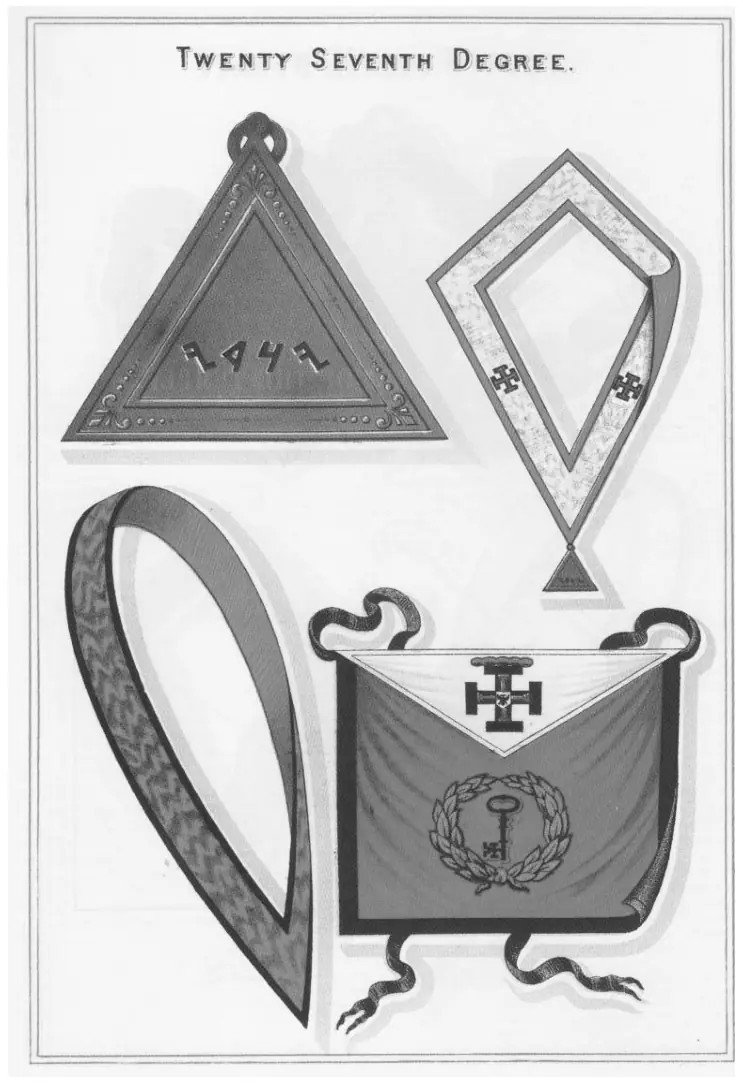
La Toute Puissance est revêtue d’une robe bleue et porte un manteau rouge bordé d’hermine couronne en tête, les autres Commandeurs sont avec leurs habits ordinaires portant un cordon bleu bordé de rouge, au bas duquel est suspendu un triangle ou le Mot Sacré est peint en hébreu, le cordon qui se passe en bandoulière 882 est rouge bordé de noir, en bas pend la Croix de l’Ordre en noir au milieu du cordon est brodé une couronne de lauriers et au-dessous une Clef également brodée mais en noir.
Titres
Le Président se nomme Toute Puissance les Survts∴ Souverains, et les autres FF∴ Commandeurs, les FF∴ doivent être en rond et quand il n’y a point de réception, ils sont autour d’une table ronde la Toute Puissance à l’Or∴ et les Souv∴ à l’Oc∴ L’Ordre est d’avoir la main droite en équerre sur le ventre et la gauche de même sur la Table, la Cour Souv∴ s’ouvre, à dix heures et se ferme à 4. Aucun Command∴ ne peut se trouver en Cour sans épée ni chapeau uni à plumet blanc.
Ouverture
Le T∴ Puissant 883 frappe 27 coups du plat de son épée dont 24 de suite & trois séparés répétés par les Surveillants, puis il Folio 265 verso
dit : en dirant 884 sa montre, T∴ Ill∴ Souverains Commandeurs il
est dix heures la Cour est ouverte.
Alors tous les FF∴ mettent la main à l’épée et on frappe 27 coups sur la table et après s’être salués ils se remettent à leurs places.
Réception
Quand l’aspirant proposé est accepté le Souv∴ Command chargé de l’introduire va le prendre dans la Chambre lui bande les yeux lui lie les mains derrière le dos et le conduit à la porte de la Cour Souveraine et lui fait frapper 27 coups avec son épée auxquels il 885 répond en faisant les questions ordinaires on fait entrer l’Aspirant et on le place entre les deux Survts∴ où on le laisse pendant l’espace du quart d’heure sans que personne ne parle après que la Toute Puissance dit : Faites-le voyager, alors le 2e∴ Survt∴ lui fait faire trois fois le tour du Tableau, ces trois Survt∴ voyages finis le fait une inclination de tête pour avertir la Toute Puissance qui dit : Faites mettre
le Cand∴ à genoux alors les Souverains l’enlèvent et le
font passer par-dessus le Tableau et le posent debout devant la Toute Puissance, et vont reprendre leurs places et mettent l’épée à la main à l’exception des Survts qui restent derrière l’aspirant. Dès que chacun est placé la Toute 2e Survt∴ Puissance tire un coup de pistolet et le lui délie les mains et la Toute Puissance dit : Je vous délie de la servitude des hommes vous ne serez plus soumis à aucun F∴ tous vous respecteront, il n’y a que notre Cour Souveraine qui vous égale. Le 2e∴ Survt∴ lui passe son habit et lorsqu’il est habillé la Toute Puissance donne un coup d’épée sur la Table & le 2e∴ Survt∴ va se mettre à sa place ( Na∴) Tous les FF∴ doivent observer le plus profond silence pendant la réception et il n’y a que la Toute Puissance qui parle. 2e∴ Survt∴ Le étant arrivé à sa place la T∴ Puissance 1er∴ Survt∴ tire un coup de pistolet et le lui donne la Lumière et le fait mettre à genoux pour porter son obligation.
Obligation
Je promets sur mon âme et conscience de garder le secret le plus inviolable sur ce qui me sera confié dans ce sublime grade, je promets de conserver la plus grande fidélité à mon souverain et aux lois de mon pays je jure d’aimer tous mes FF∴ et me soumettre en cas d’infraction aux peines portée par mes précédentes
Folio 266 recto
obligations Amen
Cette obligation prêtée la Toute Puissance le fait lever le décore du tablier et du cordon, lui met une couronne de lauriers sur la terre, 886 lui donne les Signes, Mots et Attouchements après quoi il le fait passer à sa droite, frappe un coup d’épée sur le table et tous les Commandeurs remettent leur épée et s’asseyent.
Signes
Le premier est de tendre le pouce de la main droite les doigts fermés et de faire une croix sur le front. Le deuxième qui est la réponse Folio 107 recto est de baiser le front là où la croix a été faite.
Ce Signe ne se fait qu’en Cour tenante et quand on est à l’abri des Profanes, on y supplée en portant les deux premiers
doigts sur la bouche serrant tous les autres et les tournant du côté de l’examinateur.
Attouchement
Il se fait en frappant trois coups de la main droite sur l’épaule de l’examinateur qui y répond en prenant la main droite en faisant sentir 3 petites secousses.
Mot Sacré
Inri Mot de Passe
Salomon le Mot Sacré s’épelle & ne se prononce qu’en
Cour Souveraine et dans un lieu sûr.
Instruction
Êtes-vous Souv∴ Command∴ du Temple R∴J’ai vu le triple triangle887 887
D∴
D∴ Pourquoi avez-vous été introduit nu en Cour ? Pour m’apprendre qu’on ne peut entrer dans un lieu où le St∴ R∴ nom de Dieu est, que dans un état pur et dépouillé de toutes corruptions.
D∴ Pourquoi avez-vous les yeux bandés ?
R∴ Parce que le triple triangle ou Lumière m’aurait ébloui n’étant pas en état de la voir
D∴ Que signifie le cordon avec lequel on vous lia ?
R∴ Que j’étais encore sous le joug.
D∴ Que signifient les 27 coups que l’on frappe en Cour ?
R∴ Les 24 premiers représentent les 12 tribus et les 12 apôtres et les 3 autres frappés séparément la trinité
D∴ Quand vous avez été en Cour où vous a-t-on placé ? Entre 2 Survts∴D∴Qu’a-t-on fait ensuite R∴On m’a fait voyager R∴
D∴ Comment ? R∴On m’a fait faire 3 fois le tour du Tracé ?
D∴ Que signifient ces voyages ? R∴Le mystère de la Trinité.
D∴ Pourquoi vous a-t-on porté en l’air de l’Or∴ à l’Occ∴ ?
Folio 266 verso
R∴ Pour m’apprendre que tout me sera soumis en m’élevant au-dessus des autres
D∴ Pourquoi vous a-t-on délié ?
R∴ Pour m’apprendre que je ne connaisse plus aucun joug.
D∴ Que signifient le bleu et le rouge que vous portez ?
R∴ La pureté du Fils de Dieu et son précieux sang qu’il a répandu pour nous.
D∴ Que signifie le noir ? R∴Le deuil que nous devons porter de l’aveuglement des mortels. D∴Pourquoi vous a-t-on mis une couronne de lauriers
R∴ Pour m’apprendre qu’étant arrivé au faîte de la grandeur nos actions ont méritées d’être couronnées du symbole de l’héroïsme D∴Quels sont les Signes et Attouch t∴
R∴ Il les donne. D∴Quel est votre Mot Sacré ? R∴Il l’épèle comme au R∴ C∴
D∴ Que signifie ce Mot ?R∴Ce sont les 4 lettres attachées à la Croix du Sauveur.
D∴ Quel est le Mot de PasseR∴Salomon. D∴Qu’est-ce que la L∴ dans la G de Lumière ?
R∴ Deux triangles et une Étoile Flamboyante unis ensemble.D∴Qu’y a-t-il dans ces 3 choses ? er∴ le Jéhovah∴ écrit en hébreu dans le 2 e∴ les lettres initiales R∴ Dans le 1 de l’inscription de la Croix et dans l’Étoile Flamboyante la planète sur laquelle est le Messie. R∴ 888Que signifient les 27 lumières autour de votre Cour ?
R∴ Elles sont relatives aux 27 coups dont on a déjà rendu raison
D∴ Que signifie le coffre ? R∴L’endroit où repose la clef du Temple que gardait le Souverain Commandeur ?
Clôture
La Toute Puissance frappe 27 coups et dit : À l’Ordre mes FF∴ ?
Alors tous les Commandeurs se lèvent & se mettent la main en équerre sur le ventre le Tout Puissant dit :
Ill∴ P r∴ Surveillant quelle heure est-il ? D∴
R∴ Quatre heures. Il est donc temps de nous reposer je vous annonce que la Cour Souveraine est fermée.
Alors tous les Souverains Commandeurs frappent 27 coups des mains, ils font une inclination générale.
Folio supplémentaire LXII
Apparat critique de l’édition Latomia
887. Kloss et Pyron 1812 indiquent : « J’ai vu la triple Lumière ».
889. Kloss et Pyron 1812 classent ce degré en 29e position, comme la plupart des tuileurs. Cette inversion semble une caractéristique du Suprême Conseil d’Amérique (cf. introcuction).
890. Erreur du copiste A : l’expression exacte est « à chaque coin », cf. Kloss et Pyron 1812.
895. Erreur du copiste A ; le mot exact est « de », cf. Kloss et Pyron 1812.
896. Erreur du copiste A ? Kloss et Pyron 1812 indiquent ici « Loge éternelle ».
900. Oubli du copiste A : il manque la préposition « à », cf. Kloss et Pyron 1812.
Delaulnaye 1813
tuileur imprimé · 430 mots
Le « Thuileur des trente-trois degrés de l'Écossisme » de Delaulnaye (Paris, 1813), premier tuileur imprimé du REAA constitué : mots, signes, décors et remarques du grade. Texte relu mot à mot sur le fac-similé, mots hébreux restitués. Pages 184-189 de l'édition originale.
Tenture Rouge, ornée, de distance en distance, de colonnes Noires, sur chacune desquelles est un bras tenant un flambeau. Un dais Rouge, parsemé de larmes Noires.
Au milieu de la salle est un lustre à trois rangs, chargé de vingt-sept Lumières, savoir douze au premier rang, neuf au second, et six au troisième.
Vingt-sept autres Lumières sont posées sur une table ronde, autour de laquelle siégent les Commandeurs.
Titres.
La Loge a le titre de Cour. Le Maître s'appelle Tout-Puissant ; quelques-uns se qua- [p. 185] lifient de Très-Illustres et Très-Valeureux. Les Surveillants ont le titre de Très-Souverains-Commandeurs ; tous les Frères s'appellent Commandeurs-Souverains.
Signe.
Former une Croix sur le front du Frère avec le pouce de la main droite, les autres doigts fermés.
La réponse est de baisser le front.
Ce Signe ne se fait qu'en Cour. On y supplée en portant sur la bouche les deux premiers doigts de la main droite, les autres fermés et tournés du côté de l'examinateur.
Ordre.
Main droite en équerre sur le ventre.
Attouchement.
Donner trois coups de la main droite sur l'épaule du Frère, qui répond en vous prenant la main, et lui faisant éprouver trois légères secousses.
[p. 186]
Batterie.
Vingt-sept Coups, par douze, douze et trois, avec le plat de l'épée.
Le Tout Puissant est revêtu d'une robe bleue, par-dessus laquelle est un manteau rouge, doublé d'Hermine. Il a la couronne en tête.
[p. 187]
Cordon.
Blanc, liséré de rouge, en camail, à la pointe duquel est attaché le bijou. Sur les deux côtés du camail sont brodées en rouge quatre croix de Commandeur.
De plus, une écharpe rouge, bordée de noir. Elle se porte de droite à gauche, et l'on y attache une croix de Commandeur.
Bijou.
Un Triangle d'or, sur lequel est brodé en hébreu י נ ר י.
Tablier.
De peau rouge, doublé et bordé de noir. Sur la bavette la croix de l'ordre, entourée d'une couronne de laurier, et, au-dessous, une Clef, le tout peint en noir.
Gants blancs, doublés et brodés en rouge.
Quoique ce grade se confère également hors de l'Écossisme, on ne doit point le confondre [p. 188] avec l'Ordre des Templiers modernes, qui distribue des Commanderies dans toutes les parties du monde.
[p. 189]
VII.e CLASSE.
Vuillaume 1820
tuileur imprimé · 834 mots
Le tuileur de Claude-André Vuillaume, « Manuel maçonnique, ou Tuileur de tous les rites de maçonnerie pratiqués en France » (Paris, Delaunay et Hubert, 1820) : décoration, titres, signes, attouchement, marche, batterie, âge, mots, habillement du grade, avec l'étymologie et l'interprétation des mots hébreux. Texte établi sur le fac-similé et relu mot à mot sur les images : océrisation à 600 dpi du volume numérisé, fusion avec la couche texte de la numérisation Gallica, puis relecture page par page. Orthographe de 1820 conservée, hébreu et grec restitués, batteries rendues comme l'imprimé les note, pagination de l'original. Pages 175 à 180. Les planches gravées du volume, absentes de la numérisation Google, sont reprises de la numérisation Gallica et rapportées au grade qu'elles représentent.
TENTURE rouge, colonnes noires, à chacune desquelles est un bras tenant un flambeau.
Le dais et le trône sont rouges, avec des larmes noires.
Au milieu de la loge, est un lustre à trois rangs, portant vingt-sept lumières ; savoir, douze au rang inférieur, neuf au second, et six au troisième.
Vingt-sept autres lumières sont posées sur une table ronde, autour de laquelle siègent les commandeurs.
TITRES.
La loge prend le titre de Cour.
[p. 176]
Le maître est qualifié, Tout-Puissant. Dans quelques cours on lui donne le titre de très-illustre et très-valeureux.
Les surveillans sont nommés Très-souverains Commandeurs.
Les autres membres sont Souverains Commandeurs.
SIGNES.
De reconnaissance. — Marquer sur son front le signe de la croix, avec le pouce de la main droite, les autres doigts étant fermés. En réponse, le Tuileur baise le front à la place où le signe a été fait. Cela n'a lieu qu'en cour. Hors de la cour, au lieu de baiser le front, la réponse est de porter sur la bouche les deux premiers doigts de la main droite, en fermant les autres, le dedans de la main tourné en dehors ;
D'ordre. — En cour, la main droite étendue sur la table ronde, formant avec le pouce écarté, une équerre ; étant debout, la main droite sur le corps, au-dessous de la poitrine, formant aussi l'équerre.
ATTOUCHEMENT.
Frapper légèrement de la main droite trois coups sur l'épaule gauche du Tuileur, qui ré- [p. 177] pond en prenant la main droite, et faisant sentir trois légères secousses.
BATTERIE.
Vingt-sept coups, avec le plat de l'épée, par douze, douze et trois : ● ● ● ● ● ● ● ● ● ● ● ○ — ● ● ● ● ● ● ● ● ● ● ● ○ — ● ● ● !
MARCHE.
Le récipiendaire fait trois voyages. Il n'y a point de marche particulière.
HEURES DE SERVICE.
Pour ouvrir. — Dix heures.
Pour fermer. — Quatre heures.
HABILLEMENT.
Le Tout-Puissant porte une robe blanche, et par-dessus, un manteau rouge doublé d'hermine. Il a sur la tête une couronne à pointes.
Tablier rouge, doublure et bordure noire. Sur la bavette est une croix teutonique, qui est celle de l'ordre, entourée d'une couronne de laurier. Au-dessous de la bavette est une clef ; le tout est peint ou brodé en noir.
Gants blancs, doublure et bordure rouge.
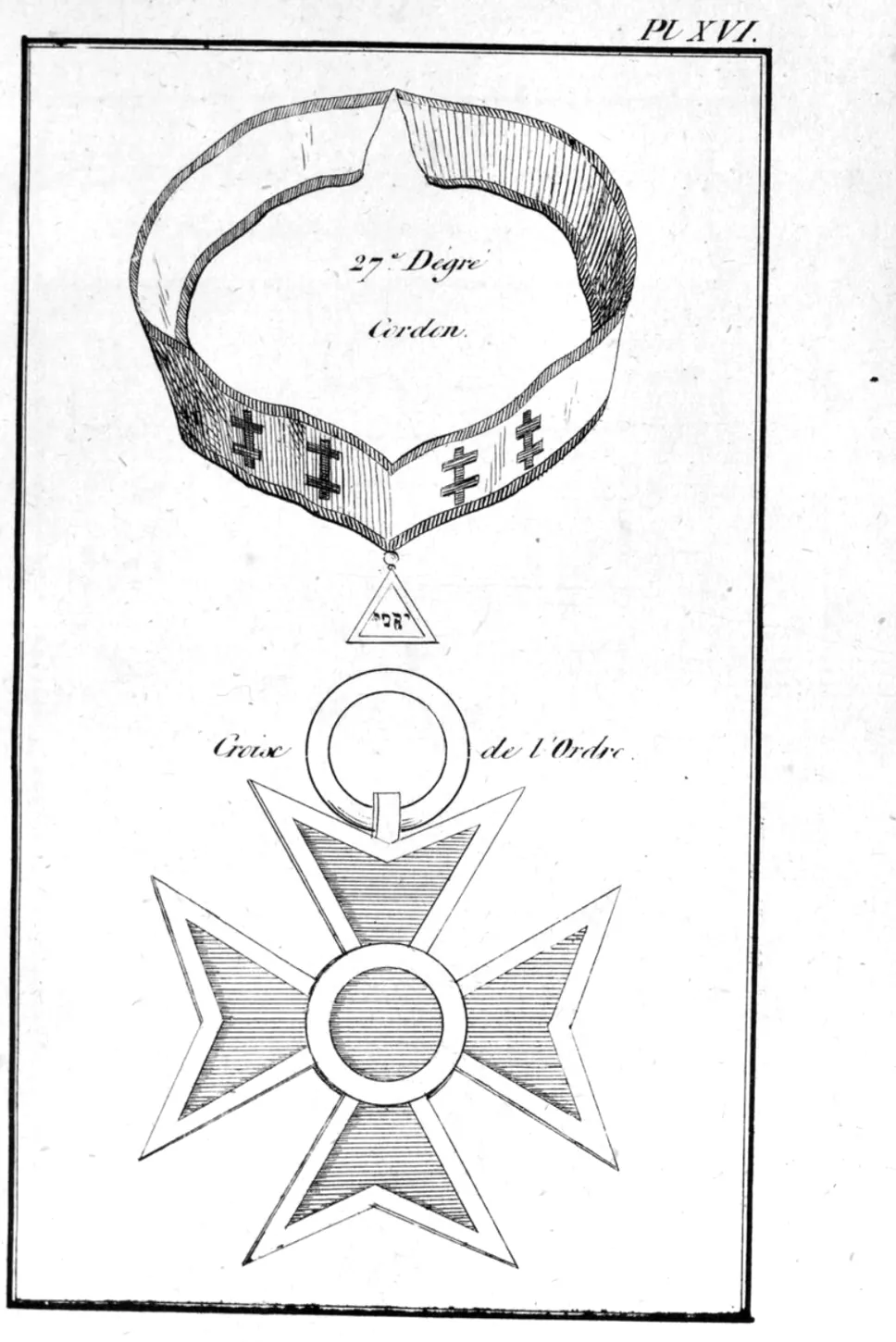
Cordon blanc, liséré de rouge, porté en ca- [p. 178] mail. A la pointe du cordon est suspendu le bijou ; sur les deux côtés, sont brodées en rouge quatre croix de commandeurs. (Voyez Pl. XVI, fig. 1.)
Les commandeurs portent aussi une écharpe rouge, bordée en noir, passant de droite à gauche, à laquelle est suspendue la croix de commandeur, en or émaillé.
Le bijou est un triangle en or, sur lequel est gravé, en lettres hébraïques, le mot sacré.
MOT DE PASSE.
SALOMON (héb. שְׁלֹמֹה Sch'lomoh, pacificus ; fils de David et de Betzabée, femme d'Urie. Rois, 2, ch. 12, v. 24).
MOT SACRÉ.
J. N. R. J. (1).
(1) Ces lettres sont les initiales de quatre mots bien connus, mais dont l'interprétation n'est pas toujours telle qu'elle nous est donnée dans Saint-Jean, chap. 19, ℣. 19.
Dans le dix-huitième degré, Souv∴ Pr∴ Rose-croix, elles signifient : Judée, Nazareth, Raphaël, Juda.
Les philosophes hermétiques, les anciens Rose-croix, en formèrent les aphorismes suivans :
[p. 179]
NOTE.
Nous avertissons nos lecteurs qu'il ne faut pas prendre l'ordre des commandeurs du temple, vingt-septième degré de l'Écossisme, dont nous venons de donner le tuileur, pour celui des Chevaliers de Saint-Jean de Jérusalem, plus connus sous le nom de Templiers, successeurs immédiats des anciens chevaliers du temple.
Cet ordre militaire et religieux subsiste toujours, malgré l'abolition qui en a été prononcée par le pape Clément V. On sait que, depuis, la bulle d'abolition a été cassée et annullée.
Ignem natura regenerando integrat,
Igne natura renovatur integra,
Igne nitrum roris invenitur.
D'autres, en employant les signes hébraiques, les ont interprétés ainsi :
יַמִים Iammim, Maria.
נוּר Nour, ignis.
רוּחַ Rouahh, ventus.
יַבֶשֶׁה Iabescheh, arida terra.
C'est le nom que l'on donne aux quatre élémens de l'ancienne physique.
(Note extraite du Tuileur de l'Ecossisme 1813.)
[p. 180]
Le grand-maître Jacques de Molay, avant de mourir, se nomma un successeur, qui a transmis ses pouvoirs, jusqu'au grand-maître actuel, par une suite non interrompue de chefs de cet ordre, célèbre à tant de titres. Parmi ces chefs on compte plusieurs princes de la maison de Bourbon.
Les chevaliers du temple ne sont donc point un ordre de maçonnerie. Cependant ils fraternisent, ainsi que faisaient leurs ancêtres, avec les Franc-Maçons, et ils les visitent sous le titre de maçons de l'ordre d'orient, mais sans avoir aucun rite maçonnique.
Planche XVI. 27e Degré. Cordon. — Croix de l'Ordre. Insignes du vingt-septième degré : le cordon de l'ordre semé de croix potencées et portant en pendentif un triangle à inscription hébraïque, et la croix de l'Ordre à huit pointes cantonnée d'un anneau central.
Pike 1857
rituel imprimé · en anglais · 5 324 mots
« The Magnum Opus or Great Work » (1857) : le premier corps complet de rituels révisés par Albert Pike pour la Juridiction Sud des États-Unis. Texte en anglais, établi par reconnaissance optique corrigée : des coquilles subsistent.
D'après la réimpression Kessinger de l'édition de 1857 (numérisation archive.org)
DECORATIONS, FURNITURE, ETC.
Lodges of this Degree are styled Cosrprens. The hangings are red, ornamented here and there with black columns, upon each of which is placed a branch, holding a light. The Canopy and Throne are red, sprinkled with black tears. In the centre of the Lodge, which is circular in its shape, is a chandelier, with three rows or circles of lights, one above the other: in the lowest circle, 12; in the next, 9; and in the upper 6, making 27 in all. 27 other lights are placed upon a round table; around which the Knights are seated, when the Chapter is open.
OFFICERS, CLOTIING, JEWELS, ETC.
The Presiding Officer is styled Grand Commander, and sits in the East. The Sen.*. Warden is styled Grand Marshal, and sits in the West; the Jun.. Warden, Grand Hospitaller, and sits in the South. .In the North sits the Grand Admiral: on the right of the Gr.*. Commander, the Grand Charicellor, and on his left the Grand Prior, The Grand Seneschal guards the door on the inside. ' not .
The Gr.*, Commander wears a white tunic, and over it a Knight's mantle of red, lined with Ermine. On" his head he wears a ducal crown. The apron is flesh-coloured, lined and edged with black. On the flap is a Teutonic Cross, which is also the jewel of the Order, encircled by a laurel-wreath, and beneath it key. The Cross, wreath and key are all black. The gloves are white, lined and bound with black, and the scabbard and belt of the sword are black. The order is white, edged with red, worn as a collar, and the jewel suspended' fromit. On each side of the collar are two black Teutonic Crosses. There is also a sash proper, red, bordered with black, worn from right to left, from which hangs gold-enamelled Tan Cross. The principal jewel is a" triangle of gold, on which is engraved the Sacred Name m7".
TO OPEN.
[The Gr.*, Commander raps 3 times, and says: " Valiant Its.. and Commanders of the Temple, I have caused you to be summoned to deliberate upon matters of deep interest to the Order of the House of St. Mary of Jerusalem, Assist me to open a Chapter of the Order, that we may consult together. Attention, Knights and Commanders |'']
[All rise, in their appropriate stations, draw their swords, salute the Gr.". Commander, and stand at the carry].
Gr... Com.*. Bro.*. Seneschal, see that the doors of the Chapter are duly guarded, and inform the Sentinels that we are about, to open a Chapter here, directing them to keep vigilant watch, that none enter without the words and signs. . .
[The Seneschal goes out, returns, and reports: "'Th.*, Puissant Gr.*, Commander, the Sentinels are at their posts, and we are in security.'']
Gr. Com.. Bro.. Gr.*. Hospitaller, what are the first duties of a Knight Commander of the Temple? ~
Gr.. Hosp.. To soothe the sufferings and administer to the necessities of the poor, sick and wounded Soldiers of the Cross; to watch with and nurse them, and supply them with food and medicine.
Are. Com.. Bro', Grr. Marshal, what are the Knightly duties of a Kt;*. Commander of the Temple?
Gro, Marsh., To guard the City of Solomon against the Infidel, to protect Christendom against the Pagan, to succor and assist the helpless and feeble, and to defend the innocent.
Are. Com. Bro.*. Gr.*. Chancellor, what are the oral duties of a Kt. Commander?
Gr.*. Chan.". To be temperate, chaste, charitable and discreet, °
Gr. Com.'. Bro.*. Gr.*. Prior, what are the Masonic duties of a Kt.:. Commander?
Gr.. Prior: To be grateful to God for his goodness: : to lead pure and blameless lives; and to love our brother.
Gro. Com... Bro.*. Gr.*. Marshal, where were you made a Kt.' Commander?
Gr.. Marsh.. After I became an Elu, and knew the Ineffable Name.
Gr.. Com.*.. How have you proved yourself worthy of the title?
Gr... Marsh... By being true to my rows; by strict observance of my duties; and by my sears gained at 'Acre, at Ascalon, and against the Pagans of Prussia.
Gro. Com.. Bro.*. Grand Hospitaller, whence come you as a Kt.*. Commander of the Temple?
Gr-. Hosp... From the abodes of sickness, pain and suffering; where I-have learned patience, fortitude
. and resignation.
Gr.. Com... Bro.*. Gr.*. Admiral, whence come you as a Kt.*. Commander?
Gr.*. Adm... From the great ocean; where I have learned the feebleness of man, and his dependence on the Deity, amid the mighty tumult of its waters.
Are. Com... Bro.*. Gr.'. Marshal, whence come you as a Kt.. Commander?
Gr.. Marsh... From the field of battle; where I have learned that the most glorious of deaths is that which overtakes a Soldier of the Cross, who dies in the performance of his duty.
Gr.. Com.*.. Assemble round the altar, my brethren, that we may open this Chapter of Its.°. Commanders -of the Temple! .
[The Knights form in a circle around the altar, and place the points of their swords together, holding them horizontally in front of them, the points meeting in the centre; and repent after the Gr.*. Commander]:
Gr.. Com.. As these swords point to one common centre, s0 we, here renewing our vows, do devote our swords to the cause of God and the Cross, our hearts to the glory of God and the welfare of man, and our hands to assist the sick, the suffering, and the destitute. So help us God!
The Knights then kneel, and the Gr.'. Prior repeats the following
PRAYER.
Father and Creator, who bast given as life and being, aid us to perform the duties which Thy law and our vows impose upon us! Thou has given us the portion and the food of Sons: make us to do the duty of Sons,
Cavil.. 8
that we may never lose our title to an inheritance so glorious! Thou has vouchsafed to call us Thy children, and most graciously permit us to call Thee Father. May that name be our glory and our confidence, our defence and guard, our ornament and strength, our dignity and the endearment of obedience! May it confirm and sustain us in oar good resolutions, and make us steadfast never to desert the post of duty! Let our bodies be chaste, our thoughts pure, our words gentle, and our lives useful and innocent, to the honour and commendation of Masonry and Knighthood! Make us patient of the evils which Thou inflictest, lovers of the good which Thou commandest, haters of all vice which Thou forbiddest, and satisfied with all the accidents Thou sendest! Let us not be tempted with want, nor made contemptible by beggars, nor wanton or proud by riches, nor in love with anything in this world to the disregard of duty! Look upon us with mercy, and forgive our imperfections and our errors; and accept with indulgence the little service we may be enabled to render to the cause of virtue, charity and truth! and to Thee be all glory and honour forever: Amen!
All answer, "So mote it be;'' and rise. Then the Gr.°. Tfospitaller raps ; times — the Gr.". Marshal , ? . by PSC C2—the Gr.. Commander , ? by PS$C C2:—and the Gr... Commander says: "My Brethren, the
Chapter is open." -
RECEPTION.
The Candidate is prepared by being clothed in a white mantle with a largo black Teutonic cross upon the left breast. The Grand Prior then goes to him, and conducts him to a small room [first bandaging his eyes], in which he 'places him in o chair, in front of a table on which are ao light, and a skull and cross-bones, with the Holy Scriptures, the square and compasses.
Haring seated him, he says to him: 'My Brother, you desire to receive the degree of Kt. Commander of the Temple. Before you can do so, you are required to answer certain questions, which you will find in writing, on the table before you. I shall leave yo® alone, and when you hear three distinct raps you will remove the bandage from your eyes, and annex your answer to each question, in writing, and sign your name at the bottom. Consider the questions well! Let what you will.sea upon the table before you, remind you that you will answer them in the hearing of the Deity, who knows your thoughts: let it teach you the evanescence of all earthly things, the obligations of rectitude and honour, the certainty of sickness and death, and after that of judgment; and that your answers must be true and sincere. When you shall have answered the questions, you will give three distinct raps upon the table, and I will return." .
[The Gr.*. Prior then withdraws and closes the door. The questions are as follows] :
1st. . Have you ever violated any Masonic obligation, without atoning for it by repentance and reformation?
2d. Axo you willing te aid, assist and comfort the sick, the needy and the destitute ; to watch with them and minister to their wants; and to help to feed, to clothe and to protect the widow and the orphan?
3d. Have you any enmity towards any one, that_ you would not readily abandon, if you found him sincerely Willing to be reconciled to you?
4th. Would you, if called upon, draw your sword in defence of truth, of human freedom and the rights of conscience, against falsehood, tyranny, and usurped power? And can you rather choose to die than desert
the post of duty?
If the questions are answered satisfactorily, the Gr.*. Commander orders the Candidate to be admitted. He is led in front of the Gr.*. Commander, who says: " My Brother, are these your answers ; and are they sincere and from the heart?" —
Card.'. They are.
Gro. Com... It is well. Are you an Elu, and Gr.' ., Elect, Perf.*. and Subl.. Mason ?
Cand.". Iam.
XX3VIL..4
Gr.*. Com.*. Most thou desire to obtain the degree of Kt.'. Commander of the Temple?
Cand.*. Do.
Gr.. Com.. Knowest thou that thou wouldest thus embrace a life of toil and of hardship, of self-denial and of danger?
Cand... I do.
Gr. Com.*. And most thou not hesitate and falter at the prospect?
Cand.*. I do not.
Gr.. Com... Go,then, my Brother, to the Holy Altar, and there assume the obligation of this Order.
[The Gr.*. Prior conducts the Candidate to the Altar, where he kneels on both knees, with his hands upon the blades of the Swords of three of the Knights, who hold them crossed before him upon the Holy Scriptures: in which position he repeats the following] ,
OBLIGATION.
'I,A.... B....,in the presence of the One Almighty and only true God, the Spirit of the Universe ; and of this Chapter of Knights Commanders of the Temple, or the Order of the House of St. Mary of Jerusalem, do of my own free will and accord most solemnly and sincerely promise, and to God and the Saviour vow, that I will never reveal the secrets of this degree to any person of an inferior degree; except in a Chapter lawfully holden by authority of some regularly established Council of the 33d Degree; or by virtue of special authority from such Supreme Council. ;
". I furthermore promise and vow, that I will not assist in, nor be present at, the conferring of this degree upon any person, who shall not have received all the preceding Degrees of the Ancient and Accepted Rite of Free Masonry; nor will I tacitly consent or- agree thereto, but will prevent the same if it be in my power, by proper and peaceable means.
I furthermore promise and row that I will through life conduct myself, in all my dealings, with truth, rectitude, justice and honour, doing unto others as I would others should do unto me; that I will not endeavour to make gain by the misfortunes of others; that I will never misrepresent the arguments or opinions of friend or enemy; that I will take no unfair advantage of, and will not overreach any one: that I will not seek to . injure even my enemy; and that I will never attempt to make reputation for myself by destroying the reputation of another. . . .
I furthermore promise and vow that if occasion should offer, I will not five from plague, pestilence or _ epidemic, to avoid danger, when duty and manhood require me to remain ;.but will imitate the example of
those Ill. Knights of Bremen and Lubec, who, making their sails into tents, devoted themselves to the care and nursing of the sick and wounded; and so became the founders of this Order.
I furthermore promise and swear, that I will never desert the post of duty through fear of death: however humble that duty, and however unnoticed my death may be: but in plague or battle, in fire or tempest, I will stand firm at my post, so long as manhood and duty demand, whatever may be the consequences to myself; and even should I perish in doing so. .
I furthermore promise and swear that I will ever be governed by the true principles of Masonry; and obey its laws, rules and regulations, made by the proper authority ; and that I will do all in my power to aid and advance all justifiable measures for the good of the Craft, and the advantage of Free Masonry, agreeably to the Constitutions of the Order. .
To all which I most solemnly, understandingly and sincerely Lind myself, with the full intention of ever keeping and perfuming the same, and making them the rule and guide of my life, conduct and conversation ; under no less penalty than that of being branded in the estimation of all men as nidering and coward, and exposed to the anger of God, if I should wilfully and knowingly violate this my solemn obligation. So help
me God!
The Gr.*. Commander then raises him, and communicates the Signs, Tokens and Words.
XMAVIT.. 2 5
Ten: of Recognition ... Make the sign of the cross upon a brother's WYtCkCOn with your
$P&5 Some, the FOMLCIO TH4Ac0.
Answer: ... Te (92:22 your WYtCkCOU. This is done only in the Chapter. Elsewhere the
answer is to place the two first fingers of the right hand Y*Cf the S54 4 °S—TtY OM the ¥PECT WOK CIS, and turning the SOS 8 4 PY You. .
Due-Goarp: . . . In open Chapter, place the right hand upon the {8 $1 yOmt«, and extend the
P&% Sony, so as to forma &XZOtC. When standing, place it in like manner on the mn, C{th.
Torry: ... Strike gently the fA&% 4% fC? of a brother ; times with the right hand.
Answer: ... He gently 2323 C CM CS your {LOMO ; POLECA.
Pass-worn: .. . 224 PRUs se,
Granp Worn: ... QA¢t9.". alternating the letters.
+ The Gr.°. Commander then, with his sword gives the Candidate the accolade, on each shoulder alternately, saying, "By my authority and power as successor of Herman de Saltza and Albert of Brandenburg, I hereby 'constitute, create and dub thee a Knight Commander of the Temple, or of the Ill.*. Order of the House of St. Mary of Jérusalem. Be true: be devout: be brave!" .
He raises the newly-made Knight, and invests him with the insignia of the degree; after which he is seated, and the following History and instruction is read to him. - 7
HISTORY.
When St. Jean d'Acre, the ancient Ptolemnis, on the southern side of which was Mount Carmel, was besieged by the Christian forces, for nearly two years, under Guy of Lusignan, King of Jerusalem, Conrad, Marquis of Montserrat, and other Princes and leaders from every country in Europe; and especially by Henry VI. of Germany, son of Frederic Barbarossa; joined, near the end of the siege, by Philip Augustus of France and Richard Cour de Lion of England ; they were long Affected with famine, until they ate the flesh of horses "with joy, and even the intestines sold for ten sons: men of high rank and the sons of great men greedily devoured grass; the starving fought together like dogs for the little bread baked at the ovens; they gnawed "the bones that had already been gnawed by the dogs; and noblemen, ashamed to beg, were known to steal bread. Constant rains added to their miseries; and Saladin, Sultan of the Saracens, encamped near them with a vast army from every portion of his dominions, and all the great Emirs of Islamism, harassed them with constant attacks: Saladin, whom his People called the Elect of God; Males-Adhel, SayfEddin, his brother; the Prince of Haman, his nephew; and the Princes of Damascus and Aleppo, his sons; the yellow and green banners of the Emirs of Emessa, the Princes of Baalbec, Warren and Odessa in Mesopotamia, Singer and Gezire on the Tigris, and all the tents of Islamism. ,
- Sickness, also, caused by the rains and the intense heat, decimated the Christian forces. The wounded German soldiers, whom none of the others understood, could not make known their sickness nor their necessities. Certain German nobles from the cities of Bremen and Lubec, who had arrived at Acre by sea, moved by the miseries of their countrymen, took the sails of their ships, and made of them a large tent, in which for a time they placed the wounded Germans, and tended them with great kindness. Forty nobles of the same nation united with them, and established a kind of hospital in the midst of the camp; and this noble and charitable association, like the Knights of the Temple and of St. John of Jerusalem, soon and insensibly became a new Hospitaller and Military Order. This was in the year 1191. In 1192, Pope Celestin IIL, at
the request of the Emperor Henry the Gth, solemnly approved of the Order, by his Bull of the 23d of February. Te prescribed, as regulations for the new Knights, those of Saint Augustine; and, for special statutes, in-all that regarded the poor and sick, those of the Mospitallers of St, John; in regard to military discipline, the 'regulations of the Templars. This new order, exclusively composed of Germans, was styled The Order of Teutonic Knights of the House of St. Mary of Jerusalem. After the destruction of the Templars, they were also known as Commanders of the Temple. . ,
The first name was given them, because, while the city of Jerusalem was under the government of the Latin Christians, a German had erected there, at his own expense, a Hospital and Oratory, for the sick of that nation, under the protection of, and dedicated to, the Holy Virgin. Their dress was a white mantle with a black cross; and they, like the Hospitallers, were required to take three solemn vows. Before assuming the habit, they were required to swear that they were Germans, of noble extraction and birth; and to bind themselves for their whole life to serve the poor and sick, and defend the Holy Places. Ever to adhere to the truth, to attend and nurse the sick and wounded, and never to recede before the enemy, were their three solemn vows. Truth is the first Masonic duty: to leave the path of duty is to recede before the enemy; and therefore you have taken the three vows of the Teutonic Knights and Hospitallers, in 4 still more noble and enlarged spirit.
These were the common objects of the three great military orders; which were always the generous De-
fenders of the Holy Land. To them was at first applied the phrase, found in the Book of Ecclesiastes, "a three-fold cord is not easily broken." . The Teutonic Knights soon becume one of the most Illustrious of the Military and Religious Orders. The three were the chief strength of the army before Acre; but the siege advanced slowly, where there were neither absolute chiefs nor discipline. On the 13th of July 1191 it surrendered. "In 1223, Herman de Saltza, Grand Master of the Teutonic Knights, was present at a celebrated assembly convoked by Pope Ionorius III., at Ferentino in Campania, to deliberate concerning the mode of raising such 'cours for the Holy Land; at which were also present the Pope, the Emperor Frederic In. of Sicily, John, King of Jerusalem, the Bishop of Bethlehem, the Grand Masters of the Templars and Iospitallers, and other distinguished personages: and it was by the influence of Merman de Saltza, 4th Grand Master of the Teutonic Knights, then exercised, that Frederic espoused and married the daughter of:the King of Jerusalem, and . engaged in a new crusade. .
In the year 1226 most of the Teutonic Knights went from the Holy Land to Prussia; the people of which were still idolaters, waging cruel war against their Christian neighbours, murdering Priests at the foot of the Altar, and employing the Sacred Vessels for profane uses, Conrad; Duke of Masovia, called in the Teutonic Knights to his assistance, and gave them, as a commencement for their establishment there, the whole territory of Culm, with all lands they should conquer from the Infidels, De Saltza, the Grand Master, sent thither a Knight called Conrad do Lansberg, who concluded the Treaty, which was signed by three Bishops of that Country. The Knights then entered those Northern Countries, and by continued wars acquired in time the entire sovereignty of Royal and Ducal Prussia, Livonia, and the Duchies of Courland and Seminal; all vast Provinces, and capable of forming a great Kingdom. And when, in 1291, the Sultan stormed and took St. Jean d'Acre, the Teutonic Knights that survived returned to Europe and joined their brethren in Prussia and Livonia.
For many years the Teutonic Knights held Prussia as a fief depending onthe Crown of Poland. During this period, fierce contests arose between the Grand Masters of the Order and the Kings of Poland ; the former struggling for independence, and the latter obstinately asserting their right of sovereignty. Albert, a Prince of tha Blouse of Brandenburg, elected Grand Master in 1511, engaged keenly im the quarrel, and maintained a long war with Sigismund King of Poland ; but adopting the doctrines of Luther, be mado o treaty with Sigismund, by which that part of Prussia belonging to the Order was erected into a secular and hereditary Duchy, and the investiture of it granted to Albert, who bound himself to do homage for it to the Kings of Poland, as their vassal. Immediately afterwards, he publicly professed the Protestant faith, and married a Princess of Denmark. The Knights exclaimed sv loudly against his treachery, that he was put under the ban of the empire; but he kept possession of the Province he had usurped, and transmitted it to his posterity: and in process of time it fell to the Electoral Branch of the family; all dependence on Poland was shaken off,
AXVIT. .
and the Margrares of Brandenburg took the title of Kings of Prussia; which so has become one of the leading powers of Europe.
Times change, and circumstances; but Virtue and Duty remain, the same. The Evils to be warred
against but take another shape, and are developed in a different form.
There is the same need now of truth and loyalty, as in the days of Frederic Barbarossa.
The characters religious and military, attention to the sick and wounded in the Hospital, and war against the Infidel in the field, are no longer blended: but the same duties, to be performed in another shape, continue to exist and to environs us all. :
The innocent virgin is no longer at the mercy of the brutal Baron or licentious man-at-arms; bat purity and innocence still need protectors.
War is no longer the apparently natural State of Society; and for most men it is an empty obligation to assume, that they will not recede before the enemy; but the same high duty and obligation still rest upon all men.
For Truth, in act} profession and opinion, is even rarer now than in the days of chivalry. Falsehood hag become a current coin, and circulates with a certain degree of respectability; because it has an actual value. — It is indeed the great Vice of the Age; it, and its twin-sister, Dishonesty. Books are published and read by thousands, detailing the experiences of a life of knavery: Men for political preferment profess whatever principles are expedient and profitable: At the bar, in the pulpit and in the halls of legislation, men argue against their own convictions, and, with what they term logic, prove to the satisfaction of others that which they do not themselves believe. Insincerity and duplicity are valuable to their possessors, like estates in stocks, that yield a certain revenue: and it is no longer the ¢truth of an opinion or a principle, but the net profit that may be realized from it, which is the measure of its value.
The Press is the great sower of falsehood. To slander a political antagonist, to misrepresent all that he says, and if that be impossible, to invent for him what he does not say; to manufacture 'and put in circulation whatever utterly baseless calumnies against him are necessary to defeat and destroy him,—these are habits so common as to have ceased to excite notice or comment, much less surprise or disgust.
+. There was a time when a Knight would have died rather than utter a lic, or break his Knightly word. The Knight Commander of the Temple revives the old Knightly spirit; and devotes himself to the old Knightlyworship of Truth. No profession of an opinion not his own, for expediency's sake or profit, or through fear. of the world's disfavour ;.no slander of even an enemy; no colouring or perversion of the sayings or acts of other men; no insincere speech and argument for any purpose, or under any pretext, must soil his fair escutcheon. Out of the Chapter as well as in it, he must speak the Truth, and alt the Truth, no more and no less; or else speak not at all.
To purity and innocence everywhere, the. Kt.:. Commander owes protection, as of old; against bold
-violence, or those, moro guilty.than murderers, who by art and treachery seck to.slay the soul; and against that grim want and 'gaunt and haggard destitution that drive too many to sell their honour and their innocence for food.
:. In no age of the world has man had better opportunity than now to display those lofty virtues and that noble heroism that so distinguished the three great military and religious Orders, in their youth, before they became corrupt and vitiated by prosperity and power.
'When a fearful epidemic ravages a city, and death is inhaled with the air men breathe; when the living scarcely suffice to bury the dead,—most men flee in abject terror, to return and live respectable and influential when the danger has passed away. But the old Knightly spirit of devotion and disinterestedness and 'contempt of death, still lives, and is not extinct in the human heart. Everywhere a few are found to stand firmly and unflinchingly at their posts, to front and defy the danger, not for money, or to be honoured for it, or to' protect their own household; but from mere humanity, and to obey the unerring dictates of duty. They nurse the sick, breathing the pestilential atmosphere of the hospital. They explore the abodes of want and misery. With the gentleness of ivoman, they soften the pains of the dying, and feed the lamp of life in the convalescent. They perform the last sad offices to the dead; and they sock no other reward than the approval of their own consciences.
These are the true Knights of the present age: these, and the captain who remains at his post on board his shattered ship until the last boat, loaded to the water's edge with passengers and crew, has parted from her side; and then goes calmly down with her into the mysterious depths of the ocean:—the pilot who stands at the wheel while the swift flames eddy round him, and scorch away his life :—the fireman who ascends the blazing walls, and plunges amid the flames to save the property or lives of those who have upon him no claim , by tie of blood, or friendship, or even of ordinary acquaintance :—these, and others like these :—all men, who, set at the post of duty, stand there manfully; to die, if need be, but not to desert their post: for these too are sworn not to recede before the enemy. .
To the performance of duties and of acts of heroism like these, you have devoted yourself, my Brother, by becoming o Kt.:. Commander of the Temple. Soldier of the Truth and of Loyalty! Protector of Purity and Innocence! Defier of Plague and Pestilence! Nurser of the Sick and Burier of the Dead! Knight, preferring Death to abandonment of the Post of Duty! 'Welcome to the bosom of this Order!
TO CLOSE.
[The Gr.-. Commander gives three raps: All the Knights rise, salute him, and remain standing, in their -stations, with swords carried.)
Gr.. Com... Bro.*. Gr.. Hospitaller, what is the hour?
Gr.. Hos... Tour in the afternoon, Th.*. Puissant Gr.-. Commander.
Gr.. Com... Since the sun is declining in the West, it is time that wo should close this Chapter; that
we may not omit, even for one day, our duties in the world. Bro.*. Gr.*. Prior, whither go you from this Gr.*,
Chapter?
Gr.. Prior: To the denth-beds of the sick, there to administer comfort and consolation, and with the hope
of eternal life to cheer the last moments of the dying.
Gro. Com. Bro. Gr.*. Admiral, whither go you from this Chapter?
Gro. ddm.*. To my ship; to encounter, it may be, the enemy, storm, fire, and the unknown dangers of .the ocean; and, if my country's honour or the dictates of duty require, to sink with her, rather than desert my post. . .
7 Gr... Com. Bro.*, Gr.*. Chancellor, whither go you from this Chapter ? .
Gr. Chan. To save the innocent and pure from falling, and to rescue and redeem those that have erred and that repent. . .
Gro. Com... Bro.*. Gr.*. Hospitaller, whither go you from this Chapter?
Gr.. Hosp... To the hospitals, and to the dwellings of the sick and destitute.
Gr. Com... Bro." Gr.*. Marshal, whither go you from this Chapter?
Gr.. Marsh. To war against all falsehoods, insinceritics and plausibilities: to practise truth: and to lay bare the deformities of all sophists and pestilent false philosophies and doctrines that lead astray the people, and under the guise of progress and philanthropist embody atheism and adultery, or public and private
robbery.
Gr... Com... Such is the mission of our Order. May it live forever! and may we never forget or dire-
gard our vows! Brethren, assemble around the altar, that we may close this Chapter.
(The Brethren form a circle as in opening, and hold their swords horizontally before them, all the points
meeting in the centre, on a level with their hearts].
Are. Com. Let us be one, my Brethren, now and henceforward; and let our swords, our arms, our
hearts be devoted to the great cause of Truth, Humanity and Duty! And may the blessing of Providence
rest upon us and our labours; and the lustre of our Order never fade, nor its glories grow dim! Amen! "(The Brethren all answer, " So mote it be!" Then the Gr.. ospitaller raps ; with his sword, the Gr.*. Marshal ,? by P&ICCO—the Gr.c, Commander ,? by PS¢CC—and the Gr. Commander declares,
"This Chapter is closed! Go in peace, my Brethren!"] ....
FINIS.
Ragon 1861
tuileur imprimé · 755 mots
Le « Tuileur général de la Franc-Maçonnerie ou Manuel de l'initié » de Jean-Marie Ragon (Paris, 1861), dernier grand tuileur français du siècle : décoration, titres, ordre, signes, mots, marche, âge, batterie et décors du grade, avec les notes critiques de Ragon sur les mots altérés par la tradition. Pages 156-158 de l'édition originale.
Tenture rouge, colonnes noires, à chacune desquelles est un bras tenant un flambeau.
Le dais et le trône sont rouges, avec des larmes noires.
Au milieu de la Loge est un lustre à trois rangs, portant 27 lumières : 12 au rang inférieur, 9 au second et 6 au troisième.
Vingt-sept autres lumières sont posées sur une table ronde, autour de laquelle siégent les Commandeurs.
Titres.
La Loge prend le titre de Cour.
Le Maître est qualifié Tout-Puissant. Dans quelques cours, on lui donne le titre de Très Illustre et Très-Valeureux.
Les Surveillants sont nommés très-souverains Commandeurs, et les autres membres souverains Commandeurs.
Ordre.
Étant debout, placer la main droite en équerre sur le ventre; en cour, poser sur la table ronde la main droite étendue, le pouce écarté pour former l'équerre.
Signes.
Il y a deux signes de reconnaissance; le premier, de demande, est de faire sur son front le signe de la croix, avec le pouce droit, les autres doigts étant fermés; le second signe, de réponse, se fait en baisant le front à la place où le signe a été fait. Cela n'a lieu qu'en cour. Hors de la cour, au lieu de baiser le front, la réponse est de porter, sur la bouche, les deux premiers doigts de la main droite, en fermant les autres, le dedans de la main tourné en dehors.
Attouchement.
Le frère Examinateur provoque l'attouchement en frappant trois légers coups sur l'épaule gauche du visiteur, qui répond en prenant la main droite et faisant sentir trois secousses légères.
[p. 157]
Mot de passe.
SALOMON (en hébreu Sch'lomoh, pacificus, fils de David et de Belzabée, femme d'Urie (Rois, II, ch. xii, v. 24).
Mot sacré.
J∴ N∴ R∴ J∴ (il s'épèle).
Âge.
Point.
Marche.
Point¹. Le récipiendaire fait trois voyages.
Batterie.
Vingt-sept coups, avec le plat de l'épée, par 12, 12+3.
Heures de service.
Pour ouvrir, 10 heures; pour fermer 4 heures.
Questions d'ordre.
D. Etes-vous Commandeur-Souverain ?
R. J'ai vu la triple lumière.
D. A quelle heure les Grands-Commandeurs prennent-ils séance ?
R. A dix heures.
D. A quelle heure se retirent-ils ?
R. A quatre heures.
Habillement.
Le Tout-Puissant porte une robe blanche, et par-dessus un manteau rouge doublé d'hermine. Il a sur la tête une couronne à pointes.
Tablier.
Rouge, bordure et doublure noire. Sur la bavette est une croix teutonique, qui est celle de l'ordre, entourée d'une couronne de laurier dont les branches sont en or. Au-dessous de la bavette est une clé ; le tout peint ou brodé en noir.
Gants.
Blancs, doublure et bordure rouge.
Cordon.
Blanc, liseré de rouge, porté en camail ou sautoir. A la pointe du cordon est suspendu le bijou. Sur les deux côtés, sont brodées, en rouge, 4 croix de commandeurs.
Écharpe.
Rouge, bordée de noir, passant de droite à gauche, à laquelle est suspendue la croix de commandeur, en or émaillée.
Bijou.
Triangle d'or avec les lettres J. N. R. J., gravées au centre en lettres hébraïques.
On lit cette note dans le Tuileur du frère Willaume :
« Nous avertissons nos lecteurs qu'il ne faut pas prendre l'ordre des Commandeurs du Temple, 27e degré de l'écossisme, pour
1 Dans quelques rituels : trois pas ordinaires.
[p. 158]
celui des Chevaliers de Saint-Jean-de-Jérusalem, plus connus sous le nom de Templiers, successeurs immédiats des anciens Chevaliers du Temple.
» Cet ordre militaire et religieux subsiste toujours, malgré l'abolition qui en a été prononcée par le pape Clément V. On sait que, depuis, la bulle d'abolition a été cassée et annulée.
» Le Grand-Maître, Jacques de Molay, avant de mourir, se nomma un successeur qui a transmis ses pouvoirs, jusqu'au Grand-Maître actuel, par une suite non interrompue de chefs de cet ordre célèbre à tant de titres. Parmi ces chefs, on compte plusieurs princes de la maison de Bourbon.
» Les Chevaliers du Temple ne sont donc point un ordre de Maçonnerie. Cependant, ils fraternisent, ainsi que faisaient leurs ancêtres, avec les Francmaçons, et ils les visitent sous le titre de Maçons de l'ordre d'Orient¹, mais sans avoir aucun rite maçonnique. »
1 Nous pensons que le frère Willaume se trompe ici : Pour visiter nos ateliers, il faut appartenir à une loge maçonnique régulière, et être à même de donner le mot de semestre. D'ailleurs voici ce qu'on lit sur l'existence actuelle de cet ordre célèbre dans l'Histoire pittoresque de la Francmaçonnerie. (Voir p. 214).
Pike 1884
rituel définitif · en anglais · 11 845 mots
Le rituel définitif d'Albert Pike tel que pratiqué par la Juridiction Sud des États-Unis (état final des révisions, v. 1884 ; recomposition numérique de 2020). Texte en anglais, établi directement sur la composition d'origine : ligatures rétablies, italiques de l'imprimé conservées, hébreu, phénicien et samaritain rendus dans leur écriture, pagination de l'original. Les partitions musicales, les plans d'atelier et les planches de décors sont reproduits en fac-similé à leur place dans le texte. Pages 750 à 773 de l'édition.
Ritual of the Scottish Rite, Supreme Council, S. J. (recomposition 2020), p. 750-773
[p. 750]
Planche [p. 750]
[p. 751]
Lodges, Furniture, etc.
Bodies of this chivalric degree are styled Chapters. The hangings are scarlet, with black columns at intervals, on each of which is an arm or branch, holding a light. The hangings and columns are so arranged as to make the shape of the Chapter a circle.
The canopy and throne are of scarlet, sprinkled with black tears. In front of the East is a candelabrum, with three circles of lights, one above the other. In the lowest circle are twelve lights; in the middle one nine, and in the upper one six.
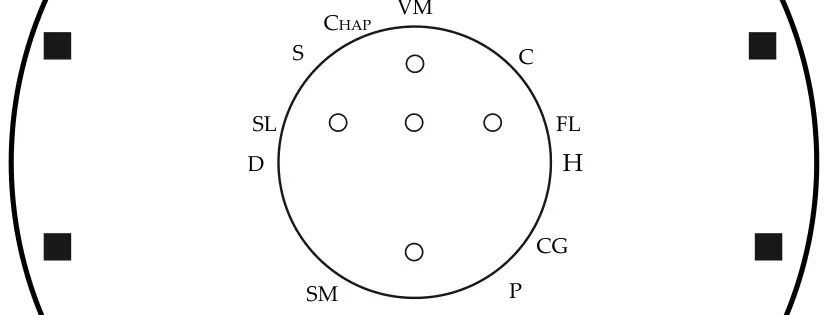
In the center of the room is a very large round table, on which are five lamps, with globular shades of ground glass, arranged in the shape of a passion-cross, the vertical shaft extending East and West, the head of the cross to the East. These lamps must be fed with olive oil. On this table are a crucifix, a copy of the Pentateuch in Hebrew, a crown or garland of laurel, a sword and a large key, crossed, an apron and pair of gloves of the degree, and scattered upon it, in no particular order, all the working tools of the Symbolic Lodge. Around this table all the Commanders sit.
In the West are the following sentences:
“in many words thou shalt not avoid sin.” “life and death are dispensed by the tongue.”
The Grand Commander of the Supreme Council is the Grand Master of the Order. The Grand Master of the Kadosh of a State is the Provincial Master. If there be no Grand Consistory, the single, elder or eldest InspectorGeneral in a State or Territory, or if there be none, the Deputy of the Supreme Council, is Provincial Master.
The presiding officer of a Chapter is the Master, styled, “Venerable”; the Senior Warden is styled “Sub-Master,” and the Junior Warden, “Preceptor”; the Orator, “Hospitaller”; the Master of Ceremonies, “Draper”; the Secretary, “Chancellor”; the Treasurer, “Sénéchal”; the Experts are “First and Second Lieutenants”; and the Captain of the Guard, “Captain of the Guard.” Each, except the Master is addressed as “Brother.” The Tiler is styled “Sentinel.” There is also a Chaplain, styled, “Reverend.”
The Venerable Master sits on the east side of the table; the Sub-Master and Preceptor on the west side, the latter on the right of the former; the Hospitaller on the south side; the Draper on the north; the Chancellor on the left of the Venerable Master, half way between him and the Hospitaller, and the Sénéchal on the right of the Venerable Master, half way between him and the Draper; the First Lieutenant on the right of the Hospitaller; the Second Lieutenant on the left of the Draper; and the Captain of the Guard on the right of the Preceptor. The Chaplain sits on the right hand of the Venerable Master.
Dress, Decoration, etc.
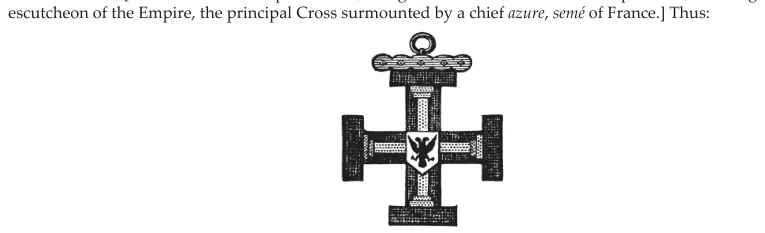
The apron is square, of scarlet-colored lambskin, lined and edged with black. The flap is white, and on it is a Teutonic Cross, [described as a cross potent sable, charged with another cross double potent or, surcharged with an escutcheon of the Empire, the principal Cross surmounted by a chief azure, semé of France.] Thus:
Vignette [p. 751]
[p. 752]
In the middle of the apron is a key, in black, and round it, embroidered in green of the proper shade, a garland or wreath of laurel.
The gloves are white, lined, edged and embroidered with red. The order is of white watered ribbon, edged with red, worn as a collar (en camail), at the bottom of which the jewel hangs. On each side of the collar is embroidered in black and gold the Teutonic Cross.
A scarf is worn across the body, from right to left, being a broad watered scarlet ribbon, edged with black, at the end of which hangs a gold cross of the Order.
The jewel is a Teutonic Cross of gold, as above, the eagle of black enamel. The hilt of the sword is in the shape of a cross, and gilt. The scabbard and sword-belt are black. Under these decorations, each wears a tunic of white woolen stuff , reaching to the mid-thigh; and over all a Knight’s mantle of scarlet velvet, reaching nearly to the ground, lined with ermine or white silk. On the breast of the tunic is embroidered a Teutonic Cross, as above described; and on the right side of the mantle a passion-cross, in black.
The hat is broad-brimmed, with red plumes, and a black and white cockade. A gilt spur is worn on each heel.
Figure de l’original [p. 752]Plan de l’atelier [p. 752]
IN MANY WORDS THOU SHALT NOT AVOID SIN LIFE AND DEATH ARE DISPENSED BY THE TONGUE
[p. 753]
To Open.
When the members have assembled, the Master raps •, to engage their attention, and says: VM—Attention, Commanders! I have caused you to assemble for the purpose of deliberating upon matters of importance to the Order. I pray you to assist me in opening our Chapter of Knights Commanders of the Temple, that we may take counsel together. Be pleased to assume your places!
The members draw their swords, salute the Master, and then, with them at the carry, take their places round the table, and remain standing.
VM—Brother Captain of the Guard, inform the Sentinel that we are about to open our Chapter, that he may keep due watch, permitting none to enter without permission of the Marshal.
The Captain of the Guard goes out, returns, salutes and reports: CG—Venerable Master, the Sentinel is at his post, and we are duly tiled.
VM—Brother Hospitaller, what were the first duties assumed by the Knights Commanders of the Temple?
H—To nurse and tend the poor, sick and wounded soldiers of the Cross.
VM—Brother Preceptor, to what knightly duties did they afterward engage themselves?
P—To guard the city of Jerusalem against the Saracens, to protect Christendom, to succor and assist the feeble and oppressed, and to defend the innocent.
VM—Brother Sub-Master, what additional obligation did they contract when they were initiated into Masonry?
SM—To practice all the Masonic virtues; but particularly to love the Brethren.
VM—Brother Preceptor, what is the first in order of the five excellent qualities of a Knight Commander of the Temple?
The Preceptor lights the last or west lamp of the three which form the vertical shaft of the cross. P—Humility.
VM—Blessed are the poor in spirit, for theirs is the kingdom of Heaven! Blessed are the meek, for they shall inherit the earth! Let nothing be done through strife or vainglory; but in lowliness of mind let each esteem the other better than himself! Brother Draper, what is the second in order of the five excellent qualities of a Knight Commander of the Temple?
The Draper lights the lamp which forms the northern extremity of the transverse bar of the cross. D—Temperance.
VM—We should live soberly, righteously and godly in this present world. The night is far spent, the day is at hand; let us, therefore, cast offthe works of darkness, and put on the armor of light; let us walk honestly, as in the day; not in rioting and drunkenness; for the kingdom of God is not meat and drink, but righteousness and peace and joy, in the Holy Spirit! Brother Hospitaller, what is the third in order of the five excellent qualities of a Knight Commander of the Temple?
The Hospitaller lights the lamp which forms the southern extremity of the transverse bar of the cross. H—Chastity.
VM—Flee also youthful lusts; but follow righteousness, faith, charity, peace, with them that call on the Lord out of a pure heart! When lust hath conceived it bringeth forth sin; and sin, when it is finished, bringeth forth death. Let not sin, therefore, reign in your mortal body, that ye should obey it in the lusts thereof! Brother Sub-Master, what is the fourth in order of the five excellent qualities of a Knight Commander of the Temple?
The Sub-Master lights the middle lamp of the three that form the vertical shaft of the cross. SM—Generosity.
VM—Blessed are the merciful, for they shall obtain mercy. See that none render evil for evil unto any; but do always that which is good, both among yourselves, and to all men. He which soweth sparingly shall reap also sparingly; and he which soweth bountifully shall reap also bountifully. Brother Chancellor, what is the fifth and most excellent of the five excellent qualities of a Knight Commander of the Temple?
The Chancellor lights the lamp at the eastern extremity of the vertical shaft of the cross. C—Honor.
VM—Ye are the salt of the earth; but if the salt have lost its savor, wherewith shall it be salted? It is thenceforth good for nothing but to be cast out, and to be trodden under foot of men. Blessed are the pure in heart; for they shall see God! Have always a conscience void of offense toward God and men! Ye shall be vessels unto Honor, sanctified, and meet for the Master’s use, prepared unto every good work! Reverend Brother Chaplain, let us pray to our Father in Heaven to inspire us with these virtues, and that he will graciously enable us to reap these promised rewards!
All kneel, in their places at the table; and the Chaplain repeats the following
[p. 754]
Prayer.
Father and Creator, who hast given us life and being, aid us to perform the duties which thy law and our vows impose upon us! Thou hast given us the portion and the food of Sons; make us to do the duty of Sons, that we may never lose our title to an inheritance so glorious! Thou hast vouchsafed to call us thy children, and dost graciously permit us to call thee Father. May that name be our glory and our confidence, our defense and guard, our ornament and strength, our dignity and the endearment of obedience! May it confirm and sustain us in our good resolutions, and make us steadfast never to desert the post of duty! Let our bodies be chaste, our thoughts pure, our words gentle, and our lives useful and innocent, to the honor and commendation of Masonry and Knighthood! Make us patient of the evils which thou inflictest, lovers of the good which thou commandest, haters of all vice which thou forbiddest, and satisfied with all the accidents thou sendest. Let us not be tempted with want, nor made contemptible by beggary, nor wanton or proud by riches, nor in love with anything in this world to the disregard of duty! Look upon us with mercy, forgive our imperfections, and accept with indulgence the little service we may be enabled to render to the cause of virtue, charity and truth! And to thee be all glory and honor forever. Amen!
All—So mote it be. All rise, and remain standing. VM—Brother Sub-Master, what is your age?
SM—I have arrived at that age when Reason governs the appetites and passions, and have received the rewards of a Knight Commander of the Temple.
VM—What were those rewards?
SM—The five trophies of a Knight Mason.
VM—Do you believe that you have deserved those rewards?
SM—I have endeavored to do so.
VM—How?
SM—By being true to my vows, and by strict and zealous observance of my duties.
VM—For what other reward do you hope?
SM—In this life, that worthy Masons will crown me with their good opinion, of which the laurel is the emblem: in the life to come, for the mercy of God.
VM—Where were you crowned with the laurel?
SM—In a place sanctified by good works.
VM—When?
SM—At the right time.
VM—What is a Knight Commander’s hour?
SM—The Present; since it alone is with us.
VM—Since then the Present only is ours, aid me, my Brethren, Knights-Commanders of the Temple Masons, to open our Chapter, according to the ancient custom!
All extend their swords over the table, the points upward, at an angle of 45 degrees, and meeting in the center; and the Venerable Master says:
VM—As these swords point to one common center, so do we here anew devote our energies and intellects to one common purpose, and dedicate our swords to the cause of Freedom, our hearts to the glory of God, our intellects to the enlightenment of men, and our hands to assist the sick, the suffering and the destitute. So help us, God!
All—Amen!
VM—To order, Knights! All stand under order. P—•••• SM—••• VM—•• Then the Venerable Master gives the sign of recognition to the Knight on his right, who makes the answer; and it is so done around the circle, and returns to the Venerable Master.
VM—In the name of the Grand Master of the Order of Knights Commanders of the Temple and under the auspices of the Supreme Council of the Thirty-Third Degree of the Ancient and Accepted Scottish Rite of Freemasonry for the Southern Jurisdiction of the United States, whose See is in Charleston, in the state of South Carolina, and by virtue of the powers in me vested as Venerable Master of this Chapter, I declare this Chapter to be duly opened, for the transaction of such business as may lawfully come before it. Reverend Brother Chaplain, be pleased to deliver the usual charge.
The Knights all form the chain, with their hands crossed, and each grasping that of the other; and the Chaplain says: Chap—Be kindly affectioned one to another with brotherly love, in honor preferring one another!
[p. 755]
Be of the same mind one toward another! Mind not high things, but condescend to men of low estate! Be not wise in your own conceits! Recompense to no man evil for evil! If it be possible, as much as lieth in you, live peaceably with all men! Let all bitterness, and wrath, and anger, and clamor, and evil-speaking, be put away from you, with all malice! And be ye kind one to another, tender-hearted, forgiving one another, that your Father, which is in Heaven, may forgive you!
All—AmenӔ So mote it be!
VM—Be seated, my Brethren! He gives one rap, and all sit down.
Reception.
This is the first strictly chivalric degree of the Ancient and Accepted Scottish Rite. The Ritual of Brother Louis Claude Henri de Montmain, who conferred it as a detached degree, in Charleston, from 1798 to 1802, and from whom, in the former year, Brother the Count Alexandre François Auguste de Grasse received it, says: “This sublime degree of Grand Commander of the Temple Mason is the last, above all that precede it, the most majestic, and the only one that has the greatest privileges, and it is for this reason it is styled the crowning point of Masonry, or the ne plus ultra.”
“In order for this degree to be communicated, the Mason who desires to be honored and favored with it must have generally all the other degrees, must possess the requisite qualities, and be provided with his titles, certificates and briefs of reception, so as to prove by authentic evidence his regularity as a Mason. … To be admitted to this degree one must possess all the degrees of Masonry, and thoroughly understand its principles, its bases and its morality, in order to be able, knowingly, to decide in regard to matters that may arise even in the Lodges, among Masons.”
Whenever a Prince of Mercy desires to obtain this degree, he communicates his wish to a Knight Commander, who inquires into his deserts, and, if satisfied, presents him to each Commander, to whom he will present a pair of gloves of the degree, and ask his consent to his admission.
A Chapter of the Knights Commanders is then convoked, of which the Grand Master and Provincial Master must be notified, if in the place where it is held. If either of them is present, he will not preside.
When the Chapter has been opened, the Candidate is introduced by the Draper; and he standing on the west of the table, between the Sub-Master and Preceptor, the Venerable Master presents him by name to the Knights Commanders, saying:
VM—Behold, my Brethren, this Prince of Mercy, who seeks to signalize his zeal for Masonry, by entering our Order. Look well upon him, and afterward inquire of each other as to his character and intelligence, that you may decide knowingly whether you will admit him to our ranks! Brother Draper, let the applicant withdraw while the Knights Commanders deliberate.
The Draper retires with the Candidate, leaves him alone in the anteroom, and returns. When he has again taken his seat, the question of admitting the Candidate is taken up; and if anyone desires information in regard to him, those who know him give it; after which the secret ballot is taken, and if he is elected, the Venerable Master directs that the ceremony proceed; and the Draper again repairs to the ante-room.
The candidate is prepared by being clothed in a tunic of black stuff , on the left of which is a large white Teutonic Cross. The Ritual of de Montmain says that he is to be “deprived of all metals, and divested of his coat and shoes, with his hair disheveled, and decorated as a Mason.” All this is now dispensed with. He wears a sword of the degree, with the belt and scabbard black.
The Candidate is further prepared by having his eyes bandaged, and is then conducted by the Draper to a small room, the walls, ceiling, and floor of which are entirely black. In the center of it is a small table, and by it a stool, both covered with black. On the table are three skulls, forming a triangle, with leafy twigs of evergreen shooting out from the several apertures of each. In the center of the triangle so formed is a single candle of black wax, burning. There is no other light. Also within the triangle are three small vessels of silver, one near each skull, containing, respectively, a morsel of dry bread, water, and salt. At one side is a printed paper containing the questions, with spaces for the answers, and also letter-paper, with pens and ink, sealing wax and a seal.
Having seated the Candidate upon the stool, the Draper says to him: D—My Brother, you have asked to be permitted to receive the degree of Knight Commander of the Temple. Before you can do so, there are certain prerequisites with which you must comply. You will learn what they are, by the printed paper on the table before you. I shall leave you alone. When you have counted sixty pulsations of the heart, remove the bandage from your eyes, eat of the bread, drink of the water, and taste of the salt, as a solemn pledge that you will answer and act, truly and with honor. Then read the paper, and do so. Consider well the solemn import of the questions and demands; and let all around you, and especially the three mementos on the table, remind you of the evanescence of all earthly things, the obligations of rectitude and honor, the certainty of death, and after
[p. 756]
that of the resurrection, and solemn judgment for the deeds done in the body. When you shall have finished, sign the paper and give three distinct raps upon the table, and I will return.
The Draper then retires, closing the door. The paper is as follows: “Question 1. Have you done wrong or injury to anyone, without atoning for it by repentance, and, if possible, by making amends?”
“Question 2. You have often made professions and given pledges in Masonry. Now we demand of you performance. If you have done wrong or injury to anyone, without making amends, and it has not now become impossible to do so, write to the party a letter, confessing the wrong, and promising to make amends, or doing so, if it can be done by letter! If you have atonement to make to more than one, answer whether what you thus do in one case you will at the earliest opportunity do in all! Seal, if you choose, your letter, since we do not demand to know its contents; but answer briefly hereunder what you do and promise!”
“Question 3. Have you any enmity toward, or feud with, anyone, that you would not readily abandon, if you found him sincerely willing to be reconciled to you?”
“Question 4. If you have any quarrel with a good Mason of any degree of the Ancient and Accepted Scottish Rite, write to him now a letter, offering reconciliation and the right hand of fellowship. Seal your letter; and answer in writing hereunder what you have done; and, if you have more than one such quarrel, whether you will at the earliest opportunity do the same in every such case?”
When the Candidate summons the Draper, the latter receives the paper, and the letters, if any, and again retires. The replies to the questions are then read aloud in the Chapter by the Chancellor; and the Knights consult together in regard to their sufficiency. If the Candidate should have refused to make atonement of an admitted wrong, confessing that it is in his power to do so; or if he refuses to make advances toward a reconciliation with a Brother of the Rite, it is not possible for him to be allowed to proceed; and in that case the Draper will conduct him to the ante-room and so inform him, permitting him to depart in peace.
If he complies satisfactorily with what has been required, the ceremony will proceed. If it is thought proper to allow him orally to explain anything in his replies, he may be introduced and permitted or requested to do so.
In short, every means will be taken to know with certainty whether he is a true Mason, in this, that he is willing to atone for a wrong done anyone, and not too proud to offer a reconciliation to a Brother. If the Chapter is not satisfied, and he is rejected, any letter he may have written will be returned to him. If he is received, his letter or letters will be handed to the Chancellor, to be forwarded to the parties to whom they are addressed.
When it is decided that the Candidate shall be admitted, the Draper conducts him to the door of the Chapter, places on his head a white linen coif, and close over that a red cap, and seats him there upon a low stool. He then raps at the door, ••••. The Captain of the Guard, on the inside, replies with •••, and the Draper returns ••. The door is then partly opened by the Captain of the Guard, who asks:
CG—Who desires to enter this Chapter?
D—A poor serving Brother-at-arms, who, having completed the due term of probation, and given evidence of his valor and virtue, now seeks of the Brethren of the Chivalry of the Temple of Solomon the habit and fellowship of the Order.
CG—What is his name?
D—A.
B.
CG—Why does he desire to obtain this favor?
D—That he may more efficiently assist in our labors of beneficence.
CG—My Brother, is this answer from the lips only, or from the heart? Candidate—I am a Perfect Elu.
CG—Do you think yourself worthy to be received among the poor fellow-soldiers of the Temple of Solomon? Candidate—I am a Knight Rose Croix, having Hope and Faith with Charity.
CG—Do you know the value of the mysteries of Masonry? Candidate—I am a Prince of Mercy. Masonry is my stay and strength in danger, and my comforter in misfortune.
CG—What guarantee will you give us of the sincerity of these professions? Candidate—The sincere vows which I have taken in the preceding degrees, and my readiness to assume the vows of this.
CG—He answers fairly. Let him wait with patience until the Venerable Master and the Chapter declare their pleasure!
The Captain of the Guard closes the door, and advances toward the table; and the following questions and answers are asked and given:
VM—Brother Captain of the Guard, who seeks to enter the Chapter?
[p. 757]
CG—A poor serving Brother-at-arms, who, having completed the due term of probation, and given evidence of his valor and virtue, now seeks of the Brethren of the Chivalry of the Temple of Solomon the habit and fellowship of the Order.
VM—What is his name?
CG—A.
B.
VM—Why does he desire to obtain this favor?
CG—That he may more efficiently assist in our labors of beneficence.
VM—Is this answer from the lips only, or from the heart?
CG—He replies to this, that he is a Perfect Elu.
VM—Does he think himself worthy to be received among the poor fellow-soldiers of the Temple of Solomon?
CG—He replies to this, that he is a Knight Rose Croix, having Hope and Faith, with Charity.
VM—Does he know the value of the mysteries of Masonry?
CG—He replies to this, that he is a Prince of Mercy; and that Masonry is his stay and strength in danger, and his comforter in misfortune.
VM—What guarantee will he give us of the sincerity of these professions?
CG—The sincere vows which he has taken in the preceding degrees, and his readiness to assume the vows of this.
VM—Brothers First and Second Lieutenants, you will go to the place where this serving Brother is, prepare him in due form to assume the vows of Knighthood, and bring him in your charge into the Chapter.
The First and Second Lieutenants go out and prepare the Candidate by taking offhis sword and belt, blindfolding him, and placing a lighted taper in his right hand; the First Lieutenant saying, as he does so:
FL—Your belt is removed, in order that you may appear perfectly free at the time of entering into so solemn an engagement as that which you are about to contract.
The lighted taper in your hand represents Charity; for the active performance of whose most sacred duties the Order which you desire to enter was instituted.
You are blindfolded to teach you Humility, the first of the five excellent qualities of a Knight Commander of the Temple. If you are willing to humble yourself, that you may be exalted, place yourself in our hands, and we will conduct you safely through every danger.
The two Lieutenants take him between them, each holding an arm, the First Lieutenant on his right and the Second Lieutenant on his left, and lead him away from the door of the Chapter, through as many rooms and by as many passages as possible, so that when they finally enter the Chapter with him, he may not know but that he is in another room. When he enters, perfect silence is maintained by the Knights, so that he may not know but that he is alone with the Lieutenants.
On entering, they stand, with him between them, on the west side of the room, the Second Lieutenant carrying his sword and belt.
There is music, soft and solemn, in an adjoining apartment. music stops.
FL—You stand here, blind and defenseless. Prepare to die! This dirge is immediately sung in the adjoining apartment:
dirge O, Mason! who dost sleep away Life’s brief, uncertain, stormy day; We all must die! We all must die! And Death is ever drawing nigh.
The Brother Terrible on high With sonorous voice to all will cry; “We all must die! We all must die! Judgment is ever drawing nigh.
Assemble, Masons, one and all! Rise in the body at my call!” We all must die! We all must die! And Heaven or Hell is drawing nigh!
(Repeat the two last lines)
[p. 758]
Partition musicale [p. 758]
[p. 759]
Partition musicale [p. 759]
[p. 760]
Partition musicale [p. 760]
[p. 761]
Partition musicale [p. 761]
[p. 762]
Partition musicale [p. 762]
[p. 763]
Partition musicale [p. 763]
[p. 764]
Partition musicale [p. 764]
[p. 765]
Partition musicale [p. 765]
FL—Because sentence against an evil work is not executed speedily, therefore the heart of the sons of men is fully set in them to do evil. But the justice of Heaven is certain; and he who would die bravely, like a Knight, should live well and honestly, like a Mason.
The Knights of this Order formerly took the three vows of Chastity, Obedience and Poverty; and we require of you three of the same nature, though not identical in the letter.
The First Lieutenant takes from the Candidate the light which he carries; and a cushion is placed before him, which he may kneel upon.
[p. 766]
Kneel on both knees, in the presence of your Father who is in Heaven, and with clasped hands appealing to him to hear your solemn vows, make distinct answer.
Do you solemnly vow, upon your soul and honor, that you will never be guilty of betraying female innocence? Candidate—I do. So help me God.
FL—Do you solemnly vow, upon your soul and honor, that you will comply with the reasonable commands of the Grand Master, Provincial Master or Master of the Chapter, in everything Masonic, that is for the glory of God or for the welfare of men?
Candidate—I do. So help me God!
FL—Do you solemnly vow, upon your soul and honor, that you will regard yourself as the Almoner of God, to dispense his bounties, so far as your means permit; and that you will rather remain poor than neglect the obligations of charity and permit your Brethren to want?
Candidate—I do. So help me God! FL and SL—Amen!
FL—Rise, Brother, and listen! He rises; and the light is again put in his hand. FL—Those who formerly entered this Order consecrated themselves to the service of the sick and suffering, were constantly employed in works of mercy, and devoted themselves to the service and defense of the Christian faith. They were no longer allowed to act for themselves, but on the contrary were obliged absolutely to renounce their own will and pleasure, and implicitly to comply with that of their superiors. The change of circumstances and manners makes this strictness to be no longer required; but you will contract with us an analogous engagement.
Do you promise that you will not neglect the sick and the suffering of your Brethren? The Candidate answers. FL—Do you promise that you will consider it the highest glory to benefit your fellows? The Candidate answers. FL—Do you promise that you will devote yourself to the service and defense of the principles of Scottish Masonry, to such extent as your other duties permit?
The Candidate answers. FL—Do you promise that you will not so be governed in your action in bodies of the Order, as that harm shall come to the Scottish Masonry in consequence of your resentments, piques and grudges?
The Candidate answers. VM—If thou bring thy gift to the Altar, and there, rememberest that thy Brother hath aught against thee, leave there thy gift before the Altar, and go thy way, first be reconciled to thy Brother, and then come and offer thy gift.
FL—Dost thou agree to obey this commandment, and not to stand at the Altars of Masonry, having a quarrel with a Brother unreconciled?
Candidate—I do. So help me God!
VM—Swear not at all; neither by Heaven; for it is God’s throne; nor by the earth; for it is his footstool!
FL—Dost thou agree to obey this commandment, and never more to take the name of God in vain? Candidate—I do. So help me God!
VM—Love your enemies! Bless them that curse you! Do good to them that hate you! and pray for them that despitefully use you and persecute you!
FL—Dost thou agree to endeavor, truly and earnestly, to obey this commandment? Candidate—I do. So help me God!
VM—Brother First Lieutenant, we have heard the responses of this serving Brother, and are content therewith. Place him now in charge of the Knights Sub-Master and Preceptor, for the ceremony of investiture.
This is done. The light is taken from him; the Sub-Master and Preceptor take the places of the First and Second Lieutenants, who return to their seats.
SM—Art thou prepared to assume the other vows of a Knight that we have all assumed? Candidate—I am.
SM—Kneel, then, upon both knees, and clasp thy hands together! He does so; and the Marshal, taking the Candidate’s hands between his own, causes him to repeat the following
Obligation.
I, A. B., about to be invested with the dignity of Knight Commander of the Temple, do vow to the Grand Master and Provincial Grand Master, and to my Chapter, perpetual obedience and fidelity. I vow that I will defend, not only with my lips, but by force of arms, and with all my strength, the free exercise of the work and rites of Masonry, the rights of conscience, and the great principles of free government; that I will at all times be prepared to take up
[p. 767]
arms for my country, to defend her safety and honor, and even in case of need to pass the seas in her service; that in the presence of three enemies I will flee not; that I will not permit the power of the Order to be perverted to evil uses, or made the instrument of private ambition or of private greed; that I will never surrender my principles in order to purchase safety; that I will never refuse to my Brother Knights any succor I am able to afford them; but will aid and defend them, by words, by arms and by all sorts of good offices; and in sincerity, and of my own free will, I vow that I will observe all these things! So help me, God!
SM—Rise, my Brother, and be seated upon the floor! He does so, and the Master says: VM—You have engaged yourself in the defense of the poor and of Scottish Masonry. We hope that you have joined our ranks through true charity, which is the mother and sure foundation of all other virtues; from a spirit of beneficence, and from a sincere attachment to Masonry. If so, you will only strive to distinguish yourself by your merit. The poor fellow-soldiers of the Temple of this branch of the Order are destined to fight only for the glory of Masonry, to uphold its banners, and vindicate its principles; to love, revere and preserve justice; and to favor, sustain and defend the oppressed, without neglecting the sacred duties of hospitality; so that, in closing the pilgrimage of this mortal life, they may attain to that eternal recompense for which God has created them. Those who shall be convicted of having neglected their duty, or misused or overlooked occasions where they could have done good service in any undertaking for the interests of Masonry, the punishment of evil-doers, and the assistance of the good, shall be rigorously punished according to the statutes and rules of the Order.
Rise, my Brother, and exchange the Darkness for the Light! He rises, and the bandage is taken from his eyes. He is also divested of the black tunic, which is replaced by the white one of the Order, and of the red cap and the coif.
VM—We do hold you now to have become consecrated to the service of this Order of Knights Commanders of the Temple, and servant of the Poor, the Sick and the Unfortunate.
Candidate—I do indeed hold myself to be such.
VM—We do hold you to be enlisted in that service for life. Candidate—I do hold myself to be so.
VM—Do you now promise and vow that, if occasion should offer, you will not flee from plague, pestilence or epidemic, to avoid danger, when duty and manhood require you to remain; but will imitate the example of those Knights of Bremen and Lubec, who, making their sails into tents, devoted themselves to the care and nursing of the sick and wounded; and so became the founders of this Order?
Candidate—I do. So help me God!
VM—Do you now promise and vow that you will never desert the post of duty through fear of death; however humble that duty, and however unnoticed your death may be; but in plague or battle, in fire or tempest, you will stand firm at your post, so long as manhood and duty demand, whatever may be the consequences to yourself?
Candidate—I do. So help me, God.
VM—Kneel, then, once more, before me. He does so. The Master draws his sword, and with the flat of the blade gives him the accolade on the left shoulder, right shoulder and head, at the words, respectively, “constitute,” “create,” and “dub,” saying:
VM—By my authority and power as Master of this Chapter, and in the name of the Grand Master of the Order, I hereby constitute, create and dub thee a Knight Commander of the Temple. Be true, devout and brave! Arise, A. B., no longer a serving Brother, but a Knight; and may glory and good fortune attend you!
Receive now the five trophies of this degree. I crown you with this garland of laurel. This especially is meant to crown your good works, done to the Order, the Lodges, and your Brethren; and to encourage you to persevere.
I present you with the apron and gloves, the collar, scarf and jewel of the Order. The colors of these decorations are white, red and black. For whom this latter color, the emblem of sorrow and mourning, is worn, you will know at a proper time.
I present you with the sword of a Knight, to enable you to maintain the rights of Masonry and of men, and to punish their enemies and tyrants. If in that contest you should fall, you will have fulfilled the noblest destiny of a Knight and gentleman; and surely it is a sweet and glorious fate to die for the Fraternity.
The Turcopilier invests him with the sword-belt, and buckles it. VM—I present you with the spurs of a Knight. The Marshal buckles them on. VM—As you have won them worthily, so may you wear them with honor! God forbid that for any act of base unworthiness you should ever be deprived of them!
I present you with the pallium or mantle of the Order.
[p. 768]
He shows him the cross upon it. This cross is the sign of the Order, which we command you constantly to wear. The new Brother kisses the sign of the cross, and the Venerable Master throws the mantle over his shoulders, and kissing him, says:
VM—Take this sign, in the name of God, for the increase of Faith, the defense of the Order, and the service of the Poor. We place this cross upon your breast, my Brother, that you may love it with all your heart; and may your right hand ever fight in its defense and for its preservation, as the symbol of Knightly Masonry. Should it ever happen that in combating against the enemies of human freedom and the rights of conscience, you retreat, desert your standard, and take to flight in so just a war, you will be stripped of this sign, according to the statutes and customs of the Order, as having broken the vows you have just taken; and will be cut offfrom our body as an unsound and worthless member.
Fastening the strings of the mantle round the neck: VM—Receive the yoke of the Order; for it is easy and light, and with it you shall reap honor. We promise you nothing but bread and water, and a simple habit of little value; but we give you, what is far more than all and above all insignia and jewels, a share in the good works performed by our Order, and by our Brethren, and in its glories, heretofore, now and hereafter throughout the world.
My Brethren, embrace your new Brother, in token of friendship, peace, and brotherly love. All the Brethren do so; after which the Venerable Master says: VM—Receive now the Signs, Tokens and Words of this degree! The Sign is of Recognition. Make the sign of the Teutonic Cross upon a Brother’s forehead with your right thumb, the fingers closed.
The Answer: He kisses your forehead. This is done only in the Chapter. Elsewhere the answer is to place the first two fingers of the right hand over the mouth—closing the other fingers, and turning the palm outwards.
The Order: In open Chapter, place the right hand upon the round table, and extend the thumb so as to form a square. When standing, place it in like manner on the belly.
The Token is to strike gently the left shoulder of a Brother three times with the right hand. The Answer: He gently squeezes your right hand three times. The Password is Shalamah. The Grand Word is INRI, alternating the letters in reverse. [The new Knight is now told that the History of the Order is properly to be recited here, but that, as it will be more convenient for him, he will read it in the Legenda. The following is what is in the Legenda].
History.
WHEN St. Jean d’Acre, the Ancient Ptolemais, on the southern side of which was Mount Carmel, was besieged by the Christian forces, for nearly two years, under Guy of Lusignan, King of Jerusalem, Conrad, Marquis of Montferrat, and other Princes and leaders from every country in Europe, and especially by Henry VI of Germany, son of Frederic Barbarossa, joined, near the end of the siege, by Philip Augustus of France and Richard Cœur de Lion of England, they were long afflicted with famine, until they ate the flesh of horses with joy, and even the intestines sold for ten sous; men of high rank and the sons of great men greedily devoured grass; the starving fought together like dogs for the little bread baked at the ovens; they gnawed the bones that had already been gnawed by the dogs; and noblemen, ashamed to beg, were known to steal bread. Constant rains added to their miseries; and Salah Eddin, Sultan of the Saracens, encamped near them with a vast army from every portion of his dominions, and all the great Emirs of Islamism harassed them with constant attacks—Salah Eddin, whom his people called The Elect of God; Malek-Adhel, Sayf-Eddin, his Brother; the Prince of Hamah, his nephew; and the Princes of Damascus and Aleppo, his sons; the yellow and green banners of the Emirs of Emessa, the Princes of Baalbec, Harran and Edessa in Mesopotamia, Singar and Gezire on the Tigris, and all the tents of Islamism.
Sickness also, caused by the rains and the intense heat, decimated the Christian forces. The wounded German soldiers, whom none of the others understood, could not make known their sickness nor their necessities. Certain German nobles from the cities of Bremen and Lubec, who had arrived at Acre by sea, moved by the miseries of their countrymen, took the sails of their ships and made of them a large tent, in which for a time they placed the wounded Germans and tended them with great kindness. Forty nobles of the same nation united with them and established a kind of hospital in the midst of the camp; and this noble and charitable association, like the knights of the Temple and of St. John of Jerusalem, soon and insensibly became a new Hospitaller and Military Order. This was in the year 1191. In 1192, Pope Celestin III, at the request of the Emperor, Henry the 6th, solemnly approved of the Order by his Bull of the 23d of February. He prescribed as regulations for the new Knights, those of Saint Augustine; and for special statutes, in all that regarded the poor and sick, those of the Hospitallers of St. John; in
[p. 769]
regard to military discipline, the regulations of the Templars. This new Order, exclusively composed of Germans, was styled “The Order of Teutonic Knights of the House of St. Mary of Jerusalem” as the Templars were styled “of the House of the Temple at Jerusalem.”
The author of the “Critical and Apologetic History” of the Templars (Rev. Father Mansuet Junior) says: “A great number of German noblemen, who had followed that Prince (Frederic of Suabia, second son of the Emperor) to Acre as volunteers, some actuated by religious enthusiasm and some by the desire of glory, joined the soldieries of the Temple and of the Hospital or engaged in attending on the wounded and caring for the sick of their nation. This was the origin of the Teutonic Order, the first branch of that of the Templars.”
“The Chiefs, desiring to advance these pious gentlemen and to gratify the German nation, proposed to them the institution of a new Order of Chivalry, to be at once hospitaller and military. Forty German lords, distinguished by their nobility and feats of arms, agreed to this and became the founders and original members of the Order. On entering the Order, they bound themselves by the three solemn vows and also obliged themselves to serve the poor, in imitation of the Hospitallers, and to follow the claustral and military discipline of the Templars in peace as well as in war.”
Their title of Knights of the House of St. Mary of Jerusalem was given them, because while the city of Jerusalem was under the government of the Latin Christians, a German had erected there, at his own expense, a Hospital and Oratory for the sick of his nation, under the protection of and dedicated to the Virgin Mary. An old writer says that the Order was founded “by an Almain who, with his wife, settling in Jerusalem after the taking of the city, founded there a Hospital for the reception of pilgrims, with an Oratory dedicated to the Blessed Virgin, and in a short time had drawn such resort that from thence arose a Fraternity, electing a Grand Master.”
The author first cited again says: “HENRI WALPOT,” (Heinrich Walpoti) “was elected the first Master of the growing Order and was put in possession of the Hospital of Mount Sion, as the principal place of the Establishment. The Popes and Sovereigns, induced thereto by the services rendered theretofore by the other two Military Orders, were not slow in proving their favorable opinion of this. It received from the Holy See the same privileges as the Templars and Hospitallers, and the right was granted it of holding in perpetuity all such lands and provinces as it might conquer from the Moslems.”
“It was divided into seven Provinces: Armenia, Achaia, Sicily, Teutonica, Apulia, Austria, Prussia and Livonia.” “The Templars had adopted a form of government, in part monarchical and in part aristocratic, of which the Grand Master was the Chief, and the Marshal, Draper and Senechal, with the Provincial Masters, were the principal members. The Teutonic Knights adopted the same system, with the addition of a Jiospitaller, an office borrowed from the Knights of St. John the Baptist or Hospitallers.”
The Grand Master was chosen by Electors. When a vacancy occurred, the Lieutenant Grand Master convoked a Chapter, which appointed a President of the Electors. He selected a second Elector, these two a third, these three a fourth, and so on, to the number of thirteen, among whom there had to be a Priest, eight Knights and four other Brethren from four different Provinces, when that was possible. These nineteen elected the Grand Master by a plurality of votes.
The Grand Master and Chapter appointed and removed the Grand Officers. Under him were, first, the Bishops, then the Provincial Masters, each exercising the whole power in his Province, presiding in the Provincial Chapters and seeing that the regulations of the Grand Master and of the Chapters-General were observed. The other officers or Preceptors were five in number, the Grand Commander, the Marshall, the Grand Hospitaller, the Draper and the Senechal, or Treasurer.
The Grand Commander was originally only the Counselor or Assessor of the Grand Master. Afterward he was appointed to govern in the Grand Master’s absence. In time of peace he had precedence of the Marshal and convoked the Chapter when the Master and Sub-Master were absent. He was also called Preceptor.
The Marshal had command of the Knights, under the Grand Master, and military command of campaigns. In time of war he had precedence over all the other high officers, including the Grand Commander.
The Grand Hospitaller had the charge of the poor and the administration of the Hospitals. The Draper had charge of the clothing and furnished the Knights with their ordinary and military dress and equipment.
The Treasurer or Senechal was also the Commissary-General of Supplies. There were also Chatelains or Governors of fortified places, with the Turcopiler and Chaplain. The Turcopilier commanded the light cavalry. In the Teutonic Order, the Marshal appointed him whenever occasion required.
The Chaplain had charge of the Chapel and its ornaments, and when the Knights lived in tents, he regulated the religious services.
[p. 770]
To distinguish this Order from the other two, they adopted the Black Cross. It is ordinarily said that they also adopted the white mantle; but about the year 1210, the Templars of Palestine complained to Pope Innocent that after they had received from the Holy See the white mantle as the distinctive dress of their Order, the Teutonic Knights, and especially those of St. Jean d’Acre, had assumed to wear it. Innocent wrote to the latter and to their Grand Master, Herman Bart, a gentleman of Holstein, and directed them that, in order to avoid all occasion for jealousy or quarrel, they should content themselves with their ordinary dress and leave the white color to the Templars; and at the same time he ordered the patriarch of Jerusalem to see to it that the Teutonic Knights should follow their first custom and to censure and so compel them to do it, if necessary.
It is true that they paid little regard to the mandate of the Pope and soon adopted the white mantle again, but it was not their primitive dress; and therefore we, in this degree, wear a different color.
The leading objects of the three great Military Orders were the same, and to them was well applied the phrase of the Preacher, the Son of David, the King of Jerusalem, “a three-fold cord is not quickly broken.”
The Teutonic Knights soon rivaled the other Orders in numbers and influence. In 1223, Herman de Saltz a, Grand Master of the Teutonic Knights, was present at a celebrated assembly convoked by Pope Honorius III, at Ferentino in Campania, to deliberate concerning the mode of raising succors for the Holy Land, at which were also present the Pope, the Emperor Frederic II, of Sicily, John, King of Jerusalem, the Bishop of Bethlehem, the Grand Masters of the Templars and Hospitallers, and other distinguished personages; and it was by the influence of Herman de Saltz a, 4th Grand Master of the Teutonic Knights, then exercised, that Frederic espoused and married the daughter of the King of Jerusalem and engaged in a new crusade.
In the year 1226 most of the Teutonic Knights went from the Holy Land to Prussia, the people of which were still idolaters, waging cruel war against their Christian neighbors, murdering Priests at the foot of the Altar and employing the sacred vessels for profane uses. Conrad, Duke of Masovia, called in the Teutonic Knights to his assistance and gave them, as a commencement for their establishment there, the whole territory of CuIm, with all lands they should conquer from the Infidels. De Saltz a, the Grand Master, sent thither a Knight called Conrad de Lansberg, who concluded the Treaty, which was signed by three bishops of that country. The Knights then entered those northern countries and by continued wars acquired in time the entire sovereignty of Royal and Ducal Prussia, Livonia and the Duchies of Courland and Semigal, all vast provinces and capable of forming a great kingdom. And when, in 1291, the Sultan stormed and took St. Jean d’Acre, the Teutonic Knights that survived returned to Europe and joined their Brethren in Prussia and Livonia.
In their war against the Heathen of Prussia, it is said, “they got great honor; and the Emperor, granting them permission to enjoy what by the sword they had wonne with expense of some blood, they purchased great revenues in Prussia, founded Konigsberg, Dantz ick, and all the chief towns and built many illustrious edifices and some cathedrals, establishing bishops there, who were enjoyned to wear the habit of the Order.”
In 1257, Pope Alexander accorded to the Teutonic Order all the indulgences, immunities and privileges before then granted by the Holy See to the two Houses, of the Temple and the Hospital, and this, because it observed with edification the Statutes of the Hospitallers in regard to the sick poor, and those of the Templars, in what regarded the functions of the Chaplains, Knights and other persons. “For this reason,” said the Pope, “it is just to make you the equals, in favors and privileges, of those whose virtues and good conduct you zealously strive to imitate.”
For many years the Teutonic Knights held Prussia as a fief depending on the Crown of Poland. During this period, fierce contests arose between the Grand Masters of the Order and the Kings of Poland, the former struggling for independence and the latter obstinately asserting their right of sovereignty. Albert, a Prince of the House of Brandenburg, elected Grand Master in 1511, engaged keenly in the quarrel and maintained a long war with Sigismund, King of Poland; but adopting the doctrines of Luther, in 1525, he made a treaty with Sigismund, by which that part of Prussia belonging to the Order was erected into a secular and hereditary Duchy, and the investiture of it granted to Albert, who bound himself to do homage for it to the Kings of Poland as their vassal. Immediately afterward he publicly professed the Protestant faith and married a Princess of Denmark. The Knights exclaimed so loudly against his treachery that he was put under the ban of the Empire, but he kept possession of the Province he had usurped and transmitted it to his posterity; and in process of time it fell to the Electoral Branch of the family, all dependence on Poland was shaken off , and the Margraves of Brandenburg took the title of Kings of Prussia, which has thus become one of the leading powers of Europe.
The remnant of the Order continued their ancient rule in Franconia, under their newly elected Grand Master, Albert Wolfgang, and a kind of Order was formed at Utrecht for Protestants, who were required before admission to pay a certain sum into the fund for charity and to prove themselves noble by four generations.
After the Order of the Temple had been “suppressed, extinguished, and abolished,” in the year 1312, by the Papal Bull of the 6th of May of that year, by which all persons were forbidden to enter the Order, or to assume the name of Templars, or to wear their dress, under pain of excommunication, an extension of the same, in the same
[p. 771]
year, adjudged all the property and estates of the Templars to the Knights of Rhodes (of St. John, or the Hospitallers, afterward Knights of Malta), except such as were in the realms of Spain and without prejudice to the rights of any kings, princes or lords to any property of the Order in other countries.
In Germany, all the princes desired to vest the property of the Templars in the Teutonic Order, in order to augment and enrich it and create great establishments for their children. They insisted that at least a portion of the property should be adjudged thus, for the reason that it had in part been bestowed on the Templars by their ancestors. This demand was made in a tone that permitted no refusal, and the Pope accordingly yielded and consented to the division.
No Templar were executed in German, and yet the Order disappeared. History does not tell us what became of the individual members, but as the one Order was but an off -shoot of the other, bound to the same service and professing the same vows, it is easily believed that the ranks of the Teutonic Knights readily opened to receive these impoverished unfortunates. Connected, like the other Military Orders, with the Masons, at least as to part of its members, the Teutonic Order privately preserved the title of Knight Commander of the Temple, though the red mantle and Black Cross replaced the white mantle and Red Cross of the soldiery of the Temple of Solomon.
(This ends the History from the Legenda.) VM—A Knight Commander of the Temple should have five excellent qualities, which are represented by the five lights that form the Symbolic Cross upon our table,—Humility, Temperance, Chastity, Generosity and Honor. It is only by the constant practice of the four first, and by a jealous care of your own Honor, that of the Chapter and that of the Order, that you can deserve to wear the Sword and Spurs of a Knight.
The new Brother may now be sent to the Hospitaller, and hear his address, or he may be told that it will be omitted, and that he will read it in the Legenda.
Discourse.
H—This is the first of the really Chivalric Degrees of the Ancient and Accepted Scottish Rite. It occupies this place in the Calendar of the Degrees between the 26th and the last of the Philosophical Degrees, in order, by breaking the continuity of these, to relieve what might otherwise become wearisome; and also to remind you that, while engaged with the speculations and abstractions of philosophy and creeds, the Mason is also to continue engaged in the active duties of this great warfare of life. He is not only a Moralist and Philosopher, but a Soldier, the Successor of those Knights of the Middle Age, who, while they wore the Cross, also wielded the Sword, and were the Soldiers of Honor, Loyalty, and Duty.
Times change, and circumstances; but Virtue and Duty remain the same. The Evils to be warred against but take another shape, and are developed in a different form.
There is the same need now of truth and loyalty as in the days of Frederic Barbarossa. The characters, religious and military, attention to the sick and wounded in the Hospital, and war against the Infidel in the field, are no longer blended; but the same duties, to be performed in another shape, continue to exist and to environ us all.
The innocent virgin is no longer at the mercy of the brutal Baron or licentious man-at-arms; but purity and innocence still need protectors.
War is no longer the apparently natural State of Society; and for most men it is an empty obligation to assume, that they will not recede before the enemy; but the same high duty and obligation still rest upon all men.
Truth, in act, profession, and opinion, is rarer now than in the days of chivalry. Falsehood has become a current coin, and circulates with a certain degree of respectability; because it has an actual value. It is indeed the great Vice of the Age—it, and its twin-sister, Dishonesty. Men, for political preferment, profess whatever principles are expedient and profitable. At the bar, in the pulpit, and in the halls of legislation, men argue against their own convictions, and, with what they term logic, prove to the satisfaction of others that which they do not themselves believe, Insincerity and duplicity are valuable to their possessors, like estates in stocks, that yield a certain revenue: and it is no longer the truth of an opinion or a principle, but the net profit that may be realized from it, which is the measure of its value.
The Press is the great sower of falsehood. To slander a political antagonist, to misrepresent all that he says, and, if that be impossible, to invent for him what he does not say; to put in circulation whatever baseless calumnies against him are necessary to defeat him,—these are habits so common as to have ceased to excite notice or comment, much less surprise or disgust.
There was a time when a Knight would die rather than utter a lie, or break his Knightly word. The Knight Commander of the Temple revives the old Knightly spirit; and devotes himself to the old Knightly worship of Truth. No profession of an opinion not his own, for expediency’s sake or profit, Or through fear of the world’s disfavor; no slander of even an enemy; no coloring or perversion of the sayings or acts of other men; no insincere speech and
[p. 772]
argument for any purpose, or under any pretext, must soil his fair escutcheon. Out of the Chapter, as well as in it, he must speak the Truth, and all the Truth, no more and no less; or else speak not at all.
To purity and innocence everywhere, the Knight Commander owes protection, as of old; against bold violence, or those, more guilty than murderers, who by art and treachery seek to slay the soul; and against that want and destitution that drive too many to sell their honor and innocence for food.
In no age of, the world has man had better opportunity than now to display those lofty virtues and that noble heroism that so distinguished the three great military and religious Orders, in their youth, before they became corrupt and vitiated by prosperity and power.
When a fearful epidemic ravages a city, and death is inhaled with the air men breathe; when the living scarcely suffice to bury the dead,—most men flee in abject terror, to return and live, respectable and influential, when the danger has passed away. But the old Knightly spirit of devotion and disinterestedness and contempt of death still lives, and is not extinct in the human heart. Everywhere a few are found to stand firmly and unflinchingly at their posts, to front and defy the danger, not for money, or to be honored for it, or to protect their own household; but from mere humanity, and to obey the unerring dictates of duty. They nurse the sick, breathing the pestilential atmosphere of the hospital. They explore the abodes of want and misery. With the gentleness of woman, they soften the pains of the dying, and feed the lamp of life in the convalescent. They perform the last sad offices to the dead; and they seek no other reward than the approval of their own consciences.
These are the true Knights of the present age: these, and the captain who remains at his post on board his shattered ship until the last boat, loaded to the water’s edge with passengers and crew, has parted from her side; and then goes calmly down with her into the mysterious depths of the ocean:—the pilot who stands at the wheel while the swift flames eddy round him and scorch away his life:—the fireman who ascends the blazing walls, and plunges amid the flames to save the property or lives of those who have upon him no claim by tie of blood, or friendship, or even of ordinary acquaintance:—these, and others like these:—all men, who, set at the post of duty, stand there manfully; to die, if need be, but not to desert their post: for these, too, are sworn not to recede before the enemy.
To the performance of duties and of acts of heroism like these, you have devoted yourself, my Brother, by becoming a Knight Commander of the Temple. Soldier of the Truth and of Loyalty! Protector of Purity and Innocence! Defier of Plague and Pestilence! Nurser of the Sick and Burier of the Dead! Knight, preferring Death to abandonment of the Post of Duty! Welcome to the bosom of this Order!
VM—Attention, Commanders! You will recognize as a member of our Chapter, and as a Chief of our Masonic Bodies, the Knight Commander Name, and will now join me in applauding his admission to this degree!
The Master and all the Knights give the full battery with their hands, and then give three times the answer to the sign of recognition, with the two fingers on the mouth, crying at each time, Ozé, [pronounced ō-zay].
If the Candidate pleases, he returns his thanks, but out of respect does not return the plaudit. After which he is conducted to a seat at the table.
To Close.
VM—Attention, Commanders! If anyone has any matter of business to bring before us, or any other matter for the interest of the Chapter, of the Order or of Masonry in general, the floor is tendered to him.
When nothing more remains to be done: VM—Since no one has anything further to offer or propose, I shall proceed to close the work of this fortunate session. Attention, Commanders! Before we close our labors, I recommend to you the relief of suffering humanity, according to the means of each!
The box of fraternal assistance is placed on the table by the First Lieutenant, and each deposits his contribution. VM—Attention, Commanders! I pray you be pleased to lend me your assistance in closing this Chapter of Knight Commanders of the Temple. •••
All rise. VM—Brother Sub-Master, are you a Knight Commander of the Temple?
SM—I have received the five trophies and know the five excellent qualities of a true soldier of the Temple of Solomon.
VM—What are the colors of a Knight Commander of the Temple?
SM—White, red and black.
VM—Of what do these colors always remind us?
SM—Of the three vows; of Chastity, Obedience and Poverty.
VM—In whose charge are the five great Lights of the Chapter?
SM—Humility, of the Turcopilier; Temperance, of the Draper; Chastity, of the Hospitaller; Generosity, of the Marshal, and Honor, of the whole Chapter.
[p. 773]
VM—Honor is the Life of a True Knight. My Brethren, let us never forget that we die to honor when we violate a knightly vow. What is the motto of the Order?
SM—Inter Nos Regnat Indulgentia.
VM—May we never neglect that courtesy, gentleness and affection, which are the glory of a true Knight! Brother Hospitaller, what is the hour of a Knight Commander of the Temple?
H—The Present; that is to say every hour in turn.
VM—Since every hour is ours and has its duties, let us implore the assistance of our Father who is in Heaven, to enable us to perform those duties!
All kneel in their places at the table, and the Chaplain leads the following
Prayer.
Our Father who art in Heaven, we implore thy blessing. Deign to receive our prayers, and to shed upon the members of our Order thy precious gifts upon us, who in our works incessantly beseech thee for this mark of thy Heavenly favor, like those which thou didst bestow of old upon those who loved thee and followed thy law. Help us to serve and honor thee in our Temples, devoting to thee our hearts, keeping faithfully our vows, and obeying thee in our works. Receive our thanks and gratitude for thy favors, and continue thy goodness unto us now and forever! Amen!
All—So mote it be! All rise. VM—Attention, Commanders. Join me in the final ceremonies and the renewal of our vows! All draw their swords and extend them as in opening, the points meeting in the center. Then the Venerable Master says: VM—As these swords point to one common center so may we be of one mind, one heart and one soul; devoting our swords to the cause of freedom, our hearts to the glory of God, our intellects to the enlightenment of men, and our hands to works of charity!
All—Amen!
VM—To order, Knights! All stand under order. P—•••• SM—••• VM—•• Then the Venerable Master gives the sign of recognition to the Knight on his right, who makes the answer; and it is so done around the circle, and returns to the Venerable Master.
VM—In the name of the Grand Master of the Order of Knights Commanders of the Temple, and under the auspices of the Supreme Council of the Thirty-Third Degree of the Ancient and Accepted Scottish Rite of Freemasonry for the Southern Jurisdiction of the United States, whose See is in Charleston, in the state of South Carolina, and by virtue of the powers in me vested as Venerable Master of this Chapter, I declare this Chapter to be duly closed, to stand closed, until [called on again]. Reverend Brother Chaplain, be pleased to deliver the usual charge at parting!
The Knights form the chain, and the Chaplain says: Chaplain—All things whatsoever ye would that men should do to you, do ye even so to them; for this is the law and the prophets!
Be not overcome of evil; but overcome evil with good! As we have opportunity, let us do good unto all men, especially unto them who are of the Household of Faith! Endeavor to keep the unity of the spirit in the bond of peace! Do all things without murmurings and disputings! That ye may be blameless and harmless, the Sons of Light, without rebuke, shining as lights in the midst of the Profane World!
All—Amen! So mote it be!
VM—My Brethren, go in peace, and love one another always! [But before we separate, let each vow not to reveal anything whatever that has here been said or done, that is not proper to be made known.
The Venerable Master descends from his seat, draws his sword, and holds the hilt out in front of him. The Knight Commanders all pass by him, from south to north, each as he passes laying his hand on the hilt of the sword, and saying, “I vow.” Once this is concluded:
VM—The Chapter is closed. My brethren, depart in peace!]
Rosen 1886
tuileur imprimé · 383 mots
Le Tuileur des trente-trois grades du Rite Écossais Ancien et Accepté arrêté par le Convent universel de Lausanne et certifié le 1er juillet 1876 par le Suprême Conseil de Suisse, publié en 1886 par Paul Rosen dans sa « Maçonnerie pratique ». Décoration, titres, signes, attouchement, marche, batterie, âge, mots, tablier, cordon et bijou du grade. Les mots y sont imprimés en caractères de convention : leur déchiffrement est ajouté en fin de fiche. Le chiffre est un Vigenère sur un alphabet de vingt-cinq lettres, sans W, avec un mot-clef par groupe de degrés. Pages 391-393 de l'édition originale.
Tenture rouge, ornée de distance en distance, de colonnes noires à chacune desquelles est un bras tenant un flambeau.
Dais rouge, parsemé de larmes noires.
Au milieu de la salle est un lustre à trois rangs, portant vingt-sept lumières, savoir : douze au rang inférieur, neuf au second et six au troisième.
[p. 392]
Vingt-sept autres lumières sont posées sur une table ronde, autour de laquelle siègent les Commandeurs.
Titres.
La Loge a le titre de Cour. Le Maître est qualifié de Tout-Puissant. Les Surveillants sont nommés Très Souverains Commandeurs ; tous les FF∴, Souverains Commandeurs.
Signes.
Demande. Faire sur son front le signe de la croix avec le pouce droit, les autres doigts étant fermés.
Réponse. Baiser le front à la place où le premier signe a été fait. Cela n'a lieu qu'en Cour. Hors de la Cour, au lieu de baiser le front, la réponse est de porter sur la bouche les deux premiers doigts de la main droite, en fermant les autres, le dedans de la main tourné en dehors.
Ordre.
Étant debout, placer la main droite en équerre, sur le ventre ; en Cour, poser sur la table ronde la main droite étendue, le pouce écarté pour former l'équerre.
Attouchement.
Donner trois coups de la main droite sur l'épaule gauche du F∴, qui répond en prenant la main droite et lui faisant éprouver trois légères secousses.
[p. 393]
Batterie.
Vingt-sept coups, avec le plat de l'épée, par douze, douze et trois :
Rouge, doublure et bordure noire. Sur la bavette, la croix teutonique entourée d'une couronne de laurier dont les branches sont d'or. Au-dessous de la bavette est une clé ; le tout peint ou brodé en noir.
Gants blancs, doublure et bordure rouge.
Cordon.
Blanc, liseré de rouge, en sautoir. A la pointe du cordon est suspendu le bijou. Sur les deux côtés sont brodées, en rouge, quatre croix de Commandeur. De plus, une écharpe rouge, bordée de noir. Elle se porte de droite à gauche ; on y suspend une croix de Commandeur, en or émaillé.
Bijou.
Triangle d'or, avec les lettres O∴ B∴ C∴ B∴ gravées au centre en caractères hébreux.