Chaque version du rituel est donnée dans l'état de sa source, de la plus
ancienne à la plus récente. Choisissez une version pour la lire ; sélectionnez-en une
seconde pour les comparer côte à côte. Fiche du grade :
le REAA du 4e au 33e degré.
Les textes issus de numérisations anciennes ont été corrigés automatiquement
(césures, ligatures, mots collés) puis relus : des coquilles peuvent subsister. D'autres
versions inventoriées au corpus (Francken 1783, Pyron 1811, rituels de Charleston ) rejoindront
cette page à mesure de l'établissement de leur texte.
Le manuscrit Quesada (Mss 7834 de la Bibliothèque Nationale d'Espagne) : copie (1813-1821) d'un état du Rite de 1804, voire antérieur, tel que pratiqué dans la mouvance du Suprême Conseil d'Amérique. Les didascalies du manuscrit sont en italique. Le texte est celui de l'édition Latomia, donnée en vis-à-vis du fac-similé du manuscrit : l'apparat critique de cette édition est repris ici, de même que les repères de folio du manuscrit.
Texte intégral sur ce site · transcription C. M. & P. T., Latomia / Chantier de fouilles maçonniques, d'après le Mss 7834 de la BNE
de la Voûte Sacrée de Jacques VI
Cette L∴ de Gd∴ Élu Parfait Me∴ et Subl∴ Maçon représente une Voûte souterraine de couleur rouge avec des colonnes sans nombre peintes en couleur de feu. ( Voyez la
planche figure ) Derrière le Vble∴ qui s’appelle 3 Fois
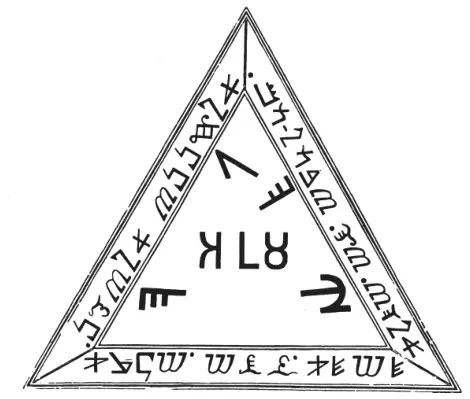
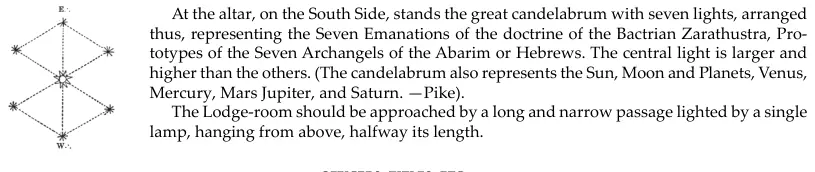
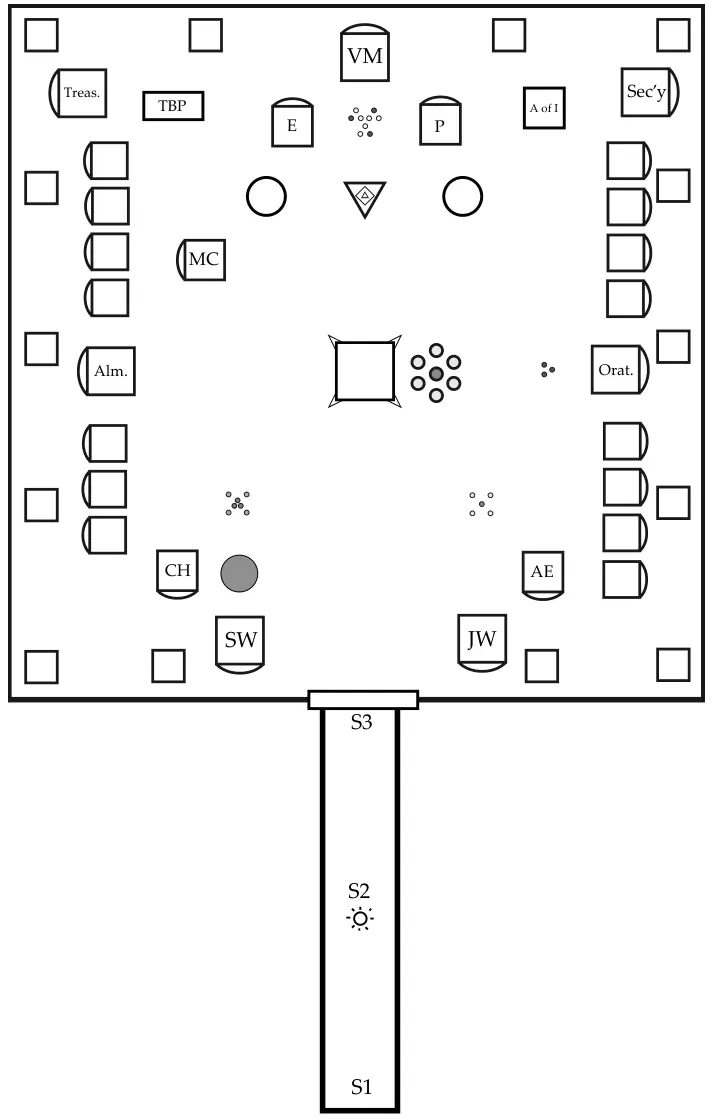
Puissant, il y a une trappedrant triangulaire qui doit éclairer toute la salle sur lequel sont écrit ces mots : Il doit y avoir encore pour marquer les différents grades de la Maçonnerie cinq lumières devant le Vble∴ F∴ 2e∴ Survt∴ 7 au Sud et 9 devant le 3 F∴ Puissant lequel est placé sous le Delta à l’Est au bas duquel il doit être peint des ruines & devant lui un piédestal cassé, toutes les 5 heures de Gd∴ Élu Parfait Me∴ & Subl∴ Maç∴ doivent être composées de 9 Grands Officiers le nombre de FF∴ ne doit pas excéder 27 en tout. 1o∴ Le 3 Fois Puissant à l’Est, représente Salomon à sa droite est un F∴ qui doit représenter Hiram roi de Tyr, en l’absence d’un Gd∴ Insp∴ ou de son Député 2o∴ À l’Ouest, le 1r∴ Survt∴ Adonhiram, Intendant des tribus de Salomon & chef de 30000 hommes destinés à couper les bois sur le Mont Liban, il fut le premier des sept Mes∴ Secrets. 3o∴ À la gauche du 1r∴ Survt∴ est le deuxième
∴∴∴∴∴∴∴∴ lequel représente Mohabon le plus zélé Me∴ de son temps et grand ami d’Hiram Abif. 4o∴ À la gauche du 3 Fois Puissant est le Garde des Sceaux représentant Galaad fils de Seprohnie chef des Lévites. 5o∴ Au Nord devant la Table des Pains de Propositions est le Gd∴ Trésorier lequel représente Jibulum confident de Salomon 6o∴ À l’Est devant la Table des Sacrifices est le Grand Secrétaire qui représente Johaber favori des deux rois alliés. 7o∴ Au Sud vis-à-vis la Table des Parfums est le Gd∴ Orateur représentant Abdon, fils d’Illiel de la tribu d’Hephraïm Me∴ Juge d’Israël. 8o∴ Au Nord le Gd∴ Me∴ des Cérémonies représentant Stolkin favori de Salomon. 9o∴ Entre les 2 Survts∴ est le Cap ne∴ des Gardes qui représente Zerbal, qui avait cet emploi pendt leur alliance, chaque Gd∴ Off∴ outre les bijoux de Gd∴ Élu Parf∴ Me∴ et Subl∴ Maç∴ doit être décoré de celui de sa dignité, il y a deux Thuileurs l’un au-dedans, l’autre au-dehors pour prévenir les Survts∴ afin qu’ils ne soient pas dans la nécessité de quitter leurs places, tous les FF∴ doivent avoir le même bijou le tablier est doublé de rouge couleur de feu et sur la bavette est peint ou brodé le bijou de l’Ordre au milieu dudit tablier est peint ou brodé une large pierre au milieu de laquelle est un anneau de fer ( Voyez la
planche figure ) Lorsqu’il y a réception il doit
y avoir sur la Table des Parfums un petit vaisseau en argent pour contenir la mixtion, laquelle est faite d’huile de vin & de farine, sur la Table des Pains de Proposition sont sept pains une coupe pleine de vin pour les libations, une bague d’or pour chaque Récipiendre∴ sur laquelle sont gravés ces mots.
La vertu unit ceux que la mort ne peut séparer.
Sur cette Table où sont gravés ces mots, sont également les cordons et bijoux pour les Récipiendaires. Tout étant ainsi en ordre le 3 Fois Puisst∴ Gd∴ Me∴ fait les questions suivantes pour préparer les FF∴ :
Ouverture
D∴ T∴ Gd∴ P r∴ Survt∴ sommes-nous à couvert sous cette voûte ?
R∴ T∴ Ill∴ F∴ nous sommes à couvert & en sûreté prions le Gd∴ Arch∴ de l’Un∴ qu’il daigne nous inspirer & nous éclairer.
Prière
Souv∴ Arch te∴ de l’Univers, toi qui pénètre les pensées les plus secrètes de tous les cœurs, purifie les par le feu sacré de ton amour, garde-nous dans le sentier de la vertu, écarte de ton adorable sanctuaire la perversité & l’impiété nous te promettons de nous occuper entièrement du Gd∴ Œuvre de la Perfection ce qui sera la récompense suffisante de nos travaux que la paix et la charité resserrent les liens de notre union et que cette L∴ soit l’image du bonheur dont jouissent les Élus dans le royaume céleste donne-nous cet Esprit Saint et ce discernement qui distinguent le bon du mauvais, pour que nous puissions connaître ceux qui ont le vrai zèle de la Perfection, fais enfin que nous n’ayons d’autre but que la gloire & l’avancement du bien dans le règne de la Maçonnerie.
Amen, amen, amen Dieu bénisse nos travaux
Après cette prière le Trois Fois Puissant garde le silence, pendant deux ou trois minutes et fait les questions suivantes
D∴ Vble∴ F∴ 1 r∴ Survt∴ qui vous a conduit ici ?
R∴ Un cœur zélé pour l’amour de la vertu et de l’amitié.
D∴ Qu’avez-vous apporté ici ?
R∴ 3 Fois Puissant, mon amour pour les Maç∴ mon obéissance et mon désir de parvenir à la Perfection.
D∴ Quelles sont les qualités propres pour y parvenir
R∴ Une qualité conduit à une autre quand on les possède toutes, on atteint bientôt au bonheur & à la Perfection.
D∴ Quelles doivent être les qualités de Vrai Élu Parfait
Maç∴?
R∴ Il ne doit laisser aucun accès dans son cœur et l’iniquité et la vengeance, à l’injustice et à la calomnie et la jalousie, et être toujours prêt à faire le bien, à ne jamais employer sa langue à la médisance, à la calomnie envers ses FF∴
D∴ Comment désirez-vous vous comporter en ce lieu ?
R∴ Avec un respect profond.
D∴ Comment se fait-il, que le pauvre, le riche, le prince et le sujet soient ici tous égaux, amis & FF∴ ?
R∴ Parce qu’il y a dans le triangle sur le piédestal et dans le firmament un être plus puissant que nous.
D∴ Pourquoi ce triangle est-il le sujet de notre respect ?
R∴ Parce qu’il contient le nom sacré de la divinité comme révéré et exalté sur la Terre et dans les Cieux sous le titre de Gd∴ Arch te∴ de l’Univers.
D∴ Quel âge avez-vous ? 7 fois 7. R∴
D∴ Comment pouvez-vous me démontrer cela ?
R∴ Je suis Parfait et Sublime Maçon mes épreuves sont faites il est temps que je recueille le fruit de mes peines.
D∴ Quel engagement avez-vous contracté quand vous avez été fait Maçon Élu Me∴ et Subl∴ Maç∴ ?
R∴ J’ai contracté une alliance avec la vertu & les hommes vertueux
D∴ Quelle marque pouvez-vous m’en donner ?
R∴ Cet anneau symbole de la pureté.
D∴ Quelle heure est-il ?
R∴ Midi plein.
D∴ Qu’entendez-vous par midi plein ?
R∴ Que le Soleil darde en ce moment perpendiculairement les rayons sur cette L∴ pour nous favoriser à travailler efficacement au but de la Perfection qu’il faut que nous profitions de sa générosité.
D∴ Où trouvons-nous des matériaux ?
R∴ Dans le trésor de la vertu du Parfait Maçon, et en gardant nos actions & nos cœurs par l’Équerre le Compas et la Divine Sagesse.
D∴ Où trouvez-vous cette Divine Sagesse ?
R∴ Dans le cœur de tous les FF∴ qui composent cette L∴
et dont vous êtes le soutien, le T∴ Ill∴ & 3 Fois P∴ dit :
C’est sur vous mes T∴ T∴ CC∴ FF∴ que je me repose pour accomplir de si glorieux desseins, V ble F∴ 1 r∴ Surv∴ annoncez que je vais ouvrir la L∴ de Gd∴ Élu Parfait & Subl∴ Maç∴ par les nombres mystérieux, 5. 7 & 9.
L’annonce faite par le Premier Gd∴ Survt∴ le Deuxième frappe 3 coups = le 1r∴ Survt∴ frappe 5 coups = Le 3 Fois Puissant 7 coups = Après un silence de deux ou trois minutes le 3 Fois Puissant dit :
A l’ordre mes TT∴ CC∴ FF∴( voyez la planche
figure ) Il frappe 3 coups égaux tous les FF∴ en font autant.
1er∴ Signe
Tirer la main droite du côté gauche du ventre à sa droite
Il frappe encore trois coups en faisant le 2e Signe qui est de porter la main droite sur le joue gauche. Ce Signe fait allusion à l’impression que fit à Moïse le Buisson Ardent sur le Mont Sinaï il fut obligé de porter la main de cette manière parce que les yeux ne pouvaient supporter l’éclat de la lumière. Il frappe 3 coups de la même manière, ce qui forme les 9 & l’on fait le troisième Signe. Il est celui d’admiration, il se fait en élevant
les mains la tête inclinée et portant ensuite les trois premiers doigts de la main droite sur les lèvres.
Le 3 Fois Puissant dit alors la L∴ est ouverte
Alors il salue les FF∴ qui se couvrent, prennent place et fait lecture des derniers travaux.
Réception
Le Récipiendre∴ est dans une chambre ou est un étroit passage avec les décorations du grade de Royale Arche le Me∴ des Cies∴ le prévient de frapper par 3, 5, 7 à la première porte d’entrée le F∴ qui la garde l’ouvre & lui demande le Mot de Passe le Cand∴ le lui donne en trois temps Schi = bo – leth. Alors le F∴ lui dit passez, il rencontre un autre F∴ qui lui demande le 2e∴ Mot de Passe, il lui donne Mohabon & il le laisse passer, il se trouve alors à la porte de la Voûte Sacrée où il donne au F∴ qui la garde le mot : Héléhanam. Le Me∴ des Cies∴ le fait frapper par 3, 5, 7 & 9 coups lesquels sont répétés par les deux Survts∴ alors le 3 Fois Puisst∴ dit : F∴ 2e∴ Survt∴ voyez qui frappe en Gd∴ Élu Parf∴ Maçon, le 2e Survt ouvre la porte & dit : Qui est là ? Le Me∴ des Cies∴ répond : C’est un Subl∴ Chev∴ de
Royal Arche qui désire la Perfection et voudrait être introduit dans la Voûte Sacrée.
Le T∴ P∴ dit : Accordez lui l’entrée. Dès qu’il est introduit un F∴ se lève accompagné seulement du Me∴ des Cies∴ ils le font placer entre les deux Survts∴ ce dernier lui met une épée nue sur le cœur alors le Cand∴ fait le Signe d’admiration en regardant le 3 Fois Pt∴ lequel après un moment de silence, lui demande
Que demandez-vous ici mon F∴ ?
R∴ T∴ Rble∴ Gd∴ Me∴ je demande la Perfection de la
Maçonnerie.Le 3 F∴ Puissant s’adressant aux FF∴ dit :
Consentez-vous à ce que ce Chev∴ de Royal Arche parvienne au grade de la Perfection ?
Tous les FF∴ donnent leur consentement à la manière accoutumée. Le 3 Fois Pt∴ dit : au Récipiendre∴
Mon C∴ F∴ avant que de vous initier aux mystères de la Perfection, répondez aux questions que je vais vous faire autrement vous ne serez pas reçu. Apprenti
D∴ Etes-vous Maç∴ ? J’ai vu la lettre G∴ mes FF∴ me reconnaissent pour tel. R∴
D∴ Donnez-moi les Mots Signes & Attouchements ?
Compagnon
D∴ Êtes-vous Comp∴ ?
R∴ J’ai vu la lettre G∴.
D∴ Donnez au F∴ 1 r∴ Survt∴ les Mots Signes et Attts∴. (il les donne)
Maître
D∴ Etes-vous Me∴ ?
R∴ Examinez-moi l’acacia m’est connu.
D∴ Donnez au F∴ 2 e∴ Survt∴ les Mots Signes & Attouch ts∴ ?
Mohabon« Dès qu’il a prononcé ce nom chaque R∴
F∴ dirige son épée près le cœur du Récipiend∴ et le 3 Fois P∴
lui dit : Qu’avez-vous mon F∴ ce mot que vous avez prononcé tout haut nous a tellement effrayés que nous sommes prêts à punir l’indiscrétion de celui qui ose élever la voix en le prononçant, mais comme vous l’avez dit sans mauvaise intention, nous vous le pardonnons. Maître Secret
D∴ Etes-vous Me∴ Secret ?
R∴ J’ai passé de l’Équerre au Compas j’ai vu le tombeau de ntre∴ Rble∴ Me Hiram Abif, et en présence de mes FF∴ j’ai versé des larmes sur ce monument.
D∴ Donnez au 1 r Surv t les Mots Signes & Attouch ts∴( Il les donne )
Le signe est celui du silence, le Mot de Passe Zison mot hébreu qui signifie Lumière. L’Attoucht∴ est la grippe de Me∴
en remontant jusqu’au coude, se balançant 7 fois en croisant les jambes Paroles, Jub∴Adonaï&Jua.
Maître Parfait
D∴ Etes-vous Me∴ Parfait ?
R∴ J’ai vu les 3 cercles, les 3 carrés placés sur deux Colonnes en Croix de S t André.
D∴ Donnez au F∴ 2 e Survt∴ les Signes Mots & Att s∴
Le premier Signe est celui d’admiration en levant les
mains au ciel ainsi que les yeux et les laisser tomber sur le ventre en les croisant ayant les yeux fixés vers la Terre
Le deuxième Signe est d’avancer précipitamment
les pointes des pieds l’une contre l’autre en se mettant et touchant mutuellement les genoux et en portant la main droite sur le front et le cœur et de là sur le sein droit formant tout deux ensemble une Équerre. L’Attoucht∴ se fait en formant la grippe de comme dans le grade de Me∴ en passant la main gauche derrière le dos, ensuite on met la main droite serrée & les poingts levés pour former le Triangle, le 1er serre 4 fois à quoi le 2e répond. Mahabon le Mot de Passe est Acacia la Parole est Jevah.
Le 3 Fois Puissant, et tous les FF∴ s’écrient, Que dites-vous, nous sommes tellement effrayés
que nous sommes prêts à punir de mort celui qui qui ose prononcer la moindre syllabe de ce Mot Sacré et mystérieux
on répète le mot à haute voix.
Secrétaire Intime
D∴ Etes-vous Secrétaire Intime ?
R∴ Ma curiosité fut satisfaite, mais il faillit m’en coûter la vie
D∴ Donnez au 1 r∴ Survt∴ les Signes Mots et Attouch t de ce grade.
( Il les donne ) Le premier Signe se fait en passant la
main droite sur l’épaule gauche et la poitrine & sur la hanche gauche droite. Le 2e∴ se fait en croisant les bras et les mains en les laissant ensuite tomber du côté de l’épée en levant les yeux au ciel. L’Attouchemt∴ se fait en serrant mutuellement la main droite l’un dit Berit, en la retournant l’autre répond Neder. et fait de même et la retourne encore et dit Selemouth. Ces trois mots signifient Alliance Promesse Perfection. Mot de Passe 1r∴ Johaber, 2e∴ Zerbal. La Parole Jah.
Intendant des Bâtiments
D∴ Êtes-vous Intendant des Bâtiments ?
R∴ J’ai monté les 7 marches de l’exactitude, j’ai pénétré dans la partie la plus intérieure du Temple j’ai vu l’effet de la G de Lumière au milieu de laquelle j’ai aperçu des caractères hébreux qui m’étaient inconnus.
D∴ Donnez au 1 r∴ Survt∴ les Mots Signes & Attouch t∴ de ce grade.
Le premier se fait en portant les deux pouces sur les tempes les mains formant l’Équerre reculant deux pas et avançant de deux autres portant ensuite les mains sur les paupières disant Benchorin le 2e∴ Signe se fait en entrelaçant les doigts des deux mains les paumes en haut les laissant tomber sur la ceinture en regardant le ciel & prononçant Achard. Le 3e∴ se fait celui de la douleur semblable à celui des Comp∴ avec la main gauche sur la hanche balançant avec les genoux 3 fois l’un dit : Civi l’autre répond Ky L’Attouch∴ se fait en frappant mutuellement le cœur avec la main droite passant la même main au milieu du bras l’un de l’autre se prenant mutuellemt l’épaule gauche avec la main, l’un dit : CiviJudas. L’autre répond : Ky.
Prévôt & Juge
D∴ Êtes-vous Prévôt & Juge ?
R∴ Je rends la justice à tous les ouvriers sans distinction.
D∴ Donnez au 2 e∴ Survt∴ les Paroles Signes et Att∴ de ce grade ( Il les donne )
Le signe se fait en portant les deux doigts à côté du nez le pouce sous le menton formant une Équerre l’Attouch∴ se fait en entrelaçant les petits doigts de la main droite et se donnant mutuellt∴ 7 coups sur la paume de la main le Mot de Passe est Tito. Mot Sacré. Jakinay. Paroles. Géometras, Xinxe
Ikivic, Iva, Hiram, Stolkin.
Maître Élu des 9.
D∴ Êtes-vous Me∴ Élu des 9 ?
R∴ Une caverne m’est connue, une lampe m’a éclairé une source m’a désaltéré
D∴ Donnez au F∴ 2 e∴ Survt∴ les Signes Paroles et Attouch t∴ de ce grade
( Il les donne ) Le 1r∴ Signe se fait en faisant semblant de frapper au front avec un poignard, l’autre répond en portant la main comme pour voir s’il n’y a pas de sang. Le deuxième se fait en faisant semblant de plonger son poignard dans le cœur d’un F∴ en disant : Nekam il répond en portant la main droite sur le cœur en disant : Nekam L’Attouch∴ est de fermer la main, le pouce levé, l’autre à son tour prend le pouce ce qui forme huit doigts apparents et un pouce qui signifient les 9 Élus. La Parole est Bagulkal qui signifie fidèle gardien, les Mots de Passe sont : Joaber, Stolkin
Illustre Élu des
D∴ Etes-vous Élu des 15 ?
R∴ Mon zèle et mon travail m’ont procuré ce grade.
D∴ Où avez-vous reçu ce grade ?
R∴ De Salomon lui-même dans son cabinet.
D∴ A quelle occasion avez-vous été reçu ?
R∴ Quand je fus envoyé avec mes Comp∴ pour faire la recherche des deux scélérats qui avaient assassiné notre R∴ Me∴ Hiram Abif. D∴ Comment furent-ils découverts
R∴ Par les soins de Bengabert préfet des revenus de Salomon dans le pays de Geth.
D∴ Donnez au F∴ Gd∴ Insp∴ les Signes Paroles et Attouch∴ de ce grade ( Il les donne )
Le premier Signe se fait en prenant son poignard le portant sous le menton et le descendant sur le ventre comme si on voulait se l’ouvrir. Le 2 e∴ Signe est de répondre par celui d’App∴ la main fermée le pouce tendu, l’Att∴ se fait en portant réciproq t∴ le pouce sur le côté du ventre et le tirant à gauche comme si l’on voulait se l’ouvrir. Mots Sacrés : Zerbal, l’autre répond : Bendecar. Le Mot de Passe est : Héléham.
Le Sublime Chev∴ Élu
D∴ Êtes-vous Chev∴ Élu ? R∴Mon nom vous le fera connaître. Quel est-il ? .................. R∴Quel est-il ?Emerk, est mon
D∴
véritable nom.
D∴ Donnez au Me∴ des Cies∴ les Signes Paroles et Att∴ de ce grade ( il les donne )
Le signe se fait en se croisant les bras sur la poitrine les mains fermées les pouces levés. Le 1r∴ Attouch∴ se donne en se prenant le pouce que l’on présente à l’autre en fermant les autres doigts et prononçant Beriti Neder, Selémouth. Le 2e∴ Attouch∴ est de prendre la main droite d’un F∴ sur laquelle il frappa 3 coups avec le pouce sur la prem phalange du medium La Parole est Emerch. Le Mot Sacré Adonaï celui de Passe Stolkin
Le Grand Me∴ Architecte
D∴ Êtes-vous Gd∴ Me∴ Arch te∴ ?
R∴ Je possède toutes les sciences des mathématiques tous les attributs me sont connus.
D∴ Donnez au P r∴ Survt∴ les Signes Paroles & Attouch t∴ du grade.
R∴ ( Il les donne ) Le Signe se fait en glissant la main droite dans
l’intérieur de la la gauche, fermer les doigts à l’exception du pouce, avec lequel on fait le simulacre de tracer un plan dans la gauche en regardant le Gd∴ Me∴ comme s’il vous indiquait le sujet. L’Attouch t∴ est d’entrer tous les doigts de la main droite avec ceux de la gauche d’un F∴ et mettre l’un et l’autre la main gauche sur la hanche, Mot Sacré est Rabucin. qui signifie architecte, Mot de Passe. Adonaï
Royal Arche
D∴ Quel est le plus subl∴ grade que vous ayez reçu dans la Maçonnerie ?
R∴ Le 13 e∴ que j’ai reçu par un effet de la providence.
D∴ Expliquez-moi cela mon F∴
R∴ J’ai fouillé dans les ruines inconnues et j’ai trouvé le Delta que Dieu avait promis aux Sts∴ Patriarches de trouver un jour.
D∴ Qu’entendez-vous par le Delta ?
R∴ C’est une pièce d’or triangulaire environnée de rayons au milieu desquels fut gravé par heure le saint nom de Dieu. D∴ Je pense que vous connaissez ce nom
R∴ Je ne le connais pas encore parce que mon temps n’est pas fini ce nom sacré n’est connu que du Gd∴ Parfait Maç∴ Subl∴ & je crois que j’en aurai la connaissance quand le temps sera accompli.
D∴ Quelle est votre qualité. R∴Chev∴ de Royal Arche
D∴ Quel est votre nom R∴Jibulum D∴Donnez au F∴ 2 eSurv t∴ les Mots Signes et Attouch t∴ de ce grade. ( Il les donne ) Le Signe est celui d’ad on∴ en levant les
yeux et les mains au ciel, les portant ensuite sous les coudes d’un F∴ comme pour l’aider à se relever en disant : Hamalabek, Jibulum
Mots de Passe. Jod. Jah∴Haiah. Jakinaï, Adonaï Héléhanam, Jobabulum. Mot Sacré. Jéhovah
trouvé sur la plaque d’or en hébreu.
D∴ Que désirez-vous maintenant mon F∴ ?
R∴ Le g de∴ de Gd∴ Élu Parfait et Sublime Maç∴∴∴Le 3 Fois Puissant
fait alors le signe d’admiration, en étendant les mains vers le ciel la tête inclinée, regardant en haut & portant ensuite les 3 doigts de la
main droite sur les lèvres & dit : Retirez-vous mon F∴ Dieu permettra que vous receviez ce que vous désirez ardemment.
Alors le Trois Fois Puissant ordonne au Me∴ des Cies∴ de faire sortir le Cand∴ et d’attendre avec lui jusqu’à ce qu’on les demande, le 3 F∴ Puissant dit :
Mes FF∴ consentez-vous à ce que ce Chev∴ de Royal Arche reçoive
la Perfection. Tous les FF∴ donnent leur consentement en levant les mains. Le 3 Fois Puissant continue, puisque vous y consentez applaudissez
par 3, 5, 7, 9.Comme ci-après
puis il donne ordre au Me∴ des Cérémonies de faire rentrer le Cand∴ et de le placer entre les deux Survts∴ où on lui fait les demandes suivantes
D∴ Depuis que vous êtes Maçon votre conscience ne vous a-t -elle jamais reproché d’avoir été faux envers vos FF∴ d’avoir cherché à leur avoir porté préjudice où à leur famille, d’avoir manqué à votre religion aux lois de l’Etat répondez-moi ?
R∴ Jamais D∴N’avez-vous jamais communiqué ou laissé communiquer quelque chose relative à la Maçonnerie & à nos mystères à des profanes qu’auriez-vous fait aux assassins de notre Rble∴ M e Hiram Abif, si vous aviez vécu dans le Temple auriez-vous vengé sa mort ? Répondez-moi ?
R∴ J’aurai fait comme Johaber.
D∴ Avez-vous été attentif à remplir les obligations que vous avez contractées en présence du Gd∴ Arch∴ de l’Un∴ ?
R∴ Je l’ai toujours été.
D∴ N’avez-vous jamais trouvé dans vos obligations quelque chose de contraire à votre religion aux lois de l’Etat à vous même ou qui ait pu blesser votre conscience. R∴Jamais. Souvenez-vous mon F∴ que si vous approchez de nos mystères avec froideur et indifférence quand vous aurez reçu le grade de Gd∴ Élu Parfait et Sublime Maç∴ vous serez beaucoup plus blâmable qu’auparavant, & vous en répondrez au g d∴ & terrible jour du Jugement où les replis de tous les cœurs seront fouillés et tous les secrets découverts. Ce grade mon Ch∴ F∴ est le complément de la Maçonnerie symbolique, en le recevant vous allez vous lier par des obligations indispensables et que vous ne connaissez pas encore, je me flatte & j’espère qu’elles demeureront gravées dans votre cœur quand nous vous les auront communiquées, & que votre ardeur à suivre la vertu, vous unira indispensablement à nous qui sommes vos compagnons & vos supérieurs.
D∴ Y consentez-vous ? R∴J’y consens
D∴ Désirez-vous être lié par de nouveaux engagements ?
R∴ De tout mon cœur. Puisque vous le désirez lavez vous les mains dans cette mer d’airain, pour prouver votre innocence et que vous n’avez jamais violé vos engagements, souvenez-vous que vos ancêtres pratiquaient cette cérémonie quand ils étaient accusés & prouvaient par-là s’ils étaient innocents ou coupables
Le Me∴ des Cies∴ conduit le Récipre∴ à la mer d’airain où il lui fait laver les mains & le ramène entre les deux Survts∴. Le 3 Fois Pt∴ continue : Vous-êtes introduit
mon Rble∴ F∴ dans le lieu le plus sacré de la Maçonnerie, les mystères les plus augustes vont vous être dévoilés ces mots ont toujours été sévèrement gardés par les soins & la vigilance des G ds∴ Élus Parf∴ et Subl∴ Maç∴, rien n’a transpiré, tandis que les 3 premiers grades semblaient être dévoilés aux yeux de toute la Terre, nous allons vous communiquer le plus grand secret, nous espérons de vous la plus grande
discrétion & nous avons la plus grande confiance. Le Me∴ des Cies∴ fait avancer le Cand∴ par 8 pas précipités et un lent, il doit avoir sur lui les marques de Me∴ Élu, il s’agenouille et prête le serment suivant :
Obligation
Je N…. de ma propre volonté, jure et promets sur la Sainte Bible en présence du Gd∴ Arch te∴ de l’Un∴ de cette Resp∴ assemblée de Parfait Subl∴ Maç∴ d’être éternellement fidèle à ma religion, je promets de ne jamais prendre les armes contre mon Souv∴ de ne jamais tremper indirectement où directement dans aucune conspiration si elle venait à ma connaissance, je promets de ne jamais révéler à un Gd∴ Me∴ Arch te∴ ni un Chev∴ de Royal Arche, où à toute autre personne qui ne serait pas compétente les mystères de ce sublime grade de ne jamais donner connaissance de ce qui se passe dans cette L∴ Respble∴ ni de ses lois et statuts, sous les peines de ma première obligation, je promets s’il est en mon pouvoir de me réunir à mes FF∴ au moins une fois l’an, le jour de S t Jean Evangéliste et de fréquenter cette Rble∴ L∴ aussi souvent que mes affaires me le permettront, je promets de regarder de même œil tous les FF∴ de Royal Grade sans distinction de grade, de richesses de pauvreté de noblesse ou de roture, & de ne faire parmi eux aucune distinction que celle que donne la vertu, de ne jamais refuser de reconnaitre un F∴ honnête homme & Maç∴ en quelle situation il se trouve, soit dans le malheur ou indigence. Je promets de visiter mes FF∴ dans leurs maladies de les aider et assister de mon bras de ma bourse & de mes conseils de les consoler dans leurs chagrins & leur être utile dans tous les cas. Je promets de ne jamais donner mon consentement pour l’admission d’un F∴ si je n’ai une parfaite connaissance de sa vie et mœurs, si je n’ai pas examiné scrupuleusement sa conduite. Je promets & jure de ne jamais séduire la femme de mon F∴ de ne jamais le déshonorer ni aucun de sa famille & je m’engage à ne jamais violer ce serment. Je promets de ne recevoir ni assister jamais à la réception d’un Grand Me∴ Élu Parf∴ ou Subl∴ Maç∴ s’il n’a pas été Off∴ d’une L∴ Écossaise régulièrement organisée où s’il n’a point tenu le maillet, dans quelque Loge régulière, je promets de ne recevoir ni d’assister à aucune réception qu’aux conditions suivantes : 1 o∴ qu’avec la permission et le consentement magnanime de tous les G ds∴ Élus Parf∴ & Subl∴ Maç∴ de cette Rble∴ L∴ où par permission par écrit signé de tous les membres. 2 o∴ Par un Gd∴ Insp∴ où de son Député 32 e∴ degré qui m’aurait délivré un pouvoir, & à distance de 25 lieues de cette L∴ où de toute autre de Perfection régulièrement constituée, et si je manque à mes 1 rs∴ serments & à mes promesses je consens d’éprouver les peines que je me suis infligées dans mes premières obligations. Dieu me maintienne dans la vérité & la justice. Amen.
Le Récipiendre∴ reste à genoux, le Gd∴ Me∴ des Cies∴ va chercher la truelle, le viseau et l’huile, le 3 F∴ Puissant tient le Cand∴ sur les yeux les lèvres et le cœur et lui dit : Par les pouvoirs qui m’ont
été donnés et que j’ai acquis par mon assiduité mon travail et ma constance & mon intégrité, je vous sacre les yeux et les lèvres avec cette huile sainte qui oignit le pieux Aaron, le pénitent David, et le sage Salomon, je vous en oins, pour que votre zèle pour le Gd∴ Arch te∴ de l’Univers redouble et pour garder dans votre esprit et dans votre cœur cette ferveur et cette constance qui doivent illustrer
toutes vos actions.Le 3 Fois Puisst∴ relève le Cand∴ et le conduit à la Table des Pains de Propositions lui présente des pains et du vin dans une coupe & dit : Mangez et buvez avec moi
dans cette coupe pour vous apprendre à secourir vos FF∴ lui présentant
la bague il lui dit : Recevez cet anneau comme un signe
de l’alliance que vous contractez aujourd’hui avec la vertu et les vertueux, promettez-moi de ne jamais vous en défaire pendant votre vie et à votre mort de ne la donner qu’à votre femme où à votre frère aîné, où à votre meilleur ami après cette cérémonie
tous les FF∴ se lèvent et vont manger & boire ensemble dans la même coupe, pour faire les libations suivant l’antique usage pratiqué pour les sacrifices. Ensuite le Trois Fois Puissant décore le Récipendre∴ des ornements de l’Ordre & dit :
Je vous salue à présent M∴ T∴ C∴ F∴ et vous donne le titre de Gd∴ Élu Parf∴ et Subl∴ Maç∴ avec tous les plaisirs imaginables, recevez le ruban de l’Ordre, sa figure triangulaire représente le Delta sur lequel fut gravé par heure le St∴ nom des noms et l’objet principal de nos mystères et dont nous n’avons eu connaissance que par les plus g ds∴ travaux les plus g des∴ peines & les plus grands dangers. Le cordon
de couleur rouge ( Voyez la planche figure ) représente deux choses
1 o∴ Les rayons qui environnaient le Buisson Ardent lorsque Moïse reçut de Dieu même sur le Mont Sinaï ce Mot Sacré. 2 o∴ il désigne la prééminence d’un Gd∴ Élu Parf∴ Maç∴ sur tous les FF∴ qui ne sont point parvenus à ce grade. Ce bijou suspendu sur votre poitrine, vous donne aussi les grandes instructions suivantes 1 o∴ La couronne désigne l’origine de la Maçonnerie, 2 o∴ Le Compas & le ¼ de cercle de 90 degrés représente les opérations des différents grades par lesquels les G ds∴ Élus passent 3 o∴ Le Soleil marque la supériorité du grade et sa place sur le poitrine rappelle continuellement l’ornement de votre dignité pour que vous ne vous écartiez jamais des devoirs qu’elle vous impose & des instructions que nous allons vous donner et qui formeront votre accomplissement dans l’étude de la Maçonnerie, il y a trois Signes, 3 Mots Couverts, 3 Mots de Passe, et le Gd∴ Mot Sacré de l’Ordre je vais vous les communiquer tous. Le 1 r∴ Signe se fait en portant la main sur son ventre à gauche et en la retirant à droite. Le premier Attouchemt se fait
en prenant réciproquement la main droite l’un dit Bérit et la retournant l’autre dit Neder. Et la retournant encore et de même en disant SelemouthLe premier Mot Couvert est : Jibulum
qui signifie ami choisi, favori, zélé F∴ le 1 r∴ Mot de Passe est :
Schiboleth qui se prononce avec aspiration, le deuxième
signe se fait en portant la main droite ouverte sur la joue gauche
comme pour éviter la chaleur d’un grand feu et de soutenir le coude droit avec la main gauche. Ce signe à rapport à
l’impression que fit à Moïse le Buisson Ardent sur le Mont Sinaï duquel il ne put soutenir l’éclat. Le 2 e∴ Attouch∴ est semblable à la grippe de Me∴ vous dites : Allez-vous plus loin alors vous avancez sur l’avant-bras, puis jusqu’au coude
votre main gauche doit être placée sur l’épaule droite réciproqt∴ et vous balancez trois fois de la même manière les Maîtres Secrets le font 7. Le deuxième Mot Couvert est, Mohabon
qui signifie silence et respect. Le deuxième Mot de Passe est : Elehanam. Mot hébreu qui signifie, grâce, don de miséricorde de Dieu. Le 3 e∴ Signe est celui d’admiration
en élevant les deux mains vers le ciel la tête inclinée regardant le firmament ensuite porter les trois doigts de la main droite sur les lèvres.Le 3 e∴ Attouch∴est de prendre réciproquement le coude droit et de l’autre main environner le
col comme si vous releviez quelqu’un. Le 3 e∴ Mot Couvert est : Adonaï qui signifie, Dieu Éternel. Le 3 e Mot de Passe est – Mac = Vira = Ha = Ra = Ba = Hack Le Gd∴ Mot Sacré est∴Jehovah. Alors on met devant le Récipiendre∴
le tableau de la L∴ qu’il examine pendant qu’on lui développe
l’histoire du grade :Discours historique
Votre zèle mon T∴ C∴ F∴ votre conduite et votre discrétion m’ont déterminés à vous donner le vrai degré de la vraie connaissance de la Perfection vous avez à présent le grade de Gd∴ Élu Parf∴ et Sublime Maç∴ nous sommes maintenant heureux mon F∴ de vous avoir donné cette connaissance, et d’avoir eu assez de discernement pour avoir fait un bon choix nous ne croyons pas la fatalité qui est arrivée aux 3 premiers grades, l’application que vous avez mis à pénétrer chacun de ces grades dans lesquels vous avez passé avant de parvenir à celui-ci, nous a convaincu que vous possédiez toute l’histoire de la Maçonnerie, jusqu’à la miraculeuse époque où Jibulum, Johabert et Stolkin par la permission divine trouvèrent le saint nom gravé sur le brillant Delta dans le grand arche sous la terre où heure l’avait placé directement, sous le sanctuaire d’un temple qu’il avait élevé à Dieu sous la montagne Haceldama près du Mont Sion appelée auparavant la terre d’argile ou de potier, maintenant appelée terre de sang. Au sud de la vallée de Josapha. Il serait inutile de perdre un temps précieux pour retourner aux circonstances de cette histoire vous avez pénétré jusqu’aux lieux ou 3. zélés FF∴ choisis par la providence firent la découverte de ce nom sacré, comme ils l’apportèrent dans l’app t∴ de Salomon où il était avec Hiram roi de Tyr et qui pour les récompenser de leur travail les créa tous les trois Chevalier de Royal Arche, leur promit de leur expliquer le Mot Sacré dès qu’ils auraient pu trouver une place pour le déposer et lorsqu’il fit le signe d’admiration en leur disant Dieu permettra bientôt que vous soyez récompensé de vos vertus et que vous soyez décoré du sublime grade de Gd∴ Élu Parf∴ et Subl∴ Maç∴ vous savez mon F∴ que lorsque le Temple fut achevé les Maç∴ acquirent beaucoup d’honneur et leur société devînt un ordre de la délicatesse des FF∴ dans leurs choix, les rendit partout respectables, le mérite seul les fît parvenir ainsi que vous mes Chers FF∴ Les G∴ Élus & Subl∴ Maç∴ ne se laissent point séduire en faveur de Cand∴ ils ne reçoivent que ceux qui leur en parurent digne, un grand nombre de ces habiles architectes partirent de Jérusalem après la dédicace du Temple, ils se dispersèrent chez les nations voisines pour les instruire de l’excellence de leur Art Royal mais avec la plus grande précaution de n’initier que des mâles libres malgré cette résolution les Maç∴ des plus bas grades multiplièrent sur la surface de la Terre, leur nombre augmenta au-delà de l’expression ce qui fut cause que leur secret fut bientôt publié. Ils perdirent par ce moyen l’estime générale il n’y eut que les G ds Élus Parfaits et Sublimes Maçons qui eurent le plus grand soin de conserver les sublimes & derniers mystères de l’Ordre, et qui prirent résolution de le garder parmi eux sous le sceau le plus inviolable, en ne donnant que les 3 premiers grades, la grande majorité des FF∴ qui étaient parvenus à ces grades fut si peu circonspecte dans les paroles actions et conduite, que les profanes obtinrent les Mots Signes et Attouchements par leur imprudence & leur indiscrétion, ces désordres chagrinèrent les premiers Maçons, ils prirent toutes les peines imaginables pour arrêter la contagion mais tout fut inutile la Maçonnerie dégénéra insensiblement les réceptions se multiplièrent on n’observa aucun intervalle entre chaque grade et souvent même on les obtint tous les trois à la fois enfin ils préférèrent l’amusement à l’instruction des innovations s’élevèrent une nouvelle doctrine détruisit l’ancienne qu’on n’aurait jamais dû abandonner ces différences créèrent des disputes des dissensions et produisirent à la fin une découverte volontaire des travaux par lesquels la Maçonnerie a perdu les 3 premiers grades heureusement pour nous que nous avions la consolation de connaître le secret de Gd∴ Élu Parf∴ & Sublime Maç∴ dont ils étaient entièrement ignorant, faisons tous nos efforts pour rendre impossible que les autres degrés éprouvent le même destin, pour ranimer notre zèle pour obtenir cette ancienne Perfection nous travaillons à apprendre cette science, qui seule peut nous faire parvenir à la connaissance du Gd∴ Arch te∴ de l’Un∴ cette grande parole était celle des anciens M es∴ Maçons, Salomon l’avait choisie pour inspirer aux ouvriers de la vénération pour lui et pour les engager à mettre de la sévérité et de l’ardeur pour la construction du Temple, ce sage roi connaissait toute la force de ce saint nom, et que le Gd∴ Arch te∴ de l’Un∴ avait apparu à Moïse dans le Buisson Ardent au pied duquel notre L∴ doit être sans cesse en lui déclarant qu’il était le seul des patriarches qui en eut connaissance, et qu’il l’invoquerait à l’avenir par ce nom dans le Temple qu’il avait ordre de bâtir, dans la Terre Promise sur la place et dessus le Tabernacle, ce saint nom ayant tant de rapport avec la construction du Temple était la parole des Maîtres. Salomon, était convaincu que le courage […], et persuadé qu’il n’avait point divulgué le secret, résolut de ne le donner à l’avenir à aucune personne que ce put être ni en conséquence les Paroles Signes et Attouch∴ furent changés ainsi qu’il a été dit : ci-devant il n’y eut que les anciens M tres qui la connurent jusqu’à ce que les 3 Chevaliers de Royal arche eurent trouvés le Delta dans les ruines d’heuré Salomon & Hiram, ayant mis en sûreté ce précieux dépôt dans la voûte sacrée près le 3 e∴ pilier appelé celui de la Beauté parce qu’il soutient la plus glorieuse place de l’Univers. Ces profanes curieux ainsi que les Maç∴ de la basse classe n’avaient pu découvrir jamais la place de cette parole sacrée parce qu’elle avait été conservée avec le plus grand secret des Subl∴ Maç∴ du grade de Royal Arche, et ce qui a été toujours observé par les Grands Élus qui animés du même zèle, se la communiquèrent entre eux, de là commence cette union que les Parfaits Maç∴ se sont jurés et dont cette parole a été le sceau, le Temple fut achevé en l’an 3000. Sa construction a duré 6 ans 6 mois & 6 jours, Salomon en avait posé la première pierre avec la plus grande pompe quand il fut achevé il donna audience à tous les Maç∴ successivement pendant trois jours le premier fut consacré aux M es∴ Élus qui furent introduits dans la voûte sacrée tandis que les Chev∴ de Royal Arche en gardaient l’entrée pendant ce temps, les G ds∴ Arch tes∴ étaient dans l’appartem t du roi, il accorda le grade de perfection aux plus vertueux des deux Ordres, il leur fit promettre de vivre toujours en paix union et concorde d’exercer les œuvres de charité et de bienfaisance pour imiter leur défunt chef, de prendre ainsi que lui pour base de leurs actions la sagesse, la justice et l’équité, de garder toujours le plus profond mystère sur les secrets de ne jamais les révéler qu’à des personnes qui mériteraient cette faveur, de s’assister mutuellemt dans leurs besoins, de punir sévèrement la trahison la perfidie et l’injustice. Il leur donna la bénédiction, leur découvrit l’Arche d’Alliance, dans laquelle l’Eternel rendait ses oracles, ordonna de nouveaux sacrifices, les admit aux simples libations leur donna à chacun une bague d’or philosophique comme une preuve de l’Alliance qu’il venait de contracter avec la vertu et les vertueux leur fit plusieurs présents et leur permit de rester à Jérusalem où de voyager comme ils le jugeraient à propos, le 2 e∴ jour il donna audience dans la cour du Temple aux Élus, Intendants de Bâtiments Prévôt et Juges, Secrétaire Intime M es∴ Secrets M es∴ Parfaits & autres M es∴ et leur fit promettre, ce qu’il avait fait promettre aux autres les engagea fortement de ne jamais s’écarter des principes de la vertu dont leurs anciens chefs leur avaient donnés l’exemple leur accorda le grade de G ds∴ M es∴ Arch tes∴ leur fit jurer d’être fidèles gardiens de leur mystère de ne les donner qu’à ceux qui en seraient dignes leur fit divers présents et leur permit d’aller où bon leur semblerait Le 3 e∴ jour Salomon donna audience aux Comp∴ et App∴ dans la partie de l’Orient du Temple devant le tombeau d’Hiram Abif : pendant ce temps les App∴ gardaient le dehors. Il donna aux Comp∴ qui en étaient les plus dignes le grade de Me∴ ensuite il fit entrer les App∴ sous le Portique du Temple ou il leur donna le grade de Comp∴ leur fit faire à tous le serment d’être toujours amis de se secourir mutuellement et de garder entre eux les Mots Signes et Attouch s∴ et de ne les communiquer qu’à des hommes vertueux, leur fit des présents leur permit d’aller où bon leur semblerait ordonna à ses intendants de les défrayer jusqu’à ce qu’ils fussent arrivés dans leur pays, mais Salomon ce monarque si sage si vertueux ce roi que Dieu avait choisi dans son cœur, fut sourd à sa voix. Il devint orgueilleux de se voir le 1 er∴ roi de l’univers oublia bientôt sa bonté et se livra à la débauche par sa complaisance pour un sexe aussi dangereux qu’aimable, et détruisit sa piété et abandonna le sentier de la vertu, ses crimes pénétrèrent de douleur les cœurs des bons Maçons qui ne laissèrent pas d’instruire leurs enfants dans le sentier de la vertu en leur communiquant cette sainte & parfaite union qui avait toujours subsisté entr’eux, ils essayèrent par leurs conseils et bon exemple d’écarter le sacrilège et l’impiété leurs concitoyens, mais ils n’y purent parvenir, ils eurent beau leur rappeler dans l’amertume de leurs cœurs la vengeance que Dieu avait exercé sur leurs ancêtres par le Déluge dont ils les avaient frappé que le tonnerre grondait sur leur tête, que le superbe Temple de Salomon pouvait être détruit Jérusalem ruinée et écrasée que leurs femmes et leurs enfants souffriraient de leurs iniquités, toutes ces sages remontrances furent infructueuses, ne pouvant les faire revenir de leur égarement ces vertueux Maç∴ quittèrent volontairement leur pays natal, les uns allèrent à Athènes, la superbe d’autres à Rome, mais la plus grande partie passa dans Calédonie alors habitée, par les Scots ou Écossais enfin de n’être pas témoins des horreurs qu’ils envisageaient. Les crimes de ce peuple étant à leur comble Dieu inspira à Nabuchodonosor, roi de Babylone de faire le siège de Jérusalem dont il se rendit maître ainsi que de toute la Judée avec une armée commandée par son général Nabuzardan, qui après s’être rendu maître de la cité sainte en rasa les murailles, détruisit le Temple même jusqu’aux fondations, fit les habitants prisonniers avec leur roi Sedecias le 9 e∴ jour du 4 mois qui répond au mois de juin de l’année sainte, les fit charger de chaînes et après avoir enlevé toutes les richesses du Temple ils les emmena prisonnier à Babylonne Cet événement arriva 470 ans 10 mois et 10 jours après la dédicace du Temple. Les Grands Élus Parfaits Maç∴ qui étaient restés à Jérusalem la défendirent avec la plus grande intrépidité mais ils ne purent résister au nombre ni à la force des conquérants Ils se soucièrent fort peu des trésors, ils ne considéraient que celui qui était sous la voûte sacrée, ils avaient la plus grande crainte qu’il ne fut découvert, leur intrépidité les exposa à la fureur des soldats qui gardaient la porte ils les combattirent et pénétrèrent dans la voûte sacrée là ils trouvèrent le corps de Galaad, fils de Zéphronie homme considéré parmi les vrais Maçons. Ce Galaad, lors de l’invasion du Temple était de garde pour entretenir les lampes ardentes qui brûlaient continuellement, cet homme égala Hiram Abif, préféra être enterré sous les ruines que de découvrir par sa fuite le trésor confié à ses soins. Dès qu’ils eurent pénétrés dans la voûte ils s’écrièrent Mac – ma – ha – ra – ba – kak qui signifient, Dieu soit béni nous avons trouvé. Il serait difficile d’exprimer les démonstrations de joie qu’ils firent éclater en ce moment ils se mirent sur le champ à l’ouvrage effacèrent ce nom sacré de manière qu’il fut illisible et afin qu’il ne put être découvert par les impies ils mirent la plaque d’or dans l’Arche d’Alliance qui contenait les Tables de la Loi & d’autres précieux trésors cassèrent la pierre cubique d’agate voyant qu’il leur était impossible de la transporter, renversèrent le piédestal & creusèrent un trou de 27 pieds de profondeur où ils jetèrent le tout, dépouillèrent Galaad, de robe de chef des Lévites ils le couvrirent d’une table de marbre qui avait été trouvée par Jibulum, Johaber & Stolkin dans les ruines du temple du S t Patriarche Enoch et se retirèrent fort satisfaits résolus de ne confier à l’avenir qu’à leur mémoire ce grand nom et de ne le transmettre à la postérité que par traduction c’est de là que vient l’usage de ne l’épeler que lettre par lettre, sans prononcer une syllabe. Cet usage fut conservé quand le Temple fut rétablit sous Cyrus le Gd∴ Prêtre au milieu d’un petit nombre de Parfaits Maç∴ formaient une chaîne et forme de cercle & l’épelaient une fois l’année dans le Temple, ordonnant au peuple de faire beaucoup de bruit de peur qu’il ne vienne à frapper l’oreille des assistants, par cette grande circonspection on a perdu l’habitude de le prononcer on est même incertain des lettres qui le composent, & la vraie prononciation a été seule connue des Grands Élus & Parfaits Maç∴
Instruction
D∴ Qui êtes-vous ?
R∴ Je suis ce que je suis, en outre Gd∴ Elu Parf∴ Me∴ et Sub∴ Maç∴ mon nom est Jibulum rien ne n’est inconnu, ami zélé et favori.
D∴ Où fûtes-vous reçu ?
R∴ Dans un lieu qui n’a besoin du Soleil ni de la Lune ni d’aucune lumière artificielle
D∴ Où est fixé ce lieu miraculeux ?
R∴ Sous le Saint des Saints dans un lieu appelé Voûte Sacrée ?
D∴ Qui vous y introduisit ?
R∴ En allant dans une chambre du Palais de Salomon j’ai pénétré par un long corridor composé de plusieurs arches, à peine cintrées qui aboutissaient à ce lieu sacré.
D∴ Comment fûtes-vous introduit dans cette voûte souterraine
R∴ Par 3 coups.
D∴ Que signifient-ils ?
R∴ L’âge d’un App∴ et de 3 zélés Maç∴ qui pénétrèrent dans les entrailles de la Terre
D∴ Comment appelez-vous le lieu où les 3 FF∴ trouvèrent ce précieux dépôt ? La montagne Haladama près du Mont Sion appelée auparavant R∴ Terre d’Argile, parce qu’elle appartenait à quelques fabricants de pots, elle servait néanmoins de cimetière à quelques ouvriers Maç∴ ou pèlerin qui moururent à Jérusalem, ce même champ fut acheté des trente deniers que Judas que Judas après avoir trahi Jésus Christ, Me∴ de Vitry dit : que les Hospitaliers y enterraient les pauvres pèlerins qui mouraient dans leur hôpital
D∴ Qui vous procura ces 3 coups ?
R∴ Cinq autres qui désignent l’âge d’un Comp∴ ils désignent aussi le nombre 5 qui se trouvait heureusement complété quand les 3 zélés FF∴ arrivèrent au Palais de Salomon, chargés des trésors précieux, formèrent le nombre mystérieux cinq.
D∴ Quelle réponse fit-on à ces cinq coups ?
R∴ Sept autres, qui signifient 1 o∴ l’âge d’un Me∴2 e∴ qu’il fallait 7 FF∴ expérimentés pour en remplacer un 3 e∴ que Salomon employa 7 ans à la construction du Temple.
D∴ Quelle réponse fut faite à ces 7 coups ? 9 autres qui désignent l’âge d’un parfait Maç∴ qui 9 ont
R∴ répétés font le nombre révéré par les Grands Elus Parfaits Maç∴ on ouvrit alors la G de∴ Voûte & j’ai pénétré dans le lieu le plus saint de la Terre en prononçant 3 fois Schibboleth avec aspiration.
D∴ Que signifie ce Mot de Passe ?
R∴ Abondance, un épi de blé.
D∴ Qu’aperçûtes-vous en entrant dans le lieu saint ?
R∴ La plus brillante de toutes les Lumières qui m’a ébloui et me frappa d’étonnem t.
D∴ Quelle est cette Lumière ?
R∴ C’est le brillant Delta à l’âme d’or triangulaire
D∴ Comment appelez-vous le piédestal.
R∴ C’est le pilier de la Beauté
D∴ Donnez-moi le mot de ce St∴ Nom ?
R∴ Je ne le puis.
D∴ Comment voulez-vous donc me le faire connaître. Mohabin fut substitué à sa place, et le 3 e Mot de Passe R∴ est : Mac = ma = ha = ra = ba = kak où 3 fois saint.
D∴ A qui Dieu confia-t-il le 1 er∴ Mot Sacré ?
R∴ A Noé avant le déluge, à Moïse quand il lui parla sur le Mont Sinaï et au Gd∴ Élu Parf∴ Maç∴ quand il le trouva.
D∴ Qu’avez-vous aperçu dans le g de∴ de Gd∴ Me∴ Arch te∴ ?
R∴ 12 Lumières
D∴ Que signifient-elles ?
R∴ Les 12 M es∴ qui furent élus par Salomon pour conduire les travaux du Temple après la mort d’Hiram Abif. Lesquels commandaient les 12 tribus d’Israël. D∴ Comment s’appelaient ces 12 M es∴ ?
sont les 9 qui furent élus pour la recherché d’Hiram Abif. Zerbal.
Banayal, & Tabor. Sont les 3 autres que Salomon
choisis pour compléter les autres 12. Comment ces M es∴ furent-ils dirigés dans le Temple pour
D∴ prendre connaissance des ouvrages ?
R∴ Joaberavait l’Insnde la tribu deJudas Berthem Aser
Stolkin Benjamin Tito Neptali Tercy Simeon Zerbal Ruben Morphy Ephraïm Banayal Issachar Dorson Manassé Tabor Gad Kerem Dan Alquebar Zabulon
Ces 12 M es∴ rendaient compte journellement de l’ouvrage qui se faisait dans le Temple distribuaient le salaire aux divisions
D∴ Que signifie la Clef d’Ivoire de Me∴ Secret ?
R∴ Elle sert à nous rappeler que les G ds∴ Élus Parf∴ M es et Subl∴ Maç∴ étaient les seuls dépositaires de l’ancienne Maçonnerie, que les Maçons doivent garder dans leur cœur pour être la règle de leur conduite, de manière à ne se rendre jamais indigne de cette vérité
D∴ Que signifie le tombeau à la porte du Temple ?
R∴ C’est là où repose le corps de notre Respble∴ Me∴ Hiram Abif que Salomon fit placer en mémoire de l’estime qu’il avait pour ce grand homme.
D∴ Que signifie la balance dans le grade de Prévôt & Juge ?
R∴ C’est pour nous enseigner d’être juste & équitable.
D∴ Que signifie l’épée nue que le Gd∴Me∴ des Cies∴ tient à la main lorsque vous entrez
en L∴?
R∴ C’est pour la défense de notre Gd∴ Me∴, et pour punir ceux qui s’écarteraient de la vertu et qui seraient assez perfides pour révéler les secrets qui leur ont été confiés.
D∴ Quelle récompense les 12 M es∴ reçurent-ils de Salomon ?
R∴ Il les choisit pour ses favoris, Chev∴ Élus et les décora d’un large ruban noir sur lequel était brodé un cœur enflammé et ne leur permit pas de voyager sans porter cette marque distinctive au lieu d’un poignard il leur donna une épée de justice et leur dit : Puisque vous avez été les Cond∴ des travaux du Temple vous le défendez contre tous les ennemis qui tenteraient de le profaner.
D∴ Que signifie le cœur enflammé R∴La charité, que ∴ nom et qualité d’Élu ? nous nous devons réciproq t∴ D∴Quel est v tre
R∴ Baguikal. Qui signifie garde fidèle il y a 3 Mots de Passe 1 o∴Nekam. Qui signifie Vengeance, 2 o∴Stolkin qui est le nom de celui qui trouva le corps d’Hiram sous la branche d’acacia 3 o∴Joaber qui porta la tête du scélérat Hoben à la porte du Temple de Salomon accompagné de ses huit M es∴ Comp ons
D∴ Que signifient dans le Chap∴ d’Élu des 9, les huit Lumières et une séparée ?
R∴ Les 9 M es∴ Élus qui furent envoyés à la recherche d’Oben avec l’inconnu représenté par un chien, symbole de la fidélité
D∴ Quel était cet inconnu ?
R∴ Il s’appelait Perignon, polisseur de marbre, il n’était point inscrit au rang des ouvriers du Temple mais en considération de ses services, Salomon le récompensa et l’y admis
D∴ Que firent les deux autres complices d’Oben ?
R∴ Ils s’appelaient Sterkin & Oterfut tous trois de la tribu de Dan, fils de même père et mère Oben était l’aîné.
D∴ Que devinrent les deux jeunes FF∴ ?
R∴ Ils s’enfuirent dans le pays de Jeth.
D∴ Quel moyen Salomon employa–t-il pour s’en emparer ?
R∴ Il écrivit à Mahacha, roi de ce pays.
D∴ Zerbal l’un des Cap nes Qui fut porteur de cette lettre R∴∴ des Gardes de Salomon
D∴ Le roi Maacha, fit-il quelques difficultés ?
R∴ Au contraire il donna de suite une escorte pour les chercher
D∴ Où furent-ils trouvés R∴Dans une caverne.
D∴ Comment les découvrit-on R∴Par l’avis d’un berger qui montra leur retraite
D∴ Combien Salomon envoya-t-il de M es∴ à leur recherche
R∴ Quinze dont je fus du nombre.
D∴ N’y en eu-t-il point d’autres ?
R∴ Salomon donna les meilleures troupes pour les escorter sous la conduite de
Zerbal. Quels furent les ceux qui les aperçurent de nouveau les premiers. D∴
R∴ Zerbal et Heleham après cinq jours de marche.
D∴ Avez-vous reçu quelques marques de distinction, lorsque vous avez été élevé au grade de Chev∴ Élu ?
R∴ Salomon voulant récompenser les Élus s’empressa de les élever au rang de Subl∴ Chev∴ Élu, joignit à leur Chap∴ trois FF∴ zélés afin qu’ils fussent portés à 12 membres, puis il leur montra toutes les richesses du Tabernacle, leur donna une Clef d’or pour les distinguer des autres ouvriers, il leur donna l’excellent nom d’Emereh, qui signifie vrai en toute chose, ainsi que le command t des 12 tribus
D∴ Avez-vous été plus loin ?
R∴ Salomon bientôt après m’initia au g de∴ de G d M e Arch te pour me récompenser de mon zèle fervent & constance et me conduisit au trône. céleste
D∴ Que signifie la lettre A∴ et les deux PP∴ que vous avez aperçu dans le triangle ?
R∴ L’Alliance de Moïse et Aaron ainsi que celle de Salomon et d’Hiram roi de Tyr et des promesses faites aux grands Élus Parf∴ et accordée à leur caractère avec les mots Alliance Promesse Quel est le mot de Gd∴ Me∴ Arch te∴R∴Rabucin D∴
D∴ Que signifie ce mot. R∴Architecte.
D∴ Quelle récompense Salomon vous donna-t-il ?
R∴ La providence veillant sur nous par la divine promesse faite à Noé, Moïse & David, mon ardeur fut récompensée, le Souverain créateur conduisit mes pas vers les entrailles de la Terre je vis le brillant triangle orné de son nom sacré, mes yeux et ceux de mes deux Comp∴ furent éblouis de sa splendeur et en récompense, Salomon me donna le grade de Gardien de l’étoile entrée qui me conduisait à la Voûte Sacrée.
D∴ Quelle qualité reçûtes-vous alors ?
R∴ Celle de Chev∴ de Royal Arche
D∴ Comment fûtes-vous reçu ?
R∴ Par Salomon et Hiram roi de Tyr qui pour me récompenser de mes travaux me créèrent en cette qualité ainsi que mes compagnons Quel fut votre nom R∴Jibulum. D∴
D∴ Quelle fut la récompense dont Salomon vous honora ?
R∴ Après avoir déposé le précieux trésor de Maçon, je fus décoré du grade de Gd∴ Me∴ Élu Parfait & Subl∴ Maç∴
D∴ Quel est le nom du lieu où vous reçûtes ce gradeR∴La Voûte Sacrée.
D∴ Où le Gd∴ Élu Parf∴ Me∴ & Subl∴ Maç∴ travaille-t-il ?
R∴ Sous le Temple de Salomon.
D∴ Quel est maintenant son travail ? De garder des mystères de la Maçonnerie, pratiquer la plus pure R∴ morale assister & secourir ses FF∴D∴Où voyagent-ils ?
R∴ Dans les 4 parties du monde pour y répandre la Lumière.
D∴ Pourquoi êtes-vous toujours dans une posture de surprise d∴ une L. de Perf on∴
R∴ Parce que c’est la position que Moïse fut obligé de prendre quand il reçut la Loi de Dieu, les deux rois furent saisis de la même surprise, quand, Jibulum Joaber et Stolkin apportèrent la divine plaque d’or.
D∴ Comment vécu Salomon après la dédicace.
R∴ Salomon ce roi si sage si vertueux que Dieu avait choisi dans son cœur, devint sourd à sa voix, orgueilleux de se voir le plus puissant roi de la terre et d’avoir élevé un Temple dont la structure et la magnificence faisait l’admiration de tout l’univers, oublia la bienfaisance et la bonté du seigneur il s’abandonna à toutes les passions oublia la religion de ses pères & profana le St Temple en offrant à l’infâme idole de Moloch un encens qui ne devait brûler que p r∴ Dieu seul
D∴ Qu’arriva-t-il après tant d’horreur ?
R∴ Dieu abandonna entièrement Salomon qui mourut à l’âge de 94 ans, il n’en avait que 20 quand il commença à construire le Temple, il fut enterré à Jérusalem.
D∴ Qui fut roi après Salomon ? R∴Roboam son fils.
D∴ Qu’arriva-t-il de remarquable pendant son règne ?
R∴ La division du royaume de Judée que Dieu permit en punition des crimes de Salomon
D∴ Par qui fut rétabli le Temple détruit par Nabuchodonosor ?
R∴ Cyrus permit aux juifs de le rétablir dans la ville de Jérusalem sous la conduite des princes Maç∴.
D∴ Qui détruisit le deuxième Temple ?
R∴ Le Gd∴ Pompée en commença la destruction et Hérode l’acheva
D∴ Qui le rétablit encore ?
R∴ Hérode qui pénétré d’une action aussi infâme rappela les Maçons de toutes parts et ne négligea rien pour les attirer afin de rebâtir
D∴ Combien de temps subsista ce Temple rebâti par Hérode le Grand. Cinq ans ½. R∴
D∴ Que fit Hérode après la construction du Temple ?
R∴ Comme les dépenses qu’il avait faites tant à l’extérieur qu’à l’intérieur du royaume avaient dissipé les finances et qu’il savait que son prédécesseur avait tiré 3000 talents d’argent du sépulcre de David pensa qu’il en restait encore quantité suffisante, après avoir longtemps réfléchi il exécuta son projet, il commença d’abord à prendre toutes les précautions pour que le peuple n’en eût aucun doute il fit ouvrir le Tabernacle la tombe pendant la nuit il y entra accompagné de ses confidents il n’y trouva aucun argent monnayé, mais beaucoup d’or travaillé, il fit tout enlever, mais cela ne faisait qu’augmenter ses désirs, il ordonna de fouiller dans le tombeau de Salomon, puis il en sortit une flamme qui consuma deux de ses gardes, Hérode pour expier ce sacrilège fit bâtir à l’entrée du sépulcre un superbe monument de marbre blanc
D∴ Hérode entra-t-il dans le tombeau ?
R∴ Il n’osa pas y entrer lui-même, mais on assure qu’ayant violé le respect dû à la sainteté des tombeaux, Dieu l’accabla lui et sa famille des calamités qui excitèrent ses peines et ses cruautés envers Marianne & son fils.
D∴ Qui détruisit le 3 e Temple ? Titus fils de l’empereur Vespalien. R∴
D∴ Que devinrent les Maçons ?
R∴ La majeure partie pénétrée de douleur se retirèrent à Rome se firent catholiques, et résolurent de ne plus s’occuper du Temple après avoir longtemps résidé à Rome où la mort en emporta une grande partie le reste se divisa en plusieurs pays, mais la majeure partie se retira en Écosse, 27000 Chev∴ chrétiens qui étaient à Jérusalem résolurent d’aller assister. Ils partirent avec du roi d’Écosse
D∴ Que leur arriva-t-il de remarquable ? Leur courage les fit remarquer des Chev∴ Templiers R∴ & de S t Jean, tellement que les généraux et les grands de l’armée résolurent de se faire initier à leurs mystères.
D∴ Pourquoi les Grands Élus Parfaits Maçons, portent-ils un triangle un demi-cercle surmonté d’un Compas couronné ?
R∴ Le triangle représente le précieux trésor, la couronne l’origine de la Maçonnerie le Compas & le ½ cercle désignent les plus importantes opérations qui appartiennent aux Grands Élus Parfaits & Sublimes Maç∴ et le Soleil la supériorité de leur rang
D∴ Pourquoi le bijou est-il suspendu à un ruban rouge couleur de feu ?
R∴ Cette couleur désigne le Buisson Ardent quand Moïse reçu le S t Nom de Dieu pour la première fois, elle désigne aussi la prééminence des Grands Élus Parfaits Maçons sur tous les autres.
D∴ Où travaillent les G ds∴ Élus depuis qu’ils n’ont plus de Temple
R∴ Dans un lieu secret pour rétablir l’édifice ruiné par les traitres, et sous la protection des Subl∴ Souv∴ Princes.
D∴ Quels sont les salaires de vos succès ?
R∴ La vertu & la concorde
D∴ Quelle récompense attendez-vous ?
R∴ La destruction du vice l’amitié et la reconnaissance de mes FF∴ les Vrais Élus.
D∴ Que trouvez-vous dans le secret usurpé ?
R∴ De l’eau du sang & une lampe ardente. Que ferez-vous de la lampe ardente ? R∴Je l’ôterai
D∴
D∴ Vous serez alors dans les ténèbres ?
R∴ Non, T∴ Puissant, parce qu’au lieu d’une lampe je serai éclairé par la plus brillante des lumières. Dieu protège vos desseins, tous ensemble répondent
Clôture
D’où venez-vous F∴ R ble
D∴∴ Premier Sur vt∴ ?
R∴ T∴ P∴ je viens de la Judée.
D∴ Que nous apportez-vous ?
R∴ Le précieux trésor des Grands Élus Parfaits et Subl∴ Maç que je viens vous déposer
Le 1r∴ Survt∴ s’approche du T∴ Pt∴ épèle le Mot Sacré à son oreille droite dès qu’il l’a reçu il dit : À l’ordre
mes FF∴ tous viennent se placer autour du piédestal au milieu
de la L∴ formant la Chaîne d’Union. Le Tout Puissant épèle le Mot Sacré à sa droite & passe successivement d’un F∴ à l’autre et revient au T∴ Puissant qui dit ensuite.
Mes FF∴ : le Mot qui était perdu est retrouvé.
D∴ F∴ 1 r∴ Grand Sur vt∴ quelle heure est-il ? Tout Puissant, il est minuit.
R∴
D∴ Pourquoi dites-vous qu’il est minuit ?
R∴ Parce qu’après l’ouvrage vient le repos
D∴ Pourquoi fermons-nous nos travaux à minuit
R∴ Parce que la nuit est pour le repos des ouvriers
D∴ Quel motif vous conduit ici ?
R∴ Le désir de pratiquer des actes de vertu de justice et de charité Qu’est-ce qui vous attire ici ?
D∴
R∴ Le brillant & divin Delta
D∴ Pourquoi le nom du divin Delta est-il si souvent répété ?
R∴ Pour montrer le pouvoir du Grand Arch te∴ de l’Univers dans le ciel et sur la Terre.
D∴ Qu’avez-vous apporté de là ?
R∴ Un grand désir de pratiquer la vertu
D∴ Que reste-t-il à désirer à un Grand Élu Parf∴ et Subl∴ Maç∴ quand il a acquis ce grade ?
R∴ Le bonheur pour lequel il doit continuellement soupirer et qu’il doit s’efforcer d’acquérir par de bons travaux F∴ Premier Sur vt∴ avertissez que je vais fermer la L∴ par les nombres mystérieux 3. 5. 7 & 9.
Le 1r∴ Survt∴ répète. Le F∴ 2e∴ Survt∴ répète, frappe 3 coups et éteint 3 lumières. Le Premier Grand Survt∴ frappe 5 coups éteint 5 lumières après un silence de quelques minutes le Gd∴ T∴ Pt∴ dit :
A l’ordre mes FF∴ 1o∴ Il frappe 3 coups
& tous font le signe du ventre coupé. 2o∴ Il frappe trois coups et tous font le signe d’honneur auquel répond le Tout Puissant. 3o∴ Il frappe 3 autres coups et tous font le signe de silence, le Tout Puissant dit :
Je vous invite à pratiquer la vertu fuir le vice et vous rendre agréables au Grand Arch te∴ de l’Univers.
Tous répondent : amen, amen, amen. Le T∴ Puissant dit :
Dieu bénisse le roi de nos travaux
Les FF∴ applaudissent par 3, 5. 7 & 9, et la L∴ est fermée Folio supplémentaire XIFolio 113 recto.
Delaulnaye 1813
tuileur imprimé · 1 564 mots
Le « Thuileur des trente-trois degrés de l'Écossisme » de Delaulnaye (Paris, 1813), premier tuileur imprimé du REAA constitué : mots, signes, décors et remarques du grade. Texte relu mot à mot sur le fac-similé, mots hébreux restitués. Pages 84-97 de l'édition originale.
C'est de ce grade que se rapproche le plus l'Écossois de France. Ils renferment l'un et l'autre les premiers points de tout Écossisme. Les autres points, non moins importants, se trouvent, quant à la consécration du Prêtre, dans le 19.e degré, ci-après, et, pour le reste, dans le 26.e et dans le 29.e, où les principes que l'on veut exposer au Récipiendaire sont cachés sous le voile de la Philosophie Hermétique.
Décoration de la Loge.
Une Voûte souterraine, tendue de Rouge, avec des nuances innombrables couleur de feu.
[p. 85]
Vingt-quatre Lumières, savoir Neuf devant Salomon, Sept au sud, Cinq devant le premier Surveillant, et Trois devant le second.
Titres.
Il y a Dix Officiers, savoir : 1°, le Trois fois Puissant, qui représente Salomon ; 2°, Hiram, roi de Tyr, assis à la droite de Salomon ; 3°, le Respectable premier Grand-Surveillant, qui représente Adoniram, fils d'Abda ; 4°, le Respectable second Grand-Surveillant, qui représente Moabon ; 5°, le Garde des Sceaux, placé à la gauche de Salomon, et qui représente Galaad ; 6°, le Grand-Trésorier, placé au nord, devant la table des pains de Proposition, il représente Jabulum 7°, le Grand-Secrétaire, placé au sud, devant la table des parfums, il représente Johaber ; 8°, le Grand-Orateur, placé aussi au sud, près l'autel des sacrifices, il représente Abdamon ; 9°, le Grand-Maître des Cérémonies, au nord, c'est Stolkin ; 10°, enfin le Capitaine des Gardes, auprès du second Surveillant ; c'est Zerbal.
[p. 86]
Premier Signe, dit du Serment.
Porter la main droite sur le côté gauche du ventre, et la retirer précipitamment et horizontalement vers la droite, comme pour s'ouvrir le ventre (Écossois de France).
Premier Attouchement.
Se prendre mutuellement la main droite, et, la retournant alternativement trois fois, le premier dit BERITH, le second NEDER, et le premier SCHELEMOTH (Écossois de France).
Premier Mot Couvert.
Jibulum, ou Jabulum, que l'on traduit ici par ami, favori, chéri, zélé.
Premier Mot de Passe.
SCHIBBOLETH.
[p. 87]
Second Signe, dit du Feu.
Porter la main droite ouverte sur la joue gauche, comme pour se garantir de la chaleur du feu, et se tenir le coude droit avec la main gauche.
Second Attouchement.
La Grippe comme à la maîtrise ; puis on dit : Allez-vous loin ? à quoi l'on répond en avançant jusqu'à l'avant-bras, et ensuite jusqu'au coude ; puis on se met mutuellement la main gauche sur l'épaule droite, et l'on se balance trois fois.
Second Mot Couvert.
Mahabin, que l'on traduit par : c'est lui, il est mort.
Ce mot est altéré ; il faut dire
MAKOBIM, מַכְאֹבִים
(dolores)
D'autres disent, comme au Maître, MOABON.
D'autres encore, Gabaon-Notade, et rendent
[p. 88]
le dernier mot par Ami-Parfait, Élu. Au lieu de Notade, il faut dire
NOTEL, נוֹטֵל
(præponens)
Second mot de Passe.
Eleanam ;
Il faut écrire, comme on l'a vu ci-dessus, ELCHANAN (Gratia Dei).
Troisième Signe, dit d'Admiration et de Silence.
Lever vers le Ciel les deux mains ouvertes, la tête inclinée, les yeux en l'air ; porter ensuite les deux premiers doigts de la main droite sur les lèvres.
Troisième Attouchement.
En trois temps, 1°, se saisir la main droite ; 2°, se cramponner avec la gauche à l'épaule gauche ; 3°, passer cette main derrière le dos, comme pour relever quelqu'un.
[p. 89]
Troisième Mot Couvert.
ADONAI.
Batterie.
Vingt quatre Coups, par trois, cinq, sept, neuf, comme à l'Écossois de France.
Marche.
Huit pas précipités et un lent (neuf).
Âge d'un Écossois.
Sept fois Sept ans (49).
Mot Sacré.
IEHOVAH.
Grand Mot de Passe.
Macmaha, Rababack,
que l'on traduit par : Dieu soit loué, nous avons trouvé. Ces mots sont considérablement altérés ; il faut écrire
MAKAH, MEHARAH, BEHA, מַכָּה מְעָרָה בְּעָא
(quæsivit Spelunca Interfector) ;
[p. 90]
c'est-à-dire : Il a cherché (le) meurtrier (dans la) caverne.
Cette Parole appartient spécialement au caractère de l'Élu, et prouve que ce caractère forme un des points fondamentaux du véritable Écossisme. Elle se retrouve dans le grade appelé Élu-Parfait.
Tablier.
Blanc, doublé et bordé de Cramoisi. Un petit ruban Bleu est à cheval sur la bordure Rouge. Au milieu du Tablier est peinte une Pierre plate et carrée, dans laquelle est scellé un Anneau de fer.
Cordon.
Cramoisi, en sautoir.
Bijou.
Celui de l'Écossois de France.
Bague.
Une alliance, sur laquelle sont gravés ces [p. 91] mots : La Vertu unit ce que la mort ne peut séparer.
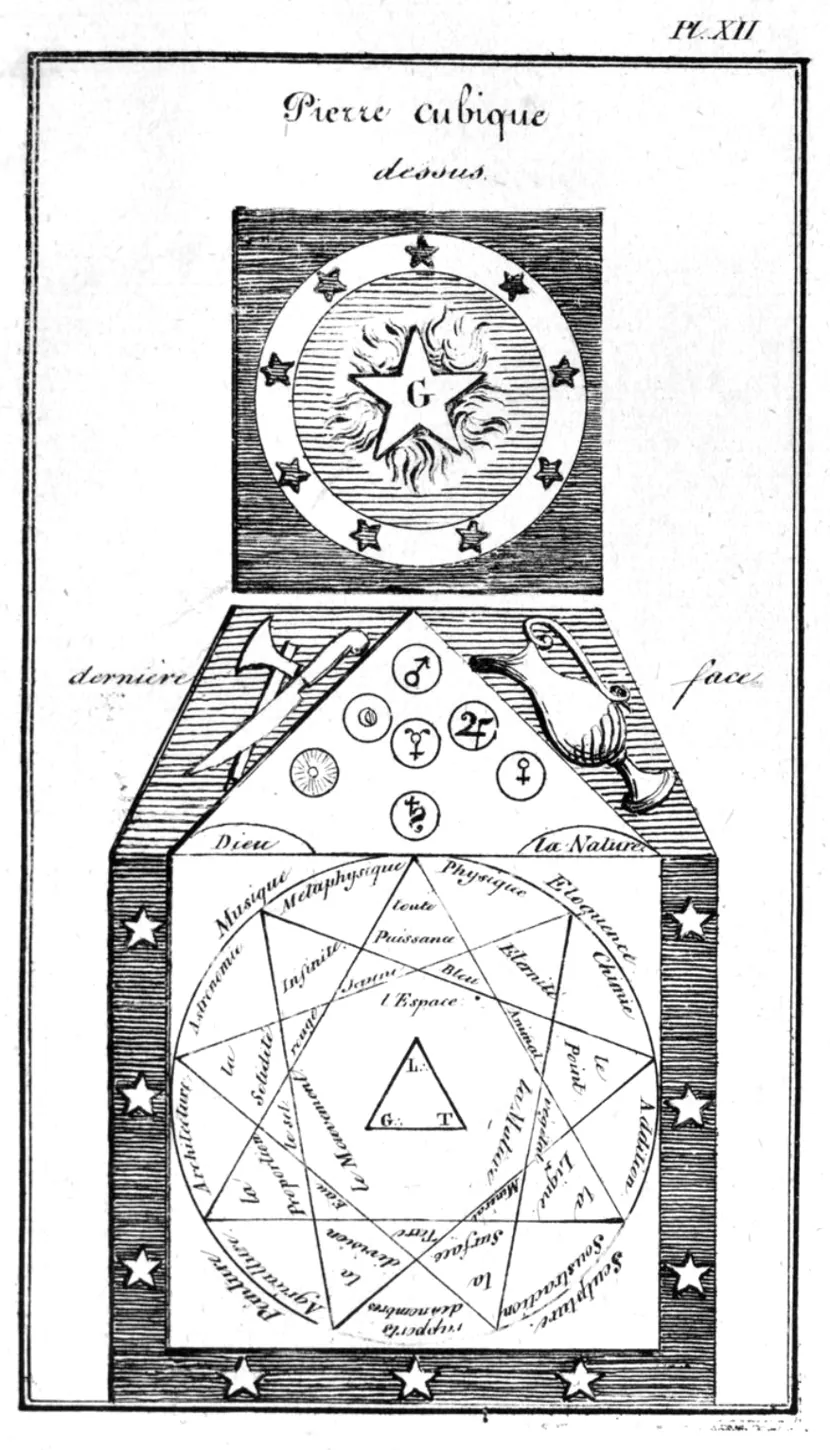
L'Écossois, cinquième des grades de France, se trouve le sixième dans la réforme de Saint-Martin. On l'y appelle Grand-Architecte d'Heredom, Vertus du Collège Ternaire de Saint-André d'Écosse. Tous ces grades présentent dans le rit des différences que nous ne nous sommes point engagés à faire connoître. Nous avons cru seulement devoir faire graver ici celle des faces de la Pierre Cubique sur laquelle sont tracés les mots Sacrés des sept grades de France ; parce que la planche qu'en a donnée le S.r Chereau est extrêmement fautive. Avec le zèle le plus irascible pour les mystères de l'ordre, le S.r Chereau en fut un des membres les plus ignorants. Nous joindrons à la Pierre Cubique la rectification et l'explication des mots hébreux employés dans l'Écossois de France et dans celui de Saint-Martin.
Les mots de l'Attouchement de l'Écossois de France sont BERITH, NEDER, SCHELEMOTH, (voy. ci-dessus pag. 44).
[p. 92]
Le mot Sacré doit s'écrire
SCHEM HAMMEPHORAS, שֵׁם הַמְפוֹרָשׁ, et signifie Nomen explicatum, expansum, pronuntiatum.
On a vu ci-dessus que le Iehovah étoit, chez les Juifs, un nom ineffable. Pour que la prononciation de ce nom ne se perdît point parmi les Lévites, le Grand-Prêtre le proféroit dans le temple une seule fois l'année, le 10 du mois Thisri, jour du jeûne de l'expiation. C'étoit alors que le Iehovah étoit dit Schem Hammephoras, c'est-à-dire, nom bien prononcé, bien expliqué ; ais on recommandoit au peuple de mener un grand bruit pendant cette cérémonie ; afin que ce nom Sacré ne fût entendu que de ceux qui avoient droit de l'entendre, car tout autre, disent les Juifs, eût été incontinent frappé de mort.
Le mot de Passe est Elehanam, ou, plutôt, EL CHANAN, אֵל חָנָן,
(gratia dei,)
seu
(misericors Deus).
[p. 93]
Les différents points de l'Écossois de France, sont, 1°, Imitation du sacrifice d'Abraham, 2°, Ablution ; 3°, Purification par le feu ; 4°, Esclavage ; 5°, Recherche et découverte du précieux Delta ; 6°, liberté rendue ; 7°, consécration du prêtre de Iehovah ; 8°, nouvelle purification par l'Auge et la Truelle ; 9°, Communion avec les Frères.
Dans l'Écossois de Saint-Martin, les mots Sacrés sont
EL, אֵל,
GOMEL, גֹמֵל, un des noms de Dieu (1).
(retribuens)
Le mot de Passe est Gabaon, en hébreu GHIBHON, גִּבְעוֹן, qui, dans cet endroit, signifie habitaculum excelsum, et est dérivé de גבה et de עון (2).
(1) C'est par erreur que l'on écrit Gomez, qu'on traduit par Beauté divine, et que l'on suppose avoir été la première parole prononcée par Adam.
(2) Dans la Maçonnerie Adonhiramite, le mot de Passe étoit Zedidiac, mot altéré, à la place duquel il faut écrire ZEBADIAH זְבַדְיָה (victima dei).
[p. 94]
Les douze grands noms de Dieu placés sur les douze pierres du Rational, sont :
MELEK, מֶלֶךְ (Rex), sur la Sardoine.
GOMEL, גֹמֵל (Retribuens), sur la Topase.
ADAR, אָדָר (Magnificus), sur l'Émeraude.
ÉLOAH, אֱלוֹהַּ (Deus fortis), sur l'Escarboucle.
HAIN, עַיִן (Fons, oculus), sur le Saphir.
ELCHAI, אֵלחַי (Deus vivens), sur le Diamant.
ÉLOHIM, אֱלֹהִים (Dii), sur le Lyncure.
EL, אֵל (Fortis), sur l'Agathe.
IAHO, יָהוּ (IAΩ), sur l'Amethyste.
ISCHGOB, אִישׁ־גָּב (Pater excelsus), sur la Chrysolithe.
ADONAI, אֲדֹנָי (Domini), sur l'Onyx.
IEHOVAH, יְהֹוָה (Sum qui sum), sur le Berylle.
Les vingt deux noms de Dieu, par ordre alphabétique.
Main droite à la Coupe — Haut la Coupe. — Videz la Coupe en trois temps.
Coupe à l'épaule droite.
Coupe diagonalement à la hanche gauche.
Remontez la Coupe à l'épaule gauche.
Coupe diagonalement à la hanche droite.
Ces quatre évolutions forment une Croix de Saint-André X.
Remontez la Coupe à l'épaule droite.
En avant la Coupe.
Posez la Coupe.
Ces trois temps forment une Équerre.
La Batterie ;
Puis on dit :
Dieu bénisse le Roi et les Chevaliers.
[p. 97]
V.e CLASSE.
Vuillaume 1820
tuileur imprimé · 1 257 mots
Le tuileur de Claude-André Vuillaume, « Manuel maçonnique, ou Tuileur de tous les rites de maçonnerie pratiqués en France » (Paris, Delaunay et Hubert, 1820) : décoration, titres, signes, attouchement, marche, batterie, âge, mots, habillement du grade, avec l'étymologie et l'interprétation des mots hébreux. Texte établi sur le fac-similé et relu mot à mot sur les images : océrisation à 600 dpi du volume numérisé, fusion avec la couche texte de la numérisation Gallica, puis relecture page par page. Orthographe de 1820 conservée, hébreu et grec restitués, batteries rendues comme l'imprimé les note, pagination de l'original. Pages 114 à 120. Les planches gravées du volume, absentes de la numérisation Google, sont reprises de la numérisation Gallica et rapportées au grade qu'elles représentent.
Une voûte souterraine, tendue en rouge pourpre et flambée couleur de feu.
Vingt-quatre lumières éclairent cette salle; savoir, neuf à l'est, devant le trône; sept au sud; cinq à l'ouest, devant le premier surveillant; et trois devant le second surveillant.
En avant du trône, du côté du sud, est un autel, dit des parfums, sur lequel est un réchaud allumé, dans lequel brûle le plus pur encens. Du côté du nord, est une table carrée, [p. 115] sur laquelle sont les douze pains de proposition, formant deux piles, chacune composée de six pains. Sur cette table, en avant, est une auge en or, avec une truelle de même métal; l'auge contient une mixtion dont il est fait usage dans les réceptions. Un autel, dit des sacrifices, est également placé à l'est, en avant du trône.
A l'ouest, est un grand vase ou cuve, en airain, rempli d'eau.
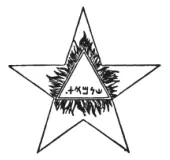
Dans le fond du dais qui orne le trône, est un delta transparent, où l'on voit, en caractères hébraïques, le grand nom de Dieu.
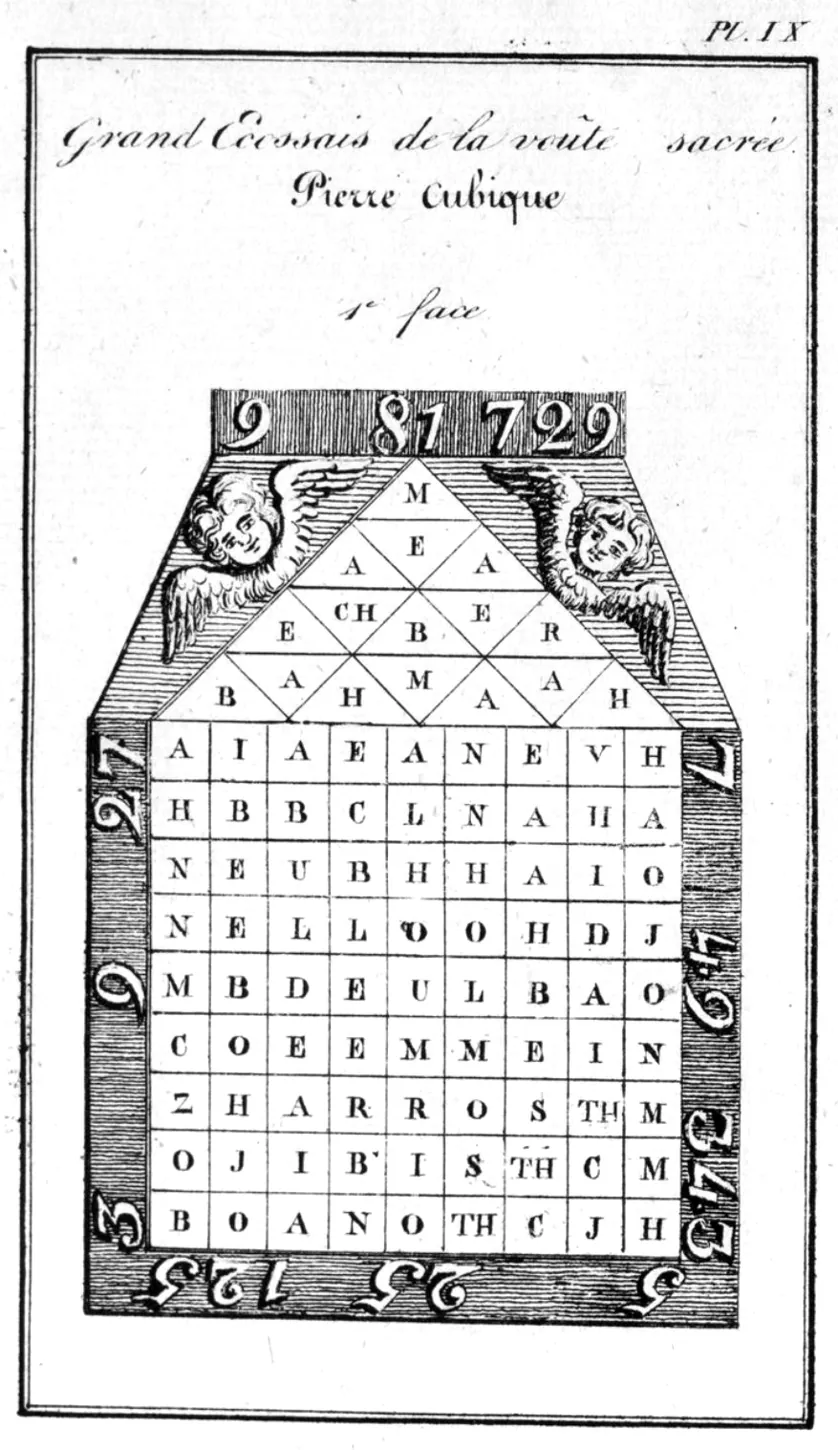
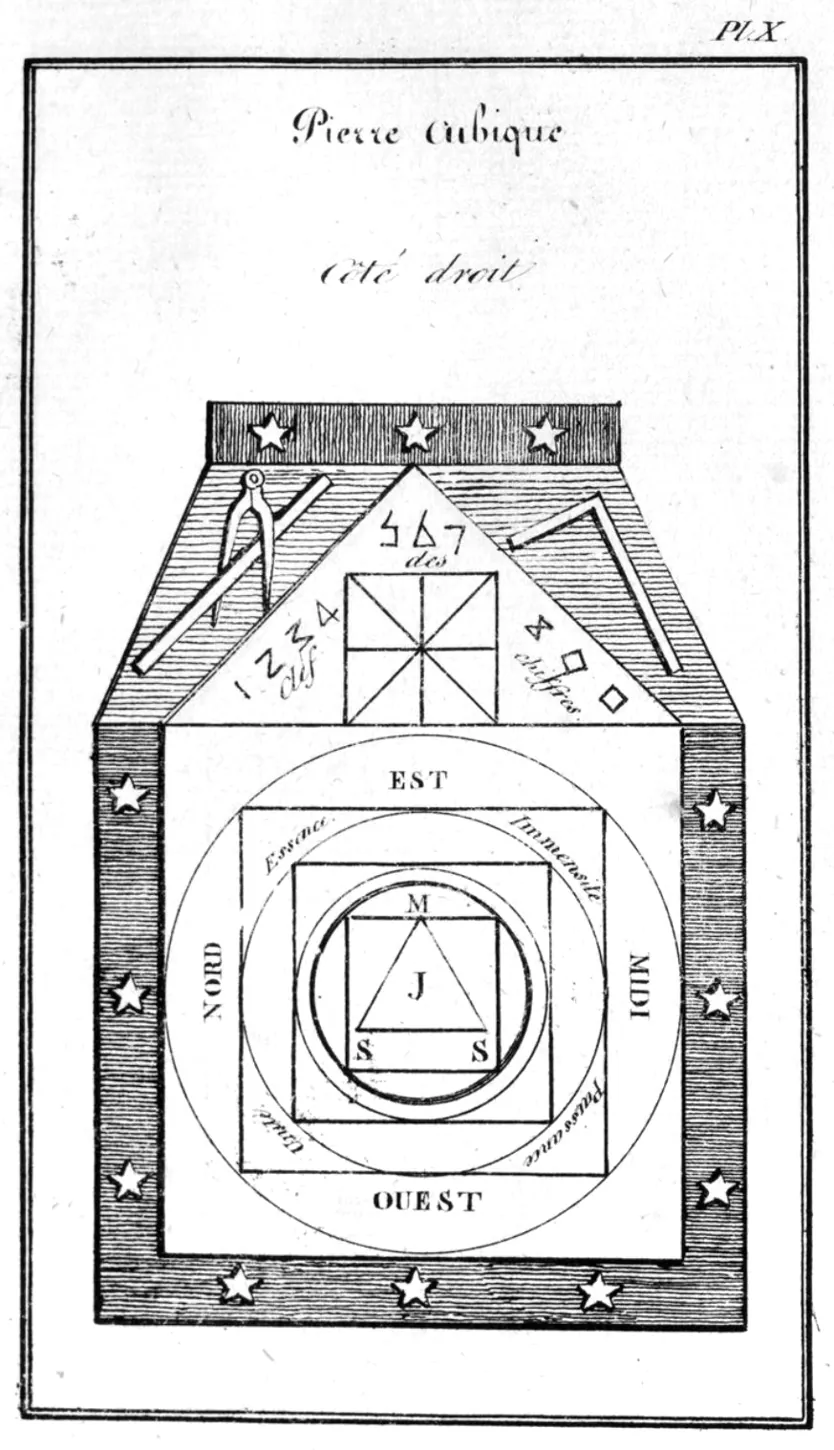
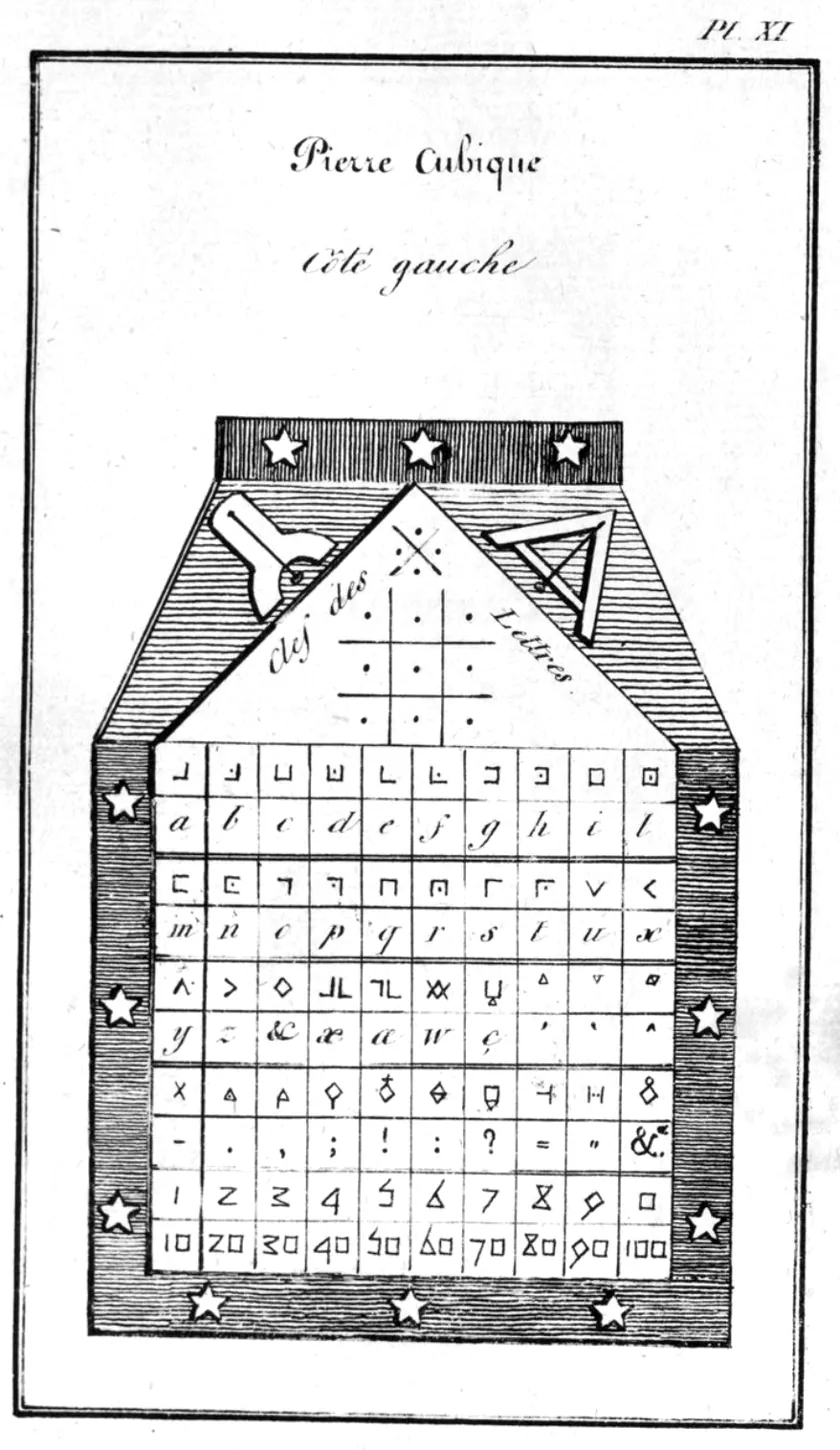
Le nombre des colonnes qui décorent la loge n'est point fixé; elles doivent être riches et du meilleur goût. On trouve sous cette voûte la pierre cubique. (Pl. IX, X, XI et XII.)
TITRES.
La loge prend le titre de Collège.
Il y a dix officiers :
1°. Le président, qui représente Salomon, et se nomme Trois fois puissant;
2°. Un officier qui représente Hiram, roi de Tyr, assis à la droite du président;
3°. Le resp∴ premier surv∴ qui représente Adoniram;
[p. 116]
4°. Le resp∴ deuxième surv∴ qui représente Moabon;
5°. Le garde des sceaux, qui se place à la gauche du président, et représente Galaad (1);
6°. Le grand trésorier, placé au nord, devant la table des pains de proposition; il représente Jabulum;
7°. Le grand secrétaire, placé au sud, devant la table des parfums; il représente Johaben;
8°. Le grand orateur, au sud, près l'autel des sacrifices; il représente Abdamon (2);
9°. Le grand maître des cérémonies, au nord; il représente Stolkin;
10°. Enfin le capitaine des gardes, qui se place près du deuxième surv∴ et représente Zerbal.
SIGNES, ATTOUCHEMENS ET MOTS.
1er signe, celui du serment. — Porter la main droite vers le flanc gauche; la retirer
(1) Héb. גַל־עֵד gal-ged, tumulus testis (Gen. ch. 31, ℣. 48). Galaad était le fils de Machir, fils de Manassé, fils aîné de Joseph (Josué, ch. 17, ℣. 1).
(2) עֶבֶד־הָמוֹן gebed-hamon, servus turbæ.
[p. 117]
avec vivacité, et horizontalement vers la droite.
1er attouchement. — Se prendre mutuellement la main droite, et la retourner alternativement jusqu'à trois fois. L'un dit : Berith; l'autre, neder; le premier réplique : Schelemoth.
1er mot couvert. — JABULUM.
1er mot de passe. — SCHIBBOLETH.
2e signe, celui du feu. — Porter la main droite ouverte sur la joue gauche; la paume en dehors, et se tenir le coude avec la main gauche.
2e attouchement. — Se prendre réciproquement la main droite, et se l'empoigner comme au 3e degré; on dit : Allez-vous plus loin? Pour réponse, avancer la main le long de l'avant-bras jusqu'au coude; ensuite se poser mutuellement la main gauche sur l'épaule droite, et se balancer par trois fois, ayant les jambes avancées les unes entre les autres par la droite.
2e mot couvert. — MACHOBIM (pron. makobim) (héb. מַכְאבִים dolores), et que l'on interprète ainsi : C'est lui, il est mort!
Selon quelques rituels, on fait dire Mahabin, ou Mohabon, ou Moabon, ou enfin Makobin; tous ces mots, ou sont fautifs, ou ne [p. 118] sont pas à leur place. Dans d'autres, nous avons trouvé Gabaon notade (1), que l'on traduit par ces mots : Gabaon, ami parfait, ami élu! Mais cela est d'un usage peu répandu.
2e mot de passe. — EL-HHANAN (héb. אֵל־חָנָן gratia Dei, misericors Deus). On lit dans quelques rituels : Eleanam ou Elehanam, ces deux mots sont également fautifs.
Il ne faut pas confondre ce nom avec El-chanan אֵל־כָנָן, nom d'un des plus braves officiers de David (Paral. 1, chap. 11, vers. 26.).
3e signe, celui d'admiration et de silence. — Lever les deux mains ouvertes vers le ciel, ayant la tête inclinée, les yeux élevés; porter ensuite les deux premiers doigts de la main droite sur les lèvres.
3e attouchement. — Se saisir réciproquement la main droite, se cramponner avec la main droite, et avancer la main gauche sur le dos comme pour attirer à soi.
(1) On devrait dire Gabaon-Notel גִבְעוֹן־נֹטֵל ghibgon-notel assumens collis.
[p. 119]
MARCHE.
Huit pas précipités et un plus lent, ensemble neuf.
AGE.
Sept fois sept ans.
TEMS DU TRAVAIL.
De midi à minuit.
HABILLEMENT.
Tablier blanc, doublure et bordure cramoisi; un ruban bleu, ou faveur, est achevalé sur la bordure sans la couvrir en toute sa largeur; au milieu du tablier, est peinte ou brodée une pierre plate carrée, au centre de laquelle est représenté un anneau de fer qui y est scellé.
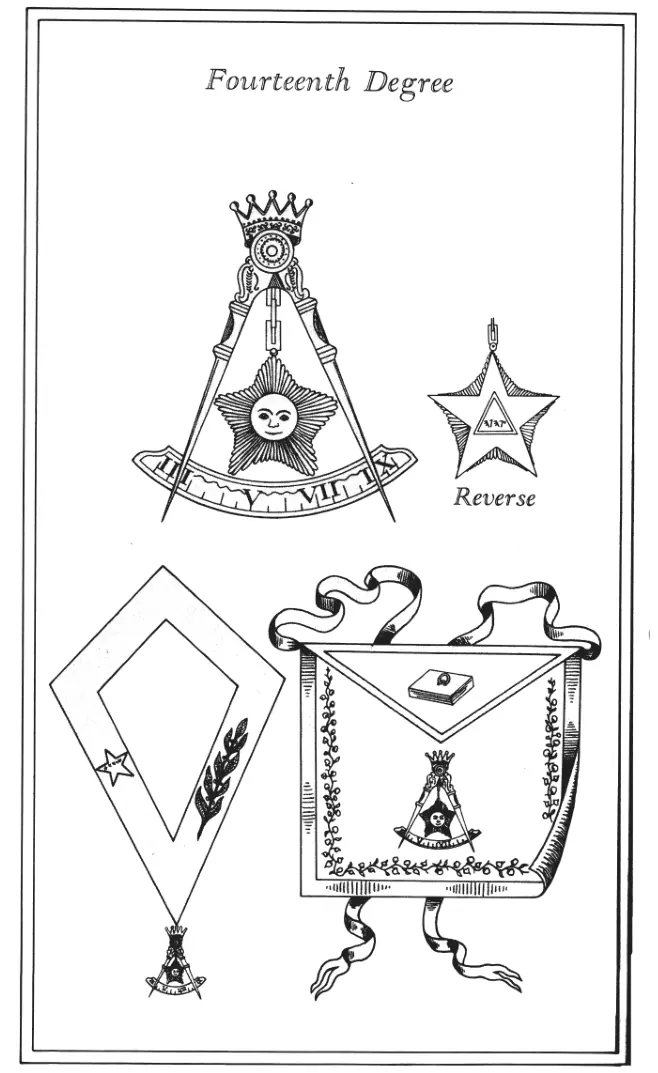
Cordon cramoisi, porté en sautoir; au bas du cordon est suspendu le bijou, qui est un compas en or, surmonté d'une couronne à pointes, ouvert sur un quart de cercle. Entre les jambes du compas, est une médaille, représentant d'un côté le soleil, et de l'autre l'étoile flamboyante, au milieu de laquelle est la lettre G. Sur le quart de cercle sont gravés les chiffres 3, 5, 7 et 9 (Pl. VIII, fig. 3).
Chaque écossais porte un anneau en forme d'alliance, dans l'intérieur duquel sont gravés, [p. 120] d'un côté, le nom de l'Ecossais, et la date de sa réception; de l'autre, ces mots : Virtue unites what death cannot separate; la vertu unit ce que la mort ne peut séparer.
GRAND MOT DE PASSE.
BEA MACHEH (prononcez makeh). BAMFARAH, que l'on interprète : Dieu soit loué! nous avons trouvé! (héb. בְעָא מַכֶה בָמְעָרָה bega macheh bam'garah, quærit interfectorum vel percussorum spelunca.) Ces mots se sont fort corrompus dans la tradition; il y a des rituels où l'on trouve, macmaha rababack, mots ablument insignifians.
MOT SACRÉ.
JEHOVAH.
Planche IX. Grand Écossais de la voûte sacrée. Pierre Cubique. 1re face. Première face de la pierre cubique du Grand Écossais de la voûte sacrée : un damier de lettres surmonté d'un fronton triangulaire à cases où se lit le nom mystérieux, encadré de deux têtes d'anges ailées et bordé de chiffres.Planche X. Pierre Cubique. Côté droit. Côté droit de la pierre cubique : au fronton, la clef des chiffres accompagnée du compas et de l'équerre ; au corps, cercles et carrés concentriques portant les mots Essence, Immensité, Puissance, Unité et les quatre points cardinaux, au centre un triangle aux lettres M, J, S, S ; le tout bordé d'étoiles.Planche XI. Pierre Cubique. Côté gauche. Côté gauche de la pierre cubique : au fronton la « Clef des Lettres » en grille pointée avec truelle et équerre ; au corps, table de l'alphabet chiffré donnant les caractères correspondant aux lettres, aux signes de ponctuation et aux nombres de 1 à 100 ; bordure d'étoiles.Planche XII. Pierre Cubique. dessus — dernière face. Dessus de la pierre cubique orné de l'étoile flamboyante au G entourée de sept étoiles, et dernière face portant les sept symboles planétaires au fronton et, entre « Dieu » et « la Nature », une roue de triangles entrelacés répartissant les sciences et les arts autour d'un triangle central marqué L, G, T.
Pike 1857
rituel imprimé · en anglais · 20 074 mots
« The Magnum Opus or Great Work » (1857) : le premier corps complet de rituels révisés par Albert Pike pour la Juridiction Sud des États-Unis. Texte en anglais, établi par reconnaissance optique corrigée : des coquilles subsistent.
D'après la réimpression Kessinger de l'édition de 1857 (numérisation archive.org)
THE LODGE, ITS DECORATIONS, ETC.
_ This Lodge represents a subterranean apartment, without opening to admit the light. Tt ought regularly to be a perfect cube; that is, its length, breadth and height should be exactly equal. The hangings are crimson, with columns at regular intervals.
_ In the East is a transparency, on which is painted a luminous triangle, having in its centre the word him. .It should be large and brilliant. .
_ In front of the Master's sent in the East are two large gilded columns; and between them o transparent triangular pedestal, lighted within, and representing alabaster, on which is the Cube of Agate, having upon its upper face the Ineffable Name upon a triangular plate of gold. Around the sides of the plate, in the 'character of the degree, or the nine names of Deity in different languages, as given in the Royal Arch degree. . .
. lan front of the Jun.*. Warden in the West are 3 lights; in front of the Sen.*. Warden, in the North, 5; 'in front of the Orator, in the South, 7; and in front of the Master, in the East, and between him and the columns, 9. Those in front of the Jan.*. Warden form o triangle; those in front of the Sen.*. Warden, a pentagon ; those in front of the Orator, a heptagon; and those in front of the Master, three equilateral triangles in one line.
. The Lodge room should be approached by o long and narrow passage, lighted by a single lamp, hanging from above, half way its length. ;
The Lodge is styled The Sacred Vault.
OFFICERS, TITLES, ETC.
The Presiding Officer is styled T'h.°, Puissant Gr... Master.
'The Sen.*, and Jan.".. Wardens are styled Sen.°. and Jun.*. Grand Wardens.
'The Grand Treasurer sits in the East, on the right of the Gr.. Master. Before him is the altar of incense, which is four-square, with a gilded horn at each corner, and covered by a plate of metal of the colour of gold. Upon it is an urn, filled with perfumes for burning.
The Gr.'. Secretary sits in the East, on the left of the Th... P... Before him is a table, covered with a white linen cloth, on which are a basket containing twelve small loaves of bread, and a cup of red wine;
~The Deacons are styled Gr.°. Sen.. and Jun.. Experts.
There is also a Gr.*, Master of Ceremonies. .
In the passage-way are three Sentinels, each with o sword in his hand; ono at the further door of the passage, one half-way, and one at the door of the Lodge.
Upon the altar of incense is a small silver vessel containing perfumed oil, and a little trowel of goldWhen there is a reception, all the jewels for the candidates are placed on the table in front of the Gr.*. Secretary, with a ring foreach. This ring is a plain one, of gold, with this motto engraved on the inside: Virtue
junzit: More non separabit.
In front of the Sen.-. Warden is a short column, on which is 9 brazen basin, filled with pure water.
CLOTHING, ORNAMENTS, AND JEWEL.
The Th.*. P.*, wears a purple robe, with the collar and jewel of the degree. All the other members, the collar, apron and jewel.
The apron is of white sheepskin, lined with crimson, and edged with blue. Around it, on the inside of the edging of blue, is 9 delicate embroidery in crimson, representing a wreath of flowers. In the middle of the apron is painted or embroidered the jewel; and on the flap is a representation of a flat square stone, to which is attached a ring. .
The collar is of crimson velvet.
The jewel is 2 compass, opened upon a quarter of a circle, and surmounted by a pointed crown. 'Within
the compass is a medal, representing, on one side the Sun, and on the other a Star, in the centre of which is a triangle, and on that the Sacred Word him. This jewel is suspended from the collar.
The dress of the Brethren should be black, with black gloves; and each wears a sword,
The battery is ; | £ and ; times ;
The age is the cube of ; or square of z—or $,
TO OPEN.
The. P.. (Rapping 1]: My Brethren, I am about to open this Lodge of Perfection. I pray you to give
me your attention and assistance. .
(The officers assume their stations; and the Th.°. P.:. raps 2, and says] :
Th.. P.. Respectable Bro.:. Jun.'. Gr.'. Expert, are all present Gr.°., El.., Perf.*. and Subl.*. Masons?
{if the Jun.°. Gr.. Expert knows all the Brothers, be answers in the affirmative. If he does not, he says]:
J. Gro. Exp.. Th. P.., Lam not certain.
Th. P.. In that case, Bros.*. Sen.'. and Jun.-. Gr.*. Experts, you will receive the first [or any other he fixes on] covered word from each one present, and carry it up to the Most Excellent Bro.', Jun.*. Gr.*. Warden, and he to the M.*. Ex.*. Bro.*. Sen.*. Gr.*. Warden, that it may come to me in the East,
[The two Experts receive the word from all except the Th.-. P.°. and the two Wardens. Then the Jun.*. Gr.. Expert gives it to the Sen:'. Gr.. Expert. Le goes and gives it to the Jun.'. Gr., Warden, and he to the Sen.. Gr.". Warden, who goes and gives it to the Th.-. P.". in the East]. —
Th.. P... The word has come up to the East aright. Bro.*. Jun.*. Gr.*, Expert, it is our first duty to see that the approach to this sacred vault is duly guarded. Attend to that duty; see that the sentinels are duly posted; and advise them that this Lodge of Perfection is about to be opened, and that they must allow none to approach without the proper pass-words.
[The Jun.-. Gr.. Expert goes out, returns, and says]:
Jo. Are. Exp. The. Pt, Gee. Master, the sentinels are duly posted, and your orders made known to '
them.
Th... P.. Thanks, my Brother! Let us, my Brethren, return our thanks to the Gr.*, Architect of the Universe for the many blessings and comforts with which He has surrounded us, and implore Lis aid to enable us to perform our duties.
[AU kneel ; and the Gr.*, 3laster reads the following]
[After this prayer, the Brethren remain for a moment or two in profound silence. Then the Th.-, Po -Faps 3, and they all rise, and remain standing. He then asks] :
'Th Po. M.. Excellent Sen., Gr.*. Warden, what brought you hither?
Sen. Gr. W.. My obligation, my love for Masonry, and my earnest desire to approach Perfection.
'Qu.*.. What do you bring hither with you? .
Ans.". Trae Friendship, and a sincere love for virtue.
Qu.*. What are the characteristics of a Gr.*., El.*., Pert.:. and Sub.*. Mason ?
. Ans. That he frees himself from the dominion of iniquity, injustice, revenge, envy and jealousy ; that he is active in doing good; and speaks of his brethren, only to praise them.
Qu... What should be your deportment in this place?
Ans... That of profound respect and perfect decorum.
* Qu. Ilow is it that here Princes and Subjects, the master and the employed, the rich and the poor, become friends, brothers and equals ? ~~ Ans." By the influence of that, of which the Triangle over you is an emblem ; of a Power infinitely greater than yours or any other on earth.
Qu.. What does the Triangle represent ?
Ans,". I¢ contains the Ineffable Name, and represents the Great Creator of the Universe ; in comparison with whom all men are so infinitely small and powerless, that the difference between the highest and the lowest is insignificant.
Qu.*, What are you, my Brother?
'Ans... Tam your Brother; a Gr.*, El.., Perf... and Sub.*. Mason; who have undergone all the tests and trials, and obtained the reward of my labours.
Qu... What is that reward ?
~ Ans. The knowledge of the True God; a faint bat true appreciation of His nature and infinite atari-
butes; a confidence in Iis wisdom and justice, His benevolence and lore for his feeble creatures ; securing me against scepticism and despair.
Qu.. Have you the True Word of a Gr.-., El.'., Perf... and Sublime Mason ?
Ans. Have.
Qu. What is it?
Ins.*, That knowledge and confidence; of which the visible word is but a symbol.
Qu... What is your Masonic age?
Ins.', The square of z or $, years complete.
Qu... What contract did you enter into, on receiving this degree?
Ans... I devoted myself to virtue, and to the cause of Humanity ; and became the firm ally of the virtuous and good.
Qu... What is the token of that contract?
Ins.. This ring, symbol of Eternity and of unbroken friendship.
Qu... What is the hour?
Ans... Noon; the sun is in the zenith.
Qu." What does the arrival of that hour require of us?
Ins.", That we renew our labours for the benefit of our fellows, our country and mankind, while it is yet day; for that the night soon comets, in which no man can work.
Qu... Where shall we find materials with which to work?
Ans.. In the virtues of our Brethren, and in our own intellect and energy, regulated and directed by
- the square and compasses of Reason.
Th.. P.. Then, that we may so work while it is day, as the brethren desire, let us open this Lodge |! Announce to the Brethren that we will forthwith open this Lodge of Gr.°. El.', Perf.:. and Subl.*. Masons, by the mysterious numbers [;] [j] [£] and [z]. . . ;
Sen. Gr. Ward... Brethren in the North and South, the Th.°. P.. Gr.*. Master, with your assistance, is about to open this Lodge of Gr.*. Elect, Perfect and Sublime Masons, that we 'may renew our labours; and prays that you will sid him in doing so. :
{The Jun.:. Gr.*. Warden raps ; at equal intervals] : [The Sen.*. Gr.*. Warden raps {[ at equal intervals]: (The Th.*. P.*. raps £ at equal intervals] :
[Then follows a short but profound silence]:
{The Th.*. P.*. raps ; slowly and at equal intervals] :
(All the Officers and Brothers give the lit sign] :
{The Th.*. P.*. again raps ; as before] :
[All give the 2d sign]: ~
[The Th.-. P.*. again raps ; as before]:
[All give the 3d sign]: .
Th. P.. Most excellent Brothers Sen.*. and Jun.'. Gr.*. Wardens, this Lodge of Perfection is opened.
Sen.. Gr. W.'. Brethren in the North, this Lodge of Perfection is opened.
Jun. Gro. Wo. Brethren in the South, this Lodge of Perfection is opened.
[Then the Th.-. P.*. gives the sign of simple admiration. The two Gr.*. Wardens repent it together, and then all the Brethren do so. Then the Th.:. P.*, salutes the Lodge by the 1st sign: all the Brothers repeat it.
_ The Th.*. P.*. gives one rap; and all cover themselves, and take their seats].
RECEPTION.
The Candidate being in an apartment beyond the narrow passage leading to the Lodge Room, clothed as a Royal Arch Mason, the Master of Ceremonies conducts him to the door entering into the passage, and informs him what pass-word he is to give to the first Sentinel within, and directs him to rap ; J and £ at the
door. The luminous pedestal is covered with a thick cloth,
Any... 5
The Guard, first answering by the same battery, opens the door and asks: [bringing down the point of his
sword]:
Guard: . . Who comes hero?
AL'. Her. A Mason, with the first pass-word.
Guard: Advance Bro,*. Mason, and give the pass-word.
(The Candidate gives it]:
Guard: The word is right, Pass, my Brother.
[The M.-. of Car.'. then communicates to the Candidate the second pass-word, and directs him to give the same battery on approaching the second Sentinel. That pass-word is demanded and received in the same way].
[Then the M.-. of Car.*. communicates to the Candidate the third pass-word, and directs him to give the same battery on approaching the third Sentinel. That pass-word is demanded and received in the same way].
[Then the M.*. Car.*, raps; [| £ and at the door of the Lodge Room. The battery in repeated from
within, and the Jun.. Gr.-. Expert partly opens the door, and asks]:
J. Gro. Exp... Who comes here ?
MM. Her... A Mason of the Royal Arch, who having ever been true to the demands of Honour and the
dictates of Duty, is desirous to be admitted into the Sacred Vault, that be may pray the Th.*. Puissant Gr.". Master and the Brethren to confer upon him the Degree of Perfection. . J. Gro. Exp.. will advise the Th.. P.:. Gr.. Master of his request, and return his answer.
[He closes the door, and goes to the East, where the Th.-. P.-. asks the same question, and the same answer is given, as at the door].
Th. Ps. Wet this Mason of the Royal Arch enter, and be received in due and ancient form.
{The M.°. of Her.*. having instructed the Candidate how to give the sign of admiration, conducts him into the Lodge. As he enters, the Jun.-. Gr.. Warden meets him, and places the point of his sword against his chest. The M.:. of Her.'. does the same, and he is then led up to the East; where, directed by the M.-. of Her.*. he gives the sign of admiration; after which there is a profound silence for some moments. Then the Th.. P.*. asks]:
Th. P.. What request have you to prefer, my Brother?
Cand., [The M.. of Her.:. dictating the answer]: Th... P.°. Gr.*. Master, I desire to be permitted to - receive the degree of Perfection. :
. Th.. P... My Brother, before your request can be granted, or the assent of the brethren asked, there are 'certain questions-which I must put to you, and which you must answer. Should you fail to do so, your request will be denied.
Th... P.. Are you 2 Mason?
Cand.". My Brethren know me to be such.
Qu.". Can you give to our Brother the Jun.*. Gr.*. Warden the sign, word and token of the first degree ?
Ans.". Can. [He gives them].
Qu.*. Are you a fellow-craft Mason?
. Ans... I have seen the letter G., and I know the Pass-word.
Th.. P.. Give, then, to the Jun. . Gr. Warden the sign, word and token of that degree. [the gives them].
Qu.". Are you a Master Mason?
Ana.". I have seen the body of our Gr.'. Master disinterred. ,
"The. Ps. Give the sign, word and token of a Master Mason to the Jun.°. Gr... Warden. [Be does so. , When he pronounces the word, all the Brethren present their swords at his breast: and the Th.. P.-. says: '* Beware, my Brother. You cause us to tremble when you pronounce that word aloud. You might do so elsewhere, and be heard by the Profane. We pardon you; but be careful never again to be guilty of a like indiscretion].
Th... P.. Are you s Secret Master?
Cand.*, Have passed from the Square to the Compass: I have seen the Tomb of our Gr... M.. Hiram Abi, and in company with my Brethren I have shed tears thereon.
Qu". What was the lesson taught you in that degree? alns.. Secrecy .. Obedience . . and Fidelity. Qu. Are you a Perfect Master?
Ans., Have seen the three circles, enclosing the square, upon the two crossed columns, Qu... What lesson were you taught in that degree? Ans... Honesty, sincerity, frankness, straightforwardness and good faith. Qu... Are you a Confidential Secretary?
Ans... My zeal was mistaken for curiosity; and my life was for s time in danger. Qu... What lesson were you taught in that degree? ans.*. To be zealous and faithful, disinterested and benevolent, and to act the peace-maker. Qu... Are you a Provost and Judge?
Ans... I dispense impartial justice to the workmen. Qu.*. What lesson were you taught in that degree? Ans... To decide justly and impartially, and to do justice to all men, seeking no undue advantage of any, nor endeavouring to enrich or elevate myself at the expense of another's fortune, happiness or reputation. Qu... Are you an Intendant of the Building? Ang... Was o pupil of our Gr.*. Master Hiram Abi; and with four others was thought worthy to take his place.
Qu... What lesson was taught you in that degree? Ans... Benevolence and charity, and brotherly sympathy fur those in my employ. Qu.". Are you an Elu of Nine? "
Ans.'." A cavern received me, a lamp gave me light, and s fountain refreshed me. Qu.*. What lesson was taught you in that degree? Ans.*. To protect the oppressed against the oppressor, and Free Thought, Free Conscience and Free Speech against usurpation and invasion.
Qu.*. Are you an IIL'. Elu of Fifteen? .
Ans... My zeal and indefatigable exertions procured me that great honour, far above my deserts. Qu.*.. Against what do you contend as dn Elu of Fifteen? Ana..° Tyranny, Fanaticism, and Ignorance. Que. Are youa Sublime Elu of Twelve ?
dns. My name will satisfy you that Iam.
Qu. What is that name? .
Ans, Axetu,ntrueman. It is my name and my profession. Que. Whatare the duties of a Prince Amoth? Ans.. To bo earnest, true, reliable and sincere; and to be the advocate and champion of the rights of the People.
Qu... Are you a Gr.. Master Architect?
Ans. I have studied mathematics, and am familiar with the instruments used by a Gr.". Master Architect. Qu.*. Of what is the North Star the symbol to you? dns. O€ Taorm and Rieu; the pole-atars that guide Masons over the stormy seas of Timo. Qu... Are youn Royal Arch Mason Ecossnis?
Ans. I have descended through the nine arches into the subterranean yault, and seen the luminous pedestal, the cube of agate, and rz Great WORD. Qu... To what did you pledge yourself as a Royal Arch Mason?
Ans.*, Ever to be guided and directed by ITowovr and Durr. Th. P.. Give to the Gr.*. Jun.. Warden the words, signs and token of « Mason of the Royal Arch.
[Ue does so].
Qu... Can you pronounce the Sacred Word?
Ans.*.. Teannot. I have come hither in hopes to obtain that secret.
[The Th.*. P.*. gives the sign of admiration, and says]:
Th.. P. You ask a Loon which I alone am not competent to grant. These Brethren must be satisfied and unanimously consent that you shall receive the degree you seek. «Answer me yet again: Since you bare been a Mason, have you ever endeavoured to conduct yourself with frankness and sincerity towards your brethren? Have you ever attempted to injure a Brother in his person, his property, his domestic relations or his reputation? avo you ever refused to comply with your Masonic obligations to the widow or orphans of a Brother? Does your conscience reproach you with the violation of any portion of any ono of your Masonic obligations, of which violation you have not repented ; or with any wrong done by you, for which you have not earnestly endeavoured to make amends? Have you ever found in those obligations any thing contrary to the duties you owe yourself, your family, your friends, your country or your God; or to the feelings of a good man and a man of honour?
[The candidate answers each question separately. Then the Th.*. P.. says]:
Th. P. My Brother, you will now please to retire. But first, if you wish to explain any answer you have made, you are at liberty to do so. .
{If he makes any explanation, it is listened to, and then, or if he makes none, the Gr.-. Master says]:
Th. P.. Retire then, my Brother, while we consult together; and place entire confidence in the justice and impartiality of your Brethren.
(The candidate retires; and the Gr.*. Master says]:
. Ph. P.. My Brethren, do you consent that this Mason of the Royal Arch shall be admitted to the degree of Perfection?
(Those who agree, hold up the right hand].
Th.*. P.. Do any object?
[Those who object extend the right hand before them, as if repelling a person. If any object, the candidate is so informed, and sent away. If none, the Gr.°, Master says]:
Th, P:. Then let us applaud, my Brethren, by 2 £ {| and ;
[The Brethren all so applaud; hearing which, the M.°. of Her.'. re-conducts the candidate into the room, and places him between the two Wardens]. .
Th.. P.. My Brother, the Brethren assent to your receiving the degree of Perfection. Remember that you are in the immediate presence of the Gr.-. Architect,of the Universe, who knows every secret thought of your heart; and that, though you may deceive us, you cannot deceive Him. If you have not answered us truly, withdraw. And fear to lie unto us and to your Maker, by approacHing our altar with false or feigned professions on your lips, with indifference and carelessness; without a fixed resolution to perform faithfully and heartily all the duties which you may assume. Learn also that this eminent degree will bind you to us more firmly than before, by new and additional duties and obligations. If you are prepared ever to fulfil these duties with firmness and fidelity; if you are satisfied that we will impose upon you no duty and require of | you the performance of no act that will not exalt and ennoble the character: if you are firmly resolved that we shall never have reason to repent having conferred upon you this degree; and if you are willing to form an indissoluble connection of amity and brotherhood with us, in the 'cause of Our Just, Us Rieut, and Taz Troe, answer that you are willing to assume the obligation of this degree.
Cand... Iam willing.
Th... P.. First go, then, to the station of our Sen.". Gr.". Warden, and wash your bands in the brazen Javer, as a token of the purity of your intentions and the sincerity of your purposes, and that you here lay aside all ignoble passions and unworthy desires, and dedicate yourself to Truth and Virtue.
~ [The candidate is conducted to the laver, where he washes his hands, and returns to his former place between the Wardens. Then the Th.-. P.-. says to him]:
- Th.. P... My Brother, you will now approach the altar by the steps of a Gr.*. El.-. Perf.*. and Sub.°. Mason, and kneel to receive the obligation of this degree: °
[The candidate is conducted to the altar of incense, which he is made to reach by $ quick steps and one slow. Then he kneels upon both knees, and gives the sign of adoration of a Royal Arch Mason, and with his hands takes hold of two of the horns of the altar, and in that position repeats the following]
OBLIGATION.
I,A....3B...., in the presence of the Gr.*. Architect of the Universe, kneeling before this altar raised to Him, and holding thereto, in token of my dependence upon Him and my trust in Him, do hereby and hereon most solemnly and sincerely promise and swear, that I will never reveal the secrets of this degree, nor any thing that may occur in a Lodge thereof, except at such time, and in such place and manner as I may lawfully do so, and to those only who may be duly authorized to receive, while I am legally authorized to communicate and make known the sume.
I furthermore promise and swear that I will never take up arms against my country, nor side with her enemies, nor enter directly or indirectly into any plot, plan or conspiracy against her, her honour or her welfare; but will make known and defeat every such plot, plan or conspiracy, whenever it may bo in my power. . ;
I furthermore promise and swear, that I will pay equal regard and consideration to all my Brethren of this degree, no matter of what rank or condition, or whether rich or poor; knowing no other distinction among them than that of superior merit and virtue; and recognizing them all as my Brethren, if they are honest men; and that I will assist them in their poverty, rescue them from danger, and comfort and console them in misfortune.
. I furthermore promise and swear, that T will visit my Brethren when they are sick; and in every case of necessity will aid and assist them with my counsel, my purse and my person.
I furthermore promise and swear that I will never knowingly have illicit connexion with the wife, mother, daughter, sister, or any other near relative of a Brother. .
I furthermore promise and swear, that, if there be a Lodge of this degree within the distance of fifty miles, I will visit it at least twice in each year, on the 27th of December and the 24th of June, if it be in my power; and oftener if my business and my duty to my family permit.
I furthermore promise and swear, that I will never vote for the admission of a candidate to this degree, unless I have a previous personal knowledge of his good conduct and good morals ;.nor agree to confer it upon any one who js not at the time a member in good standing of o regularly constituted Master's Lodge, or who. has not been Master or Warden of such 1 Lodge. .
I furthermore promise and swear that I will never consent to, or be present at, the admission of a Brother to this degree, unless he has been duly elected thereto by a unanimous rote of the brethren of the Lodge; nor oven then, if I know that any absent brother, o member of the Lodge, would hare voted against him, if
he had been present.
I furthermore promise and swear, that I will ever hereafter strive to maintain the character, and deserve
the name, of a Grand, Elect, Perfect and Sublime Mason; doing and abiding by, in all emergencies, that which is Just, Right and True, and that only, without regard to consequences, or consideration of success or reward. .
And I consent, in case I should ever wilfully or intentionally violate this my solemn obligation, to be held and deemed by all men as perjured, base and infamous, 2 moral leper, offensive to God and man; to touch whom would be defilement, and to associate with.whom, dishonour. So help me God! and keep
me steadfast in the due performance of the same!
[The moment the obligation is concluded, the incense upon the altar is lighted, and the cloth covering the pedestal and cube of agate is removed; and all the Brothers, falling upon their knees, give the 3d sign, and then rise. The Master of Ceremonies (the candidate still kneeling) brings the vessel of oil and the trowel, while the Jun.*. Gr.. Warden uncovers the side over the heart of the candidate. The Th... P.*. then, taking a little oil upon the trowel, anoints the candidate's eyes, lips and side over the heart; and says, os he docs 80] :
The. P.. By the power vested in me as Master of this Lodge, and, in that character, Successor and Representative of Solomon, King of Israel, I devote and consecrate you to the service of that which is Just,
NIV. :.9
Right and True, to Honour and Duty, and to all the excellencies and virtues which go to make up the character of a Perfect Mason!
Orator: Justice is immutable!
Jo. Gro. We. The Incur is omnipotent!
Sen. Gro. We. Tretu is immortal !
The, Pr dnd thou art henceforth their sworn knight and soldier. Arise, my Brother! .
[The candidate rises, and ig conducted to the table of bread and wine, where the Th.°. P.-. hands him of each, and says]: .
Th. Po. Eat of this bread, my Brother, and drink from the same cup with me, as a pledge of brotherhood ; and let this ceremony ever remind you that [Hospitality is a truly Masonic virtue; and that every one of us owes to his brother kind services, and graceful courtesies, and prompt and cheerful assistance and relief.
{The candidate eats and drinks; after which all the brothers do the same; after which the Th... P.-, takes the cup, goes to the altar, and pours what wine remains upon the incense, saying] :
Th... P.. I pour out this libation to the memory of our departed Brethren ; and as nn acknowledgment that it is our duty to pour comfort and consolation into the hearts of the distressed, the afflicted and the destitute ; and that the thanks and gratitude of the widow and orphan are a Mason's most acceptable offering _ to his God.
(Then the Th.°. P.*. puts the ring upon the third finger of the right hand of the candidate, saying]:
Th. P.. My Brother, this plain ring is a visible mark of the compact that you have now made, Its motto is, Virtue junzil, more non separabit: [Virtue has united us, and death shall not separate us]. Promise me that you will wear it during your lifetime, and that you will provide that, after your death, it shall go into the hands of no other person than your widow, your eldest son, or the friend whom of all others you most love.
Cand.°. I promise.
Th. P-. now invest you with the apron of this degree. Of its three colours, while, like the snowy purity of the ermine, represents Justice; Ulue, the colour of the perfectly symmetrical and changeless arch of the sky, represents Riaur; and crimson, the colour of fire which tries and purifies all things, represents Thorn.
Th.. P:, I also invest you with the collar and jewel of this degree. The compasses remind us that science, united to honour and virtue, made the architects of the Temple the companions of Kings; .and that the men of intellect and 'earning, the Great Kings of Thought, are in this age the rulers of the world. The sun, source of light to our system, and once worshipped as_a god, and the star, type of the myriad suns that light other and countless systems of worlds, are emblems of that Masonic Light in search of which every Mason travels; the correct knowledge of the Deity and of his laws that control the universe.
Th. P. We have in this degree three signs, three tokens, three covered words, three pnss-words, and 1 Grand Ineffable Word.
Ist Sion? . . . Bring the t3&Qce1 quickly and &¥fOMY ev Otth from the left side of the @mrrySC x to the right, as if cutting it open.
2p Ten: . . . Place the 8 2Coe3tikOQem upon the fi f &C C$, as if to protect it from the heat of the fire, holding the tC % If with the tC WFSOxeOL. Then change, and put the t3k@c¢r7 before the tht & C Cf, holding the fi Ctm, 3 2/ with the t]kO=1.
3p Sron: .. . Raise the PI¥ MOwos, ¥§CX, towards Heaven, the head inclining backward and
the Ch Can#O?2CT: and then put the? WF 9taPIG OO Ct of the SQL on the 9 $x,
Is Toxin: ... Take each other by the right hand, and 7% tat the Some Y*Ct; times—saying,
alternately . . MCt9 P&.*. eCOCt.. A&T ty gs P&.*.
2p Toxen: eee begin with the ZOO € tai t 9§ Oneasks "fOxzih Y BIT BIWSEIVECL" The
other replies by passing, first to the S59 m7tC€ of the WYtC-O1Ss, and then to the C tm Y Y of the other, semCteCOrs. The other docs the same. Then each puts his {CVWZPISOL on the other's t}any-
4 {T1Ct, and advances his $9 UEP] ¥ Ff go as to pass it beyond the (CWY3W YY of the other; and
they then MO{O" 7 C; PEGCS.
XIV: .. 10
3p Toren: .. . Each takes the other by the fiC tm Y with his t1]kOS¢q, and puts his {OO
Granp Sacred Worn: .... mir... The true pronunciation of which word I give you in n whisper, in which way only I can communicate it to you, or you to another person..... [Q&3&]...
My Brother, I salute you as a Grand, Elect, Perfect and Sublime Mason, duly created and constituted. It remains for you to learn what meanings are involved in the legend and symbolism of this Degree. Go therefore to the Brother the Gr.*. Orator, and receive his instruction.
LEGEND, HISTORY, ETC.
My Brother, you were informed in the Royal Arch Degree, that King Solomon builder a Secret Vault, the approach to which was through eight other vaults or apartments in succession, all under ground, and to which a long and narrow passage led from under his palace; that the ninth vault was immediately under the [oly of Holies of the Temple; that, in that apartment King Solomon held bis private conferences with King Hiram of Tyre, and Hiram Abi; and that, after the death of Hiram Abi, the two Kings ceased to visit it, resolving not to do so again, until they should have selected one to fill his place; and that, until that time, they would make known the Sacred Name to no one.
After Adonhiram, Joabert and Stolkin had discovered the cube of agate and the Mysterious Name, as you have heard, and had delivered it to King Solomon, the two Kings, after much deliberation, determined to deposit it in the secret vault, and to permit the three Masters who had discovered it to be present, and then to make known to them the true pronunciation of the Ineffable Word, creating a new degree, the last of Ancient Masonry, of which those three Masters and themselves should be the first members, tu be called the Degree of Perfection, and its recipients, Grand, Elect, Perfect and Sublime Masons.
Accordingly, after some days, the cube.of agate was so deposited in the Secret Vault (which was thereafter styled the Sacred Vault); being set upon the summit of the column of white marble, called the Pillar of Beauty. Then all knelt, and returned thanks to God for his multiplied favours shown to them and to the Jewish People. Then the correct pronunciation of the Sacred Name was given to the three Masters, and the degree of Perfection, with its signs, words and tokens, was instituted; and thus the zeal and devotcdness of Adonhiram, Joabert and Stolkin were rewarded.
After the twelve Princes Emeth, the first Nine of the Ill.-, Elus of Fifteen, and the Chief Architect, were admitted to this degree, the Nine Elus of Fifteen were assigned to the duty of guarding the approaches to the sacred vault, the eldest being stationed at the entrance of that vault, and the others respectively, at the entrances of the other eight. But that has long been dispensed with in our ceremonies; and three sentinels only are required, each of whom has his especial pass-word.
The private entrance to the Secret Vault having been constructed by Hiram Abi, with the aid of certain Phoonician Architects and Masons; who, being initiates of the Mysteries, and solemnly sworn to secrecy as to its existence, had returned to their homes; none others knew of it, except the two Kings, and those who were made Gr.*. Elect, Perfect and Sublime Masons. To none others was the True Word communicated; all
of inferior degrees knowing uuly the substitute, adopted at the death of Hiram Abi, as the Muster Mason's Word.
The Temple is said to have been completed in the year 3000; six years, six months and ten days after King Solomon had laid the first stone; and its completion was celebrated with the greatest pomp, and the most splendid magnificence.
It was after these ceremonies were performed, and the Temple was dedicated, that King Solomon conferred this degree on the twenty-five whom we have mentioned. During three days he gave audience to the Brethren. The twenty-five to whom he gave this degree, he received in the Sacred Vault, exacting from each of them a solemn promise to live in peace, union and concord; to practise, like their deceased Gr.-. Master, Charity and Beneficence; like him to make wisdom, justice and equity the rule of their life and conduct; to be profoundly secret as.to the mysteries of this degree, and never to confer them on any one who should not have proven himself worthy thereof, by his zeal, fervour and constancy ; to assist catch other in their labours, distresses, difficulties and calamities, and to punish treason, perfidy and injustice, When they had so promised, he gave them his benediction; showed them the ark of the covenant, whence issued the oracles of God; offered up sacrifice and incense ; united with them in a libation: and then, having embraced each of them, and presented each with a ring, 23 a tuken of the covenant which each had entered into with virtue and the virtuous, and bestowed upon them many other marks of honour; he gave them permission to remain at his Court, or to travel into foreign countries, as they might prefer.
The second day, he gave audience to all Masons from the degree of Master up to that of Royal Arch. He filled all the vacancies in the different degrees, created by the exultation of the twenty-five Brothers to that of Perfection, and made many honorary members of the Degree of Grand Master Architect, and the other
degrees; engaging them never to forget the principles of honour, uprightness and virtue which they had been and then were taught in the different degrees ; always to live united in harmony, and to aid and comfort one another in their necessities and distresses. This was done in the [Holy of Holies of the Temple. He gave them
.the jewels and decorations of the different degrees which he conferred ; and bound them by solemn obligations
to be faithful and discreet guardians of the mysteries of their respective degrees, and never to communicate them to any but the deserving ; and having showed them many other marks of favour, he invited them to - remain at his Court; giving them permission to travel i in foreign countries, if they saw fit; and to those who
_ were of Tyre, to return to their own homes,
The third day he devoted to the Fellow-crafts and Apprentices, raising those of the former who were worthy, 'to the degree of Master, and passing such of the latter as deserved it by fidelity and obedience, to the degree of Fellow-craft. Ie caused them to enter into like obligations, and gave them permission to remain at Jeru-
'salem or return to their homes, giving the Intendants of the Building orders to furnish them money for their
expenses, in case they should see fit to return to their own countries.
_ Afterwards this great King, renowned for his wisdom, and long the faithful servant of God, became deaf to the voice of duty; and, filled with haughty pride at the glory he had gained, vain of his great wealth, and intoxicated with flattery, he forgot the lessons which he had taught 'to others, multiplied the number of his wives and concubines, and gave himself up to shameless and indecent luxury; and, yielding to the blandishments of lascivious women, he built Temples to the Gods of other nations, and profanely offered up to them the incense which should have been offered to the True God alone, in the Holy of Holies of the Temple.
These acts of the King and their Grand Master, covered all good Masons with shame, and afflicted them with the profoundest grief. Far from following his example, they lamented his infatuation, and devoted themselves to bringing up their children in the true principles of virtue; pointing them by way of warning to the shameful and irregular life led by the King, og an example to be avoided. The people, following their Monarch's example, frequented the Temples of the false Gods, and sacrificed upon their altars, indulging in all the obscene and indecent rites of the worship of Moloch and Astarte. The Masons long contended against this inroad of vice and evil ; but finding their efforts unavailing, and remembering the punishment that similar excesses and crimes had often brought upon their ancestors, they foresaw the future desolation of Jerusalem, and the destruction of the Temple, and that the descendants of the Jews would expiate in captivity the
"monstrous sins of their ancestors; and therefore determined to five into other countries, and avoid the impending disaster. .
They were of necessity extremely careful as to the admission of new members into the Masonic Order; making merit, and merit alone, the test of qualification: and the Gr.-. El.*. Perf.*. and Sub.*. Masons especially received no one until after long probation and by many trials he had been proven worthy,
Upon the completion of the Temple, many Masons of the inferior degrees, and some of the Gr.-. El..
_Porf.:. and Sub.*. Masons journeyed into other countries. Still more followed them, after the excesses of the King became intolerable; and ina few years the Jewish Architects and Free Masons were to be found in every part of the world. They admitted many into the order, made known to them its truths, and taught them its duties. Fora long time they were wisely cautious to admit none but proper persons, who could appreciate the true purposes and objects of the Royal Craft. But by degrees the inferior grades of Masonry so spread abroad, that men were indiscriminately admitted without duo inquiry; and it was forgotten that Masonry was
"not a popular, but a select and exclusive institution. Improper men gained admission. It became no privilege, nor any mark of honour, to be even a Master Mason; dissensions grew rife among the members; ambition, entering in, coveted rank and honours, the secrets were + improperly divulged, and Blue Masonry fell into contempt.
The crimes and follies of the Jewish People at length produced their natural consequences, Immediately upon King Solomon's death they were divided into two kingdoms, Israel and Judah; the people of the former
"of which, * after no great lapse of time, were carried into captivity, ceased to exist as a people, and their descendants have never yet been discovered. The descendants of Solomon reigned for many years over Judah; but at length in the reign of Zedekiah, Nebuchadnezzar, King of Assyria, conquered Judah, and Jerusalem was destroyed by Nebuzarndan his general, the Temple razed to the ground, and the treasures and most of the people of Jerusalem and Judah carried away to Babylon. This occurred four hundred and seventy years 'after the dedication of the Temple.
Some Gr.°. El.'. Perf.". and Subl.*. Masters bad still remained at Jerusalem. They fought bravely in its defence, mad many lost their lives upon the walls and in the streets. After the city was taken and the King's Palace and the Temple demolished, they bethought themselves of the Sacred Vault and the inestimable treasure it contained; and feared lest it should have been discovered and the treasure carried away. During the reign of one of the impious descendants of Solomon, the secret passage leading to it from the King's Palace had been walled up, and the original descent into it from the Iluly of Moulies opened. Repairing to the ruins of the Temple, at night, and eluding the parties of the victors that patrolled the streets, they discovered that the way which led down to the vault had not been discovered, nor the slab of marble that covered it disturbed : but upon it they found the dead body of Galahad, son of Sephoris, an eminent Brother of the Degree of Perfection, and Chief of the Levites. lie had been entrusted with the custody of the Sacred Vault, and the care of the lamps that burned continually within the pedestal of alabaster, on which stood the cube of agate, upon which, inscribed on the triangular plate of gold, was the Ineffable Word. He, like Hiram Abi, who lost
his life rather than reveal this Word, preferred to be buried under the ruins of the falling Temple, rather than, by escaping, to risk the discovery of the sacred treasures, never yet profaned by unholy hands.
Removing the body, and descending into the vault, they erased the sacred letters from the plate of gold, and broke the plate in pieces, placed the cube of agate in a corner of the vault, and covered it with rubbish, extinguished the lamps and overturned the pedestal. Then ascending, they conveyed the body of Galahad into the vault, and laid it down by the overturned pedestal, clad in his Masonic clothing and wearing the insignia and jewel of a Gr, El-. Perf... and Sublime Mason, and performed over him o brief and solemn ceremony of Masonic burial, Then they ascended again, replaced the ylab of marble that covered the entrance, and heaped upon it heavy stones and beams of timber, that it might not be discovered until the Temple should at some
'future time be rebuilt. .
They then departed, determining not to make known to any one what they had done, except to those who should afterwards be permitted to become Gr.*. El.*. Perf. and Sublime Masons; and not again to write the name, but to hand it down by tradition only, and that only by spelling in syllables, without ever pronouncing the entire word. That practice was afterwards observed, when the temple had been rebuilt by permission of King Cyrus; and has come down to us; the true pronunciation being confided to none but those who receive this degree; and then in a whisper, and with a prohibition against ever pronouncing it aloud, or even in a whisper, except when confiding it to a new Initiate. Once in each year, the Word was repeated by syllables in the Temple, the Brothers forming a circle, and the High Priest, in the centre, repeating the syllables to n Brother, who repeated them to the one next him, and so they passed round the circle, and returned to the High Priest; while a great noise was made without the Temple, with trumpets, and instruments of music, that none might hear the Sacred Syllables; and in that manner the true pronunciation has come down to us.
Such is the Legend of the Degree. We do not know how far, in its details, it is historically true. That the true name of the Deity was thus cautiously communicated, we know; and that its true pronunciation was lost to the Jewish People. And we also know that the Legend hos a double meaning: Tv those whom Solomon initiated in the final degree of the Mysteries, afterwards called the Degree of Perfection of Free Masonry, he
taught the true doctrine in regard to the being, nature and attributes of God, the true history of the creation of the Universe, the explanation of the great problem of the existence of suffering and evil, and the doctrine of 'the immortality of the soul, and of a future spiritual existence, in which it would ever advance towards 'that perfection of which this degree is but a faint and imperfect symbol. In the care taken to conceal the " Word from their conquerors and from the people, we see that which was habitually alien to conceal those doctrines, and to expound and develops them to the favoured few alone, who became enrolled among the Masons of this Degree. ~ . . . .
After the destruction of the City and Temple, some of the Grand Elect, Perfect and Sublime Masons were carried away captive into Babylon: others escaped into Egypt, Phoenicia, Syria, the Desert of the Thebaid; and wandered even into India. At later day they penetrated, conveyed thither in Phoonician ships, into England, Scotland and Ireland. Wheresoever they went, they spread Free-Masonry, and inculcated its pure, peaceful and benevolent doctrines, substituting, in place of the legend of Osiris and Syphon, which was represented in the Egyptian Mysteries, that of Hiram Abi, slain by the three assassins, whose names, in time, became so corrupted as scarcely to be recognized. They commended themselves and their order to the favourable consideration of Princes, Nobles and People, by the purity of its principles, the virtues which they practised, and the great and splendid edifices which they erected everywhere. Admitting into the order good and true men of all ranks and degrees, they were careful not unnecessarily to multiply the number of those who received the Degree of Perfection, Making an architect and worker in brass their type of the Principle of good, of honor and incorruptible integrity and fidelity, they paid no regard to rank ; but made virtue, capacity and intellectual attainments the sole test of fitness to receive this Degree.
From them the Essenes and their great Teacher John the Baptist received their pure and profound
doctrines: from them Philo Judaeus learned them in the schools of Alexandria. They were the Masters of
- the Druids, the Brahmins and the Magi, and inspired Confucius, Zoroaster, Pythagoras and Plato, Christ appeared, and made public the true doctrines, until his time confined to a select few, and even by
them in many instances added to, perverted and corrupted. After his death, Jewish traditions and the tenets of the Greek Philosophy were interpolated into his pure religion: and the creed taught by the Great Teacher was overlaid with follies and fictions. The religious mind indulged in the fantastic vagaries of Gnosticism ; and the idolatry of Saints and images recalled te mind the worship of idols in the days of Solomon.
When the Powers of Christendom united to conquer from the followers of the Crescent, Jerusalem and the Holy Land, the Masons, then numerous in every Christian country, eager to participate in the glorious enterprise, offered their services to the confederated Princes. Under leaders elected by themselves, and known only in the hour of battle, they joined the standards of the invading armies, and on every disorderly march of the motley forces that entered Palestine, they preserved good order, scrupulously performed their military duties, and at all times practised those principles of heroism, honour, morality and virtue, which they bad been taught by their fathers; treating each other as brothers, listing in the same harmony as when the world was at peace, and occupying the same tents without distinction of rank.
It would be impossible to relate all their acts of heroism and bravery in the different battles which were fought during the Crusades. Without them, Palestine would not hare been recovered, nor a Christian King hare been seated on the Throne of Jerusalem. They fronted the most imminent danger, and ever sought to receive the first shock of the Battle. Often they turned the scale in favour of the Christian hosts. Their counsels were heard with respect; and they were ever ready to assist and succour the unfortunate, to nurse the sick and care for the wounded soldier of every Nation. Their blood was poured out like water at Acre and Ascalon. They were the foremost to mount the walls of Jerusalem, and to plant upon them the standard of the Cross; and when the city was taken, they, entering among the foremost, strove to stay the carnage which ensued, saving the wounded, the old and the unfortunate, and ut the hazard of their lives protecting the women from violation.
Their disinterestedness, generosity and charity, their close and perfect union with and devotion to one another, and their undaunted bravery and contempt of danger and death, attracted the attention and excited the admiration of the Christian leaders and Princes; who, finding that they had some secret bond of union, and one leader whose slightest order was obeyed by all, and whose will was communicated instantancously'as it were, and in some unknown mode, to all his forces, sought to penetrate the mystery. .Learning that they 'constituted a particular order, in which all, even to the humblest soldier, were equals, they sought to become members of it, and were admitted. But they were first informed, that-wisdom, justice, probity, honour, morality, friendship, equality and union were the fundamental laws of the Order; that rank and dignity gave no one 4 claim to enter it; and that if they did so, they must thereafter regard every Mason as their equal, if he were an honourable, honest and upright man, no matter what his rank or title. Some of the Princes, governed by prejudice and pride of birth, declined to enter the order; but the eminent, virtuous and distinguished among them did so with joy, and wore in duo time advanced to the degree of Gr.'. Elect, Perf.*. and Sublime Mason. Received as Fellow-Crafts, they embraced the Venerable Brothers who surrounded end
accepted them, and many of whom were but private soldiers, thanking them for displaying to their eyes the mysteries of Masonry, and for their distinguislféd services in the common cause of Christendom: They were told that their gratitude was due to the Gr.°. Architect of the Universe alone; for that, their fathers having been driven from the Holy Land, the Masons could not but unite in the common enterprise, and deserved no thanks for assisting to recover their country from the hands of the Infidel. Such is the feeling which should animate all Masons; since, in complying with our obligations, and practising the virtues here inculcated, we but perform our duty.
Thus was new vigour given to Masonry. Carried, by those returning from Palestine, into every country, it was protected by the Christian Princes, and became a Power in every State. Connecting itself with Chivalry and the Knightly Orders, by new Degrees, it everywhere taught the practice of the noble and heroic virtues ; and continued to flourish amid all the revolutions and vicissitudes of Empires, the downfall of Dynasties, and the overthrow of Thrones. It crossed the ocean to America, it penetrated the primeval forests, it was scattered oven among the Indian tribes. Itself undergoing many changes in forms and ceremonies, it divided into different rites, practised in different countries; but the cardinal principles of Masonry remained unchanged
ATV... 15
in all, Let us hope, my Brother, that they may so continue, until time shall be no more. Go now to the Sen.. and Jun.". Gr.. Wardens, and receive from them the Catechism of this Degree.
CATECHISM.
Sens. Gr. Wa, What are you?
June, Gro. We. A Gr.' EL*. Perf.. and Sub.-. Mason. - I have learned the Great Secret.
Sen. Gr. W.. Where were you received as such ?
Jun. Gro. Ws. Ina place where the light of the Sun and Moon was not needed.
Qu.*. Where is that place?
Ana... Under the Ifoly of Iolies, in a secret place called the Sacred Vault.
Qu.. Who received you there?
"Ans.*.. The Successor and Representative of Solomon, King of Israel.
Qu.*. Whom did you represent?
Ans... Adonhiram the sun of Aida.
Qu.°. How did you enter the Sacred Vault ?
Ans... Through a long and narrow passage, and eight arched apartments underground.
Qu.'. What followed these ; raps? - Ans". [f others.
Qu.*. What did they signify? . Ans.*, The term of my service as a Fellow Craft, and the first Gr.*. Elect, Perfect and Sublime Masons, -" Qu. Who were they?
Ans." The same ; Masters, with the two Kings, Solomon and Hiram of Tyre. - Qu.*. What followed these |] raps?
Ans.*, £ others.
Qu.". What did they signify ?
Ana... The age of a Master Mason: the £ §£4 *#48O2°DIOS13 S OO. CA, and the £ years occupied in MS STOO MQ IP& CIV CIs C.
Qu.*. What followed these £ raps?
Ana. Z others.
Qu... What did they signify?
Ans. The age of a Perfect Master; the square of which is the age of a Gr.. El.*. Perf. and Suabl.*. Mason. °
Qu... What did this alarm procure you ?
Ans.. The ninth arch was opened to me, and, by the aid of the pass-words, I penetrated into the Sacred Vault.
Qu... What was unveiled to you during your reception ¢
Ana.. A brilliant light, within 9 pedestal of alabaster, which dazzled my eyes, and filled my soul with admiration.
Qu... What saw you by that light?
Ans... A cube of agate upon the pedestal ; sunk into one side whereof was a triangular plate of gold ; and engraved on that the Holy and Ineffable Name of Deity.
Qu.*. How come that treasure thither?
ATV... 16
Ans... It was taken by the three Masters from oa vault hewn in the solid rock, to which they descended
through nine arched apartments, one above the other.
Qu... When and by whom was it placed there?
Ans., Before the Deluge, by the Patriarch Enoch.
Qu.'. Will you give me that Word?
Ans, Iecannot. It is forbidden.
Qu.-. How then shall I know that you hare it?
Ans... Gloom, ¥e2C& was substituted in its place, after the death of Hiram Abi.
Qu." What does that mean?
Ans... What! is this the Builder?
Qu.'. What at last became of the plate of gold and the name upon it?
Ans.*, After the Temple was destroyed by Nabuzaradan, certain faithful Gr.'., Elect, Perf. and Subl.-. Masons erased the name and broke up the plate, that it might not fall into the hands of the idolatrous Assyrians, .
Qu... When you became a Prince Emeth, what did you see?
Ans., Twelve great lights. .
Qu... What did they signify?
Ans.' The twelve IL. Elus of Fifteen who were appointed by Solomon the King to be Governors over Israel, and charged with the collection of the revenues of the realm.
Qu.' What were their names?
Ans... Ben-Hur, Ben-Decar, Ben-Hesed, Den-Abinadab, Bana, Ben-Gaber, Ahinadab, Achimaas, Baana, Josapbat, Semen and Gaber; who, with Joabert, Stolkin and Zerbal, were the first Ill.°. Elus of Fifteen; and of whom Ben-Hur, Ahinadab, Ben-Decar, Baana, Semen and Gaber, with Joabert, Stolkin and Zerbal, were the first Elus of Nine.
Qu... What signifies, to us, as Gr.*., El.., Perf.*. and Subl.-. Masters, the key of ivory of n Secret Master?
Ans... That we are the depositories of the True Word, the Great Secret, and the Ancient Doctrines of Masonry ; that we must lock them up in our hearts, and keep them iariolable, always-so regulating our life and conduct as not to prove unworthy of the great trust reposed in us.
Qu... What signification, to us, have the tomb and monument erected to our deceased Gr.'. Master Hiram Abi?
Ans... That the memories of its great and good men are the noblest treasures of a nation, standing, like mountain-tops above the Deluge, high above the dark and wintry ocean of the Past, to invite us to leave our names and memories as worthy legacies to our country.
Qu.*. What, to us, signifies the balance of the Provost and Judge?
Ans.*. That we are to weigh carefully the qualifications of those who desire to be admitted among us; and reject them without hesitation, if any sordid vice, or ignoble passion, or selfishness, ingratitude or want of Honour weighs down the scale against them.
Qu.*, What signify the swords upon whose points you were received, when you entered the Sacred Vault?
Ans., CONTEMPT and Pitr; the punishments which Masons inflict on those who are base enough to violate their obligations.
Qu.' What does the inflamed heart signify, in the degree of Sub.*. Elu of Twelve or Prince Amcth?
Ans... Ardent devotion to the cause of Masonry and the welfare of our Brothers.
Qu... What is the Sacred Word of a Knight Elu of Nine?
Ans. QCM F-T&9F.°.
Qu... What does it signify?
Ans." Hero of Might, or Mighty and Distinguished Man.
Qu... What are the pass-words of that degree?
Ans... oC f $95, meaning vengeance, the signal agreed upon by the fugitives who had murdered our Gr... Master, and the exclamation of the Chief Assassin when his retreat was discovered: 6 ¥O™mci
Qu.", What do the nine lights signify, in the Chapter of Knights Elu of Nine; eight together, and one by itself?
dns.*, The Nine Elect who were sent to search for the murderers, and one of whom captured Abiram Akirop their leader. .
Qu.". What was the name of the stranger who made known to Solomon the place where the murderer. Akirop was concealed ?.
Ans... Pharos, the son of Miamis, a herdsman of Poppa. Qu... What became of him, after the murderer was'captured ? Ans.. Liberally rewarded by King Solomon, he returned to Poppa. Qu. What became of the two companions of Akirop? Ans, Escaping the Nine Elect in the mountains near Poppa, they fled 'into the country of Gath, and took refuge in a quarry between Gath and Saphir. . Qu., By whom was their place of refuge discovered? Aas,. By Ben-Decar, one of the Nine Elus, and afterwards appointed Governor 'over- that part of Palestine, as one of the Elus of Twelve, or Princes Emeth. Qu. What steps did King Solomon take, to have them apprehended ? Ans, Ile sent thither the fifteen Elus, bearing a letter to Maacha, Tributary King of Gath, with a sufficient escort.
Qu. To whom was the letter committed ?
"Ans.. To Zerbal, Captain of the Guards, and one of the Nine Elus. Qu. Did the Fifteen succeed in apprehending the murderers? Ans.", They did, with the assistance furnished them by King Maacha. Qu... By whom were they discovered?
Ans... By Joabert and Zerbal, two of the Elus of Fifteen. Qu... .What was done with the murderers?
Ans, They were taken to Jerusalem; and, with Abiram, tried, condemned and executed. Qu.*. What were the names of the other two murderers? Ans.".' Hobo and Zabud.
Qu.*. Of what are they the types to us?
Ans... Of Fanaticism and Ignorance.
> Qu... How were they punished?
Ans... They were first hanged, and afterwards beheaded. ; Qu.". What do the three heads represent, upon the apron and collar of an IIl.-. Ela of Fifteen? Ans., -Tyranny, Fanaticism and Ignorance; the three enslaves of mankind, smitten by the hand of Freedom. .
Qu.. What are the words of an Elu of Fifteen?
"Ans... ™MCIMOt and Of-TSOxkOxe..
Qu... What did you next become, after you had been received an IIL.*; Elu of Fifteen? - Ana. A Sub.°. Elu of Twelve, or Prince Emeth. Qu... Did you advance further? .
Ans". : Like Adonhiram, I became Gr.*. Master Architect. Qu... What is the pass-word of a Gr.-, Master Architect ? Anse. [Om-m Cot poe.. — Chief of the Architects. Qu.*. What further honour did you receive?
Ans,, Like the three Masters who descended into the vault of Enoch, and bore thence to King Solomon the Sacred Treasure, I was made a Royal Arch Mason. Qu... Who were first received Masons of the Royal Arch? Ans... Adonhiram, Joabert and Stolkin, with Solomon, and Hiram King of Tyre. Qu... To what were you devoted, as 2 Royal Arch Mason? Ans... To Honour and Duty.
Qu.*. Are you a Gr.*. El.', Perf... and Sublime Mason?
Ans.*. I have entered into the most Secret and Sacred place.
Qu. What is it called ?
Ans... The Sacred Vault. .
Qu... Where do the Gr.. El.*. Perf.*. and Subl.:. Masons work ?
Ans... Under ground.
Qu.*. Where under ground ?
Ans., Under the Holy of Holies of the Temple.
Qu.". What are their works?
Aus... To keep in profound secrecy the Mysteries of Masonry; to practise the purest morality, and to assist and relieve their brothers.
Qu... What do they know?
us.". All that men have ever known as to the nature and attributes of the Deity, the laws of harmony which govern the Universe, and the immortality of the soul.
Qu.*. Whither do they travel?
Ans.*. To the four quarters of the globe.
Qu... With what object?
Ans... To make known the truth, and teach the pure morality of Masonry.
Qu.*. What did the Sacred Vault contain?
Ans... The Ineffable Name, or True Word of a Mason, engraved on a plate of gold, upon 8 cube of agate.
Qu... What is your name ?
Ans... QOMOS.
Qu.. What does it signify ?
Ans. An elevated place.
Qu.*. Tow many signs has o Grand EL. Porf.. and Sub.'. Mason?
Ans.'. Three indispensable to be known, and six others.
Qu.*. Give me the three principal signs.
Ans.. [Ile gives them].
Qu.". Give me the six others.
Ants... [They are given thus] :
4th Ten: . . "Bear upon the FY C of the f/44 8 %, raising the heel. At the some time raise the
Ch CAIOMTIY Oso: to Mearen. This is the sign of Admiration. 5th Stax: .. Of Distress. .. Interlace the fingers of your hands, and put them on the [¥% of your
&You, *Ofse2: upward.
6th Sicy: .. Give the 4th Sign, each turning his back on the other. Then TE STMOVFICOLE& other,
over the 2&% 4 fOcy.'.
jth Sian: .. St@8 your t}&@=11 on your ©: raise the same Or towards &CO*CS, and
bringing it down, 2Y{t OTC with it your [4&4 3. .
8th StaN: .. Place your t}&@"TI on your 254 4 Y&, as if to pull out your FY="¢,,5 C, and thence carry i¢ quickly to your &COtYy. ;
9th Siey: .. Asia holding a DOQSLCL At? [CIO the Brother's WY¥tC&COO; then F102 your fi&@=rr to your own WY T C&COH.
Qu.*. How many tokens are there? ins.*, Three principal ones.
Qu... Give them to me.
Ans, [He gives them].
Qu.. Wow many Pass-words are there ? Ans.", Three principal ones.
Qu.*. Give them.
XIV... 19.
Ans.", [Te does so].
Qu. Ifow many covered words?
Ans., Three likewise.
Qu. Give them.
Ans., [If dues so].
Qu... What are the working tools of the Grand, Elect, Perfect and Sublime Mason?
Ans... The Crow, the Mattock and the Spade.
Qu... To what uses have they been put?
» Ans.". To discover and raise the square stone, which covered the entrance to the vaults of Enoch; to open 2 way to the Sacred Vault, after the Temple was destroyed; and to break in pieces the pedestal therein.
Qu... What did those Masons who entered the Sacred Vault, after the destruction of the Temple, find when they discovered the entrance ?
Ans... The corpse of Galahad.
Qu. Who was he?
Ans... The son of Sephoris, a Gr.-. Elect, Chief of the Levites, and Special Guardian of the Sacred Vault; who died at his post, buried under the ruins of the Temple.
Qu. What disposition did they make of the corpse?
Ans.". They placed it in the Sacred Vault, clothed in his insignia, and wearing the jewel of a Gr.°. Elect.
Qu.:. What did King Solomon become, after the completion of the Temple
Ans... Alibertine and 'an idolater; sacrificing to Chemosh, Moloch and Astarte ; which caused many Masons to abandon Judea, fearful of the ruin which they believed his sins would bring upon his kingdom.
Qu.*. How long did he reign?
Ans, Forty years, dying at the age of 58.
- Qu. Who succeeded him ?
-. Ans». His kingdom was divided into those of Judah and Israel. Rehoboam his Son reigned over the former only.
Qu.*. When did his race cones to reign?
Ans., When Nabuzaradan, General of the Assyrian armies, took Jerusalem, destroyed the Temple, and carried Zedekiah the King away captive unto Babylon: when the surviving Gr.. Elect entered the Sacred Vault, erased the Ineffable Name, broke up the golden plate, and overturned the pedestal.
- Qu... Tow long did the captivity last?
Ans.'. Seventy years; and the war, two.
Qu." Who restored the Jews to freedom?
Ans, Cyrus, King of Persia. oa
Qu.". What other favour did he show them?
Ans.*. He gave them permission to rebuild the city and Temple of the Lord, and restored to them most of the ornaments and vessels of the ancient Temple.
Qu.". What are the characteristics of a Gr.. El.. Perf.*, and Sub.*. Mason ?
Ans, That he frees himself from the dominion of iniquity, injustice, revenge, envy and jealousy; that he is active in doing good; and speaks of his brethren only to praise them.
Qu... What is your reward?
Ans... The knowledge of the True God; a faint, but true appreciation of His nature and Infinite attributes; a confidence in His wisdom and justice; an implicit trust in His beneficence and love for his creatures, securing me against scepticism and despair.
Qu.'. What is your Masonic age?
Ans.", The square of z—or §, years complete.
Qu... What contract did you enter into, on receiving this degree?
Ans... I devoted myself to Virtue, and to the cause of Humanity; and became the firm m aly of the Virtuous and the Good.
Qu... What is the token of that contract?
ATV... 20
Ans.". This ring, symbol of Eternity, and of unbroken friendship.
Qu... By what light does a Gr.*. Elect work?
Ans., By the light of Truth, which emanates from Him whose holy Name glitters upon the Triangular
plate of gold, and lights our Lodge.
Sen.'. Gr.. Ward., Return now, my Brother, to thé Th.°. P.*.Gr.*, Master, and receive from him the closing instruction of this degree.
LECTURE.
My Brother, you have received the last degree in Ancient Masonry; and it is my duty to give you the concluding instruction in that degree, that you may be prepared to advance, if you desire, through the still higher degrees of the Ancient and Accepted Rite.
It is for each individual Mason to discover the secret of Masonry, by reflecting on its emblems, and upon what is said and done in the work. Seek and ye shall find. The great object of Masonry being the physical and moral amelioration of every individual in particular, and of society in general, there are important truths to be substituted in public opinion in the place of many errors and injurious prejudices; and among these moral maladies are some whose treatment requires courage and at the same time much prudence and discretion. The Masonic Secret manifests itself without speech revealing it, to him who well comprehends all the degrees, in proportion as he receives them, and particularly to those who advance to the highest degrees of the Ancient and Accepted Rite. That Rite raises a corner of the veil even in the degree of Apprentice ; for in that it declares that Masonry is a worship.
Never intermeddling with points of doctrine, in politics or religion, Masonry labours to improve the social order, by enlightening men's minds, by warming men's hearts with love of the good, by inspiring them with the great principle of human fraternity, by requiring of its disciples, that their language and actions shall conform to that principle, that they shall enlighten one another, triumph over their passions, abhor vice, and pity the vicious man, as one afflicted with a deplorable malady.
It is the universal, eternal, immutable religion, such as God planted it in the heart of universal humanity. Its ministers are all Masons who comprehend it and are devoted to it: its offerings to God are good works; the sacrifice of the baso and disorderly passions; and perpetual efforts to attain to all the moral perfection uf which man is capable.
That enlightened faith, from which as from a living spring flow sublime devotedness, the sentiment of fraternity fruitful of good works, the spirit of indulgent kindness and gentle peace, sweet hopes, effectual consolation, and inflexible resolution to accomplish the most arduous and painful duties, Masonry has in all times religiously preserved. Ardently and perseveringly it has propagated it in all ages; and in our own day moro zealously than ever. Scarcely a Masonic discourse is pronounced or 6 Masonic lesson read, by the highest officer or the humblest lecturer, that does not demonstrate the necessity and advantages of this faith, and earnestly teach the two constitutive principles of religion, the two great tenets that mnko all true religion,— Love of God, and Love of our neighbor. These two principles Masons carry into the bosom of their families, and into society. The Sectarians of former days substituted intolerance fur charity and persecution for love; and did not love God, because they hated their neighbour. "Thou shalt love the Lord thy God with all thy " heart, soul, strength and mind, and thy neighbour as thyself; this do, and thou shalt live . . Suffer little "children to come unto me, for of such is the Kingdom of Heaven, into which ye shall not enter, except ye "be converted and become as little children . . Ile that loveth not his brother knoweth not God, for God is "love . . Whosoever hatch his brother is a murderer and abideth in death and darkness." Such is the true religion, and whatever is contrary to its falsehood; and that true religion is the very spirit of Masonry. Forming one great people over the whole globe, it preserves that religion, strengthens it, extends it in its purity and simplicity, and makes it the rule and guide of the life and conduct of its members.
To make honour and duty the steady beacon-lights that shall guide your life-ressel over the stormy seas of Time; to do that which it is right to do, not because it will insure you success, or bring with it a reward, or gain the applause of men, or be most prudent and most advisable; but because it iy right, and therefore oughé to be done; to war always against error, ignorance, intolerance and vice; and yet to pity those who err, to teach the ignorant, to be yourself tolerant even of intolerance, and to strive to reclaim the vicious; are some of the duties of a Mason.
A good Mason is one that can look upon death, and see its face with the same countenance with which he hears its story; that can endure all the labours of his life with his soul supporting his body; that can equally despise riches when he hath them and when he hath them not; that is not sadder if they are in his neighbour's exchequer, nor more lifted up if they shine round about his own walls: one that is not moved with good fortune coming to him, nor going from him; that can look upon another man's lands with equanimity and pleasure, as if they were his own; and yet look upon his own and use them too, just as if they were another man's; that neither spends his goods prodigully and foolishly, nor yet keeps them avariciously and like a miser; that — weighs not benefits by weight and number, but by the mind and circumstances of him that confers them; that never thinks his charity expensive, if a worthy person be the receiver; that does nothing for opinion's sake, but every thing for conscience, being as careful of his thoughts as of his acting in markets and theatres, and in as much awe of himself as of a whole assembly; that is bountiful and cheerful to his friends, and charitable and apt to forgive his enemies; that loves his country, consults its honour, and obeys its laws, and desires and endeavours nothing more than that he may do his duty and honour God. And such a Mason may reckon his life to be the life of a man, and compute his months, not by the course of the sun, bat By the zodiac and circle of his virtues.
The whole world is but one Republic, of which each nation is a family and every individual a child. The sublime art of Masonry, not in any wise derogating from the different duties which the diversity of States requires, tends to create a new People, which, composed of many nations, shall all be bound together by the
bonds of science, morality and virtue.
Essentially philanthropic, philosophical and progressive, it has for its bases the existence of God and the immortality of the soul; for its object, the study of universal morality, the sciences and the arts, and the practice of all the virtues. In every age its device has been, Liberty, Equality, Fraternity.
It is neither a political party nor a religious sect. It embraces all parties and all sects, to form from among them all a vast fraternal-association. It recognizes the dignity of man, and his right to freedom whenever he is fitted for it; and it knows nothing that should place one man below another, except debasement,
ignorance and crime.
It is philanthropic; for it recognizes the great truth that all men are of the same origin, have common
interests, and should co-operate together to the same end.
Therefore it teaches its members to love one another, to give to each other mutual assistance and support in all the circumstances of life, to share each other's pains and sorrows, as well as their joys and pleasures; to guard the reputations, respect the opinions, and be perfectly tolerant of the errors, of each other, in matters of faith and beliefs. -
It is philosophical, because it teaches the great Truths concerning the nature and existence of one Supreme Deity, and the existence and immortality of the soul, It revives the Academy of Plato, and the wise teachings of Socrates. It reiterates the maxims ef Pythagoras, Confucius and Zoroaster, and reverentially enforces the sublime lessons of [im who died upon the Cross.
The ancients thought that universal humanity acted under the influence of two opposing Principles, the Good and the Evil: of which the Good urged men towards Truth, Independence and Devotedness; and the Evil, towards Falsehood, Servility and Selfishness. Masonry represents the Good Principle and constantly wars against the evil one. It is the Hercules, the Osiris, the Apollo, and the Ormuczd, at everlasting and deadly feud with the demons of ignorance, brutality, baseness, falsehood, lavishness of soul, intolerance, superstition, tyranny, meanness, the insolence of wealth, and bigotry.
When Despotism and Superstition ruled everywhere and seemed invincible, it invented, to avoid persecution, the Mysteries, that is to say, the Allegory, the Symbol and the Emblem, and transmitted its doctrines by
the secret mode of initiation. Now, retaining its ancient ceremonies, and absolutely forbidding innovation, it openly displays in every civilized country its banner, on which its principles are written in letters of living light.
Man's views in regard to God, will contain only so much positive truth as the human mind is capable of receiving; whether that truth is attained by the exercise of reason, or communicated by revelation. It must. necessarily be both limited and alloyed, to bring it within the competence of finite human intelligence. Being finite, we can form no correct or adequate idea of the Infinite: being material, we can form no clear conception of the Spiritual. We do believe in and know the infinity of Space and Time, and the spirituality of the Soul ; but the idea of that infinity and spirituality eludes us. Even Omnipotence cannot infuse infinite conceptions into finite minds; nor can God, without first entirely changing the conditions of our being, pour s complete and full knowledge of Ilis own nature and attributes into the narrow capacity of a human suul. ILuman intelligence could not grasp it, nor human language express it.
And yet it is here that man most dogmatizes, classifies and describes God's attributes, makes out his map of God's nature, and his inventory of God's qualities, feelings, impulses and passions; and then hangs and burns his brother, who, as dogmatically as he, makes out « different mapand inventory. The common understanding hos no humility. Its God is an incarnate Divinity. Imperfection imposes its own limitations on the Inimitable, and clothes the Inconceivable Spirit of the Universe in forms that come within the grasp of the senses and the intellect, and are derived from that finite and imperfect nature which is but God's creation. -
We are all of us, though not all equally, mistaken. The cherished dogmas of each of us are not, as we fondly suppose, the pure truth of God ; but simply our own special form of error, the fragmentary and refracted
ray of light which has fallen on our own minds,
Our little systems have their day ;
They have their day, and cease to be:
They are but broken lights of Thee,
And Thou, O Lord, art more than they.
Thus perfect Truth is not attainable anywhere. We fondly style this Degree, that of Perfection; and yet that-which it teaches is imperfect and defective. Still we are not to relax in the pursuit of Truth, nor contentedly acquiesce in error. It is our duty ever to press forward in the search; fur though absolute Truth is unattainable, yet the amount of error in our views is capable of progressive and perpetual diminution; and thus it is that Masonry is o continual struggle towards the Light.
All errors are not equally innocuous; and to entertain unworthy conceptions of the nature and Providence of God, is what Masonry symbolizes by ignorance of the True Word. Not the entire and perfect and absolute Truth in regard to God; but the highest and noblest conception of him that our minds are capable of furming, ig the True Word of a Mason; and it is Ineffable, because one»man cannot communicate to another his own conception of Deity.
For every man's conception of God must vary with his mental cultivation and mental powers. If any
one contents himself with any lower image than his intellect is capable uf grasping, then he contents himself
with that which is false fo Atm, as well as false in fact. If lower than he can reach, he must needs /cel it to be
false. The negro's idea of Cud, true to him, is false to me, because I feel it to be unworthy and inadequate. And if we, of the nineteenth century after Christ, adopt the conceptions of the nineteenth century before him ; if our conceptions of Gud are those of the ignorant, narrow-minded and vindictive Israelite; then we think worse of God, and have a lower, meaner and moro limited view of His nature, than the faculties which he has bestowed are capable of grasping. The highest view we can form is nearest to the truth, If we acquiesce in any lower one, we acquiesce in an untruth. We feel that it is an affront and on indignity to Him, to conceive of Tim as eruel, short-sighted, enpricious and unjust; as a jealous, an angry, a vindictive Being. When wo examine our conceptions of Lis character, if we can conceive of a loftier, nobler, higher, more beneficent, glorious and magnificent character, then this latter is to us the true conception of Deity; sor nothing can be imagined more excellent than Le.
Religion, to obtain currency and influence with the great mass of mankind, must needs be alloyed with
'such an amount of error, as to place it far below the standard attainable by the higher human capacities. A religion as pure as the loftiest and most cultivated human reason could discern, would not be comprehended by, or effective over, the less-educated portion of mankind. What is Truth to the philosopher, would not be Truth, nor have the effect of Truth, to the peasant. The religion of the many must necessarily be more incorrect than that of the refined and reflective few, nut so much in its essence as in its forms, not so much in the spiritual idea which lies latent at the bottom of it, as in the symbols and dogmas in which that idea is embodied. The truest religion would, in many points, not be comprehended by the ignorant, nor consolatory to them, nor guiding and supporting fur them. The doctrines of the Bible are often not clothed in the language of strict truth, but in that which was fittest to convey to a rude and ignorant people the practical essentials of the doctrine. A perfectly pure faith, free from all extraneous admixtures, 4 system of noble theism and lofty morality, would find too little preparation for it in the common mind and heart, to admit of prompt reception by the masses of mankind; and Truth might not have reached us, if it had not borrowed the wings of Error.
We cannot read literally the views of God contained in the Hebrew writings. To us their inner meaning is different from their words; and we read them thus:
., "Iam the God of Abraham, the God of Isaac and the God of Jacob; the Absolute, Untreated Existence, that which was and shall be. This is my Eternal Name, and my memorial unto all generations.
."T demand the veneration and adoration due me from mankind. By the inflexible law of cause and effect which I have enacted, the consequences of the vices and iniquities of the fathers descend and are visited upon. 'their children through many generations of those that set my laws at defiance; and those only escape, who
- love me and follow my law. -
"God is merciful and gracious, indulgent and abundant in goodness and truth, showing mercy to
'thousands, forgiving iniquity, transgression and sin, but requiring repentance, reformation and atonement from the guilty.
"The Lord m7 is one God. Te is the only God, the Eternal Truth, by whose immutable laws the good
deed involves in itself its reward, and the sin its punishment. Io protects the fatherless and the widow, and loves the stranger, and gives him food and raiment."
_. Many parts of these writings contain views of Deity, of God, and of Man's relations to him, as pure and lofty as the-IHuman Intellect can grasp; but others, quite as numerous and characteristic, depict feelings and opinions, on these topics, as low, meagre, and unworthy, as ever took their rise in savage and uncultivated minds. They would require us to believe that the Pure, Spiritual, Supreme, Ineffable, Immutable Creator of the universe, infinite in wisdom, consistency, justice and mercy, who permits his frail creatures to call [im Father, so mistook in the creation of man, as to repent, and grieve, and find it necessary to destroy his own work: that he.permits the existence of a rival though inferior God ; and allows him to gain the dominion over this world, and to people Hell with God's creatures: that Ile selected one favoured people from the rest of Iis children, and commissioned them to devastate and destroy; that He sanctioned fraud, commanded cruelty, contended, and long in vain, with the magic of other Gods, hardened the heart of Pharaoh that He might punish him and his people, and slay them in multitudes, because their King was thus hardened to resist His will; that he wrestled in the body with one Patriarch and supped with another, sympathized with and shared in human passions, became enraged, furmed rask and cruel resolutions, and was persuaded to abandon them ;—~
and all this they would require, because these coarse conceptions prevailed some thousands of years ago, among & People, whose History, as written by themselves, is not of a nature toinspire us with any extraordinary confidence in either their virtues or their intellect.
The Mason regards God as a Moral Governor, as well as an Original Creator; as a God at hand, and not merely one afar off in the distance of infinite space, and-in the remoteness of Past or Future Eternity. He conceives of Slim as taking a watchful and presiding interest in the affairs of the world, and as influencing the hearts and actions of men.
To him, God is the great Artificer of the World of Life and Matter; 'and man, with his wonderful corporeal and mental frame, His direct work. He believes that God has made men with different intellectual capacities; and enabled some, by superior intellectual power, to see and originate truths which are hidden from the mass of men. We believes that when it is His will that mankind should make some great step forward, or achieve some pregnant discovery, Io calls into being some intellect of more than ordinary magnitude and power, to give birth to new ideas, and grander conceptions of the Truths vital to Humanity.
We hold that God has so ordered matters in this beautiful and harmonious, but mysteriously-governed Universe, that one great mind after another will arise, from time to time, as such are needed, to discover and flash forth before the eyes of men the truths that are wanted, and the amount of truth that can be borne. He so arranges, that nature and the course of events shall send men into the world, endowed with that higher mental and moral organization, in which grand truths, and sublime gleams of spiritual light will spontaneously and inevitably arise. °
Whatever Hiram Abi really was, he is the type, perhaps an imaginary type, to us, of humanity i in its highest phase; an exemplar of what man may and should become, in the course of ages, in his progress towards the realization of his destiny; an individual gifted with a glorious intellect, a noble soul, a fine organization, and a perfectly balanced moral being; 20 earnest of what humanity may be, and what we believe it will hereafter be in God's good time; the possibility of the race made real.
The Mason believes that God has arranged this glorious but perplexing world with purpose, and on a
plan. He holds that every man sent upon this earth, and especially every man of superior capacity, has a duty to perform, a mission to fulfil, a baptism to be baptized with: that every great and good man possesses some portion of God's truth, which he must proclaim to the world, and which must bear fruit in his own bosom. ... In a true and simple sense, he believes all the pure, wise and intellectual to be inspired, and to be so for the instruction, advancement and elevation of mankind. That kind of inspiration, like God's omnipresence, is not limited to the few writers claimed by Jews, Christians or Moslems, but is co-extensive with the race. It is the consequence of a faithful use of our faculties. Each man is its subject, God is its source, and Truth its only test. It differs in degrees, as the intellectual endowments, the moral wealth of the soul, and the degree of cultivation of those endowments and faculties differ. It is limited to no sect, age or nation. It is wide as the world, and common as God. It was not given to a few men, in the infancy of mankind, to monopolize inspiration, and bar God out of the soul. "You and I are not born in the dotage and decay of the world. The stars are beautiful as in their prime; the most ancient [Heavens are fresh and strong. God is still everywhere in nature wherever a heart beats with love, wherever Faith and Reason utter their oracles, there is God, as formerly in the hearts of seers and prophets. No soil on earth is so holy as the good man's heart; nothing is so full of God. This inspiration is not given to the learned alone, nut alone to the great and wise, but to every faithful child of God. Certain as the open eye drinks in the light, do the pure in heart see God; and he that lives truly, feels Slim as o presence not to be put by.
Truths that are written by the finger of God upon the heart of man, are definite enough for the Mason. Views of religion and duty, wrought out by the meditations of the studious, confirmed by the allegiance of the good and wise, stamped as sterling by the response they find in every uncorrupted mind, are sure enough for him. He does not cling to dogmatic certainty, nor vainly imagine such certainty attainable. Io is willing to rest the hopes which animate him, and the principles which guide him, on the deductions of reason and the convictions of instinct. Le believes that no surer foundation can be discovered fur religious belief, than the deductions of the intellect and the convictions of the heart. Reason proves to him the existence and attributes of God; those spiritual instincts, which he believes to be the voice of God in the soul, infuse into his mind o
sense of his relation to God; and 2 hope of future existence ; and his reason and conscience alike irresistibly point to virtue as the highest good, and the destined end and aim of man. .
If studies the wonders of the Heavens, the frame-work and revolutions of the Earth, the mysterious beauties and adaptations of animal existence, the moral and material constitution of the human creature, so fearfully and wonderfully made; and is satisfied that God is; and that a Wise and Good Being is the author of the starry Heavens above him, and of the moral world within him: and his mind finds on adequate foundation fur its hopes, its worship, its principles of action, in the far-stretching universe, in the glorious firmament, in the deep, full soul, bursting with unutterable thoughts.
These are truths which every reflecting mind will unhesitatingly receive, ny not to be surpassed, nor capable of improvement; and fitted, if obeyed, to make earth indeed a Paradise, and man only a little lower than the angels. The worthlessness of ceremonial observances, and the necessity of active virtue: the enforcement of purity of heart as the security fur purity of life, and of the government of the thoughts, as the originators and forerunners of action; universal philanthropy, requiring us to love all men, and to do unto others that and that only which we should think it right, just and generous for them to do unto us; forgiveness of injuries; the necessity of self-sacrifice in the discharge of duty; humility ; genuine sincerity, and being that which we seem to be; all these sublime precepts need no miracle, no voice from the clouds, to recommend them to our allegiance, or to assure us of their divine origin. They command obedience by virtue of their inherent rectitude and beauty; and have been, and are, and will be the law in every age and every country of the world.
Yo the Mason, God is our Father in Heaven,—to be whose especial children is the best reward of the peace-makers—to see whose five iy the highest hope of the pure in heart :—who is ever at hand to strengthen Ilis true worshippers—to whom are due our heartiest love, our humblest submission—whose most acceptable worship is a holy heart—in whose constant presence our life is passed,—to whose merciful disposal we are resigned by that death which we hope is to make known to us Ilis great Creation-Thought; and whose severe decrees forbid a living. man to lap his soul in an Elysium of mere indolent content.
As to our feelings towards Him, and our conduct towards man, Masonry teaches little about which men can differ, and little from which they can dissent. We is our Father; and we are all brethren. This much lies open to the most ignorant and busy, as fully as to those who have most leisure and are most learned. This needs no Priest to teach it, and no authority to endorse it; and if every man did that only which is consistent with it, it would exile barbarity, cruelty, intolerance, uncharitablenoss, perfidy, treachery, revenge, selfishness, and all their kindred vices and bad passions, beyond the confines of the world.
The true Mason, sincerely holding that a Supreme God created and governs this world, believes also that He governs it by laws, which, though wise, just and beneficent, are yet steady, unwavering, inexorable. Ile believes that his agonies and sorrows are not specially ordained for his chastening, Ais strengthening, his elaboration and development ; but are incidental and necessary results of the operation of laws, the best that could be devised for the happiness and purification of the species, and to give occasion and opportunity for the practice of all the virtues, from the homeliest and most common, to the noblest and most sublime; or perhaps not even that, but the best adapted to work out the vast, awful, glorious, eternal designs of the Great Spirit of the universe. Ile believes that the ordained operations of nature, which have brought misery to him, have, from the very unswerving tranquillity of their career, showered blessings and sunshine upon many another path; that the unrelenting chariot of Time, which has crushed or maimed him in its allotted course, is pressing onward to the accomplishment of those serene and mighty purposes, to have contributed to which, even as a victim, isan honour and a recompense. Ie takes this view of Time and Nature and God, and yet bears bia lot without murmur or distrust; because it is a portion of a system, the best possible, because ordained by God. But he dues not believe that God loses sight of him, while superintending the march of the great harmonies of the universe; nor that it was not foreseen, when the universe was created, its laws enacted, and the long succession of its operations are-ordained, that in the great march of those events, he would suffer pain and undergo calamity. Ie believes that his individual good entered into God's consideration, as well as the great cardinal results to which the course of all things is tending.
Thus believing, he has attained an eminence in virtue, the highest, amid passive excellence, which
humanity can reach. Ie finds his reward and his support in the reflection that he is an unreluctant and selfsacrificing co-operator with the Creator of the Universe; and in the nuble consciousness of being worthy and capable of so sublime a conception, yet so sad destiny. eis then truly entitled to be called a Grand, Elect, Perfect and Sublime Mason. Ie is content to fall early in the battle, if his body may 'but form a stepping-
stone for the future conquests of humanity. °
It cannot be that God, who, we are certain, is perfectly good, can choose us to suffer pain, unless either
'we are ourselves to receive from it an antidote to what is evil in ourselves, or else as such pain is a necessary part in the scheme of the universe, which as a whole is good. In either case, the Mason receives it with submission. Ie would not suffer unless it was ordered so. Whatever his creed, if he believes that God is, and that Ie cares for his creatures, he cannot doubt that; nor that it would not have been so ordered, unless it was either better for himself, or for some other persons, or for some things. To complain and lament is to murmur against God's will, and worse than unbelief.
The Mason, whose mind is cast in a nobler mould than those of the ignorant and unreflecting, and is instinct with o diviner life,—who loves truth more than rest, and the peace of Heaven rather than the pence of Eden,—to whom a loftier being brings severer cares,—who knows that man does not live by pleasureé or content alone, but by the presence of the power of God,—must cast behind him the hope of any other repose or tranquillity, than that which is the last reward of long agonies of thought; he must relinquish all prospect of any Ileaven sare that of which trouble is the avenue and portal; he must gird up his loins, and trim his lamp, for a work which cannot be put by, and must not be negligently done. If he does not like to live in the furnished lodgings of tradition, he must build his own house, his own system of faith and thought, for 'himself.
The hope of success, and not the hope of reward, should be our stimulating and sustaining power. Our object, and not ourselves, should be our inspiring thought. Selfishness is a.sin, when temporary, and for time: Spun out to eternity, it does not become celestial prudence. We should toil and die, not for Heaven or Bliss, but for Duty.
In the more frequent cases, where we hare to join our efforts to those of thousands of others, to contribute to the carrying forward of a great cause; merely to till the ground or sow the seed for a very distant harvest, or to prepare the way for the future advent of some great amendment; the.amount which each one contributes - to the achievement of ultimate success, the portion of the price which justice should assign to each as his especial production, can never be accurately ascertained. Perhaps few of those who hare "laboured, in the patience of secrecy and silence, to bring about some political or social change, which they felt convinced would ultimately prove of vast service to humanity, may live to sec the change effected, or the anticipated good flow from it. Fewer still of them will be able to pronounce what appreciable weight their several efforts contributed to the achievement of the change desired. Many will doubt, whether, i in truth, these exertions have any influence whatever; and, discouraged, cease all active effort.
Not to be thus discouraged, the Mason must labour to elevate and purify his motives, as well a8 sedulously cherish the conviction, assuredly a true one, that in this world there is no such thing a3 effort thrown away ; that in all labour there is profit; that all sincere exertion, ina righteous and unselfish cause, is necessarily followed, in spite of all appearance to the contrary, by an appropriate and proportionate success; that no bread cast upon the waters can be wholly lost; that no seed planted in the ground can fail to quicken in due time and measure; and that, however we may, in moments of despondency, be apt to doubt, not only whether our cause will triumph, but whether, if it does, we shall have contributed to its triumph,—there is One, who has not only seen every exertion wo have made, but who can assign the exact degree in which each soldier has assisted to gain the great victory over social evil.
The Grand, Elect, Perfect and Sublime Mason will in nowise deserve that honorable title, if he has not that strength, that will, that self-constraining energy; that Faith, that foods upon no earthly hope, nor ever thinks of victory, but, content in its own consummation, combats because it ought to combat, rejoicing fights, and still rejoicing falls.
The Augean Stables of the World; the accumulated uncleanness and misery of centuries, require a mighty river to cleanse them thoroughly away; every drop we contribute aids to swell that river and augment its
force, in a degree appreciable by God, though not by man; and he whose zeal is deep and earnest, will not be overanxious that his individual drops should be distinguishable amid the mighty mass of cleansing and fertilizing waters; far less that, fur the sake of distinction, it should flow in ineffective singlences away. Be will not Le careful that his name should be inscribed upon the mite which he casts into the Treasury of Ged. It suffices the Mason to know, that, if he has laboured, with purity of purpose, in any good cause, he must hare contributed tu its success; that the degree in which he has contributed, is 4 matter of infinitely small concern ; and still more, that the consciousness of having so contributed, however obscurely and unnoticed, is his sufficient, even if it be his sole, reward. Let every Grand, Elect, Perfect and Sublime Mason cherish this faith. It is duty. It is the brilliant and never dying light that shines within and through the symbolic pedestal of alabaster, on which reposes the cube of agate, symbol of duty, inscribed with the Divine name of God. Ie who sows and reaps is a good labourer, and worthy of his hire. But he who sows that which shall be reaped by others, who know not of and care not fur the sower, is a labourer of a nobler order, and worthy of a loftier guerdon.
The Mason does not exhort others than ascetic undervaluing of this life, as an insignificant and unworthy portion of existence; fur that demands feelings which are unnatural, and which therefore, if attained, must be morbid, and if merely professed, insincere ; and it teaches us to look rather to a future life for the compensation of social evils, than to this life fur their cure; and so does injury to the cause of virtue and to that of social progress. Life is real, and is earnest, and it is full of duties to be performed. Those only who feel a deep interest and affection fur this world will work resolutely fur its amelioration: those whose affections are transferred to Heaven, easily acquiesce in the miseries of earth, giving them up as hopeless, as befitting, and as ordained; and console themselves with the idea of the amends which are one day to be theirs, It is sad truth, that those most decidedly given to spiritual contemplation, and to making religion rule in their hearts, are often most apathetic towards all improvement of this world's systems, and in many cases virtual conservatives of evil, and hostile to political and social reform, as diverting men's energies from eternity.
The Mason does not war with his own instincts, macerate the body into weakness and disorder, disparage what he sees to bo beautiful, knows to be wonderful, and feels to be unspeakably dear and fascinating. Ie does not put down the nature which God has given him, to struggle after one which Ie has not bestowed. Be knows that man is sent into the world, not a spiritual, bué 4 composite being, made up of body and mind, the body having, as is ft and needful in a material world, its full, rightful and allotted share. Mis life is guided by a full recognition of this fact. Ie does not deny it in bold words, and admit it in weaknesses and inevitable failings. He believes that his spirituality will come in the next stage of his being, when he puts on the spiritual body: that his body will be dropped at death: and that, until then, God meant it to be commanded and controlled, but not neglected, despised or ignored by the soul, under pain of heavy consequences.
Yet the Mason is not indifferent as to the fate of the soul, after its present life, as to its continued and eternal being, and the character of the scenes in which that being will be fully developed. These are to him topics of the profoundest interest, and the most ennobling and refining contemplation.. They occupy much of his leisure; and as he becomes familiar with the sorrows and calamities of this life, as his hopes are disappointed and his visions of happiness here fade away; when life has wearied him in its race of hours; when be is harassed and tuil-worn, and the burthen of his years weighs heavy on him, the balance of attraction gradually inclines in favour of another life ; and he clings to his lofty speculations with a tenacity of interest
'which needs no injunction, and will listen to no prohibition. They are the consoling privilege of the aspiring, the wayworn, the weary and the bereaved.
To him the contemplation of the Future lets in light upon the Present, and develops the higher portions of his nature. lie endeavours rightly to adjust the respective claims of heaven and earth upon his time and thought, su as to give the proper proportions thereof to performing the duties and entering into the interests of this world, and to preparation fur a better; to the cultivation and purification of his own character, and to the public service of his fellow-men.
" Thy brother shall lice again." Our Broroer: not some undefined spirituality, some new and strange
being; but thy brother Himself. Not so spiritually changed as to be forever lust to thee. Not re-absorbed into
the Parent-Soul, nor living again in a vague, indefinite, unremembering existence ; but 'he same life, in its character, affections, and spiritual identity. What noble and consoling words, to be uttered amidst the 'wrecks of Time, the memorials of buried Nations, the earth-mounds every where rising above the silent dust of all that has ever lived and breathed in the visible creation! They come from beyond the regions of all visible life. From the dark earth under our feet, no voice issues; from the silent stars no word is uttered. Here are but silence, dust and death. The Earth entombs us, and the Heavens crush us, until these words come tous, sent from Heaven, uttered from the great realm of invisible life. . ,
There is life for us, somerchere; and we ask not where. We can wait God's time for that. Somewhere in His great Universe we shall find our lost ones, and be with them evermore. The Mason believes that there is that within us, which shall never did: that the soul is essentially immortal, and immortally blessed; and that no dark eclipse shall come over it, between death and the resurrection, to bury it in the gloom of utter unconsciousness, or cause it to wander like a shadow in the dim realms of nn intermediate state. - :
In that future existence, the Mason believes that his perceptions of God's presence will be clearer, and his insight into His nature incalculably deeper. When the soul at death emerges from the body, he hupes toIay down nt once and forever all those temptations with which in this life the senses beset the soul, all that physical weakness which has clogged and bounded the exertions of the intellect, all that obscurity with which our material nature has too often clouded our moral vision. But he does not hope to attain perfection at once. He believes that, according to the point which each son! bas reached on earth, will be its starting point in Heaven; that through long ages of selfelaborating effort, it must win its way up nearer and nearer to the Throne of God ; and that occupation can never fail, nor its interest ever flag, oven through everlasting being; for, infinite as may be its duration, it will ever be surpassed by the infinity of God's perfection, and of the created Universe: nor does he fear that eternity will exhaust the contemplation of him to whom will lie open, not only the systems and firmaments we read of and can dimly see, but that larger, remoter, more illimitable Universe which we cannot oven dream of here.
And he hopes that, at length,—when, in the course of those endless gradations of Progress, through which our spiritual faculties will ever advance towards full development, we shall have begun to know God our Father with something of the same cognizance therewith we know our. fellow-creatures here, we shall so learn to love Him, that Lore will absorb into itself all the elements and ennstitucnts of that immortal life.
And even in regard to this, the Mason docs not dogmatize, hut entertaining and uttering his own convictions, he leaves every one else free to do the same; and only hopes that the time will come, even if after the lapse of unimaginable ages, when all men shall form one great family of brothers, and one law alone shall govern God's whole Universe, and that law the law of Love.
Believe as you may, my Brother; if the Universe is not, to you, without s God, and if man is not like the beast that perishes, but hath on immortal soul, we welcome you among us; to wear, as we wear, with humility and a strong consciousness of your own demerits and short-comings, the title of Gr.". Elect, Perf..
and Sublime Mason.
TO CLOSE.
(The Th.. P.*. raps 3, and says]:
Th. P.. Whence come you, Most Exe.*. Sen.*. Gro. Warden?
So. Gt. We. From Judea.
Qu. What bring you thence? .
ins, The precious treasure of a Gr.*. Elect, engraven on my heart, and which I desire to communicate
to you.
Th.. P.. Approach, and do so, my Brother!
{The Sen.*. Gr.*. W.". approaches the East, giving the sign of admiration ; and whispers the Word, by its
letters, in the car of the Th.'. P..]
Th. Po. My Brethren, you will form in a circle upon my right and left, to receive this Treasure.
[They do a0; and place their Not on their KCOUS, in the attitude of the Sth sign. The Th. P..
whispers the word, by the letters, to the Bro.. on his right, and he to the next on the right; and so it goes round the circle, and returns to the Th.'. P.".}.
The. Ps. My Brethren, the Gr. Architect of the Universe having allowed us to receive the Ineffable Word, let us, that it may ever remain engraved upon our hearts, that we may not again be plunged in darkness, purify our souls of all impurities, and pray for Iis aid and support.
(All kneel: and the Th.-. P.. repeats the following]
PRAYER.
Direct us, Oh m1, Supreme Ruler of the Universe! Keep us from falling into the pits which our enemies dig for us! Animate us with thy Divine Spirit! Extend over us Thy beneficent Providence, and by means of Thy gifts and favours enable us to assist the poor and relieve the needy! Bless and sanctify our works, that they may produce good fruit! Strengthen us with Thy Holy Power; and, that we may add to Thy glory, help us to perform our Masonic duties, and to practise all the Masonic virtues! Amen!
[All rise].
The. Po. Bro. Sen.. Gr. Wot., what is the hour?
Ans... Midnight.
Qu.*. What then remains for us to do?
" Ana.*. To rest.
Qu.*. "What motive brought you hither?
Ana... The desire of practising virtue, charity and justice with my Brethren.
Qu... What other purpose had you?
Ana.*, That of contemplating the brilliant Triangle.
Qu.; Why does that so often occupy us here?
Ana.*. Because it is an emblem of the Gr.*. Architect of [Heaven and Earth.
Qu... What fruit do you expect to receive from that contemplation?
Ans... Light, Truth and Knowledge.
Qu.. What knowledge?
_. Ass", That entrusted to Masons in the earliest ages, and which Masonry has handed down to us; the knowledge of the Deity, His creatures and His works.
Qu... Have you attained that knowledge?
Ans... In part. I hope to know more as I advance towards Perfection beyond the grave.
Th. P». So mote it be! Announce, my Brother, that I am about to close this Lodge by the Mysterious Numbers. -
S-. Ge. We. Brethren in the North and South, the Th." P.*. Gr.*. Master is about to close this Lodge by the Mysterious Numbers. Be pleased to give him your assistance. [The Th.-. P.. salutes the assembly by the Ist sign, They respond by the same}. . The. Ps. M.. Ex.. Sen.. and Jun.*. Get. Wardens, and Ex.°. Officers and B three of this Venerable Lodge of Perfection, we are about to close the same, that you may retire in peace, and continue to do good, _and to live virtuously in the presence of the Gr.*. Architect of-the Universe. Attend! , [The Jun, Gr. W.-. raps ; — the Sen... Gr.. Wo. [| — and the Th. P., £— Then there is silence for s moment or two. Then .
The Th.°. P.*. raps 5; —
All the Brus.*. give the Ist sign.
He raps ; again.
They give the 2d sign.
* Ilo raps ; again.
And they give the 3d sign].
Th. P.. The Lodge is closed. My Brethren, go in peace!
FINTS.
Ragon 1861
tuileur imprimé · 2 127 mots
Le « Tuileur général de la Franc-Maçonnerie ou Manuel de l'initié » de Jean-Marie Ragon (Paris, 1861), dernier grand tuileur français du siècle : décoration, titres, ordre, signes, mots, marche, âge, batterie et décors du grade, avec les notes critiques de Ragon sur les mots altérés par la tradition. Pages 124-130 de l'édition originale.
On dit, pour lui donner du relief, que ce grade fut rédigé par Jacques VI, roi de la Grande-Bretagne. Il pénétra en France, en 1741. La générosité de quelques officiers français engagea des frères anglais, qu'ils avaient bien traités, à le leur conférer. Le Prétendant le conféra aussi à des officiers français qui l'avaient suivi dans sa malheureuse expédition d'Écosse. On trouve dans ce grade, qui est plein d'onction et d'intérêt, une très-belle invocation. Ce grade est un des principaux de la Maçonnerie biblique.
Décoration de la Loge.
Une voûte souterraine, tendue en rouge pourpre et flambée couleur de feu.
24 lumières éclairent cette salle, savoir : 9 à l'est, devant le trône, 7 au sud, 5 à l'ouest, devant le premier Surveillant, et 3 devant le second Surveillant.
En avant du trône, du côté du sud, est un autel dit des Parfums, sur lequel est un réchaud allumé dans lequel brûle le plus pur encens. Du côté du nord, est une table carrée sur laquelle sont les 12 pains de proposition, formant 2 piles composées chacune de 6 pains. Sur cette table, en avant, est une auge en or, avec une truelle de même métal. L'auge contient une mixtion dont il est fait usage dans les réceptions. Un autel, dit des Sacrifices, est également placé à l'est, en avant du trône.
A l'ouest, est un grand vase ou cuve, en airain, rempli d'eau.
Dans le fond du dais qui orne le trône, est un delta transparent, où l'on voit en caractère hébraïque le grand nom de Dieu.
Le nombre des colonnes qui décorent la Loge n'est point fixé ; elles doivent être riches et du meilleur goût. On trouve sous cette voûte la pierre cubique.
1 Ce grade porte aussi le titre de Grand-Écossais de la perfection, ou Grand-Élu, ancien Maître-Parfait et Sublime-Maçon.
[p. 125]
Titres.
La Loge prend le titre de Collége. Il y a 10 officiers.
1° Le président, qui représente Salomon et se nomme Trois fois Puissant ou Grand-Maître ;
2° Un officier, qui représente Hiram, roi de Tyr, assis à la droite du président.
3° Le respectable premier Surveillant, qui représente Adonhiram ;
4° Le respectable second Surveillant, qui représente Moabon ;
5° Le garde des sceaux, placé à la gauche du président, représente Galaad¹ ;
6° Le Grand-Trésorier, placé au nord, devant la table des pains de proposition, représente Jabulum ;
7° Le Grand-Secrétaire, assis au sud, devant la table des parfums, représente Johaben ;
8° Le Grand-Orateur, au sud, près l'autel des sacrifices, représente Abdamon² ;
9° Le Grand-Maître des cérémonies, au nord, représente Stolkin ;
10° Et le Capitaine des gardes, placé près du second Surveillant, représente Zerbal ou Bendia.
Il y a de plus deux frères Tuileurs.
Ordre.
Point.
Signes.
Premier signe, celui du serment ; c'est le signe du ventre coupé : la main droite portée au flanc gauche, est ramenée horizontalement à la partie droite.
1er ATTOUCHEMENT. Se prendre mutuellement la main droite et se la renversant 3 fois, l'un dit : Berith (alliance), l'autre Neder (promesse), tous deux Schelemoth (perfection).
1er MOT COUVERT. JABULUM (Voir la note 1re du grade précédent) : ami chéri, favori, zélé frère.
1er MOT DE PASSE. SCHIBBOLETH (prononcé en 3 syllabes).
2e SIGNE, celui du feu. Porter au-dessus de la joue gauche, la main droite ouverte, la paume en dehors ; allusion à l'impression
1 En hébreu, Gal-ged (tumulus testis) Gen. ch. XXXI, v. 48). Galaad était fils de Machir, fils de Manassé, fils aîné de Joseph (Josué, ch. XVII, v. 1).
2 En hébreu, Gebed-homon (Servus turbæ).
[p. 126]
que fit le buisson ardent sur Moïse, qui fut obligé de porter la main de cette manière, ses yeux ne pouvant supporter l'éclat de la lumière.
2e ATTOUCHEMENT. D'abord la griffe de Maître ; puis, lors de la question : Allez-vous plus loin ? se prendre l'avant-bras, ensuite le coude. Pendant ces différents temps, on se pose mutuellement la main gauche sur l'épaule droite, en avançant chacun la jambe droite, et lorsqu'elles se touchent, on se balance 3 fois.
2e MOT COUVERT. MACHOBIM (ch se prononce k, dolores) ; on l'interprète ainsi : c'est lui, il est mort¹ !
2e MOT DE PASSE. EL-HHANAN (gratia Dei, misericors Deus²).
3e SIGNE dit d'admiration et de silence. Lever les mains ouvertes et regarder le ciel, en inclinant un peu la tête à gauche. Ensuite se poser sur les lèvres les 3 premiers doigts de la main droite.
3e ATTOUCHEMENT. Se saisir réciproquement la main droite ; se cramponner avec la gauche à l'épaule droite et l'avancer sur le cou, comme pour attirer à soi le frère pour l'embrasser.
3e MOT COUVERT. ADONAÏ.
Grand mot de passe.
BEA-MACHEH (pron. makeh. BAMEARAH, que l'on interprète : Dieu soit loué, nous avons trouvé ! (En hébr. Bega macheh bam'garah, quærit interfectorum vel percussorum spelunca³) ; ces mots se sont corrompus dans la tradition.
Mot sacré.
JEHOVAH.
Âge.
Sept fois sept ans.
Marche.
Neuf pas : huit précipités et un lent (en se prenant le coude droit et en se portant la main droite sur la joue, la paume
1 On lit dans quelques rituels : Mohabin ou Makobin (silence respect). Mohabon ou Moabon ; ces mots, ou sont fautifs ou ne sont pas à leur place. D'autres font dire Gabaon notade, avec cette traduction Gabaon, ami élu, ami parfait, on devrait dire Gabaon notel, en hébreu Ghibgon notel, afflumens collis.
2 Eleanom ou Elehanam que l'on trouve dans quelques cahiers sont fautifs. Il ne faut pas confondre ce nom avec El-Chanan, l'un des plus braves officiers de David (Parl. 1, ch. II, v. 26).
3 Il y a des régulateurs où l'on trouve Macmaha Rababack, mots tout à fait nsignifiants.
[p. 127]
en dehors. C'est ainsi, dit le Rituel, que fit Hiram pour parer les coups de ses meurtriers.)
Banquet.
Mêmes usages qu'au grade Écossais du rite français, p. 40.
Batterie.
24 coups, par 3, 5, 7 et 9, comme au 2e ordre français.
Temps du travail.
De midi à minuit.
Questions d'ordre.
Etes-vous Écossais ?
R. Oui, je suis Grand-Élu, Parfait-Écossais.
D. Où avez-vous été reçu ?
R. Sous la voûte sacrée.
D. Par où avez-vous passé ?
R. Par un long corridor.
D. Que veut dire le premier attouchement ?
R. L'union qui lie les Élus parfaits ; le premier mot rappelle l'alliance qu'ils se sont jurés ; le deuxième mot, la promesse qu'ils se sont faite, et le troisième mot, la perfection, objet de leurs travaux.
D. Que signifie le premier mot couvert ?
R. Élu parfait, ami choisi.
D. Pourquoi prononce-t-on en trois temps le premier mot de passe ?
R. Pour prouver qu'on ne saurait trop prendre de précautions.
D. Que signifie le second signe ?
R. L'impression que fit sur Moïse l'éclat du buisson ardent et l'effort qu'il fit pour résister à la frayeur qui le saisit en entendant le nom de Dieu prononcé par Dieu même.
D. Que signifie le second attouchement ?
R. La précaution que l'on doit prendre lorsqu'il s'agit de reconnaître quelqu'un pour Grand-Élu parfait.
D. Que signifie le second mot couvert ?
R. Silence et respect.
D. Que signifie le second mot de passe ?
R. Miséricorde de Dieu.
D. Que signifie le troisième signe ?
[p. 128]
R. Le respect et la discrétion.
D. Que signifie le troisième attouchement ?
R. La défiance que l'on a des faux frères, la disposition où l'on est de résister aux profanes, la satisfaction que l'on goûte en rencontrant un bon frère.
D. Que signifie le troisième mot couvert ?
R. Ce mot fut choisi par les Hébreux pour invoquer l'Éternel après que Moïse leur eut défendu de prononcer le saint nom de Dieu.
D. Que signifie-t-il ?
R. Vous êtes seul éternel.
D. Que signifie le grand mot de passe ?
R. Dieu soit loué, nous avons trouvé ! Il signifie encore : il a cherché le meurtrier dans la caverne.
Décors.
TABLIER. Blanc, doublé et bordé de taffetas couleur de feu. Au milieu est peinte une pierre plate, carrée, au centre de laquelle est représenté un anneau de fer qui y est scellé.
Cordon.
Rouge cramoisi, porté en sautoir, au bas duquel est suspendu le bijou.
Bijou.
Compas, surmonté d'une couronne à pointes, ouvert sur un quart de cercle. Entre ses branches est une médaille représentant d'un côté le soleil, et de l'autre l'étoile flamboyante, au milieu de laquelle est la lettre G. Sur le quart de cercle sont gravés les chiffres 3, 5, 7 et 9.
Bague.
Chaque Écossais porte un anneau d'or, en forme d'alliance, dans l'intérieur duquel sont gravés, d'un côté, le nom de l'Écossais et la date de sa réception ; de l'autre, ces mots : La vertu unit ce que la mort ne peut séparer. (En anglais) : Virtue unites what death cannot separate.
Voici une des questions pour l'admission : « Qu'auriez vous fait » aux assassins de notre respectable Maître Hiram, si vous aviez » vécu dans ce temps ; auriez-vous vengé sa mort ? Répondez- » moi ?
». Rép. J'aurais fait ce qu'a fait Johaber.
OBLIGATION (extrait) : « Je promets de ne jamais recevoir ni assister à aucune réception qu'aux conditions suivantes :
[p. 129]
1° qu'avec la permission et le consentement unanime de tous les Grands-Élus parfaits Maçons de cette respectable Loge, ou par une permission par écrit de tous ses membres ; 2° par un Grand-Inspecteur ou un de ses députés, 32e degré, qui m'aurait délivré un pouvoir, et à la distance de 25 lieues de cette respectable Loge ou de toute autre de perfection régulièrement constituée, et l'aspirant devra avoir été officier d'une Loge écossaise. » Les peines auxquelles se soumet cet adepte de la perfection sont aussi barbares ou atroces que celles de l'apprenti, sans avoir pour motif la même antiquité ; tant les Maçons ont de peine à perfectionner et leur moral et leurs travaux.
Le Trois fois puissant dit au récipiendaire : « Souvenez-vous, » mon cher frère, que si vous approchez de nos mystères avec » froideur et indifférence, quand vous aurez reçu le grade de » Grand-Élu parfait et sublime Maçon, vous serez beaucoup plus » blâmable qu'auparavant, et VOUS EN RÉPONDREZ AU GRAND ET » TERRIBLE JOUR DU JUGEMENT, où les replis de tous les cœurs » seront fouillés et tous les secrets découverts. Ce grade, mon » frère, est le COMPLÉMENT DE LA MAÇONNERIE SYMBOLIQUE... » Erreur ! ce grade est salomonique, biblique, et le symbole initiatique était complet avant Salomon et la Bible.
Nous devons le répéter ici, à l'occasion de ce grade éminemment écossais, l'esprit de l'écossisme n'a aucun rapport avec celui de l'antique initiation, de laquelle tout grade qui s'écarte n'est pas de la Maçonnerie. Celle-ci s'arrête à la maîtrise.
Ce 14e grade ferme la 1re classe composée de 3 grades qui concernent surtout la confrérie des Architectes, car ils se rapportent à l'architecture dont Salomon veut former une école. Les 5 ordres sont représentés par 5 colonnes. Le président demande au 1er Surveillant, dans le Grand-Architecte, 12e degré, s'il possède ce grade, il répond qu'il connaît parfaitement tout ce que renferme un étui de mathématiques, etc.
[p. 130]
Vrai Maître écossais de Jacques VI, dit de la Voûte Sacrée.
Variantes du grade précédent, attribuées aux Jésuites d'alors.
1er SIGNE, dit du Serment. Porter la main droite au côté gauche du ventre, et la ramener horizontalement vers la droite, comme pour s'ouvrir le ventre.
1er ATTOUCHEMENT. Se prendre mutuellement la main droite et la renverser, l'un dit : Berith, l'autre Neder.
2e SIGNE, dit du Silence. Porter trois doigts de la main droite sur la bouche.
2e ATTOUCHEMENT. Se prendre avec la main droite le coude du bras droit, que l'on secoue trois fois, en disant, en trois temps : Gaba-on-natade (Notel, proponsus), que l'on rend par Ami-Parfait, Élu.
3e SIGNE, dit d'Appel ou d'Horreur. Porter le revers de la main droite sur la joue gauche.
3e ATTOUCHEMENT. Pied gauche contre pied gauche, genou contre genou ; poignard dans la main droite, main gauche sur l'épaule droite du frère ; on dit, en trois temps, Ma-ha-ben¹, qu'on dit signifier : C'est lui, il est mort !
Marche.
Celle d'Élu ; à chaque pas, on se prend le coude et l'on renverse la main sur sa joue ; comme devait faire Hiram pour parer les coups de ses assassins.
Ponceau, moiré, très-large, en camail ; au bout une rosette pour attacher le bijou.
Bijou.
Un compas couronné, sur un quart de cercle ; au milieu, un soleil rayonnant.
1 Ce mot altéré est une corruption de Moabon ou de Makbenah ; ou bien il faut dire Makobim (dolores).
Pike 1884
rituel définitif · en anglais · 28 122 mots
Le rituel définitif d'Albert Pike tel que pratiqué par la Juridiction Sud des États-Unis (état final des révisions, v. 1884 ; recomposition numérique de 2020). Texte en anglais, établi directement sur la composition d'origine : ligatures rétablies, italiques de l'imprimé conservées, hébreu, phénicien et samaritain rendus dans leur écriture, pagination de l'original. Les partitions musicales, les plans d'atelier et les planches de décors sont reproduits en fac-similé à leur place dans le texte. Pages 328 à 364 de l'édition.
Ritual of the Scottish Rite, Supreme Council, S. J. (recomposition 2020), p. 328-364
[p. 328]
Planche [p. 328]
[p. 329]
Vignette [p. 329]
ࠇࠓࠔ࠰ࠀࠁࠍ࠰ࠂࠃࠅࠋ࠰ࠁࠇࠉࠓ࠰ࠔࠋࠌ࠰ࠅࠂࠁࠄ
(GRAND, ELECT, PERFECT AND SUBLIME MASON)
Bodies of this degree are styled Lodges of Perfection. The Lodge is styled The Secret Vault. It represents an arched or vaulted subterranean apartment, without any opening to admit the light. It ought regularly to be, and is always supposed to be, a perfect cube, its length, width, and height exactly equal.
The hangings are crimson, corresponding to the term “Red Masonry,” by which the Masonry of Perfection was formerly known on the continent of Europe. At intervals there are white columns.
In the East, over the throne, is a transparency, on which appear, upon a crimson ground, the interlaced triangles, one white and the other black, thus:
Vignette [p. 329]
With the Phoenician letters IHU, at the points, and those of Sanskrit in the center. The whole should be large, and very brilliant.
In front of the throne are two large gilded columns, round, and wreathed with carved garlands of leaves from base to capital. Between these stands a triangular pedestal, hollow, made to resemble white alabaster, and lighted within. Each side measures eighteen inches in width, and its height is two and a half feet.
Upon this sets a cubical stone, painted to represent agate, measuring eight or nine inches each way. On the upper face are two forms of the same the Ineffable Names, in Sanskrit at center and around it in Phœnician characters, both center, on a triangular plate of gold, glittering with gems of different colors. Around the sides of the plate are the passwords of the nine Arches, given in the Royal Arch Degree, in Phœnician letters;—the whole being as shown by the following engraving:
[p. 330]
Planche [p. 330]
In front of the Orator in the South, are three lights; in front of the Junior Warden in the Weston the right, five; in front of the Senior Warden in the Weston the left, seven; and in front of the Venerable Master in the East, between him and the columns, nine. Those in front of the Orator form an equilateral triangle, the apex toward him; those in front of the Junior Warden, a square with one in the center; those in front of the Senior Warden, a square enclosing a triangle; and those in front of the Venerable Master, a triple triangle, the three central lights forming an equilateral triangle. If candles are used for these, those in front of the Orator are blue; those in front of the Junior Warden are yellow, except the central one, which is green, and taller; those in front of the Senior Warden, the triangle crimson and the square orange; and of each triangle in front of the Venerable Master, two lights are white and one blue, the central ones being white.
The Altar of Obligation is in front of the Venerable Master, toward the center of the room. It is made of white wood, hollow, and plated on the top with yellow metal imitating gold. It is twenty-seven inches square, and two and a quarter feet high, with a rim of yellow metal round it at the top and another at the bottom. At each upper corner is an upright tongue of flame, [the “horns” of the altar], six inches high of yellow metal; and on each of two opposite sides are rings of yellow metal, for the gilded staves or rods to pass through, by which to carry it.
This altar is covered with a white linen cloth, fringed with gold, and reaching on all sides to the floor. On the front (the eastern side) of the cover is embroidered in gold the word , meaning Perfection. On this altar are the Hebrew Pentateuch, the Book of Constitutions, an equilateral Triangle of gold bars, the Square and Compasses of silver, and two naked Swords crossed, their hilts to the West.
In front of the Secretary is the Altar of Incense. It is also made of light white wood, hollow, the top covered with a plate of yellow metal, imitating gold, a rim of the same metal round it at the top, and two rings of the same on each of the two opposite sides, for gilded staves or rods to pass through, by which to carry it. It is twenty-four inches square and two and a half feet high; and at each upper corner is a tongue of flame, of yellow metal, six inches high. On it is an urn of silver, filled with perfumes, ready for burning.
In front of the treasurer is a table made of light white wood, three and a half feet long, eighteen inches broad, and two and a quarter feet high, the top covered with a plate of yellow metal, with a rim or border of gilded wood round its edge, on the top. Below the top is a strip of wood four inches wide, with a similar rim or border round its lower edge. The legs are in the shape of the leg and paw of a lion; and a little below the lower rim, at equal distances from the top, are rings of yellow metal, one on each leg of two opposite sides, through which gilded staves pass, to carry it. It is called the table of the Bread of the Presence.
On this table of the Bread of the Presence are twelve small loaves of wheaten bread, in two piles of six each, sprinkled with frankincense and salt; and a large goblet of pure red wine.
Upon the altar of incense are a small silver vessel containing perfumed oil, and a little trowel of gold. When there is a reception, all the jewels for the aspirants are placed on the table in front of the Secretary, with a ring for each. The ring is a plain of one gold, as described in the statues, with the motto “Virtus junxit mors non separabit.”
[p. 331]
Vignette [p. 331]
Officers, Titles, etc.
The presiding officer is styled “Venerable Master.” The Senior and Junior Wardens are styled “Brothers” or “Wardens.” The Secretary, Treasurer, Orator, Almoner, Master of Ceremonies, Senior and Junior Experts, and Captain of the Host, are styled “Brother.”
The Venerable Master sits in the East; the Senior and Junior Wardens in the West, the former on the left. The Secretary is on the left hand of the Venerable Master (in the Southeast), near the wall, and facing him, a little to his front.
The Treasurer is on the right hand of the Venerable Master (in the Northeast), near the wall, and facing him, a little to his front.
The Orator is in the South; and the Almoner in the North. The Master of Ceremonies is in front of the Venerable Master, Northeast of the Altar of Obligation, facing the South.
The Expert is to the right, in front of the Venerable Master, facing the West. The Assistant Expert is to the right, in front of the Senior Warden, facing the East. The Captain of the Host is to the right, in front of the Junior Warden, facing the east. The Prelate is at the left hand of the Venerable Master toward the Secretary, facing the West. In the passageway are three Sentinels, each armed with a sword—one at the further door of the passage, one half-way, and one at the door of the Lodge-room.
Clothing, Decorations, Jewels, etc.
The Venerable Master wears a purple robe of violet colored silk with the cordon and jewel of the degree. All the other members wear the cordon, apron, and jewel.
The Apron is of white lambskin, lined with crimson and edged with blue. Around it, on the inside of the edging of blue, is a delicate embroidery in crimson, representing a wreath of flowers. In the middle of the apron is painted or embroidered the jewel, and on the flap is a representation of a flat square stone, to which is attached a ring.
The Cordon is a collar of crimson velvet, worn over the neck and coming to a point on the breast. On the left side is embroidered, in green, a branch of acacia. On the right is embroidered, in silver, a five-pointed star, with the word in the center. The Jewel is a pair of compasses, opened upon a quarter of a circle, and surmounted by a pointed crown. Within the compasses is a medal, representing on one side the sun, and on the other a five-pointed star, in the center of which is a delta, and on that the word 𐤉. 𐤄𐤅𐤄 This jewel is of gold, and worn suspended from the collar. On the segment of the circle are enameled, at proper distances from each other, the numerals III … V … VII … IX.
All the brethren wear swords, cross-hilted, with the hilt and scabbard gold-plated, and on the scabbard the numeral XIV., and the word . This is worn with a waist-belt of orange-colored morocco. The dress of the brethren should be black, with white gloves. The Age of a Perfect Elu is 49 years. The hours of labor are from after dawn and before sunrise, to midnight.
[p. 332]
Plan de l’atelier [p. 332]
[p. 333]
To Open.
VM—My Brethren, be pleased to assist me in opening this Lodge of Perfection. Be clothed and let each repair to his place or station.
When all are clothed and in their places, the Venerable Master raps • and says— VM—Brother Senior Warden, what should be the first care of a Lodge of Perfect Elus when met together?
SW—Venerable Master, to see that their lodge is well tiled.
VM—Be pleased, my Brother, to give the necessary orders, that we may, while here at work, be perfectly tiled.
SW—Brother Junior Warden, be pleased to see to it that the Lodge be perfectly tiled.
JW—Brother Captain of the Host, see that the Sentinels be duly posted; advise them that this Lodge of Perfection is now about to be opened, and order them to permit no one to approach without the proper Passwords, or to enter without your permission.
The Captain of the Host goes out, sees that the Sentinels are posted, gives them their orders, and returns; closes the door, steps to his place, faces the Junior Warden, salutes with his sword, and says—
CH—Brother Junior Warden, the lodge is well tiled.
JW—How, Brother Captain of the Host?
CH—By three Perfect Elus at their posts as Sentinels, duly instructed and vigilant.
JW— Brother Senior Warden, the Lodge is well tiled.
SW—Venerable Master, the Lodge is well tiled.
VM—Brother Senior Warden, what should be the second care of a Lodge of Perfect Elus when met together?
SW—Venerable Master, to be certain that all present are Perfect Elus.
VM—Be pleased to ascertain that, through the Brethren Expert and Assistant Expert, after the ancient manner.
SW—Brethren Expert and Assistant Expert, ascertain if all present are Perfect Elus; and for greater security receive the first (or any other he fixes on) Covered Word from each Brother present, and come with it to the West. Rise, Brethren, and to order. •••
All, except the Venerable Master and Wardens, rise. The officers remain in their places, and they and the Brethren face the West, under the Sign of Order, which is to place the right hand in position to make the first sign, i.e., open, palm downward, fingers together, thumb extended and touching the lower part of the abdomen on the left side of the body. Beginning in the East, the Expert receives the Covered Word fixed on from the Brethren in the North, and the Assistant Expert receives it from those in the South, by approaching the Brethren in succession and touching each on the shoulder; the Brother faces about, gives the word, and remains faced to the East.
If any Brother cannot give the Word, it will be reported by the Expert, if the Brother be on the North, to the Senior Warden; and by the Assistant Expert, if he be on the South, to the Junior Warden. The Warden so informed will direct the Brother to repair to the Altar, and will ask his name, and if any known Brother can vouch that he is a Perfect Elu. Then, whether vouched for or not, he will be sent to the anteroom in charge of the Captain of the Host, who will leave him there and return. When the Lodge is opened, and not until then, if he was vouched for, or is a member of the Lodge, he will be recalled and the Word communicated to him by the Senior Warden. If not a member, or not vouched for, the Experts will be sent to examine him. If he prove himself a Perfect Elu, they will give him the Word, and return with him to the Lodge, where he will give it to the Junior Warden.
When the Word has been received from all, the Expert will receive it at the Altar from the Assistant Expert, and go and give it to the Junior Warden, who will go and give it to the Senior Warden, and he to the Venerable Master.
Then—
VM—The Word comes correctly to the East. Brethren Senior and Junior Wardens, are you satisfied that all present are Perfect Elus?
SW—Brother Expert, are all the Brethren in the North Perfect Elus?
E—Brother Senior Warden, they are.
JW—Brother Assistant Expert, are all the Brethren in the South Perfect Elus?
AE—Brother Junior Warden, they are.
JW—Brother Senior Warden, I am satisfied as to the South.
SW—Venerable Master, we are satisfied.
VM—Then, in the name of God and St. John the Apostle, let us proceed! (He raps • and all are seated). Brother Senior Warden, whom do you represent in the Lodge of Perfection?
SW—Khirum, King of Tsūr, who aided Solomon, King of Israel, to build the Holy House of the Temple.
VM—Of what are the allied Kings symbols to us?
SW—Of Wisdom and Power, in harmonious cooperation.
VM—Brother Junior Warden, whom do you represent in the Lodge of Perfection?
JW—Adoniram, the son of Abada, who was over the workmen at the building of the Temple.
VM—Of what is he the symbol to us?
[p. 334]
JW—Of the Harmony of the Universe, result of the Power and Wisdom of God; of that Harmony which is the fruit of Reason and Faith, acting in their proper spheres; of the Moral Harmony, that is the result of the equilibrium of Reason and the Passions, the Moral Sense and the Sensual Appetites; and of that Harmony which flows from the coexistence of Constitutional Liberty and salutary Power directed by Wisdom.
VM—Brother Senior Warden, what brings you hither?
SW—My obligation, and my love for the true Freemasonry.
VM—What do you bring here with you?
SW—Love for my Brethren and zeal for the interests of the Ancient and Accepted Scottish Rite.
VM—Are the Perfect Elus bond or free?
SW—Both, if they be true Masons; bound, by their obligations, the sacred ties of brotherhood, the laws of God, and their allegiance to honor and virtue; free from prejudice, intolerance, envy, and all that makes men slaves when they idly dream of freedom.
VM—Brother Junior Warden, how is it that we are all equals here?
JW—Because in this Lodge, and in every other of this Degree, Authority and Liberty are in equilibrium, and there is neither Anarchy nor Despotism; but those who are elected govern, and are not governed by the electors.
VM—Is there another reason?
JW—There is. God is above all and the Father of all. In the presence of His Infinity, human distinctions are infinitely insignificant. He permits all to call him father, and disinherits none of his children, but the affluence of His love embraces all.
VM—What, then, are you, my Brother?
JW—A Man, and indeed your Brother.
VM—What more?
JW—A Perfect Elu, who has endured all the trials, and earned the reward.
VM—What is that reward?
JW—Light and the True Word.
VM—Brother Senior Warden, what is the True Word?
SW—It is my secret. Each must discover it for himself.
VM—Where is it to be found?
SW—Within us and without. God is manifested in Nature and Man.
VM—Of what are you the friend?
SW—Of all good men.
VM—Of what the servant?
SW—Of Honor and Duty.
VM—Of how many does your Lodge consist?
SW—Of five or more, not exceeding twenty-seven.
VM—Who, besides the Master and Wardens, constitute the Lodge when there are but five?
SW—The Secretary and the Master of Ceremonies.
VM—Whom do they represent?
SW—Yehu-Aber and Satolkin, who, with Adoniram, discovered the nine arches and the Delta.
VM—At what hour should we open our Lodge?
SW—At any hour when there is work to do; regularly, between the dawn and the sunrise.
VM—What is Masonic work?
SW—To assist, encourage, and defend the Brethren; to protect the oppressed; right the wronged; raise the fallen; relieve want and distress; enlighten the People; serve well the Common-weal, and be fruitful of all good works.
VM—Brother Junior Warden, what is the hour?
SW—After dawn and before sunrise.
VM—Then, since the sun is about to rise, let us resume our labors, for the benefit of our fellows, our country, and mankind. Brethren Senior and Junior Wardens, announce to the Brethren under your charge that we will forthwith open this Lodge of Perfection by the Sacred Numbers, and invoke their assistance.
SW—Brethren in the North, the Venerable Master will forthwith open this Lodge of Perfection by the Sacred Numbers, and invokes your assistance.
JW—Brethren in the South, the Venerable Master will forthwith open this Lodge of Perfection by the Sacred Numbers, and invokes your assistance.
All—•••, •••• •, ••• •••• (with hands) VM—My brethren, let us return thanks to the Grand Architect of the Universe for the many blessings with which he has surrounded us, and implore his aid to enable us to perform our duties! •••
All rise, then all kneel; and the Prelate reads the following
Prayer.
Prelate—Sovereign Architect of the Universe! We pay to Thee the sincere homage of our fervent gratitude for all the blessings which Thy Infinite Goodness has bestowed upon us. We beseech Thee to purify our hearts by the sacred fire of Thy Love, and to guide and direct us in the ways of virtue. Let peace and charity form the chain of our union! Cause us in this Lodge faintly to imitate the state and condition of thy Elect in thy holy and spiritual kingdom! Enable us in all things to discern and adopt the good and reject the evil! Let us not be deceived by pretended zeal and devotion, nor deceive ourselves as to our weaknesses and errors! And aid us in advancing the purposes and attaining the objects of the true and genuine Masonry; and thus enable us to serve our fellows and assist in carrying forward thy great designs. Amen!
All—So mote it be! Amen! [All rise from kneeling.] VM—• • • (slowly) All give the first sign (Place the right hand open and palm downward, fingers together, at the left side, near the lower part of the abdomen, the thumb extended and touching it. Then bring the hand quickly and horizontally across the body, from left to right, and let it drop by the side).
VM—• • • (slowly) All give the second sign (Place the open right hand before the left cheek, palm outward, as if to protect it from the heat of a fire, holding the right elbow with the left hand).
VM—• • • (slowly) All give the third sign (Of Adoration: Raise the two hands, open, toward Heaven, the head inclining backward, and the eyes raised. Then put the fore and middle fingers of the right hand upon the lips).
VM—In the name and under the auspices of the Mother Supreme Council of the Thirty-Third Degree of the Ancient and Accepted Scottish Rite of Free Masonry, whose See is at Charleston, in the State of South Carolina, and by virtue of the powers in me vested as the Venerable Master, I declare this Lodge of Perfection to be duly opened, and its labors resumed. With me, my Brethren!
All give, the Venerable Master leading, the battery ••• ••• •••, and then the first sign three times, each time crying “Huzza!”
VM—• Be seated, my Brethren, and let the work proceed.
Reception.
The Aspirant being in an apartment beyond the narrow passage leading to the Lodge-room, in the clothing and decorations of the 13th degree, the Master of Ceremonies conducts him to the door leading to the passage, and gives him the Password for the first Sentinel (Shabalat). He also furnishes him with a staff , and directs him to rap three times on approaching the Sentinel.
The luminous pedestal is covered with a thick cloth, or in some other way, so that the light shall not show. When the Aspirant gives the alarm, the Sentinel replies by the same battery, opens the door, if there be one, and says, bringing down the point of his sword to the Aspirant’s breast:
A—••• S1—Who comes here?
MC—A Mason of the Royal Arch with the First Password. S1—Advance, Mason, and give the Password.
A—(Advances) Shabalat. S1—The Password is right. Pass on. After they pass, the Master of Ceremonies communicates to the Aspirant the Second Password (Moabon), and directs him to rap five times, by four and one, when near the Second Sentinel.
A—•••• • S2—Who comes here?
MC—A Mason of the Royal Arch with the Second Password. S2—Advance, Mason, and give the Password.
A—(Advances) Moabon. S2—The Password is right. Pass on.
[p. 336]
After they pass, the Master of Ceremonies communicates to the Aspirant the Third Password (Keleh Nekham), and directs him to rap seven times, by three and four, when near the Third Sentinel.
A—••• •••• S3—Who comes here?
MC—A Mason of the Royal Arch with the Second Password. S3—Advance, Mason, and give the Password.
A—(Advances) Keleh Nekham. S3—The Password is right. Pass on. The Master of Ceremonies raps ••• •••• • ••• •••• ••• ••• ••• (3, 4+1, 3+4, 3+3+3, or 3, 5, 7, and 9) at the door of the Lodge-room. The battery is answered, each portion separately, and in succession, from within, and then the Assistant Expert, drawing his sword, opens the door, and says:
AE—Who seeks to enter?
MC—A Mason of the Royal Arch, obedient to Honor and Duty, and desirous of admission into the Secret Vault, in the hope there to receive, at the hands of the Venerable Master and the Brethren, the Degree of Perfection.
AE—I will make known his request. Let him with patience await the answer. The Assistant Expert closes the door, goes to and stands in his place, salutes, and says: AE—Brother Junior Warden, it is a Mason of the Royal Arch, obedient to Honor and Duty, and desirous of admission into the secret Vault, in the hope here to receive, at the hands of the Venerable Master and the Brethren, the Degree of Perfection.
JW—Brother Senior Warden, it is a Mason of the Royal Arch, obedient to Honor and Duty, and desirous of admission into the secret Vault, in the hope here to receive, at the hands of the Venerable Master and the Brethren, the Degree of Perfection.
SW— Brother Venerable Master, it is a Mason of the Royal Arch, obedient to Honor and Duty, and desirous of admission into the secret Vault, in the hope here to receive, at the hands of the Venerable Master and the Brethren, the Degree of Perfection.
VM—Let him enter, and be received in like manner as all who have entered here before him.
SW—Let him enter, Brother Junior Warden, and be received in like manner as all who have entered here before him.
JW—Let him enter, Brother Assistant Expert, and be received in like manner as all who have entered here before him.
AE—Brother Captain of the Host let the Mason of the Royal Arch enter and be received in like manner as all who have entered here before him.
The Captain of the Host goes to the door with his sword drawn, opens the door, and says: CH—Let the Mason of the Royal Arch enter and be received in like manner as all who have entered here before him.
The Master of Ceremonies, having instructed the Aspirant how to give the Sign of Admiration, conducts him into the Lodge. As he enters, the Expert meets him and places the point of his sword against his left side; the Master of Ceremonies places the point of his sword against his right side, and he advances between them to the altar, where, directed by the Master of Ceremonies, he gives the Sign of Admiration. There is a pause of some moments, during which there is
Slow, Soft Music.
When the music ceases: VM—Mason of the Royal Arch, what do you desire?
A—To receive the Degree of Perfection.
VM—If these Brethren deem you worthy and qualified, you can obtain what you wish. Are you ready to be examined?
A—I am.
VM—Answer me then: Are you a Free-Mason?
A—My Brethren know me as such.
VM—Remember the penalties of untruth of which the swords whose points you feel are the symbols! Have you faithfully kept, or endeavored to keep, all the pledges and promises made by you as a Mason?
A—I have.
VM—Give the Brother Junior Warden the Sign, Token, and Word of the First Degree. The Junior Warden comes to the altar and receives the Sign, Token, and Word of the First Degree. JW—Venerable Master, the Aspirant hath the Sign, Token, and Word of an Apprentice.
VM—Are you a Fellow-Craft Mason?
[p. 337]
A—I am.
VM—Give the Brother Junior Warden the Sign, Tokens, and Words of that Degree. The Junior Warden receives the Sign, Tokens, and Words of the Second Degree. JW—Venerable Master, the Aspirant hath the Sign, Tokens, and Words of a Fellow of the Craft.
VM—Are you a Master Mason?
A—I have seen the dead disinterred and raised to life.
VM—Give the Sign, Token, and Password of a Master to the Brother Junior Warden. The Junior Warden receives the Sign, Tokens, and Words of the Third Degree. JW—Venerable Master, the Aspirant hath the Sign, Token, and Password of a Master.
VM—Have you the Substitute for the Master’s Word?
A—I have.
VM—Give it to the Brother Junior Warden.
A—(prompted) I will, as I received it. The Aspirant gives it. JW—Venerable Master, the Aspirant hath correctly given the Substitute for the Master’s Word.
VM—Are you a Secret Master?
A—I have passed from the Square to the Compasses: I have seen the Tomb of the Master Khirum, and in company with my Brethren have shed tears thereon.
VM—What were the lessons taught you in that Degree?
A—Secrecy, Obedience, and Fidelity VM—Are you a Perfect Master?
A—I have seen the three circles, enclosing the square, upon the two crossed columns.
VM—What lessons were you taught in that degree?
A—Honesty, Sincerity, and Good Faith.
VM—Are you an Intimate Secretary?
A—My zeal was mistaken for curiosity; and my life was for a long time in danger.
VM—What lessons were you taught in that degree?
A—To be zealous and faithful, disinterested and benevolent, and to act the peace-maker.
VM—Are you a Provost and Judge.
A—I dispense impartial justice to the workmen.
VM—What lessons were you taught in that degree?
A—To decide justly and impartially, and to do justice to all men, seeking no undue advantage of any, nor endeavoring to enrich or elevate myself at the expense of another’s fortune, happiness, or reputation.
VM—Are you an Intendent of the Building?
A—I was a pupil of the Master Khirum; and, with four others, was thought worthy to take his place.
VM—What lessons were taught you in that degree?
A—Benevolence and Charity, and Brotherly Sympathy for those in my employ.
VM—Are you an Elu of the Nine?
A—A cavern received me, a lamp gave me light, and a fountain refreshed me.
VM—What lesson was taught you in that degree?
A—To destroy Ignorance.
VM—Are you an Elu of the Fifteen?
A—My zeal and indefatigable exertions procured me that great honor.
VM—Against what do you contend as an Elu of the Fifteen?
A—Tyranny and Fanaticism.
VM—Are you an Elu of the Twelve?
A—My name will satisfy you that I am.
VM—What is that name?
A—Ameth. It is my name and my profession.
VM—What are your duties as such?
A—To be earnest, true, reliable; and the advocate and champion of the rights of the People.
VM—Are you a Master Architect?
A—I am familiar with the instruments used by the Sages.
VM—Of what is the North Star the symbol to you?
A—Of Truth and Right; the pole-star that guides Masons over the stormy seas of Time.
VM—Are you a Royal Arch Mason?
[p. 338]
A—I have descended through the nine arches into the subterranean Vault, and seen the luminous pedestal, the cube of agate, and The Great Word.
VM—To what did you pledge yourself as a Royal Arch Mason?
A—Ever to be guided and directed by Honor and Duty.
VM—Give the Brother Junior Warden the Sign, Token, and Password of a Mason of the Royal Arch. He does so. JW—Venerable Master, the Aspirant hath the Sign, Token, and Password of a Mason of the Royal Arch.
VM—Can you pronounce the Sacred Word?
A—I cannot. I hope to obtain that secret here.
VM—(Rising and giving the Sign of Admiration) You can obtain it only by the consent of the Brethren. They must be satisfied that you are worthy. Kneel at the Altar, lay your right hand on the Book of Constitutions, the Symbol of Deity, the Square and Compasses, and the crossed swords, and answer me on your honor.
The Aspirant does as directed. VM—Have you, since you were made a Mason, endeavored to deal honestly and fairly with all men? The Aspirant answers. VM—Have you endeavored to serve, and refrained form injuring, your Brethren? The Aspirant answers. VM—Have you been generous to the widows and orphans of your Brethren? The Aspirant answers. VM—Have you endeavored, by zeal in the cause of Free-Masonry, to deserve well of the Order, and shown by attention to your duties that you value the Degrees? If you have not, answer frankly, and admit your short-comings.
The Aspirant answers. VM—When you have done wrong to anyone, have you regretted it and endeavored to make amends? The Aspirant answers. VM—If you have been wronged by your Brother, are you willing to forgive him, and give to and receive from him the True Word, if he is willing to make amends and be reconciled to you?
The Aspirant answers. VM—Is there any Brother here present with whom you have any cause of quarrel, or toward whom you do not feel as a Brother should?
The Aspirant answers. VM—If you desire to explain any answer that you have given, you are at liberty to do so. If he makes any explanation, it is listened to. If he has any difficulty with a Brother present, it will be settled and the two reconciled, or he cannot proceed, unless the other Brother be in the fault and refuse to make amends. If he admits having violated any obligation, neglected his duty, etc.
VM—In the respects wherein you have erred and gone astray, have you repented and endeavored to make atonement and amends?
After any explanation, or when the interrogation is in any other way concluded: VM—You will now, Brother Master of Ceremonies, conduct this Mason of the Royal Arch to the Chamber of Reflection, where let him review his past life and time, and strengthen himself to perform new duties and avoid old errors. While he so remains in darkness, the Brethren will consult.
The Master of Ceremonies goes out with the Aspirant, and conducts him to and leaves him in the Chamber of Reflection, which will, if possible, be entirely dark. He will then return to the Lodge. On his return:
VM—You have heard, my Brethren, the replies of this Aspirant. If any Brother desires to be heard in respect to them, and as to his wish to receive the Degree of Perfection, the floor is now offered to him.
If no one takes the floor, or when any discussion is ended: VM—We will proceed to the ballot. Brother Master of Ceremonies, collect the votes! The ballots are collected. If there are three black cubes, the Aspirant is declared to be rejected as unworthy, and the Master of Ceremonies is sent to inform him of the decision, and to dismiss him. If there are fewer than three black, the Venerable Master so declares, and that the Aspirant is adjudged worthy to receive the Degrees.
VM—Brother Master of Ceremonies, bring hither from the Chamber of Reflection the Mason of the Royal Arch who awaits there.
The Master of Ceremonies goes to the Chamber of Reflection, and telling the Aspirant that the Lodge desires him to return, conducts him into the Chamber, and places him halfway between the West and the Altar of Obligation, facing the east, he remaining by his side.
VM—My Brother, the Perfect Elus of this Lodge consent that you shall receive the Degree of Perfection. You have now had time and opportunity to reflect. Here also the Grand Author of the Universe is immediately present, and
[p. 339]
all the Past and all our thoughts are known to Him. If you have not answered us truly as to your past acts or your resolutions for the future, it will be better for you to advance no further. Have you, without mental reservation or equivocation, done so?
The Aspirant answers. VM—Doubt not our right to ask and reiterate these questions. If we accept you in this Degree, we give you the right to require each of us, and every one of this Degree in the world, to aid and assist you even at imminent hazard of life. We have the right to know towards whom and what manner of man we are to assume such obligations. They are not to be unreal and imaginary, like those of the Masonry of the multitude. The possession of this eminent Degree will bind you to us more closely than before, and will impose on you new duties and higher obligations. Do not come to us with false or feigned professions on your lips, and lukewarmness and indifference in your soul. Take in your hand, and press to your heart, the Holy Book of your faith, and answer us.
If he is a Christian, the English Bible is handed to him by the Assistant Expert; if a Hebrew, the Pentateuch, in Hebrew; if a Mohammedan, the Koran; clasping which to his heart, he answers each separate question.
VM—Is it your firm and fixed determination faithfully to perform hereafter all the duties you have assumed, or may assume, in Masonry?
The Aspirant answers. VM—Will you endeavor so to act that no discredit may ever, through you, fall upon Masonry; and that we may never have reason to repent conferring on you this Degree?
The Aspirant answers. VM—Are you willing to form an intimate and indissoluble union of true brotherhood with us, in the cause of religious and political liberty, and of all that is Just, Right, and True?
The Aspirant answers. If the answers are satisfactory: VM—We shall require of you a most solemn pledge, the oldest and most sacred known to man, of your determination hereafter to be indeed a Mason without guile. Baptism does not exclusively or peculiarly belong to Christianity. As the natural symbol of purification, it was a rite of religion and initiation thousands of years before Christ was baptized by John the Essenian Preacher. In the Eleusinian Mysteries, the Aspirants for initiation washed their hands in water at their entrance, and were admonished not to present themselves unless with souls pure and undefiled, of which washing was the symbol. In the mysteries of Mithra in Persia and Isis in Egypt, those initiated were baptized as a symbol of regeneration, and of expiation of their sins. Ages before, the Vedic Hymns extolled the purifying virtue of the waters of Sarasvati, the holy River, and their power to cleanse the worshipper from the sins of violence, profanity, and falsehood. In the Zend-Avesta like virtues are ascribed to the waters of the sacred river Ardvisura; and the Zarathustrians used the water Zaothra, pure, filtered, while prayers were uttered for purification, that preceded every initiation; were called divine, and supposed to give the body that purity which initiation would give to the soul. The Hindus were purified by immersion in the sacred waters of the Ganges; and in the rituals of Orpheus and Musæus ablutions were indispensable. We retain the same most ancient and venerable symbol. By it we do not imitate the Baptism of Christianity. The symbol belongs to us, as the true and lineal successors of the Magian Adepts, from whom Pythagoras learned the Holy Doctrine. If there be any form of pledge by which a Mason’s soul and honor can be bound in bonds so that to break it shall be inexpressibly base, it is given by the voluntary acceptance of this sacred and most ancient symbol. If you cannot be so bound, but only as Masons too often feel bound by their obligations, you have no business here. Go, then, to the station of our Brother Senior Warden, and receive the lustration by washing, which is baptism; knowing of what the ceremony is a symbol and a pledge.
The Aspirant is conducted to the laver, and stands facing it and the Senior Warden. SW—Devotee of the Light, visible manifestation of Ahura Mazda, like the ancient disciples of Zarathustra, be purified symbolically by water, according to their liturgy and that of the Indian Brahmans and Egyptian Hierophants.
The Aspirant washes his hands. SW—Repeat now after me: I accept this Rite of Baptism / as my solemn consecration / to the Ancient and Accepted Scottish Rite of Free-Masonry / and I will ever confess it / to have been for me / a symbol of the purification / of the heart and soul, / and a pledge never to live basely, / act unworthily, / or decide unjustly. (To the Venerable Master) Venerable Master, this Mason of the Royal Arch hath performed the ancient ceremony, and given the ancient pledge.
Music Starts.
VM—Let him be prepared then to take his Vows. The Expert goes to the Aspirant and prepares him. This is done by removing his boots or shoes, and putting slippers upon his feet, and so disposing his vest and under-garments that his left breast shall be bare, and then putting on him a long, full
[p. 340]
robe of white linen or cotton, and round his waist a black cord. His head is uncovered. When this is done, the Expert returns to his place, and says,
E—Venerable Master, the Aspirant is prepared to take his vows. Music ceases.
VM—Let the Aspirant approach the Altar by the nine steps of a Perfect Elu, if he would take the Vows. The Expert and Assistant Expert, crossing their swords in front of the Aspirant, and each holding an end of the black cord, cause him to advance by eight quick and one slow steps. When he stands in front of the Altar, facing it and the East, they cause him to give the Sign of Adoration of a Mason of the Royal Arch, and the Venerable Master, rapping ••• and rising, says:
VM—Come with me to the Altar, my Brethren, and witness the vows of this Aspirant who seeks to become a soldier of Mithra and a servant of Ahura.
All repair to the Altar. The Venerable Master stands alone on the east side of it, facing the West; all the others form a semicircle, its ends on the North and South of the Altar, the convexity to the West, all facing the East, the Senior Warden being at the northern extremity and the Junior Warden at the southern. All stand with their swords drawn, except the Venerable Master, who holds in his hand a Crux Ansata, the shaft of which is of ivory and the transverse bar of ebony. When the whole are arranged, the Venerable Master, extending his right arm, with the Cross, towards the Aspirant, says:
VM—If, Aspirant, you still desire to advance, prepare to take the Vows of a Perfect Elu, which I demand of you by this sacred symbol of the eternally creative potency of the Deity. They will bind you to nothing impious, unpatriotic, or unworthy, but they will bind you to us by ties never to be dissolved. If you are ready, kneel at the Altar.
The Aspirant kneels on both knees, holding with his hands by two of the horns of the Altar. The Venerable Master places the lower end of the cross against his breast.
VM—Repeat your full name and say after me: I, A. B., do by this sacred symbol, and upon my faith and honor, solemnly vow, that I will never reveal the secrets of this Degree of Perfection, nor anything that may occur in a Lodge thereof, except when and as I lawfully may, and to those only who shall be lawfully entitled to know the same.
That I will ever bear true allegiance to the Supreme Council of the Thirty-Third Degree for the Southern Jurisdiction of the United States of America, or other Supreme Council recognized by it, under whose jurisdiction I may reside, as the supreme and sovereign power of the Ancient and Accepted Scottish Rite of Free-Masonry; and will faithfully obey as the supreme law the Constitutions of 1762 and 1786, as promulgated by it, and the Statutes, Regulations, and Edicts of that Supreme Council.
That I will support and obey the statutes and regulations of this or any other Lodge of Perfection of which I may be a member, and faithfully perform my duties as such member, or as an officer.
That I will be true to the principles of Scottish Masonry, and at all hazards defend free government and liberal institutions in the country in which I live; never consenting to its submission to despotism, or to civil or military usurpation, or to the substitution of anarchy in the stead of constitutional government and law.
That I will regard all good Masons of the Ancient and Accepted Scottish Rite as my brothers, and remember that brotherhood in all the transactions of life; in business, in political controversy, and even in civil war.
That I will assist every worthy Brother of that Rite in his poverty, distress, or need, without humiliating him, and without boasting thereof; will help him in danger, stand by him in ill report and slander, advise him when he errs or is about to be wronged, and comfort him in sorrow and misfortune, as a Brother should.
That I will not vote for the advancement of anyone to this Degree who does not do his duty as a Blue Mason, or whose conduct and good morals are not known by me or proven to me, or who is not at the time a Master Mason in good standing, or who has not been duly elected to and received all the previous Degrees of the Rite.
That I will not be present at the conferring of this Degree on anyone not legally elected or selected to receive it; and in the Lodge, if I know that any absent Brother would, if present, vote against an Aspirant, I will myself vote in the negative, if otherwise I cannot have the election postponed until such Brother may have opportunity to be present.
That I will always endeavor to deserve the title of Perfect Elu; doing, sustaining, and approving in public and private affairs that only which is just, right, and true, without regard to expediency, party, danger, success or defeat, honor or reward.
All which I do most solemnly vow, consenting, if I willfully fail to keep and perform the same, to be deemed and declared dishonored, infamous, and forsworn. So help me God. Amen!
The moment the Vows are taken, the incense upon the altar is lighted, and the covering of the pedestal and cube of agate is removed. All the Brethren falling on their knees, give the Third Sign, and then rise. The Aspirant remains kneeling. The Master of Ceremonies brings the vessel of oil and the trowel, and the Venerable Master taking a little oil on the point of the trowel, anoints the Aspirant’s eyes, lips, and breast over the heart, and as he does so says:
[p. 341]
VM—By this ancient ceremonial, and by the power with which I am clothed as Hierophant, I anoint your eyes, lips, and breast, as those of a Perfect Elu; and I do hereby devote and consecrate you to the service of all that Just, Right, and True.
O—Justice,—not sold, denied, nor delayed:—from State to State and to the citizen and stranger, demanding it as creditor, accuser or accused; from man to man, always and in everything, whatever profit may be promised by Injustice.
JW—Right,—in all questions and controversies of States, of Factions and of men, however powerful or plausible the Wrong may be, the Right however friendless and defenseless.
SW—Truth,—the Daughter of the Almighty God:—in all the utterances of the Nation, in its history and its legislation, in creed and doctrine; though Error be never so popular and Falsehood never so expedient; and how dangerous soever may be the Apostolate of the Truth.
VM—Rise, Soldier and Servant of Justice, Right, and Truth, Perfect Elu, that we may complete your investiture. The Aspirant rises and remains standing at the Altar. The Brethren then sing the ode (“When Shall the Nations All Be Free”).
When the ode has been sung, the Venerable Master goes to the table of bread and wine, stands on the east side of it, and places the Crux Ansata upon it.
VM—Return, my Brethren, to your places. All return to their places and remain standing. VM—Brother Master of Ceremonies and Brother Assistant Expert, conduct the Brother in your charge to the Table of the Presence.
The Master of Ceremonies and Assistant Expert, conduct the Aspirant, first taking from his body the black cord, to the Table of the Presence, where the Master of Ceremonies remains with him, the Expert returning to his place.
VM—Purification, Initiation, and Perfection were the three Degrees of the Eleusinian and the ancient Christian mysteries; and to perfection, for the Initiates of India, Persia, Delphi, and Etruria, and among the ancient Hebrews, the sacrifice of bread and wine was indispensable.
The Venerable Master gives the Third Sign, takes a bit of the bread, gives the First Sign, eats, and then hands the bread to the Aspirant, saying:
VM—Eat of this bread, my brother, and drink from the same cup with me, as a pledge of brotherhood; and let this ceremony ever remind you that Hospitality is a true Masonic virtue; and that every one of us owes to his brother kind services, and graceful courtesies, and prompt and cheerful assistance and relief.
The Aspirant, instructed by the Master of Ceremonies, gives the Third Sign, takes a bit of the bread, gives the First Sign, and eats the bread.
VM—Brethren Senior and Junior Wardens, I send to you and all the Brethren the bread, to break which together was, among our Hebrew Brethren, a pledge of peculiar and brotherly affection, and among the Initiates of Mithra, of Secrecy. As such, partake ye all of it.
The Expert comes to the Table of the Presence, takes the bread, and carries it first to the Senior Warden, then to the Junior Warden, then to the Secretary, Treasurer, Orator, Almoner, Master of Ceremonies, Assistant Expert, and Captain of the Host in succession; then to the Brethren, beginning at the Northwest, and going round by the North, East, and South to the Southwest, and then carrying it out to the Sentinels, returning, depositing the bread on the Table, and himself partaking of it. Each Brother gives the Third and First Signs, as already directed, before eating. Meanwhile, the Venerable Master again gives the Third Sign, takes the cup of wine, gives the First Sign, drinks, and hands the cup to the Aspirant, who does the same.
VM—Brethren Senior and Junior Wardens, I send to you and all the Brethren the red wine, as Malaki-Tsadoc, King of Salam, brought forth bread and wine to Abraham. It is the symbol of Wisdom and Knowledge. As such, partake ye all of it.
The Assistant Expert comes to the Table, takes the wine, and carries it round as the Expert does the bread, returns, deposits it on the Table, and himself partakes of it. Each, before partaking, gives the Third and First Signs. Then the Venerable Master takes the cup, goes to the Altar of Incense, pours upon the flames what wine remains, and says,
VM—I pour out this libation to the memory of our departed Brethren; and as an acknowledgement that it is our duty to pour comfort and consolation into the hearts of the distressed, the afflicted, and the destitute; and that the thanks and gratitude of the widow and orphan are a Mason’s most acceptable offering to God.
The Master of Ceremonies now covers the Aspirant’s breast, rearranging his garments, takes from him the white robe, and gives him his coat, which he puts on. Then the Venerable Master puts upon the Aspirant’s finger the ring of the Degree and says:
VM—This ring is a visible mark of the compact that you have now made. Its motto is Virtus junxit mors non separabit. “Virtue has united, and Death shall not separate.” Promise me that you will wear it during your lifetime, and
[p. 342]
Partition musicale [p. 342]
that you will provide that, after your death, it shall go into the hands of no other person than your widow, your eldest son, or the friend whom of all you most love, but not to be worn by them.
VM—There are in this Degree three Signs, three Tokens, three Passwords, three Covered Words, and a Great Ineffable Word.
The First Sign is to place the right hand open and palm downward, fingers together, at the left side, near the lower part of the abdomen, the thumb extended and touching it. Then bring the hand quickly and horizontally across the body, from left to right, and let it drop by the side.
[p. 343]
The Second Sign is to place the open right hand before the left cheek, palm outward, as if to protect it from the heat of a fire, holding the right elbow with the left hand.
The Answer is to change, and put the left hand open, palm outward, before the right cheek, holding the left elbow with the right hand.
The Third Sign is of Adoration. Raise the two hands, open, toward heaven, the head inclining backward, and the eyes raised. Then put the fore and middle fingers of the right hand upon the lips.
The First Token is to take each other by the right hand, and turn the hands over three times, saying alternately Berith, Neder, Shelemoth.
The Second Token is to begin with the true grip of a Master Mason. One asks, “Can you go no further?” The other replies by passing his hand, first to the middle of the forearm, and then to the elbow, of the other, underneath. The other does the same. Then each puts his left hand on the other’s right shoulder, and advances his right foot until it passes beyond the left foot of the other; then they balance forward and backward three times.
The Third Token is for each to take the other by the left elbow with the right hand, and put his left hand behind the other’s back, as if to draw him close to himself.
The three Passwords are Shabalat, Moabon, and Keleh-Nekham. Shabalat, ordinarily rendered in Masonry, Shibboleth, means a stream of water or an ear of wheat. The Ephraimites, in pronouncing it, substituted the sound of Samech for that of Shin. Moabon has been before explained. Keleh, more correctly, Kalah, means perfection, consummation, absolute, finished, perfect, complete. Nekham, or as written in French Necham, means solace, comfort, consolation, satisfaction. Thus, Keleh-Nekham means perfect solace or satisfaction.
There are three Covered Words: Guibulum, [G hard, and UI as EE], Alkhanan, and Adonai. Guibulum and Adonai have already been explained. Alkhanan means God of Mercy, or the Merciful or Gracious God.
The Sacred Word of the Degree is covered and concealed. You will receive it before the Lodge closes. You will never give it except by the letters; and you will not make yourself known by it to gain admission into a Lodge, or on any other occasion, unless it be necessary that you should do so in order “to earn and receive a Master’s wages.” The equilateral triangle, with its sides red, white, and blue; the right-angled triangle, and the triple-triangle of the same colors, are its symbols.
“Gloria Dei est celare Verbum.” There are three letters in the Tetragrammaton of the Hebrews, which they call the Ineffable Name. They are Yod, which in the Samaritan and Phoenician, consists of three upright limbs, forming one, and in the Kabalah is male. Heh, which, in the Kabalah, is female; and Vav, the issue of the two. In Hebrew also, Yod being a point, with a line upward and one downward, is Unity and Trinity; and each of the other letters displays the number three, forming the one. The whole Tetragrammaton is, reading from right to left, Yod He Vav He, or by transposition, He Yod He Vav. Hua is the personal pronoun masculine, He. Hia is the personal pronoun feminine She. Hu-Hi, or Ho-Hi means, therefore, Male-Female.
The Hebrews were taught by the Priests to consider this the Ineffable Name of the Deity, and believed that it was this which was communicated in the Temple, once a year, while loud music prevented its being heard by any except him to whom it was made known. Therefore it has been accepted as the Ineffable Word; that is, the Unpronounceable Name; but it was not so. The Hebrew substitute Adonai for it whenever it occurs, and will only letter it, but Moses was directed to speak it as a name to Pharaoh, and we find it continually used in colloquy. The name occurs hundreds of times in the Hebrew books of different periods, and it is not likely that the people, or at least the Priests, did not know how to pronounce it as well as any other word whose letters were well known.
The meaning of the word, as shown by transposition, was, it is plain, concealed; by the Kabalah, or ancient traditions of the Hebrews, taught that Yod He Vav He was only the name of Deity as manifested and self-limited and divided into the active and the passive, the creative or generative, and the productive.
The Hebrews were Arabians, and came originally from India, by way of Chaldea. Their Initiates had the Hindu Sacred and Ineffable Word; and it is found in the Blue Degrees, where it has remained for centuries, its presence there unsuspected.
This is the reason why there are but three different letters in the word IHUH, I, H, and U. The true pronunciation of the Word itself has been unknown for ages. The Deity is always represented as Unity, Duality, or Trinity. The Substitute for the Master’s Word is given in three syllables. The Triangle is intended to tell us that the True Word or Name is tri-literal, and the Ineffable Word is concealed in the names of the three Assassins. It is for your Officers to indicate to you on what path you may advance to understand this.
You will note that the Hebrew language is not without vowels. It is ridiculous to suppose that any language expressed in written characters was without those that represent the vowel-sounds.
The Hebrew vowels were Aleph, the Greek Alpha, A, pronounced Ah; He, the Greek Epsilon with the aspirate, E or He (hay); Vav, the Arabic Waf, Upsilon, U (pronounced oo, and also pronounced v and f); Yod, I or Y, the Greek Iota, pronounced ee; Ayin, with a nasal sound, perhaps like ng.
[p. 344]
Yod, I, expresses the Deity creating. It and Yod-He, IHE, and Yod He Vav, IHEU, or IEU are all the same as IHVH. So are in the Greek I, AO, and IAO.
The True Word is to be looked for where it is hidden, not in Jabulon or Jehovah. The name of the Master conceals it. What is the meaning of Khir-Om or Khur-Om? Compare the names of the Assassins! Jubel-A, Jubel-O, Jubel-OM.
The Triangle on the Ark signified that the True Word was tri-literal. So also does the symbolic legend that it could be communicated only when the two Kings and Khirum were all present.
It is said in the old rituals that when the Perfect Masters, after Jerusalem was taken by the Assyrians, entered the Secret Vault and found the plate of gold and the body of Galahad, the Son of Sephoris, who died guarding it, they cried “Maha Emaha Rabach!” meaning “God be praised, we have found it!” Other old rituals also give “Maha Maha Bok!” and “Mahak Maher Abach!” In some Rituals, these words are given as the Third Password.
We had conjectured that they might be a corruption of “Marah Maor Abrek!” “The cave, the place of light! Bow ye the head!” But as this has no fitness or applicability to the circumstances, it is abandoned. They have some concealed meaning which may some day be discovered.
The Venerable Master puts the apron on the Aspirant. VM—I now invest you with the apron of this degree. Of its three colors, white, like the snowy purity of the ermine, represents Justice; blue, the color of the perfectly symmetrical and changeless arch of the sky, represents Right; and crimson, the color of fire, which tries and purifies all things, represents Truth.
The Venerable Master puts the collar and jewel on the Aspirant. VM—I also invest you with the Cordon and Jewel of this degree. The Compasses remind us that science, united to Honor and Virtue, made the Architects of the Temple the companions of Kings; and that the men of intellect and learning, the Great Kings of Thought, are in this age the rulers of the world. The Sun, source of light to our system, and once worshiped as a god; and the star, type of the myriad suns that light other countless system of worlds, are emblems of that Masonic Light in search of which every Mason travels; the correct knowledge of the Deity, and of his laws that control the Universe.
VM—My Brother, I salute you as a Perfect Elu, duly created and constituted. It remains for you to learn what meanings are involved in the Legend and symbolism of this Degree. Go, therefore, to the Senior Warden, and receive his instruction.
The Aspirant goes to the Senior Warden.
Legend.
SW—The Legend of this Degree is contained in the Liturgy. You are accepted here upon condition that you will procure the Liturgy and read the Legend carefully, learning, if you can, its symbolic and allegorical meaning. It was formerly supposed to be a recital of actual facts. We retain it, not because it is so, but because it belongs to the Degree, and is valuable for much that it contains. It is undoubtedly true in part. We know that some name was cautiously communicated in the temple, in the Temple at Jerusalem, by the High Priest, as the True Name of God, while a loud noise was made outside with musical instruments, to make it impossible for any one to overhear what was pronounced: but we do not know why the Hebrew name of God, so well known and commonly used by the Patriarchs, should have been forbidden to be pronounced. It is true that its correct pronunciation cannot now be certainly ascertained. We know that the legend has at least one esoteric meaning. It is probable that it has more. To the initiates in all the mysteries were taught the true doctrine in regard to the being, nature and attributes of God, the true history of the creation of the universe, the explanation of the great problem of the existence of suffering and evil, and the doctrine of the immortality of the soul and of a future spiritual existence, in which it would ever advance toward that perfection of which this degree is but a faint and imperfect symbol.
In the care taken to conceal the Word from their conquerors and the people, we see that which was habitually taken to conceal these doctrines, hostile as they were to the idolatries and theologies of all the old nations, and to expound and develop them to the favored few alone, who became enrolled among the Masons of this degree.
It is styled the Degree of Perfection, because it is the completion and perfection of the Master’s Degree, and of Blue Masonry. The Degrees which you have received, from the Fourth to the Fourteenth, and those from the Fifteenth to the Eighteenth, with seven other of our Degrees, two of these being the Kadosh and the Master of the Royal Secret, constituted the Rite of Perfection, the originally Scottish Free Masonry. From its organization, early in the 18th century, it has been the intelligent and zealous apostle of moral, political, philosophical, and religious Truth. Everywhere and always it has taught the practice of the noble and heroic virtues; and it has continued to exist in spite of danger and persecution, of the Confessional and the Inquisition, amid all the revolutions and vicissitudes of Empires, the downfall of Dynasties, and the overthrow of Thrones. It crossed the ocean to America, with those who first began to fell the primeval forests, and made itself a home there, in which to regain all its ancient glories.
[p. 345]
It grows, and will continue to grow, in our Southern Jurisdiction; for our days of discouragement and depression are over. Those of us who now labor for its advancement will pass away; but others will take our places, and carry on the work. What though the leaves fall upon the root? The tree will continue to grow. Undergoing many changes in formulas and ceremonies, it divided into different Rites of more or less degrees practiced in every country,—the newest of all manufactured in the New World; but the cardinal principles of Masonry remained unchanged in all the Rites. Let us hope, my Brother, that they may so continue, until time shall be no more!
[The following material is the same section as the above, but from the Liturgy. It is bracketed. If the Senior Warden uses the preceding words, the following bracketed material should be skipped.]
[You were informed in the Royal Arch degree, that King Solomon builded a secret vault, the approach to which was through eight other vaults or apartments in succession, all under ground, and to which a long and narrow passage led from under his palace; that the ninth vault was immediately under the Holy of Holies of the Temple; that in that apartment King Solomon held his private conferences with King Khirum of Tsur, and the Architect and Master Khirum; and that after the death of the last, the two kings ceased to visit it, resolving not to do so again until they should have selected one to fill his place; and that until that time they would make known the Sacred Name to no one.
After Adoniram, Yehu-Aber and Satolkin had discovered the cube of agate and the Mysterious Name, as you have heard, and had delivered the cube to King Solomon, the two monarchs, after much deliberation, determined to deposit it in the secret vault, and to permit the three Masters who had discovered it to be present, and then to make known to them what was meant by the true pronunciation of the Ineffable Word, creating a new degree, the last of the Masonry of the First Temple, of which those three Masters and themselves should be the first members, to be called” The Degree of Perfection” [Shelemoth]; and its recipients, “Grand Elect, Perfect, and Sublime Masons” (alias Perfect Elus).
Accordingly, after some days, the cubical stone was so deposited in the secret vault. Then all knelt, and returned thanks to God for his manifold favors shown to them, and to the Phoenician and Hebrew people. Then the correct pronunciation of the Sacred Name was given to the three Masters, and the degree of Perfection, with its sacred numbers, its signs, words and tokens, was instituted; and thus the zeal and devotedness of Adoniram, Yehu-Aber and Satolkin were rewarded.
After the twelve Princes Ameth, the first nine of the Elus of the Fifteen, and the Chief Architect, Zerbal, were admitted to this degree, the nine Elus of the Fifteen were assigned to the duty of guarding the approaches to the secret vault, the eldest being stationed at the entrance of it, and the others respectively at the entrances of the other eight. But that has long been dispensed with in our ceremonies; and three sentinels only are required, each of whom has his especial pass-word.
The private entrance to the secret vault having been constructed by the Master Khirum, with the aid of certain Phoenician Architects and Masons (alias Perfect Elu), who being initiates of the mysteries, and solemnly sworn to secrecy as to its existence, had returned to their homes, none others knew of it, except the two kings, and those who were made Perfect Elus. To none others was the True Word communicated—all those of inferior degrees knowing only the substitute, adopted at the death of the Master, as the Master Mason’s Word.
The temple is said to have been completed in the year 3000, six years, six months and ten days after King Solomon had laid the first stone; and its completion was celebrated with the greatest pomp and the most splendid magnificence. The foundation, we are told in the oldest account, that of the first Book Malakim, was laid in the fourth year of Solomon’s reign, in the month Zif [or Aijar], and the house was finished in the month Bul [or Khesvan], of the eleventh year.
It was after these ceremonies were performed and the temple dedicated [in the month Ethanim or Tisri,] that Solomon conferred this degree on the twenty-five whom we have mentioned. During three days he gave audience to the brethren. Those to whom he gave the degree he received in the secret vault, exacting from each of them the solemn promise to live in peace and concord; to practice, like their deceased Master, Charity and Beneficence; like him to make Wisdom, Justice and Equity the rule of their life and conduct; to be profoundly secret as to the mysteries of this degree, and never to confer them on anyone who should not have proven himself worthy thereof, by his zeal, fervor and constancy; to assist each other in their labors, distresses, difficulties and calamities; and to punish treason, perfidy and injustice. When they had so promised, he gave them his benediction, and showed them the Ark of the Covenant, in which there was then nothing save the two tables of stone which Moses put there at Horeb, when Yehovah made a covenant with the children of Israel, when they came out of the land of the Mitz raim. He offered up sacrifice and incense; united with them in a libation; and then, having embraced each, and presented each with a ring, as a token of the covenant which each had entered into with virtue and the virtuous, and bestowed upon them many other marks of honor, he gave them permission to remain at his court, or to travel into far countries in search of knowledge, as they might prefer.
[p. 346]
The second day he gave audience to all Masons from the degree of Master up to that of Royal Arch. He filled all the vacancies in the different degrees, created by the exaltation of the twenty-five brethren to that of Perfection, and made many honorary members of the degree of Master Architect and the other degrees; engaging them never to forget the principles of honor, uprightness and virtue which they had been and then were taught in the different degrees; always to live united in harmony, and to aid and comfort one another in their necessities and distresses. This was done in the Holy of Holies of the Temple. He gave them the jewels and decorations of the different degrees which he conferred; and bound them by solemn obligations to be faithful and discreet guardians of the mysteries of their respective degrees, and never to communicate them to any but the deserving; and having shown them many other marks of favor, he invited them to remain at his court; giving them permission to travel into foreign countries, if they saw fit; and to those who were of Tsur to return to their own homes.
The third day he devoted to the Fellow-Crafts and Apprentices, raising those of the former, who were worthy, to the degree of Master, and passing such of the latter as deserved it, by fidelity and obedience, to the degree of Fellow-Craft. He caused them to enter into like obligations, and gave them permission to remain at Jerusalem, or to return to their homes, giving the Intendants of the Building orders to furnish them money for their expenses, in case they should see fit to return to their own countries.
Afterward this great king, renowned for his wisdom, and long the faithful servant of God, and although he had seen the glory of the Lord fill all the house of the Lord, and Yehovah had twice appeared to him, and warned him against serving other gods, became deaf to the voice of duty; and filled with haughty pride at the glory he had gained, vain of his great wealth, and intoxicated with flattery, he forgot the lessons which he had taught to others, multiplied the number of his wives and concubines, and gave himself up to shameless and indecent luxury; and yielding to the blandishments of lascivious women, he built temples to the gods of other nations, and profanely offered up to them the incense which should have been offered to the True God alone, in the Holy of Holies of the Temple.
These acts of their king and Master covered all good Masons with shame, and afflicted them with the profoundest grief. Far from following his example, they lamented his infatuation, and devoted themselves to bringing up their children in the true principles of virtue; pointing them by way of warning to the irregular and shameful life led by the king, as an example to be avoided. But the people, led by the monarch, frequented the temples of the false gods, and sacrificed upon their altars, practicing all the indecent and obscene rites of the worship of Moloch and Astarte. The Masons long contended against this inroad of vice and evil; but finding their efforts unavailing, and remembering the punishment that similar excesses and crimes had often brought upon their ancestors, they foresaw the future desolation of Jerusalem, and the destruction of the temple, and that the descendants of the Jews, a small people in the midst of enemies, and between the two powerful monarchies of Egypt and Assyria, would expiate in captivity the monstrous sins of their fathers; and many of them, under the successors of Solomon, fled into other lands to avoid the impending disasters.
They were constrained to be extremely careful as to the admission of new members into the Masonic Order, making merit alone the test of qualification; and the Perfect Elus, especially, received no one until after long probation and by many trials he had been proven worthy.
Upon the completion of the temple, many Masons of the inferior degrees, and some of the Perfect Elus journeyed into other countries. Still more followed them, after the excesses of the king became intolerable; and in a few years the Jewish architects and initiates were to be found in every part of the world. They admitted many into the Order, made known to them its truths, and taught them its duties. For a long time they were wisely cautious to admit none but proper persons, who could appreciate the true purposes and objects of the Royal Craft. But by degrees the inferior grades of Masonry, “the lesser mysteries,” their teachings narrowed down, and the symbols so interpreted as to suit the common comprehension, so spread abroad that men were indiscriminately admitted, almost without inquiry, and it was forgotten that Masonry was not meant to be a popular but a select and exclusive institution. Improper men gained admission, and unworthy persons even became blind teachers of the blind, trivialized the ceremonies, and substituted commonplace absurdities for the profound lessons of wisdom of the ancient sages. It came to be no privilege nor any mark of honor to be admitted to the lesser mysteries; dissensions divided the Lodges; ambition entered into them, coveting rank and titles, the secrets were sold for money, and the Masonry of the multitude fell into merited contempt.
But the Perfect Elus long avoided these errors. They carefully concealed their secrets from the vulgar, kept strict watch at the doors of their temples, and refused to multiply their initiates. They strove to arrest the downward progress of the fundamental degrees, and refused to confer any degree above that of Master, on those who conducted themselves viciously and unmasonically. But they could not forever close their doors against innovations and irregularities. The mysteries continued to degenerate, and abuses proved both contagious and epidemic. Aspirants were admitted in order to gain numbers, or for revenue alone; the degrees were too rapidly conferred, and without
[p. 347]
a knowledge of the principles or even of the work of the preceding degrees, on the part of the Aspirants; men of little intellect and information swarmed into the Order, and lowered it to their level; others joined it merely through idle curiosity, and wholly disregarded their obligations; frivolous ceremonies were multiplied, and new degrees invented, and large bodies of men calling themselves Masons threw offtheir allegiance, pretended to a knowledge of the True Word, without possessing it, and invented new rites; so that the Temple of Masonry became an arena of strife and house of contention. It is the history of human folly; and the occupation of the present always is to reenact the follies of the past. If the account is legendary only, as to the Hebrew Masonry, it is historical as to the mysteries, all of which fell into decadence by inordinate multiplication of their initiates.
The crimes and follies of the Jewish people produced their natural consequences. Immediately upon Solomon’s death his kingdom divided into two, ten of the tribes selecting for themselves a king not of his blood. Israel, under Jeroboam’s successors, continued to decay, until the country was subjugated and the people carried into a captivity from which they never returned, nor is it to this day known who or where their descendants are. The descendants of Solomon reigned longer over Judah; but at length, in the reign of Tsadoc-Ihu, Nabacadnatz ar, King of Assyria, conquered Yehudah, and Jerusalem was destroyed by Nabuzaradan, his general, the temple razed to the ground, and the treasures of the temple, including the great bronze columns, Yakin and Boaz, with most of the people, were carried away to Babylon. This occurred four hundred and seventy years after the dedication of the temple.
Some Perfect Elus, our legend says, had still remained at Jerusalem. They had fought bravely in its defense, and many lost their lives on the walls and in the streets, for the siege lasted many months, and there was treachery within the city. After the city was taken by storm, and the palace and temple demolished, they bethought themselves of the secret vault and the inestimable treasure it contained; and feared lest it should have been discovered and the treasure carried away. During the reign of one of the impious descendants of Solomon, the secret passage leading to it from the king’s palace had been walled up by the initiates, and the original descent into it from the Holy of Holies opened.
Repairing to the ruins of the temple at night, and eluding the parties of the victors that patrolled the streets, they found that the way which led down into the vault had not been discovered, nor the slab of marble that covered it disturbed; but upon that they found the dead body of Galahad, son of Sephoris, chief of the Levites, and an eminent brother of the degree of Perfection. He had been entrusted with the custody of the secret vault, and the care of the lamp that burned continually within the pedestal of alabaster, on which lay the cube of agate, having inscribed upon the triangular plate of gold the Ineffable Word. He, like the Master Khirum, who lost his life rather than reveal this word unlawfully, preferred to be buried under the ruins of the falling temple, rather than, by escaping, to risk a discovery of the sacred treasure, never before profaned by unholy hands.
Removing the body, and descending into the vault, they erased the sacred letters from the plate of gold, and broke the plate in pieces, placed the cube of agate in a corner of the vault, and covered it with rubbish, extinguished the lamp and overturned the pedestal. Then ascending, they conveyed the body of Galahad into the vault, and laid it down by the overturned pedestal, clad in his Masonic clothing, and wearing the insignia and jewel of a Perfect Elu; and performed over him a brief and solemn ceremony of Masonic burial. Then they reascended, replaced the slab of marble that covered the entrance, and heaped upon it heavy stones and beams of timber, that it might not be discovered until the temple should at some future time be rebuilt.
Then they departed, determining not to make known to anyone what they had done, except to those who should afterward be permitted to become Perfect Elus; and not again to write the Name, but to hand it down by tradition only, and that only by its letters, without ever pronouncing the whole word. That practice was afterward observed, when the temple was rebuilt by permission of King Cyrus, and has come down to us; the true pronunciation being confided to none but those who receive this degree. Once in each year, it is said the word was repeated by its syllables, in the temple, the brethren forming a circle, and the High-Priest, in the center, repeating the syllables to a brother, who repeated them to the one next him, and so they passed round the circle and returned to the HighPriest; while a great noise was made without the temple, with trumpets and other instruments of music, that none might hear the sacred syllables; and in that manner the true pronunciation has come down to us.
Such is the legend of the degree. We do not know that it is, in its details, historically true; but we do not know why the Hebrew name of God, so well known and commonly used by the patriarchs, should have been forbidden to be pronounced. It is true that its correct pronunciation cannot now be certainly ascertained. We know that the legend has at least one esoteric meaning. It is probable that it has more. To the initiates in all the mysteries were taught the true doctrine in regard to the being, nature and attributes of God, the true history of the creation of the universe, the explanation of the great problem of the existence of suffering and evil, and the doctrine of the immortality of the soul and of a future spiritual existence, in which it would ever advance toward that perfection of which this degree is but a faint and imperfect symbol.
[p. 348]
In the care taken to conceal the Word from their conquerors and the people, we see that which was habitually taken to conceal these doctrines, hostile as they were to the idolatries and theologies of all the old nations, and to expound and develop them to the favored few alone, who became enrolled among the Masons of this degree.
It will be profitable for you to consider the legends of this and the thirteenth degree as an allegory, and to endeavor to penetrate into the heart of it, and know all its hidden meanings. The profoundest things have habitually been concealed in legends that seem baseless and absurd, and language that seems jargon, like that of the alchemists. You must explore the nine mysterious vaults, (a number itself significant and symbolical,) with the lamp of Hermes in your hand.
After the destruction of the city and temple, some of the Hebrew initiates were carried away as captives into Assyria; others escaped into Egypt, Persia, Phoenicia, Syria, the desert of the Thebaïd, and even into Greece, Etruria and India. At a later day, in Phoenician vessels, they penetrated into England, Scotland, and Ireland and other European regions. Everywhere they found the mysteries, even in the frozen North, and brethren of the mystic tie in the Magi, the Brahmins, the Druids, the Hierophants of all countries, to whom they were able to make themselves known as initiates. Wherever they went, they carried their own mysteries, substituting in the stead of the more ancient legends of a slain God or Hero, that of Khirum murdered by the three symbolical assassins, whose names, like that of the Hero-Architect, were invented to conceal a meaning and a dogma.
Everywhere, they commended themselves and their Order to the favorable consideration of princes, nobles, and people, by the purity of its principles, the virtues which they practiced, and the great and splendid edifices which they erected. Admitting into their Order good and true men of all ranks and degrees, they were careful not unwisely to multiply the number of those who received the degree of Perfection. Making an artificer and worker in bronze their type of the principle of good, of honor and incorruptible integrity and fidelity, they paid no regard to rank; but virtue, capacity and intellectual attainments were the sole tests of fitness to receive this degree.
From them the Essenes and their great teacher, John the Baptist, received their pure and profound doctrines; and Philo learned the same in the schools of philosophy of Alexandria. The same doctrines were held in secret by the Brahmins, the Magi, and the Druids, by Confucius, Zoroaster, Menu, Pythagoras and Plato. The book of Ecclesiastes is the work of an initiate, to mislead the vulgar, hiding the profoundest truths under the semblance of materialism and of a sardonic contempt for human life and human nature.
Then came Christianity, making much of the true doctrine public, teaching by allegories and parables, uttering enigmas to divide men into hostile sects, and having its own secret mysteries and institutions and successive degrees. The Jewish traditions and the tenets of the Greek philosophy of the time of Philo and Plotinus were incorporated into the creed of Christianity, by those who followed the first apostles; and the simple and sublime teachings of its founder, largely taken from the old Hebrew books, were overloaded with follies and fictions. The religious mind rioted in the fantastic vagaries of the later gnosticism; and the idolatry of saints and images recalled to mind the paganism of Rome and the worship of idols under the successors of Solomon.
When the powers of Christendom united to conquer Jerusalem and the Holy Land, from the followers of the crescent, the Masons, their traditions aver, then numerous in every Christian country, eager to participate in the glorious enterprise, enlisted under the banners of different princes. With leaders selected by themselves and known only in the hour of battle, they acted in concert, and were foremost to scale the walls of Jerusalem, and plant on them the sacred standard of the cross. The Christian leaders and princes, finding that they constituted a particular order, in which all, even to the humblest soldier, were equals, sought to become members of it, and many were admitted, and in due time advanced to the degree of Perfection.
New vigor was thus given to Masonry. Carried by those returned from Palestine, into every country, it was protected by the Christian princes, and became a power in every State; everywhere laboring to exalt the common people, and so being dreaded, at length, and hated, by all despots in church and state. The chivalric and religious orders became connected with it under peculiar circumstances, and new degrees were thus formed and the Order often devoted to new and sometimes to unwise purposes. Everywhere it taught the practice of the noble and heroic virtues; and it continued to exist, in spite of danger and persecution, of the confessional and the inquisition, amid all the revolutions and vicissitudes of empires, the downfall of dynasties, and the overthrow of thrones. It crossed the ocean to America, with those who first began to fell the primeval forests, and made itself a home there, in which to regain all its ancient glories. Undergoing many changes in formulas and ceremonies, it divided into different rites, of more or less degree, practiced in every country—the newest of all manufactured in the new world; but the cardinal principles of Masonry remain unchanged in all the rites. Let us hope, my brother, that they may so continue, until time shall be no more!]
Hear now the Catechism of this Degree!
[p. 349]
Catechism.
SW—Brother Junior Warden, what honor and dignity possessed by you, do you most value?
JW—Those of a Faithful Brother of the Light.
SW—Where did you become such?
JW—Here.
SW—Whence and to what place have you journeyed?
JW—From the High Place of Gabaon to the Threshing-floor of Ornan the Jebusite.
SW—What have you learned on the way?
JW—The morality of all the ages of the world.
SW—Of what does that consist?
JW—Of the deductions of Reason and the conclusions of the Moral Sense; it thus being contained symbolically between the two points of the Compasses.
SW—What more have you learned?
JW—The Holy Doctrine concealed by the Symbols of the Master’s Lodge.
SW—Have you a Master?
JW—I have two; Pythagoras, and one whom I do not name.
SW—How may I know if he is also mine?
JW—I see him before sun-rise and after sun-set, clothed in blue and gold.
SW—How does a Master work?
JW—With chalk and charcoal on the tracing-board, and with the crucible of clay.
SW—Of what are the white chalk and black charcoal symbols?
JW—Of Light and the Shadow, and of Good and Evil.
SW—What lessons do they teach us?
JW—Many.
SW—What is one of these?
JW—That Light and Darkness are equally necessary, since that on which the Light falls must intercept it and project a shadow; that Evil is the shadow of Good; and that we ought to make ill-fortune, adversity and sorrows as profitable to us as prosperity and gladness of heart.
SW—Of what is the Crucible the Symbol to you?
JW—Of the extraction of philosophical and religious Truth, by the Alchemy of Reason and Faith, from the many Creeds of all nations and generations.
SW—What did you receive in the Master’s Degree in lieu of something higher?
JW—The Substitute for the Master’s Word.
SW—What does it mean?
JW—“The Creative Energy from The Father”; The Creative Energy first-proceeding from the Hidden God, from the most Hidden of all Hidden ones, the Ancient of Days, Ahura, the Endless, who can only be known by His creatings, a closed Eye, present with all, yet concealed from all, The Unknown Father. This Creative Energy is the First-born, the Creative Agent, the Preserver and animating Principle of the world, the Light of Lights, having the three primal Forces of the Divinity, Light, Spirit and Life. He is the Ain-Soph of the Kabalah, the Very Image of God, by whom all things were created, “in whom,” said Saint Paul, “all things consist; in whom dwelleth the plenitude of the Godhead bodily.” The one only God, who has not issued forth from the Silence, hath manifested Himself by Him, and he is the First Power of God, the great Power, Virtue and Energy of the Supreme Being. “In the beginning was the Word,” Saint John said, “and the Word was with God, and God was the Word. All things were made by Him, and without Him was not anything made that was made. In Him was Life; and the Life was the Light of men.”
SW—What does the Key of Ivory of a Secret Master signify to us?
JW—That we are the Custodians of the True Word, the great Secret, and the ancient doctrines of Masonry; that we must lock them up in our hearts, and keep them inviolable, always so regulating our life and conduct, as not to prove unworthy of the great trust reposed in us.
SW—What is the Pass-word of a Secret Master?
JW—Geison, by which name the railing around the Temple at Jerusalem was called: by error, Zizon.
SW—What lessons were you taught in the Fourth Degree?
JW—Secrecy, Obedience and Fidelity.
SW—What name did you acquire in the Fifth Degree?
JW—Morah Sâlâm, a Perfect Master.
SW—What signification, to us, have the tomb and monument erected to our deceased Master?
[p. 350]
JW—That the memories of its great and good men are the noblest treasures of the nation, standing like mountain-tops above the Deluge, high above the dark wintry ocean of the Past, to invite us to leave our names and memories as worthy legacies to our country.
SW—What is the Pass-word of the Fifth Degree?
JW—Acacia.
SW—What lessons were you taught as a Perfect Master?
JW—To be honest in my contracts, sincere in affirming, frank in bargaining, and faithful in performing, with all men.
SW—How is the expression, “if within the length of my Cable-tow,” illustrated in the Sixth Degree?
JW—By this, which was said by the King of Tsūr to the King of Israel: “He is not wise, because he is not honest, who doth not keep his word in the spirit, as well as in the letter.”
SW—What are the Pass-words of the Sixth Degree?
JW—Yehuaber and Zerbal.
SW—What lessons were you taught in that Degree?
JW—To be zealous and faithful in the service of Masonry, the Master and my Brother; and to act the Peacemaker.
SW—What, to us, signifies, the Balance of the Provost and Judge?
JW—That we are to weigh carefully the qualifications of those who desire to be admitted among us; and reject them without hesitation, if any sordid vice, ignoble passion, selfishness, ingratitude, or want of Honor weigh down the scale against them.
SW—What is the Sacred Word of a Provost and Judge?
JW—Shekinah.
SW—What does it signify to a Provost and Judge?
JW—That the decisions of Magistrates and Judges should be the very Oracles of Truth.
SW—What lesson were you taught in that Degree?
JW—To decide justly and impartially whatever matters of difference may be submitted to me, without fear or favor, or the hope of promise or reward.
SW—Whom did you represent, in becoming an Intendant of the Building?
JW—Yehu-Aber; symbol of the Divine Energy, inspiring Humanity with Fortitude and Heroism.
SW—What are the Pass-words of the Eighth Degree?
JW—Ben-Khurim and Achad or Achar.
SW—What do they mean?
JW—Sons of the Freeborn; and, The Divine Unity.
SW—What lesson was taught you in that Degree?
JW—To be benevolent and charitable, and not to wrong or deal harshly with the laborer in my employ, or with his children.
SW—To what do the eight and one in the Ninth Degree allude?
JW—To the first eight Frenchmen who founded the Order of the Temple, and the one other who joined them the next year.
SW—Whom has Abairam, the oldest of the three murderers, represented?
JW—Philip the Fair, King of France: Pilate and Herod: Cromwell; and regal despotism.
SW—What does he represent to us?
JW—Ignorance.
SW—What are the nine knightly Virtues of a faithful Elu?
JW—Disinterestedness, Courtesy, Devotedness, Firmness, Frankness, Generosity, Self-Denial, Heroism and Patriotism.
SW—What is the Sacred Word of the Ninth Degree?
JW—Bagul-Kol.
SW—What does it signify?
JW—“The Word manifested.”
SW—What is the special mission of an Elu of the Nine?
JW—To extirpate Ignorance.
SW—What Ignorance?
JW—Intellectual darkness and mental vacuity; want of knowledge of the Truth, in morals, philosophy, political science and religion.
SW—What do the three heads represent, upon the apron and Cordon of an Elu of the Fifteen?
JW—Ignorance, Tyranny, and Fanaticism; the enslavers of mankind, smitten by the hand of Freedom.
[p. 351]
SW—What is the Sacred Word of an Elu of the Fifteen?
JW—Alah-Ham.
SW—What does it mean?
JW—God of the People.
SW—To what cause are the Elus of the Fifteen now devoted?
JW—To that of the Oppressed against the Oppressor, and of Toleration against Intolerance.
SW—What name did you receive in the Eleventh Degree?
JW—Âmeth.
SW—What does it mean?
JW—A true man; loyal.
SW—What does the flaming heart signify in the degree of Elu of the Twelve?
JW—Ardent devotion to the cause of Masonry and the welfare of our Brethren.
SW—What is the Sacred Word of an Elu of the Twelve?
JW—Adonai.
SW—What were you taught in the Eleventh Degree?
JW—To be earnest, honest and sincere; to protect the People against illegal impositions and exactions; to guard their political rights; and to endeavor to make it the law, that those shall bear the burdens who reap the benefits, of the Government.
SW—What are the instruments of a Master Architect?
JW—Three different Compasses, the Parallel Ruler, the Protractor, the Plain Scale, the Sector, and the Slide-rule.
SW—What lesson do the Compasses teach you?
JW—That Life and Time are but a point in the Center of Eternity; while the circle of God’s attributes is infinite.
SW—Of what is the North Star a Symbol to you?
JW—Of Truth, the Pole-Star that guides Masons over the stormy Seas of Time.
SW—Of what are the Seven Stars the Symbol?
JW—Of a Mason’s loyalty to Truth and Right, to his Order, and to his Country.
SW—What is the Pass-word of a Master Architect?
JW—Rab-Banayim.
SW—What lesson were you taught as a Master Architect?
JW—To strive to practice all the virtues of which the instruments to be used by me are Symbols.
SW—Of what are the three great Lights of a Chapter of Master Architects the Symbols?
JW—Of the Wisdom, Power and Beneficence of the Deity: also of the Divine Will, and the Divine Wisdom in the Deity, and revealed in the Human Intellect.
SW—What does the Pass-word mean?
JW—Chief of the Builders, the Chief Magistrate of a free people, representative of the Workers, and not of those who prey upon and oppress the Workers.
SW—What entitled you to be made a Master of the Royal Arch of Solomon?
JW—I discovered a pedestal of alabaster, in which a perpetual light burned, a cube of agate, and a Word.
SW—To what were you devoted as a Mason of the Royal Arch?
JW—To Honor and Duty.
SW—Of what is the Luminous Pedestal, lighted by the undying flame within, a Symbol?
JW—Of that Light of Reason, a ray of the Divine Light and immortal, given by God to man, by which he reads in the Book of Nature the Thoughts of God, and by this revelation comes to know Him.
SW—What is the Pass-word of the Thirteenth Degree?
JW—Ha-Malek Guibulum.
SW—Where were you received a Perfect Elu?
JW—In a place where the light of the Sun and Moon was not needed.
SW—Where is that place?
JW—Under the Holy of Holies, in a room called the Secret Vault.
SW—Who received you there?
JW—The successor of Solomon, King of Israel.
SW—Whom do you represent?
JW—Adoniram ben Abada.
SW—How did you enter the Secret Vault?
JW—Through a long and narrow passage, and eight arched apartments underground.
SW—How did you succeed in reaching it?
[p. 352]
JW—By 3, 5, 7, and 9.
SW—What was unveiled to you during your reception?
JW—A cubical stone upon its pedestal.
SW—What was upon that stone?
JW—The Ineffable Name, known to the Adepts.
SW—Whence came it thither?
JW—From the place where it was deposited by Enoch.
SW—Will you give me that word?
JW—Ten, five, six, five.
SW—What represents it?
JW—The Apprentice’s Token.
SW—How do you read it?
JW—By the Compasses and Square. In the image of God created He him: Male and Female created He them.
SW—What does it cover?
JW—The True Word of a Master Mason.
SW—What signify the swords upon whose points you were received, when you entered the Secret Vault?
JW—Contempt and Pity,—the punishments which Masons inflict on those who are base enough to violate their obligations.
SW—What is the Masonic Work of a Perfect Elu?
JW—To assist, encourage and defend the Brethren; to protect the oppressed; right the wronged; raise the fallen; relieve want and distress; enlighten the People; serve well the Common-weal, and be faithful of all good works.
SW—By what Light does a Perfect Elu work?
JW—By the Light of Truth, which flows from God.
SW—Whom did you represent, in becoming a Perfect Elu?
JW—Yehu-Aber.
SW—Whom did those represent who descended at the same time into the Vault?
JW—Adoniram and Satolkin. Afterwards I heard of another name instead of the former.
SW—What is that other name?
JW—Guibul-Om, the limitation of the Deity, by His Self-Manifestation in the Universe and in Man.
SW—What contract did you enter into, on receiving this degree?
JW—I devoted myself to Virtue, and to the cause of Humanity; and became the firm ally of the Wise and the Good.
SW—What is the token of that contract?
JW—This ring, symbol of Eternity, and of unbroken friendship.
SW—What is your Name?
JW—Gabaon.
SW—What does it signify?
JW—An elevated place.
SW—How many signs have you as a Perfect Elu?
JW—Nine, of which three are indispensable.
SW—Give me the three that are indispensable. He gives them. SW—Give me the others. The Junior Warden gives the Fourth Sign, which is of Admiration (Bear upon the toes of the left foot, raising the heel, at the same time raising the eyes and arms toward Heaven). He then gives the Fifth Sign, which is of Distress (Interlace the fingers of your hands, place them on the top of the head, palms upward). He then gives the Sixth Sign (Each turning his back to the other, gives the fourth sign; then look at each other over the left shoulder). He then gives the Seventh Sign (Clap the right hand on the heart; then raise the right arm toward Heaven, and bringing it down, strike the right hip with it). He then gives the Eighth Sign (Place the right hand on the mouth, as if to pull out the tongue; then carry it quickly to the heart). He then gives the Ninth Sign (As if holding a dagger, strike at the Brother’s forehead; then clasp your left hand to your own forehead).
SW—How many Tokens are there?
JW—Three principal ones.
SW—Give them to me. He gives them (The First Token is to take each other by the right hand, and turn the hands over three times, saying alternately Berith, Neder, Shelemoth. The Second Token is to begin with the true grip of a Master Mason. One asks, “Can you go no further?” The other replies by passing his hand, first to the middle of the forearm, and then to the elbow, of the other, under-
[p. 353]
neath. The other does the same. Then each puts his left hand on the other’s right shoulder, and advances his right foot until it passes beyond the left foot of the other; then they balance forward and backward three times. The Third Token is for each to take the other by the left elbow with the right hand, and put his left hand behind the other’s back, as if to draw him close to himself).
SW—How many Passwords are there?
JW—Three likewise.
SW—Give them to me.
JW—Shabalat, Moabon, and Keleh-Nekham.
SW—How many Covered Words are there?
JW—Three likewise.
SW—Give them to me.
JW—Guibulum, Alkhanan, and Adonai.
SW—What are the characteristics of a Perfect Elu?
JW—That he frees himself from the dominion of iniquity, injustice, revenge, envy and jealousy; that he is active in doing good; and speaks of his brethren only to praise them.
SW—What is your reward?
JW—The knowledge of the true God; a faint, but true appreciation of His nature and infinite attributes; a confidence in His wisdom and justice; an implicit trust in His benevolence, and love for his creatures, securing me against skepticism and despair.
SW—What is your Masonic age?
JW—49 years.
VM—Go now, my Brother, to the Brother Orator, and receive the Lecture of this Degree. He goes to the Orator.
Lecture.
O—It is for each individual Mason to discover the secret of Masonry, by reflection upon its symbols and a wise consideration and analysis of what is said and done in the work. Masonry does not inculcate her truths. She states them, once and briefly; or hints them, perhaps darkly; or interposes a cloud between them and eyes that would be dazzled by them. “Seek and ye shall find,” knowledge and the truth.
The practical object of Masonry is the physical and moral amelioration and the intellectual and spiritual improvement of individuals and society. Neither can be effected, except by the dissemination of truth. It is falsehood in doctrines and fallacy in principles, to which most of the miseries of men and the misfortunes of nations are owing. Public opinion is rarely right on any point; and there are and always will be important truths to be substituted in that opinion in the place of many errors and absurd and injurious prejudices. There are few truths that public opinion has not at some time hated and persecuted as heresies; and few errors that have not at some time seemed to it truths radiant from the immediate presence of God. There are moral maladies, also, of man and society, the treatment of which requires not only boldness, but also, and more, prudence and discretion; since they are more the fruit of false and pernicious doctrines, moral, political, and religious, than of vicious inclinations.
Much of the Masonic secret manifests itself, without speech revealing it, to him who even partially comprehends all the Degrees in proportion as he receives them; and particularly to those who advance to the highest Degrees of the Ancient and Accepted Scottish Rite. That Rite raises a corner of the veil, even in the Degree of Apprentice; for it there declares that Masonry is a worship.
Masonry labors to improve the social order by enlightening men’s minds, warming their hearts with the love of the good, inspiring them with the great principle of human fraternity, and requiring of its disciples that their language and actions shall conform to that principle, that they shall enlighten each other, control their passions, abhor vice, and pity the vicious man as one afflicted with a deplorable malady.
It is the universal, eternal, immutable religion, such as God planted it in the heart of universal humanity. No creed has ever been long-lived that was not built on this foundation. It is the base, and they are the superstructure. “Pure religion and undefiled before God and the Father is this, to visit the fatherless and widows in their affliction, and to keep himself unspott ed from the world.” “Is not this the fast that I have chosen? to loose the bands of wickedness, to undo the heavy burdens, and to let the oppressed go free, and that ye break every yoke?” The ministers of this religion are all Masons who comprehend it and are devoted to it; its sacrifices to God are good works, the sacrifices of the base and disorderly passions, the offering up of self-interest on the altar of humanity, and perpetual efforts to attain to all the moral perfection of which man is capable.
To make honor and duty the steady beacon-lights that shall guide your life-vessel over the stormy seas of time; to do that which it is right to do, not because it will insure you success, or bring with it a reward, or gain the applause of men, or be “the best policy,” more prudent or more advisable; but because it is right, and therefore ought
[p. 354]
to be done; to war incessantly against error, intolerance, ignorance, and vice, and yet to pity those who err, to be tolerant even of intolerance, to teach the ignorant, and to labor to reclaim the vicious, are some of the duties of a Mason.
A good Mason is one that can look upon death, and see its face with the same countenance with which he hears its story; that can endure all the labors of his life with his soul supporting his body, that can equally despise riches when he hath them and when he hath them not; that is, not sadder if they are in his neighbor’s exchequer, nor more lifted up if they shine around about his own walls; one that is not moved with good fortune coming to him, nor going from him; that can look upon another man’s lands with equanimity and pleasure, as if they were his own; and yet look upon his own, and use them too, just as if they were another man’s; that neither spends his goods prodigally and foolishly, nor yet keeps them avariciously and like a miser; that weighs not benefits by weight and number, but by the mind and circumstances of him who confers them; that never thinks his charity expensive, if a worthy person be the receiver; that does nothing for opinion’s sake, but everything for conscience, being as careful of his thoughts as of his acting in markets and theatres, and in as much awe of himself as of a whole assembly; that is, bountiful and cheerful to his friends, and charitable and apt to forgive his enemies; that loves his country, consults its honor, and obeys its laws, and desires and endeavors nothing more than that he may do his duty and honor God. And such a Mason may reckon his life to be the life of a man, and compute his months, not by the course of the sun, but by the zodiac and circle of his virtues.
The whole world is but one republic, of which each nation is a family, and every individual a child. Masonry, not in anywise derogating from the differing duties which the diversity of states requires, tends to create a new people, which, composed of men of many nations and tongues, shall all be bound together by the bonds of science, morality, and virtue.
Essentially philanthropic, philosophical, and progressive, it has for the basis of its dogma a firm belief in the existence of God and his providence, and of the immortality of the soul; for its object, the dissemination of moral, political, philosophical, and religious truth, and the practice of all the virtues. In every age, its device has been, “Liberty, Equality, Fraternity,” with constitutional government, law, order, discipline, and subordination to legitimate authority--government and not anarchy.
But it is neither a political party nor a religious sect. It embraces all parties and all sects, to form from among them all a vast fraternal association. It recognizes the dignity of human nature, and man’s right to such freedom as he is fitted for; and it knows nothing that should place one man below another, except ignorance, debasement, and crime, and the necessity of subordination to lawful will and authority.
It is philanthropic; for it recognizes the great truth that all men are of the same origin, have common interests, and should co-operate together to the same end.
Therefore it teaches its members to love one another, to give to each other mutual assistance and support in all the circumstances of life, to share each other’s pains and sorrows, as well as their joys and pleasures; to guard the reputations, respect the opinions, and be perfectly tolerant of the errors, of each other, in matters of faith and beliefs.
It is philosophical, because it teaches the great Truths concerning the nature and existence of one Supreme Deity, and the existence and immortality of the soul. It revives the Academy of Plato, and the wise teachings of Socrates. It reiterates the maxims of Pythagoras, Confucius, and Zoroaster, and reverentially enforces the sublime lessons of Him who died upon the Cross.
The ancients thought that universal humanity acted under the influence of two opposing Principles, the Good and the Evil: of which the Good urged men toward Truth, Independence, and Devotedness; and the Evil toward Falsehood, Servility, and Selfishness. Masonry represents the Good Principle and constantly wars against the evil one. It is the Hercules, the Osiris, the Apollo, the Mithras, and the Ormuzd, at everlasting and deadly feud with the demons of ignorance, brutality, baseness, falsehood, slavishness of soul, intolerance, superstition, tyranny, meanness, the insolence of wealth, and bigotry.
When despotism and superstition, twin-powers of evil and darkness, reigned everywhere and seemed invincible and immortal, it invented, to avoid persecution, the mysteries, that is to say, the allegory, the symbol, and the emblem, and transmitted its doctrines by the secret mode of initiation. Now, retaining its ancient symbols, and in part its ancient ceremonies, it displays in every civilized country its banner, on which in letters of living light its great principles are written; and it smiles at the puny efforts of kings and popes to crush it out by excommunication and interdiction.
Man’s views in regard to God, will contain only so much positive truth as file human mind is capable of receiving; whether that truth is attained by the exercise of reason, or communicated by revelation. It must necessarily be both limited and alloyed, to bring it within the competence of finite human intelligence. Being finite, we can form no corrector adequate idea of the Infinite; being material, we can form no clear conception of the Spiritual. We do believe in and know the infinity of Space and Time, and the spirituality of the Soul; but the idea of that infinity and
[p. 355]
spirituality eludes us. Even Omnipotence cannot infuse infinite conceptions into finite minds; nor can God, without first entirely changing the conditions of our being, pour a complete and full knowledge of His own nature and attributes into the narrow capacity of a ‘human soul. Human intelligence could not grasp it, nor human language express it. The visible is, necessarily, the measure of the invisible.
The consciousness of the individual reveals itself alone. His knowledge cannot pass beyond the limits of his own being. His conceptions of other things and other beings are only his conceptions. They are not those things or beings themselves. The living principle of a living Universe must be infinite; while all our ideas and conceptions are finite, and applicable only to finite beings.
The Deity is thus not an object of knowledge, but of faith; not to be approached by the understanding, but by the moral sense; not to be conceived, but to be felt. All attempts to embrace the Infinite in the conception of the Finite are, and must be only accommodations to the frailty of man. Shrouded from human comprehension in an obscurity from which a chastened imagination is awed back, and Thought retreats in conscious weakness, the Divine Nature is a theme on which man is little entitled to dogmatize. Here the philosophic Intellect becomes most painfully aware of its own insufficiency.
And yet it is here that man most dogmatizes, classifies and describes God’s attributes, makes out his map of God’s nature, and his inventory of God’s qualities, feelings, impulses, and passions; and then hangs and burns his brother, who, as dogmatically as he, makes out a different map and inventory. The common understanding has no humility. Its God is an incarnate Divinity. Imperfection imposes its own limitations on the Illimitable, and clothes the Inconceivable Spirit of the Universe in forms that come within the grasp of the senses and the intellect, and are derived from that infinite and imperfect nature which is but God’s creation.
We are all of us, though not all equally, mistaken. The cherished dogmas of each of us are not, as we fondly suppose, the pure truth of God; but simply our own special form of error, our guesses at truth, the refracted and fragmentary rays of light that have fallen upon our own minds. Our little systems have their day, and cease to be; they are but broken lights of God; and He is more than they. Perfect truth is not attainable anywhere. We style this Degree that of Perfection; and yet what it teaches is imperfect and defective. Yet we are not to relax in the pursuit of truth, nor contentedly acquiesce in error. It is our duty always to press forward in the search; for though absolute truth is unattainable, yet the amount of error in our views is capable of progressive and perpetual diminution; and thus Masonry is a continual struggle toward the light.
All errors are not equally innocuous. That which is most injurious is to entertain unworthy conceptions of the nature and attributes of God; and it is this that Masonry symbolizes by ignorance of the True Word. The true word of a Mason is, not the entire, perfect, absolute truth in regard to God; but the highest and noblest conception of Him that our minds are capable of forming; and this word is Ineffable, because one man cannot communicate to another his own conception of Deity; since every man’s conception of God must be proportioned to his mental cultivation, and intellectual powers, and moral excellence. God is, as man conceives Him, the reflected image of man himself.
For every man’s conception of God must vary with his mental cultivation and mental powers. If any one contents himself with any lower image than his intellect is capable of grasping, then he contents himself with that which is false to him, as well as false in fact. If lower than he can reach, he must needs feel it to be false. And if we, of the nineteenth century after Christ, adopt the conceptions of the nineteenth century before Him; if our conceptions of God are those of the ignorant, narrow-minded, and vindictive Israelite; then we think worse of God, and have a lower, meaner, and more limited view of His nature, than the faculties which He has bestowed are capable of grasping. The highest view we can form is nearest to the truth. If we acquiesce in any lower one, we acquiesce in an untruth. We feel that it is an affront and an indignity to Him, to conceive of Him as cruel, short-sighted, capricious, and unjust; as a jealous, an angry, a vindictive Being. When we examine our conceptions of His character, if we can conceive of a loftier, nobler, higher, more beneficent, glorious, and magnificent character, then this latter is to us the true conception of Deity; for nothing can be imagined more excellent than He.
Religion, to obtain currency and influence with the great mass of mankind, must needs be alloyed with such an amount of error as to place it far below the standard attainable by the higher human capacities. A religion as pure as the loftiest and most cultivated human reason could discern, would not be comprehended by, or effective over, the less educated portion of mankind. What is Truth to the philosopher, would not be Truth, nor have the effect of Truth, to the peasant. The religion of the many must necessarily be more incorrect than that of the refined and reflective few, not so much in its essence as in its forms, not so much in the spiritual idea which lies latent at the bottom of it, as in the symbols and dogmas in which that idea is embodied. The truest religion would, in many points, not be comprehended by the ignorant, nor consolatory to them, nor guiding and supporting for them. The doctrines of the Bible are often not clothed in the language of strict truth, but in that which was fittest to convey to a rude and ignorant people the practical essentials of the doctrine. A perfectly pure faith, free from all extraneous admixtures, a system of noble theism and lofty morality, would find too little preparation for it in the common
[p. 356]
mind and heart, to admit of prompt reception by the masses of mankind; and Truth might not have reached us, if it had not borrowed the wings of Error.
The Mason regards God as a Moral Governor, as well as an Original Creator; as a God at hand, and not merely one afar offin the distance of infinite space, and in the remoteness of Pastor Future Eternity. He conceives of Him as taking a watchful and presiding interest in the affairs of the world, and as influencing the hearts and actions of men.
To him, God is the great Source of the World of Life and Matter; and man, with his wonderful corporeal and mental frame, His direct work. He believes that God has made men with different intellectual capacities; and enabled some, by superior intellectual power, to see and originate truths which are hidden from the mass of men. He believes that when it is His will that mankind should make some great step forward, or achieve some pregnant discovery, He calls into being some intellect of more than ordinary magnitude and power, to give birth to new ideas, and grander conceptions of the Truths vital to Humanity.
We hold that God has so ordered matters in this beautiful and harmonious, but mysteriously-governed Universe, that one great mind after another will arise, from time to time, as such are needed, to reveal to men the truths that are wanted, and the amount of truth than can be borne. He so arranges, that nature and the course of events shall send men into the world, endowed with that higher mental and moral organization, in which grand truths, and sublime gleams of spiritual light will spontaneously and inevitably arise. These speak to men by inspiration.
Whatever Hiram really was, he is the type, perhaps an imaginary type, to us, of humanity in its highest phase; an exemplar of what man may and should become, in the course of ages, in his progress toward the realization of his destiny; an individual gifted with a glorious intellect, a noble soul, a fine organization, and a perfectly balanced moral being; an earnest of what humanity may be, and what we believe it will hereafter be in God’s good time; the possibility of the race made real.
The Mason believes that God has arranged this glorious but perplexing world with a purpose, and on a plan. He holds that every man sent upon this earth, and especially every man of superior capacity, has a duty to perform, a mission to fulfill, a baptism to be baptized with; that every great and good man possesses some portion of God’s truth, which he must proclaim to the world, and which must bear fruit in his own bosom. In a true and simple sense, he believes all the pure, wise, and intellectual to be inspired, and to be so for the instruction, advancement, and elevation of mankind. That kind of inspiration, like God’s omnipresence, is not limited to the few writers claimed by Jews, Christians, or Moslems, but is co-extensive with the race. It is the consequence of a faithful use of our faculties. Each man is its subject, God is its source, and Truth its only test. It differs in degrees, as the intellectual endowments, the moral wealth of the soul, and the degree of cultivation of those endowments and faculties differ. It is limited to no sect, age, or nation. It is wide as the world and common as God. It was not given to a few men, in the infancy of mankind, to monopolize inspiration, and bar God out of the soul. We are not born in the dotage and decay of the world. The stars are beautiful as in their prime; the most ancient Heavens are fresh and strong. God is still everywhere in nature. Wherever a heart beats with love, wherever Faith and Reason utter their oracles, there is God, as formerly in the hearts of seers and prophets. No soil on earth is so holy as the good man’s heart; nothing is so full of God. This inspiration is not given to the learned alone, not alone to the great and wise, but to every faithful child of God. Certain as the open eye drinks in the light, do the pure in heart see God; and he who lives truly, feels Him as a presence within the soul. The conscience is the very voice of Deity.
Masonry, around whose altars the Christian, the Hebrew, the Moslem, the Brahmin, the followers of Confucius and Zoroaster, can assemble as brethren and unite in prayer to the one God who is above all the Baalim, must needs leave it to each of its Initiates to look for the foundation of his faith and hope to the written scriptures of his own religion. For itself it finds those truths definite enough, which are written by the finger of God upon the heart of man and on the pages of the book of nature. Views of religion and duty, wrought out by the meditations of the studious, confirmed by the allegiance of the good and wise, stamped as sterling by the response they find in every uncorrupted mind, commend themselves to Masons of every creed, and may well be accepted by all.
The Mason does not pretend to dogmatic certainty, nor vainly imagine such certainty attainable. He considers that if there were no written revelation, he could safely rest the hopes that animate him and the principles that guide him, on the deductions of reason and the convictions of instinct and consciousness. He can find a sure foundation for his religious belief, in these deductions of the intellect and convictions of the heart. For reason proves to him the existence and attributes of God; and those spiritual instincts which he feels are the voice of God in his soul, infuse into his mind a sense of his relation to God, a conviction of the beneficence of his Creator and Preserver, and a hope of future existence; and his reason and conscience alike unerringly point to virtue as the highest good, and the destined aim and purpose of man’s life.
He studies the wonders of the Heavens, the frame-work and revolutions of the Earth, the mysterious beauties and adaptations of animal existence, the moral and material constitution of the human creature, so fearfully and wonderfully made; and is satisfied that God IS; and that a Wise and Good Being is the author of the starry Heavens
[p. 357]
above him, and of the moral world within him; and his mind finds an adequate foundation for its hopes, its worship, its principles of action, in the far-stretching Universe, in the glorious firmament, in the deep, full soul, bursting with unutterable thoughts.
These are truths which every reflecting mind will unhesitatingly receive, as not to be surpassed, nor capable of improvement; and fitted, if obeyed, to make earth indeed a Paradise, and man only a little lower than the angels. The worthlessness of ceremonial observances, and the necessity of active virtue; the enforcement of purity of heart as the security for purity of life, and of the government of the thoughts, as the originators and forerunners of action; universal philanthropy, requiring us to love all men, and to do unto others that and that only which we should think it right, just, and generous for them to do unto us; forgiveness of injuries; the necessity of self-sacrifice in the discharge of duty; humility; genuine sincerity, and being that which we seem to be; all these sublime precepts need no miracle, no voice from the clouds, to recommend them to our allegiance, or to assure us of y their divine origin. They command obedience by virtue of their inherent rectitude and beauty; and have been, and are, and will be the law in every age and every country of the world. God revealed them to man in the beginning.
To the Mason, God is our Father in Heaven, to be Whose especial children is the sufficient reward of the peacemakers, to see Whose face the highest hope of the pure in heart; Who is ever at hand to strengthen His true worshippers; to Whom our most fervent love is due, our most humble and patient submission; Whose most acceptable worship is a pure and pitying heart and a beneficent life; in Whose constant presence we live and act, to Whose merciful disposal we are resigned by that death which, we hope and believe, is but the entrance to a better life; and Whose wise decrees forbid a man to lap his soul in an Elysium of mere indolent content.
As to our feelings toward Him and our conduct toward man, Masonry teaches little about which men can differ, and little from which they can dissent. He is our Father; and we are all brethren. This much lies open to the most ignorant and busy, as fully as to those who have most leisure and are most learned. This needs no Priest to teach it, and no authority to indorse it; and if every man did that only which is consistent with it, it would exile barbarity, cruelty, intolerance, uncharitableness, perfidy, treachery, revenge, selfishness, and all their kindred vices and bad passions beyond the confines of the world.
The true Mason, sincerely holding that a Supreme God created and governs this world, believes also that He governs it by laws, which, though wise, just, and beneficent, are yet steady, unwavering, inexorable. He believes that his agonies and sorrows are ordained for his chastening, his strengthening, his elaboration and development; because they are the necessary results of the operation of laws, the best that could be devised for the happiness and purification of the species, and to give occasion and opportunity for the practice of all the virtues, from the homeliest and most common, to the noblest and most sublime; or perhaps not even that, but the best adapted to work out the vast, awful, glorious, eternal designs of the Great Spirit of the Universe. He believes that the ordained operations of nature, which have brought misery to him, have, from the very unswerving tranquility of their career, showered blessings and sunshine upon many another path; that the unrelenting chariot of Time, which has crushed or maimed him in its allotted course, is pressing onward to the accomplishment of those serene and mighty purposes, to have contributed to which, even as a victim, is an honor and a recompense. He takes this view of Time and Nature and God, and yet bears his lot without murmur or distrust; because it is a portion of a system, the best possible, because ordained by God. He does not believe that God loses sight of him, while superintending the march of the great harmonies of the Universe; nor that it was not foreseen, when the Universe was created, its laws enacted, and the long succession of its operations pre-ordained, that in the great march of those events, he would suffer pain and undergo calamity. He believes that his individual good entered into God’s consideration, a, well as the great cardinal results to which the course of all things is tending.
Thus believing, he has attained an eminence in virtue, the highest, amid passive excellence, which humanity can reach. He finds his reward and his support in the reflection that he is an unreluctant and self-sacrificing co-operator with the Creator of the Universe; and in the noble consciousness of being worthy and capable of so sublime a conception, yet so sad a destiny. He is then truly entitled to be called a Grand Elect, Perfect, and Sublime Mason. He is content to fall early in the battle, if his body may but form a stepping-stone for the future conquests of humanity.
It cannot be that God, Who, we are certain, is perfectly good, can choose us to suffer pain, unless either we are ourselves to receive from it an antidote to what is evil in ourselves, or else as such pain is a necessary part in the scheme of the Universe, which as a whole is good. In either case, the Mason receives it with submission. He would not suffer unless it was ordered so. What-ever his creed, if he believes that God is, and that He cares for His creatures, he cannot doubt that; nor that it would not have been so ordered, unless it was either better for himself, or for some other persons, or for some things. To complain and lament is to murmur against God’s will, and worse than unbelief.
The Mason, whose mind is cast in a nobler mould than those of the ignorant and unreflecting, and is instinct with a diviner life,--who loves truth more than rest, and the peace of Heaven rather than the peace of Eden,--to
[p. 358]
whom a loftier being brings severer cares,--who knows that man does not live by pleasure or content alone, but by the presence of the power of God,--must cast behind him the hope of any other repose or tranquility, than that which is the last reward of long agonies of thought; he must relinquish all prospect of any Heaven save that of which trouble is the avenue and portal; he must gird up his loins, and trim his lamp, for a work that must be done, and must not be negligently done. If he does not like to live in the furnished lodgings of tradition, he must build his own house, his own system of faith and thought, for himself.
The hope of success, and not the hope of reward, should be our stimulating and sustaining power. Our object, and not ourselves, should be our inspiring thought. Selfishness is a sin, when temporary, and for time. Spun out to eternity, it does not become celestial prudence. We should toil and die, not for Heaven or Bliss, but for Duty.
In the more frequent cases, where we have to join our efforts to those of thousands of others, to contribute to the carrying forward of a great cause; merely to till the ground or sow the seed for a very distant harvest, or to prepare the way for the future advent of some great amendment; the amount which each one contributes to the achievement of ultimate success, the portion of the price which justice should assign to each as his especial production, can never be accurately ascertained. Perhaps few of those who have ever labored, in the patience of secrecy and silence, to bring about some political or social change, which they felt convinced would ultimately prove of vast service to humanity, lived to see the change effected, or the anticipated good flow from it. Fewer still of them were able to pronounce what appreciable weight their several efforts contributed to the achievement of the change desired. Many will doubt, whether, in truth, these exertions have any influence whatever; and, discouraged, cease all active effort.
Not to be thus discouraged, the Mason must labor to elevate and purify his motives, as well as sedulously cherish the conviction, assuredly a true one, that in this world there is no such thing as effort thrown away; that in all labor there is profit; that all sincere exertion, in a righteous and unselfish cause, is necessarily followed, in spite of all appearance to the contrary, by an appropriate and proportionate success; that no bread cast upon the waters can be wholly lost; that no seed planted in the ground can fail to quicken in due time and measure; and that, however we may, in moments of despondency, be apt to doubt, not only whether our cause will triumph, but whether, if it does, we shall have contributed to its triumph,--there is One, Who has not only seen every exertion we have made, but Who can assign the exact degree in which each soldier has assisted to gain the great victory over social evil. No good work is done wholly in vain.
The Grand Elect, Perfect, and Sublime Mason will in nowise deserve that honorable title, if he has not that strength, that will, that self-sustaining energy; that Faith, that feeds upon no earthly hope, nor ever thinks of victory, but, content in its own consummation, combats because it ought to combat, rejoicing fights, and still rejoicing falls.
The Augean Stables of the World, the accumulated uncleanness and misery of centuries, require a mighty river to cleanse them thoroughly away; every drop we contribute aids to swell that river and augment its force, in a degree appreciable by God, though not by man; and he whose zeal is deep and earnest, will not be over-anxious that his individual drops should be distinguishable amid the mighty mass of cleansing and fertilizing waters; far less that, for the sake of distinction, it should flow in ineffective singleness away.
The true Mason will not be careful that his name should be inscribed upon the mite which he casts into the treasury of God. It suffices him to know that if he has labored, with purity of purpose, in any good cause, he must have contributed to its success; that the degree in which he has contributed is a matter of infinitely small concern; and still more, that the consciousness of having so contributed, however obscurely and unnoticed, is his sufficient, even if it be his sole, reward. Let every Grand Elect, Perfect, and Sublime Mason cherish this faith. It is a duty. It is the brilliant and never-dying light that shines within and through the symbolic pedestal of alabaster, on which reposes the perfect cube of agate, symbol of duty, inscribed with the divine name of God. He who industriously sows and reaps is a good laborer, and worthy of his hire. But he who sows that which shall be reaped by others, by those who will know not of and care not for the sower, is a laborer of a nobler order, and, worthy of a more excellent reward.
The Mason does not exhort others to an ascetic undervaluing of this life, as an insignificant and unworthy portion of existence; for that demands feelings which are unnatural, and which, therefore, if attained, must be morbid, and if merely professed, insincere; and teaches us to look rather to a future life for the compensation of social evils, than to this life for their cure; and so does injury to the cause of virtue and to that of social progress. Life is real, and is earnest, and it is full of duties to be performed. It is the beginning of our immortality. Those only who feel a deep interest and affection for this world will work resolutely for its amelioration; those whose affections are transferred to Heaven, easily acquiesce in the miseries of earth, deeming them hopeless, befitting, and ordained; and console themselves with the idea of the amends which are one day to be theirs. It is a sad truth, that those most decidedly given to spiritual contemplation, and to making religion rule in their hearts, are often most apathetic toward all improvement of this world’s systems, and in many cases virtual conservatives of evil, and hostile to political and social reform, as diverting men’s energies from eternity.
[p. 359]
The Mason does not war with his own instincts, macerate the body into weakness and disorder, and disparage what he sees to be beautiful, knows to be wonderful, and feels to be unspeakably dear and fascinating. He does not put aside the nature which God has given him, to struggle after one which He has not bestowed. He knows that man is sent into the world, not a spiritual, but a composite being, made up of body and mind, the body having, as is fit and needful in a material world, its full, rightful, and allotted share. His life is guided by a full recognition of this fact. He does not deny it in bold words, and admit it in weaknesses and inevitable failings. He believes that his spirituality will come in the next stage of his being, when he puts on the spiritual body; that his body will be dropped at death; and that, until then, God meant it to be commanded and controlled, but not neglected, despised, or ignored by the soul, under pain of, heavy consequences.
Yet the Mason is not indifferent as to the fate of the soul, after its present life, as to its continued and eternal being, and the character of the scenes in which that being will be fully developed. These are to him topics of the profoundest interest, and the most ennobling and refining contemplation. They occupy much of his leisure; and as he becomes familiar with the sorrows and calamities of this life, as his hopes are disappointed and his visions of happiness here fade away; when life has wearied him in its race of hours; when the is harassed and toil-worn, and the burden of his years weighs heavy on him, the balance of attraction gradually inclines in favor of another life; and he clings to his lofty speculations with a tenacity of interest which needs no in-junction, and will listen to no prohibition. They are the consoling privilege of the aspiring, the wayworn, the weary, and the bereaved.
To him the contemplation of the Future lets in light upon the Present, and develops the higher portions of his nature. He endeavors rightly to adjust the respective claims of Heaven and earth upon his time and thought, so as to give the proper proportions thereof to performing the duties and entering into the interests of this world, and to preparation for a better; to the cultivation and purification of his own character, and to the public service of his fellow-men.
The Mason does not dogmatize, but entertaining and uttering his own convictions, he leaves every one else free to do the same; and only hopes that the time will cone, even if after the lapse of ages, when all men shall form one great family of brethren, and one law alone, the law of love, shall govern God’s whole Universe.
Believe as you may, my brother; if the Universe is not, to you, without a God, and if man is not like the beast that perishes, but hath an immortal soul, we welcome you among us, to wear, as we wear, with humility, and conscious of your demerits and short-comings, the title of Perfect Elu.
VM—Approach the East and receive the closing instruction.
Closing Instruction.
VM—My brother, Paul has said, in his letter to the Christians at Rome, “All that can be known of God is manifest in men; for God hath manifested it unto them. For since the creation of the universe, what in him is invisible has been clearly seen, being shown forth by that creation; even his eternal power and divinity.”
The light illumines neither insensible things, nor closed eyes; or, at least, it illuminates them for the benefit of those only who see. That sentence of the Book of Genesis, “be light—and light is”—is the cry of victory of the intellect triumphing over the darkness. It is sublime, because it expresses with simplicity the greatest and most marvelous thing in the world—the Creation of the Intellect by itself, when convoking its powers, equilibrating its faculties, it says, “I will to make myself immortal by seeing the Eternal Truth. Let Light be!” and Light is. The Eternal Light, like God, commences every day, for eyes that open. Truth will eternally be the invention, and, as it were, the creation of the intellect. It cries, “Let Light be!” and itself Is, because the Light Is. It is immortal, because it comprehends the Eternal Light. It contemplates Truth as its work, because it is its prize; and immortality as its triumph, because it will be its recompense and crown.
The initiatory symbolism, adopted throughout the Orient, is the key of all the ancient and modern mythologies. If we do not know their hieroglyphical alphabet, we shall be lost in the obscurities of the Sacred Books. The Tree, generator of Good and Evil; the single Source of the four rivers, one whereof waters the Land of Gold, that is, of Light, and another flows into Ethiopia, or the realm of Night; the magnetic Serpent that seduces the Woman, and the Woman who seduces the Man; the Cherub or Sphynx placed at the gate of the Edenic Sanctuary, with the blazing sword of the guardians of the Symbol; the quarrel of Cain and Abel, identical with the Symbol of the strife between Eros and Anteros; the ark borne on the waters of the Deluge, like the Coffer of Osiris; the black raven that does not return, and the white dove that does,—new expression of the doctrine of Antagonism and Equilibrium; all these magnificent Kabalistic allegories of Genesis become luminous for the Initiate, who then hails with enthusiasm and love the perpetuity of the true dogma, and the universality of the one Initiation in all the Sanctuaries of the world.
The five Books of Moses, the Prophesy of Ezekiel, and the Apocalypse of Saint John, are the three keys of the whole biblical edifice. The Sphynxes of Ezekiel, identical with those of the Sanctuary and of the Ark, are the Divine
[p. 360]
Potencies of the Zendavesta; his wheels, which turn one within the other, are the harmonious spheres of Pythagoras; the new Temple, the plan whereof he gives by measurements wholly Kabalistic, is the type of the works of the primitive Mysteries. Saint John reproduces the same images and the same numbers, and ideally reconstitutes the Edenic world in the New Jerusalem; but at the Source of the four rivers, the Lamb has replaced the Edenic Tree. The Initiation of toil and blood is accomplished, and there is no longer any Temple, because the Light of Truth is universally diffused, and the World has become the Temple of Justice. “The hour cometh, when ye shall neither in this mountain, nor yet at Jerusalem, worship the Father. The hour cometh and now is, when the true worshipers shall worship the Father in spirit and in truth.” The New Jerusalem is no more of this world than was the primitive Paradise, where neither good nor evil could be known, nor liberty, nor generation, nor death; wherefore it is in Eternity that the cycle of our religious symbolism begins and ends.
As the ages have passed, the sands have accumulated round the Sphynx, which seems to have become gray with the hoarfrost of centuries. The pyramids, always grand, still propound to the nations their enigma, whose solution is lost. The great Empires of Daniel have reigned, each in its turn over the earth, and one after another has been smitten by Fate and plunged with its whole weight into the tomb. The conquests of war, the solid works of toil, the fruits of human passions, all are buried with the symbolic body of the Sphynx; now the human head alone rears itself above the sands of the desert, as if it awaited the universal Empire of Thought.
“In every science,” Plato said, “we are to accept only so much as accords with the eternal truths and with the oracles of God. It is not the books,” he said, “that communicate this exalted knowledge: we must gather it within ourself, by profound meditation, and seek the sacred fire in its proper source. Every man who shall endeavor to make this knowledge common, will undertake that task in vain,” he adds, “and the only harvest he shall reap of his labor will be, that excepting a few men to whom God has given intelligence enough to see in themselves these Heavenly truths, he will cause in some contempt for them, and will fill others with a vain and rash confidence, as though they knew marvelous things, which nevertheless they do not know at all.” And, writing to the younger Dionysius in regard to the nature of the First Principle, he says, “I must write to you in enigmas, so that if my letter be intercepted by land or sea, he who shall read it, may in no degree comprehend it.”
Philo said, “Those who know God only by the Creation, know him by His shadow; but the pure and perfect Spirit, initiated in the Great Mysteries, is not reduced to knowing the Cause by the works, as one gets glimpses of the truth by the shadow: he raises himself above that which is created, and receives the Revelation of the Eternal in such manner that he recognizes Him in Himself, as well as in His shadow, the Logos and the Universe.”
This is the Primitive and Universal Revelation, by which the Supreme Intelligence, which we call “God” (a word that in itself has no meaning, more than any other three letters forming a meaningless word would have; but which is the accepted Symbol of an idea and conception), has, as it were, engraved in letters indelible, upon the soul, has fixed firmly in the Intellects of Universal Humanity.
It is not conceivable that, if only matter existed, it could, by any effort of its inherent forces, produce Reason, Intelligence, Thought, or even that limited Reason which we call Instinct. Nothing can, by exercise or operation of the forces which belong to it, create qualities of a higher nature than itself possesses. The effect cannot be of a higher nature than the cause, or derive from it qualities higher than any which it possesses, or radically different from them.
Only Intelligence, or something higher than Intelligence, could produce the human intellect or the animal instinct. To that Intelligence, if it must be that it exists for that, must be ascribed everything that displays design in the Universe; and as, if matter had chemical or other inherent forces of its own, independent of this Intelligence, these might thwart its designs and make matter its Master, it follows that all the forces of matter and of Nature must have been given by the same Intelligence, and are its varied action.
This Intelligence, then, is Supreme, and it is Unity of Intelligence. It must also be indissolubly united with unity of will, with limitless power, and with Sovereignty also Supreme. Nature, the Work and Book of this Supreme Intelligence, shows us that its Beneficence is as infinite and exhaustless as its Power. And this Supreme Absolute Reason, Will and Unity is a Person, not a Force or Principle; is a Being, an Entity; is God, the Father, Generator, Source or Creator of all things.
That we do not know what manner of Entity It is, of what nature, how existing, how acting; that It is beyond the reach of our comprehension, is no more than we must say of our own Soul, Spirit or Intellect. It is no more necessary that we should conceive of God as personally present everywhere, than that we should conceive of our own Intellect and Will as present and abiding everywhere in our body and limbs, even in our nails and hair. It is in the brain, which is its organ; and its forces, the radiations of Will and Power, extend throughout the body and limbs, are everywhere in them, in what manner we do not know.
It is not necessary that we should conceive of God as permeating matter, and so think of him as comparable to ether, gas, or electricity. What His Very Self is, we do not know, we know only His Potencies, and these act everywhere. He is omnipresent in these, by which He acts.
[p. 361]
It is true, also, that we have no right to speak of Him as an Intelligence. We only know that Intelligence is an effect and product of something in Him which we call Intelligence, because we have no conception of a higher faculty from which It emanates, as Light does from flame. We can conceive of no mode of being except Life, such life as ours is here, as we can conceive of no other Senses than those which we possess, and no other colors than those known to us. Yet, in other worlds there may be many other colors, and beings not living our life, and possessing a hundred Senses which we have not, and cannot conceive of.
But we must conceive of God as having will; and all will must be of one and the same Nature. We give the name of Electricity to that, of the nature and essence whereof we know no more than we know of the Very Self of God; and so we call the Deity the Supreme Reason and Intelligence; having no name for any higher faculty; conceding that He may no more be ether than He is light; and meaning that He is that Unknown and Unnamable, Who manifests His Being by light, and by the rays which He sends forth to become the intellect of Humanity.
It is equally inconceivable that any moral qualities could be the result of the operation of the forces of matter. No combination of molecules or atoms of matter could possibly, by chemical or other action, produce love, pity, sympathy, or even the sensual appetites, and the passions. Only a moral Being could produce moral qualities in created beings. The Deity must possess the moral excellencies which He creates in man, or something higher than these, of which we can form no conception, and therefore cannot invent a word for.
We need not be afraid to ascribe to Him our own moral qualities, so far as they can consist with His infinitely higher Nature, and His exemption from our weaknesses. We may say that He is merciful, indulgent, pitying, just, true, beneficent. There can be no higher qualities, to which those in us are analogous. These must be common to us and to Him; but in Him they are perfect, and where it can be predicated of them, are infinite.
Also it is impossible, and we cannot conceive it to be possible, that any combinations or action of matter or its forces could create duties, or moral obligation, or any Moral Law. These duties and obligation, or any Moral Law. These duties and obligation, or any Moral Law. These duties and obligations can be created, this law can be enacted, only by Intelligence and Reason. They are the conclusions of Infinite Wisdom, enforced by the Omnipotent Will. The right to create and enact them does not reside in Omnipotence, but in the Infinite Wisdom. Matter cannot be their Author. Without the Absolute Reason for Author, there could be no duty, no obligations of justice or generosity, of honesty or fidelity, of honor or conscience, no moral law, no merit, or virtue, or excellence; and equally no guilt, or sin, or crime, or shame. Men and women, if their existence by action and reaction of Matter were possible, would have no more moral nature or merit or demerit, than the acids and alkalies.
Both Reason and Faith are daughters of God; and they concur to enlighten the Intelligence by their double 1ight. They are reconciled with each other by the primal and universal Revelation, which man has not, in any age, been wholly without. It is one office of Religion to prevent the use of the Forces of Reason against Faith, and of the energies of Faith to enslave or lead astray the Reason, and this has always been a chief office of Initiation.
The Lights of the Divine Revelation are distributed by the Supreme Reason, descending with order and harmony. God does not light the world with meteors and lightning, but makes the Universes gravitate peaceably, each around its sun.
Therefore it has never been possible that there should be an entirely false Religion anywhere in the world. There is an original Truth at the bottom of every Superstition; and observances that seem absurd, and notions that are revolting to the moral sense have had a natural and sensible cause of being. Every religion, even of the savage, has had in itself somewhat of that permanent Verity, taught by the Universal Revelation, which is written in visible Nature and stamped in convictions upon the human soul, which is explained by the Reason, and completed by the wise analogies of Faith.
The True Word sums up and compresses into expression by itself as a Symbol, the True Doctrine. A Symbol that does not thus conceal some great Truth, which it was once thought wise and necessary to withhold from all but the Adepts, is as worthless as a tavern-sign or the symbol of a pawnbroker. We think that you may find, in the Doctrines which you have here heard expressed, the True Word, in Philosophy and Religion. We cannot require you to accept them as such, because Belief must never be coerced. We can only require you to consider carefully, and as little influenced as possible by prejudgment, what you have heard, and to accept so much as you may be convinced is true. Do not think, even, that we expect to change your preconceived opinions, a result which argument seldom effects.
The True Word, in political Science, is Constitutional Liberty; the same free will in the Nation, that in the Individual is in consistent harmony with the Omnipotence of God;—not because uncontrolled by law; but rational liberty, protected by the law, which itself is the expression of the settled and well-considered opinion of the people; that liberty of the people that expresses itself, not by the irrational verdicts of a mob, but in the voice of the whole people, uttered through its constitutional organs, as its deliberate legislation.
And this Constitutional Liberty reposes immutably on the two columns of the Temple of political salvation,— Yachin, the Force of the people, and the expression of the Will of the Present; the active energy in Government;
[p. 362]
and Boaz, the Stability of the fundamental law, the expression of the Will of the Past; whose foundations are laid strongly and deeply in prescription, and built on the fixed habits and instincts of the people; the Passive, the Fixed, and the Immutable in government.
It is ideas that raise up or cause the downfall of Republics and Empires. At the heart of every greatness there is a Creed; and for a Creed to be fruitful and creative, it must spring from a Truth. The true history, fit to interest the wise, is that of the Light ever victorious over the Darkness. One great day of this Sun is termed a Civilization. If Free Masonry were, as is too generally imagined, without a Creed, it would never have helped, as it has helped in many countries, to achieve that victory.
Your instruction here is ended. What remains to be learned will be found in our books. ••• All rise. VM—In the name of the Supreme Council of the Thirty-Third Degree of the Ancient and Accepted Scottish Rite, I proclaim this Brother, A.B., to be a Perfect Elu, duly invested with the Fourteenth Degree of the same Rite; and I do commend him to the kind offices of all Perfect Elus in the World. My Brethren, join me in congratulating him.
All give the battery with their hands (3, 4+1, 3+4, 3×3), and then the First Sign three times, with the acclamation each time, “Huzza!” After which, all remaining standing, the Venerable Master says to the newly received Brother:
VM—Brother A.B., the Lodge will be pleased to hear any remarks you may please to offer. If the new Brother chooses, he acknowledges in suitable terms the favor done him, with any other remarks that may seem to him appropriate. When he concludes, the Venerable Master says:
VM—Brother Master of Ceremonies, conduct our newly received Brother to the seat of honor on my right. The new Brother is conducted to a seat on the right of the Venerable Master; who then raps •, and all the Brethren are seated.
To Close.
When no other business remains to be done: VM—Brethren Senior and Junior Wardens, if either of you desires to offer anything for the benefit of the Ancient and Accepted Scottish Rite, or of this Lodge, the floor is yours.
If either desires to make any motion or offer any suggestion, he does so, the Senior Warden preceding. If neither does so, or when they have concluded, and what they have moved or suggested is disposed of, the Venerable Master says,
VM—Brethren Senior and Junior Wardens, be pleased to inform the Brethren in your respective valleys that if any one has anything that he desires to offer for the benefit of the Ancient and Accepted Scottish Rite or of this Lodge, the floor is offered to him.
SW—Brethren of my valley, the Venerable Master informs you that if anyone has anything that he desires to offer for the benefit of the Ancient and Accepted Scottish Rite, or of this Lodge, the floor is yours.
JW—Brethren of my valley, the Venerable Master informs you that if anyone has anything that he desires to offer for the benefit of the Ancient and Accepted Scottish Rite, or of this Lodge, the floor is yours.
When all have spoken who may desire to do so and what is moved or suggested is disposed of, or if nothing is said, the Wardens report,
JW—Brother Senior Warden, silence prevails in my valley.
SW—Venerable Master, silence prevails in both valleys.
VM—• Brethren Senior and Junior Wardens, inform the Brethren in your respective valleys that the Almoner’s Box of Fraternal Assistance is about to be presented to them with the usual charge, which let them heed.
SW—Brethren of my valley, the Almoner’s Box of Fraternal Assistance is about to be presented to you with the customary charge that each of us ought to contribute for the relief of the poor at least so much as he is in the habit of expending unnecessarily each day. Hereof take good heed and govern yourselves accordingly.
JW—Brethren of my valley, the Almoner’s Box of Fraternal Assistance is about to be presented to you with the customary charge that each of us ought to contribute for the relief of the poor at least so much as he is in the habit of expending unnecessarily each day. Hereof take good heed and govern yourselves accordingly. (To the Senior Warden) The order is announced, Brother Senior Warden!
SW—The order is announced, Venerable Master! The box is passed round. The sum received is placed in the hands of the Almoner, to be disposed of as in other degrees; unless some Brother requests it may be placed in his hands to be bestowed on some particular person. After this is done:
VM—Whence comest thou, Brother Senior Warden?
SW—From India.
VM—What bringest thou to us thence?
SW—The Great Symbol of a Perfect Elu engraven on my heart, and which I desire to communicate to thee.
VM—Approach and do so, my Brother.
[p. 363]
The Senior Warden approaches the East, gives the Sign of Admiration, and whispers the Word, by its letters, in the ear of the Venerable Master.
VM—My Brethren, you will form in a circle, on my right and left, to receive this Great Symbol. They do so, the Senior Warden on the right, and the Junior Warden on the left, of the Master. If there be a newly received Brother or Brothers, he or they are next to the Senior Warden. Each Brother, in giving and receiving the word, places his hands on his head, as in giving the fifth sign (Interlace the fingers of your hands, place them on the top of the head, palms upward). The Venerable Master whispers the Word, by its letters, to the Brother on his right, and he to the next on his right; and so it goes round the circle, and returns to the Venerable Master.
VM—My Brethren, the Great Source and Origin of all that is, having allowed us to receive the Master’s Word, let us, that it may ever remain engraved upon our hearts, and we be not again plunged into darkness, purify our souls of all impurities, and pray for His aid and support!
All kneel, and the Venerable Master repeats the following
Prayer.
Direct us, O Supreme Ruler of the Universe! Keep us from falling into the pits which our enemies dig for us! Animate us with Thy Divine Spirit! Extend over us thy beneficent Providence, and by means of Thy gifts and favors enable us to assist the poor and relieve the needy! Bless and sanctify our works, that they may produce good fruit! Strengthen us with Thy Holy Power; and, that we may add to Thy glory, help us to perform our Masonic duties, and to practice all the Masonic virtues! Amen!
VM—Brother Senior Warden, what is the hour?
SW—The three bright Stars of Orion have risen.
VM—What then remains for us to do?
SW—Here, nothing. Elsewhere, all that we have vowed to do.
VM—What motive brought thee hither?
SW—My desire to know the excellencies of perfect Brotherhood.
VM—What other purpose hadst thou?
SW—That of studying the Symbols of Freemasonry.
VM—Why do they so often occupy us here?
SW—Because they conceal the Holy Doctrine.
VM—What fruit dost thou expect to derive from that study?
SW—The Light of Truth and Knowledge.
VM—What Knowledge?
SW—That entrusted to the Initiates in the earliest ages, and which Masonry has handed down to us: the knowledge of the Deity and His revealings.
VM—Hast thou attained that knowledge?
SW—In part: I hope to learn more when, after death, I shall draw nearer unto the Light.
VM—What is the Symbol of the Great Secret?
SW—The Word that is not a Word, and yet more than a Word.
VM—Hast thou that?
SW—I have it.
VM—Wilt thou give it me?
SW—I cannot.
VM—How shall I know that thou hast it?
SW—It is Alpha and Omega; the Beginning, the Middle, and the End; the three Potencies in one; the Sacred Numbers, three, five, seven, and nine; the luminous Delta with three equal sides; the Light, the Wisdom, and the Word.
VM—It is enough. Since we all possess the Master’s Word, and therewith can journey into far countries and receive Master’s wages, announce that we are about to close this Lodge by the mysterious numbers.
SW—• Brethren in the North, this Lodge is about to be closed by the mysterious numbers. Be pleased to give us your assistance.
JW—• Brethren in the South, this Lodge is about to be closed by the mysterious numbers. Be pleased to give us your assistance.
The Venerable Master gives the First Sign, and all the Brethren respond by the same.
music—Closing Ode
[p. 364]
VM—Brothers Senior and Junior Wardens, Officers, and Brethren of this Lodge of Perfection, we are about to close the same, that you may retire in peace, and continue to do good, and to live virtuously in the presence of the Creator of the Universe! Attend!
JW—••• SW—•••• • VM—••• •••• VM—• • • (slowly) All give the first sign (Place the right hand open and palm downward, fingers together, at the left side, near the lower part of the abdomen, the thumb extended and touching it. Then bring the hand quickly and horizontally across the body, from left to right, and let it drop by the side).
VM—• • • (slowly) All give the second sign (Place the open right hand before the left cheek, palm outward, as if to protect it from the heat of a fire, holding the right elbow with the left hand).
VM—• • • (slowly) All give the third sign (Of Adoration: Raise the two hands, open, toward Heaven, the head inclining backward, and the eyes raised. Then put the fore and middle fingers of the right hand upon the lips).
VM—The Lodge is closed, my Brethren. Go in peace, and remember everywhere the lessons here learned, and the duties of Brotherhood. But first, by solemn vow give me assurance that you will disclose nothing, to Profane or Mason not a Brother of this Lodge, that has occurred here tonight, which is not proper to be made known.
Each Brother passes before the Venerable Master, who holds out the hilt of his sword; and each laying his right hand on the hilt says, “I vow.” Then all retire.
Rosen 1886
tuileur imprimé · 643 mots
Le Tuileur des trente-trois grades du Rite Écossais Ancien et Accepté arrêté par le Convent universel de Lausanne et certifié le 1er juillet 1876 par le Suprême Conseil de Suisse, publié en 1886 par Paul Rosen dans sa « Maçonnerie pratique ». Décoration, titres, signes, attouchement, marche, batterie, âge, mots, tablier, cordon et bijou du grade. Les mots y sont imprimés en caractères de convention : leur déchiffrement est ajouté en fin de fiche. Le chiffre est un Vigenère sur un alphabet de vingt-cinq lettres, sans W, avec un mot-clef par groupe de degrés. Pages 365-369 de l'édition originale.
Les atel∴ de ce degré sont nommés Loges de Perfection.
Une voûte souterraine tendue de rouge, par intervalles des colonnes blanches.
Vingt-quatre lumières : trois au Sud ; cinq à l'Occident, à droite, sept à gauche ; neuf à l'Orient.
[p. 366]
Devant le trône, deux colonnes dorées, entourées d'une guirlande sculptée qui va de la base au chapiteau. Entre les deux colonnes, un piédestal triangulaire, d'albâtre, surmonté de la pierre cubique. A la face supérieure est le nom ineffable sur une plaque d'or incrustée de pierreries. Autour sont les neuf noms de Dieu du Royal Arche.
Il y a en outre :
L'autel des Sacrifices.
L'autel des Parfums.
La table des Pains de Proposition.
Le grand candélabre à sept branches.
Titres.
La Loge est appelée voûte secrète. Le Vénérable se nomme Trois Fois Puissant G∴ M∴ Les Souv∴ portent le titre de Très Excellents.
Signes.
1° Placer la main droite ouverte, la paume en dessous, les doigts rapprochés, sur le côté gauche du ventre, le pouce étendu et touchant le ventre. C'est le signe d'ordre. Puis porter vivement et horizontalement la main le long du corps de gauche à droite et la laisser retomber sur le côté.
2° Placer la main droite ouverte sur la joue gauche, la paume en dehors et se prendre le coude droit avec la main gauche.
Réponse. Placer la main gauche ouverte sur la [p. 367] joue droite, la paume en dehors, et se prendre le coude gauche avec la main droite.
3° Signe d'Adoration. Elever les deux mains ouvertes vers le ciel, la tête inclinée en arrière ; les yeux en l'air ; porter ensuite les deux premiers doigts de la main droite sur les lèvres.
Attouchement.
1° Se prendre réciproquement la main droite et la retourner alternativement trois fois ; le premier dit : GMUMMM, le second : SMGIK, et le premier : YKKIEJURYA.
2° D'abord, la griffe de maître. Puis l'un dit : N'allez-vous pas plus loin ? à quoi l'autre répond en avançant la main, premièrement jusqu'à l'avant-bras, ensuite jusqu'au coude. Puis on se met mutuellement la main gauche sur l'épaule droite, en avançant le pied droit de manière à dépasser le pied gauche de l'autre, puis l'on se balance trois fois en avant et en arrière.
3° Se saisir mutuellement le coude gauche avec la main droite, puis placer la main gauche derrière l'épaule de l'autre comme pour l'attirer à soi.
Blanc, doublé de rouge, bordé de bleu, avec une broderie de fleurs le long de la bordure ; au milieu est peint ou brodé le bijou. Sur la bavette une pierre plate et carrée dans laquelle paraît scellé un anneau de fer.
Cordon.
De velours cramoisi, en sautoir ; à gauche, une branche d'acacia, brodée en vert ; à droite, l'étoile à cinq pointes, avec le tetragrammaton.
[p. 369]
Bijou.
Un compas ouvert sur un quart de cercle et surmonté d'une couronne. Dans l'intérieur du compas une médaille représentant d'un côté le soleil, de l'autre l'étoile à cinq pointes, au centre de laquelle est le Delta avec le tetragrammaton. Sur les segments du cercle sont émaillés les nombres 3, 7, 9. Ce bijou est d'or et attaché au camail.
Bague.
Une alliance, avec ces mots gravés à l'intérieur : Virtus junxit, mors non separabit.