Grand Inspecteur Inquisiteur Commandeur — les rituels
7versions au corpus
1804-1886période couverte
5 fr · 2 enlangues
Chaque version du rituel est donnée dans l'état de sa source, de la plus
ancienne à la plus récente. Choisissez une version pour la lire ; sélectionnez-en une
seconde pour les comparer côte à côte. Fiche du grade :
le REAA du 4e au 33e degré.
Les textes issus de numérisations anciennes ont été corrigés automatiquement
(césures, ligatures, mots collés) puis relus : des coquilles peuvent subsister. D'autres
versions inventoriées au corpus (Francken 1783, Pyron 1811, rituels de Charleston ) rejoindront
cette page à mesure de l'établissement de leur texte.
Le manuscrit Quesada (Mss 7834 de la Bibliothèque Nationale d'Espagne) : copie (1813-1821) d'un état du Rite de 1804, voire antérieur, tel que pratiqué dans la mouvance du Suprême Conseil d'Amérique. Les didascalies du manuscrit sont en italique. Le texte est celui de l'édition Latomia, donnée en vis-à-vis du fac-similé du manuscrit : l'apparat critique de cette édition est repris ici, de même que les repères de folio du manuscrit.
Texte intégral sur ce site · transcription C. M. & P. T., Latomia / Chantier de fouilles maçonniques, d'après le Mss 7834 de la BNE
Souverain Commandeur
Décoration du Gd∴ Tribunal
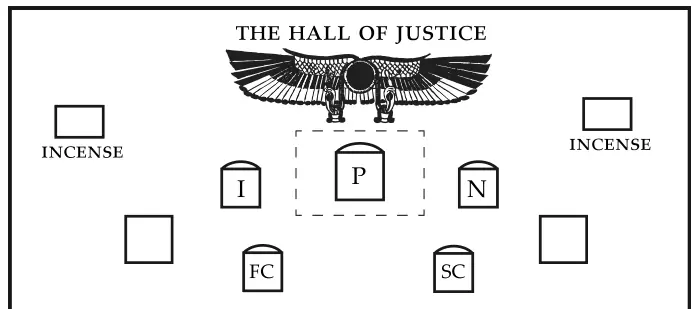
La tenture est toute blanche, le dais du Président de même au dessus de la tête du on1032 1032 verra les deux lettres : J & E l’Autel sera couvert de drap blanc et élevé de 3 marches, au bout du tableau du côté de l’Or∴ il y aura un tabouret sur lequel sera posé la caisse des échevins1033 1033 couverte d’un drap blanc avec une grande Croix rouge qui suivra la longueur du drap. À la droite de l’Autel et dans un coin sera la table du Chev1034∴ 1034 et à gauche celle du Trésorier. Le Gd∴ Tribunal est décoré de huit colonnes d’or, 4 au Midi 4 au Septentrion à chacune de ces colonnes est suspendu ou écrit l’attribution du grade savoir :
À la 1re∴ colonne du côté du Midi un tablier d’Ap∴À la 1re∴ colonne du côté du Septentrion celui de Comp∴ À la 2e∴Les attributs de Me∴ À la 2e∴ Celui d’Élu À la 3e∴Ceux d’Écossais À la 3e∴ Celui de Chev∴ d’Or∴ À la 4e∴Ceux de R∴∴ À la 4e∴ Celui de Chev∴ K∴ S∴
Entre les huit Colonnes sont placées huit statues dont six pour des vertus tenant chacune la Croix en différents attributs, 1035 il y aura encore deux statues à côté du Président chacune de ces statues sera armée1036 1036 de trois bougies, au milieu du Gd∴ Tribunal sera le tablier1037 1037 représentant une Croix entourée de tous les attributs de la Maçonnerie, au plus haut degré au-dessus de ce tableau sera suspendue une balance, dans le bas1038 1038 de la droite sera le bijou du grade et dans celui de la gauche tous les Bijoux de la Maçonnerie les Gds∴ Inspecteurs sont habillés en Gds∴ Élus et portent au col le Bijou suspendu à un camail blanc, dans les Loges ou Chap∴ des grades inférieurs on porte le Bijou à une chaine d’or ou dorée entrelacée des attributs des huit grades fondamentaux ou 1039 une rosette blanche à la boutonnière avec un tablier blanc sur la bavette duquel sera brodé ou peinte, la Croix, cet habillement ne peut se porter que dans un Gd∴ Tribunal.
Ouverture du Gd∴ Tribunal
Le Gd∴ Tribunal ainsi décoré et les FF∴ étant habillés l’Insp∴ ouvre la porte, le Président entre tenant ses deux mains croisées sur le nombril, les bras tendus ce qui fait le Signe de Demande il est sure 1040 du Chancelier, du Trésorier et des autres FF∴ suivant l’ancienneté de leur réception tous étant à l’ordre comme le Président quand ils sont tous entrés l’Insp∴ ferme la porte et le Président dit :
TT∴ CC∴ & TT∴ Éclairés FF∴ GG ds∴ Inspecteurs arrivés dans ce terrible 1041 Saint des Saints du Temple de la Vertu où règnent, la Justice & l’Équité promettons d’être fidèles aux Statuts et Règlements de ce grade. Alors tous les FF∴ entourent la caissette en disant Je le promets, chacun ayant repris sa place le Président continue Travaillons donc mes FF∴ pour le bien de la Maçonnerie & aidez moi des vraies Lumières. 1042 Alors il fait le Signe de Demande
les FF∴ font celui de Réponse qui est de porter ainsi les mains
croisées par-dessus la tête en disant Justice. et se remettre ensuite à l’ordre en disant Équité le Président avec 1043 le Chancelier
s’avancent vers la caisse des archives et l’ouvrent avec le Président pour en tirer les papiers dont on pourrait avoir besoin, et on procède au jugement des affaires qui se sont présentées depuis la dernière assemblée, ou s’il y a une réception à faire, on la fait de la manière suivante :
Réception
Quand une place vient à vaquer soit par mort soit par le départ d’un F∴ on doit en élire un autre dans les 1rs∴ 9 jours de 1044 l’élection finie l’Inspecteur est charger d’en donner avis à celui sur qui le sort est tombé sans cependant lui rien dire, ni du jour ni du lieu de sa réception, à laquelle on procédera de la manière suivante : Le jour arrivé l’Insp∴ va prendre le récipiendaire l’amène à la porte du Gd∴ Tribunal décoré de tous les attributs du grade qu’il possède les yeux bandés et frappe en Chev∴ K∴ S∴ Le Président ayant entendu frapper dit : Au dernier des
FF∴ de voir ce que c’est, il ouvre la porte & demande qui frappe ainsi ? L’Insp∴ répond : C’est le F∴ N…. 1045 Comp∴ Me∴ M∴ Secret Écossais Chev∴ d’Or∴ P∴ 1046 P∴ R∴ C∴ et Chev∴ K∴ S∴ qui ayant été élu pour remplacer le F∴ N∴ doit être introduit chez nous.
Les FF∴ ayant consentis, il dit : Qu’on l’introduise : alors tous les FF∴ remettent l’épée à la main et se rangent autour de la caissette, le Récipiendaire introduit, le Président dit :
Je suis charmé mon F∴ que le sort de l’élection soit tombé sur vous et je suis persuadé que nous n’aurons pas sujet de nous repentir du choix que nous avons fait, mais comme nous sommes très scrupuleux vous subirez avant de vous initier à nos mystères un examen rigoureux sur les hauts1047 1047 grades de la Maçonnerie –
Ensuite le Prince G∴ Insp∴ commence par l’examiner sur le Comp∴ 1048 et ainsi de suite tous les FF∴ Gds∴ Inspecteurs selon l’ancienneté de leur réception au Gd∴ Tribunal tout cela fini le Président lui pose quelques questions sur le grade précédent ayant ainsi satisfait l’attente des FF∴ sur ce point le Président continue, Je suis très
enchanté de vos réponses et je vous crois digne d’entrer dans nos augustes secrets, venez à présent par des engagements plus forts vous lier à nous pour jamais on le fait avancer vers l’Autel
et lui ayant fait ployer le genou sur le coussin, le Chancelier détache la balance et la lui fait tenir de la main gauche, et lui fait mettre la main droite sur la statue1049 1049 tous les Gds∴ Inspecteurs vont entourer le Récipiendre∴ couvrent sa tête de la main gauche et en cette position on lui fait prêter son obligation.
Obligation
Je promets & m’engage parole d’honneur de ne jamais révéler les secrets des G ds∴ Insprs∴ qui vont m’être communiqués, de ne jamais les écrire, imprimer, graver ni tracer sous aucun prétexte que ce puisse être sans en recevoir la permission du Grand Tribunal je promets de plus d’observer scrupuleusement les Statuts et Règlements de cette sublime dignité si je manquais à mon obligation, je consens de subir toutes les peines que je me suis imposées lors de ma dernière réception
Le Président lui dit alors de lever les deux doigts vers le ciel
& de prononcer avec lui : Je jure devant le Gd∴ Architecte de l’Un∴ de ne jamais manquer à l’obligation que je viens de prêter. Amen.
En même temps qu’il prononce amen, l’Inspecteur lui donne la Lumière, tous les FF∴ remettent l’épée font le Signe de Demande & de Réponse battant des1050 1050 mains en reprenant leur place, l’Insp∴ fait lever le Récipiendre∴ et lui ôte ses Bijoux les suspend aux Colonnes
ensuite le Président dit : L’on vous a dépouillé mon F∴ de tous vos attributs, comme le secret du grade renferme tout ce que vous connaissez & qu’il est au-dessus de tous, vous n’en avez plus besoin F∴ Insp∴ montrez-lui la marche des FF∴ G ds∴ Inspecteurs, il le fait
mettre à l’ordre en formant un pas du pied droit en avant le pied gauche1051 1051 il lui détache les mains en formant le 3e∴ pas du pied droit il le fait remettre à l’ordre et ainsi de suite 9 pas, au 9e∴ il se trouve devant l’Autel et le Président le décore du camail avec le Bijou et les autres habillements en lui disant : Que cet habit et cette Croix vous fassent toujours
ressouvenir que vous êtes Gd∴ Élu elle vous ordonne d’en suivre exactement les Statuts ces deux poignards vous serviront, l’un pour punir les parjures et l’autre pour venger la Maçonnerie1052. 1052 Cette balance que vous voyez suspendue vous marque la sublimité de ce grade et doit toujours vous faire souvenir de juger avec justice.
Il le fait ensuite mettre à genoux, lui pose les deux mains sur la tête en disant Par le pouvoir qui m’a été donné et du
consentement de ce Grand Tribunal je vous fait Gd∴ Inspecteur
Après quoi il lui donne les Signes Mots et Attouchements et le fait mettre à côté de lui pour cette fois car à la 1re∴ assemblée suivante il sera tenu de prendre la place d’Inspecteur. S’il y a des causes à juger on y procède et n’ayant plus rien à proposer le Chev∴ fait lecture du procès-verbal le fait signer par les Gd∴ FF∴ et on ferme le Tribunal comme il a été ouvert Il lui donne, Signes Mots 1053 l’Attouchement, l’on se donne réciproquement de la main droite un coup sur l'épaule droite en se prenant la main gauche de bonne foi et élevant le bras droit croisé pied contre pied genou contre genou, en cette position on se donne le mot : Celui qui demande dit à l’oreille de l’autre Justice. L’autre : Équité. Tous les deux ensemble : Ainsi soit-il. L’on frappe 9 coups de cette manière. = = =
Le Président s’appelle 3 fois Pt∴ 1054 & les FF∴ TT∴ Éclairés quand∴∴ .de grade inférieur et lorsqu’il un F∴ Gd∴ Inspecteur va visiter une s’annonce comme tel le Vén∴ doit envoyer deux FF∴ Gds∴ Inspecteurs pour le reconnaitre l’ayant reconnu ils rentrent et font le rapport au Vble∴ à l’oreille l’un après l’autre le Vble∴ fait rentrer tous les FF∴ armés de leurs épées et fait mettre le Gd∴ Insp∴ autour du Tableau, renvoie les 2 FF∴, chercher les visiteurs qu'il amène jusqu’au bord du Tableau, alors le Vble∴ va prendre le maillet des deux Survts∴ place le sien sur l’Évangile et il les présente ainsi à genoux au F∴ Gd∴ Insp∴ le F∴ les accepte et rend chaque maillet à celui à qui il appartient et prend de suite la place d’honneur.
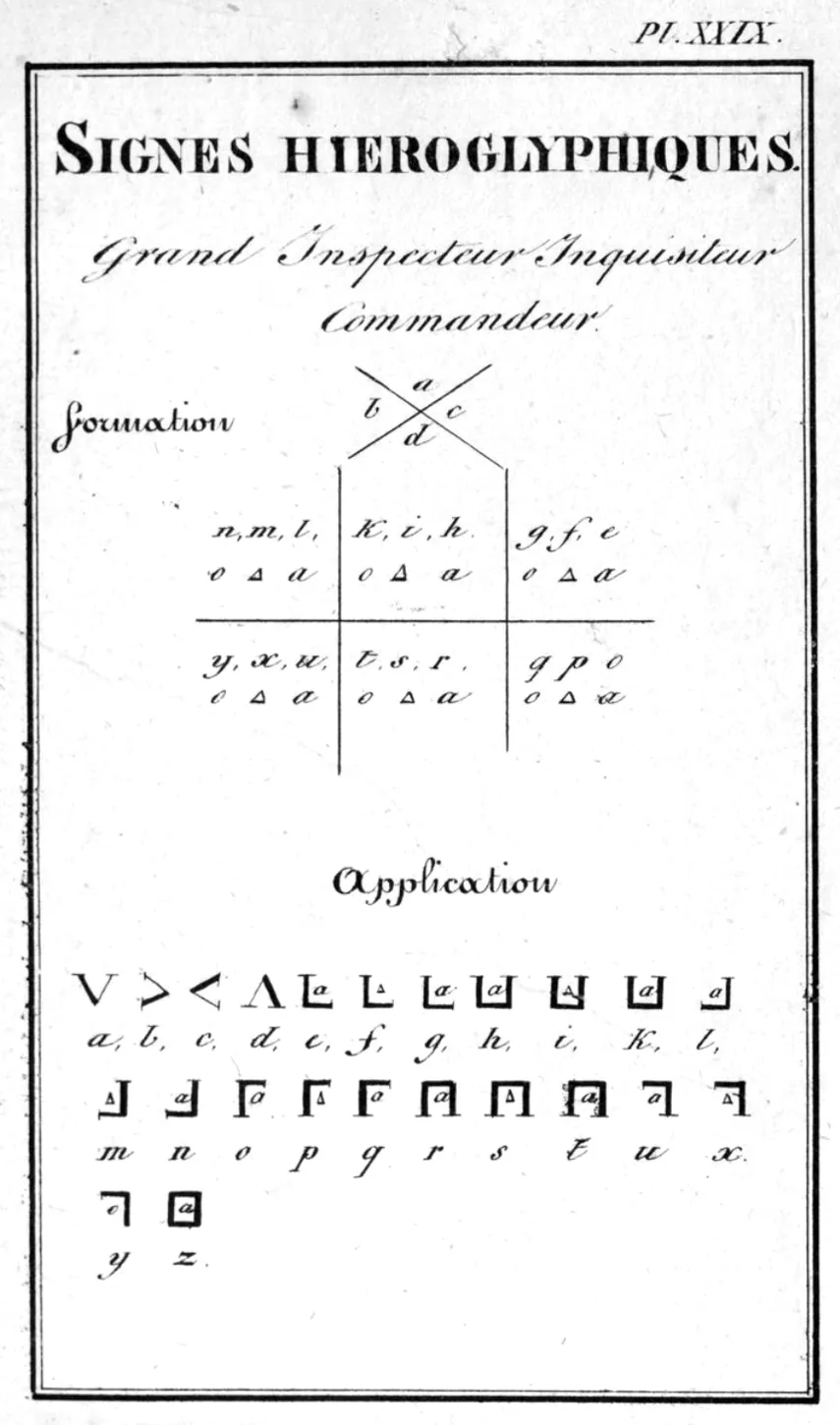
Hiéroglyphe
=a = b = c = d =e = f = g = h=j = k = l = m=n=o=p= q= ========.======= = = =r = s = t = u =v = x = y =z ========
Statuts du grade de Gd∴ Inspecteur
Article 1 er∴
Une assemblée de Gds∴ Inspecteurs se nomme Gd∴ Tribunal.
Article 2 e∴
On ne peut parvenir à posséder ce grade qu’étant parfaitement instruit des huit grades fondamentaux de la Maçonnerie savoir de l’App∴ Maître Maître Secret, Illustre Écossais, Chev∴ d’Or∴ S∴ P∴ R∴ C∴ & Chev∴ Kadosh. Le Gd∴ Insp∴ étant au-dessus de tous les grades qui existent1055. 1055
Article 3∴
Un Gd∴ Tribunal est composé de 9 FF∴ savoir : un Président, un Chancelier un Trésorier, & six Grands Inspecteurs le dernier fait fonction d’Inspecteur Les charges du Président, Chancelier et Trésorier sont amovibles tous les 9 mois, on nommera aussi à chaque élection un Vice-Président et un Vice Chancelier qui en l’absence du premier prendront leurs places.
Article 4 e∴
Le Président aura seul le droit de convoquer le Souv∴ Tribunal et de désigner le jour et l’heure de l’assemblée, mais si un F∴ le priait de le convoquer pour une affaire de conséquence et qui ne souffre point de délai, il ne pourra le lui refuser.
Article 5 e∴
On ne pourra se dispenser de s’assembler une fois par mois pour les affaires de ce grade, les FF∴ qui se seront aperçu de quelque désordre ou abus en feront leur rapport au Souv∴ Tribunal et diront les premiers leurs avis à ce sujet. Le Président demandera alors le sentiment des autres Gds∴ Insp∴ & si les voix se trouvent partagées également il aura la voix décisive sinon la pluralité l’emporte.
Article 6 e∴
La charge de Chancelier doit être remplie par un F∴ sachant bien écrire et qui soit au fait de la composition des lettres il sera de son devoir de tenir un registre ouvert et exact de toutes les délibérations et discussions données par le Souv∴ Trib∴ qu’il écrira pendant l’assemblée dans un livre séparé et réservé uniquement pour ce grade. Il fera signer après la clôture du Souv∴ Trib∴ par tous les FF∴ Grands Insp∴ pour qu’il soit renfermé aussitôt dans une caissette faite pour cet usage il doit aussi entretenir une correspondance régulière de 3 en 3 mois avec tous les Grands Tribunaux & avec lesquels on est en relation et avec tous les FF∴ GGds∴ Insp∴ absents & il rendra compte au Gd∴ Tribunal.
Article 7 e∴
Comme le Gd∴ Tribunal n’a rien de commun avec les autres LL∴ des grades inférieurs, il doit avoir un fond à lui seul dont le Trésorier aura l’admon
Article 8 e∴
L’Insp∴ sera chargé de la porte du Gd∴ Tribunal et d’avertir verbalement le Gd∴ Trib∴ du jour et de l’heure de l’assemblée il sortira toujours le dernier et répondra que la caissette des archives et la porte de l’Appartement sont bien fermées.
Article 9 e∴
On ne peut recevoir dans ce grade aucun Souverain Ecclésiastique ni Chev∴ de Malte ou d’autre Ordre Ecclésiastique.
Article 10 e∴
Si une place de Gd∴ Insp∴ vient à vaquer dans un Tribunal par la mort d’un des FF∴ ou qu’un d’eux quitte pour ne plus revenir l’ore∴, 1056 on procédera dans l’espace de 9 jours à compter de la mort ou du départ à l’élection d’un nouveau Gd∴ Insp∴ ce qui se fera avec les formalités suivantes Le Chancelier prendra note du nom des Chev∴ K∴ S∴ qui aspirent à cette dignité et les lira au Souv∴ Trib∴ assemblé alors chaque F∴ écrira le nom de celui qu’il croira le plus digne sur un papier le roulera et le jettera dans une urne, celui qui aura eu 5 voix sur 8 sera reçu Grand Insp∴ le 1057 nombre de voix étant requis pour être reçu mais si les FF∴ ne peuvent s’accorder sur ce point ils finiront l’élection, 1058 on remettra la décision au sort en écrivant le nom de ceux qui auront le plus grand nombre de voix en leur faveur sur du papier qu’on roulera et jettera dans une urne le Président en tirant un et celui sur lequel le sort tombera sera regardé comme s’il avait été élu unanimement dans tous les cas le Souv∴ Trib∴ ne pourra se séparer que l’élection ne soit faite.
Article 11 e∴
Il est expressément défendu à un Gd∴ Insp∴ de dire le jour l’heure et l’endroit où il a été reçu à tel Maçon que ce soit.
Article 12 e∴
Il doit y avoir dans un Souv∴ Tribunal une caissette proportionnée à la grandeur du livre des procès-verbaux pour pouvoir les y enfermer avec les Statuts & les archives de ce grade, elle sera fermée de deux clefs différentes, la première sera entre les mains du Président & la 2e∴ entre les mains du Chancelier et il ne peuvent avoir 1059 la caissette qu’en la présence du Souv∴ Tribunal assemblé.
Article 13 e∴
Il ne doit y avoir qu’un cahier de ce grade dans un Souv∴ Tribunal lequel sera toujours enfermé dans la boite des archives, il ne pourra jamais en être tiré qu’en présence du Souv∴ Trib∴ assemblé il est défendu à un Gd∴ Insp∴ d’en avoir un cahier ni même quelque chose d’écrit de ce grade excepté les hiéroglyphes, les Statuts ne pouvant être communiqués qu’au Souv∴ Tribunal assemblé.
Article 14 e∴
Quand il sera question d’installer un Souv∴ Trib∴ le Chancelier de l’ancien délivrera au nouveau, une copie exacte des Statuts et des cahiers du grade alors les membres du nouveau Tribunal feront serment de n’en jamais communiquer de copie, sans en avoir auparavant demandé la permission à l’ancien.
Article 15 e∴
Le Souv∴ Trib∴ est juge de l’Ordre et doit prendre note de tous les détails de désordres abus et contraventions aux Statuts et Règlements de la Maçonnerie les Gds∴ Insp∴ doivent en faire le rapport au Souv∴ Trib∴ pour qu’il puisse délibérer sur les moyens qu’on doit employer pour rétablir l’ordre, à cette fin chaque Souv∴ Trib∴ sera obligé d’avoir.
dans la caissette des cahiers de tous les grades que l’on connait dans la Maçonnerie et si un F∴ prend connaissance d’un nouveau grade il est tenu par son obligation d’en donner avis sur le champ au Souv∴ Trib∴ en remettant aux archives un cahier exact de ce grade.
Article 16 e
Le plus ancien Trib∴ d’une ville tâchera de faire en sorte qu’il ne s’en établisse pas plus de trois dans la même ville et il aura soin d’empêcher qu’un Souv∴ Trib∴ soit composé de FF∴ tous attachés à la même L∴
Article 17 e
S’il se présente une affaire d’importance et qui regarde la Maçonnerie en général, les Tribunaux d’une ville qui auront pris connaissance les premiers du cas en donnent avis aux autres Tribunaux avec lesquels ils sont en relation ils leurs demandent leurs avis qu’ils attendront pour se réunir et prononcer le jugement de l’affaire.
Article 18 e
Les FF∴ Gds∴ Insp∴ sont obligés de visiter souvent toutes les LL∴ tant régulières qu’irrégulières établies dans la ville où ils ont leur domicile aucune L∴ ne peut leur refuser la porte en s’annonçant comme Grand Insp∴ et pour cet effet le Tribunal établit dans une ville avertira les LL∴ constituées des droits, pouvoirs et prérogatives de ce grade, sur tout ce qui concerne la Maçonnerie et les LL∴ connues aussi les Chap∴ de R∴ C∴ seront tenus d’envoyer leurs tableaux des FF∴ le lendemain de l’élection au Souverain Tribunal.
Article 19 e
Un Souv∴ Trib∴ doit veiller avec attention aux Chev∴ K∴ S∴ afin qu’ils se conforment à leurs obligations et s’ils s’en trouvaient et s’ils s’en trouvaient 1060 qui n’en eussent point prêtés, de les y engager afin que ce grade ne se communique pas aussi légèrement à l’avenir.
Article 20 e
L’union des LL∴ étant un des principaux soutiens de l’Ordre les Grands Inspecteurs doivent par leur médiation tâcher de mettre fin au brouillement et établir le bon ordre dans les LL∴
Article 21 e
Un Souverain Tribunal doit empêcher autant qu’il est possible qu’il ne se forme point de Loges bâtardes parce que c’est de là que proviennent tous les désordres et abus contraventions aux Statuts et Règlements de la Franche Maçonnerie.
Article 22 e
Si un Grand Inspecteur s’absente de son Tribunal pour un voyage de durée, il sera tenu d’écrire tous les trois mois au Souverain Tribunal & de lui donner avis des découvertes qu’il aura faites pendant ce temps et le Tribunal lui donnera de même avis de ce qui se sera passé dans cet intervalle.
Article 23 e
Un Gd∴ Insp∴ qui se sera démis de sa dignité de membre d’un Trib∴ et 1061 nonobstant obligé de se trouver tous les 9 mois une fois au Souverain Tribunal.
Article 24 e
Chaque F∴ Insp∴ est obligé de juger, de maintenir1062 1062 de tout son pouvoir les Statuts et Règlements et de les observer strictement Folio supplémentaire LXXIFolio supplémentaire LXXIIIFolio 290 recto. (.)(.)(.)(.)(.)(.)(.)(.)(.)(.)(.)(.)(.)(.)(.)(.)(.)(.)(.)(.)(.)(.)(.)(.)(.)(.)(.)(.)(.)(.)
Apparat critique de l’édition Latomia
1032. Erreur du copiste A : les mots exacts sont « ...de sa tête on... », cf. Kloss et Pyron 1812.
1033. Erreur du copiste A : le mot exact est « archives », cf. Kloss et Pyron 1812.
1034. Erreur du copiste A : le mot exact est « Chanc∴ » ( Chancelier ), cf. Kloss et Pyron 1812.
1035. Erreur du copiste A : les mots exacts sont « en différentes attitudes », cf. Kloss et Pyron 1812.
1036. Erreur du copiste A : le mot exact est « ornée », cf. Kloss et Pyron 1812.
1037. Erreur du copiste A : le mot exact est « tableau », cf. Kloss et Pyron 1812.
1038. Erreur du copiste A ? le mot exact serait « bassin », cf. Kloss et Pyron 1812. Mais on observe le même mot ( Abréviation ? Variante de bac ? ) dans un manuscrit du Rite Écossais Philosophique ( Latomia 198-o-f ), conservé à la B. M. de Toulouse ( référencé Lat198 dans les notes suivantes ).
1047. KLoss et Pyron 1812 écrivent ici « huit » à la place de « hauts » ; Lat198 ne précise pas.
1048. Kloss, Pyron 1812 et Lat198 commencent par le grade d’Apprenti.
1049. Erreur du copiste A ; les mots exacts sont « les statuts », cf. Kloss, Pyron 1812 et Lat198.
1050. Pyron 1812 écrit ici « baissant leurs » ; Pour Kloss et Lat198, c’est « battent neuf fois des ».
1051. C’est pratiquement le texte de Lat198 ; Kloss et Pyron 1812 parlent ici de former une équerre.
1052. C'est exactement le texte de Pyron 1812 et Lat198 ; Kloss ajoute ici un développement.
1055. Erreur du copiste A ? Il manque dans cette liste le grade de Compagnon, cf. Pyron 1812 dont le texte des Statuts est pratiquement identique ; ceux du Kloss sont globalement les mêmes, mais dans une rédaction différente et rallongée ; les Statuts sont absent de Lat198.
1060. Erreur du copiste A : doublon.
1061. Erreur du copiste A : le mot exact est « est »,cf. Kloss et Pyron 1812.
1062. Kloss et Pyron 1812 nous feraient rectifier en « jurer de maintenir » ; mais la version Quesada est également cohérente avec la fonction d’un Souverain Tribunal.
1063. Changement d’écriture, de numérotation et de type de cadre. C’est le copiste B qui intervient pour tout le manuscrit de ce degré, probablement en remplaçement de la copie de A. La note (1) précise l’origine de ce manuscrit et sa date de communication au S. C.
1064. Cette note a été reprise quasiment à l’identique en 1861 par Jean-Marie Ragon ( Rituels du Grand Inspecteur Inquisiteur, Commandeur, 31e degré, et du Prince de Royal Secret, 32e degré, fac-simile dans Latomia 294-o-f ), p. 44 ; ce rituel sera noté dorénavant Ragon 1861.
1067. Nous avons gardé dans cette page les lettres telles qu’écrites par le copiste B, différentes des lettres relevées dans d’autres versions, comme « S, A, L, I, X, N, O, N, IS, T, E, N, G, U. » dans Pyron 1812, « S, A, L, I, X, N, O, N, I, T, E, N, G, U. » dans Francken, Kloss et Ragon 1861, en remarquant qu’il est parfois difficile de distinguer un « I » d’un « J » majuscule ou un « U » d’un « V » majuscule ; les notes 1-2-3 de la page 7 ( folio 243 recto ) confirment un choix particulier à ce rituel ; la seule erreur de copie serait alors le « J » de « T.J.N.G.V. » mis par erreur à la place d’un « E ».
1071. Probablement : byb1s= K9l=y+ MOal4 todOa rq-D} = s̆ạqar oḏôṯ lĕʾom yạlạḵ sạvîv ; « La trahison est la cause de l’errance des peuples [ litt. il trahit (est) cause (qu’) un peuple marchera autour ] »
1072. Probablement : la2r-SRy! yq1n_ db2Oa lb=n+ = nạvạl oveḏ naqî yiśraʾel ; « Un impie erre, un pur est Israël ».
1073. Probablement : hy+r4Va lVbg$< hl=b=n$ Nya2 ir-a7t-< = taʾăraʿ ên nĕvạlạ̈ gĕvûl ûrĕyạ̈ ; « Tu ne trouveras point d’infâmie au territoire de la lumière divine »
1074. Les notes de Ragon 1861 donnent une transcription proche, mais encore plus fautive : « Stakar adith leos jalak sabib nabal obed naki Israel thara en nebalah ghebal uria »
1077. Cette tournure de phrase curieuse est pratiquement la même dans Ragon 1861 : « et le leur présentez »
1079. Pour les noms des chefs du pentagone, voir les notes du folio 291 verso.
1080. Oubli du copiste B : il manque un cinquième « Amen », cf. Ragon 1861 et les autres parties du rituel.
1083. La longitude n’est pas indiquée ici à partir du méridien de Greenwich ( usage actuel ) mais à partir d’un méridien situé 18° plus à l’Ouest, en l’occurrence le méridien de Ferro ( Île de Fer = Île El Hierro aux Canaries ), utilisé en Europe depuis,l’ordonnance du 1er juillet 1634 de Louis xiii. Ce méridien d’origine pour le calcul des longitudes est officiellement abandonné en 1792 au profit du méridien de Paris, puis du méridien de Greenwich en 1884. C’est un indice pour attribuer la rédaction de l’original de ce rituel ( et de ses notes ) au xviii e siècle.
1084. Erreur du copiste B : doublon.
1087. Pour le mot hébreu exact, voir les notes du folio 299 verso. Remarquons au passage, que la lecture littérale de ces lettres fautives ( ce mot n’existe pas en hébreu, ni en araméen, langue que ce manuscrit nomme « Chaldéen » ) peut être effectivement « Hakemah »...
1089. Exactement : « Nekam Makkah » ( hk=<m-jMq-n$ = nĕqam-makkạ̈ ), vengeance de la blessure (ou de la défaite) ; c’est une relation génitivale : «nekam» est la forme construite de «nakam». La traduction proposée dans ce manuscrit est donc relativement correcte.
1091. Erreur du copiste B : doublon.
1092. Erreur du copiste B : doublon ; hésitation entre « de » et « du ».
1096. Erreur du copiste B : doublon de deux mots.
1097. Exactement « Betsalél » ( la2l4x-b4< = bĕẕalʾel ) ; la forme « Béséléel » est une francisation du mot latin « Beseleel » pris dans la Vulgate Clémentine, courante au xviiie siècle. Le copiste «hébraïsant» n’a pas rédigé dans l’espace laissé libre par le copiste B.
1115. Le copiste B a laissé ici un espace, probablement pour faire transcrire en hébreu le mot « Machbena » ; cela prouve, de la même manière que les espaces mal calibrés par rapport aux mots hébreux précédents, qu’il a fait sans doute appel à un hébraïsant pour ce travail. Ragon 1861 a une toute autre analyse : « ... au lieu de makbenah, qui est arabe et qui signifie le fils de la veuve est mort ; lequel lui est maintenant substitué.»
1119. Erreur du copiste B : doublon.
1120. C’est de nouveau le copiste A qui officie pour ce rituel. Le texte recopié est parfois légèrement différent de celui de Kloss et Pyron 1812, qui sont eux totalement identiques ; une note en tête du Kloss indique d’ailleurs : « Ce cahier a été copié sur celui dont on fait usage dans le Suprême Conseil dont le F∴ Pyron est membre ». Les différences conduisent à penser que la version Quesada est un peu plus ancienne. Sauf indication contraire, Toutes les ratures et rajouts sont de la main du copiste B.
1121. Erreur du copiste A ; il faut rectifier « Stabilily » en « Stability ».
1122. Rature et correction du copiste B ; pourtant, c'est bien le mot « sûreté » qui est utilisé dans Kloss, Pyron 1812 et Ragon 1861.
1123. Rature et correction du copiste B ; le mot « pétitions » est utilisé par Kloss et Pyron 1812, mais Ragon 1861 utilise « supplications ».
1124. Kloss, Pyron 1812 et Ragon 1861 utilisent le mot « connaissance » ; la nuance est de taille entre la prétention présomptueuse de connaître la parole divine et le fait de la reconnaître.
1125. La surcharge du copiste B ne permet pas de voir le mot corrigé ( vérité ? )
1126. Rajouts du copiste B, identiques aux textes de Kloss et Pyron 1812. La rédaction du manuscrit Quesada était pourtant cohérente
1127. Kloss, Pyron 1812 et Ragon 1861 utilisent le mot « agréé ».
1132. Kloss et Pyron 1812 parlent ici de « questions » qui vont être faites ; Ragon 1861 évoque lui des « tentations ».
1133. Erreur du copiste A ; le mot exact est « Olibanum », cf. Kloss, Pyron 1812 et Ragon
1134. Erreur du copiste A ; le mot exact est « Storax », cf. Kloss, Pyron 1812 et Ragon 1861. C’est une variété de benjoin extraite d’arbustes du genre Styrax.
1135. « Labdanum » ou « Ladanum » est une gomme produite par des arbustes du genre Sistus. Kloss et Pyron 1812 le confondent avec le « Laudanum », teinture d’opium très populaire à cette époque.
1136. Erreur du copiste A ; le mot exact est « Benjoin », cf. Kloss et Pyron 1812. Curieusement, Ragon 1861 utilise aussi le mot erroné « Bezoine ».
1142. Exactement « Tephillin », ( Nyl1<p1t4< = tĕfillîn ), sorte de phyllactère porté pendant les prières.
1143. Environ 2,25 mm.
1145. Kloss et Pyron 1812 sont rédigés comme la version du copiste A ; Ragon 1861 supprime les Kadoshs pour les remplacer par les Princes du Royal Secret, comme le copiste B.
1146. Cette rature est du copiste A qui, dans un premier temps, avait probablement mal lu le mot « manuscrit ».
1149. Inversion de « Grand » et « Souverain ». Kloss et Pyron 1812 utilisent ici « Très Puissant Souverain ».
1151. Les rectifications de cette phrase par le copiste B sont différentes des versions Kloss et Pyron 1812, identiques au texte du copiste A.
1152. Kloss et Pyron 1812 utilisent ici le mot « sur ».
1153. Kloss et Pyron 1812 rajoutent ici « ...tient-il l’étendard de l’Ordre dans sa main ? »
1155. Cette copie des Constitutions et Règlements est de la main du copiste B. Là aussi, le texte recopié est parfois légèrement différent de celui de Kloss et Pyron 1812, qui sont eux totalement identiques ;
Delaulnaye 1813
tuileur imprimé · 261 mots
Le « Thuileur des trente-trois degrés de l'Écossisme » de Delaulnaye (Paris, 1813), premier tuileur imprimé du REAA constitué : mots, signes, décors et remarques du grade. Texte relu mot à mot sur le fac-similé, mots hébreux restitués. Pages 225-229 de l'édition originale.
Le titre de ce grade en indique le caractère. On ne le confère, dit-on, ni aux Souverains, ni aux ecclésiastiques, ni aux Chevaliers de Malte. Pour l'obtenir, il faut surtout posséder à fond les huit suivants, que l'on regarde comme fondamentaux. Apprenti, Compagnon, Maître, Élu, Écossois, Chevalier d'Orient, Rose-Croix, Kadosch.
Décoration de la Loge.
Tenture Blanche, ornée de huit colonnes d'or.
Titres.
La Loge est appelée Souverain-Tribunal. Le Maître se nomme Très-Parfait-Président ; les Surveillants, Inspecteurs ; le Secrétaire,
[p. 226]
Chancelier, et tous les Frères, Très-Éclairés. Il y a en tout neuf officiers.
Signe.
Croiser les deux mains sur le nombril.
Réponse :
Porter les deux mains croisées au-dessus de la tête.
Attouchement.
Se mettre pied contre pied, genou contre genou, se prendre mutuellement la main gauche, et se donner un coup de la main droite sur l'épaule droite.
Batterie.
Neuf Coups, ainsi
○——○ ○ ○——○ ○ ○ ○——○
Suivant d'autres, ainsi
○ ○ ○ ○——○ ○——○ ○ ○
[p. 227]
Mots Sacrés.
L'un dit JUSTICE ;
L'autre répond : ÉQUITÉ ;
Tous deux ensemble : AINSI-SOIT-IL.
Habit.
Celui de Grand-Élu.
Cordon.
Blanc, tout uni, en Camail.
Dans les Loges inférieures, un Grand-Inspecteur porte, au lieu du camail blanc, une chaîne d'or, entrelacée des attributs des huit grades fondamentaux.
Bijou.
La Croix de l'ordre en argent.
Tablier.
On ne porte point de Tablier dans le Souve- [p. 228] rain Tribunal, parce que l'ouvrage est fini. Dans les loges inférieures, on peut porter un Tablier tout blanc, sur la bavette duquel est brodée en argent la Croix de l'Ordre.
[p. 229]
Vuillaume 1820
tuileur imprimé · 321 mots
Le tuileur de Claude-André Vuillaume, « Manuel maçonnique, ou Tuileur de tous les rites de maçonnerie pratiqués en France » (Paris, Delaunay et Hubert, 1820) : décoration, titres, signes, attouchement, marche, batterie, âge, mots, habillement du grade, avec l'étymologie et l'interprétation des mots hébreux. Texte établi sur le fac-similé et relu mot à mot sur les images : océrisation à 600 dpi du volume numérisé, fusion avec la couche texte de la numérisation Gallica, puis relecture page par page. Orthographe de 1820 conservée, hébreu et grec restitués, batteries rendues comme l'imprimé les note, pagination de l'original. Pages 209 à 211. Les planches gravées du volume, absentes de la numérisation Google, sont reprises de la numérisation Gallica et rapportées au grade qu'elles représentent.
TENTURE blanche, soutenue par huit colonnes dorées.
TITRES.
La loge se nomme Souverain Tribunal.
Le maître prend le titre de Très-parfait Président ; les surveillans celui d'Inspecteurs ; le secrétaire, celui de Chancelier ; et tous les membres du souv∴ tribunal, celui de Très-éclairés.
SIGNES.
Croiser les deux mains devant soi sur le nombril.
La réponse, dite d'équité, est de croiser les deux bras en-dessus de la tête, les doigts alon- [p. 210] gés, la paume de la main tournée vers le dehors.
ATTOUCHEMENT.
S'approcher réciproquement du pied droit, faire toucher le genou, se prendre la main gauche, et, de la droite, se frapper mutuellement un coup léger sur l'épaule droite.
BATTERIE.
Neuf coups : ○ — ● ● ○ — ● ● ● ○ — ● !
Suivant quelques rituels, la batterie devrait se faire par quatre, deux et trois ; les trois derniers coups plus lents que les autres : ● ● ● ○ — ● ○ — ○ ○ ○ !
HABILLEMENT.
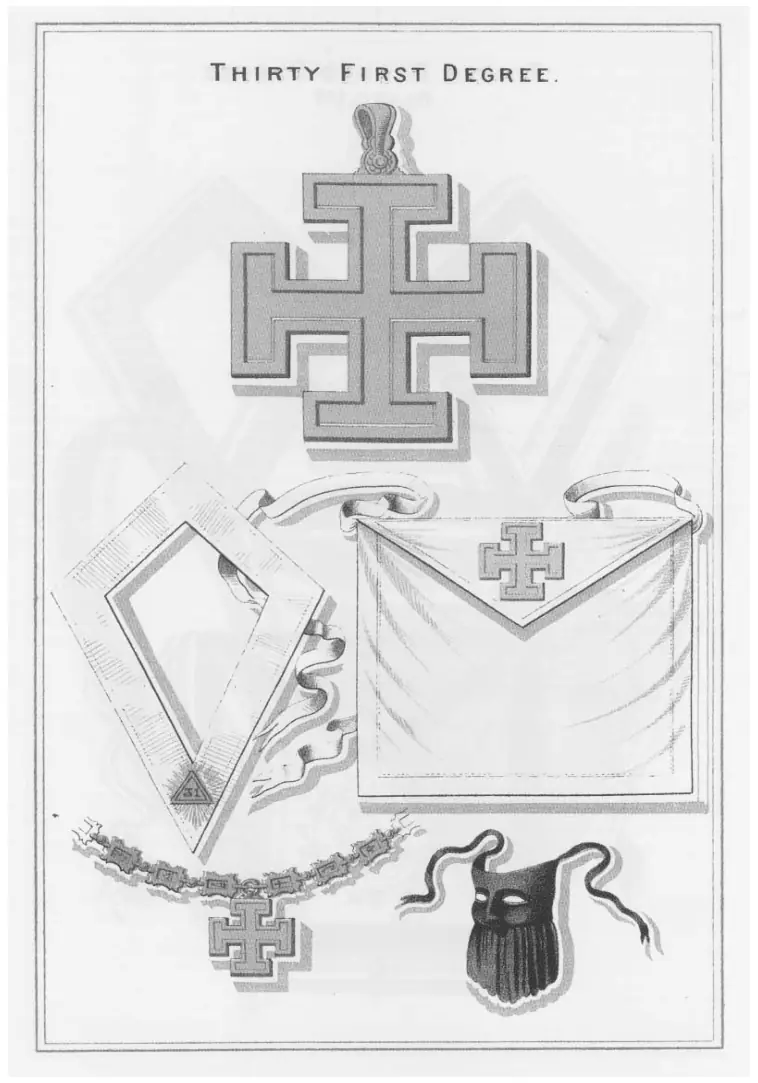
On ne porte point de tablier dans le souverain tribunal. Dans les loges inférieures, on peut avoir un tablier blanc, sur la bavette duquel est brodée une croix teutonique, qui est celle de l'ordre.
Le cordon est blanc, il se porte en camail ; sur la pointe du cordon, est brodé, en or, un triangle radieux, au milieu duquel est le nombre 31, en chiffres arabes.
Dans les loges inférieures, au lieu d'un cordon, les grands inspecteurs portent une [p. 211] chaîne d'or, passée au cou, à laquelle est suspendue la croix de l'ordre ; les chaînons sont composés des attributs, entrelacés, des degrés fondamentaux de la maçonnerie.
Une croix teutonique, en argent, est le bijou de ce grade.
Planche XXIX. SIGNES HIEROGLYPHIQUES. Grand Inspecteur Inquisiteur Commandeur. Alphabet secret du Grand Inspecteur Inquisiteur Commandeur : schéma de formation des caractères par une croix et une grille répartissant les lettres, suivi de l'application donnant les vingt-six signes correspondants.
Pike 1857
rituel imprimé · en anglais · 11 637 mots
« The Magnum Opus or Great Work » (1857) : le premier corps complet de rituels révisés par Albert Pike pour la Juridiction Sud des États-Unis. Texte en anglais, établi par reconnaissance optique corrigée : des coquilles subsistent.
D'après la réimpression Kessinger de l'édition de 1857 (numérisation archive.org)
DECORATIONS, OFFICERS, ETC.
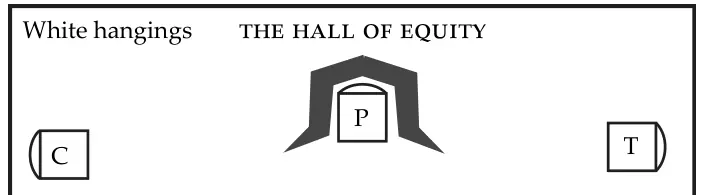
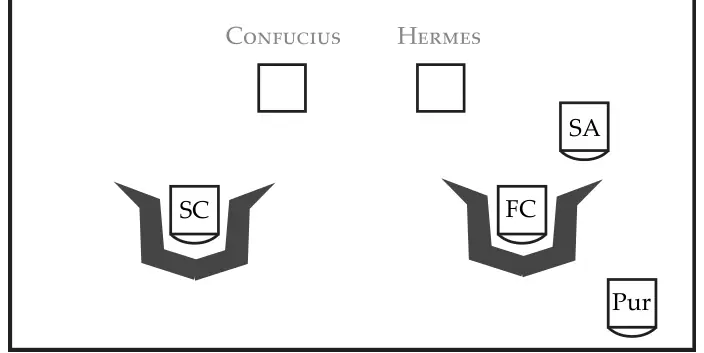
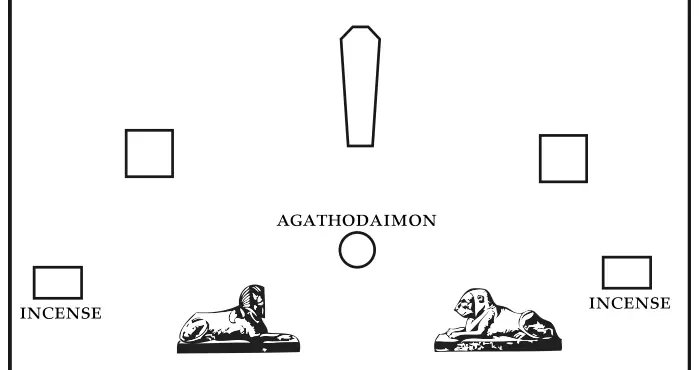
The hangings are white. There are two gilded columns in the East, one on each side of the President, two in the West, one on each side of the seats of the Senior and Junior Counsellors, three on the South side of the Lodge, and three on the North, equidistant from each other.
On the column on the right of the President is inscribed in large letters the word Justitia, and on that on his left, the word Equitas. From the two springs a Gothic arch, from the apex whereof is suspended over the head of the President the Tetractys of Pythagoras; and, under it, a balance, or the scales of Justice, and a sword.
On the column on the right of the Counsellors is inscribed the word Lenitas, and on that upon their left, Misericorpia. From these columns springs a Gothic arch, from the apex whereof is suspended, in letters of gold, the sacred word INRI,
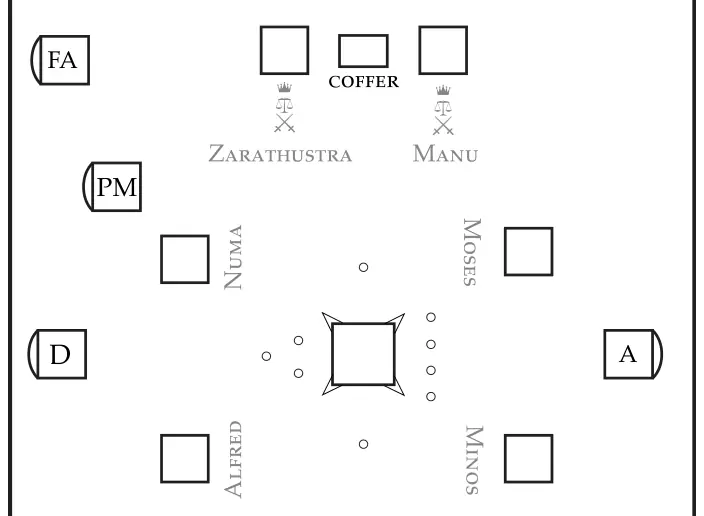
On the three columns in the South, going from East to West, are the busts of Moses, ZonoasrER and Mtvos, with the name of each inscribed on his column. On those in the North, also arranged from East to 'West, are the busts of Conrucrus, Socrates and ALFRED, with the name of each inscribed on his column.
'In front of the President is a hexagonal altar, on which are the [holy Bible, the Square and Compasses, 'the Plumb and Level, a pair of Scales, and a Sword. .
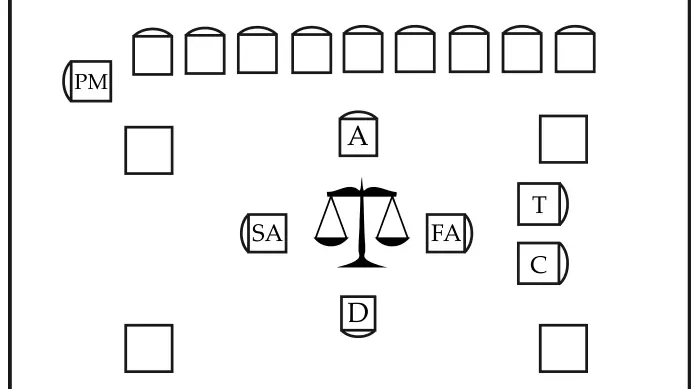
In the centre of the room is a large table in the shape of a decagon, and on it ten lights." In the East are ten, and in the West ten; each ten being arranged by 1, 2, 3, and 4, in the form of the Tetractys.
The Altar is covered with a black cloth, and the Table with a green one.
The Assembly is styled Supreme Tribunal. The Presiding Officer is styled Most Ill.°. President, The Wardens are styled Counsellors, and sit together in the West. The Secretary is styled Chancellor, and sits on the right of the President. The Treasurer sits on his left, The other officers are, the Advocate, who sits in the South, the Defender, who sits in the North, the Pursuivant, in front of the Wardens, and the Sergeant-alarms, on the outside of the door. , .
All the officers and members, except the President, are styled Illustrious.
When a trial takes place, the Tribunal consists of ten members only, and they sit around the Table i in the centre, on which ore then placed the Bible and other furniture of the Altar.
The composition of the Tribunal and the qualifications of the members will be found in the Statutes.
DRESS, JEWELS, ETC.
No apron is worn in the Sov.*. Tribunal. In the inferior bodies, the Commanders wear one of entirely white sheepskin, with a Teutonic cross in silver embroidered on the flap.
Baal .. 2
The collar is white. On the breast, at the point, is a triangle surrounded with a glory, and of gold, in the centre of which, in Arabic figures, is the number of the degree, 31. The Commander may also wear o gold chain, the links of which are composed of the interlaced attributes of the different degrees, particularly
the Ist, 2d, 3d, llth, ldth, 17th, 18th and 30th...
The jewel is a Teutonic cross of silver. The members should be dressed i in black, and wear swords. *
The battery is ,.— by ,—-?—; and!
TO OPEN.
Af. Ill. Ills. Bro.*. Sen.*. Counsellor, the obligations of duty are eternal to the good Mason. They require us to resume our labours. See that all present are Gr.*. Enquiring Commanders.
Sen.. C.. All present are Gr.*, Enquiring Commanders, M.*, Ill,
af, In. You will then take steps to ascertain whether the doors of this Tribunal are safely guarded ; and give orders that none be allowed to enter here without your permission, that we may not be improperly interrupted.
Sen. C.. IlL+. Pursuivant, you will please ascertain whether the Sergeant-nt-Arms is at his post: and command him to be vigilant that none approach to disturb or interrupt this Supreme Tribunal, which is now about to open; and that he allow none to enter without our permission first obtained. °
{The Pursuivant goes out, returns, gives the battery, which is answered from without, and reports: " ae .
Sen. Counsellor, your orders are executed').
Sen.*. "M.. IIL«., the Sergeant-at-Arms is at his post and duly instructed, and wo are in security.
AM, he Then we may safely proceed. IL:. Pursuivant, your duty?
Purs.*, To execute your orders coming to me by the West, and see the judgments of the Tribunal duly executed: to serve and return all process, and to compel order when the Tribunal is in session.
Mt. Il. ML. Defender, your duty?
Def. To defend all persons charged with offences and tried before this Tribunal,.to see that no improper testimony be admitted against them, to present the truth in their defence, to "lay their cases fairly before the Tribunal, and to urge all circumstances of extenuation in their favour.
Dt. Til. Tis. Advocate, your duty?
Adv. To prefer charges against those under the jurisdiction of this Tribunal, who bare been guilty of
offences against Masonic law and duty: to draft the acts of accusation, prepare the testimony, elicit the truth, and present the whole case fairly and without aggravation or misrepresentation before the Tribunal.
M, Ti. Ul. Treasurer, your duty ?
Treas... To receive and keep safely the funds of the Tribunal.
M:. Il. W.:. Chancellor, your duty?
Chan.. To record the proceedings and judgments of the Tribunal.
Bf. It. Ul. Junior Counsellor, your duty?
June. Co. To guard against all violations of Masonic law, to give my advice on proper occasions to the M.*. IlL*, President, and to pronounce just and righteous judgment.
a. Il, Ill. Sen.*. Counsellor, your duty?
Sen. C.. That of my Junior, tempering justice with equity, and ever remembering the dictates of merey. ;
Me. Ql. YL. Sen.*. Counsellor, the duty of the M.-. I.*. President?
Sen. C.. To preside in judgment and expound the law; to judge justly, and to punish sternly; but, ever remembering the frailty and imperfection of human nature, to pardon and forgive, while there remains hope of reformation.
M. Il. The duty of all members of this Tribunal, when sitting in judgment?
Sen.. C.". Careful and scrupulous investigation of all facts, inculpatory, exculpatory and extenuating
charitable construction of acts and motives; calm and deliberate consideration, just judgment, and disregard of person, rank, influence and power.
Mf. fi. Treeognize my duty. My Brethren, recognize those that devolve upon you. May the Great Judge of all human actions aid me and all of us well and conscientiously to perform all that it is fitting for ustodo! My Brethren, kneel with me, and let us implore Ilis aid, His pardon and His protection.
[The sign is given: Then the Advocate raps , — the Jun.'. Counsellor ?— the Senior ; — and the Are-
silent |! —]
IM. Tile, Tl. Senior Counsellor, this Supreme Tribunal is now open. Let due Proclamation thereof be
made.
Sen, C.. Ill. Pursuivant, make Proclamation that this Sup.°. Tribunal i is now open, and that all who
demand its judgment may now draw near,
Furs.. [Going to the dour and opening it]. Hear ye! This Sup.". Tribunal of Gr.-. Inquiring Commanders is now open and in session. Whosoever hath been cited to appear, or hath complaint or appeal to make or answer, let him draw near, and he shall be heard!
(The M.:. IIL>. then gives one rap, and the Commanders are seated].
" Reception.
No one can receive this degree, except a Knight Kadosch, elected to receive is by unanimous vote of the Chapter of Its.*. K—H.-. to which he belongs. Upon filing a certificate of such election, he is balloted for; $
and if unanimously elected by the Tribunal, he receives the degree.
Being brought to the door of the Tribunal, in the dress and jewel of a Kt. K—H.°. the Serg.". at Arms raps , and ?— the Pursuivant answers ;— and the Serg.". at Arms responds | The door is then opened. ~ Purs.. Who approaches this Sup.*. Tribunal, and what is his desire ?
. Serg'. A Kes. K—IL.-., upright, virtuous and eminent, who, having been duly elected by his brethren, desires to receive the degree of Grand Enquiring Commander.
Purs.. What is his name?
35D
Serge. Av... Bow...
Purs.. Wis age?
Serg.". years.
Prus.', Tis occupation?
Serg.". .That of : Useful and honourable, as is all work in this world: as Masons, best of all men, are aware. 4
Purs,", Math he, by sufficient service and patient obedience as a Mason, learned the first lesson in the art of governing ? .
Serg.". Ile hath. IIe bas learned to govern himself.
Purs.. Ig he trustworthy and true? Do you vouch forhim? Is he honest, temperate, of equal temper, charitable construction and merciful impulses? .
Serg.. He is a K—IL.-.; and his brethren have thought him worthy to enter here.
Purs... Let him wait until his request is made known to the President.
(The Pursuivant reports the answers, and is ordered to allow him to enter. The Commanders should all wear black hats, with black masks and cloaks. When the Candidate enters, the Pursuivant takes charge of him, and leads him to the President].
DM. lil. Whom have you there, my Brother ?
Purs.. A Knight K—I.-. of good name and fame and virtuous conversation, who, having been duly elected by his Brethren, desires to receive the degree of Grand Enquiring Commander.
AC. Ill, My Brother, you desire to take upon yourself an arduous and responsible office. There in but One Infallible, Unerring Judge. All human judgment is at best uncertain. Serious in its consequences, it must often, when tine develops its errors, produce regret, and sometimes remorse. It is not wise to seek to judge our fellow-man. Its a stern du¢y and aa unwelcome task to be performed, and not a privilege to be coveted; and wo unto that man who assumesthe prerogative of judgment, and to some extent usurps the functions of God, not being himself just, upright, impartial! Does your heart tell you that you may safely assume that power? . ;
Cand.*, Tt does. .
Mf. Is. tis well. See to it that you be not deceived !- Go with your Guide. Heed well the lessons and warnings you will receive, and again return to me. .
{The Candidate is led round the room, halting at each column, and addressed at each, ag follows] :
At the Column of Atrrep: .... I was the Just King of Saxon England. I framed wise laws, appointed upright magistrates, and caused just and speedy judgment to be given. In all my realm, justice and right were sold to none, denied to none, delayed tu nine. I slept little, I wrote much, I studied more. I reigned but to bless those over whom I had dominion. I have vanished into the thin Past; but I still live in the memory of men. They call me Brave King, wise Lawgiver, just Judge: Follow thou my example, or shudder to satin judgment on thy fellows ! -
At the Column of Socrates: .... I was Socrates the Athenian. I knew the Holy Mysteries, and reverenced God in Nature. In the Sacred Groves of Athens I taught to young and old the existence and immortality of the Soul, and the Unity of God the Creator. And when by unjust judgment my country condemned me to die, I refused to flee, lest I should bring the laws into disrepute, lwlding the good citizen bound to submit to even the unrighteous judgment of the State. If thou woulds judge others, be prepared to obey as I
did.
At the Column of Conrvervs: ... . Was Khoung-fou-tseu. Isaid to the Chinese, 'The great law of duty ig to bo looked for in humanity. Justice is Equity,—to render to every one that to which he is entitled. He who would stand above the ordinary level of men must be exempt from prejudices and from obstinacy, and be governed by the mandates of Justice alone. Iear much, that your doubts may disappear. Be cautious in what you say, that you may say nothing superfluous; for then you will rarely commit faults. See much, that you may avoid the dangers that beset all men. Watch carefully over your actions, and you will rarely need to repent. Elevate and honour upright and just men, and put down and degrade those who are corrupt and perverse. Form no friendships with those who are morally your inferiors. Exercise always the perms-
XXAT.. 2 5
nent and eternal virtues. Be circumspect of speech. Neglect not to strive ever to perform your whole duty. Overflow not in superfluous words: and let your words answer to your actions, and your actions correspond with your words.' Su I taught; and my influences lived after me, and have shaped the destinies of myriads of men; the noblest fortune that can befall humanity. Strive thou so to live and act, to obey and govern, that thou too gayest live in the good opinions of men after thou art dead; and that éthine influences may make thee too a king over the minds of men.
At the Column of Mixos: .... Was Minos, the Lawgiver of Crete. I taught the Cretins that the
laws which I enacted were dictated to me by Jove: for all true and righteous laws and all human justice are but developments of that Eternal, infinite justice that is of the essence of the Deity. IIe who assumes to judge his brother, clothes himself with the prerogative of God. Woe unto thee, if, vicious or criminal thyself, thou nssumest to judge others, or if thou givest corrupt judgment; for then thou wilt usurp and abuse the power of God, and lie will punish thee.
Af the Column of Zoroaster: .... Was Zerdusht, the great Lawgiver of the Persians. My laws live' after me, and Time still adds to their authority. I said, 'If is the best servant of God whose heart is upright, who is liberal, with due regard to what is just, to all men; who turns not his eyes towards riches, and whose heart wishes well to everything that lives. lie that is charitable and merciful in his judgments is alone just. Fear to do anything against that God whom thou lovest; and thou wilt not love to do anything against that God whom thou fearest.' . .
At the Column of Moses: .... God gave into my hands the Tables of his law upon Mount Sinai: By
my Statutes Israel was governed ; and between man and man I administered justice. I said to Israel: 'Thou shalt not wrest the judgment of thy poor in his cause. Thou shalt take no gift: fur the gift blindeth the wise, and perverteth the words of the righteous. Ye shall do no unrighteousness in judgment: thou shalt not respect the person of the poor, nor honour the person of the mighty: in righteousness shalt thou judge thy neighbour. Ye shall not respect persons in judgment. Ye shall hear the Small as well as the Great: Ye shall not fear the face of man; for the judgment is God's.'
[Then the Candidate halts before the Counsellors, and the Sen.°. Counsellor says to him: . . "Thou bast heard the words of the Great Sages, Philosophers and Lawgivers of Antiquity. Behold [pointing upward to the word over his head], the monogram of the greatest lawgiver that has ever come among men: and listen reverentiully to his teachings: *If ye furgive men their trespasses, your Heavenly Father will also forgive you. But if ye forgive not men their trespasses, neither will your [Heavenly Father forgive your trespasses. With what judgment ye judge, ye shall be judged: and with what measure ye mete, it shall be measured to you again. If thy brother trespass against thee, go and tell him his fault between thee and him alone. If he shall hear thee, thou has gained thy brother. ... If he neglect to hear thee, tell it unto the Church: bat if he neglect to hear the Church, let him be unto thee as an heathen and publican. Judge not according to the appearance; bat judge righteous judgment. If thy brother trespass against thee, rebuke him; and if he repent, forgive him. And if he trespass against thee seven times in a 'day, and seven | times in a day tarn Sgain to thee, saying, I repent, thou shalt forgive him.' ']
[The Candidate is then conducted to the East].
M.. Iil., My Brother, you have heard the lessons of wisdom, uttered by lips, now these many ages "mouldered into dust. Through those lips God spake to man: for of Ili comets all wisdom. You desire to become a member of this Tribunal, and a Supreme Judge in Masonry. Kneel then at its Holy Altar, with sincerity and reverence, fully appreciating the important office to which you aspire, and with no thought in your heart, nor word upon your lips, but those of deep earnestness, of soberness and truth.
[The Candidate kneels, placing one hand on the Holy Bible, square, compasses, plumb and level, and the other on the scales and sword; and answers as follows :]
M..Ius. Kneeling at the Altar of Masonry in token of humility and reverential awe of Deity, do you, upon these emblems of Divine Truth,of Justice, Equity, Uprightuess and the Law's Dread Vengeance, most solemnly and sincerely swear, that you will carefully examine all eases in which you may be judge, listen attentively to every argument that may be urged, and faithfully and impartially weigh both evidence and argument;
XXAT... 6
being neither careless nor indifferent, partial nor prejudiced, nor wearying of investigation; with the sole and only purpose of giving a true and just judgment?
Cand.*, Do so swear.
Mf. Ill. Do you solemnly and sincerely swear, that you will never sit in judgment in any case where you may entertain feelings of ill-will or enmity towards a party therein, or any feeling of: prejudice or dislike; nor in any case where, from any cause whatever, you doubt whether you can hear patiently, consider calmly and decide impartially ?
Cund.. Do so swear.
It. In. Do you suleninly promise and swear, that you will never allow rank or power, influence or
money, to sway you in your judgment; and that, before you as a Judge, all men shall stand on one common level, to be sternly condemned if guilty, and acquitted if innocent?
Cand... I do so swear.
Mf. Il. Do you solemnly and sincerely swear, that you will as a Judge lay aside all pride of opinion,
obstinacy and self-will, and be governed absolutely by the dictates of In, justice, equity, and your own conscience?
Cand... I do so swear.
M. Til. Do you solemnly and sincerely swear, that you will usurp no doubtful powers; that you will
strain no law so that it may cover cases to which it docs not plainly apply; that you will presume every one innocent until he is proven to be guilty; and that you'will give to every one accused the benefit of all reasonable doubt, and of a charitable and natural construction of his actions, remembering that the Masonic law seeks punishment only as 2 means and not as an end?
Cared.". I do so swear.
DM. In. And all this you swear, hoping that God will so judge you as you judge others, and invoking
upon your unprotected head [is just and terrible anger, in case you wilfully violate this your solemn oath and obligation? Do you so swear?
Cund.". I do.
did: .. Forgive us our trespasses as we forgive those that trespass against us!
At, Il:. Witness you the solemn oath, my Brethren; and let ic be recorded! all: . . We witness it.
Chan, And I record it.
M.. Ill. Arise, Il.*. Enquiring Commander! I invest you with the white collar and apron and with
the jewel of this degree. See that the purity of the two furmer and the lustre of the latter be never sullied or dimmed by injustice, inhumanity or impurity! Receive nuw the Signs, Words and Token of this Degree!
Six:... StYAO the Any Solos over the SO*Ct— the CWP over the TOCLEP.
Answer; ... 2¢¥22 VEC over the {COM — the 79 6, C 1S extended and 2CIOIO*YCO and @@ {oats upward.
Toren: ... Place WYY to WES and TCC to ToeC C —take each other by the tCWPry &OQeO, and with the $9CUS*¥ strike gently the {Ok Ft CI of the other; one giving the password, and
the other the answer.
Pass-word: ... MSFYOwP* CH.
Answer: ... Of} CU.-.
Sacnep Worps:... Onesays 84279 2C.". The other answers CX¥$ 98h. And both say 23 SSxrC SF MC.
af. Ill, Go now, my Brother, to our IIl.*. Bro.*. the Advocate, and receive from him the Lecture of this Degree. .
LECTURE.
This Degree was instituted when anarchy reigned among the rites of Masonry. It was evidently indispensable to establish a special body that should see to.the maintenance of principles, and the regularity of Masonic forms. The Tribunal of Grand Inquiring Commanders was thus created; and invested with the power, as it was charged with the duty, of visiting the different bodies and inspecting their work, of taking care that caution should be observed in the selection of candidates, of compelling a strict observance of the ritual in the higher degrees. To these powers were added, by degrees, that of judging differences between the Brethren, and of trying those guilty of offences against Masonic law, .
These powers and this jurisdiction are now defined, and the mode of proceeding regulated, by statutes enacted by the supreme authority; with a copy of which I now present you, requiring you to become familiar with them, that you may be enabled to perform properly the high duties that devolve upon you. .
, To hear patiently, to weigh deliberately and dispassionately, and to decide impartially ;—these are the chief duties of a Judge. After the lessons you have received, I need not further enlarge upon them. You will be ever eloquently reminded of them by the furniture upon our Altar, and the decorations of the Tribunal.
The Holy Bible will remind you of your obligation; and that as you judge here below, so you will be yourself judged hereafter, by One who has not to submit, like an earthly Judge, to the sad necessity of inferring the motives, intentions and purposes of men [of which all crime essentially consists] from the uncertain and often unsafe testimony of their acts and words; as men in thick darkness grope their way, with hands outstretched before-them: but before Whom every thought, feeling, impulse and intention of every soul that now is, or ever was, or ever will be on earth, is, and ever will be through the whole infinite duration of eternity, present and visible.
The Square and Compasses, the Plumb and Level, are well known to you as a Mason. Upon you as 5
Judge, they peculiarly inculcate uprightness, impartiality, careful consideration of facts and circumstances,
-accuracy in judgment, and uniformity in decision. As a Judge, too, you are to bring up square work and square work only. Like a temple erected by the plumb, you are to lean neither to one side nor the other. Like 'a building well squared and levelled, you are to be firm and steadfast in your convictions of right and justice. : Like the circle swept with the compasses, you are to be true. In the scales of justice you are to weigh the 'facts and the law alone, nor. place in-either scale personal friendship or personnel dislike, neither fear nor favour: and when reformation is no longer.to be hoped for, you are to smite relentlessly with the sword of justice,
The peculiar and principal symbol of this degree is the Tetractys of Pythagoras, suspended in the East, where ordinarily the sacred word or letter glitters, and, like them, representing the Deity. Its nine external points form the triangle, the chief symbol in Masonry, with many of the meanings of which you are familiar.
To us, its three sides represent the three principal attributes of the Deity, which created, and now, as aver, support, uphold and guide the universe in its eternal movement; the three supports of the Masonic Temple, itself an emblem of the universe:—-Wisdom, or the Infinite Divine Intelligence; Strength, or Power, the Infinite Divine Will; and Beauty, or the Infinite Divine Harmony, the'Eternal Law, by virtue of which the infinite myriads of suns and worlds dash ever onward in their ceaseless revolutions, without clash or conflict, in the Infinite of space, and change and movement are the law of all created existence.
To us, as Masonic Judges, the triangle figures forth the Pyramids, which, planted firmly as the everlasting hills, and accurately adjusted to the four cardinal points, defiant of all assaults of men and time, teach us to stand firm and unshaven as they, when our feet are planted upon the solid truth.
It includes a multitude of geometrical figures, all having a deep significance to Masons. The triple triangle is peculiarly sacred, having ever been among all nations 2 symbol of the Deity. Prolonging all the external lines of the Hexagon, which also it includes, we have six smaller triangles, whose bases cut each
XXAL.. 8
other in the central point of the Tetractys, itself always the symbol of the generative power of the universe, the Sun, Brahma, Osiris, Apollo, Bet, and the Deity Himself. Thus, too, we form twelve still smaller triangles, three times three of which compose the Tetractys itself. .
I refrain from enumerating all the figures that you may trace within it: but one may not be passed unnoticed. The Hexagon itself faintly images to.us a cube, not visible at the first glance, and therefore the fit emblem of that faith in things invisible, most essential to salvation. The first perfect solid, and reminding you of the cubical stone that sweater blood, and of that deposited by Enoch, it teaches justice, accuracy and consistency.
The infinite divisibility of the triangle teaches the infinity of the universe, of time, of space and of the Deity, as do the lines that, diverging from the common centre ever increase their distance from each other, as they are infinitely prolonged. As they may be infinite in number, so are the attributes of Deity infinite; and as they emanate from one centre and are projected into space, so the whole Universe has emanated from God. . . - .
Remember also, my Brother, that you have other duties to perform than those of a judge. You are to
inquire into and scrutinize carefully the work of the subordinate Bodies in Masonry. You arc to see that recipients of the higher degrees are nut unnecessarily multiplied ; that improper persons are carefully excluded from membership, and that in their life and conversation Masons bear testimony to the excellence of our doctrines and the incalculable value of the institution itself You are to inquire also into your own heart and conduct, and' keep careful watch over yourself, that you go not astray. If you harbour ill-will and jealousy, if you are hospitable to intolerance and bigotry, and churlish to gentleness and kind affections, opening wide your heart to one and closing its portals to the other, it is time fur you to sect in order your own temple, or else you wear in vain the name and insignia of a Mason, while yet-uninvested with the Masonic nature.
Everywhere in the world there is a natural law, that is, a constant mode of action, which seems to belong to the nature of things, to the constitution of the universe. This fact is universal. In different departments we call this mode of action by different names, as the Jaw of Matter, the Jaw of Mind, the law of Morals, and the like. We mean by this, 2 certain mode of action which belongs to the material, mental or moral forces, the mode in which commonly they are found to act, and in which it is their ideal to act always. The ideal laws of matter we only know from the fact that they are always obeyed. To us the actual obedience is the only evidence of the ideal rule; for in respect to the conduct of the material world, the ideal and the actual are the same. .
The laws of matter we learn only by observation and experience. Before experience of the fact, no
man could foretell that a body falling towards the earth, would descend sixteen feet the first second, twice that the next, four times the third, and sixteen times the fourth. No mode of action in our consciousness anticipates this rule of action in the outer world. The same is true of all the laws of matter. The ideal law is known because its a fact. The law is imperative. It must Le obeyed without hesitation. Laws of crystallization, laws of proportion in chemical combination,—neither in these nor in any other law of Nature is there any margin left for oscillation of disobedience. Only the primal will of God works in the material
world, and no secondary finite will. . .
There are no exceptions to the great general In of Attraction, which binds atom to atom in the body
of a rotifer visible only by aid of the microscope, orb to orb, system to system; gives unity to the world of things, and rounds these worlds of systems to a universe. At first there seem to be exceptions to this law, as in growth and decomposition, in the repulsion of electricity ; but at length all these are found to be special cases of the one great law of attraction acting in various mudes, .
The variety of effect of this law at first surprises the senses ; but in the end the unity of cause astonishes the cultivated mind. Looked at in reference to this globe, an earthquake is no more than a chink that opens in a garden-walk of a dry day in Summer. A sponge is porous, having small spaces between the solid
parts: the solar system is only more porous, having larger room between the several orbs: the universe yet more so, with spaces between the systems, as small compared with in/finile space, as those between the atoms that compose the bulk of the smallest invisible animaleule, of which millions swim in 3 drop of salt water. The same attraction holds together the animalcule, the sponge, the system and the universe.
XXSL..9
Every particle of matter in that universe is related to each and all the other particles; and attraction is. their common bond.
In the spiritual world, the world of human consciousness, there is also a law, an ideal mode of action, for the spiritual forces of man. The law of Justice is ag universal an one as the law of Attraction 3; though we are very far from being able to reconcile all the phenomena of Nature with it. The lark has the same right, in our view, to live, to sing, to dart at pleasure through the ambient atmosphere, as the hawk has to ply his strong wings in the summer sunshine: and yet the hawk pounces on and devours the harmless
lark, as i devours the worm, and as the worm devours the animalcule; and, so far as we know, there is nowhere, in any future state of animal existence, any compensation for this apparent injustice. Among the bees, one rules, while the others they—some work, while others are idle. With the small ants, the soldiers feed on the proceeds of the workmen's labour. The lion lies in wait for and devours the antelope that has apparently as good a right to life as he. Among men, some govern and others serve, capital commands and labour obeys, and one race, superior in intellect, avails itself of the strong muscles of another that is inferior; | and yet, for all this, no one impeaches the justice of God. . .
No doubt all these varied phenomena are consistent with one great law of justice ; and the only difficulty - is that we do not, and no doubt we cannot understand that law. It is very easy for some dreaming and visionary theorist to-say that it is most evidently unjust for the lion to devour the deer, and for the eagle to tear and eat the wren; but the trouble is, that we know of no other way, according to the frame, the constitution and the organs.which God has given them, in which the lion and the eagle could manage to live at all. Our little measure of justice is not God's measure. His justice dues not require us to relieve the hard-working millions of all labour, to emancipate the serf or slave, unfitted to be free, from all control.
No doubt, underneath all the little bubbles, which are the lives, the wishes, the wills and the plans of the two hundred millions or more of human beings on this earth (for bubbles they are, judging by the space and time they occupy in this great and age-outlasting sea of human-kind),—no doubt, underneath them all resides one and the same eternal force, which they shape into this or the other special form; and over all the same paternal Providence presides, keeping eternal watch over the little and the great, and producing variety of effect from Unity of Force. . .
It is entirely true to say that justice is the constitution or fundamental law of the moral universe, the law of right, a rule of conduct for man (as it is for every other living creature), if all his moral relations. No doubt all human affairs (like all other affairs), must be subject to that as the law paramount; and what is right agrees therewith and stands, while what is wrong conflicts with it and falls. The difficulty is that we -evererect our notions cf what is right and just into the law of justice, and insist that God shall adopt that as Hia law; instead of striving to learn by observation and reflection what his law is, and then believing that law to be consistent with His infinite justice, whether it corresponds with our limited notion of justice, or does notso correspond. We are too wise in our own conceit, and ever strive to enact our own little notions into the Universal Laws of God. : .
It might be difficult for man to prove, even to his own satisfaction, how it is right or just for him to subjugate the horse and ox to his service, giving them in return only their daily food, which God has spread out for then on all the green meadows and savannah of the world: or how it is just that we should slay and eat the harmless deer that only crops the green herbage, the buds and the young leaves, and drinks the freo-running water that God made common to all, or the gentle dove, the innocent kid, the many other living things that so confidently trust to our protection;—quite us difficult, perhaps, as to prove it just for one man's intellect or even his wealth to make another's strong arms his servants, for daily wages or for a bare subsistence.
To find out this universal law of justice is one thing—to undertake to measure off something with our own little tape-line, and call that God's law of justice, is another. The great general plan and system, and the great general laws enacted by God, continually produce what to our limited notions is wrong and injustice, which hitherto men have been able to explain to their own satisfaction only by the hypothesis of another existence in which all inequalities and injustices in this life will be remedied and compensated for, To our ideas of justice, it is very unjust that the child is made miserable for life by deformity or organic disease, in consequence of the vices of its father; and yet that is part of the universal law. The ancients said that the
XNAI... 10
child was punished for the sins of its father. Te say that its deformity or disease is the consequence of its father's vices: but so far as concerns the question of justice or injustice, that is merely the change of a word.
It is very easy to lay down a broad, general principle, embodying our own idea of what is absolute justice, and to insist that everything shall conform to that: to say, "all human affairs must be subject to that'as the law paramount; what is right agrees therewith and stands, what is wrong conflicts and falls, Private coke- - sions of self-love, of friendship or of patriotism, must all be subordinate to this universal gravitation towards the eternal right", The difficulty is that this universe of necessities God-created, of sequences of cause and effect, and of life evolved from death, this interminable succession and aggregate of cruelties, will not conform to any such absolute principle or arbitrary theory, no matter in what sounding words and glittering phrases
it may be embodied. .
Impracticable rules in morals are always injurious; for as all men fall short of compliance with them, they turn real virtues into imaginary offences against o forged law. Justice as between man and man and as between man and the animals below him, is that which, under and according to the God-created relations existing between them, and the whole aggregate of circumstances surrounding them, is fit and right and proper to be done, with a view to the general as well as to the individual interest. It is not a theoretical principle by which the very relations that God has created and imposed on us are to be tried, and approved or condemned.
God has made this great system of the Universe, and enacted general Jaws for its government. Those
laws environs everything that lives with a mighty network of necessity. Ie chose to create the tiger with such organs that he cannot crop the grass, but must eat other flesh or starve. IIo has made man carnivorous also; and the smallest singing-bird is as much so as the tiger. In every step we take, in every breath we draw, ig involved the destruction of o multitude of animate existences, each, no matter how minute, as much a living creature as yourself. He has made necessary among mankind a division of labour, intellectual and moral. He has made necessary the varied relations of society and dependence, of obedience and control.
What is thus made necessary cannot be unjust; for if it be, then God the great Law-giver is Himself
unjust. The evil to be avoided is, the legalization of injustice and wrong under the false plea of necessity. Out of all the relations of life grow duties,—as naturally grow and as undeniably, as the leaves grow upon the trees. If we have the right, created by God's law of necessity, to slay the lamb that-we may eat and live, we have na right to torture it in doing so, because that is in no wise necessary. We have the right to live, if we . fairly can, by the legitimate exercise of our intellect, and hire or buy the labour of the strong arms of others, to till our grounds, to dig in our mines, to toil in our manufactories; but we have no right to overwork or underpay them. . .
It is not only true that we may learn the moral law ofjustice, the law of right, by experience and observation ; but that God has given us o moral faculty, our conscience, which is able to perceive this law directly and immediately, by intuitive perception of it; and it is true that man has in his nature a rule of conduct higher than what be has ever yet come up to,--an ideal of nature that shames his actual of history: because man has ever been prone to make necessity, his own necessity, the necessities of society, a plea for injustice. But this notion must not be pushed too far—for if we substitute this ideality for actuality, then it is equally true that we have within us an ideal rule of right and wrong, to which God Himself in his government of the world has never come, and against which Ie (we say it reverentially) every day offends. We detest the tiger and the wolf for the rapacity and love of blood which are their nature; we revult against the law by which the crooked limbs and diseased organism of the child are the fruits of the father's vices ; we even think that 2 God Omni-
ought to have permitted no pain, no poverty, no servitude ; our ideal of justice is more
potent and Oniniscient ;
Hic has given us that moral sense for wise
lofty than the actualities of Gud. It is well, as all else is well.
and beneficent purposes. We accept it as significant proof of the inherent loftiness of human nature, that
it can entertain an ideal so exalted; and should strive to attain it, as far ag we can do so consistently with the relations which Ie has created, and the circumstances which surround us and hold us captive.
If we faitlifully use this faculty of conscience; if, applying it to the existing relations and circumstances, we develop it and all its kindred powers, and so deduce the duties that out of these relations and those circumstances, and limited and qualified by them, arise and become obligatory upon us, then wo learn justice, the law of right, the divine rule of conduct for human life. But if we undertake to define and settle 'the mode
of action that belongs to the infinitely perfect nature of God," and so set up any ideal rule, beyond all human reach, we soon come to judge and condemn His work and the relations which it has pleased Him in Ilis infinite wisdom to create.
A sense of justice belongs to human nature, and is a part of it. Men find a deep, permanent and instinctive delight in justice, not only in the outward effects, but in the inward cause, and by their nature love this law of right, this reasonable rule of conduct, this justice, with a deep and abiding love. Justice is the object of the conscience, and tits it as light fits the eye and truth the.mind.
* Justice keeps just relations between men. It holds the balance between nation and nation, between 2 man and his family, tribe, nation and race, so that his absolute rights and theirs do not interfere, nor their ultimate interests ever clash, nor the eternal interests of the one prove antagonistic to those of all or of any other one. This we must believe, if we believe that God is just. We must do justice to all, and demand it of all; its a universal human debt, a universal human claim. But we may err greatly in defining what, that justice is. The temporary interests, and what to human view are the rights, of men, do often interfere and clash. The lifeinterests of the individual often conflict with the permanent interests and welfare of society; and what may seem to be the natural rights of one class or race, with those of another.
It is not true to say that 'one man, however little, must not be sacrificed to another, however great, to majority, or to all men." That is not only a fallacy, but a most dangerous one. Often one man and many men must be sacrificed, in the ordinary sense of the term, to the interest of the many. It is a comfortable fallacy to the selfish; for if they cannot, by the law of justice, be sacrificed for the common good, then their country has no right to demand of them sel/sacrifice ; and he is a fool who lays down his life, or sacrifices his estate, or even his luxuries, to ensure the safety or prosperity of his country. According to that doctrine, Curtius was 0 fool, and Leonidas an idiot; and to die for one's country is no longer beautiful and glorious, but a mere absurdity. Then it is no longer to be asked that the common soldier shall receive in his bosom the sword or bayonet-thruat which otherwise would let out the life of the great commander on whose fate hang the liberties of his country, and the welfare of millions yet unborn.
On the contrary, it is certain that necessity rules in all the affairs of men, and that the interest and even the life of one man must often be sacrificed to the interest and welfare of his country. .Some must ever lead. the forlorn hope: the missionary must go among savages, bearing his life in his hand; the physician must
. expose himself to pestilence for the snake of others; the sailor, in the frail boat upon the wide ocean, escaped from the foundering or burning ship, must step calmly into the hungry waters, if the lives of the passengers
-can be saved only by the sacrifice of his own; the pilot must stand firm at the wheel, and let the flames scorch away his own life to ensure-the common safety of those whom the doomed vessel bears. .
The mass of men are always looking fur what is just. All the vast machinery which makes up a State,
a world of States, is, on the part of the people, an attempt to organize, not that ideal justice which finds fault with God's ordinances, but that practical justice which may be attained in the actual organization of the world. The minute and wide-extending civil machinery which makes up the law and the courts, with all their officers and implements, on the part of mankind, is chiefly an effort to reduce to practice the theory of right. Constitutions are made to establish justice; the decisions of courts are reported to help us judge more wisely in time to come. The nation aims to get together the most just men io the State, that they may incorporate into statutes their aggregate sense of what is right. The people wish law to be embodied justice, administered without passion. Even in the wildest ages there has been a wild popular justice, but always mixed with passion and administered in hate; for justice takes a rude form with rude men, and becomes less mixed with hate and passion in more civilized communities. Every progressive State revises its statutes and revolutionizes its constitution from time to time, seeking to come closer to the utmost possible practical justice and right; and sometimes, following theorists and dreamers in their adoration for the ideal, by erecting into law positive principles of theoretical right, works practical injustice, and then has to retrace its steps.
In literature men always look for practical justice, and desire that virtue should have its own reward, and vice its appropriate punishment. They are ever on the side of justice and humanity; and the majority of them have an ideal justice, better than the things about them, juster than the law: for the law is ever imperfect, not attaining even to the utmost practicable degree of perfection; and no man is as just as his own idea
36D ,
XXAL . . 12
of possible and practicable justice, Ifis passions and his necessities ever cause him to sink below his own ideal. The ideal justice which men ever look up to and strive to rise towards, is true; butt will not be realized in this world. Yet we must approach as near to it as practicable, as we should do towards that ideal democracy that "now floats before the eyes of earnest and religious men,—fairer than the Republic of Plato, or More's Utopia, or the Golden Age of fabled memory," only taking care that we do not, in striving to' reach and ascend to the impossible ideal, neglect' te seize upon and hold fast to the possible actual. To sim at the best, but be content with the best possible, is the only true wisdom. To insist on the absolute right, and throw out of the calculation the important and all-controlling element of necessity, is the folly of a mere dreamer.
In a world inhabited by men with bodies, and necessarily with bodily wants and animal passions, the time will never come when there will be no want, no oppression, no servitude, no fear of man, no fear of God, but only Love. That can never be while there are inferior intellect, indulgence in low vice, improvidence, indolence, awful visitations of pestilence and war and famine, earthquake and volcano, that must of necessity cause men to want, and serve, and suffer and fear. . ,
But still the ploughshare of justice is ever drawn through and through the field of the world, uprooting the savage plants. Ever we see a continual and progressive triumph of the right. The injustice of England lost her America, the fairest jewel of her crown. The injustice of Napoleon bore him to the ground more than the snows of Russia did, and exiled him to a barren rock, there to pine away and die, his life o warning to bid mankind be just. a
We intuitively understand what justice iy, better than we can depict it. What it is in a given case depends so much on circumstances, that definitions of it are wholly deceitful. Often it would be unjust to society to do what would, in the absence of that consideration, be pronounced just to the individual. General propositions of man's right to this or that are ever fallacious: and not infrequently it would be most unjust to the individual himself to do for him what the theorist, as a general proposition, would say was right and his due.
We should ever do unto others what, under the same circumstances we ought¢ to wish and should have the right to wish, they should do unto us. There are many cases, cases constantly occurring, where ono man must take care of himself, in preference to another, as where two struggle for the possession of a plank that will save one, but cannot uphold both; or where, assailed, he can save his own life only by slaying his adversary. So one must prefer the safety: of his country to the lives of her enemies; and sometimes, to ensure it, to those of her own innocent citizens. The retreating General may cut away « bridge behind him, to delay pursuit and save the main body of his army, though he thereby surrenders a detachment, a battalion or even a corps of his own force to certain destruction.
These are not departures from justice ; though, like other instances where the injury or death of the individual is the safety of the many, where the interest of one individual, class or race is postponed to that of the public, or of the superior race, they may infringe some dreamer's ideal rule of justice. But every departure from real, practical justice is no doubt attended with loss to the unjust man, though the loss is not reported to the public. Injustice, public or private, like every other sin and wrong, is inevitably followed by its consequences. The selfish, the grasping, the inhuman, the fraudulently unjust, the ungencrous employer and tha cruel master are detested by the great popular heart; while the kind master, the liberal employer, the generous, the humane and the just have the good opinion of all men, and even envy is a tribute to their virtues. Men honour all who stand up for truth and right, and never shrink. The world buihls monuments to its patriots. Four great statesmen, organizers of the right, embalmed in stone, look down upon the lawgivers of France as they puss to their hall of legislation, silent orators to tell how nations love the just. Iuew wo herero the marble lineaments of those just judges, Jay and Marshall, that look so calmly towards the living Bench of the Suprente Court of the United States! What a monument Washington has built in the heart of America and all the world, not because he dreamed of an impracticable ideal justice, but by his constant effort to be prac. tically just! ;
. But necessity alone, and the greatest good of the greatest number, can legitimately interfere with the dominion of absolute and ideal justice. Government should not foster the strong at the expense of the weak, or protect the capitalist and tax the labourer. The powerful should not seek a monopoly of development and
enjoyment; not prudence only and the expedient for to-day should be appealed to by statesmen, but conscience and the right: justice should not be forgotten in looking at interest, nor political morality neglected for political economy: we should not have national housekeeping instead of national organization on the basis of right. : . - -
Woe may well differ as to the abstract right of many things; for every such question has many sides, and few men look at all of them, many only at one. But we all readily recognize cruelty, unfairness, inhumanity, partiality, over-reaching, hard-dealing, by their ugly and familiar lineaments. We do not need to sit as a Court of Errors and Appeals to revise and reverse God's Providences, in order to know and to hate and despise them, .
There are certainly great evils of civilization at this day,;and many questions of humanity long adjourned and put off. The hideous aspect of pauperism, the debasement and vicé in our cities tell us by their eloquent silence or in inarticulate muttering, that the rich and the powerful and the intellectual do not do their duty by the poor, the feeble and the ignorant; and every wretched woman that lives, leaven scarce knows how, by making shirts at sixpence each, attests the injustice and inhumanity of man. There are cruelties to slaves, and worse cruelties to animals, each disgraceful to their perpetrators, and equally unwarranted by the lawful relation of control and dependence which it hag pleased God to create.
A sentence is written against all that is unjust, written by God in the nature of man and in the nature of the Universe, because it is in the nature of the Infinite God. Fidelity to your faculties, trust in their convictions, that is justice to yourself; a life in obedience thereto, that ig justice towards men. No wrong is really successful. The gain of injustice is a loss, its pleasure suffering. Iniquity often seems to prosper, but its success is its defeat and shame. After a long while, the day of reckoning ever comes, to nation as to individual. The knave deceives himself.- The miser, starving his brother's body, starves also his own soul, and at death shall creep out of his great estate of injustice, poor and naked and miserable. Whose escapes a duty avoids a gain. Outward judgment often fails, inward justice never. Let a man try to love the wrong and to do the wrong, it is-eating stones and not bread ; the swift feet of justice arc upon him, following with woollen tread, and her iron bands are round his neck. No man can escapeé from this, any more than from himself. Justice is the angel of God that flies from East to West; and where she stoops her broad wings, it is to bring the counsel uf God, and feed mankind with angels' bread. of .
We cannot understand the moral Universe. The arc is a long one, and our eyes reach but a little way ;- qe cannot calculate the curve and complete the figure by the experience of sight; but we can divine it by conscience, and we surely know that it bends towards justice. Justice will not fail, though wickedness appears strong, and has on its side the armies and thrones of power, the riches and the glory of the world, and though poor men crouch down in despair. Justice will not fail and perish out from the world of men, nor will what is really wrong and contrary to God's real law of justice continually endure. The Power, the Wisdom and the Justice of God are on the side of every just thought, and it cannot fail, any more than God himself can
perish.
* In human affairs, the justice of God must work-by human means. Men are the instruments of God's
principles; our morality is the instrument of His justice, which, incomprehensible to us, seems to our short vision often to work injustice, but will at some time still the oppressor's brutal laugh. Justice is the rule of conduct written in the nature of mankind. We may, in our daily life, in house or field or shop, in the office or in the Court, help to prepare the way for the commonwealth of justice which is slowly, but, we would fain hope, surely approaching. All the justice we mature will bless us here and hereafter, and at our death we shall leave it added to the common store of human-kind. And every Mason who, content to do that which is possible and practicable, does and enforces justice, may help deepen the channel of human morality in which God's justice runs; and so the wrecks of evil that now check and obstruct the stream may be the sooner swept out and borne away by the resistless tide of Omnipotent Right. Let us, my Brother, in this, as in all else,
endeavour always to perform the duties of a good Mason and a good man,
XOMNT... 14
70 CLOSE.
Jf. In". Tl.*, Sen.*, Counsellor, what is the hour of, rest for good Masons?
Sen. C.. M.*. IML.*., the hour when all their duties are performed.
at, Wi. Has that hour arrived, my brother?
Sen. C.. As nearly as it ever comes to mortals; since none perform all their duties: and our Masonic
labours end only at the grave.
I:. I. Most true, my Brother. Remains there yet any complaint unheard, wrong unredressed, or known offence unpunished ?
Sen.. C.. None, M.°. MIL'.
BL. W.. Its permitted, then, that this Tribunal should close. Join me, my Brethren, in the concluding
ceremony.
[The officers then rap and repent, as follows]: ....
Advocate... [,] ... From all errors and mistakes in conclusion and opinion: ... .
Jun. C.. [2]... From all impatience, and inattention to evidence or argument: ... - . .. ~ From all petulance and peevishness, all carelessness and indifference: .... Sens. Co... [;] --. From all hasty conclusions and unconsidered opinions: .... .... From all partiality and prejudice: ....
...» From all obstinacy and pride of opinion, and all wilful adherence to error: .... Mo. Ml... .. [!] ... From all usurpation of power and unwarrantablo assumptions of jurisdiction :
.... From all harsh and uncharitable constructions of act or motive: .... .... From all improper influences, that pervert men's judgment: . ... From all false judgment and intentional injustice: ....
. + «« Keep us free, our Father, who art to judge us at the Inst day!
All: ... Andes we judge, so do Thou in mercy judge us! Amen!
M:. I". My Brethren, the sign! [Its given]. This Tribunal is close-.
FINIS.
XAXT. 2. 15
SMntutes tor the Government of all Cribumals of the 31st Degree,
WHEREVER HELD UNDER
AUTHORITY OF TIE SUPREME COUNCIL, OF SOY-. GR... INSP... GEN:
AT CHARLESTON.
ART. I.
21. Every Tribunal of the 31st Degree, when sitting in judgment, shall be composed of ten members and no more, not including the Advocate and Defender. .
" ¢ 2.4 When trying a case in which a Sub.-. Prince of the Royal Secret is a party, all the members must have attained the 32d Degree: and in all other cases, at least five must have attained it, [to wit, the President, Counsellors, Secretary and Treasurer], and the others must have attained the 31st.
ART. It.
#1. Tribunals of the 31st Degree have exclusive jurisdiction to hear, try and determine all offences against Masonic law, or the Statutes, Constitutional provisions, rules and regulations of the Sup.°. Council of the 33d Degree, committed by Brothers who have attained any degree above the 18th, and of appeals from all - judgments of all Chapters of Rose Croix within their jurisdiction: bat os to offences committed by Knights of the Rose Croix attached to regular Chapters, and for the punishment whereof the Statutes of such Chapters _ have made provision, their jurisdiction shall be concurrent; and in such cases, the body first having posses- . sion of the case shall proceed, and the other desist.
#2. The Tribunals of the 31st Degree shall also have jurisdiction in all cases ordered by the Chapters to be transmitted to them for trial: and to decide all questions certified to them by the Chapters, and by -Councils of Princes of Jerusalem and Lodges of Perfection; their decision being in all eases final and conclusive. . ;
ART. III.
21. Any Mason, knowing of the commission by a Brother of rank above the 18th Degree, of any offence against Masonic Jaw, may make known the fact to any Gr.. Enquiring Commander, by communication in. writing, stating the offence, its nature and circumstances, and the time of its commission ; which shall be delivered by such Commander to the IIL'. Advocate, who shall prepare and prefer the act of accusation.
22. Each Commander shall also in like manner make known to the Ill. Advocate every Violation of Masonic law within his knowledge: and the Advocate shall prepare and prefer acts of accusation in all such cases, and in every case where the facts come otherwise to his knowledge.
23. Upon the act of accusation being preferred, the Chancellor shall issue a citation, under the seal of ; the Tribunal, which shall be served by copy in writing, by the Pursuivant, or by any other Mason at a distance, to whom the Chancellor may direct and transmit it; by which the accused shall be cited to appear before the Tribunal at a certain time and place, and answer the charge, The nature of such charge shall not be specified; but a copy of the act of accusation shall be delivered to the accused in person, whenever he applies
for it.
24., If it is known that the accused is not to be found, or when the citation is returned that he is not found, a copy thereof shall be put up in the place where he last resided, in the Lodge room of the Lodge or other Masonic Body of which he was last a member, or in any Lodge room, if he was s member of none, or, if there be no such room, then in any public place, and the facts returned upon the citation,
85. The day fixed for appearance shall be at least ten days after the actual or constructive service.
26. Upon the day fixed, if the accused appear, he shall make full answer to the charge, stating, if he pleases, any extenuating circumstances, and detailing the facts as particularly as he pleases. The Defender is charged with the duty of preparing this defence.
27. And if he does not appear, or when he has answered, a day shall be fixed for: trial, and written evidence may in the mean-time be taken on both sides. .
28. The testimony of persons not Masons must be given on oath, and that of Masons upon their highest Masonic obligation: and either may be taken in writing or orally: , "
ART, Iv.
31. At the time fixed for trial, unless the Tribunal grants further delay, as it may do at its discretion, the testimony taken in writing shall be read, and the witnesses heard, the accused having the right to be present, fully to examine and cross-examine the witnesses, and to be heard by himself or the Defender, or both. He or his Defender shall also have the right to conclude the argument, * .
32. After the case is heard, argued and submitted, the accused and witnesses shall withdraw, and the Tribunal shall deliberate. . . '
33. After deliberation the members shall vote upon the different specifications in the act of accusation, each member voting in turn, beginning with the youngest member, and the officers following according to rank from lowest to highest. The Advocate and the Defender shall rote.
24, Two-thirds of those present must concur, to find the accused guilty of any specification.
45. The punishment shall be fixed by a like vote, a majority determining its nature and extent.
26. The accused shall then be called in, and informed of the result. . If he be found guilty, the sentence shall be communicated by the Chancellor to all Masonic bodies of which he is 1 member, and the -punishment shall be imposed according to the Sentence, and the Laws, Statutes and regulations governing
the ease.
27. If the trial proceeds in the absence of the accused, the Defender shall represent him, and perform
all the duties of Counsel for him, to the best of his ability.
ART. Y.
21. Appeals from judgments of Chapters of Rose *% shall be sent up in writing, with all the papers; a simple notice of appeal being alone necessary to give the Tribunal jurisdiction.
$2, Every appeal shall bo suspensive.
23. If the appeal be on the facts, the Tribunal shall try it de nor. If it involve only a question of law,
they shall decide it, and affirm, reverse, remand, or grant a new trial, or altogether quash and anoul, os may be . proper and in accordance with Masonic law. :
24. Incase the Tribunal tries the case de nor, the proceedings at the trial shall be the same as in cases of original jurisdiction.
25. Any subordinate body may submit 2 question or questions to the Tribunal for its decision, upon order to that effect; and the Tribunal shall take jurisdiction, upon a certificate of the Recorder or Secretary of such Inferior Body, stating the question and its reference; shall decide, and transmit a certificate of its decision. And upon the decision of such questions, that of the majority shall stand as the decision of the whole, and no dissent be made known; but any Commander who dissents may present his opinion in writing, with the reasons for it, and have it filed for reference. : .
96. A-record of all such decisions, and of decisions on po
cellor in a book for that purpose, under appropriate headings.
ints of Masonic Taw, shall be kept by the Chsn-
AXXT... 17
ART, VI.
#1. No trials whatever for offences shall be had in any Consistory of Sub.:. Princes of the R.°. S..
22. The Tribunals of the 31st Degree shall also have jurisdiction to issue mandates to require subordinate bodies to proceed to judgment, or otherwise to do whatever acts they ought to do in order to give to Brother his Masonic rights: a3 also mandates requiring them to desist from proceeding, in proper cases; and mandates to bring up their proceedings, when alleged to be against law, to be examined, and affirmed or quashed, as law and right may require. °
23. They shall also have jurisdiction to issue mandates to bring before them questions 'of right to office in Subordinate Lodges and Bodies, and to hear and determine the game.
34. And mandates to suspend or supersede any judgment or action of such inferior bodies.
#5. The said Tribunals shall usurp and assume to themselves no powers not granted by these statutes, or not flowing as necessary incidents or corollaries from the powers hereby granted. .
26. They may act as Tribunals of conciliation or decision, in all matters of difference, dispute or dissension, between Masons of the some or different degrees ; when such matters are either referred to them by subordinate bodies, or by the parties themselves, or one of them, or by other Masons; and shall examine into and weigh the facts and merits, and give and enforce such judgment and decision, as shall in their view be just, right and equitable in the premises.
ART. VII.
21. All mandates and process of the Tribunal shall! be signed by the Chancellor, and sealed with the
seal of the Tribunal.
22. A-record shall be faithfully kept of all the proceedings and judgments of the Tribunal ; and all depo-
sitions and other papers shall be filed and carefully preserved.
FINTIS.
Ragon 1861
tuileur imprimé · 541 mots
Le « Tuileur général de la Franc-Maçonnerie ou Manuel de l'initié » de Jean-Marie Ragon (Paris, 1861), dernier grand tuileur français du siècle : décoration, titres, ordre, signes, mots, marche, âge, batterie et décors du grade, avec les notes critiques de Ragon sur les mots altérés par la tradition. Pages 172-173 de l'édition originale.
Tenture blanche, soutenue par huit colonnes dorées.
Titres.
La Loge se nomme Souverain tribunal.
Le Président prend le titre de Très-parfait Président ; les Surveillants celui d'Inspecteurs; le Secrétaire celui de Chancelier et tous les membres du Souverain tribunal, celui de Très-éclairés Frères.
Ordre.
Les mains en croix sur le ventre.
Signes.
De demande, mains croisées sur le ventre; de réponse, dite d'équité, mains croisées sur la tête, les paumes en dehors.
Attouchement.
S'approcher réciproquement du pied droit, aire toucher le genou, se prendre la main gauche, et de la droite se frapper mutuellement un léger coup sur l'épaule droite.
Mot de passe.
Point.
Mots sacrés.
JUSTICE (en héb. Tsedakau); réponse : ÉQUITɹ (en héb. Mischor). Ensemble : AINSI SOIT-IL (amen)!
1 Voir l'introduction aux grades symboliques, page 35, note 1re, du Cours interprétatif des initiations.
Les initiales de ces deux mots rappellent les initiales de deux mots grecs Isotéis (égalité) et Eleuthéria (liberté). Les légendaires voulant, sans doute, commémorer les persécutions qu'éprouvent de temps à autre, l'égalité, la liberté, ont inscrit, dans le martyrologe romain, une sainte Isotéis et un saint Eleuthère; ce dernier est fêté le 20 février, époque où la nature se dispose à briser les chaînes hivernales.
Ces initiales J, E, signifiant justice, équité ou égalité, liberté, figuraient sur les colonnes des Sublimes Maîtres parfaits, adelphes et philadelphes, pour indi-
[p. 173]
ÂGE.
Marche.
Point.
Batterie.
Neuf coups (1+3+4+1) : ○ ○ ○ ○ ○ ○ ○ ○ ○!
Questions d'ordre.
D. Êtes-vous Grand-Inquisiteur ?
R. Oui.
D. Combien de membres composent un Souv∴-Trib∴?
R. Neuf.
D. Quels sont-ils?
R. Un Président, un Chancelier, un Grand-Trésorier, six Grands-Inquisiteurs.
D. Par quelles qualités avez-vous obtenu ce grade?
R. Je possédais tous les grades de la Maçonnerie, depuis celui d'Apprenti jusqu'au grade de Chevalier Grand-Élu Kadosch inclusivement. J'ajouterai que je ne suis ni souverain, ni ecclésiastique, ni Chevalier de Malte, ni d'aucun ordre de chevalerie.
D. Quelles sont les fonctions de Grand-Inquisiteur ?
R. Celle de veiller à ce qu'aucun frère, de quelque grade que ce soit, ne s'écarte des devoirs qui lui sont imposés ; d'empêcher les contraventions aux lois de la Maçonnerie ; enfin de travailler à la répression des abus.
Décors.
TABLIER. Point. (Dans les Loges inférieures, on peut avoir un tablier blanc, une croix teutonique brodée sur la bavette.)
Cordon.
Blanc moiré, porté en camail; à sa pointe, est brodé, en or, un triangle radieux, portant au centre le nombre 31.
Dans les Loges inférieures, au lieu d'un cordon, les Grands-Inspecteurs portent une chaîne d'or passée au cou, à laquelle est suspendue la croix de l'ordre. Les chaînons sont composés des attributs entrelacés, des degrés fondamentaux de la Maçonnerie.
Bijou.
Une croix teutonique, en argent.
quer que la maçonnerie, établie sur ces deux bases, jointes à la sagesse et à la force, était impérissable.
Avec ces deux lettres, en figuraient deux autres, placées de chaque côté du firmament : R (religion), N (naturelle).
Dans les archives maçonniques de Douai, il exista, dit-on, un rituel d'une société maçonnique, dite des Adelphes.
Une loge de Philadelphes a existé à Narbonne. Elle n'a donné qu'à ses adeptes la connaissance de ses doctrines.
Pike 1884
rituel définitif · en anglais · 18 215 mots
Le rituel définitif d'Albert Pike tel que pratiqué par la Juridiction Sud des États-Unis (état final des révisions, v. 1884 ; recomposition numérique de 2020). Texte en anglais, établi directement sur la composition d'origine : ligatures rétablies, italiques de l'imprimé conservées, hébreu, phénicien et samaritain rendus dans leur écriture, pagination de l'original. Les partitions musicales, les plans d'atelier et les planches de décors sont reproduits en fac-similé à leur place dans le texte. Pages 986 à 1014 de l'édition.
Ritual of the Scottish Rite, Supreme Council, S. J. (recomposition 2020), p. 986-1014
[p. 986]
Planche [p. 986]
[p. 987]
Planche [p. 987]
Bodies of this Degree are styled Tribunals.
The Halls and Their Furnishing.
There must be, for the purposes of this Degree, two Halls, each of considerable size. The first is the Hall of Equity, in which the ordinary meetings of the Tribunal are held, and judicial proceedings had. Its hangings are white, and the canopies under which are the seats of the President and Councilors, are blue.
In this Hall are eight Ionic columns, white, ornamented with gilding; and on each, midway its height, is in letters of gold, a Name. These columns are square, six feet or more in height, and twenty inches square at the base. In front of each is a chair of state.
Two of the columns are to the right and left in front of the President; two to the right and left in front of the Councilors; two on the South side and two on the North side of the Lodge, with the same distance between each two as between each and the corner of the room.
On the column to the right, in front of the President, is the name Zarathustra; on that to his left in front, Manu; on that to the right in front of the Councilors, Hermes; on that to their left in front, Confucius. On the easternmost column, on the south side, Moses; on the westernmost, Minos; on the easternmost on the north side, Numa; on the westernmost, Alfred.
Above each name may be two naked swords, crossed, and a balance, and above these a crown. In the middle of the Hall is an Altar, upon which is the Book of Constitutions, closed, and on it a figure in plaster or wood, of Thme or Ma, the Goddess of Truth and Justice, of the Egyptians, as given on the frontispiece of this Ritual.
Half-way between the two eastern columns is a small table, on which is the coffer that contains the records of the Tribunal.
On the four sides of the Altar are nine large lights: on the eastern side, one; on the western side, one; on the southern side, four, and on the northern side, three.
The Altar is covered with a white linen cloth, which hangs to near the floor on all sides of it. On the front part of the Altar cloth, toward the East, appears in stars of gold, the Lesser Tetractys (of 1, 2, 3, and 4 stars).
the second hall. This is styled “The Hall of Justice,” and should resemble a Chamber of an ancient Egyptian Temple, with columns having capitals imitating the seed-vessels of the lotus, on all sides of it, at intervals, and five or six feet in front of each wall.
The hangings on all sides of the Hall are of dark gray or slate-color.
[p. 988]
Planche [p. 988]
In one Scale of the Balance is a vase shaped like a heart, and in the other a figure of Thme, Goddess of Truth and Justice, with the ostrich feather on her head, and the emblem of life in her hand, as given above. When a reception begins, this scale is so weighed down as to rest upon the floor.
To the west of the Scale-beam stands a low bier, with its head to the east, on which lies the representation of a corpse, swathed as a mummy, with the skull-cap on its head, and behind the head, the seed-vessel of the lotus, as is shown below:
Planche [p. 988]
Toward each corner of the hall is a small table, on which is a censer, with perfumes for burning.
Officers of the Tribunal, Sitting in the Hall of Equity.
The President (the Commander in Chief of the Grand or Particular Consistory), sits in the East. The First and Second Councilors (the Lieutenant Commanders of the Consistory), sit in the West. The Chancellor (the Registrar of the Consistory), sits on the right of, and facing the President. The Treasurer (the Treasurer of the Consistory), sits on the left of, and facing the President. The Advocate (the Minister of State of the Consistory), is in the South.
[p. 989]
The Defender (the Hospitaller of the Consistory), sits in the North. The Provost-Marshal (the Marshal of Ceremonies of the Consistory), sits between the Altar and the East, toward the North, and faces the South.
The First and Second Archers (the Expert and Assistant Expert of the Consistory), have the same places as the Deacons of the Lodge.
The Pursuivant (the Master of the Guards of the Consistory), sits near the entrance into the Hall. The Tiler sits at the door, on the outside. The President is styled “Venerable.” Each other officer and member, simply “Brother.”
Personages in the Hall of Justice.
This Hall, in which the Judgment Scene takes place, represents the Egyptian “Hall of the Two Truths,” and the region of the West, Amenthe, “The Land of the Two Truths,” the Lower World.
The Dignitaries and Officers of the Tribunal, or other Brethren selected, represent the following Deities of the Ancient Egyptians.
Planche [p. 989]
He wears a closely-fitting crimson robe, is masked, and holds in the right hand a scourge, and in the left a crook. In front of him and those who sit with him, a veil of thin stuffis let down, which remains so during the whole ceremony, until he pronounces judgment.
Planche [p. 989]
[p. 990]
He wears a closely-fitting green robe, and holds in his right hand the symbol of life, and in his left a scepter of Husiris. The name of this Deity reads on the monuments Atm, and is given by many writers as Athom. He is often entitled Ra-Athom, Ra meaning the Sun; and he was the especial God worshipped at Heliopolis. He is styled also “The Father of the Gods.” In the Book of the Dead he is called Nefer-Atum; and elsewhere Nefru-Atum, “the good Atum.” Bunsen says that he was the Son of Phtha. The Souls in the Ritual style him “Father,” and he addresses them as “children.”
Planche [p. 990]
She wears a green robe, and on her head the feather, and holds in her right hand the symbol of life, and in her left a scepter. She is frequently called “Daughter of Ra,” and “the Goddess of the Low Country,” Lower Egypt. She expresses the highest properties of God, in nature and in man. She is the same as Thme, a name which Bunsen does not give. Spineto reads her name Sme or Tme; and the legend over her figure in the Egyptian Amenti, in the picture of the trial upon a papyrus in the Vatican Library, is “Smé, the Goddess of Truth, the daughter of the Sun, forever living and benevolent, Ruler of the inferior region.” The great Serpent (Uræus) is her symbol.
Fourth: (The Chancellor), Tet or ThŌth stands by the scales. He is the Greek Hermes. He is the “Scribe of the Gods,” Lord of the Divine Words, Guardian of the pure Souls in the House of the Two Truths.
Planche [p. 990]
[p. 991]
He wears a green robe, the ostrich feathers on his head, with the moon’s disk, and a mask that makes him ibisheaded.
He signs the Sentences on the Souls of the Dead; and holds a tablet and reed-pen. His face is golden. He is the second of the twelve Gods of the Second Order, as these are arranged by Bunsen. He is often designated on the mummies, as “Lord of Hermopolis,” and is also styled “Begett er of Osiris,” and wears the moon’s disk on his head.
Planche [p. 991]
He is jackal-headed, wears a black robe, and bears the symbol of life and the scepter. His face is black. He is styled “the Son of Osiris,” and occurs once with the ram’s head, and once as the Son of Isis. A white and saffroncolored cock was offered to him.
Sixth: (The Provost-Marshal) Har (in Greek, Horus) presents the deceased to Husiris, his seat being that of the Master of Ceremonies.
Planche [p. 991]
[p. 992]
He wears a saffron-colored robe, has the head of a hawk, and bears the Symbol of Life, Scepter and Scourge. He is also called Her, Her-Het, and Horus-Arueris; and his Constellation was Orion. His eyes are called the Sun and Moon.
Four Genii, Sons and Assistants of Husiris, sit on the East, West, South, and North sides of the Scales. 1°. On the East side, (The Advocate) Kebhsenuf, the Genius with the Hawk-head.
Planche [p. 992]Vignette [p. 992]
[p. 993]
Planche [p. 993]
This Genius bears the Symbol of Life and the Scepter of Upper Egypt. On the right and left of Husiris are the Goddesses Res (or Isis), and Nêbtêi (Nephthys).
Planche [p. 993]
Isis or Hes was the sister and wife of Husiris, and in the Court of the Dead is styled Thermuthis, “Giver of Death.”
Nêbtêi was her younger sister, and mother of Anupu. In front of AtŪm and Ma sit, in one or two rows, three, nine or twelve Assistant Judges, each bearing the symbol of life, and robed in black, and with a head-dress like that of Amset.
Other Brethren present may sit on the North and South sides of the hall; but only if they are robed in black, and wear the same head-dress.
All present are masked. Inside the door there should be two Sphynxes, one on either side, facing each other,
[p. 994]
Planche [p. 994]Planche [p. 994]
In the following engraving is depicted the Tribunal in the Hall of Justice, from an Egyptian monument.
Planche [p. 994]
Regularly, the President will be Husiris; the First Councilor, Atum; the Second Councilor, Ma; the Chancellor, ThŌth; the Treasurer, Anubis; the Provost-Marshal, Horus; the Advocate, the First Genius; the Defender, the Second; and the Archers, the Third and Fourth.
But other Brethren may at pleasure be substituted for these; and Ma, Isis and Nephthys must be represented by Brethren who are young, and not too large or tall to represent females.
clothing, jewel, etc. No apron is worn in the Tribunal. In the inferior bodies the Inspectors wear one entirely of white lamb-skin, with a Teutonic Cross embroidered in black and silver on the flap.
The collar is white. On the breast, at the point, is a triangle emitting rays, embroidered in gold, in the center of which is the number xxxi in letters.
In the inferior bodies, instead of a collar, an Inspector-Inquisitor may wear around his neck a chain of gold, from which hangs the Cross of the Order. The links of the chain are formed of the interlaced attributes of the eight fundamental degrees of Masonry, viz: the first, second, third, fourteenth, sixteenth, eighteenth and thirtieth.
The Jewel of the Degree is a Teutonic Cross of silver, worn with a white watered ribbon round the neck, or at the buttonhole; when the chain of gold is not worn.
The members are all clothed in black.
[p. 995]
Figure de l’original [p. 995]Figure de l’original [p. 995]Figure de l’original [p. 995]
[p. 996]
Plan de l’atelier [p. 996]Plan de l’atelier [p. 996]Figure de l’original [p. 996]
Dark gray hangings
[p. 997]
To Open the Tribunal for Work.
When all is ready for opening, the President invites the attention of all by one rap, and says: P—• Brethren, I am about to open the Tribunal. Assume your stations and places. … Brother Second Councilor, let the Second Archer see that we are secure against intrusion.
SC—Brother Second Archer, see that we are secure against intrusion, and direct the Brother Tiler to keep due watch and ward.
The Second Archer goes out, returns, closes the door, and, standing at his place, but facing the President, says: SA—Brother Second Councilor, we are secure against intrusion. The Brother Tiler keeps due watch and ward.
SC—Venerable President, we are secure against intrusion. The Brother Tiler keeps due watch and ward.
P—Brothers Councilors, let the Archers ascertain whether all present are Inspectors-Inquisitors.
FC—• Brother First Archer, ascertain if all on the Column of the North are Inspectors-Inquisitors.
SC—• Brother Second Archer, ascertain if all on the Column of the South are Inspectors-Inquisitors.
FC—••• To order, Brethren! All rise, and stand under the Sign of Order. The Archers pass along their Columns from West to East, and satisfy themselves, if they do not know all upon their respective Columns, that all are Inspectors-Inquisitors. Then each returns to his place, and they say, facing the West:
FA—Brother First Councilor, all on my Column are Inspectors-Inquisitors.
SA—Brother Second Councilor, all on my Column are Inspectors-Inquisitors.
SC—Brother First Councilor, all on my Column are Inspectors-Inquisitors.
FC—Venerable President, all on both our Columns are Inspectors-Inquisitors.
P—My Brethren, the obligations of Duty are eternal for the good Mason. Brother Advocate, what are the especial duties of your office?
A—(Rising) To prefer charges against those who, within the jurisdiction of this Tribunal, have been guilty of offences against Masonic law and duty; to draft the acts of accusation, prepare the testimony, elicit the truth and present the whole case fairly, without misrepresentation or exaggeration, to the Tribunal.
P—Brother Defender, what are the especial duties of your office?
D—To defend those accused and tried, carefully preparing their defense; to see that no incompetent evidence be admitted against them, nor any that is competent in their favor rejected; to present the truth in their defense, and to urge all circumstances of extenuation or justification in their behalf.
P—Brother Second Councilor, what are the especial duties of your office?
SC—To hear the testimony and arguments without inattention, impatience, or hastening to conclusions; to condemn no one upon presumptions, and take not many circumstances to be proof of guilt, where each may be consistent with innocence; and to give impartially and dispassionately my conclusions upon the law and evidence.
P—Brother First Councilor, what are the especial duties of your office?
FC—Those of my Brother the Second Councilor, tempering Justice with Equity, and less desiring conviction than acquittal.
P—What are the especial duties of the office of President?
FC—To make just rulings and give righteous judgment; to protect the rights of the accused, but also to vindicate law and avert reproach from the Order, being neither weak through pity, nor harsh through hatred of iniquity; permitting no perversions of fact in argument; to sum the facts up fairly, condemn unreasonable conclusions, and state accurately the law.
P—What are the especial duties of all Inspectors-Inquisitors, when exercising judicial powers?
FC—Careful investigation of all material facts; natural and charitable construction of acts and motives; calm and deliberate consideration; just judgment, and utter disregard of person, influence, rank, and power.
P—I recognize my duty. My brethren, see that you neither forget nor neglect those that devolve on you. We are now in the Holy Sanctuary of eternal Masonic Justice and Equity. Let us most solemnly pledge ourselves to perform, so far as human frailty will permit, the high duties that thus devolve upon us; to be ever faithful to the Constitutions, Statutes, and Regulations of the Order, and always guided by Justice and Equity.
All—(Extending the right hand toward the Coffer containing the records) We do, in the hearing of our Father Who is in Heaven, most solemnly so promise and vow.
P—Let us implore the aid and protection of Him Who alone can give us strength to keep our promises. To order! Bend the knee to the Almighty God!
All rise under the Sign of Order, and then kneel.
[p. 998]
Prayer.
Hear us with indulgence, O Infinite Deity, of Whose Essence are Justice, Equity and Mercy, in one Infinite Excellence! Thou to Whom the Infinite Past and the Infinite Future are one Now; and the Infinitudes of Space in all directions one Here! Give to us the wisdom to judge justly, and the will to judge mercifully! Keep our feet from going out of the ways of Truth! Close for us all the paths of temptation! Strengthen our good resolves and free us from prejudice, passion, and error! Help us to perform all our duties, to ourselves, to other men and to Thee! Let the Masonic Light illuminate the world, and Masonry become the creed of all mankind! Forgive us, when we offend! Help us to advance the cause of Liberty and Toleration! Judge us not as we have hastily and harshly judged others; but mercifully, for we are very weak. Amen!
All—So mote it be!
P—(Rising) Rise, my Brethren. All rise under the Sign of Order. P—Brother First Councilor, of what are you an Inspector?
FC—Of the words and acts by which guilt is to be proved or disproved, and of the circumstances that are supposed to tend to establish guilt or innocence; and daily and more particularly, of my own words and acts.
P—Brother Second Councilor, into what do you make inquisition?
SC—Into the motives of those charged with the commission of offences, in which motives crime or innocence consists; and daily and more particularly into the true motives of my own works and acts.
P—Brother Second Councilor, what is the hour?
SC—The morning twilight.
P—Then since the night ends and day begins, let us prepare for our labors. • FC—••• SC—•••• P—• Then, the President, First Councilor, and Second Councilor give the sign, and all the other Brethren the answering sign. P—The Tribunal is opened. Let proclamation be made thereof.
FC—Brother Second Councilor, let proclamation be made that the Tribunal is opened.
SC—Brother Pursuivant, proclaim aloud that the Tribunal is opened, and that all who demand its judgment may now draw near.
Pursuivant—₍Opening the door) Hear ye! This Tribunal of Inspectors-Inquisitors is now open: whosoever hath been cited to appear, or hath complaint to make or appeal to answer, let him draw near and he shall be heard.
The door being closed: P—• Be seated, Brethren! After which, the business is proceeded with as in other Bodies.
Reception.
When the Tribunal is ready to proceed with the reception, those who are to represent the Egyptian Deities clothe and mask themselves, and take their places in the Hall of Justice, which must be dimly lighted by shaded lights, so that objects shall be only indistinctly seen. The two Archers, in their ordinary dress, receive the Candidate in the preparation-room, and prepare him to appear before the Court of the Dead.
He is divested of his outer garments, his feet made bare, and round his body, from the neck downwards, a sheet of white cotton is closely wrapped, tied with strings at the throat, and confined by a cord round the waist. The arms, passed through apertures in the sheet, are naked to the shoulders. Over his head, and covering the ears, a skull-cap is drawn, wholly covering the hair, before and behind.
Thus prepared, the Candidate is conducted by the Archers into the ante-room, where they leave him standing alone, and entering the Hall of Justice, assume their dresses and take their places as two of the four Genii.
Then Horus goes to the ante-room, and, standing in front of the Candidate, says to him: PM—O Soul of Chērēs, Son of Suphis! thou hast come to the Court of the Dead, where thy body lies before the Judges waiting to have interment granted or denied, according as thou shalt be adjudged to have, living, deserved well of the Gods of Egypt and the men among whom thou hast lived thy life. Come with me before the Tribunal.
At the last word, the door flies suddenly open, and Isis is seen standing a little way from the door, facing it, holding the scepter, advanced, in her left hand, and the symbol of life in her right. Horus causes the Candidate to raise his right hand, palm to the front, somewhat to the right-front of the face, and to lay the left hand, open, on the right side. Then, himself raising the left hand, palm to the front, to the height of and in front of the shoulder, and holding out the right hand, open and palm upwards,
[p. 999]
horizontally, in front of the middle of the body, he causes the Candidate, in front of himself, and to the left of himself, to enter the hall, and stand in front of Isis.
Isis—What Soul is this, O Hor-oeri! whom thou bringest here into Amente, into the Court of the Dead?
PM—O Queen Isis, sister and wife of the King Husiris, this is the Soul of Chērēs, the son of Sūphis, one of the people of the land of Chemi, who was an architect in the city of Memfi , and hath lately died there. His body hath been brought hither, into the Court of the Dead, to await judgment, according as this soul hath lived and done well or ill.
At this moment a flash of brilliant and vivid light, lasting but a moment or two, lights up the hall, making the gloom that succeeds seem darkness. A howl from the wolf without the hall follows, and low growls from the Sphynxes at the door.
Isis—O Soul of Chērēs, art thou ready to be judged? Candidate—(Prompted by the Provost-Marshal) O Queen Isis, I am ready.
A—They against whom there is unfavorable judgment here, do not behold the great God AmŪn-Ra: their eyes do not imbibe the rays that flow from His disk; their souls shall not be manifested or made illustrious in the world; they shall not hear the voice of this great God, who is exalted far above their sphere.
D—To them for whom there is favorable judgment here, this great God speaks, and they speak to Him; His glory illuminates them in the splendor of His disk, while He is in their sphere. They shall enter into the Realm of Light.
PM—Thus answereth this Soul of Chērēs: I have obeyed the laws of the Land of Chemi. I have in all things done as the Kings of the Land have decreed. I have given to the Courts no cause to condemn me for any offence which the laws forbid and punish. I have not neglected the worship of the Gods in the Temples, nor the prescribed prayers, nor any observance of religion. I have contributed to the sacrifices. I have lived decorously and soberly, and reproved and censured vice and irreligion. The contracts which the laws required me to keep, I have kept. Tax and tribute to the King I have punctually paid. I have taken no more than lawful usury, have restored whatsoever was entrusted to my keeping, have paid my lawful debts; and in all ways have deserved and had the character of an orderly, honest, and reputable citizen.
Isis—If it be so, the Gods give him good deliverance! Let him approach the scales and stand near the body, which is still his, and so will be until it shall have decayed to dust.
Isis returns to her seat, and the Provost-Marshal conducts the Candidate to the body on the bier, and places him, standing, on the West side of it.
There is profound silence for some minutes, while the hall is still more darkened. Then there is a strain of low, sad music, like that of an Æolian harp. This is interrupted by a flash of dazzling light, and AtŪm speaks: FC—Who is this soul that standeth by his body, to be tried by the Court of the Dead?
PM—O AtŪm! this is the Soul of Chērēs, the son of Sūphis, one of the people of the land of Chemi, who was an Architect in the city of Memfi , and hath lately died there.
FC—What answereth he for himself?
PM—Thus answereth the Soul of Chērēs: I have obeyed the laws of the Land of Chemi. I have in all things done as the Kings of the Land have decreed. I have given to the Courts no cause to condemn me for any offence which the laws forbid and punish. I have not neglected the worship of the Gods in the Temples, nor the prescribed prayers, nor any observance of religion. I have contributed to the sacrifices. I have lived decorously and soberly, and reproved and censured vice and irreligion. The contracts which the laws required me to keep, I have kept. Tax and tribute to the King I have punctually paid. I have taken no more than lawful usury, have restored whatsoever was entrusted to my keeping, have paid my lawful debts, and in all ways have deserved and had the character of an orderly, honest, and reputable citizen.
FC—Doth anyone avouch the truth of this that the Soul of Chērēs hath said, or accuse him of having answered falsely?
SA—The Soul of Chērēs hath truly answered that he hath obeyed the laws of the Land of Chemi; that he hath in all things done as the Kings of the land have decreed; that he hath given to the Courts no cause to condemn him for any offence which the laws forbid and punish.
FC—Hath he been content with thus doing and refraining? Have the laws and the decrees of the Kings alone described for him the outer circles of duty and prohibition?
SA—I, Amset, do not avouch that he hath not, and that they have not.
FA—The Soul of Chērēs hath truly answered that he hath not neglected the worship of the Gods in the Temples, nor the prescribed prayers, nor any observance of religion; that he hath contributed to the sacrifices, lived decorously and soberly, and reproved and censured vice and irreligion.
[p. 1000]
SC—Hath he been content with such outward service and observance, and with censuring others? Hath he had his religion for use at certain times and seasons, and to be laid aside when it might be inconvenient, a hindrance, or a restraint?
FA—I, Hapi, do not avouch that he hath not.
D—The Soul of Chērēs hath truly answered that the contracts which the laws required him to keep, he hath kept; that he hath punctually paid tax and tribute and his lawful debts, and hath taken no more than lawful usury.
FC—Hath he made these the limits of his duties to others, giving no more than the laws required, exacting all that he could lawfully exact?
D—I, Tua-Mutef, do not avouch that he hath not.
A—The Soul of Chērēs hath truly answered that he hath restored whatsoever was entrusted to his keeping, hath paid his lawful debts, and hath deserved and had the character of an orderly, honest, and reputable citizen.
SC—Hath he been content with these narrow limits of duty? Hath he been content to be esteemed upright and just, without being merciful and generous; regarding the praises of men more than gratitude for a debt forgiven, more than the blessings and the prayers of the widow and the fatherless?
A—I, Kebhsenuf, do not avouch that he hath not.
FC—Hast thou written down, O ThŌth, all that the four sons of Husiris have avouched, and all that they cannot avouch, of this Soul of Chērēs?
C—O AtŪm! it is written.
FC—Weigh in the scales of Truth, then, O Anupu, all that hath been avouched of good of this Soul for whom the Priests have besought liberation of the liberators of those that are made houses of Husiris.
The Treasurer puts into the vase small weights, sufficient to raise the opposite scale a little way from the floor, and says: T—O AtŪm and Ma, the good that hath been avouched of this Soul doth not suffice for the demands of the Justice of the Gods.
FC—The Justice of the Gods is not fallible and imperfect, like the justice of men. To obey the Laws of the Land of Chemi, and the King, to refrain from crime and fraud, to comply with the outward observances of religion, to live decorously and soberly, are well; but not enough to entitle one to the favor of the Gods.
SC—And one may so live all his life, and yet be unfit to have lived at all. There are ill deeds which no human laws punish; and good deeds that no human law requires. The strict outward observance of religious duty may be but a mask; and religion itself, if harsh and heartless, is more hateful to the Gods than many crimes. An austere life may be coupled with cold selfishness and heartless indifference to the welfare of others, and a spotless reputation may cover an uncharitable heart, hatred and malice and envy.
PM—O King Husiris, the Soul of Chērēs is willing to be questioned further, and to abide the judgment that shall thereupon be given.
P—Let the Soul of Chērēs, standing at the altars of the four great Gods, make further answer. Isis and Nephthys descend from the East and go to the bier, where Isis stands at the head of the body upon it, and Nephthys at its feet. The four Genii rise, and go, the Advocate to the altar near the northeast corner; the Defender to that near the northwest corner; the First Archer to that near the southeast corner; and the Second Archer to that near the southwest corner of the Hall.
Then the Provost-Marshal conducts the Candidate to the altar in the northeast corner, and places him near it, so that he partly faces both it and the place where the bier is. Then,
Isis—Let the Soul of Chērēs swear to the Great God AmŪn-Ra to answer truly.
FC—The Gods will know.
SC—The Gods have known, all that he has done and said and thought, in all his life. The Advocate lights the fire in the censer, and says: A—This human Soul, naked before the just Gods, invokes the Great God AmŪn-Ra to hear, and unto him doth sacrifice and swear that he will answer truly.
Candidate—King AmŪn, hear me! I will answer truly, so help me all the Gods! At the last word there is a vivid blaze of light, lasting for a moment or two; and the Advocate throws perfumed incense into the censer, until a thick smoke rises.
Isis—AmŪn is Light. He hears. O Soul of Chērēs! answer! If thou canst not truly answer “no” to any question, do not so answer, lying unto the Gods, but speak the truth, and if there be reasons why the wrong or error should be overlooked and deemed atoned for, make thou them known.
The following questions are then asked, to each of which the Candidate replies distinctly: 1°. Hast thou tempted or persuaded or permitted any one to do wrong, that profit might, through his wrong, come to thyself?
2°. Hath any maiden owed to thy promises or temptings loss of her virtue?
[p. 1001]
3°. Hath any wife, tempted by thee, been false to her husband? 4°. Hast thou bought judgment with money, or perverted it by influence or chicanery? 5°. Hast thou sold thy intellect or eloquence or knowledge, to help the wrong to succeed against the right? 6°. Hast thou knowingly helped to place power in unclean and dishonest hands? 7°. Hast thou sold by false measure or weight, or the thing unsound or inferior for the sound and that of better quality?
8°. Hast thou demanded or received, for work or service, more than its fair value? 9°. Hast thou connived at the making of laws to further private interests to the public injury? 10°. Hast thou given currency to slanders without due inquiry and abundant caution? 11°. Hast thou said unkind words of any, unto whom thou hast vowed the vows of brotherhood? 12°. Hast thou, paying low wages, made over-gain by the toil of the working-man? 13°. Hast thou purchased for base or unjust purposes the venal services of others? 14°. Have thy preaching or profession and thy practice been contrary to each other? 15°. Hast thou made the law the measure of thy morality, and thought that to be justifiable, which thou couldst do with impunity?
These questions will not be asked in rapid succession, but with pauses between, and occasional warnings to answer truly. When the questions are all answered, Isis says:
Isis—No man is always free of sin and error, performs every duty, keeps every promise, fulfils every vow. The Gods know how weak and prone to err men are. If thou wishest to change or add to any answer thou hast made, to extenuate any ill act done, or to show that thou hast repented of, and atoned and made amends for, any wrong that thou hast done, the Gods will hear thee patiently.
If no answer is made, or when one has been made, Isis asks: Isis—ThŌth! hast thou recorded all the answers of this Soul of Chērēs?
C—O Queen ThermŪthis, I have written all.
Isis—Let the Soul of Chērēs answer at the Altar of the great God Kneph, the Spirit of the Universe. Upon which, the Candidate is conducted by the Provost-Marshal to the Altar near the Northwest corner, and placed, standing, so as to see both it and the bier. Then,
Nephthys—Let the Soul of Chērēs swear to the Great God Kneph to answer truly. The Defender lights the fire in the censer, and says: D—This human Soul, naked before the Gods, invokes the great God Kneph to hear, and unto him doth sacrifice, and swear that he will answer truly.
Candidate—O Kneph-Ra, hear me! I will answer truly; so help me all the Gods! At the last word a gong clangs loudly without, and there is a vivid blaze of light in the hall, lasting a moment or two; after which, thunder in the ante-room. Then the Defender throws a quantity of incense into the censer, making a thick smoke.
Nephthys—Kneph is the Spirit of the Universe, the Intellect that becomes the Word. Thou canst not deceive him, the All-knowing, O Chērēs!
The following questions are then asked and answered: 1°. Hast thou worn the mask of piety and devoutness, and been ostentatiously punctual in repairing to the Temples, without truly revering the Gods in thy heart and obeying the precepts of the Sacred Books?
The Candidate answers. Nephthys—Kneel, then, and pray to the Gods, and call on them to be thy witnesses. He kneels, and prompted in a low voice by the Provost-Marshal, or from a printed slip handed him, prays in these words:
Prayer.
Candidate—O Sun, and all ye Gods that give life to men! and Thou, O God who art above all Gods, and of whom all other Gods are but attributes and names! receive me, and give me to dwell along with the Immortal Gods! Hear and be witnesses of the replies that I am about to make! Let me not be condemned because ye mated me with a body, and thereby gave me appetites and passions, and made me imperfect and prone to error; nor for acts at variance with my nature, or repented of and atoned for! Be merciful unto me, O ye Gods!
He rises. Nephthys—2°. Hast thou had thy religion for the Temples and for the processions in honor of the Gods, and laid it aside in thy dealings with men, in thy disputes and thy pursuit of pleasures?
3°. Hast thou thought it sufficient to believe devoutly whatsoever is said in the Holy Writings and by the Priests; and that faith would atone for failure to live well as the Holy Religion requires?
[p. 1002]
4°. Thou hast broken promises, and neglected duties, and done wrongs and fallen into errors. Hast thou delayed repenting thereof until thou hast not cared to repent; and counted the cost of atonement and amends, until it seemed unreasonable to ask it of thee?
5°. Hast thou prayed to the Gods, while unforgiving or ungrateful? 6°. Hast thou failed to keep promises in the spirit, while keeping them in the letter? 7°. Hast thou taken solemn vows without care to keep them, and thinking it no sin or shame to disregard them? 8°. Hast thou done any grievous wrong, which, if done unto thee by another, thou wouldst not forgive although it were repented of?
Nephthys—If thou wishest to explain any answer that thou hast made, or to extenuate, or show that thou hast repented of and atoned for, what thou confessest to have done, the Gods, who look at the whole life, and weigh the acts only as they, each partially, imperfectly and often falsely, reveal the Selfness of the Soul, will hear thee patiently.
A reply is waited for. If none is made, or after one is made, Nephthys—O ThŌth, hast thou recorded all the answers of this Soul of Chērēs, made at the Altar of Kneph?
C—O Queen Nêbtêi, Rectrix of the Lower Regions, the Savior Sister Goddess, I have written all. Nephthys—Let the Soul of Chērēs answer at the Altar of the Great God Khem, the Procreator. Upon which, the Candidate is conducted by the Provost-Marshal to the Altar near the Southeast corner, and placed standing, so as to face it and the bier. Then,
Isis—Let the Soul of Chērēs swear to the Great God Khem, the Renewer of Life, to answer truly. The First Archer lights the fire in his censer, and says: FA—O AmŪn-Khem, the Victorious, this human Soul, naked before the Gods, invokes Thee to hear, and unto Thee sacrificing doth swear that he will answer truly.
Candidate—O AmŪn-Khem, hear me! I will answer truly; so help me all the Gods! At the last word there is a vivid blaze of light, as at the other altars, and the First Archer throws incense into the censer. Isis—Thou hast thy life from Khem, O Son of Suphis! If thou liest to him or dost equivocate, He will put it out. The following questions are then asked and answered. 1°. Hast thou condemned and censured others’ vices, thyself having the same? 2°. Hast thou been to anyone a false friend or treacherous enemy? 3°. Hast thou made mischief between friends, or set father against son, or husband against wife? 4°. Hast thou made any mistake of another thy fraud, by availing thyself of it, to make gain? 5°. Hast thou, by ingenious devices, or harsh exactions, by sharp practices or unconscientious dealing, made profit for thyself at the expense of others?
6°. Hast thou kept from anyone that which thou couldest keep by law, but which in equity and conscience was his or thou didst owe him?
Isis—If thou wishest to explain any answer that thou hast made, or to extenuate, or show that thou hast repented of and atoned for, what thou canst not deny having done, the Judges of the Court of the Dead will hear thee patiently.
A reply is waited for. If none is made, or after one is made, Isis asks: Isis—O ThŌth, hast thou recorded all the answers of the Soul of Chērēs, made at the Altar of Khem?
C—O Queen Thermuthis, I have written all.
Isis—Let the Soul of Chērēs answer at the Altar of the Great God Pthah, the Artificer of the World. Upon which the Candidate is conducted by the Provost-Marshal to the Altar near the southwest corner, and placed as at the others. Then,
Nephthys—Let the Soul of Chērēs swear to the Great God Pthah, the Artificer, to answer truly. The Second Archer lights the fire in his censer, and says: SA—O Pthah, Artificer of the World and Lord of Truth, this human Soul, naked before the Gods, invokes thee to hear, and unto thee sacrificing doth swear that he will answer truly.
Candidate—O Pthah Toré, hear me! I will answer truly, so help me all the Gods! At the last word there is a vivid blaze of light, as at the other altars, the Second Archer throws incense into the fire. Five or six of the Brethren come silently around the Candidate, and stand near him, and a red light rises upon the altar, and burns for a few moments, succeeded by a green one. After which,
Nephthys—Pthah is the Lord of Truth, O Soul of Chērēs, and the punisher of falsehood. Weigh well what thou shalt reply.
The following questions are then asked and answered. 1°. Hast thou, in the interest of respectability, been relentless in condemning and swift to punish those who have erred and gone astray?
[p. 1003]
2°. Hast thou lived chiefly for thyself and for those who are parts of thyself, without interest in the welfare of others?
3°. Hast thou thriven by the scanty compensation of the laboring man; or rejoiced at buying for a pittance the labor of poor hungry women; or taken work away from them, or caused it to be done, because of their opinions, or in the insolence of power?
4°. Hast thou contributed to showy charities, that thou mightest be named in the Market-places and the Temples, and sent from thy door hungry the destitute whom the Gods sent to thee to try and prove thee?
5°. Hast thou pretended to be devout or austere, being the slave in secret of some vice or sin? 6°. Hast thou ever forgiven anyone that had done thee a great wrong? 7°. Hast thou endeavored to raise the fallen, and been merciful and lenient to the erring? 8°. Hast thou foregone revenge, when thou couldest have had it, and spared those whom, having done thee wrong, thou couldest have humbled?
9°. Hast thou felt a secret satisfaction in thy heart, when others, who had the world’s respect, standing on slippery places have, yielding to temptation, sunken into low estate and shame?
10°. Hast thou ever, in any considerable thing, preferred another’s interest and profit to thine own, or sacrificed thy chances of preferment, and honors within thy reach, to serve and rejoice a friend?
11°. Hast thou oppressed the weak, or been subservient to the strong; honored wealth and despised the poor; connived at corruption or winked at dishonesty; deceived when trusted; obstructed the free course of justice; devised harm out of dislike; or taken pay or wages for service, to accept pay or wages or gifts wherefor was not decent or creditable?
Nephthys—If thou wishest to explain any answer that thou hast given, or to palliate, excuse, or extenuate any wrong which thou canst not deny having done, the Judges of the Court of the Dead will hear thee patiently. If thou hast nothing more to offer, thy trial ends, and judgment will be pronounced. Weigh well thine answers, therefore!
A reply is waited for. If none is made, or after one is made, three blows will be struck upon a gong, and Nephthys will ask, Nephthys—O ThŌth, hast thou recorded all the answers of the Soul of Chērēs, made at the Altar of Pthah?
C—O Queen, I have written all.
FC—Place in the Scales, O Anupu! what of good the Soul of Chērēs should have honor for, and what of ill Justice should weigh against it.
The Treasurer throws weights into each scale until they are nearly in equipoise, and says: T—O AtŪm, the good and bad are so nearly balanced, that a little weight in either scale will weigh it down.
FC—O King Husiris, the good and bad are so nearly balanced, that a little weight in either scale will weigh it down.
P—Let the Soul of Chērēs sit near his body, alone. Return, my Sisters, to your thrones. ThŌth and Anupu, collect the opinions of the Assessors.
Isis and Nephthys return to their seats. The Provost-Marshal leads the Candidate to the bier and seats him on the floor at its head, and goes to the West. The Chancellor and Treasurer go among the Assessors, and from one to the other, as if receiving their opinions. Then they return to the scales, and the Chancellor, after seeming to write at some length, says:
C—O King Husiris, of the Assessors the larger number think that the Soul of Chērēs should be adjudged to have deserved the favor of the Gods, and that though it hath often fallen into sin and error, it should, upon the burial of the body, be freed from its companionship, and permitted to go to Thy home, and dwell in peace and happiness under Thy protection in the invisible world. Some think that this Soul should be condemned to atonement in the bodies of the animals, until purged of its alloy and imperfections: none think that it deserves to be condemned to eternal banishment from the light and to the torments that punish crime and vice.
P—Let the four Genii consider the opinion of the Assessors, and give to AtŪm and Ma their conclusions. The Chancellor goes with a roll of papyrus to the four Genii, and they examine the supposed record of the opinions of the Assessors, and consult. Then each in turn rises, goes to the seats of the First and Second Councilors and communicates to them his opinion. When all have done so, AtŪm, rising, and facing the East, says:
FC—O King Husiris, three of thy sons agree with the larger number of the Assessors. One, knowing that the Soul of Chērēs hath been too lenient to himself, and hath had for ill acts unworthy motives which he now denies, thinks that he should not yet be permitted to go to thy realm of light. With him and not with them, I agree.
SC—I agree with them and not with him. Ill acts are done by all men; by the good, ill acts; by the evil, good acts. The Soul of Chērēs is not essentially bad or base.
Nephthys—AtŪm, superior to the weaknesses of men, cannot feel, as the weak and erring do, how their weakness and imperfection excuse and extenuate their faults, follies, and sins.
Isis—AtŪm, serene and without the appetites and passions of Humanity, cannot feel, as the men do whose masters these become, how little they are themselves responsible for the excesses which these cause.
[p. 1004]
The curtain in the East is drawn aside. P—The Strong who easily resist allurement and the tyranny of the senses and the passions, which the Gods have given to men as to the animals, are less deserving than the Weak who struggle to overcome. To fall and rise again is more heroic than by greater strength never to fall. To do wrong, and make amends, to sin and to repent belong to a noble nature. The Gods love men the more, because they are not perfect, even as fathers love their children, and men love women, for their weaknesses and faults.
The judgment of the Court of the Dead upon the life and Soul of Chērēs is that he is not unworthy. Let the body have burial, and the Soul, then freed from it, entrance into the realm of everlasting light and rest and peace.
One after another, all the Brethren pass noiselessly out of the darkened Hall of Justice, leaving the Provost-Marshal and the Candidate there alone. In the Ante-room the Brethren divest themselves of their disguises, clothe themselves as 31sts or 32ds, with the Jewel, and over all put on large white robes, which will cover them to the feet, and masks with long white hair and the features of aged men. Then they repair to the Hall of Equity.
A Brother representing the Sage whose name is on each Column, sits in front of it, and the Dignitaries and Officers are in their stations and places. The Hall is brilliant with light.
Meanwhile, the Candidate will have been conducted by the Provost-Marshal to a chamber near the Hall, where he will have put on his ordinary dress, while the Provost-Marshal retired to lay aside his disguise and mask, and put on the white robe and mask as the others do. This done, he will return, conduct the Candidate to the Ante-room and there cause him to put on the clothing and insignia of a Kadosh, without the sword; and over all will put on him a white robe like those worn by the Brethren. His head will be left bare.
Then, when notified that the Tribunal is ready to receive them, the Provost-Marshal will go with the Candidate to the door, and giving three raps, will be admitted, and advance with him to the East, where, halting in front of the President, he will say:
PM—Venerable President, this good Knight Kadosh whom we have consented to receive here, has represented the Soul of Chērēs before the Court of the Dead, in the Hall of Justice, and it hath been there adjudged, after due trial and weighing the actions of his life, that he is not unworthy to be admitted to the Realm of Light, there to have rest and peace. I bring him hither, into the Hall of Equity, that his reception may be completed.
P—Let the Knight Kadosh, then, hear and heed the words of the Ancient Sages. The Provost-Marshal turns with the Candidate and causes him to approach and face the Column of Zarathustra. The Brother seated in front of it rises, and says:
Zar—I was Zarathustra, the Bactrian Soldier and King, who, six thousand years before the death of Plato, and five thousand before the Trojan War, revived among the Âryans of Bactria the ancient Religion of Ahura, the One God, Creator of all, in whom dwelt the Divine Wisdom which uttered itself in Humanity as the Word.
I said unto the Bactrian Âryans, my People, “Verily, ye shall drive the marauding Drukhs back into the darkness of the North, by revering Ahura, adoring Him by prayers, and obeying His laws. Victory and prosperity are the fruit and consequences of piety and faith in the Creator. Whoso repents of evil thoughts, words and deeds, unto him shall the punishment be remitted, if afterwards he do not again commit wicked deeds. The law of Ahura forbids deceit, and the breaking of contracts, and lying to Mithra; denies happiness after death to the impure, the faithless, the rapacious, the heartless, and the idle. Good thoughts, words and deeds are the religion of Ahura. It shall be well with him who, out of piety, doeth what is right. Seek not to propitiate the bad, for profit; desert not the weak because thou fearest the strong. The manly and the honest man, even with many faults, Ahura loves.”
The Provost-Marshal now leads the Candidate to the Column of Manu, and the Brother seated in front of it, rising, says: Manu—I was Manu, the most ancient Legislator of the Âryans of India. I said to the People, “Read the sacred books, practice charity, sacrifice to the Gods, become not the slaves of the pleasures of the senses, be merciful to dumb animals, give the way to an old man and one bearing a burden; seek to harm no one, wound no one by words, covet not honors. Seek not revenge, abstain from anger and cupidity, judge men leniently and forgive easily, and be always master of thyself. To be so is better than to know the three Holy Books. If thou art in a chariot, strike not one who is on foot. Receive no favors from unworthy men. It is base to help injustice wound justice, to be silent and let the lie be believed, to help the falsehood to overcome the truth, and to exact a legal right unconscientiously.”
The Provost-Marshal now conducts the Candidate to the Column of Hermes; and the Brother seated in front of it rising, says:
Hermes—I was he whom the Egyptians called ThŌth, and the Greeks, Hermes. I gave letters and laws and arts to the men of the Land made by the Nile. I said to them, “Let the judges wear upon their bosoms the image of Thme, with closed eyes, Goddess of Justice and Truth, and see not the persons of those who come before them for judgment. The Gods do not judge harshly those whom they created weak, and of little wisdom. In truth, the Gods punish no one. They make it a law that the consequence shall follow the cause. They subject the Soul to discipline that it may become better; or if it be not worth preserving, they extinguish it in darkness. Who punishes the wolf or the hyena, because he acts according to the nature given him by the Gods? Who endeavors to reform the tiger?”
[p. 1005]
The Provost-Marshal now conducts the Candidate to the Column of Confucius; and the Brother who sits in front of it rises and says:
Confucius—I was Khung-Fu-Tseu, who, more than forty-five centuries ago, interpreted to the people of ancient China the great laws engraved by the finger of God, in everlasting letters, upon the pages of the many-leaved Book of Nature, and compiled for them a Code of morals, philosophy and religion. I said to them, “My whole doctrine is summed up in two precepts: Have uprightness of heart, and love thy neighbor as thyself. Conduct the affairs of others with the same zeal and integrity as thine own; be sincere in thy relations with thy friends and fellows; carefully preserve and practice the Holy Doctrine. If thou art poor, degrade not thyself by adulation; if rich, be not arrogant and inflated. Virtue consists in having absolute empire over one’s self. Detest that which has the show without the reality, the weeds that ruin the harvest, the ingenious who perplex equity, the crafty mouth that confuses the truth, the Advocate that becomes the accomplice of villainy, perverter of justice and aider of fraud, helping those who have no right, to rob those who have, for a fee; the Magistrate who is wiser than the law, setting in its place his own notions of right; or who enlists on the side of one Litigant, silently resolute to maintain his own opinion against all argument; the Court that denies a right or confiscates an estate, following as precedents its former judgments, knowing them to have been erroneous.”
The Provost-Marshal now leads the Candidate to the Column of Moses; and the Brother who sits in front of it, rising, says: Moses—I was Moshah, the Lawgiver of the Hebrews. I was initiated into the mysteries of Ancient Egypt, and by my mouth Yehūah dictated the Statutes by which Israel was governed. I said unto the people: “Thou shalt not wrest the judgment of thy poor in his cause. Thou shalt take no gift; for the gift blindeth the wise and perverteth the words of the righteous. Ye shall do no unrighteousness in judgment; thou shalt not respect the person of the poor, nor honor the person of the mighty. Ye shall hear the small as well as the great. Ye shall not fear the face of man; for the judgment is of the Alohim.”
The Provost-Marshal then conducts the Candidate to the Column of Minos; and the Brother seated in front of it rises and says:
Minos—I was Minos, the lawgiver of the Cretans. I taught them that the Laws which I enacted were dictated by Zeus the Father; for all true Laws and all human Justice are but the developments of that infinite Justice, which is of the essence of the Deity. He who assumes to judge his brethren clothes himself with a power like that of God. To usurp a jurisdiction is to invade the territory of His Prerogative. Act so that men may praise thy moderation, thine inflexibility, thy equity and thine integrity. And yet regard not alone the judgment of the living, but seek the approval of those who shall live hereafter, whose verdict will be more just, even if more severe. Woe unto thee if, being thyself vicious or criminal, thou dost assume to judge others; and still more, if thou givest corrupt judgment! For then will thy memory be execrated; and in all time, it shall be the bitterest reproach to an unjust Judge, to call him by thy name.
The Provost-Marshal then conducts the Candidate to the Column of Numa; and the Brother seated in front of it rises and says:
Numa—I was Numa, the just and wise King of Rome. I gave to the Romans righteous Laws, sanctified and approved by the nymph Egeria, which became part of the perpetual law of the Eternal City. I said unto the Roman people, “Desire not for your country any other benefit than Justice. Justice is Equity—to render to every man that to which he is entitled. He who would stand above the ordinary level of men, must be exempt from prejudices, and self-conceit, and obstinacy, and be governed by the mandates of Justice alone. Cultivate Justice and Piety; which, great towards your parents and relations, should be greatest towards your country. Let doubt of guilt be acquittal; and presumption of innocence, solid proof.” So I taught, and my influences lived after me, and gave good fortune to my country. That is the noblest recompense of human virtue. Do thou strive so to live and act, to obey and govern; and thou, too, mayest live in the good opinion of men, after thou art dead; and thine influences may make thee also a king over the minds of men.
The Provost-Marshal then conducts the Candidate to the Column of Alfred; and the Brother seated in front of it rises and says:
Alfred—I was the just King Alfred, of Saxon England. I framed wise laws, made upright Judges, independent of my will, and caused just and speedy judgment to be given. In all my realm, Justice and Right were sold to none, denied to none, delayed to none. I slept little, I wrote much, I studied more. I reigned to bless those over whom I had dominion. I have vanished into the thin Past, and many Ages have the Court of the Areiópăgos, I swore by Phoïbŏs Apŏllōn, by Dēmētēr, and by Zĕūs-Pâtēr, the King, that I would give sentence uprightly and according to Law; or when the Law was silent, to the best of my judgment; and that I would not receive gifts, nor should any other for me; nor take bribes of my own passion, prejudice, or affection; nor allow any other person to do the like, by any means, director indirect, to prevent justice in the Court.”
[p. 1006]
And One wiser than Socrates, said unto those who, doubting, heard Him in Judea, when that had become a Roman Province, “If ye forgive men their trespasses, your Heavenly Father will also forgive you; but if ye forgive not men their trespasses, neither will your Father forgive your trespasses. With what judgment ye judge, ye shall be judged; and with what measure ye mete, it shall be measured to you again. … Judge not according to the appearance; but judge righteous judgment. If thy Brother trespass against thee, rebuke him; and if he repent, forgive him; and if he trespass against thee seven times in a day, and seven times in a day turn again to thee, saying: “I repent,” thou shalt forgive him. Blessed are the merciful; for they shall obtain mercy.”
The Candidate is now conducted to the East, and seated in front of and facing the President, who, when there has been silence for some time, will say:
P—My Brother, we should not confer this Degree on one who, we suspected, would, after passing through it, need an explanation of, or a commentary upon, the ceremonies. You have too much knowledge and sense, to be affected by theatrical display or mummery. These are permissible only so far as they are but accessories. When they become all, a Degree is vulgarized, as Masonry itself is by display and parade.
It is wholly in the lessons inculcated, that the value of a Degree consists. Its pomp and show are but to give impressiveness to the lessons. We need not repeat those of this Degree. If they are not deeply engraved upon your heart, it is useless to endeavor to commend them to you.
You are always ready to judge others, and not too leniently; and to condemn them, even if they be not of another creed or faction, upon rumors, and the lies of those who print them for the public, to gratify prurient and malicious curiosity.
If you so judge and condemn, you sin and err. Often you wantonly do grievous wrong. When the human hounds bay after a man or woman who has fallen, you are moved to join the pack, by what you think a righteous indignation. Better help to drive the hounds back into their kennels, and rebuke the Phariseeism of self-righteousness, as Christ did!
If you have a right to punish, take care you do not so exercise it as to give God a right to punish you. The punishment must always be proportioned to the offense; and some must not be punished for doing that for which others are not so much as called to account. In punishing, also, we must guard against passion; and remember that there is no such thing in Masonry as vindictive Justice.
When you maintain a cause in argument, in any forum whatever; in the court, in the market, or at the fireside, you are never to offend against the rules of courtesy and charity, or to overpass the boundaries of moderation. There must be in your argument neither heat nor bitter words. If you have maturely reflected and are satisfied that the grounds you take are wholly right, maintain with firmness and express with frankness your own opinion; but not too positively or scornfully toward your antagonist, nor with the use of any words that can justly wound his feelings or startle his self-respect. Suggestion often convinces more than assertion; and a modest and courteous demonstration will succeed where rude and positive Logic will fail.
Ever remember that, being human, you must of necessity often err; that those who hold different opinions entertain them as honestly as you do your own; and that you have no right to deny or doubt their sincerity. Especially never harshly denounce an opinion that more experience and a more thorough investigation may some day compel you to adopt; and therefore always treat your opponents as if their opinions were at some time to become your own.
If, in advancing to this Degree, the Mason has not learned the wisdom of leniency and indulgence, he has advanced too far. It is the doctrine of Masonry that no man is truly wise who is not kind and courteous, charitable in his construction of men’s motives, lenient and distrustful of his own ability to resist the allurements of temptation, and afraid of the mighty influences of prejudice and passion.
Remember that you represent the Order; that you must maintain its dignity and glory, preserve its Constitutions and act by its laws; and that all these things are committed to your fidelity. You are neither to be subordinate nor subservient, nor haughty nor domineering; and you are ever to bear in mind that what the letter of the law does not prohibit, is often forbidden by generosity and decency.
If you take upon yourself the obligation of this Degree, you will become an Inspector-Inquisitor. What your powers will be, it is not half so important for you to know, as what your duties will be.
To inspect is to look into, examine, and scrutinize. Your chief duty will be to scrutinize your own words and acts, to weigh them carefully, and so becoming conscious of your faults, to endeavor to avoid them for the future.
Your inquiries or inquisition will be chiefly in regard to your own motives, and how far you deserve the honors you have won or the shame that may have come upon you, the applause or the censure of men, the favor or the displeasure of your Father who is in Heaven.
If you are now willing to take your Vows, go with the Provost-Marshal to the altar. Standing on the West side of the Altar, and raising his right hand, the Candidate repeats the following:
[p. 1007]
Obligation.
I do most solemnly Vow, in the presence of Almighty God, that I will hereafter constantly and strenuously endeavor to do all right things, under all circumstances, which, in the Hall of Justice, I was asked if I had done, and to avoid all faults and errors which I there heard censured and condemned. And may our Father Who is in Heaven care for me or forsake me, as I keep or fail to keep this solemn Vow! Amen!
All—Forgive us our trespasses, O Father! as we forgive those that trespass against us.
P—Witness the solemn Vow, my Brethren! and let it be recorded!
All—We witness it.
C—And I record it. The lights of the Hall are lowered by degrees, until nearly extinguished. Then a cloth is cast over the head of the Candidate, and the President says,
P—May the day perish for the Mason who shall live basely and act unworthily! May his day be darkness! Let not God regard it from above, neither let the light shine upon it! Let gloom and the shadow of death darken it, a cloud dwell upon it, and the blackness of eclipse and night terrify it!
All—Amen! and Amen! The lights are restored to their full brilliancy, and then the cloth is taken from the head of the Candidate, and the First Councilor says:
FC—May the Mason who performs his duties and keeps his Vows and lives usefully and worthily, come into the perfect Light which is the Presence of God the Author of all that is! May the Divine Wisdom abide in him, the Stars of the twilight and the Dawning of the Day be bright for him, and peace and comfort and content be his forever!
All—Amen! and Amen! Then the President descends from the East and goes to the Altar; the First Archer invests the Candidate with the cordon, and the Second Archer invests him with the jewel of the Degree.
P—You are invested with the white Cordon and the Jewel of this Degree. White is the color of silver and of the Moon. It was so for the Hebrews, the Alchemists and the Hermetic Philosophers; and with all these, silver was the metal of the Moon, as gold was the metal of the Sun. Laban, in Hebrew, meant “white,” and Labanah, “the Moon.” White has always been the color of Purity and of Equity; and if, not living and acting purely and equitably, you wear this cordon, you will falsely pretend to be what you are not, and be contemptible and despicable. The man who wins respect and consideration by false pretenses is no better than the man who obtains money by false pretenses and is therefor branded as a knave and punished by the law.
The jewel is the image of Thme, Goddess of Justice and Truth, which the Egyptian Judges wore. It also, worn by you, will be a pledge that you will be true and justin all things, though Truth and Justice may neither prove profitable to you nor make you popular.
PM—The Sign is to cross the two hands over the abdomen, the leftover the right. This is also the Sign of Order. The Answer is to cross them over the head, fingers extended, and palms upward. The fingers are spread apart, also, or separated.
The Token is to place the right foot to the right foot, and the right knee to the right knee; take each other by the left hand, and with the right, strike a smart blow on the other’s right shoulder.
The Password is Thmei [the e pronounced like ay in say, nay; and the i like ee in see]; the Egyptian Goddess of Truth and Justice.
The Sacred Words are, first, Mespat (“ ,)משפט Judgment, just, justice.” Or, instead of this, Justitia, or Justice. The Answer is Geburah ( ,)גבורה the fifth Sephirah or Emanation of the Kabalah; “Severity,” or “The inflexible Divine Justice.”
The Second Sacred Word is Tsaduc (“ ,)צדוק Rectitude, benignant justice, lenity, equity.” Or instead of this, Aequitas, or Equity.
The Answer is Gedulah (“ ,)גדולה Benignity, clemency.” The Battery is • ••• •••• •. In some old Rituals, it is •••• •• •••. When the Candidate is in possession of the Arcana, the President will say to him: P—The Hebrew word mespat means “Judgment,” “Just,” and “Justice.” Tsaduc is Rectitude, Benignant Justice, Equity, Lenity.
Geburah is the Fifth and Gedulah (or Khased) the Fourth Sephirah or Emanation of the Hebrew Kabalah. In the Latin Kabalistic Treatises, one is translated by Severitas, the other by Benignitas. Gesenius gives robur, strength, fortitude, bravery, power, as the meanings of Geburah, and greatness, magnificence, majesty, as the meanings of Gedulah. Their Kabalistic meanings are Justice and Mercy; and from their equilibrium results the Sixth Sephirah, Teparat, ornament, splendor, glory; in the Kabalah, Harmony or Beauty.
[p. 1008]
Everywhere in the Universe, two Contraries, ruled by a single Will which is the expression of the Infinite Wisdom, by their alternating preponderance produce movement, life, and all the great Harmonies. The Infinite Justice and Infinite Mercy, though seemingly opposed, are not antagonistic, but by their mystical union evolve the Beauty and Stability of the Universe, and the Victory, Glory and Sovereignty of God.
After saying which, the Presidents calls up the Brethren, and will say to the Candidate: P—Brother A. B., by the authority of the Supreme Council of the 33d Degree for the Southern Jurisdiction of the United States, I receive and recognize you as an Inspector-Inquisitor, of the 31st Degree of the Ancient and Accepted Scottish Rite, and a Member of this Tribunal. • Be seated in front of the Brother Advocate, and hear his final instruction.
He is seated in front of the Advocate, who addresses to him the usual
Discourse.
A—To hear patiently, to weigh deliberately and dispassionately, and to decide impartially;—these are the chief duties of a Judge. After the lessons you have received, I need not further enlarge upon them. You will be ever eloquently reminded of them by the furniture upon our Altar, and the decorations of the Tribunal.
The Holy Bible will remind you of your obligation; and that as you judge here below, so you will be yourself judged hereafter, by One who has not to submit, like an earthly judge, to the sad necessity of inferring the motives, intentions, and purposes of men [of which all crime essentially consists] from the uncertain and often unsafe testimony of their acts and words; as men in thick darkness grope their way, with hands outstretched before them: but before Whom every thought, feeling, impulse, and intention of every soul that now is, or ever was, or ever will be on earth, is, and ever will be through the whole infinite duration of eternity, present and visible.
The Square and Compass, the Plumb and Level, are well known to you as a Mason. Upon you as a Judge, they peculiarly inculcate uprightness, impartiality, careful consideration of facts and circumstances, accuracy in judgment, and uniformity in decision. As a Judge, too, you are to bring up square work and square work only. Like a temple erected by the plumb, you are to lean neither to one side nor the other. Like a building well squared and levelled, you are to be firm and steadfast in your convictions of right and justice. Like the circle swept with the compasses, you are to be true. In the scales of justice you are to weigh the facts and the law alone, nor place in either scale personal friendship or personal dislike, neither fear nor favor: and when reformation is no longer to be hoped for, you are to smite relentlessly with the sword of justice.
The peculiar and principal symbol of this Degree is the Tetractys of Pythagoras, suspended in the East, where ordinarily the sacred word or letter glitters, like it, representing the Deity. Its nine external points form the triangle, the chief symbol in Masonry, with many of the meanings of which you are familiar.
To us, its three sides represent the three principal attributes of the Deity, which created, and now, as ever, support, uphold, and guide the Universe in its eternal movement; the three supports of the Masonic Temple, itself an emblem of the Universe:—Wisdom, or the Infinite Divine Intelligence; Strength, or Power, the Infinite Divine Will; and Beauty, or the Infinite Divine Harmony, the Eternal Law, by virtue of which the infinite myriads of suns and worlds flash ever onward in their ceaseless revolutions, without clash or conflict, in the Infinite of space, and change and movement are the law of all created existences.
To us, as Masonic Judges, the triangle figures forth the Pyramids, which, planted firmly as the everlasting hills, and accurately adjusted to the four cardinal points, defiant of all assaults of men and time, teach us to stand firm and unshaken as they, when our feet are planted upon the solid truth.
It includes a multitude of geometrical figures, all having a deep significance to Masons. The triple triangle is peculiarly sacred, having ever been among all nations a symbol of the Deity. Prolonging all the external lines of the Hexagon, which also it includes, we have six smaller triangles, whose bases cut each other in the central point of the Tetractys, itself always the symbol of the generative power of the Universe, the Sun, Brahma, Osiris, Apollo, Bel, and the Deity Himself. Thus, too, we form twelve still smaller triangles, three times three of which compose the Tetractys itself.
I refrain from enumerating all the figures that you may trace within it: but one may not be passed unnoticed. The Hexagon itself faintly images to us a cube, not visible at the first glance, and therefore the fit emblem of that faith in things invisible, most essential to salvation. The first perfect solid, and reminding you of the cubical stone that sweated blood, and of that deposited by Enoch, it teaches justice, accuracy, and consistency.
The infinite divisibility of the triangle teaches the infinity of the Universe, of time, of space, and of the Deity, as do the lines that, diverging from the common center, ever increase their distance from each other as they are infinitely prolonged. As they may be infinite in number, so are the attributes of Deity infinite; and as they emanate from one center and are projected into space, so the whole Universe has emanated from God.
[p. 1009]
Remember also, my Brother, that you have other duties to perform than those of a judge. You are to inquire into and scrutinize carefully the work of the subordinate Bodies in Masonry. You are to see that recipients of the higher Degrees are not unnecessarily multiplied; that improper persons are carefully excluded from membership, and that in their life and conversation Masons bear testimony to the excellence of our doctrines and the incalculable value of the institution itself. You are to inquire also into your own heart and conduct, and keep careful watch over yourself, that you go not astray. If you harbor ill-will and jealousy, if you are hospitable to intolerance and bigotry, and churlish to gentleness and kind affections, opening wide your heart to one and closing its portals to the other, it is time for you to set in order your own temple, or else you wear in vain the name and insignia of a Mason, while yet uninvested with the Masonic nature.
Everywhere in the world there is a natural law, that is, a constant mode of action, which seems to belong to the nature of things, to the constitution of the Universe. This fact is universal. In different departments we call this mode of action by different names, as the law of Matter, the law of Mind, the law of Morals, and the like. We mean by this, a certain mode of action which belongs to the material, mental, or moral forces, the mode in which commonly they are found to act, and in which it is their ideal to act always. The ideal laws of matter we know only from the fact that they are always obeyed. To us the actual obedience is the only evidence of the ideal rule; for in respect to the conduct of the material world, the ideal and the actual are the same.
The laws of matter we learn only by observation and experience. Before experience of the fact, no man could foretell that a body, falling toward the earth, would descend sixteen feet the first second, twice that the next, four times the third, and sixteen times the fourth. No mode of action in our consciousness anticipates this rule of action in the outer world. The same is true of all the laws of matter. The ideal law is known because it is a fact. The law is imperative. It must be obeyed without hesitation. Laws of crystallization, laws of proportion in chemical combination,—neither in these nor in any other law of Nature is there any margin left for oscillation of disobedience. Only the primal will of God works in the material world, and no secondary finite will.
There are no exceptions to the great general law of Attraction, which binds atom to atom in the body of a rotifier visible only by aid of a microscope, orb to orb, system to system; gives unity to the world of things, and rounds these worlds of systems to a Universe. At first there seem to be exceptions to this law, as in growth and decomposition, in the repulsions of electricity; but at length all these are found to be special cases of the one great law of attraction acting in various modes.
The variety of effect of this law at first surprises the senses; but in the end the unity of cause astonishes the cultivated mind. Looked at in reference to this globe, an earthquake is no more than a chink that opens in a gardenwalk of a dry day in Summer. A sponge is porous, having small spaces between the solid parts: the solar system is only more porous, having larger room between the several orbs: the Universe yet more so, with spaces between the systems, as small, compared with infinite space, as those between the atoms that compose the bulk of the smallest invisible animalcule, of which millions swim in a drop of salt-water. The same attraction holds together the animalcule, the sponge, the system, and the Universe. Every particle of matter in that Universe is related to each and all the other particles; and attraction is their common bond.
In the spiritual world, the world of human consciousness, there is also a law, an ideal mode of action for the spiritual forces of man. The law of Justice is as universal an one as the law of Attraction; though we are very far from being able to reconcile all the phenomena of Nature with it. The lark has the same right in our view, to live, to sing, to dart at pleasure through the ambient atmosphere, as the hawk has to ply his strong wings in the Summer sunshine: and yet the hawk pounces on and devours the harmless lark, as it devours the worm, and as the worm devours the animalcule; and, so far as we know, there is nowhere, in any future state of animal existence, any compensation for this apparent injustice. Among the bees, one rules, while the others obey—some work, while others are idle. With the small ants, the soldiers feed on the proceeds of the workmen’s labor. The lion lies in wait for and devours the antelope that has apparently as good a right to life as he. Among men, some govern and others serve, capital commands and labor obeys, and one race, superior in intellect, avails itself of the strong muscles of another that is inferior; and yet, for all this, no one impeaches the justice of God.
No doubt all these varied phenomena are consistent with one great law of justice; and the only difficulty is that we do not, and no doubt we cannot, understand that law. It is very easy for some dreaming and visionary theorist to say that it is most evidently unjust for the lion to devour the deer, and for the eagle to tear and eat the wren; but the trouble is, that we know of no other way, according to the frame, the constitution, and the organs which God has given them, in which the lion and the eagle could manage to live at all. Our little measure of justice is not God’s measure. His justice does not require us to relieve the hard-working millions of all labor, to emancipate the serf or slave, unfitted to be free, from all control.
No doubt, underneath all the little bubbles, which are the lives, the wishes, the wills, and the plans of the two thousand millions or more of human beings on this earth (for bubbles they are, judging by the space and time they
[p. 1010]
occupy in this great and age-outlasting sea of humankind),—no doubt, underneath them all resides one and the same eternal force, which they shape into this or the other special form; and over all the same paternal Providence presides, keeping eternal watch over the little and the great, and producing variety of effect from Unity of Force.
It is entirely true to say that justice is the constitution or fundamental law of the moral Universe, the law of right, a rule of conduct for man (as it is for every other living creature), in all his moral relations. No doubt all human affairs (like all other affairs), must be subject to that as the law paramount; and what is right agrees therewith and stands, while what is wrong conflicts with it and falls. The difficulty is that we ever erect our notions of what is right and just into the law of justice, and insist that God shall adopt that as His law; instead of striving to learn by observation and reflection what His law is, and then believing that law to be consistent with His infinite justice, whether it corresponds with our limited notion of justice, or does not so correspond. We are too wise in our own conceit, and ever strive to enact our own little notions into the Universal Laws of God.
It might be difficult for man to prove, even to his own satisfaction, how it is right or just for him to subjugate the horse and ox to his service, giving them in return only their daily food, which God has spread out for them on all the green meadows and savannas of the world: or how it is just that we should slay and eat the harmless deer that only crops the green herbage, the buds, and the young leaves, and drinks the free-running water that God made common to all; or the gentle dove, the innocent kid, the many other living things that so confidently trust to our protection;—quite as difficult, perhaps, as to prove it just for one man’s intellect or even his wealth to make another’s strong arms his servants, for daily wages or for a bare subsistence.
To find out this universal law of justice is one thing—to under-take to measure offsomething with our own little tape-line, and call that God’s law of justice, is another. The great general plan and system, and the great general laws enacted by God, continually produce what to our limited notions is wrong and injustice, which hitherto men have been able to explain to their own satisfaction only by the hypothesis of another existence in which all inequalities and injustices in this life will be remedied and compensated for. To our ideas of justice, it is very unjust that the child is made miserable for life by deformity or organic disease, in consequence of the vices of its father; and yet that is part of the universal law. The ancients said that the child was punished for the sins of its father. We say that this its deformity or disease is the consequence of its father’s vices; but so far as concerns the question of justice or injustice, that is merely the change of a word.
It is very easy to lay down a broad, general principle, embodying our own idea of what is absolute justice, and to insist that everything shall conform to that: to say, “all human affairs must be subject to that as the law paramount; what is right agrees therewith and stands, what is wrong conflicts and falls. Private cohesions of self-love, of friendship, or of patriotism, must all be subordinate to this universal gravitation toward the eternal right.” The difficulty is that this Universe of necessities God-created, of sequences of cause and effect, and of life evolved from death, this interminable succession and aggregate of cruelties, will not conform to any such absolute principle or arbitrary theory, no matter in what sounding words and glittering phrases it may be embodied.
Impracticable rules in morals are always injurious; for as all men fall short of compliance with them, they turn real virtues into imaginary offences against a forged law. Justice as between man and man and as between man and the animals below him, is that which, under and according to the God-created relations existing between them, and the whole aggregate of circumstances surrounding them, is fit and right and proper to be done, with a view to the general as well as to the individual interest. It is not a theoretical principle by which the very relations that God has created and imposed on us are to be tried, and approved or condemned.
God has made this great system of the Universe, and enacted general laws for its government. Those laws environ everything that lives with a mighty network of necessity. He chose to create the tiger with such organs that he cannot crop the grass, but must eat other flesh or starve. He has made man carnivorous also; and some of the smallest birds are as much so as the tiger. In every step we take, in every breath we draw, is involved the destruction of a multitude of animate existences, each, no matter how minute, as much a living creature as ourself. He has made necessary among mankind a division of labor, intellectual and moral. He has made necessary the varied relations of society and dependence, of obedience and control.
What is thus made necessary cannot be unjust; for if it be, then God the great Lawgiver is Himself unjust. The evil to be avoided is, the legalization of injustice and wrong under the false plea of necessity. Out of all the relations of life grow duties,—as naturally grow and as undeniably, as the leaves grow upon the trees. If we have the right, created by God’s law of necessity, to slay the lamb that we may eat and live, we have no right to torture it in doing so, because that is in no wise necessary. We have the right to live, if we fairly can, by the legitimate exercise of our intellect, and hire or buy the labor of the strong arms of others, to till our grounds, to dig in our mines, to toil in our manufactories; but we have no right to overwork or underpay them.
It is not only true that we may learn the moral law of justice, the law of right, by experience and observation; but that God has given us a moral faculty, our conscience, which is able to perceive this law directly and immediately,
[p. 1011]
by intuitive perception of it; and it is true that man has in his nature a rule of conduct higher than what he has ever yet come up to,—an ideal of nature that shames his actual of history: because man has ever been prone to make necessity, his own necessity, the necessities of society, a plea for injustice. But this notion must not be pushed too far—for if we substitute this ideality for actuality, then it is equally true that we have within us an ideal rule of right and wrong, to which God Himself in His government of the world has never come, and against which He (we say it reverentially) every day offends. We detest the tiger and the wolf for the rapacity and love of blood which are their nature; we revolt against the law by which the crooked limbs and diseased organism of the child are the fruits of the father’s vices; we even think that a God Omnipotent and Omniscient ought to have permitted no pain, no poverty, no servitude; our ideal of justice is more lofty than the actualities of God. It is well, as all else is well. He has given us that moral sense for wise and beneficent purposes. We accept it as a significant proof of the inherent loftiness of human nature, that it can entertain an ideal so exalted; and should strive to attain it, as far as we can do so consistently with the relations which He has created, and the circumstances which surround us and hold us captive.
If we faithfully use this faculty of conscience; if, applying it to the existing relations and circumstances, we develop it and all its kindred powers, and so deduce the duties that out of these relations and those circumstances, and limited and qualified by them, arise and become obligatory upon us, then we learn justice, the law of right, the divine rule of conduct for human life. But if we undertake to define and settle “the mode of action that belongs to the infinitely perfect nature of God,” and so set up any ideal rule, beyond all human reach, we soon come to judge and condemn His work and the relations which it has pleased Him in His infinite wisdom to create.
A sense of justice belongs to human nature, and is a part of it. Men find a deep, permanent, and instinctive delight in justice, not only in the outward effects, but in the inward cause, and by their nature love this law of right, this reasonable rule of conduct, this justice, with a deep and abiding love. Justice is the object of the conscience, and fits it as light fits the eye and truth the mind.
Justice keeps just relations between men. It holds the balance between nation and nation, between a man and his family, tribe, nation, and race, so that his absolute rights and theirs do not interfere, nor their ultimate interests ever clash, nor the eternal interests of the one prove antagonistic to those of all or of any other one. This we must believe, if we believe that God is just. We must do justice to all, and demand it of all; it is a universal human debt, a universal human claim. But we may err greatly in defining what that justice is. The temporary interests, and what to human view are the rights, of men, do often interfere and clash. The life-interests of the individual often conflict with the permanent interests and welfare of society; and what may seem to be the natural rights of one class or race, with those of another.
It is not true to say that “one man, however little, must not be sacrificed to another, however great, to a majority, or to all men.” That is not only a fallacy, but a most dangerous one. Often one man and many men must be sacrificed, in the ordinary sense of the term, to the interest of the many. It is a comfortable fallacy to the selfish; for if they cannot, by the law of justice, be sacrificed for the common good, then their country has no right to demand of them self-sacrifice; and he is a fool who lays down his life, or sacrifices his estate, or even his luxuries, to insure the safety or prosperity of his country. According to that doctrine, Curtius was a fool, and Leonidas an idiot; and to die for one’s country is no longer beautiful and glorious, but a mere absurdity. Then it is no longer to be asked that the common soldier shall receive in his bosom the sword or bayonet-thrust which otherwise would let out the life of the great commander on whose fate hang the liberties of his country, and the welfare of millions yet unborn.
On the contrary, it is certain that necessity rules in all the affairs of men, and that the interest and even the life of one man must often be sacrificed to the interest and welfare of his country. Some must ever lead the forlorn hope: the missionary must go among savages, bearing his life in his hand; the physician must expose himself to pestilence for the sake of others; the sailor, in the frail boat upon the wide ocean, escaped from the foundering or burning ship, must step calmly into the hungry waters, if the lives of the passengers can be saved only by the sacrifice of his own; the pilot must stand firm at the wheel, and let the flames scorch away his own life to insure the common safety of those whom the doomed vessel bears.
The mass of men are always looking for what is just. All the vast machinery which makes up a State, a world of States, is, on the part of the people, an attempt to organize, not that ideal justice which finds fault with God’s ordinances, but that practical justice which may be attained in the actual organization of the world. The minute and wide-extending civil machinery which makes up the law and the courts, with all their officers and implements, on the part of mankind, is chiefly an effort to reduce to practice the theory of right. Constitutions are made to establish justice; the decisions of courts are reported to help us judge more wisely in time to come. The nation aims to get together the most nearly just men in the State, that they may incorporate into statutes their aggregate sense of what is right. The people wish law to be embodied justice, administered without passion. Even in the wildest ages there has been a wild popular justice, but always mixed with passion and administered in hate; for justice takes a rude form with rude men, and becomes less mixed with hate and passion in more civilized communities. Every
[p. 1012]
progressive State revises its statutes and revolutionizes its constitution from time to time, seeking to come closer to the utmost possible practical justice and right; and sometimes, following theorists and dreamers in their adoration for the ideal, by erecting into law positive principles of theoretical right, works practical injustice, and then has to retrace its steps.
In literature men always look for practical justice, and desire that virtue should have its own reward, and vice its appropriate punishment. They are ever on the side of justice and humanity; and the majority of them have an ideal justice, better than the things about them, juster than the law: for the law is ever imperfect, not attaining even to the utmost practicable degree of perfection; and no man is as just as his own idea of possible and practicable justice. His passions and his necessities ever cause him to sink below his own ideal. The ideal justice which men ever look up to and strive to rise toward, is true; but it will not be realized in this world. Yet we must approach as near to it as practicable, as we should do toward that ideal democracy that “now floats before the eyes of earnest and religious men,—fairer than the Republic of Plato, or More’s Utopia, or the Golden Age of fabled memory,” only taking care that we do not, in striving to reach and ascend to the impossible ideal, neglect to seize upon and hold fast to the possible actual. To aim at the best, but be content with the best possible, is the only true wisdom. To insist on the absolute right, and throw out of the calculation the important and all-controlling element of necessity, is the folly of a mere dreamer.
In a world inhabited by men with bodies, and necessarily with bodily wants and animal passions, the time will never come when there will be no want, no oppression, nor servitude, no fear of man, no fear of God, but only Love. That can never be while there are inferior intellect, indulgence in low vice, improvidence, indolence, awful visitations of pestilence and war and famine, earthquake and volcano, that must of necessity cause men to want, and serve, and suffer, and fear.
But still the ploughshare of justice is ever drawn through and through the field of the world, uprooting the savage plants. Ever we see a continual and progressive triumph of the right. The injustice of England lost her America, the fairest jewel of her crown. The injustice of Napoleon bore him to the ground more than the snows of Russia did, and exiled him to a barren rock, there to pine away and die, his life a warning to bid mankind be just.
We intuitively understand what justice is, better than we can depict it. What it is in a given case depends so much on circumstances, that definitions of it are wholly deceitful. Often it would be unjust to society to do what would, in the absence of that consideration, be pronounced just to the individual. General propositions of man’s right to this or that are ever fallacious: and not infrequently it would be most unjust to the individual himself to do for him what the theorist, as a general proposition, would say was right and his due.
We should ever do unto others what, under the same circumstances, we ought to wish, and should have the right to wish they should do unto us. There are many cases, cases constantly occurring, where one man must take care of himself, in preference to another, as where two struggle for the possession of a plank that will save one, but cannot uphold both; or where, assailed, he can save his own life only by slaying his adversary. So one must prefer the safety of his country to the lives of her enemies; and sometimes, to insure it, to those of her own innocent citizens. The retreating general may cut away a bridge behind him, to delay pursuit and save the main body of his army, though he thereby surrenders a detachment, a battalion, or even a corps of his own force to certain destruction.
These are not departures from justice; though, like other instances where the injury or death of the individual is the safety of the many, where the interest of one individual, class, or race is postponed to that of the public, or of the superior race, they may infringe some dreamer’s ideal rule of justice. But every departure from real, practical justice is no doubt attended with loss to the unjust man, though the loss is not reported to the public. Injustice, public or private, like every other sin and wrong, is inevitably followed by its consequences. The selfish, the grasping, the inhuman, the fraudulently unjust, the ungenerous employer, and the cruel master, are detested by the great popular heart; while the kind master, the liberal employer, the generous, the humane, and the just have the good opinion of all men, and even envy is a tribute to their virtues. Men honor all who stand up for truth and right, and never shrink. The world builds monuments to its patriots. Four great statesmen, organizers of the right, embalmed in stone, look down upon the lawgivers of France as they pass to their hall of legislation, silent orators to tell how nations love the just. How we revere the marble lineaments of those just judges, Jay and Marshall, that look so calmly toward the living Bench of the Supreme Court of the United States! What a monument Washington has built in the heart of America and all the world, not because he dreamed of an impracticable ideal justice, but by his constant effort to be practically just!
But necessity alone, and the greatest good of the greatest number, can legitimately interfere with the dominion of absolute and ideal justice. Government should not foster the strong at the expense of the weak, nor protect the capitalist and tax the laborer. The powerful should not seek a monopoly of development and enjoyment; not prudence only and the expedient for today should be appealed to by statesmen, but conscience and the right: justice
[p. 1013]
should not be forgotten in looking at interest, nor political morality neglected for political economy: we should not have national housekeeping instead of national organization on the basis of right.
We may well differ as to the abstract right of many things; for every such question has many sides, and few men look at all of them, many only at one. But we all readily recognize cruelty, unfairness, inhumanity, partiality, overreaching, hard-dealing, by their ugly and familiar lineaments, and in order to know and to hate and despise them, we do not need to sit as a Court of Errors and Appeals to revise and reverse God’s Providences.
There are certainly great evils of civilization at this day, and many questions of humanity long adjourned and put off . The hideous aspect of pauperism, the debasement and vice in our cities, tell us by their eloquent silence or in inarticulate mutt erings, that the rich and the powerful and the intellectual do not do their duty by the poor, the feeble, and the ignorant; and every wretched woman who lives, Heaven scarce knows how, by making shirts at sixpence each, attests the injustice and inhumanity of man. There are cruelties to slaves, and worse cruelties to animals, each disgraceful to their perpetrators, and equally unwarranted by the lawful relation of control and dependence which it has pleased God to create.
A sentence is written against all that is unjust, written by God in the nature of man and in the nature of the Universe, because it is in the nature of the Infinite God. Fidelity to your faculties, trust in their convictions, that is justice to yourself; a life in obedience thereto, that is justice toward men. No wrong is really successful. The gain of injustice is a loss, its pleasure suffering. Iniquity often seems to prosper, but its success is its defeat and shame. After a long while, the day of reckoning ever comes, to nation as to individual. The knave deceives himself. The miser, starving his brother’s body, starves also his own soul, and at death shall creep out of his great estate of injustice, poor and naked and miserable. Whoso escapes a duty avoids a gain. Outward judgment often fails, inward justice never. Let a man try to love the wrong and to do the wrong, it is eating stones and not bread, the swift feet of justice are upon him, following with woolen tread, and her iron hands are round his neck. No man can escape from this, any more than from himself. Justice is the angel of God that flies from East to West; and where she stoops her broad wings, it is to bring the counsel of God, and feed mankind with angel’s bread.
We cannot understand the moral Universe. The arc is a long one, and our eyes reach but a little way; we cannot calculate the curve and complete the figure by the experience of sight; but we can divine it by conscience, and we surely know that it bends toward justice. Justice will not fail, though wickedness appears strong, and has on its side the armies and thrones of power, the riches and the glory of the world, and though poor men crouch down in despair. Justice will not fail and perish out from the world of men, nor will what is really wrong and contrary to God’s real law of justice continually endure. The Power, the Wisdom, and the Justice of God are on the side of every just thought, and it cannot fail, any more than God Himself can perish.
In human affairs, the justice of God must work by human means. Men are the instruments of God’s principles; our morality is the instrument of His justice, which, incomprehensible to us, seems to our short vision often to work injustice, but will at some time still the oppressor’s brutal laugh. Justice is the rule of conduct writt en in the nature of mankind. We may, in our daily life, in house or field or shop, in the office or in the court, help to prepare the way for the commonwealth of justice which is slowly, but, we would fain hope, surely approaching. All the justice we mature will bless us here and hereafter, and at our death we shall leave it added to the common store of humankind. And every Mason who, content to do that which is possible and practicable, does and enforces justice, may help deepen the channel of human morality in which God’s justice runs; and so the wrecks of evil that now check and obstruct the stream may the sooner be swept out and borne away by the resistless tide of Omnipotent Right. Let us, my Brother, in this, as in all else, endeavor always to perform the duties of a good Mason and a good man.
P—Brother Provost Marshal, conduct our youngest Brother to a seat among the Brethren. This being done, the business, if there be any, is proceeded with, which concluded, P—• Brethren, if anyone desires to address the Tribunal, for the purpose of enforcing the obligations of Justice and Equity, or for the good of the Ancient and Accepted Scottish Rite, the floor is tendered him.
If no one speaks, or when no more desire to do so, P—Brethren, the box of fraternal assistance will now be presented to you. The Provost-Marshal presents the box to the Brethren, as in the other degrees. P—Brother Chancellor, read the Minutes of this day’s proceedings. The Chancellor reads the Minutes, as recorded during the sitting. P—Brethren, if anyone has any observation to make in regard to the minutes now read, I offer him the floor. If silence prevails, or when the Minutes are settled, P—The minutes of this day’s labor, as recorded during our present sitting, are adopted.
[p. 1014]
To Close.
P—Brother First Councilor, what is the hour of rest for the Inspector-Inquisitor?
FC—Venerable President, the hour when all his duties are performed.
P—Has that hour arrived, my Brother?
FC—As nearly as in this life it ever comes to mortals; since none perform all their duties; and our labors end only at the grave.
P—Most true, my Brother. Remains there yet any complaint unheard, wrong unredressed, or known offense unpunished, that requires action on our part?
FC—None, Venerable President.
P—Then we may close. ••• To order, Brethren! All rise, under the sign of Order. A—• From all errors and mistakes in opinion, inference and conclusion; SC—••• From all impatience, and inattention to evidence and argument; from all petulance and peevishness and indifference; from all harsh and uncharitable construction of actor motive;
FC—•••• From all partiality and prejudice; From all pride of opinion and willful adherence to error; From all usurpations of power and unwarrantable assumptions of jurisdiction; From all improper influences that pervert men’s judgment;
P—• From all false judgment and intentional injustice; keep us exempt, our Father, Who art to judge us at the end of our earthly pilgrimage!
All—And as we judge others, so do Thou in mercy judge us! Amen!
P—(Making the sign) Justice.
All—(Making the answer) Equity.
P—The Peace and Truth of God be with you always! The Tribunal is closed.
Rosen 1886
tuileur imprimé · 168 mots
Le Tuileur des trente-trois grades du Rite Écossais Ancien et Accepté arrêté par le Convent universel de Lausanne et certifié le 1er juillet 1876 par le Suprême Conseil de Suisse, publié en 1886 par Paul Rosen dans sa « Maçonnerie pratique ». Décoration, titres, signes, attouchement, marche, batterie, âge, mots, tablier, cordon et bijou du grade. Les mots y sont imprimés en caractères de convention : leur déchiffrement est ajouté en fin de fiche. Le chiffre est un Vigenère sur un alphabet de vingt-cinq lettres, sans W, avec un mot-clef par groupe de degrés. Pages 402-403 de l'édition originale.
Tenture blanche, soutenue par huit colonnes dorées.
Titres.
La Loge est appelée Souverain Tribunal. Le Maître se nomme Très Parfait Président ; les Surveillants, Inspecteurs ; le Secrétaire, Chancelier, et tous les FF∴, Très Éclairés.
Signe.
Les mains croisées sur le ventre.
Réponse : Les mains croisées sur la tête, la paume en dehors.
Ordre.
La première partie du Signe.
[p. 403]
Attouchement.
Se mettre pied contre pied, genou contre genou, se prendre mutuellement la main gauche et se donner un coup de la main droite sur l'épaule droite.
Batterie.
Neuf coups ainsi :
○ — ○ ○ ○ — ○ ○ ○ ○ — ○ ou ○ ○ ○ ○ — ○ ○ — ○ ○ ○.
Mots Sacrés.
L'un dit : DCXIBVL. L'autre répond : YYZXMY. Les deux ensemble : TPRHB - MVMI - BF.
Cordon.
Blanc, en camail, terminé par une croix teutonique en émail rouge, centre bleu, avec le chiffre 31∴.
Bijou.
Aigle noir à deux têtes, avec le bec, le bout des ailes et la queue dorés, suspendu à un cordon rouge liseré d'or et porté en collier.