Chaque version du rituel est donnée dans l'état de sa source, de la plus
ancienne à la plus récente. Choisissez une version pour la lire ; sélectionnez-en une
seconde pour les comparer côte à côte. Fiche du grade :
le REAA du 4e au 33e degré.
Les textes issus de numérisations anciennes ont été corrigés automatiquement
(césures, ligatures, mots collés) puis relus : des coquilles peuvent subsister. D'autres
versions inventoriées au corpus (Francken 1783, Pyron 1811, rituels de Charleston ) rejoindront
cette page à mesure de l'établissement de leur texte.
Le manuscrit Quesada (Mss 7834 de la Bibliothèque Nationale d'Espagne) : copie (1813-1821) d'un état du Rite de 1804, voire antérieur, tel que pratiqué dans la mouvance du Suprême Conseil d'Amérique. Les didascalies du manuscrit sont en italique. Le texte est celui de l'édition Latomia, donnée en vis-à-vis du fac-similé du manuscrit : l'apparat critique de cette édition est repris ici, de même que les repères de folio du manuscrit.
Texte intégral sur ce site · transcription C. M. & P. T., Latomia / Chantier de fouilles maçonniques, d'après le Mss 7834 de la BNE
Folio 247 recto
Décoration
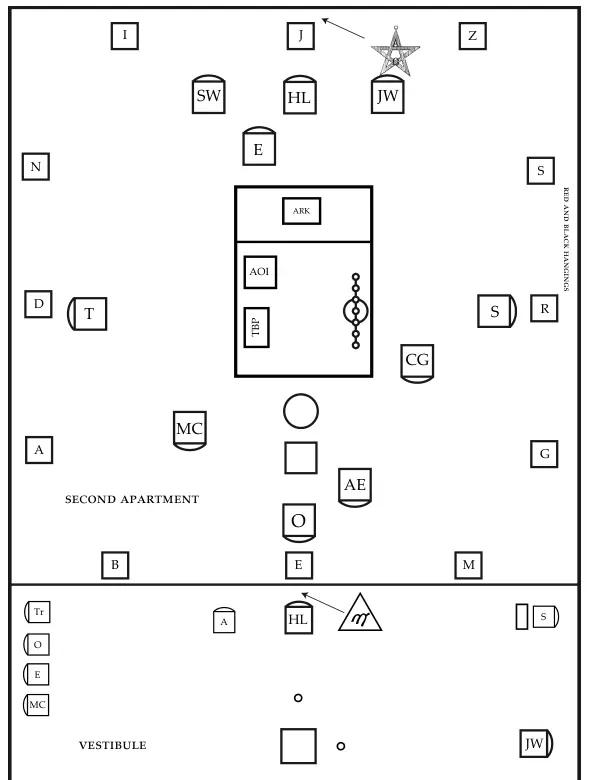
Pour tenir cette L∴ avec l’éclat qu’elle exige il faut deux appartements contigus, le 1er∴ est nommé vestibule, il est décoré de tous les Le 2e∴ est orné des décorations attributs de la Maçonnerie. conformes au plan ci-dessous, le nombre des lumières autour de la L∴ est de 49 sans y comprendre celles qui éclairent la Gloire & l’Autel.
Des habits
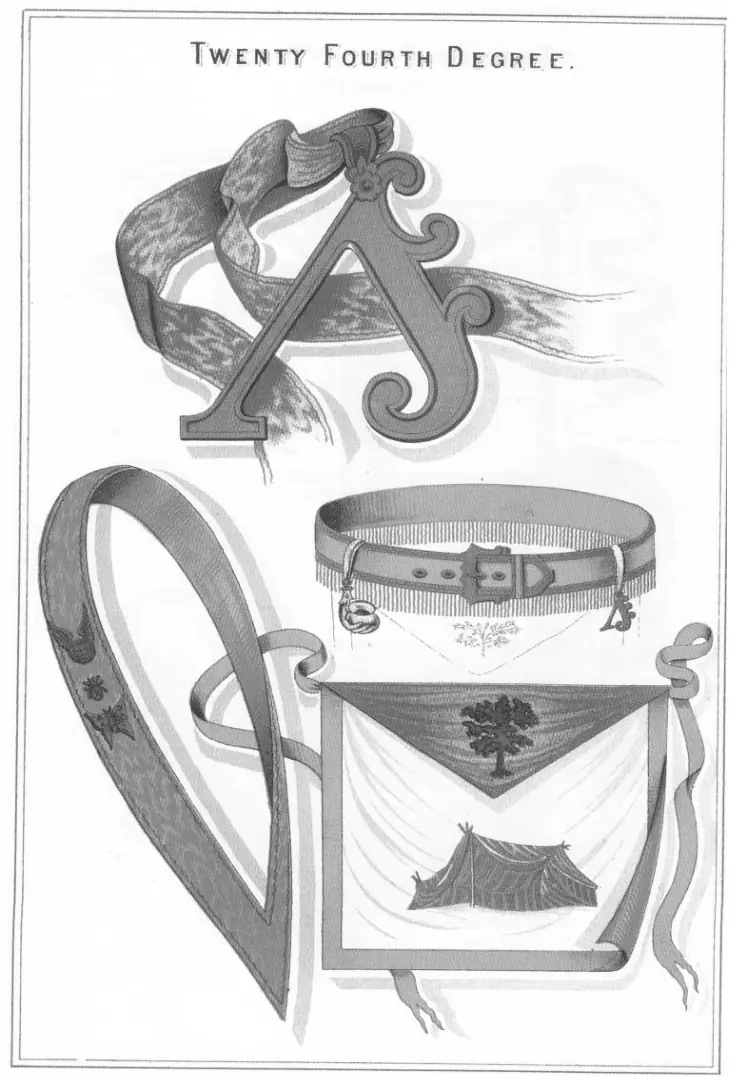
Tous les membres sont revêtus d’une espèce de camail ou aube de taffetas bleu, le collet garni de rayons comme ceux du Soleil en gaze d’or et raisonnablement long le reste de l’habit parsemé d’étoiles, l’on mettra par-dessus le cordon qui doit être un ruban ponceau moiré au bout duquel pend le Bijou. Voyez la
Planche figure ) Le cordon se porte indifféremment en sautoir ou
en bandoulière de droite à gauche, le tablier blanc doublé de taffetas ponceau on pourra l’orner par des broderies, ( Planche
figure ) le Bijou y sera brodé en or, tous les FF∴ porteront une
couronne fermée et environnée d’étoiles surmontée d’un triangle lumineux, on pourra aussi porter sur l’habit au côté gauche l’étoile la 716 broderie, le T∴ Puissant porte en main un sceptre composé d’une règle sur laquelle sont posées les deux pointes d’un Compas et par-dessus un triangle lumineux.
Ouverture
Tous les FF∴ assemblés au vestibule se décorent de leur habillemt∴, c’est en ce lieu qu’on questionne les visiteurs s’il y en a, ensuite le Me∴ des Cies∴ suivi de tous les membres de la L∴ suivant leur rang, entrent en L∴ où le Me∴ est nommé T∴ Puissant les trois Survts∴ Puissant, le 1er∴ est placé à la porte du Midi, le deuxième à celle de l’Occ∴ & le 3e∴ à celle du Nord, l’appartemt∴ doit-être parfaitement rond par les moyens de tentures, lors des réceptions, la L∴ est tendue d’une pe∴ perspective. Tous les FF∴ placés le T∴ P∴ dit : Puissants 1er∴ 2 e∴ & 3 e∴ Survts∴ et
vous FF∴ de cette Hiérarchie, l’amour du Souv∴ Me∴ pour qui les rois Folio 248 recto
Folio 247 verso
& les potentats de la Terre descendent de leurs Trônes nous unit en ce jour pour augmenter le nombre des zélés adorateurs. Puissant 1 er∴ Survt∴ quelle heure est-il ? D∴ La première heure du jour des sept que Jéhovah employa employa 717 à la construction R∴ de notre Hiérarchie, le 1 er∴ de vie & de sûreté. 718Le T∴ Puissant dit : Puissant 1 er∴ Survt∴ annoncez que la L∴ de Prince du Tabernacle est ouverte
Le 1er∴ Survt∴ Il frappe 7 coups dont six de suite & un détaché répète l’annonce, alors sept membres de la L∴ répètent ce que le 1er∴ Survt∴ vient d’annoncer après cela tous les FF∴ sont le Signe d’Admiration il 719 le F∴ Introducteur revêtu de ses habits va chercher le Récipiendre∴ dans la chambre des réflexions l’amène à la porte de la L∴ où il frappe sept coups, la L∴ est alors tendue en 1re∴ perspective, savoir les murs d’un tapis uni représentant une colonnade & le sol un pavé mosaïque, au milieu est un chandelier à 7 branches.
( Voyez la Planche figure )
Le 1er∴ Survt∴ ayant dit : au T∴ Puissant que l’on a frappé à la porte & ayant ensuite examiné ce que c’est par ordre du T∴ Puissant, il lui dit :
T∴ Puissant c’est un Chef du Tabernacle qui demande à être présenté au Temple achevé.Le T∴ Puissant dit : D∴ Combien de temps a-t-il travaillé ?
R∴ 2185 jours à obéir autant à imiter autant à perfectionner.
D∴ Quelle preuve en donnera-t-il ? Son innocence sur l’énorme innocence 720de la mort d’Hiram et l’envie qu’il R∴ a de faire de grands progrès dans la Vertu
D∴ Qui lui a inspiré ce désir ?
R∴ L’amour de nos solennités & le Nom Ineffable de Celui qui a promis de fixer sa demeure en ce Temple D∴Que demande-t-il de plus. Est-il en état de paraître en ce lieu saint ? 721R∴Oui T∴ P∴ Me∴ R∴
D∴ La sapience qui fut accordée à Salomon. 722 Introduisez-le à l’Occident. Étant introduit le T∴ P∴ dit F∴ Introd∴ faites avancer le Récipiendaire par six pas ordinaires et un plus grand, faites le reculer et avancer de nouveau de la même façon
Arrivé par cette marche au pied du Trône le T∴ Pt∴ dit :
voici la d re∴ heure du jour que dura la construction du Temple unissons-nous pour le sanctifier Le 1er∴ Survt∴ dit : Le Temple est ébranlé les autels sont renversés un culte impur oppose les ténèbres de
l’erreur à la lumière de la vérité, le 2e∴ Survt∴ dit :
L’Urim & Le Thurim 723 sont inaccessibles & muets le Saint des Saints n’exhale plus le pur encens offert par Salomon & son parvis sacré ne reçoit plus
de signes immémorables 724 d’un véritable adorateur.Le T∴ Pt∴ dit :
Salomon édifie un Temple par l’ordre de Jéhovah qui promit venir habiter et reçut en Gabaon, ce qu’il avait déjà reçu en Sion mais Salomon par son erreur donna atteinte à sa gloire, l’esprit du Souv∴ Arch te∴ de l’Un∴ se retira de lui et lui voila pour témoigner ses Tabernacles sacrés cet exemple frappant nous fait assez connaître l’instabilité de l’homme même le plus sage, si néanmoins par vos œuvres jusqu’ici merveilles vous évitez les écueils où ce roi, notre émule, se perdit vous réunirez tous nos suffrages et recouvrerez tous les droits que vous avez pour mériter l’entrée de
Folio 248 recto
nos Tabernacles sacrés
D∴ Persistez-vous mon F∴ à continuer votre route jusqu’à la prééminence des hauts lieux Oui T∴ P∴ Me∴ ....... Puissant F∴ qui surveillez à l’Occ∴ annoncez R∴ au Rble∴ F∴ la sagesse du Conseil plus éminente que la gloire d’Israël ne le fut autrefois et qu’il soit conduit par le F∴ Introd∴ aux points cardinaux de ce Temple
Le F∴ Introd∴ fait passer le Récipiendre∴ par une petite allée pratiquée derrière le Trône du Tout Puissant. La deuxième perspective est changée ce qui consiste à mettre des idoles contre les colonnades et à couvrir le pavé de la mosaïque d’un sol représentant des paysages & des animaux le chand à 7 branches est replacé, le tout étant achevé le Récipiendre∴ est conduit par le F∴ Introducteur au 1er∴ Survt∴ qui après lui avoir demandé les Signes de Maître lui dit : Mon F∴ les voies que vous cherchez
sont continuellement ouvertes aux yeux de l’Univers allez en Siloé en Gabaon, allez au Liban à Oreb et en Sina vous trouverez partout des traits qui déterminent une volonté sainte et vertueuse mais ne vous arrêtez pas au lieu de scandales et d’opprobres où Salomon laissant les voies du Seigneur arbora l’étendard 725 qui le précipita dans les routes égarées du paganisme. Le Temple dédié à l’inexorable 726 idole de Moloh 727 n’est pas la seule prévention728 728 chargé de l’administration 729 richesses qu’Israël avait consacré au culte de Dieu, il prodigua ce qu’il y avait de plus précieux & vous trouverez dans la carrière qui vous reste à parcourir les marques de ces égarements scandaleux qui justifieront l’horreur que je désire vous inspirer de son péché, puissiez-vous en imitant la Vertu du F∴ qui vous précède mériter nos suffrages & les lumières qui vous seront accordées.
Ce discours fini les FF∴ donnent le Signe l’Attoucht∴ et la Parole de Me∴ ensuite le Récipiendre∴ est conduit à l’Occ∴ où le Survt∴ après avoir reçu les Signes de Me∴ lui dit :
Le Temple de Jehovalh730 730 souillé & délaissé en Sion, le Temple de Moloch abreuvé de victimes humaines et son Autel fumant d’un encens qui n’est dû qu’à la divinité ne sont pas les seules taches que Salomon fit à sa gloire ni les seules taches731 731 ni les seuls dangers que vous avez à éviter, Astaroth, idole des Sidoniens, les abominations des enfants d’Ammon que vous voyez assis sur les idoles de Bethot732 732 souillés des abominables productions d’Éphraïm, Samarie, Damas et toute la suite des faux cultes rendus par les humains aux idoles élevées dans la Palestine & l’Egypte pourraient s’opposer par les appâts séducteurs de leurs faux plaisirs au point de vue des vertus qui vous guident et vous faire briser contre l’égide redoutable qui renversa Salomon Nous nous flattons pourtant qu’en continuant les victoires que vous remportez sur vous, vous arriverez au champ de gloire où vous devez être couronné.
Ensuite on lui donne les Mots et Att∴ de Me∴ & le F∴ Introd∴ le mène au T∴ P∴ à qui il dit : Les vapeurs qui Folio 249 recto Folio 248 verso
s’élèvent de la forge 733 de la Terre peuvent ajouter un éclat à la splendeur du Soleil mais aussitôt que cet astre se retire, l’éclat des nuages s’éclipse et disparait, tel a paru aux yeux du Respble∴ Récipiend re∴ la vérité 734 des faux dieux que l’orgueil a forgé et 735 l’à l’imbécilité, ses oreilles ne sont point portées aux chants mystiques qui les exaltent, sa bouche ni son cœur ne les ont point adorés son esprit accoutumé à s’élever aux grandeurs suprêmes pour y chercher le puissant Dieu qui les remplit de son immensité comme un aimant qu’une vertu sublime attire cherchant avec avidité l’Hurim & le Thunin de ses Tabernacles sacrés en voyant déjà un sanctuaire où il espère trouver son bonheur il précipite d’un pas rapide sa brillante carrière pour nous inviter à nous de l’unir.
Le T∴ Pt∴ porte les mains sur les yeux d’un 736 Récipiendre & lui dit : Retirez-vous sombres fantômes enfants
mystérieux 737 de la chimère et du délire qui égarez le voyageur incertain, retirez-vous oracles prestiges augures, devins sibylles & faux dieux et prophètes, monstres audacieux et chimériques usurpateurs des dons que la nature reçoit des cieux, le R ble ∴ F∴ triomphe de vos folies et de vos sacrilèges attentats
Pendant ce discours on incline les idoles et les colonnades on y substitue la perspective du Jardin de Dieu qui avec le sol du Temple donne la perspective du Paradis terrestre qui est le sujet du 3e plan Le T∴ Puissant dit :Ne pleurez plus des malheurs de Sion, ils
ne sont point l’effet d’une volonté absolue, qui frivole génie 738 qui la trame reste dans le néant de son empire avorté, Eden cette partie 739 antique de nos pères, ce Paradis visible, l’écoulement de la splendeur des cieux qui l’embellissent le terminent, ce séjour de triomphe et de béatitude que l’Éternel créa pour la postérité de notre postérité 740 et de notre Hiérarchie sera désormais votre demeure, je n’entreprendrai point de vous développer la grandeur du grade qui va vous être conféré d’autres puissances vont se réunir à moi pour vous en donner dans une exacte intelligence la juste idée, prêtez donc une oreille attentive pour en profiter. F∴ Introd∴ placez le F∴ à la perspective du Temple où tout ouvrage est parfait & qu’il s’y repose un instant.
On le fait asseoir à l’Occ∴ sur un tabouret lui faisant incliner la tête sur les mains et les 741 lui couvrant de son tablier, alors on allume les 49 bougies autour de la L∴ on élève 742 le chandelier à 7 branches et sur le piédestal on pose en groupe des cœurs dont le plus élevé est évasé & contient du feu autour sont rangées 7 bougies allumées sur ce même piédestal est une cassolette pleine d’encens et une cuillère à côté, le T∴ Pt∴ dit : au Récipiend∴ :
Si vous vous sentez la force pour soutenir l’éclat des merveilles qui vont se présenter à vos yeux découvrez-vous le visage.
Le Récipiendre∴ ôte son tablier de dessus les yeux et le Tout Puissant commence l’instruction qui est aussi le commencement & l’ouverture de la L∴ lorsqu’il n’y a pas de réception tant pour les décorations que pour l’instruction.
Folio 249 recto
Instruction
D∴ Puissant F∴ 1 er∴ Survt∴ êtes vous Prince du Tabernacle ?
R∴ Très Puissant Me∴ regardez-moi ( il fait le Signe du Cordon )
D∴ Qui êtes-vous ? Un de vos FF∴et les743 743 dernier des hommes éclairés. R∴
D∴ Comment le prouverez-vous ?
R∴ Le Mot de Passe, le globe & le triangle que je porte sont des preuves
Tabernacle de vérité744. 744 D∴ Donnez-moi le Mot de Passe R∴Uriel
D∴ Où avez-vous puisé ces connaissances R∴ Dans le g d∴ livre de la loi souveraine & immuable
D∴ Où est ce livre ? R∴ Il est perpétuellem t∴ ouvert aux yeux de l’Univers.
D∴ Comment est-il écrit ? R∴ En caractères lumineux et immuables
D∴ Qui vous a donné l’intelligence ? R∴ Celui qui invite l’esprit à s’élever aux choses. sublimes. D∴ Qui vous a fait apercevoir ces connaissances ?
R∴ La beauté la stabilité & la puissance réunies au souverain degré de toutes perfections
D∴ Quels furent les objets de votre admiration ? La Lune & cet astre céleste faisant sa route745 745 dans les cieux et la R∴ figure triforme qui se rempli d’une lumière au-dessus d’elle, qu’elle dispersait sur le sommet de Japhet où je reposais.
Dans l’intervalle de cette question la Lune parait nouvelle en son plein & à son décroit.
D∴ Qu’arriva-t-il ensuite ?
R∴ Les barrières du jour précédées de l’étoile du matin s’ouvrirent le Soleil plein de majesté parut dirigeant sa course de l’Or∴ à l’Occ∴ et dispensant à l’Univers des rayons de lumières si parfaits qu’il est impossible aux yeux d’en supporter l’éclat.
D∴ Que produisit le Soleil ?
R∴ La beauté des cieux dans toute sa splendeur qui réfléchit le jour et les rayons de cet astre à cette immense sphère, animent les vallons les montagnes les vastes réservoirs des eaux & toute la nature prête à s’étendre 746 reprenant sa première beauté à l’influence de sa chaleur vivifiante.
D∴ Qu’entendez-vous par chaleur vivifiante du Soleil ?
R∴ À son aspect la terre obéit et répand les effets de son abondante fécondité, le sperme des créatures vivantes, les semences végétales et les productions minérales acquirent leur perfection par sa présence les faisant éclore, germer et se reproduire ce qui perpétue et renouvelle à chaque instant les admirables effets des ouvrages des six jours
Pendant cette question le Soleil décrit sa course dans le firmament
D∴ Quelle évidence en avez-vous ? Mon existence invisible et mortelle747 747 caractérisée par R∴ le pouvoir que j’ai de voir d’entendre & de comprendre. Quelle est votre puissance visible maternelle748 748 et mortelle ? D∴
R∴ Elle se borne à me démontrer les rapports qui lient la Folio 250 recto
Folio 249 verso
multiplicité et la variété des objets que j’admire dans la nature et à me démontrer encore que les créatures formées d’un assemblage proportionné aux 4 éléments dans chaque régime 749 vivent et meurent se dissolvent et sont la preuve de l’anéantissement total du corps dans la matière.
D∴ Qu’est-ce que votre existence spirituelle invisible et immortelle ?
R∴ Elle émane des principes de vie qui donne le mouvement à tout ce qu’il y a de mortel dans mon corps et m’élève à l’immortalité où réside la puissance première et originale 750 de toute existence.
D∴ Qu’entendez-vous par puissance première et originale de toute existence Que tes ouvrages sont grands divin Arch te∴ de l’Un∴ Jéhovah R∴ Jéhovah. Tu ne te communiques point à la vérité aux yeux qui te cherchent, invisible au milieu de ta splendeur tu résides sur un Trône inaccessible sans que je puisse te voir ni te connaître également attentif à t’élever au-dessus de nos regards et à te manifester au sein de notre intelligence, tu maintiens les piers∴ dans l’instabilité 751 de tes ordonnances secrètes, et tu protèges les 2 ds dans les lois 752 éternelles qui te caractérisent et te démontrent la vaste circonférence du ciel les constellations innombrables qu’il contient l’étendue que mesure chaque constellation mille et mille fois plus grande que la Terre sont les témoignages que tu nous donnes de ton immensité de ta grandeur & de ta puissance, 753 les éléments qui depuis les premiers jours que tu les créas conservent sans dissipation ni augmentation la beauté & la stabilité de la puissance sont les signes par où tu manifestes que tu es l’essence unique et prééminente de la beauté de la plénitude, de la puissance et de la stabilité réunies au souverain degré de toutes perfections
Pendant la question suivante les nuages se replient sur euxmêmes & le triangle lumineux paraît dans tout son éclat.
Définissez plus amplement tous les signes de cette puissance 1 ère D∴∴ et originelle
R∴ Jéhovah ! Jéhovah ! L’union que tu exposes à mes yeux pour être le perpétuel témoignage de ton existence suprême ne l’explique pas d’un langage que je puisse rendre sublime 754 à la voix de même qu’à 755 l’aurore annonce tacitement le retour du Soleil 756 dispense silencieusement la lumière qu’il a préparé aux nations, mais dont la puissance éclairée devient à leur égard une preuve relative et secrète des vérités que tu m’ordonnes de leur notifier.
D∴ Donnez-moi le Signe des Princes du Tabernacle ?
R∴ À l’aspect de cette lumière sublime vous êtes forcé de le faire avec moi.
Le Tout Puissant fait conjointement avec tous les FF∴ le Signe ce Signe est de lever les yeux au ciel & les couvrir ensuite avec la main
gauche la main droite sur la poitrine & la tête inclinée.
2 e∴ Puissant Survt∴ qu’elle heure est-il ? D∴
R∴ La dernière des six où tout fut accompli.
Le Tout Puissant dit : Puissants FF∴ de cette Folio 250 recto
Hiérarchie, voici la dernière heure du jour des sept heures
Le T∴ Puisst∴ frappe six coups et de vie et de suavité. un détaché alors lui et tous les FF∴ font sept fois le tour de l’Autel et au 7e∴ chaque F∴ met de l’encens dans le feu et retourne à sa place. Ensuite le F∴ Introd∴ amène le Récipiendre∴ devant le T∴ Puissant qui lui dit
Instruit comme vous l’êtes des lois de la Maçonnerie que vous avez si dignement professées, vous connaissez ce que vous devez à l’Être suprême aux hommes à vous-même, pour le bonheur de la société morale et civile, peut-être qu’un sentiment 757 imprime la raison qui forme le désir qui rend l’âme inquiète après a pu troubler jusqu’à cette heure la paix intérieure que vous comptez goûter dans la fraternité, maxime758 758 du monde dont vous sortez, qu’avez-vous maintenant à désirer T∴ R∴ F∴ ? Vous avez connu les mystères qui nous constituent dans notre sapientifique Hiérarchie vous connaissez nos solennités, nos Autels, notre culte nos statiques occupations fixées à nos béatitudes suprêmes de Jéhovah qui reçoit dans sa gloire le pur encens que son amour a lui-même enflammé dans nos cœurs, voulez-vous être uni au cercle qui refera les fidels759...... 759 C’est en son nom ineffable que je vous demande si vous consentez d’y être
Le Récipiendre∴ répond :Oui.
parfaitement uni.
Le F∴ Introd∴ l’ayant amené par la marche ordinaire au Tout Puissant, ce dernier le revêt de l’habit en lui disant :
Que cet habit te voile à jamais aux ténèbres de l’erreur et de vains prestiges760. 760Ensuite prenant le cordon il lui en pose
le triangle sur la tête, le lui passe au col et lui dit :
Le cordon dont je t’environne est le symbole du cercle invisible de notre union, et de l’éternité du Souverain Grand Maître qui n’a ni commencement ni fin, le triangle qui le couronne est la preuve que tu as mérité d’être couronné du céleste Urim, & Thunin. Signe de la puissance & de la vertu.
Ensuite il lui donne le tablier et les gants et le baiser de paix en lui disant : Approchez-vous de l’Autel afin
d’offrir à l’Être Suprême l’encens qui va vous unir avec les Princes du Tabernacle et promettez-nous d’être fidèle observateur du secret inviolable envers tout ce qui est indigne de participer à nos solennités & à ce sublime grade.
Le Récipiendre∴ pose la main droite sur le cœur & dit :
Je promets tout parole d’honneur. Ensuite le Tout
Puissant lui donne les Signes.
Grand Signe
Porter les deux mains ouvertes sur la tête joindre les deux index et les deux pouces par le bout ce qui forme le triangle, ce signe ne se fait qu’en L∴.
Folio 250 verso
Signe de reconnaissance
Il se fait en portant la main droite ouverte sur les yeux comme pour la garantir des rayons du soleil ensuite la porter sur l’épaule gauche et la laisser tomber sur la hanche droite et rester en cette attitude.Ce Signe d’appelle aussi Signe du Cordon Mot Sacré.Jehovah. Il s’épèle. Mot de Passe.Urielen demande, on y répond : Le Tabernacle des vérités révélées.
Attouchement
Prendre le coude gauche pliant le bras pour faire ensemble une espèce de globe.
Batterie : Sept coups. Le F∴ lui fait faire 7 tours de l’Autel les Survts∴ lui posent ensuite une couronne sur la tête & tous les FF∴ disent 3 fois
Mohabon. Le Récipiendre∴ prend ensuite de l’encens avec la cuillère et dit :
Reçois Souv∴ Gd∴ Me∴ cette offrande de mon cœur et la parole donnée 761 du lien indissoluble que je contracte volontairement avec mes FF∴ de n’avoir qu’un cœur et qu’une volonté avec eux pour la gloire de notre union.
( Na∴ ) Le Récipiendre∴ doit toujours porter cette promesse sur lui en caractères hiéroglyphiques.
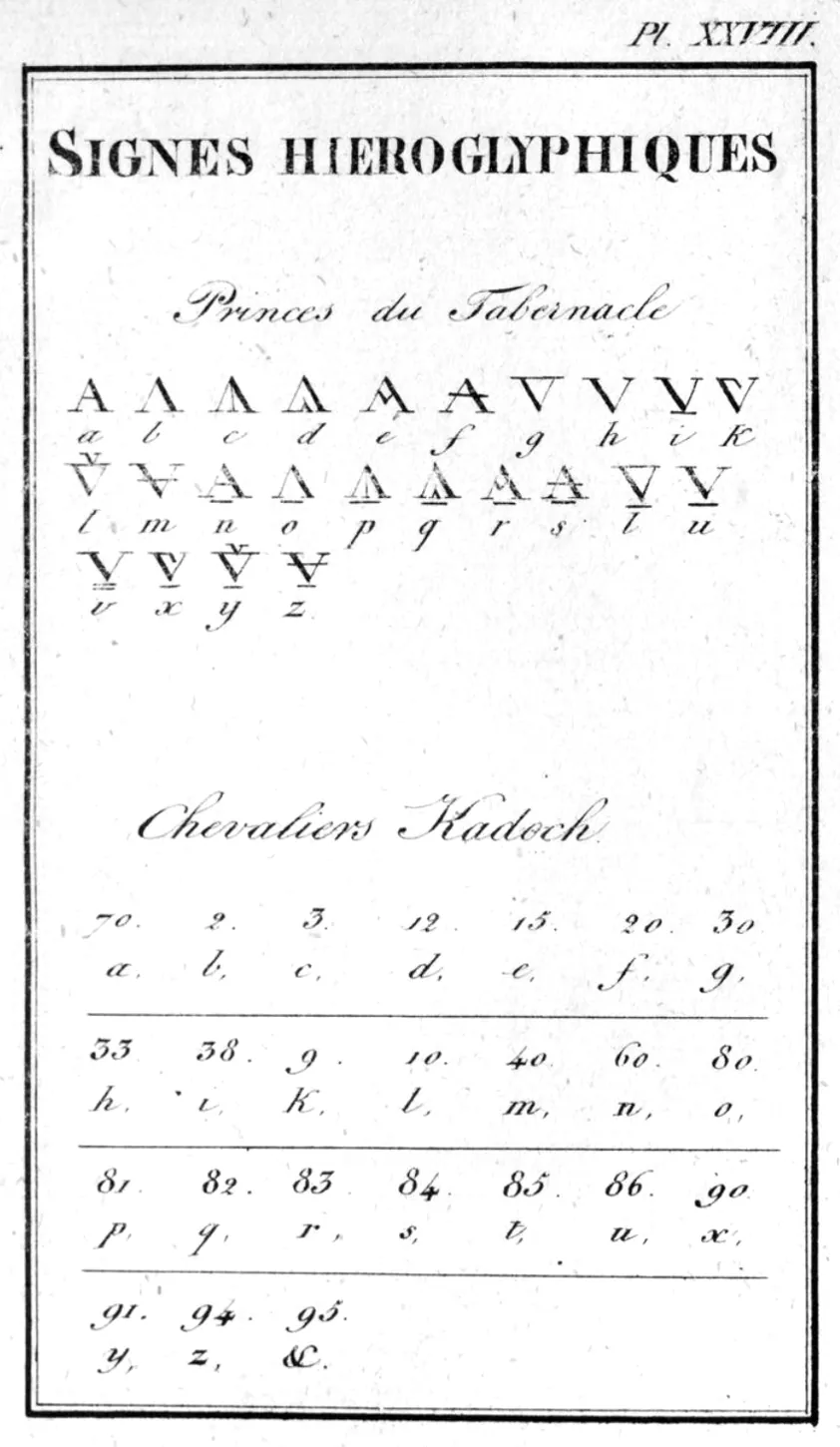
Caractères hiéroglyphiques de ce grade.
a, b, c, d, e, f, g, h, i, k, l, m, n, o, p, q, r, s, t,
u, v, x, y, z, &a∴ En ajoutant au-dessous de ces caractères des barres ainsi faites Ces caractères pour lors feront : 762 En ajoutant au-dessous de ces mêmes caractères on entend que les dix premiers, un point au lieu des barres, ces caractères pour lors feront les dix premiers chiffres. Le T∴ Puissant Me∴ dit : Puissant F∴ 1 er∴ 2 e∴ et 3 e Surv t
Puissants FF∴ de cette Hiérarchie, examinez l’ordre de nos Constitutions
Tous les FF∴ donnent alors le Signe de Reconnaissance.
D∴ F∴ Secrétaire quel est le double Mot de Passe ?
Uriel. Tabernacle des vérités révélées. R∴
D∴ Pourquoi annoncez-vous la vérité ?
R∴ Parce qu’elle fut le triomphe de mon couronnement et qu’en étant éclairé tous les Tabernacles me sont ouverts.
D∴ Quel temps y consacrez-vous ?
R∴ Des seize jours de repos qui succèdent aux douze pleines lunes de l’année et aux solstices qui en renouvellent les saisons
Folio 251 recto
mesurent les années, c’est dans ces périodes divines que je viens offrir à sa prééminence le sacrifice de tout autre plaisir.
D∴ Qui vous y assiste ?
R∴ Tous les FF∴ puissants constitués dont l’amour pour les solennités est égal au mien. D∴ Où sont les absents ? Les uns soustraits par l’ordre du destin leur souvenir sublime763 763 R∴ au cercle invisible de nos solennités, les autres par des causes illégitimes fuient la splendeur de la vérité pour se prostituer aux plaisirs764 764 d’une vie terrestre & mortelle.
D∴ Ont-ils droit de rentrer en L∴ ?
R∴ Oui si après avoir consulté leur raison les membres leur accordent de nouveau leur suffrage.
D∴ Expliquez la suite des Constitutions ?
R∴ L’antiquité de la Hiérarchie accréditée et fondée sur les traits de la justice et de la raison fait que dans l’ordre de la nature éternisant cette heureuse disposition qui nous fait agir avec le discernement que le Souv∴ Gd∴ Me∴ lui a inspiré 765 de F∴ en F∴ les transmettant à la postérité la plus reculée.
Tous les FF∴ s’inclinent D∴ Tout est-il accompli ? la tête appuyée sur les mains et après un moment de silence le T∴ Puissant frappe 7 coups détachés766 766 que les 3 Survts∴ répètent. Tous les FF∴ font le Signe de Reconnaissance et lèvent la tête
D∴ Puissant F∴ Secrétaire pourquoi restez-vous dans l’inaction Le mouvement par lequel le Souv∴ Gd∴ Me∴ excite nos R∴ travaux n’est point sujet aux vicissitudes d’une odieuse oisiveté mais si le soleil767 767 fait cesser l’activité qui me fait mouvoir ce n’est que pour réparer mes forces et les employer de nouveau au service du sanctuaire de celui qui me l’a donné. 768
D∴ Que signifient les 49 lumières ? Les dons principaux que le Souverain Gd∴ Me∴ accorde aux FF∴ R∴ pour s’élever aux cieux la plus parfaite demande769. 769
Le T∴ Pt∴ Me∴ dit : Puissants FF∴ 1 er∴ 2 e∴ & 3 e∴ Survts∴ Puissants
FF∴ de cette Hiérarchie conservons le feu divin dans nos cœurs afin qu’en quelque temps que l’on 770 nous surprenne, nous puissions accomplir tout ce que l’Arch∴ Suprême se propose de nous, et tout ce que notre amour nous fait désirer de lui
On fait circuler le Sac des Propositions et ensuite le Tronc des Pauvres cela fait tous les FF∴ sortent du Temple et vont se déshabiller dans le vestibule.
Cérémonies de Table
La table est ronde on range autour autant de canons que l’on est de FF∴ et chacun charge le sien à sa fantaisie l’on pose au milieu de la table le groupe de cœurs qui était sur l’Autel ainsi que l’encens l’on range autour sept lumières tous les FF∴ chacun selon son rang fait le tour de la table Le Tout Puissant Me∴ frappe sept coups répétés Folio 252 recto Folio 251 verso
Survts par les alors tous les FF∴ font le Signe de Reconnaissance & le T∴ Pt∴ dit : Puissants FF∴ 1 er∴, 2 e∴ et 3 e∴
Survts∴ Puissants FF∴ de cette Hiérarchie voici la première heure qui constitue notre Hiérarchie il est temps de lui rendre
L’on fait alors 7 tours circulaires autour de hommage. la table au 7e∴ chacun prend de l’encens et en met sur le feu et réitèrent tous les Signes de Reconnaissance ensuite le Tout Puissant dit :
D∴ F∴ Introd∴ pourquoi ces aliments ? Le Souv∴ Gd∴ Me∴ les a donnés à l’homme pour nourrir R∴ sustenter et fortifier son corps mortel et passible, mais il est une nourriture spirituelle qu’il a destiné à l’âme et que nous devons chercher avec empressement pour en profiter. Comment les uns et les autres nous sont-ils appliqués ? 771 D∴
R∴ Si ma puissance égale ma connaissance, 772 satisfaisant à la nature humaine, je l’acquiers par mon travail en rendant au Souv∴ Gd∴ Me∴ les honneurs qui lui sont dus, je prends de nouvelles faveurs et de nouveaux bienfaits que je tâche de partager avec les
Alors chacun met sur la table sa qualité 773 et indigents. ses aumônes enveloppées dans un papier et signées de celui qui donne Le T∴ Puissant dit ensuite : Donner à qui est dans
l’indigence tels sont les privilèges et les lois dictées par le cœur & l’humanité à tout homme vertueux que l’esprit est satisfait lorsqu’il fait le bien et soulage son semblable empressons-nous donc d’y souscrire mais si du bien procède le bien que nos solennités en réglent à jamais le légitime usage
Alors tous les FF∴ font le Gd∴ Signe cela fait on prend le verre & on boit. On fait une fois les accords des gobelets par un triangle par un cercle & la figure du cordon on pose ensuite le verre sur la table et l’on fait ensemble l’exclamation 774 en disant
3 fois Mohabon.Santés
1ère∴ Santé. Le Tout Puissant se lève frappe sept coups
répétés par les Survts∴ et dit : L’ardent midi de nos solennités
sollicite nos cœurs à des libations nouvelles, dans ce moment
tous se servent à boire.
Puissant F∴ 2 e∴ Survt∴ quelle suite de bonheur nous annoncez-vous ? D∴
R∴ Puisque par la Création les grandeurs de Jéhovah sont devenues visibles, la nature est un Temple délicieux orné pour nos qu’ 775Eden plaisirs raisonnables, c’est ainsi de l’Autel de la pure origine nous allons à la douce volupté les actions de notre libre arbitre remplaçant à la fois et nos plaisirs et nos devoirs perpétuent ainsi l’encens qu’il offre
Folio 252 recto
Le T∴ Pt∴ dit : FF∴ 1 er∴ 2 e∴ & 3 e∴ Surv ts à la divinité. FF∴ de cette Hiérarchie célébrons la grandeur du glorieux destin qui nous unit, c’est véritablement prospérer et acquérir l’immortalité que d’en jouir par les parfaits accords de nos
solennités.Puis il boit On fera les accords comme ci-devant. la triple acclamation Mohabon
2ème∴ Santé.Les canons chargés le Tout Puissant dit :
l’ardent midi de nos solennités sollicite nos cœurs à des libations nouvelles Puissant F∴ 1 er∴ Survt∴ quelle heure est-il ? D∴ La première heure du jour qu’Adam 776 parfait dans sa R∴ beauté, les créatures célestes élémentaires chacune dans l’ordre prescrit commence à éclairer son globe et à répandre sur lui les influences qui perpétuent l’effet de son abondante fécondité nos cœurs élus pour concourir à cultiver les fruits par de nouveaux travaux s’empressent d’embellir sa brillante 777 perspective.
D∴ Quel talents réunissez-vous ? Je partage indivisiblement les dons que le Gd∴ Me∴ R∴ imprime aux FF∴ pour mériter les suffrages et l’amour de tous
D∴ Où sont vos FF∴ ? Le Souv∴ Gd∴ Me∴ les dirige en L∴ et les couronne en Hiérarchie R∴
Le Tout Puissant frappe sept coups qui sont répétés par les Surveillants & dit :
Puissant FF∴ de la sapiente L∴ hiérarchique je porte la santé de tous les Maçons élus et à élire par les accords de 7 et 3 fois 3.
Puis on boit on fait les accords778 778 par un cercle et le signe du cordon on pose ensuite le verre sur la table et on fait ensemble l’acclamation en disant trois fois Mohabon.
3e∴ Santé.∴
Puissants FF∴nous portons la santé du roi notre maître et de toute la famille royale, que le Souverain Grand Me∴ leur donne joie et prospérité. On dit 3 fois. Vive le roi !
Le T∴ Puissant continue que ses volontés soient pour nous des
lois inviolables779. 779
On boit et on termine la santé comme les précédentes Si on en porte quelqu’autre on la porte assis et la L∴ se ferme comme celle de la Réception Folio supplémentaire LVIIIFolio 253 recto.
728. Erreur du copiste A : le mot exact est « prévarication », cf. Kloss et Pyron 1812.
729. Oubli du copiste A : il manque l’article « des », cf. Kloss et Pyron 1812.
730. Erreur du copiste A : mis pour « Jehovah ». C’est un autre signe de l’inculture du copiste.
731. Répétition du copiste A : absente des versions Kloss et Pyron 1812.
732. Erreur du copiste A : la phrase exacte est « sur les autels de Bethel », cf. Pyron 1812.
743. Erreur du copiste A : le mot exact est « le », cf. Kloss et Pyron 1812.
744. Erreur du copiste A : le phrase exacte est « Tabernacle des vérités révélées », cf. Kloss, Pyron 1812, et le rituel de Chef du Tabernacle.
745. Erreur du copiste A : le mot exact est « ronde », cf. Kloss et Pyron 1812.
746. Erreur du copiste A : le mot exact est « éteindre », cf. Kloss et Pyron 1812.
747. Erreur du copiste A : le mot exact est « immortelle », cf. Kloss et Pyron 1812.
748. Erreur du copiste A : le mot exact est « matérielle », cf. Kloss et Pyron 1812.
757. Erreur du copiste A : les mots exacts sont « ...peut-être un sentiment qu’... », cf. Kloss et Pyron 1812.
758. « ...goûter dans les fastidieuses maximes... » dans Kloss et Pyron 1812. La version Quesada paraît plus cohérente.
759. Le copiste A semble avoir eu des difficultés de lecture ; la phrase exacte est : « qui renferme le nombre de ses fidèles adorateurs », cf. Kloss et Pyron 1812.
760. Erreur du copiste A : le mot exact est « préjugés », cf. Kloss et Pyron 1812.
763. Erreur du copiste A : le mot exact est « subsiste », cf. Kloss et Pyron 1812.
764. Kloss et Pyron 1812 indiquent ici « loisirs ». La version Quesada semble plus exacte.
765. Kloss et Pyron 1812 indiquent ici « imprimé ». La version Quesada semble plus exacte.
766. Oubli du copiste A ; « 7 coups dont le 7e détaché », cf. KLoss.
767. Erreur du copiste A : le mot exact est « sommeil », cf. Kloss et Pyron 1812.
768. Erreur du copiste A : la phrase exacte est « ... celui qui me les a données », cf. Kloss et Pyron 1812.
769. Erreur du copiste A : le mot exact est « demeure », cf. Kloss et Pyron 1812.
770. Erreur du copiste A : les mots exacts sont « la mort », cf. Kloss et Pyron 1812.
776. Erreur du copiste A : le mot exact est « Eden », cf. Kloss et Pyron 1812.
777. Kloss et Pyron 1812 indiquent ici « vaillante ». La version Quesada semble plus exacte.
778. Oubli du copiste A : il manque les mots « par un triangle », cf. Kloss.
779. Cette santé implique que le texte recopié par le copiste A a été rédigé avant l’avènement du 1er Empire, voire avant 1793. Même remarque pour Kloss et Pyron 1812. C’est un indice de l’ancienneté de ce rituel. La conservation de cette santé dans une copie faite vers 1813 témoigne peut-être d’une permanence des idées royalistes dans le milieu du Suprême Conseil.
Delaulnaye 1813
tuileur imprimé · 64 mots
Le « Thuileur des trente-trois degrés de l'Écossisme » de Delaulnaye (Paris, 1813), premier tuileur imprimé du REAA constitué : mots, signes, décors et remarques du grade. Texte relu mot à mot sur le fac-similé, mots hébreux restitués. Pages 172-174 de l'édition originale.
La Loge est appelée Conseil Souverain ; le Chef, Grand-Commandeur.
Signe.
Étendre la main devant soi.
Attouchement.
Se prendre mutuellement les mains en les croisant l'une sur l'autre.
Batterie.
Trois Coups égaux.
○ ○ ○
Mot Sacré.
DIEU LE VEUT.
[p. 173]
Mot de Passe.
LE VOYAGE DE DIEU.
L'objet du grade est les douze Commandements des deux Tables de la Loi.
[p. 174]
Vuillaume 1820
tuileur imprimé · 599 mots
Le tuileur de Claude-André Vuillaume, « Manuel maçonnique, ou Tuileur de tous les rites de maçonnerie pratiqués en France » (Paris, Delaunay et Hubert, 1820) : décoration, titres, signes, attouchement, marche, batterie, âge, mots, habillement du grade, avec l'étymologie et l'interprétation des mots hébreux. Texte établi sur le fac-similé et relu mot à mot sur les images : océrisation à 600 dpi du volume numérisé, fusion avec la couche texte de la numérisation Gallica, puis relecture page par page. Orthographe de 1820 conservée, hébreu et grec restitués, batteries rendues comme l'imprimé les note, pagination de l'original. Pages 163 à 167. Les planches gravées du volume, absentes de la numérisation Google, sont reprises de la numérisation Gallica et rapportées au grade qu'elles représentent.
Le premier, qui précède immédiatement le second, est nommé vestibule, il sert de vestiaire. Il est décoré d'attributs variés de maçonnerie.
Le second appartement est de forme circulaire ; il est éclairé par quarante-neuf lumières.
La décoration varie, dans cet appartement, aux trois points de la réception.
Au milieu de la loge est un chandelier à sept branches.
TITRES.
La loge se nomme hiérarchie.
Le maître prend le titre de Très-puissant.
Il y a trois surveillans, qui ont le titre de
[p. 164]
Puissans ; ils se placent, l'un au sud, le second à l'ouest, et le troisième au nord.
SIGNES.
De reconnaissance. — Porter la main droite ouverte sur les yeux, comme pour se garantir d'une vive lumière, ayant la main gauche sur la poitrine ; ensuite porter la main droite vers l'épaule gauche et la ramener diagonalement sur le côté droit. Ce signe est nommé, signe du cordon.
Grand signe. — Porter les deux mains ouvertes sur la tête, joindre les deux pouces et les deux index par les extrémités, pour former un triangle.
L'attouchement, la batterie et les mots sont les mêmes que dans le grade précédent.
HEURES DE SERVICE.
Pour ouvrir. — La première heure du jour des sept de la construction de la hiérarchie.
Pour fermer. — La dernière heure du jour, de vie et de suavité.
MARCHE.
Six pas égaux et un plus grand, ensemble : sept pas.
[p. 165]
HABILLEMENT.
Une robe de soie bleue, dont le collet est garni de rayons en gaze d'or, imitant l'auréole ; le surplus de la robe parsemé d'étoiles d'or. Sur la tête, une couronne fermée, environnée d'étoiles, et surmontée d'un delta.
Cordon ponceau moiré, porté en sautoir ou en écharpe, passant de droite à gauche.
Tablier blanc, doublure ponceau.
[p. 166]
CÉRÉMONIE DE TABLE
DES CHEFS ET DES PRINCES DU TABERNACLE.
La table est ronde ; les mets ne sont pas déposés dessus ; ils sont présentés successivement à chacun, qui se sert à son gré.
Au milieu de la table est un groupe de cœurs enflammés, et de l'encens.
Il ne peut y avoir que sept lumières sur la table.
MANIÈRE DE PORTER LES SANTÉS.
1re SANTÉ.
Le maître dit : L'ardent midi de nos solemnités sollicite nos cœurs à des libations nouvelles, chargeons nos canons !
Puissant F∴ second surveillant, quelle suite de bonheur nous annoncez-vous ?
La réponse se fait selon le rituel.
Frères surveillans, et vous, puissans frères de cette hiérarchie, célébrons la grandeur du glorieux destin qui nous unit !
On vide la coupe d'un seul trait.
[p. 167]
2e SANTÉ.
Le maître dit : L'ardent midi de nos solemnités, etc.
Puissant F∴ premier surveillant, quelle heure est-il ?
Réponse, comme dans le rituel.
Quels talens réunissez-vous ?
Réponse, comme au rituel.
Où sont nos frères ?
Réponse : Le souverain grand-maître les dirige en loge et les conserve en hiérarchie.
Le maître reprend : Puissans frères de la sapiente loge hiérarchique, je porte la santé de tous les maçons élus et à élire, par les accords de sept et de trois fois trois.
3e SANTÉ.
Le maître fait charger les canons comme on l'a vu, et dit :
Puissans frères, nous portons la santé du Roi notre souverain, et de toute la famille royale. Que le souverain grand-maître leur donne joie et prospérité !
Planche XXVIII. SIGNES HIEROGLYPHIQUES. Princes du Tabernacle — Chevaliers Kadoch. Deux alphabets secrets : celui des Princes du Tabernacle, où chaque lettre est figurée par un chevron diversement pointé, et celui des Chevaliers Kadosch, où chaque lettre correspond à un nombre.
Pike 1857
rituel imprimé · en anglais · 33 370 mots
« The Magnum Opus or Great Work » (1857) : le premier corps complet de rituels révisés par Albert Pike pour la Juridiction Sud des États-Unis. Texte en anglais, établi par reconnaissance optique corrigée : des coquilles subsistent.
D'après la réimpression Kessinger de l'édition de 1857 (numérisation archive.org)
THE LODGE ROOM, ITS DECORATIONS, ETC.
_, The Lodge consists of two apartments, the first of which proceeds directly into the second, and is called - the Vestibule, where the brethren clothe themselves. It is furnished at all points like a Master's Lodge.
The second apartment is made completely circular, by means of a suite of hangings. The decorations
of this vary, as will be stated, hereafter, according to the three points of reception. In the centre is placed a candlestick with seven branches, each holding seven lights.
7. The dress in o blue silk tunic or alb; the collar of which is decorated with rays of gold representing a 'glory; and the body of it sprinkled with stars of gold. Upon the head is a close crown encircled with stars, and surmounted by a delta. . .
2+ The sash or cordon is a broad watered scarlet ribbon, worn es a collar, or as a sash from right to left. "The apron is white, lined with deep scarlet, and bordered with green; with the flap sky-blue. In the middle 'of the apron is « representation of the first Tabernacle, built by Moses.
" The jewel is the letter x, worn from a collar of broad crimson ribbon.
The Lodge is styled Assembly. The Chief Prince is styled T%.°. Puissané: and there are three Wardens, who are styled Puissant. The first Warden represents Aaron the High Priest, and sits in the West. The 'second represents Bersri-Ax [Bezalee!], and sits in the South. The third represents Anti-As [Aholiab), and sits in the North. ;
The Ch.*. Prince represents Moses: and the Candidate represents Erzazar the son of Aaron.
The battery is ? ??,
TO OPEN.
Th, P. Puissant Warden in the North, I am about to open this Assembly of Princes of the Tabernacle, that we may take counsel for the welfare of the Order. Are we well guarded, so that none save those -who are entitled to do so can approach the Tabernacle?
3d Ward.. Th.*. Puissant Chief Prince, the Tabernacle is guarded on all sides, and we are in security.
Th. P.. Puissant Warden in the West, are all present Princes of the Tabernacle? . 1st Ward.", All are Princes of the Tabernacle, Th.. P.-., and have seen the Perfection of the Holy
Mysteries of the Hebrews.
The. P. What are the duties of a Prince of the Tabernacle?
"XXIV...2
ist Wurd.*. .To labour incessantly for the glory of God, the honour of his Country and the happiness of his Brethren.
Th. P.*. Puissant Warden in the North, whom most thou represent?
3d Ward. Ahli-Ab, Th.. P.*., who aided in building the first Tabernacle.
Th, Ps. Tow did he labour upon the Tabernacle of the Lord? .
3d Ward. Asan engraver; beautifying the vessels thereof; and as an embroidered in blue and purple, and scarlet and fine linen.
Th. P. What does his occupation teach thee, in morals?
3d Ward.", To engrave upon my heart, and ever recollect, the Laws of God and the Statutes of Righteousness, Virtue and Truth; and to make my life beautiful with the embroidery of good actions.
Th. Ps. Puissant Warden in the South, whom most thou represent ?
2d Ward.*. Bessel-Al. Th.*. P.*., who aided in building the first Tabernacle.
Th.. P.:, Tlow did he labour upon the Tabernacle of the Lord?
2d Ward.'. In gold and silver and brass; in the cutting of stones, and in the carving of wood.
Tk... P.«. What does his occupation teach thee in morals?
2d Ward.. Ever to strive to attain perfection, and to be patient and persevering in every good work.
Th... P.. Puissant Warden in the West, Most Excellent High Priest, what is your duty in the Tabernacle? |
lst Ward... To offer up prayers and thanks to the Deity, in lieu of Sacrifices; and to aid you with my counsel and advice.: -
Th. P.. Its time to proceed to discharge our duties. Aid me, Princes, to open this Assembly! The Sign, my Brethren | .
{Each gives the Second Sign. The Th.*. P.. raps???,—each Warden successively the same; and the Th.. P.+, declares the Assembly open].
RECEPTION.
{The Candidate, representing Eleazar, the son of Aaron, is clothed in s white tunic, without ornaments or insignia, and conducted to the door of the vestibule, in charge of the-Sen.°. Deacon, who enters with him without ceremony. This room is furnished in every respect like a Master Mason's Lodge, except that, instead of the Bible, a roll of parchment, representing the Book of the Law, lies upon the Altar: and the Hebrew letter Yon is in the East, instead of the letter G. Here the Sen.". Deacon addresses him thus}: _
Sen. D.. Bro.*. Eleazar, thou bast been chosen to be anointed, consecrated, and sanctified, to minister unto the Lord in the Priest's office. But before thou cants enter upon the Mysteries of Consecration, thou must in the most solemn manner give assurance that no unworthy motive prompts thee to seek to know those Ancient Mysteries which were instituted among the Patriarchs; and the knowledge of which is indispensable to him who would become a Priest in Israel. Kneel, therefore,.and place thy hand on the Bockof the Law, and make true answer to such questions as shall be asked thee.
Ist. Most thou, now representing Eleazar the son of Aaron, solemnly declare that in seeking to know the hidden Ancient Mysteries, thou art not actuated by any spirit of idle curiosity, or the pride of knowledge; but by a sincere desire thereby to be the better-able to serve God, your Country and your Brethren, and more effectually to labour fur the reformation and improvement of mankind? '
Cand... Do.
Qd. In the character of Chief of the Tabernacle, has thou earnestly striven to discharge all the duties required of thee, and to live worthily, act justly, and fear God? .
Cand... I have. .
3d. Has thou, while a Chief of the Tabernacle, done wrong to any one, without making reparation, as far as was in thy power?
Cand.. Have not.
4th. Most thou solemnly swear, upon the holy Book of the law, and with thy heart open before God, and all its thoughts legible to Slim, that these answers are true and sincere, without equivocation or double meaning, or any mental reservation whatsoever? If thou most, soy, "I swear," and kiss the Book of the Law.
Cand.. I swear.
[The Sen.*. Deacon then raises him, and directs him to wash himself in a vessel prepared for the purpose ; after which he instructs him in regard to the emblems and furniture of the Lodge room as follows]: .
Sens, Do. Tam charged, my Brother, to explain to you the meaning of the several symbols with which you are now surrounded.
The Triangle with the letter Yon in the centre, suspended in the East, is an Emblem of the Deity, and of equity; because its sides are equal, and it is the first perfect figure that can be formed with straight lines.
The Square upon the Altar is an emblem of rectitude of intention and action, and of obedience to Constituted Authority: The Compasses, of Command, of the Motion of the Heavenly bodies, of harmony and of Eternity. ; ;
The three lights on the East, West and South of the Altar, represent the Summer Solstice and the Vernal and Autumnal equinoxes; the three persons of the Indian Godhead, the Creator, Preserver and Destroyer; the three Egyptian Gods, Osiris, Isis and Horus: and, to us, the absolute Reason, the creative Power, and the Protecting IntstiiceNnce that constitute the Godhead.
The two columns at the entrance represent the two solstices, and are the parallel lines between which is the circle with a point in the centre, representing the Sun. The circle also represents the Deity, in the centre of the universe ; ; and the two -columns those erected by Enoch to perpetuate the history of the times before the flood.
The plumb is a a symbol of decision, firmness and independence: of truth, and straight-forward simplicity.
'The level is a symbol of equality and equanimity; and teaches us that all men are equal in the sight of God and in the Mysteries.
'The blazing star represents Sirius or Sothis, the dog-star, announcing the approach of the inundation of the Nile, to the forefathers of the Hebrews, when-they toiled upon its banks. :
+: The rough stone or ashlar represents the Profane who is ignorant of the Mysteries ; and the perfect cube 'fa a symbol of the Enlightened to whom they are known. |
:To-many of these symbols there are-other meanings which it. should be your study to discover for yourself. :. Often' they are indicated to the initiate by a hint or a.suggestion only; in order that, obtaining Masonic light by thought and investigation, he may the more highly value it. And,as many of the explanations given in the three symbolic degrees embody the most common-place ideas, inventions of men of no capacity, after the true interpretation of these symbols had long been lost, it is the more incumbent on you, by reflection and study, to learn the true meaning for yourself.
- [This instruction being concluded, the Sen.*. Deacon blindfolds the Candidate, takes him by the hand, and leads him to the door of the second apartment.
This apartment, circular in shape, is now hung with scarlet: and around it, in front of the hangings are 12 columns, each having painted on it in brilliant letters one of the signs of the zodiac, which thus follow each other in regular progression. The Presiding Officer (Moses) sits in the East, clothed with all his insignis, between the columns on which are the signs Taurus and Aries: The 1st Warden, (Aaron) sits in the 'West, between the signs Libra and Scorpio; The 24 Warden in the South, between the signs Capricornus and Aquarius ; and the 3d Warden in the North, between the signs Cancer and. Leo, In the centre of the
room, by the chandelier, is'a triangular altar.
The Sen.°. Deacon * raps at the door [{???,]. It is opened by the Jun.*. Deacon, who inquires: " Who seeks admission to this inner chamber of the Mysteries ?"']
.- Sen. De. Eleazar the son of Aaron, who having been appointed to minister unto God in the Priest's office, desires first to know the Mysteries and receive the indispensable degree of Prince of the Tabernacle.
Jun... D, Has he attained the degree of Chief of the Tabernacle?
Sen. D.. He has.
Jun. D.. In that character, has he earnestly striven to discharge all the duties required of him, and to live worthily, act justly and fear God?
Sen, D.°. He has,
Jun. D.*. Has he, while such, done wrong to any one, without afterwards making 'reparation, as far as hath been in his power?
Sen.*. D.*. He hath not.
Jun. Do. Eleazar, art thou actuated, in seeking to know the Mysteries, by a sincere desire to be thereby better able to serve God, your country and your brethren, and more : efficiently to labour for the good of man?
Cand... Iam.
Jun. D.. Artthou not induced to come hither through idle curiosity or the pride of knowledge, and s desire to become superior to thy brothers and fellows?
* Cand. Iam not.
Jun. Do. By what further right does he expect to gain admission here?
Sen, D.. By the Sacred Word.
Jun. D.". Tlas he the Sacred Word?
Sen.*. D.*. The has,
Jun. D.*. Let him give it.
Sen.. D.*. Te cannot, except with our assistance.
Jun. D.. Let him begin then.
Cand. You... Sen. Dv. He... Jun. D.. Var. -« Cand. He.
Jun. D.. The word i is right. Let him wait until the Th.-. P.. Ch.:. Pr.*. is informed of his request.
[The i un.*. Deac.'. closes the door, goes to the centre of the circle, and gives the battery; and the Th.',
_ P., asks the same questions, in substance, as were asked at the door; and like answers are returned; until the Th.°. Puissant asks if the Candidate has the word; to which the Jun.*. Deac.. answers: " Ie has, and with my aid and that of his guide our Sen.*. Deacon, he has given it.'']
Th. P.. tis weil. Since he comes endowed with these necessary qualifications, let him-enter, and be received in due form.
[This is announced to the candidate, and he enters. When within the circle, he is stopped by: 'the Jun.-, Deacon, who bares his right arm, and holds a candle near enough to it to cause him to feel the heat and a slight pain; and the Jun.*. Deacon says}: "I test you by nine: and let this present pain ever remind you that he who rashly assumes to perform offices for which he is unfit, deserves the fate of Nadab and Abibu, who were consumed by fire from Heaven, when they offered strange fire before the Lord in the wilderness of Sinai."
[The candidate is then led 3 times around the room; while the Th.:. P.*. rend] :
Th. P*. "And the Lord spake unto Moses, saying, Bring the Tribe of Levi near, and present them before Aaron the Priest, that they may minister unto him. And they shall keep his charge, and the charge of the whole congregation before the tabernacle of the congregation, to do the service of the tabernacle. And thou shalt give the Levites unto Aaron and his sons. They are wholly given unto him out of the children of Israel. And thou shalt appoint Aaron and his sons, sod they shall wait on their Priests' office; and the stranger that comets nigh shall be put to death.""
[The candidate is then halted in the South, by the 2d Warden's station, who pours a small quantity of water on his head, and says}: " Thou bast reached the South. I test thee with water, the second test. Let it ever remind thee that none but the pure uf heart can be admitted to the Huly Tabernacle in the Heavens; whore God, who is Infinite Purity, presides; and that it is reformation and repentance, and not the blood of animals sacrificed, that wash out sin; of which reformation the Iavation of the body is a symbol."
[Then the candidate is again led 3 times around the room, while the Ist Warden rends]:
lst Wo. "At the door of the tabernacle of the congregation I will meet with the children of Israel; and I will sanctify the tabernacle of the congregation and the altar: I will sanctify also both Aaron and his Boas, to minister ta mo in the Priest's office: and J will dwell among the children of Israel, and I will be their God: and they shall kuuw that [ am the Lord their God, that brought them furth out of the land of Egypt, that I
might dwell among them; I, the Lord their God."
[The candidate is then halted in the West, by the Ist Warden's station ; who causes him to kneel upon a place prepared for the occasion with sand and gravel; and says}: 'Thou has reached the West. I test thee with gant. Its the common mother, and to it our frail bodies return. It is well to kneel upon its bosom when we would implore the mercy and forgiveness of God. Let the beneficence of the earth, which pro-, duceth generously and liberally, even for the unworthy, teach thee generosity, and that the open hand is a fit companion of the pure heart." . . . . °
" [Then the candidate is again led 3 times round the circle, while the 2d Warden reads]:
.. [The candidate is then halted in the East, at the station of the Th.*. Puissant; who says to him, while the brethren, with fans, make a wind about him]: "Thou has reached the East. I test thee with AIR, the life of all men, the free, inestimable gift of God. Like Him it is mighty, but invisible. Like Him it blesses us ever. Be thou liberal and generous as the air: for, if God freely gives thee light and air, and asks in return nothing but gratitude and whispered thanks, thou gayest well afford to share thy plenty with thy destitute, afflicted and unfortunate brother. Bro.°. Sen.*. Deacon, whence come you?" .
Sen... Deac.. Qutof the darkness.
Th. P.. And whither go you?
'Sen.t. Deac.'.. To the East, the place of Light, and crédle of the Mysteries.
-f.*. 'Thou art already there. What is thy desire?
Sen.2 Deac.. .That this aspirant may go the way that we have gone before him, and attain unto the new life..." ::- . , .
"Thee Poe ~The soul is immortal; but for the body, life comes only out of death. If he would see the 'Tight, conduct him to the Holy Altar, and let him there assume the proper obligation.
.. [The Candidate is led to the altar, where he kneels (advancing to it from the West by six equal and one long step), and, with his hands upon the book of the Law, repeats the following obligation] :
OBLIGATION.
J, A..... B....., in the presence of the God of Abraham, Isaac and Jacob, and knowing that he is now reading the thoughts of my heart, do hereby and hereon, most solemnly and sincerely promise and swear, that I will never reveal to any person in the world the secrets of this degree of Prince of the Tabernacle, unless it be, to one who is legally authorized to receive them; and when I am legally authorized to communicate them to him. .
-I furthermore promise and swear, that I will pay due obedience to all the laws, rules and regulations which appertain to this degree, or may be regularly made and enacted by the superior authority.
-- furthermore promise and swear, that I will remember and observe the lessons which I have received in
this degree; that I will be generous and liberal to the poor and needy, and just and impartial in public and private judgment, even when deciding between myself and another; that I will not harbor malice nor seek revenge, but will love my neighbour like myself, so far as human infirmity will allow:. that I will not entirely glean my wheat-field nor my vineyard, but will leave something for the hungry and the stranger; and that [ will not oppress or take usury of a brother. And should I wilfully violate this my obligation, I admit that I shall deserve to be consumed with fire from Heaven, like Nadab and Abibu, and that my ashes should be fung
8p°
XNIV...6
into the air, to be blown to the four corners of the earth by the winds: and may God aid me faithfully to keep and perform this, my obligation!
" [The Candidate is then told to rise. He dues so, and remains standing blindfolded before the altar, A brother in the vestibule rends in a gloomy voice as follows]:
"Rebel became a keeper of sheep, but Cabin was a tiller of the ground. In process of time it came to pass that Cabin brought, of the fruit of the ground, an offering unto the Lord. And Ilebel, he also brought, of the firstlings of his flock, and of the fat thereof. And the Lord had regard unto Rebel and to-his offering. But unto Cabin and his offering he had not regard. And Cabin was very wroth, and his countenance was downcast. And the Lord said unto Cabin, 'Why art thou wroth, and why i is thy countenance downcast? If thou does well, cants thou not liftitup? but if thou does not well, sin concheth at the door. , Though unto thee be its desire, thou shouldest rule over it.' Cabin spoke with Rebel his brother; and it came to pass, when they were in the field, that Cabin rose up against Hebel, his brother, and slew him."
{In the mean time, all the lights are extinguished, except a single lamp or candle: and, as the reading concludes, three brethren, clothed in black and wearing black masks, rush in, seize the Candidate, in silence, tear the bandage from his eyes, and hurry him into the vestibule, where they force him into a coffin, placed on the floor in the middle of the room. They then throw a black cloth over his body, leaving the face uncovered, and withdraw. Both apartments are now entirely dark. All is silent.for o time, and then mournful voices: are heard in the second apartment, saying, from different quarters of the room, as 'follows]:
eist Voice: ... Osiris, the God of Light, is slain, The Spirit of Evil hath conquered, and darkness is
about to prevail over the earth.
°d Voice: ... Trpmox hath flung the body i in o coffin upon the waters; and Iris and Horus go in search
of it, mourning, over the earth. °
3d Voice: ... Calais slain by Tswana, and committed to the waves. The wintry constellations laugh for joy; and the earth is wrinkled with cold, and shudders at the darkness.
4h Voice: . ..-Auniman has prevailed over Oruczp. The Six Evil Devs. cry aloud for joy; and the three thousand years of evil, sorrow and darkness commence.
5th Voice: .. - Atrsis slain in Phrygia, and his body remains without sepulture, while all the land is 'cursed with barrenness, and Crbexe seeks him weeping, on the plains and among the mountains that resound . with the clashing of her cymbals. . -
Gih Voice: .. . Toauncz, mutilated by the wintry boar in Phoenicia, has descended to the shades, and left the world to mourn. Astarte, wearing the crescent, sitting with veiled head on Mount Libanus, besieges
heaven with prayers for his return.
Tih Voice: . . . Diosusos is slain by the Giants; and the women mourn his death in the Etruscan forests
and upon the Syrian mountains; and all the Malignant Signs of the Zodiac rejoice.
8th Foice: . . Mivaras is dead, is dead. His body lies in the tomb, and the Magi weep over it, and chant their funereal hymns, while the shadows of night gather over them, and all Persia and Armenia mourn: but his suffering shall be the safety of the disconsolate.
Ist Voice: . . Letus cry unto the Lord. Avows-Annix, give us Light!
2d Voice: . . See our tears, Au-Saepr, Most Mighty and Victorious! have ys from the darkness, and
restore us to thy favour!
3d Voice: . . Wave mercy upon us, Apex-Tspactn, Lord of 'the Starry Hosts of Heaven, and Author of
our Existence! Have mercy, An-Kuaxan, Lord of Mercy!
dth Voice: .. Thou art the Most Bligh, O Attex! Thou art the Fire, O AL, whose titles are Apar and Assn-Genau! Thou art the Light, O Mevec-Aunia! Lift upon us the light of thy countenance!
5th Voice: . . Guide our footsteps, and direct us in the right path, O Lord our Uod. Io Nisst! Bo merci-
ful unto us, and with Thy great Light drive back the Powers of Darkness!
{During these lamentations and cries, resounding from different directions, in mournful and piercing tones, the coffin is taken up and carried into the second apartment, and placed upon the floor in the centre. By this time the room will have been changed, by dropping hangings entirely black on the inside of the columns,
There is still but a single dim light. At the head of the coffin is set an artificial tree of the thorny tamarisk
or the acacia.
The Princes now assume their seats, in perfect silence, all covered with black robes or mantles, entirely concealing their jewels and regalia. Then the Th.*. Puissant speaks]:
Th.. P*. My Brethren, the Power of Darkness has prevailed over the Prince of Light. The Earth mourns and is wrinkled with frost. The leaves full from the trees; snow shrouds the mountains, and cold winds sweep over the shuddering skies, All Nature laments; and we share the common sorrow. Excellent
- First Warden, let prayers be offered up in the Tabernacle for the return of Light and the re-ascension of the Sun, and of that Moral and Spiritual Light of which he is the type.
1st Ward... Th. Puissant, all the Nations of the Earth do fast and pray. Our ancient taskmasters on the banks of the Nile mourn for Osiris, The Chaldeans lament for Bet, and the Phoenicians for Toasuvz. The Phrygian women clash their cymbals and weep fur Arrs: on the Syrian hills and over the Etruscan plains the Virgins lament for Dioxusos: while far in India the Brahmins pray for the return of Cawa; and in Persia the Magi predict the resurrection of Miraras. The dead will rise again, as the wheat grows from the grain; and all the world will then rejoice.
Th.. Po... We, like our Ancient Masters, mourn Osiris; the type to us of the Sun, of Light, of Life. The Scorpion and the Serpent rule the winter waves, on which the frail ark tosses that contains his body. Weep,-my Brethren, fur Osiris! Weep for Light lost, and Life departed, and the Good and Beautiful oppressed by Eyl! Man hath fallen from his first Estate, and is lost, as the sun hath sunken into the icy arms of winter. Weep for Osiris, type of the Good, the True, the Beautiful! Wow shall his body be recovered from the embraces of the hungry sea; and earth again be gladdened by his presence?
2d Wards, Th.-. Puissant, nine Princes offer to go forth and search for the body of Osiris. ,
. Th. P.. Let them go forth, my Brother, by threes, to the East, the West and the South, and make diligent search; while wa continue in fasting and prayer. |
(The Brethren walk round, a3 if searching for the body, and after a time they gather round the coffin: and one says] : " Behold, my brethren, the body of Osiris under this spreading tamarisk." Each of the Brethren 'makes the first sign ; and says, " God wills it." Then a brother says, 'Cover the face, my. brethren, and let us hasten to the Th.'. P.°. Ch.*. Prince, and make known to him that the body is fyand." ,
«3 [They cover the face, and return to the Station of the 2d Warden; and the Jun.*. Deacon says: "Puissant
2a Warden, Prince Bessel-Al, we have found the body of Osiris cast on shore at Byblos, and concealed by a
tamarisk-tree, which by the wonderful virtue of the body has grown up around it in a night"].
2d Ward.. Th.°. P.*. Ch.*. Prince, the body of Osiris has been found at Byblos, where it hath been cast ashore, concealed by a.tamarisk-tree, which by the wonderful virtue of the body has grown up around it,
. hk». P.. Summon the Princes, my brother, to attend us while we repair thither: for it is promised that
the dead shall rise again.
2d Ward. Princes and brethren, the body of Osiris is found, at Byblos; and the Cb.-. Prince goeth thither, and summons you to bear him company.
(The Brethren again surround the coffin. In the menn time, the room is hung with red as before, and the lights are lighted. The Th.-. P.:. says, "My Brethren, assist me to raise this body." Ie takes off the covering, grasps the right hand of the Candidate with his right, and the left with his left, and with the assistance of the three other officers, raises him to his feet].
3d Warden: .. Osiris is risen again, and prevails against the Powers of Darkness. Orpheus and Dionugos return from the Shades. Cams and Ttys rise again ; and Adoni reigns henceforth in Heaven.
22 Ward... . The Sun turns back from the South, and darkness flees before him. To-day is the great feast of the Winter Solstice.
», lst Wards... The reign of Light and Life has recommenced. The feet of the young Spring shine afar off upon the Mountains; and the Bull and Ram lead on the glittering constellations: Let all the world rejoice! The reign of Evil ends; and thé Good Principle i is victorious. Let Earth and Heaven be glad t
3d Ward. The seed dies, and out of its death springs the young shoot of the new wheat, to produce an
handred- fold.
- 2d Ward. The worm dies in its narrow prison-house, woven by itself, and out of its death springs the
brilliant moth, emblem of immortality. . .
Ast Ward.. The deadly serpent dies, and self-renews its own existence; and out of the death of Night's
sleep, the minor mystery, comes the renewed life of the morning.
The. Po... Now, as over, out of Death springs Life: out of Darkness ever comes the Light; and to
Evil, in eternal circle Good succeeds. Hence the profound truth of the Indian idea of the Godhead; God, three in One; the Creator, the Preserver and the Destroyer: the three sides of the Triangle; the One Only Absolute; developing Himself in three Modes, and those modes one harmony.
(The Candidate is now seated ; and the Th.-. P.:. proceeds, addressing him]: -
Th. P.. "My Brother, the allegory in which you have performed o part, we will shortly endeavour more fully to explain to you. As nn initiate of the time of Moses, you have represented the different personifications of the Sun among the Ancient Nations, and the Principle of Light and of Good, warring with and victorious over that of Darkness and Evil. .
"When the Hebrew Initiate, whom you have represented, had been raised as you have, from his simulated and allegorical death, he was briefly taught the meaning and application of the ceremony through which he had passed. History is silent as to the language of that explanation' Hear however its substance, as spoken in the Deserts four thousand years ago. .
"*You are taught by this Mystery,' it was said to him, 'that the Heathen Gods are Unreslities, and mere ideal personifications either of the heavenly bodies, of the Powers of Nature, or of the Principles of Light and Darkness, and Good and Evil. The Egyptians, Phoenicians, Chaldean and Philistines have thus given to the Sun, the Moon, the Stars, Heaven, Earth, the Sky, Light, Fire, the Air and the Ses, personal charactaristics and names. They worship the Powers of Nature in the Constellations, and the Constellations in the animals imaged there. The idol is mere wood and stone, the representation of an unreal ideality. Our People, prone to idol-worship are forbidden to make to themselves, any symbol or idol of the Deity. There is bat one Only True God, who bath no bodily shape, nor hath been scen of any man. Ile is n-t the Light, nor Fire, but pure Absolute INTELLECT and Existence, the Soul and Spirit of the Universe, which Ie created with thought. The Past, the Present and the illimitable Future, the infinite series of events and successions of time in both directions, are all present to Slim at one and the same moment... There is to Him no Future''and no Past. Present everywhere, there is to Him neither There nor Elsewhere. Everything to: Him is Here and Now. Ile is unchangeable, immutable, infinitely just, wise and powerful. Me can neither be angry nor repent, What we term his punishments are but the inevitable results, that by-bis great laws of cause and effect, the corollaries from universal harmony, flow from and follow sin and crime. .
"The soul is immortal. The body, perishing, dissolves into atoms infinitely small and mingles again with nature, and forms new bodies, of man, and living things below man, and the vegetable creation. The soul, a spark of the Universal Soul, imprisoned in the body, becomes sordid with the body's imperfections; and must be purified before it can return and mingle again with the Universal Source. It is immortal, not of necessity, but unless God pleases, as it and all things emanated from Tim, to absorb it again into Himself. No sin that man commits will go unpunished, and after death the soul will feel the results of its sins and errors here, by a law os inflexible as that which holds the stars to their courses.
"You are also taught how constant is the struggle in every man's nature between the Divine Will,
implanted in every man by God, and the natural will, prone to vice and error, and caused by the frailty of the flesh. Osiris and 'T'syphon, Ormuzd and Ahriman, Vishnu and Siva, make of every human soul, as they do of the world and universe, a battle-field. All the universe coheres. The struggle between material light and darkness is more than a symbol of that between good and evil. It is in the truest sense the same, Such is the law of harmony. The contest is One: and it goes on under different forms, in the universe and all its parts.
"Tt will henceforward be your duty to seek full instruction in these great mysteries, which the mass of the people are incapable of understanding. To them, material images of God will ever be indispensable, One religion after another will spring up, and grow for s time, and decay and die, and give place to another 3 the framers and o select few will know the great primitive truths which must be the foundations of all religions; but the people will ever worship idols and images, either carved of wood and stone, or found on earth or in the
XAIV...9
heavens, or the gross material ideas and images which in their own minds they will form and enthrone as representations of the Deity. Ie will ever be to them only an ideal aggregate of their own mental faculties and their passions, as unreal as an image in 2 mirror.
"To you it will be given to understand these truths; and the esoteric meaning of the allegories and fables which are taught the people; and which, without their knowing it, contain all truth. We hope that you will zealously avail yourself of the opportunities which we shall gladly give you, to learn from us all that we ourselves know of the true essence and relations of the Deity and Nature.' Such, in substance, were the lessons taught to the Hebrew Initiate; whom you are yet for a while to represent, while you are finally consecrated, as he was, to the service of God, as a Priest before Him, and to that of man, as a Teacher and Benefactor. Make bare thy right foot, and kneel before me !"" Se .
The candidate kneels, with his right foot naked. The Th.". P.". takes in his left hand a small vessel of perfumed oil; and says: "I will sanctify the Tabernacle of the congregation, and the Altar. I will sanctify also both Aaron and his sons, to minister to me in the Priest's office. In the Tabernacle of the congregation without the vail, which is before the testimony, Aaron and his sons shall order it from evening to morning before the Lord. It shall be a statute forever unto their generations, on behalf of the children of Israel. And - thou shalt anoint Aaron and his sons, and consecrate them, that they may minister unto me in the Priest's office." [Ie pours a little of the oil on the head of the candidate, and says]: " Eleazar, son of Aaron, I do anoint thee and consecrate thee to the service of truth and virtue, which is the service of the Lord; to minister unto Him and unto thy fellow-men in this world, which is His truest Tabernacle and Temple."
-. He then takes a small vessel, with a liquid resembling blood, and using a small brush or pencil, suiting the action to the word, says: '" With the blood of the ram slain for a burnt offering I touch the tip of thy right ear,the thumb of thy right hand, and the great toe of thy right foot, and with the same blood I sprinkle thy garments, and do sanctify thee and them. Thine ear is hereafter to be ever open to the cry of distress, the prayer of want, the moan of suffering, the supplication of the penitent, and the call of duty: thy hand is henceforth to be opened wide in charity, and ready to labour in every good work: and thy feet are to stand firmly wherever duty places thee, however dangerous the post; nor ever to slide upon the slippery paths of "Lomptation."" . , . +
c.: » He raises him and gives him the signs, token and.words, and invests him with the insignia and jewel of the Degree; and then says: " Brethren, behold a new Priest of the Tabernacle, to be instructed and prepared 'to falSt all his duties as 0 Prince of Well-Doers in this Tabernacle of clay,.that he may be raised on the great day'of account, a shining monument of God's glory, in the Tabernacle not made with bands, eternal in the
Heavens." . .
Ist Stan: of Recognition: ... Raise the eyes to Heaven, and 78*Ct PRCI5 YO PR the tikO<"1I,
BITCH, as if to seer D TY them from My Can HOLE. At the same time, place the t}&@<*I
on the tTimtCOA%, inclining the & COMM towards the Be&Y STUCt: then MOY the ti&QMI
Ty Yr TROL SOT h to the 9%.
2a, The Granp Ten: .. Place both hands $ wer the & You, with the 5:4 25m and WY :¢¥9-
QCA CYPCHIOCH, and joining so as to form a triangle; the ¥ Q=—°PS: of the WYICYO much: above. .
and the 7&5 252 turned IY PATIO: the body being the base, the OFF, Some and WYITCVE 2CL Cis the sides, and the SCC? 9-4), of the ay perer-s of the latter the apes, of the Triangle.
'Toren: ..« Mutually take each other's hands; the t with the $ and the ¢ with the }CY#¥, T1¥a0-
geeQ.. them—and give the Pass-word. .
Pass-word: OCtCf-h C&4O&.". [Substitute fur the latter word, OO Y4"9]: . . or, in English, P&C
SxRteCh 38 QL. .
Sacred Worn; h C{SO%MC FOR CEZOS [substitute OCUY—].. . or in English, (UY UIttS
(The following lecture is then read to the Initiate]: .
LECTURE.
Symbols were the almost universal language of ancient theology. They were the most obvious-method of instruction; for, like nature herself, they addressed the understanding through the eye; and the most ancient expressions denoting communication of religious. knowledge, signify ocular exhibition. The first teachers of mankind borrowed this method of instruction; and it comprised aon endless store of pregnant hieroglyphics. These lessons of the olden time were the riddles of the Sphinx, tempting the curious by their quaintness, but involving the personal risk of the adventurous interpreter. "The Gods themselves," it was said, '' disclose their intentions to the wise, but to fools their teaching is unintelligible ;" and the King of the Delphic Oracle was said not to declare, nor on the other hand to conceal; but emphatically "intimate or signify.?"
The Ancient Sages, both barbarian and Greek, involved their meaning in similar indirection and enigmas ; their lessons were conveyed either in visible symbols, or in those ' parables and dark sayings ef eld,'? which the Israelites considered it a sacred duty to hand down unchanged to successive generations. The explanatory tokens employed by man, whether emblematical objects or actions, symbols or mystic ceremonies, were 'like the mystic signs and portents either in dreams or by the wayside, supposed to be significant of the intentions of the Gods; both required the aid of anxious thought and skilful interpretation. It was only by a correct appreciation of analogous problems of nature, that the will of Heaven could be understood By the Diviner, or the lessons of Wisdom become manifest to the Sage.
' The mysteries were a series of symbols; and what was spoken there consisted wholly of accessory explanations of the act or image;-sacred commentaries, explanatory of established: symbols ; with little of. those independent traditions.embodying physical or moral speculation, in which the elements or planets were the actors, and the creation and revolutions of the world were intermingled with recollections of ancient events: and yet with so much of that also, that nature became her own expository through the medium of an arbitrary symbolical instruction; and the ancient views of the relation between the human and divine received dramatic forms. .
. There has ever been an intimate alliance between the two systems, the symbolic and the philosophical, in the allegories of the monuments of all ages, in the symbolic writings of the priests of all nations, in the rituals of all secret and mysterious societies: there has been a constant series, an invariable uniformity of principles, which come from an aggregate, vast, imposing and true, composed of parts that fit harmoniously only there.
Symbolical instruction is recommended by the constant and uniform usage of antiquity; and it has
retained its influence throughout all ages, as a system of Mysterious Communication. The Deity, in his revelations to man, adopted the use of material images for the purpose of enforcing sublime truths; and Christ taught by symbols and parables. The mysterious knowledge of the Druids was embodied in signs and
symbols. Taliesin, describing his initiation, says, "The secrets were imparted to me by the old Giantess ( Ceridwen, or Isis), without the use of audible language." And again he says, "Iam na silent proficient."
Initiation was a school, in which were taught the truths of primitive revelation, the existence and attributes of one God, the immortality of the Soul, rewards and punishments in a future life, the phenomena of Nature, the arts, the sciences, morality, legislation, philosophy and philanthropy, and what we now style psychology and metaphysics, with animal magnetism and the other occult sciences.
All the ideas of the Priests of Ilindostan, Persia, Syria, Arabia, Chaldea, Phoenicia, were known to the Egyptian Priests. The rational Indian philosophy, after penetrating Persian and Chaldea, gave birth to the Egyptian Mysteries. We find that the use of Hieroglyphics was preceded in Egypt by that of the easily
understood symbols and figures, from the mineral, animal and vegetable kingdoms, used by the Indians, Persians and Chaldeans to express their thoughts: and this primitive philosophy was the basis of the modern philosophy of Pythagoras and Plato. .
All the philosophers and legislators that made Antiquity illustrious were pupils of the initiation; and all the beneficent modifications in the religions of the different people instructed by them were owing to their institution and extension of the mysteries. In the chaos of popular superstitions, those mysteries alone kept man from lapsing into absolute brutishness. Zoroaster and Confucius drew their doctrines from the mysteries. Clemens of Alexandria, speaking of the Great Mysteries, says, "Ifere ends all instruction. Nature and all things are seen and known." IInd moral truths aloneé been taught the Initiate, the mysteries could never have deserved or received the magnificent eulogiums of the most enlightened men of Antiquity,—of Pindar, Plutarch, Isocrates, Diodorus, Plato, Euripides, Socrates, Aristophanes, Cicero, Epictetus, Marcus Aurelius and others ;—philosophers hostile to the Sacerdotal Spirit, or historians devoted to the investigation of Truth. ~ No: All the sciences were taught there: and those oral or written traditions briefly communicated, which reached back to the first age of the world. _ .
Socrates said, in the Prado of Plato; "It well appears that those who established the mysteries, or secret assemblies of the Initiated, were no contemptible personages, but men of great genius, who, in the early ages strove to teach us, under enigmas, that he who shall go to. the invisible regions, without being purified, will be precipitated into the abyss; while he who arrives there, purged of the stains of this world, and accomplished in virtue, will be admitted to the dwelling-place of the Deity. . . The initiated are certain to attain the company of the Gods." . :
Le gr retextatus, Proconeul of Achaia, a man endowed with all! the virtues, said, in the 4th century, that to depriveé the Greeks of those Sacred Mysteries which bound together the whole human race, would make life insupportable. : . . a
Initiativn was considered to be o mystical death ja descent into the infernal regions, where every pollution, and the stains and imperfections of a corrupt and evil life were purged away by fire and water; and the perfect Epopt was then said to be regenerated, new-born, restored to a renovated existence of life, light and purity ;-and placed under the Divine Protection. .
_.A new Language was adapted to these celebrations,—and also a language of hieroglyphics, unknown to any bat those-who had received the highest Degree. And to them ultimately were confined the learning, the "morality and the political power of every people among which the mysteries were practised. So effectually was the knowledge of the hieroglyphics of the highest degree hidden from all bat a favoured few, that in . process of time their meaning was entirely lost, and none could interpret them. If the same hieroglyphics- .were employed in the higher as in the lower degrees, they had a different and more abstruse and figurative meaning. It was pretended, in later times, that the sacred hieroglyphics and language were the same that were used by the Celestial Deities. Everything that could heighten the mystery of initiation was added, until the very name of the ceremony possessed o strange charm, and yet conjured up the wildest fears. The greatest rapture came to be expressed by the word that signified to pass through the mysteries. —
The Priesthood possessed one-third of Egypt. They gained much of their influence by means of the
Mysteries, and spared nc means tu impress the people with a full sense of their importance. They represented -them as the beginning of a new life of reason and virtue: the initiated, or esoteric companions were said to entertain the most agreeable anticipations respecting death and eternity, to comprehend all the hidden mysteries of Nature, to have their souls restored to the original perfection from which man had fallen; and at their death to be borne to the celestial mansions of the Gods. The doctrines of a future state of rewards and punishments formed a prominent feature in the mysteries; and they were also believed to assure much temporal happiness and good fortune, and afford absolute security against the most imminent dangers by land and sea. Public odium was cast on those who refused to beinitinted. They were considered profane, unworthy of public employment or private confidence; and held to be doomed to eternal punishment as impious. To betray the secrets of the Mysteries, to wear on the stage the dress of an Initiate, or to hold the Mysteries up
to derision, wus to incur death at the hands of public vengeance. . oo,
It is certain that up to the time of Cicero, the mysteries still retained much of their original character of
sanctity and purity. And at a later day, as we know, Nero, after committing a horrible crime, did not dare, even in Greece, to aid in the celebration of the Mysteries ; nor at o still Inter "day was Constantine, the Christian Emperor, allowed to do so, "after his murder of his relatives.
Everywhere, and in all their forms, the Mysteries were funereal; and celebrated the mystical death and restoration to life of some divine or heroic personage: and the details 'of the legend and the mode of the death varied in the different Countries where the Mysteries were practised. .
Their explanation belongs both to astronomy and mythology; and the Legend of the Master's Degree i is but another form of that of the Mysteries, reaching back, in one shape or other, to the remotest antiquity. "Whether Egypt originated the legend, or borrowed it from India or Chaldea, it is now impossible to know. But the I[cbrews received the Mysteries from the Egyptians; and of course were familiar with their legend,—known as it was to those Egyptian Initiates, Joseph and Moses. It was the fable (or rather the truth clothed in allegory and figures) of Osiris, the Sun, Source of Light and Principle -of Good, and Tresox, the Principle of Darkness and Evil. In all the histories of the Gods and heroes lay couched and hidden astronomical details and the history of the operations of visible Nature; and those in their turn were also symbols of higher and profounder truths. None but rude uncultivated intellects could long consider the Sun and Stars and the Powers of Nature as Divine, or as fit objects of human Worship; and they will consider them so while the world lasts; and ever remain ignorant of the great Spiritual Truths of which these are the hieroglyphics and expressions.
A brief summary of the Egyptian legend will serve to show the leading idea on which the Mysteries among the Hebrews were based.
Osiris, said to have been an ancient King of Egypt, was the Sun; and Isis, his wife, the Moon: and his history recounts, in poetical and figurative style, the annual journey of the Great Luminary of 'Heaven through the different Signs of the Zodiac.
In the absence of Osiris, Syphon, his Brother, filled with Envy and Malice, sought to usurp his throne; but his plans were frustrated by Isis. Then he resolved to kill Osiris. This be did, by persuading him to enter a coffin or sarcophagus, which he then flung into the Nile. After o long search, Isis found the body, and concealed it in the depths of o forest; but Syphon, finding itthere, cut it into fourteen pieces, and scattered them hither and thither. After a tedious search, Isis found thirteen pieces, the fishes having-eaten the other (the privates), which she replaced of wood, and buried the body at While; where o temple of our passing magnificence was erected in honour of Osiris.
Isis, aided by her son Orus or Horus warred against Syphon, slew him, reigned gloriously, and at her * death was re-united to her husband, in the same tomb.
Syphon was represented as born of the earth; the upper part of his body covered with feathers, in stature reaching the clouds, his arms and legs covered with scales, serpents darting from him on every side, and fire flashing from his mouth. Iforus, who aided in slaying him, became the God of the Sun, answering to the Grecian Apollo; and Syphon is but the anagram of Python, the great serpent slain by Apollo.
The word Syphon, like Eve, signifies a serpent, and life. By its form the serpent symbolizes life, which circulates through all nature. When, towards the end of autumn, the Woman (Virgo), in the constellations seems (upon the Chaldean sphere) to crush with her heel the head of the serpent, this figure foretells the coming of winter, during which life seems to retire from all beings, and no longer to circulate through nature. This is why Syphon signifies also a serpent, the symbol of winter, which, in the Catholic Temples, is represented surrounding the Terrestrial Globe, which surmounts the heavenly cross, emblem of redemption. If the word Syphon is derived from Tupou?, it signifies a tree which produces apples (mala, evils), the Jewish origin of the fall of man. Syphon means also one who supplants, and signifies the human passions, which expel from our hearts the lessons of wisdom. In the Egyptian Fable, Isis wrote the sacred word for the instruction of men, and Syphon effaced it as fast as she wrote it. In morals, his name signifies Pride, Ignorance and
'Falsehood. -
When Isis first found the body, where it had floated ashore near Byblos, « shrub of erica or tamarisk near it had, by the virtue of the body, shot up into « tree around it, and protected it; and hence our sprig of acacia. Isis was also aided in her search by Anubis, in the shape of agog. Ie was Sirius or the Dog-Star, the friend
ATV... 13
and counsellor of Osiris, and the inventor of language, grammar, astronomy, surveying, arithmetic, music and medical science; the first maker of Inws; and who taught the worship of the Gods, and the building of Temples.
In the Mysteries, the nailing of the'hody of Osiris up in the chest or ark was termed' the aphanism, or disappearance (of the Sun at the Winter Solstice, below the Tropic of Capricorn], and the recovery of the different parts of his body by Isis, the Zurests, or finding, The Candidate went through a ceremony representing this, in all the Mysteries everywhere. The main facts in the fable were the same in all countries ; and the prominent Deities were everywhere a male and 2 female. ;
. In Egypt they were Osiris and Isis: in India, Mahadeva and Sita: in Phoenicia, Thammuz (or Adonis) and Astarte (or Venus): in Phrygia, Ttys and Cybele: in Persian, Mithras and Asis: in Samothrace and Greece, Dionusos or Sabazeus and Rhea: in Britain, Hu and Ceridwen ; and in Scandinavia, Woden and Frea : and in every instance these Divinities represented the Sun and the Moon. . _ :
The Mysteries of Osiris, Isis and Horns, seem to have been the model of all the other ceremonies of initio» tion subsequently established among the different peoples of the old world. Those of Ttys and Cybele, celebrated in Phrygia; those of Ceres and Proserpine, at Eleusis and many other places in Greece, were but copies of them. This we learn from Plutarch, Diodorus Siculus, Lactantius and other writers; andin the —
'absence of direct testimony should necessarily infer it from the similarity of the adventures of these Deities ; for the ancients held that the Ceres of the Greeks was the same as the Isis of the Egyptians; and Dionusos or Bacchus as Osiris. : .
In the legend of Osiris and Isis, as given by Plutarch, are many details and circumstances other than those that we have briefly mentioned; and all of which we need not repeat here. Osiris married his sister Isis; 'and laboured publicly with her to ameliorate the lot of men. He taught them agriculture, while Isis invented laws. He built temples to the Gods, and established their worship. Both were the patrons of artists and their useful inventions; and introduced the use of iron for defensive weapons and implements of agricul ture, and of gold to adorn the temples of the Gods. He went forth with an army to conquer men to civilization, teaching the people which he overcame to plant the vine and sow grain for food. . .
Syphon, his brother, slew him when the sun was in the sign of the Scorpion, that is to say, at the autumnal equinox. They had been rival claimants, says Synesius, for the throne of Egypt, as Light and Darkness contend ever for the empire of the world, Plutarch adds, that at the time when Osiris was slain, the moon was at "its fall; and therefore it was in the sign opposite the Scorpion, that is, the Bull, the sign of the vernal equinox. . .
: . Plutarch assures us that it was to represent these events and details that Isis established the mysteries,
in which they were reproduced by images, symbols, and a religious ceremonial, whereby they were imitated : and in which lessons of piety were given, and consolations under the misfortunes that afflict as here below. Those who instituted these mysteries meant to strengthen religion and console men in their sorrows by the lofty hopes found in a religious faith, whose principles were presented to them covered by a pompous ceremonial, and under the sacred veil of allegory. .
_ To aid her in the search for the body of Osiris, and to nurse her infant child [Horns, Isis sought out and took with her Anubis, son of Osiris, and his sister Nephté. Ile, as we have said, was Sirius, the brightest star in the Heavens. After finding him, she went to Byblos, and seated herself near a fountain, where she had learned that the sacred chest had stopped which contained the body of Osiris. There she sat, sad and silent,
OD
shedding o torrent of tears, Thither came the women of the Court of Queen Astarte, and she spoke to them, and dressed their hair, pouring upon it deliciously perfumed ambrosia. This known to the Queen, Isis was engaged as nurse for her child, in the palace, one of the columns of which was made of the erica or tamarigk, that had grown up over the chest containing Osiris, cut down by the King, and, unknown to him, still] enclosing the chest: which column Isis afterwards demanded, and from it extracted the chest and the body, which, the latter wrapped in thin drapery and perfumed, she carried away with her. fo
Blue Masonry, ignorant of its import, still retains among its emblems one of a woman weeping over a broken column, holding in her hand a branch of acacia, myrtle, or tamarisk, while Time, we are told, stands behind her combing out the ringlets of her hair. We need not repeat the vapid and trivial explanation there given, of this representation of Isis, weeping at Byblos, over the column torn from the palace of the King, that
' contained the body of Osiris, while Horus, the God of Time, pours ambrosia on her hair.
Nothing of this recital was historical; but the whole was an allegory or sacred fable, containing a meaning known only to those who were initiated into the mysteries. All the incidents were astronomical, with a meaning still deeper lying behind Zia? explanation, and so hidden by o double veil. The mysteries, in which these incidents were represented and explained, were like those of Eleusis in their object, of which Pausanias, who was initiated, says that the Greeks, from the remotest antiquity, regarded them as the best calculated of all things to lead men to piety: and Aristotle says they were the most valuable of all religious institutions, and thus were called mysteries par excellence; and the Temple of Eleusis was regarded.as, in some sort, the common sanctuary of the whole earth, where religion had brought together all that was most imposing and most august.
The object of all the mysteries was to inspire men with piety, and to console them in the miseries of life. That consolation, so afforded, was the hope of a happier future, and of passing, after death, to a state of eternal felicity.
Cicero says that the initiates not only received lessons which made life more agreeable, but drew from the ceremonies happy hopes for the moment of death. Socrates says that those who were so fortunate as to be admitted to the mysteries, possessed, when dying, the most glorious hopes for eternity. Aristides says that
. they not only procure the initiates consolations in the present life, and means of deliverance from the great weight of their evils, but also the precious advantage of passing after death to a happier state.
Isis was the Goddess of Suis; and the famvuus Feast of Lights was celebrated there in her honour. There were celebrated the mysteries, in which were represented the death and subsequent restoration to life of the God Osiris, in a secret ceremony and scenic representation of his sufferings, called the Mysteries of Night.
The Kings of Egypt often exercised the functions of the Priesthood ; and they were initiated into the sacred science as soon as they attained the throne. So of Athens, the First Magistrate, or Archon-King superintended the mysteries. This was an image of the union that existed between the Priesthood and Royalty, in those early times when legislators and kings sought in religion a potent political instrument.
Ilerodotus says, speaking of the reasons why 'animals were deified in Egypt: "If I were to explain these reasons, I should be led to the disclosure of those holy matters which I particularly wish to avoid, and which, but from necessity, I should not have discussed atall."' So he says, "The Egyptians hare at Sais the tomb of a certain personage, whom I do not think myself permitted to specify. i is behind the Temple of Minerva." (The latter, so called by the Greeks, was really Isis, whose was the often-cited enigmatical inscription, "I am what was and is and is tocomc. No mortal hath yct unveiled me."] So again he says: "Upon thiy Inke are represented by night the accidents which happened to him whom I dare not name. The Egyptians call them their mysteries. "Concerning these, at the same time that I confess myself sufficiently informed, I feel myself compelled to be silent. Of the ceremonies also in honour of Ceres, I may not venture to speak, further than the obligations of religion will allow me.'
It is easy to see what was the great object of initiation and the mysteries; whose first and greatest fruit was, as all the ancients testify, to civilize savage hordes, to soften their ferocious manners, to introduce among them social intercourse, and lead them into a way of life more worthy of men. Cicero considers the establishment of the Eleusinian mysteries to be the greatest of all the benefits conferred by Athens on other
'commonwealths; their effects having been, he says, to civilize men, soften their savage and ferocious manners, and teach them the true principles of morals, which inttiafe man into the only kind of lifo worthy of him. The same philosophic orator, in a passage where he apostrophizes Ceres and Proserpine, says that mankind owes these Goddesses the first elements of moral life, as well as the first means of sustenance of physical life; knowledge of the laws, regulation of morals, and those examples of civilization which have improved the manners of men and cities.
Bacchus in Euripides says to Pentheus, that his new institution (the Dionysian Mysteries) deserved to be known, and that one of its great advantages was, that it proscribed all impurity: that these were the Mysteries of Wisdom, of which it would be imprudent to speak to persons not initiated: that they were established among the Barbarians, who in that showed greater wisdom than the Greeks, who had not yet received them. -
'This double object, political and religious,—one teaching our duty to men, and the other, what we owe to 'the Gods; or rather, respect for the Gods calculated to maintain that which we owe the laws, is found in that well-known verse of Virgil, borrowed by him from the ceremonies of initiation: '' Teach me to respect Justice and the Gods." 'This great lesson, which the Iierophant impressed on the initiates, after they had witnessed a representation of the Infernal regions, the Poet places after his description of the different punishments suffered by the wicked in Tartarus, and immediately after the description of that of Sisyphus,
Pausanias, likewise, at the close of the representation of the punishments of Sisyphus and the daughters of Manaus, in the Temple at Delphi, makes this reflection; that the crime or impiety which in them had chiefly merited this punishment, was the contempt which they had shown for the Mysteries of Eleusis. From this reflection of Pausanias, who was an initiate, it is easy to see that the Priests of Eleusis, who taught the dogma of punishment in Tartarus, included among the great crimes deserving these punishments, contempt for and
disregard of the Holy Mysteries; whose object was to lead men to piety, and thereby to respect for justice and the laws, chief object of their institution, if not the only one, and to which the needs and interest of religion itself were subordinate; since the latter was but a means to lead more surely to the former: for the whole force of religious opinions being in the hands of the legislators to be wielded, they were sure of being better obeyed."
"he ¢ The Mysteries were not merely simple lustrations and the observation of some arbitrary formulas and - 'ceremonies; nor a means of reminding men of the ancient condition of the race prior to civilization: but they led men to piety by instruction in morals and as to a future life; which at ao very early day, if not originally, formed the chief portion of the ceremonial.
++, Symbols were used in the ceremonies, which referred to agriculture, as Masonry has preserved the ear of wheat in a symbol and in one of her words: but their principal reference was to astronomical phenomena. Much was no doubt said as to the condition of brutality and degradation in which man was sunk before the institution of the Mysteries; but the allusion was rather metaphysical, to the ignorance of the uninitiated,
than to the wild life of the earliest men.
The great object of the Mysteries of Isis, and in general of all the Mysteries, was a great and truly politic one. It was to ameliorate our race, to perfect its manners and morals, and to restrain society by stronger bonds than those that human laws impose. They were the invention of that ancient science and wisdom which exhausted all its resources to make legislation perfect; and of that philosophy which has ever sought to secure the happiness of man, by purifying his soul from the passions which can trouble it, and as a necessary consequence introduce social disorder. And that they were the work of genius is evident from their ~ employment of all the sciences, a profound knowledge of the human heart, and the means of subduing it.
It is a still greater mistake to imagine that they were the inventions of charlatanism, and means of deception.' They may in the lapse of time have degenerated into imposture and schools of false ideas; but they were not so.at the beginning; or else the wisest and best men of antiquity have uttered the most wilful falsehoods. In process of time the very allegories of the Mysteries themselves, Tartarus and its punishments, Minos and the other judges of the dead, came to be misunderstood, and to be false because they were s0; while at first they were true, because they were recognized as merely the arbitrary forms in which truths were enveloped.
The object of the Mysteries was to procure for man a real felicity on earth by the means of virtue: and
to that end he was taught that his soul was immortal; and that error, sin and vice must needs, by an inflexible law, produce their consequences. The rude representation of physical torture in Tartarus was but an image of the certain, unavoidable, eternal consequences that flow by the law of God's enactment from the sin committed and the vice indulged in. The poets and mystagogues laboured to propagate these doctrines of the soul's immortality and the certain punishment of sin and vice, and to accredit them with the people, by teaching them, the former in their poems, and the latter in the sanctuaries; and they clothed them with the charms, the one of poetry, and the other of spectacles and magic illusions.
They painted, aided by all the resources of art, the virtuous man's happy life after death, and the horrors of the frightful prisons destined to punish the vicious. In the shades of the sanctuaries, these delights and horrors were exhibited as spectacles, and the initiates witnessed religious dramas, under the name of initiation and mysteries. Curiosity was excited by secrecy, by the difficulty experienced in obtaining admission, and by the tests to be undergone. The candidate was amused by the variety of the scenery, the pomp of the deco-— rations, the appliances of machinery. Respect was inspired by the gravity and dignity of" the actors and the majesty of the ceremonial; and fear and hope, sadness and delight, were in turns excited.
The Tierophants, men of intellect, and well understanding the disposition of the people and the art of controlling them, used every appliance to attain that object, and give importance and impressiveness to their ceremonies. As they covered those ceremonies with the veil of Secrecy,-so they preferred that Night should cover them with 'its wings. Obscurity adds'to impressiveness, and assists illusion; and.they used it to produce an effect upon the astonished initiate. The ceremonies were conducted in caverns dimly lighted: thick groves were planted around the Temples, to produce that gloom that impresses the mind with a religious awe.
The very word mystery, according to Demetrius Phalereus, was a metaphorical expression that denoted the secret awe which darkness and gloom inspired. The night was almost always the time fixed for their celebration ; ; and they were ordinarily termed nocturnal ceremonies. Initiations into the Mysteries of Samothrace took place at night; as did those of Isis, of which Apuleius speaks, Euripides makes Bacchus say, that Ais mysteries were celebrated at night, because there is in night something august and imposing.
Nothing excites men's curiosity so much as Mystery, concealing things which they desire to know: and nothing so much increases curiosity as obstacles that interpose to prevent them. from indulging in the gratis- - cation of their desires. Of this the Legislators and UWierophants took advantage, to attract the people to their sanctuaries, and to induce them to seek to obtain lessons from which they would perhaps have turned away with indifference, if they had been pressed upon them. In this spirit of mystery they professed to imitate the Deity, who hides himself from our senses, and conceals from us the springs by which He moves the Universe. They admitted that they concealed the highest truths under the veil of allegory, the more to excite the curiosity of men, and to urge them to investigation. The secrecy in which they buried their mysteries, had that end. Those to whom they were confided, bound themselves, by the most fearful oaths, never to reveal them. They were not allowed even to speak of these important secrets with any others than the initiated; and the penalty of death was denounced against any one indiscreet enough to reveal them, or found in the Temple without being an initiate: and any one who had betrayed those secrets, was avoided by all, as excommunicated.
siristotle was accused of impiety, by the Ilicrophant Eurymedon, for having sacrificed to the manes of his wife, according to the rite used in the worship of Ceres. Ile was compelled" to flee to Chalets; and to purge his memory from this stain, he directed, by his will, the erection of a Statue to that Goddess. Socrates, dying, sacrificed to Esculapius, to exculpate himself from the suspicion of Atheism. <A price was set on the bead of Diagoras, because he had divulged the Secret of the Mysteries. Andocides was accused of the same crime, as was Alcibiades, and both were cited to answer the charge before the inquisition at Athens, where the People were the judges. JZschylus the Tragedian was accused of having represented the mysteries on the stage; and was acquitted only on proving that he had never been initiated.
Seneca, comparing Philosophy to initiation, says that the most sacred ceremonies could be known to the
adepts alone: but that many of their precepts were known even to the Profane. Such was the case with the
doctrine of a future life, and a state of rewards and punishments beyond the grave. The ancicat Legislators
clothed this doctrine in the pomp of a mysterious ceremony, in mystic words and magical representations, to impress upon the mind the truths they taught, by the strong influence of such scenic displays upon the senses and imagination.
Jo the same way they taught the origin of the soul, its fall to the earth past the spheres and through the elements, and its final return to the place of its origin, when, during the continuance of its union with earthly matter, the sacred fire, which formed its essence, had contracted no stains, and its brightness had not been marred by foreign particles, which denaturalizing it, weighed it down and delayed its return. These metaphysical ideas, with difficulty comprehended by the mass of the initiates, were represented by figures, by . symbols, and by allegorical analogies; no idea being so abstract that men do not seek to give it expression by, and translate it into, sensible images. . .
The attraction of Secrecy was enhanced by the difficulty of obtaining admission. Obstacles and suspense redoubled curiosity. Those who aspired to the initiation of the Sun and in the Mysteries of Mithras in Persia, underwent many trials. They commenced by easy tests and arrived by degrees at those that were most cruel, in which the life of the Candidate was often endangered. Gregory Nazinnzen terms them tortures and mystic punishments. No one can be initiated, says Sundas, until after he has proven, by the most terrible trials, that he possesses & virtuous soul, exempt from the sway of every passion, and as it were impassible. There were twelve principal tests ; and some make the number larger.
The trials of the Eleusinian initiations were not so terrible; but they were severe; and the suspense, above all, in which the aspirant was kept for several years [the memory of which is retained in Masonry by the ages of those of the different degrees], or the interval between admission to the' inferior and initiation in the great mysteries, was a species of torture to the curiosity which it was desired to excite. 'Thus the Egyptian Priests tried Pythagoras before admitting him to know the secrets of the sacred science. IIe succeeded, by his incredible patience and the courage with which he surmounted all obstacles, in obtaining admission to their society and receiving their lessons. Among the Jews, the Essenes admitted none among them, until _ they had passed the tests of several degrees. ; , :
'By initiation, those who before were fellow-citizens only, became brothers, connected by a closer bond than before, by means of a religious fraternity, which bringing men nearer together, united them more strongly: and the weak 'and the poor could-more readily appeal for assistance to the powerful and the wealthy, with whom religious association gave them a closer fellowship. - . :
. . The initiate was regarded as the favourite of the Gods. For him alone Heaven opened its treasures. Fortunate during life, he could, by virtue and the favour of Heaven, promise himself after death an eternal felicity. . .
* . The Priests of the Island of Samothrace promised favourable winds and prosperous voyages to those who were initiated. It was promised them that the Canrrr, and Castor and Pollux, the Diuscunt, should appear to them when the storm raged, and give them calms and smooth seas: and the Scholiast of Aristophanes says - that those initiated in the mysteries there were just men, who were privileged to escape from great evils and tempests.
The initiate in the mysteries of Orpheus, after he was purified, was considered as released from the empire of evil, and transferred to o condition of life which gave him the happiest hopes. 'I have emerged from evil," he was made to say, ''and have attained good." Those initiated in the mysteries of Eleusis believed that the Sun blazed with a pure splendour for them alone, And, as we see in the case of Pericles, they flattered themselves that Ceres and Proserpine inspired them and gave them wisdom and counsel. .
Initiation dissipated errors and banished misfortune: and after having filled the heart of man with joy during life, it gave him the most blissful hopes at the moment of death. We owe it to the Goddesses of Elcusis, says Socrates, that we do not lead the wild life of the earliest men: and to them are due the flattering hopes which initiation gives us for the moment of death and for all eternity. The benefit which we reap from these august ceremonies, says Aristides, is not only present joy, 9 deliverance and enfranchisement. from the old ills; but also the sweet hope which we have in death of passing to. more fortunate state. And Then says that participation in the mysteries is the finest of all things, and the source of the greatest blessings. The happiness promised there was not limited to this mortal life; but it extended beyond the grave. There a new
ANIV. .. 18
life was to commence, during which the initiate was to enjoy a bliss without alloy and without limit. The Corybantes promised eternal life to the initiates of the mysteries of Cybele and Ttys. '
Apuleius represents Lucius, while still in the form of nn nsa, as addressing his prayers to Isis, whom he speaks of os the same as Ceres, Venus, Diana and Proserpine, and as illuminating the walls of many cities simultaneously with her feminine lustre, and substituting her quivering light for the bright rays of the Sun. She appears to him in his vision as « beautiful female, * over whose divine neck her long thick hair hung in graceful ringlets." Addressing him, she says, "The parent of Universal nature attends thy call. The mistress of the Elements, initiative germ of generations, Supreme of Deities, Queen of departed Spirits, first inhabitant of Heaven, and uniform type of all the Gods and Goddesses, propitiated by thy prayers, is with thee. She governs with her nod the luminous heights of the firmament, the salubrious breezes of the ocean, the silent deplorable depths of the shades below; one Sole Divinity under many forms, worshipped by the different nations of the Earth under many titles, and with various religious rites."
Directing him how to proceed, at her festival, to re-obtain his human shape, she says: " Throughout the entire course of the remainder of thy life, until the very Inst breath has vanished from thy lips, thou art devoted to my service .-.. Under my protection will thy life be happy and glorious; and when, thy days being spent, thou shalt descend to the shades below, and inhabit the Elysian fields, there iso, even in the subterranean hemisphere, shalt thou pay frequent worship to my propitious portion: and yet further; if, through sedulous obedience, religious devotion to my ministry, and inviolable chastity, thou shalt prove thyself a worthy object of divine favour, then shalt thou feel the influence of the power that I alone Possess. The number of thy days shall be prolonged beyond the ordinary decrees of fate." ~
In the procession of the festival, Lucius saw the image of the Goddess, on either side of which were female attendants, that, " with ivory combs in their hands, made believe, bythe motion of their arms and the twisting of their fingers, to comb and ornament the Goddess' royal hair." Afterwards, clad in linen robes, came the initiated. "The hair of the women was moistened by perfume, and enveloped in a transparent covering; but the men, terrestrial stars, as it were, of the Great religion, were thoroughly shaven, and their bald heads shone exceedingly."
Afterwards came the Priests, in robes of white linen. The first bore a lamp in the form of a boat, emitting fame from an orifice in the middle: the second, a small altar: the third, a golden -palm-tree ¢: and the fourth displayed the figure of a left hand, the palm open and expanded; "representing thereby 2 symbol of equity and fair-dealing, of which the left hand, as slower than the right hand, and more void of skill and craft, is therefore an appropriate emblem."
After Lucius had, by the grace of Isis, recovered his human form, the Priest said to him, "Calamity hath no hold on those whom our Goddess hath chosen for her service, and whom her majesty hath vindicated." And the people declared that he was fortunate to be "thus after a manner born again, and at once betrothed to the service of the Holy Ministry."
When he urged the Chief Priest to initiate him, he was answered that. there was not "a single one .among the initiated, of a mind so depraved, or so bent on his own destruction, as, without receiving a special command from Isis, to dare to undertake, her ministry rashly and sacrilegiously, and thereby commit an act _ certain to bring upon himself a dreadful injury." "For," continued the chief Priest, "the gates of the shades below, and the care of our life being in the hands of the Goddess,—the ceremony of initiation into the Mysteries is, ag it were, fo suffer death, with the precarious chance of resuscitation, Wherefore the Goddess, in the wisdom of her Divinity, hath been accustomed to select as persons to whom the secrets of her religion can with propriety be entrusted, those who, standing as it were on the utmost limit of the course of life they have completed, may through her Providence be in @ manner born again, and commence the career of a new existence."
When he was finally to be initiated, he was conducted to the nearest baths, and after having bathed, the Priest first solicited forgiveness of the Gods, and then sprinkled him all over with the clearest and purest water, and conducted him back to the Temple; where, says Apuleius, "after giving me some instruction that mortal tongue is not permitted to reveal, he bade me for the succeeding ten days restrain my appetite,
eat no animal food, and drink no wine."
. These ten days elapsed, the Priest led him into the inmost recesses of the Sanctuary. "And here, studious reader," he continues, '' peradventure thou wilt be sufficiently anxious to know all that was said and done, which, were it lawful to divulge, I would tell thee; and, were thou permitted to hear, thou shouldst know. Nevertheless, although the disclosure would affix the penalty of rash curiosity to my tongue as well ag thy ears, yet will I, for fear thou shouldst be too long tormented with religious longing, and suffer the pain of protracted suspense, tell the truth notwithstanding. Listen then to what shall relate. approached the abode of death; with my foot I pressed the threshold of Proserpine's Palace. I was transported through the elements, and conducted back again. At midnight I saw the bright light of the sun shining. I stood in the pregence of the Gods, the Gods of Heaven and of the Shades below; ay, stood near and worshipped. And now have I told thee such things that, hearing, thou necessarily cants not understand; and being beyond the comprehension of the Profane, I enn enunciate without committing a crime." :
After night had passed, and the morning had dawned, the usual ceremonies were at an end. Then he
was consecrated by twelve stoles being put upon him, clothed, crowned with palm-leaves, and exhibited to the people. The remainder of that day was celebrated as his birthday and passed in festivities: and on the third day afterwards, the same religious ceremonies were repeated, including a religious breakfast, 'followed by a final consummation of ceremonies." . .
_ |, A year afterwards, he was warned to prepare for initiation into the mysteries of 'the Great God, Supreme Parent of all the other Gods, the invincible Osiris." 'For,' says Apuleius, "although there is « strict connexion between the religions of both Deities, aND EVEN THE ESSENCE ov Bota Divinities 1s tpentical, the ceremonies of the respective initiations are considerably different."
. Compare with this hint the following language of the prayer of Lucius, addressed to Isis; and we may judge what doctrines were taught in the mysteries, in regard to the Deity: ' O Holy and Perpetual Preserver. of the Human Race! ever ready to cherish mortals by Thy munificence, and afford thy sweet maternal affection to the wretched under misfortune; whose bounty is never at rest, neither by day nor by night, nor 'throughout the very minutest particle of duration ; thou who stretchest forth thy health-bearing right hand over the land and over the sea for the protection of mankind, to disperse the storms of life, to unravel the "inextricable entanglement of the web of fate, to mitigate the tempests of fortune, and restrain the malignant influences of the stars,—the Gods in Heaven adore thee, the Gods in the shades below do 'thee homage, the stars' obey thee, the Divinities rejoice in thee, the elements and the revolving seasons serve thee! At thy nod the winds breathe, clouds gather, seeds grow, buds germinate: in obedience to Thee the Earth revolves ann THE Sun arves nis Licit. It 1s Too woo covernest The UNIVERSE AND TREADEST TARTARUS UNDER THY FEET."
Then he was initiated into the nocturnal mysteries of Osiris and Serapis: and afterwards into those of Ceres at Rome: but of the ceremonies in these initiations, Apuleius says nothing. . ;
Under the Archonship of Euclid, bastards and slaves were excluded from initiation: and the same exclusion obtained against the Materialists or Epicureans who denied Providence and consequently the utility of initiation, By o natural progress, it came at length to be considered that the gates of Elysium would open only for the initiates, whose souls had been purified and regenerated in the sanctuaries. But it was never held, on the other hand, that initiation alone sufficed. We learn from Plato, that it was also necessary for the soul to be purified from every stain: and that the purification necessary was such as gave virtue, truth, wisdom, strength, justice and temperance.
. Entrance to the Temples was forbidden to all who had committed homicide, even if it were involuntary. So it is stated by both Isocrates and Then. Magicians and Charlatans, who made trickery a trade, and impostors pretending to be possessed by evil spirits, were excluded from the sanctuaries. Every impious person and criminal was rejected ; and Lampridius states that before the celebration of the mysteries, public notice was given, that none need apply to enter but those against whom their consciences uttered no reproach, and -who were certain of their own innocence.
It was required of the initiate that his heart and hands should be free from any stain. Porphyry says that man's soul, at death, should be enfranchised from all the passions, from hate, envy and the others; and, in a word, be as pure as it is required to be in the mysteries. Of course it is not surprising that parricides and perjurers, And others who had committed crimes against God or man, could not be admitted.
In the Mysteries of Mithras, a lecture was repeated to the initiate on the subject of Justice. And the great moral lesson of the mysteries, to which all their mystic ceremonial tended, expressed in a single line by Virgil, was to practice Justice and revere the Deity;—thus recalling men to justice, by connecting it with the justice of the Gods, who require it and punish its infraction. The initiate could aspire to the favours of the Gods, only because and while he respected the rights of society and those of humanity, "The san," says the chorus of Initiates in Aristophanes, "burns with o pure light for us alone, who, admitted to the mysteries, observe the laws of piety in our intercourse with strangers and our fellow-citizens." The rewards of initio- ' tion were attached to the practice of the social virtues. It was not enough to be initiated merely. It was
necessary to be faithful to the Jaws of initiation, which imposed on men duties in regard to their kind. Bacchus allowed none to participate in his mysteries, but men who conformed to the rules of piety and justice. Sensibility, above all, and compassion for the misfortunes of others, were precious virtues, which initiation strove to encourage. "* Nature," says Juvenal, "has created us compassionate, since it has endowed us with tears. Sensibility is the most admirable of our senses. What man is truly worthy of the torch of the mysteries ; the man such as the Priest of Ceres requires him to be, if he regards the misfortunes of others as wholly foreign to himself?" , : :
* All who had not used their endeavours to defeat a conspiracy ; and those who had-on the contrary fomented one; those citizens who had betrayed their country, who had surrendered an advantageous post or place, or the vessels of the State, to the enemy; all who had supplied the enemy with money; and in general, all who had come short of their duties as honest men and good citizens, were excluded from the mysteries of Eleusis. To be admitted there, one must have lived equitably, and with sufficient good fortune not to be regarded as hated by the Gods. . _
Thus the Society of the Initiates was, in its principle, and according to the'true purpose of its institution, a society of virtuous men, who laboured to free their souls from the tyranny of the passions, and to develop the germ of all the 'social virtues. And this was the meaning of the idea, afterwards misunderstood, that entry into Elysium was only allowed to the initiates: because entrance to the sanctuaries was allowed to the virtuous only, and Elysium was created fur virtuous souls alone. .
The precise nature and details of the doctrines as to future life, and rewards and punishments there,
- developed in the mysteries, is in a measure uncertain. . Little direct information in regard.to it has come down 'tous. No doubt, in the ceremonies, there was n scenic representation of Turtarus and the judgment of the dead, resembling that which we find in Virgil: but there is as little doubt 'that these representations were explained to be allegorical. It is not our purpose here to repent the descriptions given of Elysium and Tartarus. 'That would be aside from our object. We are only concerned with the great fact that the Mysteries taught the doctrine of the soul's immortality, and that, in"some shape, suffering, pain, remorse and agony, ever follow sin as its consequences. °
Human ceremonies are indeed but imperfect symbols; and the alternate baptisms in fire and water
intendéd to purify us into immortality, are ever in this world interrupted at the moment of their anticipated completion. Life is o mirror which reflects only to deceive, a tissue perpetually interrupted and broken, an urn forever fed, yet never full. .
All initiation is but introductory to the great change of death. , Baptism, anointing, embalming, obsequies by burial or fire, are preparatory symbols, like the initiation of Hercules-befuro descending to the Shades, pointing out the mental change which ought to precede the renewal of existence. Death is the true initiation, to which sleep is the introductory or minor mystery. It is the final rite which united the Egyptian with his God, and which opens the same promise to all who are duly prepared for it.
The body was deemed a prison for the soul; but the latter was not condemned to eternal banishment and imprisonment, The Father of the Worlds permits its chains to be broken, and has provided in the course of Nature the means of its escape. It was a doctrine of immemorial antiquity, shared alike by Egyptians, Pythagoreans, the Orphici, and by that characteristic Bacchie Snge, "the Preceptor of the Soul," Silents, that death is far better than life; that the real death belongs to those who on earth are immersed in the Lethe of its passions and fascinations, and that the true life commences only when the soul is emancipated |
for its return.
And in this sense, as presiding over life and death, Dionusos is in the highest sense ze Lineraror: since, like Osiris, he frees the soul, and guides it in its migrations beyond the grave, preserving it from the risk of "again falling under the slavery of matter or of some inferior animal form, the purgatory of Metempsychoais ; and exalting and perfecting its nature through the purifying discipline of his mysteries. "The grent consummation of all philosophy," said Socrates, professedly quoting from traditional and mystic sources, "is Death: He who pursues philosophy aright, is studying how to die."
All soul is part of the Universal Soul, whose totality is Dionusos; and it is therefore he who, as Spirit of Spirits, leads, back the vagrant spirit to its home, and accompanies it through the purifying processes, both real and symbolical, of its earthly transit. We is therefore emphatically the Mystes or [ierophant, the great Spiritual Mediator of Greek religion.
The human soul is itself Saczoros, 2 God within the mind, capable through its own power of rivalling the canonization of the Iero, of making itself immortal by the practice of the good, and the contemplation of the beautiful and true. The removal to the Happy Islands could only be understood mythically; everything earthly must die; Man, like Oedipus, is wounded from his birth; his-real elysium can exist only beyond the grave. Dionusos died and descended to the Shades. His passion was the great Secret of the Mysteries; as Death is the Grand Mystery of existence. Ilis death, typical of Nature's Death, or of her periodical decay and restoration, was one of the many symbols of the palingenesia or second birth of man.
-Man, descended from the elemental Forces or Titans [Elohim], who fed on the body of the Pantheistic
. Deity creating the Universe by self-sacrifice, commemorates in sacramental observance this mysterious passion} and while partaking of the raw flesh of the victim, seems to be invigorated by a fresh draught from the fountain of universal life, to receive a new pledge of regenerated existence. Death is the inseparable antecedent of life; the seed dies in order to produce the plant, and earth itself is rent asunder and dies at the birth of Dionusos. Hence the significance of the phallus, or of its inoffensive substitute the obelisk, rising ss an emblem of resurrection by the tomb of buried Deity at Lorna or at Sais.
Dionusos-Orpheus descended to the Shades to recover the lost Virgin of the Zodiac, to bring back his mother' to the sky as Throne; or what has the same meaning, to consummate his eventful marriage with Persephone, thereby securing, like the nuptials of his father with Semele or Danaé, the perpetuity of Nature. His under-éarth office is the depression of the year, the wintry aspect in the alternations of bull and serpent, 'whose united series makes up the continuity of Time, and in which, physically speaking, the stern and dark -are ever the parents of the beautiful and bright.
. It was this aspect, sombre for the moment but bright by anticipation, which was contemplated in the 'mysteries: the human 'sufferer was consoled "by witnessing the severer trials of the Gods; and the vicissitudes of life and.death, expressed by apposite symbols, such as the sacrifice or submersion of the Bull, the 'extinction and re-illumination of the torch, excited corresponding emotions of alternate grief and joy, that play of passion which was present at the origin of Nature, and which accompanies all her changes.
The greater Eleusiniss were celebrated in the month Boédromion, when the seed was buried in the ground, and when the year, verging to its decline disposes the mind to serious reflection. The first days of the ceremonial were passed in sorrow and anxious silence, in fasting and expiatory or lustral offices. On o sudden, the scene was changed: sorrow and lamentation were discarded, the glad name of Incchus passed from mouth to mouth, the image of the God crowned with myrtle and bearing a lighted torch was borne in joyful procession from the Ceramicus'to Eleusis, where during the ensuing night, the initiation was completed by an imposing revelation. The first scene was in the xpovaos, or outer court of the sacred enclosure, where amidst utter darkness, or while the mediating God, the star illuminating the Nocturnal Mystery, alone carried an unextinguished torch, the candidates were overawed with terrific sounds and noises, while they painfully groped their way as in the gloomy cavern of the soul's sublunar migration; a 'scene justly compared: to the passage of the Valley of the Shadow of Death. For by the immutable law exemplified in the trials of Psyche, man must pass through the terrors of the under-world, before he can reach the height of Heaven. At length the gates of the adytum were thrown open, a supernatural light streamed from the illuminated statue of the Goddess, and enchanting sights and sounds, mingled with songs and dances, exalted' the communicant to &
10p
rapture of supreme felicity, realizing, as far as sensuous imagery could depict, the anticipated reunion with the Gods. °
In the dearth of direct evidence as to the detail of the ceremonies enacted, or of the meanings connected with them, their tendency must be inferred from the characteristics of the contemplated deities with their accessory symbols and myths, or from direct testimony as to the value of the Mysteries generally.
The ordinary phenomena of vegetation, the death of the seed in giving birth to the plant, connecting the sublimest hopes with the plainest occurrences, was the simple yet beautiful formula assumed by the great mystery in almost all religions, from the Zend-Avesta to the Gospel. As Proserpine, the divine power is as" the seed decaying and destroyed; as Artemis, she is the principle of its destruction; but Artemis Proserpine is also Core Soteira, the Saviour, who leads the Spirits of Hercules and Llyacinthus to Heaven.
Many other emblems were employed in the mysteries,—os the dove, the myrtle-wreath, and others, all significant 'of life rising out of death, and of the equivocal condition of dying yet immortal man.
The horrors and punishments of Tartarus, as described in the Phaedo and the Zneid, with all the ceremonies of the judgments of Minos, Eacus and Rhadamanthus, were represented, sometimes more and sometimes less fully, in the Mysteries; io order to impress upon the minds of the initiates this great lesson,—that we should be ever prepared to appear before the Supreme Judge, with a heart pure and spotless; as Socrates
_teaches in the Gorgias. For the soul stained with crimes, he says, to descend to the Shades, is the bitterest ill. To adhere to Justice and Wisdom, Plato holds, is our duty, that we may some day take that lofty road that leads towards the heavens, and avoid most of the evils to which the soul is exposed in its subterranean journey of a thousand years. And so in the Phacdo, Socrates teaches that we should seek here below to free our soul of its passions, in order to be ready to enter our appearance, whenever Destiny summons us to the Shades. ,
Thus the Mysteries inculcated a great moral truth, veiled with a fable of huge proportions and the appli-
antes of an impressive spectacle, to which, exhibited in the sanctuaries, art and natural magic lent all they had that was imposing. They sought to strengthen men against the horrors of death and the fearful idea of utter annihilation. Death, says the author of the dialogue entitled sixfochus, included in the works of Plato, is bat ® passage to a happier state: but one must have lived well, to attain that most. fortunate result. So that the doctrine of the immortality of the soul was consoling to the virtuous and religious man alone: while to all others it came with menaces and despair, surrounding them with terrors and.alarms that disturbed their repose
during all their life.
For the material horrors of Tartarus, allegorical to the initiate, were real to the mass of the Profane;
nor in latter times, did, perhaps, many initiates read rightly the allegory. The triple-walled prison, which the condemned soul first met, round which swelled and surged the fiery waves of Phlegethon, wherein rolled roaring huge blazing rocks; the great gate with columns of adamant which non¢ save the Gods could crush; Tisiphone, their warder, with her bloody robes; the Inch resounding on the mangled bodies of the miserable unfortunates: their plaintive groans, mingled in horrid harmony with the clashing of their chains; the Furies, lashing the guilty with their snakes; the awful abyss where Hydra howls with its hundred heads, greedy to devour; Tityus, prostrate, and his entrails fed upon by the cruel vulture; Sisyphus, ever rolling his rock; Ixion on his wheel; Tantalus tortured by eternal thirst and hunger, in the midst of water and with delicious fruits touching his head; the daughters of Manaus at their eternal, fruitless task; beasts biting and venomous reptiles stinging; and devouring flame eternally consuming bodies ever renewed in endless agony: all these sternly impressed upon the people the terrible consequences of sin and vice, and urged them to pursue the paths of honesty and virtue. .
And if, in the ceremonies of the Mysteries, these material horrors were explained to the initiates os mere symbols of the unimaginable torture, remorse and agony that would rend the immaterial soul and rack the immortal spirit, they were feeble and insufficient in the same mode and measure only, as all material images and symbols fall short of that which is beyond the cognizance of our senses: and the grave Iicrophant, the imagery, the paintings, the dramatic horrors, the funereal sacrifices, the august mysterics, the solemn silence of the sanctuaries, were none the less impressive, because they were known to be but symbols, that with
material shows and images made the imagination to be the teacher of the intellect.
So, too, it was represented, that except for the gravest sins there was an opportunity for expiation ; and the tests of water, air and fire were represented; by means of which, during the march of many years, the soul could be purified, and rise towards the ethereal regions ; that ascent being more or less tedious and laborious, according as each soul was more or less clogged by the gross impediments of its sins and vices. Herein was shadowed forth, (how distinctly taught the initiates we know not), the doctrine that pain and sorrow, misfortune and remorse, are the inevitable consequences that flow from sin and vice, as effect Sows from cause; that by each sin and every act of vice the soul drops back and loses ground in its advance towards perfection; and that the ground ao lost is and will be in reality never so recovered as that the sin shall be as if it never had been committed; but that throughout all the eternity of its existence, each soul shall be conscious that every act of vice or baseness it did om earth hag made the distance greater between itself and ultimate perfection. .
We see this truth glimmering in the doctrine, taught in the Mysteries, that though slight and ordinary | offences could be expiated by penance, repentance, acts of beneficence and prayers, grave crimes were mortal sins, beyond the reach of all such remedies. Eleusis closed her gates against Nero; and the Pagan Priests told Constantine that among all their modes ofexpiation there was none so potent as could wash from his soul the dark spots left by the murder of his wife, and his multiplied perjuries and assassinations.
_ The object of the ancient initiations being to ameliorate mankind and to perfect the intellectual part of man, the nature of the human soul, its origin, its destination, its relations to the body and to universal nature, all formed part of the mystic science; and to-them in part the lessons given to the initiate were directed. For it was believed 'that initiation tended to his perfection, and to preventing the divine part within him, overloaded with matter gross and earthy, from being plunged into gloom, and impeded in its return to the Deity. The soul, with them, was not a mere conception or abstraction; but reality including in itself life and thought; or, rather, of whose essence it was to live and' think. It was material; but not brute, inert, inactive, lifeless, motionless, formless, lightless matter. It was held to be active, reasoning, thinking; its natural home in the highest regions of: the universe, whence it descended to illuminate, give form and movement to, vivify, animate, and carry with itself the baser matter; and whither it unceasingly tends to reascend, when and as soon as it can free itself from its connection with that matter. From that substance, divine, infinitely delicate and active, essentially luminous, the souls of men were formed, and by it alone, uniting with 'and organizing their bodies, men lived. «
This was the doctrine of Pythagoras, who learned it when he received the Egyptian Mysteries: and it 'was tha doctrine of all who by means of the ceremonial of initiation thought to- purify the soul. Virgil makes the spirit of Anchises teach it to Areas: and all the expiation and lustrations used in the mysteries were bat symbols of those intellectual ones by which the soul was to be purged of its vice-spots and stains, and freed of the encumbrance of its earthly. prison, so that it might rise unimpeded to the source from which it enme. -
_-.*Henee sprang the doctrine of the transmigration of souls; which Pythagoras taught as an allegory, and those who came after him received literally. Pinto, like him, drew his doctrines from the East and the mysteries, and undertook to translate the language of the symbols used there, into that of philosophy; and to prove by argument and philosophical deduction, what, felté by the consciousness, the mysteries taught by symbols as an indisputable fact,—the immortality of the soul. Cicero did the same; and followed the mysteries in teaching that the Gods were but mortal men, who for their great virtues and signal services had deserved that their souls should, after death, be raised to that lofty rank. ;
~ It being taught in the Mysteries, either by way of allegory, the meaning of which was not made known . except to a select few; or, perhaps only at a later day, as an actual reality, that the souls of the vicious dead. passed into the bodies of those animals to whose nature their vices had most affinity, it was also taught that the soul could avoid these transmigrations, often successive and numerous, by the practice of virtue, which would acquit it of them, free it from the circle of successive generations, and restore it at once to its source. Hence nothing was so ardently prayed for by the initiates, says Proclus, as this happy fortune, which, delivering them from the empire of Evil, would restore them to their true life, and conduct them to the place of final
SAIV. .. 24
rest. To this doctrine probably referred those figures of animals and monsters which were exhibited to the initiate, before allowing him to see the sacred light for which be sighed.
Plato says, that souls will not reach the term of their ills, until the revolutions of the world have restored them to their primitive condition, and purified them from the stains which they have contracted by the contagion of fire, earth and air. And he held that they could not be allowed to enter Heaven, until they had distinguished themselves by the practice of virtue in some one of three several bodies. The Manicheana allowed five: Pindar, the same number as Plato; as did the Jews. .
And Cicero says, that the ancient soothsayers, and the interpreters of the will of the Gods, in their religious ceremonies and initiations, taught that we expiate bore below the crimes committed in a prior life; and for that ara boro. It was taught in these mysteries, that the soul passes through several states, and that the pains and sorrows of this life are an expiation of prior faults. -
This doctrine of transmigration of souls obtained, aa Porphyry informs us, among the Persians and
Magi. Iowas held in the East and the West, and that from the remotest antiquity. Herodotus found it among the Egyptians, who made the term of the circle of migrations from one human body, through animals, fishes and birds, to another human body, three thousand years. Empedocles even held that souls went into plants. Of these, the laurel was the noblest, as of animals the lion; both being consecrated to the Sun, to which it was held in the Orient, virtuous souls were to return. The Curds, the Chinese, the Kabbalists, all held the same doctrine. So Origin held, and the Bishop Synesius, the latter of whom had been initiated, and who thus prayed to God; "O Father, grant that my soul, reunited to the light, may not be plunged again into the defilement of earth!" So the Gnostics held; and even the Disciples of Christ inquired if the man who was born blind, was not so punished for some sin that he had committed before his birth.
Virgil, in the celebrated allegory in which he develops the doctrines taught in the mysteries, enunciated the doctrine, held by most of the ancient philosophers, of the are-existence of souls, in the eternal fire from which they emanate; that fire which animates the stars, and circulates in every part of Nature: and the purification of the soul, by fire, water and air, of which he speaks, and which three modes were employed in the Mysteries of Bacchus, were symbols of the passage of the soul into different bodies.
The relations of the human soul with the rest of nature were a chief object of the science of the mysteries. The man was there brought face 'to face with entire nature. The world,.and the spherical envelope that-surrounds it, were represented by a mystic eg, by the side of the image'of the Sun-God whose mysteries were celebrated. The famous Orphic egg was consecrated to Bacchus in his mysteries. It was, says Plutarch, an image of the Universe, which engenders everything, and contains everything in its bosom. " Consult," says
--Macrobiug, 'the initiates of the mysteries of Bacchus, who honour with special veneration the sacred egg.!" The rounded and almost spherical form of its shell, he says, which encloses it on every side, and- confines within itself the principles of life, is a symbolic image of the world; and the world is the universal principle of all things. .
This symbol was borrowed from the Egyptians, who also consecrated: the egg to Osiris, germ of Light, himself born, says Diodorus, from that famous egg. In Thebes, in Upper Egypt, he was represented as emitting it from his mouth, and causing to issue from it the first principle of heat and light, or the Fire-God, Vulcan, or Phtha. Wo find this egg even in Japan, between the horns of the famous Mithriac Bull, whose attributes Osiris, Apia and Bacchus all borrowed.
Orpheus, author of the Grecian Mysteries, which he carried from Egypt to Greece, consecrated this symbol: and taught that matter, untreated and informous, existed from all eternity, unorganized, as chaos; containing in itself the Principles of all Existences confused and intermingled, light with darkness, the dry with ° the humid, heat with cold; from which, it after long ages taking the shape of an immense egg, issued the purest matter, or first substance, and the residue was divided into the four elements, from which proceeded heaven and earth and all things else. This grand Cosmogonic idea he taught in the mysteries; and thus the Hierophant explained the meaning of the mystic egg. seen by the initiates in the Sanctuary, .
Thus entire Nature, in her primitive organization, was presented to him whom it was wished to instruct in her secrets and initiate in her mysteries; and Clemens of Alexandria might well say that initiation was a
real physiology.
So Phanes, the Light-God, in the Mysteries of the New Orphics, emerged from the egg of chaos: and the Persians bad the great eg¢ of Ormuzd, And Sanchoniathon tells us that in the Phoenician theology, the matter of chaos took the form of an egg; and be adds: "Such are the lessons which the Sun of Thahion, first Hierophant of the Phoenicians, turned into allegories, in which physics and astronomy intermingled, and which he taught fo the other Iierophants, whose duty it was to preside at orgies and initiations; and who, seeking to excite the astonishment and admiration of mortals, faithfully transmitted these things to their successors and the initiates."
To the mysteries wag also taught the division of the Universal Cause into an Active and a "Passive o: cause ; of which two, Osiris and Isis,—the heavens and the earth, were symbols, These two First Causes, into which it was held that the great Universal First Cause at the beginning of things divided itself, were the two great Divinities, whose worship was, according to Varro, inculcated upon the initiates at Samothrace. "As is taught," he says, "in the initiation into the mysteries at Samothrace, Heaven and Earth are regarded as the two first Divinities. They are the potent Gods worshipped in that Island, and whose names are consecrated in the books of our Augurs. One of them is male and the other female; and they bear the same relation to each other aa the soul does to the body, humidity to dryness." The Curates, in Crete, had builder an altar to heaven and to Earth; whose mysteries they celebrated at Gnossus, in ao cypress grove.
These two Divinities, the Active and Passive Principles of the Universe, were commonly symbolized by the generative parts of man and woman; to which in remote ages, no idea of indecency was attached; the Phallus and Cieis, emblems of generation and production, and which, as such, appeared in the mysteries. The Indian Lingam was the union of both, as were the boat and mast, and the point within a circle; all of which expressed the same philosophical idea as to the Union of the two great Causes of Nature, which concur, one actively and the other passively, in the generation of all beings: which were symbolized by what we now term Gemini, the Twins, at that remote period when the Sun was in that Sign at the Vernal Equinox, and when they were Malo and Female; and'of which the Phallus was perhaps taken from the generative organ of the Bull, when about twenty-five hundred years before our era be opened that equinox, and became to the "Ancient World the symbol of the creative and generative Power."
The initiates at Eleusis commenced, Proelus says, by invoking the two great causes of nature, the "Heavens and the Earth, on which in succession they fixed their eyes, addressing to each a prayer. And they deemed it-their duty to do a0, he adds, because they saw in them the Father and Mother of all generations. The concourse of thése two agents of the universe was termed in theological language a marriage. Tertullian, accusing the Valentinions with having borrowed these symbols from the Mysteries of Eleusis, yet admits that in those 'Mysteries they were explained in a manner consistent with decency, as representing the powers of nature, - He was too little of a philosopher to comprehend the sublime esoteric meaning of these emblems, which will, if you 'advance, in other Degrees be unfolded to you. :
The Christian Fathers contented themselves with reviling and ridiculing the use of these emblems. Bat as they in the earlier times created no indecent ideas, and were worn alike 'by the most innocent youths and virtuous women, it will be far wiser fur us to seek to penetrate their meaning. Not only the Egyptians, says Diodorus Siculus, but every other people that consecrate this symbol (the Phallus), deem that they thereby do honour to the Active Force of the universal generation of all living things. For the same reason, a3 we learn from the geographer Ptolemy, it was revered among the Assyrians and Persians. Proclus remarks that in the distribution of the Zodiac among the twelve great Divinities, by ancient astrology, six signs were assigned to the male and six to the female principle.
' There is another division of nature, which has in all ages struck all men, and "which was not forgotten in the Mysteries; that of Light and Darkness, Day and Night, Good and Evil; which mingle with, and clash against, and pursue or are pursued by each other throughout the universe. The Great Symbolic Eggs distinctly reminded the initiates of this great division of the world. Plutarch, treating of the dogma of a Providence, and of that of the two principles of Light and Darkness, which he regarded as the basis of the Ancient Theology, of the Orgies and the Mysteries, as well among the Greeks as the Barbarians,—n doctrine whose origin, according to him, is lost in the night of time,—cites, in support of his opinion, the famous Mystic Egg of the ;
disciples of Zoroaster and the initiates in the Mysteries of Mithras.
To the initiates in the Mysteries of Eleusis was exhibited the spectacle of these two principles, in the successive scenes of Darkness and Light which passed before their eyes. To the profoundest darkness, accompanied with illusions and horrid phantoms, succeeded the most brilliant light, whose splendour blazed round the statue of the Goddess. The candidate, says Dion Chrysostomus, passed into 3 mysterious temple, of astonishing magnitude and beauty, where were exhibited to him many mystic scenes; where his ears were stunned with many voices; and where Darkness and Light successively passed before him. And Themistius in like manner describes the initiate, when about to enter into that part of the sanctuary tenanted by the Goddess, as filled with fear and religious awe, wavering, uncertain in what direction to advance through the profound darkness that envelopes him. But when the Wierophant has opened the entrance to the inmost sanctuary, and removed the robe that hides the Goddess, he exhibits her to the initiate, resplendent with diving light. The thick shadow and gloomy atmosphere which had environed the candidate vanish; he is filled with a vivid and glowing enthusiasm, that lifts his soul out of the profound dejection in which it was plunged; and the purest light succeeds to the thickest darkness.
In o fragment of the same writer, preserved by Stobzeus, we learn that the initiate, up to the moment when his initiation is to be consummated, is alarmed by every kind of sight: that astonishment, and terror take his soul captive; he trembles; cold sweat flows from his body; until the moment when the Light is shown him,—a most astounding Light,—the brilliant scene of Elysium, where he sees charming meadows overarched by a clear sky, and festivals celebrated by dances; where he hears harmonious voices, and the majestic chants of the Iierophants; and views the sacred spectacles. 'Then, absolutely free, and enfranchised from the dominion of all ills, he mingles with the crowd of initiates, and crowned with flowers celebrates with them the holy orgies, in the brilliant realms of ether, and the dwelling-place of Ormuzd.
In the Mysteries of Isis, the candidate first passed through the dark valley of the shadow of death ; then into. place representing the elements or sublunary world, where the two principles clash and contend; and
as finally admitted to a luminous region, where the sun, with his most brilliant light, put to rout the shades of night. Then he himself put on the costume of the Sun-God, or the Visible Source of Ethereal Light, in whose mysteries he was initiated; and passed from the empire of darkness to that of light, After having set his feet on the threshold of the palace of Pluto, he ascended to the Empyrean, to the bosom of the Eternal Principle of Light of the Universe, from which all souls and intelligence emanate,
Plutarch admits that this theory of two Principles was the basis of all the Mysteries, and consecrated in the religious ceremonies and mysteries of Greece. . Osiris and Syphon, Ormuzd and Ahriman, Bacchus and the Titans and Giants, all-represented these principles. Phanes, the luminous God thatissued from the Sacred Egg, and Night, bore the sceptres in the Mysteries of the New Bacchus. Night and Day were two of the eight Gods adored in the Mysteries of Osiris. The sojourn of Proserpine and also of Adonis, during six months of each year in the upper world, abode of light, and six months in the lower or abode of darkness, allegorically represented the same division of the Universe.
The connexion of the different initiations with the Equinoxes which separate the Empire of the Nights from that of the Days, and fix the moment when one of these principles begins to prevail over the other, shows that the Mysteries referred to the continual contest between the two principles of light and darkness, each alternately victor and vanquished. The very object proposed by them shows that their basis was the theory of the two principles and their relations with the soul. ' We celebrate the august Mysteries of Ceres and Proserpine," says the Emperor Julian, "at the autumnal Equinox, to obtain of the Gods that the soul may not experience', the malignant action of the Power of Darkness that is then about to hare sway and rule in Nature." Sallust the Philosopher makes almost the same remark as to the relations of the soul with the periodical march of light and darkness, during an annual revolution; and assures us that the mysterious festivals of Greece related to the same. And in all the explanations given by Macrobius of the Sacred Fables in regard-to the Sun, adored under the names of Osiris, Hurus, Adonis, Ttys, Bacchus, &c., we invariably sco that they refer to the theory of the two Principles, Light and Darkness, and the triumphs gained by one over the other, In April was celebrated the first triumph obtained by the light of day over the length of the nights; and the ceremonies of mourning and rejoicing had, Macrobius says, as their object the vicissitudes of the annual administration
of the world.
'This brings us naturally to the tragic portion of these religious scenes, and to the allegorical history of the different adventures of the Principle, Light, victor and vanquished by turns, in the combats waged with darkness during each annual period. Here we reach the most mysterious part of the ancient initiations, and that most interesting to the Mason who laments the death of his Grand Master Hiram. Over it Herodotus throws the august veil of mystery and silence. Speaking of the Temple of Minerva, or of that Isis who was styled the Mother of the Sun-God, and whose' Mysteries were termed Isiac, at Sais, he speaks of o Tomb in the Temple, in the rear of the Chapel and against the wall; and says, "It is the tomb of a man, whose name respect requires me to conceal. Within the Temple were great'obelisks of stone, [phalli], and a circular lake paved with stones and revetted with a parapet. It seemed to me as large as that at Delos," [where the Mysteries of Apollo were celebrated]. 'In this lake the Egyptians celebrate, during the night, what they style the Mysteries, in which are represented the sufferings of the God of whom I have spoken above." This God was Osiris, put to death by Syphon, and who descended to the Shades and was restored to life; of which he had spoken before.
We are reminded, by this passage, of the Tomb of Hiram, his death, and his raising from the grave, symbolical of restoration of life; and also of the brazen Seain the Temple at Jerusalem. Herodotus adds: "TI impose upon myself a profound silence in regaid to these Mysteries, with most of which Iam acquainted. As little will I speak of the initiations of Ceres, known among the Greeks as Thesmophoria, What I shall say will not violate the respect which I owe to religion."
* Athenagoras quotes this passage to show that not only the Statue but the Tomb of Osiris was exhibited in Egypt, and a tragic representation of his sufferings; and remarks that the Egyptians had mourning ceremonies in honour of their Gods, whose deaths they lamented ; and to whom they afterwards sacrificed as having passed to a state of immortality. -
"It is, however, not difficult, combining the different rays of light that emanate from the different Sanctuaries, to learn the genius and the object of these secret ceremonies. We have hints, and not details.
*.We know that the Egyptians worshipped the Sun, under the name of Osiris. The misfortunes and
tragical death of this God were an allegory relating to the Sun. Syphon, like Ahriman, represented Darkness. ' The sufferings and death of Osiris in the Mysteries of the Night were » mystic image of the phenomena . of Nature, and the conflict of the two great principles which.share the empire of Nature, and most influence our souls. The Sun is neither born, dies nor is raised to life: ond the recital of these events was but an allegory, 'veiling a higher truth.
Horus,-son of Isis, and the same os Apollo or the Sun, also died and was restored again to life and to his mother; and the priests of Isis celebrated these great events by mourning and joyous festival succeeding each other.
'In the mysteries of Phoenicia, established in honour of Thammuz or Adoni, also the Sun, the spectacle of his death and resurrection was exhibited to the initiates. As we learn from Meursius ood Plutarch, a figare wna exhibited representing the corpse of 2 young man. Flowers were strewed upon this body; the women
mourned for him; a tomb was erected to him. And these feasts, as we learn from Plutarch and Ovid, passed into Greece. .
In the mysteries of Mithras, the Sun-God, in Asia Minor, Armenia and Persia, the death of that God was lamented, and his resurrection was celebrated with the most enthusiastic expressions of joy. A corpse, we learn from Julian Firmicus, was shown the initiates, representing Mithras dead ; and afterwards his resurrection was announced; and they were then invited to rejoice that the dead God was restored to life, and had by means of his sufferings secured their salvation. Three months before, his birth had been celebrated, under the emblem of an infant, born on the 25th of December, or the 8th day before the Kalends of January.
' In Greece, in the mysteries of the same God, honoured under the name of Bacchus, 9 representation was given of his death, slain by the Titans; of his descent into hell, his subsequent resurrection, and his return towards his Principle or the pure abode whence he had descended to unito himself with matter. In the islands of Chios and Tenedos, this death was represented by the sacrifice of 1 man, actually immolated.
The mutilation and sufferings of the same Sua-God, honoured in Phrygia under the name of Ttys, caused the tragic. scenes that were, as we learn from Diodorus Siculus, represented annually in the mysteries of
XAIV. . . 28
Cyhbelo, mother of the Gods, An image was borne there, representing the corpse of a young man, over whose tomb tears were shed, and to whom funeral honours were paid, :
At Samothrace, in the mysteries of the Cabiri or great Gods, a representation was given of the death of one of them, This name was given to the Sun, because the Ancient Astronomers gave the name of
Gods Cabiri and of Samothrace to the two Gods in the Constellation Gemini; whom others term Apollo and Hercules, two names of the Sun. Athenian says that the young Cabirus so slain was the same as the Dionusos or Bacchus of the Greeks. The Pelasei, ancient inhabitants of Greece, and who settled Samathrace, celebrated these mysteries, whose origin is unknown: sad they worshipped Castor and Pollux as patrons of navigation. . :
The tomb of Apollo was at Delphi, where his body was laid, after Python, the Polar Serpent that annually heralds the coming of autumn, cold, darkness and winter, had slain him, and over whom the God triumphs, on the 25th of March, on his return to the lamb of the vernal equinox. .
In Crete, Jupiter Amman, or the Sun in Aries, painted with the attributes of that equinoctial sign, tha Ram or Lamb ;—that Amman who, Martianus Capella says, is the same as Osiris, Adoni, Adonis, Atya, and the other Sun-Gods,—had also a tomb, and 4 religious initiation; one of the principal ceremonies of which consisted in clothing the initiate with the skin of a white lamb. And in this we see the origin of the apron of white sheep-skin, used in Masonry.
All these deaths and resurrections, these funereal emblems, these anniversaries of mourning and joy, these cenotaphs raised in different places to the Sun-God, honoured under different names, had buts single object, the allegorical narration of the events which happen here below to the Light of Nature, that, sacred fire from which our souls were deemed to emanate, warring with matter and the dark principle resident therein, ever at variance with the Principle of Good and Light poured upon itself by the Supreme Divinity. All these mysteries, says Clemens of Alexandria, displaying to us murders and tombs alone, all these religious tragedies, had a common basis, variously ornamented: and that basis was the fictitious death and resurrection of the Sun, Soul of the World, principle of life and movement in the Sublunary World,.and source of our intelligence, which are but a portion of the Eternal Light blazing in that Star, their chief centre.
It was in the Sun that Souls, it was said, were purified; and to it they repaired. It was one of the gates of the soul, through which the theologians, says Porphyry, say that it re-ascends-towards the. home of Light and the Good. Wherefore, in the Mysteries of Eleusis, the Dadoukos (the first officer after the Mierophant, who represented the Grand Demiourgos or Maker of the Universe), who was posted in the interior of the Temple, and there received the Candidates, represented the Sun. ;
Tt was also held that the vicissitudes experienced by the Father of Light had an influence on the destiny of souls; which, of the same substance as he, shared his fortunes. This we learn from the Emperor Julian and Sallust the Philosopher. They are afflicted when he suffers: they rejoice when he triumphs over the Power of Darkness which opposes his sway and hinders the happiness of Souls, to whom nothing is so terrible as darkness. 'The fruit of the sufferings of the God, father of light and Souls, slain by the Chief of the Powers of Darkness, and again restored to life, was received in the mysteries. 'is death works your Salvation ;" said the High Priest of Mithras. That was the great secret of this religious tragedy, and its expected fruit; — the resurrection of a God, who, repossessing himself of his dominion over Darkness, should associate with him in his triumph those virtuous Souls that by their purity were worthy to share His glory; and that strove not against the divine force that drew them to Slim, when he had thus conquered.
To the initiate was also displayed the spectacle of the chief agents of the Universal Cause, and of the distribution of the world, in the detail of its parts arranged in most regular order. The Universe itself sup-
' plied man with the model for the first Temple reared to the Divinity. The arrangement of the Temple of Solomon, the symbolic ornaments which formed its chief decorations, and the dress of the High Priest,—all, as Clemens of Alexandria, Josephus and Philo state, had reference to the order of the world. Clemens informs ug that the Temple contained many emblems of the Seasons, the Sun, the Moon; the planet's, the constellations Ursa Major and Minor, the zodiac, the elements, and the other parts of the world.
Josephus, in his description of the Iigh Priest's Vestments, protesting against the charge of impiety Drought against the Ifebrews by other nations, for condemning the Heathen Divinities, declares it false, because,
in the construction of the Tabernacle, in the vestments of the Sacrificers and in the Sacred vessels, the whole World was in some sort represented. Of the three parts, he says, into which the Temple was divided, two represent Earth and Sea, open to all men, and the third, Heaven, God's dwelling-place, reserved for [im alone. The twelve loaves of She-bread signify the twelve months of the year. The Candlestick represented the twelve signs through which the Seven Planets run their courses; and the seven lights, those planets; the veils, of four colours, the four elements; the tunic of the High Priest, the earth; the hyacinth, nearly blue, the Heavens ; the ephod, of four colours, the whole of nature ; the gold, Light; the breast-plate, in the middle, this earth in the centre of the world; the two Sardonyxes, used as clasps, the Sun and Moon; and the twelve precious stones of the breast-plate arranged by threes, like the Seasons, the twelve months, and the twelve signs of the zodiac. Even the Idares were arranged in two groups of six, like the zodiacal signs. above and below the Equator. Clemens, the learned Bishop of Alexandria, and Philo, adopt all these explanations.
Hermes calls the Zodiac, the Great Tént,—Tabernaculum. In the Royal Arch Degree of the American
Rite, the Tabernacle has four veils, of different colours, to each of which belongs a banner. . The colours of the four are White, Blue, Crimson and Purple, and the banners bear the images of the Bull, the Lion, the Man and the Eagle, the Constellations answering 2500 years before our era to the Equinoctial and Solstitial points: to which belong four stars, Aldebaran, Regulus, Fomalhaut and Antares. At each of these veils there are three words: and to each division of the Zodiac, belonging to each of these Stars, are three Signs. The four signs, Taurus, Leo, Scorpio and Aquarius, were termed the jized signs, and are appropriately assigned to the four veils. : .
_ So the Cherubims, according to Clemens and Philo, represented the two hemispheres; their wings, the rapid course of the firmament, and of time which revolves in the zodiac. "For the Heavens fly ;'' says Philo, speaking of the wings of the Cherubim: which were winged representations of the Lion, the Bull, the Eagle and the Man; of two of which, the human-headed, winged bulls and lions, so many have been found at Him- 'roud; adopted as beneficent symbols, when the Sun entered Taurus at the vernal equinox and Leo at the _summer solstice: and when, also, he entered Scorpio, fur which, on account of its malignant influences, Aquila, the eagle, was substituted, at the autumnal equinox; and Aquarius (the water-bearer) at the winter solstice.
-. So, Clemens says, the candlestick with seven branches represented the seven planets, like which the seven "branches were arranged and regulated, preserving that musical proportion and system of harmony of which the sun was the centre and connection. They were arranged, says Philo, by threes, like the planets above | and those below the san; between which two groups was the branch that represented him, the mediator or moderator of the celestial harmony. He is, in fact, the fourth in the musical scale, as Philo remarks, and Martianus Capella in his hymn to the Sun. . .
Near the candlestick were other emblems representing the heavens, earth, and the vegetative matter out of whose bosom.-the vapours arise. The whole temple was an abridged image of the world. There were candlesticks with four branches, symbols of the elements and the seasons ;, with twelve, symbols of the signs; and even with three hundred and sixty, the number of days in the year, without the supplementary days.
Imitating the famous Temple of Tyre, where were the great columns consecrated to the winds and fire, the Tyrinn artist placed two columns of bronze at the entrance of the porch of the temple. The hemispherical 'brazen sea; supported by four groups of bulls, of three each, looking to the four cardinal points of the compass, represented the bull of the vernal equinox, and at Tyre were consecrated to Astarte; to whom Hiram, Jose~ phus says, had builder o temple, and who wore on her head a helmet bearing the image of a bull. And the throne of Solomon, with balls adorning its arms, and supported on lions, like those of Horus in Egypt and of the Sun' at Tyre, likewise referred to the vernal equinox and summer solstice.
Those who in Thrace adored the sun, under the name of Saba-Zeus, the Grecian Bacchus, builder to him, soya Macrobius, a temple on Mount Zelmisso, its round form representing the world and the sun. A circular aperture in the roof admitted the light, and introduced the image of the sun into the body of the sanctuary, where he seemed to blaze as in the heights of Heaven, and to dissipate the darkness within that temple which was a representative symbol of the world. There the passion, death and resurrection of Bacchus were repre-
sented. a
So the Temple of Eleusis was lighted by a window in the roof. The sanctuary so lighted, Dion compares
to the universe, from which he says it differed in size slone; ond in it the great lights of nature played a great part and were mystically represented. The images of the Sun, Moon and Mercury were represented there, (the latter the same as Anubis who accompanied Isis); and they are still the three lights of Masonic Lodge ; except that for Mercury, the Master of the Lodge has been absurdly substituted. :
Eusebius names as the principal Ministers im the Mysteries of Eleusis, first, the Hierophant, clothed with the attributes of the Grand Architect (Demiourgos) of the Universe. After him came the Dadoukos, or torchbearer, representative of the Sun: then the altar-bearer, representing the Moon: and Inst, the Hieroceryz, bearing the caduceus, and representing Mercury. It was not permissible to reveal the different emblems and the mysterious pageantry of initiation to the Profane; and therefore we do not know the attributes, emblems and ornaments of these and other officers; of which Apuleius and Pausanias dared not speak,
We know only that everything recounted there was marvellous; everything done there tended to astonish the initiate; and that eyes and ears were equally astounded. The Iierophant, of lofty height, and noble features, with long hair, of a great age, grave and dignified, with a voice sweet and sonorous, sat upon @ throne, clad in a long trailing robe; as the Motive-God of Nature was held to be' enveloped in His work, and hidden under a veil which no mortal can raise. Even his name was concealed, like that of the Demiourgos, whose name was ineffable. .
The Dadoukos also wore a long robe, his hair long, and o bandeau on his forehead. Callias, when holding that office, fighting on the great day of Marathon, clothed with the insignia of his office, was taken by the Barbarians to be a King. The Dadoukos led the procession of the initiates, and was charged with the puridications. . . . : °
We do not know the functions of the Epidomos or assistant at the altar, who represented the moon. That planet was one of the two homes of souls, and one of the two great gates by which they descended and reascended. Mercury was charged with the conducting of souls through the two great gates; and in going from the sun to the moon, they passed immediately by him. Le admitted or rejected them os they were more or less pure, and therefore the Uicroceryx or Sacred Herald, who represented Mercury, was charged with the duty of excluding the Profane from the Mysteries. .
- 'The same officers are found in the procession of initiates of Isis, described by Apuleius, All clad in robes of white linen, drawn tight across the breast, and cluse-fitting down to the very feet, came, first, one bearing a lamp in the shape of a bont; second, one carrying an altar; and third one carrying a golden palm-tree and the caduceus. These are the same as the three officers at Eleusis, after the Ilicrophant. Then ono carrying an open hand, and pouring milk on the ground from a golden vessel in the shape of woman's breast. The hand was that of justice: and the milk alluded to the Galaxy or Milky Way, along which souls descended and remounted, Two others fullowed, one bearing a winnowing-fan, and the other a water-vase; symbols of the purification of souls by air and water: and the third purification, by earth, was represented by an image of the animal that cultivates it, the cow or ox, borne by another officer.
. Then followed a chest or ark, magnificently ornamented, containing an image of the organs of generation of Osiris, or perhaps of both sexes: emblems of the original generating and producing powers. When Tysphon, said the Egyptian fable, cut up the body of Osiris into pieces, he flung his genitals into the Nile, where a fish devoured them. <Ttys mutilated himself, as his Priests afterwards did in imitation of him; and Adonis was in that part of his body wounded by the boar: all of which represented the loss by the Sun of his vivifying and generative power, when he reached the autumnal equinox (the Scorpion that on old monuments bites those parts of the Vernal Bull), and descended toward the region of darkness and winter.
Then, says Apuleius, came "one who carried in his bosom an object that rejoiced the heart of the bearer, a venerable effigy of the Supreme Deity, neither bearing resemblance to man, cattle, bird, beast, or any living creature: an exquisite invention, venerable from the novel originality of the fashioning: a wonderful, ineffable symbol of religious mysteries, to be looked upon in profound silence. Such as it was, its inure was that of a small urn of burnished gold, hollowed very artistically, rounded at the bottom, and covered all over the outside with the wonderful hieroglyphics of the Egyptians, The spout was not elevated, but extended laterally, projecting like a long rivulet; while on the opposite side was the handle, which, with similar lateral extension,
bore on its summit an asp, curling its body into folds, and stretching upward its wrinkled, scaly, swollen throat."
' The salient basilisk, or royal ensign of the Pharaohs, often occurs on the monuments—a serpent in folds, with his head raised erect above the folds. The basilisk was the phoenix of the serpent-tribe: and the vase or urn was. probably the vessel, shaped like a cucumber, with a projecting spout, out of which, on the monuments of Egypt, the priests are represented pouring streams of the. crux ansata or Tan Cross, and of sceptres over the kings. . ;
In the Mysteries of Mithras, 2 sacred cave, representing the whole arrangement of the world, was used for the reception of the initiates. Zoroaster, says Eubulus, first introduced this custom of consecrating caves. They were also consecrated, in Crete, to Jupiter; in Arcadia, to the Moon and Pan; and in the Island of Noxos, to Bacchus. The Persians, in the cave where the Mysteries of Mithras were celebrated, fixed the sent of that God, Father of Generation, or Demiourgos, near the equinoctial point of Spring, with the Northern portion of the world on his right, and the Southern on his left. , .
Mithras, says Porphyry, presided over the Equinoxes, seated on a Bull, the symbolical animal of the Demiourgos, and bearing a sword. The equinoxes were the gates through which souls passed to and fro, between the hemisphere of light and that of darkness. The milky way was also represented, passing'near each of these gates; and it was, in the old theology, termed the pathway of souls. It is, according to Pythagoras, vast troops of souls that form that luminous belt. '
~The route followed by souls, according to Porphyry, or rather their progressive march in the world, lying through the fixed stars and planets, the Mithriac cave not only displayed the zodiacal and other constellations, and marked gates at the four equinoctial and solstitial points of the zodiac, whereat souls enter into and escape from the world of generatiéns; and through which they pass to and fro between the realms of light and darkness; but it represented the seven planetary spheres which they needs must traverse, in descending from the heaven of the fixed stars to the elements that envelop the-earth: and seven gates were marked, one for each planet, through which they pass, in descending or returning. - . . Lo.
"We learn this from Census, in Origin; who says that the symbolic image of this passage among the Stars, used In the Mithrine Mysterics, 'was a ladder, reaching from earth to heaven, divided into seven steps or stages, to each of which was o gate, and at the summit an eighth, that of the fixed stars. The first gate, says Census, was that of Saturn, and of lead, by the heavy nature whereof his dull slow progress was symbolized. "The second, of tin, was that of Venus, symbolizing her soft splendor and easy flexibility. The third, of brass, was that of Jupiter, emblem of his solidity and dry nature. The fourth, of iron, was that of Mercury, expressing his indefatigable activity and sagacity. 'The fifth, of copper, was that of Mars, expressive of his inequalities and variable nature. The sixth, of silver, was that of the Moon; and the- seventh, of gold, that of the Sun. This order is not the real order of these Planets; but o mysterious one, like that of the days of the Week consecrated to them, commencing with Saturday, and retrograding to Sunday. - It was dictated, Census says, by certain harmonic relations; those of the fourth. .
"Thus there was an intimate connexion between the Sacred Science of the Mysteries, and ancient astronomy and physics; and the grand spectacle of the Sanctuaries was that of the order of the Known Universe, or the spectacle of nature itself, surrounding the soul of the initiate, as it surrounded it when it first descended through the planetary gates, and by the equinoctial and solstitial doors, along the Milky Way, to be for the 'first time immured in its prison-house of matter. But the mysteries also represented to the Candidate, by sensible symbols, the invisible forces which move this visible universe, and the virtues, qualities and powers attached to matter, and which maintain the marvellous order observed therein. Of this Porphyry informs us.
"The world, according to the philosophers of antiquity, was not a purely material and mechanical machine. A great Soul, diffused everywhere, vivified all the members of the immense body of the universe; and an Intelligence, equally great, directed all its movements, and maintained the eternal harmony that resulted therefrom. 'Thus the Unity of the Universe, represented by the symbolic egg, contained in itself two unities, the Soul and 'the Intelligence, which pervaded all its parts; and they were to the Universe, considered as an animated and intelligent being; what intelligence and the soul of life are to the individuality of man.
The doctrine of the Unity of God, in this sense, was taught by Orpheus. Of this his hymn or palinode
is proof; fragments of which are quoted by many of the Fathers, as Justin, Titian, Clemens of Alexandria, Cyril and Theodoret, and the whole by Eusebius, quoting from Aristubulus, The doctrine of tha Loaos (word) or the Noos (intellect), his incarnation, death, resurrection or transfiguration; of his union with matter, his division in the visible world, which he pervades, his return to the original Unity, and the whole theory relative to the origin of the soul and its destiny, were taught in the mysteries, of which they were the great object.
The Emperor Julian explains the Mysteries of Ttys and Cybele by the same metaphysical principles,
respecting the demiurgical Intelligence, its descent into matter, and its return to its origin: and extends this explanation to those of Ceres. And so likewise does Sallust the Philosopher, who admits in God a secondary intelligent Force, which descends into the generative matter to organize it. These mystical ideas naturally formed a part of the sacred doctrine and of the ceremonies of initiation, the object of which, Sallust remarks, was to unite man with the World and the Deity; and the final term of perfection whereof was, according to Clemens, the contemplation of nature, of real beings and of causes. The definition of Sallust is correct. The mysteries were practised as means of perfecting the soul, of making it to know its own dignity, of reminding it of its noble origin and immortality, and consequently of its relations with the Universe and the Deity.
What was meant by real beings, was invisible beings, genii. the facullics or powers of nature; everything not part of the visible world, which was called by way of opposition, apparent existence. The theory of Genii, or Powers of Nature, and its Forces, personified, made part of the Sacred Science of initiation, and of that religious spectacle of different beings exhibited in the Sanctuary. It resulted from that belief in the providence and superintendence of the Gods, which was one of the primary bases of initiation, The administration of the Universe by Subaltcrn Genii, to whom its confided, and by whom good and evil are dispensed in the world, was a consequence of this dogma, taught in the Mysteries of Mithras, where was shown that famous ege, shared between Ormuzd and Ahriman, each of whom commissioned twenty-four Genii to dispense the good and evil found therein; they being under twelve Superior Gods, six on the side of Light and Good, and six on that of Darkness and Evil. .
This doctrine of the Genii, depositories of the Universal Providence, was intimately connected with the Ancient Mysteries, and adopted in the sacrifices and initiations both of -Grecks.and Barbarians. Plutarch says that the Gods, by means of Genii, who are intermediates between them and.men,.draw near to mortals in the ceremonies of initiation, at which the Gods charge them to assist, and to distribute: punishment and blessing. Thus not the Deity, but his ministers, or a Principle and Power of Evil, were deemed the authors of vice and sin and suffering: and thus the Genii or angels differed in character like men, some being good and some evil; some Celestial Gods, Archangels, Angels, and sume Infernal Gods, Demons and fallen Angels.
At the head of the latter was their Chief, Syphon, Ahriman or Shaitan, the Evil Principle; who, having wrought disorder in nature, brought troubles on men by land and sea, and caused the greatest ills, is at last punished for his crimes. It was these events and incidents, says Plutarch, which Isis desired to represent in the ceremonial of the mysteries, established by her in memory of her sorrows and wandering, whereof she exhibited an i:mage and representation in her Sanctuaries, where also were afforded encouragements to piety and consolation in misfortune, The dogma of a Providence, he says, administering the Universe by menus of intermediary Powers, who maintain the connection of man with the Divinity, was consecrated in the mysteries of the Egyptians, Phrygians and Thracians, of the Magiand the Disciples of Zoroaster; as is plain by their initiations, in which mournful and funereal ceremonies mingled. It was an essential part of the lessons given the initiates, to teach them the relations of their own souls with Universal Nature, the greatest lessons of all, meant to dignify man in his own eyes, and teach him his place in the universe of things.
Thus the whole system of the Universe was displayed in all its parts to the eyes of the initiate; and the symbolic cave which represented it was adorned and clothed with all the attributes of that Universe. To this world so organized, endowed with double force, active and passive, divided between lightand darkness, moved 'by a living and intelligent Force, governed by Genii or Angels who preside over its different parts, and whose pature-and character are more lofty or low in proportion as they possess 4 greater or less portion of dark matter, —t this world descends the soul, emanation of the ethereal Are, and exiled from the luminous region above the world. It enters into this dark mutter, wherein the hostile Principles, each seconded by his troops of
Genii, are ever in conflict, there to submit to one or more organizations in the body which is its prison, until it shall at last return to its place-of origin, its true native country from which during this life it is an exile,
But one thing remained,—to represent its return, through the constellations and planetary spheres, to its original home. The celestial fire, the philosophers said, soul of the world and ¢f fire, an universal principle, circulating above the Heavens, in a region infinitely pure and wholly luminous, itself pure, simple and unmixed, is above the world by its specific lightness. If any part of it (say a human soul) descends, it acts against its nature in doing so, urged by an inconsiderate desire of the intelligence, a perfidious love for matter which causes it to descend, to know what passes here below, where good and evil are in conflict. The Soul, a simple substance, when unconnected with matter, a ray or particle of the Divine Fire, whose home is in Heaven, ever turns towards that home, 'while united with the body, and struggles to return thither.
Teaching this, the mysteries strove to recall man to his divine origin, and point out to him the means of returning thither. The great science acquired in the mysteries was knowledge of man's self, of the nobleness of his origin, the grandeur of his destiny, and his superiority over the animals, which can never acquire this knowledge, and whom he resembles so long as be does nut reflect upon his existence and sound the depths of his own nature. - .
By doing and suffering, by virtue and piety and good deeds, the soul was enabled at length to free itself from the body and ascend, along the path of the Milky Way, by the gate of Capricorn and by the seven spheres, to the place whence by many gradations and successive lapses and enthralments it had descended. And thus the theory of the spheres, and of the signs and intelligence which preside there, and the whole system of astronomy were connected with that of the soul and its destiny; and so were taught in the mysteries, in which were developed the great principles of physics and metaphysics as to the origin of the soul, its condition here below, its destination and its future fate.
The Greeks fix the date of the establishment of the Mysteries of Eleusis at the year 1498 B. C., during the reign of Erechtheus at Athens, According to some authors, they were instituted by Ceres herself; and according to others, by that Monarch, who brought them from Egypt, where, according to Diodorus of Sicily, he was born. Another tradition was, that Orpheus introduced them into Greece, together with the Dionisinc ceremonies, copying the latter from the Mysteries of Osiris, and the former from those of Isis.
. +.Nor was it a¢ Athens only, that the worship and Mysteries of Isis, metamorphosed into Ceres, were etta-
blushed. The Beeotians worshipped the Great or Cabiric Ceres, in the recesses of a sacred grove, into which
none bat initiates could enter; and the ceremonies there observed, 'and the sacred traditions of their mysteries, 'were connected with those of the Cabiri in Samothrace.
So in Argos, Phocis, Arcadia, Achaia, Messenia, Corinth, and many other parts of Greece, the Mysteries were practised, revealing everywhere their Egyptian origin, and everywhere having the same general features; but those of Eleusis, in-Attica, Pausanius informs us, had been regarded by the Greeks, from the earliest times, as being as far superior to all the others, as the Gods are to mere Heroes.
. Similar to these were the Mysteries of Bona Dea, the Good Goddess, whose name, say Cicero and Plutarch, it was not permitted to any man to know, celebrated at Rome from the earliest times of that city. It was these Mysteries, practised by women alone, the secrecy of which was impiously violated by Clodius. - They -were held at the Kalends of May; and, according to Plutarch, much of the ceremonial greatly resembled that 'of the Mysteries of Bacchus.
_., The Mysteries of Venus and Adonis belonged principally to Syria and Phoenicia, whence they passed into , Greece and Sicily. Venus or Astarte was the Great Female Deity of the Phoenicians, os Hercules, Melkarth or Adoni was their Chief God. Adoni, called by the Greeks Adonis, was the lover of Venus. Slain by a wound in the thigh inflicted by a wild boar in the chase, the flower called anemone sprang from his blood. 'Venus received the corpse, and obtained from Jupiter the boon that her lover should thereafter pass six months of each year with her, and the other six in the Shades with Proserpine; au allegorical description of the - alternate residence of the Sun in the two hemispheres. In these Mysteries, his death was represented and 'mourned, and after this maceration and mourning were concluded, his resurrection and ascent to Heaven were
announced.
Ezekiel speaks of the festivals of Adonis under the name of those of Thammuz, an Assyrian Deity whom 'avery year the women mourned, seated at the doors of their dwellings. These Mysteries, like the others, were celebrated in the Spring, at the Vernal Equinox, when he was restored to life; at which time, when they were instituted, the Sun (Avon, Lord, or Master) was in the Sign Taurus, the domicile of Venus. He was represented with horns; and the hymn of Orpheus in his honour styles him " the two-horned God; ;? os in Argos Bacchus was represented with the feet of a bull.
Plutarch says that Adonis and Bacchus were regarded as one and the same Deity; and that this opinion was founded on the great similarity in very many respects between the Mysteries of these two Gods.
The Mysteries of Bacchus were known as the Sabazian, Orphic and Dionysian Festivals. . They went back to the remotest antiquity among the Greeks, and were attributed by some to Bacchus himself, and by others to Orpheus. The resemblance inceremonial between the observances established in honour of Osiris in Egypt, and those in honour of Bacchus in Greece, the mythological traditions of the two Gods, and the symbols used in the festivals of each, amply prove their identity. Neither the name of Bacchus, nor the word orgies applied to his feasts, nor the sacred words used in his mysteries, are Greek, but of foreign origin. Bacchus was an Oriental Deity, worshipped in the East, and his orgies celebrated there, long before the Greeks adopted them. In the earliest times he was worshipped in India, Arabia and Bactria.
He was honoured in Greece with public festivals, and in simple or complicated mysteries, varying in ceremonial in various places; as was natural, because his worship had come thither from different countries and at different periods. The people who celebrated the complicated mysteries were ignorant of the meaning 0: many words which they used, and of many emblems which they revered. In the Sabazian Feasts, for example (from Sawn-Zeus, an oriental name of this Deity], the words Ever, Sanor, were used, which are in nowise Greek; and a serpent of gold was thrown into the bosom of the initiate, in allusion to the fable that Jupiter had, in the form of a serpent, had connection with Proserpine, and begotten Bacchus, the Bull; whence the enigmatical saying, repented to the initiates, that a bull engendered o dragon or serpent, and the serpent in turn engendered the bull, who became Bacchus: the meaning of which was, that the Bull (Taurus, which then
-opened the Vernal Equinox, and the Sun in which Sign, figuratively represented by the Sign itself, was Bacchus, Dionusos, Saba-Zeus, Osiris, &c.), and the Serpent, another constellation, occupied such relative positions in the . heavens, that when one rose the other set, and rice rersa.
The serpent was a familiar symbol in the mysteries of Bacchus. The 'initiates grasped them with their hands, as Ophiucus does on the celestial globe: and the Orpheo-telestes, or Purifier of Candidates, did the same, crying, a3 Demosthenes taunted Eschines with doing in public at the head of the women whom his mother was to initiate, Evot, Savor, Ives, At£, At#, ILres!
The initiates in these mysteries had preserved the ritual and cerethonies that accorded with the simplicity" of the earliest ages, and the manners of the first men. The rules of Pythagoras were followed there. Like the Egyptians, who held wool unclean, they buried no initiate in woollen garments. They abstained from bloody sacrifices; and lived on fruits or vegetables or inanimate things. They imitated the life of the contemplative Sects of the Orient; thus approximating to the tranquillity of the first men, who lived exempt from trouble and crimes in the bosom of profound peace. One of the most precious advantages promised by their initiation was, to put man in communion with the Gods, by purifying his soul of all the passions that interfere with that enjoyment, and dim the rays of divine light that are communicated to every soul capable of
' receiving them, and that imitates their purity. One of the degrees of initiation was the state of inspiration to which the adepts were claimed to attain. The initiates in the mysteries of the Lamb, at Pepuzo, in Phrygia, professed to be inspired, and prophesied: and it was 'claimed that the soul, by means of these religious ceremonies, purified of all stain, could see the Gods in this life, and certainly, in all cases, after death,
The sacred gates of the Temple, where the ceremonies of initiation were performed, were opened but once in each year, and no stranger was ever allowed to enter it. Night throw her veil over these august mysteries, which could be revealed to no one. There the sufferings of Bacchus were represented, who, like Osiris, died, descended to hell and ruse to life again; and raw flesh was distributed to the initiates, which each ate, in
memory of the death of the Deity, torn in pieces by the Titans.
These mysteries also were celebrated at the vernal equinox; and the emblem of generation, to express the
active energy and generative power of the Divinity was a principal symbol. The initiates wore garlands and crowns of myrtle and laurel. , .
. In these mysteries, the aspirant was kept in terror and darkness three days and nights; and was then made to perform the Agaroyos, or ceremony representing the death of Bacchus, the same mythological personage with Osiris. This was effected by confining him in a close cell, that he might seriously reflect, in solitude and darkness, on the business he was engaged in; and his mind be prepared for the reception of the
-sublime and mysterious truths of primitive revelation and philosophy. This was a symbolic death; the deliverance from it, regeneration; after which he was called drugs or twin-born. While confined in the cell, the pursuit of Syphon after the mangled body of Osiris, and the search of Rhea or Isis for the same, were enacted in his hearing; the initiated crying aloud the names of that Deity derived from the Sanskrit. Then it was announced that the body was found; and the aspirant was liberated amid shouts of joy and exultation. -
Then he passed through a representation of Welland Elysium. "Then," said an ancient writer, "they are entertained with hymns and dances, with the sublime doctrines of sacred knowledge, and with wonderful and holy visions. And now become perfect and initiated, they are FREE, and no longer under restraint ; but, crowned and triumphant, they walk up and down the regions of the blessed, converse with pure and holy men, and celebrate the sacred mysteries at pleasure." They were taught the nature and objects of the mysteries, and the means of making themselves known, and received the name of Lpopts ; were fully instructed in the nature and attributes of the Divinity, and the doctrine of a future state; and made acquainted with the anity and attributes of the Grand Architect of the Universe, and the true meaning of the fables in regard to the Gods of Paganism: the great Truth being often proclaimed, that "Zeus is the primitive Source of all things; there is ONE God; one power, and ong ruler over all." And after full explanation of the many symbols and emblems that surrounded them, they were dismissed with the barbarous words Koyf and Ouzc$, corruptions of the Sanskrit words, Kunska aum Pakscha ; meaning, object of cur wishes, God, Silence, or Worship the Deity in Silence. .
Among the emblems used was the rod of Bacchus ;- which once, it was said, he cast on the ground, sad it became a serpent; and at another time he struck the rivers Orontes and Hydaspes with it, and the waters receded and he passed over dry-shod, Water was obtained, during the ceremonies, by striking a rock with it, The Bacchw crowned their heads with serpents, carried them in vases and baskets, and at.the Euprocs, or finding, of the body of Osiris, cast one, alive, into the aspirant's bosom.
The Mysteries of-Ttys in Phrygia, and those of Cybele his mistress, like their worship, mach resembled those of Adonis and Bacchus, Osiris and Isis. Their Asiatic origin is universally admitted, and was with great plausibility claimed by Phrygia, which contested the palm of antiquity with Egypt. They, more than any other people, mingled allegory with their religious worship, and were great inventors of fables; and their sacred traditions as to Cybele and. Ttys, whom all admit to be Phrygian Gods, were very various. In all, as we learn from Julius Firmicus, they represented by allegory the phenomena of nature, and the succession of physical facts, under the veil of a marvellous history. : .
.- Their feasts occurred at the equinoxes, commencing with lamentation, mourning, groans and pitiful cries for the death of Ttys; and ending with rejoicings at his restoration to life.
Wo shall not recite the different versions of the legend of Ttys and Cybele, given by Julius Firmicus, Diodorus, Arnobius, Lactantius, Servius, Saint Augustine and Pausanias. It is enough to say that it is in substance this; that Cybele, o Phrygian Princess, who invented musical instruments and dances, was enamoured
of Ttys, a youth; that either he in o fit of frenzy mutilated himself, or was mutilated by her in a paroxysm 'of jealousy; that he died, and afterwards, lize Adonis, was restored to life. It is the Phonician fiction as to 'the Sun-God, expressed in other terms, under other forms and with other names. ;
Cybele was worshipped in Syria, under the name of Rhea. Lucian says that the Lydian Ttys there
established her worship, and built her a temple. The name of Rhea is also found in the ancient cosmogony of the Phoenicians by Sanchoniathon. It was Ttys the Lydian, says Lucian, who, having been mutilated, first established the Mysteries of Rhea, and taught the Phrygisns, the Lydians and the people of Samothrace to celebrate them. Rhea, like Cybele, was represented drawn by lions, bearing 5 drum, and crowned with towers. According to Varro, Cybele represented the earth. She partook of the characteristics of Minerva, Venus, the —
Moon, Diana, Nemesis and the Furies; was clad in precious stones; and her 'Tigh Priest wore a robe of purple and tiara of gold.
The Grand Feast of the Syrian Goddess, like that of the Moth¢r of the Gods at Rome, was celebrated at the vernal equinox. Precisely at that equinox the Mysteries of Ttys were celebrated, in which the initiates were taught to expect the rewards of a future life; and the flight of Ttys from the jealous fury of Cybele was described, his concealment in the mountains and in « cave, and his self-mutilation in a fit of delirium; in which act his priests imitated him. The feast of the passion of Ttys continued three days; the first of which was passed in mourning and tears; to which afterwards clamorous rejoicings succeeded; by which, Macrobiug says, the Sun was adored under the name of Ttys. The ceremonies were all allegorical, some of which, according to the Emperor Julian, could be explained, but more remained covered with the veil of mystery. Thus it is that symbols outlast their explanations, as many have done in Masonry, and ignorance and rashness substitute new ones.
In another legend, given by Pausanias, Ttys dies, wounded like Adonis by a wild boar in the organs of generation ; a mutilation with which all the legends ended. The pine-tree under which he was said to bare died, was sacred to him ; and was found upon many monuments, with o bull and a ram near it; one the sign of exaltation of the Sun, and the other of that of the Moon.
The worship of the Sun under the name of Mithras belonged to Persia, whence that name came, as did the erudite symbols of that worship. The Persians, adores of Fire, regarded the Sun as the most brilliant abode of the fecundating energy of that element, which gives life to the earth, and circulates in every part of the universe, of which it is, as it were, the soul, This worship passed from Persia into Armenia, Cappadocia and Cilicia, long before it was known at Rome. The Mysteries of Mithras flourished more than any others in the imperial city. The worship of Mithras commenced to prevail there under Trajan. Adrian prohibited these Mysteries, on account of the cruel scenes represented in their ceremonial: for human victims were immolated therein, and the-events of futurity looked for in their palpitating entrails, They reappeared in greater splendour than ever under Commodes, who with his own hand sacrificed a victim to Mithras: and
.they were still more practised under Constantine and his successors, when the Priests of Mithras were found everywhere in.the Roman Empire, and the monuments of his worship appeared even in. Britain.
Caves were consecrated to Mithras, in which were collected a multitudeof astronomical. emblems; and ; cruel tests were required of the initiates.
'The Persians built no temples; but-worshipped upon the summits of hills, in enclosures of unhewn stones. They abominated images, and made the Sun and Fire emblems of the Deity. The Jews borrowed this from them, and represented God as appearing to, Abraham in a flame of fire, and to Moses as oa fire at Tloreb and on Sinai.
With the Persians, Mithras, typified in the Sun, was the invisible Deity, the Parent of the Universe, the Mediator. In Zoroaster's cave of initiation, the Sun and Planets were represented over-head, in gems and gold, as also was the Zodiac. The Sun appeared emerging from the back of.Taurus. Three great pillars, Eternity, Fecundity and Authority, supported the roof; and the whole was an emblem of the universe,
Zoroaster, like Moses, claimed to have conversed face to face, as man with man, with the Deity; and to have received from him a system of pure worship, to be communicated only to the virtuous, and those who would devote themselves to the :tidy of Philosophy. Iis fame spread over the world, and pupils came to him from every country. Even Pythagoras was his scholar.
After his novitiate, the candidate entered the cavern of initiation,.and was received on the point of sword presented to his naked left breast, by which he was slightly wounded, Being crowned with olive, Anointed with balsam of benzoin, and otherwise prepared, he was purified with fire and water, and went through seven stages of initiation. The symbol of these stages was a high ladder with seven rounds or steps. In them, he went through many fearful trials, in which darkness played o principal part. He saw o representation of the wicked in Hades; and finally emerged from darkness into light. Meceived in a place representing Elysium, in the brilliant assembly of the initiated, where the Archimagus presided, robed in blue, he assumed the obligations of secrecy, and was entrusted with the Sacred Words, of which the Ineffable Name_
of God was the chief,
Then all the incidents of his initiation were explained to him: he was taught that these ceremonies brought him nearer the Deity; and that he should adore the consecrated Fire, the gift of that Deity and His visible residence. Ile was taught the sacred characters known only to the initiated; and instructed in regard to the creation of the world, and the true philosophical meaning of the vulgar mythology; and especially of the legend of Ormuzd and Ahriman, and the symbolic meaning of the six Amshaspands created by the former: 'Bahman, the Lord of Light; Ardibehest, the Genius of Fire; Shariver, the Lord of Splendour and Metals; Stapandomad, the Source of Fruitfulness; Khadad, the Genius of Water and Time; and Amerdad, the Pro-
-tector of the Vegetable World, and the prime cause 6f growth. And finally he was taught the true nature of the Supreme Being, Creator of Ormuzd and Ahriman, the Absolute First Cause, styled Zervane AKHERENE.
"In the Mithriac initiation were several degrees. The first, Tertullian says, was thatof Soldier of Mithras. The ceremony of reception consisted in presenting the Candidate a crown, supported by a sword.- It was placed near his head, and he repelled it, saying "' Mithras is my crown." Then he was declared the soldier of Mithras, and had the right to call the other initiates fellow-soldiers, or companions in arms. Hence the title Companions in the Royal Arch Degree of the American Rite. ' .
Then he passed, Porphyry says, through the degree of the Lion,—the constellation Leo, domicile of the Sun and symbol of Mithras, found on his monuments. These ceremonies were termed at Rome Leontic and
. Heliac; and Coracia or Hiero-Coracia, of the Raven, a bird consecrated to the Sun, and a sign placed in the Heavens below the Lion, with the Hydra, and also appearing on the Mithriac monuments.
Thence he passed to a higher degree, where the initiates were called Perses and children of the Sun. Above them were the Fathers, whose chief or Patriarch was styled Father of Fathers, or Pater Putratus. The initiates also bore the title of Eagles and Hawks, birds consecrated to the Sun in Egypt, the former sacred to the God Mendes, and the latter the emblem of the Sun and Royalty. : .
. The little island of Samothrace was long the depository of certain august mysteries, and many went thither from all parts of Greece to be initiated. It was said to have been settled by the ancient Pelasgi, early -Asiatic colonists in Greece. The Gods adored in the Mysteries of this island were termed Canin, an oriental -word, from Cadar, great.. Varro calls the Gods of Samothrace, Potent Gods. In Arabic, Venus.is called Cabar. Varro says that the Great Deities whose mysteries were practised there, were Heaven. and Earth, .
. Those were but symbols of the Active and Passive Powers or Principles of universal generation. The two Twins, Castor and Pollux, or the Dioscuri, were also called the Gods of Samothrace; and the Scholiast of Apolloniug, citing Mnaseng, gives the names of Ceres, Proserpine, Pluto and Mercury, as the four Cabirie Divini-' ties worshipped at Samothrace, as Asieros, Axiocersa, Axiocersus and Casmillus. Mercury was, there as everywhere, the minister and messenger of the Gods; and the young servitors of the altars, and the children employed in the Temples were called Mercuries or Casmilli; as they were in Tuscany, by the Etrusci and Pelasgi, who worshipped the Great Gods.
:. Tarquin the Etruscan was an initiate of the Mysteries of Samothrace; and Etruria had its Cobiri as Samothrace had. , For the worship of the Cabiri spread from that island into Etruria, Phrygia and Asia 'Minor: and it probablycame from Phoenicia into Samothrace: for the Cabiri are mentioned by Sanchoniathon ; and the word Cabar belongs to the Hebrew, Phoenician and Arabic languages.
The Dioscuri, tutelary Deities of Navigation, with Venus, were invoked in the Mysteries of Samothrace. The constellation Auriga, or Phaéton, was also honoured there with imposing ceremonies. Upon the Argonautio expedition, Orpheus, an initiate of these Mysteries, a storm arising, counselled his companions to pat into Samothrace. They did so, the storm ceased, and they were initiated into the Mysteries there, and sailed again with the assurance of a fortunate voyage, under the auspices of the Dioscuri, patrons of sailors and navigation. .. ;
_ But much more than that was promised the initiates. The Iierophants of Samothrace made something infinitely greater to be the object of their initiations; to wit, the consecration of men to the Deity, by pledging them to virtue; and the assurance of those rewards which the justice of the Gods reserve for initiates after death, * This, above all else, made these ceremonies august, and inspired everywhere so great o respect for them, and so great a desire to be admitted to them. That originally caused the island to be styled Sacred, It was respected by all nations. . The Romans, when masters of the world, left it its liberty and laws. It was
12p
'XXIV... 38
an asylum for the unfortunate and a sanctuary inviolable. There mon were absolved of the crime of homicide, if not committed in a temple.
Children of tender age were initiated there, and invested with the sacred robe, the purple cincture and the crown of olive, and seated upon o throne, like other initiates. In the ceremonies was represented the 'death of the youngest of the Cabiri, slain by. his brothers, who fled into Etruria, carrying with them the chest or ark that contained his genitals: and there the Phallus and the sacred ark were adored. Herodotus says that the Samotbracian initiates understood the object and origin of this reverence paid the Phallus, sod why 'it was exhibited in the Mysteries. Clemens of Alexandria says that the Cabiri taught the Tuscany to revere it. It was consecrated at Heliopolis in Syria, where the Mysteries of o Divinity having many points of resemblance with Ttys and Cybele were represented. The Pelasgi connected it with Mercury; and it appears on the monuments of Mithras; always and everywhere a symbol of the life-giving power of the Son at the Vernal Equinox.
In the Indian Mysteries, a3 the Candidate made his three circuits, he paused each time he reached the South, and said, "I copy the example of the Sun, and follow his beneficent course." Blue Masonry has retained the Circuits, but has utterly lost the explanation; which is, that in the Mysteries the Candidate invariably represented the Sun, descending Southward towards the reign of the Evil Principle, Ahriman, 'Siva, or Syphon, (darkness and winter); there figuratively to be slain, and after a few days to rise again from the dead,'and commence to ascend to the Northward.
Then the death of Sits was bewailed; or that of Cams, slain by Iswara, and committed to the waves on ® chest, like Osiris and Bacchus ; during which the Candidate was terrified by phantoms and horrid noises.
Then he was made to personify Vishnu, and perform his avatars, or labours. In the two first he was taught in allegories the legend of the Deluge: In the 1st he took three steps at right angles, representing the three huge steps taken by v ishnou in that avatar; and hence the three steps in the Master's degree, ending at 'right angles.
The nine avatars finished, he was taught the necessity of faith, as superior to sacrifices, acts of charity, or
-fortifications of the flesh." Then he was admonished aghast five crimes, and took a solemn obligation never to commit them. He was then introduced into 9 representation of Paradise; the Company of the Members of the Order, magnificently-arrayed, and the Altar with a fire blazing upon it, as an-emblem of the Deity.
Then the multitude of emblems was explained to the Candidate; the orcana of science hidden under them, and the different virtues of which the mythological figures were mere personifications, And he thus learned the meaning of those symbols, which, to the uninitiated, were but a maze of unintelligible figures.
The third degree was 0 life of seclusion, after the Initiate's children were capable of providing for themselves; passed in the forest, in the practice of prayers and ablutions, and living only on vegetables. We was then said to be born again.
The fourth was absolute renunciation of the world, selfcontemplation and self-torture; by which Perfection was thought to be attained, and the soul merged in the Deity.
In the second degree, the Initiate was taught the Unity of the Godhead, the happiness of the patriarchs, the destruction by the Deluge, the depravity of the heart and the necessity of a mediator, the instability of life, the final destruction of all created things, and the restoration of the world in a more perfect form. They inculcated the-Eternity of the Soul, explained the meaning of the doctrine of the Metempsychosis, and held the doctrine of 1 state of future rewards and punishments: and they also earnestly urged that sins could only be atoned for by repentance, reformation and voluntary penance ; and not by mere ceremonies and sacrifices. .
The Mysteries among the Chinese and Japanese came from India, and were founded on the same principles and with similar rites. The word given to the new initiate was O-w1-To Fo, in which we recognize the
original name a. v, ¥., coupled at a much later time with that of Fo, the Indian Buddha, to show that he was the Great Deity himself.
. The equilateral triangle was one of their symbols; and so was the mystical Y; both alluding to the Triune God, and the latter being the ineffable name of the Deity. A ring supported by two serpents was em-~ blematical of the world protected by the power and wisdom of the Creator; and that is the origin of the two parallel lines (into which time has changed the two serpents), that support the circle in our Lodges. Among the Japanese, the term of probation for the highest degree was twenty years. ~
The main features of the Druidical Mysteries resembled those of the Orient. . .
The ceremonies commenced with a hymn to the sun. The candidates were arranged in ranks of threes, Jives and sevens, according to their qualifications; and conducted nine times around the Sanctuary, from East to West. The Candidate underwent many trials, one of which had direct reference to the legend of Osiris. He was placed in a boat, and sent out to sea alone, having to rely on his own skill and presence of mind to reach the opposite shore in safety. The death of Ic was represented in his hearing, with every external mark of sorrow, while he was in utter darkness. He met with many obstacles, had to prove his courage, and expose his life against armed enemies; represented various animals, and at last, attaining the permanent light, he was instructed by the Arch-Druid in regard to the Mysteries, and in the morality of the Order, incited to act bravely in war, taught the great truths of the immortality of the soul and a future state, solemnly enjoined not to neglect the worship of the Deity, nor the practice of rigid morality; and to avoid sloth, contention, and folly. ° ;
The aspirant attained only the esoteric knowledge in the two first degrees. The third was attained only by a few, and they persons of rank and consequence, and after long purification, and study of all the arts and sciences known to the Druids, in solitude, for nine months. This was the symbolical death and burial of these Mysteries. .
:The dangerous voyage upon the actual open sea, in a small boat covered with a skin, on the evening of the 29th of April, was the last trial, and closing scene, of initiation. If he declined this trial, he was dismissed with contempt. If he made it and succeeded, he was termed thrice-born, was eligible to all the dignities of the State, and received complete instruction in the philosophical and religious doctrines of the Druids, .
The Greeks also styled the Exonzys, Tpeyoyos, thrice-born; and in India perfection was assigned to 'the ogee who had accomplished many births. - oF
The general features of the Initiations among the Goths were the same as in all the mysteries, A long probation, of fasting -and 'mortification, circular processions, representing the march of the celestial bodies, many fearful tests and trials, a descent into the infernal regions, the killing of the God Balder by the Evil Principle, Lok, the placing of his body in a boat and sending it abroad upon the waters; and, in short, the Eastern Legend, under different names, and with some variations. ; ,
The Egyptian Anubis appeared there, as the dog guarding the gates of death. The Candidate was
immured in the representation of » tomb; and when released, goes in search of the body of Balder, and. finds him, at length, restored to life, and seated upon a throne. He was obligated upon o naked sword, (as is still the custom in the It Moderns), and sealed his obligation by drinking mead out of a human skull, -
Then all the ancient primitive truths were made known to him, so far ag they had survived the assaults oftime: and he was informed as to the generation of the Gods, the creation of the world, the deluge, and the resurrection, of which that of Balder was @ type. oo
He was marked with the sign of the cross, and a ring was given to him as a symbol of the Divine Protection; and also as on emblem of Perfection; from which comes the custom of giving a ring to the Aspirant in the 14th Degree. , a. : :
..* The point within a Circle, and the Cube, emblem of Odin, were explained to him; and lastly, the nature of the Supreme God, "the author of everything that existeth, the Eternal, the Ancient, the Living and Awful Being, the Searcher into concealed things, the Being that never changeth ;" with whom Odin the Conqueror was by the vulgar confounded: and the Tri-one God of the Indians was reproduced, os Ovm, the Almighty Fatuer, Frea, (Rhea or Phre), his wife (emblem of universal matter), and Thor his son, (the Mediator).
Here we recognize Osiris, Isis, and Hor or Horus. Around the bead of Thor, as if to show his eastern origin, twelve stars were arranged in a circle.
~ He was also taught the ultimate destruction of the world, and the rising of a new one, in which the brave and virtuous shall enjoy everlasting happiness and delight: as the means of securing which happy fortune, he was taught to practise the strictest morality and virtue. .
The initiate was prepared to receive the great lessons of all the Mysteries, by long trials, or by abstinence and chastity. For many days he was required to fast and be continent, and to drink liquids calculated to diminish his passions and keep him chaste.
Ablutions were also required, symbolical of the purity necessary to enable the soul to escape from its bondage in matter, Sacred baths and preparatory baptisms were used, lustrations, immersions, lustral sprinklings, and purification of every kind. At Athens they bathed in the Ilissus, which thence became o sacred river; and before entering the Temple of Eleusis, all were required to wash their hands in o vase of lustral water placed near the entrance. Clean hands and a pure heart were required of the Candidates. Apuleius bathed seven times in the sea, symbolical of the Seven Spheres through which the Soul must re-ascend: and the Hindus must bathe in the sacred river Ganges. ;
Clemens of Alexandria cites a passage of Menander, who speaks of a purification by sprinkling three times with salt and water. Sulphur, resin and the laurel also served for purification, os did air, earth, water and fire. The initiates at Heliopolis, in Syria, says Lucian, sacrificed the sacred lamb, symbol of Aries, then the sign of the Vernal Equinox; ate his flesh, as the Israelites did at the Passover; and then touched his head and feet to theirs, and knelt upon the fleece. Then they bathed in warm water, drank of the same, and slept upon the ground. . . ,
- 'There was a distinction between the lesser and greater mysteries. One must have been for some years admitted to the former, before he could receive the latter, which were but a preparation for them, the Vestibule of the Temple, of which those of Eleusis were the Sanctuary. There, in the lesser mysteries, they were are- 'pared to receive the holy truths taught in the greater. The initiates in the lesser were called simply DMystes, or Initiates ; but those in the greater, Epoxies, or Seers. An ancient poet says that the former were an imperfect shadow of the latter, as sleep is of Death. After admission to the former, the initiate was taught lessons of morality, and the rudiments of the sacred science, the most sublime and secret part.of which was reserved. . for the Epopt, who-saw the Truth in its nakedness, while the Mystes only viewed it-through a veil and under . emblems fitter to excite than to satisfy his curiosity.
Before communicating the first secrets and primary dogmas of initiation, the priests required the Candidate to tuke o fearful oath never to divulge the secrets. Then he made his rows, prayers and sacrifices to the Gods. The skins of the victims consecrated to Jupiter were spread on the ground, and he was made to set his feet upon them. If was then taught some enigmatic formulas, as answers to questions, by which to make himself known. Be was then enthroned, invested with a purple cincture, and crowned with flowers, or branches of palm or clive. . . .
We do not certainly know the time that was required to elapse between the admission to the Lesser and Greater Mysteries of Eleusis. Most writers fix it at five years. It was a singular mark of favour when Demetrius was made Mystes and Epopt in one and the same ceremony. When at length admitted to the degree of perfection, the initiate was brought face tu face with entire nature, and learned that the soul was the whole of man; that earth was but his place of exile; that Heaven was his native country; that for the soul, to be born is really to die; and that death was fur it the return to a new life. Then he entered the sanctuary; but be did not receive the whole instruction at once. It continued through several years. There were, as it were, many apartments, through which he advanced by degrees, and between which thick veils intervened. There were Statues and Paintings, says Proclus, in the inmost sanctuary, showing the forms assumed by the Gods, Finally the last veil fell, the sacred covering dropped from the image of the Goddess, and she stood revealed in all her splendour, surrounded by o divine light, which, filling the whole sanctuary, dazzled the eyes and penetrated the soul of the initiate. Thus is symbolized the final revelation of the true doctrine as to the nature
of Deity and of the soul, and of the relations of each to matter. . i,
This was preceded by frightful scenes, alternations of fear and joy, of light and darkness; by glittering
XCSTV. .. 41
lightning and the crash of thunder, and apparitions of spectres, or magical illusions, impressing at once the
eyes and ears. This Claudian describes, in his poem on the rape of Proserpine, where he alludes to what' passed in her mysteries. ''The temple is shaken," he cries; "fiercely gleams the lightning, by which the
Deity announces his presence. Earth trembles; and a terrible noise is heard in the midst of these terrors.
The Temple of the Son of Cecrops resounds with long-continued roars; Eleusis uplifts her sacred torches; the
serpents of Triptolemus are heard to hiss; and fearful Hecate appears afar."
The celebration of the Greek Mysteries continued, according to the better opinion, for nine days.
On the first, the initiates met. It was the day of the full moon, of the month Boédromion ; when the moon was full a¢ the end of the sign Aries, near the Pleiades and the place of her exaltation in Taurus.
. The second day, there was 2 procession to the sea, for purification by bathing.
The third was occupied with offerings, expiatory sacrifices and other religious rites, such as fasting, mourning, continence, &c. A mullet was immolated, and offerings of grain and living animals made.
On the fourth, they carried in procession the mystic wreath of flowers, representing that which Proserpine dropped when seized by Pluto, and the Crown of Ariadne in the Heavens. It was borne on a triumphal car. drawn by oxen; and women followed bearing mystic chests or boxes, wrapped with purple cloths, containing grains of sesame, pyramidal biscuits, salt, pomegranates and the mysterious serpent, and perhaps the mystic phallus.
On the fifth, was the superb procession of torches, commemorative of the search for Proserpine by Ceres; the initiates marching by trios, and each bearing o torch; while at the head of the procession marched the Dadoukos.
"The sixth was consecrated to Incchus, the young Light God, son of Ceres, reared in the sanctuaries and bearing the torch of the Sun-God. The chorus in Aristophanes terms him the luminous star that lights the nocturnal initiation. He was brought from the sanctuary, his head crowned with myrtle, and borne from the gate of the Ceramicus to Eleusis, along the sacred way, amid dances, sacred songs, every mark of joy, and mystic cries of Bacchus.
* On the seventh there were gymnastic exercises and combats, the victors in which were crowned and _ rewarded. -.
'On the eighth was the feast of _dEsculapius. .
_. On the ninth the famous libation was made for the souls of the departed. The: Priests, according to Athenians, filled two vases, placed one in the East and one in the West, towards the gates of day and night, and overturned them, pronouncing a formula of mysterious prayers. ..Thus they invoked Light and Darkness, the two great principles of nature.
During all these days no one could be arrested, nor any suit brought, on pain of death, or at least a heavy fine: and no one was allowed, by the display of unusual wealth or magnificence, to endeavour to rival this sacred pomp. Everything was for religion.
Such were the Mysteries; and such the Old Thought, os in scattered and widely separated fragments it has come down tous. The human mind still speculates upon the great mysteries of nature, and still finds its ideas anticipated by the ancients, whose profoundest thoughts are to be looked for, not in their philosophies, but in their symbols, by which they endeavoured to express the great ideas that vainly struggled for utterance in words, as they viewed the great circle of phenomena,—Birth, Life, Death or Decomposition, and New Life out of Death and Rottenness,—to them the greatest of mysteries, Remember, while you study their symbols, that they had s profounder sense of these wonders than we have. To them the transformations of the worm were @ greater wonder than the stars; and hence the poor dumb scarabseus or beetle was sacred to them. Thus their faiths are condensed into symbols or expanded into allegories, which they understood, but.were not always able to explain in language; for there are thoughts and ideas which no language ever spoken by man has words to express. .
Thus ends the instruction of this Degree: and we reserve the further explanation of the symbols and ceremonies of the Mysteries, especially 2s connected with astronomy, for the next Degree.
TO CLOSE.
Th. P.. Puissant Warden in the West, what is the hour?
Ist W. Th.*. P.., its time for the evening sacrifice.
Th.. P.. Puissant Warden in the North, Prince Abli-Ab, what tidings has thou in the North?
$d WW... Th.*. Puissant, Balder, slain by Lok, has arisen from the dead; and the notions of the North rejoice, for the long nights of winter grow shorter.
0 The. Po. Puissant Warden in the South, Prince Bessel-Al, what tidings has thou in the South?
2d W.. Th.*. Puissant, Osiris slain by Syphon is restored to life; and the dwellers on the banks of the. Nile are glad, for light begins to prevail against darkness.
Th.:.'P.. Puissant Warden in the West, Excellent High Priest, what tidings bast thou in the West?
sé Wi. Th.. Puissant, Wu, slain by Ceridwen and cast upon the stormy waters, is again olive; and the people of the Western Islands celebrate the winter solstice, and the triumph of the Powers of Light over those of, Darkness.
Th. Po. And so everywhere the Principle of Good prevails over that of Evil, and men rejoice. My Brethren, the fast is over, and the feasts commence. It is time to close this Assembly of Princes of the Tabernacle. Assist me, my Brethren, to do ao, by giving me the sign of closing.
[The sign is given; the Th.*, P.. raps [:,]—each Warden in succession the tame—and the Th.*, P..
declares the Assembly closed.]
Ragon 1861
tuileur imprimé · 668 mots
Le « Tuileur général de la Franc-Maçonnerie ou Manuel de l'initié » de Jean-Marie Ragon (Paris, 1861), dernier grand tuileur français du siècle : décoration, titres, ordre, signes, mots, marche, âge, batterie et décors du grade, avec les notes critiques de Ragon sur les mots altérés par la tradition. Pages 149-151 de l'édition originale.
Le premier, qui précède immédiatement le second, est nommé vestibule ; il sert de vestiaire. Il est décoré d'attributs variés de Maçonnerie.
Le second appartement est de forme circulaire, il est éclairé par 49 lumières. La décoration varie, dans cet appartement, aux trois points de la réception.
Au milieu de la Loge, est un chandelier à 7 branches.
Titres.
La Loge se nomme Hiérarchie.
Le Maître prend le titre de Très-Puissant.
Il y a trois Surveillants qui ont le titre de Puissants ; ils se placent, l'un au sud, le second à l'ouest, et le troisième au nord.
Ordre.
Point.
Signes.
Il y en a deux : Signe de reconnaissance, porter sur les yeux la main droite ouverte, comme pour se garantir d'une vive lumière, ayant la main gauche sur la poitrine ; ensuite, porter la main droite vers l'épaule gauche et la ramener diagonalement sur le côté droit, ce qui s'appelle signe du Cordon.
Grand signe.
Porter les deux mains ouvertes sur la tête ; join- [p. 150] dre les deux pouces et les deux index par les extrémités, pour former un triangle.
Signe d'admiration.
Incliner la tête en avant, la main droite sur la poitrine, et de la main gauche, couvrir les yeux élevés vers le ciel.
Attouchement.
Comme au grade précédent.
Mot de passe.
Id.
Mots sacrés.
Id.
Batterie.
Id.
Âge.
Point.
Marche.
Sept pas : six égaux et un plus grand.
Heures de service.
Pour ouvrir. La première heure du jour des sept de la construction de la Hiérarchie.
Pour fermer. La dernière heure du jour de vie et de suavité.
Questions d'ordre.
D. Etes-vous prince du Tabernacle ?
R. Oui, je le suis.
D. Comment tenez-vous ?
R. En Conseil souverain.
D. Sur quoi travaillez-vous ?
R. Sur les Douze Commandements de la table de la loi.
D. A quelle heure ouvre-t-on le Conseil ?
R. A la première heure du jour.
D. A quelle heure le ferme-t-on ?
R. A la dernière du jour de vie et de suavité.
Habillement.
Une aube ou robe de soie bleue, dont le collet est garni de rayons en gaze d'or, imitant l'auréole ; le surplus de la robe parsemé d'étoiles d'or. Sur la tête, une couronne fermée, environnée d'étoiles et surmontée d'un delta, ou triangle.
Cordon.
Ruban ponceau moiré, porté en sautoir, ou de l'épaule droite à la hanche gauche.
Tablier.
Blanc, doublure couleur ponceau.
Bijou.
Un globe d'or, surmonté d'un double triangle cerclé et rayonnant de gloire, ayant au centre le mot Jéhovah.
Cérémonie de table.
La table est ronde ; les mets ne sont pas déposés dessus ; ils sont présentés successivement à chacun, qui se sert à son gré.
[p. 151]
Au milieu de la table est un groupe de cœurs enflammés ; l'encens brûle.
Il ne peut y avoir que 7 lumières sur la table.
Manière de porter les santés.
(Il n'y en a que trois.).
1re SANTÉ. Le Maître fait charger, etc., et dit : L'ardent midi de nos solennités sollicite nos cœurs à des libations nouvelles ; chargeons nos canons !
Puissant frère second Surveillant, quelle suite de bonheur nous annoncez-vous ? — R.....
Frères Surveillants et vous puissants frères de cette hiérarchie, célébrons la grandeur du glorieux destin qui nous unit.
On vide la coupe d'un seul trait.
2e SANTÉ. Le Maître dit : L'ardent midi de nos solennités, etc.
D. Où sont nos frères ?
R. Le souverain Grand-Maître les dirige en Loge et les conserve en hiérarchie.
Puissants frères de la sapiente Loge hiérarchique, je porte la santé de tous les Maçons élus et à élire, par les accords de 7 et de 3 fois 3.
3e SANTÉ. Le Maître dit : L'ardent midi, etc.
Puissants frères, nous portons la santé du roi, notre souverain, et de toute la famille royale¹. Que le Sublime Architecte des mondes leur donne joie et prospérité.
1 On portait, en 5848, la Santé de la France et de ses enfants.
Pike 1884
rituel définitif · en anglais · 37 092 mots
Le rituel définitif d'Albert Pike tel que pratiqué par la Juridiction Sud des États-Unis (état final des révisions, v. 1884 ; recomposition numérique de 2020). Texte en anglais, établi directement sur la composition d'origine : ligatures rétablies, italiques de l'imprimé conservées, hébreu, phénicien et samaritain rendus dans leur écriture, pagination de l'original. Les partitions musicales, les plans d'atelier et les planches de décors sont reproduits en fac-similé à leur place dans le texte. Pages 611 à 652 de l'édition.
Ritual of the Scottish Rite, Supreme Council, S. J. (recomposition 2020), p. 611-652
[p. 611]
Planche [p. 611]
[p. 612]
The Lodge, its Decorations, etc.
The Lodge consists of two apartments. The first, which is the smaller, adjoins the second, and is called the Vestibule, where the Brethren clothe themselves. It is furnished at all points like a Master Mason’s Lodge, except that instead of a printed Bible, a roll of parchment, representing the Book of the Law, lies on the altar, upon the Book of Constitutions; and that the letter ࠉis suspended in the East, instead of the G.
The second apartment is furnished in every respect like the principal apartment in the 23d degree, with these additions:
In the East is suspended the Pentagram or Blazing Star, drawn in the following shape, with vermilion, on thin white lambskin, and illuminated as a transparency:
Planche [p. 612]
There are two sets of hangings all around the room, one red and the other black. On the Table of Shew-bread, in the Tabernacle, is a silver vessel containing perfumed oil.
Officers and Clothing.
The Lodge is styled “The Court.” The presiding officer represents Moses, and is styled “Honored Leader.” He sits in the East. Near him, on his right, is the second officer, who represents Eleazar the High-Priest, the son of Aaron. He is styled “Venerable High-Priest;” and wears the full dress of his office, as described in the 23d degree. On the left of the Leader sits the third officer, clothed as the priests in that degree, and representing Ithamar, the son of Aaron. He is styled “Excellent Priest.”
The Orator represents Eliasaph, the son of Lael, of the House of Gershon, and sits in the West. The Secretary represents Eliazaphan, the son of Uzziel, of the House of Kohath, and sits to the South of the Tabernacle.
The Treasurer represents Zuriel, the son of Abihael, of the House of Merari, and sits to the North of the Tabernacle.
The Expert represents Aholiab, and sits to the right of the Leader, in front. The Assistant Expert represents Betsel-Al, and sits to the right of the Orator, in front. The Master of Ceremonies represents Caleb, the son of Jephunneh, and sits facing the Leader, in front of the Tabernacle.
The Captain of the Guards represents Joshua, the son of Nun, and sits on the right side of the Tabernacle, facing the East.
All the officers, except the Leader and Wardens, and all the other members are styled “Levites;” and these officers and members all wear turbans of white muslin; a broad, watered scarlet ribbon, worn from right to left; a girdle of light green morocco, fringed below with gold, and edged with gold lace, from which girdle a small silver censer is suspended; and the apron and jewel of the degree.
[p. 613]
On the front of the ribbon are embroidered in gold, a winged globe, and under it a scarabæus, under which is a brilliant butterfly; all symbols of immortality.
The apron, which is not worn by the three first officers, is of white lambskin, lined with scarlet, bordered with light green, and the flap light blue. In the middle of the apron is painted a representation of an Arabian Tent, in gold; and on the flap a representation of a myrtle tree, of violet color.
The jewel is the letter ,ࠀsuspended from a short collar of narrow, watered, violet-colored ribbon. The Leader wears a tunic of blue silk, its collar decorated with rays of gold representing a glory, and the body of it sprinkled with stars of gold. On his head he wears the white turban, with a purple band round the forehead, embroidered with stars of gold; and also surmounted by a small triangle of gold, the apex downward.
Plan de l’atelier [p. 613]
AE
SW
[p. 614]
To Open.
HL—Prince Eliasaph ben-Lael, I am about to open this Court of Princes of the Tabernacle, that we may take counsel together for the welfare of the Order. See that we be well guarded, so that those entitled to do so can alone approach the Tabernacle.
O—Brother Captain of the Guards, see that the Tabernacle is well guarded, so that none may approach it save those who are entitled to do so.
The Captain of the Guards goes out, returns, gives the battery • •• ••• •, receives it in response, posts two brethren, armed with drawn swords, on each side, north and south, of the Tabernacle, and then, facing the West and saluting, reports:
CG—Chief of the House of Gershon, the sentinels are at their posts, and the Tabernacle is well guarded.
O—Report the same to the Leader. The Captain of the Guards facing the East and kneeling on one knee: CG—Honored Leader, the sentinels are at their posts, and the Tabernacle is well guarded.
HL—Thanks, my Brother! Princes, Chiefs of the three Houses of Levites, see that all present are Princes of the Tabernacle, and have seen the perfection of the Holy Mysteries of the Hebrews!
The Orator, Secretary and Treasurer receive the sign of recognition and the token, with the pass-word, from the Brethren, in their respective Houses. Then the Treasurer gives them to the Secretary, and he to the Orator, who reports:
O—Honored Leader, all the Brethren in our Houses, on the North, South, and West of the Tabernacle, are Princes of the Tabernacle, and have seen the perfection of the Holy Mysteries of the Hebrews.
HL—Brother Assistant Expert, whom dost thou represent in this Court?
AE—Aholiab, who aided in making the first Tabernacle, in the Desert.
HL—How did he labor upon the Tabernacle?
AE—As an engraver; beautifying the vessels thereof; and as an embroiderer in blue and purple and scarlet and fine linen.
HL—Excellent Priest Ithamar, what should that occupation teach us as Masons?
JW—To engrave upon our hearts, and ever recollect and obey the Laws of God, and the Statutes of Righteousness, Virtue and Truth; and to make our lives beautiful with the embroidery of good actions.
HL—Brother Expert, whom dost thou represent in this Court?
E—Betsel-Al, who also aided in making the first Tabernacle, in the Desert.
HL—How did he labor upon the Tabernacle?
E—In gold and silver and brass; in the cutting of precious stones, and the carving of wood.
HL—Excellent Priest Ithamar, what lesson should that occupation teach us as Masons?
JW—Ever to strive to attain perfection and to be patient and persevering in every good work.
HL—What are the especial duties of a Prince of the Tabernacle?
JW—To labor incessantly for the glory of God; the honor of his country, and the happiness of his brethren.
HL—Venerable High Priest, what is your duty in the Court of the Princes of the Tabernacle?
SW—To offer up thanks and prayers to the Deity, in lieu of sacrifices of flesh and blood; and to aid you with my counsel and advice.
HL—It is time to proceed to discharge our duties. Assist me, Princes, to open this Court! ••• The sign, my Brethren!
All give the second sign together, except the Wardens and Leader, who then give it in succession, the Junior Warden beginning. Then the Leader, Wardens, and others in the East, give the battery with their hands. Those in the West repeat it; then those in the South; then those in the North. The Honored Leader, stretching forth his hands:
HL—The Lord bless you and keep you!
All—Amen!
HL—The Lord make his face shine upon you, and be gracious unto you!
All—Amen!
HL—The Lord lift up his countenance upon you, and give you peace!
All—AmenӔ So mote it beӔ HL—Under the auspices of the Supreme Council of the Thirty-Third Degree of the Ancient and Accepted Scottish Rite of Freemasonry for the Southern Jurisdiction of the United States, whose See is in Charleston, in the state of South Carolina, and by virtue of the powers in me vested as Leader, I declare this Court of Princes of the Tabernacle to be duly opened. •
The Brethren sit down.
[p. 615]
Reception.
The Candidate, representing Phinehas, the son of Eleazar the High-Priest, is clothed in a white tunic, without ornaments or insignia, and conducted to the door of the Vestibule, in charge of the Expert, who enters with him without ceremony, and conducts him to the east of the Vestibule, where the Master of Ceremonies is seated, who thus addresses him:
MC—My Brother, thou hast sought to be consecrated and sanctified in the office of Prince of the Tabernacle. But before thou canst att ain thy wish, and before the ancient ceremonies can be commenced, thou must, in the most solemn manner, give assurance that no unworthy motive prompts thee to seek to know those Ancient Mysteries which were instituted among the Patriarchs; and the knowledge of which is indispensable to him who would become a Prince in Masonry. Kneel, therefore, and place thy hand on the Book of the Law, and make true answer to such questions as shall be asked thee!
Dost thou now, representing Phinehas the son of Eleazar, solemnly declare that, in seeking to know the hidden Ancient Mysteries, thou art not actuated by any spirit of idle curiosity, or the pride of knowledge; but by a sincere desire to be better able to serve God, thy Country and thy Brethren, and more effectually to labor for the reformation and improvement of mankind?
C—I do.
MC—Wilt thou hereafter, on an occasions, earnestly endeavor to discharge all the duties required of thee, and to live worthily, act justly, and fear God?
C—I will.
MC—If thou hast heretofore done wrong to anyone, without making reparation, wilt thou shortly do so, so far as may be in thy power?
C—I will.
MC—Dost thou solemnly vow, upon the Holy Book of the Law, and with thy heart open before God, and all its thoughts legible to Him, that these answers are true and sincere, without equivocation or double meaning, or any mental reservation whatsoever?
C—I do. The Expert then raises him and places him between the altar and the East, facing the East; and the Master of Ceremonies says:
MC—Thou desirest to know the Ancient Hebrew Mysteries. Thou seest above me the Mystic Triangle with the ancient Hebrew letter Yod in the center. It is an emblem of the Deity, familiar to our masters, the Kabalists. Kneel, and offer silently up to God thy prayers and thanksgiving! When thy prayer is ended, arise!
The Candidate kneels, prays in silence, and rises. MC—My Brother, the Initiate is he who possesses the Lamp of Trismegistus, the Cloak of Apollonius, and the Staff of the Patriarchs.
The Lamp is Reason, by whose light he traverses the fields of Science: the Cloak is Liberty, or Self-Control, the full and entire possession of one’s self, which defends him against the blind forces of instinct; and the Staff is Faith, the profound conviction of Spiritual Truths, which is Veritable Revelation: and Reason, Knowledge and Faith are the three sides of an Equilateral Triangle.
Faith is the greatest of the Spiritual and Intellectual Forces. Reason is a ray of the Divine Intellect. It is not withheld from any man, but its possessors too often do not know how to make use of it. That is a Science which must be learned. Liberty is offered unto all, but few have the power to be free. That is a Right, which one must conquer. Faith is the gift of God unto all men, but all do not dare to lean upon it. That is a Power, of which one must possess himself.
These are to us, in this degree, the three great lights on the East, West and South of the altar. To attain the Holy Empire, that is to say, the science and power of the Magi, four things are indispensable: an Intellect enlightened by study; an Audacity which nothing checks; a Will that nothing can conquer; and a Discretion that nothing can corrupt or intoxicate. To Know, to Dare, to Will, to be Silent: these are the four Words of the Magus, written in the four symbolic forms of the Sphynx.
Initiation preserves from the false lights of mysticism. It gives to Human Reason its relative value, and its proportional infallibility, connecting it with the Supreme Reason by the chain of analogies.
The Initiate has, therefore, neither doubting hopes nor irrational fears; because he has no unreasoning beliefs. He knows to what he is equal; and it costs him nothing to Dare; wherefore, for him to Dare is to be able.
He knows the weaknesses of the human heart; he dares to make use of them in order to do his work; and he is silent as to his plans.
He knows the reasons of all symbolisms and all worships; he dares practice them or abstain from them without hypocrisy and without impiety; and he is silent as to the single dogma of the High Initiation.
[p. 616]
The Compasses of the Grand Architect lie upon our altar, with the Square of Solomon. They have not become for us the gross and material Level of unintelligent Jacobinism, made real by a Triangle of steel.
You would know the mysteries. To know them is to stand face to face with God and Nature. The Absolute Unity is the supreme and last reason of things.
Harmony consists in equilibrium; and equilibrium subsists by the analogy of contraries. To create equilibrium, there must be separation and union: separation by the poles, union by the center. The analogy of contraries is the relation of light to shadow, of the convex to the concave, of the full to the void. From the union, the ancient Kabalists said, of the justice and mercy, of the benignity and severity of God, each perfect and each infinite, contrary to each other, and each seemingly excluding the other, result the victory, glory and dominion of God. Geburah and Gedulah, Justice and Mercy, the fourth and fifth emanations from the Deity, are the columns Yachin and Boaz, here copied in our Lodge, and which stood at the entrance to the Temple of Initiation.
The balance of Forces is the magical equilibrium. It is by it that we explain the great and antique mystery of existence, and of the relative necessity of the Evil. This equilibrium, considered in its first cause, is the Will of God; in man, it is Liberty. It alone produces stability and duration. Liberty gives birth to the immortality of man; and the Will of God puts in operation the laws of the Eternal Reason. These laws are symbolized to us by the Square, the Level and the Plumb; since the use of these depends upon and assumes the immutability of the laws of matter, and analogy teaches that the moral laws are equally immutable.
This equilibrium is, in Ideas, Wisdom; in Forces, Power; in the result, Harmony; the three pillars of our Temple. The Universe is balanced by two forces, that maintain it in equilibrium: the force which attracts, and that which repels. So the Philosophers tell us; but it still remains true that all the forces of Nature are the varied action of God.
Take care that thou dost not mistake the shadow for the reality. In everything the vulgar habitually do so. They turn their backs to the light, and wonder at the obscurity which they themselves project.
Listen and learn. Interpret our symbols for yourself. In every rough ashlar of marble is hidden the perfect cube. One is the symbol; the other its meaning. The sun and moon in our Lodges are the Truth, and the reflection of the Truth in doctrine. Allegory, the mother of all dogmas, is the substitution of the impression for the seal, of the shadow for the reality.
The Work of God is the Book of God. For the letters to appear, there must needs be two colors on the page. Search and discover. You also are a part of His work. The Book lies open before you, and He has given you Reason and Faith, whereby to read it. Masonry, like Nature, teaches by symbols, whereby the unwise are always in danger of falling into superstition, which is the idolizing of misunderstood symbols. The most monstrous faiths owe their origin to the ancient and true symbols of the Sages, and to the fancies and personifications of the Poets.
Be prepared now for admission to the higher mysteries. The Master of Ceremonies and the Expert now prepare the Candidate. His right foot and leg, to above the knee, his left foot, his right arm, to above the elbow, and his right breast, are bared. He is blindfolded, and a cord of hair passed three times around his waist. The Master of Ceremonies leads him by this cord, and the Expert holds him by the left arm. Thus prepared, he is conducted to the door of the Lodge. The second apartment is now hung with scarlet; and all the officers and members are in their places. The Expert gives the battery of the degree at the door. It is opened by the Assistant Expert, who inquires:
AE—Who seeks admission to this inner chamber of the Sacred Mysteries?
MC—Phinehas, the Son of Eleazar the High Priest, who, having been appointed to minister unto Adonai in the Priest’s office, seeks to know the Higher Mysteries, and receive the degree of Prince of the Tabernacle.
AE—Has he attained the degree of Chief of the Tabernacle?
MC—He has.
AE—Will he, hereafter, earnestly endeavor to discharge all the duties required of him, and to live worthily, act justly, and fear God?
MC—He promises that he will.
AE—If he has wronged anyone, without afterward making reparation, will he speedily do so, so far as may be in his power?
MC—He promises that he will.
AE—Art thou actuated, in seeking to know the mysteries, by a sincere desire to be thereby better able to serve God, thy Country and thy Brethren, and more efficiently to labor for the good of man?
C—I am.
AE—Art thou not induced to come hither through idle curiosity or the pride of knowledge, and a desire to become the superior of thy Brethren and fellows?
C—I am not.
AE—By what further right does he expect to gain admission here?
MC—By the Sacred Word.
[p. 617]
AE—Has he the Sacred Word?
MC—He has.
AE—Let him give it.
MC—He cannot, except with our assistance.
AE—Let him begin then.
C—Yod.
AE—He.
MC—Vav.
C—He.
AE—The word is right. Let him wait until the Leader is informed of his request. The Assistant Expert closes the door, goes to the front of the Tabernacle, and gives the battery. The Honored Leader asks: HL—Who seeks admission to this inner chamber of the Sacred Mysteries?
AE—Phinehas, the Son of Eleazar the High Priest, who, having been appointed to minister unto Adonai in the Priest’s office, seeks to know the Higher Mysteries, and receive the degree of Prince of the Tabernacle.
HL—Has he attained the degree of Chief of the Tabernacle?
AE—He has.
HL—Will he, hereafter, earnestly endeavor to discharge all the duties required of him, and to live worthily, act justly, and fear God?
AE—He promises that he will.
HL—If he has wronged anyone, without afterward making reparation, will he speedily do so, so far as may be in his power?
AE—He promises that he will.
HL—Is he actuated, in seeking to know the mysteries, by a sincere desire to be thereby better able to serve God, his Country and his Brethren, and more efficiently to labor for the good of man?
AE—He is.
HL—Is he not induced to come hither through idle curiosity or the pride of knowledge, and a desire to become the superior of his Brethren and fellows?
AE—He is not.
HL—By what further right does he expect to gain admission here?
AE—By the Sacred Word.
HL—Has he the Sacred Word?
AE—He has, and with the aid of his guides has given it.
HL—It is well. Since he comes endowed with these necessary qualifications, let him enter, and be received in due form.
This is announced to the Candidate, and he enters. When within the circle, he is stopped by the Assistant Expert, who takes his right arm, and holds a candle near enough to it to cause him to feel the heat and a slight pain, and says:
AE—I test thee by fire: and let this present pain ever remind thee that he who rashly assumes to perform offices for which he is unfit deserves the fate of Nadab and Abihu, who were consumed by lightning from heaven, when they offered strange fire before the Lord in the wilderness of Sinai.
The Candidate is then led three times round the room; while the Junior Warden reads: JW—(First circuit) I will publish the name of GOD: ascribe ye grandeur unto our Aloh; His work is perfect: all his ways are judgment. A God of Truth, unmixed with evil, just and right is He.
(Second circuit) There is none like unto the God of Israel, Who rideth upon the heaven in thy help, and in His excellency on the sky. The Eternal God is our refuge: under us are the everlasting arms.
(Third circuit) He found Jacob in a desert land, and in the waste howling wilderness: he led him about, He instructed him, He kept him as the apple of His eye. The Lord alone did lead him, and no strange God was with him.
The Candidate is now halted in the North, near the Treasurer, who pours a small quantity of water on his head, and says: T—Thou hast reached the North. I test thee with water, the second test. Let it ever remind thee, that none but the pure of heart can be admitted to the holy tabernacle in the heavens, where God, who is Infinite Purity, presides; and that it is reformation and repentance, and not the blood of animals sacrificed, that wash out sin; of which reformation, the lavation of the body is a symbol.
Then the Candidate is again led three times around the room, while the Senior Warden reads: SW—(First circuit) The Priests, the sons of Levi, shall come near: for them the Lord thy God hath chosen to minister unto Him, and to bless in the name of the Lord.
[p. 618]
(Second circuit) When thou shalt vow a vow unto the Lord thy God, thou shalt not delay to pay it; for the Lord thy God will surely require it of thee, and it would be sin in thee. That which is gone out of thy mouth thou shalt keep and perform.
(Third circuit) I will raise me up a faithful Priest, who shall do according to that which is in My heart and in My mind: and I will build him a sure house; and he shall walk before mine Anointed forever.
The Candidate is now halted in the South, near the Secretary, who causes him to kneel upon a place prepared for the occasion with sand and gravel, on his naked right knee; saying unto him:
S—Thou hast reached the South. I test thee with earth. It is the common mother, and to it our frail bodies return. It is well to kneel upon its bosom when we would implore the mercy and forgiveness of God. Let the beneficence of the earth, which produceth generously and liberally, even for the unworthy, teach thee generosity; and that the open hand is a fit companion of the pure heart.
Then the Candidate is again led three times round the room. While the Honored Leader reads: HL—(First circuit) The pillars of the earth are the Lord’s, and he hath set the world upon them. He that ruleth over men must be just, ruling in the fear of God.
(Second circuit) Arise, O Lord God! into Thy resting-place, Thou and the ark of thy strength. Let Thy Priests, O Lord God! be clothed with salvation, and let Thy saints rejoice in goodness!
(Third circuit) O send out Thy Light and Thy Truth! Let them lead me! Let them bring me unto thy Holy Hill and to Thy Tabernacle! Then will I go unto the altar of God, the God of my life; unto whom the shields of the earth belong, the Lord God of Hosts.
The Candidate is now halted in the West, near the Orator, who says to him, while Brethren with fans make a wind about him:
O—Thou hast reached the West. I test thee with air, the life of all men, the free, inestimable gift of God. Like him it is mighty, but invisible. Like him it blesses us ever. Be thou liberal and generous as the air: for, if God freely gives thee light and air, and asks in return nothing but gratitude and whispered thanks, thou mayest well afford to share thy plenty with thy destitute, afflicted and unfortunate Brother. Brother Grand Master of Ceremonies, whence come you?
MC—Out of the darkness.
O—And whither go you?
MC—From the High Place of Gabaon, to the threshing-floor of Ornan the Jebusite.
O—When the soul has expiated its faults, it will have become sufficiently strong to depart from the external darkness of the terrestrial atmosphere, and to ascend toward the sun. What does this Brother desire?
MC—To go the way that we have all gone before him, and so attain the Light.
O—Every man who thinks is an Œdipus, fated to divine the enigma of the sphynx or to die. Every initiate should be a Hercules, completing and rounding the cycle of a great year of labors, and, by sacrifices of the heart and of life, deserving the triumphs of apotheosis. Is this Brother capable thereof?
MC—I hope he is.
O—The soul is immortal; but for the body, life cometh only out of death; and death is birth to a new life. If he, indeed, desires to see the Light, shining in the darkness, and thus manifested, conduct him to the altar of sacrifices, and let him there assume the proper obligation.
The Candidate is now led to the altar of sacrifices, in front of the Tabernacle, where he kneels on his right knee, facing the East, holding by each hand to the horns of the altar. The point of a sword is placed against his naked right breast. In this attitude he repeats the following
Obligation.
I, A. B., in the presence of the True God, do most solemnly and sincerely promise and vow, that I will never reveal to any person in the world the secrets of this Degree, unless it be to one who is legally authorized to receive them; and when I am legally authorized to communicate them to him.
I furthermore promise and vow, that I will remember and heed the lessons which I have received in this degree; that I will be generous and liberal to the poor, and just and impartial in public and private judgment, even when deciding between myself and another; that I will not harbor malice nor seek revenge, but will love my neighbor like myself, so far as human infirmity will allow; and that I will not oppress or take usury of a Brother. And should I willfully violate this my obligation, I admit that I shall deserve to be consumed with fire from heaven, and that my ashes should be flung into the air, to be borne to the four corners of the earth by the winds: and may God aid me faithfully to keep and perform this, my obligation!
The Candidate is then told to rise. He does so, and remains standing blindfolded before the altar. A Brother in the vestibule reads, in a gloomy voice, as follows:
[p. 619]
Habel became a keeper of sheep, but Cayin was a tiller of the ground. It came to pass that Cayin brought, of the fruit of the ground, an offering unto the Lord. And Habel, he also brought, of the firstlings of his flock. And the Lord had regard unto Habel and his offering: but unto Cayin and his offering he had not regard. And Cayin was very wroth, and his countenance was downcast. And the Lord said unto Cayin, “Why art thou wroth, and why is thy countenance downcast? If thou doest well, canst thou not lift it up? but if thou doest not well, sin coucheth at the door. Though unto thee be its desire, thou shouldst rule over it.” Cayin spoke with Habel his brother; and it came to pass, when they were in the field, that Cayin rose up against Habel, his brother, and slew him.
In the mean time, all the lights are extinguished, except a single lamp or candle: and, as the reading concludes, three Brethren, clothed in black and wearing black masks, rush in, seize the Candidate, in silence, tear the bandage from his eyes, and hurry him into the vestibule, where they force him into a coffin, placed on the floor in the middle of, the room. They then throw a black cloth over his body, leaving the face uncovered, and withdraw. Both apartments are now entirely dark. All is silent for a time, and then mournful voices are heard in the second apartment, saying, from different quarters of the room, as follows:
First Voice—Osiris, the God of Light, is slain. The Spirit of Evil hath conquered, and darkness prevails over the earth.
Second Voice—Typhon hath cast the body in a coffin upon the waters; and ISIS and HORUS go in search of it, mourning, over the earth.
Third Voice—Cama is slain by Iswara, and committed to the waves. The wintry constellations laugh for joy; and the earth is wrinkled with cold, and shudders at the darkness.
Fourth Voice—Ahriman has prevailed over Ormuzd. The Six Evil Devs cry aloud for joy; and the three thousand years of evil, sorrow and darkness commence.
Fifth Voice—Atys is slain in Phrygia, and his body remains without sepulture, while all the land cursed with barrenness, and Cybele seeks him, weeping, on the plains and among the mountains that resound with the clashing of her cymbals.
Sixth Voice—Thammuz, mutilated by the wintry boar in Phœnicia, has descended to the shades, and left the world to mourn. Astarte, wearing the crescent, sitting with veiled head on Mount Libanus, besieges heaven with prayers for his return.
Seventh Voice—Dionusos is slain by the giants; and the women mourn his death in the Etruscan forests and upon the Syrian mountains; and all the malignant Signs of the Zodiac rejoice.
Eighth Voice—Mithra is dead, is dead. His body lies in the tomb, and the Magi weep over it, and chant their funereal hymns, while the shadows of night gather over them, and all Persia and Armenia mourn: but his suffering shall be the safety of the disconsolate.
First Voice—Let us cry unto the LordӔ Adonai-Alohim, give us Light!
Second Voice—See our tears, Al-Shadai, Most Mighty and Victorious! Save us from the darkness, and restore us to thy favor!
Third Voice—Have mercy upon us, Adon-Tsabaoth, Lord of the Starry Hosts of Heaven, and Author of our Existence! Have mercy, Al-Khanan, Lord of Mercy!
Fourth Voice—Thou art the Most High, O Aliun! Thou art the Fire, O Al, whose titles are Adar and AishGebahӔ Thou art the Light, O Malec-Alohim! Lift upon us the light of thy countenance!
Fifth Voice—Guide our footsteps, and direct us in the right path, O Lord our God. Io Nissi! Be merciful unto us, and with thy great Light drive back the Powers of Darkness!
During these last lamentations and cries, resounding from different directions, in mournful and piercing tones, the coffin is taken up and carried into the second apartment, and placed upon the floor in the center, with its head to the East. By this time the room will have been changed, by dropping hangings entirely black on the inside of the columns. There is still but a single dim light. At the head of the coffin is set an artificial tree of the thorny tamarisk or the acacia. The Princes now assume their seats, in perfect silence, all covered with black robes or mantles, entirely concealing their jewels and clothing. Then the Honored Leader speaks:
HL—My Brethren, the Power of Darkness has prevailed over the Prince of Light. The Earth mourns, and is wrinkled with frost. The leaves drop from the trees; snow shrouds the mountains, and cold winds sweep over the shuddering skies. All nature laments; and we share the common sorrow. Venerable High Priest, let prayers be offered up in the Tabernacle for the return of Light and the re-ascension of the Sun, and of that moral and spiritual Light of which he is the type.
SW—Honored Leader, all the Nations of the Earth do fast and pray. Our ancient taskmasters on the banks of the Nile mourn for Osiris. The Chaldæans lament for Bel, and the Phœnicians for Thammuz. The Phrygian women clash their cymbals and weep for Atys: on the Syrian hills and over the Etruscan plains the Virgins lament for Dionusos: while far in India the Brahmans pray for the return of Cama; and in Persia the Magi predict the resurrection of Mithra. The dead will rise again, as the wheat grows from the grain; and all the world will then rejoice.
[p. 620]
HL—We, like our Ancient Masters, mourn Osiris; the type to us of the Sun, of Light, of Life. The Scorpion and the Serpent rule the winter waves, on which the frail ark tosses that contains his body. Weep, my Brethren; for Osiris!— Weep for Light lost, and Life departed, and the Good and Beautiful oppressed by Evil! Man hath fallen from his first Estate, and is lost, as the sun hath sunken into the icy arms of winter. Weep for Osiris, Type of the Good, the True, the Beautiful! How shall his body be recovered from the embraces of the hungry sea; and earth again be gladdened by his presence?
JW—Honored Leader, nine Princes offer to go forth and search for the body of Osiris.
HL—Let them go forth, my Brother, by threes, to the East, the West and the South, and make diligent search; while we continue in fasting and prayer.
The Brethren walk round, as if searching for the body, and after a time they gather round the coffin; and one says: Brother—Behold, my Brethren, the body of Osiris under this spreading tamarisk. Each of the Brethren makes the first sign; and says: Brothers—God wills it. Then a Brother says: Brother—Cover the face, my Brethren, and let us hasten to return, and make known to the Venerable Leader that we have found the body.
They cover the face and return to the East, and the Expert says: E—Honored Leader, searching by the seashore, we have found the body of Osiris cast on shore at Byblos, and concealed by a tamarisk tree, which, by the wonderful virtue of the body, had grown up around it in a night.
HL—Summon the Princes in your several camps, Chiefs of the three Houses, to attend us while we repair to Byblos: for it is promised that the dead shall rise again.
T—Princes of the House of Merari, the body of the great king Osiris is found at Byblos. The Honored Leader is about to repair thither to give it burial, and commands you to attend him.
S—Princes of the House of Kohath, the body of the great king Osiris is found at Byblos. The Honored Leader is about to repair thither to give it burial, and commands you to attend him.
O—Princes of the House of Gershon, the body of the great king Osiris is found at Byblos. The Honored Leader is about to repair thither to give it burial, and commands you to attend him.
The Brethren form in procession, and make the circuit of the room three times, halting afterward in a circle round the coffin. In the mean time, the red hangings are substituted for the black, the hanging curtain in front of the Tabernacle is raised, and the incense prepared to be lighted on the altar of perfumes. The bread and wine, with the oil, on the Table of Shew-bread, are also uncovered, and the seven lamps of the Candelabrum prepared to be quickly lighted. Then the Honored Leader, standing in the circle, at the foot of the coffin, the Senior Warden being at the head, on the South side, and the Junior Warden opposite him on the North side, says:
HL—(Raising both hands toward heaven, the palms to the front.) It is the body. No man hath power over the spirit, neither power in the day of death. There is no discharge in that war. Man cometh in with vanity, and departeth in darkness, and his name is covered with darkness. Excellent Priest Ithamar, can this body be raised to new life by the grip of an Apprentice?
JW—Honored Leader, it cannot. Science findeth it impossible, by its processes and analyses, its experiments and diagnoses, to discover evidence of even the existence of the Soul, much less its immortality.
The Honored Leader, raising his arms as before: HL—O Lord, my God! Science fails us; and I fear the Masters Word is forever lost. Venerable High Priest, can this body be raised to new life by the grip of a Fellow-Craft?
SW—Honored Leader, it cannot. By logical formulas and dialectics it is not possible to demonstrate the existence of the Soul, much less its immortality. Logic, like Science, leads only to skepticism, and substitutes words in the place of thoughts.
The Honored Leader, raising his arms as before, says: HL—O Lord, my God! Reason fails us: and I fear the Master’s Word is forever lost. My Brethren, assist me in endeavoring to raise this body by the Master’s grip, called by our Ancient Masters that of the Lion’s paw and Eagle’s claw, to us the symbol of Faith. The profound conviction, which Faith is, that that which in us is intellectual, is still to live after the body dies, whence come all our aspirations toward that other life, in which those will be reunited whom death divides, is the revelation of God; and it is infallibly true, for it is not of His nature to deceive us and delude us by vain and idle hopes.
He takes offthe covering, grasps the right hand of the Candidate with his right, places his left under his right shoulder, and with the assistance of the two Wardens, raises him to his feet, by the Master’s grip, and whispers in his ear the True Triliteral Sacred Word, on the five points of fellowship.
[p. 621]
O—Osiris is risen again, and prevails against the Powers of Darkness. Orpheus and Dionusos return from the Shades. Cama and Atys rise again; and Adonai reigns henceforth in Heaven.
JW—The Sun turns back from the South, and darkness flees before him. Today is the great feast of the Winter Solstice.
SW—The reign of Light and Life has recommenced. The feet of the young Spring shine afar offupon the Mountains, and the Bull and Ram lead on the glittering Constellations. Let all the world rejoice! The reign of Evil ends; and the Good Principle is victorious. Let Earth and Heaven be glad!
O—The seed dies, and out of its death springs the young shoot of the new wheat, to produce an hundredfold.
JW—The worm dies in its narrow prison-house, woven by itself, and out of its death springs the brilliant moth, emblem of Immortality.
SW—The deadly serpent dies, and self-renews its own existence; and out of the death of Night’s sleep comes the renewed life of the Morning.
The Honored Leader, releasing the Candidate, who remains standing: HL—Now, as ever, out of Death springs Life; out of Darkness ever comes the Light; and to Evil, in eternal circle, Good succeeds. Behold the profound truth of the Hindu idea of the Godhead; God, three in one—the Creator, the Preserver, and the Destroyer; the three sides of the triangle; the One Only Absolute, developing himself in three modes, and those modes one Harmony.
Brother Master of Ceremonies, return now with this Brother to the place whence he came, and duly prepare him for investiture.
The Candidate is re-conducted to the preparation room, where he is clothed, except as to his feet, which remain naked. He is then invested with linen drawers, like those of the Wardens, and again conducted by the Master of Ceremonies into the Hall, and to the front of the Tabernacle, and placed standing, near the laver. The Honored Leader then reads:
HL—When they go into the Tabernacle of the congregation, they shall wash with water, that they die not. So they shall wash their hands and their feet, that they die not; and it shall be a statute forever to them, and to their seed, throughout their generations.
The Candidate is caused to wash his hands and feet, and is then seated near the entrance to the Tabernacle; and the Honored Leader says:
HL—My Brother, the allegory in which you have performed a part we will shortly endeavor more fully to explain to you. As an Initiate of the time of Moses, you have represented the different personifications of the Sun among the Ancient Nations, and the Principle of Light and of Good, warring with and victorious over that of Darkness and Evil.
When the Hebrew Initiate, whom you have represented, had been raised as you have, from his simulated and allegorical death, he was briefly taught the meaning and application of the ceremony through which he had passed. History is silent as to the language of that explanation. Hear, however, its substance, as spoken in the Desert four thousand years ago:
“You are taught by this Mystery,” it was said to him, “that the Heathen Gods are Unrealities, and mere ideal personifications either of the heavenly bodies, of the Powers of Nature, or of the Principles of Light and Darkness, and Good and Evil. The Egyptians, Phœnicians, Chaldæans and Philistines have thus given to the Sun, Moon and Stars, to the Earth, the Sky, Light, Fire, the Air and the Sea, personal characteristics and names. They worship the Powers of Nature in the Constellations, and the Constellations in the animals imaged there. The idol is mere wood and stone, an attempt to express more palpably than by words a confused and indefinite notion. Our People, prone to idol-worship, are forbidden to make to themselves any symbol or image of the Deity. There is but one Only True God, who hath no bodily shape, no name, nor hath been seen of any man. He is not the Light, nor Fire, but pure Absolute Intellect and Existence, the Soul and Spirit of the Universe, which he created with a thought. The Past, the Present and the illimitable Future, the infinite series of events and successions of time in both directions, are all present to him at one and the same moment. There is to him no Future and no Past. Present everywhere, there is to him neither Here nor Elsewhere. Everything to him is Here and Now. He is unchangeable, immutable, infinitely just, wise and powerful. He can neither be angry nor repent. What we term His punishments are but the inevitable results, that by his great laws of cause and effect, which themselves are outflowings of the Universal Harmony, follow sin and crime as their consequences.
The Soul is immortal. The body, perishing, separates into atoms, and mingles again with nature, and enters into new bodies, of man, of animal, of the mineral and vegetable world. The Soul, a spark of the Universal Soul, imprisoned in the body, becomes sordid with the body’s imperfections; and must be purified before it can return and mingle again with the Universal Source. It is immortal, not of necessity, but unless God pleases, as it and all things emanated from him, to absorb it again into himself. No sin that man commits will go unpunished, and after
[p. 622]
death the soul will feel the consequences of its sins and errors here, by a law as inflexible as that which holds the stars to their courses.
You are also taught how constant is the struggle in every man’s nature between the Divine will, implanted in every man by GOD, and the natural will, prone to vice and error, and caused by the frailty of the flesh. Osiris and Typhon, Ormuzd and Ahriman, Vishnu and Siva, make of every human soul, as they do of the universe, a battlefield. All the universe coheres. The struggle between material light and darkness is more than a symbol of that between good and evil. It is in the truest sense the same. Such is the law of harmony. The contest is One: and it goes on under different forms, in the universe and all its parts, forever.
It will henceforward be your duty to seek full instruction in these great mysteries, which the mass of the people are incapable of understanding. To them, material images of God will ever be indispensable. One religion after another will spring up, and grow for a time, and decay and die and give place to another; the framers and a select few will know the great primitive truths which must be the foundations of all religions; but the people will ever worship idols and images, either carved of wood and stone, or found on earth or in the heavens; or the gross material ideas and images which in their own minds they will form and enthrone as representations of the Deity. He will ever be to them only an ideal aggregate of their own mental faculties and their passions, as unreal as an image in a mirror.
To you it will be given to understand these truths, and the esoteric meaning of the allegories and fables which are taught the people; and which, without their knowing it, contain all truth. We hope that you will zealously avail yourself of the opportunities which we shall gladly give you, to learn from us all that we ourselves know of the true essence and relations of the Deity and Nature.” Such, in substance, were the lessons taught to the Hebrew Initiate.
As you heard it said while you lay in the coffin, the immortality of the soul cannot be proven by Science, nor demonstrated by the processes of Logic; but only by Faith, and its own instinctive consciousness that it is not material or dissoluble like the body.
Science can no more perform the functions of Faith than Faith can decide in matters of Science. To believe and to know are two terms that can never be confounded. Nor can they rightfully oppose each other, in any antagonism whatever. Science is absolutely impotent to decide whether we are right or wrong in believing a dogma. Faith, in itself, considered as a physiological fact, is evidently a necessity and a force.
God can only be defined by Faith. Science can neither deny nor affirm that He exists. The true certainty is the reciprocal acquiescence of the Reason, which knows, in the Sentiment, which believes; and of the Sentiment, which believes, in the Reason, which knows. The definitive alliance of Reason and Faith will result from their absolute distinction and separateness, but their mutual control and fraternal concurrence.
The dogma of Masonry is that of Zarathustra and Hermes; its Law is progressive initiation; its principle, Equality, regulated by a Hierarchy and universal Fraternity. It is the continuation of the school of Alexandria, the heir of all the ancient Initiations. It is the depositary of the secrets of the Apocalypse and the Sohar. The object of its worship is the Truth, which it represents in its Lodges by the Light. It tolerates all creeds, and professes but a single and the same philosophy. It seeks Truth alone, teaches the reality only, and strives to lead by Degrees all intellects to the Reason.
The allegorical object of Masonry is the re-building of the Temple of Solomon; its real object is the reconstruction of social unity, by the alliance of Reason and Faith, and the reestablishment of the Hierarchy, in the way of Science and Virtue, with initiation and trials for its Degrees.
In the legend of the Master’s degree, Solomon is the personification of the Supreme Science and Wisdom. The Temple is the realization and figure of the Hierarchical reign of Truth and Reason all over the earth. Khirum is the man who attains command by Science and Wisdom. He governs by justice and order, rendering to each according to his works. He is Hermes, the Teacher, under another name; the Word, the Divine Reason, manifesting itself in Humanity. In the Masonic Legend, three Assassins seek to silence him. The first strikes him on the throat with the graduated Rule, the twenty-four inch gauge. The Greek word meaning a rule is Kanōn, and it means also a rule of law or conduct. The Canon Law is the Law of the Romish Church, the Ecclesiastical Law; and therefore the rule fitly symbolizes the Priestly power, enemy of thought; and the former strikes with it at the throat of the candidate, where the organs of Speech are; because it incessantly strives to annihilate free thought and free speech.
The second strikes him over the heart, seat of the affections. The Square with which he strikes, is an apt symbol of the absolute tyranny of the Despot whose will is the law, resolutely crushing out of the popular heart its aspirations for liberty.
The third strikes with the Setting-maul, symbol of the brutality of the Mob, always the instrument of the Priesthood and the Despot; and with it the Master strikes the Candidate on the forehead, seat of the intellect and reason, against which the mob always rebels.
[p. 623]
When men have so troubled the order of nature, Providence interferes to reëstablish it, as Solomon did to avenge the death of Khirum. Then he who has slain by the Rule dies by the dagger; he who has struck with the Square dies under the axe of the Law; they who have murdered by the Mace become the victims of the Force that they abused.
The first is denounced by the very lamp which lights him, and the spring at which he drinks. The law of retaliation is enforced against him. The others are taken by surprise when their vigilance is at fault, and are given up by their fellows: for Anarchy is the mother of Treason.
Khirum is Pythagoras proscribed; Orpheus rent in pieces by the Bacchanals; Socrates drinking the deadly hemlock; Jesus crucified by Caiaphas, Judas and Pilate.
The true Masons are those who persist in building the Temple according to the plan of Khirum. The rites of Masonry are intended to transmit the memory of the legend of Initiation, and to preserve it among the Brethren.
Masonry is the Gnosis; and the false Gnostics have condemned the true. What compels Masons to be secret is not fear of the Light; for Light is what they desire, seek for, and adore. But they fear the Profane, that is to say, false interpreters, calumniators, skeptics with their stupid laugh, and the enemies of all belief and all morality.
Moreover, at the present day, a great number of those who think themselves Freemasons know not the meaning of the ceremonies, and have lost the key of the mysteries.
They do not even comprehend their symbolical charts, nor understand the hieroglyphical signs with which the walls and ceilings of their Lodges are ornamented.
Every genuine Freemason is a Priest of the Truth, of Toleration, of Philosophy, of rational Liberty: and therefore it is that we shall now consecrate you, as the sons of Aaron were consecrated, to the service of God, as a Priest before him, and to that of men, as Ruler, Teacher and Benefactor. Venerable High Priest, and Excellent Priest, invest this Candidate with the proper clothing!
He is clothed by the Senior and Junior Wardens in the same clothing in all respects as the latter. When this is completed the Senior Warden reports:
SW—Honored Leader, the new Initiate is duly clothed. The Honored Leader descends, approaches the Candidate, and causes him to face the Tabernacle. The Senior Warden leaves him and goes into the Tabernacle. The Honored Leader stands on the right of the Candidate, and the Junior Warden on his left.
HL—When Aaron lighteth the lamps at even— The Senior Warden lights the seven lamps of the candelabrum. HL—in the Tabernacle of the Congregation, without the veil, which is before the testimony, he shall burn incense upon the altar of incense; a perpetual incense before the Lord, throughout your generations.
The Senior Warden lights the incense, and all the Officers and Brethren, with the Candidate, kneel on one knee, and bow their heads three times toward the floor, saying, together:
All—Holy, Holy, Holy, Lord God of HostsӔ Great and marvelous are thy works, Lord God Almighty! Just and true are thy ways, O King of Holiness!
All rise; and the Honored Leader and Junior Warden, with the Initiate, enter the Tabernacle and stand in front of the veil, near the Table of Shew-bread. Then the Honored Leader says:
HL—I will sanctify the Tabernacle of the Congregation and the Altar. I will sanctify also both Aaron and his sons. And thou shalt anoint Aaron and his sons, and consecrate them to minister unto me in the Priest’s office. Kneel, my Brother!
He pours a little of the perfumed oil on the Initiate’s head, and says: HL—Phinehas, Ben-Eleazar, Ben-Aaron. I do anoint thee and consecrate thee to the service of truth and virtue, which is the service of the Lord; to minister unto him and unto thy fellowmen in this world, which is his truest Tabernacle and Temple.
He then takes a small vessel, with a liquid resembling blood, and using a small brush or pencil, suiting the action to the word, says:
HL—With the blood of the ram slain for a burnt offering I touch the tip of thy right ear, the thumb of thy right hand, and the great toe of thy right foot, and with the same blood I sprinkle thy garments, and do sanctify thee and them. Thine ear is hereafter to be ever open to the cry of distress, the prayer of want, the moan of suffering, the supplication of the penitent, and the call of duty; thy hand to be opened wide in charity, and ready to labor in every good work; and thy feet to stand firmly wherever duty places thee, however dangerous the post; nor ever to slide upon the slippery paths of temptation.
He raises him and gives him the Signs, Token and Words of the degree: The First Sign is of Recognition. Raise the eyes to Heaven, and cover them with the left hand, open, as if to protect them from intense light. At the same time, place the right hand on the left breast, inclining the head toward the left shoulder: then draw the right hand down diagonally to the right hip.
[p. 624]
The Second Sign is the Grand Sign. Place both hands upon the head, with the thumbs and forefingers extended, and joining so as to form a triangle, the point of the forefingers above.
The Token is to mutually take each other’s hands; the right with the right and the left with the left, crossing them—and give the Password.
The Password is Darak-Adonai; or, in English, “The Way of God,” as is written in Judges 2:22. The Examiner says Give me the Password of the 24th Degree.” The other says “D … R … K.” The Examiner says Adonai, the other says He (the e like a in hate). The first answers, “Vaf”; the second replies “Yud” (the u like the oo in wood), and the first concludes with “he,” making HUIH.
The Sacred Word is the Ineffable Triliteral One. It is Also Adonai Alohim, thus given: One says: “Give me the Sacred Word of the 24th Degree,” the other says, “Adonai.” The first says “Al,” the other “Alohim.” Then the first says, “What further? The second replies He, and the Ineffable Word is completed as under the password.
The Pentagram, which you see in the East, called in the Gnostic schools and in Masonry “The Blazing Star,” is the sign of intellectual omnipotence and autocracy.
It is the Star of the Magi: it is the symbol of the Word in Humanity; and, according as its rays are directed, it represents Good or Evil, Order or Disorder, the Blessed Lamb of the Apocalypse of John, or the accursed Goat of Mendes, the scape-goat of Leviticus, consecrated to Azazel.
When it elevates two points it represents Satan, or the Goat devoted to Azazel. When it elevates a single point or ray, it represents the Savior.
The winged-globe, the scarabæus and the butterfly, on the ribbon of the Brethren, and the myrtle-tree on the apron, are all symbols of immortality.
Except a man be born again of water and of the spirit, he cannot enter into the kingdom of God. God said to Moses, of Phinehas, Ben-Eleazar, Ben-Aaron: “I give unto him my covenant of peace. And he shall have it, and his seed after him; the covenant of an everlasting Priesthood.”
Brethren, behold a new Priest of the Tabernacle, to be instructed and prepared to fulfill all his duties as a Prince of well-doers in this frail Tabernacle of Life, that he may be raised on the great day of account, a shining monument of God’s glory, in the Tabernacle of Eternity.
Receive now, my Brother, the Lecture of this degree.
Lecture.
O—Symbols were the almost universal language of ancient theology. They were the most obvious method of instruction; for, like nature herself, they addressed the understanding through the eye; and the most ancient expressions denoting communication of religious knowledge, signify ocular exhibition. The first teachers of mankind borrowed this method of instruction; and it comprised an endless store of pregnant hieroglyphics. These lessons of the olden time were the riddles of the Sphynx, tempting the curious by their quaintness, but involving the personal risk of the adventurous interpreter. “The Gods themselves,” it was said, “disclose their intentions to the wise, but to fools their teaching is unintelligible;” and the King of the Delphic Oracle was said not to declare, nor on the other hand to conceal; but emphatically to “intimate or signify.”
The Ancient Sages, both barbarian and Greek, involved their meaning in similar indirections and enigmas; their lessons were conveyed either in visible symbols, or in those “parables and dark sayings of old,” which the Israelites considered it a sacred duty to hand down unchanged to successive generations. The explanatory tokens employed by man, whether emblematical objects or actions, symbol’s or mystic ceremonies, were like the mystic signs and portents either in dreams or by the wayside, supposed to be significant of the intentions of the Gods; both required the aid of anxious thought and skillful interpretation. It was only by a correct appreciation of analogous problems of nature, that the will of Heaven could be understood by the Diviner, or the lessons of Wisdom become manifest to the Sage.
The Mysteries were a series of symbols; and what was spoken there consisted wholly of accessory explanations of the actor image; sacred commentaries, explanatory of established symbols; with little of those independent traditions embodying physical or moral speculation, in which the elements or planets were the actors, and the creation and revolutions of the world were intermingled with recollections of ancient events: and yet with so much of that also, that nature became her own expositor through the medium of an arbitrary symbolical instruction; and the ancient views of the relation between the human and divine received dramatic forms.
There has ever been an intimate alliance between the two systems, the symbolic and the philosophical, in the allegories of the monuments of all ages, in the symbolic writings of the priests of all nations, in the rituals of all secret and mysterious societies; there has been a constant series, an invariable uniformity of principles, which come from an aggregate, vast, imposing, and true, composed of parts that fit harmoniously only there.
[p. 625]
Symbolical instruction is recommended by the constant and uniform usage of antiquity; and it has retained its influence throughout all ages, as a system of mysterious communication. The Deity, in his revelations to man, adopted the use of material images for the purpose of enforcing sublime truths; and Christ taught by symbols and parables. The mysterious knowledge of the Druids was embodied in signs and symbols. Taliesin, describing his initiation, says: “The secrets were imparted to me by the old Giantess (Ceridwen, or Isis), without the use of audible language.” And again he says, “I am a silent proficient.”
Initiation was a school, in which were taught the truths of primitive revelation, the existence and attributes of one God, the immortality of the Soul, rewards and punishments in a future life, the phenomena of Nature, the arts, the sciences, morality, legislation, philosophy, and philanthropy, and what we now style psychology and metaphysics, with animal magnetism, and the other occult sciences.
All the ideas of the Priests of Hindostan, Persia, Syria, Arabia, Chaldæa, Phœnicia, were known to the Egyptian Priests. The rational Indian philosophy, after penetrating Persia and Chaldæa, gave birth to the Egyptian Mysteries. We find that the use of Hieroglyphics was preceded in Egypt by that of the easily understood symbols and figures, from the mineral, animal, and vegetable kingdoms, used by the Indians, Persians, and Chaldæans to express their thoughts; and this primitive philosophy was the basis of the modern philosophy of Pythagoras and Plato.
All the philosophers and legislators that made Antiquity illustrious, were pupils of the initiation; and all the beneficent modifications in the religions of the different people instructed by them were owing to their institution and extension of the Mysteries. In the chaos of popular superstitions, those Mysteries alone kept man from lapsing into absolute brutishness. Zoroaster and Confucius drew their doctrines from the Mysteries. Clemens of Alexandria, speaking of the Great Mysteries, says: “Here ends all instruction. Nature and all things are seen and known.” Had moral truths alone been taught the Initiate, the Mysteries could never have deserved nor received the magnificent eulogiums of the most enlightened men of Antiquity,—of Pindar, Plutarch, Isocrates, Diodorus, Plato, Euripides, Socrates, Aristophanes, Cicero, Epictetus, Marcus Aurelius, and others;—philosophers hostile to the Sacerdotal Spirit, or historians devoted to the investigation of Truth. No: all the sciences were taught there; and those oral or written traditions briefly communicated, which reached back to the first age of the world.
Socrates said, in the Phædo of Plato: “It well appears that those who established the Mysteries, or secret assemblies of the initiated, were no contemptible personages, but men of great genius, who in the early ages strove to teach us, under enigmas, that he who shall go to the invisible regions without being purified, will be precipitated into the abyss; while he who arrives there, purged of the stains of this world, and accomplished in virtue, will be admitted to the dwelling-place of the Deity. . . The initiated are certain to attain the company of the Gods.”
Pretextatus, Proconsul of Achaia, a man endowed with all the virtues, said, in the 4th century, that to deprive the Greeks of those Sacred Mysteries which bound together the whole human race, would make life insupportable.
Initiation was considered to be a mystical death; a descent into the infernal regions, where every pollution, and the stains and imperfections of a corrupt and evil life were purged away by fire and water; and the perfect Epopt was then said to be regenerated, new-born, restored to a renovated existence of life, light, and purity; and placed under the Divine Protection.
A new language was adapted to these celebrations, and also a language of hieroglyphics, unknown to any but those who had received the highest Degree. And to them ultimately were confined the learning, the morality, and the political power of every people among which the Mysteries were practised. So effectually was the knowledge of the hieroglyphics of the highest Degree hidden from all but a favored few, that in process of time their meaning was entirely lost, and none could interpret them. If the same hieroglyphics were employed in the higher as in the lower Degrees, they had a different and more abstruse and figurative meaning. It was pretended, in later times, that the sacred hieroglyphics and language were the same that were used by the Celestial Deities. Everything that could heighten the mystery of initiation was added, until the very name of the ceremony possessed a strange charm, and yet conjured up the wildest fears. The greatest rapture came to be expressed by the word that signified to pass through the Mysteries.
The Priesthood possessed one third of Egypt. They gained much of their influence by means of the Mysteries, and spared no means to impress the people with a full sense of their importance. They represented them as the beginning of a new life of reason and virtue: the initiated, or esoteric companions were said to entertain the most agreeable anticipations respecting death and eternity, to comprehend all the hidden mysteries of Nature, to have their souls restored to the original perfection from which man had fallen; and at their death to be borne to the celestial mansions of the Gods. The doctrines of a future state of rewards and punishments formed a prominent feature in the Mysteries; and they were also believed to assure much temporal happiness and good-fortune, and afford absolute security against the most imminent dangers by land and sea. Public odium was cast on those who refused to be initiated. They were considered profane, unworthy of public employment or private confidence; and held to
[p. 626]
be doomed to eternal punishment as impious. To betray the secrets of the Mysteries, to wear on the stage the dress of an Initiate, or to hold the Mysteries up to derision, was to incur death at the hands of public vengeance.
It is certain that up to the time of Cicero, the Mysteries still retained much of their original character of sanctity and purity. And at a later day, as we know, Nero, after committing a horrible crime, did not dare, even in Greece, to aid in the celebration of the Mysteries; nor at a still later day was Constantine, the Christian Emperor, allowed to do so, after his murder of his relatives.
Everywhere, and in all their forms, the Mysteries were funereal; and celebrated the mystical death and restoration to life of some divine or heroic personage: and the details of the legend and the mode of the death varied in the different Countries where the Mysteries were practised.
Their explanation belongs both to astronomy and mythology; and the Legend of the Master’s Degree is but another form of that of the Mysteries, reaching back, in one shape or other, to the remotest antiquity.
Whether Egypt originated the legend, or borrowed it from India or Chaldæa, it is now impossible to know. But the Hebrews received the Mysteries from the Egyptians; and of course were familiar with their legend,—known as it was to those Egyptian Initiates, Joseph and Moses. It was the fable (or rather the truth clothed in allegory and figures) of OSIRIS, the Sun, Source of Light and Principle of Good, and TYPHON, the Principle of Darkness and Evil. In all the histories of the Gods and Heroes lay couched and hidden astronomical details and the history of the operations of visible Nature; and those in their turn were also symbols of higher and profounder truths. None but rude uncultivated intellects could long consider the Sun and Stars and the Powers of Nature as Divine, or as fit objects of Human Worship; and they will consider them so while the world lasts; and ever remain ignorant of the great Spiritual Truths of which these are the hieroglyphics and expressions.
A brief summary of the Egyptian legend will serve to show the leading idea on which the Mysteries among the Hebrews were based.
Osiris, said to have been an ancient King of Egypt, was the Sun; and Isis, his wife, the Moon: and his history recounts, in poetical and figurative style, the annual journey of the Great Luminary of Heaven through the different Signs of the Zodiac.
In the absence of Osiris, Typhon, his brother, filled with envy and malice, sought to usurp his throne; but his plans were frustrated by Isis. Then he resolved to kill Osiris. This he did, by persuading him to enter a coffin or sarcophagus, which he then flung into the Nile. After a long search, Isis found the body, and concealed it in the depths of a forest; but Typhon, finding it there, cut it into fourteen pieces, and scattered them hither and thither. After tedious search, Isis found thirteen pieces, the fishes having eaten the other (the privates), which she replaced of wood, and buried the body at Philæ; where a temple of surpassing magnificence was erected in honor of Osiris.
Isis, aided by her son Orus, Horus or Har-oeri, warred against Typhon, slew him, reigned gloriously, and at her death was re-united to her husband, in the same tomb.
Typhon was represented as born of the earth; the upper part of his body covered with feathers, in stature reaching the clouds, his arms and legs covered with scales, serpents darting from him on every side, and fire flashing from his mouth. Horus, who aided in slaying him, became the God of the Sun, answering to the Grecian Apollo; and Typhon is but the anagram of Python, the great serpent slain by Apollo.
The word Typhon, like Eve, signifies a serpent, and life. 1 By its form the serpent symbolizes life, which circulates through all nature. When, toward the end of autumn, the Woman (Virgo), in the constellations seems (upon the Chaldæan sphere) to crush with her heel the head of the serpent, this figure foretells the coming of winter, during which life seems to retire from all beings, and no longer to circulate through nature. This is why Typhon signifies also a serpent, the symbol of winter, which, in the Catholic Temples, is represented surrounding the Terrestrial Globe, which surmounts the heavenly cross, emblem of redemption. If the word Typhon is derived from Tupoul, it signifies a tree which produces apples (mala, evils), the Jewish origin of the fall of man. Typhon means also one who supplants, and signifies the human passions, which expel from our hearts the lessons of wisdom. In the Egyptian Fable, Isis wrote the sacred word for the instruction of men, and Typhon effaced it as fast as she wrote it. In morals, his name signifies Pride, Ignorance, and Falsehood.
When Isis first found the body, where it had floated ashore near Byblos, a shrub of erica or tamarisk near it had, by the virtue of the body, shot up into a tree around it, and protected it; and hence our sprig of acacia. Isis was also aided in her search by Anubis, in the shape of a dog. He was Sirius or the Dog-Star, the friend and counsellor of Osiris, and the inventor of language, grammar, astronomy, surveying, arithmetic, music, and medical science; the first maker of laws; and who taught the worship of the Gods, and the building of Temples.
In the Mysteries, the nailing up of the body of Osiris in the chest or ark was termed the aphanism, or disappearance [of the Sun at the Winter Solstice, below the Tropic of Capricorn], and the recovery of the different parts of his body by Isis, the Euresis, or finding. The candidate went through a ceremony representing this, in all the Mysteries
[p. 627]
everywhere. The main facts in the fable were the same in all countries; and the prominent Deities were everywhere a male and a female.
In Egypt they were Osiris and Isis: in India, Mahadeva and Bhavani: in Phœnicia, Thammuz (or Adonis) and Astarte: in Phrygia, Atys and Cybele: in Persia, Mithras and Asis: in Samothrace and Greece, Dionusos or Sabazeus and Rhea: in Britain, Hu and Ceridwen: and in Scandinavia, Woden and Frea: and in every instance these Divinities represented the Sun and the Moon.
The mysteries of Osiris, Isis, and Horus, seem to have been the model of all other ceremonies of initiation subsequently established among the different peoples of the world. Those of Atys and Cybele, celebrated in Phrygia; those of Ceres and Proserpine, at Eleusis and many other places in Greece, were but copies of them. This we learn from Plutarch, Diodorus Siculus, Lactantius, and other writers; and in the absence of direct testimony should necessarily infer it from the similarity of the adventures of these Deities; for the ancients held that the Ceres of the Greeks was the same as the Isis of the Egyptians; and Dionusos or Bacchus as Osiris.
In the legend of Osiris and Isis, as given by Plutarch, are many details and circumstances other than those that we have briefly mentioned; and all of which we need not repeat here. Osiris married his sister Isis; and labored publicly with her to ameliorate the lot of men. He taught them agriculture, while Isis invented laws. He built temples to the Gods, and established their worship. Both were the patrons of artists and their useful inventions; and introduced the use of iron for defensive weapons and implements of agriculture, and of gold to adorn the temples of the Gods. He went forth with an army to conquer men to civilization, teaching the people whom he overcame to plant the vine and sow grain for food.
Typhon, his brother, slew him when the sun was in the sign of the Scorpion, that is to say, at the Autumnal Equinox. They had been rival claimants, says Synesius, for the throne of Egypt, as Light and Darkness contend ever for the empire of the world. Plutarch adds, that at the time when Osiris was slain, the moon was at its full; and therefore it was in the sign opposite the Scorpion, that is, the Bull, the sign of the Vernal Equinox.
Plutarch assures us that it was to represent these events and details that Isis established the Mysteries, in which they were re-produced by images, symbols, and a religious ceremonial, whereby they were imitated: and in which lessons of piety were given, and consolations under the misfortunes that afflict us here below. Those who instituted these Mysteries meant to strengthen religion and console men in their sorrows by the lofty hopes found in a religious faith, whose principles were represented to them covered by a pompous ceremonial, and under the sacred veil of allegory.
Diodorus speaks of the famous columns erected near Nysa, in Arabia, where, it was said, were two of the tombs of Osiris and Isis. On one was this inscription: “I am Isis, Queen of this country. I was instructed by Mercury. No one can destroy the laws which I have established. I am the eldest daughter of Saturn, most ancient of the Gods. I am the wife and sister of Osiris the King. I first made known to mortals the use of wheat. I am the mother of Orus the King. In my honor was the city of Bubaste built. Rejoice, O Egypt, rejoice, land that gave me birth!” . . . And on the other was this: “I am Osiris the King, who led my armies into all parts of the world, to the most thickly inhabited countries of India, the North, the Danube, and the Ocean. I am the eldest son of Saturn: I was born of the brilliant and magnificent egg, and my substance is of the same nature as that which composes light. There is no place in the Universe where I have not appeared, to bestow my benefits and make known my discoveries.” The rest was illegible.
To aid her in the search for the body of Osiris, and to nurse her infant child Horus, Isis sought out and took with her Anubis, son of Osiris, and his sister Nephte. He, as we have said, was Sirius, the brightest star in the Heavens. After finding him, she went to Byblos, and seated herself near a fountain, where she had learned that the sacred chest had stopped which contained the body of Osiris. There she sat, sad and silent, shedding a torrent of tears. Thither came the women of the Court of Queen Astarte, and she spoke to them, and dressed their hair, pouring upon it deliciously perfumed ambrosia. This known to the Queen, Isis was engaged as nurse for her child, in the palace, one of the columns of which was made of the erica or tamarisk, that had grown up over the chest containing Osiris, cut down by the King, and unknown to him, still enclosing the chest: which column Isis afterward demanded, and from it extracted the chest and the body, which, the latter wrapped in thin drapery and perfumed, she carried away with her.
Blue Masonry, ignorant of its import, still retains among its emblems one of a woman weeping over a broken column, holding in her hand a branch of acacia, myrtle, or tamarisk, while Time, we are told, stands behind her combing out the ringlets of her hair. We need not repeat the vapid and trivial explanation there given, of this representation of Isis, weeping at Byblos, over the column torn from the palace of the King, that contained the body of Osiris, while Horus, the God of Time, pours ambrosia on her hair.
Nothing of this recital was historical; but the whole was an allegory or sacred fable, containing a meaning known only to those who were initiated into the Mysteries. All the incidents were astronomical, with a meaning still deeper
[p. 628]
lying behind that explanation, and so hidden by a double veil. The Mysteries, in which these incidents were represented and explained, were like those of Eleusis in their object, of which Pausanias, who was initiated, says that the Greeks, from the remotest antiquity, regarded them as the best calculated of all things to lead men to piety: and Aristotle says they were the most valuable of all religious institutions, and thus were called mysteries par excellence; and the Temple of Eleusis was regarded as, in some sort, the common sanctuary of the whole earth, where religion had brought together all that was most imposing and most august.
The object of all the Mysteries was to inspire men with piety, and to console them in the miseries of life. That consolation, so afforded, was the hope of a happier future, and of passing, after death, to a state of eternal felicity.
Cicero says that the Initiates not only received lessons which made life more agreeable, but drew from the ceremonies happy hopes for the moment of death. Socrates says that those who were so fortunate as to be admitted to the Mysteries, possessed, when dying, the most glorious hopes for eternity. Aristides says that they not only procure the Initiates consolations’ in the present life, and means of deliverance from the great weight of their evils, but also the precious advantage of passing after death to a happier state.
Isis was the Goddess of Sais; and the famous Feast of Lights was celebrated there in her honor.’ There were celebrated the Mysteries, in which were represented the death and subsequent restoration to life of the God Osiris, in a secret ceremony and scenic representation of his sufferings, called the Mysteries of Night.
The Kings of Egypt often exercised the functions of the Priest-hood; and they were initiated into the sacred science as soon as they attained the throne. So at Athens, the First Magistrate, or Archon-King, superintended the Mysteries. This was an image of the union that existed between the Priesthood and Royalty, in those early times when legislators and kings sought in religion a potent political instrument.
Herodotus says, speaking of the reasons why animals were deified in Egypt: “If I were to explain these reasons, I should be led to the disclosure of those holy matters which I particularly wish to avoid, and which, but from necessity, I should not have discussed at all.” So he says, “The Egyptians have at Sais the tomb of a certain personage, whom I do not think myself permitted to specify. It is behind the Temple of Minerva.” [The latter, so called by the Greeks, was really Isis, whose was the often-cited enigmatical inscription, “I am what was and is and is to come. No mortal hath yet unveiled me.”] So again he says: “Upon this lake are represented by night the accidents which happened to him whom I dare not name. The Egyptians call them their Mysteries. Concerning these, at the same time that I confess myself sufficiently informed, I feel myself compelled to be silent. Of the ceremonies also in honor of Ceres, I may not venture to speak, further than the obligations of religion will allow me.”
It is easy to see what was the great object of initiation and the Mysteries; whose first and greatest fruit was, as all the ancients testify, to civilize savage hordes, to soften their ferocious manners, to introduce among them social intercourse, and lead them into a way of life more worthy of men. Cicero considers the establishment of the Eleusinian Mysteries to be the greatest of all the benefits conferred by Athens on other commonwealths; their effects having been, he says, to civilize men, soften their savage and ferocious manners, and teach them the true principles of morals, which initiate man into the only kind of life worthy of him. The same philosophic orator, in a passage where he apostrophizes Ceres and Proserpine, says that mankind owes these Goddesses the first elements of moral life, as well as the first means of sustenance of physical life; knowledge of the laws, regulation of morals, and those examples of civilization which have improved the manners of men and cities.
Bacchus in Euripides says to Pentheus, that leis new institution (the Dionysiac Mysteries) deserved to be known, and that one of its great advantages was, that it proscribed all impurity: that these were the Mysteries of Wisdom, of which it would be imprudent to speak to persons not initiated: that they were established among the Barbarians, who in that showed greater wisdom than the Greeks, who had not yet received them.
This double object, political and religious,—one teaching our duty to men, and the other what we owe to the Gods; or rather, respect for the Gods calculated to maintain that which we owe the laws, is found in that wellknown verse of Virgil, borrowed by him from the ceremonies of initiation: “Teach me to respect justice and the Gods.” This great lesson, which the Hierophant impressed on the Initiates, after they had witnessed a representation of the Infernal regions, the Poet places after his description of the different punishments suffered by the wicked in Tartarus, and immediately after the description of that of Sisyphus.
Pausanias, likewise, at the close of the representation of the punishments of Sisyphus and the daughters of Danaus, in the Temple at Delphi, makes this reflection; that the crime or impiety which in them had chiefly merited this punishment, was the contempt which they had shown for the Mysteries of Eleusis. From this reflection of Pausanias, who was an Initiate, it is easy to see that the Priests of Eleusis, who taught the dogma of punishment in Tartarus, included among the great crimes deserving these punishments, contempt for and disregard of the Holy Mysteries; whose object was to lead men to piety, and thereby to respect for justice and the laws, chief object of their institution, if not the only one, and to which the needs and interest of religion itself were subordinate; since the lat-
[p. 629]
ter was but a means to lead more surely to the former; for the whole force of religious opinions being in the hands of the legislators to be wielded, they were sure of being better obeyed.
The Mysteries were not merely simple lustrations and the observation of some arbitrary formulas and ceremonies; nor a means of reminding men of the ancient condition of the race prior to civilization: but they led men to piety by instruction in morals and as to a future life; which at a very early day, if not originally, formed the chief portion of the ceremonial.
Symbols were used in the ceremonies, which referred to agriculture, as Masonry has preserved the ear of wheat in a symbol and in one of her words; but their principal reference was to astronomical phenomena. Much was no doubt said as to the condition of brutality and degradation in which man was sunk before the institution of the Mysteries; but the allusion was rather meta-physical, to the ignorance of the uninitiated, than to the wild life of the earliest men.
The great object of the Mysteries of Isis, and in general of all the Mysteries, was a great and truly politic one. It was to ameliorate our race, to perfect its manners and morals, and to restrain society by stronger bonds than those that human laws impose. They were the invention of that ancient science and wisdom which exhausted all its resources to make legislation perfect; and of that philosophy which has ever sought to secure the happiness of man, by purifying his soul from the passions which can trouble it, and as a necessary consequence introduce social disorder. And that they were the work of genius is evident from their employment of all the sciences, a profound knowledge of the human heart, and the means of subduing it.
It is a still greater mistake to imagine that they were the inventions of charlatanism, and means of deception. They may in the lapse of time have degenerated into imposture and schools of false ideas; but they were not so at the beginning; or else the wisest and best men of antiquity have uttered the most willful falsehoods. In process of time the very allegories of the Mysteries themselves, Tartarus and its punishments, Minos and the other judges of the dead, came to be misunderstood, and to be false because they were so; while at first they were true, because they were recognized as merely the arbitrary forms in which truths were enveloped.
The object of the Mysteries was to procure for man a real felicity on earth by the means of virtue; and to that end he was taught that his soul was immortal; and that error, sin, and vice must needs, by an inflexible law, produce their consequences. The rude representation of physical torture in Tartarus was but an image of the certain, unavoidable, eternal consequences that flow by the law of God’s enactment from the sin committed and the vice indulged in. The poets and mystagogues labored to propagate these doctrines of the soul’s immortality and the certain punishment of sin and vice, and to accredit them with the people, by teaching them the former in their poems, and the latter in the sanctuaries; and they clothed them with the charms, the one of poetry, and the other of spectacles and magic illusions.
They painted, aided by all the resources of art, the virtuous man’s happy life after death, and the horrors of the frightful prisons destined to punish the vicious. In the shades of the sanctuaries, these delights and horrors were exhibited as spectacles, and the Initiates witnessed religious dramas, under the name of initiation and mysteries. Curiosity was excited by secrecy, by the difficulty experienced in obtaining admission, and by the tests to be undergone. The candidate was amused by the variety of the scenery, the pomp of the decorations, the appliances of machinery. Respect was inspired by the gravity and dignity of the actors and the majesty of the ceremonial; and fear and hope, sadness and delight, were in turns excited.
The Hierophants, men of intellect, and well understanding the disposition of the people and the art of controlling them, used every appliance to attain that object, and give importance and impressiveness to their ceremonies. As they covered those ceremonies with the veil of Secrecy, so they preferred that Night should cover them with its wings. Obscurity adds to impressiveness, and assists illusion; and they used it to produce an effect upon the astonished Initiate. The ceremonies were conducted in caverns dimly lighted: thick groves were planted around the Temples, to produce that gloom that impresses the mind with a religious awe.
The very word mystery, according to Demetrius Phalereus, was a metaphorical expression that denoted the secret awe which darkness and gloom inspired. The night was almost always the time fixed for their celebration; and they were ordinarily termed nocturnal ceremonies. Initiations into the Mysteries of Samothrace took place at night; as did those of Isis, of which Apuleius speaks. Euripides makes Bacchus say, that his Mysteries were celebrated at night, because there is in night something august and imposing.
Nothing excites men’s curiosity so much as Mystery, concealing things which they desire to know: and nothing so much increases curiosity as obstacles that interpose to prevent them from indulging in the gratification of their desires. Of this the Legislators and Hierophants took advantage, to attract the people to their sanctuaries, and to induce them to seek to obtain lessons from which they would perhaps have turned away with indifference, if they had been pressed upon them. In this spirit of mystery they professed to imitate the Deity, who hides Himself from our senses, and conceals from us the springs by which He moves the Universe. They admitted that they concealed
[p. 630]
the highest truths under the veil of allegory, the more to excite the curiosity of men, and to urge them to investigation. The secrecy in which they buried their Mysteries, had that end. Those to whom they were confided, bound themselves, by the most fearful oaths, never to reveal them. They were not allowed even to speak of these important secrets with any others than the initiated; and the penalty of death was pronounced against any one indiscreet enough to reveal them, or found in the Temple without being an Initiate; and any one who had betrayed those secrets, was avoided by all, as excommunicated.
Aristotle was accused of impiety, by the Hierophant Eurymedon, for having sacrificed to the manes of his wife, according to the rite used in the worship of Ceres. He was compelled to flee to Chalcis; and to purge his memory from this stain, he directed, by his will, the erection of a Statue to that Goddess. Socrates, dying, sacrificed to Esculapius, to exculpate himself from the suspicion of Atheism. A price was set on the head of Diagoras, because he had divulged the Secret of the Mysteries. Andocides was accused of the same crime, as was Alcibiades, and both were cited to answer the charge before the inquisition at Athens, where the People were the Judges. Æschylus the Tragedian was accused of having represented the Mysteries on the stage; and was acquitted only on proving that he had never been initiated.
Seneca, comparing Philosophy to initiation, says that the most sacred ceremonies could be known to the adepts alone: but that many of their precepts were known even to the Profane. Such was the case with the doctrine of a future life, and a state of rewards and punishments beyond the grave. The ancient legislators clothed this doctrine, in the pomp of a mysterious ceremony, in mystic words and magical representations, to impress upon the mind the truths they taught, by the strong influence of such scenic displays upon the senses and imagination.
In the same way they taught the origin of the soul, its fall to the earth past the spheres and through the elements, and its final return to the place of its origin, when, during the continuance of its union with earthly matter, the sacred fire, which formed its essence, had contracted no stains, and its brightness had not been marred by foreign particles, which, denaturalizing it, weighed it down and delayed its return. These metaphysical ideas, with difficulty comprehended by the mass of the Initiates, were represented by figures, by symbols, and by allegorical analogies; no idea being so abstract that men do not seek to give it expression by, and translate it into, sensible images.
The attraction of Secrecy was enhanced by the difficulty of obtaining admission. Obstacles and suspense redoubled curiosity. Those who aspired to the initiation of the Sun and in the Mysteries of Mithras in Persia, underwent many trials. They commenced by easy tests and arrived by degrees at those that were most cruel, in which the life of the candidate was often endangered. Gregory Nazianzen terms them tortures and mystic punishments. No one can be initiated, says Suidas, until after he has proven, by the most terrible trials, that he possesses a virtuous soul, exempt from the sway of every passion, and at it were impassible. There were twelve principal tests; and some make the number larger.
The trials of the Eleusinian initiations were not so terrible; but they were severe; and the suspense, above all, in which the aspirant was kept for several years [the memory of which is retained in Masonry by the ages of those of the different Degrees], or the interval between admission to the inferior and initiation in the great Mysteries, was a species of torture to the curiosity which it was desired to excite. Thus the Egyptian Priests tried Pythagoras before admitting him to know the secrets of the sacred science. He succeeded, by his incredible patience and the courage with which he surmounted all obstacles, in obtaining admission to their society and receiving their lessons. Among the Jews the Essenes admitted none among them, until they had passed the tests or several Degrees.
By initiation, those who before were fellow-citizens only, became brothers, connected by a closer bond than before, by means of a religious fraternity, which, bringing men nearer together, united them more strongly: and the weak and the poor could more readily appeal for assistance to the powerful and the wealthy, with whom religious association gave them a closer fellowship.
The Initiate was regarded as the favorite of the Gods. For him alone Heaven opened its treasures. Fortunate during life, he could, by virtue and the favor of Heaven, promise himself after death an eternal felicity.
The Priests of the Island of Samothrace promised favorable winds and prosperous voyages to those who were initiated. It was promised them that the CABIRI, and Castor and Pollux, the DIOSCURI, should appear to them when the storm raged, and give them calms and smooth seas: and the Scholiast of Aristophanes says that those initiated in the Mysteries there were just men, who were privileged to escape from great evils and tempests.
The Initiate in the Mysteries of Orpheus, after he was purified, was considered as released from the empire of evil, and transferred to a condition of life which gave him the happiest hopes. “I have emerged from evil,” he was made to say, “and have attained good.” Those initiated in the Mysteries of Eleusis believed that the Sun blazed with a pure splendor for them alone. And, as we see in the case of Pericles, they flattered themselves that Ceres and Proserpine inspired them and gave them wisdom and counsel.
Initiation dissipated errors and banished misfortune: and after having filled the heart of man with joy during life, it gave him the most blissful hopes at the moment of death. We owe it to the Goddesses of Eleusis, says Socrates,
[p. 631]
that we do not lead the wild life of the earliest men: and to them are due the flattering hopes which initiation gives us for the moment of death and for all eternity. The benefit which we reap from these august ceremonies, says Aristides, is not only present joy, a deliverance and enfranchisement from the old ills; but also the sweet hope which we have in death of passing to a more fortunate state. And Theon says that participation of the Mysteries is the finest of all things, and the source of the greatest blessings. The happiness promised there was not limited to this mortal life; but it extended beyond the grave. There a new life was to commence, during which the Initiate was to enjoy a bliss without alloy and without limit. The Corybantes promised eternal life to the Initiates of the Mysteries of Cybele and Atys.
Apuleius represents Lucius, while still in the form of an ass, as addressing his prayers to Isis, whom he speaks of as the same as Ceres, Venus, Diana, and Proserpine, and as illuminating the walls of many cities simultaneously with her feminine lustre, and substituting her quivering light for the bright rays of the Sun. She appears to him in his vision as a beautiful female, “over whose divine neck her long thick hair hung in graceful ringlets.” Addressing him, she says, “The parent of Universal nature attends thy call. The mistress of the Elements, initiative germ of generations, Supreme of Deities, Queen of departed spirits, first inhabitant of Heaven, and uniform type of all the Gods and Goddesses, propitiated by thy prayers, is with thee. She governs with her nod the luminous heights of the firmament, the salubrious breezes of the ocean; the silent deplorable depths of the shades below; one Sole Divinity under many forms, worshipped by the different nations of the Earth under many titles, and with various religious rites.”
Directing him how to proceed, at her festival, to re-obtain his human shape, she says: “Throughout the entire course of the remainder of thy life, until the very last breath has vanished from thy lips, thou art devoted to my service. . . . Under my protection will thy life be happy and glorious: and when, thy days being spent, thou shalt descend to the shades below, and inhabit the Elysian fields, there also, even in the subterranean hemisphere, shalt thou pay frequent worship to me, thy propitious patron: and yet further: if through sedulous obedience, religious devotion to my ministry, and inviolable chastity, thou shalt prove thyself a worthy object of divine favor, then shalt thou feel the influence of the power that I alone possess. The number of thy days shall be prolonged beyond the ordinary decrees of fate.”
In the procession of the festival, Lucius saw the image of the Goddess, on either side of which were female attendants, that, “with ivory combs in their hands, made believe, by the motion of their arms and the twisting of their fingers, to comb and ornament the Goddess’ royal hair.” Afterward, clad in linen robes, came the initiated, “The hair of the women was moistened by perfume, and enveloped in a transparent covering; but the men, terrestrial stars, as it were, of the great religion, were thoroughly shaven, and their bald heads shone exceedingly.”
Afterward came the Priests, in robes of white linen. The first bore a lamp in the form of a boat, emitting flame from an orifice in the middle: the second, a small altar: the third, a golden palm-tree: and the fourth displayed the figure of a left hand, the palm open and expanded, “representing thereby a symbol of equity and fair-dealing, of which the left hand, as slower than the right hand, and more void of skill and craft, is therefore an appropriate emblem.”
After Lucius had, by the grace of Isis, recovered his human form, the Priest said to him, “Calamity hath no hold on those whom our Goddess hath chosen for her service, and whom her majesty hath vindicated.” And the people declared that he was fortunate to be “thus after a manner born again, and at once betrothed to the service of the Holy Ministry.”
When he urged the Chief Priest to initiate him, he was answered that there was not “a single one among the initiated, of a mind so depraved, or so bent on his own destruction, as, without receiving a special command from Isis, to dare to undertake her minis-try rashly and sacrilegiously, and thereby commit an act certain to bring upon himself a dreadful injury.” “For,” continued the Chief Priest, “the gates of the shades below, and the care of our life being in the hands of the Goddess,—the ceremony of initiation into the Mysteries is, as it were, to suffer death, with the precarious chance of resuscitation. Wherefore the Goddess, in the wisdom of her Divinity, hath been accustomed to select as persons to whom the secrets of her religion can with propriety be entrusted, those who, standing as it were on the utmost limit of the course of life they have completed, may through her Providence be in a manner born again, and commence the career of a new existence.”
When he was finally to be initiated, he was conducted to the nearest baths, and after having bathed, the Priest first solicited forgiveness of the Gods, and then sprinkled him all over with the clearest and purest water, and conducted him back to the Temple; “where,” says Apuleius, “after giving me some instruction, that mortal tongue is not permitted to reveal, he bade me for the succeeding ten days restrain my appetite, eat no animal food, and drink no wine.”
These ten days elapsed, the Priest led him into the inmost recesses of the Sanctuary. “And here, studious reader,” he continues, “peradventure thou wilt be sufficiently anxious to know all that was said and done, which, were it
[p. 632]
lawful to divulge, I would tell thee; and, wert thou permitted to hear, thou shouldst know. Nevertheless, although the disclosure would affix the penalty of rash curiosity to my tongue as well as thy ears, yet will I, for fear thou shouldst be too long tormented with religious longing, and suffer the pain of protracted suspense, tell the truth notwithstanding. Listen then to what I shall relate. I approached the abode of death; with my foot I pressed the threshold of Proserpine’s Palace. I was transported through the elements, and conducted back again. At midnight I saw the bright light of the sun shining. I stood in the presence of the Gods, the Gods of Heaven and of the Shades below; ay, stood near and worshipped. And now have I told thee such things that, hearing, thou necessarily canst not understand; and being beyond the comprehension of the Profane, I can enunciate without committing a crime.”
After night had passed, and the morning had dawned, the usual ceremonies were at an end. Then he was consecrated by twelve stoles being put upon him, clothed, crowned with palm-leaves, and exhibited to the people. The remainder of that day was celebrated as his birthday and passed in festivities; and on the third day afterward, the same religious ceremonies were repeated, including a religious breakfast, “followed by a final consummation of ceremonies.”
A year afterward, he was warned to prepare for initiation into the Mysteries of “the Great God, Supreme Parent of all the other Gods, the invincible OSIRIS.” “For,” says Apuleius, “although there is a strict connexion between the religions of both Deities, and even the essence of both divinities is identical, the ceremonies of the respective initiations are considerably different.”
Compare with this hint the following language of the prayer of Lucius, addressed to Isis; and we may judge what doctrines were taught in the Mysteries, in regard to the Deity: “O Holy and Perpetual Preserver of the Human Race! ever ready to cherish mortals by Thy munificence, and to afford Thy sweet maternal affection to the wretched under misfortune; Whose bounty is never at rest, neither by day nor by night, nor throughout the very minutest particle of duration; Thou who stretchest forth Thy health-bearing right hand over the land and over the sea for the protection of mankind, to disperse the storms of life, to unravel the inextricable entanglement of the web of fate, to mitigate the tempests of fortune, and restrain the malignant influences of the stars,—the Gods in Heaven adore Thee, the Gods in the shades below do Thee homage, the stars obey Thee, the Divinities rejoice in Thee, the elements and the revolving seasons serve Thee! At Thy nod the winds breathe, clouds gather, seeds grow, buds germinate; in obedience to Thee the Earth revolves and the sun gives us light. it is thou who governest the universe and treadest tartarus under thy feet.”
Then he was initiated into the nocturnal Mysteries of Osiris and Serapis: and afterward into those of Ceres at Rome: but of the ceremonies in these initiations, Apuleius says nothing.
Under the Archonship of Euclid, bastards and slaves were excluded from initiation; and the same exclusion obtained against the Materialists or Epicureans who denied Providence and consequently the utility of initiation. By a natural progress, it came at length to be considered that the gates of Elysium would open only for the Initiates, whose souls had been purified and regenerated in the sanctuaries. But it was never held, on the other hand, that initiation alone sufficed. We learn from Plato, that it was also necessary for the soul to be purified from every stain: and that the purification necessary was such as gave virtue, truth, wisdom, strength, justice, and temperance.
Entrance to the Temples was forbidden to all who had committed homicide, even if it were involuntary. So it is stated by both Isocrates and Theon. Magicians and Charlatans who made trickery a trade, and impostors pretending to be possessed by evil spirits, were excluded from the sanctuaries. Every impious person and criminal was rejected; and Lampridius states that before the celebration of the Mysteries, public notice was given, that none need apply to enter but those against whom their consciences uttered no reproach, and who were certain of their own innocence.
It was required of the Initiate that his heart and hands should be free from any stain. Porphyry says that man’s soul, at death, should be enfranchised from all the passions, from hate, envy, and the others; and, in a word, be as pure as it is required to be in the Mysteries. Of course it is not surprising that parricides and perjurers, and others who had committed crimes against God or man, could not be admitted. In the Mysteries of Mithras, a lecture was repeated to the Initiate on the subject of Justice. And the great moral lesson of the Mysteries, to which all their mystic ceremonial tended, expressed in a single line by Virgil, was to practise Justice and revere the Deity;—thus recalling men to justice, by connecting it with the justice of the Gods, who require it and punish its infraction. The Initiate could aspire to the favors of the Gods, only because and while he respected the rights of society and those of humanity. “The sun,” says the chorus of Initiates in Aristophanes, “burns with a pure light for us alone, who, admitted to the Mysteries, observe the laws of piety in our intercourse with strangers and our fellow-citizens.” The rewards of initiation were attached to the practice of the social virtues. It was not enough to be initiated merely. It was necessary to be faithful to the laws of initiation, which imposed on men duties in regard to their kind. Bacchus allowed none to participate in his Mysteries, but men who conformed to the rules of piety and justice. Sensibility, above all, and compassion for the misfortunes of others, were precious virtues, which initiation strove to encourage.
[p. 633]
“Nature,” says Juvenal, “has created us compassionate, since it has endowed us with tears. Sensibility is the most admirable of our senses. What man is truly worthy of the torch of the Mysteries; who such as the Priest of Ceres requires him to be, if he regards the misfortunes of others as wholly foreign to himself?”
All who had not used their endeavors to defeat a conspiracy; and those who had on the contrary fomented one; those citizens who had betrayed their country, who had surrendered an advantageous post or place, or the vessels of the State, to the enemy; all who had supplied the enemy with money; and in general, all who had come short of their duties as honest men and good citizens, were excluded from the Mysteries of Eleusis. To be admitted there, one must have lived equitably, and with sufficient good fortune not to be regarded as hated by the Gods.
Thus the Society of the Initiates was, in its principle, and according to the true purpose of its institution, a society of virtuous men, who labored to free their souls from the tyranny of the passions, and to develop the germ of all the social virtues. And this was the meaning of the idea, afterward misunderstood, that entry into Elysium was only allowed to the Initiates: because entrance to the sanctuaries was allowed to the virtuous only, and Elysium was created for virtuous souls alone.
The precise nature and details of the doctrines as to a future life, and rewards and punishments there, developed in the Mysteries, is in a measure uncertain. Little direct information in regard to it has come down to us. No doubt, in the ceremonies, there was a scenic representation of Tartarus and the judgment of the dead, resembling that which we find in Virgil: but there is as little doubt that these representations were explained to be allegorical. It is not our purpose here to repeat the descriptions given of Elysium and Tartarus. That would be aside from our object. We are only concerned with the great fact that the Mysteries taught the doctrine of the soul’s immortality, and that, in some shape, suffering, pain, remorse, and agony, ever follow sin as its consequences.
Human ceremonies are indeed but imperfect symbols; and the alternate baptisms in fire and water intended to purify us into immortality, are ever in this world interrupted at the moment of their anticipated completion. Life is a mirror which reflects only to deceive, a tissue perpetually interrupted and broken, an urn forever fed, yet never full.
All initiation is but introductory to the great change of death. Baptism, anointing, embalming, obsequies by burial or fire, are preparatory symbols, like the initiation of Hercules before descending to the Shades, pointing out the mental change which ought to precede the renewal of existence. Death is the true initiation, to which sleep is the introductory or minor mystery. It is the final rite which united the Egyptian with his God, and which opens the same promise to all who are duly prepared for it.
The body was deemed a prison for the soul; but the latter was not condemned to eternal banishment and imprisonment. The Father of the Worlds permits its chains to be broken, and has provided in the course of Nature the means of its escape. It was a doctrine of immemorial antiquity, shared alike by Egyptians, Pythagoreans, the Orphici, and by that characteristic Bacchic Sage, “the Preceptor of the Soul,” Silenus, that death is far better than life; that the real death belongs to those who on earth are immersed in the Lethe of its passions and fascinations, and that the true life commences only when the soul is emancipated for its return.
And in this sense, as presiding over life and death, Dionusos is in the highest sense the LIBERATOR: since, like Osiris, he frees the soul, and guides it in its migrations beyond the grave, preserving it from the risk of again falling under the slavery of matter or of some inferior animal form, the purgatory of Metempsychosis; and exalting and perfecting its nature through the purifying discipline of his Mysteries. “The great consummation of all philosophy,” said Socrates, professedly quoting from traditional and mystic sources, “is Death: He who pursues philosophy aright, is studying how to die.”
All soul is part of the Universal Soul, whose totality is Dionusos; and it is therefore he who, as Spirit of Spirits, leads back the vagrant spirit to its home, and accompanies it through the purifying processes, both real and symbolical, of its earthly transit. He is therefore emphatically the Mystes or Hierophant, the great Spiritual Mediator of Greek religion.
The human soul is itself δαιμονιος a God within the mind, capable through its own power of rivalling the canonization of the Hero, of making itself immortal by the practice of the good, and the contemplation of the beautiful and true. The removal to the Happy Islands could only be understood mythically; everything earthly must die; Man, like Œdipus, is wounded from his birth, his real elysium can exist only beyond the grave. Dionusos died and descended to the shades. His passion was the great Secret of the Mysteries; as Death is the Grand Mystery of existence. His death, typical of Nature’s Death, or of her periodical decay and restoration, was one of the many symbols of the palingenesia or second birth of man.
Man descended from the elemental Forces or Titans [Elohim], who fed on the body of the Pantheistic Deity creating the Universe by self-sacrifice, commemorates in sacramental observance this mysterious passion; and while partaking of the raw flesh of the victim, seems to be invigorated by a fresh draught from the fountain of universal life, to receive a new pledge of regenerated existence. Death is the inseparable antecedent of life; the seed dies in
[p. 634]
order to produce the plant, and earth itself is rent asunder and dies at the birth of Dionusos. Hence the significancy of the phallus, or of its inoffensive substitute, the obelisk, rising as an emblem of resurrection by the tomb of buried Deity at Lerna or at Sais.
Dionusos-Orpheus descended to the Shades to recover the lost Virgin of the Zodiac, to bring back his mother to the sky as Thyone; or what has the same meaning, to consummate his eventful marriage with Persephone, thereby securing, like the nuptials of his father with Semele or Danaë, the perpetuity of Nature. His under-earth office is the depression of the year, the wintry aspect in the alternations of bull and serpent, whose united series makes up the continuity of Time, and in which, physically speaking, the stern and dark are ever the parents of the beautiful and bright.
It was this aspect, sombre for the moment, but bright by anticipation, which was contemplated in the Mysteries: the human sufferer was consoled by witnessing the severer trials of the Gods; and the vicissitudes of life and death, expressed by apposite symbols, such as the sacrifice or submersion of the Bull, the extinction and re-illumination of the torch, excited corresponding emotions of alternate grief and joy, that play of passion which was present at the origin of Nature, and which accompanies all her changes.
The greater Eleusiniæ were celebrated in the month Boëdromion, when the seed was buried in the ground, and when the year, verging to its decline, disposes the mind to serious reflection. The first days of the ceremonial were passed in sorrow and anxious silence, in fasting and expiatory or lustral offices. On a sudden, the scene was changed: sorrow and lamentation were discarded, the glad name of Iacchus passed from mouth to mouth, the image of the God, crowned with myrtle and bearing a lighted torch, was borne in joyful procession from the Ceramicus to Eleusis, where, during the ensuing night, the initiation was completed by an imposing revelation. The first scene was in the προναος, or outer court of the sacred enclosure, where amidst utt er darkness, or while the meditating God, the star illuminating the Nocturnal Mystery, alone carried an unextinguished torch, the candidates were overawed with terrific sounds and noises, while they painfully groped their way, as in the gloomy cavern of the soul’s sublunar migration; a scene justly compared to the passage of the Valley of the Shadow of Death. For by the immutable law exemplified in the trials of Psyche, man must pass through the terrors of the under-world, before he can reach the height of Heaven. At length the gates of the adytum were thrown open, a supernatural light streamed from the illuminated statue of the Goddess, and enchanting sights and sounds, mingled with songs and dances, exalted the communicant to a rapture of supreme felicity, realizing, as far as sensuous imagery could depict, the anticipated reunion with the Gods.
In the dearth of direct evidence as to the detail of the ceremonies enacted, or of the meanings connected with them, their tendency must be inferred from the characteristics of the contemplated deities with their accessory symbols and mythi, or from direct testimony as to the value of the Mysteries generally.
The ordinary phenomena of vegetation, the death of the seed in giving birth to the plant, connecting the sublimest hopes with the plainest occurrences, was the simple yet beautiful formula assumed by the great mystery in almost all religions, from the Zend-Avesta to the Gospel. As Proserpina, the divine power is as the seed decaying and destroyed; as Artemis, she is the principle of its destruction; but Artemis Proserpina is also Core_ Soteria, the Saviour, who leads the Spirits of Hercules and Hyacinthus to Heaven.
Many other emblems were employed in the Mysteries,—as the dove, the myrtle-wreath, and others, all significant of life rising out of death, and of the equivocal condition of dying yet immortal man.
The horrors and punishments of Tartarus, as described in the Phædo and the Æneid, with all the ceremonies of the judgments of Minos, Eacus, and Rhadamanthus, were represented, sometimes more and sometimes less fully, in the Mysteries; in order to impress upon the minds of the Initiates this great lesson,—that we should be ever. prepared to appear before the Supreme Judge, with a heart pure and spotless; as Socrates teaches in the Gorgias. For the soul stained with crimes, he says, to descend to the Shades, is the bitterest ill. To adhere to Justice and Wisdom, Plato holds, is our duty, that we may some day take that lofty road that leads toward the heavens, and avoid most of the evils to which the soul is exposed in its subterranean journey of a thousand years. And so in the Phædo, Socrates teaches that we should seek here below to free our soul of its passions, in order to be ready to enter our appearance, whenever Destiny summons us to the Shades.
Thus the Mysteries inculcated a great moral truth, veiled with a fable of huge proportions and the appliances of an impressive spectacle, to which, exhibited in the sanctuaries, art and natural magic lent all they had that was imposing. They sought to strengthen men against the horrors of death and the fearful idea of utter annihilation. Death, says the author of the dialogue, entitled Axiochus, included in the works of Plato, is but a passage to a happier state; but one must have lived well, to attain that most fortunate result. So that the doctrine of the immortality of the soul was consoling to the virtuous and religious man alone; while to all others it came with menaces and despair, surrounding them with terrors and alarms that disturbed their repose during all their life.
[p. 635]
For the material horrors of Tartarus, allegorical to the Initiate, were real to the mass of the Profane; nor in latter times, did, perhaps many Initiates read rightly the allegory. The triple-walled prison, which the condemned soul first met, round which swelled and surged the fiery waves of Phlegethon, wherein rolled roaring, huge, blazing rocks; the great gate with columns of adamant, which none save the Gods could crush; Tisiphone, their warder, with her bloody robes; the lash resounding on the mangled bodies of the miserable unfortunates, their plaintive groans, mingled in horrid harmony with the clashings of their chains; the Furies, lashing the guilty with their snakes; the awful abyss where Hydra howls with its hundred heads, greedy to devour; Tityus, prostrate, and his entrails fed upon by the cruel vulture; Sisyphus, ever rolling his rock; Ixion on his wheel; Tantalus tortured by eternal thirst and hunger, in the midst of water and with delicious fruits touching his head; the daughters of Danaus at their eternal, fruitless task; beasts biting and venomous reptiles stinging; and devouring flame eternally consuming bodies ever renewed in endless agony; all these sternly impressed upon the people the terrible consequences of sin and vice, and urged them to pursue the paths of honesty and virtue.
And if, in the ceremonies of the Mysteries, these material horrors were explained to the Initiates as mere symbols of the unimaginable torture, remorse, and agony that would rend the immaterial soul and rack the immortal spirit, they were feeble and insufficient in the same mode and measure only, as all material images and symbols fall short of that which is beyond the cognizance of our senses: and the grave Hierophant, the imagery, the paintings, the dramatic horrors, the funeral sacrifices, the august mysteries, the solemn silence of the sanctuaries, were none the less impressive, because they were known to be but symbols, that with material shows and images made the imagination to be the teacher of the intellect.
So, too, it was represented, that except for the gravest sins there was an opportunity for expiation; and the tests of water, air, and fire were represented; by means of which, during the march of many years, the soul could be purified, and rise toward the ethereal regions; that ascent being more or less tedious and laborious, according as each soul was more or less clogged by the gross impediments of its sins and vices. Herein was shadowed forth, (how distinctly taught the Initiates we know not), the doctrine that pain and sorrow, misfortune and remorse, are the inevitable consequences that flow from sin and vice, as effect flows from cause; that by each sin and every act of vice the soul drops back and loses ground in its advance toward perfection: and that the ground so lost is and will be in reality never so recovered as that the sin shall be as if it never had been committed; but that throughout all the eternity of its existence, each soul shall be conscious that every act of vice or baseness it did on earth has made the distance greater between itself and ultimate perfection.
We see this truth glimmering in the doctrine, taught in the Mysteries, that though slight and ordinary offences could be expiated by penances, repentance, acts of beneficence, and prayers, grave crimes were mortal sins, beyond the reach of all such remedies. Eleusis closed her gates against Nero: and the Pagan Priests told Constantine that among all their modes of expiation there was none so potent as could wash from his soul the dark spots left by the murder of his wife, and his multiplied perjuries and assassinations.
The object of the ancient initiations being to ameliorate mankind and to perfect the intellectual part of man, the nature of the human soul, its origin, its destination, its relations to the body and to universal nature, all formed part of the mystic science; and to them in part the lessons given to the Initiate were directed. For it was believed that initiation tended to his perfection, and to preventing the divine part within him, overloaded with matter gross and earthy, from being plunged into gloom, and impeded in its return to the Deity. The soul, with them, was not a mere conception or abstraction; but a reality including in itself life and thought; or, rather, of whose essence it was to live and think. It was material; but not brute, inert, inactive, lifeless, motionless, formless, lightless matter. It was held to be active, reasoning, thinking; its natural home in the highest regions of the Universe, whence it descended to illuminate, give form and movement to, vivify, animate, and carry with itself the baser matter; and whither it unceasingly tends to reascend, when and as soon as it can free itself from its connection with that matter. From that substance, divine, infinitely delicate and active, essentially luminous, the souls of men were formed, and by it alone, uniting with and organizing their bodies, men lived.
This was the doctrine of Pythagoras, who learned it when he received the Egyptian Mysteries: and it was the doctrine of all who, by means of the ceremonial of initiation, thought to purify the soul. Virgil makes the spirit of Anchises teach it to Æneas: and all the expiations and lustrations used in the Mysteries were but symbols of those intellectual ones by which the soul was to be purged of its vice-spots and stains, and freed of the incumbrance of its earthly prison, so that it might rise unimpeded to the source from which it came.
Hence sprung the doctrine of the transmigration of souls; which Pythagoras taught as an allegory, and those who came after him received literally. Plato, like him, drew his doctrines from the East and the Mysteries, and undertook to translate the language of the symbols used there, into that of Philosophy; and to prove by argument and philosophical deduction, what, felt by the consciousness, the Mysteries taught by symbols as an indisputable fact,—the immortality of the soul. Cicero did the same; and followed the Mysteries in teaching that the Gods were
[p. 636]
but mortal men, who for their great virtues and signal services had deserved that their souls should, after death, be raised to that lofty rank.
It being taught in the Mysteries, either by way of allegory, the meaning of which was not made known except to a select few, or, perhaps only at a later day, as an actual reality, that the souls of the vicious dead passed into the bodies of those animals to whose nature their vices had most affinity, it was also taught that the soul could avoid these transmigrations, often successive and numerous, by the practice of virtue, which would acquit it of them, free it from the circle of successive generations, and restore it at once to its source. Hence nothing was so ardently prayed for by the Initiates, says Proclus, as this happy fortune, which, delivering them from the empire of Evil, would restore them to their true life, and conduct them to the place of final rest. To this doctrine probably referred those figures of animals and monsters which were exhibited to the Initiate, before allowing him to see the sacred light for which he sighed.
Plato says, that souls will not reach the term of their ills, until the revolutions of the world have restored them to their primitive condition, and purified them from the stains which they have contracted by the contagion of fire, earth, and air. And he held that they could not be allowed to enter Heaven, until they had distinguished themselves by the practice of virtue in some one of three several bodies. The Manicheans allowed five: Pindar, the same number as Plato; as did the Jews.
And Cicero says, that the ancient soothsayers, and the interpreters of the will of the Gods, in their religious ceremonies and initiations, taught that we expiate here below the crimes committed in a prior life; and for that are born. It was taught in these Mysteries, that the soul passes through several states, and that the pains and sorrows of this life are an expiation of prior faults.
This doctrine of transmigration of souls obtained, as Porphyry informs us, among the Persians and Magi. It was held in the East and the West, and that from the remotest antiquity. Herodotus found it among the Egyptians, who made the term of the circle of migrations from one human body, through animals, fishes, and birds, to another human body, three thousand years. Empedocles even held that souls went into plants. Of these, the laurel was the noblest, as of animals the lion; both being consecrated to the Sun, to which, it was held in the Orient, virtuous souls were to return. The Curds, the Chinese, the Kabbalists, all held the same doctrine. So Origen held, and the Bishop Synesius, the latter of whom had been initiated, and who thus prayed to God: “O Father, grant that my soul, reunited to the light, may not be plunged again into the defilements of earth!” So the Gnostics held; and even the Disciples of Christ inquired if the man who was born blind, was not so punished for some sin that he had committed before his birth.
Virgil, in the celebrated allegory in which he develops the doctrines taught in the Mysteries, enunciated the doctrine, held by most of the ancient philosophers, of the pre-existence of souls, in the eternal fire from which they emanate; that fire which animates the stars, and circulates in every part of Nature: and the purifications of the soul, by fire, water, and air, of which he speaks, and which three modes were employed in the Mysteries of Bacchus, were symbols of the passage of the soul into different bodies.
The relations of the human soul with the rest of nature were a chief object of the science of the Mysteries. The man was there brought face to face with entire nature. The world, and the spherical envelope that surrounds it, were represented by a mystic egg, by the side of the image of the Sun-God whose Mysteries were celebrated. The famous Orphic egg was consecrated to Bacchus in his Mysteries. It was, says Plutarch, an image of the Universe, which engenders everything, and contains everything in its bosom. “Consult,” says Macrobius, “the Initiates of the Mysteries of Bacchus, who honor with special veneration the sacred egg.” The rounded and almost spherical form of its shell, he says, which encloses it on every side, and confines within itself the principles of life, is a symbolic image of the world; and the world is the universal principle of all things.
This symbol was borrowed from the Egyptians, who also consecrated the egg to Osiris, germ of Light, himself born, says Diodorus, from that famous egg. In Thebes, in Upper Egypt, he was represented as emitting it from his mouth, and causing to issue from it the first principle of heat and light, or the Fire-God, Vulcan, or Phtha. We find this egg even in Japan, between the horns of the famous Mithriac Bull, whose attributes Osiris, Apis, and Bacchus all borrowed.
Orpheus, author of the Grecian Mysteries, which he carried from Egypt to Greece, consecrated this symbol: and taught that matter, uncreated and informous, existed from all eternity, unorganized, as chaos; containing in itself the Principles of all Existences confused and intermingled, light with darkness, the dry with the humid, heat with cold; from which, it after long ages taking the shape of an immense egg, issued the purest matt er, or first substance, and the residue was divided into the four elements, from which proceeded heaven and earth and all things else. This grand Cosmogonic idea he taught in the Mysteries; and thus the Hierophant explained the meaning of the mystic egg, seen by the Initiates in the Sanctuary.
[p. 637]
Thus entire Nature, in her primitive organization, was presented to him whom it was wished to instruct in her secrets and initiate in her mysteries; and Clemens of Alexandria might well say that initiation was a real physiology.
So Phanes, the Light-God, in the Mysteries of the New Orphics, emerged from the egg of chaos: and the Persians had the great egg of Ormuzd. And Sanchoniathon tells us that in the Phœnician theology, the matter of chaos took the form of an egg; and he adds: “Such are the lessons which the Son of Thabion, first Hierophant of the Phœnicians, turned into allegories, in which physics and astronomy intermingled, and which he taught to the other Hierophants, whose duty it was to preside at orgies and initiations; and who, seeking to excite the astonishment and admiration of mortals, faithfully transmitted these things to their successors and the Initiates.”
In the Mysteries was also taught the division of the Universal Cause into an Active and a Passive cause; of which two, Osiris and Isis,—the heavens and the earth were symbols. These two First Causes, into which it was held that the great Universal First Cause at the beginning of things divided itself, were the two great Divinities, whose worship was, according to Varro, inculcated upon the Initiates at Samothrace. “As is taught,” he says, “in the initiation into the Mysteries at Samothrace, Heaven and Earth are regarded as the two first Divinities. They are the potent Gods worshipped in that Island, and whose names are consecrated in the books of our Augurs. One of them is male and the other female; and they bear the same relation to each other as the soul does to the body, humidity to dryness.” The Curetes, in Crete, had builded an altar to heaven and to Earth; whose Mysteries they celebrated at Gnossus, in a cypress grove.
These two Divinities, the Active and Passive Principles of the Universe, were commonly symbolized by the generative parts of man and woman; to which, in remote ages, no idea of indecency was attached; the Phallus and Cteis, emblems of generation and production, and which, as such, appeared in the Mysteries. The Indian Lingam was the union of both, as were the boat and mast and the point within a circle: all of which expressed the same philosophical idea as to the Union of the two great Causes of Nature, which concur, one actively and the other passively, in the generation of all beings: which were symbolized by what we now term Gemini, the Twins, at that remote period when the Sun was in that Sign at the Vernal Equinox, and when they were Male and Female; and of which the Phallus was perhaps taken from the generative organ of the Bull, when about twenty-five hundred years before our era he opened that equinox, and became to the Ancient World the symbol of the creative and generative Power.
The Initiates at Eleusis commenced, Proclus says, by invoking the two great causes of nature, the Heavens and the Earth, on which in succession they fixed their eyes, addressing to each a prayer. And they deemed it their duty to do so, he adds, because they saw in them the Father and Mother of all generations. The concourse of these two agents of the Universe was termed in theological language a marriage. Tertullian, accusing the Valentinians of having borrowed these symbols from the Mysteries of Eleusis, yet admits that in those Mysteries they were explained in a manner consistent with decency, as representing the powers of nature. He was too little of a philosopher to comprehend the sublime esoteric meaning of these emblems, which will, if you advance, in other Degrees be unfolded to you.
The Christian Fathers contented themselves with reviling and ridiculing the use of these emblems. But as they in the earlier times created no indecent ideas, and were worn alike by the most innocent youths and virtuous women, it will be far wiser for us to seek to penetrate their meaning. Not only the Egyptians, says Diodorus Siculus, but every other people that consecrate this symbol (the Phallus), deem that they thereby do honor to the Active Force of the universal generation of all living things. For the same reason, as we learn from the geographer Ptolemy, it was revered among the Assyrians and Persians. Proclus remarks that in the distribution of the Zodiac among the twelve great Divinities, by ancient astrology, six signs were assigned to the male and six to the female principle.
There is another division of nature, which has in all ages struck all men, and which was not forgotten in the Mysteries; that of Light and Darkness, Day and Night, Good and Evil; which mingle with, and clash against, and pursue or are pursued by each other throughout the Universe. The Great Symbolic Egg distinctly reminded the Initiates of this great division of the world. Plutarch, treating of the dogma of a Providence, and of that of the two principles of Light and Darkness, which he regarded as the basis of the Ancient Theology, of the Orgies and the Mysteries, as well among the Greeks as the Barbarians,—a doctrine whose origin, according to him, is lost in the night of time,—cites, in support of his opinion, the famous Mystic Egg of the disciples of Zoroaster and the Initiates in the Mysteries of Mithras.
To the Initiates in the Mysteries of Eleusis was exhibited the spectacle of these two principles, in the successive scenes of Darkness and Light which passed before their eyes. To the profoundest darkness, accompanied with illusions and horrid phantoms, succeeded the most brilliant light, whose splendor blazed round the statue of the Goddess. The candidate, says Dion Chrysostomus, passed into a mysterious temple, of astonishing magnitude and beauty, where were exhibited to him many mystic scenes; where his ears were stunned with many voices; and where Darkness and Light successively passed before him. And Themistius in like manner describes the Initiate, when about to enter into that part of the sanctuary tenanted by the Goddess, as filled with fear and religious awe,
[p. 638]
wavering, uncertain in what direction to advance through the profound darkness that envelopes him. But when the Hierophant has opened the entrance to the inmost sanctuary, and removed the robe that hides the Goddess, he exhibits her to the Initiate, resplendent with divine light. The thick shadow and gloomy atmosphere which had environed the candidate vanish; he is filled with a vivid and glowing enthusiasm, that lifts his soul out of the profound dejection in which it was plunged; and the purest light succeeds to the thickest darkness.
In a fragment of the same writer, preserved by Stobæus, we learn that the Initiate, up to the moment when his initiation is to be consummated, is alarmed by every kind of sight: that astonishment and terror take his soul captive; he trembles; cold sweat flows from his body; until the moment when the Light is shown him,—a most astounding Light,—the brilliant scene of Elysium, where he sees charming meadows overarched by a clear sky, and festivals celebrated by dances; where he hears harmonious voices, and the majestic chants of the Hierophants; and views the sacred spectacles. Then, absolutely free, and enfranchised from the dominion of all ills, he mingles with the crowd of Initiates, and, crowned with flowers, celebrates with them the holy orgies, in the brilliant realms of ether, and the dwelling-place of Ormuzd.
In the Mysteries of Isis, the candidate first passed through the dark valley of the shadow of death; then into a place representing the elements or sublunary world, where the two principles clash and contend; and was finally admitted to a luminous region, where the sun, with his most brilliant light, put to rout the shades of night. Then he himself put on the costume of the Sun-God, or the Visible Source of Ethereal Light, in whose Mysteries he was initiated; and passed from the empire of darkness to that of light. After having set his feet on the threshold of the palace of Pluto, he ascended to the Empyrean, to the bosom of the Eternal Principle of Light of the Universe, from which all souls and intelligences emanate.
Plutarch admits that this theory of two Principles was the basis of all the Mysteries, and consecrated in the religious ceremonies and Mysteries of Greece. Osiris and Typhon, Ormuzd and Ahriman, Bacchus and the Titans and Giants, all represented these principles. Phanes, the luminous God that issued from the Sacred Egg, and Night, bore the sceptres in the Mysteries of the New Bacchus. Night and Day were two of the eight Gods adored in the Mysteries of Osiris. The sojourn of Proserpine and also of Adonis, during six months of each year in the upper world, abode of light, and six months in the lower or abode of darkness, allegorically represented the same division of the Universe.
The connection of the different initiations with the Equinoxes which separate the Empire of the Nights from that of the Days, and fix the moment when one of these principles begins to prevail over the other, shows that the Mysteries referred to the continual contest between the two principles of light and darkness, each alternately victor and vanquished. The very object proposed by them shows that their basis was the theory of the two principles and their relations with the soul. “We celebrate the august Mysteries of Ceres and Proserpine,” says the Emperor Julian, “at the Autumnal Equinox, to obtain of the Gods that the soul may not experience the malignant action of the Power of Darkness that is then about to have sway and rule in Nature.” Sallust the Philosopher makes almost the same remark as to the relations of the soul with the periodical march of light and darkness, during an annual revolution; and assures us that the mysterious festivals of Greece related to the same. And in all the explanations given by Macrobius of the Sacred Fables in regard to the Sun, adored under the names of Osiris, Horus, Adonis, Atys, Bacchus, etc., we invariably see that they refer to the theory of the two Principles, Light and Darkness, and the triumphs gained by one over the other. In April was celebrated the first triumph obtained by the light of day over the length of the nights; and the ceremonies of mourning and rejoicing had, Macrobius says, as their object, the vicissitudes of the annual administration of the world.
This brings us naturally to the tragic portion of these religious scenes, and to the allegorical history of the different adventures of the Principle, Light, victor and vanquished by turns, in the combats waged with Darkness during each annual period. Here we reach the most mysterious part of the ancient initiations, and that most interesting to the Mason who laments the death of his Grand Master Khir-Om. Over it Herodotus throws the august veil of mystery and silence. Speaking of the Temple of Minerva, or of that Isis who was styled the Mother of the Sun-God, and whose Mysteries were termed Isiac, at Sais, he speaks of a Tomb in the Temple, in the rear of the Chapel and against the wall; and says, “It is the tomb of a man, whose name respect requires me to conceal. Within the Temple were great obelisks of stone [phalli], and a circular lake paved with stones and revett ed with a parapet. It seemed to me as large as that at Delos” [where the Mysteries of Apollo were celebrated]. “In this lake the Egyptians celebrate, during the night, what they style the Mysteries, in which are represented the sufferings of the God of whom I have spoken above.” This God was Osiris, put to death by Typhon, and who descended to the Shades and was restored to life; of which he had spoken before.
We are reminded, by this passage, of the Tomb of Khir-Om, his death, and his rising from the grave, symbolical of restoration of life; and also of the brazen Sea in the Temple at Jerusalem. Herodotus adds: “I impose upon myself a profound silence in regard to these Mysteries, with most of which I am acquainted. As little will I speak of the
[p. 639]
initiations of Ceres, known among the Greeks as Thesmophoria. What I shall say will not violate the respect which I owe to religion.”
Athenagoras quotes this passage to show that not only the Statue but the Tomb of Osiris was exhibited in Egypt, and a tragic representation of his sufferings; and remarks that the Egyptians had mourning ceremonies in honor of their Gods, whose deaths they lamented; and to whom they afterward, sacrificed as having passed to a state of immortality.
It is, however, not difficult, combining the different rays of light that emanate from the different Sanctuaries, to learn the genius and the object of these secret ceremonies. We have hints, and not details.
We know that the Egyptians worshipped the Sun, under the name of Osiris. The misfortunes and tragical death of this God were an allegory relating to the Sun. Typhon, like Ahriman, represented Darkness. The sufferings and death of Osiris in the Mysteries of the Night were a mystic image of the phenomena of Nature, and the conflict of the two great Principles which share the empire of Nature, and most influenced our souls. The Sun is neither born, dies, nor is raised to life: and the recital of these events was but an allegory, veiling a higher truth.
Horus, son of Isis, and the same as Apollo or the Sun, also died and was restored again to life and to his mother; and the priests of Isis celebrated these great events by mourning and joyous festival succeeding each other.
In the Mysteries of Phœnicia, established in honor of Thammuz or Adoni, also the Sun, the spectacle of his death and resurrection was exhibited to the Initiates. As we learn from Meursius and Plutarch, a figure was exhibited representing the corpse of a young man. Flowers were strewed upon his body, the women mourned for him; a tomb was erected to him. And these feasts, as we learn from Plutarch and Ovid, passed into Greece.
In the Mysteries of Mithras, the Sun-God, in Asia Minor, Armenia and Persia, the death of that God was lamented, and his resurrection was celebrated with the most enthusiastic expressions of joy. A corpse, we learn from Julian Firmicus, was shown the Initiates, representing Mithras dead; and afterward his resurrection was announced; and they were then invited to rejoice that the dead God was restored to life, and had by means of his sufferings secured their salvation. Three months before, his birth had been celebrated, under the emblem of an infant, born on the 25th of December, or the eighth day before the Kalends of January.
In Greece, in the Mysteries of the same God, honored under the name of Bakchos, a representation was given of his death, slain by the Titans; of his descent into hell, his subsequent resurrection, and his return toward his Principle or the pure abode whence he had descended to unite himself with matter. In the islands of Chios and Tenedos, his death was represented by the sacrifice of a man, actually immolated.
The mutilation and sufferings of the same Sun-God, honored in Phrygia under the name of Atys, caused the tragic scenes that were, as we learn from Diodorus Siculus, represented annually in the Mysteries of Cybele, mother of the Gods. An image was borne there, representing the corpse of a young man, over whose tomb tears were shed, and to whom funeral honors were paid.
At Samothrace, in the Mysteries of the Cabiri or great Gods, a representation was given of the death of one of them. This name was given to the Sun, because the Ancient Astronomers gave the name of Gods Cabiri and of Samothrace to the two Gods in the Constellation Gemini; whom others term Apollo and Hercules, two names of the Sun. Athenion says that the young Cabirus so slain was the same as the Dionusos or Bakchos of the Greeks. The Pelasgi, ancient inhabitants of Greece, and who settled Samothrace, celebrated these Mysteries, whose origin is unknown: and they worshipped Castor and Pollux as patrons of navigation.
The tomb of Apollo was at Delphi, where his body was laid, after Python, the Polar Serpent that annually heralds the coming of autumn, cold, darkness, and winter, had slain him, and over whom the God triumphs, on the 25th of March, on his return to the lamb of the Vernal Equinox.
In Crete, Jupiter Ammon, or the Sun in Aries, painted with the attributes of that equinoctial sign, the Ram or Lamb;—that Ammon who, Martianus Copella says, is the same as Osiris, Adoni, Adonis, Atys, and the other SunGods,—had also a tomb, and a religious initiation; one of the principal ceremonies of which consisted in clothing the Initiate with the skin of a white lamb. And in this we see the origin of the apron of white sheep-skin, used in Masonry.
All these deaths and resurrections, these funeral emblems, these anniversaries of mourning and joy, these cenotaphs raised in different places to the Sun-God, honored under different names, had but a single object, the allegorical narration of the events which happened here below to the Light of Nature, that sacred fire from which our souls were deemed to emanate, warring with Matter and the dark Principle resident therein, ever at variance with the Principle of Good and Light poured upon itself by the Supreme Divinity. All these Mysteries, says Clemens of Alexandria, displaying to us murders and tombs alone, all these religious tragedies, had a common basis, variously ornamented: and that basis was the fictitious death and resurrection of the Sun, Soul of the World, principle of life and movement in the Sublunary World, and source of our intelligences, which are but a portion of the Eternal Light blazing in that Star, their chief centre.
[p. 640]
It was in the Sun that Souls, it was said, were purified: and to it they repaired. It was one of the gates of the soul, through which the theologians, says Porphyry, say that it re-ascends toward the home of Light and the Good. Wherefore, in the Mysteries of Eleusis, the Dadoukos (the first officer after the Hierophant, who represented the Grand Demiourgos or Maker of the Universe), who was posted in the interior of the Temple, and there received the candidates, represented the Sun.
It was also held that the vicissitudes experienced by the Father of Light had an influence on the destiny of souls; which, of the same substance as he, shared his fortunes. This we learn from the Emperor Julian and Sallust the Philosopher. They are afflicted when he suffers: they rejoice when he triumphs over the Power of Darkness which opposes his sway and hinders the happiness of Souls, to whom nothing is so terrible as darkness. The fruit of the sufferings of the God, father of light and Souls, slain by the Chief of the Powers of Darkness, and again restored to life, was received in the Mysteries. “His death works your Salvation;” said the High Priest of Mithras. That was the great secret of this religious tragedy, and its expected fruit;—the resurrection of a God, who, repossessing Himself of His dominion over Darkness, should associate with Him in His triumph those virtuous Souls that by their purity were worthy to share His glory; and that strove not against the divine force that drew them to Him, when He had thus conquered.
To the Initiate were also displayed the spectacles of the chief agents of the Universal Cause, and of the distribution of the world, in the detail of its parts arranged in most regular order. The Universe itself supplied man with the model of the first Temple reared to the Divinity. The arrangement of the Temple of Solomon, the symbolic ornaments which formed its chief decorations, and the dress of the High Priest,—all, as Clemens of Alexandria, Josephus and Philo state, had reference to the order of the world. Clemens informs us that the Temple contained many emblems of the Seasons, the Sun, the Moon, the planets, the constellations Ursa Major and Minor, the zodiac, the elements, and the other parts of the world.
Josephus, in his description of the High Priest’s Vestments, protesting against the charge of impiety brought against the Hebrews by other nations, for contemning the Heathen Divinities, declares it false, because, in the construction of the Tabernacle, in the vestments of the Sacrificers, and in the Sacred vessels, the whole World was in some sort represented. Of the three parts, he says, into which the Temple was divided, two represent Earth and Sea, open to all men, and the third, Heaven, God’s dwelling-place, reserved for Him alone. The twelve loaves of Shew-bread signify the twelve months of the year. The Candlestick represented the twelve signs through which the Seven Planets run their courses; and the seven lights, those planets; the veils, of four colors, the four elements; the tunic of the High Priest, the earth; the Hyacinth, nearly blue, the Heavens; the ephod, of four colors, the whole of nature; the gold, Light; the breast-plate, in the middle, this earth in the centre of the world; the two Sardonyxes, used as clasps, the Sun and Moon; and the twelve precious stones of the breast-plate arranged by threes, like the Seasons, the twelve months, and the twelve signs of the zodiac. Even the loaves were arranged in two groups of six, like the zodiacal signs above and below the Equator. Clemens, the learned Bishop of Alexandria, and Philo, adopt all these explanations.
Hermes calls the Zodiac, the Great Tent,—Tabernaculum. In the Royal Arch Degree of the American Rite, the Tabernacle has four veils, of different colors, to each of which belongs a banner. The colors of the four are White, Blue, Crimson, and Purple, and the banners bear the images of the Bull, the Lion, the Man, and the Eagle, the Constellations answering 2500 years before our era to the Equinoctial and Solstitial points: to which belong four stars, Aldebarán, Regulus, Fomalhaut, and Antares. At each of these veils there are three words: and to each division of the Zodiac, belonging to each of these Stars, are three Signs. The four signs, Taurus, Leo, Scorpio, and Aquarius, were termed the fixed signs, and are appropriately assigned to the four veils.
So the Cherubim, according to Clemens and Philo, represented the two hemispheres their wings, the rapid course of the firmament, and of time which revolves in the Zodiac. “For the Heavens fly;” says Philo, speaking of the wings of the Cherubim: which were winged representations of the Lion, the Bull, the Eagle, and the Man; of two of which, the human-headed, winged bulls and lions, so many have been found at Nimroud; adopted as beneficent symbols, when the Sun entered Taurus at the Vernal Equinox and Leo at the Summer Solstice: and when, also, he entered Scorpio, for which, on account of its malignant influences, Aquilla, the eagle was substituted, at the autumnal equinox; and Aquarius (the water-bearer) at the Winter Solstice.
So, Clemens says, the candlestick with seven branches represented the seven planets, like which the seven branches were arranged and regulated, preserving that musical proportion and system of harmony of which the sun was the centre and connection. They were arranged, says Philo, by threes, like the planets above and those below the sun; between which two groups was the branch that represented him, the mediator or moderator of the celestial harmony. He is, in fact, the fourth in the musical scale, as Philo remarks, and Martianus Capella in his hymn to the Sun.
[p. 641]
Near the candlestick were other emblems representing the heavens, earth, and the vegetative matter out of whose bosom the vapors arise. The whole temple was an abridged image of the world. There were candlesticks with four branches, symbols of the elements and the seasons; with twelve, symbols of the signs; and even with three hundred and sixty, the number of days in the year, without the supplementary days. Imitating the famous Temple of Tyre, where were the great columns consecrated to the winds and fire, the Tyrian artist placed two columns of bronze at the entrance of the porch of the temple. The hemispherical brazen sea, supported by four groups of bulls, of three each, looking to the four cardinal points of the compass, represented the bull of the Vernal Equinox, and at Tyre were consecrated to Astarte; to whom Hiram, Josephus says, had builded a temple, and who wore on her head a helmet bearing the image of a bull. And the throne of Solomon, with bulls adorning its arms, and supported on lions, like those of Horus in Egypt and of the Sun at Tyre; likewise referred to the Vernal Equinox and Summer Solstice.
Those who in Thrace adored the sun, under the name of Saba-Zeus, the Grecian Bakchos, builded to him, says Macrobius, a temple on Mount Zelmisso, its round form representing the world and the sun. A circular aperture in the roof admitted the light, and introduced the image of the sun into the body of the sanctuary, where he seemed to blaze as in the heights of Heaven, and to dissipate the darkness within that temple which was a representative symbol of the world. There the passion, death, and resurrection of Bakchos were represented.
So the Temple of Eleusis was lighted by a window in the roof. The sanctuary so lighted, Dion compares to the Universe, from which he says it differed in size alone; and in it the great lights of nature played a great part and were mystically represented. The images of the Sun, Moon, and Mercury were represented there, (the latter the same as Anubis who accompanied Isis); and they are still the three lights of a Masonic Lodge; except that for Mercury, the Master of the Lodge has been absurdly substituted.
Eusebius names as the principal Ministers in the Mysteries of Eleusis, first, the Hierophant, clothed with the attributes of the Grand Architect (Demiourgos) of the Universe. After him came the Dadoukos, or torch-bearer, representative of the Sun: then the altar-bearer, representing the Moon: and last, the Hieroceryx, bearing the caduceus, and representing Mercury. It was not permissible to reveal the different emblems and the mysterious pageantry of initiation to the Profane; and therefore we do not know the attributes, emblems, and ornaments of these and other officers; of which Apuleius and Pausanias dared not speak.
We know only that everything recounted there was marvellous; everything done there tended to astonish the Initiate: and that eyes and ears were equally astounded. The Hierophant, of lofty height, and noble features, with long hair, of a great age, grave and dignified, with a voice sweet and sonorous, sat upon a throne, clad in a long trailing robe; as the Motive-God of Nature was held to be enveloped in His work and hidden under a veil which no mortal can raise. Even His name was concealed, like that of the Demiourgos, whose name was ineffable.
The Dadoukos also wore a long robe, his hair long, and a bandeau on his forehead. Callias, when holding that office, fighting on the great day of Marathon, clothed with the insignia of his office, was taken by the Barbarians to be a King. The Dadoukos led the procession of the Initiates, and was charged with the purifications.
We do not know the functions of the Epibomos or assistant at the altar, who represented the moon. That planet was one of the two homes of souls, and one of the two great gates by which they descended and reascended. Mercury was charged with the conducting of souls through the two great gates; and in going from the sun to the moon they passed immediately by him. He admitted or rejected them as they were more or less pure, and therefore the Hieroceryx or Sacred Herald, who represented Mercury, was charged with the duty of excluding the Profane from the Mysteries.
The same officers are found in the procession of Initiates of Isis, described by Apuleius. All clad in robes of white linen, drawn tight across the breast, .and close-fitting down to the very feet, came, first, one bearing a lamp in the shape of a boat; second, one carrying an altar; and third, one carrying a golden palm-tree and the caduceus. These are the same as the three officers at Eleusis, after the Hierophant. Then one carrying an open hand, and pouring milk on the ground from a golden vessel in the shape of a woman’s breast. The hand was that of justice: and the milk alluded to the Galaxy or Milky Way, along which souls descended and remounted. Two others followed, one bearing a winnowing fan, and the other a water-vase; symbols of the purification of souls by air and water; and the third purification, by earth, was represented by an image of the animal that cultivates it, the cow or ox, borne by another officer.
Then followed a chest or ark, magnificently ornamented, containing an image of the organs of generation of Osiris, or perhaps of both sexes; emblems of the original generating and producing Powers. When Typhon, said the Egyptian fable, cut up the body of Osiris into pieces, he flung his genitals into the Nile, where a fish devoured them. Atys mutilated himself, as his Priests afterward did in imitation of him; and Adonis was in that part of his body wounded by the boar: all of which represented the loss by the Sun of his vivifying and generative power,
[p. 642]
when he reached the Autumnal Equinox (the Scorpion that on old monuments bites those parts of the Vernal Bull), and descended toward the region of darkness and Winter.
Then, says Apuleius, came “one who carried in his bosom an object that rejoiced the heart of the bearer, a venerable effigy of the Supreme Deity, neither bearing resemblance to man, cattle, bird, beast, or any living creature: an exquisite invention, venerable from the novel originality of the fashioning; a wonderful, ineffable symbol of religious mysteries, to be looked upon in profound silence. Such as it was, its figure was that of a small urn of burnished gold, hollowed very artistically, rounded at the bottom, and covered all over the outside with the wonderful hieroglyphics of the Egyptians. The spout was not elevated, but extended laterally, projecting like a long rivulet; while on the opposite side was the handle, which, with similar lateral extension, bore on its summit an asp, curling its body into folds, and stretching upward, its wrinkled, scaly, swollen throat.”
The salient basilisk, or royal ensign of the Pharaohs, often occurs on the monuments—a serpent in folds, with his head raised erect above the folds. The basilisk was the Phœnix of the serpent-tribe; and the vase or urn was probably the vessel, shaped like a cucumber, with a projecting spout, out of which, on the monuments of Egypt, the priests are represented pouring streams of the crux ansata or Tau Cross, and of sceptres, over the kings.
In the Mysteries of Mithras, a sacred cave, representing the whole arrangement of the world, was used for the reception of the Initiates. Zoroaster, says Eubulus, first introduced this custom of consecrating caves. They were also consecrated, in Crete, to Jupiter; in Arcadia, to the Moon and Pan; and in the Island of Naxos, to Bacchus. The Persians, in the cave where the Mysteries of Mithras were celebrated, fixed the seat of that God, Father of Generation, or Demiourgos, near the equinoctial point of Spring, with the Northern portion of the world on his right, and the Southern on his left.
Mithras, says Porphyry, presided over the Equinoxes, seated on a Bull, the symbolical animal of the Demiourgos, and bearing a sword. The equinoxes were the gates through which souls passed to and fro, between the hemisphere of light and that or darkness. The milky way was also represented, passing near each of these gates: and it was, in the old theology, termed the pathway of souls. It is, according to Pythagoras, vast troops of souls that form that luminous belt.
The route followed by souls, according to Porphyry, or rather their progressive march in the world, lying through the fixed stars and planets, the Mithriac cave not only displayed the zodiacal and other constellations, and marked gates at the four equinoctial and solstitial points of the zodiac, whereat souls enter into and escape from the world of generations; and through which they pass to and fro between the realms of light and darkness; but it represented the seven planetary spheres which they needs must traverse, in descending from the heaven of the fixed stars to the elements that envelop the earth; and seven gates were marked, one for each planet, through which they pass, in descending or returning.
We learn this from Celsus, in Origen; who says that the symbolical image of this passage among the Stars, used in the Mithriac Mysteries, was a ladder, reaching from earth to Heaven, divided into seven steps or stages, to each of which was a gate, and at the summit an eighth, that of the fixed stars. The first gate, says Celsus, was that of Saturn, and of lead, by the heavy nature whereof his dull slow progress was symbolized. The second, of tin, was that of Venus, symbolizing her soft splendor and easy flexibility. The third, of brass, was that of Jupiter, emblem of his solidity and dry nature. The fourth, of iron, was that of Mercury, expressing his indefatigable activity and sagacity. The fifth, of copper, was that of Mars, expressive of his inequalities and variable nature. The sixth, of silver, was that of the Moon: and the seventh, of gold, that of the Sun. This order is not the real order of these Planets; but a mysterious one, like that of the days of the Week consecrated to them, commencing with Saturday, and retrograding to Sunday. It was dictated, Celsus says, by certain harmonic relations, those of the fourth.
Thus there was an intimate connection between the Sacred Science of the Mysteries, and ancient astronomy and physics; and the grand spectacle of the Sanctuaries was that of the order of the Known Universe, or the spectacle of Nature itself, surrounding the soul of the Initiate, as it surrounded it when it first descended through the planetary gates, and by the equinoctal and solstitial doors, along the Milky Way, to be for the first time immured in its prisonhouse of matter. But the Mysteries also represented to the candidate, by sensible symbols, the invisible forces which move this visible Universe, and the virtues, qualities, and powers attached to matter, and which maintain the marvellous order observed therein. Of this Porphyry informs us.
The world, according to the philosophers of antiquity, was not a purely material and mechanical machine. A great Soul, diffused everywhere, vivified all the members of the immense body of the Universe; and an Intelligence, equally great, directed all its movements, and maintained the eternal harmony that resulted therefrom. Thus the Unity of the Universe, represented by the symbolic egg, contained in itself two units, the Soul and the Intelligence, which pervaded all its parts: and they were to the Universe, considered as an animated and intelligent being, what intelligence and the soul of life are to the individuality of man.
[p. 643]
The doctrine of the Unity of God, in this sense, was taught by Orpheus. Of this his hymn or palinode is a proof; fragments of which are quoted by many of the Fathers, as Justin, Tatian, Clemens of Alexandria, Cyril, and Theodoret, and the whole by Eusebius, quoting from Aristobulus. The doctrine of the Logos (word) or the Nous (intellect), his incarnation, death, resurrection or transfiguration; of his union with matter, his division in the visible world, which he pervades, his return to the original Unity, and the whole theory relative to the origin of the soul and its destiny, were taught in the Mysteries, of which they were the great object.
The Emperor Julian explains the Mysteries of Atys and Cybele by the same metaphysical principles, respecting the demiurgical Intelligence, its descent into matter, and its return to its origin: and extends this explanation to those of Ceres. And so likewise does Sallust the Philosopher, who admits in God a secondary intelligent Force, which descends into the generative matter to organize it. These mystical ideas naturally formed a part of the sacred doctrine and of the ceremonies of initiation, the object of which, Sallust remarks, was to unite man with the World and the Deity; and the final term of perfection whereof was, according to Clemens, the contemplation of nature, of real beings, and of causes. The definition of Sallust is correct. The Mysteries were practised as a means of perfecting the soul, of making it to know its own dignity, of reminding it of its noble origin and immortality, and consequently of its relations with the Universe and the Deity.
What was meant by real beings, was invisible beings, genii, the faculties or powers of nature; everything not a part of the visible world, which was called, by way of opposition, apparent existence. The theory of Genii, or Powers of Nature, and its Forces, personified, made part of the Sacred Science of initiation, and of that religious spectacle of different beings exhibited in the Sanctuary. It resulted from that belief in the providence and superintendence of the Gods, which was one of the primary bases of initiation. The administration of the Universe by Subaltern Genii, to whom it is confided, and by whom good and evil are dispensed in the world, was a consequence of this dogma, taught in the Mysteries of Mithras, where was shown that famous egg, shared between Ormuzd and Ahriman, each of whom commissioned twenty-four Genii to dispense the good and evil found therein; they being under twelve Superior Gods, six on the side of Light and Good, and six on that of Darkness and Evil.
This doctrine of the Genii, depositaries of the Universal Providence, was intimately connected with the Ancient Mysteries, and adopted in the sacrifices and initiations both of Greeks and Barbarians. Plutarch says that the Gods, by means of Genii, who are intermediates between them and men, draw near to mortals in the ceremonies of initiation, at which the Gods charge them to assist, and to distribute punishment and blessing. Thus not the Deity, but His ministers, or a Principle and Power of Evil, were deemed the authors of vice and sin and suffering: and thus the Genii or angels differed in character like men, some being good and some evil; some Celestial Gods, Archangels, Angels, and some Infernal Gods, Demons and fallen Angels.
At the head of the latter was their Chief, Typhon, Ahriman, or Shaitan, the Evil Principle; who, having wrought disorder in nature, brought troubles on men by land and sea, and caused the greatest ills, is at last punished for his crimes. It was these events and incidents, says Plutarch, which Isis desired to represent in the ceremonial of the Mysteries, established by her in memory of her sorrows and wanderings, whereof she exhibited an image and representation in her Sanctuaries, where also were afforded encouragements to piety and consolation in misfortune. The dogma of a Providence, he says, administering the Universe by means of intermediary Powers, who maintain the connection of man with the Divinity, was consecrated in the Mysteries of the Egyptians, Phrygians, and Thracians, of the Magi and the Disciples of Zoroaster; as is plain by their initiations, in which mournful and funereal ceremonies mingled. It was an essential part of the lessons given the Initiates, to teach them the relations of their own souls with Universal Nature, the greatest lessons of all, meant to dignify man in his own eyes, and teach him his place in the Universe of things.
Thus the whole system of the Universe was displayed in all its parts to the eyes of the Initiate; and the symbolic cave which represented it was adorned and clothed with all the attributes of that Universe. To this world so organized, endowed with a double force, active and passive, divided between light and darkness, moved by a living and intelligent Force, governed by Genii or Angels who preside over its different parts, and whose nature and character are more lofty or low in proportion as they possess a greater or less portion of dark matter,—to this world descends the soul, emanation of the ethereal fire, and exiled from the luminous region above the world. It enters into this dark matter, wherein the hostile Principles, each seconded by his troops of Genii, are ever in conflict, there to submit to one or more organizations in the body which is its prison, until it shall at last return to its place of origin, its true native country, from which during this life it is an exile.
But one thing remained,—to represent its return, through the constellations and planetary spheres, to its original home. The celestial fire, the philosophers said, soul of the world and of fire, an universal principle, circulating above the Heavens, in a region infinitely pure and wholly luminous, itself pure, simple, and unmixed, is above the world by its specific lightness. If any part of it (say a human soul) descends, it acts against its nature in doing so, urged by an inconsiderate desire of the intelligence, a perfidious love for matter which causes it to descend, to know what
[p. 644]
passes here below, where good and evil are in conflict. The Soul, a simple substance, when unconnected with matter, a ray or particle of the Divine Fire, whose home is in Heaven, ever turns toward that home, while united with the body, and struggles to return thither.
Teaching this, the Mysteries strove to recall man to his divine origin, and point out to him the means of returning thither. The great science acquired in the Mysteries was knowledge of man’s self, of the nobleness of his origin, the grandeur of his destiny, and his superiority over the animals, which can never acquire this knowledge, and whom he resembles so long as he does not reflect upon his existence and sound the depths of his own nature.
By doing and suffering, by virtue and piety and good deeds, the soul was enabled at length to free itself from the body, and ascend along the path of the Milky Way, by the gate of Capricorn and by the seven spheres, to the place whence by many gradations and successive lapses and enthrallments it had descended. And thus the theory of the spheres, and of the signs and intelligences which preside there, and the whole system of astronomy, were connected with that of the soul and its destiny; and so were taught in the Mysteries, in which were developed the great principles of physics and metaphysics as to the origin of the soul, its condition here below, its destination, and its future fate.
The Greeks fix the date of the establishment of the Mysteries of Eleusis at the year 1423 B. C., during the reign of Erechtheus at Athens. According to some authors, they were instituted by Ceres herself; and according to others, by that Monarch, who brought them from Egypt, where, according to Diodorus of Sicily, he was born. Another tradition was, that Orpheus introduced them into Greece, together with the Dionisiac ceremonies, copying the latter from the Mysteries of Osiris, and the former from those of Isis.
Nor was it at Athens only, that the worship and Mysteries of Isis, metamorphosed into Ceres, were established. The Bœotians worshipped the Great or Cabiric Ceres, in the recesses of a sacred grove, into which none but Initiates could enter; and the ceremonies there observed, and the sacred traditions of their Mysteries, were connected with those of the Cabiri in Samothrace.
So in Argos, Phocis, Arcadia, Achaia, Messenia, Corinth, and many other parts of Greece, the Mysteries were practiced, revealing everywhere their Egyptian origin and everywhere having the same general features; but those of Eleusis, in Attica, Pausanius informs us, had been regarded by the Greeks, from the earliest times, as being as far superior to all the others, as the Gods are to .mere Heroes.
Similar to these were the Mysteries of Bona Dea, the Good Goddess, whose name, say Cicero and Plutarch, it was not permitted to any man to know, celebrated at Rome from the earliest times of that city. It was these Mysteries, practised by women alone, the secrecy of which was impiously violated by Clodius. They were held at the Kalends of May; and, according to Plutarch, much of the ceremonial greatly resembled that of the Mysteries of Bakchos.
The Mysteries of Venus and Adonis belonged principally to Syria and Phœnicia, whence they passed into Greece and Sicily. Venus or Astarte was the Great Female Deity of the Phœnicians, as Hercules, Melkarth or Adoni was their Chief God. Adoni, called by the Greeks Adonis, was the lover of Venus. Slain by a wound in the thigh inflicted by a wild boar in the chase, the flower called anemone sprang from his blood. Venus received the corpse and obtained from Jupiter the boon that her lover should thereafter pass six months of each year with her, and the other six in the Shades with Proserpine; an allegorical description of the alternate residence of the Sun in the two hemispheres. In these Mysteries his death was represented and mourned, and after this maceration and mourning were concluded, his resurrection and ascent to Heaven were announced.
Ezekiel speaks of the festivals of Adonis under the name of those of Thammuz, an Assyrian Deity, whom every year the women mourned, seated at the doors of their dwellings. These Mysteries, like the others, were celebrated in the Spring, at the Vernal Equinox, when he was restored to life; at which time, when they were instituted, the Sun (ADON, Lord, or Master) was in the Sign Taurus, the domicile of Venus. He was represented with horns, and the hymn of Orpheus in his honor styles him “the two-horned God;” as in Argos Bakchos was represented with the feet of a bull.
Plutarch says that Adonis and Bakchos were regarded as one and the same Deity; and that this opinion was founded on the great similarity in very many respects between the Mysteries of these two Gods.
The Mysteries of Bakchos were known as the Sabazian, Orphic, and Dionysiac Festivals. They went back to the remotest antiquity among the Greeks, and were attributed by some to Bakchos himself, and by others to Orpheus. The resemblance in ceremonial between the observances established in honor of Osiris in Egypt, and those in honor of Bakchos in Greece, the mythological traditions of the two Gods, and the symbols used in the festivals of each, amply prove their identity. Neither the name of Bakchos, nor the word orgies applied to his feasts, nor the sacred words used in his Mysteries, are Greek, but of foreign origin. Bakchos was an Oriental Deity, worshipped in the East, and his orgies celebrated there, long before the Greeks adopted them. In the earliest times he was worshipped in India, Arabia, and Bactria.
[p. 645]
He was honored in Greece with public festivals, and in simple or complicated Mysteries, varying in ceremonial in various places, as was natural, because his worship had come thither from different countries and at different periods. The people who celebrated the complicated Mysteries were ignorant of the meaning of many words which they used, and of many emblems which they revered. In the Sabazian Feasts, for example [from Saba-Zeus, an oriental name of this Deity], the words EVOI, SABOT, were used, which are in nowise Greek; and a serpent of gold was thrown into the bosom of the Initiate, in allusion to the fable that Jupiter had, in the form of a serpent, had connection with Proserpina, and begotten Bakchos, the bull; whence the enigmatical saying, repeated to the Initiates, that a bull engendered a dragon or serpent, and the serpent in turn engendered the bull, who became Bakchos: the meaning of which was, that the bull [Taurus, which then opened the Vernal Equinox, and the Sun in which Sign, figuratively represented by the Sign itself, was Bakchos, Dionusos, Saba-Zeus, Osiris, etc.], and the Serpent, another constellation, occupied such relative positions in the Heavens, that when one rose the other set, and vice versa.
The serpent was a familiar symbol in the Mysteries of Bakchos. The Initiates grasped them with their hands, as Orphiucus does on the celestial globe, and the Orpheo-telestes, or purifier of candidates did the same, crying, as Demosthenes taunted Æschines with doing in public at the head of the women whom his mother was to imitate, evoi, saboi, hyes attê, attê, hyes!
The Initiates in these Mysteries had preserved the ritual and ceremonies that accorded with the simplicity of the earliest ages, and the manners of the first men. The rules of Pythagoras were followed there. Like the Egyptians, who held wool unclean, they buried no Initiate in woolen garments. They abstained from bloody sacrifices; and lived on fruits or vegetables or inanimate things. They imitated the life of the contemplative Sects of the Orient; thus approximating to the tranquility of the first ashen, who lived exempt from trouble and crimes in the bosom of a profound peace. One of the most precious advantages promised by their initiation was, to put a man in communion with the Gods, by purifying his soul of all the passions that interfere with that enjoyment, and dim the rays of divine light that are communicated to every soul capable of receiving them, and that imitate their purity. One of the degrees of initiation was the state of inspiration to which the adepts were claimed to attain. The Initiates in the Mysteries of the Lamb, at Pepuza, in Phrygia, professed to be inspired, and prophesied; and it was claimed that the soul, by, means of these religious ceremonies, purified of all stain, could see the Gods in this life, and certainly, in all cases, after death.
The sacred gates of the Temple, where the ceremonies of initiation were performed, were opened but once in each year, and no stranger was ever allowed to enter it. Night threw her veil over these august Mysteries, which could be revealed to no one. There the sufferings of Bakchos were represented, who, like Osiris, died, descended to hell and rose to life again; and raw flesh was distributed to the Initiates, which each ate, in memory of the death of the Deity, torn in pieces by the Titans.
These Mysteries also were celebrated at the Vernal Equinox; and the emblem of generation, to express the active energy and generative power of the Divinity, was a principal symbol. The Initiates wore garlands and crowns of myrtle and laurel.
In these Mysteries, the aspirant was kept in terror and darkness to perform the three days and nights; and was then made Αφαυισμος, or ceremony representing the death of Bakchos, the same mythological personage with Osiris. This was effected by confining him in a close cell, that he might seriously reflect, in solitude and darkness, on the business he was engaged in: and his mind be prepared for the reception of the sublime and mysterious truths of primitive revelation and philosophy. This was a symbolic death; the deliverance from it, regeneration; after which he was called διφυης or twin-born. While confined in the cell, the pursuit of Typhon after the mangled body of Osiris, and the search of Rhea or Isis for the same, were enacted in his hearing; the initiated crying aloud the names of that Deity derived from the Sanscrit. Then it was announced that the body was found; and the aspirant was liberated amid shouts of joy and exultation.
Then he passed through a representation of Hell and Elysium. “Then,” said an ancient writer, “they are entertained with hymns and dances, with the sublime doctrines of sacred knowledge, and with wonderful and holy visions. And now become perfect and initiated, they are free, and no longer under restraint; but, crowned and triumphant, they walk up and down the regions of the blessed, converse with pure and holy men, and celebrate the sacred Mysteries at pleasure.” They were taught the nature and objects of the Mysteries, and the means of making themselves known, and received the name of Epopts; were fully instructed in the nature and attributes of the Divinity, and the doctrine of a future state; and made acquainted with the unity and attributes of the Grand Architect of the Universe, and the true meaning of the fables in regard to the Gods of Paganism: the great Truth being often proclaimed, that “Zeus is the primitive Source of all things; there is one God; one power, and one rule over all.” And after full explanation of the many symbols and emblems that surrounded them, they were dismissed with the barbarous words Κογξ and Ομπαξ, corruptions of the Sanscrit words, Kansha Aom Pakscha; meaning, object of our wishes, God, Silence, or Worship the Deity in Silence.
[p. 646]
Among the emblems used was the rod of Bakchos; which once, it was said, he cast on the ground, and it became a serpent; and at another time he struck the rivers Orontes and Hydaspes with it, and the waters receded and he passed over dry-shod. Water was obtained, during the ceremonies, by striking a rock with it. The Bakchæ crowned their heads with serpents, carried them in vases and baskets, and at the Ευρησις or finding, of the body of Osiris, cast one, alive, into the aspirant’s bosom.
The Mysteries of Atys in Phrygia, and those of Cybele his mistress, like their worship, much resembled those of Adonis and Bakchos, Osiris and Isis. Their Asiatic origin is universally admitted, and was with great plausibility claimed by Phrygia, which contested the palm of antiquity with Egypt. They, more than any other people, mingled allegory with their religious worship, and were great inventors of fables; and their sacred traditions as to Cybele and Atys, whom all admit to be Phrygian Gods, were very various. In all, as we learn from Julius Firmicus, they represented by allegory the phenomena of nature, and the succession of physical facts, under the veil of a marvellous history.
Their feasts occurred at the equinoxes, commencing with lamentation, mourning, groans, and pitiful cries for the death of Atys; and ending with rejoicings at his restoration to life.
We shall not recite the different versions of the legend of Atys and Cybele, given by Julius Firmicus, Diodorus, Arnobius, Lactantius, Servius, Saint Augustine, and Pausanias. It is enough to say that it is in substance this: that Cybele, a Phrygian Princess, who invented musical instruments and dances, was enamored of Atys, a youth; that either he in a fit of frenzy mutilated himself or was mutilated by her in a paroxysm of jealousy; that he died, and afterward, like Adonis, was restored to life. It is the Phœnician fiction as to the Sun-God, expressed in other terms, under other forms, and with other names.
Cybele was worshipped in Syria, under the name of Rhea. Lucian says that the Lydian Atys there established her worship and built her temple. The name of Rhea is also found in the ancient cosmogony of the Phœnicians by Sanchoniathon. It was Atys the Lydian, says Lucian, who, having been mutilated, first established the Mysteries of Rhea, and taught the Phrygians, the Lydians, and the people of Samothrace to celebrate them. Rhea, like Cybele, was represented drawn by lions, bearing a drum, and crowned with flowers. According to Varro, Cybele represented the earth. She partook of the characteristics of Minerva, Venus, the Moon, Diana, Nemesis, and the Furies; was clad in precious stones; and her High Priest wore a robe of purple and a tiara of gold.
The Grand Feast of the Syrian Goddess, like that of the Mother of the Gods at Rome, was celebrated at the Vernal Equinox. Precisely at that equinox the Mysteries of Atys were celebrated, in which the Initiates were taught to expect the rewards of a future life, and the flight of Atys from the jealous fury of Cybele was described, his concealment in the mountains and in a cave, and his self-mutilation in a fit of delirium; in which act his priests imitated him. The feast of the passion of Atys continued three days; the first of which was passed in mourning and tears; to which afterward clamorous rejoicings succeeded; by which, Macrobius says, the Sun was adored under the name of Atys. The ceremonies were all allegorical, some of which, according to the Emperor Julian, could be explained, but more remained covered with the veil of mystery. Thus it is that symbols outlast their explanations, as many have done in Masonry, and ignorance and rashness substitute new ones.
In another legend, given by Pausanias, Atys dies, wounded like Adonis by a wild boar in the organs of generation; a mutilation with which all the legends ended. The pine-tree under which he was said to have died, was sacred to him; and was found upon many monuments, with a bull and a ram near it; one the sign of exaltation of the Sun, and the other of that of the Moon.
The worship of the Sun under the name of Mithras belonged to Persia, whence that name came, as did the erudite symbols of that worship. The Persians, adorers of Fire, regarded the Sun as the most brilliant abode of the fecundating energy of that element, which gives life to the earth, and circulates in every part of the Universe, of which it is, as it were, the soul. This worship passed from Persia into Armenia, Cappadocia, and Cilicia, long before it was known at Rome. The Mysteries of Mithras flourished more than any others in the imperial city. The worship of Mithras commenced to prevail there under Trajan. Hadrian prohibited these Mysteries, on account of the cruel scenes represented in their ceremonial: for human victims were immolated therein, and the events of futurity looked for in their palpitating entrails. They reappeared in greater splendor than ever under Commodus, who with ins own hand sacrificed a victim to Mithras: and they were still more practised under Constantine and his successors, when the Priests of Mithras were found everywhere in the Roman Empire, and the monuments of his worship appeared even in Britain.
Caves were consecrated to Mithras, in which were collected a multitude of astronomical emblems; and cruel tests were required of the Initiates.
The Persians built no temples; but worshipped upon the summits of hills, in enclosures of unhewn stones. They abominated images, and made the Sun and Fire emblems of the Deity. The Jews borrowed this from them, and represented God as appearing to Abraham in a flame of fire, and to Moses as a fire at Horeb and on Sinai.
[p. 647]
With the Persians, Mithras, typified in the Sun, was the invisible Deity, the Parent of the Universe, the Mediator. In Zoroaster’s cave of initiation, the Sun and Planets were represented over-head, in gems and gold, as also was the Zodiac. The Sun appeared emerging from the back of Taurus. Three great pillars, Eternity, Fecundity, and Authority, supported the roof; and the whole was an emblem of the Universe.
Zoroaster, like Moses, claimed to have conversed face to face, as man with man, with the Deity; and to have received from Him a system of pure worship, to be communicated only to the virtuous, and those who would devote themselves to the study of Philosophy. His fame spread over the world, and pupils came to him from every country. Even Pythagoras was his scholar.
After his novitiate, the candidate entered the cavern of initiation, and was received on the point of a sword presented to his naked left breast, by which he was slightly wounded. Being crowned with olive, anointed with balsam of benzoin, and other-wise prepared, he was purified with fire and water, and went through seven stages of initiation. The symbol of these stages was a high ladder with seven rounds or steps. In them, he went through many fearful trials, in which darkness displayed a principal part. He saw a representation of the wicked in Hades; and finally emerged from darkness into light. Received in a place representing Elysium, in the brilliant assembly of the initiated, where the Archimagus presided, robed in blue, he assumed the obligations of secrecy, and was entrusted with the Sacred Words, of which the Ineffable Name of God was the chief.
Then all the incidents of his initiation were explained to him: he was taught that these ceremonies brought him nearer the Deity; and that he should adore the consecrated Fire, the gift of that Deity and His visible residence. He was taught the sacred characters known only to the initiated; and instructed in regard to the creation of the world, and the true philosophical meaning of the vulgar mythology; and especially of the legend of Ormuzd and Ahriman, and the symbolic meaning of the six Amshaspands created by the former: Bahman, the Lord of Light; Ardibehest, the Genius of Fire; Shariver, the Lord of Splendor and Metals; Stapandomad, the Source of Fruitfulness; Khordad, the Genius of Water and Time; and Amerdad, the protector of the Vegetable World, and the prime cause of growth. And finally he was taught the true nature of the Supreme Being, Creator of Ormuzd and Ahriman, the Absolute First Cause, styled zeruane akherene.
In the Mithriac initiation were several Degrees. The first, Tertullian says, was that of Soldier of Mithras. The ceremony of reception consisted in presenting the candidate a crown, supported by a sword. It was placed near his head, and he repelled it, saying, “Mithras is my crown.” Then he was declared the soldier of Mithras, and had the right to call the other Initiates fellow-soldiers or companions in arms. Hence the title Companions in the Royal Arch Degree of the American Rite.
Then he passed, Porphyry says, through the Degree of the Lion,—the constellation Leo, domicile of the Sun and symbol of Mithras, found on his monuments, These ceremonies were termed at Rome Leontic and Heliac; and Coracia or Hiero-Coracia, of the Raven, a bird consecrated to the Sun, and a sign placed in the Heavens below the Lion, with the Hydra, and also appearing on the Mithriac monuments.
Thence he passed to a higher Degree, where the Initiates were called Perses and children of the Sun. Above them were the Fathers, whose chief or Patriarch was styled Father of Fathers, or Pater Patratus. The Initiates also bore the title of Eagles and Hawks, birds consecrated to the Sun in Egypt, the former sacred to the God Mendes, and the latter the emblem of the Sun and Royalty.
The little island of Samothrace was long the depositary of certain august Mysteries, and many went thither from all parts of Greece to be initiated. It was said to have been settled by the ancient Pelasgi, early Asiatic colonists in Greece. The Gods adored in the Mysteries of this island were termed CABIRI, an oriental word, from Cabar, great. Varro calls the Gods of Samothrace, Potent Gods. In Arabic, Venus is called Cabar. Varro says that the Great Deities whose Mysteries were practised there, were Heaven and Earth. These were but symbols of the Active and Passive Powers or Principles of universal generation. The two Twins, Castor and Pollux, or the Dioscuri, were also called the Gods of Samothrace; and the Scholiast of Apollonius, citing Mnaseas, gives the names of Ceres, Proserpine, Pluto, and Mercury, as the four Cabiric Divinities worshipped at Samothrace, as Axieros, Axiocersa, Axiocersus, and Casmillus. Mercury was, there as everywhere, the minister and messenger of the Gods; and the young servitors of the altars and the children employed in the Temples were called Mercuries or Casmilli, as they were in Tuscany, by the Etrusci and Pelasgi, who worshipped the Great Gods.
Tarquin the Etruscan was an Initiate of the Mysteries of Samothrace; and Etruria had its Cabiri as Samothrace had. For the worship of the Cabiri spread from that island into Etruria, Phrygia, and Asia Minor: and it probably came from Phœnicia into Samothrace: for the Cabiri are mentioned by Sanchoniathon; and the word Cabar belongs to the Hebrew, Phœnician, and Arabic languages.
The Dioscuri, tutelary Deities of Navigation, with Venus, were invoked in the Mysteries of Samothrace. The constellation Auriga, or Phaëton, was also honored there with imposing ceremonies. Upon the Argonautic expedition, Orpheus, an Initiate of these Mysteries, a storm arising, counselled his companions to put into Samothrace. They
[p. 648]
did so, the storm ceased, and they were initiated into the Mysteries there, and sailed again with the assurance of a fortunate voyage, under the auspices of the Dioscuri, patrons of sailors and navigation.
But much more than that was promised the Initiates. The Hierophants of Samothrace made something infinitely greater to be the object of their initiations; to wit, the consecration of men to the Deity, by pledging them to virtue; and the assurance of those rewards which the justice of the Gods reserves for Initiates after death. This, above all else, made these ceremonies august, and inspired everywhere so great .a respect for them, and so great a desire to be admitted to them. That originally caused the island to be styled Sacred. It was respected by all nations. The Romans, when masters of the world, left it its liberty and laws. It was an asylum for the unfortunate, and a sanctuary inviolable. There men were absolved of the crime of homicide, if not committed in a temple.
Children of tender age were initiated there, and invested with the sacred-robe, the purple cincture, and the crown of olive, and seated upon a throne, like other Initiates. In the ceremonies was represented the death of the youngest of the Cabiri, slain by his brothers, who fled into Etruria, carrying with them the chest or ark that contained his genitals: and there the Phallus and the sacred ark were adored. Herodotus says that the Samothracian Initiates understood the object and origin of this reverence paid the Phallus, and why it was exhibited in the Mysteries. Clemens of Alexandria says that the Cabiri taught the Tuscans to revere it. It was consecrated at Heliopolis in Syria, where the Mysteries of a Divinity having many points of resemblance with Atys and Cybele were represented. The Pelasgi connected it with Mercury; and it appears on the monuments of Mithras; always and everywhere a symbol of the life-giving power of the Sun at the Vernal Equinox.
In the Indian Mysteries, as the candidate made his three circuits, he paused each time he reached the South, and said, “I copy the example of the Sun, and follow his beneficent course.” Blue Masonry has retained the Circuits, but has utterly lost the explanation; which is, that in the Mysteries the candidate invariably represented the Sun, descending Southward toward the reign of the Evil Principle, Ahriman, Siba, or Typhon (darkness and winter); there figuratively to be slain, and after a few days to rise again from the dead, and commence to ascend to the Northward.
Then the death of Sita was bewailed; or that of Cama, slain by Iswara, and committed to the waves on a chest, like Osiris and Bacchus; during which the candidate was terrified by phantoms and horrid noises.
Then he was made to personify Vishnu, and perform his avatars, or labors. In the first two he was taught in allegories the legend of the Deluge: in the first he took three steps at right angles, representing the three huge steps taken by Vishnu in that avatar; and hence the three steps in the Master’s Degree ending at right angles.
The nine avatars finished, he was taught the necessity of faith, as superior to sacrifices, acts of charity, or mortifications of the flesh. Then he was admonished against five crimes, and took a solemn obligation never to commit them. He was then introduced into a representation of Paradise; the Company of the Members of the Order, magnificently arrayed, and the Altar with a fire blazing upon it, as an emblem of the Deity.
Then a new name was given him, and he was invested in a white robe and tiara, and received the signs, tokens, and lectures. A cross was marked on his forehead, and an inverted level, or the Tau Cross, on his breast. He received the sacred cord, and divers amulets or talismans; and was then invested with the sacred Word or Sublime Name, known only to the initiated, the Triliteral A. U. M.
Then the multitude of emblems was explained to the candidate; the arcana of science hidden under them, and the different virtues of which the mythological figures were mere personifications. And he thus learned the meaning of those symbols, which, to the uninitiated, were but a maze of unintelligible figures.
The third Degree was a life of seclusion, after the Initiate’s children were capable of providing for themselves; passed in the forest, in the practice of prayers and ablutions, and living only on vegetables. He was then said to be born again.
The fourth was absolute renunciation of the world, self-contemplation and self-torture; by which Perfection was thought to be attained, and the soul merged in the Deity.
In the second Degree, the Initiate was taught the Unity of the Godhead, the happiness of the patriarchs, the destruction by the Deluge, the depravity of the heart, and the necessity of a mediator, the instability of life, the final destruction of all created things, and the restoration of the world in a more perfect form. They inculcated the Eternity of the Soul, explained the meaning of the doctrine of the Metempsychosis, and held the doctrine of a state of future rewards and punishments: and they also earnestly urged that sins could only be atoned for by repentance, reformation, and voluntary penance; and not by mere ceremonies and sacrifices.
The Mysteries among the Chinese and Japanese came from India, and were founded on the same principles and with similar rites. The word given to the new Initiate was O-MI-TO-FO, in which we recognize the original name A. U. M., coupled at a much later time with that of Fo, the Indian Buddha, to show that he was the Great Deity Himself.
The equilateral triangle was one of their symbols; and so was the mystical Y; both alluding to the Triune God, and the latter being the ineffable name of the Deity. A ring supported by two serpents was emblematical of the
[p. 649]
world, protected by the power and wisdom of the Creator; and that is the origin of the two parallel ‘lines (into which time has changed the two serpents), that support the circle in our Lodges.
Among the Japanese, the term of probation for the highest Degree was twenty years. The main features of the Druidical Mysteries resembled those of the Orient. The ceremonies commenced with a hymn to the sun. The candidates were arranged in ranks of threes, fives, and sevens, according to their qualifications; and conducted nine times around the Sanctuary, from East to West. The candidate underwent many trials, one of which had direct reference to the legend of Osiris. He was placed in a boat, and sent out to sea alone, having to rely on his own skill and presence of mind to reach the opposite shore in safety. The death of Hu was represented in his hearing, with every external mark of sorrow, while he was in utter darkness. He met with many obstacles, had to prove his courage, and expose his life against armed enemies; represented various animals, and at last, attaining the permanent light, he was instructed by the Arch-Druid in regard to the Mysteries, and in the morality of the Order, incited to act bravely in war, taught the great truths of the immortality of the soul and a future state, solemnly enjoined not to neglect the worship of the Deity, nor the practice of rigid morality; and to avoid sloth, contention, and folly.
The aspirant attained only the exoteric knowledge in the first two Degrees. The third was attained only by a few, and they persons of rank and consequence, and after long purification, and study of all the arts and sciences known to the Druids, in solitude, for nine months. This was the symbolical death and burial of these Mysteries.
The dangerous voyage upon the actual open sea, in a small boat covered with a skin, on the evening of the 29th of April, was the last trial, and closing scene, of initiation. If he declined this trial, he was dismissed with contempt. If he made it and succeeded, he was termed thrice-born, was eligible to all the dignities of the State, and received complete instruction in the philosophical and religious doctrines of the Druids.
The Greeks also styled the Εποπτης, Τριγονος, thrice-born; and in India perfection was assigned to the Yogee who had accomplished many births.
The general features of the initiations among the Goths were the same as in all the Mysteries. A long probation, of fasting and mortification, circular processions, representing the march of the celestial bodies, many fearful tests and trials, a descent into the infernal regions, the killing of the God Balder by the Evil Principle, Lok, the placing of his body in a boat and sending it abroad upon the waters; and, in short, the Eastern Legend, under different names, and with some variations.
The Egyptian Anubis appeared there, as the dog guarding the gates of death. The candidate was immured in the representation of a tomb; and when released, goes in search of the body of Balder, and finds him, at length, restored to life, and seated upon a throne. He was obligated upon a naked sword (as is still the custom in the Rit Moderne), and sealed his obligation by drinking mead out of a human skull.
Then all the ancient primitive truths were made known to him, so far as they had survived the assaults of time: and he was informed as to the generation of the Gods, the creation of the world, the deluge, and the resurrection, of which that of Balder was a type.
He was marked with the sign of the cross, and a ring was given to him as a symbol of the Divine Protection; and also as an emblem of Perfection; from which comes the custom of giving a ring to the Aspirant in the 14th Degree.
The point within a Circle, and the Cube, emblem of Odin, were explained to him; and lastly, the nature of the Supreme God, “the author of everything that existeth, the Eternal, the Ancient, the Living and Awful Being, the Searcher into concealed things, the Being that never changeth;” with whom Odin the Conqueror was by the vulgar confounded: and the Triune God of the Indians was reproduced, as Odin, the Almighty Father, Frea, (Rhea or Phre), his wife (emblem of universal matter), and Thor his son (the Mediator). Here we recognize Osiris, Isis, and Hor or Horus. Around the head of Thor, as if to show his eastern origin, twelve stars were arranged in a circle.
He was also taught the ultimate destruction of the world, and the rising of a new one, in which the brave and virtuous shall en-joy everlasting happiness and delight: as the means of securing which happy fortune, he was taught to practise the strictest morality and virtue.
The Initiate was prepared to receive the great lessons of all the Mysteries, by long trials, or by abstinence and chastity. For many days he was required to fast and be continent, and to drink liquids calculated to diminish his passions and keep him chaste.
Ablutions were also required, symbolical of the purity necessary to enable the soul to escape from its bondage in matter. Sacred baths and preparatory baptisms were used, lustrations, immersions, lustral sprinklings, and purifications of every kind. At Athens they bathed in the Ilissus, which thence became a sacred river; and before entering the Temple of Eleusis, all were required to wash their hands in a vase of lustral water placed near the entrance. Clean hands and a pure heart were required of the candidates. Apuleius bathed seven times in the sea, symbolical of the Seven Spheres through which the Soul must reascend: and the Hindus must bathe in the sacred river Ganges.
[p. 650]
Clemens of Alexandria cites a passage of Menander, who speaks of a purification by sprinkling three times with salt and water. Sulphur, resin, and the laurel also served for purification, as did air, earth, water, and fire. The Initiates at Heliopolis, in Syria, says Lucian, sacrificed the sacred lamb, symbol of Aries, then the sign of the Vernal Equinox; ate his flesh, as the Israelites did at the Passover; and then touched his head and feet to theirs, and knelt upon the fleece. Then they bathed in warm water, drank of the same, and slept upon the ground.
There was a distinction between the lesser and greater Mysteries. One must have been for some years admitted to the former, before he could receive the latter, which were but a preparation for them, the Vestibule of the Temple, of which those of Eleusis were the Sanctuary. There, in the lesser Mysteries, they were prepared to receive the holy truths taught in the greater. The Initiates in the lesser were called simply Mystes, or Initiates; but those in the greater, Epoptes, or Seers. An ancient poet says that the former were an imperfect shadow of the latter, as sleep is of Death. After admission to the former, the Initiate was taught lessons of morality, and the rudiments of the sacred science, the most sublime and secret part of which was reserved for the Epopt, who saw the Truth in its nakedness, while the Mystes only viewed it through a veil and under emblems fitter to excite than to satisfy his curiosity.
Before communicating the first secrets and primary dogmas of initiation, the priests required the candidate to take a fearful oath never to divulge the secrets. Then he made his vows, prayers, and sacrifices to the Gods. The skins of the victims consecrated to Jupiter were spread on the ground, and he was made to set his feet upon them. He was then taught some enigmatic formulas, as answers to questions, by which to make himself known. He was then enthroned, invested with a purple cincture, and crowned with flowers, or branches of palm or olive.
We do not certainly know the time that was required to elapse between the admission to the Lesser and Greater Mysteries of Eleusis. Most writers fix it at five years. It was a singular mark of favor when Demetrius was made Mystes and Epopt in one and the same ceremony. When at length admitted to the Degree of Perfection, the Initiate was brought face to face with entire nature, and learned that the soul was the whole of man; that earth was but his place of exile; that Heaven was his native country; that for the soul to be born is really to die; and that death was for it the return to a new life. Then he entered the sanctuary; but he did not receive the whole instruction at once. It continued through several years. There were, as it were, many apartments, through which he advanced by degrees, and between which thick veils intervened.
There were Statues and Paintings, says Proclus, in the inmost sanctuary, showing the forms assumed by the Gods. Finally the last veil fell, the sacred covering dropped from the image of the Goddess, and she stood revealed in all her splendor, surrounded by a divine light, which, filling the whole sanctuary, dazzled the eyes and penetrated the soul of the Initiate. Thus is symbolized the final revelation of the true doctrine as to the nature of Deity and of the soul, and of the relations of each to matter.
This was preceded by frightful scenes, alternations of fear and joy, of light and darkness; by glittering lightning and the crash of thunder, and apparitions of spectres, or magical illusions, impressing at once the eyes and ears. This Claudian describes, in his poem on the rape of Proserpine, where he alludes to what passed in her Mysteries. “The temple is shaken,” he cries; “fiercely gleams the lightning, by which the Deity announces his presence. Earth trembles; and a terrible noise is heard in the midst of these terrors. The Temple of the Son of Cecrops resounds with long-continued roars; Eleusis uplifts her sacred torches; the serpents of Triptolemus are heard to hiss; and fearful Hecate appears afar.”
The celebration of the Greek Mysteries continued, according to the better opinion, for nine days. On the first the Initiates met. It was the day of the full moon, of the month Boëdromion; when the moon was full at the end of the sign Aries, near the Pleiades and the place of her exaltation in Taurus.
The second day there was a procession to the sea, for purification by bathing. The third was occupied with offerings, expiatory sacrifices, and other religious rites, such as fasting, mourning, continence, etc. A mullet was immolated, and offerings of grain and living animals made.
On the fourth they carried in procession the mystic wreath of flowers, representing that which Proserpine dropped when seized by Pluto, and the Crown of Ariadne in the Heavens. It was borne on a triumphal car drawn by oxen; and women followed bearing mystic chests or boxes, wrapped with purple cloths, containing grains of sesame, pyramidal biscuits, salt, pomegranates and the mysterious serpent, and perhaps the mystic phallus.
On the fifth was the superb procession of torches, commemorative of the search for Proserpine by Ceres; the Initiates marching by trios, and each bearing a torch; while at the head of the procession marched the Dadoukos.
The sixth was consecrated to Iakchos, the young Light-God, son of Ceres, reared in the sanctuaries and bearing the torch of the Sun-God. The chorus in Aristophanes terms him the luminous star that lights the nocturnal ‘initiation. He was brought from the sanctuary, his head crowned with myrtle, and borne from the gate of the Ceramicus to Eleusis, along the sacred way, amid dances, sacred songs, every mark of joy, and mystic cries of Iakchos.
On the seventh there were gymnastic exercises and combats, the victors in which were crowned and rewarded. On the eighth was the feast of Æsculapius.
[p. 651]
On the ninth the famous libation was made for the souls of the departed. The Priests, according to Athenæus, filled two vases, placed one in the East and one in the West, toward the gates of day and night, and overturned them, pronouncing a formula of mysterious prayers. Thus they invoked Light and Darkness, the two great principles of nature.
During all these days no one could be arrested, nor any suit brought, on pain of death, or at least a heavy fine: and no one was allowed, by the display of unusual wealth or magnificence, to endeavor to rival this sacred pomp. Everything was for religion.
Such were the Mysteries; and such the Old Thought, as in scattered and widely separated fragments it has come down to us. The human mind still speculates upon the great mysteries of nature, and still finds its ideas anticipated by the ancients, whose profoundest thoughts are to be looked for, not in their philosophies, but in their symbols, by which they endeavored to express the great ideas that vainly struggled for utterance in words, as they viewed the great circle of phenomena,—Birth, Life, Death, or Decomposition, and New Life out of Death and Rottenness,—to them the greatest of mysteries. Remember, while you study their symbols, that they had a profounder sense of these wonders than we have. To them the transformations of the worm were a greater wonder than the stars; and hence the poor dumb scarabæus or beetle was sacred to them. Thus their faiths are condensed into symbols or expanded into allegories, which they understood, but were not always able to explain in language; for there are thoughts and ideas which no language ever spoken by man has words to express.
To Close.
[HL—• Venerable High Priest, have you anything to offer or propose to this Court of Princes of the Tabernacle, for the benefit of the Ancient and Accepted Scottish Rite or of this Court? If so, the floor is yours.
SW—(Rising and bowing, he addresses the High Priest, offering or proposing what he desires; or if he has nothing, says:) Nothing, Honored Leader.
HL—Excellent Priest, have you anything to offer or propose to this Court of Princes of the Tabernacle, for the benefit of the Ancient and Accepted Scottish Rite or of this Court? If so, the floor is yours.
JW—(Rising and bowing, he addresses the High Priest, offering or proposing what he desires; or if he has nothing, says:) Nothing, Honored Leader.
HL—Venerable High Priest and Excellent Priest, please inform the Princes of the Tabernacle in your respective valleys, that if anyone desires to offer or propose anything in the Court, for the benefit of the Ancient and Accepted Scottish Rite or of this Court, the floor is his.
SW—Brethren Princes of the Tabernacle of my valley, the Honored Leader informs you, that if anyone desires to offer or propose anything in the Court, for the benefit of the Ancient and Accepted Scottish Rite or of this Court, the floor is his.
JW—Brethren Princes of the Tabernacle of my valley, the Honored Leader informs you, that if anyone desires to offer or propose anything in the Court, for the benefit of the Ancient and Accepted Scottish Rite or of this Court, the floor is his.
JW—(When no one desires to speak or everything is disposed of) Venerable High Priest, silence prevails in my valley.
SW—Honored Leader, silence prevails in both valleys.
HL—Venerable High Priest and Excellent Priest, inform the brethren in both valleys that the Box of Fraternal Assistance is about to be presented to them.
SW—Brethren Princes of the Tabernacle in my valley, the Honored Leader informs you that the Box of Fraternal Assistance is about to be presented to you.
JW—Brethren Princes of the Tabernacle in my valley, the Honored Leader informs you that the Box of Fraternal Assistance is about to be presented to you.
HL—Brother Master of Ceremonies, present the Box of Fraternal Assistance to all. It is passed around. After the collection,] HL—• Excellent Priest, what is the hour?
JW—Honored Leader, that of the evening sacrifice.
HL—Chief of the House of Merari, what tidings hast thou in the North?
T—Honored Leader, Balder, slain by Lok, has arisen from the dead; and the nations of the North rejoice, for the long nights of winter shorten.
HL—Chief of the House of Kohath, what tidings hast thou in the South?
T—Honored Leader, Osiris, slain by Typhon, is restored to life; and the dwellers on the banks of the Nile, the Euphrates and the Ganges are glad; for Light begins to prevail against Darkness.
HL—Chief of the House of Gershon, what tidings hast thou in the West?
[p. 652]
O—Honored Leader, Hu, slain by Ceridwen, and cast upon the stormy waters, again lives; and the people of the storm-vexed Western Islands celebrate the winter solstice.
HL—Thus everywhere the principle of Good prevails and men rejoice. My Brethren, the fast is over, and the feasts commence. It is time to close this Court of Princes of the Tabernacle. Assist me, my Brethren, to do so.
All give the sign of closing. HL—• •• ••• • SW—• •• ••• • JW—• •• ••• • HL—This Court is closed. [But before we separate, let each vow not to reveal anything whatever that has here been said or done, that is not proper to be made known.
The Honored Leader descends from his seat and holds the hilt out in front of him. The brethren all pass by him, from south to north, each as he passes laying his hand on the hilt of the sword, and saying, “I vow.” Once this is concluded:
HL—The Court is closed. My brethren, depart in peace!]
Rosen 1886
tuileur imprimé · 134 mots
Le Tuileur des trente-trois grades du Rite Écossais Ancien et Accepté arrêté par le Convent universel de Lausanne et certifié le 1er juillet 1876 par le Suprême Conseil de Suisse, publié en 1886 par Paul Rosen dans sa « Maçonnerie pratique ». Décoration, titres, signes, attouchement, marche, batterie, âge, mots, tablier, cordon et bijou du grade. Les mots y sont imprimés en caractères de convention : leur déchiffrement est ajouté en fin de fiche. Le chiffre est un Vigenère sur un alphabet de vingt-cinq lettres, sans W, avec un mot-clef par groupe de degrés. Pages 386-387 de l'édition originale.
Deux appartements. Le premier se nomme vestibule. Le second est de forme circulaire. Au milieu, le chandelier à sept branches.
[p. 387]
Titres.
La loge est appelée Hiérarchie. Le Maître est dit Très Puissant. Il y a trois Surveillants avec le titre de Puissants.
Signe de Reconnaissance ou du Cordon.
Porter sur les yeux la main droite ouverte, la main gauche sur la poitrine ; ensuite, porter la main droite vers l'épaule gauche et la ramener diagonalement sur le côté droit.
Grand Signe.
Porter les mains ouvertes sur la tête ; joindre les pouces et les index par les extrémités, pour former un triangle.
Attouchement, Batterie, Marche, Mots Sacrés et de Passe, comme au Grade précédent.
Tablier.
Blanc, doublé de ponceau.
Cordon.
Ponceau, moiré, en sautoir, ou de droite à gauche.