Chaque version du rituel est donnée dans l'état de sa source, de la plus
ancienne à la plus récente. Choisissez une version pour la lire ; sélectionnez-en une
seconde pour les comparer côte à côte. Fiche du grade :
le REAA du 4e au 33e degré.
Les textes issus de numérisations anciennes ont été corrigés automatiquement
(césures, ligatures, mots collés) puis relus : des coquilles peuvent subsister. D'autres
versions inventoriées au corpus (Francken 1783, Pyron 1811, rituels de Charleston ) rejoindront
cette page à mesure de l'établissement de leur texte.
Copie d'un officier du régiment de Foix en garnison à Saint-Domingue : le Rite de Perfection en 25 degrés, tel qu'arrêté au convent de Bordeaux. Cahier « Le grade des chevaliers d'Orient et d'Occident, princes de Jérusalem » (p. 111-118 de la transcription). Le texte suit la transcription d'Aeditimus : son apparat critique est repris ici, ainsi que les repères de folio du manuscrit.
Lorsque les chevaliers princes se croisèrent pour conquérir la terre sainte, ils prirent pour marque une croix et firent serment de répandre jusqu'à la dernière goutte de leur sang pour rétablir dans Jérusalem le culte du Très-Haut. Mais la paix étant faite et ne pouvant accomplir leurs vœux, ils retournèrent dans leur pays et résolurent d'exécuter par théorie ce qu'ils avaient juré de pratiquer et de n'admettre à leurs cérémonies, que ceux, qui auraient fait preuve d'amitié, de zèle et de discrétion.
Ils s'ouvrirent ensuite aux Maltais quant à la relation que leur Ordre avait avec la Maçonnerie, prirent le nom de chevaliers d'Orient et d'Occident, princes de Jérusalem, pour faire connaître les parties du monde où cet Ordre avait commencé et ne changèrent rien des usages ou cérémonies ordinaires. Lors de leur réception en 1118 les premiers chevaliers maçons au nombre de 11 firent leurs vœux entre les mains de Garinous patriarche et prince de Jérusalem, autrement Garimond.
Cérémonial des réceptions
1°. Le grand conseil des princes doit être tendu de rouge parsemé d'étoiles d'or.
2°. Au fond du grand conseil doit être un trône élevé de 7 degrés soutenu par quatre animaux, lions ou aigles etc102. Entre ces quatre animaux est un autre animal de figure humaine ayant six ailes.
3°. Aux côtés du trône à droite et à gauche sont le Soleil et la Lune, éclairés par un transparent qui donne de la lumière comme d'un arc-en-ciel et vis-à-vis, par terre, est un grand bassin plein d'eau de parfum.
4°. Aux deux côtés du conseil sont 22 autres, petits trônes élevés seulement de 3 marches, pour les vénérables vieillards, et au bas vis-à-vis le grand trône, deux trônes pour les deux officiers faisant fonction de surveillants.
5°. Le grand conseil doit être composé de 24, savoir : le vénérable, qui pour lors est appelé tout-puissant, les deux grands Officiers, faisant fonction de surveillants et 21 frères, qui sont appelés respectables vieillards. S'il s'en trouve une plus grande quantité, ils s'appelleront respectables chevaliers et se placeront derrière les petits trônes à droite et à gauche indifféremment des 22 petits trônes ; le premier à la droite du tout-puissant doit être vaquant et est réservé pour le récipiendaire.
6°. Tous les frères sont assis, vêtus d'une robe blanche avec une ceinture couleur d'or et un large ruban. Ils ont une barbe blanche postiche et une couronne d'or sur la tête, ainsi que le tout-puissant. Les chevaliers sont en habit décent et portent le grand cordon couleur d'or de l'épaule droite à la hanche gauche, l'attribut suspendu au bas, cuirassés, tenant le bouclier, la croix de l'Ordre pendant au col avec un large ruban noir de commandeur.
7°. Le tout-puissant tient en sa main un grand livre ou pendent les sept sceaux.
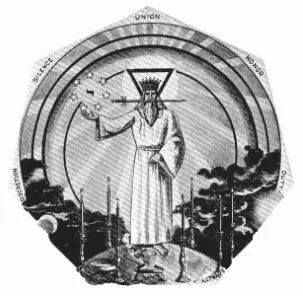
8°. Le tableau est un heptagone régulier dans un cercle. A chaque angle est écrite une de sept lettres103 B. D. S. H. P. F. G. et à côté un chandelier avec une ou trois lumières. Au milieu du tableau paraît un homme vêtu de blanc avec une ceinture d'or, tenant de la main
gauche sept étoiles, avec une barbe blanche fort longue, la tête environnée de rayons, portant à la bouche une épée à deux tranchants.
Ouverture du grand conseil
D. Vénérables frères chevaliers princes, quel est notre devoir ?
R. De connaître si nous sommes en sûreté s'il n'y a rien à craindre.
D. Faites votre ronde vénérables frères.
R. (Après la visite) Tout-puissant, nous sommes en sûreté.
D. Vénérables frères et chevaliers princes, le conseil d'Orient et d'Occident des chevaliers princes est ouvert. Soyez attentifs. II frappe sept coups égaux.
R. Tout-puissant nous sommes attentifs à ce que votre excellence ordonnera. Introduction du récipiendaire
Le récipiendaire est introduit à la manière accoutumée par sept coups égaux. La porte étant ouverte, le second surveillant, sans se faire voir, dit : Montez ici, je vous ferai voir des choses surprenantes.
Le frère maître de cérémonies pousse le récipiendaire dans la salle le plus brusquement qu'il est possible et, après les demandes ordinaires, on le fait voyager par sept pas en équerre sur chaque angle de l'heptagone, en commençant du côté du premier surveillant. On le fait ensuite avancer par sept pas suivis jusqu'au bord du bassin où il prête son obligation, la main droite étendue vis-à-vis du tout-puissant
Après que le récipiendaire a prêté son obligation, le maître de cérémonies le reconduit au pied du tableau, et le premier surveillant lui dit d'examiner avec une scrupuleuse attention les chères merveilles et que le tout-puissant va opérer [34v°]. –
[34v°] Le premier surveillant dit alors : Quel est le mortel digne d'ouvrir le livre et de lever ses sceaux ?
Tous les frères baissent les yeux et paraissent sangloter. Le premier surveillant lui dit : Respectables vénérables et respectables chevaliers, ne pleurez et ne sanglotez point, voici une victime (en montrant le récipiendaire) et son vainqueur vous en contentera.
D. II demande ensuite au récipiendaire s'il sait pourquoi ces vieillards ont des barbes blanches.
R. Oui, vous le savez.
D. Le premier surveillant lui dit : Ce sont ceux, qui étant venus ici, après avoir passé par des grandes afflictions, ont lavé et blanchi leur robe dans le sang qu'on leur a tiré. Voulez-vous une pareille robe à ce prix ?
R. Oui, je le veux.
Les surveillants conduisent le récipiendaire à la cuve ou bassin, on lui découvre les deux bras jusqu'aux coudes. On les lui fait mettre dans l'eau, on lui met des ligatures et, les deux surveillants ayant chacun une lancette creuse à ressort dans laquelle il y a du vin rouge, on lui en donne un coup sur la veine. Le vin sort et coule à l'instant. On le recueille avec attention et on le fait voir à toute l'assemblée, en disant : Il n'a pas craint de répandre son sang pour voir des choses merveilleuses. On lui défait les ligatures et on le laisse les bras nus et dans la même disposition.
Après cette cérémonie l'orateur lui fait un discours sur l'essence de l'Ordre et lui en apprend l'origine.
Le tout-puissant ouvre ensuite le 1des sept sceaux du Livre et en tire un arc, des flèches et une couronne qu'il remet à un des surveillants en disant : Partez et continuez vos conquêtes.
Le tout-puissant ouvre le 2 sceau, en tire une épée qu'il remet à un autre vieillard, en lui disant : Enlevez la paix d'entre les profanes et les faire frères et faites qu'ils ne trouvent d'asile. que dans nos loges.
Le tout-puissant ouvre le 3 sceau, en tire une balance qu'il remet à un vieillard et lui dit : Faites que les profanes et les faux frères ne trouvent la justice que dans nos loges.
Le tout-puissant ouvre le 4 sceau, en tire une tête de mort qu'il remet à un vieillard en lui disant : Jusque quand différerons-nous à nous venger des profanes et des faux frères, qui ont tué plusieurs de nos frères par calomnie ?
Le tout-puissant ouvre le 5 sceau, en tire un linge plein de sang qu'il remet à un vieillard en lui disant : Faites que les profanes et les faux frères ne trouvent la vie que dans nos loges.
Le tout-puissant ouvre le 6 sceau et à l'instant le Soleil s'obscurcit et paraît noir et la Lune teinte de sang.
Le tout-puissant ouvre le 7 sceau et en tire de l'encens qu'il remet à un vieillard qui porte un vase plein et sept trompettes qu'il remet à 7 autres vieillards.
Après cette cérémonie les quatre vieillards, qui sont aux quatre coins du conseil font paraître quatre vessies qui représentent les quatre principaux vents renfermés.
Le tout-puissant dit : Ne frappez ni les profanes ni les faux frères jusqu'à ce que j'aie marqué les vrais et forts maçons. Alors les quatre vieillards cachent leurs vessies et un d'entre eux sonne de la trompette et alors les deux surveillants viennent prendre le récipiendaire, lui couvrent les deux bras et le dépouillent de son tablier et de son attribut
Un second vieillard sonne de la trompette et les deux surveillants passent la robe blanche au récipiendaire avec le tablier et les attributs de l'Ordre.
Un troisième vieillard sonne de la trompette et les deux surveillants lui mettent la barbe.
Un quatrième sonne de la trompette et les deux surveillants lui mettent la couronne d'or.
Un cinquième sonne de la trompette et les deux surveillants lui mettent la ceinture d'or.
Un sixième sonne de la trompette et le premier surveillant lui donne le signe, la parole et l'attribut.
Le signe est de regarder derrière soi et on y répond en regardant du côté opposé.
La parole est, l'un dit : Abaddon, l'autre répond : Jubelum qui signifie l'Ange de l'abîme.
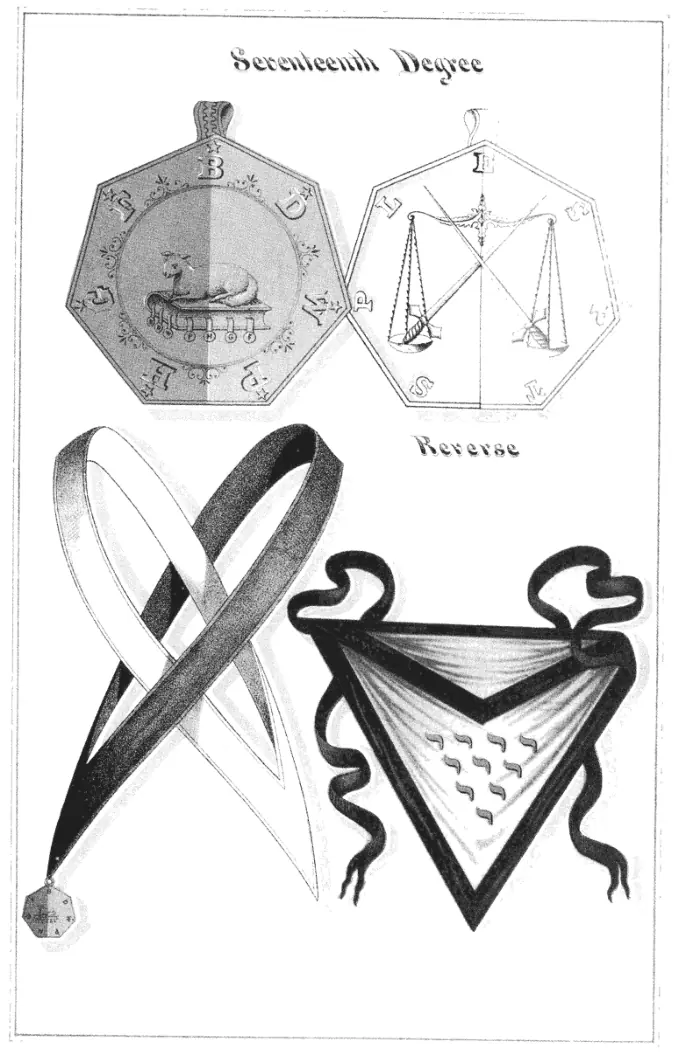
L'attribut est un heptagone régulier de nacre, ou argent, à chaque angle duquel est une étoile d'or et une des 7 lettres B. D. S. H. P. F. G. Au milieu d'un côté un agneau sur le revers, une épée à deux tranchants et une balance égale tenue par une main, d'un côté de la poignée de l'épée la lettre initiale de Cyrus et de l'autre côté celle de Zorobbabel. Cet attribut pendant le conseil sera attaché à la ceinture d'or. La croix de l'Ordre est pendue au col avec un ruban noir large commandeur.
Les sept vieillards sonnent enfin tous ensemble et les deux surveillants conduisent le récipiendaire au trône qui lui est destiné et préparé à la droite du tout-puissant (et selon d'autres) au pénultième du côté du 2 surveillant.
Les princes de Jérusalem entreront dans les loges symboliques, lorsqu'ils voudront les visiter, le chapeau sur la tête, l'épée nue à la main, cuirassés, armés du bouclier et de tous les attributs de l'Ordre des chevaliers princes et le tablier doublé de soie jaune. Dans cet attirail, les deux battants des portes lui seront ouverts et il sera conduit par deux anciens maîtres à côté du siège, les frères formant au-dessus de sa tête le berceau avec leurs épées et le vénérable lui offrira le marteau et le collier qu'il acceptera ou refusera selon son bon plaisir.
S'il visite une loge de grands élus parfaits maîtres et sublime écossais, il ne pourra se dispenser de porter en outre les bijoux écossais de princes. Celui des princes pend de l'épaule droite à la hanche gauche et l'attribut au bas.
Dans les loges qu'un prince de Jérusalem visitera, il pourra se faire représenter les registres pour voir si la loge travaille suivant les usages ordinaires. Il sera le maître d'interdire celles qui ne seront pas régulières et donnera de ce qu'il aura fait à la grande loge et à toutes les loges reconnues pour légitimes et régulières. _____________________
Nota. La cuirasse et le bouclier se font avec du carton peint et [bien imité] en petit et le tablier est plus petit que le tablier ordinaire [35r°].
[35r°] Les signes des chevaliers princes de Jérusalem sont doubles. Le premier se fait l'un en faisant semblant de regarder derrière soi, le 2 y répond à l'opposite. L'attouchement est double et doit se donner avant le mot. Il se fait en se prenant mutuellement la main croisée de bonne foi et en descendant et glissant les doigts jusqu'au bout et alors on se serre la pointe des doigts par sept fois en mettant une distance entre le sixième et septième serrement. On peut faire ces signe et attouchement en se prenant les deux mains.
La parole est Abbadon et l'autre répond Jubelum, qui veut dire l'Ange de l'abîme.
Chacun de ces mots forme le nombre de 7 lettres dont chacune a sa signification.
Au milieu du grand cordon d'or en imitant cette couleur, il doit y avoir un pont brodé en soie brune pour imiter la couleur du bois et ces lettres hébraïques seront brodées sur le pont :
Les chevaliers princes surnuméraires dans le conseil des vieillards porteront la cuirasse et le bouclier. Clôture du conseil
D. Qui êtes-vous ?
R. Je suis Pathmïen.
D. D'où venez-vous ?
R. De Pathmos.
D. Comment vous appeliez-vous avant le voyage de Pathmos ?
R. Je m'appelais Cyrus, roi.
D. Et avant ?
R. Zorobabel.
D. Quel âge avez-vous ?
R. Je suis très vieux.
D. Quelle heure est-il, respectable frère surveillant ?
R. Tout-puissant, il n'y a plus de temps. Le tout-puissant frappe sept coups comme à l'ouverture et dit : Respectables vénérables et chevaliers princes, le grand conseil est fermé. Cela est répété par les deux surveillants qui frappent aussi 7 coups.
- Fin -
Doctrine des chevaliers princes de Jérusalem
D. Etes-vous chevalier d'Orient, d'Occident et prince de Jérusalem ?
R. Oui, je le suis.
D. Qu'avez-vous vu ?
R. Des choses merveilleuses.
R. Par l'eau et l'effusion du sang.
D. Expliquez-moi cela.
R. C'est qu'un bon maçon ne doit point craindre de verser son sang pour la Maçonnerie.
D. De quoi est orné notre grand conseil ?
R. De superbes trônes du Soleil et de la Lune et d'un bassin ou cuve.
D. Quelle figure a le tableau du conseil ?
R. Un heptagone régulier placé dans un cercle.
D. Que représente notre tableau ?
R. Un homme vêtu d'une robe blanche, ayant une ceinture d'or, tenant de la main gauche 7 étoiles, la tête environnée de rayons, portant à la bouche une épée à deux tranchants. Il est aussi environné de 7 chandeliers vides.
D. Que signifie le cercle ?
R. De même qu'un cercle est fini par la conduite d'un point, de même une loge ou grand conseil doit être animé de la même volonté.
D. Que signifie l'heptagone ?
R. Notre nombre mystique renfermé dans les 7 lettres B. D. S. H. P. F. G. qui signifient Beauté, Divinité, Sagesse, Honneur, Puissance, Force et Gloire.
D. Donnez-moi l'explication de ces différents mots.
R. Beauté pour orner. La Divinité nous apprend que la Maçonnerie a quelque chose de divin. La Sagesse est une qualité propre et nécessaire pour inventer ; la Puissance est une affaire pour abaisser les profanes et les faux frères les réduire au silence et faire taire leur calomnie, l'Honneur est une qualité indispensable à un maçon pour se maintenir dans cet Ordre respectable, la Gloire nous fait connaître qu'un maçon est égal aux plus grands princes, et la Force est pour exécuter et pour soutenir.
D. Que signifient les 7 étoiles ?
R. Sept qualités qui doivent guider les maçons, savoir : l'amitié, l'union, la soumission, la discrétion, la fidélité, la prudence et la tempérance [35v°].
[35v°] D. Pourquoi les bons maçons doivent-ils avoir ces qualités ?
R. L'amitié est un sentiment qui doit régner naturellement parmi les frères, l'union est la base d'une société, la soumission nous sert à recevoir sans murmurer les arrêts de la loge. La discrétion sert à nous garantir de toute surprise de la part des profanes, la fidélité est nécessaire pour garder nos obligations, la prudence pour régler nos actions de façon que les profanes envieux de nos plaisirs ne puissent blâmer notre conduite, la tempérance enfin pour éviter les excès également nuisibles au corps et à l'esprit.
D. Que signifient les sept chandeliers vides ?
R. Les 7 défauts que les maçons doivent éviter, la haine, la discorde, l'orgueil, l'indiscrétion, la perfidie, l'étourderie enfin la médisance.
D. Pourquoi les maçons doivent-ils éviter ces défauts ?
R. Parce qu'ils sont absolument contraires aux qualités que nous venons de nommer. Un bon maçon ne doit avoir aucune haine contre les frères, quelque insulte qu'il en ait reçu, la discorde est trop contraire à la société pour ne pas l'éviter, l'orgueil doit être banni comme contraire à l'humanité, l'indiscrétion est nuisible à un maçon, la perfidie est odieuse à un honnête homme et à plus forte raison à un bon maçon, l'étourderie nuit à la société, la médisance enfin est un vice si bas, qu'un maçon, qui doit s'efforcer de ressembler en lui un être parfait, doit l'éviter et les autres défauts ci-dessus comme la peste du genre humain.
D. Que signifie l'épée à deux tranchants ?
R. La supériorité que les chevaliers princes de Jérusalem ont sur les autres grades.
D. N'y a-t-il pas de grade au-dessus de celui-ci ?
R. Il y a l'Ordre respectable des chevaliers de l'Aigle et du Pélican, celui du Soleil ou Chaos
D. Que signifie le Livre auquel pendent 7 sceaux, que personne ne peut ouvrir ?
R. Une loge de francs-maçons que le vénérable a seul droit de communiquer et d'ouvrir.
D. Que renferment les sept sceaux ?
R. Le premier renferme un arc avec des flèches, une couronne, le second une épée à deux tranchants. Le 3 une balance. Le 4 une tête de mort. Le 5 un linge teint de sang. Le 6 le pouvoir d'obscurcir le Soleil et teindre la Lune en sang. Le 7 enfin sept trompettes et des parfums.
D. Donnez-moi l'explication de toutes ces choses.
R. 1° L'arc, les flèches et la couronne signifient que les arrêts de la loge doivent être exécutés avec autant de ponctualité et de promptitude que l'arc décoche une flèche et reçus avec autant de soumission que ceux des têtes couronnées.
2° L'épée à deux tranchants nous apprend que la loge a des armes en main pour punir.
3° La balance, comme le symbole de la justice, fait connaître au vénérable qu'il doit mettre toute son attention à rendre justice en loge.
4° La tête de mort est l'image d'un frère exclus de nos loges. Cette idée doit faire trembler tous les frères et leur rappeler ce à quoi ils se sont soumis par leurs obligations.
5° Le linge teint de sang doit nous enseigner que nous ne devons pas balances à verser jusqu'à la dernière goutte de notre sang pour le bien de la Maçonnerie.
6° Le pouvoir que porte le 6 sceau d'obscurcir le Soleil et teindre la Lune au sang est la figure du pouvoir qu'un frère visiteur de ce grade supérieur a dans la loge qu'il visite, le droit d'interdire les Officiers, au cas que la loge ne travaille pas en règle jusqu'à que l'on se repentit, marqué par la soumission.
7° Enfin les 7 trompettes et les parfums nous apprennent que la Maçonnerie est répandue par toute la terre sur les ailes de la renommée et qu'elle se soutiendra avec autant d'honneur, que les parfums répandent des odeurs agréables. _____________________________ Fin du catéchisme ____________________________ Autres instructions particulières
Connaissant par le grade de grand élu parfait maître et sublime écossais, ce qui s'est passé du temps des rois de la Judée, jusqu'à l'entière destruction du temple de Salomon par Nabucodonozor, et les Juifs emmenés captifs à Babylone, nous bornerons cette instruction à quelques questions sur les suites de cette captivité et la conduite, que suivirent les braves fidèles maçons pendant ce temps-là.
D. Qui fut roi d'Israël après la mort de Salomon ?
R. Ce fut Roboam, son fils.
D. Qu'arriva-t-il de remarquable sous son règne ?
R. La division du royaume des Israélites, comme Dieu l'avait prédit.
D. Comment se fit cette division ?
R. Par la dureté et l'impudence de Roboam qui aigrit les Israélites au point que 10 tribus se révoltèrent et reconnurent Jéroboam pour roi. Les tribus de Juda et Benjamin restèrent seules fidèles à leur roi, le royaume de la Judée commença alors à être divisé en deux [36r°].
[36r°] D. Comment nomma-t-on ces deux royaumes ?
R. Celui de Roboam s'appelait celui de Juda et celui de Jéroboam le royaume d'Israël ou d'Ephraïm.
D. Comment vécurent ces deux rois ensemble ?
R. D'abord Roboam voulut s'opposer à la division du royaume de Juda et leva à cet effet une armée de cent quatre-vingts mille hommes pour combattre Jéroboam, mais Dieu lui fit dire
par un prophète qu'il le laisse régner en paix. Il cessa alors de faire la guerre, mais la paix ne dura que trois ans après quoi ces deux princes vécurent toujours en guerre.
D. Quelles furent les capitales de ces deux royaumes ?
R. Jérusalem fut toujours la capitale de Juda et Samarie fut la capitale de celui d'Israël ou d'Ephraïm.
D. Comment vécut Jéroboam ?
R. Comme un scélérat, un impie et un idolâtre, empêchant ses sujets d'aller comme à l'ordinaire au temple de Jérusalem, persécutant les maçons et leurs descendants qui l'avaient construit, faisant faire des veaux d'or pour que ses sujets fussent séparés du reste des Juifs, autant par la religion que par la domination.
R. Dix et neuf. 1° Jeroboam 2° Nadab 3° Baza 4° Ela 5° Zambry usurpateur 6° Aniry 7° Achab 8° Achazias 9° Joram 10° Jehû 11° Joachas 12° Joaz 13° Jeroboam 14° Zacharias 15° Selim 16° Manchem 17° Phacée fils de Manchem 18° Phacée fils de Ropene 19° Ozée.
[Une]partie des rois de Juda ont vécu saintement mais tous les rois d'Israël ont vécu dans l'impiété.
D. Comment ont vécu les maçons pendant ce temps-là ?
R. La plupart ont suivi l'exemple de leurs rois, mais Dieu s'est dans tous les temps réservé des grands élus parfaits maçons dans les deux royaumes qui sont demeurés fidèles et inviolablement attachés à la foi.
D. Combien de temps dura le gouvernement des rois de la Judée ?
R. Saul, David et Salomon régnèrent successivement pendant 250 ans et les rois de Juda 387 ans.
D. Comment finit le royaume de Juda ?
R. Par la destruction de Jérusalem et du temple de Salomon et la captivité des Juifs, que Nabuzardan, général des armées de Nabucodonozor, emmena avec leur roi Jechonias captifs à Babylone 470 ans, dix mois, dix jours après la dédicace du temple.
D. Combien de temps dura la captivité des Juifs ?
R. 70 ans et 2 années de guerre font 72 ans, comme l'avait prédit le prophète Jérémie.
D. Comment les Juifs vécurent-ils à Babylone pendant la captivité ?
R. Par l'exemple des bons maçons ils rentrèrent en eux-mêmes, servirent Dieu fidèlement sous la conduite spirituelle des grands élus parfaits et des prophètes que Dieu leur suscita pour les soutenir dans la captivité.
D. Quels furent ces prophètes ?
R. Les sept plus célèbres furent Ezechiel, Daniel, Habacuc, Sophonie, Aggée, Zacharie et Malachie.
D. Qui est-ce qui donna la liberté aux Juifs ?
R. Cyrus et ceux mentionnés dans les chevaliers de l'Orient.
D. Sous la conduite de qui et en quel nombre les Juifs retournèrent- ils en Judée ?
R. Ils retournèrent au nombre de 42360 sous la conduite de Jehû fils de Joadech grand-prêtre et de Zorobabel fils de Jalachiel prince hébreu chef de la tribu de Juda.
D. Que devinrent les chevaliers maçons après la destruction de ce second temple ?
R. Plusieurs se mirent sous un même chef travaillant à la réformation de leurs mœurs en élevant dans leurs cœurs des édifices spirituels et se rendirent recommandables par leurs œuvres.
D. Comment les nommait-on ?
R. Paulkal ou Pharaskal, ou Baïlkall, qui veut dire : Séparé, comme ils l'étaient effectivement par la sainteté de leur vie.
D. Comment l'Ordre a-t-il pu se conserver tant de maçons s'étant écarté de leur devoir ?
R. Plusieurs zélés observateurs des lois se séparèrent, élurent entre eux les déserts de la Thébaïdes et de la Syrie. Ces solitudes furent ensuite habitées par les Perses du désert qui furent regardés comme des saints.
D. Quels furent les maçons les plus renommés parmi eux ?
R. Alexandre le grand fut un des grands-maîtres maçons, qui régna sur tout l'Orient. Manchem qu'ils élurent grand-maître fut le plus renommé parmi eux.
D. Les Romains étant Juifs comment l'Ordre a-t-il pu passer chez les chrétiens ?
R. Apres la destruction du second temple plusieurs embrassèrent le Christianisme et communiquèrent leurs secrets à plusieurs chrétiens en qui ils reconnurent les qualités requises. Ils vivaient en commun et ne formaient qu'une famille. ____________________________________ Fin ___________________________________
Apparat critique de la transcription Aeditimus
102. Ce etc. n’implique pas n’importe quoi d’autre, mais simplement que l’auteur (le copiste ?) abrège ici en connaissance cause. De fait, le passage réfère ici implicitement à la vision d’Ezéchiel.
103. Leur signification est donnée plus bas, page 35r° du manuscrit, dans la « doctrine des chevaliers princes de Jérusalem ».
106. Le manuscrit omet le numéro 10° !
Manuscrit Quesada 1804 (copie 1813-1821)
manuscrit · BNE Mss 7834 · 3 084 mots
Le manuscrit Quesada (Mss 7834 de la Bibliothèque Nationale d'Espagne) : copie (1813-1821) d'un état du Rite de 1804, voire antérieur, tel que pratiqué dans la mouvance du Suprême Conseil d'Amérique. Les didascalies du manuscrit sont en italique. Le texte est celui de l'édition Latomia, donnée en vis-à-vis du fac-similé du manuscrit : l'apparat critique de cette édition est repris ici, de même que les repères de folio du manuscrit.
Texte intégral sur ce site · transcription C. M. & P. T., Latomia / Chantier de fouilles maçonniques, d'après le Mss 7834 de la BNE
et d’Occident
Origine
Quand les Chev∴ et les Princes de Jérusalem se rassemblaient pour conquérir la Terre Sainte, ils prirent une croix, pour se distinguer comme la marque qu’ils allaient combattre sous la même bannière ils firent en même temps serment de répandre jusqu’à la dernière goutte de leur sang pour rétablir la vraie religion, la paix étant faite ils purent accomplir leurs vœux et s’en retournèrent chacun dans leur pays respectif. Ils résolurent d’être par théorie ce qu’ils ne pouvaient être par pratique et de n’admettre dans leurs cérémonies que ceux qui leur avaient donnés des preuves de de leur amitié zèle zèle et discrétion ils se joignirent à l’Ordre de Malte qui en ce moment était lié à la Maçonnerie, ils prirent le titre de Chev∴ d’Orient & d’Occ∴ Princes de Jérusalem pour apprendre à tout l’Univers où l’Ordre avait pris naissance et qu’ils ne changeraient jamais leurs coutumes et leurs réceptions, en l’année 1118 les premiers Chevaliers au nombre de onze, firent leurs vœux entre les mains de Garinous Patriarche & Prince de Jérusalem.
Cérémonie de Réception
1o∴ Le Grand Conseil est tendu de rouge parsemé d’étoiles
d’or. ( Voyez la planche figure ) 2o∴ A l’Oriet∴ du Conseil est un Trône élevé de 7 marches soutenu par 4 Lions ou Aigles et entre eux un animal figure humaine avec six ailes, 3o∴ du côté du Trône est le Soleil et de l’autre la Lune, chacun dans un transparent, sous lequel est un arc-en-ciel, de plus un gd∴ bassin plein d’eau odoriférante, une tête de mort, 4o∴ à la partie du Nord & du Sud, sont onze petits Trônes élevés ∴ Anciens, à l’Occ∴ opposé au Trône sur cinq sur 3 marches, pour les Vbles marches pour les deux Anciens Officiers qui font l’office de Surveillants dans le Grand Conseil, 5o∴ Le Gd∴ Conseil est composé de 24 Chevaliers le ∴ Me∴ s’appelle T∴ Puissant, les Surv∴ et les 2 FF∴ Respbles Vble∴ Chev∴ lesquels sont placés au Nord et au Sud sur les petits Trônes à sa droite, il en reste toujours un vacant pour un Cand∴6o∴ tous les FF∴ sont revêtus d’une robe blanche avec une ceinture en or autour du corps, ils ont une longue barbe blanche, et une couronne d’or sur la tête. Les Chev∴ sont dans leurs habits ordinaires portant un large ruban blanc de l’épaule droite à la hanche gauche avec le bijou suspendu au bout d’un ruban outre la croix de l’Ordre attachée à un ruban noir en sautoir. ( Pl∴fig∴) 7o∴ le T∴ Pt∴ a à sa droite, un gd∴ livre porté sur un piedestal, auquel livre pendent 7 sceaux. Le plan du Conseil est renfermé dans un cercle du côté de l’arc, sont les lettres suivantes : B∴ D∴ S∴ L∴ M∴ G∴ F∴S∴P∴H∴F∴G∴dans le milieu un homme vêtu d’une robe blanche avec une ceinture d’or la main droite étendue environnée de 7 étoiles ayant une longue barbe blanche, la tête environnée d’une Gloire, une Épée à d’eux tranchants dans la bouche, 7 chandeliers autour de lui avec les lettres suivantes : X∴D∴O∴S∴P∴M∴C∴H∴D∴J∴O∴M∴C∴E∴
Ouverture du Conseil
D∴ Rble∴ Chev∴ Prince, quel est votre devoir ?
R∴ De savoir si nous sommes en sûreté.
D∴ Voyez, cherchez si nous le sommes ?
R∴ Nous le sommes ; le T∴ P∴ dit : R bles∴ Princes le Gd∴ Conseil des Chev∴ d’Or∴ et d’Occ∴ est ouvert. Soyez attentifs. Nous le serons toujours, parce que le Dieu tout P∴ R∴ voudra bien nous proposer.
Réception
Le Cand∴ est introduit par 7 coups, six égaux et un long Les Off∴ se lèvent vont voir qui frappe et apercevant le Cand∴ ils le
prennent par la main, ils lui disent : Venez mon F∴ nous allons vous montrer quelque chose de surprenant ; ils lui font faire sept tours
et à chaque angle il met le pied dans le carré, et ainsi jusqu’au dernier angle, par le moyen de ses 7 marches, il arrive à la barre534 et présente la main au T∴ Puissant, entre les mains duquel il prête l’obligation suivante :
Obligation
Je jure & promets d’être fidèle à ma sainte religion d’observer les lois de mon pays autant que je pourrai, je promets de plus de ne pas recevoir ni initier personne dans ce grade Folio 147 recto, qu’en me conformant aux anciennes coutumes statut et règles, où par un pouvoir qui me serait donné à cet effet. De ne révéler les secrets de cet éminent degré sous les peines de mes premières obligations ainsi, Dieu me maintienne dans la justice et la droiture. Amen.
Après cela, le Me∴ des Cérémonies prend le Cand∴ le fait lever et le ramène entre les deux Survts il lui dit : Mon F∴ examinez avec
la plus grande attention toutes les choses que le T∴ Pt∴ va opérer
devant vous, il règne alors un petit silence. Le 1r∴ Survt∴ continue & dit :
Est-il un mortel capable d’ouvrir le livre aux 7 sceaux ? Tous les D∴
FF∴ baissent les yeux en soupirant. Le 1r∴ Survt∴ entendfaisant535 des
∴ FF∴ ne soyez point affligés si536 cette soupirs dit : Vble∴ & Resp ble victime, elle vit encore.
D∴ Savez-vous la raison pour laquelle les Anciens ont une barbe si blanche & si longue ? Est-ce que vous la connaissez537 ?
R∴
D∴ Ce sont ceux qui vinrent ici, après avoir passé par les plus grandes afflictions, ont lavé et trempé leurs robes dans leur propre sang, en voulez-vous une pareille au même prix ? Tous les Chev∴ répond t∴Oui
Les Survts∴ conduisent le Récipiendre∴ au bassin, ils prennent chacun une lancette, font semblant de le saigner aux deux bras, ils ont de la couleur rouge, qu’ils mettent sur les bras et en répandent sur le linge, qui est sur sa culotte, ils découvrent les yeux du Cand∴ leur
font voir son sang en disant : Mon F∴ vous ne devez jamais craindre de répandre votre sang lorsqu’il s’agit de voir des choses surprenantes Folio 195 recto
Alors on retire les ligatures des bras, les mains restent toujours liées, et le Gd∴ Orateur lui fait un discours sur sa fermeté et son courage. Ce discours terminé le T∴ Pt∴ ouvre alors le 1er sceau du Gd Livre il en retire un arc des flèches ainsi qu’une couronne et les donne à un Vieillard il lui dit : Partez et continuez la conquête, il ouvre le 2e∴ et en retire une épée, qu’il remet au plus âgé, il lui dit :
Allez punissez les profanes et les méchants FF∴ afin qu’ils
ne reviennent jamais dans nos LL∴ il ouvre le 3e∴ il prend une balance, la donne à un Ancien en lui disant : Empêchez
que les profanes et les méchants FF∴ troublent la justice dans nos
LL∴4o∴ il ouvre le 4e sceau, prend une tête de mort la donne à un des Anciens & lui dit : Empêchez que les méchants
FF∴ ne trouvent la vie parmi nous, il ouvre le 5e∴ sceau, en
tire une pièce d’étoffe, trempée dans le sang. La donne à un autre Vieillard & lui dit : Voici le temps marqué où vous devez
punir les méchants FF∴ qui en ont détruit tant de bons
par de fausses accusations, 6o∴ il ouvre le 6e∴ dans ce moment le Soleil s’obscurcit et la Lune paraît teinte de sang. 7o∴ il ouvre le 7e∴ en tire de l’encre qu’il donne à un F∴ il en tire aussi un vase avec sept trompettes, en donne une à chaque Vieillard et dit : Ne frappez aucun profane ni méchant F∴
jusqu’à ce que j’aie découvert les bons & véritables Maçons
Parfaits, une trompette sonne, alors 4 FF∴ représentant les 4 vents principaux ayant sous le bras chacun une vessie pleine d’air, ils la présentent pour le faire sortir, une des trompette sonne alors, les deux Survt∴ vont chercher le Cand∴ qui est près de l’O∴ lui couvrent les bras et lui ôtent son tablier et bijou, la 2e∴ trompette sonne, le 2e∴ Survt∴ revêt le Cand∴ d’une robe blanche lui met le tablier et le nouveau bijou de l’Ordre, la 3e∴ trompette sonne le 1er∴ Survt∴ lui met une barbe blanche, la 4e∴ trompette sonne le 2e∴ Survt∴ lui pose une couronne d’or sur la tête, la 5e∴ trompette sonne, le 1r Survt∴ met au Cand∴ une ceinture dorée la 6e∴ trompette sonne le 2e∴ Survt∴ lui donne le Signe l’Attt∴ et la Parole. La 7e trompette sonne avec les 6 autres alors le 1er∴ Survt conduit le Récipiendre∴ au Trône vacant.
Signe = il se fait en regardant son épaule droite. La réponse est le contraire. Le 1er∴ dit Abandon. L’autre répond Jabulum. Qui signifie ange de l’abîme
1 er∴ Attouchement
Il se fait en portant la main gauche dans la droite du F∴ qu’on veut reconnaitre et celui-ci recouvre la main du premier F∴ avec la main gauche. 2e∴Attouchement. Toucher l’épaule gauche du F∴ avec la main gauche, ainsi touché, regarder son épaule droite541.
Le bijou est un heptagone d’or où d’argent à chaque angle, il y a d’un côté une étoile d’or et une de ces lettres.
B∴ D∴ S∴ P∴ H∴ G∴ F542∴( Planche figure ) dans le centre un
agneau sur un livre où il y a sept sceaux de l’autre côté à chaque angle les mêmes lettres, dans le centre deux épées, en sautoir surmontées d’une balance ce bijou est porté par le T∴ Pnt∴ en sautoir et par les Chev∴ au bout d’un large ruban blanc, tous portent la croix de l’Ordre au bout d’un ruban noir sur la poitrine. Le tablier, est de soie jaune doublé et bordé de
rouge ( Planche figure ).
Catéchisme
D∴ Êtes-vous Chev∴ d’Orient et d’Occ∴ ?
R∴ Je le suis.
D∴ Qu’avez-vous vu ?
R∴ Des choses merveilleuses.
D∴ De quelle manière avez-vous été reçu ?
R∴ Par l’eau et l’effusion de sang.
D∴ Expliquez-moi cela ?
R∴ Un Maç∴ ne craint jamais de verser son sang pour la Maçonnerie.
D∴ Quels sont les ornements du Conseil ?
R∴ Des trônes superbes le Soleil la Lune des bassins d’eau parfumée
D∴ Quelle est la figure du tableau
R∴ Un régulier heptagone placé dans un cercle.
D∴ Que représente-t-il ?
R∴ Une robe qui revêt un homme, blanche avec une ceinture en or autour de son bras, sept étoiles, sa tête environnée d’une Gloire, une longue barbe blanche, une épée à deux tranchants, dans la bouche environné de sept chandeliers sur chacun d’eux sont les lettres initiales H∴ D∴ O∴ I∴ P∴ M∴ C∴H∴ D∴ Y∴ P∴ M∴ C∴ E543∴
D∴ Que signifient le centre ?
R∴ Le centre étant le point de la réunion désigne l’unité et la fraternité qui doit exister parmi les Maçons.
D∴ Que signifie l’Eptagone ?
R∴ Notre nombre mystique inclus dans les sept lettres B∴ D∴S∴
D∴ Donnez l’explication de ces paroles ? 1 o∴ La Beauté pour embellir, 2 o∴ La Divinité que la Maçonnerie R∴ a un but divin, 3 o∴ Sagesse qualité pour inventer 4 o∴ Honneur est un devoir, indispensable dans la Maçonnerie pour la conduire et la maintenir dans cet Ordre respectable. 5 o∴ Puissance, pour écraser les profanes et les méchants FF∴ réduire et confondre leurs calomnies, 6 o∴ La Gloire qu’un bon Maç∴ est égal aux plus G ds∴ Princes, 7 o∴ La Force est nécessaire pour nous soutenir.
D∴ Que signifient les 7 Étoiles ?
R∴ Les qualités qui doivent toujours diriger le Maçon savoir : l’amitié, l’union, la soumission, la discrétion, la prudence et la tempérance.
D∴ Pourquoi un Maç∴ doit-il posséder ces 7 qualités ? 1 o∴∴L’amitié est un sentiment qui doit régner parmi R∴ les FF∴ 2 o∴ L’union est la base de la société, 3 o∴ La soumission pour recevoir les ordres de la L∴ sans murmurer, 4 o∴ La discrétion pour être toujours sur nos gardes, et n’être jamais répréhensible, 5 o∴ la fidélité en observant fidèlement nos obligations 6 o∴ la prudence en réglant nos actions de telle manière que les profanes soit toujours jaloux de nos plaisirs, et sans pouvoir blâmer notre conduite, 7 o∴ la tempérance en extirpant tout excès qui pourrait être préjudiciable à notre âme et à notre corps
D∴ Que signifient les 7 chandeliers et leurs lettres.
septe vices qui
Parce qu’ils sont absolument contraire aux qualités.
R∴ auxquelles nous sommes parvenus et que nous avons acquises, la Haine ne doit exister entre deux bons Maçons, quand bien même l’un d’eux aurait été maltraité par son F∴, la Discorde est contraire à tous les liens qui unissent une société l’Orgueil en doit être banni par ce qu’il répugne à l’humanité l’Indiscrétion parce qu’elle est fatale à la Maçonnerie la Perfidie, parce qu’elle est horrible à tout honnête homme la Méchanceté parce qu’elle est mortelle & dangereuse, la Calomnie est un vice trop au dessous d’un Maçon, pour qu’elle puisse pénétrer dans son cœur puisqu’elle doit cacher les fautes d’autrui qui sont un fléau attaché à la nature humaine. et l’envie qui doit être bannie de tout M∴
D∴ Que signifie l’épée à deux tranchants ?
R∴ Elle désigne la supériorité des grades tel que l’Ordre Respble∴ des Chev∴ du Soleil, le Gd∴ Écossais, le Chev∴ de l’Aigle Blanc & Noir, le Subl∴ grade des Grands Inspecteurs et Inquisiteurs Commandeurs.
D∴ Que signifie le livre qu’on ne peut ouvrir ?
R∴ Une L∴ de Maç∴ que le T∴ P∴ a seul le droit de faire ouvrir et de fermer.
D∴ Que renferme le premier sceau ?
R∴ Un arc des flèches et une couronne.
D∴ Que renferme le deuxième ?
R∴ Une épée à deux tranchants.
D∴ Que renferme le 3 ème∴ ?
R∴ Une balance.
D∴ Le 4 ème∴ ?
R∴ Une tête de mort ?
D∴ Le cinquième ?
R∴ Une robe teinte de sang.
D∴ Le sixième ?
R∴ Le pouvoir d’éclipser le Soleil et de teindre la Lune de sang.
D∴ Le septième.
R∴ Sept trompettes & des parfums.
D∴ Expliquez-moi toutes ces choses ?
R∴ L’arc, les flèches la couronne signifient l’ordre qui doit régner dans la L∴ où tout doit s’exécuter avec autant de vitesse que d’exactitude semblable aux flèches lancées par un arc on doit y recevoir et exécuter les ordres avec la même célérité et la même soumission comme si elles émanaient d’une tête couronnée. 2 o∴ Que la L∴ est toujours armée pour punir 3 o∴ La Balance est le symbole de la justice 4 o∴ la tête de mort est l’image d’un exclu de la L∴ 5 o∴ la robe teinte de sang désigne que nous devons toujours être prêts à verser jusqu’à la dernière goûte de notre sang pour le Dieu550 de la Maçonnerie, 6 o∴ Le pouvoir d’observer le Soleil et de teindre la lumière de la Lune de sang est la représentation dues pouvoirs551 qu’un F∴ visiteur des Hauts Grades552 à dans les LL∴ inférieures de suspendre les travaux qui ne sont pas réguliers d’interdire la L∴ jusqu’à ce que ses membres viennent à soumission. 7 o∴ Les sept trompettes et les parfums désignent que la Maçonnerie suspend répend553 sur toute la Terre, et sur les ailes de la renommée, sa gloire et sa splendeur et qu’elle les soutiendra. Les parfums sont l’emblème des odeurs
534. Erreur du copiste A : si on se réfère à Pyron 1812, le mot mal recopié serait « base », ce qui n’a pas plus de sens ; Il y a donc probablement aussi un erreur sur l’original. Le mot le plus adapté serait « bassin » ou « cuve », cf. Francken et Kloss.
535. Rature et correction du copiste C. Le mot était pourtant juste, cf. Pyron 1812 et Kloss.
536. Erreur du copiste A : le mot exact est « sur », cf. Pyron 1812 et Kloss.
537. Erreur du copiste A : la réponse exacte est « Vous la connaissez », cf. Pyron 1812 et Kloss.
541. Oubli du copiste A ? Francken, Pyron 1812 et Kloss rajoutent « et vice versa ».
542. Aucune correction ici sur cette suite de lettre, conforme à Pyron 1812 et Kloss, contrairement à la correction justifiée du copiste C au folio 193 verso. Seul l’ordre diffère dans Francken. Ce sont les initiales de Beauté, Divinité, Sagesse, Puissance ( ou Pouvoir ), Honneur, Gloire et Force. Claude Guérillot ( Le Rite de Perfection ) indique que ces sept lettres écrites en hébreu donnent un résultat guématrique de 474, soit la valeur de la onzième Sephira, Daat.
543. Ratures et correction du copiste C. La suite du rituel ( folio 195 verso ) nous indique que ces lettres étaient bonnes, cf. Pyron 1812 et Kloss. Le copiste C remplace l’Orgueil par l’Envie.
544. Les lettres du copiste A étaient conformes à Pyron 1812 et Kloss ( B. D. S. H. P. G. F. ) ainsi que l’explication qui suit. La correction en B. D. S. P. H. F. G. ( ordre différent ) est du copiste C, ainsi que l’explication adaptée, avec correction ultime de Pouvoir en Puissance.
550. Erreur du copiste A : le mot exact est « bien », cf. Pyron 1812 et Kloss.
551. Correction du copiste C. Le singulier était pourtant conforme à Pyron 1812 et Kloss.
552. Conforme à la version de Kloss ; mais Pyron 1812 précise 32e degré.
553. Rature et correction du copiste C, avec son orthographe approximative.
555. Changement d’écriture, de numérotation et de type de cadre. C’est le copiste B qui intervient pour tout le manuscrit de ce degré, probablement en remplaçement de la copie de A.
556. Sic. Mis pour « chambre ». Influence d’une langue natale étrangère ? En espagnol, « chambre » s’écrit « camara ». Le copiste B serait-il De Quesada lui-même ?
560. Mis pour Zorobabel.
561. Déformation des mots hébreux : My!m-<h- VrObi7y_ ( yaʿăvorû hammayim ) que l’on peut traduire par « ils passèrent les eaux » ( inaccompli duratif dans un récit )
Delaulnaye 1813
tuileur imprimé · 432 mots
Le « Thuileur des trente-trois degrés de l'Écossisme » de Delaulnaye (Paris, 1813), premier tuileur imprimé du REAA constitué : mots, signes, décors et remarques du grade. Texte relu mot à mot sur le fac-similé, mots hébreux restitués. Pages 110-115 de l'édition originale.
On fixe l'origine vraie ou supposée de ce grade à l'an 1118, époque à laquelle, dit-on, les Croisés (d'Occident) s'unirent aux Maçons (d'Orient), sous la conduite de Garimont (1), patriarche de Jérusalem. Le but de ce grade, ajoute-t'on, fut de veiller à la sûreté des Pèlerins ; il tire son rituel de l'Apocalypse.
Décoration du Conseil.
Tenture Rouge ; parsemée d'Étoiles d'or.
Titres.
La Loge s'appelle Grand-Conseil ; elle doit être composée de Vingt-quatre membres, qui figurent les vingt-quatre vieillards de l'Apocalypse, et qui, en conséquence, indépendam-
(1) Autre interprétation de la lettre G de l'Étoile flamboyante.
[p. 111]
ment d'une longue robe blanche, serrée d'une ceinture couleur de feu, portent une longue barbe. Le Vénérable est dit Très Puissant ; les Surveillants et les Frères, Respectables-Anciens. S'il en survient au-delà du nombre fixé, on les nomme Respectables-Chevaliers.
Signe.
Regarder son épaule droite.
Réponse. Regarder la gauche.
L'un dit Abaddon ; l'autre Jabulum.
Premier Attouchement.
Mettre la main gauche dans la droite du Frère, qui couvre la votre avec sa gauche : se regarder mutuellement l'épaule droite.
Second Attouchement.
Toucher de la main gauche l'épaule gauche du Frère, qui répond en touchant votre épaule droite avec sa droite.
[p. 112]
Signe pour entrer en Loge.
Se mettre mutuellement la main droite sur le front.
Batterie.
Sept Coups (six et un).
○ ○ ○ ○ ○ ○——○
Marche.
Sept pas en équerre sur les côtés de l'Heptagone.
Mot Sacré.
ABADDON, nom de l'ange de l'abîme, (Voy. APOCAL., c. 9, v. 11).
אֲבַדּוֹן (Exterminans)
en grec ἈΒΑΔΔΩΝ
on l'appelle aussi ἈΠΟΛΛΥΩΝ.
Mot de Passe.
Jabulum.
Suivant d'autres, Pérignan et Gadon.
[p. 113]
Heure.
Pour ouvrir ; le Temps est proche.
Pour fermer ; il n'y a plus de Temps.
Tablier.
De soie Jaune, doublé de Rouge.
Cordons.
Un ruban Blanc, mis de droite à gauche.
Plus un ruban Noir, en sautoir, auquel on pend le bijou.
Bijou.
Un Heptagone, partie en or, partie en argent, ou nacre de perle. D'un côté sont gravées, sur les pointes, les lettres B. D. S. P. H. G. F., initiales des mots Beauté, Divinité, Sagesse, Puissance, Honneur, Gloire, Force. Au-dessus de chaque lettre est une étoile. Au centre de l'Heptagone est représenté en argent l'Agneau de Dieu, couché sur le livre des sept
[p. 114]
Sceaux, portant les sept lettres. De l'autre côté, l'on voit deux épées en croix, la pointe en haut, s'appuyant sur une balance.
Quelques-uns joignent à l'Heptagone une lancette.
[p. 115]
Vuillaume 1820
tuileur imprimé · 451 mots
Le tuileur de Claude-André Vuillaume, « Manuel maçonnique, ou Tuileur de tous les rites de maçonnerie pratiqués en France » (Paris, Delaunay et Hubert, 1820) : décoration, titres, signes, attouchement, marche, batterie, âge, mots, habillement du grade, avec l'étymologie et l'interprétation des mots hébreux. Texte établi sur le fac-similé et relu mot à mot sur les images : océrisation à 600 dpi du volume numérisé, fusion avec la couche texte de la numérisation Gallica, puis relecture page par page. Orthographe de 1820 conservée, hébreu et grec restitués, batteries rendues comme l'imprimé les note, pagination de l'original. Pages 129 à 132.
On croit généralement que ce grade a été institué en 1118, lorsque les croisés s'unirent aux initiés d'orient, sous la conduite de Garimont, patriarche de Jérusalem, et formèrent un corps armé pour la défense et la protection des pélerins qui visitaient la Terre-Sainte.
Décoration de la Loge.
Tenture rouge, parsemée d'étoiles d'or.
TITRES.
La loge se nomme Grand Conseil; elle est composée de vingt-quatre membres.
Le président prend le titre de Très-puissant; les autres membres du conseil sont nommés Respectables anciens.
Les membres reconnus dans le grade, et qui [p. 130] excèderaient le nombre de vingt-quatre, fixé pour la composition du conseil, peuvent y assister sans voix délibérative, et ils sont nommés respectables chevaliers.
SIGNES.
Signe général. — Regarder son épaule droite; en réponse, se regarder l'épaule gauche, en prononçant alternativement ces mots : Abaddon (héb. אֲבַדּוֹן exterminans, vel perditio; Abyssus, racine אָבַד abad, periit, desperiit, nom de l'ange de l'abîme; Apoc., chap. 9 v. 11.) et Jabulum.
Signe pour l'entrée. — Se mettre mutuellement la main droite sur le front.
1er ATTOUCHEMENT.
Mettre la main gauche dans la main droite du Tuileur, les doigts alongés; celui-ci la couvre de son autre main, pendant que l'on se regarde chacun l'épaule droite.
2e ATTOUCHEMENT.
Toucher de la main gauche l'épaule gauche du Tuileur, tandis que celui-ci touche l'épaule droite du premier avec la main droite.
[p. 131]
BATTERIE.
Sept coups, par six et un : ● ● ● ● ● ○ — ●!
MARCHE.
Sept pas en équerre, marquant les côtés d'un heptagone.
HEURES DU TRAVAIL.
Pour commencer : Le tems est proche.
Pour terminer : Il n'y a plus de tems.
HABILLEMENT.
Tablier jaune, doublure et bordure rouge.
On porte deux cordons, l'un blanc, passant de droite à gauche, l'autre noir, et mis en sautoir. Au cordon noir est suspendu le bijou, qui est une médaille heptagone, partie or et partie argent ou nacre de perles. Sur une des faces, dans chacun des angles, sont gravées les lettres B∴ D∴ S∴ P∴ H∴ G∴ F∴ initiales des mots : beauté, divinité, sagesse, puissance, honneur, gloire, force. Au-dessus de chaque lettre est une étoile. Au centre est un agneau en argent, couché sur le livre des sept sceaux, et chacun des sceaux portant une des lettres ci-dessus. Sur l'autre face sont deux épées en [p. 132] croix, la pointe tournée vers le haut, posées sur une balance en équilibre. Il y a des conseils où l'on joint une lancette à l'heptagone.
MOT DE PASSE.
JABULUM.
MOT SACRÉ.
ABADDON. Il y a des loges où l'on dit APOLYON, en grec Απολυον, exterminans, vel perditio, aut destruens (Ap., chap. 9, v. 11.).
Pike 1857
rituel imprimé · en anglais · 19 232 mots
« The Magnum Opus or Great Work » (1857) : le premier corps complet de rituels révisés par Albert Pike pour la Juridiction Sud des États-Unis. Texte en anglais, établi par reconnaissance optique corrigée : des coquilles subsistent.
D'après la réimpression Kessinger de l'édition de 1857 (numérisation archive.org)
THE LODGE, ITS DECORATIONS, ETC.
The Lodge Room is in the shape of a Heptagon, hung with crimson, sprinkled with stars of gold. In each angle is a square column ; on the capitals of which, beginning at the South East, and going round by the South, West and North, in reg salar succession, to the North East corner, are the initials respectively, of the following words: ... Beauty... Divinity ... Wisdeum ... Power... Honour... Glory... and
Force: .. . and on their bases, of these, wes Friendship eee Union . «+ Resignation... Discretion wee Fidelity . . . Prudence . . and Temperance.
On each of these columns should be a brilliant lamp or transparency.
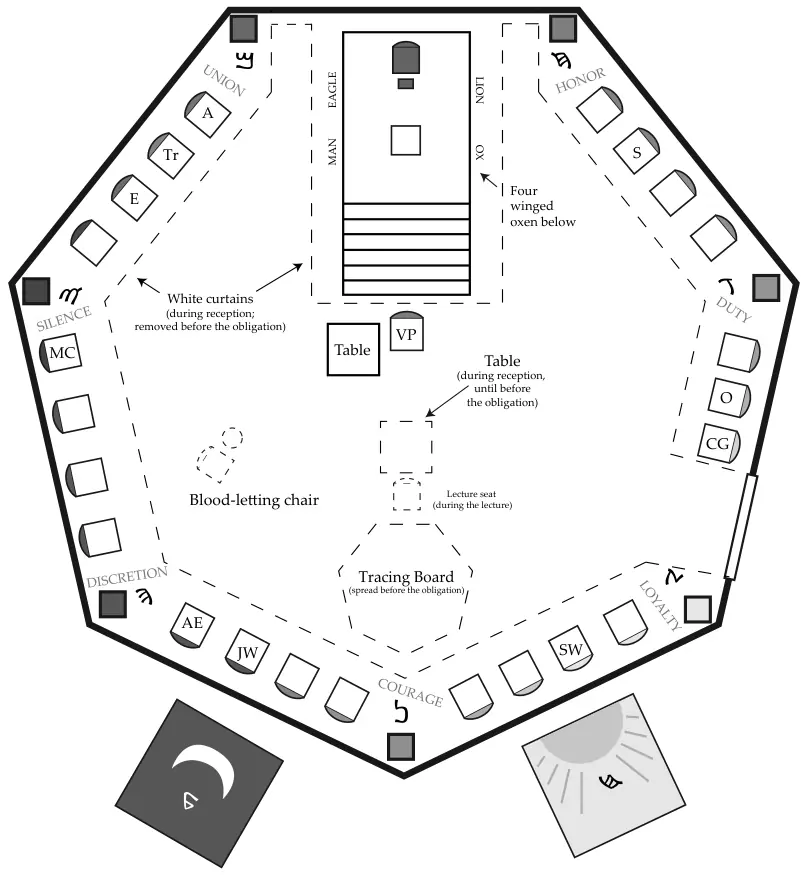
In the East is an altar, upon a platform to which you ascend by 7 steps. The platform is supported by four winged oxen, with the heads, respectively, of a Lion, an Ox, a Man and an Eagle.
Around the room are twenty-four Thrones or Seats, richly decorated. On the ceiling are the Sun and Moon: and over the seat of the Master in the East hangs a two-edged sword, surrounded by seven stars.
Upon the platform, in front of the altar, iss Throne, that is always vacant, and i in front uf it a footstool. The Seat of the Master is at the foot of the Platform, in front.
* On the altar is a silver basin with perfumed water, a chafing-dish with live coals, and o large Bible, sealed with seven great seals, of green wax, at least two inches in diameter, attached to red ribbons, that at the other end pass through holes in one lid, the seals lying upon the other lid, and being slightly attached to it by 'drop of was, so as to be easily separated, leaving the seal whole.
The Tracing Board of the Degree is a Heptagon, with the seven words whose initials are on the capitals of the columns, on the outside, and the other seven on the inside, on each side respectively.
In the centre is the figure of a man in a long white robe, with a golden girdle round his waist, and long hair and beard as white as snow: his right hand stretched out and holding seven stars, his head encircled by a glory, his eyes blazing with light, and a two-edged sword in his mouth. Around him stand seven golden candlesticks, and on each, one of these letters: E.°. S.°. P.*. Ta". S.. Pat. Le. [Ephesus .. Smyrna. . Pergamos
. Thyatira . . Saudis . ... Philadelphia .. . Laodicea]: TheSun and Full Moon also appear on the Tracing' Board; and the basin and chafing-dish. .
OFFICERS, TITLES, DECORATIONS, ETC.
Bodies in this Degree are called Preceptories. A Preceptors should be composed of 24 Members. The Muster is styled Venerable: the two Wardens Zealous, and the other Brothers Faithful. The other officers are a Lecturer, un Examiner, a Sen.*. Deacon, a Jun.". Deacon, Treasurer, Secretary, and a Guard of the
inner, and one of the outer door.
lp
AVIL..2
The Master represents John the Baptist. The Officers and Members, his most eminent disciples among
the Essence. .
The apron is of yellow silk, triangular in shape, and li fg i i it, i H the Tetrarne in a Of eal g I ned and edged with crimson. On it, in the centre, is
The order is o broad white ribbon worn from right to left, crossed by a black one of equal width, worn from left to right. The jewel is suspended from the latter. ,
The jewel is « heptugonal medal, part gold, part silver or mother-of-pearl. On one side are engraved, at the angles, the same letters as are upon the square columns, with a star over each. In the centre of it, on the
. same side, is a lamb, lying on a book with seven seals, on which seals are respectively the same letters. On
the reverse side are two swords cross-wise, points upward, and the hilts resting on an even balance: in the corners, the initials of the seven churches. .
Each Brother wears under the jewel, order and apron a long white robe, and on his head a circlet of gold
or gilded metal, like a coronet.
The battery is# — by: and,
TO OPEN.
The Ten.*. Master, having on a table near him the Sealed Book, and his hand resting upon it, raps once, and asks:
Vu. AC. Faithful Bro.. Jun.*. Deacon, the first duty of Knights of the East and West in Council?-
Jun. D.. To see that they are secure from intrusion, Ten.*, Master.
Fen., ML. Seo to that, my Bro.'., and caution the Inner and Outer Guards to sleep not upon their posts, but be vigilant; for we are about to open this Preceptors, and must at be disturbed by the Profane or the Pharisees. : .
(The Jun.*. Deacon gnes out, returns, gives the Pass-wordl for the night to the two Guards, and reports] :
June. Dew Vens. Mu, the Guards are posted at the inner and the outer door, and have the Pass-word
for the night, and we are secure from intrusion.
Fens. JC. Ibis well, Brother Jun.*. Deacon, what is your duty as a Kt.°. of the East and West?
Jun... D.. To work, to reflect, and to pray.
Ten.*. M.*." Faithful Brother Sen.*. Deacon, what is your duty as 0 Kt.. of the East and West?
Sen. D.. To hope, to trust, and to believe.
Ten.. AL. Faithful Bro.. Examiner, what is your duty as a Knight of the East and West?
Ezam.*. To be vigilant; that the bad, the base, and the selfish gain no admittance into the ranks of the
Faithful.
Fen. Mf. Faithful Bro.*. Lecturer, your duty as such?
Lec.*. To teach the truths that lie hid in allegories.
Fen. AL'. Zealous Bro.*. Jan.*, Warden, your duty?
Juns. We. To revere God and love men: to be just and humane: to be true to all men.
Ten.. M. Zealous Bro.. Sen.*. Warden, your duty?
Sen. W.:. To bear persecution with patience, and affliction with resignation: to despise Death; and to minister to the wants of my brethren.
Fen.". Bf'. The duty of the Ten.*, Master? .
Sens. We To prench the Truth in the desert of Human Life: to pevelaim the coming of the New Taw:
to instruct and baptize the accepted candidate: to judge with justice: and ty expound in its true sense the old
law. .
Yen.*. I. I recognize the duty. Zealous Bro.*, Sen.'. Warden, what is the hour?
Sens. W, Before day. The Morning Star glitters in the East, on the shoulders of the hills, over the desert; and the Seven are low in the North.
Veas. JL. My Brethren, the dawn of the new day approaches, bringing with it Light and the New Law. The Time comets, and the Man. To your knees, my Brethren!
{The Brethren all kneel [facing the East], on both knees. The Ten.°. M.*. repeats the following prayer,
the Brethren all making the responses] :
PRATER.
Clear us, our Father, God of the Ancient Patriarchs, whom they adored on the Plains of Chaldea! Resp... Be gracious unto us, our Father!
We wander in the Desert in darkness, and turn anxiously to the East, and look longingly for the promised Light,
Resp.. Send us the Dawn of Day, our Father! We sit in the shadow of death, and our feet tread the margin of the sea that covers Sodom, and
our tents whiten the Desert upon its sterile shores. Send us Thy Light, our Father, Thy Light promised to our Fathers! Thy Light, to guide our fact into the way of Peace |
Resp... Thy Light, to be the Life uf Men! ° Send us the New Law of Love, fur which the world pines and languishes; and make war and
bloodshed to cease among the nations, and strife and dissension in the Cities, and beart-burning in the Desert among the Faithful!
Resp.". Help us to love Thee and one another, our Father ! Save us from our enemies and from the hand of all that hate us! And help us to serve Thee without fear, in Holiness and Righteousness before Thee, all the days of our life! Resp. Amen! So mote it be! Axex!
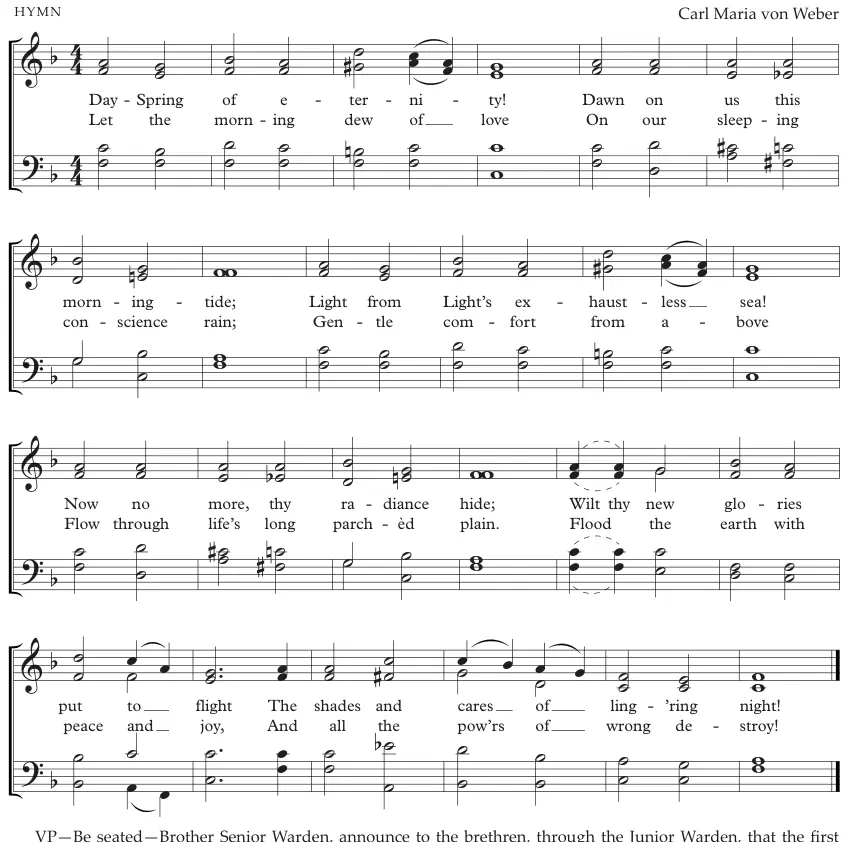
[The organ then plays, and the Brethren sing the following hymn] :
HYMN.
Day-spring of eternity !
Dawn on us this morning-tide! ~
Light from Light's exhaustless sea } Now no more thy radiance hide ;
With thy new glories put to flight
The shades and cares of lingering night!
Let the morning dew of lore
On our sleeping conscience rain |
Gentle comfort from above
Flow through life's long parcbéd plain : Flood the earth with pence and joy; And all the Powers of Wrong destroy!
Fen. Af. Zealous Bro.*. Sen.*. W.*., announce to the Brethren, through the Zealous Bro.. Jun.*. W.-., that the first faint blush of Dawn dims the light of the Morning Star, and this Preceptors is about to be opened; charging them according to the ancient custom,
_ Sen. We. Zealous Bro.*. Jun.*. Warden, the first faint blush of Dawn dims the light of the Morning Star, and this Preceptors is about to be opened. Announce this to the Brethren, with the ancient charge.
"XVIL..4
Jun.. WW... [Rapping thrice, at which all rise]: Faithful Brethren, Essence that wait for the Light and the new Law, the first faint blush of the coming Dawn, long waited fur, begina.to dim the splendour of the Morning Star. The glittering Seven fade into the far North, and the day comets, and this Preceptors is now about to be opened.
Jun, We. Yo shall keep my Sabbaths and reverence my Sanctuary.
Sen. We. Ye shall obey my judgments and keep my ordinances and my statutes."
Vi. af. Yo shall not profane the name of your God.
J. Wo. Ye shall love and venerate every man his father and mother.
S.. WV. Ye shall not glean your vineyards, nor gather every grape, nor wholly reap the corners of your fields; but leave something fur the poor and the stranger.
Vo, JC. Nor steal, nor deal falsely, nor lic one to another.
J. We, Nor defraud nor despoil your neighbours.
S.. W.. Nor go up and down as tale-bearers among the People.
V.. af". Thou shalt not bate thy brother in thy heart; nor suffer thy neighbour to go astray for want of warning.
J.. WW... Nor take revenge, nor feed and nurse old grudges; but love thy neighbour as thyself.
S.. Wi. Ye shall rise up respectfully before the hoary head, and honour the presence of the aged man, and fear your God.
. Vo. af. Ye shall not vex the stranger in your land, but shall love him os yourselves; for ye were strangers in the land of Egypt. .
S.. W.. Tf thy brother be waxen poor, and fallen into decay with thee, thou shalt relieve him, even if he be a stranger or sojourned, that he may live with thee. Thou shalt not give him thy money upon-usury, nor lend him thy victuals for increase. ,
V.. UM. These are the statutes, and judgments and laws of the Lord your God. Whatsoever Ie hath 'commanded you, observe and do it; nor add thereto, nor diminish from it, and it shall bo well with you and your children. Together, my Brethren!
[The Brethren all give the sign. Then the Ten.°. raps ?—the Sen.°. W.". ? — the Jun., W.:. ? — and the Ten... [,] Then the Brethren clap: , with their hands, and cry once EYATECOK..]
V.. Mf. This Preceptors is opened in due form. Bro.*. Jun.*. Deacon, inform the Guards.
RECEPTION.
The Candidate is received in the preparation room by the Examiner, who divests him of his regalia and jewel, if he wear any. Ie is then made to bare his feet and place thom in slippers, and o hair cloth is thrown over his shoulders, fastened together in front at the throat, and confined round the waist by o girdle of leather. He is then conducted to the door of the Lodge.
The Lodge room is thus prepared for his reception. The Brethren put off their regalia and jewels, and appear in their white robes only: The book with seven seals is placed upon the altar, and white curtains are let down from the ceiling to the floor, in front of the altar and platform, and of the hangings, all around the room, concealing the seats of all except the Ten.*. Master, who alone sits, while all the other brothers stand., The small table, which was at the right of the Master, is placed in the centre of the room, and covered with white linen, and on it are set the chafing dish, the basin of perfumed water, and a little vase with perfumed oil. The columns are also concealed.
The Examiner raps: , at the door, and it is partly opened by the Junior Warden, who asks:
J... Who seeks admission here, and with what purpose? .
Exam.", A weary traveller, who, having crossed the desert, wanders on the shore of the Dead Sea in darkness, seeking for light.
S.*. 7°. What does he desire?
Ex.. To be admitted to know the Mysteries of the Twenty-Four Elders.
Qu... Whence comes he?
Ans... From the Schools of the Philosophers of Greece and Egypt, and from sitting at the feet of the Pharisees and Kabbalists. ;
Qu... By what title does he expect to gain admission here? . dins... -By being 2 Mason, a Prince of Jerusalem, and a patient and humble searcher after Truth. Qu. Do you vouch for this?
Aas. Do. :
Jo. We. Then let him wait, with patience and humility, until the Elders are informed of his request. [The Jun.:. Warden closes the door, and reports to the Sen.*. Warden, where the same questions are asked and like answers returned as at the door, except the last question and answer. The Sen.*. Warden reports to the Yen.*. Master, the same questions being asked and the same answers given. Upon receiving the answers, the Ten.*. Master says] : ;
V.. M. Zealous Bro.-. Examiner, go to this Candidate and strictly examine if he be o Mason, and if his principles be such that we may fitly admit him among us. : [The Examiner goes to the Candidate, and questions him as follows]: Qu. 1.... Do you declare that, unintluenced by curiosity, or the desire of worldly advantage, or any base, low or unworthy motive, and as an honest and earnest seeker after Truth, you have come hither? Ans... . Do.
Que.2.... Are youa Mason?
Anse... . Tam.
Qu..3.... Towhat degree have you attained ? Ans... ... To that of Prince of Jerusalem. Qu... 4... Give me the Pass-word of a Prince of Jerusalem. Anss. ee. KOEMCY.-. .
'Que.5.... The Sacred Word?
Aas'. ..-. Quit.
Qu..6.... The sign.
(He gives it.]
Qu..7.... The grip.
[He gives it.]
Qu.. 8... Tnecept and recognize you as Brother. What found you in the Schools of Philosophy? Ans... ... Empty babbling and vain jangling of words, and a confused mass of incoherent ideas. Qu..9. +. . What found you among the Kabbalists? . ans... .. The rhapsodies and extravagances of insanity and delirium. Qu. 10.... What found you in the Desert?
Ans.*. ... Patience and Submission.
Qu. 11... . What lesson have you learned on the shores of the Dead Sea? Ans. ... Humility, and Veneration.
Qu.*. 12... . What do you expect to find among us? Ans. ... The True Light. m
Qu.'.18.... Ibis not yet Day. We have but reached Truth's threshold. But we advance. Would you advance with us?
dns, ... T would.
Qu.*. 14... Have you hitherto, to the best of your ability, been mindful of your Masonic obligations, and striven to comply with them in spirit and in truth? ans... . have. ,
Qu.. 15... . Wave you ever wronged a brother, or allowed him to be wronged, when you could have prevented it; without afterwards repenting and making reparation? alums. 66. [have not.
Qu. 1G.... Wave you any dissension or quarrel with a Gro.*. Prince of Jerusalem unreconciled ?
Ans... . Have not.
Exam. It is well, Wait again with patience, until the Elders are informed of the answers you have made.
(The Bro.*, Examiner enters the Preceptors, advances to the East, and says] :
Exam... On.*. Master, the Candidate has satisfiéturily answered the sixteen questions. .
Ten. Mf. My Brethren, you hear the report of our Faithful Brother Examiner. Shall the Candidate be received? If you assent, give me the sign.
[All who assent give the sign by putting the right band to the forehead. If it is unanimously assented to, the Yen.°. M.*. says]:
Ve. Mf, Faithful Bro.-. Lecturer, you will please receive and introduce the Candidate.
[The Lecturer goes out, and leads in the Candidate. The room is now lighted dimly, by ono or two candies on the table in the centre, the lights on the columns burning low and being shaded. The Brethren, except the Master, stand facing the East. The Lecturer conducts him seven times around the room, the" officers repeating at each circuit as follows] : :
Ist Circuit: . 2.0.6. Ie that hath an ear, let him hear what the spirit saith unto the churches: To him that overcometh will I give to ent of the tree of life, which is in the midst of the Paradise of God.
Od Circuit: ..... . The that hath an ear, let him hear what the spirit saith unto the churches: He that overcometh shall not be hurt of the second death.
3d Circuit: ....... To him that overcometh will I give to eat of the hidden manna; and I will give him a white stone, and in the stone a new name written, which no man shall know but he that shall receive it.
4th Circuits 2.25% Ile that overcometh, and laboureth in my service until the end, to him will I give power over the nations, and his influences shall control and guide them, and I will give him the Morning Star.
5th Circuit: . ... . He thatovercometh shall be clothed in robes of white: and I will not erase his name from the Book of Life; but I will own him as mine before my Father and all his Angels.
6h Cireutt: .... . Him that overcometh will I make a pillar in the Temple of my God, and he shall remain there forever: and I will write upon him the name of God, and the name of the City of Ged, the New Jerusalem, which comets down out of Heaven from Gud; and ming own new name.
7th Circuit: ...... To Him that overcometh will I grant to sit with mo near my Throne, even as I also overcame, and am seated with my Father near Ilis Throne. As many as I love, I rebuke and chasten: be zealous therefore, and repent! °
[The Lecturer and Candidate then halt in front of the Ten.*. M.-.; who asks]:
Fens. Ma. Bro.. Examiner, whence come you, and whither do you travel?
Lect.*. From the desert and the darkness, towards the Light.
Ten. 3£°. have you yet found the Light? =.
Lect... Ten.*. Master, no: but the Seven Stars sink low in the North; the Pleiades and Orion.are in the
Zenith; the Morning Star grows pale; the Dawn, long expected, approaches.
Ten. U, Light comes from God. When clouds and darkness are around us, we should implore Tis aid. Let us do so, my Brethren!
{All kneel; and the Ten.:. BL. repeats the following]
PRAYER.
Our Father, who, when darkness brooded upon the face of the vast chaos, and the universe Jaya confused mass of struggling forces, without form and void, midst move upon it, and said, Dect there be light l~had light was: Thou who midst set the Light against the Darkness, and call one Day, and the other Night: Thou who midst set the Greater and Lesser Lights in the Heavens: Thou who briniest forth Mazzaroth in his season, and guides Arcturus with his sons: enable this Candidate to find the light for which he secketh! Let the dawn of the New Day arise, and shine upon the clouds of Error, and cause the darkness of ignorance and
superstition to five away and be seen no more forever. Amen!
Vo. Ms. My Brother, the innocent and pure of heart alone can be admitted to our mysteries. [A brother brings a basin of pure water and a white towel, and places them on the table}. In token of that innocence and purity ; and as a pledge to us that your bands shall henceforward never be defiled By covetousness, unjust gain, tyranny, oppression, injustice, baseness or fraud, you will wash them in the pure water before you.
(The Candidate does so ; and the Ten.*. M.*. proceeds] : .
Vo. Me. The living know that they shall die: but the dead know not anything; neither have they any more a reward; fur the memory of them is forgotten. Also their lore and their hatred and their envy is now perished ; neither have they any more 2 portion forever in anything done under the sun.
Remember now thy Creator in the days of thy youth, while the evil days come not, nor the years draw nigh when thou shalt say, I have no pleasure in them: while the sun, or the light, or the moon or the stars are not darkened; and the clouds pass away after the rain:
In the day when the limbs are not yet trembling with age, nor the head bowed with sorrow, nor the eyes dim with weeping: before thou guest ta thy long home, and the mourners go about the streets; before the silver cord is loosed and the guldeu bowl broken, and the pitcher shivered at the spring, and the wheel shat- - tered at the cistern: before the dust returns to the earth as it was, and the spirit unto God who gave it.
My Brother, when you became a Mason, you placed your trust in God. Do you still continue to do so?
Cand. Do.
V..M. Do you firmly believe that there is but one God, Supreme, Infinite, Eternal, Unchangeable; that The is infinitely good, wise, just and true; and that evil and pain, and sorrow and misery are but parts of the plan of Infinite Wisdom, working together to produce infinite good? and that the soul is immortal?
Cand.:. Do.
Vo. Af. Kneel, then, and' be consecrated to the service of Truth!
(He kneels in front of the Yen.*. Master, as he stands near the table, while the Brethren form a circle around him. Then the Ten.*. M.". takes in his hand a small quantity of perfumed water from the basin, and pours it on his head, saying]: .
¥."s Af, In imitation of our Ancient Masters, the Egyptians, and as a token and solemn pledge that you here, henceforth and forever, renounce all that is vicious, sordid and base, I pour upon thy head this pure water; and I devote and consecrate thee to the service of Truth, Justice, Virtue and Benevolence. I do this as asymbil of repentance and reformation; but One comets hereafter, whose shoes I am not worthy to unloose. He shall baptize you with the Holy Spirit and with fire. Ilis fan will be in his hand. and he will thoroughly sweep his threshing floor, and gather his wheat into his granary, and burn up the chaff with a devouring fire. Ilis axe 'is prepared for the trees; and every tree that beareth not good fruit will be cut down and cast into the fire. [A Brother puts live coals in the chafing-dish, or in some other way produces 4, heat over his bead, that he sensibly feels]. Lo! a symbol of that baptism, with the Spirit and with fire; purified by which, man becomes God's soldier, to war against Fanaticism, Intolerance, Bigotry, Falsehood, and the whole brood of kindred fiends, that so long have made a hell of our earth, which was created a paradise: symbol also of that suffering and pain; and wo and want, and sharp ingratitude, and.bitter injustice, that are God's baptism of fire, by which He strengthens the human soul, and gives occasion and incentive to the noblest virtues ; and thus purifying it, lifts it above humanity. To suffer is the noblest lot of man here below ; fur none but those who suffer doth God baptize with fire and with his Spirit.
My Brother, you have been baptized with water and with fire: and you are clad in hair-cloth, and 9 girdle of leather, as a token of sorrow and penitence. Are you prepared to suffer and endure in the cause of Masonry and for the good of your fellow-men?
Cand. Iam +
V.:. Mf. My Brethren, who among you is worthy to open the Book with Seven Seals? [There is no
reply: and, laying his hand on the head of the candidate, he says}: My Brother, Socrates drank the hemlock, when the doors of his prison were open, that he might not set the example of disobeying the laws of his ungrateful country. Curtius leaped, in his armour, into the gulf that could thus only be closed, and else would swallow Rome. Daniel prayed three times a day, openly, to God, knowing that the penalty was exposure, naked, to hungry lions: and an army of martyrs have offered up their lives, o willing sacrifice, to prove their
faith or benefit mankind. None other can open the Great Book with Seven Seals, and learn the mysteries that are hidden therein. re you prepared to shed your blood, in proof of your fidelity and courage, and even for those who may have wronged you, because God made men your Brethren?
Cand... Iam.
V.. ML". Prepare him, then, for the last trial, my Brethren !
[Ile is blindfolded, and seated in a chair. Ilis right arm is bandaged, a slight incision made near the vein with a lancet, so ag to draw a little blood, and tepid water is poured upon it in a small stream, and falls into a basin on the floor, to produce the impression that lie is bleeding. After this has been continued some minutes, that arm is freed from the bandage, and the same process gone through with the Icft arm. Then the Ten.". M.*, says]: ,
V, Mi. Enough, my Brethren! The cause of Humanity docs not now require our Brother's life.
Whenever it shall, let him be ready to lay it upon the altar of his God, of friendship, of his country, or of the haman race. Bind up his wounds!
[Both arms are dressed and bandaged, as after bleeding. In the mean time the Brethren have assumed their regalia, the white curtains are removed or rolled up, and all the lights are lighted. The table is placed again to the right of the Master's seat, and the little vessel of oil upon the altar]. ~
Vv... M. My Brother, thou has wandered long in the desert of this world, and sought for Light in the darkness of Philosophy, on the shores of the Dead Sea of Human Life. Dust thou still pray for Light?
Cand... I do. °
V.. IL. My Brethren, he also is your Brother, for he séeks to find the Truth. Give him light!
[The bandage is removed from his eyes; and he is then led by the Ten.°. Master to the Platform, to which he ascends, and stands near the altar. Ile is then made to kneel, on both knees, with both hands on the Book
with Seven Seals, and repeats the following]
OBLIGATION.
LA..«...B..... im the presence of the One God, Creator of the Universe, and calling upon
these Brethren as witnesses, do, upon this Sacred Book, most solemnly promise and sincorcly swear, that I - will never reveal the secrets of this Degree or the mode of my adinission, to any person.in the world, :to whom. the same may not lawfully belong, and only when I am authorized to communicate them.
I furthermore promise and swear that I will be ever ready to expose, and if necessary to yield up, my life, in the cause of Friendship, my Country, or of Common Humanity. :
I furthermore promise and swear, that I will never fight or combat with a Brother of this Degree, except in the extremest and clearest case of self-defence: and that I will, at all. times, when he has justice on his side, bo ready to aid and support him against any who seek his life, or to destroy his honour, reputation, peace of mind or estate; that I never will slander, revile or speak slightingly of a Brother, or endeavour to bring him into contempt or to cast ridicule upon him: nor suffer others to assail his character in his absence, without resenting it myself, or informing him thereof at the earliest opportunity: and that I will on all occasions
consult his honour and his interest.
I furthermore promise and swear, that I will hereafter be just and upright, benevolent to my fellow-men,
and indulgent of their errors.
I furthermore promise and swear, that I will pay due respect and obedience to the superior authorities of the Ancient and Accepted Rite; and especially to the Knights Kadosch, Sublime Princes of the Royal Secret, and Sovereign Gr.-. Inspectors General of the 33d Degree, within whose jurisdiction I may be; and that I will in every thing assist and support them in all proper and justifiable measures for the good of Masonry, according to the constitutions of the Supreme Council. ' .
To all which I do most solemnly promise and swear, invoking the just anger of the Deity, if I wilfully violate this my solemn, deliberate and voluntary obligation. Sv help mo God, and keep mo steadfast to per-
furm the same !
V.. M. My Brother, arise! I accept and receive you as a Brother of this Degree; and I now further devote you to its duties and ta Masonry,
[Saying this, he takes the vessel of oil, and with the tip of his finger aucints bis Head, Eyes, Mouth, Ilenrt, the tip of his right Ear, his right Hand, and right Foot; and says]: ;
¥-. af. Your brain, sight, speech, passions, hearing, and powers of work and action, instruments to man for good or evil, I hereby forever devote to Good ; and charge you hereafter to let them aid in no base, dishonest or vicious thought, wurd ur action! Thus devoted, pledged and sworn, and having sealed your covenant with us with your blood, you are worthy to open the Buok with Seven Seals. Approach, and open the first seal!
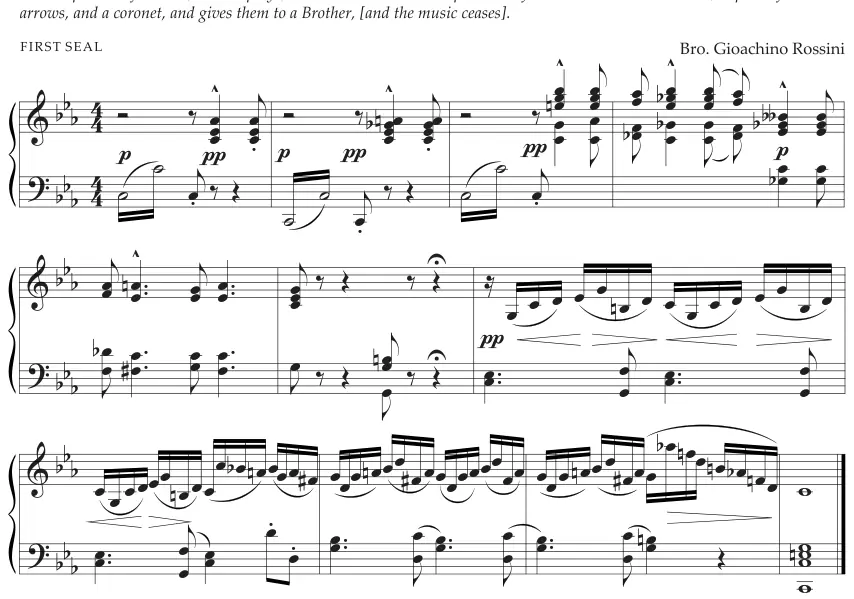
[Ire opens the first seal. 'The organ plays a few notes; and the Ten.". M.. takes from behind the altar a bow, 0 quiver filled with arrows, and a coronet, and gives them to a Brother, and says to him]: " Depart and continue the conquest! And [ saw, and lo! a white horse; and he that sat on him held a bow; and a crown was given unto him: and he went forth conquering and to conquer. Open now the second seal!"
Ile does so: and the Ten.°. M.°. takes from behind the altar a naked sword ; [Music is heard here, and as each seal is opened]; and gives it to another Brother, saying: ''Go forth and create strife and dissension among the Profane and Wicked, that they may destroy each other; and smite thou unsparingly the vices, the superstitions and the errors that infest and atilict the world! Fur there went out another horse that was red; and it was given to him that sac thereun tu banish peace from the earth, and that the wicked should slay one another; and there was given unto him a great sword. Open now the third seal 1"
Ile does so: and the Ten.°. M.-. takes from behind the altar a pair of balances, and gives them to another Brother; and says: "Go thou and administer Justice and Equity, and see that the poor be no longer oppressed with false weights and false measures; and that their wages Le punctually paid them; that they may no longer starve! Open now the fourth seal ['
He does so: and the Ten.-. M.°. takes from behind the altar a human skull, and gives it to another Brother, saying: "Go thou and teach mankind that the soul which sins shall die; that they may learn humility and the vanity of all earthly things!—for lo! a pale horse; and his name that sits on him is Death; and after death the judgment: and power is given to him to slay with the sword, and with starvation, and with sickness, and the beasts of the earth. Open now the fifth seal!"
"$e does so: and the Yen.°. M.°. takes from behind the altar a linen cloth, stained with much blood, and gives it to another Brother, saying: "Go thou and accuse those who have persecuted and slain them who have come on earth to reform and be the benefactors of mankind! For under the altar are the souls of those who have been slain because they taught God's Truth, and condemned the errors of those who ruled over the consciences of men: and they cry with a voice that ascends to God's footstool, 'Tow long, O Lord, Holy and True, wilt Thou refrain from judging and avenging our blood upon these monsters of cruelty and oppression under whom the earth groans and mankind are crushed and trampled down?? And white robes are given unto them; and they are told to be patient yet a little while, until all who, like them, shall endeavour to serve mankind, shall, like them, be tortured and slain, and the great purposes of God in Ilis timo be fulfilled. Open
now the sixth seal!" . .
He does 0: and immediately there is a crash of loud music from the organ, thunder rolls near the Lodge,
and the lights are all darkened.
V.. M-. Lo! a great earthquake; and the sun is eclipsed and the moon becomes red as blood; and the stars of Heaven fall to the earth, -as a fig-tree casteth her unripe figs, when shaken by 0 mighty wind: and the Heaven vanishes as a scroll is rolled together: and the mountains and islands are moved out of their places: and earth's rulers, the great, the rich, the captains of armies, the powerful, the bondsmen and the free, hide themselves in the caves, and take refuge among the rocks upon the mountains, and call upon them, crying, " Fall upon us, and hide us from the face of Him that sitteth on the Throne, and from the anger of God; for the great day of his wrath is come, and who shall be able to stand."
_ The Ten.' M.*. then, with a liquid of the colour of blood, marks a Tau cross upon the forehead of the candidate, and says: " Hurt not the earth, nor the sea nor the trees, until we have sealed the servants of God upon their foreheads! Glory to God who sitteth upon the Throne, and unto his Son, who as Lamb for the sacrifice shall take away the sins of the world!"
re i
XVII... 10
The Brethren all kneel, and bow their beads to the floor, and say together, " Amen! Blessing and glory, and wisdom and thanksgiving, and honour and power and might be unto our God, forever and ever: Amen!"
Then the Ten.*. M.°. takes from the candidate his girdle and hair-cloth, and puts upon him o white linen robe; and says; "And one of the Elders said unto me, 'who are these that are arrayed in white robes? and whence came they? and [ said unto him, 'Ten.°., thou knowest.' And he said unto me, 'These are they who have been purified by sorrow and suffering, and by the intercession and blood of the Redeemer. Therefore stand they before God's throne, and serve him day and night in his Temple: and he that sitteth on the Throne shall dwell among them; and they shall hunger no more, neither thirst any more; nor shall the sun scorch them, nor the fire again torture them. For the Lamb who sitteth upon his Throne shall sustain them, and shall lead them to the living springs of truth; and God shall wipe away all tears from their eyes.' Open now the Seventh Seal."
Ile does so: and for a time there is a perfect silence. Then the Yen.". Master takes from behind the altar seven trumpets, and gives them to the two Wardens, the Lecturer and Examiner, the Secretary and Treasurer and the Senior Deacon; and to the Jun.*. Deacon a gilded censer, and incense, which he lights and places upon the altar, After it has burned a time, he takes it, and flings down the contents upon a place prepared to receive them. Immediately the 1st trumpet sounds.
V.. Mf. Wail and fire, mingled with blood shall be cast upon the earth; and the third part of the trees, and all the green grass shall be burned up.
{The 2d Trumpet sounds].
V.. af. A great mountain vomiting fire shall be torn up and flung into the sea; and the third part of the oceans shall become blood; and the third part of all living creatures in the sea shall die, and the third part of the ships thereon be destroyed. '
[The 3d Trumpet sounds]. .
Vu. Mf, A great star shall fall from Heaven, burning like a lamp; and a third part of the waters of all the rivers and of the living springs that feed the rivers, shall become bitter os wormwood; and all who drink thereof shall'die. .
(The 4th Trumpet sounds]. .
V.. Mf. A third*part of the sun, moon and stars shall be eclipsed and darkened; and by.day there shall . be but a dim light, and the.night shall be dark and gloomy.
(The 5th Trumpet sounds}.
¥.. IL. The first woe shall come upon the Earth; the reign of the Spirit of Evil; and the locusts of Ignorance, Fanaticism and Superstition, whose leader is Abandon.
(The Gth Trumpet sounds].
V.. M6. Then the four Demons, that came among men while yet they had not gone abroad from the
banks of the Euphrates, Bigotry, Intolerance, Ambition and Selfishness shall be Jet loose, and with fire and the sword and all manner of savage torture shall slay one third of mankind; and yet the others shall not repent. And God's servants shall endeavour to reform the People, and Thought and Speech and Conscience shall struggle to be free: but those who would reform mankind, and free the world from slavery and oppression, shall be slain; and their dead bodies, denied burial, shall be Sung to rot upon the earth, which shall then be one great Sodom. But 'Truth shall still struggle with Error; and the great earthquake of Thought shall at length shake the Souls of Nations; and the second woe shall cease.
(The 7th Trumpet sounds].
V.. MM. The Kingdoms of this world shall become the Kingdoms of God and Ilis Anointed; and he shall reign forever and ever. The long war between the Evil and the Good, between Michael and his angels and the Dragon and his angels shall end; and the Serpent and his angels shall be overcome, and shall pass away and be seen no more forever; and salvation and strength, and the Kingdom of God, which is Truth, shall come, and thenceforward remain forever: and sorrow and evil shall disappear; and the labours of those who have " borne testimony to the Truth, and given up their lives to benefit the world shall not have been in vain; but they shall have eternal fame and glory and honour, when the names of all conquerors and kings shall have faded out of the memories of men.
AVIT. . . 11
Jo. & S$. 7. We give Thee thanks, O Lord God Omnipotent! who art Eternal, and to whom the Past, the Present and the Future are One; because Thou wilt in due time assert Thy Power, and vindicate Thy Justice, Thy Wisdom and Thy Goodness, when Evil shall reign no longer.
V.. IL. For Thou wilt in due time judge all men, and reward Thy servants and those who have loved and served mankind, the Known and the Unknown, the Lofty and the Low; and those who have vexed and plagued the Earth Thou wilt reward according to their evil works, And then shall Thy Temple be rebuilt in the Heavens; and those who wear Thy Name written upon their foreheads, and Thy Law engraven in their hearts, shall inhabit its courts forever. Blessed, henceforward, are the dead, who fall in the cause of Truth: for they shall then rest from their labours and their sorrows, and their works shall follow them !
[The organ plays an exulting and triumphant air; and the Ten.°. M.*. and the Candidate descend from the Platform; the Ten.-. having first opened the Great Book, and Isid upon it the Square and the Compasses. They halt at the Master's sent ; when the music ends, and the Ten.*. M.*. invests the Candidate with the collar, apron, jewel, and sword of the Degree; saying] :
"'Tiniest you with the apron of this Degree. Its color is emblematical of the Dawn; its shape of the Deity, of Justice, of Equality, of Equanimity; the Tetractys upon it, of the Universe, with the Deity in its centre. .
"T invest you with the order of this Degree. Its two colors, white and black, are emblematical of the contest between the Principles of Good and Evil.
"Tiniest you with the jewel of this Degree. Its heptagonal shape will be hereafter explained to you, as also will the devices upon it. Its material, gold and silver or mother of pearl, symbolizes the Sun and Moon, the Great Lights of the Day and Night, themselves Emblems of Strength and Beauty, the two pillars at the Threshold of Masonry.
"* Receive now the Signs, Tokens and Words of this Degree.
'Stew: . . Look at your $2¢,&VI2&% 6 tI Ct...
Axswrr: ... Look atthe fCWYYPpOey 5 fIICf: one says Om Our Y &.-. the other RO&MOT LH.
Frast Toxzew: ... Put the }CWPJ&OQL°TL in a brother's [9GUe7: He F¥*Ct4 yours with his
TCV: Then look mutually at the {1.28% 4 fICt.
Second Toxry: ... 85 2& with your f[CWYI&OxrL the T2245 fMICt of the Brother; who
answers by P34 F&O your Ok YS tOCt with his {{&O"11.
Six to ENtER true Lopce:... Put the {3}<Oetrr upon the WYtC&COn.
Ve. Me. 2. Tfinally present you with this coronet, in token of your present rank in Masonry. Remem. her that it, like the other insignia of the Ancient and Accepted Rite, is honourable, only so long as it is worn with honour. On the brow of the dishonest, the dissipated, the vicious or the basc, honours undeserved are the extremest disgrace: See, therefore, that you wear it worthily and well!
[The Candidate is now directed to be seated in front of the Ten.*. M.-., and receives from the Lecturer the following History and Instruction] : .
HISTORY.
This, my Brother, is the first of the Philosophical degrees of the Ancient and Accepted Rite; and the beginning of « course of instruction which will fully unveil to you the heart and inner mysteries of Masonry. Do not despair because you have often seemed-on the point of attaining the inmost light,and have as often been disappointed. In ail time, truth has been hidden under symbols, and often under a succession of allegories: where veil after veil had to be penetrated, before the true Light was reached, and the essential truth
- stood revealed.
We are about to approach those ancient Religions which once ruled the minds of men, and whose ruins encumber the plains of the great Past, as the broken columns of Palmyra and Tadmor lie bleaching on the sands of the desert. They rise before us, those old, strange, mysterious breeds and faiths, shrouded in the mists of antiquity, and stalk dimly and undefined along the line which divides Time from Eternity; and forms of strange, wild, startling beauty mingle in the vast throng of figures with shapes monstrous, grotesque and hideous. .
The religion taught by Moses, which, like the laws of Egypt, enunciated the principle of exclusion, borrowed, at every period of its existence, from all the creeds with which it came in contact. While, by the studies of the learned and wise, it enriched itself with the most admirable principles of the religions of Egypt and Asia, it was changed, in the wandering of the People, by everything that was most impure or seductive in the pagan manners and superstitions. It was one thing in the times of Moses and Aaron, another in those of David and Solomon, and still another in those of Daniel and Philo.
* At the time when John the Baptist made his appearance in the desert, near the shores of the Dead Sea, all the old philosophical and religious systems were approximating towards each other. A general lassitude inclined the minds of all towards the quietude of that amalgamation of doctrines for which the expeditions of Alexander and the more peaceful occurrences that followed, with the establishment in Asia and Africa of many Grecian dynasties and a great number of Grecian colonies, hail prepared the way. After the intermingling of different nations, which resulted from the wars of Alexander in three-quarters of the globe, the 'doctrines of Greece, of Egypt, of Persia and of India met and intermingled everywhere. All the
. barriers that had formerly kept the nations apart, were thrown down; and while the Pcopleof the West readily connected their faith with those of the East, the people of the Orient hastened ty learn the traditions of Greece and the legends of Athens. While the Philosophers of Greece, all, (except the disciples of Epicurus), more or less Platonicians, seized eagerly upon the beliefs and doctrines of the East; the Jews and Egyptians,
. before then the most exclusive of all peoples, yielded to that eclectism which prevailed among their masters,
the Greeks and Romans.
Under the same influences of toleration, even those who embraced Christianity, mingled together the old and the new, Christianity and Philosophy, the Apostolic teachings, and {the traditions of Mythology. The man of intellect, devotee of one system, rarely displaces it with another in all its purity. The people take _ such a creed as is offered them. Accordingly, the distinction between the esoteric and the esoteric doctrine,
. immemorial in other creeds, easily gained a foothold among many of the Christians; and it was held by a vast number, even during the preaching of Paul, that the writings of the Apostles were incomplete; that they contained only the germs of another doctrine, which must receive from the hands of philosophy, not only the systematic arrangement which was wanting, but all the development which lay concealed therein. The writings of the Apostles, they said, in addressing themselves to mankind in general, enunciated only the articles of the vulgar faith; but transmitted the mysteries of knowledge to superior minds, to the Elu,— mysteries handed 'down from generation to generation in esoteric traditions; and to this science of the mysteries they gave the name of Tvidcs [Gnasis].
The Gnostics derived their lending doctrines and ideas from Plato and Philo, the Zend- avesta and the Kabbala, and the Sacred books of India and Egypt; and thus introduced into the bosom of Christianity the cosmological and theosophical speculations, which bad formed the larger purtiun of the ancient religions of the Orient, joined to those of the Egyptian, Greek and Jewish doctrines, which the Neo-Platonists had equally
adopted in the Occident,
Emanation from the Deity of all spiritual beings, progressive degeneration of these beings from emanation to emanation, redemption and return of all to the purity of the Creator; and, after the re-establishment of the primitive harmony of all; a fortunate and truly divine condition of all, in the bosom of God; such were the fundamental teachings uf Gnosticism. The genius of the Orient, with its contemplation, irradiation and intuitions, dictated its dugtrines. Its language corresponded to its origin. Full of imagery, it had all the magnificence, the inconsistencies and the mobility of the figurative style.
Behold, it said, the light, which emanates from an immense centre of Light, that spreads everywhere its benevolent rays: so do the spirits of Light emanate from.the Divine Light. Behold all the springs which nourish, embellish, fertilize and purify the Earth: they emanate from one and the same ocean: so from the bosom of the Divinity emanate so many streams, which form and fill the universe of Intelligences. Behold numbers, which all emanate from one primitive number, all resemble it, all are composed of its essence, and still vary infinitely ; and utterances, decomposable into so many syllables and elements, all contained in the primitive word, and still infinitely various; so the world of Intelligences emanated from a Primary Intelligence, and they all resemble it, and yet display an infinite variety of existences.
Tt revived and combined the old doctrines of the Orient and the Occident: and it found in many passages of the Gospels and the Pastoral letters, a warrant for doing so. Christ himself spoke in parables and allegories, John borrowed the enigmatical language of the Platoniats, aad Paul often indulged in incomprehensible rhapsodies, the meaning of which could have been clear to the initiates alone.
It is admitted that the cradle of Gnosticism is probably to be looked for in Syria, and even in Palestine. Most of its expounders wrote in that corrupted form of the Greek used by the Hellenistic Jews, and in the Septuagint and the New Testament: and there was a striking analogy between their doctrines and those of the Egyptian Philo, of Alexandria, the seat of three schools, at once philosophic and religious—the Greek, the Egyptian, and the Jewish. ,
Pythagoras and Plato, the most mystical of the Grecian Philosophers, (the latter heir to the doctrines of __ the former), and who had travelled, the latter in Egypt, and the former in Phoenicia, India, and Persia, also
taught the esoteric doctrine, and the distinction between the initiated and the profane. The dominant doctrines of Platonism were found in Gnosticism. Emanation of Intelligences from the bosom of the Deity; the .going astray in error and the sufferings of spirits, so long as they are remote from God, and imprisoned in matter; vain and long-continued efforts to arrive at the knowledge of the Truth, and re-enter into their primi- ~ five union with the Supreme Being; alliance of pure and divine soul with an irrational soul, the seat of evil .desires; angels or demons who dwell in and govern the planets, having but an imperfect knowledge of the 'ideas that presided at the creation; 'regeneration of all beings by their return to the xdopos vortos, [cosmos noetos], the world of Intelligences, and its Chief, the Supreme Being; sole possible mode of re-establishing that primitive harmony of the creation, of which the music of the spheres of Pythagoras was the image; these were the analogies of the two systems: and we discover in them some of the ideas that form a part of Masonry ; in which, in the present mutilated condition of the symbolic degrees, they are disguised and overlaid with fiction and absurdity, or present themselves as casual hints that are passed by wholly unnoticed.
The distinction between the esoteric and esoteric doctrines, (a distinction purely Masonic), was always and from the very earliest times preserved among the Greeks. It remounted to the fabulous times of Orpheus ; and the mysteries of Theosophy were found in all their traditions and myths. And after the time of Alexander, they resorted for instruction, dogmas and mysteries, to all the schools, to those of Egypt and Asia, as well as those of Ancient Thrace, Sicily, Etruria, and Attica. °
The Jewish-Greek School of Alexandria is known only by two of its Chiefs, Aristobulas and Philo, both Jews of Alexandria in Egypt. Belonging to Asia by its origin, to Egypt by its residence, to Greece by its language and studies, it strove to show that all truths embedded in the philosophies of other countries were transplanted thither from Palestine. Aristobulus declared that all the facts and details of the Jewish Scriptures were so many allegories, concealing the most profound meanings, and that Plato had borrowed from them all his finest ideas. Philo, who lived a century after him, following the same theory, endeavored to show that the Ilebrew writings, by their system of allegories, were the true source of all religious and philosophical doctrines. According to him,' the literal meaning is for the vulgar alone. Whoever has meditated on philosophy,
has purified himself by virtue, and raised himself by contemplation, to God and the intellectual world, and received their inspiration, pierces the gross envelope of the letter, discovers a wholly different order of things, and is initiated into mysteries, of which the elementary or literal instruction offers but an imperfect image. A historical fact, a figure, a word, a letter, a number, a rite, a custom, the parable or vision of a prophet, veil the most profound truths: and he who-has the key of science will interpret all according to the light be possesses. .
Again wo seo the symbolism of Masonry, and the search of the Candidate for light. "Let men of narrow minds withdraw," he says, "' with closed ears. We transmit the divine mysteries to those who have received the sacred initiation, to those who practise true piety,and who are not enslaved by the empty trappings of words or the preconceived opinions of the pagans."
To Philo, the Supreme Being was the Primitive Light, or thé Archetype of Light, Source whonco the
rays emanate that illuminate Souls. IIo was also the Soul of the Universe, and as such acted in all its parts. If Himself fills and limits his whole Being. Ilis Powers and Virtues fill and penetrate all. These Powers, [dvvduers, dunameis] are Spirits distinct from God, the Ideas of Plato personified. If is without beginning, and lives in the prototype of Time, [arwr, aion]. .
Ilis image in tres Worn [Acyos], a form more brilliant than fire; that not being the pure light. This - Locos dwells in God; for the Supreme Being makes to Himself within his Intelligence the types or ideas of everything that is to become reality in this World. The Locos is the vehicle by which God acts on the Uni- . Verse, ond may be compared to the speech of man.
The Locos being the World of Ideas [xosyos vores], by means whereof God has created visible things, Ie is the most ancient God, in comparison with the World which is the youngest production. The Locos, Chief of Intelligences, of which If is the general representative, is named Archangel, type and representative of all spirits, even those of mortals. Te is also styled the man-type and primitive man,
God only is Wise. The wisdom of man is but the reflection and imngo of that of God. Ie is the Father; and Ilis Wispox the mother of creation: for Io united Iimaclf with Wisvox [Sopa, Sophia}, and commune- | cated to it the germ of creation, and it brought forth the material world. Ie created the ideal world only, and caused the material world to be made real after its type, by His Locos, which is His speech, and. at the same time the Idea of Ideas, the Intellectual World. The Intellectual City was but the Thought of the Architect, who meditated the creation, according to that plan of the Material City.
The Word is not only the Creator, but occupies the place of the Supreme Being. Through Him all the ; Powers and Attributes of God act. On the other side, as first representative of the Human Family, Uo is the
Protector of men and their Shepherd.
God gives to man the Soul or Intelligence, which exists before the body, and which he unites with the body. The reasoning Principle comes from God through the Word, and communes with God and with the
Word ; but there is also in man an irrational Principle, that of the inclinations and passions which produce disorder, emanating from inferior spirits who fill the air as ministers of God. The body, taken from the Earth, and the irrational Principle that animates it concurrently with the rational Principle, are hated by God, while the rational soul which be has given it, is, as it were, captive in this prison, this coffin, that encompasses it, The present condition of man is not his primitive condition, when he was the image of the Logos. IIe has fallen from his first estate. But he may raise himself again, by following the directions of Wispox (Zola] and of the Angels which God has commissioned to aid him in freeing himself from the bonds of the body, sad combating Evil, the existence whereof God has permitted, to furnish him the means of exercising his liberty. The souls that are purified, not by the Law but by light, rise to the Heavenly regions, to enjoy there o perfect felicity. Those that persevere in evil go from body to body, the seats of passions and evil desires. The familiar lineaments of these doctrines will be recognized by all who read the Epistles of St. Paul, who wrote after Philo, the latter living in the reign of Caligula, and being the contemporary of Christ.
And the Mason is familiar with these doctrines of Philo: that the Supreme Being is a centre of Light whose rays or emanations pervade the Universe; for thais the Light fur which all Masonic journeys area search, and of which the sun and moon in our Lodges are only emblems; that Light and that Darkness, chief enemies from the beginning of Time, dispute with each other the empire of the world; which we symbolize
by the candidate wandering in darkness and being brought to light: that the world was created, not by the Supreme Being, but by a secondary agent, who is but His Worn, [the Aoyos}, and By types which are but his ideas, aided by an [ntELitcence, or Wispou [Zola], which is one of His Attributes; in which we see the occult meaning of the necessity of recovering the Word ; and of our two columns of Srrexcrm and Wisnou, which are also the two parallel lines that bound the circle representing the Universe: that the visible world is the image of the invisible world; that the essence of the Human Soul is the image of God, and it existed before the body; that the object of its terrestrial life is to disengage itself of its body or its sepulchre; and that it will ascend to the Heavenly regions whenever it shall be purified ; in which we see the meaning, now almost forgotten in our Lodges, of the mode of preparation of the candidate for apprenticeship, and his tests and purification in all the degrees. ;
Philo incorporated in his eclectism neither Egyptian nor Orientalelements. But there were other Jewish Teachers in Alexandria who did both. The Jews of Egypt were slightly jealous of, and a little hostile to those of Palestine, particularly after the erection of the sanctuary at Leontopolis by the High Priest Onias; and therefore they admired and magnified those sages, who, like Jeremiah, had resided in Egypt. The wisdom of Solomon was written at Alexandria, and, in the time of St. Jerome, was attributed to Philo; but it contains principles at variance with his. It personifies Wisdom, and draws between its children and the Profane, the same line of demarcation that Egypt had long before taught to the Jews. That distinction existed at the beginning of the Mosaic creed. Moses himself was an initiate in the mysteries of Egypt, as he was compelled to be, as the adopted son of the daughter of Pharaoh, Thouoris, daughter of Sesostris-Ramses ; who, as her tomb and monuments show, was, in the right of her infant husband, Regent of Lower Egypt or the Delta at the time of the Hebrew Prophet's birth, reigning at Heliopolis. She was also, as the reliefs on her tomb show, a Priestess of Harbor and Nehru, the two great primeval goddesses. As her adopted son, living in her Palace and presence forty years, and during that time scarcely acquainted with his brethren the Jews, the law of Egypt compelled his initiation: and we find in many of his enactments the intention of preserving, between the common people and the initiates, the line of separation which he found in Egypt. Moses.and Aaron his brother, the whole series of High Priests, the Council of the 70 Elders, Solomon and the entire succession of Prophets, * were in possession of a higher science; and of that science Masonry is, at least, the lineal descendant. It was familiarly known a3 THE KNOWLEDGE or THE WorD.
Axon, at first the God of Lower Egypt only, where Moses was reared, was the Supreme God. He was
styled the Celestial Lord, who sheds Light on hidden things. Te was the source of that divine life, of which the crux ansata is the symbol; and the source of all Power. He united all the attributes that the Ancient Oriental Theosophy assigned to the Supreme Being. THe was the wiepopo (Pleroma), or Fulness of things, for He comprehended in Himself everything; and the Licit; for be was the Sun-God. Ie was unchangeable in the midst of everything phenomenal in his worlds. He created nothing; but everything emanated from him ; and of Him all the other Gods were but manifestations.
In this degree, unknown fur a hundred years to those who have practised it, these emblems reproduced
refer to these old doctrines. The lamb, the yellow hangings strewed with stars, the seven columns, candlesticks and seals all recall them to us. .
The Lion was the symbol of Arrow-Re, the Great God of Upper Egypt, the Hawk of Ra or Puaz, the
Eagle of Menses, the Bull of Aris; and three of these are seen under the platform on which our altar stands.
The first Henwes was the InteLuicEexce or.WoRD of God. Moved with compassion for a race listing without law, and wishing to teach them that they sprang from his bosom, and to point out to them the way that they should go, [the books which the first Hermes had written on the mysteries of divine science, in the sacred characters, being unknown to those who lived after the flood], Ged sent to man Osrais and Isis, accompanied by Tors, the incarnation or terrestrial repetition of the first zruzs; who taught men the arts, science, and the ceremonies of religion; and then ascended to Heaven or the Moon. Osiris was the Principle of Good. Trrnon, like Amaimay, was the principle and source of all that is evil in the moral and physical order. Like the Satan of Gnosticism, he was confounded with matter.
From Egypt or Persia the new Platonists borrowed the idea, and the Gnostics received it from them, that man, in his terrestrial career, is successively under the influence of the Moon, of Mercury, of Venus, of the Sun, of Mars, of Jupiter, and of Saturn, until he finally reaches the Elysian Fields; an idea again symbolized in the Seven Seals.
The Jews of Syria and Judea were the direct precursors of Gnosticism; and in their doctrines were
ample oriental elements. These Jews had had with the Orient, at two different, periods, intimate relations, familiarizing them with the-doctrines of Asia, and especially of Chaldea and Persia;—their forced residence in Central Asia, under the Assyrians and Persians; and their voluntary dispersion over the whole East, when subjects of the Seleucid and the Romans. Living near two-thirds of o century, and many of them long afterwards, in Mesopotainia, the cradle of their race; speaking the same language, and their children reared with those of the Chaldeans, Assyrians, Medes and Persians, and receiving from them their names (as the case of Daniel, who was called Belteshazzar, proves), they necessarily adopted many of the doctrines of their conquerors, Their descendants, as Ezra and Nehemiah show us, hardly desired to leave Persia, when they were allowed to do so. They had a special jurisdiction, and governors and judges taken from their own people; many of them held high office, and their children were educated-with those of the highest. nobles. Daniel was the friend and minister of the King, and the Chief of the College of the Magi at Babylon; ; if we may believe the book which bears his name, and trust to the incidents related in its highly figurative and imaginative style. Mordecai, too, occupied a high station, no less than that of Prime Minister, and Esther his cousin was the Monarch's wife. .
The Magi of Babylon were expounders of figurative writings, interpreters of nature, and of dreams;
astronomers and divines; and from their influences arose among the Jows, after their rescue from captivity, & number of sects, and a new exposition, the mystical interpretation, with all its wild fancies and infinite caprices. The "Eons of the Gnostics, the Ideas of Plato, the Angels of the Jews and the Demons of the Greeks, all correspond to the Ferouers of Zoroaster.
A great number of Jewish families remained permanently in their new country ; and one of the most celebrated of their schools was at Babylon. They were soon familiarized with the doctrine of. Zoroaster, which itself was more ancient than Cyrus. -From the system of the Zend-Avesta they borrowed, and subsequently gave large development to, everything that could be reconciled with their own faith; and these additions to the old doctrine were soon spread by the constant intercourse of commerce, into Syria and Palestine."
In the Zend-Avesta, God is Illimitable Time. "No origin can be assigned to Slim. Ile is so entirely enveloped in his glory, His nature and attributes are so inaccessible to human Intelligence, that If can be only the object of a silent Veneration, Creation took place by emanation from Him. The first emanation was the primitive Light, and from that the King of Light, Oxsuzp. By the Worp, Ormuzd ercated the world pure. Ie is its preserver and judge: a Being Holy and Heavenly; Intelligence and Knowledge ; ; the First-born of Time without limits; and invested with all the Powers of the Supreme Being.
Still he is, strictly speaking, the Fourth Being. He had a Ferouer, are-existing Soul, [in the language of Plato, a ¢type or ideal] ; and it is said of Slim, that he existed from the beginning, in the primitive Light, But, that Light being but an element, and his Ferouer a type, he is, in ordinary language, the First-born of
ZEROUANE-AKIERENE. Behold, again, rue Worn of Masonry ; the Mun, on the Tracing Board of this
Degree; the LIGHT towards which ail Masons travel.
IIe created after his own image, six Genii called Amshaspands, who surround his Throne, are his organs of communication with inferior spirits and men, transmit to [him their prayers, solicit for them his favours, and serve them as models of purity and perfection. Thus we have the Demiourgos of Gnosticism, and the six Genii that assist him.
The names of these .tushespands are Bahman, Ardibehest, Schariver, Sapandomad, Khordad and
Amerdad.
The fourth, the oly Sasaranpowasp, created the first man and woman.
Then Oruczp created 28 Less, of whom Mitoras is the chief. They watch, with Ornuzd and the
Amshaspands, over the happiness, purity and preservation of the world, which is under their government: and they are also models fur mankind and interpreters of men's prayers. With Vithras and Ormuzd, they make a pleroma [ur complete number] uf 30, corresponding to the 50 Lous of the Gnosties, and to the ogdoade, dodeeade and decade of the Egyptians. Mitkrus was the Sun-Gud, invoked with, and soon confounded with him, becoming the object of a special worship, and eclipsing Ormusd himself.
The third order of pure spirits is more numerous. They are the Ferouers, the Tuowents of Ormuzd, or the meas which he cunecived before proceeding to the creation of things. They too are superior to men. They protect them during their life on earth; they will purify them from evil at their resurrection. They are their tutelary genii, from the full to the complete regeneration.
Anrivay, second-horn of the Primitive Light, emanated from it, pure like Orsuzp; but, proud and ambitious, yielded to jealousy of the First-born. For his hatred and pride, the Eternal condemned him to dwell, for 12,000 years, in that part of space where no ray of light reaches ; the black empire of darkness. In that period the struggle between Light and Darkness, Good and Ecil. will be terminated.
Auriuan scorned to submit, and took the field against Gruvzp. To the good spirits created by his Brother, he opposed an innumerable army of Evil Ones. To the seven Amshaspands he oppose seven Archdevs, attached. to the seven Planets; to the eds and Ferouers an equal number of Does, which brought upon. the world all moral and physical evils. Wence Poverty, Maladies, Impurity, Envy, Chagrin, Drunkenness, Falsehood, Calumny, and their horrible array. .
The image of Ahriman was the Dragon, confounded by the Jews with Satan and the Serpent-Tempter. After a reign of 3000 years, Ormuzd had created the Material World, in 6 periods, calling successively into existence the Light, Water, Earth, plants, animals and Man. But Ahriman concurred in creating the earth and water; for darkness was already an element, and Ormuzd could not exclude its Master. So also the two concurred in producing Man. Ormuzd produced, by his Will and Word, a Being that was the type and source
.of universal life for everything that exists under IIeaven. To placed in man a pure principle, or Life, proceeding from the Supreme Being. But Ahriman destroyed that pure principle, in the form therewith it was clothed ; and when Ormuzd had made, of its recovered and purified essence, the first man and 'woman, Ahriman seduced and tempted them with wine and fruits; the woman yielding first.
Often, during the three latter periods of 2000 years each, Ahriman and Darkness are, and are to be triumphant. But the pure souls are assisted by the Good Spirits; the Triumph of Good is decreed by the Supreme Being, and the period of that triumph will infallibly arrive. When the world shall be most afflicted with the evils poured out upon it by the spirits of perdition, three Prophets will come to bring relief to mortals. Sostoscn, the principal of the Three, will regenerate the earth, and restore to it its primitive beauty, strength and purity. Ie will judge the good and the wicked. After the universal resurrection of the good, he will conduct them to a home of everlasting happiness. Ahriman, his evil demons, and all wicked men will also be purified in a torrent of melted metal. The law of Ormuzd will reign everywhere; all men will be happy ; all, enjoying unalterable bliss, will sing with Susiosch the praises of the Supreme Being.
These doctrines, the details of which were sparingly borrowed by the Jews, were much more fully adopted by the Gnostics; who taught the restoration of all things, their return to their original pure condition, the happiness of those to be saved, and their admission to the feast of Heavenly Wisdom.
The doctrines of Zoroaster ¢ came originally from Bactria, an Indian Province of Persia. Naturally, there-
fore, it would include Iindoo or Buddhist elements, as it did. The fundamental idea of Buddhism was, matter subjugating the intelligence, and intelligence freeing itself from that slavery. Perhaps something came to Gnosticism from China, " Before the chaos which preceded the birth of Weaven and Earth," says Lao-Tseu, "a single Being existed, immense and silent, immovable and ever actire—the mother of the universe. I know not its name: but I designate it by the word Person. Man has his type and model in the Earth; Earth in Weaven; Weaven in Reason; and Reason in Itself.' Here again are the Ferouers, the Ideas, the Eons,—the Reason or [xteunicence [Erroa], Ssrence [Zty7z], Worp [Acyos] and Wispox [Copra] of the Gnostics: Ennoia, Sigé, Logos and Sophia. .
The dominant system among the Jews after their captivity was that of the Pheroschim or Pharisees. Whether their name was derived from that of the Parsecs, or followers of Zoroaster, or from some other source, it is certain that they had borrowed much of their doctrine from the Persians. Like them they claimed to have the exclusive and mysterious knowledge, unknown tithe mass. Like them they taught that a constant war was waged between the Empire of Good and that of Evil. Like them they attributed the sin and fall uf man to the demons and their chief; and like them they admitted a special protection of the righteous by inferior beings, agents of Jehovah. All their doctrines on these subjects were at bottom those of the Holy Books; but singularly developed; and the Orient was evidently the source from which those developments came, .
They styled themselves Interpreters; a name indicating their claim to the exclusive possession of the true meaning of the Holy Writings, by virtue of the oral tradition which Moses bad received on Mount Sinai, and which successive generations of Initiates had transmitted, ss they claimed, unaltered, unto them. Their very costume, their belief in the influences of the stars, and in the transmigration of souls, their system of angels and their astronomy, were all foreign.
Sadduceeism arose merely from an opposition essentially Jewish, to these foreign teachings, and that mixture of doctrines, adopted by the Pharisees, and which constituted the popular creed.
We come at last to the Essenes and Therapeuts, with whom this degree.is particularly concerned. That intermingling of oriental and occidental rites, of Persian and Pythagorean opinions, which we hare pointed out in the doctrines of Philo, is unmistakable in the creeds of these two sects.
They were less distinguished by metaphysical speculations than by simple meditations and moral. prac: 'tives. But the latter always partook of the Zoroastrian principle, that it was necessary to free the soul from the trammels and influences of matter; which led to a system of abstinence and maceration entirely opposed to the ancient [hebraic idens, farournble as they were to physical pleasures. In general, the life and manners of these mystical associations, as Philo and Josephus describe them, and particularly their prayers at sunrise, seem the image of what the Zend-Avesta prescribes to the faithful adorer of Ormuzd; and some of their observances cannot otherwise be explained. .
The Therapeuts resided in Egypt, in the neighbourhood of Alexandria; and the Essenes in Palestine, in the vicinity of the Dead Sea, But there was nevertheless a striking co-incidence in their ideas, readily explained by attributing it to a foreign influence. The Jews of Egypt, under the influence of the School of Alexandria, endeavoured in general to make their doctrines harmonize with the traditions of Greece; and thence came, in the doctrines of the Therapeuts, as stated by Philo, the many analogies between the Pythagorean and Orphic ideas, on one side, and those of Judaism on the other: while the Jews of Palestine, having less communication, with Greece, or condemning its teachings, rather imbibed the Oriental doctrines, which they drank in at the source, and with which their relations with Persia made them familiar. This attachment was particularly shown in the Kabbula, which belonged rather to Palestine than to Egypt, though as extensively known in the latter; and furnished the Gnostics with some of their most striking theories.
It is a significant fact, that while Christ spoke often of the Pharisees and Sadducees, he never once mentioned the Essenes, between whose doctrines and his there was so great 9 resemblance, and, in many points, so perfect an identity. Indeed, they are not named, nor even distinctly alluded to, anywhere in the New Testament. . my
John, the son of a Priest who ministered in the Temple at Jerusalem, and whose mother was of the family of Aaron, was in the deserts until the day of his showing unto Israel. Me drank neither wine nor strong
drink. Clad in hair-cloth, and with a girdle of leather; and feeding upon such food as the desert afforded, he preached, in the country about Jordan, the baptism of repentance, for the remission of sins; that is, the necessity of repentance and reformation. lie taught the people charity and liberality; the publicans, justice, equity, and fair dealing; the soldiers, peace, truth, and contentment; to do violence to none, accuse none falsely, and be content with their pay. lie inculcated the necessity of a virtuous life, and the fully of trusting to their descent from Abraham.
Ilo denounced both Pharisees and Sadducees as a generation of vipers, threatened with the anger of God. The baptized those that confessed their sins. He preached in the desert; and therefore in the country where the Eesenes lived, professing the same doctrines. He was imprisoned before Christ began to preach. Matthew mentions him without preface or explanation ; as if, apparently, his history was too well known to need any. "<In those days," he says, "came Juha the Baptist, preaching in the wilderness of Judea." His disciples frequently fasted ; fur we find them with the Pharisees, coming to Jesus to inquire why his disciples did not fast as often as they; and he did not denounce éhem, as his habit was to denounce the Pharisees; but answered them kindly and gently. .
From his prison, John sent two of his disciples to inquire of Christ: " Art thou he that is to come, or do wa look fur another?' Christ referred them to his miracles as an answer; and declared to the people that John was 2 prophet, and more than a-prophet, and that no greater man had ever been born; but that the humblest Christian was his superior. Ire declared him to be Elias, who was to come.
John had denounced to Herod his marriage with his brother's wife as unlawful; and for this he was
imprisoned, and finally executed to gratify her. Ilis disciples buried him ; and Herod and others thought he had risen from the dead and appeared again in the person of Christ. The people all regarded John as a prophet; and Christ silenced the Priests and Elders by asking them whether he was inspired. They feared to excite the anger of the people by saying that he was not. Christ declared that he came "in the way of right. ousness ;' and that the lower classes believed him, though the Priests and Pharisees did not.
- Thus John, who was often consulted by Herod, and to whom that monarch showed great deference, and was often governed by his advice; whose doctrine prevailed very extensively among the people.and the publicans, taught some creed older than Christianity, That is plain: and it is equally plain, that the very large body of the Jews that adopted his doctrines, were neither Pharisees nor Sadducees, but the humble, common people. They must, therefore, have been Essences. It is plain, too, that Christ applied for baptism as a sacred rite, well known and long practised. It was becoming to him, he said, to fulfil all righteousness.
In the 18th chapter of the Acts of the Apostles wo read thus: "And a certain Jew, named Apollos, born at Alexandria, an eloquent man, and mighty in the Scriptures, came to Ephesus. This man toas instructed in the way of the Lord, and, being fervent in spirit, he spake and taught diligently the things of the Lord, knowing only the baptism of John; and he began to speak boldly in the synagogue; whom, when Aquila and Priscilla had heard, they took him unto them, and expounded unto him the way of God more perfectly.".
Translating this from the symbolic and figurative language into the true ordinary sense of the Greek. text, it rends thus: " And a certain Jew, named Apollos, an Alexandrian by birth, an eloquent man, and of _extensive learning, came to Ephesus. He had learned in the mysteries the true doctrine in regard to God; . and, being a zealous enthusiast, he spoke and taught diligently the truths in regard to the Deity, having received no other baptism than that of John." Ie knew nothing in regard to Christianity; for he had resided in Alexandria, and had just then come to Ephesus; being, probably, 3 disciple of Philo, and a The-
rapeut.
P "That, in all times," says St. Augustine, "is the Christian religion, which to know and follow is the moat sure and certain health, called according to that name, but not according to the thing itself, of which it is the namo; for the thing itself, which is now called the Christian religion, really was known to the Ancients, nor was wanting at any time from the beginning of the human race, until the time when Christ enme in the flesh; from whence the true religion, which had previously existed, began to be called Christian; and this in our days iy the Christian religion, not as having been wanting in former times, but as having, in later times,
received this name."
__ The Wandering or Itinerant Jews or Exorcists, who assumed to employ the Sacred Name in exorcising evil spirits, were no doubt Therapeuts or Essence. ,
" And it came to pass," we read in the 19th Chapter of the Acts, verses 1 to 4, "that while Apollos was at Corinth, Paul, having passed through the upper parts of Asia Minor, came to Ephesus; and finding certain disciples, be said to them, Have ye reveivel the Holy Ghost sinee ye became Believers? And they said unto him, We have not s0 much as heard that there is any Holy Ghost. And he said to them, In what, then, were you baptized? And they said, in John's Baptism. Then said Paul, John indeed baptized with the baptism of repentance, saying to the people that they should believe in him who was to come after him, that is, in Jesus Christ. When they heard this, they were baptized in the name of the Lord Jesus." .
This faith, taught by John, and so nearly Christianity, could have been nothing but the doctrine of the Essenes; and there can be no doubt that John belonged to that sect. The place where he preached, his lacerations and frugal diet, the doctrines he taught, all prove it conclusively. There was no other sect to which he could hare belonged; certainly none so numerous as his, except the Essence,
We And, from the two letters written by Paul to the brethren at Corinth, that City of Luxury and Corruption, that there were contentions among them. rival sects had already, about the 57th year of oar ora, reared their banners there, as followers, some of Paul, some of Apollos and some of Cephas. [let Cor. Ch. 1, 0 11, 12, Ch. 3, 2. 4, 5, 6, 21, 22]. Some of them denied the resurrection: [42. Ch. 15, 2.12]. Paul urged them to adhere to the doctrines taught by himself, and had sent Timothy to them to bring them afresh to their recollection. ° : .
According to Paul, Christ was to come again. IIe was to put an end to all other Principles and Powers, and finally to Death, and then He Ilimself once more merged in God; who should then be all in all. .
The forms and ceremonies of the Essence were symbolical. They had, according to Philo the Jew, four degrees ; the members being divided into two Orders, the Practice and Therapentici; the latter being the contemplative and medical Brethren ; and the former the active, practical, business men, They were Jews by birth; and had a greater affection fur each other than the members of any other sect. Their brotherly love was intense. They fulfilled the Christian law, "Love one another." They despised riches. No one was to be found among them, hating more than another. The possessions of one were intermingled. with those of the . other; so that they all had but one patrimony, and were brethren, Their piety towards.God was extraordinary. Before sunrise they never spake a word about profane matters; bat put up certain prayers which they had received from their forefathers. At dawn of day, and before it was light, their prayers and hymns ascended to Heaven. They were eminently faithful and true, and the Ministers of Peace. They had mysterious ceremonies, and initiations into their mysteries; and the Candidate promised that he would ever practise fidelity to all men, and especially to those in authority, "because no one obtains the government without God's assistance."
Whatever they said, was firmer than an oath; but they avoided swearing, and esteemed it worse than perjury. They were simple in their diet and mode of living, bore torture with fortitude, and despised death. They cultivated the science of medicine and wore very skilful. They deemed ita good omen to dress in white robes. They had their own courts, and passed righteous judgments. 'They kept the Sabbath more rigorously than the Jews... . . . .
Their chief towns were Engaddi, near the Dead Sea, and Hebron. Engaddi was about 30 miles southeast from Jerusalem, and Iebron about 20 miles south of that city. Josephus and Eusebius speak of them as-an ancient sect; and they were no doubt the first among the Jews to embrace Christianity: with whose faith and doctrine their own tenets had so many points of resemblance, and were indeed in a great measure the same. Pliny regarded them as a very ancient people. '
Jn their devotions they turned towards the rising sun; as the Jews generally did towards the Temple. But they were no idolaters; fur they observed the law of Moses with scrupulous fidelity, They held all things in common, and despised riches, their wants being supplied by the administration of Curators or Stowargs. The Tetractys, compused of round dots instead of jods, was revered among them. This boing s Pythagorean symbol, evidently shows their connection with the school of Pythagoras: but their peculiar tenets more re-
semble those of Confucius and Zoroaster; and probably were adopted while they were prisoners in Persia; which explains their, turning towards the Sun in prayer.
Theiademeanvur was sober and chaste. They submitted to the superintendence of governors whom they appointed over themselves. The whole of their time was spent in Labour, meditation and prayer; and they were most sedulously attentive to every call of justice and humanity, and every moral duty. They believed in the unity of God. They supposed the souls of men to have fallen, by a disastrous fate, from the regions of purity and light, into the bodies which they occupy; during their continuance in which they considered them confined as in a prison, Therefore they did not believe in the resurrection of the body; but in that of the soul only. They believed in a future state of rewards and punishments; and they disregarded the ceremonies or external furms enjoined in the law of Moses to be observed in the worship of God; holding that the words of that lawgiver were to Le understood in 8 mysterious and recondite sense, and not according to their literal meaning. They offered no sacrifices, except at home; and by meditation they endeavoured, as far ag possible, to isolate the soul from the body, and carry it back to God.
Eusebius broadly admits * that the ancient Therapeuta were Christians; and that their ancient writings were our Gospels and Epistles."
The Essence were of the Eclectic Sect of Philosophers, and held Plato in the highest esteem; they be. sieved that true philosophy, the greatest and most salutary gift of God to mortals, was scattered, in various portions, through all the different Sects; and that it was, consequently, the duty of every wise man to gather it from the several corners where it lay dispersed, and to employ it, thus re-united, in destroying the dominion of impiety and vice. .
The great festivals of the Solstices were observed in a distinguished manner by the Essenes; as would naturally be supposed, from the fact that they reverenced the Sun, not as a God, but as a symbol of light and fire; the fountain of which the Orientals supposed God to be. They lived in continence and abstinence, and had establishments similar to the monasteries of the early Christians.
The writings of the Essence were full of mysticism, parables, enigmas and allegories. They believed in: the esoteric and esoteric meanings of the Scriptures; and, as we have already said, they had a warrant for that in the Scriptures themselves. They found it in the Old Testament, os the Gnostics found it in the New. The Christian writers, and even Christ himself recognized it as o trath, that all Scripture had an inner and outer meaning. Thus wo find it said as follows, in one of the Gospels:
"Unto you it is given te know the mystery of the Kingdom of God; but unto men that are without, all these things are done in parables; that seeing, they may see and not perceive, and hearing, they may hear and not understand. .. And the disciples came and said unto him, Why spenkest Thou the truth in parables? He answered and said unto them, Because it is given unto you to know the mysteries of the Kingdom of Heaven, but to them it is not given." .
Paul, in the 4th Chapter of his Epistle to the Galatians, speaking of the simplest facts of the Old Testament, asserts that they are an allegory. In the 3d Chapter of the 2 letter to the Corinthians he declares himself a minister of the New Testament, appointed by God; " Not of the letter, but of the spirit; for the
Jetter killeth.' Origin and St. Gregory held that the Gospels were not to be taken in their literal sense; and Athanasius admonishes us that ' Should we understand sacred writ according to the letter, we should fall into
the most enormous blasphemies." +
Eusebius said, "those who preside over the Holy Sepulchres, philosophize over them, and expound their
literal sense by allegory."
The sources of our knowledge of the Kabbalistic doctrines, are the books Jezirah and Sohar, the former drawn up in the 2d Century, and the latter a little Inter; but containing materials mach older than themselves. In their most characteristic elements, they go back to the time of the exile. In them, as in the teachings of Zoroaster, everything that exists emanated from a source of infinite Licit. Bofure everything, existed raz 'Ancient or Dars, the Kite or Licit; 2 title often given to the Creator in the Zend-Avesta and the code of the Subcans. With the idea so expressed is connected the pantheism of India. Tuas Kilo or Licurt, The Ayctent, is Ave tat ts. Ie is not only the real cause of all Existences; be is Infinite [Exsoru]. Me is
Missenr: there iy nuthing in Him that [fe can call Thou.
In the Indian doctrine, not only is the Supreme Being the real cause of all, but he is the only real Existence: all the rest is illusion. In the Kabbala, asin the Persian and Gnostic doctrines, Ilo is the Supreme Being unknown to all, the Unknown Father. The world is his revelation, and subsists only in Him. His attributes are reproduced there, with different modifications, and in different degrees, so that the Universe is His Holy Splendour: it is but His Mantle; but it must be revered in silence. All beings have emanated from the Supreme Being: The nearer a being is to Him, the more perfect it is; the more remote in the scale, the less its purity.
A ray of Light, shot from the Deity, is the cause and principle of all that exists. It is at once Father and Mother of All, in the sublimest sense. It penetrates everything; and without it nothing can exist an instant. From this double Force, designated by the two first letters of the word I.. IL.-. U.-. U.*. emanated the Firstsory of God, the Universal FORM, in which are contained all beings, the Persian and Platonic Archetype of things, united with the Infinite by the primitive ray of Light.
This First-Born is the Creative Agent, Conservator and animating Principle of the Universe. It is tax Licnut or Licit. It possesses the three Primitive Forces of the Divinity, Licit, Sririr and Lire; [tis, TIvevpo' ond On]. As it has received what it gives, Light and Life, it is equally considered as the generative and éGoneeptive Principle, the Primitive Man, Apaw Kapuon. As such, it has revealed itself in ten emanations or Sephiroth, which are not ten different beings, nor even beings at all; but sources of life, vessels of Omnipotence, and types of Creation. They are Sovereignty, Wisdom, Prudence, Magnificence, Sternness, Beauty, Victory, Glory, Permanence and Empire. These are attributes of God; and this idea, that God reveals Himself by His attributes, and that the human mind cannot perceive or discern God Himself, in his works, but only his mode of manifesting Himself, is o.profound Truth. . '
To each of these attributes was given one of the most sacred names of the Supreme Being. Wisdom they termed Jax ; Prudence, Inum ; Magnificence, Eu; Sternness, Eronis; Victory and Glory, Zanaorn ; and Empire, Avowal. Sovereignty was also styled Or, which is the Our of the Sabean system, that is Lien.
Wisdom was also called Nous and Locos, [Not and Aoyos], Ixtentecr or the Worn. Jnidence, source of the oil of anointing, responds to the Holy Ghost of the Christian Faith.
Beauty is represented by green and yellow. Jiefory is Incu-Zanaora, the column on the right hand, the column Jackin: Glory is the column Boaz, on the left hand. And thus our symbols appear again in the . Kabbala. And again the Licit, the object of our labours, appears as the creative power of Deity. The circle, also, was the special symbol of the first of the Sephiroth. ,
We do not further follow the Kabbala, its four Worlds of Spirits, zi?uch, Briah, Jezirah, and Asiah, or .of emanation, creation, formation, and fabrication, one inferior to and one emerging from the other, the superior always enveloping the inferior; its doctrine that, in all that exists, there is' nothing purely material ; that all comes from God, and in all Ilo proceeds by irradiation; that everything subsists by the Divine ray that penetrates creation; and all is united by the Spirit of God, which is the life of life; so that all 1s God; the Existences that inhabit the four worlds, inferior to each other in proportion to their distance from the Great King of Light: the contest between the good and evil Angels and Principles, to endure until the Eternal Himself comes to end it and re-establish the primitive harmony ; the four distinct parts of the Soul of Man; and the migrations of impure souls, until they are sufficiently purified to share with the Spirits of Light the contemplation of the Supreme Being whose Splendour fills the Universe.
The WORD was also found in the Pheuician Creed. As in all those of Asia, 2 Worp of God, written in starry characters, by the planetary Divinities, and communicated by the Demi-Geds, as a profound mystery, to the higher classes of the human race, to be communicated by them to mankind, created the world. The faith of the Phoonicians was an emanation from that ancient worship of the Stars, which, in the creed of Zoroaster alone, is connected with a faith in one God. Light and Fire are the most important agents in the Phoonician faith. There is a race of children of the Light. They adored the Heaven with its lights, deeming it the Supreme God.
Everything emanates from a Single Principle, and a Primitive Love, which is the Moving Power of All and governs all, Light, by its union with Spirit, whereof it is but the vehicle or symbol, is the Life of every-
thing; and penetrates everything, It should therefore be respected and honoured everywhere ; fur everywhere it governs and controls.
The Chaldaic and Jerusalem Paraphrases endeavoured to render the phrase, Iucn-Desar.. [nor 137], the Word of God, a personally, wherever they met with it. The phrase, "And God created man," is, in the Jerusalem Targum, "And the Word of Inca created man."
So, in xxviii Gen. 20, 21, where Jacob says; if God, [onos mn, Tum Anis], will be with me... then shall Incu be my Anus: [anos 4 mae om; Unie Inum Lr Laur); and this stone shall be God's House
foams moan. . Tune Berw Aca]: Onkelus paraphrases it, "If the Word of Inuu will be my help...
then the Word of Iuum shall be my God." :
So, in iii Gen. 8, fur * The Voice of the Lord God," [anos him, Invn Atuty], we have, The voice of the Word of Tuva."
To ix Wisdom 1, "'O God of my Fathers and Lord of Merey! who bast made all things with thy Word. . dy AGyou cov."
And in xviii Wisdom 15, "Thine Almighty Word [Aoyos] leaped down from Heaven."
Philo speaks of the Word as being the same with Cud. So in several places he calls it Sevrepos Gries Acyes, the Second Divinity; éxcv you Ocov, the Image of God: the Divine Word that made all things: the txapzos, substitute, of God; and the like.
Thus, when Julin commenced to preach, had Leen fur ages "agitated, by the Priests and Philosophers of the East and West, the great questions concerning the eternity or creation of matter: immediate or intermediate creation of the universe by the Supreme "God ; the origin, object, and final extinction of evil; the relations between the intellectual and material worlds, and between God and man; nod the creation, fall, redemption and restoration to his first estate, of man.
The Jewish doctrine, differing in this from all the other oriental creeds, and even from the Elohistic legend with which the book of Genesis commences, attributed the creation to the immediate action of the Supreme Being. The Theosophists of the other Eastern Peoples interposed more than one intermediary between God and the world. To place between them but a single Being, to suppose for the production of the world but single intermediary, was, in their eyes, to lower the Supreme Majesty. The interval between God, who is perfect Purity, and matter, which is base and foul, was too great for them to clear it at a single step. Even in the Occident, neither Plato nor Philo could thus impoverish the Intellectual World.
Thus Cerinthus of Ephesus, with most of the Gnostics, Philo, the Kabbala, the Zend-Avesta, the Puranas, .and all the Orient, deemed the distance and antipathy between the Supreme Being and the material world too -great, to attribute to the former the creation of the latter. Below, and emanating from, or created by, the Ancient of Days, the Central Light, the Beginning or First Principle [Apz7], one, two or more Principles, Existences or Intellectual Beings were imagined, to some one or more of whom, [without any immediate _ creative act on the part of the Great Immovable, Silent Deity], the immediate creation of the material and mental universe was due.
We have already spoken of many of the speculations on this point. To some, the world was created by the Locos or WORD, first manifestation of, or emanation from, the Deity. To others, the beginning of creation was by the emanation of a ray of Licit, creating the principle of Light and Life. The Primitive Tuovent, creating the inferior Deities, a succession of Intevticesces, the Iynges of Zoroaster, his Amshaspands, Jzeds, and Ferouers, the Ideas of Plato, the -lions of the Gnosties, the angels of the Jews, the Nous, the Deniourgos, the Divine Reason, the Pursers or Forces, of Philo, and the Elohim, Forees or Superior Gods of the ancient legend with which Genesis begins,—to these and other intermediaries the creation was owing. No restraints were laid on the Fancy and the Imagination. The veriest Abstractions Became Existences and Realities. The attributes of God, personified, became Powers, Spirits, Intelligences.
'God was the Light of Light, Divine Fire, the Abstract Intellectuality, the Root or Germ of the universe. Simon Tagus, founder of the Gnostic faith, and many of the early Judaizing Christians, admitted that the
manifestations of the Supreme Being, as FATHER, or Jenovat, Sox or Cunisr, ¢ and [our Spirit, were only so many different modes of Existence, or Furces [Suraues] of the same Gud. 'Lo others they were, os were the multitude of Subordinate Intelligences, real and distinct beings.
The oriental imagination revelled in the creation of these Inferior Intelligences, Powers of Good and Evil, and Angels. -We hare spoken of those imagined by the Persians and the Kabbalists.. In the Talmud, every star, every country, every town and almost every tungue has a Prince of Heaven as its Protector. Jensen is the guardian of fire, and Micaaet of water. Seven spirits assist each; those of fire being Scraphiel, Gabriel, Niiriel, Tammael, Tchimschiel, Hadarniel and Sarniel. These seven are represented by the square columns of this degree, while the columns Jacuinw and Boaz represent the angels of fire and water. But the columns are not representatives of these alone. ;
To Basilides, God was without name, uncrented, at first containing and concealing in Himself the Plenitude of his Perfections ; and when these are by him displayed and manifested, there result as many particular Existed'es, all analogous to Him, and still and always Slim. To the Essenes and the Gnostics, the East and the West both devised this faith: that the Ideas, Conceptions or Manifestations of the Deity were so many Creations, so many Beings, all God, nothing without Him, but more than what we now understand by the word ideas. They emanated from and were again merged in God. They had a kind of middle existence between our modern 'ideas, and the iatelligences or ideas, elevated to the rank of genii, of the oriental mythology.
These personified attributes of Deity, in the theory of Basilides, were the IIpurcyores or First-born, Not [Nous or Mind]: from it emanates Acyos [Logos, or tHe Worp]: from it bpor_ns [J'hronesix, Intellect]: from it Sopa (Sophia, Wisdom]: from it Avvapes [Dunamis, Power]: and from it Acxaconty [Dikaiosune, Righteousness]: to which latter the Jews gave the name of Etpxry [Firene, Peace or Calm], the essential characteristic of Divinity, and harmonious effect of all His perfections. The whole number of successive emanations was 365, expressed by the Guostics, in Greek letters, by the mystic word ABPAZAS : [Abraxas]; designating God as manifested, _ or the aggregate of his manifestations; but not the Supreme and Secret God Himself. These 305 Intelligences
compose altogether the Fulness or Plenitude [Itazpupa] of the Divine Emanations.
With the Ophites, a sect of the Gnostics, there were seven inferior spirits [inferior to Taldabaoth, the Demiourgos or. Actual Creator]: Michaél, Suridl, Raphaét, Gabriel, Thauthabaoth, Erataoth and Athaniel, the genii of the stars called the Bull, the Dog, the Lion, the Bear, the Serpent, the Eagle, and the Ass that formerly figured in the constellation Cancer, and symbolized respectively by those animals; as Iuldabaoth, Jao, Adonai, Eloy, Orai and Astaphat were the genii of Saturn, the Moon, the Sun, Jupiter, Venus.and Mercury.
The Wonp appears in all these creeds. It is the Ormuzd of Zoroaster, the Easoph of the Kabbala, the Nous of Platonism and Philonism, and the Sophia or Demiouryas of the Gnostics.
And all these creeds, while admitting these different manifestations of the Supreme Being, held that His identity was immutable and permanent. That was Plato's distinction between the Being always the same, [roa] and the perpetual flow of things incessantly changing, the Genesis.
The belief in dualism, in some shape, was universal. Those who held that everything emanated from God, aspired to God and re-entered into God, believed that, among thuse emanations were two adverse Principles, of Light and Darkness, Good and Evil. This prevailed in Central Asia and in Syria; while in Egypt it assumed the form of Greek speculation. In the former, a second Intellectual Principle was admitted, active in-its Empire of Darkness, audacious against the Empire of Light. So the Persians and Sabeans understood it. In Egypt, this second Principle was Matter, as the word was used by the Platonic School, with its sad attributes, Vacuity, Darkness and Death. In their theory, matter could be animated only by the low communication of a principle of divine-life. It resists the influences that would spiritualize it. That resisting Power is Satan, the rebellious Matter, Matter that dues not partake of God,
To many there were two Principles; the Unknown Father, or Supreme and Eternal God, living in the
centre of the Light, happy in the perfect purity of his being ; the other, eternal Matter, that inert, shapeless,
darksome mass, which they considered as the source of all evils, the mother and dwelling-placo of Satan,
To Philo and the Platonists, there was a Soul of the world, creating visible things, and active in them, as agent of the Supreme Intelligence; realizing therein the ideas communicated to Him by that Intelligence, and which sometimes excel his conceptions, but which Io executes without comprehending them. .
The Apocalypse or Revelations, by whomever written, belongs to the Orient and to extreme antiquity. 1 reproduces what is far older than itself. It paints, with the strongest culuurs that the Oriental genius ever employed, the closing scenes of the great struggle of Light, and Truth, and Good, against Darkness, Error
'and Evil; personified in that between the New Religion on one side, and Paganism and Judaism on the other. It is a particular application of the ancient myth of Ormuzd and his Genii against Ahriman and his Devs; and it celebrates the final triumph of Truth against the combined powers of men and demons, The ideas and imagery are borrowed from every quarter; and allusions are found in it to the doctrines of alleges. We are continually reminded of the Zend-Avesta, the Jewish Codes, Philo and the Gnosis. The Seven Spirits surrounding the Throne of the Eternal, at the opening of the Grand Drama, and acting so important a part throughout, everywhere the first instruments of the Divine Will and Vengeance, are the Seven Amshaspands of Parsism; as the Twenty-four Ancients, offering to the Supreme Being the first supplications and the first homage, remind us of the Mysterious Chiefs of Judaism, foreshadow the Eons of Gnosticism, and reproduce the 24 Good Spirits created by Ormuzd and inclosed in an egg.
The Christ of the Apocalypse, First-burn of Creation and of the Resurrection, is invested with the characteristics of the Ormuzd and Susiusch of the Zend-Avesta, the Ensoph of the Kabbala and the Carpistes [Kapecorys] of the Gnostics, The idea that the true Initiates and Faithful become Kings and Priests, is 'at once Persian, Jewish, Christian and Gnostic. And the definition of the Supreme Being, that he is at once Alpha and Omega, the beginning and the end—he that was, and is, and is to come, i.e. Time illimitable; is Zoroaster's definition of Zerouane-.kherene. ,
The depths of Satan which no man can measure: his triumph for a time, by fraud and violence; his being chained by an angel; his reprobation and his precipitation into a sea of metal; his names of The Serpent and the Dragon; the whole conflict of the Good Spirits or celestial armies against the bad; are so many ideas and designations found alike in the Zend-Avesta, the Kabbala and the Gnosis. ,
'We even find in the Apocalypse that singular Persian idea, which regards some of the lower animals as so many Devs or vehicles of Devs.
The guardianship of the earth by a good angel, the renewing of the earth and heavens, and the final triumph of pure and holy men, are the same victory of Good over Evil, for which the whole Orient looked.
The gold, and white raiment, of the twenty-four Elders are, as in the Persian faith, the signs of a lofty perfection and divine purity.
But one grand idea ever emerged and stood prominent and unchangeable over the weltering chaos of confusion. God is great, and good and wise. Evil and pain and sorrow are temporary, and for wise and beneficent purposes. They must be consistent with God's goodness, parity and infinite perfection; and there must be a mode of explaining them, if we could but find it out; as, in all ways we will endeavour to do. Ultimately, Good will prevail, and Evil be overthrown. God alone can do this, and Ilo will do it, by an Emanation from Himself, assuming the Human form and redeeming the world.
Behold the object, the end, the result, of the great speculations and logomachies of antiquity: the ultimate annihilation of evil, and restoration of Man to his first estate, by a Redeemer, a Christos, the incarnate Word, Reason or Power of Deity. +
This Redeemer is the Word or Logos, the Ormuzd of Zoroaster, the Ensoph of the Kabbala, the Nous of "Platonism and Philonism: he that was inthe Beginning with God, and was God, and by whom everything was made. That Ie was looked for by all the People of the East is abundantly shown by the Gospel of John 'and the Letters of Paul; wherein scarcely anything seemed necessary to Le said in proof that such a Redeemer was to come; but all the energies of the writers are devoted to showing that Jesus was that Christos whom 'all the nations were expecting. .
In this degree the great contest between good and evil, in anticipation of the appearance and advent of the Word or Redeemer is symbolized ; and the mysterious esoteric teachings of the Essenes and the Cabalists.
4n
OF the practices of the former wa gain but glimpses in the ancient writers; but we know that, as their doctrines were taught by John the Baptist, they greatly resembled those of greater purity and more perfect, taught by Jesus; and that not only Palestine was full of John's disciples, so that the Priests and Pharisees did not dare to deny John's inspiration; but his doctrine had extended into Asian Minor, and had made converts in luxurious Ephesus, as it also had in Alexandria in Egypt: and that they readily embraced the Christian faith, of which they had before not even heard. .
These old controversies have died away, and the old faiths have faded into oblivion. But Masonry still survives, vigorous and strong, as when philosophy was taught in the schools of Alexandria and under the Portico; teaching the same old truths as the Essenes taught by the Shores of the Red Sea, and as John the Baptist preached in the Desert: truths imperishable as the Deity, and undeniable as Light. Those truths were gathered by the Essenes from the doctrines of the Orient and the Occident, from the Zend-avesta and the Vedas, from Plato and Pythagoras, from India, Persia, Phoenicia and Syria, from Greece and Egypt, and from the Iloly Buoks of the Jews. [Hence we are called Knights of the East and West, because their doctrines came from both. And these doctrines, the wheat sifted from the chaff, the Truth separated from Error, Masonry has garnered up in her heart of hearts, and through the fires of persecution, and the storms of calamity, has brought them and delivered them unto us. That God in Ono, immutable, unchangeable, infinitely just and good; that Light will finally overcome Darkness ; Good Conquer Evil, and Truth be victor over Error ;—these, rejecting all the wild and useless speculations of the Zend-aAresta, the Kabbala, the Gnostics, and the Schools, are the religion and Philosophy of Masonry.
Those speculations and fancies it is useful to study; that knowing in what worthless and unfruitful investigations the mind may engage, you may the more value and appreciate the plain, simple, sublime, universally acknowledged truths, which have in all ages been the Light by which Masons have been guided on their way, the wisdom and strength that like imperishable columns hare sustained and will continue to
sustain its Glorious and Magnificent "Temple.
TO CLOSE.
Fo. Ms. Brow. J. Warden, what is the hour?
Jo. Wee Ten.. Master, the Dawn is bright in the East, and the Sun is about to rise.
Fu. Mf. The Dawn of Hope and the Sun of Righteousness !—My Brethren, we may rest from our labours. Bro.*. Examiner, are any poor brethren unrelieved 2
Few.*. None, Yen.*. Master.
Vo. af. Bro. Lecturer, doth any offence of a Brother remain unreprored, that hath been made known to us?
Lect... None, Ten.*. Master.
Vi. af, What then, my Brethren, remains to be done?'
J. We. To be patient.
S.. We. To watch.
J.. W.. To meditate.
S.. W.-. To pray.
V.. Ji. Let us pray then, my Brethren, in silence. [lIe raps 3: all rise].
[There is a few minutes' silence: and the Yen.'. M.-. says]:
Ye. Ate. Faithful Brethren, —Essenes' that have long waited fur the Light and the new Law, the Sun is
about to rise upon the waters uf the Dead Sea. Aid mie to ) close this Preeeptory. Together, my Brethren! [All give the sign: Then the Yen.*. raps ?—the S.°, W.*.t-—the d.*, W..?-—and the Yen.*. ,—. Then the
Brothers clap: , with their hands, and all very Hosenean by.
Vo. Mc. The Preceptors is closed.
FINIS.
Ragon 1861
tuileur imprimé · 720 mots
Le « Tuileur général de la Franc-Maçonnerie ou Manuel de l'initié » de Jean-Marie Ragon (Paris, 1861), dernier grand tuileur français du siècle : décoration, titres, ordre, signes, mots, marche, âge, batterie et décors du grade, avec les notes critiques de Ragon sur les mots altérés par la tradition. Pages 136-138 de l'édition originale.
La Loge se nomme Grand-Conseil; elle est composée de 24 membres.
Le président prend le titre de Très-Puissant; les autres membres du conseil sont nommés respectables Anciens.
Les membres reconnus dans le grade et qui excéderaient le nombre de 24, fixé pour la composition du conseil, peuvent y assister sans voix délibérative, et ils sont nommés respectables Chevaliers.
Ordre.
Point.
Signe général.
Regarder son épaule droite, en disant : Abaddon; à quoi l'on répond en regardant son épaule gauche, et disant : Jabulum.
Signe pour l'entrée. Se mettre mutuellement la main droite sur le front; on garde cette position pour entrer au conseil.
Attouchement.
1° Mettre la main gauche dans la main droite du Tuileur, les doigts allongés; celui-ci la couvre de son autre main, pendant que l'on se regarde chacun l'épaule droite.
2° Toucher de la main gauche l'épaule gauche du Tuileur, tandis que celui-ci touche de sa main droite l'épaule droite du premier.
Mot de passe.
JABULUM. (V. la note 1re du 13e degré.).
1 On veut faire croire que ce grade, qui est tiré de l'Apocalypse et renferme par conséquent, des emblèmes astronomiques, a été institué en 1118, quand les croisés s'unirent aux initiés d'Orient, sous la conduite de Garimond, patriarche de Jérusalem, et formèrent un corps armé pour la défense et la protection des pèlerins qui visitaient la Terre sainte.
[p. 137]
Mot sacré.
ABADDON¹.
Âge.
Point.
Marche.
Sept pas en équerre sur les côtés de l'heptagone.
Batterie.
Sept coups par 3, 3 et 1 = ○ ○ ○ ○ ○ ○ ○ !
Heures du travail.
Pour commencer : le temps est proche, où le soleil se couche.
Pour terminer : Il n'y a plus de temps, ou le soleil se lève.
Questions d'ordre.
D. Etes-vous Chevalier d'Orient et d'Occident?
R. Oui, je le suis.
D. Qu'avez-vous vu?
R. Des choses merveilleuses.
D. Comment avez-vous été reçu?
R. Par l'eau et l'effusion du sang.
D. Quel âge avez-vous?
R. Je suis très-vieux.
D. Qui êtes-vous?
R. Un Pathmon.
D. D'où venez-vous?
R. De Pathmos.
D. Que signifient les lettres B∴ D∴ S∴ P∴ H∴ G∴ F∴?
R. Beauté, Divinité, Sagesse, Puissance, Honneur, Gloire, Force.
D. Quelle est l'heure de l'ouverture?
R. Le temps est proche.
D. Quelle est celle de fermeture?
R. Il n'y a plus d'heure.
Décors.
TABLIER. Soie jaune, doublure et bordure rouge.
Cordons.
Deux, l'un blanc passant de droite à gauche, l'autre noir porté en sautoir; le bijou au bas.
Bijou.
Médaille heptagone, partie or et partie argent ou nacre
1 Ce mot signifie, en hébreu, exterminans, vel perditio. — Abyssus, radical Abad, periit, disperiit, nom de l'ange de l'abime, l'ange exterminateur. (Apocal., ch. IX, v. 11.)
Il y a des conseils où l'on dit, APOLYON, qui, en grec, signifie exterminans, vel perditio, aut destruens. (Apoc., Ibidem.)
[p. 138]
de perles. Sur une des faces, dans chacun des angles, sont gravées les lettres B∴ D∴ S∴ P∴ H∴ G∴ F∴, initiales des mots : Beauté, Divinité, Sagesse, Puissance, Honneur, Gloire, Force. Au centre, est un agneau en argent, couché sur le livre des 7 sceaux, et chacun des sceaux portant une des lettres ci-dessus. Sur l'autre face sont deux épées en croix, la pointe tournée vers le haut, posées sur une balance en équilibre. Il y a des conseils où l'on joint une lancette à l'heptagone.
BANQUET DES CHEVALIERS D'ORIENT ET D'OCCIDENT.
Le commandement pour les santés est le même que celui des Grands-Élus; seulement, lorsqu'on a posé l'urne sur la table, on frappe un coup de pied à terre.
Tableau du grade.
Le chandelier à 7 branches sous un dais d'azur rond; de chaque côté, la lune et le soleil; sous le chandelier, la couronne boréale; dessous, un homme nu, les bras ouverts, les pieds sur l'intérieur d'un croissant. Au-dessous, en travers, une clé, celle de David, qui ouvre et personne ne peut fermer, qui ferme et personne ne peut ouvrir. Six lumières : 2 de chaque côté de l'homme; 2 plus rapprochées, de chaque côté du croissant, et 2 en dessous, plus rapprochées.
Les sept anges de la semaine sont : Raphaël, Gabriel, Michel, Adaniel, Salathiel, Anaël et Uriel.
Pike 1884
rituel définitif · en anglais · 27 703 mots
Le rituel définitif d'Albert Pike tel que pratiqué par la Juridiction Sud des États-Unis (état final des révisions, v. 1884 ; recomposition numérique de 2020). Texte en anglais, établi directement sur la composition d'origine : ligatures rétablies, italiques de l'imprimé conservées, hébreu, phénicien et samaritain rendus dans leur écriture, pagination de l'original. Les partitions musicales, les plans d'atelier et les planches de décors sont reproduits en fac-similé à leur place dans le texte. Pages 414 à 455 de l'édition.
Ritual of the Scottish Rite, Supreme Council, S. J. (recomposition 2020), p. 414-455
[p. 414]
Planche [p. 414]
[p. 415]
Planche [p. 415]
The Preceptory, its Decorations, etc.
Bodies of this degree are styled Preceptories; and each regularly consists of twenty-four members only. All others are deemed adjunct members.
The Chamber of Council of the Preceptory is regularly in the shape of a heptagon, hung with crimson, sprinkled with stars of gold. In each angle is a square column, each of a different color. These respective colors are,—beginning with the column in the Southeast, and going round by the South, West and North, to the Northeast, Red, Orange, Yellow, Green, Blue, Indigo and Violet.
On the capitals of the respective columns, beginning at the same place and going round in the same order, are the letters, … … ࠌ … ࠉ … ࠄ … ࠍ … ࠕ … ࠂ … ࠇthe initials of the name of the last seven Sephiroth of the Kabalah, Khased, Geburah, Tephareth, Netsach, Hōd, Yesūd and Malakoth.
Half-way down each column, in the same order, diagonally across each, in gilded letters, on a white scroll, are the words, respectively, Union, Honor, Duty, Loyalty, Courage, Discretion, Silence.
On each of these columns should be a brilliant lamp or transparency. If a transparency, the Hebrew letters should be on these, and not on the capitals.
Over the seat of the Master, in the East, hangs a red transparency, on which is a two-edged, cross-hilted sword, point upward, with three stars on each side of it, forming a triangle, and one over the point.
Over all is the letter ,ࠊinitial of the Hebrew word Kether, the name of the first Sephirah of the Kabalah. Over the Senior Warden is a yellow transparency, on which is a Sun, rising, and amid his rays the letter ,ࠇinitial of the Hebrew word Hakemah or Chochmah, name of the second Sephirah.
Over the Junior Warden is a blue transparency, on which is a crescent Moon, the horns upward, and over it the letter ,ࠁinitial of the Hebrew word Binah, name of the third Sephirah.
Around the room are twenty-four thrones or arm-chairs, including those of the Master and Wardens. That of the Master is covered with red cloth; that of the Senior Warden, with yellow; and that of the Junior Warden, with blue. The others are covered with cloth of other colors of light, as separated by the prism.
In the East is a platform, to which you ascend by seven steps. This is supported by four winged oxen, with heads, respectively of a Lion, an Ox, a Man and an Eagle. On this platform is a square Altar, and in front of the Altar an armchair covered with cloth of violet color, and always vacant. In front of this is a foot-stool, covered with violetcolored velvet.
On the Altar are a silver basin, with perfumed water, a chafing dish with live coals, and a large book, sealed with seven great seals of wax, of the seven colors mentioned above, each seal being at least two inches in diameter, and each attached to a ribbon of the same color with itself, which at the other end passes through a hole in one lid, the
[p. 416]
seals lying on the other lid, and being slightly attached to it by a drop of wax, so as to be easily separated, leaving the seal whole.
The Tracing-board of the degree is a heptagon, around which, near the edge, are the words whose initials are on the capitals of the columns, i.e., .ࠌࠋࠊࠅࠕ … ࠉࠎࠅࠃ … ࠄࠅࠃ … ࠍࠑࠇ … ࠕࠐࠀࠓࠕ … ࠂࠁࠅࠓࠄ … ࠇࠎࠃInside of these, in the same order, are the words, Union, etc., which appear on the columns.
In the center of the heptagon is the figure of a man in a long white robe, with a golden girdle round his waist, and long snow-white hair and beard; his right hand stretched out, and holding seven stars; his head encircled by an aureole, his eyes raying light, and in his mouth a two-edged sword. Around him stand seven golden candlesticks, and over each, one of these letters, Ἔ … Σ … Π … Θ … Σ … Φ … Α; initials of the names of the Seven Churches, Ephesus … Smyrna … Pergamos … Thyatira … Sardis … Philadelphia … Laodicea. On either side are the rising sun and crescent moon; and under these the basin and chafing-dish.
Officers, Titles, Decorations, etc.
The Master is styled “Venerable Preceptor.” The other officers are the two Wardens, the Orator, Almoner, Master of Ceremonies, Secretary, Treasurer, Expert, Assistant Expert, Captain of the Guards and Sentinel.
The Master represents John the Baptist. The officers and members, his most eminent disciples among the Essenes.
The Apron is of yellow silk, triangular in shape, and lined and edged with crimson. On it, in the center, is the Lesser Tetractys, in dots of gold.
The Order is a broad, white, watered ribbon, worn from right to left, crossed by a black one of equal width, worn from left to right. The Jewel is suspended from the latter. Or it may be a broad ribbon, one half white and the other black, and worn from right to left.
The Jewel is a heptagonal medal, half gold, half silver, or mother-of-pearl. On one side are engraved, at the angles, the same letters as are on the capitals of the columns, with a star over each. In the center of it, on the same side, is a lamb, lying on a book with seven seals, on which seals are, respectively, the same letters. On the reverse side are two swords crosswise, points upward, and the hilts resting on an even balance: in the corners, the initials of the names of the Seven Churches.
Each brother wears, under the Order and Apron, a long white linen robe, and on his head a circlet of gold or gilded metal, like a coronet.
[p. 417]
Figure de l’original [p. 417]Plan de l’atelier [p. 417]
[p. 418]
To Open.
The Venerable Preceptor has on a table near him the sealed Book, and his hand resting upon it. VP—Brother Captain of the Guards, the first duty of Knights of the East and West in Council?
CG—To see that they are secure from intrusion, Venerable Preceptor.
VP—See to that, my Brother, and caution the Sentinel to be vigilant; for we are about to open this Preceptory, and must not be disturbed by the profane or the Pharisees.
The Captain of the Guards goes out, gives the pass-word for the night to the Sentinel, returns and reports: CG—Venerable Preceptor, the Sentinel is posted at the outer door, and has the pass-word for the night.
VP—It is well. Brother Assistant Expert, what is your duty as a Knight of the East and West?
AE—To work, to reflect, and to pray.
VP—Brother Expert, what is your duty as a Knight of the East and West?
E—To hope, to trust, and to believe.
VP—Brother Master of Ceremonies, what is your duty as a Knight of the East and West?
MC—To be vigilant; that the bad, the base, and the selfish may not enter the ranks of the Faithful.
VP—Brother Almoner, what is your duty as a Knight of the East and West?
A—To relieve the distressed widow and orphan, and minister to the wants of my Brethren.
VP—Brother Orator, your duty as such?
O—To teach the truths that are hidden in allegories, and concealed by the symbols of Masonry.
VP—Brother Junior Warden, your duty?
JW—To revere God and love men; to be just and humane; to be true to all men.
VP—Brother Senior Warden, your duty?
SW—To bear persecution with patience, and affliction with resignation; to despise death, and prepare for eternity.
VP—The duty of the Venerable Preceptor?
SW—To preach the Truth in the desert of Human Life; to proclaim the approach of the New Law; to instruct and baptize the accepted Candidate; to judge with justice; and to expound in its true sense the Old Law.
VP—I recognize the duty. Brother Senior Warden, what is the hour?
SW—It is the hour before day. The Morning Star glitters in the East, on the shoulders of the hills, over the desert; and the Seven are low in the North.
VP—The dawn of the New Day approaches, bringing with it Light and the New Law. The Time cometh, and the Man. Rise and to your knees, my Brethren.
The Brethren all kneel, facing the East, on both knees. The Venerable Preceptor repeats the following prayer, the brethren all making the responses:
Prayer.
VP—Hear us our Father, God of the ancient Patriarchs, whom they adored on the plains of Chaldæa! Response—Be gracious unto us, our FatherӔ VP—We wander in the desert in darkness, and turn anxiously to the East, and look longingly for the promised Light.
Response—Send us the Dawn of Day, our FatherӔ VP—We sit in the shadow of death, and our feet tread the margin of the sea that covers Sodom, and our tents whiten the desert upon its sterile shores. Send us Thy Light, our Father—Thy Light, promised to our Fathers! Thy Light, to guide our feet into the way of Peace!
Response—Thy Light to be the Life of Men!
VP—Send us the New Law of Love, for which the world pines and languishes; and make war and bloodshed to cease among the nations, and strife and dissension in cities, and heart-burnings in the desert among the Faithful!
Response—Help us to love Thee and one another, our Father!
VP—Save us from our enemies and from the hand of all that hate us! And help us to serve Thee without fear, in Holiness and Righteousness before Thee, all the days of our life!
Response—AmenӔ So mote it beӔ Amen!
VP—Rise. The organ then plays, and the brethren sing the following hymn.
[p. 419]
Partition musicale [p. 419]
VP—Be seated—Brother Senior Warden, announce to the brethren, through the Junior Warden, that the first faint blush of the coming dawn, long waited for, begins to dim the splendor of the Morning Star, and this Preceptory is about to be opened; charging them according to the ancient custom.
SW—Brother Junior Warden, the first faint blush of the coming dawn begins to dim the splendor of the Morning Star, and this Preceptory is about to be opened. Announce this to the brethren, with the ancient charge.
JW—••• All rise. JW—Brethren, Essenes that wait for the Light and the New Law, the first faint blush of the coming dawn, long waited for begins to dim the splendor of the Morning Star. The glittering Seven fade into the far North, and the day cometh, and this Preceptory is now about to be opened.
O—Ye shall keep my Sabbaths, and reverence my Sanctuary!
JW—Ye shall obey my judgments, and keep my ordinances!
SW—Ye shall not profane the Name of your God!
O—Ye shall love and venerate every man his father and mother!
[p. 420]
JW—Ye shall not glean your vineyards, nor gather every grape, nor wholly reap the corners of your fields; but leave something for the poor and the stranger!
SW—Ye shall not steal, nor deal falsely, nor lie one to another!
O—Nor despoil nor defraud your neighbors!
JW—Nor go up and down as tale-bearers among the people!
SW—Thou shalt not hate thy brother in thy heart; nor suffer thy neighbor to go astray for want of warning!
O—Nor take revenge, nor cherish old grudges; but love thy neighbor as thyself!
JW—Ye shall rise up respectfully before the hoary head, and honor the presence of the aged man!
SW—If thy brother be waxen poor, and fallen into decay with thee, thou shalt relieve him, even if he be a stranger or sojourner, that he may live with thee. Thou shalt not give him thy money upon interest, nor lend him thy victuals for increase!
VP—These are the statutes, and judgments, and laws of the Lord your God. Whatsoever He hath commanded you, observe and do it; nor add thereto, nor diminish from it; and it shall be well with you and your children. Together, my brethren!
The brethren all give the sign. VP—• SW—•• JW—••• VP—• Then the brethren clap • •• ••• • with their hands, and cry three times the sign, Hoscheah.
VP—[In the name and under the auspices of the Supreme Council of the Thirty-third Degree of the Ancient and Accepted Scottish Rite of Freemasonry, for the Southern Jurisdiction of the United States, whose See is at Charleston, in the State of South Carolina, and by virtue of the authority in me vested as the Wise Master of A.B. Chapter of Rose Croix, I declare] this Preceptory [to be] opened in due form. Be seated, my brethren! Brother Assistant Expert, direct the Captain of the Guards to inform the Sentinel that we are at labor.
The Assistant Expert gives the order. [AE—Brother Captain of the Guards, inform the Sentinel that we are at labor. The Captain of the Guards goes to the door, knocks • •• ••• •, which is returned, and tells the Sentinel that the Preceptory is at labor. He closes the door, gives the battery, which is returned, and he returns to his place.
CG—Brother Assistant Expert, the Sentinel is informed.
AE—Venerable Preceptor, the Sentinel is informed.] reception The Candidate is received in the preparation-room by the Master of Ceremonies, who divests him of his regalia and jewel, if he wears any. He is then made to bare his feet, and place them in slippers, and a hair-cloth is thrown over his shoulders, fastened together in front at the throat, and confined round the waist by a girdle of leather. He is then conducted to the door of the Preceptory.
The Chamber of Council is thus prepared for his reception: The brethren put offtheir regalia and jewels, and appear in their white robes only; the book with seven seals is placed upon the Altar, and white curtains are let down from the ceiling to the floor, in front of the Altar and platform, and of the hangings, all around the room, concealing the seats of all except the Venerable Preceptor, who alone sits, while all the other brethren stand. The small table, which was at the right of the Venerable Preceptor, is placed in the center of the room, and covered with white linen; and on it are set the chafing-dish, the basin of perfumed water, and a little vase with perfumed oil. The columns are also concealed.
The Master of Ceremonies raps • •• ••• • at the door, and it is partly opened by the Captain of the Guards, who asks, CG—Who seeks admission; and with what purpose?
MC—A weary traveler, who, having crossed the desert, wanders on the shore of the Dead Sea in darkness, seeking for light.
CG—What does he desire?
MC—To know the Mysteries of the Twenty-four Elders.
CG—Whence comes he?
MC—From the Schools of Philosophy, and the feet of the Pharisees and Kabalists.
CG—By what title does he expect to gain admission here?
MC—By that of a Prince of Jerusalem, and a patient and humble searcher after Truth.
CG—Do you vouch for this?
MC—I do.
CG—Then let him wait with patience and humility, until the Elders are informed of his request. The Captain of the Guards closes the door, and the Junior Warden asks,
[p. 421]
JW—Brother Captain of the Guards, who seeks admission, and with what purpose?
CG—A weary traveler, who, having crossed the desert, wanders on the shore of the Dead Sea in darkness, seeking for light.
JW—What does he desire?
CG—To know the Mysteries of the Twenty-four Elders.
JW—Whence comes he?
CG—From the Schools of Philosophy, and the feet of the Pharisees and Kabalists.
JW—By what title does he expect to gain admission here?
CG—By that of a Prince of Jerusalem, and a patient and humble searcher after Truth.
JW—Brother Senior Warden, it is a weary traveler, who, after crossing the desert, wanders on the shore of the Dead Sea in darkness, seeking for light, desiring to know our mysteries. He comes from the Schools of Philosophy and the feet of the Pharisees and Kabalists, and claims to be a Prince of Jerusalem, and a patient and humble searcher after Truth.
SW—Venerable Preceptor, it is a weary traveler, who, after crossing the desert, wanders on the shore of the Dead Sea in darkness, seeking for light, desiring to know our mysteries. He comes from the Schools of Philosophy and the feet of the Pharisees and Kabalists, and claims to be a Prince of Jerusalem, and a patient and humble searcher after Truth.
VP—Brother Orator, go to this Candidate, and strictly examine if he be a Prince of Jerusalem, and if his principles be such that we may fitly admit him among us.
The Orator goes out, and questions him as follows; the Master of Ceremonies prompting him: O—Do you declare that, uninfluenced by curiosity, or the desire of worldly advantage, or any unworthy motive, and as an honest seeker after Truth, you have come hither?
C—I do.
O—Are you a Mason?
C—I am.
O—To what degree have you attained?
C—To that of Prince of Jerusalem.
O—Give me the Pass-word of a Prince of Jerusalem.
C—Tebeth.
O—The Sacred Word?
C—Adar.
O—The Sign? The Candidate advances boldly with the sword raised, as if to engage, the left hand, open, on the left hip. O—The Token? The Candidate and the Orator tap each other mutually with the right thumb on the joint of the little finger of the right hand five times, by 1, 2, 2. At the same time, they place the right feet together at the points, forming a straight line, and let the right knees touch each other. Then respectively they place the left hand on the right shoulder of each other, opening the fingers. One says “Twenty” and the other says “Twenty-three”; then form a square, with the left wrist on the right, let go the hands, bring the point of the right foot to the left heel, and bow to each other.
O—What have you found in the desert?
C—Patience and submission.
O—What lesson have you learned on the shores of the Dead Sea?
C—Humility and veneration.
O—What do you expect to find among us?
C—The True Light.
O—It is not yet day. We have but reached Truth’s threshold. But we advance. Would you advance with us?
C—I would.
O—Have you always hitherto, to the best of your ability, been mindful of your Masonic obligations, and striven to comply with them in spirit and in truth?
C—I have.
O—Have you ever wronged a brother, without afterward repenting and making reparation?
C—I have not.
O—Have you any dissension or quarrel with a Brother Prince of Jerusalem unreconciled?
C—I have not.
O—It is well. Wait again with patience, until the Elders are informed of the answers you have made. The Orator enters the Preceptory, advances to the East, and says,
[p. 422]
O—Venerable Preceptor, the Candidate has satisfactorily answered the fourteen questions.
VP—My brethren, you hear the report of our Brother Orator. Shall the Candidate be received? If you assent, give me the sign.
All who assent, give the sign by putting the right hand to the forehead. If it is unanimously assented to, the Venerable Preceptor says,
VP—Brother Master of Ceremonies, you will please receive and introduce the Candidate. The Master of Ceremonies goes out, and leads in the Candidate. The room is now lighted dimly, by three candles in a triangular position on the table in the center, the lights on the columns burning low and being shaded. The brethren, except the Venerable Preceptor, stand facing the East. The Master of Ceremonies conducts him seven times around the room, the officers repeating at each circuit as follows:
O—(First circuit) He that hath an ear, let him hear what the Spirit saith unto the churches: To him that overcometh will I give to eat of the tree of life, which is in the midst of the Paradise of God.
JW—(Second circuit) He that hath an ear, let him hear what the Spirit saith unto the churches: He that overcometh shall not be hurt of the second death.
SW—(Third circuit) To him that overcometh will I give to eat of the hidden manna; and I will give him a white stone, and in the stone a new name written, which no man shall know but him that shall receive it.
O—(Fourth circuit) He that overcometh, and laboreth in my service until the end, to him will I give power over the nations, and his influences shall control and guide them, and I will give him the Morning Star.
JW—(Fifth circuit) He that overcometh shall be clothed in robes of white: and I will not erase his name from the Book of Life, but I will own him as mine before my Father and all his Angels.
SW—(Sixth circuit) Him that overcometh will I make a pillar in the temple of my God, and he shall remain there forever: and I will write upon him the name of God, and the name of the City of God, the new Jerusalem, which cometh down out of Heaven from God; and my own New Name.
VP—(Seventh circuit) To him that overcometh will I grant to sit with me near my Throne, even as I also overcame, and am seated with my Father near His Throne. As many as I love, I rebuke and chasten: be zealous, therefore, and repent!
The Master of Ceremonies and the Candidate then halt in front of the Venerable Preceptor, who asks, VP—My brother, whence come you, and whither do you travel?
MC—From the desert and the darkness toward the Light.
VP—Have you yet found the Light?
MC—Venerable Preceptor, no; but the Seven Stars sink low in the North; the Pleiades and Orion are in the Zenith; the Morning Star grows pale; the dawn, long expected, approaches.
VP—Light comes from God. When clouds and darkness are around us, we should implore His aid. Let us do so, my Brethren! Kneel, my Brethren.
All kneel; and the Venerable Preceptor repeats the following
Prayer.
VP—Our Father, who, when darkness brooded upon the face of the vast chaos, and the Universe lay a confused mass of struggling forces, without form and void, didst move upon it, and said, Let Light be!—and light was; Thou who didst set the light against the darkness, and call one day, and the other night: Thou who didst set the greater and lesser lights in the Heavens: Thou who bringest forth Mazzaroth in his season, and guidest Arcturus with his sons: enable this Candidate to find the light for which he seeketh! Let the dawn of the new day arise, and shine upon the clouds of error, and cause the darkness of ignorance and superstition to flee away, and be seen no more forever. Amen!
VP—Rise. My brother, the innocent and pure of heart alone can be admitted to our mysteries. A brother brings a basin of pure water and a white towel, and places them on the table. VP—In token of that innocence and purity; and as a pledge to us that your hands shall henceforward never be defiled by covetousness, unjust gain, tyranny, oppression, injustice, baseness, or fraud, you will wash them in the pure water before you.
The Candidate does so; and the Venerable Preceptor proceeds, VP—The living know that they shall die: but the dead know not anything; neither have they any more a reward; for the memory of them is forgotten. Also, their love and their hatred and their envy is now perished; neither have they any more a portion forever in anything done under the sun.
Remember now thy Creator in the days of thy youth, while the evil days come not, nor the years draw nigh when thou shalt say, I have no pleasure in them: while the sun, or the light, or the moon, or the stars are not darkened; and the clouds pass away after the rain:
[p. 423]
In the day when the limbs are not yet trembling with age, nor the head bowed with sorrow, nor the eyes dim with weeping: before thou goest to thy long home, and the mourners go about the streets; before the silver cord is loosed and the golden bowl broken, and the pitcher shivered at the spring, and the wheel shattered at the cistern; before the dust returns to the earth as it was, and the spirit unto God who gave it.
My brother, when you became a Mason, you placed your trust in God. Do you still continue to do so?
C—I do.
VP—Do you firmly believe that there is but one God—Supreme, Infinite, Eternal, Unchangeable; that He is infinitely good, wise, just, and true; and that the soul is immortal?
C—I do.
VP—Kneel, then, and be consecrated to the service of Truth. He kneels in front of the Venerable Preceptor, as he stands near the table, while the brethren form a circle around him. Then the Venerable Preceptor takes in his hand a small quantity of perfumed water from the basin, and pours it on his head, saying:
VP—In imitation of our Ancient Masters, the Egyptians, and as a token and solemn pledge that thou dost here, henceforth and forever, renounce all that is vicious, sordid, and base, I pour upon thy head this pure water; and I devote and consecrate thee to the service of Truth, Justice, Virtue, and Benevolence. I do this as a symbol of repentance and reformation; but John the Baptist said to those whom he baptized: “One cometh hereafter who shall baptize you with the Holy Spirit and with fire. His fan will be in his hand, and he will thoroughly sweep his threshingfloor, and gather his wheat into his granary, and burn up the chaffwith a devouring fire. His axe is prepared for the trees; and every tree that beareth not good fruit will be cut down, and cast into the fire.”
A brother puts live coals in the chafing dish, or in some other way produces a heat over his head that he sensibly feels. VP—Lo! a symbol of that baptism, with the Spirit and with fire—purified by which, man becomes God’s soldier, to war against Fanaticism, Intolerance, Bigotry, Falsehood, and the whole brood of kindred fiends that so long have made a hell of our earth, which was created a paradise: symbol also of that suffering and pain, and woe and want, and sharp ingratitude and bitter injustice, that are God’s baptism of fire, by which He strengthens the human soul, and gives occasion and incentive to the noblest virtues; and, thus purifying the soul, lifts it above humanity. To suffer is the noblest lot of man here below; for none but those who suffer doth God baptize with fire and with his Spirit.
My brother, you have been baptized with water and with fire: and you are clad in haircloth and a girdle of leather, as a token of sorrow and penitence. Are you prepared to suffer and endure in the cause of Masonry and for the good of your fellow-men?
C—I am.
VP—My brethren, who among you is worthy to open the Book with Seven Seals? There is no reply. The Venerable Preceptor lays his hand on the head of the Candidate. VP—My brother, Socrates drank the hemlock, when the doors of his prison were open, that he might not set the example of disobeying the laws of his ungrateful country. Curtius, in his armor, leaped into the gulf that could thus only be closed, and else would swallow Rome. Daniel prayed three times a day, openly to God, knowing that the penalty was exposure, naked, to hungry lions; and an army of martyrs have offered up their lives, to prove their faith or to benefit mankind. None other can open the Great Book with Seven Seals, and learn the mysteries that are hidden therein. Are you prepared to shed your blood, in proof of your fidelity and courage, and even for those who may have wronged you; because God made men your brethren?
C—I am.
VP—Rise my brother. Prepare him, then, for the last trial, my brethren! He is blindfolded, and seated in a chair. [All the white curtains are removed and the brethren are seated.] His right arm is bandaged, a slight incision made near the vein with a lancet, so as to draw a little blood, and tepid water is poured upon it in a small stream, and falls into a basin on the floor, to produce the impression that he is bleeding. After this has been continued some minutes, that arm is freed from the bandage, and the same process gone through with the left arm. Then the Venerable Preceptor says,
VP—Enough, my brethren! The cause of humanity does not now require our brother’s life. Whenever it shall, let him be ready to lay it upon the altar of his God, of friendship, of his country, or of the human race. Bind up his wounds!
Both arms are dressed and bandaged, as after bleeding. In the mean time, the brethren have assumed their insignia, the white curtains are removed or rolled up, and all the lights are lighted. The table is placed again to the right of the Preceptor’s seat, and the little vessel of oil upon the Altar.
VP—My brother, thou hast wandered long in the desert of this world, and sought for Light in the darkness of Philosophy, on the shores of the Dead Sea of Human Life. Dost thou still pray for Light?
C—I do.
VP—My brethren, he also is your brother, for he seeks to find the Truth—give him Light!
[p. 424]
The bandage is removed from his eyes; and he is then led by the Venerable Preceptor to the platform, to which he ascends, and stands near the Altar. He is then made to kneel, on both knees, with both hands on the Book with Seven Seals, and repeats the following
obligation: I, A. B., in the presence of the One God, and calling upon these brethren as witnesses, do, upon this Sacred Book, most solemnly promise and vow, that I will never reveal the secrets of this degree to any person in the world, to whom the same may not lawfully belong, nor unless I am authorized to communicate them.
I furthermore promise and vow, that I will be ever ready to expose my life in the cause of friendship, my country, or of common humanity.
I furthermore promise and vow, that I will never fight or combat with a brother of this degree, except in the extremest and clearest case of self-defense: and that I will, at all times, when he has justice on his side, be ready to aid and support him against any who seek his life, or to destroy his honor, reputation, peace of mind, or estate; that I never will slander, revile, or speak slightingly of a brother, or endeavor to bring him into contempt or to cast ridicule upon him—nor suffer others to assail his character in his absence, without resenting it myself, or informing him thereof at the earliest opportunity; and that I will on all occasions consult his honor and his interest.
All of which I do most solemnly promise and vow, invoking the just anger of the Deity, if I willfully violate this my solemn, deliberate, and voluntary obligation.
VP—My brother, arise! I accept and receive you as a Brother of this degree; and I now further devote you to its duties and to Masonry.
Saying this, he takes the vessel of oil, and with the tip of his finger anoints his head, eyes, mouth, heart, the tip of his right ear, his right hand, and right foot; and says,
VP—Your brain, sight, speech, passions, hearing, and powers of work and action—instruments to man for good or evil—I hereby forever devote to Good; and charge you hereafter to let them aid in no base, dishonest, or vicious thought, word or action! Thus devoted, pledged, and sworn, and having sealed your covenant with us with your blood, you are worthy to open the Book with Seven Seals. Approach and open the first seal!
He opens the first seal, [music plays,] and the Venerable Preceptor takes from behind the Altar a bow, a quiver filled with arrows, and a coronet, and gives them to a Brother, [and the music ceases].
Partition musicale [p. 424]
[p. 425]
The Venerable Preceptor says to the Brother, VP—Depart, and continue the conquest! And I saw, and, lo! a white horse; and he that sat on him held a bow; and a crown was given unto him; and he went forth conquering and to conquer. Open now the second seal!
He does so, music plays, and the Venerable Preceptor takes from behind the Altar a naked sword, and gives it to another Brother.
Partition musicale [p. 425]
He says to him, VP—Go forth, and create strife and dissension among the profane and wicked, that they may destroy each other; and smite thou the vices, the superstitions, and the errors that infest and afflict the world! For there went out another horse, that was red; and it was given to him that sat thereon to banish peace from the earth, and that the wicked should slay one another: and there was given unto him a great sword. Open now the third seal!
Partition musicale [p. 425]
[p. 426]
Partition musicale [p. 426]
VP—Go thou, and administer Justice and Equity, and see that the poor be no longer oppressed with false weights and false measures; and that their wages be punctually paid them; that they may no longer starve! Open now the fourth seal!
He does so, and the Venerable Preceptor takes from behind the Altar a human skull, and gives it to another Brother.
FOURTH SEAL Gaetano Donizetti
Partition musicale [p. 426]
[p. 427]
Partition musicale [p. 427]
VP—Go thou, and teach mankind that the soul which sins shall die; that they may learn humility and the vanity of all earthly things!—for, lo! a pale horse; and his name that sits on him is Death; and after death the judgment: and power is given to him to slay with the sword, and with starvation, and with sickness, and the beasts of the earth. Open now the fifth seal!
He does so, and the Venerable Preceptor takes from behind the Altar a linen cloth, stained with much blood, and gives it to another Brother.
Partition musicale [p. 427]
[p. 428]
Partition musicale [p. 428]
VP—Go thou, and accuse those who have persecuted and slain them who have come on earth to be the benefactors of mankind! For under the Altar are the souls of those who have been slain because they taught God’s Truth, and condemned the errors of those who ruled over the consciences of men: and they cry, with a voice that ascends to God’s footstool, “How long, O Lord, Holy and True, wilt Thou refrain from judging and avenging our blood upon these monsters of cruelty and oppression under whom the earth groans, and mankind are crushed and trampled down?” And white robes are given unto them; and they are told to be patient yet a little while, until all who, like them, shall endeavor to serve mankind, shall like them, be tortured and slain, and the great purposes of God in His time be fulfilled. Open now the sixth seal!
He does so, and immediately there is a crash of loud music from the organ, thunder rolls near the Preceptory and the lights are all darkened.
Partition musicale [p. 428]
[p. 429]
Partition musicale [p. 429]
VP—Lo! a great earthquake; and the sun is eclipsed, and the moon becomes red as blood; and the stars of heaven fall to the earth, as a fig-tree casteth her unripe figs when shaken by a mighty wind: and the heaven vanishes as a scroll is rolled together: and the mountains and islands are moved out of their places: and earth’s rulers, the great, the rich, the captains of armies, the powerful, the bondmen and the free, hide themselves in the caves, and take refuge among the rocks upon the mountains, and call upon them, crying, “Fall upon us, and hide us from the face of Him that sitt eth on the Throne, and from the anger of God; for the great day of his wrath is come, and who shall be able to stand?
The Venerable Preceptor then, with a liquid of the color of blood, marks a Tau Cross upon the forehead of the Candidate, and says,
VP—Hurt not the earth, nor the sea, nor the trees, until we have sealed the servants of God upon their foreheads! Glory to God who sitt eth upon the Throne, and unto his Son, who as a Lamb for the sacrifice shall take away the sins of the world!
The brethren all kneel, and bow their heads to the floor, and say together, All—Amen! Blessing, and glory, and wisdom, and thanksgiving, and honor, and power, and might, be unto our God, forever and ever. Amen!
Partition musicale [p. 429]
[p. 430]
Partition musicale [p. 430]
Then the Venerable Preceptor takes from the Candidate his girdle and hair-cloth, and puts upon him a white linen robe; and says,
VP—And one of the Elders said unto me, “who are these that are arrayed in white robes? and whence came they?” and I said unto him, “Venerable, thou knowest.” And he said unto me, “These are they who have been purified by sorrow and suffering, and by the intercession and blood of the Redeemer. Therefore stand they before God’s Throne, and serve Him day and night in His Temple: and He that sitt eth on the Throne shall dwell among them; and they shall hunger no more, neither thirst any more; nor shall the sun scorch them, nor the fire again torture them. For the Lamb who sitt eth upon His Throne shall sustain them, and shall lead them to the living springs of Truth; and God shall wipe away all tears from their eyes.” Open now the seventh seal!
He does so, and for a time there is perfect silence. [Then music plays.] Then the Venerable Preceptor takes from behind the Altar seven trumpets, and gives them to the two Wardens, the Orator and Master of Ceremonies, the Secretary and Treasurer, and the Expert; and to the Assistant Expert a gilded censer and incense, which he lights, and places upon the Altar.
Partition musicale [p. 430]
[p. 431]
Partition musicale [p. 431]
After it has burned a time, he takes it, and flings down the contents upon a place prepared to receive them. Immediately the first trumpet sounds.
Partition musicale [p. 431]
[p. 432]
Partition musicale [p. 432]Partition musicale [p. 432]
VP—A great mountain, vomiting fire, shall be torn up, and flung into the sea; and the third part of the oceans shall become blood; and the third part of all living creatures in the sea shall die, and the third part of the ships thereon be destroyed.
Partition musicale [p. 432]
[p. 433]
VP—A third part of the sun, moon and stars shall be eclipsed and darkened; and by day there shall be but a dim light, and the night shall be dark and gloomy.
Partition musicale [p. 433]
VP—Then the four Demons, that came among men while yet they had not gone abroad from the banks of the Euphrates—Bigotry, Intolerance, Ambition and Selfishness—shall be let loose, and with fire and the sword, and all manner of savage torture, shall slay one-third of mankind; and yet the others shall not repent. And God’s servants shall endeavor to reform the people; and Thought and Speech and Conscience shall struggle to be free; but those who would reform mankind, and free the world from slavery and oppression, shall be slain; and their dead bodies, denied burial, shall be flung to rot upon the earth, which shall then be one great Sodom. But Truth shall still strive with Error; and the great earthquake of Thought shall at length shake the souls of the Nations; and the second Woe shall cease.
The seventh trumpet sounds (the same tune as the sixth trumpet). VP—The kingdoms of this world shall become the kingdoms of God and His Anointed; and He shall reign forever and ever. The long war between the Evil and the Good, between Michael and his Angels, and the Dragon and his Angels, shall end; and the Serpent and his Angels shall be overcome, and shall pass away, and be seen no more forever; and Salvation and Strength, and the Kingdom of God, which is Truth, shall come, and thenceforward remain forever: and Sorrow and Evil shall disappear: and the labors of those who have borne testimony to the Truth, and given up their lives to benefit the world, shall not have been in vain; but they shall have eternal fame and glory and honor, when the names of all conquerors and kings shall have faded out of the memories of men.
JW and SW—We give Thee thanks, O Lord God Omnipotent! who art Eternal, and to whom the Past, the Present, and the Future are One; because Thou wilt in due time assert Thy Power, and vindicate Thy justice, wisdom, and loving kindness, when evil shall no longer reign.
VP—For Thou wilt in due time judge all men, and reward Thy servants and those who have loved and served mankind, the known and the unknown, the lofty and the low; and those who have vexed and plagued the earth Thou wilt reward according to their evil works. Then shall Thy Temple be rebuilt in the Heavens; and those who wear Thy Name written upon their foreheads, and Thy law engraven in their hearts, shall inhabit its courts forever. Blessed, henceforward, are the Dead, who fall in the cause of Truth: for they shall then rest from their labors and their sorrows, and their works shall follow them!
There is triumphant music.
[p. 434]
Partition musicale [p. 434]
[p. 435]
The Venerable Preceptor and the Candidate descend from the platform; the Venerable Preceptor having first opened the Great Book, and laid upon it the Square and the Compasses. They halt at the Master’s seat, when the music ends, and the Venerable Preceptor invests the Candidate with the collar, apron and jewel of the degree; saying,
VP—I invest you with the Apron of this degree. Its color is emblematical of the Dawn; its shape is symbolic of the Deity, in His three first emanations; and the Tetractys upon it, of the ten Sephiroth of the Kabalah.
I invest you with the Cordon of this degree. Its two colors, like the interlaced triangles, white and black, enclosing the letters Yōd and Hē, are symbolic of the dualism of the doctrines of Zoroaster and Manes, the two Principles of Good and Evil.
I invest you with the Jewel of this degree. Its heptagonal shape will be hereafter explained to you, as also will the devices upon it. Its gold and silver symbolize the sun and moon, themselves symbols to the ancients of Osiris and Isis, since gold is the metal which they appropriated to the sun, representative of the male or generative power; and silver was by them appropriated to the moon, representative of the female, or productive power; these two being symbolized by the two columns Jachin and Boaz, or strength, potency, energy, and stability; the Active and the Passive Forces manifested in nature.
Receive now the Signs, Tokens, and Words of this degree. The Sign is to look at your right shoulder. The Answer is to look at the left shoulder: one says Ab-Adon, the other Yah-Balin. The First Token is to put the left hand in a brother’s right: he covers yours with his left: Then look mutually at the right shoulder.
The Second Token is to touch with your left hand the right shoulder of the brother; who answers by touching your right shoulder with his right hand.
The Sign to enter the Lodge is to put the right hand upon the forehead. The Password is Yah-Balin. The Covered Word is Ab-Adon. The Password, [also pronounced] Yabul-Om (ום- ,)יבול means Emanation from Om. Yabul, Iabul, or Ibul, is, product, issue, progeny—that which is produced from or issues or flows out or emanates from; the Word or Logos, uttered by the Father; the creative Demiourgos.
This word has been corrupted into Jabulum and Jahbulum: said to be the three names of God, Jah, Bel, and Um. But Um ( )און was not a name of God anywhere. Aun or On (as it is rendered in the translation) was a City, Heliopolis, in Egypt.
The Covered Word is Abaddon, which means “Destroying, Destruction.” Esther 9:5 and 8:6 translates it as “slaughter, death,” and so forth.
The Hebrews obtained this word from the Chaldeans, as a title of the Prince of Darkness, and it signified, it is supposed, the Serpent God.
The names of the Evil Principle are not selected for Masonic words. There is therefore a secret here, which only the Adepts know. The real word is Ab-Adon, Ab meaning “Father, Head, Chief, Ruler.” Ab-Adon means “FatherLord, Pater Deus, Al-Fader, God the Father or Originator, Source from which all that becomes emanates.”
And they had a King over them, the Angel of the Bottomless Pit, whose name in the Hebrew tongue is Abaddon. Revelation 9:11.
The word is given as spelled in the Apocalypse for a test. I present you with this coronet, in token of your present rank in Masonry. Remember that it, like the other insignia of the Ancient and Accepted Scottish Rite, is honorable, only so long as it is worn with honor. On the brow of the dishonest, the dissipated, the vicious, or the base, honors undeserved are the extremest disgrace. See, therefore, that you wear it worthily and well!
The Candidate is now directed to be seated in front of the Venerable Preceptor and receives from the Orator the Lecture of the degree.
Lecture.
This is the first of the Philosophical Degrees of the Ancient and Accepted Scottish Rite; and the beginning of a course of instruction which will fully unveil to you the heart and inner mysteries of Masonry. Do not despair because you have often seemed on the point of attaining the inmost light, and have as often been disappointed. In all time, truth has been hidden under symbols, and often under a succession of allegories: where veil after veil had to be penetrated before the true Light was reached, and the essential truth stood revealed. The Human Light is but an imperfect reflection of a ray of the Infinite and Divine.
We are about to approach those ancient Religions which once ruled the minds of men, and whose ruins encumber the plains of the great Past, as the broken columns of Palmyra and Tadmor lie bleaching on the sands of the
[p. 436]
desert. They rise before us, those old, strange, mysterious creeds and faiths, shrouded in the mists of antiquity, and stalk dimly and undefined along the line which divides Time from Eternity; and forms of strange, wild, startling beauty mingled in the vast throngs of figures with shapes monstrous, grotesque, and hideous.
The religion taught by Moses, which, like the laws of Egypt, enunciated the principle of exclusion, borrowed, at every period of its existence, from all the creeds with which it came in contact. While, by the studies of the learned and wise, it enriched itself with the most admirable principles of the religions of Egypt and Asia, it was changed, in the wanderings of the People, by everything that was most impure or seductive in the pagan manners and superstitions. It was one thing in the times of Moses and Aaron, another in those of David and Solomon, and still another in those of Daniel and Philo.
At the time when John the Baptist made his appearance in the desert, near the shores of the Dead Sea, all the old philosophical and religious systems were approximating toward each other. A general lassitude inclined the minds of all toward the quietude of that amalgamation of doctrines for which the expeditions of Alexander and the more peaceful occurrences that followed, with the establishment in Asia and Africa of many Grecian dynasties and a great number of Grecian colonies, had prepared the way. After the intermingling of different nations, which resulted from the wars of Alexander in three-quarters of the globe, the doctrines of Greece, of Egypt, of Persia, and of India, met and intermingled everywhere. All the barriers that had formerly kept the nations apart, were thrown down; and while the People of the West readily connected their faith with those of the East, those of the Orient hastened to learn the traditions of Rome and the legends of Athens. While the Philosophers of Greece, all (except the disciples of Epicurus) more or less Platonists, seized eagerly upon the beliefs and doctrines of the East,—the Jews and Egyptians, before then the most exclusive of all peoples, yielded to that eclecticism which prevailed among their masters, the Greeks and Romans.
Under the same influences of toleration, even those who embraced Christianity, mingled together the old and the new, Christianity and Philosophy, the Apostolic teachings and the traditions of Mythology. The man of intellect, devotee of one system, rarely displaces it with another in all its purity. The people take such a creed as is offered them. Accordingly, the distinction between the esoteric and the exoteric doctrine, immemorial in other creeds, easily gained a foothold among many of the Christians; and it was held by a vast number, even during the preaching of Paul, that the writings of the Apostles were incomplete; that they contained only the germs of another doctrine, which must receive from the hands of philosophy, not only the systematic arrangement which was wanting, but all the development which lay concealed therein. The writings of the Apostles, they said, in addressing themselves to mankind in general, enunciated only the articles of the vulgar faith; but transmitted the mysteries of knowledge to superior minds, to the Elect,—mysteries handed down from generation to generation in esoteric traditions; and to this science of the mysteries they gave the name of Γνῶσις; [Gnosis].
The Gnostics derived their leading doctrines and ideas from Plato and Philo, the Zend-avesta and the Kabalah, and the Sacred books of India and Egypt; and thus introduced into the bosom of Christianity the cosmological and theosophical speculations, which had formed the larger portion of the ancient religions of the Orient, joined to those of the Egyptian, Greek, and Jewish doctrines, which the Neo-Platonists had equally adopted in the Occident.
Emanation from the Deity of all spiritual beings, progressive degeneration of these beings from emanation to emanation, redemption and return of all to the purity of the Creator; and, after the re-establishment of the primitive harmony of all, a fortunate and truly divine condition of all, in the bosom of God; such were the fundamental teachings of Gnosticism. The genius of the Orient, with its contemplations, irradiations, and intuitions, dictated its doctrines. Its language corresponded to its origin. Full of imagery, it had all the magnificence, the inconsistencies, and the mobility of the figurative style.
Behold, it said, the light, which emanates from an immense center of Light, that spreads everywhere its benevolent rays; so do the spirits of Light emanate from the Divine Light. Behold, all the springs which nourish, embellish, fertilize, and purify the Earth: they emanate from one and the same ocean; so from the bosom of the Divinity emanate so many streams, which form and fill the universe of intelligences. Behold numbers, which all emanate from one primitive number, all resemble it, all are composed of its essence, and still vary infinitely; and utterances, decomposable into so many syllables and elements, all contained in the primitive Word, and still infinitely various; so the world of Intelligences emanated from a Primary Intelligence, and they all resemble it, and yet display an infinite variety of existences.
It revived and combined the old doctrines of the Orient and the Occident; and it found in many passages of the Gospels and the Pastoral letters, a warrant for doing so. Christ himself spoke in parables and allegories, John borrowed the enigmatical language of the Platonists, and Paul often indulged in incomprehensible rhapsodies, the meaning of which could have been clear to the Initiates alone.
It is admitted that the cradle of Gnosticism is probably to be looked for in Syria, and even in Palestine. Most of its expounders wrote in that corrupted form of the Greek used by the Hellenistic Jews, and in the Septuagint and the
[p. 437]
New Testament; and there was a striking analogy between their doctrines and those of the Judeo-Egyptian Philo, of Alexandria; itself the seat of three schools, at once philosophic and religious—the Greek, the Egyptian, and the Jewish.
Pythagoras and Plato, the most mystical of the Grecian Philosophers (the latter heir to the doctrines of the former), and who had travelled, the latter in Egypt, and the former in Phœnicia, India, and Persia, also taught the esoteric doctrine and the distinction between the initiated and the profane. The dominant doctrines of Platonism were found in Gnosticism. Emanation of Intelligences from the bosom of the Deity; the going astray in error and the sufferings of spirits, so long as they are remote from God, and imprisoned in matter; vain and long-continued efforts to arrive at the knowledge of the Truth, and re-enter into their primitive union with the Supreme Being; alliance of a pure and divine soul with an irrational soul, the seat of evil desires; angels or demons who dwell in and govern the planets, having but an imperfect knowledge of the ideas that presided at the creation; regeneration of all beings by their return to the κόσμος νοητός, [kosmos noetos], the world of Intelligences, and its Chief, the Supreme Being; sole possible mode of re-establishing that primitive harmony of the creation, of which the music of the spheres of Pythagoras was the image; these were the analogies of the two systems; and we discover in them some of the ideas that form a part of Masonry; in which, in the present mutilated condition of the symbolic Degrees, they are disguised and overlaid with fiction and absurdity, or present themselves as casual hints that are passed by wholly unnoticed.
The distinction between the esoteric and exoteric doctrines (a distinction purely Masonic), was always and from the very earliest times preserved among the Greeks. It remounted to the fabulous times of Orpheus; and the mysteries of Theosophy were found in all their traditions and myths. And after the time of Alexander, they resorted for instruction, dogmas, and mysteries, to all the schools, to those of Egypt and Asia, as well as those of Ancient Thrace, Sicily, Etruria, and Attica.
The Jewish-Greek School of Alexandria is known only by two of its Chiefs, Aristobulus and Philo, both Jews of Alexandria in Egypt. Belonging to Asia by its origin, to Egypt by its residence, to Greece by its language and studies, it strove to show that all truths embedded in the philosophies of other countries were transplanted thither from Palestine. Aristobulus declared that all the facts and details of the Jewish Scriptures were so many allegories, concealing the most profound meanings, and that Plato had borrowed from them all his finest ideas. Philo, who lived a century after him, following the same theory, endeavored to show that the Hebrew writings, by their system of allegories, were the true source of all religious and philosophical doctrines. According to him, the literal meaning is for the vulgar alone. Whoever has meditated on philosophy, purified himself by virtue, and raised himself by contemplation, to God and the intellectual world, and received their inspiration, pierces the gross envelope of the letter, discovers a wholly different order of things, and is initiated into mysteries, of which the elementary or literal instruction offers but an imperfect image. A historical fact, a figure, a word, a letter, a number, a rite, a custom, the parable or vision of a prophet, veils the most profound truths; and he who has the key of science will interpret all according to the light he possesses.
Again we see the symbolism of Masonry, and the search of the Candidate for light. “Let men of narrow minds withdraw,” he says, “with closed ears. We transmit the divine mysteries to those who have received the sacred initiation, to those who practice true piety, and who are not enslaved by the empty trappings of words or the preconceived opinions of the pagans.”
To Philo, the Supreme Being was the Primitive Light, or the Archetype of Light, Source whence the rays emanate that illuminate Souls. He was also the Soul of the Universe, and as such acted in all its parts. He Himself fills and limits His whole Being. His Powers and Virtues fill and penetrate all. These Powers [Δυνάμεις, dunameis] are Spirits distinct from God, the “Ideas” of Plato personified. He is without beginning, and lives in the prototype of Time [αιων, aion].
His image is the Word [Λογος], a form more brilliant than fire; that not being the pure light. This Logos dwells in God; for the Supreme Being makes to Himself within His Intelligence the types or ideas of everything that is to become reality in this World. The Logos is the vehicle by which God acts on the Universe, and may be compared to the speech of man.
The Logos being the World of Ideas [κοσμος νοητος], by means whereof God has created visible things, He is the most ancient God, in comparison with the World, which is the youngest production. The Logos, Chief of Intelligence, of which He is the general representative, is named Archangel, type and representative of all spirits, even those of mortals. He is also styled the man-type and primitive man, Adam Kadmon.
God only is Wise. The wisdom of man is but the reflection and image of that of God. He is the Father, and His Wisdom the mother of creation: for He united Himself with Wisdom [Σοφια, Sophia], and communicated to it the germ of creation, and it brought forth the material world. He created the ideal world only, and caused the material world to be made real after its type, by His Logos, which is His speech, and at the same time the Idea of Ideas, the
[p. 438]
Intellectual World. The Intellectual City was but the Thought of the Architect, who meditated the creation, according to that plan of the Material City.
The Word is not only the Creator, but occupies the place of the Supreme Being. Through Him all the Powers and Attributes of God act. On the other side, as first representative of the Human Family, He is the Protector of men and their Shepherd.
God gives to man the Soul or Intelligence, which exists before the body, and which he unites with the body. The reasoning Principle comes from God through the Word, and communes with God and with the Word; but there is also in man an irrational Principle, that of the inclinations and passions which produce disorder, emanating from inferior spirits who fill the air as ministers of God. The body, taken from the Earth, and the irrational Principle that animates it concurrently with the rational Principle, are hated by God, while the rational soul which He has given it, is, as it were, captive in this prison, this coffin, that encompasses it. The present condition of man is not his primitive condition, when he was the image of the Logos. He has fallen from his first estate. But he may raise himself again, by following the directions of Wisdom [Σοφια] and of the Angels which God has commissioned to aid him in freeing himself from the bonds of the body, and combating Evil, the existence whereof God has permitted, to furnish him the means of exercising his liberty. The souls that are purified, not by the Law but by light, rise to the Heavenly regions, to enjoy there a perfect felicity. Those that persevere in evil go from body to body, the seats of passions and evil desires. The familiar lineaments of these doctrines will be recognized by all who read the Epistles of St. Paul, who wrote after Philo, the latter living till the reign of Caligula, and being the contemporary of Christ.
And the Mason is familiar with these doctrines of Philo: that the Supreme Being is a center of Light whose rays or emanations pervade the Universe; for that is the Light for which all Masonic journeys are a search, and of which the sun and moon in our Lodges are only emblems: that Light and Darkness, chief enemies from the beginning of Time, dispute with each other the empire of the world; which we symbolize by the candidate wandering in darkness and being brought to light: that the world was created, not by the Supreme Being, but by a secondary agent, who is but His Word [the Λογος], and by types which are but his ideas, aided by an Intelligence, or Wisdom [Σοφια], which gives one of His Attributes; in which we see the occult meaning of the necessity of recovering “the Word”; and of our two columns of Strength and Wisdom, which are also the two parallel lines that bound the circle representing the Universe: that the visible world is the image of the invisible world; that the essence of the Human Soul is the image of God, and it existed before the body; that the object of its terrestrial life is to disengage itself of its body or its sepulcher; and that it will ascend to the Heavenly regions whenever it shall be purified; in which we see the meaning, now almost forgott en in our Lodges, of the mode of preparation of the candidate for apprenticeship, and his tests and purifications in the first Degree, according to the Ancient and Accepted Scottish Rite.
Philo incorporated in his eclecticism neither Egyptian nor Oriental elements. But there were other Jewish Teachers in Alexandria who did both. The Jews of Egypt were slightly jealous of, and a little hostile to, those of Palestine, particularly after the erection of the sanctuary at Leontopolis by the High-Priest Onias; and therefore they admired and magnified those sages, who, like Jeremiah, had resided in Egypt. “The wisdom of Solomon” was written at Alexandria, and, in the time of St. Jerome, was attributed to Philo; but it contains principles at variance with his. It personifies Wisdom, and draws between its children and the Profane, the same line of demarcation that Egypt had long before taught to the Jews. That distinction existed at the beginning of the Mosaic creed. Moshah himself was an Initiate in the mysteries of Egypt, as he was compelled to be, as the adopted son of the daughter of Pharaoh, Thouoris, daughter of Sesostris-Ramses; who, as her tomb and monuments show, was, in the right of her infant husband, Regent of Lower Egypt or the Delta at the time of the Hebrew Prophet’s birth, reigning at Heliopolis. She was also, as the reliefs on her tomb show, a Priestess of Hathor and Neith, the two great primeval goddesses. As her adopted son, living in her Palace and presence forty years, and during that time scarcely acquainted with his brethren the Jews, the law of Egypt compelled his initiation: and we find in many of his enactments the intention of preserving, between the common people and the Initiates, the line of separation which he found in Egypt. Moshah and Aharun his brother, the whole series of High-Priests, the Council of the 70 Elders, Salomoh and the entire succession of Prophets, were in possession of a higher science; and of that science Masonry is, at least, the lineal descendant. It was familiarly known as the knowledge of the word.
Amun, at first the God of Lower Egypt only, where Moshah was reared [a word that in Hebrew means Truth], was the Supreme God. He was styled “the Celestial Lord, who sheds Light on hidden things.” He was the source of that divine life, of which the crux ansata is the symbol; and the source of all power, He united all the attributes that the Ancient Oriental Theosophy assigned to the Supreme Being. He was the πλήρωμα (Pleroma), or “Fullness of things,” for He comprehended in Himself everything; and the Light; for he was the Sun-God. He was unchangeable in the midst of everything phenomenal in his worlds. He created nothing; but everything emanated from Him; and of Him all the other Gods were but manifestations.
[p. 439]
The Ram was His living symbol; which you see reproduced in this Degree, lying on the book with seven seals on the tracing-board. He caused the creation of the world by the Primitive Thought [Εννοια, Ennoia], or Spirit [Πνευμα, Pneuma], that issued from him by means of his Voice or the Word; and which Thought or Spirit was personified as the Goddess Neith. She, too, was a divinity of Light, and mother of the Sun; and the Feast of Lamps was celebrated in her honor at Sais. The Creative Power, another manifestation of Deity, proceeding to the creation conceived of in her, the Divine Intelligence, produced with its Word the Universe, symbolized by an egg issuing from the mouth of Kneph; from which egg came Phtha, image of the Supreme Intelligence as realized in the world, and the type of that manifested in man; the principal agent, also, of Nature, or the creative and productive Fire. Phre or Re, the Sun, or Celestial Light, whose symbol was ☉, the point within a circle, was the son of Phtha; and Tiphe, his wife, or the celestial firmament, with the seven celestial bodies, animated by spirits of genii that govern them, was represented on many of the monuments, clad in blue or yellow, her garments sprinkled with stars, and accompanied by the sun, moon, and five planets; and she was the type of Wisdom, and they of the Seven Planetary Spirits of the Gnostics, that with her presided over and governed the Sublunary world.
In this Degree, unknown for a hundred years to those who have practiced it, these emblems reproduced refer to these old doctrines. The lamb, the yellow hangings strewed with stars, the seven columns, candlesticks, and seals all recall them to us.
The Lion was the symbol of Athom-Re, the Great God of Upper Egypt; the Hawk, of Ra or Phre; the Eagle, of Mendes; the Bull, of Apis; and three of these are seen under the platform on which our altar stands.
The first Hermes was the Intelligence or Word of God. Moved with compassion for a race living without law, and wishing to teach them that they sprang from His bosom, and to point out to them the way that they should go [the books which the first Hermes, the same with Enoch, had written on the mysteries of divine science, in the sacred characters, being unknown to those who lived after the flood], God sent to man Osiris and Isis, accompanied by Thoth, the incarnation or terrestrial repetition of the first Hermes; who taught men the arts, science, and the ceremonies of religion; and then ascended to Heaven or the Moon. Osiris was the Principle of Good. Typhon, like Ahriman, was the principle and source of all that is evil in the moral and physical order. Like the Satan of Gnosticism, he was confounded with Matter.
From Egypt or Persia the new Platonists borrowed the idea, and the Gnostics received it from them, that man, in his terrestrial career, is successively under the influence of the Moon, of Mercury, of Venus, of the Sun, of Mars, of Jupiter, and of Saturn, until he finally reaches the Elysian Fields; an idea again symbolized in the Seven Seals.
The Jews of Syria and Judea were the direct precursors of Gnosticism; and in their doctrines were ample oriental elements. These Jews had had with the Orient, at two different periods, intimate relations, familiarizing them with the doctrines of Asia, and especially of Chaldea and Persia;—their forced residence in Central Asia under the Assyrians and Persians; and their voluntary dispersion over the whole East, when subjects of the Seleucidæ and the Romans. Living near two-thirds of a century, and many of them long afterward, in Mesopotamia, the cradle of their race; speaking the same language, and their children reared with those of the Chaldeans, Assyrians, Medes, and Persians, and receiving from them their names (as the case of Danayal, who was called Bæltasatsar, proves), they necessarily adopted many of the doctrines of their conquerors. Their descendants, as Azra and Nahamaiah show us, hardly desired to leave Persia, when they were allowed to do so. They had a special jurisdiction, and governors and judges taken from their own people; many of them held high office, and their children were educated with those of the highest nobles. Danayal was the friend and minister of the King, and the Chief of the College of the Magi at Babylon; if we may believe the book which bears his name, and trust to the incidents related in its highly figurative and imaginative style. Mordecai, too, occupied a high station, no less than that of Prime Minister, and Esther or Astar, his cousin, was the Monarch’s wife.
The Magi of Babylon were expounders of figurative writings, interpreters of nature, and of dreams,—astronomers and divines; and from their influences arose among the Jews, after their rescue from captivity, a number of sects, and a new exposition, the mystical interpretation, with all its wild fancies and infinite caprices. The Aions of the Gnostics, the Ideas of Plato, the Angels of the Jews, and the Demons of the Greeks, all correspond to the Ferouers of Zoroaster.
A great number of Jewish families remained permanently in their new country; and one of the most celebrated of their schools was at Babylon. They were soon familiarized with the doctrine of Zoroaster, which itself was more ancient than Kuros. From the system of the Zend-Avesta they borrowed, and subsequently gave large development to, everything that could be reconciled with their own faith; and these additions to the old doctrine were soon spread, by the constant intercourse of commerce, into Syria and Palestine.
In the Zend-Avesta, God is Illimitable Time. No origin can be assigned to Him: He is so entirely enveloped in His glory, His nature and attributes are so inaccessible to human Intelligence, that He can be only the object of a silent Veneration. Creation took place by emanation from Him. The first emanation was the primitive Light, and from
[p. 440]
that the King of Light, Ormuzd. By the “Word,” Ormuzd created the world pure. He is its preserver and judge; a Being Holy and Heavenly; Intelligence and Knowledge; the First-born of Time without limits; and invested with all the Powers of the Supreme Being.
Still he is, strictly speaking, the Fourth Being. He had a Ferouer, a pre-existing Soul [in the language of Plato, a type or ideal]; and it is said of Him, that He existed from the beginning, in the primitive Light. But, that Light being but an element, and His Ferouer a type, he is, in ordinary language, the First-born of Zerouane-Akherene. Behold, again, “The Word” of Masonry; the Man, on the Tracing-Board of this Degree; the Light toward which all Masons travel.
He created after his own image, six Genii called Amshaspands, who surround his Throne, are his organs of communication with inferior spirits and men, transmit to Him their prayers, solicit for them His favors, and serve them as models of purity and perfection. Thus we have the Demiourgos of Gnosticism, and the six Genii that assist him. These are the Hebrew Archangels of the Planets.
The names of these Amshaspands are Bahman, Ardibehest, Schariver, Sapandomad, Khordad, and Amerdad. The fourth, the Holy Sapandomad, created the first man and woman. Then Ormuzd created 28 Izeds, of whom Mithras is the chief. They watch, with Ormuzd and the Amshaspands, over the happiness, purity, and preservation of the world, which is under their government; and they are also models for mankind and interpreters of men’s prayers. With Mithras and Ormuzd, they make a pleroma [or complete number] of 30, corresponding to the thirty Aions of the Gnostics, and to the ogdoade, dodecade, and decade of the Egyptians. Mithras was the Sun-God, invoked with, and soon confounded with him, becoming the object of a special worship, and eclipsing Ormuzd himself.
The third order of pure spirits is more numerous. They are the Ferouers, the Thoughts of Ormuzd, or the Ideas which he conceived before proceeding to the creation of things. They too are superior to men. They protect them during their life on earth; they will purify them from evil at their resurrection. They are their tutelary genii, from the fall to the complete regeneration.
Ahriman, second-born of the Primitive Light, emanated from it, pure like Ormuzd; but, proud and ambitious, yielded to jealousy of the First-born. For his hatred and pride, the Eternal condemned him to dwell, for 12,000 years, in that part of space where no ray of light reaches; the black empire of darkness. In that period the struggle between Light and Darkness, Good and Evil, will be terminated.
Ahriman scorned to submit, and took the field against Ormuzd. To the good spirits created by his Brother, he opposed an innumerable army of Evil Ones. To the seven Amshaspands he opposed seven Archdevs, attached to the seven Planets; to the Izeds and Ferouers an equal number of Devs, which brought upon the world all moral and physical evils. Hence Poverty, Maladies, Impurity, Envy, Chagrin, Drunkenness, Falsehood, Calumny, and their horrible array.
The image of Ahriman was the Dragon, confounded by the Jews with Satan and the Serpent-Tempter. After a reign of 3000 years, Ormuzd had created the Material World, in six periods, calling successively into existence the Light, Water, Earth, plants, animals, and Man. But Ahriman concurred in creating the earth and water; for darkness was already an element, and Ormuzd could not exclude its Master. So also the two concurred in producing Man. Ormuzd produced, by his Will and Word, a Being that was the type and source of universal life for everything that exists under Heaven. He placed in man a pure principle, or Life, proceeding from the Supreme Being. But Ahriman destroyed that pure principle, in the form wherewith it was clothed; and when Ormuzd had made, of its recovered and purified essence, the first man and woman, Ahriman seduced and tempted them with wine and fruits; the woman yielding first.
Often, during the three latter periods of 3000 years each, Ahriman and Darkness are, and are to be, triumphant. But the pure souls are assisted by the Good Spirits; the Triumph of Good is decreed by the Supreme Being, and the period of that triumph will infallibly arrive. When the world shall be most afflicted with the evils poured out upon it by the spirits of perdition, three Prophets will come to bring relief to mortals. Sosiosch, the principal of the Three, will regenerate the earth, and restore to it its primitive beauty, strength, and purity. He will judge the good and the wicked. After the universal resurrection of the good, he will conduct them to a home of everlasting happiness. Ahriman, his evil demons, and all wicked men, will also be purified in a torrent of melted metal. The law of Ormuzd will reign everywhere; all men will be happy; all, enjoying unalterable bliss, will sing with Sosiosch the praises of the Supreme Being.
These doctrines, the details of which were sparingly borrowed by the Pharisaic Jews, were much more fully adopted by the Gnostics; who taught the restoration of all things, their return to their original pure condition, the happiness of those to be saved, and their admission to the feast of Heavenly Wisdom.
The doctrines of Zoroaster came originally from Bactria, an Indian Province of Persia. Naturally, therefore, it would include Hindu or Buddhist elements, as it did. The fundamental idea of Buddhism was, matter subjugat-
[p. 441]
ing the intelligence, and intelligence freeing itself from that slavery. Perhaps something came to Gnosticism from China. “Before the chaos which preceded the birth of Heaven and Earth,” says Lao-Tseu, “a single Being existed, immense and silent, immovable and ever active—the mother of the Universe. I know not its name: but I designate it by the word Reason. Man has his type and model in the Earth; Earth in Heaven; Heaven in Reason; and Reason in Itself.” Here again are the Ferouers, the Ideas, the Aions the Reason or Intelligence [Εννοια], Silence [Σιγή], Word [Λογος], and Wisdom [Σοφια] of the Gnostics.
The dominant system among the Jews after their captivity was that of the Pharoschim or Pharisees. Whether their name was derived from that of the Parsees, or followers of Zoroaster, or from some other source, it is certain that they had borrowed much of their doctrine from the Persians. Like them they claimed to have the exclusive and mysterious knowledge, unknown to the mass. Like them they taught that a constant war was waged between the Empire of Good and that of Evil. Like them they attributed the sin and fall of man to the demons and their chief; and like them they admitted a special protection of the righteous by inferior beings, agents of Jehovah. All their doctrines on these subjects were at bottom those of the Holy Books; but singularly developed; and the Orient was evidently the source from which those developments came.
They styled themselves Interpreters; a name indicating their claim to the exclusive possession of the true meaning of the Holy Writings, by virtue of the oral tradition which Moses had received on Mount Sinai, and which successive generations of Initiates had transmitted, as they claimed, unaltered, unto them. Their very costume, their belief in the influences of the stars, and in the immortality and transmigration of souls, their system of angels and their astronomy, were all foreign.
Sadduceeism arose merely from an opposition essentially Jewish, to these foreign teachings, and that mixture of doctrines, adopted by the Pharisees, and which constituted the popular creed.
We come at last to the Essenes and Therapeuts, with whom this Degree is particularly concerned. That intermingling of oriental and occidental rites, of Persian and Pythagorean opinions, which we have pointed out in the doctrines of Philo, is unmistakable in the creeds of these two sects.
They were less distinguished by metaphysical speculations than by simple meditations and moral practices. But the latter always partook of the Zoroastrian principle, that it was necessary to free the soul from the trammels and influences of matter; which led to a system of abstinence and maceration entirely opposed to the ancient Hebraic ideas, favorable as they were to physical pleasures.
In general, the life and manners of these mystical associations, as Philo and Josephus describe them, and particularly their prayers at sunrise, seem the image of what the Zend-Avesta prescribes to the faithful adorer of Ormuzd; and some of their observances cannot otherwise be explained.
The Therapeuts resided in Egypt, in the neighborhood of Alexandria; and the Essenes in Palestine, in the vicinity of the Dead Sea. But there was nevertheless a striking coincidence in their ideas, readily explained by attributing it to a foreign influence. The Jews of Egypt, under the influence of the School of Alexandria, endeavored in general to make their doctrines harmonize with the traditions of Greece; and thence came, in the doctrines of the Therapeuts, as stated by Philo, the many analogies between the Pythagorean and Orphic ideas, on one side, and those of Judaism on the other: while the Jews of Palestine, having less communication with Greece, or contemning its teachings, rather imbibed the Oriental doctrines, which they drank in at the source and with which their relations with Persia made them familiar. This attachment was particularly shown in the Kabalah, which belonged rather to Palestine than to Egypt, though extensively known in the latter; and furnished the Gnostics with some of their most striking theories.
It is a significant fact, that while Christ spoke often of the Pharisees and Sadducees, He never once mentioned the Essenes, between whose doctrines and His there was so great a resemblance, and, in many points, so perfect an identity. Indeed, they are not named, nor even distinctly alluded to, anywhere in the New Testament.
John, the son of a Priest who ministered in the Temple at Jerusalem, and whose mother was of the family of Aharun, was in the deserts until the day of his showing unto Israel. He drank neither wine nor strong drink. Clad in hair-cloth, and with a girdle of leather, and feeding upon such food as the desert afforded, he preached, in the country about Jordan, the baptism of repentance, for the remission of sins; that is, the necessity of repentance proven by reformation. He taught the people charity and liberality; the publicans, justice, equity, and fair dealing; the soldiery, peace, truth, and contentment; to do violence to none, accuse none falsely, and be content with their pay. He inculcated the necessity of a virtuous life, and the folly of trusting to their descent from Abraham.
He denounced both Pharisees and Sadducees as a generation of vipers, threatened with the anger of God. He baptized those who confessed their sins. He preached in the desert; and therefore in the country where the Essenes lived, professing the same doctrines. He was imprisoned before Christ began to preach. Matthew mentions him without preface or explanation; as if, apparently, his history was too well known to need any. “In those days,” he says, “came John the Baptist, preaching in the wilderness of Judea.” His disciples frequently fasted; for we find
[p. 442]
them with the Pharisees coming to Jesus to inquire why His Disciples did not fast as often as they; and He did not denounce them, as His habit was to denounce the Pharisees; but answered them kindly and gently.
From his prison, John sent two of his disciples to inquire of Christ: “Art thou he that is to come, or do we look for another?” Christ referred them to his miracles as an answer; and declared to the people that John was a prophet, and more than a prophet, and that no greater man had ever been born; but that the humblest Christian was his superior. He declared him to be Elias, who was to come.
John had denounced to Herod his marriage with his brother’s wife as unlawful; and for this he was imprisoned, and finally executed to gratify her. His disciples buried him; and Herod and others thought he had risen from the dead and appeared again in the person of Christ. The people all regarded John as a prophet; and Christ silenced the Priests and Elders by asking them whether he was inspired. They feared to excite the anger of the people by saying that he was not. Christ declared that he came “in the way of righteousness”; and that the lower classes believed him, though the Priests and Pharisees did not.
Thus John, who was often consulted by Herod, and to whom that monarch showed great deference, and was often governed by his advice; whose doctrine prevailed very extensively among the people and the publicans, taught some creed older than Christianity. That is plain: and it is equally plain, that the very large body of the Jews that adopted his doctrines, were neither Pharisees nor Sadducees, but the humble, common people. They must, therefore, have been Essenes. It is plain, too, that Christ applied for baptism as a sacred rite, well known and long practiced. It was becoming to him, he said, to fulfill all righteousness.
In the 18th chapter of the Acts of the Apostles we read thus: “And a certain Jew, named Apollos, born at Alexandria, an eloquent man, and mighty in the Scriptures, came to Ephesus. This man was instructed in the way of the Lord, and, being fervent in spirit, he spake and taught diligently the things of the Lord, knowing only the baptism of John; and he began to speak boldly in the synagogue; whom, when Aquilla and Priscilla had heard, they took him unto them, and expounded unto him the way of God more perfectly.”
Translating this from the symbolic and figurative language into the true ordinary sense of the Greek text, it reads thus: “And a certain Jew, named Apollos, an Alexandrian by birth, an eloquent man, and of extensive learning, came to Ephesus. He had learned in the mysteries the true doctrine in regard to God; and, being a zealous enthusiast, he spoke and taught diligently the truths in regard to the Deity, having received no other baptism than that of John.” He knew nothing in regard to Christianity; for he had resided in Alexandria, and had just then come to Ephesus; being, probably, a disciple of Philo, and a Therapeut.
“That, in all times,” says St. Augustine, “is the Christian religion, which to know and follow is the most sure and certain health, called according to that name, but not according to the thing itself, of which it is the name; for the thing itself, which is now called the Christian religion, really was known to the Ancients, nor was wanting at any time from the beginning of the human race, until the time when Christ came in the flesh; from whence the true religion, which had previously existed, began to be called Christian; and this in our days is the Christian religion, not as having been wanting in former times, but as having, in later times, received this name.” The disciples were first called “Christians,” at Antioch, when Barnabas and Paul began to preach there.
The Wandering or Itinerant Jews or Exorcists, who assumed to employ the Sacred Name in exorcising evil spirits, were no doubt Therapeutæ or Essenes, “And it came to pass,” we read in the 19th chapter of the Acts, verses 1 to 4, “that while Apollos was at Corinth, Paul, having passed through the upper parts of Asia Minor, came to Ephesus; and finding certain disciples, he said to them, ‘Have ye received the Holy Ghost since ye became Believers?’ And they said unto him, ‘We have not so much as heard that there is any Holy Ghost.’ And he said to them, ‘In what, then, were you baptized?’ And they said ‘In John’s baptism.’ Then said Paul, ‘John indeed baptized with the baptism of repentance, saying to the people that they should believe in Him who was to come after him, that is, in Jesus Christ. When they heard this, they were baptized in the name of the Lord Jesus.”
This faith, taught by John, and so nearly Christianity, could have been nothing but the doctrine of the Essenes; and there can be no doubt that John belonged to that sect. The place where he preached, his macerations and frugal diet, the doctrines he taught, all prove it conclusively. There was no other sect to which he could have belonged; certainly none so numerous as his, except the Essenes.
We find, from the two letters written by Paul to the brethren at Corinth, that City of Luxury and Corruption, that there were contentions among them. Rival sects had already, about the 57th year of our era, reared their banners there, as followers, some of Paul, some of Apollos, and some of Cephas. Some of them denied the resurrection. Paul urged them to adhere to the doctrines taught by himself, and had sent Timothy to them to bring them afresh to their recollection.
According to Paul, Christ was to come again. He was to put an end to all other Principalities and Powers, and finally to Death, and then be Himself once more merged in God; who should then be all in all.
[p. 443]
The forms and ceremonies of the Essenes were symbolical. They had, according to Philo the Jew, four Degrees; the members being divided into two Orders, the Practici and Therapeutici; the latter being the contemplative and medical Brethren; and the former the active, practical, business men. They were Jews by birth; and had a greater affection for each other than the members of any other sect. Their brotherly love was intense. They fulfilled the Christian law, “Love one another.” They despised riches. No one was to be found among them, having more than another. The possessions of one were intermingled with those of the others; so that they all had but one patrimony, and were brethren. Their piety toward God was extraordinary. Before sunrise they never spake a word about profane matters; but put up certain prayers which they had received from their forefathers. At dawn of day, and before it was light, their prayers and hymns ascended to Heaven. They were eminently faithful and true, and the Ministers of Peace. They had mysterious ceremonies, and initiations into their mysteries; and the Candidate promised that he would ever practice fidelity to all men, and especially to those in authority, “because no one obtains the government without God’s assistance.”
Whatever they said, was firmer than an oath; but they avoided swearing, and esteemed it worse than perjury. They were simple in their diet and mode of living, bore torture with fortitude, and despised death. They cultivated the science of medicine and were very skillful. They deemed it a good omen to dress in white robes. They had their own courts, and passed righteous judgments. They kept the Sabbath more rigorously than the Jews.
Their chief towns were Engaddi, near the Dead Sea, and Hebron. Engaddi was about 30 miles southeast from Jerusalem, and Hebron about 20 miles south of that city. Josephus and Eusebius speak of them as an ancient sect; and they were no doubt the first among the Jews to embrace Christianity: with whose faith and doctrine their own tenets had so many points of resemblance, and were indeed in a great measure the same. Pliny regarded them as a very ancient people.
In their devotions they turned toward the rising sun; as the Jews generally did toward the Temple. But they were no idolaters; for they observed the law of Moses with scrupulous fidelity. They held all things in common, and despised riches, their wants being supplied by the administration of Curators or Stewards. The Tetractys, composed of round dots instead of jods, was revered among them. This being a Pythagorean symbol, evidently shows their connection with the school of Pythagoras; but their peculiar tenets more resemble those of Confucius and Zoroaster; and probably were adopted while they were prisoners in Persia; which explains their turning toward the Sun in prayer.
Their demeanor was sober and chaste. They submitted to the superintendence of governors whom they appointed over themselves. The whole of their time was spent in labor, meditation, and prayer; and they were most sedulously attentive to every call of justice and humanity, and every moral duty. They believed in the unity of God. They supposed the souls of men to have fallen, by a disastrous fate, from the regions of purity and light, into the bodies which they occupy; during their continuance in which they considered them confined as in a prison. Therefore they did not believe in the resurrection of the body; but in that of the soul only. They believed in a future state of rewards and punishments; and they disregarded the ceremonies or external forms enjoined in the law of Moses to be observed in the worship of God; holding that the words of that lawgiver were to be understood in a mysterious and recondite sense, and not according to their literal meaning. They offered no sacrifices, except at home; and by meditation they endeavored, as far as possible, to isolate the soul from the body, and carry it back to God.
Eusebius broadly admits “that the ancient Therapeutæ were Christians; and that their ancient writings were our Gospels and Epistles.”
The Essenes were of the Eclectic Sect of Philosophers, and held Plato in the highest esteem; they believed that true philosophy, the greatest and most salutary gift of God to mortals, was scattered, in various portions, through all the different Sects; and that it was, consequently, the duty of every wise man to gather it from the several quarters where it lay dispersed, and to employ it, thus reunited, in destroying the dominion of impiety and vice.
The great festivals of the Solstices were observed in a distinguished manner by the Essenes; as would naturally be supposed, from the fact that they reverenced the Sun, not as a god, but as a symbol of light and fire; the fountain of which, the Orientals supposed God to be. They lived in continence and abstinence, and had establishments similar to the monasteries of the early Christians.
The writings of the Essenes were full of mysticism, parables, enigmas, and allegories. They believed in the esoteric and exoteric meanings of the Scriptures; and, as we have already said, they had a warrant for that in the Scriptures themselves. They found it in the Old Testament, as the Gnostics found it in the New. The Christian writers, and even Christ himself, recognized it as a truth, that all Scripture had an inner and an outer meaning. Thus we find it said as follows, in one of the Gospels:
“Unto you it is given to know the mystery of the Kingdom of God; but unto men that are without, all these things are done in parables; that seeing, they may see and not perceive, and hearing they may hear and not understand. …
[p. 444]
And the disciples came and said unto him, ‘Why speakest Thou the truth in parables?’—He answered and said unto them, ‘Because it is given unto you to know the mysteries of the Kingdom of Heaven, but to them it is not given.’“
Paul, in the 4th chapter of his Epistle to the Galatians, speaking of the simplest facts of the Old Testament, asserts that they are an allegory. In the 3d chapter of the second letter to the Corinthians, he declares himself a minister of the New Testament, appointed by God; “Not of the letter, but of the spirit; for the letter killeth.” Origen and St. Gregory held that the Gospels were not to be taken in their literal sense; and Athanasius admonishes us that “Should we understand sacred writ according to the letter, we should fall into the most enormous blasphemies.”
Eusebius said, “Those who preside over the Holy Scriptures, philosophize over them, and expound their literal sense by allegory.”
The sources of our knowledge of the Kabalistic doctrines, are the books of Jezirah and Sohar, the former drawn up in the second century, and the latter a little later; but containing materials much older than themselves. In their most characteristic elements, they go back to the time of the exile. In them, as in the teachings of Zoroaster, everything that exists emanated from a source of infinite Light. Before everything, existed the Ancient of Days, the King of Light; a title often given to the Creator in the Zend-Avesta and the code of the Sabæans. With the idea so expressed is connected the pantheism of India. The King of Light, the Ancient, is all that is. He is not only the real cause of all Existences; he is Infinite [Ainsoph]. He is Himself: there is nothing in Him that We can call Thou.
In the Indian doctrine, not only is the Supreme Being the real cause of all, but he is the only real Existence: all the rest is illusion. In the Kabalah, as in the Persian and Gnostic doctrines, He is the Supreme Being unknown to all, the “Unknown Father.” The world is his revelation, and subsists only in Him. His attributes are reproduced there, with different modifications, and in different degrees, so that the Universe is His Holy Splendor: it is but His Mantle; but it must be revered in silence. All beings have emanated from the Supreme Being: The nearer a being is to Him, the more perfect it is; the more remote in the scale, the less its purity.
A ray of Light, shot from the Deity, is the cause and principle of all that exists. It is at once Father and Mother of All, in the sublimest sense. It penetrates everything; and without it nothing can exist an instant. From this double Force, designated by the two parts of the word I.H.U.H. emanated the First-Born of God, the Universal Form, in which are contained all beings; the Persian and Platonic Archetype of things, united with the Infinite by the primitive ray of Light.
This First-Born is the Creative Agent, Conservator, and animating Principle of the Universe. It is The Light of Light. It possesses the three Primitive Forces of the Divinity, Light, Spirit, and Life [Φώς, Πνευμά, and Ζωη]. As it has received what it gives, Light and Life, it is equally considered as the generative and conceptive Principle, the Primitive Man, Adam Kadmon. As such, it has revealed itself in ten emanations or Sephiroth, which are not ten different beings, nor even beings at all; but sources of life, vessels of Omnipotence, and types of Creation. They are Sovereignty or Will, Wisdom, Intelligence, Benignity, Severity, Beauty, Victory, Glory, Permanency, and Empire. These are attributes of God; and this idea, that God reveals Himself by His attributes, and that the human mind cannot perceive or discern God Himself, in his works, but only his mode of manifesting Himself, is a profound Truth. We know of the Invisible only what the Visible reveals.
Wisdom was called Nous and Logos, Intellect or the Word. Intelligence, source of the oil of anointing, responds to the Holy Ghost of the Christian Faith.
Beauty is represented by green and yellow. Victory is Yahovah-Tsabaoth, the column on the right hand, the column Jachin: Glory is the column Boaz, on the left hand. And thus our symbols appear again in the Kabalah. And again the Light, the object of our labors, appears as the creative power of Deity. The circle, also, was the special symbol of the first Sephirah, Kether, or the Crown.
We do not further follow the Kabalah in its four Worlds of Spirits, Aziluth, Briah, Yezirah, and Asiah, or of emanation, creation, formation, and fabrication, one inferior to and one emerging from the other, the superior always enveloping the inferior; its doctrine that, in all that exists, there is nothing purely material; that all comes from God, and in all He proceeds by irradiation; that everything subsists by the Divine ray that penetrates creation; and all is united by the Spirit of God, which is the life of life; so that all is God; the Existences that inhabit the four worlds, inferior to each other in proportion to their distance from the Great King of Light: the contest between the good and evil Angels and Principles, to endure until the Eternal Himself comes to end it and re-establish the primitive harmony; the four distinct parts of the Soul of Man; and the migrations of impure souls, until they are sufficiently purified to share with the Spirits of Light the contemplation of the Supreme Being whose Splendor fills the Universe.
The Word was also found in the Phœnician Creed. As in all those of Asia, a Word of God, written in starry characters, by the planetary Divinities, and communicated by the Demi-Gods, as a profound mystery, to the higher classes of the human race, to be communicated by them to mankind, created the world. The faith of the Phœnicians was an emanation from that ancient worship of the Stars, which in the creed of Zoroaster alone, is connected with
[p. 445]
a faith in one God. Light and Fire are the most important agents in the Phœnician faith. There is a race of children of the Light. They adored the Heaven with its Lights, deeming it the Supreme God.
Everything emanates from a Single Principle, and a Primitive Love, which is the Moving Power of All and governs all. Light, by its union with Spirit, whereof it is but the vehicle or symbol, is the Life of everything, and penetrates everything. It should therefore be respected and honored everywhere; for everywhere it governs and controls.
The Chaldaic and Jerusalem Paraphrasts endeavored to render the phrase, Debar-Yahovah, the Word of God, a personality, wherever they met with it. The phrase, “And God created man,” is, in the Jerusalem Targum, “And the Word of Ihuh created man.”
So, in Gen. 28:20, 21, where Jacob says: “If God [Ihih Alhim] will be with me . . . then shall Ihuh be my Alhim, [Uhih Ihuh li l’Alhim]; and this stone shall be God’s House [Ihuh Bith Alhim]: Onkelos paraphrases it, “If the word of Ihuh will be my help . . . . then the word of Ihuh shall be my God.”
So, in iii. Gen. 8, for “The Voice of the Lord God” [Ihuh Alhim], we have, “The Voice of the Word of Ihuh.” In ix. Wisdom, 1, “O God of my Fathers and Lord of Mercy! who has made all things with thy word. ἐν λόγου σου.”
And in xviii. Wisdom, 15, “Thine Almighty Word [Λογος] leaped down from Heaven.” Philo speaks of the Word as being the same with God. So in several places he calls it “δεύτερος Θεἰος Λόγος” the Second Divinity; “εἰκὼν του Θεοῦ,” the Image of God: the Divine Word that made all things: “the ὕπαρχος” substitute, of God; and the like.
Thus, when John commenced to preach, had been for ages agitated, by the Priests and Philosophers of the East and West, the great questions concerning the eternity or creation of matter: immediate or intermediate creation of the Universe by the Supreme God; the origin, object, and final extinction of evil; the relations between the intellectual and material worlds, and between God and man; and the creation, fall, redemption, and restoration to his first estate, of man.
The Jewish doctrine, differing in this from all the other Oriental creeds, and even from the Alohayistic legend with which the book of Genesis commences, attributed the creation to the immediate action of the Supreme Being. The Theosophists of the other Eastern Peoples interposed more than one intermediary between God and the world. To place between them but a single Being, to suppose for the production of the world but a single intermediary, was, in their eyes, to lower the Supreme Majesty. The interval between God, who is perfect Purity, and matter, which is base and foul, was too great for them to clear it at a single step. Even in the Occident, neither Plato nor Philo could thus impoverish the Intellectual World.
Thus, Cerinthus of Ephesus, with most of the Gnostics, Philo, the Kabalah, the Zend-Avesta, the Puranas, and all the Orient, deemed the distance and antipathy between the Supreme Being and the material world too great, to attribute to the former the creation of the latter. Below, and emanating from, or created by, the Ancient of Days, the Central Light, the Beginning, or First Principle [Αρχὴ], one, two, or more Principles, Existences, or Intellectual Beings were imagined, to some one or more of whom [without any immediate creative acton the part of the Great Immovable, Silent Deity], the immediate creation of the material and mental universe was due.
We have already spoken of many of the speculations on this point. To some, the world was created by the Logos or Word, first manifestation of, or emanation from, the Deity. To others, the beginning of creation was by the emanation of a ray of Light, creating the principle of Light and Life. The Primitive Thought, creating the inferior Deities, a succession of Intelligences, the Iynges of Zoroaster, his Amshaspands, Izeds, and Ferouers, the Ideas of Plato, the Aions of the Gnostics, the Angels of the Jews, the Nous, the Demiourgos, the Divine Reason, the Powers or Forces of Philo, and the Alohayim, Forces or Superior Gods of the ancient legend with which Genesis begins; to these and other intermediaries the creation was owing. No restraints were laid on the Fancy and the Imagination. The veriest Abstractions became Existences and Realities. The attributes of God, personified, became Powers, Spirits, Intelligences.
God was the Light of Light, Divine Fire, the Abstract Intellectuality, the Root or Germ of the Universe. Simon Magus, founder of the Gnostic faith, and many of the early Judaizing Christians, admitted that the manifestations of the Supreme Being, as Father, or Jehovah, Son or Christ, and Holy Spirit, were only so many different modes of Existence, or Forces [δυναμεις] of the same God. To others they were, as were the multitude of Subordinate Intelligences, real and distinct beings.
The Oriental imagination revelled in the creation of these Inferior Intelligences, Powers of Good and Evil, and Angels. We have spoken of those imagined by the Persians and the Kabalists. In the Talmud, every star, every country, every town, and almost every tongue has a Prince of Heaven as its Protector. Jehuel is the guardian of fire, and Michael, of water. Seven spirits assist each; those of fire being Seraphiel, Gabriel, Nitriel, Tammael, Tchimschiel,
[p. 446]
Hadarniel, and Sarniel. These seven are represented by the square columns of this Degree, while the columns Jachin and Boaz represent the angels of fire and water. But the columns are not representatives of these alone.
To Basilides, God was without name, uncreated, at first containing and concealing in Himself the Plenitude of His Perfections; and when these are by Him displayed and manifested, there result as many particular Existences, all analogous to Him, and still and always Him. To the Essenes and the Gnostics, the East and the West both devised this faith; that the Ideas, Conceptions, or Manifestations of the Deity were so many Creations, so many Beings, all God, nothing without Him, but more than what we now understand by the word ideas. They emanated from and were again merged in God. They had a kind of middle existence between our modern ideas, and the intelligences or ideas, elevated to the rank of genii, of the Oriental mythology.
These personified attributes of Deity, in the theory of Basilides, were the Πρωτόγονος or First-born, Νοῦς [Nous or Mind]: from it emanates Λογος [Logos, or The Word] from it Φρόνησις: [Phronesis, Intellect]: from it Σοφια [Sophia, Wisdom]: from it Δύναμις [Dunamis, Power]: and from it Δικαιοσύνη [Dikaiosune, Righteousness]: to which latter the Jews gave the name of Ειρηνη [Eirene, Peace, or Calm], the essential characteristics of Divinity, and harmonious effect of all His perfections. The whole number of successive emanations was 365, expressed by the Gnostics, in Greek letters, by the mystic word ΑΒΡΑΞΑΣ [Abraxas]; designating God as manifested, or the aggregate of his manifestations; but not the Supreme and Secret God Himself. These three hundred and sixty-five Intelligences compose altogether the Fullness or Plenitude [Πληρωμα] of the Divine Emanations.
With the Ophites, a sect of the Gnostics, there were seven inferior spirits [inferior to Ialdabaoth, the Demiourgos or Actual Creator]: Michaël, Surièl, Raphaël, Gabriel, Thauthabaoth, Erataoth, and Athaniel, the genii of the stars called the Bull, the Dog, the Lion, the Bear, the Serpent, the Eagle, and the Ass that formerly figured in the constellation Cancer, and symbolized respectively by those animals; as Ialdabaoth, Iao, Adonaï, Eloï, Oraï, and Astaphaï were the genii of Saturn, the Moon, the Sun, Jupiter, Venus, and Mercury.
The Word appears in all these creeds. It is the Ormuzd of Zoroaster, the Ainsoph of the Kabalah, the Nous of Platonism and Philonism, and the Sophia or Demiourgos of the Gnostics.
And all these creeds, while admitting these different manifestations of the Supreme Being, held that His identity was immutable and permanent. That was Plato’s distinction between the Being always the same [τὸ ὄν] and the perpetual flow of things incessantly changing, the Genesis.
The belief in dualism in some shape, was universal. Those who held that everything emanated from God, aspired to God, and re-entered into God, believed that, among those emanations were two adverse Principles, of Light and Darkness, Good and Evil. This prevailed in Central Asia and in Syria; while in Egypt it assumed the form of Greek speculation. In the former, a second Intellectual Principle was admitted, active in its Empire of Darkness, audacious against the Empire of Light. So the Persians and Sabeans understood it. In Egypt, this second Principle was Matter, as the word was used by the Platonic School, with its sad attributes, Vacuity, Darkness, and Death. In their theory, matter could be animated only by the low communication of a principle of divine life. It resists the influences that would spiritualize it. That resisting Power is Satan, the rebellious Matter, Matter that does not partake of God.
To many there were two Principles; the Unknown Father, or Supreme and Eternal God, living in the centre of the Light, happy in the perfect purity of His being; the other, eternal Matter, that inert, shapeless, darksome mass, which they considered as the source of all evils, the mother and dwelling-place of Satan.
To Philo and the Platonists, there was a Soul of the world, creating visible things, and active in them, as agent of the Supreme Intelligence; realizing therein the ideas communicated to Him by that Intelligence, and which sometimes excel His conceptions, but which He executes without comprehending them.
The Apocalypse or Revelations, by whomever written, belongs to the Orient and to extreme antiquity. It reproduces what is far older than itself. It paints, with the strongest colors that the Oriental genius ever employed, the closing scenes of the great struggle of Light, and Truth, and Good, against Darkness, Error, and Evil; personified in that between the New Religion on one side, and Paganism and Judaism on the other. It is a particular application of the ancient myth of Ormuzd and his Genii against Ahriman and his Devs; and it celebrates the final triumph of Truth against the combined powers of men and demons. The ideas and imagery are borrowed from every quarter; and allusions are found in it to the doctrines of all ages. We are continually reminded of the Zend-Avesta, the Jewish Codes, Philo, and the Gnosis. The Seven Spirits surrounding the Throne of the Eternal, at the opening of the Grand Drama, and acting so important a part throughout, everywhere the first instruments of the Divine Will and Vengeance, are the Seven Amshaspands of Parsism; as the Twenty-four Ancients, offering to the Supreme Being the first supplications and the first homage, remind us of the Mysterious Chiefs of Judaism, foreshadow the Eons of Gnosticism, and re-produce the twenty-four Good Spirits created by Ormuzd and inclosed in an egg.
The Christ of the Apocalypse, First-born of Creation and of the Resurrection, is invested with the characteristics of the Ormuzd and Sosiosch of the Zend-Avesta, the Ainsoph of the Kabalah and the Carpistes [Καρπιστης] of the Gnostics. The idea that the true Initiates and Faithful become Kings and Priests, is at once Persian, Jewish, Christian,
[p. 447]
and Gnostic. And the definition of the Supreme Being, that He is at once Alpha and Omega, the beginning and the end—He that was, and is, and is to come, i.e., Time illimitable, is Zoroaster’s definition of Zerouane-Akherene.
The depths of Satan which no man can measure; his triumph for a time by fraud and violence; his being chained by an angel; his reprobation and his precipitation into a sea of metal; his names of the Serpent and the Dragon; the whole conflict of the Good Spirits or celestial armies against the bad; are so many ideas and designations found alike in the Zend-Avesta, the Kabalah, and the Gnosis.
We even find in the Apocalypse that singular Persian idea, which regards some of the lower animals as so many Devs or vehicles of Devs.
The guardianship of the earth by a good angel, the renewing of the earth and heavens, and the final triumph of pure and holy men, are the same victory of Good over Evil, for which the whole Orient looked.
The gold, and white raiments of the twenty-four Elders are, as in the Persian faith, the signs of a lofty perfection and divine purity.
Thus the Human mind labored and struggled and tortured itself for ages, to explain to itself what it felt, without confessing it, to be inexplicable. A vast crowd of indistinct abstractions, hovering in the imagination, a train of words embodying no tangible meaning, an inextricable labyrinth of subtleties, was the result.
But one grand idea ever emerged and stood prominent and unchangeable over the weltering chaos of confusion. God is great, and good, and wise. Evil and pain and sorrow are temporary, and for wise and beneficent purposes. They must be consistent with God’s goodness, purity, and infinite perfection; and there must be a mode of explaining them, if we could but find it out; as, in all ways we will endeavor to do. Ultimately, Good will prevail, and Evil be overthrown. God alone can do this, and He will do it, by an Emanation from Himself, assuming the Human form and redeeming the world.
Behold the object, the end, the result, of the great speculations and logomachies of antiquity; the ultimate annihilation of evil, and restoration of Man to his first estate, by a Redeemer, a Masayah, a Christos, the incarnate Word, Reason, or Power of Deity.
This Redeemer is the Word or Logos, the Vohu-manô of Zarathustra, the Ensoph of the Kabalah, the Nous of Platonism and Philonism; He that was in the Beginning with God, and was God, and by Whom everything was made. That He was looked for by all the People of the East is abundantly shown by the Gospel of John and the Letters of Paul; wherein scarcely anything seemed necessary to be said in proof that such a Redeemer was to come; but all the energies of the writers are devoted to showing that Jesus was that Christos whom all the nations were expecting; the “Word,” the Masayah, the Anointed or Consecrated One.
In this Degree the great contest between good and evil, in anticipation of the appearance and advent of the Word or Redeemer is symbolized; and the mysterious esoteric teachings of the Essenes and the Cabalists. Of the practices of the former we gain but glimpses in the ancient writers; but we know that, as their doctrines were taught by John the Baptist, they greatly resembled those of greater purity and more nearly perfect, taught by Jesus; and that not only Palestine was full of John’s disciples, so that the Priests and Pharisees did not dare to deny John’s inspiration; but his doctrine had extended to Asia Minor, and had made converts in luxurious Ephesus, as it also had in Alexandria in Egypt; and that they readily embraced the Christian faith, of which they had before not even heard.
These old controversies have died away, and the old faiths have faded into oblivion. But Masonry still survives, vigorous and strong, as when philosophy was taught in the schools of Alexandria and under the Portico; teaching the same old truths as the Essenes taught by the shores of the Dead Sea, and as John the Baptist preached in the Desert; truths imperishable as the Deity, and undeniable as Light. Those truths were gathered by the Essenes from the doctrines of the Orient and the Occident, from the Zend-Avesta and the Vedas, from Plato and Pythagoras, from India, Persia, Phœnicia, and Syria, from Greece and Egypt, and from the Holy Books of the Jews. Hence we are called Knights of the East and West, because their doctrines came from both. And these doctrines, the wheat sifted from the chaff , the Truth separated from Error, Masonry has garnered up in her heart of hearts, and through the fires of persecution, and the storms of calamity, has brought them and delivered them unto us. That God is One, immutable, unchangeable, infinitely just and good; that Light will finally overcome Darkness,—Good conquer Evil, and Truth be victor over Error;—these, rejecting all the wild and useless speculations of the Zend-Avesta, the Kabalah, the Gnostics, and the Schools, are the religion and Philosophy of Masonry.
Those speculations and fancies it is useful to study; that knowing in what worthless and unfruitful investigations the mind may engage, you may the more value and appreciate the plain, simple, sublime, universallyacknowledged truths, which have in all ages been the Light by which Masons have been guided on their way; the Wisdom and Strength that like imperishable columns have sustained and will continue to sustain its glorious and magnificent Temple.
[p. 448]
It is very surprising that the Essenes, whose exemplary virtues elicited the unbounded admiration of even the Greeks and Romans, and whose doctrines and practices contributed so materially to the spread of Christianity, should be so little known among intelligent Christians. The current information upon this remarkable sector order of Judaism, to be found in ecclesiastical histories and cyclopaedias, is derived from the short notices of Philo, Pliny, Josephus, Solinus, Porphyry, Eusebius, and Epiphanius. Not only is this combined testimony insufficient, but it is too much tainted with the peculiar dogmas of the respective witnesses, to furnish the general reader with an unbiased notion of the character and doctrines of this ancient sect. Nor can the modern descriptions of the Essenes, as given in the histories of the church and in the popular cyclopaedias, be always relied upon when they profess to give the results of the afore-mentioned garbled scraps of ancient information.
The impartial statement which follows of the doctrines and practices of the Essenes, is derived, not only from the seven writers mentioned above, but from the information upon the subject, scattered throughout the Midrashim and the Talmud.
The cardinal doctrines and practices of this sect are as follows: They regarded the Inspired Law of God with the utmost veneration. The highest aim of their life was to become the temples of the Holy Ghost, when they could prophesy, perform miraculous cures, and, like Elias, be the forerunners of the Messiah. This they regarded as the last stage of perfection, which could only be reached by gradual growth in holiness, brought about through strictly observing the commandments and the Levitical laws of purity contained in the Pentateuch, mortifying the flesh and the lusts thereof, and being meek and lowly in spirit, inasmuch as this would bring them into closer communion with Him who is the Holy One of Israel. To this end they abstained from oaths; their communication was ‘yea, yea’; ‘nay, nay’; whatsoever was more than these came of evil. The desire to secure themselves from all impure contact with persons not equally scrupulous with themselves altogether from the society of their Jewish brethren, to form a separate community, and to live apart from the world. This fear of impurity, joined with the wish to escape all hindrance to spiritual communion with God, also made the Essenes abstain from marriage, although some weak brethren, who could not be like the angels in heaven, neither marrying nor being given in marriage, were allowed to take wives. But these could never advance to the highest orders of the Brotherhood.
In their separate community, whatever any one of them possessed was deposited in the general treasury, from which the wants of the whole community alike were supplied by stewards appointed by the whole Brotherhood; so that they had all things in common. There were no distinctions among them, such as rich and poor, masters and servants; they called no one ‘master’ upon earth, but all ministered to the wants of one another. They lived peaceably with all men, reprobated slavery and war, were governed by an elective president-judge, had trials conducted by juries of at least one hundred members, who must be unanimous in their verdict, and the brother who was found guilty of walking disorderly was excommunicated, yet was he not regarded as an enemy, but was admonished as a brother, and received back again after due repentance.
They always got up before the sun rose, and never talked about any worldly matters till they had all assembled together, and, with their faces turned towards the sun, offered up their national hymn of praise for the renewal of the light of the day. Labor followed until eleven o’clock, when all of them again assembled together, had a baptism in cold water, put on their white garments, the symbol of purity, and then made their way to the refectory, which they entered with as much solemnity as if it were the Temple. The meal was a common one, and each member took his seat according to the order of age. . . . The repast commenced after the Priest had invoked God’s blessing upon it. A mysterious silence was observed during the meal, which had the character of a sacrament, and may have been designated as a substitute for the sacrifices which they refused to offer in the Temple. The Priest concluded it by offering thanks to the Bountiful Supplier of all our wants. Then all laid aside their white garments for their workdress, and resumed labor until evening, when they again assembled for a common meal. Everything was done under the direction of the Overseers, yet in two things they were at perfect liberty to act as they pleased, viz., they could relieve the distressed with as much money as they thought proper, and manifest their compassion for those who were not of the Brotherhood as much as they liked, and whenever they liked.
The Sabbath they observed with the utmost rigor. . . . On this day they took special care not to be guilty of forsaking the assembling of themselves together, as the manner of some is. . . . They had no ordained Ministers, whose exclusive right it was to conduct the service; any one that liked took up the Bible and read it, whilst another, who had much experience in spiritual matters, expounded what was read.
Celibacy being the rule of Essenism, the ranks of the Brotherhood had to be filled up by recruits from the Jewish community at large. They preferred taking children, whom they educated most carefully, and taught the practices of the Order, believing that of such the Kingdom of Heaven is best made up. Before a grown-up candidate for membership in the Order could be finally admitted into close fellowship, he had to bind himself by a most solemn oath (this being the only occasion on which the Essenes used an oath) to observe three things. (1) Love to God; (2) Merciful justice toward all men; especially to honor nobody as master, to avoid the wicked, to help the righteous, to be faithful
[p. 449]
to every man, and especially to Rulers, for without God no one comes to be Ruler; and (3) Purity of character, which implied humility, love of truth, hatred of falsehood, strict secrecy toward Profanes, so as not to divulge the secret doctrines to any one, and perfect openness with the members of the Order, and, finally, carefully to preserve the books belonging to their sect, and the various mystical names held sacred among them.
Eight different stages marked the gradual growth in holiness: (1) the state of outward or bodily purity by baptisms; (2) the stage which imposed celibacy; (3) that of inward or spiritual purity; (4) that which required the banishing of all anger and malice, and the cultivation of a meek and lowly spirit; (5) the culminating point of holiness, upon the summit of which he became (6) the temple of the Holy Spirit, and could prophesy, and whence he advanced to (7) that stage in which he was enabled to perform miraculous cures and raise the dead, after which he reached (8) the position of Elias, the forerunner of the Messiah.
The earnestness and determination of these Essenes to advance to the highest state of holiness were seen in their self-denying and godly life; and it may fairly be questioned whether any religious system has ever produced such a community of saints. Their absolute confidence in God and resignation to the dealings of Providence; their uniformly holy and unselfish life; their unbounded love of virtue, and utter contempt for worldly fame, riches, or pleasure; their industry, temperance, modesty, and simplicity of life; their contentment of mind and cheerfulness of temper; their love of order and abhorrence of even the semblance of falsehood; their benevolence and philanthropy; their love for the brethren, and their following peace with all men; their hatred of slavery and war; their tender regard for children, and reverence and anxious care for the aged; their attendance on the sick, and readiness to relieve the distressed; their humility and magnanimity; their firmness of character, and power to subdue their passions; their heroic endurance under the most agonizing sufferings for righteousness’ sake; and their cheerfully looking forward to death, as releasing their immortal souls from the bonds of the body to be forever in a state of bliss with their Creator – have hardly found a parallel in the history of mankind. No wonder that Jews of different sects, Greeks and Romans, Christian church-historians, and heathen writers have been alike constrained to lavish the most unqualified praise on this holy Brotherhood. Jesus himself showed what is required for a holy life in the Sermon on the mount, by a description of the Essenes. So remarkably does this Brotherhood exemplify the lessons which Christ propounds in Matthew, chap. 5, etc.
The Essenes were not related to Pythagoras, although Josephus and Philo assumed that they were, and Zeller, in his History of Philosophy, has made a very able summary of supposed resemblances between Neo-Pythagorism and Essenism. For, in fact, the parallels between Pythagorism and Essenism are more imaginary than real, and the few things which might be considered as being analogous are unimportant, and are such as will naturally develop themselves among any number of enlightened men who devote themselves almost exclusively to a contemplative religious life. Several important peculiarities of the Essenes may be mentioned in which the Pythagoreans were quite unlike them: Thus, the Essenes were real monotheistic Jews, worshipers of the Holy One of Israel; they did not consider a leader or founder as the centre of their faith, but regarded the inspired Scriptures as their sole source of spiritual life, and called no man master on earth; they made celibacy the rule, marriage the exception; they knew nothing of metempsychosis; they forbade scientific studies as injurious to a devotional life, avoided investigation of the origin and constitution of the universe as inconsistent with piously looking to God as the Creator of all things, and devoutly accepted fate as heavenly Providence; they were most exemplary in their charity toward all men, and in their unbounded kindness to those who were not of the Brotherhood; and instead of being aristocratic and exclusive, they were meek and lowly in spirit, and were so much beloved by those who belonged to the different sects, that Pharisees and Sadducees, Greeks and Romans, Jews and Gentiles, joined in lavishing the highest praise upon them.
As to the relationship which Essenism bears to Judaism, the facts that the Essenes, like the other Jews, professed to be guided by the teachings of the Bible, that a rupture between them and the Jewish community at large is nowhere mentioned, and that on the contrary they are always spoken of in the highest terms of commendation, would of themselves be sufficient to prove it. In doctrine, as well as in practice, the Essenes and the Pharisees were nearly alike. Besides many other points of exact likeness, both looked upon their meal as a sacrament; amongst both, the priest began and concluded the meal with prayer; both were very strict observers of the Sabbath, and both abstained from using oaths, though it is true that the Essenes alone uniformly observed it as a sacred principle. The differences between Essenes and Pharisees were the simple result of the greater rigor of Levitical purity aimed at by the former. The Essenes could avoid impure contacts only by isolating themselves in a separate Brotherhood, and by adopting the rule of celibacy, as they did, although their less rigorous brethren of the Pharisaic order regarded marriage as a most sacred institution, and laid it down as a rule that every man is to take a wife at the age of eighteen. Hence the declaration in the Aboth of Rabbi Nathan—‘there are eight kinds of Pharisees, . . . . and those Pharisees who live in celibacy are Essenes.’ So, also, the Essenes could not frequent the Temple to offer sacrifices, because of
[p. 450]
their anxiety to avoid defilement by contact with persons and things not Levitically pure. And, though they firmly believed in the immortality of the soul, yet, unlike the Pharisees, they did not believe in the resurrection of the body.
The identity of many of the precepts and practices of Essenism and Christianity is unquestionable. Essenism urged on its disciples to seek first the Kingdom of God and his righteousness: so Christ (Matt . 6:33; Luke 12:31). The Essenes forbade the laying up of treasures upon earth; so Christ (Matt . 6:19-21). The Essenes required those who wished to join them to sell all their possessions, and to divide the price among the poor brethren: so Christ (Matt . 19:21; Luke 12:33). The Essenes had all things in common, and appointed one of the brethren as steward to manage the common fund: so the primitive Christians (Acts 2:44, 45; 4:32-34; John 12:6; 13:29). Essenism put all its members on the same level, forbidding the exercising of authority of one over the other, and enjoining mutual service: so Christ (Matt . 20:25-28; Mark 9:35-37; 10:42-45). Essenism commanded its disciples to call no man Master upon the earth: so Christ (Matt . 23:8-10). Essenism laid the greatest stress on being meek and lowly in spirit: so Christ (Matt . 5:5; 11:29). Christ commended the poor in spirit, those who hunger and thirst after righteousness, the merciful, the pure in heart, and the peacemakers; so the Essenes. . . . Christ combined the healing of the body with that of the soul; so the Essenes. Like the Essenes, Christ declared that the power to cast out evil spirits, to perform miraculous cures, etc., should be possessed by his disciples as signs of their belief (Mark 16:17, 18; compare also Matt . 10:8; Luke 9:1, 2; 10:9). Like the Essenes, Christ commanded his disciples not to swear at all, but to say yea, yea, and nay, nay. The manner in which Christ directed his disciples to go on their journey (Matt . 10:9, 10) is the same which the Essenes adopted when they started on a mission of mercy. The Essenes, though repudiating offensive war, yet took weapons with them when they went on a perilous journey; Christ enjoined his disciples to do the same thing (Luke 22:36). Christ commanded that elevated spiritual life, which enables a man to abstain from marriage for the Kingdom of Heaven’s sake, and which cannot be attained by any save those to whom it is given (Matt . 19:10-12; compare also 1 Cor. 7); so the Essenes who, as a body, in waiting for the kingdom of heaven, abstained from connubial intercourse. The Essenes did not offer animal sacrifices, but strove to present their bodies a living sacrifice, holy and acceptable unto God, which they regarded as a reasonable service; the apostle Paul exhorts the Romans to do the same (Rom. 12:1). It was the great aim of the Essenes to live such a life of purity and holiness as to be the temples of the Holy Spirit, and to be able to prophesy: the apostle Paul urges the Corinthians to covet the gift of prophecy (1 Cor. 14:39). When Christ pronounced John to be Elias (Matt . 11:14), he declared that the Baptist had already attained to that spirit and power which the Essenes strove to obtain in their highest stage of purity. It will therefore hardly be doubted that he himself belonged to this holy Brotherhood. This will especially be apparent when we remember that the whole Jewish community, at the advent of Christ, was divided into three parties, the Pharisees, the Sadducees, and the Essenes, and that every Jew had to belong to one of these sects. Jesus, who in all things conformed to the Jewish law, and who was holy, harmless, undefiled, and separate from sinners, would therefore naturally associate himself with that order of Judaism which was most congenial to his holy nature. Moreover, the facts that Christ, with the exception of once, was not heard of in public till his thirtieth year, implying that he lived in seclusion with this Fraternity; and that though he frequently rebuked the Scribes, Pharisees, and Sadducees, he never denounced the Essenes, strongly confirm this conclusion. But he repudiated their extremes. They were ascetics; he ate and drank the good things of God (Matt . 11: 19). They considered themselves defiled by contact with any one who practiced a lower degree of Levitical holiness than their own; Christ associated with publicans and sinners, to teach them the way to heaven. They sacrificed the lusts of their flesh to gain spiritual happiness for themselves; Christ sacrificed himself for the salvation of others.
The accounts given by Josephus first mention their existence in the days of Jonathan the Maccabaean, B. C. 166; and they most unquestionably show that the Essenes existed at least two centuries before the Christian era, and that they at first lived among the Jewish community at large. Their residence at Jerusalem is also evident from the fact that there was a gate named after them. When they ultimately withdrew themselves from the rest of the Jewish nation, the majority of them settled on the northwest shore of the Dead Sea, sufficiently distant to escape its noxious exhalations, and the rest lived in scattered communities throughout Palestine and Syria. Both Philo and Josephus estimated them to be above four thousand in number. This must have been exclusive of women and children. We hear very little of them after this period (i.e., 40 A.D.); and there can hardly be any doubt that, owing to the great similarity which existed between their precepts and practices, and those of the primitive Christians, the Essenes, as a body, must have embraced Christianity.
As to the meaning of the name Essenes, not less than twenty explanations of it have been given. Perhaps that is most probable which derives the term from a Hebrew word which means pious, as this plainly connects the Essenes with an ancient Jewish brotherhood, called Khasidim, the pious, who preceded the Essenes, and from whom the latter took their rise.
Some sentences of the ancient accounts of them are as follows:
[p. 451]
Philo (born in Alexandria, between the years 20 and 1 B.C., and died about 60 A.D., and thus a contemporary of Jesus and Paul) says, “Palestine, and Syria too, which are inhabited by no slight portion of the numerous population of the Jews, are not barren of virtue. There are some among them called Essenes—in number more than four thousand,—from, as I think, an incorrect derivation from the Greek homonym hosiotēs, piety, because they are, above all others, worshipers of God. They do not sacrifice any animals, but rather endeavor to make their own minds fit for holy offerings. They do not lay up treasures of gold or silver, nor do they acquire large portions of land out of a desire for revenues, but provide themselves only with the absolute necessities of life. Yet they regard themselves as the richest of mankind, because they hold that the supply of our wants, and contentment of mind, are riches, as in truth they are. No maker of things belonging to war is found among them. They repudiate every inducement to covetousness. There is not a single slave to be found among them, for all are free, and mutually serve each other. They condemn owners of slaves, not only as unjust, inasmuch as they corrupt the principle of equality, but also as impious, because they destroy the law of nature, which, like a mother, brought forth and nourished all alike, and made them all legitimate brethren, not only in word but in deed.
“They omit the logical part of philosophy, and the natural part, excepting that which treats upon the existence of God and the origin of the universe; but the ethical part they thoroughly work out for themselves, using as their guides the laws which their fathers inherited. They are instructed in piety, holiness, righteousness, economy, politics, in knowledge of what is truly good, bad and indifferent, to choose things that are necessary, and to avoid the contrary. They use therein a three-fold rule and definition, viz.: love of God, love of virtue, and love of mankind. Of their love of God, they give innumerable demonstrations—e. g., their constant and unalterable holiness throughout the whole of their life; their avoidance of oaths and falsehoods: and their firm belief that God is the source of all good, but of nothing evil. Of their love of virtue they give proofs in their contempt for money, fame, and pleasures, their continence and endurance, in satisfying their wants easily, simplicity, cheerfulness of temper, modesty, order, firmness, and everything of the kind. As instances of their love to man, are to be mentioned their benevolence, and equality, and having all things in common, which is beyond description. They manifest respect, reverence and care for the aged, just as children do for their parents, administering to them a thousand times, with all plentifulness, both with their hands and their counsels, in their old age. Such champions of virtue does a philosophy produce which is free from the subtlety of Greek word-splitting, and which deals with subjects tending to the exercise of praiseworthy actions, and giving rise to invincible freedom, so that neither the cruel tyrant nor the wily hypocrite could gain any advantage over this Brotherhood of Essenes or holy ones, but, disarmed by the virtues of these men, all recognized them as independent and free by nature, praised their common meals, and their community of goods, which surpasses all description, and is an evident proof of a perfect and very happy life.”
The above is from Philo’s treatise entitled ‘Every Virtuous Man is Free.’ Eusebius has preserved another account from Philo’s lost treatise, entitled ‘Apology for the Jews,’ in which Philo says: “Their order is not founded upon natural descent, but upon admiration for virtue and sincere love for man. They all dwell together in the same place, form themselves into companies, societies, combinations, and unions, and work together all their life, for the common good of the Brotherhood. The different members of the Order are engaged in different employments; they work cheerfully and industriously, and never try to leave their labor on account of cold, heat, or any change of weather. They believe that their employment is a sort of gymnastic exercise, of more benefit to life, greater pleasure both to soul and body, and of a more enduring advantage than any mere athletic labors, because they can cheerfully continue in their work as a recreation even when youth and bodily strength are gone. They eat at the same table, and have every day the same food, being lovers of frugality and moderation, and averse to luxury and extravagance, as diseases of both mind and body. If one of them is sick, he is cured from the common resources, and is attended to by the general care and anxiety of the whole body. The old men, even if they happen to be childless, that is, if they are celibates, end their lives in a most happy, prosperous, and tenderly cared-for old age, as if they were not only the fathers of many children, but were even also particularly happy, in an affectionate offspring. Such is the enviable system of the life of the Essenes.”
Josephus, who was born about 37 a.d., and at one time actually belonged to the Essenian Brotherhood, gives more than one account of the Order, in the course of his works. The following sentences are from his ‘Jewish War’: “Jews by birth, they love each other more than the others. They reject pleasure as an evil, and regard continence and not yielding to passion as virtues. They despise marriage, and adopt the children of others while still tender and susceptible of instruction, and regard them as their own relations, and train them in their practices. They despise riches, have all things in common in a very admirable manner, and there is not one to be found among them who is richer than another; for it is a law that those who enter the sect must give up their possessions to the society as common property, so that there is not to be seen among them all, either the abjectness of poverty or the distinction of riches; but as every man’s goods are cast into a common treasury, they all, like brothers, have one patrimony. If any of the society come from other places, whatever they have lies open for them, just as if it were their own; and
[p. 452]
they go to those whom they have never seen before, as if they had been most intimate. Hence they take nothing with them when they go on a journey, but arms for defence against robbers. A steward is appointed in every city of this Order to provide strangers with clothes and other necessaries. The keeping and appearance of their body are such as of children brought up in fear; they change neither garments nor shoes till they are worn out or made unfit by time. They neither sell nor buy any thing among themselves, but every one gives of that which he has to him that wants, and gets from him that which he needs; and even without requital they can freely take whatever they want.
Their piety toward God is extraordinary, for they never speak about worldly matters before the sun rises, but offer up, with their faces toward it, some of the prayers transmitted by their forefathers, as if they supplicated it to rise. Hereupon, they are all sent by the overseers, every one to work in the department in which he is skilled; and having diligently labored till the fifth hour, assemble again together in one place, girt round with their linen apron, and have a baptism with cold water. After this lustration they resort to a special house, in which no one of another faith is admitted, and go to the refectory, purified, as into a holy temple. Having quietly taken their seats, the baker gives every one a loaf of bread according to order, and the cook places before each one a dish with one sort of food. The priest commences with prayer, and no one is allowed to taste his food before grace is said. He also returns thanks after the meal; for both at the commencement and at the conclusion they praise God as the giver of their food. Whereupon they put offtheir white garments as if they were sacred, and betake themselves again to their work till evening. On returning again they take their supper together, at which strangers who happen to be in the place, are allowed to sit down with them. No noise or tumult ever desecrates their house, but they let every one take part in the conversation in turn; and the silence of those who are within appears to those that are without as some awful mystery. Whilst they do nothing without the injunctions of their overseers, yet there are two things in which they have free action, viz., helping the needy and showing mercy; to help the deserving when they are in want, and to give food to the hungry, they are at perfect liberty. They are just dispensers of their anger, curbers of their passions, representatives of fidelity, ministers of peace; and every word with them is of no more force than an oath. They avoid taking an oath, and regard it as worse than perjury; for they say that he who is not believed without calling on God to witness is already condemned of falsehood.
“When any one desires to enter the sect, he is not immediately admitted, but although he has to remain a whole year without, yet he is obliged to observe their ascetic rules of living, and they give him an axe, an apron and a white garment. If he has given proof of continence during this time, he approaches nearer to their life and partakes of the holier water of purification; but is still not as yet admitted to their common table. Having thus given proof of his perseverance, his conduct is tested two more years, and, if found worthy, he is admitted into the society. But before he touches the common meal, he swears, by most awful oaths, first to fear God, and next to exercise justice toward all men—neither to wrong any one of his own accord nor by the command of others; always to detest the wicked and side with the righteous; ever to keep faith inviolable with all men, especially with those in authority, for no one comes to office without the will of God; not to be proud of his power nor to outshine his subordinates, either in his garments or greater finery, if he himself should attain to office; always to love truth and strive to reclaim all liars; to keep his hands clear from stealing, and his mind from unholy gain; not to conceal anything from the Brotherhood, nor disclose anything belonging to them to those without, though it were at the hazard of his life.
“Such as are caught in heinous sins are excommunicated from the society, and the excommunicated frequently die a miserable death. For, being bound by oaths and customs, they cannot receive food from any out of the society, so that they are forced to eat herbs till their bodies being famished with hunger, they perish. Hence they compassionately receive many of them again when they are at their last gasp, thinking that suffering, approaching unto death, is sufficient for their sins.
“They live to a great age, so that many of them attain above a hundred years – arising from the simplicity of their diet, as it appears to me, and from their regular habits. They despise suffering, and overcome pain by fortitude. Death, if connected with honor, they look upon as better than long life. Of the firmness of their minds in all cases, the war with the Romans has given ample proof; in which, though they were tortured, racked, burned, pressed, and subjected to all the instruments of torment, that they might be forced to blaspheme the lawgiver or eat what was forbidden, yet they could not be made to do either of them; nor would they even once flatter their tormentors or shed a tear, but, smiling through their torments and mocking their tormentors, they cheerfully yielded up their souls, as those who would soon receive them back again. For they firmly believe that the bodies perish and their substance is not enduring, but that the souls are immortal, and that when freed from the bonds of the body, they, as if released from a long servitude, rejoice and mount upward.
“There are also some among them who undertake to foretell future events, having been brought up from their youth in the study of sacred Scriptures, in divers purifications, and in the sayings of the prophets; and it is very seldom that they fail in their predictions.”
[p. 453]
Josephus also relates instances in which Essenes foretold future events. The last account given by him of this Order is in his Antiq., book 18, chap. 1, § 2 and 5. He says in § 5—“The doctrines of the Essenes delight in leaving all to God. They regard the soul as immortal, and say that the attainment to virtue must be fought for with all our might. Although they send consecrated gifts to the Temple, yet they never bring any sacrifice, on account of the different rules of purity which they observe; hence, being excluded from the common sanctuary, they offer sacrifices in themselves (spiritually). Otherwise they are in their manner of life the best of men, and employ themselves wholly in the labors of agriculture. Their uprightness is to be admired above all others who endeavor to practice virtue; such uprightness, which is by no means to be found among the Greeks and foreigners, is not of recent date, but has existed among them from times of yore, striving most scrupulously not to disturb the community of goods, and that the rich should not enjoy more of the common property than the poor. This is the conduct of this people, who are more than four thousand in number. They never marry wives, nor endeavor after the possession of property; for they believe that the latter leads to injustice, and the former yields opportunities for domestic discord. Living by themselves, they serve each other. They choose good men, who are also priests, to be the stewards of their incomes and of the produce of the fields, as well as to procure them corn and food.”
These accounts are the principal ancient testimonies as to the Essenes. Modern study has gathered other evidence from the records of Jewish tradition, through the labors especially of Rappaport, ‘the corypheus of Jewish critics,’ who found that what Philo and Josephus describe as peculiarities of the Essenes, tallies with what the Mishna, the Talmud and Midrashim record of the Khasidim, and that they [the Essenes] are most probably the so-called old believers, who are also described in the Talmud as the holy community in Jerusalem; who also rightly recognized in them an intensified form of Pharisaism, and remarks that what is said in the Mishna about the moderation observed in eating and drinking, the great humility, endurance under sufferings, zeal for everything that is holy, community of goods, etc., refers to this holy community, or the Essenes. Rappaport, too, was the first who pointed out that the prayer which Josephus tells us the Essenes offered up at the rising of the sun, is the national hymn of praise, which still constitutes a part of the Jewish daily service, and is as follows:
“He in mercy causes His light to shine upon the earth and upon the inhabitants thereof; and in His goodness unfailingly renews every day the work of creation. How numerous are Thy works, O Lord! Thou hast made all in wisdom; the earth is full of Thy possessions. O King, Thou only art the Exalted One from everlasting, the Praised and Glorified and Extolled since the days of yore! Lord of the universe, in Thy great mercy have mercy upon us! Lord, our Might, Fortress of our strength, Shield of our salvation, defend us! O Lord, be Thou praised, Thou great in wisdom, who hast ordained and created the rays of the sun: the Infinitely Good has formed a glorious testimony for His name. He surrounded His Majesty with luminaries. The chiefs of His heavenly hosts are holy beings; they glorify the Almighty; they continually declare the glory of God and His holiness. Blessed be Thou, the Lord, our God, for the excellency of the works of Thy hands, and for the shining luminaries which Thou hast created. They shall glorify Thee forever.
“God, the Lord of all created things, is praised and blessed in the mouths of all the living. His power and goodness fill the universe; wisdom and intelligence are round about Him. He exalts himself above the angels, and beams in glory upon his chariot throne. Interceding goodness and rectitude are before His throne, loving-kindness and mercy before His Majesty. Benign are the luminaries which our God has created. He has formed them in wisdom, intelligence, and understanding; he has endowed them with power and strength to bear rule in the midst of the world. Filled with splendor and brightness, their glory illuminates all of the world; rejoicing in rising, and joyous in setting, they perform with awe the will of their Creator. They give praise and glory to His name, joy and song to the memory of His kingdom. He called the sun, and light rose; He saw and shaped the form of the moon. Praise Him all ye heavenly hosts; ascribe glory and majesty to Him, ye Seraphim, Ophanim, and holy Angels.”
These, as Rappaport rightly remarks, are some of the remains of the ancient prayer used by the Essenes. Of Ewald’s view of the Essenes Dr. Ginsburg says, This profound and merciless critic, without having access to the Jewish information gathered from the Talmud and Midrashim, saw that Essenism was no Greek plant transplanted into Palestine, but, like Pharisaism, grew out of the Chasidim. He remarks that people, who left the great community in order to lead a specially holy life, with the permission and under the direction of the law, were to be found in Israel from the remotest times, yet in its first form there were only the Nazarites, of whom each one lived for himself; and in the second, the Rechabites combined themselves already into a larger union; but now the whole conscience of the people itself, as it were, departed into solitude with numerous Essenes. For it cannot be denied that they, proceeding from the Chasidim, represent the direct and legitimate development of Judaism in the form which became the ruling one since Ezra. . . . Their new features and endeavors merely consisted in their intensely earnest and rigorous application of the demands of the law, as understood and interpreted since Ezra. Finding that the rigorous and logical application of these laws was impossible in the great community, especially in that community as regulated by the Pharisees, they preferred to congregate and live in solitude.
[p. 454]
The studies of Frankel are held by Dr. Ginsburg to have been of the highest value for correct knowledge of the Essenes. Frankel substantiated, by numerous quotations from the Talmud, that the Essenes are the offspring of Judaism, that they are noting but stationary, or more correctly speaking, consequential Chasidim, that they were therefore not so far distant from the Pharisees as to be regarded as a separate sect, but, on the contrary, that they formed a branch of Pharisaism.
Two other learned investigators of the subject, Graetz and Jost, have accepted the same conclusions. The latter says, The Essenes are exactly the same that the other Rabbis wished to be who endeavored to practice the Levitical law of purity, as leading to higher consecration. They have neither another creed nor another law, but simply institutions peculiar to this brotherhood, and endeavor to reach the highest consecration by their manner of life, in defining the different stages, according to preliminary exercises and certain years of preparation. Their views and tenets are therefore also to be found in the utterances of the learned Rabbis who did not enter their order, so that they did not look upon the Essenes as opponents or apostates, but, on the contrary, as holding the same opinions with increased claims and some fewer enjoyments, whom many of their own midst joined. Graetz has lately maintained that Jesus simply appropriated to himself the essential features of Essenism, and that primitive Christianity was nothing but an offshoot from Essenism, a view which Dr. Ginsburg’s orthodoxy leads him to question.
He says, however, of Westcott ’s article on the Essenes in Smith’s Dictionary of the Bible—His fear lest any shining virtues in the Essenes might be thought by some to pale some of the brightness of the Sun of Righteousness, prevented him from appreciating the true character of this Order, as well as from seeing that they paved the way to Christianity. Dr. Ginsburg also says of another eminent writer’s treatment of the subject, that “The description of the Essenes in the new edition of Dean Milman’s History of the Jews, gives a very imperfect idea both of the development and morality of this brotherhood.” The general opinion about the Essenes, Dr. Ginsburg states, has been largely based upon an account given by Dr. Thomas Godwyn, in a learned English work, which first appeared in 1625, and the statements of which, though drawn chiefly from Josephus and Philo, have been found incorrect and inadequate, in not a few respects, since later studies have brought forward much new evidence. One capital error of Godwyn’s account was in confounding the Essenes, who lived in Palestine, with the Therapeutae, who lived in Alexandria, and who made contemplation their chief aim, while the Essenes made practical holiness the chief thing. To complete Dr. Ginsburg’s account, it should be distinctly added that he does not think it necessary to admit, in view of the true story of Essenism, that Jesus was indebted to it for the Christian system of faith and life. He does almost say this while telling the story, but his opinion he thus expresses: “Those who style themselves the true evangelical Christians are very anxious to destroy every appearance of affinity between Essenism and Christianity, lest it should be said that the one gave rise to the other; whilst those who are termed Rationalists multiply and magnify every feature of resemblance, in order to show that Christianity is nothing but a development of Essenism—so that the poor Essenes are crucified between the two.”
Essenism had fully developed a doctrine and practice of pure spiritual religion, not without marked limitations and eccentricities, yet with a purity and truth of religious sentiment and life never surpassed. In it were found the great truths of God’s perfection in goodness and power, of the divine law of human brotherhood, and of undefiled righteousness as the aim and law of life. That sweetness and humility which are deemed so significant signs of divine grace in the human heart, shone like stars of morning in the Essenistic practice of heavenly things. The best thought ever attained of human life visited by the divine light, was found by this sect of Jewish saints. No believers that ever were have more profoundly felt and more perfectly trusted the indwelling presence of God. This was the finest, as it was the most sober and most practical mysticism that this earth has ever seen. Whatever is possible to man, of marvelous exercise of exceptional power, in healing, in doing wonders upon body and mind, perhaps in shaking offthe fixed grasp of death, was achieved by these pure confessors, whose stainless lives, whose spotless souls, commanded unparalleled intimacy with heaven. As much as it is possible for the contemplative spirit to read the unrolled page of events and to veritably foretell what is to be, these forecasting, watching, divinizing masters of grace and truth exercised the highest prophetic gift, and made daring mention of things which lay fully open to the divine eye only. They realized a communion the most brotherly ever known on earth, and celebrated it every day with sacrament simpler and more heavenly than any other which communism, religious or social, has been able to establish. It cannot be strongly enough represented that they loved one another, and that they practiced a charity and kindness towards all men worthy a company of sons of God, and a forgiveness and compassion singularly divine. The great steps of reform which it is the latest effort of the modern world to initiate, they had taken with the clear intelligence of divine enlightenment and the unswerving courage of them that walk with God, and regard neither the fear nor the favor of man. In presence of the urgent instinctive cries of the human soul for atonement, they had found the secret of the divine discipline, and accepted the law which is heaven’s highest, that of union with the divine will by sacrifice offered in the soul itself. And in respect of the outlook of human life, they had watched the aurora of eternity, and the sun-break of life and immortality, and knew the forward path as children know the
[p. 455]
familiar way which brings them to their father’s house. If there were any star in heaven not familiar to the eyes of these simple Judean folk, any deep truth of religion which did not light their steps through the world, we have as yet no revelation which will enable us to point it out. Their limitations and eccentricities we may remark upon; the garb in which their faith clothed itself was strikingly individual; but by them, nevertheless, came grace and truth, and in their faith and life was opened a fountain the purest ever known on earth.
To Close.
[VP—• Brother Senior Warden, have you anything to offer or propose to this Preceptory of Knights of the East and West, for the benefit of the Ancient and Accepted Scottish Rite or of this Preceptory? If so, the floor is yours.
SW—(Rising and bowing, he addresses the Venerable Preceptor, offering or proposing what he desires; or if he has nothing, says:) Nothing, Venerable Preceptor.
VP—Brother Junior Warden, have you anything to offer or propose to this Preceptory of Knights of the East and West, for the benefit of the Ancient and Accepted Scottish Rite or of this Preceptory? If so, the floor is yours.
JW—(Rising and bowing, he addresses the Venerable Preceptor, offering or proposing what he desires; or if he has nothing, says:) Nothing, Venerable Preceptor.
VP—Brethren Senior and Junior Wardens, please inform the Knights of the East and West in your respective valleys, that if anyone desires to offer or propose anything in the Preceptory, for the benefit of the Ancient and Accepted Scottish Rite or of this Preceptory, the floor is his.
SW—Brethren Knights of the East and West of my valley, the Venerable Preceptor informs you, that if anyone desires to offer or propose anything in the Preceptory, for the benefit of the Ancient and Accepted Scottish Rite or of this Preceptory, the floor is his.
JW—Brethren Knights of the East and West of my valley, the Venerable Preceptor informs you, that if anyone desires to offer or propose anything in the Preceptory, for the benefit of the Ancient and Accepted Scottish Rite or of this Preceptory, the floor is his.
JW—(When no one desires to speak or everything is disposed of) Brother Senior Warden, silence prevails in my valley.
SW—Venerable Preceptor, silence prevails in both valleys.
VP—Brethren Senior and Junior Wardens, inform the brethren in both valleys that the Box of Fraternal Assistance is about to be presented to them.
SW—Brethren Knights of the East and West in my valley, the Venerable Preceptor informs you that the Box of Fraternal Assistance is about to be presented to you.
JW—Brethren Knights of the East and West in my valley, the Venerable Preceptor informs you that the Box of Fraternal Assistance is about to be presented to you.
VP—Brother Master of Ceremonies, present the Box of Fraternal Assistance to all. It is passed around. After the collection, the Venerable Preceptor says:] VP—Brother Junior Warden, what is the hour?
JW—Venerable Preceptor, the Dawn is bright in the East, and the Sun is about to rise.
VP—The Dawn of Hope and the Sun of Righteousness!—My brethren, we may rest upon our labors. Brother Almoner, are any poor brethren unrelieved?
A—None, Venerable Preceptor.
VP—Brother Orator, doth any offense of a brother remain unreproved, that hath been made known to us?
O—None, Venerable Preceptor.
VP—What, then, my brethren, remains to be done?
A—To be patient.
O—To watch.
JW—To meditate.
SW—To pray.
VP—Let us pray, then, my brethren, in silence. ••• All rise. There is a few minutes’ silence. VP—Brethren, Essenes that have long waited for the Light and the New Law, the Sun is about to rise upon the waters of the Dead Sea. Aid me to close this Preceptory. Together, my brethren!
All give the sign. VP—•, SW—••, JW—•••, VP—•, The Brethren—• •• ••• • (with hands) All cry Hoscheah three times with the sign. VP—The Preceptory is closed, but before we separate, let each vow not to reveal anything whatever that has here been said or done, that is not proper to be made known. (This is done in the usual manner.)
Rosen 1886
tuileur imprimé · 248 mots
Le Tuileur des trente-trois grades du Rite Écossais Ancien et Accepté arrêté par le Convent universel de Lausanne et certifié le 1er juillet 1876 par le Suprême Conseil de Suisse, publié en 1886 par Paul Rosen dans sa « Maçonnerie pratique ». Décoration, titres, signes, attouchement, marche, batterie, âge, mots, tablier, cordon et bijou du grade. Les mots y sont imprimés en caractères de convention : leur déchiffrement est ajouté en fin de fiche. Le chiffre est un Vigenère sur un alphabet de vingt-cinq lettres, sans W, avec un mot-clef par groupe de degrés. Pages 373-375 de l'édition originale.
La Loge s'appelle Grand Conseil. Le Vénérable est dit Très Puissant ; les Surveillants, Respectables Anciens, et les autres FF∴, Respectables Chev∴.
Signe.
Regarder son épaule droite.
Réponse. Regarder la gauche.
L'un dit PBXSDLD, l'autre OEYKLLKN.
Premier Attouchement.
Mettre la main gauche dans la droite du F∴, qui couvre la vôtre avec sa main gauche, se regarder mutuellement l'épaule droite.
Second Attouchement.
Toucher de la main gauche l'épaule gauche du
[p. 374]
F∴, qui répond en touchant votre épaule droite avec sa main droite.
Signe pour entrer en Loge.
Se mettre mutuellement la main droite sur le front.
Batterie.
Sept coups, six et un.
Marche.
Sept pas en équerre.
Mot Sacré.
PBXSDLD.
Mot de Passe.
OEYKLLKN.
Tablier.
De soie jaune, doublé et bordé de rouge.
Cordons.
Un ruban blanc, mis de droite à gauche. Plus un ruban, en sautoir, auquel on pend le bijou.
Bijou.
Un heptagone, partie en or, partie en argent, ou nacre de perle. D'un côté sont gravées, sur les pointes, les lettres B∴ D∴ S∴ P∴ H∴ ∴ G∴ F∴. Au-dessus de chaque lettre est une étoile. Au centre de l'heptagone est représenté en argent [p. 375] l'Agneau de Dieu, couché sur le livre des Sept Sceaux portant les sept lettres. De l'autre côté, l'on voit deux épées en croix, la pointe en haut, s'appuyant sur une balance.