Chaque version du rituel est donnée dans l'état de sa source, de la plus
ancienne à la plus récente. Choisissez une version pour la lire ; sélectionnez-en une
seconde pour les comparer côte à côte. Fiche du grade :
le REAA du 4e au 33e degré.
Les textes issus de numérisations anciennes ont été corrigés automatiquement
(césures, ligatures, mots collés) puis relus : des coquilles peuvent subsister. D'autres
versions inventoriées au corpus (Francken 1783, Pyron 1811, rituels de Charleston ) rejoindront
cette page à mesure de l'établissement de leur texte.
Copie d'un officier du régiment de Foix en garnison à Saint-Domingue : le Rite de Perfection en 25 degrés, tel qu'arrêté au convent de Bordeaux. Cahier « Les chevaliers de la royale hache ou les grands patriarches, princes du Liban » (p. 162-163 de la transcription). Le texte suit la transcription d'Aeditimus : son apparat critique est repris ici, ainsi que les repères de folio du manuscrit.
Leurs assemblées se nomment collèges. Les signes sont de lever les bras en tenant les doigts écartés, les paumes ouverts en équerre au dessus de la tête ; puis les laisser tomber perpendiculairement sur les cuisses, ce qui signifie les arbres étaient debout et je les ai abattus. Les mots pour se reconnaître sont, le premier dit : Noë, Bezeleel, Sidoniens. – L'autre répond : Japhet, Eliab, Libanus… Il n'y a point d'attouchement. Le collège s'ouvre en faisant tous ensemble les signes et l'on prononce les paroles. Il se ferme de même. On s'assure toujours avant, comme dans les précédents grades, si la loge est couverte [40r°].
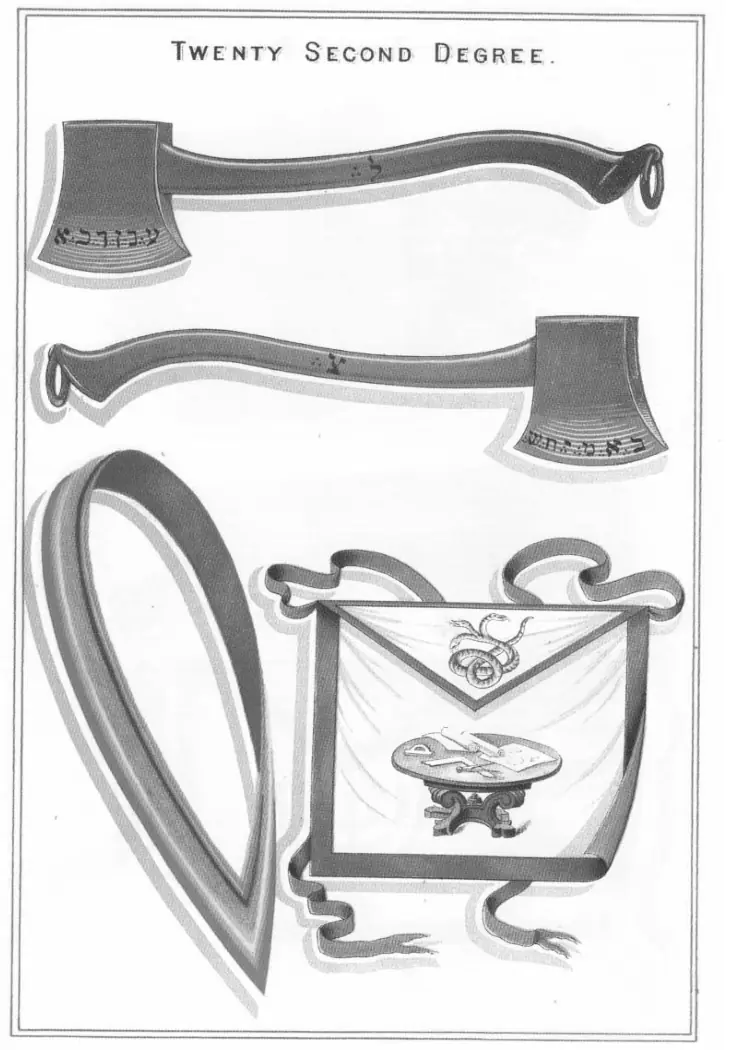
Cet Ordre est fondé sur l'histoire des différents temps et occasions, où les cèdres du Liban furent coupés pour les entreprises saintes. L'explication de chaque lettre fera l'abrégé de cette histoire. Elles sont les initiales de chaque nom dont on conserve la mémoire : L. sur l'acier de la hache signifie Liban, S. sur l'autre côté de l'acier signifie Sidonien, N. sur un des cotés du manche signifie Noë dont nous descendons depuis le déluge, S. est l'initiale de Sem, C. de Cam, J. de Japhet, M. de Moïse, B. de Bezeleel, E. d'Eliab, et de l'autre côté du manche : S. est l'initiale de Salomon, A. de Abda, ADH de Adon Hyram, C. de Cyrus, D. de Darius, X. de Xerxes, Z. de Zorobabel, A. d'Ananias.
Les Sidoniens furent toujours zélés pour les entreprises saintes dès avant le Déluge. Ils s'étaient employés à couper les cèdres du mont Liban pour la construction de l'arche de Noë sous la conduite de Japhet. Ce furent eux aussi qui coupèrent les cèdres dans le même forêt sous les ordres de Moïse pour construire l'arche d'Alliance. Ils s'employèrent encore à abattre les cèdres du même mont Liban sous la conduite du même prince Harodin pour la construction du premier temple sous les ordres de Salomon et aidèrent à les descendre jusqu'au bord de la mer pour les conduire à la porte de Joppe. Ces zélés ouvriers ont encore abattu les cèdres du même lieu pour la construction du second temple sous les ordres de Cyrus, de Darius et de Xerces, sous la conduite de Zorobabel.
Cette mémorable nation formait dès les premiers temps des collèges sur le mont Liban et adorait, en travaillant, le Grand Architecte de l'Univers. Ils avaient les mêmes signes et leurs mots étaient les noms de leurs inspecteurs Noë, Sem, Cam, et Japhet. C'est par ces anciens patriarches, que l'histoire nous en est successivement parvenue après le déluge et que les collèges ont été rétablis au mont Liban pour la construction de l'arche d'alliance et après, selon les époques, pour le temple de Salomon, qui s'y fit bâtir une petite maison où il allait sur la montagne, avec le prince Harodin voir travailler les ouvriers à la charpente de cèdre. Ainsi à leur exemple nous conservons avec révérence les noms de ces vénérables patriarches et la mémoire des Sidoniens.
Toutes les lettres du bijou forment l'abrégé de cette histoire ainsi que les emblèmes du tableau.
Forme du bijou [cf. hache sur la gravure, à droite]. De l'autre côté du manche on grave ces lettres qui signifient : N : Noë S : Salomon S : Sem A : Abda C : Cam ADH : Adonhyram J : Japhet C : Cyrus M : Moÿse D : Darius B : Bezeleel X : Xerces E : Eliab Z : Zorobabel
A : Ananias _________
[Id.] De l'autre côté de l'acier, on y grave une S. pour Sidoniens. Ce bijou en doit être d'or. On le porte à un ruban d'arc en ciel soit de l'épaule gauche à la hanche droite ou en forme d'un cordon sur la poitrine. _________
[Page 49 r° vierge [49v°]]
[49v°] Le présent cahier comprend tous les grades suivants : Le premier grade de rose-croix ou chevalier de l'Aigle ou du Pélican, ou la Maçonnerie d'Hérédon, de Saint André ou le parfait maçon. Le second grade de rose-croix, ou Clavi-Maçonnerie. Savoir le postulant, le vainqueur et le formidable, qui en sont les trois degrés, autrement dit l'Ordre de l'horlogerie ou le franc- horloger. Le chevalier prussien, noachite ou noëtien. Le sublime écossais, ou le dernier point de perfection
Manuscrit Quesada 1804 (copie 1813-1821)
manuscrit · BNE Mss 7834 · 2 049 mots
Le manuscrit Quesada (Mss 7834 de la Bibliothèque Nationale d'Espagne) : copie (1813-1821) d'un état du Rite de 1804, voire antérieur, tel que pratiqué dans la mouvance du Suprême Conseil d'Amérique. Les didascalies du manuscrit sont en italique. Le texte est celui de l'édition Latomia, donnée en vis-à-vis du fac-similé du manuscrit : l'apparat critique de cette édition est repris ici, de même que les repères de folio du manuscrit.
Texte intégral sur ce site · transcription C. M. & P. T., Latomia / Chantier de fouilles maçonniques, d'après le Mss 7834 de la BNE
Folio 241 recto
1 er∴ appartement
Le premier appartement doit être tendu bleu et représente l’atelier matériel du Liban il doit y avoir des haches des scies
des maillets et coins épars sur le parquet. ( Voyez la planche fig∴)
Le Me∴ s’appelle T∴ Sage les Survts∴ Sages Princes le tracé représente la forêt du Liban & au-dessus des outils nécessaires à la coupe des bois, les FF∴ doivent être éclairés par 11 lumières cet appartement se nomme Collège chaque F∴ est armé d’une hache.
2 ème∴ appartement.
Le 2e∴ appartement est tendu de rouge il doit y avoir une table ronde au milieu sur laquelle seront un Compas une Équerre et un plan sur lequel seront désignés677 677 plusieurs cercles de proportion entrelacés formant une figure quadrangulaire chaque F∴
doit être armé d’un glaive cet appartement. ( Pl∴fig∴)
représente le Conseil de la Table Ronde le Me∴ se nomme Gd∴ Patriarche, les FF∴ se nomment Patriarches. Le cordon est un
sautoir couleur feu ( Planche figure )Le Bijou est une hache en or suspendue au bas du cordon. ( Pl∴fig∴) Le tablier doit
être de peau blanche un outil678 678 en or sur la bavette une table ronde au milieu sur laquelle seront des plans et au bas 3 figures un abattant, un équilatéral, et la 3e∴ branchant679 679 des cèdres une lisière couleur de feu pour bordure Folio 242 recto.
Folio 241 verso
Ouverture du Collège
Le T∴ Sage frappe & dit :
R∴ 680 Sommes-nous tous ici du grade que nous travaillons ? Après
avoir examiné tous les Princes le 1er∴ 681 répond : R∴Oui.
D∴ Quel est le devoir d’un maçon en L∴ R∴C’est de voir si nous sommes à couvert.
Assurez-vous en mes FF∴ ? Le F∴ 1er∴ Survt∴ le dit au 2e∴ et celui-ci au T∴ Sage.
D∴ Nous sommes à couvert. R∴ 682En quels lieux sommes-nous T∴ S∴ P∴ ? R∴
R∴ Au mont Liban, les arbres doivent être crus et propres à couper.
Le 1er∴ Survt∴ étend la main à la hauteur du front et la laisse tomber sur la cuisse tous les FF∴ font de même il dit ensuite : des arbres ont
été coupés et c’est pour un saint usage qu’ils furent employés 1°∴ Pour la construction de l’Arche de Noé. 2°∴ Pour la construction de l’Arche Daillance Daillance 683 3°∴ Pour celle du Temple de Salomon.
Le T∴ Sage dit :Puisqu’il en est ainsi mes FF∴ humilions
nous devant le Grand Architecte de l’Univers et que sa volonté soit faite. Il frappe deux coups répétés par les Surveillants
& dit :A moi mes FF∴tous font le Signe puis, le T∴ Sage dit : Le Collège est ouvert travaillons. ( Les Survts∴ répètent ).
P r∴ Survt∴ Prince quel est le but de l’assemblée. D∴
R∴ T∴ Sage Prince c’est pour la propagation de l’Ordre et la réception d’un F∴ T∴ Sage Gd∴ Me∴des Cies∴ allez préparer le Cand∴Il l’amène D∴
à la porte & frappe. L’annonce faite. Le T∴ Sage dit : ∴ répondez-vous de ce Cand∴Les Survt∴répètent. F∴ Me∴ des C ies
D∴
Le Me∴ des Cies∴ répond : Oui ; Est-il instruit, Oui.
D∴ Sait-il écrire est-il brave, fort résigné et par-dessus tout valeureux 684R∴Oui D∴
Donnez-lui l’entrée. On l’introduit. Le T∴ Sage dit : D∴
Consentez-vous jurer sur ce livre sacré dépôt de la foi des sectateurs de la vertu d’abandonner tout pour suivre vos FF∴ au Mont Liban y consacrant votre vie entière s’il le faut aux travaux de la réédification du Temple le 685 Gd∴ Arch te∴ de l’Un∴ si vous en êtes requis. R∴Oui. Prince Me∴ des C ies D∴∴ armez-le ?
Le Me∴ des Cies∴ lui met une hache sur l’épaule droite soutenue avec la main droite. Le T∴ Souv∴ 686 dit : Faites lui faire les trois voyages mystérieux,le 1er∴ Survt∴ se met à droite le 2d∴ à gauche, le Me∴ des Cies∴ en avant le fait passer par le Septentrion & revenir par le Midi. Le 1er∴ Survt∴ dit : T∴ Sage le 1er∴ voyage
est fini,le T∴ Sage dit : Consentez-vous à jurer devant le Gd∴ Arch te∴ de l’Un∴ d’employer le précieux instrument que vous portez à la construction du nouveau Temple. R∴Oui
Folio 242 recto
Le T∴ Sage dit : Faites lui faire son 2 e∴ voyage, ce voyage finit il dit : le Collège des Princes exige avant l’admission dans notre Ordre
auguste d’un Cand∴ qu’il consente à signer de son sang l’obligation qui doit le lier. Y consentez-vous. R∴Oui. Faites lui faire son 3 e∴ voyage, de retour il lui dit : faites lui faire son 3 e687∴ 687 et approchez le Cand∴ de l’Autel pour y prêter son obligation
Il le met à genoux la main droite sur la Bible les deux GGds∴ Survts∴ & tous les Princes l’entourent armés de leurs haches
Obligation
Sur ce livre sacré dépôt des sectateurs de la vertu je renouvelle expressément sans aucun égard tous les engagements que j’ai contractés. Je jure de tout abandonner pour suivre les Princes mes FF∴ et travailler à la réédification du Temple, de688 688 consacrer ma vie entière d’employer le précieux instrument dont je suis muni à cette sainte entreprise et de signer de mon sang ainsi Dieu me soit en aide. Amen.
Le T∴ Souv689∴ 689 les Survts∴ et tous les FF∴ posent leur hache suspendue sur sa tête en croix & puis il dit :
En vertu des pouvoirs dont je suis revêtu je vous fais crée, et constitue Prince du Liban et vous reçois membre du Collège
Il le relève et lui donne l’accolade le fait asseoir et dit :
Princes mes FF∴ vous voyez avec quelle résignation ce nouveau Prince se soumet à tout ce qui lui est prescrit, employons-nous après de nos G ds∴ Patriarches afin d’obtenir son admission au Conseil de la Table RondeLes Princes baissent la hache en signe d’approbation
Le T∴ Sage dit : Allez mon F∴ vous recueillir adressez vos
hommages au Gd∴ Arch te∴ de l’Un∴ demandez-lui la vertu nécessaire pour occuper la place que vous allez solliciter, on fait passer
le Récipiendre∴ dans le parvis le Me∴ des Cies∴ l’accompagne, on passe dans le 2e∴ appartement où les FF∴ doivent être en tunique le chapeau sur la tête et le glaive en main tous assis autour d’une Table Ronde le T∴ Souv690∴ 690 tourne le dos à l’Occ∴ et la place qui est vis-à-vis de lui est vide pour placer le Cand∴ quand tout est prêt le Me∴ des Cies∴ frappe et annonce le Cand∴ qui demande la faveur d’être admis au Conseil. Le 1er∴ Survt∴ va à la porte et lui demande à haute voix Folio 243 recto : Folio 242 verso
Jurez-vous devant le Gd∴ Arch te∴ de l’Univers, discrétion, humanité 691 D∴
foi & obéissance, le Cand∴ répond : Je le jure. Le T∴ S∴ dit :
Donnez-lui l’entrée puis il dit : quoique vous soyez homme sachez que vous devez déposer toutes les passions humaines à l’entrée de cet édifice & par ce moyen vous vous disposerez à recevoir les principes de l’homme sage où plutôt cesserez d’être homme pour devenir un des sectateurs de la vertu, les Patriarches qui composent le Conseil prenant en considération la demande qui leur avait été donnée par le Conseil 692 de vous admettre dans son sein, vous accordent cette faveur insigne, vous allez être plus particulièrement lié à la maçonnerie vos FF∴ vous deviendront plus chers, leurs besoins seront les vôtres, car ici mon F∴ le fort aime le faible, point de distinction parmi nous que celle qui 693 donne la vertu je vous préviens qu’il ne sera plus en votre pouvoir de renoncer à nos actes particuliers.
On fait asseoir le Cand∴ à la place qui lui est préparée tous les Patriarches se lèvent, lui posent le glaive sur la tête et le Très Sage dit :
En vertu des pouvoirs dont je suis revêtu et du consentement unanime de tous les Patriarches nos FF∴ et nos égaux je vous reçois membre du Conseil de la Table Ronde Dieu vous soit en aide
Il se relève lui donne l’accolade les Signes Mots et Attouchts
Signe. Le Signe demande est de porter les deux mains vers l’épaule droite & les laisser tomber vers la cuisse gauche comme si on abattait un arbre à coups de hache.
La réponse est de lever les mains à hauteur du front
& les laisser tomber sur la cuisse.
Attouchement se prendre mutuellement les mains
et croiser les droites sur les gauches en bonne foi.
Le Signe de demande est de porter les deux mains
vers l’épaule droite &a∴ Mots Sacrés. NoéBezeléel. 694 Sidoniens Mots de Passe. Japhet. Ooliab. Libanus. Marche. Elle s’exécute par 3 pas en croisant
un pied devant l’autre partant du pied droit.
Batterie. Deux coups égaux - -
Le T∴ Souv∴ 695 dit : 1er
∴ Patriarche donnez à notre nouveau F∴ le 1er ∴ élément de la proportion & de la dimension.
On lui fait tracer un cercle avec le Compas.
Folio 243 recto
Le T∴ Sage lui dit : Mon F∴ ceci est symbolique696 696 notre système moral et démontre que la vie d’un sage doit-être un cercle continuel de pratique de vertus, ne perdez jamais de vue les principes fondamentaux de notre ordre. Les Maç∴ se sont associés pour se rendre meilleurs et pour élever le Conseil de697 697 l’édifice ravissant de la perfection humaine l’histoire de ce grade nous fournit les notions suivantes, nos ancêtres les Sidoniens furent employés à la coupe des cèdres qui avaient cru de nouveau sous la conduite des Princes Harodins ensuite sous les ordres de Salomon, ils coupèrent le nécessaire pour la construction du Temple du Gd∴ Arch te∴ de l’Un∴ et ceux nécessaires pour la construction du 2 e∴ Temple après la dédicace du premier Salomon établit les Sidoniens sur le Mont Liban il forma divers Collèges dont les membres étaient obligés de justifier de leurs progrès, non seulement dans la science de la coupe du bois mais aussi la pratique de l’amitié de la bienfaisance et de la recherche des devoirs sociaux enfin dans toutes les vertus qui constituent un sage. Un Conseil choisi parmi les membres du Collège était établi pour veiller à la portée morale de cette instruction698 698 et à l’étude des proportions mesures et dimensions, tel est mon F∴ votre tâche vous sentez-vous la force nécessaire pour la remplir. Il répond : Oui.
Le T∴ Sage frappe un coup de la lame de son glaive sur la table, répété par les deux Survts∴ & dit :
Patriarches de la Table Ronde, félicitons-nous d’avoir augmenté le nombre des sectateurs de la vertu.
Les Survts∴ répètent. On fait le signe de réponse & on bat deux fois dans les mains en disant : Houzé. Le T∴ Sage dit :
Si quelqu’un de vous à quelque chose à proposer pour la propagation de l’Ordre la parole lui est acquise.
Les Survts∴ répètent. La Boîte des Pauvres circule Folio supplémentaire LIII.
Folio supplémentaire LIII Folio supplémentaire LIV
Cette illustration est probablement mal placée. Elle correspond en effet à la description de la Loge « tendue en
1re perspective » du degré suivant, le Prince du Tabernacle Folio 244 recto.
Folio supplémentaire LV
Apparat critique de l’édition Latomia
677. Erreur du copiste A ? Les mots utilisés sont : « des signes » dans Pyron 1812 ; on peut aussi penser que « désignés » a été mis pour « dessinés ».
678. Erreur du copiste A. Le mot exact est « œil », cf. Pyron 1812 et dessin reproduit ci-dessus.
679. Erreur du copiste A. La phrase exacte est : « ...une abattant, une équarissant et la 3e ébranchant des ... », cf. Pyron 1812.
687. Erreur du copiste A : doublon, cf Pyron 1812.
688. Erreur du copiste A. le mot exact est « d’y », cf. Pyron 1812.
689. Erreur du copiste A ? Il s’agit du « T∴ Sage » dans Pyron 1812. Cf. même remarque à la page précédente.
690. Même remarque.
696. Erreur du copiste A. Il manque la préposition « de »
698. Ici, Pyron 1812 indique « ... de ces institutions et ... ».
699. Erreur du copiste A. Kloss et Pyron 1812 indiquent à cet endroit « ...à côté du grand Autel, le premier... », ce qui semble plus logique.
702. Erreur du copiste A qui a commencé à recopier de nouveau la ligne précédente.
Delaulnaye 1813
tuileur imprimé · 461 mots
Le « Thuileur des trente-trois degrés de l'Écossisme » de Delaulnaye (Paris, 1813), premier tuileur imprimé du REAA constitué : mots, signes, décors et remarques du grade. Texte relu mot à mot sur le fac-similé, mots hébreux restitués. Pages 162-167 de l'édition originale.
Deux appartements ; le premier tendu en Bleu, représentant l'Atelier du Mont-Liban ; il est éclairé de onze Lumières. Le second tendu en Rouge ; c'est le Conseil de la Table Ronde.
Titres.
La Loge se nomme Collége, au premier point, et Conseil au second. Le Maître est appelé d'abord Très-Sage, puis Grand-Patriarche ; il y a deux Grands-Officiers. Les Frères sont armés d'une hache au premier point, et du glaive au second.
[p. 163]
Signes.
Élever les deux mains vers l'épaule droite, et les laisser tomber sur la cuisse gauche, pour imiter la chute des Cèdres du Liban, sous les coups de hache. On répond en levant les deux mains à la hauteur du front, les doigts étendus, et les laissant tomber.
Attouchement.
Se prendre mutuellement les mains en les croisant, en signe de bonne foi.
Batterie.
Deux Coups égaux.
○ ○
Marche.
Trois pas croisés. Trois Voyages.
Mots Sacrés.
Noë, en hébreu NOACH, נֹחַ,
(requies)
[p. 164]
Beseleel (Voyez ci-dessus, pag. 125).
Sidonius, en hébreu TSIDONI, צִדֹנִי.
(venator)
C'est le nom appellatif du peuple Sidonien, lequel avoit une grande réputation pour couper les bois, puisque Salomon dit à Hiram, roi de Tyr : Scis enim quomodo non est in populo meo qui noverit ligna cædere SICUT SIDONII.
REG. l. 3, ch. 5, v. 6.
Mots de Passe.
JAPHETH,
OOLIAB,
LIBAN.
C'est par erreur que l'on écrit le second de ces mots Élial ou Éliab, il faut dire Ooliab. Bezeleel et Ooliab furent deux célèbres ouvriers du Tabernacle, remplis tous deux de l'esprit de Dieu (Exod. c. 31). On a déjà vu Bezeleel au rang des Élus dans le Rose-Croix de Kilwining. Ooliab s'écrit en hébreu AHOLIAB אָהֳלִיאָב.
(patris Tabernaculum, seu potius pater Tabernaculi).
Il étoit fils d'Achisamech, et de la tribu de Dan.
[p. 165]
Cordon.
Couleur d'Arc-en-ciel, en sautoir, doublé de Ponceau.
Bijou.
Une Hache couronnée, d'or. D'un côté du manche sont les lettres L. S. et, au sommet, A. A. C. D. X. Z. A. ; de l'autre côté, S, et, au bout, N. S. C. J. M. B. O.
Ces lettres sont, dans le même ordre, les initiales des mots suivants : Liban, Salomon, Abda, Adoniram, Cyrus, Darius, Xercès, Zorobabel, Ananias, Sidonius, Noé, Sem, Cham, Japheth, Moyse, Beseleel, Ooliab. Tous ces noms sont déjà connus du lecteur, à la réserve d'Ananias. Cet Ananias, (hébr. HANANIAH, עֲנַנְיָה) est probablement le Parfumeur de la tribu de Benjamin, qui, de concert avec Eziel, travailla aux murs de Jérusalem (voy. ESDRAS, l. 2, c. 3, v. 8).
[p. 166]
Tablier.
Blanc, avec une table ronde au milieu, sur laquelle sont des Plans. Sur la bavette un Serpent à trois têtes.
[p. 167]
Vuillaume 1820
tuileur imprimé · 485 mots
Le tuileur de Claude-André Vuillaume, « Manuel maçonnique, ou Tuileur de tous les rites de maçonnerie pratiqués en France » (Paris, Delaunay et Hubert, 1820) : décoration, titres, signes, attouchement, marche, batterie, âge, mots, habillement du grade, avec l'étymologie et l'interprétation des mots hébreux. Texte établi sur le fac-similé et relu mot à mot sur les images : océrisation à 600 dpi du volume numérisé, fusion avec la couche texte de la numérisation Gallica, puis relecture page par page. Orthographe de 1820 conservée, hébreu et grec restitués, batteries rendues comme l'imprimé les note, pagination de l'original. Pages 155 à 158.
Le premier est tendu en bleu, et représente l'atelier du mont Liban. Il est éclairé de onze lumières.
Le second est tendu en rouge; c'est le Conseil de la table ronde.
TITRES.
La loge se nomme Collège au premier point; le maître y est nommé Très-sage.
Au second point, la loge prend le titre de Conseil, et le maître y est nommé Grand Patriarche.
Après le maître, il y a deux grands officiers.
[p. 156]
SIGNES.
Faire le mouvement d'élever une hache avec les deux mains, et de frapper, comme pour couper un arbre par le pied.
En réponse, lever les deux mains à la hauteur du front, les doigts étendus, et les laisser retomber.
ATTOUCHEMENT.
Se prendre mutuellement les mains en croisant les doigts, en signe de bonne foi.
BATTERIE.
Deux coups égaux.
MARCHE.
Trois pas croisés.
Le récipiendaire fait trois voyages dans le cours de la réception.
HABILLEMENT.
Tablier blanc; au milieu est peinte ou brodée une table ronde ; sur la table on voit des plans déroulés.
Il y a des loges où l'on se borne à peindre un œil sur le tablier.
Cordon aux couleurs de l'arc-en-ciel, doublé en soie, couleur ponceau, porté en sautoir.
[p. 157]
Au bas du cordon est suspendu pour bijou une hache d'or, surmontée d'une couronne. Sur un des côtés du manche de la hache, sont les lettres L∴ S∴ Au sommet, du même coté : A∴ A∴ C∴ D∴ X∴ Z∴ A∴ Sur l'autre côté du manche est la lettre S∴ Et au sommet : N∴ S∴ C∴ J∴ M∴ B∴ O∴ Ce sont les initiales des noms qui suivent, dans le même ordre : Liban, Salomon, Abda, Adoniram, Cyrus, Darius, Xerxès, Zorobabel, Ananias, Sidonius, Noé, Sem, Cham, Japheth, Moïse, Beseleel, Ooliab.
Les princes du Liban sont armés d'une hache, au premier point de la réception, et d'un glaive au second.
MOTS DE PASSE.
JAPHETH, OOLIAB ( héb. אָהֳלִיאָב Aholiab, patris tabernaculum, seu pater tabernaculi) (1), et LIBAN ( héb. לְבָנוֹן l'banon, blanc, encens).
On sait que c'est dans les forets du Liban que furent coupés et préparés les bois em-
(1) Il y a des rituels, où, au lieu d'Ooliab, on lit Elial ou Eliab; c'est une faute. Beseleel, Ooliab étaient deux célèbres ouvriers qui furent employés par Moïse à la construction du tabernacle ( Exode, chap. 31, ÿ. 2 ; et chap. 38, ÿ. 22 et 23 ).
[p. 158]
ployés dans la construction du temple de Salomon.
MOTS SACRÉS.
NOÉ, BESELEEL ( héb. בְּצַלְאֵל betsalel, in umbra Dei, fils d'Uri, fils de Hur, de la tribu de Juda, et de Marie, sœur de Moïse), et SIDONIUS ( héb. צִידֹנִי tsidoni, venator, nom appellatif du peuple de Sidon, qui était réputé pour sa science dans la coupe des bois. Rois, 3., chap. 5, v. 6).
Pike 1857
rituel imprimé · en anglais · 8 094 mots
« The Magnum Opus or Great Work » (1857) : le premier corps complet de rituels révisés par Albert Pike pour la Juridiction Sud des États-Unis. Texte en anglais, établi par reconnaissance optique corrigée : des coquilles subsistent.
D'après la réimpression Kessinger de l'édition de 1857 (numérisation archive.org)
LODGES, OFFICERS, DECORATIONS, ETC.
Bodies of this degree are styled Colleges. There aretwo apartments. The first is a plain room, of moderate dimensions, without any fixed number of lights, and prepared to represent a carpenter's workshop on Mount. Lebanon. The second is hang with red, and lighted by 36 lights, arranged by sixes and each six by twos. It represents the Council Room of the Round Table. In the centre of the Room is 'such a table, around which the brethren sit. The altar is in the East, and upon it are an open Bible, the Square and Compasses, and an
Axe. :
The officers are a Chief Prince, who is styled 7'4.. Puissant; s Sen.'. and Jun.*. Grand Warden, and a Sen.*. and Junior Deacon.
The Order is n broad, rainbow-colored ribbon, worn.as a collar. It may be worn as 0 sash, from right to left; 'and is lined with purple. The jewel, suspended to the collar, is an axe and handle of gold. On the top or end of the handle are the letters N.*. and S.. . . . On one side of the handle, L.*. . . . On the other, Ts.°.0°5. On one side of the blade, A.*, C.". D.*. Z.. Nut. E.*, .'. . On the other, Sa.. Ku, Y.". Mr. Au. Ba.
"The letters on the top are the initials of the words Noah and Solomon: those on the handle, of Lebanon and Tsidunians: those on the first side of the blade, of Adoniram, Cyrus, Darius, Zerubbatel, Nehemiah, and Ezra: and those on the other side, of Shem, Them, Yaphet, Moses, Ahliab and Bessel-Al. ;
The Apron is white, lined and bordered with purple. On the middle a round table is embroidered, on which are mathematical instruments, and plans unrolled. On the flap is a serpent with three heads. .
The «Tracing Board is view of the mountain and forests of Lebanon, the summit of the mountain covered with snow; and of the Temple erected of its cedars and pines. It is in the form of an ore.
_ In the workshop the Sen." Warden presides, and is styled Master Carpenter. He and all the Brethren wear frocks or blouses and aprons. .
The battery is; by °° 2 ¥ 2. — but there is no particular alarm or battery in the workshop.
TO OPEN.
_[The Ch.°. Prince gives one rap, and says]: " My Brethren, the day-star has risen in the East. It is time to arouse the workmen; that they may prepare for their labours. Brother Sen.-. Gr.". Warden, are all the
-Princes present?"
* 4p
Sen. G.. We. Th.. Puissant, they are.
Th, P.. Announce to them, my brother, through the Jun., Gr.*. Warden, that I am about to open this
College; that directions may be given to the workmen, their complaints be heard, and justice administered. S.°. G.. We. Bro. Jun.. Are.*. Warden, the Th.*. Puissant is about to open this College of Princes of Libanus. Make proclamation that all-who desire instruction, and those who have complaints to prefer or
justice to demand may come forward and be heard. _ ; :
Jun. G-. We. Brethren, it is made known to me that the Th.*. Puissant in about to open this College of
Princes of Libanus. Let those who hare instructions to ask, complaints to prefer, or justice to demand, draw
near and they shall be heard. a
Th. P.. My Brethren, unite with me in imploring the blessing of the Supreme Deity upon our labours!
[All the Knights repeat the following prayer]:
PRATER.
Thou who midst create the universe, and bast builder it in infinite magnificence, as Thou art infinite in skill and wisdom, bless us in our daily labours, and prosper and look indulgently upon the work of our hands! Teach us and all men that labour is honourable, and that to work well in our vocation is the noblest destiny of man! Improve, O beneficent God, the condition of the toiling millions! Teach the rich and the haughty, compassion for thoseé over whom they have control; and hasten the coming of the day when idleness will no longer be a privilege to boast of, nor labour be deemed ignoble; and when all men shall acknowledge the great truth, that to work well and faithfully in our appointed sphere, is the most acceptable prayer that
erring man can offer up to Thee! Amen!
Th.. P. Brother Jun.*. Gr.*. Warden, arouse the workmen, by the usual alarm.
The Jun.', Gr. W.. raps ? — the Sen.*. Gr.. Warden ? — and the Th.". P.*. ?— Then, after a moment's silence, the Th.*. P.°. gives the sign, which all answer: and he says, " The cedars upon Mount Libanus wait
to be felled ; and this College is open."
RECEPTION.
The Candidate, in the dress, insignia, and jewels of a Prussian 'Knight, or Rose >}, 'with sword and other apparel complete, is brought to the door of the second apartment, in which the officers and brethren are seated around the table, on which are plans and mathematical instruments.' The Senior Deacon having charge of the candidate raps : by P2/¥4:. The Junior Deacon opens the door & Tittle, and asks, " Who comes bere 2?"
Sen. D.. Aworthy Prussian Knight and Knight of the Rose Croix, who desires to obtain the Degree. of Prince of Libanus, and to that end hath travelled hither from afar, , .
Jun.*. Deac.*. Has he received all the preceding degrees ?
Sen.*. Deae.*, Ye has. - oo Tet '
Jun.. Deae.". Hath he approved himself o true Knight and a just Judge?
Sen.*. Deac., He has.
Jun. Deac... What further claim hath he to this privilege?
Sen. Deac. The claim of birth; and rank in Masonry.
Jun. Deac.*. I will advise the College of his request. Let him patiently await their answer. . . . {We
closes the door].
Ch.. Pr. Brother Junior Deacon, who seeks admittance to the 'College?
" Jun.*. Deac.. A Knight of the Rose Croix and Prussian Knight; who desires 'to obtain the degree of Prince of Libanus; in charge of the Knight our Senior Deacon.
Ch.. Prince. Has he received all the preceding degrees?
XA... 3
Jun., Deae.. The Senior Deacon answers that he has.
Ch. Pro. Tiath he approved himself a true Knight and a just Judge?
Jun. Deae, The Senior Deacon answers that he has.
Ch.*, Pr. What further claim hath he to this privilege?
Jun. Deac. The claim of birth, and rank in Masonry.
Ch.:. Pr. The claim is not sufficient. But let him be admitted.
[Fle is admitted, and advances to the Table; and the Th.". Puissant addresses him thus]: Ch.°. Pr. Is it your desire, my Brother, to obtain the degree of Prince of Libanus? Cand.. It in. , ST
". Che. Pro. We know the grounds on which you claim it: bat birth is not regarded here; and rank in Masonry does not of itself suffice. We are all workmen in oar several vocations. You see us now engaged in preparing plans for the labourers; and studying the calculations of astronomy. None can, by our constitutions, be admitted to the high privileges of this degree, unless he bath first wrought one year in the workshop; and obtained the unanimous suffrage of the workmen. Is your desire for this degree sufficient to induce you to lay aside your insignia, your sword and jewels, for a time, and join the Sons of Labour, who represent the toiling millions?
Cand... It is.
Ch.. Pr. Go, then, my Brother, obtain their suffrage, and return to us. : .
_,, [The Candidate withdraws, with the Senior Deacon, and goes to the door of the first apartment, where they give 'three or four raps. The door is opened, and they enter. The workmen are hewing, sawing, planing, mortising, &c., and the master-workman copying designs from a tracing-board. As the Candidate enters, he gives one loud rap, and the workmen pause]. . .
" Bf>. Carp". Whom have you there, Brother Senior Deacon?
Sen... Deaes, .A Knight of the Rose Croix:and: Prussian Knight, who desires your suffrage, that he may obtain the degree of Prince of Libancs. . .
H.. Carp... Our suffrage are given to those that work. Hath he yet learned to work? 'Sen: Deac.. Nay ; but desires to do so; and hath for that come hither. ;
3:7 Carp." Doth he.acknowledge the dignity of labour; and that it is no curse, but s privilege, for man to be allowed to earn his sustenance by the exercise of his strong arms and sturdy muscles? Sen.*. Deacon. He does. . - . -
'M. Carp... Does he admit that the honest labouring man, upright and independent, is, in nature's heraldry, the peer of Kings; and that not labour, but idleness, is disgraceful ? : oo . * Sen. Deac.. He does. .
- "M:. Carp.. Art thou willing to eat only what thou earnest; patiently to receive instruction ; and to recognize and treat these humble workmen as thy brethren and thy equals? 'Cand. +Lam, : ee Lot '
[M.. Carp.*; .Then, as thou west divested of thy outward garments, upon thy first entry into a Masonic Lodge, divest thyself now of thy insignia and jewels, and assume the dress and apron of a workman. ". +2. [The Candidate puts off his regalia, and is clothed in o blouse and coarse apron, and directed to saw a long plank in two lengthwise. . When he has finished, the Master Carpenter says]: " My Brother, the sato,. "the plane, and the hewing-are are the working tools of a Prince of Libanus. The saw symbolizes that steady . patience, and. persevering determination, by which the resolute man makes his way to the object of his endeavour through all obstacles; and teaches us that Masons, labouring for the improvement of the world and the :great caase-of human progress, must be content to advance—certainly, though never 20 painfully and slowly,. 'towards: éuccess...As the rranx cats down the inequalities of surfaces, it is symbolical of Masonry, which, eats off the prejudices of ignorance, and the absurdities of superstition, and aids to polish and civilize mankind. ~The axx is the great agent of civilization and improvement. It is the troops, armed with that weapon, that have conquered barbarism.. Under. its blows the primeval forests disappear, and the husbandman displaces the wild hunter, and to the rude barbarism of the early ages succeed settled society and laws, and all the arts that refine and elevate mankind. The axe is nobler than the sword. And as the sturdy pioneer, armed with
the axe, strides onward in the front of civilization; and as the stout oak, and pine, and ash, and elm fall never to rise again before him, so Masonry hews at those mighty Spas-trees, Intolerance, Bigotry, Superstition, Uncharitableness, and Idleness; and lets in the light of truth and reason upon the human mind, which these Vices have overshadowed and darkened for centuries." ,
(The Candidate is then made,to use the plane; and then a brother brings him a piece of dry bread and a cup of water; and the Master Carpenter says to him], "Eat, my brother, of the labourer's food. It is thine own; for thou bast earned it; and no one suffers because thou most eat." . , .
[He is then made to use the axe. Then the Master Carpenter says]: " My Brethren, this Knight, by his ready acquiescence in our rules, and his cheerful conformity to our customs, has shown a true appreciation of the dignity of labour. We may require him to toil with us a year; or, at our option, we may at once give him our suffrage. If no one wishes otherwise, we will proceed to vote upon his request to be admitted among the Princes of Libanus." °
[The vote is taken by ballot; and, it being declared white, the Candidate is informed that he is duly elected to receive the degree, and that he will repair to the second apartment. He is again invested with his insignia and jewels, during which time the Brethren go out one by one, and repair to the second chamber, dressed in the insignia and jewel of this degree].
One Senior Deacon gives the alarm: raps, by ¥2/%es—and the Junior Deacon asks], " Who comes ere 2'? '
. Sens. Dea, A Knight of the Rose Croix and Prussian Knight; who having wrought cheerfully in the
workshop, and learned the use of the saw, plane and axe, has received the suffrage of the workmen, and
demands to be received a Prince of Libanus. .
[The Junior Deacon repeats the same to the Th." P."., who orders him to be admitted. The three prin-
cipal officers are now in their proper seats].
Sen.*. Deac:. Th..-Puissant Chief Prince, I present to you this Knight, who has toiled in the workshop,
and received the unanimous suffrage of the Brethren.
The. P.. My Brother, do-you still persist in your desire to enter this association of labourers ?
Cand.. I do. . -
Th... "Are-you not deterred by the hazard of such toil and fare as you experienced in the workshop?
Cand.". Iam not. .
Th. P.", Go, then, and kneel at the altar, and receive the obligation of this Degree.
He kneels upon beth knees, with his hands upon the axe and Bible, and takes this obligation :
OBLIGATION.
I, A. . eee Be es so of my own free will and accord, in the presence of the Supreme Architect of the Universe, and this Illustrious College of Princes of Libanus, do hereby sad hereon, most solemnly and' sincerely promise and swear, that I will never communicate the secrets of this degree to any person or persons whatsoever, unless he or they shall be lawfully entitled to the same, by having legally received all the preceding degrees, in the proper and legally constituted bodies, or from s legally authorized Inspector-General or Deputy Inspector; nor then, without due authority fur so doing from a legal and duly established Supreme Council of the 33d Degree. 7 .
* I furthermore promise and swear, that I will ever hereafter use my best endeavours to elevate the character of the labouring classes, and to improve their condition, to disseminate the blessings of education among their children, and to give to themselves their due and proper social and political weight; and recognizing labour as honourable, 1 will regard the labouring man as my peer and equal, 0 fae as his honesty, virtue, and intelligence may entitle him to it. ;
All which I promise and swear,
there miserably to perish in its perpetual snows.
under the penalty of exposure on the highest pinnacle of Mount Libanus,
So help me God; and aid me to keep and observe the same t
(The Th.-. P.. raises him, and communicates the signs and words].
* Stoic: .. Raise mS YS} ROTI towards the HA&Y 4 ITCH, the Pk 4 Toma} Or yes cite
32.CO1OY CO as much as possible, and let them WOH upon the TCWVIPR OCLE, as if OPT OF 220GL
with an OBC. It alludes to WCtt 2-20) the F COO of Libanas. - :
Answer: .... Raise M3 PLILOSMTIA to the &C OCL&*H of the F¥YICK& You, BYoatLcta C¥-
°F CHTICH, and let them WOTtsILY 2/ together, in front,
'Toxex: ... Take 933 YE Otth each other's SOUS, TE 429K) them, in sign of good faith.
Pass-worns: ... SY Ok. MCPAC-Of. HOM&CP.". Most 9-Om.- PAO To. Common-
Bm.
Saczep Worps: Of-A&CO9.. SAKE OK.
[The' Candidate is then invested with the apron, collar, and jewel of the degree: and the Th.°. P.. explains to him the initials upon the jewel ; concluding by saying]: " The Serpent with three beads, upon the flap of the apron, is Idleness, the body from which issue the three vices symbolized by the heads: Drunkenness, Impurity, and Gaming: by which so many Youths have been lost, and so many great Nations have sunk into ignoble 'imbecility and shameful bondage."
The Th.°. P.-, then recites to him the following History and Lecture:
HISTORY AND LECTURE.
The Teidanians or Pheenicians were ever ready to aid the Israelites in their holy enterprises. The tie between them was the mysteries, into which the principal persons of.both Nations were initiated; Moses mysteries, modified by Solomon, or perhaps at an earlier day by Joshua or even Moses, to suit the genius and manners of the Jewish People, became Masonry, such as.it was practised at the building of the Temple, and such 28 it has in part come down to us. Hiram King of Tyre in Phoenicia, and Hiram Abi, also a Phoenician and not a Jew, were also initiates; and hence the intimate connection between them and Solomon, as Masons. — The people of Tsidun, a city of Phoenicia, were employed by Noah to cut cedars on Mount Libanus, of which to build the Ark, under the superintendence of Japhet. His descendants repeopled Taidun and Phoenicia, and procured and furnished the cedar from Lebanon to build the Ark of the Covenant; and at a later day his pos-. verity, wader Advthiram, cut in the same forests cedars for King Solomon: and at a time still later, they felled tinaber on the saire mountains te conse? the second Temple.
- Upon the same mountain they established Colleges of Artificers, like those in Etruria and afterwards at Rome; from which latter many deduce Masonry. But the Etrurians, who emigrated from Assyria to Egypt "and afterwards to Etruria; better known ss the Hyksos, from Resen [R. 8S. N.] on the Tigris, or as the Shepherd Kings, carried with them the same mysteries, which went also with them into Phoenicia; and the Etrurian end Roman Colleges'were in all respects like those of Mt, Libanus. These Artificers everywhere adored the Grand Architect of the Universe; and had their signs aid words, by which to recognize each other. Solomon himself, whose wisdom necessarily gave him s true idea of the dignity of labour, built a small palaceé on the mountain, to which he often repaired to inspect the progress of the work. The names of the Patriarchs who 'were, the Inspectors and Conductors of the workmen on the mountain at different periods are preserved in our pass-words. The institution of Colleges upon Mount Libonus was perpetuated by the Douses, from' whom the Crusaders obtained « knowledge of this degree. .
°" Sympathy with the great labouring classes, respect for labour itself, and resolution to do some good
work in our day and generation, these are the lessons of this Degree; and they are purely Masonic. Masonry has made a working man and his associates the heroes of her principal legend, and himself the companion of Kings. The idea is as simple and true as it is sublime. From first to last, Masonry i is work, It venerates the Grand Architect of the Universe. It commemorates the building of a Temple. . Its principal emblems are the working tools of Masons and Artisans. It preserves the name of the first worker in brass and tron as one of its pass-words. When the Brethren meet together, they are at labour. The Master is the overseer who sets the craft ¢o work and gives them proper instruction. Masonry is the apotheosis of Worx. . ~-
It is the hands of brave forgotten men that have made this great, populous, cultivated world a world for us. It is all work, and forgotten work. The read conquerors, creators and eternal proprietors of every great and civilized land are all the heroic souls that ever were in it, each in his degree; all the men that ever felled a forest-tree or drained a marsh, or contrived a wise scheme, or did or said a true or valiant thing therein. Genuine work alone, done faithfully,—éhat is eternal, even og the Almighty Founder and World-builder Himself. All work is noble: o life of ease is not for any man, nor for any God. The Almighty Maker is not like one who, in old immemorial ages, having made his machine of a Universe, sits ever since, and sees it ge. QOut of that belief comes Atheism. The faith in an Invisible, Uanameable, Directing Deity, present everywhere in all that we see and work and suffer, is the essence of all faith whatsoever.
The life of all Gods figures itself to us as a Sublime Earnestness,—of Infinite battle against Infinite labour. Our highest religion is named the Worship of Sorrow. For the Son of Man there is no noble crown, well worn, or even ill-worn, but is a crown of thorns. Man's highest destiny is not to be happy, to love - pleasant things and find them. His only true unhappiness should be that he cannot work, and get his destiny ag aman fulfilled. The day passes swiftly over, our life passes swiftly over, and the night comets, wherein "no man can work, That night once come, our happiness and unhappiness ore vanished, and become as things that never were. But our work is not abolished, and has not vanished. It remains, or the want of it remains, for endless Times and Eternities. It is in our influences after death that we are immortal.
Whatsoever of morality and intelligence; what of. patience, Perseverance, faithfulness, of method, insight, ingenuity, energy; in a word, whatsoever of Srrexcrz ao man has in him, will lie written in the worr he does. To work is to try himself against Nature and her unerring, everlasting laws; and they will return true verdict as tohim. The noblest Epic is mighty Empire slowly 'built together, a mighty series of heroic deeds, 2 mighty conquest over chaos. Deeds are greater than words. They have a life, mute, but undeniable; and grow. They people the vacuity of Time, and make it green and worthy.
Labour is the truest emblem of God, the Architect and Eternal Maker; noble Labour, which is yet to be the King of this Earth, and sit on the 'highest Throne. Men without duties to do, are like trees planted on precipices; from the roots of which all the earth has crumbled. Nature owns no man who is not also a Martyr. She scorns the man who sits screened from all work, from want, danger, hardship, the victory over which is work; and has all his work and battling done by other men: and yet there are men who pride themselves that they and theirs have done no work, time out of mind.
The chief of men is he who stands in the van of men, fronting the peril which frightens back all others, and if not vanquished would devour them. Hercules was worshipped for twelve labours. The Czar of Russia became a toiling shipwright, and worked with his axe in the docks of Saardam: and something came of that. Cromwell worked, and Napoleon ; and effected somewhat.
There is perennial nobleness and even sacredness in work. Be he never so benighted and forgetful of his high calling, there is always hope in a man that actually and earnestly works: in Idleness alone is there perpetual Despair. Man perfects himself by working. Jungles are cleared away. Fair seed-fields riso instead, and stately cities; and withal, the man himself first ceases to be a foul unwholesome jungle and desert thereby. Even in the meanest sort of labour, the whole soulof man is composed into a kind of real harmony, the moment he begins to work. Doubt, Desire, Sorrow, Remorse, Indignation, and even Despair shrink murmuring far off into their cares, whenever the man bends himself resolutely against his task. Labour is life. From the inmost heart of the worker rises his God-given Force, the Sacred Celestial Life-essence, breathed into him by Almighty God; and awakens him to all nobleness, as soon as work fitly begins. By it man learns Patience, Courage, Perseverance, Openness to light, readiness to own himself mistaken, resolution to do better
XANIT. ... 7
and improve. Only by labour will man continually learn the virtues. There is no Religion in stagnation and inaction; but only in activity and exertion, There was the deepest truth in that saying of the 'old monks, laborare est orate. "If prayeth best who loveth best all things both 'great and small ;'? and can man love except by working earnestly to benefit that being whom he loves?
"Work; and therein hare well-being," is the oldest of Gospels; unpreached, inarticulate, bat ineradicable and enduring forever. To make Disorder, wherever found, an eternal enemy ; to attack and subdue him, and make order of him, the subject not of Chaos, but of Intelligence and Divinity, and of ourselves; to attack ignorance, stupidity and brute-mindedness, wherever found, to smite it wisely and unweariedly, to rest not while we live and it lives, in the name of God, this is our duty as Masons; commanded us by the Highest God. Even He, with his unspoken voice, awfuller than the thunders of Sinai, or the syllables speech of the Hurricane, speaks tous. The Unborn Ages; the old Graves, with their long-mouldering dust speak to us, The deep Death-Kingdoms, the Stars in their never resting course, all Space and all Time, silently and Continually admonish us, that we too must work while it is called to-day. Labour, wide as the Earth, has its summit in Heaven. To toil, whether with the sweat of the brow, or of the brain or heart, is worship,—the noblest thing yet discovered beneath the Stars. Let the weary cease to think that labour is a curse and doom pronounced by Deity. Without it there could be no true excellence in human nature. Without it and pain and sorrow, where would be the human virtues? Where Patience, Perseverance, Submission, Energy, Endurance, Fortitude, Bravery, Disinterestedness, the noblest excellencies of the Soul?
Let him who toils complain not, nor feel humiliated. Let him look up, and see his fellow-workmen there, in God's Eternity ; they alone surviving there. Even in the weak human memory they long survive,as Saints, 'us Heroes and as Gods: they alone survive, and people the unmeasured solitude of Time.
- Yo thé primeval man, whatsoever good came, descended on him (as in mere fact, it ever does), direct from 'God ; whatsoever duty Iny visible for him, this a Supreme God had prescribed. For the primeval man, in 'whom dwelt Thought, this Universe was all a Temple, life everywhere a Worship.
Duty is with us ever: and evermore forbids us to be idle. To work with the hands or brain, according to our acquirement and our capacities, to-do that which lies before us to do, is more honourable than rank and 'title.* .Ploughers, spinners and builders, inventors and men of science, poets, advocates and writers, all stand 'upon one common level, and form one grand innumerable host, marching ever onward since the beginning of the world; éeach entitled to our sympathy and respect, each a man and our brother.
It was well to give the earth to man os o dark mass, whereon to labour. It was well to provide rude and "unsightly materials in the ore-bed and the forest, for him to fashion into splendour and beauty. It was well, not because of that splendour and beauty; but because the act creating them is better than the things them- 'selves ; because exertion is nobler than enjoyment; because the labourer is greater and more worthy of honour 'than the idler. Masonry stands up for the nobility of labour. It is Heaven's great ordinance for human improvement. It has been broken down for ages; and Masonry desires to build it up again. -It has been 'broken down, because men toil only because they must, submitting to it as, in some sort, o degrading neces- "sity ¢ and desiring nothing so much on earth as to escape from it. They fulfil the great law of labour in the 'letter; but break it in the spirit: they fulfil it with the muscles, but break it with the mind. .
"Masonry teaches that every idler ought to hasten to some field of labour, manual or mental, as a chosen and coveted theatre of improvement; but he is not impelled to do so, under the teachings of an imperfect 'civilization. On the contrary, he sits down, folds his hands, and blesses and glorifies himself i in his idleness. Tt is time that: this opprobrium of toil were done away. To be ashamed of toil; of the dingy workshop and "dusty labour-feld ; 'of the hard hand, stained with service more honourable than that of war; of the soiled 'and weather-stained- garments, on which Mother Nature has stamped, midst sun and rain, midst fire and steam, her own heraldic honours; to be ashamed of these tokens and titles, and envious of the flaunting robes 'of imbecile idleness and vanity ; is treason to Nature, impiety to Heaven, a breach of Heaven's great Ordinance. "Tort, of brain, heart or hand, is the only true manhood and genuine nobility.
Labour is a more beneficent ministration than man's ignorance comprehends, or his complaining 'will admit. Even when its end is hidden from him, it is not mere blind drudgery. It is all o training, a discipline, a development of energies, a nurse of virtues, a school of improvement. From the poor boy that
XNIT". . 8
gathers a few sticks fur his mother's hearth, to the strong man who fells the 'oak or guides the ship or the steani-car, every human toiler, with every weary step and every urgent task, is obeying a wisdom far above his own wisdom, and fulfilling a design far beyond his own design. ;
The great law of human industry is this; that industry, working, either with the hand or the mind, the application of our powers to some task, to the achievement of some result, lies at the foundation of all human improvement, We are not sent into the world like animals, to crop the spontaneous herbage of the field, and then to lie down in indolent repose: but we are sent to dig the soil and plough the sea; to do the business of cities and the work of manufuctories. The world is the great and appointed school of industry. In an artificial state of society, mankind are divided into the idle and the labouring classes; but such was not the design of Providence.
Labour is man's great function, his peculiar distinction and his privilege. From being an animal, that eats and drinks and sleeps only, to become a worker, and with the hand of ingenuity to pour his own thoughts into the moulds of Nature, fashioning them into forms of grace and fabrics of convenience, and converting them to purposes of improvement and happiness, is the greatest possible step in privilege.
The Earth and the Atmosphere are man's laboratory. With spade and plough, with mining-shofts and
furnaces and forges, with fire and steam; amidst the noise and whirl of swift and bright machinery, and abroad in the silent fields, man was made to be ever working, ever experimenting. And while he and all his dwellings of care and toil are borne onward with the circling skies, and the splendour of heaven are around him, and their infinite depths image and invite his thought, still in all the worlds of philosophy, in the universe of intellect, man must be a worker. Ire is nothing, he can be nothing, can achieve nothing, fulfil nothing, without working. Without it, he can gain neither lofty improvement nor tolerable happiness. The idle must bunt down the hours as their prey. To them Time is an enemy, clothed with armour; and they must kill him, or themselves die. It never yet did answer, and it never will answer, for any man to do nothing, to be exempt from all care and effort, to lounge, to walk, to ride and to feast alone. No man can live in that way. God made.a law against it: which no human power can annul, no human ingenuity
evade. ,
. The idea that « property is to be acquired in the course of ten or twenty years, which shall suffice for the rest of life; that by some prosperous traffic or grand speculation, all the labour of a whole life is. to be accom- . - phished in a brief portion of it; that by dexterous management, o large part of the term of human existence is to be exonerated from the cares of industry and self-denial, is f{funded upon a grave mistake, upon a misconception of the true nature and design of business, and of the conditions of human well-being. The desire of accumulation fur the sake of securing a life of ease and gratification, of escaping from exertion and selfdenial, is wholly wrong, though very common. It is better for the Mason to live while he lives, and enjoy life ag it passes; to live richer and die poorer. It is best of all for him to banish from the mind that empty dream of future indolence and indulgence; to. address himself to the business of life, as the school of his earthly education; to settle it with himself now, that independence, if he gains it, is not to give him exemption from employment. It is best for him to know, that, in order to be a happy man, he must always be a labourer, with the mind or the body, or with both; and that the reasonable exertion of his powers, bodily and mental, is not to be regarded as mere drudgery, but as a good discipline, a wise ordination, a training in this primary school of our being, for nobler endeavours, and spheres of higher activity hereafter.
. There are reasons why a Mason may lawfully, and even earnestly desire a fortune. If he can fill some fine palace, itself a work of art, with the productions of lofty genius; if he can be the friend and helper of humble worth; if he can seek it out, where failing health or adverse fortune presses it hard, and soften or stay the bitter hours that are hastening it to madness or to the grave; if he can stand between the oppressor and his prey, and hid the fetter and the dungeon give up their victim; if he can build up great institutions of learning, and academics of art; if he can open fountains of knowledge for the people, and conduct. ijs streams in the right channels; if be can do better fur the poor than to bestow alms upon them2-even to think of them, and devise plans fur their elevation io knowledge and virtue, instead of forest& opening the old reservoirs and resources for their improvidence; if he has sufficient heart and soul to 'dé sities, or
part of it; if wealth would be tu him the handmaid of exertion, fieilitating effort, and giving success to endeavour; then may he lawfully, and yet warily and modestly, desire it. But if it is to do nothing for him, but to minister ease and indulgence, and to place his children in the same bud school; then there is no reason why he should desire it.
What is there glorious in the world, that is not the product of labour, either of the body or of the mind? What is history, but its record? What are the treasures of genius and art, but its work? What are cultivated fields, but its toil? The busy marts, the rising cities, the enriched empires of the world are but the great treasure-houses of labour. The pyramids of Egypt, the castles and towers and temples of Europe, the buried cities of Italy and Mexico, the canals and railroads of Christendom, are but tracks, all round the world, of the mighty footsteps of labour. Without it, antiquity would not have been. Without it, there would be no memory of the past and no hope for the future. . ;
"must toil for a subsistence. That is, then, the best condition for man, and the grand sphere of human 'improvement. If the whole world could acquire wealth, (and one man is as much entitled to it as another, when he is born); if the present generation could lay up 2 complete provision for the next, as some men desire to do for their children; the world would be destroyed at a single blow. All industry would cease with the necessity for it; all improvement would stop with the demand for exertion; the dissipation of fortunes, the mischief of which are now countervailed by the healthful tone of society, would breed universal disease, and break out into universal license; and the world would sink into the grave of its own loathsome vices.
_ Almost all the noblest things that have been achieved in the world, have been achieved by poor men ; poor scholars, poor professional men; poor artisans and artists; poor philosophers, poets and men of genius. A certain staidness and sobriety, 2 certain moderation and restraint, a certain pressure of circumstances, are good for man. His body was not made for luxuries. It sickens, sinks and dies under them. His mind was 'not, made for indulgence. It grows weak, effeminate and dwarfish, under that condition. And he who 'pampers his body with luxuries and his mind with indulgence, bequeaths the consequences to the minds and bodies of his descendants, without the wealth which was their cause. For wealth, without a law of entail to help it, has always lacked the energy even to keep its own' treasures. They drop from its imbecile hand. The third generation almost inevitably goes down the roiling wheel of fortune, and there learns the energy necessary to rise again, if it rises at all; heir, as it is, to the bodily diseases and mental weaknesses and the soul's vices of its ancestors, and not heir to their wealth. And yet we are, almost all of us, anxious to put our children, or to ensure that our grand-children shall be pat, on this road to indulgence, luxury, vice, degradation and ruin ;. this heirship of hereditary disease, soal-malady and mental leprosy. Lo
"Tf wealth were employed in promoting mental culture at home, and works of philanthropy abroad ; if it were multiplying studies of art, and building up institutions of learning around us; if it were in every way
raising the intellectual character of the world, there could scarcely be too much of it. Bat if the utmost aim,
fort and ambition of wealth be, to procure rich furniture, and provide costly entertainments, and build lura-
rious houses, and minister to vanity, extravagance and ostentation, there could scarcely be too little of it. To
'8 certain &tént it may laudably be the minister of elegancies and luxuries, and the servitor of hospitality and *~Sp ,
XAIL .. 10
physical enjoyment: but just in proportion as its tendencies, divested of all higher aims and tastes, ara running that way, they are running to peril and evil.
Nor does that peril attach to individuals and families alone. It stands, o fearful beacon, in the experience of Cities, Republics and Empires. The lessons of past times, on this subject, ore emphatic and solemn. The history of wealth has always been a history of corruption and downfall, The people never existed that could stand the trial. Boundless profusion is too little likely to spread fur any people the theatre of manly energy, rigid self-denial and lofty virtue. You do not look for the bone and sinew and strength of a country, its loftiest talents and virtues, its martyrs to patriotism or religion, its men to meet the days of peril and disaster, among the children of ease, indulgence and luxury.
In the great march of the races of men over the earth, we have always seen opulence and luxury sinking before poverty and toil and hardy nurture. That is the law which has presided over the great processions of empire. Simon and Tyre, whose merchants possessed the wealth of princes ; Babylon and Palmyra, the seats of Asiatic luxury; Rome, laden with the spoils of a world, overwhelmed by her own vices more than by the hosts of her enemies; all these, and many more are examples of the destructive tendencies of immense and unnatural accumulation: and men must become more generous ond benevolent, not. more selfish. and effeminate, as they become more rich, or the history of modern wealth will follow in the sad train of all past examples.
All men desire distinction, and feel the need of some ennobling object i in life. Those persons are usually most happy and satisfied in their pursuits, who have the loftiest ends in view. Artists, mechanicians and inventors, all who seek to find principles or develop beauty in their work, seem most to enjoy it. The farmer who labours for the beautifying and scientific cultivation of his estate is more happy in his labours, than one
'who tills his own land for a mere subsistence. This is one of the signal testimonies which all human employments give to the high demands of our nature. To gather wealth never gives such satisfaction as to bring the humblest piece of machinery t6 pericction; nt least, when wealth is sought for display and ostentation, or mere luxury and ease and pleasure; and not for ends of philanthropy, the relief of kindred, or the payment of just debts, or as 2 means to attain some other great and noble object.
With the pursuits of multitudes is connected a painful conviction, that 'they neither supply a sufficient object, nor confer any satisfactory honour. Why work, if the world is soon not to know that such a being 'ever existed; and when one can perpetuate his name, neither on canvas nor on marble, nor in books, nor by lofty eloquence or statesmanship?
The answer is, that every man has 3 work todo in himself, greater and sublimer than any work of genius; and works upon a nobler material than wood or marble—upon his own soul and intellect; and may so attain the highest nobleness and grandeur, known on earth or in heaven; may so be the greatest of artists and of authors; and his life, which is far more than speech, may be eloquent.
The great author or artist only portrays what every man should be. He conceives, what we should do, He conceives and represents moral beauty, magnanimity, fortitude, love, devotion, forgiveness, the soul's . greatness. Ile portrays virtues, commended to our admiration and imitation. "To embody those portraiture
in our lives, is the practical realization of those great ideals of art. The magnanimity of Heroes, celebrated on the historic or poetic page; the constancy and faith of Truth's martyrs; the beauty of love and pity glowing on the canvas; the delineations of Truth and Right, that flash from the lips of the Eloquent, are, in their essence, only that which every man may feel and practise in the daily walks of life. The work of virtue is nobler than any work of genius: for it is a nobler thing to be n hero than to describe one, to endure martyrdom than to paint it, to do right than to plead for it. Action is greater than writing. A good man is a nobler object of contemplation than groat author. There are but two things worth living for; to do what is worthy of being written; and to write what is worthy of being rend; and the greater of these is the doing.
Every man has to do the noblest thing that any man enn do or describe. There is wide field for the courage, cheerfulness, energy and dignity of human existence. Let therefore no Mason deem his life doomed to mediocrity or meanness, to vanity or unprofitable toil, or to any ends less than immortal. No one can truly say that the grand prizes of life are for others, and he can do nothing. No matter how magnificent and
XAAIT... 11
noble an act the author can describe or the artist paint. It will be still nobler for you to go and do that which one describes, or be the model which the other draws. .
The loftiest action that ever was described is not more magnanimous than that which we may find occasion to do, in the daily walks of life; in temptation, in distress, in bereavement, in the solemn approach to death. In the great Providence of God, in the great ordinances of our being, there is opened to every man a sphere for the noblest action. It is not even in extraordinary situations, where all eyes are upon us, where all our energy is aroused and all our vigilance is awake, that the highest efforts of virtue are usually demanded of os; but rather in silence and seclusion, amidst our occupations and our homes; in wearing sickness, that makes no complaint; in sorely-tried honesty, that asks no praise; in simple disinterestedness, hiding the hand that resigns its advantage to another.
Masonry seeks to ennoble common life. Its work is to go down into the obscure and unsearched records of daily conduct and feeling; and to portray, not the ordinary virtue of an extraordinary life ; but the more extraordinary virtue of ordinary life. What is done and borne in the shades of privacy, in the hard and - beaten path of daily care and toil, full of uncelebrated sacrifices; in the suffering, and sometimes insulted suffering, that wears to the world a cheerful brow ; in the long strife of the spirit, resisting pain, penury and neglect, carried on in the inmost depths of the heart ;—what is done and borne, and wrought and 1 won there, is a higher glory, and shall inherit a brighter crown.
*: On the volume of Masonic life one bright word is written, from which on every side blazes an ineffable Splendour. That word is Durr. ,
", To aid in securing to all labour permanent employment and its just reward: to help to hasten the coming , of that time when no one shall suffer from hunger or destitution, because, though willing and able to work, be can find no employment, or because be has been overtaken by sickness in the midst of his labour, are part -of your duties as a Knight of the Royal Axe. And if we can succeed in making some small nook of God's creation a little more fruitful and cheerful, a little better and more worthy of Him,—or in making some one "or two human hearts a little wiser, ind more manful and hopeful and happy, we shall have done work, worthy- : of Masons, and acceptable to our Father in Heaven.
TO CLOSE.
[The Ch.*. Prince gives one rap: and says: " Bro.'. Son.". Grand Warden, what is the hour?'"]
8. G. Wi. Th.*. Puissant, the sun has set.
Th.. P.. It is time then to call the workmen from their labours, that they may rest. Announce to the Princes that this College is about to be closed.
"S$. Gs. We. Bro.*, Jun.. Gr, Warden, the Th.*. Puissant is about to close this College of Princes of 'Libanus. You will communicate the same to the Brethren.
Jo. G.. We. Brethren, the Th.*. Puissant is about to close this College of Princes of Libanus.
The. P... Brother Jun.. Gr... Warden, we will call the workmen from their labours by the usual alarm.
[The Jo, G.. W.*. raps f—the S.°. G.*. W.° -t—and the Th.*. P.. ?—and the sign is given and answered as
_at opening.]
The Pow The cedars of Mount Libanus are felled ; ; and this College is closed.
FINIS.
Ragon 1861
tuileur imprimé · 508 mots
Le « Tuileur général de la Franc-Maçonnerie ou Manuel de l'initié » de Jean-Marie Ragon (Paris, 1861), dernier grand tuileur français du siècle : décoration, titres, ordre, signes, mots, marche, âge, batterie et décors du grade, avec les notes critiques de Ragon sur les mots altérés par la tradition. Pages 145-147 de l'édition originale.
Le premier est tendu en bleu, et représente l'atelier du mont Liban. Il est éclairé de 11 lumières.
Le second est tendu en rouge ; c'est le conseil de la Table ronde.
Titres.
La Loge se nomme Collége, au premier point ; le Maître y est nommé Très-Sage.
Au second point, la Loge prend le titre de Conseil, et le Maître y est nommé Grand-Patriarche.
Après le Maître, il y a deux Grands-Officiers.
Ordre.
Point.
Signe.
Faire le mouvement d'élever une hache avec les deux mains, et de frapper, comme pour couper un arbre par le pied. En réponse, lever les deux mains à la hauteur du front, les doigts étendus et les laisser retomber.
[p. 146]
Attouchement.
Se prendre mutuellement les mains en croisant les doigts, en signe de bonne foi.
Mots de passe.
JAPHETH, OOLIAB (en hébreu, Aholiab, patris tabernaculum, ou pater tabernaculi¹, et LIBAN (en hébreu L'banon, blanc, encens).
Mots sacrés.
NOÉ, BESELEEL (en hébreu Betsalel, umbra Dei, fils d'Uri, fils de Hur, de la tribu de Juda et de Marie, sœur de Moïse), et SIDONIUS ou SEDONIAS (en hébreu Tsidoni, venator, nom appellatif du peuple de Sidon, qui était réputé pour sa science dans la coupe des bois. (Rois, III, ch. 5, v. 6).
Âge.
Point.
Marche.
Trois pas croisés, en partant du pied droit.
Le récipiendaire fait trois voyages dans le cours de la réception.
Batterie.
Deux coups égaux : ○ ○ !
Questions d'ordre.
D. Que signifient les lettres gravées sur les deux côtés de la hache des Chevaliers princes du Liban ?
R. L. Liban.
S. Salomon.
1er A. Abda (nom du père d'Adon-Hiram).
2e A. Adon-Hiram.
C. Cyrus.
D. Darius.
X. Xerxès.
Z. Zorobabel.
3e A. Ananias ou Ananiah (divination du Seigneur).
D. Que signifient les lettres gravées de l'autre côté de la hache ?
R. S. Sidonius (ou Sidonias, Sidonnien).
N. Noé.
S. Sem.
C. Cham.
J. Japheth.
M. Moïse.
1 On sait que c'est dans la forêt du Liban que furent coupés et préparés les bois employés dans la construction du temple de Salomon.
[p. 147]
B. Bescleel.
O. Ooliab. Si c'est E, dites Eliab¹.
Décors.
TABLIER. Blanc, au milieu est peinte ou brodée une table ronde, sur laquelle on voit des plans déroulés.
Il y a des Loges où l'on se borne à peindre un œil sur le tablier.
Cordon.
Ruban couleur d'arc-en-ciel, doublé en taffetas couleur ponceau. On le porte en sautoir, au bas est suspendu le bijou.
Bijou.
Hache d'or couronnée. Sur un côté du manche, sont les lettres L∴ S∴ A∴ A∴ C∴ D∴ X∴ Z∴ A∴. Sur l'autre côté, les lettres S∴ N∴ S∴ C∴ J∴ M∴ B∴ O∴ (initales des 17 noms ci-dessus).
1 Dans quelques rituels, on lit élial ou éliab, au lieu d'Ooliab ; c'est une faute : Ooliab, Bescléel, étaient deux célèbres ouvriers qui furent employés par Moïse à la construction du tabernacle. (Exode, ch. XXXI, v. 2 ; et ch. XXXVIII v. 22 et 23.)
Pike 1884
rituel définitif · en anglais · 8 771 mots
Le rituel définitif d'Albert Pike tel que pratiqué par la Juridiction Sud des États-Unis (état final des révisions, v. 1884 ; recomposition numérique de 2020). Texte en anglais, établi directement sur la composition d'origine : ligatures rétablies, italiques de l'imprimé conservées, hébreu, phénicien et samaritain rendus dans leur écriture, pagination de l'original. Les partitions musicales, les plans d'atelier et les planches de décors sont reproduits en fac-similé à leur place dans le texte. Pages 576 à 588 de l'édition.
Ritual of the Scottish Rite, Supreme Council, S. J. (recomposition 2020), p. 576-588
[p. 576]
Planche [p. 576]
[p. 577]
Knight Royal Axe, Prince of Libanus.
The Lodge, Officers, Decorations, etc.
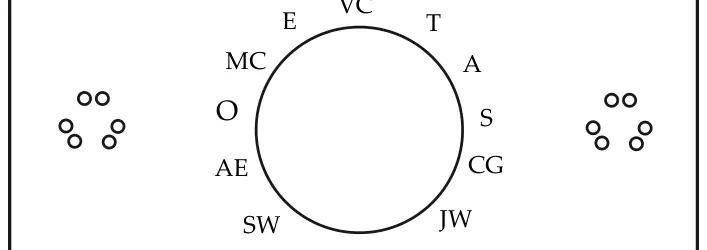
Bodies of this degree are styled Colleges. There are two apartments. The first is a plain room, of moderate dimensions, without any fixed number of lights, and prepared to represent a carpenter’s workshop on Mount Lebanon. The second is hung with red, and lighted by 36 lights, arranged by sixes, and each six by twos. It represents the Council Room of the Round Table. In the center of the room is such a table, around which the Brethren sit. The altar is in the East, and upon it are an open Bible, the Square and Compasses, and an Axe.
The officers are a Chief, who is styled Venerable; a Senior and Junior Warden, a Master of Ceremonies, and an Expert and Assistant Expert.
The Order is a broad, rainbow-colored ribbon, worn as a collar. It may be worn as a sash, from right to left; and is lined with purple. The jewel, suspended to the collar, is an axe and handle of gold. On the top or end of the handle are the letters נ and ש, on one side of the handle, ל and on the other, צ; on one side of the blade, נ, ז, ד, כ, א, and ע on the other, ב. א, מ, י, ח, ש,
The letters on the top are the initials of the names Noah and Solomon; those on the handle, of Libanus And Tsidonian; those, on one side of the blade, of Adoniram, Cyrus, Darius, Zerubbabel, Nehemiah and Ezra; and those on the other side of Shem, Kham, Yapheth, Moses, Ahaliab and Betselal.
The Apron is white, lined and bordered with purple. On the middle a round table is embroidered, on which are mathematical instruments, and plans unrolled. On the flap is a serpent with three heads.
The Tracing-Board is a view of the mountains and forests of Lebanon, the summit of the mountain covered with snow; and of the Temple erected of its cedars and pines. It is in the form of an axe.
In the workshop the Senior Warden presides, and is styled “Master Carpenter.” He and all the Brethren wear frocks or blouses and aprons.
There is no particular alarm or battery in the workshop.
[p. 578]
Figure de l’original [p. 578]Plan de l’atelier [p. 578]Batterie [p. 578]
SECOND APARTMENT (COUNCIL ROOM OF THE ROUND TABLE)
[p. 579]
To Open.
The Chief gives one rap, and says: VC—• My Brethren, the day-star has risen in the East. It is time to arouse the workmen, that they may prepare for their labors. Brother Senior Warden, are all the Princes present?
SW—Venerable Chief, they are.
VC—Announce to them, my Brother, through the Junior Warden, that I am about to open this College; that directions may be given to the workmen, their complaints be heard, and justice administered.
SW—Brother Junior Warden, the Venerable Chief is about to open this College of Princes of Libanus. Make proclamation that all who desire instruction, and those who have complaints to prefer or justice to demand may come forward and be heard.
JW—Brethren, it is made known to me that the Venerable Chief is about to open this College of Princes of Libanus. Let those who have instruction to ask, complaints to prefer, or justice to demand, draw near and they shall be heard.
VC—My Brethren, unite with me in imploring the blessing of the Supreme Deity upon our labors! All the Knights repeat the following
prayer:
All—Thou who didst create the universe, and hast builded it in infinite magnificence, as thou art infinite in skill and wisdom, bless us in our daily labors, and prosper the work of our hands! Teach us and all men that labor is honorable! Improve the condition of the toiling millions! Teach the rich and the haughty compassion for those over whom they have control; and hasten the coming of the day when all men shall acknowledge the great truth, that to work well in our appointed sphere is the most acceptable prayer that man can offer up to thee. Amen!
VC—Brother Junior Warden, arouse the workmen, by the usual alarm.
JW—•• SW—•• VC—•• Then, after a moment’s silence, the Venerable Chief gives the sign, which all answer: and he says: VC—The cedars on Mount Lebanon wait to be felled. Under the auspices of the Supreme Council of the ThirtyThird Degree of the Ancient and Accepted Scottish Rite of Freemasonry for the Southern Jurisdiction of the United States, whose See is in Charleston, in the state of South Carolina, and by virtue of the powers in me vested as Chief, I declare this College open.
Reception.
The Candidate, in the dress, insignia, and jewel of a Prussian Knight, with sword and other apparel complete, is brought to the door of the second apartment, in which the officers and brethren are seated around the table, on which are plans and mathematical instruments. The Master of Ceremonies, having charge of the Candidate, gives the battery. The Assistant Expert opens the door a little, and asks:
AE—Who comes here?
MC—A worthy Prussian Knight who desires to obtain the degree of Prince of Libanus, and to that end hath traveled hither from afar.
AE—Hath he received all the preceding degrees?
MC—He has.
AE—Hath he approved himself a true Knight and just Judge?
MC—The Brethren know.
AE—What further claim hath he to this privilege?
MC—The claim of birth; and rank in Masonry.
AE—I will advise the college of his request. Let him patiently await their answer. He closes the door. VC—Brother Assistant Expert, who seeks admittance to the College?
AE—A Prussian Knight, who desires to obtain the degree of Prince of Libanus; in charge of our Master of Ceremonies.
VC—Has he received all the preceding degrees?
AE—The Master of Ceremonies answers that he has.
VC—Hath he approved himself a true Knight and a just judge?
[p. 580]
MC—The Brethren know.
VC—What further claim hath he to this privilege?
MC—The claim of birth; and rank in Masonry.
VC—The claim is not sufficient. Yet let him be admitted. He is admitted, and advances to the table; and the Venerable Chief addresses him thus: VC—Is it your desire, my Brother, to obtain the degree of Prince of Libanus?
C—It is.
VC—We know the grounds on which you claim it; but birth is not regarded here; and rank in Masonry does not of itself suffice. We are all workmen in our several vocations. You see us now engaged in preparing plans for the laborers, and studying the calculations of astronomy. No one can, by our constitutions, be admitted to the high privileges of this degree, unless he hath first wrought one year in the workshop, and obtained the unanimous suffrage of the workmen. Is your desire for this degree sufficient to induce you to lay aside your insignia, your sword and jewel, for a time, and join the Sons of Labor, who represent the toiling millions?
C—It is.
VC—Go, then, my Brother, obtain their suffrages and return to us. The Candidate withdraws with the Expert, and goes to the door of the first apartment, where they give three or four raps. The door is opened, and they enter. The workmen are hewing, sawing, planing, mortising, etc., and the Master Carpenter copying designs from a tracing-board. He gives one loud rap, and the workmen pause.
SW—Whom have you, there, Brother Expert?
E—A Prussian Knight, who desires your suffrages, that he may obtain the degree of Prince of Libanus.
SW—Our suffrages are given to those that work. Has he learned to do so?
E—Nay; but is willing; and hath for that come hither.
SW—Does he acknowledge the dignity of labor; and that it is no curse, but a privilege, for man to be allowed to earn his sustenance by work?
E—He does.
SW—Does he admit that the honest laboring man, upright and independent, is, in nature’s heraldry, the peer of Kings; and that not labor, but idleness, is disgraceful?
E—He does.
SW—Art thou willing to eat only what thou earnest; patiently to receive instruction; and to recognize and treat these workmen as thy brethren and thy equals?
C—I am.
SW—Then, as thou wast divested of thy outward garments, upon thy first entry into a Masonic Lodge, divest thyself now of thy insignia and jewels, and assume the dress and apron of a workman.
The Candidate puts offhis regalia, and is clothed in a blouse and coarse apron, and directed to saw a long plank in two lengthwise. When he has finished, the Master Carpenter says:
SW—My Brother, the Saw, the Plane, and the Hewing-Axe are the working tools of a Prince of Libanus. The Saw symbolizes that steady patience and persevering determination by which the resolute man makes his way to the object of his endeavor through all obstacles; and teaches us that Masons, laboring for the improvement of the world and the great cause of human progress, must be content to advance—certainly, though never so painfully and slowly, toward success. As the Plane cuts down the inequalities of surfaces, it is symbolical of Masonry, which cuts offthe prejudices of ignorance, and the absurdities of superstition, and aids to polish and civilize mankind. The Axe is the great agent of civilization and improvement. It is the troops armed with that weapon that have conquered barbarism. Under its blows the primeval forests disappear, and the husbandman displaces the wild hunter, and to the rude barbarism of the early ages succeed settled society and laws, and all the arts that refine and elevate mankind. The axe is nobler than the sword. And as the sturdy pioneer, armed with the axe, strides onward in the van of civilization; and as the great trees fall before him, never to rise again, so Masonry hews at those mighty upas-trees, Intolerance, Bigotry, Superstition, Uncharitableness, and Idleness; and lets in the light of truth and reason upon the human mind, which these vices have darkened for centuries.
The Candidate is made to use the plane; and then a brother brings him a piece of dry bread and a cup of water; and the Master Carpenter says to him:
SW—Eat, my Brother, of the laborer’s food. It is thine own; for thou hast earned it; and no one suffers because thou dost eat.
He is made to use the axe. Then the Master Carpenter says: SW—My Brethren, this Knight, by his ready acquiescence in our rules, and his cheerful conformity to our customs, has shown a true appreciation of the dignity of labor. We may require him to toil with us a year; or we may
[p. 581]
at once give him our suffrages. If no one wishes otherwise, we will proceed to vote upon his request to be admitted among the Princes of Libanus.
The vote is taken by ballot; and, it being declared white, the Candidate is informed that he is duly elected to receive the degree, and that he will repair to the second apartment. He is again invested with his insignia and jewel, during which time the Brethren go out one by one, and repair to the second chamber, dressed in the insignia and jewel of this degree. The Expert gives the alarm, and the Assistant Expert asks:
AE—Who comes here?
E—A Prussian Knight; who, having wrought cheerfully in the workshop, and learned the use of the saw, plane and axe, has received the suffrages of the workmen and demands to be received a Prince of Libanus.
He closes the door. VC—(To the Assistant Expert) Whom comes here?
AE—A Prussian Knight; who, having wrought cheerfully in the workshop, and learned the use of the saw, plane and axe, has received the suffrages of the workmen and demands to be received a Prince of Libanus.
VC—Let him be admitted. The three principal officers are now in their proper seats. The Candidate is admitted. E—Venerable Chief, I present to you this Prussian Knight, who has toiled in the workshop, and received the unanimous suffrage of the Brethren.
VC—My Brother, do you still persist in your desire to enter this association of laborers?
C—I do.
VC—Are you not deterred by the hazard of such toil and fare as you experienced in the workshop?
C—I am not.
VC—Go, then, and kneel at the altar, and receive the obligation of this degree. He kneels upon both knees, with his hands upon the axe and Bible, and takes this
obligation:
I, A. B., of my own free will and accord, in the presence of the Supreme Architect of the Universe, and this College of Princes of Libanus, do hereby and hereon most solemnly and sincerely promise and vow, that I will never communicate the secrets of this degree to any person or persons whatsoever, unless he or they shall be lawfully entitled to the same.
I furthermore promise and vow that I will hereafter use my best endeavors to elevate the character of the laboring classes, and to improve their condition; to disseminate the blessings of education among their children, and to give to themselves their due social and political weight; and that, recognizing labor as honorable, I will regard the laboring man as my peer and equal, so far as his honesty, virtue and intelligence may entitle him to it.
All which I promise and vow, under the penalty of exposure on the highest pinnacle of Mount Libanus, there miserably to perish in its perpetual snows. So help me God; and aid me to keep and observe the same!
The Venerable Chief raises him, and communicates the Signs and Words. The Sign is to raise both hands toward the right shoulder, the thumbs and fingers separated as much as possible, and let them fall upon the left hip, as if striking with an axe. It alludes to felling the cedars of Libanus.
The Answer is to raise both hands to the height of the forehead, fingers extended, and let them fall down together, in front.
The Token is to take mutually each other’s hands, crossing them, in sign of good faith. The Passwords are Noakh, Betsel-Al, Yaphet, Aholai-Ab, Tsuidunai, Lebanon. The Sacred Word is El-Shadai. Noah means Quiet. Betsel-Al means Shade of God. Yaphet means Enlargement, Success. Aholai-Ab means Tent of the Father. Tsuidunai means People of Tsidun (Sidon). Lebanon means The White Mountain of Lebanon. The Sacred Word, El-Shadai, comes from Sad and Sadah, meaning “Breast, bosom, paps.” In Chaldaic, Shadah means “ejaculated, poured out.” Sad or Sud is said to mean “devastation,” and Sadai, “Omnipotence.” It more probably meant Nature or the Powers of Nature, represented by the Indians and Egyptians as a woman pouring fertility from her breasts. These Powers of Nature were worshipped before men had any idea of a personal creative God.
Al-Shadai means “The Nature God,” and Sadah also means “Mistress, Queen, Wife.” Appropriately, therefore, “Nature,” Great Mother of all, and the plural Shadai, “The Powers and Potencies of Nature.”
[p. 582]
Sadah and Sadi mean, also, “a field, a plain”; and Sad, “Master, Lord, potent.” The Candidate is then invested with the collar, apron and jewel of the degree. VC—[I will now invest you with the collar, apron, and jewel of this Degree. The Order is a broad, rainbowcolored ribbon, worn as a collar. It may be worn as a sash, from right to left; and is lined with purple. The jewel, suspended to the collar, is an axe and handle of gold. On the top or end of the handle are the letters nun and shin, on one side of the handle, lamech and on the other, tsadi; on one side of the blade, aleph, kaph, daleth, zayin, nun, and ayin; on the other, shin, khet, yod, mem, aleph, and beth.
The letters on the top are the initials of the names Noah and Solomon; those on the handle, of Libanus and Tsidonian; those, on one side of the blade, of Adoniram, Cyrus, Darius, Zerubbabel, Nehemiah and Ezra; and those on the other side of Shem, Kham, Yapheth, Moses, Ahaliab and Betselal.
The Apron is white, lined and bordered with purple. On the middle a round table is embroidered, on which are mathematical instruments, and plans unrolled.]
The Serpent with three heads, upon the flap of the apron, is Idleness, the body from which issue the three vices symbolized by the heads, Drunkenness, Impurity, and Gaming: by which so many youths have been lost, and so many great Nations have sunk into ignoble imbecility and shameful bondage.
The Orator then recites to him the History and Lecture.
History.
O—The Tsidunians or Phœnicians were ever ready to aid the Israelites in their holy enterprises. The tie between them was the mysteries, into which the principal persons of both Nations were initiated; Moses having necessarily received them in Egypt, before he could marry the daughter of a priest of On. These mysteries, modified by Solomon, or perhaps at an earlier day by Joshua or even Moses, to suit the genius and manners of the Jewish people, became Masonry, such as it was practiced at the building of the temple, and such as it has in part come down to us. Khirum, King of Tsūr in Phœnicia, and Khirum Abai, also a Phœnician and not a Jew, were likewise initiates; and hence the intimate connection between them and Solomon, as Masons. The people of Tsidun, a city of Phœnicia, were employed by Noah to cut cedars on Mount Libanus, of which to build the ark, under the superintendence of Japhet. His descendants repeopled Tsidun and Phœnicia, and procured and furnished the cedar from Lebanon to build the Ark of the Covenant; and at a later day his posterity, under Adon Khirum, cut in the same forests cedars for King Solomon: and at a time still later, they felled timber on the same mountains to construct the second temple.
Upon the same mountain they established Colleges of Artificers, like those in Etruria and afterward at Rome; from which latter many deduce Masonry. The Etrurians, an Ugric race, kinsmen of the Finns and Huns, who emigrated from Northern Asia, and at last established themselves in Italy, long before the founding of Rome, had no Mysteries; but they carried some of the Arts to great perfection, and gave to Rome many of its institutions. These Artificers everywhere maintained their rights and privileges and had their signs and words, by which to recognize each other. Solomon himself, whose wisdom necessarily gave him a true idea of the dignity of labor, built a palace on the mountain, to which he often repaired to inspect the progress of the work. The names of the Patriarchs who were the Inspectors and Conductors of the workmen on the mountain at different periods are preserved in our pass-words. The institution of Colleges upon Mount Libanus was perpetuated by the Druses, from whom the Crusaders obtained a knowledge of this degree.
Lecture.
Sympathy with the great laboring classes, respect for labor itself, and resolution to do some good work in our day and generation, these are the lessons of this Degree, and they are purely Masonic. Masonry has made a working-man and his associates the Heroes of her principal legend, and himself the companion of Kings. The idea is as simple and true as it is sublime. From first to last, Masonry is work. It venerates the Grand Architect of the Universe. It commemorates the building of a Temple. Its principal emblems are the working tools of Masons and Artisans. It preserves the name of the first worker in brass and iron as one of its pass-words. When the Brethren meet together, they are at labor. The Master is the overseer who sets the craft to work and gives them proper instruction. Masonry is the apotheosis of Work.
It is the hands of brave, forgotten men that have made this great, populous, cultivated world a world for us. It is all work, and forgotten work. The real conquerors, creators, and eternal proprietors of every great and civilized land are all the heroic souls that ever were in it, each in his degree: all the men that ever felled a forest-tree or drained a marsh, or contrived a wise scheme, or did or said a true or valiant thing therein. Genuine work alone, done faithfully, is eternal, even as the Almighty Founder and World-builder Himself. All work is noble: a life of ease is not for any man, nor for any God. The Almighty Maker is not like one who, in old immemorial ages, having
[p. 583]
made his machine of a Universe, sits ever since, and sees it go. Out of that belief comes Atheism. The faith in an Invisible, Unnamable, Directing Deity, present everywhere in all that we see, and work, and suffer, is the essence of all faith whatsoever.
The life of all Gods figures itself to us as a Sublime Earnestness,—of Infinite battle against Infinite labor. Our highest religion is named the Worship of Sorrow. For the Son of Man there is no noble crown, well-worn, or even ill-worn, but is a crown of thorns. Man’s highest destiny is not to be happy, to love pleasant things and find them. His only true unhappiness should be that he cannot work, and get his destiny as a man fulfilled. The day passes swiftly over, our life passes swiftly over, and the night cometh, wherein no man can work. That night once come, our happiness and unhappiness are vanished, and become as things that never were. But our work is not abolished, and has not vanished. It remains, or the want of it remains, for endless Times and Eternities.
Whatsoever of morality and intelligence; what of patience, perseverance, faithfulness, of method, insight, ingenuity, energy; in a word, whatsoever of strength a man has in him, will lie written in the work he does. To work is to try himself against Nature and her unerring, everlasting laws: and they will return true verdict as to him. The noblest Epic is a mighty Empire slowly built together, a mighty series of heroic deeds, a mighty conquest over chaos. Deeds are greater than words. They have a life, mute, but undeniable; and grow. They people the vacuity of Time, and make it green and worthy.
Labor is the truest emblem of God, the Architect and Eternal Maker; noble Labor, which is yet to be the King of this Earth, and sit on the highest Throne. Men without duties to do, are like trees planted on precipices; from the roots of which all the earth has crumbled. Nature owns no man who is not also a Martyr. She scorns the man who sits screened from all work, from want, danger, hardship, the victory over which is work; and has all his work and battling done by other men; and yet there are men who pride themselves that they and theirs have done no work time out of mind. So neither have the swine.
The chief of men is he who stands in the van of men, fronting the peril which frightens back all others, and if not vanquished would devour them. Hercules was worshipped for twelve labors. The Czar of Russia became a toiling shipwright, and worked with his axe in the docks of Saardam; and something came of that. Cromwell worked, and Napoleon; and effected somewhat.
There is a perennial nobleness and even sacredness in work. Be he never so benighted and forgetful of his high calling, there is always hope in a man who actually and earnestly works: in Idleness alone is there perpetual Despair. Man perfects himself by working. Jungles are cleared away. Fair seed-fields rise instead, and stately cities; and withal, the man himself first ceases to be a foul unwholesome jungle and desert thereby. Even in the meanest sort of labor, the whole soul of man is composed into a kind of real harmony, the moment he begins to work. Doubt, Desire, Sorrow, Remorse, Indignation, and even Despair shrink murmuring far offinto their caves, whenever the man bends himself resolutely against his task. Labor is life. From the inmost heart of the worker rises his God-given Force, the Sacred Celestial Life-essence, breathed into him by Almighty God; and awakens him to all nobleness, as soon as work fitly begins. By it man learns Patience, Courage, Perseverance, Openness to light, readiness to own himself mistaken, resolution to do better and improve. Only by labor will man continually learn the virtues. There is no Religion in stagnation and inaction; but only in activity and exertion. There was the deepest truth in that saying of the old monks, “laborare est orare.” “He prayeth best who loveth best all things both great and small;” and can man love except by working earnestly to benefit that being whom he loves?
“Work; and therein have well-being,” is the oldest of Gospels; unpreached, inarticulate, but ineradicable, and enduring forever. To make Disorder, wherever found, an eternal enemy; to attack and subdue him, and make order of him, the subject not of Chaos, but of Intelligence and Divinity, and of ourselves; to attack ignorance, stupidity and brute-mindedness, wherever found, to smite it wisely and unweariedly, to rest not while we live and it lives, in the name of God, this is our duty as Masons; commanded us by the Highest God. Even He, with his unspoken voice, more awful than the thunders of Sinai, or the syllabled speech of the Hurricane, speaks to us. The Unborn Ages; the old Graves, with their long-moldering dust speak to us. The deep Death-Kingdoms, the Stars in their never-resting course, all Space and all Time, silently and continually admonish us that we too must work while it is called to-day. Labor, wide as the Earth, has its summit in Heaven. To toil, whether with the sweat of the brow, or of the brain or heart, is worship,—the noblest thing yet discovered beneath the Stars. Let the weary cease to think that labor is a curse and doom pronounced by Deity, Without it there could be no true excellence in human nature. Without it, and pain, and sorrow, where would be the human virtues? Where Patience, Perseverance, Submission, Energy, Endurance, Fortitude, Bravery, Disinterestedness, Self-Sacrifice, the noblest excellencies of the Soul?
Let him who toils complain not, nor feel humiliated! Let him look up, and see his fellow-workmen there, in God’s Eternity; they alone surviving there. Even in the weak human memory they long survive, as Saints, as Heroes, and as Gods: they alone survive, and people the unmeasured solitudes of Time.
[p. 584]
To the primeval man, whatsoever good came, descended on him (as in mere fact, it ever does) direct from God; whatsoever duty lay visible for him, this a Supreme God had prescribed. For the primeval man, in whom dwelt Thought, this Universe was all a Temple, life everywhere a Worship.
Duty is with us ever; and evermore forbids us to be idle. To work with the hands or brain, according to our requirements and our capacities, to do that which lies before us to do, is more honorable than rank and title. Ploughers, spinners and builders, inventors, and men of science, poets, advocates, and writers, all stand upon one common level, and form one grand, innumerable host, marching ever onward since the beginning of the world: each entitled to our sympathy and respect, each a man and our brother.
It was well to give the earth to man as a dark mass, whereon to labor. It was well to provide rude and unsightly materials in the ore-bed and the forest, for him to fashion into splendor and beauty. It was well, not because of that splendor and beauty; but because the act creating them is better than the things themselves; because exertion is nobler than enjoyment; because the laborer is greater and more worthy of honor than the idler. Masonry stands up for the nobility of labor. It is Heaven’s great ordinance for human improvement. It has been broken down for ages; and Masonry desires to build it up again. It has been broken down, because men toil only because they must, submitting to it as, in some sort, a degrading necessity; and desiring nothing so much on earth as to escape from it. They fulfill the great law of labor in the letter, but break it in the spirit,: they fulfill it with the muscles, but break it with the mind.
Masonry teaches that every idler ought to hasten to some field of labor, manual or mental, as a chosen and coveted theatre of improvement; but he is not impelled to do so, under the teachings of an imperfect civilization. On the contrary, he sits down, folds his hands, and blesses and glorifies himself in his idleness. It is time that this opprobrium of toil were done away. To be ashamed of toil; of the dingy workshop and dusty labor-field; of the hard hand, stained with service more honorable than that of war; of the soiled and weather-stained garments, on which Mother Nature has stamped, midst sun and rain, midst fire and steam, her own heraldic honors; to be ashamed of these tokens and titles, and envious of the flaunting robes of imbecile idleness and vanity, is treason to Nature, impiety to Heaven, a breach of Heaven’s great Ordinance. toil, of brain, heart, or hand, is the only true man-hood and genuine nobility.
Labor is a more beneficent ministration than man’s ignorance comprehends, or his complainings will admit. Even when its end is hidden from him, it is not mere blind drudgery. It is all a training, a discipline, a development of energies, a nurse of virtues, a school of improvement. From the poor boy who gathers a few sticks for his mother’s hearth, to the strong man who fells the oak or guides the ship or the steam-car, every human toiler, with every weary step and every urgent task, is obeying a wisdom far above his own wisdom, and fulfilling a design far beyond his own design.
The great law of human industry is this: that industry, working either with the hand or the mind, the application of our powers to some task, to the achievement of some result, lies at the foundation of all human improvement. We are not sent into the world like animals, to crop the spontaneous herbage of the field, and then to lie down in indolent repose: but we are sent to dig the soil and plough the sea; to do the business of cities and the work of manufactories. The world is the great and appointed school of industry. In an artificial state of society, mankind is divided into the idle and the laboring classes; but such was not the design of Providence.
Labor is man’s great function, his peculiar distinction and his privilege. From being an animal, that eats and drinks and sleeps only, to become a worker, and with the hand of ingenuity to pour his own thoughts into the moulds of Nature, fashioning them into forms of grace and fabrics of convenience, and converting them to purposes of improvement and happiness, is the greatest possible step in privilege.
The Earth and the Atmosphere are man’s laboratory. With spade and plough, with mining-shafts and furnaces and forges, with fire and steam; midst the noise and whirl of swift and bright machinery, and abroad in the silent fields, man was made to be ever working, ever experimenting. And while he and all his dwellings of care and toil are borne onward with the circling skies, and the splendors of Heaven are around him, and their infinite depths image and invite his thought, still in all the worlds of philosophy, in the universe of intellect, man must be a worker. He is nothing, he can be nothing, can achieve nothing, fulfill nothing, without working. Without it, he can gain neither lofty improvement nor tolerable happiness. The idle must hunt down the hours as their prey. To them Time is an enemy, clothed with armor; and they must kill him, or themselves die. It never yet did answer, and it never will answer, for any man to do nothing, to be exempt from all care and effort, to lounge, to walk, to ride, and to feast alone. No man can live in that way. God made a law against it: which no human power can annul, no human ingenuity evade.
The idea that a property is to be acquired in the course of ten or twenty years, which shall suffice for the rest of life; that by some prosperous traffic or grand speculation, all the labor of a whole life is to be accomplished in a brief portion of it; that by dexterous management, a large part of the term of human existence is to be exonerated from the cares of industry and self-denial, is founded upon a grave mistake, upon a misconception of the true nature and
[p. 585]
design of business, and of the conditions of human well-being. The desire of accumulation for the sake of securing a life of ease and gratification, of escaping from exertion and self-denial, is wholly wrong, though very common.
It is better for the Mason to live while he lives, and enjoy life as it passes: to live richer and die poorer. It is best of all for him to banish from the mind that empty dream of future indolence and indulgence; to address himself to the business of life, as the school of his earthly education; to settle it with himself now that independence, if he gains it, is not to give him exemption from employment. It is best for him to know, that, in order to be a happy man, he must always be a laborer, with the mind or the body, or with both: and that the reasonable exertion of his powers, bodily and mental, is not to be regarded as mere drudgery, but as a good discipline, a wise ordination, a training in this primary school of our being, for nobler endeavors, and spheres of higher activity hereafter.
There are reasons why a Mason may lawfully and even earnestly desire a fortune. If he can fill some fine palace, itself a work of art, with the productions of lofty genius; if he can be the friend and helper of humble worth; if he can seek it out, where failing health or adverse fortune presses it hard, and soften or stay the bitter hours that are hastening it to madness or to the grave; if he can stand between the oppressor and his prey, and bid the fetter and the dungeon give up their victim; if he can build up great institutions of learning, and academies of art; if he can open fountains of knowledge for the people, and conduct its streams in the right channels; if he can do better for the poor than to bestow alms upon them—even to think of them, and devise plans for their elevation in knowledge and virtue, instead of forever opening the old reservoirs and resources for their improvidence; if he has sufficient heart and soul to do all this, or part of it; if wealth would be to him the handmaid of exertion, facilitating effort, and giving success to endeavor; then may he lawfully, and yet warily and modestly, desire it. But if it is to do nothing for him, but to minister ease and indulgence, and to place his children in the same bad school, then there is no reason why he should desire it.
What is there glorious in the world, that is not the product of labor, either of the body or of the mind? What is history, but its record? What are the treasures of genius and art, but its work? What are cultivated fields, but its toil? The busy marts, the rising cities, the enriched empires of the world are but the great treasure-houses of labor. The pyramids of Egypt, the castles and towers and temples of Europe, the buried cities of Italy and Mexico, the canals and railroads of Christendom, are but tracks, all round the world, of the mighty footsteps of labor. Without it antiquity would not have been. Without it, there would be no memory of the past, and no hope for the future.
Even utter indolence reposes on treasures that labor at some time gained and gathered. He that does nothing, and yet does not starve, has still his significance; for he is a standing proof that somebody has at some time worked. But not to such does Masonry do honor. It honors the Worker, the Toiler; him who produces and not alone consumes; him who puts forth his hand to add to the treasury of human comforts, and not alone to take away. It honors him who goes forth amid the struggling elements to fight his battle, and who shrinks not, with cowardly effeminacy, behind pillows of ease. It honors the strong muscle, and the manly nerve, and the resolute and brave heart, the sweating brow, and the toiling brain. It honors the great and beautiful offices of humanity, manhood’s toil and woman’s task; paternal industry and maternal watching and weariness; wisdom teaching and patience learning; the brow of care that presides over the State, and many-handed labor that toils in workshop, field, and study, beneath its mild and beneficent sway.
God has not made a world of rich men; but rather a world of poor men; or of men, at least, who must toil for a subsistence. That is, then, the best condition for man, and the grand sphere of human improvement. If the whole world could acquire wealth, (and one man is as much entitled to it as another, when he is born); if the present generation could lay up a complete provision for the next, as some men desire to do for their children; the world would be destroyed at a single blow. All industry would cease with the necessity for it; all improvement would stop with the demand for exertion; the dissipation of fortunes, the mischiefs of which are now countervailed by the healthful tone of society, would breed universal disease, and break out into universal license; and the world would sink, rotten as Herod, into the grave of its own loathsome vices.
Almost all the noblest things that have been achieved in the world, have been achieved by poor men; poor scholars, poor professional men, poor artisans and artists, poor philosophers, poets, and men of genius. A certain staidness and sobriety, a certain moderation and restraint, a certain pressure of circumstances, are good for man. His body was not made for luxuries. It sickens, sinks, and dies under them. His mind was not made for indulgence. It grows weak, effeminate, and dwarfish, under that condition. And he who pampers his body with luxuries and his mind with indulgence, bequeaths the consequences to the minds and bodies of his descendants, without the wealth which was their cause. For wealth, without a law of entail to help it, has always lacked the energy even to keep its own treasures. They drop from its imbecile hand. The third generation almost inevitably goes down the rolling wheel of fortune, and there learns the energy necessary to rise again, if it rises at all; heir, as it is, to the bodily diseases, and mental weaknesses, and the soul’s vices of its ancestors, and not heir to their wealth. And yet we are,
[p. 586]
almost all of us, anxious to put our children, or to insure that our grandchildren shall be put, on this road to indulgence, luxury, vice, degradation, and ruin; this heirship of hereditary disease, soul malady, and mental leprosy.
If wealth were employed in promoting mental culture at home and works of philanthropy abroad; if it were multiplying studies of art, and building up institutions of learning around us; if it were in every way raising the intellectual character of the world, there could scarcely be too much of it. But if the utmost aim, effort, and ambition of wealth be, to procure rich furniture, and provide costly entertainments, and build luxurious houses, and minister to vanity, extravagance, and ostentation, there could scarcely be too little of it. To a certain extent it may laudably be the minister of elegancies and luxuries, and the servitor of hospitality and physical enjoyment: but justin proportion as its tendencies, divested of all higher aims and tastes, are running that way, they are running to peril and evil.
Nor does that peril attach to individuals and families alone. It stands, a fearful beacon, in the experience of Cities, Republics, and Empires. The lessons of past times, on this subject, are emphatic and solemn. The history of wealth has always been a history of corruption and downfall. The people never existed that could stand the trial. Boundless profusion is too little likely to spread for any people the theatre of manly energy, rigid self-denial, and lofty virtue. You do not look for the bone and sinew and strength of a country, its loftiest talents and virtues, its martyrs to patriotism or religion, its men to meet the days of peril and disaster, among the children of ease, indulgence, and luxury.
In the great march of the races of men over the earth, we have always seen opulence and luxury sinking before poverty and toil and hardy nurture. That is the law which has presided over the great processions of empire. Sidon and Tyre, whose merchants possessed the wealth of princes; Babylon and Palmyra, the seats of Asiatic luxury; Rome, laden with the spoils of a world, overwhelmed by her own vices more than by the hosts of her enemies; all these, and many more, are examples of the destructive tendencies of immense and unnatural accumulation: and men must become more generous and benevolent, not more selfish and effeminate, as they become more rich, or the history of modern wealth will follow in the sad train of all past examples.
All men desire distinction, and feel the need of some ennobling object in life. Those persons are usually most happy and satisfied in their pursuits, who have the loftiest ends in view. Artists, mechanicians, and inventors, all who seek to find principles or develop beauty in their work, seem most to enjoy it. The farmer who labors for the beautifying and scientific cultivation of his estate, is more happy in his labors than one who tills his own land for a mere subsistence. This is one of the signal testimonies which all human employments give to the high demands of our nature. To gather wealth never gives such satisfaction as to bring the humblest piece of machinery to perfection: at least, when wealth is sought for display and ostentation, or mere luxury, and ease, and pleasure; and not for ends of philanthropy, the relief of kindred, or the payment of just debts, or as a means to attain some other great and noble object.
With the pursuits of multitudes is connected a painful conviction that they neither supply a sufficient object, nor confer any satisfactory honor. Why work, if the world is soon not to know that such a being ever existed; and when one can perpetuate his name neither on canvas nor on marble, nor in books, nor by lofty eloquence, nor statesmanship?
The answer is, that every man has a work to do in himself, greater and sublimer than any work of genius; and works upon a nobler material than wood or marble—upon his own soul and intellect, and may so attain the highest nobleness and grandeur known on earth or in Heaven; may so be the greatest of artists, and of authors, and his life, which is far more than speech, may be eloquent.
The great author or artist only portrays what every man should be. He conceives, what we should do. He conceives, and represents moral beauty, magnanimity, fortitude, love, devotion, forgiveness, the soul’s greatness. He portrays virtues, commended to our admiration and imitation. To embody these portraitures in our lives is the practical realization of those great ideals of art. The magnanimity of Heroes, celebrated on the historic or poetic page; the constancy and faith of Truth’s martyrs; the beauty of love and piety glowing on the canvas; the delineations of Truth and Right, that flash from the lips of the Eloquent, are, in their essence only that which every man may feel and practice in the daily walks of life. The work of virtue is nobler than any work of genius; for it is a nobler thing to be a hero than to describe one, to endure martyrdom than to paint it, to do right than to plead for it. Action is greater than writing. A good man is a nobler object of contemplation than a great author. There are but two things worth living for: to do what is worthy of being written; and to write what is worthy of being read; and the greater of these is the doing.
Every man has to do the noblest thing that any man can do or describe. There is a wide field for the courage, cheerfulness, energy, and dignity of human existence. Let therefore no Mason deem his life doomed to mediocrity or meanness, to vanity or unprofitable toil, or to any ends less than immortal. No one can truly say that the grand prizes of life are for others, and he can do nothing. No matter how magnificent and noble an act the author can de-
[p. 587]
scribe or the artist paint, it will be still nobler for you to go and do that which one describes, or be the model which the other draws.
The loftiest action that ever was described is not more magnanimous than that which we may find occasion to do, in the daily walks of life; in temptation, in distress, in bereavement, in the solemn approach to death. In the great Providence of God, in the great ordinances of our being, there is opened to every man a sphere for the noblest action. It is not even in extraordinary situations, where all eyes are upon us, where all our energy is aroused, and all our vigilance is awake, that the highest efforts of virtue are usually demanded of us; but rather in silence and seclusion, amidst our occupations and our homes; in wearing sickness, that makes no complaint; in sorely-tried honesty, that asks no praise; in simple disinterestedness, hiding the hand that resigns its advantage to another.
Masonry seeks to ennoble common life. Its work is to go down into the obscure and unsearched records of daily conduct and feeling; and to portray, not the ordinary virtue of an extraordinary life; but the more extraordinary virtue of ordinary life. What is done and borne in the shades of privacy, in the hard and beaten path of daily care and toil, full of uncelebrated sacrifices; in the suffering, and sometimes insulted suffering, that wears to the world a cheerful brow; in the long strife of the spirit, resisting pain, penury, and neglect, carried on in the inmost depths of the heart;—what is done, and borne, and wrought, and won there, is a higher glory, and shall inherit a brighter crown.
On the volume of Masonic life one bright word is written, from which on every side blazes an ineffable splendor. That word is Duty.
To aid in securing to all labor permanent employment and its just reward: to help to hasten the coming of that time when no one shall stiffer from hunger or destitution, because, though willing and able to work, he can find no employment, or because he has been overtaken by sickness in the midst of his labor, are part of your duties as a Knight of the Royal Axe. And if we can succeed in making some small nook of God’s creation a little more fruitful and cheerful, a little better and more worthy of Him,—or in making some one or two human hearts a little wiser, and more manful and hopeful and happy, we shall have done work, worthy of Masons, and acceptable to our Father in Heaven.
To Close.
VC—• Brother Senior Warden, have you anything to offer or propose to this College of Princes of Libanus, for the benefit of the Ancient and Accepted Scottish Rite or of this College? If so, the floor is yours.
SW—(Rising and bowing, he addresses the Venerable Chief, offering or proposing what he desires; or if he has nothing, says:) Nothing, Venerable Chief.
VC—Brother Junior Warden, have you anything to offer or propose to this College of Princes of Libanus, for the benefit of the Ancient and Accepted Scottish Rite or of this College? If so, the floor is yours.
JW—(Rising and bowing, he addresses the Venerable Master, offering or proposing what he desires; or if he has nothing, says:) Nothing, Venerable Chief.
VC—Brethren Senior and Junior Wardens, please inform the Princes of Libanus in your respective valleys, that if anyone desires to offer or propose anything in the College, for the benefit of the Ancient and Accepted Scottish Rite or of this College, the floor is his.
SW—Brethren Princes of Libanus of my valley, the Venerable Chief informs you, that if anyone desires to offer or propose anything in the College, for the benefit of the Ancient and Accepted Scottish Rite or of this College, the floor is his.
JW—Brethren Princes of Libanus of my valley, the Venerable Chief informs you, that if anyone desires to offer or propose anything in the College, for the benefit of the Ancient and Accepted Scottish Rite or of this College, the floor is his.
JW—(When no one desires to speak or everything is disposed of) Brother Senior Warden, silence prevails in my valley.
SW—Venerable Chief, silence prevails in both valleys.
VC—Brethren Senior and Junior Wardens, inform the brethren in both valleys that the Box of Fraternal Assistance is about to be presented to them.
SW—Brethren Princes of Libanus in my valley, the Venerable Chief informs you that the Box of Fraternal Assistance is about to be presented to you.
JW—Brethren Princes of Libanus in my valley, the Venerable Chief informs you that the Box of Fraternal Assistance is about to be presented to you.
VC—Brother Master of Ceremonies, present the Box of Fraternal Assistance to all. It is passed around. After the collection, the Venerable Chief gives one rap, and says: VC—• Brother Senior Warden, what is the hour?
SW—Venerable Chief, the sun has set.
[p. 588]
VC—It is time, then, to call the workmen from their labors, that they may rest. Announce to the Brethren that this College is about to be closed.
SW—Brother Junior Warden, the Venerable Chief is about to close this College of Princes of Libanus. You will communicate the same to the Brethren.
JW—Brethren, the Venerable Chief is about to close this College of Princes of Libanus.
SW—Brother Junior Warden, we will call the workmen from their labors by the usual alarm.
JW—•• SW—•• VC—•• The sign is given and answered as at opening. VC—The cedars of Mount Libanus are felled; and this College is closed. But before we separate, let each vow not to reveal anything whatever that has here been said or done, that is not proper to be made known.
The Venerable Chief descends from his seat, draws his sword, and holds the hilt out in front of him. The brethren all pass by him, from south to north, each as he passes laying his hand on the hilt of the sword, and saying, “I vow.” Once this is concluded:
VC—The College is closed. My brethren, depart in peace!
Rosen 1886
tuileur imprimé · 216 mots
Le Tuileur des trente-trois grades du Rite Écossais Ancien et Accepté arrêté par le Convent universel de Lausanne et certifié le 1er juillet 1876 par le Suprême Conseil de Suisse, publié en 1886 par Paul Rosen dans sa « Maçonnerie pratique ». Décoration, titres, signes, attouchement, marche, batterie, âge, mots, tablier, cordon et bijou du grade. Les mots y sont imprimés en caractères de convention : leur déchiffrement est ajouté en fin de fiche. Le chiffre est un Vigenère sur un alphabet de vingt-cinq lettres, sans W, avec un mot-clef par groupe de degrés. Pages 383-384 de l'édition originale.
Deux appartements, le premier tendu de bleu, représentant l'Atelier du Mont-Liban ; il est éclairé de onze lumières. Le second, tendu en rouge ; c'est le Conseil de la Table Ronde.
Titres.
La Loge se nomme Collège au premier point, et Conseil au second. Le Maître est appelé d'abord Très Sage, puis Grand-Patriarche ; il y a deux Grands Officiers.
Signes.
Élever les deux mains vers l'épaule droite, et les laisser retomber sur la cuisse gauche. On répond en levant les deux mains à la hauteur du front, les doigts étendus, et les laissant retomber.
[p. 384]
Attouchement.
Se prendre mutuellement les mains en les croisant.
Batterie.
Deux coups égaux : ○ ○.
Marche.
Trois pas croisés. Trois voyages.
Mots Sacrés.
TCS, HRILMEKRA, AGXVXGO.
Mots de Passe.
PNEAMM, UCABIT ; RVPSV.
Tablier.
Blanc ; est peinte au milieu une table ronde, sur laquelle on voit des plans. D'autres y peignent un œil.
Cordon.
Couleur d'arc-en-ciel, en sautoir, doublé de ponceau.
Bijou.
Une hache couronnée d'or. D'un côté du manche sont les lettres L∴ S∴ A∴ A∴ C∴ D∴ X∴ Z∴ A∴ ; sur l'autre côté, les lettres S∴ N∴ S∴ C∴ J∴ M∴ B∴ O∴.