Chaque version du rituel est donnée dans l'état de sa source, de la plus
ancienne à la plus récente. Choisissez une version pour la lire ; sélectionnez-en une
seconde pour les comparer côte à côte. Fiche du grade :
le REAA du 4e au 33e degré.
Les textes issus de numérisations anciennes ont été corrigés automatiquement
(césures, ligatures, mots collés) puis relus : des coquilles peuvent subsister. D'autres
versions inventoriées au corpus (Francken 1783, Pyron 1811, rituels de Charleston ) rejoindront
cette page à mesure de l'établissement de leur texte.
Copie d'un officier du régiment de Foix en garnison à Saint-Domingue : le Rite de Perfection en 25 degrés, tel qu'arrêté au convent de Bordeaux. Cahier « Chapitre des grands inspecteurs des loges, grands élus chevaliers Kadoz » (p. 190-203 de la transcription). Le texte suit la transcription d'Aeditimus : son apparat critique est repris ici, ainsi que les repères de folio du manuscrit.
Tolle et lege Disce et tace Chapitre des grands inspecteurs des loges, grands élus chevaliers Kadoz avant pour chef le très illustre Frédéric second roi de Prusse sous le titre de très illustre chevalier grand commandeur N… B…
Les frères qui voudront s'instruire plus particulièrement des faits rapportés dans cette histoire ou dans ce grade, pourront consulter les auteurs qui en ont parlé le plus clairement, et dont les noms sont ci après.
Villaneus, historien contemporain
Mathieu Paris, histoire de tous les ordres
L'abbé Vertot, histoire de Malte
Sainte Foix, essais sur Paris
Bernard Dupuy etc. etc. etc., histoire des K[ados]
Brompton et Roger de Howerden, historiens anglais qui vivaient en 1141 [62v°]
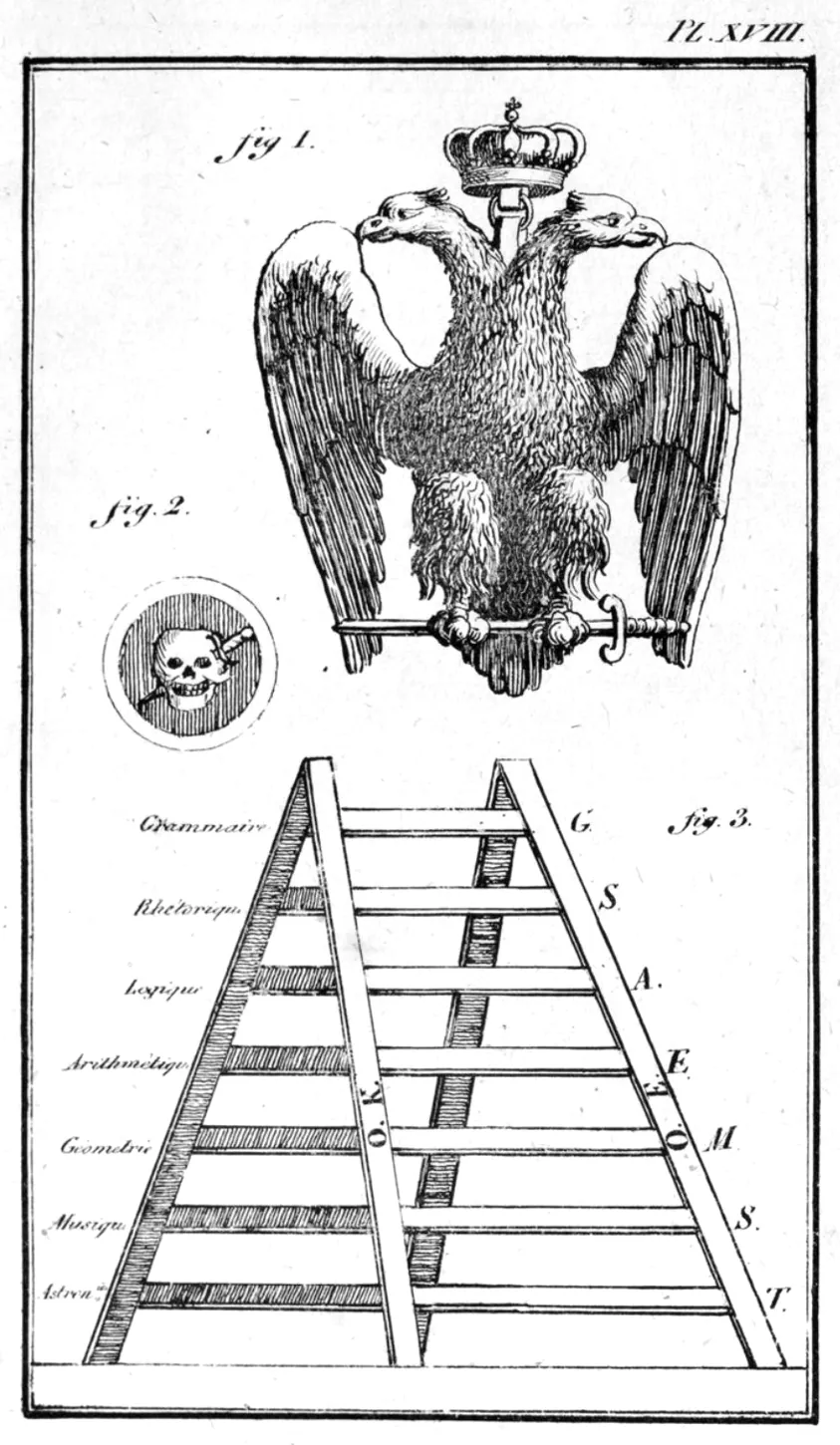
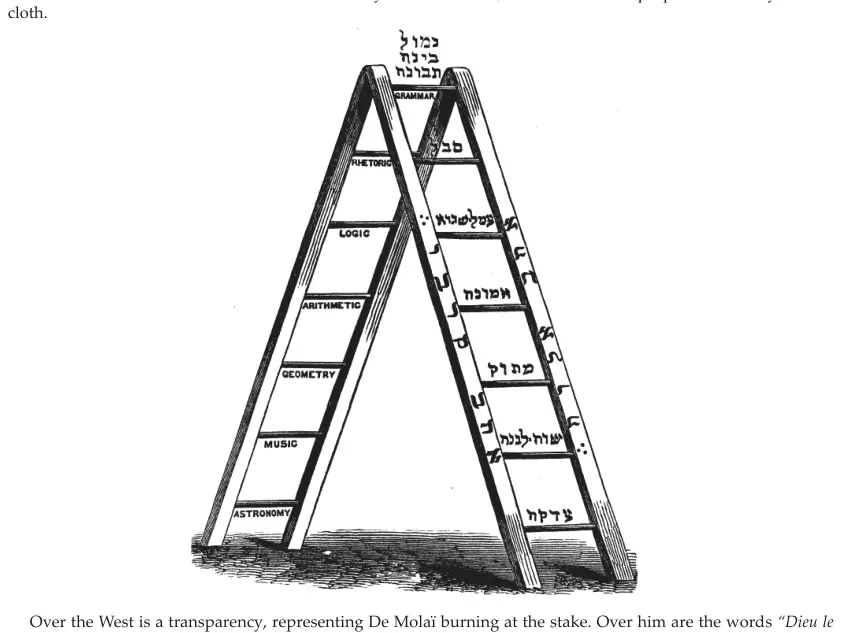
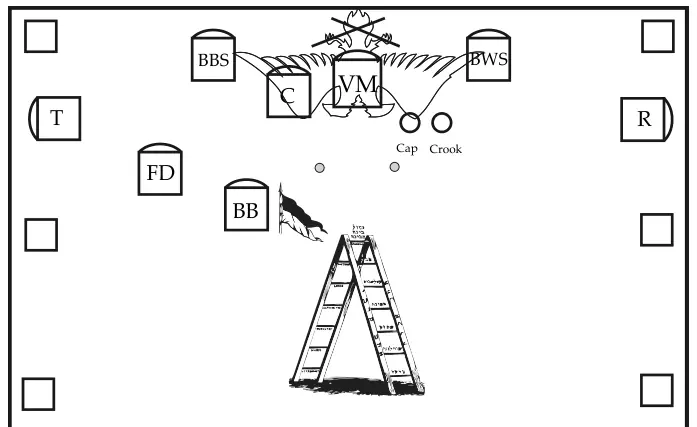
[62v°] L'échelle mystérieuse contenant deux montants et sept échelons necum, ou necak, ou nicak nec plus ultra l'explication en est dans le cours de l'instruction etc. etc.
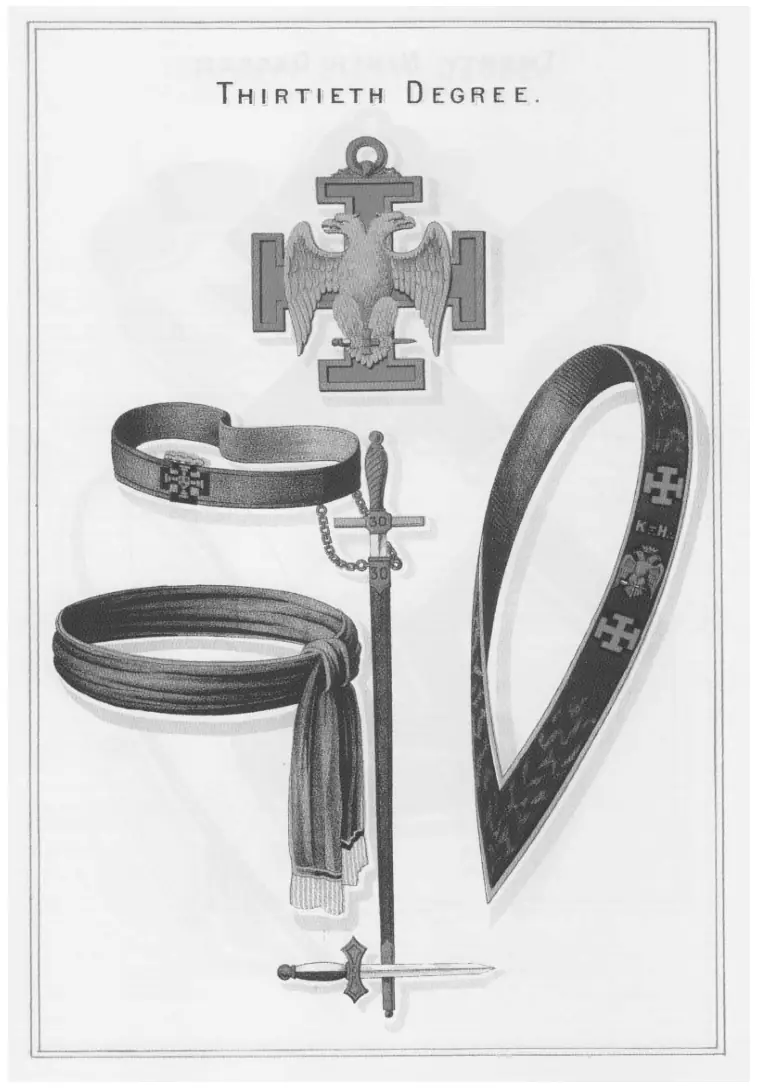
[63r°] Ouverture du chapitre Le chapitre des grands élus doit être composé de cinq frères au moins revêtus de ce grade pour la plus grande décence. Tous doivent être habillés de noir avec de gants blancs, le cordon noir mis en sautoir de l'épaule gauche au côté droit. Ce cordon sert à porter l'attribut de l'Ordre, qui est une croix rouge tout à fait semblable à celle que portent les chevaliers de l'Ordre Teutonique, au milieu de deux épées en sautoir. Ils ne portent plus de tablier.
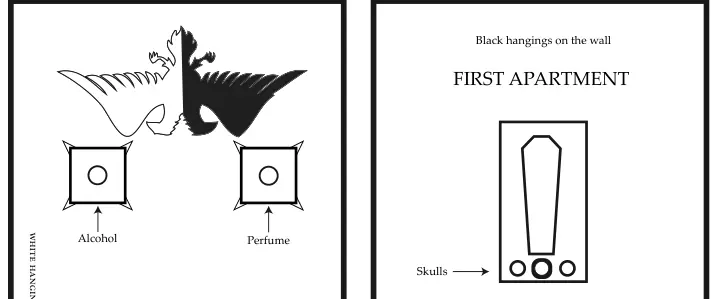
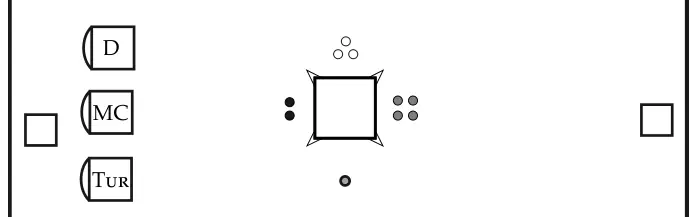
La décoration du lieu où se tient le chapitre est arbitraire, mais celle d'un chapitre d'élu est celle dont on se sent le plus communément, comme la plus analogue à l'Ordre. Comme il n'y a plus d'emblèmes et que le rideau est tiré, il n'y a plus d'épreuves à soutenir ni de tableau tracé ; on figure seulement sur le plancher l'échelle mystérieuse que l'on masque au récipiendaire jusqu'à ce qu'il ait prononcé ses vœux ; on doit être au reste assez assuré de sa discrétion pour n'avoir plus besoin de détours et de routes cachées qui doivent le conduire au point de perfection où il aspire.
Des cinq frères qui composent le chapitre trois restent dans l'appartement où doit se faire la réception et les deux autres vont tenir compagnie au récipiendaire jusqu'à ce qu'il soit temps de l'introduire.
Dans un lieu éloigné comme à la campagne, un seul peut faire cette réception ou cérémonie. Mais il doit à cet effet choisir un endroit écarté et prendre les précautions les plus grandes pour n'être pas aperçu ; malgré cela, il ne doit pas faire cette réception sans en avoir obtenu le consentement express de deux autres grands élus, qui ne se refuse jamais aux instances de celui qui, devant faire cette réception, certifie de la probité, vie et mœurs et religion de celui qu'il présente ainsi que d'une discrétion à l'épreuve et de son exactitude la plus scrupuleuse à remplir l'obligation dernière dont celui qui fait seul la réception se rend garant envers le grand commandeur et tous les chevaliers de l'Ordre.
Apres avoir pris les précautions, mesures, et sûretés reprises pour ces sortes de chapitre, le très illustre chevalier grand commandeur en fait l'ouverture en demandant successivement à chacun des deux frères qui sont restés avec lui.
D. Illustre chevalier êtes-vous élu ?
R. Oui, très illustre chevalier grand commandeur.
D. Pourquoi vous êtes-vous fait recevoir élu ?
R. Le sort seul en a décidé.
D. Quels indices pouvez-vous me donner de votre réception ?
R. Une caverne obscure en a été témoin.
D. Qu'avez-vous fait dans cette caverne ?
R. Je m'y suis acquitté de ma commission.
D. Avez-vous pénétré plus avant ?
R. Oui, très illustre chevalier grand commandeur.
D. Comment vous croirai-je [63v°] ?
[63v°] R. Je m'appelle le chevalier Kados, vous devez en avoir entendu parler.
D. Oui, illustre chevalier, quelle heure est-il ?
R. L'heure du silence.
D. Donnez-moi donc le signe de reconnaissance contre la surprise. Alors tous trois ensembles font le signe, mettent l'épée à la main, et le grand commandeur, frappant un coup de son épée sur la table qui est devant lui, dit : Très illustres chevaliers, le chapitre est ouvert.
Aussitôt après l'ouverture du chapitre, lors qu'on a annoncé le récipiendaire comme un chevalier servant qui demande à parvenir au grade de grand élu, le très illustre chevalier grand commandeur dit :
Illustres chevaliers, pouvons-nous admettre ce maçon libre parmi nous sans courir aucun risque d'indiscrétion de sa part ; sommes-nous prêts à répondre chacun sur nos têtes et sur nos vies qu'il ne dévoilera jamais les secrets qui vont lui être confiés ; et promettons-nous de le sacrifier aux moindres apparences de lâcheté et d'indiscrétion ?
Les chevaliers répondent : Nous le jurons tous, par la main. Ils prêtent l'obligation suivante :
Obligation que prêtent les chevaliers grands élus avant d'admettre le récipiendaire en chapitre
Nous jurons et promettons par le Dieu vivant Etre Suprême, de venger la mort de nos ancêtres sur celui de nous qui aurait le malheur de commettre la plus légère indiscrétion touchant les secrets de notre Ordre et d'ensevelir son cadavre sous le trône de cette illustre assemblée. Ainsi Dieu protège nos desseins et nous maintienne dans la droiture et l'équité… Amen.
[Après l'obligation]
Apres cette obligation on introduit le récipiendaire de la manière suivante.
Peu de temps après que les deux frères chevaliers qui sont en dehors avec le récipiendaire ont entendu le coup que le grand commandeur frappe pour annoncer que le chapitre est ouvert, ils mettent l'épée à la main et introduisent le récipiendaire qu'ils remettent entre les mains du grand commandeur et se retirent après, aussi bien que les deux autres chevaliers pour faire la garde en dehors, n'y ayant jamais eu de témoins à la réception d'un templier.
Le récipiendaire étant entré et prosterné la face contre terre, le grand commandeur lui rappelle en cette posture les points principaux de la Maçonnerie depuis son commencement jusqu'à l'époque douloureuse de la perte d'Hyram Abif, assassiné par trois scélérats ; le désir que témoigna Salomon de punir ce terrible attentat de la manière la plus exemplaire, les moyens que l'on employa pour disposer à la vengeance le cœur des élus. On passe ensuite à d'autres événements moins tristes et plus intéressants ; on lui rappelle et on lui propose pour exemple le zèle, la constance et la ferveur de Joabert, Stolkin, et Guibelum dans les recherches pénibles et heureuses qu'ils ont faites par ordre de Salomon dans les anciennes mines d'Enoch, leur découverte précieuse du trésor inestimable des maçons parfaits sublimes écossais, la manière dont Salomon et Hyram roi de Tyr, les introduisirent et les reçurent dans la voûte sacrée et le dépôt qu'ils y firent de ce précieux Delta. On continue ensuite par remettre sous les yeux du récipiendaire la fermeté des élus parfaits lors de la destruction du temple de Salomon, quand au travers de l'ennemi qui pillait de toutes parts. Ils le portèrent par toute sorte de risques à pénétrer jusque dans la voûte sacrée pour y renverser le pilier de la beauté et empêcher en effaçant la parole innominable qu'elle ne fut exposée à être profanée parles impies qui pillaient alors les richesses immenses qui servaient à décorer le temple de l'Eternel.
[64r°] On rappelle à sa mémoire la captivité des juifs emmenés à Babylone où ils restèrent esclaves pendant l'espace de soixante et dix ans, la manière dont ils ont vécu en bons et fidèles maçons grands élus parfaits.
On lui met ensuite sous les yeux la bienveillance de Cyrus devenu empereur de tout l'Orient qui mit les Juifs en liberté à la prière de Zorobabel qu'il établit chef de toute la nation juive, la générosité de cet empereur en le comblant de présents et lui faisant remettre les vases, urnes et autres ornements qui avaient servi à la décoration de l'ancien temple pour en décorer le nouveau qu'il ordonna que les juifs retournés en leur patrie réédifieront au Dieu
On n'oublie pas non plus d'instruire le récipiendaire de la marche heureuse des Juifs jusqu'au bord du fleuve l'Euphrate connu des maçons libres sous le nom de Sthar-buzanaÿ, la victoire signalée et complète qu'ils remportèrent sur les Assyriens qui voulurent leur disputer le passage de ce fleuve et piller les richesses immenses qu'ils avaient avec eux. On lui apprend ensuite leur arrivée à Jérusalem où le premier soin des maçons parfaits fut d'élever au Dieu des armées, qui avait combattu pour eux, un autel d'holocaustes en actions de grâce.
Vient ensuite la réédification de ce second temple qui fut inquiétée par les Samaritains qui, jaloux de la gloire que ces maçons parfaits allaient acquérir de nouveau, entravèrent leurs travaux l'espace de quarante et six ans, les précautions que les maçons prirent pour mener cet ouvrage à sa perfection en bâtissant, l'épée d'une main et la truelle de l'autre.
On passe ensuite à la destruction de ce second temple et on apprend au récipiendaire comment, après cet événement, les plus zélés d'entre les maçons en élèvent dans leurs cœurs des édifices spirituels et se rendirent recommandables par leurs œuvres. Ils se distinguèrent encore plus particulièrement du temps de Manchen qui fut le plus renommé d'entre eux.
On lui ajoute que plusieurs ensuite embrassèrent le Christianisme et communiquèrent leurs secrets aux Chrétiens en qui ils reconnurent les qualités requises, vivant en commun et ne formant pour ainsi dire qu'une seule et même famille. On continuera par peindre au récipiendaire l'éclat avec lequel cet Ordre de maçons parfaits se soutint jusqu'au sixième siècle, l'espèce de léthargie où il tomba alors quoi qu'il y ait toujours eu de maçons fidèles, la manière avec laquelle on le fit revivre en 1118, où onze frères grands élus parfaits se présentèrent à Garimond / Garinous / ou Garincourt (l'une des trois prononciations), prince de Jérusalem, patriarche et chevalier maçon, et prononcèrent leurs vœux dans ses mains.
On apprend ensuite au récipiendaire la succession des temps et le progrès que fit l'Ordre maçon jusqu'au temps où les chevaliers princes se croisèrent pour aller conquérir la Terre Sainte, l'alliance qu'ils formèrent avec ces princes et le serment qu'ils firent de répandre jusqu'à la dernière goutte de leur sang pour rétablir dans Jérusalem le culte du Très-Haut et la paix qui survint ensuite et les empêcha d'accomplir leur vœu, ce qui les détermina à faire par théorie ce qu'ils avaient juré de pratiquer et de n'admettre dans leur Ordre que ceux qui feraient preuve d'amitié, de zèle, de constance et de discrétion.
En un mot le très illustre chevalier grand commandeur fait au récipiendaire la généalogie ou histoire chronologique de l'Ordre des maçons, de ses progrès, de sa décadence et de la manière dont il fut soutenu et conservé jusqu'après les Croisades ou plutôt jusqu'aux circonstances historiques qui ont donné lieu au grade auquel le récipiendaire aspire, grade qui lui donne une connaissance parfaite de tous ceux qui le précèdent et de la manière dont la Maçonnerie nous est parvenue.
On fait renouveler au récipiendaire toutes les obligations qu'il a contractées à chaque grade, on lui fait jurer sur ce qu'il y a de plus sacré de ne jamais donner connaissance à personne de ce qui va lui être confié sous tel prétexte que ce puisse être. Après cette première obligation [64v°], on s'attache de l'instruire par le discours [64v°] suivant, qui est d'autant plus nécessaire qu'il sert à faire connaître les dispositions du cœur de celui qu'on admet et son désir des connaissances ou lumières qu'on doit lui donner sur une histoire, qui doit l'informer et ce qui est celle de ce nouveau grade.
Discours nécessaire
Mon très cher frère, les frères maçons auxquels on aura conféré le grade auquel vous aspirez et qui est ici désigné sous le titre de grand inspecteur des loges grand élu sentiront assez d'importance du secret qu'on leur aura confié sans qu'il soit nécessaire de leur recommander une circonspection secrète égale, même à l'égard de ceux qui s'annoncent sous
soupçons qui se répandent journellement sur l'origine, le progrès et le but de la Maçonnerie. L'imprudence ou l'indiscrétion de plusieurs frères ont donné au public la connaissance de plusieurs de ses emblèmes. La Maçonnerie en a souffert beaucoup et réparera difficilement les pertes que l'indiscrétion lui a causées dans la retraite et l'éloignement de plusieurs dont le mérite aurait fait l'ornement de nos loges.
Un semblable échec dans le grade que nous vous conférons, mon très cher frère, serait sans ressource parce qu'il n'y a plus ici d'emblèmes et que la vérité connue donnerait lieu à des événements dont vous pressentirez les suites dangereuses quand j'aurai achevé de vous instruire.
Ces paroles que les anglais, nos frères les plus zélés, placent à la fin de leur obligation (parce que cela n'est plus ; cela ne sera plus ; et si cela est encore) ne doivent plus être un mystère pour vous. Elles vont vous faire connaître l'origine de la Maçonnerie et ce qui y a donné lieu. La vérité toute nue a percé le nuage à l'ombre seule duquel nous pourrons parvenir à la connaissance de ce que nous aurons été en qualité de chevalier Kados, de ce que nous sommes comme maçons symboliques et de ce que nous pouvons être par la destruction de nos ennemis.
Ici que le voile tombe : apprenez que la plus légère indiscrétion creuserait infailliblement sous nos pas un abîme affreux où nous verrions ensevelir avec l'Ordre entier des francs- maçons, les restes timides d'un Ordre illustre autrefois, et aussi glorieux par son héroïsme au comble de l'infortune, qu'il avait été grand dans le temps où sa puissance, son autorité, ses richesses, et sa gloire étaient montés au plus haut point. Si la naissance distinguée de ceux qui en étaient membres le rendit célèbre, il ne le fut pas moins dans sa fin injuste et tragique, par la noble fierté que les chevaliers firent paraître au milieu des fers, des flammes, et des tourments. Que penser de la prophétie de Jacques de Molay, qui s'est vérifiée dans le temps marqué, quel éloge ne devons nous pas au zèle hardi de ceux qui nous ont conservé les restes précieux d'un Ordre que la noirceur, la trahison, l'ennemie, et la malignité la plus atroce n'ont pu éteindre entièrement et quelle haine ne devons-nous pas jurer à ceux qui occupent aujourd'hui leurs biens et leurs dignités et ne peuvent être regardés que comme des puissants ennemis de la cendre desquels doit renaître cet Ordre infortuné, lorsque le nombre de chevaliers Kados sera assez multiplié pour pouvoir, sous les auspices et la conduite d'un grand commandeur puissant, entreprendre le rétablissement de l'Ordre, en dépossédant tous les biens et dignités, qui lui appartenaient autrefois ceux qui n'ont d'autre titre aujourd'hui pour en jouir que l'injustice et le crime.
Que ceci, mon très cher frère, ne soit point dit pour intimider ceux qui aspirent au grade que vous recevez aujourd'hui, ou leur inspirer une ardeur et un zèle indiscret. Ils doivent toute attention du temps dans un silence devenu essentiel, et si la confiance est la marque d'une amitié sincère, ils doivent juger de l'étendue de toute celle que l'on a à leur égard, en leur confiant un secret aussi important et aussi dangereux ; ils doivent nouer à ceux qui sont décorés du même titre une amitié inviolable et à l'épreuve des intérêts les plus puissants. Ils doivent désirer l'augmentation du nombre des chevaliers et craindre pour conférer ce grade d'avoir trop de confiance en un ami ordinaire de la discrétion duquel on ne serait pas aussi sûr que de la sienne propre.
Vous vous rappelez, mon très cher frère, le serment que vous avez prêté entre les mains du commandeur de cette cérémonie ; en vous rendant la justice que vous méritez, j'ai de vous une trop bonne opinion pour craindre quelque indiscrétion de votre part. Si dans le cours de ce [65r°] discours, vous aviez fait quelque [65r°] remarque qui vous détournât de prononcer les vœux que nous exigeons de vous, avant de vous donner des plus grandes connaissances sur le grade de grand élu, consultez-vous, et voyez si vous vous trouvez disposé à pénétrer plus avant en remplissant exactement, et sans modification tous les points de l'obligation que vous allez
- Fin -
Si le récipiendaire craint de se trop engager, balance ou hésite, le grand commandeur sur le champ ferme le chapitre sans aller plus avant. A l'égard des notions que l'on a pu donner au récipiendaire, son serment nous assure de sa discrétion déjà reconnue. Si, au contraire, il veut prononcer ses vœux, le grand commandeur les reçoit en continuant la cérémonie de la manière suivante :
Obligation que doit prononcer le récipiendaire
Le récipiendaire, pour prêter son obligation, se met à genoux aux pieds du grand commandeur, la main gauche dans la sienne, et la main droite sur l'Evangile ; le grand commandeur, le voyant dans cette posture lui dit : Vous me jurez et promettez sur ce que vous avez de plus cher et de plus sacré :
1° De pratiquer les œuvres de miséricorde, et de vivre et mourir dans la religion que vous professez, et de ne déclarer à personne, ni qui vous a reçu ni qui a assisté à votre réception.
R. Je le promets et je le jure.
D. Dites donc avec moi – Tsed-hacad. – Le récipiendaire le dit.
2° Vous me jurez et promettez la candeur dans toutes nos actions, en conséquence, de ne jamais recevoir à ce grade personne, même de vos amis les plus intimes sans en avoir auparavant obtenu le consentement de deux autres grands élus.
R. Je le promets et je le jure.
D. Dites donc avec moi – Scarlabac. – Le récipiendaire le dit.
3° Vous me promettez toute la douceur de caractère dont vous croyez être capable, d'aimer et chérir vos frères autant et plus que vous-même, de pouvoir à leurs besoins dans l'adversité, de les visiter et soulager quand ils seront malades et de ne jamais tourner vos armes contre eux sous tel prétexte que ce puisse être.
R. Je le promets et je le jure.
D. Dites donc avec moi – Motteck. – Le récipiendaire le dit.
4° Vous me promettez et jurez de régler tous vos discours, et toujours sur la vérité et de garder la plus grande circonspection sur ce qui regarde le grand élu.
R. Je le promets et je le jure.
D. Dites donc avec moi – Emmunah. – Le récipiendaire le dit.
5 ° Vous me promettez et jurez de travailler à notre avancement dans la pratique des cieux. Vous promettez de plus de suivre en tout temps et en tous points ce qui pourrait vous être prescrit et ordonné par le très illustre chevalier grand commandeur aux ordres duquel vous me jurez une soumission et une obéissance aveugle en toutes occasions.
R. Je le promets et je le jure.
D. Dites donc avec moi – Hamach-schiats. – Le récipiendaire le dit.
6° Vous me promettez et jurez la patience dans l'adversité, et de ne jamais recevoir à ce grade sous tel prétexte que ce puisse être personne dont les volontés ne sont pas libres, comme moines, religieux, et généralement tous ceux qui ont voué l'obéissance à leurs supérieurs.
R. Je le promets et je le jure.
D. Dites avec moi – Sabaël. – Le récipiendaire le dit.
7° Vous me promettez enfin et jurez de garder inviolablement le secret que je vous confie, d'immoler les traîtres à la Maçonnerie, de regarder comme vos ennemis les chevaliers de Malte, de renoncer à l'être jamais, de ne voir en eux que les usurpateurs injustes des biens, titres et dignité des chevaliers templiers dans la possession des quels vous espérez pouvoir [65v°]
R. Je le promets et je le jure.
D. Dites donc avec moi – Schocmal, Binah, Tabunah. – Le récipiendaire le dit.
Le grand commandeur lui dit ensuite : A ces conditions par le pouvoir qui m'a été transmis je vous reçois grand inspecteur des loges, grand élu chevalier templier. Prenez séance désormais avec les chevaliers Kados dont nous portons tous le nom que je vous prie, mon très cher frère, de ne pas oublier.
Il est indispensable, mon très cher frère, de monter à présent une échelle mystérieuse qui servira à vous instruire par gradation des mystères de notre Ordre dont il est essentiel que vous ayez une exacte connaissance.
Le récipiendaire monte l'échelle mystérieuse en prononçant à chaque échelon le mot qui y est écrit. Lors qu'il est au septième et qu'il a prononcé le dernier mot, on fait écrouler l'échelle pour que le récipiendaire ne la descende pas, ce qu'il ne ferait qu'en reculant. Et un grand élu qui a prononcé ses vœux ne peut plus reculer sur les vues et l'intérêt de l'Ordre ; c'est pourquoi on le fait tomber tout doucement avec l'échelle et lorsqu'il est en bas, on lui fait lire ces mots tracés sur le plancher aux pieds de l'échelle qui doit aussi lui être figurée : Nec plus ultra173
Le chevalier grand commandeur embrasse ensuite le récipiendaire et lui dit : Je vais vous donner les signes, paroles, attouchements, et mots de passe des grands élus après vous avoir donné l'explication de l'échelle mystérieuse que vous venez de monter, sans la connaître ; elle est, mon cher frère, l'emblème le plus analogue à l'histoire que je vais vous réciter.
Elle est composée de deux montants qui peuvent nous donner une juste idée de la force que reçut Philippe le Bel par son union avec le pape Clément sixième.
La réunion de ces deux montants par sept échelons nous donne une juste idée des sept conditions que Philippe le Bel imposa à l'archevêque Bertrand Goth pour le faire élire pape et comme les sept échelons ferment à assembler les deux montants, de même les sept conditions imposées furent le gage et la base fondamentale de l'union qui devait régner entre le roi Philippe le Bel et le pape Clément six.
Ces sept échelons sont encore l'image des sept points d'obligation, que vous avez contractée et, comme par la septième condition que Philippe le Bel impose à Clément, il lui fait jurer la perte et destruction totale des templiers, de même par le septième point de votre obligation, vous jurez une haine implacable aux chevaliers de Malte, vous promettez de travailler à leur perte et destruction, et vous réclamez les biens et dignités qu'ils possèdent.
C'est à présent mon très, cher frère, qu'il est temps de vous instruire à fond du grade du grand élu et de vous donner une connaissance précise de l'origine de la Maçonnerie et son origine. Prêtez beaucoup d'attention, je vous prie, aux faits principaux et essentiels de l'histoire que je vais vous réciter ; vous en ferez aisément l'application vous-même. Dénouement de la Maçonnerie, ou histoire de son origine ; de la manière dont elle nous est parvenue ; comment et par qui elle nous a été transmise
Apres la mort de Benoît onze arrivée le 18 juillet 1304 les cardinaux assemblés pour l'élection d'un nouveau pape se divisèrent en deux factions de Français et d'Italiens. Philippe le Bel, qui avait différentes vues qu'il ne pouvait remplir sans l'assistance du pape qui le concile devrait choisir, avait suscité ces divisions pour favoriser ses desseins et profitant de ces circonstances, il manda Bertrand Goth alors archevêque de Bordeaux, fils d'un nommé
Bertrand, seigneur de Villandreau dans le même diocèse. Dans l'entrevue qu'il eut avec cet archevêque en une maison de plaisance près Saint Jean d'Angely, il flatta son ambition et lui dit que la division du concile lui donnait les moyens et le pouvoir de le faire élire pape et qu'il y était disposé [66r°] pourvu qu'il voulut lui jurer de remplir sept conditions qu'il lui imposerait, se réservant de ne lui donner connaissance de la dernière condition que lors qu'il serait temps d'en venir à l'exécution. Du reste il lui manifesta les six premières que je passerai sous silence parce qu'elles sont étrangères à cette histoire. Fixons seulement toute notre attention sur la dernière et septième pour gage à laquelle comme pour la sûreté de son exécution, Bertrand Goth prit une hostie qu'il partagea en deux, en garda une moitié et donna l'autre à Philippe le Bel pour caution de sa promesse. Le roi, ayant donc trouvé l'homme qu'il désirait pour en faire le ministre de sa vengeance, le fit élire pape l'an 1305 sous le nom de Clément six.
Ce pape, sitôt après son élection, alla établir son siège à Lyon où ses premiers soins furent d'exécuter les six premières conditions que Philippe le Bel lui avait imposées.
Le temps de lui manifester la dernière étant venu, Philippe ne tarda pas à déclarer au pape que par son serment il s'était obligé de s'unir à lui pour détruire jusqu'au dernier des templiers dans toute la Chrétienté. Voici ce qui leur avait attiré la haine de Philippe le Bel et ce qui lui avait fait prendre la résolution barbare de les exterminer tous.
Quelque temps avant la mort de Benoît onze, il était arrivé à Paris une sédition au sujet des monnaies que Philippe le Bel avait fait frapper qui étaient faibles et de bas aloi. Le peuple de Paris s'était mutiné à ce sujet, avait pillé et démoli la maison d'Etienne Barbet, maître de la Monnaie, s'était ensuite porté au temple où le roi était logé, y avait commis une infinité d'indécences et beaucoup de désordre, en un mot tout menaçait d'une révolte prochaine.
Les templiers, contre lesquels l'envie avait déjà soulevé des puissants ennemis, furent soupçonnés d'avoir contribué à cette mutinerie en répandant parmi le peuple des paroles séditieuses et atteint à la personne sacrée du roi qui, dès cet instant projetant leur perte, avait juré qu'il s'en déferait. Il en cherchait les moyens et désirait trouver quelque puissance qui voulut lui prêter la main dans cette entreprise lors que la mort de Benoît onze lui offrit l'occasion la plus favorable de mettre dans ses intérêts un pape qu'il placerait lui-même sur le Saint Siège, aux conditions qu'il voudrait lui imposer.
On vit bientôt après l'effet des promesses que le pape avait fait au roi de le venger des templiers et lui aider à les détruire entièrement ; il ne fallait qu'un prétexte pour les entamer et en imposer à une populace crédule et dangereuse ; avec la force et le pouvoir en main tout devenait aisé. On gagna à prix d'argent deux scélérats, l'un nommé Gérard Habé, et l'autre Benoît Mesny. Il leur proposa de se faire recevoir templiers et peu de temps après d'accuser l'Ordre entier des plus grandes horreurs. Ces deux scélérats exécutèrent de point en point ce qu'on s'en était promis ; ils demandèrent à être reçus dans l'Ordre des templiers. Cela leur fut aisé : un extérieur honnête, des mœurs et des qualités apparentes, un prétendu crédit à la cour. Tout enfin détermina les voix en leur faveur. Ils furent reçus mais on ne fut pas longtemps à se repentir d'avoir allumé le flambeau qui devait causer la déplorable et tragique incendie où presque tous les templiers furent enveloppés.
Les deux fourbes abominables que j'ai nommé plus haut, peu de temps après leur réception, accusèrent l'Ordre entier des crimes les plus affreux, demandant à rentrer dans le sein de la société pour se soustraire aux abominations qu'on leur suggérait : on aime la trahison, mais on déteste les traîtres, aussi subirent-ils le sort qui était réservé aux templiers.
Sur leur dénonciation le roi, qui avait eu une nouvelle entrevue avec le pape Clément à Poitiers, prit avec lui les mesures les mieux assurées pour les faire arrêter tous en un même jour dans l'étendue du royaume, ce qui fut exécuté le 12 octobre 1307 deux ans après la
réception des deux infâmes accusateurs. On s'empara en même temps du temple à Paris, on saisit leurs papiers, titres, trésors et généralement tous leurs biens sur lesquels on établit aussitôt des séquestres [66v°].
[66v°] Le roi Charles de Naples fit arrêter le même jour tous ceux qui étaient en Provence. Ceux qui furent pris en France ont été enfermés dans le château de Melun pour y voir faire leur procès.
Le pape manda dans le même temps leur grand-maître nommé Jacques de Molay, Bourguignon de naissance, lequel faisait alors la guerre aux Turcs dans l'île de Chypre. Sur le mandat du pape il se rendit à Paris avec soixante chevaliers de son Ordre, parmi lesquels était Guy frère du Dauphin, Deniennois, Hugues Deparaldes et Théodore Bazile Demoraucourt ; on les arrêta tous, on leur fit souffrir les tourments les plus affreux pour leur faire avouer les crimes, qu'on leur imputa pour s'en procurer d'autres preuves que la dénonciation de deux infâmes subornés. Comme il était impossible de parachever leur procès et on les brûla tout vifs et à petit feu.
57 furent exécutés en un seul jour ; 59 une autre fois, enfin on ne fit grâce à personne, on n'épargna pas même ceux dont on s'était servi pour accuser l'Ordre entier. Comme templiers ils furent compris dans le jugement qui fut prononcé, et brûlés avec les autres.
Que la fin de ces malheureux deux scélérats serve de leçon à ceux d'entre nous que l'on pourrait entreprendre de séduire par de belles promesses, pour en apprendre des vérités qui leur deviendront funestes : car leur lâcheté et leur indiscrétion les entraîneraient avec tous les chevaliers Kados dans une perte commune !
Le grand-maître et les trois ci-dessus nommés ne furent cependant pas compris dans les premières exécutions qui se firent, parce que le pape s'en était réservé le jugement.
Tous les templiers dans le temps de cette persécution qui dura jusqu'à 1314 furent arrêtés dans tous les états de la Chrétienté, mais ils ne furent pas tous mis à mort, et comme Philippe le Bel pressait continuellement le pape de finir le jugement de Jacques de Molay, le grand- maître, et de ses trois compagnons, après avoir gémi près de sept ans dans les prisons accablés de fers, ils furent brûlés vifs le 11 mars 1314 dans l'île du palais, attendrissant et faisant répandre des larmes au peuple qui les vit mourir avec une fermeté et une constance héroïque, protes tant de leur innocence, dont on put dans la suite avoir des preuves apparentes par un événement dont le hasard peut avoir décidé. Voici ce que l'histoire nous en dit :
Jacques de Molay, grand-maître de l'Ordre de templiers, se voyant sur l'échafaud prêt à finir dans les flammes la vie malheureuse qu'il traînait dans les fers depuis plusieurs années, se tournant vers le peuple adressa au Seigneur la prière qui suit :
Dieu tout-puissant et éternel, qui connaissez l'innocence des victimes que l'on accuse depuis plusieurs années, faites-moi la grâce de méditer sur les tourments, l'opprobre et l'infamie dont vous avez permis que Jésus-Christ, notre Sauveur, fut couvert à sa mort pour nous racheter de l'esclavage du péché et donnât l'exemple aux innocents, en leur apprenant par sa douceur à souffrir sans murmurer la persécution et les tourments que l'injustice et l'aveuglement leur préparent. Pardonnez, ô mon Dieu, à la calomnie qui à causé la destruction entière de l'Ordre dont votre Divine Providence m'avait établi le chef, et si vous avez pour agréable la prière que nous vous adressons, permettez, ô mon Dieu, que les peuples désabusés puissent connaître l'innocence de ceux qui, s'étant efforcés de vivre dans votre sainte crainte et amour, attendent de votre bonté et de votre miséricorde la récompense des peines, qu'ils vous offrent à leur mort pour jouir de votre divine présence dans l'éternité bien heureuse. Ainsi soit-il… Puis il s'écria :
Vous, peuple qui nous voyez prêts à périr dans les flammes, vous pourrez juger de notre innocence par les comptes que le pape Clément, dans quarante jours, et Philippe le Bel, dans un an, iront rendre à Dieu du sang qu'ils font répandre injustement. On pressa leur exécution,
La prédiction de Jacques de Molay s'est effectivement accompli : le pape Clément six mourut le 19 avril de la même année à Roquemaure sur le Rhône, quarante jours après l'exécution de Jacques de Molay et le roi mourut à Fontainebleau la même année [67r°].
[67r°] Cependant la nouvelle de la persécution des templiers était parvenue aux chevaliers que Jacques de Molay avait laissés à l'île de Chypre. Pendant l'absence de leur grand-maître ils avaient eu le dessous dans la guerre contre les Turcs, ils avaient laissé prendre Acre et plusieurs autres places fortes, et avaient été forcés de se retirer dans l'île de Rhodes et dans quelques autres îles adjacentes.
Comme le procès avait été fait à tous les templiers, dans un concile ouvert à Vienne le premier octobre 1311, l'Ordre condamné et éteint, leurs biens confisqués et laissés à la disposition du pape qui, en 1312, en donna une partie aux chevaliers de Saint Jean. Ceux qui avaient échappé à la persécution et s'étant retirés dans l'île de Rhodes furent obligé de se déguiser et ne perdant point entièrement l'espoir de voir un jour leur Ordre se rétablir, ils jurèrent une haine implacable aux chevaliers de Saint Jean qui possèdent encore aujourd'hui tous leurs biens. Cette haine fait partie de l'obligation ou du serment des grands élus chevaliers templiers. Comme le petit nombre de ceux qui avaient échappé rendait cette haine impuissante, ils cherchèrent à renouveler et augmenter leur Ordre en y admettant des personnes en qui ils croyaient reconnaître des mœurs et des qualités suffisantes, ceux enfin qu'ils jugeaient capables de garder un secret de la plus grande importance, ils crurent ne pouvoir mieux placer leur confiance que dans les grands élus parfaits maîtres.
Instruits des merveilles qu'avaient opérées en différents temps les bons et vertueux maçons, dignes héritiers de ceux que Salomon avait distingués et favorisé après la construction de son temple, connaissant l'ardeur inouïe et l'intrépidité qu'ils avaient fait paraître dans les plus grands dangers, la sagesse de ce peuple maçon, son union, sa charité, son amour fraternel, son désintéressement, sa fermeté, sa discrétion, son zèle etc., ils se persuadèrent aisément qu'ils ne pouvaient mieux faire que de tâcher de s'unir à ces bons et fidèles maçons qu'ils commencèrent par nommer leurs frères, leurs protecteurs, leur soutien et leur appui. Ils demandèrent à être admis dans leur société et initiés dans leurs mystères.
Instruits de leur histoire, ils leur apprirent de leur côté qui ils étaient, les événements barbares et tragiques auxquels ils avaient échappé, la résolution qu'ils avaient pris dans le secret d'augmenter leur nombre pour pouvoir un jour réclamer leurs droits, rétablir leur Ordre et rentrer dans leurs possessions. Ils offrirent aux bons et fidèles maçons de prendre leur défense comme celle d'une cause commune et d'accomplir le tribut de la plus juste reconnaissance. Les grands élus chevaliers maçons approuvèrent leurs généreux desseins, agréèrent leurs offres et commirent entre eux au lieu du caractère distinctif de l'Ordre ou de la croire qui servait à les faire reconnaître et qu'ils n'osaient plus porter, de mettre en usage les signes, mots et attouchements des maçons d'Hyram parla conformité de plusieurs événements analogues à leur histoire. Ils leurs persuadèrent que les différents signes des maçons les mettraient entièrement à couvert, puisqu'ils seraient un obstacle qui arrêterait la malignité de ceux qui comme Gérard Habé ou Benoît Mesmy tâcherait en d'être admis dans un Ordre dont ils entreprendraient inutilement de devenir les délateurs. Ceux qu'ils avaient parfaitement approuvé et dont ils étaient sûrs comme d'âge même, après les avoir fait passer par les différents grades que nous connaissons dans la Maçonnerie qui, ayant pris naissance à la construction du temple de Salomon depuis son origine jusqu'à la destruction de ce même temple, a caractérisé ses événements les plus remarquables par des emblèmes entièrement analogues à la destruction des templiers qui, comme les élus de la Maçonnerie, ne respirent que pour venger la mort de leur respectable et très illustre grand-maître.
En effet, mon très cher frère, depuis le grade de maître que vous avez reçu et où vous avez appris à verser les larmes sur le tombeau d'Hyram Abif n'a-t-on pas cherché, dans d'autres
les couleurs les plus affreuses ? Serait-ce exagérer que de comparer la conduite de Philippe le Bel à la sienne et les deux infâmes délateurs des templiers aux deux scélérats qui s'unirent à Jubelum-akiroff pour assassiner Hyram-Abif ? Les noms de Gérard Habé et Benoît Mesmy ne doivent-ils pas allumer dans notre cœur une haine semblable à celle qui mérite les faveurs de Salomon aux vengeurs des assassins de notre respectable maître [67v°] ?
[67v°] Les détours que l'on a pris, et les épreuves que l'on vous a fait subir pour vous apprendre les faits historiques de l'Ancien Testament ne doivent-ils pas plutôt servir à fonder les dispositions de votre cœur pour vous mettre à même de faire la juste application de la mort d'Hyram en la comparant à celle de Jacques de Molay, et par le grade de petit élu, on a tâché de disposer votre cœur à la vengeance. N'a-t-on pas essayé de vous préparer à la haine implacable que vous avez jurée aux chevaliers de Malte sur qui vous devez venger la mort de Jacques de Molay. Comme grand élu, qui a acquis par notre discrétion approuvée dans la Maçonnerie symbolique des lumières qui ne vous laissent plus rien à désirer.
Voilà, mon très cher frère, comment et par qui la Maçonnerie est parvenue jusqu'à nous et nous a été transmise. Vous devez y voir que c'est pour rentrer dans nos justes droits que nous cherchons à nous associer d'hommes. Tout le mérite la bravoure et les bonnes mœurs nous tiennent lieu de titres que la seule naissance accordait à nos ancêtres. Vous voilà chevalier au même niveau qu'eux, vous avez les mêmes événements à courir, tant du coté de l'envie que de la précaution. Vous pouvez les éviter en gardant soigneusement notre obligation et en cachant au contraire notre état et ce que vous êtes.
Parvenu au degré de lumière que notre seul mérite et la connaissance que nous avons de vos mœurs vous a acquis parmi nous, nous sommes plus que persuadés que notre seule confiance à votre égard suffira pour vous faire comprendre combien il vous est important de ne pas vous mettre à même de nous en répondre. Nous connaissons trop parfaitement vos bonnes qualités pour qu'il nous reste la plus légère inquiétude à cet égard. Aussi n'avons nous pas hésité de vous éclairer sur les véritables intérêts de l'Ordre, afin qu'en vous unissant à nous, vous travailliez à acquérir cette perfection qui mérite notre zèle. – Amen –
Apres ce discours le très illustre chevalier grand commandeur frappe un coup pour annoncer aux autres chevaliers qui sont en dehors de rentrer dans le chapitre ; lorsqu'il y [sic] fait, il achève en leur présence la réception en donnant au nouveau chevalier les signes, mots, et attouchements des grands élus et l'arme chevalier, le décore de l'attribut et lui communique le nom qu'il doit porter à l'avenir et qui lui est commun avec tous les grands élus. C'est celui de chevalier Kados.
L'attribut est une croix rouge, telle que nous l'avons désignée au commencement de ce grade ; il est encore un autre attribut que l'on porte qui est un aigle noir à deux têtes ayant les ailes déployées et tenant en ses serres un poignard.
Le signe est de porter la main droite sur le cœur, l'étendre ensuite et la laisser tomber sur le genou droit.
L'attouchement est de se présenter réciproquement la main droite fermée, comme si on voulait frapper quelqu'un d'un coup de poignard en tenant le pouce haut ; celui à qui on donne cet attouchement doit empoigner de la même manière le pouce élevé de celui qui veut se faire connaître en prononçant alternativement les mots suivants :
Les mots de passe sont : Necum – ou Necak – Vengeance.
Les grands mots sont : Nikamaca – Bullion – JJJ.
On répond : – Paulkal – ou – Pharascal
et on s'embrasse en disant ensemble : Adonaï.
Doctrine des grands élus etc.
D. Etes-vous grand élu ?
R. Oui, très illustre chevalier, je le suis.
D. Qui vous a reçu en ce grade ?
R. Un député grand-maître avec le consentement de deux autres.
D. Que vous a-t-il fait ?
R. Il m'a créé chevalier.
D. Comment pourrais-je vous croire ?
R. Le nom que je porte est la preuve de ce que j'avance.
D. Comment vous appelez-vous ?
R. Le chevalier Kados, vous devez en avoir entendu parler. – Oui, oui, répond le grand-maître commandeur.
D. Ne vous a-t-on fait rien de plus ?
R. Le député grand-maître m'a donné l'habit, le cordon et l'attribut.
D. A quoi sert le cordon ?
R. A lier plus intimement dans mon âme les sentiments d'honneur, de religion et de vertu [68r°].
[68r°] D. Quelle récompense donna Salomon à ceux, qui le servirent fidèlement ?
R. Il les établit surintendants de 153592 ouvriers, savoir 3593 maîtres, 79997 compagnons et 70000 apprentifs.
D. Comment nomma-t-on les ouvriers qui s'unirent sous un chef après la construction du temple ?
R. Prince Kados, qui veut dire séparé.
D. Quel fut le maître qui s'acquit le plus de réputation ?
R. Ptolémée Philadelphe, roi d'Egypte, prince des astrologues, qui ordonna aux 70 frères de faire la version de l'Ecriture Sainte.
D. L'Ordre se soutient-il longtemps ?
R. Jusque la fin du sixième siècle, ensuite il tomba presque dans l'oubli, quoi qu'il y eut toujours des frères zélés qui, s'étant présentés à Garimon, prince de Jérusalem, ils prononcèrent leurs vœux entre ses mains.
D. Où avez-vous reçu le prix de votre élection ?
R. Dans une grotte profonde et dans le silence de la nuit.
D. A quoi vous appliquez-vous ?
R. Je travaille de toutes mes forces à élever dans mon cœur un édifice digne de mes frères.
D. Quel progrès avez-vous fait ?
R. J'ai acquis la connaissance de l'échelle mystérieuse.
D. Qu'est-ce qui la compose ?
R. Deux montants et sept échelons.
D. Comment nomme-t-on ces deux montants175 ?
R. Le premier O lebur eloë, et O leb berabac.
D. Que nous désignent-ils ?
R. Le premier l'amour de Dieu, et l'autre l'amour du prochain.
D. Quels sont les sept échelons ?
R. Les vertus que je dois pratiquer conformément à mon obligation.
D. Nommez-les176.
R.Le 1 Tsed-hacad, la pratique des œuvres de miséricorde.
Le 2 Scarlabac, la candeur dans nos actions.
Le 3 Motteck, la douceur que les frères doivent avoir dans le caractère.
Le 4 Emmunah, la mérite dans nos discours.
Le 5 Hamack schiats, l'avancement dans la pratique des cieux.
Le 6 Sabaël, la patience sans l'adversité.
Le 7 Schoemal binah tabunah, la prudence avec la quelle nous devons garder le secret confié.
D. Quel est votre mot de passe ordinaire ?
R. Manchen, nom du grand-maître le plus renommé connu parmi les solitaires sous le nom de chevalier Kados.
D. Que signifie ce nom ?
R. Il signifie séparé ou solitaire.
D. Que répondaient ces solitaires quand on leur demandait ce qu'ils prétendaient faire ?
R. Avarecha recolget Adonaï clounid teltillahe vophi, qui signifie : Je bénirai le Seigneur en tout temps et aurai toujours sa louange dans la bouche et ils ajoutaient : Begaherad stebion hemny, dont l'explication est : J'assisterai toujours les pauvres et les soutiendrai de mes biens.
On sent la controverse allégorique de ces anagrammes177.
D. Pourquoi portez-vous la croix rouge ?
R. Pour faire voir comme chrétien que je ne dois point rougir de l'Evangile.
D. Pourquoi surmonte-t-elle le poignard ou l'épée ?
R. Pour me faire ressouvenir que je dois employer l'un et l'autre pour sa défense.
D. Où travaillez-vous ?
R. Dans un lieu secret pour y rétablir secrètement l'édifice ruiné par les traîtres.
D. Quel doit être le gage de votre réussite ?
R. Le règne de la vertu dans le commun accord des frères.
D. Quelle récompense espérez-vous ?
R. La destruction du vice, l'amour et la reconnaissance de mes frères [68v°].
[68v°] D. Très illustre chevalier, avez-vous pleuré ?
R. Oui, très illustre chevalier grand commandeur.
D. Avez-vous porté le deuil ?
R. Oui, et je le porte encore. Ici tous répondent de même.
D. Pourquoi ?
R. A cause que la vertu est méprisée, que le vice règne encore, que l'innocence a été opprimée et le crime récompensé.
D. Qui agira autrement à l'égard du crime et de la vertu ?
R. Le Grand Architecte de l'Univers.
D. Comment cela ?
R. En favorisant nos desseins et nos désirs.
Alors tous ensemble disent par trois fois : – Qu'il les favorise.
D. N'avez-vous pas d'autre nom que celui de chevalier Kados ?
R. Je porte encore celui d'Adama pour m'apprendre que du plus bas je puis monter au plus haut.
D. Donnez-moi le signe de reconnaissance contre la surprise.
R. J'obéis. – Tous font le signe – en mettant l'épée à la main.
D. Pour quoi portez-vous la main sur le cœur ?
R. Pour marquer ma confiance en Dieu.
D. Pourquoi l'étendez-vous ?
R. Pour témoigner à mes frères l'envie que j'ai de leur faire bon accueil et les exciter à la vengeance.
D. Pourquoi la faites-vous descendre sur le genou ?
R. Pour faire voir qu'il faut le fléchir pour adorer Dieu.
D. Quelle heure est-il ?
R. Le point du jour paraît.
Alors le grand commandeur dit : Partons donc illustres chevaliers et courons à la vengeance.
Tous les chevaliers s'embrassent ; de l'un à l'autre cela parvient jusqu'au très illustre chevalier grand commandeur, chacun le salue, on éteint les lumières et le chapitre est fermé.
Fin de l'instruction Index pour l'explication des mots que nous lisons sur l'échelle mystérieuse ; des grands mots et mots de passe ; ainsi que ceux que répondent les solitaires. Tous ces mots sont des combinaisons ou arrangements de lettres tirées de l'anagramme du nom et du caractère de chacun de ceux qui ont joué quelque rôle important dans cette histoire. En voici quelques exemples pour faciliter la recherche des autres à ceux qui voudraient chercher :
1° Les deux montants de l'échelle mystérieuse sont appelés O lebur eloë, O leb berabac, faites en l'anagramme vous trouverez 21 lettres qui arrangées différemment vous désignent Philippe le Bel dans cette exclamation : – O Bel cruel, ô Bel barbare.
2° La réponse des solitaires exprimée par Begarerad stebion hemny vous donne encore 21 lettres dont la combinaison par anagramme donne le nom de Gérard Habé et Benoit Mehny.
L'anagramme convertie de tous les mots désigne : Philippe le Bel, roi de France ; Bertrand Goth, élu pape sous le nom de Clément sixième ; Berraud, son père, seigneur de Villandreau ; Etienne Barbet, maître de la Monnaie à Paris ; Gérard Habé / Benoit Mehny, les deux accusateurs de l'Ordre des templiers ; Le roi Charles de Naples qui les fit tous arrêter en Provence ; Jacques de Molay, grand-maître et les trois chevaliers qui périrent avec lui.
Il y a pour l'Ordre deux fêtes dans l'année : le 12 8 1307, pour les chevaliers arrêtés le 11 mars 1314, pour le supplice de Molay.
[Signature]
Apparat critique de la transcription Aeditimus
173. Cf. figure en page 62v°.
174. Surchargé, et corrigé dans l’interligne supérieur.
175. Cf. page 62v°.
176. Cf. page 62v°.
177. Cf. « Fin de l’instruction », page 68v°.
178. Cf. note 17, page 22 de la présente transcription (page 8v° du manuscrit). La signature (si c’en est bien une) paraît ici surchargée et accompagnée de ce qui peut en être une autre.
179. Cette partie figure en ajout, dans l’interligne supérieur, annoncée par un signe de renvoi : #.
180. Ecrit verticalement dans la colonne : Demandes (puis un autre mot en partie illisible).
181. Ecrit verticalement dans la colonne : Les protecteurs sont.
Manuscrit Quesada 1804 (copie 1813-1821)
manuscrit · BNE Mss 7834 · 7 163 mots
Le manuscrit Quesada (Mss 7834 de la Bibliothèque Nationale d'Espagne) : copie (1813-1821) d'un état du Rite de 1804, voire antérieur, tel que pratiqué dans la mouvance du Suprême Conseil d'Amérique. Les didascalies du manuscrit sont en italique. Le texte est celui de l'édition Latomia, donnée en vis-à-vis du fac-similé du manuscrit : l'apparat critique de cette édition est repris ici, de même que les repères de folio du manuscrit.
Texte intégral sur ce site · transcription C. M. & P. T., Latomia / Chantier de fouilles maçonniques, d'après le Mss 7834 de la BNE
Folio 278 recto
K∴H∴ou de l’Aigle Noir & a∴ & a∴
973
Chapitre du Gd∴ Inspr∴ des LL∴ Gd∴ Élu Chev∴ Kadhoch ou de l’Aigle Blanc & Noir Le chef, est le 3 Fois Ill∴ Roi de Prusse sous le titre de 3 Fois Puissant Chev∴ et Gd∴ Commandeur
Ouverture de la Loge
Ce Chaptre∴ des Gds∴ Élus doit être composé de 5 FF∴ Maç∴ revêtus de ce grade ; ils doivent être tous vêtus en noir avec des gants blancs ; le cordon est un large ruban noir, de l’épaule gauche à la hanche droite ; auquel pend l’attribut de l’Ordre, qui est une Croix rouge, comme les Chevaliers Teutoniques avaient la coutume de la porter ; dans le milieu de deux épées en Croix comme ceux de St André.
(1) Ils ne portent pas de tablier. Il n’y a ni décorations ni
emblème dans ce Chaptre∴ le rideau est entièrement tiré on figure seulement sur le plancher l’Échelle Mystérieuse, qui doit être couverte jusqu’à ce que le Cand∴ ait prononcé son obligation. Il faut observer de n’ye jamais admettre qui que ce soit enà cet éminent grade, s’il n’a pleinement satisfait et prouvé sa fidélité à l’Ordre. Des cinq FF∴ qui composent ce Chap∴, deux doivent être avec le Cand∴ dans un autre appartement jusqu’à ce qu’ils soient introduits ; les 3 autres restent dans le Chap∴ dans des places séparées pour aider à la réception. Un Chevalier Kadhosch ne peut initier un F∴ sans y être autorisé par un pouvoir spécial d’un Insp∴ Gal∴ ou de son député Général Insp∴ signé et scellé par lui. Quand on fait une réception le Grand Commandeur reste seul derrière le rideau pour que le Cand∴ ne puisse pas connaître qui l’a initié. Les autres Chev∴
sont à l’intérieur de la salle. Ils en gardent l’entrée ; l’épée à la main. 974 Ouverture & forme du Chapitre
grand
Ill∴ Chev∴, êtes-vous Élu ? R∴Oui, 3 Fois Ill∴ Chev∴ Gd∴ Command r∴, je le suis D∴
Folio 278 verso
D∴ Comment avez-vous été élu à ce grade ?
R∴ La fortune se décida en ma faveur.
D∴ Quelle preuve pouvez-vous me donner de votre réception ?
R∴ Une caverne en a été le témoin.
D∴ Que fîtes-vous dans cette caverne ? R∴J’ai exécuté ma commission Avez-vous pénétré plus loin ? R∴Oui 3 Fois Ill∴ Chev∴ Gd∴ Command D∴
D∴ Comment vous croirais-je ?R∴ Mon nom est Chev∴ K∴ H∴ vous m’entendez.
D∴ Quelle heure est-il ? R∴L’heure du silence. Puisqu’il est ainsi, donnez-moi le Signe pour me convaincre de vos connaissances (En ce moment tous tirent leur épée de crainte de surprise.
Alors le Gd∴ Commandeur frappe un coup sur la table qui est devant
lui & dit : Ill∴ Chevrs∴, le Chapitre est ouvert.
Aussitôt que les Chev∴ qui sont dans l’antichambre avec le Cand∴ entendent le Gd∴ Commandeur frapper un coup un d’eux frappe un coup à la porte, on lui demande ce qu’il veut. Il répond qu’un Chev∴ servant demande à parvenir au grade de Gd∴ Élu ; qu’il a tous les grades requis et les qualités maçonniques nécessaires. Ce qui est rapporté au 3 Fois Ill∴ &a∴ qui dit : Ill∴ Chevrs∴ pouvons
nous admettre ce Maçon parmi nous, sans crainte et sans indiscrétion ?
Alors le T∴ Ill∴ Commandeur approche ils se prennent mutuellement par la main, et prononcent l’obligation suivante :
« Nous jurons et promettons devant le Dieu vivant toujours « suprême, de venger la mort de nos ancêtres ; & que quiconque « de nous commettra en aucune manière la plus légère indiscrétion, « sera enterré sous le trône de cette illustre assemblée, que « Dieu nous protège en nos desseins, et nous maintienne « dans l’équité et la droiture. » Amen.
Formule de Réception
Peu de temps après que les deux Chev∴ qui sont avec le Cand∴ ont entendu frapper un gd∴ coup par le Gd∴ Commandr pour ouvrir le Chap∴ ils mettent l’épée à la main ; et après qu’un d’eux a été à la pore et qu’il croit que le Gd∴ Commandeur a ouvert le Chap∴ ils introduisent le Cand∴, le laissent entre les mains du Grand Commandeur, & se retirent tous les quatre pour garder la porte d’entrée & les autres. La raison pour laquelle ils sortent du Chaptre∴ est que personne ne doit assister à la réception d’un Templier. Quand le Cand∴ est dans le Chaptre∴, il se prosterne le visage contre terre, alors le Grand Commandeur qui est derrière le rideau lui retrace les principaux points de la maçonnerie de son commencement à l’époque de l’assassinat d’Hiram Ab∴ ; le désir de Salomon de punir les traitres assassins de la manière la plus exemplaire ; la méthode qu’il employa pour disposer les Mtres∴ qui allèrent à la recherche des trois assassins pour exécuter sa vengeance. Il lui rappelle le zèle constant et la fermeté de Joaber, & de Stolkin, de Jibulum, qui, après leurs pénibles recherches par ordre de Salomon, eurent le bonheur de trouver parmi les ruines du Temple de Noé 975, dans le Grand Arche, le précieux trésor des Parfaits Maçons. Il lui rappelle encore la fermeté des Grands Élus Parfaits Maç∴, lors de la destruction du Temple, et les risques Folio 279 recto
qu’ils coururent en passant à travers des ennemis pour parvenir à la Voûte Sacrée, pour découvrir l’île 976 de Beauté ; et empêcher en effaçant le mot ineffable, qu’il ne soit exposé à être profané. Il lui rappelle les 72 ans de captivité, et la clémence de Cyrus roi de Perse, qui, à la requête de Zorobabel, non seulement rendit la liberté aux Israélites mais encore ordonna que tous les trésors pris dans leur Temple lors de la destruction par Nabuchodonosor, leurs furent restitués pour en décorer le nouveau Temple qu’il leur ordonna de bâtir en l’honneur du Dieu infini et qu’il le créa Chevalier. Il lui rappelle alors la clémence de Darius envers Zorobabel, à la tête de l’ambassade de Jérusalem à Babylonne, sur leurs plaintes contre les Samaritains qui refusaient de participer au sacrifice du nouveau Temple conformément aux ordres de son prédécesseur Cyrus, en faveur des Chev∴ d’Orient quand ils eurent des lettres de Darius pour tous les gouvernements &a∴ &a∴ de Samarie Comment les ambassadeurs furent reçus à leur retour à Jérusalem, et élus Princes par le peuple. Il lui rappelle ensuite la destruction du second Temple : comment les plus zélés Maçons s’unirent sous un chef, & travaillèrent à la réforme des mœurs et élevèrent dans leurs cœurs les sentiments qui les rendirent dignes de leurs ouvrages. Ils furent le plus particulièrement remarqués et distingués dans le temps de Manchem, qui fut le plus remarquable parmi eux ; une grande quantité d’entre eux embrassèrent le christianisme et communiquèrent leurs secrets aux chrétiens qu’ils jugèrent dignes ; ils vivaient en commun et ne formaient qu’une famille, et démontrèrent combien l’Ordre 6e∴ de la Maçonnerie se soutint jusqu’au siècle ; et comme ensuite il tomba en léthargie : quoi qu’il se soit toujours trouvé quelques fidèles Maçons : ce qui est clairement prouvé par l’éclat que l’Ordre reçut en 1118. lorsque deux 977 Grands Élus et Parfaits Maçons, les plus zélés, se présentèrent à Garinoüs Prince de Jérusalem, Pontife 978 & Chev∴ Maçon et prononcèrent leur serment entre ses mains ; ils lui apprirent les succès et les progrès des Princes qui allèrent à la conquête de la Terre Sainte. L’alliance et les obligations contractées entre les Princes, furent qu’ils répandraient jusqu’à la dernière goutte de leur sang, pour rétablir dans Jérusalem le culte du Très Haut. Ils l’instruisirent de l’événement de cette guerre qui les empêchait d’accomplir leurs desseins ; et qu’en conséquence ils continueraient par la théorie, à pratiquer ce qu’ils avaient juré d’observer nonobstant n’admettant jamais dans leur Ordre que ceux seulement qui auraient donné des preuves d’amitié, de constance & de discrétion. Enfin, l’Ill∴ Command∴ fait l’histoire générale et généalogique de l’Ordre de la Maçonnerie, de ses progrès et de son déclin, et de la manière dont il se soutint jusqu’à l’époque des Croisades, & jusqu’aux circonstances historiques qui ont donné lieu aux grade auquel le Cand∴ easpèire ; grade qui lui donnera une parfaite connaissance des précédents ; et lui apprendra comment la Maçonnerie nous est parvenue ; après quoi, le Cand∴ prête l’obligation suivante Folio 279 verso
la main droite sur la Bible, et la gauche entre les mains du Grand Commandeur.
Obligation
Je ...... jure & promets de ne jamais révéler les secrets de la du grade de Gd∴ Élu Prince et Chev∴ Kadosch, 979 ou de l’Aigle Blanc et Noir, à aucune personne ; de venger la Maçonnerie contre les traîtres ; de ne jamais recevoir dans ce grade, que ceux parvenu au grade de Prince de Jérusalem et Chevalier du Soleil, et seulement par l’autorité d’un Grand Commandeur ou Député-Inspecteur, signé de sa main je promets d’être prêt en tout temps à conquérir la Terre Sainte, quand je serai forcé 980 de paraître ; de rendre obéissance aux Princes du Royal Secret ; 981 et si je manque à cette obligation, je consens que toutes les peines portées par ma première obligation, soient exécutées sur ma personne. Amen. Il baise la Bible et se lève. Alors le Grand Commandeur lui dit : « M∴ F∴ « celui qui vousa avous conféréer ce grade auquel vous aspirez, celui qui représente « le Grand Commandeur et Grand Inspecteur de toutes les LL∴ Grand Élu « & a∴, est pénétré de l’importance du secret qui vous est déjà confié : « il vous recommande la circonspection nécessaire, comme aussi « d’observer à ceux qui seront revêtus du grade de Chev∴ de l’Aigle « Blanc et Noir, de ne jamais donner le moindre soupçon sur les « mystères de l’Ordre, et les progrès & le but de la Maçonnerie. « L’imprudence et l’indiscrétion de plusieurs FF∴ ont donné « dans le monde connaissance de plusieurs de nos emblèmes : ce dont « la Maçonnerie a extrêmement souffert, et ne peut être réparée « qu’avec beaucoup de difficultés. Leur indiscrétion a causé la « perte et la retraite de plusieurs FF∴ puissants qui avaient été « l’ornement et le soutien de nos LL∴ une telle indiscrétion « dans ce grade, M∴ C∴ F∴, serait sans remède. Lorsque tous « nos mystères vous seront découverts et que vous aurez entendu « toutes nos instructions, vous sentirez la conséquence de ne « point donner lieu à la moindre indiscrétion, le mot Amen « que nous prononçons à la fin de nos obligations signifie « Cela n’est plus. Que ce ne sera plus Si cela est encore, cela « ne doit plus être un secret pour vous, qui êtes prêt à recevoir « l’explication de l’origine de la Maçonnerie qui a formé cette « société. 982 La vérité pénètre le nuage & l’ombre, pour quiconque « peut parvenir à la connaissance de ce que nous étions avant d’être « Chevalier de K∴H∴ ou de l’Aigle Blanc et Noir ; et de ce que nous « sommes comme Maçons symboliques, et ce qui peut arriver « par la destruction de nos ennemis. 983
Prions. Ô Éternel et bienfaisant
Grand Architecte de l’Univers ! Nous t’offrons, du plus profond de nos cœurs ; nous te supplions humblement d’inspirer à nos ennemis un juste repentir des mots et maux qu’ils nous ont fait, et qu’il ne nous appartient pas, comme tes serviteurs fidèles, de réformer nous-mêmes ; mais qu’ils ouvrent les yeux
un sacrifice vivant.
Folio 280 recto
que nous puissions être réconciliés avec eux ; et qu’en unissant nos cœurs, nous puissions reprendre possession de cette
TerreSainte 984 où le premier Temple fut construit, et où nous
puissions nous réunir pour célébrer encore une fois et louer sur la sainte montagne ton nom à jamais béni Amen.
Alors le rideau est tiré, le T∴ Ill∴ Grand Commandeur paraît & dit : « Apprenez que la plus légère indiscrétion nous
jetterait dans l’abîme le plus horrible où nous verrions s’ensevelir 985 tout l’Ordre de la Maçonnerie, les restes d’un Ordre illustre et glorieux par son héroïsme en faveur des infortunés. Combien il était grand & illustre, lorsque sa présence, son autorité & ses richesses furent parvenues aux plus hauts points ; quand la naissance distinguée de ceux qui en étaient membres, célébraient sa gloire. Il était aussi lorsque sa fin injuste et tragique 986 lorsque par une noble fermeté les Chevaliers parurent au milieu des flammes & des tourments. Que pouvons-nous penser de la prophétie de Jacques de Molay protection ? 987 et qui se vérifia selon sa Quel espoir ne devons-nous pas avoir pour le zèle de ceux qui ont conservé les restes précieux d’un Ordre que la plus noire trahison l’envie et la malignité la plus atroce n’a pu éteindre ? Quelle haine ne devons-nous pas avoir pour ces usurpateurs qui se sont emparés des richesses et des dignités de cet ordre ? Ils ne peuvent être considérés que comme des puissants ennemis dont les cendres doivent renouveler cette funeste époque où les membres des Chevaliers seront assez forts pour, sous les auspices et la conduite d’un grand & puissant Command∴ et sous rétablissement de cet Ordre, s’emparer de toutes le les possessions, dont les richesses et les dignités qui leur appartenaient autrefois, et qui sont maintenant en la possession de ceux qui n’y ont aujourd’hui d’autres droits que l’injustice et la malignité. Ceci, mes FF∴ 988 n’est pas dit pour exciter ceux qui, comme vous, ont aspiré au grade que nous vous conférons aujourd’hui, ou pour leur inspirer une ardeur & un zèle indiscret. Ils doivent attendre en silence le moment favorable et essentiel ; et la confiance est la marque la plus authentique d’une sincère amitié. Ils doivent désirer d’augmenter le nombre des Chevaliers, et de craindre cependant de conférer ce grade avec trop de confiance, à un ami ordinaire, si vous n’êtes pas aussi assuré de sa discrétion que de la votre propre. Rappelez-vous, mon Cher F∴, l’obligation que vous avez contractée en mes mains, au commencement de la cérémonie. Je vous rends la justice que vous méritez : j’ai trop bonne opinion de vous pour craindre la moindre indiscrétion en vous donnant les premières notions de ce dernier grade de la Maçonnerie. Si, dans ce discours, vous avez fait quelques remarques qui vous empêchent de faire où de prononcer le vœu que nous ne pouvons nous dispenser d’exiger de vous, avant que nous vous donnions de plus grandes connaissances du grade de Grand Élu
Folio 280 verso
Chev∴ de K∴H∴, consultez-vous ; et voyez si vous êtes digne et disposé à pénétrer plus avant et à remplir plus exactement tous les points de l’obligation que vous allez prononcer avec nous pour vous lier à nous pour toujours.
(Il y a ici une pause pendant laquelle le Cand∴ réfléchit.
Na∴Be∴ Si le Cand∴ craint de s’engager ou hésite à prononcer sa
dernière obligation, l’Ill∴ Gd∴ Command∴ sans aller plus loin le renvoie au-dehors & ferme le Chap∴. A l’égard des notions est qu’il peut avoir, sa première obligation nous assurera de sa discrétion si au contraire il persiste il prêtera sa 2e∴ obligation. Le Gd∴ Command∴ continue alors la cérémonie comme suit : Le Cand∴ se met à genoux aux pieds du Grand Command. et dans cette position mettant la main droite sur la bible et la gauche entre les mains du Grand Command∴ qui lui dit :
Vous me jurez et promettez sur ce que vous avez de plus cher & de plus sacré 1°∴ de pratiquer la miséricorde, de vivre et mourir dans votre religion et de ne jamais révéler qui vous a reçu ou assisté à votre réception ? Le Cand∴ répond : Je le jure et le promets. Le Gd∴ Command∴prononcez avec moi
Tselaad. 989 Ce qu’il répète
2°∴ Vous jurez et promettez d’être modeste dans toutes vos actions, de ne jamais recevoir dans ce grade aucun F∴ s’il n’est votre intime ami, et seulement avec le consentement de deux Grands Insp∴ s’il y en a, ou d’un pouvoir qui vous sera donné à cet effet ? Le Cand∴ répond : Je le jure et promets
& il répète Harlabac. 990 // d’avoir
3°∴ Vous jurez et promettez // en tous temps un caractère doux autant qu’il vous sera possible, d’aimer et chérir vos FF∴, de les aider dans leurs besoins, de les visiter et assister quand ils seront malades, et de ne jamais porter les armes contre eux sous aucun prétexte que ce soit ? Le Cand∴ répond : je le jure et
promets et répète.Moteck 991
4°∴ Vous jurez et promettez de régler vos discours par la vérité, de garder avec circonspection et respect le grade de l’Aigle Blanc et Noir ou K∴H∴ ? Je le jure et promets et répète
Omanah. 992 5°∴ Vous jurez et promettez de travailler
à la prospérité de l’Ordre & de servir en tous temps et en tous points tout ce qui vous sera ordonné et prescrit par l’Illustre Chev∴ Gd∴ Command∴ aux ordres duquel vous jurez soumission & obéissance dans toutes les occasions sans aucune réflexion ? Je le jure et promets. Dites avec moi :
Hamac Sciata 993 6°∴ Vous jurez d’être patient
dans l’adversité, et de ne jamais recevoir un F∴ dans ce grade sous aucun prétexte, qui ne soit pas libre, tel qu’un moine et tous ceux qui ont fait des vœux sans restriction des supérieurs ? je le jure et le promets, il répèteSabael. 994 7°∴ Vous jurez et promettez enfin de garder inviolablement le secret que je vais vous confier, de sacrifier les traitres à la Maçonnerie, et de considérer les Chev∴ de M∴ comme nos ennemis et de renoncer à entrer jamais dans cet Ordre & de le considérer comme les injustes usurpateurs des droits titres & dignités des Chevaliers Templiers, dans la possession desquels vous espérez de rentrer, avec le secours du Tout Puissant ?
Folio 281 recto
moi : Choemel Je le jure & le promets. Dites avec
Binach Tubinah 995 après que le Cand∴ a prononcé
ces dernières paroles le Gd∴ Command∴ le relève & lui dit : « Par les
sept conditions ci-dessus & par les pouvoirs qui me sont transmis et que j’ai acquis par ma discrétion, un voyage infatigable, mon zèle ma ferveur & ma constance, je vous reçois Grand Inspecteur de toutes les LL∴ Gd∴ Élu Chev∴ Templier. Prenez rang avec les Chev∴
K∴ H∴ ou de l’Aigle Blanc et Noir dont nous portons le nom.
Je désire que vous ne l’oubliez pas ; il est essentiel pour vous, mon F∴ que vous montiez l’Échelle Mystérieuse que vous voyez-là : elle vous servira et vous instruira dans les mystères de notre Ordre, dont il est nécessaire que vous ayez connaissance. »
Quand il est parvenu à la septième ou la plus haute marche et a prononcé les trois derniers mots l’Échelle est ouverte pour que le Candidat puisse passer dessus. Il ne peut descendre par le même côté étant alors obligé de descendre à reculons contre l’obligation qu’il a contracté de ne jamais agir par aucune autre voie d’intérêt que celui de l’Ordre. C’est pourquoi l’Échelle est ouverte. Alors il passe dessus et lit au bas : Nec plus ultra
Elvé. (amour de Dieu) Olebbarabac. (l’amour du prochain) Le 1er∴ montant signifieOleboc C, B, T∴ que l’on doit aimer comme soi
Les deux montants de l’Echelle, signifient
Sabael.
Hamach, Sci àla
Ennin ah
même
Mo. leck
Schar labac
Ised. hasad.
Nec plus ultra. 996 997
Alors le Gd∴ Commandeur embrasse le Cand∴ et lui dit :
M∴ C∴ F∴ je vais vous donner les Signes, Attouchements et le Mot Sacré, et de Passe du grand mystère Élu ou Chev∴ du Temple, après avoir donné l’explication de l’Échelle Mystérieuse que vous avez montée et sur laquelle vous avez passé sans en savoir la raison. L’Échelle mon cher F∴ est très hautement essentielle et analogue à l’histoire que je vais vous conter. Comme une échelle, est composée de deux supports. Ceci vous donne une juste idée de la force de l’union de Philippe le Bel, roi de France, avec Clément VI ; 998 l’union
Folio 281 verso
des deux supports par les sept degrés, vous donne une juste idée des sept conditions que Philippe le Bel imposa à l’archevêque Bertrand Got pour le faire pape, ces deux supports étant joints par les sept degrés, forment l’emblème de la base de l’union entre le roi et le pape élu. Les sept degrés représentent aussi les sept points de l’obligation que vous avez contractée ainsi que Philippe le Bel le fit avec l’archevêque Bertrand Got, qui, par le septième article, jura la destruction entière des Chevaliers Templiers ; et de la même manière vous avez juré par les sept points de vos obligations, de porter une haine implacable aux Chevaliers de Malte ; et vous vous êtes engagé à faire tous vos efforts pour leur ruine totale, et pour réclamer les droits et les dignités qu’ils possèdent. Voici enfin, mon C∴ F∴, le Gd∴ moment de vous instruire parfaitement du grade de Chev∴ Élu, et de vous instruire concernant 999 la Maçonnerie est venue jusqu’à nous. Ayez attention aux principaux points de cette illustre histoire vous en ferez même l’explication.
Histoire
Après la mort de Bénédicte 2., 1001 qui eut lieu le 13 juillet 1304 les cardinaux s’assemblèrent pour l’élection d’un nouveau pape et se formèrent en deux sections, de Français et d’Italiens. Philippe le Bel, roi de France, avait alors plusieurs projets qui ne pouvaient être accomplis sans l’assistance du pape qui serait élu : &, comme son parti fomentait dans le conclave des divisions pour favoriser les desseins de Philippe le Bel, qui voulait tirer parti des circonstances ; il envoya chercher Bertrand de Got, alors archevêque de Bordeaux, fils de Bertrand seigneur de Villandrau dans le même diocèse ; et dans la même conférence qu’il eut avec lui dans une de ses maisons S t de plaisance près Jean d’Angeli, il l’informa de ses desseins, et de la division du conclave, qui le mettait en pouvoir d’élire un pape, et qu’il était disposé à le préférer, pourvu qu’il jurât d’exécuter sept articles dont le septième devrait être pour lui un secret jusqu’à ce que l’exécution en fut préparée. En conséquence, il lui révéla les six articles qui sont étrangers à notre histoire ; et quant au septième ; après en avoir pris le serment comme les précédents, pour sûreté de leur entière exécution, il prit en otage le frère et le neveu de Bertrand Got. Ce roi ayant trouvé un homme propre à ses desseins et l’agent de sa vengeance, le fit élire pape, et placer sur la chaire de S t Pierre en 1305 sous le nom de Clément V. Ce pape, après son élection, établit son siège en la ville de Lyon ; où ses premiers soins furent d’accomplir les six articles conditionnels que Philippe le Bel lui avait imposés. Le temps de déclarer 7 e le article étant arrivé : Philippe ne tarda pas à déclarer, au pape que par son serment, il s’était engagé à se joindre à lui pour éteindre et exterminer
Folio 282 recto
entièrement les Chevaliers Templiers dans toute l’étendue de la chrétienté. Voici ce qui avait fait naitre la haine de Philippe contre les Chev∴ Templiers, et ce qui lui avait fait prendre contre eux une résolution aussi barbare. 2, 1002 Quelques temps avant la mort de Benoit il arriva une sédition dans Paris, occasionnée par Philippe qui avait fait frapper de la monnaie fort légère et mêlée d’un bas métal, ce qui porta le peuple à se mutiner ; à piller et démolir la maison de Stephen 1003 Barbet, maître de la monnaie. Il fut ensuite au palais du roi, et commis beaucoup d’excès ; de manière que tout menaçait d’une insurrection. Les Chevaliers Templiers contre qui l’envie avait élevée de puissants ennemis, furent suspectés d’avoir été les promoteurs de ces mouvements & de ces outrages, quoi que sans fondement, leur perte fut déterminée par le roi ; et, pour cet effet cherchait les moyens d’être aidé dans ce dessein. Lorsque la plus favorable occasion s’offrit alors d’elle-même, par la mort de Benoit 2 ; en faisant élire à sa place un pape, sous les conditions qui lui seraient imposées. Il ne manqua plus alors qu’un prétexte, mais, avec la force & l’autorité, tout devient aisé. Pour cet effet, il fit choix de deux aventuriers, nommés Melun, 1004 Gérard l’Abbé et Benoit auxquels il proposa pour de l’argent, de se faire admettre parmi les Chevaliers Templiers, afin que, quand ils connaîtraient leurs mystères, ils accusassent tout l’Ordre des plus grands crimes : ce que ces deux scélérats exécutèrent exactement. Ils demandèrent à être admis dans l’Ordre : ce qui leur fut d’autant plus facile, qu’ils avaient un extérieur honnête, des titres et des qualités apparentes ; et qu’on leur supposait du crédit à la cour. Tout conspira en leur faveur, & ils furent reçus, mais les Templiers ne tardèrent pas à s’en repentir par la destruction commune où la plupart des Templiers furent enveloppés. Ces deux scélérats, bientôt après leur admission, les accusèrent des plus affreux, et plus exécrables crimes ; et demandèrent à être séparés de l’Ordre et à dévoiler les choses horribles qui leur avaient été communiquées ; les méchants aiment la trahison ; mais ils détestent les traitres, parce qu’ils les craignent. Aussi, Philippe le Bel leur fit-il partager le sort des Templiers, et Dieu permit que ces traitres expiassent leur trahison par les plus horribles tourments ; & ne souffrit pas qu’ils vécussent, après avoir été les instruments de la vengeance exercée sur les Templiers par leur fausse accusation. Sur leur rapport le roi qui avait eu une entrevue avec le pape à Poitiers, prit les mesures les plus sûres pour arrêter tous les Templiers dans sa domination 1005 le même jour : ce qui fut exécuté le 13 8 bre∴ 1307 deux ans après l’accusation des deux traitres ; tous les papiers titres
Folio 282 verso
et trésor furent saisis, & généralement tous leurs biens où étaient leur administration et intendance. Le roi Charles de Naples fit arrêter pareillement tous les Templiers en Provence ; ceux arrêtés en France furent enfermés au château de Melun pour être jugés. Le pape envoya chercher Jean 1006 de Molay natif de Bourgogne, qui selon les ordres du Pape vient aussitôt à Paris avec 60 Chevaliers, parmi les quels étaient Guy frère du Dauphin. De Vlenois 1007 Hugues Deparalde, et Théodore Bazile de Nonancourt. Ils furent tous arrêtés et destinés à soufrir les plus cruels tourments pour tirer d’eux l’aveu des crimes dont ils étaient accusés, mais sans effet, car ils souffrirent tous les
coupables
tourments, plutôt que de s’accuser de crimes dont ils étaient innocents, de manière que l’on n’eut d’autres preuves que celles que les deux infâmes suborneurs avaient données, sans en avoir pu tirer d’autre contre eux. Conséquemment leurs épreuves furent terminées ; cinquante-sept furent brûlés vifs dans un jour ; cinquante-neuf le jour suivant ; ainsi de suite jusqu’à la destruction totale. Ceux qui les avaient accusés ne furent même pas pardonnés : comme Templiers, ils furent compris dans la condamnation générale, et furent également brûlés vifs. Que la mort de ces deux scélérats nous serve de leçon, afin que nous ne soyons pas à l’avenir séduits par de belles promesses ; et de ne croire que ceux qui nous nous 1008 auront donné des preuves de la plus solide discrétion, et vertu : pour que nous ne soyons pas encore entraînés
avec tous les Chevalier de l’Aigle Blanc & Noir & K∴H∴
dans de pareils malheurs. Le Grand Maître et les trois susnommés ne furent pas compris dans la première exécution : le pape par des raisons particulières & inconnues, se réserva le jugement d’une partie des Templier. Lors de cette persécution qui dura jusqu’en 1314, ils furent arrêtés dans tous les États de la Chrétienté ; mais tous ne furent pas mis à mort ; Philippe le Bel, pressait sans cesse le pape d’immoler Jean de Molay et ses compagnons, étaient qui depuis longtemps sept ans, étaient dans les fers ; ils furent brûlés vifs le 11 mai 1009 1314, dans l’Île à Paris. Attirant la pitié et les larmes des spectateurs nombreux qui y étaient présents, par leur fermeté et leur constance héroïque : protestant solennellement de leur innocence qui fut ensuite démontrée par un évènement mémorable ; Jacques de Molay 1 er∴ Gd∴ Maître, se voyant sur l’échafaud près à perdre la vie dans les flammes, après avoir langui plusieurs années dans les fers, considérant alors comme un soulagement à ses peines de finir sa vie d’une manière ou d’une autre avec une intrépidité sans bornes, il adressa
cette prière à Dieu : &a 1010 Folio 283 recto
A Dieu : « Toi, qui connais l’innocence des victimes « qui ont été sacrifiées depuis tant d’années, nous permets « nous de réfléchir sur les reproches injustes et les infâmes tourments « dont ton fils fut accablé lors de sa mort, pour nous racheter « de l’esclavage de nos péchés, en donnant l’exemple « par sa douceur à souffrir sans murmure les pires actions « et les angoisses que l’injustice et l’aveuglement leur a « fait nous prodiguer ; pardonne, ô mon Dieu, les fausses « accusations et imputations qui couvrent l’entière « destruction de l’Ordre où la divine providence m’avait « établi le chef. Tu te plais à accepter les prières que « nous t’offrons maintenant ; permets ô mon Dieu, permets « qu’un jour le monde détrompé, connaisse ceux qui « s’efforçaient à vivre pour toi. Nous espérons de ta bonté « et compassion, la récompense des tourments & de la mort « que nous souffrons patiemment, pour jouir de ta divine « présence dans le séjour du bonheur ; – alors s’adressant au peuple il dit : « Vous qui nous voyez prêts à périr « dans les flammes, vous jugerez de notre innocence, car je « somme le pape Clément V. dans quarante jours ; et Philippe « le Bel dans 12 mois, à paraître devant le légitime et – « terrible Dieu vivant, pour rendre compte du sang qu’ils exécutés, 1011 « ont injustement versé. – Ils furent ensuite crainte des mouvements de la population. La prédiction de Jean de Molay fut accomplie. Clément V mourut le 19 avril de la même année à Roquemaure sur le Rhône ; et Philippe le Bel 12 mois après à Fontainebleau. La nouvelle de la persécution des Chevaliers Templiers qui Cypre ; 1012 étaitent dparns parvenue à ceux qui étaient à l’absence de leur G∴ Maître, ils avaient été vaincus par les Turcs. Ils perdirent St Jean d’Acre, et plusieurs autres places fortes de cette île : ils furent obligés de se retirer dans celle de Rhodes et adjacentes.
∴ 1013 La persécution exercée contre eux à Vienne fut, le 1er 9 bre
1311 : ils furent bannis et leurs biens confisqués & laissés à la disposition du pape, qui en l’année 1312, en donna S t une partie aux Chevaliers de Jean de Jérusalem qui possèdent encore aujourd’hui la plus grande partie de leurs l’adaversion 1014 biens. C’est le motif de qui anime les Chevaliers Templiers ou Grands Élus ; et qui fait aujourd’hui une partie de leur obligation. Comme le nombre de ceux qui avaient échappé était très petit, ils songèrent pour rendre cette adaversion plus puissante, à renouveler & augmenter leur Ordre, en y admettant des personnes qui, par leurs qualités & leur conduite, seraient dignes d’être initiées dans leur important secret, et de les instruire des merveilles opérées différentes fois parmi les vertueux Maçons. Il est digne de ceux que Salomon avait distingués de les favoriser. Après la destruction du Temple, connaissant la candeur et l’intrépidité qui parut parmi eux dans les plus grands dangers, par leur sagesse, union, charité, amitié, impartialité, fermeté, distinction & zèle, ils pensèrent ne devoir pas mieux faire que de s’unir à ces Maçons, leurs pères protecteurs et soutiens, et demandèrent à être admis dans leur société, initié à leurs mystères. Ces nouveaux initiés informèrent
Folio 283 verso
les Maçons, qu’il était 1015 des événements barbares auxquels ils avaient échappés ; et de la résolution qu’ils avaient prise secrètement d’augmenter leur nombre ; de rétablir leur Ordre, et de reprendre possession de leurs biens. Ils offrirent assistance à leurs FF∴ Maçons, pour prendre vengeance contre une cause commune, comme au tribut de leur juste reconnaissance. Les Grands Élus Chevaliers et Prince Maçons approuvèrent leur dessein, acceptèrent leur offre ; et convinrent entre eux qu’au lieu d’une croix qui était leur attribut, de faire usage des Signes, Mots des Maçons ; &, pour la conformité des diverses analogies, conformes à l’histoire, les persuadèrent que les différents signes & mots du Maçon, les mettraient à l’abri de la méchanceté des traitres, tels que Gérard Labée et Benoit Maitray qui cherchaient à être admis à leur Ordre, et dont ils seraient difficilement exclus, s’ils ne confiaient le vrai secret qu’à
qui ils
ceux qui seraient strictement éprouvés, et desquels furssent sûrs comme d’eux-mêmes ; après les avoir fait passer par les différents grades que nous connaissons de la Maçonnerie, qui prend naissance à la construction du Temple de Salomon, jusqu’à sa destruction caractérisée par les événements les plus remarquables, et qui ont quelque analogie avec la destruction des Chevaliers Templiers, qui, ainsi que la Maçonnerie, excite la vengeance de la mort de leur Illustre Grand Maître et la reprise de leurs possessions. Lorsque vous avez été reçu mes Chers FF∴, vous avez appris à verser des pleurs sur le tombeau d’Hiram Abif : n’avez-vous pas été disposés à sa vengeance dans d’autres grades contre Abiram. 1016 De la manière la plus violente ; serait-ce exagéré que de comparer la conduite de Philippe le Bel, à la sienne, ainsi que celle des accusateurs de Gérard Labée et Benoit Melun et celle des deux scélérats qui se joignirent à Jabulum pour assassiner Hiram Abif, cela n’allume-t-il pas dans votre cœur le désir d’allumer la même vengeance, que ces malheureux compagnons méritent et qui fut exécutée ? Les preuves que vous avez faites pour apprendre les faits historiques de l’ancienne Bible, ne vous portent-elles pas à faire une juste application de la mort d’Hiram avec celle de Jean de Molay par le grade d’Élu des Neufs ? Votre cœur n’a-t-il pas été disposé à la vengeance et à l’implacable haine que vous avez jurée aux Chevaliers de Malte sur lesquels vous devez venger la mort de Jean de Molay ? Par le Grand Élu vous avez acquis par votre discrétion dans la Maçonnerie symbolique des lumières qui ne vous laissent rien à désirer, que votre soumission à ce grade sublime Prince de Royal Secret & à notre chef et Grand Élu qui vous a conféré cette signalée faveur ! Voilà, mon Cher F∴ comment et par qui la Maçonnerie nous a été transmise. Vous devez voir que c’est pour rentrer dans nos légitimes droits que nous cherchons à vous associer avec les hommes auxquels le mérite, la bravoure et
Folio 284 recto
les bonnes mœurs donnent des droits que la naissance seulement accorde aux ancêtres des Templiers. Vous êtes maintenant Chevalier ; et au niveau d’eux, vous avez les mêmes événements à courir, tant du côté de l’envie, que de la persécution, auxquels vous pouvez échapper en observant soigneusement l’obligation ; et en cachant au vulgaire votre état & ce que vous êtes. Ayant atteint à ce degré de Lumière que vous méritez seulement par la connaissance que nous avons de vos mœurs, nous sommes persuadés que notre confiance envers vous sera suffisante pour nvous 1017 faire craindre ce qui nous devient aussi important que vous ne nous ferez pas repentir de vous avoir initié ; nous nous connaissons trop bien, pour avoir le moindre doute sur vous ; ainsi nous n’hésitons point à vous éclairer sur les vrais intérêts de l’Ordre ; et à croire qu’en vous unissant à nous par une soumission sincère, vous acquerrez cette perfection, que mérite votre zèle. Vous êtes maintenant au rang de ceux qui sont Élus au Grand Œuvre, puisque votre nom est dans l’urne de votre élection. Le délicieux parfum de vos actions vous conduira au bonheur auquel que vous aspirez, et que je vous souhaite. Amen
Amen Amen. Après ce discours, le Gd∴ Command frappe un gd∴ coup sur la table pour faire rentrer les 4 Chevaliers dans le Chapitre ; et donne ensuite au Cand∴ les Signes, Mots et Attouchements. Il l’arme et décore des attributs, il lui communique le nom qu’il doit prendre à l’avenir qui est Chevr∴
de Kadosch ; ou Chevalier de l’Aigle Blanc et Noir, au lieu de
Chevalier Templier. Le Bijou ét ait une Croix rouge, mais à sa place, c’est un aigle à deux têtes, taché de noir ; suspendu à un ruban large couleur de feu, de l’épaule gauche à la hanche droite. L’aigle doit avoir les ailes étendues comme pour voler, et tenant une épée dans ses serres.
Signe Mettre la main droite sur le cœur, les doigts étendus ; et ensuite la porter pour empoigner le genou droit, les doigts également ouverts Attouch∴
C’est le même que celui d’Élu des 9 : 8 & 1.
Mots de Passe Nécam. ou Nékah.
Vengeance, autrement : manchim.
Grands MotsL’un dit :Micha mocha Baelim 1018
l’autre répond : Bagulkal Pharaxal. 1019 Ensuite ils s’embrassent
Adanai. Na∴ Be∴
en disant Ceux qui désirent être mieux instruits de tous ces ordres, je dis de toutes ces ordres, je dis de toute l’histoire de ce grade peuvent consulter les auteurs suivants Histoire de Vielle, de tous les Ordres par Mathey à Paris, histoire de Malte par Verlot, Emes sur Paris par St∴ Foix. 1020
Instruction
Êtes-vous Gd∴ Élu ? R∴Je suis trois fois puissant Chevalier. D∴
remis
D∴ Qui vous a ce grade ? R∴ Un digne député Grand Inspect du consentement de deux autres D∴Que fit-il de vous R∴Il me créa Chevalier
D∴ Comment vous croirais-je ? R∴ Le nom que je porte vous en convaincra.
Folio 284 verso
Quel est votre nom ? R∴Kadoch ou Chev∴ de l’Aigle Noir. D∴ Ne vous fit-il rien de plus ? R∴Le Député Gd∴ Insp∴ m’arma d’un Bijou. D∴
D∴ Où avez-vous été éluR∴ Dans une grotte profonde et dans le silence de la nuit.
D∴ À quoi vous appliquez-vousR∴ Je travaille de toutes mes forces pour élever un Temple digne de mes FF∴
D∴ Quels progrès avez-vous faits ?
R∴ J’ai obtenu la connaissance de l’Échelle Mystérieuse.
D∴ 1021
De quoi est-elle composée R∴Olebak-Elde, Oleb-Barabac
[ ]
D∴ Quels sont les noms des 2 supports R∴ de deux supports et de 7 échelons . [il] y a ici
D∴ Que signifient ces deux supports motsR∴Le premier, l’amour de Dieu ; [in]version dans & le second, l’amour du prochain. 1022 [le]s demandes
D∴ Quels sont les 7 degrés de l’Échelle Mystérieuse ? [e]t réponses
R∴ Les vertus que je dois pratiquer conformément à mon obligation. Donnez Nommezles moi ? R∴1°∴Sedhalad. La pratique des œuvres D∴ de miséricorde, 2°∴Scharlabac la douceur que doivent avoir les FF∴ 3°∴Moteck. La candeur de nos actions. 4°∴Emanak. La vérité dans les discours 5°∴Hamac-Sciata. L’avancement dans la pratique du ciel 6°∴Sabael. La patience dans l’adversité. 7°∴Choemel. Binah
Tabinah. Que nous devons être prudents & garder le secret sur tout
ce qui nous est confié. 1023
D∴ Que signifie ce nom ? R∴Solitaire ou RSéparé.
D∴ Quelle était la réponse des solitaires quand ils étaient séparés ?
Abercha. Bechoget, A Donai, Tamid Teilleth R∴ Bephy. 1024 qui signifient Je louerai Dieu & le louerai par ma voix.
D∴ Ne disaient-ils jamais autre chose ? Oui. Ils répondaient aussi Begaherad. Stiberine. Hennicy. 1025 R∴ qui signifie, j’assisterai toujours les pauvres, et les soutiendrai de tout mon pouvoir.
D∴ Pourquoi la Croix est-elle surmontée de l’Aigle & de l’épée ?
R∴ C’est pour me rappeler d’employer mon épée en tous temps, sous la bagnnière de l’Aigle Noir, pour le soutien de l’Ordre. (1)
D∴ Quels succès en attendez-vous ?
R∴ Les droits de la vertu, l’union de nos FF∴ et la possession du bonheur éternel de nos premiers pères.
D∴ Avez-vous versé des pleurs ? R∴Oui.
D∴ Avez-vous porté le deuil R∴Oui, je le porte encore.
+
D∴ Pourquoi Comment cela ? R∴Pour favoriser nos desseins et (2) nos désirs, (ici tous les FF∴ disent ensemble : 3 fois Dieu favorise nos desseins)
D∴ Avez-vous d’autre nom que celui de Kadosh ou Chev∴ de l’Aigle Blanc et Noir ?
R∴ Je porte encore le nom d’Adam, pour signifier que je dois toujours m’élever.
D∴ Donnez-moi le Signe de Reconnaissance contre la surprise.
R∴ Il le donne en mettant la main sur le cœur d’un F∴ comme avec un le poignard dans le grade de Gd∴ Élu. Ensuite l’Att∴ de Grand Élu & tous les deux se frappent du le genou droit. 1026
D∴ Pourquoi portez-vous les doigts étendus sur votre cœur ?
R∴ Pour montrer que ma confiance est en Dieu.
D∴ Pourquoi après cela, étendez-vous la main ?
R∴ Pour montrer à mon F∴ un bon accueil selon mon pouvoir, et pour l’encourager à la vengeance.
D∴ Pourquoi portez-vous la main sur votre genou droit ?
R∴ Pour montrer qu’il faut ployer le genou pour adorer Dieu.
Amen.
Folio 285 recto
Pour fermer le Chap∴
D∴ Quelle heure est-il ?
Le point du jour nous l’enseigne, G∴C∴. 1027
R∴
Le Grand Commancdeur dit : si le point du jour nous
l’enseigne, partons pour la vengeance. Après quoi, il met sa main droite
sur son cœur, et la laisse tomber sur son genou droit, ce qui fait que tous les FF∴répondent de même et s’embrassent à la ronde. Le Chapitre est fermé Folio supplémentaire LFolio 241 recto. Na∴ le Gd∴ Insp∴StéphéaneMorin, 1028 fondateur de la L∴ de la perfection dans un Consistoire des Princes de Royal Secret, tenu à Kengston, Jamaïque, en janvier de l’an maçonnique 75769, 1029 avertit les Princes Maçons que, dernièrement, une commission avait eu lieu à Paris ; et que des recherches y avait été faites pour savoir si tous les Maçons qui sont
connus sous le titre de Chevalier Kadosh, n’étaient pas des
Chevaliers Templiers ; qu’il fut fut 1030 en conséquence résolu dans le Grand Chapitre de Communication de Berlin & de Paris, que ce grade serait dénommé Chevalier de l’Aigle Blanc & Noir, et que le Bijou serait un Aigle Noir.
(1)D. Où travaillez-vous ? R. Dans un lieu de sûreté à rétablir secrètement l’édifice détruit par les traîtres.
(2) D. Pourquoi cela ? R. Parceque la vertu est méprisée, et que, tant que le vice règnera, l’innocence sera opprimée ; et le crime, impuni. D. Qui punira les crimes et récompensera la vertu ? R. Le Gd∴ Architecte de l’Univers, seul. D. Comment cela &a. 1031
Delaulnaye 1813
tuileur imprimé · 2 359 mots
Le « Thuileur des trente-trois degrés de l'Écossisme » de Delaulnaye (Paris, 1813), premier tuileur imprimé du REAA constitué : mots, signes, décors et remarques du grade. Texte relu mot à mot sur le fac-similé, mots hébreux restitués. Pages 205-225 de l'édition originale.
Quoique les Écossois ne confèrent, disent-ils, ce grade que par communication, et qu'il n'occupe dans le rit ancien que le 30e degré ; l'on ne doit pas moins le considérer comme le dernier terme de l'Écossisme (1), de même qu'il
(1) Cette assertion est si vraie, qu'il existe une autre série des trente-trois grades où le Kadosch se trouve le dernier. La voici : 1 App∴, 2 Comp∴, 3 M.e∴, 4 Maître-Parfait, 5 Prevôt et Juge, 6 Maître en Israël, 7 Élu des Neuf, 8 Élu Illustre, 9 Chevalier du Temple, 10 Élu de l'Inconnu, 11 Élu des Quinze, 12 Maître Anglois, 13 Maître Irlandois, 14 Petit Architecte, 15 Grand-Architecte, 16 Apprentif Écossois, 17 Compagnon Écossois, 18 Maître Écossois, 19 Élu Parfait, 20 Élu Suprême,
[p. 206]
est le Nec plus ultra de la Maçonnerie Templière. On y commémore l'abolition de l'ordre des Templiers par Philipe-le-Bel et le Pape Clément V, et le supplice du dernier Grand-Maître, Jacques Molay, qui périt dans les flammes le 11 mars 1314.
Dans cette réduplication de l'Élu, la scène change ; il n'est plus question d'Hiram et de sa fin tragique. Ce personnage allégorique est remplacé par J. B. M. (Jacobus Burgundus Molay), dont le Récipiendaire doit venger la mort, soit figurativement sur les auteurs même de son supplice, soit implicitement sur qui de droit.
Nous nous abstiendrons, et pour cause, de tous détails sur le caractère de ce grade. Nous
21 Chevalier Victorieux, 22 Chevalier de l'Aigle, 23 Chevalier d'Orient, 24 Chevalier du Soleil, 25 Sublime Écossois, 26 Chevalier d'Occident, 27 Royal-Arche, 28 Écossois de Saint-André, 29 Prince de Jérusalem, 30 Commandeur du Temple, 31 Chevalier du Grand-Aigle, 32 Rose-Croix d'Héredom, 33 G. I. G. E. Chevalier Kadosch.
[p. 207]
observerons seulement qu'il se confère fréquemment hors de l'Écossisme, et que l'on en compte à peu près huit espèces différentes, suivant que le but que l'on s'y propose est plus ou moins clairement exprimé. Celui qu'ont adopté la plupart des Loges de France est extrêmement mitigé.
Le mot KADOSCH, ou KODESCH, קדש, signifie Sanctus, Consecratus, Purificatus. Il ne faut pas croire pour cela que les Chevaliers de l'Aigle Blanc et Noir aient quelque prétention à la Sainteté. Ils veulent exprimer, par ce mot, qu'eux seuls sont les Élus, les hommes par excellence, purifiés de toute la souillure des préjugés.
Administré séparément, le Kadosch se confère en trois points, qui sont : Illustre Chevalier du Temple, (dont le mot Sacré est ADONAÏ) Chevalier de l'Aigle Noir, et Grand Élu.
Mais, dans la série des trente-trois, on le réduit aux deux derniers.
[p. 208]
Décoration de la Loge.
Il faut pour ce grade quatre appartements, non compris un lieu de réflexion.
Le premier est tendu de Noir. Une lampe triangulaire, suspendue au-dessus d'une trappe, laisse appercevoir un escalier qui conduit à un caveau, dans lequel on précipite le Récipiendaire. Il y trouve un cercueil, etc. On lit cette inscription : Quiconque pourra vaincre les frayeurs de la mort, sortira du sein de la terre, et aura droit d'être initié aux grands mystères.
Le deuxième est tendu de Blanc. Sur le devant sont deux urnes, l'une pleine d'encens fumant, l'autre contenant de l'esprit de vin enflammé qui, seul, éclaire la pièce, dans laquelle il ne doit y avoir que le Grand-Sacrificateur.
Le troisième Appartement est tendu en Bleu, voute étoilée ; éclairé de trois bougies Jaunes.
Le quatrième est décoré de colonnes Blanches et Rouges. A l'orient est un Trône surmonté [p. 209] d'un double Aigle couronné, tenant un Poignard dans ses serres. A son col est passé un Cordon noir, au bas duquel pend une Croix émaillée à trois pointes. Sur sa poitrine est un Équilatéral, au milieu duquel on lit אדני, et, tout autour, Nec proditor nec proditur, innocens fovet. Une draperie de velours Noir et Blanc, parsemé de Croix Rouges, descend entre les aîles de l'Aigle, et forme un pavillon. Derrière le Trône sont deux Étendards croisés ; l'un Blanc avec une Croix Verte, et ces mots : Dieu le veut ; l'autre noir, chargé, d'un côté, d'une Croix Rouge, de l'autre d'un double Aigle tenant un Poignard, avec ces mots, brodés en argent : Vaincre ou mourir. Dans cette pièce est l'Échelle à deux montants.
Neuf Bougies de cire jaune.
D'autres tendent la quatrième pièce de Noir, parsemé de colonnes et flammes Rouges, et l'éclairent de Cinq bougies jaunes. Lorsque le Récipiendaire y est entraîné, une épaisse fumée, produite par des cassolettes, laisse à peine entrevoir les objets. Le reste de la dé- [p. 210] coration diffère entièrement de ce qui vient d'être décrit.
D'autres enfin tendent cette pièce en Rouge, à colonnes et flammes Blanches, et l'éclairent de Sept bougies, ou même de quatre-vingt-une.
En un mot, le nombre, la distribution et la décoration des appartements varient autant que les grades.
Titres.
Dans le troisième appartement, la Loge est appelée Tribunal Supréme, et les Chevaliers composent l'Aréopage. Elle est présidée par le premier Surveillant, qui porte sur la poitrine l'image de la Vérité brodée en or. C'est une tête de femme couronnée d'un Soleil. Deux juges sont à ses côtés. Dans la quatrième pièce, la Loge est dite Sénat Le Chef s'appelle Grand-Maître, ou Grand-Commandeur, ou Souverain ; il est qualifié de trois fois Puissant, et représente Fréderic III, roi de Prusse. Les Frères sont dits Grands-Chevaliers.
[p. 211]
Signe.
Porter la main droite sur le cœur, les doigts écartés ; la laisser ensuite tomber sur la cuisse droite, en fléchissant le genou ; puis saisir le poignard qui est à l'écharpe, et le lever à la hauteur de l'épaule, comme pour frapper, en disant : Nekam Adonaï.
Suivant d'autres, porter la main droite sur le cœur, puis sur le genou droit et l'empoigner.
Autrement encore, mettre la main droite sur le cœur (1er temps), faire une génuflexion (2e temps), ouvrir la main droite et étendre le bras (3e temps).
Ordre.
L'Épée de la main gauche ; la droite sur la Croix rouge qui couvre le cœur.
Autrement ; main droite levée, le bras tendu, les doigts serrés, le pouce écarté, la paume vers la terre ; l'épée de la main gauche, le bras plié sur la hanche.
[p. 212]
Attouchement.
La pointe du pied droit contre celle du Frère, genou contre genou ; présenter le poingt droit, le pouce levé ; se le prendre alternativement en le laissant glisser et reculant un pas, le bras gauche levé comme pour frapper.
Autrement ; l'Attouchement d'Élu des neuf.
Autrement encore ; On dit Étes-vous Kadosch ? et l'on porte la main droite au front.
RÉPONSE : oui, je le suis, et l'on présente le poingt fermé, le pouce levé ; ce qui se fait alternativement trois fois ; à la troisième, le Frère empoigne le pouce et l'on s'embrasse trois fois.
Thuilage d'un Chevalier Kadosch.
D. A quelle heure s'ouvre le Chapitre ?
R. A l'entrée de la nuit.
D. Qui connoissez-vous ?
R. Deux Abominables.
[p. 213]
D. Nommez-les ?
R. Philippe-le-Bel et Bertrand de Goth (Clément V).
Batterie.
Cinq Coups, ainsi :
○——○ ○——○ ○
Autrement ; Sept Coups, ainsi :
○ ○——○ ○——○ ○——○
Autrement ; Neuf Coups, ainsi :
○——○ ○ ○ ○——○ ○——○——○
Autrement ; Trois Coups, à l'inverse de l'Apprenti ;
○——○ ○ ; c'est la plus usitée.
Autrement, enfin, un seul Coup ;
○
Cette dernière est celle que l'on doit préférer.
Marche.
Trois pas précipités, les mains croisées sur la tête.
[p. 214]
MOTS SACRÉS, DE PASSE, etc.
(Ier Point, CHEVALIER DE L'AIGLE NOIR).
Parole.
Jabamiah ;
Ce mot est altéré, il faut écrire
HABAMAH, הַבָּמָה (Fanum, excelsum).
On sait que, chez les Hébreux, Bamah étoit un lieu saint, élevé, près de l'autel, où l'on mangeoit les victimes immolées.
Mot de Passe.
ÉLIEL, אֱלִיאֵל (Dei fortitudo).
Autrement Manchem ;
Réponse, Nemehaniack.
Au lieu de ces deux mots, il faut écrire
MENACHEM, מְנַחֵם (Consolator).
NECHEMIAH, נְחֶמְיָה (Solatio Dei).
Autrement encore, Nika maka ;
Écrivez NEKAM, MAKAH, נְקָם מַכָּה
(Percussio ultio)
Voyez le Sublime Prince du Royal Secret.
[p. 215]
Mot de l'Attouchement.
Kiriès ;
Écrivez :
ΚΥΡΙΕ, de Κύριος (Dominus).
Second Point.
On sait que, dans la réception du Kadosch, il est question d'une échelle mystérieuse, sur laquelle on fait monter et descendre le néophyte. Cette échelle est symbolique ; chacun des sept échelons présente l'emblème d'une Vertu. Nous allons en rapporter les noms, avec leur rectification.
Premier Échelon.
Tesla cades ;
Écrivez :
TSEDAKAH, צְדָקָה, (Justitia).
[p. 216]
Deuxième Échelon.
Charlaban ;
Écrivez :
SCHOR LABAN, שׁוֹר לָבָן (Albus Bos).
Expression métaphorique pour désigner la Candeur.
Troisième Échelon.
Motech ;
Écrivez :
MATHOK, מָתוֹק (Dulcedo).
Quatrième Échelon.
Emmunac ;
Écrivez :
EMOUNAH, אֱמוּנָה, (veritas).
Cinquième Échelon.
Choemul Seal ;
Écrivez :
HAMAL SAGHIA, עָמָל שַׂגִּיא, (labor magnus),
[p. 217]
que l'on paraphrase par ces mots : Progrès dans la Vertu.
Ces trois mots ne forment aucun sens déterminé ; on les explique dans le grade par Prudence pour garder les secrets.
Montants de l'Échelle.
Côté du Nord ; Oseb Eloa ;
[p. 218]
Ecrivez :
OHEB ELOAH, אֹהֵב אֱלוֹה (Deum amans), Amour du Prochain.
Côté du Midi ; Oseb Scherabal ;
Écrivez :
OHEB KEROBO, אֹהֵב קְרֹבוֹ, (propinquum ei amans), Amour du Prochain.
Les Templiers appliquent encore plusieurs autres septenaires aux échelons de cette échelle : quelques-uns, ne reconnoissant que sept grades inférieurs au leur, les symbolisent par ces échelons ; ces sept grades sont App∴, Comp∴, M.e, Élu, Chevalier du Temple, Élu-Illustre, Écossois. On peut imaginer mille spéculations de cette espèce.
Parole Sacrée.
NEKAM ADONAÏ.
Cette Parole est commune à tous les Kadosch, de Suède, d'Allemagne, de Prusse, d'Angleterre, de France, etc.
[p. 219]
Autres Mots.
NEKAMAH BAELIM, נְקָמָה בָאֵלִים
(inter fortes. ultio)
Voyez le 33e degré.
Réponse.
BEGOHAL KOL, PHARAS KOL,
בְּגֹעַל כֹל : פָּרַשׂ כֹל. (In abjectione omne, explicatum est omne), puis l'on s'embrasse en disant ADONAÏ
Mots de Passe.
Pour entrer ; NEKAM, R. MENACHEM.
Pour sortir ; PHAAL KOL, R. PHARAS KOL ;
פָּעַל כֹל : פָּרַשׂ כֹל (operatum est omne, explicatum est omne).
Au lieu de ce langage inintelligible et barbare, écrivez :
ABORKAH ETH ADONAÏ BEKOL HETH : THAMID THEHILLATHO BEPHI.
אֲבָרְכָה אֶת יְהֹוֹה בְּכֹל עֵה : תָּמִיד
semper tempore in omni dominum benedicam
תְּהִלָּתוֹ בְּפִי :
in ore meo laus ejus
(PSALM. 34, suiv. les hébr., v. 1).
Autres Mots
Banahanael jon hamey ;
Écrivez :
BAAHABAH ACHALLEK HIM HEHANI ;
בָאַהֲבָה אֲחַלֵּק עִם הֶעָנִי
paupero cum dividam pro dilectione
[p. 221]
NOM DU GRAND-MAITRE DES ESSÉENS.
ACHARON SCHILTON..... אַחֲרוֹן שִׁלְטוֹן.
(novissimum imperium)
Les Députés, CHORIM..... חוֹרִים (Nobiles).
Les Visiteurs, TSOHIN..... צֹעִים (Peregrinantes).
Les Officiers, ROZNIM..... רֹזְנִים (Principes).
On demande à un Templier quels sont ses droits ;
Il répond : j'ai MISCHTAR, מִשְׁטָר, (dominium), le pouvoir de Maître par excellence.
Age d'un Chevalier Kadosch.
Un Siècle et plus ;
ou bien,
Je ne compte plus.
Heure.
Pour ouvrir ; l'entrée de la Nuit : suivant d'autres, neuf heures après midi.
Pour fermer ; le Point du jour.
[p. 222]
Habillement.
Il varie comme tout le reste, suivant les différentes espèces de Kadosch.
Le Récipiendaire ne peut être vêtu qu'en Gris.
Les Chevaliers sont en Noir, avec des gants Blancs. Ils ont un chapeau rabattu, sur la forme duquel est un Soleil à fond d'argent, rayons d'or. Au centre du Soleil, l'Œil de Dieu en couleur naturelle, et, en Rouge, les deux lettres N. A.
Ou bien ils ont une Tunique Blanche, bordée de Noir, avec une Croix Rouge devant et derrière.
Ou bien encore, habit Noir avec une Croix Rouge sur le cœur ; le souverain, en robe Rouge, avec un manteau Noir chargé de la Croix. Quelques-uns, à la place de la Croix mise sur le cœur, portent un crachat à fond Rouge, au milieu duquel est un aigle écartelé, d'argent, tenant dans ses serres un poignard.
[p. 223]
Enfin, les plus réguliers portent l'habit exact des anciens Chevaliers Templiers, sont bottés et casqués.
Cordon.
Généralement il est Noir, placé de gauche à droite.
Les uns y brodent deux épées en croix ; d'autres, la devise Vincere aut mori ; d'autres, la Croix de l'ordre en or. Presque tous, les lettres C. K. S. Il est ou n'est point liséré en argent.
Indépendamment de ce cordon, on en porte un autre, noir également, et mis en sautoir.
Plus, de droite à gauche, une écharpe rouge, à franges d'or, dans laquelle est passé un Poignard, à manche d'ivoire et d'ébène : quelques-uns attachent ce poignard au grand-cordon, avec une rosette rouge.
Bijou.
La Croix Teutonique. On la porte le plus [p. 224] près possible du cœur, attachée soit au camail, soit à la boutonière de l'habit.
Ou bien, une Croix émaillée en rouge, au centre de laquelle, sur un ovale de nacre de perle, et d'un côté, est le chiffre J. M. (Jacques Molai) ; de l'autre, une téte de mort, traversée d'un poignard.
Ou un Aigle noir, écartelé, couronné d'or, tenant un poignard dans ses serres.
Tablier.
Un chevalier Kadosch n'en porte point en Chapitre. Lorsqu'il est en Loge inférieure, il a, sous la bavette du tablier du grade, une croix rouge, ou un aigle noir écartelé, tenant un poignard dans ses serres.
Le Banquet s'exécute comme celui d'Élu. Lorsque l'on plonge le poignard dans l'urne, on dit : Deus, sanctus (ou Sacratus), NOKEM, נֹקֵם (ultor). C'est une faute de dire Machem.
[p. 225]
Vuillaume 1820
tuileur imprimé · 2 306 mots
Le tuileur de Claude-André Vuillaume, « Manuel maçonnique, ou Tuileur de tous les rites de maçonnerie pratiqués en France » (Paris, Delaunay et Hubert, 1820) : décoration, titres, signes, attouchement, marche, batterie, âge, mots, habillement du grade, avec l'étymologie et l'interprétation des mots hébreux. Texte établi sur le fac-similé et relu mot à mot sur les images : océrisation à 600 dpi du volume numérisé, fusion avec la couche texte de la numérisation Gallica, puis relecture page par page. Orthographe de 1820 conservée, hébreu et grec restitués, batteries rendues comme l'imprimé les note, pagination de l'original. Pages 195 à 208. Les planches gravées du volume, absentes de la numérisation Google, sont reprises de la numérisation Gallica et rapportées au grade qu'elles représentent.
On connaît, hors de l'Ecossisme, plusieurs ordres, sous le titre de Chevaliers Kadosch (héb. קֹדֶשׁ ou קדוֹשׁ kadosch ou kodesch, sanctus, consecratus, purificatus).
Celui-ci, désigné sous le titre particulier de Chevalier de l'Aigle blanc et noir, est même très-varié dans ses rituels.
C'est, dans tous, une commémoration de l'évènement tragique qui a marqué la fin d'un ordre illustre par ses vertus et par ses malheurs.
Le chevalier Kadosch, dont nous allons donner le tuileur, est le seul admis en France; il est purement philosophique, et n'a d'autres [p. 196] rapports avec les autres ordres du même nom, que les mots, signes et attouchemens qui sont communs à tous.
Décoration de la Loge.
Il y a, pour les réceptions, dans ce grade, quatre appartemens obligés.
Le premier est tendu en noir, il est éclairé par une seule lampe de forme triangulaire, suspendue au plafond. Cet appartement communique à un cabinet, espèce de caveau, où l'on entre en descendant quelques marches. Il n'y a, dans ce cabinet, d'autre lumière que celle que l'on y porte en conduisant le récipiendaire. C'est le lieu des réflexions. On y voit un cercueil couvert d'un voile noir, et d'autres images de la destruction.
Le second appartement est tendu en blanc; vers le milieu de la salle sont deux autels, sur l'un desquels est une urne remplie d'esprit de vin allumé, qui éclaire l'appartement; sur l'autre autel, est un réchaud avec du feu, et de l'encens à côté. Il ne paraît, dans cette pièce, que le F∴ sacrificateur.
Le troisième appartement est tendu en bleu; la voûte est étoilée; il n'est éclairé que par trois bougies jaunes. C'est l'Aéropage.
[p. 197]
Le quatrième appartement est tendu en rouge. A l'est, est un trône, au-dessus duquel est un double aigle couronné, ayant les ailes déployées, tenant un poignard dans les serres. Au cou de l'aigle est passé un ruban noir, auquel pend la croix de l'ordre. Sur sa poitrine est un triangle équilatéral, au milieu duquel on lit le nom de Dieu אֲדֹנָי Adonaï, et autour, cette légende : Nec proditor, nec proditur, innocens feret.
La draperie du dais est en velour noir et blanc, parsemé de croix teutoniques en étoffe rouge. Derrière le trône, sont les étendards de l'ordre : l'un, fond blanc, avec deux bandes croisées vertes, et la légende : Dieu le veut; l'autre, fond vert, ayant d'un côté une croix teutonique rouge, et de l'autre un aigle noir à deux têtes, tenant dans ses serres un poignard, avec la devise : Vaincre ou mourir, brodée en argent. L'aigle a les becs et les ongles en or.
Neuf bougies jaunes éclairent cette salle; au milieu de la salle est une échelle à deux montans.
Il y a des loges où le quatrième appartement est tendu en noir, et la tenture parsemée de flammes rouges, et n'est éclairé que de cinq bougies jaunes. Une épaisse fumée, produite [p. 198] par l'encens qui brûle dans des cassolettes, laisse à peine apercevoir les objets.
Dans d'autres, la tenture est rouge, avec des colonnes blanches, des flammes blanches; il y a sept bougies, et quelquefois quatre-vingt-une.
Enfin, le nombre, la distribution et la décoration des appartemens, varient suivant les ordres, et même dans chaque loge d'un même ordre.
La première décoration que nous avons décrite, est celle adoptée pour l'Ecossisme en France.
TITRES.
Nous avons déjà dit que la loge prend, dans le troisième appartement, le titre d'Aréopage. Les deux premiers appartemens n'étant que des lieux de préparation, pour le cas où il y a réception, la loge ne se forme que dans la salle de l'Aréopage, où elle est présidée par le premier surveillant, assisté de deux Juges. Il porte sur la poitrine une image allégorique de la Vérité, brodée en or.
Dans le quatrième appartement, la loge prend le titre de Sénat. Le chef se nomme Grand-Maître ou Grand-Commandeur, ou Grand-Souverain; il est qualifié de Trois fois [p. 199] puissant, et représente Frédéric II, roi de Prusse. Les frères ont le titre de Chevaliers.
L'on se tutoie dans le Sénat.
SIGNES.
De Kadosch. — Porter la main droite sur le cœur, les doigts écartés; laisser ensuite retomber la main sur le genou droit, que l'on empoigne, en fléchissant. Après ce mouvement, saisir le poignard qui est suspendu au cordon, l'élever à la hauteur de l'épaule, comme pour en frapper, en disant Nekam Adonaï! (héb. נְקַם אֲדֹנָי vengance, Seigneur!)
Il y a des loges où, ayant la main droite sur le cœur, on fait une génuflexion, en étendant le bras droit, la main ouverte, comme en prêtant un serment. Nous ferons remarquer que le premier signe est le véritable.
Signe d'ordre. — Le glaive étant passé dans la main gauche, avoir la main droite étendue sur le cœur.
Dans quelques loges, le signe d'ordre se fait ainsi : le glaive dans la main gauche, le poignet appuyé sur la hanche, étendre le bras droit, la main alongée, les doigts rapprochés, le pouce écarté, comme pour prêter le serment.
[p. 200]
ATTOUCHEMENT.
En se touchant réciproquement par la pointe des pieds et par les genoux, présenter le poing fermé de la main droite, le pouce levé; se saisir alternativement le pouce, le laisser glisser en reculant d'un pas et en levant le bras comme pour frapper d'un poignard. En faisant ce mouvement, le premier dit : Nekamah-bealim (héb. נְקָמַה־בְאַלִם ultio proditorum!) le second répond : Pharasch-chol (héb. פָרָשׁ־כֹּל explicatum est omne (1).
Dans quelques rituels, on trouve, à la place de cet attouchement et des paroles, l'attouchement et les mots de l'Elu des neuf.
Selon d'autres, pour l'attouchement, on porte la main droite au front, en disant : êtes-vous Kadosch? la réponse est : oui, je le suis; et l'on présente le poing fermé et le pouce levé comme nous l'avons dit; on fait trois fois alternativement le mouvement de saisir le poignard, qui est figuré par le pouce, et à la troisième fois, on s'embrasse.
(1) C'est à tort que selon quelques cahiers on a fait dire Pharas-chol, qui n'a aucun sens.
[p. 201]
BATTERIE.
Il y a plusieurs batteries; celle adoptée par l'Ecossime en France, est de sept coups, par trois fois deux et un : ● ○ — ● ○ — ● ○ — ●
Les batteries en usage dans quelques autres Aréopages, sont :
Un coup : ●
Trois coups : ○ — ● ●
Cinq coups : ○ — ● ○ — ● ●
Ou neuf coups : ○ — ● ● ● ○ — ● ○ — ○ — ●
MARCHE.
Trois pas précipités, les mains croisées sur la tête.
HEURES DE L'ASSEMBLÉE.
On se réunit à l'entrée de la nuit, et l'on ferme l'Aréopage au point du jour.
Selon quelques rituels, on ouvre l'Aréopage à neuf heures du soir, et on le ferme au point du jour.
AGE.
Les chevaliers Kadosch ne comptent point leur âge; ils ont un siècle et plus.
[p. 202]
HABILLEMENT.
Tunique blanche, ouverte sur le côté, en forme de dalmatique, bordée en noir; par-dessus, est une écharpe noire, portée en ceinture, avec franges en argent. Un poignard à manche d'ivoire et d'ébène est passé dans la ceinture.
Chapeau rabattu; sur le devant de la coiffe, est un soleil à fond d'argent, rayons en or. Au centre du soleil est peint un œil; le soleil est placé entre les lettres N∴ A∴
En habit de ville, les Chevaliers doivent être en noir; ils portent (outre la ceinture, qui, alors est rouge) un cordon noir en écharpe, passant de gauche à droite, au bas duquel est attaché un poignard. Sur le devant du cordon, sont brodées en rouge, deux croix teutoniques; il y a aussi un aigle à deux têtes, avec les lettres C∴ K∴ H∴ brodées en argent.
On peut porter le cordon en sautoir; il est noir, avec une croix teutonique, brodée en rouge, sur chacun des côtés.
Point de tablier.
Il y a des Aréopages où les Chevaliers portent l'ancien costume des chevaliers du temple; ils sont bottés, cuirassés et casqués; ce sont ceux de l'antique et stricte observance.
Le bijou est une croix teutonique, émaillée [p. 203] en rouge, suspendue au camail, ou attachée à la boutonnière sur le côté gauche.
On peut porter, en place de ce bijou, une croix émaillée qui a été faite pour cet ordre; elle porte au centre un médaillon en nacre de perle; sur un des côtés on voit les lettres J∴ M∴ et sur l'autre, une tête de mort, traversée d'un poignard.
Quelques Aréopages ont adopté, pour bijou, un aigle noir à deux têtes, portant une couronne, ayant un poignard dans les serres. (V. Pl. XVIII, f. 1 et 2.)
Lorsqu'un chevalier Kadosch assiste dans les loges inférieures, il peut se dispenser du costume que nous venons de décrire, ne conserver que le cordon, et prendre un tablier blanc, doublé et bordé en rouge ou en noir; sous la bavette, est brodée en rouge une croix teutonique; au milieu du tablier est un aigle noir à deux têtes, couronné, tenant un poignard dans les serres.
Il y a quelques chevaliers qui font broder sur le tablier l'échelle à deux montans, posée sur un serpent à trois têtes. Cela est contraire à l'ordre de l'Ecossisme, adopté en France.
MOTS DE PASSE.
Pour entrer. — NEKAM. La réponse est :
[p. 204]
MENAHHEM (héb. מְנַחֵם m'nahhem, consolator).
Pour sortir. — PHAGAL-CHOL ou PHAAL-CHOL (héb. פְעַל־כֹּל operatum est omne). La réponse est : PHARASCH-CHOL.
MOTS SACRÉS.
NEKAMAH-BÉALIM; à quoi l'on répond : PHARASCH-CHOL.
Mais plus généralement on dit :
NEKAM ADONAÏ. — Réponse : PHARASCH-CHOL.
Selon quelques rituels, la réponse au mot sacré est : BEGOAL-CHOL, mot tiré de l'Elu des neuf.
Description de l'Échelle mytérieuse.
Elle est composée de deux montans, ayant chacun sept échelons (V. Pl. XVIII, fig. 3). Le premier montant, à droite, se nomme OHEB ELOAH (héb. אֹהֵב אֱלוֹהַ Deum amans).
Le second montant, à gauche, se nomme OHEB KEROBO (héb. אֹהֵב קְרֹבוֹ propinquum ei amans).
[p. 205]
Noms des échelons du premier montant.
1er TSEDAKAH, héb. צְדָקָה Justitia, eleemosina.
2e SCHOR-LABAN.. שׁוֹר לָבָן Bos albus.
3e MATHOC..... מָתוֹק Dulcis.
4e EMOUNAH.... אֱמוּנָה Fides, firmitas.
5e AMAL SAGGHI.. עָמָל שַׂגִּיא (Gamal sagghi.) Labor magnus.
Les échelons du montant à gauche sont nommés comme suit :
1er ASTRONOMIE.
2e MUSIQUE.
3e GÉOMÉTRIE.
4e ARITHMÉTIQUE.
5e LOGIQUE.
6e RHÉTORIQUE.
7e GRAMMAIRE.
(1) Tous ces noms sont singulièrement altérés dans un grand nombre de cahiers; nous pouvons assurer qu'ils sont rétablis ici avec la plus grande exactitude.
[p. 206]
NOTE.
Dans le chevalier Kadosch ancien, ou le Templier, la réception se fait en deux points. Dans le premier, on donne les mots qui suivent :
PAROLE.
HABBAMAH (héb. הַבָּמָה fanum excelsum.) (1).
MOT DE PASSE.
ELIEL (héb. אֱלִיאֵל Dei fortitudo); ou bien MENAHHEM. La réponse est :
NEHEMIAH (héb. נְחֶמְיָה nehem'iah, solatio Dei; ou bien :
Benedicam Dominum in omni tempore, semper laus ejus in ore meo (Psal. 34; v. 1, suivant les héb.) (1).
AUTRES PAROLES.
BAHABAH AHHALLEK IM HEANI (héb. בְּאַהֲבָה אֲחַלֵּק עִם הֶעָנִי bahabah ahhallek gim hegani. In dilectione dividam cum paupero) (2).
AUTRE PAROLE.
Si l'on demande à un Kadosch-Templier, quels sont ses droits, il répond : MISCHTAR (héb. מִשְׁטָר ministerium).
DES BANQUETS.
Les banquets des chevaliers Kadosch se nomment agapes; ils suivent, au surplus, le rituel des élus, que l'on trouvera ci-après, au rite français.
(1) On lit dans un grand nombre de cahiers : Avreca adonaï recolgetho thamith rephi. On reconnaît aisément que ce sont des fautes de copistes. C'est mots sont absolument insignifians.
(2) On trouve aussi : Banahamel jon hamey, mots tous fautifs et insignifians.
[p. 208]
Lorsque l'on plonge le poignard dans l'urne, on dit : Deus sanctus ou sacratus, NOKEM (héb. נֹקֵם ultor) (1).
(1) Quelques-uns disent : Machem, c'est une faute.
Les banquets fraternels, ou faits en commun, sous le nom d'agapes, sont de la plus haute antiquité. Leur nom fait assez connaître que leur but était de resserrer, le plus possible, les liens de l'amour fraternel des initiés. Αγαπη, signifie dilectio, du verbe ἄγαπω, diligo, j'aime.
Planche XVIII. Emblèmes du grade de Kadosch : l'aigle bicéphale couronné tenant une épée dans ses serres (fig. 1), un médaillon à la tête de mort percée d'un poignard (fig. 2), et l'échelle mystérieuse à sept échelons portant les sept arts libéraux et les lettres G, S, A, E, M, S, T (fig. 3). fig. 1 à 3.Planche XXVI. Pierre Cubique. Carré hiéroglyphique des Chev∴ Kadosch.. Pierre cubique des Chevaliers Kadosch : carré hiéroglyphique de quatre-vingt-une cases remplies de caractères hébraïques, sous l'inscription 9 × 9 = 81, encadré des lettres repères G, E, A, N, T, B, M, V.
Pike 1857
rituel imprimé · en anglais · 14 459 mots
« The Magnum Opus or Great Work » (1857) : le premier corps complet de rituels révisés par Albert Pike pour la Juridiction Sud des États-Unis. Texte en anglais, établi par reconnaissance optique corrigée : des coquilles subsistent.
D'après la réimpression Kessinger de l'édition de 1857 (numérisation archive.org)
DECORATIONS, FURNITURE, ETC.
Bodies in this degree are styled Chapters. The Hall is decorated with red and black columns. The Throne, in the East, is surmounted by a double-headed Eagle, crowned, holding a poniard in his claws. Over his neck is a black ribbon, to which is suspended the cross of the Order. On his breast is an equilateral triangle, around which are the words: Nec PRODITOR, NEC PRODITUS, Innocent Beret. A drapery of black and white curtains, strewed with red crosses, descends between the wings of the Eagle, and forms a pavilion. Behind the throne are two banners, one white, with a green cross upon it, and the motto, Devs vuzr: the other with a red cross on one side, and on the other a double Eagle, holding poniard, with this motto embroidered in silver: Aut vincerz our uorrt. There is also the mystic ladder hereafter described, which is covered until the Candidate is obligated.
There are nine lights of yellow wax.
A Chapter must 'consist of at least five brethren, dressed in black, with white gloves. Over the coat is 'worn a white tunic, open at the side, in the shape of a. Dalmatique, and edged with black. Over this a black sash fringed with. silver, and worn from left to right. A poniard, with an ivory and ebony handle, is worn in the girdle. .
The hat is three-cornered (or cocked). On the front is a Sun of silver, with rays of gold. In the centre of the Sun is an eye: and the Sun is placed between the letters N.. A.
On the left breast is a large red cross. No apron is worn.
The jewel is a. Teutonic cross of gold, enamelled with red, at the junction of two cross-swords. It is hung to the sash, or from a button-hole.
The battery is £— by 222,
The step is ; hasty steps forward, the &OueTIes t weed over the & COL.
OFFICERS AND TITLES.
The first officer, i in the East, is styled Grand Commander; the second, in the West, Grand Prior; the third, in the South, Grand Preceptor; the fourth, Almoner; and the fifth the Jfurskal. The other officers are the Treasurer, the Draper, the Turcopilar, or Commander of Cavalry, and the Standard-bearer.
OPENING.
Are. Comm.*. Tl. Grand Prior, are you an Elu?
Are. Pro. Ths. IL. Gro. Commander, I am.
Gro. Comm.. Ilow became yuan Elu? .
Gr. Pr. Fortune decided for me. :
Gr... Comm... Ifow may I be certain that you were received an Elu?°
Gr.. Pro, -A cavern witnessed my reception.
Gr... C.. What did you in that cavern?
Gro. Pr. T executed my commission.
Gr... C... Have you advanced further?
Are, Pro. The. Ul, I have.
Gr... Com... How shall I know that it is so?
Gr. Pro. Iam styled Knight Kadosch. Once I bore another name.
Gro. Com... Iunderstand you. Is the just vengeance of our order complete?
Gr.. Pro. Tt is not. One of its enemies still lives. The Mouse of the rapacious King is fallen. Rhodes and its Knights are but the echo of nome: The third still clings to life.
Gro. C.. Whatis the hour? .
Are. Pr. The hour of silence.
"Are. Come: Since it is the hour of silence, and our vengeance is not complete, let us labour in
silence, as we hare done so many years. The time is coming when we shall speak aloud. The sign, my
Brethren!
All the Knights make the sign by drawing their swords. The Gr.-. Commander raps one, on the table
before him, and says, 'IlL.+. Knights, this Chapter is now open." ;
RECEPTION.
The Candidate being in the anteroom, without regalia or jewels, a Knight knocks 1 at the door. One within asks, " Who comes there?" The answer is, "A serving Brother, who having all the necessary preparatory degrees, demands that of Knight Kadosch."
Gr. Com.. .Th.. Ill. Knights, can we admit this Free Mason among us, without risk from his indiscretion? Are we all ready to answer on our lives, that he will never reveal the secrets we are about to entrust to
him, and ean wo safely place even our lives in his keeping? All the Kis. We can.
The Grand Commander then joins the Knights; and all holding each other by the hand, before the Candi-
date is introduced, take the following obligation :
OBLIGATION OF TDL SNICHTS.
We do most sacredly and solemnly vow, and to each other renewedly pledge our Masonic and Knightly Word, that we will, by all legal and honourable means, avenge the murder of our predecessors of this Order: and that we will denounce as a perjured knave and forsworn Knight, and bring to disgrace and universal loathing and contempt, if in our power, every one of this Order who may illegally, by intention or indiscretion, reveal the secrets of the same. And may the Almighty Maker of the Universe so reward or punish us os we
keep or violate this row! Amen!
The Gr.-. Commander then gives one rap, and two of the Knights without lead in the Candidate, and deliver him to the Gr.. Commander; and all but the latter and the Candidate retire. One person only was
present at the reception of a Templar.
The Candidate then kneels on one knee before the Gr.'. Commander, who says to him: " My Brother, you desire to unite yourself to an Order which has laboured in silence and secrecy fur more than 500 years for the attainment of a single end, in which it has as yet only partially succeeded, and to which, if you join us, you must devote yourself. You have been partially prepared for this in some of the degrees that you have already taken, The tale of the assassination of our once Grand Master Hiram Abi shocked your soul and aroused all your sympathies in the Master's Degree. We have a far more horrid, barbarous and bloody tragedy to avenge, and in that you will become bound to assist us, You remember how in the Elu of 9 and the Elu of 15, the search for and the vengeance taken upon. the murderers was represented. You were no doubté startled at seeing the bloody Sure of Vengeance arise in the calm and tranquil realms of Masonry, and you thought that there, at least, the lesson of revenge and bloody retribution ought not to be taught, but rather that of mercy and forgiveness. Perhaps you suspected that the drama of vengeance was an allegory, the esoteric sense of which would at a later period be made known to you. That period has come.
This Order has for its mission the avenging of an awful crime; not by the punishment of those that committed it; for they have lung sinee gune before the Judge of all mankind, their bones have mouldered into a little dust, and many of their memories are forgotten: but by the destruction of that of which those men were but the miserable instruments; of arbitrary and irresponsible power, of tyranny over the conscience, of bigotry and intolerance; and by the establishment everywhere of well-ordered liberty. Already this Order has byits silent influences aided in working out great results; and still it labours, earnestly and steadfastly towards the great end. Hostile at first to persons, to a particular dynasty, to a corrupt Order, and a Pontifical usurpation of temporal power, it now pursues with a foot that never tires, and an eye that never sleeps, the personifications of the three assassins; and so labours for the good of mankind. Thus we hope to arrive at true Perfection, symbolized by the precious treasure found in the ruins of the Temple of Enoch, and to place which beyond the power of the infidel and barbarian, the Grand, Elect, Perfect and Sublime Masons boldly risked their lives at the destruction of the Temple built by Solomon. .
Nor must you imagine that we are conspirators, or plotters against the peace of the world. We work in secret, because we can so work more efficiently. We excite no people to hasty and ill-advised rebellion; in which those who bring them into peril are powerless to shield them from the consequences. But wherever the legitimate standard of civil and religious liberty is raised, there you will find the Knights of our Order; for it has spread over all the civilized countries on the globe. We hold no wild theories, we teach no novel doctrines; but true Masonry and uncorrupted only, as it came to us from our fathers, rich with the glorious fragments of the primitive truth.
Here, too, we strive to restore that ancient disinterestedness and devotion to the great cause of humanity which led the nine founders of the Order, all Frenchmen of noble lineage, and of wealth and honour, to devote themselves to the arduous service of protecting the unarmed and helpless Pilgrims whose piety led them to visit the Holy City of Jerusalem. They in the year 1128, appeared before Guarimund, Patriarch of Jerusalem, and between his hands vowed faithfully to perform the duties they had agreed to assume, as The Poor FellowSoldiers of Jesus Christ: From which beginning grew up a Great Order, Soldiers of the Cross, defenders of Palestine against the Turks and Saracens, and of Spain against the Moors. . .
The Christian throne of Jerusalem fell in the dust; and the Mosque of Omar still occupies the site of the YWoty Temple. The Crusades, with all their pomp and pageantry of war and romance, went by, and have long since faded away in the dim Past, A new age has succeeded; and if the Holy Sepulchre is to be again the heritage of a Christian Power and the appanage of a Christian Throne, it will be obtained by peaceful negotiation, in God's good time, and not by war and bloodshed. But there remain other fields on which our Order can achieve new triumphs; and with enlarged objects and a broader philanthropy, we are now the soldiers of the Masonic Temple.
Are you willing to devote yourself to the great purposes that I have indicated, and to become the sworn servant of the Order; trusting that you shall receive hereafter fuller explanation, and satisfied with my pledge of knightly honour that those objects are honest, upright, just, and such a3 may become a Mason and a gentleman; as ore the means by which they are proposed to be attained?
Cand. Tam.
XAX...
Gr... Com.*, Taro you well considered all the trials and difficulties that may await you in the Order?
Cand.*. JI have. .
Gr.*. Con. Do you still persist in proceeding?
Cand. Do.'
_ Are. Com.s, sre you of sound body, without any secret infirmity, and free to bind yourself to us, without
interfering with any previous pledges to another Order?
Cand... Iam.
Gr.. Com.. You will then repeat your Christian and surname, and, repeating after me, assume a solemn obligation.
OBLIGATION.
I,A.... B...., do most solemnly promise, and on my Masonic and Knightly word, of 2 Knight of the Sun and of St. Andrew, do vow, that I will never reveal to any person whatever, who shall not be entitled to receive the same, any of the secrets of Gr.*. Elect Knight Kadosch; that I will avenge the murder of innocent Brother Knights of this Order who have been slain, so far and in such manner as I lawfully and laudably may: and that I will never consent to receive into this degree any person who shall not legally have received the degree of Grand Ecossais of St. Andrew and Knight of the Sun, and then by the authority of a Grand Commander or Sovereign Inspector General or Deputy Inspector duly authorized. And I furthermore promise and vow to be at all times ready to do my devoir as a true soldier of the Masonic Temple, as it shall be taught mo in this degree; and that I.will pay due obedience to the Sublime Princes of the Royal Secret: and should I violate this my obligation, I consent to be denounced as « craven and a perjurer, and that my spurs shall be
ey 2
hacked off by a slave and my sword broken by a woman.
{Ire kisses the Bible, and rises; and the Gr.*, Commander says]: My Brother, your confidence in us is not misplaced. As the representative of the Gr.-. Master and Gr.-. Inspector of all Chapters of the Knights Kadosch, I assure you that you need hare no distrust of your brethren, or fear lest you may. be entangled in. unworthy enterprises. But it is indispensable that, before we communicate to you the purposes and objects of this organization, and the secrets by which we secure unity and efficiency of action, and prompt obedience to the governing power of the Order, we should lnve ample assurance that we may confide in and rely upon you: fur by neglecting to use sufficient precaution, and not taking in advance sufficient guarantees of fidelity, we have admitted unworthy members, and have thereby lost good and great men, who would have been the ornaments and supports of our Chapters, Besides which, if our objects or even our existence were prematurely made known, it might ensure defeat, and produce the most disastrous consequences. This you will fully appreciate when all our mysteries shall be confided to you, and you shall have been fully instructed ; when the cloud that covers us shall part and roll away; and you shall see us as we were in our days of glory, when our Grand Master was the Peer of Princes and the Regent of Kingdoms, having even the crown of the Kingdom of Jerusalem in his gift. To that rank we no longer aspire; but our aim is now the far nobler one of being distinguished among Masons, and enrolled among the benetacturs of mankind. To assure you that our purposes.are just and upright, let us invoke the protection, aid and support of the Great and Just Deity, who created the Universe with a thought, and gave it the perpetual law by which its changes and movements
are governed.
PRATER.
O Thou Eternal, Untreated, Wimitable Being, that vast originally all in all, and at whose thought the Universe flashed into being, and the great spheres began their eternal noiseless revolutions! from the depths of our hearts we adore Thee, we worship Thee, we user Thee sincere and grateful homage. We beseech Thee that Thun wilt look with favour upon our undertakings and bless and encourage our enterprises fur the good of the human race! Aid us to punish and avenge the wrongs done to our predecessors and to hamahity, in such way as may be consistent with Thy will, and with our duty as good and true Masons! Aid us to subj-
AXX... 5
gate and overcome Error, Intolerance and Bigotry, and Ignorance, Tyranny and Injustice! And may that day speedily dawn when all the earth shall be the Holy Land, and all mankind one great Lodge of Brethren; and wars and oppression be known no more forever! Amen!
The other Knights now enter; and the Gr... Commander continues: " Assured of the justice of the
cause in which you are engaged, remember the indispensable necessity of the most perfect discretion. The least failure on your part in that respect may be most serious in its consequences. Place before your eyes as the great object of your desires, this Order, great and sublime as it was when its Preceptories and Priories were in every country in Europe; when its Grand Masters sat above the Ambassadors of Christian Kings, and the Brothers of Princes were proud to serve under then as humble Knights, whose memories shall be immortal. Be firm even as those noble Martyrs who maintained the innocence of the Order in the midst of flames, and under the most awful tortures: and hate and war against all oppressors of the people, all enemies of human rights, as you detest the memory of those who murdered the innocent, and then shared among themselves the estates and wealth of a noble and persecuted Order. .
Be not urged too hastily onward by imprudent zeal! Error and Wrong are sheltered behind strong
fortifications, strengthened and consolidated by the lapse.of ages. By regular approaches only can those works be carried. It may be that its to be our fortune but to prepare the way for those who are to come after us. We must wait patiently and in silence fur the hour and the time. Let us increase the number of our proselytes; admitting not even our most intimate friends, unless we are as well assured af their discretion as of our own. Incessantly recall to mind your obligation, and be careful that in no'respect you violate it, . . .
'We have thus shadowed forth to you some of the first principles, and have obscurely hinted to you the
" objects, of this eminent degree in Masonry. Before we can say more, we are compelled to require of you
another and 2 most stringent obligation. If you have heard anything to deter you from taking it, if you feel
doubtful or reluctant, if you are half inclined to pause, do soat once. Reflect, my Brother! fur you may now
'withdraw with honour. -Be certain before you determine to proceed, that you will not hesitate to comply with
'every point of the serious obligation which, if you advance, you must now pronounce with me, and which will .bind you to us forever." , .
[There is a pause, for the Candidate to reflect. If he-refuses to proceed, or fears, or even hesitates, the .Gr.*. Commander will send him out, and close the Chapter. If he determines to advance, he will be directed to kneel on both knees, with his right hand on the Holy Bible, and his left between those of the Grand Commander, and answer the following questions}: . .
1st. Do you promise and swear, by all that you hold most dear and sacred, that you will hereafter consider yourself the Soldier of Truth, Justice, Order, Law, and Suffering Humanity; and that you will wage continual war, by all legitimate and proper means that may comport with the character of a Mason, 2 Knight and a gentleman, against all tyranny over the mind or body, temporal or spiritual, and all ignorance, fraud and wrong-doing; against all who plunder the widow and orphan, grind the faces of the poor, or insult and degrade the nobility of human nature; that you will practise mercy, dnd live and did in your Religion? and also, that you will never, without their consent, reveal who have received you here, or assisted at your reception? -
Cand.*. I promise and swear. [Then, with the Gr.:.Comm.'.he pronounces the word Px COCfO%.-.]
2d. Do you promise and swear that you will be modest in all your actions; and that you will never receive into this degree any one who is not your intimate friend: and then only with the consent of two Gr". Elus and Inspectors, if there be such near you; and, if not, then by virtue of & special power, signed and sealed ? .
Cand.. I promise and swear. [Repeats with the Gr.°.Com.". 2&% &-FONO.*.]
3d. Do you promise and swear to be at all times gentle and affectionate; to love and cherish your brethren, to aid them in their necessities, to visit and assist them in sickness, and never on any pretext to bear
arms against them? ,
Cand.*. I promise and swear. [Repeats SC 4"%.".]
4th. Do you promise and swear in your conversation to be ever governed by Truth, and in your actions by sincerity and frankness: and that you will cireumspeetly guard and keep the secrets of a Kniehs Kadosch of this degree ? ; - °
5th. Do you promise and swear that you will labour zealously for the good of this Order, and that you will at all times, places and points whatsoever, follow whatsoever shall be prescribed to you by the IIl.-. Gr.'. Commander under whom you may serve, in respect to the discipline and service of the Order ?
Cand.:. I promise and swear. [Repeats OS Ci--=-O6L&70.°] °
6th. Do you promise and swear never to admit any one into this degree, who is a monk or a Jesuit, or has taken the vows of any other religious order; not even with the permission of his superiors?
Cand.*. I promise and swear. (Repeats 2@M|Cf.°.],
7th. Finally, do you promise and swear, that you will punish and bring to disgrace and detestation all traitors to Masonry; that you will consider the Knights of St. John of Jerusalem, of Malta or of Rhodes as the despoilers of this Order, and as its enemies; and that you will never enter that Order, but will in every just and proper mode in your power discourage and prevent its revival?
Cand.". I promise and swear. (Repeats (| €25$ t-m, 9seO&-¥ Om 5 eO&-.]
The Grand Comm.«. then raises him, and says: ' By the seven promises that you have now made, and by the powers regularly transmitted to'me from our Grand Master Jacques de Malay, I acknowledge and reward your labours, your zeal, your discretion, your firmness and your constancy, and I receive you a Grand Inspector of all Lodges, Grand Knight Kadosch, or Knight of the White and Black.Eagle, under the great black and
white banner Beauseant of the ancient Templars.
" Ascend now, Sir Knight, the mysterious ladder which you see before you, which, when explained, will
instruct you in the duties of our Order." .
The candidate: mounts the ladder, pausing at each step, and pronouncing the word or words, belonging to
it. The Gr...Commander responds with the meaning of each. When he is on the Inst round, and has pro- - nounced the last word, the ladder is lowered, and he passes over it; a Kadosch not being allowed to retreat, .either from an enemy, or from the interests of the Order.
[The ladder has two supports or sides. The one on the right, as-you ascend the steps is inscribed and called O€ CM-OLZ&... The Lore of Gop: and the one on the left, O£ECM-TCEYMSE . . . Love of our Neighbour. They are symbolical of those two powerful pillars of all true morality and virtuous excellence. These two supports are united by seven steps, which are symbolical of the seven. divisions of the obligation, all deducible to, and springing as corollaries from those two great tenets of the primitive undefined religion.
The seven steps, commencing at the bottom are named and inscribed with the words repeated by the Candidate, in the order in which he repeated them; and their meanings are as follows:
Px CUCIO&.:. .. Truth, Justice, Righteousness.
A&s &-4Om Oo. ... Pure or perfect Equity.
BCyst.. ... Amiability.
OZ eO&.*. . . . Good Faith.
Oss tito seO..... Much Labour or Exertion.
LOM... . . . Patience or Endurance.
UCSB EM Hook-POMECOK...-- Elaboration ; Prudence; Discrimination.]
Gr..Com.. Each of these steps symbolizes a triad of Masonic virtues, all belonging to the character of
a true Knight Kadosch, For that name is the Hebrew word gap... KDSu .. [Holiness or Perfection .. and requires him who bears it, to strive to attain that holiness and perfection which it menus, and of which it
holds out the promise. ;
The Triad of virtues belonging to the first step as you ascend, is, .. Trota, Justice and Ricnreousness:
++. to the second, Equity, Leniency, and Mercy:... to the third, Awranrurry, Kixpyzss, and Coorrssr:.. to the fourth, Sixcertry, Urricutness and Finetitr: .. to the fifth, Ispusrry, Anpour and ZEAL:..to the sixth, Patience, ENDURANCE and Perseverance: ..and to the seventh and Inst, Prepence, Evaporation and Discrimination.
These virtues, springing from Love of God and Love of our Neighbour, constitute the Nec Pius Usrna of Masonic Perfection. ;
Go now, my Brother, to the Gr.-. Preceptor, and listen to the History of this Order.
[The Cand.*. is conducted to the Gr.*. Preceptor, who reads to him the following History of the degree] :
HISTORY.
In the year 1128, Fugues de Payens, Geoffrey de Saint Aldemar, and seven other gentlemen of noble
birth, Frenchmen, but whose names history has not preserved, pitying the dangers to which the pilgrims were exposed in their journey to and return from Jerusalem, firmed themselves into a society at that city, to serve as an escort tu the pilgrims, receiving them at, and reconducting them as far as, the mountain defiles and most dangerous passes. At first they were a mere association of individuals, without rules, or assuming a religious habit, but merely acting as an escort fur the pilgrims when required. They lived in a house near the Temple, at Jerusalem, from which circumstance they came to be known by the name of Templars, or Knights of the Temple. "The King of Jerusalem having selected fugues de Payens to go to Rome and solicit succour, and, if he could obtain it, a new crusade, that Knight, after performing this duty, presented his companions to Pope Honorius 2d, and requested that they might be formed into an Order, religious and military, 'like the Hnspitallers, or Knights of St. John, fur the protection of pilgrims. The Pope referred them to the Council then assembled at Troyes in Champagne, which granted their request, and appointed-St. Bernard to draw up the roles of the Order and prescribe a dress. Among the rules, they were each allowed a Squire or serving brother at - arms, and three riding-horses; but all gilding and superfluous.ornaments were forbidden, and their dress was prescribed to be white, ag a mark of their profession ; to which Pope Eugenics 3d added a red cross on the left 'breast, The institution of the Order and its rules, approved by the Council, were also approved by the Pope. . Many gentlemen of the best houses of France, Germany and Italy joined the order and went with de Payens _
- to Palestine.
'In a little time the Order largely increased. Princes of sovereign houses and Lords of the most illustrious families of Christendom joined it, and brought to it immense wealth, so that it soon became so rich and 'powerful as even to overshadow the Knights of St. John. Raymond Berenger, Count of Barcelona and Provence, beeagie 2 member, and, too old to go to Jerusalem, sent large sums of money to carry on the war against the Infidels, laid down his power as sovereign Prince, and died among the Templars. Alfonso, first King of
' Navarre and Arragon, made the Knights of St. John, the Templars and the Monks or Knights of the Ioly " Sepulchre heirs of his Kingdom in 1131. In 1150 they distinguished themselves by defending, with the Knights of St. John, the city of Jerusalem, and routing the Infidels, in the absence of Baldwin 3d; and in 1154 at the siege of Ascalon. ;
.. An 1179 dissensions grew up between them and the Iospitallers, which were settled for the time by the intervention of the Pope. In 1186 the Grand Master of the Templars, depository and guardian of the crown of Jerusalem, gave it by his influence to Guy of Lusignan. In 1187 they and the I[ouspitullers surprised the camp of Saladin, and distinguished themselves by a long and bloody battle; and attacking the Infidels first at the battle of Tiberiadc in 1188, long carried everything before them, until betrayed by the Count of Tripoli, who, by agreement with Saladin, fled the field, and left the Templars surrounded by the enemy, where they - were all slain or taken prisoners, In 1191 they purchased the Island of Cyprus from Richard of England for 300,000 livres, and garrisoned it; but afterwards restured it again tu King Richard. :
In 1243, the Knights of the two Orders fought 2 battle against the Curasniins, who had taken and pillaged Jerusalem, that lasted two days, in which they performed prodigies of valour, and were almost annihilated, twenty-six Iospitallers and thirty-three Templars only escaping, and the Grand Masters of both Orders being
33p
slain. In 12951, the quarrel between the two orders again breaking out, they fought a battle, in which the Templars were go cut to pieces that hardly one survived to bear the news of the defeat; and so few Templars were left in Palestine, that they were compelled peremptorily to summon all their Knights in the West to repair thither. of
In 1270, the Templars mortgaged, all their lands in France"to Philip 3d, the Bold, son of St. Louis, King of France, as security for twenty-five thousand marks of silver, borrowed by Gregory the 10th to carry on the wars against the Infidels: and in the General Council at Lyons that year, the Grand Masters of the two Orders sat above all the Ambassadors, the Peers of France, and the other great Lords who were present. In 1291, when Acre, with a garrison of 12,000 men, mostly Iospitallers, Templars and Teutonic Knights, was besieged by the Sultan, at the head of 160,000 infantry and 60,000 cavalry, Pierre de Beaujeu, Grand Master of the Templars, was chosen Commander-in-chief, and defended it bravely to the last, until he was slain with o poisoned arrow, the City carried, by storm, and its defenders slain. .
In 1301, a feud occurring between Boniface 3d and Philip le Be, King of France, in consequence of that Pope's claim to temporal power in France, it was reported that the Templars offered their services to that Pontiff in the war which he meditated against Philip, and that they had furnished.considerable sums of money to begin the war. In 1303 Boniface died, and was succeeded, eleven days afterwards, by Benedict XL, who also died; after occupying the chair of St. Peter only eight months.
The conclave of Cardinals then assembled at Perouse, and remained in session nearly a year, divided into two factions, and resolved never to agree to the election of any one of themselves. Cardinal Francis Rattan, nephew of Boniface, and who had inherited his hatred of the Colonna, the partisans of France, was at the head of one of these factions; and at that of the other, which was devoted to Philip, was Cardinal Dupré, intimate friend of the two Cardinals Colonna; whom, as well as their whole house, Boniface, through his hatred to France, had cruelly persecuted. . :
"Cardinal Dupré at length proposed to Cardinal Gaiman, that as they must needs select some one not in the conclave, one of the two factions should name at its pleasure, three ultramontaue Archbishops, and the other 'faction should, within forty days afterwards choose one of the three to be Pope; and offered, as if from
.Gnitan then nominated three'ultramontane Archbishops, all of whom had been creatures of his uncle, and espoused his interest against the King. The first of them was the Archbishop of Bordeaux, named Bertrand de Got, a Prelate of a great family in Aquitaine, but fond of: pleasure, devoured by ambition, an intimate friend of Caétan, whose entire confidence he had, and a subject of the King of England, who was then Duke of Aquitaine. Besides, he was a personal enemy of Phillippe lo Be, and especially of Charles of Valois, his brother, who, during the wars between France and England, had ravaged the chateaus and lands of his brother and other relatives. .
Cardinal Dupri, knowing the character of this Archbishop, dispatched a courier to the Ring of France, bearing a copy of the agreement, and a letter from himself, advising him to make terms with the Archbishop. The King wrote to the latter that he desired to meet him on important business at an abbey in the midst of a forest near St. Jean d'Angely ona certain day. They meting the church of the abbey, where after hearing mass, and swearing the Archbishop with his hand upon the altar to inviolable secrecy, he showed him the agreement, and informed him that it was in his power to make him Pope. —-
The Archbishop threw himself at the King's feet, and embraced them, with assurances of the profoundest gratitude, pledging himself that if he heeame Pope, the King should share his authority, and offering to give him any assurances to that effect that he might require. . . 1°
The King told him that, when he reached the chair of St. Peter, he wished him to grant.him six favours, all just, he said, and which would redound only to the good of the church and the State; but of which he desired to be assured, before entering into any more particular engagements with him. The five first conditions he made known to him. The sixth he said, he would not make known until after his coronation as Pope. The Archbishop swore upon the holy sacrament to grant these requests, and gave his brother and two nephews to
AXX... 9
the King as hostages for performance. Information of this was sent by the King to Cardinal Dupré, and he, with the consent of his party nominated Bertrand de Got, Archbishop of Bordeaux to be Pope, who was immediately elected, to the great joy of the nephew of Boniface and his party. :
Ile was installed in the College of Cardinals, held at Lyons; and took the name of Clement V. After the installation, the King made known his sixth condition; which was the execution and abolition of the entire order of Templars. Clement was greatly surprised; but the King averring that they had been guilty of the most féarful crimes, of which he had good proof, the Pope agreed to institute secret investigations, and requested the King to communicate to him his proofs, that he might comply with his promise. Having for his Mistress the beautiful Countess of Perigard, daughter of the Count de Foil, and avaricious even to the practice of the grossest simone, this base Pontiff was prepared to commit any crime which his interest. prompted.
In 1807 he summoned to his court at Poitiers Jacques de Molay, Grand Master of the Templars, of an illustrious house in the County of Burgundy, who had repaired thither with most of his Knights, abandoning the Island of Cyprus. The Knights had dispersed themselves through the different States of Christendom, in which they had a great number of wealthy commanderics. It was reported that the Grand Master had brought from the Levant immense treasures, which were deposited in the House of the Order at Paris. The Grand Master with his principal Knights repaired to the Court of the Pope and were graciously received, the Pope carefully concealing the secret motive which induced him to require their attendance ; but he consulted him in regard to a new Crusade which be had in view, called upon him for information, and proposed to unite the two orders of Templars and Ilospitallers a3 one order, under one Grand Muster. Perhaps he hoped thus to enable them to escape the vengeance of the Royal assassin. History bas preserved the responses of de Molay to the memoirs of the King. Te showed the impracticability of the proposed union, for several strong reasons ; but proposed, if the Pope desired, to hold a Chapter of Priors, Bailiffs, and principal Commanders, in the presence of the King, where he could learn their views, and decide as he might think best. The response breathed the purest spirit of religious piety, and submission to the Pope, coupled with military frankness and fearlessness. so .
After the Knights of St. John took Rhodes, in 1310, popular opinion became unfriendly to the Templars, for abandoning the [Holy Land and living in Europe in idleness; and odious rumors 'began to circulate in regard to the Order. Philip then put in execution his long cherished plans for the destruction of the order. Two wretches, one a citizen of Beziers, named Squid de Florian, and the other an apostate Templar, being confined together in prison, charged with monstrous crimes, and despairing of their lives, confessed their crimes to each other. The apostate then made known to the officers of the prison that he was in possession of a secret of vast importance; which he would make known to the King alone. Some historians charge this act upon a Templar, the Prior of Muntfaugan, and another of the same order, called Noffudoi, who bad both been condemned by the Grand Master and a Council of the order fur their impieties, and for leading infamous lives, to end their days in close confinement. Whoever was the informer, Philip had him sent to Paris, saw him and promised him pardon and even rewards, if he would divulge the truth. Upon this, the wretch, having already drawn up the heads of his accusation, charged the whole body of Templars with theft, homicide, idolatry and sodomy. He added, that when a Templar was received into the order, he was obliged to renounce Christ, and spit upon the cross in token of detestation : that the Knights, who had secretly become Mahometans, by an infamous act of treason sold the Holy Land to the Infidels. In the collection of Pierre Dupuy may be seen all the abominations and all the obscenities with which the informer endeavoured to blacken his Brothers, and which decency will not allow us to repeat. .
The King had communicated these accusations to the Pope, in an interview at Lyons; and urged him
more pressingly on the subject the next year at Puitiers. On the 9th of July, 1307, the Pope wrote to the King that if the corruption charged upon the Order was so general, and it must be abolished, he willed that all their wealth should be employed in the recovery of the Holy Land, and would not suffer the least part of it to be diverted to other uses: whence it is to be presumed that he suspected that in the persecution about to begin against the Templars, their crime was rather their great wealth than their irregular morals. = | -
- Philip, not brooking the delays of the Pope, by a secret order, executed on the 18th of October, caused to
be arrested in one day the Grand Master and all the Templars that were found in Paris and the different parts of his realm; and confiscated all their property; for which proceeding several reasons were assigned. . Some said it was heenuse the Template had furnished money to Boniface, to enable him to make war upon the King: others addled (and the formal accusation contained the charge) that they had even obtained part of that money from the King's Treasury, by means of a Templar who was Treasurer. Others said that the Templars had stirred up a sedition in Paris, that grew out of the King's having debased the coin. The people insisted that no better reason need be sought fur than the avarice of the King and his Ministers, and their greediness to handle the vast property of the Order. Philip had the year before arrested all the Jews in one day, despoiled them of their property, and driven them and their families, half naked, and with scanty means for their subsistence on the rond, out of his Kingdom. And he had lately taken the principal share of the plunder of Italy, - when Annaquia was pillaged by a band of adventurers secretly in his service.
When Edward the 2d of England beard of the arrest of the Templars, he wrote to the Pope and most of the Sovereigns of Europe, begging them to close their ears against the calumnies circulated against the Knights, "the purity of whose faith,' said be, " whose good morals, and whose zeal for the defence of religion, all England reveres." But the haughtiness and ambition of the Templars had made them many enemies, and
prejudiced most of the Bishops, their judges, with whom, indeed, a3 well as with the Hospitallers, they had had difficulties, in regard to their independence and the privileges of the Order. By appointment of the King, these Prelates, assisted by William of Paris, a Dominican and Inquisitor, and the Confessor of the King, held the first examination of the prisoners, which William de Nogaret conducted.
The Pope was surprised at this proceeding, and regarded the matter as an invasion of his rights, He suspended the powers of William of Paris, and interdicted the Bishops from proceeding with the case; and wrote to the King, claiming the jurisdiction and requiring him to deliver over to two Cardinals or to his Nuncio the persons and property of the Templar. The King replied boldly and contemptuously; and the Pope
yielded, and allowed the. King's Tribunal to proceed, the persons and property being, to gave appearances, in form but not in reality placed in the hands of the Pope's Nuncio, .
'The 'proceedings commenced, The prisons were full of Knights; all of whom that did not voluntarily confess were subjected to the most extreme torture in use. Nothing was heard. but the cries and groans of those who were torn 'with hot-pincers, their bones crushed and their limbs torn.asunder in the torture. Many to exenpe the awful agony, confessed whatever they were required; but many,.in-the midst of the most fearful torments insisted,with invincible firmness and constancy, that they were innocent.
The Pope himself interrogated seventy-two, who confessed. -One Knight of the Order, an officer of the Pope, pretended to reveal all the wicked practices of his Brethren. The Pope then ordered the Grand Master, the Grand Priors, and the principal Commanders, of France, of beyond seas, and of Normandy, Aquitaine and Puitou, to he brought before him. It was pretended that the Grand Master had at Poitiers, and also at Paris, confessed must of the crimes imputed to him and the Order; and had written a circular letter, urging all the Knights to do the same. The Apostolic Commissioners, on their return from Chinos, laid the pretended procesverbal of his confession before the King and Pope.
But when measures were about to be taken to extinguish the Order, based on the confessions of a great number of Templars, the Royal and Ecclesiastical miscreants were surprised to learn that the greater part of the Knights had revoked their confessions, and averred that they were extorted from them by torture; that they detested the pardon which the officers of the King had offered them, and regarded it os the price of infi-- deity, and the shameful reward of prevarication, as injurious to their honours as to their consciences.
The Kings of England, Castile, and Arragon, the Count of Provence, most Christian Princes, and even the Archbishops of Italy, had, in the mean time, on the urging of the Pope, arrested all the Templars in their dominions, Garrisons were placed in their Commandcries, their property was seized, and everywhere the proceedings against them went on, The Templars of Arragon at first took refuge in their fortresses, built by them to defend that country against the incursions of the Moors; and wrote to the Pope justifying themselves and asserting their innocence; urging that the charge against them that they were Infidels was particularly absurd, because many of their Brethren were captives among the Moors and treated most cruelly as Christians: and they claimed the right to prove their innocence, as Knights were entitled to do, by wager of battle.
The Pope is not known to have answered their letters; and James 2d of Arragon besieged them, took them prisoners, and confined them, to be tried by the Bishop of Valencia.
Most of the prisoners in France were collected in Paris. The revocation of the confessions embarrassed the Judges; but they finally determined that they should be treated as relapsed, and as having renounced. Christ. De Malay was again Lrought before the Commissioners, and asked if he had anything to say in defence of his Order. Ie answered that he would cheerfully undertake, and would be delighted with the opportunity, to prove in the face of the Universe the innocence of his Order; but that he could neither read nor write (like most of the nobility). Ie demanded to be allowed to employ an advocate; "though," said he, "I have not. four farthings left, .to defray the costs of so great a suit."
The Commissioners told him that persons accused of heresy could be allowed neither counsel nor advocate; and advised him, before undertaking the defence, seriously to reflect, reminding him of his pretended confessions; and thereupon they were read to him. Never was astonishment like that of the Grand Master., When he heard them read, he made the sign of the cross, and said that if the three Cardinals, before whom. he appeared at Chinos, and who had signed the examination, were not what they were, he should well know. what to any. Being urged to explain himself more openly, he said (not being able to control his anger), that they deserved the same punishment which the Saracens and Tartars inflicted on forgers and liars, whose bellies, he said, they rip open, and cut off their heads. . .
The authentic proceedings show, that before the assembly at Chinos, and upon the promise of immunity of the King and Pupe, he had on two occasions confessed a part of the crimes charged against him. Apparently the clerk had added aggravating circumstances,—perhaps all the crimes imputed to the order: and to conceal the cheat had not read the paper to him. .
De Malay claimed to be sent before the Pope, who had reserved the right of trying him'; and added that he had but three things to represent in favour of the Order: Ist, That except in the Cathedral Churches, nowhere in all Christendom was the divine service celebrated with more devotion, nor anywhere were to be found. @ greater number of relics and richer ornaments. 2d. That in every commanders a general alms was given three times a week. 3d. That there was no order, nor any nation, where the Knights and gentlemen had
"more generously exposed their lives in defence of the Christian religion, than the Templars had always done..
The Commissioners told him that all that was useless without faith. He replied that the Templars firmly
"believed everything that the Catholic Church believed; and that it was for the maintenance of so holy a belief, . that so greats numberof those Knights had poured out their blood against the Saracens, the Turks, and the Moors.
. Brother Pierre de -Boulugne, a Priest, and Procureur General of the Order pleaded for the Order. THe .Represented the means by which confessions had been extracted ; by promises of pardon, in letters patent, -under the King's seal, and those failing, by torture. Ie said that many Knights had died in their dungeons, -and be invoked the jailers and executioners to prove that they had invariably died protesting their into- .
cence. And he demanded to be heard in full council, with his Superiors, and the Deputies of the whole Order, "to prove," he said, 'their innocence in the face of all Christendom."
But all was prejudged, and the Commissioners proceeded accordingly. Those who had confessed were
either discharged, or condemned merely to a canonical penance. Those who had revoked their confessions were treated with every species of rigour. Fifty-nine were degraded, as relapsed, by the Bishop of Paris, and given over to the secular arm. They were taken out of the gate St. Antoine and burned alive byaslowfire. In the midst of the flames, all invoked the Holy name of God; and what was most surprising, not one of the fiftynine would deliver himself from so awful an agony and death, by accepting the amnesty which relatives and friends were holding out to them, from the King, if they would renounce their protestations of innocence.
.-And a great number of Templars, in other parts of France, in the midst of the flames, showed the same firmness. They burned them; but they could not extort from them any admission of the crimes charged against them. " Jt was an astonishing thing," says the Bishop of Lodévre, a contemporary historian, " that these unfortunates who were delivered over to the most cruel punishments, gave no other reason for retracting their confessions, than their shame and remorse for hating, under the influence of torture, confessed to crimes of which
they now declared themselves perfectly innocent." ., , . .
4 The King, with his relatives and chief nobles, repaired to the Great Council held at Vienna in Dauphins,
the first session of which was held on the 16th of October 1311, when there were present more than three hundred Bishops, besides the Abbots, Priors, and most celebrated Doctors of Christendom. —
The Pope had the proceedings against the Templars read, and the question as to suppressing the order was then put to each of the fathers, in turn. An Italian Prelate advised it; but all the Bishops and Archbishops of the Council, and the most celebrated Doctors unanimously represented to the Pope, that, before extinguishing so illustrious an order, and one which had from the time of its institution rendered so important services to Christianity, they ought to hear the Grand Master and Principal of the order in their defence, as justice required, and as they had themselves demanded, so urgently by many petitions. -
All the Bishops of Italy, save one, were of this opinion; and with them agreed those of Spain, Germany, Denmark, England, Scotland and Ireland, and all the Prelates of France except three, the Archbishops of Rheims, Sens and Rouen, so that only four Prelates out of moro than three hundred were found to deny the right of defence, contrary to the first principles of natural equity. But the time had como for the knavish
"and unprincipled Pope to comply with his oath to the 'Kingly assassin, torturer and robber. Ie delayed the matter by conferences, and at last declared that if the Templars could not be otherwise condemned without the formality of being heard in their defence, the plenitude of the Pontifical power would supply everything; and that he would condemn them by way of expedient, rather than that his dear son, the King of France, should be disappointed. :
And, in fact, on the 22d of May, 1312, after obtaining assurance of support, in a secret consistory of Cardinals, and of some of the Bishops who had been won over, he held the second session of the Council, and therein quashed and annulled the military order of the Templars. "And though we cannot," he said in his sentence, " pronounce according to the forms of law, we condemn them provisionally and by the Apostolic authority, reserving to ourselves and ¢o the Holy Roman Church the disposition of the persons and property of the Templars." ~ ;
The question then arose as to the disposition to be made of their property. The Pope proposed to give it to the Knights of Rhodes (the new name of the Knights of St. John of Jerusalem). The partisans of Franco proposed to found a new order to be receivers of the spoil. But the Pope by large promises of reforming the order of St, John prevailed. All the property of the Templars was given to the Knights of Rhodes, except so much as was in Spain, which by special provision was to be applied to the defence of that country against the Moors, who yet occupied Grenada.
The next year, and after the adjournment of the Council, the nest act of the tragedy was performed. The Pope, who had promised to.try the Grand Master, and the Grand Preceptors or Grand Commanders, devolved that business on two Cardinals, who went to Paris and associated with themselves the Archbishop of Sens, and
- some other Prelates of the Gallican church. These apostolical Commissioners caused to be brought before
. them, by the Previt of Paris, Jacques de Molar, the Grand Master, whose rank was equal to that of a Prince; Guy, brother of the Dauphin of Viennois, Sovereign Prince of Dauphins ; Hugues de Peralde, Grand Prior, or visitor of the Priory of France; and the Grand Prior of Aquitaine, who had, before his arrest, had the direction of the finances of the King.
It does not appear that the Prelates put any new questions to the prisoners, or that they were confronted with the witnesses; althougli &¥ proceedings aped the ordinary judicial forms. The tribunal was content with the confession which they had already made before the Pope and the King; and upon that, and following the intentions of the Pope, the Judges agreed, if the prisoners stood to their first confession, to condemn them to perpetual imprisonment only.
But as it was important to calm men's minds, astonished at so many fires lighted in the different provinces of the realm, and above all, to convince the people of Paris that so grent 2 number of Templars bad justly been burned alive, the four prisoners were required, if they would save their lives and have the benefit of the Pope's promise to that effect, to make in public a sincere declaration of the abuses and crimes committed in their Order. For this purpose staging was erected in the nave of the Cathedral Church, upon which the archers and soldiers led the accused. One of the Legates opened the ceremony by a harangue, in which he expounded at great length all the impieties and abominations, whereof, he said, the Templars were convicted by their own admission. And, to leave no doubt on this subject, he called on the Grand Master and his companions to make anew, before the people, the confession which they had made before the Pope, of their crimes and their
errors. Ag if to induce them to make this declaration, they were on the one hand assured of a full pardon, while on the other, to intimidate them, the executioners prepared a pile of wood, as if they were to be burned on the spot, if they revoked their first confession.
The Priors of France and Aquitaine adhered to their confessions, terrified by the immediate prospect of an awful death. But when it came the Grand Master's turn to make his declaration, all were surprised, as, rattling the chains with which he was loaded, he advanced with a bold countenance to the very edge of the staging, and, raising his voice, that he might be the better heard, cried aloud: "It is very right, that on this terrible day, and in the last moments of my life, I should uncover all the iniquity of the lie, and cause the truth to triumph. I declare then, before heaven and earth, and I avow, although to my eternal shame, that I hare committed the greatest of all crimes; but only by acknowledging the truth of those so foully charged against an order, of which the truth today compels me to say that order is innocent. I agreed to the decla-. ration demanded of me, solely to procure a respite from the excessive agony of the tortures, and to endeavour to move those to compassion who left me to suffer. I know the punishment that has been imposed on those who have revoked similar confessions ; but the fearful spectacle that fronts me cannot make me confirm a first lie by a second. Upon a condition so infamous, I heartily renounce a life already hateful tome. And what would it avail me to prolong a miserable life, which I must owe to the basest calumny and slander!"
Me would have said more, but they forced him to be silent. The brother of the Prince Dauphin who
came after him, held the same language, and loudly protested the innocence of the Order. -
The prisoners were then remanded to prison; and the King, naturally vindictive, and more irritated by 'this public retraction of the chiefs of the Order, caused them to be burned alive by a slow fire, on a little island in the Seine, between the King's garden and the Convent of the Augustine. The Grand Master in the midst of his cruel punishment showed the same courage as in the Cathedral, and made similar declarations. He protested anew the innocence of the order; but confessed that he himself deserved death, for having confessed the contrary before the King and Pope. Some authors say that one of the Priors, determined by the noble resolution of De "Molay, had also revoked his confession, and was burned with the Grand Master, and the brother of the Prince Dauphin. The other died in prison.
When the Grand Master could at length move his tongue only and was nearly stifled with smoke, he in a loud voice, summoned the Pope, that iniquitous judge and cruel butcher, to appear before the Tribunal of the Sovereign Judge in fifty days, and Philip within a year; and both afterwards died at the times specified in his summons.
'All the people shed tears at the tragical spectacle of this execution. The Grand Master had before his execution offered up this prayer: 'O God, permit us to meditate.on the pains that Jesus suffered that we might be redeemed ; and enable us to 'imitate the example of endurance which he gave us, when he submitted without a murmur to the persecutions and torments which bigotry and injustice had prepared for him. Forgive, O God, those false accusers who have caused the entire destruction of the Order whereof thy Providence had made me the head: And if it please thee to accept the prayer which we now offer, grant that the day may come when the world, now deceived, may better know those who have sought to live for thee. We trust to thy goodness and mercy to compensate us for the tortures and death which we are now to suffer; and that we may enjoy thy divine presence in the mansions of happiness." .
Convinced of his innocence, many holy persons and devotees gathered the ashes of these noble victims, and preserved them as. precious relics. .
_.. This tragedy was enacted on the llth day of March, 1314, The Knights of Rhodes or Malta greedily accepted the donation of the estates and riches of the Templars. A Council was held, and persons appointed to receive the property by an act dated at Rhodes on the 17th of October, 1312, signed by the Grand Master, Foulques de Villaret, "by the grace of God and of the Apostolic See, Humble Master of the Holy House and -Hospital of St. John of Jerusalem, and Guardian of the Sepulchre of Jesus Christ." Bat it cost them much time and vast sums of money to get the property out of the hands of the greedy courtiers who had possession 'of it; and finally they were compelled to consent to pay the King and his successor a large sum, for which the latter retained two-thirds of the moneys of the Templars, the ornaments of their churches, the furniture of
AXA... 14
their houses, and the fruits and revenues of their lands, and, in a word, all their movables up to the day when the Hospitallers obtained possession. Of this plunder the Pope received his share.
Charles 2d, King of Naples and Sicily, and Count of Provence and Fortalquiers, pursued the same course. IIe burned a great number of them, who would not confess, and gave the lands of the Order to the Huspitallers, 'but divided their money and personal effects between himself and the Pope. ' The Kings of Castile, Arragoa and Portugal seized on most of their property within their respective realms; but in England the Hospitallers obtained the whole, and in Germany shared the property with the Teutonic Knights. The Order was entirely destroyed everywhere.
Hated and persecuted by the Pope, by all the Sovereigns and Princes of Christendom, and by the Hospitallers, who had become mighty by means of their ill-gotten wealth, the remaining Templars knew that it was entirely useless to attempt to revive their great, illustrious and unfortunate Order. Having in Palestine become intimate with the Knights of St. Andrew and other gallant and noble Masonic Knights and Princes, and many of them having been made Masons in the Holy Land, they sought to unite themselves with our ancient Fraternity, hoping, by thus gaining accessions to their Order among the Military Masons, one day to be able to recover their estates, and again to become the defenders of the Holy Land and the shield of Christendom against the Infidel. The Masonic Knights and Princes, who by this time were to be found in every part of Christendom, gladly agreed to this union, and most of them were initiated into the Order of Templars, who first discarded their white habit and red cross, and assumed a Masonic garb; and also adopted Masonic signs and words, and assumed the name of Knights and Princes Kadosch, to protect themselves against traitors; for, whom to arrive af this exalted degree would be impossible, in consequence of the assurance which, during their progress towards it, they would be compelled to give of their fidelity, their courage and their discretion. Hence the hostility which the Knights of St. John, or of Malta, have always shown against Free Masonry: for even so late as 1710 the Grand Master of that Order caused to be published and enforced in Malta the Bull of Pope Clement XII., worthy successor of Clement V., against the Masons, and forbade their meetings; and in 1741 encouraged the Inquisition to persecute them.
Gr, Precept... Return, now, my Brother, to the Th.:. Ill". Gr.t. Commander, and receive the concluding explanations of this Degree.
Gr... Conon... The Templars, my Brother, have seen in the legend of the Master's Degree, which was fully explained to you in the Degree of Knight of the Sun, a striking resemblance to the tragical fate of their Order and their Grand Master Jacques De Malay. It has been often said that we have been. taught to see in the Grand Master Hiram, our murdered Grand Master De Molay,.and in the three assassins, the three first informers against the Templars, Squid de Florian, Noffodei and the Prior of Montfaucon.
The Templars have not taken so much pains, my brother, merely to perpetuate the memory of the crimes of three worthless knaves, who long since found their due reward ; one being hung, another assassinated, and the end of the third being unknown. .
No, ms Brother. The good De Molay was a victim; but there was a nobler victim than he,—the Order
itself, of which he was but a part. In the persecution and destruction of that Order we have seen renewed, under another form, the legend, ever varying, yet ever the same, of [Hiram and his assassins, of Osiris and Syphon, of the Light and the Darkness, of the Good Principle and the Evil. And the three assassins of the Widow's Son we see reproduced in the Royal Power of France, embodied in Philip le Be; the Papal Power, in Clement the 5th; and the rapacious Order of the Knights of Rhodes, or the Order of St. John of Jerusalem.
The feeling of vengeance, at first personal in its character, soon became ennobled, by being directed against the abuses of which Philip, Clement, and the Iospitallers were the type and embodiment. After Philip' s death, the Order laboured to subvert kingly despotism and feudal oppression: after that of Clement, it checked and thwarted the arrogant assumptions of temporal power by the Popes, and inspired the Gallican Church and the Jurists and Parliaments of France with a feeling and spirit of sturdy independence. In the Order of the Hospitallers, it fought against an odious monopoly of wealth and power, against privileges
AXA... 15
granted at the expense of the people, and against abuses licensed by charter, and for ages beyond the reach of the law.
These, then, are the three assassins of human freedom and of liberty of thought and conscience: Regal Tyranny, Sacérdotal Usurpation by whatever Church, and Corporate Monopolies and abuses vested in Privileged Orders. The Templars made no issue with liberal and well-regulated Government. They were not at first, nor are they now the advocates of radicalism and unbridled popular license; but they believe that a Constitutional Monarchy, or a well-regulated Republic, based upon law and an inviolable Constitution, is that Government to which alone a human being, moral and enlightened, ought to submit.
Professed Catholics, they made no war on the Catholic religion. They strove only to set limits to its extravagant claim of temporal power; to check its intolerable usurpation; and to apply the knife and cautery to its rank abuses. They had not those exalted ideas of the Supremacy of the Roman Bishop, required in those days of all Catholics; though they admitted that, by the consent of Christendom, he held the highest rank. Many of the Crusaders had learned in the East the doctrines of the Gnostics and Manichzans, which seemed . to them less altered from the original revelation than those of Rome. They adopted the doctrines of St. John,
rather than those of the successors of St. Peter or of St. Paul. There is reason to believe that there was a secret schism between them and Rome, and that their Johannite doctrines, with the mysteries which they learned in the East, were the sole foundation for the charges of monstrous crimes brought against them, and so confidently alleged to have been fully established by testimony and confession. De Payens was learned in the esoteric doctrines and formulas in Initiation, of the Christians of the Orient; and he was, say the chronicles, clothed, in 1113, with the Patriarchal power, in the legitimate order of succession of St. John, who never wens beyond the East, and whose doctrines seemed to the Templars more pure than those of Peter and Paul, who, carrying the word of Christ to the remotest nations, conceded something to their manners and customs, and allowed other rites to be practised than those of the East.
The race of Philip le Be no longer sits upon the throne of France; but in their place 1 Monarch elected by the People. The Templars bore no small share in the first French Revolution. They were represented in the National Assembly among the members of the Third Estate, and aided in making the Monarchy constitutional. But equally opposed to despotism and license, they were not found among the Jacobins. They looked with horror on the days of terror. They were seen in the ranks of the Republican Army, when the soil of France was invaded by the enemy. They had fought under the banners of Washington. They assisted to raise the first Napoleon to power. They have been found wherever the armies of freedom have met those of tyranny; and they look forward hopefully to the day when. unlimited and licentious Power will no longer oppress the Earth. _? .
The. Hospitallers fell in 1798. The Order had long before lost its object, and with it its dignity and
"strength. The Knights possessed large estates in different countries; but though their duty was to protect the Christian Nations against the Barbary States, and to destroy the infamous pirates that infested the Mediterranean, they maintained no efficient naval force, and their Bailiffs and Commanders, spread over Christendom, consumed the revenues of the Order in luxury and indolence. There was not a single Knight who had ever been engaged with the Barbary Corsairs. The possessions of the Order had been taken from it in France, and seized by Napoleon in Italy, and no one cared enough for the effete Institution to remonstrate in its behalf. .
On the 10th of June, 1798, Napoleon landed on the Island of Malta, and captured it almost without opposition. The Grand Master accepted the promise of a Principality in Germany, or an annuity of 300,000 francs, and an indemnity of 600,000 francs in reedy money: and to each French Knight an annuity of 700 francs was granted, or of 1000 if they were sixty years of age. The Grand Master kissed the hand of the Conqueror; and the Order of Knights of St. John of Jerusalem expired. ;
The same great Conqueror laughed to scorn the temporal power of the Pope and defied the lightnings of excommunication. He brought the Pope to France and made him a Prisoner of State. The doctrine of temporal authority over Kings has become a mere idle theory, set at nought even in Sardinia and Spain. ;
And thus the warfare against the Powers of Evil that crushed the Order of Templars goes steadily on; and freedom marches ever onward towards the Conquest of the World. The vast power of public opinion
34D
reaches and controls even the occupants of Despotic Thrones. «A mighty Republic in the West, already stretching from ocean to ocean, menaces with speedy overthrow the abuses and hoary oppression of the old world. The infamous tortures of the middle ages are no longer known. The persecutions for opinion's sake are remembered like plague and pestilence that swept theearth with the besom of destruction centuries ago. The rights of the People are daily rising into sight; and the will of the people is everywhere coming to be recog: nized as the foundation of all clvi] power and government.
Profoundly does mankind love the truth, and will not let it go, so native it is to the mind of man. Forget not, my Brother, the vast power of a special truth, of a great idea, viewed merely as s force in the world of men. At first, nothing seems so impotent. It has no hands nor feet; how can it go alone? It seems as if the censor of the press could blot it out forever. It flatters no man, offers to serve no personal and private interest, and then forbear its work; will be no man's slave. It scems rendy to perish; it will surely give up the ghost the next moment! Lo, now; some startled Tyrant or pampered Priest has it in the dust, and stamps stout! 0, idle ferr! Stamp out the lightning of the sky? Of all things, Truth is the most lasting; invulnerable as God: of the Eternal co-eternal beam, no accident of His Being, but substance of His Substance, inseparable from Him. The solid masses of the pyramids may after long ages crumble into dust and be blown off by the Sirocco of the desert; the very mountains whence they were hewn may all vanish, melting imperceptibly down to the level of the plains; but every Truth shall still remain, immortal, unchangeable and never growing old. Heaven and earth may pass away, but a Truth never. A true word cannot fail from amongst men. It is endorsed by the Almighty, and shall pass current with mankind forever. All the armies of the world cannot destroy or alter the smallest truth of mathematics ; make one and one greater or less than
two: and as little can they destroy or alter any truth in morals, in politics or in religion. . .
See the power of some special truth upon a single man. Saul of Tarsus sees that God loves the Gentile
as welles the Jew. It seems a small thing now to see that. Why did men ever think otherwise? Why
should not God love the Gentile as welles the Jew? Iowas impossivlo that He should do otherwise. Yet this seemed a great truth at that time, the Christian Church dividing upon that matter. Burning in the bosom of Paul, what heroism it.wakened in him, what self-denial, For it he bore want, hardships, persecution, the contempt and loathing of his former friends and companions, shipwreck, the scourge, prisons, and at last death. A Truth inspired -him, and these compared with that were nothing. Ie became eloquent.and his letters powerful with the force of this new truth. Everywhere he finds foes and.a world bristling with peril; - but everywhere 'this Truth and the heroism: it wakes in him make him friends, Men saw the new doctrine * and looked back on the old error,—that Jove loved Rome; Pallas, Athens; Juno, Samoa, and Carthage most of all; Jehovah, Mount Zion, and Baal his Syrian towers ; while each looked frowningly and sternly at all the rest of men,—they see now that all this was an error, out of which came great evils, incessant wars, and ages full uf strife, national jealousies, wrangling between Babylonian nod Theban Priests, the antagonism of the Gentile and the Jew, and afterwards the Christian hatred of the Saracen, the Moor, and the detested remnants of the Ilcbrew race, imagined to be hated of God, and su despised.
and what an influence has a great Truth, or 4 great idea, upon masses of men! Some single man secs stat first, dimly perhaps fur a lung time, without power of sight sufficient to make it clear, the quality of vision better than his quantity of sight. Then he sees it clearly and in distinct outline. The troth burns mightily within him, and he cannot be still, Ie tells it, now to one, and then to another, and they see it also. It wakens a love for itself: a few minds prepared for it half-welcome it; and thence it timidly flashes into other minds, as light reflected from the water. Then those who receive it form s family of faith, and grow strong in the companionship. The circle grows wider; and men oppose the new idea, with little skill or much, sometimes with violence, sometimes with intellect only. Then there comes a pause. The interruptions to a great idea are of corresponding value to its development in a man, 2 nation or the world. Those baptized with the fire of the new ides pause and reflect to be more sure,—perfecting the logic of their thought; Pause, and devise their mode to set it forth,—perfecting their rhetoric; and seek to organize it in an outward form ; for every thought must be thing. Then they tell their idea more perfectly ; in the controversy that fulluws, errors connected with it get exposed; all that is merely accidental, national or personnel gets shaken | off, and the pure truth gocs furth to conquer. In this way, all the great ideas, political, religious, moral and
philanthropic, have gone their round. Soon the truth has philosophers to explain it, apologists to defend it, orators to set it forth, institutions to embody its sacred life: it has become a new Force in the world; and nothing can destroy or withstand it.
Not many hundred years ago the great leading truth asserted in this Degree began to be obscurely seen. Man has natural empire over all institutions: They are for him, according to his development; not he for them. That seems to us a very simple statement, one to which all men everywhere ought to assent. But once it was a great New Truth. It has led to much. Its application to the Catholic Church "was seen, that mighty institution that for centuries had ruled "over the souls of men. The Church gave way, and recoiled before the tide of Truth. Afterwards men saw its application to the temporal despotism that had long ruled over the bodies and chained down the souls and intellects of men. That helpless truth has - inspired millions, has built institutions, has called a multitude of men into life. As it first pained foothold, revolutions followed thick and fast in Holland, England, America and France; and one day all Europe and the world will be a-blaze with that idea. Men opposed it; one of the Stuarts said, "It shall not cross the four seas of England ;?' but it crossed the Stuart's neck, and drove his children from the faithful soil. At first destructive, it was destined to be creative and conservative. It came to America in company with those who fled from England and France across the wide Atlantic, little knowing what fruit would come of their planting; and lo! what institutions have sprung up on the soil then shaded by interminable forests, and hideous with wild beasts and wilder men! Out of the old Truth what great constitutional ideas have blossomed ; under the shadow of this idea, what a family of States, clasping friendly, brotherly hands across the great central mountains and deserts has sprung up ! :
. And now this great Truth, long since recognized as true, and now by experiment proved expedient and practicable, goes back over the sea, and earnest nations welcome it to their hearts,—this Sovereign Truth: MAN I8 SUPREME OVER INSTITUTIONS, NOT THEY OvER HIu. Tow it has startled the thrones masters of Europe, and how it still rings there in the people's hearts! Before it Thrones and Hierarchies and Privilege are doomed to go down, and at last lie grovelling in the dust: for it belongs to the nature of man, can only perish when the race gives up the ghost, and all the armies of the world cannot crush it. It has the omnipotence of God on its side, and con no more be overcome than IIe. 4
The truths wo slowly learn will be added to the people that come after us: the great political truths of - America will go round the world, and clothe the earth with greenness and with beauty. The truths we bring to light are dropped into the world's wide treasury, and form a part of the heritage which each generation receives, enlarges, holds in trust, and of necessity bequeaths to mankind; the personal estate of man, -entailed of nature to the'end of time. Ie who sets forth or develops any truth, or any human excellence of gift or growth, greatens the spiritual glory of his race. The spiritual truths we learn, the intellectual wealth that we acquire, all the manly excellence that we slowly meditate and slowly sculpture into life, go down in blessing to mankind, the cup of gold hid in the sack of those who only asked for corn, richer than all the grain they bought. . . .
No king nor conqueror does men so great a good as he who bestows on human-kind a great and
universal truth. He that aids its march, and makes the thought or thing, works in the same line with Moses and with Him who died upon the cross, and has an intellectual sympathy with the Deity himself. The best gift we can bestow upon man is manhood. We undervalue not material things; but we remember that the same generation which found Rome brick and left it marble, and full of statues and of temples too, as its best achievement bequeathed to us a few words uttered in Galilee, an insignificant district in an unimportant Roman Province, and the remembrance of the perfect life and divine virtues of Him who taught there and was ignominiously crucified at Jerusalem, by the same enemies of human freedom that sacrificed the Templars, and that still wage war against Free Thought, Free Action and Free Conscience as savagely, if not as successfully as they did when the Roman Eagles hovered over Judea, and the Priests and besotted people set at liberty 2 common malefactor and demanded the blood of the great Benefactor of the Human Race.
For much still remains to do. Tyranny is weakened but not overthrown. The chains still weigh on
human thought and conscience. Monopolies and privileges, in the hands of favoured classes, still impose barthens on the people: and the Elu are still needed, to do vengeance on these abuses. It is the old contest
XXX eos 13
between Good and Evil, between the Sons of Light and the Sons of Darkness. With the tongue and the pen, with all our open and secret influences, with the sword, if need be, we advance the cause of human progress, and labour to enfranchise human thought, to give freedom to the human conscience, and equal rights to the people everywhere. Wherever a nation struggles to regain its freedom, wherever the haman mind asserts its independence, and the people claim their inalienable rights, there go our warmest sympathies.
This, my Brother, is the true Vengeance, symbolically represented in the Elu degrees: a lofty, noble vengeance, on Wrong and Oppression. Opposition to regal tyranny made the internal government of Masonry Democratic. Hatred of sacerdotal usurpation and intolerance caused the dedication of its Lodges to the Holy Saints John ; and its adoption of Hiram, a founder and worker in metals, the son of a poor widow, as the Hero of its Legend, the successor of the God Osiris, the typification of Light and the good Principle; the scorch for him by his companions, the sturdy common people, workers in stone and wood; and the new dignity given by Masonry to industrial associations, evidence its opposition to the unjust privileges of the higher classes, and to Orders that enjoy monopolies that they may be enabled to live in contented indolence.
Such is the Masonry of the true Kaposcu: Love for the people ; hatred of Tyranny; sacred regard for the rights of free thought, free speech, and free conscience ; and detestation of intolerance, bigotry and priestly arrogance and usurpation ; respect and regard for Labour, which makes human nature noble, and contempt and disgust for all monopolies of wealth and laziness.
Behold, Il. Brother, how and why this Order and Masonry became connected! Persecuted and impoverished, the Templars came to have sympathies with the Common People. The Elus, with whom they had formed habits of friendship in the Holy Land, succoured and protected them. The Mospitallers, the Papal power, the Despotism of Kings were the common enemies of both. Hoping to obtain thereby the means of regaining their rights and possessions, the Templars gladly associated themselves with those who by their virtues and courage had acquired rights, privileges and consideration, such as birth alone had accorded to their own.ancestors. You are from this time their.equal; but no longer in danger from the rancour of envy or the fires of persecution.
Wo have confidence in your.discretion, and faith in your zeal and fidelity. We have not hesitated to make known to you the true purposes of our Order; and we hope that, zealously co-operating with us, you will, by sincere obedience to our Jaws and your superiors, acquire that perfection which is the aim of.every: Masonic
Knight.
You are now truly a Knight, Elected to great work. May the excellence of your life and conversation
conduct you to that happiness which they alone can give !
The Gr.*. Commander then directs the Candidate to kneel, and invests him with the collar and jewel of the Order: Then striking him lightly on the right shoulder, the left shoulder, and the head, with the blade of his sword, he says, while doing so: "Dy virtue of the power and prerogative to me belonging, as the rightful successor of Ilugh de Payens and Jacques de Molay, I hereby constitute, create and dub you a Grand Elect Knight Kadosch, Be brave, discreet and virtuous! Arise, Sir Knight, and be invested with the arms of Knighthood."
The Grand Prior girds a sword, and the Grand Preceptor buckles the silver spurs, upon the Candidate: and the Gr.°. Commander says: [after communicating the signs, &c.]: " Knights and Brethren, behold a new Knight added to our number! I commend him to your kindness and courtesy, Protect him in danger, aid him in distress, and defend his good name at the peril of your lives; and should he fall at the post of duty,
honour his memory, and cherish those who survive to bear his name!"
{> Cyrc=uco, and then
§ the & ith the WQSLC
Sion: ... Place the {1@"L upon the COTY wi Thon seize the 182290
let it WOTt on the thro S—at the some time Mm Caro oaegy the (cc.
{In which is 2442CTI CO from the 22O2V;, and raise it to the height of the shoulder, as if to QPto[C—saying —S CIOS OUOQ.*.
Oxper: ... Sword in the left hand; the right on the {C@I. 7$ YA on the MICO...
Towex: . .. The 2% Q2eX. of the 27C CP together, and T=""CC against JorCC. Then one presents, the f1SQMDLTtCerTécoO with the E525, tO9ACU. The other encloses the 7&4 25m, with his #3 4t WY SOUCIS, disown YSSSEm, C+C*O*CH, thus showing Cc 2SUE" Bema cia 2&5 9 and Y&EZem, in sight. Then they unclose, and the same thing is done again, with change of persons. Then unclosing, each tc TY Of o 2 C4, with the left arm {(OE¢O2CU as if to 2YtOTC— in which attitude the first saya ee Us OUOS&-T5 CHT FS O55.". and the other answers @&CtCA&-[ Yt.
Pass-worp : eee wc"... asabove: another is Some CUO...
G.. Comm.:. [Giving one rap]; IIL". Gr.*. Prior, what news from the Order in the West?
Gr.. Prior: .. Th.°. Ti. our brethren of the West bid us be of good cheer, for the Eagles gather together, and the doom of Tyranny is at hand.
Gr.. Com. IIL. Gr.*. Preceptor, what news from the Order in the South?
Are. Prec. Th.*. Ill.'., Truth struggles bravely against error, and the great electric ocean of thought is in agitation. The storm hovers on the horizon, and the lightning is ready to leap forth against ancient Wrong
and the hoary precedents of oppression.
Gr-. Comm.*,. And in the East the People begin to know 'their tights and to be conscious of their dignity,
My Brethren, the reign of Darkness draweth to its close, and the Sun's rays smite the summits of the mountains. ILL. Gr.. Prior, what remains for us to do?
Gr'. Prior: .. Th.°. Ill.., to sow the good seed, that those may reap to whom God in 1 his own good time may assign it:—to be patient and to hope.
Gr.. Com... Brother Almoner, does any distressed Knight need comfort or assistance, or is any widow or orphan of s brother unprovided for?
[If any case for relief is reported, order is taken upon it—if none, the Almoner answers accordingly].
Gro. Com.. Brethren, since nothing remains for us to do but to hope and labour, let us go forth and perform our duties in the world. It is my pleasure that this Chapter be now closed. Brethren, the Sign!
[The Sign is given as in opening. The Gr.. Comm... gives one rap, and declares the Chapter closed.]
FINIS.
Ragon 1861
tuileur imprimé · 2 010 mots
Le « Tuileur général de la Franc-Maçonnerie ou Manuel de l'initié » de Jean-Marie Ragon (Paris, 1861), dernier grand tuileur français du siècle : décoration, titres, ordre, signes, mots, marche, âge, batterie et décors du grade, avec les notes critiques de Ragon sur les mots altérés par la tradition. Pages 165-172 de l'édition originale.
Il y a, pour les réceptions, quatre appartements obligés, dont les deux premiers ne sont que préparatoires.
Le premier est tendu en noir; il est éclairé par une seule lampe de forme triangulaire, suspendue au plafond. Cet appartement [p. 166] communique à un cabinet, espèce de caveau, où l'on entre en descendant quelques marches. Il n'y a, dans ce cabinet, d'autre lumière que celle que l'on y porte en conduisant le récipiendaire. C'est le lieu des réflexions; on y voit un cercueil couvert d'un voile noir, et d'autres images relatives à la destruction.
Le second appartement est tendu en blanc; vers le milieu de la salle sont deux autels, sur l'un desquels est une urne remplie d'esprit de vin allumé, qui éclaire l'appartement; sur l'autre autel est un réchaud avec du feu, et de l'encens à côté. Il ne paraît dans cette pièce que le frère Sacrificateur.
Le troisième est tendu en bleu; la voûte est étoilée, il n'est éclairé que par trois bougies jaunes. C'est l'aréopage, ou chambre d'examen.
Le quatrième appartement est tendu en rouge, c'est la chambre du sénat. A l'est, est un trône, au-dessus duquel est un double aigle couronné, ayant les ailes déployées, tenant dans ses serres un poignard. Au cou de l'aigle est passé un ruban noir, auquel pend la croix de l'ordre. Sur sa poitrine est un triangle équilatéral, au milieu duquel on lit le nom de Dieu : Adonaï, et autour cette légende : Nec proditor, nec proditur, innocens feret¹.
La draperie du dais est en velours noir et blanc, parsemé de croix teutoniques en étoffe rouge. Derrière le trône, sont les étendards de l'ordre : l'un, fond blanc avec deux bandes croisées vertes, et la légende : Dieu le veut; l'autre, fond vert, ayant, d'un côté, une croix teutonique rouge, et de l'autre un aigle noir à deux têtes, tenant dans ses serres un poignard, avec la devise : Vaincre ou mourir, brodée en argent. L'aigle a les becs et les ongles en or.
1 Il y a des Loges où le quatrième appartement est tendu de noir, et la tenture parsemée de flammes rouges; il n'est éclairé que de cinq bougies jaunes; une épaisse fumée, produite par l'encens qui brûle dans des cassolettes, laisse à peine apercevoir les objets.
Dans d'autres, la tenture est rouge, avec des colonnes blanches, des flammes blanches, il y a 7 bougies et quelquefois 81.
Enfin, le nombre, la distribution et la décoration des appartements, varient suivant les Ordres et même dans chaque Loge d'un même Ordre. Ces 4 appartements n'existent que pour recevoir 4 serments qui répondent aux 4 vœux des Jésuites.
[p. 167]
Neuf bougies jaunes éclairent cette salle, au milieu de laquelle est une échelle à deux montants.
Titres.
Les deux premiers appartements n'étant que des lieux de préparation pour le cas où il y a réception, la Loge ne se forme que dans le troisième, ou salle de l'aréopage. C'est le premier Surveillant qui y préside, assisté de deux Juges. Il porte sur la poitrine une image allégorique de la Vérité, brodée en or.
Dans le quatrième appartement la Loge prend le titre de Sénat. Le chef se nomme Grand-Maître, ou Grand-Commandeur, ou Grand-Souverain; il est qualifié de Trois fois Puissant, et représente Frédéric II, roi de Prusse. Les frères ont le titre de Chevaliers.
On se tutoie dans le sénat et l'on tutoie le Grand-Maître.
Ordre.
L'épée droite dans la main gauche, la main droite ouverte sur le cœur.
Signe.
Le visiteur, étant à l'ordre, laisse tomber sa main droite sur la cuisse, fléchit un peu le genou, et, en se relevant, saisit le poignard suspendu à l'écharpe, l'élève à la hauteur du front et a l'air de vouloir frapper, en disant Nekam, Adonaï! c'est-à-dire Vengeance, Seigneur!
Attouchement.
L'examinateur et le visiteur mettent en contact les deux pointes du pied droit et le genou : l'un présente le pouce droit levé, l'autre le saisit rapidement; tous deux reculent d'un pas, et ont l'air de vouloir se frapper au front avec leur poignard; l'un dit : Nekamah-bealim (vengeance des traîtres), l'autre répond : Pharesch-chol (tout est expliqué)¹.
Mots de passe.
Pour entrer au conseil : NEKAM. Réponse : MENAHHEM (consolateur). Pour sortir : PHAGAL-CHOL ou PHAAL-GHOL (tout est opéré). Réponse : PHARASH-CHOL (tout est expliqué).
1 Dans quelques rituels, on trouve à la place de cet attouchement et des paroles, l'attouchement et les paroles de l'Élu des neuf.
Selon d'autres, pour l'attouchement, on porte la main droite au front, en disant : Étes-vous Kadosch? La réponse est : Oui, je le suis; et l'on présente le point fermé et le pouce levé, comme il est dit ci-dessus. On fait trois fois alternativement le mouvement de saisir le poignard, figuré par le pouce et à la troisième fois on s'embrasse.
[p. 168]
Mots sacrés.
NEKAM ADONAÏ. Réponse : PHARASCH-CHOL¹.
Âge.
Cent ans et plus, ou un siècle et plus, ou je ne compte plus; (parce que les Chevaliers Kadosch ne comptent point leur âge.)
Marche.
Trois pas précipités, les mains croisées sur la tête.
Batterie.
7 coups (2+2+2+1) : ○ ○ ○ ○ ○ ○ ○! Cette batterie est celle de l'écossisme en France. Dans quelques autres aréopages, les batteries sont, 1 coup : ○! 3 coups : ○ ○ ○ ○! (1+2); 5 coups (1+2+2) : ○ ○ ○ ○ ○! ou mieux 9 coups (1+4+2+1+1) : ○ ○ ○ ○ ○ ○ ○ ○ ○!
Heures de l'assemblée.
On ouvre l'aréopage à l'entrée de la nuit (et selon quelques Rituels, à neuf heures du soir), et on le ferme au point du jour.
Questions d'ordre.
D. Étes-vous Chevalier Kadosch?
R. Oui, j'ai ce bonheur.
D. En êtes-vous digne?
R. J'ai fait mes efforts pour cela.
D. Quel profit avez-vous fait?
R. Je connais l'échelle mystérieuse.
D. De quoi se compose-t-elle ?
R. De deux montants et de sept échelons chacun.
D. Comment nommez-vous les deux montants?
R. Oheb Eloha (Deus amans) et Oheb Kerobo (propinquum à amans).
D. Que signifient ces mots?
R. Amour de Dieu, et amour du prochain.
D. Que signifient les sept échelons?
R. Les sept vertus que je dois professer.
D. Comment se nomment les échelons du premier montant?
R. 1er Tsadakah (hébr. élustitia, éleemosina).
2e Schor-Laban (id. Bos albus, pureté).
3e Mathok (id. Dulcis, douceur).
4e Emounah (id. Fides, firmitas, foi, force).
5e Amal Sagghi (id. Labor magnus, travail).
1 Dans quelques cahiers on fait dire à tort Pharas-Chol, qui n'a aucun sens.
[p. 169]
6e Sabbal (id. Onus, fardeau).
7e Ghemoul, Binah Thebounah (id. Retributio, intelligentia, prudentia¹).
D. Comment se nomment les échelons du second montant de côté?
R. 1. Astronomie.
2. Musique.
3. Géométrie.
4. Arithmétique.
5. Logique.
6. Rhétorique.
7. Grammaire².
D. A quelle heure ouvre-t-on la Loge des Chevaliers K∴-S∴?
R. A l'approche de la nuit.
D. A quelle heure la ferme-t-on?
R. Au point du jour.
DES BANQUETS.
Les banquets des Chevaliers Kadosch se nomment Agapes. On y suit le Rituel des Élus (p. 34).
Lorsque l'on plonge le poignard dans l'urne, on dit : Deus sanctus, ou sacratus, Nokem (hébr. Ultor).
Habillement.
Tunique blanche, ouverte sur le côté, en forme de dalmatique, bordée en noir; par-dessus est une écharpe noire, portée en ceinture, avec franges en argent. Un poignard à manche d'ivoire et d'ébène est passé dans la ceinture.
CHAPEAU rabattu; sur le devant de la coiffe est un soleil à fond d'argent, rayons en or; au centre du soleil est peint un œil; le soleil est placé entre les lettres N∴ A∴.
En habit de ville, les Chevaliers doivent être en noir; ils portent (outre la ceinture qui, alors, est rouge) un CORDON noir en
1 Tous ces noms, fort altérés ou défigurés dans beaucoup de cahiers, sont rétablis ici avec exactitude.
2 Les 2 montants de cette échelle représentaient Philippe le Bel et Clément V. Les échelons rappelaient les CONDITIONS imposées par le roi de France à l'archevêque de Bordeaux, pour arriver au sommet de l'épiscopat : la papauté.
[p. 170]
écharpe, passant de gauche à droite, au bas duquel est suspendu un poignard. Sur le devant du cordon sont brodées, en rouge, 2 croix teutoniques; il y a aussi un aigle à deux têtes, un soleil et les lettres C∴ K∴ H∴, brodées en argent. On peut aussi porter le cordon en sautoir, si l'on a priorité; sur chacun de ses côtés est brodée en rouge une croix teutonique.
Tablier.
Point (le travail est censé terminé)¹.
Bijou.
Une croix teutonique, émaillée en rouge, suspendue au camail ou bien au sautoir ou cordon, ou attachée à la boutonnière sur le côté gauche. Une croix émaillée a été faite pour cet ordre; elle porte, au centre, un médaillon en nacre de perles; sur un des côtés, on voit les lettres J∴ M∴, et sur l'autre, une tête de mort traversée d'un poignard.
Beaucoup d'aréopages ont adopté, pour bijou, un aigle noir à deux têtes, portant une couronne, ayant un poignard dans les serres.
Les Chevaliers Kadosch de l'antique et stricte observance, portent l'ancien costume des Chevaliers du Temple; ils sont bottés, cuirassés et casqués.
Lorsqu'un Chevalier Kadosch assiste dans les Loges ou ateliers inférieurs, il peut se dispenser du costume qui vient d'être décrit et ne porter que le cordon, ou même le bijou attaché par une faveur rouge sur le sein gauche.
NOTA. Ce grade, malgré l'esprit philosophique dont on l'affu-
1 Il y a des maçons qui, ne comprenant pas ce grade, portent un tablier blanc doublé et bordé en rouge ou en noir ; sur la bavette est brodée, en rouge, une croix teutonique; au milieu du tablier est un aigle noir à deux têtes, couronné, tenant un poignard dans les serres.
D'autres chevaliers font broder sur ce tablier l'échelle à 2 montants, posée sur le serpent à trois têtes.
Les chev∴ Kadosch de la stricte observance portaient l'ancien costume des Ch∴ du Temple ; ils étaient bottés, cuirassés et casqués.
Dans le Kadosch de Sudermanie,
Le chapitre s'ouvre à midi et se ferme au point du jour.
Dans un autre Kadosch,
Le lieu saint s'ouvre à l'heure de l'innocence, lorsque la lumière a percé la nuit la plus affreuse. Il se ferme lorsque la clarté du jour s'obscurcit.
ÂGE. Celui de la sagesse.
[p. 171]
bla depuis 1795, rappelait encore trop les projets de vengeance templière pour en continuer la pratique, qui cessa en 1860. On y substitua un véritable KADOSCH PHILOSOPHIQUE. Voir le nouveau Rituel.
Kadosch Templier.
Nous avons cinq cahiers de ce grade, non compris le Kadosch templier dit de Sudermanie. Il y a quelques différences dans les détails et dans les mots.
Parole.
HABBAMAH (sanctuaire élevé).
Mot de passe.
ELIEL (force de Dieu). Réponse : NEHEMIAH (consolation de Dieu), ou NEKAM-MAKKAH (vengeance du meurtre).
Mot de l'attouchement.
KIRIE (Seigneur).
PAROLES DES CROISÉS : Evar' qah eth Adonaï Bechol-geth Tuamid Thehillatho Bephi¹ (je bénirai Dieu en tout temps; sa louange sera toujours dans ma bouche).
Autres paroles.
Bahabah ahhalek im heani (je partagerai avec le pauvre, avec amour).
Autre parole.
Si l'on demande à un Templier quels sont ses droits, il répond : Mischtar (ministère).
Les banquets fraternels se nomment Agapes (amitié).
Kadosch (Faux) dit de Cromwell.
Ce prétendu grade, dont nous avons quatre copies, qui ne diffèrent que par les réflexions exécratives des frères qui les ont possédées, nous paraît une monstruosité inventée par un ennemi de
1 Il faut lire: Evarechah eth adonai Bechol-geth thamed thehillatho vephi.
[p. 172]
toute Maçonnerie, afin d'avoir un prétexte pour la calomnier. Le Rituel contient un mot prussien, traduit par exterminés, et une note, au bas des cahiers, dit que ce grade ne se donne qu'en Prusse et en Angleterre, ce dont nous doutons : il n'est bon à être communiqué nulle part. Nous n'en parlons que parce qu'il figure dans les collections.
Pike 1884
rituel définitif · en anglais · 35 876 mots
Le rituel définitif d'Albert Pike tel que pratiqué par la Juridiction Sud des États-Unis (état final des révisions, v. 1884 ; recomposition numérique de 2020). Texte en anglais, établi directement sur la composition d'origine : ligatures rétablies, italiques de l'imprimé conservées, hébreu, phénicien et samaritain rendus dans leur écriture, pagination de l'original. Les partitions musicales, les plans d'atelier et les planches de décors sont reproduits en fac-similé à leur place dans le texte. Pages 927 à 985 de l'édition.
Ritual of the Scottish Rite, Supreme Council, S. J. (recomposition 2020), p. 927-985
[p. 927]
Planche [p. 927]
[p. 928]
…קדש K. D. Sh. … Kadosh or Kodesh is a Hebrew word, meaning Pure, Holy, Holiness, Hallowed, Consecrated, Purified, Sacred.
… הקדש H’ Kadosh: the Holy Place or Sanctuary. … מקדש M’ Kadosh: the Temple, in Chronicles, and synonymous with … היכל Haikal: the Temple—of Solomon; also called H’Kadosh and קדשך- … היכל Haikal-Kadoshik: Thy Holy Temple … קדשיו- היכל and קדשיהו- ה, יכל HaikalKadoshiu and Haikal-Kadoshi-hu, His Holy Temple.
There are several Kadoshes. The French Rituals mention seven: … First, that of the Hebrews. Second, that of the first Christians. Third, that of the Crusades. Fourth, that of the Templars. Fifth, that of Cromwell or of the Puritans. Sixth, that of the Jesuits. And seventh, “The Grand Veritable Kadosh, apart from every sect, free of all ambition, which opens its arms to all men, and has no enemies other than vice, crime, fanaticism and superstition.”
In all the Kadoshes, the Words, Signs and Tokens are substantially the same.
Apartments and Furniture.
In this degree, when there is a reception, four apartments are used. The First Apartment: … This is hung with black. A sepulchral lamp is suspended from the ceiling. In the center of the apartment is a tomb, painted to imitate black marble. Upon it is a coffin. On the platform of the tomb are three skulls. The middle one, wreathed with laurel and amaranths (immortelles), lies on a black velvet cushion. Upon the one on the left is the triple tiara of the Pope, and on the one on the right a regal crown, adorned with fleurs de lys, and open, like those of the middle age. At the west end of the apartment is a large transparency, on which appears, in flame-colored letters, the following sentence:
“He who shall overcome the dread of Death shall ascend above the terrestrial sphere and be entitled to initiation into the Greater Mysteries.”
Under this are the initials The Second Apartment … is hung with white. At one end of it are two altars. On one is an urn filled with perfume; on the other, one filled with alcohol. It has no other light than from the alcohol.
Above and between the two altars hangs a double-headed eagle, one half white and the other black, with his wings extended. He should be as life-like as possible.
The Third Apartment … is hung with light-blue; the ceiling blue and starry. The apartment is divided into two parts by a curtain, mid-way between the entrance and the East. In the East is a platform, the ascent to which is by seven steps. On the platform are seven seats, one in the middle, to the rear, for the Supreme Judge, and three on each side; facing inward, for the Frank-Judges. Over the Supreme Judge a crimson curtain divides, and hangs down to the floor on each side of the platform, like a tent.
Planche [p. 928]
In front of the Supreme Judge’s seat is an Altar, on which are a Sword, a Balance, the Book of Constitutions, and, on the latter, two Kadosh daggers. On the East, North and South sides of the Altar, are three candlesticks, one
[p. 929]
on each side, and each with three branches. In each branch burns a candle of yellow wax; and the candlesticks are covered with black crape.
The Fourth Apartment … is hung with crimson, except the East, and adorned with white columns. The East is hung, at the back and sides, with black velvet, embroidered with silver, displaying skulls pierced with daggers.
In the East is a Throne surmounted by a double eagle, crowned, holding a poniard in his claws. Around his neck is a black Cordon, below which hangs an enameled Cross with three points. On his breast is an equilateral triangle, in the center of which is the word י, נדא and around it the words “Nec Proditor, nec Proditus, Innocens foret.” A drapery of black and white velvet, strewn with red crosses, falls down between the wings of the Eagle, and forms a canopy. Behind the Throne are the White and Black Standards crossed. In front of the Throne, to the right, the Beauseant is planted.
Toward the west of the hall is a large Mausoleum, in the shape of a truncated pyramid, painted to imitate black marble. On the platform of it is a funereal urn covered with a black veil. This is encircled by a wreath of laurel. On the right of the urn is a regal Crown; on the left a Pope’s Tiara. At each angle is a vase, in which alcohol burns; and there are two or three small pans in which is incense, to be lighted at the proper time.
Planche [p. 929]
Over the West is a transparency, representing De Molaï burning at the stake. Over him are the words “Dieu le Veut; Spes mea in Deo est.”
In the East are a Roman Cap of Liberty and a Shepherd’s Crook. Between the Mausoleum and the West is the Altar, on which are a skull containing a silver cup, a decanter of red wine and a loaf of white bread; all of which is covered by a white linen cloth, to be removed at the proper time.
On each side of the Mausoleum stands a Herald-at-Arms, in full armor, gauntleted, and with sword, battle-axe, casque and visor.
On each side, to the front, of each of the first three officers, is a light; and round the altar are ten, thus arranged: on the West side one, its color light-blue; on the East side two, their color black; on the North side three, forming
[p. 930]
an equilateral triangle, their color white; and on the South side four, forming a square, their color bright red. The lights of the officers are of yellow wax.
In speaking of the Body, outside of it, and on the Register, and everywhere else except as hereinafter mentioned, a Body of this Degree is styled a “Council;” always, in the Body, in its records and in the Letters of Constitution, it is styled a “Preceptory.” But in receptions, in the third apartment, it is styled “Areiópăgos.”
Officers, Titles, etc.
The elective officers of a Preceptory are:
1. The Preceptor. 2. The First Sub-Preceptor. 3. The Second Sub-Preceptor. These officers are spoken of outside the Body as, and are called in the Register, and wherever else the Body is called a “Council,” (1) The Commander, (2), The First Lieutenant Commander, and (3) The Second Lieutenant Commander.
4. The Chancellor 5. The Orator 6. The Almoner 7. The Recorder 8. The Treasurer. The appointed officers are:
9. The Marshal of Ceremonies 10. The Turcopilier or Commander of the Cavalry 11. The Draper or Commander of Infantry 12. The First Deacon 13. The Second Deacon 14. The Bearer of the Beauseant 15. The Bearer of the White Standard 16. The Bearer of the Black Standard 17. The Lieutenant of the Guard 18. The Sentinel. The word “Sir” is prefixed to the title of each officer, in addressing him; and to the Christian name of each Knight, in speaking of or to him, with or without his surname. The phrase “Sir Knight” is not permitted to be used. To the surname only, in speaking of or to a Knight, “Messire” is prefixed. In addressing each other in the Body the second person singular, “thou,” “thee,” “thine,” is used.
Stations and Places.
The First and Second Sub-Preceptors sit in the West, the former on the right. The Chancellor sits on the right of the Preceptor. The Orator, in the South. The Almoner, in the North. The Recorder and Treasurer sit as in other bodies. The Marshal of Ceremonies sits in front of the East, half-way between it and the Altar, facing the South. The Turcopilier sits on his right, and the Draper on his left.
The Deacons sit as in the Symbolic Lodge. The Bearer of the Beauseant sits in front, to the right of the Commander, near the Beauseant. The Bearers of the other Standards sit on the right and left, a little to the front, of their Standards. The Lieutenant of the Guard is near the door, on the inside; and the Sentinel is stationed on the outside. The Second Sub-Preceptor presides in the second apartment, and is there styled “The Hierophant.” The First Sub-Preceptor presides in the third apartment, and is there styled “Supreme Judge.” The Areiópăgos is composed of seven members and no more. Regularly, these are: The Supreme Judge, with the Chancellor, Treasurer, Almoner, Turcopilier, Draper and First Deacon. These are styled “Frank Judges.” The Lieutenant of the Guard attends them, and is styled “Provost of Justice.”
[p. 931]
Clothing, Decorations, etc.
The regular and full costume of a Knight Kadosh, as prescribed by the Mother-Council, is as follows: A white tunic of fine woolen stuff , in the shape of a robe, with large and full sleeves, and resembling a tunic in general shape, i.e., like a Dalmatique, but reaching only to the knees, with the sides partially unclosed, bordered with black, and ornamented with fringes of gold, and orfreys, or bands of cloth of gold or gold-embroidered work, longitudinal, from top to bottom, at intervals; and having on the left breast a red Latin Cross.
A black belt, of morocco or patent leather, with a true Teutonic Cross in front, as a clasp, of jet and gold, on which are the letters J∴B∴M∴ The Teutonic Cross is of this shape and fashion, and is thus described in heraldic language: “A cross potent sable (black), charged with another cross double potent or (gold), surcharged with an escutcheon bearing the letters J∴B∴M∴, the principal cross surmounted by a chief azure (blue) semé of France.”
Vignette [p. 931]
A mantle or cloak of black velvet, very full, and reaching mid-way between the knee and ankle, lined with crimson silk and edged with red velvet, and having on the left side or breast a red Latin cross. It is clasped in front of the throat with a plain Teutonic Cross of gold, of the shape before given.
A wide-brimmed hat of black felt, with a plume of red ostrich feathers on the left side, which is turned up, and the lower end of the plume covered with a Teutonic Cross of gold.
A Knight’s collerett e, with points, of linen cambric, with or without lace. Closely fitting pantaloons of white cassimere; and, worn over them, yellow morocco boots, coming up half-way to the knee, bound round the top with narrow gold lace, and having tassels of white silk in front.
Gold spurs. A sword with belt and buckle-plate, in accordance with the regulations of the Statutes. [From the Statutes: Sword: Broad and double-edged. Width, an inch or more; length, 40 inches. Hilt: Yellow metal, slightly oval; on the end, a helmet; at the lower end a transverse, forming a cross, with an acorn at each end. Numerals xxx on the shield. Length of hilt, six inches. Length of transverse four inches.
Scabbard: Black leather, with yellow metal mountings. Belt: Black patent leather. Width, 3 inches. Buckle-plate: [Gold-plated; 3 inches in length, from top to bottom; width 2 ½ inches. Enameled on it, a red Passion Cross; length of cross, 2.35 inches; length of transverse bar, 1.77 inches.]
The sword is suspended by means of a button on the scabbard, from a flap through which the belt passes. This is of the same material and color as the belt.]
A cordon of black watered silk ribbon, four or five inches wide, edged with narrow silver lace, and worn across the body, over the tunic and under the mantle, from left to right.
Or a collar, of similar ribbon, edged in the same manner. On the front part of the cordon or collar are embroidered in scarlet silk the letters K∴—H∴, two Teutonic Crosses and a double-headed eagle, his wings extended, a crown resting on the two heads, holding a poniard in his claws. The crown, both heads and the blade of the poniard are of gold. The handle of the poniard is oval, one half of it white and the other black.
Under the sash or belt is a poniard, its blade of steel, its handle oval, one half of it ebony, the other half of ivory. Round the body is a broad black scarf, sash or girdle, fringed with silver. The jewel of the degree is thus described: A double-headed eagle, with wings spread, and measuring about one inch across from outside to outside of wings, resting upon a Teutonic Cross one and a half inches in size. The eagle is of silver, and the cross of gold, enameled with red.
On the front of the hat, between the two letters א, נ may be a sun of gold, its rays extending the whole width of the front each way.
[p. 932]
The gloves are of white kid. As this costume is costly, the following may be used instead: A suit of black, with white kid gloves; a black cordon or collar, edged with silver lace; a girdle or sash of black, with silver fringe; sword and belt as above; a red Teutonic Cross over the heart; a round black hat; the cordon or collar embroidered as above, and the jewel as above.
No apron is worn.
The Standards.
The Beauseant is half black and half white, as given in the books. The White Standard is a piece of white satin, three and a half feet square, with a fringe of gold round it on all the sides. On the upper part on one side is a green Teutonic Cross, and in the center the words DEUS VULT. At the bottom are the words ORDO AB CHAO, and the date MCXVIII. These and the other words are embroidered in gold.
On the reverse side, in the center, is a Teutonic Cross, embroidered in gold and crimson, with the number XXX° on the intersection of the cross.
The Black Standard is of the same size and shape as the White, and of black silk or satin. The words VINCERE AUT MORI are embroidered diagonally, from the upper corner on the right. In the center, dividing the words, is a red Teutonic Cross; and at the bottom, the date MCCCXII.
On the reverse side, in the center, is an eagle with two heads, embroidered, his wings open but not spread, holding a Kadosh poniard in his claws. All the embroidery on this standard is of silver; and round it on all sides, is a silver fringe.
Meetings.
Councils of Kadosh must meet at least once every two months, in addition to the assembly on the feast-day and fast day of the Order. These are the second day of January, the day of the foundation of the Order; and the eleventh day of March, the day of the martyrdom of De Molaï.
There are refections on Good Friday and Ascension Day in each year. Elections of officers are held as provided in the Statutes. Ten Knights form a quorum for the transaction of business; but nothing can be transacted unless the Preceptor or a Sub-Preceptor is present. Without one of these there is no Council. Nevertheless, if these offices should all be vacant at once, the Knights may convene and elect their successors.
[p. 933]
Figure de l’original [p. 933]
љієѕѡȱяљѢђȱѕюћєіћєѠȱќћȱѡѕђȱѤюљљ
THIRD APARTMENT
Figure de l’original [p. 933]
ѤѕіѡђȱѕюћєіћєѠȱќћȱѡѕђȱѤюљљ
Hanging sepulchral lamp
Batterie [p. 933]
[p. 934]
Plan de l’atelier [p. 934]Plan de l’atelier [p. 934]Figure de l’original [p. 934]Figure de l’original [p. 934]
[p. 935]
To Open.
The Preceptory is always opened in the fourth apartment. P—• FSP—• SSP—• P—Sir Second Sub-Preceptor, cause it to be ascertained if we are duly tiled.
SSP—Sir Lieutenant of the Guard, see if we are duly tiled, and make report. The Lieutenant of the Guard does so, and reports: LG—Sir Second Sub-Preceptor, we are duly tiled.
SSP—Sir Preceptor, we are duly tiled.
P—Sirs Sub-Preceptors, send through the Preceptory and ascertain if all present are Knights Kadosh, and entitled to sit here with us.
The Sub-Preceptors rise and draw their swords, and say, in succession: FSP—Sir First Deacon, go through the ranks of the Preceptory on the South, and see if all present there are Knights Kadosh and entitled to sit here with us.
SSP—Sir Second Deacon, go through the ranks of the Preceptory on the North, and see if all present there are Knights Kadosh and entitled to sit here with us.
The Deacons pass along the columns, from West to East, receiving from each Knight the pass-word. Each Knight rises when approached, and sits down when found correct; but continues to stand, if without the word, until vouched for or required to withdraw for examination. Then the Deacons report thus:
SD—Sir Second Sub-Preceptor, I find all of the column of the North to be Knights Kadosh and entitled to sit here with us.
FD—Sir First Sub-Preceptor, I find all of the column of the South to be Knights Kadosh and entitled to sit here with us.
FSP—Sir Preceptor, all in the North and South are Knights Kadosh and entitled to sit here with us.
P—Sir First Sub-Preceptor, art thou a Knight Kadosh?
FSP—Sir Preceptor, thou hast said! Once the name was another and yet the same.
P—I understand thee, my Brother. What is thine age?
FSP—A century or more.
P—What dost thou seek?
FSP—Light.
P—What light, my Brother, and for whom?
FSP—Of Liberty; for all who will not abuse their freedom.
P—What else dost thou seek?
FSP—Vengeance.
P—On whom?
FSP—On all Tyrants, temporal and spiritual, of whom Philip the Fair and Clement the Fifth are for me the representatives.
P—Sir Second Sub-Preceptor, where hast thou knelt and wept?
SSP—At the tomb of our murdered Grand Master.
P—On what hast thou trampled?
SSP—On Kingly Crowns and Pontifical Tiaras.
P—Why are we the Kadosh?
SSP—To war incessantly against all wrong-and all oppression, whether these claim authority from God, the King or the People; and to rebuild the Holy House of the Temple of the Lord.
P—Sir First Sub-Preceptor, with what assistance do we hope to rebuild the Holy House?
FSP—With the help of God. SPES MEA IN DEO. Pronouncing these words in four times, the First Sub-Preceptor makes the sign of the Cross, by touching with the points of the forefinger of the right hand the forehead, the chest, the right shoulder, and the left shoulder.
P—It is true: Nekam Adonai! “Vengeance is mine; I will repay,” saith Yehuah. Sir First Sub-Preceptor, at what does a Preceptory of the Kadosh open?
FSP—At night-fall.
P—Since such is the case, as the shades of night enable us to labor in security, and as we hope to redress wrongs and dethrone oppression, be pleased, Sirs Sub-Preceptors, to request the Officers and Knights in your respective valleys to be ready to obey my orders.
FSP—Brethren, Officers and Knights in my valley, the Preceptor requests you to be ready to obey his orders.
[p. 936]
SSP—Brethren, Officers and Knights in my valley, the Preceptor requests you to be ready to obey his orders.
FSP—Sir Preceptor, the Officers and Knights are all ready to obey your orders. The Preceptor rises, raps •, and says: P—Rise! and to order, Officers and Knights! All rise, and stand under the sign of order. P—Knights and Brethren of the Holy House of the Temple, poor fellow-soldiers of the Temple of Solomon, are you ready to do whatever duty demands?
All—We are.
P—Then let us unanimously vow to maintain, no matter at what sacrifice of ease or interest, the sacred principles of our Order, to defend the cause of Truth and Humanity, against usurped or alarmed authority, political, military or religious; and to punish as he deserves anyone who shall betray our secret.
All the Knights stretch out the right hand to the front, and each says in an audible voice: Each—I solemnly vow. The Preceptor, drawing his sword and bringing it to the carry, says: P—Attention, Knights! Draw swords! Carry swords! Present swords! Salute! Each obeys and stands at the salute, uncovering the head, also, with the left hand. Preceptor also saluting and uncovering, says: P—To the glory of the Great Source of all that is, in the name and under the auspices of the Supreme Council of the Thirty-Third Degree of the Ancient and Accepted Scottish Rite of Freemasonry for the Southern Jurisdiction of the United States, whose See is at Charleston, in the state of South Carolina, and by virtue of the powers in me vested as Preceptor, I declare and pronounce that the Preceptory is now opened in due form and its labors resumed.
P—•• FSP—•• SSP—•• P—• Knights and Brethren, give me the sign. All do so. P—With me, my Brethren. All give the battery of the degree with their hands, and then make the Sign of the Cross, as before directed, with the words Spes mea in Deo.
P—Dieu le veut. His will be done! In Deo Fiducia Nostra.
P—Sir Marshal of Ceremonies, cause the Sentinel to be informed that the Preceptory is opened and at labor.
MC—Sir Second Deacon, cause the Sentinel to be informed that the Preceptory is opened and at labor.
SD—Sir Lieutenant of the Guard, inform the Sentinel that the Preceptory is opened and at labor. The Lieutenant of the Guard goes out, informs the Sentinel, and returns into the Preceptory.
Proceedings, Business, etc.
The record of the proceedings of the last session is now read, corrected, if need be, and then carried by the First Deacon to the Preceptor, First Sub-Preceptor, and Second Sub-Preceptor and the Chancellor, in succession, each of whom signs it. He then carries it again to the Recorder; after which the Preceptor says:
P—Sir Marshal of Ceremonies, ascertain if any Knights are in waiting desirous of visiting this Preceptory. The Marshal of Ceremonies goes out, ascertains, and, returning without knocking, reports: MC—Sir Preceptor, there are no Visitors in waiting; [or] there is a Visitor without who is a Knight Kadosh; [or] there are Visitors without who are Knights Kadoshim.
He then approaches the East, if there are Visitors, and hands the Chancellor the Register of Visitors, from the ante-room. The Chancellor reads the names inscribed. If there are no Visitors of higher rank than Knight Kadosh, the Preceptor says:
P—Sir Marshal of Ceremonies, have you satisfied yourself that these Visitors are regular Knights Kadoshim? If there be any of higher rank, he says: P—Sir Marshal of Ceremonies, have you satisfied yourself as to the identity and rank of these Brethren who are entitled to be received with the honors, and that the other Visitors are regular Knights Kadoshim?
The Marshal of Ceremonies answers according to the fact. If there be any as to whom he is uncertain, measures are taken to ascertain, by sending out Brethren who know the Visitors, or, if necessary, a committee of examination. When the Preceptor is satisfied, and if no objection is made to the admission of anyone or more, he says:
P—Sir Marshal of Ceremonies, introduce the Visitors in due form. If there be Visitors of higher rank, they are introduced separately, beginning with the Knights Kadosh; and those above them being received with the appropriate honors. In either case, the Marshal of Ceremonies retires, brings the Visitors to the door, and gives the alarm of the degree. The Lieutenant of the Guard answers it by one rap, and says:
[p. 937]
LG—• Sir Second Sub-Preceptor, there is an alarm at the door of the Preceptory.
SSP—Sir First Sub-Preceptor, there is an alarm at the door of the Preceptory.
FSP—Sir Preceptor, there is an alarm at the door of the Preceptory.
P—Let the cause of the alarm be ascertained!
FSP—Sir Second Sub-Preceptor, let the cause of the alarm be ascertained!
SSP—Sir Lieutenant of the Guard, ascertain the cause of the alarm! The Lieutenant of the Guard, opening the door a little: LG—Who knocks?
MC—The Marshal of Ceremonies, with the Knights Kadoshim who desire to visit the Preceptory, [or, if the Visitor or any of the Visitors be of higher rank,] with the Brother A. B. [adding his rank and title] whom he proposes to introduce with the appropriate honors.
The Lieutenant of the Guard, without closing the door: LG—Sir Second Sub-Preceptor, it is the Marshal of Ceremonies, with the Knights Kadoshim who desire to visit the Preceptory, [or, if the Visitor or any of the Visitors he of higher rank,] with the Brother A. B. [adding his rank and title] whom he proposes to introduce with the appropriate honors.
SSP—Sir First Sub-Preceptor, it is the Marshal of Ceremonies, with the Knights Kadoshim who desire to visit the Preceptory, [or, if the Visitor or any of the Visitors be of higher rank,] with the Brother A. B. [adding his rank and title] whom he proposes to introduce with the appropriate honors.
P—Open the doors, and let our Brethren enter! [or, if it is a Brother who is to be received with the Honors:] Open wide the doors and receive the Brother with the Honors due him! [Then, in either case,] To order! Officers and Knights!
All rise and place themselves under the Sign of Order. If the Honors are to be given, the Stars and Swords are sent out, the arch of steel formed, etc., and the Visitor or Visitors received in due form. If the Honors are to be given, the Expert and Assistant Expert assist the Marshal of Ceremonies. When the Visitors reach the center of the hall, the Master of Ceremonies says:
MC—Sir Preceptor, I have the honor to introduce to you and to the Preceptory the Brother A. B. [adding his rank and title, or, if the Visitors are only Knights], the Knights Kadoshim, A. B., C. D., etc., who do us the honor to visit our Council.
Then the Visitors salute the Preceptor and the First Sub-Preceptor and Second Sub-Preceptor in succession, by giving the sign to each; after which they face the East and await the pleasure of the Preceptor. If any Visitor is of higher rank than Knight Kadosh, the Preceptor directs the Marshal of Ceremonies to conduct him to the East, provided he wears his appropriate insignia and jewel; and when any such have been so placed, and all have been received, he says to them:
P—Brethren and Knights, we are most happy to welcome you this evening, and to tender you the hospitalities of our Preceptory. Your presence here proves that you are not unmindful of your obligations as Knights Kadoshim, and cheers us with the glad assurance of your cooperation in the great work in which we are all engaged, of restoring to Humanity its rights, its respectability, its dignity, by teaching it to throw offthe yoke imposed by Tyranny, Imposture and Privilege; and by establishing it as the common law of all Nations, that usurpation or abuse of temporal power is High Treason against the People oppressed and outraged; and that to enslave the Conscience, fetter the Reason, and persecute for opinion’s sake, is High Treason against God. Hail, Fellow-Laborers! And Welcome! With me, Brother Knights of the Preceptory!
The Preceptor and all the Officers and Knights of the Preceptory give the battery with their hands, and then the Plaudit of Welcome, which is thus given: The right hand is placed on the heart; then brought down to the thigh; then raised until the upper arm is horizontal, the fore-arm perpendicular, the hand near the side of the head, the palm open and to the front. This is done three times, the word “Hail!” accompanying each movement, making three times three.
The Preceptor will, at his option, substitute other remarks for those given above. During the address, the Visitors stand, uncovered, under the Sign of Order. After it is concluded, one of them may, if he pleases, return thanks; but they will decline repeating the battery, through respect for the Preceptory and Preceptor.
This ceremony concluded, the Preceptor directs all to be seated. The Chancellor is then called on for the “Orders of the Day,” which are attended to in the usual manner. The Preceptory may proceed with the business at once; or, if there is to be a reception, may postpone it until after that.
[p. 938]
Reception.
The ceremony commences in the First Apartment, which is arranged as stated in the introduction to this Degree. The Candidate being outside the four Apartments, the Preceptor sends the Deacons to him, to comply with the necessary formulas. These being alone with the Postulant, as he is styled, the First Deacon asks him:
FD—Do you desire to be admitted among the Poor Fellow-Soldiers of the Temple of Solomon? Postulant—I do.
FD—What do you desire of the Order? The Postulant having been previously instructed what answers to make, will reply: Postulant—Bread and water, opportunity for service, the companionship of the Knights Kadosh.
FD—The Preceptor shall be informed of your request. Wait! The Deacons return into the Preceptory, and the First Deacon says: FD—Sir Preceptor, the Postulant has preferred his first request to be admitted, and for bread and water, opportunity for service, the companionship of the Knights Kadosh. He waits.
P—Sirs Turcopilier and Draper, receive the second request of the Postulant. These two Officers go to the Postulant, and the former asks him: T—Do you desire to be admitted among the Poor Fellow-Soldiers of the Temple of Solomon? Postulant—I do.
T—What do you desire of the Order? Postulant—Bread and water, service in arms, the companionship of the Knights Kadosh.
T—Are you a Knight of Saint Andrew of Scotland? Postulant—I am.
T—Are you sound of body? Postulant—I am.
T—The Preceptor shall be informed of your request. Hope! The Turcopilier and Draper return into the Preceptory, and the former says: T—Sir Preceptor, the Postulant has preferred his second request to be admitted, and for bread and water, service in arms, the companionship of the Knights Kadosh. He hopes.
P—Has he answered the necessary questions?
T—He has.
P—Sirs Orator and Almoner, receive the third request of the Postulant. These two officers go to the Postulant, and the former asks him: O—Do you desire to be admitted among the poor fellow-soldiery of the Temple of Solomon? Postulant—I do.
O—What do you desire from the Order? Postulant—Bread and water, honor and glory by service in arms, the companionship of the Knights Kadosh.
O—To attain what you desire, you must bind yourself by solemn obligations. You may expose yourself to much trouble and many dangers. You will have to watch, when you would wish to sleep; to endure fatigue, when you would wish to rest; to suffer from hunger and thirst, when you long to eat and drink; to obey the orders of your superiors, even if you are required to go to another country, when you wish to remain in your own. Do you still desire to be admitted?
Postulant—I do.
O—Will you take the threefold vow of the Order of Obedience, Temperance and Fidelity? Postulant—I will.
O—The Preceptor shall be informed of your request. Be patient. The Orator and Almoner return into the Council, and the Orator says, O—Sir Preceptor, the Postulant has preferred his third request to be admitted into our Order, and for bread and water, honor and glory by service in arms, the companionship of the Knights Kadosh. He is patient.
P—Has he been duly warned, and answered the necessary questions?
O—He has.
P—Sirs First and Second Deacons, prepare the Postulant, and let him enter the First Apartment. The Deacons go to the Candidate, deprive him of his decorations, if he wears any, clothe him in a gray tunic, and gird around him a sword-belt with a poniard suspended from it. They then conduct him, bare-headed, to the door of the first apartment, open it, and direct him to enter.
In the meantime a Knight, wrapped in a white shroud, with a white veil over his face, will have placed himself in the open coffin. Near this will be vessels of alcohol and salt, their contents burning. There will be no other light in the apartment.
[p. 939]
In this apartment will be no one except the Preceptor, who stands near the Mausoleum, wrapped in a dark cloak, and with his hat drawn low over his eyes. When the Postulant enters, he directs him by a gesture, without speaking, to seat himself on a low stool opposite the Mausoleum. After a few minutes elapse in perfect silence, while plaintive music is heard, a large bell slowly strikes nine, and the music stops.
Partition musicale [p. 939]
[p. 940]
Then the Preceptor says: P—Whatever occurs, leave not thy seat! If thou dost, the greatest dangers await thee. plaintive music. After a few minutes, music ceases, and voices are heard at a distance singing “Quid retribuam,” or some other solemn music of the church. When this ends, there is silence for a few moments; and then the Preceptor says, pointing to the three skulls:
Partition musicale [p. 940]
[p. 941]
Partition musicale [p. 941]
P—Reflect upon these ghastly representatives of what once were men like thee: of men who loved, hated, labored, were moved by joy and sorrow, and all the passions that agitate Humanity. Set thou thy house in order, for thy life passes with every breath thou drawest! Death tracks thee like a blood-hound. He is at thy side now. Thou knowest not how soon his arm may be lifted up to smite thee, nor how soon hereafter thy skull may take the place of one of these.
music. After another pause of a few minutes, music ceases.
[p. 942]
Partition musicale [p. 942]
[p. 943]
Partition musicale [p. 943]
P—In this that thou seest, a mystery is hidden. This somber gloom, these relics of the dead, this tomb, are no vulgar appliances to create a senseless terror. Nor do they merely teach the evanescence of human life. They sum up in a few symbols the history of the human race, that constant tragedy of guilty power and murdered innocence.
Thou seekest initiation, and to become a Knight Kadosh. Read aloud the words that teach thee how to attain it. The Preceptor points to the transparency. Postulant—He who shall have overcome the dread of death shall ascend above the terrestrial sphere, and be entitled to initiation into the greater mysteries.
P—If thou hast not overcome the dread of death, rise and depart! For him who enters in and does not pass through, it were better he had never been born. Art thou prepared to undergo the trials which await thee?
[p. 944]
Postulant—I am.
P—Arm thyself, then, with all thy courage, and be not too confident! Questions of serious import will be asked thee; to all of which, lest thou shouldst commit some fatal error, I advise thee to make this answer only, “I will not recede.” Thou holdest thy fate in thine own hands.
music. The Preceptor slowly retires. After a considerable time allowed for reflection, music ceases.
Partition musicale [p. 944]
[p. 945]
When all is still, the Knight in the coffin slowly rises to a sitting posture and says: K—Who art thou? What is thy desire? Why comest thou hither to disturb my repose? Postulant—I will not recede.
K—O thou fool! So they told me to answer, and this is the state to which my folly brought me. Thou knowest not what it is thou seekest. Fly! Escape! While it is not yet too late, avoid the doom that waits for thee! Flee! Flee afar off ! Look not behind thee! Hide thyself from King and Priest, and let not the Inquisitor or Jesuit take thee on the way.
Postulant—I will not recede.
K—I also had that phrase by heart: I did not recede: and I am here. Leap back from the verge of the abyss! If thy soul is not pure as crystal, and thy courage true as the steel of Damascus, thy destruction is inevitable. Go back! Be warned in time! What headstrong and rash folly led thee hither?
Postulant—I will not recede.
K—Proceed then, since thou wilt not be warned! Thy blood be upon thine own head!
Wailing Music in a Minor Key.
As soon as the Knight has said the last words, he sinks back slowly into the coffin. A hand reaches up and takes away the vessel of alcohol and salt. The door is flung open with a loud noise, and the Preceptor appears at it, a Herald-at-Arms appearing behind him, his visor down, and his axe raised as if to strike. Behind them will be light, so that they may be distinctly seen. The Preceptor advances into the apartment with a light in his left hand and a poniard in his right. The Herald-at-Arms stands a moment in the doorway, so that the Postulant may plainly see him. Then there is a flash of artificial lightning, and the Herald drawing back closes the door with a loud noise.
Music Ceases.
The Preceptor comes near the Postulant, and says to him in a menacing tone, P—Thou art resolute not to recede! Thy rashness prompts thee to defy the wrath in store during so many centuries; the fate reserved for those who seek to assume a burden which they cannot bear, to play a part for which they are unfitted, and whose courage fails them in the hour of trial. Be it so! Rise and approach with me this monument of sorrow!
The Preceptor walks slowly to the tomb, kneels before the skull wreathed with laurel, and says to the Postulant: P—Kneel here with me! The Postulant kneels, and the Preceptor says: P—Hitherto thou hast, for the most part, seen in Masonry emblems and symbols only! Now thou art drawing near to the solemn and serious reality. Pause and reflect, before thou irretrievably committ est thyself to what may perhaps be to put life itself at hazard! If thou dost proceed, thou must place entire confidence in those who, unseen by thee, are all around thee, and hold thee firmly in their grasp. Art thou inspired with that confidence?
Postulant—I am.
P—Art thou prepared to do without hesitation, and even at the risk of life, whatever thou mayest be commanded to do, in matters concerning this Order, that is not inconsistent with the obligations of Honor, Duty or Gratitude, or the laws which, as a good citizen, thou art bound to obey?
Postulant—I am.
P—I will test the sincerity of thy professions. Give me thy hands! The Preceptor takes the Postulant’s hands between his, and says: P—Repeat before these illustrious remains the Vows of Obedience, Temperance, and Fidelity which I shall dictate to thee!
First Vow.
In the presence of God our Father and this holy relic, wreathed with laurel, representation of the noble victim of irresponsible power, I do solemnly vow that I will keep to the letter, and in the spirit, the promise contained in the last answer which I have now given: That I will be governed by all the rules and regulations of the Order, and they shall be my law, and its principles my creed: That I will obey as my lawful superiors the constituted authorities of the Ancient and Accepted Scottish Rite, as a Knight of the Holy House of the Temple should: That I will in all things be temperate, control my appetites, and subdue my evil propensities: That I will be faithful unto death to the Order and my fellows, keeping the secrets of the Kadosh, and revealing them unlawfully to none, whether man or woman; and that I will aid with all my energies in protecting innocence, vindicating the right, humbling oppression, and bringing to justice criminals against humanity and the rights of man.
The Preceptor points to the skull on which is the Royal Crown.
[p. 946]
I will not for my own ease or interest, or out of fear, or for my own safety, submit to, or compound, or make terms with any despotism that enslaves or oppresses men by usurpation or abuse of the powers of government.
In this also I will be faithful unto death. The Preceptor points to the skull on which is the tiara. Nor with spiritual despotisms that impose fetters on the conscience and manacles upon free thought, and make conscientious belief and honest doubt a crime.
In this also I will be faithful unto death. The Preceptor points to the laureled skull. I will hold in reverence and do honor to the immortal Martyrs of faith and freedom, and their fidelity shall teach me also to die rather than be dishonored.
In this also I will be faithful unto death. So help me God!
P—Rise, my Brother. He does so. P—Reflect again before thou dost determine to advance! The duties that thou proposest to assume are serious and real, and the responsibility great. Thou canst not know how soon thou mayest be called upon to resist oppression at the hazard of thy life. We will not take thee by surprise! Reflect! Recall the tenor of thy vow already taken! It is the first and least solemn of the Degree. Yet thou canst not be permitted to violate it with impunity. Our objects are too important, the consequences of betrayal might be too serious to us, to allow us to let perjury go unpunished. We should have a right to punish thee and protect ourselves, in case of thy disobedience, unfaithfulness, or disclosure of our secrets or our purposes; and we should exercise that right. What the penalty is, thou wilt know only when it falls upon thee. Thou art, for the present, done with symbols. Truth and reality are before thee. Our statutes are peremptory and exacting, though they require of thee nothing contrary to Honor and Duty. If thou desirest, thou mayest still withdraw. We shall feel secured by thy vow already taken. If thou takest one step more, it will be too late to draw back. Thou must then become bound to us forever; and thy life may be at the disposal of the Order, if the interests of Humanity require it. What dost thou decide?
Postulant—Not to recede. Upon the word “recede” being uttered, there is a loud crash of
Discordant Music [Hasty Steps].
The torch of the Preceptor is extinguished, and the door is flung open with a great noise. Again the Herald-at-Arms appears in the doorway, and the Lieutenant of the Guard, with his hat over his eyes, and his sword drawn, walks in, seizes the Postulant by the arm, and says to him:
LG—Thou resolvest, then, not to recede! It is well. The step is irrevocable; and whatever thy destiny, it can no longer be avoided. Come with me, therefore, to good or evil fortune, as thou mayest prove worthy or unworthy!
Saying this, he hurries him into the
Second Apartment.
The Hierophant (Second Sub-Preceptor) and Sacrificer (Orator) are alone in this apartment The former is clothed in a long white robe, and wears a long white beard. His face is covered with a veil. On his head is a crown of oak-leaves. The Sacrificer is also veiled, and wears a green robe. On his head is a crown of mistletoe. Both are standing; the Preceptor near the Altar of Perfumes, and the Sacrificer near the Altar of Sacrifice. On the former Altar is a small silver vase filled with perfume, and burning coals in a censer or pan. On the latter Altar, besides the alcohol, is a vase of flowers. On the Altar of Perfumes is also a shell-formed silver spoon.
Music Ceases.
[p. 947]
Partition musicale [p. 947]
[p. 948]
When the Hierophant sees the Postulant approach, led by the Lieutenant of the Guard, he says, in a calm and composed voice:
SSP—What does this person desire?
LG—He is a Knight of St. Andrew of Scotland, who, having overcome the dread of death, seeks initiation here, and to be admitted among the Poor Fellow-Soldiery of the Temple of Solomon. As a Knight of the Sun he has already seen the Truth face to face.
SSP—Thou knowest, Sir Lieutenant of the Guard, the importance of our secret and how cautiously we communicate it. Dost thou vouch for the discretion of this Postulant? Is he prepared to submit to the ordeal of the FrankJudges?
LG—He has endured without faltering the preparatory trial, and is resolved to proceed.
SSP—Dost thou become his sponsor?
LG—I do.
SSP—It is enough! Since the Postulant is willing to submit to the ordeal of the Frank-Judges, and is resolved to seek initiation, I will allow him to proceed if I find him worthy.
Soft Music.
A Knight, concealed behind the hangings, pronounces slowly, and in a grave voice the following sentences: K—“All things whatsoever ye would that men should do unto you, do ye even so unto them. “Do not unto another that which thou wouldst not wish he should do unto thee. “Adore the Supreme Being, and pay him homage, with a worship free from superstition. “Make not unto thyself a Deity in thine own Image. “Be not selfish in the noblest things; standing coldly aloof from the unlearned and the unknown. “Be not afraid of that which will injure thee in others’ eyes, and heedless of the sin that throbs in thy soul in hatreds, jealousies and revenges.
“Strive not to be better than others, but to be better than thyself. “Think not that a man’s life consists in the abundance of the things that he possesses. “Imagine not that thou hast no stock in the public morality. “Do not abhor sin so much, as to come to love men too little. “Be as indulgent unto thy neighbor’s faults and errors as thou art unto thine own. “Aid and assist the unfortunate. “Be sincere, and shun falsehood. “Be patient, and imagine not thyself to deserve the special favor of the Deity. “Seek not for faults but virtues in other men. “Be faithful to thy engagements, and hold discretion to be one of the chief virtues of a philosopher. “Bear adversity with resignation.” Such are the duties of a philosopher and a true Knight Kadosh.
Music Ceases.
[p. 949]
Partition musicale [p. 949]
P—My Brother, thou desirest to unite thyself to an Order which has labored in silence and secrecy for more than five hundred years with a single end in view, and hitherto with only partial success. If thou joinest us, thou must devote thyself to this great work. Thou hast been to some extent prepared for this in other Degrees, and art now bound to us by thy solemn Vow.
The tale of the cruel assassination of the Master Khirum aroused thy sympathies in the Master’s Degree; but the criminals there were only three unknown and miserable miscreants among the multitude who have long since died and been forgotten. Thou hadst nothing to avenge, nor anyone to punish. There is a far more barbarous and bloody tragedy to make known to thee, one which is still to be avenged, although the immediate actors have long ago been numbered with the dead. The real criminals, guilty of this and ten thousand thousand other murders, still live and rule, and men bow down and worship them.
It is now thy destiny to assist us in wreaking a just and lawful vengeance on these high criminals. Perhaps thy sagacity has already partially raised the curtain that conceals our purposes, and which cannot be entirely removed until thy qualifications are proven by means of new trials.
Thou rememberest how, in the Degrees of Elu of the Nine and Elu of the Fifteen, the search for the murderers of Khirum, and the punishment inflicted on them were represented. Thou wast startled at seeing the bloody figure of Vengeance arise, brandishing the poniard in the calm and tranquil realms of Masonry; and thou thoughtest, no
[p. 950]
doubt, that here, at least, the lessons of barbarous revenge and bloody retribution ought not to be taught; but rather those of mercy and forgiveness. Perhaps thou didst suspect that the whole drama was an allegory, the esoteric sense of which might, at a later period, be disclosed to thee. If so, thou wast not mistaken; that period has come.
The Order of Knights Kadosh has for its mission the avenging of a great crime; not by the punishment of the instruments who committed it, for they have long since gone before the Great Judge of all mankind, their bones have mouldered into dust, and those of them whose memories are not wholly forgotten, History has made infamous. Already this Order, cooperating with others, has, by its silent influences, aided in working out great results; and still it labors earnestly and steadfastly toward the great end. Hostile at first to persons, to a particular dynasty, to a priesthood that usurped and abused mighty temporal and spiritual powers, and claimed the right to decide in the last resort what all men should believe, to pardon sins and receive commutation-money for crime; and to a corrupt Order enriched by the plunder of another, and which had outlived its usefulness; it now pursues, with feet that never tire and eyes that never sleep, the personifications of the three Assassins, the Incarnations of Evil of which these were but the tools; and so labors unceasingly for the good of Mankind, the enfranchisement of Humanity.
Nor must thou imagine that we are conspirators, enemies of good government, or plotters against the peace of nations. We work in secret, and are cautious whom we admit among us, because so only we can act efficiently. But we have not forgotten our obligations as Master Masons. We are the apostles of no crude and undigested theories. We seek to establish no ideal Utopia. We know that a People will have such institutions only as it is fitted to have, and that it is worse than useless to attempt to force any others upon it. We excite no people, unfitted for freedom, to hasty and ill-advised revolt and rebellion, in which those who persuade them into peril are powerless to shield them from the consequences. We teach no novel doctrines, no superficial and unsound philosophy of politics, of glittering generalities and specious paradoxes.
We strive to restore here that ancient disinterestedness and that devotion to the cause of Humanity which led eight Frenchmen of noble lineage, men of wealth and honor, to devote themselves to the arduous service of protecting the unarmed and helpless pilgrims whose piety led them to visit the Holy City of Jerusalem. These, in the year 1118, appeared before Guarimond, Patriarch of Jerusalem, and between his hands vowed faithfully to perform the duties which they had agreed to assume, as “The Poor Fellow-Soldiery of the Temple of Solomon;” from which beginning grew up a great Order, Soldiers of the Cross, Defenders of Palestine and Syria against the Saracens, and of Spain against the Moors.
The Christian throne of Jerusalem fell in the dust. The Mosque of Omar still occupies the site of the Holy Temple. The Crusades, with all their pomp and pageantry of war and romance, went by, and have long since faded away in the dim past. A new age has succeeded, with new ideas, new institutions, new aims; and if the Holy Sepulcher is again to be the heritage of a Christian Power, and the appanage of a Christian Throne, that will be brought about by peaceful negotiation, or as the result of a war between great nations, in God’s good time, and not by a new Crusade.
But there remain other fields in which the Knights Kadosh, the Masonic Soldiery of the Temple, may achieve new triumphs.
Thou already knowest that the Scottish Masonry is the enemy of all oppression, injustice and usurpation. Admitting into the ranks of her initiates, on terms of perfect equality, men of all creeds and countries who are worthy of such fellowship, she labors to emancipate men from their own ignorance, prejudices and errors, which enslave them, in order that they may emancipate themselves from the bondage of Despotism and the thralldom of spiritual tyranny.
She will not open her doors so wide, as that all the world may flock in, until she becomes, like other Orders that sprung from the same root as the Kadosh, powerless when convulsions shake the nations. Nor will she, where no usurping and illegitimate power has seized her Temples, submit to lie prostrate at the foot of a throne, and receive her dogmas from King or Emperor. A knightly Order should not be impotent, or it becomes contemptible. The Ancient and Accepted [Scottish] Rite does not accept its Officers from the hands of Monarchs, or receive its laws and dogma from the Civil Power or a Church.
Art thou willing to devote thyself, without more precise information, to the great purposes that I have thus indicated; to become the sworn servant of the Order; to do this in reality, and not merely in pretense or words; trusting hereafter to receive further explanation?
Postulant—I am.
SSP—Hast thou well considered this? Dost thou fully understand that this Degree is not, like much of Masonry, mere routine that means little and effects less? and that the work of the Knights Kadosh is not the repetition at stated times of a few sentences, and the reception now and then of a Candidate? Dost thou fully understand that what thou art now engaged in is real, will require the performance of duty, will exact sacrifices, will expose thee to danger, and that this Order means to deal with the affairs of nations and be once more a Power in the world, like the far-
[p. 951]
famed Order of Jesus, but aiming at nobler ends, and seeking to attain these ends by nobler means? If thou dost not, thou canst advance no further. Reflect and answer!
Postulant—I do.
SSP—Reflect again! Do not deceive thyself. … Is thine answer still the same? Postulant—It is.
SSP—Yet a third time reflect! Life and death may depend on thy decision. Dost thou still answer as before? Postulant—I do.
SSP—Kneel then with me before the Altar of Truth, and make the usual Vow of all who desire to proceed in this degree.
The Second Vow.
I, A. B., desiring to proceed in this degree, after due warning and mature reflection, do solemnly and sincerely vow faithfully to devote myself to the objects of the Order of the Kadosh, and zealously to assist in maintaining them by such means as shall be ordered by the competent authority. To this service I do consecrate my speech, my strength, my influence, my intellect, and my life: I swear to be submissive and obedient to the Preceptor and his lawful superiors of the Ancient and Accepted Scottish Rite: I accept the Apostolate of truth and of the rights of man, and will do my duty therein as a true Kadosh should. So help me God!
The Hierophant directs the Postulant to rise, and says to him: SSP—We do not revive here the ancient custom of burning incense and offering up sacrifices to the Gods, as themselves efficacious, by any virtue in the act itself, to propitiate their favor. We do not mistake the symbol for the thing symbolized. But thoughts may be expressed as well by symbols and acts as by words, which indeed are themselves only symbols, not so expressive often as a sign, a figure or a ceremonial. The efficacy of prayer consists in the feelings of gratitude and veneration, the earnest resolution to amend, the longing desire for Divine aid and favor, attempted to be expressed in words, which themselves are but arbitrary sounds.
Here, to the words, we unite other symbols of Thought, speaking to the eye and not to the ear, expressing our thankfulness to God for his many blessings. Do thou, therefore, as an act of profound veneration and homage, as an expression of thy faith and confidence in God, burn incense on the Altar of Perfumes and let thy reverential words ascend therewith toward our Father Who is in heaven.
The Hierophant hands the vessel of perfume and the spoon to the Postulant, who throws a small quantity of incense on the coals. The Hierophant takes them and does the same; and then the Postulant repeats with him this
invocation:
Oh! Omnipotent and Infinite Wisdom and Reason, Holy and Merciful! Thou of whom we are yet the beloved children, wander from the light as we may! Source and Sovereign of the Universe! Alpha and Omega! Eternal Reason Absolute! Light of the Soul, Giver of the Intellect, Law of the Heart! accept the love and reverence which we endeavor feebly to express by this incense and by these words! Enable us to feel how sacred and augusta thing it is to worship Thee by endeavoring to benefit and bless Humanity! Sustain us as with faltering steps we try to walk in that path! Through Thee the immense assemblage of living creatures forms one connected whole. Thou art the only Light whose splendors can dissipate the darkness that veils Nature from our gaze. Created to know and love the Truth, the Human Soul finds in Thee alone that which can satisfy its aspirations. Purify us and give us strength, and let Thy Holy Kingdom come at last, and with it the end of all the wrongs that oppress and crush Humanity! AmenӔ So mote it be!
After the invocation, the Hierophant says: SSP—Go now to the Altar of Sacrifices! The Postulant obeys, and the Sacrificer (Orator) says: O—This is the Altar of Masonry. On it we offer up no sacrifices to the Deity, nor burn the fruits of the earth, nor the blood and flesh of animals in adoration of him. Fire is the ancient symbol of purification and one of the tests of initiation. By fire, anciently, the bodies of the dead were consumed, and the atoms passed into the atmosphere, to enter into other combinations. In this fire, symbol also of the Deity, symbol of zeal and truth, we sacrifice to Masonry.
He hands the Postulant a cup filled with a combination of perfume and some resinous substance, in pellets, and says: O—If thou art willing here to sacrifice, in completion of thy second vow, repeat after me and offer thy oblations. The following formula is pronounced by the Orator and repeated by the Postulant, who also, at a sign from the Orator, throws into the vessel wherein alcohol is burning, at the pause indicated by each asterisk, a pellet of the composition:
[p. 952]
The Sacrifice.
Upon this Holy Altar of Masonry and the Kadosh I sacrifice. * I here sacrifice in this consecrated fire my love of ease, my love of self, my indifference to the interests of others. * I sacrifice my pride of opinion, my self-conceit, my reluctance to yield up my own judgment upon the decision of my lawful superiors. *
I sacrifice my love of wealth and gain, whenever it shall interfere with the interests of the Order, or the demands of Humanity and Charity. *
I sacrifice my Vanity, Pride, Jealousy, Envy and private grievances, to the good of the Order and my fellows. * I sacrifice my desire for honors and distinction, that I may serve and labor wherever the good of the Order requires. *
I sacrifice all vicious passions and sensual appetites that are unworthy of a good Mason and a Knight Kadosh. * Amen. * As soon as the last word is pronounced, the Orator throws into the vessel of alcohol a quantity of some composition which will at once produce a thick perfumed smoke. The Marshal seizes the hand of the Postulant, and conducts him rapidly to the door of the third apartment, where he knocks as a Knight of St. Andrew of Scotland (• •• ••• ••••). After doing so, he leaves the Postulant in charge of a Knight, and repairs to his post in the Areiopăgos.
The Third Apartment.
The members of the Areiopăgos will be ready to receive the Postulant. Each wears a long black robe; a black hood covers the head of each, and a black veil hangs over the face, wholly concealing the features. Each wears a sword, and holds a long white rod or wand; and each wears a plain crimson collar, without embroidery, at the end of which hangs a medallion of gold, with his number engraven on it—that of the Supreme Judge (the First Sub-Preceptor) being 1, etc.
The Provost of Justice (Lieutenant of the Guard) wears a black dalmatique, a helmet with the visor down and a sword and poniard. The sword-belt is black. He stands at the door, on the inside.
When the alarm is given, the First Sub-Preceptor asks: FSP—Who makes the alarm?
LG—A Knight of St. Andrew of Scotland, and Knight of the Sun, who has offered up incense at the shrine of Infinite Wisdom, and sacrificed on the Altar of Masonry and of the Kadosh, and who now, willing to abide the ordeal of the Frank-Judges, seeks admission among the fellow-soldiery of the Temple of Solomon.
FSP—His name?
LG—A.
B.
FSP—Has he made the usual vows?
LG—He has.
FSP—Permit him to enter. The Provost of Justice opens the door. The Postulant, over whose head a black veil will have been thrown, is allowed to enter, the Lieutenant of the Guard takes him by the arm, and says:
LG—I do not stand here to prevent thee from accomplishing thy destiny, but to advise thee that, having taken the first step, if thou now falterest or thy courage fails thee, thou art lost.
He then leads the Postulant to the center of the room, and the First Sub-Preceptor says: FSP—Knight of the Order of St. Andrew of Scotland, how great must be thy temerity to seek to abide the ordeal of the Frank-Judges.
LG—Venerable and august Frank-Judges, I venture to ask you to look with favor on this Postulant. He has been vouched for as one worthy to become a Knight Kadosh. He has firmly and after mature reflection made the necessary vows, when fully warned as to the burden he was about to assume; and I am satisfied that he deserves the boon he asks.
FSP—Sir Provost of Justice, is this Knight, who thus exposes himself to the severe judgment of this Tribunal, so confident of the purity of his intentions, of his love for his brethren and his detestation of wrong and oppression, that he feels no apprehension? Or does he not know that he stands in the presence of the successors of those secret and stern Frank-Judges, who have condemned kings, and defied even the lightnings of Rome?
Thou knowest that we admit among us only those persons whose integrity, whose unsullied reputation, whose unimpeachable honesty and honor lift them above the mass of mankind; whose courage, zeal and fidelity make it impossible to doubt or distrust them; and who, free of prejudices and improper influences, are prepared to labor in the great work of the Knights Kadoshim; none whose intellect does not enable them to soar above the gross appetites of the Senses, to attain, guided by Reason and inspired by Faith, the discovery of the loftiest truths, and to pierce the thick veil that hides from the mass of mortals the mysteries of nature. Many, my Brother, are called, but
[p. 953]
few are chosen. Many faint on the way, and many wander from it and are lost. Dost thou so well know this Aspirant that thou canst answer for him that he possesses these necessary qualifications? If not, beware! Thou knowest what danger he and thou would both incur.
LG—Supreme Judge, the Postulant has had repeated warning, and opportunity to retire, according to our customs. What he is to encounter here he does not know. But having heard his pledges already given, his vows already made, and seeing his resolution to proceed, I have been willing to bring him before you, his Judges; and am also willing, knowing the responsibility I do assume, to vouch for him as for myself.
FSP—It is well. Since thou dost so, murmur not, if, should the terrible penalty be incurred, we pronounce it on thee and him alike. Since he elects to abide our judgment, whatever it may be, uncover his face, and, let him kneel, and looking upon his Judges, await submissively the sentence they shall pass upon him!
The Postulant kneels, extending his hand as if to take an oath. FSP—Second and Third Frank-Judges, proceed in silence to receive the votes. Frank-Judges, shall the Postulant be allowed to proceed? Remember that here neither friendship nor hatred enters, nor favor, nor partiality, nor prejudice.
The Second and Third Frank-Judges receive the votes, each Judge giving his vote in a whisper. After so receiving the vote, each reports in a whisper to the Supreme Judge, giving also his own vote.
FSP—Frank Judges, one of you has voted in the negative. If the vote stands, the Postulant is condemned. If the Judge who voted in the negative is pleased to do so, he may submit his reasons to the Areiopăgus.
A Judge—Supreme Judge, the negative vote is mine. I fear that the Postulant entertains opinions that are not Masonic, but Jesuitical. I fear that he is a sectarian in religion, and intolerant. I fear that he is willing to tolerate old abuses, and that the too rapid progress which he has made in Masonry has been owing to the unwise favor and facile weakness of his brethren. I demand his general profession of faith in Masonry, Religion and Politics, or else I adhere to my vote.
Each Judge—I concur.
FSP—Rise, Knight of Saint Andrew of Scotland! You have heard the decision of the Areiopăgus. The FrankJudges demand that before they finally decide, you present to them your written profession of faith in matters Masonic, Religious, and Political, in regard to the great leading principles of each. Retire, Provost of Justice. Perform thy duty!
Music.
The Provost of Justice covers the head of the Postulant, and retires with him. In another room he supplies him with materials for writing, and directs him to write his profession under each of these heads: “Masonic, Political, Religious,” to date and sign it, and then to recall him by rapping three times. He then retires, leaving him alone.
Music Ceases.
When the Provost of Justice is recalled, he receives the profession of faith, leaves the Postulant in charge of a Knight, reenters the Areiopăgus, and delivers the paper to the Supreme Judge, who reads it aloud, and then says:
FSP—Frank-Judges, you have heard the profession of faith of the Postulant. If you are satisfied with it, and do deem him worthy to proceed further, say so by your vote! If not, reject him! Third Frank-Judge, receive the voices of all the Judges by the secret ballot!
The Third Frank-Judge receives the ballots, that of the Supreme Judge first, adding his own for the last. Then he presents the box to the Supreme Judge. If there is any negative, the Supreme Judge so declares, and the Postulant is informed that the Judges refuse to allow him to proceed; and so he is sent away. If there be no negative, the Supreme Judge says:
FSP—Sir Provost of Justice, let the Postulant reenter the Areiopăgus! He re-enters, his head uncovered. The Supreme Judge says to him: FSP—The Frank-Judges, voting by secret ballot unanimously decide that thy Profession of Faith befits the character of a Knight Kadosh, and is a sufficient refutation of the suspicion against thee. I congratulate thee on this result. We have looked at thy opinions only so far as to see that they are consistent with a reverential love of the Deity, affection for thy fellow-men, regard for their rights, and detestation of imposture and tyranny. Beyond that we have no right to ask what thou believes. Thy profession of faith, authenticated by us, will be placed in our archives, there to be perpetually preserved. The Areiopăgos is satisfied of thy good faith and honor, and consents that thou mayest proceed.
Thy confidence in us is not misplaced. Thou needest have no distrust of thy Brethren, nor any fear that thou mayest be entangled in unworthy enterprises. But it is indispensable that, before we communicate to thee our secret, we should have ample assurance that we may implicitly confide in and rely upon thee; for by neglecting to
[p. 954]
use sufficient precaution, and not taking in advance ample guarantees of fidelity, we have sometimes admitted unworthy members, who have themselves done us much harm, and deterred good and great men from uniting with us. Once, even, by imprudence or treachery, the degree fell into the hands of the Jesuits, who used it for the basest purposes, entrapping many worthy Masons into vows to “unknown superiors,” thus making them apprentices to treachery, deceit and assassination. If our objects, or even our existence, were prematurely made known, it might ensure defeat, or indefinitely postpone success.
All this thou wilt fully appreciate when our whole secret shall be confided to thee, and thou shalt have been fully instructed; when the cloud that now covers us shall part and roll away, and thou shalt see us as we were in our days of glory, when our Grand Masters were the Peers of Kings and the Regents of Kingdoms, having even the Crown of Jerusalem in their gift. To that rank we no longer aspire; but our aim is now the far nobler one of being distinguished among Masons, and enrolled among the benefactors of mankind.
We have shadowed forth to thee some of the first principles, and have obscurely hinted to thee the objects of this eminent Degree, once regarded as the Ne plus ultra of Masonry. Before we can say more, we are compelled to require of thee another and more solemn vow. If thou hast heard anything to deter thee from taking it; if thou feelest doubtful or reluctant; if thou art half inclined to pause, do so at once! Thou mayest yet withdraw with honor. Before thou determinest to proceed, be certain that thou wilt never hesitate to comply with every point of the serious vow, which, if thou advancest, thou must now pronounce with me, and which will bind thee to us forever.
There is a pause for the Candidate to reflect. If he refuses to proceed, or fears, or even hesitates, the Supreme Judge will direct him to be withdrawn, and the ceremony will end. In that case, he can never apply again for admission to any Preceptory. If he determines to advance, he will be directed to kneel, with his arms crossed over his breast, and to repeat
The Third Vow.
I, A. B., of my own perfect free will and accord, do solemnly and sincerely promise and vow to protect the innocent, the feeble, the wronged and the oppressed, in all times and seasons, to the utmost of my power; and to aid in bringing to justice guilty oppressors, wrong-doers and usurpers.
I furthermore solemnly promise and vow, that I will never slander a good Knight Kadosh, or do him any intentional wrong by word or action; and that I will aid him in his necessities, visit him in sickness, and never on any pretext challenge him or accept a challenge from him. And if he be my enemy on the field of battle, I will spare his life when he gives me the sign, save it if I can, in prison, or in escape by land or sea, and in all ways give him a Brother’s treatment, and also that I will maintain, defend and publicly justify every Knight Kadosh who refuses to accept the challenge of a brother Knight.
Also, I solemnly promise and vow, that I will vindicate Right and Truth by arms if I am ordered to do so by the lawful authority of the Order, if in so doing I commit no treason, nor become the enemy of my native land; and in presence of three enemies I will not flee, but singly combat if I cannot retire with honor.
And should I in any wise violate this vow, I consent and submit to undergo whatever punishment may be determined upon by this Tribunal, which I hereby acknowledge to be my Supreme Judge in such a case. Amen.
After taking the vow, the Postulant is told to rise. Then the Supreme Judge, raising the point of his sword towards Heaven, exclaims:
FSP—Justice, O Lord, on Tyrants! Justice on Persecutors! Justice on those who delude and defraud the people! Then he sheaths his sword, breaks his rod in pieces, and throws down the pieces at the feet of the Postulant, saying: FSP—So may the Lord of Hosts break in pieces the strength of all Oppressors! The other Judges in succession break their rods and throw down the pieces at the feet of the Postulant, with the same invocation, and all withdraw, leaving the Postulant with the Provost of Justice. The Provost then conducts the Postulant to the ante-room, there to await the pleasure of the Senate, leaves him in charge of a Knight, and repairs to
The Fourth Apartment.
In the fourth apartment, the officers will be in full dress, and at their respective posts, and the candles lighted. Everything being prepared, the Preceptor directs the Marshal of Ceremonies to introduce the Postulant. He retires, brings him to the door, and knocks by the battery of the degree (•• •• •• •).
P—Sir First Sub-Preceptor, who interrupts our deliberations?
FSP—Sir Second Sub-Preceptor, who interrupts our deliberations?
SSP—Sir Lieutenant of the Guard, who interrupts our deliberations? The Lieutenant of the Guard opens the door a little. LG—Who interrupts our deliberations?
[p. 955]
MC—It is the Marshal of Ceremonies, with a good Knight of St. Andrew of Scotland, who, having obtained the favorable judgment of the Areiopăgos, now seeks to be constituted a Knight Kadosh.
LG—(Closing the door) Sir Second Sub-Preceptor, it is the Marshal of Ceremonies, with a good Knight of St. Andrew of Scotland, who, having obtained the favorable judgment of the Areiopăgos, now seeks to be constituted a Knight Kadosh.
SSP—Sir First Sub-Preceptor it is the Marshal of Ceremonies, with a good Knight of St. Andrew of Scotland, who, having obtained the favorable judgment of the Areiopăgos, now seeks to be constituted a Knight Kadosh.
FSP—Sir Preceptor, it is the Marshal of Ceremonies, with a good Knight of St. Andrew of Scotland, who, having obtained the favorable judgment of the Areiopăgos, now seeks to be constituted a Knight Kadosh.
P—What is his name, and by what right does he claim to enter here?
FSP—Sir Second Sub-Preceptor, what is his name, and by what right does he claim to enter here?
SSP—Sir Lieutenant of the Guard, what is his name, and by what right does he claim to enter here?
LG—(Opening the door a little) What is his name, and by what right does he claim to enter here?
MC—His name is A. B., Eques à … and Ameth, as well as Knight of the Sun and Knight of St. Andrew of Scotland; and he possesses the right which he derives from the high Degrees already in his possession. But the only claim that he prefers, is that he is a Man; and his rights are expressed by the word Meschtar.1
LG—(Closing the door) Sir Second Sub-Preceptor, his name is A. B., Eques à … and Ameth, as well as Knight of the Sun and Knight of St. Andrew of Scotland; and he possesses the right which he derives from the high Degrees already in his possession. But the only claim that he prefers, is that he is a Man; and his rights are expressed by the word Meschtar.
SSP—Sir First Sub-Preceptor, his name is A. B., Eques à … and Ameth, as well as Knight of the Sun and Knight of St. Andrew of Scotland; and he possesses the right which he derives from the high Degrees already in his possession. But the only claim that he prefers, is that he is a Man; and his rights are expressed by the word Meschtar.
FSP—Sir Preceptor, his name is A. B., Eques à … and Ameth, as well as Knight of the Sun and Knight of St. Andrew of Scotland; and he possesses the right which he derives from the high Degrees already in his possession. But the only claim that he prefers, is that he is a Man; and his rights are expressed by the word Meschtar.
P—Permit the Marshal of Ceremonies and this Aspirant to enter!
FSP—Permit the Marshal of Ceremonies and this Aspirant to enter!
SSP—Sir Lieutenant of the Guard, permit the Marshal of Ceremonies and this Aspirant to enter.
LG—The Preceptory consents that you enter, Sir Marshal of Ceremonies, with this Aspirant. The Marshal of Ceremonies enters, conducting the Aspirant, and stands with him in front of the Mausoleum. P—Sir Marshal of Ceremonies, thou art very bold to bring this person among us, announcing his only claim to be that he is a man, and that his rights are expressed by the word Meschtar. For the word “Man” expresses no claim of right to enter here; and those who enter come to obey, and not to govern.
MC—Sir Preceptor, I meant a man in the old Roman sense of the word Vir; a true man in the Saxon sense; one on whom you can depend; and also one whose mind and intellect have attained their manhood; one freed from the notions and credulities of childhood, and capable of distinguishing the Truth, as well as manly enough to follow it. His Empire is over himself. He has overcome the dread of death, has sacrificed his weaknesses and passions on the Altar of Masonry, and seeks to become a Soldier of the Holy Empire.
P—Is he such a man?
MC—I believe that he is.
P—If he be so, he must reverence departed worth. Let him kneel, then, before the Mausoleum erected to the memory of one whose name is dear to us and to all who think that great examples are the noblest legacies which the Past devises to the Present, and that they enrich a Nation more than wealth or power.
The Marshal of Ceremonies causes the Aspirant to kneel, facing the Mausoleum, and extending his right hand toward the urn on which are the letters J∴B∴M∴.
P—Knight of Saint Andrew of Scotland, thou hast heretofore been called a Suppliant. Thou now aspirest. Learn how to attain greatness and immortality. Those letters are the initials of the name of a great and good man, the Head of an Order whose Preceptories and Priories were in every country in Europe; whose Grand Masters sate above the Ambassadors of Christian Kings, and the brothers of Princes were proud to serve under them as humble Knights. His memory is immortal. The flames kindled by cupidity and avarice consumed all of him that was mortal, after the rack had wrenched asunder his bones; and his spirit returned to God who gave it; but his example remains, as the perpetual law, which no earthly power can repeal, to govern the Knights Kadosh. If thou wouldest proceed, thou must be prepared, if the occasion should ever require it, to yield up thy life, as he did, rather than consent to the dishonor of thy Order. Art thou willing, by proceeding, to accept that as thy law?
1 Meschtar ( ,)משטר Imperium.
[p. 956]
Aspirant—I am.
P—Rise, then, and be seated, while we give thee yet further information. The Aspirant rises, and is seated facing the Preceptor, who thus proceeds: P—In this Degree, Masonry again calls on thee to do honor to the memory of a good man unjustly murdered, as in the earlier Degrees she continually pointed thee to the bleeding wounds of the Master, Khirum. Thou couldst feel no real sorrow at the death of one slain thirty centuries ago, as thou dost when those die whom thou hast known and loved. It was useless to demand that thou shouldest lament his death, as thou lamentest in pain and agony the departure of those who have been near and dear to thee. It is equally useless to ask thee so to lament the death of the Martyr whose memory we here honor. After a little while we cease to feel the sharp pangs of sorrow, even for those whom we have loved the most; thanks to the healing influences of Time.
The pages of the world’s history are studded all over with the names of martyrs. In every age and every year, Tyranny, Fanaticism and ignorant Brutality have had their victims. Untimely deaths are of daily occurrence. Ships burn or founder at sea, and boats burn or sink upon great rivers. Trains running at lightning speed crash together and crush out life from hundreds of mutilated bodies. With shot and sabre war never ceases to destroy its thousands; and human life is too cheap in this age of agitation and excitement for one to pause in order to lament the death of a single person who died hundreds of years ago.
And if such grief were possible, why not also, if not much rather, mourn for the death of Socrates, to whose lips an ungrateful city held the cup of hemlock? or of Seneca the philosopher, ordered by Nero to slay himself? or of old Coligni, his gray hairs dabbled with blood on the eve of Saint Bartholomew? or of Russell, judicially murdered, to the eternal shame of England? of More, the innocent victim of a tyrant? or of Servetus, the sacrifice of fanaticism? of the Apostles, Saints and Martyrs, crucified, beheaded, burned? of the thousand eminent victims, in every age of the world, of the Despot’s suspicion and cowardice, the Priest’s intolerance, the Noble’s rapacity, the cruelty and ingratitude of the Mob?
If thou hast reflected upon the Degrees that thou hast received, thou must long since have concluded that the legend of the death of Khirum, and the mourning of Masons for his tragical fate, had some deeper meaning than appeared upon the surface; and that the Masonic world could not seriously have been called upon, for more than a century and a half, to lament the death of a merely good man, no great achievement, or splendid act of heroism or philanthropy, or extraordinary wealth of virtue, of whom, is recorded in history; and thou art ready to ask why thou art again called upon to lament the death of another as to whose great deeds history is equally silent, murdered by two miscreants, higher in rank and in the world’s estimation than those who assassinated Khirum in the Temple, but yet single individuals, and equally unworthy and infamous with the three treacherous and brutal Fellow-Crafts?
Thou art ready to ask, What great lesson is taught Humanity, when three highwaymen in Calabria or elsewhere murder an unresisting good man for the sake of gain? Thou complainest that it has often been promised that this should be explained to thee, and that as yet the promise has not been kept. The complaint, it must be admitted, is well founded.
Masonry is Philosophy teaching by symbols; as History is Philosophy teaching by examples. Khirum, the Master, was a man of the people, a mechanic, working chiefly in brass and iron, among a people divided into castes, and where all power, regal and sacerdotal, was confined to certain families. Masonry selected him as the type of the great laboring classes, the masses of the people, whose hands produce what the privileged classes consume, and who create the wealth that the more fortunate squander, and especially of that great class of handicraftsmen in the cities, who, during the middle age, first began to wrest power from the Throne and the Nobles and to throw up the first earth-works of Freedom against brutal Power and licensed outrage.
In the murder of this man, represented as being, by his virtues, and in consequence of the republicanism of Masonry, the peer and companion of Kings, was typified the fate of those who first asserted the rights of the dumb, suffering, patient masses of Humanity, and called them to awake, arouse and vindicate their rights; of the Gracchi, the Rienzis, the Hampdens, the Sydneys, and the hundred others who have stood between the people and their oppressors, and had for their reward the scaffold or the dagger. By one or the other of three enemies they have fallen; the ferocity of Kings and Nobles, startled in their fancied security; the fanaticism of Priestcraft, alarmed at the audacious inquiries of Reason; or the stupid and senseless rage of an ignorant Populace, unable to appreciate the value of Liberty, and venting its blind, brutal rage upon its benefactors, or making of its Demagogues its Tyrants.
And by his death and burial Masonry also typifies that stupid somnolence of a People sunken in slavery, hugging its chains, kissing the feet that trample on it, content to toil and be a slave, if it can but eat and drink; and mumbling its incoherent prayers to a God whom it does not know, at the dictation of a Priesthood whom it worships as invested by that God with the power of giving or withholding eternal life. That is the death of the Soul, a
[p. 957]
national asphyxia, in which the stertorous breathing of the great, dumb, stupid animal alone gives evidence that it lives at all.
The three Assassins of such a people are the same three that have slain all the Apostles of Freedom, all the Leaders of the people; Herod the Tyrant, Caiaphas the High-Priest, and the Populace who yelled for the release of Barabbas the malefactor, and for the crucifixion of Christ.
And Masonry has wisely selected for two of its exemplars of virtue and devotedness, Khirum the Artificer, the type of the laboring classes, and Yesus of Nazareth, supposed son of a Carpenter, the type of all who have sought to enfranchise the world from the spiritual tyranny of those scheming and ambitious Pontiffs, Demagogues and Despots who have in all ages cultivated and encouraged superstition and ignorance among the People, that it might be for them a readier, blinder, more ferocious tool and instrument.
It is, therefore, not lamentation and sorrow for the Murdered, that Masonry has in view in repeating these legends. It does not build its monuments to them, in token of its sorrow for their deaths and its own loss. It is to teach its Initiates by these examples, to impress upon them in the most emphatic manner in its power, how hideous and hateful are the lineaments, how hostile to human happiness the existence of these three assassins. It is to teach us to hate them, to swear unrelenting hostility against them, and to endeavor to extirpate them from the world.
Against whom it warns us and desires to unite us in this Degree, you will know hereafter. It is enough now to say, that here, as little as elsewhere, does it ask you for a fictitious sorrow, an unreal mockery of grief. Here, as elsewhere, it has something more in view than that. It is in earnest, and not playing a farce. The recital of the death of Khirum was a parable, and the whole Legend symbolic; symbolic also of more things than one.
Masonry desires, by increasing in numbers and strength, by union, by teaching its sublime and noble doctrines, at least to prevent the recurrence hereafter of such murders as those of Yesus of Nazareth by the Hebrew Hierarchs, of the priests of France by the Revolutionists, and of Hypatia by Cyril of Alexandria; as the horrors of the Inquisition, the ferocities of Claverhouse and Kirke, the judicial murders perpetrated by Jeffries; and to establish, in part of the world at least, the reign of Freedom, Peace and Toleration; of that Freedom and that Toleration which shall secure to the governed, if not fitted for perfect freedom, at least just laws, the common rights of humanity, protection against rapine and plundering and licentiousness, and entire liberty to worship God as they please, and entertain whatever opinions seem to them right and true.
If it cannot prevent war between nations or within the bosom of a nation, it will at least endeavor to mitigate the horrors and prevent the worst atrocities of war. It will not remain silent, if private citizens are robbed and murdered, if the barbarity of the savage is engrafted on civilization, and cruelty and villainy are rewarded with honor and distinction. If it cannot prevent the crimes that disgrace humanity, it will denounce those who commit them, and make their names infamous all over the world.
By thy resolution and courage, thy determination to advance, and thy assent to the principles we have enunciated, thou hast gained our confidence and regard, and we willingly consent to confer on thee the title of Kadosh. But, before we can do so, there are an ancient ceremony to be performed, and a series of impressive lessons to be given. Arise, my Brother! Sir Marshal of Ceremonies, conduct the Aspirant to the Mysterious Ladder.
The Ladder is uncovered and the Candidate conducted to it. He is placed at the foot of and fronting it, and the Preceptor says: P—Sirs Sub-Preceptors, Officers and Knights, encircle the Mystic Ladder! When they have done so, the Preceptor directs the Aspirant to ascend the first step, and says to him: P—My Brother, the Ladder before thee has two supports or sides. On the one upon the right are the Hebrew words Aheb Aloh, “Love of God;” and on the one upon the left the Hebrew words Aheb Karubah, “Love of our Neighbor.” They are symbolical of those two pillars of all true morality and virtuous excellence, and refer to this sentence, uttered in response to the young man’s question, what he should do to be saved: “Love God with all thy heart and with all thy soul, and with all thy mind and with all thy strength, and thy neighbor as thyself. This do, and thou shalt live.”
Humanity is our Neighbor. We are all of one kindred, for, as God breathed into man the breath of life, so also we have from Him our Intellects, each a ray of the One Intellect and Universal Intelligence, as every individual spark and ray of light is a limited manifestation of the One Universal Light.
Aheb means not only “Love,” but also “friend, intimate and familiar with.” As the bonds of a mysterious sympathy unite us with all of mankind, so also they make the Deity not to be remote from us. The original meaning of aheb, the verb, is “to desire, to aspire to;” and there is always in the soul a longing to return to the Deity from Whom it came, a yearning to be nearer God, and a conviction that it shall be nearer to Him hereafter.
There are seven steps on each side, and each step has a word or words upon it, as its name; these words are on one side Hebrew, and on the other side English.
The name of the first step, on which thou now standest, is Tsedekah—”Right, Justice, Probity.” To be true, just and upright is the basis of all virtue and excellence, without which neither of these can exist. Especially these
[p. 958]
qualities are essential to the character of a true Knight Kadosh, who must be always frank and true, and, even when called on to punish, must not forget that justice is never to be violated.
Tsedekah means also “Beneficence,” and “Health, Safety.” The Commander raps •, and the Aspirant ascends the second step. P—The second step, on which thou now standest, is called Shuah Labanah, Pure or Perfect Equity; the first word meaning white, as well as pure or perfect. The fourth and fifth Sephiroth of the Kabalah, as you know, are the Justice or Severity, and the Benignity or Mercy of God; and His Benignity is in the Kabalah often termed white and whiteness. The seven steps are the Human Analogues of the Divine Sephiroth; and this step teaches thee not always to insist on what in strict justice may be thine, nor to stand on the letter of the positive law and on the extreme boundary of thy rights; but to yield much to Equity, and let it temper Justice, especially where the feeble and those below thee are concerned.
Justice does not require that we should punish all offences against us, or that we should see that no wrongful act goes unpunished. God has not made it unjust to forgive; but, on the contrary, He requires us to forgive our child or brother. We have no common measure by which to proportion the punishment to the offence. Who shall say by what quantity or continuance of pain of agony a wrongful act is equaled? or how soon justice becomes revenge and cruelty?
Shuah means also “equal, level, equality, apt, convenient, like,” and the verb, “posited, made, composed, prepared.”
The Commander again raps •, and the Aspirant ascends the third step. P—The third step, on which thou now standest, is called Matuc, Amiability or Kindliness, that quality which makes its possessor beloved by others, and is the charm and beauty of all social intercourse; from which come that gentle courtesy and affable bearing, which round and perfect the character of a true Knight; whence comes also the gift of persuasion, by which good men are enabled to reclaim their erring Brethren, and bring them back into the paths which lead to happiness; while harshness and stern denunciation from one never so rigidly upright only drive them further astray. It is the spring or source from which Mercy flows, and that equilibrium of Justice and Equity or Benignity, which is the Harmony and Beauty of the Divine and Human nature alike.
More literally, matūk is “sweet, sweetness, suavity, pleasantness,” the verb meaning “to suck.” The Commander again raps •, and the Aspirant ascends the fourth step. P—The fourth step, on which thou now standest, is called Amunah, Good Faith, the great virtue of a Knight and Mason. He is neither true Knight nor true Man who is unfaithful to his word in any of the transactions of life, public or private. The nobleman or even the monarch who violates his pledge or betrays confidence reposed in him, is neither Knight nor gentleman, no matter how long or illustrious the roll of his ancestors. The word of a Knight Kadosh should be firmer than other men’s bonds or oaths.
AmŪn is “Faith, Fides, Fidelity,” and AmŪnah, “Faith, Firmness, Security.” And also AmŪn means “Workman, Architect, Wisdom, the Hypostasis or Person of the Deity, Maker of the World.” The meaning of the Verb is “established, sustained,” and Amanah, “a Covenant, a Statute, a Decree, a Column, Tutelage.”
The Commander again raps •, and the Aspirant ascends the fifth step. P—The fifth step, on which thou now standest, is called Amel Saghia, Much Toil or Labor; and it teaches thee, that by unceasing exertion, by constant labor only, can man attain to any purpose, effect any great work, or fit himself for eminence in any pursuit or profession. Thus only Victory or Superiority, and Glory, the analogues of the seventh and eighth Sephiroth, are attained. It is those who toiled and studied, who laid up in the arsenal of their memory all the monuments for the future battle of life, which is a constant warfare, that have done great things intellectually, and made themselves great names. Without unintermitt ing labor and exertion, Masonry can effect nothing commensurate with its lofty and sounding pretensions. If its members or those of this Order of Knights Kadosh merely meet now and then, hurry through a few ceremonies, utter or listen apathetically to a few fine precepts, and occasionally contribute a pitiful sum for the purposes of an empty and ostentatious charity, they do little for the welfare of Humanity, and less for their own honor and that of the Order, however loudly they may preach.
The verb aamal means “labored,” and the noun, “labor, toil, hardships, a worker.” The Commander again raps •, and the Aspirant ascends the sixth step. P—The sixth step, on which thou now standest, is called Sabal, Patience or Endurance, one of the most necessary of virtues in this world of apathy and indifference. The earnest and enthusiastic man must look for continual checks and repulses, from the cold, the calculating, the selfish and the timid. If he conceives a great idea, few will appreciate it, fewer become interested in it, fewer still endeavor to aid in realizing it. The enthusiast at twenty-five is likely thus to be transmuted into the sarcastic misanthrope at fifty. The liberator generally becomes the autocrat, not because he intended it or was ambitious, but because he wearies of the work in hand, and finds the people unwilling to be free. Even in Masonry, it is the hardest of all things to effect reform. If you initiate one, no matter how wise
[p. 959]
and necessary, if you attempt to eradicate an error or correct an abuse, you are met with sneers here, apathy and coldness there, opposition on one side, predictions of failure on the other, stupid adherence to old stupid routine on the part of some, envy and jealousy on the part of others, because your movement does not come from them.
Consider it settled at the beginning, that if we benefit men at all, it must be against their will; that it is always more difficult to force education, enlightenment or freedom on them, than it is to deprive them of their rights; that they cling to old errors and antiquated creeds, that are on the point of tumbling about their ears, with a tenacity like that with which they cling to life; and that, when one endeavors to right and elevate them, he is more likely to be hated as an enemy than loved as a friend, and to fall a martyr to his philanthropy than to be crowned as a benefactor. If, therefore, one would do anything worth doing, he must be patient. If he cannot be so, it were better for him to retire at once from the contest with ignorance and error.
The verb Sabal means “to bear a burden, bore up, erected;” and the noun, “a burden, load.” Its initial letter is Samech. Sabal, its initial letter Shin, means “went, ascended, grew, increased, flowed, stream, pour, come forth, go, proceed;” and the noun, “outflow, emanation, stream;” and Sabal + at is “a branch, an ear of wheat, a stream.”
The Commander again raps •, and the Aspirant ascends the seventh step. P—The seventh and last step, on which thou now standest, is called Gemul, Binah, Tabunah, Elaboration, Intelligence, Understanding. The second word is the name of the third Sephirah of the Kabalah, and the third is often used there as synonymous with it. The three words together mean that a Knight Kadosh is not to be content with the mere every-day routine of duty, which is often merely mechanical; nor with possessing the other virtues that we have mentioned, in that common and ordinary degree only, which does not raise him above and distinguish him from the common level of those who are merely not without them; nor is he to be satisfied with doing moderately well whatever he undertakes; but he must in everything strive to attain excellence and superiority; do his whole duty in the most perfect manner, and heartily; aim to be illustrious by extraordinary exertions in the way of virtue; and on whatever work, material, moral or intellectual, he may be engaged, however small and unimportant it may be, elaborate it, strive to attain the highest skill, and to finish and perfect it with the most exquisite and faultless taste. “Gemul” means Completion and Finishing, as well as Elaboration. The true Knight Kadosh must do nothing by halves, do nothing slightingly, begin no work and leave it undone; but in the greatest or least work, of hand or brain, elaborate, finish, perfect, with the utmost skill and taste; inasmuch as whatever is worth doing at all in this world is worth doing well. The Hebrew word “Kadosh,” the name which thou desirest to assume, not only means Holiness, but Perfection also; and the words Binah and Tabunah indicate that the labor of a Knight Kadosh is chiefly intellectual. The Temple which we are to rebuild is the Temple of Philosophy; and the seven steps of the ladder are the seven steps of that Temple.
Gamul is, literally, “action, work,” and also “weaned” as a child is, and “benefit.” The verb gaml means “gave, furnished, showed, manifested, ripened, cherished, repaid, returned, blessed.”
Binah is “intellect, intelligence, intellection.” The verb bin means “distinguished, separated, discerned, animadverted, understood, comprehended, knew, was wise.”
Tabun is “intelligence, wisdom,” and Tabunah, “prudence, wisdom, intelligence.” Tabanith, “image, exemplar, simulacrum, structure.”
The number of steps corresponds with that of the Amĕsha-Çpĕnta, or Divine Potencies of the religion which the Magi inherited from Zarathustra; but the meanings of the words only in part correspond to the names of these Potencies, which were The Divine Wisdom, its utterance in Humanity as the Word, the Divine Power and the Divine Sovereignty; Productiveness, Soundness or Health, and Vitality.
The Hebrews increased these to ten, and made them the Sephiroth, giving them new characters and names, only one of which, Binah, “Understanding,” is among those of the Ladder.
Gemul, Binah, Tabunah, “Action, Intellection, Intellect,” may be the ACTION (in the creation and movement of the Universe), of the Divine WORD, utterance or Out-thinking of the immanent Divine Intellect. The third, second and first Amĕsha-Çpĕntas Asha, the Divine Power; Vohumanô the Divine Wisdom acting in the Universe, and Çpĕnta Mainyu, this Divine Wisdom abiding in the Deity; in the descending order, the Divine Wisdom, the Divine Word, the Divine Might.
There are other correspondencies which thou canst study at thy leisure. It is hardly probable that these coincidences are accidental, and hardly credible that this Symbol of the Ladder was resorted to, to teach merely moral lessons. In regard to these Divine Potencies, and the whole doctrine of Zarathustra thou wilt be more fully instructed hereafter, and we, for the present, only suggest to thee a subject for reflection and study.
Music, Continuing for a Few Moments.
[p. 960]
Partition musicale [p. 960]
[p. 961]
P—On the other side of the ladder are written on the seven steps the names of those sciences with which thou becamest familiar, while thou wast as yet only a Fellow-Craft: Grammar, Rhetoric, Logic, Arithmetic, Geometry, Music and Astronomy. Thou wouldest wonder, no doubt, if thou heardest repeated here, in this eminent degree, the rudimentary information, the trite and trivial commonplaces, in regard to these elementary studies, which were given thee in that degree, which were even then not new to thee, with which school-boys are at this day familiar.
We shall not now detain thee, to recite to thee the instruction suggested by the other seven steps of the Mystic Ladder. Thou wilt find it profitable to read it in the Legenda.
The first step on the reverse of the ladder, beginning at the summit, is Grammar. Thou knowest the ordinary meaning of the word: what is meant by it in this Degree the Legenda will inform thee. There are profound meanings involved in the names of the seven ancient Sciences, and they are by no means used in this Degree in the ordinary sense, nor as they are understood by the mere Fellow-Craft.
Grammar is the means by which one intellect communicates its thoughts to another, the most wondrous of all gifts. Stand upon the step which represents it!
Rhetoric is the means by which one intellect persuades and impassions, and so leads and controls and uses other intellects. Stand upon the step which represents it!
Logic is the exercise of the power of convincing, the stable foundation of all human power and human government. Stand upon the step which represents it!
Arithmetic is the Science of Mathematics and mathematical demonstration in physics and philosophy. Stand upon the step which represents it!
Geometry deals with the great laws that govern the mechanical movements of the Universe, existing as a Science, because these are certain and immutable. Stand upon the step that represents it!
Music is the Science of the Harmonies of the Universe, results of a single law of harmony, and not of opposing mechanical forces. Stand upon the step that represents it!
Astronomy, studying the Book of Nature, finds for the Creation of the Universe one Motive, infinite Beneficence; one Law, infinite Love. Stand upon the step that represents it!
The ladder is suddenly lowered, and the Aspirant, supported by two Knights, finds himself upon the floor. P—It was formerly the custom, my Brother, thus to lower the ladder, while the Aspirant was on the summit; by which injury was sometimes inflicted, notwithstanding all the precautions that were taken. It was an emblem of the sudden blow which misfortune may strike us, whatever the extent of our knowledge, whatever our virtues, whatever the elevation we may have attained among men. The lesson is so obvious, and experience sets it so continually before our eyes, that such a mode of enforcing it was wholly unnecessary. “Let him that standeth,” saith the old maxim, “take heed lest he fall.” A breath may reduce the loftiest of us far below the common level. The sword of Damocles is ever suspended above our heads. Whatever sea of misfortunes may overwhelm us, if we have practiced the virtues and studied the philosophy inculcated by the words of the Mystic Ladder, we shall still find consolation, and be able to bear patiently the storms of evil fortune. They will give us strength to bear and suffer beyond what the mere stoic possesses, and will keep us from repinings and despair; for the Universe will still not be dark to us, nor life without an object. The duties of life, which are more than life, will still remain to be done; and the love of God will still shine around us, more brilliant than the Sun.
P—To order, Officers and Knights! All rise, and stand under the sign of order.
music [Religious Melody].
The Preceptor leaves his station and proceeds to the Mausoleum.
Music Ceases.
P—Officers and Knights, form a semi-circle in front of the Mausoleum. They do so. P—Officers and Knights, to your devotions! All kneel. The Preceptor, kneeling on the right of the semi-circle, with the Aspirant next to him, repeats the following
prayer:
P—Thou Eternal, Uncreated, Illimitable Being, of Infinite Beneficence and Love, Who wast originally All in All, and at Whose thought the Universe flashed into being, coeval with Thee as Thy thoughts were, and the great spheres began their eternal noiseless revolutions! From the depths of our hearts we adore Thee, we worship Thee, we offer Thee sincere and grateful homage. Enable us to imitate and emulate the virtues of all who have lost their
[p. 962]
Partition musicale [p. 962]
lives in endeavoring to serve and elevate Humanity! We beseech Thee to look with favor on us, and to bless and prosper our undertakings for the good of the human race. Aid us to punish and avenge the wrongs done to our predecessors and to Humanity, in such way as may be consistent with Thy law, and with our duty as good and true Masons! Aid us to subjugate and overcome Error, Intolerance, Oppression and Bigotry; and may the day soon dawn when all the earth shall be one Holy Land, and all Mankind one great Lodge of Brethren; and when all Religions of Hate and Fear shall have vanished away, and wars and persecutions be known no more forever! Amen!
P—(To the Aspirant) My Brother, repeat with me!
The Fourth Vow.
I, A. B., do solemnly promise and vow, that I will ever revere the memory and imitate the loyalty of the illustrious personage to the remembrance of whom this monument is consecrated, even if I should thereby incur the risk of falling, like him, a victim to Tyranny and persecution.
I furthermore promise and vow that I will hereafter contribute by every means in my power to the propagation and diffusion of liberal and enlightened ideas, wheresoever I may be, and will strive to secure for my brethren, according to their capacity and merit, the share to which they are legitimately entitled in the legal sovereignty of the people.
And I furthermore and especially promise and vow, in all situations, places, contests, controversies and emergencies, to speak and act for what I may sincerely believe to be for the permanent benefit and honor of my state and country, without regard to expediency or popularity, or to my own private interests or the interest of any party.
I furthermore promise and vow, that I will, even at the peril of my life, help every true Brother if he be persecuted for his religion, for his devotion to the holy cause of Liberty, for his political opinions, or as a member of the higher Masonic bodies.
And may all men hold me dishonored as a man, and degraded as a Knight and no longer fit to be called gentleman, if I fail to keep this my solemn obligation. Amen!
P—Rise, Brethren and Knights!
[p. 963]
All rise and stand under the sign of order. P—My Brother, we yet have a solemn ceremony to perform, that shall more fully impress upon thee the nature and reality of thy duties as a Knight Kadosh, and the necessity of ever remembering and punctually observing the solemn obligations which thou hast this day assumed.
Saying this, the Preceptor removes the cloth from the Altar on which the skull is. P—Thou art rapidly approaching the end of the teachings of this degree. Thou art no longer engaged in the pastimes of the Blue degrees, nor promising what thou art not expected to perform. Thou art now engaged in what is serious and earnest. Thou art brought face to face with realities. Thy engagements here entered into are for life, and for all of life. Give me thy hand, and let me place it upon this terrible symbol of human equality!
He places the Aspirant’s right hand on the skull, and continues, P—We all enter life in one manner; and before Death, rank and privileges disappear. Who shall tell us of whose mortal body this relic was a part? We do not know whether he was rich or poor, the statesman wearied with the burden of his honors, or the beggar shivering in his rags; whether fortune smiled, or want and misery frowned upon him; whether he was illustrious by his virtues or infamous by his crimes; whether he died in his bed, or on the field of glory, lamented by a nation, or on the scaffold, execrated and unpitied. We only know that he lived and died, that he was but a man, and that death regarded neither his honors nor his disgrace.
In order never to forget these sad truths, the Knights Kadosh all drink from the same cup, the cup of Equality, and they all break together the bread of Fraternity, as necessary to the life of the poor as to that of the rich, to the life of the strong as to that of the weak, to the life of the tyrant as to that of his victim.
The Preceptor breaks the bread and distributes it to the Knights, and all partake of it. Then he fills the cup, drinks, and passes it to the Knight next him, who does the same, and so all drink. After which,
P—(Pointing to the regal crown) This crown does not represent that to which anyone of us may owe allegiance; nor that of a constitutional monarchy, maintained by the will of the people; nor that of a just and beneficent sovereign, whose reign blesses a prosperous realm, and who regards the happiness of his people as his first care. It represents that worn by Philip the Fair, the Infamous King of France; those of Nero and Caligula and the other monsters that wore the imperial purple of Rome; those of Henry VIII of England and Philip II of Spain; those of all, who as kings and emperors, or by whatever name, have usurped or abused power, reigned for themselves and not for the people, slaughtered and persecuted their subjects, and robbed a free people of their liberty, or quenched the fires of freedom with the blood of patriots.
He takes it in his hand. P—Not as the symbol of any particular form of government, or of any particular development or outgrowth of usurpation and unconscientious power, but as that of licentious and irresponsible Tyranny, in whatever shape, under whatever name, and by whomsoever exercised, we trample it under our feet and require you to do the same.
He throws it on the floor, sets his right foot upon it, and says: P—May Humanity set its foot upon Despotism, as I do on this Crown which is its emblem! All the Knights in succession, and following them the Aspirant, set the right foot on the Crown, each saying as he does so: Each—May Tyranny perish from the Earth!
P—(Passing to the Tiara) This Tiara, my Brother, represents no religion, nor any Spiritual Power, which any of us revere. It represents that of the Priests who prevailed on Herod and Pilate to murder Jesus of Nazareth; of those of Egypt, who long enslaved a whole people by a degrading superstition; that of the Pontifices of Imperial Rome, who induced weak or savage emperors to give Christian virgins as food to hungry lions; that of Clement V, the cowardly rapacious and cruel Pope, who sacrificed to his ambition, and rapacity the Order of the Temple. Not as the symbol of any particular faith or religion, or of any particular church; but as that of unholy and haughty ambition and imposture, in every age, that makes men its dupes, enslaves them through their fears, and unmans and brutalizes them by superstition, patron of Ignorance and ally of Despotism, we trample it under our feet, and require you to do the same.
He throws down the Tiara on the floor and sets his left foot upon it, saying: P—May Free Thought trample under foot Spiritual Despotism, as I trample under foot this Tiara, which is its emblem!
All the Knights in succession, and following them the Aspirant, set the left foot on the Tiara, each saying as he does so: Each—May Intolerance cease to curse mankind!
P—Brother First Sub-Preceptor, with what shall we replace the Crown? For answer, the First Sub-Preceptor brings from the East the Roman Cap of Liberty, and hands it to the Preceptor, who places it where the Crown was, and, kneeling on the right knee, says:
P—I pay homage to this Symbol of the Sovereignty of the People and of Constitutional Government.
[p. 964]
All the Knights, and the Aspirant following them, pass round, each in succession halting at the Cap of Liberty, kneeling on the right knee and saying:
Each—The People! Sovereign over Institutions!
P—Brother Second Sub-Preceptor, with what shall we replace the Tiara? For answer, the Second Sub-Preceptor brings from the East the Crook, and hands it to the Preceptor, who sets it where the Tiara was, and, kneeling before it on the left knee, says:
P—I pay homage to the only spiritual power that God hath entrusted to man. The Good Shepherd giveth his life for his sheep. The Minister of Religion is commissioned to teach and persuade alone.
All the Knights, and the Aspirant, again pass round, each in succession halting before the Crook, kneeling on the left knee, and saying:
Each—The Good Shepherd who teaches and persuades.
P—My Brother, the hopes we entertained of thee have not been disappointed, nor we mistaken as to thy character and opinions. Thou provest thyself the foe of tyranny and usurpation of power, and well deservest to be constituted a Knight Kadosh.
An Order once great and sublime is about to receive thee into its bosom; whose Preceptories and Priories were once in every Christian country in Europe; that was the bulwark of Christendom against the Infidel, and whose Beauseant floated over many a desperately fought field in Syria and Palestine. Thou hast chosen the path thou wilt tread hereafter. Be firm, even as those noble martyrs were who maintained the innocence of the Order in the midst of flames, under the most awful tortures; and ever hereafter war against all who oppress the people, all enemies of Human Rights, as thou detestest the memory of those who murdered the innocent, and then shared among themselves the estates and wealth of a noble and persecuted Order.
But be not urged too hastily onward by an imprudent zeal! Error and wrong are sheltered behind strong fortifications, strengthened and consolidated by the lapse of ages. By regular approaches only can those works be carried. It is perhaps our fortune only to prepare the way for those who are to come after us. We must patiently and in silence wait for the hour and time. Let us increase the number of our proselytes, admitting not even our most intimate friends, unless we are certain of their discretion and fitness; and strike only when our blows will be effective. Kneel, my Brother!
The Aspirant kneels on the right knee, and the Commander says, striking him with the flat of the sword three times, on the right shoulder, left shoulder and head, at the words where the asterisks are found below:
P—To the glory of the Great Source and Origin of all that is; in the name and under the auspices of the Supreme Council, of the Sovereign Grand Inspectors General, Thirty-Third degree of the Ancient and Accepted Scottish Rite, whose See is at Charleston in the State of South Carolina; and by virtue of the authority vested in me as Preceptor of ____ Preceptory of Knights Kadosh, No. ____, I do create*, constitute*, and receive* thee a Knight Kadosh, or Knight of the Black and White Eagle, and one of the poor Fellow-Soldiery of the Temple of Solomon, and as an active member of this Preceptory.
Then the Marshal of Ceremonies buckles the gold spurs on the heels of the new Knight, the Preceptor saying: P—We invest thee with the spurs of Knighthood. See to it that thou wear them with honor! Arise, Knight Kadosh and of the Temple!
The Aspirant rises. The Preceptor returns to his station, and seats himself. P—• Be seated, Officers and Knights! All take their seats except the Marshal of Ceremonies and the new Knight. P—Sir Marshal of Ceremonies, proceed to invest this new Knight with the Signs, Token and Words of this Degree.
These are then given the new Knight, as follows: MC—The Sign is to place the right hand upon the heart, the fingers extended, and then let it fall upon the knee. Bend and grasp the knee, then seize the poniard, which is suspended from the cordon, and raise it to the height of the shoulder, as if to strike with it, saying Nekam Adonai.
The Sign of Order: Sword in the left hand, the right hand extended over the red cross on the left breast. In some Preceptories, the principal sign is to place the right hand on the heart, bend the knee, and extend the right arm, the hand open, as if to take an oath.
And the Sign of Order: to hold the sword in the left hand, the wrist on the hip; extend the right arm, the hand open, the fingers closed together, the thumb separated, as if to take an oath.
The Token: The points of the right feet together, and right knee to right knee. Then one presents his right hand clenched, the thumb raised. The other encloses the thumb with his right hand, the thumb extended, thus showing eight fingers closed and a thumb raised. They then unclose, and the same thing is done again with a change of per-
[p. 965]
sons. Then unclosing, each recoils a step, with his left arm raised as if to strike. In this attitude, one says Nekamah Menakhem. The other says, Pharak Sal.
Nekhamah ( )נחמה means “consolation, pity, sympathy, solace, satisfaction,” and “revenge, vengeance,” because revenge is sweet.
Menakhem ( )מנחם is the participle of Nekham or Nakham, which means “consoling himself, being consoled, taking vengeance.”
Nekhamah Menakhem therefore means “Satisfaction of taking revenge or of punishing the guilty.” Nekam Adonai ( )נקם אדני means “Vengeance, O Lord!” For entering, the Password is Nekhamah, and the answer Menakhem. In some Rituals the Password for entering is Nekum Adonai. The Regular Passwords are Palkol and Pharak Sal. These, in the old Rituals, are Polkal and Pharaxal. They are also used for withdrawing. One was said to mean “Separated,” and the other “United to Accomplish.” No such meaning for the latter can be found.
Phala ( )פלא means “separated, divided, broken open, split, etc.,” and Kol ( ,)לוכ means “the whole, the totality, all complete, perfect, entirely.”
Pal-Kol (כול- )פל means “totally separated, dispersed, broken to fragments, crushed.” Pharak ( )פר ְך means “oppression, tyranny, broken to pieces, crushed, split, harshness, rigor that crushes.” Pharak ( )פרק means “violence, rapine; broke to fragments, tearing in pieces, prey fragments.” Sal ( )של means “on account of, by means of.” Pharak Sal (של- פר ְך or של- )פרק therefore means, “by means of violence and robbery,” or “for rapine and as a prey,” or “by means of oppression and tyranny.” By which words the Kadosh is always reminded that he is a successor of the Templars, and of the dispersion and destruction of the Order, and the violence, oppression, tyranny and outrage to which the Knights were subjected; and the robbery, rapine and confiscation of their estates which prompted the persecution.
Another regular Password is Dakemah. Daak or Dak ( )דע ְך means “extinguished, exterminated, destroyed, put out, like a lamp.”
Amah or Emah ( )אמה means “a people, nation, family or tribe; cætus; an Association or Order. Daak-Emah (אמה- )דע ְך means “an Order extinguished or destroyed,” meaning that of the Temple. In the old Password, Nekamah Baalim, the latter word (“Possessors, Masters, Husbands, etc.”) means “Chiefs,” and the whole, “The vengeance of the Chiefs of Masonry.”
In some Rituals, instead of the Token and Words which we have given you, we find those of the Ninth Degree. According to others, the token is, to place the right hand upon the forehead, saying, “Are you a Kadosh?” The answer is, “Yea, I am,” then presenting the fist with the thumb raised, etc. Then motion is made three times, alternately, of seizing the poniard, which is presented by the thumb; and at the third motion the parties embrace.
Another word formerly used was Nika Mika. It should be Nakah Makah. Nakah ( )נקה is “innocent, clear, swept away, devastated.” Nakah ( )נכה is “struck, wounded, killed, struck with calamity, smitten, beaten down, injured, and Makah ( )מכה is “a blow, wound, slaughter, calamity, smitten, injured, etc.”
It is proper also to remind you that every Knight should perfectly remember the sides and rounds of the mysterious ladder, and the meaning of those names. The sides are Aheb Aloh ( )אהב אלוה and Aheb Keruba or Karabu ( ,)אהב קרובו which mean “Love of God” and “Love of one’s neighbor.”
The seven steps are Tsedekah (“ ,)צדקה Justice, Probity, Piety, Virtue,” and also “Liberality and Beneficence.” Shuah Labanah (לבנה-“ ,)שוה Pure or perfect Equity.” Matuc (“ ,)מתוק Suavity, Amiability, Courtesy.” Amunah (“ ,)אמונה Good faith, Faithfulness, Fidelity, Loyalty.” Amel ( )עמל or Khamal ( ,)חמלSaghia (“ ,)שגיא Great labor,” or “Great Humanity, Clemency, Mercy, Pity, Compassion,” and Khamal is the truer word, because these are excellent virtues, and great labor may not be so.
Sabal (“ ,)סבל Endurance, Patient, Equanimity,” which are true Heroism. Gamul or Gemul ( ,)גמולBainah or Binah ( ,)בינהTabunah ( ,)תבונה Wise and discriminating remuneration, i.e., “Wisdom, judgment and discrimination, in giving others their due.”
Gemul means “reward or retribution,” Bainah, “understanding, intelligence,” and Tabunah, “skill and discernment.”
Sacred Words: Ali-Al (על- ,)אלי meaning “The Supreme Deity.” Also, “Mai Kamucah Balim Adonai” ( ,)מי כמכה באלים יהוה meaning “Who of the Balim is like unto Thee, oh [Lord]?” Two parties pronounce these words alternately, using the word Adonai; and then letter the Ineffable Word.
In some Rituals the word is Nekhamah-Baalim, and the answer is Pheresh-kol. In others, Nekam Adonai is the Sacred Word, and Pheresh-kol is the answer to it. In some, the answer to the Sacred Word is given as Bagul-kol, or Begoal-
[p. 966]
kol. Another Password used in the old Rituals, and which will be used in this Jurisdiction is Habamah ( ,)המבה the High Place, the Castle, Chapel, or Temple on a hill,” here being again a concealed allusion to the name of the Temple.
Additional Sacred Word: Hereafter, within this Jurisdiction, to prevent the admission of spurious American Masons of the Ancient and Accepted Scottish Rite, a new and additional Sacred Word will be demanded. The Examiner will say, “Give me the most Sacred Word.” The other, putting his left hand on his heart, will answer in a low tone, “Haikal,” which means Temple. The Examiner will ask “Whose?” and the other, dropping the left hand and pointing upwards with the forefinger of the right hand, will answer, “Haikal Kadoshik,” which means “His Holy Temple.”
In the Ritual of the Degree as given by the Grand Orient of France, the Sign, etc., are as follows. The Sign is as given earlier, only that when each steps back, the arm is raised as if to ward offa threatened blow, one party saying Nekam, the other Adonai. The Sacred Word used is Nika Mika, which has been explained already. The Response to this is Adonai. The Password is Pharaxal. The Battery in that Ritual is •• •• •• •; in others, • •• ••, and in others • •••• •• • •. These variations and others in the Signs and Words are explained by the fact that the Templars, when they were first dispersed, made use of the present Ninth Degree to keep and conceal their organization; and that after the Kadosh Degree was invented it became suspected, frequent changes were made in it to evade discovery, and even the name of Kadosh was proscribed, that of Knight of the White and Black Eagle being substituted for it, when the ceremonial was reduced to a simple obligation.
The Sign of Distress or Appeal of a Kadosh is to cross the hands on the top of the head, the right over the left, backs of hands upward.
The Cry is “Have mercy, O Lord!” and the Test to be applied when aid is demanded, and there are time and opportunity, is to repeat the Cry in Hebrew Nekhamah Adonai! And then to letter the Ineffable Name in this order, He, Yod, He, Vav, pronouncing the name in English.
The Battery is •• •• •• •. The Age of a Kadosh is “a century or more,” meaning the great antiquity of the Order of the Temple. The March is to make three hurried steps forward, the hands crossed on the head; drop on the knee, (the right,) and present the poniard by the hilt to the Preceptor, who leaves his seat, raises the Knight, and conducts him to the East.
A Preceptory of the Kadosh opens at night-fall and closes at day-break.
P—Sir Marshal of Ceremonies, invest the new Knight with the Cordon and Jewel of the Order, and with the Sword of a Knight Kadosh.
This is done; and the Preceptor then says: P—Thou art invested, Sir A. B., with the insignia of a Knight Kadosh, and also with the weapon which each of us must always wear when in Preceptory. This Order is altogether Chivalric, though the degree is styled the Philosophical Kadosh; and we ought to be ever armed, ready to defend the cause of Humanity. Thou dost nothing, if thou dost not battle for the Truth. Sir Marshal of Ceremonies, place now this new Knight between the two columns!
The Marshal of Ceremonies does so. Then the Preceptor says: P—Rise, and to order, Officers and Knights! Look upon this newly-admitted Knight, your Brother, that you may know him well, and greet him everywhere as one who has become the soldier of toiling, oppressed and suffering Humanity. Let us all applaud his noble resolution, that he may the better remember and never violate his solemn promises. With me, my Brethren, by the battery!
All give the battery (•• •• •• •) with their hands. Then, by the three motions of the sign, all cry, three times, “Laus Deo.”
P—Be seated, Officers and Knights. Sir Marshal of Ceremonies, let the new Knight make himself known to the Sub-Preceptors!
He is conducted to each in turn, and gives each the Word, Sign and Token. Then the Preceptor says: P—Sirs Turcopolier, and Draper, receive this new Knight, and with the proper assistance proclaim him a Knight Kadosh.
The Turcopolier and Draper receive the Candidate, take him by the right and left arms, with their own swords drawn; and, preceded by the Lieutenant of the Guard and followed by the First and Second Deacons, also with drawn swords, make the circuit of the Hall three times, halting each time at the West, and the Lieutenant of the Guard crying:
LG—Oyez! Oyez! Oyez! Sir A. B., heretofore Knight of Saint Andrew of Scotland and of the Sun, hath been duly created and constituted a Knight Kadosh, of the Black and White Eagle, and is duly enrolled among the fellowsoldiery of the Temple of Solomon.
During each circuit, there is music, or trumpets precede the procession, and sound the proper call before the proclamation. During the halts and proclamation, music ceases.
[p. 967]
Partition musicale [p. 967]
[p. 968]
Partition musicale [p. 968]
[p. 969]
MARCH FROM JUDAS MACCABÆUS (SECOND PROCESSION) George Frideric Handel
Partition musicale [p. 969]
[p. 970]
Partition musicale [p. 970]
[p. 971]
When the circuits are completed, the new Knight is conducted to the East, and placed at the right of the Preceptor, standing. The Preceptor rises, and says:
P—To order, Officers and Knights! Once more, in token of the satisfaction we feel at this addition to our numbers and increase of our strength, and accepting it as a good omen of ultimate success, let us applaud and praise God, by the battery and three times three! With me, Officers and Knights!
All give the battery and plaudit, as before. P—Be seated, Officers and Knights! Sir Orator, be pleased to instruct this new Knight in the history of this degree.
The new Knight is seated in front of and facing the Orator, who reads to him the history of the Order of the Temple, or, with a brief statement of its leading points and facts, gives it him in print, to be read.
(Here following is the Lecture from the Morals and Dogma, which would properly be concluded with the following section from the Legenda, and then from the Ritual.)
O—We often profit more by our enemies than by our friends. “We support ourselves only on that which resists,” and owe our success to opposition. The best friends of Masonry in America were the Anti-Masons of 1826, and at the same time they were its worst enemies. Men are but the automata of Providence, and it uses the demagogue, the fanatic, and the knave, a common trinity in Republics, as its tools and instruments to effect that of which they do not dream, and which they imagine themselves commissioned to prevent.
The Anti-Masons, traitors and perjurers some, and some mere political knaves, purified Masonry by persecution, and so proved to be its benefactors; for that which is persecuted, grows. To them its present popularity is due, the cheapening of its Degrees, the invasion of its Lodges, that are no longer Sanctuaries, by the multitude; its pomp and pageantry and overdone display.
An hundred years ago it had become known that the שׁדק were the Templars under a veil, and therefore the Degree was proscribed, and, ceasing to be worked, became a mere brief and formal ceremony, under another name. Now, from the tomb in which after his murders he rotted, Clement the Fifth howls against the successors of his victims, in the Allocution of Pio Nono against the Free-Masons. The ghosts of the dead Templars haunt the Vatican and disturb the slumbers of the paralyzed Papacy, which, dreading the dead, shrieks out its excommunications and impotent anathemas against the living. It is a declaration of war, and was needed to arouse apathy and inertness to action.
An enemy of the Templars shall tell us the secret of this Papal hostility against an Order that has existed for centuries in despite of its anathemas, and has its Sanctuaries and Asyla even in Rome.
It will be easy, as we read, to separate the false from the true, the audacious conjectures from the simple facts. “A power that ruled without antagonism and without concurrence, and consequently without control, proved fatal to the Sacerdotal Royalties; while the Republics, on the other hand, had perished by the conflict of liberties and franchises, which, in the absence of all duty hierarchically sanctioned and enforced, had soon become mere tyrannies, rivals one of the other. To find a stable medium between these two abysses, the idea of the Christian Hierophants was to create a society devoted to abnegation by solemn vows, protected by severe regulations; which should be recruited by initiation, and which, sole depositary of the great religious and social secrets, should make Kings and Pontiffs, without exposing it to the corruptions of Power. In that was the secret of that kingdom of Jesus Christ, which, without being of this world, would govern all its grandeurs.
“This idea presided at the foundation of the great religious orders, so often at war with the secular authorities, ecclesiastical or civil. Its realization was also the dream of the dissident sects of Gnostics or Illuminati who pretended to connect their faith with the primitive tradition of the Christianity of Saint John. It at length became a menace for the Church and Society, when a rich and dissolute Order, initiated in the mysterious doctrines of the Kabalah, seemed disposed to turn against legitimate authority the conservative principle of Hierarchy, and threatened the entire world with an immense revolution.
“The Templars, whose history is so imperfectly known, were those terrible conspirators. In 1118, nine Knights Crusaders in the East, among whom were Geoffroi de Saint-Omer and Hugues de Payens, consecrated themselves to religion, and took an oath between the hands of the Patriarch of Constantinople, a See always secretly or openly hostile to that of Rome from the time of Photius. The avowed object of the Templars was to protect the Christians who came to visit the Holy Places: their secret object was the re-building of the Temple of Solomon on the model prophesied by Ezekiel.
“This re-building, formally predicted by the Judaïzing Mystics of the earlier ages, had become the secret dream of the Patriarchs of the Orient. The Temple of Solomon, re-built and consecrated to the Catholic worship would become, in effect, the Metropolis of the Universe; the East would prevail over the West, and the Patriarchs of Constantinople would possess themselves of the Papal power.
[p. 972]
“The Templars, or Poor Fellow-Soldiery of the Holy House of the Temple intended to be re-built, took as their models, in the Bible, the Warrior-Masons of Zorobabel, who worked, holding the sword in one hand and the trowel in the other. Therefore it was that the Sword and the Trowel were the insignia of the Templars, who subsequently, as will be seen, concealed themselves under the name of Brethren Masons. [This name, Frères Masons in the French, adopted by way of secret reference to the Builders of the Second Temple, was corrupted in English into Free-Masons, as Pythagore de Crotone was into Peter Gower of Groton in England. Khairūm or Khūr-ūm, (a name mis-rendered into Hiram) from an artificer in brass and other metals, became the Chief Builder of the Haikal Kadosh, the Holy House, of the Temple, the Ἱερος Δομος; and the words Bonai and Banaim yet appear in the Masonic Degrees, meaning Builder and Builders.]
“The trowel of the Templars is quadruple, and the triangular plates of it are arranged in the form of a cross, making the Kabalistic pantacle known by the name of the Cross of the East. The Knight of the East, and the Knight of the East and West, have in their titles secret allusions to the Templars of whom they were at first the successors.
“The secret thought of Hugues de Payens, in founding his Order, was not exactly to serve the ambition of the Patriarchs of Constantinople. There existed at that period in the East a Sect of Johannite Christians, who claimed to be the only true Initiates into the real mysteries of the religion of the Savior. They pretended to know the real history of Yesus the Anointed, and, adopting in part the Jewish traditions and the tales of the Talmud, they held that the facts recounted in the Evangels are but allegories, the key of which Saint John gives, in saying that the world might be filled with the books that could be written upon the words and deeds of Jesus Christ; words which, they thought, would be only a ridiculous exaggeration, if he were not speaking of an allegory and a legend, that might be varied and prolonged to infinity.
“The Johannites ascribed to Saint John the foundation of their Secret Church, and the Grand Pontiffs of the Sect assumed the title of Christos, Anointed, or Consecrated, and claimed to have succeeded one another from Saint John by an uninterrupted succession of pontifical powers. He who, at the period of the foundation of the Order of the Temple, claimed these imaginary prerogatives, was named Theoclet; he knew Hugues de Payens, he initiated him into the Mysteries and hopes of his pretended church, he seduced him by the notions of Sovereign Priesthood and Supreme royalty, and finally designated him as his successor.
“Thus the Order of Knights of the Temple was at its very origin devoted to the cause of opposition to the tiara of Rome and the crowns of Kings, and the Apostolate of Kabalistic Gnosticism was vested in its chiefs. For Saint John himself was the Father of the Gnostics, and the current translation of his polemic against the heretical of his Sect and the pagans who denied that Christ was the Word, is throughout a misrepresentation, or misunderstanding at least, of the whole Spirit of that Evangel.
“The tendencies and tenets of the Order were enveloped in profound mystery, and it externally professed the most perfect orthodoxy. The Chiefs alone knew the aim of the Order: the Subalterns followed them without distrust.
“To acquire influence and wealth, then to intrigue, and at need to fight, to establish the Johannite or Gnostic and Kabalistic dogma, were the object and means proposed to the initiated Brethren. The Papacy and the rival monarchies, they said to them, are sold and bought in these days, become corrupt, and to-morrow, perhaps, will destroy each other. All that will become the heritage of the Temple: the World will soon come to us for its Sovereigns and Pontiffs. We shall constitute the equilibrium of the Universe, and be rulers over the Masters of the World.
“The Templars, like all other Secret Orders and Associations, had two doctrines, one concealed and reserved for the Masters, which was Johannism; the other public, which was the Roman Catholic. Thus they deceived the adversaries whom they sought to supplant. Hence Free-Masonry, vulgarly imagined to have begun with the Dionysian Architects or the German Stone-workers, adopted Saint John the Evangelist as one of its patrons, associating with him, in order not to arouse the suspicions of Rome, Saint John the Baptist, and thus covertly proclaiming itself the child of the Kabalah and Essenism together.”
[For the Johannism of the Adepts was the Kabalah of the earlier Gnostics, degenerating afterward into those heretical forms which Gnosticism developed, so that even Manes had his followers among them. Many adopted his doctrines of the two Principles, the recollection of which is perpetuated by the handle of the dagger and the tesserated pavement or floor of the Lodge, stupidly called “the Indented Tessel,” and represented by great hanging tassels, when it really means a tesserated floor (from the Latin tessera) of white and black lozenges, with a necessarily denticulated or indented border or edging. And wherever, in the higher Degrees, the two colors white and black, are in juxtaposition, the two Principles of Zoroaster and Manes are alluded to. With others the doctrine became a mystic Pantheism, descended from that of the Brahmins, and even pushed to an idolatry of Nature and hatred of every revealed dogma.
[To all this the absurd reading of the established Church, taking literally the figurative, allegorical, and mythical language of a collection of Oriental books of different ages, directly and inevitably led. The same result long after
[p. 973]
followed the folly of regarding the Hebrew books as if they had been written by the unimaginative, hard, practical intellect of the England of James the First and the bigoted stolidity of Scottish Presbyterianism.]
“The better to succeed and win partisans, the Templars sympathized with regrets for dethroned creeds and encouraged the hopes of new worships, promising to all liberty of conscience and a new orthodoxy that should be the synthesis of all the persecuted creeds.”
[It is absurd to suppose that men of intellect adored a monstrous idol called Baphomet, or recognized Mahomet as an inspired prophet. Their symbolism, invented ages before, to conceal what it was dangerous to avow, was of course misunderstood by those who were not adepts, and to their enemies seemed to be pantheistic. The calf of gold, made by Aaron for the Israelites, was but one of the oxen under the laver of bronze, and the Karobim on the Propitiatory, misunderstood. The symbols of the wise always become the idols of the ignorant multitude. What the Chiefs of the Order really believed and taught, is indicated to the Adepts by the hints contained in the high Degrees of Free-Masonry, and by the symbols which only the Adepts understand.
[The Blue Degrees are but the outer court or portico of the Temple. Part of the symbols are displayed there to the Initiate, but he is intentionally misled by false interpretations. It is not intended that he shall understand them; but it is intended that he shall imagine he understands them. Their true explication is reserved for the Adepts, the Princes of Masonry. The whole body of the Royal and Sacerdotal Art was hidden so carefully, centuries since, in the High Degrees, as that it is even yet impossible to solve many of the enigmas which they contain. It is well enough for the mass of those called Masons, to imagine that all is contained in the Blue Degrees; and whoso attempts to undeceive them will labor in vain, and without any true reward violate his obligations as an Adept. Masonry is the veritable Sphinx, buried to the head in the sands heaped round it by the ages.]
“The seeds of decay were sown in the Order of the Temple at its origin. Hypocrisy is a mortal disease. It had conceived a great work which it was incapable of executing, because it knew neither humility nor personal abnegation, because Rome was then invincible, and because the later Chiefs of the Order did not comprehend its mission. Moreover, the Templars were in general uneducated, and capable only of wielding the sword, with no qualifications for governing, and at need enchaining, that queen of the world called Opinion.” [The doctrines of the Chiefs would, if expounded to the masses, have seemed to them the babblings of folly. The symbols of the wise are the idols of the vulgar, or else as meaningless as the hieroglyphics of Egypt to the nomadic Arabs. There must always be a commonplace interpretation for the mass of Initiates, of the symbols that are eloquent to the Adepts.]
“Hughes de Payens himself had not that keen and far-sighted intellect nor that grandeur of purpose which afterward distinguished the military founder of another soldiery that became formidable to kings. The Templars were unintelligent and therefore unsuccessful Jesuits.
“Their watchword was, to become wealthy, in order to buy the world. They became so, and in 1312 they possessed in Europe alone more than nine thousand seignories. Riches were the shoal on which they were wrecked. They became insolent, and unwisely showed their contempt for the religious and social institutions which they aimed to overthrow. Their ambition was fatal to them. Their projects were divined and prevented. [Rome, more intolerant of heresy than of vice and crime, came to fear the Order, and fear is always cruel. It has always deemed philosophical truth the most dangerous of heresies, and has never been at a loss for a false accusation, by means of which to crush free thought.] Pope Clement V and King Philip le Bel gave the signal to Europe, and the Templars, taken as it were in an immense net, were arrested, disarmed, and cast into prison. Never was a Coup d’Etat accomplished with a more formidable concert of action. The whole world was struck with stupor, and eagerly waited for the strange revelations of a process that was to echo through so many ages.
“It was impossible to unfold to the people the conspiracy of the Templars against the Thrones and the Tiara. It was impossible to expose to them the doctrines of the Chiefs of the Order. [This would have been to initiate the multitude into the secrets of the Masters, and to have uplifted the veil of Isis. Recourse was therefore had to the charge of magic, and denouncers and false witnesses were easily found. When the temporal and spiritual tyrannies unite to crush a victim they never want for serviceable instruments.] The Templars were gravely accused of spitting upon Christ and denying God at their receptions, of gross obscenities, conversations with female devils, and the worship of a monstrous idol.
“The end of the drama is well known, and how Jacques de Molai and his fellows perished in the flames. But before his execution, the Chief of the doomed Order organized and instituted what afterward came to be called the Occult, Hermetic, or Scottish Masonry. In the gloom of his prison, the Grand Master created four Metropolitan Lodges, at Naples for the East, at Edinburg for the West, at Stockholm for the North, and at Paris for the South.” [The initials of his name, J. B. M. found in the same order in the first three Degrees, are but one of the many internal and cogent proofs that such was the origin of modern Free-Masonry. The legend of Osiris was revived and adopted, to symbolize the destruction of the Order, and the resurrection of Khirum, slain in the body of the Temple, of Khi-
[p. 974]
rum Abai, the Master, as the martyr of fidelity to obligation, of Truth and Conscience, prophesied the restoration to life of the buried association.]
“The Pope and the King soon after perished in a strange and sudden manner. Squin de Florian, the chief denouncer of the Order, died assassinated. In breaking the sword of the Templars, they made of it a poniard; and their proscribed trowels thence-forward built only tombs.”
[The Order disappeared at once. Its estates and wealth were confiscated, and it seemed to have ceased to exist. Nevertheless it lived, under other names and governed by unknown Chiefs, revealing itself only to those who, in passing through a series of Degrees, had proven themselves worthy to be entrusted with the dangerous Secret. The modern Orders that style themselves Templars have assumed a name to which they have not the shadow of a title.]
“The Successors of the Ancient Adepts Rose-Croix, abandoning by degrees the austere and hierarchial Science of their Ancestors in initiation, became a Mystic Sect, united with many of the Templars, the dogmas of the two intermingling, and believed themselves to be the sole depositaries of the secrets of the Gospel of St. John, seeing in its recitals an allegorical series of rites proper to complete the initiation.
“The Initiates, in fact, thought in the eighteenth century that their time had arrived, some to found a new Hierarchy, others to overturn all authority, and to press down all the summits of the Social Order under the level of Equality.”
The mystical meanings of the Rose as a Symbol are to be looked for in the Kabalistic Commentaries on the Canticles.
The Rose was for the Initiates the living and blooming symbol of the revelation of the harmonies of being. It was the emblem of beauty, life, love, and pleasure. Flamel, or the Book of the Jew Abraham, made it the hieroglyphical sign of the accomplishment of the great Work. Such is the key of the Roman de la Rose. The Conquest of the Rose was the problem propounded to Science by Initiation, while Religion was laboring to prepare and establish the universal triumph, exclusive and definitive, of the Cross.
To unite the Rose to the Cross, was the problem proposed by the High Initiation; and in fact the Occult philosophy being the Universal Synthesis, ought to explain all the phenomena of Being. Religion, considered solely as a physiological fact, is the revelation and satisfaction of a necessity of souls. Its existence is a scientific fact; to deny it, would be to deny humanity itself.
The Rose-Croix Adepts respected the dominant, hierarchical, and revealed religion. Consequently they could no more be the enemies of the Papacy than of legitimate Monarchy; and if they conspired against the Popes and Kings, it was because they considered them personally as apostates from duty and supreme favorers of anarchy.
What, in fact, is a despot, spiritual or temporal, but a crowned anarchist? One of the magnificent pantacles that express the esoteric and unutterable part of Science, is a Rose of Light, in the center of which a human form extends its arms in the form of a cross.
Commentaries and studies have been multiplied upon the Divine Comedy, the work of Dante, and yet no one, so far as we know, has pointed out its especial character. The work of the great Ghibellin is a declaration of war against the Papacy, by bold revelations of the Mysteries. The Epic of Dante is Johannite and Gnostic, an audacious application, like that of the Apocalypse, of the figures and numbers of the Kabalah to the Christian dogmas, and a secret negation of every thing absolute in these dogmas. His journey through the supernatural worlds is accomplished like the initiation into the Mysteries of Eleusis and Thebes. He escapes from that gulf of Hell over the gate of which the sentence of despair was written, by reversing the positions of his head and feet, that is to say, by accepting the direct opposite of the Catholic dogma; and then he reascends to the light, by using the Devil himself as a monstrous ladder. Faust ascends to Heaven, by stepping on the head of the vanquished Mephistopheles. Hell is impassable for those only who know not how to turn back from it. We free ourselves from its bondage by audacity.
His Hell is but a negative Purgatory. His Heaven is composed of a series of Kabalistic circles, divided by a cross, like the Pantacle of Ezekiel. In the center of this cross blooms a rose, and we see the symbol of the Adepts of the Rose-Croix for the first time publicly expounded and almost categorically explained.
For the first time, because Guillaume de Lorris, who died in 1260, five years before the birth of Alighieri, had not completed his Roman de la Rose, which was continued by Chopinel, a half century afterward. One is astonished to discover that the Roman de la Rose and the Divina Commedia are two opposite forms of one and the same work, initiation into independence of spirit, a satire on all contemporary institutions, and the allegorical formula of the great Secrets of the Society of the Roses-Croix.
The important manifestations of Occultism coincide with the period of the fall of the Templars; since Jean de Meung or Chopinel, contemporary of the old age of Dante, flourished during the best years of his life at the Court of Philippe le Bel. The Roman de la Rose is the Epic of old France. It is a profound book, under the form of levity, a revelation as learned as that of Apuleius, of the Mysteries of Occultism. The Rose of Flamel, that of Jean de Meung, and that of Dante, grew on the same stem.
[p. 975]
Swedenborg’s system was nothing else than the Kabalah, minus the principle of the Hierarchy. It is the Temple, without the keystone and the foundation.
Cagliostro was the Agent of the Templars, and therefore wrote to the Free-Masons of London that the time had come to begin the work of re-building the Temple of the Eternal. He had introduced into Masonry a new Rite called the Egyptian, and endeavored to resuscitate the mysterious worship of Isis. The three letters L∴ P∴ D∴ on his seal, were the initials of the words “Lilia pedibus destrue;” tread under foot the Lilies [of France], and a Masonic medal of the sixteenth or seventeenth century has upon it a sword cutting offthe stalk of a lily, and the words “talem dabit ultio messem,” such harvest revenge will give.
A Lodge inaugurated under the auspices of Rousseau, the fanatic of Geneva, became the centre of the revolutionary movement in France, and a Prince of the blood-royal went thither to swear the destruction of the successors of Philippe le Bel on the tomb of Jacques de Molaï. The registers of the Order of Templars attest that the Regent, the Duc d’Orleans, was Grand Master of that formidable Secret Society, and that his successors were the Duc de Maine, the Prince of Bourbon-Condé, and the Duc de Cossé-Brissac.
The Templars compromitt ed the King; they saved him from the rage of the People, to exasperate that rage and bring on the catastrophe prepared for centuries; it was a scaffold that the vengeance of the Templars demanded. The secret movers of the French Revolution had sworn to overturn the Throne and the Altar upon the Tomb of Jacques de Molaï. When Louis XVI was executed, half the work was done; and thenceforward the Army of the Temple was to direct all its efforts against the Pope.
Jacques de Molaï and his companions were perhaps martyrs, but their avengers dishonored their memory. Royalty was regenerated on the scaffold of Louis XVI, the Church triumphed in the captivity of Pius VI, carried a prisoner to Valence, and dying of fatigue and sorrow, but the successors of the Ancient Knights of the Temple perished, overwhelmed in their fatal victory.
(Here ends the lecture from the Morals and Dogma and begins the historical part of the Legenda.) The feeling of revenge and desire for vengeance in the bosoms of those Templars who survived when the Order suffered shipwreck, at first personal in their character, soon became ennobled, by being directed against the abuses of which Philip, Clement and the Hospitallers were the type and embodiment. After Philip’s death, the fallen Order, reviving under different names in different parts of Europe, labored to overthrow Royal Despotism and Feudal Oppression. After that of Clement, it sought to thwart the arrogant assumption of temporal power by the Popes and nurtured throughout Europe, among men of letters, poets and divines, the anti-papal spirit. The Knights entered and controlled various Orders and Associations, became Alchemists, Hermetic philosophers and Rosicrucians, to teach liberal doctrines under different masks, and inspired the Gallican Church and the Parliaments and Jurists of France with a feeling of sturdy independence. In the Order of Hospitallers it warred against an arrogant and bloated monopoly of wealth and power; against privileges granted at the expense of the people; against abuses licensed by charter and for ages beyond the reach of the law. The day for the people to spawn tyrants had not yet returned.
These, then, are, to us at least, the three Assassins of Human Freedom, of Liberty of Thought and Conscience— irresponsible autocratic power, sacerdotal usurpation, and corporate monopolies and abuses that enrich privileged classes. The Templars made no issue with liberal and well-regulated government. They were not at first, nor are they now, the advocates of radicalism and unbridled popular license, itself the worst of tyrannies; but they do believe that a constitutional Monarchy or a well-regulated and safely-balanced Republic, based on an inviolable Constitution, expressing the will and having the assent of the people, is the only government to which a moral and enlightened human being ought to submit.
Nor did they make war upon the religion of Rome. They wished only to see limits set to its extravagant claims to temporal power, its intolerable usurpations checked, the knife and actual cautery applied to its rank abuses, the right of private judgment in matters of faith asserted, and that of every man to worship God in such manner as his own conscience should dictate. They had not those ideas of the Pope’s supremacy and infallibility that were in those days required of all good Catholics, though they admitted that among Bishops, he, by the consent of Christendom, held the highest rank.
Many of the Crusaders had become familiar, while in the East, with the doctrines of the Gnostics and Manichæans and had adopted those of Saint John rather than those of the Bishops who succeeded Saint Peter and Saint Paul. There is reason to believe that there was a secret schism between them and Rome and that their Johannite doctrines and their practice of the mysteries which they had learned in the East were the sole foundation for the charges of monstrous crimes and blasphemies brought against them, and so confidently alleged to have been fully established by testimony and confession. Des Paiens was learned in the esoteric doctrines and formulas of initiation of the Christians of the orient, and he was, say the Chronicles, clothed in 1118 with the Patriarchal power, in the legitimate order of succession of Saint John, who never went beyond the East, and whose doctrines seemed
[p. 976]
more pure to the Templars than those of other Apostles, who, carrying the word of Christ to the remotest nations, conceded something to their manners and customs and allowed other rites to be practiced than those of the East.
The Great Order naturally revolted against a Church which demanded of its members an absolute surrender of the reason as well as of the will. And it is quite probable that many of the Templars believed the Hermetic doctrines and were even Pantheists. To many, perhaps, the Monotheism of the Kur’an seemed a more rational faith that Athanasianism.
The race of Philippe le Bel no longer sits on the throne of France. The Empire has become a Republic, and a Masonic Grand Orient of Italy sits at Rome. The Apostolate of Liberty in Europe has belonged to Free Masonry, and Tyrants have hated and feared the Order, and Popes have excommunicated Masons. These were represented among the Third Estate and aided in making the Monarchy constitutional. Many of them, lovers of liberty but haters of anarchical license, were cut offby the guillotine, many fell in the ranks of the republican armies when the hosts of the first coalition desecrated the soil of France. They fought in the new world under the banners of Washington, followed to every corner of Europe the victorious eagles of the Republic, the Consulate and the Empire, and still stood by them when they looked down on disaster and defeat alone. In almost every regiment of the Empire was a Masonic Lodge, of the French or of the Scottish rite. CAMBACERES, the Arch-Chancellor of the Empire, Eugene Beauharnois, Viceroy of Italy, Massena, Serrurier, Lasnes, Murat, Soult, Macdonald, Kellermann, Perignon, Bernadotte, Mortier, Lefebyre, Augereau and Latour d’Auvergne, and many Generals of the Empire were Freemasons of the Ancient and Accepted Scottish Rite and in possession of the 33d Degree. In 1830, the Masons helped to hold the barricades against the soldiery of the Bourbons and in 1848 against those of the last King of the House of Orleans, and thus aided to undo forever the work of the Holy Alliance. In the world of letters they also labored to propagate liberal opinions before the opening of the first French Revolution. But they were never Jacobins, nor were the revolutionary tyrants of France Knights of the Order. The despotism of Sylla or Couthon is more odious than that of Octavius.
The Pope no longer sets his foot on the necks of Kings, nor by a bull from the Vatican places Realms under interdict and dethrones Emperors. The first Napoleon carried the Roman Pontiffa prisoner of state to Paris, and so avenged the indignities which that priest’s predecessors had often shown to kings. Realm after realm, Rome has lost the brightest jewels of her tiara, since the preachings of Luther and Melancthon shook the foundations of her power as with an earthquake. Even Catholic countries no longer tolerate the iniquities of the Inquisition nor permit the once terrible Order of Jesus openly to exist and plot within their limits; and the temporal authority of the Roman Bishop in “The States of the Church” has ceased to exist.
The Hospitallers fell in 1798. The Order had long before lost its object and with it its dignity and strength. The Knights possessed large estates in different countries, but though their duty was to protect the Christian nations against the Barbary States and to destroy the infamous pirates that infested the Mediterranean, they maintained no efficient naval force and their Bailiffs and Commanders, spread over Christendom, consumed the revenues of the Order in luxury and indolence. There was not a single Knight who had ever been engaged with the Barbary Corsairs. The possessions of the Order had been taken from it in France and seized by Napoleon in Italy, and no one cared enough for the effete Institution to remonstrate in its behalf.
On the 10th of June, 1798, Napoleon landed on the Island of Malta and captured it almost without opposition. The Grand Master accepted the promise of a Principality in Germany, or an annuity of 300,000 francs and an indemnity of 600,000 francs in ready money, and to each French Knight an annuity of 700 francs was granted, or of 1,000 if they were sixty years of age. The Grand Master kissed the hand of the Conqueror, and the Order of Knights of St. John of Jerusalem expired. And thus the warfare against the powers of evil that crushed the Order of the Temple goes steadily on, and Freedom marches ever onward toward the conquest of the world. Whether the sentences were intrinsically just or unjust, it was a mighty stride, when a king of England, and afterward a King of France were formerly tried and convicted of high treason against the Nation. The immense power of public opinion is no longer disregarded by even the most absolute monarchs. America daily preaches revolution to Europe and the inherent right of every state and people to adopt such form of government as to itself may seem best suited to its needs, and thus, by its example, wages incessant war against the abuses and hoary oppressions of the old world. The infamous tortures of the middle ages are no longer known. The whole civilized world would now cry out against an auto da fe, or denounce as an act of ignorant and brutal barbarity the imprisonment of a Galileo for asserting that the earth revolved around the sun. Jews are no longer plundered and then roasted alive. Christian nations league together to protect and defend the Ottoman. Persecutions with fire and steel, for opinion’s sake, are only remembered like plague and pestilence that swept the earth with the besom of destruction centuries ago. Enlightened monarchs no longer fear to educate the children of the people. Rapine and robbery are no longer licensed by law. The noble’s castle is no longer a den of brigands, and mercenary Free Companions no longer wage private war and levy forced contributions. Dispensations, under the forged seal of God, are no longer sold, authorizing and pardoning crimes
[p. 977]
yet to be committed, at prices graduated by a regular tariff , proportioned to the degree of enormity proposed; and the spiritual power no longer patents incest and dissolves the obligation of a judicial oath. Even despotism respects private rights and finds it necessary to let its courts decide impartially between man and man and to hold sacred the title to property, and everywhere the will of the people is coming to be recognized as the true basis of all civil power and government.
To assist in this great work is the noblest enterprise in which human virtue can engage. It is the nobler because it promises only labor and danger, with little expectation of any other reward than the approval of one’s own conscience and that of such Brethren as love the truth, and that of God, from whom Justice and Truth emanate.
The arms wherewith to war against Tyranny, Superstition and Ignorance are Knowledge, Virtue and Love, and Charity for mankind. Superstition and Fanaticism are the progeny of Ignorance. To Ignorance oppose Knowledge; instruct men and make known to them the Truth. Whenever Virtue and Information are united, the world will be rescued from the grasp of those monsters that now, like serpents, embrace and strangle it. No arms are so perfect in purity, so formidable, as these. Even heaven can furnish no other.
Born thus, these monsters were begotten by Ambition and Knavery. Against these, also Knowledge and Truth are the only reliable weapons. The history of the world remains and will be our auxiliary. Men will yet listen to it. It speaks, looking back along sixty centuries of misery. Present to men its most striking facts and examples. It will speak for thee, will be eloquent on the side of Truth, touch the hardest hearts and confound the perverse. Paint a country harassed, despoiled, desolated because its people could not believe, as impudent arrogance dictated, in things beyond the reach of human understanding; paint its fields fattened with corpses, its mountains loathsome with human blood. Paint its eternal servitude, that has become its only heritage, and in that servitude the tortures, the glowing coals, the gallows; Scotland the prey of Claverhouse, the inhuman crusade against the Albigenses, the fires of Smithfield, and Alva’s saturnalia of hell in the Netherlands; Saint Bartholomew and the Sicilian vespers.
There still exist remnants of nations that can testify to those terrible calamities, still mourning over their cities in ruins and their country in the tomb. Interrogate them! Place on the stand that unfortunate people of Idumæa, whose ancient name was Israel. Better than any other people it can tell you the cost of Ignorance and Fanaticism, and into what deplorable excesses it can lead mankind.
Ask that people how many thousands of men and women it murdered, how many kings it slew, how many virgins its priests violated, and by whose promptings, after it invaded Canaan?
Ask it why it burned living children to Moloch, the god of the same people whom it was commissioned to exterminate?
Ask why its priests and prophets degraded and put to death its kings and continually murdered one another? Inquire of it under what circumstances a brother was required to slay his brother, a father his son, his daughter, his nearest friend, the very wife of his bosom, in what case it was required that they should burn a whole city and slay every living thing—the animals, men, women, the aged, the very infants on the bosoms of their mothers?
Or, if that be not enough, ask it to describe, in the language of Josephus, the atrocities committed by fanaticism in the beleaguered city before the armies of Titus slaughtered or ravished all Jerusalem?
Interrogate the Teocalli of Mexico, streaming with the blood of human sacrifices. Ask the columns of Stonehenge of what horrid orgies they have been silent spectators. Ask the Gauls why they burned women and children in honor of their god Taranis and sought a knowledge of futurity in human entrails?
Ask the more modern nations: who caused the divisions and ruin of the Roman empire? Who murdered the Saxons, the Waldenses and the Lollards? Who massacred whole nations in America, and under what banner, and more than decimated the population of Europe?
Listen to the savage bell that sounds on the eve of Saint Bartholomew! Traverse the streets of Paris and ask who has strewn them with corpses and inundated them with blood? Behold the grey head of that most virtuous of men, the Admiral de Coligni, and tell us what assassins severed it from his body and sent it as a grateful present to the arch-pontiffat Rome to be displayed as a trophy in his horrible rejoicings, ordered for the celebration of the most infamous of victories!
Call from his tomb that remorseless bloody butcher, the Eighth Henry of England, and from theirs the two female Furies that reigned after him, and ask them of what atrocity either man or woman, invested with arbitrary power, is not capable? Ask the Catholics of Ireland, the Puritans of England, the Covenanters of Scotland, the Huguenots of France, the Moors of Spain, the Jews of every nation, the Christians of Turkey and Syria, the Heretics of the Netherlands and Germany, the Quakers of Massachusetts! Ask the ghosts of Huss, Servetus, Ridley, Cranmer, Sir Thomas More, Hampden, Sidney, Sir Walter Raleigh, the countless victims of Couthon, Marat, Danton, Robespiere—ask all the martyrs, and all the murdered, and all the persecuted of all the ages of the long carnival of blood who it was that committed all these horrible atrocities; and from all you shall hear, as with one voice, the answer,
[p. 978]
ominous and awful—Power, of monarch, priest and demagogue, unrestrained by law—Ambition, Rapacity, Fanaticism and Superstition.
For these outrages we righteously swear to detest these monsters and to wage eternal war against them. There shall be no peace, no truce, no armistice between them and us, henceforward forever. If ignorance and imposture dare indict us, History shall absolve us in the sight of the world and of God.
Heaven has not denied all remedy for these monstrous abuses. He who created the great suns to light the universe also created Reason and Knowledge to be our guides, to console us in this awful labyrinth of horrors and calamities. If Fanaticism is fruitful of monsters, heaven has also created virtuous men to do battle with them; and every age, it may be truly said, has seen arise a Redeemer, by the side of the genius of Malevolence. Heroes, Sages and Friends of Humanity have appeared in almost uninterrupted succession, in all ages, to enlighten and console the world. Bring together their august names; collect their divine precepts, ancient as the world and common to all countries and climes, their virtues, their sublime actions, and urge them incessantly upon the remembrance of those with whom thou hast intercourse, and thus re-inspire despairing hearts with hope by proving to them the possibility of doing good.
God has given us the Truth, my Brother, the Truth armed with which we are invincible. A special Truth, a great idea, is a power. It flatters no man, offers to serve no personal and private interest and then forbear its work, will be no man’s slave. It seems weak and impotent, as if some self-constituted censor of the Press could blot it out forever. It is ready to perish. And now some startled tyrant or pampered priest has it in the dust and stamps it out! O, idle fear! He could as easily stamp out the lightning. It is as invulnerable as God. Heaven and earth may pass away, but a Truth, never. It is immortal, unchangeable and cannot grow old. Every true word is endorsed by the Almighty, and all the armies of the world, and all the tyrants and priests and popular orators of the world cannot destroy or alter it.
Not many years ago, the great leading Truth asserted in this degree began to be obscurely seen. “Man has natural empire over all institutions: they are for him, according to his development, and not he for them.” That seems to us a very simple statement, one to which all men everywhere ought readily to assent. But once, and that not very long ago, it was a great new truth. It has led to much. It made its way, feebly at first, confined to a few speculative heads. Then it began to get abroad; one taught it to another. It soon had philosophers to explain it, apologists to defend it, orators to set it forth, and by-and-by it got into the heads of the people. Its application to the Catholic Church was seen, to that mighty institution, deep-rooted in the soil of every country of Europe, that had for centuries been absolute over the souls of men, from the cradle to the grave. The church gave way and recoiled before this truth. It had become a power and measured its strength with the church and worsted it. Afterward men saw its application to the temporal despotisms that had so long relieved men of the trouble of governing themselves and ruled them by virtue of pretended patents issued by God to certain families and individuals. So soon as it gained foothold, revolutions followed thick and fast, in Holland, England, America and France, until it has inspired millions, built institutions, called a multitude of men into life; and one day all Europe and the world will be ablaze with that idea. Men opposed it: one of the Stuarts said, “It shall not cross the four seas of England,” but it crossed the Stuart’s neck, drove his children from the faithful soil and gave the throne to a foreigner, whose descendant sits upon it still. At first feeble, and strong with its own strength only, it has long ago got itself cannon and gunpowder and armies and ships of war, and has its flags, which it forces all the world to know and respect. At first destructive, it was destined to become creative and conservative. It came to America in company with those who fled from England and France across the wide Atlantic to escape persecution, little knowing what fruit would come of their planting; and lo! what institutions have sprung up on the soil then shaded by interminable forests and hideous with wild beasts and wilder men! Out of the now old truth, what constitutional ideas have blossomed! Under the shadow of this idea, what a family of States, self-governing and sovereign, clasping hands across the great central mountains and deserts, has sprung up. And should these unfortunately ever separate and even war against each other, still the separation and the war will be caused by the assertion and maintenance of the same great truth of the right of the people of every State to govern themselves and to adopt or continue only such institutions of government as shall seem to themselves best suited to their condition.
And now this great truth, long since recognized as true, and now by experience proved expedient and practicable, goes back over the sea, and earnest nations welcome it to their hearts—this sovereign truth: “Man is supreme over Institutions: not they over him.” How it has startled the throned masters of Europe and how it still rings there in the people’s hearts! Before it, Thrones and Hierarchies and Privileges are doomed to go down and at last lie groveling in the dust, for it belongs to the nature of man, can only perish when the race is exterminated, and all the armies of the world cannot crush it. It has the Omnipotence of God on its side and can no more be overcome than he.
[p. 979]
Russia emancipates its serfs; the yoke is lightened on the neck of Ireland; constitutional guarantees are given by kings; France again elects by popular vote an emperor; Lombardy is rescued from the grasp of Austria; a constitutional kingdom, with representative bodies and free discussion, amazes Italy; Savoy votes itself to France; Dukes lose their thrones, and none know into what obscurity they vanish; the Pope is shorn of most of his temporal power; and still the same great truth marches onward to new and greater conquests.
Preach the truth, and thou wilt find more disciples than thou imaginest. The heart of man craves only justice and love. Men are good. Evil institutions alone have made them bad, and it is the duty of Masonry and of every Knight to aid in leading them back to the truth.
For much still remains to be done. Tyranny is startled and weakened, but not overthrown. The chains still weigh on human thought and conscience. Monopolies and privileges, in the hands of favored classes, still impose burdens on the people. It is the old contest between Good and Evil, between the Sons of Light and the Children of Darkness, between Hercules and the giant Antæus. The spirit of tyranny, in ambition, is immortal. The race of those who desire to play the despot will never end in any country: in peace the scheming demagogue, in war the military usurper, and the smaller of each the more tyrannical. Woe to the people that submits for an instant to usurpation, and gives itself a Sylla or a Caesar for an hour, because of present peril or under the plea of necessity! There is no burden from which the masses so anxiously seek to escape as that of intelligent self-government, and the freer their institutions, the more ready they have ever been to accept a dictator and tremble before a tyrant.
(Here ends the Legenda.) The word Kadosh is Hebrew, and means Pure, Holy, Holiness, Hallowed, Consecrated, Purified, Sacred. With the definite article it means the Holy Place or Sanctuary, and Ma Kadosh, the Temple, is used in the Book of Chronicles as synonymous with Haikal, the Temple at Jerusalem, which is also called Ha Kadosh. The term Haikal-Kadoshik, Thy Holy Temple, is also used. “Knight Kadosh” means, therefore, literally, “Knight of the Temple;” and the reason for the adoption of the name is evident.
The Order being thus disintegrated, and the Grand Mastership of the whole Order ceasing at the death of DeMolaï (for all pretenses to the true successorship in that office are fraudulent), each branch of the Templars has since that event governed itself, independently of any other. The Knights Kadosh, originating in Scotland, and extending into France, connected themselves with the Masons of the Rite of Perfection, and the Degree became one of the scale of that Rite, the Commander of the Grand Consistory of Sublime Princes being the Grand Master of the Kadosh. When the Degree became a part of the Ancient and Accepted Scottish Rite, in thirty-three degrees, the Grand Commander of each Supreme Council became the Grand Master of the Kadosh, or of the Masonic Order of the Temple of the Scottish Rite, for his Jurisdiction; the Commanders of Grand Consistories representing the Grand Priors of the Order.
Thou wilt now return to the East for further instruction. The new Knight is conducted to the East, and seated in front of and facing the Preceptor, who says to him: P—Masonry, my Brother, like the field of the husbandman, will yield up her treasures to the persevering laborer only, who earns them by diligent toil. Time alone, and study, will enable thee to understand it: and then thou wilt see why it is so highly prized by those generous men who esteem above dignities and riches the mind’s tranquil peace, the love of Truth, the pleasure of aiding our fellow men. Retiring, like Truth, into the secrecy of her profound retreats, Masonry presents her symbols to her Initiates, and demands of them that they shall study and understand them; in order that they may value them, as men always value that only which is attained with difficulty and by exertion.
To be a good and true Knight Kadosh, thou must revere and love the God of Infinite Beneficence, labor for the good of the human race, strive to acquire a knowledge of the wonders of nature, and the sublime truths of sound philosophy, and practice all the virtues.
Many men are capable of becoming learned, where few can become good, generous, disinterested and magnanimous. Many are profound scholars, where few know how to be men. There is an immense distance between science and virtue; and yet, for the well-being of the world, one never ought to be divorced from the other. Masonry alone can unite them indissolubly; for Free-masonry is love and the aggregate of all perfections.
This union it is one purpose of this Degree to effect. Its object is, to make real in action the noblest sentiments; to restore to man all his powers and the whole dignity of manhood, and to make true again the ancient description of man, that he was made like unto or in the image of the Deity.
Thou hadst hardly become a Mason, when thou didst promise to love and assist “the Children of the Widow.” There the phrase meant Masons only. To thee as a Knight Kadosh, it means all, whom misfortune pursues, whom wickedness oppresses, whom falsehood and fanaticism persecute.
The Templars, my Brother, have seen in the legend of the Master’s Degree, a striking resemblance to the tragical fate of their Order and their Grand Master, Jacques De Molaï. It has been often said that we are to recognize him
[p. 980]
in our Grand Master, Khirum; and in the three Assassins, the first three informers against the Templars, Squin de Florian, Noffodei and the Prior of Montfaucon.
The Templars have not taken so much pains merely to hang on the gibbet of immortal infamy three worthless knaves, who long since found their reward; one being hung, one assassinated, and the end of the third unknown, as the memories of all of them ought to rot and be forgotten.
No, my Brother! The good de Molaï was a victim; but there was a nobler victim than he, the Order itself, of which he was but a part. In the persecution and destruction of that Order, because it stood in the way of regal power and papal ambition, and exercised the right of free thought and free inquiry, we see renewed, under another form, the legend, ever varying yet ever the same, of Osiris and Typhon, Light and Darkness, the Good Principle and the Evil.
And the three assassins of the widow’s son we see reproduced in the Royal Power of France, embodied in Philippe le Bel; the Papal and Pontifical power, in Clement the Fifth; and Caste and Privilege, represented by the rapacious Order of the Knights of Rhodes or Malta, or of Saint John of Jerusalem.
Against what enemies the Kadosh contend thou wilt more fully learn upon reading the Legenda. Of that instruction we shall here repeat, and conclude with, only this: In most rituals of this degree, everything breathes vengeance; and the original spirit of the Degree still lingers in some of its words and gestures. All that, my Brother, is an allegory. Vengeance, in the ordinary acceptation of the word, is discountenanced by the philosophical teachings of Masonry. Virtue alone, and good examples, patience and energy in opposing evils, a resolute courage, and, if necessary, a resort in open warfare to the sword, can ensure our success. The death of De Molaï and the destruction of his Order call for no other vengeance at our hands, than that we should, if possible, prevent the recurrence of such deeds. With tongue and pen, with all our open and secret influences, with the purse, and, if need be, with the sword, we will advance the cause of human progress, and labor to enfranchise human thought, to give freedom to the human conscience, and equal rights to the people everywhere. Wherever a nation struggles to gain or regain its freedom, wherever the human mind asserts its independence, and the people demand their inalienable rights, there shall go our warmest sympathies. At home, we will submit to no tyranny, compromise with no tyrant, parley with no usurpation; but at the call of the Grand Master take up arms, saying “God wills it,” and prefer death to dishonor.
This is the true vengeance, symbolically represented in the Elu degree; a lofty, noble vengeance on wrong and oppression. Opposition to Regal tyranny made the internal government of Masonry democratic. Hatred of Sacerdotal usurpation and intolerance caused the dedication of its Blue Lodges to the holy Saints John; and its adoption of a worker of metals, the son of a poor widow, as its hero; the search for him by his companions, who were of the sturdy common people, workers in wood and stone; with the new dignity assigned by Masonry to industrial associations, evidence its opposition to the unjust privileges of the higher classes, and to Orders that enjoy monopolies enabling them to live in contented indolence.
This is the Masonry of the true Kadosh: Love for the people; detestation of tyranny; sacred regard for the rights of free thought, free speech and free conscience; hatred of intolerance, bigotry, priestly arrogance and usurpation; contempt for charlatanism and imposture, under whatever garb, of prophet, priest or demagogue; respect and regard for labor, which makes human nature noble; and opposition to all monopolies by which the laboring man is oppressed.
Sir Orator, the floor is thine. The Orator rises, bows, and delivers a brief discourse, addressed to the Brethren and in part to the Candidate, and inviting a response from the latter. After which,
P—• (He rises.) To order, Officers and Knights! All rise, and stand under the Sign of Order. The Preceptor, in the name of the Preceptory, thanks the Orator for his discourse, and resuming his seat, says, P—Be seated, Officers and Knights! Brother A. B., the Council will be pleased to listen to any remarks thou hast to offer.
The new Knight replies to the Orator, if he chooses; after which, or if he does not reply, P—Sirs Sub-Preceptors, inform the Officers and Knights in your respective valleys, that the Preceptory will be pleased to hear anyone who has anything to offer for the good of the Order in general or of this Body in particular.
FSP—Officers and Knights of my valley, the Preceptor is pleased to inform you that the Preceptory will be pleased to hear anyone who has anything to offer for the good of the Order in general or of this Body in particular.
SSP—Officers and Knights of my valley, the Preceptor is pleased to inform you that the Preceptory will be pleased to hear anyone who has anything to offer for the good of the Order in general or of this Body in particular.
Then the Knights may offer what they think proper. If no one rises, or after all are done: SSP—Sir First Sub-Preceptor, silence prevails in my valley.
FSP—Sir Preceptor, all is silence in both valleys.
[p. 981]
P—Sirs Sub-Preceptors, inform the Officers and Knights in your respective valleys that the box of fraternal assistance is about to be presented to them, with the customary exhortation.
FSP—Officers and Knights of my valley, the box of fraternal assistance is about to be presented to you. Let everyone contribute according to his means, not being satisfied to give only so much as is as nothing to himself, but making liberal contribution, that the whole may be worthy of this Preceptory, and enable it to give substantial assistance to misfortune and misery! For our wealth is only loaned us by God; and we are His almoners to dispense it charitably.
SSP—Officers and Knights of my valley, the box of fraternal assistance is about to be presented to you. Let everyone contribute according to his means, not being satisfied to give only so much as is as nothing to himself, but making liberal contribution, that the whole may be worthy of this Preceptory, and enable it to give substantial assistance to misfortune and misery! For our wealth is only loaned us by God; and we are His almoners to dispense it charitably.
The Marshal of Ceremonies presents the box to each Knight, beginning with the Preceptor, and then to the Officers in succession, and last the Knights, and returns it to the Treasurer, who ascertains and announces the amount. The sum so contributed is disposed of in accordance with the general rule.
To Close.
P—• Sirs Sub-Preceptors, what tidings from the Order in the West?
FSP—Sir Preceptor, our Brethren of the West bid us be of good cheer, for the Eagles gather together, and the doom of Tyranny is near at hand.
P—Sir Orator, what tidings from the Order in the South?
O—Sir Preceptor, Truth struggles bravely there against Error, and the great electric ocean of Thought is stirred to its profoundest depths. The storm hovers on the horizon, and the lightning is ready to leap forth against ancient wrong and the hoary precedents of oppression.
P—And in the North, Sir Almoner?
A—Sir Preceptor, the night there draws toward its close. Fanaticism is pale with terror, and Intolerance protests that she has been misunderstood, and that it is a mistake to suppose that she ever persecuted.
P—And in the East, the people begin to know their rights and to be conscious of their dignity. The long night passes; the dawn comes; the sun’s rays will soon smite the summits of the mountains. Sir First Sub-Preceptor, at what hour are the labors of the Knights Kadosh adjourned?
FSP—Sir Preceptor, at day-break.
P—And why at day-break?
FSP—The better to conceal our purposes from the malevolent and the malicious.
P—What are those purposes?
FSP—To punish crime and protect innocence.
P—How are we to punish crime?
FSP—By resisting oppression and imposture, with the voice, pen and sword; by arousing the people against their tyrants; by disarming those tyrants, temporal and spiritual, bringing them to trial, and inflicting such punishment as shall deter others from following their evil example.
P—How are we to protect innocence?
FSP—By laboring to elevate mankind; by diffusing knowledge; and by interposing between the oppressor and his victim, between Fanaticism and the human sacrifice which it every day offers up, when it crushes the soul with fear and brutalizes it with superstition.
P—Sir Second Sub-Preceptor, what are we to do, to aid in effecting these great objects?
SSP—Sir Preceptor, to sow the good seed, that those may reap to whom God in his pleasure may assign it; to labor, to be patient and to hope.
P—Sirs First and Second Sub-Preceptors, since nothing remains for us to do but to labor, to be patient, and to hope, request the Officers and Knights in your respective Valleys to assist me in adjourning the Preceptory, that we may go forth and perform our duties in the world.
FSP—Officers and Knights in my Valley, the Preceptor requests you to assist him in adjourning this Preceptory, that we may go forth and perform our duties in the world.
SSP—Officers and Knights in my Valley, the Preceptor requests you to assist him in adjourning this Preceptory, that we may go forth and perform our duties in the world.
P—••• All rise. P—To order, Officers and Knights!
[p. 982]
All stand under the Sign of Order. P—Let us pray! prayer Our Father, who art in Heaven! in Whom we live and move and have our being! Thou Whose Infinite Beneficence desires that man should enjoy all the blessings which Thy munificence has placed within his reach, and from which he is prevented solely by his own ignorance, weakness and irresolution! Help us, in Thy love for Thy children, to remove the obstacles which tyranny and imposture interpose between man and happiness, between man and a knowledge of himself and Thee! Help us to set our brethren free from all the bonds that degrade them, and to bring their oppressors to justice! and yet let us not forget that we are to read our motto, Nekam, Adonai; “Vengeance is thine, O Lord! Thou wilt repay;” lest we should persecute the persecutors, and become intolerant in hating intolerance! Amen! So mote it be!
P—•• FSP—•• SSP—•• P—• With me, Officers and Knights! All give the battery with their hands; and, with the Sign by three times three, the plaudit. All—Laus Deo.
P—Carry swords! Present swords! Salute! To the glory of the Grand Architect of the Universe, the Source and Origin of all that is; in the name and under the auspices of the Supreme Council of the Thirty-Third Degree for the Southern Jurisdiction, whose See is at Charleston in the State of South Carolina, and by virtue of the powers in me vested as Preceptor of ____ Preceptory of Kadosh, No. ____, I declare its labors adjourned. Recover swords! Officers and Knights, you may retire in peace, but first give me the usual assurance that you will not, against the rules of the Order, reveal any of the transactions of this day not proper to be made known.
He comes down in front of the Throne, and presents the hilt of his sword, holding it by the end of the blade. All the Knights pass in procession before him, extending the right hand over the hilt of the sword, and each saying, “I vow.” Then all retire.
Legenda.
It is not necessary, at this day, to enlarge upon the necessity of study and the importance of knowledge. For knowledge alone gives men power; it alone enables a man to be useful and makes him necessary to the community. Little can be expected from an ignorant man. He is always ready to be the dupe of the artful and cunning and to become their servant. Prejudice and error always hold him in bonds. The well-informed man only is really free. Education expands his intellect, enlarges his mind and bears him, as it were, to the very steps of the Throne of Eternal Truth. He sees, he understands, he knows. Upon his eyelids shines the True Light, the light of Knowledge, Truth, Philosophy. He may be to his Brethren a teacher and a guide. Even in the General, it is his shining civil qualities that command the respect of the rudest soldiery. The ignorant man is blind, goes staggering all his life in the dark, serves Imposture and Tyranny, bears the burdens they impose on him and is ever ready to be their instrument to enslave his Brethren and to remove out of the way of his Masters those who seek to elevate the enslaved above their present condition. Knowledge is power. The world has at least learned that.
You conclude that, in this Degree, the words on the seven steps of the Ladder mean something more and higher than the mere elementary Sciences of which they are the names. You are right, for while an acquaintance with the rules of Grammar and with Arithmetic are mere ordinary acquirements, taught in the cheapest schools to boys, one may be a Logician without studying Logic; there are but few eminent Astronomers in the world, and Musicians and Rhetoricians are not particularly public benefactors. One may be a true Knight Kadosh, as he may be a Statesman, an Orator, an Advocate, without studying Logic or Rhetoric at all and certainly without being an adept in Music, Geometry or Astronomy.
The seven Sciences of Pythagoras would not now be named as constituting the circle of human knowledge. Grammar, Rhetoric, Logic and Arithmetic are dethroned as Sciences, and have become but the preparatory studies of youth in schools and academies, while Geometry, Music and Astronomy have made such advances, that to attain eminence in either demands the whole of a man’s time and life. New Sciences, unknown to the ancients—Geology, Botany, Chemistry, Dynamics, Electrology, Physics—now constitute the principal Chambers of the great Temple of Knowledge.
[p. 983]
* * * * * * Grammar.
Let us imagine the world unpeopled and that a thousand persons, of both sexes and mature age and in full possession of all their faculties but without any language whatever, are created and placed on some portion of the globe together.
The first study of each would be himself. He would find himself thinking. Seeing others like himself, he would wonder if they also thought. A thousand things would impel him to communicate his thoughts. A thought is intangible, not cognizable by any of the senses. How shall it be communicated to another? The desire of indulging an appetite, and some of the passions and feelings could be expressed by gestures—the desire to eat, for example, because that is a desire to do an act by means of particular organs of the body—hatred, because the act of repelling or beating would be evidence of ill-will.
To go beyond this, language would be invented. Words, which are but arbitrary sounds combined and modified, would be agreed on, to represent, either singly or together, not only objects, but mental operations, arguments, deductions—in short, the invisible, intangible thoughts.
We easily see how men could agree on a sound that should stand for a particular part of the body, a particular object. But more than that would be necessary. Before men could argue, conclude or agree, in regard to anything beyond visible objects, they would have to settle among themselves the precise meaning to be attached to a vast number of words not the representatives of visible objects. Take “Thought,” “Perception,” “Imagination,” “Good,” “Bad,” “Law,” and the like as examples. No wonder in the world is so great as this: how men ever could get beyond visible, tangible, material objects, beyond the passions that are evidenced by outward manifestation and communicate to each other metaphysical ideas and make known to each other their thoughts, the fine distinctions of logic, the nice shades of meaning of dialectics?
The value of this communication depends upon its accuracy. If we agree on a word or phrase as expressing the same idea to each of us, when in reality my idea, which I endeavor to express by it, is not your idea, which you try to express, and think you express by it, neither of us really expresses his idea at all. So far, there is really no language, but only unmeaning sounds—unmeaning, because their meaning is really not agreed on. Hence there will arise constant misunderstanding and disputes.
Take, for example, in some Christian country, ten men of different degrees of intellect. Each believes that there is a God, the Creator and Ruler of the Universe. Yet, because to each the word “God” has a meaning different from that which it has to each of the others, they worship different Deities, one bowing down to Moloch, one to Baal, and perhaps of the whole ten not one to the true God.
Again, the thought that is conceived in, or that comes, we know not whence, into the mind is transitory. It passes away and is forgotten. Not only to communicate it to persons at a distance is it necessary to find something, to agree on something that shall represent it to the eye, but it is also necessary to do so in order to perpetuate it, to be enabled to refer to it, to recall it even to ourselves, who originate and then forget it, and in order to make it exercise any extended or continued influence. Here, again, the value of this representation of the thought is its accuracy.
Besides that, words do not represent the same ideas, in all cases, to different persons (one reason for which is that we apply to mental phenomena and spiritual things words that have intrinsically material meanings); many words represent no ideas at all, but only vague and confused notions, or are wholly without any meaning whatever. Many such words are current in religion, metaphysics, philosophy and politics, the great fields of disputation of the World, and, of course, as to these words and their meanings, constant disagreements arise, to settle which is impossible.
Out of these disputes as to words, and chiefly as to words without meaning, grow sects, schools, polemics, hatreds, persecutions and wars.
Grammar is the wonderful gift and science of accurately communicating to other minds, through the medium of the ear or eye, by language or writing, the thoughts that come into our own mind and of so recording them with exact accuracy, by symbolic characters that conventionally represent them, as that these characters shall always recall to us and others the self-same thoughts and ideas with all their more delicate shades and colorings. It, therefore, this science of accurate communication of ideas, is the first step toward knowledge, toward the foundation of society and social relations, toward law, contracts, business and philosophy.
Rhetoric.
For our thousand persons to act together, to combine, to form a society, make laws, establish a government, nay, even to refrain from destroying each other and to live in peace, some of them must sway, move, impassion, excite, stir, persuade the others. The mind of one must take fire at the mind of another. The thoughts of one must exercise
[p. 984]
a power over the thoughts and will of another. Thoughts and ideas, it is found, can not only be communicated, but are actual powers, and produce visible and tangible results. And this art of persuasion, of agitation, of exciting and swaying by impassioned and eloquent words, and so of waking enthusiasm, love, hate, anger, patriotism, in the breasts of others—this magnetic influence of will on will—this still greater mystery of Creation by intangible Thought—is the Rhetoric represented by the sixth step on the reverse side of the ladder.
Logic.
But many minds, not so impressible and susceptible, are not to be moved by Rhetoric and Eloquence. Is there any higher power innate in Thought? Yes, argument, proof, demonstration, induction, analysis, synthesis, analogies, reductio ad absurdum, Socratic method of questioning, everything that can convince the judgment and the reason are put in use, and lo! a new power in Thought, acting on the intellect and not upon the passions or imagination, and ruling and controlling by convincing. The miracle is now complete. I stand here and not only find means to inform you, without moving a single limb of my body, what thoughts have sprung up within me and forthwith vanished again, but by persuading and convincing, without laying a finger on you, without using the least bodily exertion to constrain you, I compel you to do my will. The creation of the universe by a Thought of God is not more wonderful. This power of convincing by reasoning and argument is Logic, the stable foundation of all human power and human government.
Arithmetic.
Rhetoric is a mercenary Soldier and specious Knave that takes wages on any side, as frequently to maintain hoary abuses and old usurpations, to gild and gloze over vice and to defend wrong and make the worse appear the better reason, as to advocate reform, laud and commend virtue and vindicate the Right; and there is a bastard Logic, called Sophistry, much more common than Logic itself, a cunning juggler that dexterously plays with words, misleads, and cheats the understanding, and into which men often fall through mere pride in their intellectual powers and acuteness. Beware of this degenerate Logic and lend not thy Rhetoric or eloquence to an evil or a doubtful cause. With a Knight Kadosh, the two sides of the ladder must always correspond.
The simplest business transactions, following immediately upon communication of thoughts and ideas, would compel our thousand persons to the knowledge and use of numbers and of the elementary Arithmetic. With a little experience the Future would become important to them, the alternations of Day and Night, the Seasons, the changes of the Moon, the revolutions of the Sun, the number and movements of the Planets. By far the most important of all things to them would be the regular return of Spring. Certain numbers would thus become particularly noticeable. The day of twenty-four hours would represent the unit. The year of twelve moons, divided each into four weeks, to agree with the changing figure of the moon, would give them the number seven, agreeing with the number of the planets. Mercury, Venus, Mars, Jupiter, and Saturn would make the number 5 sacred, and the three beneficent seasons, Spring, Summer and Autumn, the number 3. The months of these seasons, nine in number, would sanctify the square of 3. Geometrical figures—the circle, point, triangle, five-pointed star, the cube, the triple triangle, the seal of Solomon, the three squares of the 47th problem—would soon become symbols of the mysterious numbers. Hence the idea of “intellectual numbers,” existing in the Deity before anything was created, of numbers as unconnected with any object and having in themselves a peculiar virtue and potency, of which so much was said in the philosophy of Pythagoras.
Thus men, going a step further, a step beyond mental intercommunication with each other, began to commune with the universe around them, to reason as to cause and effect and to inquire into the mysteries of nature. Logic was soon found to be unsatisfactory, since it always ended in some insoluble difficulty or brought them to some impregnable obstacle; and mathematical demonstration seemed the only certainty, the only process that could rightfully demand the assent of all minds. To us the word Arithmetic means the Science of Mathematics and mathematical demonstration in physics and philosophy, and its numbers and figures were seen by the ancients in the heavens, written there in stars by the finger of God. It was a great advance in the direction of Truth.
Geometry.
The Science of Mathematics, applied to the earth, which appeared to be and was supposed to be a great flat level with occasional inequalities, was termed Geometry. The world, with the stars and other heavenly bodies that seemed made only to minister to it, became a great machine, subjected to and governed by certain mere mechanical forces, laws of unerring accuracy imposed upon it by Omnipotence. These laws and that mechanical, unvarying accuracy of movement demonstrated the existence of a single Omnipotent Will, and thus men arrived at the conviction that there was a Supreme Architect or Builder of the Universe, an incomparable Machinist, who had made
[p. 985]
the Universe as men make a clock, and having wound it up and set it running, left it to go on of itself by the neverending action and impulsion of eternal Forces which He had impressed upon it. The unity of God, the Creation of the Universe or great World-machine by Him, and the certainty and immutability of the laws that govern its mechanical motions, still another step toward the Truth, are the Geometry of the Knights Kadosh.
Music.
This system also was found insufficient. It gave no basis for the Moral Law. It accounted for nothing Spiritual, nor even for the phenomena of vegetation. It assigned to the Deity no moral motive for exercising the power of creation. It removed Him too far from the Universe and annulled all sympathy between Him and His work. This Universe was foreign to Him, a machine manufactured by Him in which He could feel only that gratification which the workman feels in the product of his art and skill.
Therefore men began to see, in the revolutions of the spheres all arranged so as never to interfere with each other, in the alternation of the seasons and of the hours for rest and labor, in the eternal genesis of living creatures, in the phenomena of growth, something more than the exercise of mechanical skill on the part of the Creator. They found that musical notes proceeded by octaves and were connected with, and could be represented by, numbers; they connected all musical sounds in nature with one universal harmony and imagined that the spheres, revolving in their orbits, made exquisite Music and thought that the law which made their movement eternal was not two opposing mechanical forces, but One law of Harmony, in which something more than the mechanical genius of the Deity played a part and was the lawgiver. They saw the same law of harmony in the nature of man, in the birth and death of things, in growth and in decay; and thus they connected all the phenomena of nature with the incessant movements of the Stars and made all these the result of that one law of Harmony, which sense the word Music has in this Degree—the Harmony of Equilibrium, resulting everywhere from the opposite action and tendency of contraries.
Astronomy.
Still no sufficient motive was assigned why the Deity, after an eternity of immobility during which He had been alone with Time and Space, silent, speechless and inactive as they, should have been impelled to create; nor any in its nature so permanent as to give us guarantee that He might not at any moment become weary of His work and annul it when it should no longer give Him pleasure; nor any indeed at all consistent with the loftiness and infinity of His perfection. Surely the gratification arising from the exercise of an even infinite mechanical skill and inventive capacity was not so; nor could the contemplation of the smooth and accurate working of a mere machine long give Him pleasure. And though of higher degree, the mere sensual delight which Harmony could give would be in its nature the same. It is only in part intellectual, and in no degree moral.
Man studied the mysterious of the great Universe. He invented the telescope and microscope, and that Universe unfolded itself to his rapt and wondering eyes. Infinite as the world above him seemed, he found a world as infinite below him, and the minuteness and magnitude of creation equally unlimited. Everywhere he saw life, rioting in enjoyment; everywhere something adapted and designed to minister to the enjoyment of some living thing. With eyes unsealed, he studied again the great pages of the Book of Nature and sought to read the thought of the Creator written indelibly there and to discover the motive for creation and the great law of the Universe in the wondrous profusion displayed by the Almighty; and in the stars, thick as the leaves of great forests in the springtime, in air, earth and water, teeming with life, in the greenness of the earth and the azure of the sky, in everything within him and without, he discovered that motive and that Law—the motive, infinite Beneficence; the Law, infinite Love; and he saw that, as the time never was when God was not, so the time never was when God was alone, with naught to love and care for, and when He had not created the Universe. Astronomy is the religion of space, leading man through a starry peristyle, up to the religion of ideas.
The law of Love, which governs the Universe, is of the essence of the Deity and not a mere enactment of arbitrary Will. It governs us, free and intellectual as we are, because it is of the essence of the Deity and because it is, in the nature of things, the true Law. It is the last word of Philosophy and Religion, the unerring test by which all systems, schools, creeds are to be tried, and by which they must stand or fall. God is the Absolute Love, as He is the Absolute Reason, and can no more be otherwise that He can not be. The Law of Love is the perfection and ne plus ultra of all religion and all philosophy.
Rosen 1886
tuileur imprimé · 500 mots
Le Tuileur des trente-trois grades du Rite Écossais Ancien et Accepté arrêté par le Convent universel de Lausanne et certifié le 1er juillet 1876 par le Suprême Conseil de Suisse, publié en 1886 par Paul Rosen dans sa « Maçonnerie pratique ». Décoration, titres, signes, attouchement, marche, batterie, âge, mots, tablier, cordon et bijou du grade. Les mots y sont imprimés en caractères de convention : leur déchiffrement est ajouté en fin de fiche. Le chiffre est un Vigenère sur un alphabet de vingt-cinq lettres, sans W, avec un mot-clef par groupe de degrés. Pages 399-402 de l'édition originale.
Le premier est tendu de noir. Une lampe triangulaire, suspendue au-dessus d'une trappe, laisse apercevoir un escalier qui conduit à un caveau.
Le deuxième est tendu de blanc. Sur le devant sont deux urnes, l'une pleine d'encens fumant, l'autre contenant de l'esprit de vin enflammé, qui seul éclaire la pièce.
Le troisième est tendu de bleu ; la voûte est étoilée ; il n'est éclairé que de trois bougies jaunes.
Le quatrième est tendu de rouge. A l'Orient est un trône surmonté d'un double aigle couronné, les ailes déployées, tenant un poignard dans ses serres. A son cou est passé un cordon noir, auquel pend la croix de l'ordre. Sur sa poitrine est un triangle équilatéral, au milieu duquel est le nom de Dieu, Adonaï, en lettres hébraïques ; et tout autour cette légende : Nec proditor, nec proditur, innocens fovet. Une draperie de velours noir et blanc, parsemée de croix rouges, descend entre les ailes de l'aigle et forme [p. 400] un pavillon. Derrière le trône, sont deux étendards croisés, l'un blanc avec un croix verte et ces mots : Dieu le Veut ; l'autre noir, ayant, d'un côté, une croix rouge, de l'autre, un double aigle noir tenant un poignard avec la devise : Vaincre ou Mourir, brodée en argent.
Neuf bougies de cire jaune.
Titres.
Dans le troisième appartement, la Loge est appelée Tribunal Suprême, et les Chevaliers composent l'Aréopage. Elle est présidée par le premier Surveillant, assisté de deux Juges. Dans le quatrième appartement, la Loge est dite Sénat. Le chef s'appelle Grand-Maître ou Grand Commandeur ; il est qualifié de Trois Fois Puissant. Les frères sont dits Grands-Chevaliers.
Signe.
Porter la main droite sur le cœur, les doigts écartés ; la laisser ensuite tomber sur la cuisse droite, en fléchissant le genou.
Ordre.
Le glaive dans la main gauche ; la main droite sur le cœur.
Attouchement.
La pointe du pied droit contre celle du F∴, genou contre genou ; l'un présente le pouce droit levé, l'autre le saisit rapidement et tous deux [p. 401] reculent d'un pas. Le premier dit : XITI ADPP ; le second, TCA-TLHDIB.
Batterie.
Sept coups, ainsi : ○ ○ — ○ ○ — ○ ○ — ○.
PREMIER POINT.
Mot Sacré.
XITTUSX.
Mot de Passe.
TTBYT.
Mot d'Attouchement.
AGKCM.
Marche.
Trois pas précipités, les mains croisées sur la tête.
SECOND POINT.
Mot Sacré.
CQDTUHAI-TYIEYU-SXXGPQ.
Mot de Passe.
Demande : QMZIPSB-SHF.
Réponse : FIKTB-DET.
Age.
Un siècle et plus ; ou : Je ne compte plus.
[p. 402]
Cordon.
Noir. Au bas, deux drapeaux croisés ; à droite, celui du Sup∴ Cons∴, à gauche, celui de l'État. Il est terminé par une croix teutonique en émail rouge, centre bleu, avec le n° 30∴.
Bijou.
Aigle noir à deux têtes, suspendu au cou par un cordon noir, liseré d'argent.