Grand Écossais de Saint-André d'Écosse — les rituels
8versions au corpus
1760-1886période couverte
6 fr · 2 enlangues
Chaque version du rituel est donnée dans l'état de sa source, de la plus
ancienne à la plus récente. Choisissez une version pour la lire ; sélectionnez-en une
seconde pour les comparer côte à côte. Fiche du grade :
le REAA du 4e au 33e degré.
Les textes issus de numérisations anciennes ont été corrigés automatiquement
(césures, ligatures, mots collés) puis relus : des coquilles peuvent subsister. D'autres
versions inventoriées au corpus (Francken 1783, Pyron 1811, rituels de Charleston ) rejoindront
cette page à mesure de l'établissement de leur texte.
Copie d'un officier du régiment de Foix en garnison à Saint-Domingue : le Rite de Perfection en 25 degrés, tel qu'arrêté au convent de Bordeaux. Cahier « Grade de grand élu accepté ou des croisades, patriarche et chevalier du Soleil, grand-maître de la lumière » (p. 79-83 de la transcription). Le texte suit la transcription d'Aeditimus : son apparat critique est repris ici, ainsi que les repères de folio du manuscrit.
R. L'amour de mes devoirs et de la Maçonnerie, les obligations que j'ai contractées et le désir ardent d'arriver au degré de perfection d'un véritable maçon.
D. Qu'apportez-vous ?
R. Un cœur zélé et partisan de la vertu.
D. Quelles sont les qualités pour l'acquérir ?
R. Eloigner de lui l'iniquité, la vengeance et la jalousie, être toujours prêt à faire du bien et avoir le mensonge en horreur.
D. Comment doit-on être dans ce lieu respectable en observant le silence, la candeur et le respect ?
R. C'est qu'il est ici quelque chose au-dessus du très respectable.
D. Pourquoi les respects lui sont-ils dus ?
R. Parce qu'il contient le nom du Grand Architecte de l'Univers, que nous sommes en sa présence et que nous ne devons jamais le perdre de vue.
D. Quel âge avez-vous ?
R. Neuf fois neuf ans.
D. Pourquoi ce compte ?
R. Parce que je suis parfait maçon, que nos épreuves sont remplies, et qu'il ne me reste plus qu'à recueillir le fruit de mes travaux.
D. Qu'avez-vous contracté en vous faisant recevoir grand élu etc. ?
R. Une alliance étroite avec la vertu.
D. Quelle en est la marque ?
R. Un anneau, que nous devons porter, qui s'est d'emblème à notre union.
D. Encore une fois : Quelle heure est-il ?
R. Midi plein.
D. Que signifie cette réponse ?
R. Que le Soleil, en nous éclairant, nous avertit de travailler efficacement à la perfection.
D. Où trouve-t-on les matériaux ?
R. Dans les trésors des zélés et vertueux maçons, qui se règlent sur le niveau, l'équerre et le compas.
D. Où trouve-t-on la sagesse ?
R. Dans le cœur des frères de cette loge, dont vous êtes le soutien et l'ornement.
Alors le Patriarche se lève et dit : C'est sur votre conduite, mon très cher frère, que je veux régler la mienne et m'efforcer et seconder en tous vos désirs. Respectables 1 et 2 surveillants, aidez-moi à ouvrir la loge de grands élus acceptés des Croisades. Les surveillants répètent ce que le Patriarche a dit. Alors, le Patriarche ou très excellent frappe neuf coups sur son tambour de cette manière : 2 et 1, 1 et 2, 111. Les respectables surveillants répètent le même nombre sur les leurs et le Patriarche dit : A l'ordre mes frères, puisque le Soleil nous éclaire, qu'il est à sa verticale. Annoncez 1° et 2° respectables surveillants, que la grande loge
élue, soutien de la Maçonnerie, est ouverte, et que chacun doit travailler avec zèle, ferveur et constance.
Le signe se fait, le pouce en équerre sur le bas ventre, les quatre doigts étendus, on la tire horizontalement pour faire le signe ; et c'est ainsi, qu'on se tient à l'ordre. Ordre de la loge
Le Patriarche ou très excellent est sous un dais rouge, garni en or. Les deux respectables surveillants sont à ses côtés. Tous trois doivent être habillés d'une robe rouge et avoir un tambour couvert d'une gaze rouge, pour commander les travaux.
Réception
On amène le proposé sur ses vœux, et l'introducteur le conduit partout où il doit aller, après l'avoir examiné scrupuleusement sur les grades, qu'il possède. Première loge d'apprentif
[22v°] La première loge est un enclos au fond duquel est le temple. Un peu en avant sont les deux colonnes J et B, à côté desquelles sont deux petites colonnes où sont logés deux maîtres. Sitôt que le récipiendaire est entré dans l'enceinte, il prend une pierre brute dans la main. On le conduit à la colonne J. Il frappe trois coups à la porte et présente la pierre à Jakin qui parait en même temps. Il marche en apprentif et fait le signe de la terre, en prononçant le mot. Il marche trois pas ordinaires en avant et en arrière.
Le signe est de s'essuyer le front avec les quatre doigts étendus en disant : Ardazaël ou : Tout est peine et travaux. Ensuite l'introducteur le fait voyager de la colonne J. à la colonne B. et le ramène à la première, où il est décoré par Jakin d'un ruban couleur de feu, après quoi il prend de la main gauche une pierre cubique adoucie et polie qu'il porte à la colonne Booz. II la tient contre la poitrine et, en cet état, est conduit à la porte de la dite colonne, où il frappe cinq coups. Booz paraît, il lui présente la main droite et lui remet la pierre cubique, ensuite on le fait entrer dans la galerie qui précède la seconde loge. On l'interroge sur le signe et le mot de passe de compagnon. Il voyage cinq fois autour d'un tombeau placé au milieu de la galerie et marche en compagnon, qui est la même que celle d'un compagnon bleu. Le signe de l'eau
Etendre sa main comme si on voulait saluer, puis la laisser tomber en prononçant le mot Farlaë ou : Je vous présente un cœur pur et net. Ici l'orateur fait un discours par lequel il exhorte le récipiendaire à être sage et vertueux. 2 loge ou loge de compagnon
Cet appartement doit être tendu de noir avec des colonnes blanches. Le tableau représente le lieu où reposait le corps d'Hyram, lorsque l'on travaillait au tombeau que Salomon lui faisait élever. Il ne doit y avoir qu'une seule lumière vers le Septentrion et trois poignards auprès. L'étoile flamboyante est dans un coin de la loge entre l'Orient et le Midi.
Préparation du récipiendaire
Il doit être vêtu d'une robe blanche, les cheveux épars et décoré du tablier écossais et d'un petit cordon ponceau que Booz passe lui-même de l'épaule gauche à la hanche droite, au bas duquel est l'attribut qui est une équerre renversée que soutient un poignard dans l'angle. Il prend dans la main gauche une pierre cubique parfaitement polie et toujours accompagné de l'introducteur, il va se présenter à la loge de compagnon. Il y est annoncé par 3 fois 3 coups, le terrible ouvre, lui prend son ouvrage et l'annonce à la loge, qui a ordonné de le faire entrer, s'il est en état convenable et suffisamment instruit. Le terrible exige le mot, le signe et l'attouchement de compagnon, après quoi il est introduit
II voyage sept fois autour du tombeau et, à la fin du dernier tour, il fait le signe d'horreur. Il marche ensuite en maître Symbolique et en donne l'attouchement en prononçant le mot. Le signe d'horreur se fait en tournant la tête du coté gauche et regardant les trois poignards posés à terre, on lève les mains en l'air, on les porte un peu vers la droite.
La marche de maître Symbolique se fait en avant et en arrière ; l'attouchement de maître Symbolique aussi en disant le mot Nekamak. Ici l'orateur lui fait un autre discours. Préparation du récipiendaire pour entrer dans la grande loge. On l'habille en noir dans la 2 loge, d'où il sort par la porte de l'Orient et par une allée fort étroite. Il est conduit auprès d'un escalier fait en forme devis de 3, 5, et 7 marches. On entre sous la Voûte Sacrée, au bout de laquelle est située la grande loge ; mais avant que d'y arriver
[23r°] on traverse un petit corridor qui mène au bas de la belle galerie qui forme l'entrée du temple. A la sortie de ce corridor on trouve les deux autres éléments qu'il faut passer. Le premier est celui du feu, lamé de tous côtés par deux colonnes, qui soutiennent une guirlande tout enflammée sous laquelle il faut passer en faisant le signe et prononçant le mot. Le signe se fait les deux bras croisés et le front appuyé dessus en disant : Ici tout vice expire. Il passe ensuite l'éliment de l'air qui est de sauter un fossé au pied de l'escalier, en faisant le signe et prononçant le mot.
Le signe se fait en levant la main droite en l'air et en disant : Talus ou Jalus : La voûte monte au ciel. Introduction du récipiendaire dans la grande loge
Il monte les neuf degrés de l'escalier et frappe à la porte en grand écossais a[ccepté]. Le frère terrible, qui représente Stolkin paraît avec un triple triangle sur la poitrine au milieu duquel est un Soleil et, tenant de la main droite une épée flamboyante, il interroge le récipiendaire ; puis il va l'annoncer à la grande loge. A son retour il exige de lui les mots, signes et attouchements, puis lui montre une table à sa gauche, couverte d'un tapis rouge, sur laquelle est une cuvette et un poignard ; en le présentant au récipiendaire, il lui demande s'il ne s'est jamais servi de ce glaive. I.e récipiendaire répond : Si je m'en servais, ce serait pour punir les traîtres parricides. Après quoi il jette le poignard à sa gauche, se lave les mains. Le frère terrible l'annonce et la loge lui est ouverte. Il reste au bas et le Patriarche lui dit :
Vénérable frère, les épreuves par lesquelles on vient de vous faire passer doivent vous faire entrevoir l'importance du grade qui va vous être conféré. Vous allez voir la Maçonnerie dans tout son jour, peut-être en connaîtrez vous le but. Soyez donc essentiellement discret. Parvenu à ce degré éminent vous serez désormais annoncé comme un des dignes soutiens de cet Ordre respectable, mais réfléchissez bien sur ce que vous allez entreprendre. On laisse le récipiendaire réfléchir un moment après quoi il voyage neuf tours, puis traversant le cadavre,
[Discours]
Le discours du Patriarche est en blanc68.
[Après le discours]
Lorsqu'il est fini, il ajoute : Avant de vous découvrir la connaissance et l'origine de nos sages lois et leur ancienne institution, nous avons éprouvé votre discrétion dans les grades par lesquels on vous a fait passer. Elle doit être plus exacte que jamais et il vous est fait très expresses défense, sous peine d'être à jamais banni de toutes les loges de l'Ordre, de communiquer celui-ci avant trois ans expirés à compter de cc jour, sous quelque prétexte que ce soit, ne pouvant être dégagé que par moi ou par une loge d'écossais acceptés, régulièrement constituée par [le] C. S. pr. Ec69. ou par pouvoirs émanés de lui. Si même il y a une loge de ce grade régulièrement établie, vous ne pouvez même après votre temps expiré, user de votre droit, si elle tient ses séances à cinq lieues à la ronde de l'endroit, où vous vous trouvez, comme aussi s'il n'y en a point, vous êtes obligé, avant de communiquer ce grade, s'il se trouve des frères qui en soient décorés aussi à cinq lieues à la ronde, de les en prévenir avant de pouvoir dévoiler cette science, où peu de maçons peuvent atteindre. Obligez-vous totalement devant Dieu et en notre présence d'observer religieusement ce que vient de vous être prescrit et les devoirs imposés par ce sublime grade ?
Obligation
Je promets et juge devant le très excellent de l'Ordre de ne jamais conférer sous quelque prétexte que ce soit le grade, qui va m'être communiqué qu'après avoir trois ans révolus à [23v°] compter de ce jour [23v°] de ne point solliciter ou séduire les femmes ou filles des chevaliers maçons écossais Acceptes, ni rien de ce qui peut l'intéresser. Je promets de plus de n'admettre à ce grade supérieur que des maçons d'une probité reconnue sous peine d'encourir la fin des très malheureux compagnons G. G. G.
Le Patriarche le relève, lui donne le signe en mettant le pouce sur l'œil droit en étendant en l'air le premier doigt en équerre et en visant au bout comme si on voulait prendre le point de vue en disant : je compte aller jusqu'au Soleil. Marche
On trace une croix comme ci-dessous70. On se place d'abord au point M. D'où on part pour marcher au point A. par trois pas d'apprentif Symbolique. Du point A. vers le petit coin B. en faisant le pas de compagnon Symbolique. Du point B. à la petite croix C. et le 2 pas de compagnon. Du C. au D. milieu de la grande croix et le 3 pas de compagnon du point D. à la petite croix E. et le premier pas de maître Symbolique de E. à F. et le 2 pas de maître Symbolique et de F. en G. avec le 3 pas de maître Symbolique.
Après la marche le Patriarche prend les G3° … grades inférieurs. Vous deux anneaux qui ont été mis sur l'autel pour le récipiendaire. Il lui en donne un, garde l'autre et dit à l'orateur de faire au
récipiendaire l'histoire du grade. F +
après l'histoire, on décore le récipiendaire du cordon, bijou et tablier et gants, après quoi le Patriarche s'adressant à la loge dit : Respectable maîtres grands écossais acceptés, par le
grade que vous avez mérité, C2° +
vousdevez être en état de conduire et distinguer tous maçons ordinaires jusqu'à ce qu'ils puissent, par leur zèle et leur vertu, obtenir le même bonheur. Je vous A M exhorte à travailler, à acquérir des connaissances et des lumières pour éclairer vos frères des…
D. Respectables frères, quelle heure est-il ?
R. Il est minuit plein.
Le reste comme en loge Symbolique et à la fin le Patriarche dit : Souverain Architecte de l'Univers, si nos travaux vous sont agréables, nous vous les présentons pour vous supplier de nous accorder la récompense que vous promettez à vos élus. Le tablier
Sur la bavette est un triple triangle autour duquel est écrit : estime des beaux-arts, amour de la vertu, désir des sciences. Sur le tablier au-dessous de la pointe de la bavette est un Soleil et un œil réunis par les pointes d'un compas ouvert et entre le Soleil et l'œil est un J, au-dessus trois colonnes et en triangle, sur le tablier trois bras auxquels pend un poignard traversant autant de têtes. L'étoile flamboyante en bas, une clef, deux arbres et neuf rosettes, qui garnissent le tablier. De l'autre coté du compas est une épée flamboyante.
[Signature] serez responsables, plus qu'un autre, quand vous ferez des demandes contraires à vos
engagements et aux règles de l'Art Royal. + + E Puissent les trois
génies paisibles, qui président à la sainte alliance, de laquelle vous êtes au - -jourd'hui les chefs. Vous proscrirez du parjure en manifestant à ce que vous devez à l'Eternel, à vos frères, à vous même et à
+ B1° l'Ordre en général.
On parle ensuite du catéchisme, on fait la chaîne. La parole sacrée est passée et on ferme
la loge comme suit :
Apparat critique de la transcription Aeditimus
68. Cette mention, parmi d’autres nombreuses qui émaillent ce manuscrit, prouve à l’évidence qu’il s’agit là d’un canevas (ou d’une copie partielle) destiné à un usage restreint. Au reste, on aura noté çà et là de nombreux renvois à des figures (notamment) absentes du présent manuscrit. L’ensemble de cette pièce est donc bien incomplet et insuffisant en soi.
69. Soit : Conseil suprême des princes écossais.
70. Dans le manuscrit, la figure de la croix occupe le centre de la page 23v° ; le texte descriptif y figure autour : quadrant supérieur gauche, puis inférieur gauche, puis supérieur droit, puis inférieur doit. Des pointillés y figurent la marche rituelle (cf. manuscrit).
152. Ce passage figure dans le manuscrit en marge supérieure du texte ; il est destiné à expliciter ce que fait ici le « Très Puissant ».
153. Ce passage figure dans le manuscrit en marges inférieure (début : 1° à 11°) et supérieure (fin : 12° à 19°) du texte ; il est destiné à expliciter la réponse précédente.
154. Cf. note 17, page 22 de la présente transcription (page 8v° du manuscrit).
155. La présente section est à mettre en relation avec la précédente : Le grade de chevalier de l’Aigle et du Soleil, ou le chaos débrouillé.
156. Traduction des vers précédents.
157. En bas de la présente page, les notes relatives aux trois renvois qui suivent, a. b. et c : a. Nam, ut vexe loquamur, superstitio fuera per gentes oppressif, omnium fere animos atque hominum imbecillitatem occupavit b. Ibid. nem et majorem instituta tueri, lacis cacrimonüsque retinendis sapientis est, et esse praestantem aliquam eternamque naturam, et eam suscipiendam admirandamque hominum generi pulchritudo mundi ordoque rerum caelestium cogit confiteri, quam obrem et religio propaganda etiam quo est juncta cum cognitionem naturae. Sic superstitionis stirpes omnes ejicienda 3. c. qui se ipsem norit, primum aliquid sentiet se habere sentiet divinum ingeniumque in se suum sicut si mulacrum aliquod dedicatum putavit tantoque menore deorum semper dignum aliquid faciet et sentiet .
158. En marge gauche : De divinatione (cf. 2° cap. ultima).
159. En marge gauche : facultés de l’âme.
160. En marge gauche : idées et notions.
161. En marge gauche, en relation avec tout ce passage : morale / religion / phisique / loix / éloquence / politique / administration / histoire et sagesse.
162. En marge gauche : philosophie, règle universelle.
163. En marge gauche : culte religieux.
164. En marge gauche : superstition.
165. En marge gauche : [effets] du fanatisme [la] ligue.
166. En marge gauche : [note illisible].
167. En marge gauche, en relation avec tout ce passage : [piété] générale / [ ?] qui nous à nous [ ?] raisonner.
168. En marge gauche : utilité des peines [ ?] le philosophe.
169. En marge gauche : la philosophie règle les mœurs et empêche les crimes.
170. En marge gauche, en relation avec tout ce passage : la philosophie [empêche] de craindre la mort / [ ?] retourne à [ ?] comme à sa source.
171. Cf. note 17, page 22 de la présente transcription (page 8v° du manuscrit).
172. Tolle, lege ! Prends, lis ! est ce qu’entendit saint Augustin, cependant qu’il hésitait avant sa conversion. Il prit alors le livre que lisait son ami Alype et, tombant sur une épître de Paul, il se convertit.
Manuscrit Quesada 1804 (copie 1813-1821)
manuscrit · BNE Mss 7834 · 7 903 mots
Le manuscrit Quesada (Mss 7834 de la Bibliothèque Nationale d'Espagne) : copie (1813-1821) d'un état du Rite de 1804, voire antérieur, tel que pratiqué dans la mouvance du Suprême Conseil d'Amérique. Les didascalies du manuscrit sont en italique. Le manuscrit numérote ce grade 28e (le Chevalier du Soleil y porte le n° 29). Le texte est celui de l'édition Latomia, donnée en vis-à-vis du fac-similé du manuscrit : l'apparat critique de cette édition est repris ici, de même que les repères de folio du manuscrit.
Texte intégral sur ce site · transcription C. M. & P. T., Latomia / Chantier de fouilles maçonniques, d'après le Mss 7834 de la BNE
Folio 267 recto
de St∴ André d’Écosse.
889
Préalable
Ce grade a été établi dans le temps des Croisades par les Écossais qui s’étaient joints pour la conquête de la Terre Sainte, il est tout à fait différent de l’Écossais mis en rang au 7e∴ grade du Rit Français, c’est une réunion de mystères de tous les grades symboliques anglais ou écossais, où il ne s’en donne point d’autres, mais en forme il n’est que de pure satisfaction pour en connaitre les mystères et se rapprocher davantage de la Maç∴ primitive ou Écossaise.
Décoration
La L∴ doit être tendue d’une tapisserie rouge foncé, et parsemée de colonnes blanches, le Trône du G∴ Me∴ et ceux des Survts∴ sont rouge avec des rideaux de même couleur garnis en or l’on place au milieu 890 de la L∴ une Croix de St∴ André et devant chaque 4 lumières de front, le tout sur une table garnie d’un tapis rouge, l’on met à l’Occid∴ un billot et une hache dessus le Gd∴ Me∴ et les Survts∴ ont à côté d’eux un tambour couvert d’un tapis rouge sur lesquels ils frappent de leurs maillets. Au-dessus du Trône du Gd∴ Me∴ il doit y avoir un triangle lumineux au milieu un Delta et sur le Trône un Évangile, un compas, une épée et au pied du Trône un coussin de même couleur que la tenture, tous les FF∴ sont placés sur des Trônes Folio 267 verso
bleus sans rideaux et placés des deux côtés de la L∴
Luminaire
La L∴ ou le Chap∴ doit être éclairée de 81 lumières disposées de 9 en 9 dans des lustres autour de la L∴ y compris les 16 lumières placées aux coins devant la Croix, mais on n’allume d’abord que les 16 lumières du tour du Tableau et les bougies de l’Autel de devant les Survts∴ et des étoiles. 892
Titres & habillement des FF∴
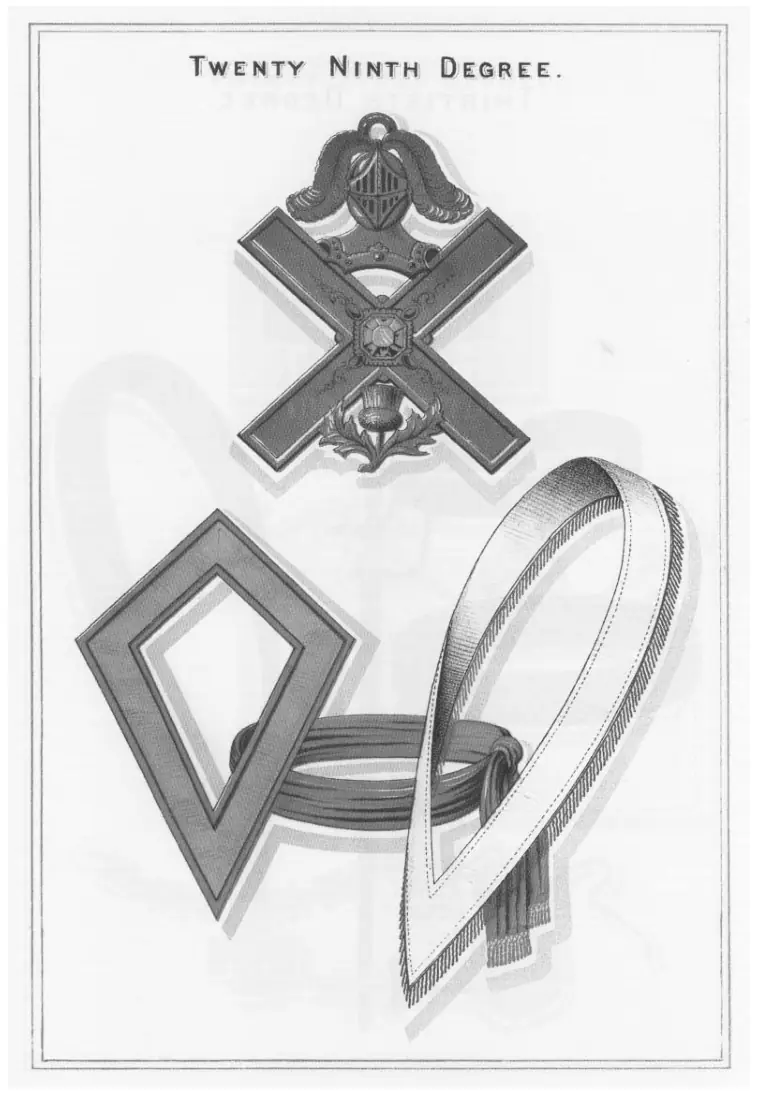
Le Gd∴ Me∴ se nomme Patriarche, les Off∴ Resp∴ Mes ils sont tous revêtus d’une robe rouge décorés d’un ruban cramoisi en écharpe au bout le Bijou qui est une Croix de St André avec une couronne de France au-dessus au milieu de la Croix une pomme de pin et 893 un J∴ renfermé dans un triangle qui fait le milieu d’un anneau qui traverse cette Croix et sur le bout des bras de la Croix et sur le bout des bras de la Croix 894 les initiales des deux Mots et celui de Passe elle s’attache à un ruban gros vert bordé de rouge, à moins qu’elle ne se porte en bandoulière un large ruban moiré gros vert liseré de rouge allant de droite à gauche auquel on met le Bijou, on le porte en sautoir on porte aussi une écharpe blanche à franges d’or, les Mes Écoss∴ portent aussi les mêmes écharpes cordons et Bijoux, le F∴ Terrible est placé entre les deux Survts∴ ayant en main une épée flamboyante et doit avoir sur la poitrine un plastron en forme de cuirasse au milieu duquel est un triple triangle portant au centre un Soleil au-dessous est une tête de mort peinte où brodée. Tous les Écossais ont en L∴ l’épée à la main.
Ouverture
Le Gd∴ Me∴ frappe 9 coups de maillet sur son tambour de cette manière.= = = = = et dit : À l’Ordre mes FF∴ L’Ordre est de porter le pouce de la main droite sur le bas ventre en équerre, les autres doigts serrés et tendus et de tirer ainsi la main horizontalement comme si on se coupait
le ventre.FF∴ 1 er∴ et 2 e∴ Survts∴ aidez-moi à ouvrir la G de∴ L∴ Écossaise. D∴Quelle heure est-il ?
R∴ Midi plein le Soleil nous éclaire et nos actions doivent être mises au g d∴ jour D∴Qui conduit ici vos pas ?
Folio 268 recto
L’amour des 895 mes devoirs de la Maçonnerie et le désir R∴ d’arriver au degré de la perfection d’un v ble∴ Maç∴D∴Qu’apportez-vous ?
R∴ Un cœur zélé et partisan de la vertu. D∴Quelles sont les qualités nécessaires pour arriver à ce degré ?R∴ Zèle ferveur et constance
D∴ Pourquoi ces trois vertus ? R∴Parce que les 2 premières conduisent immédiatement à la 3 e∴ qui bien soutenue nous fait jouir du bonheur d’entrer dans la vie éternelle. 896 Quelles sont les dispositions du cœur d’un v ble∴ Gd∴ Écossais ? D∴
R∴ Éloigner sans cesse de son cœur l’iniquité la vengeance et la jalousie, être toujours prêt à faire le bien ne jamais faire d’inimitié calomnies et médire. D∴Comment doit-on être dans ce lieu Rble∴ ?
R∴ Dans un profond silence et avec un saint respect. D∴Pourquoi les pauvres, princes ou sujets sont-ils nos égaux ? R∴C’est que la Maçonnerie réduit tous les hommes à un même niveau et qu’il est ici dans ce triangle une chose plus grande que vous T∴ R∴
D∴ Pourquoi nos respects lui sont-ils dus ? R∴Parce qu’il contient le nom du Gd∴ Arch te∴ de l’Un∴ que nous ne devons jamais perdre de vue si nous voulons arriver au degré de perfection d’un v ble∴ Maçon D∴Quel âge avez-vous Folio supplémentaire XXXIXFolio supplémentaire XLIFolio 197 recto ?
R∴ Le carré de 9 ou 81. D∴Pourquoi dites-vous que vous avez 81 ans ? R∴Parce que je suis Maçon Parfait que mes épreuves sont finies et qu’il est temps que je recueille le fruit de mes travaux D∴Qu’avez-vous contracté lorsque vous avez été reçu Me∴R∴Une étroite alliance avec la vertu.
D∴ Quelle est la marque ? R∴C’est un anneau ou une médaille en or qui en découvre la pureté. D∴Quels matériaux devons-nous employer dans nos Travaux ? R∴C’est les actes de vertu qui doivent être nos premiers guides & la sagesse que nous devons nous efforcer d’acquérir doit nous conduire à la mettre en pratique. D∴Où trouve-t-on cette sagesse ? Dans le cœur de tous les Écossais qui composent cette R ble R∴ L∴ dont vous êtes le soutien et l’ornement, le Patriarche se lève
& dit : mes FF∴ c’est en suivant vos principes que je veux
régler ma conduite et pour cet effet, 1 er∴ et 2 e∴ Surveillants annoncez que la Grande L∴ Écossaise soutien de la primitive Maç∴ est ouverte et qu’à l’envie chacun s’empresse de travailler avec
Les Survts∴ répètent alors tous zèle ferveur et constance. les Écossais à l’imitation du Gd∴ Me∴ font le Signe, l’Applaudissement par 3 fois et en disant 3 fois. Houzé.
Préparation
Le Cand∴ avant d’être reçu doit avoir la preuve d’une discrétion de trois années qui ont dû s’écouler depuis sa réception au Folio 269 recto Folio 268 verso
dernier grade qui est celui de Chevalier du Soleil 897 on le questionne sur tous les grades qui précédent, le F∴ Expert a soin de mettre avant l’ouverture de la L∴ le Cand∴ dans un Cabinet de Réflexion, il doit être muni d’un anneau d’or qu’il remet au F∴ Expert qui le porte sur l’Autel des Patriarches ensuite il va prendre le Cand∴ lui passe un cordon au col dont il lui lie les bras, lui ôte son épée et son chapeau, et le conduit à la porte de la L∴ où il frappe 9 coups comme ci-dessus et qui sont répétés au-dedans pour avertir le Gd∴ Me∴ de l’arrivée du Récipiendre∴, après toutes les cérémonies usitées le F∴ Terrible lui ouvre la porte et s’étant emparé de lui, le conduit à l’Occ∴ et le place sur le billot.
Réception
Lorsque le Cand∴ est placé sur le billot le Gd∴ Me∴ lui dit :
Mon F∴ le grade que vous sollicitez est des plus éminents il exige de vous une connaissance étendue et une soumission sans bornes aux différentes épreuves nécessaires pour votre réception et il n’y a qu’un zèle extrême et une vertu tels que vous les avez fait paraître jusqu’ici qui puissent vous donner la force de les supporter
D∴ Êtes-vous dans la résolution de vous sacrifier entièrement pour l’Ordre
Il répond : Alors le T∴ Respble∴ ordonne qu’on lui fasse faire 16 tours dans la L∴, le F∴ Terrible le prend par la corde qui lui tient le col et les mains et lui fait faire d’abord 4 fois le tour de la L∴ il lui fait poser la main sur une des Croix qui sont aux 4 coins et lui fait dire : Si jamais je manque à aucune
de mes obligations ; que l’affreux supplice de la Croix soit mon
Cette cérémonie se répète devant chaque Croix partage. et une fois à chaque tour, cela fini le Récipiendre∴ 898 dit :
F∴ Terrible le dévouement du F∴, sa patience son zèle et l’amour des devoirs qui lui sont imposés, nous engagent à lui faire grâce des autres voyages ordonnés, faites subir les épreuves ordinaires dans lesquelles il verra et découvrira une partie de nos mystères. Le F∴ Terrible met dans
la main du Récipiendre∴ une pierre brute figurée en carton l’amène à la Colonne J∴ il frappe 3 coups et lui en fait faire 3 fois le tour il le remet ensuite au 2 e∴ Survt∴ qui reçoit de lui la dernière pierre et lui fait faire les 3 pas d’App∴ Écossais qui sont ceux d’App∴ ordinaire, si ce n’est qu’on les défait en les faisant et lui donne l’Att∴ qui se fait en se prenant la grosse phalange du doigt index l’un prononce J∴ et l’autre A∴ ensuite on vient à la 2e∴ phalange l’un dit K∴ l’autre I∴ enfin à la dernière l’un dit N∴ et l’autre dit Jakin. On le remet au F∴ Terrible qui lui fait espérer 899 la montagne sur laquelle est écrit Folio 269 recto
la lettre. M∴ Il lui donne l’explication de la signification de cette montagne telle qu’elle est 900 la description du Tableau et lui fait faire le Signe suivant :
Signe de la Terre
Ce signe se fait en s’essuyant le front avec le revers des quatre doigts de la main droite bien tendue, la tête un peu baissée on lui donne le Mot de Passe qui est :Tallind901. 901Qui veut
dite tout est peine & travaux, et qui est le nom de l’ange conducteur de la Terre & qui y préside : 902 Il le ramène ensuite
au 2e∴ Survt∴ qui le décore d’un petit ruban couleur de feu qu’il lui passe à la boutonnière de l’habit. Ensuite il le ramène à l’Occ∴ lui fait prendre dans les mains une Pierre Cubique à pointe figurée en carton, qu’il porte contre la poitrine le conduit à la Colonne B∴ où il frappe cinq coups en Comp∴ et le fait voyager 5 fois autour de cette Colonne, le remet au 1er∴ Survt∴ qui reçoit de lui la Pierre Cubique, lui fait faire les 3 pas de Comp∴ en les défaisant de même que ceux d’App∴ lui donne l’Att∴ de Comp∴ Écoss∴ qui est de prendre la 1re phalange du doigt médium, l’un dit : B∴ l’autre O∴ ensuite on passe à la 2 e∴ phalange l’un dit : O∴ l’autre Z∴ et l’autre reprend : Booz il le remet ensuite entre les mains du F∴ Terrible qui le fait entrer dans le 2e∴ plan du Tableau par le côté du puits, lui fait laver les mains dans la cuvette d’eau qu’un F∴ apporte de dessus la table qui est à côté de lui et lui fait faire le signe suivant.
Signe de l’eau
Ce signe se fait en portant la main droite sur le cœur et l’étendre à la hauteur de la poitrine la laissant tomber tout à coup comme si on voulait saluer et lui donnant le Mot de Passe qui est : Furlac903 903qui signifie un cœur.
pur & net, c’est le nom de l’ange qui préside à l’eau. 904
Il le mène ensuite au 1er∴ Survt∴ qui lui passe le cordon Écossais de droite à gauche, 905 en cet état il le remet au F∴ Terrible qui le conduit au 3e∴ plan du Tableau, lui fait monter 7 degrés en forme de vis par 3, 5, 7, puis passant par la voûte il le fait mettre entre les deux Colonnes du 3e∴ plan du Tableau qui représentent les Colonnes du feu et de l’air Le 1er∴ Survt∴ vient à lui, le fait voyager et se retire. 7 fois autour du Tableau, au dernier tour, il lui fait faire le signe d’Étonnement ou de Terreur.
Folio 269 verso
Ce signe est de tourner la tête du côté gauche regarder les trois poignards qui sont à terre et lever les deux mains jointes en l’air en les portant un peu vers la droite. Ensuite il lui fait faire la marche de Me∴ symbolique Écossais c’est-à-dire en défaisant les trois pas il lui donne ensuite les Signes, Attouch s∴ Mots de Passe de la Gde∴ Chambre ou de Me∴ Écossais le signe consiste en deux manières l’une de demande et l’autre de réponse, celui de demande est le suivant :
Signe du feu
Ce signe se fait en croisant les mains les doigts entrelacés, se couvrant la vue avec les revers des deux mains le dedans en dehors. Celui à qui on fait ce signe y répond.
par le suivant :
Signe de l’air
Ce signe se fait en étendant sa main droite à la
hauteur de l’épaule.Attouchement
L’Attt∴ est de prendre la 1re∴ phalange du doigt index c’est-à-dire celle du bout des doigts, l’un dit Mac = l’autre. Be∴ ensuite on passe à la 1re∴ phalange du petit doigt, l’un dit Nak l’autre Macbenak. Le Mot de Passe est composé des deux mots
Ardarel. Casmaran 906 Le premier veut dire
ici tout vient expirer, 907 le 2e∴ la vertu 908 mène au ciel c’est le nom de l’ange qui préside à l’air. Le F∴ Terrible fait voir au Récipiendre∴ la table qui est à droite du Tableau sur laquelle sont la cuvette et le poignard et lui dit :
D∴ Ne vous êtes-vous jamais servi de ce glaive ? Je ne m’en suis servi que pour punir les crimes 909 et les parricides R∴
Alors le F∴ Terrible jette le poignard par terre ramène le Récipiendre∴ à l’Occ∴ le fait mettre à genoux sur le billot, tourné vers l’Orient et le Gd∴ Me∴ dit : V ble
∴ F∴ les épreuves où vous venez de passer doivent vous faire entrevoir l’importance du grade qui vous a été confié vous allez voir la Maç∴ dans connaissez-vous, 910 tout son jour peut-être soyez donc essentiellement discret parvenu à ce degré ^. soutien éminent =|^.tout sera 911 désormais regardé comme =| 912de cet Ordre si respectable, mais réfléchissez sur ce que vous allez entreprendre. Le F∴ Terrible fait voyager 9 fois
Folio 270 recto
autour du Tableau de la L∴ puis il le ramène à l’Occ∴ l’assied sur le billot et le Patriarche lui dit :
Mon F∴ voici l’instant où nous allons nous assurer de votre attachement et de votre courage pour ce respectable Ordre où vous allez entrer, tous les Ill∴ FF∴ Chev∴ de St∴ André doivent entièrement se sacrifier en offrant leur tête à l’exemple des prédécesseurs qui ont souffert les supplices les plus rigoureux plutôt que de se rendre infidèles à leurs vœux et promesses ce n’est que par un dévouement entier que vous pourrez apprécier l’entière vérité de nos profonds mystères, F∴ Terrible mettez sur les yeux du F∴ un voile impénétrable. Le F∴ Terrible lui
bande les yeux et lui fait pencher le tête en étendant le col ensuite il prend la hache et la lève comme pour frapper, pendant ce temps le Patriarche sort de son Trône vient et lui dit : Mon F∴ avant de vous développer
l’entière connaissance de l’origine et ancienne exécution 913 de nos sages lois, nous avons éprouvé votre circonspection dans les grades où vous avez passé, elle doit être encore plus exacte que jamais, et il vous est expressément défendu sous peine d’être à jamais privé des LL∴ Écossaises de communiquer ce grade avant 3 ans expirés à compter de ce jour : sous quelque prétexte que ce soit, ne pouvant être relevé de l’engagement que vous allez contracter que par moi ou par une L∴ Écossaise régulièrement constituée par Charles Stuart prince Édouard, ou par un pouvoir émané de lui ou son représentant, vous ne pourrez pas le donner s’il y avait une L∴ établie à cinq lieues à la ronde du lieu où vous vous proposez d’en établir une et vous êtes nécessairement tenu d’appeler à cette opération tous les FF∴ qui possèdent ce grade, et dont la résidence n’excède point cette distance limitée vous observez que la qualité essentielle914 914 d’un Cand∴ sont la sagesse la vertu la discrétion, promettez-vous en cas d’infidélité de venir à vos FF∴ leur offrir votre tête afin afin915 915 qu’elle soit tranchée et que votre corps serve de pâture aux animaux. R∴Oui. Alors le Patriarche
lui donne916 916 quatre petits coups de maillet en lui disant :
Mon F∴ vous devenez digne de nous par votre constance et votre fermeté, venez vous obliger solennellement devant Dieu en notre présence, d’observer scrupuleusement ce qui vient de vous être prescrit et les devoirs imposés par ce sublime grade. On lui débande les yeux pendant Folio 271 recto
Folio 270 verso
que le Gd∴ Me∴ retourne à sa place avant d’ôter le bandeau on doit allumer toutes les bougies de la L∴ le Gd∴ Me∴ fait avancer le Récipiendre∴ au pied du Trône par la marche des Grands Écossais qui se fait sur la Croix de Jérusalem 917 que l’on doit avoir dessinée sur une toile que l’on étend à terre au pied du Tableau de la L∴. La marche est de se placer au bas de la Croix de Jérusalem à une certaine distance de laquelle on part pour parvenir au n° 1er∴ en marchant par 3 pas d’App∴ symbolique de là on part du pied droit pour se porter au bas de la petite Croix n° 2∴ par un pas de Comp∴ et du pied gauche pour se placer au bas de la petite Croix n° 3 par un 2e∴ pas de Comp∴ et de là au milieu de la Gde∴ Croix n° 4 par les trois pas 918 de Comp∴ on part du pied droit pour aller au milieu de la petite Croix du haut à droite n°∴ 5 par un pas de Me∴ de là à l’autre petite Croix à gauche n° 6 par un 2e pas de Me∴ on pose les deux pieds en équerre en haut de la Croix n° 7 le Patriarche lui fait prêter son obligation à genoux la main droite sur l’Évangile et couvert du Compas et de l’épée.
Obligation
Je promets et m’engage sur ma foi de M∴ de ne jamais révéler les secrets du grade de St∴ André d’Écosse à aucun F∴ revêtu des grades inf∴ ni à aucun Profane de n’être jamais la cause directe ni indirecte qu’il soit révélé, de ne jamais confier ce grade qu’après 3 ans révolus à compter de ce jour et sans être muni d’un pouvoir d’un député Gd∴ Insp∴ de ne pas solliciter ni séduire la femme ou la fille d’un Chev∴ Maç∴ Écossais ni rien qui puisse lui appartenir de n’admettre à ce grade que des Me∴ dignes de suivre en tous points les devoirs du Chev∴ Écossais de St André qui sont d’aimer de servir d’adorer le vrai Dieu obéir à son souverain et aux lois de son pays avoir en horreur la médisance et la calomnie et le mensonge, se secourir mutuellement, soulager chacun dans ses besoins et prévenir même ceux de ses FF∴ faire bon accueil aux étrangers, exercer l’hospitalité, visiter les malades les consoler les guider principalement ceux qui sont persécutés s’efforcer toujours de protéger l’innocence être régulièrement observateur des lois Maçonniques instruire mes
Folio 271 recto
FF∴ avec exactitude et les reprendre avec douceur et fraternité ce à quoi je m’oblige sous les mêmes conditions portées à mes premières obligations, et sous les peines de mourir, de la fin des trois malheureux FF∴ que Dieu me soit en aide et son Saint Évangile. Il se lève et baise
l’Évangile ensuite le Gd∴ Me∴ le décore des bijoux et cordons de l’Ordre puis il lui donne les Signes Paroles et Attouch∴ qui sont ceux qui lui ont déjà été donnés dans le cours des épreuves pour l’App∴ Comp∴ et Me∴ Écossais mais il y a un signe particulier qui est de former une Croix de St= André avec les deux bras sur la poitrine les mains en haut, il lui montre ensuite le Signe suivant
Signe d’Admiration
Il se fait en levant les yeux au ciel les deux mains en l’air le bras gauche un peu plus bas que le droit comme quand un prêtre dit : Dominus vobis-cum. Le talon du pied gauche un peu relevé, de façon que le genou gauche fasse un peu l’équerre
il lui donne ensuite le Signe du Soleil.
Signe du Soleil
Ce signe est de mettre le pouce de la main gauche919 919 sur l’œil droit et d’étendre en l’air le petit doigt en équerre et de viser au but comme si on voulait prendre un point de vue en
disant :Je compasse jusqu’au Soleil.
Le Patriarche prend ensuite les deux bagues qui ont été mises sur l’Autel, il en donne une au Récipiendre∴ et garde l’autre sur lui pour marque de la liaison intime contractée ensemble920 920 et lui adresse le discours suivant.
Discours historique
Parmi les grands Écossais connus en France sous ce titre seul921 921 qui soit digne de fixer l’attention et 922 sans contredit le véritable Écossais de St André d’Écosse, les choses sérieuses et raisonnables qu’il renferme, sont prouvées par les traditions fidèles que le temps a respecté la morale épurée qu’il renferme l’ancienneté la science et la fidélité qu’il renferme et prescrit tout accorde prééminence au Gd∴ Écossais de St André qui a sur toutes les autres branches de l’Ordre l’avantage d’être peu connu, borné à un petit nombre par conséquence encore pur et dont la doctrine et la forme consacrent de plus en plus la noblesse de cette destination l’utilité de notre institut, le charme et le bonheur d’un lien qui fait rentrer les hommes dans leur véritable état et semble constituer en leur faveur un fond public et connu des connaissances agréables et des ressources solides. Consultons les Livres Saints Folio 272 recto Folio 271 verso
nous apercevrons une mention formelle du grade, remontons à notre origine, à la construction du Temple de Salomon, nous y sommes désignés sous le nom d’Archte∴ nous y recevons immédiatement les ordres de Salomon et d’Hiram Abif. Salomon, l’homme le plus versé dans les sciences et dans les spéculations physiques, veut faire exécuter un 923 Temple magnifique que David son père lui a laissé, et qu’il a dessein d’ériger à l’Éternel, il choisit 12 hommes dévoués à la recherche des vérités naturelles, il leur communiqua ses intentions il travailla de concert avec eux pour former un corps d’ouvriers qu’il divisa en trois classes, ces 12 architectes choisis par Salomon sont établis chefs sur les trois classes d’ouvriers 924 crut ne pouvoir lui donner de marque plus convaincante de son amitié qu’en lui envoyant un fameux ouvrier en toutes sortes de métaux et Gd∴ Archte∴ il prit la conduite de cet édifice il fut nommé surintendant de tous les ouvrages l’Écriture Sainte le désigne sous le nom d’Hiram Abif. La mort de ce surintendant intervertit cet ordre, Salomon fut obligé de faire un nouveau choix d’ouvriers qu’il divisa en 3 classes et d’établir parmi eux de nouveaux chefs. Ce prince les appela dans tous les travaux à imiter la nature c’est par la vertu de leurs opérations que les lambris du Temple sont revêtus de lames d’or que les Colonnes qui les soutiennent ont cet éclat riche et précieux que l’on vante si fort dans cet édifice, ils connaissaient le feu sacré et universel, le 1er∴ des esprits, ils placèrent eux mêmes dans ce Temple les emblèmes mystérieux qui ne sont en vrai que des symboles et des hiéroglyphes dont la clef est dans la main du sage ; figurés par celle des LL∴ peintes sur les médailles qu’un Écossais reçoit à son initiation dans ce sublime grade. Le Temple achevé Salomon retient les chefs Arch∴ auprès de de 925 sa personne il leur accorda des privilèges sans nombre et leur continua l’intendance et le soin de son édifice le reste des Maç∴ est licencié payé et renvoyé chacun dans sa patrie, Jérusalem devient alors la patrie des architectes, ils formèrent entr’eux un corps régulier pour continuer leurs études dans les opérations de la nature, mais ces merveilles ne durèrent pas longtemps, Salomon Folio 272 recto
passa bientôt des plaisirs de la sagesse à ceux de l’idolâtrie, où il finit ses jours, ses crimes avaient irrité l’Éternel et bientôt il abandonna cette maison et la Cité Sainte, Nabuzardan général des troupes de Nabuchodonosor roi de Babylonne assiège Jérusalem détruit le Temple jusqu’aux fondements et mena les Israélites prisonniers, les Arch∴ virent avec regret emporter toutes les richesses du Temple, Cyrus leur rendit la liberté au bout de 70 ans un nouveau Temple s’éleva sous la conduite du prince Zorobabel de la maison de David, les Architectes prirent la direction du nouvel édifice mais à peine purent-ils jouir du prix de leurs travaux le second Temple périt sous le règne du grand Pompée. Les Architectes restèrent inconnus mais toujours unis ils se retirèrent à Athènes pour y exercer leur science ils reçurent 1er des récompenses d’Aristide le Juste magistrat d’Athènes, Hérode le Grand entreprend de réédifier le Temple pour la 3e∴ fois il appelle les maçons de toutes parts, les Architectes volent à Jérusalem pour y exercer leurs talents, ils veulent toujours contribuer à la construction de cet édifice dont ils connaissent les dimensions le Temple ne s’achève pas, il est détruit par Titus fils de l’empereur Phespacien 926 les Architectes se rangent sous la domination de l’Empire Romain ils y forment une association utile toujours prêts à sacrifier leur vie pour le bien de la patrie, à faire fleurir les arts et honorer l’humanité Rome longtemps maîtresse du monde est redevable d’une partie de sa gloire à cette association qui existe encore à Édeinbourg927 927 en Écosse. La venue du Messie leur prépara encore de nouveaux obstacles à combattre ils embrassèrent la religion chrétienne, l’Empire Romain est détruit les Architectes se retirent dans l’île d’Écosse, ils prirent le nom d’Écossais mais à peine se disposaient-ils à cultiver leurs sciences dans leur nouvel établissement qui est devenu leur patrie, la guerre sainte ranime leur courage toujours animés du zèle le plus ardent de concourir à la réédification du Temple, ils marchent où l’intérêt du bien public les appelle St Louis partant pour la Terre Sainte fit choix de vaillants Écossais pour combattre près sa personne. Il en forme sa garde c’est avec des Écossais qu’il veut conquérir les Lieux Saints et fonder un nouvel Empire, ce sage prince les connaissant depuis longtemps, et sachant apprécier leur mérite Folio 273 recto Folio 272 verso
27 928 Architectes d’entr’eux se joignirent aux croisés toujours liés par le nœud sacré de la fraternité, ils se reconnaissaient par leurs mêmes Signes et Attouch∴ qui nous ont été transmis jusqu’à ce jour, partout leur valeur est renommée, ils combattirent sous Bohemond, ils enlevèrent la capitale de la Syrie, cette fameuse Antioche à la robe insolente 929 la ville de Damiette fut le boulevard de leurs travaux le théâtre de leur vaillance, ils ont arrosé de leur sang la Palestine et Jérusalem Louis IX abandonné de son armée, seul sur une roche escarpée, se défend encore les traits volent sur lui sa tête va tomber le monarque ne sera bientôt plus deux Écossais se précipitent à travers les dangers leurs efforts sont victorieux le prince est en sureté, périr pour son roi sauver son prince expirer à ses yeux c’est la gloire des Écossais, tous les valeureux personnages que le retour des guerres saintes ramènent en Europe furent accueillis de tous les monarques, notre Ordre commença alors et l’on connut pour la première fois les LL∴ Écossaises, l’Angleterre a vu ces institutions admirables qui honorent la vertu, termine le vice et anoblissent la vérité. Ce fut Guillaume le Conquérant qui fonda les LL∴ primitives chez un peuple qu’il venait de subjuguer, et qui furent les plus grands fondements de son autorité royale, les Écossais uniquement occupés de la connaissance de la nature sentirent tout le prix de l’amitié et le besoin de secours mais ils connurent aussi la nécessité de cacher leurs Travaux sous des emblèmes dont les relations extérieures servaient d’essai au genre d’esprit dont il fallait que les enfants de la science furent véritablement pourvus, de là cette multitude de grades que l’intérêt forgea, que l’amour propre prolongea et auxquels l’imprudence se livre sans réflexion la France a ignoré pendant longtemps le véritable écossisme, nous sommes redevables de cette connaissance à ce prince et à la Maison de Stuart qu’un événement malheureux contraignit de se réfugier en France et dont les Écossais conserveront toujours la mémoire il communiqua ce grade au petit nombre de Français qui s’attachèrent à sa personne ces derniers jaloux de posséder la véritable origine de la Maçonnerie ont toujours été d’une extrême réserve à ne conférer ce grade qu’à des Folio 273 recto
hommes vertueux & discrets, imitons la délicatesse de nos prédécesseurs évitons autant qu’il nous sera possible que ce grade n’éprouve un sort pareil à tout autre qui ont été livrés au pillage d’une curiosité indiscrète soyons persuadés que quoique nos Travaux soient renfermés dans les bornes d’une spéculation physique nous usons encore des mêmes Signes Mots et Attouchem et cérémonies que nos anciens et soyons jaloux autant qu’eux de conserver la possession de ce trésor930 930 travaillons donc pour le bonheur des hommes c’est de nous 931 de ce but que de nous élever au-dessus de l’humanité ce n’est que par-là que notre association mérite la préférence sur toutes les sociétés, qui dans l’enchainement des liaisons civiles n’ont pour base que le désœuvrement et l’ennui de la sollicitude, un malheureux se présente-il implore votre pitié votre932 932 se ferme… Vous n’êtes plus Écossais… Éloignons ce sentiment indigne de chacun de nous, vivons heureux non par les richesses, mais par le témoignage de notre conscience, vivons heureux non par l’appât frivole des dignités ni par l’éclat de la naissance, mais par nos mœurs et notre probité, le cœur enfin, le cœur fidèle voilà Gd∴ notre trésor. Demandons au Arch∴ de l’Univers qu’il daigne échauffer notre cœur du feu de la vertu enfin qu’en suivant les peuples 933 nous aspirions un jour à jouir du vrai bonheur.
Instruction
Vble∴ 1er∴ Survt∴ êtes-vous Écossais de S t André ? R∴Oui T∴ D∴ Rble∴ je le suis et me glorifie de l’être. D∴Comment avez-vous obtenu cet insigne bonheur ? R∴Par la bonté des R bles Écossais qui ont cru reconnaitre en moi les qualités requises.
D∴ Quelles sont ces qualités. R∴Zèle ferveur et constance. Est-ce un g de∴ que le Gd∴ Écossais R∴Oui c’est la fin de la D∴ Maçonnerie et la récompense des travaux d’un v ble∴ Maçon
D∴ Comment êtes-vous entré en L∴R∴Avec fermeté et le courage dans le cœur et sur le front les caractères ordinaires d’une âme innocente et vertueuse. D∴Qu’avez-vous vu en entrant en L∴ ?
R∴ 81 lumières disposées de 9 en 9. D∴Pourquoi le nombre 9 ? Parce que le Gd∴ Arch∴ de l’Un∴ se plait à reconnaître en tous R∴ lieux les marques de la Triple Essence figurée par le nombre 9.
D∴ Qu’avez-vous aperçu de plus ? R∴Le chandelier à 7 branches fabriqué par l’Arch te∴ Hiram Abif. D∴Que représentait Folio 274 recto
Folio 273 verso
Hiram Abif dans ce Temple ? R∴Il est figuré comme conducteur des ouvriers, mais dans le vrai sens il couvre l’allégorie de la puissance que le Gd∴ Arch∴ donna à Salomon pour exécuter ce qu’il entreprenait.
D∴ Pourquoi nous apprend-t-on dans la maîtrise qu’il a été assassiné par 3 coups 934 ? R∴Les Comp∴ nous figurent les passions où les hommes s’abandonnent qui leur font perdre le don de la sagesse dont ils étaient doués D∴Quel lieu choisit Salomon pour y bâtir le Temple : R∴La vallée d’Amesea 935 près la montagne Moria. D∴Qui posa la première pierre ?
R∴ Salomon lui-même. D∴Que renfermait-elle ? Le nom du Gd∴ Arch te∴ de l’Univers. D∴Quelle forme avait-elle ? R∴
R∴ Elle était cubique. D∴De quelle matière. R∴D’agate.
D∴ A quelle heure fut-elle posée. R∴Avant le lever du Soleil.
D∴ Pourquoi cela ? R∴Pour marquer la vigilance que nous avons à faire de bonnes œuvres. D∴Quel ciment fut employé
R∴ Un ciment composé avec de la farine de froment du vin et de l’huile.
D∴ N’y a-t-il pas un sens mystique dans ce ciment ? R∴Oui pour créer le premier homme l’Éternel employa la douceur la sagesse et la force. D∴Dans quel temps Salomon fit-il la dédicace du Temple ? R∴La septième année de la construction.
D∴ De quoi s’aperçut-on à la construction ? R∴Du triple triangle que l’Éternel fit paraitre pour marque de sa Triple Alliance et d’un parfum qui fut répandu aux environs de Jérusalem.
D∴ Quelles sont les obligations d’un Écossais ? R∴De ne jamais refuser de secourir un de ses FF lorsqu’il donnera des marques d’un vrai Maçon. D∴Quel sujet de méditation nous offre le péché de Salomon ? R∴Que l’homme le plus sage peut errer, mais qu’un Maçon doit avoir la force de se corriger.
D∴ Pourquoi les femmes sont-elles interdites de nos LL∴ ?
R∴ Parce qu’elles n’ont jamais entré dans le sanctuaire et qu’elles n’ont jamais travaillé aux édifices et que leur caractère indiscret doit être un juste sujet de crainte. D∴Pourquoi reçoit-on un Écossais la corde au col ? R∴Pour marquer qu’un bon Maçon doit-être détaché de tout orgueil et qu’il doit toujours avoir l’humanité en partage. D∴Pourquoi les Maçons prennent-ils S t Jean pour patron ? R∴Parce que dans les guerres saintes les Maçons se joignirent aux chevaliers de S t Jean de Jérusalem pour combattre les infidèles.
D∴ Pourquoi les appelle-t-on libres ? R∴Parce que les Maçons qui travaillent au Temple de Salomon furent exempts d’impôts
D∴ Que présentent les médailles des Écossais ?
R∴ Elles nous font remarquer des présents qui leur furent faits par
Folio 274 recto
les monarques protecteurs de l’Ordre. D∴Que représente l’épée 936 flamboyante du F∴ Terrible ? R∴L’ardeur avec laquelle les Écossais doivent s’empresser de soutenir la franche et primitive Maçonnerie. D∴Que représente le plastron en forme de cuirasse que porte le F∴ Terrible sur la poitrine ?
R∴ La force et le courage des Écossais dans leurs actions vertueuses. D∴Pourquoi cette tête de mort au milieu du plastron et tous les FF∴ l’épée à la main ? R∴Pour nous marquer que tout v ble∴ Maçon et bon Écossais ne craint pas la mort et qu’il est toujours prêt à verser la dernière goutte de son sang pour le service de la patrie. D∴Pourquoi avez-vous passé les 4 éléments ?
R∴ Pour me faire ressouvenir des peines de ce monde me laver et me purifier de ce que j’avais d’impur. 937D∴Que signifie le Soleil
R∴ Que les Écossais connaissent la Maçonnerie dans sa perfection. Que signifie l’Équerre ? 938 renversée et le poignard ? D∴
R∴ Que nous devons être armé de constance pour éviter de succomber sous le poids des passions qui nous environnent Qui détruisit le 1 er∴ Temple ? R∴Nabuchodonosor D∴ 470 ans 6 mois 10 jours après sa dédicace. D∴Qui détruisit le 2e
R∴ Le grand Pompée commença sa destruction et Hérode le Grand l’acheva
D∴ 939 Le même Hérode qui sous son règne appela les Maç∴ de toutes parts pour les faire aller à Jérusalem. Qui détruisit le 3e∴ ? R∴Titus, fils de l’empereur Vespasien D∴
D∴ Que devinrent alors les Maç∴R∴Ils se rangèrent sous la domination de l’Empire Romain. D∴Après la destruction de cet Empire que devinrent-ils ? R∴Ils se retirèrent dans la ville de Kilwining en Écosse D∴Que firent les Maçons après la guerre des Croisades ? R∴Ils se dispersèrent en Écosse premièrement puis en Angleterre pour y exercer la Maçonnerie D∴Comment est-elle parvenue en France
R∴ Nous sommes redevables de cette connaissance aux Anglais de la maison d’Amilton D∴Combien avez-vous de signes ?
R∴ Quatre. D∴Quels sont-ils ? R∴Ceux de la Terre du Feu de l’Air & de l’Eau. D∴Que signifie celui de la Terre ?
R∴ Les peines de ce monde. D∴Celui du Feu ?
R∴ La pureté d’un cœur qui désire arriver à la perfection. La perfection940 940de nos mœursD∴ D∴ Celui de l’Eau ?R∴ Celui de l’Air
R∴ Le droiture de notre cœur et la vérité de notre grade.
Clôture
D∴ Quelle heure est-il ? R∴L’entrée de la nuit.
Folio 274 verso
D∴ Pourquoi dites-vous l’entrée de la nuit ? Parce que tout Maçon doit cesser ses travaux p r prendre du repos. R∴
D∴ Puisqu’il est l’entrée de la nuit, il est temps de terminer nos travaux les ténèbres ne sont que pour les œuvres d’iniquités à cet effet FF∴ 1 er∴ et 2 e∴ Survt∴ annoncez à tous les Rble∴ M s∴ Écossais que nos travaux sont finis.
Questions à faire aux FF∴ visiteurs dans ce grade
D∴ D’où venez-vous ? R∴De la voûte sacrée.
D∴ Que venez-vous faire ici ?
R∴ Visiter vos travaux vous faire part de mes lumières travailler ensemble à la vertu.
D∴ Que demandez-vous ?
R∴ Me soumettre à vos volontés diriger ma conduite sur le modèle de vos vertus.
901. Erreur du copiste A ; le nom exact est « Talliud », cf. Kloss et Pyron 1812. Pour Vuillaume ce serait une déformation de Tal-Yahad ( dh-y+jle= = ṭạl-yạhaḏ ). Sens inconnu.
902. Cette explication, qui est présente dans Kloss et Pyron 1812, est un rajout du copiste B.
903. Pour Vuillaume, ce serait une déformation de Phorlach ( K9al=r4op = fôrĕlạ̄ḵ ). Sens inconnu.
904. Cette explication, qui est présente dans Kloss et Pyron 1812, est un rajout du copiste B.
905. De gauche à droite pour Kloss et Pyron 1812.
913. Erreur du copiste A ? Kloss et Pyron 1812 utilisent ici le mot « institution ».
914. Erreur du copiste A : rétablir le pluriel « les qualités essentielles », cf. Kloss et Pyron1812.
915. Erreur du copiste A : doublon.
916. Erreur du copiste A ? Kloss et Pyron 1812 rajoutent ici « sur le cou ».
919. Kloss et Pyron 1812 parlent ici de la main droite ; les tuileurs (Delaulnaye, Vuillaume, Grasse-Tilly) aussi.
920. Kloss et Pyron 1812 rajoutent ici la phrase « Il lui donne ensuite l’explication du tableau de la L∴ tel qu’il est tracé ci-devant ». Nous avons vu précédemment ( cf. note du folio 267 verso ) que cette explication ne figure pas dans le manuscrit Quesada.
921. Oubli du copiste A ; il manque l’article « le », cf. Kloss et Pyron 1812.
922. Erreur du copiste A ; le mot exact est « est », cf. Kloss et Pyron 1812.
926. Il s’agit bien sûr de « Vespasien » ; nouveau signe d’inculture historique du copiste A.
927. Ancienne orthographe usuelle au xviii e siècle.
930. Kloss et Pyron 1812 intercalent ici tout un paragraphe d’une quinzaine de lignes.
931. Oubli du copiste A ; il manque le verbe « rapprocher », cf. Kloss et Pyron 1812.
932. Oubli du copiste A ; il manque le mot « cœur », cf. Kloss et Pyron 1812.
933. Erreur du copiste A ; les mots exacts sont « ses préceptes », cf. Kloss et Pyron 1812.
936. Kloss et Pyron 1812 indiquent ici « étoile ». La version Quesada semble plus logique et conforme aux descriptions précédentes.
937. Il manque ici un couple Demande-Réponse présent dans Kloss et Pyron 1812.
938. Erreur du copiste A : point d’interrogation inutile.
939. Erreur du copiste A ; il manque le texte de la demande : « Qui le fit rebâtir ? » et le « R∴ » de la réponse, cf. Kloss et Pyron 1812.
940. Erreur du copiste A ; le mot exact est « purification », cf. Kloss et Pyron 1812.
941. Kloss et Pyron 1812 classent ce degré en 28 e position, comme la plupart des tuileurs. Cette fois, le texte du Quesada a une source proche de celle du Pyron 1812, alors que le Kloss est très différent, plus proche de la version de Francken.
942. Erreur du copiste A ; le mot exact est « est », cf. Pyron 1812.
943. Phrase peu compréhensible, absente du Pyron 1812.
944. Erreur du copiste A ; le mot exact est « une », cf. Pyron 1812.
945. Mis pour « Lux ex tenebris » ; nouvel indice de méconnaissance du latin par le copiste A.
946. Erreur du copiste A ; le mot exact est « principes », cf. Pyron 1812.
953. Erreur du copiste A : rajout d’une phrase descriptive qui a déjà été copiée au folio précédent.
954. Erreur du copiste A : les mots exacts sont « du sanctuaire », cf. Pyron 1812.
955. Même remarque qu’au folio précédent : Pyron 1812 indique ici « Souv∴ Comm r∴ du Temple ».
956. Pyron 1812 écrit ici « qui vont vous être dictés ».
957. Oubli du copiste A ; il manque ici les mots « Chaque Chérubin... », cf. Pyron 1912.
958. Erreur du copiste A ; le mot exact est « austérité », cf. Pyron 1812.
965. Oubli du copiste A ; il manque les mots : « vous ont mérité », cf. Pyron 1812.
966. Erreur du copiste A ; le mot exact est « comme », cf. Pyron 1812.
967. Erreur du copiste A ; les mots exacts sont « s’est », cf. Pyron 1812.
968. La préposition « de » est en trop ;la même erreur se trouve dans Pyron 1812.
969. Erreur du copiste A ; les mots exacts sont « qui le », cf. Pyron 1812.
970. Erreur du copiste A ; le mot exact est « consentement », cf. Pyron 1812.
971. Erreur du Copiste A ; le mot exact est « vérité », cf. Pyron 1812.
973. Toutes les ratures, surcharges, notes et compléments ( transcrits ici en caractères différents) , rajoutés sur le texte d’origine du copiste A, sont de la main du copiste B. Il n’a pas été toujours possible de déchiffrer les mots sous les ratures. Comme pour le Chevalier du Soleil, le texte du Quesada a une source proche de celle du Pyron 1812, et est aussi très proche du manuscrit Francken, alors que le Kloss est très différent ; par contre, les cinq illustrations jointes au Quesada correspondent exactement à la description faite des quatre appartements et de l’habillement dans le Kloss, ce qui démontre qu’elles ont été rajoutées après, probablement lors de la reliure de l’ensemble.
974. Ces deux dernières phrases ont été rajoutées par le copiste B.
977. Cette rature et correction du copiste B ne permet pas de voir le mot utilisé par le copiste A ; c’est peut-être « onze », valeur indiquée par Francken.
978. « Patriarche » pour Francken.
984. Ces quatre ratures et rajouts du copiste B sont conformes au manuscrit Pyron 1812.
985. « enseveli » dans Francken et « s’ensevelir » dans Pyron 1812 dont le copiste B s’inspire ici.
986. Cette phrase rayée pas le copiste B, semblait effectivement peu compréhensible ; Francken écrivait ici : « Il n’en fut plus de même, lors de son injuste et honteuse fin... »
987. Erreur du copiste A ? On attendrait plutôt le mot « prédiction ».
988. Erreur du copiste A ; les mots exacts sont : « mon F∴ », cf. Pyron 1812.
993. « Hamach sciata » pour Francken, « Chocmak-seat » pour Kloss et Pyron 1812. Probable déformation de « Amal sagui » ( ayg!<S{ lm=i= = ʿạmạl śaggîʾ ), grand travail.
994. « Sabaél » pour Francken, Kloss et Pyron 1812. Probable déformation de « Sabal » ( lb=<s- = sabbạl ), porteur, portefaix.
995. « Choe(c ?)mel Binah Tabinah » pour Francken, « Thebunah » pour Kloss et Pyron
996. « O lebur eloé » pour Francken, « Oheb Eloha » pour Kloss et Pyron 1812. Probable déformation de « Ohev Eloha » ( h<-ola6 bh3Oa = ohẹv ẹ̆lôah ), aimant Dieu.
997. « O leb barabac » pour Francken, « Oheb Kerabah » pour Kloss et Pyron 1812. Probable déformation de « Ohev Qerovo » ( obOrq4 bh3Oa = ohẹv qĕrovô ), aimant son prochain.
998. La même erreur ( VI au lieu de V) se trouve dans les manuscrits de Francken.
1002. Même remarque qu’au folio précédent. Idem quelques lignes plus bas.
1003. Cet anglicisme sur le prénom Antoine est un indice pour penser que ce texte pourrait être une traduction à partir d’un original anglais : Francken indique justement « Stephen » ; mais les références à l’ouvrage de l’abbé de Vertot ne sont pas reprises ici et le texte est souvent différent dans sa rédaction.
1004. Francken indique ici « Mehui ».
1005. Nouvel anglicisme à partir des mots « his dominions », cf. Francken. La traduction correcte aurait été « ses États » ou « son Royaume ».
1011. Erreur du copiste A : il manque probablement le mot « par ».
1012. Nouvel anglicisme : « Cyprus » dans les manuscrits Francken.
1013. Erreur du copiste A : il s’agit du 1er octobre, cf. Francken.
1014. Nouvel anglicisme, corrigé par le copiste B : « adversion » dans les manuscrits Francken.
1017. Cette correction du copiste B n’est pas justifiée, même si la phrase est «alambiquée».
1018. « Michamaka Bulion » pour Francken ; probable déformation de « Mi khamokha ba elim » ( Ml1a2b=< hk=Omk=jym1 = mî-ḵạmoḵạ̈ bạʾelim ), qui est comme toi parmi les dieux ?
1019. « Bagulkal Pharaskal » pour Francken ; probable déformation de « Begohel kol » ( lOk< la2Og<b4<1 = bĕg-goʾel kol ), tous comme vengeur ! Ainsi que de « Parash kol » ( lOk<
1020. Il s’agit de Giovanni Villani, historien du XIV e s. ; de Mathieu Paris, chroniqueur du XIII e s. ; de l’Abbé de Vertot et de Germain-François Poullain de Sainte Foix (XVIII e s.).
1024. Déformation, avec permutation, des mots hébreux d’une phrase des Psaumes, 34:2 ( yp1b4< otl=<h1t4< dym1t=< en tout temps, constamment j’aurai ses louanges à la bouche. La déformation dans Francken est encore pire... Pyron 1812 ne donne pas les mots hébreux.
1025. Déformation probable de ( yn!i=h3 Mi1 ql2<c-a7 hb=h7a-b4< = bĕʾahăvạ̈ ăḥalleq ʿim hẹʿạnî ), avec amour je partagerai avec le pauvre.
1026. Toutes ces ratures du copiste B ne sont pas forcément justifiées quand on compare aux manuscrits de Francken.
1027. Ce rajout de deux lettres avec triponctuation est de la main du copiste B. La lecture de la première lettre n’est pas sûre, mais G(rand) C(ommandeur) semble la meilleure hypothèse.
1028. Il s’agit bien sûr de « Stephen » ou « Étienne » Morin . Nouvel anglicisme ?
1029. Ce «7» corrigé en «5» par le copiste B est présent ( fautivement ? ) sur les manuscrits de Francken. La correction semble logique.
1030. Erreur du copiste A : doublon.
1031. Ces deux notes, qui complètent les oublis du copiste A, sont de la main du copiste B.
Delaulnaye 1813
tuileur imprimé · 923 mots
Le « Thuileur des trente-trois degrés de l'Écossisme » de Delaulnaye (Paris, 1813), premier tuileur imprimé du REAA constitué : mots, signes, décors et remarques du grade. Texte relu mot à mot sur le fac-similé, mots hébreux restitués. Pages 195-205 de l'édition originale.
Voici encore un grade dont le but est caché sous une apparence hermétique ; mais le mot sacré de ce grade peut en rendre l'intention facile à saisir à ceux qui possèdent les degrés antérieurs.
Décoration de la Loge.
Tenture Rouge, parsemée de colonnes Blanches. Les siéges du Maître et des deux Surveillants sont Rouges et or ; mais ceux des Écossois sont Bleus.
A chaque coin de la salle, est une Croix de Saint-André, et, devant chacune, quatre Lu- [p. 196] mières de front, ce qui fait Seize ; mais la Loge doit être éclairée en tout de quatre vingt-une Lumières, disposées neuf par neuf, y compris néanmoins les seize dont nous venons de parler, et deux qui sont sur l'autel.
Titres.
La Loge est dite Grande-Loge ; le Maître a le titre de Patriarche, et les Écossois sont qualifiés de Respectables Maîtres.
Premier Signe, dit de la Terre, 🜃,
relatif à l'Apprenti-Écossois.
S'essuyer le front avec le revers des quatre doigts de la main droite, ayant la tête un peu baissée.
Premier Attouchement.
Se prendre mutuellement et successivement la première, la seconde, et la troisième phalanges de l'index de la main droite, en épelant [p. 197] alternativement le mot d'Aprenti Iakin, ainsi : I—a—k—i—n— Iakin.
Second Signe, dit de l'Eau, 🜄,
relatif au Compagnon-Écossois.
Porter la main droite sur le cœur, et, l'étendant à la hauteur de la poitrine, la laisser tomber tout-à-coup du côté droit, comme si l'on vouloit saluer.
Second Attouchement.
Se prendre mutuellement et successivement la première, la seconde, et la troisième phalanges du Médius, en épelant le mot de Compagnon (B—o—h—a—z — Bohaz).
Troisième Signe, dit d'Étonnement et d'Horreur.
Tourner la tête du côté gauche, regardant par terre, et lever les deux mains jointes, en les portant un peu sur la droite.
[p. 198]
Quatrième Signe, dit du Feu, 🜂,
relatif au Maître Écossois.
Entrelacer ses dix doigts, et se couvrir la vue du revers des mains, la paume étant en dehors.
Réponse,
dite Signe de l'Air, 🜁.
Porter en avant la main droite, à la hauteur de l'épaule.
Troisième Attouchement.
Prendre l'index par la phalange du bout du doigt, l'un dit Mak, et l'autre Bé ; on passe ensuite à la pareille phalange du petit doigt, l'un dit Na, et l'autre prononce Makbena.
Cinquième Signe, dit d'Admiration.
Lever les yeux au ciel, les deux mains en l'air, le bras gauche un peu plus bas que le [p. 199] droit, comme quand le prêtre dit : Dominus vobiscum ; le talon du pied gauche un peu relevé, de façon que le genou gauche fasse équerre avec le droit.
Sixième Signe, dit du Soleil.
Mettre le pouce de la main droite sur l'œil droit ; étendre en l'air le premier doigt en équerre, et viser au bout, comme si l'on vouloit prendre un point de vue, en disant : je compasse jusqu'au soleil.
Septième Signe.
Il est un dernier Signe général, qui consiste à former sur la poitrine une croix de Saint-André avec les deux bras, les mains en haut.
Attouchement général.
Prendre la phalange du bout du doigt index ; l'un dit Né, l'autre Ka : on passe à la sembla- [p. 200] ble phalange du petit doigt, l'un dit Mah, l'autre rassemble Nekamah.
Marche.
Sur la croix de Jérusalem, par trois pas d'Apprenti, trois pas de Compagnon, et trois de Maître.
Batterie.
Neuf Coups, ainsi :
○——○ ○——○——○ ○——○——○——○
Âge d'un Écossois de Saint-André.
Le carré de neuf, quatre-vingt-un ans.
Mot Sacré.
Celui de l'Attouchement général,
NEKAMAH, נְקָמָה
(ultio)
Voilà le cri de Vengeance de l'Élu répété, ce qui montre quel est le véritable caractère de l'Écossois de Saint-André. Ce cri se fait en- [p. 201] tendre une troisième fois dans le Kadosch ; mais alors il est plus particulièrement spécifié.
D'autres portent, en sautoir, un ruban Verd, liséré de Rouge.
Plus, une écharpe Blanche, frangée en or.
Bijou.
Un Compas dans treize Triangles renfermés dans un seul. Au bas du bijou, une Équerre renversée ; un Poignard est dans l'angle de l'équerre.
Ceux qui portent le ruban verd ont pour bijou une Croix de St-André, surmontée de [p. 204] la couronne de France. Au milieu de la croix est une pomme de pin ou un J, renfermé dans un triangle faisant le milieu d'un anneau qui traverse la croix. A cet anneau est attachée une clef pendante entre les deux branches de la croix, sur les quatre extrémités de laquelle sont les quatre initiales des quatre mots Sacrés.
[p. 205]
Vuillaume 1820
tuileur imprimé · 747 mots
Le tuileur de Claude-André Vuillaume, « Manuel maçonnique, ou Tuileur de tous les rites de maçonnerie pratiqués en France » (Paris, Delaunay et Hubert, 1820) : décoration, titres, signes, attouchement, marche, batterie, âge, mots, habillement du grade, avec l'étymologie et l'interprétation des mots hébreux. Texte établi sur le fac-similé et relu mot à mot sur les images : océrisation à 600 dpi du volume numérisé, fusion avec la couche texte de la numérisation Gallica, puis relecture page par page. Orthographe de 1820 conservée, hébreu et grec restitués, batteries rendues comme l'imprimé les note, pagination de l'original. Pages 190 à 194.
Tenture rouge, supportée par des colonnes blanches.
Le siège du maître, et ceux des deux surveillans, sont en étoffe rouge, à franges en or ; ceux des Ecossais sont bleus.
A chacun des angles de la salle, est une croix de Saint-André ; devant chacune de ces croix, sont quatre lumières de front, ce qui forme seize lumières. Le nombre total des lumières, dans cette loge, est de quatre-vingt-un, savoir, deux sur l'autel, sept groupes de neuf, et les seize premières, devant les quatre croix.
[p. 191]
TITRES.
La loge prend le titre de Grande Loge.
Le maître prend celui de Patriarche, et les Ecossais, celui de Respectables Maîtres.
SIGNES ET ATTOUCHEMENS.
1er Celui de la terre. — S'essuyer le front avec le revers de la main droite, la tête un peu inclinée en avant.
1er Attouchement. — Se prendre mutuellement et successivement la première, la seconde, et la troisième phalange de l'index de la main droite, en épelant alternativement le mot d'apprenti (Booz).
2e Signe, celui de l'eau. — Porter la main droite sur le cœur, l'étendre horizontalement à la hauteur de la poitrine, la laisser ensuite retomber du côté droit, comme dans le salut de la main.
2e Attouchement. — Se prendre mutuellement la première, la seconde et la troisième phalange du doigt médius, comme on a fait pour l'index, au premier attouchement, en épelant le mot de compagnon (Jachin).
3e Signe, celui d'étonnement et d'horreur. — Tourner la tête du côté gauche, en regardant [p. 192] par terre ; élever les deux mains jointes vers le ciel, un peu à droite.
4e Signe, celui du feu. — Joindre les deux mains, les doigts entrelacés, et s'en couvrir la vue, la paume tournée en dehors.
En réponse, signe de l'air. — Etendre en avant le bras et la main droite, à la hauteur de l'épaule.
3e Attouchement. — Prendre l'index de la main droite par la phalange du bout ; prononcer alternativement chacun, une des trois syllabes du mot de maître (Moabon).
5e Signe, celui d'admiration. — Lever les yeux et les mains vers le ciel, le bras gauche un peu moins élevé que le droit, le talon du pied gauche un peu relevé, de manière à ce que le genou fasse équerre avec la jambe droite.
6e Signe, celui du soleil. — Mettre le pouce de la main droite sur l'œil droit, élever l'index pour former l'équerre, et l'aligner, comme si l'on voulait marquer un point de vue, en disant : je compasse jusqu'au soleil.
7e Signe, SIGNE GÉNÉRAL. — Former sur la poitrine une croix de Saint-André, avec les deux bras, les mains vers le haut.
[p. 193]
ATTOUCHEMENT GÉNÉRAL. — Se prendre la phalange extrême de l'index de la main droite, en disant, le premier : ne, le second ka. Passer ensuite à la phalange extrême du petit doigt, en disant, le premier : mah ; le second, assemblant le mot, prononce nekamah.
MARCHE.
Sur le plan de la croix de Jérusalem, par trois pas d'apprenti, trois de compagnon, et trois de maître.
AGE.
Le carré de neuf, quatre-vingt-un ans.
BATTERIE.
Neuf coups, par deux, trois et quatre : ● ○ — ● ● ○ — ● ● ● ○!
HEURES DES TRAVAUX.
Pour ouvrir : midi plein.
Pour fermer : l'entrée de la nuit.
HABILLEMENT.
Robe rouge.
Cordon ponceau, porté en écharpe. Au bas du cordon, est attaché le bijou, avec une rosette, en ruban gros vert, liséré de rouge.
Lorsque l'on porte le cordon en camail, il est vert, liséré de rouge.
[p. 194]
Une ceinture en soie blanche, avec franges en or.
Le bijou est un compas dans trois triangles, renfermés dans un seul. Au-dessous du grand triangle, est une équerre renversée ; un poignard est posé dans l'angle de l'équerre.
Avec le cordon en camail, on porte pour bijou une croix de Saint-André, surmontée d'une couronne fermée. Au centre, et sur la croisée, est une pomme de pin, ou un J, renfermé dans un triangle, placé au milieu d'un anneau. A cet anneau est attachée une clef pendante entre les deux branches inférieures de la croix. Sur l'extrémité des bras de la croix, sont les initiales des quatre mots sacrés : B∴ J∴ M∴ N∴
MOT DE PASSE.
ARDAREL, ou plutôt ARDRIEL, ange du feu.
CASMARAN, ange de l'air.
TALLIUD, ange de l'eau.
FURLAC, ange de la terre.
MOT SACRÉ.
C'est celui de l'attouchement général, NEKAMAH (héb. נְקָמָה ultio).
Pike 1857
rituel imprimé · en anglais · 9 626 mots
« The Magnum Opus or Great Work » (1857) : le premier corps complet de rituels révisés par Albert Pike pour la Juridiction Sud des États-Unis. Texte en anglais, établi par reconnaissance optique corrigée : des coquilles subsistent.
D'après la réimpression Kessinger de l'édition de 1857 (numérisation archive.org)
THE CHAPTER; ITS DECORATIONS, ETC.
The hangings are crimson, supported by white columns. The seats of the Master and Wardens are of crimson, ornamented with gilding. Those of the other Knights are blue.
In each corner of 'the Hall is a Saint Andrew's Cross, with nine lights, by threes, in front of each. There are also nine, by threes, on the East, West and South sides of the altar in the centre. There are also nine, by threes, in front of each of the four first officers; making, in all, 81.
The dress of the Knights is 2 crimson robe, a deep scarlet sash round the waist, a green collar edged with crimson, worn over the neck, and to which the jewel is suspended, and « white silk scarf, worn from left to right, and ornamented with gold fringe. On the left breast is embroidered on the robe a large white Cross of St.:. Andrew.
The Presiding officéy is styled Ten.. Gr.. Muster; the Sen.*. Warden, Gr.. Prior ; the Jun.- Warden, Gr. Seneschal; the 4th Officer, Gr.. Bailiff; the Sen... Deacon, Gr.-. Preceptor; the Jun.*..Deacon, Gr.°. Marshal; the Treasurer, Gr.*. Almoner; the Secretary, Gr.*. Registrar; and the other Knights, Gr.", Crosses. A. Warder guards the door on the inside, and a Sentinel? on the outside. The Gr.*. Master sits in the East; the Gr.*. Prior in the West; the Gr.-. Seneschal in the South; and the Gr.*. Bailiff in the North.
During 2 reception, the [all represents the Court of Salah-Eddin (or Saladin), the Great Sultan of Egypt and Syria. No Masonic emblems appear. A roll of parchment representing the Koran lies on a table in front of the Throne, and a Saracenic Standard, displaying the Crescent, stands near the seat of the Gr. Master and each of the Wardens. The Hall is then hung with green and gold. The Knights all wear the Turkish costume, ¢. ¢. wide trowsers, a vest and turban, all snow-white, and a red sash round the waist, with
ascimetar. The Throne is occupied by the Candidate, who represents the Sultan, while the Gr.°. Master represents high of Tiberius, Lord of Galilee. The Sen.*. Warden, seated in the West, represents Males ddhel, brother of the Sultan, [Males Adhel Says-Eddin, the Just King and Sword of Religion]: The Junior Warden, seated in the South represents Valek Modajfer Tupi-Eddin [the Victorious King devoted to religion], Prince of Tlamah, and Nephew of the Sultans thé 3d Warden and Sen.*. Deacon, seated on either side of the Throne, Males Daher [Triumphant King] Son of the Sultan and Prince of Aleppo; and M€alek Afdal [Excellent King], Son of the Sultan and Prince of Damascus: and the Junior Deacon, who accompanies the Grand Master, and ° after introducing him seats himself on the right of the Sen.*. Warden, the Emir of Emessa.
Behind the Throne is a banner in the shape of a shroud, white, on which, in black letters are the words " Satan Epoxy, Nine or Kines, Saran-Eppix, Victor or Victors, Saan-Pepin Must DIE i
TO OPEN.
The Gr.*. Master gives three raps, and says, 'Sir Knights, I am about to open this Chapter of, Knights Ecossais of St. Andrew. You will please clothe and arm yourselves, and the officers will assume their respective stations." i
After that is done, the Gr.". Master again says, " Sir Knight Gr.-. Bailiff, are all present Knights Ecossais of St. Andrew ?" : oe : "
Are. Bail... Ten.*. Gr.*. Master, all present have seen the Sultan of the Saracens upon his Throne.
Gro. M. You will take order then, Sir Kt". Gr.*. Bailiff, that the' avenues of approach be duly guarded, that we may suffer no interruption. . : t.
Cro. Bail... Sir Kt. Warden, inform the Captain of the Guard that this Chapter is about to be opened, and direct him to station his guards so that all the avenues leading hither shall be duly guarded, and we be secure against interruption. . , ;
[The Warden goes out, returns, and says, "Sir Kt. Gr.*, Bailiff, your orders are communicated and the guards are stationed."] :
Are, Buile. Ten.*. Gr... Master, the avenues are duly guarded, and we are in security,
Are. Prior: .. To rebuild the Churches in the Iuly Land, destroyed by the Saracens; as our ancient brethren wrought at the re-building of the Temple, with the Sword in one band and the Trowel in the other.
Gro. Mf. To what do we now devote ourselves?
Are. Priors .. To active Charity, and practical philanthropy, especially inculcating toleration, and discountenancing bitterness and strife. |
Gr. Mf. Sir Kt.. Gr.*. Preceptor, what is the first duty of a true Knight?
Gr.. Prec. To reverence and obey that Great Deity whose Unspeakable Name is so Sacred in this" degree.
Are. Mi. Sir Kt. Geo. Bailiff, what is the second duty of a true Knight?
Gr.*. Bail... Ever to have a sacred regard for truth, and. a profound scorn for falsehood, cunning and treachery ; to profess no opinion for the sake of expediency ; and to conceal none through fear of consequences.
Are. Mt. Sir Kt. Gro. Seneschal, what is the third duty of o true Knight?
Gr. Senna.. ' To protect virtue and innocence against rislenee, injury, fraud or defamation.
Are. ML. Sir Kt. Ge.. Prior, what is the fourth duty of a true Knight?
Cr:. Prior: .. Never to recede in the great battle for truth, the right, free thought and free speech, against error, wrong, bigotry, intolerance and oppression of the conscience, unless it be to gather now strength for a more determined struggle. . .
Gr.. Bf. Knights Gr.*. Crosses, you hear what duties your knightly obligation requires of you. Renew now to each other your solemn promise, made when you were admitted to this degree, that you will ever and
faithfully perform them!
All: We promise.
Gr. H. Fail not to keep the promise! Sir Kt.*. Grand Almoner, knowest thou of any poor, sick or distressed Knight, or of the widow or orphan of one deceased, who needs our aid, or is entitled to our sympathy ?
All... Do not, den.*. Gr.. Master. ; .
Ten.'. Mf'. Then, in the name of God and St. Andrew, let us open, our Chapter! since its high noon, and life is all too short for the work we have to do. Sir Knights Gr.-. Crosses, the sign! : ;
[All give the £th sign, Then the Gr.. Sentinel raps ?— the Gr.. Prior ;— and the Gr., Master 1— and the latter declares the Chapter duly opened].
RECEPTION.
The Candidate is prepared by being dressed in Turkish costume, as described above, wearing in front of ' the turban a large brilliant. Being thus prepared, and all the Knights except the Grand Master being in their places, but the Throne vacant, the armed Sentinel on the outside throws the door open, and the Candidate, accompanied by the Grand Bailiff [fdeé Daher] enters the Mall, which is blazing with light, advances to the Throne, the Knights all rising and bowing, and is seated upon it. The Grand Bailiff sits on his right, and hands him from time to time, at the proper moment, what he has to any, printed on slips of paper; having told him beforehand that he is to read them aloud.
In the mean time, the Gr.*. Master is dressed as a Prisoner, and loaded with heavy chains, and being taken charge of by the Junior Deacon [Zvir of Emessu}, goya to the door, where the Sentinel receives the pass-word [(OttL4{@4.-.], and admits them. They advance to the East, and the Emir makes a deep obeisance to the Sultan, who, from a slip given him by the Grand Bailiff, reads: ,
Cand... Brave Emir of Enessa, whence come you, and whom bring you with you in chains?
Jun. D.. King of Kings, from Asealon, where we have defeated the Christian invaders in a hard-fought - battle, and taken many prisoners, one of the chief of whom, Hugh of Tiberius, the Lord of Galilee, I have brought to thee, that thou mightest 4s his ransom.
Cand. Attan Akpan! Attar Keriu! The praise be to God. Art thou the Lord of Galilee?
Gr. Mo. Tam.- .
'Cand... Have heard of thy fame in a hundred battles, and have myself crossed swords with thee before the walls of Acre. Thou arta brave knight, noble and courteous. Emir, sayeth not the Prophet, "Thou shalt not degrade the noble captive?" It was not well done to load him with these chains. ave them at once removed, and when the knight hath eaten, and refreshed himself, return again to my presence. ~
'(The Gr.. Master and the Emir withdraw, and after 2 time return, the Gr.*. Master freed of his chains, and clothed in a new robe; and the Emir, conducting him to a seat near the Sultan, repairs to his own place].
_ Cand., Sir ugh of Tiberius, I do you all honour as a brave and loyal knight; but as the custom is among the followers of the Prophet, I must exact of you a ransom proportioned to your rank as a lord, and your eminence as a warrior. Its amount will show the estimation in which I hold you; and I fix it a¢ the sum of twice fifty thousand besants of gold. The choice is yours, to pay the ransom or to lose your head.
Gr. I, Alas, princely Saladin, you give me in reality no option. It is beyond my power to pay the ransom, or the half of it, Were my Lordship of Galilee and my Principality of Tiberius both sold, I could not pay it, So even take my bead; for to a man impoverished and ruined it scarcely matters whether he has a head or not. I need short shrift, and the executioner may do his work at once. ;
Cand... Most thou not fear death?
Gro. 1. No, by my faith. Have met him face to face too often. Only I would rather fall sword in hand, striking a good blow or two against your nobles, a3 a true knight loves to leave the world, than die the death of a criminal by the scimitar or bowstring.
Cand.*. It does not need that you should die thus, gallant Knight. Igive you two years in which to collect together your ransom. Go back to France: Thou neediest not part with thy Principality or Lordship. I will win them of thee hereafter with the sword. So noble 2 Knight is too valuable to his countrymen to be allowed
thus to lose his life. There is no Knight or Christian that will not give thee liberal aid towards thy ransom. Butif you should fail, give me your Knightly word that at the end of two years from this day, and at this hour, you will present yourself to me again, and surrender your head to the Executioner,
Gr.". Mr. Most noble and princely Saladin! truest of Knights thyself in spirit! I accept thy terms, with ten thousand thanks for thy generous confidence; and I pledge my Knightly word, never yet given to man or woman and afterwards broken, that, if Do not pay the ransom, I will at this very hour, two years hence, present myself before you, to die without murmur. And this moreover, by the Body of the Redeemer do I solemnly swear; and may lie have mercy on me, only if I keep this oath and promise, if death or sickness do not prevent! . ,
Cund.*. Noble Emir of Emessa, return this brave Knight his sword and armour. Give him a horse of the breed called the Winged, and send him with sufficient escort, after he bath eaten with us, tu the Christian Army. Males Adhel, Snyf-Eddin, see that he hath passports that may insure his safety.
Sen. Wu. King of Kings, I hear and obey.
Gr. M, Princely Saladin, I thank thee most. gratefully; and all Christendom shall know bow nobly
thou bast dealt with me. Permit me now to retire and prepare fur my journey; since, by my faith, the hundred thousand besants require me to be stirring, and will allow me scant rest fur the next two years.
Card.". Thou bast permission, Knight. The noble Emir will go with you and see you prepared at all points for your journey. ° ,
_ [The Gr.*. Master bows and retires, butas he passes out at the door, the Candidate, prompted by the Gr.. Bailiff, says, " Males Afdal, my Son, recall the Frankish Knight. I would speak with him again."]
{The See.*. Deacon goes out, and returns with the Gr.*. Master, who again approaches the East, and awaits the Sultan's pleasure]. . :
Cand... Noble Knight, since your forces entered this Inns of ours, I have learned something of your institution of Knighthood, and would fain know more. I-understand the sanctity of the Knightly word, as you may see by the confidence I have placed in yours. And I have also. heard from those who have. been in your camps, as prisoners and otherwise, that there is among you a strange equality; so that a Knight, though
* poor, may sit in the presence of a Monarch, Tell me if that be so. .
Are, Mo. Tt is. Thou has not been misinfurmel. The name of Knight-and gentle: blood entitle the . possessor to place himselfin the same rank with sovereigns of the first deyree, 30 far as regards all but Kingly - authority and dominion. If the greatest King were to wound the honour of the poorest Knight, he could not by the law of chivalry, refuse satisfaction by single combat,
Cand... And how may he aspire to mate in marriage?
Gro. Mo. With the noblest and the proudest dame in Christendom. The poorest Knight is free, in all
Honourable service, to devote his hand and sword, the fame of his exploits and the deep devotion of his heart, to the fairest princess that ever wore a Coronet.
Cand... And hath the Order of Knighthood other excellencies ?
Gro. AC. It demands the strictest honour and most sacred regard to truth. It requires us to protect the
defenceless and the innocent. -It inculcates purity and virtue, patience, firmness, self-government; and, in short, that the true Knight and gentleman shall be alike without fear and without reproach.
Cand... Prince of Tiberius, thou owest me return for the favour'I have done thee, and I ask of thee a boon. I pray thee in the name of Allah, that thou wilt make known to mo the sacred laws of the Order of Knighthood; and confer upon me that dignity before your departure; for Tam rendy to conform to its laws.
Gro. Mr, [After hesitating, and appearing confused]. It is impossible.
Cund.. Wow impossible? Make known to me the reasons. I would {nin receive os o willing gift that
which I might extort. ;
Are. Mf. Thou rudest many nations, Salah-Eddin. For every arrow thou sendest by a Messenger, 'tis
said that two-score thousand riders mount on horseback, and for the bow as many as thou bast asked me besants for my ransom. But I tell thee, that mighty as thou art, thou bast not the power to force o true and
forbidden by the rules of Knighthood.
loyal Knight to do an act dishonourable, or _ i,
° I: ght, for the inconsiderate threat; fur is it not true that the thing
Cund.. I crave thy pardon, noble Kai
that one gains only by compulsion is of little value? I would entreat thee courteously, and as an equal, to do me this great favour. Thou sayest it is impossible; bat why?
Gro. M1. Thou cants not be made a Knight without bending thy knee before me; and my sword must be laid upon thy person.
Cand... Du I nat kneel in prayer, even as the humblest believer ?
Gr.. Mf. Thou must profess thy belief in the one true and ever-living God; and ye Saracens worship not the true God. . . ;
Cand... Thou art mistaken, Prince; fur thou knowest not our faith. Doth not the Koran say, "There is no God but God, the living, the selfsubsisting? Your God is our God; there. is no God but he, the most merciful. To God belungeth the East and the West: therefore, whithersoever ye turn yourselves to pray, there is the face of God: fur God is omnipresent and omniscient. We believe in God, and that which hath been sent down to us, and that which hath been sent unto Abraham and Ismael, and Isaac and Jacob, and the Tribes; and that which was delivered unto Muses and Jesus; and that which was delivered unto the Prophets from their Lord. We make no distinction between any of them, and to God are we resigned."" So speaketh the Koran everywhere. °
Are. Mo. It is indispensable that every Knight should believe in the Lord Jesus Christ.
Cund.. Doth not the Koran say that those who believe, Christians, and whosoever believeth in God and the lust day, and duth that which is right, they shall have their reward with their Lord? Doth it not say, "We formerly delivered the book of the law unto Moses, and caused Apostles to succeed him, and gave evident miracles to Jesus the Son of Mary, and strengthened him with the Holy Spirit. Every one of them believeth in God, and his angels and his scriptures, and his apostles. We make no distinction at all between his apostles. The angels said, O Mary, verily Gud hath chosen thee, and hath purified thee, and hath chosen thee above all the women of the world. The angels said, O Mary, verily God sendeth thee good tidings, that thou shalt bear the Word, proceeding from himself; his name shall be Christ Jesus, the Sun of Mary, honourable in this world and in the world to come, and one of those who approach near to the presence of God; and he shall speak unto men in the cradle . . God shall teach him the Scripture and wisdom and the law, and the Gospel; and shall appoint him his apostle to the children of Israel. God took him.up unto himself; and God is mighty and wise. And there shall not be one of those who have received the Scriptures, who shall not believe in him, before his death; and on the day of resurrection he shall be a witness against them." Thus sayeth the Koran; and all the followers of the Prophet believe that Christ was on Apostle from God, born of a Virgin, and inspired, and did teach the truth. .
Gr.. AL. Sayeth the Koran these things, and most thou believe them ?
Cand.*. 'It sayeth them; and I believe them. I also believe that the Prophet was an apostle, sent to preach the truth, the primitive true religion, revealed by God to Abraham. I believe in Christ ; but thou most not believe in Mahomet. We worship nv idols, but the one true God, who was the God of Abraham, and who sent Christ Jesus to teach his truth tithe Jews.
Gr. ME. What Knightly virtues does the Koran enjoin upon those who believe its doctrines?
Cand.. "Serve God, associate no creature with him ; and show kindness unto parents and relations and orphans and the poor, and your neighbour who is of kin to you, and also your neighbour who is a stranger, and to your familiar companion and the traveller, and the captives whom your right hands shall possess, for God loveth not the proud or vaia-glorious who are covetous. Oh, true believers, be patient, and constantminded, and fear God, that ye may be happy." Such and others like them are the words written on all the pages of the Koran. The word of a Moslem is never broken: and he who is intemperate, unchaste, cruel, the violator of innocence, covetous or base, offends against the law of the Prophet. :
Cr.. 2+. Princely Salah-Eddin, £ consent; and gayest thou pardon me, O Father! if in this Terr: for one so noble and magnanimous surely merits the high honour of Knighthood. Go with me then alone; for none but thou must witness the solemn ceremony that shall confer on' thee the rank and honours of Knight-
hood. .
Cand.*. Says-Eddie, my brother, assume my station until I return, as thou has often done,
business of the day proceed. Let none depart until I come again.
3lo
and let the
[Ile then descends from the Throne, and retires with the Gr.' Master to an adjoining apartment; in which are water in a basin, towels, a bath, and a couch, with snow-white covering. The Gr.°. Master leads the candidate to the basin, pours water on his head and directs him to wash his face and hands, and dry them on the napkin: and then says to him]: 'The rules of Knighthood also strictly require that the beard of the novitiate shall be shaven smooth and his hair trimmed; but the literal' performance of these rites may be dispensed with, under circumstances that require it, like the present. I therefore, as 9 representation of that ceremony, cut a small lock of each, and no more, yielding to your rank and the customs of your country. I shall now retire. You will then immerse yourself in the bath; which, with the ceremonies already performed, is a symbol of that baptismal rite observed among all Eastern nations by way of purification of * the body, emblematical of that purity and innocence of soul without which no one can enter into the order of Knighthood, nor into the pure abodes of happiness above. The candidate for Knighthood. not only serves a long apprenticeship in arms, and shows himself valiant and daring, and above all base apprehension of death ; but he must pass through a long and rigid probation, to prove himself, for his virtue, temperance, faith, constancy and nobleness of heart, ft to be enrolled in the ranks of chivalry. That, when the excellent qualities of the candidate are known, may be dispensed with, and the order conferred even upon the field. But wherever and whenever conferred, the candidate must be free of sin and vice. And I do enjoin thee, if thou art not resolved to be henceforward virtuous, chaste, humble before God, merciful, tolerant, generous and charitable, to proceed no further; lest hereafter thou shouldest be disgraced before.the whole world, as a false and disloyal Knight. Remember that, if thou becomes a Knight, thy word must hereafter never be broken: thou must never strike a prostrate foe, nor slay the prisoner that can no longer resist, nor refuse moderate ransom, nor defile thyself with many women; and all true and loyal Knights must be thy brothers, all distressed virgins thy sisters, and all poor and destitute orphans thy children. Wilt thou proceed 2"
Cand.. I will. a
Are. We. Bathe then, and free thy body from impurity; at the same time, washing from thy soul ail evil passions and unworthy desires. . Then seek the couch, which, snow-white and perfumed, is an emblem of that heaven that waits to welcome the true Knight, whose strong arm ever maintains.that which he believes to be right and true, who protects the poor and feeble against the hand of the oppressor, and keeps himself pure and» undefined before God. Then array thyself in snowy linen, the emblem of innocence,.and the searlet robe that is an emblem of the zeal and devotion of a Knight, and his readiness to shed his blood fur his Cud, his country, or the lady of his heart. When thou bast dressed, summon me unto thee again.
[The Gr.*, Master retires, the Candidate bathes, and then retires to the couch, where he lies a few moments, rises, and dresses himself as directed; and then gives three raps, which recall the Gr.. Master.]
Are. Mo. My Brother, let us kneel and pray! :
PRATER.
Our Father, who art in Heaven, the God of Abraham, Isaac and Jacob, the one only true God! Look
now upon this Candidate, about to become a Knight and thy Servant. Aid him to perform punctually the yows he is about toassume. Strengthen his good resolutions, and suffer not temptation to overcome him. Make him a true Knight, and teach him to exercise whatever powers he hath, with gentleness and moderation, and for the benefit of mankind and thy glory. Aid him to Le true and loyal, frank and sincere; and may his Knighthood here below be but preparatory to his final initiation into the mysteries of thy Heaven of perfect
happiness and perfect purity! Amen!
Gr. If. Noble Salah-Eddin, thou bast kneeled to God in prayer. Thou must kneel yet again, to me,
as the representative of all the orders of Knights od." But first it is necessary that you take upon yourself a* most solemn obligation, before I can reveal to you the secrets of the order of Knighthood, which Tam about to confer upon you. It will bind thee to nothing unworthy of thyself, or contrary to thy faith, or at variance with thy duties to thy household, thyself, thy People or thy God. Take then, if thou art willing to proceed,
the Koran, which thou deepest oly, in thy left hand and press it to thy heart, and placing thy right hand upon this cross-hilt of my sword, repeat after me:
THE OBLIGATION.
In the presence of the One Living and Ever True God of Abraham, Isaac and Jacob, and upon this Holy Book and Emblem, I do most solemnly and sincerely promise and swear, that I will never reveal the secrets of this Degree of Grand Ecossais of St. Andrew to any person in the world,.except by permission from due , and proper authority, and to one duly authorized to receive them.
I furthermore promise and swear, that I will henceforward never write or utter a falsehood, knowing it to be such; nor violate my plighted word, or my implied pledge; nor use words in a double sense ; nor equivocate or bo guilty of mental reservation to deceive another; nor allow another to misunderstand and be deceived
by my words; but I will ever henceforward be true, frank and loyal.
I furthermore promise and swear that I will henceforward give succor and assistance to all distressed
Indies and poor and needy orphans, and will allow none to rob'or injure them, if it be in my power to prevent it.
I furthermore promise and swear that I will ever venerate the True God, and strive to govern my conduct by His laws; and that I will henceforward receive his blessings and generous gifts with thankfulness and gratitude, and strive to repay in' part his favours by doing good to my fellow-men.
* I furthermore promise and swear that I will never disgracefully retreat before the enemy; and that will aid and assist, cherish and protect a worthy Brother Knight, and see that no wrong be done him, if it be in my power to prevent it.
To all whereof I do again most solemnly and sincerely swear, binding myself under no less a penalty than that of being excommunicated from the Order of Knighthood, and denounced throughout the world, inevery Court in Europe and Asia, to Moslem and Nazarene, to Knight and Lady, wherever honour is loved and infamy detested, as disloyal and forsworn Knight, dishonoured gentleman, and base, ignoble man. So help me God, and reward or punish me as I keep or violate this vow! ;
[The Gr.". Master then gives the Candidate the Signs, Words and Tokens].
First Six: ... Of the Earth: ... MB the You gently WytYOUWI— and WIC the
WYStC&SCOU with the MOTG of the! WEAN Cis of the Most.
First Token: . . . Mutually and successive take, with the ends of the P&% Some, and WUTC OMLCt of the t3SO7"T, each the ,st — ?d and jd WOTOMTLCS of the VYICWO HOC of the iSO of the other; mutually spelling the word Mm % O%.".
Secoxn Stex: ... Of Water: ... Place the t3]XQ@seL1 over the ECOL, and then extending the Qt. to the front at the height of the MECOL*, let it gracefully WOTt to the f229nC, asia 2OtS-
oP QangL, one.
" Second ToxEN: ..- Mutually and successively take, with the %% gam, and 1d You Ct of the tiS@LLT, each the st — 2d and 3d AOTOREL.CS of the 2d WomwLCtT of the other; mutually spelling Roi... .
Turrp Six: ... Of the did: .. . Turn the &You tithe tCyy 9, looking upon the Wry St; raise the PIS ISOASUXA TIO22CLL together, carry y&CSs to the sOCL&Y, and let ~&Cas drop by the 29IICA.
Turep Toren: ... Take between the 972: of the P&%25m and jd WIaoLC, mutually and successively, each the 9% of the jd WOGLCt of the other, one saying S5@)7%.*. and the other mC..— Then the first takes in the same way the first SOTO" of the same WoC, and says Its... |
Fourth Siew: ... Of Fire: ... ome cor C all the WOOL CIS: and the P&E rIm5, and
cover the Chk, CS with the mO@ 76S of the SOO, @Ofes& outwards.
Respowsz:... Stretch forth the t}*@4<T1- and OS, iO downwards, to the height of the O&Y 4 tT, and directly to the WEEP.
__, Frerg Sion: .. Of Admiration: . . - Raise the eyes towards Heaven, the hands 5 3+9W°? All, the fight somewhat &9QUSCt than the left, as the Catholic Priest does, when he says L1$ssQ9ee42 *Sm Of E55; the &CCt of the ThW3 8 being somewhat elevated, so that the left {°C C may form a 2% OC with the right.
_ Srxta Stew: . . «Of the Sun: ...- Place the thumb of the right hand upon the 7iCh C, raising the WEICW? ARULCEL of the AOBCICOLI so as to forma 2X ZOIC, with a gesture as if you had some distant object in view, saying O99 {Ok &OR&ECHCAEL..
. Severtx, (or Genera) Siew: can Form a St. Andrew's Cross upon hystimcony, with the Omen Try OCO and &OMTS upwards.
GeneraL Toxen: es . Each takes successively, between the "922 of the Y&$g5m and WYtCW2SLCI of the 38OccLl the WOIAT SY Or of the WEICWH2P—ELCs of the SOT of the other; one saying S7(.*. and the other (&@.*. then each takes, successively, with the same, the W912 3 Ysary of the PTC W2XGLCt of the other, and one says 5OS.. and the other =CJLOBOS.
Pass-Worns: ... Ist... 22YtC&-four. [Angel of the Earth].
After communicating these, the Gr.°. Master requests the Candidate to kneel on his right knee; draws his sword and strikes him lightly with the flat of the blade on each shoulder, snying: "Salah-Eddin, Sultan "of Egypt.and Syria, I dub thee Knight, in the name of the Order of Knights Ecossais of the Order of St.-, " Andrew of Scotland. Be valiant, true and virtuous."
- lie then raises him, and says: "My Brother, I need not enlarge further to you upon the duties of a Knight. The Order of Knights Ecossnis, is a Chivalric Order of Great Antiquity ; and has numbered among its members many Kings and Princes; but its greatest boast is its intimate connection and alliance with an order more ancient still; one founded by the Great King Solomon at the time of building the Temple at Jerusalem, and of which he was the First Grand Master; to which order he committed the custody of those primitive truths revealed to the Ancient Patriarchs, and which the Moslems revere as the religion of Abraham. King ILuram of Tyre, and Iuram, the son of a widow of Tyre, a man of the People, were also Grand Masters ; and from them, by uninterrupted continuity, the ancient truths, known before the flood, have come down to us. That order numbered among its members the chief favourites and nobles of Solomon; but it was chiefly composed of the workmen who wrought at the building of the Temple. They then were and still are called Free
Masons. The Masters, or Third Order, received from Solomon the true name of the Deity, which was made known by God to Moses; and which is still preserved among the Masons, none being allowed to pronounce it. It is termed with us the Master's word; it being the same, by pronouncing which Asaf brought the throne of the Queen of Suba to Solomon in the twinkling of an eye. To that ancient order refer the three first passwords of this degree. . It is open to all who believe in the One True God ; and a Moslem may be a Mason, if he but believes in God, and is a good man and true.
All Masons are brethren. There, Moslem and Nazarene worship at the same altar, each perfectly equal to the other. They have certain signs and words by which to recognize each other in the dark os well as in the light, and o particular word and sign which one brother seeing, or hearing given by another, though one were of your faith and the other of mine, he is compelled to go to his assistance if the probability be greater that he will save the life of the Brother who calls upon him, than that he will lose his own.
That True Name, the Ineffable, is the Thrice Sacred Grand Word of this degree, and thou art entitled to its possession; for the God whose name it is, is as much thy God as mine."
" He then gives him the True Name (m7) by the letters: and then says: '' Thou art now entirely instructed as a Knight; but the degrees of Masonry thou cants not receive, except in a regular Lodge, at which are present three Master Masons. Were it not so, I would gladly make thee a Mason; but I dare not violate my oath."
They return to the Tall; and the Candidate is again seated in the East; and prompted as before, says: " Prince of Tiberius, and Lord of Galilee, I return thee sincere thanks for the great honour thou bast done me; and believing thou wilt regard it as the greatest favour I can confer, I grant thee the lives and liberty of ten Christian captives, to be selected by thyself."
_ Gro. Ms. Royal Salah-Eddin, thou most understand the true feelings of a Knight. Ten thousand times more I thank thee for the boon, than if it had been an act of nobleness and generosity towards myself. But thou-art now my brother; and I, as a Knight, require of thee a proof of brotherly love; without which thou cants not become a Mason. My ransom is far beyond my means; and it is not fit that a Knight should wander through the world, beseeching charity. Reduce my ransom; so that by selling my Principality and Lordship, and laying down my rank, to become a poor Knight again, I may myself discharge it. If I must sue for alms and aid, I do it here, where I esteem the most.
Cand.. Sir.Knight, thou most not sue.in vain. I give thee half thy ransom. Have I fulfilled my knightly obligation?
Gr. M.. Two-fold, most noble Knight and Monarch; and I thank thee with a heartfelt gratitude, too - great for words. May thy name never cease to be honoured in story and song! I would thou were immortal.
A Voice behind the Throne: .Saran-Epoots, Kilo or Krxes! .Satau-Epprx, Victor or Victors! SatanEpoix wuss pis! :
Cand.*. Sir Knight, thou shalt not thank me for half o gift, Valiant Princes and Emirs, behold this valiant Lord from whom I have received the Order of Knighthood! We is my Brother; and I pray you contribute to pay his ransom; fur the love you bear myself, and the honour that brave men owe to bravery equal to their own. .
{The Knights contribute, laying moneys upon the table; and Males Adhel says: "ty Brother, SalahEddin, there yet lack thirteen thousand bezants of the fifty thousand''].
Cand.*. I give that from the Royal Treasury. Take it, Sir Knight, and take also thy liberty, unpurchased. Choose thy ten Knights, and when thou most weary of our hospitality, depart with ample escort.
-Thou art free.
Gr.. M.. Noble Salah-Eddin, though I would fain see my gallant companions in arms, I accert thy hospitality: and I give thee also a boon more valuable than thy gold. I could not have sold it thee, or have allowed thee, expecting it, to give me such noble largess as thou bast. Among your prisons:s are the good Knights, my Brothers in arms, Florant de Vorennes and Drogo de Merle, whom I know as Masons. There may be others of the Fraternity. I select them as two of the ten that I am allowed to set free, ud with their help will make known to you the secrets of Masonry, never more worthily bestowed than they will be on you. '
(The Jun.*, Deacon now conducts the Candidate to the preparation-room, where he remains while jhe Are.
'Master assumes his seat, and the clothing of the Knights is changed. Ie then again conducts him into the Hall,'and to the East, where the Gr.. Master invests him with the clothing and jewel of the Degree, and thus explains the letters on the jewel] :
Ten.*. M.:. The mystical Y.*. enclosed in an equilateral triangle, and that in o ring formed by a serpent (the emblem of eternity), alludes to the Deity, with His three attributes of Creation, Preservation and Regeneration, as it did among the Indians, Chinese and Japanese, with all of whom it was the Ineffable Name of the Deity; and it is also the same as the letter Yon that so often appears suspended over the Master in the East, and there represents God, of whose Hebrew name it is the first letter. ; .
The letters 3,°.*.*. 0,", and 3,°, are the initials of the words MYOM.. POT Oe. GOTSM Who Phe
and "Its OOS... oo .
[He is then taught the meaning of the pass-words and sacred word of the Degree; and then proceeds to ' the seat of the Orator, where he receives the lecture of the Degree].
LECTURE.
Masonry is not a religion. Ie who makes of it a religious belief, falsifies and denaturalizes it. The Brahmin, the Jew, the Mahometan, the Catholic, the Protestant, each professing his peculiar religion, sanctioned by the laws, by time and by climate, must needs retain it, and cannot have two religions; for the social and sacred laws adapted to the usages, manners and prejudices of particular countries, are the work of men.
But Masonry teaches, and has preserved in their purity, the cardinal tenets of the old primitive faith, which underlie and are the foundation of all religions. .All that ever existed hare had a basis of truth; and
_ all have overlaid that truth with errors. The primitive truths taught by the Redeemer were sooner corrupted, . and intermingled and alloyed with fictions than when taught to the first of our race, Masonry is the universal morality which is suitable to the inhabitants of every clime, to the man of every creed. I¢ has taught no doc- * trines, except those truths that tend directly to the well-being of man; and those who have attempted to direct it towards useless vengeance, political ends, the Kabbala, IWermeticism, Alchemy, Templarism and -Jesuitism have merely perverted it to purposes foreign to its pare spirit and real nature,
Mankind outgrows the sacrifices and the mythologies of the childhood of the world. Yet it is easy for human indolence to linger near these helps, and refuse to pass further on. So the anadventurous Nomad in the Tartarian wild keeps his flock in the same close-cropped circle where they first learned to browse, while the progressive man roves ever forth " to fresh fields and pastures new."
The latter is the true Mason; and the best and indeed the only good Mason is he who with the power of business does the work of life; the upright mechanic, merchant or farmer, the man with the power of thought, of justice or of love, he whose whole life is one great act of performance of Masonic duty. The natural use of the strength of a strong man or the wisdom of n wise one, is to do the work of a strong man ora wise one. The natural work of Masonry is practical life; the use of all the faculties in their proper spheres, and fur their natural function. Love of Truth, justice and generosity as attributes of God, must appear ins life marked by these qualities; that is the only effectual ordinance of Masonry. A profession of one'estonvictions, joining the Order, assuming the obligations, assisting at the ceremonies, 'are of the same value in science as in Masonry; the natural form of Masonry is goodness, morality, living a true, just, affection: te, self-faithful life, from the motive of a good man. It is loyal obedience to God's law.
The good Mason does the good thing which comes in his way, and because it comes in his way; from
love of duty, and not merely because a law, enacted by man or God, commands his will to do it. The is true to his mind, his conscience, heart and soul, and feels small temptation to do to others what he would not wish to rev five from them. lie will deny himself for the sake of his brother ncnr at hand. His desire attracts in the lite of his duty, both being in conjunction. Not in vain dues the poor or the oppressed look up to him. You fiad such men in all Christian sects, Protestant and Catholic, in all the great religious parties of the civilize 1 world, among Buddhists, Mahometans and Jews. They are kind fathers, generous citizens, unim-
XXIX. 2.11
penchable in their business, beautiful in their daily lives. You see their Masonry in their work and in their play. It appears in all the forms of their activity, individual, domestic, social, ecclesiastical or political. True Masonry within must be morality without, It must become eminent morality, which is philanthropy. The true 3ason loves not only his kindred and his country, but all mankind; not only the good, but also the evil, among his brethren. lie has more goodness than the channels of his daily life will hold. It runs over the banks, to water and to feed a thousand thirsty plants. Not content with the duty that lies along his track, he goes out to seek it; nut only willing, he has a salient longing to do good, to spread his truth, his justice, his generosity, his Masonry over all the world. - [is daily life is a profession of his Masonry, published in perpetual good-will to men. .
Not more naturally does the beaver build or the mocking-bird sing his own wild gushing melody, than . the true Mason lives in this beautiful outward life. So from the perennial spring swells forth the stream, to quicken the meadow with new access of green, and perfect beauty bursting into bloom. Thus Masonry does the work it was meant to do. The Mason does not sigh and weep, and make grimaces. Ie lives right on. If his life is, as whose is not, marked with errors, and with sins, he ploughs over the barren spot with his remorse, sows with new seed, and the old desert blossoms like a rose. He is not confined to set forms of thought, of action or of feeling. Ie accepts what his mind regards as true, what his conscience decides is right, what his heart deems generous and noble; and all else he puts far from him. Though the ancient and the honourable of the Earth bid him bow down to them, his stubborn knees bend only at the bidding of his manly soul. His Masonry is his freedom before God, not his bondage unto men. Ilis mind nets after the universal law of the intellect, his conscience according to the universal moral law, his affections and his soul after the universal law of each, and so he is strong with the strength of God, in this four-fold way communicating with him. : . - The old theologies, the philosophies of religion of ancient times will not suffice us now. The duties of life are to be done; we are to do them, consciously obedient to the law of God, not atheistically, loving only our selfish gain. There or sins of trade to be corrected. Everywhere morality and philanthropy ore needed. There are errors to be made way with, and their place supplied with new truths, radiant with the glories of Heaven. "There are great wrongs and evils, in Church and State, in domestic, social and public life, to be 'righted and outgrown. Masonry cannot in our age forsake the broad way of life. She must journey on in 'the open street, appear in the crowded square, and teach men by her deeds, her life more eloquent than any lips. . . _—
'This degree is devoted to Toterstion ; and it inculcates in the strongest manner that great lending idea of the Ancient Art, that a belief in the one True God, and 2 moral and virtuous life, constitute the only religious requisites needed to enable a man to be 2 Mason. oo, - _ It has ever the most vivid remembrance of the. terrible and artificial torments that were used to put down new forms of religion or extinguish the old. It sees with the eye of memory the ruthless extermination of all the people of all sexes and ages, because it was their misfortune not to know the God of the Hebrews, or to worship [im under the wrong name, by the savage troops of Moses and Joshua. It sees the thumb-screws and the racks, the whip, the gallows and the stake, the victims of Diocletian and Claverhonse, the miserable Covenanters, the Non-Conformists, Servetus burned and the unoffending Quaker hung. It sees Cranmer hold his arm, now no longer erring, in the flame until the hand drops off in the consuming heat. It sees the persecutions of Peter and Paul, the martyrdom of Stephen, the trials of Ignatius, Polycarp, Justin and Irenmaus ; and then in turn the sufferings of the wretched Pagans under the Christian Emperors, 2s of the Rapists in Ireland and under Elizabeth and the bloated Henry. The Roman Virgin naked before the hungry lions, young Margaret Graham tied to a stake at low-water mark, and there left to drown, singing hymns to God until the savage waters broke over her head, while the more savage Claverhouse looked on; and all that in all ages have suffered by hunger and nakedness, peril and prison, the rack, the stake and the sword,—it sees them all, and shudders at the long roll of human atrocities. And it sees also the oppression still practised in the name of religion—men shot in a Christian jail in Christian Italy for reading the Christian Bible ; in almost every Christian State, laws forbidding freedom of speech on matters relating to Christianity, and the gallows reach-
ing its arm over the pulpit.
"The fires of Moloch in Syria, the harsh mutilations in the name of Astarte, Cybele, Jehovah; .the barbari. ties of imperial Pagan Torturers; the still grosser torments which Romano-Gothic Christians in Italy and Spain' heaped on their brother men, the fiendish cruelties to which Switzerland, France, the Netherlands, England, Scotland, Ireland, America have been witnesses, are none too powerful to warn man of the unspeakable evils -which follow from mistakes and errors in the matter of religion, and especially from investing the God of Love with the cruel and vindictive passions of erring humanity, and making blood to have . sweet-savour in his nostrils, and groans of agony to be delicious to his ears. - .
- Man never had the right to usurp the unexercised prerogative of God, and condemn and. punish another for his belief. Born in a Protestant land, we are of that faith. If we had opened our eyes to the light under the shadows of St. Peter's at Rome, we should have been devout Catholics: Born in the Jewish quarter of Aleppo, we should have condemned Christ as an impostor; in Constantinople, we should have cried " Allah if Allah, God is-great and Mahomet is his prophet!" Birth, place, and education give us our faith. Few believe 'in any religion because they have examined the evidences of its authenticity, and made upa formal judgment, upon weighing the testimony. Not one man in ten thousand knows anything about the proofs of his faith. We believe what we are taught; and those are most fanatical who know least of the evidences on which their creed is based. Facts and testimony are not, except in very rare instances, the ground-work of faith. It is
- an imperative' In of God's Economy, unyielding and inflexible as Himself, that man shall accept without . question the belief of those among whom-he is born and reared ; the faith so made a part of his nature resists - all evidence to the contrary; and he will disbelieve even the evidence of his own senses, rather than yield
.up the religious belief which has grown up in him, flesh of his flesh and bone of his bone.
What is truth to me is not truth to another. The same arguments and evidences that convince one mind
make no impression on another. This difference is in men at their birth. No man is entitled positively to assert that ke is right, where other men equally intelligent and equally well-informed hold directly the opposite opinion. Each thinks it impossible for the other to be sincere, and each, as to that, in equallyin error. " [What is truth?" was a profound question, the most suggestive one ever putto man. Many beliefs of former and
_ present times seem incomprehensible. They startle us with a new glimpse into the human soul, that mysterious thing, more mysterious the more we note its workings. Were is man. superior to myself in intellect
nd learning; and yet he sincerely believes what seems to me too absurd to.merit confatation; and I.cannot .. conceive, and sincerely do not believe, that he is both sane and honest. And yet he is both, Ilis reason is as perfect as mine, and he is as honest as I.
The fancies of a lunatic are realities, fo Rim. Our dreams are realities while they last; and, in the Past, no more unreal than what we have acted in our waking hours. No man can say that he hath as sure possession of the truth as of a chattel, When men entertain opinions diametrically. opposed to each other, and each is honest, who shall decide which hath the Truth; and how can either say with certainty that he hath it? We know.not what is the truth. That we ourselves believe and feel absolutely certain that our own belief is true, is in reality not the slightest proof of the fact, seem it never so certain and incapable of doubt to us. ,
Therefore-no.man hath or ever had a right to persecute another for his belief: fur there cannot be two antagonistic rights: and if one can persecute another, because he himself is satisfied that the belief of that other is erroneous, the other has, fur the same reason, equally as certain a right to persecute him,
The truth comes to us tinged and coloured with our prejudices and our preconceptions, which are as old as ourselves, and strong.with a divine furce. [t comes ty us as the image of a rod comes to us through the water, bentand distorted. .An argument sinks into and convinces the mind of oné man, while from that of another it rebounds like a ball of ivory dropped on marble. It is no merit in a man to have a particular faith, excellent and sound and philosophic as it may be, when he imbibed it with his mother's milk. It is no more a merit than his prejudices and his passions.
The sincere Moslem has as much right to persecute us, as we to persecute him: and therefore Masonry wisely requires no more than a belief in One Great All-Powerful Deity, the Father and Preserver of the Uni- 'verse. Therefore it is she teaches her rotaries that toleration is one of the chief duties of every good Mason,
a component part of that charity without which we are mere hollow images of true Masons, mere sounding brass and tinkling cymbals.
No evil hath so atllicted the world as intolerance of religious opinion. The human beings it has slain in various ways, if once and together brought to life, would make a nation of people: left to live and increase, would have doubled the population of the civilized portion of the globe; among which civilized portion it chiefly is that religious wars are waged. The treasure and the human labour thus lost would have made the earth a garden, in which, but fur his evil passions, man might now be as happy as in Eden.
And no man truly obeys the Masonic law who merely tolerates those whose religious opinions are opposed to his own. Every man's opinions are his own private property, and the rights of all men to maintain each his own are perfectly equal. Merely to étolerate, to bear with an opposing opinion, is to assume it to be heretical; and assert the righté to persecute, if we would; and claim our toleration of it as merit. The Mason's creed goes further than that. No man, it holds, has any right in any way to interfere with the religious belief of another. It holds that each man is absolutely sovereign as to his own belief, and that belief is a matter absolutely foreign to all who do not entertain the same belief; and that, if there were any right of persecution at all, it would in all cases bo a mutual right; because one party has the same right os the other to sit as judge in his own case: and God is the only magistrate that can rightfully decide between them. To that great Judge, Masonry refers the matter; and opening wide its portals, it invites to enter there and live in peace and harmony, the Protestant, the Catholic, the Jew, the Moslem; every man who will lead a truly virtuous and moral life, love his brethren, minister to the sick and distressed, and believe in the Oz, AllPowerful, All- Wise, everywhere-Present Gov, Architect, Creator and Preserver of all things, by whose universal law of Harmony ever rolls on this universe, the great, vast, infinite circle of successive Death and Life :—to whose Inzrrants Naxe let all true Masons pay profoundest homage! for whose thousand blessings poured upon. us, let us feel the sincerest gratitude, now, henceforth and forever, Amen!!
TO CLOSE.
Gro. Mf. Sir Kt. Gr.. Prior, what is the hour?
Gr. Prior: Ten.". Gr.*. Master, the night draws near.
Gr.. M., Tiven so approaches, with the same rapid step, the night of death and the hour of judgment!
' Sir Kt. Almoner, doth any charitable work remain undone, that it is within our power to do? ' Are. Alan. On.*. Gr.*. Master, none.
Ore Mf. Sir Kt.:. Gr. Buitiff, whence come you as a Knight Ecossais of St.°. Andrew?
*. Bail. From the Holy Land, where the Moslem and Barbarism yet reign supreme. .
Gn Af. Even so reign Wrong and Error over all the world; and only hore and there Truth and 'the Right are victors! But ever morning comets after night, and no true Mason despairs of final victory. Sir Kt.". Gr.*, Seneschal, what is the age of a Kt.°. Reossais?
Gr. Senes.". ' §, years. .
Gro. Hs. The 234 OtC of s — which is the 2x4 OtC of ; — emblem of Deity and Immortality ;
fit number for o Perfect Knight. Sir Kt.°. Gr.°. Prior, what remains to be done?
' Gro. Priors, Our duty, everywhere: our duty, always: Evil and the Wrong, never: a base act, nowhere.
Gro. Ms. Right, my Brother! So let us ever act! In the name of God and St., Andrey, let us close
this Chapter! Sir: Its.'., the sign!
(All give the £th sign: the Gr.*. Seneschal raps?—the Gr'. Prior;—and the Gr.-. Master!—and the
Gr.°. Master says]:
Gr.. Mi. Sie Its.*., this Chapter is closed. Go in peace! and God and all good angels guard us all!
FINIS.
32p
Ragon 1861
tuileur imprimé · 838 mots
Le « Tuileur général de la Franc-Maçonnerie ou Manuel de l'initié » de Jean-Marie Ragon (Paris, 1861), dernier grand tuileur français du siècle : décoration, titres, ordre, signes, mots, marche, âge, batterie et décors du grade, avec les notes critiques de Ragon sur les mots altérés par la tradition. Pages 163-165 de l'édition originale.
Le siége de Maître et ceux des deux Surveillants sont en étoffe rouge, à franges en or; ceux des Écossais sont bleus.
A chacun des angles de la salle est une croix de Saint-André; devant chacune d'elles, sont 4 lumières de front, ce qui forme 16 lumières, lesquelles, avec 7 groupes de 9 et 2 sur l'autel, portent à 81 le nombre des lumières de la Loge. A l'occident, est un billot et une hache dessus.
Titres.
La Loge prend le titre de Grande-Loge.
Le Maître prend celui de Patriarche; les Écossais celui de Respectables Maîtres.
Il n'y a qu'un Surveillant nommé Inspecteur.
Ordre.
Point.
Signes et attouchements.
Il y a 7 signes, 3 attouchements et un attouchement général.
1er Signe, celui de la Terre. S'essuyer le front avec le revers de la main droite, la tête un peu penchée.
1er Attouchement. Se prendre mutuellement et successivement la 1re, la 2e et la 3e phalange de l'index de la main droite, en épelant alternativement le mot d'Apprenti écossais (Booz).
2e Signe, celui de l'Eau : Mettre la main étendue sur le cœur, et la laisser retomber sur le côté droit, comme si on saluait.
2e Attouchement. Faire sur le médius, comme on a fait sur l'index, au 1er attouchement, en épelant le mot de Compagnon écossais (Jakin).
3e Signe, celui d'étonnement et d'horreur. Regarder la terre, à gauche, joindre et lever les mains au ciel, en les portant à droite.
[p. 164]
4e Signe, celui du Feu. Entrelacer les mains et en appliquer le revers sur les yeux. Ce signe a une réponse dite de l'air ; porter la main droite en avant, à la hauteur de l'épaule.
3e Attouchement. Se prendre réciproquement la 1re phalange de l'index, en disant, l'un Mo, l'autre a, passer à la même phalange du petit doigt et dire, l'un bon, l'autre, moabon (mot de la maîtrise écossaise).
5e Signe, celui d'admiration. Lever vers le ciel les yeux et les mains, le bras gauche un peu moins élevé que le droit; le talon du pied gauche un peu relevé, de manière à ce que le genou fasse équerre avec la jambe droite.
6e Signe, celui du soleil. Placer au-dessus de l'œil droit le pouce droit, l'index étendu en l'air pour former l'équerre, et viser au bout comme si l'on prenait un point de vue, en disant : Je compasse jusqu'au soleil.
7e Signe, signe général. Former sur la poitrine, avec les bras, les mains en haut, la croix de Saint-André.
Attouchement général. Se prendre la phalange extrême de l'index droit, et dire, l'un Né, l'autre K; passer ensuite à la même phalange du petit doigt, en disant, Mah, l'autre Nekamah.
Mots de passe.
ARDAREL, ou plutôt ARDRIEL, ange du feu, de la lumière; CASMARAN, ange de l'air; TALLIUD, ange de l'eau, FURLAC, ange de la terre. D'autres Maçons, trouvant ces mots fautifs, disent : Erel, Hassan, Taljahhad, Phorlach.
Mot sacré.
NEKAMAH (celui de l'attouchement général, qui, en hébreu, signifie ultio).
Âge.
Quatre-vingt-un ans (le carré de 9).
Marche.
Sur le plan de la croix de Jérusalem, par 3 pas d'Apprenti, 3 de Compagnon et 3 de Maître.
Batterie.
Neuf coups égaux, par 2, 3, 4 : ○ ○ ○ ○ ○ ○ ○ ○ ○! ou 3 fois 2 plus un.
Heures de travail.
Pour ouvrir, midi plein. Pour fermer, l'entrée de la nuit.
Questions d'ordre.
D. Êtes-vous Écossais de Saint-André d'Écosse?
R. Je le suis, éprouvez-moi.
[p. 165]
D. Que signifient les mots de passe?
R. Ce sont les noms des 4 éléments : le 1er est le nom de l'ange du feu; le 2e, celui de l'ange de l'air; le 3e, le nom de l'ange de l'eau, et le 4e celui de l'ange de la terre.
D. A quelle heure ouvre-t-on la Loge?
R. A midi plein.
D. A quelle heure la ferme-t-on?
R. A l'entrée de la nuit.
Habillement.
Robe rouge.
Tablier.
Point.
Cordon.
Ruban ponceau, porté en écharpe. Au bas du cordon est attaché le bijou, avec une rosette en ruban gros vert, liseré de rouge. Lorque l'on porte le cordon en camail, il est vert liseré de rouge.
Ceinture.
En soie blanche, avec franges en or.
Bijou.
Un compas dans trois triangles, renfermés dans un seul. Au-dessous du grand triangle, est une équerre renversée; un poignard est posé dans l'angle de l'équerre.
Avec le cordon en camail, on porte pour bijou une croix de Saint-André, surmontée d'une couronne fermée. Au centre, et sur la croisure, est une pomme de pin ou un J, renfermé dans un triangle placé au milieu d'un anneau. A cet anneau est attachée une clef pendante entre les deux branches inférieures de la croix. Sur l'extrémité des bras de la croix sont les initiales des quatre mots sacrés : R∴ J∴ M∴ N∴.
Pike 1884
rituel définitif · en anglais · 18 986 mots
Le rituel définitif d'Albert Pike tel que pratiqué par la Juridiction Sud des États-Unis (état final des révisions, v. 1884 ; recomposition numérique de 2020). Texte en anglais, établi directement sur la composition d'origine : ligatures rétablies, italiques de l'imprimé conservées, hébreu, phénicien et samaritain rendus dans leur écriture, pagination de l'original. Les partitions musicales, les plans d'atelier et les planches de décors sont reproduits en fac-similé à leur place dans le texte. Pages 901 à 926 de l'édition.
Ritual of the Scottish Rite, Supreme Council, S. J. (recomposition 2020), p. 901-926
[p. 901]
Planche [p. 901]
[p. 902]
The Chapter—its Decorations, etc.
Bodies of this degree are styled Chapters. In a reception there are two apartments. The second is the Hall of the Chapter. Its hangings are crimson, supported by white columns. The seats of the first three officers are draped with crimson, and ornamented with gilding. Those of the other Knights are blue.
Over the Master is suspended, as a transparency, a St. Andrew’s Cross. [Near this is the Hebrew word, 𐤀, 𐤂𐤋𐤀 also suspended in the East, composed of the initials of the four words spoken at the opening.] At the Altar, four lights, to the N.E., N.W., S.E. and S.W. of the Altar, form a like Cross.
In front of each of the first three Dignitaries are three lights, forming an equilateral triangle. The Banner of the Order is white, fringed with gold, with a St. Andrew’s Cross in green, on each side, and above it on each side, five stars of gold in a circle, in the center whereof is a thistle.
The clothing of the Knights is a crimson robe, with a scarlet sash round the waist, a green collar, edged with crimson, over the neck, and a white silk scarf, fringed with gold, and worn from left to right. On the left breast is embroidered on the robe a large white Saint Andrew’s Cross.
A sword, with gilt scabbard, and yellow belt, and gilt spurs, and hat with yellow plume, complete the costume. Or it may be, with the sword, belt, spurs and hat, a plain black watered ribbon, worn as a scarf, from right shoulder to left hip.
The Jewel is a Saint Andrew’s Cross, of gold, with a large emerald in the center, surmounted by the helmet of a Knight, and with a thistle of gold between the arms at the bottom. It is worn suspended from the collar, or at a buttonhole.
The Officers of a Chapter are, the Venerable Master; the Senior Warden, who is styled Prior; the Junior Warden, styled Preceptor; the Orator, who is styled Chancellor; the Almoner; the Expert, who is styled Bailiff ; the Assistant Expert, who is styled Marshal; the Treasurer; the Secretary, who is styled Registrar; and the Master of Ceremonies. There is also a Warder, commanding the guard on the inside of the door; and a Captain of the Guard, commanding that on the outside.
The Master sits in the East, the Almoner on his right; the Prior in the West, the Chancellor on his right; and the Preceptor in the South, the Master of Ceremonies on his right.
All the Knights wear swords, and sit covered. The battery is ten raps, by 1, 2, 3, 4 (• •• ••• ••••). The age is the square of seven. The step is on a Saint Andrew’s Cross; by the three steps of an Entered Apprentice, the three of a Fellow-Craft, and the three of a Master Mason.
[p. 903]
Figure de l’original [p. 903]Figure de l’original [p. 903]Figure de l’original [p. 903]
FIRST APARTMENT
[p. 904]
Plan de l’atelier [p. 904]Plan de l’atelier [p. 904]
[p. 905]
To Open.
VM—• Knights, my Brethren, I am about to open this Chapter of Scottish Knights of Saint Andrew. You will please clothe and arm yourselves, and the Officers will assume their respective stations.
After that is done, the Lights in front of the Officers being lighted, and those around the Altar remaining unlighted, the Master says:
VM—Sir Bailiff , are all present Scottish Knights of Saint Andrew?
B—Venerable Master, all present are Scottish Knights of Saint Andrew.
VM—Take order, then, my Brother, that the avenues of approach be duly guarded, that we may suffer no interruption during our labors.
B—Sir Warder, inform the Captain of the Guard that this Chapter is about to be opened; and direct him to station his guards so that all the avenues leading hither shall be duly guarded, and we be secure against intrusion.
The Warder goes out, returns, and reports: W—Sir Bailiff , your orders are communicated, and the guards are stationed.
B—Venerable Master, the avenues are duly guarded, and we are secure against intrusion.
VM—Sir Prior, for what purposes was this order of Knighthood of Saint Andrew of Scotland instituted?
Prior—To rebuild the Churches destroyed in the Holy Land by the Saracens; to protect pilgrims journeying to the Holy Sepulcher; and to perform the other active duties of Knighthood.
VM—To what do the Knights of Saint Andrew of Scotland now devote themselves?
Prior—To active charity and practical philanthropy, and to the inculcation among men of the principles of toleration and free government.
VM—Sir Almoner, what is the first duty of a true Knight?
A—To reverence and obey that great Deity, whose Ineffable Name is so sacred in this degree.
VM—Sir Chancellor, what is the second duty of a true Knight?
C—To be the liege servant of Truth; and the foe of all falsehood, cunning and treachery.
VM—Sir Preceptor, what is the third duty of a true Knight? Preceptor—To protect virtue and innocence against violence, fraud and defamation.
VM—Sir Prior, what is the fourth duty of a true Knight?
Prior—To battle manfully for truth and the right, for free speech and free thought; and to defend the people against all usurpation and tyranny, civil or military, in peace or in war; under whatsoever color or pretext their rights under the law and Constitution may be invaded.
VM—Knights, my Brethren! you hear again what duties your knightly obligation requires of you. Renew now to each other your solemn promise, made when you were admitted to this Degree, that you will always faithfully perform them!
All—We promise.
VM—Sir Preceptor, before you in the South are three Lights burning. Of what are they the Symbols to the Chapter?
Preceptor—Of Humility, Patience and Self-Denial, three excellent qualities of a Knight.
VM—It is well. Let these always be inculcated in the South, and remain in your special charge! Sir Prior, before you, in the West, also, are three Lights burning. Of what are they the Symbols to the Chapter?
Prior—Of Charity, Clemency and Generosity, three more excellent qualities of a Knight.
VM—It is well. Let these always be inculcated in the West, and remain in your special charge! Sir Prior, before me in the East, also, are three Lights burning. Of what are they the Symbols to the Chapter?
Prior—Of Virtue, Truth and Honor, three most excellent qualities of a Knight.
VM—It is well. They shall always be inculcated in the East, and remain in the special charge of all the Knights. He rises, saying: VM—Rise, my Brethren! All rise. VM—• Sir Chancellor, perform your duty! The Chancellor takes one of the Lights in the West, goes to the Altar, and lights the Light on the Northwest of it, and then, crossing his arms on his chest, and bowing to it, utters the word Yud, and returns to his station.
VM—•• Sir Preceptor, perform your duty. The Preceptor takes one of the Lights in front of him, goes to the altar, and lights the Light on the northeast of it, and then, crossing his arms on his chest and bowing to it, utters the word He,1 and then returns to his station.
VM—••• Sir Prior, perform your duty!
1 The E is pronounced like a in “hate.”
[p. 906]
The Prior takes one of the Lights in front of him, goes to the Altar, and lights the Light on the south-west of it; then, crossing his arms on his breast, and bowing to it, says Vav, and returns to his station.
VM—•••• Sir Bailiff , perform in my stead the duty of the Master in the East. The Bailiffcomes to the East, takes one of the Lights in front of the Venerable Master, goes to the Altar and lights the Light on the south-east side of it; then, crossing his arms on his breast and bowing to it, says He, returns the light he bears to its place before the Venerable Master and repairs again to his station.
VM—••• The four great Lights representing the four potencies of the One God, burn around our Altar. In the name of God and Saint Andrew let us open our Chapter! With me, Knights!
The Venerable Master places his right hand, open, on his forehead, all the Brethren doing the same, and says: VM—Ath. The Venerable Master carries his right hand to his chest, all the Brethren doing the same, and the Prior says: Prior—Gebur. The Venerable Master carries his right hand to his left shoulder, all the Brethren doing the same, and the Preceptor says: Preceptor—Laulim. The Venerable Master carries his right hand to his right shoulder all the Brethren doing the same, and the Chancellor says: C—Adonai. Then the Master clasps his hands together, and raises them above his head, all the Brethren doing the same; and all say together:
All—Thou art mighty forever, O Lord!
VM—In the name of God and Saint Andrew, and under the auspices of the Supreme Council of the 33d degree for the Ancient and Accepted Scottish Rite, whose See is at Charleston in the State of South Carolina, and by virtue of the power vested in me as Venerable Master, I declare this Chapter of Scottish Knights of Saint Andrew to be duly opened and its labors resumed.
C—• Preceptor—•• Prior—••• VM—•••• With me, Knights! All give the Seventh Sign. VM—Sir Warder, inform the Captain of the Guard that the Chapter is open and at labor.
Reception.
For a reception, the first apartment is chiefly used. It is without furniture, and dimly lighted, representing the open and roofless court of an old ruined castle, in which the Knights are encamped.
At the end of this apartment, opposite the entrance, and at as great a height as practicable, is a dimly lighted transparency, representing a serpent in a circle; and at intervals around are others, as will be hereafter mentioned, which are lighted at the proper moment, for a moment only, by means of a dark lantern or of a small quantity of alcohol.
When the Candidate is ready to be introduced, all the Knights are in this apartment, without decorations or insignia, dressed as nearly as possible to represent men in dark armor, and armed with sword and shield. In the center of the apartment is planted the banner of the Order, and in rear of that is a tent, dark and well-worn. The Knights are in groups around the banner and elsewhere around the apartment, sitting or standing, except a Sentinel who walks in front of the tent, between it and the banner, and two who walk inside of the door. A Sentinel also walks outside of the door.
The Candidate, wearing the clothing of a Knight Commander of the Temple, is taken in charge by the Captain of the Guard, and brought by him to the door of the first apartment. As they approach, the Sentinel hails:
S—Who comes there?
CG—Captain of the Guard, with a friend.
S—Halt, friend! Advance Captain of the Guard, and give the countersign! The Captain of the Guard leaves the Candidate standing, advances to the Sentinel and gives the countersign. S—The countersign is right. Advance friend! The Candidate now advances, the Sentinel resumes his walk, and the Captain of the Guard and Candidate approach the door, where the former raps 1, 2, and 3 (• •• •••). The Warder, who sits near the door within, announces the alarm, by saying:
W—Sir Preceptor, there is an alarm at the entrance to the Encampment, by the sacred numbers of Pythagoras, incomplete.
Preceptor—See if the applicant to enter can complete the numbers; and if so, demand his name and the purpose of his coming!
The Warder goes to the door, and raps •, and then • again. The Captain of the Guard replies with ••••; and the Warder then opens the door a little way, and asks:
[p. 907]
W—Who comes here, and what does he demand by the sacred numbers?
CG—It is the Captain of the Guard, with a worthy Knight Commander of the Temple, who seeks admission to the Order of Scottish Knights of Saint Andrew.
W—Who is this Knight Commander of the Temple?
CG—Sir A.
B.
W—Who recommend and vouch for him?
CG—The good Knights of our Chapter, C. D. and E.
F.
W—Let the Knight Commander wait with humility and patience, until the Prior is informed of his name and wishes, and announces his pleasure thereon.
The Warder closes the door, and reports to the Preceptor: W—Sir Preceptor, it is the Captain of the Guard, with a Knight Commander of the Temple, called by him worthy, who seeks admission to the Order of Scottish Knights of Saint Andrew.
Preceptor—Who is this Knight Commander of the Temple?
W—Sir A. B. Preceptor—Who recommend and vouch for him?
W—The good Knights of our Chapter, C. D. and E. F. Preceptor—Sir Prior, the Captain of the Guard is at the entrance to our Encampment, with a Knight Commander of the Temple, named A. B., whom he calls worthy, and who seeks admission to the Order of the Scottish Knights of Saint Andrew.
Prior—Who recommend and vouch for this Knight? Preceptor—The good Knights of our Chapter, C. D. and E.
F.
Prior—Sirs C. D. and E. F., do you recommend and vouch for this Knight Commander of the Temple? Each of two Knights—I do.
Prior—Let the Bailifftake with him the Marshal, and repair to the ante-chamber and receive this applicant for admission into our Order. If he answers satisfactorily the indispensable questions, let the Marshal return and so report.
The two officers named retire, and meet the Candidate in the ante-chamber, where the following questions are put to him: B—Sir A. B., your request for admission to our Order has been made known to the Prior; and he has directed us to ask you certain questions.
Do you know that the Order of Scottish Knights of Saint Andrew, established the year after the execution of Jacques de Molaï, and composed at first of Brethren of the Order of the Temple, has succeeded to the duties, without succeeding to the possessions, of the Fellow-Soldiery of the Temple of Solomon?
Candidate—I do.
B—Are you aware that you are to expect only a life of toil, hardship, danger and privation, in this Order, with no other reward than honor and the consciousness of well-doing?
Candidate—I am.
B—And do you freely consent to accept such a life, and to submit cheerfully to all the laws and rules of the Order?
Candidate—I do.
B—Do you consent to submit to the necessary probation of a year, unless it should please the Venerable Master to remit it; and in the meantime do you agree at once to enter upon that probation?
Candidate—I do.
B—Are you willing to unite yourself in this Order with those of the Knights who were of the Soldiery of the Temple of Jerusalem, and to aid them in their purpose of reestablishing at a propitious moment the Order of the Temple, and of making impotent those accursed enemies of Humanity, of which Philip the Fair and Pope Clement the Fifth were only the representatives? Reflect well before you reply!
Candidate—I am willing.
B—It is well: wait with patience until the Prior is informed of your replies, and his will ascertained! Sir Marshal, report to the Prior the answers of this Knight Commander of the Temple, and learn his pleasure thereon!
The Marshal enters the first apartment, and, facing the Prior, salutes with the sword, and says: M—Sir Prior, the Applicant has answered promptly in the affirmative all the indispensable questions.
Prior—Let him enter, then, and be received and tried as our rules require. The Marshal returns to the Ante-Chamber, and brings the Candidate, without decorations or insignia, bareheaded and blindfolded, to the door of the First Apartment. The Master will be seated in the tent: the Prior on a stool in front of it, and the Preceptor by the banner.
[p. 908]
When the Bailiffand Marshal enter the first apartment, which they do without knocking, the Candidate being between them, and each holding one of his arms, the two Sentinels on the inside bring down their swords so that the points touch the Candidate’s breast, and at the same time a Brother closes the door behind him with some noise, and the Master of Ceremonies standing near, says in a harsh voice:
MC—What man is this, Brother Familiar?
B—It is he who bears the name of A. B., who comes to answer unto the Inquisitors of the Faith.
MC—Bring him before them. The Bailiffand Marshal lead him a little way forward, and halt, Prior—Who art thou? Candidate—I am named A.
B.
Prior—What dost thou want here? Candidate—(Prompted by the Bailiff ) That which I expected to obtain.
Prior—What hast thou to say? Candidate—I am ready to answer, if questioned.
Prior—Thou art before those who have the right to judge thee. The Church hath a Divine right to extirpate heresy and exterminate heretics. Wilt thou, by confession, entitle thyself to mercy and forgiveness?
Candidate—What is charged against me?
Prior—Thou knowest of what thou hast been guilty. Candidate—I am not guilty of any offence. I have nothing to confess.
Prior—Thy guilt of heresy and magic is known to us. Brother Fiscal, read what is written in thy record.
F—A. B. is a Free-Mason and a Rosicrucian, and of the Order of Adepts, who practice Magic and teach heretical doctrine, and he expected to become, tonight, one of the Order of the Temple, which is hiding under another name.
Prior—Thou hast come, instead, to the office of the Holy Inquisition. Wilt thou deny or confess what thou hast heard alleged? Art thou a Free-Mason?
Candidate—I am.
Prior—Thou knowest that by the Bulls of the Vicars of Jesus Christ, the Popes Clement and Benedict, all of thy accursed Association are excommunicated. Is it not so?
Candidate—It is.
Prior—Art thou not also one of the Society of those who call themselves Knights of the Rosy Cross? Candidate—I am.
Prior—Art thou not also one of those who call themselves Knights of the Sun, and Adepts? Candidate—I am.
Prior—Then thou dost confess thyself a heretic, and a practicer of magic? We would fain deal mercifully and tenderly with thee. The Holy office sympathizes with thee, and would fain rescue thee from danger of damnation. Whoso defends himself must needs be punished.
Candidate—There is no ill, of actor purpose, in Freemasonry. What, then, can I confess?
Prior—Let not thy heart be hardened. If thou art obdurate, thou condemnest thyself; and it is better to put to death an hundred persons irreproachable in their faith, than let one heretic escape. Wilt thou renounce Free-masonry, and confess thyself guilty of practices of magic, and divulge to us the names of thy associates and Superiors?
Candidate—I will not do either one or the other.
Prior—Hast thou not said that thou wouldst willingly assist in reestablishing that Order of the Temple, which the Church hath declared guilty of Magic, Sorcery and Heresy?
Candidate—I have.
Prior—Art thou still of that mind? Candidate—I am.
Prior—Officials, take this contumacious person to the Chamber of the Questioning, and there persuade him, by the threefold torture, and even by the embraces of the Madre Dolorosa, if ye find it necessary, to confess his motives for being a Free-mason and desiring to reestablish the Order of the Temple, and to reveal the names of his Superiors. If by his obstinacy he compel you to dislocate his limbs, and strangle him with water, or if he die in the embrace of the Madonna, let him not complain that he is dealt with unjustly, nor murmur against us his judges, or the judgment of the Church. Take him away!
The Bailiffand Marshal tie his hands behind him with a cord, and turning with him, go toward the door. Then the Preceptor cries to them:
Preceptor—Halt, Officials! We will give this Excommunicated Heretic one more opportunity to escape the torture. Once more we ask thee, Accused! whether thou wilt confess thyself guilty, and renounce Freemasonry and reveal to us the names of thy Superiors?
Candidate—I will not.
[p. 909]
Prior—It is enough. Free this Knight of the Sun and Adept from his bonds, uncover his eyes, and let him become what he desires. We are content with him.
This is done, and the Candidate is seated upon a stool near the seat of the Marshal. Preceptor—Knight Commander of the Temple, your truth and courage are worthy of admiration. Know that you were truly told before entering this Encampment, that this Order, established by Robert Bruce in 1314, was at first composed of persecuted Brethren of the Order of the House of the Temple at Jerusalem; and that we all have it at heart to reinstate that venerable Order in its ancient privileges. But its enemies are too potent to be openly defied, and we are constrained to use every possible precaution, lest a spy or traitor should find his way into our Order. You see our camp; you shall share our usual food, and then enter upon your probation, which should be of a year complete, but may be abridged at the discretion of the Master of the Order. Sir Marshal, give this brother to eat and drink, that he may enter on his probation!
The Marshal gives the Candidate a crust of bread and a cup of cold water; after eating and drinking which, the Preceptor says to him:
Preceptor—Receive now your first lesson as a Scottish Knight of Saint Andrew. Lay aside all your pride as a Knight Commander of the Temple, and remember that to become what you desire to be, you must possess the three excellent virtues of humility, patience and self-denial. Sir Master of Ceremonies, let this Brother be armed as a Novice should be, and place him on guard at the banner of the Order until daybreak.
The Master of Ceremonies and the Marshal go with the Candidate to the Banner, and place him in front of it. Then the Master of Ceremonies says:
MC—We place in your charge this Banner of our Order, and your life must answer for its safety. That your act may be the more knightly, you are to do this duty, and fight, if need be, in defense of the Banner, without defensive armor.
The Marshal here puts on the Candidate a cassock of white linen; and the Bailiffbuckles the sword-belt around his waist, over that, and hands him a sword and a shield.
MC—You will walk here, to and fro, in front of the Banner, until you are relieved at daybreak. If more than three attack you, you may cry aloud for aid, saying: “In the name of God, Saint Andrew and Saint Michael the Archangel, help!” but against three only you must make good your defense. The countersign (He gives these in a whisper,) is Bruce, and the Parole Robert. If anyone approaches, hail and demand the countersign in the proper manner. If one approaches, and to the demand “Who comes there?” replies, “Friend, with the countersign!” say, “Advance, friend, and give the countersign!” If more than one; and their reply is, “Friends, with the countersign!” say “Halt, friends! Advance one and give the countersign.” Let but one approach. If the countersign is right, let them pass; if wrong, repulse them, and defend the banner. Farewell! God and his good angels guard you!
The Candidate commences his walk in front of the banner; and while the light in the apartment is made more dim, until none is seen except from the luminous serpent-circle, the Knights gradually and quietly withdraw from the apartment, one only remaining for each transparency; and these so concealed by curtains as not to be seen.
The Candidate is left to walk on his post for the full term of ten minutes; while everything is perfectly silent. At the end of this time, a voice, low and grave, and at a distance from him, says:
Voice—There is no God but God; the Living, the Self-Subsisting. After a little, another voice, in a different direction, slowly and gravely says: Voice—Unto God belong the East and the West; therefore, whithersoever ye turn yourselves to pray, there is the Face of God; for God is omnipresent and omniscient.
A moment after this, a transparency representing a skull and cross-bones is lighted for a few seconds; and a voice near it says:
Voice—Death cometh once unto all men; and after death the judgment; yet death to a true Knight is more welcome than dishonor.
A few minutes elapse, and a transparency is displayed, representing de Molaï burning at the stake; and a voice near it says: Voice—O Lord, my God! was there no help for the Widow’s Son! All is again dark for a little while, when a Miter and Crown are displayed, side by side, and over them the words “Nekam Adonai.”
All is again dark and silent, when three persons suddenly enter, armed, and approach the Candidate, who hails: Candidate—Who come there? Stranger—Friends, with the countersign. Candidate—Halt, friends! Advance one, and give the countersign! Two halt, one advances and gives, in a low tone, “Robert,” and attempts to seize the Candidate, but allows himself to be shaken off . The other two approach, and one of them seizes the banner, while the other, with the first, attacks the Candidate.
He resists, and at the approach of steps from behind the tent they retire, leaving the banner. The Master of Ceremonies comes up, with the Bailiff , and the former inquires:
[p. 910]
MC—Is the banner safe? Candidate—It is.
MC—By how many were you attacked? Candidate—By three.
MC—You are both brave and fortunate. Remain at your post, while we inform the Prior. The Master of Ceremonies and the Bailiffreturn into the second apartment, which is now brilliantly lighted, the Officers and Knights in their stations and places, the Venerable Master concealed by crimson curtains in front of his seat. Between the Altar and the East is a table set with a collation and wine, all covered from sight with a cloth of white linen. On the altar is the Book of Constitutions, open, with a small St. Andrew’s Cross upon it, and a naked sword.
After a few moments the Master of Ceremonies and Bailiffreturn to the first apartment, and the former says to the Candidate:
MC—Knight Commander of the Temple, in consideration of your fidelity and courage, the Prior has been pleased to request the Venerable Master to dispense with your further probation, to which he has graciously consented; and you are now to be admitted into our poor Order. Take in your left hand the Banner which you have defended, and with the sword which you have used so well in your right, follow us!
The three approach the door of the second apartment, the two officers in advance. At the door, the Bailiffraps •; this is answered by • from within; he then raps ••, which is answered by •••, within; and he replies by •••• at equal intervals; upon which the door is opened by the Warder, who asks:
W—Who come here?
B—The Master of Ceremonies, and the Bailiff , with the Defender of the Banner of the Order, who is now to be admitted a Scottish Knight of Saint Andrew.
W—(After closing the door) Sir Prior, it is the Master of Ceremonies and Bailiff , with the Knight Commander of the Temple who has defended the Banner of our Order and is now to be admitted a Scottish Knight of Saint Andrew.
Prior—••• All the Brethren rise, and, at the proper order, draw their swords. Prior—Let the good Knights, with him they have in charge, enter!
W—(Opening the door) It is the order of the Prior that you enter, with him you have in charge. The two Officers enter, with the Candidate between them, the Master of Ceremonies on his right, and the Bailiffon his left. They advance—each with his sword drawn and at the carry, the Candidate bearing the banner in his left hand, almost to the Altar, there halt, face about, the two Officers change places, and the three salute with the sword the Prior, and stand at the salute. The Prior then says:
Prior—Officers and Knights, Brethren of the Order of Saint Andrew of Scotland, salute your banner! He and all the Knights salute with the sword. Then all come to the carry, including the Master of Ceremonies and the Bailiff , and the Candidate: and all except these three return their swords, and following the Prior, clap •, ••, •••, and ••••; and then, with the second sign all cry three times, “Hoscheah!” The Bailiffthen takes the banner, carries it to the East, and places it on the right in front there, where it habitually remains. He then returns to his station. The Master of Ceremonies remains with the Candidate in front of the Altar, the Prior now seats the Officers and Knights with one rap, and says:
Prior—Sir Master of Ceremonies, let the Brother in your charge now sheath and lay aside his sword; and then conduct him to the Preceptor.
The Candidate’s sword is sheathed, and the Master of Ceremonies takes it from him and then lays it on the Altar, placing his shield at the foot of the Altar. Then going with the Candidate to the West, and thence round by the North and East to the South, he halts with him in front of the Preceptor, who rises as they approach. On the right of his station, in front, is a small table, and on it a basin of pure water and a towel; and the Preceptor says:
Preceptor—Brother, this Order refuses to receive any who are intemperate, unchaste, covetous or base; and requires of its Knights purity and virtue, and that each be alike without fear and without reproach. The oriental rite of baptism has been used, from time immemorial, as a symbol and pledge of the purification of the heart and soul. If you still desire admission into our Order, wash now your face and hands as such a pledge and token.
A—(After this has been done) The poor ye have always with you; if thy Brother be waxen poor and fallen into decay with thee, then thou shalt support him; yea, though he be a stranger or a sojourner, that he may live with thee.
Preceptor—You hear, my Brother, one of the lessons of our Order. You have already been told that Humility, Patience and Self-denial are three essential virtues of a Scottish Knight of Saint Andrew. Three more essential qualities are Charity, Clemency and Generosity. Go with him who has you in charge to the West, fulfill the obligations of charity with the Almoner, and receive the instruction of the Prior.
The Candidate is conducted to the West, where the Almoner presents him the box of fraternal assistance, in which he places such moneys as he can afford or thinks proper. Then the Prior says to him:
[p. 911]
Prior—Brother, the Candidate for Knighthood not only serves a long apprenticeship in arms, and shows himself valiant and daring, and above all base apprehension of death, but he must pass through a long and rigid probation, to prove himself, for his virtue, temperance, fidelity, constancy and nobleness of heart, fit to be enrolled in the ranks of Chivalry. That, when the excellent qualities of the Candidate are known, may be dispensed with, and the Order conferred even upon the field. But wherever and whenever conferred, the Candidate must be free of sin and vice. And I do enjoin thee, if thou art not resolved to be henceforward virtuous, true, humble before God, merciful, tolerant, generous and charitable, to proceed no further; lest hereafter thou shouldst be disgraced before the whole world as a false and disloyal Knight. Wilt thou still proceed?
Candidate—I will.
Prior—Remember that, if thou becomest a Scottish Knight of Saint Andrew, thy word must hereafter never be broken; thou must never strike a prostrate foe, nor refuse quarter, nor slay the prisoner that can no longer resist, nor refuse moderate ransom, nor despoil any who have not arms in their hands; and all true and loyal Knights must be to thee as brothers; all distressed women as sisters; and all poor and destitute orphans as children. Wilt thou still proceed?
Candidate—I will.
Prior—Brethren, let us kneel and pray to our Heavenly Father to assist this Candidate! All kneel; and all repeat with the Prior the following
prayer:
Our Father who art in Heaven, the one only true God! Look kindly upon this Candidate, about to become a Knight and Thy Servant! Aid him to perform punctually the vows he is to assume. Strengthen his good resolutions, and suffer not temptation to overcome him. Make him a true Knight; and teach him to exercise whatever powers he may possess with gentleness and moderation, and for the benefit of mankind and Thy glory! Aid him to be true and loyal, frank and sincere; and may his and our Knighthood here below be but preparatory to our final initiation into the mysteries of Thy Heaven of perfect peace and happiness! Amen!
After the prayer, all rise, and the Prior says: Prior—In every degree in Freemasonry, the Candidate seeks to attain light. In the Philosophical degrees you journeyed continually toward the East, in search of intellectual light. In the Chivalric degrees you seek to be illuminated by the knightly and heroic virtues, which are the light of the Soul. In this Order the Chapter is lighted by nine great Lights, symbolical of the qualities by which every Scottish Knight of Saint Andrew must endeavor to be distinguished. Humility, Patience and Self-denial are three excellent qualities of a Knight. They light the South, and are in the charge and keeping of the Preceptor. Charity, Clemency and Generosity are three more excellent qualities of a Knight. They light the West and are in the charge and keeping of the Prior. Of these six you have already been reminded. The three most excellent qualities of a Knight are Virtue, Truth and Honor. These shine in the East, and light the whole Chapter, and are in charge of all the officers and Knights. Are you willing to promise that these nine Lights shall be your guides hereafter, in all the ways of this life?
Candidate—I am.
Prior—Sir Bailiff , repair to the East, and learn of the Venerable Master whether he permits that this Candidate shall now be admitted to assume the obligation of a Scottish Knight of Saint Andrew.
The Bailiffgoes to the East, passes behind the curtain, remains a moment or two, returns, and says: B—The Venerable Master is pleased to grant his permission.
Prior—Sir Master of Ceremonies, conduct this Candidate to the Altar, and place him in proper position to take upon himself the obligation of this degree.
The Master of Ceremonies conducts the Candidate to the Altar, where he causes him to kneel on both knees, behind the Altar and facing the West, under the seventh or general sign. He then says:
MC—Sir Prior, the Candidate is at the Altar, in proper position to receive the obligation of a Scottish Knight of Saint Andrew.
The Prior rises and calls up all the Brethren by three raps. He then approaches the Altar and stands in front of the Candidate. All the other Officers and Knights stand in a circle around, and drawing their swords, form the roof of steel over the Candidate. In this position, the Candidate repeats after the Prior the following
obligation:
I, A. B., do vow to God, in the face of this Chapter, and do promise these my Brethren, upon my Faith and Honor, that I will live and die in the service of the Ancient and Accepted Scottish Rite, without ever departing from its principles or its union of Brotherhood:
[p. 912]
That I will bear to its lawful Authorities and Magistrates entire and perfect obedience under the Grand Constitutions and Statutes, as a good and loyal Knight ought to do, without failing in any part of duty:
That I will keep, defend and maintain, to my uttermost power, the Honor and Rights of the Supreme Council for the Southern Jurisdiction of the United States and the Bodies obedient to it, to all and against all whatsoever.
That when any occasion of importance shall present itself, at all times, and as often as I may be lawfully commanded to do so, I will do the Order of Freemasonry of said Rite service, against all impostors, assailants civil or religious, and antagonists whatsoever; and on such occasions will never leave or abandon my Chiefs in Masonry, or the place where they may have appointed me to do service, without their express leave and license or command, or of him or them whom I shall be ordained to obey:
That I will never consent, nor ever permit, so much as in me lieth, that anything shall be innovated or attempted against lawful authority, nor to the prejudice of this Order; which I will labor to my uttermost power to augment and maintain.
That I will keep and observe most religiously all the Statutes and Ordinances of the Order; and will not make known to anyone any of its modes or means of recognition or other secrets.
That I will henceforward succor and assist all distressed women and needy orphans, and allow none to do them wrong or injury, if it be in my power to prevent it.
That I will be hereafter guided, as far as human imperfection will admit, by the nine great symbolic Lights of this Chapter.
And that I will be personally present at all the Assemblies and Chapters of the Order, so often as I shall be thereunto lawfully commanded, or else acquaint those by whom I am commanded with my just excuses; which I shall never hold for good and lawful, except they be approved and authorized by those entitled to take knowledge of them.
All these things I vow and will endeavor to do, keep and perform, so help me God! The Prior returns to the West. The Master of Ceremonies raises the Candidate, who remains standing on the east of the Altar; and the Knights and Officers withdraw their swords.
Prior—Let the newly-obligated Candidate face to the East! Officers and Knights, fall into line in rear of the Altar, facing the East!
This is done, the Candidate facing the East, and the Officers and Knights forming line in rear of the Altar, in one or two lines, according to numbers and space, the officers on the right, according to rank, The Prior comes forward and takes the right of all, and then says:
MC—Attend Knights! Present swords! Salute! A strain of
Triumphant Music.
is played, the curtains in front of the East are opened, the Master descends from his seat and comes to the Candidate, who continues kneeling, the Officers and Knights remaining at the salute. Then the
Music Ceases.
and the Master, drawing his sword, gives the Candidate the triple accolade, on the left shoulder, right shoulder and head, saying:
VM—In the name of God [!], Saint Andrew [!] and Saint Michael the Archangel [!], I dub thee Knight of the Ancient and Venerable Order of Scottish Knights of Saint Andrew of Scotland. Rise, good Knight and true Mason! Be faithful, fearless and merciful!
The Master returns to his seat in the East; and all the Knights and Officers to their places and stations. The new Knight rises and the Master of Ceremonies invests him with the sword, saying:
MC—Take this sword to the increase of your honor; and in token and sign of your membership in the Order which you have now received; wherewith you being defended may be bold to fight in the defense of those rights and ordinances to which you be engaged, and to the just and necessary defense of those that be oppressed and needy.
The Bailiffbuckles on him the spurs. The Chancellor clothes him with the robe, saying: C—Receive this robe and livery of our Order, in augmentation of thine honor, and wear it with the firm and steady resolution, that by thy character, conduct and demeanor, thou mayest approve thyself a true servant of our Father who is in Heaven, and Knight Companion of this ancient and honored Order.
The Venerable Master invests him with the cordon, sash, scarf and jewel, saying:
[p. 913]
VM—Sir, the loving company of the Order of Scottish Knights of Saint Andrew have received thee their brother, lover, and fellow, and in token and for the knowledge of this, they give unto thee this badge and do now invest thee therewith, the which God will that thou receive and wear from henceforth to His praise and pleasure, and to the exaltation, and honor of this our Order, and of thyself!
The Candidate rises. VM—Knight Master of Ceremonies, conduct this Knight to the Preceptor in the South, there to be invested with the Secrets of the Order, and then place him in the West near the Prior.
The new Knight is conducted to the South, when the Preceptor makes known to him the Signs, Words and Tokens of the Degree, as follows:
Preceptor—The First Sign is of the Earth: Bow the head gently forward—and wipe the forehead with the back of the four fingers of the right hand.
The First Token is to mutually and successively take, with the ends of the thumb and forefinger of the right hand, each the first, second, and third phalanges of the forefinger of the right hand of the other; mutually spelling the word Yachin.
The Second Sign is of Water. Place the right hand over the heart, and then extending the arm to the front at the height of the breast, let it gracefully fall to the right side, as if saluting one.
The Second Token is to mutually and successively take, with the thumb and second finger of the right hand, each the first and second phalanges of the second finger of the other; mutually spelling Boaz.
The Third Sign is of the Air. Turn the head to the left side, looking upon the floor; raise the two hands clasped together, carry them to the right, and let them drop by the sides.
The Third Token is to take between the tips of the thumb and second finger, mutually and successively, one the tip of the second finger of the other, one saying Mak, and the other Ba. Then the first takes in the same way the first phalanx of the same finger, and says Nakh.
The Fourth Sign is of Fire. Interlace all the fingers and thumbs, and cover the eyes with the backs of the hands, palms outward.
The Response is to stretch forth the right hand and arm, palm downward, to the height of the shoulder, and directly to the front.
The Fifth Sign is of Admiration. Raise the eyes toward Heaven, the hands uplifted, the right somewhat higher than the left, as the Catholic priest does, when he says “Dominus Vobiscum”; the heel of the left foot being somewhat elevated, so that the left knee may form a square with the right.
The Sixth Sign is of the Sun. Place the thumb of the right hand upon the right eye, raising the forefinger of the same hand so as to form a square, with a gesture as if you had some distant object in view.
The Seventh, or Distress, Sign is made by forming a Saint Andrew’s Cross upon your breast, with the arms crossed and hands upward.
The General Token is for each to take successively, between the tips of the thumb and forefinger of the right hand the first joint of the forefinger of the right hand of the other; one saying Ne, and the other Kha; then each takes, successively, with the same, the first joint of the little finger of the other, and one says Moabon, and the other, Nekhamah.
The first Password is Adar El (The Angel of the Fire). The second Password is Casmaran (The Angel of the Air). The third Password is Talihud (The Angel of the Water). The fourth Password is Phorlak (The Angel of the Earth). The Sacred Word is Nekhamah. The Invocation is “Ath Gebur Laolim Adonai.” After receiving these, the Candidate is conducted to the West, and placed on the left of the Prior, who explains to him the words of the Degree.
Prior—The first Password is Adar El (The Angel of the Fire). Adar ( )רדא means “Glorious, magnificent, fire, splendor,” or the name of the Angel that has charge of the Sun. Adar was the Sun-god of the Dorians. Adar-El means “Angel of Fire, the splendor, light, or fire of God.”
The second Password is Casmaran (The Angel of the Air). The derivation of this name is not yet discovered. The third Password is Talihud (The Angel of the Water). Tali ( )ילט means “Dew, fire, or rain.” Hud ( )דוה means “Majesty, splendor, vigor, beauty.” “The dew or rain of Vigor and Beauty,” that is, that which invigorates and beautifies Nature.
The fourth Password is Phorlak (The Angel of the Earth). Phoreh or Phorh ( )הרפ means “to produce, bear fruit, etc.” Lakh ( )חל means “Recent, new, fresh, green, greenness.” Therefore Phor-Lakh (רפ- )חל means “Producing greenness, fruit.”
[p. 914]
The Sacred Word is Nekhamah ( ,)המחנ meaning “solace, satisfaction, vengeance, revenge.” The Invocation is “Ath Gebur Laolim Adonai”( .)את גבור לעולם יהוה The initials of these words, as pronounced, form the word Agla ( ,)אגלא which is the word, in the old Phœnician character, suspended in the East.
Officers and Knights, let us welcome and congratulate this newly-received Knight and Brother with the usual plaudit and acclamation:
Whereupon all, except the Master, taking the cue from the Prior, rise, clap •, ••, •••, ••••; and then with the second sign cry three times “Hoscheah!” After which:
Prior—Sir Master of Ceremonies, conduct this newly-received Knight and Brother to the refection. Sir Marshal, make ready the table for our frugal repast. In the name of God and Saint Andrew, I declare the labors of this Chapter suspended, and it duly at refreshment. Sir Preceptor, the Chapter and its Lights remain in your charge.
When the table is ready, and the seats placed, the Preceptor raps once, and says: Preceptor—Attention, Knights! Form the Arch of Steel from the East, that the Venerable Master may pass to the refection.
The Knights form in two lines, facing inward. Nearest the East stand, on opposite sides, the Prior on the south side, and Preceptor on the north; and then, on one side, the Master of Ceremonies and the new Knight, opposite the Chancellor and Almoner; after these the other officers according to rank, and then the Knights. All form the Arch of Steel. The Master passes under it, to the head of the table; followed by the Prior and Preceptor, who take their proper places; these are followed by the Master of Ceremonies and the new Knight, who sit on the left of the Master. The other Officers and Knights pass in turn under the Arch, and take their proper places at the table.
After the viands are eaten, the Master calls for attention to the regular toasts; which are, as usual, except this, given between the 4th and 5th:
“To the memory of the Grand Master Jacques de Molaï, and his fellow-sufferers of the persecuted Soldiery of the Temple! May that great Order revive, and avenge itself upon its oppressors!”
After each toast is announced and repeated by each of the first three officers, the drinking acclamation is given, by three times bringing the right hand, with the glass in it to the left breast, then at each time extending the arm to its full length directly in front, and then bringing the hand and glass upon the table; at the last motion each time saying “HoscheahӔ” After which the wine is drunk.
After the toasts, others may be given by the Officers and Knights, and brief speeches made, the new Knight being specially called on. When all is over, at a hint from the Master, the Preceptor rises and says:
Preceptor—Attention, Brethren! the repast is over. Form the Arch of Steel to the East, that the Venerable Master may return to his throne.
The Arch is formed as before, except that the officers are next the table. The Master and all the others pass under it, and return to their stations and places; the new Knight being reconducted by the Master of Ceremonies to the West, where he stands on the left of the Prior.
Preceptor—In the name of God and Saint Andrew, I declare the hour of refreshment of this Chapter ended. Let all prepare to resume labor! Sir Prior, the Chapter is no longer in my charge.
Prior—In the name of God and Saint Andrew, I declare this Chapter recalled from refreshment, and that its labors are duly resumed. •
All are seated. Prior—Sir Master of Ceremonies, conduct now this newly-received Knight to the Preceptor, there to receive the Lecture and instruction of the Degree.
The Master of Ceremonies conducts the new Knight to the other side of the Prior, and seats him near the Preceptor [probably really the Chancellor], who delivers the Lecture of the Degree, first saying:
History.
C—When the Order of “The Knighthood of the Temple of Solomon,” or of “The Knights of the Temple,” the “Poor Fellow-Soldiers of Jesus Christ,” which was established in 1118, had been declared heretical by Pope Clement V, at the instance of Philip the Fair of France, in 1307; when all of the Order in France had been arrested and imprisoned, many executed, more tortured, and all impoverished; when in most of the other European States, the Estates of the Order had been confiscated, and divided between the Sovereign, the Knights Hospitallers and the Pope; and when the Grand Master and the Grand Preceptor Guy had been burned alive, on the 11th of March, 1313; the Templars no longer had a common head, nor could anywhere maintain their organization under their old name, which had become so famous.
Their possessions confiscated, their leaders incarcerated for life or put to death, the Brethren persecuted in every way, the survivors were compelled, for the sake of concealment, and to be in safety, to leave their homes, lay aside the garb of the Temple, and mingle again with the world, or enter other Orders. In Portugal, where they were
[p. 915]
pronounced innocent, the name of the Order was changed to that of the Order of Christ. In England, King Edward proscribed them, and forbade them to remain in the realm, unless they entered the Preceptories of the Knights of St. John of Jerusalem or of the Hospital. In Scotland they found protection, and joined the army with which King Robert Bruce met the invasion of his country by Edward II of England.
The battle of Bannockburn was fought on the 24th of June, 1314. In consequence of the assistance rendered him on that memorable day by the Templars, Bruce created, and received them into, the Order of Saint Andrew du Chardon [of the Thistle], of Scotland. This was afterward annexed to the Degrees of the Rite of Heredom, Herodom, or Hierodom, a word coined from the two Greek words Hieros domos (Ἱερός Δόμος), Holy House, and said to be the name of a mountain in Scotland (where there is no such mountain), to conceal the real name of the Order, which was “The Holy House of the Temple at Jerusalem.” The meaning hidden in the word “Holy” you may, perhaps, be hereafter fortunate enough to learn.
King Robert reserved to himself and to his successors forever the title of Grand Master of the new Order; and granted a charter of lands to Walter de Clifton, Grand Preceptor of the Templars for Scotland, for the assistance which they rendered him at Bannockburn.
Prince Charles Edward Stuart was the last Grand Master of the Order of Heredom in Scotland, and exercised his powers in France, by establishing a Chapter of Rose Croix of Heredom at Arras, and by other acts. And when the Ancient and Accepted Scottish Rite was finally organized, by those in possession of the Degrees of the Rites of Heredom and Perfection, and of other Rites and detached Degrees that had been from time to time established in Scotland, France, Germany and elsewhere, the Order of Scottish Knights of Saint Andrew became the 29th of the new Rite formed by selecting, from the different Rites and Observances, seven Degrees, in addition to the twentyfive of Perfection; and creating the 33d, as the supreme and last Degree, to rule the whole.
Such is, in brief, the History of this Degree. The multiplication of signs and tokens in it can only be accounted for upon the theory that it was dangerous to be known to belong to it, and necessary to make it exceedingly difficult for anyone not a member to gain admission to its Chapters or win the confidence of the Brethren as such, and so be able to betray it. The necessity having passed away, the first sign only is used for recognition, and the seventh as a distress sign; and the Tokens are wholly disused.
You will read the Lecture of this Degree in the Morals and Dogma. In the meantime reflect upon the words that you are now to hear.
“The journey of high honor lies not,” Sir Philip Sydney said, “in plain ways.” “Habits of endurance,” says Kenelm Henry Digby, “are necessary to men who have many things to lose, far dearer than property or life; who have to contend with the force of material evil, and not to bend themselves to its dominion. Knighthood must begin from childhood. Honor requires bodily suffering, and comfort is the ruin of honor when we indulge in it too long or too much.”
A gentleman once asked Bayard what inheritance a father was bound to leave his children. “He should leave them,” he replied, “the mind that fears neither rain nor tempest, nor force of man, nor human injustice; and that is wisdom and virtue.”
Let the coward amuse himself with living as long as he may; C’est son métier: but do not let him come to annoy us with his impertinences respecting the unhappiness of those who are not like himself. True; but men must expect many adversaries, many dangers; many labors and sufferings; but we should ally ourselves with them and be like them, believing ourselves born, not for sloth and sleep and feasting and ease and pleasure, but for honor and justice, and the service of our brethren and of our Country. In the words of the Admiral of France to the Barons and Knights who complained of their sufferings in Scotland:
“We cannot be always at Parys or Dygeon, at Beauve or at Chalons; it behoveth them that wyll lyve in this worlde, thynkynge to have hououre, to suffre sometime as well povertie as welth.” “We are born for action,” says Montaigne; “and not only an Emperor, but every gallant man ought to die standing.”
Seward, the great Earl of Northumberland in the reign of King Edward the Confessor, when he perceived that the hour of death was at hand, caused himself to be put in armor and to be set up in his chair, affirming that a Knight and a man of honor should die in that manner, rather than lying on a couch, like a feeble and faint-hearted creature; and so, sitting upright in his chair, armed at all pieces, he ended his course, and was buried in the Monastery of St. Mary at York.
In the middle ages men carried their principles of honor into their religion; and who but a base sycophant would despise and forsake a King during the period of a rebellion, and then cringe and fawn upon him when he came in his power and great glory? Man, indeed, as Sir Philip Sydney said before a battle, “may for a moment forget his God, and yet hope that his God may not forget him”; but it is not the part of a man of honor to provoke and forsake God in the world, and to call upon him with tears in death.
[p. 916]
A Knight, it is said in the Romance of Gerard de Roussillon, “performs everything as by the hand of God and in His name, without ever celebrating himself; for his praise out of his own mouth is an insult to others: he, on the contrary, who praises not himself, but God, adds renown to honor. The empty love of fame is a load which annihilates the merit, the plumes and the good deeds of chivalry.”
In the admirable book of Chivalrous Instruction by Gilles de Rome, entitled “The Mirror,” it is laid down how the Prince, Baron or Knight should be grounded in the truth of faith, steadfast in the faith, firm in hope, firm in the love of God, perfect in the fear of God: he ought to be fervent in prayer for the love of Jesus Christ; to have reverence and devotion towards the Church; to be humble in himself; to have reasonable knowledge; to be stable in perseverance, and constant in execution; honest in conversation, secret in consultation, discreet in speech, courteous in receiving strangers, liberal in gifts, magnificent and noble in actions, magnanimous in enterprises, continent in purity, abstinent in sobriety, amiable in all good qualities, incomparable in clemency, and invincible in patience.”
Count William of Holland, when elected King of the Romans in 1277, was knighted at Cologne. At this time he was only a Squire; so it was necessary, according to the custom of creating the Christian Emperors, that he should be made a Knight before he received the crown of the empire at Aix-la-Chapelle. When everything was prepared in the church at Cologne, after mass, the Squire William was led by the King of Bohemia before the Cardinal, Father Caputz ino, legate of Pope Innocent, who was addressed in these words: “We place before your honored Reverence, beloved Father, this Squire, humbly beseeching that in paternal kindness you would accept his desires that he may become worthy of associating among Knights.” Then the Cardinal said to the youth, “What is a Knight, according to the meaning of that word? Whoso desireth to obtain Knighthood must be high-minded, open-hearted, generous, superior and firm; high-minded in adversity, open-hearted in his connexions, generous in honour, superior in courtesy, and firm in manly honesty; but before you make your vow, take this yoke of the order which you desire into mature consideration. These are the rules of chivalry: 1. Before all, with pious remembrance, every day to hear the mass of God’s passion. 2d. To risk body and life boldly for the Catholic faith. 3d. To protect holy Church, with her servants, from everyone who shall attack her. 4th. To search out widows and helpless orphans in their necessity. 5th. To avoid engaging in unjust wars. 6th. To refuse unreasonable rewards. 7th. To fight for the deliverance of innocence. 8th. To pursue warlike exercises only for the sake of perfecting warlike strength. 9th. To obey the Roman Emperor, or his deputy, with reverence in all temporal things. 10th. To hold inviolable the public good. 11th. In no way to alienate the feudal tenures of the empire. 12th. And; without reproach before God and man, to live in the world. When you shall have faithfully attended to those laws of chivalry, know that you shall obtain temporal honor on the earth, and, this life ended, eternal happiness in Heaven.” When the Cardinal had said this, he placed the joined hands of the young warrior on the holy book of the mass, out of which the Gospel had been read, saying, “Wilt thou piously receive Knighthood in the name of God, and fulfil, to the best of thy power, according to the letter, what has been taught?” The Squire answered, “I will.” Therefore the Cardinal gave him the following solemn instruction, which the youth read aloud publicly: “I, William, count of Holland, Knight and vassal of the Holy Roman Empire, swear to observe the rules of Knighthood in presence of my Lord Peter of the Golden Fleece, Cardinal, Deacon, and Legate of the Apostolic See; by this Holy Gospel which I touch with my hands.” Then the Cardinal said, “May this devout confession give thee pardon of thy sins!” This spoken, he gave a blow on the neck of the Squire, and said, “For the honor of God Almighty, I make you a Knight, and do you take the obligation; but remember how He was smitten in the presence of the High Priest Annas, how He was mocked by Pilate the Governor, how He was beaten with scourges, crowned with thorns, and, arrayed in royal robe, was derided before King Herod, and how He, naked before all the people, was hanged upon the cross. I counsel you to think upon His reproach, and I exhort you to take upon you His cross.” After this had taken place, the new Knight, amidst the sound of trumpets, beat of kettle-drums and crash of musical instruments, ran three times against the son of the King of Bohemia, to display his warlike exercise in battle. Then he held court for three days, and maintained his honor before all the great by princely gifts.
We are bound to be the Almoners of God’s bounty, not tax-gatherers, to take away what little others have. As a father stands in the midst of his household, and says, “What is best for my children?” so we are to stand in the world, and say, “What is best for my brotherhood?”
We look down at our fellows as the eagle looks over the edge of the cliffat the mice which crawl far below him. This is the selfishness of the moral nature. Our gifts and attainments ought not only to be light and warmth in our own dwellings, but as well to shine out through the window, into the dark night, to guide and cheer bewildered travelers upon the road.
We ought to love life; we ought to desire to live here so long as God ordains it; but let us not so encase ourselves in time that we cannot break the crust and begin to throw out shoots for the other life. The things which most concerned men in past ages—food, raiment, wealth, place, personal honor—are all forgotten now; but those things which seemed to them the most shadowy and unsubstantial—their faiths, their ideals, their principles,—these are
[p. 917]
now the only abiding remembrances. We care, most of all, to know what the men of the old dead ages thought in regard to the phenomena of nature, in regard to the origin of things, in regard to the Deity and the connection and relation between Him and the Universe. The history of human thought is the only history that deserves much study.
Thus men are kept alive on earth by that which is invisible; and sunk to the bottom by that which is material. Time is made up of waters so thin, that nothing may float thereon which is heavier than unseen truths, and treasures of the intellect and heart. As at sea we descry ships by the sails which lift themselves high above the curve of the ocean, while the dark and heavy hulls, where the freights are, are sunk below the sight,—so, the convoys of men that sailed in the past are no longer seen where they carried the much prized freight, but in the lifting up of their spars and sails against the sky, high above the bend and curve of the ocean of time.
Compassion will cure more sins than condemnation; and summer will do more, with silent warmth, to redeem the earth from barrenness, than winter can, with all its majesty of storms and the irresistible power of its icy hand.
It is not desirable that we should live as in the constant atmosphere and presence of death; that would unfit us for life; but it is well for us, now and then, to look into the face of death, as one looks into the face of a friend, and to bathe in the strange seas, and anticipate the experiences of that land to which it will lead us.
These forethinkings are meant, not to make us discontented with life, but to bring us back with more strength, and a nobler purpose in living. A banner long unused, and laid away in a dark chamber, grows dusty and motheaten, and needs for its preservation to be unrolled and shaken out, and borne high in the air; so our spiritual life decays in the confinement and darkness of the world; and that it may gain new vigor, our thoughts must now and then be unfurled, and held high, and shaken in the air of heaven.
Nothing of divine truth which comes into the world is ever lost. You may open your cage, and let your warbler or throstle fly out, and he may wander away, and you may never hear again in your home the song he sang: but when God opens the door of Heaven and lets some winged truth fly down to the earth, it is never lost; but one catches and repeats the strain here, and another there, until at length it becomes the strain of a chorus of singers.
The truth may change its form; it may be hid for years and generations; but as the old wheat-grains, wrapped in the swathings of an Egyptian mummy, now, after ages, sought out by prying travelers, and planted, are found not to have lost their germ, but to have kept it through the sleep of three thousand years; so God’s truths, hid in dead forms and institutions, slumbering in the grave of old books and libraries, or banished from polite society to live in the rags of the vulgar, do at length come forth with unimpaired germ, having lost naught by their long burial, but having carried an unquenched heart through the grave. They bring forth light from its darkness, and in spite of brute force and watchful authority, they stand again upon the earth, and are heard of men, and look above with eyes of immortality.
As birds, in the hour of transmigration, feel the impulse of Southern lands, and gladly spread their wings for the regions of brightness and bloom, so may we, in the hour when we are to pass away, feel the solicitations of the life beyond the veil, and joyfully soar from the chill atmosphere and shadows of earth, to fold our wings and rest in the summer of an eternal heaven!
After having heard this instruction, the newly-made Knight is directed to seat himself with the youngest Knights; and the business of the Chapter is proceeded with.
To Close.
[VM—• Sir Prior, have you anything to offer or propose to this Chapter of Scottish Knights of Saint Andrew, for the benefit of the Ancient and Accepted Scottish Rite or of this Chapter? If so, the floor is yours.
Prior—(Rising and bowing, he addresses the Venerable Master, offering or proposing what he desires; or if he has nothing, says:) Nothing, Venerable Master.
VM—Sir Preceptor, have you anything to offer or propose to this Chapter of Scottish Knights of Saint Andrew, for the benefit of the Ancient and Accepted Scottish Rite or of this Chapter? If so, the floor is yours.
Preceptor—(Rising and bowing, he addresses the Venerable Master, offering or proposing what he desires; or if he has nothing, says:) Nothing, Venerable Master.
VM—Sirs Prior and Preceptor, please inform the Knights in your respective valleys, that if anyone desires to offer or propose anything in the Chapter, for the benefit of the Ancient and Accepted Scottish Rite or of this Chapter, the floor is his.
Prior—Knights of my valley, the Venerable Master informs you, that if anyone desires to offer or propose anything in the Chapter, for the benefit of the Ancient and Accepted Scottish Rite or of this Chapter, the floor is his.
Preceptor—Knights of my valley, the Venerable Master informs you, that if anyone desires to offer or propose anything in the Chapter, for the benefit of the Ancient and Accepted Scottish Rite or of this Chapter, the floor is his. (When no one desires to speak or everything is disposed of) Sir Prior, silence prevails in my valley.
Prior—Venerable Master, silence prevails in both valleys.
[p. 918]
VM—Sirs Prior and Preceptor, inform the brethren in both valleys that the Box of Fraternal Assistance is about to be presented to them.
Prior—Knights in my valley, the Venerable Master informs you that the Box of Fraternal Assistance is about to be presented to you.
Preceptor—Knights in my valley, the Venerable Master informs you that the Box of Fraternal Assistance is about to be presented to you.
VM—Brother Master of Ceremonies, present the Box of Fraternal Assistance to all. It is passed around. After the collection:] VM—• Sir Prior, what is the hour?
Prior—Venerable Master, the night draws near.
VM—Even so; and with the same swift step approach the night of Death and the hour of Judgment. Sir Almoner, does any charitable work remain undone, that it is within our power to do?
A—Venerable Master, none.
VM—Sir Chancellor, whence come you as a Scottish Knight of Saint Andrew?
C—From the Holy Land, where the Moslem and Barbarian yet reign supreme.
VM—Even so Wrong and Error rule all over the world; and it is only here and there that Truth and Right are conquerors. But morning ever comes at last after night; and no true Mason despairs of final victory. Sir Preceptor, what is the age of a Scottish Knight of Saint Andrew?
Preceptor—7 times 7 years.
VM—The square of 7, composed of four and three; a number sacred among all the Ancient Nations of the world, Symbol of the Divine Potencies and of the great Mysteries of Religion; fit number for a true and loyal Knight! Sir Prior, what remains to be done?
Prior—Our Duty, everywhere; our Duty always; Evil and the Wrong, never; a base act, nowhere.
VM—Right, my Brother! So let us ever live and act! In the name of God and Saint Andrew, let us close this Chapter! With me, Knights!
The Venerable Master places his right hand, open, on his forehead, all the Brethren doing the same, and says, VM—Ath. The Venerable Master carries his right hand to his chest; all the Brethren doing the same; and the Prior says, Prior—Gebur. The Venerable Master carries his right hand to his left shoulder, all the Brethren doing the same; and the Preceptor says, Preceptor—Laulim. The Venerable Master carries his right hand to his right shoulder, all the Brethren doing the same, and the Chancellor says, C—Adonai. Then the Venerable Master clasps his hands together and raises them above his head, all the Brethren doing the same, and all say together:
All—THOU art mighty forever, O Lord! The Orator then raps •; the Preceptor, ••; the Prior, •••, and the Master ••••. Then the Master says, VM—With me, Knights. All give the seventh Sign, and the Master says, VM—In the name of God and Saint Andrew, I declare this Chapter closed. But before we separate, let each vow to reveal nothing of what has here taken place this night.
This vow is taken in the usual manner. Then the Venerable Master says, VM—The Chapter is closed. My Brethren, go in peace!
[p. 919]
lecture (From the Morals and Dogma)
A miraculous tradition, something like that connected with the labarum of Constantine, hallows the Ancient Cross of St. Andrew. Hungus, who in the ninth century reigned over the Picts in Scotland, is said to have seen in a vision, on the night before a battle, the Apostle Saint Andrew, who promised him the victory; and for an assured token thereof, he told him that there should appear over the Pictish host, in the air, such a fashioned cross as he had suffered upon. Hungus, awakened, looking up at the sky, saw the promised cross, as did all of both armies; and Hungus and the Picts, after rendering thanks to the Apostle for their victory, and making their offerings with humble devotion, vowed that from thenceforth, as well they as their posterity, in time of war, would wear a cross of St. Andrew for their badge and cognizance.
John Leslie, Bishop of Ross, says that this cross appeared to Achaius, King of the Scots, and Hungus, King of the Picts, the night before the battle was fought betwixt them and Athelstane, King of England, as they were on their knees at prayer.
Every cross of Knighthood is a symbol of the nine qualities of a Knight of St. Andrew of Scotland; for every order of chivalry required of its votaries the same virtues and the same excellencies.
Humility, Patience, and Self-denial are the three essential qualities of a Knight of St. Andrew of Scotland. The Cross, sanctified by the blood of the holy ones who have died upon it; the Cross, which Jesus of Nazareth bore, fainting, along the streets of Jerusalem and up to Calvary, upon which He cried, “Not My will, O Father! but Thine be done,” is an unmistakable and eloquent symbol of these three virtues. He suffered upon it, because He consorted with and taught the poor and lowly, and found His disciples among the fishermen of Galilee and the despised publicans. His life was one of Humility, Patience, and Self-denial.
The Hospitallers and Templars took upon themselves vows of obedience, poverty, and chastity. The Lamb, which became the device of the Seal of the Order of the Poor Fellow Soldiery of the Temple of Solomon, conveyed the same lessons of humility and self-denial as the original device of two Knights riding a single horse. The Grand Commander warned every candidate not to be induced to enter the Order by a vain hope of enjoying earthly pomp and splendor. He told him that he would have to endure many things, sorely against his inclinations; and that he would be compelled to give up his own will, and submit entirely to that of his superiors.
The religious Houses of the Hospitallers, despoiled by Henry the Eighth’s worthy daughter, Elizabeth, because they would not take the oath to maintain her supremacy, had been Alms-houses, and Dispensaries, and Foundlingasyla, relieving the State of many orphan and outcast children, and ministering to their necessities, God’s ravens in the wilderness, bread and flesh in the morning, bread and flesh in the evening. They had been Inns to the wayfaring man, who heard from afar the sound of the Vesper-bell, inviting him to repose and devotion at once, and who might sing his matins with the Morning Star, and go on his way rejoicing. And the Knights were no less distinguished by bravery in battle, than by tenderness and zeal in their ministrations to the sick and dying.
The Knights of St. Andrew vowed to defend all orphans, maidens, and widows of good family, and wherever they heard of murderers, robbers, or masterful thieves who oppressed the people, to bring them to the laws, to the best of their power.
“If fortune fail you,” so ran the vows of Rouge-Croix, “in divers lands or countries wherever you go or ride that you find any gentleman of name and arms, which hath lost goods, in worship and Knighthood, in the King’s service, or in any other place of worship, and is fallen into poverty, you shall aid, and support, and succor him, in that you may; and he ask of you your goods to his sustenance, you shall give him part of such goods as God hath sent you to your power, and as you may bear.”
Thus Charity and Generosity are even more essential qualities of a true and gentle Knight, and have been so in all ages; and so also hath Clemency. It is a mark of a noble nature to spare the conquered. Valor is then best tempered, when it can turn out a stern fortitude into the mild strains of pity, which never shines more brightly than when she is clad in steel. A martial man, compassionate, shall conquer both in peace and war; and by a twofold way, get victory with honor. The most famed men in the world have had in them both courage and compassion. An enemy reconciled hath a greater value than the long train of captives of a Roman triumph.
Virtue, Truth, and Honor are the three most essential qualities of a Knight of St. Andrew. “Ye shall love God above all things, and be steadfast in the Faith,” it was said to the Knights, in their charge, “and ye shall be true unto your Sovereign Lord, and true to your word and promise. Also, ye shall sit in no place where that any judgment should be given wrongfully against any body, to your knowledge.”
The law hath not power to strike the virtuous, nor can fortune subvert the wise. Virtue and Wisdom, only, perfect and defend man. Virtue’s garment is a sanctuary so sacred, that even Princes dare not strike the man that is thus robed. It is the livery of the King of Heaven. It protects us when we are unarmed; and is an armor that we cannot lose, unless we be false to ourselves. It is the tenure by which we hold of Heaven, without which we are but
[p. 920]
outlaws, that cannot claim protection. Nor is there wisdom without virtue, but only a cunning way of procuring our own undoing.
Peace is nigh Where Wisdom’s voice has found a listening heart. Amid the howl of more than winter storms, The halcyon hears the voice of vernal hours, Already on the wing. Sir Launcelot thought no chivalry equal to that of Virtue. This word means not continence only, but chiefly manliness, and so includes what in the old English was called souffrance, that patient endurance which is like the emerald, ever green and flowering; and also that other virtue, droicture, uprightness, a virtue so strong and so puissant, that by means of it all earthly things almost att ain to be unchangeable. Even our swords are formed to remind us of the Cross, and you and any other of us may live to show how much men bear and do not die; for this world is a place of sorrow and tears, of great evils and a constant calamity, and if we would win true honor in it, we must permit no virtue of a Knight to become unfamiliar to us, as men’s friends, coldly entreated and not greatly valued, become mere ordinary acquaintances.
We must not view with impatience or anger those who injure us; for it is very inconsistent with philosophy, and particularly with the Divine Wisdom that should govern every Prince Adept, to betray any great concern about the evils which the world, which the vulgar, whether in robes or tatters, can inflict upon the brave. The favor of God and the love of our Brethren rest upon a basis which the strength of malice cannot overthrow; and with these and a generous temper and noble equanimity, we have everything. To be consistent with our professions as Masons, to retain the dignity of our nature, the consciousness of our own honor, the spirit of the high chivalry that is our boast, we must disdain the evils that are only material and bodily, and therefore can be no bigger than a blow or a cozenage, than a wound or a dream.
Look to the ancient days, Sir E—, for excellent examples of Virtue, Truth, and Honor, and imitate with a noble emulation the Ancient Knights, the first Hospitallers and Templars, and Bayard, and Sydney, and Saint Louis; in the words of Pliny to his friend Maximus, Revere the ancient glory, and that old age which in man is venerable, in cities sacred. Honor antiquity and great deeds, and detract nothing from the dignity and liberty of any one. If those who now pretend to be the great and mighty, the learned and wise of the world, shall agree in condemning the memory of the heroic Knights of former ages, and in charging with folly us who think that they should be held in eternal remembrance, and that we should defend them from an evil hearing, do you remember that if these who now claim to rule and teach the world should condemn or scorn your poor tribute of fidelity, still it is for you to bear therewith modestly, and yet not to be ashamed, since a day will come when these who now scorn those who were of infinitely higher and finer natures than they are, will be pronounced to have lived poor and pitiful lives, and the world will make haste to forget them.
But neither must you believe that, even in this very different age, of commerce and trade, of the vast riches of many, and the poverty of thousands, of thriving towns and tenement houses swarming with paupers, of churches with rented pews, and theatres, opera-houses, custom-houses, and banks, of steam and telegraph, of shops and commercial palaces, of manufactories and trades-unions, the Gold-room and the Stock Exchange, of newspapers, elections, Congresses, and Legislatures, of the frightful struggle for wealth and the constant wrangle for place and power, of the worship paid to the children of mammon, and covetousness of official station, there are no men of the antique stamp for you to revere, no heroic and knightly souls, that preserve their nobleness and equanimity in the chaos of conflicting passions, of ambition and baseness that welters around them.
It is quite true that Government tends always to become a conspiracy against liberty; or, where votes give place, to fall habitually into such hands that little which is noble or chivalric is found among those who rule and lead the people. It is true that men, in this present age, become distinguished for other things, and may have name and fame, and flatterers and lacqueys, and the oblation of flattery, who would, in a knightly age, have been despised for the want in them of all true gentility and courage; and that such men are as likely as any to be voted for by the multitude, who rarely love or discern or receive truth; who run after fortune, hating what is oppressed, and ready to worship the prosperous; who love accusation and hate apologies; and who are always glad to hear and ready to believe evil of those who care not for their favor and seek not their applause.
But no country can ever be wholly without men of the old heroic strain and stamp, whose word no man will dare to doubt, whose virtue shines resplendent in all calamities and reverses and amid all temptations, and whose honor scintillates and glitters as purely and perfectly as the diamond—men who are not wholly the slaves of the material occupations and pleasures of life, wholly engrossed in trade, in the breeding of cattle, in the framing and enforcing of revenue regulations, in the chicanery of the law, the objects of political envy, in the base trade of the lower literature, or in the heartless, hollow vanities of an eternal dissipation. Every generation, in every country, will bequeath
[p. 921]
to those who succeed it splendid examples and great images of the dead, to be admired and imitated; there were such among the Romans, under the basest Emperors; such in England when the Long Parliament ruled; such in France during its Saturnalia of irreligion and murder, and some such have made the annals of America illustrious.
When things tend to that state and condition in which, in any country under the sun, the management of its affairs and the customs of its people shall require men to entertain a disbelief in the virtue and honor of those who make and those who are charged to execute the laws; when there shall be everywhere a spirit of suspicion and scorn of all who hold or seek office, or have amassed wealth; when falsehood shall no longer dishonor a man, and oaths give no assurance of true testimony, and one man hardly expect another to keep faith with him, or to utter his real sentiments, or to be true to any party or to any cause when another approaches him with a bribe; when no one shall expect what he says to be printed without additions, perversions, and misrepresentations; when public misfortunes shall be turned to private profit, the press pander to licentiousness, the pulpit ring with political harangues, long prayers to God, eloquently delivered to admiring auditors, be written out for publication, like poems and political speeches; when the uprightness of judges shall be doubted, and the honesty of legislators be a standing jest; then men may come to doubt whether the old days were not better than the new, the Monastery than the Opera Bouffe, the little chapel than the drinking-saloon, the Convents than the buildings as large as they, without their antiquity, without their beauty, without their holiness, true Acherusian Temples, where the passer-by hears from within the never-ceasing din and clang and clashing of machinery, and where, when the bell rings, it is to call wretches to their work and not to their prayers; where, says an animated writer, they keep up a perennial laudation of the Devil, before furnaces which are never suffered to cool.
It has been well said, that whatever withdraws us from the power of our senses, whatever makes the Past, the Distant, or the Future, predominate over the Present, advances us in the dignity of thinking beings. The modern rivals of the German Spa, with their flaunting pretenses and cheap finery, their follies and frivolities, their chronicles of dances and inelegant feasts, and their bulletins of women’s names and dresses, are poor substitutes for the Monastery and Church which our ancestors would have built in the deep sequestered valleys, shut up between rugged mountains and forests of somber pine; and a man of meditative temper, learned, and of poetic feeling, would be glad if he could exchange the showy hotel, amid the roar and tumult of the city, or the pretentious tavern of the country-town, for one old humble Monastery by the wayside, where he could refresh himself and his horse without having to fear either pride, impertinence, or knavery, or to pay for pomp, glitter, and gaudy ornamentation; then where he could make his orisons in a church which resounded with divine harmony, and there were no pews for wealth to isolate itself within; where he could behold the poor happy and edified and strengthened with the thoughts of Heaven; where he could then converse with learned and holy and gentle men, and before he took his departure could exalt and calm his spirits by hearing the evening song.
Even Free-Masonry has so multiplied its members that its obligations are less regarded than the simple promises which men make to one another upon the streets and in the markets. It clamors for public notice and courts notoriety by scores of injudicious journals; it wrangles in these, or, incorporated by law, carries its controversies into the Courts. Its elections are, in some Orients, conducted with all the heat and eagerness, the office-seeking and management of political struggles for place. And an empty pomp, with semi-military dress and drill, of peaceful citizens, glittering with painted banners, plumes, and jewels, gaudy and ostentatious, commends to the public favor and female admiration an Order that challenges comparison with the noble Knights, the heroic soldiery encased in steel and mail, stern despisers of danger and death, who made themselves immortal memories, and won Jerusalem from the infidels and fought at Acre and Ascalon, and were the bulwark of Christendom against the Saracenic legions that swarmed after the green banner of the Prophet Mohammed.
If you, Sir E—, would be respectable as a Knight, and not a mere tinseled pretender and Knight of straw, you must practice, and be diligent and ardent in the practice of, the virtues you have professed in this Degree. How can a Mason vow to be tolerant, and straightway denounce another for his political opinions? How vow to be zealous and constant in the service of the Order, and be as useless to it as if he were dead and buried? What does the symbolism of the Compass and Square profit him, if his sensual appetites and baser passions are not governed by, but domineer over his moral sense and reason, the animal over the divine, the earthly over the spiritual, both points of the compass remaining below the Square? What a hideous mockery to call one “Brother,” whom he maligns to the Profane, lends money unto at usury, defrauds in trade, or plunders at law by chicanery?
Virtue, Truth, Honor!—possessing these and never proving false to your vows, you will be worthy to call yourself a Knight, to whom Sir John Chandos might, if living, give his hand, and whom St. Louis and Falkland, Tancred and Baldassar Castiglione would recognize as worthy of their friendship.
Chivalry, a noble Spaniard said, is a religious Order, and there are Knights in the fraternity of Saints in Heaven. Therefore do you here, and for all time to come, lay aside all uncharitable and repining feeling; be proof henceforward against the suggestions of undisciplined passion and inhuman zeal; learn to hate the vices and not the vicious;
[p. 922]
be content with the discharge of the duties which your Masonic and Knightly professions require; be governed by the old principles of honor and chivalry, and reverence with constancy that Truth which is as sacred and immutable as God Himself. And above all, remember always, that jealousy is not our life, nor disputation our end, nor disunion our health, nor revenge our happiness; but loving-kindness is all these, greater than Hope, greater than Faith, which can remove mountains, properly the only thing which God requires of us, and in the possession of which lies the fulfillment of all our duties.
[By Ill. Bro. Rev. W. W. Lord, 32°] We are constrained to confess it to be true, that men, in this Age of Iron, worship gods of wood and iron and brass, the work of their own hands. The Steam-Engine is the pre-eminent god of the nineteenth century, whose idolaters are everywhere, and those, who wield its tremendous power securely account themselves gods, everywhere in the civilized world.
Others confess it everywhere, and we must confess here, how reluctantly soever, that the age which we represent is narrowed and not enlarged by its discoveries, and has lost a larger world than it has gained. If we cannot go as far as the satirist who says that our self-adored century
—its broad clown’s back turns broadly on the glory of the stars, we can go with him when he adds, “We are gods by our own reckoning, and may as well shut up our temples And wield on amidst the incense-steam, the thunder of our cars: For we throw out acclamations of self-thanking, self-admiring, With, at every step, “Run faster, O the wondrous, wondrous age!” Little heeding if our souls are wrought as nobly as our iron, Or if angels will commend us at the goal of pilgrimage. Deceived by their increased but still very imperfect knowledge and limited mastery of the brute forces of nature, men imagine that they have discovered the secrets of Divine Wisdom, and do not hesitate, in their own thoughts, to put human prudence in the place of the Divine. Destruction was denounced by the Prophets against Tyre and Sidon, Babylon, and Damascus, and Jerusalem, as a consequence of the sins of their people; but if fire now consumes or earthquake shatters or the tornado crushes a great city, those are scoffed at as fanatics and sneered at for indulging in cant, or rebuked for Pharisaic uncharitableness, who venture to believe and say that there are divine retributions and God’s judgment in the ruin wrought by His mighty agencies.
Science, wandering in error, struggles to remove God’s Providence to a distance from us and the material Universe, and to substitute for its supervision and care and constant overseeing, what it calls Forces—Forces of Nature—Forces of Matter. It will not see that the Forces of Nature are the varied actions of God. Hence it becomes antagonistic to all Religion, and to all the old Faith that has from the beginning illuminated human souls and constituted their consciousness of their own dignity, their divine origin, and their immortality; that Faith which is the Light by which the human soul is enabled, as it were, to see itself.
It is not one religion only, but the basis of all religions, the Truth that is in all religions, even the religious creed of Masonry, that is in danger. For all religions have owed all of life that they have had, and their very being, to the foundation on which they were reared; the proposition, deemed undeniable and an axiom, that the Providence of God rules directly in all the affairs and changes of material things. The Science of the age has its hands upon the pillars of the Temple, and rocks it to its foundation. As yet its destructive efforts have but torn from the ancient structure the worm-eaten fret-work of superstition, and shaken down some incoherent additions—owl-inhabited turrets of ignorance, and massive props that supported nothing. The structure itself will be overthrown, when, in the vivid language of a living writer, “Human reason leaps into the throne of God and waves her torch over the ruins of the Universe.”
Science deals only with phenomena, and is but charlatanism when it babbles about the powers or causes that produce these, or what the things are, in essence, of which it gives us merely the names. It no more knows what Light or Sound or Perfume is, than the Aryan cattle-herders did, when they counted the Dawn and Fire, Flame and Light and Heat as gods. And that Atheistic Science is not even half-science, which ascribes the Universe and its powers and forces to a system of natural laws or to an inherent energy of Nature, or to causes unknown, existing and operating independently of a Divine and Supra-natural power.
That theory would be greatly fortified, if science were always capable of protecting life and property, and, with anything like the certainty of which it boasts, securing human interests even against the destructive agencies that man himself develops in his endeavors to subserve them. Fire, the fourth element, as the old philosophers deemed it, is his most useful and abject servant. Why cannot man prevent his ever breaking that ancient indenture, old as Prometheus, old as Adam? Why can he not be certain that at any moment his terrible subject may not break forth and tower up into his master, tyrant, destroyer? It is because it also is a power of nature; which, in ultimate trial of
[p. 923]
forces, is always superior to man. It is also because, in a different sense from that in which it is the servant of man, it is the servant of Him Who makes His ministers a flame of fire, and Who is over nature, as nature is over man.
There are powers of nature which man does not even attempt to check or control. Naples does nothing against Vesuvius. Valparaiso only trembles with the trembling earth before the coming earthquake. The sixty thousand people who went down alive into the grave when Lisbon buried her population under both earth and sea had no knowledge of the causes, and no possible control over the power, that effected their destruction.
But here the servant, and, in a sense, the creature of man, the drudge of kitchen and factory, the humble slave of the lamp, engaged in his most servile employment, appearing as a little point of flame, or perhaps a feeble spark, suddenly snaps his brittle chain, breaks from his prison, and leaps with destructive fury, as if from the very bosom of Hell, upon the doomed dwellings of fifty thousand human beings, each of whom, but a moment before, conceived himself his master. And those daring fire-brigades, with their water-artillery, his conquerors, it seemed, upon so many midnight fields, stand paralyzed in the presence of their conqueror.
In other matters relative to human safety and interests we have observed how confident science becomes upon the strength of some slight success in the war of man with nature, and how much inclined to put itself in the place of Providence, which, by the very force of the term, is the only absolute science. Near the beginning of this century, for instance, medical and sanitary science had made, in the course of a few years, great and wonderful progress. The great plague which wasted Europe in the fourteenth and fifteenth centuries, and reappeared in the seventeenth, had been identified with a disease which yields to enlightened treatment, and its ancient virulence was attributed to ignorance of hygiene, and the filthy habits of a former age. Another fatal and disfiguring scourge had to a great extent been checked by the discovery of vaccination. From Sangrado to Sydenham, from Paracelsus to Jenner, the healing art had indeed taken a long stride. The Faculty might be excused had it then said, “Man is mortal, disease will be often fatal; but there shall be no more unresisted and unnecessary slaughter by infectious disease, no more general carnage, no more carnivals of terror and high festivals of death.”
The conceited boast would hardly have died upon the lip, when, from the mysterious depths of remotest India a specter stalked forth, or rather a monster crept, more fearful than human eye had ever yet beheld. And not with surer instinct does the tiger of the jungles, where this terrible pestilence was born, catch the scent of blood upon the air, than did this invisible Destroyer, this fearful agent of Almighty Power, this tremendous Consequence of some Sufficient Cause, scent the tainted atmosphere of Europe and turn Westward his devastating march. The millions of dead left in his path through Asia proved nothing. They were unarmed, ignorant, defenseless, unaided by science, undefended by art. The cholera was to them inscrutable and irresistible as Azrael, the Angel of Death.
But it came to Europe and swept the halls of science as it had swept the Indian village and the Persian khan. It leaped as noiselessly and descended as destructively upon the population of many a high-towered, wide-paved, purified, and disinfected city of the West as upon the Pariahs of Tanjore and the filthy streets of Stamboul. In Vienna, Paris, London, the scenes of the great plague were re-enacted.
The sick man started in his bed, The watcher leaped upon the floor, At the cry, Bring out your dead, The cart is at the door! Was this the judgment of Almighty God? He would be bold who should say that it was; he would be bolder who should say it was not. To Paris, at least, that European Babylon, how often have the further words of the prophet to the daughter of the Chaldæans, the lady of kingdoms, been fulfilled? “Thy wisdom and thy knowledge have perverted thee, and thou hast said in thy heart I am and none else beside me. Therefore shall evil come upon thee; thou shalt not know whence it riseth; and mischief shall fall upon thee; thou shalt not be able to put it off ; desolation shall come upon thee suddenly.”
And as to London—it looked like judgment, if it be true that the Asiatic cholera had its origin in English avarice and cruelty, as they suppose who trace it to the tax which Warren Hastings, when Governor-General of India, imposed on salt, thus cutting offits use from millions of the vegetable-eating races of the East: just as that disease whose spectral shadow lies always upon America’s threshold, originated in the avarice and cruelty of the slavetrade, translating the African coast fever to the congenial climate of the West Indies and Southern America—the yellow fever of the former, and the vomito negro of the latter.
But we should be slow to make inferences from our petty human logic to the ethics of the Almighty. Whatever the cruelty of the slave-trade, or the severity of slavery on the continents or islands of America, we should still, in regard to its supposed consequences, be wiser, perhaps, to say with that great and simple Casuist Who gave the world the Christian religion: “Suppose ye that these Galileans were sinners above all the Galileans because they suffered such things? or those eighteen upon whom the tower of Siloam fell and slew them, think ye that they were sinners above all the men that dwelt in Jerusalem?”
[p. 924]
Retribution bars retaliation, even in words. A city shattered, burned, destroyed, desolate, a land wasted, humiliated, made a desert and a wilderness, or wearing the thorny crown of humiliation and subjugation, is invested with the sacred prerogatives and immunities of the dead. The base human revenge of exultation at its fall and ruin should shrink back abashed in the presence of the infinite Divine chastisement. “Forgiveness is wiser than revenge,” our Freemasonry teaches us, “and it is better to love than to hate.” Let him who sees in great calamities the hand of God, be silent, and fear His judgments.
Men are great or small in stature as it pleases God. But their nature is great or small as it pleases themselves. Men are not born, some with great souls and some with little souls. One by taking thought cannot add to his stature, but he can enlarge his soul. By an act of the will he can make himself a moral giant, or dwarf himself to a pigmy.
There are two natures in man, the higher and the lower, the great and the mean, the noble and the ignoble; and he can and must, by his own voluntary act, identify himself with the one or with the other. Freemasonry is continual effort to exalt the nobler nature over the ignoble, the spiritual over the material, the divine in man over the human. In this great effort and purpose the chivalric Degrees concur and co-operate with those that teach the magnificent lessons of morality and philosophy. Magnanimity, mercy, clemency, a forgiving temper, are virtues indispensable to the character of a perfect Knight. When the low and evil principle in our nature says, “Do not give; reserve your beneficence for impoverished friends, or at least unobjectionable strangers, Do not bestow it on successful enemies,—friends only in virtue, of our misfortunes,” the diviner principle whose voice spake by the despised Galilean says, “Do good to them that hate you, for if ye love them (only) who love you, what reward have you? Do not publicans and sinners the same”—that is, the tax-gathers and wicked oppressors, armed Romans and renegade Jews, whom ye count your enemies?
Refection During Reception.
VM—• My Brethren, Knights, our works, which have some time been suspended, are again in full vigor.
Prior—Brethren on my Valley, our works, which have some time been suspended, are again in full vigor. Preceptor—Brethren on my Valley, our works, which have some time been suspended, are again in full vigor.
VM—To order, my Brethren.
First Health.
VM—Sirs Prior and Preceptor, invite the Knights of each Valley to prepare to charge and align for the first obligatory health.
Prior—Knights of the Valley of the North, prepare to charge and align for the first obligatory health. Preceptor—Knights of the Valley of the South, prepare to charge and align for the first obligatory health.
VM—Charge and align, my Brethren, Knights! No one must touch a barrel until this order is given, otherwise there will be confusion in the work. Each pours into his glass so much as he pleases. If anyone drinks water only, he is under no obligation to use wine. As soon as each has filled his cannon, he sets it as far from the edge of the table as half the diameter of his tile: thus the cannons are aligned in an instant. The barrels and stars are aligned on a second line. When all are in line:
Preceptor—Sir Prior, all is aligned in the valley of the South.
Prior—Venerable Master, all is aligned in both valleys.
VM—The East is so likewise. Stand, and at order! All rise. The flag is thrown over the right shoulder. Thus all are at order. If the table is a horseshoe, the Brethren within it remain seated.
VM—• Sirs Prior and Preceptor, be pleased to announce upon your Valleys that the first obligatory health is that of The President and the Congress of the United States! We will add to this health our wishes for the success of the arms of the nation in War, and its honor and prosperity in Peace. It is a health so dear to us, that I invite you to deliver your fire as handsomely as possible. I claim for myself the words of command.
Prior—• Knights on the Valley of the North, the first obligatory health is that of The President and the Congress of the United States! We will add to this health our wishes for the success of the arms of the nation in War, and its honor and prosperity in Peace. It is a health so dear to us, that I invite you to deliver your fire as handsomely as possible.
Preceptor—• Knights on the Valley of the South, the first obligatory health is that of The President and the Congress of the United States! We will add to this health our wishes for the success of the arms of the nation in War, and its honor and prosperity in Peace. It is a health so dear to us, that I invite you to deliver your fire as handsomely as possible.
VM—Attention, Knights, my Brethren!
[p. 925]
1. Right hand to the Sword! 2. Carry Sword! 3. Salute with the Sword! 4. Sword to the left hand! 5. Carry Arms! (The Cannon is raised, and held out in front, at arm’s length.) 6. To the cheek! (It is brought near to the cheek.) 7. Fire! (Drink, and again carry the Cannon to the front at arm’s length.) 8. Good Fire! (Drink again, and do the same.) 9. The sharpest of fires! (Drink again, to the bottom, and hold the Cannon nearly at the height of the chin, in front of the right shoulder, arm at full length.)
10. Advance Arms! 11. One! (Bring the cannon to the left breast.) Two! (Extend the arm to its full length directly in front.) Three! (Bring the hand and glass to the table.)
All—HoscheahӔ 12. One! Two! Three! (The same.) 13. One! Two! Three! (The same.) 14. Advance Arms! 15. One! (Bring back the Cannon to the left breast.) Two! (Then to the right.) Three! (Set it on the table, all at the same time.)
16. Right hand to the Sword! 17. Carry Swords! 18. Salute with the Sword! 19. Rest Sword! (The knife is laid down.) All—• •• ••• •••• VM—Let us resume our seats, Knights, my Brethren!
Prior—Knights of the Valley of the North, let us resume our seats. Preceptor—Knights of the Valley of the South, let us resume our seats. So long as the work continues in vigor, the Brethren may continue to eat, but it must be in silence.
Second Health.
Same procedure as before, but with this health. VM—• Sirs Prior and Preceptor, the second obligatory health is that of the Supreme Council of Sovereign Grand Inspectors-General of the Thirty-Third Degree, for the Southern Jurisdiction, whose See is at Charleston! We will add to this health our wishes for the prosperity of the Masonic Order in general. Be pleased to invite the Knights of each Valley to join me in delivering the most Masonic and fraternal fire.
Third Health.
VM—• Sirs Prior and Preceptor, the fifth obligatory health is that of the Sovereign Grand Commander, Illustrious Brother __________! We will add to this Health our fraternal wishes for his strength and leadership. Be pleased to invite the Knights of each Valley to join me in delivering the most Masonic and fraternal fire.
Fourth Health.
VM—• Sirs Prior and Preceptor, the fourth obligatory health is that of the Most Worshipful Grand Lodge and Grand Master of [Ancient], Free and Accepted Masons of the State of ___________! We will add to this Health our fraternal wishes for its Prosperity and continuance, and that of the Brethren who constitute its Masonic people. Be pleased to invite the Knights of each Valley to join me in delivering the most Masonic and fraternal fire.
Non-Obligatory Health.
VM—• Sirs Prior and Preceptor, the next health is that of the memory of the Grand Master Jacques de Molaï, and his fellow-sufferers of the persecuted Soldiery of the TempleӔ May that great Order revive, and avenge itself upon its oppressors! Be pleased to invite the Knights of each Valley to join me in delivering the most Masonic and fraternal fire.
[p. 926]
Fifth Health.
VM—• Sirs Prior and Preceptor, the fifth obligatory health is that of the Sovereign Grand Inspector General of the Orient of ______, Illustrious Brother ______! We will add to this Health our fraternal wishes for his wisdom and guidance. Be pleased to invite the Knights of each Valley to join me in delivering the most Masonic and fraternal fire.
Sixth Health.
VM—• Sirs Prior and Preceptor, the sixth obligatory health is that of the Grand Chapter of Royal Arch Masons of the State of ____ and other Grand Bodies of the Jurisdiction! We will add to this Health our fraternal wishes for their Prosperity and continuance, and that of the Brethren who constitute their Masonic People. Be pleased to invite the Knights of each Valley to join me in delivering the most Masonic and fraternal fire.
Seventh Health.
VM—• Sirs Prior and Preceptor, the seventh obligatory health is that of the memory of the Brethren of the Degree, whose labors here below have ceased during the present Masonic year! [The Venerable Master adds any appropriate words]. Be pleased to invite the Brethren of each Valley to join me in delivering the most Masonic and fraternal fire.
Non-Obligatory Healths.
If there are visiting brethren or guests, they are toasted as such, after the seventh. In that case, the following formula should be used:
VM—Sirs Prior and Preceptor, invite the Knights of each Valley to prepare to charge and align for a health.
Prior—Knights of the Valley of the North, prepare to charge and align for a health. Preceptor—Knights of the Valley of the South, prepare to charge and align for a health.
VM—Charge and align, Knights, my Brethren! When all are in line: Preceptor—Sir Prior, all is aligned in the valley of the South.
Prior—Venerable Master, all is aligned in both valleys.
VM—The East is so likewise. All visitors, please remain seated. All others, stand, and at order! All but the visitors rise. The flag is over the right shoulder. Thus all are at order. If the table is a horseshoe, the Brethren within it remain seated.
VM—• Sirs Prior and Preceptor, this health is that of the Visiting Brethren who honor us with their presence! To this, we add the health of all Masonic bodies affiliated or corresponding with ours. Union! Contentment! Wisdom! Be pleased to invite the Knights of each Valley to join me in delivering the most Masonic and fraternal fire.
One of the visitors present may respond to the Toast after it is given. While he does so, all will remain standing. None of the visitors will have drunk at first: they will do so after the response, and then applaud. The Chapter will cover the plaudit.
Rosen 1886
tuileur imprimé · 538 mots
Le Tuileur des trente-trois grades du Rite Écossais Ancien et Accepté arrêté par le Convent universel de Lausanne et certifié le 1er juillet 1876 par le Suprême Conseil de Suisse, publié en 1886 par Paul Rosen dans sa « Maçonnerie pratique ». Décoration, titres, signes, attouchement, marche, batterie, âge, mots, tablier, cordon et bijou du grade. Les mots y sont imprimés en caractères de convention : leur déchiffrement est ajouté en fin de fiche. Le chiffre est un Vigenère sur un alphabet de vingt-cinq lettres, sans W, avec un mot-clef par groupe de degrés. Pages 395-399 de l'édition originale.
Tenture rouge, supportée par des colonnes. Le siège du Maître et ceux des deux Surveillants sont rouge et or. Ceux des Écossais sont bleus.
A chacun des angles de la salle est une croix de Saint-André ; devant chacune d'elles, quatre lumières de front, ce qui forme seize lumières ; plus sept groupes de neuf lumières et deux à l'autel, en tout quatre-vingt-une.
[p. 396]
Titres.
La Loge a le titre de Grande-Loge ; le Maître, celui de Patriarche ; les Écossais sont appelés Respectables Maîtres.
Premier Signe.
Passer sur le front le revers de la main droite, la tête un peu penchée.
Premier Attouchement.
Se prendre mutuellement et successivement la première, la seconde et la troisième phalange de l'index de la main droite, en épelant alternativement le mot d'Apprenti.
Second Signe.
Mettre la main droite étendue sur le cœur et la laisser retomber sur le côté droit, comme si l'on saluait.
Second Attouchement.
Faire le premier attouchement sur le médius, au lieu de l'index, en épelant le mot de Compagnon.
Troisième Signe.
Regarder la terre, à gauche, joindre et lever les mains au ciel, en les portant à droite.
Quatrième Signe.
Entrelacer les mains, et en appliquer le revers sur les yeux.
[p. 397]
Réponse : Porter la main droite en avant, à la hauteur de l'épaule.
Troisième Attouchement.
Se prendre réciproquement la première phalange de l'index, en épelant alternativement le mot de Maître.
Cinquième Signe.
Lever vers le ciel les yeux et les mains, le bras gauche un peu moins élevé que le droit, le talon du pied gauche un peu relevé, en sorte que le genou fasse équerre avec la jambe droite.
Sixième Signe.
Placer le pouce droit au-dessus de l'œil droit, l'index étendu en l'air comme pour former l'équerre.
Septième Signe, ou Signe Général.
Former sur la poitrine la croix de Saint-André, avec les bras, les mains en haut.
Attouchement Général.
Se prendre la dernière phalange de l'index droit. L'un dit : CXMB, l'autre : RPHX.
Marche.
Sur le plan de la croix de Jérusalem par 3 pas d'Apprenti, 3 de Compagnon, 3 de Maître.
[p. 398]
Batterie.
Neuf coups, par deux, trois et quatre : ○ ○ — ○ ○ ○ — ○ ○ ○ ○.
Age.
Le carré de neuf, quatre-vingt-un ans.
Mot Sacré.
CXMB.
Mot de Passe.
PAVTAXB. RILGIKPV. JIEFQNS. UDKFIU.
Cordon.
Ruban ponceau, en écharpe, ou un ruban vert, liseré de rouge, en sautoir. Au bas du cordon est attaché le bijou.
Ceinture en soie blanche, frangée d'or.
Bijoux.
Un compas dans trois angles, renfermés dans un seul. Au-dessous du grand triangle, une équerre renversée ; un poignard est dans l'angle de l'équerre.
Avec le cordon en camail, on porte pour bijoux une croix de Saint-André, surmontée d'une couronne fermée. Au milieu de la croix, est une pomme de pin, ou un J∴, renfermé dans un triangle placé au milieu d'un anneau. A cet anneau est attaché une clé pendante entre les deux branches inférieures de la croix. Sur l'extrémité [p. 399] des bras de la croix sont les initiales des mots qui accompagnent les attouchements.