Chaque version du rituel est donnée dans l'état de sa source, de la plus
ancienne à la plus récente. Choisissez une version pour la lire ; sélectionnez-en une
seconde pour les comparer côte à côte. Fiche du grade :
le REAA du 4e au 33e degré.
Les textes issus de numérisations anciennes ont été corrigés automatiquement
(césures, ligatures, mots collés) puis relus : des coquilles peuvent subsister. D'autres
versions inventoriées au corpus (Francken 1783, Pyron 1811, rituels de Charleston ) rejoindront
cette page à mesure de l'établissement de leur texte.
Copie d'un officier du régiment de Foix en garnison à Saint-Domingue : le Rite de Perfection en 25 degrés, tel qu'arrêté au convent de Bordeaux. Cahier « L'élu de cinq, le surintendant des bâtiments ou maître en Israël » (p. 68-73 de la transcription). Le texte suit la transcription d'Aeditimus : son apparat critique est repris ici, ainsi que les repères de folio du manuscrit.
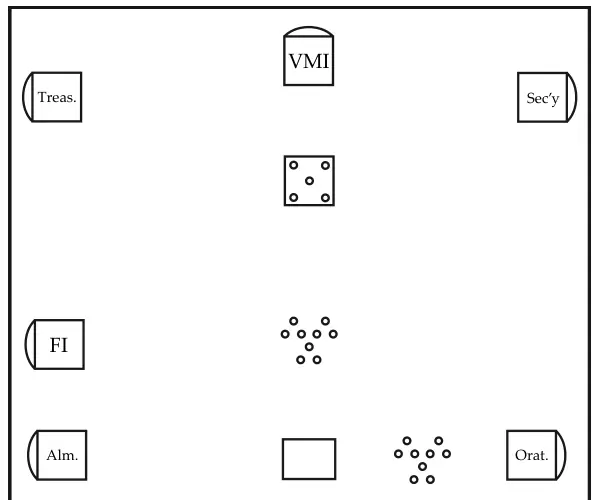
Le chapitre doit être tendu de rouge et éclairé de vingt et sept lumières de neuf en neuf, placées de la même façon qu'aux loges Symboliques, ou tout autour de la loge. Le très respectable maître, ou très excellent maître, qui en ce grade représente Salomon, est placé à l'Orient sous un dais d'azur, parsemé d'étoiles d'or, et assis sur un trône... Adonyram est le nom du premier surveillant et le maître de cérémonies fait fonction de second surveillant. Ils sont assis, tous trois en triangle, les deux derniers à l'Occident de la loge et il y a. cinq autres lumières sur l'autel, Adoniram à droite et le maître de cérémonies à gauche, prêt à recevoir ses ordres.
Pour ouvrir la loge
Le très excellent maître ayant un sceptre en la main, dit : Frère Adoniram, serions-nous en sûreté ? Adoniram répond : Oui, très excellent maître, nous sommes à couvert dans cette loge.
D. Quelle heure est-il ?
R. Le point du jour parait.
Le frère Adoniram, ayant ainsi répondu, le très excellent frappe cinq coups sur l'autel avec son sceptre, qui sont répétés par Adoniram, qui les frappe avec son maillet et le maître de cérémonies en fait autant. Le très excellent dit ensuite : Puisqu'il est le point du jour, il est temps, mes chers frères, que nous commencions nos travaux. La loge est ouverte. Tous les frères alors frappent ensemble cinq coups et chacun prend sa place.
Pour une réception
Le très excellent, qui représente Salomon, dit : Frère Adoniram, comment réparer les malheurs, qui nous sont arrivés par la mort d'Hyram Abiff ? Vous savez, qu'il était chargé, lui seul, des ornements de la chambre du milieu, ou troisième lieu, d'autant plus important qu'il devait contenir l'Arche sainte, et assurer le peuple juif de la présence et de la protection de l'Eternel. Cependant a-t-il eu le temps seulement de les ébaucher que le plus horrible crime nous l'a enlevé. Voyez, Adoniram, si vous pouvez me donner quelques avis là-dessus, qui soit salutaire et sage.
Très excellent maître, je sens très parfaitement toutes les difficultés, qu'il y a à réparer la perte que nous avons faite, mais dans la conjoncture où nous nous trouvons, je crois que l'unique moyen qui nous reste est de fonder cinq chefs des cinq ordres d'architecture afin que tous ensemble réunissant nos capacités nous puissions achever les ouvrages du troisième lieu, Adoniram dit. Le très excellent maître : Votre conseil est trop sage pour que je ne le mette par en pratique et pour vous donner une preuve du cas que j'en fais, je vous établis vous et votre père Abda inspecteur et conducteur de ces mêmes ouvrages. Voyez dans la chambre du milieu, s'il n'y aurait point quelqu'architecte.
Le très excellent maître frappe 3, 5 et 7 coups avec son sceptre et dit, en portant la main au front comme pour parer un coup de lumière ou un coup de Soleil : Frère, Adonyram, faites informer. Alors le maître de cérémonies sort et va dans la chambre voisine, où il demande s'il y a quelque chef des cinq ordres d'architecture. Alors, le récipiendaire, à qui l'on souffle,
appliquer avec attention à tous les ouvrages auxquels le très excellent voudra vous attacher ? Il répond : Je regarde comme le plus grand bien et le plus grand avantage, qui puisse m'arriver de [concourir] au but qu'il est proposé d'élever à l'Eternel un monument digne de sa gloire. Il lui demande les signes, mots et attouchements d'apprentif, compagnon, maître etc. Et alors le maître de cérémonies frappe à la porte 3, 5 et 7. On lui répond et il réplique, que c'est un employé aux travaux de la chambre du troisième lieu. Pour lors on lui ouvre la porte, le maître de cérémonies le prend par la main en agrippement et le conduit à genoux sur un carreau au milieu de la loge, qui est au devant d'une table noire, laquelle est Adoniram. Le frère Adoniram lui met une branche d'acacia à la main, ou toute autre branche au défaut de celle-là, et dans cette attitude lui fait faire son obligation en ces termes. Le serment
Je promets devant le Grand Architecte de l'Univers et devant les très illustres frères, ici assemblés tant absents que présents, de garder un éternel secret sur tous les mystères qui me seront dévoilés et, en cas d'infraction, je me soumets aux mêmes peines de mes précédentes obligations et d'avoir de plus le ventre coupé et les entrailles arrachées tout vif. Ainsi Dieu me soit en aide...
[Après le serment] Au moment qu'il prononce le dernier mot du serment, un des frères, qui est derrière lui, le couvre d'un voile rouge, le relève et le fait asseoir sur un tabouret au milieu de la chambre, et le très excellent maître lui fait à peu près ce discours :
Mon vénérable maître, Salomon voulant porter à leur plus haute perfection les ouvrages commencés par Hyram Abiff, crut ne pouvoir le remplacer qu'en créant le corps des chefs des cinq ordres d'architecture et leur donner pour adjoints Adoniram et Abda, son père, convaincu de leur zèle et de leurs talents, espérant que par eux il parviendrait à la fin qu'il se proposait. Ils se flattent aussi que vous y contribuerez de toute votre force. La situation de mort où vous êtes vous représente d'abord que vous ne pouvez remplacer notre respectable maître Hyram Abiff dans les ouvrages qu'après l'avoir suivi dans cette fermeté qui lui fit mépriser les horreurs d'un assassinat plutôt que de trahir les mystères de l'Ordre, et nous nous assurons qu'il en fera de même de vous. Je vais vous relever non comme vous l'avez déjà été mais comme il le fut lui-même.
Alors le vénérable Adoniram va saisir le récipiendaire parle coude et par trois secousses le relève et lui ôte le voile rouge, qui le couvrait. Le très excellent maître lui donne après les signes, mots et attouchements.
Il y a trois signes, le premier est celui de surprise qui se fait en portant la main droite sur le front, les doigts et les ongles tournés en dedans, sur les yeux et l'on prononce le mot Ben Chorin. On fait le même signe aussi en portant les deux mains ouvertes à la hauteur des joues, les doigts élevés au haut et les pouces qui touchent les oreilles formant un double équerre de chaque main. Il faut s'arrêter, si l'on marche, ou jeter son corps en arrière, si l'on est arrêté.
Le second signe est celui d'admiration. On le fait en levant lentement les yeux au ciel en croisant les mains, les doigts en haut, et les laissant tomber sur la cuisse à la partie gauche. On prononce ensuite le mot El Chard.
Le troisième signe est celui de douleur. Il se fait en portant la main droite sur le flanc droit et un peu crochue et la main gauche sur le cœur, comme si l'on voulait entrer, et on prononce ensuite le mot Jjachin ou Judia ou Ki et l'autre répond Jja, qui veut dire Dieu.
L'attouchement se fait en se touchant l'un l'autre réciproquement le cœur de la main gauche et en passant la main droite au coude droit de l'autre, entre la chemise et le bras, pressant fortement le coude par trois secousses.
Le premier en faisant cet attouchement a dû faire le signe avant et prononce le mot Jjachin, ou Jakinaÿ et le second en rendant le signe et l'attouchement du premier prononce le mot Jeova ou Judia.
Ce sont là les signes, mots et attouchements des maîtres en Israël, maîtres anglais, ou Surintendant des Bâtiments, ou élus des cinq, et cinq des mots qui leur sont propres. Il y en a encore deux qui sont Kin, et Jja pour se reconnaître. L'un dit le premier et l'autre le dernier. Ces deux mots veulent dire Dieu.
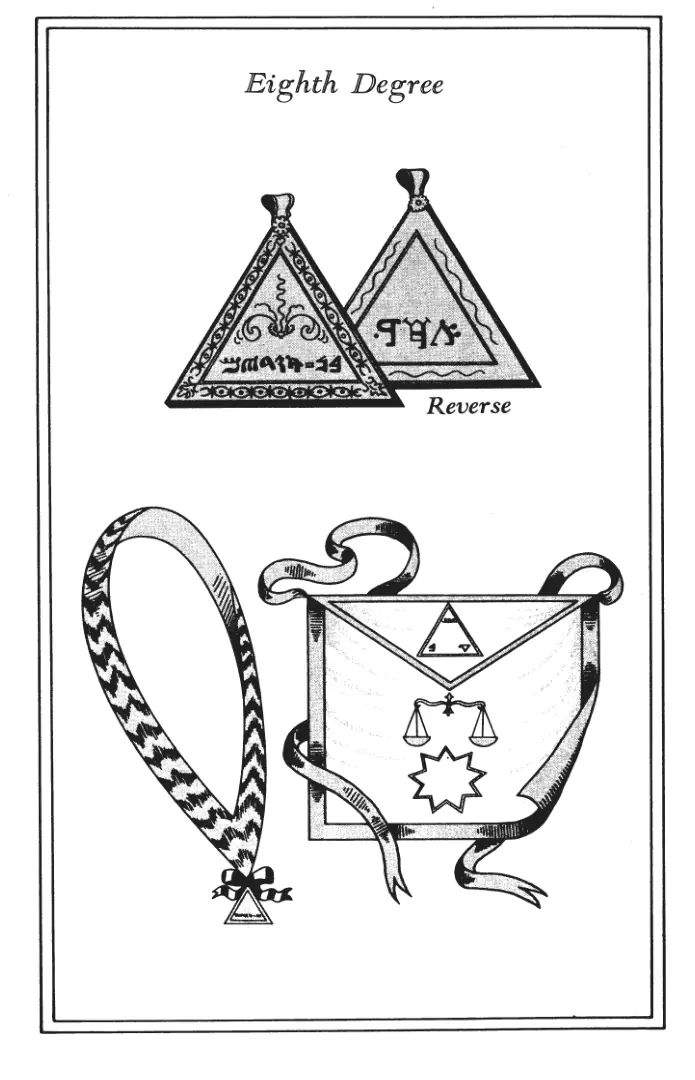
Les maîtres en Israël doivent porter un grand cordon rouge de droite à gauche au bas duquel pend un triangle, d'un côté duquel sont les trois mots hébreux Benchorin, Elchard, Jjachin, dont la signification est le 1 maçon libre, 2° un Seul, 3° ô vous seul Eternel. De l'autre côté du bijou sont également écrits en hébreu les trois mots Judia, Ki, Jja, qui signifient Dieu tout-puissant, Dieu, Dieu. Il y a aussi au milieu du triangle une balance égale. Ils doivent porter un tablier blanc, doublé et bordé de rouge, et dans lequel est en broderie une étoile à cinq rayons, et sur la bavette est en broderie un triangle sur les points duquel sont en broderie les lettres initiales des trois premiers mots. Et les trois JJJ. dans le triangle.
Note. L'attitude où l'on doit être en loge c'est de former un triangle avec les deux pouces et les deux index à la hauteur de la poitrine, après quoi on bat vingt et sept fois des mains ensemble par trois groupes et le très excellent maître fait toujours le premier signe avant toute cérémonie pour fermer ou ouvrir la loge.
Instruction et doctrine
D. Etes-vous maître en Israël, Intendant des Bâtiments ?
R. J'ai pénétré dans l'intérieur du temple par cinq pas d'exactitude. J'ai vu l'effet de la grande clarté au milieu de la quelle j'ai aperçu les trois lettres JJJ. mystérieuses en caractères hébraïques sans les connaître.
D. Comment êtes-vous entré ?
R Nu pied.
D. Pourquoi ?
R. Parce que Moïse l'était lorsqu'il entra dans la terre sainte.
D. Comment avez-vous été introduit en loge ?
R. Par cinq coups, qui annoncent les cinq points de félicité lesquels m'ont produit un surveillant qui m'a fait voyager dans le temple pour m'y faire admirer le pilier de ce temple.
D. Qu'avez vous aperçu en entrant [20v°] ?
[20v°] R. J'ai été saisi d'admiration et de douleur en apercevant l'étoile flamboyante, qui renfermait le saint nom de la divinité, qui est Jeova.
D. Que représente de plus cette étoile ?
R Le météore qui devait conduire les trois mages au lieu, où reposait la divinité.
D. Pourquoi avait-elle cinq rayons ?
R. Pour marquer les cinq ordres d'architecture employés à la construction du temple de Salomon. Les cinq joints de la félicité et les cinq sens de nature, lesquels l'homme ne savait pas être parfait, les cinq lumières de la Maçonnerie et les cinq zones du monde habitées par les maçons.
D. Où avez-vous été introduit ?
R. Dans un lieu mystérieux, plein de charmes et de sagesse, où réside la vérité.
D. Quel est le devoir d'un maître en Israël ?
D. Pourquoi exige-t-on dans ce grade que vous vous fassiez reconnaître apprentif, compagnon et maître ?
R. Pour marquer, que c'est par gradation qu'on peut parvenir à la perfection.
D. Que vous apprennent les grades d'apprentif, compagnon et maître bleu ?
R. L'apprentissage traite de la vertu morale, le compagnon de la vertu politique et le maître de la vertu héroïque.
D. Pourquoi vous a-t-on fait faire les pas de ce grade en avançant et en reculant ?
R. Pour marquer que nous devons opposer L'humilité à l'orgueil.
D. Savez-vous expliquer les mystères de notre loge ?
R. Je le crois, autant qu'il m'est possible.
D. Que signifient les trois lettres mystérieuses qui sont au milieu de notre bijou JJJ. ?
R. Jakini, Jeheva, et Jeova les deux premiers signifient beauté et sagesse divine et le troisième est l'initiale du grand Nom du Grand Architecte de l'Univers.
D. A quoi sert le cercle, qui est au milieu du troisième triangle ?
R. A marquer l'immensité de Dieu, qui n'a ni commencement, ni fui.
D. Que signifient les quatre cercles, qui sont au dedans du cycle LAIN ?
R. A vous seul Eternel de posséder les attributs de la divinité.
D. Quels sont les principaux attributs de la divinité ?
D. Expliquez-moi le carré de neuf62 ?
R. Sagesse 7
Beauté 6
R. Neuf vertus attribuées à 3 dans le premier triangle △
Toute-Puissance 15 neuf vertus attribuées à 3 dans le second triangle △
Immensité 9 neuf vertus attribuées à 3 dans le troisième triangle △
Eternité 8 forment le carré de neuf qui additionnés par trois colonnes réunies
Perfection 10 ensemble portent et forment le nombre de 81.
Justice 7
D. Pourquoi placez-vous Salomon dans notre temple ?
Miséricorde 11
R. Pour marquer ce fut le premier, qui consacra un temple à
Création 8 l'Eternel.
D. Pourquoi met-on une mer d'airain dans le temple de l'Eternel ?
R. Pour nous avertir que le temple de Dieu est saint et qu'il ne faut y entrer, qu'après s'être purifié.
D. Que signifie tout le côté gauche du temple ?
R. L'ordre maçon sous la loi de figures et de cérémonie.
D. Que signifie le côté droit du temple ?
R. La vraie Maçonnerie sous la loi de la vérité et de grâce.
D. Pourquoi placez-vous Saint Jean-Baptiste au côté droit ?
R. Parce qu'il a été le réédificateur du vrai temple que le Seigneur s'était choisi.
D. Pourquoi vous met-on en état de mort, couvert d'un voile rouge ?
R. Pour nous faire entendre, que les maçons doivent être morts au monde et à ses maximes.
D. Que signifie le tombeau, qui est sur la seule porte du sanctuaire ?
R. Il nous avertit que ce n'est, qu'après avoir été purifié par la mort, que nous devons être introduits dans le signe de la Divinité.
D. Que signifie le chandelier à sept branches ?
R. La présence de l'Esprit Saint dans le cœur151 des vrais observateurs de la loi.
D. Que vous marque la balance que vous lui avez remise en main ?
R. La balance est un des attributs de la justice. Elle m'a été remise pour me la faire exercer sur les différences, qui arriveront entre les maçons et pour me faire souvenir, que c'est avec elle, que je dois juger mes démarches et mes projets, si je veux mériter à juste titre le nom que l'on m'a donné.
D. Avez-vous vu votre illustre maître aujourd'hui ?
R. Oui, très excellent, je l'ai vu.
D. Où était-il placé ?
R. Sur un trône du côté de l'Orient.
D. Comment était-il vêtu ?
R. D'or et d'azur.
D. Pourquoi de cette façon ?
R. Parce que lorsque l'Eternel apparut à Moïse sur le mont Sinaï pour lui donner les tables de sa loi, il était sur un nuage d'or et d'azur.
D. Vous reste-t-il de ténèbres encore ?
R. L'aurore est [ ?] par moi et l'étoile mystérieuse me conduit.
D. Où avez-vous été conduit ?
R. Je ne puis vous le dire.
D. Pourquoi avez-vous ressenti de la douleur ?
R. En voyant toutes ces merveilles, que j'ai aperçues dans le temple, elles m'ont rappelé le souvenir de notre respectable maître [67v°] Hyram.
D. Etes-vous succombé à cette douleur ?
R. J'y aurais succombé sans le service de ceux, qui m'ont soutenu et que j'ai reconnu cour mes frères.
D. A quoi les avez-vous reconnus ?
R. Au grand Nom incommunicable qu'ils ont invoqué après avoir prononcé le mot Jjackin.
D. Quel est ce grand Nom ?
R. Celui du Grand Architecte de l'Univers, que je vois tracé en un lieu de cette étoile resplendissante de lumière.
D. Pourquoi portez-vous du vert sur votre tablier et au bas de votre cordon ?
R. Pour m'apprendre que pratiquant la Maçonnerie je puis espérer de parvenir plus avant.
D. Quel âge avez-vous ?
R. 27 ans.
D. Quel nombre avez-vous remarqué ?
R. Cinq, sept et quinze, dans les arrangements des lumières.
D. Que représente votre bijou ?
R. La triple essence de la divinité.
9 9 9
9 9 9
9 9 9
Pour fermer la loge
D. Quelle heure est-il, très vénérable premier surveillant ?
R. La fin du jour, très illustre maître. Alors, le très excellent dit : Souvenez-vous, mes très illustres frères, des cinq points de félicité. Il est temps de nous reposer. Il frappe cinq coups, qui sont répétés par les surveillants et tous les illustres maîtres frappent des mains cinq, sept et quinze et la loge est fermée.
Nota. Il est des loges où les 27 lumières doivent être rangées par 5, 7, et 15. Je crois même que cette façon est plus convenable. Tout de même que le tablier doit être bordé de vert et le bijou, qui pend au cordon, doit être attaché à une gaine ou rosette d'un ruban vert, ce qui est
beaucoup de rapport aux instructions de ce grade, qui a été altéré par ceux qui lui ont donné le nom d'écossais des trois JJJ. Nota. Dans d'autres loges il parait sur le tableau un rond avec des rayons, un grand vide, au milieu où sont ces initiales JJJ., 5 grands chandeliers, une lampe qui brûle, avec les lettres initiales J.K.Y. et les vases du temple.
[Signature]
Apparat critique de la transcription Aeditimus
62. La figure en question, à droite des présentes répliques sur le manuscrit, a été reportée ici en fin du présent catéchisme.
63. Ajout secondaire, d’une autre écriture.
64. Cf. supra : note 17, page 22 de la présente transcription (page 8v° du manuscrit).
66. La fin de cette réplique est donnée en bas de la présente section dans le manuscrit : cf. appel et renvoi par le signe +. Nous l’avons mise ici à sa place.
67. Cf. supra : note 17, page 22 de la présente transcription (page 8v° du manuscrit).
71. Cf. supra : note 17, page 22 de la présente transcription (page 8v° du manuscrit).
72. Cf. supra : note 17, page 22 de la présente transcription (page 8v° du manuscrit).
73. Ce cahier couvre les pages 26r° à 37v°.
74. Chevaliers de l’Orient.
76. En dessous de ce nom : mal écrit.
77. Le 7 vient surcharger un 8 initial.
78. Rajout dans l’interligne inférieur : + ou Nabuzardan qui fait fonction de pr[emier] sur[veillant].
79. Rajout dans l’interligne inférieur : + qui fait fonction de sec[ond] sur[veillant].
84. Ce qui semble être un 9 surcharge un chiffre précédent. Dans l’interligne supérieur, on lit : 348[5 ou 6 ?], la suite est illisible.
86. Ce passage, jusqu’à la fin de la phrase (cf. Henoab) est un rajout, figuré en bas de page avec un rappel de note : ++.
88. Dans le coin supérieur gauche, la page porte le numéro 8. Ce chiffre correspond à la numérotation des pages du présent cahier, couvrant les folios 26 à 37 du manuscrit, la numérotation excluant le feuillet de garde dudit cahier (pages 26r° et 26v°).
89. Ajout dans l’interligne supérieur.
90. Pour ce renvoi : cf. page suivante et note 92.
91. Pour ce renvoi : cf. page 33v° du manuscrit.
92. Ce fragment, placé en marge droite du catéchisme comme ici, est indépendant de ce dernier. En fait, il renvoie à la précédente marque identique (), au bas de la page 30v° du manuscrit : Le second temple etc.
93. Cette incise figure en ajout, à la fin de la présente réponse : +.
95. Ce nom est suivi d’un second, rajouté : Rem [fardam mareerit] ?
96. Cette colonne se rapporte évidemment à la colonne n° 5.
97. Sic. Il y a un e en trop à ce nom, pour être l’anagramme juste d’assiduité (cf. note 87 supra).
98. Septembre.
99. Le 1° est marqué deux fois ! Idem pour le 4° infra.
101. Sur ce renvoi : cf. page du 30v° manuscrit.
104. Cette mention supplémentaire figure en rajout, dans l’interligne supérieur.
105. La fin de cette phrase est indiquée en bas de la présente page, précédé du rappel du signe de renvoi : T.
107. Ajout, dans l’interligne supérieur.
108. Cf. « omissions », page 37v° du manuscrit.
109. Cf. « omissions », page 37v° du manuscrit.
110. Ce passage s’intercale en fait dans le catéchisme, après la réponse : Cyrus. Dans le manuscrit, on trouve à côté un dessin que nous avons reporté à la fin du présent catéchisme.
112. Cf. supra : note 17, page 22 de la présente transcription (page 8v° du manuscrit).
113. Cf. page 36v° du manuscrit.
114. Ici, un signe de renvoi . La fin de la phrase figure en bas de la section suivante, précédée du rappel du signe de renvoi. Nous l’avons mise ici à sa place.
115. Cf. page 36v° du manuscrit.
117. Cf. supra : note 17, page 22 de la présente transcription (page 8v° du manuscrit).
118. Toute cette partie est écrite sur deux colonnes, de part et d’autre d’une figure que nous reproduisons en page suivante.
119. Ou franc-maçon (sur ce point : cf. 4°) ? Le manuscrit porte simplement : fr.
120. Ajout dans l’interligne supérieur.
122. Cf. supra : note 17, page 22 de la présente transcription (page 8v° du manuscrit).
123. Dans l’interligne supérieur, une mention illisible.
124. Ajout d’une autre écriture.
125. On croit pouvoir lire, avant ce nom, le même déformé : pitagore ? C’est à voir…
126. Cf. note 17, page 22 de la présente transcription (page 8v° du manuscrit).
127. En haut à droite de la page, la mention suivante : B625, notée deux fois.
128. Ajout en marge supérieure, qu’un signe appelle : +.
129. Cette précision s’applique à la question posée par le « très puissant ».
130. Ajout dans l’interligne supérieur.
131. Cf. note 17, page 22 de la présente transcription (page 8v° du manuscrit).
133. Cf. note 17, page 22 de la présente transcription (page 8v° du manuscrit).
134. Ajout dans l’interligne supérieur. Illisible.
135. Avant ce nom, on croit pouvoir lire un autre, non barré (oubli ?) : Nabuzodonosor, sic.
136. Cf. note 17, page 22 de la présente transcription (page 8v° du manuscrit).
137. Cf. note 17, page 22 de la présente transcription (page 8v° du manuscrit).
138. Les trois lettres sont fondues en une sorte de monogramme.
139. On retrouvera ces lettres et ces noms sur la clé formant ledit bijou. Cf. figure page suivante.
140. Cette partie comporte une pagination double : celle relative à l’ensemble du manuscrit (seule reportée ici), dans le coin supérieur droit de chaque recto de folio, et une qui est relative au présent cahier, portée en tête de chaque page (de 1 à 11 – numérotation absente pour la fin du cahier).
141. Cette mention accompagne le titre de la présente section dans le manuscrit (cf. encadré en fac-similé). A noter : Cette partie comporte un grand nombre de notes et rajouts, en marge du texte principal. Comme pour l’ensemble du manuscrit, nous les avons inclus directement dans le texte, à l’endroit voulu, sans toutefois les repérer ici à chaque fois, au risque sinon d’alourdir la présente partie d’un appareil de notes inutile. Les passages dont l’emplacement est incertain figurent en caractères italiques ; les insertions non identifiées figurent en note en bas de page. Il faut ici prévenir qu’en l’état du document consulté, le rognage fréquent des marges (que vient compliquer une écriture souvent serrée et difficile à lire) autant que la difficulté quelquefois à repérer exactement les signes de renvois, rendent hasardeuse une recomposition du texte final. A toutes fins utiles, pour lever tout doute, on se reportera au document original pour une étude plus approfondie.
142. Nous transcrirons de la sorte, en caractères gras et en lettres capitales, les passages figurant dans le texte dans l’alphabet propre au grade (cf. fac-similé de l’entête, sous l’encadré).
144. Tout le passage qui suit (jusque : comme cela devait être) est porté en marge droite de la page (fin en bas de page), en remplacement d’un passage plus court, barré sur le manuscrit.
146. Tout ce passage, écrit en marge gauche du texte est difficile à déchiffrer. Nombre de mots sont coupés, voire illisibles. Il semble se terminer par la ligature & (suivie de tc ?), indiquant par-là que ce passage est bien destiné à l’insertion.
148. Ou : conservant ? autre lecture possible.
149. En marge gauche du texte, une note ou insertion que nous n’avons pu situer : le grade de grand écossais ou sublime élu, grand élu, [grand] maître et sublime écossais.
150. Pour tout ce qui est transcrit de cette manière : cf. supra, note 20.
151. Dans le document original, les figures que nous reproduisons ici après leur description se trouvent de part et d’autre du passage destiné à l’insertion, tout en haut de la page 53r°. Manuscrit Baylot 169
Manuscrit Quesada 1804 (copie 1813-1821)
manuscrit · BNE Mss 7834 · 2 433 mots
Le manuscrit Quesada (Mss 7834 de la Bibliothèque Nationale d'Espagne) : copie (1813-1821) d'un état du Rite de 1804, voire antérieur, tel que pratiqué dans la mouvance du Suprême Conseil d'Amérique. Les didascalies du manuscrit sont en italique. Le texte est celui de l'édition Latomia, donnée en vis-à-vis du fac-similé du manuscrit : l'apparat critique de cette édition est repris ici, de même que les repères de folio du manuscrit.
Texte intégral sur ce site · transcription C. M. & P. T., Latomia / Chantier de fouilles maçonniques, d'après le Mss 7834 de la BNE
.∴ Cette doit être décorée de rouge éclairée de 27 Lumières distribuées en trois groupes dont un composé de 15. doit être devant l’Autel du 3 Fois Puissant qui représente Salomon. Le 1er∴ Survt∴ est appelé Insp∴ il représente le 3 Fois Illustre Tito Harodin, et a devant lui 7 Lumières. Le 2e∴ Survt∴ en a cinq il a le titre d’Introducteur Tous les FF∴ sont décorés d’un large ruban rouge qui descend de l’épaule droite à la hanche gauche auquel est suspendu avec une rosette verte un triangle sur lequel sont gravées les paroles
Achaad, Jakini, Benchorin,
qui signifient Franc-Maçon, Ô ! Dieu Éternel de l’autre côté du triangle sont les paroles hébraïques
Judea Ky.Ytza286.
Le tableau est blanc doublé de rouge bordé de vert au milieu est une étoile à 9 branches sur une balance ; sur la bavette un triangle avec Folio 130 recto
les lettres : B∴A∴Y∴
Le Trois Fois P∴ est placé à l’O∴ Le Rble∴ Tito à l’Ouest, et Adonhiram à l’autre angle prêt à recevoir les ordres de Gd∴ Inspr∴
Ouverture
Le 3 Fois Puissant le sceptre à la main dit :
D∴ F∴ Tito, sommes-nous à couvert ?
R∴ Nous les sommes.
D∴ Quelle heure est-il ?
R∴ Le point du jour. Alors le 3 Fois Puissant frappe
5 coups avec son sceptre sur l’Autel ce qui est répété par Tito & Adonhiram Le 3 Fois Puissant dit : Puisque c’est le point
du jour mes TT∴ C∴ FF∴ il est temps de commencer l’ouvrage cette L∴ est ouverte tous les FF∴ frappent 5 coups dans leurs mains
ils font signe d’admiration et de surprise.
Signes
Le signe de surprise se fait en portant la main
droite sur le front et se couvrant les yeux comme si on voulait éviter la Lumière.
Celui d’admiration en élevant les deux bras
en haut regardant le ciel la tête inclinée sur l’épaule gauche.
Réception
Le Cand∴ doit avoir les pieds nus. Le 3 Fois Puissant s’adressant au F∴ Tito dit :
D∴ F∴ Tito comment ferons-nous réparer la perte de notre cher Hiram Abif qui était chargé des ornements de la Chambre Secrète qui renfermait l’Arche Sainte pour assurer les Israélites de la présence de la protection de Dieu très puissant, il nous a été enlevé par le plus horrible crime & nous sommes par ce moyen privés de ce Rble∴ chef. Voyez F∴ Tito si vous pourriez me donner quelques biens bons avis à cet égard. Tito répond :
R∴ J’éprouve moi-même toute la difficulté que nous aurons de réparer la perte de notre cher Me∴ Hiram Abif dans cela je crois que le seul remède est de faire un chef de chaque ordre d’architecture, de réunir tous nos moyens nos capacités pour finir l’ouvrage de la chambre jusqu’au 3e étage.
Alors le 3 Fois Puissant répond :
R∴ Votre conseil est trop bon pour ne pas le suivre et pour vous le prouver vous F∴ Tito et F∴ Abda Insp∴ et Introd∴ voyez dans la Chambre du Milieu
Il s’y rend & trouve Johabert à qui il dit :
D∴ F∴ y a-t-il ici des chefs des cinq ordres d’architecture Johaber répond :
L’Inspr∴ dit : R∴ Me voilà ?
D∴ Avez-vous mon C∴ F∴ assez de zèle pour vous appliquer avec attention à tous les ouvrages qu’il plaira au 3 Fois Puissant de vous ordonner ; répond Johaber :
R∴ Je regarde comme mon plus grand bonheur & mon plus grand avantage d’accomplir ce que le 3 Fois Puissant désirera de moi Folio 131 recto.
L’Inspr∴ lui demande les signes paroles & attouchements des trois premiers grades alors il frappe à la porte 3, 5, & 7 coups, lesquels étant entendus dans l’intérieur le F∴ Introd∴ lui demande ce qu’il veut : il répond
R∴ C’est un ouvrier de la Chambre du Milieu, alors l’Introducteur le prenant par la grippe
de Mtre∴ lui fait faire 5 fois le tour du Temple en lui faisant admirer la beauté, & le conduit à l’Autel en lui faisant faire cinq pas graves. Il lui dit : de se mettre à genoux : Tito qui est à côté de lui, lui met une branche d’acacia dans la main droite & dans cette position il prête l’obligation suivante :
Obligation
Je N… promets en présence du Gd∴ Architecte de l’Un∴ & devant les Illustres FF∴ ici présents de garder éternellement le secret sur les mystères de ce grade qui va m’être confié dans ce moment, et de ceux qui me le seront dans la suite, je promets d’avoir une entière obéissance à tous les statuts et décrets qui me seront transmis par le Grand Conseil des Princes de Jérusalem sous les peines de mes premières obligations, d’avoir mon corps séparé en deux, & d’avoir mes entrailles arrachées, ainsi queDieu me maintienne dans la justice et l’équité
Amen.
Au moment où le Cand∴ prononce les dernières paroles de son serment, Tito le couvre d’un voile rouge le prend par l’épaule, le relève et l’assied sur un tabouret, le 3 Fois Puissant lui adresse le discours suivant
« Mon T∴ Cher F∴, Salomon voulant « porter à la plus haute perfection l’ouvrage commencé il « fut obligé d’employer les 5 chefs des 5 ordres d’arch re∴ « & de mettre à leur tête, Tito, Abda, Salomon « était convaincu du zèle & de la capacité de ceux qu’il « employait à perfectionner son ouvrage, de même nous « espérons, mon C∴ F∴ que vous contribuerez à tout ce « que vous pourrez, remplacer notre Rble∴ Me∴ Hiram « Abif, dans cet ouvrage qu’en ayant la même « fermeté qu’il eut en méprisant la mort, plutôt « que de découvrir les mystères de notre ordre, nous « espérons que nous l’imiterons je vais vous « donner les Mots, Signes & Attouchements :
1er∴ Signe
Celui de la surprise, en portant les deux
pouces sur les tempes, les deux mains formant l’Equerre reculant deux pas et avançant de 2 autres portant ensuite les mains sur les paupières en disant Benchorin
2 ème∴ Signe
Il se fait en entrelaçant les doigts des
deux mains la paume des mains en haut et les laisser tomber sur la ceinture regardant le ciel en prononçant Achard Folio 132 recto.
3ème∴ Signe
Celui de la douleur, en se portant la main
droite sur le cœur, la main gauche sur la hanche, balançant avec les genoux trois fois on dit : Ky& l’autre Jah.
Batterie5 coups
Attouchem∴
Il se fait en se frappant mutuellement le
cœur avec la main droite, passer ensuite la main au milieu du bras l’un de l’autre et avec la main gauche se prendre mutuellement l’épaule l’un dit Jakinaï, l’autre répond : Juda.
Instruction
D∴ Êtes-vous Intendant des Bâtiments ?
R∴ J’ai monté les 7 marches de l’exactitude. J’ai pénétré dans la plus grande partie du Temple ; j’ai vu une grande
Lumière au milieu de laquelle j’ai aperçu trois lettres J∴J∴J∴
en caractères hébraïques sans savoir ce qu’elles signifient.
D∴ Comment avez-vous été reçu ?
R∴ En reconnaissant mon ignorance
D∴ Pourquoi avez-vous été reçu ?
R∴ Pour dissiper les ténèbres et me procurer la véritable Lumière pour diriger mon cœur et éclairer mon entendement.
D∴ Où avez-vous été introduit ?
R∴ Dans un lieu merveilleux plein de charme où réside la vérité et la souveraine sagesse.
D∴ Quel est votre devoir ?
R∴ D’encourager mes FF∴ par mon exemple à pratiquer la vertu & à tenir nos ouvrages sous le secret Pourquoi a-t-on exigé de vous des épreuves288 de
D∴ Comp∴ de Mtre∴ avant de vous recevoir ?
R∴ Pour me montrer que ce n’est que par gradation que je suis capable d’arriver à la perfection.
D∴ Que vous désignent les 3 premiers grades ? L’App∴ montre la vertu morale289 & le Maître
R∴ la vertu morale et héroïque
D∴ Pourquoi dans le grade avancez-vous & reculez-vous ?
R∴ Pour démontrer par gradation qu’un de vous mettait en opposition l’humilité à l’orgueil qui nous est naturelle, que nous devons avancer dans le chemin de la vertu, et290 faire le but de toutes nos actions, & ne faire que tout ce qui est décent291.
D∴ Pourquoi placez-vous Salomon dans le Temple ?
R∴ Pour montrer qu’il fut le premier qui consacra un temple à la divinité.
D∴ Pourquoi placez-vous la mer d’airain dans le Temple ?
R∴ Pour avertir que le Temple du Seigneur est Saint et qu’on ne peut y entrer qu’après avoir été purifié Que signifie le côté gauche du Temple292 ?
D∴
R∴ La vraie Maçonnerie sous les lois de la grandeur & de la vérité. D Que signifie le chandelier à 7 branches ?
R∴ La présence de l’Esprit Saint dans le cœur Folio 133 recto de tous les vrais observateurs des lois de Dieu.
D∴ Pourquoi dans votre réception aviez-vous les pieds nus ?
R∴ Parce que j’allais apprendre des choses saintes et que Moïse était quand il entra dans la Terre Sainte.
D∴ Qu’avez-vous entendu avant d’entrer ?
R∴ Cinq grands coups.
D∴ Que dénotent-ils ?
R∴ Les 5 points de la fidélité.
D∴ Qu’ont-ils produits ?
R∴ Un Survt∴
D∴ Qu’a-t’il fait de vous ?
R∴ Il m’a conduit 5 fois autour du Temple en me soutenant.
D∴ Pourquoi cela ?
R∴ Pour m’en faire admirer la beauté.
D∴ Quelle impression ont fait sur vous les 5 voyages ?
R∴ Une grande surprise d’admiration & de douleur.
D∴ Pourquoi ?
R∴ Par ce que j’ai vu renfermé dans l’Étoile Flamboyante ?
D∴ Qu’y avait-il dans cette Étoile ?
R∴ Le saint nom du Gd∴ Arch te∴ de l’Univers.
D∴ Pourquoi cette Étoile n’a-t-elle que 5 rayons ?
R∴ Parce que les cinq rayons font allusion aux cinq ordres d’architecture dont on fit usage pour la construction du Temple aux cinq points de la fidélité aux cinq cents de la nature sans lesquels un homme ne peut être parfait, aux cinq Lumières de la Maçonnerie et aux saintes zones de la terre habitée par les Maçons
D∴ Quels sont les cinq points de la fidélité ?
R∴ Agir intercéder, aimer prier et secourir nos FF∴
D∴ Pourquoi avez-vous été saisi d’admiration & de douleur ?
R∴ En voyant les beautés du Temple et de tous les ornements.
D∴ Avez-vous vu toutes les beautés du Temple ?
R∴ Je n’en ai vu qu’une partie ?
D∴ Par quelle raison ne les avez-vous pas toutes vues
R∴ Une épaisse muraille qui en couvrait une partie m’a empêché, mais par mon zèle pour arriver à la perfection de l’Art Royal j’espère qu’un jour mes yeux n’éprouveront aucun obstacle.
D∴ Pourquoi avez-vous ressenti de la douleur ?
R∴ Parce que les ornements du Temple ont rappelé à ma mémoire la mort de notre T∴ C∴ Me∴ Hiram Abif cruellement sacrifié.
D∴ Avez-vous été altéré par la douleur ?
R∴ Non, mais je l’eus sans doute été si quelqu’un que j’ai reconnu après pour F∴ ne m’avait soutenu.
D∴ Comment l’avez-vous reconnu pour F∴ ?
R∴ Par le Gd∴ nom qu’il a invoqué après avoir prononcé
Jakinaï qui est le Mot Sacré que j’ai vu dans le
centre de l’Étoile Flamboyante.
D∴ Avez-vous promis de garder le secret sur tout ce que vous avez vu ?
R∴ Oui Illustre Maître.
D∴ Que vous êtes-vous imposé si vous y manquiez ?
R∴ D’avoir mon corps coupé & mes entrailles arrachées.
D∴ Comment avez-vous marché ? Par 5 pas graves que j’ai fait en avançant vers297
R Folio 134 recto∴ pour y prononcer mon obligation.
D∴ Pourquoi avez-vous paru mort et avez-vous été couvert d’un voile rouge ?
R∴ Pour apprendre que tous les FF∴ doivent être morts au monde & à tous les vices.
D∴ Avez-vous vu votre Illustre Maître aujourd’hui ?
R∴ Je l’ai vu ?
D∴ Où était-il placé ?
R∴ Sous un dais bleu céleste parsemé d’étoiles brillantes.
D∴ Comment était-il vêtu ?
R∴ D’or & d’azur.
D∴ Pourquoi ?
R∴ Parce que Dieu apparut ainsi à Moïse sur le Mont Sinaï quand il lui donna les 2 Tables de la Loi.
D∴ Êtes-vous encore dans l’obscurité ?
R∴ Le jour m’a apparu & l’Étoile mystérieuse est mon guide.
D∴ Où avez-vous été conduit ?
R∴ Je ne puis le dire.
D∴ Quel âge avez-vous ? 27 ans.
R∴
D∴ Comment marquez-vous, 5, 7 & 15 et où avez-vous atteint ce nombre ?
R∴ De la manière dont on place les Lumières.
D∴ Que signifient-elles ?
R∴ Je vous ai déjà expliqué les deux premières, la dernière représente les 15 Maîtres qui trouvèrent le corps d’Hiram Abif sous une branche d’acacia.
D∴ Pourquoi y a-t-il du vert dans votre tablier ?
R∴ Parce que je dois espérer d’arriver à de plus sublimes connaissances par le zèle et la constance dans la Maçonnerie.
D∴ Que signifie votre bijou ?
R∴ La Triple Alliance de la divinité.
D∴ Quelle heure est-il ?
R∴ Sept heures du soir.
Clôture
Le 3 Fois Puissant frappe un coup se lève et dit :
Mes chers FF∴ comme vous avez pratiqué les 5 points de la fidélité il est temps de vous affranchir300 & de vous reposer.
Puis il frappe cinq Les Survts∴ les répètent et tous les FF∴ de même, alors le 3 Fois Puissant frappe un coup & dit :
Mes TT∴ R bles∴ FF∴ la Nble∴ L∴ des Intendants des Bâtiments, où Me∴ en Israël est fermée retirons-nous en paix Folio supplémentaire XIXFolio 137 recto.
Apparat critique de l’édition Latomia
286. Écrit « Yah » plus loin, ce qui semble la forme usuelle. « Joa » dans Kloss, « Yva » dans Pyron 1812.
288. La formule exacte est « d’Apprenti, de Compagnon et de Maître », cf. Pyron1812 et Kloss.
289. Erreur du copiste A : la formule exacte est « [...] le Compagnon la persévérance et le Maître la vertu héroïque », cf. Pyron 1812 et Kloss.
290. Erreur du copiste A : « et » mis à la place de « en », cf. Pyron 1812 et Kloss.
291. Il manque ici 5 couples demande-réponse présents dans les versions Pyron 1812 et Kloss.
292. Il manque ici la réponse « L’Ordre maçonnique sous les lois des emblèmes et des cérémonies » et la question suivante sur le côté droit du Temple.
293. Il manque ici un couple demande-réponse présent dans la version Pyron 1812.
297. Oubli du copiste A : « le trône », cf. Pyron 1812 et Kloss.
300. Le mot utilisé ailleurs est « raffraîchir », cf. Pyron 1812 et Kloss. Ce n’est pas forcément une erreur du copiste A, car « affranchir », dans le sens de libérer (d’un engagement de travail) semble ici plus pertinent et moins trivial que « raffraîchir ».
Delaulnaye 1813
tuileur imprimé · 513 mots
Le « Thuileur des trente-trois degrés de l'Écossisme » de Delaulnaye (Paris, 1813), premier tuileur imprimé du REAA constitué : mots, signes, décors et remarques du grade. Texte relu mot à mot sur le fac-similé, mots hébreux restitués. Pages 52-57 de l'édition originale.
Vingt-sept Lumières, par trois fois neuf ; (5+7+15).
Cinq autres devant le Vénérable.
Titres.
Le Vénérable représente Salomon, on le nomme trois fois Puissant : un Inspecteur représente Tito, et est qualifié de trois fois Illustre ; enfin un Introducteur représente Adoniram. Le Récipiendaire est appelé Jocabert. Il a les pieds nus.
[p. 53]
Signe, dit de Surprise.
Porter les deux pouces aux tempes, les mains formant l'équerre ; reculer deux pas, en avancer deux ; porter les mains sur les paupières, en disant BENCHORIN בֶנחוֹרִים
(nobilium filius)
Second Signe, dit d'Admiration.
Entrelacer les deux mains, les retourner la paume en haut, puis les laisser tomber sur la ceinture, en regardant le ciel et disant : Achard. Au lieu de Achard, il faut écrire HAKAR עָכָר
(conturbans)
C'est un des noms de Dieu.
Troisième Signe, dit de Douleur.
Porter chacun la main droite sur le cœur,
[p. 54]
et la main gauche sur la hanche ; puis se balancer trois fois avec les genoux, le premier disant Ki, le second Iea.
Ces deux mots sont altérés ; au lieu de Ki, il faut dire CHAI חַי ; c'est une des épithètes de Dieu.
(vivans)
Au lieu de Iea, écrivez IAH יָהּ
(deus)
Attouchement.
Se frapper mutuellement le cœur avec la main droite, puis se la passer au milieu du bras l'un de l'autre, et se prendre l'épaule de la main gauche ; le premier dit IAKINAÏ, le second JUDA.
Batterie.
Cinq Coups égaux.
○ ○ ○ ○ ○
La marche est aussi de Cinq pas égaux.
Mots Sacrés et de Passe.
Ce sont ceux de l'Attouchement.
[p. 55]
Âge d'un Intendant des Bâtiments.
Trois fois Neuf ans (27 ans).
Heure.
Pour ouvrir ; le Point du jour.
Pour fermer ; Sept heures du soir.
Ce nombre ne cadre point avec le reste du rituel.
Tablier.
Blanc, doublé de Rouge, bordé de Verd. Au milieu est une Étoile à neuf pointes sur une balance. Sur la bavette, un Triangle renfermant les trois lettres B. A. I (Benchorim, Akar, Iakinai).
Cordon.
Rouge, moiré, en écharpe, de droite à gauche.
Bijou.
Un Triangle, sur l'un des côtés duquel sont gravés les trois mots Benchorim, Akar, Iakinaï.
[p. 56]
En loge, on traduit ces trois mots par Franc-Maçon, ô Dieu, tu es éternel. Cette traduction rappelle celle des mots turcs du Bourgeois-Gentilhomme. Si, en ajoutant des liaisons qui n'existent point, on vouloit former un sens avec ces trois mots, cela signifieroit le fils des nobles (ou, si l'on veut, le Franc-Maçon) (est) ferme (devant) celui qui trouble (qui épouvante) (tout).
Sur le revers du triangle sont gravés les deux mots Juda, Iah, que l'on n'a pas manqué de traduire par : Dieu puissant, Dieu, Dieu ! Ils signifient Louange à Dieu. Le Bijou tient au Cordon par une rosette verte.
L'Intendant des Bâtiments monte les sept marches d'exactitude, et pratique les cinq points de fidélité.
On suppose ce grade relatif à l'établissement des Juges du peuple d'Israël. (Voy. le DEUTÉRON., c. 16, v. 18).
[p. 57]
III.e CLASSE.
Vuillaume 1820
tuileur imprimé · 506 mots
Le tuileur de Claude-André Vuillaume, « Manuel maçonnique, ou Tuileur de tous les rites de maçonnerie pratiqués en France » (Paris, Delaunay et Hubert, 1820) : décoration, titres, signes, attouchement, marche, batterie, âge, mots, habillement du grade, avec l'étymologie et l'interprétation des mots hébreux. Texte établi sur le fac-similé et relu mot à mot sur les images : océrisation à 600 dpi du volume numérisé, fusion avec la couche texte de la numérisation Gallica, puis relecture page par page. Orthographe de 1820 conservée, hébreu et grec restitués, batteries rendues comme l'imprimé les note, pagination de l'original. Pages 92 à 95.
Vingt-sept lumières, en trois groupes; l'un de cinq lumières, placé devant le second surveillant; l'un de sept, placé devant le premier surveillant; et le troisième de quinze, placé devant le président.
TITRES.
Le président représente Salomon, et prend le titre de Trois fois puissant. Le premier sur∴ représente Tito, et a le titre de Trois fois illustre inspecteur; le second représente Adoniram, et fait les fonctions d'introducteur.
Le récipiendaire est nommé Johaben (1).
(1) Nous insistons sur l'observation que nous avons déjà faite sur ce nom, qui dans plusieurs loges est changé en celui de Jocaber, Jocabert ou Johaber, ce qui est également fautif.
[p. 93]
SIGNES.
De surprise : — Porter les deux pouces aux tempes, les mains étendues en équerre; reculer de deux pas, avancer d'autant; porter ensuite les mains sur les yeux pour les couvrir, en disant : ben-chorim (héb. בֶּן־חוֹרִים ben-hhorim, nobilium filius);
D'admiration : — Entrelacer les deux mains, les tourner ensuite la paume en haut, puis les laisser retomber sur la ceinture, en regardant le ciel, et en prononçant : Achar (héb. עָכָר gachar ou achar, conturbans); pron. Akar. C'est un des noms de Dieu;
De douleur : — Porter la main droite sur le cœur et la main gauche sur la hanche, puis se balancer par trois fois sur les genoux, en disant le premier : hhaï (héb. חַי vivans); le second, jah (héb. יָה Deus).
On trouve dans un grand nombre de rituels Ki et Jea, au lieu des mots que nous venons de donner; c'est une erreur que la signification des premiers fait assez sentir.
ATTOUCHEMENT.
Se frapper mutuellement sur le cœur avec la main droite, puis la passer sous le bras gauche; ensuite prendre l'épaule droite avec [p. 94] l'autre main, en disant, le premier : Jachinaï (pron. jakinaï); le second répond, Juda (héb. יְהוּדָה jehoudah, laudatio. Gen. chap. 29, v. 35).
BATTERIE.
Cinq coups égaux : ● ● ● ● ●
MARCHE.
Cinq pas égaux.
L'intendant monte les sept marches d'exactitude, et connaît les cinq points de fidélité.
AGE.
Trois fois neuf ans.
TEMS DU TRAVAIL.
Du point du jour jusqu'à sept heures du soir.
HABILLEMENT.
Tablier blanc, doublé en rouge et bordé en vert. Au milieu du tablier est une étoile à neuf pointes sur une balance; sur la bavette est un triangle contenant les lettres B∴ A∴ I∴
Cordon rouge moiré, porté en écharpe, passant de droite à gauche, auquel est suspendu, pour bijou, un triangle, sur l'un des côtés duquel sont gravés les mots de passe et sacré,
[p. 95]
Ben-chorim, Achar, Jachinaï, qu'en loge on traduit ainsi : FRANC-MAÇON, Ô DIEU, TU ES ÉTERNEL ! Sur le revers du triangle sont encore gravés ces mots : Juda, Jah, que l'on traduit : DIEU PUISSANT : DIEU ! DIEU ! leur vraie signification est, LOUANGES SOIENT AU SEIGNEUR !
Le bijou est attaché au cordon par une rosette verte.
MOTS DE PASSE ET SACRÉS.
Ce sont ceux qui ont été donnés avec l'attouchement.
Pike 1857
rituel imprimé · en anglais · 9 128 mots
« The Magnum Opus or Great Work » (1857) : le premier corps complet de rituels révisés par Albert Pike pour la Juridiction Sud des États-Unis. Texte en anglais, établi par reconnaissance optique corrigée : des coquilles subsistent.
D'après la réimpression Kessinger de l'édition de 1857 (numérisation archive.org)
THE LODGE AND ITS DECORATIONS.
The hangings of the Lodge are crimson. It is lighted by 27 lights, arranged in 3 groups, of 9 each, and each group forming a triple triangle.
In front of the Master is the Altar, on which are five other lights.
" Over the Master is a blazing star with five points, and in its centre the name of Deity .......ceeee wm, [Us]. ,
OFFICERS AND TITLES.
The Lodge- regularly consists, and is always supposed to consist, of five members only; representing the five Architects who were appointed superintendents of the building, in the place, for the time being, of the deceased Hiram Abi. -
'The Master sits in the East, is styled Most Skilful, and represents Avonairax the son of Aida, President of the Board of Architects. .
"The Sen.*. Warden sits in the West and the Junior Warden in the South; the Sen.*. and Jan.°. Deacons in 'the North. The Sen.. Warden represents JoABERT, a Pheenician, chief artificer in brass; the Jan.. Warden, Srotxrs, a Hebrew, Chief Carpenter: the Sen.°. Deacon, Setec the Giblemite, Chief Stone-Muason; and the Jun.*. Deacon, Galen the Hebrew, chief worker in Silver and Gold, and Engraver.
_. During a reception, the Muster represents King Solomon; the Sen.:. Warden, Sadie the Priest; and the Jon.°. Warden, tAishar, Governor of the louse. The Sen.°. Deacon acts as'Master of Ceremonies, and repre- 'sents Zabud, the son of Nathan. . ;
ORNAMENTS, JEWEL, ETC.
The cordon of the degree is a broad red ribbon, worn from the right shoulder to the left hip, at the end of which hangs the jewel, attached by a green ribbon.
_* The jewel is a triangle of gold, or of silver gilt, on one side of which is engraved the word Ben-Khurim, and on the other the word Achar. .
-The apron is white, lined with red, and bordered with green. In the centre of it is painted or embroidered . nine-pointed star, and over that a balance. On the Map is a triangle, with one of the following letters at -each angle J, x. v.°, [B.°. A.*. Su.'.), the initials of the words Ben-cuurixv, Acnar, SHexinag.
VED .. 2
TO OPEN.
Af, Sk. Bro.*. Sonhert, what is the hour?
Sen.. We. Day-break, Most Skilful.
JL, Sk. Then it is time to resume our labours, that the workmen upon the Temple may not be delayed for the want of plans and designs. See that we be secure from interruption. °
Sen. We. Bro.. Gureb, this Lodge is about to be opened. See that we are duly tyled, and direct the. Tyler to allow no one to interrupt us in our labours.
. (The Jun.*, Deacon goes to the door, informs the Tyler, closes the door, gives the battery (332) which is answered from without, returns to his place, and reports]:
Jun. Dt. Bro. Joabert, we are duly tyled.
Sen. Wo, M.. Skilful Master, we are duly tyled, and secure against interruption.
MM. Sk. Be.. Jun. Deacon, what is your duty in this Lodge ?
Jun, D.. Gareb the Hebrew, whom I represent, was the chief worker in silver and gold, and chief engraver after the death of Hiram Abi. As he furnished designs tithe workmen under him, so it is my duty to furnish good examples to the Brethren, by the practice of those virtues that adorn and add grace to the
eharncter'of a Mason.
Mf. Sk. Bro., Sen.. Deacon, what is your duty ?
Sen.*. D.*. Selec the Giblemite, whom I represent, was the chief stone-mason. As he saw that the foundations and walls of the Temple were built strong and solid, it is my duty to inculcate those noble virtues which give strength and solidity to the character of a Mason; and which alone can make the order perpetual.
Af. Sk... Bro.*. Jun.*. Warden, what is your duty? '
Jun. W.. Stolkin, whom I represent, was the chief carpenter, and rose to the highest honours. It is my duty to inculcate and practice those virtues, sobriety, temperance, punctuality and industry, which muko Isbour honourable, and the mechanic the peer of kings.
A. Sk. Bro.*. Sen.*. Warden, what is your duty?
Seno. Wir. -Joabert the Phoenician, whom I represent, was the chief artificer in brass, and completed the
great works commenced by Hiram Abi. It is my duty to imitate these illustrious incn, in their deeds. of usefulness, of charity and of devotion to Masonry.
M>. Sk. And it is my duty, representing Adonhiram the son of Abdn, President of the Board of Architects, and who, with Joabert, Stolkin, Selecand Gareb were the favourite pupils of Iliram Abi, and from him learned the science of architecture, studied by him in Assyria and Phoenicia, to superintend, correct and approve the work of the Lodge, to encourage the timid and diffident, to repress the forward and impatient, and to reward the worthy and deserving. Bro.°. Sen.". Warden, since we no lunger build Temples and Palaces, what is the chief employment of an Intendant of the buildings?
Sen.". W.. To carry onward the great Masonic works of Charity and Benevolence: to found schools and colleges, for the education of the children of the dead and the poor; hospitals fur the sick, and houses of refuge for the unfortunate. ° °
df. Sk. Aid me, then, my Brethren, in opening this Lodge, that we may take counsel together as to that great work; a our ancient Brethren counselled in regard to the work upon the Temple.
[The M.°. gives the sign of surprise: The Brethren all respond with that of admiration.)
Mf, Sk.*. Bro.*, Sen.. Warden, what is the ago of an Intendant of the building?
Sen. Wis. Thatof a Fellow-craft, multiplied by that of an Apprentice—5 multiplied by 3, ar 15.
[Then the Master raps [;]—the Sen.. W.. (;J—and the Jun.. W.". [2]: and the Master says]:
M. Sk. Brethren, the Lodge is duly opened.
RECEPTION.
The Lodge being opened, the Master clothes himself in a purple robe, with a sceptre and crown, and represents King Solomon. The Sen.:. Warden, wearing a white robe and mitre, represents Sadoc, the Priest, and the Jun.*. Warden, wearing the collar and apron of the degree, represents Ahishar.
The candidate, dressed as a Perfect Master, in brought into the Lodge, and requested to be sented.
AL, Sk. Sadie, my Brother, gira me your counsel and advice. A base and bloody crime has deprived ua of the Chief Architect of the Temple, and there is no one among the workmen competent to take his place. There is no one upon whom his mantle has fallen; for he studied architecture in Babylon, in Thebes and in Memphis, as well as in Tyre, and had learned all that the builders of Phoenicia, Egypt and Assyria could teach him. Moreover he was charged with the construction of the secret chamber, intended in caso of emergency to contain the sncred treasures, and the Holy Ark of the covenant. I am at loss how to provide for carrying on the work which stands still, and the workmen are idle.
Sen... W.". Th.:. Puissant King Solomon, cannot thy brother the King of Tyre send thee another architect to fill the wlnea of our deceased Gr.*. Master?
., Af. Sk, The hath none such in his dominions; and where shall we find one like unto him that we have lost? ° - :
Sen? Wi. Then, Th.-. P.*., I know not what to advise.
June. Wo. Th. Pu. King Solomon, may thy servant Abishar speak?
Af. Sk.*. Speak, my Brother, and freely.
4 Juas. Wi, Th,*, Puissant, our lamented Gr.". Master was fond of the society of the young who were eager
" to learn, and delighted to communicate to them the arts and sciences which be had studied in the East and in Egypt. Wis chief favourites were Adonhiram the son of Aida, Joabert the noble Phocnician, Stolkin of the Tribe of Benjamin, Selec the Giblemite, and Gareb of the Tribe of Naphtbali, whom he was wont to term his school, and to whom he taught all the learning that he had gathered from the Sacred Books of the Egyptian Priests and those of the Magi of Persia; the sciences of geometry and astronomy, of numbers and of architecture; with the occult learning of the Indians, Assyrians.and Etruscans; as well as that of hia own People; and the art of working in brass, in wood, and in silver and gold. He often spoke to me of these his scholars, 'saying that when he was dead, they would be able to take his place; he often entrusted to Adonhiram the superintendence of the whole work, and made Joabert the chief artificer in brass, Stolkin chief of the workers in wood, Pelee chief of the stone masons and Gareb chief of the workmen in silver and gold, and the engravers.. Why should they not, if it so please my Lord the King, take his place as he intended, now that he is dead?
Af. Sk.:. Do you believe, my Brother, that these pupils of our deceased Gr.*. Master are competent to fill his place, and to carry on the work upon the Temple?
Jun.. W.. Th.. Puissant, they were greatly trusted by our deceased Gr.*. Master, and he believed them
'fitted to succeed him. They may at least conduct the work until one can be found fitted in all respects to be 'appointed Gr.*, Master Architect, They will partials} supply the great loss that we have sustained; if they can do no more.
Mi. Sk. Are they present here among us?
J.. Wi. They are.
M,. Sk. They have then attained the rank of Perfect Masters?
Jun. Wo. They have.
3L:. Sk. Sadoc, my Brother, what thinkest thou of this suggestion of our Brother Ahishar?
Sen, We, Th.°, Puissant, I have assisted our deceased Gr.*. Master to instruct these pupils; and have often heard him say that they would soon be-fit to take his place. They were ever eager to learn, attentive, docile, orderly and obedient. I think the work may safely be entrusted to their hands; at least for the present.
Mf. Sk. Let Adonhiram, Joabert, Stolkin, Selec and Gareb approach the East. [The candidate and four Brethren come forward; and one of the Brethren answers]:
" Mo. Sk. Were you the pupils of our Brother Hiram?
All: ... We were.
Af, Sk. In what did he instruct you?
Bros, To all the arts and sciences known to the Phoenicians, Kevptians and Assyrians, and especially in architecture; and in the mysterious knowledge of the Indians, the Magi and the Etruscans, But, alas, our knowledge, in comparison with his, is nothing.
aE. Sk. He knows much, who is conscious of his ignorance. Are you willing to devote your time, your talents, your attainments, entire and undivided, to the great work which he commenced, but did not live to finish ?
Bro. Th.*, Puissant, we fear to assume so grave a responsibility, knowing ourselves incompetent.
Ma. Sk. If T command? -
Bros, Then we shall undertake the task with diffidence; and devote ourselves and all our energies to the great work, relying more upon your kind indulgence than upon our own merits,
Mo. She. Go then with your Brother, our Master of Ceremonies, who will prepare you to he invested with the office which it is our design to confer upon you, if he finds you qualified and worthy. Take with you these Brethren, Bro.*. Master of Ceremonies, with whose skill in architecture we are satisfied, and see whether they are sufficiently instructed in Masonry; and having informed them of the moral qualifications which we require in those whom we advance to rank and honour, bring them again Lefure us for investiture, if you find thea qualified and worthy.
{The M.-. of Her.-. retirés with the Candidate and the four Brethren, and in the preparation room carefully examines the Candidate in the work of the 7th Degree, and then puts to him the following questions] :
1°. What lesson was taught you in the Degree of Secret Master?
=", What lesson was taught you in the Degree of Perfect Master?
3°. What lesson is taught by the Degree of Confidential Secretary?
4°. What virtues were you taught to practice as a Provost and Judge?,
[If he fails to answer correctly, he must be dismissed, to receive further instruction, and undergo a longer probation. He may be prompted in the work, and his deficiencies in that overlooked; but not in the moral principles of the Degrees. This rule is imperative. If he answers correctly, the M.°. of Ceremonies says]:
Af. Her. Such are the lessons of the Preceding Degrees. To become an Intendant of the Buildings. it is required that, besides being skilful Architects, and learned in the knowledge of the Fast and of Egypt, you should be charitable and benevolent, that you may sympathize with the labouring man, relieve his-necessities, see to his comfort and that of his family, and smooth for him and for those who depend upon him the rugged pathway of life. Recognizing all men as your Brethren, and yourself as the Almoner of-God's bounty, are you willing to perform these duties?
Cand.. Tam.
Af. Her. And you, my Brethren, do you answer like our Brother Joabert?
Others. "We do. _
B:. Her. Prepare, then, to be invested with the office which you seek.
[Euch lays aside the clothing and ornaments of a Perfect MInster, and puts on a white robe; and the M.*, of Her.*. then gives the alarm at the door. The Jun.*. Deacon, partly opening it, says] :
June. Do. Who comes here?
if. Cers. The five Brethren, who being found qualified and competent, are about to be invested with the office of Intendant of the Buildings.
Jun, De, Let them enter.
{The Candidate and the four Brethren then enter, and make the circuit of the room fio times, while the Master rends as fulluws) :
2d Civewit: If thy brother be waxen poor, and fallen into decay with thee, then thou shalt relieve him, though he he a stranger or a transient person, thathe mny live with thee. Take of him no usury nor increase: but fear thy God, and let thy brother lire.
_ 8d Circuit: .. . . If there be among you o poor man, and one unable to work, of thy brethren within any of thy gates, thou shalt not harden thy heart, nor shut thine hand from thy poor brother; but thou shalt épen thine hand unto him, and shalt surely lend him sufficient for his need: and thine eye shalt not be evil 'against thy poor brother, so that thou give him naught, and he cry unto the Lord against thee, and it be charged against thee as asin. Thou shalt give him without grudging, and the Lord shall bless thee; for thou art but his Treasurer, to dispense his benefits to the poor. _
4th Circuit: .... When thou curtest down thy harvest in thy field, thoa shalt not wholly reap the corners of thy field, nor gather the gleanings of thy harvest: and if thou halt forgotten a sheaf in the field, - thou shalt not go again to fetch it. It shall be for the stranger, for the fatherless and for the widow; that the Lord thy God may bless thee in all the work of thy hands. When thou neatest thine olive-trees, thou shalt not go over the boughs again. It shall be for the stranger, the fatherless and the widow. When thou gatherest the grapes of thy vineyard, thou shalt not glean it afterwards. It shall be for the stranger, for the fatherless and for the widow. . .
5th Circuit: .... If thy brother be waxen poor, and be compelled to serve thee, thou shalt notrule over him with rigour; but shalt fear thy God. Nor shalt thou discharge those whose labour is their life, because thy profits are not large; nor leave the children of those who have served thee, and are dead, to suffer with want or to grow up in ignorance: but thou shalt be God's almoner; for Ie hath but lent thee all the wealth thou has; and thou art but Ilis Trustee for the poor, the suffering and the destitute.
[At the end of the Sth Circuit, the Candidate and the four Brothers are halted in front of the altar; and the Master of Ceremonies gives each of them a branch of evergreen, and directs them to kneel before the Altar, holding the evergreen in the right hand, and placing the left upon the Holy Bible. The Th.". P.. then rises 'and calls up all the brethren, and approaching the altar says] : .
_ . Af, Sk. My Brethren, before you can be invested with the office of Intendant of the Building, it is necessary that you should take an obligation faithfully to perform the duties of the office, and the Masonic duties specially inculcated in this degree. You will therefore repeat your names, and say after me:
OBLIGATION.
TA... Bo... in the presence of the Gr.*. Architect of the Universe, do hereby and hereon most
solemnly and sincerely promise and swear; that I will never reveal the secrets of this degree, except at a _proper time and in a proper place, to one duly authorized to receive them, and when I am legally authorized to communicate them. ,
I furthermore promise and swear, that I will endeavour faithfully to perform the duties imposed upon me Jn this degree, in good faith, and to the best of my capacity and ability.
' : [furthermore promise and swear that I will practice the duties of benevolence and charity; that I will not oppress nor deal hardly with the labouring man in my employ, nor defraud him of his wages, nor make unjust charges against him ; nor abandon him when he is sick and feeble and unable to work; nor refuse to recognize the claim of his children upon me for assistance; nor over-work nor under-any him ; but will ever remember that he is my brother, and is entitled to my sympathy, to my regard and to my assistance.
Yo all which I do most solemnly and sincerely promise and swear; and may our Common Father so deal gently or harshly with me, as I deal gently or harshly with my brother! Amen!
'Arise, my Brethren! I accept and declare you Intendants of the Building, and Chief Architects of the "Masonic Temple. As successors of our lamented Gr.*. Master, strive to follow his excellent precepts, and to imitate his illustrious virtues ; and see that you prove not unfaithful to the trust confided to you, nor dishonour
the rank and title which you now receive. -
"In this degree there are three signs and a token:
Place the P& % sn, one oneach PCaBZFC ; the K\Oxcoe extended
Ist Ten: . . . of Surprise: ...
In
in front of the S¥¢C&COn, and forming a square; as if to protect the Ch Cz from the f29Q&97.
this attitude, take two steps forward, and then ? backward; and say: MCeI&s $995." .
2d Stax: of Admiration: ... In answer to the first: ... Interlace the fingora of the two hands in front of the V3 ¥tC&COr, and let them fall to a level with the YO Oxy; looking upward, and saying:
Orkot.
3d Ten:"of Sorrow: ... Each places his {{&OQceo or his &C Oty, and his t}&Ox77 on his
T2&9%: then each balancing himself three times on his JC € =, one says &40.". and the other, 8Ok..
Toxex: ... Each places his t23&Qcer7 on the &(OtY¥ of the other: then each with his right hand takes the other by the iC tm ¥ Y and puts bis {J/&OQseL on the {{2&by ZtOCt of the other. Then one says 2z&C992O&.°. and the other §C*O.°.
Passwords: ... Mimi&Ztom.. OF&Of.
Sacred Worps:... &$0.. 8O&. 2&CI(92O&". §6C*O-.
The Candidate is then invested with the apron, collar and jewel; the Th.*. P.". saying:
Tiniest you with the apron of this degree. Let its three colours, white, red and green, teach you to imitate that purity of morals and zeal for the service of Masonry, which have made the memory of our deceased Gr.". Master immortal in the recollection of men. .
T invest you also with the collar and jewel of this degree. You do not need to be told of what the triangle isan emblem. When you wear them, remember that you do sons the successor of Hiram Abi; and be -careful that you do no act inconsistent with the character which as such successor it, becomes you to maintain. '
This is the meaning of the words of this degree: *[The candidate is then instructed in the meaning of
the words, from the manuscript].
LECTURE.
The history of this degree is fully given in the reception. In it you have represented one of the five architects appointed by King Solonion to conduct the work upon the Temple, in the place of Hiram the Chief Architect, who had been murdered ; and you have been taught the important lesson, that none are entitled to advance in the Ancient and Accepted Rite, who have not by study-and application made themselves familiar with Masonic learning and jurisprudence. The degrees of this rite are not for those who are content with the mere work and ceremonies, and do not seek to explore the mines of wisdom that lie buried beneath the surface. You still advance towards the light, towards that star, blazing in the distance, which is an emblem of the Divine Truth, given by God to the first men, and preserved amid all the vicissitudes of ages in the traditions and teachings of Masonry. Low far you will advance, depends upon yourself alone. Mere, as every where in the world, Darkness struggles with Light, and clouds and shadows intervene between you and the truth.
When you shall have become imbued with the morality of Masonry, with which you yot are, and for some time will be exclusively occupied, —when you shall have learned to practice all the virtues which it inculcates ; when they become familiar to you as your [Household Gods ; then will you be prepared to receive its lofty phil-
'sophical instruction, and to scale the heights upon whose summit Light and Truth sit enthroned. Step by step men must advance*towards Perfection; and each Masonic Degree is meant to be one of those steps. Each is a development of 9 particular duty; and in the present you arc taught charity and benevolence ; to be to your brethren an example of virtue; to correct your own faults ; and to endeavour to correct those of your brethren.
Here, as in all the degrees, you meet with the em
whose character and attributes it has ever been a chief object of Masonry to perpetuate.
bless and the names of Deity, the true knowledge of
To appreciate his .
infinite greatness and goodness, to rely implicitly upon Ilias Providence, to revere and venerate [him og the Supreme Architect, Creator and Legislator of the universe, is the first of Masonic duties.
The Battery of this Degree, and the five circuits which you made around the Lodge allude to the 5 points
of fellowship; and are intended to recall them vividly to your mind. To go upon a Brother's errand or to his relief, even bare-foot and upon flinty ground: to remember him in your supplications to the Deity: to clasp him to your heart, and protect him against misfortune and slander: to uphold him when about to stumble and full: and to give him prudent, honest and friendly counsel ; ara duties plainly written upon the pages of God's great code of laws, and first among the ordinances of Masonry.
-.. The first sign of the Degree is expressive of the diffidence and humility with which we inquire into the nature and attributes of the Deity; the second, of the profound admiration and reverence with which we contemplate Ilis glories ; and the third, of the surruw with which we reflect upon our insufficient observance of our duties and compliance with Ilis statutes.
The distinguishing property of man is to search for and follow after truth. Therefore, when relaxed from our necessary cares and concerns, we then covet to see, to hear and to learn somewhat; and we esteem knowledge of things, either obscure or wonderful, to be the indispensable means of living happily. Truth, Simplicity, and Candour are most agreeable to the nature of mankind. Whatever is virtuous consists either in Sagacity, and the perception of Truth; or in the preservation of Human Society, by giving to every man his due, and observing the faith of contracts; or in the greatness and firmness of an elevated and ansubdued mind ; or in observing order and regularity in all our words and in all our actions; in which consist moderation and temperance.
of society. While the Sectarians of former times enfeebled the religious spirit, Masonry, forming one great People over the whole globe, and marching under the great banner of Charity and Benevolence, preserves that religious feeling, strengthens it, extends it in its purity and simplicity, as it has always existed in the depths of the human heart, as it existed even under the dominion of the most ancient forms of worship, bat where gross and debasing superstition forbade its recognition. .
_ .& Masonic Lodge should resemble a bee-hive, in which all the members work together with ardour for the common good. Masonry is not made for cold souls and narrow minds, that do not comprehend its lofty mission and sublime apostolate. [ere the anathema against lukewarm souls applies. To comfort misfortune, to popularize knowledge, to teach whatever is true and pure in religion and philosophy, to accustom men to respect order and the proprietics of life, to point out the way to genuine happiness, to prepare for that fortunate period, when all the fractions of the Human Family, united by the bonds of Toleration and Fraternity, shall be but one household,—these-are Inbours that may well excite zeal and even enthusiasm.
. We do not now enlarge upon or elaborate these ideas. We but utter them to you briefly, as hints, upon 'which you may at your leisure reflect. Hereafter, if you continue to advance, they will be unfolded, explained and' developed,
__ For. the present, as we have said, we are occupied solely with the moral code of Masonry. It utters no impracticable and extravagant precepts; certain, because they are so, to be disregarded. It asks of its initiates nothing that is not possible and even easy for them to perform. Its teachings are eminently practical ; and its statutes can be obeyed by every just, upright and honest man, no matter what his faith or creed. Its object is to attain the greatest practical good, without seeking to make men perfect. It does not meddle with the domain of religion, nor inquire into the mysteries of regeneration. It teaches those truths that are written by the finger of God upon the heart of man; those views of duty which have been wrought out by the meditations of the studious, confirmed by the allegiance of the good and wise, and stamped as sterling by the
response they find in every uncorrupted mind. It does not dogmatize, nor vainly imagine dogmatic certainty to be attainable.
Masonry does not occupy itself with crying down this world, with its splendid beauty, its thrilling
interests, its glorious works, its noble and holy affections; nor exhort us to detach our hearts from this earthly life, as empty, fleeting and unworthy, and fix them upon Heaven, as the only sphere deserving the love of the loving or the meditation of the wise. It teaches that man has high duties to perform, and a high destiny to fulfil, on this earth: that this world is not merely the portal to another; and that this life, though not our only one, is an integral one, and the particular ono with which we ore here meant to be concerned : that the Present is our scene of action; and the Future for speculation and for trust: that man was sent upon the earth to live in it, to enjoy it, to study it, to lore it, to embellish it, to make the most of it. It is his country, on which he should lavish his affections and his efforts. It is here.his influences are to operate. ~ It is his house, and not tent; his home, and not merely a school. Ie is sent into this world, not to be constantly hankering" after, dreaming of, preparing for another; but to do his duty and fulfil his destiny on this earth; to do all that lies in his power to improve it, to render it a scene of elevated happiness to himself, to those around him, to those that are to come alter him.
- And thus, Masonry teaches us, will man best prepare for that Future which he hopes for. The Unseen cannot hold a higher place in our affections than the Seen and the Familiar. The law of our being is Love of Life, and its interests and adornments; love of the world in which our lot is cast, engrossment with the interests and affections of earth. Not low or sensual lore; not love of wealth, of fame, of ease, of power, of splendour. Not low worldliness; but the love of Earth as the garden on which the Creator has lavished such miracles of beauty, as the habitation of humanity, the arena of its conflicts, the scene of its illimitable progress, the dwelling-place of the wise, the good, the active, the loving and the dear; the place of opportunity for the development, by means of sin and suffering and sorrow, of the noblest passions, the loftiest virtues and the * tenderest sympathies.
They take very unprofitable pains, who endeavour to persuade men that they are obliged wholly to despise this world, and all that is in it, even whilst they themselves live here. God hath not taken all that pains in forming and framing and furnishing and adorning the world, that they who were made by Him to live in it should despise it. It will be enough, if they do not love it too immoderately. It is useless to attempt to extinguish all those affections and passions which are and always will be inseparable from human nature. As long as the world lasts, and honour and virtue and industry have reputation in the world, there will be ambition and emulation and appetite in the best and most accomplished men in it; and if there were not, more barbarity
and vice and wickedness would cover every nation of the world, than it now suffers under.
Those only who feel o deep interest in, and affection for, this world, will work resolutely for its amelioration.
Those who undervalue this life, naturally become querulous'and discontented, and lose their interest in the welfare of their fellows. To serve them, and so to do our duty as Masons, we must feel that the object is worth the exertion ; and be content with this world in which God has placed us, until Ile permits us to remove to a better one.
It is a serious thing to defame and belie a whole world; to speak of it as the: abode of a poor, toiling, drudging, ignorant, contemptible race. You would not so discredit your family, your friendly circle, your village, your city, your country. The world is not a wretched and s worthless one; nor is it a misfortune, but a, thing to be thankful for, to be 5 man.
In society itself, in that living mechanism of human relationships that spreads itself over the world, there is a finer essence within, that as truly moves it, as any power, heavy or expansive, moves the sounding manufactory or the swift-fying car. The man-machine hurries to and fro upon the earth, stretches out its hands on every side, to toil, to barter, to unnumbered labours and enterprises; and almost always the motive, that which mores it, is something that takes hold of the comforts, affections and hopes of social existence. True, the mechanism often works with difficulty, drags heavily, grates and screams with harsh collision. True, the, essence of finer motive, becoming intermixed with baser and coarser ingredients, often clogs, obstructs, jars and deranges the free and noble action of social life. But he is neither grateful nor wise, who looks cynically on all this, and loses the fine sense of secial gail in its perversions. That I can be a friend, that I can have cY
friend, though it were but one in the world; that fact, that wondrous good fortune, we may set against all the sufferings of our social nature. That there is such n place on earth as a home, that resort and sanctuary of in-walled and shielded joy, we may set against all the surrounding desolation of life. 'That one can be a true, social man, can speak his true thoughts, amidst all the jangling of controversy and the warring of opinions ; that fact from within, outweighs all facts from without.
In the visible aspect and action of society, often repulsive and annoying, we are apt to lose the due sense of its invisible blessings. As in Nature it is not the coarse and palpable, not soils and rains, nor even fields and flowers, that are so beautiful, as the invisible spirité of wisdom and beauty that pervades it; so in society,
_it is the invisible, and therefore unobserved, that is most beautiful.
What nerves the arm of toil? If man minded himself alone, he would fling down the spade and axe, and
rush to the desert; or roam through the world as a wilderness, and make that world a desert. His home, which he sees not, perhaps, but once or twice in a day, is the invisible bond of the world. Its the good, strong and noble faith that men have in each other, which gives the loftiest character to business, trade and commerce. Fraud occurs in the rush of business; but it is the exception. Honesty is the rule; and all the frauds in the world cannot tear the great bond of human confidence. If they could, commerce would furl its sails on every sea, and all the cities of the world would crumble into ruins. The bare character of 3s man on the other side of the world, whom you never saw, whom you never will see, you hold good for a bond of thousands. The most striking feature of the political state is not governments, nor constitutions, nor laws, nor enactments, nor the judicial power, nor the police; but the universal will of the people to be governed by the common weal. Take off that restraint, and no government on earth could stand for an hour.
Of the many teachings of Masonry, one of the most valuable is, that we should not depreciate this life. Tt does not hold, that when we reflect on the destiny that awaits man on earth, we ought to bede his cradle with our tears; but, like the Hebrews, it hails the birth of a child with joy, and holds that its birth-day should be a festival, . .
It has no sympathy with those who profess to have proved this life, and found it little worth; who have deliberately made up their minds that its far more miserable than happy; because its employments are
tedious, and their schemes often baffled, their friendships broken, or their friends dead, its pleasures palled, 'and its honours faded, and. its paths beaten, familiar and dull.
'Masonry deems it no mark of great piety towards God, to disparage, if noE despise, the state that He has ordained for us. It does not absurdly set up the claims of another world, not in comparison merely, but in competition, with the claims of this. It looks upon both as parts of one system. It holds that a man may make the best of this world and of another at the same time, It does not teach its initiates to think better of other works and dispensations of God, by thinking meanly of these. It does not look upon life as so much time lost; nor regard its employments as trifles unworthy of immortal beings; nor tell its followers to fold their arms, as if in disdain of their state and species: butt looks soberly and cheerfully upon the world, as a theatre of worthy action, of exalted usefulness, and of rational and innocent enjoyment. ;
- Ie holds that, with all its evils, life is a blessing. To deny that, is to destroy the basis of all religion, natural and revealed. The very foundation of all religion is laid on the firm belief that God is good: and if this life is an evil and a curse, no such belief can be rationally entertained, To level our satire at humanity and haman existence, 2s mean and contemptible; to look on this world as the habitation of a miserable race, fit only for mockery and scorn ; to consider this earth as a dungeon or a prison, which has no blessing to offer but escape from it, is to extinguish the primal light of faith and hope and happiness, to destroy the basis of religion, and Truth's foundation in the goodness of God. If it indeed be s0, then it matters not what else is true or not true ; speculation is vain and faith is vain; and all that belongs to man's highest being is buried in the ruins of misanthropy, melancholy, and despair. ;
: , Our love of life; the tenacity with which, in sorrow and suffering, we cling to it; our attachment to our home, to the spot that gave us birth, to any place, however rude, unsightly or barren, on which the history of our years has been written, all show how dear are the tics of kindred and society. Misery makes a greater impress-
sion upon us than happiness; because the former is not the habit of our minds. It is a strange, unusual guest,
and we are more conscious of its presence. Happiness lives with us, and we forget it. It does not excite us,
Will... 10
nor disturb the order and course of our thoughts. A great agony is an epoch in our life. We remember our afflictions, as we do the storm and earthquake; because they are out of the common course of things. They are like disastrous events, recorded because extraordinary ; and with whole and unnoticed periods of prosperity between. We mark and signalize the times of calamity; but many happy days and unnoted periods of enjoyment pass, that are unrecorded either in the book of memory, or in the scanty annals of our thanksgiving. We are little disposed and less able to call up from the dim remembrances of our past years, the peaceful moments, the easy sensations, the bright thoughts, the quiet reveries, the throngs of kind affections in which life flowed on, bearing us almost unconsciously upon its bosom, because it bore us calmly and gently. .
Life is not only good; but it has been glorious in the experience of millions. The glory of all haman virtue clothes it. The splendour of devotedness, beneficence and heroism are upon it; the crown of o thousand martyrdom is upon its brow. The brightness of the soul shines through this visible sod sometimes darkened Jifo; through all its surrounding cares and labours. The humblest life may feel its connection with its Infinite Source. There is something mighty in the frail inner man; something of immortality in this momentary and transient being. The mind stretches away, on every side, into infinity. Its thoughts flash abroad, far into the boundless, the immeasurable, the infinite; far into the great, dark, teeming future; and become powers and influences in other ages, To know its wonderful Author, to bring down wisdom from the Eternal Stars, to bear upwards its homage, gratitude, and Jove, to the Ruler of all worlds, to be immortal in our influences projected far into the slow-approaching Future, makes life most worthy and most glorious.
Life is the wonderful creation of God. It is light, sprung from void darkness; power, waked from inertness and impotence; being created from nothing; and the contrast may well enkindle wonder and delight. It is-a rill from the Infinite, overflowing goodness; and from the moment when it first gushes up unto the light, to that when it mingles with the ocean of Eternity, that Goodness attends it and ministers to it. It is & great and glorious gift. There is gladness in its infant voices; joy in the buoyant step of its youth; deep satisfaction in its strong maturity; and pence in its quiet age. There is good for the good; virtue for the faithful; and victory for the valiant. There is, even in this humble life, an infinity for those whose desires are boundless. There are blessings upon its birth; there is hope in its death; and eternity in its prospect. Thus earth, which binds many in chains, is to the Mason the starting place and goal of immortality. Many it buries in the rubbish of dull cares and wearying vanities: but to the Mason it is the lofty mount of meditation, where Heaven, and Infinity and Eternity are spread before him and around him. To the lofty-minded, the pure and the virtuous, this life is the beginning of Heaven, and the threshold of immortality.
God hath appointed one remedy for all the evils in the world; and that is a contented spirit. We may be reconciled to poverty and a low fortune, if we suffer contentedness and equanimity to make the proportions. No man is poor that doth not think himself so; but if, in a full fortune, with impatience he desires more, he proclaims his wants and his beggarly condition. This virtue of contentedness was the sum of all the old moral philosophy, and is of most universal use in the whole course.of our lives, and the only instrument to ease the burdens of the world and the enmities of sad chances. It is the great reasonableness of complying with the Divine Providence, which governs all the world, and bath so ordered us in the administration of his great Family. It is fit that God should dispense His gifts as Ie pleases; and if we murmur here, we may, at the next melancholy, be troubled that He did not make us to be angels or stars.
We ourselves make our fortunes good or bad ; and when God lets loose a Tyrant upon us, or a sickness, or scorn, or a lessened fortune, if we fear to die, or know not how to be patient, or are proud, or covetous, then the enlamity sits heavy on us. But if we know how to manage a noble principle, and fear not death so much as a dishonest action, and think impatience a worse evil than a fever, and pride to be the greatest disgrace as well as the greatest folly, and poverty far preferable to the torments of avarice, we may still bear an even mind and smile at the reverses of fortune and the ill-nature of Fate.
If thou has lost thy land, do not also lose thy constancy: and if thou must did sooner than others, or than thou midst expect, yet do not did impatiently. Fur no chance is evil to him that is content, and to a man nothing is miserable unless it be unreasonable. No man can nine another man to be his slave, unless that other hath first enslaved himself to life and death, to pleasure or pain, to hope or fear: command these pas-
sions, had you are freer than the Parthian Kings.
When an enemy reproaches us, let us look on him as an impartial realtor of our faults; 'for be will tell us
It... 11
truer than our fondest friend will, and we may forgive his anger, while we make use of the plainness of his declamation. The ox, when he is weary, treads truest ; and if there be nothing else in abuse, but that it makes us to walk warily, and tread sure for fear of our enemies, that is better than to be flattered into pride and carelessness.
If thou fallest from thy employment in public, take sanctuary in an honest retirement, being indifferent to thy gain abroad, or thy safety at home. When the north wind blows hard, and it rains sadly, we do not sit down in it and cry; but defend ourselves against it with a warm garment, or o good fire and a dry roof. So when the storm of a sad mischance beats upon our spirits, we may turn itinto something that is good, if we resolve to make it so; and with equanimity and patience may slielter ourselves from its inclement pitiless pelting. If it develops our patience, and give occasion fur heroic endurance, it hath done us good enough to recompense us sufficiently for all the temporal affliction: for so a wise man shall overrule his stars; and have a greater influence upon his own content, than all the constellations and planets of the firmament.
Compare not thy condition with the few above thee, but to secure thy content. Look upon those thousands with whom thou wouldest not, for any interest, change thy fortune and condition. A soldier must not think himself unprosperous, if he be not successful as Alexander or Wellington; nor any man deem himself unfortunate that he hath not the wealth of Rothschild: but rather let the former rejoice that he is not lessened like the many generals who went down horse and man before Napoleon, and the latter that he is not the beggar who, bareheaded in the bleak winter wind holds out his tattered hat for charity. There may be many who are richer and moro fortunate; but many thousands who are very miserable, compared to thee.
After the worst assaults of Fortune, there will be something left to us,—a merry countenance, a cheerful spirit and a good conscience, the Providence of God, our hopes of Heaven, our charity for those who have injured us; perhaps « loving wife, and many friends to pity, and some to relieve us; and light and air, and all the beauties of Nature; we can read, discourse and meditate; and having sti]l these blessings, we should be much in love with sorrow and peevishness to lose them all, and prefer to sit down on our little handful of thorns.
Enjoy the blessings of this day, if God sends them, and the evils of it bear patiently and calmly; for this day only is ours: we are dead to yesterday, and we are not yet born to the morrow. When our fortunes are violently changed, our spirits are unchanged, if they always stood in the suburbs and expectation of sorrows and reverses. The blessings of immunity, safeguard, liberty and integrity deserve the thanksgiving of a whole life. We are quit from a thousand calamities, every one of which, if it were upon us, would make us insensible of our present sorrow, and glad to receive it in exchange for that other greater affection.
Measure your desires by your fortune and condition, not your fortunes by your desires: be governed by your needs, not by your fancy; by nature, not by evil customs and ambitious principles. It is no evil to be poor, but to be vicious and impatient. Is that beast better, that hath two or three mountains to graze on, than the little bée that feeds on dew or manna, and lives upon what falls every morning from the store-houses of heaven, clouds and Providence?
: There are some instances of fortune and « fair condition that cannot stand with some others; but if you 'desire this, you must lose that, and unless you be content with one, you lose the comfort of both. If you covet learning, you must have leisure and a retired life; if honours of State and political distinctions, you must be ever abroad in public, and get experience, and do all men's business, and keep all company, and hare no leisure at all. If you will be rich, you must be frugal; if you will be popular, you must be bountiful; if a philosopher, you must despise riches. If you would bo famous as Epaminondas, accept also his poverty; for it added lustre to his person, and envy to his fortune, and his virtue without it could not have been so excellent. If you would have the reputation of a martyr, you must needs accept his persecution; if of a benefactor of the world, the world's injustice.
God esteems it one of his glories, that he brings good out of evil; and therefore it were but reason we should trust Him to govern IIis own world as he pleases; and that we should patiently wait until the change comets, or the reason is discovered.
- But 2 Mason's contentedness must by no means be 2 mere contented selfishness, like his who, comfortable himself, is indifferent to the discomfort of others. There will always be in this world wrongs to forgive, suffering
to alleviate, sorrows asking for sympathy, necessities and destitution to relieve; and ample occasion for the exercise of active charity and benevolence. And he who sits unconcerned amidst it all, perhaps enjoying his own comforts and luxuries the more, by contrasting them with the hungry and ragged destitution, and shivering misery of his fellows, is not contented, but unfeeling and brutal.
It is the saddest of all sights upon this earth, that of a man, lazy and luxurious, or hard and penurious, to whom want appeals in vain, and suffering cries in an unknown tongue. The man whose hasty anger hurries him into violence and crime, is not half so unworthy to live. Ie is the faithless steward, that embezzles what is given him in trust for the penniless and impoverished among his brethren. The true Mason must be, and must have a right to be, content with himself; and he can be so only when he lives, not for himself alone, but for others who need his assistance and hare a claim upon his sympathy.
The particulars of mercy or alms cannot be narrower than men's needs are. Ile that gives alms, must do it in mercy, that is, out of » true sense of the calamity of his brother, first feeling it in himself, in some proportion, and then endeavouring to ease himself and the other of their common calamity. Against this rule they offend who give alms merely out of custom; or to upbraid the poverty of the other 5 or to make him | mercenary and lay him under obligation ; or with any unhandsome circumstances.
He that gives alms must do it with a single eye and heart, without designs to get the praise of men. He who hath done a good turn, should so forget it, as not to speak of it; but he that boasts it or upbraids it, bath paid himself, and lost the nobleness of the charity.
Give, looking for nothing again, without consideration of future advantages: give to children, to old men, to the unthankful, and the dying, and to those you shall never see again; for else your alms or courtesy is not charity, but traffic and merchandise: and omit not to relieve the needs of your enemy and him who does you injury.
Charity is the great channel, through which God passes all his mercy upon mankind. For we receive absolution of our sins in proportion to our forgiving our brother. This is the rule of our hopes, and the measure of our desire in this world; and on the day of death and judgment, the great sentence upon mankind shall be transacted according to our alms, which is the other part of charity. God Limselfis Love; and every degree of charity that dwells in us, is the participation of the Divine Nature.
These principles Masonry reduces to practice. By them it expects you herenftor to be guided and governed. It especially inculcates them upon him who employs the labour of others, forbidding him to discharge them, when to want employment is to starve, or to contract for the labour of man or woman at so low a price that by over-exertion they must sell him their blood and life at the same time with the labour of their hands.
Such are the lessons of this degree. Reflect upon them well, my Brother, before you again apply to
advance in Masonry.
TO CLOSE.
M.. Sk. Bro.. Sen.*. Warden, what is the hour?
Sen. W.. Most Skilful Master, it is the twelfth hour of the day.
M.. Sk. Then it is time for us to rest. Give notice, Bro.'. Sen.*. Warden, that I am about to close this
Lodge.
'Sen. +, We. Bro. Jun.*. Warden, give notice to the Brethren that the Most Skilful Master is about to close
this pole that they may take notice, and aid him in doing so.
Jun.. W. [Rapping ;]: Brethren, the Most Skilful Master is about to close this Lodge, and desires you to assist him i in so doing.
JL. Sk. Together, my Brothers.
{The Master gives the Sign of Surprise, and all the Brethren that of Admiration, Then the M.*, raps
[;]—the Sen.". W.-. [; ]—and the Jun.:. W.°, [?]—and the Master says] :
3. Sk.*. Go forth into the world, my Brethren, and be charitable and benevolent, that ye may be con-
tent. This Lodge is closed.
FINIS.
Ragon 1861
tuileur imprimé · 489 mots
Le « Tuileur général de la Franc-Maçonnerie ou Manuel de l'initié » de Jean-Marie Ragon (Paris, 1861), dernier grand tuileur français du siècle : décoration, titres, ordre, signes, mots, marche, âge, batterie et décors du grade, avec les notes critiques de Ragon sur les mots altérés par la tradition. Pages 112-113 de l'édition originale.
27 lumières en trois groupes : l'un de 5 lumières, placé devant le second Surveillant ; l'un de 7, placé devant le premier Surveillant ; et le troisième de 15, placé devant le Président.
Titres.
Le Président représente Salomon, et prend le titre de Trois fois Puissant. Le premier Surveillant représente Tito, et a le titre de Trois fois illustre Inspecteur ; le second représente Adoniram, et fait les fonctions d'Introducteur.
Le Récipiendaire est nommé Johaben.
Ordre.
Point.
Signe.
Il est triple. 1er. De surprise : Porter les deux pouces aux tempes, les mains étendues en équerre; reculer de deux pas, avancer d'autant ; porter ensuite les mains sur les yeux pour les couvrir, en disant : Ben-chorim (hébr. Ben-khorim, nobilium filius).
2e. D'admiration : Entrelacer les deux mains, les tourner ensuite la paume en haut, puis les laisser retomber sur la ceinture, en regardant le ciel et en prononçant Akar (hébr. Achor, conturbans, troublant). C'est un des noms de Dieu.
3e. De douleur : Porter la main droite sur le cœur et la main [p. 113] gauche sur la hanche, puis se balancer par 3 fois sur les genoux en disant : le premier, Haï (hébreu, Hhaï, vivans) ; le second, Jah (hébreu, il signifie Dieu).
Attouchement.
Se toucher mutuellement sur le cœur avec la main droite, que l'on passe ensuite sous le bras gauche, et de l'autre main prendre l'épaule droite du Frère, en disant : l'un, Jakinaï (Jachinaï); l'autre Juda (louange).
Mot de passe.
JAKINAÏ.
Mot sacré.
JUDA (en hébreu, Jehoudah, laudatio. Gen., ch. XXIX, v. 35).
Âge.
Trois fois neuf ans.
Marche.
Cinq pas égaux. L'Intendant connaît les cinq points de fidélité, et monte les 7 marches d'exactitude.
Batterie.
Cinq coups égaux, ○ ○ ○ ○ ○ !
Temps du travail.
Du point du jour jusqu'à sept heures du soir.
Questions d'ordre.
D. Etes-vous Intendant des bâtiments?
R. J'ai monté les 7 marches de l'exactitude; j'ai pénétré dans les plus grandes parties du Temple; j'ai vu une grande lumière, au milieu de laquelle j'ai aperçu 3 lettres mystérieuses en caractères hébraïques : J∴ J∴ J∴ (initiales des mots ci-dessus).
D. A quelle heure ouvre-t-on les travaux?
R. Au point du jour.
D. A quelle heure doivent-ils être fermés?
R. A 7 heures du soir.
Décors.
TABLIER. Blanc, doublé en rouge et bordé en vert. Au milieu est une étoile à 9 pointes sur une balance. Sur la bavette est un triangle contenant les lettres B∴ A∴ I∴
Cordon.
Rouge moiré, porté de l'épaule droite à la hanche gauche.
Bijou.
Un triangle où sont gravés les mots : BEN-CHORIM, ACHAR, JACHINAÏ (ch, dans ces mots, se prononce k); en Loge, on les traduit par Francmaçon, Dieu-Éternel. Sur le revers du triangle, on lit : JUDA, JAH, qui signifient : Louanges soient au Seigneur, et que l'on traduit par Dieu-Puissant, Dieu! Dieu!
Le bijou est attaché au cordon par une rosette verte.
Pike 1884
rituel définitif · en anglais · 11 110 mots
Le rituel définitif d'Albert Pike tel que pratiqué par la Juridiction Sud des États-Unis (état final des révisions, v. 1884 ; recomposition numérique de 2020). Texte en anglais, établi directement sur la composition d'origine : ligatures rétablies, italiques de l'imprimé conservées, hébreu, phénicien et samaritain rendus dans leur écriture, pagination de l'original. Les partitions musicales, les plans d'atelier et les planches de décors sont reproduits en fac-similé à leur place dans le texte. Pages 236 à 250 de l'édition.
Ritual of the Scottish Rite, Supreme Council, S. J. (recomposition 2020), p. 236-250
[p. 236]
Planche [p. 236]
[p. 237]
Vignette [p. 237]
ࠌࠔࠂࠉࠇ࠰ࠄࠁࠍࠉࠉࠍ
The Lodge—its Decorations, etc.
The hangings of this Lodge are crimson. It is lighted by twenty-seven lights, arranged in three groups, of nine each, and each group forming a triple triangle. These are in front of the East, West, and South.
In front of the Master, to the right, is a small table, on which are five other lights, four forming a square, with one taller one in the center.
Over the presiding officer hangs a nine-pointed star, in the center of which is the word why [.]ࠉࠄࠅ
Officers and Titles.
The Lodge regularly consists, and is always supposed to consist, of five members only, representing the five persons who were appointed Superintendents of the Building, in the place, for the time being, of the deceased Master Khirum.
The Master sits in the East, is styled “Venerable Master Intendant,” and represents Adoniram ben Abada, President of the Intendants.
The other members are the Wardens, styled “First and Second Directors,” who sit in the West, and the Expert and Assistant Expert, styled “First and Second Inspectors,” who sit in the North.
The First Director represents Yehu-aber, a Phoenician, chief of the artificers in bronze; the Second Director represents Satolkin, a Hebrew, chief of the carpenters; the First Inspector represents Zelec, of Gebal, chief of the stonemasons; the Second Inspector represents Gareb, the Hebrew, chief of the workers in silver and gold, and engravers.
During a reception the Master represents King Solomon; the Senior Warden, Tsadoc, the High Priest; and the Junior Warden, Ahishar, Mayor-domo, or Governor of the House. The Expert acts as Master of Ceremonies, and represents Zabud ben Nathan.
Decorations, Jewels, etc.
The Cordon of the degree is a broad watered crimson ribbon, worn from right to left, at the end of which hangs the jewel, attached by a green ribbon.
The Jewel is a delta of gold, on one side of which is engraved or enameled the word myrwx-nb [ ,]ࠁࠍ࠰ࠇࠅࠓࠉࠌ and on the other, the word dx) [ ,]ࠀࠇࠃin ancient Samaritan.
[p. 238]
The Apron is white, lined with red and bordered with green. In the center of it is painted or embroidered a nine-pointed star, and over that a balance. On the flap is a triangle, with one of the following letters at each angle: .b .C .$ [. ,ࠔ. ࠏ. ࠁbut the second letter here should probably be ,ࠀas these three letters are supposed to be the initials of the primary words of the degree, which are ,ࠀࠇࠃ ,ࠁࠍ࠰ࠇࠅࠓࠉࠌand ;ࠔࠊࠉࠍࠄthe second word in 1857–70 was ( ,ࠏࠒࠓAchar) which means sojourner, a foreigner in Israel]. The Age of an Intendant of the Building is 15 years. The labors commence at daybreak, and end at the twelfth-hour of the day.
Plan de l’atelier [p. 238]
SI
SD
FD
[p. 239]
To Open.
VMI—Brother Yehu-aber, what is the hour?
FD—Daybreak, Venerable Master [Intendent].
VMI—It is time to resume our labors, that the workmen upon the Temple may not be delayed for the want of plans and designs. See that we be secure from interruption.
FD—Brother Gareb, this Lodge is about to be opened. See that we be duly tiled, and direct the Tiler to allow no one to interrupt us in our labors!
The Second Inspector (Assistant Expert) goes to the door, informs the Tiler, closes the door, gives the battery (••• ••• ••), which is answered from without (••• ••• ••), returns to his place, and reports.
SI—Bother First Director, we are duly tiled.
FD—Venerable Master Intendant, we are duly tiled, and secure against interruption.
VMI—Brother Second Inspector, what is your duty?
SI—Gareb, the Hebrew, whom I represent, was the Chief of the Workers in silver and gold, and principal Engraver, after the death of the Master Khirum. As he furnished designs to the workmen under him, so it is my duty to furnish good examples to the Brethren, by the practice of those virtues that adorn the character of a Mason.
VMI—Brother First Inspector, what is your duty?
FI—Zelec of Gebal, whom I represent, was the Chief of the Stonemasons. As he saw to it that the foundations and walls of the Temple were built strong and solid, so it is my duty to inculcate those manly virtues which give strength and solidity to the character of a Mason; and which alone can make the Order perpetual.
VMI—Brother Second Director, what is your duty?
SD—Satolkin, whom I represent, was the Chief of the Carpenters, and rose to the highest honors. It is my duty to inculcate and practice the sobriety, temperance, punctuality and industry that make labor honorable.
VMI—Brother First Director, what is your duty?
FD—Yehu-aber, the Phoenician, whom I represent, was the Chief of the Artificers in bronze, and completed the great works commenced by the Master Khirum. It is my duty to imitate these illustrious men in their deeds of usefulness and charity, and of devotion to Masonry.
VMI—And it is my duty, representing Adoniram, the son of Abada, to superintend and approve the work of the Lodge, to encourage the timid, to repress the forward, and to reward the worthy. Brother First Director, since we no longer build temples and palaces, what is the chief employment of an Intendant of the Building?
FD—To carry onward the great Masonic works of charity and benevolence; to found schools for the children of the poor; hospitals for the sick, and houses of refuge for the unfortunate.
VMI—Aid me, then, my Brethren, in opening this Lodge, that we may take counsel together as to that great work; as our ancient Brethren counseled in regard to the work upon the Temple.
VMI—Brother First Director, what is the age of an Intendant of the Building?
FD—That of a Fellow-Craft, multiplied by that of an Apprentice.
VMI—What is the hour?
FD—The sun has risen.
VMI—Since the sun has rise, let us not remain idle. My Brethren, aid me to open the Lodge. [•••] [All rise.] VMI—••• (with gavel) FD—••• (with gavel) SD—•• (with gavel) The Venerable Master Intendant gives the sign of surprise (Place the thumbs, one on each temple; the hands extended in front of the forehead, and forming a square; as if to protect the eyes from the light. In this attitude, take two steps forward and then two backward, and say “Ben-Khurim”).
The Brethren all respond with the sign of admiration (Interlace the fingers of the two hands in front of the forehead, and let them fall to a level with the waist; looking upward, and saying Achad).
VMI—The Lodge is duly open. Let the work begin. [•] [All are seated.]
Reception.
The Lodge being opened, the Venerable Master Intendant clothes himself in a purple robe, with a scepter and crown, and represents King Solomon. The First Director, wearing a white robe and miter, represents Tsadoc, the Priest; and the Second Director, wearing the cordon and apron of the degree, represents Ahishar. The Aspirant, dressed as a Perfect Master, is brought into the Lodge, and requested to be seated.
[p. 240]
VMI—Tsâdōc, my Brother, give me your counsel and advice. A base and bloody crime has deprived us of the Chief Architect of the Temple, and there is no one among the workmen competent to take his place.
Moreover, he was charged with the construction of the Secret Chamber, intended in case of emergency to contain the sacred treasurers, and the Holy Ark of the Covenant. I am at a loss how to provide for carrying on the work, which stands still, and the workmen are idle.
FD—Wise King Solomon, cannot thy royal brother the King of Tsūr send thee another Architect to fill the place of our deceased Master?
VMI—He hath none such in his dominions; and where shall we find one like him that we have lost?
FD—Then, O Wise King, I am at a loss what to advise.
SD—O King, may thy servant Ahishar speak?
VMI—Speak freely, my Brother.
SD—Wise King, our lamented Master was fond of the society of the young who were eager to learn, and delighted to communicate to them the arts and sciences which he had studied in the East and in Egypt. His chief favorites were Adoniram ben Abada, Yehu-aber, the noble Phœnician, Satolkin of the tribe of Naphtali, Zelec the Phœnician from Gebal, and Gareb of the Tribe of Naphtali, to whom he taught all the learning that he had gathered from the Sacred Books of the Mitz raim, preserved in the Temples at Aūn.
He often spoke to me of these, his scholars, saying that when he was dead, they would be able to take his place. He often entrusted to Adoniram the superintendence of the whole work; and he made Yehu-aber the chief artificer in bronze; Satolkin, chief of the workers in wood; Zelec, chief of the Stonemasons; and Gareb, chief of the workmen in silver and gold, and the Engravers. Why should they not, if it so please my Lord the King, take his place as he intended, now that he is dead?
VMI—Do you believe, my Brother, that these pupils of the deceased master are competent to fill his place, and to carry on the work upon the Temple?
SD—Wise King, they were greatly trusted by our deceased Master, and he believed them fitted to succeed him. They may at least conduct the work until one can be found fitted in all respects to be appointed the Master Architect. They will partially supply the great loss that we have sustained, if they can do no more.
VMI—Are they present here among us?
SD—They are.
VMI—They have, then, attained the rank of Perfect Master?
SD—They have.
VMI—Tsâdōc, my Brother, what thinkest thou of this suggestion of our Brother Ahishar?
FD—O Wise King, I assisted our Master Khirum to instruct these pupils, and I believe that the work may safely be entrusted to their hands.
VMI—Let Adoniram, Yehu-aber, Satolkin, Zelec, and Gareb approach the East. The Aspirant and four Brethren come forward; and one of the Brethren answers. VMI—Were you the pupils of our Brother Khirum?
All—We were.
VMI—In what did he instruct you?
Brother—In all the arts and sciences, and especially in architecture.
VMI—Are you willing to devote your time and talents to the great work which he commenced, but did not live to finish?
Brother—We shall undertake the task with diffidence, relying more upon thy indulgence than upon our own merits.
VMI—Go then with your Brother, our Master of Ceremonies, who will prepare you to be invested with the office which it is our design to confer upon you, if he finds you qualified and worthy. Take with you these Brethren, Brother Master of Ceremonies, and see whether they are sufficiently instructed in the Mysteries; and bring them again before us for investiture, if you find them qualified and worthy.
The Master of Ceremonies retires with the Aspirant and the four brethren, and in the preparation-room carefully examines the Aspirant in the work of the Seventh Degree, and then puts to him the following questions:
1. What lesson was taught you by the degree of Secret Master? 2. What lesson was taught you by the degree of Perfect Master? 3. What lesson was taught by the degree of Intimate Secretary? 4. What virtues were you taught to practice as a Provost and Judge? If he fail to answer correctly, he must be dismissed, to receive further instruction, and undergo a longer probation. He may be prompted in the work, and his deficiencies in that overlooked; but not in the moral principles of the degrees. This rule is imperative. If he answers correctly, the Master of Ceremonies says:
[p. 241]
MC—Such are the lessons of the preceding degrees. To become an Intendant of the Building, it is required that, besides being skillful architects, and learned in the knowledge of India, Media, Chaldæa, and Egypt, you should be charitable and benevolent, that you may sympathize with the laboring man, relieve his necessities, see to his comfort and that of his family, and smooth for him and those who depend upon him the rugged pathway of life. Recognizing all men as your Brethren, and yourself as the almoner of God’s bounty, are you willing to perform these duties?
A—I am.
MC—And you, my Brethren, do you answer like our Brother Yehu-aber?
Others—We do.
MC—Prepare, then, to be invested with the office which you seek! Each lays aside the clothing and decorations of a Perfect Master, and puts on a white robe; and the Master of Ceremonies then gives the alarm at the door. The Second Inspector partly opens it.
SI—Who comes here?
MC—The five Brethren who, being found qualified and competent, are about to be invested with the office of Intendant of the Building.
SI—Let them enter. The Aspirant and the four Brethren then enter and make the circuit of the room five times, while the Venerable Master Intendant, First Director, and Second Director read alternately as follows:
VMI—(During the first circuit) Thou shalt not oppress a hired servant or a laboring man that is poor and needy. On the day when he earns it thou shalt give him his hire, nor shall the sun go down upon it; for he is poor, and it is his life: lest he cry against thee unto the Lord, and God punish thee for this sin.
FD—(During the second circuit) If thy brother be waxen poor, and fallen into decay with thee, then thou shalt relieve him, though he be a stranger or a transient person, that he may live with thee.
SD—(During the third circuit) If there be among you a poor man, and one unable to work, of thy brethren within any of thy gates, thou shalt not harden thy heart, nor shut thine hand from thy poor brother.
VMI—(During the fourth circuit) When thou cutt est down thy harvest in the field, thou shalt not wholly reap the corners of thy field, nor gather the gleanings of thy harvest. They shall be for the stranger, the fatherless, and the widow.
FD—(During the fifth circuit) If thy brother be waxen poor and be compelled to serve thee, thou shalt not rule over him with rigor; but shalt fear thy God.
At the end of the fifth circuit, the Aspirant and the four Brethren are halted in front of the altar; and the Master of Ceremonies gives each of them a branch of evergreen, and directs them kneel before the altar, holding the evergreen in the right hand, and placing the left upon the Book of Constitutions. The Venerable Master Intendant then rises and calls up the Brethren, and approaching the altar, says:
VMI—My Brethren, before you can be invested with the office of Intendant of the Building, it is necessary that you should take an obligation faithfully to perform the duties of the office, and the Masonic duties specially inculcated in this degree. You will therefore repeat your names and say after me:
[The Master raps ••• and the Brethren rise.]
Obligation.
I, A. B., in the presence of the Grand Architect of the Universe, do hereby and hereon most solemnly and sincerely promise and vow, that I will never reveal the secrets of this degree, except to one duly entitled to receive them, and when I am legally authorized to communicate them.
I furthermore promise and vow, that I will endeavor faithfully to perform the duties imposed upon me in this degree, in good faith, and to the best of my capacity and ability.
I furthermore promise and vow, that I will practice the duties of benevolence and charity; that I will not deal hardly with a laboring man in my employ, nor make unjust charges against him; nor abandon him when he is unable to work; nor refuse to recognize the claim of his children upon me for assistance; but will ever remember that he is my brother.
Unto all which I do most solemnly pledge my faith and honor; and may our Heavenly Father so deal with me, as I deal with my Brother! Amen!
[The Master raps • and the Brethren are seated.] Arise, my Brethren! I accept and declare you Intendants of the Building, and Chief Architects upon the Masonic Temple. As successors of our lamented Master, endeavor to follow his excellent precepts, and to imitate his illustrious example; and see that you do not prove unfaithful to the trust confided to you, nor dishonor the rank and title which you now receive.
[p. 242]
In this degree there are three signs and a token. The first sign is of surprise. Place the thumbs, one on each temple; the hands extended in front of the forehead, and forming a square; as if to protect the eyes from the light. In this attitude, take two steps forward, and then two backward; and say, “Ben-Khurim.”
The second sign is of admiration, which is in answer to the first sign. Interlace the fingers of the two hands in front of the forehead, and let them fall so interlaced to a level with the waist; looking upward, and saying, “Akhad.”
The third sign is of sorrow. Each places his right hand on his heart, and his left hand on his left hip, then each balancing himself three times on his knees, one says “Hua” and the other “Yah.”
The token is for each to place his right hands on the heart of the other: then each with his right hand takes the other by the right elbow and puts his left hand on the right shoulder of the other. Then one says “Shekinah,” and the other “Yeva.”
The passwords are Ben-Khurim and Akhad. Khurim or Khorim ( )חורים means “Persons clad in white; Ingenui; Free-born; Nobles.” Ben ( )בן means “A son, child, descendant.” The Beni-Israel are the children of Israel, and BenKhurim means “sons of the free-born or nobles,” that is, persons of that class. Akhad ( )אחד means first or chief; also one, single, first, single of its kind. In the old Rituals it is said to mean “Our only God.” Its meaning here is “The One, the Primal Unity, in which the All is included: the One who is alone, above, Chief and Source of All.
The Sacred Words are Hua, Yah, Shekinah, and Yeva. Kum and Jea, were in the old rituals given with the third sign. Kum never was a Sacred Word. Jea is a false pronunciation of a part of the Tetragrammaton. Shekinah, given with the Token, is Shekan-Yah. Yeva Yuhah or Yu-ah.
The Aspirant is then invested with the Apron, Collar, and Jewel. VMI—(During the investment) I invest you with the Apron of this degree. Let its three colors, white, red, and green, teach you to imitate that purity of morals and zeal for the service of Masonry, which have made the memory of our deceased Master immortal in the recollection of men.
I invest you also with the Cordon and Jewel of this degree. You do not need to be told of what the triangle is an emblem. When you wear them, remember that you do so as the successor of the Master Khirum; and be careful that you do no act inconsistent with the character which as such it becomes you to maintain.
The Venerable Master Intendant returns to his station. VMI—• All are seated. VMI—Brother Master of Ceremonies, let the new Intendant be seated in front of the East. He is seated in front of the East.
Charge.
VMI—In this Degree you have represented one of the five artificers appointed by King Solomon to conduct the work upon the Temple, for the time being, in the stead of the Master Khirum, who had been murdered; and you have been taught the important lesson, that none are entitled to advance in the Ancient and Accepted Scottish Rite, who have not by study and application made themselves familiar with the morality and philosophy of Masonry. The degrees of this Rite are not for those who are content with the mere work and ceremonies, and do not seek to explore the mines of wisdom that lie buried beneath the surface. You still advance toward the Light, toward that star, blazing in the distance, which is an emblem of the Divine Truth, given by God to the first men, and preserved amid all the vicissitudes of ages in tradition and the teachings of the Sages, in all the Sanctuaries of Initiation in the world. How far you will advance, depends upon yourself alone. Here, as everywhere in the world, Darkness struggles with Light, and clouds and shadows intervene between you and the Truth.
When you shall have become imbued with the morality of Masonry, with which you are, and for some time will be, exclusively occupied,—when you shall have learned to practice all the virtues which it inculcates; when they shall have become familiar to you as your Household Gods; then you will be prepared to receive its lofty philosophical instruction, and to scale the heights upon whose summit Light and Truth sit enthroned. Step by step men must advance towards perfection; and each Masonic degree is meant to be one of those steps. Each is a development of a particular duty; and in the present you are taught charity and benevolence; to be an example of virtue; to correct your own faults; and to endeavor to correct those of your Brethren.
Go now to the Brother Orator and receive his instruction. This is done. [The Orator then reads to him from the Liturgy portions of the Lecture of the Degree.]
[p. 243]
Lecture.
O—Here, as in all the Degrees, you meet with the emblems and the names of Deity, the true knowledge of whose character and attributes it has ever been a chief object of Masonry to perpetuate. To appreciate His infinite greatness and goodness, to rely implicitly upon His Providence, to revere and venerate Him as the Supreme Architect, Creator, and Legislator of the universe, is the first of Masonic duties.
The Battery of this Degree, and the five circuits which you made around the Lodge, allude to the five points of fellowship, and are intended to recall them vividly to your mind. To go upon a brother’s errand or to his relief, even barefoot and upon flinty ground; to remember him in your supplications to the Deity; to clasp him to your heart, and protect him against malice and evil-speaking; to uphold him when about to stumble and fall; and to give him prudent, honest, and friendly counsel, are duties plainly written upon the pages of God’s great code of law, and first among the ordinances of Masonry.
The first sign of the Degree is expressive of the diffidence and humility with which we inquire into the nature and attributes of the Deity; the second, of the profound awe and reverence with which we contemplate His glories; and the third, of the sorrow with which we reflect upon our insufficient observance of our duties, and our imperfect compliance with His statutes.
The distinguishing property of man is to search for and follow after truth. Therefore, when relaxed from our necessary cares and concerns, we then covet to see, to hear, and to learn somewhat; and we esteem knowledge of things, either obscure or wonderful, to be the indispensable means of living happily. Truth, Simplicity, and Candor are most agreeable to the nature of mankind. Whatever is virtuous consists either in Sagacity, and the perception of Truth; or in the preservation of Human Society, by giving to every man his due, and observing the faith of contracts; or in the greatness and firmness of an elevated and unsubdued mind; or in observing order and regularity in all our words and in all our actions; in which consist Moderation and Temperance.
Masonry has in all times religiously preserved that enlightened faith from which flow sublime Devotedness, the sentiment of Fraternity fruitful of good works, the spirit of indulgence and peace, of sweet hopes and effectual consolations; and inflexibility in the accomplishment of the most painful and arduous duties. It has always propagated it with ardor and perseverance; and therefore it labors at the present day more zealously than ever. Scarcely a Masonic discourse is pronounced, that does not demonstrate the necessity and advantages of this faith, and especially recall the two constitutive principles of religion, that make all religion,—love of God, and love of neighbor. Masons carry these principles into the bosoms of their families and of society. While the Sectarians of former times enfeebled the religious spirit, Masonry, forming one great People over the whole globe, and march under the great banner of Charity and Benevolence, preserves feeling, strengthens it, extends it in its purity and simplicity, as it has always existed in the depths of the human heart, as it existed even under the dominion of the most ancient forms of worship, but where gross and debasing superstitions forbade its recognition.
A Masonic Lodge should resemble a beehive, in which all the members work together with ardor for the common good. Masonry is not made for cold souls and narrow minds, that do not comprehend its lofty mission and sublime apostolate. Here the anathema against lukewarm souls applies. To comfort misfortune, to popularize knowledge, to teach whatever is true and pure in religion and philosophy, to accustom men to respect order and the proprieties of life, to point out the way to genuine happiness, to prepare for that fortunate period, when all the factions of the Human Family, united by the bonds of Toleration and Fraternity, shall be but one household,—these are labors that may well excite zeal and even enthusiasm.
We do not now enlarge upon or elaborate these ideas. We but utter them to you briefly, as hints, upon which you may at your leisure reflect. Hereafter, if you continue to advance, they will be unfolded, explained, and developed.
Masonry utters no impracticable and extravagant precepts, certain, because they are so, to be disregarded. It asks of its initiates nothing that it is not possible and even easy for them to perform. Its teachings are eminently practical; and its statutes can be obeyed by every just, upright, and honest man, no matter what his faith or creed. Its object is to attain the greatest practical good, without seeking to make men perfect. It does not meddle with the domain of religion, nor inquire into the mysteries of regeneration. It teaches those truths that are written by the finger of God upon the heart of man, those views of duty which have been wrought out by the meditations of the studious, confirmed by the allegiance of the good and wise, and stamped as sterling by the response they find in every uncorrupted mind. It does not dogmatize, nor vainly imagine dogmatic certainty to be attainable.
Masonry does not occupy itself with crying down this world, with its splendid beauty, its thrilling interests, its glorious works, its noble and holy affections; nor exhort us to detach our hearts from this earthly life, as empty, fleeting, and unworthy, and fix them upon Heaven, as the only sphere deserving the love of the loving or the meditation of the wise. It teaches that man has high duties to perform, and a high destiny to fulfill, on this earth; that this world is not merely the portal to another; and that this life, though not our only one, is an integral one, and the particular one with which we are here meant to be concerned; that the Present is our scene of action, and the
[p. 244]
Future for speculation and for trust; that man was sent upon the earth to live in it, to enjoy it, to study it, to love it, to embellish it, to make the most of it. It is his country, on which he should lavish his affections and his efforts. It is here his influences are to operate. It is his house, and not a tent; his home, and not merely a school. He is sent into this world, not to be constantly hankering after, dreaming of, preparing for another; but to do his duty and fulfill his destiny on this earth; to do all that lies in his power to improve it, to render it a scene of elevated happiness to himself, to those around him, to those who are to come after him. His life here is part of his immortality; and this world, also, is among the stars.
And thus, Masonry teaches us, will man best prepare for that Future which he hopes for. The Unseen cannot hold a higher place in our affections than the Seen and the Familiar. The law of our being is Love of Life, and its interests and adornments; love of the world in which our lot is cast, engrossment with the interests and affections of earth. Not a low or sensual love; not love of wealth, of fame, of ease, of power, of splendor. Not low worldliness; but the love of Earth as the garden on which the Creator has lavished such miracles of beauty; as the habitation of humanity, the arena of its conflicts, the scene of its illimitable progress, the dwelling-place of the wise, the good, the active, the loving, and the dear; the place of opportunity for the development by means of sin and suffering and sorrow, of the noblest passions, the loftiest virtues, and the tenderest sympathies.
They take very unprofitable pains, who endeavor to persuade men that they are obliged wholly to despise this world, and all that is in it, even whilst they themselves live here. God hath not taken all that pains in forming and framing and furnishing and adorning the world, that they who were made by Him to live in it should despise it. It will be enough, if they do not love it too immoderately. It is useless to attempt to extinguish all those affections and passions which are and always will be inseparable from human nature. As long as the world lasts, and honor and virtue and industry have reputation in the world, there will be ambition and emulation and appetite in the best and most accomplished men in it; and if there were not, more barbarity and vice and wickedness would cover every nation of the world, than it now suffers under.
Those only who feel a deep interest in, and affection for, this world, will work resolutely for its amelioration. Those who under-value this life, naturally become querulous and discontented, and lose their interest in the welfare of their fellows. To serve them, and so to do our duty as Masons, we must feel that the object is worth the exertion; and be content with this world in which God has placed us, until He permits us to remove to a better one. He is here with us, and does not deem this an unworthy world.
It is a serious thing to defame and belie a whole world; to speak of it as the abode of a poor, toiling, drudging, ignorant, contemptible race. You would not so discredit your family, your friendly circle, your village, your city, your country. The world is not a wretched and a worthless one; nor is it a misfortune, but a thing to be thankful for, to be a man. If life is worthless, so also is immortality.
In society itself, in that living mechanism of human relationships that spreads itself over the world, there is a finer essence within, that as truly moves it, as any power, heavy or expansive, moves the sounding manufactory or the swift-flying car. The man-machine hurries to and fro upon the earth, stretches out its hands on every side, to toil, to barter, to unnumbered labors and enterprises; and almost always the motive, that which moves it, is something that takes hold of the comforts, affections, and hopes of social existence. True, the mechanism often works with difficulty, drags heavily, grates and screams with harsh collision. True, the essence of finer motive, becoming intermixed with baser and coarser ingredients, often clogs, obstructs, jars, and deranges the free and noble action of social life. But he is neither grateful nor wise, who looks cynically on all this, and loses the fine sense of social good in its perversions. That I can be a friend, that I can have a friend, though it were but one in the world; that fact, that wondrous good fortune, we may set against all the sufferings of our social nature. That there is such a place on earth as a home, that resort and sanctuary of in-walled and shielded joy, we may set against all the surrounding desolations of life. That one can be a true, social man, can speak his true thoughts, amidst all the janglings of controversy and the warring of opinions; that fact from within, outweighs all facts from without.
In the visible aspect and action of society, often repulsive and annoying, we are apt to lose the due sense of its invisible blessings. As in Nature it is not the coarse and palpable, not soils and rains, nor even fields and flowers, that are so beautiful, as the invisible spirit of wisdom and beauty that pervades it; so in society, it is the invisible, and therefore unobserved, that is most beautiful.
What nerves the arm of toil? If man minded himself alone, he would fling down the spade and axe, and rush to the desert; or roam through the world as a wilderness, and make that world a desert. His home, which he sees not, perhaps, but once or twice in a day, is the invisible bond of the world. It is the good, strong, and noble faith that men have in each other, which gives the loftiest character to business, trade, and commerce. Fraud occurs in the rush of business; but it is the exception. Honesty is the rule; and all the frauds in the world cannot tear the great bond of human confidence. If they could, commerce would furl its sails on every sea, and all the cities of the world would crumble into ruins. The bare character of a man on the other side of the world, whom you never saw, whom you never will see, you hold good for a bond of thousands. The most striking feature of the political state is not
[p. 245]
governments, nor constitutions, nor laws, nor enactments, nor the judicial power, nor the police; but the universal will of the people to be governed by the common weal. Take offthat restraint, and no government on earth could stand for an hour.
Of the many teachings of Masonry, one of the most valuable is that we should not depreciate this life. It does not hold, that when we reflect on the destiny that awaits man on earth, we ought to bedew his cradle with our tears; but, like the Hebrews, it hails the birth of a child with joy, and holds that his birthday should be a festival.
It has no sympathy with those who profess to have proved this life, and found it little worth; who have deliberately made up their minds that it is far more miserable than happy; because its employments are tedious, and their schemes often baffled, their friendships broken, or their friends dead, its pleasures palled, and its honors faded, and its paths beaten, familiar, and dull.
Masonry deems it no mark of great piety toward God to disparage, if not despise, the state that He has ordained for us. It does not absurdly set up the claims of another world, not in comparison merely, but in competition, with the claims of this. It looks upon both as parts of one system. It holds that a man may make the best of this world and of another at the same time. It does not teach its initiates to think better of other works and dispensations of God, by thinking meanly of these. It does not look upon life as so much time lost; nor regard its employments as trifles unworthy of immortal beings; nor tell its followers to fold their arms, as if in disdain of their state and species; but it looks soberly and cheerfully upon the world, as a theatre of worthy action, of exalted usefulness, and of rational and innocent enjoyment.
It holds that, with all its evils, life is a blessing. To deny that is to destroy the basis of all religion, natural and revealed. The very foundation of all religion is laid on the firm belief that God is good; and if this life is an evil and a curse, no such belief can be rationally entertained. To level our satire at humanity and human existence, as mean and contemptible; to look on this world as the habitation of a miserable race, fit only for mockery and scorn; to consider this earth as a dungeon or a prison, which has no blessing to offer but escape from it, is to extinguish the primal light of faith and hope and happiness, to destroy the basis of religion, and Truth’s foundation in the goodness of God. If it indeed be so, then it matters not what else is true or not true; speculation is vain and faith is vain; and all that belongs to man’s highest being is buried in the ruins of misanthropy, melancholy, and despair.
Our love of life; the tenacity with which, in sorrow and suffering, we cling to it; our attachment to our home, to the spot that gave us birth, to any place, however rude, unsightly, or barren, on which the history of our years has been written, all show how dear are the ties of kindred and society. Misery makes a greater impression upon us than happiness; because the former is not the habit of our minds. It is a strange, unusual guest, and we are more conscious of its presence. Happiness lives with us, and we forget it. It does not excite us, nor disturb the order and course of our thoughts. A great agony is an epoch in our life. We remember our afflictions, as we do the storm and earthquake, because they are out of the common course of things. They are like disastrous events, recorded because extraordinary; and with whole and unnoticed periods of prosperity between. We mark and signalize the times of calamity; but many happy days and unnoted periods of enjoyment pass, that are unrecorded either in the book of memory, or in the scanty annals of our thanksgiving. We are little disposed and less able to call up from the dim remembrances of our past years, the peaceful moments, the easy sensations, the bright thoughts, the quiet reveries, the throngs of kind affections in which life flowed on, bearing us almost unconsciously upon its bosom, because it bore us calmly and gently.
Life is not only good; but it has been glorious in the experience of millions. The glory of all human virtue clothes it. The splendors of devotedness, beneficence, and heroism are upon it; the crown of a thousand martyrdoms is upon its brow. The brightness of the soul shines through this visible and sometimes darkened life; through all its surrounding cares and labors. The humblest life may feel its connection with its Infinite Source. There is something mighty in the frail inner man; something of immortality in this momentary and transient being. The mind stretches away, on every side, into infinity. Its thoughts flash abroad, far into the boundless, the immeasurable, the infinite; far into the great, dark, teeming future; and become powers and influences in other ages. To know its wonderful Author, to bring down wisdom from the Eternal Stars, to bear upward its homage, gratitude, and love, to the Ruler of all worlds, to be immortal in our influences projected far into the slow-approaching Future, makes life most worthy and most glorious.
Life is the wonderful creation of God. It is light, sprung from void darkness; power, waked from inertness and impotence; being created from nothing; and the contrast may well enkindle wonder and delight. It is a rill from the infinite, overflowing goodness; and from the moment when it first gushes up into the light, to that when it mingles with the ocean of Eternity, that Goodness attends it and ministers to it. It is a great and glorious gift. There is gladness in its infant voices; joy in the buoyant step of its youth; deep satisfaction in its strong maturity; and peace in its quiet age. There is good for the good; virtue for the faithful; and victory for the valiant. There is, even in this humble life, an infinity for those whose desires are boundless. There are blessings upon its birth; there is hope in its
[p. 246]
death; and eternity in its prospect. Thus earth, which binds many in chains, is to the Mason both the starting-place and goal of immortality. Many it buries in the rubbish of dull cares and wearying vanities; but to the Mason it is the lofty mount of meditation, where Heaven, and Infinity and Eternity are spread before him and around him. To the lofty minded, the pure, and the virtuous, this life is the beginning of Heaven, and a part of immortality.
God hath appointed one remedy for all the evils in the world; and that is a contented spirit. We may be reconciled to poverty and a low fortune, if we suffer contentedness and equanimity to make the proportions. No man is poor who doth not think himself so; but if, in a full fortune, with impatience he desires more, he proclaims his wants and his beggarly condition. This virtue of contentedness was the sum of all the old moral philosophy, and is of most universal use in the whole course of our lives, and the only instrument to ease the burdens of the world and the enmities of sad chances. It is the great reasonableness of complying with the Divine Providence, which governs all the world, and hath so ordered us in the administration of His great family. It is fit that God should dispense His gifts as He pleases; and if we murmur here, we may, at the next melancholy, be troubled that He did not make us to be angels or stars.
We ourselves make our fortunes good or bad; and when God lets loose a Tyrant upon us, or a sickness, or scorn, or a lessened fortune, if we fear to die, or know not how to be patient, or are proud, or covetous, then the calamity sits heavy on us. But if we know how to manage a noble principle, and fear not death so much as a dishonest action, and think impatience a worse evil than a fever, and pride to be the greatest disgrace as well as the greatest folly, and poverty far preferable to the torments of avarice, we may still bear an even mind and smile at the reverses of fortune and the ill-nature of Fate.
If thou hast lost thy land, do not also lose thy constancy; and if thou must die sooner than others, or than thou didst expect, yet do not die impatiently. For no chance is evil to him who is content, and to a man nothing is miserable unless it be unreasonable. No man can make another man to be his slave, unless that other hath first enslaved himself to life and death, to pleasure or pain, to hope or fear; command these passions, and you are freer than the Parthian Kings.
When an enemy reproaches us, let us look on him as an impartial relator of our faults; for he will tell us truer than our fondest friend will, and we may forgive his anger, whilst we make use of the plainness of his declamation. The ox, when he is weary, treads truest; and if there be nothing else in abuse, but that it makes us to walk warily, and tread sure for fear of our enemies, that is better than to be flattered into pride and carelessness.
If thou fallest from thy employment in public, take sanctuary in an honest retirement, being indifferent to thy gain abroad, or thy safety at home. When the north wind blows hard, and it rains sadly, we do not sit down in it and cry; but defend ourselves against it with a warm garment, or a good fire and a dry roof. So when the storm of a sad mischance beats upon our spirits, we may turn it into something that is good, if we resolve to make it so; and with equanimity and patience may shelter ourselves from its inclement pitiless pelting. If it develop our patience, and give occasion for heroic endurance, it hath done us good enough to recompense us sufficiently for all the temporal affliction; for so a wise man shall overrule his stars; and have a greater influence upon his own content, than all the constellations and planets of the firmament.
Compare not thy condition with the few above thee, but to secure thy content, look upon those thousands with whom thou wouldst not, for any interest, change thy fortune and condition. A soldier must not think himself unprosperous, if he be not successful as Alexander or Wellington; nor any man deem himself unfortunate that he hath not the wealth of Rothschild; but rather let the former rejoice that he is not lessened like the many generals who went down horse and man before Napoleon, and the latter that he is not the beggar who, bareheaded in the bleak winter wind holds out his tattered hat for charity. There may be many who are richer and more fortunate; but many thousands who are very miserable, compared to thee.
After the worst assaults of Fortune, there will be something left to us,—a merry countenance, a cheerful spirit, and a good conscience, the Providence of God, our hopes of Heaven, our charity for those who have injured us; perhaps a loving wife, and many friends to pity, and some to relieve us; and light and air, and all the beauties of Nature; we can read, discourse, and meditate; and having still these blessings, we should be much in love with sorrow and peevishness to lose them all, and prefer to sit down on our little handful of thorns.
Enjoy the blessings of this day, if God sends them, and the evils of it bear patiently and calmly; for this clay only is ours: we are dead to yesterday, and we are not yet born to the morrow. When our fortunes are violently changed, our spirits are unchanged, if they always stood in the suburbs and expectation of sorrows and reverses. The blessings of immunity, safeguard, liberty, and integrity deserve the thanksgiving of a whole life. We are quit from a thousand calamities, every one of which, if it were upon us, would make us insensible of our present sorrow, and glad to receive it in exchange for that other greater affliction.
Measure your desires by your fortune and condition, not your fortunes by your desires: be governed by your needs, not by your fancy; by nature, not by evil customs and ambitious principles. It is no evil to be poor, but to
[p. 247]
be vicious and impatient. Is that beast bett er that hath two or three mountains to graze on, than the little bee that feeds on dew or manna, and lives upon what falls every morning from the storehouses of Heaven, clouds and Providence?
There are some instances of fortune and a fair condition that cannot stand with some others; but if you desire this, you must lose that, and unless you be content with one, you lose the comfort of both. If you covet learning, you must have leisure and a retired life; if honors of State and political distinctions, you must be ever abroad in public, and get experience, and do all men’s business, and keep all company, and have no leisure at all. If you will be rich, you must be frugal; if you will be popular, you must be bountiful; if a philosopher, you must despise riches. If you would be famous as Epaminondas, accept also his poverty, for it added luster to his person, and envy to his fortune, and his virtue without it could not have been so excellent. If you would have the reputation of a martyr, you must needs accept his persecution; if of a benefactor of the world, the world’s injustice; if truly great, you must expect to see the mob prefer lesser men to yourself.
God esteems it one of His glories, that He brings good out of evil; and therefore it were but reason we should trust Him to govern His own world as He pleases; and that we should patiently wait until the change cometh, or the reason is discovered.
A Mason’s contentedness must by no means be a mere contented selfishness, like his who, comfortable himself, is indifferent to the discomfort of others. There will always be in this world wrongs to forgive, suffering to alleviate, sorrow asking for sympathy, necessities and destitution to relieve, and ample occasion for the exercise of active charity and beneficence. And he who sits unconcerned amidst it all, perhaps enjoying his own comforts and luxuries the more, by contrasting them with the hungry and ragged destitution and shivering misery of his fellows, is not contented, but selfish and unfeeling.
It is the saddest of all sights upon this earth, that of a man lazy and luxurious, or hard and penurious, to whom want appeals in vain, and suffering cries in an unknown tongue. The man whose hasty anger hurries him into violence and crime is not half so unworthy to live. He is the faithless steward, that embezzles what God has given him in trust for the impoverished and suffering among his brethren. The true Mason must be and must have a right to be content with himself; and he can be so only when he lives not for himself alone, but for others also, who need his assistance and have a claim upon his sympathy.
“Charity is the great channel,” it has been well said, “through which God passes all His mercy upon mankind. For we receive absolution of our sins in proportion to our forgiving our brother. This is the rule of our hopes and the measure of our desire in this world; and on the day of death and judgment, the great sentence upon mankind shall be transacted according to our alms, which is the other part of charity. God himself is love; and every degree of charity that dwells in us is the participation of the Divine nature.”
These principles Masonry reduces to practice. By them it expects you to be hereafter guided and governed. It especially inculcates them upon him who employs the labor of others, forbidding him to discharge them, when to want employment is to starve; or to contract for the labor of man or woman at so low a price that by overexertion they must sell him their blood and life at the same time with the labor of their hands.
The Aspirant is seated again in front of the East. VMI—These Degrees, my Brother, are also intended to teach more than morals. The symbols and ceremonies of Masonry have more than one meaning. They rather conceal than disclose the Truth. They hint it only, at least; and their varied meanings are only to be discovered by reflection and study. Truth is not only symbolized by Light, but as the ray of light is separable into rays of different colors, so is truth separable into kinds. It is the province of Masonry to teach all truth,—not moral truth alone, but political and philosophical, and even religious truth, so far as concerns the great and essential principles of each. The sphynx was a symbol. To whom has it disclosed its inmost meaning? Who knows the symbolic meaning of the pyramids?
In the Degree of Entered Apprentice, Masonry takes Man, in a condition of subjection, binds him by an obligation of Secrecy, and teaches him that he is a Man, that he has a soul, and a personal right to freedom, of thought and of action. He represents, also, an oppressed and enslaved people, to whom it is for the first time suggested that it has rights. His condition, when prepared to enter the Lodge, represents that of such a people; half naked, unshod, with the bonds of vassalage upon its neck, and deprived of light.
In the Degree of Fellow-Craft, the Aspirant is taught the idea and the value of association, the necessity of a union of the oppressed with each other, and of a secret bond of affiliation, to enable them to recover their liberties. He is taught, also, the nobility of labor, which gives to life all its value. He ascends the mysterious steps, and is introduced to the five Orders of Architecture, from the simplest to the most intricate; the rude, plain Tuscan, or the patriarchal and despotic form of government: the strong, heavy Doric, or simple democracy, where the whole people legislate, and popular tyranny governs; the Ionic, or the oligarchic form of government, the government of the best, which eventually becomes the government of the worst; the graceful and strong Corinthian, or constitutional monarchy;
[p. 248]
and the Composite, or confederated republican.
In the Master’s Degree was symbolized a people’s resurrection to freedom, of thought and action. The Master Khirum is the symbol of human liberty—liberty of the soul and of the body. He symbolizes perfect liberty of the intellect and of the conscience—freedom from error and prejudice, from vice and the enthrallments of the passions, as well as from spiritual and temporal subjugation. It remains to be seen how the resurrection is to be accomplished.
In the Fourth Degree, Masonry contents itself with teaching secrecy, obedience, and fidelity; because they are the first requisites of one who would assist in enfranchising a degraded and oppressed people, and without them there can be no union or concert of action among the people themselves.
In the Fifth Degree, you were taught contempt of life; to be always ready to die for a great principle, and not to regard death as the worst end that can befall a man. You were encouraged to self-sacrifice in case duty or honor should require it, by the honors there paid to the Great Dead; and you were again reminded that the object of Masonry is the resurrection of man and people to that life of liberty which God intended for them when they should become fit for freedom.
In the Sixth Degree, you were taught the necessity of good faith, fidelity, self-sacrifice, generosity. For it is worse than useless to free men, until you have first made them fit to be free. If they are not fit for it, their liberty is only license, like that of the populace of Rome, when Rienzi gave them freedom and became their Tribune. It is not essential to free government, that the ignorant, the base and the brutal should vote. That is not a right, if to give it is unsafe and dangerous. It is a privilege, to which none are entitled who are unfit to have it; for it is a power given in trust for the general good, and not for individual emolument.
So, too, it is worse than useless to emancipate men from superstition, without enlightening them; since it is only to make Infidels and Atheists.
In the Seventh Degree, if you had penetrated its meaning, you would have seen that it indicates, as indispensable to freedom and equality of rights, an independent and upright judiciary, not the creatures of the popular whim and caprice, nor exposed to that continual bribery which frequent reelection, by the People or a Legislature, constitutes; nor selected by the chief of a political party, because of their devotion to it, and to decide constitutional and other questions in its interest. It taught you likewise, that sacred justice is the only stable foundation of free government; and that an unjust nation, like an unjust man, is the architect of its own swift ruin.
This Degree, which you have now received, the Eighth, provokes reflection in respect to the necessity of an elective and independent legislature, in which Capital and Labor, the two columns Yachin and Boaz, that sustain the whole fabric of human association, are both represented; and due protection is thereby secured to each; that neither may be at the mercy of the other; but that, like all other contraries in nature, they may cooperate to produce that harmony which is the prosperity of nations.
If you are a citizen of a republic or of a country governed constitutionally by king or emperor and a free parliament, you wonder, no doubt, why it should be deemed necessary that to you, or in such a country to anyone, where free action and free speech, the civil rights of men and freedom of conscience are possessed by all, and not in jeopardy, the lessons of political truth, simple and rudimentary, should be repeated.
But these Degrees were not framed in such a country, nor to instruct those already possessed of civil, political and religious liberty. They had their origin on the Continent of Europe, long before the French Revolution, when there was no free Government in Europe, outside of the British Islands and Switz erland; and when, in the Countries peopled by the Latin race, in one of which they originated, and for use wherein they were intended, the Church of Rome, with its army of Jesuits and the Holy Inquisition, held human consciences everywhere in chains, and made of free speech and free thought capital crimes.
These Degrees were intended to serve the cause of human freedom, by taking men, ignorant of the principles of civil government, enlisting them in its cause, as members of an association which existed in secret in all those countries, teaching them those principles and the civil, political, and religious rights of men, fitting them to be free, ascertaining whether they could be fully trusted, and making them the soldiery of rational and well regulated Liberty.
Suppose yourself a subject of the Crown of Spain or Portugal, an hundred and fifty years ago, becoming a member of such an association, when every man who entered it thereby forfeited his life to the laws of Rome and of the State,—an uneducated man of the people, in whom to place a too hasty and premature confidence was unsafe, was to place in his hands the lives of all the members known to him, of the association; and you can understand why great precaution was necessary, and long instruction in a course of Degrees; and why these speak of the serious nature of the duties and obligations which the candidate assumes, and of the punishment sure to be inflicted for betrayal of Secrets and treason to the Order. The obligations of the Blue Degrees, even, were not framed when it was safe to be a Mason, or to place the lives of many in the keeping of a new associate, without first making it absolutely certain that he would not betray them.
[p. 249]
The Scottish Masonry,—the French, or Modern Rite being composed of part of its Degrees,—is the only Masonry known in the Latin countries of Europe, and in all South and Central America and Mexico, among the native population. In Spain, Portugal and Italy it has done more than any other human agency, in procuring for the People a voice in public affairs, guarantees of personal freedom, the right of free speech, the freedom of the Press, and emancipation from the hideous despotism of the Church of Rome over the conscience.
This that I now read, was written at the end of the year 1882. There were then over a hundred native Lodges in Mexico, under the Supreme Council of that Republic; over two hundred Lodges and higher Bodies, in Spain and Cuba, under the Supreme Council of Spain, of which Sagasta, the Prime Minister of Alfonso, was ex-Grand Commander, as was Zorrilla the Republican. In Brazil there were over three hundred Lodges and other Bodies, under Grand Orients; and in Portugal seventy or more; while in Italy were some two hundred Lodges of the Ancient and Accepted Scottish Rite.
These were once the most bigoted countries in the world. The Scottish Masonry, established in each of them by a handful of intelligent lovers of freedom, grew into a powerful association, able at last to revolutionize Governments, by gaining recruits among the people, instructing them by means of its Degrees, and making them zealots, ready to be the Soldiers or Martyrs of Liberty.
Hence it is that our Degrees, not framed for use in a Republic alone, but for all the world, teach political truth, even where that teaching seems unnecessary. Nor, indeed, is it surely useless in Republics; for these are subject to early decay and rottenness, and never reach old age and dotage, but die in their youth or prime of manhood, victims of the ambitions of the great, of the corruption of the public service, or of the greed and rapacity of those who accumulate wealth by impoverishing others.
The Scottish Rite in the United States sends its books abroad; but it has enough to demand its exertions and tax its energies at home, without sending missionaries into other lands. Its influences extend to these, its books are read and borrowed from and worked by; and its opinions are regarded as authoritative.
You will hereafter learn who are the chief foes of human liberty symbolized by the assassins of the Master Khirum; and in their fate you may see foreshadowed that which we earnestly hope will hereafter overtake those enemies of humanity, against whom Masonry has struggled so long. For the present, we have said enough.
to close VMI—• Brother First Director, have you anything to offer or propose to this Lodge of Intendants of the Building, for the benefit of the Ancient and Accepted Scottish Rite or of this Lodge? If so, the floor is yours.
FD—(Rising and bowing, he addresses the Venerable Master Intendant, offering or proposing what he desires; or if he has nothing, says:) Nothing, Venerable Master Intendant.
VMI—Brother Second Director, have you anything to offer or propose to this Lodge of Intendants of the Building, for the benefit of the Ancient and Accepted Scottish Rite or of this Lodge? If so, the floor is yours.
SD—(Rising and bowing, he addresses the Venerable Master Intendant, offering or proposing what he desires; or if he has nothing, says:) Nothing, Venerable Master Intendant.
VMI—Brethren First and Second Directors, please inform the Intendants of the Building in your respective valleys, that if anyone desires to offer or propose anything in the Lodge, for the benefit of the Ancient and Accepted Scottish Rite or of this Lodge, the floor is his.
FD—Brethren Intendants of the Building of my valley, the Venerable Master Intendant informs you, that if anyone desires to offer or propose anything in the Lodge, for the benefit of the Ancient and Accepted Scottish Rite or of this Lodge, the floor is his.
SD—Brethren Intendants of the Building of my valley, the Venerable Master Intendant informs you, that if anyone desires to offer or propose anything in the Lodge, for the benefit of the Ancient and Accepted Scottish Rite or of this Lodge, the floor is his.
SD—(When no one desires to speak or everything is disposed of) Brother First Director, silence prevails in my valley.
FD—Venerable Master Intendant, silence prevails in both valleys.
VMI—Brethren Senior and Junior Inspectors, inform the brethren in both valleys that the Box of Fraternal Assistance is about to be presented to them.
SI—Brethren Intendants of the Building in my valley, the Venerable Master Intendant informs you that the Box of Fraternal Assistance is about to be presented to you.
JI—Brethren Intendants of the Building in my valley, the Venerable Master Intendant informs you that the Box of Fraternal Assistance is about to be presented to you.
VMI—Brother Master of Ceremonies, present the Box of Fraternal Assistance to all. It is passed around; the Venerable Master Intendant saying, as the Master of Ceremonies presents it to the first brother, “He that giveth to the poor, lendeth to the Lord.” After the collection, the Venerable Master Intendant says:
VMI—Brother First Director, what is the hour?
[p. 250]
FD—Venerable Master Intendant, it is the twelfth hour of the day.
VMI—Then it is time for us to rest. Give notice, Brother First Director, that I am about to close the Lodge.
FD—Brother Second Director, give notice to the Brethren that the Venerable Master Intendant is about to close this Lodge, and desires you to assist him in so doing.
SD—• Brethren, the Venerable Master Intendant is about to close this Lodge and desires you to assist him in so doing.
[VM—••• All rise.] VMI—Together, my Brethren. (Gives the Sign of Surprise) All others—(Give the Sign of Admiration) VMI—••• (with gavel) FD—••• (with gavel) SD—•• (with gavel) VMI—Go forth into the world, my brethren, and be charitable and benevolent, that ye may be content! The Lodge is closed. But before we separate, let each vow not to reveal anything whatever that has here been said or done.
The Venerable Master Intendant descends from his seat, draws his sword, and holds the hilt out in front of him. The brethren all pass by him, from north to south, each as he passes laying his hand on the hilt of the sword, and saying, “I vow.” Once this is concluded:
VMI—This Lodge is closed. My brethren, depart in peace!
Rosen 1886
tuileur imprimé · 297 mots
Le Tuileur des trente-trois grades du Rite Écossais Ancien et Accepté arrêté par le Convent universel de Lausanne et certifié le 1er juillet 1876 par le Suprême Conseil de Suisse, publié en 1886 par Paul Rosen dans sa « Maçonnerie pratique ». Décoration, titres, signes, attouchement, marche, batterie, âge, mots, tablier, cordon et bijou du grade. Les mots y sont imprimés en caractères de convention : leur déchiffrement est ajouté en fin de fiche. Le chiffre est un Vigenère sur un alphabet de vingt-cinq lettres, sans W, avec un mot-clef par groupe de degrés. Pages 355-357 de l'édition originale.
Vingt-sept lumières, cinq devant le deuxième Surveillant, sept devant le premier, et quinze devant le Président.
Titres.
Le Vénérable est nommé Trois Fois Puissant ; il y a en outre un Inspecteur, qualifié de Trois Fois Illustre, et un Introducteur.
[p. 356]
Signe dit de Surprise.
Porter les deux pouces aux tempes, les mains formant l'équerre ; reculer de deux pas, avancer d'autant; porter les mains sur les paupières, en disant :
BQCTHBGAM.
Second Signe, dit d'Admiration.
Entrelacer les deux mains, les retourner la paume en haut, puis les laisser tomber sur la ceinture, en regardant le ciel et disant :
HMZRR.
Troisième Signe, dit de Douleur.
Porter chacun la main droite sur le cœur et la main gauche sur la hanche ; puis se balancer trois fois avec les genoux, le premier disant : CTOA, le second, IMV.
Attouchement.
Se frapper mutuellement sur le cœur avec la main droite, que l'on pousse ensuite sous le bras gauche et, de l'autre main, prendre l'épaule droite du F∴ en disant, l'un : JMZANMX, l'autre : JHRR.
Batterie.
Cinq coups égaux.
○ ○ ○ ○ ○
[p. 357]
Marche.
Cinq pas égaux.
Mot Sacré et de Passe.
Ceux de l'Attouchement.
Age.
Trois fois neuf ans.
Tablier.
Blanc, doublé de rouge, bordé de vert. Au milieu est une étoile à neuf pointes sur une balance. Sur la bavette, un Triangle renfermant les trois lettres B∴ A∴ I∴
Cordon.
Rouge, moiré, en écharpe, de droite à gauche.
Bijou.
Un Triangle, sur l'une des faces duquel sont gravés les trois mots, BQCTHBGAM, HMZRR, JMZANMX.
Sur le revers du triangle sont gravés les deux mots, JHRR, IMV. Le Bijou tient au cordon par une rosette verte.