THE LODGE, ITS FURNITURE, DECORATIONS, ETC.
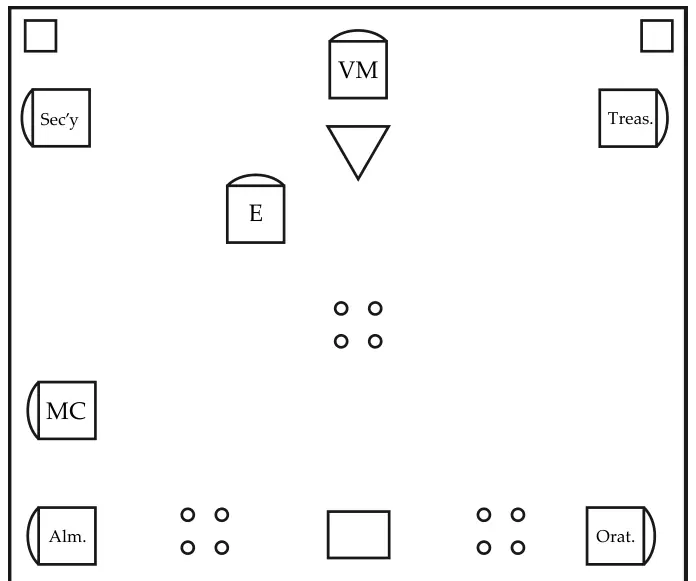
The hangings are green. In each corner of the room is a white column. The lodge is lighted by sixteen lights, four at each of the cardinal points, The altar is covered with a black cloth, strewed with white tears.
OFFICERS, CLOTHING, AND JEWELS.
The master is styled T%.*. Honorable. We represents Adonhiram the Son of Aida, who was at first in command of the workmen on Mount Lebanon, and after the death of Hiram was appointed Chief Architect of
the Temple. He is seated in the East.
There is one Warden, who sits in the West, and represents Zabud, the Son of Nathan, who was Principal
Officer, and the King's friend.
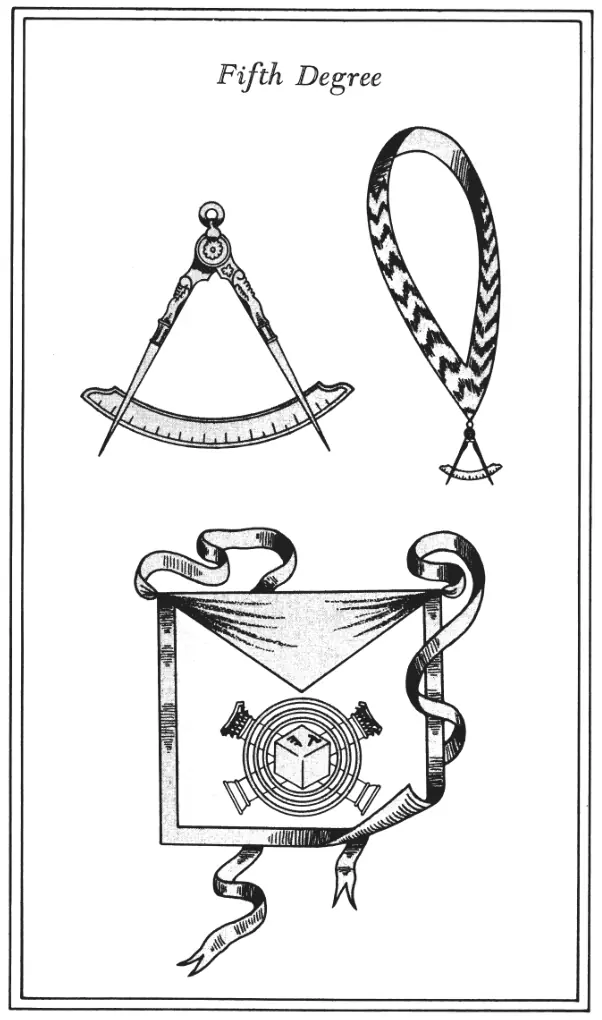
The apron is of white sheepskin, lined and 'bordered with green, and the flap green. In the middle of the apron are painted or embroidered three circles, with a cube in the centre, and in the centre of that the
letters 1°. .
The Jewel.is n compass open to sixty degrees, the points on the are of a circle. It hangs from a wide
green watered ribbon, which is worn from the right shoulder to the left hip.
The batteryis - . [5] [2]
The age of a Perfect Master is the square of [;] or [z].
TO OPEN.
[The 72.°. Hon.*. gives one rap, and says]:
Th.. Hon.". My Brethren, I am about to open a Lodge of Perfect Masters in this place for the despatch
of business. I will thank you to bo clothed and assist me. The officers will repair to their appropriate
stations. Bro.°. Zabud, are all present Perfect Masters? [The Warden goes round and receives the Pass-word from all the Brothers, returns to his station, and
reports]:
Ward... Th. Hon.*. all present prove themselves to be Perfect Masters.
Th.". Hon.*. Bro.*, Jr.*. Deacon, what is the first care of a Lodge of Perfect Masters, when about to open?
Jun. D.. To see @ that the Lodge is duly tyled.
Th.. Hon... You will attend to that duty, and inform the Tyler that wo are about to open this Lodge of Perfect Masters, and direct him to tyle accordingly.
[The Jun.°. Deacon goes out, returns, gives the battery at the door, it is responded to from without, and he returns to his place, and reports] :
Jun. Dw. Th, Hon.*. the Lodge is duly tyled.
Th". Hon.. Wow tyled ?
J.D... By a Perfect Master without the door, armed with a drawn sword.
Th.*. Hon.. His duty there?
Jun.*, D.. To guard the door, and see that none approach and enter, except such os are duly qualified, and have permission of the Th.*. Honorable Master.
Th.*, Hon.*. Thank you, my Brother. Bro.*. Zabud, are you a Perfect Master?
Ward.. I have seen the three circles enclosing the cube, upon the crossed columns.
Th.. Hon. Where were they?
Ward.*. Over the tomb where the body of our Gr.*. Master Hiram Abi was Inid,
Th.°. Hon.*. What do the two columns represent?
Ward.. The columns Jachin and Boaz, which I knew before I obtained the degree of Perfect Master.
Th". Hon. Why did King Solomon institute this degree?
Ward.. To encourage the Brethren in their sorrow; and to cause them to venerate the memory of our Gr.*. Master Hiram Abi; as also to incite them to search for and discover his murderers, who were then
'unknown; but were presumed to be among the workmen; and the roll having been called, suspicion had
fallen upon three in particular, who were missing.
Tk.. Hon.*, What does the Cubical Stone in the centre of the circle represent?
Ward... The finite Universe, the Work of God, of whom the three circles are the emblems.
Th.*. Hon.*. What do the three circles represent?
Ward... The Wisvox, Power and Bexzvotznce of God; the Great Trinity. of his Attributes.
Th, Hon. Where were you received a Perfect Master?
Ward... At the Tomb of our deceased Grand Master, in 2 regular and full | Lodge of Perfect Masters.
Th.°. Hon. How many compose a Lodge of Perfect Masters?
Ward.. Nine or more.
Th.. Hon., When composed of but nine, of whom does it consist?
Ward.. The Th.*. Hon.*. Master, the Hon.*. Warden, the Orator, the Treasurer and Secretary, the Sen. and Jun.*. Deacons and two Brothers.
Th.*. Hon.*. The Jun.*. Deacon's place in the Lodge?
Ward.. In front, to the right, of the Warden in the West.
Th.°. Hon.*, Your duty there, Bro.'. Jun.*. Deacon?
Jun." D.. To receive and.execute the commands of the Hon.°. Warden, and to make known to the Lodge those who, being worthy, need, and therefore are entitled to its assistance. .
Th.°. Hon. The Sen.*. Deacon's place in the Lodge tf
Jun.'. D.. In front, to the right, of the Th.*. Hon., Master.
Th.*. Hon.*. Your duty | there, Bro.*. Sen.*. Deacon?
Sen... D. To receive and execute your commands, and to make known the claims of the widow and orphan.
Th... Hon. The Secretary's place in the Lodge.
Sen. Ds. In the South, Th.*. Hon.°.
Th.*. Hon... Your duty there, Bro.*. Secretary?
Sec'y.".. To receive and record all applications for assistance and charity; to register the proceedings of the Lodge, proper to he written ; and to receive all moneys and pay them over to the Treasurer.
Th.. Hon.*. The Treasurer's place in the Lodge?
Sec. In the North, Th.°. Hon.
Th... Ifon.. Your duty there, Bro.*. Treasurer?
Treas. To receive and account for the moneys and property of the Lodge; and to pay them out, upon proper authority, for purposes of charity or for the good of the Lodge.
Th.. Hon... The Orator's Station in the Lodge?
Treas. On your right, Th.. Hon.
Th.. Hon.*. Your duty there, Bro.-. Orator?
Orat.. To deliver the Lecture of this degree to the Candidate ; to celebrate the memory of our deceased Gr.*. Master ; and to inculcate the practice of the virtues of beneficence, charity and liberality.
Th.. Hon... The on.:. Warden's Station in the Lodge?
Orat... In the West, Th.°. [Hun..
Tk, Hon. Your duty there, Bro.*. Zabud?
Ward.. To honour the memory of all virtuous and zealous Masons; to aid you in the performance of your duties; and to exhibit in my conduct and conversation all the virtues of o Perfect Master.
Th.*. Hon.'. The duties of the Th.*. Hon.*. Master of the Lodge?
Ward.. To preside over the work; to brighten the chain of friendship, expound the ancient traditions of the craft, dispense the charities of the Lodge, maintain its honor and respectability, and labour to advance the interests of Masonry.
Th.. Hon. acknowledge the duty. But man is weak and prone to error, and God alone can give him strength to perform his duties. Let us invoke Its aid.
{All kneel, and the Th.°. Hon.°. reads the following
PRAYER.
- 10 Jehovah, our Lord, Grand Architect of the Universe, who bast created the Heavens, the earth, all living creatures and the Souls of Men ; whose name excels all others on the earth, and Thy glory ie above that of all others in the Heavens! When we consider thy Heavens, created by Thy Thought, the Stars and Worlds whose motion and harmony is ordained by Thee; and their infinity and our littleness; what is man that Thou art mindful of him, or the son of man that Thou concernest Thyself for his welfare? Thou art clothed with Honour and Majesty! Thou coverest Thyself with Light as with garment, and atretchest out the Heavens
like a curtain. Thou layest the beams of Thy Chambers on the Waters, and makes the clouds Thy Chariot, and wackest on the wings of the wind. Thou art the Lord, and there is none else. There is no God besides Thee." Thou formest the Light and craziest Darkness. Thou makes Good and crestest Evil. Thou the Lord most all these things. And yet Thou most regard and protect, as Thou midst frame and make, the smallest thing that lives; and watches over the life and fortunes of the living but invisible atoms that float in the air, and by tens of thousands inhabit the water-drops, and toil in the sea to build up Continents. Therefore wilt Thou be kind and merciful to man, whom Thou hart made, and to whom Thou halt given a living Soul. Preside Thou ovée our Work! -Increase harmony. and disinterested friendship among us, and among all men! Increase everywhere, and spread abroad, the knowledge of the Ancient Truth! Incline us by our charities and the purity 'of our'lives to imitate Thee at an infinite distance from Thee; and aid and strengthen us to perform all the 'duties which Thy Law and our obligations as men and Masons require of us! and to Thee be all Honour, .Praisé and Glory forever: Amen!
<4 Th.*. Hon. Bro.*. Zabud, what is your age as a Mason?
"Ward... The Square of [;], or [z]: perfection of the number of a Master Mason.
_ Wh, Hon. What is the hour?
- -Ward.. Its the first hour of the day.
Th.. Hon.. Since its the first hour of the day, it is time to set the Labourers at work, Give notice, therefore, that this Lodge of Perfect Masters is about to be opened and its labours resumed,
Ward... My brethren, the Lodge of Perfect Masters is now about to be opened, and the labours upon the Temple resumed. You will take duo notice thereof, and govern yourselves accordingly.
Th. Hon.*. "Together, my brethren.
(All g give the sign of admiration. Then the warden raps [; ? J—the Th.*. Hon... the same; and then all
the brethren the same with their hands; and the Th.-. Ion." says] :
Th. Hon.*. This Lodge of Perfect Masters is open.
RECEPTION.
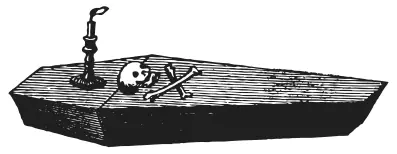
The Preparation-Room is hung with black. There is a small table, covered with black, on which are a skull and cross-bones; and on one side of the Room is a coffin. On the Table are pens, ink and paper. The candidate is dressed in the clothing and jewel of a Secret Master; and received by the Master of Ceremonies; who first examines Sim in the words, signs and token of n Seerct Master; and then asks him:
Of, Her. My Brother, what were the three principles inculcated at your admission to the degree of Secret Master?
{If the candidate is imperfect in the work, he may be instructed, in cases where he is otherwise 2 good mason and so known to be; but if he cannot reply to this question, "Szcrecr, Oneprexce and Fipetrry," he should be immediately sent away ; for if he have forgotten that, he is wholly unfit to advance. This rule is inflexible; and never in any case to be disregarded]. .
{When he answers properly, the M.°. of Car.*. directs him to be seated at the Table, and handing him a printed paper, containing what is stated hereafter, gays to him]:
AL. Her", Since you desire now to advance to the degree of Perfect Master, and are prepared to be in all proper respects secret, obedient and faithful, read this paper which I lay before you. Read it slowly and carefully, and reflect upon it well, Then, upon another paper, answer in writing the questions as they are numbered, and sign the obligation, and draw up and'sign the instrument required :
THE PAPER.
" Neophyte, desiring to advance, be patient, thoughtful and deliberate!
" Read carefully and ponder well what follows; and answer truly and siaccrely, remembering that the aye . of Him who made you is upon you, and sees your thoughts and knows the Secrets of your Heart,
"If after reading, you are not disposed to answer, you are free to retire.
"If you decide to answer, then approach the Temple with respect, with calmness, with a desire to learn,
with the courage and presence of mind necessary to undergo the tests that may be required of youl Read
now, and write; or depart!
"1°... Are you living in the commission of any crime against the laws of God or man, or any offence
against those of propriety and decency, which you are conscious, if known, ought to, and would, prevent us
from receiving you in this Degree?
"2°... Inge you done any grave wrong to any person whatever, which remains unrepented of, and
for which you have not made reparation to the utmost of your power?
"3°... You believe in a First Great Cause, Author and Preserver of the universe and of yourself.
Therefore you have duties to perform towards Him. What are those duties?
* «4°... All men, made by one God, are brothers. What are your duties towards your fellow-men? "5°... Man, composed of a body and a soul, has duties of two kinds to perform towards himself. What
are those duties ?
PERSONAL OBLIGATION.
"Conscious that the Eye of. the Grand Architect of the Universe is upon me, I do premise to Him and to those who shall receive me here, that I will strenuously endeavor to perform the duties which I have now acknowledged do devolve upon me; and be governed by their dictates in the world and in the Lodge, as @ good and faithful Mason; actuated by benevolence and fraternal feeling, and complying with all my obligations as a Mason, heretofore, now, or hereafter assumed; and I will never reveal or make known the mode of my admission into this degree, even if I should retire without completely receiving it. So help me God!
Signed at
The day of A.D. 18
"Write now your last will and testament; as if in five minutes you were about to engage in battle, leading the forlorn hope to storm a breach, with the almost absolute certainty of falling in the assault."
[When the Candidate has concluded, the M.*. Her.*. takes the paper containing his responses and what he has written, and says to him]:
Af. C. Remain here a time in patience, until what you have answered and written is submitted to the Th.. Hon.*. and the Brethren, and their judgment had thereon ; when I will return to you.
[The M.*. Her.*. then enters the Lodge, leaving him alone, Ie hands the paper to the Master, who reads it to the Brethren. If be regards the answers ay unsatisfactory, he so declares, and directs the Candidate shall be dismissed. If he considers them sufficient, he puts the question to the Brethren, thus] :
The.*. Hon.". Brethren, you have heard the responses, the obligation and the last will and testament of the candidate. Are you satisfied with them, and do you consent that he shall be admitted? Those of you who ore so, will give the affirmative sign.
[It is given by raising the right arm perpendicularly above the head.]
Th.. Hon.". Those who are not satisfied or who do not consent, will give the negative sign.
[It is given by extending the right arm in front, hand open and palm outwards; as if repelling a person.]
Th... Hon. Bro.-. Zabud, do any answer in the negative ?
(If there is any negative, the Candidate is dismissed. If none, the Th.'. Ton.°. says] :
Th.. Hon.. Bro. M.. of Car.*., the Brethren consent-that the Candidate shall be admitted. The Secretary will file his responses, his obligation and his testament; and being properly prepared, he may be allowed to enter.
[The Master of Ceremonies goes out, and says to the Candidate]:
Bf:. Cers. The Th.*. Honorable Master, the Warden and the Brethren are satisfied with your responses, your obligation and your testament. They are deposited in the Archives of the Lodge, for a testimony during all time. Our Lodge is now sorrowful and in mourning; for it is the anniversary of the final burial of our Gr.*. Master Hiram Abi; and while we mourn fur him, we mourn also for that darkness and death of pain and evil and sorrow, into which man bath fallen, and of which his death is to usa most expressive symbol. Reflect upon their sad condition, and let feelings of pity and commiseration fur sinful, suffering bamanity fill your heart; and in that spirit prepare to receive this degree, .
_ [The M.*. of Car.. then divests him of his Masonic clothing, and puts on him a robe of white linen, and slippers upon his feet, and a green silk cord around his neck, and blindfolds him. Then, with the end of the cord in one hand and a drawn sword in the other, he leads him into the Lodge, and makes the Circuit thereof five times, while the Master and Warden read alternately as follows]:
M:, ... Ist Cire. . If ye will indeed obey my voice, and keep my covenant, then ve shall be a peculiar treasure unto mo above all people: for all the Earth is mine: and ye shall be unto me a Kingdom of Priests, and an Holy Nation.
But.» . 2d Cire. . Ye shall do my judgments, and keep my ordinances, to walk therein: I am the
wo
Lord your God: ye shall therefore keep my statutes and my judgments, which if a°man do, be shall live in them. .
Sanctify yourselves, and be holy, that ye may be my people; fur I nm holy. ; .
MM... 3d Cire... If ye walk in my statutes, and keep my commandments, and do them, then I will give you rain in due season, and the land shall yield her increase, and the trees of the field shall yield their fruit; and your threshing shall reach unto the vintage, and your vintage shall reach unto the sowing time, and ye shall eat your bread to the full, and dwell on your land safely: and I will give peace in the lund, and. ye shall lie down, and none shall make you afraid: and I will rid evil beasts out of the land; neither shall the sword go through your land: I will have respect unto you, and make you fruitful, and multiply you, and establish my covenant with you; and ye shall est old store, and give away the old, because of the abundance of the new: and I will set my tabernacle among you, and be not angry with you, and will be with you and be your God, and ye shall be my people. .
We... 4th Cire... Thou shalt love the Lord thy Ged with all thine heart, and with all thy soul, and with all thy might: and these words which I command thee this day shall be in thy heart; and thou shalt teach them diligently unto thy children, and shalt talk of them when thou fittest in thy house, and when thou wackest by the way, and when thou lest down, and when thou risest up: and thou shalt bind them for a sign upon thy hand, and they shall be as frontlets between thine eyes: and thou shalt write them upon the posts of thy house, and on thy gates,
Thou shalt fear the Lord thy God, and shalt serve him, and swear by his name.
If... 5th Cire... Aaa man chasteneth his Son, the Lord thy God chasteneth thee. Ye shalldiligently keep his commandments, his testimonies and his statutes. Beware lest ye forget or tempt Him; but do that which is right and good in His sight, and fear him, and observe all his commandments.
(At the end of the 5th Circuit, the M.-. of Her.-. and Candidate halt in front of the Warden, who asks]
Ward... Whom bring you here with you, Bro.-. M.*. of Her.*., in darkness and in bondage?
Af. Her. Brows A... B.... a worthy Secret Master, who has thus fur trodden the path that leads to light, and desires to press further onward, by being admitted to the degree of Perfect Master.
Wurd.. "Is this he whose answers, obligation and testament have lately been deposited in our archives?
M.. Her. Ibis. .
Ward... Does he know the lessons that are inculcated in this degree?
Af-. C.. Me does not; but hating learned secrecy, obedience and fidelity, as a Secret Master, he has come here to lenrn the duties that we practise.
Ward... Pass on, then, to the East, and Jet him make known his desire to the Th.*. Hon.*. Master.
[They pass on to the East, and halt in front of the Th.°. Hon... who asks the same questions, receives the same answers, and says]:
Th.*, Hon.*. Is not this he, who, to become a Master Mason, represented our deceased Grand Master Hiram Abi?
At. Her. It is,
Th.. Hon. To day we keep in sorrow the anniversary of his funeral and final burial. Through the
frowning gates of death lies the way to eternal life. Let him again assume the character of our Grand Master ; 'and return to the state from which he arose to be a Master.
[The candidate is again conducted to the preparation room and placed in the coffin; which is then lifted up and carried into the lodge, and set in the middle of the room; when the following ceremonies take
place] :
FUNERAL CEREMONIES.
The Th.*. Lion.'. gives one loud rap with his gavel, which is answered by the Warden; and says :
Th. Hon. All the world is a storm; and men rise up in their several generations, like bubbles descending from God and the dew of heaven, from's tear and a drop of rain, from Nature and Providence; and some of these instantly sink into the deluge of their first parent, and are hidden in a sheet of water, having bad po
other business in the world, but to be born, that they might be able to die; others float up and down two or three turns, and suddenly disappear, and give their place to others: and they that live longest upon the face of the waters, are in perpetual motion, restless and uneasy, and being crushed with the great drop of a cloud sink into the flat level of dead humanity.
All the succession of time, all the chan ges in nature, all the varieties of Light and Darkness, the thousand thousands of accidents in the world, and every contingency to every man, and to every creature, doth preach - our funeral sermon; and calls us to look and sea how Time ever digs the grave where we must lay our sins or our sorrows; and our mortal bodies moulder away and again become in atoms a portion of the great material world. Every revolution which the earth makes around the sun, divides between life and death; and death possesses both those portions by the next morrow; and we are dead to all those months which we have already lived, and we shall never live them over again; and still God makes little periods of our age. ,
Every day's necessity calls fur a reparation of that portion which death fed on all night, when we lay in his lap, and slept in his outer chambers. While we think a thought, wa die; and the clock strikes, and reckons on our portion of eternity. We form our words with the breath of our nostrils : we have the less to live upon four every word we speak.
Death reigns in all the portions of our time. The autumn with its fruits provides disorders for us; and the winter's cold turns them into sharp diseases; and the spring brings flowers to strew our hearse; and the summer gives green turf and brambles to bind upon our graves. Fevers and surfeit, cold and agnes, ara the four quarters of the year, and all minister to death; and you can go no whither, but you tread upon a dead man's bones.
Death meets us everywhere; and is procured by every instrument, and in all chances, and enters in at many doors; by violence and secret influence, by a heat or a cold, by the sharp tooth of an unregarded serpent, the shying of an unruly horse at the sudden flutter of a garment; by stumbling at o loose stone lying in the way, by the scratch of an envenomed lancet, by a little spark of fire upon a swift boat that of a dark night
" descends a deep broad river; all are the instruments of death, and overtake us with a sudden fate. And all
this is the law and constitution of Nature, the unalterable event of Providence, and the decree of Heaven.
. The chains that confine us to this condition are strong as Destiny, and immutable as the eternal laws of God.
Death is the portion of every man and every woman; the heritage of worms and serpents, of rottenness
"and cold dishonour. This day is mine and yours; but we know not what shall be on the morrow; and every
'morning creeps out of a dark cloud, leaving behind it an ignorance and silence deep as midnight, and
undiscerned as are the phantasms that make an infant smile; so that we cannot discern what comes
hereafter.
Even our joys are troublesome; and the fear of losing them takes away the present pleasure. They are brief and fleeting as the remembrance of a traveller that stayeth but night. They arise from vanity, and. they dwell upon ice, and they converse with the wind, and they have the wings of a bird, and are serious but as the resolutions of « child, and end in vanity and forgetfulness. Man is ever restless and uneasy. He dwells upon the waters, and leans upon thorns, and lays his head upon a sharp stone.
< The sndnesses of life help to sweeten the bitter cup of death. For It our life be never so long, if our
'strength were great as that of the Titans, and our sinews strong as the corsage at the foot of 'an oak, yet still
'the period shall be, that all this shall end in death, and the people shall talk of us awhile, good or bad, recording as'we deserve or as they please; and once it shall come to pass, that concerning every one of 'us, i¢ shall be told in the neighbourhood that we are dead.
3 Such, my Brethren, are the uncertainty and vanity of Life. And if we could, from one of the battlements of Heaven espy how many men and women at this moment lie fainting and dying for want of bread; how many young men are hewn down by the sword of war; how many poor orphans are now weeping over the
graves of their fathers, by whose life they were enabled to eat; if we could but hear how many mariners and passengers are at this moment in a storm, and shriek out because their keel dashes against a rock, or their foundering vessel far out at sea shudders as she sinks down into the ocean; how many people there are that 'weep with want, or are mad with oppression, or are desperate by too quick a sense of a constant infelicity;
we should rejoice to be beyond the noise and participation of so many evils.
Let us therefore, my Brethren, imitate the example of our illustrious Gr.:. Master Hiram Abi; and by a wise and virtuous life make the best preparation for a peaceable death. Let us remember that God gives us our time, not as Nature gives ua rivers, but drop by drop, minute after minute, so that we never can have two minutes together; but lie takes away one, when he gives us another. * This should teach us to value our time; since God so values it, and by this so small distribution of it, tells us its the most precious thing we have. -Ile that would die well and happily, must lead an upright life, under the conduct of prudence and observation; a life of warfare and sober counsels, labour and watchfulness. No one of us wants cause of tears and a daily sorrow. Let each of us consider in what be fails, and acknowledge his misery; It us confess our sins and chastise them; let us bear our crosses patiently and our persecutions nobly, and our repentance willingly and constantly; let us pity the evils of all the world, and bear our share of the calamities of our brother; let us ever keep our house in order that we may be fit to die; remembering that our errors and our offences are numerous and increasing, like the families of the northern people, or the genealogies of the first Patriarchs of the World; and that the computations of a man's life are busy as the tables of sines and tangents, and intricate as the accounts of eastern merchants. Let us therefore keep constant account of our actions, and thus restrain the inundation of evils; and as every night we must make our bed the memorial of our grave, so let our evening thoughts be an image of the judgment of Him who made us. Let us not covet many things greedily, nor snatch at high things ambitiously, nor despise our neighbour proudly, nor bear our crosses peevishly, nor our prosperity impotently and passionately, nor be prodigal of our precious time, nor tenacious and retentive of evil purposes.
My Brethren, we have been taught, as Masons, that we should implore the assistance of God, in every great and important undertaking. Let us ask is did to enable us to live well and to did in peace, that our
memories may be respected among men and Masons.
[The Brethren all kneel; and the Th.-. Ion... recites the following]
PRAYER.
O Almighty and Eternal God, and Great Architect of the Universe! there is no number of Thy days or of Thy mercies: Thou host sent us into this world to serve Thee, and to live according to Thy laws; but we wander far from Thee into the paths of error, and hare planted thorns and sorrows round about our dwellings.
: Our life is but a span in length, and yet very tedious, because of the calamities that enclose us on every side ; the days of our pilgrimage are few and evil, our bodies frail, our passions violent and distempered, our understandings weak and our wills perverse. Look Thou upon us, oh our Father, in mercy and pity! let not our weaknesses make us sin against Thee, nor our fear cause us to betray our duty, nor the calamities of this world vex us into impatience! Let not temptation be too strong for us, nor our feet stray too far from the right path! We adore Thy Majesty, and submit to Thy Prudence, and revere Thy justice, and trust like little children to Thine Infinite Mercies, when Thou most please to deliver one among us out of the miseries of this world. Thy counsels are secret and Thy wisdom Infinite, and we do not presume to murmur at Thy Dispensations, nor repine at the sufferings with which Thou dolt afflict us for our good. Give us patience, oh our Father, and resolution to live well, and firmness to resist evil, and faith and confidence in Thee and in Thy Wisdom and Benevolence; and enable us so to lire, that when we come to die, we may lie down in the grave like one who composes himself to sleep, and that we may be worthy to be afterwards remembered in the memories of men! Amen!
All: .. So mote it be!
[Then the organ plays, and the Brothers sing the following lines]:
Ob, weep not, mourn not o'er this bier!
On such death none should look with fear;
Ile died as dies a brave, true man;
And with his death, true life began.
Coffin and grave we deck with care;
Ills body reverently we bear;
Tt is not dead ; but rests in God;
Softly to sleep beneath the sod.
Cod breathed into this house of clay
The Spirit that hath passed any ;
Ile gave the true courageous mind,
The noble heart, strong, calm and kind.
Our brave Grand Master, who preferred
Death to the utterance of a word;
Shall to the Mason ever bo
The type of true fidelity.
{An alarm is now given at the door; and the Jun.*. Deacon says: "Th.*. Ion.-., the M.-, Ill. Kings, Solomon and Hiram, our Grand Masters, approach this sacred place, to unite with us in performing the last honours to our deceased Gr.. Master, their lamented Brother."]
Th.. Hon.. [Rapping]: Arise, my Brethren, and receive our M.*. Ill. G.*. Masters in silence.
[Two brothers come forward, representing King Solomon and Hiram King of Tyre; and the former says]:
X.. Sol... My Brethren, when we have received the last breath of our friend, and closed his eyes and composed his body fur the grave, then seasonable is the counsel of the Son of Mirach: '" Weep bitterly and make great monn, and use lamentation, as he is worthy; and that a day or two; lest thou be evil spoken of; and then comfort thyself for thy heaviness. But take no grief to heart, for there is no turning again; thou shalt not do him good, but hurt thyself" Solemn and appointed mournings ara good expressions of our affection for the departed soul, and of his worth and our value of him; and it hath its praise in nature, and in manners, and in public customs. Something is to be given to custom, something to fame, to nature and to civilities, and to the honour of our deceased friends; for that man is esteemed to die miserable, for whom no friend or relative sheds a tear, or pays a solemn sigh.
. When thou host wept a while; compose the body to burial: which that it be done gravely, decently and .charitably, we have the example 'of all nations to engage ua, and of all ages of the world to warrant; 20 that it is against honesty, and public fame and reputation, not to do this office.
Place therefore on the coffin of our brother the square, the compass, the gavel and the rule; emblems of the virtues and authority of our Grand Master, Hiram Abi; and let him who wears the jewels of that distinguished and murdered Mason, remember henceforward and forever, that he can commit no graver offence against the laws of Masonry and honour, than to degrade them by any act which that illustrious martyr would scorn or be ashamed to do.
[The square, compass, gavel and rule are laid upon the coffin by four different brothers, each advancing separately" and depositing one of them.]
K.. Sol, Place now upon the coffin the apron, collar and jewel of a Perfect Master; ond'let him who shall hereafter wear them, be careful that he wear them worthily; lest Masonic justice pluck them from him if he disgrace them by sloth or baseness; as the spurs were in former times hacked from the heels of him who proved false gentleman and disloyal knight.
It is ao grent act of piety, and honorable, to inter our friends and relatives according to the proportions of their condition; and so to give evidence that we appreciate and desire to imitate their virtues, For so Jacob was buried with great solemnity, and Joseph's bones were carried unto Canaan, after they had been embalmed and kept four hundred years. Those that die should not be commended at a price, nor the measure of their legacy be the degree of their virtue; lest to want 1 monument should best preserve the memories of the great and good, while the succeeding ages should by their instances remember the changes
of the world, and the dishonours of death, and the equality of the dead. The reward of the greatest virtue should be preserved like laurels and coronets, to incite and encourage-to the noblest things.
- Let us also right the causes of the dead, and assert their honour. For certainly it is the noblest thing in the world, to do an act of kindness to him whom we shall never see, and yet who hath deserved it of us; and unless we do so, our charity is mercenary, and our friendships are mere merchandise ; but what we do to the dead, or to the living for their sakes, is gratitude, and virtue for virtue's sake, and the noblest portion of. humanity. Let us do our duty to the dead, lest peradventure they should perceive our neglect, and be witnesses of our transient affections and forgetfulness.
It remains, my Brethren, that we who are alive should so live, 'and 80 perform our duties, and play our parts upon this stage of life, that we neither be surprised by death, nor leave our duties uaporformed, nor our sins uncancelled, nor our persons unreconciled, nor God unapponsed.
K.-. Sol. Bro.-. M.°. of Ceremonies, distribute to our brethren the mysterious branches, symbols of immortality.
_ [The M.-. of Her.. gives to each brother a branch of Acacia. Then K.°. Sol.*. says]:
* Ku. Sol. Brothers Adonhiram and Zabud, invite the brethren in the North, South, East and West to assemble and aid us in depositing the body of our Gr.. Master Hiram Abi in the tomb; and in performing our pious pilgrimage around it~
Ward.. Brethren in the North, South, East and West, its the desire of the Wise and Powerful King Solomon our Gr.*, Master that you assemble together and aid him and our Gr.*. Master the King of Tyre in depositing the body of our Gr.-. Master Hiram Abi in the Tomb, and performing our pious pilgrimage around it.
Th.. Hon.*. Brethren in the East, its the desire, &c.
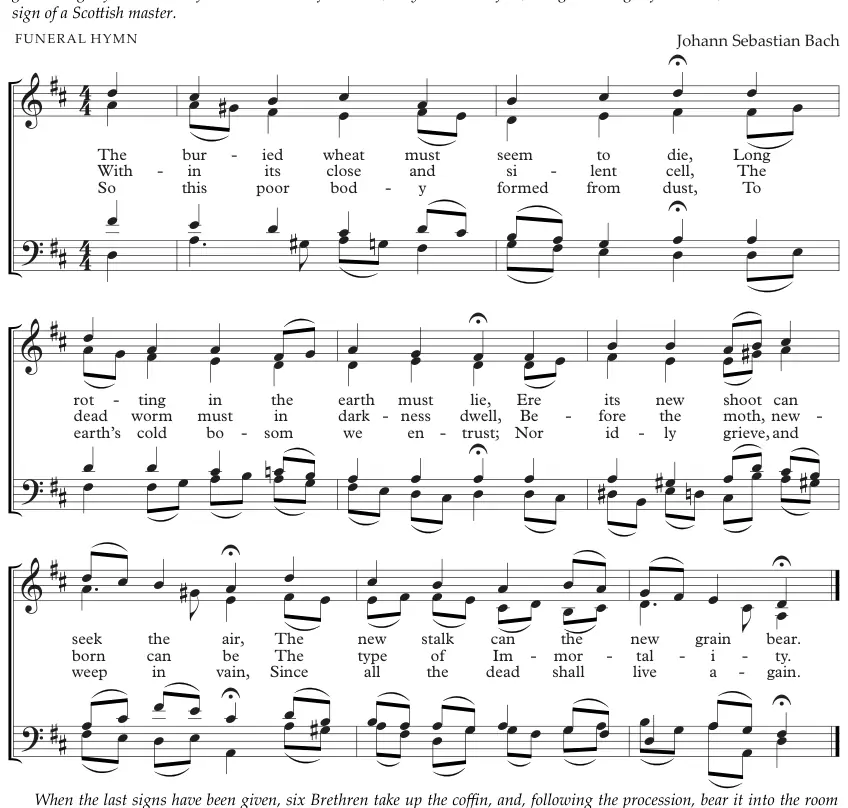
(The Th.*. Hon.*. raps thrice; and the Brethren all assemble and form in procession. The coffin is taken up, and borne three times around the Lodge, while the organ plays, and the following hymn is sung:
The buried grain of wheat must die,
. Withered and worthless long must lie,
Before its soft shoot seeks the air,
Its new stalk the new grain can benr.
Eren so this body made of dust
To earth we once again entrust;
And painless i¢ shall slumber here,
Until the appointed Time appear.
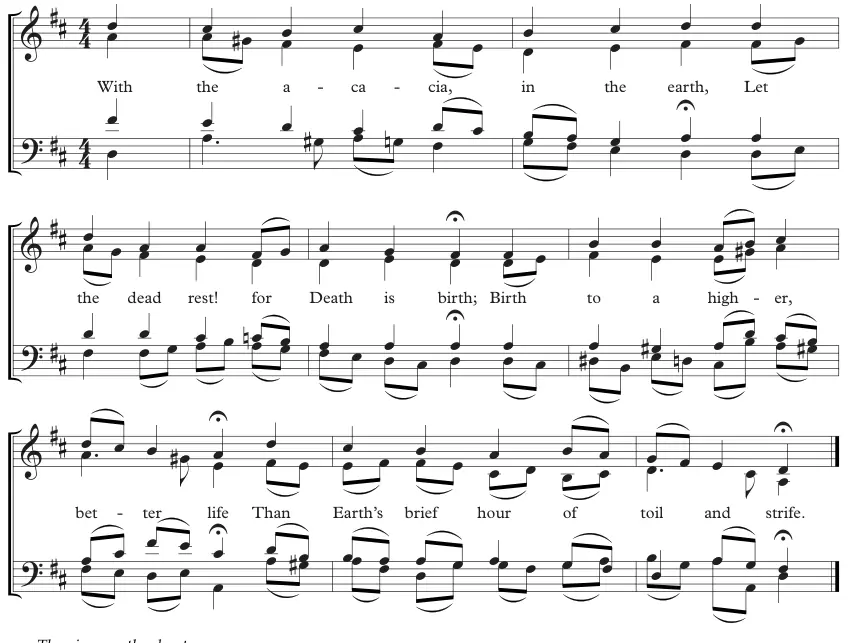
[The coffin is then deposited in the monument, and the fullowing vorse is sung:
Now it is hidden from our eyes,
Till God shall bid it wake and rise;
Who never the creature will forget,
On whom his image Ile hath sct.
(Then the Th.*. Iron.°. gives three raps, and K.°. Sol.', says:
X.*, Sol. Thas Masonry honours the memory of the virtuous and good. Jt mourns their loss, but con-
soles itself with the reflection that the Souls of the Great Dead are immortal, and that their influences live beyond the grave. Death is dreadful to the man whose all is extinguished with his life ; but not to him whose
glory and whose influences enn never did.
These [odours, and the general regard of Posterity, and to follow their illustrious and excellent examples,
V...i
are the fit rewards of those who hare deserved well of their Order, their Country and the World. Not to gratify or please the dead, whose souls are lifted far above such honours, but to du that which it is eminently fit and becoming fur ourselves tu do, we perform these ceremonies.
A desire fur our name to be perpetuated to after times, by monuments erected by public gratitude, in memory of noble deeds, is a worthy spring of action everywhere, and most of all in a Republic. Is an inducement to great deeds: and a monument to the memory of a grentand good man js an Orator in bronze or marble, teaching glorious lessons to after generations; the silent but impressive evidence of his immortal influence ; and itself exercising an influence nut often inconsiderable upon men's actions, their country's welfare and the world's destiny, The record of nuble actions and heroic devotion is more fitly written on the enduring marble or the pyramid of granite, than on the paper pages of a destructible book. The marble or the granite is itself
. book, like those on which the Hicrophants of Egypt cut in hieroglyphics the history of the Ancient Ages.
_Sach monuments regard not alone those to whom they are erected. JIow noble an office do they not fulfil in making known to future ages that People or Fraternity had loftiness of soul enough to appreciate, honour and glorify great deeds! | They are the best evidence of the virtues of those who erect them; silent exporters to lofty actions, perpetual Teachers of the finest lessons of virtue and patriotism!
It does not become any one to set little value on the general opinion of his own time, or on the final judgment of posterity. That the desire for fame and reputation is universal and instinctive, proves that it is laudable and proper; for it is a Force and Power; one of those Laws of God which Ile has been pleased to enact, as part of the great laws of Harmony and Attraction by which He rules the Universe.
But as that judgment and that opinion are not infallible; as the World and Posterity may condemn the
good, the wise, the disinterested, and deere honours to the bad, the ignorant and the base; to gain that judgment of approval must not be the only or even the chief motive of a Mason's action. For Duty is the great Law that governs him; to be obeyed, no matter with what result; and his conscience the true judge, from whose judgment there is no appeal except to God. .
_. Ifyou would fain direct your regards on high, and aspire to an eternal happiness hereafter, you neither will regard the rumours of the vulgar, nor will you rest your hopes and your interest on human rewards. Virtue herself must attract you by her own charms to true glory. What others may any of you, as they will talk, ao let themselves consider. For all that is so said is confined to the narrow limits of these regions that you see. None respecting any man was ever eternal. It is extinguished by the death of the individual, or perishes altogether in the oblivion of posterity.
The swan that wings her way to the lofty heights of heaven, inquires not whether the shadow of her wings falls on the sordid earth below. The monuments which we erect in-human memories, are transient as the delicate tracery of frost-work woven from leaf to leaf, of a morning in the spring. Time, like o river, carries them all away with a rapid course; they swim above the stream for a while, but are quickly swallowed up and seen no more. The marbles that men rear to perpetuate their names, are consumed by time and silently moulder away, and proclaim their own mortality while they testify to ours. But the enjoyments of the immortal soul in that future existence promised us by God will be superior to decay, and endless jn duration. They will be ever full, fresh and entire, like the stars and orbs above, which shine with the same
undiminished lustre, and more with the same unwearied motion with which they did from the first date of their creation. Nay, the joys of heaven will abide when these lights of heaven will be put out, and when . sun and moon and nature itself shall be discharged their stations, and be employed by Providence no more, The good Mason shall then appear in his full glory; and fixed in the Divine presence, enjoy one perpetual and everlasting day; a day commensurate to the unlimited Eternity of God Himself, the Great Sun of Righteousness, who is always rising, and never sets.
The world is filled with the voices of the dead. They speak, not from the public records of the grent world, only, but from the private history of our own experience. They speak to us in a thousand remembrances, incidents, events, associations. They speak to us, not only from the silent graves, but from the throng of life. They are invisible, and yet life is filled with their presence. They are with us by the silent fireside, and in the secluded chamber; in the paths of society, and in the crowded assemblies of men. They speak to us from the lonely wayside; and from the venerable walls that echo to the steps of a multitude and to the
voice of prayer. Go where we will, the dead are with us always. We lire and converse with those who once lived and conversed with us. Their well-remembered voices mingle with the whispering breeze, with the sound of the falling leaf, with the songs and melodies uf spring. The earth is filled with their shadowy train. Everywhere are leaves from the long scroll of time, borne on the breath of ages, invested with the attributes of universality and eternity ; a heritage, from family to family, among all the dwellings of the world.
The world is filled with the labours and works of the dead. Almost all its literature, the discoveries of science, the glories of art, the ever-enduring temples, the dwelling-places of generations, the comforts and improvements of life, the languages, the maxims, the opinions of the living, the very frame-work of Society, the institutions of nations, the fabrics of Empires,—all are the works of the dead; and by them, they who are dead yot spenk. The small Province of Life is little, compared with the vast Empire of Death. It is a moment in the centre of Eternity; a point in the centre of Immensity; a breath of existence amidst the ages and regions of the Everlasting. The dead live in our thoughts, in our blessings, and in our very life.
The world would be but an ordinary and indifferent place, if it contained nothing but the workmanship, the handicraft, the devices of living men. We love to see dwellings which speak to us of other things than earthly convenience or fleeting pleasure; which speak to us the holy recollections of lives that were passed in them, and have passed away from them. We love to see temples, in which successive generations of men have prayed; ruins, on whose mighty walls is inscribed the touching story of joy and sorrow, love, heroism, patience, which lived there, and there breathed their first hope and their last sigh, ages ago; scenes which offer more to our eye than fair landscape and living stream; telling us of inspired genius, glorious fortitude, martyred faith, that studied there, suffered there, died there. We would fain behold the Earth as more than mere soil and scenery: wo would behold it, as written over with histories' as a sublime page, on which are inscribed the lives of men and empires. ;
And now, my Brethren, in presence of this emblem of our sorrow and our regret; under these funereal arches, dumb witnesses of our religious homage; before these symbols of the nothingness of our own nature and the immensity of God, let every selfish and hateful thought be banished. Take now with me, my brethren, the oath of forgetfulness of all wrongs and injuries that may have been inflicted upon us. May Pence and Concord dwell evermore among us! May we and all Masons be no more divided by vain and empty disputes ~and- quarrels! May we henceforward be inspired by on ardent devotion to the interests of our country, of 'Masonry and of mankind! And may we ever recollect, and be at all times governed and guided by, that 'precept which is the corner stone of Masonry, do unto others whatever you would wish that they should do unto you. My Brethren, join me in the solemn row |
All. ... We do so You aND PROMISE.
K.. Sol... Heaven hears and the angels record the vow. And now, my brethren, in token of our belief
in the soul's immortality, and of that resurrection to a new life fur which we all confidently hope, you will raise our brother from that coffin which represents the earthly prison that confines the soul, and all the impediments of sin and error that environs it here below; and place him at the Holy Altar, that he may be there made a Perfect Master. .
(The Master of Ceremonies, assisted by a sufficient number of brethren, raises the Candidate from the coffin, uncovers his eyed, and relieves him from the cord around his neck. IIo is then led to the Altar; and directed to kneel on both knees, and place both hands on the Holy Bible, interlacing the fingers. An arch of steel is formed over him, and the points of three swords, held by three brothers, converging to one point are pressed against his bosom. In this position he repeats the following obligation] : .
OBLIGATION.
I,A.... B.... in the presence of the Gr.°. Architect of the Universe and of this Right Worshipful Lodge of Perfect Masters, do hereby and hereon most solemnly and sincerely promise and vow, that I will never reveal or make known, intentionally or by indiscretion,-any of the secrets of this degree of Perfect Master, to any person in the known world, except to one who may be legally authorized to receive, when I am legally authorized to communicate, them.
I furthermore promise and swear that I will at all times hereafter remember, and endeavour to practice, that which befits the character of a Perfect Master; and especially that I will be honest in my contracts, sincere in affirming, frank and straight-forward in bargaining, and faithful in performing, with all men; that I will pretend not what is false, nor cover what is true, nor 'lie either in a little thing ora great, neither in the substance nor in the circumstance, nor in word nor deed; but the measure of my affirmation or denial shall be the understanding of the person with whom [ contract; and that I will religiously keep all my promises and covenants, though made to my disadvantage, and though afterward IT perceive I might have done better; nor shall anything make me break my promise, unless to perform i€ be unlawful or impossible; or unless it have been unlawfully, or by force or fraud, obtained from me. -
Alt of which Do most solemnly and sincerely promise and vow, binding myself under the penalty of being despised by all mankind while living, and after my death; and buried in an undistinguished grave, with none to shed a tear over me or to lament that I am dead; in case I wilfully violate this my solemn obligation of a Perfect Master.
[The Th.:. Hon.*. then raises the candidate, and says to him, relieving him of the white robe]:
Th.". Hons. As you have been already relieved of the cord which was around your neck, symbol of the enthralment of vice and indulgence, so now I relieve you of this robe, symbol of your novitiate; which having passed, I Uo, by the authority in me vested, raise you to the rank and dignity of Perfect Master: and I do now invest you with this collar, apron and jewel; which, as they Iny upon your heart when you represented our excellent and illustrious Gr,°, Master in his coffin, you will now and forever wear as the representative of him living; making him ever your model, and deeming yourself bound to strive to equal his virtues, as you wear his clothing and his jewel; that your memory may deserve such honours as have to day been rendered unto his.
. Receive now the signs, token and words of a Perfect Master.
Is Sicw . . . Of Admiration .. . Raise both ©tgse and Ch Cz towards Heaven; and then n let the
former fall crosswise on the mC {th ; and drop the latter on the ground.
2p Stan ... Of Recognition ... Each advances his may yy, until the points meet, and the right
Gor C Can come together. -Then each places his ¢ & ©or upon his &EC OY.
Toxen: ... Take each other with the ssQa7°( tax grip; and at the same time each place the ¢&Q:21 bebind the tu&¥ 4 tract of the other, and press it ! times, with the ! first fingers closed ; saying, by syllables alternately, 5Q)..&@.°."_ Can.*. 2.*. 'Then clench the ! fingers of the two ¢ hands together, closing them, not interlaced, raising the °&$ sm 2: and putting them together at the points, so as to form a triangle.
Pass Worn: ....-Olaf 20.
Sacred Worn: ... 8C*O..
The Candidate is then seated ; and receives the following History and Lecture:
HISTORY AND LECTURE.
King Solomon, having learned that the body of Hiram had been found, and deposited in the Western part of the unfinished Temple, and being greatly rejoiced that the precious remains of his Brother the 'Artificer were found, immediately ordered Adonhiram, who was afterwards appointed Chief Architect and Inspector of the works in his stead, to prepare a funeral that should correspond with the eminent virtues of the deceased. And that the recollection of his sad fate might be more. vividly remembered, and the general indignation
V...i
against his murderers not be diminished, he directed that the stains made by his blood upon the floor of the Temple should not be washed out, until they should be apprehended and punished for their awful crime. °
All the workmen upon the Temple, on Mount Libanus and in the quarries, were ordered to be present 'at the funeral ceremonies. In nine days Adonhiram completed a superb mausoleum to the memory of the Gr.*. Master, destined to receive his body; a tomb of white marble, surmounted by a triangular obelisk of the black marble of Egypt, upon which was o great urn of the same, pierced with o sword.' On the urn was nerved % branch of acacia, and on its base, in Hebrew, the letters 0.". 3.". [M. P.".] In this urn was to be deposited his heart, which had for that purpose been embalmed.
This monument was erected in the Western part of the Temple, rather to the North; marking the spot where the murderers first deposited the body, after they committed the great crime. It being determined not to perform the funeral ceremonies until the monument was completed, the body was embalmed, placed in a coffin, and kept in an apartment of the Temple where it had been the habit of the Gr.*, Masters to hold their Lodge-Meetings, and communicate the Mysteries of Masonry.
_ Three days after the monument was completed, the remains of the murdered Gr.. Master ware deposited there by King Solomon, assisted by Adonhiram the Son of Aida, Zabud the Son of Nathan, who was over his Household, and all his Nobles, Princes and Captains, and all the workmen, with Hiram, King of Tyre, who had come from his own country to he present at the imposing ceremony.
Annually afterwards, the anniversary of this funeral was religiously observed, and on each such occasion some Brother represented the deceased, and was thereafter called a Perfect Master; because he was thenceforward considered to be, in his character and conduct, a representative of Hiram Abi, whose place he had occupied in the coffin, and worn his clothing and his jewel.
And, still further to perpetuate the memory of the murder of Hiram Abi, a representation of his murder was thereafter substituted in the Master Mason's degree, in place of the ceremonies brought by Moses from Egypt, and of those practised in Phoenicia; all of them emblems of one great truth and leading idea, common to all the ancient nations, and hereafter to be at the proper time unfolded to you.
Our Grand Master Hiram Abi, my Brother, was an industrious and an honest man, What he was
employed to do, he did diligently, and be did it well and faithfully. Industry and honesty are the virtues peculiarly inculcated in this degree. They are common and homely virtues, but not fur that. beneath our notice. The bees love not drones, nor Masons the idle and the lazy; for those who are so, are liable to become dissipated and vicious: and perfect honesty, which ought to be the common qualification of all, is more rarely met with than diamonds. To do earnestly and steadily, and to do faithfully and honestly, that which we have to do:—perhaps this wants but little, when looked at from every point of view, of including the whole body of the moral law: and these virtues belong to the character of a Perfect Master, even in their homeliest and commonest applications. .
Idleness is the burial of a living man. Foran idle person is so useless to any purposes of God and man, that he is like one that is dead, unconcerned in the changes and necessities of the world; and he only lives to spend his time, and ent the fruits of the earth. Like a vermin or'a wolf, when his time comes, he dics and perishes, and in the mean time does no good. Ie neither ploughs nor carries burthens: all that he does is either unprofitable or mischievous. .
It is a vast work that any man may do, if he never be idle: and it is a huge way 'that a man may go in virtue, if he never goes out of his way by a vicious habit or a great crime: and be that perpetually reads good books, if his parts be answerable, will have a huge stock of knowledge.
St. Ambrose, and from his example, St. Augustine, divided every day into cight tertias of employment: eight hours they spent in the necessities of nature and recreation; eight hours in charity, and doing assistance to others, despatching their businesses, reconciling their enmities, reproting their vices, correcting their errors, instructing their ignorance, transacting the affairs of their dioceses ; and the other eight hours | they spent in study and prayer. .
We think, at the age of twenty, that life is much too long for that which we hare to learn and do, and that there is an almost fabulous distance between our age and that of our Grandfather. But when at the age of sixty, if we arc fortunate enough to reach it, or unfortunate enough, as the case may be, and as we bare
spent or wasted our time, we halt and look back along the way we have come, and east up and try to balance our accounts with Time, we find that we have made Life much too short, and thrown avery a hugo portion of it, We then in our mind deduct from the sum total of our years the hours that wo unnecessarily have spent in sleep; the waking hours each day, during which the surface of the mind's sluggish pool has not been stirred and ruffed by a single thought; (fur the soul lives without thought far more than we suspect) ; the days that wo have got rid of, to attain some real or fancied object that lay beyond, in the way between which and us stood irksomely the intervening days ; and the hours mis-spent, and worse than wasted, in fully and dissipation ; and we acknowledge with a sigh that wa could have learned and done, in half a score of years well-spent, more than we hare done in our forty years of manhood.
To learn, and to do! This is the soul's work here below. The soul grows as truly as an oak grows. As the tree takes the air, and the elements and particles that float in the air, the dew and rain, and the food that in the earth lies piled around its routs; and by its potent chemistry transmutes them into sap and fibre, into wood and leaf, and flower and fruit, and colouring and perfume ; so the soul drinks in knowledge, and by a divine alchemy changes what it learns into its own substance, and developes itself from within outwardly, and grows, with an inherent Force and Power like that which lies bid in the grain of wheat.
The soul hath its senses, like the body, that may be cultivated, enlarged, refined, as itself grows in stature and proportion: and he who cannot appreciate a beautiful pointing, or a noble poem, or a sweet harmony, or a heroic thought or a disinterested action, only lives upon the level of common-place, and need not pride himself upon that inferiority of the soul's senses, which is the inferiority and imperfect development 'of the soul itself.
To sleep little, and to study much ; to say little, and to hear and think much; to learn, that wo may bo able to do; and then to do earnestly and vigorously, whatever duty, and the good of our fellows, our country and mankind require,—these are the duties of every one who would imitate our deceased Grand Master.
. The duty of a Mason os an honest mon is plain and easy. It requires of us honesty in contracts, sincerity in affirming, simplicity in bargaining, and faithfulness in performing. Lie not at all, neither in a little thing "nor in a great, neither in the substance nor in the circumstance, neither in word nor deed: that is, pretend . 'not what is false ; cover not what is true; and let the measure of your affirmation or denial be the understanding of your contractor; for. be that deceives the bayer or the seller by speaking what is true, in a sense not intended or understood by the other, is a liar and 1 thief. A Perfect Master must avoid that which deceives, equally with that which is false. .
Let your prices be according to that measure of good and evil, which is established in the fame and common accounts of the wisest and most merciful men, skilled in that manufacture or commodity; and the gain such, which, without scandal, is allowed to persons in all the same circumstances,
In intercourse with others, do not do all which thou gayest lawfully do; but keep something within thy power; and, because there is a latitude of gain in buying and selling, take not thou the utmost penny that is lawful, or which thou thinkest so; fur although it be lawful, yet its not safe; and he that gains all that he can gain lawfully, this year, will possibly be tempted, next year, to gain something unlawfully.
Let no man, for his own poverty, become more oppressing and cruel in his bargain; but quietly,
-modestly, diligently and patiently recommend his estate to God, and fullow its interest, and leave the success to Him.
Detain not the wages of the hireling; for every degree of detention of it beyond the time, is injustice and unchuritableness, and grinds his face till tears and blood come out: but pay him exactly according to covenant, or according to his needs. -
Religiously keep all promises and covenants, though made to your disadvantage, though afterward you perceive you might have done better; and let not any precedent act of yours be altered by any after-nccident.
- Let nothing make you break your promise, unless it be unlawful or impossible ; that is, either out of your nature or out of your civil power, yourself being under the power of another; or that it bé intolerably inconvenient to yourself, and of no advantage to another; or that you have leave expressed or reasonably are-
fumed,
Let no man take wages or fees fur a work, that he cannot do, or cannot with probability undertake; or
in some sense profitably, and with ease, or with advantage manage. Let no man \ appropriate to his own use, what God, by a Special Mercy, or the Republic, hath mado common ; fur that is against both Justice and Charity.
That any man should be the worse for us, and our direct act, and by our intention, is against the rule of equity, of justice and of charity. We then do not that to others, which we would have done to ourselves; fur wo grow richer upon the ruins of their fortune.
It is not honest to receive any thing from another without returning him an equivalent therefore. The gamester who wins the money of another is dishonest. There should be no such thing as bets and gaming among Masons: for no honest man should desire that for nothing which belongs to another. The, merchant who sells an inferior article for a sound price, the speculator who makes the distresses and needs of others his exchequer are neither fair nor honest.
It should be the earnest desire of every Perfect Master so to live and deal and act, that when it comes to him to die, he may be able to say, and his conscience to adjudge, that no man on earth is poorer, because he is richer; that what he hath, he has honestly earned, and no man can go before God and claim that, by the rules of Equity administered in His Great Chancery, this house in which we die, this land we devise among our heirs, thie money which enriches those who survive to bear our name, is his and not ours, and we in that Forum only his Trustees. For it is most certain that God is just, and will sternly enforce every such trust; and that to all whom we despoil, to all whom we defraud, to all from whom wo take any thing whatever without fair consideration and equivalent, Ie will decree a full and adequate compe sation.
Be careful then, my Brother, that thou receive no wages, here or elsewhere, that are not thy due. For if thou most, thou wrongest some one, by taking that which in God's- -Chancery belongs to him ;—and whether
"that which thou tamest thus, be wealth, or rank, or influence or reputation.
TO CLOSE.
(The Th.°. Hon.*. gives one rap, and says]:
The. Hon. Bro.. Zabud, what is the hour?
Ward. Th.°. Ion.*. it is the 5th hour of the day.
Th., Hon'. Then the hour of refreshment has arrived, and it is time to close the Lodge. Give notice to
the Brethren that I am about to do so.
Ward.*. Brethren, the Th.*. Hon.*. blaster is about to close this Lodge of Porfoct Mastors, that you may
rest from your labours and refresh yourselves. Arise, my Brethren, and assist him in doing so.
Th.*. Hon.'. Together, my Brethren.
[The Brethren all give the sign of admiration. Then the Master raps [; ?] the Warden the same, and
all the Brothers the same with their hands; and the Master says]:
Th.'. Hon.. This Lodge of Perfect Masters in closed.
FINIS.