Chaque version du rituel est donnée dans l'état de sa source, de la plus
ancienne à la plus récente. Choisissez une version pour la lire ; sélectionnez-en une
seconde pour les comparer côte à côte. Fiche du grade :
le REAA du 4e au 33e degré.
Les textes issus de numérisations anciennes ont été corrigés automatiquement
(césures, ligatures, mots collés) puis relus : des coquilles peuvent subsister. D'autres
versions inventoriées au corpus (Francken 1783, Pyron 1811, rituels de Charleston ) rejoindront
cette page à mesure de l'établissement de leur texte.
Copie d'un officier du régiment de Foix en garnison à Saint-Domingue : le Rite de Perfection en 25 degrés, tel qu'arrêté au convent de Bordeaux. Cahier « Le maître secret » (p. 9-14 de la transcription). Le texte suit la transcription d'Aeditimus : son apparat critique est repris ici, ainsi que les repères de folio du manuscrit.
La loge de maître secret doit être tendue de même que celle de maître bleu, c'est-à-dire en noir avec des larmes. L'autel est triangulaire. Le maître représente Salomon et s'appelle très puissant, qui vient au temple pour nommer sept autres pour en remplacer un seul, qui est Hyram Abiff.
Il n'y a qu'un seul surveillant qui se nomme Adoniram. C'est celui, qui avait inspection et le détail des ouvriers, qui étaient inscrits pour travailler aux ouvrages de temple. Salomon tient un sceptre en sa main. Il est vêtu d'un grand manteau noir, doublé d'hermine, une couronne sur la tête, est placé à l'Orient devant l'autel. Adoniram inspecteur sera placé à l'Occident. On ne se sert point de maillet dans ce grade. Les travaux du temple furent suspendus par le triste événement de la perte d'Hyram Abiff. Salomon ne porte point de tablier. Il est décoré d'un large cordon bleu, pendant de l'épaule droite à la hanche gauche, un triangle au bas. Adoniram aura un large cordon bleu en forme de collier, une clef d'ivoire au bas et tous les maîtres seront ainsi décorés, ayant tablier et gants blancs, doublés d'un satin de même couleur, attachés avec des rubans blancs. Le blanc marque l'innocence des maîtres. Le ruban noir est la marque de deuil et de tristesse de la perte du chef.
La loge doit être éclairée de quatre vingt et une lumières, distribuées par sept fois neuf.
Pour ouvrir la loge de maître secret le très puissant, adressant la parole au frère inspecteur, lui dit. –
D. Frère Adoniram, êtes-vous maître secret ?
R. très puissant, j'ai passé de l'équerre au compas, j'ai vu le tombeau du respectable maître Hyram Abiff, j'ai versé mes larmes avec celles de mes frères et du plus sage et plus puissant des rois de la terre.
D. Quelle heure est-il ?
R. L'aurore a chassé les ténèbres et la grande lumière commence à luire.
D. Puisque la grande lumière a été précédée de l'aurore, qu'elle commence à luire et que nous sommes tous maîtres secrets, il est temps que nous commençons nos travaux. La loge est ouverte. –
Tous les frères, ainsi que le très puissant, frappent ensemble sept coups avec les mains, chacun en place. Après on fait le signe du silence répété, qui se fait en portant l'index et le médius sur les lèvres, répété par chaque maçon. Cette cérémonie faite, tous les frères doivent se saluer en portant la main droite sur la partie du cœur, en saluant d'abord le très puissant, ensuite le frère inspecteur et chaque colonne se salue ensemble. On s'assied, puis on tient la délibération. Si elle fait mention d'une réception, elle se fera comme suit.
Cérémonie de réception de maître secret
Le maître bleu, avant d'être introduit dans la loge, sera examiné de tous les points des trois grades, qu'il doit avoir reçu, c'est-à-dire d'apprentif, de compagnon et de maître bleu ou symbolique, par un frère expert, qui le trouvant orthodoxe, en rendra compte en frappant sept coups à la porte de la loge, annoncera un maître bleu, qui désire être reçu de maître secret et qui a les qualités requises, qui lui font mériter cette grâce.
Adoniram rendra compte au très puissant de la demande du récipiendaire et ajoutera qu'il répond de sa capacité, de sa constance. Le très puissant ordonne de l'introduire, puisqu'il répond de lui. L'Expert introduira le candidat, et lorsqu'il entre la loge, il fera successivement
genou droit sur terre, la tête baissée, comme s'il était ébloui d'une éclatante lumière, et pendant que le candidat est dans cette pose, le très puissant lui parle ainsi :
Vous n'avez vu jusqu'à ce moment, mon frère, que le voile épais, qui vous cachait le Saint des Saints du temple. Dû à votre fidélité, zèle et constance qui vous ont mérité la faveur, que je vous accorde, il vous fera voir nos trésors en vous introduisant dans ce lieu saint et sacré. Venez à moi en maître maçon contracter de nouveaux engagements.
Le frère Adoniram le fait relever, lui ordonne de marcher en maître bleu, et de se mettre à genoux au pied de l'autel pour y contracter son obligation, qui est la même, que celle du maître bleu, etc.
Après l'obligation le récipiendaire restant toujours à genoux, le très puissant descend une marche et lui met une couronne sur la tête, mêlée de feuilles de laurier et d'olivier et lui disant : Je vous reçois maître secret. Ce laurier représente victoire, que vous avez remportée sur vos passions, l'olivier est le symbole de la paix et de lumière, qui doit régner vos frères. Il ne tiendra qu'à vous de mériter la grâce, que Dieu seul peut vous donner. C'est celle d'espérer de parvenir un jour dans le lieu sûr et pour y contempler le pilier de la beauté.
Je vous décore de cette clef d'ivoire suspendue au cordon bleu, et de ce triangulaire bijou, symbole de votre félicité et de votre discrétion. Ce tablier bleu et ces gants doublés de même, marquent la candeur des maîtres secrets, que vous avez reçus à juste titre. Le cercle, qui environne la lettre J., initiale du nom sacré de l'Eternel, est tracé sur la bavette de votre tablier. Je vous donne en cette qualité rang parmi les Lévites pour devenir dans la suite le gardien fidèle du Saint des Saints et vous mets du nombre des sept pour remplacer la perte de notre cher maître Hyram Abiff et les ouvrages, que nous élevons à la Divinité. Il se fait en portant l'index et le médius de la main droite sur les lèvres, répété de chaque main.
L'attouchement est de se prendre réciproquement la main droite, porter en même temps la main gauche au coude droit, balancer par sept fois l'un et l'autre. On doit croiser les jambes pendant cette cérémonie.
Les mots sacrés et mystérieux sont Job, Adonaï, Jua. Ces mots sont les trois noms, que Dieu s'est donné en parlant à Moïse pour la première fois sur la montagne de Sinaï Le grand mot de maître est celui que Moïse avait reçu sur une lame d'or triangulaire en caractères hébraïques, lorsqu'il lui parla sur la montagne [fragment manquant sur le document [3v°]].
[3v°] Cette parole sacrée et mystérieuse ne vous sera communiquée, que lorsque la providence divine le permettra. Dieu défendit à Moïse de jamais prononcer ce nom ineffable. Selec, Aron, et Salomon eurent la faculté seule de l'appeler dans la suite, lettre par lettre, sans jamais rassembler les syllabes.
Les neuf noms, qu'il a plu à Dieu de se donner en dérivant et chacun de ces neuf noms par ces récipients royales, ont huit attributs, se rapportant à la divinité, ce qui ensemble fait 72 noms. Ces mêmes noms constituent 888 lettres, renfermées dans ces neuf voyelles suivant les cabalistes et ces neuf noms10 Eloah, Adonaj, Jehena, Job, Aloïm Javhè, Achab, Ozem, Jesoüs.
Le récipiendaire sera conduit par le frère Expert à tous les frères, afin qu'il donne les mots de passe, signes, attouchements et paroles. Après quoi il se placera au milieu de la loge pour y entendre les instructions, comme ci-après. –
Doctrine pour les maîtres secrets
D. Etes-vous maître secret ?
R. Oui, je le suis et m'en fais gloire.
D. Comment avez-vous été reçu ?
R. J'ai passé de l'équerre au compas.
D. Où avez-vous été reçu ?
R Sous le laurier et l'olivier.
D. Dans quel lieu avez-vous été reçu ?
R Dans le Saint des Saints.
D. Qui vous a reçu ?
R Salomon, aidé d'Adoniram, inspecteur des ouvrages du temple.
D. Qu'avez-vous aperçu en entrant ?
R Les traces de la majesté divine.
D. N'avez-vous rien aperçu de plus ?
R. J'ai aperçu le grand cercle, le delta au milieu et ce qu'il renferme, placé au milieu de l'étoile flamboyante, qui m'a ébloui de ses rayons.
D. Que représentent les caractères hébraïques, qui sont renfermées dans le delta ?
R. Des choses au dessus de la portée des faibles humains, que je n'ose prononcer
D. Nous sommes en loge et cela vous est permis ?
R. J'ai vu la grande clarté éblouissante.
D. Que renfermerait cette grande clarté ?
R. Le nom ineffable du Grand Architecte de l'Univers, Moïse seul en avait appris la vraie prononciation du Grand Architecte lui-même. Il fut défendu par une loi, que Moïse fit publier, de jamais prononcer ce nom mystérieux, de sorte que l'on perdit la véritable prononciation, et que nous sommes fort incertains aujourd'hui sur le nombre des syllabes qui composent ce nom sacré et redoutable.
D. Qu'avez-vous aperçu de plus ?
R. Neuf autres mots en caractères hébraïques.
D. Où étaient-ils placés ?
R.. Dans les neuf rayons, qui partaient du delta lumineux et flamboyant.
D. Que signifient ces neuf noms ?
R.. Ce sont les neuf noms que Dieu fit donner lui-même en parlant à Moïse sur le mont Sinaï,
D. Donnez-moi les neuf noms avec leur signification ?
R. Eloah, Adonaj, Jeheva, Javhe, Jah, Aloïm, Achab, Ozem, Jesoys. Ces neuf noms chacun grand attributs de la divinité, et qui en tout composent 888 lettres, qui forment 72 noms qui est pris comme le nom de la divinité selon l'alphabet des anges et l'arbre cabalistique.
D. Que représente le cercle qui environne le delta ?
R. Il représente l'immensité de la puissance de Dieu, qui n'a ni commencement, ni Fin.
D. Que représente l'étoile flamboyante ?
R. C'est le météore, qui doit nous guider à la divine providence.
D. Que signifie la lettre G., qui est dans le centre ?
R. Elle signifie Gloire, Grandeur et Gomez11.
D. Qu'entendez-vous par là ?
R. Par la gloire j'entends Dieu, par la grandeur j'entends l'homme, qui peut être grand par la perfection, Gomez mot hébreu qui veut dire « Je rends grâce à Dieu de sa suprême puissance » fut la première parole, que prononça notre père connu en voyant Eve à son réveil.
D. Que signifient les cinq rayons de l'étoile flamboyante ?
R. Les cinq ordres d'architecture, qui furent employés à la construction et à la décoration du temple, de plus les cinq sens de nature au défaut d'un desquels l'homme ne saurait être parfait.
D. Qu'avez-vous vu de plus dans le Saint des Saints ?
R. L'Arche d'Alliance, le chandelier d'or à sept branches et la table des pains de proposition.
D. Où était placés l'Arche d'Alliance ?
R. Au milieu du Saint des Saints, sous l'étoile flamboyante.
D. [Où était placée] l'étoile flamboyante ?
[4r°] R. Tout de même, que l'Arche était l'emblème de l'alliance, que Dieu avait faite avec son peuple et qu'elle avait été mise à l'ombre des ailes des chérubins, tout de même le cercle, le triangle ou delta, renfermée dans l'étoile flamboyante, sont l'emblème de la Nouvelle Alliance des frères maçons.
D. Quelle était la forme de l'arche ?
R. Un carré long.
D. De quoi était-elle ?
R. De bois de setim, ou de cèdre, couverte d'or en dehors et en dedans et surmontée d'une couronne d'or, tout en l'entour et soutenue par deux chérubins d'or.
D. Comment s'appelait la couverture de l'Arche ?
R. Le propitiatoire ou le lieu, qui servait pour apaiser la colère de Dieu.
D. Que contenait l'Arche ?
R. Les témoignages que Dieu donna à Moïse, autrement dit les tables de la loi.
D. Que contenaient les tables ?
R. Elles étaient de marbre blanc et contenaient dix commandements en caractères hébraïques.
D. Quels étaient ces dix commandements ?
R. C'était le dialogue gravé par Moïse et dicté par le tout-puissant. La première table contenait les quatre commandements divins, la seconde table contenait les six commandements humains, qui ne doivent regarder que les devoirs d'homme à homme.
D. Comment les distingue-t-on ?
R. Par les commandements de la loi divine et par les commandements de la loi humaine.
D. Dites-moi, les quatre premiers, qui regardent la divinité ?
R. 1° Qu'il n'y a qu'un seul Dieu qui Lui seul doit être adoré ;
2° Qu'il ne faut adorer aucune ressemblance d'homme, d'animaux, ni rien qui soit dans l'univers ;
3° Qu'il ne faut point jurer pour choses vaines ;
4° Qu'il faut garder le repos le septième jour ;
D. Dites moi, le six derniers, qui regardent le prochain et que vous appelez commandements humains ?
R. 5 ° Qu'il faut honorer père et mère ;
6° Qu'il faut s'abstenir de meurtre ;
7° Qu'il ne faut pas paillarder ;
8° Qu'il faut se garder de commettre larcin ;
9° Qu'il ne faut pas mentir ;
10° Qu'il ne faut pas garder le bien d'autrui.
D. A quoi servait la table ?
R. A y mettre douze pains appelés de proposition qui devaient être toujours en la présence de Dieu, ainsi qu'il l'avait ordonné.
D. De quoi étaient les pains ?
R. De la plus pure farine.
D. Comment étaient-ils placés ?
R. [fragment manquant sur le document [4v°]]
[4v°] D. Que mettait-on au-dessus ?
R. De l'encens très luisant et du plus pur.
D. Pourquoi ?
R. Pour qu'ils fussent un monument de l'oblation faite au Seigneur.
D. Comment appelait-on le Saint des Saints en hébreu ?
D. Que signifie ce mot ?
R. Parole.
D. Pourquoi l'appelait-on de même ?
R. Parce que c'était là où résidait la Divinité et où Elle rendait ses oracles.
D. Qui construisit l'Arche ?
R. Lorsque Moïse eut reçu l'ordre de Dieu pour construire l'Arche, il fit choisir de Bezeleer, de la tribu de Juda, d'Uron et de Marie, sœur de Moïse, et Elioab fils d'Izamach, de la tribu de Dan, fort habiles, le peuple témoigna tant d'ardeur pour cet ouvrage et offrit avec autant de joie son travail et son bien, que Moïse fut obligé, par l'avis même de ceux qui avaient la conduite de cet ouvrage de faire publier à son de trompe qu'il n'avait pas besoin de d'avantage. On commença donc à travailler à cet ouvrage, selon le dessein et le modèle que Dieu lui-même avait donné à Moïse, qui marqua aussi le nombre des vaisseaux sacrés qu'on devait mettre dans ce tabernacle, pour servir aux sacrifices.
D. Quel rapport ont les sept branches du chandelier ?
R. Ce nombre représente celui des sept planètes.
D. Qu'y avait-il au haut des 7 branches du grand chandelier ?
R. Il y avait à chacune une lampe et toutes ces lampes regardaient l'Orient et le Midi.
D. De combien de parties était composé le chandelier à 7 branches ?
R. De soixante et dix parties.
D. Que signifie ce nombre de parties ?
R. Ce nombre nous représente les douze signes, par lesquels les planètes font leurs cours et les lampes représentent ces 7 planètes.
D. Que représente l'œil toujours tracé dans nos loges ?
R. Une seule lumière, qui nous éclaire.
D. Comment montait-on aux galeries du temple ?
R. Par un escalier, fait en forme de vis, que l'on montait par 3, 5 et 7, pratiqué dans l'épaisseur d'un mur, dans la partie de vis.
D. Comment se nommait cet escalier ?
R. Coquille.
D. Combien y avait-il de parties au Saint des Saints ?
R. Une seule du côté de l'Orient, qu'on appelait Zara, couverte d'un tissu de pourpre, d'hyacinthe, d'or et d'azur.
D. Que vous représentent ces couleurs ?
R. Les quatre éléments.
D. Quel âge avez-vous ?
R. Trois fois vingt et sept ans, accompli 81.
D. Quel est votre mot de passe ?
R. Zizon.
D. Que veut dire ce mot ?
R. Balustrade.
Pour fermer la loge
D. Grand inspecteur, quelle heure est-il ?
R. La fin du jour.
D. Que nous reste-t-il à faire ?
R. Pratiquer le bien, fuir le vice et rentrer dans le silence.
D. Puisqu'il ne nous reste plus rien à faire, qu'à pratiquer le bien et fuir le vice, rentrons dans le silence, que la volonté de Dieu soit accomplie. Il est temps de nous reposer.
D. Frère inspecteur, avertissez les frères que je vais fermer la loge par les nombres
R. Le frère inspecteur répète à tous les frères la volonté du très puissant, qui frappe sept coups avec ses mains, qui sont répétés par tous les frères de la loge.
On se retire et la loge est fermée. Nota. Sur le tombeau ces lettres initiales I. H. S. et au-dessus une urne sur laquelle seront gravées les lettres X. C. A l'extérieur du temple deux palmiers et dans le milieu du vide du temple un triangle rayonnant et une nuée, qui se dissipe tout autour avec ces lettres et au dessous un cœur enflammé. Dans la partie où est Salomon, un triangle et ces lettres B. N. S. Il faut de plus en haut une tête de mort, un linge teint de sang, une navette piscine, un vase plein de feu et allumé. Trois aux quatre coins, quatre vaisselles, cinq de vent où les 4 zéphyrs, qui ont les joues à chaque aigle d'un autre heptagone, les lettres A. V. S. D. F. P. T., sept chandeliers sans bougies ni huile avec ces lettres H. D. O. I. P. E. M., un arc et des flèches.
Apparat critique de la transcription Aeditimus
10. Quant à ces neuf noms : cf. infra, « Doctrine pour les maîtres secrets » (même page).
11. Cf. tableau en page 32v° du manuscrit.
Manuscrit Quesada 1804 (copie 1813-1821)
manuscrit · BNE Mss 7834 · 2 815 mots
Le manuscrit Quesada (Mss 7834 de la Bibliothèque Nationale d'Espagne) : copie (1813-1821) d'un état du Rite de 1804, voire antérieur, tel que pratiqué dans la mouvance du Suprême Conseil d'Amérique. Les didascalies du manuscrit sont en italique. Le texte est celui de l'édition Latomia, donnée en vis-à-vis du fac-similé du manuscrit : l'apparat critique de cette édition est repris ici, de même que les repères de folio du manuscrit.
Texte intégral sur ce site · transcription C. M. & P. T., Latomia / Chantier de fouilles maçonniques, d'après le Mss 7834 de la BNE
Décorations
La L∴ de Me Secret doit être tendue271 noir parsemée de larmes. Le Vble∴ de la L∴ représente Salomon, on l’appelle 3 Fois Puissant. Il vient dans le Temple pour remplacer Hiram Abif par 7 Mtres∴ Experts. Il n’y a dans cette L∴ qu’un seul Survt qu’on appelle Adoniram. C’est lui qui avait l’inspection des ouvrages sur le Mont Liban avant la mort d’Hiram Abif. Il fut le 1er∴ Mtre∴ Secret.
Forme de la L∴
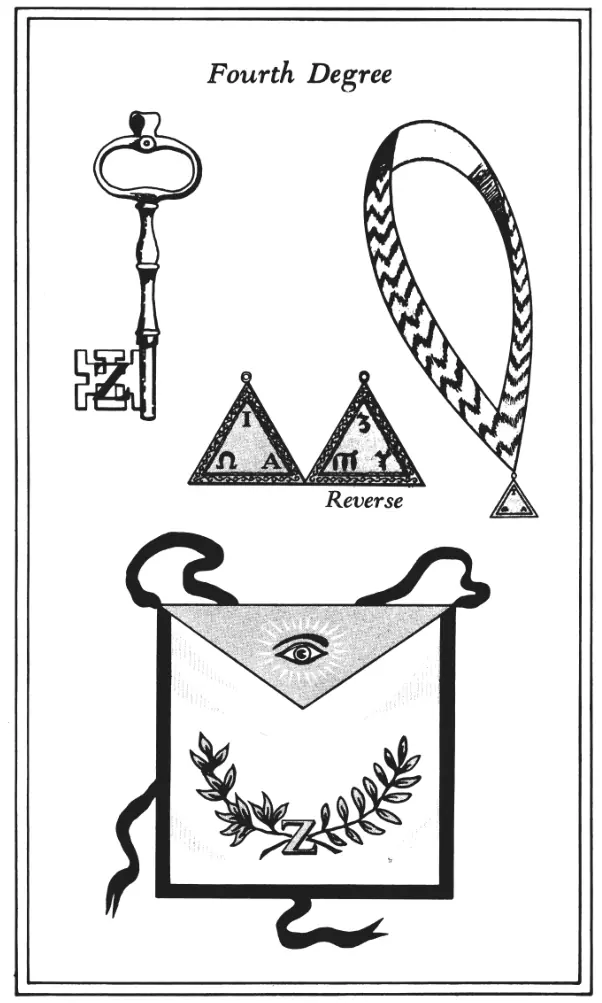
Salomon est à l’Ouest, il est revêtu d’un manteau noir doublé d’hermine, il tient un sceptre à la main, devant lui est un Autel triangulaire sur lequel est placé une couronne d’or laurier et d’olivier, Adonhiram est à l’Occ∴ Il s’appelle Insp∴ et ne se sert d’aucun outil de métal parce que l’ouvrage était suspendu par la mort d’Hiram. Ad∴ Salomon est décoré d’un Gd ruban bleu de l’épaule droite à la hanche gauche au bas quel est suspendu un triangle. Il n’a pas de tablier. Adonhiram est également décoré d’un large ruban bleu mais bordé de noir au bas duquel est suspendue une clef d’ivoire au milieu la lettre Z. Tous les FF∴ ont un ruban pareil en sautoir, avec une clef. Le tablier est blanc attaché avec des rubans noirs, le blanc annonce la candeur et l’innocence des Mtres∴ le noir désigne le deuil de leur chef. La bavette doit être bleue sur laquelle est un œil en or peint ou brodé.
Luminaire
Cette L∴ doit être éclairée de 9 Lumières sur trois chandeliers à trois branches.
Ouverture de la L∴
D∴ F∴ Adonhiram êtes-vous Me∴ Secret ?
R∴ 3 Fois Puissant, j’ai passé de l’Équerre au Compas j’ai vu le tombeau du Respble∴ Me∴ Hiram Abif et j’ai avec mes FF∴ & le plus sage & le plus puissant des rois, versé des larmes sur le tombeau.
D∴ Quelle heure est-il ?
R∴ L’éclat du jour a chassé les ténèbres et la Grande Lumière commence à paraître dans cette L∴
Le 3 fois Puissant dit : Puisque la Gde
Lumière paraît dans cette L∴ et que nous sommes M es∴ Secrets il est temps de commencer notre ouvrage avertissez que je vais ouvrir la L∴
L’Insp∴ répète. Alors le 3 Fois Puissant frappe avec tous les FF∴ 7 fois dans leurs mains et font après le signe de silence.
Signe
On met les deux premiers doigts de la main droite sur la bouche ce qui est imité par l’Inspecteur tous les FF∴ en font de même avec la main gauche ce qui est la réponse Folio 107 recto.
Le 3 fois Puisst∴ dit : La L∴ est ouverte.
Réception
Le Cand∴ doit être bien examiné par un F∴ Expert, sur les premiers grades avant d’être introduit, il frappe sept coups à la porte alors le Me∴ des Cérémonies entre & dit :
T∴ C∴ F∴ Adonhiram, le M e Secret que je viens de tuiler, a parfaitement répondu. Je réponds de son zèle, de sa ferveur et de sa constance, l’Inspecteur frappe un coup et dit : 3 Fois Puissant le Cand∴ a suprêmement répondu aux questions que lui a faites le Me∴ des Cies∴, il vous prie de permettre qu’il soit introduit il répond de son zèle de sa ferveur et de sa constance. Alors le 3 Fois Puissant dit : Que ce Cand∴ soit introduit & conduit au F∴ Adonhiram à qui il rendra compte de ses connaissances maçonniques.
Ensuite il avance au pied de l’Autel avec un bandeau sur les yeux comme s’il n’y voyait pas, il tient à la main un flambeau, il y a sur le front une Équerre il est à genoux du côté droit dans cette position le 3 Fois Puissant lui parle en ces termes.
Vous n’avez vu jusqu’ici que le mur épais qui couvre le Saint du Saint du Temple de Dieu, votre fidélité votre zèle, votre constance vous ont mérité la faveur que je vous accorde en ce moment, je vais vous montrer un trésor, je vais vous introduire dans le lieu sacré du S t des Saints.
Obligation
Je N…. jure & promet sincèrement en présence du Gd∴ Arch te∴ de l’Univers de cette R ble L∴ de Me∴ Secret de ne jamais révéler ou faire connaître à qui que ce soit d’un grade inf r ce qui peut concerner celui-ci. Je promets en outre de ne jamais révéler aucune des lois ou transactions faites dans cette L∴ lorsque j’en serai dehors, à moins que ce ne soit à un F∴ connu, de me conformer aux statuts et règlements qui me seront communiqués, je voue une entière obéissance aux préceptes & commandements de la Gde∴ L∴ parfaite et sublime, me soumettant à tous les ordres qu’elle voudra me donner, j’obéirai pareillement aux Gds∴ Inspect rs∴ & à leurs Députés comme étant les seuls chefs suprêmes de toute la Maçonnerie, je promets enfin de ne jamais aider, consentir ou assister à la réception de personne excepté dans cette Rble∴ L∴ de ne jamais m’entretenir de Maçonnerie qu’avec ceux que je reconnaîtrai avoir été régulièrement reçus et sous les peines de mes premières obligations, priant le Gd∴ Arch te∴ de me maintenir dans le chemin de sa droiture & de l’équité et de la vérité.
Après cela Adonhiram le relève, le 3 Fois Puissant le décore du bijou avec le tablier il lui pose sur la tête une couronne de laurier et d’olivier & lui dit :
Mon cher F∴ je vous reçois Me∴ Secret, je vous mets au rang des Lévites, ce laurier vous représente la victoire que vous avez remportée sur vos passions, et l’olivier est le symbole de la paix et de l’union qui doit toujours régner entre nous, vous pouvez mériter mon F∴ que Dieu vous permette d’arriver un jour dans le lieu sacré, pour y contempler le pilier de la Beauté je vous décore d’une clef d’ivoire suspendue à un ruban bleu bordé de noir comme étant le symbole de votre fidélité, de votre innocence et de votre discrétion votre tablier et les gants, sont la marque de la candeur de tous les M es∴ Secrets au nombre desquels vous avez mérité d’être admis par le rang que vous venez d’acquérir parmi les Lévites en qualité de Me∴ Secret ; vous devenez le fidèle gardien du Saint des Saints et l’un des sept nommés pour remplacer la perte de notre Rble∴ F∴ Hiram Abif pour le glorieux édifice qui s’élève à la divinité l’œil qui est placé sur la bavette de votre tablier doit rappeler à votre mémoire que vous devez veiller continuellement à la conduite de l’ouvrage
Signe en général
( Il est celui du silence )
Mot de Passe
Zizon ( mot hébreu qui signifie balustrade )
Attouchement
C’est la grippe de Me∴ on remonte ensuite la main jusqu’au coude on balance 7 fois en croisant les jambes.
Parole Sacrée
Jahod Adonaï Jah Ces trois
Mots sont les trois premiers noms que Dieu donna à Moïse sur la montagne et dont vous voyez les lettres initiales tracées sur les triangles.
Le 3 Fois Puissant dit : Allez mon F∴
répéter les Mots à tous les FF∴ et vous viendrez ensuite écouter la lecture de notre doctrine.
A son retour le Cand∴ s’assied à la droite du 3 Fois Puissant qui fait les questions suivantes auxquelles l’Insp r= Adonhiram répond.
Instruction
D∴ Êtes-vous Me∴ Secret ?
R∴ Oui je m’en glorifie.
D∴ Comment avez-vous été reçu Me∴ Secret ?
R∴ J’ai passé de l’Équerre au Compas.
D∴ Où avez-vous été reçu Me∴ Secret ?
R∴ Sous le laurier & l’olivier.
D∴ Dans quelle place avez-vous été reçu ?
R∴ Dans le Saint des Saints.
D∴ Qui vous a reçu ?
R∴ Salomon avec Adonhiram Inspecteur des travaux du Temple.
D∴ Avez-vous aperçu quelque chose en entrant dans le Saint des Saints ?
R∴ Des marques évidentes de la présence de Dieu.
D∴ Avez-vous remarqué quelque chose de particulier ?
R∴ J’ai aperçu un triangle dans un grand cercle au centre duquel était une Étoile Flamboyante qui m’a ébloui avec un saint respect.
D∴ Que signifie le caractère hébreu qui est dans le centre ?
R∴ Quelque chose au-dessus des forces humaines que je ne peux prononcer.
D∴ Nous sommes en L∴, en conséquence ceci vous est permis ?
R∴ J’ai vu une grande & bienfaisante clarté sans pouvoir la connaître.
D∴ Qui avait-il dans cette brillante clarté ?
R∴ Le Gd∴ & ineffable nom du Gd∴ Arch te∴ de l’Univers. Moïse en avait la prononciation qu’il tenait de Dieu lorsqu’il lui apparut sur la montagne Moïse fit alors une loi qu’il rendit publique pour défendre de le prononcer ce qui fit que la vraie prononciation fut perdue, mais j’espère avoir un jour la connaissance de cette parole ineffable.
D∴ Avez-vous encore aperçu quelque chose ?
R∴ J’ai vu 9 autres paroles en caractères hébraïques.
D∴ Où étaient-elles placées ?
R∴ Dans 9 rayons qui partaient du brillant & lumineux triangle.
D∴ Que signifient les 9 noms ?
R∴ Ce sont les 9 que Dieu donna lui-même à Moïse sur le Mont Sinaï en lui faisant espérer que sa postérité aurait son vrai nom.
D∴ Donnez-les moi avec leur signification ?
Elohim, El, Eloha, Ehiel,
R∴
Elehai, Saddaï, Jah, Elion, etSebaoth.
qui sont pris du nom de la divinité depuis l’alphabet des Anges & de l’Arche Cabalistique.
D∴ Que signifie le cercle qui environne le triangle ?
R∴ Il représente l’immensité du pouvoir de Dieu qui n’a ni commencement ni fin.
D∴ Que signifie l’Étoile Flamboyante ?
R∴ Un météore qui doit toujours nous guider vers la divine providence.
Que signifie la lettre G∴ dans le
D∴ centre de l’Étoile Flamboyante ?
Gloire, Grandeur Gomesse.
R∴ &
D∴ Qu’entendez-vous par ces 3 noms ?
R∴ Par le mot Gloire j’entends Dieu, par le mot Grandeur, l’homme qui devient grand par la perfection & Gomesse est une parole hébraïque qui signifie remerciement à l’Éternel pour son pouvoir suprême et sa beauté, ce fut la première parole que notre père Adam prononça à Ève.
D∴ Que signifie les paroles à 5 pointes de l’Étoile Flamboyante ?
R∴ Les 5 ordres d’architecture dont on se servit à la construction du Temple, elles signifient aussi les cinq sens de la nature sans lesquels l’homme ne peut être parfait.
D∴ Qu’avez-vous vu encore dans le S t= des Sts∴ ?
R∴ L’Arche d’Alliance le chandelier d’or à sept branches avec la table des pains de proposition.
D∴ Où était placée l’Arche d’Alliance ?
R∴ Dans le milieu du Saint des Saints sous l’Étoile Flamboyante.
D∴ À quoi font allusion l’Arche d’Alliance et l’Étoile flamboyante ?
R∴ Comme l’Arche d’Alliance est l’emblème que Dieu fit avec son peuple et qu’elle fut mise sous l’ombre des ailes des Chérubins de même le cercle qui renferme le triangle dans l’Étoile Flamboyante est l’emblème des Francs-Maçons.
D∴ De quelle forme était l’Arche d’Alliance ?
R∴ Un carré long.
D∴ De quoi était-elle faite ?
R∴ De bois de cèdre couverte d’or surmontée d’une couronne d’or soutenue de deux Chérubins de même métal.
D∴ Quel était le nom de la couverture de l’Arche
R∴ Le propitiatoire qui servait à apaiser la colère de Dieu.
D∴ Que renfermait l’Arche ?
R∴ Le témoignage que Dieu donna à Moïse ou les Tables de la Loi.
D∴ Que contenait ces deux Tables et de quoi étaient-elles278 ?
R∴ Elle étaient de marbre blanc et contenaient Folio 111 recto les Dix Commandements de Dieu, les quatre premiers sont relatifs à nos devoirs envers la divinité et sont renfermés dans la première Table, et dans la seconde sont les six commandements envers les hommes.
D∴ De quel usage est la Table que vous avez vue dans le Saint des Saint ?
R∴ Pour y placer les 12 pains de proposition qui par l’ordre de Dieu doivent toujours être placés en sa présence.
D∴ De quoi étaient-ils faits ?
R∴ De la plus pure farine.
D∴ Où étaient-ils placés ?
R∴ Six à la gauche, six à la droite formant deux monceaux.
D∴ Que mettait-on entre eux ?
R∴ Le meilleur & le plus pur encens.
D∴ Pourquoi ?
R∴ En mémoire des obligations que nous devons à Dieu.
D∴ Quel était le nom du Saint des Saints ?
Dabber
R∴
D∴ Que signifie-t-il ?
R∴ La Parole.
D∴ Pourquoi est-elle ainsi appelée ?
R∴ Parce que la divinité y réside.
D∴ Qui construisit l’Arche ?
R∴ Moïse quand il en reçut l’ordre de Dieu. Il fit choix des Israélites Bézéléhel fils de Duré de la tribu de Juda et de Marie sœur de Moïse. Il choisit Aliab, fils d’Achisameck de la tribu de Dam, deux habiles ouvriers pour faire cet ouvrage, & dans cette occasion le peuple d’Israël témoigna tant d’ardeur & de zèle et donna tant de richesses que Moïse de l’avis de ceux qui avaient la direction de l’ouvrage fut obligé de faire publier au son de trompette, qu’il n’avait plus besoins de leur généreuse assistance. L’ouvrage fut donc commencé suivant le plan que Dieu en avait donné à Moïse qui eut la direction particulière du nombre des vases qui devaient être employés dans le tabernacle à l’usage des sacrifices.
D∴ Pourquoi le chandelier a-t-il 7 branches ?
R∴ Parce que le nombre 7 représente les 7 planètes.
D∴ Qu’y a-t-il au bout de chaque branche ?
R∴ Une pompe280 & chacune d’elle est dirigée au Sud.
D∴ En combien de parties consiste le chandelier ?
R∴ En 70.
D∴ Que représente ce nombre ?
R∴ Les 12 signes du Zodiaque autour desquels les planètes font leur mouvement.
D∴ Que signifie cet œil qui regarde continuellement dans notre L∴ ?
R∴ Une seule lumière qui chasse l’obscurité parmi nous.
D∴ Par où montait-on dans les galeries du Temple ?
R∴ Par un escalier en forme de vis dans le même mur neuf du Temple, par lequel on montait par 5 3 7 marches, on l’appelait coquille parce qu’il avait la forme d’un limaçon.
D∴ Combien y avait-il de portes de là au St des Sts∴ ?
R∴ Il y en avait une dans la partie de l’Est qui était
appelée Ara et qui était couverte d’une draperie
pourpre, hyacinthe, or & azur.
D∴ Que représentent ces couleurs ?
R∴ Les 4 éléments.
D∴ Quel âge avez-vous ?
R∴ Neuf ans accomplis.
D∴ Quel est votre mot de P∴ ?
Zizon qui signifie balustrade.
R∴
Clôture
D∴ F∴ Insp∴ quelle heure est-il ?
R∴ La fin du jour.
D∴ Que vous reste-il à faire ?
R∴ À pratiquer la vertu, abhorrer le vice et demeurer en silence.
Le Trois Fois Puissant dit : aux FF∴ :
Comme il n’y a plus rien à faire que de pratiquer la vertu fuir le vice, restons en silence pour que la volonté de Dieu soit faite il est temps de nous reposer. F∴ Insp∴ annoncez aux FF∴ que je vais fermer la L∴ par les nombres mystérieux.
Le F∴ Insp∴ répète. Le 3 Fois Puissant frappe sept coups dans la main, tous les FF∴ l’imitent il fait le signe du silence que tous les membres font et la L∴ est fermée Folio supplémentaire XIFolio 113 recto.
Apparat critique de l’édition Latomia
271. Erreur du copiste A : le mot exact est au singulier « cardinal », cf. Pyron 1812 et Kloss.
272. Il manque probablement ici le mot « Maître ». La description est moins complète dans Pyron 1812 et Kloss.
275. Il s’agit du « Dictionnaire historique, critique, chronologique, géographique et littéral de la Bible » du Révérend Père Dom Augustin Calmet dont la 1re édition en quatre volumes est de 1722-28. Ce n’est pas à cette édition que se réfère la note du manuscrit, mais à la 3e, celle de 1783, publiée à Toulouse et Nîmes en six volumes, et dont la page 57 du tome III commence effectivement par « Jehovah ».
277. D’autres rituels du 1er Empire (Pyron 1812 et Kloss) inversent les noms des colonnes, en cohérence avec les degrés symboliques, mais en contradiction avec le texte même de la réponse de ce rituel puisque, dans la Bible, c’est bien Booz qui est de la tribu de Juda et de la famille de David (il est son arrière grand-père). C’est donc un indice d’ancienneté pour cette version recopiée par le copiste A.
278. L’oubli du mot « faites » semble évident ; le même oubli est constaté dans les versions Pyron 1812, Kloss et le BnF FM4 768, indiquant une origine commune pour le document recopié. Le mot est présent dans le manuscrit Francken de 1783 ( and what were they made of ? )
280. Erreur du copiste A : mis pour « la », cf. Kloss.
Delaulnaye 1813
tuileur imprimé · 529 mots
Le « Thuileur des trente-trois degrés de l'Écossisme » de Delaulnaye (Paris, 1813), premier tuileur imprimé du REAA constitué : mots, signes, décors et remarques du grade. Texte relu mot à mot sur le fac-similé, mots hébreux restitués. Pages 31-37 de l'édition originale.
Tenture Noire, parsemée de larmes. La Loge est censée représenter le Saint des Saints. On y remarque un grand cercle, dans lequel est inscrit un Triangle, au centre duquel est l'Étoile flamboyante.
Quatre-vingt-une Lumières, sur neuf chandeliers à neuf branches.
On les réduit souvent à trois candelabres à trois branches.
Titres.
Le Vénérable représente Salomon à l'Orient ; on l'appelle trois fois Puissant. Il tient son
[p. 32]
Sceptre, un Maillet noir, et, devant lui, sur un autel triangulaire, est une couronne de laurier et d'olivier, destinée au Récipiendaire. Il n'y a qu'un seul Surveillant, qui représente Adoniram (1); on le nomme Inspecteur ; il est placé à l'Occident, et ne doit avoir aucun outil en fer.
Le but apparent du grade est de remplacer Hiram par sept Maîtres-Experts, qui sont admis au rang des Lévites.
Signe, dit du Silence.
Mettre les deux premiers doigts de la main droite sur la bouche.
Réponse. Mettre également sur la bouche les deux premiers doigts de la main gauche.
Attouchement.
La Grippe, comme au Maître ; puis on se coule mutuellement la main sous le coude, en
(1) Voy. sur ADONIRAM, le Grade suivant.
[p. 33]
se balançant sept fois, et se croisant chacun la jambe droite.
Batterie.
Sept Coups, dont six égaux et un séparé.
○ ○ ○ ○ ○ ○——○
Âge d'un Maître-Secret.
Trois fois Vingt-sept ans accomplis (81 ans).
Mots Sacrés.
IOD,
י
Cette lettre, prise cabalistiquement, signifie Dieu, Principe, Unité;
ADONAI,
אֲדֹנָי
(Dii)
IVAH,
par syncope, pour Iehovah.
d'autres disent :
IAHO, ADONAI, IAH.
Ces mots Iod, Iah, Iaho, sont tirés, par [p. 34] décomposition, du tétragramme Iehovah ; les Cabalistes les forment ainsi :
י
יה
יהו
יהוה
Les mots Iod, Iah, Iaho se retrouvent dans le Secrétaire Intime, dans l'Intendant des Bâtiments et dans le Royal-Arche.
Mot de Passe.
Zizon,
que l'on traduit par Balustrade.
Voici un exemple frappant d'une altération qui a fait perdre jusqu'au sens du mot primitif.
Zizon n'est d'aucune langue ; à la place de cette parole insignifiante, il faut dire :
ZIZA
זִיזָא
(Splendor)
d'où les Rabbins ont fait leur fameux oiseau
[p. 35]
Ziz, qui, lorsqu'il ouvroit les aîles, déroboit à la terre les rayons de l'astre du jour. Mais Dieu le sala prudemment au commencement des siècles, ensemble avec le poisson Leviathan de Job, et ce mets exquis doit faire, pendant l'éternité bienheureuse, la nourriture des fidèles. Ils auront pour breuvage le vin recueilli par Noé lui-même dans les celliers du Paradis.
Heure.
Pour ouvrir ; l'Éclat du jour a chassé les ténèbres, et la Grande-Lumière commence à paroître.
Pour fermer ; la Fin du jour.
Tablier.
Blanc, attaché avec des rubans Noirs ; bavette Bleue, sur laquelle est un œil, peint ou brodé. Deux branches, l'une de laurier, l'autre d'olivier, se croisent sur le tablier : dans le milieu est la lettre Z.
[p. 36]
Cordon.
Bleu, liséré de Noir, ruban large en sautoir.
Bijou.
Une Clef d'ivoire, au milieu de laquelle est la lettre Z.
Nota. Ce grade, assez insignifiant, n'existe point dans l'Écossisme réformé de Saint-Martin.
[p. 37]
Vuillaume 1820
tuileur imprimé · 1 192 mots
Le tuileur de Claude-André Vuillaume, « Manuel maçonnique, ou Tuileur de tous les rites de maçonnerie pratiqués en France » (Paris, Delaunay et Hubert, 1820) : décoration, titres, signes, attouchement, marche, batterie, âge, mots, habillement du grade, avec l'étymologie et l'interprétation des mots hébreux. Texte établi sur le fac-similé et relu mot à mot sur les images : océrisation à 600 dpi du volume numérisé, fusion avec la couche texte de la numérisation Gallica, puis relecture page par page. Orthographe de 1820 conservée, hébreu et grec restitués, batteries rendues comme l'imprimé les note, pagination de l'original. Pages 75 à 81.
TENTURE noire, parsemée de larmes blanches. La loge représente le Saint des Saints (1). Au fond, est un grand cercle, dans lequel est inscrit un triangle; au centre du triangle est l'étoile flamboyante.
La loge est éclairée par quatre-vingt-une lumières, posées sur neuf chandeliers à neuf branches. On peut réduire ce nombre à neuf, avec trois chandeliers à trois branches.
TITRES.
Le vénérable représente le roi Salomon; il prend le titre de Trois fois puissant, il a un
sceptre en la main; devant lui, sur un autel triangulaire, est un maillet garni en étoffe noire, et une couronne d'olivier et de laurier, dont il est fait usage dans les réceptions.
Il n'y a qu'un surveillant, qui représente Adoniram (1); il prend le titre d'Inspecteur; il est placé à l'ouest, et ne doit avoir aucun outil de fer.
SIGNES.
Mettre l'index et le doigt médius, réunis, de la main droite, sur la bouche. La réponse est de faire le même signe de la main gauche.
ATTOUCHEMENT.
Se prendre réciproquement la main droite, comme au grade de maître, puis avancer la main jusqu'au coude que l'on empoigne, en se balançant par sept fois le bras, pendant que l'on s'approche de la jambe droite, en se touchant par l'intérieur.
BATTERIE.
Sept coups, dont un séparé : ● ● ● ● ● ○ — ●!
(2) Voyez ce que nous avons dit de ce personnage, page 60.
[p. 77]
MARCHE.
Il n'y a point d'autre marche que celle de maître.
AGE.
Trois fois vingt-sept ans accomplis. (Quatre-vingt-un ans.)
TEMS DE TRAVAIL.
Du point du jour à la nuit tombante.
HABILLEMENT.
Tablier blanc attaché avec des cordons noirs; la bavette bleue, avec un œil peint ou brodé; au milieu du tablier sont deux branches, l'une de laurier et l'autre d'olivier, formant une couronne non fermée, et au milieu la lettre Z.
Cordon bleu, liséré de noir, porté en sautoir; au bas du cordon pend une clef d'ivoire, sur laquelle est la lettre Z.
MOT DE PASSE.
ZIZA (héb. זיזא ou זזא resplendens)(1). C'est
(1) Quelques-uns disent Zizon, mais c'est une faute. On traduit aussi ce mot par balusirade, ce qui paraît sans fondement, à moins que l'on ne considère les rayons de la gloire de Dieu, auxquels pourrait être appliquée la signification vraie, resplendens, comme une balustrade qui en garantit l'approche.
[p. 78]
le nom du fils de Jonathan, fils de Juda, fils d'Onan. (Paralip. liv. 1er, chap. 2, vers. 33).
MOTS SACRÉS.
1er mot. — JOD (héb. י). Lettre qui, étant prise cabalistiquement, signifie Dieu, principe, unité.
2e mot. — ADONAÏ (héb. אדני Deus) (1).
3e mot. — JVAH (héb. יוה par contraction pour Jehovah).
Dans quelques rituels on trouve :
1er mot. — JAHO יהו (2).
2e mot. — ADONAÏ.
3e mot. — JAH יה
Ces mots dont l'initiale est la même, sont tirés de la décomposition cabalistique du mot Jehovah, qui, étant combiné de plusieurs manières avec la lettre initiale, donne toujours un des noms de Dieu.
La seule initiale même suffisait pour expri-
(1) C'est à tort que quelques personnes traduisent le mot אדני, Adonaï, par Dii; c'eût été pour les Hébreux un blasphême : ils mettaient au pluriel le nom de Dieu אדן Adon, pour marquer son excellence, et non pour indiquer une pluralité.
(2) Les mots Jvah et Jaho ne sont point hébraïques; ce ne sont que des corruptions du grand mot Jehovah.
[p. 79]
mer ce nom ineffable, et on est parvenu à en former un signe cabalistique qui l'exprime par excellence de cette manière :
יֹ יְ יָ
En même temps que l'on y trouve la lettre sacrée, avec les divers accens qui entrent dans la prononciation du mot Jéhovah, la disposition de ces trois signes, qui forme un delta ou triangle, est encore un des emblêmes par lesquels on désignait la divinité.
Le grand nom de Dieu יהוה, le nom innominable, était un des mystères de l'intérieur du temple, et l'on n'est pas bien certain de sa prononciation. Le grand-prêtre seul avait la permission de le prononcer, et une seule fois dans l'année; c'était le jour de l'expiation, 10e de la lune de Thischri. Les lévites, par le bruit qu'ils faisaient dans ce moment, empêchaient qu'il ne fût entendu par la multitude.
C'est le nom que le Seigneur se donna à lui-même, en parlant à Moïse sur le mont Horeb. (Exode, chap. 3, v. 14.)
Enos אנוש, fils de Seth, fils d'Adam, est le premier qui, selon l'Ecriture, a invoqué le Seigneur par son nom. (Gen., chap. 4, v. 26.)
[p. 80]
Le P. Souchet, dans une dissertation très-savante, a traité fort au long de la prononciation et de l'étymologie du mot Jéhovah. Genebrard, Vossius, et beaucoup d'autres, ont traité de la même matière avec une égale érudition.
On a poussé les recherches sur ce nom jusqu'à prétendre y avoir découvert la démonstration et l'expression positive du mystère de la Trinité divine. Nous ne pouvons nous refuser à mettre sous les yeux de nos lecteurs un des plus singuliers de ces systèmes, rapporté par l'auteur de la continuation de l'Histoire des Juifs; ceci est écrit dans le douxième siècle; l'auteur était un Juif, devenu chrétien.
Il dit, tome 4, page 409, que la Trinité se prouve par le nom de Jéhovah, dont la combinaison peut former trois noms, qui ne forment cependant qu'une seule essence.
Décrivez quatre cercles (V. Pl. VII, fig. 1.), dont deux grands et concentriques, et deux autres dont le centre est sur la circonférence du cercle intérieur; dans chacun des petits cercles, écrivez deux lettres du mot יהוה, de manière à ce qu'il y en ait une dans chaque hémisphère; alors joignez le jod au premier he, vous avez un des noms de Dieu, c'est le générateur; joignez encore le [p. 81] premier he avec le vaf, vous avez un autre nom de Dieu, c'est le verbe engendré; joignez aussi le vaf avec le second he, c'est un troisième nom, qui procède du premier et du second; enfin, comme le tout est réuni dans le grand cercle, vous avez trois dans un.
François Vatable, dans ses commentaires sur la Bible (Ex., chap. 28), rapporte à-peu-près le même système, hors la figure employée dans l'exemple qui précède. Voici ce qu'il dit : Hoc autem nomen יהוה Trinitatis mysterium continet, ut veteres Judæi qui Christum præcesserunt, dixere in suis traditionibus. Nam per י intelligitur Pater, qui est principium, et origo omnium rerum. Per ה, Filius per quem omnia quæ facta sunt, esse cœperunt. Per ו, quæ est conjunctio copulativa, intelligitur Spiritus Sanctus, qui est amor et nexus utriusque, qui ab utroque procedit. Geminatur autem ה propter duplicam naturam quæ est in Christo. Per primum ה natura divina intelligitur; per ה postremum, natura humana.
Hay, fils de Schérira, qui vivait l'an de J.-C. 997, rapporte dans un ouvrage sur la formation ancienne du mot Jéhovah, qu'à Jérusalem il l'avait vu écrit sur les monumens anciens, comme dans la fig. 2, planche VII.
Pike 1857
rituel imprimé · en anglais · 7 425 mots
« The Magnum Opus or Great Work » (1857) : le premier corps complet de rituels révisés par Albert Pike pour la Juridiction Sud des États-Unis. Texte en anglais, établi par reconnaissance optique corrigée : des coquilles subsistent.
D'après la réimpression Kessinger de l'édition de 1857 (numérisation archive.org)
THE LODGE, ITS DECORATIONS, FURNITURE, ETC.
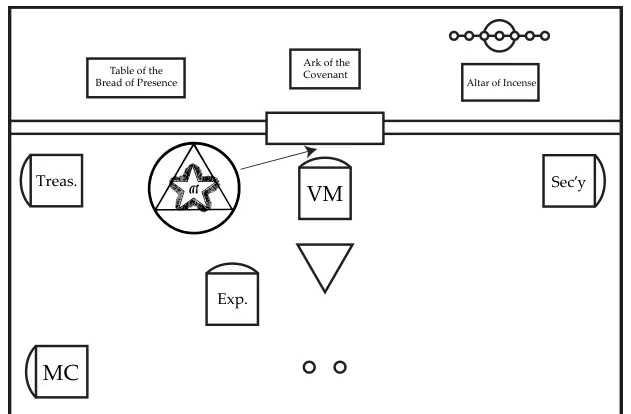
The hangings are black, strewed with white tears, The Lodge represents the Sanctum Sanctorum; the East being separated from the body of the room by a railing running from one side to the other, with a gato in the middle,
Over the Master's seat hangs a circle, within which is an equilateral triangle, and in the centre of that a blazing star, in the centre of which is the ITebrow Ictter *.
The Lndgo in lighted by eight lights, two by two, in the north, south, east, and west. Besides these Principal lights, there may be as many others as may be desired.
The battery of this degree is; —
The ace of a Secret Master is : years,
ete wee tee ae
OFFICERS, TITLES, DECORATIONS, ETC.
The Master represents King Solomon, and is styled Thrice Puissant. Te sits in the east, wearing a black robe lined with ermine, with a sceptre in his hand. Before him is a triangular altar, on which is a crown, made of branches of laurel and olive.
There is bat one Warden, who represents Adonhiram, is styled Zaspecfor, and sits in the west
No working-tools are used in the Lodge, for the reason that the labours on the temple were suspended after the death of our Grand Master Hiram Abi.
The Master wears a broad blue watered ribbon, from the right shoulder to the left hip, at the ond of which hangs, as a jewel, an equilateral triangle of gold, with the letters 9. @.°. ¥.*. upon fe.
The Warden and all the Brothers wear a broad white ribbon edged with black, at the end of which hangs the jewel of the Degree, which is an ivory key, on the wards of which is the letter Z.*, in black.
The apron is white, edged with black: the gloves white, turned over with black at the wrists. The flap of the apron in blue, with an open eye embroidered on it in gold. 'The strings are of black ribbon. Two branches, ono of Laurel! and the other of olive, crusa each other in the middle of the apron, and at their crossing is the letter 7.°. embroidered in gould.
TO OPEN.
Th., P.'. Be. Adonhiram, in our sorrow we must not forget the demands of duty. Are all present, Secret Masters? Let any who are not so, retire.
Jasp.. Th. Puissant, all present are Secret Masters. Th. Po. Whatis the first duty of a Secret Master, when the Lodge is about te open? Insp, To see that the entrance to the Holy of Holies is duly guarded, that we may be secret and secure. Th. P.. Attend, my Brother, to that duty, through your proper officer, and cause the Tyler to be informed that I am about to open this Lodge of Secret Masters here, and direct him to tylo accordingly. nap... Bro. Jun. Deacon, sco that the entrance to this holy place ie duly guarded; and inform the Tyler that the Th.". P.". King is about to open a Lodge of Secret Masters in this place, and direct him to tyle accordingly.
[The Jun.*, Deacon goes to the door, opens it, informs the Tyler, closes it, raps on it [;] equal and then L], which is answered by the Tyler, and thea returns to his place and remains standing, and says]: Jro. D.. Yen.*. Inspector, we are well tyled, and the entrance to this Holy Place is well guarded. Insp... How tyled and guarded, my Brother?
Jr, Dv» By a Secret Master at the entrance without, armed with a drawn sword. Jasp.*. Wis duty there?
Jr, D.. To repel all intruders and iowans, and allow none to enter here who have not the Pass-word, nor until after your permission obtained.
Insp. It in well, my Brother. Th.*. P.*. King Solomon, we are well tyled, secret and secure. Th. P.. Its well, my Brother. Are you a Secret Master? Insp.". I have passed from the Square to the Compass. I have seen the Tomb of our Master Hiram Abi; and with my Brethren have shed tears thereon.
Qu.*. Where were you received a Secret Master?
Ana.*, Under the laurel and olive trees.
Qu.*, What were the lessons taught you in this degree? Ans. Secrecy, Obedience, and Fidelity.
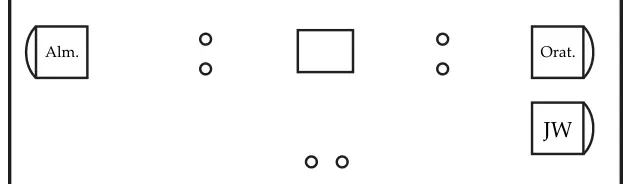
Th,*, P. Bro.*. Jun.*. Deacon, your place in this Lodge? Jro. D.. In the West, in front of the Yen.*. Warden, to his right. Th. P.. Your duty there?
Are. Ds. To keep inviolable the secrets entrusted to me. Th. Pe. Bro.*, Sen.*, Deacon, your place in the Lodge? Sen*. D.. In the East, in front of the Th.. P.*. Master, to his right. Th. Po. Your duty there?
Sen". D.. To obey the laws of God, of the Order, and of the Th.'. P.*, Master. Th, P.. Ton.. Bro.*. Adonhiram, your station in the Lodge? Insp.". In the West, Th.'. P.°.; between the lights. Th. Ps. Your duty there?
Jnsp... To be faithful unto death.
Th. Pw', The station of the Master of the Lodge? Jeep.. In the East, in front of the Tomb of our deceased Master, the Worker in Metals, and Son of a widow of Tyre,
Th. Po. Wis duties there?
Zasp.*. To provide for the welfare of the Order, and to teach the Craftsmen their duties; remembering that though their Master, they ore still his equals in the eye of God and of Masonry. Th. P.. Lacknowledge the truth, and recognize the duty. My Brothers, the husband must labour to give his children bread, while their mother, the wife of his bosom, lies under his roof unburied, cold and still in her coffin; and the mother, while her tears still dow fast for her first born that Mes dead before her.
The poor have no leisure to mourn: and Masons must not permit their sorrows to encroach upon the domain of their duties. Brother Adonhiram, what is your age?
Insp... The cube of [7].
The. Po. What is the hour?
dnp, The Dawn has chased away the Darkness, and the great Light is about to shine in our Lodge.
Th. Ps. Since the Dawn lias chased away the Darkness, and the great Light is about to shine in our Lodge, give notice to the Brethren that Iam about to open this Lodge of Secret Masters by the mysterious numbers.
Jup.. Brethren in the North and South, the Dawn has chased away the Darkness, the great Light is about to shine, and the Th.-. P.*. is about to open this Lodge of Secret Masters, by the mysterious numbers. You will take due notice and govern yourselves accordingly.
[Then the Thy, ['.°, raps [3] (.]—the Inspector {:] [,]—and all the brethren the same, with their hands. Then the Th.-, P.*. gives the sign, and all the Brothers give the answer; and the Th.-. P.*, says]:
Th. Po. T therefore declare this Lodge of Secret Masters duly opened; and I charge you all, my Brethren, to be secret, silent, obedient and faithful during our labours,
RECEPTION.
The Candidate appears in the preparation-reory, in the clothing, and wearing the jewel of a Master Saeon. The Master of Ceremonies gocs tu him and examines him thoroughly in the work of the three first degrees, [which ie done now once fur all, that it may never be necessary, in any subsequent degree, to examine a candidate in any work but that of the degree immediately preceding]. Ie then deprives him of his clothing and jewel of Master, and places a small silver square upon his forehead, securing it there by a bandage that covers his eyes. He also places a cord round his neck, and a light in his Jeff hand, causes him to lay the two first fingers of his right hand upon his lips, and then leads him to the door of the Lodge, and raps [;] [,]. The Jun.*. Deacon opens the door and inquires
Jeo. D.. Who comes here? Who approaches this place of sadness and sorrow ?
Af', Her, The Bro.*. Master of Ceremonies, with a Bro.*., who having been regularly initiated en entered Apprentice Mason, passed to the Degree of Follow Craft, and been raised to the Degree of Master Mason, now
--desires to be admitted to the degree of Secret Master. .
Jes. D.. Is he duly and truly prepared to receive the degree he secks?
MM, Cers. We is. .
Jr. De. Mas he made suitable proficiency in the three Brat Degrees?
Af, Her. Tbave examined him carefully, and fiud him well instructed and proficient in the three degrees.
Are. Do. Is the Master's Lodge, to which be belongs, satisfied with his conduct and behaviour as « Bason, and content that be should advance?
BL. Her. Ue is.
Jrs. D.. Do you vouch to this Lodge for his zeal, his candour, and his constancy, and thet he will be silent, obedient, and faithful?
BM, Ceres, Do, as fur myself.
Jr. Do. Itiawell, Let bios wait a time in silence, until the Th.*. P.. Master be informed of his request, and his will ascertained. .
(The Jun.', Deacon closes the door, and reports to the Th.'. P..; the same questions being asked, and like answers returned as at the door.]
TA. P. Its well. Since the candidate comes endowed with these necessary qualifications, and duly vouched for, let him be admitted and received in due and ancient form.
[The door is opened, and the candidate enters, led by the 31.°. of Her.*., by the cord around his neck. The Sen.°. D.°, meets him, and says):
Sen.*, D.. My Brother, upon entering the Lodge in the several degrees of Entered Apprentice, Fellow-
craft, and Master Mason, you were received in a particular manner in each, which was then explained. Upon your entrance into this Lodge of Secret Masters, I senl your lips with this seal of secrecy and discretion. (Ue presses a seal upon the candidate's lips, first removing his fingers from them, and then replacing them again.] Let this ceremony ever remind you that you cannot, in any emergency, divulge our secrets without violating your obligation as a Mason, ant your honour as a man.
('The enndidate is then conducted four times around the Lodge, while the following sentences are read aloud, the Warden and Master rapping as he passes them on each circuit (,], then [2], then (;]: and then [;,]:
lst Circuit. . .. I, the Lord thy God, did bring thee out of the Inns of Egypt, out of the house of bondage. Thou shalt worship no other gods, nor make any graven image, nor any likeness of anything in heaven or on earth, in the sea, or under the earth, whereunto to bow down and serve them.
+ + Thou shalt not irreverently or unnecessarily pronounce my name | mir; for if thou does so, thou ecommittest an offence which I will punish,
2d Circuit. . .. Turn ye not unto idols, nor make to yourselves molten gods, nor profane the name of my your God, nor swear by His name falsely. '
..... If aman sow 5 vow unto the Lord, or swear an oath to bind his soul with a bond, he shall net break his word: he shall do according to all that proceedeth out of his mouth.
3d Circuit. . . . . When thou leftest up thine Ayes unto heaven, and weest the sun and the moon and the stars, even all the armies of heaven, do not thou worship them, nor adore them, like the ancient nations,
. +e... Xe shall observe to do as the Lord sour God hath commanded you. Ye shall not turn aside to the right hand or to the left. Ye shall walk in all the ways which the Lord your God hath commanded you, that yo may live, and that it may be well with you, and that your days may Le prolonged in the land which ye possess.
4th Circuit. . .. . What does the Lord thy God require of thee but to fear Him, to walk in all Ilis ways, to love Slim, and to serve Him with all thy heart and with all thy soul? Love Him, walk in all Lis ways, and cleave unto Him.
(At the conclusion of the four circuits, the candidate is halted in front of the Warden, who asks]:
Insp.*. Who is this that journeys with you, Bro.. M.*. of Her... in bondage and in darkness?"
MM. Her... A Master Mason, Bro.*. Adonhiram, who seeks the lost word.
Insp... Alas, my Brother, it hath not yet been found. What does the Brother desire?
Mf. Her.*. To receive the degree of Secret Master.
[4 Voice in the extreme East says, gravely and slowly]:
Toice: . . Wo unto those who aspire to that for which they are unfitted !
[Another Voice in the North cries]:
Vo...» Wo unto those who assume a burthen which they cannot bear!
[A Foice in the South cries] :
Vi.» « » Wo unto those who assume duties lightly, and afterwards neglect them |
Insp". You hear, my Brother. Masonry is duty, and its honours the reward of work, which is the
performance of duty. Are you prepared to assume its duties?
Cand. Tam.
Insp... Your labours may not be rewarded; for he who sows not often reaps. Are you prepared to
perform those duties because they are duties, without regard to the reward, and satisfied withthe approbation
of your own conscience alone?
Cand. Iam.
dnsp.. Repair, then, to our sacred altar, and there kneeling, not to us, but to the Great Architect of the
Universe, enter into a covenant with us and an obligation to Slim, ever to perform the duties of this degree. (The candidate is led to the altar, and placed, standing, in front of it, facing the East; and the Th.". Pw.
any]:
The, P.*. Who stands before the altar, under the sign of Secrecy ?
aL. Her. A worthy Brother Master Mason, who has been duly examined, has made the four circuits, and answered suitably the questions of the worthy Inspector Adonhiram, and now stands here by his permission to receive the obligation of a Secret Master.
[t Toice in the Must says]:
Vi. Duty is with us always, inflexible as Fate.
[4 Voice in the North says]:
V.. In health or sickness, in prosperity or in adversity, duty is with us always, exacting as Necessity.
[A Toice in the South says]: .
¥. It rises with us in the morning, and watches by our pillow at night, In the roar of the City, and in the loneliness of the Desert, Duty is with us always, imperative as Destiny.
Th.. P-. You hear, my Brother. Do you with all your heart agree that Duty is the one 'great law of Masonry, inflexible as Fate, exacting as Necessity, imperative as Destiny ?
Cand... Do. .
Th. P.. What seek you in your journeying?
Af. Her. Truth, and the Lust Word.
Th. P2, Like the light you bear, which yet you cannot see, Truth and the Lost Word, which are Light, are
within the reach of every man that lives, would he but open his eyes and see. The broad highway of Duty, straight as an arrow, lends directly to them; but men seck shorter routes by by-paths, and lose themselves in the labyrinths of error. If you would find the True Light and the Lost Word, kneel at our Sacred Altar, and enter into a sincere covenant with us, and a firm obligation to the Gr.*. Arch." of the Universe, that you will faithfully keep the secrets, and perform the duties of this degree. .
[The candidate kneels on both knees. His left hand, holding the light, is placed upon the Holy Bible and Compasses, and the two first fingers of his right upon his heart; in which position he assumes the following]
OBLIGATION.
_1,A...B...., in the présence of the Gr.". Arch.". of the Universe, and of the Brethren now bere assembled, do hereby and hereon most solemnly and sincerely covenant with them and bind and oblige myself by vow . and oath to Him, that I will never reveal the secrets of this degree to any person in the world, who shall not be entitled at the time to receive them, and I having power and right to communicate them.
I furthermore promise and swear that I will bold allegiance to the Supreme Council of Sovereign Gr.:. Insp.*. Gen.". of the 33d Degree, fer the Southern Jurisdiction of the-United States, so long as I continue to reside or bo within its jurisdiction, and will pay due obedience to its Regulations, Laws and Edicts not subversive of the true Principles of Masonry nor contrary to the Ancient Land-marks; and that I will obey and abide by the by-laws, rules and regulations of the Lodge of Secret Masters and of Perfection to which I may
belong, so long as I continue a member thereof.
I furthermore promise and swear, that Duty shall hereafter be the rule and guide of my conduct, inflexible
'as fate, exacting as necessity, and imperative as destiny. .
*I furthermore promise and swear, that wherever secrecy may be enjoined or required by the rules or interest of Masonry or of a brother, or by the order of a Lodge, Council, Chapter, or the Supreme Council, and I may as a good citizen, obedient to the laws of my country, lawfully and laudably be ao, I will be silent and secret a3 the grave, as to all matters and things improper to be divulged. _
I furthermore promise and swear that I will ever be obedient to Divine and all human constitutional and legal authority, secular, civil and masonic, and cheerfully comply with and carry out the lawful will and legal
orders of my superiors. ;
I furthermore promise and swear that I will be faithful voto death to every trust reposed in me, to every
by... 6
obligation imposed on me, to every duty required to be performed, to God, my country, the Lodge, my family, my brother and my friend; nor ever fail country, Lodge, family, brother or friend in time of need, distress, danger or persecution.
All of which I do most sincerely covenant and solemnly promise and vow; and may Ged aid me to keep and perform the same | ,
[The cord is then taken from the candidate's neck, and the light from his left hond, ond the two first fingers of his right hand replaced upon his lips. Then the Th.". P.-. takes off the bandage from his eyes, and says to him]:
Th.. P. My Brother, late in darkness, I restore you to Light, and set your feet in the path of Duty, which leads to that True Light of which this is rutan emblem. Arise, my Brother! Let this Square, which lay upon your forehead, ever remind you to walk sprightly, and turn not aside into the inviting paths of error. Let it also remind you that you have now passed from the Square to the Compasses, as the Geometrician passes from the straight lines and angles by which he measures the surface of the earth, to the great curves and circles by which he calculates the movements of the Stars. Begin now to rise above the earth, and climb the Skies of Spiritual Knowledge; for there, and not upon the Earth, are Truth and the Lost Word to be found.
You see our Lodge clad in mourning, my Brother, and the Brethren wearing the emblems of grief, for the death of our Gr.*. Master Hiram Abi, and for the eclipse of Light and Truth, by the dork, frowning and baleful clouds of Darkness and Error. Grief fur the loss of those we love is natural and proper. But we lament not only the death of a friend and » benefactor, of him who had elevated labour and set it by the side of Kings, and made worth and virtue equal to patents of nobility and hereditary rank ; but also the loss of the True Word, of which we are deprived by his death, and which we hare henceforth to seek for until it is recovered. '
This Lodge represents that of the Princes of Israel, held immediately after the death of Hiram, and before his murderers were discovered ; when Adonhiram, who had been over the levy and tribute, was made Warden and chief of the work in his place, and Azariah the Son of Nathan, [who bad been over the seven officers, Azariah the Son of Zadok, Elihoreph, Ahiah, Jehoshaphat, Benainh, Zadok, and Abinthar], was set over the Tribute in the place of Adonhiram; and in his place Jehoshaphat was set over the Seven Princes, and Jeroboam was made a Prince and Master to fill the vacancy eo created.
And as Jeroboam was then made « Prince in Israel, and a Superintendent of the labours upon the Temple, so do L now receive and accept you, my Brother, as one of the Seven Seerct Masters of this Lodge, that you may at once engage in the performance of the more exalted duties which your higher rank imposes upon you. Remember that the Princes of Masonry are those who best work and best agree ; that no valuable result is to be attained in this world without exertion, and that you bare yet many steps to ascend, before you reach the heights on which Truth sits enthroned, and discover Tax Lost Worn, known to the ancient Patriarchs.
Remember that, as the Seven Princes of Israel were under their Chief, so you are subordinate to your Chiefs in Masonry; and still more to your Country; and most of all and above all, to God; and therefore .prepare yourself to command, by learning to obey. Remember that life is short, and in it there is much to do, end Death approaches, and is nearer and nearer to us at every breath we draw; and therefore loiter not by the way-sido, but press onward, up the slopes of the mountain, lest Death overtake you and his cold hand clutch you, before you reach its summit. an
I crown you with this garland of laurel and olive; of laurel, emblem of victory and triumph, and sacred to Apollo, God of Light. Those who went to consult the Delphic Oracle wore garlands of it, as did the Roman Priests, on festivals. You march towards an Oracle greater than that at Delphi; that of Masonic Truth, which gives no equivocal answers, to mislead and deceive. You now commence the upward course that is to fit you to be Truth's Minister and Priest; and I crown you with the laurel, and with the olive, emblem of fruition, in hopeful expectation of your ultimate success and victory. . .
I also invest you with the apron, collar and gloves of this degree. Their colour, white, edged with black, is emblematical of the grief of our ancient brethren, on account of the Death of our Gr." M.", I. Au. and
the loss of the Master's Word. Its also symbolical of the contest, in the universe of things, and in the soul of every man that lives, between Licit and Darxxess, Goon and Evit, Truth and Error; a struggle which commenced with Time, and is typified in Masonry by the efforts and anxiety of the Candidate to attain the Light.
"The Eye upon the blue flap of the apron is a symbol of the sun in the sky, eye of the universe, and to the Ancients an emblem and image of the Deity, the great Archetype of Light. '* Light and darkness," snid Zoroaster, " are the world's eternal ways." An Eye, the Egyptian hieroglyphic fur the word Ir:, [to perform religious coromonics], was the second syllable of the namo of Osiris, [Osn-In1], the Sun deified, Personification of the Principle of Good.
I also present you with this key of ivory, the jewel of this Degree, and an emblem of Secrecy. The letter Z.. upon the wards, is the initial of the Pass-word of the Degree.
The East of this Lodge represents Our Ilory or Moxies of the First Temple at Jerusalem, and the most Secret Mysteries of Masonry, from which you are now separated by a barrier at present impassable. But you bear the key; and some day it will be permitted you to unlock the gate, and pass the barrier. Passion, prejudice and error interpose many barriers between man and the Truth; but there are none that energy and perseverance, with honest intentions and pure motives, cannot surmount. :
Receive now the signs, words and tokens of this degree.
Tie Stan... Place the ? first fingers of the ¢ hand on the lips.
Answer... Place the ? first fingers of the f hand on the lips.
Toxen. . . Begin with the ptf }Q19% of aM... M.°. Then slip the ¢ hand up the other's arm, taking hold of the elbow on the under side; and say—one, My 9 —the other, M¥ a.
Tax Password: the two syllables last foregoing.
Sacarp Worns: 903-5 OUSOY 9-- $10.
These three words are three names by which the Deity has been known: and their initials are engraved upon the Triangle, which is the jewel of the Master; and which, ss well as that within the circle, suspended in the East, represents the Grand Architect of the Universe. The three sides of each are Wisdom, Power and Harmony; three Divine Attributes much spoken of by Masons:—Wispox, which conceived ; Power, which created; and Waruony [inaccurately styled Beauty], which regulates and.preserves, the Universe. That Universe is symbolized by us, as it was by the Ancient Nations, by a circle. The Blazing Star represents the
"great Central Light, which so many nations have worshipped in the Sun, its representative: and the Lerrre, surrounded by its splendor, is the Ifebrew Initial of the name of the Great Archetype of Light, the true God, whom all Masons revere.
Listen now to the Lecture of this Degree.
LECTURE.
According to the Masonic Legend, Hiram, the Phanician, son of a widow of the Tribe of Dan or Naphtali, by a man of Tyre, died before the Temple was completed. Sent by King Hiram to his friend'and ally, Solomon, as sensible and scientific man, skilful to work in gold, silver, brass, iron, stone and wood, in purple, blae, fine linen and crimson, and to grave any manner of graving, and to find out every device that could be put to him, he had been the principal architect of the Temple. Ilis skill and his many virtues, caused him to be treated by both kings, it is said, as their equal. Considering the exclusiveness of the Jews, and their habit of utterly exterminating the petty Tribes which they conquered in Palestine, as well as the henry penalties denounced against such of them as should marry women who worshipped strange Gods, it must needs excite some surprise to learn that King Solomon, even before building the temple, married a daughter of the King
who desires to understand the harmonious and beautiful proportions of Masonry, read, study, reflect, digest and discriminate. The true Mason is an ardent seeker after knowledge; and he knows that books are vessels which come down to us full-freighted with the intellectual riches of the past; and that in the lading of these Argosies is mach that sheds light upon the history of Masonry, and proves its claims to be regarded as the great benefactor of mankind,
Knowledge is the most genuine and real of human treasures; for its Light, as Ignorance is Darkness. It is the development of the human soul, and its acquisition the growth of the soul, which at the birth of man knows nothing, and therefore, in one sense, may be said to be nothing. It is the seed, which has in it the power to grow, to acquire, and by acquiring to be developed, as the seed is developed into the shoot, the plant, the tree. We need not pause at the common argument that by learning man excelleth man, in that wherein man excelleth beasts; that by learning man ascendeth to the Heavens and their motions, where in body he cannot come, and the like. Get us rather regard the dignity and excellency of knowledge and learning in that whereunto man's nature doth most aspire, which is immortality or continuance. Four to this tendeth generation, and raising of Houses and Families; to this buildings, foundations and monuments; to this tendetlh the desire of memory, fume and celebration, and in effect the strength of all other human desires. That our influences shall live after us, and be'a living power when we are in the grave; and not merely that our names shall be remembered ; but rather that var works shall be read, our acts spoken of, our names recollected and mentioned when we are dead, as evidences that those influences live and rule, sway and control the world or a portion of it,—this is the aspiration of the human soul. We see then bow far the monuments of genius and learning are more durable than monuments of power or of the hands. For have not the verses of Homer continued twenty-five hundred years or more, without the loss of a syllable or letter, during which time infinite palaces, temples, castles, cities, have been decayed and demolished. It is not possible to have the true pictures or statues of Cyrus, Alexander, Caesar, no, nor of the Kings or great personages of much later years ;- for the originals cannot last, and the copies cannot but lose of the life and truth. But the images of men's genius and knowledge remain in books, exempted from the wrong of time, and capable of perpetual renovation. Neither are they fitly to be called images, because they generate still, and cast their seeds jn the winds of others, provoking and causing infinite actions and opinions in succeeding ages; so that if the invention of the ship was thought so noble, which carrieth riches and commodities from place to place, and consociateth the most remote regions in participation of their fruits, how much more are letters to' be magnified, which, as 'ships, pass through the vast seas of time, and make ages so distant to participate of the wisdom, illumination and inventions, the one of the other. . .
To learn, to attain knowledge, to be wise, is a necessity for evéry truly noble soul; to teach, to communicate that knowledge, to share that wisdom with others, and not churlishly to lock up his exchequer, and place a sentinel at the door to drive away the needy, is equally an impulse of a noble nature and the worthiest work of man. .
'There was a little city,' says the Preacher, the Son of David, 'and few men within it; and there came ry great King against it and besieged it, and built great bulwarks against it, Now there was found in itn poor wise man, and he by his wisdom delivered the city; yet no man remembered that same poor man. Then said I, wisdom is better than strength: nevertheless the poor man's wisdom is despised, and his words are not heard.' _ If it should chance to you, my brother, to do mankind good service, and Le rewarded with indifference and forgetfulness only, still be not discouraged, but remember the further advice of the wise King. 'In the morning sow the seed, and in the evening withhold not thy hand; for thou knowest not which shall prosper, this or that, or whether beth shall be alike good.' Sow you the sced, whoever reaps. Learn, that you may be enabled to do good; and do so because it is right, finding in the act itself ample reward and recompense. _ To attain the Truth, and tg serve mankind, our country and our fellows. This is the noblest destiny of man, your object henceforward and forever. ,1f you desire to ascend to that destiny, advance! If you have other and more ignoble objects, and are contented with a lower flight, halt here, return, and leave Masonry to fulfil her mission. .
- If you will advance, gird up your loins for the struggle; for the way is lung and toilsome. Pleasure, all
smiles, will beckon to you on the one hand, and Indolence will invite you to eleop among the flowers, upon the other.. Prepare, by Secrecy, Obedience and Fidelity, to resist the allurements of both.
Secrecy is indispensable in a Mason of whatever degree. It is the first and almost the only lesson taught to the Entered Apprentice. The obligations which we have each assumed towards every Mason that lives, requiring of us the performance of the most serious and onorous duties towards those personally unknown to ua until they demand our aid,—duties that must be performed, ten at the risk of life, or our solemn oaths be broken and riglated and we be branded as fulse Mason ond faithless man, teach us how profound a folly it would be to betray our Secrets to those who, bound to us by no tie of common obligation, might, by obtaining them, call on us in their extremity, when the urgency of the occasion should allow us no timo for inquiry, and the peremptory mandate of our obligation compel us to do a brother's duty to a base impostor.
. The Secrets of our brother, when communicated to us, must be snered, if they be such as the law of our country warrants us to keep. We are required to keep none other, when the law that we are called on to obey is indced a law, by having emanated from the only source of power, the People. Edicts which emanate from the mero arbitrary will of a despotic power, contrary to the Iaw'of God or the Grent Law of Nature, destructive of the inherent rights of man, viulative of the right of free thought, free speech, free conscience, it is lawful to rebel against and strive to abrogate.
For obedience to the Law does not mean submission to tyranny; nor that, by a profligate sacrifice of every noble feeling, we should offer to despotism the homage of adulation. As every new victim falls, we may lift . our voice in still louder flattery. We may fall at the proud feet, we may beg, as a boon, the honour of kissing that bloody hand which has been lifted against the helpless. We may do more: we may bring the altar and the sacrifice, and implore the God not to ascend too soon to Icaren. This we may do, for this we have the and remembrance that beings of a human form and soul hare dune. But this is all we can do. We can cone strain our tongues to be false, our features to bend themselves to the semblance of that pnssivnate adoration which wa wish to express, our knees to fall prostrate; but our heart we cannot constrain. There virtue must still have a voice which in not to be drowned by hymns and acclamation; there the crimes which wo laud as virtues, are crimes atill, and he whom we have made a God, is the most contemptible of mankind; if, indeed, we do not feel, perhaps, that we are ourselves still more contemptible. .
But that Jaw which is the fair expression of the will and judgment of the people, is the. enactment of the whole and of every individual. Consistent with the law of God and the great law of nature, consistent with pure and abstract right as tempered by necessity and the general interest, os contra-distinguished from the private interest of individuals, it is obligatory upon all, because it is the work of all, the will of all, the solemn * judgment of all, from which there is no appeal.
In this degree, my brother, you are especially to learn the duty of obedience to that law. There is one true and original law, conformable to reason and to nature, diffused over all, invariable, eternal, which calls to the fulfilment of duty, and to abstinence from injustice, and calls with that irresistible voice which is felt in all its authority wherever its heard. This law cannot be abrogated or diminished, or its sanctions affected, by any Jaw of man. A whole senate, » whole people, cannot dispense from its paramount obligation. It requires no commentator to render it distinctly intelligible: nor is it one thing at Rome, another at Athens, one thing now, and another in the ages to come; but in all times and in all nativns, it is, and has been, and will be, one and everlasting ;—one as that God, its grent Author and Promulgator, who is the Common Sovereign of all mankind, is Himself One. No man can disobey it without Oying, as it were, from his own bosom, and repudiating his nature; and in this very act he will inflict on himself the severest of retributions, even though he escape what is regarded as punishment.
It is our duty to obey the laws of our country, and to be careful that prejudice or passion, fancy or affection, error and illusion, be not mistaken for conscience. Nothing is more usual than to pretend conscience in all the actions of man which are public and cannot be concealed. The disobedient refuse to submit to the laws, and they also in many cases pretend conscience, and ¢o disobedience and rebellion are become conscience, in which there is neither knowledge nor revelation, nor truth nor charity, nor reason nor religion. Conscience is tied tolaws. Right or sure conscience is right reason reduced to practice, and conducting moral actions, while perverse conscience is seated in the fancy or affections—a heap of irregular principles and irregular defects
and is the same in conscience as deformity is in the body, or peevishness in the affections. It is not enough that the conscience be taught by nature; but it must be taught by God, conducted by reason, made operative by discourse, assisted by choice, instructed by laws and sober principles; and then it is right, and it may be sure. All the general measures of justieo, are the laws of God, and therefore they constitute the general rules of government for the conscience; but necessity also hath a large voice in the arrangement of human affairs and the disposal of human relations, and the dispositions of human laws; and these general measures, like & great river into little streams, are deduced into little rivulets and particularities, by the laws and customs, by the sentences and agreements of men, and by the absolute despotism of necessity, that will not allow perfect and abstract justice and equity to be the sole rule of civil government in an imperfect world; and that must needs be law which is for the greatest good of the greatest number.
When thou lowest a vow unto God, defer not to pay it. It is better thou shouldest not vow than that ; thou shouldest vow and nut pay. Be nut rash with thy mouth, and It not thine heart be hasty to utter anything before God: fur God is in Heaven, and thou art upon earth; therefore let thy words be few. Weigh well what it is you promise; but once the promise and pledge is given, remember that he who is false to his obligation will be false to his family, his friend, his country, and his God.
Fides servanda est, Faith plighted is ever to be kept, was a maxim and an axiom even among pagans.
The virtuous Roman said, either let not that which seems expedient be base, or if it be base, let it not seem expedient. What is there which that so-called expediency can bring so valuable as that which it takes away, if it deprive you of the name of a good man and rob you of your integrity and honour? In all ages, he who violates his plighted word has been held unspeakably base. The word of a Mason, like the word of a knight in the times of chivalry, once given must be sacred; and the judgment of his brothers, upon him who violates hia pledge, should be stern as the judgments of the Roman Censors against him who violated his oath, Good faith is revered among Masons as it was among the Romans, who placed its statue in the capitol, next to that of Jupiter Mozimus Optimum; and we, like them, hold that calamity should always be chosen rather than baseness; and with the knights of old, that one should always die rather than be dishonored.
Be faithful, therefore, to the promises you make, to the pledges you give, and to the vows that you assume: since to break either is base and dishonorable. -
Be faithful to your family, and perform all the duties of s good father, @ good son, 2 good husband and s good brother, -
Be faithful to your friends ; for truo friendabip is of a nature not only to survive through all the vicissitudes of life, but to continue through an endless duration; not only to stand the shock of conflicting opinions, and the roar of a revolution that shakes the world, but to last when the heavens are no more, and to spring fresh from the universe.
Be faithful to your country, and prefer its dignity and honour to any degree of popularity and honour for yourself, consulting its interest-'rather than your own, and rather than the pleasure and "gratification of the people, which is often at variance with their welfare.
Be faithful to Masonry, which is to be faithful to the best interests of mankind. Labour, by precept and example, to elevate the standard of Masonic character, to enlarge its sphere of influence, to popularize its teachings, and to make all men know it fur the Great Apostle of Peace, Harmony, and Good-will on earth among men.
Masonry is useful to all men: to the learned, because it affords them the opportunity of exercising their talents upon subjects eminently worthy of their attention; to the illiterate, because it offers them important instruction ;" to the young, because it presents them with salutary precepts and good examples, and accustoms them to reflect on the proper mode of living; to the man of the world, whom it furnishes with noble and useful recreation; to the traveller, whom it enables to find friends and brothers in countries where else he would be isolated and solitary ; to the worthy man in misfortune, to whom it gives assistance; to the afflicted, to whom it lavishes consolation; to the charitable man, whom it enables to do more good, by uniting with those who are charitable like himself; and to all who have a soul capable of appreciating its importance, and of enjoying the charms of a friendship founded on the same principles of religion, morality and philanthropy. .
A Free-Mason therefore should be a man of honour and of conscience, preferring his duty to everything
beside, even to his life; independent in his opinions, and of good morals; submissive to the laws, devoted to humanity, to his country, te his family; kind and indulgent to his brethren, friend of all virtuous men, and ready to assist his fellows by all the means in his power.
'Thus will you bo faithful to yourself, to your fellows and to God, and thus will you do honour to the name and rank of Secret Master; which, like other Masonic honours, degrades if it is not deserved.
TO CLOSE.
Th... P.. Bro.. Adonhiram, what is the hour?
Insp... Th.*. P.*., the close of day.
Th.*. P.. Doth any work of charity or benevolence remain unperformed ?
Insp.";, None that is within our power to do.
Th. P.. Have we no brother who is sick, to be watched with and his wants supplied? Are there no widows unprovided for, no orphans to be maintained and educated?
Insp... None that are at our charge.
Th. Pt. What then remains for us to do?
Insp... To practice'virtue, avoid vice, and remain in silence. Th.. P.. Since nothing remains for us to do, but to practice virtue and avoid vice, let us remain in
silence, that the will of God may be done and accomplished. Give notice, my brother, by the mysterious
numbers, that I am about to close this Lodge of Secret Masters. {The Inspector raps [; , ]—then the Th.-. P.. [; ,]—and then all the Brothers [; ,] with their hands:
then the Th.*. P.*. gives the sign of silence, and all the Brothers give tha response, and the Th.". P.-. says]: Th.. P.. Brethren, this Lodge is closed.
FINIS.
Ragon 1861
tuileur imprimé · 715 mots
Le « Tuileur général de la Franc-Maçonnerie ou Manuel de l'initié » de Jean-Marie Ragon (Paris, 1861), dernier grand tuileur français du siècle : décoration, titres, ordre, signes, mots, marche, âge, batterie et décors du grade, avec les notes critiques de Ragon sur les mots altérés par la tradition. Pages 105-107 de l'édition originale.
Tenture noire, parsemée de larmes blanches. La Loge représente le Saint des Sains (en hébreu, Koderch hakoderchim, Sanctita Sanctitarum). Au fond est un grand cercle, dans lequel est inscrit un triangle ; au centre du triangle est l'Étoile flamboyante.
Le Loge est éclairée par 81 lumières, posées sur 9 chandeliers à 9 branches. On peut réduire ce nombre à 9, avec 3 chandeliers à 3 branches.
Titres².
Le Vénérable représente le roi Salomon, et prend le titre de trois fois puissant. Il a un sceptre en la main ; devant lui, sur un autel triangulaire, est un maillet garni en étoffe noire, et une couronne d'olivier et de laurier, dont il est fait usage dans les réceptions.
Il n'y a qu'un Surveillant, qui représente Adhoniram, et prend
1 Nous donnerons, à chaque grade, la décoration de la loge, pour qu'en y entrant, le visiteur ne soit pas dépaysé.
2 Les titres sont utiles à connaître, afin que, dans ses remerciments après son introduction, ou lorsqu'il veut demander la parole pendant la séance, le visiteur puisse désigner les officiers par les titres que le grade leur a conférés.
[p. 106]
le titre d'Inspecteur; il est placé à l'Ouest, et ne doit avoir aucun outil de fer¹.
Ordre.
Point.
Signe dit du silence.
Mettre à plat, sur la bouche, les deux premiers doigts de la main droite. La réponse est de faire le même signe de la main gauche.
Attouchement.
La griffe de maître; on glisse ensuite mutuellement la main sous le coude, en se balançant sept fois le bras et en se croisant la jambe droite.
Mot de passe.
ZIZA² (resplendens, splendeur), nom du fils de Jonathan.
Mots sacrés.
IOD. Lettre qui, étant prise cabalistiquement, signifie Dieu, principe, unité; ADONAÏ (Dieu) et IVAH (contraction de Jéhovah), nom ineffable, un des mystères de l'intérieur du Temple.
Marche.
Point, ou celle de maitre.
Âge.
81 ans accomplis (trois fois 27).
Batterie.
Sept coups (6 + 1), ○ ○ ○ ○ ○ ○ ○
Temps du travail.
Du point du jour à la nuit tombante.
Questions d'ordre³.
D. Etes-vous maître secret?
R. Je m'en glorifie.
D. Comment avez-vous été reçu à ce grade?
R. En passant de l'équerre au compas.
1 Le continuateur de l'histoire des Juifs par Joseph, dit qu'en 1480, on découvrit à Sagonte un corps d'une grandeur prodigieuse; qu'il y avait sur la pierre qui le couvrait, une inscription hébraïque, dont voici la traduction, donnée par Billerus, Villalpondus la regarde comme authentique : Hic est tumulus ADONHIRAM servi regis Salomonis qui venit ut exigeret tribut et mortuus est die..... Cet Adonhiram, fils d'Abda, qui diffère d'Adonhiram, était un des intendants des tributs perçus par Salomon (Rois, l. III, c. IV, v. 6).
2 Quelques rituels portent abusivement ZIZON, la traduction de ce mot par balustrade, ne peut s'interpréter qu'en considérant les rayons de la gloire de Dieu, auxquels pourraient être appliquée la signification vraie resplendens, comme une balustrade qui en garantit l'approche. C'est d'après ce mot que les rabbins ont fait leur fameux oiseau ziz, qui, lorsqu'il ouvrait les ailes, dérobait à la terre les rayons du soleil.
3 Nous donnerons, à chaque degré, un abrégé de l'instruction, pour que le visiteur puisse répondre de manière à prouver qu'il est familier avec une partie de l'historique du grade.
[p. 107]
D. Où avez-vous été reçu?
R. Sous le laurier et l'olivier.
D. A quelle heure s'ouvre la Loge?
R. L'éclat du jour a chassé les ténèbres, et la grande lumière commence à paraître.
D. A quelle heure se ferme la Loge?
R. A la fin du jour.
Décors¹.
TABLIER. Blanc, attaché avec un ruban noir; bavette bleue sur laquelle est peint ou brodé un œil. Au milieu du tablier sont deux branches, l'une de laurier et l'autre d'olivier, formant une couronne non fermée, et au milieu la lettre Z (initiale du mot de passe).
Cordon.
Bleu, large de 11 centimètres, liseré de noir, porté en sautoir.
Bijou.
Clef d'ivoire (symbole du secret), ayant au milieu un Z. (On l'attache au cordon avec une faveur noire.)
1 Les DÉCORS ou ORNEMENTS annoncent le grade du visiteur. Il est nécessaire que le récipiendaire en ait la description, pour qu'il puisse se les procurer conformes au Rituel.
Pike 1884
rituel définitif · en anglais · 8 105 mots
Le rituel définitif d'Albert Pike tel que pratiqué par la Juridiction Sud des États-Unis (état final des révisions, v. 1884 ; recomposition numérique de 2020). Texte en anglais, établi directement sur la composition d'origine : ligatures rétablies, italiques de l'imprimé conservées, hébreu, phénicien et samaritain rendus dans leur écriture, pagination de l'original. Les partitions musicales, les plans d'atelier et les planches de décors sont reproduits en fac-similé à leur place dans le texte. Pages 184 à 195 de l'édition.
Ritual of the Scottish Rite, Supreme Council, S. J. (recomposition 2020), p. 184-195
[p. 184]
Planche [p. 184]
[p. 185]
Vignette [p. 185]
ࠌࠅࠓࠄ࠰ࠍࠇࠁࠀ
The Lodge, its Furniture, Decorations, etc.
The hangings are black, strewed with silver tears. The Lodge represents the [ ࠒࠃࠔ࠰ࠒࠃࠔࠉࠌthe Most Holy Place, or Kadosh-Kadoshim of the Temple.] The East is separated from the main body of the room by a railing or balustrade, running from one side of the room to the other, with a gate in the middle.
Over the Master’s seat hangs a gilded circle, within which is an equilateral triangle, and in the center of that a five-pointed blazing star, in the center of which is the ancient Hebrew letter [ ࠉYūd].
The Lodge is lighted by eight large lights, by twos, in the North, South, East, and West. Besides the principal lights, there may be as many others as may be desired.
The altar, in the center of the Lodge, is covered with a black cloth, strewed with tears of silver. On it are a roll of parchment or the Hebrew Pentateuch, open English Bible, and the Book of Constitutions, closed; and on that lies a key of ivory.
No working tools are used in this Lodge, for the reason that the labors on the Temple were suspended after the death of the Master Khirum.
The vacant chair in the West is draped with black, strewed with tears of silver. In the Orient are the Ark of the Covenant, the Candelabrum with seven lights, the Altar of Incense, and the Table of the Bread of the Presence.
Officers, Titles, Decorations, etc.
The Master represents King Solomon, and is styled “Venerable Master,” or “Wise King Solomon.” He wears a robe of black silk or velvet, lined with ermine, and a crown; and holds a scepter in his hand. In front of him is a triangular altar, covered with a black cloth, strewed with tears of silver. On it is a wreath of olive and laurel leaves.
The Senior Warden sits alone in the West and on the South Side. He represents Adoniram ben Abada, who was set by King Solomon over the Tribute. He is styled “Inspector,” or “Brother Adoniram.”
The Junior Warden sits in the South, with the Orator. The Master wears a broad blue watered ribbon, from the right shoulder to the left hip, at the end of which hangs, as a jewel, an equilateral delta of gold, with the letters I⸫ A⸫ Ω⸫ upon it, on one side; and ⸫ ,ࠉ⸫ ࠄ⸫ ࠅon the other.
The Wardens and the brethren wear a broad white ribbon, edged with black, at the end of which hangs the jewel of the degree, which is a small ivory key, on the wards of which, in black, is the letter Z.
The Apron (14 inches square) is white, edged with a ½-inch border of black. The gloves are white, turned over
[p. 186]
with black at the wrists. The flap of the apron is sky blue, with an open eye embroidered on it in gold. The strings are of black ribbon. Two branches, one of laurel and the other of olive, cross each other in the middle of the apron, and at their crossing is the letter Z⸫ embroidered in gold.
The AGE of a Secret Master is nine years. The hours of labor are from dawn till the close of day.
Plan de l’atelier [p. 186]Figure de l’original [p. 186]
CG
AE
SW
[p. 187]
To Open.
VM—My Brother Adoniram, are all present Secret Masters?
SW—Venerable Master, all present are Secret Masters.
VM—What is the first duty of a Secret Master, when the Lodge is about to open?
SW—To see that the entrance to the Holy of Holies is duly guarded.
VM—Attend to that duty, and cause the Tiler to be informed that I am about to open a Lodge of Secret Masters here, and direct him to tile accordingly.
SW—Brother Captain of the Guards, see that the entrance to this holy place is duly guarded, and inform the Tiler that the Venerable Master is about to open a Lodge of Secret Masters in this place, and direct him to tile accordingly.
The Captain of the Guards goes to the door, opens it, informs the Tiler, closes it, gives the battery ••• •, which is answered by the Tiler, and then returns to his place, and says—
CG—Brother Inspector, we are duly tiled.
SW—How, my brother?
CG—By a Secret Master without, armed with a drawn sword.
SW—His duty there?
CG—To keep off all cowans and eaves-droppers, and allow none to enter who are not duly qualified, nor anyone until your permission is obtained.
SW—Venerable Master, we are duly tiled, secret, and secure.
VM—Brother Inspector, are you indeed a Secret Master?
SW—I have passed from the Square to the Compasses. I have seen the tomb of our Master Khirum, and with my brethren, have shed tears thereon.
VM—Where were you received a Secret Master?
SW—Under the laurel and olive trees.
VM—What were the lessons taught you in this degree?
SW—Secrecy, Obedience, and Fidelity.
VM—•• All officers rise. VM—Brother Assistant Expert, your place in this Lodge?
AE—On the right, in front of the Inspector in the West.
VM—Your duty there?
AE—To keep inviolably the secrets entrusted to me.
VM—Brother Expert, your place in the Lodge?
E—On the right, in front of the Venerable Master in the East.
VM—Your duty there?
E—To obey the laws of God and the Order, and the will of the Venerable Master.
VM—Brother Adoniram, where is your station in the Lodge?
SW—In the West, between the lights.
VM—Your duty there?
SW—To be faithful unto death.
VM—The station of the Master of the Lodge?
SW—In front of the tomb of our deceased Master.
VM—His duty there?
SW—To provide for the welfare of the Order, and to teach the Craftsmen their duties; remembering that, though he is their Master, they are still his equals in the eye of God and of Masonry.
VM—I acknowledge the truth, and recognize the duty. Brother Adoniram, what is your age in Freemasonry?
SW—The square of three years.
VM—What is the hour?
SW—Darkness has fled before the Dawn; and the Great Light is about to shine in our Lodge.
VM—Since Darkness has fled before the Dawn, and the Great Light is about to shine in our Lodge, give notice to the brethren that I am about to open this Lodge of Secret Masters by the mysterious numbers.
SW—••• (All brethren rise) Brethren in the North and South, Darkness has fled before the Dawn, the Great Light is about to shine, and the Venerable Master is about to open this Lodge of Secret Masters, by the mysterious numbers. You will take due notice and govern yourselves accordingly.
VM—••• • (with gavel) SW—••• • (with gavel)
[p. 188]
Brethren—••• • (with hands) VM—I declare this Lodge of Secret Masters duly opened. Be secret, silent, and faithful! (Gives sign.) Brethren—(Give the response.) VM—• All are seated.
Reception.
The aspirant appears in the preparation-room, in the clothing, and wearing the jewel, of a Master Mason. The Master of Ceremonies goes to him and examines him thoroughly in the work of the first three degrees, which is done now once and for all, that it may never be necessary, in any subsequent degree, to examine an aspirant in any work but that of the degree immediately preceding. He must be duly and truly prepared to receive the degree he seeks; must have made suitable proficiency in the first three degrees; and his zeal, candor, and constancy must be vouched for, and that he will be silent, obedient, and faithful. The Master of Ceremonies then deprives him of his clothing and jewel of Master, and places a small silver square upon his forehead, securing it there by a bandage that covers his eyes. He also places a cord round his neck, and a light in his left hand, causes him to lay the first two fingers of his right hand upon his lips, and then leads him to the door of the Lodge, and raps ••• •. The Assistant Expert opens the door and inquires—
AE—Who approaches this place of sadness and sorrow?
MC—The Brother Master of Ceremonies, with a brother, who, having been regularly initiated an Entered Apprentice Mason, passed to the Degree of Fellow Craft, and raised to the Degree of Master Mason, now desires to be advanced to the Degree of Secret Master.
AE—Is he duly and truly prepared to receive the degree he seeks?
MC—He is.
AE—Has he made suitable proficiency in the first three degrees?
MC—He has been examined carefully, and found well instructed and proficient in the three degrees.
AE—Do you vouch for his zeal, candor, and constancy, and that he will be silent, obedient, and faithful?
MC—Having evidence thereof, I do.
AE—It is well. Let him wait a time in silence, until the Venerable Master is informed of his request, and his will ascertained.
The Assistant Expert closes the door, and reports to the Venerable Master. VM—Who comes here? Who approaches this place of sadness and sorrow?
AE—The Brother Master of Ceremonies, with a brother, who, having been regularly initiated an Entered Apprentice Mason, passed to the Degree of Fellow Craft, and raised to the Degree of Master Mason, now desires to be elevated to the Degree of Secret Master.
VM—Is he duly and truly prepared to receive the degree he seeks?
AE—He is.
VM—Has he made suitable proficiency in the first three degrees?
AE—He has been examined carefully, and found well instructed and proficient in the three degrees.
VM—Does he vouch for his zeal, candor, and constancy, and that he will be silent, obedient, and faithful?
AE—Having evidence thereof, he does.
VM—It is well. Since the candidate comes endowed with these necessary qualifications, and duly vouched for, let him be admitted and received in due and ancient form.
The door is opened and the Aspirant enters, led by the Master of Ceremonies, by the cord around his neck. The Expert meets him and says—
E—My brother, upon entering the Lodge in the several degrees of Entered Apprentice, Fellow Craft, and Master Mason, you were received in a particular manner in each, which was then explained. Upon your entrance into this Lodge of Secret Masters, I seal your lips with this seal of secrecy and discretion. (He presses a seal upon the Aspirant’s lips, first removing his fingers from them, and then replacing them again.) Let this ceremony ever remind you that you cannot, in any emergency, divulge our secrets without violating your obligations as a Mason and your honor as a man.
The Aspirant is then conducted four times around the Lodge, while the following sentences are read aloud, Senior Warden and Venerable Master rapping as his passes them on each circuit, •, then ••, then •••, then ••• •.
(First circuit) I, the Lord thy God, did bring thee out of the land of Egypt, out of the house of bondage. Thou shalt worship no other gods, nor make any graven image, nor any likeness of anything in heaven or on earth, in the sea, or under the earth, to bow down unto it and serve it.
(Second circuit) Turn ye not unto idols, nor make to yourselves molten gods, nor profane the Great Name of your God, nor swear by His name falsely.
[p. 189]
(Third circuit) When thou liftest up thine eyes unto heaven, and seest the sun and the moon and the stars, even all the armies of heaven, do not thou worship them, nor adore them, like the ancient nations.
(Fourth circuit) What does the Lord thy God require of thee but to revere him, to walk in his ways, to love him, and to serve him with all thy heart and with all thy soul?
At the conclusion of the four circuits, the Aspirant is halted in front of the Senior Warden, who asks— SW—Who is this that journeys with you, Brother Master of Ceremonies, in bondage and in darkness?
MC—A Master Mason, Brother Adoniram, who seeks the Lost Word.
SW—Alas, my Brother, it hath not yet been found. What does the Brother desire?
MC—To receive the Degree of Secret Master. A voice in the extreme East says, gravely and slowly— Woe unto those who aspire to that for which they are unfitted! Another voice in the far North cries— Woe unto those who take up a burden which they cannot bear! A voice in the far South cries— Woe unto those who assume duties lightly and afterward neglect them!
SW—You hear, my Brother. Masonry is Duty, and its honors the reward of Work, which is the performance of Duty. Are you prepared to assume its duties?
A—I am.
SW—Your labors may not be rewarded; for he who sows does not always reap. Are you prepared to perform those duties because they are duties, without regard to the reward, and satisfied with the approbation of your own conscience alone?
A—I am.
SW—Repair, then, to our sacred altar, and there kneeling to the Great Architect of the Universe, enter into a covenant with us and an obligation to Him, ever to perform the duties of this degree.
The Aspirant is led to the altar, and placed, standing, in front of it, facing the East; and the Venerable Master says— VM—Who stands before the altar, under the sign of Secrecy?
MC—A worthy Brother Master Mason, who has been duly examined, has made the four circuits, and answered suitably the questions of the Brother Inspector Adoniram, and now stands here by his permission to receive the obligation of a Secret Master.
A voice in the far East says— Duty is with us always, inflexible as fate. A voice in the far North says— In health or sickness, in prosperity or adversity, Duty is with us always, exacting as Necessity. A voice in the far South says— It rises with us in the morning, and watches by our pillow at night. In the roar of the city, and in the loneliness of the desert, Duty is with us always, imperative as Destiny.
VM—You hear, my Brother. Do you with all your heart agree that Duty is the one great law of Masonry, inflexible as Fate, exacting as Necessity, imperative as Destiny?
A—I do.
VM—What seek you in your journeying?
MC—Truth and the Lost Word.
VM—Like the light you bear, which yet you cannot see, Truth and the Lost Word, which are Light, are within the reach of every man that lives, would he but open his eyes and see. The broad highway of Duty, straight as an arrow, leads directly to them; but men seek shorter routes by bypaths, and lose themselves in the labyrinths of error. If you would find the True Light and the Lost Word, kneel at our Sacred Altar, and enter into a sincere covenant with us, and a firm obligation to the Great Architect of the Universe, that you will faithfully keep the secrets and perform the duties of this degree.
The Aspirant kneels on both knees. His left hand, holding the light, is placed upon the Key, and the book under the Key, and his right upon his heart; in which position he repeats the following
Obligation.
VM—Say I, state your name, and repeat after me (he does so), in the presence of the Great Architect of the Universe, and of the Brethren now here assembled, do most solemnly and sincerely covenant with them, and bind myself by vow to Him, that I will never reveal any of the secrets of this degree to any person in the world, who shall not be entitled at the time to receive them, and I having power and right to communicate them.
I furthermore promise and vow that I will bear true allegiance to the Supreme Council of the Inspectors General
[p. 190]
of the Thirty-Third Degree, for the Southern Jurisdiction of the United States, so long as I continue to reside or be within its jurisdiction, and will pay due obedience to its Regulations, Statutes, and Edicts, not subversive of the true principles of Masonry nor contrary to the ancient Landmarks; and that I will obey and abide by the by-laws, rules, and regulations of the Lodge of Secret Masters and of Perfection to which I may belong, so long as I continue a member thereof.
I furthermore promise and vow that I will be faithful unto death to every trust confided to me, to every obligation imposed on me, to every duty required to be performed by me, to God, my country, the Lodge, my family, my brother, and my friend; nor ever fail country, Lodge, family, brother, or friend, in time of need, distress, danger, or persecution.
To all of which I do most sincerely pledge my faith and honor; and may God aid me to keep and perform the same! Amen!
The cord is then taken from the Aspirant’s neck, and the light from his left hand, and the first two fingers of his right hand replaced upon his lips. Then the Master of Ceremonies takes off the bandage from his eyes, and the Venerable Master says to him—
VM—My brother, late in darkness, we restore you to light, and set your feet in the path of duty, which leads to that True Light, of which this is but an emblem. Rise, my brother! Let this square, which lay upon your forehead, ever remind you to walk uprightly, and turn not aside into the inviting paths of error. Let it also remind you that you have now passed from the Square to the Compasses, as the Geometrician passes from the straight lines and angles by which he measures the surface of the earth, to the great curves and circles by which he calculates the movements of the stars. Begin now to rise above the earth, and climb the skies of spiritual knowledge! for there, and not upon the earth, are Truth and the Lost Word to be found.
You see our Lodge clad in mourning, my brother, and the brethren wearing the emblems of grief, for the death of the Master Khirum, and for the eclipse of Light and Truth by the dark, frowning, and baleful clouds of Darkness and Error. Grief for the loss of those we love is natural and proper. But we lament not only the death of a friend and benefactor, but also the loss of the True Word, of which we are deprived by his death, and which we have henceforth to seek for until it is recovered.
This Lodge represents that of the Sarim or Princes of Israel, held immediately after the death of Khirum, and before his murderers were discovered; when Adoniram, who had been over the levy and tribute, was made Warden and Chief of the Work in his place for the time, and Azariah ben Nathan was set over the Tribute in the stead of Adoniram; and in his place Jehoshaphat was set over the Seven Princes and Jeroboam was made a Prince and Master to fill the vacancy so created.
And as Jeroboam was then made a Prince in Israel, and a superintendent of the labors on the Temple, so do I now receive and accept you, my brother, as one of the Secret Masters of this our Lodge, that you may at once engage in the performance of the more exalted duties which your higher rank imposes upon you. Remember that the Princes of Masonry are those who best work and best agree; that no valuable result is to be attained in this world without exertion, and that you have yet many steps to ascend before you can reach the heights on which Truth sits enthroned, and discover The Lost Word, known to the ancient patriarchs.
Remember that, as the seven Princes of Israel were under their chief, so you are subordinate to your Chiefs in Masonry; and still more to your country; and most of all and above all, to God; and, therefore prepare yourself to command, by learning to obey. Remember that life is short, and in it there is much to do, and Death approaches and is nearer and nearer to us at every breath we draw; and therefore loiter not by the wayside, but press onward, up the slopes of the mountain, lest Death overtake and smite you, before you reach its summit.
I crown you with this garland of laurel and olive; of laurel, emblem of victory and triumph, and sacred to Apollo, God of Light. Those who went to consult the Delphic oracle wore garlands of it, as did the Roman Priests on festivals. You march toward an Oracle greater than that at Delphi—that of Masonic Truth, which gives no equivocal answers, to mislead and deceive. You now commence the upward course that is to fit you to be Truth’s Minister and Priest; and I crown you with the laurel and with the olive, emblem of fruition, in hopeful expectation of your ultimate success and victory.
I also invest you with the apron, collar, and gloves of this degree. The colors of the apron and collar—white edged with black—are emblematical of the grief of the Masons of the Temple on account of the death of the Master or Director Khirum, the Phœnician Initiate, and the loss of the Master’s Word. They are also symbolical of the contest, in the Universe of things, and in the soul of every man that lives, between Light and Darkness, Good and Evil, Truth and Error, a struggle which commenced with time, and is typified in Masonry by the efforts and anxiety of the Aspirant to attain the light.
The Eye upon the blue flap of the apron is a symbol of the Sun in the sky, Eye of the universe, and to the Ancients an emblem and image of the Deity, the Great Archetype of Light. “Light and Darkness,” said Zoroaster, “are the
[p. 191]
world’s eternal ways.” An eye was the Egyptian hieroglyphic for the word Iri [to perform religious ceremonies], and the second syllable of the name of Osiris, [Osh-Iri], the sun deified, personification of the Principle of Good. The name of the Master who is known to you as Hiram Abif is connected with the same symbol. Abif is not a part of his name, nor a correct rendering of the Hebrew word, which is Abi-ū, “his father.” Ab and Abi mean “father, master, instructor.” Nor was the name Hiram; but in the Book of Kings Khairōm or Khairūm, and in the Book of Chronicles Khūrōm or Khūrūm: and Khur, in the Phœnician language, means “The Sun.” What om means you will learn hereafter.
I also present you with this key of ivory, the jewel of this degree and an emblem of Secrecy. The letter Z upon the wards is the initial of the Password of the degree.
The East of the Lodge represents the Kadosh-Kadoshim, or Holy of Holies, the most Holy Place of the First Temple at Jerusalem, and the most Secret Mysteries of Freemasonry, from which you are now separated by a barrier at present impassible. But you have the key; and someday it will be permitted you to unlock the gate and pass the barrier. Passion, prejudice, and error interpose many obstacles between man and the Truth; but there are none that energy and perseverance, with honest intentions and pure motives, cannot surmount.
Receive now the Signs, Words, and Tokens of this degree. The Sign is to place the first two fingers of the right hand on the lips. The Answer is to place the first two fingers of the left hand on the lips. The Token is to begin with the true grip of a Master. Then slip the right hands up the other’s arm taking hold of the elbow on the underside; and say—one, Zi—the other, zon.
The Password is the two syllables last foregoing, Zizon. The Sacred Words are Yao (i.e., IAO; Alpha and Omega; the Beginning and the ending), Adonai (The Phoenician Deity Adon: a Hebrew name of Deity), and Hua (“He,” often used by itself to designate Jehovah).
These three words are three Names by which the Deity has been known. One of them is engraven upon the Delta, which is the jewel of the Master; and this, as well as that within the circle, suspended in the East, represents the Grand Architect of the Universe. The three sides of each are Wisdom, Strength, and Beauty, or, more properly, Wisdom, Power, and Harmony; three Divine Attributes much spoken of by Masons; Wisdom, which conceived; Power, which created; and Harmony, which regulates and preserves the universe. That Universe is symbolized by us, as it was by the ancient nations, by a circle. The blazing five-pointed star represents the Great Central Light, which so many nations have worshiped in the Sun, its representative; and the LETTER, surrounded by its splendors, is the Hebrew Initial of the Name of the Great Source of Light, the True God, whom all Masons revere.
Go now to the Brother Orator and receive his instruction. The Aspirant is now conducted to the South, and seated in front of the Orator, [who will read to him portions of the Lecture of the Degree, from the Liturgy, informing him that he will find the whole in the volume entitled “Morals and Dogma,” and saying to him further, before reading from the Liturgy:]
O—[No one, my Brother is fully invested with any Degree of our Ancient and Accepted Scottish Rite until he has read and, indeed studied the whole Lecture of the Degree. The Lectures are in the Morals and Dogma now presented to you, and in the Liturgy and Legenda which you may purchase and own. By reading and study, you should make yourself familiar with them. I shall now read to you only so much of the Lecture of this Degree as will serve to awaken in your mind a desire to read the whole.]
The [brackets] here further indicate the parts of the Lecture reproduced in the Liturgy, which the Ritual appears to deem mandatory. Parts not in brackets are the rest, contained in Morals and Dogma.
Lecture.
O—[Masonry is a succession of allegories, the mere vehicles of great lessons in morality and philosophy. You will more fully appreciate its spirit, its object, its purposes, as you advance in the different Degrees, which you will find to constitute a great, complete, and harmonious system.
If you have been disappointed in the first three Degrees, as you have received them, and if it has seemed to you that the performance has not come up to the promise, that the lessons of morality are not new, and the scientific instruction is but rudimentary, and the symbols are imperfectly explained, remember that the ceremonies and lessons of those Degrees have been for ages more and more accommodating themselves, by curtailment and sinking into commonplace, to the often limited memory and capacity of the Master and Instructor, and to the intellect and needs of the Pupil and Initiate; that they have come to us from an age when symbols were used, not to reveal but to conceal; when the commonest learning was confined to a select few, and the simplest principles of morality seemed newly discovered truths; and that these antique and simple Degrees now stand like the broken columns of a roofless Druidic temple, in their rude and mutilated greatness; in many parts, also, corrupted by time, and disfigured by modern additions and absurd interpretations. They are but the entrance to the great Masonic Temple, the triple
[p. 192]
Columns of the Portico.
You have taken the first step over its threshold, the first step toward the inner sanctuary and heart of the temple. You are in the path that leads up the slope of the mountain of Truth; and it depends upon your secrecy, obedience, and fidelity, whether you will advance or remain stationary.
Imagine not that you will become indeed a Mason by learning what is commonly called the “work,” or even by becoming familiar with our traditions. Masonry has a history, a literature, a philosophy. Its allegories and traditions will teach you much; but much is to be sought elsewhere. The streams of learning that now flow full and broad must be followed to their heads in the springs that well up in the remote past, and you will there find the origin and meaning of Masonry.
A few rudimentary lessons in architecture, a few universally admitted maxims of morality, a few unimportant traditions, whose real meaning is unknown or misunderstood, will no longer satisfy the earnest inquirer after Masonic truth. Let whoso is content with these, seek to climb no higher. He who desires to understand the harmonious and beautiful proportions of Masonry, read, study, reflect, digest and discriminate. The true Mason is an ardent seeker after knowledge; and he knows that books are vessels which come down to us full-freighted with the intellectual riches of the past; and that in the lading of these Argosies is much that sheds light upon the history of Masonry, and proves its claims to be regarded as the great benefactor of mankind, born in the very cradle of the race.]
Knowledge is the most genuine and real of human treasures; for it is Light, as Ignorance is Darkness. It is the development of the human soul, and its acquisition the growth of the soul, which at the birth of man knows nothing, and therefore, in one sense, may be said to be nothing. It is the seed, which has in it the power to grow, to acquire, and by acquiring to be developed, as the seed is developed into the shoot, the plant, the tree.
“We need not pause at the common argument that by learning man excelleth man, in that wherein man excelleth beasts; that by learning man ascendeth to the Heavens and their motions, where in body he cannot come, and the like. Let us rather regard the dignity and excellency of knowledge and learning in that whereunto man’s nature doth most aspire, which is immortality or continuance. For to this tendeth generation, and raising of Houses and Families; to this buildings, foundations and monuments; to this tendeth the desire of memory, fame and celebration, and in effect the strength of all other human desires.”
That our influences shall live after us, and be a living power when we are in the grave; and not merely that our names shall be remembered; but rather that our works shall be read, our acts spoken of, our names recollected and mentioned when we are dead, as evidences that those influences live and rule, sway and control the world or a portion of it—this is the aspiration of the human soul.
“We see then how far the monuments of genius and learning are more durable than monuments of power or of the hands. For have not the verses of Homer continued twenty-five hundred years or more, without the loss of a syllable or letter, during which time infinite palaces, temples, castles, cities, have been decayed and demolished. It is not possible to have the true pictures or statues of Cyrus, Alexander, Caesar, no, nor of the Kings or great personages of much later years; for the originals cannot last, and the copies cannot but lose of the life and truth. But the images of men’s genius and knowledge remain in books, exempted from the wrong of time, and capable of perpetual renovation. Neither are they fitly to be called images, because they generate still, and cast their seeds in the minds of others, provoking and causing infinite actions and opinions in succeeding ages; so that if the invention of the ship was thought so noble, which carrieth riches and commodities from place to place, and consociateth the most remote regions in participation of their fruits, how much more are letters to be magnified, which, as ships, pass through the vast seas of time, and make ages so distant to participate of the wisdom, illumination and inventions, the one of the other.”
[To learn, to attain knowledge, to be wise, is a necessity for every truly noble soul; to teach, to communicate that knowledge, to share that wisdom with others, and not churlishly to lock up his exchequer, and place a sentinel at the door to drive away the needy, is equally an impulse of a noble nature and the worthiest work of man.]
“There was a little city,” says the Preacher, the Son of David, “and few men within it; and there came a great King against it and besieged it, and built great bulwarks against it. Now there was found in it a poor wise man, and he by his wisdom delivered the city; yet no man remembered that same poor man. Then said I, wisdom is better than strength: nevertheless the poor man’s wisdom is despised, and his words are not heard.” If it should chance to you, my brother, to do mankind good service, and be rewarded with indifference and forgetfulness only, still be not discouraged, but remember the further advice of the wise King. “In the morning sow the seed, and in the evening withhold not thy hand; for thou knowest not which shall prosper, this or that, or whether both shall be alike good.” Sow you the seed, whoever reaps. Learn, that you may be enabled to do good; and do so because it is right, finding in the act itself ample reward and recompense.
[To attain the Truth, and to serve mankind, our country and our fellows. This is the noblest destiny of man, your object henceforward and forever. If you desire to ascend to that destiny, advance! If you have other and more ignoble objects, and are contented with a lower flight, halt here, return, and leave Masonry to fulfil her mission.
[p. 193]
If you will advance, gird up your loins for the struggle; for the way is long and toilsome. Pleasure, all smiles, will beckon you on the one hand, and Indolence will invite you to sleep among the flowers, upon the other. Prepare, by secrecy, obedience, and fidelity, to resist the allurements of both!]
Secrecy is indispensable in a Mason of whatever Degree. It is the first and almost the only lesson taught to the Entered Apprentice. The obligations which we have each assumed toward every Mason that lives, requiring of us the performance of the most serious and onerous duties toward those personally unknown to us until they demand our aid—duties that must be performed, even at the risk of life, or our solemn oaths be broken and violated, and we be branded as false Masons and faithless men, teach us how profound a folly it would be to betray our secrets to those who, bound to us by no tie of common obligation, might, by obtaining them, call on us in their extremity, when the urgency of the occasion should allow us no time for inquiry, and the peremptory mandate of our obligation compel us to do a brother’s duty to a base impostor.
The Secrets of our brother, when communicated to us, must be sacred, if they be such as the law of our country warrants us to keep. We are required to keep none other, when the law that we are called on to obey is indeed a law, by having emanated from the only source of power, the People. Edicts which emanate from the mere arbitrary will of a despotic power, contrary to the law of God or the Great Law of Nature, destructive of the inherent rights of man, violative of the right of free thought, free speech, free conscience, it is lawful to rebel against and strive to abrogate.
For obedience to the Law does not mean submission to tyranny; nor that, by a profligate sacrifice of every noble feeling, we should offer to despotism the homage of adulation. As every new victim falls, we may lift our voice in still louder flattery. We may fall at the proud feet, we may beg, as a boon, the honor of kissing that bloody hand which has been lifted against the helpless. We may do more: we may bring the altar and the sacrifice, and implore the God not to ascend too soon to Heaven. This we may do, for this we have the sad remembrance that beings of a human form and soul have done. But this is all we can do. We can constrain our tongues to be false, our features to bend themselves to the semblance of that passionate adoration which we wish to express, our knees to fall prostrate; but our heart we cannot constrain. There virtue must still have a voice which is not to be drowned by hymns and acclamations; there the crimes which we laud as virtues, are crimes still, and he whom we have made a God is the most contemptible of mankind; if, indeed, we do not feel, perhaps, that we are ourselves still more contemptible.
But that law which is the fair expression of the will and judgment of the people, is the enactment of the whole and of every individual. Consistent with the law of God and the great law of nature, consistent with pure and abstract right as tempered by necessity and the general interest, as contra-distinguished from the private interest of individuals, it is obligatory upon all, because it is the work of all, the will of all, the solemn judgment of all, from which there is no appeal.
In this degree, my brother, you are especially to learn the duty of obedience to that law. “There is one true and original law, conformable to reason and to nature, diffused over all, invariable, eternal, which calls to the fulfillment of duty, and to abstinence from injustice, and calls with that irresistible voice which is felt in all its authority wherever it is heard. This law cannot be abrogated or diminished, or its sanctions affected, by any law of man. A whole senate, a whole people, cannot dissent from its paramount obligation. It requires no commentator to render it distinctly intelligible: nor is it one thing at Rome, another at Athens; one thing now, and another in the ages to come; but in all times and in all nations, it is, and has been, and will be, one and everlasting;— one as that God, its great Author and Promulgator, who is the Common Sovereign of all mankind, is Himself One.”
No man can disobey it without flying, as it were, from his own bosom, and repudiating his nature; and in this very act he will inflict on himself the severest of retributions, even though he escape what is regarded as punishment.
It is our duty to obey the laws of our country, and to be careful that prejudice or passion, fancy or affection, error and illusion, be not mistaken for conscience. Nothing is more usual than to pretend conscience in all the actions of man which are public and cannot be concealed. The disobedient refuse to submit to the laws, and they also in many cases pretend conscience; and so disobedience and rebellion become conscience, in which there is neither knowledge nor revelation, nor truth nor charity, nor reason nor religion. Conscience is tied to laws. Right or sure conscience is right reason reduced to practice, and conducting moral actions, while perverse conscience is seated in the fancy or affections—a heap of irregular principles and irregular defects—and is the same in conscience as deformity is in the body, or peevishness in the affections. It is not enough that the conscience be taught by nature; but it must be taught by God, conducted by reason, made operative by discourse, assisted by choice, instructed by laws and sober principles; and then it is right, and it may be sure. All the general measures of justice, are the laws of God, and therefore they constitute the general rules of government for the conscience; but necessity also hath a large voice in the arrangement of human affairs and the disposal of human relations, and the dispositions of human laws; and these general measures, like a great river into little streams, are deduced into little rivulets and particularities, by
[p. 194]
the laws and customs, by the sentences and agreements of men,” and by the absolute despotism of necessity, that will not allow perfect and abstract justice and equity to be the sole rule of civil government in an imperfect world; and that must needs be law which is for the greatest good of the greatest number.
[When thou vowest a vow unto God, defer not to pay it. It is better thou shouldest not vow than that thou shouldest vow and not pay. Be not rash with thy mouth, and let not thine heart be hasty to utter anything before God: for God is in Heaven, and thou art upon earth; therefore let thy words be few. Weigh well what it is you promise; but once the promise and pledge is given, remember that he who is false to his obligation will be false to his family, his friend, his country, and his God.]
Fides servanda est. “Faith plighted is ever to be kept,” was a maxim and an axiom even among pagans. The virtuous Roman said, either let not that which seems expedient be base, or if it be base, let it not seem expedient. What is there which that so-called expediency can bring so valuable as that which it takes away, if it deprive you of the name of a good man and rob you of your integrity and honor? In all ages, he who violates his plighted word has been held unspeakably base.
[The word of a Mason, like the word of a knight in the times of chivalry, once given must be sacred; and the judgment of his brothers, upon him who violates his pledge, should be stern as the judgments of the Roman Censors against him who violated his oath. Good faith is revered among Masons as it was among the Romans, who placed its statue in the capitol, next to that of Jupiter Maximus Optimus; and we, like them, hold that calamity should always be chosen rather than baseness; and with the knights of old, that one should always die rather than be dishonored.]
Be faithful, therefore, to the promises you make, to the pledges you give, and to the vows that you assume: since to break either is base and dishonorable.
Be faithful to your family, and perform all the duties of a good father, a good son, a good husband and a good brother.
Be faithful to your friends; for true friendship is of a nature not only to survive through all the vicissitudes of life, but to continue through an endless duration; not only to stand the shock of conflicting opinions, and the roar of a revolution that shakes the world, but to last when the heavens are no more, and to spring fresh from the universe.
Be faithful to your country, and prefer its dignity and honor to any degree of popularity and honor for yourself; consulting its interest rather than your own, and rather than the pleasure and gratification of the people, which is often at variance with their welfare.
Be faithful to Masonry, which is to be faithful to the best interests of mankind. Labor, by precept and example, to elevate the standard of Masonic character, to enlarge its sphere of influence, to popularize its teachings, and to make all men know it for the Great Apostle of Peace, Harmony, and Goodwill on earth among men.
Masonry is useful to all men: to the learned, because it affords them the opportunity of exercising their talents upon subjects eminently worthy of their attention; to the illiterate, because it offers them important instruction; to the young, because it presents them with salutary precepts and good examples, and accustoms them to reflect on the proper mode of living; to the man of the world, whom it furnishes with noble and useful recreation; to the traveler, whom it enables to find friends and brothers in countries where else he would be isolated and solitary; to the worthy man in misfortune, to whom it gives assistance; to the afflicted, to whom it lavishes consolation; to the charitable man, whom it enables to do more good, by uniting with those who are charitable like himself; and to all who have a soul capable of appreciating its importance, and of enjoying the charms of a friendship founded on the same principles of religion, morality and philanthropy.
[A Freemason therefore should be a man of honor and of conscience, preferring his duty to everything beside, even to his life; independent in his opinions, and of good morals; submissive to the laws, devoted to humanity, to his country, to his family; kind and indulgent to his brethren, friend of all virtuous men, and ready to assist his fellows by all the means in his power.
Thus will you be faithful to yourself, to your fellows and to God, and thus will you do honor to the name and rank of Secret Master; which, like other Masonic honors, degrades if it is not deserved.]
To Close.
VM—• Brother Adoniram, have you anything that you desire to offer for the benefit of the Ancient and Accepted Scottish Rite, or of this Lodge of Secret Masters?
SW—Nothing, Venerable Master.
VM—Brother Adoniram, make known to the Brethren in the North and South, that if anyone has anything that he desires to offer for the benefit of the Ancient and Accepted Scottish Rite, or of this Lodge of Secret Masters, the floor is now tendered to him.
SW—Brethren in the North and South, the Venerable Master informs you, that if anyone has anything that he
[p. 195]
desires to offer for the benefit of the Ancient and Accepted Scottish Rite, or of this Lodge of Secret Masters, the floor is now tendered to him. (When no one desires to speak) Venerable Master, silence prevails in both valleys.
VM—Brother Inspector, inform the brethren in both valleys that the Box of Fraternal Assistance is about to be presented to them.
SW—Brethren in the North and South, the Venerable Master informs you that the Box of Fraternal Assistance is about to be presented to you.
VM—Brother Master of Ceremonies, present to each the Box of Fraternal Assistance. It is passed around; the Venerable Master saying, as the Master of Ceremonies presents it to the first brother, “He that giveth to the poor, lendeth to the Lord.” After the collection, the Venerable Master says—
VM—Brother Adoniram, what is the hour?
SW—Venerable Master, the close of day.
VM—Doth any work of charity or benevolence remain unperformed?
SW—None that it is within our power to do.
VM—What then remains to be done by us?
SW—To practice virtue, avoid vice, and remain in silence.
VM—Since nothing remains to be done by us, but to practice virtue and avoid vice, let us remain in silence, that the will of God may be done and accomplished! Give notice, my Brother, by the mysterious numbers, that I am about to close this Lodge of Secret Masters.
SW—••• • (with gavel) VM—••• • (with gavel) Brethren—••• • (with hands) VM—(Gives the sign) Brethren—(Give the response) VM—Brethren, this Lodge is closed. But before we separate, let each vow not to reveal anything whatever that has here been said or done, that is not proper to be made known.
The Venerable Master descends from his seat, draws his sword, and holds the hilt out in front of him. The brethren all pass by him, from south to north, each as he passes laying his hand on the hilt of the sword, and saying, “I vow.” Once this is concluded:
VM—The Lodge is closed. My brethren, depart in peace!
Finis.
Rosen 1886
tuileur imprimé · 216 mots
Le Tuileur des trente-trois grades du Rite Écossais Ancien et Accepté arrêté par le Convent universel de Lausanne et certifié le 1er juillet 1876 par le Suprême Conseil de Suisse, publié en 1886 par Paul Rosen dans sa « Maçonnerie pratique ». Décoration, titres, signes, attouchement, marche, batterie, âge, mots, tablier, cordon et bijou du grade. Les mots y sont imprimés en caractères de convention : leur déchiffrement est ajouté en fin de fiche. Le chiffre est un Vigenère sur un alphabet de vingt-cinq lettres, sans W, avec un mot-clef par groupe de degrés. Pages 349-350 de l'édition originale.
Tenture noire, parsemée de larmes blanches. La Loge représente le Saint des Saints. On y remarque un grand cercle, dans lequel est inscrit un triangle, au centre duquel est l'Etoile flamboyante.
Trois candélabres à trois branches.
Titres.
Le Vénérable se nomme Trois Fois Puissant. Il n'y a qu'un Surveillant, qui est appelé Inspecteur et placé à l'Occident.
Signe dit du Silence.
Mettre sur la bouche l'index et le médius de la main droite.
Réponse. Mettre également sur la bouche les deux premiers doigts de la main gauche.
Attouchement.
La Griffe ; puis on se coule mutuellement la main sous le coude, en se balançant sept fois, et se croisant chacun la jambe droite.
Batterie.
Sept coups, dont six égaux et un séparé.
○ ○ ○ ○ ○ ○ — ○.
[p. 350]
Age.
Trois fois vingt-sept ans accomplis.
Mots Sacrés.
IBR.
APDFAU.
IIOZ.
Mot de Passe.
ZUNGN.
Tablier.
Blanc, attaché par des rubans noirs ; bavette bleue, sur laquelle est un œil peint ou brodé. Deux branches, l'une de laurier, l'autre d'olivier, se croisent sur le tablier : dans le milieu est la lettre Z.
Cordon.
Bleu, liseré de noir, porté en sautoir.
Bijou.
Une clef d'ivoire, au milieu de laquelle est la lettre Z∴.