Chaque version du rituel est donnée dans l'état de sa source, de la plus
ancienne à la plus récente. Choisissez une version pour la lire ; sélectionnez-en une
seconde pour les comparer côte à côte. Fiche du grade :
le REAA du 4e au 33e degré.
Les textes issus de numérisations anciennes ont été corrigés automatiquement
(césures, ligatures, mots collés) puis relus : des coquilles peuvent subsister. D'autres
versions inventoriées au corpus (Francken 1783, Pyron 1811, rituels de Charleston ) rejoindront
cette page à mesure de l'établissement de leur texte.
Copie d'un officier du régiment de Foix en garnison à Saint-Domingue : le Rite de Perfection en 25 degrés, tel qu'arrêté au convent de Bordeaux. Cahier « Le grade de prévôt et juge ou maître irlandais » (p. 24-28 de la transcription). Le texte suit la transcription d'Aeditimus : son apparat critique est repris ici, ainsi que les repères de folio du manuscrit.
La loge de maître irlandais, ou prévôt et juge, doit être éclairée par cinq grandes lumières, élevées sur quatre coins de la loge et la cinquième au milieu. La loge est tendue de rouge, le maître s'appelle très illustre maître, placé à l'Orient sous un dais bleu parsemé d'étoiles d'or et les rideaux doivent être houppés.
Pour ouvrir la loge
Le très illustre maître, placé à l'Orient, les 2 surveillants à l'Occident, les illustres maîtres placés par ancienneté à droite et à gauche. Le très illustre frappera quatre coups et un séparé, qui feront cinq et qui sont répétés par les 2 surveillants.
D. Mes très illustres frères surveillants, avez-vous fait votre devoir ?
R. très illustre maître, la loge est couverte et nous pouvons commencer nos travaux.
D. Où se tient notre maître ?
R. Partout, très illustre maître.
D. Pourquoi cela ?
R. Pour veiller à la conduite des ouvriers, présider aux travaux et rendre la justice à un chacun.
D. Quelle heure est-il ?
R. Le point du jour, huit heures, deux heures et sept heures.
Le très illustre frappe quatre coups de suite et après frappe le cinquième en se posant avec son maillet sur l'autel. Les coups sont répétés par les surveillants et il dit : Puisqu'il est le point du jour soit huit heures, deux heures et sept heures, il est temps, que les ouvriers aillent aux travaux. La loge est ouverte. Tous les illustres maîtres frappent ensemble quatre coups et un coup séparé avec les mains et chacun prend sa place.
Pour une réception
Le très illustre maître, ayant un sceptre à la main, ordonne au frère Introducteur d'aller préparer le récipiendaire et, lorsqu'il l'a emmené à la porte, il doit frapper cinq coups comme ci-dessus, ces mêmes coups sont rendus par les surveillants et répétés par le très illustre, à qui les surveillants disent que l'on frappe en maître irlandais, prévôt et juge.
Le très illustre ordonne d'aller voir qui frappe ainsi. Les surveillants viennent lui annoncer que c'est le frère N. qui désire passer au grade de maître illustre, prévôt et juge. Le très illustre ordonne de l'examiner et de l'introduire à la manière accoutumée. Le frère Introducteur le place entre les deux surveillants. Après l'avoir fait entrer par cinq coups, on lui fait mettre un genou par terre. On lui met une épée nue sur l'épaule gauche et on lui fait prononcer le mot [Ciui]. Au bout de quelques moments le très illustre lui répond Ki. Le premier mot signifie : Fléchissez le genou ! et le second : Levez-vous !
Ensuite le second surveillant lui fait faire sept fois le tour du temple carré, pendant lesquels le très illustre lui parle au premier en ces termes, après lui avoir fait faire le signe d'apprentif et dire le mot Jakin : Vous venez, mon très cher frère, de faire un tour, qui marque que vous ne faites que de naître.
On lui fait faire ensuite le second tour, auquel le très illustre maître lui fait faire le signe de compagnon et dire le mot Booz, et lui dit qu'il vient d'entrer dans l'âge viril.
Au troisième tour, il lui fait faire le signe de maître et dire le mot Mack-Benack, et lui dit qu'il vient d'entrer dans l'âge avancé, où il doit connaître et distinguer le bien et le mal en lui disant : Mon très cher frère, comme l'homme passe vite sur la terre, il est comme la fumée que le moindre souffle de vent emporte.
Au quatrième tour, il lui fait faire le signe de maître secret et dire le mot Zizon.
Au cinquième, il lui fait faire le signe de maître parfait et dire le mot Jevah.
Au sixième il lui fait faire le signe de favori et secrétaire intime et dire les mots Berith, Neder, Selemout[k].
Et au septième, après avoir fait faire le salut à chaque tour, il ordonne de l'emmener au pied du trône où il lui dit : Mon frère, vous voilà, déjà vieux et caduc, quelle satisfaction pour vous de n'avoir rien à vous reprocher d'avoir toujours resté entre l'équerre et le compas, et d'une probité à toute épreuve. Il ne fallait moins, mon très cher frère, que le témoignage que cette illustre loge a rendu de vous et de vos actions pour vous admettre dans ce temple que le roi Salomon fit bâtir à côté de celui qu'il avait bâti, élevé et fini à l'Eternel. Et pour le mettre de niveau au grand temple, il fit combler une vallée qui avait plus de 180 pieds de profondeur. Ce temple carré était entouré d'une galerie d'argent. Il était dans sa partie intime orné plus richement que le grand. Il avait quatre portiques : à l'Est un, à l'Ouest un, au Nord un et au Sud un.
Nous vous constituons prévôt et juge sur tous les ouvriers de cette loge. Comme nous sommes convaincus de votre discrétion, nous vous confions la clef de l'endroit, où repose le corps de notre respectable maître Hyram Abiff. Ensuite de ce discours on fait approcher le frère du très illustre par quatre pas de maître qui portent sur les quatre portiques du temple et étant arrivé à l'Orient, le très illustre maître lui fait prêter son obligation en ces termes :
Obligation
très illustre maître, je jure et promets devant le Grand Architecte de l'Univers, notre Grand et parfait Maître, et devant les illustres frères ici présents, de ne rien révéler de tout ce qui concerne les mystères de ce grade, soit discrètement, soit indiscrètement, mentalement ou par écrit, sous quel prétexte que ce puisse être, de terminer ou faire terminer à l'aimable tous les différents qui pourront naître entre mes frères, d'être juste et équitable envers tout le monde puisque je suis constitué par cette illustre loge pour rendre la justice et ce sous les mêmes peines auxquelles je me suis soumis dans mes précédentes obligations. Ainsi que Dieu veuille m'en donner la force en me donnant les sentiments de l'équité et de la justice. Amen, amen [9r°].
[9r°]
[Après l'obligation]
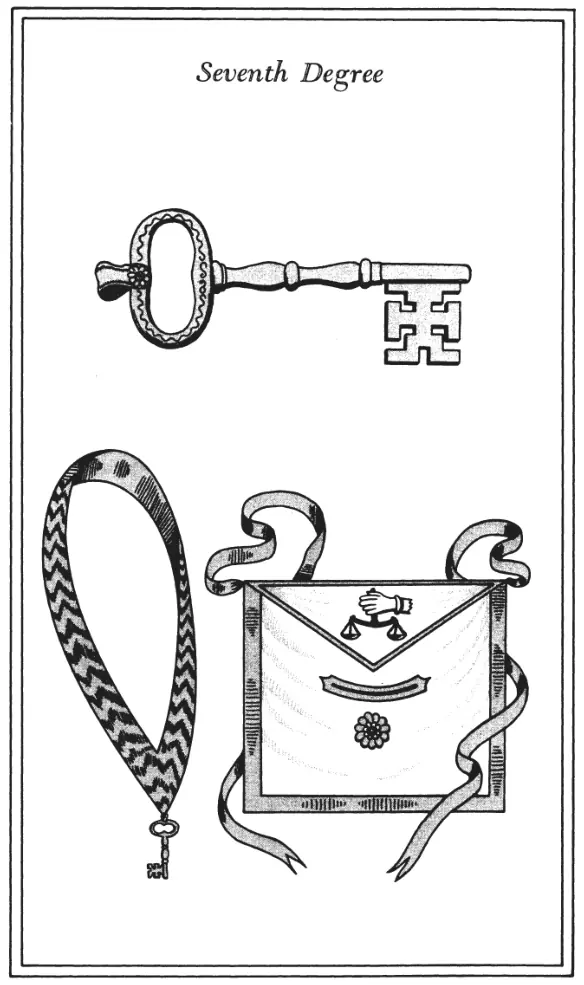
Après le serment fait, le très illustre fait relever le récipiendaire et, l'ayant fait avancer, il lui donne deux coups de son bâton royal sur chaque épaule et lui dit : Par le pouvoir, que j'ai reçu et dont je suis revêtu, je vous constitue prévôt et juge sur tous les ouvriers et tous les ouvrages du temple. Je vous décore en cette qualité de cette clef d'or, suspendue à ce cordon rouge que vous porterez en forme de collier. Voici le tablier doublé de même couleur, cette couleur rouge marque l'ardeur des maîtres. La poche au milieu sert à renfermer la clef des plans et sur la bavette est une clef brodée en or et quatre rosettes rouges ou couleur de cerise ainsi que la doublure, si l'on veut, et une rosette bleue au milieu. Il lui fait promettre ensuite, qu'il sera aussi circonspect avec les maîtres symboliques qu'il l'a été envers les profanes et lui donne ensuite les signes, les attouchements et les paroles et mots de passe, et de l'autre main, le roi ou très illustre lui remet la balance.
Le signe est d'embrasser le nez avec les deux premiers doigts du côté du pouce de la main droite. Le bout des doigts en haut en serrant le nez et on laisse glisser les bouts des doigts jusque sur la lèvre supérieure. On répond à ce signe en embrassant le menton avec le premier doigt et le pouce de la main droite, fermant les quatre autres doigts et faisant le doigt et le pouce se joindre par les bouts dans l'anneau de laquelle clef est une petite balance.
L'attouchement est que l'on empoigne les trois premiers doigts de la main droite en laissant les petits doigts de la même main d'un chacun en dehors avec lesquels on frappe l'un sept coups et le second en répond autant, ou si le premier n'en frappe qu'un ou trois, le second en répond quatre. C'est l'attouchement le plus ordinaire. D'autres même ne frappent qu'un, l'un deux et l'autre quatre.
Le mot de passe est Tito qui est le nom du doyen des 378 maîtres pour les irlandais, ou Jakinaï.
La parole est sextuple : Ciui, Ki, Jua, Hyram, Stokin, Geometros, Architecte, Xinxu18.
Le grand mot est Jakinaï.
Doctrine
D. Etes-vous illustre irlandais ou prévôt et juge ?
R. Interrogez-moi en parfait et je vous répondrai. Je rends la justice à tous les ouvriers, sans exception d'aucun.
D. Comment êtes-vous entré en loge ?
R. Par quatre grands coups et un excès, les quatre portiques du temple, et un détaché veulent dire que c'est le seul temple de l'Eternel.
D. Qui vous a introduit en loge ?
R. Un second surveillant qui m'a conduit à la partie occidentale.
D. Qu'a-t-il fait de vous ?
R. il m'a mis entre les mains du premier surveillant, qui m'a prononcé le mot Ciui.
D. Que vous a répondu le très illustre maître ?
R. Ki. Ces mots signifient, le premier : Fléchissez le genou ! et le second : Levez-vous !
D. Avez-vous voyagé ?
R. Oui, j'ai fait sept fois le tour du temple aux quatre portiques.
D. Que signifient ces tours aux quatre portiques ?
R. Les quatre âges du monde, la naissance, l'âge viril, la vieillesse et la mort
D. Qu'avez-vous fait ensuite ?
R. J'ai été aux pieds du très illustre par quatre grands pas de maître, qui m'ont porté sur les 4 portiques du temple.
D. Que vous a donné le très illustre ?
R. Il m'a donné les signes, attouchement et paroles.
D. Que vous a-t-il donné ensuite ?
R. Le cordon et le tablier, chacun avec leurs décorations.
D. Qu'avez-vous vu dans la loge ?
R. Quatre grandes lumières aux quatre coins et une au milieu.
D. Qu'avez-vous vu encore ?
R. J'ai vu la houppe dentelée au milieu de laquelle était situé un petit coffre de bois d'ébène.
D. Qu'avez-vous vu de plus ?
R. J'ai vu un grand G. et un grand A. entrelacés, une balance et une clef. Le G. et le A. signifient que Dieu a été l'architecte du temple.
D. Quoi encore ?
R. J'ai vu un I. H. S., un grand X. C., une urne d'or enflammée et le tombeau d'Hyram. X. C. signifie Xincu, qui veut dire le signe ou le repos de l'âme.
D. Où était le tombeau d'Hyram ?
R. Sous la seconde marche du temple, à main droite en entrant.
D. Que signifie la balance ?
R. L'entière inspection que nous avons sur les ouvriers et les ouvrages du temple et la marque de la justice, que nous portons.
D. Que signifie cette clef ?
R. Elle marque qu'il n'y a que nous qui savons où est placé le tombeau d'Hyram et que nous gardons les plans.
D. Où est placé le cœur d'Hyram ?
R. Il est placé dans une urne d'or enflammée, et gardée dans le sanctuaire.
D. Que veut dire I. H. S. entrelacé avec la branche d'acacia ?
R. J. signifie Jua, H. Hiram et S. Stokin qui le premier découvrit le corps d'Hyram et donna le mot de maître [9v°].
[9v°] D. La clef ne servait-elle pas encore à autre chose ?
R. Elle servait au doyen des 378 maîtres à ouvrir le petit coffre d'ébène pour renfermer et tirer les plans qu'ils distribuaient aux maîtres parfaits qui en pouvaient les proportionner sur la planche à tracer.
D. Que signifie la poche qui est sur votre tablier ?
R. Elle servait aux maîtres parfaits pour renfermer la clef et les dessins à distribuer.
D. Que signifient les rosettes rouges ?
R. Le rouge marque le sang d'Hyram.
D. Que signifient les bleues ?
R. La fidélité des maîtres.
D. Et les blanches ?
R. Leur innocence.
D. Quelle heure est-il ?
R. Le point du jour, huit heures, deux heures et sept heures.
D. Pourquoi tout cela ?
R. Parce qu'un illustre maître irlandais doit se trouve partout à toute heure du jour.
D. Quel âge avez-vous ?
R. Soixante et quatre ans.
D. Qui furent ceux qui entrèrent dans le temple carré ?
R. Il n'y eut que les hommes entièrement parfaits.
Pour fermer la loge
Ensuite le très illustre maître frappe quatre coups et un séparé, les surveillants les rendent. Tous ensuite forment le cercle pour faire passer les paroles et le mot de passe et tout finit.
[Signature]
Alphabet de l'illustre maître irlandais prévôt et juge / Second alphabet / Troisième alphabet
Apparat critique de la transcription Aeditimus
18. Ou Xinscu ? Plus bas, on trouvera Xincu.
Manuscrit Quesada 1804 (copie 1813-1821)
manuscrit · BNE Mss 7834 · 1 696 mots
Le manuscrit Quesada (Mss 7834 de la Bibliothèque Nationale d'Espagne) : copie (1813-1821) d'un état du Rite de 1804, voire antérieur, tel que pratiqué dans la mouvance du Suprême Conseil d'Amérique. Les didascalies du manuscrit sont en italique. Le texte est celui de l'édition Latomia, donnée en vis-à-vis du fac-similé du manuscrit : l'apparat critique de cette édition est repris ici, de même que les repères de folio du manuscrit.
Texte intégral sur ce site · transcription C. M. & P. T., Latomia / Chantier de fouilles maçonniques, d'après le Mss 7834 de la BNE
Cette L∴ doit être éclairée par 5 grandes Lumières une à chaque point cardinal et une au milieu elle doit être tapissée en rouge. Le Vble∴ s’appelle 3 Fois Illustre, il est placé sous un dais bleu parsemé d’étoiles d’or il représente Tito prince Arodin, le plus ancien des Prévôts et Juges Gd∴ Survt∴ et Inspecteur des 300 architectes qui étaient destinés à lever les plans pour les ouvriers, il y a dans cette L∴ 2 Survts∴
Ouverture
D∴ Ill∴ F∴ Premier Survt∴ sommes-nous à couvert ?
R∴ 3 Fois Ill∴ Nous le sommes.
D∴ Où est votre place Me∴ ?
R∴ Partout.
D∴ Pourquoi cela ?
R∴ Pour veiller à la conduite de l’ouvrage présider les ouvriers et rendre justice à chacun d’eux.
D∴ Quelle heure est-il ?
R∴ La pointe du jour 8 heures 2 & 7.
Alors le 3 Fois Ill∴ frappe Ce que répètent les Surveillants, ensuite il dit :
« Puisqu’il est la 8ème∴ heure 2 & 7, il est temps de
commencer à travailler, ce que les FF∴ répètent alors tous les FF∴ font la même batterie, le 3 Fois Ill∴ dit :
La L∴ est ouverte.
Réception
Le Me∴ des Cies∴ se rend dans la salle des pas perdus. Il conduit le Cand∴ à la porte de la L∴ à laquelle il frappe 5 coups, lesquels sont répétés par le 3 Fois Ill∴ & les deux Surveillants. Le 3 Fois Ill∴ donne l’ordre au F∴ Terrible de voir qui frappe à la porte du Temple, le F∴ Terrible dit :
C’est un F∴ N∴ qui demande à passer au Gde∴ de Prévôt & Juge
Le 3 Fois Ill∴ donne ordre au Me∴ des Cies d’introduire à la manière accoutumée le Récipiendre∴, il le fait entrer et placer entre les 2 Surveillants. Le 1er∴ Survt∴ quitte sa place prend le Récipiendre par la main, lui ordonne de dit : Civi s’agenouiller & il ensuite il lui pose son épée nue sur l’épaule droite et après une minute le 3 Fois Ill∴ dit : Ky Le 1er∴ Survt∴ retire le Cand∴ & lui fait faire 7 voyages autour de la L∴, à chaque voyage il fait le signe de ses précédents grades en commençant par le signe d’App∴ après le 7e∴ il s’arrête devant l’Autel, et le 3 Fois Ill∴ lui parle ainsi : Rble∴ Me∴ c’est avec beaucoup de
joie que je vous récompense de votre zèle et de votre attachement pour le M e des M es∴ et que je vais vous appointer Prévôt et Juge, nous sommes convaincus de votre zèle de votre discrétion nous allons sans hésiter, vous confier le plus important secret, remplissez vos devoirs dans le grade auquel nous vous élevons Comme vous les avez remplies dans les précédents, je vous confie la clef des lieux où sont placés le corps et le cœur de notre Rble∴ Hiram Abif assurez-nous que vous ne découvrirez jamais le lieu où ils sont déposés agenouillez-vous et prononcez avec moi l’obligation suivante, sur la Bible.
Obligation
Je jure & promets devant le Gd∴ Arche de l’Un∴ et les TT∴ Ill∴ FF∴ ici présents de ne jamais révéler aucune chose qui concerne le grade de Prévôt et Juge directement ou indirectement à aucune personne en dessous de ce grade je promets d’être juste et équitable envers tout le monde puisque je suis établi par cette
R∴ L∴ pour rendre la justice, je promets encore d’obéir strictement aux ordres & mandats du Gd∴ Conseil des Princes de Jérusalem, & de régler ma conduite sur ce qu’ils me prescrivent, ce que je jure sous les peines de mes premières obligations, ainsi Dieu me maintienne
dans l’équité, Amen, Amen, Amen.
Le 3 Fois Ill∴ fait relever le Candidat & en lui portant la main sur l’épaule droite il lui dit :
En vertu des pouvoirs qui m’ont été donnés et dont je suis revêtu, je vous constitue Prévôt et Juge sur tous les travaux & Ouvriers de ce Temple, je vous décore en cette qualité d’une Clef d’or suspendue à un ruban rouge que vous porterez en sautoir.
D’un tablier blanc bordé & doublé de rouge, avec une poche au milieu, sur la bavette sera une clef peinte ou brodée. Le rouge signifie l’ardeur des Maîtres et la poche est destinée à garder la clef des plans.
Signe
Porter les deux premiers doigts de la main droite à côté du nez.
La réponse est de porter sur le bout
du nez le 1er∴ doigt de la main droite, et le pouce sous le menton en forme d’Equerre.
Attouchement
S’entrelacer réciproquement le petit doigt de la main droite avec l’index ; se donner sept coups légers dans la paume de la main avec le pouce.
Mot Sacré
Jakinaï
Mot de Passe
Tito
Instruction
D∴ Êtes-vous Prévôt & Juge ?
R∴ Je rends la justice à tous les ouvriers sans exception
D∴ Comment avez-vous été introduit dans cette L∴ ?
R∴ Par 4 coups bien distincts et un séparé.
D∴ Que signifient les 5 coups ?
R∴ Les quatre coins du Temple et le centre où nous devons rendre nos dévotions à Dieu.
D∴ Qu’avez-vous trouvé en entrant dans cette L∴
R∴ Un Survt∴ qui m’a conduit à l’Ouest.
D∴ Qu’a-t-il fait ensuite ?
R∴ Le 1er∴ Survt∴ m’a fait agenouiller du genou droit et m’a fait prononcer Civi.
D∴ Qu’a répondu le T∴ Ill∴ ? Après un court intervalle il a dit : Ky. R∴
D∴ Que signifient ces paroles ?
Civi veut dire, mettez-vous à genoux, & Ky R∴
relevez-vous.
D∴ Qu’a fait ensuite le 3 Fois Ill∴ ?
R∴ Sur la bonne opinion qu’il avait de mon zèle il m’a constitué Prévôt & Juge.
D∴ Que vous a-t-il donné ?
R∴ Une Clef d’or qui est la marque distinctive de ce grade, ensuite l’attouchement les paroles & le signe.
D∴ Quel est l’usage de cette Clef ?
R∴ Elle sert à ouvrir un petit coffre d’ébène dans lequel sont déposés tous les plans nécessaires à la construction du Temple.
D∴ Que signifie tout cela ?
R∴ Cela désigne que les Prévôts et Juges connaissent le lieu où est déposé le cœur de notre Rble∴ Me∴ Hiram Abif.
D∴ Quel est le Mot de Passe ?
Tito. R∴
D∴ Que signifie cette parole ? C’est le nom du premier Gd∴ Survt∴ le prince, Harodin R∴ le plus ancien Prévôt et Juge qui avait l’inspection sur les 300 architectes du Temple.
D∴ Qu’avez-vous aperçu en L∴ ?
R∴ Un rideau sous lequel était suspendu un petit coffre d’ébène enrichi de pierreries.
D∴ Qu’y avait-il dans ce coffre ?
R∴ Tous les dessins relatifs à la construction du Temple.
D∴ Qu’avez-vous vu encore ?
R∴ Un Triangle dans le milieu de la L∴ dans lequel était un AG∴
D∴ Que signifie ces lettres ?
R∴ Que Dieu est le Gd∴ Arch te∴ de l’Univers et qu’il a donné l’idée à David et à Salomon de lui construire un Temple
D∴ Qui avait-il encore ?
R∴ Une balance.
D∴ Que signifie cette balance ?
R∴ Elle désigne l’exactitude que nous devons avoir à remplir nos devoirs, et la différence qui doit exister parmi les ouvriers
D∴ Où repose le cœur d’Hiram Abif ?
R∴ Dans une urne d’or placée sur le haut d’un obélisque.
J∴ D∴ Que signifient les lettres H∴ S∴ surmontées d’une branche d’acacia ? J∴ Jehovah. H∴ Hiram R∴ signifie
et S∴Stolkin ce dernier est le nom de celui qui trouva le corps d’Hiram Abif sous une branche d’acacia qui avait été mise sur la fosse ce qui le fit découvrir.
D∴ Dans quel lieu avez-vous été reçu282 ?
R∴ Dans la Chambre du Milieu.
D∴ Avez-vous fait quelqu’ouvrage de remarquable en qualité de Prévôt & Juge ?
R∴ J’ai été destiné à perfectionner le tombeau d’Hiram Abif.
D∴ De quoi vous a décoré le 3 Fois Ill∴ quand il vous a fait Prévôt et Juge.
R∴ D’un tablier blanc doublé & bordé de rouge cramoisi au milieu duquel était une poche avec une rosette rouge & blanche.
D∴ Quel était l’usage de cette poche ?
R∴ Pour mettre en sûreté les plans pour le plus ancien Prévôt & Juge qui les porte dans le Temple pour les communiquer aux M es∴ et pour prendre les proportions du pavé.
D∴ Que représente la rosette rouge & blanche ?
R∴ Le rouge représente le sang d’Hiram Abif et le blanc la candeur des M tres
D∴ Quelle était l’intention de Salomon en créant ce grade ?
R∴ Il était nécessaire de le créer parmi un aussi grand nombre d’ouvriers, Joabert, qui était honoré de sa confiance intime reçut cette nouvelle marque de distinction ce monarque créa d’abord, Tito Prince Arodin, Abda & Adonaïm ses fils, Prévôts & Juges, et leur donna ordre d’initier Joabert, son favori dans les plus grands secrets, de lui donner la Clef de tous les plans qui étaient renfermés dans un petit coffre d’ébène suspendu dans le St∴ des Saints sous un riche dais dans cette place sacrée il fut saisi d’admiration et tombant sur les genoux il prononça Civi , Salomon
Ky le voyant prosterné lui répondit et
lui donna une balance en signe de sa nouvelle place & de l’augmentation de ses connaissances.
R∴ Parce qu’un Prévôt & Juge doit être prêt à toute heure pour rendre la justice.
Alors le 3 Fois Ill∴ ferme la L∴ par 4, & un, comme à l’ouverture.
Apparat critique de l’édition Latomia
282. Le copiste A s’est aperçu qu’il avait inversé la question et sa réponse et a tenté de la signaler par des signes de renvoi peu clairs.
283. Le terme exact = est « Harodim » ( Myd1Orh= = hạroḏîm, 1 Roi 5:16 ou 1 Roi 5:30 selon les traductions ), écrit « Harodin » dans Pyron 1812 et Kloss.
284. Écrit « Achard » plus loin, ce qui semble la forme usuelle, cf. Pyron 1812 et Kloss.
285. Écrit « Jakinai » plus loin, ce qui semble la forme usuelle, cf. Pyron 1812 et Kloss.
Delaulnaye 1813
tuileur imprimé · 440 mots
Le « Thuileur des trente-trois degrés de l'Écossisme » de Delaulnaye (Paris, 1813), premier tuileur imprimé du REAA constitué : mots, signes, décors et remarques du grade. Texte relu mot à mot sur le fac-similé, mots hébreux restitués. Pages 47-52 de l'édition originale.
Cinq Bougies, savoir une à chaque coin et une au milieu.
Titres.
Le Vénérable représente Tito, prince des Harodim ; le premier mot n'est point hébreu, le second, Harodim, signifie
הָרֹדִים
(Præsidentes.)
On appeloit ainsi les chefs ou conducteurs que Salomon établit sur les ouvriers du temple ; chefs dont l'Ecriture compte 3600 (Paralip. l. 2, c. 2, v. 18), et seulement 3300 (Rois, l. 3, c. 5, v. 16).
Le Vénérable est qualifié de trois fois
[p. 48]
Illustre ; les Surveillants s'appellent Illustres Frères.
Signe.
Porter les deux premiers doigts de la main droite à côté du nez.
Réponse. Porter le premier doigt de la main droite sur le bout du nez, et le pouce sous le menton.
Attouchement.
On s'entrelace les petits doigts de la main droite, et l'on se donne mutuellement sept Coups dans la paume de la main.
Batterie.
Cinq Coups (quatre et un).
○ ○ ○ ○——○
Le Récipiendaire doit exécuter Sept voyages.
Mot Sacré.
IAKINAI.
Ce mot Iakinai יָכִינָי n'est autre chose que le [p. 49] pluriel de Iakin, comme Adonaï est le pluriel de Adon.
Il se retrouve, plus ou moins altéré, dans l'Intendant des Bâtiments ; Royal-Arche, l'Écossois de Montpellier, l'Écossois Trinitaire, celui de Franville, celui des trois J, etc.
Grande Parole.
Geometros, Xincheu, Yzirie, Ivah, Hiram, Stolkin.
On traduit Xincheu par Siége de l'Ame ; ce mot est insignifiant.
Suivant d'autres, le mot sacré est Tito, le mot de Passe Xincheu.
On dit aussi Civi, que l'on traduit par fléchissez le genou, et Ky ou Caki, auquel on fait signifier Levez-vous.
Heure.
Pour ouvrir, comme pour fermer ; Huit heures, Deux et Sept, ce qui signifie que le Prevôt et Juge doit, à toute heure, être prêt à rendre justice.
Tablier.
Blanc, bordé de Rouge. Une poche au milieu, avec une rosette Rouge et Blanche. Sur la bavette, une Clef peinte ou brodée. Le Rouge signifie l'Ardeur du Maitre Irlandois. La Poche est destinée à garder la Clef des Plans.
Cordon.
Cramoisi, en sautoir.
[p. 51]
Bijou.
Une Clef d'or. Elle est censée celle du coffre qui renfermoit le cœur d'Hiram.
Ce grade participe du Compagnonage et de l'Ecossois. On a cru y trouver une allusion aux ossements de Joseph, mort en Égypte, que Moyse emporta avec lui. Voyez GENÈSE, c. 50, v. 26, et EXOD., c 13, v. 19.
[p. 52]
Vuillaume 1820
tuileur imprimé · 365 mots
Le tuileur de Claude-André Vuillaume, « Manuel maçonnique, ou Tuileur de tous les rites de maçonnerie pratiqués en France » (Paris, Delaunay et Hubert, 1820) : décoration, titres, signes, attouchement, marche, batterie, âge, mots, habillement du grade, avec l'étymologie et l'interprétation des mots hébreux. Texte établi sur le fac-similé et relu mot à mot sur les images : océrisation à 600 dpi du volume numérisé, fusion avec la couche texte de la numérisation Gallica, puis relecture page par page. Orthographe de 1820 conservée, hébreu et grec restitués, batteries rendues comme l'imprimé les note, pagination de l'original. Pages 89 à 91.
Cinq lumières; une à chacun des angles, et la cinquième au milieu de la loge.
TITRES.
Le vénérable représente Tito, prince des Harodim (1). Il prend le titre de Trois fois illustre.
(1) הַרֹדִים harodim præsidentes. C'est ainsi que l'on nommait les 3600 chefs ou préfets que Salomon avait établis sur les ouvriers du Temple (Paralip. 2, chap. 2, ℣. 17 et 18). On feint que Tito en était le chef ou le prince; ce nom n'est pas d'origine hébraïque; l'Ecriture ne le nomme pas. (Grec. Τιτος, lat. Titus, signifie honorabilis; Titus, cognomento justi (Act. 18, ℣. 7.). Ce pourrait être à ce personnage que l'on a voulu faire allusion.
[p. 90]
Il y a deux surveillans; ils se nomment illustres frères.
SIGNES.
Porter les deux premiers doigts de la main droite à côté du nez; en réponse, on porte l'index sur le bout du nez et le pouce sous le menton.
ATTOUCHEMENT.
S'entrelacer réciproquement le petit doigt de la main droite avec l'index; se donner sept coups légers dans la paume de la main.
BATTERIE.
Cinq coups, par quatre et un : ● ● ● ○ — ●
HEURES DU TRAVAIL.
Huit, deux et sept.
HABILLEMENT.
Tablier blanc, bordé de rouge, une poche au milieu, avec une rosette rouge et blanche. Sur la bavette, est une clef peinte ou brodée en or; la poche est destinée à garder les clefs du coffre à renfermer les plans.
Cordon cramoisi, porté en sautoir, au bas duquel pend, pour bijou, une clef d'or.
MOT DE PASSE.
TITO.
[p. 91]
MOT SACRÉ.
JAKINAÏ (héb. יַכִינַי Jachinaï, pluriel du mot Jachin). Voyez la note sur le nom de Jachin, page 51.
Selon quelques rituels, cette parole est : Geometros, Xincheu, Yzirie, Jvah, Hiram et Stolkin; cela est fautif.
On dit aussi chivi (pron. kivi, de כִּפַת ou כַת inclinare) que l'on traduit ainsi : fléchissez le genou, et ki ou kai (de קַאֵי ou קַאִים stat, vel surgit ad standum) que l'on traduit par : levez-vous.
Pike 1857
rituel imprimé · en anglais · 6 850 mots
« The Magnum Opus or Great Work » (1857) : le premier corps complet de rituels révisés par Albert Pike pour la Juridiction Sud des États-Unis. Texte en anglais, établi par reconnaissance optique corrigée : des coquilles subsistent.
D'après la réimpression Kessinger de l'édition de 1857 (numérisation archive.org)
THE LODGE, ITS DECORATIONS, ETC.
The.Lodge is hung with red, and lighted by 5 Great Lights, one in each corner, and one in the middle.
In the East is a canopy, painted to represent the sky, with stars shining. Under it is suspended a box of Ebony, ornamented with jewels, supposed to contain the records of the Tribunal of Provosts and Judges.
In the middle of the Lodge hangs an equilateral Triangle; in the centre of which is the Word i; [In]:
and under it hangs an equal balance.
OFFICERS, TITLES, ETC.
The Master is'styled Ilustrious, and sits in the East. He represents Azarias, Son of Nathan, the Chief
'Provost and Judge.
There are two Wardens, who represent Elihoreph and Akia, the Scribes; and sit in the West. The Recorder sits in the South and represents Josaphat, the Son of Ahilud.
There is also a Master of Ceremonies.
The Candidate represents Zabud, the Son of Nathan. The Wardens are styled Sen.°, and Jun.°. Inspectors.
ORNAMENTS AND JEWELS.
The apron 's white, edged with red. In the middle is pocket, with are and white rosette. On the
flap is painted or embroidered a key.
The cordon is crimson, worn across the body. From it hangs the jewel: which is a Key of Gold.
The battery is ; 3,
The Age of a Provost and Judge is £ xX ? or, | years.
TO OPEN.
W.. M-. Bro., Sen. Inspector, I am about to open this Lodge of Provosts and Judges. See that we
are properly tyled.
'VIL... 2
Sen.*. Insp... Bro.*, Junior Inspector, the Iil.°. Master is about to open this Lodge. You will aco that it is properly tyled, and inform the tyler that the Lodge is about to be opened.
[The J.*. W.*. goes out, returns, raps ; ;, — which is returned by the tyler; and reports:
Jun. Insp... Bro.*. Sen.*. Inspector, the Lodge is properly tyled.
Sen.*. Insp.. Tl. Master, the Lodge is duly tyled, and we are secure from intrusion,
Th, Mr. Be.*. Sen.*. Inspector, are all present Provosts and Judges?
Ans.*. They are, IIL. Master.
Qu... Bro.*. Sen.:. Inspector, are you a Provost and Judge?
Ans.*. I dispense justice to all the workmen; and administer the law, without prejudice or partiality.
Qu.'. Where were you made a Provost and Judge?
Ans.*, In the middle chamber.
Qu". What is the especial emblem of your rank?
Ans, An equal balance, symbol of justice, accuracy and impartiality.
Qu... Where is your Master stationed ?
Ans... Everywhere.
Qu. Why?
Ans.". To adjust the demands of the workmen, hear their complaints, and do justice to all.
Qu... What is your age?
Ans. Twice £ years—I ¥ $5 Mf the age of a Master Mason.
Qu.". What is the hour?
as.*, 'The last hour of the night. The day comets.
I.. If. Give notice then that I am about to open this Lodge of Provosts and Judges, that the labours
of the day may be recommenced.
Sen.°. Insp... Bro.*. Jun.*. Inspector, it is the pleasure of the Ill.'. Master that this Lodge of Provosts and
Judges be now opened. Make known his will to the Brethren.
- Jun. Insp.*. Brethren, it is the pleasure of the Ill.. ML". that this Lodge of Provosts and Judges be now
opened. Take notice thereof, and prepare to recommence your labours, [The IIL*. M.*. raps;—the Sen". W..;—and the Jun.". W.,—then all.the Brethren rap ;; , with .
their hands. The Master gives the sign, and all the others the answer; and the Master declares the Lodge open].
Reception.
The Candidate, in the dress and with the jewel of 3 Confidential Secretary, i is received in the ante-room . by the Master of Ceremonies, who conducts him to the door of the Lodge, and gives the alarm ; ; , The door
is opened, and the Junior Warden asks,
Jun.". Insp... Who comes here?
. Jf. Cers. A Brother, who being a Perfect Master and Confidential Secretary, desires to obtain the degree of Provost and Judge.
Jun. Insp... Wow hath he fitted himself to receive this degree ?
AL-. Her... By being faithful, obedient and honest; by being zealous, ardent and devoted to Masonry and to his brethren ; by being generous and disinterested ; and by having aided to preserve peace and harmony among men.
Jun.°. Insp... For what purpose does he desire to advance further in Masonry?
M.. Cor."., That he may be the better qualified to do good, and live as becomes a Mason.
Jun." Insp.". Since such is his object, let him wait until the Ill, M.-. is informed of his request,
[The Jun.*. W.*. closes the door, and reports to the Sen.*. W.*. and he in his turn to the Master ; the same questions being asked, in each ense, and like answers returned as at the door.]
In,. af. Let him enter, and be received upon the edge of the sword of justice.
[The door is opened, and the 3I.*. of Ceremonies leads in the candidate, and places him in front of the two Wardens]. -
Tile, af. Let him who desires to advance in Masonry, first kneel, bending his knee and bowing his head to the God that made and that preserves him. :
(The Candidate kneels and inclines his head, and the Sen.*. W.". presses upon his neck the sharp edge of a naked sword, saying] : ; -
Sen., Insp. In this degree you are received upon the edge of the sword of justice. You desire, as a Provost and Judge, to grasp its hilt. Sea that you do not, by violating the moral Jaw, expose yourself to bo smitten with its edge.
I. Mc. Arise.
{Ile rises, and is led 7 times around the Lodge. At the end of each of the first six circuits, he halts in front of the Ill... Master, and gives the signs of the preceding degrees, one at each circuit, commencing with that of E.. A... During the circuits, the Ill. Master reads as fullows]:
Ist Circuit: . 2 . . Thou shalt provide out of all the People able men, such as fear God, men of Truth, and Haters of Injustice, and set them to judge the People at all Seasons. Hear the causes between your brethren, and judge righteously between man and man, and between the citizen and the stranger. Yo shall not respect persons in judgment; but shall listen to the humble as well as to the great. Ye shall not fear the face of man; for the judgment is God's.
2d Circuit: . . . . Thou shalt not follow a multitude to do evil; neither shalt thou, floating on the popular current, speak in a cause in order to pervert judgment. Nor shalt thou as a judge lean towards the side of a poor man, because he is poor; nor strain any point to give judgment in his favour.
8d Circuit: . . . .° See that ye Judge. not falsely, nor slay the innocent and the righteous: and take no gift: for a gift blindeth the wise, and perverteth the words of the righteous.
4th Circuit: . . . . Yeshall do no unrighteousness in judgment: ye shall not lean to the side of the poor, nor honour the person of the great; but shall impartially judge your neighbour. Yo shall do po injustice in judgment, in mete-yard, in weight or in measure. Just balances, just weights and just measures shall ye have; and no one shall chest or over-rench another. .
[5th Circuit: . . . . Ye shall have one manner of law,as well for the stranger as for one of-your own country. - One ordinance shall be for you and the stranger who sojourneth with you; the same ordinance forever in your generations: as ye are, so shall the stranger be before the Lord: one law and one custom shall be for you, and for the stranger that sojourneth with you. , .
6th. Love justice, you that are the judges of the earth: for he that speaketh unjust things cannot. be hid; neither shall the chastising judgment pass him by. Justice is perpetual and immortal. Oppress not the poor just man; bat spare the widow, and honour the ancient grey hairs of the aged. Let not your strength be the law of justice; nor hold that which is feeble to be nothing worth.
"Tth Circuit: . . . . The just that is dead condemnecth the wicked that are living. They shall live for evermore ; and their reward is with God, and the care of them with the Most High, to whom justice is as s breastplate, and true judgment as o helmet, and equity as an invincible shield; and He will sternly judge those," who being ministers of His Kingdom, do not judge rightly, nor keep the law of justice, nor walk according to his will. .
[The Candidate is then halted in front of the IIl.-. M.*. who says]:
HL. Bf. Whom bring you hither, Bro.*. M.°. of Ceremonies?
MM. Cor, Brow. A... B....,% Perfect Master and Confidential Secretary, who desires to attain the Degree of Provost and Judge, and so become a Master in Israel.
Hl, BE. He desires to assume a heavy burthen. IZath he o sufficient sense of the important duties and heavy responsibilities of the office?
M.. Her, Ill. Master, he will answer for himself.
ds, M, My Brother, are you aware that he who would assume the character of Provost and Judge, and in that character judge and decide between his Brethren, must be himself 'a just and upright man, impartial, cautious, merciful; of pure morals and blameless life and conversation; for that what judgment he measures
unto others, God will measure unto him; and that he must first of all give judgment against his own faults
and vices?
Cand... Tam. .
Ik, 3£°, Are you sensible that he who pardons or ignores his own errors and offences, and punishes the
self-same errors and offences, or those that are of their kindred, in others, is a false judge and disloyal Mason? Cand... Iam.
Il.-. M.*. De you feel the grave responsibility of deciding between man and man, where incorrect decision is injustice; and the effects of indolence, of inattention, of hasty examination and rash conclusion, are as grave as those of corruption, or of decision purchased by bribes, or prompted by enmity or prejudice ?
Cand... Do.
Nl. 36°; Do you feel that be who would assume the character of judge, is guilty of « serious offence, if
be does not fully inform himself of the laws and jurisprudence which he is to be called on to construe, to
apply, to administer and enforce ?
Cand.*. Do.
Jun.. Insp... Let the unjust judge tremble; for God will smite him with the sharp sword of his wrath |
Sén.*. Insp... Let the corrupt magistrate shake with terror; fur Remorse and his accusing conscience shall hunt him like hounds, and pursue him far beyond the grave !
Orator:.. Lect him who, unqualified, usurps the seat of judgment, remember the fate of those who laid their unholy hands upon the ark, and were smitten with God's anger for their presumption |
Sen.*. Insp... Judge not, that thou gayest not be judged: for whatever judgment thou tenderest against the errors and offences of others, shall God pronounce against thine !
Tl. O°. My Brother, hear and consider! Thus warned, do you atill desire to proceed?
Cand.*... Do.
It. H. Bro.. Master of Her.*., since this Bro.*., thus warned, hath such confidence in himself that he
is willing to proceed, you will conduct him to the Holy Altar, and cause him to kneel there, in proper position to take upon himself the solemn obligation of Provost and Judge.
{The Candidate is conducted to the Altar, and caused to kneel on both knees, with his hands upon the roll of parchment that represents the Holy Bible, while the Sen.". Warden lays the blade of ao naked sword
upon his head: in which position be repeats the following}
OBLIGATION.
I,A....B..... in the presence of the Gr.*. Architect of the Universe, whose Name and Symbol is suspended over me, and praying Him to witness this my obligation, do hereby and heron most solemnly and sincerely promise and swear, that I will never reveal the secrets of this degree to any person whatsoever, unless - it be to one who is duly authorized to receive, when I am duly authorized to communicate them; and at proper time and in a proper place.
- I furthermore promise and swear, that I will decide justly and impartially whatever matters of difference may be submitted to me; and whether in or out of the Lodge; without fear, favour, affection, prejudice, or the hope or promise of reward.
I furthermore promise and swear that I will henceforward most earnestly endeavour to do justice unto all men, whether friends or enemies or indifferent to me; seeking no unfair advantage of any, nor endeavouring to enrich or elevate myself, at the expense of another's fortune, happiness or reputation.
All of which I do most sincerely and solemnly promise and swear; binding myself under the penalty of being despised of all men while living, and my memory execrated after I am dead, and my name ever quoted by way of warning, os that of an unjust and corrupt judge, and unfair and dishonest man, if I wilfully violate this obligation. So help me God, and keep mo steadfast in the duo performance of the same!
As. M.... Arise, my Brother! By the power vested in mo, as successor of Azarias the son of Nathan, first Chief Provost and Judge under Solomon the King, I appoint and accept you a Provost and Judge, in the Ancient and accepted Rite of Masonry. Receive now the signs, words and token of this degree.
Sion: ... Place the 9 sO Cy and gs 9 UTC fingers of the ¢ hand, on the { side of the sy = C.
Answer:,.. Place the 9am C€ y finger of the ¢ hand on the wy 2 C; the y° & $ 95m, under
the ¢ & 9 a; thus forming a square.
Toxen: Interlace the OY PTCIS 9 UC te of the $&Q arn, and tap each other mutually,
& times [ by;;,], with the Y & $ gol, in the 3Q +95 of the & Orn.
Password:... POPPY.
Sacred Worn: ... %&C99%O&.* or, in French, SO F&To P--
Oruze Woans: ... T2*O-- Th Bee eH BETO YORI EE 2MIO L&2 Ok.
I now invest you with the apron, collar and jewel of this degree. The latter represents the key of the
Chief Provost and Judge, therewith he unlocked the box of Ebony that contained the Records of the Tribunal. It teaches you to lock carefully up in your heart the secrets of Masonry, and to keep the key ever in your own possession: and it is especially emblematical of that justice and uprightness that alone can unlock to you the mysteries contained in the higher degrees, and enable you to advance towards perfection. ., The triangle that hangs above your head is emblematical, here, as elsewhere in Masonry, of the Deity; of - dis Omnipresence, Omnipotence and Omniscience; and hath His Holy Name in the centre: and it is also cemblematical of the three great requisites of a judge, possessed by Him in their perfection and infinitude ; and with which, though in an infinitely less degree, avery human judge should be invested ;—Jusricz, Equirr, aad Iuparrtaniry. Let that emblem and the balance be ever before your eyes, and remind you of the obligation which you have taken in this Degree ; of the duties which devolve upon you; of the responsibilities which. rest upon you; and which, with God's eye ever fixed on you, you cannot evade or avoid. -
Listen now to the Lecture of this degree. :
LECTURE.
It is said that King Solomon, after the death of Hiram Abi, in order that justice might be administered among the workmen upon the Temple, their disputes be decided and their complaints heard, appointed seven Provosts and Judges, to adjust their demands, listen to their complaints, and settle any disputes and differences that might arise among them. Ie appointed Azarias the Son of Nathan to be the Chief Provost and Judge, Elihoreph and Ahia, the Sons of Siss, to be Masters of the Records, with the title of Inspectors, and four 'others, learned in the laws of Moses, to complete the number, and constitute the Tribunal. They held their sittings in the Middle Chamber of the Temple, where the records of the Tribunal were kept, in a box of Ebony, the Key of which was committed to the Chief Provost and Judge; and there they considered and adjusted the demands and differences of the workmen, and determined all appeals from the judgment of a single Provost and Judge; administering the enme laws to the Phonician as to the Hebrew; and endeavouring~to do entire justice, according to the law of Moses, between man and man. .
_ Such ig the brief account which hes come down to us, of the establishment of this degree. The lesson which it inculcates is justice in decision and judgment, and in our intercourse and dealing with other men.
In a country where trial by jury is known, every intelligent man is liable to be called on to act as a
judge, either of fact alone, or of fact and law mingled ; and to assume the heary respunsibilities which belong to that character. :
Those who are invested with the power of judgment, should judge the causes of all persons sprightly _and impartially, without any personal consideration of the power of the mighty, or the bribe of the rich, or the needs of the poor. That is the cardinal rule, which no one will dispute; though many fail to observe it. But they must do more. They must divest themselves of prejudice and preconception. They must hear
patiently, remember accurately, and weigh carefully the facts and the arguments offered before them. They must not leap hastily to conclusions, nor form opinions before they have heard all. They must not presume crime or fraud; but decide that it exists, only when, and not until, it is proven. They must neither cherish and indulge a stubborn pride of opinion, nor be too facile and yielding to the views and arguments of others. In deducing the motive from the proven act, they must not assign to the act either the best or the worst motive, _ but that which they would think it just and fair fur the world to assign to it, if they themselves had done it: nor must they endeavour tu make many little circumstances that weigh nothing separately, weigh much together, to prove their own acuteness and sagacity.
In our intercourse with others, there are two kinds of injustice ; the first, of those who offer an injury; the second, of those who hare it in their power to avertan injury from those to whom it is offered; and yet do it not. So active injustice may be done in two ways—by force and by fraud,—of which force is lion-like, and fraud fox-like,—both utterly repugnant to social duty, but fraud the more detestable.
Every wrong done by one man to another, whether it affect his person, his property, his happiness or his reputation, is an offence against the law of justice. The field of this degree is therefore o wide and vast one; and Masonry seeks fur the most impressive mode of enforcing the law of justice, and the most effectual means of preventing wrong and injustice.
To this end it teaches this great and momentous truth: that wrong and injustice once done cannot be undone; but are eternal in their consequences; once committed, are numbered with the irrevocable Past: that the wrong that is done, contains its own retributive penalty, as surely and as naturally, as the acorn contains the oak. Its consequences are its punishment; it needs nv other, and can have no heavier; they are involved in its commission, and cannot be separated from it. A wrong done to another is.an injury done to our own Nature, an offence against our own souls, s disfiguring of the image of the Beautiful. and Good.. Punishment is not the execution of a sentence, but the occurrence of an effect. It is ordained to follow guilt, not by the decree of God as a fudge, hut by a law enacted By Him as the Creator and Legislator of the Universe. It is not an arbitrary and artificial annexation, but an ordinary and logical consequence; and therefore must be borne by the wrongdoer alone.
There can be no interference with, or remittance of, or protection from, the natural effects of our wrongful acts. God will not interpose between the cause and its consequence ; and in that sense there cnn be no forgiveness of sins. The act which has debased our soul may be repented of, may be turned from; but the injury is done. The debasement may be redeemed by after efforts, the stain obliterated by bitterer struggles and severer sufferings; but the efforts and the endurance which might have raised the soul to the loftiest heights are now exhausted in merely regaining what it has lost. There must always be a wide difference between him who only ceases to do evil, and him who has always done well.
He will certainly be far more scrupulous watcher over his conduct, and far more careful of his deeds, who believes that those deeds will inevitably bear their natural consequences, exempt from after intervention ; than he who believes that penitence and pardon will at any time unlink the chain of sequences.- Surely we shall do less wrong and injustice, if the conviction is fixed and embedded in our souls, that every thing done is done irrevocably, that even the Omnipotence of God cannot nncommit a deed, cannot make that undone, which has been done; that every act of ours must bear its allotted fruit, according to the everlasting laws,— must remain forever ineffaceably inscribed on the tablets of Universal Nature.
If you have wronged another, you may grieve, repent, and resolutely determine against any such weakness in future. You may, so faras it is possible, make reparation. It is well. The injured party may forgive you, according to the meaning of human language; but the deed is done; and all the powers of Nature, were they to conspire in your behalf, could not make it undone; the consequences tu the body, the consequences
to the soul, though no man may perceive them, are there, are written in the annals of the Past, and must reverberate throughout all time.
Repentance for a wrong done, hears, like every other act, its own fruit, the fruit of purifying the heart and amending the Future; but nut of efucing the Past, The commission of the wrong is an irrevocable act; but it does not incapacitate the soul to do right fur the future. Its consequences cannot be expunged; but its course need not be pursued. Wrong and evil perpetrated, though ineffaceable, call fur no despair, but for efforts more energetic than before. Repentance is still as valid as over; but it in valid to secure the Future, not to obliterate the Past. .
Even the pulsations of the air, once set in motion by the human voice, cease not to exist with the sounds to which they gave rise. Their quickly attenuated force soon becomes inaudible to human ears. But the waves of air thus raised perambulate the surface of earth and ocean, and in less than twenty hours, every atom of its atmoaphero tukes up the altered movement due to that infinitesimal portion of primitive motion which has been conveyed to it through countless channels, and which must continue to influence its path throughout its future existence. The air is one vast library, on whose pages is forever written all that man has ever said or even whispered. There, in their mutable, but unerring characters, mixed with the earliest, as well as the latest signs of mortality, stand forever recorded, vows unredeemed, promises unfulfilled; perpetuating, in the united movements of enck particle, the testimony of man's changeful will. God reads that book, though we cannot,
So earth, air and ocean are the eternal witnesses of the acts that we have done. No motion impressed by natural causes or by human agency is ever obliterated. The track of every canoe which has yet disturbed the surface of the ocean, remains forever registered in the future movements of all succeeding particles which may occupy its place. Every criminal is by the laws of the Almighty irrevocably chained to the testimony of his crime; for every atom of his mortal frame, through whatever changes its particles may migrate, will still retain, adhering to it through every combination, some movement derived from that very muscular effort, by which the crime itself was perpetrated.
"What if our faculties should be so enhanced in a future life, as to enable us to perceive and trace the ineffaceable consequences of our idle words and evil deeds; and render our remorse and grief as eternal as those 'consequences themselves? No more fearful punishment to a superior intelligence can be conceived, 'thar to see still in action, with the consciousness that it must continue in action forever, & cause of wrong put in:motion by itself ages before.
Thus Masonry by its teachings endeavours to restrain men from the commission of injustice and acts of wrong and outrage. Though it does not endeavour to usurp the place of religion, still its code of morals proceeds upon other principles than the municipal law; and it frowns upon and punishes offences which neither that law punishes nor public opinion condemns. In the Masonic law, cheating and overreaching in 'trade are theft; a deliberate lie in perjury, the slanderer is an assassin, and the seducer worse than a murderer, Especially it condemns those wrongs of which the doer induces another to partake. He may repent; he may, after agonizing struggles, regain the path of virtue ; Ais spirit may re-achieve its purity through much anguish, after many strifes; but the weaker fellow-creature 'whom he led astray, whom he made a sharer in his guilt, but-whom he cannot make a sharer in his repentance and amendment: whose downward course (the first step of which he taught), he cannot check, but is compelled to witness,—what forgiveness of sins can avail bin there? There is his perpetual, his inevitable punishment, which no repentance can alleviate, and no mercy can remit.
Let us be just also, in judging of other men's motives. Wo know but little of the real merits or demerits of any fellow-crentare. We can rarely say with certainty that this man is more guilty than that, or even that this man is very good or very wicked. The basest men leave often behind them excellent reputations. There is scarcely one of us who has not, at some time in his life been on the edge of the commission of a great crime. We can every one of us look back, and shuddering, see the time when our feet stood upon the slippery crags that overhung the abyss of guilt; and when, if temptation had been a little more urgent, or a little longer continued, if want and penury had pressed us a little harder, or a little more wine had further disturbed our
intellect, dethroned our judgment, and aroused our passions, our feet would hare clipped and we should have fallen, never to rise again. .
We may be able to say; this man has lied; has pilfered, has forged, has embezzled monoys entrusted to him; and ¢haé man has gone through life with clean hands. But we cannot say that the former has not struggled long, though unsuccessfully, against temptations under which the second would have succumbed without an effort. We can say which has the cleanest hands before man; but not which has the cleanest soul before God. We may be able to say, this man has committed adultery, and that man has been ever chaste; but wo cannot tell but that the innocence of one may have been due to the coldness of his heart, to the absence of a motive, to the presence of a fear, to the slight degree of the temptation; nor but that the fall of the other may have been preceded by the most vehement self-contest, caused by the most over-mastering frenzy, and atoned * for by the most hallowing repentance. Generosity as well as niggardliness may be a mere yielding to native temperament; and in the eye of Heaven, a long life of beneficence in one man may hare cost less effort, and may indicate less virtue and less sacrifice of interest, than a few rare hidden acts of kindness wrung by duty out of the reluctant and unsympathizing nature of the other. There may be more real merit, more selfsacrificing effort, more of the noblest elements of moral grandeur, in a life of failure, sin and shame, than in a career, to our eyes, of stainless integrity. ,
When we condemn or pity the fallen, how do we know that, tempted like him, we should not have fallen as soon, and perhaps with less resistance?' How can we know what te should do if we were out of employment, famine sitting gaunt and hungry at our fireside, and our children wailing for bread? We fall not, because we | are not tempted. Ile that hath fallen may be at heart as honest as wes Wow do we know that our wife or sister or daughter could resist the distress, the temptation, that lost their poor abandoned sister of shame her virtue? Perhaps they also stand, only because they have not been tempted.
Human justice must be ever uncertain. Mow many judicial murders have been committed, through
ignorance of the phenomena of insanity! IIow many men been hung for murder, who were no more murderers at heart than the jury that tried, and the judge that sentenced, them! It may well be doubted whether the administration of human laws, in every country of the Globe, is not one gigantic mass of injustice and wrong. God sects not as man seceth; and the most abandoned criminal, black as be is'before the world, may yet bravo continued to keep some little light burning in a corner of his own soul; which would long since have gone out in that of those who walk proudly in the sunshine of immaculate fame, if. they had been tried.and tempted like the poor outcast.
We do not know even the outside life of men. We ara not competent to pronounce even on their deeds. We do not know half the acts of wickedness or virtue, even of our most immedinto fellows. We cannot soy with certainty, even of our nearest friend, that he has not committed o particular sin, and broken a particular commandment. Let each man ask his own heart. Of how many of our best and of our worst acts and
qualities, are our most intimate associates utterly unconscious! How many virtues does not the world give us credit for, that we do not possess: or vices condemn us for, of which we are not the slaves! Its but a small portion of our evil deeds and thoughts that ever comes to light; and of our few redeeming goodnesses, the largest portion is known to God alone.
We shall therefore be just, in judging of other men, only when we are charitable: and we should assume the prerogative of judging others, only when the duty is forced upon us; since we are almost so certain to err; and since the consequences of error are so serious. No man need covet the office of judge; for in . assuming it, he assumes the most serious and oppressive responsibility. You have assumed it, Wo all assume it; for man is ever ready to judge, and ever ready to condemn his neighbour; while upon the same state of case be acquits and absolves himself. See, therefore, that you exercise your office cautiously and charitably, lest in passing judgment upon the criminal, you commit a greater wrong than that for which you condemn him, and the consequences of which will be eternal. .
The faults and crimes and follies of other men are not unimportant to us; but form o part of our moral discipline. War and bloodshed at a distance, and frauds which do not affect our pecuniary interests, touch us in our feelings, and concern our moral welfare. They have much to do with all thoughtful hearts. The public eye may look unconcernedly on the miserable victim of vice; and that shattered wreck of a man may
move the multitude to laughter or to scorn. But to the Mason, its the form of sacred humanity that is before him; it is an erring fellow-being ; a desolate, forlorn, forsaken soul; and his thoughts, enfolding the poor wretch, will be far deeper than those of indifference, ridicule or contempt. All human offences, the whole system of dishonesty, evasion, circumventing, forbidden indulgence and intriguing ambition, in which men are struggling with each other, will bo luoked upon by a thoughtful Mason, not oierely as a scone of mean toils and strifes, but as the solemn conflict of immortal minds, for ends vast and momentous as their own being. It is asap and unworthy strife, and may well be viewed with indignation; but that indignation must melt into pity. For the stakes for which these gamesterg play, are not those which they imagine, not those which are in sight. For example, this man plays for o petty office, and gains it; but the real stake he gains, is sycophancy, uncharitableness, slander and deceit,
Good men are too proud of their goodness. They are respectable; dishonour comes not near them; their countenance has weight and influence ; their robes are unstained; the poisonous breath of calumny has never been breathed upon their fur name. Mow easy it is for them to look down with scorn upon the poor degraded offender; to pass him by with a lofty step; to draw up the folds of their garment around them, that they may not be soiled by his touch! Yet the Great Master of Virtue did not so; but descended to familiar intercourse with publicans and sinners.
Many men think themselves better, in proportion as they can detect sins in others? When they go over the catalogue of their neighbour's unhappy dereliction of temper or conduct, they often, amidst much apparent concern, feel o secret exultation, that destroys all their own pretensions to wisdom and moderation, and even to virtue. Many even take actual pleasure in the sins of others; and this is the case with every one whose thoughts are often employed in agreeable comparisons of his own virtues with his neighbours' faults.
The power of gentleness is too little seen in the world; the subduing influences of pity, the might of love, the control of mildness over passion, the commanding Majesty of that perfect character which mingles grave displeasure with grief and pity for the offender. So it is that Mason should treat his brothers who go astray. Not with bitterness; nor yet with good-natured easiness, nor with worldly indifference, nor with @ philosophic coldness, nor with a laxity of conscience, that accounts everything well, that passes under the seal of public opinion.
.. The human heart will not bow willingly to what is infirm'and wrong in human nature. If it yields to us, it must yield to what is divine in us. The wickedness of my neighbour cannot submit to my wickedness; his sensuality, for instance, to my anger against his vices. My faults are not the instruments that are to -arrest his faults, And-therefore impatient reformers, and denouncing preachers, and hasty reproves, and angry parents, and irritable relatives generally fail, in their several departments, to reclaim the erring.
A moral offence is sickness, pain,.lose, 'dishonour, in the immortal partof man. It is guilt, and misery
_added to guilt. It is itself calamity; and brings upon itself, in addition, the calamity of God's disapproval, the abhorrence of all virtuous men, and the soul's own abhorrence. Deal faithfully, but patiently and tenderly, with this evil. It is no matter for petty provocation, nor for personal strife, nor for selfish irritation.
Speak kindly to your erring brother. God pities him: Christ has died for him: Providence waits: for him: Heaven's mercy yearns towards him; and Heaven's spirits are ready to welcome him back with joy. Let your voice be in unison with all those powers that God is using for his recovery.
If one defrauds you, and exults at it, he is the most to be pitied of human beings. We has done himself a far deeper injury than he has done you. It is him, and not you, whom God regards with mingled displeasure and compassion; and His judgment should be your law. Among all the benedictions of the Holy Mount there is not one for this man; but for the merciful, the peace-makers and the persecuted they are poured out freely. .
We are all men of like passions, propensities and exposures. There are elements in us all, which might. have been perverted, through the successive processes of moral deterioration, to the worst of crimes. The wretch whom the execration of the thronging crowd pursues to the scaffold, is not worse than any one of that multitude might have become, under similar circumstances. He is to bo condemned indeed, but also deeply to be pitied. .
It does not become the frail and sinful to be vindictive towards even the worst criminals. Wa owe mach
to the good Providence of God, ordaining for us a lot more favourable to virtue. We 'all had that within us, that might have been pushed to the same excess. Perhaps we should hare fallen as he did, with less temptation. Perhaps we have done acts, that, in proportion to the temptation or provocation, were less excusable than his great crime. Silent pity and sorrow for the victim should mingle with our detestation of the guilt. Even the pirate who murders in cold blood on the high seas, is such aman as you or might have been. Orphanage in childhood, or base and dissolute and abandoned parents ; an unfriended youth ; evil companions; ignorance and want of moral cultivation ; the temptations of sinful pleasure or grinding poverty; familiarity with vice; a scorned and blighted name; seared and crushed affections ; desperate fortunes; these are steps that might have led any one among us, to unfurl upon the high seas the bloody flag of universal defiance; to wage war with our kind; to live the life and die the death of the reckless and remorseless freebooter. Many affecting relationships of humanity plead with us to pity him. His head once rested on a mother's bosom. Ile was once the object of sisterly love and domestic endearment. Perhaps his hand, since often red with blood, once clasped another little loving hand at the altar. Pity him then; his blighted hopes and his crushed heart. It is.proper that frail and erring creatures like ua should do so; should feel the crime, but feel its weak, tempted and rescued creatures should.. It may be that when God weighs men's crimes, He will take into consideration the temptations and the adverse circumstances that led to them, and the opportunities fur moral culture of the offender; and it may be that our own offences will weigh heavier than we think, and the murderer's lighter than according to man's judgment.
On all accounts, therefore, let the true Mason never forget the solemn injunction, necessary to be observed at almost every moment of a busy life: ""Jcoce Nor, Lest YE YOURSELVES BE JUDCED: FOR WHATSOEVER JUDGMENT YE MEASURE UNTO OTHERS, THE SAME SHALL IN TURN BE MEASURED UNTO YOU." Such is the lesson taught
to every Provost and Judge.
TO CLOSE.
I, IC. .Bro.*. Sen.*. Inspector, what is-the hoart
Sen. Insp. ' The last hour of the night. The day comets.
Il, Mf. Why always the same hour ?
~ Sen.. Insp... Because a Provost and Judge must be always ready to dispense justice ; and all hours are alike
to him.
Il. I; Does any duty of this Lodge remain unporformed?
Sen.. Insp... None, Il.. Master.
TL. M. Then we may rest from our labours in the Lodge, that each may do his individual duty in the world. Bro.*. Jun." Insp... how should Masons always act?
Jun. Insp... With justice.
Til. MM. Brd.. Sen.*. Inspector, how should they deliberate ?
Sen.". Insp... With impartiality. .
Il, Ms. And decide by the rules of Equity. So let us ever act, deliberate and decide. My Brethren, aid me to close this Lodge.
[The Ill. BL.*. gives the sign, and all the Brethren the answer. Then the Iil.. Master gives the battery {3 3» J--which is repeated by the Sen.". and Jun.' Wardens, in succession, and then by all the Brethren with their hands; and the III.-. M.°. says]:
All,:, i. My Brethren, the Lodge is closed.
FINIS.
Ragon 1861
tuileur imprimé · 420 mots
Le « Tuileur général de la Franc-Maçonnerie ou Manuel de l'initié » de Jean-Marie Ragon (Paris, 1861), dernier grand tuileur français du siècle : décoration, titres, ordre, signes, mots, marche, âge, batterie et décors du grade, avec les notes critiques de Ragon sur les mots altérés par la tradition. Pages 110-112 de l'édition originale.
5 lumières, une à chacun des angles, et la cinquième au milieu de la Loge.
Titres.
Le Vénérable prend le titre de trois fois illustre, et représente Tito, prince des Harodim².
2 Harodim, nom hébreux signifiant Præsidentes. C'est ainsi que l'on qualifiait
[p. 111]
Les deux Surveillants se nomment illustres.
Ordre.
Point.
Signe.
Porter à côté du nez les deux premiers doigts de la main droite. En réponse, on porte l'index sur le bout du nez, et le pouce sous le menton.
Attouchement.
S'entrelacer réciproquement le petit doigt de la main droite avec l'index, et se donner 7 coups légers dans la paume de la main.
Mot de passe.
TITO.
Mot sacré.
JAKINAÏ (en hébreu Jachinaï, pluriel du mot Jachin).
Grande parole.
IZRACH-IAH (hébr. Iz' rahh-iah, orietur Dominus, Paralip., I, ch. VII, v. 3). JÉHOVAH, HIRAM, STOLKIN (GÉOMÈTRES-ARCHITECTES).
Selon quelques rituels, cette parole est : Geometros, Xinchen, Ysirïe, Ivah, Hiram et Stolkin ; cela est fautif.
On dit aussi Chivi (prononcez Kivi, d'un verbe hébreu signifiant incliner, que l'on traduit ainsi : fléchissez le genou, et Ki ou Kai, que l'on traduit par levez-vous ! (il est vivant).
Marche.
Point.
Âge.
Point.
Batterie.
Cinq coups (4 + 1), ○ ○ ○ ○ ○ !
Heures de travail.
Neuf : deux et sept.
Questions d'ordre.
D. Êtes-vous Prévôt et Juge?
R. Je rends la justice à tous les ouvriers sans exception.
D. Quand avez-vous été introduit en Loge?
R. Après que j'eus frappé quatre coups et un séparé.
D. Que signifient ces quatre coups?
R. Les quatre coins du temple et le centre, où nous nous humilions devant Dieu.
les 3,600 chefs ou préfets que Salomon avait établis sur les ouvriers du temple (Paralip. 2, ch. II, v. 17 et 18). On feint que Tito en était le chef ou le prince ; ce nom n'est pas d'origine hébraïque ; l'écriture ne le nomme pas. (Grec Titos, latin Titus, signifie honorabilis ; Titus, cognomento justi (act. 18, v. 7). Ce pourrait être à ce personnage que l'on a voulu faire allusion.
[p. 112]
D. Quelle heure est-il?
R. Le point du jour.
Décors.
TABLIER. Blanc, bordé de rouge (destiné à serrer la clef du coffre renfermant ou le cœur d'Hiram ou les plans), avec une poche au milieu, portant une rosette rouge et blanche (le rouge signifie l'ardeur des Maîtres irlandais). Sur la bavette est peinte ou brodée en or la parole du grade.
Cordon.
Cramoisi, porté en sautoir, au bas duquel pend le bijou.
Bijou.
Une clef d'or.
Pike 1884
rituel définitif · en anglais · 7 376 mots
Le rituel définitif d'Albert Pike tel que pratiqué par la Juridiction Sud des États-Unis (état final des révisions, v. 1884 ; recomposition numérique de 2020). Texte en anglais, établi directement sur la composition d'origine : ligatures rétablies, italiques de l'imprimé conservées, hébreu, phénicien et samaritain rendus dans leur écriture, pagination de l'original. Les partitions musicales, les plans d'atelier et les planches de décors sont reproduits en fac-similé à leur place dans le texte. Pages 225 à 235 de l'édition.
Ritual of the Scottish Rite, Supreme Council, S. J. (recomposition 2020), p. 225-235
[p. 225]
Planche [p. 225]
[p. 226]
Planche [p. 226]
ࠒࠑࠉࠍ࠰ࠅࠔࠐࠈ
The Lodge—its Decorations, etc.
The Lodge of Provosts and Judges is hung with red, and lighted by five Great Lights, one in the East, two in the West, one in the South, and one in the North.
In the East is a canopy, painted to represent the sky, with the stars shining. Under it is suspended a small box, colored to represent ebony, and ornamented with jewels.
In the center of the Lodge, over the altar, hangs a gilded equilateral triangle, having in its center the word . Under this hangs an equal balance.
The altar is covered with white, and upon it are the Book of Constitutions, the Hebrew Pentateuch, a small gilded balance, and two naked swords, crossed.
Officers, Titles, etc.
The Master is styled “Venerable Chief Provost and Judge.” He represents Azariah the son of Nathan. The Wardens represent Alihoreph and Ahaiah, sons of Shaisha, the scribes. The Recorder represents Yosaphat, the son of Akhailūd. The Aspirant represents ZabŪd, the son of Nathan. The Wardens are styled Senior and Junior Inspectors. ornaments and jewels The Apron is of white lambskin, edged with red. In the center of it is a pocket, with a red and white rosette. On the flap is painted or embroidered, a Hand of Justice.
The Cordon is a broad watered crimson ribbon, worn from right to left. From it hangs the jewel, which is a key of gold.
The Age of a Provost and Judge is 12 years. The Lodge opens and closes at the same hour—the last hour of the night.
[p. 227]
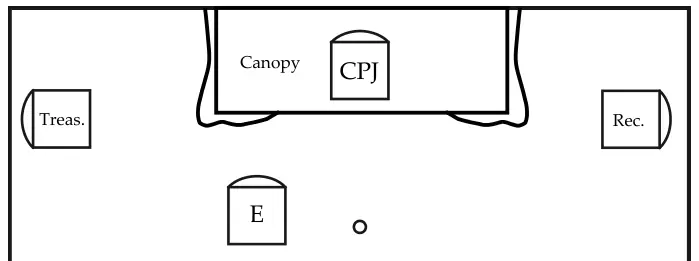
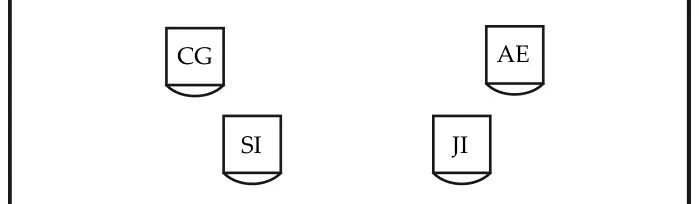
Plan de l’atelier [p. 227]
MC
Alm. Orat.
Figure de l’original [p. 227]
[p. 228]
To Open.
CPJ—Brother Senior Inspector, are all present Provosts and Judges?
SI—Venerable Chief Provost and Judge, all present are Provosts and Judges.
CPJ—Brother Senior Inspector, I am about to open a Lodge of Provosts and Judges here. See that we are duly tiled.
SI—Brother Junior Inspector, be pleased to inform the Tiler that the Lodge is about to be opened, and direct him to tile accordingly.
The Junior Inspector goes out, returns, raps ••• ••• •, which is returned by the tiler, and reports. JI—Brother Senior Inspector, the Lodge is duly tiled.
SI—Venerable Chief Provost and Judge, the Lodge is duly tiled, and we are secure from intrusion.
CPJ—Brother Senior Inspector, are you a Provost and Judge?
SI—I dispense justice to all the workmen; and administer the law without prejudice or partiality.
CPJ—Where were you made a Provost and Judge?
SI—In the Middle Chamber.
CPJ—What is the especial emblem of your rank?
SI—An equal balance, symbol of justice, accuracy, and impartiality.
CPJ—Where is your Master stationed?
SI—Everywhere.
CPJ—Why?
SI—To adjust the demands of the workmen, hear their complaints, and do justice to all.
CPJ—What is your name?
SI—Alihoreph.
CPJ—What is your age?
SI—Seven and five years; the age of a Fellow-Craft added to that of a Master.
CPJ—What is the hour?
SI—The last hour of the night. The day cometh.
CPJ—Give notice, then, that I am about to open this Lodge of Provosts and Judges, that the labors of the day may be recommenced.
SI—Brother Junior Inspector, it is the pleasure of the Venerable Chief Provost and Judge that this Lodge of Provosts and Judges be now opened. Make known his will to the brethren!
JI—Brethren, it is the pleasure of the Venerable Chief Provost and Judge, that this Lodge be now opened. Take notice thereof, and prepare to recommence your labors!
CPJ—••• All rise. CPJ—••• (with gavel) SI—••• (with gavel) JI—• (with gavel) Brethren—••• ••• • (with hands) The Chief Provost and Judge gives the sign (Place the index and middle fingers of the right hand on the right side of the nose).
All others give the answer (Place the index finger of the right hand on the nose, the thumb under the chin, thus forming a square).
CPJ—I declare this Lodge of Provosts and Judges duly opened. • All are seated.
Reception.
The Aspirant, in the dress and with the jewel of an Intimate Secretary, is received in the anteroom by the Master of Ceremonies, who conducts him to the door of the Lodge, and raps ••• ••• •. The Junior Inspector opens the door.
JI—Who comes here?
MC—A brother who, being an Intimate Secretary, desires to obtain the degree of Provost and Judge.
JI—For what purpose does he desire to advance further in Masonry?
MC—That he may be the better qualified to do good, and live as becomes a Mason.
JI—Since such is his object, let him wait until the Venerable Chief Provost and Judge is informed of his request. The Junior Inspector closes the door and reports to the Senior Inspector. SI—Who comes here?
[p. 229]
JI—A brother who, being an Intimate Secretary, desires to obtain the degree of Provost and Judge.
SI—For what purpose does he desire to advance further in Masonry?
JI—That he may be the better qualified to do good, and live as becomes a Mason.
SI—Since such is his object, let him wait until the Venerable Chief Provost and Judge is informed of his request. The Senior Inspector reports to the Chief Provost and Judge. CPJ—Who comes here?
SI—A brother who, being an Intimate Secretary, desires to obtain the degree of Provost and Judge.
CPJ—For what purpose does he desire to advance further in Masonry?
SI—That he may be the better qualified to do good, and live as becomes a Mason.
CPJ—Let him enter. The door is opened, and the Master of Ceremonies leads in the Aspirant, and places him in front of the two Wardens. CPJ—Let him who desires to advance in Masonry first kneel and bow his head to God, in whom he puts his trust!
The Aspirant kneels and inclines his head, and the Senior Inspector presses upon his neck the sharp edge of a naked sword. SI—In this degree you are received upon the edge of the sword of justice. You desire, as a Provost and Judge, to grasp its hilt. See that you do not, by violating the moral law, expose yourself to be smitten with its edge.
CPJ—Arise! The Aspirant rises and the Master of Ceremonies leads him seven times around the Lodge. At the end of each of the first six circuits, he halts in front of the Chief Provost and Judge, and gives one of the signs of the preceding degrees, at each circuit, commencing with that of Apprentice.
CPJ—(During the first circuit, reading) Thou shalt provide out of all the people able men, such as fear God, men of truth, and haters of injustice, and set them to judge the people at all seasons.
The Aspirant halts in front of the Chief Provost and Judge and gives the sign of an Apprentice. They begin the second circuit. SI—(During the second circuit) Thou shalt not follow a multitude to do evil; neither shalt thou, floating on the popular current, speak in a cause in order to pervert judgment.
The Aspirant halts in front of the Chief Provost and Judge and gives the sign of a Fellow Craft. They begin the third circuit. CPJ—(During the third circuit) See that ye judge not falsely, nor slay the innocent and the righteous; and take no gift; for a gift blindeth the wise, and perverteth the words of the righteous.
The Aspirant halts in front of the Chief Provost and Judge and gives the sign of a Master. They begin the fourth circuit. SI—(During the fourth circuit) Ye shall do no unrighteousness in judgement; ye shall not lean to the side of the poor, nor honor the person of the great; but shall impartially judge your neighbor.
The Aspirant halts in front of the Chief Provost and Judge and gives the sign of a Secret Master. They begin the fifth circuit. CPJ—(During the fifth circuit) Ye shall have one manner of law, as well for the stranger as for him of your own country. One ordinance shall be for you and for the stranger who sojourneth with you.
The Aspirant halts in front of the Chief Provost and Judge and gives the Sign of Admiration of a Perfect Master. They begin the sixth circuit.
SI—(During the sixth circuit) Love justice, ye that are the judges of the earth; for he that speaketh unjust things cannot be hid; neither shall the chastising judgment pass him by.
The Aspirant halts in front of the Chief Provost and Judge and gives the sign of an Intimate Secretary. They begin the seventh circuit.
CPJ—(During the seventh circuit) The just that is dead condemneth the wicked that are living. They shall live forevermore; and their reward is with God, and the care of them with the Most High.
The Aspirant halts in front of the Chief Provost and Judge. CPJ—Whom bring you hither, Brother Master of Ceremonies?
MC—An Intimate Secretary, who desires to attain the degree of Provost and Judge, and so become a Master in Israel.
CPJ—He desires to assume a heavy burden. Has he a sufficient sense of the important duties and heavy responsibilities of the office?
MC—Venerable Chief Provost and Judge, he will answer for himself.
CPJ—My brother, are you aware that he who would assume the character of Provost and Judge, and in that character judge and decide between his brethren, must be himself a just and upright man, impartial, cautious, merciful, of pure morals and blameless life?
A—I am.
CPJ—Are you sensible that he who pardons his own errors and offences, and punishes the same in others, is a false judge and disloyal Mason?
A—I am.
[p. 230]
CPJ—Do you feel the grave responsibility of deciding between man and man, where incorrect decision is injustice?
A—I do.
CPJ—Do you feel that he who would assume the character of judge, is guilty of a serious offence, if he does not fully inform himself of the laws which he is to be called on to construe and enforce?
A—I do.
JI—Let the unjust judge tremble; for God will smite him with the sharp sword of his wrath!
SI—Let the corrupt magistrate shake with terror; for Remorse shall pursue him far beyond the grave!
O—Let him who, unqualified, usurps the seat of judgment, remember the fate of those who laid their unholy hands upon the ark!
SI—Judge not, that thou mayest not be judged; for whatsoever judgment thou renderest against others, even that shall God pronounce against thee.
CPJ—My brother, hear and consider! Thus warned, do you still desire to proceed?
A—I do.
CPJ—Brother Master of Ceremonies, since this brother, thus warned, is willing to proceed, you will conduct him to the holy altar, and cause him to kneel there in proper position to take upon himself the solemn obligation of a Provost and Judge. •••
All rise. The Aspirant is conducted to the altar, and caused to kneel on both knees, with his hand upon the crossed swords and the roll of parchment that represents the Pentateuch, while the Senior Inspector lays the blade of a naked sword upon his head; in which position he repeats the following obligation.
CPJ—I, A. B., in the presence of the Great Architect of the Universe, do hereunder and hereon most solemnly and sincerely promise and vow, that I will never reveal the secrets of this degree to any person whatsoever, unless it be to one who is duly authorized to receive them from me.
I furthermore promise and vow, that I will decide justly and impartially whatever matters of difference may be submitted to me—whether in or out of the Lodge—without fear or favor, or the hope or promise of reward.
Unto all of which I do pledge my honor as Man and Mason; binding myself under the penalty of being despised of all men while living, my memory execrated after I am dead, and my name hated as that of an unjust judge and dishonest man, if I willfully violate this vow. So help me God, and keep me steadfast in the due performance of the same!
CPJ—• The Brethren are seated. CPJ—Arise, my brother! By the power vested in me, as successor of Azariah the son of Nathan, first Chief Provost and Judge under Solomon the King, I appoint and accept you a Provost and Judge, in the Ancient and Accepted Scottish Rite of Freemasonry.
Receive now the Signs, Words, and Token of this degree. The Sign is to place the index and middle fingers of the right hand on the right side of the nose. The Answer is to place the index finger of the right hand on the nose, the thumb under the chin, thus forming a square.
The Token is to interlace the little fingers of the right hand, and tap each other mutually seven times, by 3+3+1, with the thumb in the palm of the hand.
The Password is Tito, said to be a Prince of the Harodim. The Sacred Word is Shekinah, or in French, Jachinai (God resident or abiding). Other Words are Kivi (Obey thou, kneel), Kum (Rise), Stolkin (What is firm, stable, upright), Sanahakuh (Burning Bush), Yezrakh-Yah (The rising of God; Gesenius gives as its meaning, “to whom Jehuah has given rising and birth”).
I now invest you with the Apron, Cordon, and Jewel of this degree. The latter represents the key of the Chief Provost and Judge, wherewith he unlocked the box of ebony that contained the records of the tribunal. It teaches you to lock carefully up in your heart the secrets of Masonry, and to keep the key ever in your own possession; and it is especially emblematical of that justice and uprightness that alone can unlock to you the mysteries contained in the higher degrees, and enable you to advance toward perfection.
It is said that King Solomon, after the death of the Master Khirum, in order that justice might be administered among the workmen upon the temple, their disputes be decided and their complaints heard, appointed seven Provosts and Judges to adjust their demands, listen to their complaints, and settle any disputes and differences that might arise among them. He appointed Azariah ben Nathan to be the Chief Provost and Judge; Alihoreph and Ahaiah, ben Shaisha, to be Masters of the Records, with the title of “Inspectors”; and four others learned in the laws of Moses, to complete the number and constitute the tribunal. They held their sittings in the middle chamber of the temple, where the records of the tribunal were kept; and there they considered and adjusted the demands
[p. 231]
and differences of the workmen, and determined all appeals from the judgment of a single Provost and Judge, administering the same laws to the Phœnician as to the Hebrew; and endeavoring to do entire justice, according to the law of Moses, between man and man.
Such is the brief account which has come down to us of the establishment of this degree. The lesson which it inculcates is justice, in decision and judgment, and in our intercourse and dealing with other men.
The Triangle that hangs above your head is emblematical here, as elsewhere in Masonry, of the Deity; of his omnipresence, omnipotence, and omniscience; and has His Holy Name in its center. It is also emblematical of the three great requisites of a judge, possessed by Him in their perfection and infinitude, and with which, though in an infinitely less degree, every human judge should be invested—Justice, Equity, and Impartiality. Let that emblem and the Balance be ever before your eyes, and remind you of the obligation which you have taken in this degree; of the duties which devolve upon you; of the responsibilities which rest upon you, and which, with God’s eye ever fixed on you, you cannot avoid or evade.
Go now to the Brother Orator in the South, and receive his instructions. The Aspirant goes to and is seated in front of the Orator, who reads to him such portions as he thinks fit of the Lecture, from the Liturgy. [It is in its entirety here.]
Lecture.
O—The lesson which this Degree inculcates is Justice, in decision and judgment, and in our intercourse and dealing with other men.
In a country where trial by jury is known, every intelligent man is liable to be called on to act as a judge, either of fact alone, or of fact and law mingled; and to assume the heavy responsibilities which belong to that character.
Those who are invested with the power of judgment should judge the causes of all persons uprightly and impartially, without any personal consideration of the power of the mighty, or the bribe of the rich, or the needs of the poor. That is the cardinal rule, which no one will dispute; though many fail to observe it. But they must do more. They must divest themselves of prejudice and preconception. They must hear patiently, remember accurately, and weigh carefully the facts and the arguments offered before them. They must not leap hastily to conclusions, nor form opinions before they have heard all. They must not presume crime or fraud. They must neither be ruled by stubborn pride of opinion, nor be too facile and yielding to the views and arguments of others. In deducing the motive from the proven act, they must not assign to the act either the best or the worst motives, but those which they would think it just and fair for the world to assign to it, if they themselves had done it; nor must they endeavor to make many little circumstances, that weigh nothing separately, weigh much together, to prove their own acuteness and sagacity. These are sound rules for every juror, also, to observe.
In our intercourse with others, there are two kinds of injustice: the first, of those who offer an injury; the second, of those who have it in their power to avert an injury from those to whom it is offered, and yet do it not. So active injustice may be done in two ways—by force and by fraud,—of which force is lion-like, and fraud fox-like,—both utterly repugnant to social duty, but fraud the more detestable.
Every wrong done by one man to another, whether it affect his person, his property, his happiness, or his reputation, is an offense against the law of justice. The field of this Degree is therefore a wide and vast one; and Masonry seeks for the most impressive mode of enforcing the law of justice, and the most effectual means of preventing wrong and injustice.
To this end it teaches this great and momentous truth: that wrong and injustice once done cannot be undone; but are eternal in their consequences; once committed, are numbered with the irrevocable Past; that the wrong that is done contains its own retributive penalty as surely and as naturally as the acorn contains the oak. Its consequences are its punishment; it needs no other, and can have no heavier; they are involved in its commission, and cannot be separated from it. A wrong done to another is an injury done to our own Nature, an offence against our own souls, a disfiguring of the image of the Beautiful and Good. Punishment is not the execution of a sentence, but the occurrence of an effect. It is ordained to follow guilt, not by the decree of God as a judge, but by a law enacted by Him as the Creator and Legislator of the Universe. It is not an arbitrary and artificial annexation, but an ordinary and logical consequence; and therefore must be borne by the wrongdoer, and through him may flow on to others. It is the decision of the infinite justice of God, in the form of law.
There can be no interference with, or remittance of, or protection from, the natural effects of our wrongful acts. God will not interpose between the cause and its consequence; and in that sense there can be no forgiveness of sins. The act which has debased our soul may be repented of, may be turned from; but the injury is done. The debasement may be redeemed by after-efforts, the stain obliterated by bitterer struggles and severer sufferings; but the efforts and the endurance which might have raised the soul to the loftiest heights are now exhausted in merely
[p. 232]
regaining what it has lost. There must always be a wide difference between him who only ceases to do evil, and him who has always done well.
He will certainly be a far more scrupulous watcher over his conduct, and far more careful of his deeds, who believes that those deeds will inevitably bear their natural consequences, exempt from after intervention, than he who believes that penitence and pardon will at any time unlink the chain of sequences. Surely we shall do less wrong and injustice, if the conviction is fixed and embedded in our souls that everything done is done irrevocably, that even the Omnipotence of God cannot uncommit a deed, cannot make that undone which has been done; that every act of ours must bear its allotted fruit, according to the everlasting laws,—must remain forever ineffaceably inscribed on the tablets of Universal Nature.
If you have wronged another, you may grieve, repent, and resolutely determine against any such weakness in future. You may, so far as it is possible, make reparation. It is well. The injured party may forgive you, according to the meaning of human language; but the deed is done; and all the powers of Nature, were they to conspire in your behalf, could not make it undone; the consequences to the body, the consequences to the soul, though no man may perceive them, are there, are written in the annals of the Past, and must reverberate throughout all time.
Repentance for a wrong done, bears, like every other act, its own fruit, the fruit of purifying the heart and amending the Future, but not of effacing the Past. The commission of the wrong is an irrevocable act; but it does not incapacitate the soul to do right for the future. Its consequences cannot be expunged; but its course need not be pursued. Wrong and evil perpetrated, though ineffaceable, call for no despair, but for efforts more energetic than before. Repentance is still as valid as ever; but it is valid to secure the Future, not to obliterate the Past.
Even the pulsations of the air, once set in motion by the human voice, cease not to exist with the sounds to which they gave rise. Their quickly-attenuated force soon becomes inaudible to human ears. But the waves of air thus raised perambulate the surface of earth and ocean, and in less than twenty hours, every atom of the atmosphere takes up the altered movement due to that infinitesimal portion of primitive motion which has been conveyed to it through countless channels, and which must continue to influence its path throughout its future existence. The air is one vast library, on whose pages is forever written all that man has ever said or even whispered. There, in their mutable, but unerring characters, mixed with the earliest, as well as the latest signs of mortality, stand forever recorded, vows unredeemed, promises unfulfilled; perpetuating, in the movements of each particle, all in unison, the testimony of man’s changeful will. God reads that book, though we cannot.
So earth, air, and ocean are the eternal witnesses of the acts that we have done. No motion impressed by natural causes or by human agency is ever obliterated. The track of every keel which has ever disturbed the surface of the ocean remains forever registered in the future movements of all succeeding particles which may occupy its place. Every criminal is by the laws of the Almighty irrevocably chained to the testimony of his crime; for every atom of his mortal frame, through whatever changes its particles may migrate, will still retain, adhering to it through every combination, some movement derived from that very muscular effort by which the crime itself was perpetrated.
What if our faculties should be so enhanced in a future life as to enable us to perceive and trace the ineffaceable consequences of our idle words and evil deeds, and render our remorse and grief as eternal as those consequences themselves? No more fearful punishment to a superior intelligence can be conceived, than to see still in action, with the consciousness that it must continue in action forever, a cause of wrong put in motion by itself ages before.
Masonry, by its teachings, endeavors to restrain men from the commission of injustice and acts of wrong and outrage. Though it does not endeavor to usurp the place of religion, still its code of morals proceeds upon other principles than the municipal law; and it condemns and punishes offences which neither that law punishes nor public opinion condemns. In the Masonic law, to cheat and overreach in trade, at the bar, in politics, are deemed no more venial than theft; nor a deliberate lie than perjury; nor slander than robbery; nor seduction than murder.
Especially it condemns those wrongs of which the doer induces another to partake. He may repent; he may, after agonizing struggles, regain the path of virtue; his spirit may reachieve its purity through much anguish, after many strifes; but the weaker fellow-creature whom he led astray, whom he made a sharer in his guilt, but whom he cannot make a sharer in his repentance and amendment, whose downward course (the first step of which he taught) he cannot check, but is compelled to witness,—what forgiveness of sins can avail him there? There is his perpetual, his inevitable punishment, which no repentance can alleviate, and no mercy can remit.
Let us be just, also, in judging of other men’s motives. We know but little of the real merits or demerits of any fellow-creature. We can rarely say with certainty that this man is more guilty than that, or even that this man is very good or very wicked. Often the basest men leave behind them excellent reputations. There is scarcely one of us who has not, at some time in his life, been on the edge of the commission of a crime. Every one of us can look back, and shuddering see the time when our feet stood upon the slippery crags that overhung the abyss of guilt; and when, if temptation had been a little more urgent, or a little longer continued, if penury had pressed us a little harder, or a little more wine had further disturbed our intellect, dethroned our judgment, and aroused our passions, our feet would have slipped, and we should have fallen, never to rise again.
[p. 233]
We may be able to say—“This man has lied, has pilfered, has forged, has embezzled moneys entrusted to him; and that man has gone through life with clean hands.” But we cannot say that the former has not struggled long, though unsuccessfully, against temptations under which the second would have succumbed without an effort. We can say which has the cleanest hands before man; but not which has the cleanest soul before God. We may be able to say, this man has committed adultery, and that man has been ever chaste; but we cannot tell but that the innocence of one may have been due to the coldness of his heart, to the absence of a motive, to the presence of a fear, to the slight degree of the temptation; nor but that the fall of the other may have been preceded by the most vehement selfcontest, caused by the most over-mastering frenzy, and atoned for by the most hallowing repentance. Generosity as well as niggardliness may be a mere yielding to native temperament; and in the eye of Heaven, a long life of beneficence in one man may have cost less effort, and may indicate less virtue and less sacrifice of interest, than a few rare hidden acts of kindness wrung by duty out of the reluctant and unsympathizing nature of the other. There may be more real merit, more self-sacrificing effort, more of the noblest elements of moral grandeur, in a life of failure, sin, and shame, than in a career, to our eyes, of stainless integrity.
When we condemn or pity the fallen, how do we know that, tempted like him, we should not have fallen like him, as soon, and perhaps with less resistance? How can we know what we should do if we were out of employment, famine crouching, gaunt, and hungry, on our fireless hearth, and our children wailing for bread? We fall not because we are not enough tempted! He that hath fallen may be at heart as honest as we. How do we know that our daughter, sister, wife, could resist the abandonment, the desolation, the distress, the temptation, that sacrificed the virtue of their poor abandoned sister of shame? Perhaps they also have not fallen, because they have not been sorely tempted! Wisely are we directed to pray that we may not be exposed to temptation.
Human justice must be ever uncertain. How many judicial murders have been committed through ignorance of the phenomena of insanity! How many men hung for murder who were no more murderers at heart than the jury that tried and the judge that sentenced them! It may well be doubted whether the administration of human laws, in every country, is not one gigantic mass of injustice and wrong. God seeth not as man seeth; and the most abandoned criminal, black as he is before the world, may yet have continued to keep some little light burning in a corner of his soul, which would long since have gone out in that of those who walk proudly in the sunshine of immaculate fame, if they had been tried and tempted like the poor outcast.
We do not know even the outside life of men. We are not competent to pronounce even on their deeds. We do not know half the acts of wickedness or virtue, even of our most immediate fellows. We cannot say, with certainty, even of our nearest friend, that he has not committed a particular sin, and broken a particular commandment. Let each man ask his own heart! Of how many of our best and of our worst acts and qualities are our most intimate associates utterly unconscious! How many virtues does not the world give us credit for, that we do not possess; or vices condemn us for, of which we are not the slaves! It is but a small portion of our evil deeds and thoughts that ever comes to light; and of our few redeeming goodnesses, the largest portion is known to God alone.
We shall, therefore, be justin judging of other men, only when we are charitable; and we should assume the prerogative of judging others only when the duty is forced upon us; since we are so almost certain to err, and the consequences of error are so serious. No man need covet the office of judge; for in assuming it he assumes the gravest and most oppressive responsibility. Yet you have assumed it; we all assume it; for man is ever ready to judge, and ever ready to condemn his neighbor, while upon the same state of case he acquits himself. See, therefore, that you exercise your office cautiously and charitably, lest, in passing judgment upon the criminal, you commit a greater wrong than that for which you condemn him, and the consequences of which must be eternal.
The faults and crimes and follies of other men are not unimportant to us; but form a part of our moral discipline. War and bloodshed at a distance, and frauds which do not affect our pecuniary interest, yet touch us in our feelings, and concern our moral welfare. They have much to do with all thoughtful hearts. The public eye may look unconcernedly on the miserable victim of vice, and that shattered wreck of a man may move the multitude to laughter or to scorn. But to the Mason, it is the form of sacred humanity that is before him; it is an erring fellowbeing; a desolate, forlorn, forsaken soul; and his thoughts, enfolding the poor wretch, will be far deeper than those of indifference, ridicule, or contempt. All human offences, the whole system of dishonesty, evasion, circumventing, forbidden indulgence, and intriguing ambition, in which men are struggling with each other, will be looked upon by a thoughtful Mason, not merely as a scene of mean toils and strifes, but as the solemn conflicts of immortal minds, for ends vast and momentous as their own being. It is a sad and unworthy strife, and may well be viewed with indignation; but that indignation must melt into pity. For the stakes for which these gamesters play are not those which they imagine, not those which are in sight. For example, this man plays for a petty office, and gains it; but the real stake he gains is sycophancy, uncharitableness, slander, and deceit.
Good men are too proud of their goodness. They are respectable; dishonor comes not near them; their countenance has weight and influence; their robes are unstained; the poisonous breath of calumny has never been breathed upon their fair name. How easy it is for them to look down with scorn upon the poor degraded offender; to pass him by
[p. 234]
with a lofty step; to draw up the folds of their garment around them, that they may not be soiled by his touch! Yet the Great Master of Virtue did not so; but descended to familiar intercourse with publicans and sinners, with the Samaritan woman, with the outcasts and the Pariahs of the Hebrew world.
Many men think themselves better, in proportion as they can detect sin in others! When they go over the catalogue of their neighbor’s unhappy derelictions of temper or conduct, they often, amidst much apparent concern, feel a secret exultation, that destroys all their own pretensions to wisdom and moderation, and even to virtue. Many even take actual pleasure in the sins of others; and this is the case with every one whose thoughts are often employed in agreeable comparisons of his own virtues with his neighbors’ faults.
The power of gentleness is too little seen in the world; the subduing influences of pity, the might of love, the control of mildness over passion, the commanding majesty of that perfect character which mingles grave displeasure with grief and pity for the offender. So it is that a Mason should treat his brethren who go astray. Not with bitterness; nor yet with good-natured easiness, nor with worldly indifference, nor with the philosophic coldness, nor with a laxity of conscience, that accounts everything well, that passes under the seal of public opinion; but with charity, with pitying loving-kindness.
The human heart will not bow willingly to what is infirm and wrong in human nature. If it yields to us, it must yield to what is divine in us. The wickedness of my neighbor cannot submit to my wickedness; his sensuality, for instance, to my anger against his vices. My faults are not the instruments that are to arrest his faults. And therefore impatient reformers, and denouncing preachers, and hasty reprovers, and angry parents, and irritable relatives generally fail, in their several departments, to reclaim the erring.
A moral offence is sickness, pain, loss, dishonor, in the immortal part of man. It is guilt, and misery added to guilt. It is itself calamity; and brings upon itself, in addition, the calamity of God’s disapproval, the abhorrence of all virtuous men, and the soul’s own abhorrence. Deal faithfully, but patiently and tenderly, with this evil! It is no matter for petty provocation, nor for personal strife, nor for selfish irritation.
Speak kindly to your erring brother! God pities him: Christ has died for him: Providence waits for him: Heaven’s mercy yearns toward him; and Heaven’s spirits are ready to welcome him back with joy. Let your voice be in unison with all those powers that God is using for his recovery!
If one defrauds you, and exults at it, he is the most to be pitied of human beings. He has done himself a far deeper injury than he has done you. It is he, and not you, whom God regards with mingled displeasure and compassion; and His judgment should be your law. Among all the benedictions of the Holy Mount there is not one for this man; but for the merciful, the peacemakers, and the persecuted they are poured out freely.
We are all men of like passions, propensities, and exposures. There are elements in us all, which might have been perverted, through the successive processes of moral deterioration, to the worst of crimes. The wretch whom the execration of the thronging crowd pursues to the scaffold, is not worse than any one of that multitude might have become under similar circumstances. He is to be condemned indeed, but also deeply to be pitied.
It does not become the frail and sinful to be vindictive toward even the worst criminals. We owe much to the good Providence of God, ordaining for us a lot more favorable to virtue. We all had that within us, that might have been pushed to the same excess: Perhaps we should have fallen as he did, with less temptation. Perhaps we have done acts, that, in proportion to the temptation or provocation, were less excusable than his great crime. Silent pity and sorrow for the victim should mingle with our detestation of the guilt. Even the pirate who murders in cold blood on the high seas, is such a man as you or I might have been. Orphanage in childhood, or base and dissolute and abandoned parents; an unfriended youth; evil companions; ignorance and want of moral cultivation; the temptations of sinful pleasure or grinding poverty; familiarity with vice; a scorned and blighted name; seared and crushed affections; desperate fortunes; these are steps that might have led any one among us to unfurl upon the high seas the bloody flag of universal defiance; to wage war with our kind; to live the life and die the death of the reckless and remorseless freebooter. Many affecting relationships of humanity plead with us to pity him. His head once rested on a mother’s bosom. He was once the object of sisterly love and domestic endearment. Perhaps his hand, since often red with blood, once clasped another little loving hand at the altar. Pity him then; his blighted hopes and his crushed heart! It is proper that frail and erring creatures like us should do so; should feel the crime, but feel it as weak, tempted, and rescued creatures should. It may be that when God weighs men’s crimes, He will take into consideration the temptations and the adverse circumstances that led to them, and the opportunities for moral culture of the offender; and it may be that our own offences will weigh heavier than we think, and the murderer’s lighter than according to man’s judgment.
On all accounts, therefore, let the true Mason never forget the solemn injunction, necessary to be observed at almost every moment of a busy life: “Judge not, lest ye yourselves be judged: for whatsoever judgment ye measure unto others, the same shall in turn be measured unto you.” Such is the lesson taught the Provost and Judge.
[p. 235]
The Aspirant is invited to be seated among the Brethren.
To Close.
CPJ—• Very dear Brother Senior Inspector, have you anything to offer or propose to this Lodge of Provosts and Judges, for the benefit of the Ancient and Accepted Scottish Rite or of this Lodge? If so, the floor is yours.
SI—(Rising and bowing, he addresses the Chief Provost and Judge, offering or proposing what he desires; or if he has nothing, says:) Nothing, Venerable Chief Provost and Judge.
CPJ—Very dear Brother Junior Inspector, have you anything to offer or propose to this Lodge of Provosts and Judges, for the benefit of the Ancient and Accepted Scottish Rite or of this Lodge? If so, the floor is yours.
JI—(Rising and bowing, he addresses the Chief Provost and Judge, offering or proposing what he desires; or if he has nothing, says:) Nothing, Venerable Chief Provost and Judge.
CPJ—Beloved Brethren Senior and Junior Inspectors, please inform the Provosts and Judges in your respective valleys, that if anyone desires to offer or propose anything in the Lodge, for the benefit of the Ancient and Accepted Scottish Rite or of this Lodge, the floor is his.
SI—Brethren Provosts and Judges of my valley, the Venerable Chief Provost and Judge informs you, that if anyone desires to offer or propose anything in the Lodge, for the benefit of the Ancient and Accepted Scottish Rite or of this Lodge, the floor is his.
JI—Brethren Provosts and Judges of my valley, the Venerable Chief Provost and Judge informs you, that if anyone desires to offer or propose anything in the Lodge, for the benefit of the Ancient and Accepted Scottish Rite or of this Lodge, the floor is his.
JI—(When no one desires to speak or everything is disposed of) Brother Senior Inspector, silence prevails in my valley.
SI—Venerable Chief Provost and Judge, silence prevails in both valleys.
CPJ—Brethren Senior and Junior Inspectors, inform the brethren in both valleys that the Box of Fraternal Assistance is about to be presented to them.
SI—Brethren Provosts and Judges in my valley, the Venerable Chief Provost and Judge informs you that the Box of Fraternal Assistance is about to be presented to you.
JI—Brethren Provosts and Judges in my valley, the Venerable Chief Provost and Judge informs you that the Box of Fraternal Assistance is about to be presented to you.
CPJ—Brother Master of Ceremonies, present the Box of Fraternal Assistance to all. It is passed around; the Venerable Chief Provost and Judge saying, as the Master of Ceremonies presents it to the first brother, “He that giveth to the poor, lendeth to the Lord.” After the collection, the Venerable Chief Provost and Judge says:
CPJ—Brother Senior Inspector, what is the hour?
SI—The last hour of the night. The day cometh.
CPJ—Why always the same hour?
SI—Because a Provost and Judge must be always ready to dispense justice; and all hours are alike to him.
CPJ—Does any duty of this Lodge remain unperformed?
SI—None, Venerable Chief.
CPJ—Then we may rest from our labors in the Lodge, that each may go forth and do his duty in the world. Brother Junior Inspector, how should Masons always act?
JI—With Justice.
CPJ—Brother Senior Inspector, how should they deliberate?
SI—With Impartiality.
CPJ—And decide with Equity. So let us ever act, deliberate, and decide! My brethren, aid me to close this Lodge!
CPJ—(Gives the first sign.) All others—(Give the answer.) CPJ—••• ••• • (with gavel) SI—••• ••• • (with gavel) JI—••• ••• • (with gavel) All others—••• ••• • (with hands) CPJ—My brethren, the Lodge is closed. But before we separate, let each vow not to reveal anything whatever that has here been said or done, that is not proper to be revealed.
The Venerable Chief Provost and Judge descends from his seat, draws his sword, and holds the hilt out in front of him. The brethren all pass by him, from north to south, each as he passes laying his hand on the hilt of the sword, and saying, “I vow.” Once this is concluded:
CPJ—The Lodge is closed. My brethren, depart in peace!
Rosen 1886
tuileur imprimé · 148 mots
Le Tuileur des trente-trois grades du Rite Écossais Ancien et Accepté arrêté par le Convent universel de Lausanne et certifié le 1er juillet 1876 par le Suprême Conseil de Suisse, publié en 1886 par Paul Rosen dans sa « Maçonnerie pratique ». Décoration, titres, signes, attouchement, marche, batterie, âge, mots, tablier, cordon et bijou du grade. Les mots y sont imprimés en caractères de convention : leur déchiffrement est ajouté en fin de fiche. Le chiffre est un Vigenère sur un alphabet de vingt-cinq lettres, sans W, avec un mot-clef par groupe de degrés. Pages 354-355 de l'édition originale.