DECORATIONS, &C.
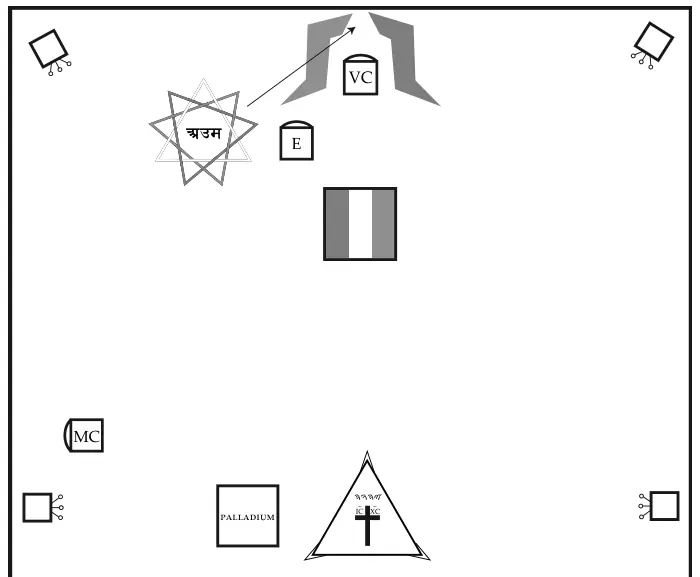
LODGES of this degree are styled Chapéers. The hangings are green, supported by nine columns, alternately white and red; upon each of which is a chandelier, holding nine lights. The canopy over the Throne is green, white and red; and before the Throne is a table, covered with a cloth of the same colours. Instead of a gavel, the Presiding officer uses an arrow, the plume of which is red on one side and green on the other,
the spear white, and the point gilded. *
By the altar is a statue representing TRUTH, clad in the same colours. It is the Palladium of the Order.
The altar itself, i in the centre, is of triangular shape, the top being a gilded plate in the shape of a Delta, on which in 'glittering stones is the Ineffable Name, M1", and under it the letters I.*. Hu. 5.°, on a Cruz
Ansaia.
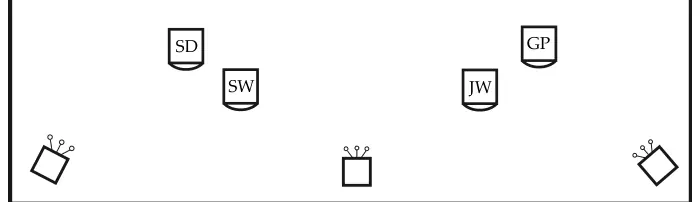
'The officers are, & Chief Prince, styled Most. Excellent, two Wardens, styled Excellent, to Deacons, &
Sacrificer and a Guard of the Palladium: The other members are styled Princes. The Chief Prince wears a tri-colored tunic, green, white and red, and a crown surmounted with nine
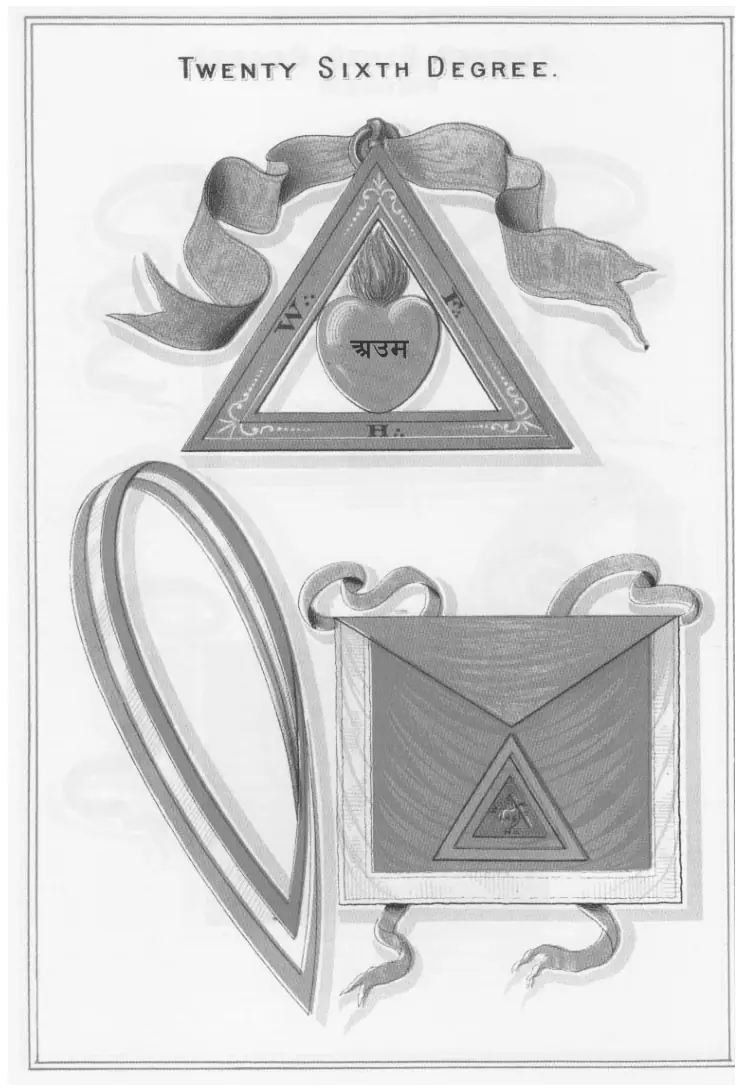
'points. The other members wear a white tunic. All wear the Order, ¥ which is a broad tri-coloured collar, green, white and red.
The apron is red, with a white border. In the middle of it, is an n equilateral triangle, embroidered with gold; in the centre of which in the jewel. The flap is sky-blue.
The jewel is an equilateral triangle of gold, in the centre of which is o heart of 'gold. On the heart are
engraved the letters 11". The jewel is suspended from the collar.
The battery is rl raps —by ; —]]—and £— given thus [;—;f'—;;,].
The Step: .. . Is; equal steps—the first with the left foot.
The Age: ...$, 'Jears—the square of ; times ;
The Order: . .. Standing; the {{£Q@"TI on the $2&9§
'Lhe tessera, or mark, given to the Initiate, is a small fish made of silver or ivory; on one side of which is the word him, and on the other, in the Rose Croix cipher, the Password of the degree.
TO OPEN.
Pr. Exe. Sen.'. Warden, I am about to open this Chapter of Princes of Mercy, in the i inner
chamber of the Mysteries. Satisfy yourself that all present are entitled to remain. -
[The Sen.°. Warden goes round, and receives the Pass-word of the Degree from each Brother, returns to
his station, and says]:
SW. ML. Exe.-., all present are of the Faithful ; and have passed through the three degrees of the
Mysteries.
Mo, Exe. Bro.*. Jun.*. Deacon, the first duty of a Chapter of Princes of Mercy, when assembled?
J.*, Deac.". To see that the Chapter is duly guarded, M.*. Exc.:.
. , MM, Exe. That being your duty, see that the Soldiers of the Cross are at their posts; and inform the Captain of the Guards that we are about to open this Chapter of Princes of Mercy; that he may redouble his
vigilance. .
{The Jun.-. Deacon goes out, returns, closes the door, g gives the alarm of the Degree, which is answered
from without, returns to his place, and says]:
J... Deac. M.:. Exe.*., the Guards are at their-posts; and their Captain is duly warned that this Chapter is about to be opened.
Mf. Exc... Who commands the Guards?
J.. Deac.*. One who has assumed the name and emulates the fidelity of Ulric the Goth, over whose body the soldiers of Domitian forced their way into o Lodge of Christian Masons.
AL:. Exe... We may then safely proceed. Bro.:. Sen.*. Warden, are you a Prince of Mercy? ©
Sen. W.. T have seen the luminous Delta, and become one of the Faithful by means of the Triple
Covenant of which we bear the mark.
Me. Exe. What is that Triple Covenant?
Sen... We. That made with Noah, when God set his bow in the Teavens: that made with Abraham and
his descendants; and that made with all the Earth, that the day should come when Light and Truth and Happiness should be victorious over Darkness, Falsehood and Misery.
M:. Bxc.*. Where did our ancient Brethren meet to celebrate their mysteries which we imitate?
Sen.°. W.". 'In the innermost recesses of the great Temple at Elepbanta, hewn out of. the solid rock, and in the most secret chamber of the vast subterranean Temple of Bouddha at Salsette; within the columns of the rootless fanes of Persia; in the forest Temples of the Druids; in the depths of the Pyramids of Memphis; in the dark vaults of Crete and Samothrace; under the [Holy of Iolies at Jerusalem ; ; in the great Temple of Eleusis; and in the dark catacombs under Rome, where the Christian Masons met at midnight to avoid the wrath of the persecuting Emperors.
- MM, Exe. What does our Lodge represent?
Sen.*. VW... The catacombs.
BL. Exc... Whom do we imitate in this Degree?
Sen.°. IV... The Christian Masons, who met when Domitian was Emperor; when the night was dark and
at
gloomy, the night of wo and persecution; when danger and death, like hounds, hung on the footsteps of our Christian brethren, and they were driven to the caverns and quarries for shelter and for safety.
Mut. Exe. Rome is a lifeless corpse, and her Emperors are shadows; but Masonry still lives, and the smoke from the fires of Persecution no longer ascends to Heaven. Yet the spirit of Persecution lives and is strong, and men forget that all mankind are brethren. Let us take heed, my Brethren, that we fall not into that great sin. Strength to resist temptation comes from God. Let us humbly kneel before him, and confess our errors, and implore his mercy for the helpless and the persecuted.
(All kneel; and M.:. Exc.-, repeats the following
PRAYER.
Our Father [the Lord's Prayer]. We have sinned against Thee, O our Father, and have broken Thy commandments. We have forgotten Mercy, and practised Intolerance. We have judged our Brother harshly,
and condemned him unheard. Soften our hearts towards those who go astray, and teach us Mercy, and help us to look with leniency on their failings, their shortcomings and their errors! If we are not in possession of the Truth, help us to attain it! If we already have it, help us in our waywardness to look with kindness and compassion upon those who are less fortunate than we, and yet perhaps more deserving of Thy Mercy! IF those whom we think Heretics and Superstitious are truly in error, and striving honestly to attain the Truth, teach us to pity and not to hate them; and if they are in Error and do noé strive to reach the Truth, teach us to pity them the more! Help us to resist and subdue our evil passions, our pride of opinion, our bitter and revengeful feelings! -Touch the hearts of all Persecutors, and teach them that, as Thou only bast the knowledge unerringly tu determine what is Truth, so Thou alone bast the right and prerogative to condemn error! Make all men humane and benevolent! Hasten the coming of that promised dawn, when all war and all persecution for opinion's sake shall cease, and all mankind shall feel and know that there in no heresy so monstrous as persecution, and no offence greater in Thy sight than intolerance! Place thy hand between man's life and the cannon's mouth! Send back the sword, the pike and the musket.to the furnace, to be - forged into the peaceful implements of agriculture and the arts! Let, in Thy good time, Peace and Love and Harmony reign sovereign in the world, and War and Hatred and Discord be known no more forever! . Strengthen our faith in Thee and in Thy Goodness and Benevolence! Pardon us our errors, our sins and our presumption; and help and strengthen us to keep our Masonic vows and sacred obligations, as those did whom Domitian persecuted and Nero slew! Amen!
. All: ... So moteit be Amen!
'M:. Exc.". Bro,". Sen.*. Warden, let this Chapter be now opened for the disposal of such business, and for such proper work as may come before it. This you will communicate to the Exc.*. Jun.-. Warden, and he to all the Princes, that they may take due notice thereof, and aid us in the performance of our duties,
Sen. We. Exc.*. Bro,, Jun.', Warden, it is the pleasure of the M.°. Exc.*. Ch.*. Prince, that this Chapter be now opened. You will therefore so announce to all the Princes, that, having due notice, they may aid us in the performance of our duties. -
Jun. W-. Brethren, it is the pleasure of the Most Exc.°. Chief Prince, that this Chapter be now opened. You will take due notice thereof, and be prepared to aid us in the performance of our duties, -
"M:. Exc... Together, my Brethren!
[All give the second sign. Then the Jun.*. W.". raps ; — the Sen.°. W.. | —- and the MM." Exe, i Then all the Princes clap with their hands [ ; | £ ]—and applaud, crying {YA 7&Coos}.°
'BL. Exe. The labours of this Chapter are resumed.
RECEPTION.
The Candidate represents a Catechumen, who has received the second degree of the -Essenian and early Christian Mysteries. Ie must be dressed in a plain white robe, reaching from the neck to the feet; and be barefooted, with his eyes bandaged, so as entirely to prevent his seeing. <A rope is passed three times around his body. In this condition he is led to the door of the Chapter; where the Examiner, who conducts him, raps { ; J—which is answered from within by [ | ]—and the Examiner raps [£]. The door is then partly opened by the Guard of the Palladium: who asks:
Guard: Who comes to disturb the Faithful in their meditations ? .
Ezam.. A Catechumen, who, having passed through the two first degrees of the Sacred Mysteries, seeks now to be admitted to the full light, and to become one of the Faithful.
Qu... Ilas he passed the regular terms of probation, and undergone the necessary tests and trials?
' Ans. He has.
* Qu... Is he of pure morals, and devout; and will he devote himself zealously to the teaching and diffusion of the True Faith?
Ans. Te will.
XSVI a
Qu. Art thou prepared to undergo stripes and persecution, hunger and destitution, and the scoffs and
nears of the Profane, in the service of 'Masonry?
ans. Tam. . °
Qu... Tlas he sufficient discernment to see the Truth under the veil that covers it from Profane eyes?
Does he understand that all Masonry is a succession of allegories, and all its teachings symbolic; and can he see, Without receiving offence, the performance of ceremonies in which the Hebrew, the Egyptian, the Persian wd the Christian behold the embodiment of their peculiar faith, he being left free to apply and interpret the sanie ag he pleases?
«las. If has; he does; he can.
Qu... Does he respect the faith of every man that hath .o faith in this age of unbelief and universal
doubt? Does he revere the character of all Reformers and all the great Teachers of Morality?
«us. The docs.
Qu.. Tow is he called?
Ans. Constaxs. °
Exam.*. Lat him wait with patience until his request is made known to this M.*, Exc.*. Chapter of Princes
of Mercy, and its will is ascertained.
[If closes the door, and goes to the East; where the same questions are asked, and like answers returned
ag at the door}.
M:. Exe. If he be blind, barefoot and firmly bound, let him be admitted, after he shall have washed his hands in pure water, and received the customary warning.
[The Guard goes again to the door, opens it, and says]:
Guard: It is the Swill of the Chapter that, if he be blind, barefoot and firmly bound, he be admitted, after he shall have washed his hands in pure water, and received the customary warning.
{The Examiner then places before the Candidate a bowl of pure water, in which he washes his hands, and dries them ona napkin, While he is doing so, the Examiner says] :
Exam.". While thou most purify thy outer man, forget not that thou must present thyself here with a pure soul, without which the external cleanliness of the body will by no.meang be accepted, and. of which this . lavation is 2 mere symbol.
{The hands of the Candidate are 'then confined behind his back; and he is. led into the Chapter, which remains in perfect silence, except when that silence is broken by the voice of the M.*. Exc.*. He is led nine times around the Lodge; while the M.*. Exc.", reads as follows]:
Ist Circuit: ... Thug said the Holy Books of ancient India: There are three Supreme Gods, the three Forms and Aspects of the First, the Supreme, Single, Imperishable, Infinite, Omnipotent, Excellent, Perfect, Incorporeal, Invisible God Paraprauua, Omnipresent, the Universal Substance, Cause of all Phenomena, and Soul of the World: and these three, the Powers of Creation, Preservation and Destruction, distinct in persons, are but one God, the Trruocert, Triple Form of the Supreme, the Word A.-. U.*. M.-., first utterance of the Eternal. ,
2d Circuit: . , . Christina, they said, ninth Incarnation of Vishnu, the second person of the Trimonrti, born of a royal virgin, without sin, was chaste and holy. He washed the feet of the Brahmins; he descended into hell; he arose again, and ascended to heaven; he charged his disciples to teach his pure doctrines, and gave them the giftof miracles. Me will appear again at the end of the world, the tenth Incarnation of Vishnu, Ile will become man, and mounted on 2 white horse, with a sword glittering like a comet, will traverse the world and destroy the guilty, The heavens shall be rolled away, the celestial spheres be confounded and halt in their courses: the sun shall lose his light, and the great serpent breathing torrents of fire shall consume the universe ; but the seeds of creation shall be preserved in the lotus; and a new creation and new age of innocence shall commence.
3d Circuit: ... Above all Existences, said the Ancient Buddhists, isthe Spirit, Universal, Indestructible, who during incalculable Time preserves all that is, and remains in repose, until the Laws of Destiny oblige him to create new worlds. From Slim flow the Bouddbas, each o Trinity, of INTELLIGENCE, Law and Union, each a Redeemer. Maitreya, born of a virgin, shall come as Sakyn did, to regenerate the world. The Stars
shall salute Tim at his Nativity, the Earth exhale perfumes, the jewels hidden in her bosom rise glittering to the surface, everywhere bloom the lotus, the running waters become clear as crystal, the winds breathe softly, and the sky be pure and serene; the tortures of the wicked shall be suspended, all venomous reptiles and beasts of prey disappear, ferocious men lose their fierce instincts and become good and gentle, the sick and infirm become well and strong, and all mankind unite in Prisons to God.
4th Circuit: ... From Zeacané Axuereyt, the Supreme Divinity and Ancient Unlimited Time, said
the old Persians, inaccessible-in his glory, his nature and his attributes, and to be worshipped with silent veneration, came 'Time, that is the Age of the Universe; in whose bosom the Universe reposes, From the Supreme emanated the Pure Light, and Ormuzd, the King of Light, the Mysterious Word Tonover; the Divine Will, base of ail existence and Source of all Good. -He will in the fourth age create Sosiosch the Saviour, who shall prepare the human race for the general resurrection. A Great Comet shall dash-against the Earth: the good and the bad shall arise and resume their bodies: and all shall be as it was on the first day of the creation. Ahriman, the Spirit of Evil, shall be plunged into thick darkness and covered with a torrent of melted brass. The Earth shall shake like a sick man. The mountains shall melt, and torrents of metal flow from their bosoms, through which all souls shall pass, that thus parting with the defilement of their sins, they may be fitted for the bliss that awaits them. Universal Nature shall be regenerated. A new Earth, more beautiful, more fertile, more delicious than the first, shall become the home of restored mankind. Darkness shall disappear, there shall be no more hell nor torment, Ormuzd shall reign alone; and be with his angels, and Ahriman with his innumerable demons shall together offer up to the Eternal o sacrifice that shall never end.
5th Circuit: ... Murara, it was said in the Ancient Sabean Mysteries, is the Grand Architect of the Universe Himself, appearing in visible shape, the Spirit of the Sun and Light, the Eye of Orwuzp. Wo rules the harmonious marches of the Stars, makes Nature fruitful, wars against the evils that scourge her, pours oat upon the earth the blessings of IIcaven, proclaims taz Drvrvz Worp, and lives in the souls of the Prophets, who are his echoes. Ile is Love, King of the living and dead, the Supremely Pure, Holy and Wise. He is Three and One; for his Essence ILLUMINATES, WARMS and MAKES FRUITFUL at once. He is the Incarnate Mediator, bringing back souls to God. Seated in the Middle Chamber, between Light and Darkness, he presides over initiations, crowned with the Sun of Truth and Justice, and bearing the Gavel of gold, Eternal, living, victorious and intelligent.
' 6th Circuit: ... The Supreme God Axranper, said our Ancient Brethren, the Druids of Scandinavia, Germany and Gaul, is Eternal. He made Heaven, Earth and Air, and Men, and gave to men immortal souls. Opin and Frea, his First-Created, and Tuor, their son, are the Supreme Council and Trinity of the Gods. The reign of evil shall draw near to its end. The Great Dragon shall turn in the Ocean and the World be inundated: the earth shall shudder, the trees be uprooted, the mountains topple and fall headlong, the Wolf Ferris devour the Sun, and the Great Dragon vomit torrents of venom. The Stars shall flee away and heaven melt, and the Evil Angels and Giants war against the Gods and Heroes. The Wolf Ferris shall devour Odin and perish; Thor perish by the poison of the expiring Serpent; and fire consume the Universe. Anew world shall emerge from the bosom of the flames, beautiful with green meadows. The fields shall produco bountifully without labour, calamity be unknown, and a vast golden palace more brilliant than the Sun receive and be the home of the Just forever. Then the Supreme Being shall come from his dwelling on high, administer Divine Justice, pronounce his decrees, and establish his immutable laws.
. Tth Circuit: ... Amun-Re, said the Ancient Egyptians, the Untreated, Immutable, Omnipotent God, _ author, preserver, and soul of Nature is the Supreme Triad, Father, Mother and Son, from whom the long chain of Triads descends to the Incarnations in human form. Ostats, final conqueror of Tycoon the Power - of Evil, shall sit in judgment on all the dead. oars and Anvuzis shall weigh the actions of each in the unerring scales; Torn record the result, and Osiris, Supreme Judge, pronounce the final sentence, on each according to his deserts. The irreclaimable depart to the lower hemisphere of darkness, remorse and pain: the imperfect return to earth to inhabit other bodies and expiate their sins; the Just return to the bosom of the Deity, to enjoy eternal happiness in the realm of light and love.
_ 8th Circuit: ... Thus was it promised unto Jupau: The sceptre shall not depart from Judah, nor a lawgiver from between his feet, until Sarrom come; and unto Slim shall the gathering of the People be. Unto
XAVI...6
us child is born; unto us a son is given; and the Government shall be upon his shoulder; and his name. shall be called Wonderful, Counsellor, The Mighty God, The Everlasting Father, The Prince of Peace. Of the increase of his Government and peace there shall be no end, upon 'the Throne of David, and upon his Kingdom, to order it, and to establish it with judgment and with justice from henceforth even for ever. There shall come forth a Rod out of the stem of Jesse, and a Branch shall grow out of his roots: and the Spirit of God shall rest upon hira, the spirit of wisdom and understanding, the spirit of counsel and power, of knowledge and the fear of God: He shall not judge after the sight of his eyes, nor reprove after the hearing of his ears; but with righteousness shall he judge the poor, and reprove with equity for the meek of the earth, The wolf shall dwell with the lamb, and the leopard shall lic down with the kid; and the calf and the young lion and the fatling together, and a little child shall lead them: they shall not hart nor destroy in all my Holy Mountain; for the Earth shall be full of the knowledge of God, as the waters cover the sea. Ie will swallow up death in victory, and God will wipe away tears from off all faces. We will feed his flock like a shepherd; and gather the lambs in his arms, and carry them in His bosom, and gently lead those that are with young.. The Sun shall be no more thy light by day, nor shall the Moon shine to give thee light: but the Lord shall be unto Thee an Everlasting Light, and thy God thy Glory.
9th Circuit: .. . In the Beginning was the Word, and the Word was with God, and the Word was God; all things were made by Him: in Him was life, and that life was the light of Mankind: the true' Light, which lighteth every man that comets into the world. And the Word became incarnate, and dwelt among men, and they beheld his glory, the glory of the First-Born of the Father, full of benevolence and truth, Thus said the ancient Christian Masons; and they said also; Ged. so loved the world that he gave his only Son, that whosoever believeth in Him should not perish, but have everlasting life. For He sent not that Son into the world to condemn it; but that through him it might be saved. There are Three that bear record in Heaven; The FATHER, the WORD, and the Horr Serrit, and these Three are one. Love is of God, and every one that loyeth is born of God, and knoweth God, and he that loveth not knoweth not Ged, for God is Love; and hath loved us, and hath sent his Son to be the propitiation fur our sins, that we might live through Him; and hath imparted tous Ilis Spirit: and in the dispensation of the fulness of times He will gather together in one all things in Christ, both in heaven and on earth; fur it pleased the. Father that.in him should be .the Plenitude of 'all Perfection; and, having made peace through the blood of his cross, that by him he should . reconcile all things unto himself.
[The Candidate is now halted in front of the Jun.*. Warden]:
* Jo. Wards, Thus in all ages the golden threads of Truth have gleamed in the woof of error. Fortunate
the Mason, who, by the Light of Wisdom, the true Masonic Light, first emanation from the Deity, can discern the golden threads, God's hieroglyphics, written when Time began ; and read them aright, as they were read
by our ancient Brethren in the early ages !
Sen.. Wi. Thus in all ages the Worn of God, His Tnovent, the Great Creative Power, not spoken
through material organs, 'nor in a voice audible to mortal ears, has sounded in the Souls of Men, and taught them "the Great Truths of Reason, Philosophy and Religion. Fortunate the Mason to whom that Word, the Deity manifest, is audible, intelligible, significant: Gov's Tuocent, that made the Stars and all that in, and the Great Laws of Harmony and Motion! !
MM. Exe... Thus in all ages rosy gleams of light tinging the dark clouds of error have taught mankind that Truth and Light, perfect "and glorious, linger | below the Horizon of Mortal vision, in time to rise, like the Sun, and fill God's universe with light and glory, at the Dawn of his promised Day. Fortunate the Mason who with firm Faith and [Hope accepts these struggling rays that gild the clouds, as ample evidence that in
God's good Time his dawn of Day will come, and be eternal!
[The Examiner gives ; raps].
Jun. The. Brother Examiner, whom hare you there, blind and in bondage?
Ez:. Brother Constant, a worthy Catechumen, who having passed the necessary terms of probation, and
undergone the tests and trials, now anxiously desires to see the great light, and to be received among the Faithful.
Juns. WW. Brother Constant, is this request caused, not by idle curiosity, but by a sincere desire to attain unto the Truth, that thereby thou mayst the better perform thy duties both towards God and man? .
Cand... It is.
June. Ws. Brother Examiner, most thou vouch for him, that he is zealous and devout, that he is true and honest, that he can be secret and silent?
Ex. Do.
Jun.. Wor. Then, since thou art his surety, let him see to it, all his life, that he bring no shame upon thee, by making false thy pledge in his behalf. ' Lead him, my Brother, to the Senior Warden!
({Hulting in front of the Sen.'. Warden's station, the Ex.*. gives |{ raps].
Sen. Wo. Bro.'. Examiner, whom have you there, blind and in bondage?
Ex. Bro.*. Constant, a worthy Catechumen, &c.
Sen, Wo. Bro.*, Constant, is this request, &c. ?
Cand.. It is.
Sen. W.. Bro.*. Examiner, most thou vouch for him, that he loveth his Brethren, that he is kind and gentle, that he is modest and humble, and not proud, haughty, self-conceited or vain-glorious ?
Ex. Do. . .
Sen.*. Ws, Then, since thou most become his surety, let him see to it, all his life, that he bring thee not to shame, by making false thy pledge in his behalf. Conduct him to the M.-. Excellent in the Orient!
{In front of the Mu. . Excellent's seat, the Examiner raps £ by;;, J.
MC. Ex.. Bro.*. Ex.*. whom bare you there, bound and in bondage?
Ez, Bro.*. Constant, a worthy Catechumen, &c.
. M.. Ex. Bro.*. Constant, is this request, &c.?
Cand.*. It is.
M:. Ex. Be sure, my Brother, that you answer not hastily or lightly ; but upon due and profound reflection and self-examination, and in sincerity and truth. Are you prepared to assume the arduous duties which will devolve upon you as one of the Faithful ?
Cand... Iam.
Mf, Ex. Bro.*. Examiner, most thou vouch for his stability and resolution ; for his courage in danger, and his contempt of death; for his truth and sincerity, and that he will be merciful and tolerant?
Ez... I do.
Me. Ex. Its well. Let him take heed that he bring not shame upon thee, by making false the Pledge which thon has given for him. Kneel then, my brother, that thou mayst join us in prayer!
[All kneel, and the following prayer and response are repeated] :
PRAYER.
'Infinitely Illustrious and Supreme Father, who Greatest and most cherish and support all men, infinitely various of counsel, all-pure, all-powerful, all-mighty God, who consumes all things, and again thyself reproduces and repairest them; ever in endless circle bringing life out of "death and light out of darkness ; who directest the ineffable harmonies that are the law of 'the boundless Universe! Thou Universal. Parent of eternally successive being, Father of Motion, infinitely various in design; whose thought produced the Earth and Starry Heavens; who art everywhere present, co-extensive with Time and Space; of whose essence are justice, mercy and goodness; Author of life and Soul of all that moves; bear our suppliant voices, : and be not offended at our prayers 1 Aid us to keep thy commandments and perform our duties! Keep us from the slippery descents of vice, and help us to stand firm in the ways of duty! Support and strengthen this our Brother, and all Masons everywhere! Fill our souls with love for Thee and gratitude! Save us from perse. tutors, and teach us and all our Brethren to be tolerant of error, the common lot of man: and send our life a happy, blameless end. O! Father, give us Faith and Understanding, and fit us for admission to the Sub lime Mysteries of Heaven!
Our Father, who art in Heaven, &eo. ! Amen!
[All respond; "So mote it be, now and evermore, in this world, and in the world to come!'"?]
20D
Bf'. Ex. Bro.'. Examiner, you will re-conduct this Brother to the Exc', Sen.'. Warden, who will place him near the Great Light by the proper steps. ' . .
[He is conducted to the West; and the Examiner places him before the Altar, by ; steps, commencing with the left foot: where he kneels and receives the following] .
OBLIGATION.
I,A..... Bo...., of my own free will and accord, in the presence of the Great Creator of the Universe, and of this Venerable Chapter, do most solemnly promise and swear, that I will never reveal the secrets of this degree to any person in the world, either intentionally or for want of due inquiry, unless it be to one who shall regularly have received all the lower degrees of the Ancient and Accepted Rite, in a regular and constitutional manner. I furthermore promise and swear, that I will never confer or aid in conferring this degree, nor be present at conferring it, upon any one, unless it is so done by virtue of a particular permission or warrant from a regularly established Sup.°. Council of the 33d degree; to whose authority, laws, rules and regulations I now swear true faith, loyalty and allegiance; or by virtue of authority from a Sovereign Inspector General or Deputy Inspector duly authorized: and that even in such case I will not do so, if the Candidate be not a worthy Brother, of pure life and irreproachable manners and morals.
I furthermore promise and swear, that I will be zealous, firm, upright, honest, true, frank, humble, modest, gentle, kind, silent, discreet, merciful and tolerant; and 'that I will endeavour to obey the New Commandment by loving my Brother. ss
And should I wilfully or knowingly violate this my obligation, I consent to be condemned, cast out and despised by all men: and may the Ruler of the Universe guide and assist me to keep this my solemn
obligation !
[Suddenly there is a disturbance at the door, and the Guard comes in in haste and breathless, and says: "The Soldiers have discovered our-retreat. They are too numerous to bo resisted, and they approach rapidly." (Arms are clashed together in the ante-room.) 'I hear the.clash of their arms."'] ;
BM. Ex... Up! my Brethren, and escape by the secret passages. Separate from one another, and let
each take care of himself. Away! Away!
[All the members go out, leaving the Candidate kneeling before the altar. A number now rush in at the
door, with clash of arms and fierce loud words, and surround the Candidate. Ono of them represents the Centurion]. .
Cent... Comrades, it is here our Gods are blasphemed, and the rites of sorcery are practised. But the tattered rogues hare escaped us again. Search fur the passages by which they have fled, and pursue them. Away! Ah, Here is one that in their hurry they have left behind, Minded and bound, and kneeling before an altar! .
isé Sold.*. Shall I hew the blasphemous Judean in pieces?
2d Sold.. Stand aside, till I thrust my lance through him.
8d Sold... Devote him to the Eternal Gods! .
Cent.*. Silence, my men! Domitian needs him for the Amphitheatre and the Lions. What art thou, knave? Most thou worship the Immortal Gods of Rome? .
Cand., No. ,
Cent... Not even Jupiter nor Mars?
Card.', No.
Cent... A rank Judean and an unbeliever! It is said that ye have a Worn by which ye pretend to work
miracles. It is here, too, that ye blasphemously imitate the Holy Mysteries. [Ile places the point of his sword against the Candidate's breast]. Give me that Word, or-did!
Cent... The Word! dog of a Jew!
es
XAVI,..9
Cent... The Word, the Word, I say; if you would live!
Cent. Then die! But, no, I will not disgrace a Roman sword with ignoble blood. Call in the Persian slaves with the bowstring!
{A small cord is placed around the Candidate's neck, and twisted so as to hurt him slightly].
Cents. Wait until I give the signal! Wilt thou not yet speak the Word?
Cent... Why, what stubborn knave! Be ready, slaves..... Now!
Jf, Eee. Iuld, my Brethren! The trial fs sufficient. Remove the cord and.unbind his hands. Constant, thou art worthy to be accepted among the Faithful. What now most thou most desire?
Cand.. Light.
Af", Exc.*. T am come a Light into the world, that whosoever believeth in me should not abide in darkness. While yo have Light, believe ye in the Light, that ye may be the Children of Light. This is Life Eternal, to know the only True God, and the Word that did create the Universe, in whom is Light, and that Light the Life of men. My Brethren, aid me to bring this newly accepted Brother to Light.
(The bandage is removed, and the M.°. Exc.*. assists him to rise; and says]:
M. Exc... Behold, the darkness is past, and the True Light now shineth. My Brother, you have before this been brought to Light in Masonry, when the Worshipful Master, with the aid of the Brethren, first made you a Mason. You have been taught to believe in the True God, whom the ancient Patriarchs worshipped. You have passed heretofore through Degrees intended to remind you of the Essenian and [Hebrew Mysteries ; and in this you see a faint imitation of those practised by the first Christians in the catacombs under Rome. As you were not required to profess a belief in the tenets of the Essenes or the Pharisees, so neither here are you required to believe in the divine mission or character of Jesus of Nazareth. We shadow forth the Secret Discipline of the early Christians, aa we do the Eg syptian, Persian, Grecian, Hebrew and Scandinavian Mysterics, as the diverse and varying and often eccentric forms in which Masonry has developed itself in the different ages of the world. Masonically we know not whether you be Christian, Jew or Moslem. We have no right ; to ask. If you be Christian, you will see in this, as in the 18th Degree, a Christian ceremony; and so you have the right to regard and interpret it. Your Brethren will respect your faith, as they have a right to — demand that you shall respect theirs. If you be not a Christian, you will see in it a mere historical allegory, symbolizing great Truths, acknowledged alike by you and them.
_. While you were veiled in darkness, you heard repeated by the Voice of the Great Past its most ancient doctrines. None bas the ~ight to object, if the Christian Mason sees foreshadowed in Chrishna and Sosios¢h,.in Mitbras and Osiris, the Divine Worn that, as he believes, became Man, and died upon the cross to redeem a fallen race. Nor can he object if others see reproduced, in the WORD of the beloved Disciple, that was in the beginning with God, and that was God, and by whom everything was made, only the Locos of Plato, and the . WORD or Uttered Tnoucur or First Emanation of Licur, or the Perfect Reason of the Great, Silent, Supreme, | Untreated Deity, believed in and adored by all.
We do not undervalue the importance of any Truth. We utter no word that can be deemed irreverent by any one of any faith. We do not tell the Moslem that it is only important for him to believe that there is but one God, and wholly inessential whether Mahomet was his prophet. We do not tell the Hebrew that the Messiah whom he expects was born in Bethlehem nearly two thousand years ago; and that be is o heretic because he will not-so believe. And as little do we tell the sincere Christian that Jesus of Nazareth was but 3 man like us, or his history but the unreal revival of an older legend. To do either is beyond our jurisdiction. Masonry, ¢ of no one age, belongs to all time; of no one religion, it finds its great truths in all,
To Every Mason, there is a Gop; Ong, Supreme, Infinite in Goodness, Wisdom, Foresight, Justice, and Benevolence; Creator, Disposer and Preserver of all things. How, or by what intermediates He creates and acts, and in what way Ie unfolds and manifests Himself, Masonry leaves to Creeds and Religions to inquire. . "+ To every Mason, the soul of man is immortal. Whether it emanates from and will return to God, and what its continued mode of existence hereafter, each judges for himself. Masonry was not made to settle that.
To every Mason, Wisdom or Istenercence, Force or Strexcty, and J[snsony, or Firygss and Beaurr,
are the Trinity of the attributes of God. With the subtleties of Philosophy concerning them Masonry does not meddle, nor decide as to the reality of the supposed Existences which are their Personifications ; nor whether the Christian Trinity be such a personification, or Reality of the gravest import and significance.
To every Mason, the Infinite Justice and Benevolence of God give ample assurance that Evil will ultimately be dethroned, and the Good,,the True and the Beautiful reign triumphant and eternal. It teaches, as it feels and knows, that Evil, and Pain and Sorrow exist as part of a Wise and Beneficent plan, all the parts of which work together under God's eye to a result which shall be perfection. Whether the existence of evil is rightly explained in this creed or in that, by Syphon the Great Serpent, by Ahriman and his Armies of Wicked Spirits, by the Giants and Titans that war against Heaven, by the two co-existent Principles of Good and Evil, by Satan's temptation and the fall of Man, by Lok and the Serpent Ferris, it is beyond the domain of Masonry to decide, nor does it need to inquire. Nor is it within its Province to determine how the ultimate triumph of Light and Truth and Good, over Darkness and Error and Evil is to be achieved ; nor whether the Redeemer, looked and longed for by all nations, hath appeared in Judea, or is yet to come.
It reverences all the great reformers. It sees in Moses, the Lawgiver of the Jews, in Confucius and Zoroaster, in Jesus of Nazareth, and in the Arabian Iconoclast, Great Teachers of Morality, and Eminent Reformers, if no more: and allows every brother of the Order to assign to each such higher and even Diyino Character as his Creed and Truth require. ae
Thus Masonry disbelieves no truth, and teaches unbelief in no creed, except so far as such creed may. lower its lofty estimate of the Deity, degrade Slim to the level of the passions of humanity, deny the high destiny of man, impugn the goodness and benevolence of the Supreme God, strike at the great columns of Masonry, Charity, Hope and Faith, or inculcate immorality, and disregard of the active duties of the Order.
Masonry is a worship; but one in which alt civilized men can unite; for it does not undertake to explain or dogmatically to settle. those grent mysteries, that are above the feeble comprehension of our human intellect, It trusts in God, and nores; it penicves, like a child, and is humble, 'It draws no sword to compel others to adopt its belief, or to be happy with its hopes. <And it waits with patience to understand the mysteries of Nature and Nature's God hereafter. . . ,
The greatest mysteries in the Universe are those which are ever going on around us; so trite and common: to us that we never note them or reflect upon them. Wise men tell us of the laws that regulate the motions of the spheres, which flashing in huge circles and spinning on their axes are also ever:darting with inconceivable rapidity through the infinities of Space; while we atoms sit here, and dream that all was mado for us. They tell us learnedly of centripetal and centrifugal forces, gravity and attraction, and all the other sounding terms, invented to hide a want of meaning. There are other forces in the Universe than those that are mechanical. .
Here are two minute seeds, not much unlike in appearance, and two of larger size. Hand them to the learned Pundit, Chemistry, who tells us how combustion goes on in the lungs, and plants are fed with phosphorus and carbon, and the alkalies and silex. Let ber decompose them, analyze them, torture them in all the ways she knows. The net result of each is a little sugar, a little fibrin, a little ws'er—carbon, potassium, sodium and the like—one cares not to know what.
We hide them in the ground; and the slight rains moisten them, and the Sun shines upon them, and little slender shoots spring up and grow ;—and what a miracle is the mere growth !—the force, the.power, the capacity (which is the true word) by which the little feeble shoot, that a small worm can nip off with a single snap of its mandibles, extracts from the earth and air and water the different elements, so learnedly catalogued, with which it increases in stature, and rises imperceptibly towards the sky! The slender shout is a
better chemist than Lichig.
One grows to be a slender, fragile, feeble stalk, soft of texture, like an ordinary weed: another a strong
bush, of woody fibre, armed with thorns, and sturdy enough to bid defiance to the winds: the third a tender tree, subject to be blighted by the frost, and looked down upon by all the forest; while another spreads its rugged arms abroad, and cares for neither frost nor ice, nor the snows that for months lie piled around its roots.
But of out of the brown foul earth, and colourless invisible air, and limpid rain-water, the chemistry of the seeds has extracted colours—four different shades of green, that paint the leaves which put forth in the
spring upon our plants, our shrubs and our trees. Later still come the fuwers—the vivid colours of the rose, the beautiful brilliance of the carnation, the modest blush of the apple, and the splendid white of the orange. Whence cume the colours of the leaves and flowers? By what process of chemistry are they extracted from the carbon, the' phosphorus and the lime? Is it any greater miracle to make something out.of nothing?
Pluck the flowers. Inhale the delicious perfumes; each perfect, and all delicious. Whence have they come? By what combination of acids and alkalies could the chemist's laboratory produce them?
And now on two comes the fruit—the ruddy apple and the golden orange. Pluck them—open them!
The texture and fabric how totally different! The ¢taste how entirely dissimilar—the perfume of each distinct from its flower and from the other. Whence the taste and this new perfume? 'Che same earth and air and water have been made to furnish a difference taste to each fruit, a different perfume not only to each fruit, but to each fruit and its own flower. ;
Ts it any more a problem whence come thought and will and perception and all the phenomena of the mind, than this whence cume the colours, the perfumes, the taste of the fruit and flower? ,
And lo! in each fruit new seeds, each gifted with the same wondrous power of reproduction—each with the same wondrous forces wrapped up in it to be again in turn evolved. Forces that had lived three thousand - years in the grain of wheat found in the wrappings of an Egyptian mummy: forces of which learning and science and wisdom know no moro than they do of the nature and laws of action of God. What can we know of the nature, and how can ie understand the powers and mode of operation, of the. human soul, when the glossy leaves, the pearl-white flower, and the golden fruit of the orange are a miracle wholly beyond our comprehension ?
Wo but hide our ignorance in a cloud of words ;—and the words too often are mere combinations of sounds without any meaning. What is the centrifugal force? A tendency to go in a particular direction! What
external force, then, produces that tendency ? ;
-. What force draws the needle round to the north? What force moves the muscle that raises the arm,
when the will determines it shall rise? Whence comes the wild itself? Is it spontaneous—a first cause, 'or an effect? These too are miracles; inexplicable as the creation, or the existence and self-existence of God.
Who will explain to us the passion, the peevishness, the anger, the memory and affections of the small ennary-wren? the consciousness of identity and the dreams of the dog? the reasoning powers of the elephant ? the wondrous instincts, passions, government and civil policy and modes of .communication of ideas of the ant and bee? .
Who has yet made us.to understand, with all his learned words; how heat comes to us from the Sun, and light from the remote .Stars, setting out upon its journey earth-ward from some, what time the Chaldeans commenced to build the Tower of Babel? Or how the image of an external object comes to and fixes itself upon the retina of the eye; and when there, how that mere empty, unsubstantial. image becomes transmuted into the wondrous thing that we call Front? Or how the waves of the atmosphere striking upon the tympanum of the ear—those thin, invisible waves of a compound of oxygen and nitrogen—produce the equally wondrous phenomenon of mzanine, and become the roar of the tornado, the crash of the awful thunder, the mighty voice of the ocean, the chirping of the cricket, the delicate sweet notes and exquisite trills and variations of the wren and mocking-bird, or the magic melody of the instrument of Paganini?
- Our senses are mysteries to us, and we are mysteries to ourselves, Philosophy has taught us nothing as to the nature of our sensations, our perceptions, our cognizance, the origin of our thoughts and ideas, but words. By no effort or degree of reflection, never so long continued, can man become conscious of a personal identity in himself, separate and distinct from his body and his brain. Wo torture ourselves in the effort to gain an idea of ourselves, and weary with the exertion. Who has yet made us understand bow from the contact with a foreign body, the image in the eye, the wave of air impinging on the car, particular particles entering the nostrils, and coming in contact with the palate, come sensations in the nerves, and from that, perception in the mind?
What do we know of Substance? Men even doubt yet whether it exists. Philosophers tell us that our weises only make known to us the allributes of substance, extension, hardness, colour, and the like; bat not the
NAVEL... 12
thing itself that is extended, solid, black or white; as we know the atfribuées of the Soul, its thoughts and its perceptions, and not the Soul itself which perceives and thinks,
What o wondrous mystery in there in heat nod light, existing, we know not how, within certain
"limits, narrow in comparison with infinity, beyond which on every side stretch out infinite apace and the blackness of unimaginable darkness, and the intensity of inconceivable cold! Think only of the mighty Power required to maintain warmth and light in the Central point of such an infinity, to whose darkness, that of Midnight, to whose cold that of the last Arctic Island is nothing! And yet Gop is every-where.
And what a mystery are the effects of heat and cold upon the wondrous fluid that wae call water! What a mystery lies hidden in every flake of snow and in every crystal of ice, and in their final transformation into the invisible vapor that rises from the ocean or the land, and floats above the summits of the mountains |
What a multitude of wonders, indeed, has chemistry unveiled to our eyes! Think only that if some
single law enacted by God were at once repealed, that of attraction or affinity or cohesion, for example, the whole material world, with its solid granite and adamant, its veins of gold and silver, its trap and porphyry, its huge beds of cool, our own frames and the very ribs and bones of this apparently indestructible earth, would instantaneously dissolve, with all Suns and Stars and Worlds throughout all the Universe of God, into a thin invisible vapor of infinitely minute particles or atoms, diffused through infinite space; and with them light and heat would disappear; unless the Deity Himself be, as the Ancient Persians thought, the Eternal Light and the Immortal Fire.
The mysteries of the Great Universe of God! Low can we with our limited mental vision expect to
grasp and comprehend them! Infinite Space, stretching out from us every way, without limit: infinite Tie, without beginning or end; and We, uEz, and Now, in the centre of each. An infinity of suns, the nearest of which only diminish in size, viewed with the most powerful télescope: each with its retinue of worlds; infinite numbers of suck suns, so remote from us that their light would not reach us, journeying during an infinity of time, while the light that has reached us, from some that we seem to sec, bas been upon its journey for fifty centuries: our-world spinning upon its ariz, and rushing ever in its circuit round the sun; and it, the sun and all our system revolving round some great central point; and that, and suns, stars and worlds ever-
'more flashing onward with incredible rapidity through illimitable space: and then, in every drop of water . that we drink, in every morsel of much of our food, in the air, in the earth, in-the sea,incredible multitudes of living creatures, invisible to the naked eye, of 2 minuteness beyond belief, yet organized, living, feeding,
- perhaps with consciousness of identity, and memory andinstinct. ,
Such are the mysteries of the great Universe of God! And yet we, whose life and that of the world on
. which we live form but a point in the centre of infinite Time: we, who nourish animalcule within, and on whom vegetables grow without, would fain learn bow God created this Universe, would understand Ilis Powers, His Attributes, His Emanations, Ifis Mode of Existence and of Action; would fain know the plan according te which all events proceed, that plan profound as God Ilimself; would know the laws by which he controls His Universe; would fain see and talk to Slim face to face, as man talks to man: and wo try not to believe, because we do not understand, °
Ile commands us to love one another, to lore our neighbour as yourself; and we dispute and wrangle, and hate and slay each other, because we cannot be of one opinion as to the Essence of Ilis Nature, as to lis Attributes; whether If became man born of a woman, and was crucified; whether the Luly Ghost is of the same substance with the Father, or only of a similar substance; whether a {ecblo old man is God's Vicegerent ; whether some are elected from all eternity to be saved and others to be condemned and punished; whether punishment of the wicked after death is to be eternal; whether this doctrine or the other be heresy of truth ;—drenching the world with blood, depopulating realms, and turning fertile lands into deserts; until, fer religious war, persecution and bloodshed, the Earth fur many ao century has rolled round the Sun, a channel-house, steaming and reeking with human gore, the blood of brother slain by brother for opinion's sake, that has soaked into and polluted all her veins, and made her a horror to her sisters of the Universe.
And if men were all Masons, and obeyed with all their heart her mild and gentle teachings, that world would be a paradise; while intolerance and persecution make of it a hell. For this is the Masonic Creed: Beutere, in God's Infinite Benevolence, Wisdom and Justice: More, for the final triumph of Good over Evil,
AXVI... 18
and for Perfect Harmony as the final result of all the concords and discords of the Universe: and be Caarrrate as God is, towards the unfaith, the errors, the follies and the faults of men: for all make one great brotherhood. , ; :
On being now again brought to light, you see before you the luminous Delta, with three equal sides, in all ages the representation of Deity, the Trinity of Wisdom, Power and Harmony; and upon it raz InzrFaBLe Nawe, and the Cross, heretofore explained to you, as the Cruz Ansata, or Egyptian emblem of immortality; with the Greek letters I.°. 11.°. X.*. which to the Christian are the name of his Redeemer, and will be explained to you hereafter. Receive now the signs, tokens, and words of this Degree.
| Ast Stex: «2. Of Entrance: ... Place the {}O<"TI over the Ch Cras if to protect ECS from the To.S°P of the 25,
Od Sian: ... Of the Trinity: ... Forma ero Orly with the eee and NB¥Tows 2S
WCj2— and place them over the AYYTO LE, $-79 Cr at the 23 Ovr
3d Stay: ... Of appeal: ... FEY the 71S over the Ecru—AOTVAD 5 2YWOW and the &QRTIS YICA— and say F2IMCMOIOBWC HPS... [To ue," (i. e. Help—2 moi!) "Sos or the Tron !'').
' Our-Guard:... $ISOMTI on the $3593.
_ Toren: +++ Press mL ¥ P£EECSSLIIS lightly on the 2&4 § tI Ct» of o brother, pronouncing at the same time the Pass-Word. .
Pass-Worp: ... QUYSsCh...
Sacnep Worp:... im.
ite Brother is then seated and receives the following instruction, by dialogue between the Sen.*, and .". Wardens].
INSTRUCTION.
Sen. W. Bro.*. Jun.*, Warden, are you a Prince of Merey?
Jun. W.. I have seen the Delta and the Holy Naxzs upon it, and am an Audra like yourself, in the Tarrpre Covenant, of which we bear the mark.
Qu... What is the first Word upon the Delta?
"Ans. The Ineffable Name of Deity, the true mystery of which is known to the Emeth alone.
- Qu. What do the three sides of the Delta denote to us?
- Ans. To us, and to all Masons, the three Great Attributes or Developments of the Essence of the Deity; 'WISDOM, or the Reflective and Designing Power, in which, when there was nought but God, the Plan and Idea of the Universe was shaped and formed: Force, or the Executing and Creating Power, which instantaneously acting, realized the Type and Idea framed by Wisdom; and the Universe, and all Stars and Worlds, and Light and Life, and Men and Angels and all living creatures were ; and Iaryoxy, or the Preserving Power, Order and Beauty, maintaining the Universe in its State, and constituting the law of Harmony, Motion, Proportion and Progression:—Wispox, which thought the plan; Srreveta which crealed: Harwowy which upholds and
preserve:—the Masonic Trinity, three Powers and one Essence: the three columns which support the Universe, Physical, Intellectual and Spiritual, of which every Masonic Lodges a type and symbol :—while to the Christina Mason, they represent the Three that bear record in Heaven, the Fatuer, the Worp and the Hour Seintz,
which three are Ove.
ANVIL... 14
Qu.'. What do the three Greek letters upon the Delta, I.*. H1.". ¥.*, [Join, Ela, and Sigma] represent,
Three of the Names of the Supreme Deity among the Syrians, Phonicians and Hebrews ... have
[are]; Self- Existence... Ever Au [os]: the Nature-God, or Soul of the Universe . . . Sazpror Smappar [79]; Supreme Power, also three of the Six Chief Attributes of God, among the Kabbalists ;—Wispox {ten} the Intellect (Navs) of the Egyptians, the More (Ao;os) of the Platonists, and the JFisdom (Sopa) of the Gnostics: . . Maentrrcence [Ex], the Symbol of which was the Lion's Mend: . . and Vicrorr and Grorr { Sebaath], which are the two columns Jachin and Boaz, that stand in the Portico of the Temple of Masonry. To the Christian Mason they are the three first letters of the name of the Son of God, who died upon the cross to redeem mankind. .
Qu.*. What is the first of the Torre Covenants, of which we bear the mark?
Ans. That which God made with Noah; when He said, "I will not again curse the earth any more for "man's sake, neither will I smite any more everything living as I have done. While the Earth remaineth, "seed-time and harvest, and cold and heat, and winter and summer, and day and night shall not cease. I "will establish my covenant with you, and with your seed after you, and with every living creature.' All " mankind shall no more be cut off by the waters of flood, nor shall there any more be a food to destroy "the earth, This is the token of my covenant:,I do set my bow in the cloud, and it shall be for a token of '*a covenant between me and the earth: an everlasting covenant between Me and every living creature on ** the earth."
Qu.*. What is the second of the Three Covenants?
aus... That which God made with Abraham; when he said, "I am the Absolute Untreated God. I will "make my covenant between me and thee, and thou shalt be the Father of Many Nations, and Kings shall 'come from thy loins. I will establish my covenant between Me and thee, and thy descendants after thee, "to the remotest generations, for an everlasting covenant; and [ will be thy God and their God, and will give " thee the land of Canaan fur an everlasting possession."'
Quo. What is the third covenant?
Ans.*, That which God made with all men by His prophets; when he said: "I will gather all nations
"and tongues, and they shall come and sec my Glory. I will create new Heavens and a new earth; and the " former shall not be remembered, nor come into mind, The Sun shall. no more shine by day, nor. the Moon "by night; but the Lord shall be an everlasting light and splendour, Iblis Spirit and-his Word shall remain "*with men forever. The fourth beast shall be the fourth kingdom upon earth, diverse from all Kingdoms, "and shall lay waste and devastate the earth; and shall speak against the Supreme God, and persecute his "Saints, and think to change his eternal laws; but the Ancienfof Days shall judge him, and take away his ** dominion, and consume and destroy it unto the end; and the kingdom and dominion, and all power under Heaven shall be given to the People of the Saints of the Most Ligh, whose kingdom in an everlasting king- "do, and all men shall serve and obey him. The Heavens shall vanish away like vapour, and the earth " shall wax old like a garment, and they that dwell therein shall die; but my salvation shall be forever, "and my righteousness shall not end; and there shall be Light among the Gentiles, and salvation unto the "ends of the earth, The redeemed of the Lord shall return, and everlasting joy be on their heads, and sorrow "and mourning shall flee away."
Qu.*. Whatis the symbol of the Triple Covenant? '
Ans... The Triple Triangle.
Qu... Of what else is it the symbol to us?
Ans... Of the Trinity of Attributes of the Deity; and of the triple essence of Man, the Principle of Life, the Intellectual Power, and the Soul or Immortal Emanation from the Deity.
Qu.. What is the first great Truth of the Sacred Mysteries?
Ans... Noman hath seen God atany time. Ile is One, Eternal, All-Powerful, All-Wise, Infinitely Just,
Merciful, Benevolent and Compassionate, Creator and Preserver of all things, the Source of Light and Life, coextensive with Time and Space; Who thought, and with the Thought created the universe and all living things, and the souls of men: Toar Js:—the Perwaxent; while everything beside is a perpetual genesis.
Qu.:. What is the second great Truth of the Sacred Mysteries?
AXVI... 15
Ans, The Soul of Man is Immortal; not the result of organization, nor an aggregate of modes of action of matter, nor a succession of phenomena and perceptions; but an Existence, ono and identical, a living spirit, a spark of the Great Central Light, that hath entered into and dwells in the body; to be separated therefrom at death, and return to Cud who gave it: that doth not disperse or vanish at death, like breath or a smoke, nor can be annihilated ; but still exists and possesses activity and intelligence, even os it existed in God, before it was enveloped in the body.
Qu. What in the third great Truth in Masonry?
Ans.. The impulse which directs to right conduct, and deters from crime, is not only older than the ages of nations and cities, but coeval with that Divine Being who sees and rules both heaven and earth. Nor did Tarquin less violate that Eternal Law, though in his reign there might have been no written law at Rome against such violence; for the principle that impels us to right conduct, and warns us against guilt, springs out of the nature of things. It did not begin to be law when it was first written, but when it originated, and. it is coeval with the Divine Intelligence itself. The consequence of virtue is not to be made the end thereof; and laudable performances must have deeper roots, motives and instigation, to give them the stamp of virtues. If a man shall Jay down as the chief good that which has no connection with virtue, and measure it by his - own interests, and not according to its moral merit; if such 2 man shall act consistently with his own principles, and is not sometimes influenced by the goodness of his heart, he can cultivate neither friendship, justice nor generosity. It is impossible for the man to be brave, who shall pronounce pain the greatest evil; or temperate, who shall propose pleasure as the highest good.
Qu.. What is the fourth great Truth in Masonry?
Ans., The moral truths are as absolute as the metaphysical truths. Even the Deity cannot make it that there should be effects without a cause, or phenomena without substance. As little could He make it to be sinful and evil to respect our pledged word, to love truth, to moderate our passions. The principles of Morality are axioms, like the principles of Geometry. The moral laws are the necessary relations that flow from the nature of things, and they are not created by, but have existed eternally in God. Their continued existence does not depend upon the exercise of His wizt. Truth and Justice are of Iis essence. Not because we are feeble and God omnipotent, is it our duty to obey his In. We may be forced, but are not under obligation, to obey the stronger. God is the principle of Morality, but 'not by This mere will, which, abstracted from all other of His attributes, would be neither just nor unjust. Good is the expression of His will, in so far as that will is itself the expression of eternal, absolute, untreated justice, which is i God, which His will did not create; but which it executes and promulgates, as our will proclaims and promulgates and executes the idea of the good which is in us, Ie has given us the law of Truth and Justice; but He has not arbitrarily instituted that law. Justice is inherent in His will, because it is contained in Ilis intelligence and wisdom, in His very nature and most intimate essence. -
Qu. Whatis the fifth great Truth in Masonry?
Ans. There is an essential distinction between Good and Evil, what is just and what is unjust; and to this distinction is attached, for every intelligent and free creature, the absolute obligation of conforming to what is good and just, Man is an intelligent and free being,—free, because he is conscious that it is his duty, and because it is made his duty, to obey the dictates of truth and justice, 'and therefore he must necessarily have the power of doing so, which involves the power of not doing so ;—capable of comprehending the distinction between good and evil, justice and injustice, and the obligation which accompanies it, and of naturally
adhering to that obligation, independently of any contract or positive law; capable also of resisting the temptations which urge him towards evil and injustice, and of complying with the sacred law of eternal justice,
That man is not governed by a resistless Fate or inexorable Destiny; but is free to choose between the evil and the good: that Justice and Right, the Good and Beautiful, ara of the essence of the_ Divinity, like His Infinitude; and therefore they are laws to man: that we are conscious of our freedom to act, a3 we are conscious of our identity, and the continuance and connectedness of our existence; and have the same evidence of one as of the other; and if we can put one in doubt, we have no certainty of either, and everything
21p
is unreal: that we can deny our free will and free agency, only upon the ground that they ore in the nature of things impossible; which would be to deny the Omnipotence of God.
Qu.. What is the sixth great Truth of Masonry? .
dns. The necessity of practising the moral truths, is obligation. The moral truths, necessary in the eye of reason, are obligatory on the will, The moral obligation, like the moral truth that is its foundation, is absolute, As the necessary truths are not more or less necessary, so the obligation is not more or less obligatory. There are degrees of importance among different obligations; but none in the obligation itself. Wa are not nearly obliged, almost obliged. We are wholly so, or not at all. If there be any place of refuge to which we can escape from the obligation, it ceases to exist. If the obligation is absolute, it is immutable and universal. For if that of to-day may not be that of to-morrow, if what is obligatory on me may not be obligatory on you, the obligation would differ from itself, and be variable and contingent. This fact is the principle of all morality. That every act contrary to right and justice, deserves to be repressed by force, and punished when committed, equally in the absence of any law or contract: that man naturally recognizes the distinction between the merit and demerit of actions, as he docs that between justice and injustice, honesty and dishonesty; and feels, without being taught, and in the absence of Jaw or contract, that it is wrong for vice to be rewarded or go unpunished, and for virtue to be punished or left unrewarded: and that, the Deity being infinitely just and good, it must follow as a necessary and inflexible law that punishment shall be the result of Sin, its inevitable and natural effect and corollary, and not a mere arbitrary vengeance. * Qu... What is the seventh great truth in Masonry? . .
Ans... The immutable law of God requires, that besides respecting the absolute rights of others, and being merely just, we should do good, be charitable, and obey,the dictates of the generous and noble sentiments of the soul. Charity is a law, because our conscience is not satisfied nor at ease if we have not relieved the suffering, the distressed and the destitute. It is to gtve that which he to whom you give has no right to éake or demand. To be charitable is obligatory on us. Were the Almoners of God's bounties. But the obligation is not so precise and inflexible as the obligation to be just, Charity knows neither rule nor limit. I¢ goes beyond all obligation. Its beauty consists in its liberty. "Ile that loveth not, knoweth not God; ror Gop 1s rove. If we lose one another, Ged dwelleth in us, and [is love is perfected in us. God is love; and he that dwelleth in love, dwelleth in God, and God in Him." .To be kindly affectioned one to another with brotherly love; to relieve.the necessities of the needy, and -be generous, liberal and hospitable ; to return to no man evil fur evil: to. rejoice at the good fortune of others, and sympathize with them in their sorrows and reverses; to live peaceably with all men, and repay injuries with benefits and kindness; these are the sublime dictates of the Moral Law, taught from the infancy of the world, by Masonry.
Qu.. What is the eighth great Truth in Masonry ?
Ans.. That the laws which control and regulate the Universe of God, are those of motion and harmony: 'We see only the isolated incidents of things, and with our feeble and limited capacity and vision cannot discern their connection, nor the mighty chords that make the apparent discord perfect harmony. Evil is merely apparent, and all is in reality good and perfect. For pain and sorrow, persecution and hardships, affliction and destitution, sickness and death are but the means, by which alone the noblest virtues could -be developed. Without them, and without sin and error, and wrong and outrage as there can be no effect without an adequate cause, there could be neither patience under suffering and distress; nor prudence in difficulty; nor 'temperance to avoid excess; nor courage to meet danger; nor truth, when to speak the truth is hazardous; nor love, when it is met with ingratitude; nor charity for the needy and destitute; nor forbearance and furgiveness of injuries: nor toleration of erruncous opinions ; nor charitable Judgment and construction of men's motives and actions; nor patriotism, nor heroism, nor honor, nor self-denial, nor generosity. These and most other virtues and excellencies would have no existence, and even their names be unknown; and the poor virtues that still existed, would scarce deserve the name; for life would be one flat, dead, low level, above which none of the lofty elements of human nature would emerge; and man would lie lapped in contented indolence and idleness, a mere worthless negative, instead of the brave, strong soldier against the grim legions of Evil and rude Difficulty.
Qu... What is the ninth great Truth in Masonry ?
Ans. The great leading doctrine of this Degree ;—that the Justice, the Wisdom and the Mercy of God
are alike infinite, alike perfect, and yet do not in the least jar or conflict one with the other; but form o Great Perfect Trinity of Attributes, three and yet one: that, the principle of merit and demerit being absolute, and every good action deserving to be rewarded, and every bad one to be punished, and God being as just as He is good; and yet the cases constantly recurring in this world, in which crime and cruelty, oppression, tyranny and injustice are prosperous, happy, fortunate and self-contented, and rule and reign, and enjoy all the blessings of God's beneficence, while the virtuous and good are unfortunate, miserable, destitute, pining away in dungeons, perishing with'could, and famishing with hunger, slaves of oppression, and instruments and victims of . the miscreants that govern; so that this world, if there were no existence beyond it, would be one great theatre of wrong and injustice, proving God wholly disregardful of Ilis own necessary law of merit and demerit ;—it follows that there must be another life, in which these apparent wrongs shall be repaired: That all the powers of man's soul tend to infinity ; and his indomitable instinct of immortality, and the universal hope of another life, testified to by all creeds, all poetry, all traditions, establish its certainty; for man is not an orphan; but hath a Father in heaven: and the day must come when Light and Truth, and the Just and Good ~ shall be victorious, and Darkness, Error, Wrong and Evil be annihilated, and known no more forever: That the universe is one great Harmony, in which, according to the faith of all nations, deep-rooted in all hearts in the primitive ages, Light will ultimately prevail over Darkness, and the Good Principle over the Evil; and the myriad souls that have emanated from the Divinity, purified and ennobled by the struggle here below, will again return to perfect bliss in the bosom of God, to offend against whose laws will then be no longer possible.
Qu... What, then, is the one great lesson taught to us, as Masons, in this Degree?
., dns. That to that state and realm of Light and Truth and Perfection, which is absolutely certain, all the good meh on earth are tending; and if there is a law from whose operation none are exempt, which inevitably conveys their bodies to darkness and to dust, there is another not less certain, nor Jess powerful, which conducts their spirits to that state of Happiness and Splendour and Perfection, the bosom of their Father and their God. The wheels of Nature are not made to roll backward. Everything presses on to Eternity. From the birth of Time an impetuous current has set in, which bears all the sons of men towards that interminable ocean. Meanwhile, Heaven is attracting to itself whatever is congenial to its nature, is enriching itself by the spoils of the Earth,.and collecting within its capacious bosom whatever is pare, permanent and divine, leaving nothing for the last fire to consume but the gross matter that creates concupiscence; while éeverything fit for that good fortune shall.be gathered and selected from the ruins of the world, to adorn that Eternal City.
Let every Mason then obey the voice that calls him thither. Let us seek the things that are above, and be not content,with a world that must shortly perish, and which we must speedily quit, while we neglect to prepare for that in which we.are invited to dwell forever. While everything within us and around us reminds us of the approach of death, and concurs to teach us that this is not our rest, let us hasten our preparations for another world, and earnestly implore that help and strength from our Father, which alone can put an end to that fatal war which our desires have too long waged with our destiny. When these move in the same direction, and that which God's will renders unavoidable shall become our choice, all things will be oars; life will be divested of its vanity, and death disarmed of its terrors.
Qu.'. What are the symbols of: the purification necessary to make us perfect Masons?
Ans.. Lavation with pure war, vt baptism; because to cleanse the body-is emblematical of purifying
the soul; and because it conduces to the bodily health, and virtue is the health of the soul, a9 sin and rico are its malady and sickness :—unction, or anointing with oil; bemuse thereby wo no svt apart and dedicated to the sorvico and priesthood of the Beautiful, the T PeUdy and the Good sand robes of whites omblums of
'candour, purity and truth.
Qu. What is to us the chief symbol of man's ultimate redemption nod regeneration ?.
ans... The fraternal supper, of bread which nourishes, and of wine which refreshes and exhilarates, symbolical of the time which is to come, when all mankind shall be one great harmonious brotherhood; and
teaching us these great lessons: that as matter changes ever, but no single atom is annihilated, it is not rational to suppose that the fur nobler soul does not continue to exist beyond the grave: that many thousands who hare died before us might claim to be joint owners with ourselves of the particles that compose our mortal
bodies; for matter ever forms new combinations; and the bodies of the ancient dead, the patriarchs before and since the food, the kings and common people of all ages, resolved into their constituent elements, are carried upon the wind over all continents, and continually enter into and form part of the habitations of new souls, creating new bonds of sympathy and brotherhood between each man that lives and all his race. And thus, in the bread we eat, and in the wine we drink tonight, may enter into and form part of us the identical particles of matter that once formed parts of the material bodies called Moses, Confucius, Plato, Socrates, or Jesus who died upon the cross. In the truest sense, we eat and drink the bodies of the dead; and cannot say that there is a single atom of our blood or body, the ownership of which some other soul might not dispute with us, and produce prior title. It teaches us also the infinite beneficence of God, who sends us seed-time and harvest, each in its season, and makes His showers to fall and Ilis sun to shine alike upon the evil and the good; bestowing upon us unsolicited His innumerable blessings, and asking no return. For there ara no angels stationed upon the watchtowers of creation to call the world to prayer and sacrifice; but Lo bestows Ilis benefits in silence, like a kind friend who comes at night, and leaving his gifts at our door, to be found by us in the morning, goes quietly away and asks no thanks, nor ceases his kind offices for our ingratitude. And thus the bread and wine teach us that our Mortal Body is no more WE than the house in which we live, or the garments that we wear; but the Soul is J, the onz, identical, unchangeable, immortal emanation from the Deity, to return to God and be forever happy, in His good time; as our mortal bodies, dissolving, return to the elements from. which they came, their particles coming and going ever in perpetual genesis. To our Jewish Brethren, this supper is symbolical of the Passover: to the Christian Mason, of that eaten by Christ and his Disciples, when, celebrating the Passover, he broke bread and gave it to them, saying, "Take! eat! this is my body:" and giving them the cup, he said, "Drink yo all of it! for this is my blood of the New Testament, which is shed for many for the remission of sins: thus symbolizing the perfect harmony and union between himself and the faithful; and bis death upon the cross for the salvation of man.
Ml. Exes. My Brethren, let us purify this our newly adopted Brother, and derote him to the service of
God and virtue. .
[A Brother brings 2 cup of pure water; and the M.°. Exe.*. pours 2 small quantity upon the head of the
Candidate, saying]: .
Me. Exes. As the first Christian Masons, in the gloomy catacombs under the Eternal City, baptized their initiates with pure water, as a symbol of regeneration, even so do I pour this water upon thy bead, as a symbol of that purification of the soul by ¢offering and sorrow, by which, parting with the stains of sin and the sordidness of rice, it becomes fit to return tu its eternal home in the bosom of the Father who loveth all the children Ile hath made. . ,
{Then a Brother brings perfumed oil in a cup, and the M.°, Exc.-., dipping his finger in it, marks with it a Tau eross upon the forehead of the Candidate, saying]: ;
M.:. Exe. By this sign I do devote thee henceforward to the cause of Truth. [The Statue ts then unveiled, and he continues]: Behold the Palladium of this Order. It is no image or idol to be worshipped; neither the Egyptian Isis, nor Astarte of the Phocnicians, nor Ceres, the symbol of nature; but an emblem of Purity and Truth,-Truth, which here we worship,—Truth, the antagonist of Error, Fraud and Falsehood, and of which
you are now the servant, .
A vessel containing bread, and a vase containing wine, are now placed upon the table in front of the & g P :
Throne; and the M.*, Exe.*. says]:
Mc. Exe... Not in irreverent imitation of the rites ef any church, nor as here assuming to administer any sacrament; hut to renew our obligations of fraternal kindness and affection, and to express our sincere and heartfelt gratitude to God for His beneficence and Ilis sure promises, let us eat and drink together.
(Each Brother eats 0 morsel of the bread, and drinks of the wine; and then the M.°, Exe.. says]:
M-. Are. Faith in God's Word, and a sincere reliance upon his loving kindness and benevolence, are the true bread of life; and virtue and good deeds, and kindly and genial affections, are the wine that exalts and nourishes the soul. Let these of which we have now partaken ever be symbols to us of Faith and Virtue,
and remind us that we are the Brethren of every true and upright Mason on the globe.
AXAVI.. . 19
[The M.*. Exe.*, then clothes the new Brother in a white tunic, and invests him with the apron, collar and jewel; saying]:
If. fees. My Brother, the enluurs of this Desree are green, while and red. The green is an emblem of the immortality of Cud, the Soul, and Virtue; the white, vf Sincerity, Candour and Purity; and the red, of Zeal, Fervour and Courage. They are also the symbol of the Holy Trinity; the green, of the Infinite Wispox and Supreme Inreziicence that furmed within itself the idea of the universe ; the red, of the WORD, or efficient Force, by which it sprang into existence; and the white, of the Srrrit or perfect Harmony by which it is maintained and all its movements regulated.
By the Holy Name upon the Delta, I charge thee to be true, sincere, merciful and tolerant; and as I press the point of this arrow against thy heart, so may Eternal Truth there penetrate and enter and abide forever! And as the arrow flies straight to its mark, so be thou ever frank, honest and straightforward in all thou sayest and does, remembering that in this world thou art being prepared for that which is to come! And so I receive thee as one of the Faithful and a Prince of Mercy: and I present thee with this dessert or mark, which thou wilt hereafter wear, in evidence that thou art entitled to the privileges and honours of this Degree.
{The following lecture is then read tu the new Brother]:
LECTURE.
The history of Masonry is the history of Philosophy. Masons do not pretend to set themselves up for instructors of the human race: but, though Asia produced and preserved the mysteries, Masonry has, in Europe and America, given regularity to their doctrines, spirit and action, and developed the moral advantages which mankind may reap from them. More consistent, and more simple in its mode of procedure, it hos put an end to the vast allegorical pantheon of ancient mythologies, and itself become a science.
None can deny that Christ taught a lofty morality. "Love one another: forgive those that despitefully 'use you and persecute you: be pure of heart, meek, humble, contented: lay not up riches on earth, but in '*heaven: submit to the powers lawfully over you: become like these little children, or ye cannot be saved, 'for of such is the Kingdom of Heaven: forgive the repentant; and enst no stone at the sinner, if you too "have sinned: do unto others as ye would have others do unto you:" such, and not abstruse questions of theology, were his simple and sublime teachings.
The early Christians followed in his footsteps. The first preachers of the faith had no 'thought of domination. Entirely animated by his saying, that he among them should be first, who should serve with the greatest devotion, they were humble, modest and charitable, and they knew how to communicate this spirit of the inner man to the churches under their direction. These churches were at first but spontaneous meetings of all Christians inhabiting the same locality. A pure and severe morality, mingled with religious enthusiasm, was the characteristic of each, and excited the admiration even of their persecutors. Everything was in common among them; their property, their joys and their sorrows. In the silence of night they met for instruction and to pray together. Their love-feasts, or fraternal repasts, ended these reunions, in which all differences in social position and rank were effaced in the presence of a paternal Divinity. Their sole object was to make men better, by bringing them back to a simple worship, of which universal morality was the basis; and to end those numerous and cruel sacrifices which everywhere inundated with blood the altars of the Gods. Thus did Christianity reform the world, and obey the teachings of its founder. It. gave to woman her'proper rank and influence ; it regulated domestic life; and by admitting the slaves to the lovo-feasts, it_by degrees raised them above that oppression under which half of mankind bad groaned for ages.
This, in its primitive purity, as taught by Christ himself, was the true primitive religion, as communicated by God.to the Patriarchs. It was no new religion, but the reproduction of the oldest of all; and its true and perfect morality is the morality of Masonry, as is the morality of every creed of antiquity.
In the early days of Christianity, there was an initiation like those of the Pagans. Persons were admitted on special conditions only. To arrive at a complete knowledge of the doctrine, they had to pass three degrees
AXVI... 20
of instruction. The initiates were consequently divided into three classes; the first, Auditors, the second, Catechumens, and the third, the Faithful. The Auditors were a sort of novices, who were prepared by certain ceremonies and certain instruction to receive the dogmas of Christianity. A portion of these dogmas was made known to the Catechumens; who, after particular purification, received baptism, or the initiation of the theogenesis (divine generation); but in the grand mysteries of that religion, the incarnation, nativity, passion and resurrection of Christ, none were initiated but the Faithful. These doctrines, and the celebration of the Holy Sacraments, particularly the Eucharist, were kept with profound secrecy. These mysteries were divided into two parts; the first styled the Mass of the Catechumens; the second, the Mass of the Faithful. The celebration of the Mysteries of Mithras was also styled @ mass; and the ceremonies used were the same. There were found all the sacraments of the Catholic Church, even the breath of confirmation. The Priest of Mithras promised the initiates deliverance from sin, by means of confession and baptism, and o future life of happiness or misery. Ile celebrated the oblation of bread, image of the resurrection. The baptism of newlyborn children, extreme unction, confession of sins,—all belonged to the Mithrinc rites. The candidate was Purified by a species of baptism, a mark was impressed upon his forehead, he offered bread and water, pronouncing certain mysterious words.
During the persecutions in the early ages of Christianity, the Christians took refuge in the vast catacombs which stretched for miles in every direction under the city of Rome, and are supposed to have been of Etruscan origin. There, amid labyrinthine windings, deep caverns, hidden chambers, chapels and tombs, the persecuted fugitives found refuge, and there they performed the ceremonies of the Mysteries.
The Basilideans, a sect of Christians that arose soon after the time of the Apostles, practised the Mysteries, with the old Egyptian legend. They symbolized Osiris by the Sun, Isis by the Moon, and Syphon by Scorpio; and wore crystals bearing these emblems, 2s amulets or talismans to protect them from danger; upon which were also a brilliant star and the serpent. They were copied from the talismans of Persia and Arabia, and
given to every candidate at his initiation. . .
Ireneus tells us that the Simonians, one of the earliest sects of the Gnostivs, had Priesthood of the
Mysteries. .
Tertullian tells us that the Valentinians, the most.celebrated of all the Gnostic schools, imitated, or rather perverted, the Mysteries of Eleusis. Irenceus informs us, in several curious chapters, of the mysteries practised by the Marcosians; and Origin gives much information as to the mysteries of the Ophites; and there is no doubt that all the Gnostic sects had mysteries and an initiation. They all claimed to possess a secret doctrine, coming to them directly from Jesus Christ, different from that of the Gospels and Epistles, and superior to those communications, which, in their eyes, were merely esoteric. This secret doctrine they did not communicate to every one; and among the extensive sect of the Basilideans hardly one in a thousand knew it, as we learn from Irenwus. We know the name of only the highest class of their initiates. They were styled . Elect or Elus [Fx0dxro], and Strangers to the World [Siro te zomg]. They had at least three degrees—the Material, the Intellectual and the Spiritual; and the lesser and greater mysteries: and the number of those who attained the highest degree was quite small.
Baptism was one of their most important ceremonies; and the Basilideans celebrated the 10th of January, as the anniversary of the day on which Christ was baptized in Jordan. .
They had the ceremony of laying on of hands, by way of purification ; and that of the mystic banquet, emblem of that to which they believed the Heavenly Wisdom would one day admit them, in the fulness "of: things [Tapupa].
Their ceremonies were much more like those of the Christians than those of Greece; but they mingled with them much that was borrowed from the Orient and Egypt: and taught the primitive truths, mixed with a multitude of fantastic errors and fictions.
The discipline of the secret, was the concealment
Clemens of Alexandria. .
To avoid persecution, the early Chir
the Faithful [of the Llousehold of Faith
in the night, and they guarded against t
(ocewliatio) of certain tenets and ceremonies. So says
istians were compelled to use great precaution, and to hold meetings of
] in private places, under concealment by darkness. They ossembied
he intrusion of false brethren and profane persons, spies, who might
NAVI... 21
cause their arrest. They conversed together figuratively, and by the use of symbols, lest iowans and eavesdroppers might overhear: and there existed among them a favoured class, or Order, who were initiated into certain mysteries which they were Luund by solemn promise not to disclose, or even converse about, except with such as had received them under the same sanction. They were called Brethren, the Faithful, Stewards of the Mysteries, Superintendents, Devotees of the Secret, and ARcuUITECTS.
In the Lierarchice, attributed to St. Dionysius the Arcopagite, the first Bishop of Athens, the tradition of the sacrament is said to have been divided into three degrees, or grades, purification, initiation, and accomplishment or perfection ; and it mentions also, a8 part of the ceremony, the bringing to sight.
The Apostolic Constitutions, attributed to Clemens; Bishop of Rome, describes the early church, and says: "These regulations must on no account be communicated to all sorts of persons, because of the mysteries contained in them." It speaks of the Deacon's duty to keep the doors, that none uninitiated should enter at the oblation, Oséierti, or duorkeepera, kept guard, and gave notice of the time of prayer and churchassemblies ; and also by private signal, in times of persecution, gave notice to those within, to enable them to avoid danger. The mysteries were open to the Fiddles or Faith ful only; and no spectators were allowed at the communion.
Tertullian, who died about A.D. 216, says in his Apology: "None are admitted to the religious mysteries without an oath of secrecy. We appeal to your Thracian and Eleusininn mysteries ; and we are specially bound to this caution, because if we prove faithless, we should not only provoke Heaven, but draw upon our heads the utmost rigour of human displeasure. And should strangers betray us? They know nothing but by report and hearsay. Far hence, ye Profane! is the prohibition from all holy mysteries."
Clemens, Bishop of Alexandria, born about A.D. 191, says, in his Stromata, that he cannot explain the mysteries, because he should thereby, according to the old proverb, put 0 sword into the hands of a child. Ie frequently compares the Discipline of the Secret with the heathen Mysteries, as to their internal and recondite wisdom.
Whenever the early Christians happened to be in company with strangers, more properly termed the _ Profane, they never spoke of their sacraments, but indicated to one another what they meant, by means of symbols, and.secret watchwords, Aeguisedly, and as by direct communication of mind with mind, and by enigmas.
'Origin, born A. D. 134 or 135, answering Census, who had objected that the Christians had a concealed doctrine, said: "'Inasmuch as the essential and important doctrines and principles of Christianity are openly taught, it is foolish to object that there are other things that are recondite; fur this is common to Christian discipline with that of these philosophers in whose teachings some things were esoteric and some esoteric: and it is enough to say that it was so with some of the disciples of Pythagoras."
The formula which the primitive church pronounced at the moment of celebrating its mysteries, was this: "Depart, ye Profane! Let the Catechumens, and those-who have not been admitted or initiated, go forth." °
Archelaus, Bishop of Mascara in Mesopotamia, who, in the year 278, conducted a controversy with the Manichwans, said: "These -mysteries the church now communicates to him who has passed through the introductory degree. They are not explained to the Gentiles at all; nor are they taught openly in the hearing of Catechumens; but much that is spoken is in disguised terms, that the Faithful [Mero], who possess the knowledge, may be still more informed, and those who are not acquainted with it, may suffer no disadvantage."
Cyril; Bishop of Jerusalem, was born in the year-315, and did in 386. In his Catechesis he says: "The Lord spake in parables to his hearers in general ; but to his disciples he explained in private the parables and allegories which he spoke in public. The splendour of glory is for those who are early enlightened: obscurity — and darkness are the portion of the unbelievers and ignorant. Just so the church discovers its mysteries to those who have advanced beyond the class of Catechumens: we employ obscure terms with others."
St. Basil, the Great Bishop of Cesarean, born in the year 326, and dying in the year 376, says: 'We receive the dogmas transmitted to us By writing, and those which have descended to us from the Apostles, beneath the mystery of oral tradition: for several things have been handed to us without writing, lest-the vulgar, too familiar with our dogmas, should lose a due respect fur them. ... This is what the uninitiated
XAVI... 22
are not permitted to contemplate; and-how should it ever be proper to write and circulate among the people an account of them?" - :
St. Gregory Narianzen, Bishop of Constantinople, A.D. 379, says: "You have beard as much of the
mystery as we are allowed to speak openly in the ears of all: the rest will be communicated to'you in private; and that you must retain within yourself... . Our mysteries are not to be made known to strangers."
St. Ambrose, Archbishop of Milan, who was born in 240, and did in 393, says, in his work De Mysteries: "All the mystery should be kept concealed, guarded by faithful silence, lest it should be inconsiderately divulged to the cars of the Profane. ... It is not given to all to contemplate the depths of our mysteries... that they may not be seen by those who ought not to behold them; nor received by those who cannot preserve them." And io another work: " Ie sins against God, who divulges to the unworthy the mysteries confided to him. The danger is not merely in violating truth, but in telling truth, if he allow himself to give hints of them to those, from whom they ought to be concealed... . Beware of casting pearls before swine!. .. Every mystery ought to be kept secret; and, as it were, to be covered over by silence, lest it should rashly be divulged to the ears of the Profane. Take heed that you do not incautiously reveal the mysteries !""
St. Augustan, Bishop of Hippo, who was born in 347, and died in 400, says in one of his discourses: "Having dismissed the Catechumens, we have retained you only to be our hearers; because, besides those things which belong to all Christians in common, we are now to discourse to you of sublime mysteries, which none are qualified to hear, but those who, by the Master's favour, are made partakers of them. . . . To have taught them openly, would have been to betray them." And he refers to the Ark of the Covenant, and says that it signified a mystery, or secret of God, shadowed over by the cherubims of glory, and honoured by being veiled.
St. Chrysostom and St. Augustan speak of initiation more than fifty times. St, Ambrose writes to those who ore initiated: and initiation was not merely baptism, or admission into the church, but it referred to initiation into the mysteries. To the baptized and initiated the mysteries of religion were unveiled; they were kept secret from the Catechumens; who were permitted to hear the Scriptures read and the ordinary discourses delivered, in which the mysteries, reserved fur the Faithful, were never treated of. When the services and prayers were ended, the Catechumens and spectators all withdrew. |
Chrysostom, Bishop of Constantinople, was born in 354, and died in 417. The says: "I wish to speak openly; but I dare not, on account of those who are not initiated. I shall therefore avail myself of disguised terms, discoursing in a shadowy manner, ... Where the holy mysteries are celebrated, we drive away all uninitiated persons, and then close the doors." Ile mentions the acclamation of the initiated ; "which," he says, "I here pass over in silence; fur it is forbidden to disclose such things to the Profane." Palladium, in his life of Chrysostom, records, ag a great outrage, that, a tumult having been excited against him by his enemies, they forced their way into the penetraliv, where the uninitiated beheld what it was not proper fur them to see: and Chrysostom mentions the same circumstance in his epistle to Pope Innocent.
St. Cyril of Alexandria, who was made Bishop in 412, and died in 444, says in his 7th Book against Julian: "These mysteries are so profound and so exalted, that they can be comprehended by those only who are enlightened. I shall not, therefore, attempt to speak of what is so admirable in them, lest by discovering them to the uninitiated, I should offend against the injunction not to give what is holy to the impure, nor cast pearls before such a3 cannot estimate their worth. . . . I should say much more, if I were not afraid of being heard by those who are uninitiated ; because men are apt to deride what they do not understand. And the ignorant, not being aware of the weakness of their minds, condemn what they ought most to venerate."
Theoduret, Bishop of Cyropolis in Syria, was born in 393, and made Bishop in 420. In one of his three Dialogues, called the Immutable, he introduces Orthodurus, speaking thus: "Answer me, if you please, in mystical or obscure terms; for perhaps there are some persons present, who are not initiated into the mysteries." And in his preface to Ezekiel, tracing up the secret discipline to the commencement of the Christian era, he says: "These mysteries are so august, that we ought to keep them with the greatest caution."
Minucius Felix, an eminent lawyer of Rome, who lived in 212, and wrote a defence of Christianity, says: "Many of them (the Christians] know each other by tokens and signs (notes et insignibus), and they form a
friendship for each other, almost before they become acquainted."
The Latin Word, ¢essera, originally meant 2 square piece of wood or stone, used in making tesseldted pavements, afterwards a tablet on which anything was written, and then a cube or die. Its most general use was to designate a piece of metal or wood, square in shape, on which the watch-word of an Army was inscribed ; whence éessera canie to mean the watch-word itself. There was also a tessera hospitalis, which was a piece of wood cut into two parts, as a pledge of friendship. Each party kept one of the parts; and they swore mutual fidelity by Jupiter. To break the éessera was considered a dissolution of the friendship. The early Christians used it as a Mark, the watch-word of friendship. With them it was generally in the shape of fish, and made of bone. On its face was inscribed the word Imus, 0 fish, the initials of which represented the Greek words, Irsots Xpearos Or Tiss, Surry; Jesus Christ, the Son of Cod, the Saviour.
St. Augustine, (de Five e¢ Symbolic) says: '' This is the faith which in a few words is given to the Novices to be kept by a Symbol: these few words are known to all the Faithful: that by believing they may be submissive to God; by being thus submissive, they may live rightly; by living rightly, they may purify their hearts; and with o pure heart may understand what they believe."
Maximum Taurinus says: "The tessera is a symbol and sign, by which to distinguish between the Faith-
ful and the Profane."
The most ancient Trinitarian doctrine on record is that of the Brahmins. The Eternal Supreme Essence, ealled Parapranwa, Breau, Panatua, produced the Universe by self-reflection, and first revealed himself as Brana, the Creating Power, then as Visaxo, the Preserving Power, and lastly as SivA, the Destroying and Renovating power; the three Modes in which the Supreme Essence reveals himself in the material Universe; but which soon came to be regarded as three distinct Deities. These three Deities they styled the Tarucert, or TRIAD. .
The Persians received from the Indians the doctrine of the three principles, and changed it to that of a principle of Life, which was individualized by the Sun, and a principle of Death, which was symbolized by cold and darkness; parallel of the moral world; and in which the continual and alternating struggle between light and darkness, life and death, seemed but'a phase of. the great struggle between the good and evil principles, embodied in the legend of Onuozp and Auervan. Mrrmgas,a Median reformer, was deified after his - death, and- invested with the attributes of the Sun; the-different astronomical phenomena being figuratively detailed as actual incidents of his life; in the same manner as the history of Buppia was invented among the Hindus.
The Trinity of the Hindus became among' the Ethiopians and Abyssinians Nern-Ahoy, Putza, and
Nerrn—the God Creator, whose emblem was a ram—Matrer, or the primitive mud, symbolized by a globe or nn egg, and Txovcnt, or the Liaut which contains the germ of everything; triple manifestation of one and the same God, (Arno), considered in three aspects, a3 the creative power, goodness and wisdom. Other Deities were speedily invented ; and among them Osrnis, represented by the Sun, Isis, his wife, by the Moon or Earth, Trrnow, his Brother, the Principle of Evil and Darkness, and Horus, son of Osiris and Isis. And this Trinity, of Osiris, Its and Torus became subsequently the Chief Gods and objects of worship of the Egyptians.
The ancient Etruscans, a race that from the city of Resen on the Tigris, are supposed to have emigrated to Egypt, and to have been known there a3 the Iyksos, or Shepherd Kings; and who, driven thence, sailed from the shores of Libya to Umbria in Italy; acknowledged only one Supreme God; but they had images for his different attributes, and temples to these images. Each town had one National Temple, dedicated to the three great attributes of God, Srrenarn, Riches and Wispow, or Tina, Talna and Minerva. The National Deity was always a Triad under one roof; and it was the same in Egypt, where one Supreme God alone was 'acknowledged, but was worshipped as a Triad, with different names in each different home. Each city in Etruria might have as many gods and gates and temples as it pleased ; but three sacred gates, and one Temple to three Divine Attributes were obligatory, wherever the laws of Tames (or Taunt or Thoth) were received. The only gate that remains in Italy, of the olden time, undestroyed, is the Porta del Circo at Volterra; and it has upon it the three heads of the three National Divinities, one upon the key-stone of its magnificent arch,
and one above each side-pillar.
22p
Cavil.. 2k
The Buddhists hold that the God Saxra of the Hindus, called in Ceylon, Gavrasa, in India beyond the Ganges, Souonaxonos, and in China, Cur-xra, or Fo, constituted a Trinity [Trinatya], of Bocppua, Doanua and Sanoa,—Intelligence, Law, and Union or Harmony. . .
The Chinese Sabeans represented the Supreme Deity as composed of Crane-t1, the Supreme Sovereign, Trex, the Meavéns, and Tao, the Universal Supreme Reason and Principle of Faith; and that from Chaos, an immense silence, an immeasurable void, without perceptible forms, alone, infinite, immutable, moving in a circle in illimitable space, without change or alteration, when vivified by the Principle of Truth, issued all Beings, under the influence of Tao, Principle of Faith, who produced one, one produced two, two produced three, and three produced all that is. a
The Sclavono-Vendes typified the Trinity by the three heads 'of the God Tarcuay; and the Praczi or _Prussians by the Tri-one God, Perxovy, Pixottos and Porrruros, the Deities of Light and Thunder, of Hell and the Earth, its fruits and animals: and the Scandinavians by Onix, Frea and Tuor.
According to Philo of Alexandria, the Supreme Being, Primitive Light or Archetype of Light, uniting with Wrspox [Copra], the mother of Creation, forms in Himself the types of all things, and acts upon the Universe through the Worn, [Acyes. . Logos], who dwells in God, and in whom all His powers and attributes develop themselves; a doctrine borrowed by him from Plato; while the Kabbalists represented the First-born of Incn, (the Universal Form, containing in Himself all beings), the Creative agent, preserver and animating
_principle of the world, as containing within Himself the three primitive Forces of the Deity, Lian, Sririz and Lire [Sas Mvevya and Zaz. . . Pros, Pneuma and Zie]; and as further revealed in the ten Emanations or Szpurgots, which are but attributes of God; Surremacr, Wispox [the Novs or Aoyos . . Nous or Logos] ; PRUDENCE [the Sporqats .. Phronésis of the Gnostics, or the Zurqocg. . Sunisis of the Platonists] ; Macyrricence, Severity, Beauty, Victory, Glory, Esrapursuxent and Dowinsux: designating Wisdom, Prudence, Magnificence, Severity, Vielory and Glory, and Dominion, by six of the most sacred names of Deity in the Hebrew: ...- Jean..Snug..E.u.. Enon... Zessota and ADONAI.
Simon Tagus and his disciples taught that the Supreme Being or Centre of Light produced first of all, three couples of united Existences, of both sexes, [Styvyas.. . Suzugias], which were the origins of all things: Reason and Inventiveness; Sreeca and Taocrent; Carccration and Rertecrion: [Nor:and Exivoa, Pury and Errae, Acytsuos and Evdxzras. .. Nous and Epinoia, Phine and Enjoin, Logismos: and Enthumésis] ; of which Ennoia or WISDOM was the first produced, and Mother of all that exists.
Other Disciples of Simon, and with them most of the Gnostics, adopting and modifying 'the doctrine, taught that the Taxpaue. . Pleréma, or Prexircve of Superior Intelligences, having the Supreme Being at their head, was composed of eight Eons [.\wwrzs. . Aidnes] of different sexes; .. Proronprty and Silence; Sernir and Truth; the WORD and Lire; May and the Cavrem: [Byes and Seyq; Irewpo and Aria; Aoyos and On; Ar$punos and Exzarua. .. . Bathos and Six; Pocuma and Aletheia; Logos and Ze; Anthrépos and Ekkiisia]. ; .
Bardesanes, whose doctrines the Syrian Christians long embraced, taught that the unknown Father, happy in the Plenitude of His Life and Perfections, first produced 1 Companion for Himself [2eduyos oe. Suzugos], whom He placed in the Celestial Paradise, and who became, by Slim, the Mother of Caristos, Son of the Living God: i. ¢. (laying aside the allegory), that the Eternal conceived, in the silence of his decrees, .
_ the Thought of revealing Himself by a Being who should be His image or Ilis Son: that to the Son succeeded his Sister and Spouse, the Holy Spirit, and they produced four spirits of the elements, male and female, Maio cand Jabseho, Douro and Rucho; then Seven Mystic Couples of Spirits, and Heaven and Earth, and all that is; then seven spirits governing the planets, twelve governing the Constellations of the Zodiac, and thirty-six Starry Intelligences whom he called Deacons: while the Holy Spirit [Sophia-ichamoth], being both the Holy Intelligence and the Soul of the physical world, went from the Plerima into that material world and there mourned her degradation, until Canistos her former spouse, corning to -her with his Divine Light and Love, guided her in the way to purification, and she again united herself with him as his primitive Com-
pinion.
Basilides, the Christian Gnostic, taught that there were seven emanations from 'the Supreme Being: The
XAAVI. . . 25
First-born, Thought, the Word, Reflection, Wisdom, Power and Righteousness [Tparcyavos, Nous, Acyos, Spovnote, Sopa, Avaues and Acxacosury . . . Protogonos, Nous, Logos, Phronesis, Sophia, Dunamis and Dikaiosun@] ; from whom emanated other Intelligences in succession, to the number, in all, of three hundred and sixty-five; which were God manifested, and composed the Plenitude of the Divine Emanations, or the God Abraxas; of which the Thought [or Intellect, Novs . . Nous] united itself, by baptism in the river Jordan, with the mdn Jesus, servant [Staxoros . . Diakonos] of the human race; but did not suffer with him; and the disciples of Basilides taught that the Nous put on the appearance only of humanity, and that Simon of Cyrene was crucified in his stead and ascended into heaven. 77 _ ;
Basilides held that out of the unrevealed God, who is at the head of the world of emanations, and exalted above all conception or designation ['O dxarorduasros, dfizros], were evolved seven living, aclf-subsistent, ever-
active hypostatized powers:
First: Toe Interrecroan Powers.
Ist. Nous ..... Nois...... The Mind.
2d. Locos. .... Aoyos..... The Reason.
3d. Phronesis .. Sporqatis. . . . The Thinking Power.
4th. Sophia .... Sopa..... Wisdom.
Second: Toe Active on Operative Power.
Sth. Donamis .. . Avraucs . . . . Might, accomplishing the purposes of Wisdom.
Torrp: Toe Moran Arrarores.
6th, Dikniosund . . Acxatosveg . . Holiness or Moral Perfection.
7th, Eiréné .... Espyry 2: . . Inward Tranquillity.
These Seven Powers (Awoues. . Dunameis), with the Primal Ground out of which they were evolved,
constituted in his scheme the Mpurz OySoas [Prote Ogdoas], or First Octave, the root' of all Existence. From this point, the spiritual life proceeded to evolve out of itself continually many gradations of existence, each lower one being still the impression, the antelope, of the immediate higher one. He - supposed there were 365 of these regions or gradations, expressed by the mystical word A@papas [Abraxas]. , : .
. The ofpagas is thus interpreted, by the usual method of reckoning Greek letters numerically ...a,1.% 82..9,100..a,1..8,60..0,1.. ¢, 200 = 365: which is the whole Emanation-World, as the development of the Supreme Being. Ss 0
In the system of Basilides, Light, Life, Soul and Good were opposed to Darkness, Death, Matter and Evil, throughout the whole course of the universe. ——-
_ According to the Gnostic view, God was represented as the immanent, incomprehensible and original source of all perfection; the Unfathomable Abyss, (Kudos . . bathos), according to Valentines, exalted above all possibility of designation; of whom, properly speaking, nothing can be predicated; the dxatorduasros of Basilides, the d» of Philo. From this incomprehensible Essence of God, an immediate transition to finite things -
_ is inconceivable. Self-limitation is the first beginning of a communication of life on the part of God—the -first passing of the hidden Deity into manifestation ; and from this proceeds all further self-developing mani-
' gestation of the Divine Essence. From this primal link in the chain of life there are evolved in the first place, the manifold powers or attributes inherent in the divine Essence, which, until that first self-comprehension, were all hidden in the Abyss of His Essence. Each of these attributes presents the whole divine Essence under one particular aspect; and to each, therefore, in this respect, the title of God may appropriately be 'applied. These Divine Powers evolving themselves to self-subsistence, become thereupon the germs ad principles of all further developments of life. The life contained in them unfolds and individualizes itself more and more, but in such a way that the successive grades of this evolution of life continually sink lower and lower ; the spirits become feebler, the further they are removed from the first link in the series.
. - The first manifestation, they termed xpdrq xardandes iavrou, [prole kalaldpsis heautou] or parey zarargerty so¥ Gov, [proton Katalépton tou Theou] ; which was hypostatically represented in a vous or acyos, [Nous or Logos].
In the Alexandrian Gnosis, the Platonic notion of the fay [IIult] predominates. This is the dead, the unsubstantial—the boundary that limits from without the evolution of life in its gradually advancing progression, whereby the Perfect is ever evolving itself into the less Perfect. This day, again, is represented under various images ;—at one time as the darkness that exists along-side of the light; at another, os the void {zemopa, xerox... Kenoma, Kenon], in opposition to the Fulness, [Marpaua ... Pleroma] of the Divine Life; or as the shadow that accompanies the light; or as the chaos, or the sluggish, stagnant, dark water. This matter, dead in itself, possesses by its own nature no inherent tendency; as life of every sort is foreign to it, itself makes no encroachment on the Divine. .As, however, the evolutions of the Divine life (the essences developing themselves out of the progressive emanation) become feebler, the further they are removed from the first linking the series; and as their connection with the first becomes looser at each successive step, there arises at the last step of the evolution, an imperfect, defective product, which, unable to retain its connection with the chain of Divine life, sinks from the World of Eons into the material chaos: or, according to the same notion, somewhat differently expressed, [according to the Ophites and to Bardesanes], a drop from the fulness of the Divine life bubbles over into the bordering void. Hereupon the dead matter, by commizturo with the living principle, which it wanted, first of all receives animation. But, at the same time, also, the 'divine, the living, becomes corrupted by mingling with the chaotic mass. Existence now multiplies itself. There arises a subordinate, defective life ; there is ground for a new world ; o creation starts into being, beyond the confines of the world of emanation. But, on the other hand, since the chaotic principle of matter has acquired vitality, there now arises a more distinct and more active opposition to the God-like—a barely negative, blind, ungodly nature-power, which obstinately resists all influence of the Divine: hence, as products of the spirit of the may, (of the areipo dacxov .. Pneuma Iulikon), are Satan, malignant spirits, wicked men, in none of whom is there any reasonable or moral principle, or any principle of a rational will; but blind passions alone have the ascendancy. In them there is the same conflict, as the scheme of Platonism supposes, between the soul under the guidance of Divine reason. [the sors .. Nous], and the soul blindly resisting reason ~—between the xporoa (pronoia] and the arayr [anagé], the Divine Principle and the natural.
The Syrian Gnosis assumed the existence of an active, turbulent kingdom of evil, or of darkness, which, by its encroachments on the kingdom of light, brought about a commisturo of .the light. with. the darkness, of the God-like with the ungodlike.
Even among the Platonists, some: thought that along with an organized, inert matter, the. substratum of the corporeal world, there existed from the beginning a blind, lawless motive power, an ungodlike soul, as its original motive and active principle. As the inorganic matter was organized into s corporeal world, by the plastic power of the Deity, so by the same power, law and reason were communicated to that turbulent, irrational soul. Thus the chaos of the 22" was transformed into an organized world, and that blind soul into a rational principle, 4 mundane soul, animating the Universe. .\s from the latter proceeds all rational, spiritual life in humanity, so from the former proceeds all that is irrational, all that is under the blind sway of passion and appetite; and all malignant spirits are its progeny.
In one respect all the Gnostics agreed: they atl held, that there was a world purely emanating out of the vital development of God, a creation evolved directly out of the Divine Essence, fur exalted above any outward creation produced by God's plastic power, and conditioned by a are-existing matter. They agreed in holding that the framer of this lower world was not the Father of that higher world of emanation; but the Demiurgo [Anptovpyos], a being of a kindred nature with the universe framed and governed by him, and far inferior to that higher system 'and the Father of it.
But some, setting out from ideas which had long prevailed among certain Jews of Alexandria, supposed that the Supreme God created and governed the world by Ilis ministering spirits, by the angels. At the head of those angels stood one who had the direction and control of all; therefore called the Artificer and Governor ofthe World. This Demiurge they compared with the plastic, animating, mundane spirit of Plato and the Platonists [the Seurepos 9edg. . Deuteros Thees; the 9:05 yerzros . . Thees Geuctos], who, moreover, according tu the Timacus of Plato, strives to represent the Jilca of the Divine Reason, in that which is becoming, (as contradistinguished from that which is), and temporal. 'Ibis angel is a representative of the Supreme God, on the
lower stage of existence: he does not act independently, but merely according to the ideas inspired in Rim by the Supreme God; just as the plastic, mundane soul of the Platonists creates all things after the pattern of the ideas communicated by tire Supreme Reason [Novas .. Nous—the 3 iors Saov. . be est zouin—the xapadevypa paradeigma, of the Divine Reason hypostatized]. But these ideas transcend his limited essence ;.he cannot understand them; he is merely their unconscious organ; and therefore is unable himself to comprehend the whole scope and meaning of the work which he performs. As an organ under the guidance of a higher
inspiration, he reveals higher truths than he himself can comprehend. The mass of the Jews, they held, recognized not the angel, by whom, in all the Theophanies of the Old Testament, God revealed himself; they knew not the Demiurge in his true relation to the hidden Supreme God, too never reveals himself in the sensible world.. They confounded the type and the archetype, the symbol and the idea. They rose no higher than the Demiurge ; they took him to be the Supreme God himself. But the spiritual men among then, on the contrary, clearly perceived, or at least divined, the ideas veiled under Judaism: they rose beyond the Demiarge, to a knowledge of the Supreme God; and are therefore properly his worshippers [Sepavstras . . Therapeutai].
Other Gnostics, who had not been followers of the Mosaic religion, but who had, at an earlier period, framed to themselves an oriental Gnosis, regarded the Demiurge as a being absolutely hostile to the Supreme - God. He and his angels, notwithstanding their finite nature, were to establish their independence; they will tolerate no foreign rule within their realm. Whatever of a higher nature descends into their kingdom, they seek to hold imprisoned there, lest it should raise itself above their narrow precincts. Probably, in this system, the kingdom of the Demiurgic Angels corresponded, fur the most part, with that of the deceitful Star-Spirits, who seek to rob man of his freedom, to beguile him by various arts of deception, and who exercise a tyrannical sway over the things of this world. Accordingly, in the system of these Sabwans, the seven Planet-Spirits, and the twelve Star-Spirits of the zodiac, who sprang from an irregular connection between the cheated Fetahil and the Spirit of Darkness, play an important part in everything that is bad. The Demiurge i is a limited and limiting being, proud, jealous and revengeful; and this his character betrays itself in the Old Testament, which, the Gnostics held, came from him. They transferred to the Demiurge himself, whatever in the idea of God, as presented by the Old Testament, appeared to them defective. Against his will and rule, the daz was continually rebelling, revolting without control against the dominion which he, the fashioned, would exercise over it; casting off the yoke imposed on it, and destroying the work he had begun. The.same jealous being, limited in his power, ruling with despotic sway, they imagined they saw in nature. He strives to check the . germination of the divine seeds of life which the Supreme God of Holiness and Love, who has no connection - whatever with the 'sensible world, has scattered among men. That perfect God was at most known and worshipped in mysteries by a few spiritual men.
The Gospel of St. John is in great measure a polemic against the Gnostics, whose different sects, to solve the great problems, the creation of a material world by an immaterial Being, the fall of man, the incarnation, the redemption and restoration of the spirits called men, admitted a long series of intelligence, intervening in a series of spiritual operations; and which they designated by the names, The Beginning, the Word, the Only Begotten, Life, Light and Spirit [Ghost]: in Greek, "Apyj, Actor, Movoysrys, Zoy, Bas and Tivevpa [Arché, Logos, | Monogenes, Zoe, Pros and Pneuma]. St. John, at the beginning of his Gospel, avers that it was Jesus Christ who existed in the Beginning; that Io was the Worn of God by which everything was made: that De was the Only Begotten, the Life "and the Light, and that he diffuses among men the Holy Spirit [or Ghost],-the Divine Life and Light.
So the Pleroma [Tazpepa], Plenitude or Fulness, was o favorite term with the Gnosties, and Truth and Grace were the Gnostic Eons: and the Simonians, Dokétés and other Gnostics held that the Eon Christ Jesus was never really, but only apparently clothed with 1 human body: but St. John replies that the Word did really become Flesh, and dwelt among us; and that in Tim were the Pleroma'and Truth and Grace.
The Gospel of St. John commences with these words; as translated in our version: 'In the Beginning was the Word, and the Word was with God, and the Word was God: the same was in the beginning with God." This, a statement of the doctrine of the Gnostics against whom the author of the book was writing, expanded into its full meaning, is as follows. " When the work of Emanation and Creation commenced, and the Supreme - God, until then existing alone, in the profundity of his own nature, uomanifested, began to manifest himself,
the WORD, His first Emanation, was, commenced to exist. That word was (pros ton Then) near.to, an immediate and primary emanation from God; and was God Himself manifested in one aspect or mode of development." And then its declared that by this Word, first and immediate emanation from God, everything was made that was made: all subsequent emanations proceeded from Him: and out of Him came life and. the light given unto men. And then the author proceeds to prove that this Word was Jesus Christ. . . .
In the doctrine of Valentines, reared 2 Christian at Alexandria, God was a Perfect Being, an Abyss, [Kudos . . Bathos], which no intelligence could sound, because no eye could reach the invisible and ineffable heights on which he dwelt, and no mind could comprehend the duration of his existence ; He has always been; He is the Primitive Father and Beginning [the IMponarwp and [poapzy . . Propatér and Proarché]: He will ze always, and does not grow old. The development of His Perfections produced the intellectual world. After having passed infinite ages in repose and silence, He manifested Himself by His Thought, source of all His manifestations, and which received from Him the germ of His creations. Being of His Being, His Thought [Esra .. Ennoia] is also termed Yaps [Charis] Grace or Joy, and Etyy,.or Appyroy, [Sigt or Arréton,] Silence or the Ineffable. Its first manifestation was Nous [Nous], the Intelligence, first of the Eons, commencement of all things, first revelation of the Divinity, the Movgye7s [Monogenes], or Only Begotten: next, Truth [Are .. Alétheial,. his companion. Their manifestations were the Word [Acyos .. Logos] and Life [Zu .. Zoe] ; and theirs, Man and the Church [Av$parcs and Exxanow .. Anthropos and Ekklesia]: and from these, other twelve, six of whom were Hope, Faith, Charity, Intelligence, Happiness and Wisdom; or, in the Hebrew, Kesten, Kina, Ample, Ouananim, Thaedes, and Oubina. The harmony of the Eons, struggling to know and be united to the Primitive God, was disturbed, and to redeem and restore them, the Intelligence [Noes} produced Christ and the Holy Spirit his companion; who restored them to their first estate of happiness and harmony; and thereupon they formed the Eon Jesus, born of a Virgin, to whom the Christos united himself in baptism, and who, with his Companion Sophia-Achamoth, saved and redeemed the-world. . .
The Marcosians taught that the Supreme Deity produced by his words the Aoyos [Logos] or Plenitude of Eons: Ilis first utterance was a syllable of four letters, each of which became a being; his second of four, his third of ten, and his fourth of twelve; thirty in all, which constituted the Iazpupa, [Pleroma].
The Valentinians and others of the Gnostics, distinguished three orders of existences:—Ist. The divine germs of life, exalted by their nature above matter, and akin to the Zope [Sophia], to the mundane soul and. to the Pleroma :—the spiritual natures, pices xrevpartxar [Phuseis Pneumatikai]: 2d. The natures originating in the life, divided from the former by the mixture of the a7,—the psychical natures, puses duzixar [Phuseis Psuchikai] ; with which begins a perfectly new order of existence, an image of that higher mind and system, in a subordinate grade; and finally, 3d. The Ungodlike or Hylic Nature, which resists all amelioration, and whose tendency is only to destroy—the nature of blind lust and passion,
The nature of the rravypartxov [pneuniatikon], the spiritual, is essential relationship with God (the Spoovator ¢ 6e@ . . Homoousion t5 Thed); hence the life of Unity, the undivided,.the absolutely simple (cise ixxy, povordzs . . Ousia heniké, monoxides).
The essence of the Jrxexoe [psuchikoi] is disruption into multiplicity, manifoldness; which, however, is subordinate to a higher unity, by which it allows itself to be guided, first unconsciously, then consciously.
The essence of the dacxoe [IIulikoi}, (of whom Satan is the head), is the direct opposite to all unity; disruption and disunion in itself, without the least sympathy, without any point of coalescence whatever for unity; together with an effort to destroy all unity, to extend its own inherent disunion to everything, and to rend everything asunder. This principle has no power to posit anything; but only to negative: it is unable
to create, to produce, to form, but only to destroy, to decompose.
By Marcus, the disciple of Valentines, the idea of 2 Acyos rev orros [Logos Ton Ontos], of a Worn, manifesting the hidden Divine Essence, in the Creation, was spun out into the most subtle dctatls—the entire creation being, in his view, a continuous utterance of the Ineffable. The way in which the germs of divine life (the oxeppara xrevporiza .. spermatn pneumatika], which lie shut up in the Eons, continually unfold and individualize themselves more and more, is represented as 4 spontaacous analysis of the several names of the
Tocffuble, into their several sounds, An echo of the Pleroma falls down into the day [Hylé], and becomes the forming principle of 2 new, but lower creation.
One formula of the pneumatical baptism among the Gnostics ran thus: "In the Naxx which is hidden
from all the Divinities and Powers" [of the Demiurge], 'The Name of Truth" [the Aargea [Aletheia], self manifestation of the Bathos], which Jesus of Nazareth has put on in the light-zones of Christ, the living Christ, through the Holy Ghost, for the redemption of the angels,—the Name by which all things attain to Perfection." The Candidate then said: "I am established and redeemed; I am redeemed in my soul from this world, and from all that belongs to it, by the name of min*, who has redeemed the Soul of Jesus. by the living Christ.' The assembly then said: '' Peace (or Salvation) to all on whom this name rests !'"
The boy Dionusos, torn in pieces, according to the Bacchic Mysteries, by the Titans, was considered by the Manicheans as simply representing the Soul, swallowed up by the powers of darkness,—the divine life rent into fragments by matter:—that part of the luminous essence of the primitive man [the sparos axdpuxos [Protos 'Anthropos] of Mani, the xpawv az%poxes [PraGa Anthropos] of the Valentinians, the Adam Kadmon; and the © Kniomorts of the Zendavesta], swallowed up by the powers of darkness; the Mundane Soul, mixed with matter —the seed of divine life, which had fallen into matter, and had thence to undergo a process of purification
and development.
The Paces [Gnosis] of Carpocrates and his son Epiphanes consisted in the knowledge of one Supreme Original being, the highest unity, from whom all existence has emanated, and to whom it strives to return. The finite spirits that rule over the several portions of the Earth, seek to counteract' this universal tendency to unity ; and from their influence, their laws and arrangements, proceeds all that checks, disturbs or limits 'the' original communion, which is the basis of nature, sg the outward manifestation of that highest Unity. These spirits, moreover, seek to retain under their dominion the souls which, emanating from the highest Unity, and still partaking of its nature, have lapsed into the corporeal world, and have there been imprisoned in bodies, in order under their dominion to be kept-within the cycle of migration. -From 'these finite spirits, the popular religions of different nations derive their origin. -But the souls which, from a reminiscence of their former condition, soar upward to the contemplation of that higher Unity, reach to such perfect freedom and repose, as nothing afterwards can disturb or limit, and rise superior to the popular deities and religions. As 'examples of this -sort, they named Pythagoras, Plato, Aristotle and Christ. They made- no distinction between the latter and the wise and good men of every nation. .They taught that any other soul which- could soar to the same height of contemplation, might be regarded as equal with him.
The Ophites commenced their system with a Supreme Being, long unknown to the Human race, and
still so to the greater number of men; the Bucs [Bathos], or Profundity, Source of Light, and of AdamKadmon, the Primitive Man, made by the Demiourgos, but perfected by the Supreme God by the communication to him of the Spirit [Tlveuza .. Pneuma]. The first emanation was the Thought of the Supreme Deity, [the Eoa ..-Ennoia], the conception of the Universe in the Thought of God. This Thought, called also Silerice (qq . | Six), produced the Spirit [tsevpo . . Pneuma], Mother of the Living, and Wisdom of God. Together with this Primitive Existence, Matter existed also, (the Waters, Darkness, Abyss and Chaos), eternal like 'the Spiritual Principle. 'Bathos and His Thought, uniting with Wisdom, made 'her fruitful by the Divine Light, and She produced a perfect and an imperfect being, Christos, and a Second and inferior wisdom, Sophia-Achamoth, who falling into chaos remained entangled there, became enfeebled, and lost all knowledge of the Superior Wisdom that gave her birth. Communicating movement to Chaos, she produced Ialdabaoth, the Demiourgos, Agent of Material Creation, and then ascended towards her first place in the scale of creation. Jaldabaoth produced an angel that was his image, and this a second, and so on in succession to the sixth after the Demiourgos: the seven being reflections oné of the- other, yet different and inhabiting seven distinct regions, The names of the six thus produced were Iso, Sanaotn, Avonat, Exor, Orar and Astarmar. Ialdabaoth, to become independent of his mother, and to pass for the Supreme Being, made the world, and man, in his own image; and his mother caused the Spiritual principle to pass from him into man so made; and
XAVI... 80
'henceforward the contest between the Demiourgos and his mother, between light and darkness, good and evil, was concentrated in man; and the image of Ialdabaoth, reflected upon matter became the Serpent-Spirit, Satan, the Evil Intelligence. Eve, created by Inldabaoth, had by his Sons children that were angels like themselves. The Spiritual light was withdrawn from man by Sophia, and the world surrendered to the influence of evil; until the Spirit, urged by the entreaties of Wisdom, induced the Supreme Being to send Christos to redeem it. Compelled, despite himself, by his Mother, Inldabagth caused the man Jesus to be born of a Virgin, and the Celestial Saviour, uniting with his Sister, Wisdom, descended through the regions of the seven angels, appeared in each under the form of its chief, concealed his own, and entered with his sister into the man Jesus at the baptism in Jordan. Jaldabaoth, finding that Jesus was destroying his empire and abolishing his worship, caused the Jews to hate and crucify him; before which happened, Christos and Wisdom had ascended to the celestial regions, They restored Jesus to life and gave him an ethereal body, in which he remained eighteen months on earth, and receiving from Wisdom the perfect knowledge [Cross . . Gnosis] communicated it to a small number of his apostles, and then arose to the intermediate region inhabited by Ialdabaoth, where, unknown to him, he sits of his right hand, taking from him the Souls of Light purified by Christos. When nothing of the Spiritual world shall remain subject to Ialdabaoth, the redemption Will be accomplished, and the end of the world, the completion of the return of Light into the Plenitude will occur. ;
Titian adopted the theory of Emanation, of Eons, of the existence of a God too sublime to allow Himself . to be known, but displaying Himself by Intolligences emanating from His bosom. The first of these was his Spirit (IIsewpze . . Pneuma], God Himself, God thinking, God conceiving the universe. The second was the Word [Acyos . . Logos] no longer merely the Thought or Conception, but the Creative Utterance, manifestation of the Divinity, but emanating from the Thought or Spirit; the First-Begotten, author of the visible creation. This was the Trinity, composed of the Father, Spirit and Word.
The Elxaites adopted the Seven Spirits of the Guostics; but named them Heaven, Water, Spirit, The Toly Angels of Prayer, Oil, Salt and the Earth. ;
. The opinion of the Doketes as to the human nature of Jesus Christ, was that most generally received among the Gnostics. They deemed the intelligence of the Superior World too pure and 'too much the antagonists of matter, to be willing to unite with it: and held that Christ, an Intelligence.of the first rank, in appearing upon the earth, did not become confounded with matter, but took upon himself only the appearance of 5 body, or at the most.used it only as an envelope. .
Nottus termed the Son the first Utterance of the Father; the Word, not by Himself, as an Intelligence, and unconnected with the flesh, a real Son; but a Word, and a perfect Only Begotten; light emanated from the Light; water flowing from its spring; o ray emanated from the Sun.
Paul of Samosata taught that Jesus Christ was the Son of Joseph and Mary; but that the Word, Wisdom or Intelligence of God, the Nous [Nous] of the Goostics, had united itself with him, so that he might be said to be at once the Son of God, and God Himself.
Arius called the Saviour the first of creatures, non-emanated from God, but really created, by the direct will of God, before time and the ages. <\According to the Church, Christ was of the same nature aa God; according to some dissenters, of the same nature as man. Arius adopted the theory of a nature analogous to both. When God resolved to create the Human race, He made a Being which he called Us Worn, Us Son, Wispox [A0yos, ros, Zola . . Logos, Vies, Sophia], to the end that Ile might give existence to men. This Worn is the Ormuzd of Zoroaster, the Ensoph of the Kabbala, the Nov [Nous] of Platonism and Philonism, and the Zope or Aeutovpyos [Sophia or Demiourgos] of the Gnostics. Ie distinguished the Inferior Wisdom, or the daughter, from the Superior Wisdom ; the latter being in God, inherent in His nature, and incapable of communication to any creature: the second, by which the Son was made, communicated itself to Him, and therefore Ie [Himself was entitled to be called the Word and the Sun.
Manes, founder of the Sect of the Manicheang, who had lived and been distinguished among the Persian Magi, profited by the doctrines of Seythianus, a Kabbalist or Judaizing Gnostic of the times of the Apostles ; and knowing those of Bardesanes and Iarmonius, derived his doctrines from Zoroasterism, Christianity and Gnosticism. lie claimed to be the Mapaxarros [Parakletus] or Comforter, in the Sense of a Teacher, organ of
the Deity, but not in that of the Holy Spirit or Holy Ghost: and commenced his Epistola Fundamenti in these words, "Manes, Apostle of Jesus Christ, elect of God the Father; Behold the Words of Salvation, emanating from the living and eternal fountain." The dominant idea of his doctrine was Pantheism, derived by him from its source in the regions of India and on the confines of China: that the cause of all that exists is in God; and at last, God is allin all. All souls are equal—-God is in all, in men, animals and plants. There are two Gods, one of Good and the other of Evil, each independent, eternal, chief of a distinct Empire; necessarily, and of their very natures hostile to one another, The Evil God, Satan, is the Genius of matter alone: The God of Good is infinitely his Superior, the True God; while the other is but the chief of all that is the Enemy of God, and must in the end succumb to Ilis Power. The Empire of Light alone is eternal ind true ; and this Empire is a great chain of Emanations, all connected with the Supreme Being which they make manifest; all Il:u, under different forms, chosen for one end, the triumph of the Good. In each of His members lie hidden thousands of ineffable treasures. Excellent in His Glory, incomprehensible in His Greatness, the Father has joined to Himself those fortunate and glorious Eons [Ausrrs . . Atones], whose Power and Number it is impossible to determine... This is Spinoza's Infinity of Infinite Attributes of God. Twelve Chief Eons, at the head of all, were the Genii of the twelve Constellations of the Zodiac, and called by Manes, Olamin. Satan, - also, Lord of the Empire of Darkness, had an Army of Eons or Demons, emanating from his Essence, and reflecting more or less his image, but divided and inharmonious among themselves. A war among them brought them to the confines of the Realm of Light. Delighted, they sought to conquer it. But the Chief of the Celestial Empire created a Power which he placed on the frontiers of Heaven, to protect his Eons, and destroy the Empire of Evil. This was the Mother of Life, the Soul of the World, an Emanation from the Supreme Being, too pure to come in immediate contact with matter. I remained in the highest region ; but produced a Son, the first Man {the Kaiomorts, Adam-Kadmon, Mpuros AvOpcartog [Protos Anthropos], and Civil-Zivah ; of the Zend-Avesta, the Kabbala, the Gnosis and Sabeism] ; who commenced the contest with the Powers of Evil; but, losing part of his panoply, of his Light, his Son and many souls born of the Light, who were devoured by the darkness, God scut to his assistance the living Spirit, or the Son of the First Man [Vids AvGpanov . . . Uios Anthropou], or Jesus Christ. The Mother of Life, general Principle of Divine Life, and the first Man, Primitive Being that reveals the Divine Life, are too sublime to be connected with the Empire of Darkness. The Sun of Man or Soul of the World, enters into the Darkness, becomes its captive, to end by tempering and softening its savage nature. The Divine Spirit, after having brought back the Primitive Man to the Empire of Light, raises above the world that part of the Celestial Soul that remained unaffected by being mingled with the Empire of Darkness. . Placed in the region of the Sun and Moon, this pure soul, the - Son of Man, the Redeemer or Christ, labours to deliver and attract to Himself that part of the Light or ofthe Soul of the First Man, diffused.through matter ; which done, the world will cease to exist. To retain the rays of Light still remaining among his Eons, and ever tending to escape and return, by concentrating them, the Prince of Darkness, with their consent, made Adam, whose soul was of the Divine Light, contributed by the Eons, and his body of matter, so that he belonged to both Empires, that of Light and that of Darkness. To prevent the light from escaping at once, the Demons forbade Adam to eat the fruit of "knowledge of good and evil," by which he would have known the Empire of Light and that of Darkness. Ie obeyed; an Angel of Light induced him to transgress, and gave him the means of victory; but the Demons created Eve, who seduced him into an act of Sensualism, that enfeebled him, and, bound him anew in the bonds of matter. This is repented in the case.of every man that lives. .
To deliver the soul, captive in darkness, the Principle of Light, or Genius of the Sun, charged to redeem the Intellectual World, of which he in the type, came to manifest Himself among men. Light appeared in the darkness, but the darkness*comprehended it not; according to the words of St. John. The Light could not unite with the darkness. It but put on the appearance of a human body, and took the name of Christ in the Messiah, only to accommodate itself to the language of the Jews. The Light did its work, turning the Jews from the adoration of the Evil Principle, and the Pagans from the worship of Demons. But the Chief of the Empire of Darkness caused him to be crucified by the Jews. Still he suffered in appearance only, and his death gave to all souls the symbol of their enfranchisement. The person of Jesus having disappeared, there, was seen in his place a cross of Light, over which a celestial voice pronounced these words: "The cross of
23p '
Light is called The Word, Christ, The Gate, Joy, The Bread, The Sun, The Resurrection, Jesus, The Father, The Spirit, Life, Truth and Grace.'" . .
With the Priscillianists there were two principles, one the Divinity, the other, Primitive Matter and Darkness; each eternal. Satan is the son and lord of matter; and the secondary angels and demons, children of matter, Satan created and governs the-visible world. But the soul of man emanated from God, and is of the same substance with God. "Seduced by the evil spirits, it passes through various bodies, until, purified and reformed, it rises to God and is strengthened by His light. These powers of evil hold mankind in pledge; and to redeem this pledge, the Saviour, Christ the Redeemer, came and died upon the cross of expiation, thus discharging the written obligation. He, like all souls, was of the same substance with God, a manifestation of the Divinity, not forming a second person; unborn, like the Divinity, and nothing else than the Divinity under another form. .
It is useless to trace these vagaries further; and we stop at the frontiers of the realm of the three hundred and sixty-five thousand emanations of the Mandaites from the Primitive Light, Fira or Ferho and Yavar; and
return contentedly to the simple and sublime creed of Masonry.
Such were some of the ancient notions concerning the Deity; and taken in connection with what has
been detailed in the preceding Degrees, this Lecture affords you a true picture of the ancient speculations. From the beginning until now, those who have undertaken to solve the great mystery of the creation of a material universe, by an Immaterial Deity, have interposed between the two, and between God and man, divers manifestations of,'or emanations from, or personified attributes or agents of, the Great Supreme God, who is coexistent with Time and coextensive with Space. .
The universal belief of the Orient was, that the Supreme Being did not Himself create either the earth orman. The fragment which commences the Book of Genesis, consisting of the first chapter and the three first verses of the second, assigns the creation, or rather the formation or modelling of the world from matter already existing in confusion, not to Inca, but to the Enourm, well known as Subordinate Deities, Forces or Manifestations, among the Phanicians. :The second fragment imputes it to Incn-Exonts (Lord of the Elohim]: and St. John assigns the-creation to the Acyos or WORD; and asserts that Christ was that Worn, as well as Licur and Lire, other emanations from the Great Primeval Deity, to which other faiths had assigned the work of creation.
An absolute existence, wholly immaterial, in no way within the reach of our senses; 9 cause, but not an effect, that never was not, but existed during an infinity of eternities, before there was anything else except Time and Space, is wholly beyond the reach of our conceptions. The mind of. man has wearied itself in speculations as to His nature, Ilis essence, His attributes; and ended in being no wiser than it began. In the ichpossibility of conceiving of immateriality, we feel at sea and lost whenever we go beyond the domain of matter. And yet we know that there are Powers, Forces, Causes, that are themselves not matter. We give them names, but what they really are, and what their essence, we are wholly ignorant,
But, fortunately, it does not follow that we may not believe or even Know, that which we cannot explain to ourselves, or that which is beyond the reach of our comprehension. If wo believed only that which our intellect can grasp, measure, comprehend, and have distinct and clear ideas of, we should believe scarce anything. The senses are not the witnesses that bear testimony to us of the loftiest truths.
'Our greatest difficulty is, that language is not adequate to express our ideas; because our words refer to things, and are images of what is substantial and material. If we use the word "emanation," our mind involuntarily recurs to something material, issuing out of some other thing that is material; and if we reject this idea of materiality, nothing is left of the emanation but an unreality. The word "thing" itself suggests to us that which is material and within the cognizance and jurisdiction of the senses. If we cut away from it the idea of materiality, it presents itself to us as no thing, but an intangible unreality, which the mind vainly endeavours to grasp. Existence and Being are terms that 'have the same colour of materiality; and when we speak of a Power or Force, the mind immediately images to itself one physical and material thing acting upon another. Eliminate that idea; and the Power or Force, devoid of physical characteristics, seems as unreal as the shadow that dances on 2 wall, itself mere absence of light; as spirit is to us merely that which is no? matter. .
Infinite space and infinite time, are the two primary ideas. We furmulize them thus: add body to body
and sphere to sphere, until the imagination wearies; and still there will remain beyond, a void, empty, unoccupied space, limitless, because it is void. Add event to event in continuous succession, forever and forever, and there will still remain, before and after, a true in which there was and will be no event, and also endless because it too is void.
Thus these two ideas of the boundlessness of space and the endlessness of time seem to involve the ideas that matter and events are limited and finite. We cannot conceive of an infinity of worlds or of events; but only of an indefinite number of each; fur, as we struggle to conceive of their infinity, the thought ever occurs in despite of all our effurty—-there must be spuce.in which there are xo worlds; there must have been time when there were no events.
We cannot conceive how, if this earth moves millions of millions of miles a million times repeated, it is still in the centre of space; nor how, if we lived millions of millions of ages and centuries, we should still be in the centre of eternity—with still as much space on one side as on the other; with still as mach dime before us as behind; for that seems to say that the world has not moved nor we lived at all.
Nor can we comprehend how an infinite series of worlds, added together, is no larger than an infinite series of atoms; or an infinite series of centuries no longer than an infinite series of seconds; both being alike infinite, and therefore one series containing no more or fewer units than the other.
Nor have we the capacity to form in, ourselves any idea of that which is immaterial. Wo use the word, but it conveys to us only the idea of the absence and negation of materiality ; which vanishing, Space and Time alone, infinite and boundless, seem to us to be left.
We cannot form any conception of an effect without a cause. We cannot but believe, indeed we know, that, how fur solver we may have to run back along the chain of effects and causes, it cannot bo infinite; but we must come at last to something which is not an effect, but the first cause: and yet the fact is literally beyond our comprehension. The mind refuses to grasp the idea of se/existence, of existence without a beginning. As well expect the hair that grows upon our head to understand the nature and immortality of the soul.
It does not need to go so far in search of mysteries; nor have we any right to disbelieve or doubt, the existence of a Great First Cause, itself no effect, because we cannot comprehend it; because the words we uso do not even express it to us adequately.
We rub a needle for little while, on a dark, inert mass of iron ore, that had lain idle in the earth for many centuries. Something is thereby communicated to the steel—we term it a rirtuc, a power, or a quality— and then we balance it upon a pivot; and, lo! drawn by some invisible, mysterious Power, one polo of the needle turns to the North, and there the same Power keeps the same pole for days and years; will keep it there, perhaps, as long as the world lusts, carry the needle where you will, and no matter what Leas or mountains intervene between it and the North Pole of the world. And this Power, thus acting, and indicating to the. mariner his course over the trackless ocean, when the stars shine not for many days, saves vessels from shipwreck, families from distress, and those from sudden death, on whose lives the fate of nations and the peace of the world depend. But for it, Napoleon might never have reached the ports of France on his return from Egypt, nor Nelson lived to fight and win at Trafalgar. Men call this Power magnetism, and then complacently think that they have explained it all; and yet they have but given o new name to an unknown thing, to hide their ignorance. What is this wonderful Power? It is a real, actual, active Power: that we know and see. But what its essence is, or how it acts, we do not know, any more than we know the essence or the mode _ of action of the Creative Thought and Word of God.
And again, what ts that which we term galvanise and electricity,—which evolved by the action of a little acid on two metals, aided by a magnet, circles the earth in a second, sending from land to land the Thoughts that govern the transactions of individuals and nations? The mind has formed no notion of matter, that will include #%; and no name that we can give it, helps us to understand its essence and its being. It is Power, like' Thought and the Will, We know no more. -
What is this power of gravitation that makes everything upon the earth tend to the centre? How does it reach out its invisible hands towards the erratic meteor-stones, arrest them in their swift course, and draw
them down to the earth's bosom? It is power. We know no more.
What is that heat which plays so wonderful o part in the world's economy ?—that caloric, latent every-
where, within us and without us, produced by combustion, by intense pressure, and by swift motion? Ta it substance, matter, spirit, or immaterial, a mere Force or State of Matter? _
And what is light? A substance, say the books,—matter, that travels to us from the sun and stars, each ray separable into seven, by the prism, of distinct colours, and with distinct peculiar qualities and action. And if a substance, what is its essence, and what power is inherent in it, by which it journeys incalculable myriads of miles, and reaches us ten thousand years or more after it leaves the stars. °
All power is equally a mystery. Apply intense cold to a drop of water in the'centre of a globe of iron, and the globe is shattered as the water freezes. Confine a little of the same limpid element in a cylinder which Enceladus or Syphon could not have riven asunder, and apply to it intense heat; and the vast power that couched latent in the water shivers the cylinder to atoms. A little shoot from a minute seed, a shoot so soft and tender that the least bruise would kill it, forces its way downward into the hard earth, to the depth of many feet, with an energy wholly incomprehensible. What are these mighty forces, locked up in the smallseed, and the drop of water?
Nay, what is Lire itself, with all its wondrous, mighty energies,—that power which maintains the heat within us, and prevents our bodies, that decay so soon without it, from resolution into their original elements? --Life, that constant miracle, the nature and essence whereof have eluded all the philosophers; and all their
learned dissertations on it are a mere jargon of words? .
" No wonder the ancient Persians thought that Light and Life sere one,—both emanations from the Supreme Deity, the archetype of light. No wonder that in their ignorance they worshipped the Sun. God breathed into man the spirit of life,—not matter, but an emanation from Himself; not o creature made by Him, nor a, distinct existence, but a Power, like His own Thought: and light, to those great-souled ancients, also seemed no creature, and no gross material substance, but a pure emanation.from the Deity, immortal and indestructible like Himself. . .
What, indeed, is reacrty? Our dreams are as real, while they last, as the occurrences of the daytime. 'We she, her, feel, act, experience pleasure and suffer pain, as vividly and actually in a dream as when awake. The occurrences and transactions of a year are crowded into the limits of second: and the dream remembered is as real as the past occurrences of life.
The philosophers tell us that we have no cognizance of substance itself; but only of its attributes: that. when we see that.which we call a block of marble, our perceptions give us information only of something extended, solid, coloured, hears, and the like; but not of the very thing itself, to which these attributes belong. And yet the attributes do not exist without the substance. They are not substantives, but adjectives. There is no such thing or existence as hardness, weight or colour, by itself, detached from any subject, moving first - here, then there, and attaching itself to this and to the other subject. And yet, they say, the attributes arc not.the subject.
So Thought, Volition and Perception are not the soul, but its at/tributes; and we have no cognizance of the soul itself, but only of them, its manifestations. Nor of God; but only of His Wisdom, Power, Magnificence, Truth, and other attributes.
And yet we know that there ¢s matter, a soul within our body, a God that lives in the universe.
Take, then, the attributes of the soul. I am conscious that I exist and am the same identical person that Was twenty years ago. I am conscious that my body is not I,—that if my arms were lopped away, this person that I call Mz, would still remain, complete, entire, identical as before. But I cannot ascertain, by the most intense and long-continued reflection, what I am, nor where within my body I reside, nor whether I am a point, or an expanded substance. I hare no power to examine and inspect. I exist, will, think, perceive. That I know, and nothing more. I think a noble and sublime Thought. Whatis that Thought? It in not Matter, nor Spirit. Its not a Thing; but 9 Power and Force. I make upon o paper certain conventional marks, that represent that Thought. There is no Power or Virtue in the marks I write, but only in the Thought which they tell tu others. I die, but the Thought still lives. It is a Power. It acts on men, excites them to enthusiasm, inspires patriotism, governs their conduct, controls their destinies, disposes of life and death. The words I speak, are but a certain succession of particular sounds, that by conventional arrangement command-" cate to others the Immaterial, Intangible, Eternal Thought. The fact that Thought continues to exist an
instant, after it makes its appearance in the soul, proves it immortal: for there is nothing conceivable that can destroy it. The spoken words, being mere sounds, may vanish into thin air, and the written ones, mere marks, be burned, erased, destroyed; but the Tuoccur itself lives still, and must live on forever. |
A Human Thought, then, i is an actual Existence, and a FORCE and Power, capable of acting upon and controlling matter as welles mind. Is not the existence of a God, who is the immaterial soul of the Universe, and whose Tuovcurt, embodied or not embodied.in his Worn, is an Infinite Power, of Creation and production» destruction and preservation, quite as comprehensible as the existence of a Soul, of a Thought separated from the Soul, of the Power of that Thought to mould the fate and influence the Destinies of Humanity ?
And yet we know not whence that Thought comes, nor what its. Its not We. Wedo not mould it,
shape it, fashion it, It is neither'our mechanism nor our invention. It appears spontaneously, flashing, as it were, into the soul, making that soul the involuntary instrument of its utterance to the world. It comes to us, and seems 3 stranger to us, seeking a home.
As little can we explain the mighty power of the human Witt. Volition, like Thought, seems spontaneous, nn effect without a cause. Circumstances provoke it, and serve as its occasion, but do not produce it. It springs up in the soul, like Thought, as the waters gush upward ina spring. Is it the manifestation of the soul, merely making apparent what passes within the soul, or an emanation from it, going abroad and acting outwardly, itself a real Existence, as it is an admitted Power? We can but own our ignorance. It is certain that it acts on other souls, controls, directs them, shapes their action, legislates for men and nations: and yet its not material nor visible; and the laws it writes merely inform one soul of what has passed within another.
God, therefore, is a mystery, only as everything that surrounds us, and 2s wo ourselves are 2 mystery. We know that there is and must be a FIRST Cause. His attributes, severed from [himself, are unrealitices, As color and extension, weight and hardness, do not exist apart from matter, as separate existences and substantives, spiritual or immaterial; so the Goodness, Wisdom, Justice, Mercy and Benevolence of God are not' independent existences, personify them a3 men may, but aétributes of the Deity, the adjectives of Ono Great Substantive, But we know that He must be Good, True, Wise, Just, Benevolent, Merciful: and in all these, and all His other attributes, Perfect and Infinite; because we are conscious that these ore laws imposed on us by the very nature of things, necessary, and without which the Universe would be confusion, and the . existence of a God incredible. aan
Tio is the Living, Thinking, Intelligent Soct of the Universe, the Penuanent, the Srattonanry [Eorog . . Estes], of Simon Tagus, the One that always 1s [To Ov . . To Ox] of Plato, as contradistinguished from the perpetual flux and reflex, or Genesis, of things. .
And, as the Thought of the Soul, emanating from the Soul, becomes audible and visible in Words, so did the Tuoccur or Goo, s springing up within Himself, immortal as Himself, when once conceived,—immortal before, because in Himself, utter Itself in Taz Worp, its manifestation and mode of communication, and thus create the Material, Mental, Spiritual Universe.
This is the real idea of the Ancient Nations: GOD, the Almighty Father, and Source of All: His Tuouce?, conceiving the whole Universe, and trilling its creation: His Worn, uttering that Tuoceut, and thus becoming the Creator or Demiourgos, in whom was Life, and Light, and that Light the Life of the Universe.
Nor did that Word cease at the single act of Creation; and having set going the great machine, and enacted the laws of its motion and progression, of birth and life, and change and death, cease to exist, or remain thereafter in inert idleness. .
For ris Tuovert or Gop tives aND Is immortal. Embodied in the Worn, is not only created, but it preserves, Tt conducts and controls the Universe, all spheres, all worlds, all actions of mankind, and of every animate and inanimate creature. It speaks in the soul of every man that lives. The Stars, the Earth, the Trees, the Winds, the universal voice of Nature, tempest and avalanche, the Sea's roar and the grave voice of the waterfall, the hoarse thunder and the low whisper of the brook, the song of birds, the voice of love, the speech of men, all are the alphabet in which it communicates itself to men, and informs them of the will and law of God, the Soul of the Universe. And thus most truly did "the Word become flesh and dwell among men."
XAVI. .. 36
God, te unknown Farmer [Marzp Ayrosros ... Pater Agnostos], known to us only by His Attributes;-the Ansocore TAM:..The Tuocent of God [Frroa..Ennoiaj; and the Worn [Acyos .. Logos], Manifestation and Expression of the Thought; .. Behold the Tree Masonic Trinirr: the Usiversat Sout, the Tzoucur in the Soul, the Worn, or Thought expressed; the Three in ONE, of a Trinitarian Ecossais.
Here Masonry pauses, and leaves its initiates to carry out and develop these great Truths in such manner as to each may seem most accordant with reason, philosophy, truth and his religious faith. It declines to act as 'Arbiter between them. It looks calmly on, while each multiplies the intermediates between the Deity and Matter, and the personifications of God's manifestations and attributes, to whatever extent his reason, his conviction or his fancy dictates.
While the Indian tells us that Parapranya, Bren ond Pararwa were the first Triuna God, revealing Himself as Bransa, Visaxu and Srva, Creator, Preserver and Destroyer: ....
The Egyptian, of Auux-Re, Nzira and Parma, Creator, Matter, and Thought or Light: the Persian of dis Trinity of Three Powers in Oruuzp, Sources of Light, Fire and Water; the Bouddhists of the God Saxra, 4 Trinity composed of Bouppua, Duarsa and Sanca,—Intelligence, Law and Union or Harmony: the Chinese Sabeans of their Trinity of Chang-ti, the Supreme Sovereign; Tien, the Heavens; and Tao, the Universal Supreme Reason and Principle of all things; who produced the Unit; that, two; two, three; and three, all thais:....
While the Sclavono-Vend typifies his Trinity by the three heads of the God Trigiav; the Ancient Prussian points to his Triune God, Perkoun, Pikollos and Potrimpos, Deities of Light and Thunder, of [ell and of the Earth; the Ancient Scandinavian to Odin, Frea and Thor; and the old Etruscang to Tova, Tanya and Miveava, Strength, Abundance and Wisdom: ....
While Plato tells us of the Supreme Good, the Reason or Intellect, and the Soul or Spirit; and Philo of the Archetype of Light, Wisdom [Zep] and the Word, [Ac;o]; the Kabbalists, of the Primitive Forces, Light, Spirit and Life (Gus, Mvevpa and Zor]: ...
While the disciples of Simon Tagus, and the many sects of the Gnostics confuse us with their Eons, Emanations, Powers, Wisdom Superior and Inferior, Jaldabacth, Adam-Kadmon, even to. the three hundred and sixty-five thousand emanations of the Maldaites:....
And while the pious Christian believes that the WORD dwelt in the Mortal Body of Jesus of Nazareth, and suffered upon the Cross; and that the Hoty Gaosr was poured out upon the Apostles, and now inspires every truly Christian Soul: ....
While all these faiths assert their claims to the exclusive possession of the Truth, Masonry inculcates its old doctrine, and no more:. . That God is ONE; that his Taovent, uttered in His WORD, created the Universe, and preserves it by those Eternal Laws, which are the expression of that Thought: that the Soul of Man, breathed into him by God, is immortal as His Thoughts are; that he is free to do evil or to choose good, responsible for his acts and punishable for his sins: that all evil and wrong and suffering are but temporary, the discords of one great Harmony: and that in His good time they will lead by infinite modulations to the great, harmonic final chord and cadence, of Truth, Lore, Peace and Happiness, that will ring forever and ever under the Arches of Heaven, among all the Stars and Worlds, and in all souls of men gud Angels,
TO CLOSE.
Ma. Exc.. Bro'. Sen.*. Warden, what is the hour?
Sen.. IF". Past Midnight, M.*. Excellent.
M:. Exc. Since it is past Midnight, the hour of rest has arrived. Bro. Jun.". Warden, what of the
night?
Jc. We. M.. Exe." the Clouds have broken, and the Stars begin to appear.
night of wo and persecution in the world draws to its close.
af. Exc. . Bro.. Sen.*. Warden, what remains for us to do?
The Storm is past, and the
AAVI... 87
Sen. We, To watch and pray, M.:. Excellent,
Xf. Exc. Since that alone remains, it is my pleasure that this Chapter be now closed. This you will communicate to the Jun.*. Warden, and he to the Brethren, that they may hare due notice thereof, and govern themselves accordingly. .
Seno. Wo. Brow. June. W.. its the pleasure of the M.*. Exc.*. Ch.', Prince, that this Chapter be now closed. This you will communicate to the Brethren, that they may have due notice, and govern themselves accordingly.
J.*. WW. Brethren, it is the pleasure, &c....
A. He, The Sign, my Brethren | .
[All give the 2d Sign: the M.*. Exc.-. raps [£] .. the S.*. W.-. [[] .. and the Jun.°. W.°. [3].
Af, Exe, This Chapter is accordingly closed.
FINIS.