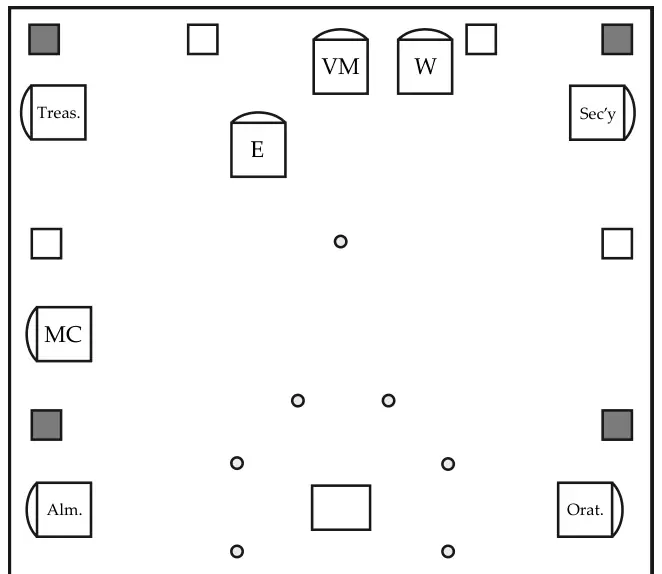
Chaque version du rituel est donnée dans l'état de sa source, de la plus
ancienne à la plus récente. Choisissez une version pour la lire ; sélectionnez-en une
seconde pour les comparer côte à côte. Fiche du grade :
le REAA du 4e au 33e degré.
Les textes issus de numérisations anciennes ont été corrigés automatiquement
(césures, ligatures, mots collés) puis relus : des coquilles peuvent subsister. D'autres
versions inventoriées au corpus (Francken 1783, Pyron 1811, rituels de Charleston ) rejoindront
cette page à mesure de l'établissement de leur texte.
Copie d'un officier du régiment de Foix en garnison à Saint-Domingue : le Rite de Perfection en 25 degrés, tel qu'arrêté au convent de Bordeaux. Cahier « Le chevalier de la royale arche » (p. 74-78 de la transcription). Le texte suit la transcription d'Aeditimus : son apparat critique est repris ici, ainsi que les repères de folio du manuscrit.
Le très puissant doit être aidé d'un ex très puissant qui est assis immédiatement à sa droite, pour représenter les deux rois Salomon et Hyram. Les deux surveillants placés suivant l'usage. Le récipiendaire est introduit selon l'usage ordinaire en frappant en élu et étant entre les surveillants, le très puissant lui dit : Que demandez-vous, mon frère ? Il répond (on lui souffle) : Je vous supplie, très puissant, de m'accorder l'insigne faveur de me conférer le sublime grade que je pense mériter par mon zèle que je sens redoubler à chaque instant et que rien ne peut retenir.
Le très puissant fait le signe avec tous les frères chevaliers et lui dit : Allez, mon frère, nous ne le pouvons, mais Dieu permettra un jour que vous le recevrez. Le récipiendaire se retire et le maître de cérémonies le conduit dans la chambre des réflexions, qui n'est éclairée que parla lumière qui vient d'un triangle transparent placé contre le mur, où il reste seul.
Peu de temps après le maître des cérémonies vient le chercher, lui passe un long ruban rouge autour du col et le conduit à la porte de la loge, où il frappe en chevalier de la Royale Arche, 3 fois 3. Le récipiendaire est introduit entre les deux surveillants, tous les chevaliers forment une voûte avec leurs mains (on observe qu'il y ait neuf voûtes ou arches, trois par trois). Pour lors le très puissant dit au récipiendaire : Voyons, mon frère, si vous aurez la force de venir jusqu'à moi en passant sous ces arches. Marchez en maçon. Il avance et le maître de cérémonies reste toujours entre les deux surveillants, tenant toujours le ruban, qu'il file à mesure.
Quand le récipiendaire est à la troisième voûte, le maître de cérémonies le tire par le cordon. Il revient sur ses pas. Le second surveillant lui dit : Retournez, mon frère, à l'autel et vous réussissiez mieux. Il avance et marche en maçon jusqu'à la sixième arche. Le maître de cérémonies le tire encore, et il revient sur ses pas. Le premier surveillant lui dit : Retournez, mon frère. Prenez ce flambeau et j'espère que vous réussirez cette fois. Il prend une bougie allumée et marche, jusqu'à la dernière et neuvième arche et là il fait une génuflexion et retourne entre les deux surveillants qui lui délient le ruban et lui disent : Nous allons, mon frère, vous accompagner. Tenez seulement ce même cordon par la main et ne le quittez pas. Ils passent tous les trois sous les arches et le maître de cérémonies reste toujours au même endroit tenant le cordon. Le récipiendaire étant arrivé à l'autel, fléchit le genou et prononce son obligation :
Obligation
Je promets, en face du Grand Architecte de l'Univers, et à tous mes frères, de ne jamais révéler les secrets de la Royale Arche qui vont m'être confiés sous les mêmes peines auxquelles je me suis soumis en recevant les grades précédents. Dieu me soit en aide. Amen.
[Après l'obligation]
Les deux surveillants le prennent sous les coudes pour l'aider à se relever, et le conduisent de même près le maître de cérémonies, où celui-ci le délie totalement du ruban. On lui présente un fauteuil, où il s'assied entre les deux surveillants. Tous les Officiers et chevaliers prennent leur place, se tiennent à l'ordre et le très puissant explique au récipiendaire l'histoire des chevaliers de la Royale Arche en ces termes :
Histoire
Lorsque Hyram roi de Tyr, comme il est dit au grade de maître secret par curiosité, ou secrétaire intime, eut porté ses plaintes à Salomon, le peu de valeur du pays Capulle en Galicie, terre aride et tout à fait stérile, qu'on lui avait donné en change des matériaux et ouvriers qu'il avait faire fournir à Salomon, celui-ci lui fit fournir le surplus et lui accorda à tout, ce qu'il exigeait. Ils renouvelèrent leur alliance et se visitèrent depuis.
Quelques maîtres Intendants des Bâtiments sachant qu'Hyram, roi de Tyr, était à Jérusalem et que du vivant d'Hyram Abiff Salomon avait un lieu particulier et souterrain, qu'on nommait voûte secrète, qui n'était connue que de ce défunt architecte et des deux rois, vinrent les trouver et les prier d'admettre quelqu'un d'eux dans le conseil secret et mystérieux, qu'ils tenaient dans cette voûte souterraine.
Salomon et le roi de Tyr leur répondirent en tournant vers eux, les mains ouvertes et la tête penchée : Allez, nous ne le pouvons. Dieu le permettra un jour que vous y soyez introduits. Quelques jours après Salomon envoya chercher trois de ses maîtres élus Intendants des Bâtiments, savoir Joaber, Stolkin et Guibelum et leur dit d'aller fouiller dans les anciennes ruines où l'on avait déjà trouvé quantité de richesses, et les ordonna d'en trouver encore d'autres pour orner son temple, qu'il allait bientôt finir de construire. Ils partirent et furent travailler suivant les ordres qu'ils venaient de recevoir.
L'un des trois nommé Guibelum, rencontra en y travaillant avec la pioche un gros anneau de fer qu'il fit remarquer à ses co-élus. Ils prétendirent, comme lui, qu'il y avait quelque chose d'extraordinaire. Ils travaillèrent en conséquence avec plus d'ardeur et parvinrent avec le secours d'une pelle à en retirer la terre et découvrirent que cet anneau tenait à une grosse trappe de pierre d'un carré long qu'ils ne levèrent qu'avec beaucoup de difficulté. Lorsqu'elle fut levée, ils n'aperçurent qu'un abîme très noir. Guibelum leur proposa de l'y descendre avec une corde, et, à cet effet, ils lui en attachèrent une à l'autour du corps avec la convention qu'ils le retireraient de ce caveau lorsqu'il secouerait la corde.
Ses camarades exécutèrent ponctuellement ce dont ils étaient convenus. Guibelum descendit dans une voûte dans l'espace de laquelle il y avait un trou. Il y descendit de même et se trouva dans une seconde voûte, dont le pavé était percé de même et conduisait à une troisième où il entra. N'osant aller plus loin, il secoua la corde. Joaber et Stolkin le retirèrent aussitôt. Il leur fit le rapport de ce qu'il avait observé et leur proposa de descendre à leur tour et sur leur refus, il y descendit encore de la même façon avec convention qu'il secouerait la corde autant de fois qu'il aurait passé des voûtes ou arches.
Lorsqu'il eut pénétré jusqu'à une sixième, il secoua la corde par six fois et on le retira. Guibelum proposa encore à ses camarades d'y descendre à leur tour, ce qu'ils n'osèrent hasarder. Voyant cela, il se détermina à y descendre, le flambeau à la main, avec les mêmes conventions. Lorsqu'il fut parvenu à la neuvième arche, des pierres et de mortier se détachèrent subitement du haut de cette dernière et les rayons du Soleil pénétrèrent vivement dans ce lieu obscur et profond et frappèrent directement sur une lame d'or triangulaire, enrichie de diamants et pierres précieuses, dont l'éclat éblouit Guibelum, ce qui lui fit faire un geste d'admiration, qui se trouva être le même que Salomon et le roi Hyram avait fait à lui et à ses camarades, lorsqu'ils furent ensemble les prier à leur conférer ce grade sublime. Guibelum se prosterna, le genou en terre, la main droite devant les yeux et l'autre derrière le dos, dont il secoua la corde par 3 fois 3.
Joaber et Stolkin le retirèrent et il leur fit part des merveilles, qu'il avait apprises dans la neuvième arche. Ils se déterminèrent à y descendre avec lui et firent à ce but des cordes. Lorsqu'ils furent descendus dans cette neuvième arche, ils firent comme Guibelum, étant éblouis des rayons éclatants de cette clarté qui resplendissait de cette lame d'or triangulaire.
lorsqu'il était descendu seul et se prosternèrent le genou en terre pour revenir de leur surprise. Ils soutinrent Guibelum par-dessous des coudes pour l'aider à remonter, disant : Hamma- laben Guibelum65 : Guibelum est un bon maçon, et examinèrent ensuite, les yeux couverts, sur cette lame d'or des caractères gravés qu'ils ne connaissaient pas.
Cette lame était de figure triangulaire, incrustée sur une pierre cubique d'agate de même figure. L'admirant avec respect, ils les reconnurent sur l'heure par les caractères, pensant que ce nom très sacré de l'Eternel, qui n'était connu que des deux rois Salomon et Hyram et du feu Adon-Hyram-Abiff qu'il y avait apparence que depuis la mort de ce dernier, les deux rois n'étant plus nombre ni suffisant ni complet, n'avaient pu leurs conférer ce sublime grade auquel ils pouvaient pour lors aspirer par la circonstance merveilleuse qui en faisait trouver ce trésor précieux, d'autant mieux qu'ils étaient convaincus que la parole du maître était perdue et que, lorsqu'ils demanderaient comment ils avaient fait le sublime grade, on leur répondit : Allez, Dieu permettra un jour que vous la recevrez, époque frappante pour eux qui leur donna une grande expérience et rendra leur zèle.
Ils levèrent cette pierre qui portant la lame et la portèrent à Salomon, qui était alors dans ses appartements avec Hyram, roi de Tyr. Ils furent surpris au premier conseil, éblouis et saisis d'admiration et firent naturellement les mêmes signes que les trois élus avaient fait dans la neuvième arche et se prosternèrent, un genou en terre. Salomon un peu revenu soutint Hyram, roi de Tyr, par les coudes pour l'aider à se relever en lui disant : Hamma laben Guibelum. Il faut en dire que Guibelum est un bon maçon. Il faudra le récompenser.
Ils examinèrent ensuite les caractères, qui étaient imprimés sur cette lame d'or et les reconnurent, mais ne les appliquèrent pas, d'abord, aux trois élus. Salomon leur déclara : le Grand Architecte de l'Univers vous a fait la plus signalée de toutes les faveurs. C'est lui, qui vous a choisi pour découvrir le trésor le plus rare et le plus précieux pour les maçons. Vous êtes ses élus. Je vous en félicite et pour vous enseigner notre joie et vous récompenser de votre zèle, ferveur et constance, nous vous tous établissons et instituons chevaliers des neuf arches, comme étant les seuls, qui en avez fait la découverte et depuis ils furent créés chevalier de la Royale Arche pour les travaux qu'y firent les deux rois. Il leur promit de leur donner l'interprétation des caractères mystérieux et sacrés, qu'ils avaient vus gravé sur cette lame d'or, lorsqu'ensemble ils l'avaient posé au lieu qui lui était destiné, et qu'il leur conférerait le plus haut et le plus sublime grade de la Maçonnerie. Et sur les observations, que ces trois grands élus firent que leur premiers signes naturels dans la neuvième arche leurs [21v°] préconisés par leurs premiers [21v°] attouchements, avaient été les mêmes que Salomon et Hyram venaient de faire et prononcer naturellement Ils se firent rendre compte de toutes leurs démarches prévues, sur quoi ils fondèrent et statuèrent les signes, attouchements et paroles de ce grade, comme dernier sous le titre de chevalier de la Royale Arche.
Salomon leur découvrit le grade, promesse de Dieu étant accompli, car il avait promis à Noé, à Moïse et à David, son père, que le véritable nom sous lequel il venait d'être indiqué se trouverait un jour sur une lame d'or, leur ayant toujours défendu de l'écrire, leur permettant seulement de le prononcer pour leur soulagement [et] consolation : Vous savez, continua-t-il, mes très chers frères, que cette parole avait toujours servi de mot de maître jusqu'à la tragique époque de Clément six, mais depuis elle n'était pas la même, parce que par nombre de traditions successivement corrompues, elle n'était plus le véritable. Nous avons le bonheur de voir à présent les véritables caractères et d'en savoir la vraie prononciation, dont nous vous donnerons l'interprétation lorsqu'il s'entendit n'ayant rien de plus à cœur que de vous rendre avec justice la récompense due à vos travaux. Vous êtes d'ailleurs, mes très chers chevaliers élus et par la main divine, connaisseurs entre vos frères, méritant cette faveur. Les deux rois embrassèrent Guibelum, Joaber et Stolkin et les renvoyèrent contents.
Communication du grade
Après cette histoire, il les prie d'approcher et en lui passant le cordon de l'Ordre et le bijou, il lui dit : Par le pouvoir que j'ai et du consentement de cette respectable loge, je vous fais chevalier de la Royale Arche. Il lui donne ensuite les signes, les attouchements et la parole et l'accolade qu'il va donner à tous les chevaliers par ordre et revient les rendre au très puissant, il applaudit et il [remarque] :
Le signe est celui d'admiration, les deux mains tendues et ouvertes, la tête penchée sur l'épaule gauche, on y répond en mettant le pouce gauche à terre, la main droite devant les yeux, et la main gauche derrière le dos et le premier doit relever celui-ci par le coude, comme pour le relever.
Lorsque l'on se rencontre trois ensemble, le signe est de faire l'arche avec les mains gauches croisées par-dessus la tête.
L'attouchement est de se prendre réciproquement par le coude et de se soutenir comme si on voulait se retirer d'un précipice en disant Hammala[b]enk Guibelum : Guibelum est un bon maçon.
Le mot de passe ou couvrant est Jabulum.
La parole mystérieuse et sacrée est celle qui était gravée sur la lame d'or triangulaire qui n'est connue que des grands élus parfait maîtres écossais.
On se tient à l'ordre en loge la main droite sur les yeux, comme pour regarder quelque chose d'éblouissant, et la main gauche derrière le dos.
Le tablier est blanc, doublé et bordé de rouge.
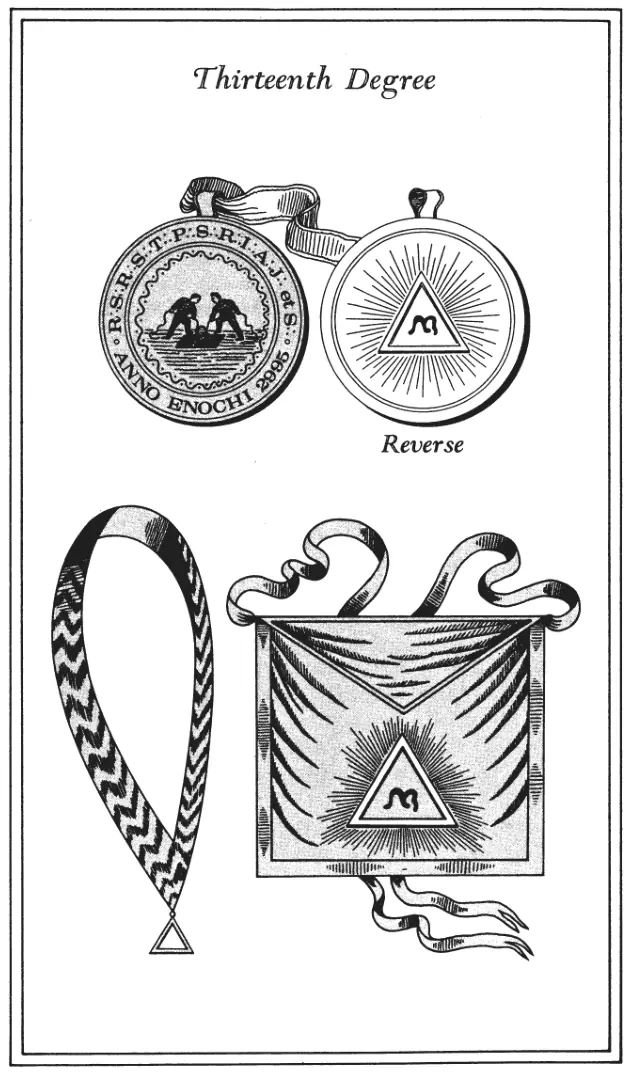
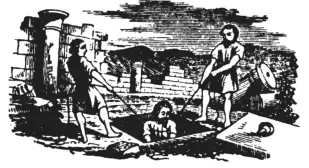
Le cordon de l'ordre est un large ruban ponceau, que l'on porte en collier au bout duquel pend un bijou d'or qui représente d'un côté un Soleil ayant neuf grands rayons et au milieu un triangle dans lequel est la lettre G. initiale de Guibelum, de l'autre côté l'arche de Noé, arrêtée sur une haute montagne, selon d'autres c'est un paysage de vieilles maisons et de bâtiments gothiques, ruines où se trouvent des citernes en voilà l'une dessus l'autre dans lesquelles deux hommes en descendent un troisième lié par les aisselles. De l'autre côté est un triangle lumineux au milieu duquel sont écrits des caractères hébreux difficiles à lire.
Instruction
Avant de recevoir un élu au grade de la Royale Arche, il est indispensable de l'interroger sur tous les grades par où il a passé.
D. Qui êtes-vous ?
R. Je suis élu de la Royale Arche, grade que j'ai reçu par un effet de la Providence.
D. Expliquez-moi cela ?
R. J'ai fouillé dans les ruines de bâtiments antiques, j'ai pénétré neuf arches souterraines et j'ai trouvé le delta, que l'on avait promis aux patriarches.
D. Qu'est-ce que ce delta ?
R. Une lame d'or triangulaire resplendissante de lumière, sur laquelle était le vrai nom de Dieu.
D. Avez-vous la prononciation de cette parole mystérieuse ?
R. Non, pas encore, mon temps n'est pas encore venu. Je n'ai plus à passer, que l'entrée, que je couvre et rien ne me sera caché.
D. Quel est le devoir du chevalier de la Royale Arche ?
R. C'est de couvrir les portes des voûtes ou arches du corridor qui conduit de l'appartement de Salomon sous le temple de Jérusalem et comme il y à neuf, il y a autant de chevaliers, qui
en couvrent chacun une en recevant des grands élus. Le mot de passe de chaque arche jusqu'à la voûte secrète.
D. Puisque vous êtes à la dernière, vous savez donc les mots de passe ?
R. Oui, très puissant.
D. Donnez-les-moi.
R. Il les donne : Jub, Jeo, Jna, Hajah, Gottra, Adonaÿ, Jakinaÿ, Helihanam, Jabulum. – Puis :
D. Que vous reste-t-il à demander ?
R. Le sublime grade de grand élu parfait maître écossais après lequel je n'ai plus rien à désirer. Alors lui dit-il : Mon frère, Dieu permettra que vous le receviez.
On ferme la loge, comme elle est ouverte. –
[Signature]
Apparat critique de la transcription Aeditimus
65. La formule reviendra avec quelques variantes que nous reproduirons à chaque fois.
Manuscrit Quesada 1804 (copie 1813-1821)
manuscrit · BNE Mss 7834 · 7 036 mots
Le manuscrit Quesada (Mss 7834 de la Bibliothèque Nationale d'Espagne) : copie (1813-1821) d'un état du Rite de 1804, voire antérieur, tel que pratiqué dans la mouvance du Suprême Conseil d'Amérique. Les didascalies du manuscrit sont en italique. Le texte est celui de l'édition Latomia, donnée en vis-à-vis du fac-similé du manuscrit : l'apparat critique de cette édition est repris ici, de même que les repères de folio du manuscrit.
Texte intégral sur ce site · transcription C. M. & P. T., Latomia / Chantier de fouilles maçonniques, d'après le Mss 7834 de la BNE
Le lieu où se tient cette L∴ royale ou Collège, doit être bien caché & même sous terre sans porte ni fenêtres, avec une trappe au sommet, sur les trois faces du triangle doivent être écrits les 3 noms de Dieu de sorte qu’en mettant une lumière dans l’intérieur du piedestal le nom doit paraître des 3 côtés & au milieu.Cette voûte doit être peinte en blanc il doit y avoir 2 Officiers352 pour remplir les fonctions nécessaires et donner
les instructions (Planche figure ) 1°∴ en cette L∴ le T∴ Puisst∴
Gd∴ Me∴ représente Salomon. Il doit y être dans un riche dais couronné assis dans un gd∴ fauteuil ayant en main une couronne & un sceptre, il doit être vêtu d’une robe royale couleur jaune & d’un manteau de satin blanc doublé d’hermine qui le couvre jusqu’aux coudes, d’un large ruban pourpre de l’épaule droite à la hanche gauche au bas duquel est un triangle d’or suspendu (Voyez la planche figure ) 2°∴ A l’Est à la gauche de Salomon, est Hiram roi de Tyr habillé en voyageur son chapeau sur la tête avec le même cordon & bijou, son sabre nu à la main ces deux Off∴ doivent être au moins des Princes de Jérusalem il doit y en avoir 3 autres pour faire le nombre 5 & tenir régulièrement une L∴ de ce grade. Le Gd∴ Trésorier représente Jibulum, qui fut le premier dépositaire du trésor précieux des Maç∴ il est décoré d’une clef d’or suspendue à un petit ruban blanc attaché
à la 5e boutonnière de son gilet avec les lettres T353∴ V∴ I∴ O∴ L∴
qui signifient Inveti, Verbum, In, Oré, Léonis354. Il doit être assis au Nord. Le Gd∴ Secrétaire représente Folio 159 recto –– Johaber il est placé au Sud et remplit ses fonctions quand les deux rois reconnaissent leur alliance, comme il est dit dans le Secrétaire Intime, il est sans chapeau. Le Gd∴ Insp∴ représente Stolkin, il est à l’Ouest les trois derniers Off∴ portent leur bijou en forme de collier leurs bras nus, s’il y a plus de 5 Frères, ils doivent être assis à l’autre extrémité de la L∴, parce qu’il n’y a que les 5 qui font réception, immédiatement après l’ouverture de la L∴ on procède aux cérémonies d’usages et le F∴ Stolkin, Gd∴ Survt∴ & Insp∴ placé à l’Ouest répond aux questions que le T∴ P∴ lui fait On ne peut admettre moins de trois Récipiendaires à la fois.
Ouverture
D∴ F∴ Insp r∴ dans quelle place sommes-nous ?
R∴ Nous sommes dans le centre de la place la plus sacrée du monde.
D∴ Comment êtes-vous parvenu à cette place ?
R∴ Par un effet de la providence.
D∴ Donnez-moi l’explication de ceci ?
R∴ J’ai fouillé dans les anciennes ruines du Temple d’Henoch. J’ai pénétré dans 9 arches sous terre, j’ai pris le Delta que Dieu avait promis au Saint Patriarche de faire trouver par la suite des temps.
D∴ Qu’est-ce que ce Delta ?
R∴ Un triangle d’or, rempli d’une grande lumière sur laquelle fut gravé par Enoch. le Gd∴ et mystérieux nom du Gd∴ Arche∴ de l’Un∴
D∴ Qui êtes-vous ? Je suis ce que je suis, mon nom & Jibulum.
R∴
D∴ Connaissez-vous la parfaite prononciation du nom du Gd∴ Arch te de l’Un∴
R∴ C’est un nom sacré connu seulement des G ds∴ Élus Anciens & Sublimes Maçons.
D∴ Quelle est votre qualité ?
R∴ Chev∴ de Royal Arche.
D∴ Qui vous a reçu en cette qualité ?
R∴ Salomon & le roi de Tyr en récompense de mon zèle et de ma constance, ils m’ont élevés à ce grade avec Joaber et –– Stolkin mes compagnons.
D∴ Quels sont vos Signes Mots et Attouchements Le premier Signe est celui d’admiration il se fait en élevant et
étendant les bras les mains ouvertes, la tête penchée sur l’épaule gauche, un genou à terre, le deuxième signe. Est de tomber sur les genoux. L’attouchement est de s’aider mutuellement à se relever en se prenant les aisselles et les coudes.
Le mot est Hamalabec. Jibulum
D∴ Que signifie ce mot ?
R∴ Il signifie, Jibulum est un bon Maçon, il faut le récompenser.
D∴ Avez-vous quelque chose à désirer ?
R∴ La sublime Maçonnerie connue sous les noms de la Perfection ou fidélité357 éternelle. Le T∴ Pt∴ continue. Dieu permettra un jour que vous soyez récompensé et que vos désirs soient accomplis
Le F∴ Insp∴ répondAmen … Amen … Amen.
Prière
Gd∴ Arch te∴ de l’Un∴ Dieu adorable en tout veuille bien examiner nos désirs dans ce moment où nous implorons la divine bonté, en lui est la vraie sagesse à laquelle nous aspirons et à laquelle nous ne pouvons atteindre que par la ferveur, cette sagesse doit faire la beauté du Temple que nous allons te consacrer c’est-à-dire que tu voudras toi-même purifier nos cœur dans lesquels nous désirons que tu résides continuellement .. Amen ..
Le Très Puisst∴ frappe cinq coups = = lesquels sont répétés par le roi de Tyr et les 3 Off∴ ensuite les deux rois se mettent à genoux devant le Delta en faisant le signe d’admiration quelque temps après tous deux s’aident à se relever comme il est dit plus haut. Tous les FF∴ font la même chose, dès que le T∴ Puissant
a frappé un coup. Le T∴ Puissant dit ensuite F∴ Insp∴ prévenez les FF∴ que la L∴ Royale est couvertele F∴ Insp∴ répète l’annonce
Réception
Il doit y avoir 3 Récip∴ s’il n’y en avait qu’un, deux autres membres de la L∴ suppléeraient à leur défaut, les Cand∴ doivent être dans l’antichambre en haut de la trappe ils frappent à la porte en Gd∴ Me∴ Arch∴ On demande qui frappe à la porte ? Ils répondent qu’ils désirent être reçus Chev∴ de Royal Arche ce qui est rapporté dans le trou de la trappe. Le Cond∴ répond :
R∴ Il n’est pas encore possible, mais je supplie Dieu de le permettre
Ils font une seconde demande, on y répond de même à la 3 e∴ on leur accorde l’entrée, le F∴ Introd∴ prend le P r∴ Cand∴ le conduit à la trappe & lui dit :
D∴ Êtes-vous disposé à descendre dans le centre de la terre pour
y chercher le trésor : il répond : Oui. Le F∴ Introd∴ lui passe une corde au travers du corps et quand la trappe est ouverte on le descend une troisième fois. Le Gd∴ Survt∴ fait mettre à genoux le Cand∴ près du Delta en faisant le signe d’admiration, la porte et la trappe se ferment on fait les mêmes cérémonies aux 2e et 3 e∴ Cand∴ & quand ils sont tous les 3 à genoux et que les lumières sont rallumées autour du Delta et placées par 5 fois 5 le T∴ P∴ leur dit : Le Gd∴ Arch∴ de l’Univers vous fait la
plus grande faveur, c’est lui qui vous a choisi pour découvrir les trésors les plus précieux des Maç∴ et vous êtes ses élus, je vous en félicite approchez et venez contracter la plus solennelle obligation de vos travaux et de vos peines pour que je vous récompense.
Obligation
Je N…. promets de faire vœu de la manière la plus sensible la plus inviolable et la plus solennelle sur la Ste- Bible et en présence du Grand Arch te∴ de l’Univers de redoubler de zèle d’amour et d’amitié pour mes FF∴ qui sont parvenus à ce Grade Royal je promets de ne jamais recevoir aucun F∴ à ce Grade Royal sans le plein consentement de cette L∴ je promets de ne jamais donner les Mots à un nombre moindre de de 3 après les avoir auparavant bien examinés & à moins que je n’y soit autorisé par un titre bien authentique et dans le cas de nécessité, de lever une L∴ de Royal Arche, que je n’assisterai ni ne consentirai jamais d’établir une pareille L∴ de Royal Arche qu’à 25 lieues d’une L∴ régulière, de Royal Arche bien constituée, à moins que j’y soit autorisé par un pouvoir d’un Grand Insp∴ ou de son Député je promets de ne jamais recevoir aucun F∴ à ce grade Royal qu’il n’ait passé régulièrement par les grades précédents, et qu’il ait été membre d’une L∴ Régulière et après avoir éprouvé son zèle fervent & constant dans la Maçonnerie, et qu’il ait témoigné de la charité & bienveillance à ses FF∴ je promets en outre de me soumettre aux lois statuts et règlements qui seront approuvés par cette Respble∴ Royale L∴ je promets de plus de renouveler mon zèle pour l’Art Royal et mon amitié pour mes FF∴ et de ne jamais me séparer de cette L∴ Royale, sans la permission expresse du T∴ Puissant Gd∴ Me∴ et de ses G ds∴ Officiers je promets de ne jamais séduire la femme de mon F∴ ni sa fille ni sa sœur, ni même de sa famille, je promets reconnaître en tout temps le Conseil des Princes de Jérusalem et du Royal Secret, pour les Souv∴ Chefs de la Maçonnerie, quand ils seront munis de lettres authentiques et de me soumettre moi-même à leurs ordres. Si je manquais ces présents engagements, je consens à subir toutes les peines de mes premières obligations, que mon corps soit exposé à la voracité des animaux sauvages pour leur servir de pâture que Dieu me maintienne en droiture et en équité. Amen, amen, amen.
Discours historique
Pour continuer l’histoire de la Franche Maçonnerie dont vous avez les éléments, il est nécessaire de vous faire connaître ce qui s’est passé depuis bien des siècles, Enoch fils de Jareh362. de la 6 e∴ génération d’Adam, il vivait dans la crainte et l’amour de Dieu qui lui apparut en songe, lui parla par inspiration et lui communiqua ce qui suit : Comme tu désires savoir mon nom, suis-moi & je te le ferai connaître, une montagne parut aussitôt s’élever jusqu’au ciel, Enoch, y fut transporté, Dieu lui fit voir une plaque d’or triangulaire, qui était éclairée de ces brillants caractères son nom très béni, et lui donna ordre de ne jamais le prononcer Enoch crut ensuite descendre perpendiculairement sous la terre sur 9 arches. Dans la 9 e∴ il vit cette plaque brillante avec les mêmes caractères éclatants tels qu’il les avait déjà vu Enoch remplit de l’esprit de Dieu très puissant, éleva sous terre un Temple à la gloire de Dieu, où il y avait 9 arches dans la même forme qu’elles lui avaient apparu. Mathusala son fils aîné fut choisi pour être l’arch te∴ du Temple sans connaitre les raisons pour lesquelles il était élevé, cet édifice fut bâti sur la terre de Canaan qui depuis fut la terre promise, ensuite Jérusalem ou la Terre Sainte, Enoch fit une plaque d’or triangulaire ayant, une coudée de chaque côté, et enrichie de pierreries les plus précieuses il l’enchâssa dans une pierre d’agate de la même forme et la transporta dans la même arche grava dessus les mêmes caractères que Dieu lui avait montrés et plaça le tout sur un piédestal de marbre blanc de la même figure. Après qu’Enoch, eut achevé ce Temple sous terre, Dieu lui apparut de nouveau & lui dit : Fais une trappe d’une seule pierre sous la 1 re∴ arche, sur laquelle tu feras un anneau en fer pour pouvoir la lever quand il faudra, parce que je dois faire périr tout ce qui respire sur la Terre. La grande arche étant achevée et soigneusement fermée, de manière que personne n’y pouvait pénétrer excepté Enoch qui avait la connaissance de ce précieux trésor, et le seul qui sut la prononciation du grand nom de Dieu, la méchanceté du genre humain augmentait tous les jours, Dieu répandit sur la Terre la destruction universelle. Enoch prévoyant que la connaissance des arts serait à jamais perdue par le Déluge qui devait arriver et désirant transmettre les principes des sciences à la postérité la plus reculée, et à ceux que Dieu voudrait sauver éleva en conséquence deux grandes colonnes sur la plus haute montagne l’une était d’airain pour résister à la force des flots, l’autre de marbre blanc, pour résister au feu, il grava sur cette dernière certains hiéroglyphes, pour faire comprendre autant qu’il était possible, que près de là était caché dans des arches sous terre, des choses dédiées à Dieu. Il grava sur la colonne d’airain les principes des arts libéraux et particulièrement ceux de la Maçonnerie philosophique, Mathusala était père de Lamech. Qui le fut de Noé homme pieux croyant en Dieu, ses vertus lui attirèrent les faveur de l’Éternel qui lui dit : Je veux punir le genre humain par un Déluge construis une Arche qui puisse contenir ta famille, et des lieux destinés à recevoir une paire de tous les animaux vivants, toi ta famille et eux serez les seuls préservés de la punition éternelle que je veux infliger. Il lui donna en même temps, le plan de la construction de l’Arche Noé fut cent ans à la construire il était alors âgé de six cent ans, son fils Sem en avait 99. C’était peu de temps avant la mort de son père, Lamech qui était âgé de 777. ans, il n’existait plus alors aucun des anciens patriarches depuis Adam, excepté Mathusala g d∴ père de Noé, qui mourut à l’âge de 969 ans, quelques temps avant le Déluge c’est-à-dire 5 ans. Le Déluge eut lieu le 17 novembre l’an du monde 1556. Il détruisit tout jusqu’aux monuments les plus superbes ainsi que la colonne de marbre qu’Henoch avait élevé par la volonté divine celle d’airain résista à la force des eaux, ce qui fut cause que les principes des arts libéraux, et les principes de la Maçonnerie philosophique, furent transmis à la postérité. L’histoire de la Bible nous apprend que Moïse fut aimé & chéri de Dieu qui lui parla sur le Mont Sinaï près du Buisson Ardent en lui communiquant ses lois divines sur des tables de pierre, renouvelant avec lui son Alliance et lui apprenant la vraie prononciation de son saint nom par lequel il voulait toujours être invoqué, ce fut dans ce moment que Moïse lui demanda qui est-tu ? À quoi Dieu répondit : Jehovah, est mon nom, je suis le Dieu fort et juste le Dieu grand & puissant, la prononciation de ce nom ayant été corrompue dans la suite des temps par différentes traductions, parce que Dieu avait défendu à Moïse & à ses descendants de ne jamais Folio 162 recto le prononcer mais que par la suite la postérité le trouverait gravé sur une plaque d’or, la même histoire nous apprend que lorsque les Israélites furent possesseurs de la Terre Promise ils se donnèrent beaucoup de soin pour la retrouver. Il est à observer que David ne pouvant bâtir le Temple du Seigneur, cet honneur fut réservé à Salomon son fils le plus sage des rois, qui se souvenant des promesses que Dieu avait faites à Moïse de retrouver son saint nom dans le temps prescrit, la sagesse lui inspirait que ce temps n’était pas éloigné et qu’il le trouverait avant la construction de son Temple à l’Eternel, qu’il fit sur les dessins que son père lui avait laissé de l’Arche d’Alliance. Il fit jeter les fondements de ce Temple la 4 e∴ année de son règne sur la place la plus belle & la plus sainte de Jérusalem en creusant les fondements, on trouva les ruines de un ancien édifice et quantité de richesses en valeur d’or et d’argent en colonnes de marbre, de jaspe, de porphyre & d’agate et un nombre prodigieux de pierres précieuses, le tout fut apporté à Salomon, ce vertueux roi présumant que dans ce lieu il y avait eu avant le Déluge un temple dédié à quelque divinité & craignant que la majesté du vrai Dieu ne fut profanée, fit abandonner ce lieu & choisit la plaine d’Arinsca, Salomon donna ordre de bâtir sous terre une caverne en forme de cave, qu’il appela Voûte Sacrée Secrète, dans le centre de la sagesse il fit élever un pilier de marbre blanc qui supportait le Saint des Saints du Temple qui par inspiration fut appelé le Pilier de la Beauté, pour arriver à la Voûte Secrète, on était obligé de passer par un lieu fort étroit et sous 9 arches qui se suivaient les unes aux autres et qui communiquaient sous terre avec le palais de Salomon, c’est dans ce saint lieu que Salomon accompagné d’Hiram roi de Tyr et d’Hiram Abif s’entretenaient des Saints Mystères, la perte de ce dernier les priva de cette satisfaction & comme le nombre de deux n’était pas suffisant pour entrer sous cette Voûte Sacrée ils furent dans l’absolue nécessité d’en choisir un 3 e∴ pour compléter le nombre.
Plusieurs G ds∴ M es∴ Intendants Sublimes Élus G ds∴ M es∴ Archt es∴ informés que le roi de Tyr était à Jérusalem et n’ignorant pas que du vivant d’Hiram Abif Salomon avait une place sous terre, qu’il appelait la Voûte Secrète laquelle n’était connue que du défunt et des deux rois, furent trouver ces deux derniers et les prièrent de choisir parmi eux une personne qui put être introduite dans ce lieu secret. Quand les deux rois renouvelaient leur alliance, Salomon répondit en levant les bras et inclinant la tête : Vous ne devez pas encore jouir de cette faveur, mais Dieu permettra qu’un jour vous connaissiez ce que vous désirez si ardemment. Quelque jours après, Salomon envoya chercher les 3 Arch tes∴ Jahaber, Stolkin & Jibulum, et leur ordonna d’aller fouiller de nouveau dans les anciennes ruines où ils avaient trouvé tant de trésors espérant qu’ils en trouveraient encore ils partirent donc pour exécuter les ordres de Salomon, Jibulum en travaillant découvrit un gros anneau de fer auquel s’accrocha la pointe de sa pioche, il appela aussitôt ses compagnons & ayant examiné l’endroit, ils présumèrent qu’il devait y avoir quelque chose d’extraordinaire déposé dans ce lieu ils redoublèrent donc leur travail, de zèle et d’ardeur et à l’aide de pelles & de pioches ils enlevèrent les déblais qui couvraient cet anneau, ils virent alors qu’il est scellé à une pierre parfaitement carrée avec beaucoup de soins et de peines il parvinrent enfin à lever cette pierre et s’aperçurent qu’elle couvrait une endroit très profond Jibulum proposa à ses Comp∴ d’y descendre à cet effet ils lui passèrent une corde autour du corps et convinrent ensemble que lorsqu’il la tirerait, ils le remonteraient de suite. Ils observèrent exactement ce dont ils étaient convenus. A peine descendu, il trouva la première arche voûtée qui le conduisit à une 2 e∴ qui communiquait à une autre il s’arrêta un instant pour observer, mais n’osant poursuivre, il tira la corde par 3 secousses, ils le Folio 163 recto remontèrent, il leur fit part de ce qu’il avait vu et les engagea à l’y descendre de nouveau en leur observant qu’à chaque arche qu’il dépasserait, il secouerait légèrement la corde, mais s’il apercevait du danger il la secouerait de suite. Il redescendit donc et parvint jusqu’à la 6 e∴ arche, là il fut obligé d’avertir ses Compagnons de le remonter, il les instruisit de ce qu’il avait vu et leur dit qu’il y avait encore beaucoup de profondeur il engagea de nouveau Jibibulum et Stolkin à y descendre mais effrayés du récit qu’il leur avait fait le refusèrent absolument. Jibulum animé d’un nouveau courage se précautionna d’un flambeau et pria ses camarades de bien observer ce qu’il leur avait déjà dit : il descendit donc pour la 3 e fois & pénétra jusqu’à la 3 e arche mais à peine y fut-il arrivé qu’un morceau de pierre, où de mortier tomba tout à coup sur son flambeau et l’éteignit heureusement qu’un rayon de Soleil pénétrait dans les 9 arches lui fit découvrir la plaque d’or triangulaire enrichie de pierres les plus précieuses, son éclat frappa tellement Jibulum qu’il faillit en perdre connaissance il fit alors le signe d’admiration qui se trouva être le même que Salomon & Hiram roi de Tyr avaient faits lorsqu’avec ses Comp∴ il témoigna le désir de parvenir à ce sublime grade Jibulum tomba sur les genoux et prosterné, mettant sa main droite sur les yeux & sa gauche sur les reins, il secoua tout à coup la corde, Johaber et Stolkin le remontèrent alors il leur annonça les merveilleuses choses qu’il avait vues dans la 9 e∴ arche, d’après son récit ils se proposèrent d’y descendre, et parvinrent à la 9 e∴ arche & firent les mêmes signes & prirent la même attitude que Jibulum c’est à dire qu’ils furent tellement éblouis qu’ils se prosternèrent après avoir fait le Signe de surprise et d’admiration. Jibulum restant toujours prosternés Johaber et Stolkin l’aidèrent, et Hamalabeck Jibulum qui signifie Jibulum est un bon Maç∴ il faut le récompenser, ils s’approchèrent ensuite de la plaque d’or et l’ayant examinée, il aperçurent des caractères qu’ils ne purent déchiffrer, cette plaque d’or triangulaire était incrustée dans une pierre d’agate de même forme ils l’admirèrent avec un saint respect et pensèrent que les caractères qu’elle représentait devaient être le nom sacré de Dieu qui n’était alors connu que de Salomon d’Hiram roi de Tyr & d’Hiram Abif. Il parut qu’après la mort de ce dernier les deux rois n’étant plus au nombre suffisant, n’avaient pu accorder ce grade à ceux qui y aspiraient qu’après avoir trouvé un si précieux trésor, ils parviendraient à l’obtenir ils se déterminèrent à lever entre eux la pierre cubique sur laquelle reposait la plaque et l’apporter à Salomon. Ils arrivèrent à la pointe du jour, à peine étaient-ils entrés dans l’appartement de Salomon que les deux rois furent si étonnés à la vue de ce précieux trésor qu’ils firent aussitôt les mêmes Signes d’admiration qu’avaient fait les 3 Maîtres dans la 9 e∴ arche, ils tombèrent sur les genoux Salomon revenu le premier de sa surprise, voyant le roi de Tyr toujours à genoux & comme en extase il dit Hamalabeh Jibulum. Ils examinèrent avec soin les caractères qui étaient sur cette plaque et reconnurent que c’était le nom de Dieu Jeovah. Mais ils ne voulurent en donner l’explication qu’aux trois Élus et leur dirent : Le Gd∴ Arch te∴ de l’Un∴ vous a comblé de la faveur la plus signalée, il vous a choisi pour découvrir le plus rare & le plus précieux trésor de la Maçonnerie vous êtes ses biens aimés je vous en félicite et je vais vous récompenser de votre zèle, votre ferveur et votre constance, je vous369 Chev∴ de Royal Arche je vous promets en outre de vous donner l’explication des caractères sacrés que vous voyez tracés sur cette plaque triangulaire, lorsque j’aurai trouvé une place pour la mettre, alors je vous découvrirai les plus hauts et plus sublimes grades370 de la Maçonnerie, les 3 Élus observèrent à Salomon que la parole que le roi de Tyr et lui avaient prononcés était la même que celle qu’ils avaient dite dans la 9 e∴ arche en voyant le trésor, ils racontèrent tout Folio 164 recto.
ce qu’ils avaient vu et fait, ce qui se trouva précisément être la Parole et l’Attouch t∴ de ce grade, connu depuis sous le titre de Royal Arche. Salomon leur annonça ensuite que la promesse de Dieu était accomplie, qu’il avait promis à Noé, à Moïse et à David son père qu’un jour son vrai nom serait trouvé sur une plaque d’or, que c’était celui par lequel il voulait être invoqué qu’ils pouvaient l’écrire pour leur consolation mais qu’ils pouvaient & ne devaient jamais le prononcer et en épeler les lettres gravées qu’avec la plus grande circonspection. Il leur dit encore vous savez que la parole de Me∴ a été perdue à la conservation du Temple par la fin tragique d’Hiram Abif, cette parole ne nous est parvenue que par tradition, jusqu’à présent elle a été successivement corrompue, maintenant mes C∴ FF∴ nous sommes assez heureux pour avoir les vrais caractères qui nous font trouver son interprétation & sa vraie prononciation, il ne nous reste plus qu’à récompenser avec justice le mérite de vos travaux vous êtes à présent choisis par la providence et cette faveur signalée vous est bien due. Les deux rois & les 3 Chevaliers prirent le précieux trésor et furent dans la Voûte Secrète par un chemin couvert de 9 arches, qui n’était connu que d’eux seuls, ils arrivèrent au Pilier de la Beauté et travaillèrent ensemble pour incruster la plaque dans le piédestal, les deux rois se glorifiant & se réjouissaient de se servir de la truelle, quand ils eurent achevés l’ouvrage ils se prosternèrent tous, rendirent hommage au Gd∴ Arch∴ de l’Un∴ le remercièrent de la grande fortune qu’il venait de leur accorder. Le brillant de la plaque, la splendeur des diamants et des rubis dont elle était ornée, suffisaient pour éclairer ce lieu, on n’avait pas besoin d’autres lumières dès que l’ouvrage fut fini les deux rois leur accordèrent, le grade de Gd∴ Élu Parfait & Sublime Maç∴ avec l’explication de la Parole Sacrée sur la pierre triangulaire qui était le nom le plus sacré de celui du Tout Puissant et le seul par lequel il voulait être invoqué. Les deux rois changèrent le nom de la voûte sacrée en celui qui ne devait373 connu que des G ds∴ Élus Parfaits Maç∴ et Subl∴ & récompensèrent la vertu des 3 Chev∴ de Royal Arche : Jibulum, Johaber et Stolkin, les deux rois leur donnèrent l’explication de la Parole Sacrée gravée sur la pierre triangulaire qui était le nom le plus sacré de Dieu, voici la méthode qu’on avait de le prononcer ci-devant, remarquez que toujours le nombre des lettres et caractères qui composent les paroles sont divisés, il se trouve toujours un nombre mystérieux de la Maçonnerie, dont on n’a la vraie prononciation que lorsqu’on est arrivé au grade de la Perfection. Le nombre de lettres qui composent ces mots sont :
Jod :._L’idée de DieuAdonnaï :
Vous seul Éternel
Dieu fort7 SchadaïTout puissant 3 Jaa_ Jah ._ Le seigneur est mon RoiJehovahDieu brillant Haiah_ Il a étéHelehanamMiséricorde de Dieu 5 Elion,_ Le Très Haut. 9 El SebaothDieu des âmes Jahod,_ Dieu ÉternelJohabulum, Ma foi est en Dieu
Les 3 nouveaux FF∴ Jibulum, Johaber et Stolkin firent serment à Dieu & aux hommes deux rois de ne jamais prononcer en entier le Mot Sacré et de ne jamais admettre aucun Maç∴ à ce sublime grade sans avoir donné des preuves de son zèle et attachement à l’Ordre & sans vouloir user des mêmes cérémonies en commémoration de la glorieuse histoire du divin Delta près le B∴ A∴ auprès duquel Dieu avait donné à Moïse cette parole. Le nombre des G ds∴ Élus commença par trois Folio 165 recto il fut ensuite porté à cinq & demeura longtemps fixé à ce nombre, savoir : Salomon, Hiram roi de Tyr, & Jibulum Joaber & Stolkin, quand le Temple fut achevé & que Salomon en eut fait la dédicace, il récompensa du degré de la perfection les 12 M es∴ qui après avoir les patriarches avaient commandés les 12 tribus d’Israël, 9 autres anciens Maîtres Élus, qui s’étaient distingués par leurs vertus, furent choisis et formèrent la Sublime L∴ de Royal Arche et dans un court espace de temps parvinrent à la Perfection. Les 9 Chev∴ qui étaient admis à la Voûte Sacrée étaient obligés de garder l’entrée des 9 arches qui conduisaient au palais de Salomon le plus ancien était placé auprès de la 9 e∴ & les autres de suite par degré d’ancienneté jusqu’à la porte de l’appartement de Salomon le plus jeune était à l’entrée qu’il n’accordait qu’aux G ds∴ Élus Parfaits & Sublimes Maç∴ qui étaient obligés de donner les Signes Paroles & Attouchements de chaque grade comme ci-après à chaque arche.
Na∴ Le Chev∴ qui donne en dedans la Parole Sacrée est obligé de donner un autre Mot de Passe qui est Schiboleth lequel se prononce 3 fois avec aspiration le nombre des anciens Mes∴ Maç∴ se trouve alors de 27 c’est-à-dire 3 fois 9, savoir : 2 Salomon & Hiram 2 3 Chev∴ de Royal Arche 3 27 12 Anciens Mes∴ des 12 tribus 12 27 9 Anciens Mes∴ Élus 9 1 Ancien Me∴ Architecte 1
Il y avait outre cela 5568 anciens M es∴ qui avaient servis à la construction du Temple et qui devinrent jaloux de la préférence accordée aux 25 FF∴ mentionnés ci-dessus comme ils les voyaient pénétrer très souvent dans l’appartement de Salomon dont l’entrée leur était interdite, ils en conçurent une telle jalousie qu’ils députèrent vers Salomon pour lui porter plainte & lui demander pourquoi ces 25 M es∴ avaient cette préférence sur eux, Salomon les écouta avec beaucoup de patience et leur dit : Les 25 M es∴ ont mérités sur vous la préférence par leur ferveur & leur ardeur au travail, votre temps n’est pas encore arrivé, allez Dieu permettra qu’un jour vous soyez récompensé suivant vos désirs. Un des députés peu satisfait de cette réponse répliqua avec véhémence : « Nous n’avons pas besoin de grade plus élevé en notre qualité de Me∴ nous allons voyager en cette qualité recevoir notre paye. Salomon frappé de cette témérité et de cette réplique mais toujours plein de bonté et de douceur ne voulut pas le peiner, mais par inspiration il lui parla ainsi Les anciens M es∴ ont mérités le degré de Perfection parce qu’ils ont été fouiller les anciennes ruines et ont pénétré dans les entrailles de la Terre, d’où ils ont tiré d’immenses trésors qui ont servis à embellir et à décorer le Temple du Seigneur, allez en paix, imitez-les travaillez à l’embellissement du Temple du Tout Puissant et vous serez récompensé suivant vos travaux & vos désirs. Ces Maç∴ vains et orgueilleux firent aux autres M es∴ le rapport de leur ambassade, & poussés par l’ambition et la jalousie, ils résolurent d’aller fouiller dans ces ruines ils trouvèrent l’anneau scellé et la pierre ainsi que l’échelle & les cordes, ils descendirent dans les arches avec des flambeaux, mais Dieu voulant punir leur ambition & leur audace et donner une preuve manifeste de sa justice, permit que dès que le dernier fut dans les arches, qu’elles s’écroulassent successivement les unes après les autres afin que leur mémoire périt avec eux et que la parole fut Folio 166 recto entièrement perdue. Salomon ne tarda pas à être instruit de cet événement, il envoya les 3 FF∴ Johaber Jibulum et Stolkin pour tâcher d’en savoir des détails ils partirent au point du jour et quand ils furent arrivés au lieu du désastre ils trouvèrent des choses si surprenantes qu’ils ne purent en concevoir la cause, il leur fut impossible de connaître la situation des arches ni découvrir aucun reste des M es∴ présomptueux qui avaient été chercr des trésors ils présumèrent qu’ils avaient été engloutis sous les ruines ils examinèrent tout avec la plus sérieuse attention et trouvèrent quelques pierres de marbre sur lesquelles étaient des caractères hébraïques hiéroglyphiques ils les ramassèrent pour les remettre à Salomon lequel ayant rapporté toutes ces pierres ensemble envoya chercher des FF∴ qui puissent déchiffrer ces hiéroglyphes et il apprit d’eux que ces ruines sous lesquelles les M es∴ présomptueux étaient ensevelis étaient celles d’un temple qu’Henoch avait bâti et consacré à l’Éternel avant le Déluge qu’à cette époque il avait été détruit n’étant rien resté sur la Terre que les arches dans le sein desquelles était déposé le Delta, où trésor dont Dieu avait si souvent parlé à Moïse & à David. Salomon ordonna que ces pierres fussent transportées dans la Voûte Sacrée, le nom du F∴ qui explique ces hiéroglyphes était Addom.
Le T∴ P∴ Me∴ continue :
Je vous exhorte mes Chers FF∴ à méditer sur la profondeur de ce mystère, vous n’êtes pas encore parvenu au degré des connaissances que vous devez acquérir, mais vous le méritez sans doute pour votre ferveur et votre ferveur.
Les Candidats conduits par le F∴ Introd près du T∴ P∴ Gd∴ Me∴ qui leur dit :
En vertu des pouvoirs qui m’ont été transmis, je vous décore du bijou de Royal Arche qui fut trouvé par nos anciens FF∴ vous le porterez en sautoir au bout d’un ruban pourpre qui est
le symbole de l’amitié. ( Voyez la planche figure )
Vous devez toujours chérir l’Ordre et vos FF∴ en particulier, allez trouver le Gd∴ Insp∴ il vous instruira de tout ce dont il est nécessaire que vous ayez connaissance
Le Gd∴ Insp∴ lui donne les Mots Signes et Attouchements du grade. Le F∴ Introducteur conduit le Cand∴ à l’Ouest. Le T∴ P∴ Gd∴ Me∴ frappe un coup et dit
FF∴ Gd∴ Insp∴ Chev∴ qui décorez cette Royale L∴ vous reconnaitrez à l’avenir les TT∴ CC∴ FF∴ N… pour Chev∴ de Royal Arche vous leur porterez secours & assistance dans le besoin et vous vous joindrez à moi pour applaudir à leur élévation
Le F∴ Gd∴ Insp∴ répète tous à l’invitation du T∴ P∴ Gd∴ Me∴ font le signe puis la batterie et disent 3 fois. Houzé. Le F∴ Introd∴ de concert avec les Cand répètent.
Clôture
D∴ Le T∴ Pt∴ Gd∴ Me∴ dit : F∴ Insp∴ désirez-vous quelque chose de moi ?
R∴ Perfection, bonheur éternel.
D∴ Dieu permettra que vous soyez un jour récompensé.
Avertissez les FF∴ que je vais fermer cette L∴ Royale Folio supplémentaire XXIXFolio 167 recto par le plus parfait & mystérieux nombre.
L’Insp∴ répète : alors Salomon frappe 7 coups le roi de Tyr de même, le Gd∴ Insp∴ le Gd∴ Trésorier le Gd∴ Secrétaire imitent. Le Gd∴ Insp∴ dit : À l’ordre Chevaliers. Les deux rois et tous les FF∴ tombent à genoux, en faisant le signe d’admiration ( Voyez P∴
figure ) ensuite ils font le Signe du silence avec la
main droite en la mettant sur les reins et s’aidant mutuellement à se relever les deux rois commencent et les FF∴ suivent leur exemple. Salomon dit alors Cette Royale L∴ est
fermée avec tous les honneurs.
Médaille
La médaille que les Chev∴ de Royal Arche portent est sur un côté gravé la porte d’une trappe, où l’on voit les 2 FF∴ descendant Jibulum avec une corde autour du corps, de l’autre côté au milieu est un triangle posé sur un piédestal et autour les lettres initiales des Mots Sacrés suivant en latin. R∴ S∴ S∴ J∴ J∴ &∴ S∴ J∴ P∴ T∴ S∴ R∴ H∴ anno 2995.
Regnante, Sapientissimé, Salomé, Jubulum. Johaber, & Stolkin, Invenot Prétiosillinum Thésorum, Subter, Ruinas Henreli anno mundi 2995.
Apparat critique de l’édition Latomia
352. Oubli du copiste A : les mots exacts sont « 2 Officiers principaux et 3 inférieurs »
353. Erreur du copiste A : il s’agit d’un «I» majuscule, cf. Pyron 1812 et Kloss.
354. Erreur du copiste A : Manifestement, il ne connaissait pas non plus le latin (accents). La formule exacte est « Inveni Verbum In Ore Leonis » , cf. Pyron 1812 et Kloss.
357. D’autres rituels utilisent le mot « félicité », cf. Pyron 1812 et Kloss.
358. D’autres rituels utilisent les mots « ta faveur », cf. Pyron 1812 et Kloss.
359. Erreur du copiste A : le mot exact est « ouverte », cf. Pyron 1812 et Kloss.
362. Correction du copiste A qui semble avoir écrit précédemment le mot exact « Jared »
369. Oubli du copiste A ; il manque le mot « crée », cf. Pyron 1812 et Kloss.
370. Erreur du copiste A : c’est « le plus haut ... grade », cf. Pyron 1812 et Kloss.
372. Erreur du copiste A ; le mot exact est « et », cf. Pyron 1812 et Kloss.
373. Erreur du copiste A ; la phrase exacte est « ... le nom de la Voûte Secrète en celui de Voûte Sacrée qui ne devait être ... », cf. Pyron 1812 et Kloss.
374. Erreur du copiste A ; le mot exact est « Jao », cf. Pyron 1812 et Kloss.
375. Erreur du copiste A ; le mot exact est « armées », cf. Pyron 1812 et Kloss.
376. Erreur du copiste A ; le mot exact est « Jahoh », cf. Pyron 1812 et Kloss.
377. Erreur du copiste A ? Ce mot est absent chez Pyron 1812 et Kloss.
382. Erreur du copiste A : le chiffre exact est « 3568 », cf. Pyron 1812, Kloss, et Francken. 3568 + 25 = 3593, qui est une référence guématrique au roi David (Claude Guérillot, Le Rite de Perfection, Paris, Trédaniel, 2007, p. 176-177)
386. Erreur du copiste A : le mot exact est « un transparent », cf. Pyron 1812 et Kloss.
387. Restitution. Manifestement, le copiste A ne connaissait pas les lettres hébraïques.
388. Cette rature est probablement la marque d’un essai de correction (du copiste B ?), car le copiste A a oublié une phrase en recopiant ; le texte correct est : « 5 lumières devant le le Vble
389. Erreur du copiste A : la phrase exacte est : « toutes les Loges », cf. Pyron 1812 et Kloss.
394. La copie de 1794 (Latomia 87-o-e) du manuscrit Francken de 1783 portait : « God bless the king and our works », c’est-à-dire « Dieu bénisse le roi et nos travaux ». La suppression du mot « roi » et l’absence de remplacement par « empereur » permet d’émettre l’hypothèse que le manuscrit d’origine, recopié par le copiste A, a été rédigé entre 1792 et 1804. Même remarque à cet endroit pour le manuscrit recopié dans Pyron 1812 et Kloss, bien que le mot soit conservé ailleurs.
399. Erreur du copiste A : la série exacte est « 3, 5, 7 & 9 », cf. Pyron 1812 et Kloss.
401. Erreur du copiste A : il manque le mot « dit », cf. Pyron 1812.
402. Dans ce même manuscrit, au 4e degré, Zizon signifie « ballustrade ».
409. Erreur du copiste A : doublon.
410. Erreur du copiste A : le mot correct est « Hénoch », cf. Pyron 1812.
412. Erreur du copiste A ? D’autres rituels ont ici le mot « murs », cf. Pyron 1812 et Kloss.
413. D’autres rituels utilisent ici le mot « roi », cf. Francken 1783, Pyron 1812 et Kloss. Son remplacement par « souverain » ( et pas « empereur » ) permet d’émettre l’hypothèse que le manuscrit d’origine, recopié par le copiste A, a été écrit entre 1792 et 1804, cf. note du folio 168 recto.
414. Oubli du copiste A (saut entre deux mots identiques) ; il manque une partie de phrase : « ...contre mon souverain ; de ne jamais trahir ni conspirer contre ma patrie et de découvrir la dite conspiration ... », cf. Pyron 1812 et Kloss.
420. Erreur du copiste A : le mot correct est « Hénoch », cf. Kloss.
421. D’autres rituels utilisent ici le mot « choses », cf. Pyron 1812 et Kloss.
425. Erreur du copiste A : le mot correct est « où », cf. Pyron 1812 et Kloss.
426. Erreur du copiste A : les mots corrects sont « mon Cher F∴ », cf. Pyron 1812 et Kloss.
432. Erreur du copiste A : le mot correct est « aux », cf. Pyron 1812 et Kloss.
436. Cf. note du folio 167 verso. D’autres rituels indiquent ici « Caath, fils de Lévi », indice supplémentaire qui confirme la différence d’origine du modèle recopié, cf. Pyron 1812 et Kloss.
437. Erreur du copiste A : il manque le possessif « sa », cf. Pyron 1812 et Kloss.
438. Erreur du copiste A : le mot exact est « tradition », cf. Pyron 1812 et Kloss.
439. Erreur du copiste A : le mot exact est « en », cf. Pyron 1812 et Kloss.
445. Erreur du copiste A : les mots exacts sont « ou lame », cf. Pyron 1812 et Kloss.
446. Erreur du copiste A : le mot exact est « divisés », cf. Pyron 1812 et Kloss.
447. D’autres rituels indiquent ici : « et recevaient le salaire de leurs divisions », cf. Pyron 1812 et Kloss.
451. D’autres rituels indiquent ici « carrière », cf. Pyron 1812 et Kloss.
452. Erreur du copiste A : mot excédentaire, cf. Pyron 1812 et Kloss.
453. Oubli du copiste A ? Il manque le troisième mot : « Perfection », cf. Pyron 1812 et Kloss.
456. Erreur du copiste A : le chiffre exact est « neuf », cf. Pyron 1812 et Kloss.
457. Erreur du copiste A : l’expression « le tabernacle » est en trop, cf. Pyron 1812 et Kloss.
462. Erreur du copiste A : le mot exact est « éteindrai », cf. Francken, Pyron 1812 et Kloss.
463. Erreur du copiste A : le titre exact est « T∴ », cf. Pyron 1812 et Kloss.
464. Erreur du copiste A : le mot exact est « Très », cf. Pyron 1812 et Kloss.
465. D’autres rituels insèrent ici un complément d’explication suivi d’une prière, indice supplémentaire qui confirme la différence d’origine du modèle recopié, cf. Pyron 1812 et Kloss.
466. Erreur du copiste A : le mot exact est « Très », cf. Pyron 1812 et Kloss.
472. Rajout du copiste C, avec une faute en 2e ligne, « ce » mis pour « c’est », une en 3e ligne, « tient » au lieu de « tiennent », et « s »au lieu de « x » au dernier mot. Cette mauvaise connaissance de la grammaire et de l’orthographe française est l’indice d’un locuteur étranger ; Espagnol (cf. note du folio 52 recto du rituel d’Apprenti) ? Ce rajout tente de décrire une des illustrations qui précèdent, mais dont les lumières sont organisées en 8 + 1.
480. Toutes les ratures et rajouts de cette page sont du copiste C.
481. Le manuscrit Francken porte « Judea », c’est-à-dire Judée, ce qui est plus logique.
482. Erreur du copiste A : le mot exact est « Hénoch », cf. Pyron 1812 et Kloss.
483. Erreur du copiste A ? Pyron 1812 est identique, mais Kloss écrit : « sur lesquelles sont ».
484. Erreur du copiste A : le mot exact est « Néhémias », cf. Pyron 1812 et Kloss. Mais c’est aussi une erreur car Francken écrit logiquement « Sedekias ».
485. Il y a ici ensuite toute une explication complémentaire dans Francken, Pyron 1812 et Kloss.
486. Erreur du copiste A : les mots exacts sont « il passe », cf. Pyron 1812 et Kloss.
487. Erreur du copiste A : les mots exacts sont « à l’Ouest », cf. Kloss.
489. Toutes les ratures et rajouts de cette page sont du copiste C, avec toujours la même orthographe phonétique, signe d’un locuteur non Français.
490. Probablement lu « puissiez » par le copiste C, d’où sa correction du mot suivant.
491. Erreur du copiste A : le mot exact est « Conseil », cf. Pyron 1812 et Kloss.
Delaulnaye 1813
tuileur imprimé · 901 mots
Le « Thuileur des trente-trois degrés de l'Écossisme » de Delaulnaye (Paris, 1813), premier tuileur imprimé du REAA constitué : mots, signes, décors et remarques du grade. Texte relu mot à mot sur le fac-similé, mots hébreux restitués. Pages 77-84 de l'édition originale.
Le Collége, ou Loge Royale, se tient dans un lieu voûté, souterrain, s'il est possible, sans portes ni fenêtres. On s'y introduit par une trappe placée au sommet de la voûte, laquelle est peinte en blanc.
Titres.
Il y a Cinq officiers ; le premier, à l'Orient, est le Trois fois puissant-Grand-Maître, et représente Salomon, vêtu d'une robe jaune, par-dessus laquelle est un manteau de satin Bleu ; le second, placé à sa gauche, représente Hiram, roi de Tyr, en habit de voyageur, chapeau en tête, sabre à la main ; le troisième, au Nord, est le Grand-Trésorier, il représente Jabulum, et est décoré d'une clef d'or suspendue à un ruban blanc. On lit autour les lettres
[p. 78]
I. V. I. O. L. Inveni Verbum In Ore Leonis ; le quatrième, dit le Grand-Secrétaire, placé au Sud, représente Johaber ; le cinquième, à l'Occident, est le Grand-Inspecteur, et représente Stolkin. On doit recevoir à la fois trois Néophites.
Premier Signe.
Celui d'admiration, lever les mains au ciel, la tête penchée à gauche, et un genou en terre.
Deuxième Signe.
Tomber sur les genoux.
Attouchement.
Porter les mains sous les aisselles du Frère, comme pour l'aider à se relever ; on dit en même temps Toub, Banaï, Amalabec, que l'on traduit par Bon cœur, courage ! Le Frère fait la même chose que vous, et répond Jabulum. D'autres interprètent ces mots : Jabulum est un bon Maçon.
[p. 79]
Les trois premiers sont fort altérés. Il faut écrire, en quatre mots,
TOUB, BAHANI, HAMAL, ABEL,
טוֹב , בָעֳנִי , עָמָל , אָבֵל ,
(lugentis labor in afflictione Bonum).
Quant au mot Jabulum, qui reparoît dans plusieurs autres grades, et que l'on écrit indistinctement Johabulum, Jibulum, Jibellum, ou il dérive de IOBEL, יוֹבֵל, (jubilæum) ou, comme quelques-uns le prétendent, il faut dire Zabulon, en hébreu ZEBULOUN זְבְלוּן, qui signifie habitacle.
Un Triangle d'or, ou bien une médaille, où, d'un côté, est gravée la trappe dans laquelle on descend Jabulum avec des cordes ; de l'autre côté, un triangle.
[p. 81]
On débite pour ce grade un long discours historique, dans lequel on suppose qu'Henoch, éclairé par un songe divin, cacha, sous neuf arches, le précieux Delta, ensemble avec deux colonnes, l'une de marbre et l'autre d'airain, sur lesquelles étoient gravés les principes des sciences. Le Narrateur suit les destinées de ce dépôt jusques au temps de Salomon, où, par les ordres de ce prince, Jocabert, Stolkin, et Jabulum en firent la recherche, que l'on fait répéter par les trois Récipiendaires.
Au reste, il existe plusieurs grades du même nom, qui tous présentent des différences. Dans l'Écossisme réformé de St.-Martin (1), le
(1) Nous avons été surpris de voir le judicieux auteur de l'Histoire de la Fondation du Grand-Orient de France se plaire à déprimer l'Écossisme réformé de Saint-Martin, dans lequel il ne trouve que des Superstitions ridicules et des croyances absurdes. Nous n'ignorons pas que la plupart des copies existantes de ce Rit sont tellement altérées qu'elles peuvent induire en erreur l'homme le plus instruit : mais nous observerons, 1°, que de grandes lumières, jointes au talent d'écrire,
[p. 82]
Royal-Arche est remplacé par le Maçon du Secret ; mais ce dernier suit immédiatement le
assurent à Saint-Martin un rang distingué parmi les Sectaires particuliers ; 2°, que c'étoit du moins une entreprise louable que celle de resserrer dans un cercle étroit ce dédale de grades incohérents, enfantés par le caprice ou l'orgueil ; 3°, que la filiation des grades de Saint-Martin nous paroît présenter un système assez suivi, un ensemble que peut saisir facilement tout initié dans l'art-royal. Enfin, chaque grade en particulier suppose une connoissance profonde de la Bible, que personne en effet ne possédoit mieux que lui, même dans les textes originaux, connoissance assez rare parmi les Maçons. On pourroit peut-être seulement lui reprocher de s'être trop appesanti sur les détails.
Quant au systême général connu sous le nom de Martinisme, et que peu de personnes ont eu la patience d'étudier, ce systême a deux parties distinctes, l'une politique, qu'il pourroit être dangereux d'approfondir ; l'autre métaphysique, qui se rapproche assez du Rationalisme de Kant. Toutes deux, au surplus, diffèrent essentiellement de l'Anthropomorphisme et du Monde Spirituel de Swedenborg.
L'Écossisme réformé de Saint-Martin est divisé en deux Temples. Dans le premier, on trouve App∴,
[p. 83]
grade d'Écossois, au lieu de le précéder, comme dans le Rit ancien. Cela fait toujours deux grades consécutifs consacrés à la recherche du Delta.
Comp∴, M.e∴, Ancien Maître, Élu, Grand-Architecte, Maçon du Secret. Le second temple contient le Prince de Jérusalem, le Chevalier de la Palestine, et le Kadosch.
Louis-Claude de Saint-Martin, né à Amboise le 18 janvier 1743, mourut à Aunay, près Paris, le 15 octobre 1803.
[p. 84]
Vuillaume 1820
tuileur imprimé · 564 mots
Le tuileur de Claude-André Vuillaume, « Manuel maçonnique, ou Tuileur de tous les rites de maçonnerie pratiqués en France » (Paris, Delaunay et Hubert, 1820) : décoration, titres, signes, attouchement, marche, batterie, âge, mots, habillement du grade, avec l'étymologie et l'interprétation des mots hébreux. Texte établi sur le fac-similé et relu mot à mot sur les images : océrisation à 600 dpi du volume numérisé, fusion avec la couche texte de la numérisation Gallica, puis relecture page par page. Orthographe de 1820 conservée, hébreu et grec restitués, batteries rendues comme l'imprimé les note, pagination de l'original. Pages 110 à 113.
La loge se tient, autant qu'il est possible, dans un lieu souterrain et voûté, sans portes ni fenêtres ; on y entre par une trappe placée au sommet de la voûte.
Neuf arches ou arceaux supportent la voûte ; sur chacune des arches est écrit le nom d'un des neuf premiers architectes qui suivent :
JOD...... י Principium.
JHAO..... יהַוֹ Existens.
JAH...... יָהּ Deus.
EHEIAH.... אֶהְיָה Ero.
ELIAH..... אֶלִיָה Fortis.
JAHEB..... יָהֵב Concedens.
ADONAÏ.... אֲדֹנָי Dominus.
EL-HHANAN.. אֶל־חַנַן Misericors Deus.
JOBEL..... יוֹבֶל Jubilans.
Ce sont tous des noms de Dieu.
[p. 111]
TITRES.
La loge prend le titre de Collège ou de Loge royale.
Il y a cinq officiers nécessaires : le président, qui se place toujours à l'est, est nommé Trois fois puissant grand-maître ; il représente Salomon. Le second officier représente Hiram, roi de Tyr ; il se place près de Salomon du côté du sud. Le troisième se place au nord, c'est le grand trésorier ; il représente Jabulum (1). Le quatrième est le grand secrétaire, il se place au sud ; il représente Johaben. Le cinquième qui est placé à l'ouest, est le grand inspecteur ; il représente Stolkin.
On ne peut admettre moins de trois récipiendaires à la fois.
SIGNES.
D'ADMIRATION. — Lever les mains vers le
(1) Ce nom se trouve écrit de différentes manières dans divers rituels ; dans l'un on lit : Johabulum, dans d'autres Jibullum, Jibellum, et enfin Chibullum. Quelques maçons le font dériver de Jobel ; d'autres prétendent que l'on doit dire Zabulon (héb. זַבֻלוּן habitacle par excellence, le ciel, la demeure de Dieu), et nous nous rangeons à ce dernier avis ; mais l'usage maintient Jabulum, auquel nous ne trouvons point de signification.
[p. 112]
ciel, la tête penchée vers la gauche, et un genou en terre ;
D'ADORATION. — Tomber sur les deux genoux.
ATTOUCHEMENT.
Porter les mains sous les bras du Tuileur, comme pour l'aider à se relever, en disant : Toub bagani gamal abel, ou Toub baani amal abel (1), que l'on traduit ainsi : ayez bon cœur, courage !
Voici la traduction littérale :
טוּב , בָעֳנִי עָמָל אָבֵל
lugentis labor in afflictione bonum.
Le Tuileur fait, en réponse, le même attouchement, et dit : Jabulum : mot que quelques-uns interprètent ainsi : Jabulum est un bon maçon.
BATTERIE.
Cinq coups, par deux et trois : ● ○ — ● ● ●
TEMS DU TRAVAIL.
Du soir au matin.
(1) On lit dans un grand nombre de cahiers : Toub banaï amalabec ; cet assemblage est défectueux et insignifiant.
[p. 113]
HABILLEMENT.
Le grand-maître est vêtu d'une robe jaune, pardessus, est un manteau royal en satin bleu.
Hiram est en habit de voyage à l'antique, la tête couverte ; le glaive à la main.
Le grand trésorier porte au cou un cordon blanc, auquel est suspendue une clef en or ; sur le cordon, sont peintes ou brodées les lettres, I∴ V∴ I∴ O∴ L∴ que l'on explique ainsi : Inveni verbum in ore leonis.
Le surplus des officiers, et les membres du collège, ont un cordon pourpre, mis en sautoir, auquel pend, pour bijou, un triangle en or, ou bien une médaille, sur un des côtés de laquelle est gravée une trappe fermant une voûte, et sur l'autre côté, un triangle.
MOT SACRÉ.
JEHOVAH.
Pike 1857
rituel imprimé · en anglais · 13 765 mots
« The Magnum Opus or Great Work » (1857) : le premier corps complet de rituels révisés par Albert Pike pour la Juridiction Sud des États-Unis. Texte en anglais, établi par reconnaissance optique corrigée : des coquilles subsistent.
D'après la réimpression Kessinger de l'édition de 1857 (numérisation archive.org)
THE CHAPTER, ITS DECORATIONS, ETC.
Bodies of this Degree are styled Chapters. The Lodge Room represents the Audience Chamber of King Solomon ; its hangings, decorations and arrangements being the same as in the Elu Degrees.
There is also an apartment representing a subterranean vault, really under ground, if possible, and at all events without door or window, and into which one descends by an opening overhead, large enough only for a man to pass through. There is however a private entrance for the members of the Chapter. The distance from the opening overhead to the bottom should be as great as possible, and the apartment in which that
opening is, should be strewed with rubbish and fragments of rock, to represent the ruins of an ancient building. The opening is closed by a trap-door, representing a flat stone, with an iron ring by which to raise it,
. 'The subterranean apartment is painted to represent a chamber hewn in the rock. There are no lights,
- go that it is profoundly dark, except when the pedestal and cubical stone are uncovered.
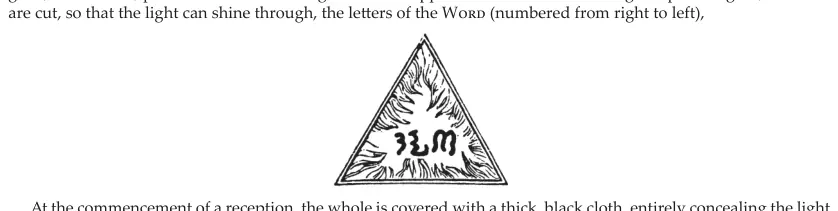
_ + In the middle of the apartment is a triangular pedestal, apparently of white marble, but of some transparent 'substance, and hollow, so that lights may be placed within it. Upon it is a cube ten inches square, being an imitation of a cubical block of agate, encrusted with glass of different colours, like precious stones. On the top of this is a triangular plate of gold, or some other metal gilded, sunk into the cube, and in the middle of the triangular plate, in black letters, the word m1". The light shining through the pedestal should be brilliant enough to enable this to be seen. At the commencement of the reception, the whole is covered with a
thick cloth, entirely concealing the light.
OFFICERS, TITLES, ETC.
The Presiding Officer represents King Solomon, and is styled Th.*. Puissant Gr.*. Master. He sits upon
a throne in the East, crowned, with a sceptre in his hand, under s rich canopy.
"! The Sen.*. Warden is styled Gr.*. Warden, and represents Hiram King of Tyre. He sits on the left hand
of the Th.*. Puissant, crowned and holding a sceptre.
The Jun.*. Warden is styled Gr.-. Inspector. lie sits in the West, and represents Adonhiram the Son of
Aida, holding a drawn sword, and wearing his hat.
There is a Gr.*. Treasurer, who represents Joabert, and sits, covered, in the North.
Also a Gr.*. Secretary, representing Stolkin, who sits in the South, covered.
There is also a Master of Ceremonies.
CLOTHING, ORNAMENTS AND JEWELS.
The Th.*, Puissant wears a yellow robe, and a chasuble lined with blue satin, the sleeves coming a8 low as the elbows. He wears also a broad purple ribbon from the right shoulder to the left hip, to which is us-
pended a triangle of gold.
. The Gr.. Warden wears a purple robe and a yellow chasuble. The collar and jewel are like those of the
Th.*. Puissant. .
The Gr.-. Inspector wears the same collar and jewel, and a white robe, without the chasuble. The Gr.*. Treasurer wears a white robe, the same collar and jewel, and from his button-hole a key of gold suspended by a white ribbon. On the key are the letters....... 1°. 0.. In. Vi. Dr
The Gr.*. Secretary wears the same robe, ribbon and jewel.
The Brethren who ore not officers wear the same collar, and an apron of crimson velvet, on which is
_ embroidered a triangle, surrounded with rays, and in the centre of it the sacred word mit'. The jewel of the
Brethren is 2 medal of gold, around which, on one side, are the initials of the following words: Regnante Salomone Rege Sapientissimo, Thesaurus Pretiosissinum Sub Ruinis Incenerunt Adonhiram, Joabert, et Stolkin: ... Anno Enochi 2995. On the same side is engraved an aperture in the earth, over which stand two persons, their foreheads touching, lowering third person into itby a rope. On the reverse side is triangle surrounded with rays, and in the middle of it the sacred word nin'. This medal is worn upon the chest, suspended by o
white ribbon.
The battery of this Degree is |] ;
The age of & Royal Arch Mason is £ times the square of ; or: ; years.
TO OPEN.
[The Th.-. P.». gives one rap, and says): :
The. Ps. My Brethren, Iam about to open this Chapter of Royal Arch Masons. Bro.*. Gr.*. Inspector,
satisfy yourself that all present are Masons of the Royal Arch Ecossais, by receiving the Password from each.
[The Gr.°. Inspector does so, and reports}: -
Gr. Ins. Th.*. P,'., all present are Masons of the Royal Arch Ecossais.
The. P. Welcome, my Brethren! Bro.-. M.. of Ceremonies, it is our first duty to see that we are secure against intrusion, Attend to that duty, and inform the Tyler that we are about to open here this Chapter of the Royal Arch, that he may see that none approach without permission.
[The M.:. Her.*. goes out, returns, raps {| ;— which is answered from without, and reports]:
BM. Her. Th. P.., the Tyler is duly notified and at his post, and we are in security.
Th. P. Thanks, my Brother! Bro.'. Gr.. Inspector, are you a Mason of the Royal Arch Ecossnis?
Gr.. Insp... Iam that which I was and shall be. My name is Adonhiram.
Qu... Where did you entitle yourself to become such?
Ana... By exploring the ruins of the Ancient Temple of Enoch, and passing through the nine arches.
Qu.. What found you there?
Ana. A Pedestal, or cubical block of agate, and o plate of gold upon the cube.
Qu... What saw you upon that plate?
Ans... The Mysterious and Ineffable Name of the Gr.". Architect of the Universe.
Qu. What is that Name?
Ans... I know its letters. None but the Grand, Elect, Ancient, Perfect and Sublime Masons know its true pronunciation. .
Qu. Of what is the Cubical Stone an emblem?
Anss. Of Perfection.
Qu.. To what do you now aspire?
Ans.*. To that degree, the summit of Ancient Masonry, the knowledge of the True Word.
Qu... What is your age?
Ans, <C*C&S times the square of ;-— or :; years complete.
Qu.". What is the hour? -*
Ans... Sunrise.
Th. P.. Let us then open this Chapter; since by Work only we can attain Perfection.
[The Th... P.. raps J; -—~ The Gr.-. Warden does the same]:
Gr.*. Insp... Come to order, my Brethren |
[All the Brethrenrepent |] ; with theirhands. The Th.*. Pr. and Gr.*. Warden give the sign of admiration ; all the Brethren repent it. Then the two Kings kneel: the Th.". P.-. rises first, and taking the Gr.-. Warden by the arm, assists him to rise. All the Brethren kneel, and each in turn, beginning on the right, helps the other to rise].
Th. Ps. My Brethren, this Chapter of Masons of the Royal Arch Ecossais is open.
RECEPTION.
[Not less than three candidates can be received at once, in this degree. If there are not so many applicants, and the case is deemed really emergent, one or more Brothers who have already received the degree may act
"as candidates; but in that case the ceremonies proceed in all respects as if all were candidates.
'The three candidates, in the clothing and jewels of Gr.. Master Architects, are received in the preparation room by. the Master of Ceremonies, and conducted to the door of the Chapter, where they meet the Tyler, who 'asks}:
Payless .. Who conic . hore, Bro.°. 3f.°. 'of Ceremonies?
"Mf, Her, Three zealous Brothers, who having regularly received all the preceding Degrees, seek now to be advanced to the Degree of Royal Arch Ecossais; that they may hereafter attain that of Perfection.
Tyler: .. Wait, then, until I announce them to the Grand Inspector.
. [The Tyler raps {| ;—and the door is opened by the Gr.°. Inspector, who asks]:
Gr., Insp. What is your desire, Bro.*. Tyler?
Tyler: .. The M.+. of Her.*. waits, with three zealous Brethren, who, having regularly received all the preceding Degrees, seek now to be advanced to the Degree of Royal Arch Ecossais, that they may hereafter attain that of Perfection.
Gr., Insp... God alone is Perfect, and can confer Perfection on 'His Creatures. There is no vacancy in the Chapter; and they cannot be admitted.
[He closes the door: and the Tyler says]:
Tyler. You have heard, Bro.*. Master of Ceremonies.
Bf. Her. I have heard; but I do not despair. The wish of these Brethren shall be made known to the Gr.. Warden. .
[The M.°. Her.'. then raps [| ;—and the door is again opened by the Gr.. Inspector].
Gr.*. Insp... What is your desire, Bro.*. BI.°. of Ceremonies?
At:, Her. I bring with me three zealous Brethren, who, having regularly received all the preceding Degrees, seek now to be advanced to the Degree of Royal Arch Ecossais, that they may hereafter attain that of Perfection.
Gr.. Insp... I have said that God alone is perfect, and can confer Perfection on his creatures. There is no vacancy in the Chapter.
Af, Her. These are true men and upright Masons, worthy to be advanced, and who have complied with all their pledges given at the altar, I demand that their request be mado known to the Gr... Warden and Gr.*. Master. °
Gr.. Insp... Do you vouch for their proficiency in the preceding degrees?
Mf. Gers. Do. They know the duties of a Gr.*. Master Architect, and' the lessons taught by the instruments he uses.
Gr.. Insp... Will make known their wish to the Gr.*. Warden and the Th.-uP.*. Gr.*. Master. They may perhaps consent, if the Brethren be proficients, as you say.
[The closes the door, goes to the East, and says] :
Gro. Insp. Th... Pu. Gro. Master and IIL. Gr... Warden, Three zealous Brethren, who have received
all the preceding degrees, seek now to be advanced to the degree of Royal Arch Ecossais, that they may hereafter attain that of Perfection.
Th... P.. Mast thou not given them to know that our numbers are complete?
Gr.*. Insp. Have; but our Bro.*. the Master of Ceremonies has prayed me to make known their wish to you, declaring them to be true men and upright Masons, worthy to be advanced, and who have complied with all their pledges given at the altar.
Th.*. P.. Does be vouch for their proficiency in the preceding degrees?
Gr.*. Insp... Te does; saying that they know the duties of o Gr.°. Master Architect, and the lessons taught by the instruments he uses.
Th. P.. My Brethren, you hear. Is it your will that our number shall be increased ?
[The Brethren raise the right hand in token of assent].
Th.. P.*, Since the Brethren consent, let the Master of Ceremonies, and those who come with him enter.
[The Gr.'. Inspector goes to the door, opens it, and says]:
Gr.*. Insp... The Brethren consent that their number shall be increased: and the Gr.*, Master orders that these Brethren be allowed to enter.
[They enter, conducted by the M.°. of Car.*. and advance to the East].
Th... Po. My Brethren, you desire to be advanced to the degree of Royal Arch. When this degree was conferred upon Adonhiram, Joabert and Stolkin, who first received it, and in whose behalf it-was created, they had earned the right to it by 2 singular service done to Masonry. For, sent to explore the ruins of the ancient Temple. built by the Patriarch Enoch, they discovered and fearlessly explored a deep shaft sunk perpendicularly in the earth; and descending through nine arches sealed up from mortal eyes fur centuries, they reached the call, hewn in the solid rock, 'far under ground, in which a sacred treasure had been hidden before the flood. If you would see that treasure, you must descend as they did into the deep vault where it remains deposited, and so entitle yourselves to attain the degree you seek. Do you consent tu do so?
Cand... We do.
Th. Ps. Go thea with him who brought you hither, to the place which represents the ruins of the ancient Temple, explore the vault, and bring hither the sacred treasure.
[The candidates retire, accompanied by the Master of Ceremonies and two or three other Brothers, and are conducted to the room representing the ruins, and directed to remove the stones nod rubbish from theplace where the trap is. They do so, and the iron ring is discovered. They are directed to raise the trap, and do so].
H, Her. Who among you will first descend ?
{One offering to do so, is prepared by a strong rope fitted with loops for his feet, and fastened round his middle. lie is then told that, if he meets with any obstacle, and desires to re-ascend, he can shake the rope, and will be drawn up; but if he reaches the bottom safe, he is to cast loose the rupe. Ne is then lowered for some distance, in perfect darkness, and when near the bottom, a brother below interposes an obstacle, preventing him from going lower; and he is drawn up.
Another candidate is lowered and drawn up in the same way. Then the third is lowered, being furnished with a torch, and told to remain quiet if he reaches the bottom, until the others come to bin. No obstacle being interposed, he reaches the bottom, and casts off the rope. The others are then lowered down, and
NIL... 5
when all have reached the bottom, some rubbish is thrown down upon them, and at the same moment a brother, unseen by them, extinguishes the light, and they are in utter darkness.
[4 Voice in a remote part of the cell]: DARKNESS, and DEATH, and the GRAVE, are reserved for all men!
{Another Voice}: One Fate comes alike to all; the Nicur of DEATH, after the short day of Life!
[Another Voice]: After Death and the Grave, come the Resurrection, and Light, and Life Eternal. [Immediately a Brother lifts the cloth that covers the pedestal; and discloses it to their eyes].
(4 Voice]: Kneel, feeble and erring mortals, and adore the Great Ineffable name of On!
- [They kneel, and a Brother comes forward and raises each by the arm; and says] :
Bra, Take now this sacred treasure, the Cubical Stone hidden deep in the Earth 'by Enoch the Patriarch, and return with it whence ye came.
. [They take the cubical stone from the Pedestal, are drawn up, one after the other, and return to the Chapter. In the mean time the lights in the Pedestal are extinguished, and the Brothers that were in the vault return by the private way to the Chapter. At the door of the Chapter, the M.-. of Her.*, raps [| ;—~and the door is opened by the Gr.-. Inspector, who asks] :
Gr... Insp... Who seek admission here?
H,. Her... Three zealous Brethren, who, ag Adonhiram, Joabert and Stolkin did before them, have descended through the nine arches, into the subterranean vault, hewn in the solid rock, and have brought thence the cubical stone, there deposited by Enoch the Patriarch, which they desire to Iny before the Gr.*. Master.
Gro. Insp. I will make known to him their desire.
(He closes the door, goes to the East, and says]:
Gr. Insp. Th.*. P.*. Gr... Master, three zealous Brethren wait without; who, as Adonhiram, Joabert and Stolkin did before them, have descended through the nine arches, into the subterranean vault, hewn in the solid rock, and have brought thence, and desire to lay before you, the cubical stone there deposited by Enoch the Patriarch. -
The. Ps. Let them enter, my Brother. ,
[The door is opened. The Gr.*. Master raps 3, and all the Brothers rise and uncover their heads, and stand with their arms raised towards heaven. The candidates enter, bearing the cubical agate, and place it, "by direction, upon a pedestal of white marble, which has been set in the centre of thé room; and remain standing by it. Then the Th.-. P.. says] :
' Th. P.. -Behold, my Brethren, the Ineffable Name of Deity, engraved by Enoch, and discovered by the three first Masons of the Royal Arch.
[He then raps once, and all the Brothers kneel, himself and the candidates included. Then he raises the an. Warden, and the Brothers raise each other,.and three brothers raise the candidates].
_, Th. P. My Brethren, you having, like the three Illustrious Masters who first received this degree, descended through the nine arches, into the subterranean vault hewn in the solid rock, and brought thence the Ineffable Name deposited there by Enoch the Patriarch, the Brethren consent that you shall be advanced to be Masons of the Royal Arch Ecossais. But to be received among us, it is necessary that you first assume
a solemn and binding obligation. Are you prepared to do so?
"(The Th.°. P.. raps 3, and all the Brethren rise, and surround the candidates. Three Brothers, standing
in front of each candidate, present their swords, with the points placed together, at his breast, and his hands are placed upon the blades. In this attitude, standing, each repeats the following]
OBLIGATION.
In.... 3B... ., in the presence of the Almighty, Terrible, Just and Merciful Creator of the Universe, do, upon these blades, promise and vow to Him, and solemnly pledge my honour to my Brethren, that I will never reveal the secrets of this degree to any person in the world, except to those who are legally entitled to receive them, when I am legally authorized to communicate them; and at such time, and in. such place and
manner as it may legally be done.
XIU... G
———— I furthermore promise, row and pledge my honour, that I will never communicate the words of this degree, unless to or in the presence of three brethren, I being one; or unless I have a commission or
patent which authorizes ine to du so, fur the purpose of furming a new Chapter of the Royal Arch.
I furthermore promise, row, and pledge my honour, that I will never receive or assist in receiving, or be present at, or consent to, the reception of'a brother in this degree, unless be shall have received all the preceding degrees by regular authority ; nor unless he is at the time a regular member in good standing, of a regular Lodge of Master Masons, and has been Master or Warden of such a Lodge; nor unless he has proven his zeal and devotion to Masonry; nor unless he is a man of intelligence and information, charitable and benevolent, true, honest, sincere and upright; so far as I may know or have the means of judging.
I furthermore promise, vow and pledge my honour, that I will redouble my own zeal in the cause of Masonry, and my charity and friendship towards my Brethren; and that honour and duty shall be the lights by which my course shall be directed during my whole life. ,
All which I promise and vow, and thereunto pledge my honour, under no less a penalty than that of sinking so low in the estimation of my Brethren and the world, that my name shall be the synonym of degradation and dishonour; my violated faith become a by-word; and I, fallen below contempt, be looked upon with pity by every man and every woman in the world. Su help me God! and keep me steadfast in the due performance of this, my solemn promise, vow and pledge of a Royal Arch Evossuis!
The. P.. My Brethren, as the successor and representative of Solomon, King of Israel, I receive and accept you as Masons of the Royal Arch Ecossais, and as the Liegemen of Honour and Duty, henceforward and forever. Receive now the Signs, Words and Token of this Degree.
Ist Ten: Of admiration: ... t1O92Ci MYPSjSOseULG towards Heaven; the &C Of inclined te the left and the 2274>C C on the ground.
2p Six: Of Adoration: ... WOtt. upon doth [= CCS, bring the fagot down from the
TOY Stitch to the $294: and place, at the same time, the fJ/SO—DL mC& 9H the mOsry.
Token: .. . Place your hands under the O{33-29 V2: of the Brother, as if to help him to rise.
Pass-worp: ... SOSCT CGT TSCMPEYss..
Sacred Worn: ... This, my Brother, is the Ineffable Word, engraved upon the plate of Gold which is upon the Cube of Agate. Its pronunciation is known to the Grand, Elect, Perfect and Sublime Masons only, and cannot now be communicated to you. You can receive and communicate it only by its letters, and os one of three brethren, repeating these letters alternately, They are Tod. . He.. Vauv.. He. , meaning; I
aM Tua? wuicit I was AND SHALL BE.
There ore nine names of Deity, used as words in this Degree, in place of, and as synonyms of the
Ineffable Name, nod appropriated, one to each of the Arches; and all of which are to be demanded in succession, when it is desired thoroughly to test a Brother, They were used by the different nations of antiquity, and are
as follows:
Ist Arch: .. OPRKYIB. 2... Egyptian:
2 OWta....... Egyptian:
3d" MCt... 6 ee ee Phoonician;
4th " Orme... ... Hebrew:
Sth "* OU8<ZO9.. .. Hebrew:
Cth " OBB... ..... Indian:
jth " O22... .. assyrian:
8th Do eee oe Assyrian:
Oth " RO*w.. 2 eee oe Assyrian.
NII... 7
These are styled the covering words: because they cover and conceal from the Profane the True Name of God, known to the first men, and revealed by God to Muses.
Tiniest you with the apron of this Degree. Its crimson colour denotes the zeal and devotedness of a Royal Arch Mason. Upon it you see the Triangle, emblem of the Deity, or Infinite Wisdom, Infinite Power and Infinite Harmony, surrounded by rays of glory, and with the Ineffable Name in the centre.
T invest you also with the purple collar and the jewel, of this Degree. Upon the face of the jewel you see ® representation of the first three recipients uf this degree, two of them lowering the third into the subterranean vault. Around this device you see the initials of the following words: Regnanle Sulomone Rene Supientissimo, Thesaurus Pretiosissimwn Sub Ruinis Tncenerunt Adonhiram, Joabert Bt Stolkin. . . Anno Enochi, 2995.* .. On the reverse side you again behold the luminous triangle and the Ineffable Name. Let them ever remind you that the good Mason reveres and adores the Gr. Architect of the Universe, and endeavours, by pursuing the path of Honour and Duty, to perform well and faithfully the part assigned him in this world. Go now to the Gr.". Inspector, and listen to the Legend and History of this Degree.
LEGEND AND HISTORY.
My Brethren, this is the Legend and history of this Degree, as it has come to us, partly in the Jewish writings, and partly by Masonic tradition.
Enoch, the sun of Jared, was the sixth in descent from Adam, the father of the human race. . Filled with the fear and love of God, while the world grew wicked around him, he adored and revered Him, and obeyed
His laws, and strove to lead men in the way of Honour and Duty. Ile dreamed that the Deity appeared to him in visible shape, and said to him, "Enoch, thou has longed to know my True Name. rise, and follow me, and thou shalt learn it'* Then it seemed to Enoch that he was taken up, and in an instant transported 'to a mountain, whose summit was hid among the clouds, and seemed to reach the stars, and there he saw upon 'the clouds, in letters of brilliant light, the awful and mysterious name him; whose pronunciation was then Swhispered i in his ear, and he prohibited from uttering it to any man. Instantly he seemed to be transported 'from the mountain, and to descend perpendicularly into the earth, passing through nine subterranean apartments," one below the other, and each roofed with arches; in the ninth and lowest of which be saw, upon 4 'triangular plate of gold, surrounded by brilliant rays of light, the same Ineffable Name which he had seen "upon the mountain ; and thereupon he awoke.
* Enoch, accepting his dream as an inspiration, journeyed in search of the mountain which he had seen in 'his dream, until, weary of the search, he stopped in the land of Canaan, then already populous with the 'descendants of Adam; and there employing workmen, and with the help of his son Methuselah, he excavated 'nine apartments in the earth, one above the other, and each roofed with arches, as he had seen them in his "dream, the lowest being hewn out of the solid rock. In the crown of each arch he left a narrow aperture, closed with a square stone, and over the upper one he built a modest temple, rootless, and of huge unhewn "atones, to the Gr.*. Architect of the Universe. Upon a triangular plate of gold, inlaid with many precious gems, he engraved the Ineffable Name of God, and sank the plate into one face ef a cube of agate, which he then placed upon a pedestal of white alabaster, in the lowest of the nine apartments. The pedestal was triangular and hollow, and into it, from a crevice in the rock, flowed a stream of inflammable air, that burned continually with a brilliant light, until after it was discovered in the reign of Solomon.
None knew of his deposits of this precious treasure; and that i¢ might remain undiscovered, and survive the flood which, it was made known to him, would soon overwhelm all the known world in one vast sea of rain, he covered the aperture and the atone that closed it, and the great ring of iron, used to raise the stone, with the granite pavement of his primitive temple.
Then, fearing that all knowledge of the arts and sciences would be lost in the universal flood, he built two great columns upon a high hill, one of brass, to resist water, and one of granite to resist fire. Upon the
# [In the reign of Solomon, wisést of Kings, Adonhiram, Joabert and Stolkin funny under the ruins a most precious treasaro}.
granite column he engraved, in the hieroglyphics which Misraim afterwards carried into Egypt, a description of the subterranean Apartments, and of the treasure there deposited: and on that of brass, the rudiments of all the arts and sciences then known, and the great truths familiar to the antediluvian Masons.
The granite column was overturned and swept away, and worn to a shapeless mass by the great Deluge, and the characters upon it wholly obliterated ; but taint of brass, by God's Providence, stood firm, and was afterwards found by Noah, who sought in vain for that of granite; the purport of the inscription upon which he knew front: Methuselah his grandfather, but not the place of the Temple or the subterranean apartments, to which that inscription would, he knew, hare guided him.
Thenceforward the true name of God remained unknown, until [Te snid unto Moses, in Egypt, when He ordered him to go unto Pharaoh, and cause him to send forth the children of Israel out of Egypt, "Jam that thick Was and shalt be. Iam the Gort of thy Fathers, the God of Abraham, of Isaac and of Jacob. Thus shalt thou say to the children of Israel, Ue who 1s hath sent me unto you. Iam the Lord that appeared to Abraham, to Isaac and to Jacob, by my name Au-Supers bué my name mn' I did not show them."
That Ineffable Name, meaning The Eternal, Self-Existent Being, Independent, Infinite, without Beginning, End or Change, the Source of all other Beings, Moses engraved upon a plate of guid, and placed it in the ark of the covenant, where it remained for many years, during the whole time of Joshua, and unto the time of the Judges who succeeded him. Forbidden to make known its true pronunciation to the people, he communicated it to Aaron and to Joshua only; and it was afterwards made known to the Chief Priests alone. The Word being composed of consonants only, so that its true pronunciation could only be communicated orally, it was wholly lost in the revolutions and disasters that ensued after the death of Joshua and his immediate successors.
But the Word still remained in the ark, engraved on the plate of gold; and in the time of Othniel, the son of .Cenez, the younger brother of Caleb, in a battle against Chusan-Rasathaim, King of Syria, those who bore the ark were slain by an ambush in a forest, and the ark fell upon the ground. The enemy, attacked and defeated in their turn, were driven from the place before they had time to plunder it; and after the battle, the men of Israel, searching fur it, were led to it by the roaring of a Lion, which, couching by it, had guarded it, holding the golden key in his mouth. Upon the approach of the High Priest and Levites, he laid down the key, and withdrew in peace, allowing them to take away the ark; taught by the Deity himself that the Israelites were his chosen people, entitled to the custody of that which contained his Sacred' Name. Hence, upon tha golden key worn by our Gr.*. Treasurer, you see the initials of these words: Ja Ore Leonid, Verbum Invent: In the Lion's mouth I found the Word,
When the Philistines took the ark, in the time of Samuel, and Ophni and Phinens, the sons of Eli, were slain defending it, those who took it melted down the plate of gold, and made of it an image of Dagon; and thenceforward no man saw that Ineffable Name, until the reign of Solomon, King of Israel.
The Jews, as a nation, did not believe in the existence of one sole God, until a late period in their history. Their early and popular ideas of the Deity were eminently coarse, low and unworthy. While Moses was receiving the law upon Mount Sinai, they forced Aaron to mould or cast an image of the Egyptian God Apis, and fell down and worshipped and adored it. They were ever ready to return to the worship of the Gods of Egypt; and soon after the death of Joshua they became devout worshippers of Be, Chemosh and Astarte, and the multitude of other Gods adored by the Monbites, the Ammonites, the Syrians and the Phenicians.
Among them, as among all other nations, the conceptions of God formed by individuals varied according . to their intellectual ond spiritual capacities; poor and imperfect, and investing God with the commonest attributes of humanity, among the ignorant and coarse; but pure and lofty, among the virtuous and richly gifted. These conceptions gradually improved and became purified and ennobled, as the Hebrews advanced in civilization; being lowest in the Historical Books, amended in the Prophetic writings, and reaching their highest elevation among the Poets. Torah, the father of Abraham and the father of Nachor served other Gods. The Elohim, or subordinate Deities, are represented in the commencement of the Book of Genesis, as creating the universe. Laban, a near relative of Abraham, and whose sister was selected as a wile for Isaac, pursued Jacob for having stolen his Gods; and Jacob collected the strange Gods worshipped by his household, and hid them under an oak,
To the mind of Moses, an intellectual and highly educated man, versed in all the learning of the Egyp-
MITT... 9
Clans, the conceptions of the God of Israel reached a sublime simplicity of expression ; and yet he admitted the existence of other Gods, not asserting thac If was the sole God; but only that IIe was superior to all others. :
Among the People, the God of the wise and the God of the ignorant, the God of the Priests and the God of the Prophets, were the embodiment of two very different classes of ideas. The God of Exodus and Numbers in represented as partial, unstable, revengeful and deceitful; while the ideas of Deity contained in the book of Job, the nobler Psalms, in Ezekiel and Daniel, are magnificent, simple and sublime. The idea of the One Living and True God was a plant of slow and gradual growth in the Hebrew mind; and if Moses, the Patriarchs or the Priests had a true and adequate knowledge of Him and Ilis attributes, they utterly failed to communicate that knowledge to the People at large. It was not until o Into day in their history, that the Jewish writers were heard to say, " Will God in very deed dwell on the earth? Behold, the Heaven and the Heaven of leavens cannot contain Thee: how much less this House that I have builder? Whither shall I go from Thy Spirit ? or whither shall I flee from Thy presence? ... Oh m7, my God, thou art very great; thou art clothed with honour and majesty: who corerest thyself with light as with a garment; who stretchest out the [leavens like a curtain; who layeth the beams of his chambers in the waters; who maketh the clouds his chariot; who walketh upon the wings of the wind. ... I know that whatsoever God doth, it shall be forever: nothing can be put to it, nor any thing taken from it... The strength of Israel will not lie nor repent: for Ie is not a man that He should repent .... For the word of the Lord is right; and all his works are done in Truth. lie loveth righteousness and judgment. Lying lips are an abomination to the Lord; but they that deal truly are his delight. Thou desires not sacrifice, else would I give it: thou delightest notin burnt offering. Ie hath shewed thee, O man, what is good: and what duth min' require of thee, bat to do justly, to love mercy, and to walk humbly with thy God."
There is therefore a deeper meaning than appears upon the surface, in the attempts of the ancient Israelites and of the initiates of Masonry, to ascertain the True name of the Deity and its pronunciation. It is an
allegory, in which are represented the people's ignorance of the true nature and attributes of God, their proneness to worship other Deities, their low and erroneous notions of the Grand Architect of the Universe, of which all partook except o few favored persons ; for even Solomon built altars and sacrificed to Chemosh and -Astarte ; and the people were for many ages idolaters of heart. The True Nature of God was unknown to them, like His Name; and with the knowledge of the true pronunciation of that Name, they lost the knowledge 'of the Deity Himself, and worshipped the false gods of the surrounding nations.
- David intended to build a Temple to God, and prepared much of the material; but bequeathed the enterprise to Solomon his son. Solomon selected for its site a level plain near Jerusalem, and his workmen commenced to excavate the foundations; but finding the overthrown columns of the Cyclopean Temple of Enoch, and supposing it to have been a place of worship erected to the false Gods of the Cannanites, the King returned to the place upon Mount Moriah, which had before-time been the threshing floor of Organ or -Areunah the Jebusite, and which David had purchased from him, and there had erected an altar to the Lord, while the Ark still remained at the high place of Gabaon.
- -There Solomon built the Temple. Under it he caused to be excavated a Secret Vault, the approach to which was through eight other vaults or apartments in succession, all under ground, and to which a long and narrow passage led from under the King's Palace. In the ninth apartment was placed a great column of white marble, called the Pillar of Beauty, on which it was intended to place the Ark; and in this apartment he held his private conferences with King [Hiram of Tyre and Hiram Abi; they only, beside himself, knowing the way by which it was approached.
"+ The Sacred Name, lost to the Jewish People, was retained in the Ancient Mysteries, in which J joseph and Moses had been initiated ; and it thus came to Samuel, and from him to David and to Solomon. But after the 'Ark was taken by the Philistines, it was forbidden to the Initiates of the Mysteries again to write the Word. It was made known by Solomon to Hiram King of Tyre and Hiram Abi; and they agreed that it should never be communicated by them to any one, unless all three were present. After the death of Hiram Abi, the two Kings refrained from visiting the secret vault, in which everything so vividly reminded them of the
XIU... 10
Brother and Companion they bad lost; and resolved not again to du so, until they should have selected one to Gill his place. :
While they were yet undetermined whom to choose, Solomon proposed to erect a public edifice for the administration of justice, upon the site of the ancient Temple of Enoch; and to that end directed that the fallen columns and the rubbish should be removed. <Adonhiram the Chief Architect, with Joabert and Stolkin, two of the Intendants of the Building, were directed to go thither, and survey the ground and Iny of the foundations fur the proposed building. In doing so, they removed some of the shattered fragments of the columns and of the old broken pavement, and discovered a large ring, attached to a square slab of granite, raising which by their united strength, an aperture was disclosed, like a deep well sunk in the earth. Joabert offered to explore it, and furnishing himself with a torch, was lowered into the opening by his Companion. After descending fur some distance he came to a fluor, and discovered in the centre of ita slab of granite with an iron ring, like that above, and raising the slab he saw another aperture, through which he descended to another floor, and thence in like manner to another. Weary by his long suspension, and his torch nearly extinguished, he made known to his Companions, by shaking the rope, that he desired to be drawn up. Arriving at the surface, he informed them of his discoveries, and his belief that there were other apartments still below.
Stolkin then offered to descend; and reaching the third floor, discovered a similar stone and ring, and afterwards two others in succession, and reaching the sixth floor, wearied with the exertion, and his torch nearly failing, he gave the signal to ascend, and was drawn up, without discovering that there were still other apartments below the sixth.
Adonhiram then descended, and passing through three more openings, reached the ninth apartment. As he reached it, his companions dislodged some rubbish above, which falling upon him bruised him and extinguished his torch; and he then discovered in the centre of the apartment 4 luminous triangular pedestal of white alabaster, hollow, and lighted by an undying fire within; and upon which sat a cube of agate, into one face of which was sunk a plate of gold, thickly encrusted with precious gems that glittered in the light; and enamelled on the plate the word min', the Ineffable name of Deity; as the same had been placed there by Enoch the Patriarch.
Since the time of Samuel that word had not been written in the copies of the law of Moses; but wherever it occurred, the word Anosar had been substituted; so that Adonhiram knew not the meaning of the word ; but struck with admiration at the sight; astounded at the perpetual light, fed by no human hand fer many centuries, and which seemed to him to indicate the immediate presence of the Deity; and penetrated with gratitude to God for allowing him to make so wonderful a discovery, he fell upon one knee, and raising his hands uttered his thanks to that God whom yet he knew only by his name Avon, or Au-Super; by which only lie was known to the Patriarchs; and then, without rising, placed his right hand behind him, and seizing the rope, gave his companions the signal, and was drawn by them to the surface.
After informing his companions of that which he had seen and discovered, Adonhiram proposed that they should procure ladders of rope, and descend together into the vault, on the ensuing day. To this they gladly assented; and making known to no ono what they had discovered, they procured ladders, and returning the next morning, descended together to the ninth apartment. At the sight of the luminous pedestal and Cube of Agate, Joabert and Stolkin, affected like Adonhiram with astonishment, awe, and gratitude, fell, as he also did again, upon their knees, and raising their hands to Heaven, thanked God for all his mercies, and especially for allowing them to discover these marvels.
Adonhiram and Stolkin first arose, and seeing Joabert, who was a Phoenician, and originally a Stone Mason, from the city of Gehal, still upon his knees, they placed their hands under his arms, and assisted him to rise; Adonhiram saying to him, in consequence of their great friendship, Lfmalek Kheblim ; meaning "Chief of the United Brotherhood." Then examining the Cube of Agate, and not knowing the meaning of the Word upon it, they resolved to carry it to King Solomon and Hiram King of Tyre, who had then consummated their new and closer alliance; thinking that they might know the meaning of the mysterious Word.
Ascending therefore, with the Cube of Agate, they closed the entrance carefully and repaired to the Palace, where they found the two Kings conferring together. King Solomon, immediately on beholding the
AMI. .
Cube and the inscription upon it, exclaimed to the King of Tyre, "' My Brother, behold the True and Ineffable Name of the Eternal, Self-Existent and Almighty God, the Grand Architect of the Universe ;" and he and King Hiram both fell upon their knees, raised their hands to Heaven, and thanked God fur all his mercies, and especially for again allowing them to see his Ineffable Name.
Then rising, King Solomon inquired of the three Brethren whence came the marvellous stone; and
they thereupon recounted tu him their whole adventure, even to the words spoken by Adonhiram, upon raising Joabert from his knees. Then Solomon, reflecting for a time, said, "Sfy Brother of Tyre, I remember well to have heard from my father David a tradition that the Patriarch Enoch, inspired by a dream, in which 'he saw this Sacred Name, and knowing that the world was shortly to be overwhelmed by a flood, made "such a yaoult os this that hath Leen discovered, and there deposited, upon a plate of gold, set in a great "Agate, the Ineffable Name of God; and afterwards engraved upon a granite column, which the flood " swept away and wore to a shapeless mass, directions in the Sacred Characters how to discover the place "in which the Ineffable Name was so deposited. None were ever enabled to discover it; but it hath now " most certainly been found, and we may now make the Word known to those whose eminent merits shall 'entitle them to receive it, fur it is the True Word of a Mason and the True Name of the Great Archi- ** tect of the Universe, known to thee and me, and to our deceased Brother Hiram Abi."
Then King Solomon said to the three Brethren; * My brethren, the Ge. Architect of the Universe has
"bestowed upon you a signal mark of his favour, by selecting you to be the discoverers of the precious " treasures of Masonry. I rejoice with you upon this your great good fortune. Wear henceforth the title of " Masons of the Ninth or Royal Arch,as high honour and order of Nobility. Image it a degree in Masonry; "into which my Brother Iliram and myself will seek to be admitted ; and which shall hereafter be conferred *' only at your pleasure, and ag a high mark of distinction for eminent services rendered to the State or to "Masonry. I have fixed upon a place in which to deposits this sncred treasure ; and when it is so deposited, 'you shall be present, and shall then learn the pronunciation of this Great and Ineffable Word; and the * profound mysteries which it involves."
'. King Solomon then fixed upon the Signs, Token, and Pass-word of the degree; the signs imitating the actions of the three brethren upon first seeing the luminous Pedestal and'Cube; the token representing the 'mode in which Adonhiram and Stolkin raised Joabert; and the pase-word being the expression of affection and friendship addressed by Adonhiram to him in doing so. And he then said: "The Sacred Word of this Degree {shall be the Great Ineffable Name: but in this degree it shall never be pronounced. I had received it orally "from my father David, and mode it known to my brother Hiram the King and my brother Hiram Abi. We "agreed never to communicate it unless when we were all present. The Il.*, liram Abi diced rather than " divalgeit. Long disused, and the name Apoxar substituted for it in the Sacred Books, its true characters " onco again greet our eyes, and we shall perhaps be authorized to communicate it to others. In this Degree "it shall be communicated only by its letters, and that only in the presence of three Brethren: and I so communicate it to you."
Then he repented to them the letters of which the word is composed, as you have already received them: and he also made known to them the nine names of Deity in different languages, which are the covering words of this degree, and to be used instead of the Ineffable Name.
Afterwards the two Kings, with Adonhiram, Joabert and Stolkin, deposited the cube of agate in the place prepared for its reception; and the degree of Grand, Elect, Perfect and Sublime Mason was then created and established, and received by them as the first five members of the degree of Perfection: and Adonhiram, Joabert and Stolkin then received the true pronunciation and explanation of the Sacred Name, and learned
the true nature and attributes of the Deity; to whom, until that time, they had ascribed human attributes exaggerated, and a nature assimilated to that of man.
After the Temple had been completed and dedicated, King Solomon selected the Twelve Princes Emeth, the nine most eminent IIl.*. Elus of Fifteen, and Zerbal, who succeeded Adonhiram as Grand Master Architect; all of them Masons eminently distinguished by their talents and their virtues; and conferred upon them first the degree of Royal Arch, and then that of Perfection, and assigned them special duties. There were thus 27 Grand, Elect, Perfect and Sublime Masons.
AIIL.. 12
But there were also 3568 Ancient Masons, who had aided in building the Temple, and who envied the 25 Brothers who had been so associated with the two Kings. Jealous of the superior honour shown them, these envious Masons sent a deputation to King Solomon, to lay their complaints before him. Ie heard them patiently to the end, and mildly answered, that the 25 Brothers of whom they were jealous had merited the preference shown them, by their extraordinary zeal and eminent services, for which they had deserved to be especially loved and honoured by him; and he snid: "Your time is not yet come. Continue to perform your " duties as Masons, and wait patiently and contentedly; and io due time, if you are found deserving, you will " receive the same reward." '
Ono of the Deputation, not satisfied with this mild and gentle answer, but giving way to his anger, insolently replied, 'We are Master Masons, and do not need to receive the highér degrees created fur the " King's favourites. We know how the Word has been changed: and we will travel as Masters, and as such "earn and receive our wages." The King, astonished at this intemperate response, bué not moved to anger, mildly answered: 'Those for whom the sublime degree of Perfection was first' created, had deserved it by "descending into the bowels of the earth, and bringing thence a treasure inestimable to Masons, and which "alone was needed to complete the Temple of the living God. Go in peace. Do as those Brothers did. Let " your services in the cause of Masonry be as valuable, and your zeal and devotedness as grent os theirs; and "TI, in my justice, will reward you as amply as you shall deserve."
The Deputies, returning, reported to those who sent them the responses of the King. Most of the Masons were satisfied, and acknowledged his justice, and strove by the strict performance of their duty to merit his favour, and to attain to the degree of Perfection. But o small number, vain, jealous, and haughty men, resolved to explore the ruins, where they understood the treasure had been found, in the hopo of discovering other treasures; and intending, if they found any, to escape with them into foreign countries.
Accordingly, some twenty or more in number, they went to the ruins, and at daybreak readily discovered an iron ring, and near it the ladders by which the three discoverers had descended. They raised the stone, while some of their companions who in vain endeavoured to dissuade them from their purpose remained at a distance watching them, and then they, one after the other, descended into the vault. A short time only elapsed, when those who followed them and remained at a distance, saw a flame of fire leap into the air from the aperture, and the roar of an explosion followed, that shook the earth all around, and was heard even.in the city, and all the arches were shattered and fell in, crushing and burying those who had descended; and thus their haughty insolence received its due reward. It was supposed that, finding in the ninth vault the luminous pedestal, and supposing it to contain valuable treasures, they had broken it to pieces, and that the flame had flashed out and filled the vault and thus produced the explosion. Nothing remained of the nine apartments, except a chasm in the earth nearly filled with rubbish, which was afterwards filled up by order of King Solomon, and the proposed building erected over it. .
Such is the Legend and Ilistcry of this Degree. Whether it is historically true, or but an allegory, containing in itself a deeper truth and a profounder meaning, we do not undertake to decide; nor is it at all important we should do so. We know that the Hebrews were forbidden to pronounce the sacred name; that wherever it occurred, they read in place of it the word ADONAI; and that under it, when the Masoretic points, which represented the vowels, came to be used, they placed those which belonged to the latter word. _ The possession of the true pronunciation was held to confer on him who had it, extraordinary and supernatural powers; and the word itself, worn upon the person, was regarded as an amulet, a protection against personal danger, sickness, and evil spirits. We know that all this was a mere vain superstition, natural to a rude and uncivilized people; necessarily disappearing as the intellect of man became enlightened; and wholly unworthy of a Mason. It was common to all the ancient nations. The sacred word Jonorer was supposed by the ancient Persians to be pregnant with a mysterious power: and they taught that by its utterance the universe was created. Among the Hindoos it was forbidden to pronounce the word Aim or Om, the Sacred name of the Supreme Deity. These superstitious notions in regard to the efficacy of The Word, and the prohibition against pronouncing it, could, being errors, have formed no part of the pure primitive religion, nor of the esoteric doctrines taught by Moses, and the full knowledge of which was confined to the Priests. They grew up in the minds of the people, like other errors and fables, not only among the Jews, but among all other ancient
> XIII... 18
nations, out of original truths misunderstood ; most of them being at the beginning allegories intended as vehicles of truth, and becoming errors by being literally accepted.
Tt ig true that, before the Masoretic points were used, the pronunciation of a word in the Hebrew langunga could not be known from the characters in which it was written. It was therefore easy for that of the Name of the Deity to be forgotten and lost. It in certain its true pronunciation is not at all represented by the word Jsnovan; and therefore that that is not the true name of Deity, nor the Ineffable Word. The pronunciation of the Word, and the Word itself would be lost when the knowledge of the true nature and attributes of God faded out of the minds of the Jewish people, and they adopted as their gods, Be, Chemosh, Aman, Astarte, and other Deities worshipped by the different nations by which they were successively subjugated. When they lost that knowledge, and then only, would they or could they forget the name of God. So long as they worshipped the True God, they would undoubtedly recollect His Name.
Among all the ancient nations, those who were enlightened and intelligent and educated, had one faith and one idea of the Deity; while the common People had another. To this rule the Hebrews were no exception. Jenovan, to the mass of the People, was like the Gods of the nations roundabout, except that He was
'the peculiar God, first of the family of Abraham, of that of Isaac and of that of Jacob, and afterwards the national God; and, as they believed, more powerful than the other Gods of the same nature worshipped by their neighbours.
Jethro, the father-in-law-.of Moses, said to him [18 Exod. 11]: "Now I know that min is greater than all the Elohim; for in the very matter wherein they prided themselves, Ie proved Himself their superior."
So it is said [ 22 Exod. 28], "Thou shalt not revile the Elohim; nor curse the Ruler of thy People." So [97 Psalms, 7] ' Worship Him, all ye Elohim." And the Witch of Endow said to Saul, "I saw Elohim ascending out of the Earth."
The Deity of the early Jews talked to Adam and Eve in the garden; He conversed with Cain; He sat
with Abraham in his tent; that Patriarch required a visible token, before he would believe in His positive . promise; He allowed Himself to be expostulated with, and his determination in regard to Sodom changed, by . Abraham; He showed to Moses his person, though not his face; He is represented as dictating the minutest ' police regulations to the Iaraelites; He required and delighted in sacrifices and burnt offerings; He was angry, jealous, and revengeful, as well as wavering and irresolute; Ie allowed Moses to reason Him out of. His fixed - resolution to destroy the Israelites entirely: He commanded the performance of the most horrid and shocking - . acts of cruelty and barbarity; the murder of men and women, and the violation of innocent virgins. Such were the popular notions of the Deity; and no more unworthy and degraded ideas of God's nature were entertained by any people of antiquity. -Either the priests took little trouble to correct these notions; or else the popular interest was not sufficiently enlarged to enable them to entertain any loftier conceptions of the Almighty.
But such were not the ideas entertained by the intellectual and enlightened few among the Hebrews. It is certain that they possessed a knowledge of the true character, nature and attributes of God; as did the same class of men among the Egyptians and Phonicians; as did Zoroaster and Confucius, and Socrates and Plato. But their doctrines on this subject were esoteric: they did not communicate them to the people at large, but only to a favoured few; as they were communicated in Egypt, Phoenician, Greece and Samotbrace in the Greater Mysteries, to the Initiates. The communication of this knowledge constituted Masonry among the Jews. That was the Lost Word, which was made known to the Grand, Elect, Perfect and Sublime Masons, It would be folly to pretend that the forms of Masonry were the same then as now. Probably the very name of the order is a mach later creation. The present titles, and the names of the degrees now in use were not then known. But, by whatever name it was then known, Masonry existed then as it exists now, the same in spirit and at heart.
The Supreme, Self-Existent, Eternal, All-Wise, All-Powerful, Infinitely Good, Beneficent and Merciful Creator of the universe, was the same, by whatever name he was called, to the intellectual and enlightened men of all nations. To communicate true and correct ideas in regard to him, was the object of the Mysteries. There Hiram the King of Tyre and Hiram Abi obtained their knowledge of Slim and Ilis nature. There it was taught to Moses and Pythagoras.
NIT... 1+
Hence many Masons regard the Legend of this degree as but an allegory, representing the perpetuation of the knowledge of the True God by means of the Mysteries. By the subterranean vault they understand the place of initiation, which in the ancient ceremonies was generally underground. The Temple itself presented a symbolic image of the universe; and resembled in its arrangements all the Temples of such of
_the ancient nations as practised the mysteries. The system of numbers was intimately connected with their religions and worship, and has come down to us in Masonry; though the esoteric meaning with which the numbers used by us are pregnant, is scarcely known to most of those who use them. Those numbers were - especially employed, that had a reference to the Deity, represented Ilis attributes, or figured in the frame-work of the world, in time and space, and formed more or less the basis of that frame-work. These numbers were universally regarded as sacred, being the expression of Order and Intelligence, the utterances of Divinity Himself.
The Holy of Tloties of the Temple formed a cube. It corresponded with the numbex,four, by which the ancients represented nature, it being the number of substance or corporeal forms, and 'df the elements, the cardinal points and seasons. The number three represented everywhere the Supreme Being. And hence the name of Deity, written upon the triangular plate, and that sunken into the cube of agate, taught the ancient Mason, and teaches us, that the true knowledge of God, His nature, essence and attributes, is written by Him upon the leaves of the great book of universal nature; and may be read there by all who are endowed with the requisite amount of intellect and intelligence. This knowledge of God, so written there, and of which Masonry in all ages has been the interpreter, iz the Master Mason's Worn.
Within the Temple, all the arrangements were mystically and symbolically connected with the same system. The vault or ceiling, starred like the firmament, was supported by twelve columns, representing the twelve months of the year. The border that ran around the columns represented the zodiac, and one of the twelve celestial signs was appropriated to each column. The brazen sea was supported by twelve oxen, three looking to each cardinal point of the compass.
And so in our day every Masonic Lodge represents the Universe. Each extends, wo are told, from the rising to the setting sun, from the South to the North, from the surface of the Earth to.the Heavens, and from the same to the centre of the globe. In it are represented the sun, moon and.stars: three great torches in the East, West and South, forming a triangle, give it light, and like the Delta. or Triangle suspended in the East, - and enclosing the Incfablo Name, indicate, by the mathematical equality of the angles and sides, the. beautiful, and harmonious proportions which govern in the aggregate and details of the Universe; while those sides and angles represent, by their number, three, the Trinity of Power, Wisdom and Harmony, which presided at the building of this marvellous work. These three great lights also represent the great mystery of the three principles, of creation, dissolution or destruction, and reproduction or regeneration, consecrated by all creeds in their numerous Trinities.
The luminous pedestal, lighted by the perpetual and undying flame within, is a symbol of that light of Reason, given by God to man, by which be is enabled to read in the book of nature the record and revelation of the attributes and essence of the Deity:
The three Masters, Adonhiram, Joabert and Stolkin, are types of the true Mason, who seeks for knowledge from pure motives, and that he may be the better enabled to serve and benefit his fellow-men; while the discontented and presumptuous Masters who were buried in the ruins of the arches, represent those who strive to acquire it for unholy purposes, to subjugate their fellows, and to gratify their pride, their vanity or their ambition.
The Lion that guarded the Ark and held in his mouth the key therewith to open it, figuratively represents Solomon, the Lion of the Tribe of Judah, who preserved and communicated the key to the true knowledge of God, of his laws, and of the profound mysteries of the moral and physical universe.
The column of brass, erected by Enoch, and which survived the flood, allegorically represents the Mysteries and Masonry; from the earliest times the custodians and depositories of the great moral and religious truths unknown to the world at large, and handed down from age to age by an unbroken current of tradition, embodied in symbols, emblems and allegories.
Thus, my Brother, do wo interpret the Legend of this Degree. Ifow it may hare been founded is, after
At... 15
all, of little importance. To us its value consists in the lessons which it inculcates, and the duties which it prescribes to those who receive it and assume its 'obligatiurts.
Masonry teaches its initiates that the pursuits and occupations of this life, its activity, care and ingenuity, the predestined developments uf the Nature given us by God, tend to promote Ilis grent design in making the world ; and are not at war with the great purpose of life. It teaches, that everything is beautiful in its time, in its place, in its appointed uifice; that every thing which man is put to do, if rightly and faithfully done, naturally helps to work out his salvation; that if he obeys the genuine principles of his culling, he will be a good man; and that it is only By neglect and non-performance of the tasks set fur him by Heaven, by wandering into idle dissipation, ur by violating their beneficent and lofty spirit, that he becomes a bad man. The appointed action of life is the great training of Providence; and if man yields himself to it, he will need neither churches nor ordinances, except fur the expression of his religious homage and gratitude.
For there is a religion of toil. It is nut all drudgery, a mere stretching of the limbs and straining of the sinews to tasks. It has a meaning and an intent. A living heart pours life-blood into the toiling arm; and "warm affections inspire and mingle with man's labours. They are the home affections. Labour toils afield, or plies its task in cities, or urges the keels of commerce over wide oceans; but home is its centre; and thither itever goes with its earnings, with the means of support and comfort for others; offerings sacred to the thought of every true man, as a sacrifice ut a golden shrine. Many faults there are amidst the toils of life ; many harsh and hasty words are uttered; but still the toils go on, weary and hard and exasperating as they often are, For in that home is age or sickness, or helpless infancy, or gentle childhood, or feeble woman, that must not want, If man had no other than mere selfish impulses, the scene of labour which we behold around us would not exist.
The advocate who fairly and honestly presents his case, with a feeling of true self-respect, honour and conscience, to help the tribunal on towards the right conclusion, with a feeling that God's justice reigns there, is acting a religious part, leading that day a religious life; or else right and justice are no part of religion. Whether, during all that day, he has once appealed, in form or in terms, to his conscience, or not; whether he has once spoken of religion and God, or not; if there has been the inward purpose, the conscious intent-and desire, that sacred justice should triumph, he has that day led a good and religious life, and made & most essential contribution to that religion of life and of society, the cause of equity between man and man, 'and of truth and right action in the world.
Books, to be of religious tendency in the Masonic sense, need not be books of sermons, of pious exercises, 'Gr of prayers. Whatever inculcates pure, noble and patriotic sentiments, or touches the heart with the beauty of virtue, and the excellence of an upright life, accords with the religion of Masonry, and is the Gospel of literature and art. That Gospel is preached from many a wall and book, from many a poem and fiction, and Review and Newspaper; and it is » painful error and miserable narrowness, not to recognize these wide-spread agencies of Heaven's providing; not to see and welcome these many-handed coadjutors, to the great and good
cause,
There is also a religion of society. In business, there is much more than sale, exchange, price, payment: for there is the sacred faith of man in man. When we repose perfect confidence in the integrity of another; when we feel that he will not swerve from the right, frank, straight-forward, conscientious course, for any temptation; his integrity and conscientiousness are the image of God to us; and when we believe in i, it is as great and generous an act, as when we believe in the rectitude of the Deity.
In gay assemblies for amusement, the good affections of life gush and mingle. If éhey did not go up to 'these gathering-places, they would be as dreary and repulsive as the caves and dens of outlaws and robbers. 'When friends meet, and hands are warmly pressed, and the eye kindles and the countenance is suffused with 'gladness, there is o religion between their hearts; and each loves and worships the True and Good that is in the other. It is not policy that spreads such a charm around that meeting, but the halo of bright and beautiful 'affection.
The same splendour of kindly liking, and affectionate regard, shines like the soft over-arching sky, over all the world; over all places where men meet, and walk or toil together; not over lovers' bowers and marriagealtars alone, not over the homes of purity and tenderness alone; but over all tilled fields and busy workshops,
XU... 16
and dusty highways, and paved streets. There is not a worn stone upon the sidewalks, bat has been the altar of such offerings of mutual kindness: nor a wooden pillar or iron railing against which hearts beating with affection have not leaned. How many sourer other elements there are in the stream of life, that is flowing through these channels, thaté is surely here and every where: honest, heartfelt, disinterested, inexpressible affection. , .
So every Masonic Lodge is a Temple of Religion; its officers, ministers of religion; its teachings, instruction in religion. For here we inculcate charity, hope and faith, disinterestedness, affection, toleration, patriotism, devotedness, and all the virtues. Here we meet as brothers, and learn to know and lore each other. Here we greet each other with joy, are lenient to each other's faults, regardful of each other's feelings, ready to aid each other's wants. And that is the true religion reveled to the Ancient Patriarchs; which Masonry taught many centuries ago; and which it sill tench as long as Time endures. If unworthy passions and selfish, bitter or revengeful feelings, contempt, dislike, hatred, enter here, they are intruders, and most unwelcome :—strangers, and not guests.
Certainly there are many evils and bad passions, and much hate and contempt and unkindness every
where in the world, We can not refuse to see the evil that is in life. But ail is not evil, We still see God in the world. There is good amidst the evil. The band of Mercy lends wealth to the hovels of poverty and sorrow. Truth and simplicity live amid many wiles and sophistries. There are good hearts beneath gay robes, and beneath tattered garments also. Love clasps the hand of love, amid all the envying and distortions of showy competition; and fidelity, piety, sympathy hold the long night-watch by the bedside of the suffering neighbour, amidst all surrounding poverty and misery. Noble and large-hearten men and women go from city to city to nurse those who are prostrated by the awful pestilence that depopulates; and poor lost women join them in this pious duty, and risk their lives for strangers, with the most unselfish heroism. Masonry still binds together its great brotherhood, and with Odd-Fellowship and other kindred Orders makes men love each other, feeds the hungry, clothes the naked, relieves the destitute, watches with the sick and buries the dead. God bless the kindly office, the pitying thought, the loving heart, wherever they are! and they are every where.
There is an element of good in all men's lawful pursuits and a divine spirit breathing in all their lawful affections. The ground on which they tread is holy ground. There is a natural religion of life, answering, with however many a broken tone, to the religion of nature. There is a beauty and glory in I[humanity, in man, answering, with however many a mingling shade, to the loveliness of soft landscapes, and swelling hills, and the wondrous glory of the starry heavens. .
Men may be virtuous, self-improving, and religious in their employments. Precisely for that, those employments were made. All their social relations, friendship, love, the ties of family, were made to be holy. They may be religious, not by a kind of protest and resistance against their several vocations; but by conformity to their true spirit. Those vocations do not exclude religion; but demand it, for their own perfection. They may be religious labourers, whether in field or factory; religious physicians, lawyers, sculptors, poets, painters, and musicians. They mny be religious in all the toils and in all-the amagements of life. Their life may be a religion; the broad earth its altar; its incense the very breath of life ; its fires ever kindled by the brightness of Heaven.
Bound up with our poor, frail life, is the mighty thought that spurns the narrow span of all visible existence. Ever the soul reaches outward, and asks fur freedom. It looks forth from the narrow and grated windows of sense, upon the wide immeasurable creation ; it knows that around it and beyond it lie outstretched the infinite and everlasting paths. .
Everything within us and without us is entitled to stir our minds to admiration and wonder. We are a mystery encompassed with mysteries. The connection of mind with matter is a mystery; that wonderful telegraphic communication between the brain and every part of the body. ILuw docs the nerve in the finger know of the will that moves it? Whatis that will; and how does its commanding net originate? It is all mystery. Within this folding veil of flesh, within these dark channels, every instant's action is a history of miracles. Every familiar step is more than a story in a land of enchantment. If a marble statue were suddenly endowed with our self-moving power, it would be intrinsically no more wonderful than is the action of
every being around us. . ;
The infinite variety of the human countenance is a wonder; and every familiar face around us, bears
NII... 17
mysteries and marvels in every look. Whatis it that holds together, and secures on its firm foundation the very house wo dwell in? Joint to joint, beam to beam, every post to its socket, is swathed and fastened by the same mighty bands that held millions of worlds in their orbits. All active motion and all seeming rest are determined by unnumbered, nicely balanced, immeasurable influences and attractions. Universal harmony springs from infinite complication. The momentum of every step we take in our dwelling, contributes its part to the order of the Universe. ,
We live in a systems of things, and dwell in a palace, whose dome is spread out in the boundless skies, whose lights are hung in the wide arches of Heaven, whose Tuundatiuns are longer than the earth and: broader thon the sea; and yet we are connected by ties of thought, and even of matter, with its whole boundless extent; and every stamp of our foot has its influence upon the motion of that Universe. We are borne onward among the celestial spheres; rolling worlds are around us; bright, starry abodes fill all the coasts and skies of Heaven; we are borne on and kept, by powers, silent and unperceived indeed, but real and boundless as the immeasurable universe.
Nor is the small and finite less mysterious than the infinite. The humblest object beneath our eye as completely defies our scrutiny, a3 the economy of the must distant star. Every blade of grass holds within itself secrets, which no human penetration ever fathomed. Its internal organization, its channels fur the vital juices to flow in, its instruments to secrete the nutriment flowing upward from the soil, and gathered from the atmosphere, its whole mechanism, more curious than any ever framed by the ingenuity of man, present us questions which the profoundest philosopher cannot answer. No man can tell what is the principle of Life, without which, though the whole organization remains, the plant dies. None knows what is that wonderful power of secretion. There are inscrutable mysteries wrapped up in the fuldings of that humble spire of grass.
You take your pen, and sit down to spread out your account of the insignificance of human life. First pause, and tell us how that pen was formed, with which you would write, and the table on which your paper lies. You can tell neither. The very instruments you use to record your thoughts, startle you into astonishment, Wherever we place our hand, we lay it on the locked bosom of mystery. Step where we will, we trend upon a land of wonder. The furrows of the field, the clods of the valley, the dull, beaten path, the insensible
_ tock, are traced over and in every direction, with this handwriting, more significant and sublime than all the - frowning rains, and all the overthrown or buried cities, that past generations have left upon the earth. It is "the handwriting of the Almighty.
- The history of the humblest human life is a tale of marvels. There is no dull or unmeaning thing in existence, did we but understand it. There is not one of our employments, or of our states of mind, that is not, if we could but in terpret it, as significant, though not as instructive, as Holy Writ. Experience, sensation, feeling, suffering, rejoicing ; a world of meaning and of wonder lies in the modes and changes, and struggling and sonrings of the life in which these are bound up.
- There is a vision like that of Eliphasz, stealing upon us, if we would mark it, through the veils of every evening's shadows, or coming in the morning, with the mysterious revival of thought and consciousness; there is a message whispering in the stirred leaves, or starting beneath the clods of the field, in the life that is every where bursting from its bosom. Every thing around us images a spiritual life; all forms, modes, processes, changes, though we discern them not. A Mason's great business with life is so to read the book of its teaching ; to find that life is not the doing of drudgeries, but the hearing of oracles. The old mythology is but a leaf in that book; for it peopled the world with spiritual natures; and science, many-leaved, still spreads before us the same tale of wonder.
[We shall be just as happy hereafter, as we are pure and upright, and no more; just as happy as our character prepares us to be, and no more: our.moral, like our mental character is not formed in a moment; it ja the habit of our minds ; and it is the result of many thoughts and feelings and efforts, bound together 'by many natural and strong ties. The great law of Retribution is, that all coming experience is to be affected by every present feeling; every future moment of being must answer fur every present moment; one
-moment, sacrificed to vice, or lost to improvement, is for ever sacrificed and lost; an hour's delay to enter the right path, is to put us back so far, in the everlasting pursuit of happiness; and every sin, even of the best men, is to be thus answered for, if not according to the full measure of its ill-desert, yet according to a rule of unbending rectitude and impartiality.
XNUI... 18
The law of retribution presses upon every man; whether he thinks of it, or not. It pursue him through all the courses of life, with a step that never falters nor tires, and with an eye that never sleeps nor slumbers. If it were not so, God's government would not be impartial; there would be no discrimination; no moral dominion ; no light shed upon the mysteries of Providence.
Whatsoever a man soweto, that, and not something else, shall he reap. That which we are doing, good or evil, grave or gay; that which we do to-day and shall do to-morrow; each thought, each {feeling, each action, each event; every passing hour, every breathing moment; all are contributing to form the character, according to which we are to be judged. Every particle of influence that goes to form that aggregate,—our character,— will, in that future scrutiny, be sifted out from the mass; and, particle by particle, with ages perhaps intervening, fall a distinct contribution to the sum of our joys or woes. Thus every idle word and idle hour will give answer in the judgment. : ,
Let us take care, therefore, what we sow. An evil temptation comes upon us; the opportunity of
unrighteous gain, or of unhallowed indulgence, either in the sphere of business or of pleasure, of society or solitude. We yield; and plant a seed of bitterness and sorrow. To-morrow it will threaten discovery. Agitated and alarmed, we cover the sin, and bury it deep in falsehood and hypocrisy. In the bosom where it lies concealed, in the fertile soil of kindred vices, that sin dies not, but thrives and grows; and other and still other germs of evil gather around the accursed root; until, from that single seed of corruption, there springs up in the soul all that is horrible in habitual lying, knavery or vice. Loathingly, often, we take each downward step; but o frightful power urges us onward ; and the hell of debt, disease, ignominy or remorse gathers its shadows around our steps even on earth; and are yet but the beginnings of sorrows. The evil deed may be done in a single moment; but conscience never dies, memory never sleeps; guilt-never can become innocence; and remorse can never whisper peace. :
Beware then, thou who art tempted to evil; beware what thou layest up for the future! Beware what thou Gayest up in the Archives of Eternity! Wrong not thy neighbour; lest the thought of him thou injures, and who suffers by thy act, be to thee a pang which long years will not deprive of its bitterness. Break not into the house of innocence to rife it of its treasure; lest, when many years have passed over thee, the moan of its distress may not have died away from thine ear. Build not the desolate.throne of ambition in thy heart; nor be busy with devices and circumventing, and selfish scheming; lest: desolation and loneliness be on thy path, as it stretches into the long futurity. Live not a negligent and irreligious life; for, bound up ° with that life is the immutable principle of an endless retribution, and elements of God's creating, which shall never spend their force, but shall continue ever to unfold with the ages of Eternity. Be not deceived! God has formed thy nature, thus to answer to the future. Ilis law can never be abrogated; nor. Ilia justice eluded; and forever and ever it will be true, that "'whaisocrer a nian soweto, that shall he also reap."
TO CLOSE.
Th... P:. {Rapping 3]: Br.*. Gr.*, Inspector, what is the hour?
Gr.*. Insp... Sunset, Th.*. Puissant.
Th.. P.. It is time then to close this Chapter; that by rest we may prepare for the labours of the
morrow. Give notice therefore to the Brethren that the labours of this day are of an end, and that this
Chapter is about to be closed.
Gr.. Insp... (Rapping 3]: Brethren, the labours of this day are at an end, and this Chapter is about to
be closed.
(The Th.. P.*. raps {| — the Gr.*. Warden ; — The Gr.. Insp.*. [| —~ the Gr.. Treasurer; — the Gr.. Secretary [| and all the other Brethren; with their hands. Then the Th.-. P.*. and the Gr... Warden give the -sign of admiration. All the Brethren repent it: then the two Kings kneel: the Th. P.*. rises first, and assists the Gr.*. Warden to rise. All the Brethren then kneel, and each in turn, beginning on the right, helps
the other to rise].
The. Po. This Chapter of Royal Arch Masons is duly closed.
FINIS.
Ragon 1861
tuileur imprimé · 748 mots
Le « Tuileur général de la Franc-Maçonnerie ou Manuel de l'initié » de Jean-Marie Ragon (Paris, 1861), dernier grand tuileur français du siècle : décoration, titres, ordre, signes, mots, marche, âge, batterie et décors du grade, avec les notes critiques de Ragon sur les mots altérés par la tradition. Pages 121-123 de l'édition originale.
La Loge se tient, autant qu'il est possible, dans un lieu souterrain et voûté, sans porte ni fenêtre. On y entre par une trappe placée au sommet de la voûte.
Neuf arches ou arceaux supportent la voûte ; sur chacune des arches est écrit le nom d'un des 9 premiers Architectes qui suivent :
JOD (Principium).
JHAO (Existens).
JHA (Deus).
EHEIAH (Ero).
ELIAH (Fortis).
JAHEB (Concedens).
ADONAÏ (Dominus).
EL-HHANAN (Misericors Deus).
JOBEL (Jubilans).
Tous ces mots sont des noms de Dieu.
Titres.
La Loge prend le titre de Collége ou de Loge royale.
Cinq Officiers sont nécessaires : le président, qui se place toujours à l'est, est nommé Trois fois puissant Grand-Maître ; il représente Salomon. Le second Officier représente Hiram, roi de
[p. 122]
Tyr ; il se place près de Salomon, du côté du sud. Le troisième se place au nord, c'est le Grand-Trésorier ; il représente Jabulum¹. Le quatrième est le Grand-Secrétaire, il se place au sud et représente Johaben. Le cinquième, qui se tient à l'ouest, est le Grand-Inspecteur ; il représente Stolkin.
On ne peut admettre moins de 3 récipiendaires à la fois.
Ordre.
Point.
Signes.
Le premier signe d'admiration se fait en levant les mains vers le ciel, la tête penchée sur l'épaule gauche et en fléchissant le genou.
Le second signe, d'adoration, est de tomber sur les deux genoux.
Attouchemet.
Porter les mains sous les bras du Tuileur, comme pour l'aider à se relever, en disant : Toub bagani gamal abel, ou Toub baani amal abel, dont la signification est : Lugentis labor in afflictione bonum, et que l'on traduit en Loge par : Ayez bon cœur, courage² ou : il est bon de récompenser le travail.
Le Tuileur fait, en réponse, le même attouchement, et dit Jabulum, ou Jabulum est un bon Maçon.
Mot de passe.
Point.
Mot sacré.
JEHOVAH.
Âge.
Point.
Marche.
Point.
Batterie.
Cinq coups (2 + 3) ○ ○ ○ ○ ○ !
Temps du travail.
Du soir au matin.
Questions d'ordre.
D. Quelle est votre qualité ?
R. Chevalier royal architecte.
D. Qui vous a reçu ?
R. Salomon et le roi de Tyr.
D. Avez-vous été reçu seul ?
1 Ce nom varie dans plusieurs rituels. Dans l'un, c'est Johabulum ; dans d'autres, c'est Jibulum, Jibellum ou Chibullum. Quelques Maçons font dériver ces mots de Jobel. Nous sommes de l'avis de ceux qui prétendent que l'on doit dire Zabulon (habitacle par excellence, le ciel, la demeure de Dieu) ; car Jabulum n'a pas de signification.
2 On lit dans quelques cahiers : Toub banaï amalabec. Cette transmission de mots est insignifiante.
[p. 123]
R. Non, j'ai été reçu avec Johaben et Stolkin, mes compagnons.
D. Quels sont les noms des 9 architectes ?
R. On les nomme (Voir d'autre part).
D. Que signifient ces noms ?
R. Ce sont les noms de Dieu.
Décors.
Le Grand-Maître est vêtu d'une robe jaune ; par-dessus, est un manteau royal en satin bleu.
Hiram est en habit de voyage à l'antique, la tête couverte, le glaive à la main.
Le Grand-Trésorier porte au cou un cordon blanc, auquel est suspendue une clef en or. Sur le cordon sont peintes ou brodées les lettres I∴ V∴ I∴ O∴ L∴ que l'on explique ainsi : Inveni verbum in ore leonis.
Tablier.
Point.
Cordon.
Pourpre, porté en sautoir ou en écharpe, de droite à gauche.
Bijou.
Triangle d'or, ou médaille représentant d'un côté une trappe formant une voûte ; de l'autre un triangle. Il se porte suspendu au bas du cordon.
INVOCATION.
Souv∴ Arch∴ de ce vaste univers, toi qui pénètres les pensées les plus secrètes de nos cœurs, purifie-les par le feu sacré de ton amour ; garde et dirige-nous dans le sentier de la vertu ; écarte de ton adorable sanctuaire la perversité et l'impiété ; nous te promettons de nous occuper entièrement du grand œuvre de la perfection, ce qui sera la récompense suffisante de nos travaux ; que la paix et la charité resserrent les liens de notre union, et que cette Loge soit l'image du bonheur dont jouissent les élus dans le royaume céleste. Donne-nous cet esprit saint et ce discernement qui distingue le bon du mauvais, pour que nous puissions connaître ceux qui ont le vrai zèle de la perfection ; fais enfin, que nous n'ayons d'autre but que la gloire et l'avancement du bien dans le règne de la Maçonnerie !
Tous les frères répondent : Amen, amen, amen !
Pike 1884
rituel définitif · en anglais · 15 146 mots
Le rituel définitif d'Albert Pike tel que pratiqué par la Juridiction Sud des États-Unis (état final des révisions, v. 1884 ; recomposition numérique de 2020). Texte en anglais, établi directement sur la composition d'origine : ligatures rétablies, italiques de l'imprimé conservées, hébreu, phénicien et samaritain rendus dans leur écriture, pagination de l'original. Les partitions musicales, les plans d'atelier et les planches de décors sont reproduits en fac-similé à leur place dans le texte. Pages 308 à 327 de l'édition.
Ritual of the Scottish Rite, Supreme Council, S. J. (recomposition 2020), p. 308-327
[p. 308]
Planche [p. 308]
[p. 309]
Planche [p. 309]
ࠀࠑࠉࠋ࠰ࠄࠊࠐࠄ࠰ࠕࠔࠉࠏࠉࠕ
This degree is also styled “The Royal Arch of Enoch;” or, simply, “The Royal Arch;” and sometimes, “Royal Arch Écossais.”
Bodies of the degree are styled Chapters. The Chapter room represents the audience chamber of King Solomon; its hangings, decorations and arrangements being the same as in the Ninth Degree.
There is also an apartment representing a subterranean vault, really underground if possible, and at all events without a door or window, and into which one descends by an opening overhead, large enough only for a man to pass through. There is, however, a private entrance at the bottom, for the members of the Chapter. The distance from the opening overhead to the bottom should be as great as possible, and the apartments in which that openings is, should be strewed with rubbish and fragments of rock, to represent the ruins of an ancient building. The opening is closed by a trap door, representing a flat stone, with an iron ring by which to raise it.
The subterranean apartment is painted to represent a chamber hewn in the rock. There are no lights, so that it is profoundly dark, except when the pedestal and cubical stone are uncovered.
In the middle of the apartment is a triangular pedestal of glass, painted white, imitating alabaster, and hollow, so that lights may be placed within, making it luminous. On the top of this is set a cube ten inches square, also of glass, and hollow, painted in imitation of agate. On the upper surface of this is a triangular plate of gold, on which are cut, so that the light can shine through, the letters of the Word (numbered from right to left),
Vignette [p. 309]
At the commencement of a reception, the whole is covered with a thick, black cloth, entirely concealing the light.
Officers, Titles, etc.
The presiding officer represents King Solomon, and is styled “Venerable Master.” He sits upon a throne in the East, crowned, with a scepter in his hand, under a rich canopy.
The Senior Warden is styled “Venerable,” and represents Khirum, King of TsŪr. He sits on the left hand of the Venerable Master, crowned, and holding a scepter.
[p. 310]
The Junior Warden is styled “Brother Inspector.” He sits in the West, and represents Adoniram, the son of Abada, holding a drawn sword, and wearing his hat.
The Orator represents Azariah, the son of Tsadōc, the High Priest. The Almoner represents Ahishar, who was over King Solomon’s household. The Secretary represents Yosaphat, the son of Ahilud, the Recorder. The Treasurer represents ZabŪd, the son of Nathan, and the King’s Prime Minister and Confidant. The Expert represents Alihoreph, son of Shaisha, one of the Scribes. The Assistant Expert represents Ahaiah, son of the same, and one of the Scribes. The Master of Ceremonies represents Azariah, the son of Nathan, who was over the officers. The Captain of the Guards represents Benaias, son of Joiada, who was over the host.
Clothing, Decorations, etc.
The Venerable Master wears a yellow robe, and a chasuble of crimson satin, lined with blue satin, the sleeves coming as low as the elbows. He wears also a broad watered purple cordon from the right shoulder to the left hip, to which is suspended a triangle of gold bars, on each bar of which is one of the letters of . . . . The Warden wears a purple robe, and a chasuble of yellow satin. The Cordon and Jewel are like those of the Venerable Master.
The Inspector wears a white robe, without the chasuble, and the same Cordon and Jewel as the Venerable Master except that only the first two letters are used, one each, on two of the parts.
The Treasurer wears a white robe, the same cordon and jewel as the Inspector, and from the button-hole a key of gold suspended by a narrow white watered ribbon. On the key are enameled the letters I. O. L. I. V.
Each of the other officers wears a white robe, and the same cordon and jewel as the Master, except only the first lett er is used on one of the bars.
The Brethren who are not officers wear the same cordon, and an Apron of crimson velvet, on which is embroidered a triangle emitting rays, and in the center of it the letter . The jewel of the brethren is a circular medal of gold, around which, on one side, are the initials of the following words: Regnante Salomone Rege Sapientissimo, Thesaurum Pretiosissimum Sub Ruinis Invenerunt Adoniram, Yehu-aber₁ et Satolkin:” and after them, “Anno Enochi, 2995.” On the same side is engraved an aperture in the earth, over which stand two persons lowering a third person into it by a rope. On the reverse side is a triangle emitting rays and in the middle of it the letter . This medal is worn upon the chest, suspended by a narrow white watered ribbon.
The Age of a Royal Arch Mason is 45 years. The hours of labor are from sunrise to sunset.
1 Shown as “J” on the jewel of the brethren, substituted by “Joabert.”
[p. 311]
Plan de l’atelier [p. 311]Figure de l’original [p. 311]
I
[p. 312]
To Open.
VM—• My Brethren, I am about to open here a Chapter of Royal Arch Masons. Brother Inspector, are all present Masons of the Royal Arch of Solomon?
I—I will ascertain with certainty, through the proper officers. Brethren Alihoreph and Ahaiah, ascertain, in the North and South, whether all present are Royal Arch Masons—demanding, if necessary, the signs and words.
The Expert and Assistant Expert pass around the hall and ascertain. When satisfied, the Assistant Expert says: AE—Brother Expert, all in the South are Masons of the Royal Arch.
E—Brother Inspector, all present are Masons of the Royal Arch.
I—Venerable Master, all present are Masons of the Royal Arch of Solomon and of Enoch.
VM—Brother Master of Ceremonies, it is our first duty to see that we are secure against intrusion. Attend to that duty, and inform the Tiler that we are about to open here a Chapter of the Royal Arch, that he may see that none approach without permission.
The Master of Ceremonies goes out, returns, raps ••• ••• •••, which is answered from without, and reports: MC—Venerable Master, the Tiler is duly notified and at his post, and we are in security.
VM—Brother Inspector, are you a Mason of the Royal Arch of Solomon?
I—I am that which I was and shall be.
VM—Where did you entitle yourself to become such?
I—In a vault deep underground, hollowed in the solid rock by the Patriarch Enoch.
VM—How did you enter therein?
I—By exploring the ruins of the Ancient Temple of Enoch, and passing through the nine arches.
VM—What found you there?
I—A luminous pedestal, a cubical stone of agate, and a plate of gold upon the cube.
VM—What saw you upon that plate?
I—The Mysterious and Ineffable Name of the Grand Architect of the Universe.
VM—What is that name?
I—I know its letters. None but the Perfect Élus know its true pronunciation.
VM—Of what is the Cubical Stone an emblem?
I—Of Perfection.
VM—To what do you now aspire?
I—To that Degree, the summit of Ancient Masonry, the knowledge of the True Word.
VM—What is your age?
I—45 years.
VM—What is the hour?
I—Sunrise.
VM—Let us then open this Chapter; since by work only can we attain Perfection. [••• The Brethren rise.] VM—••• ••• ••• (with gavel) I—••• ••• ••• (with gavel). With me, my brethren! The Inspector and all the Brethren repeat ••• ••• ••• with their hands. The Venerable Master and Warden give the sign of admiration, which is to raise both hands toward heaven, the head inclined to the left and the right knee on the ground. All the brethren repeat it. Then the two kings kneel. The Venerable Master rises first, and taking the Warden by the arm, assists him to rise. All the Brethren kneel, and each in turn, beginning on the right, helps the other to rise.
VM—My brethren, this Chapter of Masons of the Royal Arch of Solomon is open. [• All are seated.]
Reception.
No fewer than three Aspirants can be received at once in this Degree. If there are not so many applicants, and the case is deemed really emergent, one or more Brethren who have already received the degree, may act as Aspirants; but in that case, the ceremonies proceed, in all respects, as if all were Aspirants.
The three Aspirants, in the clothing and jewels of a Master Architect, are received in the preparation room by the Master of Ceremonies, and conducted to the door of the Chapter, where they meet the Tiler.
T—Who comes here, Brother Master of Ceremonies?
MC—Three zealous brethren, who, having regularly received all the preceding degrees, seek now to be advanced to the degree of Royal Arch; that they may hereafter attain that of Perfection.
T—Wait then, until I announce them to the Grand Inspector.
[p. 313]
The Tiler raps ••• ••• •••, and the door is opened by the Captain of the Guards. CG—What is your desire, Brother Tiler?
T—The Brother Master of Ceremonies waits here, with three zealous Master Architects, who now seek to be advanced to the Degree of Royal Arch, that they may hereafter attain that of Perfection.
The Captain of the Guards closes the door. CG—Brother Inspector, the Brother Master of Ceremonies waits without, accompanied by three zealous Brethren, Master Architects, who seek to be advanced to the Degree of Royal Arch, that they may hereafter attain that of Perfection.
I—Are they true men and upright Masons, worthy to be advanced?
CG—Brother Master of Ceremonies, are they true men and upright Masons, worthy to be advanced?
MC—They are.
CG—Brother Inspector, the Master of Ceremonies replies that they are.
I—Let the Master of Ceremonies enter with them, and conduct them to the East.
CG—Enter, Brother Master of Ceremonies, with those in your charge, and conduct them to the East. The Master of Ceremonies enters, conducting them, and leads them to the East. VM—You desire, my Brethren, to be advanced to the Degree of Royal Arch. When this degree, it is said in the old Rituals, was conferred upon Adoniram, Yehu-aber, and Satolkin, who first received it, and in whose behalf it was created, they had earned the right to it by a singular service done to Religion. For, sent to explore the ruins of the ancient temple built by the Patriarch Enoch, they discovered and fearlessly explored a deep shaft sunk perpendicularly in the earth; and descending through nine arches sealed up from mortal eyes for centuries, they reached the cell hewn in the solid rock, far underground, in which a sacred treasure had been hidden before the flood. If you would see that treasure, you must descend, as they did, into the deep vault where it has been deposited by us, and so entitle yourselves to attain the degree you seek. Do you consent to do so?
A—We do.
VM—Go then with him who brought you hither, to the place which represents the ruins of the ancient temple, explore the vault, and bring hither the sacred treasure.
The Aspirants retire, accompanied by the Master of Ceremonies, and two or three other brethren, and are conducted to the room representing the ruins, and directed to remove the stones and rubbish from the place where the trap is. They do so, and the iron ring is discovered. They are directed to raise the trap, and do so.
MC—Who among you will descend first? One offering to do so, is prepared by a strong rope fitted with loops for his feet, and fastened round his middle. He is then told that, if he meets with any obstacle, and desires to re-ascend, he can shake the rope, and will be drawn up; but if he reaches the bottom safe, he is to cast loose the rope. He is then lowered for some distance, in perfect darkness, and when near the bottom, a brother interposes an obstacle, preventing him from going lower; and he is drawn up.
Another Aspirant is lowered and drawn up in the same way. Then the third is lowered, being furnished with a torch, and told to remain quiet if he reaches the bottom, until the others come to him. No obstacle being interposed, he reaches the bottom, and casts offthe rope. The others are then lowered down, and when all have reached the bottom, some rubbish is thrown down upon them, and at the same moment a brother, unseen by them, extinguishes the light, and they are in utter darkness.
A voice in a remote part of the cell speaks: Voice—Darkness, and Death, and the Grave, are reserved for all men!
Another Voice—One Fate comes alike to all; the Night of Death, after the short day of life!
Another Voice—After Death and the Grave, come the Resurrection, and Light, and Life Eternal. Immediately a brother lifts the cloth that covers the pedestal; and discloses it to their eyes. A Voice—Kneel, feeble and erring mortals, and adore the Great Ineffable name of God! They kneel, and a brother comes forward and raises each by the arm; and says: Brother—Take now this sacred treasure, the counterpart of the Cubical Stone hidden deep in the Earth by Enoch the Patriarch, and return with it whence ye came.
They take the Cubical Stone from the Pedestal, are drawn up, one after the other, and return to the Chapter. In the meantime the lights in the Pedestal are extinguished, and the Brethren that were in the vault return by the private way to the Chapter. At the door of the Chapter, the Master of Ceremonies raps ••• ••• •••, and the door is opened by the Captain of the Guards, who asks,
CG—Who seek admission here?
MC—Three zealous brethren, who have descended through the nine arches, into the subterranean vault hewn in the solid rock, and have brought thence, and desire to lay before the Venerable Master and Warden the Cubical Stone there deposited by Enoch the Patriarch.
The Captain of the Guards closes the door.
[p. 314]
CG—Brother Inspector, three zealous brethren are without, who have descended through the nine arches, into the subterranean vault hewn in the solid rock, and have brought thence, and desire to lay before the Venerable Master and Warden the Cubical Stone there deposited by Enoch the Patriarch.
I—Venerable Master, three zealous brethren are without, who have descended through the nine arches, into the subterranean vault hewn in the solid rock, and have brought thence, and desire to lay before the Venerable Master and Warden the cubical stone there deposited by Enoch the Patriarch.
VM—Let them enter, my Brother!
I—Let them enter, Brother Captain of the Guards! The Captain of the Guards opens the door. CG—Brother Master of Ceremonies, let these Brethren enter!
VM—••• All the brethren rise and uncover their heads, and stand with their arms raised toward heaven. The Aspirants enter, bearing the cubical agate, and place it, by direction, upon a pedestal of white marble, which has been set in the middle of the room; and remain standing by it.
VM—Behold, my brethren, the ineffable Name of Deity, engraved by Enoch, and discovered by the three first Masons of the Royal Arch!
He then raps •, and all the brethren kneel, himself and the Aspirants included. Then he raises the Warden, and the Brethren raise each other, and three brethren raise the Aspirants.
VM—My Brethren, you having, like the three Masters who first received this Degree, descended through the nine arches, into the subterranean vault hewn in the solid rock, and brought thence the Ineffable Name deposited there by Enoch the Patriarch, the Brethren consent that you shall be advanced to be Masons of the Royal Arch of Solomon. But to be received among us, it is necessary that you first assume a solemn and binding obligation. Are you prepared to do so?
The Aspirants answer. VM—••• All the brethren rise and surround the Aspirants. Three standing in front of each Aspirant, present their swords, with the points placed together, at his breast, and his hands are placed upon the blades. In this attitude, standing, each repeats the following
Obligation.
I, A. B., in the presence of the Creator of the Universe, do vow to Him, and pledge my faith and honor to my Brethren, that I will never reveal the secrets of this Degree to any person in the world, except to those who are legally entitled to receive them, when I am legally authorized to communicate them, and at such a time, and in such place and manner, as it may legally be done.
I furthermore vow, that I will never communicate the Sacred Word of this Degree, unless to or in the presence of three Brethren, I being one, or unless I have a commission or patent which authorizes me to do so, for the purpose of forming a new Chapter of the Royal Arch; or am authorized to give it in the way of instruction.
I furthermore vow, that I will hereafter with all my might endeavor to live honestly, soberly and virtuously; to act fairly, frankly and generously; to be compassionate, tolerant, and forgiving, without envy, malice, or covetousness; to lead none into evil ways or habits by my example; and to be useful to my fellowmen.
I furthermore vow, that I will redouble my own zeal in the cause of Masonry, and my charity and friendship toward my brethren; and that Honor and Duty shall be the lights by which my course shall be directed during my whole life.
Unto all of which I vow, under no less a penalty than that of falling into such depths of disgrace, that my name shall be dishonored, my violated faith become a by-word, and I, fallen below contempt, be looked upon with pity by every man in the world. So help me God! And keep me steadfast in the due performance of this, my solemn vow and pledge of honor!
VM—My brethren, I receive and accept you as Masons of the Royal Arch of Solomon, and as the Liegemen of Honor and Duty, henceforward and forever. [•
The Brethren are seated.] Receive now the signs, words, and token of this Degree. The First Sign is of Admiration: Raise both hands toward heaven; the head inclined to the left and the right knee on the ground.
The Second Sign is of Adoration: Fall upon both knees, bring the right hand down from the left shoulder to the right hip; and place, at the same time, the left hand behind the back.
The Token is to place your hands under the armpits of the brother, as if to help him to rise.
[p. 315]
The Password is Hamelek Guibulum. The Sacred Word: This, my brother, is the Ineffable Word engraved upon the plate of Gold which is upon the Cube of Agate. Its pronunciation is known to the Perfect Élus only, and cannot now be communicated to you. You can receive and communicate it only by its letters, and as one of three brethren, repeating these letters alternately. They are [Yod, He, Vav, He].
[Four words associated with this Degree are] Job, Banai, Hamelek, Guibulum. Job is Goodness, Wealth, Glory, Majesty, etc. Banai is Builders. Ha-Malek is the King, Ruler, Commander, Director. The Fourth word is not Gebalim, Men of Gebal, because it is used as the name of the person addressed. It must be Guibulum or Gibulum (g hard).
Guibul or Gabul is limit, boundary, the space enclosed within bounds, and Guibul-Om would mean the limitation or manifestation (as limited and necessarily by limitation) of the Deity. The whole phrase means “Thou glory (or Pride) of the Builders, O Chief (or Director) Guibulum!” containing an allusion understood by the Hermetic Adepts, to the self-limitation and manifestation of the Deity, as the Word, of which the person who discovered the Tri-literal name in the vault was again the Revealer, and therefore was called by that name.
There are nine names of Deity, used as words in this Degree, in place of, and as synonyms of the Ineffable Name; one of them appropriated to each of the arches; and all to be demanded in succession, when it is desired thoroughly to test a brother.
The First Arch: Yod. The Second Arch: Yahu The Third Arch: Yah The Fourth Arch: Ahaiah The Fifth Arch: Alohi The Sixth Arch: Aliun The Seventh Arch: Adonai The Eighth Arch: Al-Khanan The Ninth Arch: Yabul-Om These are styled the Covering Words: because they cover and conceal from the Profane the True Name of God, known to the first men, and revealed by God to Enoch and afterwards to Moses.
[The three first are parts of the Tetragrammaton. The fourth is found in “Ahaiah asar Ahaiah, I am that I am. I am (Ahaiah) hath sent me unto you.” It is often said by God: “I am your Alohi.” In Daniel and elsewhere, Aliun is the name of God. Adonai, Lord, is constantly a name of God. Al-khanan means “God, the Merciful.” Yabul-om (Jabulum), the Outflowing or Emanation of Om; as Guibulum is the manifestation by limitation of Om.]
I invest you with the Apron of this Degree. Its crimson color denotes the zeal and devotedness of a Royal Arch Mason. Upon it you see the Triangle, emblem of the Deity, or Infinite Wisdom, Infinite Power, and Infinite Beneficence, surrounded by rays of glory and with the first lett er of The Name in the center.
I invest you also with the purple cordon, and the jewel of this degree. Upon the face of the jewel, you see a representation of the first three recipients of this degree, two of them lowering the third into the subterranean vault. Around this device you see letters, which are the initials of the words of a sentence in Latin, the meaning of which is:
“In the reign of Salamoh, wisest of Kings, Adoniram, Yehu-aber and Satolkin found under the ruins the most precious treasure:” and after these, “in the Year of Enoch (KhânŌk), 2995.”
On the reverse side you again behold the luminous triangle and the first Letter (representing the Creative Potency of God) of the Hebrew Ineffable Name. The letter G, in the East of the Symbolic Lodge, is the English substitute for it.
Go now to the Inspector, and hear his instruction. The Aspirants are conducted to the West, and seated in front of and facing the Inspector. Portions from the Liturgy appear here in [brackets].
Legend and History.
I—The Legend of this Degree is allegorical. Except two passages which are esoteric, it is contained in the Liturgy of the Degrees of the Lodge of Perfection, of which you may become the owner. We proceed with the ceremony of your reception here upon the express condition that you will, by purchase or loan, procure a copy of the Liturgy and read the Legend. I read to you now only those esoteric portions, to be found in the Ritual.
[p. 316]
[This is the legend and history of this degree, as it has come to us, partly in the Jewish writings, and partly by Masonic tradition.
Enoch, the son of Yarad, was the sixth in descent from Adam, the father of the human race. Filled with the fear and love of God, while the world grew wicked around him, he adored and revered him, and obeyed his laws, and endeavored to lead men in the ways of honor and duty. He dreamed that the Deity appeared to him in visible shape, and said to him, “Enoch, thou hast longed to know my true Name. Arise, and follow me, and thou shalt learn it.” Then it seemed to Enoch that he was taken up, and in an instant transported to a mountain, whose summit was lost among clouds, and seemed to reach the stars, and there he saw upon the clouds, in letters of brilliant light, the awful and mysterious name, whose pronunciation was then whispered in his ear, and he was prohibited from uttering it to any man. Instantly he seemed to be transported from the mountain, and to descend perpendicularly into the earth, passing through nine subterranean apartments, one below the other, and each roofed with arches; in the ninth and lowest of which he saw, upon a triangular plate of gold, surrounded by brilliant rays of light, the same Ineffable Name which he had seen when upon the mountain; and thereupon he awoke.
Enoch, accepting his dream as an inspiration, journeyed in search of the mountain which he had seen in his vision, until, weary of the search, he stopped in the land of Canaan, then already populous with the descendants of Adam; and there employing workmen, and with the help of his son Matusalakh, he excavated nine apartments in the earth, one above the other, and each roofed with arches, as he had seen them in his dream, the lowest being hewn out of the solid rock. In the crown of each roof he left a narrow aperture, closed with a square stone, and over the upper one he built a modest temple, roofless, and of huge unhewn stones, to the Grand Architect of the Universe. Upon a triangular plate of gold, inlaid with many precious gems, he engraved the Ineffable Name of God, and sank the plate into one face of a cube of agate, which he then placed upon a pedestal of white alabaster, in the lowest of the nine apartments.
None knew of his deposits of this precious treasure; and that it might remain undiscovered, and survive the flood which, it was made known to him, would soon overwhelm all the known world in one vast sea of ruin, he covered the aperture and the stone that closed it, and the great ring of iron, used to raise the stone, with the granite pavement of his primitive temple. Then, fearing that all knowledge of the arts and sciences would be lost in the universal flood, he built two great columns upon a high hill, one of brass, to resist water, and one of granite to resist fire. Upon the granite column he engraved, in the hieroglyphics which Mitz raïm afterwards carried into Egypt, a description of the subterranean apartments, and of the treasure there deposited: And on that of brass, the rudiments of all the arts and sciences then known, and the great truths familiar to the antediluvian Masons.
The granite column was overturned and swept away, and worn to a shapeless mass by the great deluge, and the characters upon it wholly obliterated; but that of brass, by God’s providence, stood firm, and was afterward found by Noah, who sought in vain for that of granite, the purport of the inscription upon which he knew from Matusalakh his grandfather, but not the site of the temple or the subterranean apartments, to which that inscription would, he knew, have guided him.
Thenceforward the true name of God remained unknown, until he said to Moses, in Egypt, when he ordered him to go unto Pharaoh, and cause him to send forth the children of Israel out of Egypt, “I am that which I was and shall be. I am the Alohi of thy Fathers, of Abraham, of Isaac and of Jacob. Thus shalt thou say to Beni-Israel, he who is hath sent me unto you.” And afterward he said to him, “I am Yahovah; and I appeared to Abraham, unto Isaac and unto Jacob, by the name Al-Shadai; but by my name Yahovah I was not known to them.”
That Ineffable Name, meaning the Eternal, Self-Existent Being, Independent, Infinite, without Beginning, End or Change, itself still only the name of the very Deity manifested as the Creator of all beings and manifested source of emanations, and thus the symbol and key to still another and more occult name not known to the Hebrews alone, Moses engraved upon a plate of gold, and placed this in the ark of the covenant, where it remained for many years, during the whole time of Joshua and part of that of the judges who succeeded him. Forbidden to make known, it is said, its true pronunciation to the people, he communicated it to Aaron and Joshua only; and it was afterward made known to the High Priests alone, even the kings of Judah and Israel not often knowing it. The pronunciation of Hebrew words not being indicated by the mode in which they were written, could only be communicated orally; and that of this Name was lost among the Jews in the revolutions and disasters that ensued after the death of Joshua and his immediate successors.
But the word still remained in the ark, engraved on the plate of gold; and in the time of Othni-Al, the son of Kenaz, the younger brother of Caleb, in a battle against Kusan-Rasathaim, King of Syria, between the rivers, those who bore the ark were slain by an ambush in a forest, and the ark fell upon the ground. The enemy, attacked and defeated in their turn, were driven from the place before they had time to plunder the ark; and after the battle, the men of Israel, searching for it, were led to it by the roaring of a lion, which, couching by it, had guarded it, holding the golden key in his mouth. Upon the approach of the High Priest and Levites, he laid down the key, and withdrew in peace, allowing them to take away the ark; taught by the Deity himself that the Israelites were his chosen
[p. 317]
people, entitled to the custody of that which contained his Sacred Name. Hence, upon the golden key worn by our Treasurer, you see the initials of the words: In Ore Leonis, Inveni Verbum: “In the Lion’s mouth I found the Word.”
When the Philistines captured the ark, in the time of Samuel, and Hophni And Phineas, the sons of Ali, were slain defending it, those who took it melted down the plate of gold, and made of it an image of Dagon; and thenceforward no one saw that Ineffable Name, until the reign of Solomon, King of Israel.
David intended to build a Temple to God, and prepared much of the material; but bequeathed the enterprise to Solomon his son. Solomon selected for its site a level plain near Jerusalem, and his workmen commenced to excavate the foundations; but finding the overthrown columns of the Cyclopean Temple of Enoch, and supposing it to have been a place of worship erected to the false gods of the Canaanites, he returned to the place upon Mount Moriah, which had beforetime been the threshing floor of Ornan or Araunah the Jebusite, and which David had purchased from him, and there had erected an altar to Yehovah, while the Ark still remained at the high place of Gabaon.
After the death of Khirum, the Master, the two kings refrained from visiting the secret vault, in which everything so vividly reminded them of the brother and companion they had lost; and resolved not again to do so, until they should have selected one to fill his place.
While they were yet undetermined whom to choose, Solomon proposed to erect a public edifice for the administration of public justice, upon the site of the ancient Temple of Enoch; and to that end directed that the fallen columns and the rubbish should be removed. Adoniram the Chief Architect, with Joabert and Satolkin, two of the Intendants of the Building, were directed to go thither, and survey the ground and lay offthe foundations for the proposed building. In doing so, they removed some of the shattered fragments of the columns and of the old broken pavement, and discovered a large ring, attached to a square slab of granite, raising which by their united strength, an aperture was disclosed, like a deep well sunk in the earth. Joabert offered to explore it, and furnishing himself with a torch, was lowered into the opening by his companions. After descending for some distance he came to a floor, and discovered in the center of it a slab of granite with an iron ring, like that above, and raising the slab he saw another aperture, through which he descended to another floor, and thence in like manner to another. Weary by his long suspension, and his torch nearly extinguished, he made known to his companions, by shaking the rope, that he desired to be drawn up. Arriving at the surface, he informed them of his discoveries, and his belief that there were other apartments still below.
Satolkin then offered to descend; and reaching the third floor, discovered a similar stone and ring, and afterwards two others, in succession, and reaching the sixth floor, wearied with the exertion, and his torch nearly failing, he gave the signal to ascend, and was drawn up, without discovering that there were still other apartments below the sixth.
Adoniram then descended, and passing through three more openings, reached the ninth apartment. As he reached it, his companions dislodged some rubbish above, which falling upon him bruised him and extinguished his torch; and he then discovered in the center of the apartment a luminous triangular pedestal of white alabaster, hollow, and lighted by an undying fire within; and upon which sat a cube of agate, into one face of which was sunk a plate of gold, thickly encrusted with precious gems that glittered in the light; and enameled on the plate the Ineffable name of Deity; as the same had been placed there by Enoch the Patriarch.
Since the time of Samuel that word had not been written in the copies of the law of Moses; but wherever it occurred, the word Adonaï had been substituted; so that Adoniram knew not the meaning of the word; but struck with admiration at the sight; astounded at the perpetual light, fed by no human hand for many centuries, and which seemed to him to indicate the immediate presence of the Deity; and penetrated with gratitude to God for allowing him to make so wonderful a discovery, he fell upon one knee and uttered his thanks to that God whom yet he knew only by his names Alohim, Adonaï, and Al Shadaï, and then, without rising, placed his right hand behind him, and seizing the rope, gave his companions the signal, and was drawn by them to the surface.
After informing his companions of that which he had seen and discovered, Adoniram proposed that they should procure ladders of rope, and descend together into the vault, on the ensuing day. To this they gladly assented; and making known to no one what they had discovered, they procured ladders, and returning the next morning, descended together to the ninth apartment. At the sight of the luminous pedestal and Cube of Agate, Joabert and Satolkin, affected like Adoniram with astonishment, awe, and gratitude, fell, as he also did again, upon their knees, and raising their hands to Heaven, thanked God for all his mercies, and especially for allowing them to discover these marvels.
Adoniram and Satolkin first arose, and seeing Joabert, who was a Phoenician, and originally a stonemason, from the city of Gebal, still upon his knees, they placed their hands under his arms, and assisted him to rise; Adoniram saying to him, in consequence of their great friendship, “Hamalec Gebalim,” meaning “Chief of the men of Gebal.” Then examining the cubical stone, and not knowing the meaning of the word upon it, nor indeed the characters
[p. 318]
in which it was written (which only the initiates knew), they resolved to carry it to the two kings, who had then consummated their new and closer alliance; thinking that they might know the meaning of the mysterious Word.
Ascending therefore, with the cubical stone, they carefully closed the entrance, and repaired to the palace, where they found the two kings conferring together. Solomon, immediately on beholding the cube and the inscription upon it, exclaimed to the King of Tsūr, “My Brother, behold the True and Ineffable Name of the Eternal, Self-Existent and Almighty God, the Grand Architect of the Universe!” and he and King Khirum both fell upon their knees, raised their hands to Heaven, and thanked God for all his mercies, and especially for again allowing them to see his Ineffable Name.
Then, rising, King Solomon inquired of the three brethren whence came the marvelous stone; and they thereupon recounted to him their whole adventure, even to the words spoken by Adoniram, upon raising Joabert from his knees. Then Solomon, reflecting for a time, said, “My brother of Tsūr, I remember well to have heard from my father, David, a tradition that the Patriarch Enoch, inspired by a dream in which he saw this Sacred Name, and knowing that the world was to be shortly overwhelmed by a flood, made such a vault as this that hath been discovered, and there deposited, upon a plate of gold, set in a great agate, the Ineffable Name of God; and afterward engraved upon a granite column, which the flood swept away and wore to a shapeless mass, directions in the sacred characters how to discover the place in which the Ineffable Name was so deposited. None were ever enabled to discover it; but it hath now most certainly been found, and we may now make the Word known to those whose eminent merits shall entitle them to receive it, and be thereby enabled to travel into far countries, even beyond Babylon and Persia, and there receive the high consideration due the Masters in possession of the Great Secrets; for it is the true word of a Mason, and the True Name of the Great Architect of the Universe, known to thee and me, and to our deceased Brother Khirum, the Master.”
Then King Solomon said to the three Brethren; “My brethren, the Grand Architect of the Universe has bestowed upon you a signal mark of his favor, by selecting you to be the discoverers of the precious treasure of Masonry. I rejoice with you upon this your great good fortune. Wear henceforth the title of Masons of the Ninth or Royal Arch, as a high honor and order of nobility. I make it a degree in Masonry, which shall hereafter be conferred only as a high mark of distinction for eminent services rendered to the State or to Masonry. I have fixed upon a place in which to deposit this Sacred Treasure; and when it is so deposited, you shall be present, and shall then learn the pronunciation of this great and Ineffable Word; and the profound mysteries which it involves.”]
Under the Temple builded by him, the Wise King of Israel caused to be excavated a secret Vault, the approach to which was through eight other vaults or apartments one under the other, and all underground, to the lowest of which a long and narrow passage led from under the King’s Palace. In the ninth apartment was placed a short column of white marble, called the Pillar of Beauty, on which it was intended to place the Ark; and in this apartment he held his private conferences with the King of Tsūr and Khair- or Khirum, the Master—they only, besides himself, knowing the private way by which it was approached.
The Sacred Name, lost to the Jewish People, was retained in the Ancient Mysteries, in which Joseph and Moses had been initiated; and it thus came to Samuel, and from him to David and to Solomon. But after the first Ark was taken by the Philistines, it was forbidden to the Initiates again to write the Word. It was made known to Solomon, Khirum of Tsūr, and Khair-Om the Master, and they agreed that it should never be communicated by them to anyone, unless all three were present.
[Afterward, the two kings, with Adoniram, Joabert, and Satolkin, deposited the cubical stone in the place prepared for its reception; and the degree of Perfect Elu was then established, and received by them as the first five members of the Lodge of Perfection; and they were then rewarded by receiving the true pronunciation and explanation of the Sacred Name, and learning the true nature and attributes of the Deity; to whom, until that time, they had ascribed human attributes exaggerated, and a nature assimilated to that of man.
After the temple had been completed and dedicated, King Solomon selected the twelve Princes Emeth, the nine most illustrious Elus of the Fifteen, and Zerbal, who succeeded Adoniram as Master Architect, all of them Masons eminently distinguished by their talents and their virtues, and conferred upon them, first the degree of Royal Arch, and then that of Perfection, and assigned them special duties. There were thus twenty-seven Perfect Elus, including the two kings and Adoniram, Joabert, and Satolkin.
But there were also, it is said, three thousand, five hundred and sixty-eight Masons, who had aided in building the temple, and who envied the twenty-five brethren that had been so associated with the two kings. They sent a deputation to King Solomon, to lay their grievances before him. He heard them patiently, and mildly answered that the brethren of whom they were jealous had merited the preference shown them, by extraordinary zeal and eminent services; and said, “Your time is not yet come; continue to perform your duty and wait patiently, and in due time, if you are found deserving, you will receive like rewards.”
[p. 319]
One of the deputation insolently replied, “We are Master Masons, and do not need to receive the higher degrees created for the king’s favorites. We know how the word has been changed, and we will travel as Masters, and as such earn and receive our wages.
The king, not moved to anger, answered, “Those for whom the sublime degree of Perfection was first created had deserved it by descending into the bowels of the earth, and bringing thence a treasure inestimable to Masons, and which alone was needed to complete the Temple of the God who is Existence. Go in peace! Do as those brothers did! Let your services in the cause of Masonry be as valuable, your zeal and devotedness as great, as theirs; and I, in my justice, will reward you as amply as you shall deserve.”
The delegates, returning, reported to their fellows the replies of the king. Most of these were satisfied, and acknowledged his justice, and endeavored by strict performance of their duties to deserve his favor, that they might attain the degree of Perfection. But a small number, vain, jealous, perverse men, determined to explore the ruins, where the treasure had been found, in the hope of making further discoveries; intending, if they found treasures, to escape with them into foreign countries.
Accordingly, twenty or more of them went to the ruins, and at day-break readily discovered the iron ring. They raised the stone, and by means of ladders of ropes descended into the vaults, while some of their fellows who had vainly attempted to dissuade them remained at a distance observing them. Only a little time elapsed, when those at a distance watching saw a flame of fire leap into the air, from the cavity, and the sound of an explosion followed, while the earth shook all around, and thick clouds of smoke ascended and hung over the aperture. When these floated away, and all was still, it was found that the arches had all been shattered and had fallen in, crushing and burying the rash men who had descended. Thus their haughty insolence met its reward. It was supposed that, finding the luminous pedestal in the ninth chamber, and supposing it to contain valuable treasures, they had broken it in pieces, and that the flame had flashed out and filled the vault, and produced the explosion. Nothing remained of the nine apartments, except a chasm in the earth, partly filled, and which King Solomon afterward caused to be filled up, and the proposed building to be erected over it.]
Solomon, after establishing this Degree, it is further said, prescribed its Signs, Token, and Password; the Signs imitating the actions of the three brethren upon first seeing the Cubical Stone; the Token representing the mode in which Adoniram and Satolkin raised Yehu-aber; and the Pass-word being the expression of affection and friendship addressed by Adoniram to him in doing so. And he then said: “The Sacred Word of this Degree shall be the Great Ineffable Name: but in this Degree it shall never be pronounced. My brother Khirum the King, and the Master Khirum, received the Word in Phœnicia, as I received it orally from my father David, and he from Samuel the Prophet. We agreed never to communicate it unless when we were all present. This bound us only during his life· time, and we who survive him have communicated it to our Brother Adoniram. We see it now, in letters of the alphabet of Enoch, as it once was written in our Holy Books. In this Degree it shall be communicated by its letters only, in the presence of three Brethren; and we shall now so communicate it to you.”
This was then done, and the words of the nine Arches were also made known to them. The Lecture of this Degree is contained in the Book of Morals and Dogma. It is required of you to read it diligently and understand it well, before you ask to receive the Degree of Perfection. Hear, now, some sentences of it.
The Inspector reads portions of the Lecture, from the Liturgy. The whole is below, the parts in the Liturgy and Morals and Dogma in brackets.
I—[Whether the legend and history of this degree are historically true, or but an allegory, containing in itself a deeper truth and a profounder meaning, we shall not now debate. If it be but a legendary myth, you must find out for yourself what it means. It is certain that the word which the Hebrews are not now permitted to pronounce was in common use by Abraham, Lot, Isaac, Jacob, Laban, Rebecca, and even among tribes foreign to the Hebrews, before the time of Moses; and that it recurs a thousand times in the lyrical effusions of David and other Hebrew poets.
How the Hebrew name of Deity could enable those in possession of it to travel in foreign countries, and be known as Initiates and Masters; what is the meaning of the mythical statement that Solomon, Khirum of Tsūr, and the Master Khirum agreed that it should never be communicated unless the three were all present; why the number three so constantly recurs, and the number of apartments was three times three, and the pedestal triangular, and the name engraved on a triangular plate, and how it became a sacred name to a Phoenician king—these, and other hints, that you will by study and reflection find in the legend, may enable you to decide upon its meaning.
We know that for many centuries, the Hebrews have been forbidden to pronounce the Sacred Name; that wherever it occurs, they have for ages read the word Adonaï instead; and that under it, when the Masoretic points, which represent the vowels, came to be used, they placed those which belonged to the latter word. The possession of the true pronunciation was deemed to confer on him who had it extraordinary and supernatural powers; and the Word itself, worn upon the person, was regarded as an amulet, a protection against personal danger, sickness and evil spirits. We know that all this was a vain superstition, natural to a rude people, necessarily disappearing as the intel-
[p. 320]
lect of man became enlightened; and wholly unworthy of a Mason;—unless it was the mere misunderstanding of an allegory, used originally to conceal some old truth or secret from all except the Adepts. The symbols of the wise cause the superstitions and become the idols of the ignorant.
It is noticeable that this notion of the sanctity of the Divine Name or Creative Word was common to all the ancient nations. The Sacred Word HOM was supposed by the ancient Persians (who were among the earliest emigrants from northern India) to be pregnant with a mysterious power; and they taught that by its utterance the world was created. In India it was forbidden to pronounce the word AUM or OM, the Sacred Name of the One Deity, manifested as Brahma, Vishnu and Seeva.
These superstitious notions in regard to the efficacy of the Word, and the prohibition against pronouncing it, could, being errors, have formed no part of the pure primitive religion, or of the esoteric doctrine taught by Moses, and the full knowledge of which was confined to the initiates; unless the whole was but an ingenious invention for the concealment of some other Name or truth, the interpretation and meaning whereof was made known only to the select few. If so, the common notions in regard to the Word grew up in the minds of the people, like other errors and fables among all the ancient nations, out of original truths and symbols and allegories misunderstood. So it has always been that allegories, intended as vehicles of truth, to be understood by the sages, have become, or bred errors, by being literally accepted.
It is true, that before the Masoretic points were invented, (which was after the beginning of the Christian era,) the pronunciation of a word in the Hebrew language could not be known from the characters in which it was written. It was, therefore, possible for that of the name of the Deity to have been forgotten and lost. It is certain that its true pronunciation is not that represented by the word Jehovah; and therefore that that is not the true name of Deity, nor the Ineffable Word.
The ancient symbols and allegories always had more than one interpretation. They always had a double meaning, and sometimes more than two, one serving as the envelope of the other. Thus the pronunciation of the word was a symbol; and that pronunciation and the word itself were lost, when the knowledge of the true nature and attributes of God faded out of the minds of the Jewish people. That is one interpretation—true, but not the inner and profoundest one.
Men were figuratively said to forget the name of God, when they lost that knowledge, and worshiped the heathen deities, and burned incense to them on the high places, and passed their children through the fire to Moloch.
Thus the attempts of the ancient Israelites and of the initiates to ascertain the True Name of the Deity, and its pronunciation, and the loss of the True Word, are an allegory, in which are represented the general ignorance of the true nature and attributes of God, the proneness of the people of Judah and Israel to worship other deities, and their low and erroneous and dishonoring notions of the Grand Architect of the Universe, which all shared, except a few favored persons; for even Solomon built altars and sacrificed to Astarat, the goddess of the Tsidunim, and Malcūm, the Aamūnite god, and built high places for Ramus, the Moabite deity, and Malec the god of the Beni-Aamūn. The true nature of God was unknown to them, like his name; and they worshiped the calves of Jeroboam, as in the desert they did that made for them by Aarūn.
The mass of the Hebrews did not believe in the existence of one only God until a late period in their history. Their early and popular ideas of the Deity were singularly low and unworthy. Even while Moses was receiving the law upon Mount Sinai, they forced Aarūn to make them an image of the Egyptian god Apis, and fell down and adored it. They were ever ready to return to the worship of the gods of the Mitz raim; and soon after the death of Joshua they became devout worshipers of the false gods of all the surrounding nations. “Ye have borne,” Amos, the prophet, said to them, speaking of their forty years’ journeying in the desert, under Moses, “the tabernacle of your Malec and Kaiūn your idols, the star of your god, which ye made to yourselves.”
Among them, as among other nations, the conceptions of God formed by individuals varied according to their intellectual and spiritual capacities; poor and imperfect, and investing God with the commonest and coarsest attributes of humanity, among the ignorant and coarse; pure and lofty among the virtuous and richly gifted. These conceptions gradually improved and became purified and ennobled, as the nation advanced in civilization—being lowest in the historical books, amended in the prophetic writings, and reaching their highest elevation among the poets.
Among all the ancient nations there was one faith and one idea of Deity for the enlightened, intelligent and educated, and another for the common people. To this rule the Hebrews were no exception. Yehovah, to the mass of the people, was like the gods of the nations around them, except that he was the peculiar God, first of the family of Abraham, of that of Isaac and of that of Jacob, and afterward the National God; and, as they believed, more powerful than the other gods of the same nature worshiped by their neighbors—”Who among the Baalim is like unto thee, O Yehovah?” expressed their whole creed.
The Deity of the early Hebrews talked to Adam and Eve in the garden of delight, as he walked in it in the cool of the day; he conversed with Kayin; he sat and ate with Abraham in his tent; that patriarch required a visible token,
[p. 321]
before he would believe in his positive promise; he permitted Abraham to expostulate with him, and to induce him to change his first determination in regard to Sodom; he wrestled with Jacob; he shewed Moses his person, though not his face; he dictated the minutest police regulations and the dimensions of the tabernacle and its furniture, to the Israelites; he insisted on and delighted in sacrifices and burnt offerings; he was angry, jealous and revengeful, as well as wavering and irresolute; he allowed Moses to reason him out of his fixed resolution utterly to destroy his people; he commanded the performance of the most shocking and hideous acts of cruelty and barbarity. He hardened the heart of Pharaoh; he repented of the evil that he had said he would do unto the people of Nineveh; and he did it not, to the disgust and anger of Jonah.
Such were the popular notions of the Deity; and either the priests had none better, or took little trouble to correct these notions; or the popular intellect was not enough enlarged to enable them to entertain any higher conceptions of the Almighty.
But such were not the ideas of the intellectual and enlightened few among the Hebrews. It is certain that they possessed a knowledge of the true nature and attributes of God; as the same class of men did among the other nations—Zoroaster, Menu, Confucius, Socrates and Plato. But their doctrines on this subject were esoteric; they did not communicate them to the people at large, but only to a favored few; and as they were communicated in Egypt and India, in Persia and Phoenicia, in Greece and Samothrace, in the greater mysteries, to the initiates.
The communication of this knowledge and other secrets, some of which are perhaps lost, constituted, under other names, what we now call Masonry, or Free or Frank-Masonry. That knowledge was, in one sense, the Lost Word, which was made known to the Perfect Elus. It would be folly to pretend that the forms of Masonry were the same in those ages as they are now. The present name of the Order, and its titles, and the names of the degrees now in use, were not then known. Even Blue Masonry cannot trace back its authentic history with its present degrees, further than the year 1700, if so far. But, by whatever name it was known in this or the other country, Masonry existed as it now exists, the same in spirit and at heart, not only when Solomon builded the temple, but centuries before—before even the first colonies emigrated into southern India, Persia and Egypt, from the cradle of the human race.
The Supreme, Self-existent, Eternal, All-wise, All-powerful, Infinitely Good, Pitying, Beneficent and Merciful Creator and Preserver of the Universe was the same, by whatever name he was called, to the intellectual and enlightened men of all nations. The name was nothing, if not a symbol and representative hieroglyph of his nature and attributes. The name Al represented his remoteness above men, his inaccessibility; Bal and Bala, his might; Alohim, his various potencies; Ihuh, existence and the generation of things. None of his names, among the orientals, were the symbols of a divinely infinite love and tenderness, and all-embracing mercy. As Moloch or Malek he was but an omnipotent monarch, a tremendous and irresponsible Will; as Adonai, only an arbitrary Lord and Master; as Al Shadaï, potent and a destroyer.
To communicate true and correct ideas in respect of the Deity was one chief object of the mysteries. In them, Khirum the King, and Khirum the Master, obtained their knowledge of him and his attributes; and in them that knowledge was taught to Moses and Pythagoras.
Wherefore nothing forbids you to consider the whole legend of this degree, like that of the Master’s, an allegory, representing the perpetuation of the knowledge of the True God in the sanctuaries of initiation. By the subterranean vaults you may understand the places of initiation, which in the ancient ceremonies were generally underground. The Temple of Solomon presented a symbolic image of the universe; and resembled, in its arrangements and furniture, all the temples of the ancient nations that practiced the mysteries. The system of numbers was intimately connected with their religions and worship, and has come down to us in Masonry; though the esoteric meaning with which the numbers used by us are pregnant is unknown to the vast majority of those who use them. Those numbers were especially employed that had a reference to the Deity, represented his attributes, or figured in the framework of the world, in time and space, and formed more or less the bases of that framework. These were universally regarded as sacred, being the expression of order and intelligence, the utterances of Divinity himself.
The Holy of Holies of the temple formed a cube; in which, drawn on a plane surface, there are 4+3+2=9 lines visible, and three sides or faces. It corresponded with the number four, by which the ancients represented Nature, it being the number of substances or corporeal forms, and of the elements, the cardinal points and seasons, and the secondary colors. The number three everywhere represented the Supreme Being. Hence the name of the Deity, engraven upon the triangular plate, and that sunken into the cube of agate, taught the ancient Mason, and teaches us, that the true knowledge of God, of his nature and his attributes, is written by him upon the leaves of the great Book of Universal Nature, and may be read there by all who are endowed with the requisite amount of intellect and intelligence. This knowledge of God, so written there, and of which Masonry has in all ages been the interpreter, is the Master Mason’s Word.
Within the Temple, all the arrangements were mystically and symbolically connected with the same system. The vault or ceiling, starred like the firmament, was supported by twelve columns, representing the twelve months of
[p. 322]
the year. The border that ran around the columns represented the zodiac, and one of the twelve celestial signs was appropriated to each column. The brazen sea was supported by twelve oxen, three looking to each cardinal point of the compass.
And so in our day every Masonic Lodge represents the Universe. Each extends, we are told, from the rising to the setting sun, from the South to the North, from the surface of the Earth to the Heavens, and from the same to the center of the globe. In it are represented the sun, moon, and stars; three great torches in the East, West, and South, forming a triangle, give it light; and, like the Delta or Triangle suspended in the East, and inclosing the Ineffable Name, indicate, by the mathematical equality of the angles and sides, the beautiful and harmonious proportions which govern in the aggregate and details of the Universe; while those sides and angles represent, by their number, three, the Trinity of Power, Wisdom, and Harmony, which presided at the building of this marvelous work. These three great lights also represent the great mystery of the three principles, of creation, dissolution or destruction, and reproduction or regeneration, consecrated by all creeds in their numerous Trinities.
The luminous pedestal, lighted by the perpetual flame within, is a symbol of that light of Reason, given by God to man, by which he is enabled to read in the Book of Nature the record of the thought, the revelation of the attributes of the Deity.
The three Masters, Adoniram, Joabert and Satolkin, are types of the True Mason, who seeks for knowledge from pure motives, and that he may be the better enabled to serve and benefit his fellow-men; while the discontented and presumptuous Masters who were buried in the ruins of the arches represent those who strive to acquire it for unholy purposes, to gain power over their fellows, to gratify their pride, their vanity or their ambition.
The Lion that guarded the Ark and held in his mouth the key wherewith to open it, figuratively represents Solomon, the Lion of the Tribe of Judah, who preserved and communicated the key to the true knowledge of God, of His laws, and of the profound mysteries of the moral and physical universe.
Enoch [ ח, נוך Khanōc], we are told, walked with God three hundred years, after reaching the age of sixty-five— ”walked with God, and he was no more, for God had taken him.” His name signified in the Hebrew, Initiate or Initiator. The legend of the columns, of granite and brass or bronze, erected by him, is probably symbolical. That of bronze, which survived the flood, is supposed to symbolize the mysteries, of which Masonry is the legitimate successor—from the earliest times the custodian and depository of the great philosophical and religious truths, unknown to the world at large, and handed down from age to age by an unbroken current of tradition, embodied in symbols, emblems and allegories.
The legend of this degree is thus, partially, interpreted. It is of little importance whether it is in anywise historical. For its value consists in the lessons which it inculcates, and the duties which it prescribes to those who receive it. The parables and allegories of the Scriptures are not less valuable than history. Nay, they are more so, because ancient history is little instructive, and truths are concealed in and symbolized by the legend and the myth.
There are profounder meanings concealed in the symbols of this degree, connected with the philosophical system of the Hebrew Kabalists, which you will learn hereafter, if you should be so fortunate as to advance. They are unfolded in the higher degrees. The lion [ א, ריה א, ריArai, Araiah, which also means the altar,] still holds in his mouth the key of the enigma of the sphynx.]
Here begins what must be concluded with in the Ritual: There is one application of this degree, that you are now entitled to know; and which, remembering that Khirum, the Master, is the symbol of human freedom, you would probably discover for yourself.
It is not enough for a people to gain its liberty. It must secure it. It must not entrust it to the keeping, or hold it at the pleasure of any one man. The keystone of the Royal Arch of the great Temple of Liberty is a fundamental law, charter or constitution; the expression of the fixed habits of thought of the people, embodied in a written instrument, or the result of the slow accretions and the consolidation of centuries; the same in war as in peace; that cannot be hastily changed, nor be violated with impunity, but is sacred, like the ark of the covenant of God, which none could touch and live.
A permanent constitution, rooted in the affections, expressing the will and judgment, and built upon the instincts and settled habits of thought of the people, with an independent judiciary, an elective legislature of two branches, an executive responsible to the people, and the right of trial by jury, will guarantee the liberties of a people, if it be virtuous and temperate, without luxury, and without the lust of conquest and dominion, and the follies of visionary theories of impossible perfection.
Here begins the Lecture proper, still only printed in Morals and Dogma and the Liturgy. The 1883 Ritual book does not include it.
[Masonry teaches its Initiates that the pursuits and occupations of this life, its activity, care, and ingenuity, the predestined developments of the nature given us by God, tend to promote His great design, in making the world; and are not at war with the great purpose of life. It teaches that everything is beautiful in its time, in its place, in
[p. 323]
its appointed office; that everything which man is put to do, if rightly and faithfully done, naturally helps to work out his salvation; that if he obeys the genuine principles of his calling, he will be a good man: and that it is only by neglect and non-performance of the task set for him by Heaven, by wandering into idle dissipation, or by violating their beneficent and lofty spirit, that he becomes a bad man. The appointed action of life is the great training of Providence; and if man yields himself to it, he will need neither churches nor ordinances, except for the expression of his religious homage and gratitude.
For there is a religion of toil. It is not all drudgery, a mere stretching of the limbs and straining of the sinews to tasks. It has a meaning and an intent. A living heart pours life-blood into the toiling arm; and warm affections inspire and mingle with man’s labors. They are the home affections. Labor toils a-field, or plies its task in cities, or urges the keels of commerce over wide oceans; but home is its center; and thither it ever goes with its earnings, with the means of support and comfort for others; offerings sacred to the thought of every true man, as a sacrifice at a golden shrine. Many faults there are amidst the toils of life; many harsh and hasty words are uttered; but still the toils go on, weary and hard and exasperating as they often are. For in that home is age or sickness, or helpless infancy, or gentle childhood, or feeble woman, that must not want. If man had no other than mere selfish impulses, the scene of labor which we behold around us would not exist.
The advocate who fairly and honestly presents his case, with a feeling of true self-respect, honor, and conscience, to help the tribunal on towards the right conclusion, with a conviction that God’s justice reigns there, is acting a religious part, leading that day a religious life; or else right and justice are no part of religion. Whether, during all that day, he has once appealed, in form or in terms, to his conscience, or not; whether he has once spoken of religion and God, or not; if there has been the inward purpose, the conscious intent and desire, that sacred justice should triumph, he has that day led a good and religious life, and made a most essential contribution to that religion of life and of society, the cause of equity between man and man, and of truth and right action in the world.
Books, to be of religious tendency in the Masonic sense, need not be books of sermons, of pious exercises, or of prayers. Whatever inculcates pure, noble, and patriotic sentiments, or touches the heart with the beauty of virtue, and the excellence of an upright life, accords with the religion of Masonry, and is the Gospel of literature and art. That Gospel is preached from many a book and painting, from many a poem and fiction, and review and newspaper; and it is a painful error and miserable narrowness, not to recognize these widespread agencies of Heaven’s providing; not to see and welcome these many-handed coadjutors, to the great and good cause. The oracles of God do not speak from the pulpit alone.
There is also a religion of society. In business, there is much more than sale, exchange, price, payment; for there is the sacred faith of man in man. When we repose perfect confidence in the integrity of another; when we feel that he will not swerve from the right, frank, straightforward, conscientious course, for any temptation; his integrity and conscientiousness are the image of God to us; and when we believe in it, it is as great and generous an act, as when we believe in the rectitude of the Deity.
In gay assemblies for amusement, the good affections of life gush and mingle. If they did not, these gatheringplaces would be as dreary and repulsive as the caves and dens of outlaws and robbers. When friends meet, and hands are warmly pressed, and the eye kindles and the countenance is suffused with gladness, there is a religion between their hearts; and each loves and worships the True and Good that is in the other. It is not policy, or selfinterest, or selfishness that spreads such a charm around that meeting, but the halo of bright and beautiful affection.
The same splendor of kindly liking, and affectionate regard, shines like the soft overarching sky, over all the world; over all places where men meet, and walk or toil together; not over lovers’ bowers and marriage-altars alone, not over the homes of purity and tenderness alone; but over all tilled fields, and busy workshops, and dusty highways, and paved streets. There is not a worn stone upon the sidewalks, but has been the altar of such offerings of mutual kindness; nor a wooden pillar or iron railing against which hearts beating with affection have not leaned. How many soever other elements there are in the stream of life flowing through these channels, that is surely here and everywhere; honest, heartfelt, disinterested, inexpressible affection.
Every Masonic Lodge is a temple of religion; and its teachings are instruction in religion. For here are inculcated disinterestedness, affection, toleration, devotedness, patriotism, truth, a generous sympathy with those who suffer and mourn, pity for the fallen, mercy for the erring, relief for those in want, Faith, Hope, and Charity. Here we meet as brethren, to learn to know and love each other. Here we greet each other gladly, are lenient to each other’s faults, regardful of each other’s feelings, ready to relieve each other’s wants. This is the true religion revealed to the ancient patriarchs; which Masonry has taught for many centuries, and which it will continue to teach as long as time endures. If unworthy passions, or selfish, bitter, or revengeful feelings, contempt, dislike, hatred, enter here, they are intruders and not welcome, strangers uninvited, and not guests.
Certainly there are many evils and bad passions, and much hate and contempt and unkindness everywhere in the world. We cannot refuse to see the evil that is in life. But all is not evil. We still see God in the world. There is
[p. 324]
good amidst the evil. The hand of mercy leads wealth to the hovels of poverty and sorrow. Truth and simplicity live amid many wiles and sophistries. There are good hearts underneath gay robes, and under tattered garments also.
Love clasps the hand of love, amid all the envyings and distractions of showy competition; fidelity, pity, and sympathy hold the long night watch by the bedside of the suffering neighbor, amidst the surrounding poverty and squalid misery. Devoted men go from city to city to nurse those smitten down by the terrible pestilence that renews at intervals its mysterious marches. Women well-born and delicately nurtured nursed the wounded soldiers in hospitals, before it became fashionable to do so; and even poor lost women, whom God alone loves and pities, tend the plague-stricken with a patient and generous heroism. Masonry and its kindred Orders teach men to love each other, feed the hungry, clothe the naked, comfort the sick, and bury the friendless dead. Everywhere God finds and blesses the kindly office, the pitying thought, and the loving heart.
There is an element of good in all men’s lawful pursuits and a divine spirit breathing in all their lawful affections. The ground on which they tread is holy ground. There is a natural religion of life, answering, with however many a broken tone, to the religion of nature. There is a beauty and glory in Humanity, in man, answering, with however many a mingling shade, to the loveliness of soft landscapes, and swelling hills, and the wondrous glory of the starry heavens.
Men may be virtuous, self-improving, and religious in their employments. Precisely for that, those employments were made. All their social relations, friendship, love, the ties of family, were made to be holy. They may be religious, not by a kind of protest and resistance against their several vocations; but by conformity to their true spirit. Those vocations do not exclude religion; but demand it, for their own perfection. They may be religious laborers, whether in field or factory; religious physicians, lawyers, sculptors, poets, painters, and musicians. They may be religions in all the toils and in all the amusements of life. Their life may be a religion; the broad earth its altar; its incense the very breath of life; its fires ever kindled by the brightness of Heaven.
Bound up with our poor, frail life, is the mighty thought that spurns the narrow span of all visible existence. Ever the soul reaches outward, and asks for freedom. It looks forth from the narrow and grated windows of sense, upon the wide immeasurable creation; it knows that around it and beyond it lie outstretched the infinite and everlasting paths.
Everything within us and without us ought to stir our minds to admiration and wonder. We are a mystery encompassed with mysteries. The connection of mind with matter is a mystery; the wonderful telegraphic communication between the brain and every part of the body, the power and action of the will. Every familiar step is more than a story in a land of enchantment. The power of movement is as mysterious as the power of thought. Memory, and dreams that are the indistinct echoes of dead memories are alike inexplicable. Universal harmony springs from infinite complication. The momentum of every step we take in our dwelling contributes in part to the order of the Universe. We are connected by ties of thought, and even of matter and its forces, with the whole boundless Universe and all the past and coming generations of men.
The humblest object beneath our eye as completely defies our scrutiny as the economy of the most distant star. Every leaf and every blade of grass holds within itself secrets which no human penetration will ever fathom. No man can tell what is its principle of life. No man can know what his power of secretion is. Both are inscrutable mysteries. Wherever we place our hand we lay it upon the locked bosom of mystery. Step where we will, we tread upon wonders. The sea-sands, the clods of the field, the water-worn pebbles on the hills, the rude masses of rock, are traced over and over, in every direction, with a hand-writing older and more significant and sublime than all the ancient ruins, and all the overthrown and buried cities that past generations have left upon the earth; for it is the handwriting of the Almighty.
A Mason’s great business with life is to read the book of its teaching; to find that life is not the doing of drudgeries, but the hearing of oracles. The old mythology is but a leaf in that book; for it peopled the world with spiritual natures; and science, many-leaved, still spreads before us the same tale of wonder.
We shall be just as happy hereafter, as we are pure and upright, and no more, just as happy as our character prepares us to be, and no more. Our moral, like our mental character, is not formed in a moment; it is the habit of our minds; the result of many thoughts and feelings and efforts, bound together by many natural and strong ties. The great law of Retribution is, that all coming experience is to be affected by every present feeling; every future moment of being must answer for every present moment; one moment, sacrificed to vice, or lost to improvement, is forever sacrificed and lost; an hour’s delay to enter the right path, is to put us back so far, in the everlasting pursuit of happiness; and every sin, even of the best men, is to be thus answered for, if not according to the full measure of its ill-desert, yet according to a rule of unbending rectitude and impartiality.
The law of retribution presses upon every man, whether he thinks of it or not. It pursues him through all the courses of life, with a step that never falters nor tires, and with an eye that never sleeps. If it were not so, God’s
[p. 325]
government would not be impartial; there would be no discrimination; no moral dominion; no light shed upon the mysteries of Providence.
Whatsoever a man soweth, that, and not something else, shall he reap. That which we are doing, good or evil, grave or gay, that which we do today and shall do tomorrow; each thought, each feeling, each action, each event; every passing hour, every breathing moment; all are contributing to form the character, according to which we are to be judged. Every particle of influence that goes to form that aggregate,—our character,—will, in that future scrutiny, be sifted out from the mass; and, particle by particle, with ages perhaps intervening, fall a distinct contribution to the sum of our joys or woes. Thus every idle word and idle hour will give answer in the judgment.
Let us take care, therefore, what we sow. An evil temptation comes upon us; the opportunity of unrighteous gain, or of unhallowed indulgence, either in the sphere of business or pleasure, of society or solitude. We yield; and plant a seed of bitterness and sorrow. Tomorrow it will threaten discovery. Agitated and alarmed, we cover the sin, and bury it deep in falsehood and hypocrisy. In the bosom where it lies concealed, in the fertile soil of kindred vices, that sin dies not, but thrives and grows; and other and still other germs of evil gather around the accursed root; until, from that single seed of corruption, there springs up in the soul all that is horrible in habitual lying, knavery, or vice. Loathingly, often, we take each downward step; but a frightful power urges us onward; and the hell of debt, disease, ignominy, or remorse gathers its shadows around our steps even on earth; and are yet but the beginnings of sorrows. The evil deed may be done in a single moment; but conscience never dies, memory never sleeps; guilt never can become innocence; and remorse can never whisper peace.
Beware, thou who art tempted to evil! Beware what thou layest up for the future! Beware what thou layest up in the archives of eternity! Wrong not thy neighbor! lest the thought of him thou injurest, and who suffers by thy act, be to thee a pang which years will not deprive of its bitterness! Break not into the house of innocence, to rifle it of its treasure; lest when many years have passed over thee, the moan of its distress may not have died away from thine ear! Build not the desolate throne of ambition in thy heart; nor be busy with devices, and circumventings, and selfish schemings; lest desolation and loneliness be on thy path, as it stretches into the long futurity! Live not a useless, an impious, or an injurious life! for bound up with that life is the immutable principle of an endless retribution, and elements of God’s creating, which will never spend their force, but continue ever to unfold with the ages of eternity. Be not deceived! God has formed thy nature, thus to answer to the future. His law can never be abrogated, nor His justice eluded; and forever and ever it will be true, that “Whatsoever a man soweth, that also he shall reap.”]
Return now to the East, and hear the final instruction of the Venerable Master. The Aspirants return to and are seated in front of the East. VM—My Brother, ignorance and mental imbecility have injected much nonsense into Free Masonry. What could be more absurd than gravely to tell it to an intelligent man, receiving the third Degree, as a fact, that the two Kings and Hiram Abiffhad agreed with each other never to give the Master’s Word unless they were all present; and, therefore, that, Hiram having died, the Word was for an indefinite time in the future lost, and only a Substitute for it could be given anyone, until future ages should rediscover the Word? Symbolic Masonry, he is expected to believe, has never “rediscovered” it; for it continues to give only the Substitute; without knowing its meaning, even where it no longer tells the recipient that it means, “Marrow in the bone.” For it means that, quite as much as it means, “What! is this the Builder?” or, “That which was the Builder.” These meanings are only obtained by the device of dividing a single syllable into two, and so making a word of four syllables, instead of three, thus making the triangle to be no longer a symbol of it, and all the Triads of the Lodge worthless. This is to annihilate the most important and profound Symbolism of all Free Masonry: for the Word, of three syllables, is its greatest Symbol.
Bonah, “builder,” is, according to the vowel points, reproduced in English by “bōn-âh,” the â being the essential long and unchangeable one, the longest one, sounded like a in father. It is not “boneh.”
That three were required to be present to give the Word; that in the Blue Lodges the number 3 continually presents itself, that the number of the Arches is 3 times 3, and the pedestal triangular, and the Word engraven on a triangular plate, and that the Substitute-Word is of three syllables, all indicate that “The True Word of a Master Mason, whereby he was enabled to travel into far countries and earn a Master’s Wages” (not “to be thereby enabled the better to support himself and family, and to relieve worthy and distressed Master Masons, their widows and orphans,” which is a superfetation of ignorant stupidity), consisted of three letters only.
Though no Master Mason now living has received in a Blue Lodge this Word, to obtain which he was induced to become a Master Mason, we know by the old tracing-boards that it was the Anglicized form of the Hebrew Ineffable Word. It consists of three letters, one of which is repeated. It is not pronounced in this Degree. It undoubtedly has a hidden meaning, and is not explained by the nonsense of inhaling and exhaling the breath. It is not supposable that God breathes. He gives us life, but He does not “live” as we live. He is.
[p. 326]
How did the name of the God of the Hebrews become sacred to a King of Phœnicia, a country whose national God was, according to the notions of those days, an actual god, rival and antagonist of the God of the Hebrews, whom his worshippers magnified by saying, “Who among the Bâlim is like unto thee, O Yehovah?”
Palestine was a little country, its people poor and ignorant, its language meagre, and unknown beyond its borders. How could the Hebrew name of the Deity, or any Hebrew word, enable Hebrews to journey in foreign countries, and be recognized as Initiates and Masters?
The two Kings and Khairom or Khirum are in Masonry the Representatives of Wisdom, Strength, and Beauty, the three Columns, on which the Lodge, symbol of the Universe, is upheld. Wisdom and Power are Attributes of the Deity; but Beauty is not. It is the result, in the Universe, of the action of His Wisdom and Power. The three, therefore, do not constitute a Trinity, and the symbolism is abortive, like that of the three Lights, as representing the Sun, the Moon, and the Master of the Lodge, the first two of which do not light the Lodge.
The Wisdom of God is the Divine Intelligence, or a Something higher than Intelligence, of which we cannot conceive. The Power of God is exerted as the varied Forces of Nature. It is the Divine Intellect, which in the Deity before Creation was an unexerted potency, not yet manifesting and revealing itself in action. The two Kings represent this Wisdom and Power. They are styled “Wise King” and “Powerful King.”
Khūr, in Chaldaic, is “white”; in Hebrew, “opening, hole, aperture, window, white linen, noble, freeborn”; and Khūr-am or -ōm, in Chronicles, is the name of the King of Tsūr, and of the Tsūrian Artificer, whose father was a Tsūrian and his mother a Hebrew woman. He is the third person of the Trinity, the Manifestation in the Universe and its forces, its harmonies and magnificences, of the Wisdom and Power of God. He is their Utterance and expression. They manifest themselves in him, as light does through an opening or window. The whole movement and action of the Universe, which are harmony and beauty, are the effects of his energy; and as the Master’s Word symbolizes the Deity, and the Sacred Numbers three, five, seven (by three and four), and nine, express His Potencies, the Substitute-Word, which means, “The Creative Energy from the Father,” symbolizes this Third Person of the Divine Trinity, the Creative Energy and Activity, the Divine Wisdom and Power manifesting themselves in Action. This Creative Energy in action is the Logos of Philo, Hermes the Utterance of the Divine Wisdom or Intellect: and the three letters of the Tetragrammaton, Yūd, He and Vav, represent the Trinity of which he is the third person.
Applying to the legend of the Degree what you have now heard, you may be able to interpret for yourself the whole of the Allegory.
Be seated now among the Brethren.
To Close.
VM—• Brother Inspector, have you anything to offer or propose to this Chapter of Masons of the Royal Arch, for the benefit of the Ancient and Accepted Scottish Rite or of this Chapter? If so, the floor is yours.
I—(Rising and bowing, he addresses the Venerable Master, offering or proposing what he desires; or if he has nothing, says:) Nothing, Venerable Master.
VM—Brother Inspector, please inform the brethren that if anyone desires to offer or propose anything in the Chapter, for the benefit of the Ancient and Accepted Scottish Rite or of this Chapter, the floor is his.
I—Brethren, the Venerable Master informs you, that if anyone desires to offer or propose anything in the Chapter, for the benefit of the Ancient and Accepted Scottish Rite or of this Chapter, the floor is his. (When no one desires to speak or everything is disposed of) Venerable Master, silence prevails in both valleys.
VM—Brother Inspector, inform the brethren that the Box of Fraternal Assistance is about to be presented to them.
I—Brethren, the Venerable Master informs you that the Box of Fraternal Assistance is about to be presented to you.
VM—Brother Master of Ceremonies, present the Box of Fraternal Assistance to all. It is passed around; the Venerable Master saying, as the Master of Ceremonies presents it to the first brother, “He that giveth to the poor, lendeth to the Lord.” After the collection, the Venerable Master says:
VM—Brother Inspector, what is the hour?
I—Venerable Master, the sun is setting.
VM—It is time then to close this Chapter, that by rest we may prepare for the labors of tomorrow. Give notice to the brethren that the labors of the day are at an end, and that this Chapter is about to be closed.
I—••• Brethren, the labors of the day are at an end, and the Chapter is about to be closed.
The Venerable Master and Warden give the Sign of Admiration. All—(Give the Sign of Admiration.) The Venerable Master and Warden kneel. The Venerable Master rises first and assists the Warden to rise. All the brethren kneel, and each in turn, beginning at the right, assist the other to rise.
VM—This Chapter of the Royal Arch of Solomon is closed in due form. But before we separate, let each vow not to reveal anything whatever that has here been said or done.
The Venerable Master descends from his seat, draws his sword, and holds the hilt out in front of him. The brethren all pass by him, from north to south, each as he passes laying his hand on the hilt of the sword, and saying, “I vow.” Once this is concluded:
VM—This Chapter is closed. My brethren, depart in peace!
Rosen 1886
tuileur imprimé · 215 mots
Le Tuileur des trente-trois grades du Rite Écossais Ancien et Accepté arrêté par le Convent universel de Lausanne et certifié le 1er juillet 1876 par le Suprême Conseil de Suisse, publié en 1886 par Paul Rosen dans sa « Maçonnerie pratique ». Décoration, titres, signes, attouchement, marche, batterie, âge, mots, tablier, cordon et bijou du grade. Les mots y sont imprimés en caractères de convention : leur déchiffrement est ajouté en fin de fiche. Le chiffre est un Vigenère sur un alphabet de vingt-cinq lettres, sans W, avec un mot-clef par groupe de degrés. Pages 364-365 de l'édition originale.
Le Collège ou Loge Royale se tient dans un lieu voûté, souterrain, s'il est possible, sans portes ni fenêtres. On s'y introduit par une trappe placée au sommet de la voûte, laquelle est peinte en blanc.
Cette voûte est supportée par neuf arches, avec les noms des neuf architectes.
Titres.
Il y a cinq officiers : le premier, à l'Orient, est le Trois Fois Puissant Grand Maitre, le second, placé à sa gauche, représente Hiram ; le troisième, au Nord, est le Grand Trésorier ; le quatrième, le Grand Secrétaire, placé au Sud ; le cinquième, à l'Occident, le Grand Inspecteur.
Premier Signe, dit d'Admiration.
Lever les mains au ciel, la tête penchée à gauche, et un genou en terre.
Deuxième Signe d'Adoration.
Tomber sur les genoux.
[p. 365]
Attouchement.
Porter les mains sous les aisselles du F∴, comme pour l'aider à se relever ; on dit en même temps, ZXYF, GIKEGN, MIPEE, EJHP. Le F∴ fait la même chose que vous, et répond : EMEZETDQ.
Batterie.
Cinq coups, deux et trois. ○ ○ — ○ ○ ○.
Mot Sacré.
OMKSOFP.
Cordon.
Pourpre, en sautoir.
Bijou.
Un triangle d'or ou une médaille ; d'un côté est gravé la trappe, de l'autre, un triangle.