Chaque version du rituel est donnée dans l'état de sa source, de la plus
ancienne à la plus récente. Choisissez une version pour la lire ; sélectionnez-en une
seconde pour les comparer côte à côte. Fiche du grade :
le REAA du 4e au 33e degré.
Les textes issus de numérisations anciennes ont été corrigés automatiquement
(césures, ligatures, mots collés) puis relus : des coquilles peuvent subsister. D'autres
versions inventoriées au corpus (Francken 1783, Pyron 1811, rituels de Charleston ) rejoindront
cette page à mesure de l'établissement de leur texte.
Copie d'un officier du régiment de Foix en garnison à Saint-Domingue : le Rite de Perfection en 25 degrés, tel qu'arrêté au convent de Bordeaux. Cahier « L'élu des douze, le grade de sublime élu, chapitre d'illustres » (p. 61-67 de la transcription). Le texte suit la transcription d'Aeditimus : son apparat critique est repris ici, ainsi que les repères de folio du manuscrit.
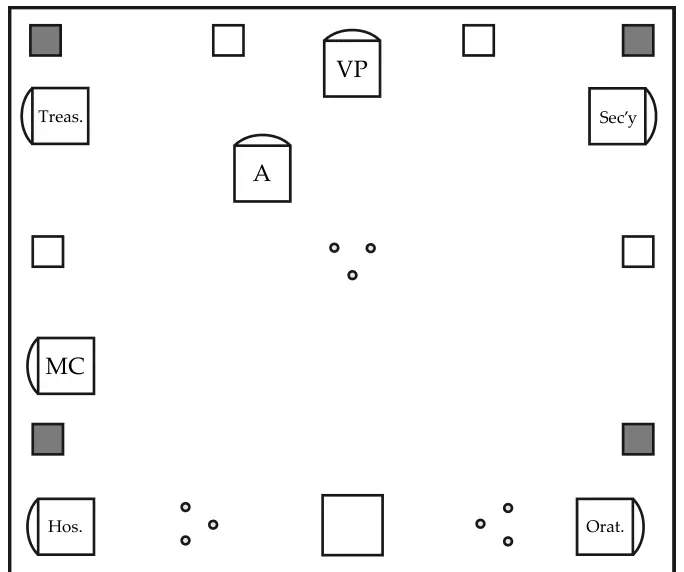
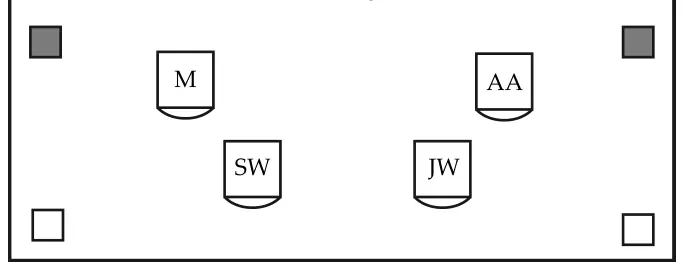
Le chapitre disposé comme nous l'expliquerons dans le tableau. Le vénérable qu'on appelle très sublime grand-maître, ou très illustre et très puissant, frappe sept coups détachés et dit : A l'ordre mes frères. Tous les frères font alors le signe et mettent l'épée à la main. Ensuite le très illustre, ou sublime maître dit :
D. Illustre premier surveillant, êtes-vous sublime élu ?
R. Très illustre grand-maître, mon nom vous le fera connaître.
D. Comment se nomme un parfait maître sublime élu ?
R. Emerk, qui veut dire homme vrai en toutes choses.
D. Qu'avez-vous en entrant en chapitre ?
R. Vingt et quatre lumières.
D. Que signifient-elles ?
R. Les douze maîtres élus et les douze tribus d'Israël.
D. Comment nommez-vous les douze maîtres élus ?
R. Zerbal, Elchior, Tercy, Morphis, Alkaber, Dorion, Ker[em], [L]esghemer, Tito. Ces neuf premiers furent élus pour aller à la recherche d'Abyram Akiroff, Benecat, Japhat et Tabor sont les trois maîtres distingués par leurs talents, leur zèle et leur vertu. Salomon joignit aux neuf premiers pour remplir les emplois qu'il leur destinait.
D. Quels sont ces emplois ?
R. La surintendance sur tous les maîtres en les nommant inspecteurs pour veiller à tour les travaux qu'on ferait dans le temple et lui en rendre compte.
D. Combien y avait-il d'ouvriers dans le temple ?
R. 153.590, parmi lesquels on comptait 7000 Appentis, 79997 compagnons et 3593 maîtres.
D. Comment les douze maîtres parfaits sublimes élus étaient-ils disposés dans le temple pour veiller à la conduite de tant d'ouvriers ?
R. Ces ouvriers étant de douze tribus différentes, ils eurent chacun l'inspection des ouvriers de chaque tribu comme il suit : Zerbal eut l'inspection des ouvriers sur la tribu de Juda. Tercy sur Benjamin. Ces douze maîtres élus inspecteurs rendaient compte à Salomon de Morphis sur Lévi. tous les travaux qui se feraient dans le temple. Alkebar sur Manassé.
D. A quelle heure s'ouvre le chapitre ? Dorion sur Issakar.
R. A minuit. Kerem sur Zabulon.
D. Pourquoi ? Barthemer sur Aser.
R. Parce que ces maîtres élus sublimes, chargés pendant le jour Tito sur Nephtaly. d'exécuter ce qui était ordonné, ne pouvaient s'assembler qu'à Benecat sur Joseph. minuit, pour rendre compte de ce qui était fait et prendre de Japhat sur Rubens. nouveaux ordres. Tabor sur Gad.
D. Quelle heure est-il ?
R. Minuit.
D. Expliquez-moi les cinq lettres, qui sont sur la croix53 ?
R. C. est la lettre initiale de Ciuy, K. celle de Ky, E. celle d'Emerk, S. celle de Salomon, et A. au milieu de la croix celle d'Adonaÿ. N.B. Dans quelques loges cette croix en est le bijou.
Alors le très illustre dit : Annoncez donc ici aux frères en toutes leurs qualités et dignités, que le chapitre de parfait maître sublime élu est ouvert et qu'on s'y tienne avec la décence due aux mystères.
Les surveillants répètent ce qui vient d'être dit. Tous font le signe, le vénérable très illustre dit : Le chapitre est ouvert, on applaudit avec sept coups, le dernier détaché.
Le très illustre sublime maître, adressant alors la parole à tous, dit : Mes frères, personne n'a-t-il rien à proposer pour le bien ou l'instruction du chapitre. L'un des frères propose alors le récipiendaire, comme un maître élu, qui a passé par les différents grades et qui supplie le très illustre grand-maître et les frères de lui introduire à pénétrer plus avant dans les mystères, en lui conférant le grade de parfait maître sublime élu. Le très illustre grand-maître requiert le consentement de tout le monde. Après quoi le maître des cérémonies va chercher le récipiendaire dans la chambre de réflexion, le dispose et l'introduit à la manière accoutumée dans le chapitre, qui doit être décoré comme il est dit ici : Description de ce qui se trouve dans le chapitre
Le lieu où se tient l'assemblée de sublime élu, ou si l'on veut Surintendant des Bâtiments, représente l'intérieur du temple de Salomon, sans tenture et le sanctuaire tapissé en colonnes blanches parsemées de flammes rouges et en colonnes rouges parsemées de flammes blanches. L'intérieur du temple doit être éclairé par vingt et quatre lumières, placées indifféremment en douze pelotons de deux et le sanctuaire doit être éclairé par le chandelier à sept branches. On trace à la partie d'Occident du temple, du coté droit, le tableau de la loge de compagnon et de l'autre côté celui d'apprentif. Plus avant dans l'intérieur est le tombeau de notre maître Hyram et de chaque coté du tombeau un palmier élevé, qui trouble la couverture de ses branches. Salomon fit placer ces deux palmiers comme un monument, qu'il voulut ériger aux talents et aux vertus de notre maître, et séparément les deux chérubins de l'arche.
On lit sur le tombeau les trois lettres I. H. S. I. est la lettre initiale de l'ancien mot que l'on prononçait Jehova, H. Hyram, S. Stokin. Plus avant dans le temple est une urne sur laquelle on voit les lettres X. C., qui veut dire Xincut56 en hébreu, le siège ou le repos de l'âme. En face on place à l'endroit de cette urne une clef et à la gauche une balance. On doit voir à l'entrée du temple dans le sanctuaire un coffre d'or suspendu par une houppe dentelée et dans le fonds du sanctuaire l'Arche d'Alliance, figurée par une double arche, autour duquel en dehors sont gravées les lettres J. A. J. M57. Les deux JJ. sont placés au haut et au bas du cercle, M. à droite, A. à la gauche. Au-dessus de ce cercle parait un triangle environné d'une nuée épaisse. Au milieu du triangle sont les lettres A. D. écrites en hébreu et qui signifient le nom de Dieu. Aux trois angles sont les lettres B. U. S. qui veulent dire Union, Sagesse et
Beauté. La nuée qui enveloppe le triangle, est pour marquer, que la dédicace du temple fut agréable au Seigneur. En face de l'arche on met un chandelier à sept branches, à droite le vase de parfums et à gauche la table des pains de proposition.
Réception
Le chapitre ainsi disposé, on introduit le récipiendaire, qui doit avoir à la main droite son épée en travers du corps et de la gauche un compas, dont une des pointes est tournée vers le cœur. Pour l'introduire le maître des cérémonies frappe sept coups, le dernier détaché, et lorsqu'on a ouvert, il place le récipiendaire entre les deux surveillants.
Le très illustre maître lui demande, ce qu'il veut Il répond qu'il demande au très illustre grand-maître de vouloir bien l'admettre dans le chapitre des parfaits maîtres sublimes élus en le recevant à ce grade. Alors, le très illustre maître lui dit au second surveillant : Conduisez-le, où travaillent les apprentifs. Alors, le second surveillant le mène où est le tableau des apprentifs et le faisant marcher en apprentif, là on lui fait les questions de ce grade, puis on le mène au tableau de compagnon parla marche, qui leur est attribuée. On l'interroge encore sur ce grade et si on est satisfait de ses réponses, on le mène en marchant en maître jusqu'au tombeau d'Hyram, où il doit encore répondre aux questions de maître qu'on lui fait. Puis, marchant en élu, il arrive à l'entrée du sanctuaire où alors le sublime maître dit : Faites approcher ce frère avec la décence due au lieu saint, où il prêtera son Obligation.
Aussitôt le premier surveillant lui prend l'épée et le compas qu'il avait entre les mains, les lui croise et lui appuie sur la poitrine. Puis il lui fait faire quatre génuflexions. A chaque génuflexion il dit : Ciui et le très illustre maître lui dit : Ki puis il se met à genoux pour prêter son obligation.
Obligation
Je jure et promets sous les mêmes obligations que j'ai déjà contractées de garder les secrets [19r°] de parfait maître sublime élu Surintendant des Bâtiments [19r°] et envers les profanes que les maçons qui sont au-dessous de ce grade. Je promets de plus d'aimer et adorer Dieu, d'être fidèle à mon roi et charitable envers mon prochain, particulièrement envers mes frères, me soumettant au cas que je contrevienne à mon obligation d'avoir le cœur percé et le corps partagé, et que ma mémoire soit regardée comme celle d'un infâme et d'un parjure. Ainsi Dieu me soit en aide et son Saint Evangile. Amen.
[Après l'obligation]
Lorsque le récipiendaire a fini de prononcer l'obligation le très illustre grand-maître lui donne les signes, mots et attouchements et le décore de l'attribut.
Le signe est de faire la croix avec la main sur l'estomac et de lever le pouce en l'air en serrant les doigts. On peut faire un autre signe par une main en serrant les doigts et tenant le pouce élevé. On fait ensuite la croix avec le pouce sur la poitrine.
L'attouchement est de prendre la main droite de celui qui vous demande de vous faire connaître et de frapper trois coups avec le pouce sur la phalange du doigt du milieu.
Les mots de passe sont Stokin ou Nikots.
Les mots sacrés sont Jubellum, Abyram Akiroff qui se disent d'abord mais le grand mot est Adonaÿ.
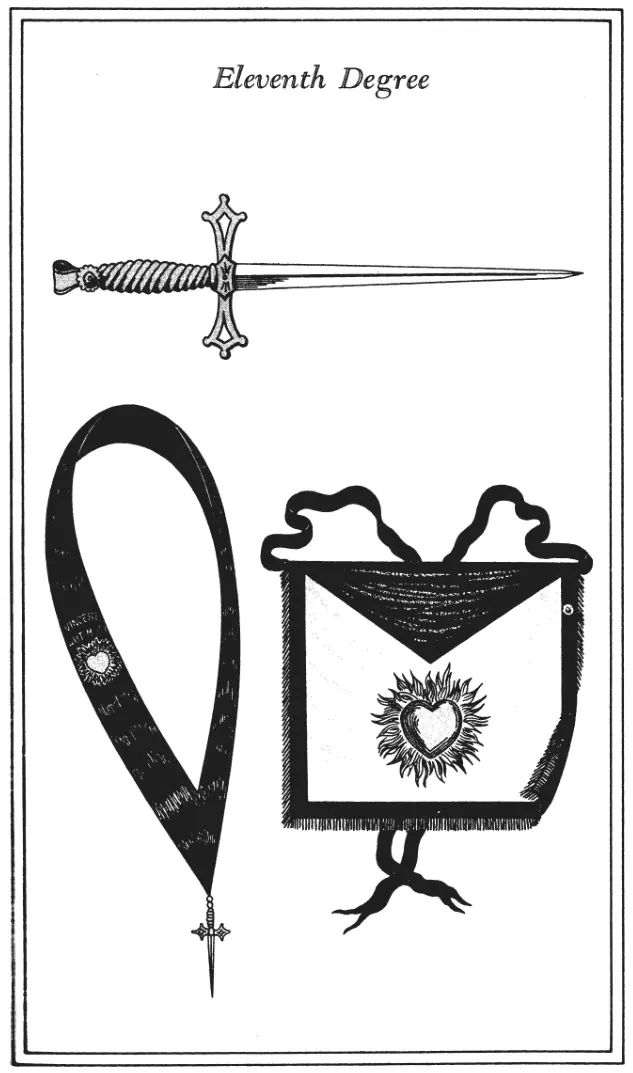
L'attribut est une croix de nacre de perle à neuf pointes en étoile sur laquelle est un cœur enflammé d'un côté et au revers sont gravées les lettres C. K. E. S. Cet attribut doit être
attaché à un grand ruban noir large moiré, que l'on porte de l'épaule gauche à la ceinture droite avec une rosette couleur de feu ayant douze flots.
Le très illustre grand-maître arme ensuite d'une épée le récipiendaire, qui va rendre aux surveillants les signes, mots et attouchements. Puis, revenant dans le chapitre, le frère orateur lui prononce à peu près ce discours, que je propose de choisir en faisant suivant son génie. On y explique le nom d'Emerk, qu'on donne à celui qui est sublime élu, mot oriental qui signifie homme vrai en toutes choses, éloges etc.
Doctrine
D. Comment étiez-vous, quand on vous a introduit en chapitre ?
R. Je tenais de la main droite une épée nue, qui me traversait le devant du corps et de la gauche un compas dont la pointe appuyait sur mon cœur.
D. Pourquoi dans cette attitude ?
R. L'épée servait à me faire connaître, que mon corps serait partagé en deux, si j'étais jamais assez malheureux de révéler les secrets qui devaient m'être confiés et le compas, que nos pensées et nos actions doivent être réglées par la justice, ce que j'ai observé, puisque vous m'avez trouvé digne de m'admettre.
D. Comment vous êtes-vous annoncé au chapitre ?
R. Par sept coups le dernier détaché, qui signifient les six années, qui furent employées à la construction et le festival à la dédicace du temple, que Salomon fit bâtir.
D. Donnez-moi notre mot sacré.
[R.] Adonaÿ.
D. Donnez-moi le mot de passe.
[R.] Nikots ou Stolkin nom du maître qui découvrit le corps d'Hyram.
D. Donnez-moi le signe.
R. J'obéis. – Il le donne.
D. Donnez l'attouchement au frère second surveillant.
R. Il le donne.
D. Qu'est ce que nous représentent les trois coups, que nous donnons dans l'attouchement ?
R. C'est pour nous rappeler les trois points principaux de notre obligation, savoir l'amour de Dieu, la fidélité au roi, et la charité envers nos frères.
D. Que signifie le tombeau qui est au sanctuaire du temple ?
R. C'est celui de notre respectable maître Hyram que Salomon fit placer dans le milieu du temple, pour indiquer aux Israélites le regret de sa perte.
D. Quelle récompense donna Salomon aux douze élus après la construction du temple ?
R. Il les nomma ses favoris, ses bien-aimés, les chevaliers sublimes élus, les décora du grand cordon et de l'attribut que nous partons et leur donna l'épée de justice. Et Salomon en leur disant : Vous avez été ses conducteurs de travaux dans la construction du temple que j'ai consacré à l'Eternel. Soyez en maintenant les juges et le soutien en combattant contre les infidèles.
D. Que signifie la houppe dentelée et le coffre d'or qu'elle suspend ?
R. Elle est la figure de trois Babyloniens, que Salomon fit mettre dans le temple pour séparer le lien saint avec le très saint. Le coffre était l'endroit, où on déposait le cœur de ceux, qui avaient été consacrés à l'Eternel.
D. Que signifient les quatre pas, qu'on vous a fait faire pour arriver au pied du trône ?
R. Les quatre portes du temple et le respect, qu'on doit avoir quand on entre dans un lieu consacré à Dieu.
D. Pourquoi le très illustre maître frappe-t-il trois coups d'épée sur la tête du récipiendaire
R. La représentation de la foi, la fidélité et la charité pour mes frères.
D. Pourquoi les sublimes élus sont-ils en chapitre l'épée à la main ?
R. Pour nous apprendre, que nous devons être toujours prêts à secourir nos frères et prendre la défense d'eux et de la religion.
D. Pourquoi le chapitre se ferme-t-il au point du jour ?
R. Pour exécuter pendant le cours de la journée, ce qui a été prescrit et ordonné.
D. Quel est notre nom en qualité de maître sublime élu ?
R. Bakulcal, mot qui signifie tabernacle ou gardien fidèle.
D. Quel était le nom de l'inconnu qui avertit Salomon de la retraite du meurtrier d'Hyram Abiff ?
R. Pérignan, équarrisseur et polisseur de marbre, qui travaillait à Guiblim dans une carrière proche de [Joppa] où fut trouvé le corps d'Hyram Abiff. Il n'était point du nombre de ceux qui étaient inscrits pour travailler au temple.
D. Que signifient les trois lumières placées aux trois portes du chapitre ?
R. La place où s'étaient portés les trois compagnons qui assassinèrent Hyram Abiff, lesquels étaient tous frères de père et de mère. Ils étaient de la tribu de Dan, le premier Akiroff, le second Kunwal ou Guips et le troisième Gravelot avec le surnom de Jubellum qu'ils portaient tous trois. Dans le grade d'élu de 15, ils sont connus par quelques-uns sous le nom de Kelek, Oterfut et Hobben, etc.
D. Quelle heure est-il ?
R. Le point du jour. Alors, le très illustre maître dit : Puisque le jour parait avertissez les frères que le chapitre est fermé.
[Signature] Omissions
Le cordon est un grand ruban noir de commandeur de Malte, pendant de l'épaule gauche à la hanche droite, une croix au bas dudit ruban, suspendue par un ruban couleur d'eau, où la croix doit être rouge, trois cœurs en bas du cordon peints enflammés... Le tablier est de peau blanche, doublé de noir, bordé d'un ruban rouge, une petite poche dans le milieu, de soie noire et une croix rouge, peinte ou brodée, sur la poche au milieu. ++ D. Que signifient les trois lettres J. H. S., que vous voyez sur le tableau ?
R. J. est la lettre initiale de Jeva, première prononciation de l'ancien mot des maîtres, H. celle d'Hyram, nom de notre respectable maître, S. celle de Stolkin, qui est le nom de celui qui découvrit son corps quand Salomon y fit la recherche.
D. Donnez-moi l'explication de l'urne que vous voyez sur le tableau.
R. C'est dans cette urne qu'est déposé le dépôt précieux du corps de notre respectable Hyram et les deux lettres X. C. qui sont sur cette urne, lettres initiales de Xin. chut, mot hébreu qui signifie le juge de l'âme.
D. Quelle récompense avaient les douze maîtres élus de Salomon après la construction du temple ?
R. Il les nomma ses favoris et les fit chevaliers sublimes élus, les décora du grand cordon, où il y avait un cœur enflammé, qu'il n'était permis de porter qu'aux sublimes maîtres élus, et leur remit l'épée de Juda.
Fin
[19v°]
Conseil des illustres élus
La loge est tendue de rouge. Il n'y a point de tableau. Les lumières sont disposées indifféremment par toute la loge, qui représente un appartement de Salomon. Le maître de la loge représente Salomon et se nomme très souverain. Il y a deux surveillants et les vénérables frères sont assis.
La loge s'ouvre par neuf coups égaux. Le récipiendaire est dans une chambre à côté avec le frère terrible, qui lui met dans la main gauche une tête de cadavre et lui dit de prendre de la droite le poignard attaché à son cordon. Puis il frappe à la loge neuf coups égaux. On y répond du dedans et on introduit le récipiendaire que l'on place entre les deux surveillants et auquel le grand-maître demande ce qu'il veut. Le premier surveillant répond pour le récipiendaire qu'il demande la récompense de ce qu'il vient de faire. Le grand-maître lui dit alors : En vengeant la mort de notre respectable maître Hyram par celle de ses assassins, votre cœur n'avait en vue que l'intérêt. Le surveillant répond : Pas du tout, la récompense que je demande est moins pour ma propre satisfaction que pour faire connaître à la postérité, que j'avais la vertu qui reste sans récompense, ni le crime impuni. Le grand-maître continue ses questions en disant : Est-il bien vrai une fois vengé ? Le surveillant présentant le récipiendaire, la tête de mort à la main, dit : En voilà, un grand et sûr témoignage.
On fait faire alors neuf petits pas au récipiendaire pour aller jusqu'au maître qui lui fait prêter son obligation et lui donne les signes.
Le signe est de porter la main droite sur la tête, qui est le mouvement, que fit Abyram en mourant lorsque Stolkin le tua du poignard.
L'attouchement est de se présenter la main droite mutuellement et s'entrelacer les doigts.
La parole est Nak-Marooz. Cette parole est détaillée dans l'instruction.
L'attribut est une étoile de nacre de perle à neuf pointes où sont gravés un poignard d'un côté, et un Soleil de l'autre.
Le grand-maître en lui donnant cette étoile dit : Je vous illustre vous et vos descendants pour l'action que vous venez de faire. Vous porterez cet attribut à la boutonnière avec un ruban rouge moiré, comme les chevaliers de saint Louis. Ensuite l'orateur lui fait un discours, qui n'est qu'une répétition de l'histoire d'Adoniram et de sa mort, du zèle que tous les frères doivent témoigner de le venger, de la découverte du traître Abyram, de la fin et de la récompense que Salomon donna à Stolkin pour prix de son zèle en le décorant de cette étoile, qu'il fit faire de nacre préférablement à l'or, regardant la première matière plus précieuse que l'or, qui était trop commun de son règne, et l'illustrant pour toujours lui et ses enfants.
Doctrine
D. Etes-vous illustre ?
R. Je le suis avec d'autant plus de justice, que je me flatte de l'avoir mérité.
D. Qu'avez-vous donc fait pour le mériter ?
R. J'ai vengé le maître des maîtres en punissant son assassin. (On peut faire ici des questions d'élu.)
D. A quoi connaîtrai-je que vous êtes illustre ?
R. Aux signes, paroles et attouchement.
D. Donnez-moi la parole.
R. Donnez-moi la seconde, je vous donnerai la première. Marooz, Nak. Ensemble Nak-Marooz. Signification : le maître des maîtres est vengé.
D. Quel est votre attribut ?
R. Une étoile extraordinaire à neuf pointes, au milieu de laquelle est un poignard et au revers un Soleil.
D. Expliquez-moi cela.
R. L'étoile indique que l'action de Stolkin causera autant d'étonnement à l'univers qu'un phénomène ; le poignard, qui est au milieu de l'étoile, est l'instrument de la vengeance et le Soleil signifie que, comme le Soleil répand ses rayons par tout l'univers, de même cette action se répandra à la postérité et y sera regardée comme un modèle de la plus haute vertu. Nota. Après la santé du maître on boit en mémoire de Salomon, et pour distinguer cette santé des autres, lorsque la santé a été annoncée, le grand-maître frappe un coup de maillet et poursuit l'exercice.
[Signature]
Apparat critique de la transcription Aeditimus
53. En marge droite, à côté de ces répliques, la figure de la croix en question. Pour des raisons de place, ladite figure a été reproduite en fin du présent catéchisme (cf. page suivante).
54. Rajout dans l’interligne supérieur.
55. Comme plus haut, en une autre section, on peut lire : Jehena.
Le manuscrit Quesada (Mss 7834 de la Bibliothèque Nationale d'Espagne) : copie (1813-1821) d'un état du Rite de 1804, voire antérieur, tel que pratiqué dans la mouvance du Suprême Conseil d'Amérique. Les didascalies du manuscrit sont en italique. Le texte est celui de l'édition Latomia, donnée en vis-à-vis du fac-similé du manuscrit : l'apparat critique de cette édition est repris ici, de même que les repères de folio du manuscrit.
Texte intégral sur ce site · transcription C. M. & P. T., Latomia / Chantier de fouilles maçonniques, d'après le Mss 7834 de la BNE
Chevalier Élu 11 e∴ degré
Cette L∴ s’appelle Gd∴ Chap∴ Salomon y préside un Gd∴ Insp∴ et un Gd∴ Me∴ des Cies∴ remplissent les places des deux Survts∴
Ouverture
Le 3 F∴ Puissant frappe 12 coups égaux Le Gd∴ Insp. en fait de même le 3 Fois Puissant dit :
D∴ Gd∴ Insp∴ Quelle heure est-il ?
R∴ 12 heures. Le 3 Fois Puisst∴ dit : puisqu’il est 12 heures, il est temps de perfectionner nos travaux à moi mes FF∴
Il fait le signe puis l’acclamation.
Signe
Croiser les bras sur la poitrine les mains fermées les pouces levés.
Formule de réception
Le Gd∴ Me∴ des Cies∴ sort pour aller prendre le Cand∴ arrivés à la porte du Chap∴ il frappe 5 coups. Le Gd∴ Insp∴ frappe un coup et dit : 3 Fois Puissant on frappe à la porte du
Gd∴ Chap∴ puis il se lève et va demander qui est là, le Gd∴
Me∴ des Cies∴ dit : C’est un Ill∴ Élu des 15 qui demande
à pénétrer dans le Gd∴ Chape∴ des Subl∴ Chev∴ Élus, dès qu’il est entré
le Gd∴ Me∴ des Cies∴ le conduit au Gd∴ Insp∴ qui l’examine sur les précédents grades l’examen fini le 3 Fois Puissant dit :
D∴ Gd∴ Me∴ des Cies∴ que demande cet Ill∴ Élu des 15 ?
R∴ La faveur d’être admis au grade de Sublime Chev r Élu et d’obtenir la récompense due à ses ouvrages et à ses travaux.
D∴ J’imagine mon F∴ que v. n’avez voyagé que dans des vues d’intérêt
R∴ Le Cand∴ répond∴ Mon premier but a été de remplir mon devoir, ce que j’ai fait à mes propres dépens et de punir tous les traîtres, ce n’est que l’honneur qui m’invite maintenant à solliciter une récompense. Le 3 Fois Puissant dit Folio 152 recto : En ce cas approchez mon F∴ venez contracter votre obligation.
Obligation
Je N.... jure & promets sur la S te∴ Bible, de ne jamais révéler où j’ai reçu le présent grade, de ne jamais dire qui a assisté à ma Réception, je promets de ne jamais recevoir personne dans ce grade Folio 147 recto sans en avoir obtenu le plein pouvoir de mes supérieurs, de n’assister à aucune Réception, à moins que ce ne soit dans un Chap∴ régulier de ce grade, je promets d’être charitable et si je manque à ces promesses, je consens d’avoir le corps coupé en 4. et que ma mémoire soit en horreur comme celle d’un imposteur.
Le 3 Fois Puissant donne ensuite les Mots Signes & Attouchements au Cand∴
Attouchement
Il se donne en se prenant mutuellement le pouce le premier le renverse en disant. Berit le 2d∴ fait de même en disant
Neder et le 3e∴Selemouth
Signe
Se croiser les bras sur la poitrine les mains fermées les pouces tendus
Décoration
Un large ruban noir sur lequel sont peints ou brodés 3 cœurs enflammés, au bout duquel pend une épée ou un poignard. Le tablier blanc doublé de noir avec une petite poche au milieu sur laquelle est une croix rouge.
Discours historique
La vengeance des 3 assassins étant accomplie Salomon pour récompenser le zèle & la ferveur des 15 Grands Élus, pour leur donner un grade plus élevé, et pour remettre327 et n’avoir aucune préférence il choisit par bulletins 12 d’ent’eux et ordonna que les 12 premiers noms qui sortiraient de l’urne seraient ceux qui formeraient un Gd∴ Chap∴ & commanderaient les 12 tribus il leur donna le titre d’Excellents Emereh. qui en hébreu signifie homme vrai en toute occasion. Il leur montra les choses précieuses qui étaient renfermées dans le Tabernacle et les Tables de la Loi gravées du doigts de Dieu, & données à Moïse sur le Mont Sinaï auprès du B∴ A∴ il les arma de l’épée de justice et leur accorda plusieurs autres faveurs, tel est mon Cher F∴ le sujet de ce tableau, qui doit toujours être devant vos yeux et faire l’objet de vos études & de vos réflexions, nous nous flattons qu’ayant une si belle route à suivre vous ne négligerez rien pour le faire, et que vous n’entrerez jamais dans le sentier dangereux qui vous écarterait des devoirs que vous avez à remplir, vous trouverez facile l’exécution de pareils principes pourvu que votre cœur sente la nécessité de maintenir le justice & de la suivre en temps329, enfin mon C∴ F∴ en remplissant strictement vos obligations et en restant fidèle à vos obligations330, nous espérons trouver en vous un F∴ ardent, zélé, officieux et digne du titre respectable, de Sublime Chev∴ Élu que vous venez de recevoir Folio 153 recto Signe de reconnaissance, où 2 e∴ Attouch∴
Il se fait en prenant la main droite d’un F∴ en frappant 3 coups, avec le pouce sur la 2e∴ phalange, du doigt du milieu.
Instruction
D∴ Êtes-vous Chev∴ Élu ?
R∴ Mon nom vous en convaincra.
D∴ Quel est-il ?
R∴ Emereh est mon nom et ma perfection. Comment êtes vous de Subl∴ Chev∴ Élu dans votre Chap∴ ?
D∴
R∴ Il ne peut y en avoir que douze qui composent les 12 Maîtres des 12 tribus.
D∴ Quel est votre Mot Sacré en qualité de Sublime Chevalier Élu.
Adonaï qui signifie Dieu. R∴
D∴ Quel est votre Mot de Passe ?
Stolkin nom de celui qui découvrit le corps d’Hiram Abif. R∴
D∴ Quel est le signe de Sublime Chev∴ Élu ?
R∴ Il se fait, en croisant les bras sur la poitrine les mains fermées les pouces levés.
D∴ Que signifie ce signe ?
R∴ La promesse que j’ai faite de porter toujours ma croix pour me souvenir de mes fautes depuis qu’elles ont été effacées.
D∴ Quel est votre signe de reconnaissance
R∴ Il se fait en prenant la main droite et frappant avec le pouce 3 coups sur la 2 e∴ phalange du doigt du milieu.
D∴ Que signifie cet attouchement ?
R∴ L’amour de Dieu, fidélité à mon souverain et charité envers mes FF∴ & mon prochain.
D∴ Qu’avez-vous vu en entrant dans le Chaptre∴ ?
R∴ Vingt-quatre Lumières.
D∴ Que signifient-elles ?
R∴ Les 12 M es∴ Élus et les 12 tribus d’Israël ?
D∴ Quels étaient les noms des 12 M es∴ Élus ?
Johaber, Stolkin, Tercy, Morphy, Alquebar R∴ Dorson, Kerem, Bertemer & Tito ce sont les 9 M es∴
Élus qui furent à la recherche d’Hiram A∴Kiroph, Zerbal & Tabor formèrent le nombre de 12332.
D∴ Quel emploi Salomon leur donna-t-il ?
R∴ Celui d’avoir l’Insp on∴ sur les M es∴ en cette qualité ils avaient le titre d’Insp∴ qui les autorisaient à se faire rendre compte de tous les travaux relatifs à la construction du Temple.
D∴ De quelle manière étaient employés les 12 Insp∴ pour surveiller une si grande quantité d’ouvriers
R∴ Johaber, inspectait la tribu de Juda Kerem Dan Stolkin Benjamin Bertemer Aser Tercy Siméon Tito Neptalie Morphy Ephraïm Zerbal Ruben Alkebar Manasser Banayar Issachar Dorson Zabulon Tabor Gad Les douze Maîtres rendaient compte à Salomon de tous les ouvrages faits ils recevaient le salaire de tous les ouvriers et les distribuaient à chaque tribu.
D∴ Pourquoi votre Chap∴ ne s’ouvre-t-il qu’à minuit ?
R∴ Parce que plusieurs des Sublimes Chev∴ étaient employés le jour à combattre les infidèles, les autres à remplir les devoirs de l’hospitalité & ils se trouvaient à minuit pour se rendre compte réciproquement de tout ce qu’ils avaient fait. Pourquoi le Chap∴ s’ouvre-t-il au point du jour ?
D∴
R∴ Pour exécuter pend t∴ le jour ce qui a été ordonné par le Chap tre
R∴ 31 ans Folio supplémentaire XXVFolio 155 recto.
Clôture
D∴ Êtes-vous Subl∴ Chev∴ Élu ?
R∴ Mon nom vous le fera connaître.
D∴ Quel est votre nom ?
R∴ Emereh.
D∴ Que signifie ce nom ?
R∴ Homme vrai en toute occasion.
D∴ A quelle heure se ferme le Chapitre ?
R∴ Au point du jour.
D∴ Quelle heure est-il ?
R∴ Le jour paraît. Puisque le jour paraît, avertissez que le Chap∴ de Subl∴ Chev∴ Élu va se fermer par les Signes & Batteries d’usage.
Le Gd∴ Insp∴ répète le Me∴ des Cies∴ de même alors tous les FF∴ debout et à l’ordre font le signe la batterie Folio supplémentaire LXVFolio supplémentaire LXVIIFolio supplémentaire LXIXFolio 278 recto suivis d’un triple Houzé. Le 3 fois Puissant après avoir frappé un coup dit :
Le Chapitre est fermé Folio supplémentaire LFolio 241 recto.
Apparat critique de l’édition Latomia
327. Probable erreur de copie : on attendrait plutôt « ne mettre ».
328. Sic. Mis pour « d’entre eux ».
329. Dans d’autres versions, « temps » a été remplacé ( à tort ? ) par « tout », cf. Pyron 1812 et Kloss
330. Probable erreur du copiste A : le mot exact est « serments », cf. Pyron 1812 et Kloss.
332. Erreur du copiste A : la phrase exacte est « [...] recherche d’Abiram-AKiroph ; Zerbal Banayar & Tabor formèrent [...] », cf. Pyron 1812 et Kloss.
333. Erreur du copiste A : le verbe attendu est « se ferme-t-il » , cf. Pyron 1812 et Kloss.
334. Oubli du copiste A : on attend plutôt « sur un des » ou « sur un », cf. Pyron 1812 et Kloss.
335. Oubli du copiste A : il manque les mots « une croix », cf. Pyron 1812 et Kloss.
340. Erreur du copiste A : les mots exacts sont « du grade », cf. Pyron 1812 et Kloss.
341. Erreur du copiste A : les mots exacts sont « du grade », cf. Pyron 1812 et Kloss.
342. Erreur du copiste A : le mot exact est « conduisaient », cf. Pyron 1812 et Kloss.
343. Erreur du copiste A : le mot exact est « que », cf. Pyron 1812 et Kloss.
348. Erreur du copiste A : le mot exact est « dioptrique », cf. Pyron 1812 et Kloss.
350. Rajout correctif du copiste A.
351. Restitution. Manifestement, le copiste A ne connaissait pas les lettres hébraïques.
Delaulnaye 1813
tuileur imprimé · 320 mots
Le « Thuileur des trente-trois degrés de l'Écossisme » de Delaulnaye (Paris, 1813), premier tuileur imprimé du REAA constitué : mots, signes, décors et remarques du grade. Texte relu mot à mot sur le fac-similé, mots hébreux restitués. Pages 70-73 de l'édition originale.
Tenture comme au grade précédent, ou parsemée de Cœurs enflammés.
Vingt-quatre Lumières.
Titres.
La Loge a le titre de Grand-Chapitre. Elle est composée de douze Élus.
Le Chef représente Salomon, et est appelé trois fois Puissant. Au lieu de Surveillants, il y a un Grand-Inspecteur et un Maître de Cérémonies.
Signe.
Croiser les bras sur la poitrine, les mains fermées, les pouces levés.
Premier Attouchement.
Se présenter mutuellement le pouce de la main droite, les autres doigts fermés ; l'un sai- [p. 71] sit celui de l'autre, et renverse le poignet trois fois, en disant, en trois temps, BERITH, NEDER, SCHELEMOTH.
Second Attouchement.
Prendre la main droite du Frère, et lui frapper trois Coups avec le pouce sur la phalange du doigt du milieu.
Batterie.
Douze Coups égaux.
○ ○ ○ ○ ○ ○ ○ ○ ○ ○ ○ ○
Mot Sacré.
ADONAI (1).
Mot de Passe.
STOLKIN.
Quelques-uns y ajoutent Emerek, que l'on
(1) Ce mot Adonaï, joint au fameux Nekam, forme, comme on le verra, le cri redoutable et caractéristique du Kadosch, qui n'est qu'une confirmation, ou plutôt une spécification de l'Élu. Seul, Adonaï se retrouve dans le Maître Secret, dans le Grand-Maître Architecte, dans le Royal-Arche, l'Écossois de la Perfection, le Chevalier du Soleil, l'Inspecteur-Général, l'Élu Parfait, etc.
[p. 72]
suppose être le nom caractéristique d'un Élu, et que l'on traduit par Homme vrai.
Au lieu de ce mot insignifiant, il faut dire : AMARIAH, אֲמַרְיָה.
(eloquens)
Heure.
Pour ouvrir ; Douze heures.
Pour férmer ; le Point du jour.
Tablier.
Blanc, doublé et bordé de Noir ; une poche au milieu, sur laquelle est une Croix-Rouge. D'autres y peignent un Poignard, environné de Neuf Larmes, comme pour l'Élu de France.
Cordon.
Noir. On y brode ou trois Cœurs enflammés, ou la devise Vincere aut mori.
Bijou.
Un Poignard d'or, à lame d'argent.
[p. 73]
IV.e CLASSE.
Vuillaume 1820
tuileur imprimé · 591 mots
Le tuileur de Claude-André Vuillaume, « Manuel maçonnique, ou Tuileur de tous les rites de maçonnerie pratiqués en France » (Paris, Delaunay et Hubert, 1820) : décoration, titres, signes, attouchement, marche, batterie, âge, mots, habillement du grade, avec l'étymologie et l'interprétation des mots hébreux. Texte établi sur le fac-similé et relu mot à mot sur les images : océrisation à 600 dpi du volume numérisé, fusion avec la couche texte de la numérisation Gallica, puis relecture page par page. Orthographe de 1820 conservée, hébreu et grec restitués, batteries rendues comme l'imprimé les note, pagination de l'original. Pages 103 à 106.
TENTURE noire parsemée de cœurs enflammés. Il y a vingt-quatre lumières.
TITRES.
La loge prend le titre de Grand Chapitre ; il ne peut y avoir que douze élus.
Le président représente Salomon ; il est nommé Trois fois Puissant. Au lieu des surveillans, il y a un grand Inspecteur et un Maître des cérémonies.
SIGNE.
Se croiser les bras sur la poitrine, ayant les mains fermées, le pouce écarté.
ATTOUCHEMENT.
1°. Se présenter mutuellement le pouce de la main droite, les autres doigts étant fermés ;
[p. 104]
l'un des FF∴ saisit le pouce de l'autre et lui renverse le poignet par trois fois, en disant entre eux alternativement ces trois mots : Berith, Neder, Schelemoth (Voyez l'explication de ces mots au sixième degré).
2°. Prendre la main droite du Tuileur ; lui frapper trois coups avec le pouce sur la première phalange du doigt medius.
BATTERIE.
Douze coups égaux.
TEMS DU TRAVAIL.
De douze heures au point du jour.
HABILLEMENT.
Tablier blanc, doublure et bordure noire ; au milieu du tablier est une poche, sur laquelle est peinte ou brodée, en rouge, une croix. Il y a quelques loges qui, au lieu de la croix, font broder sur la poche du tablier, un poignard environné de neuf flammes.
Cordon noir, porté de gauche à droite, sur lequel sont brodés trois cœurs enflammés, ou simplement la devise : VINCERE AUT MORI. Au bas du cordon est suspendu un poignard d'or à lame d'argent.
[p. 105]
MOT DE PASSE.
STOLKIN, que l'on interprète par : eau courante.
Il y a des chapitres où l'on ajoute le mot Emerek ou Emereh, que l'on traduit ainsi : Homme vrai ou véridique. Ce mot est fautif ; il faut dire Amar-iah (héb. אָמַר־יָה verbum domini).
MOT SACRÉ.
ADONAÏ.
Remarques.
On lit dans l'historique des élus, que Ben-gabel, l'un des intendans de Salomon, informa ce prince, que les deux complices d'Abiram, meurtrier de Hiram, s'étaient retirés dans le pays de Geth, dont Maacha était roi, et tributaire de Salomon ; que les coupables ayant été saisis et amenés à Jérusalem, ils furent mis, en y arrivant, dans une tour nommée Achizar.
Nous devons signaler les fautes que nous apercevons dans la tradition de tous ces noms.
1°. Ben-gabel est une corruption de Ben-[p. 106]gheber (héb. בֶּן־גֶּבֶר filius hominis), qui était, en effet, l'un des intendans de Salomon à Ramoth-galaad (Rois 3. ch. 4. v. 13).
2°. Magachah ou maachah (héb. מַעֲכָה magechah, compressus) était effectivement roi ou prince du pays de Gheth (héb. גת torcular) et non pas Geth (Rois 3. ch. 2. v. 39), la prononciation française ne permettant pas de rendre le g dur sans être suivi de l'h.
3°. Abiram, nom du meurtrier, est tronqué ; c'est Abi ramah (héb. אֲבִי־רָמָה dejiciens patrem).
4°. La tour que l'on nomme Achizar, était nommée Gezer ou Ezer (héb. עֵזֶר de secours).
On varie aussi beaucoup sur le nom des trois principaux élus, qui, au surplus, ne paraissent être que des êtres allégoriques et supposés. Les uns les nomment Sterkin ou Stolkin, Zeomet et Eleham ; d'autres, Johaben, ou Jocabert ou Johabert, Elechior et Tercy ; d'autres, enfin, les nomment Toffet, Tabaor et Edom.
Nous ne chercherons point à accorder entre elles ces variantes, ni à trouver un sens, ou une signification, à des noms qui paraissent tout défigurés ; nous ne les citons ici que pour ne rien négliger de ce qui peut intéresser nos lecteurs.
Pike 1857
rituel imprimé · en anglais · 8 284 mots
« The Magnum Opus or Great Work » (1857) : le premier corps complet de rituels révisés par Albert Pike pour la Juridiction Sud des États-Unis. Texte en anglais, établi par reconnaissance optique corrigée : des coquilles subsistent.
D'après la réimpression Kessinger de l'édition de 1857 (numérisation archive.org)
THE LODGE, ITS DECORATIONS, ETC.
This Lodge is also called a Chapter, and it is decorated like that of the 10th Degree, with the same
hangings. ~-
- It in lighted, however, by 12 lights, by threes, in the East, West, North and South.
OFFICERS, TITLES, ETC.
The Presiding Officer is styled Th.*. Ill. Prince President: and all the other officers and members Princes.
The two Wardens ore styled Inspectors, and sit in the West.
The Orator sits in the South.
The Treasurer and Secretary on the right and left of the Prince President.
The Deacons are styled Auditors, and sit as in the Symbolic Lodge.
The Master of Ceremonies is styled Jfarshal. The Chapter regularly consists of 12 members only.
CLOTHING, ORNAMENTS AND JEWELS.
The apron is white, lined, edged and fringed with black, and the flap black. In the middle of the apron
is painted or embroidered a flaming heart. . The cordon is a black sash or ribbon, worn from right to left. Over the heart is painted or embroidered
'upon it a flaming heart; and over that the words, Sincere aut More. -The jewel is a sword, worn suspended to the cordon.
Battery ee [fh]
'Age... 2X; or? £ years,
AP. . 2
TO OPEN.
Th. i. [Rapping once]: Bro.*. Sen, Inspector, Iam about to open this Chapter of Princes' Emeth, or Sublime Elu of Twelve, in this place for the dispatch of business. Please see, through the proper officer, that the entrance to the Chapter is duly guarded, that we may not be disturbed.
Sen.. Insp... Bro.*. Marshal, the Th.-. Ill. Prince President is about to open this Chapter of Princes Emeth, or Sublime Elu of Twelve. Please see that the entrance to the Chapter is duly guarded, that we may
not bo disturbed.
(The Marshal goes out, returns, raps [{],] which is answered from without, returns to his place and
says}: .
Marsh.", TIL*. Prince Sen.*. Inspector, the entrance to the Chapter is duly guarded, and we are secure
from intrusion. ;
Sen.', Insp... Tha'. TIL, Prince President, the entrance to the Chapter is duly guarded, and we are secure
from intrusion.
Th. Ill, Then we may safely proceed. Bro.'. Sen.. Inspector, are all present Princes Emeth and Sublime Elus of Twelve? Inform yourself by requiring the word.
[The Sen.°. Insp.*. goes round, receives the word, and reports] : ;
Sen.*. Lisp.*. Th.*. IlL*., all present are Princes Amcth and Elus of Twelve.
Th. Il. Bro.*. Sen.*. Inspector, are you « Sublime Elu of Twelve ?
Sen.. Insp... My name will satisfy you that I am.
Qu.. What is your name?
Ans... Emeth.
Qu." What does it signify ?
Ans... A True Man; just, fair, sincere, faithful, fearing God.
Qu... Where were you received a Prince Emeth or Elu of Twelve ?
Ans... In a place representing the audience chamber of King Solomon?
Qu.*. How many compose a chapter of Sublime Elu of Twelve?
Ans... Twelve or more.
Qu. When composed of twelve only, of whom does it consist?
Ans. The Th... HL:. Prince President, the Princes Sen.*. and Jun.*. Inspector, the Prince Orator, the Prince Treasurer and Secretary, the Princes First and Second Auditor, the Prince Marshal, and three Brothers; besides the Tyler. °
Th.. Il.. Givo me the sign of a Prince Emeth.
[He gives it.]
Th. Iii. What does it signify ?
Ans... That my faith cannot be shaken, and my confidence is in God.
Qu.*.. What are the characteristics of a Prince Emeth ?
Ans... Earnestness, Straight-forwardness, Integrity, Fairness, Sincerity and Reliability: which make up the character of a True Man.
Qu... Who were the first Elus of Twelve ?
Ans... The twelve whom King Solomon made Princes and Governors in Israel.
Qu. What were their duties?
Ans... To provide supplies fur the King and fur his household, each one his month in the year; to see that the taxes were fairly assessed; to superintend the collection of the revenue; and to protect the People against the rapacity and extortion of the tax-gatherers and farmers of the revenue.
Qu... What are now the duties of a Prince Emeth?
Ans. To be earnest, true, reliable and sincere: to protect the People against illegal impositions and
exactions, to contend for their political rights, and to see, as far asis in his power, that those bear the burthens,
who reap the benefits of the Government.
Qu.. What is the age of a Prince Emeth ?
XT... 8
Ans. The cube of ;—? £ years complete.
Qu. Whatis the hour?
Ana.. The sixth hour of the day.
Th.°. Nl. Cause then the Princes to assemble around the altar, that, renewing our pledges to each other, we may open this Chapter of Princes Emeth, or Sublime Elu of Twelve.
[The Brethren form a circle round the altar, with swords drawn, elevating which at an angle of 45 degrees and placing the points together in the centre, they repeat as follows] :
Orator: .. That the People among whom we lice may y be protected against illegal impositions and exactions:
Jun. Insp... That they may be secured in the enjoyment of their political rights :
Sen. Insp.*. That the burthens of the government may be equally apportioned, so that those shall bear most, who reap most benefit from it:
All: .. We are, aND WILL FOREVER REMAIN, UNITED.
Orator: .. We will be true unto all men:
Jun... Insp. We will be frank and sincere in all things:
Sen.. Insp... We will be earnest in doing that which it is our duty to do:
Th.*, Ill, No man shall repent that he has relied upon our resolves, our professions, or our word.
All: ., AND TO THIS WE PLEDGE OURSELVES AS Masons AND AS TRUE MEN.
(The Brethren return to their places. The Th.°. Ill", says, " Together, my Brethren!" ; and all give the sign. Then the Th,-, Ill.-. raps ],— the Sen.". Insp.*. |], —~ the Jun.". Insp.*, [,-— and all the Brethren J, — with their hands; and the Th.-. Ill.:. says]:
- The. In. This Chapter of Princes Emeth is duly opened.
RECEPTION.
The Lodge represents the Court of King Solomon, as in the two preceding degrees ; the Th.-. IIL:. representing King Solomon; the Sen.°. Insp.*., King Hiram; the Jun.°. Insp."., Adonhiram ; the Orator, Zabud ; the 'Secretary, Sadoc the Priest; the Treasurer, Josaphat the Chancellor; the Ist Auditor, Ahisar, and the 2d Auditor. Bananas, Commander in Chief. The last is not present when the Candidate enters.
The' Candidate represents Bendecar, who discovered where the two murderers had taken refuge. He wesrs the clothing and jewel of an Elu of Fifteen, and is received in the ante-room by the Marshal, conducted into the Chapter, and requested to be seated.
"Immediately afterwards, the Second Auditor enters, approaches the East, and makes his obeisance to King Solomon, who asks:
Th'. I, Welcome, Bannias{ Are the demands of justice satisfied ?
2d Audit, They are, my liege. According to the sentence of the Court, the three murderers of our Gr.*, Master have been executed, confessing their guilt in the hearing of all the People, upon the scaffold, and proclaiming that their punishment was just: and their heads, struck off after life was extinct, have been set over the East, West and South gates of the City.
Th. Id, Its well. Justice is satisfied, and the land purified of the innocent blood which was shed in 'the Temple. The majesty of the law is vindicated. Let the stains which yet remain upon the floor of the 'Temple be washed out. The murderers have atoned for their crime. We will not war upon the dead. At "night-fall let their three heads be taken from above the gates, and buried with their bodies in an undistin- "gushed grave. They have gone to meet God's judgment; and to that we will leave them. It is enough that none will lament their death or love their memories.
Hereafter let our deceased Brother and revered Grand Master be unto us and unto all Masons the type and personification of Virtue, of Goodness, of Intelligence and Truth; and his murderers, of Ignorance, "Violence and Treachery: so that the murder and its punishment may teach Masons in all ages, the great 'moral lesson that God will not permit crime to go unpunished; but Justice will surely overtake the guilty, 'and the offence be unerringly followed by its consequence.
My Brethren, the affairs of the living, too long neglected in our sorrow for the dead and our pursuit of the murderers, now demand our attention. Many complaints in connection with the revenue hare accumulated, and much wrong and oppression is charged to exist, to which I invite your consideration, Our Chancellor will make known to you the nature of these complaints.
Chane.*. M.°. Potent King Solomon, from all portions of the realm there have come up 'complaints i in regard to the collection of the revenue. The People of Salebim, Elon and Bethanin complain that the taxgatherers who have been sent among them do practice extortion, and take from them much moneys over and above the.sums for which they account to thy Treasury. The people of the Country of Argob in Basan complain that those who collect the tribute do for bribes compound with the great and wealthy, and levy the deficiency on the poor. The people of Thanac and Bethsan complain that the troops are illegally quartered upon them, and they taxed to feed both men and horses. The people of Aruboth and the land of Ether, that their young men are ngniost law impressed to serve in the army, as a means of extorting money: and like complaints come up from every quarter of the land.
Bananas: . . Thy Captains in Manaim, Mageddo and Socho complain that while the people are assessed beyond their means, and the farmers of the revenue grow rich, they are ill supplied with food fur themselves
- and provender for their horses. _
Ahisar: . .. The accounts of the collectors of the revenue in-the land of Galand, Issachar and Benjamin,
and the tribute of Seton King of the Amorrhites are largely and long in arrears and unsettled. Sadoc! ... The contributions for the service of the Temple, from Benhur and Bethsames, from the
towns of Jair, and from Mavaim and Naphtali remain unpaid for many months.
Adonhiram: . . The contributions for the labourers upon Mount Libanus, from Aser and Baloth, from
Og the King of Basan, and from all Bethson remain unpaid.
King Sol. . And in the mean time my people groan under the unjust burthen of their taxation, and send up their complaints to be Inid at the foot of my throne; while my own table and household, the labourers upon Mount Libanus, my army and the Iloly Temple are unprovided for. This must no longer beso. But how shall the evil be remedied? My Brother Hiram, aid me with your counsel and advice.
King Hiram: . . My Brother, if thou firmest out thy revenues, and bast thine army and household supplied by contributions, thy people will ever be oppressed, thy house and army ill-supplied, and those who collect the tribute will grow rich apace. If thou wouldest have thy Treasury overflow and thy people bo contented, let all share the burthen alike, each in proportion to his means. Let thine own officers collect the tribute, for certain compensation. Place in each Province of the Kingdom thy representative to superintend the collection of the tribute, and let them in turn account to certain officers at Jerusalem, and they to thee. Then, punishing severely all illegal exaction and extortion, all bribery and corruption, and setting apart fixed sums for thy house, the army, the Temple, thy government and thy labourers, thou wilt protect thy People, and thy revenues be certain and abundant.
K.*. Sol... Is this thy system, my Brother?
K.. His. tis, and hath been many years.
K.. Sol.*. Then it shall bo mine likewise; and I thank thee, my Brother, for thy counsel. Whom shall we set over this work, my Brother Sadoc?
Sadoc: My Lord the King, thou bast fifteen Knights Elu, whose merits entitle them to promotion and greater honour: and thou heat many Princes and servants whom to advance to be Knights Elu would be but fit reward for faithful service rendered.
K.. Sol... Thou bast well said, my Brother. To reward the deserving is the noblest prerogative of 1 King. I commit the administration of the revenue to Joabert, henceforward, with supreme control, and the title of Minister of Finance. Stolkin and Zerbal I appoint to be his assistants; and to the three I give rank above the other nobles of my household. We will hereafter by ordinance define their duties and their compensation. Their twelve companions I make Governors in Israel, with the title of Princes Emeth; giving them in charge the revenues of my realm, and supreme control, each in his Province, as my vicegerents and immediate representatives, Let such of them as are now present approach the East!
[The candidate, and eleven Brothers, or as many as there are tu do #0, repair to the East, and stand in front of the Th.-. Ill.., who says]:
Th.. 1. My Brethren, are you willing to take upon yourselves the duties of Governors in Israel and Chiefs over the tribute, with the resolution to discharge those duties, onerous og they may prove, well, faithfully and impartially?
"All: .. We are. .
Th.", Il, Will you promise to deal honestly and fairly by all men, to exact nothing, for yourselves or for the State, that is not legally and justly due, to know no distinction of persons, and to see that none are subjected to exaction, extortion, or unjust imposition of burthens, beyond their strength or their fair proportion?,
All: . . We will. .
The. Ill. Let then our chancellor write this decree: We do appoint and commission these twelve to bo Governors in Israel, and chiefs over the tribute; and we thus assign to them the land of Israel: To Ben-Hur, Prince Amcth; we assign Mount Ephraim.
To Ben-Decar; Macces and Salebim, Bethsames, Elon and Bethanan.
» To Ben-Hesed; Aruboth, Such, and all the land of Ether.
To Ben-Abinadad; all Nephath-Dor.
To Bane, the son of Ahilud; Thanac, Mageddo, and all Bethsan.
To Ben-Gaber; Ramoth Galaad, and all the country of Argob, in Basan.
To Ahinadab, the son of Addo; theland of Manaim.
To Achimaas ; the land of Naphtali.
To Baana the son of Husi; the land of Aser and Buloth.
To Josaphat, the son of Pharue; the land of Issachar.
To Semet the son of Ela; the land of Benjamin.
To Gaber, the son of Uri; the land of Galaad, and that of Seton, King of the Amorrhites, and that of Og,. 'King. of Basan.
| 2And we give to them, each within his jurisdiction, supreme control over the revenue of their Provinces, with power to' judge and punish all who are guilty of extortion and oppression; and to remove, displace and appoint all officers under them ; making them our representatives and vicegerents, each in his Province, to be honoured and obeyed accordingly. .
-. Go therefore, my Brethren, and at the altar assume the obligation appropriate to the rank and dignity of
Princes Emeth and Rulers over the Tribute.
-[The Candidate and the eleven brothers surround the altar,-each placing his left hand on the cross-swords, and raising his right towards Heaven. The other brothers encircle them, and form the Arch of Steel over their heads, and those in the inner circle repeat the following] :
OBLIGATION.
I,A.....3B.....,in the presence of the Gr.*. Architect of the Universe, and under these swords, raised to protect or punish, do hereby and hereon most solemnly and sincerely promise and swear, that I will never reveal the secrets of this degree of Princes Emeth, or Sublime Elu of Twelve, to any person id the 'world, unless at s proper time and in a proper place, to one duly authorized to receive them, and When In Tegally authorized to communicate them. .
T furthermore promise and swear, that I will ever, to the best of my ability and with all my power, protect the: people against illegal impositions and exactions, secure them in the enjoyment of their political rights, and .causeé-the burthens of government to be equally apportioned, in proportion to the benefit received therefrom.
I furthermore promise atid swear that I will be ever true to the just cause in which I may engage; 3 frank and sincere in all things; earnest in doing what it is right for me to do; and firm in adhering to my purposes and. promises; that those who rely upon me and pat trust in me may not be disappointed.
'*) All of which I do most sincerely promise and solemnly swear, binding myself under no less penalty, than
MI... 6
that of being deemed by all men false to my word, faithless and dishonourable. So help mo God, and keep mo steadfast in the due performance of the same |
i Th.. Ill. Arise, Princes Emeth and Governors in Israel, and receive the sign, tokens, and words of this egree. . .
Sian: ... Cross the {ga upon the F&C, with the Whom Cia FTC TECH and F& 52cm,
raised,
Finrsr Torey: Each presents to the other the °& 42am, of the [}&OU, with the You Ci
EPTYACIL One takes the P&4 Fem of the other; and they turn the 792° ; times—soying, alternately, as they do so, mCt9 P&.. 7 CU Ct.. QE CTY WP P&.".
Second Toren: ... Take the ¢1/&@**TI of a brother, and tap ; times with your 7&%2om, on the WOTOMO.C of the SPM Cem Ci.
Th. I, I invest you, my brother, with the apron, collar and jewel of this Degree. Remember that you wear them as the successor and representative of a Prince Emeth of the Court of King Solomon; and 'that your conduct and conversation must be such as becomes one invested with so high an honour. The finming hearts are symbols of that zeal and devotedness that ought to animate you; and.the motto is your . pledge, that you will rather die than betray the cause of the People, or be overcome through your own fear ox. fault. Receive now from the Brother Orator the lecture of this Degree.
LECTURE.
The History of this Degree has been fully given in your reception. I need not now repeat it or enlarge upon it.
The duties of a Prince Emeth are, to be earnest, true, reliable and sincere; to protect the People against illegal impositions and exactions; to contend for their political rights, and to see, as far as he may or can, that those bear the burthens, who reap the benefits of the Government,
You are to be true unto all men.
You are to be frank and sincere in all things.
You are to be earnest in doing whatever it is your duty to do.
And no man must repent that he has-relied upon your resolve, your profession or your word.
The grent distinguishing characteristic of a Mason is sympathy with his kind. He recognizes in the Human Race one Great Family, all connected with himself by those invisible links, and that mighty network of circumstanen, furged and woven by God.
Feeling that sympathy, it is his first Masonic duty to serve his fellow-man. At his first entrance into the order, he ceases to bo isolated, and becomes one of a great brotherhood, assuming new duties towards every
* Mason that lives, as every Mason nt the same moment assumes new duties towards him.
Nor are those duties on his part confined to Masons alune. Ie assumes many in regard to his country,
and especially towards the great, suffering inarticulate common people; for they too are his brothers. By all proper means, of persuasion and influence, and otherwise if the occasion and emergency require, he is bound tovdefend them against oppression, and tyrannical and illegal exactions.
He labours equally to defend and to improve the People. He does not fatter them, to mislead them, nor fawn upon them to rule them, nor conceal his opinions to humour them, nor tell them that they can never err, and that their voice is the voice of God. He knows that the safety of every free government, and its continuance and perpetuity, depend upon the virtue and intelligence of the common People: and that, unless their liberty is of such a kind as arms can neither procure nor take away; unless it is the fruit of piety, of justice, of temperance, and unadulterated virtue; unless, being such, it has taken deep root in the minds and hearts of the people at large, there will not long be wanting those who will snatch from them by treachery, what they have acquired by arms. . ~
He knows that if, after being released from the toils of war, the people neglect the arts of peace; if their peace and liberty be a state of warfare; if war be their only virtue, and the summit of their praise, they will soon find peace the most. adverse to their interests. It will be only a more distressing war; and that which they imagined liberty will be the worst of slavery. For, unless by the means of knowledge and morality, not frothy and loquacious, but genuine, unadulterated and sincere, they clear the horizon of the mind from those mists of error and passion which arise from ignorance and vice, they will always have those who will bend their necks to the yoke as if they were brutes ; who, notwithstanding all their triumphs, will put them up to the highest bidder, as if they were mere booty made in war; and find an exuberant source of wealth and power, in the people's ignorance, prejudices and passions. . _
. The people that does not subjugate the propensity of the wealthy to avarice, ambition and sensuality, expel luxury from them and their families, keep down pauperism, diffuse knowledge among the poor, and labour to raise the abject from the mire of vice and low indulgence, and to keep the industrious from starving in sight of luxurious festivals, will find that it has cherished, in that avarice, ambition, sensuality, selfishness and luxury of the one class, and that degradation, misery, drunkenness, ignorance and brutulization of the 'other, more stubborn and intractable despots at home, than it ever encountered im the field: and even its very bowels will be continually teeming with the intolerable progeny of tyrants.
These ara the first enemies to be subdued: this constitutes the campaign of Peace: these are triumphs, difficult indeed, but bloodless; and far more honourable than those trophies which are purchased only by - slaughter and rapine: and if not victors in this service, it is in vain to have been victorious over the despotic enemy in the field.
For if any people thinks that it is a more grand, « more beneficial, or a more wise policy, to invent subtle expedients for increasing the revenue, to multiply its naval and military force, to rival in craft the ambassadors _ of foreign States, to plot and plan the seizure and swallowing up of foreign territory, to form skilful treaties and alliances, than to administer unpolluted justice to the People, to relieve the condition and raise the estate of the great dumb suffering masses, to redress the injured and succour the distressed, and speedily to restore to every one his own, thon that people is involved in a cloud of Error; and will too late perceive, when the illusion of those mighty benefits has vanished, that in neglecting these, which it thought inferior considerations,
it has only been precipitating its own ruin and despair. . . .
'Unfortunately, every age presents its special problem, most difficult, and often impossible, to solve: and that 'which this age offers, and forces upon the consideration of all thinking men, is this,—flow in a populous
and wealthy country, blessed with free institutions and a constitutional government, are the great masses of 'the manual-labouring class to be enabled to have steady work at fair wages, be kept from starvation, and their children from vice and debauchery, and furnished with that degree of knowledge, at least, that shall fit them intelligently to exercise the privileges of freemen, and especially the right of suffrage?
For, though we do not know why God has so ordered it, it seems to be unquestionably Its law, that even in civilized and Christian countries, the large mass of the population shall be fortunate, if during their whole life, from infancy to old age, in health and sickness, they have enough of the commonest and coarsest food to keep themselves and 'their children from being hungry,—enough, of the commonest and coarsest clothing, to
protect themselves and their children from indecent exposure and the Litter cold; and if over their heads they have the rudest shelter. .
And Ie seems to have enacted this law, which no human community has yet found the means to abrogate, — that when a country becomes populous, capital shall tend to concentrate in the hands of a limited number of persons, and labour shall become more and more depéndent, and more and more at the mercy of capital; until mere manual labour eventually ceases, in every populous country, to command more than a bare subsistence ; and in great cities and large sections of country, it ceases to command even that, and goes about starving, and begging for employment. While every ox and horse can find work, and is worth being fed, it is not always so with man. To be employed, to have a chance to work, at any thing like fair wages, becomes the great engrossing object of a man's life. The capitalist can live without employing the labourer, and discharges him whenever that labour ceases to be profitable. At the moment when the weather is most inclement, provisions dearest and rents highest, he turns him off to starve. If the day-labourer is taken sick, his wages atop. When old, he has no pension to retire upon. Ilis children cannot be sent to school; for before their bones are hardened they must get to work lest they starve. The man, strong and able bodied, works fur 9 shilling or two a day: and the woman, shivering over her little pan of coals, when the mercury drops far below zero, after her hungry children have wailed themselves to sleep, sews by the dim light of her lonely candle, for a bare pittance, selling her life to him who bargained only for the work of her needle.
Fathers and mothers slay their children, to have the burial fees, that with the price of one child's life they may-continue life in those that survive. Little girls with bare feet sweep the street crossings, when the winter wind pinches them, and beg piteously for pennies of those who wear warm furs. Children grow up. in squalid misery and brutal ignorance ; want compels virgin and wife to prostitute themselves; women starve and freeze, and lean up against the walls of workhouses, like bundles of foul rags, all night long, and night after night, when the cold rain falls, and there chances to be no room for them within: and hundreds of families are crowded into a single building, rife with horrors and teeming with foul air and pestilence; where men, women and children huddle together in their filth; of all ages and all colors sleeping inliscriminately together: while, in a great, free, Republican State, in the full vigor of its youth and strength, one person in every seventeen is a pauper receiving charity. ;
ow to deal with this apparently inevitable evil and mortal disease, is the most important of all social . problems. What is to he done with pauperism and superabundance of labour; and how is the Country to be preserved, if Brutality and Ignorance are by their votes to fill our offices and control our Government; if not wisdom and authority, but turbulence and low vice are to exalt the vilest miscreants from tavern and brothel to the rank and dignity of Senators.
Masonry will do all in its power, by direct exertion and co-operation, to improve and inform, as well as to protect the people; to better their physical condition, relieve their miseries, supply their wants and minister to their necessities. Let every Mason, in this great work, do all that may be in his power.
For it is true now, os it always was and always will be, that to be free is the same thing as to be pious, to be wise, to be temperate and just, to be frugal and abstinent, and to bo magnanimous and brave; and to be the opposite of all these is to be the same as to be slave. And it usually happens, by the appointment, and, as it were, retributive justice of the Deity, that that people which cannot govern themselves, and moderate their passions, but crouch under the slavery of their lusts and vices, are delivered up to the sway of those whom they abhor, and made to submit to an involuntary servitude. .
And it is also sanctioned by the dictates of justice and by the constitution of Nature, that be who, from the imbecility or "derangement of his intellect, is incapable of governing himself, should, like a minor, be committed to the government of another. .
Above all things let us never forget that mankind constitutes one great brotherhood ; all born to encounter suffering and sorrow, and.therefore bound to sympathize with each other. .
For no tower of Pride was ever yet high enough, to lift its possessor above the trials and fears and frailties | of humanity. No human hand ever built the wall, nor erer shall, that will keep out affliction, pain and infirmity. Sickness and sorrow, trouble and death are dispensations that level everything. They know none high nor low. The chief wants of life, the great and grave necessities of the human soul, give exemption to none. They make
XT... 9
all poor, all weak. They put supplication in the mouth of every human being, as truly as in that of the meanest beggar.
But the principle of misery is not an evil principle. We err, and the consequences teach us wisdom. All elements, all the laws of things around us, minister to this end; and through the paths of painful error and mistake, it is the design of Providence to lead us to truth and happiness. Jf erring only taught us to err; if mistakes confirmed us in imprudence ; ; if the miseries caused by vicious indulgence had a natural tendency to make us more abject' slaves of vice, then suffering would be wholly evil. But, on the contrary, all tends and is designed to produce amendment and improvement. Suffering is the discipline of virtue ; of that which is infinitely better than happiness, and yet embraces in itself all essential happiness. It nourishes, invigorates and perfects it. Virtue is the prize of the severely contested race and hard-fought battle; and it is worth all the fatigue and wounds of the conflict. Man should go forth with o brave and strong heart, to battle with calamity. Ie is to master it, and not let it become his master. Ile is not to forsake the post of trial and of peril; but to stand firmly in his lot, until the great word of Providence shall bid him fly, or bid him sink. With resolution and courage the Mason is to do the work which it is appointed ,him to do; looking through 'the dark cloud of human calamity, to the end that rises high and bright before him. The lot of sorrow is great and sublime. None suffer forever, nor for naught, nor without purpose. It is the ordinance of God's wisdom, and of His Infinite Love, to procure for us infinite happiness and glory.
Virtue is the truest liberty; nor is he free that stoops to passions; nor he in bondage that serves a noble master. Examples are thé best and most lasting lectures; virtue the best example. Ile that bath done good feeds and set good precedents, in sincerity, is happy. Time shall not outlive his worth. Ie lives truly after death, whose good deeds are his pillars of remembrance; and no day but adds some grains to his heap of glory. Good works are seeds, that after sowing return us 9 continual harvest: and the memory of noble actions is more enduring than monuments of marble.
. Life is school. The world is neither prison nor penitentiary, nor o palace of ease, nor an amphitheatre tor-games and spectacles ; but 0 place of instruction, and a school. Life is given for moral and spiritual learning: and the entire course of the great school of life is an education for virtue, happiness, and o fature existence, The Periods of Life aré its terms; all human conditions, its forms; all haman employments, its lessons. . Families are the primary departments of this moral education: the various circles of society, its 'advanced atages ; Kingdoms and Republics, its universities.
"Riches and Poverty, Gayeties and Sorrows, marriages and funerals, the ties of life bound or broken, fit and fortunate, or untoward and painful, are all lessons. Events are not blindly and carelessly flung together. Providence does not school one man, and screen another from the fiery trial of its lessons. It has neither rich favorites nor poor victims. One event happeneth to all. One end and one design concern and urge all men.
'The prosperous man has been at school. Perhaps he has thought that it was a great thing, and he o great personage ; but he has been merely o pupil. He thought, perhaps, that he was Master, and had nothing to do, but to direct and command; but there was ever a Master above him, the Master of Life. He looks not at our splendid state, or our many pretensions, nor at the aids and appliances of our learning; but at our learning itself. Ie puts the poor and the rich upon the same form; and knows no difference between them, bat their progress.
If from prosperity we have learned moderation, temperance, candour, modesty, gratitude to God, and generosity to man, then we are entitled to be honoured and rewarded. If we have learned selfishness, self-
'indulgence, wrong-doing and vice, to forget and overlook our less fortunate brother, and to scoff at the providence of God, then we are unworthy and dishonoured, though we have been nursed in affluence, or taken our degrees from the lineage of an hundred noble descents ; as truly so, in the eye of Heaven, and all right-thinking men, as though we lay, victims of beggnry and disease, in the hospital, by the hedge, or on the dung-hill. The most ordinary haman equity looks not at the school, but the scholar; and the equity of [Heaven will not look beneath that mark.
The poor man also is at school. Let him take care that be learn, rather than complain. Let him keep his integrity, his candour and his kindness of heart.. Let him beware of envy, and of bondage, and keep his
self-respect. The body's toil is nothing. Let him beware of the mind's drudgery and degradation. While he betters his condition if he can, let him be more anxious to better his soul. Let him be willing, while poor, and even if always poor, to learn poverty's great lessons, fortitude, cheerfulness, contentment, and implicit confidence in God's Providence. With these, and patience, calmness, self-command, disinterestedness and affectionate kindness, the humble dwelling may be hallowed, and made more dear and noble than the loftiest palace. Let him, above all things, see that he lose not his independence. Let him not cast himself, a creature poorer than the poor, an indolent, helpless, despised beggar, on the kindness of others. Every man should choose to have God for his Master, rather than man; and escape not from this school, either by dishonesty or alms-taking, lest be fall into that state, worse than disgrace, where he can have no respect for himself:
The ties of Society teach us to love one another. That is a miserable society, where the absence of affectionate kindness is sought to be supplied by punctilious decorum, graceful urbanity, and polished insincerity; where ambition, jealousy and distrust rule, in place of simplicity, confidence and kindness.
So, too, the social state teaches modesty and gentleness ; and from neglect, and notice unworthily bestowed, on others, and injustice, and the world's failure to appreciate us, we learn patience and quietness, to be superior to society's opinion, not cynical and bitter, but gentle, candid and affectionate still.
Death is the great Teacher, stern, cold, inexorable, irresistible; whom the collected might of the world cannot stay or ward off. The breath, that parting from the lips of King or beggar, scarcely stirs the hushed air, cannot be bought, or brought back for o moment, with the wealth of Empires. What a lesson is this, teaching our frailty and feebleness, ond on Infinite Power beyond us! It is a fearful lesson, that never becomes familiar. It walks through the earth in dread mystery, and lays its handsupon all. It is a universal lesson, that is read everywhere and by all men. Its message comes every year and everyday. The past years are crowded with its sad and solemn mementos; and Death's finger traces its handwriting upon the walls of every human habitation.
It teaches us Duty; to act our part well; to fulfil the work assigned us. When one is dying, and after he is dead, there is but one question: Has he lired weil? There is no evil in death but that which life makes.
There are hard lessons in the school of God's Providence: and yet the school.of life is carefully.adjusted, in all its arrangements and tasks, to man's powers and passions. There is no'extravagance in its teachings; nor ig anything done for the sake of present effect. The whole course of human life is 9 conflict with difficulties; and, if rightly conducted, a progress in improvement. It is never' too late for man to learn. Not part only, but the whole, of life, is school. There never comes a time, even amidst the decays of age, when it is fit to lay aside the eagerness of acquisition, or the cheerfulness of endeavour. Man walks, all through the course of life, in patience and strife, and sometimes in darkness; for, from patience is to come perfection; from strife, triumph is to issue; from the cloud of darkness the lightning is to flash that shall open the way to eternity.
Let the Mason be faithful in the school of life, and to allits lessons. Let him not learn nothing; nor care whether be learns or not. Let not the years pnes over him, witnesses of only his sloth and indifference; or sco him zealous to acquire every thing but virtue. Nor let him labour only for himself; nor forget that the humblest man is his brother and hath a claim on his sympathies and kind offices; and that beneath the rough garments which labour wears may beat hearts as noble as throb under the stars of Princes. For,
Who shall judge a man from nature?
Who shall know him by his dress?
Paupers may be fit for princes,
Princes fit fur something less.
Crumpled shirt and dirty jacket
May beclothe the golden ore
Of the deepest thought and feeling —
Satin vest could do no more.
AL... 11
There are springs of crystal nectar, Ever welling out of stone:
There are purple buds and golden Hidden, crushed and overgrown. Gul who counts by souls, nut dresses, Loves and prospers you and me: While Ie values thrones the highest
But as pebbles on the sea.
Man, upraised above his fellows, Oft forgets his fellows then; Masters—rulers—-lords, remember That your meanest hands are men! Men of labor, men of feeling, Men by thought and men by fame, Claiming equal rights to sunshine, In 9 man's ennobling name. There are foam-embroidered oceans, There are little weed-clad rills, There are feeble inch-high saplings, There are cedars on the hills; God, who counts by souls, not stations, Loves and prospers you and me; For to Tim all rain distinctions Are as pebbles on the sea.
Toiling hands alone are builders Of o nation's wealth and fame; Titled laziness is pensioned, Fed and fattened on the same ; By the sweat of other's forehead, - Living only to rejoice, While the poor man's outraged freedom Vainly lifteth up its voice. Truth and justice are eternal, Born with loveliness and light; Secret wrong shall never prosper While there is starry night. God, whose world-heard vice is singing Boundless love to you and mo, Sinks oppression with its titles, -As the pebbles on the sen.
7 Nor are the other duties inculeated'in this degree, of less importance. Truth, n Mason is early told, is a Divine attribute and the foundation of every virtue: and frankness, reliability, sincerity, straight-forwardness, plain-dealing, are but different modes in which Truth developer itself. The dead, the absent, the innocent, and those that trust him, no Mason will deceive willingly. To all these he owes a nobler justice, in that ' they are the most certain trials of human Equity. Only the most abandoned of men, said Cicero, will deceive him, who would have remained uninjured if he had not trusted. All the noble deeds that have bent their
marches through succeeding ages hare all proceeded from men of truth and genuine courage, The man that is always true is both virtuous and wise: and thus possesses the greatest guards of safety; for the law has not power to strike the virtuous; nor can fortune subvert the wise. . ;
The buses of Masonry being morality and.virtue, it is by studying one and practising the other, that the conduct of @ Mason becomes irreproachable. The good of humanity being its principal object, disinterestedness is one of the first virtues that it requires of its members; fur it is the source of justice and beneficence.
To pity the misfortunes of others; to be humble but without meanness; to abjure every sentiment. of hatred and revenge; to show himself magnanimous and liberal without ostentation and without profusion ; to bo the enemy of vice; to pay homage to wisdom and virtue; to respect innocence; to be constant and patient in adversity and modest in prosperity ; to avoid every irregularity which stains the soul and distemper the body; its by following these precepts that o Mason will become o good citizen, a faithful husband, a tender father, an obedient son and a true brother: will honor friendship, and fulfil with ardor the duties which virtue and the social relations impose upon him.
It is because Masonry imposes upon us these duties, that it is properly and significantly styled work: and he who imagines that he becomes a Mason by merely taking the two or three first degrees; and that he may, having leisurely stepped upon that small elevation, thenceforward wear the honors of Masonry worthily, without labour or exertion, and that there is nothing to be dune in, Masonry, is most strangely deceived.
Js it true that nothing remains to be done in Masonry ?
Does one brother no longer proceed by Jaw against another Brother of his Lodge, in regard to matters that could be easily settled within the Masonic family circle? i
Us the duel, that hideous heritage of barbarism, interdicted among Brethren by our fundamental laws, and denounced by the municipal code, yet disappeared from the soil we inhabit? Do Masons of high rank religiously refrain from it; or do they not, bowing to o corrupt public opinion, submit to its arbitrament, despite the scandal which it occasions to the Order, and in violation of the feeble restraint of their oath?
Do Masons no longer form uncharitable opinions of their Brethren, enter harsh judginents nguinst them, and judge themselves by one rule and their brethren by another? ;
"Has Masonry any well regulated system of charity? Mas it done that which it should have dono for the cause of education? Where are its schools, its academies, its enlleges, its hospitals and infirmaries ?
Are political controversies now conducted with no violence and Ditlerness ?
Do Masons refrain from defaming and denouncing their Brethren who differ with them in religious or political opinions ? .
What grand social problems or useful projects engage our attention af our communications? Where in our Lodges are lectures habitually deliréred for the real instruction of the brethren? Do not our sessions pass in the discussion of minor matters of business, the settlement of points of order and questions of mere administration, and the admission and advancement of Candidates, whom after their admission we take no pains to instruct?
In what Lodge are our ceremonies explained and elucidated; corrupted as they are by time, until their true features can scarcely be distinguished; and where are those great primitive truths of revelation taught, "which Masonry has preserved to the world?
We have high dignities and sounding titles. Do their possessors qualify themselves to enlighten the world in respect to the aims and objects of Masonry? Descendants of those Initiates who governed empires, does your influence enter into practical life and operate efficiently in behalf of well regulated and constitutional liberty ?
Your debates should be but friendly conversations. You need concord, union and peace. Why then do you retain among you men who excite rivalries and jealousies; why permit great and violent controversy and ambitious pretensions? Mow do your own words and acts agree? If your Masonry is o nullity, how can you exercise any influence on others ?
Continually you praise each other, and utter elaborate and high-wrought eulogies upon the Order. Every where you assume that you are what you should be, and no where du you luok upon yourselves as you are. Is it true that all our actions are so many acts of homage to virtue? Explore the recesses of your hearts:
let us examine ourselves with an impartial eye, and make answer to our own questioning. Can we bear to ourselves the consoling testimony that we always rigidly perform our duties ?
Let us away with this odious self-flattery! Let us be men, if we cannot Le sages! The Jaws of Masonry, above others excellent, cannot w holly change men's natures. They enlighten them, they point out the true way; but they can lead them in it, only by repressing the fire of their passions. Alas, these often conquer, and Masonry is forgotten.
. After praising each other all our lives, there are always excellent brothers who, over our coffins, shower
'unlimited eulogies. Every one of us who dies has been'a model of all the virtues, a very child of the celestial light. In Egypt, among our old masters, where Masonry was more cultivated than vanity, no one could gain admittance to the sacred asylum of the tomb until he had passed under the most solemn judgment. A grave Tribunal sat in judgment upon all, even the kings. They said to the dead, " Whoever thou art, give account to thy country of thy actions. What bast thou done with thy time and life? The law interrogates thee, thy country hears thee, Truth sits in judgment on thee." Princes came there to be judged, escorted only by their virtues and their vices. A public accuser recounted the history of the dead man's life, and threw the blaze of the torch of truth on all his actions. If it were adjudged that the deceased had led an evil life, his memory was condemned in the presence of the nation, and his body was denied the honors of sepulture.- Lo, what a lesgon'the old Masonry gave to the sons of the People|
Is it true that Masonry is effete; that the acacia, withered, afros no shade; that Masonry no longer marches in the advance guard of Truth? No. Is freedom yet universal? Slave ignorance and prejudice disappeared from the earth? Are there no longer enmities among men? Do cupidity and falsehood no longer exist? Do toleration and harmony prevail among sects religious and political? There are yet left for Masonry to accomplish works greater than the twelve labours of Hercules: to advance ever, resolutely and steadily ; to enlighten the minds of the people, to re-construct society, to reform the laws, and improve the public morals. The eternity in front of it, is as infinite as the one behind. And it cannot cease to labor in the cause of social progress, without ceasing to be true to itself; without ceasing to be Masonry.
TO CLOSE.
Th, 1.". Bro.*. Sen.". Insp... what is the hour?
Sen.*. Insp... The 12th hour of the day, Th.°. Ill.
Th.-. I. Then it is time to close this Chapter of Princes Emeth. Cause the Princes to assemble around the altar, that, renewing our pledges to each other, we may close in due and ancient form.
Sen.'. Insp... Brethren, you will please assemble around the altar, and assist the Th.-. Ill. Prince President to close this Chapter in due and ancient form.
[The Brethren assemble around the altar. The same ceremonies are performed as in opening. Then
they return to their places. The Th.-. Ill. says, " The sign, my Brethren!" All give the sign: the Th.°. IlL-., the Sen.*. and Jun,-. Inspectors, and all the Brethren rap [| , ] in succession; and the Th. . Tih. says] :
7%", Il, My Brethren, this Chapter is closed in due and ancient form.
FINIS.
Ragon 1861
tuileur imprimé · 540 mots
Le « Tuileur général de la Franc-Maçonnerie ou Manuel de l'initié » de Jean-Marie Ragon (Paris, 1861), dernier grand tuileur français du siècle : décoration, titres, ordre, signes, mots, marche, âge, batterie et décors du grade, avec les notes critiques de Ragon sur les mots altérés par la tradition. Pages 117-119 de l'édition originale.
La Loge prend le titre de Grand-Chapitre; il ne peut y avoir que 12 Élus
Le Président représente Salomon; il est appelé Trois fois puissant.
Un Grand-Inspecteur et un Maître des Cérémonies remplacent les Surveillants.
Ordre.
Point.
Signe.
Se croiser les bras sur la poitrine, ayant les mains fermées, le pouce écarté.
Attouchement.
1° Se présenter mutuellement le pouce de la main droite, les autres doigts étant fermés; l'un des frères saisit le pouce de l'autre et lui renverse le poignet par 3 fois, en di- [p. 118] sant entre eux alternativement ces 3 mots : Berith, Neder, Schelcmoth (voir leur explication au 6e degré, p. 109).
2° Prendre la main droite du Tuileur; lui frapper 3 coups avec le pouce sur la première phalange du doigt médius.
Mot de passe.
STOLKIN, que l'on interprète par eau courante. AMAR-ÏAH (parole de Dieu).
Mot sacré.
ADONAÏ.
Âge.
Point.
Marche.
Point.
Batterie.
12 coups égaux : ○ ○ ○ ○ ○ ○ ○ ○ ○ ○ ○ ○ !
Temps du travail.
De 12 heures au point du jour.
Questions d'ordre.
Etes-vous Sublime Chevalier élu ?
R. Mon nom vous l'apprendra.
D. Quel est votre nom ?
R. Emerok (c'est Amar-ïah qu'il faudrait dire). Ce mot hébreu signifie Verbum domini; d'autres lui font signifier homme vrai.
D. Que signifie ce nom ?
R. Homme vrai en toute circonstance.
D. Quand nous réunissons-nous ?
R. A la douzième heure.
D. Quand nous séparons-nous ?
R. Au point du jour.
Décors.
TABLIER. Blanc, doublure et bordure noire. Au milieu est une poche, sur laquelle est peinte ou brodée en rouge, une croix ou un poignard environné de 9 flammes.
Cordon.
Noir, porté de gauche à droite, sur lequel sont brodés 3 cœurs enflammés, ou simplement la devise d'Élu : Vincere aut mori.
Bijou.
Un poignard ou courte épée, à poignée d'or et lame d'argent, suspendu au bas du cordon.
Remarques.
On lit dans l'historique des Élus, que Bengabel, l'un des intendants de Salomon, informa ce prince que les deux complices d'Abiram, meurtrier d'Hiram, s'étaient retirés dans le pays de Geth, dont Maacha était roi et tributaire de Salomon; que les coupables ayant été saisis et amenés à Jérusalem, ils furent mis, en y arrivant, dans une tour nommée Achizar.
[p. 119]
Ces mots ont été mal transmis. Voici leur rectification :
1° Ben-gabel est une corruption de Ben-gheber (filius hominis), qui était, en effet, l'un des intendants de Salomon à Ramothgalaad (Rois, III, ch. IV, v. 13).
2° Magachah ou Maachah (en hébreu Magechah, compressus), était effectivement roi ou prince du pays de Gheth (torculus), et non par Geth (le g étant dur). (Rois, III, ch. II, v. 39).
3° Abiram, nom du meurtrier, est tronqué. C'est Abi-ramah (dejiciens patrem, qui renverse le père).
4° La tour, dite Achizar, était nommée Gezer ou Ezer (de secours).
Les Rituels varient aussi sur les noms des 3 principaux Élus, qui ne sont en effet que des êtres allégoriques et supposés. Les uns les nomment Sterhin, Stolkin ou Schoulkain, Zéomet et Éléham; d'autres Johaben ou Jocabert ou Johabert, Éléchior et Tercy; et d'autres Toffet, Tabaor et Edom. Nous ne les mentionnons ici que pour ne rien omettre dans le grade important d'Élu.
Pike 1884
rituel définitif · en anglais · 9 309 mots
Le rituel définitif d'Albert Pike tel que pratiqué par la Juridiction Sud des États-Unis (état final des révisions, v. 1884 ; recomposition numérique de 2020). Texte en anglais, établi directement sur la composition d'origine : ligatures rétablies, italiques de l'imprimé conservées, hébreu, phénicien et samaritain rendus dans leur écriture, pagination de l'original. Les partitions musicales, les plans d'atelier et les planches de décors sont reproduits en fac-similé à leur place dans le texte. Pages 280 à 292 de l'édition.
Ritual of the Scottish Rite, Supreme Council, S. J. (recomposition 2020), p. 280-292
[p. 280]
Planche [p. 280]
[p. 281]
Vignette [p. 281]
ࠄࠀࠑࠉࠋ࠰ࠁࠇࠉࠓ࠰ࠂࠁࠄ࠰ࠄࠔࠍࠉࠌ࠰ࠏࠔࠓ
This Lodge is also called a Chapter. The hall is arranged and decorated as in the Tenth Degree, except that it is lighted by twelve lights only, three in each quarter of the room, East, West, North, and South, and each three forming an equilateral triangle with its base toward the officer in front of whom it is.
Officers, Titles, etc.
The presiding officer is styled “Venerable President,” except during a reception. The Wardens are styled “Brother Senior” and “Brother Junior” Warden, except during a reception. The Experts are styled “Auditor” and “Assistant Auditor;” and the Captain of the Guards, “Marshal.”
Upon a Reception, the Chapter represents the Court of King Solomon, as in the two preceding degrees. The Master represents King Solomon; the Senior Warden sits with him in the East, and represents King Khirum, and is styled “Powerful”; the Junior Warden represents Adoniram; the Orator, Zabūd; the Secretary, Tsadōc, the High Priest; the Treasurer, Yusaphat, the Chancellor; the Hospitaller, Ahishar; the Experts, Alihoreph and Ahaiah, and the Captain of the Guards, Banaias.
The Chapter regularly consists of twelve members only.
Clothing, Decorations, etc.
The Apron is white, lined, edged and fringed with black and the flap black. In the middle of it is painted or embroidered a flaming heart.
The Cordon is a broad black watered ribbon, worn from right to left. Over the flaming heart on the Cordon are painted or embroidered the words “Vincere aut Mori”; or in Hebrew, ( תׄומ ׄוא חֵצַנ Literally, “Death rather than Dishonor”).
The Jewel is a sword of gold, suspended from the cordon. The AGE of an Élu of the Twelve is 18 years. The hours of labor are from the sixth to the twelfth hour of the day.
[p. 282]
Plan de l’atelier [p. 282]Figure de l’original [p. 282]
[p. 283]
To Open.
VP—• Brother Senior Warden, are all present Élus of the Twelve?
SW—Venerable President, they are.
VP—• Brother Senior Warden, I am about to open this Chapter of Élu of the Twelve, for the dispatch of business. See, through the proper officer, that the entrance to the Chapter is duly guarded!
SW—Brother Marshal, the Venerable President is about to open this Chapter of Élu of the Twelve. See that the entrance to the Chapter be duly guarded!
The Captain of the Guard goes out, returns, gives the battery, which is answered from without, returns to his place, and says:
CG—Brother Senior Warden, the entrance to the Chapter is duly guarded, and we are secure from intrusion.
SW—Venerable President, the entrance to the Chapter is duly guarded, and we are secure from intrusion.
VP—Brother Senior Warden, are you an Élu of the Twelve?
SW—My name will satisfy you that I am.
VP—What is your name?
SW—Âmeth.
VP—What does it signify?
SW—Staunch, True, Faithful, Just, of Probity, of Integrity.
VP—Where were you received a Prince Âmeth or Élu of the Twelve?
SW—In a place representing the audience-chamber of King Solomon.
VP—How many compose a Chapter of Élu of the Twelve?
SW—Twelve or more.
VP—When composed of twelve only, of whom does it consist?
SW—The Venerable President, the Senior and Junior Wardens, the Orator, the Treasurer, the Secretary, the Auditor and Assistant Auditor, the Marshal, and three Brethren; besides the Tiler.
VP—Give me the sign.
SW—(Gives the sign, which is to cross the arms upon the chest, with the fingers clenched and thumb raised.) VP—What does it signify?
SW—That my faith cannot be shaken, and my confidence is in God.
VP—What are the characteristics of an Élu of the Twelve?
SW—He is frank, sincere, reliable, just, of perfect probity and integrity; and thus is a True man.
VP—Who were the first Élus of the Twelve?
SW—Those whom King Solomon made Princes and Governors in Israel.
VP—What were their duties?
SW—To provide supplies for the King and for his household, each one his month in the year; to see that the taxes were fairly assessed; to superintend the collection of the revenue; and to protect the people against the rapacity and extortion of the tax-gatherers and farmers of the revenue.
VP—What are now the duties of an Élu of the Twelve?
SW—To be earnest, honest, and sincere; to protect the people against illegal impositions and exactions; to guard their political rights, and to endeavor to make it the law, that those shall bear the burdens who reap the benefits of the government.
VP—What is the age of an Élu of the Twelve?
SW—Twice the square of three.
VP—What is the hour?
SW—The sixth hour of the day.
VP—Cause then the Knights to assemble around the altar, that, renewing our pledges to each other, we may open this Chapter of Élus of the Twelve.
The Brethren form a circle round the altar, with swords drawn, elevating which at an angle of 45 degrees and placing the points together in the center, they repeat as follows:
O—That the people of whom we are a part may be protected against illegal impositions.
JW—That they may be secured in the enjoyment of their civil and political rights.
SW—That the burdens of the government may be equally apportioned.
All—We are, and will forever remain, united.
O—We will be true unto all men.
JW—We will be frank, honest, just, and sincere in all things.
SW—We will be earnest in doing that which it may be our duty to do.
VP—No man shall repent that he has relied upon our word.
[p. 284]
All—And to this we pledge ourselves as Masons and as true men. The Brethren return to their places. VP—Together, my brethren!
All—(Give the sign, which is to cross the arms upon the chest, with the fingers clenched and thumb raised.) VP—••••• SW—••• JW—••• VP—This Chapter of Élus of the Twelve is duly opened.
Reception.
The Aspirant represents Ben-Dekar, who discovered where the two murderers had taken refuge. He wears the clothing and jewel of an Élu of the Fifteen, and is received in the anteroom by the Master of Ceremonies, conducted into the Chapter, and requested to be seated. Immediately afterward, the Captain of the Guard enters, approaches the East, and makes his obeisance to King Solomon, who asks:
VP—Welcome, Banaias! Are the demands of justice satisfied?
CG—They are, O King. According to the sentence of the Court, the two assassins of the Master have been executed, confessing their guilt in the hearing of all the people; and their heads, struck offafter life was extinct, have been set, with that of Abairam, over the East, West, and South gates of the City.
VP—It is well. Justice is satisfied, the majesty of the law is vindicated, and the land purified of the innocent blood shed in the Temple. Henceforward let our departed Brother and revered Master be unto us, and unto all Masons, the Symbol of Intelligence, Liberty, and Truth, and his Assassins, of Tyranny, Ignorance, and Intolerance; that the murder and its punishment may teach Masons in all ages not only the great moral lesson that God will not permit crime to go unpunished and that justice will surely overtake the guilty, and the offense by unerringly followed by its consequences; but also this other—that the freedom of the State can only be attained and perpetuated, by instructing the people, by following Ignorance into its darkest dens, and there smiting it mercilessly and mortally.
My Brethren, the affairs of the living, too long neglected in our sorrow for the dead and our pursuit of the assassins, now demand our attention. Many complaints have accumulated, and much wrong and oppression are charged to exist. Our Chancellor will make known to you the nature of these complaints.
Treas—Wise King Solomon, from every portion of the land there have come up complaints in regard to the collection of the revenue. Those who collect the tribute compound with the great and wealthy for bribes, and levy the deficiency on the poor. They practice extortion, and wring from the people far more than they pay into thy treasury. Their accounts are in arrears and unsettled; the contributions for the service of the Temple remain unpaid; and the farmers of the revenue grow rich, while thine army is ill supplied with food.
VP—This must no longer be so. But how shall the evil be remedied? My Brother Khirum, aid me with thy counsel and advice.
SW—Do not any longer farm out thy revenues, nor have thy household, thine army, and the Temple supplied by contributions. Let thine own officers collect the tribute for a fixed compensation. Place in each Province of thy Kingdom thy representative, to superintend the collection of the tribute, and let these in turn account to certain officers here, and they to thee. Thus thou wilt protect thy people, and thy revenues be certain and abundant.
VP—I thank thee, my Brother, for thy counsel. Whom shall we set over this work, my Brother Adoniram?
JW—My Lord the King, thou hast fifteen chosen men, whose merits entitle them to promotion, and greater honor. They will serve thee faithfully and wisely.
VP—Thou hast well said. I will create twelve of the fifteen Élus, to be Governors in Israël, with the title of Princes Âmeth, giving them in charge the collection of the revenues of my realm, and supreme control, each in his Province, as my Vicegerents and immediate Representatives. They shall also, when assembled, constitute a Chapter; and a new Degree and Order shall thus be created, called the Twelve Chosen Ones.
And in order that no one may be offended or mortified, let the Twelve be selected by lot. Brother Chancellor, write the names of the Fifteen, each on a separate slip of parchment, and let the Master of Ceremonies place them in an urn.
This is done, and the Venerable President says: VP—Brother Master of Ceremonies, receive the urn, and convey it to the Brother Adoniram in the West. Brother Zabūd, repair to the West, and assist the Brother Adoniram; and as he draws the lots, do thou read aloud the names, until twelve are drawn. Brother Yōsaphat, record the names!
The Orator goes to the West. The Junior Warden draws in succession, twelve slips from the urn, and hands each, as he draws it, to the Orator, who reads it aloud, and the Treasurer writes it down. In this manner, the following names are called, and taken down:
[p. 285]
O—Geber ben Uri … Shimei ben Elah … Yehu-aber ben Hūr … Yosaphat ben Paruah … Ben Dekar … Bânah ben Hushai … Satolkin ben Hesed … Ahimâz … Zerbâl ben Abinadab … Bâna ben Ahilud … Abner ben Geber … Ahinadab ben Iddo.
When the drawing is complete, the Venerable President says: VP—Let those whose names have been read, come to the foot of the Throne. The Aspirant and eleven Brethren repair to the East, and stand in front of the Venerable President, who says: VP—My brethren, are you willing to take upon yourselves the duties of Governors in Israel and Chiefs over the revenue, with the resolution to discharge those duties faithfully and impartially?
All—We are.
VP—Will you promise to deal honestly and fairly by all men, to know no distinction of persons, and to see that none are subjected to exaction, extortion, or unjust imposition of burdens?
All—We will.
VP—Let then our Chancellor write the decree by which we appoint these twelve to be Governors in Israel, and Chiefs over the revenue; and we give to them supreme control over the revenue of their Provinces, with power to judge and punish all who are guilty of extortion and oppression; making them our Vicegerents, each in his province, to be obeyed accordingly.
Go therefore, my brethren, and at the altar assume the obligation appropriate to the rank and dignity of Princes Âmeth and Rulers over the revenue.
The Aspirant and the eleven brethren surround the altar, each placing his left hand on the cross-swords, and raising his right toward heaven. The other brethren encircle them, and form the arch of steel over their heads, and those in the inner circle repeat the following
Obligation.
I, A. B., in the presence of the Grand Architect of the Universe, and under these swords, raised to protector punish, do hereby and hereon most solemnly and sincerely promise and vow, that I will never reveal the secrets of this degree, to any person in the world, unless to one duly authorized to receive them, and when I am legally authorized to communicate them to him.
I furthermore promise and vow, that I will ever, to the best of my ability and with all my power, protect the people against illegal impositions and exactions, and cause the burdens of the government to be equally distributed in proportion to the benefits received therefrom.
I furthermore promise and vow, that I will be ever true to the just cause in which I may engage; frank and sincere in all things; earnest in doing what it is right for me to do; and firm in adhering to my purposes and promises; so that those who rely upon me may not be disappointed.
Unto all of which I do pledge my faith and honor: and may our Father in Heaven punish me as I shall deserve, if I prove faithless and recreant to my trust, and disobedient to the law of Masonic Duty.
VP—Rise, Prince Âmeth, and receive the sign, tokens, and words of this Degree! The Sign is to cross the arms upon the chest, with the fingers clenched and thumb raised. The First Token is for each to present to the other the thumb of the right hand, with the fingers clenched. One takes the thumb of the other; and they turn the wrist three times—saying alternately as they do so, “Berith,” “Neder,” “Shelemoth.”
The Second Token is to take the right hand of a brother, and tap three times with your thumb on the phalange of the middle finger.
The Password is Âmeth. The Sacred Word is Adonai. I invest you, my brother, with the Apron, Cordon, and Jewel of this degree. Remember that you wear them as the successor and representative of a Prince and Élu (Nasia Âmeth) of the Court of King Solomon; and that your conduct and conversation must be such as become one invested with so high an honor.
The flaming hearts are symbols of that zeal and devotion with which men of noble and heroic souls have in all ages suffered and sacrificed themselves for their fellows or their country: and the motto, “Pro Patriâ et Populo,” “For Country and People,” is a solemn pledge that you will not permit harm to befall either, through your fear or fault.
You have heard the Legend of the Degree in your reception. I need not repeat it. This and the other two Élu Degrees elucidate a particular part of more than one Rite and System of Free Masonry; and there are also other independent Élu Degrees, as, for example, the Elu of Perignan, which are not parts of any Rite.
[p. 286]
In the English (miscalled the “York”) Rite, the Élus are represented only by the Fellow-crafts sent in search of the murderers, in the Third Degree. In the French Rite, or Rit Moderne, they constitute a single Degree, the Fourth of that Rite, called Élu. In some of the other systems of Free Masonry, the Élus have been subdivided into numerous degrees; but their purport is always the same,—to give the details of the detection and punishment, by chosen or elected Brethren, of those murderers who stained with the blood of the Master Khirum the floor of the Holy House of the Temple.
If you had received the Symbolic Degrees in a Lodge working in the Scottish or French Rite, in each of which those Degrees are much more full and by far more instructive and impressive, than they are in the English or American or German Masonry, it would not be necessary to inform you that in the Scottish and French Degree of Master, the discovery and apprehension of the assassins are not recited, as they are in the English and American work.
It has been often asked why this Rite is called “Scottish”; and the propriety of this title is denied by some who consider themselves qualified to be Teachers of others. It ought to be enough to say that the Rite is, in the Latin Constitutions of 1786, styled “Ritus Scoticus Antiquus Acceptus”; and that even the one Supreme Council, which recognizes as alone authentic the informal French Constitutions, does not obtain from them the title of the Rite, for there is no mention made of any Rite in these; and its name is found only in the Latin Constitutions.
But a more sufficient answer is, that the Masonry of the Rite of Perfection, older than the Constitutions of 1786, its Constitutions having been adopted in 1762, had in it degrees that were originally called “Scottish.” The Degree of Scottish Master was known soon after the revival of Masonry in England, and was a part of what was styled the Red Masonry, which owed its origin to Scottish adherents of the Stuarts, who had been compelled to take refuge in France. Free Masonry was, in fact, older in Scotland than in England; and there is evidence in the Degrees of our Ancient and Accepted Scottish Rite, that the Master’s Degree had its origin in Scotland or France soon after the beheading of King Charles the First of England.
For the Assassins are not called in that Degree of the Scottish or French Rite, by the ridiculous names of Jubela, Jubelo and Jubelum, but by those of Abiram, Abibal, Akirop, Hobhen, Romvel, Gravelot, Guibs (for Gibbs), Ott erfut and Scherkin.
Romvel is evidently an anagram of Cromwell; and Hobhen of Bohun, one of the family names of the Parliamentary General, the Earl of Essex, who quartered in his bearings the arms of Bohun with those of Hereford. Gravelot was probably an anagram of Argyle, the Scottish Duke of that title having sold Charles I to the Parliament, after he had taken refuge in Scotland. No one has succeeded in discovering who were intended by Gibbs, Ott erfoot, and Scherkin: and Abiram, Abibal and Akirop are Hebrew words, the last two corrupted. Abibal is “Son of Baal,” literally, “whose father is Baal.”
It has also been believed that the Templars who survived the destruction of their Order, used these Élu Degrees, and maintained their organization under this disguise. You will find in other Degrees, also, evidences that the last Grand Master of the Templars, Jacobus Burgundus Molaïensis (Jacques de Molaï), was sometimes, at least, represented by the assassinated Khirum.
But in France, and as the Scottish Rite extended beyond France, in other countries peopled by the Latin race, Spain, Portugal and Italy, the Order of the Scottish Free Masonry became an Association for the propagation of the principles of Liberty, Equality and Fraternity, and the establishment of free Governments and of the rights of Conscience. Khirum became, in the Scottish Free Masonry, the symbol of civil, political and religious liberty; while the English Masonry devoted itself, early in the eighteenth century, to the cause of the House of Hanover, and had great Nobles and Ministers of George the First for its Grand Masters. What induced many of these in succession to accept the Grand Mastership, no writers have had curiosity to inquire, nor are we able to say with certainty.
As an independent Legislature is an indispensable feature of free institutions, the Elect of the Nine and the Elect of the Fifteen shadow forth the two Houses,—the Upper and Lower,—in which, in modern times, the power of legislation is deposited in all free Governments. Three times three, or Nine, is the peculiar number of the Masters; and the Nine represent the Upper House; and five times three, the number of the Apprentice multiplied by that of the Fellow Craft, is the Lower, more numerous, and popular branch, which, fresh from the people, and elected for short terms, reflects its will, and even its fickle and shifting whims and caprices.
In the present Degree is shadowed forth that other free institution, without which Liberty would often be but a name-the trial by Jury of twelve men, whose unanimous verdict is necessary to convict of crime; and the Twelve Judges of the three great Courts of England, always, except during rare and brief periods of time, the Vindicators of the rights of English freemen. No people is free, in whose Courts do not sit upright Judges, whom Power cannot terrify, nor Wealth corrupt, nor Ambition seduce. No people is free in whose Courts Power can convict the innocent or acquit the guilty; and the right of trial by Jury, older than English Law, is of more worth to a man than the right to vote; individual liberty and immunity from wrong and oppression being much more dependent on it.
Go now to the Orator and hear his instruction.
[p. 287]
The Aspirant goes to and is seated in front of the Orator [who reads to him from the Liturgy, extracts from the Lecture].
Lecture.
O—The duties of a Prince Ameth are, to be earnest, true, reliable, and sincere; to protect the people against illegal impositions and exactions; to contend for their political rights, and to see, as far as he may or can, that those bear the burdens who reap the benefits of the Government.
You are to be true unto all men. You are to be frank and sincere in all things. You are to be earnest in doing whatever it is your duty to do. And no man must repent that he has relied upon your resolve, your profession, or your word. The great distinguishing characteristic of a Mason is sympathy with his kind. He recognizes in the human race one great family, all connected with himself by those invisible links, and that mighty network of circumstance, forged and woven by God.
Feeling that sympathy, it is his first Masonic duty to serve his fellowman. At his first entrance into the Order, he ceases to be isolated, and becomes one of a great brotherhood, assuming new duties toward every Mason that lives, as every Mason at the same moment assumes them toward him.
Nor are those duties on his part confined to Masons alone. He assumes many in regard to his country, and especially toward the great, suffering masses of the common people; for they too are his brethren, and God hears them, inarticulate as the moanings of their misery are. By all proper means, of persuasion and influence, and otherwise, if the occasion and emergency require, he is bound to defend them against oppression, and tyrannical and illegal exactions.
He labors equally to defend and to improve the people. He does not flatter them to mislead them, nor fawn upon them to rule them, nor conceal his opinions to humor them, nor tell them that they can never err, and that their voice is the voice of God. He knows that the safety of every free government, and its continuance and perpetuity depend upon the virtue and intelligence of the common people; and that, unless their liberty is of such a kind as arms can neither procure nor take away; unless it is the fruit of manly courage, of justice, temperance, and generous virtue—unless, being such, it has taken deep root in the minds and hearts of the people at large, there will not long be wanting those who will snatch from them by treachery what they have acquired by arms or institutions.
He knows that if, after being released from the toils of war, the people neglect the arts of peace; if their peace and liberty be a state of warfare; if war be their only virtue, and the summit of their praise, they will soon find peace the most adverse to their interests. It will be only a more distressing war; and that which they imagined liberty will be the worst of slavery. For, unless by the means of knowledge and morality, not frothy and loquacious, but genuine, unadulterated, and sincere, they clear the horizon of the mind from those mists of error and passion which arise from ignorance and vice, they will always have those who will bend their necks to the yoke as if they were brutes; who, notwithstanding all their triumphs, will put them up to the highest bidder, as if they were mere booty made in war; and find an exuberant source of wealth and power, in the people’s ignorance, prejudice, and passions.
The people that does not subjugate the propensity of the wealthy to avarice, ambition, and sensuality, expel luxury from them and their families, keep down pauperism, diffuse knowledge among the poor, and labor to raise the abject from the mire of vice and low indulgence, and to keep the industrious from starving in sight of luxurious festivals, will find that it has cherished, in that avarice, ambition, sensuality, selfishness, and luxury of the one class, and that degradation, misery, drunkenness, ignorance, and brutalization of the other, more stubborn and intractable despots at home than it ever encountered in the field; and even its very bowels will be continually teeming with the intolerable progeny of tyrants.
These are the first enemies to be subdued; this constitutes the campaign of Peace; these are triumphs, difficult indeed, but bloodless; and far more honorable than those trophies which are purchased only by slaughter and rapine; and if not victors in this service, it is in vain to have been victorious over the despotic enemy in the field.
For if any people thinks that it is a grander; a more beneficial, or a wiser policy, to invent subtle expedients by stamps and imposts, for increasing the revenue and draining the life-blood of an impoverished people; to multiply its naval and military force; to rival in craft the ambassadors of foreign states; to plot the swallowing up of foreign territory; to make crafty treaties and alliances; to rule prostrate states and abject provinces by fear and force; than to administer unpolluted justice to the people, to relieve the condition and raise the estate of the toiling masses, redress the injured and succor the distressed and conciliate the discontented, and speedily restore to every one his own; then that people is involved in a cloud of error, and will too late perceive, when the illusion of these mighty benefits has vanished, that in neglecting these, which it thought inferior considerations, it has only been precipitating its own ruin and despair.
[p. 288]
Unfortunately, every age presents its own special problem, most difficult and often impossible to solve; and that which this age offers, and forces upon the consideration of all thinking men, is this—how, in a populous and wealthy country, blessed with free institutions and a constitutional government, are the great masses of the manual-labor class to be enabled to have steady work at fair wages, to be kept from starvation, and their children from vice and debauchery, and to be furnished with that degree, not of mere reading and writing, but of knowledge, that shall fit them intelligently to do the duties and exercise the privileges of freemen; even to be entrusted with the dangerous right of suffrage?
For though we do not know why God, being infinitely merciful as well as wise, has so ordered it, it seems to be unquestionably his law, that even in civilized and Christian countries, the large mass of the population shall be fortunate, if, during their whole life, from infancy to old age, in health and sickness, they have enough of the commonest and coarsest food to keep themselves and their children from the continual gnawing of hunger—enough of the commonest and coarsest clothing to protect themselves and their little ones from indecent exposure and the bitter cold; and if they have over their heads the rudest shelter.
And He seems to have enacted this law—which no human community has yet found the means to abrogate— that when a country becomes populous, capital shall concentrate in the hands of a limited number of persons, and labor become more and more at its mercy, until mere manual labor, that of the weaver and ironworker, and other artisans, eventually ceases to be worth more than a bare subsistence, and often, in great cities and vast extents of country, not even that, and goes or crawls about in rags, begging, and starving for want of work.
While every ox and horse can find work, and is worth being fed, it is not always so with man. To be employed, to have a chance to work at anything like fair wages, becomes the great engrossing object of a man’s life. The capitalist can live without employing the laborer, and discharges him whenever that labor ceases to be profitable. At the moment when the weather is most inclement, provisions dearest, and rents highest, he turns him offto starve. If the day laborer is taken sick, his wages stop. When old, he has no pension to retire upon. His children cannot be sent to school; for before their bones are hardened they must get to work lest they starve. The man, strong and able-bodied, works for a shilling or two a day, and the woman shivering over her little pan of coals, when the mercury drops far below zero, after her hungry children have wailed themselves to sleep, sews by the dim light of her lonely candle, for a bare pittance, selling her life to him who bargained only for the work of her needle.
Fathers and mothers slay their children, to have the burial-fees, that with the price of one child’s life they may continue life in those that survive. Little girls with bare feet sweep the street-crossings, when the winter wind pinches them, and beg piteously for pennies of those who wear warm furs. Children grow up in squalid misery and brutal ignorance; want compels virgin and wife to prostitute themselves; women starve and freeze, and lean up against the walls of workhouses, like bundles of foul rags, all night long, and night after night, when the cold rain falls, and there chances to be no room for them within; and hundreds of families are crowded into a single building, rife with horrors and teeming with foul air and pestilence; where men, women and children huddle together in their filth; all ages and all colors sleeping indiscriminately together; while, in a great, free, Republican State, in the full vigor of its youth and strength, one person in every seventeen is a pauper receiving charity.
How to deal with this apparently inevitable evil and mortal disease is by far the most important of all social problems. What is to be done with pauperism and over-supply of labor? How is the life of any country to last, when brutality and drunken semi-barbarism vote, and hold offices in their gift, and by fit representatives of themselves control a government? How, if not wisdom and authority, but turbulence and low vice are to exalt to senatorships miscreants reeking with the odors and pollution of the hell, the prize-ring, the brothel, and the stock-exchange, where gambling is legalized and rascality is laudable?
Masonry will do all in its power, by direct exertion and cooperation, to improve and inform as well as to protect the people; to better their physical condition, relieve their miseries, supply their wants, and minister to their necessities. Let every Mason in this good work do all that may be in his power.
For it is true now, as it always was and always will be, that to be free is the same thing as to be pious, to be wise, to be temperate and just, to be frugal and abstinent, and to be magnanimous and brave; and to be the opposite of all these is the same as to be a slave. And it usually happens, by the appointment, and, as it were, retributive justice of the Deity, that that people which cannot govern themselves, and moderate their passions, but crouch under the slavery of their lusts and vices, are delivered up to the sway of those whom they abhor, and made to submit to an involuntary servitude.
And it is also sanctioned by the dictates of justice and by the constitution of Nature, that he who, from the imbecility or derangement of his intellect, is incapable of governing himself, should, like a minor, be committed to the government of another.
Above all things let us never forget that mankind constitutes one great brotherhood; all born to encounter suffering and sorrow, and therefore bound to sympathize with each other.
[p. 289]
For no tower of Pride was ever yet high enough to lift its possessor above the trials and fears and frailities of humanity. No human hand ever built the wall, nor ever shall, that will keep out affliction, pain, and infirmity. Sickness and sorrow, trouble and death, are dispensations that level everything. They know none, high nor low. The chief wants of life, the great and grave necessities of the human soul, give exemption to none. They make all poor, all weak. They put supplication in the mouth of every human being, as truly as in that of the meanest beggar.
But the principle of misery is not an evil principle. We err, and the consequences teach us wisdom. All elements, all the laws of things around us, minister to this end; and through the paths of painful error and mistake, it is the design of Providence to lead us to truth and happiness. If erring only taught us to err; if mistakes confirmed us in imprudence; if the miseries caused by vicious indulgence had a natural tendency to make us more abject slaves of vice, then suffering would be wholly evil. But, on the contrary, all tends and is designed to produce amendment and improvement. Suffering is the discipline of virtue; of that which is infinitely better than happiness, and yet embraces in itself all essential happiness. It nourishes, invigorates, and perfects it. Virtue is the prize of the severelycontested race and hard-fought battle; and it is worth all the fatigue and wounds of the conflict. Man should go forth with a brave and strong heart, to battle with calamity. He is to master it, and not let it become his master. He is not to forsake the post of trial and of peril; but to stand firmly in his lot, until the great word of Providence shall bid him fly, or bid him sink. With resolution and courage the Mason is to do the work which it is appointed for him to do, looking through the dark cloud of human calamity, to the end that rises high and bright before him. The lot of sorrow is great and sublime. None suffer forever, nor for naught, nor without purpose. It is the ordinance of God’s wisdom, and of His Infinite Love, to procure for us infinite happiness and glory.
Virtue is the truest liberty; nor is he free who stoops to passions; nor he in bondage who serves a noble master. Examples are the best and most lasting lectures; virtue the best example. He that hath done good deeds and set good precedents, in sincerity, is happy. Time shall not outlive his worth. He lives truly after death, whose good deeds are his pillars of remembrance; and no day but adds some grains to his heap of glory. Good works are seeds, that after sowing return us a continual harvest; and the memory of noble actions is more enduring than monuments of marble.
Life is a school. The world is neither prison nor penitentiary, nor a palace of ease, nor an amphitheater for games and spectacles; but a place of instruction, and discipline. Life is given for moral and spiritual training; and the entire course of the great school of life is an education for virtue, happiness, and a future existence. The periods of Life are its terms; all human conditions, its forms; all human employments, its lessons. Families are the primary departments of this moral education; the various circles of society, its advanced stages; Kingdoms and Republics, its universities.
Riches and Poverty, Gayeties and Sorrows, Marriages and Funerals, the ties of life bound or broken, fit and fortunate, or untoward and painful, are all lessons. Events are not blindly and carelessly flung together. Providence does not school one man, and screen another from the fiery trial of its lessons. It has neither rich favorites nor poor victims. One event happeneth to all. One end and one design concern and urge all men.
The prosperous man has been at school. Perhaps he has thought that it was a great thing, and he a great personage; but he has been merely a pupil. He thought, perhaps, that he was Master, and had nothing to do, but to direct and command; but there was ever a Master above him, the Master of Life. He looks not at our splendid state, or our many pretensions, nor at the aids and appliances of our learning; but at our learning itself. He puts the poor and the rich upon the same form; and knows no difference between them, but their progress.
If from prosperity we have learned moderation, temperance, candor, modesty, gratitude to God, and generosity to man, then we are entitled to be honored and rewarded. If we have learned selfishness, self-indulgence, wrongdoing, and vice, to forget and overlook our less fortunate brother, and to scoffat the providence of God, then we are unworthy and dishonored, though we have been nursed in affluence, or taken our degrees from the lineage of an hundred noble descents; as truly so, in the eye of Heaven, and of all right-thinking men, as though we lay, victims of beggary and disease, in the hospital, by the hedge, or on the dunghill. The most ordinary human equity looks not at the school, but at the scholar; and the equity of Heaven will not look beneath that mark.
The poor man also is at school. Let him take care that he learn, rather than complain. Let him hold to his integrity, his candor, and his kindness of heart. Let him beware of envy, and of bondage, and keep his self-respect. The body’s toil is nothing. Let him beware of the mind’s drudgery and degradation. While he betters his condition if he can, let him be more anxious to better his soul. Let him be willing, while poor, and even if always poor, to learn poverty’s great lessons, fortitude, cheerfulness, contentment, and implicit confidence in God’s Providence. With these, and patience, calmness, self-command, disinterestedness, and affectionate kindness, the humble dwelling may be hallowed, and made more dear and noble than the loftiest palace. Let him, above all things, see that he lose not his independence. Let him not cast himself, a creature poorer than the poor, an indolent, helpless, despised beggar, on the kindness of others. Every man should choose to have God for his Master, rather than man; and escape
[p. 290]
not from this school, either by dishonesty or alms-taking, lest he fall into that state, worse than disgrace, where he can have no respect for himself.
The ties of Society teach us to love one another. That is a miserable society, where the absence of affectionate kindness is sought to be supplied by punctilious decorum, graceful urbanity, and polished insincerity; where ambition, jealousy, and distrust rule, in place of simplicity, confidence, and kindness.
So, too, the social state teaches modesty and gentleness; and from neglect, and notice unworthily bestowed on others, and injustice, and the world’s failure to appreciate us, we learn patience and quietness, to be superior to society’s opinion, not cynical and bitter, but gentle, candid, and affectionate still.
Death is the great Teacher, stern, cold, inexorable, irresistible; whom the collected might of the world cannot stay or ward off . The breath, that parting from the lips of King or beggar, scarcely stirs the hushed air, cannot be bought or brought back for a moment, with the wealth of Empires. What a lesson is this, teaching our frailty and feebleness, and an Infinite Power beyond us! It is a fearful lesson, that never becomes familiar. It walks through the earth in dread mystery, and lays its hands upon all. It is a universal lesson, that is read everywhere and by all men. Its message comes every year and every day. The past years are crowded with its sad and solemn mementoes; and death’s finger races its handwriting upon the walls of every human habitation.
It teaches us Duty; to act our part well; to fulfill the work assigned us. When one is dying, and after he is dead, there is but one question: Has he lived well? There is no evil in death but that which life makes.
There are hard lessons in the school of God’s Providence; and yet the school of life is carefully adjusted, in all its arrangements and tasks, to man’s powers and passions. There is no extravagance in its teachings; nor is anything done for the sake of present effect. The whole course of human life is a conflict with difficulties; and, if rightly conducted, a progress in improvement. It is never too late for man to learn. Not part only, but the whole, of life is a school. There never comes a time, even amidst the decays of age, when it is fit to lay aside the eagerness of acquisition, or the cheerfulness of endeavor. Man walks, all through the course of life, in patience and strife, and sometimes in darkness; for, from patience is to come perfection; from strife, triumph is to issue; from the cloud of darkness the lightning is to flash that shall open the way to eternity.
Let the Mason be faithful in the school of life, and to all its lessons! Let him not learn nothing, nor care not whether he learns or not. Let not the years pass over him, witnesses of only his sloth and indifference; or see him zealous to acquire everything but virtue. Nor let him labor only for himself; nor forget that the humblest man that lives is his brother, and hath a claim on his sympathies and kind offices; and that beneath the rough garments which labor wears may beat hearts as noble as throb under the stars of princes.
God, who counts by souls, not stations, Loves and pities you and me; For to Him all vain distinctions Are as pebbles on the sea.
Nor are the other duties inculcated in this Degree of less importance. Truth, a Mason is early told, is a Divine attribute and the foundation of every virtue; and frankness, reliability, sincerity, straightforwardness, plain dealing, are but different modes in which Truth develops itself. The dead, the absent, the innocent, and those that trust him, no Mason will deceive willingly. To all these he owes a nobler justice, in that they are the most certain trials of human Equity. Only the most abandoned of men, said Cicero, will deceive him, who would have remained uninjured if he had not trusted. All the noble deeds that have beat their marches through succeeding ages have proceeded from men of truth and genuine courage. The man who is always true is both virtuous and wise; and thus possesses the greatest guards of safety: for the law has not power to strike the virtuous; nor can fortune subvert the wise.
The bases of Masonry being morality and virtue, it is by studying one and practicing the other, that the conduct of a Mason becomes irreproachable. The good of Humanity being its principal object, disinterestedness is one of the first virtues that it requires of its members; for that is the source of justice and beneficence.
To pity the misfortunes of others; to be humble, but without meanness; to be proud, but without arrogance; to abjure every sentiment of hatred and revenge; to show himself magnanimous and liberal, without ostentation and without profusion; to be the enemy of vice; to pay homage to wisdom and virtue; to respect innocence; to be constant and patient in adversity, and modest in prosperity; to avoid every irregularity that stains the soul and distempers the body—it is by following these precepts that a Mason will become a good citizen, a faithful husband, a tender father, an obedient son, and a true brother; will honor friendship, and fulfill with ardor the duties which virtue and the social relations impose upon him.
It is because Masonry imposes upon us these duties that it is properly and significantly styled work; and he who imagines that he becomes a Mason by merely taking the first two or three Degrees, and that he may, having leisurely stepped upon that small elevation, thenceforward worthily wear the honors of Masonry, without labor or exertion, or self-denial or sacrifice, and that there is nothing to be done in Masonry, is strangely deceived.
[p. 291]
Is it true that nothing remains to be done in Masonry? Does one Brother no longer proceed by law against another Brother of his Lodge, in regard to matters that could be easily settled within the Masonic family circle?
Has the duel, that hideous heritage of barbarism, interdicted among Brethren by our fundamental laws, and denounced by the municipal code, yet disappeared from the soil we inhabit? Do Masons of high rank religiously refrain from it; or do they not, bowing to a corrupt public opinion, submit to its arbitrament, despite the scandal which it occasions to the Order, and in violation of the feeble restraint of their oath?
Do Masons no longer form uncharitable opinions of their Brethren, enter harsh judgments against them, and judge themselves by one rule and their Brethren by another?
Has Masonry any well-regulated system of charity? Has it done that which it should have done for the cause of education? Where are its schools, its academies, its colleges, its hospitals, and infirmaries?
Are political controversies now conducted with no violence and bitterness? Do Masons refrain from defaming and denouncing their Brethren who differ with them in religious or political opinions?
What grand social problems or useful projects engage our attention at our communications? Where in our Lodges are lectures habitually delivered for the real instruction of the Brethren? Do not our sessions pass in the discussion of minor matters of business, the settlement of points of order and questions of mere administration, and the admission and advancement of Aspirants, whom after their admission we take no pains to instruct?
In what Lodge are our ceremonies explained and elucidated; corrupted as they are by time, until their true features can scarcely be distinguished; and where are those great primitive truths of revelation taught, which Masonry has preserved to the world?
We have high dignities and sounding titles. Do their possessors qualify themselves to enlighten the world in respect to the aims and objects of Masonry? Descendants of those Initiates who governed empires, does your influence enter into practical life and operate efficiently in behalf of well-regulated and constitutional liberty?
Your debates should be but friendly conversations. You need concord, union, and peace. Why then do you retain among you men who excite rivalries and jealousies; why permit great and violent controversy and ambitious pretensions? How do your own words and acts agree? If your Masonry is a nullity, how can you exercise any influence on others?
Continually you praise each other, and utter elaborate and high-wrought eulogies upon the Order. Everywhere you assume that you are what you should be, and nowhere do you look upon yourselves as you are. Is it true that all our actions are so many acts of homage to virtue? Explore the recesses of your hearts; let us examine ourselves with an impartial eye, and make answer to our own questioning! Can we bear to ourselves the consoling testimony that we always rigidly perform our duties; that we even half perform them?
Let us away with this odious self-flattery! Let us be men, if we cannot be sages! The laws of Masonry, above others excellent, cannot wholly change men’s natures. They enlighten them, they point out the true way; but they can lead them in it, only by repressing the fire of their passions, and subjugating their selfishness. Alas, these conquer, and Masonry is forgotten!
After praising each other all our lives, there are always excellent Brethren, who, over our coffins, shower unlimited eulogies. Every one of us who dies, however useless his life, has been a model of all the virtues, a very child of the celestial light. In Egypt, among our old Masters, where Masonry was more cultivated than vanity, no one could gain admittance to the sacred asylum of the tomb until he had passed under the most solemn judgment. A grave tribunal sat in judgment upon all, even the kings. They said to the dead, “Whoever thou art, give account to thy country of thy actions! What hast thou done with thy time and life? The law interrogates thee, thy country hears thee, Truth sits in judgment on thee!” Princes came there to be judged, escorted only by their virtues and their vices. A public accuser recounted, the history of the dead man’s life, and threw the blaze of the torch of truth on all his actions. If it were adjudged that he had led an evil life, his memory was condemned in the presence of the nation, and his body was denied the honors of sepulture. What a lesson the old Masonry taught to the sons of the people!
Is it true that Masonry is effete; that the acacia, withered, affords no shade; that Masonry no longer marches in the advance-guard of Truth? No. Is freedom yet universal? Have ignorance and prejudice disappeared from the earth? Are there no longer enmities among men? Do cupidity and falsehood no longer exist? Do toleration and harmony prevail among religious and political sects? There are works yet left for Masonry to accomplish, greater than the twelve labors of Hercules; to advance ever resolutely and steadily; to enlighten the minds of the people, to reconstruct society, to reform the laws, and to improve the public morals. The eternity in front of it is as infinite as the one behind. And Masonry cannot cease to labor in the cause of social progress, without ceasing to be true to itself, without ceasing to be Masonry.
The Aspirant is invited to be seated among the Brethren.
[p. 292]
To Close.
VP—• Brother Senior Warden, have you anything to offer or propose to this Chapter of Élus of the Twelve, for the benefit of the Ancient and Accepted Scottish Rite or of this Chapter? If so, the floor is yours.
SW—(Rising and bowing, he addresses the Venerable President, offering or proposing what he desires; or if he has nothing, says:) Nothing, Venerable President.
VP—Brother Junior Warden, have you anything to offer or propose to this Chapter of Élus of the Twelve, for the benefit of the Ancient and Accepted Scottish Rite or of this Chapter? If so, the floor is yours.
JW—(Rising and bowing, he addresses the Venerable President, offering or proposing what he desires; or if he has nothing, says:) Nothing, Venerable President.
VP—Brethren Senior and Junior Wardens, please inform the Élus of the Twelve in your respective valleys, that if anyone desires to offer or propose anything in the Chapter, for the benefit of the Ancient and Accepted Scottish Rite or of this Chapter, the floor is his.
SW—Brethren Élus of the Twelve of my valley, the Venerable President informs you, that if anyone desires to offer or propose anything in the Chapter, for the benefit of the Ancient and Accepted Scottish Rite or of this Chapter, the floor is his.
JW—Brethren Élus of the Twelve of my valley, the Venerable President informs you, that if anyone desires to offer or propose anything in the Chapter, for the benefit of the Ancient and Accepted Scottish Rite or of this Chapter, the floor is his.
JW—(When no one desires to speak or everything is disposed of) Brother Senior Warden, silence prevails in my valley.
SW—Venerable President, silence prevails in both valleys.
VP—Brethren Senior and Junior Wardens, inform the brethren in both valleys that the Box of Fraternal Assistance is about to be presented to them.
SW—Brethren Élus of the Twelve in my valley, the Venerable President informs you that the Box of Fraternal Assistance is about to be presented to you.
JW—Brethren Élus of the Twelve in my valley, the Venerable President informs you that the Box of Fraternal Assistance is about to be presented to you.
VP—Brother Master of Ceremonies, present the Box of Fraternal Assistance to all. It is passed around; the Venerable President saying, as the Master of Ceremonies presents it to the first brother, “He that giveth to the poor, lendeth to the Lord.” After the collection, the Venerable President says:
VP—Brother Senior Warden, what is the hour?
SW—The twelfth hour of the day, Venerable President.
VP—Then it is time to close the Chapter. Cause the Knights to assemble around the altar, that, renewing our pledges to each another, we may close in due and ancient form.
SW—••• Brethren, you will please assemble around the altar, and assist the Venerable President to close this Chapter in due and ancient form.
The Brethren form a circle round the altar, with swords drawn, elevating which at an angle of 45 degrees and placing the points together in the center, they repeat as follows:
O—That the people of whom we are a part may be protected against illegal impositions.
JW—That they may be secured in the enjoyment of their civil and political rights.
SW—That the burdens of the government may be equally apportioned.
All—We are, and will forever remain, united.
O—We will be true unto all men.
JW—We will be frank, honest, just, and sincere in all things.
SW—We will be earnest in doing that which it may be our duty to do.
VP—No man shall repent that he has relied upon our word.
All—And to this we pledge ourselves as Masons and as true men. The Brethren return to their places. VP—The sign, my brethren!
All—(Give the sign, which is to cross the arms upon the chest, with the fingers clenched and thumb raised.) VP—••••• SW—••• JW—••• VP—This Chapter is closed. Go in peace! But before we separate, let each vow not to reveal anything whatever that has here been said or done. The Venerable President descends from his seat, draws his sword, and holds the hilt out in front of him. The brethren all pass by him, from north to south, each as he passes laying his hand on the hilt of the sword, and saying, “I vow.” Once this is concluded: VP—This Chapter is closed. My brethren, depart in peace!
Rosen 1886
tuileur imprimé · 196 mots
Le Tuileur des trente-trois grades du Rite Écossais Ancien et Accepté arrêté par le Convent universel de Lausanne et certifié le 1er juillet 1876 par le Suprême Conseil de Suisse, publié en 1886 par Paul Rosen dans sa « Maçonnerie pratique ». Décoration, titres, signes, attouchement, marche, batterie, âge, mots, tablier, cordon et bijou du grade. Les mots y sont imprimés en caractères de convention : leur déchiffrement est ajouté en fin de fiche. Le chiffre est un Vigenère sur un alphabet de vingt-cinq lettres, sans W, avec un mot-clef par groupe de degrés. Pages 361-362 de l'édition originale.
Tenture comme au grade précédent, ou parsemée de cœurs enflammés.
Vingt-quatre lumières.
Titres.
La Loge a le titre de Grand Chapitre. Le Vénérable est appelé Trois Fois Puissant. Au lieu de Surveillants, il y a un Grand Inspecteur et un Maitre des Cérémonies.
Signe.
Croiser les bras sur la poitrine, les mains fermées, les pouces levés.
Premier Attouchement.
Se présenter mutuellement le pouce de la main droite, les autres doigts fermés ; l'un saisit celui de l'autre, et renverse le poignet trois fois en disant, en trois temps, NSJBGV, ASUXE FQZXYSEHGV.
Second Attouchement.
Prendre la main droite du F∴, et lui frapper trois coups avec le pouce sur la première phalange du doigt du milieu.
Batterie.
Douze coups égaux.
[p. 362]
Mot Sacré.
MRGGMX.
Mot de Passe.
FIGEXXF.
Tablier.
Blanc, doublé et bordé de noir, une poche au milieu, sur laquelle est une croix rouge. D'autres y peignent un poignard, environné de neuf larmes.
Cordon.
Noir. On y brode ou trois cœurs enflammés ou la devise : Vincere aut mori.