Chaque version du rituel est donnée dans l'état de sa source, de la plus
ancienne à la plus récente. Choisissez une version pour la lire ; sélectionnez-en une
seconde pour les comparer côte à côte. Fiche du grade :
le REAA du 4e au 33e degré.
Les textes issus de numérisations anciennes ont été corrigés automatiquement
(césures, ligatures, mots collés) puis relus : des coquilles peuvent subsister. D'autres
versions inventoriées au corpus (Francken 1783, Pyron 1811, rituels de Charleston ) rejoindront
cette page à mesure de l'établissement de leur texte.
Copie d'un officier du régiment de Foix en garnison à Saint-Domingue : le Rite de Perfection en 25 degrés, tel qu'arrêté au convent de Bordeaux. Cahier « Ralliement des princes sublimes » (p. 204-205 de la transcription). Le texte suit la transcription d'Aeditimus : son apparat critique est repris ici, ainsi que les repères de folio du manuscrit.
Frédéric III, roi de Prusse, grand-maître et commandant général avec son armée des princes sublimes français, anglais et prussiens et les chevaliers de Flandre, d'Ecosse, gardiens fidèles du temple.
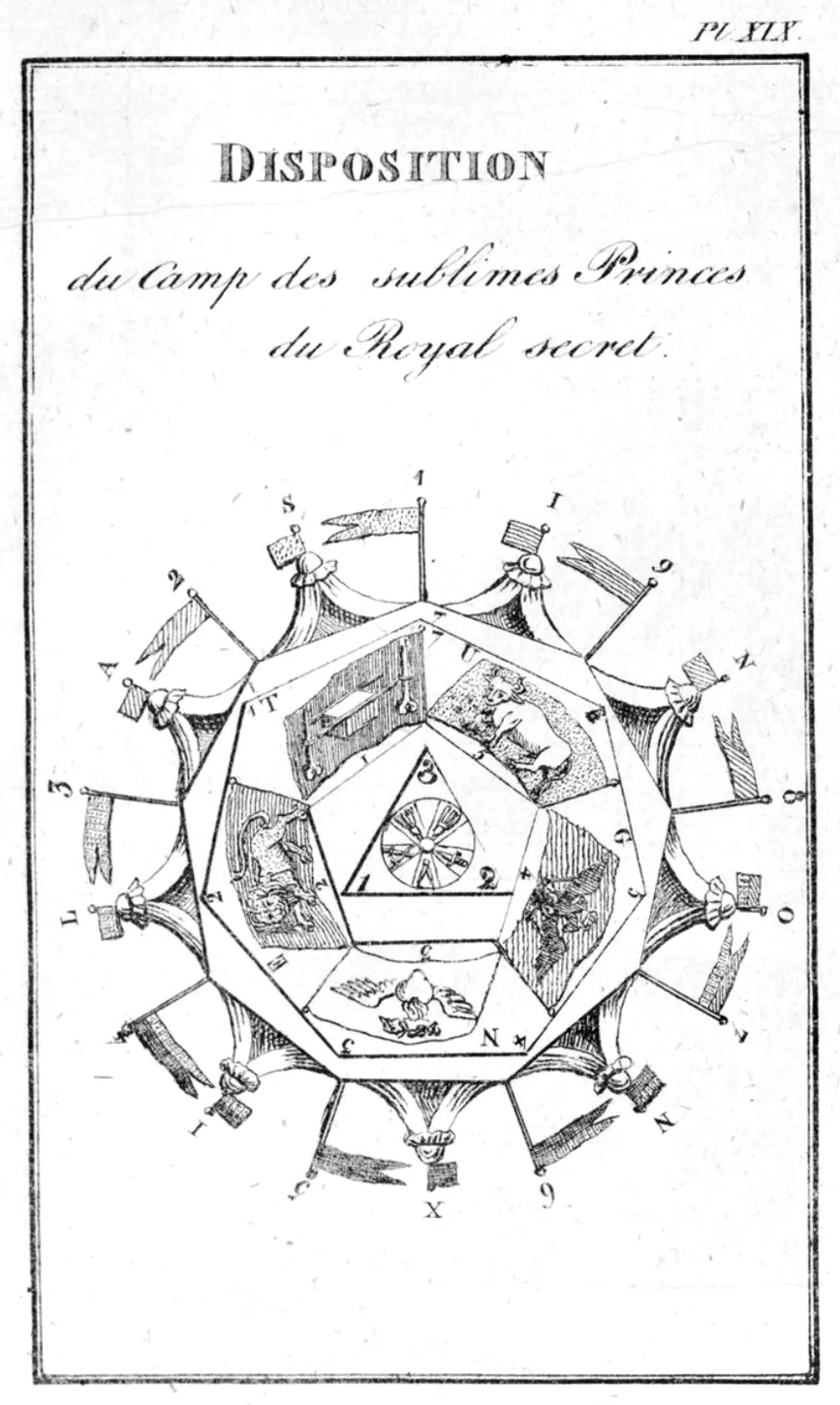
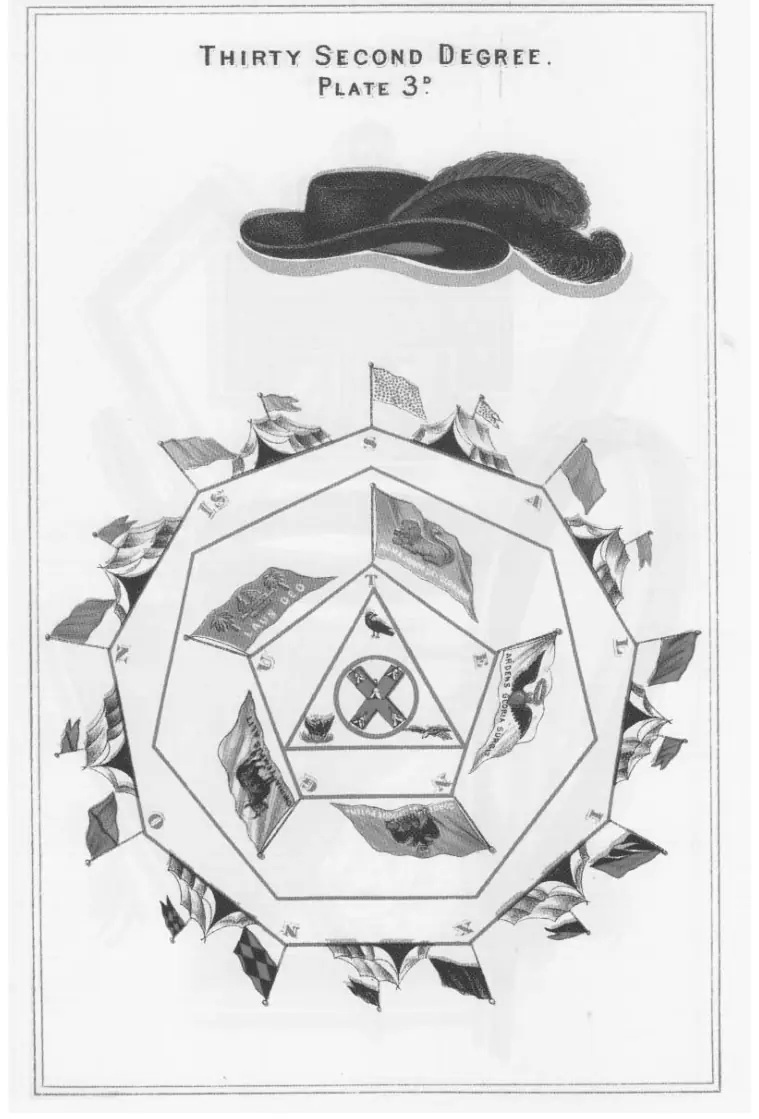
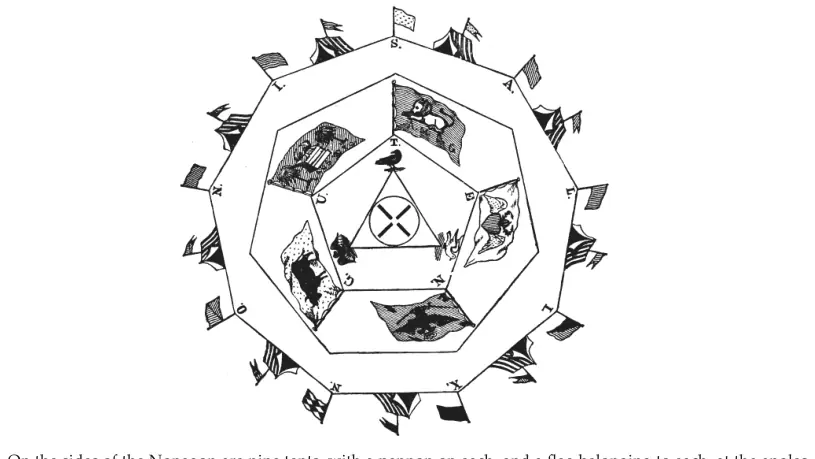
Le Triangle △ représente le centre où seront les chevaliers de Malte qui se joindront à nous et se feront connaître les gardiens fidèles de notre trésor. A leur tête : le prince ou à son défaut les princes... Tous les cinq successivement l'un à l'autre et par rang d'ancienneté ou tous les cinq ensemble recevront l'ordre directement du roi de Prusse. Ils occuperont le [figure d'un pentagone où est inscrit 5] à chaque angle duquel sont les cinq pavillons, savoir l'étendard où le T au lion d'or tenant à la gueule une clef d'or et ayant un collier d'or avec ces lettres S. Q. S. sur un fond d'azur et, au bas, les lettres initiales de ces mots : Ad majorem Dei gloriam. E. au cœur enflammé de gueule ailé de sable et couronné de laurier sinople fond d'argent. N. à l'aigle à deux têtes, une couronne d'or servant de collier aux deux cols ensemble tenant une épée de la serre droite, la pointe en bas, sur un fond sinople. G. au bœuf de sable fond d'or U. à l'arche d'Alliance d'or, deux palmiers sinoples, le fond pourpre avec ces mots : Laus Deo. L'[figure d'un heptagone où est inscrit 7] est pour les princes du Liban et les princes de Jérusalem. Ceux ci recevront les ordres des premiers qui les recevront des princes sublimes. L'[figure d'un ennéagone où est inscrit 9] est pour les neuf camps des maçons en tous grades suivant l'arrangement ci-après. N.B. que chaque tente représente un camp et les pavois et pavillons la couleur du grade. Chaque lettre pour indiquer chaque grade par tente ainsi que chaque lettre pour indiquer les étendards ou pavois [des] pavillons ci-dessus sont [sic] prises des trois mots consacrés aux seules cérémonies sublimes. S. au pavillon et pavois blanc, flamme rouge, représente le camp des chevaliers de Rose- Croix ou de l'Aigle blanc ou d'André d'Ecosse. A. au pavillon et pavois vert d'eau représente le camp des chevaliers d'Orient. L. au pavillon et pavois rouge représente le camp des grand élus parfaits maîtres et sublimes écossais. I. au pavillon et pavois noir et rouge représente le camp des chevaliers de la Royale Arche. X. au pavillon et pavois bandes rouges et noires représente le camp des maîtres irlandais. N. au pavillon et pavois noir représente le camp des élus, maîtres élus et chevaliers élus. O. au pavillon et pavois bandes vertes et rouges représente le camp des maîtres anglais. N. au pavillon et pavois vert représente le camp des maîtres parfaits. S. au pavillon et pavois bleu représente le camp des maîtres symboliques et volontaires. Les noms des neuf camps sont : S. Malachias ; A. Zorobabel ; L. Nehemias ; I. Homen ; X. Phaleg ; N. Joyada ; O. Eliab ; N. Josué ; S. Esdras. Heures indiquées
La cinquième après Soleil couché par cinq coups de canon ainsi tirés : 1 et 4.
Rendez-vous
A Paris au temple, à Naples au Palais royal, à Rome au Capitole, à Malte à l'hôtel, en mer de l'île de Chypre, où se rendra l'armée navale de toutes les nations, après avoir passé pour second rendez-vous au port de Malte et le troisième rendez-vous est à Jérusalem, où sont nos gardiens fidèles.
Les noms des garde-étendards sont : Bezeleel, Eliab, Manchem, Garinous et Emerk.
Les mots de l'Ordre pour chaque jour de la semaine qui ne changeront que par la volonté du roi de Prusse commandant général, sont ainsi : Ezechiel Cyrus Dimanche
Les mots de passe sont : Lundi Daniel Darius Demande : Poolkal... séparés Mardi Habacuc Xerces Réponse : Pharaskal... réunis Mercredi Sophonie Alexandre
Pour accomplir Jeudi Aggée Philadelphe ils disent ensemble : NIKA-MEKA Vendredi Zacharie Hérode Les mots pour ouvrir et fermer le conseil Samedi Malachie Ezéchias souverain des princes sublimes [69v°]…
[69v°] …sont : le premier officier dit : SALIX, le second dit : NONIS, et le troisième : TENGU, qui signifie : Ralliement des frères sages.
Toutes les lettres de ces mots de l'ouverture du conseil prises l'une après l'autre sont les initiales de cette prophétie : Soutenons à présent ; l'invincible Xercès nous offre notre incomparable trésor sacré et nous gagnerons victorieusement… Les princes sublimes posséderont les trésors comme aux anciens temps et les chevaliers de Malte qui s'y joindront auront les mêmes honneurs et prérogatives
Les princes de Jérusalem seront reçus commandeurs de l'Aigle noir et commanderont les chevaliers d'Orient, les grands écossais, les symboliques et les volontaires avec le mot de passe à triple prononciation.
Imitons notre grand-maître qui jusqu'à la fin mit son espérance au Grand Architecte de l'Univers et proféra les dernières paroles en passant d'ici à la gloire : Spes mea in deo est182. La partie supérieure du frontispice est : Virtute et silentio.
Le signe se fait en levant les bras ouverts les mains renversées les doigts écartés et les laisser retomber sur les cuisses. L'aigle qui ouvre ses ailes en signe de protection pour les ordres, qui lui sont soumis.
[Signature]
Apparat critique de la transcription Aeditimus
182. Psaume LXII, 7 (Vulgate).
183. Cf. note 17, page 22 de la présente transcription (page 8r° du manuscrit).
184. A été l’objet d’une publication dans Renaissance Traditionnelle, n° 79, juillet 1989. Cf. article de Rogez Dachez, « Les élus coëns à Saint-Domingue. En 1767-1768. Textes d’instruction sur les deux premiers grades bleus », p. 189-192 (présentation) et p. 197-203 (transcription).
185. Nous donnons ci-après le commentaire de Roger Dachez (article cité supra) : « Cette distinction en trois classes, sans plus de détail, semble a priori se référer à une distribution des grades où les trois grades bleus, ainsi que le précise le discours, forment la “première classe”. Il serait plus aventuré de répartir les autres grades du système. »
186. Nous donnons ci-après le commentaire de Roger Dachez (article cité supra) : « Il s’agit en fait de deux versets de Prov. VIII, selon la Vulgate : - “Dominus possedit me in initio viarum suarum, antequam quidquam faceret a principio” Prov. VIII, 22. (Traduction de la Bible de Jérusalem : “Yahvé m’a créée au début de ses desseins, avant ses œuvres les plus anciennes.”) - “Cum eo ream, cuncta componans” Rov. VIII, 30. (Traduction de la Bible de Jérusalem : “J’étais à ses côtés comme maître d’œuvre.”) Dans ces versets, c’est la Sagesse qui s’exprime et fait son propre éloge. »
187. Nous donnons ci-après le commentaire de Roger Dachez (article cité supra) : « Cette attribution paraît cohérente avec la note qui figure à la suite du catéchisme d’Apprenti, faisant de Caïn l’un des “trois compagnons” (allégoriquement évoqués dans la légende d’Hiram ?). Quant à Abel, c’est très classiquement une figure du Christ ; son association au troisième grade est donc logique. »
188. Nous donnons ci-après le commentaire de Roger Dachez (article cité supra) : « L’évocation de ces colonnes d’avant le Déluge est très remarquable, puisqu’elle fait évidemment référence aux “deux colonnes” renfermant toutes les sciences, et destinées à l’humanité régénérée. Apparues dans Flavius Josèphe et notamment transmises en Europe par Pierre Comestor, ces deux colonnes figurent en bonne place dans les “Old charges”, les “Anciens Devoirs” de la Maçonnerie anglaise, et Anderson en fait naturellement mention dans l’Histoire du Métier qui figure en tête des Constitutions de 1723. Ces deux colonnes sont beaucoup moins familières aux Maçons français du XVIIIe siècle. Toutefois elles pouvaient être connues grâce à la traduction de l’œuvre d’Anderson publiée par La Tierce, en 1742, qui eut un succès certain et une grande diffusion. »
189. A été l’objet d’une publication dans Renaissance Traditionnelle. Cf. article cité supra, p. 192-196 (présentation) et p. 204-206 (transcription).
190. Nous donnons ci-après le commentaire de Rogez Dachez (article cité supra) : « Nous avons signalé que notre texte permet de combler une lacune de la version Faivre-La Haye, avec le mot “tiers”. Si l’on reprend le schéma de la cosmogonie martinésiste, telle que l’expose notamment le “Traité de la Réintégration”, nous voyons qu’après avoir “émancipé” diverses classes d’esprits dans “l’immensité surcéleste” (premier des trois mondes étrangers à Dieu lui-même, ou “immensité divine”), Dieu procéda, en raison de la prévarication des esprits pervers, à une seconde émancipation, au terme de laquelle Adam fut constitué gouverneur de “l’immensité céleste” (deuxième monde) et de “l’immensité terrestre” qui devait servir de prison aux esprits rebelles. Adam, marqué par le nombre 4, occupe bien, comme le montre la “Figure Universelle” de Martinès de Pasqually, la jonction entre l’immensité surcéleste dont il est issu, d’une part, et les deux immensités céleste et terrestre qu’il doit gouverner, d’autre part. On peut ainsi comprendre qu’il est “Chef sur les deux tiers”. »
191. Le manuscrit porte : possede, ce qui semble devoir être rendu en fait par : procède.
192. Un catéchisme d’Apprenti donné par Antoine Faivre (document La Haye) continue la description du Temple. Dans le manuscrit Baylot, cette description reprend avec le catéchisme de Compagnon.
193. A été l’objet d’une publication dans Renaissance Traditionnelle. Cf. article cité supra, 192-196 (présentation) et p. 207-211.
194. Nous donnons ci-après le commentaire de Roger Dachez (article cité supra) : « L’attribution du deuxième grade à la prévarication d’Adam est déjà bien établie ici. Dans des textes plus tardifs, décrivant la cérémonie synthétique des trois premiers grades “remis en un seul”, on lit encore : “Au grade de Comp il retrace la prévarication du premier homme par celle de Kain tipe de celle des premiers esprits rélégués au midy (…)” (cf. R.T. n° 73-74, p. 94). »
195. Nous donnons ci-après le commentaire de Roger Dachez (article cité supra) : « Selon un enseignement constant de “l’arithmosophie” martinésiste, le nombre 5 est le nombre “diabolique” par excellence, combinant le nombre de la matière (3) et celui de la confusion (2). »
196. A été l’objet d’une publication dans Renaissance Traditionnelle. Cf. article cité supra (p. 212-213).
197. Nous donnons ci-après le commentaire de Roger Dachez (article cité supra) : « Il s’agit de la seconde lacune de la version Faivre-La Haye. Le mot “souche”, pour désigner une génération d’hommes, est déjà utilisé deux réponses plus haut. »
198. A été l’objet d’une publication dans Renaissance Traditionnelle. Cf. article cité supra (p. 211).
199. Roger Dachez met ici pentacule.
Manuscrit Quesada 1804 (copie 1813-1821)
manuscrit · BNE Mss 7834 · 13 821 mots
Le manuscrit Quesada (Mss 7834 de la Bibliothèque Nationale d'Espagne) : copie (1813-1821) d'un état du Rite de 1804, voire antérieur, tel que pratiqué dans la mouvance du Suprême Conseil d'Amérique. Les didascalies du manuscrit sont en italique. Le texte est celui de l'édition Latomia, donnée en vis-à-vis du fac-similé du manuscrit : l'apparat critique de cette édition est repris ici, de même que les repères de folio du manuscrit.
Texte intégral sur ce site · transcription C. M. & P. T., Latomia / Chantier de fouilles maçonniques, d'après le Mss 7834 de la BNE
1
Fidèle gardien du trésor sacré et Vail∴ P ce∴ de R al∴ Secret (1).
Décoration et disposition des appartements
Les assemblées de ce grade se tiennent, en campagne, sur un terrain élevé, et dans un bâtiment au moins à deux étages. Au 1er. seront trois appartements. Le 1er. sert à préparer le candidat. Le 2e. est destiné aux réceptions ; et le 3e., aux réunions du Consistoire.
1 er. appartement.
Un cabinet suffira pour la préparation du Candidat.
(1) Ce grade doit être consulté comme le nec plus ultra de la Maçie∴
templière : non seulement dans le Rit de Perfection, qui n’en suppose aucun qui lui soit supérieur ; mais encore dans le Rit Ancien et Accepté, qui assurément ne doit envisager dans son 33e., qu’une fonction administrative. On trouvera dans le cours de cette instruction, des détails qu’ignorent les Maçons les plus instruits de l’un et l’autre Rit. En effet, on ne connait en France de ce grade, que la décoration, le Signe, les Mots d’ordre et de Passe, les hiéroglyphes et la formule de la prestation de serment. On ignore 1°. la véritable manière d’ouvrir et de fermer les Trav∴ ; 2°. tout ce qui est relatif à la Réception, excepté l’obligation ; 3°. les circonstances des cinq voyages ; 4°. les différentes invocations de l’Être Sup∴ ; 5°. les Mots Sacrés, ainsi que l’Attouchement ; 6°. l’instruction &a. Cette note ainsi que les suivantes sont du T∴ Ill∴ F∴ Cte. d’Orfeuille, qui, en 1818, communiqua ce manuscrit au Sup∴ Conseil du 33e. degré. 1064 2
Second Appartement.
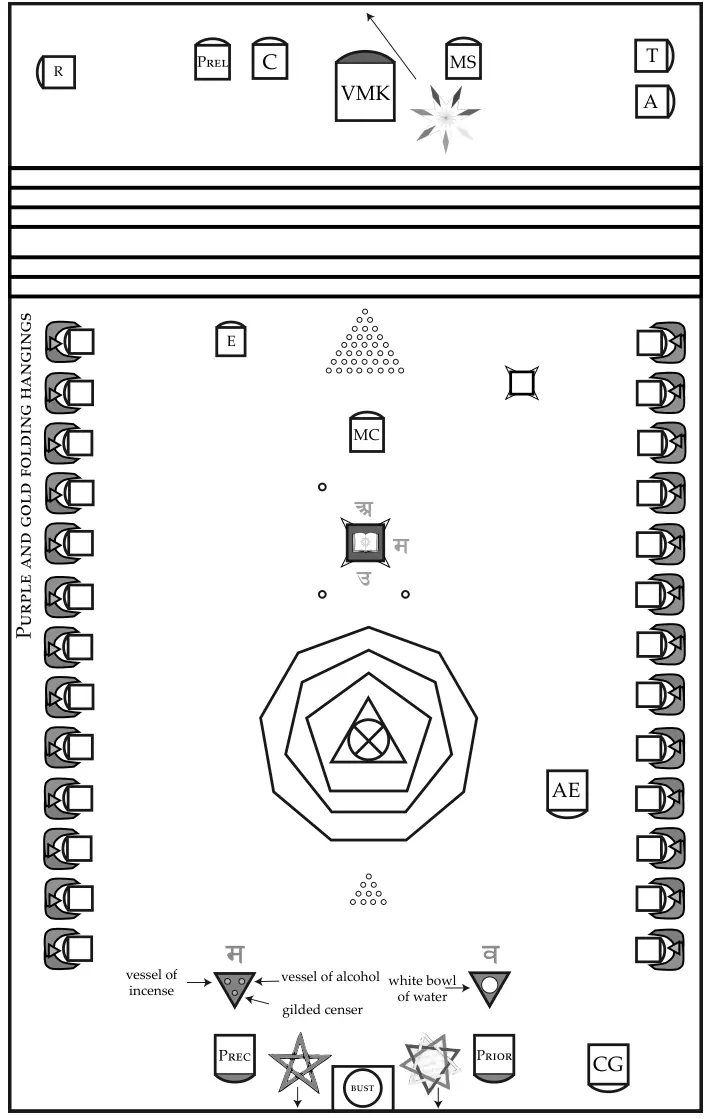
La chambre de Réception sera tendue en noir ; parsemée de larmes blanches, de squelettes, de têtes de mort, et d’os en sautoir. À l’Est est un trône élevé de sept marches garnies de satin noir, parsemé de flammes ardentes. Le Président, qualifié de Gd∴ Commandeur Souverain des Souverains, s’y place ; et a devant lui une table couverte de satin noir, parsemé de larmes blanches. Sur cette table, sont le sceptre du Gd∴ Commandeur, une balance, et les Statuts de l’Ordre, et sur le devant, une tête de mort, et deux os en sautoir. Les lettres initiales J∴ et M∴ ( Jacques Molay ) sont, la première, sur la tête de mort ; et la 2e. sous les deux os. Le Gd∴ Comm∴ est couvert, et armé d’une épée et d’un bouclier. À l’Ouest, sont les deux Surv∴, nommés Sub∴ Lieutenants Commandeurs. 1066 Ils sont couverts, et ont un bouclier. On place devant eux deux épées en croix, sur une table garnie de cramoisi bordé de noir et parsemé de larmes blanches ; avec les lettres N∴ K∴ M∴ K∴ bordées en or sur le devant, et initiales du Mot de Passe. Le Ministre d’État est à la droite du Souv∴, et remplit les fonctions d’Orateur. Le Gd∴ Chancelier est à gauche. Le Gd∴ Hospitalier est placé après le Ministre d’État ; et le Gd∴ Trésorier, après le Gd∴ Chancelier. Au-dessous d’eux, sont placés, d’un côté, le Porte-Enseigne du Grand Commandeur ; et de l’autre côté, le Capitaine des Gardes. Plus bas, sont placés, à droite et à gauche, 14 Chevaliers en habit rouge et sans tablier ; portant sur la poitrine, au bas d’un large ruban noir en sautoir, Le 1er., le Bijou des Chevrs∴ K∴ H∴ ; Le 2e., celui de Chev r∴ du Soleil ; Le 3e., celui du Serpent d’Airain ; Le 4e., celui de Chev r∴ Prussien ; 3 Le 5e., celui de Gd∴ Pontife ; Le 6e., celui de Souv∴ Pce∴ R∴ C∴ ; Le 7e., celui de Chev r∴ d’Orient ; Le 8e., celui de Gd∴ Écossais de la Voûte Sacrée ; Le 9e., celui de Ral∴ Arche ; le 10e., celui d’Ill∴ Élu des 15 ; Le 11e., celui de Prévôt et Juge ; Le 12e., celui d’Intendant des Bâtiments ; Le 13e. , celui de Me∴ Parfait ; Le 14e., celui de Maître. Les cinq premiers désignés par les noms de Béséleel, Ooliah, Machsim, Garimont et Amariah, sont les porte-étendards des cinq corps de troupes campés autour du pentagone, et dont il sera parlé. Les neuf autres, désignés par les noms Malachias, Zorobabel, Néhémias, Hoben, Phaleg, Joiada, Abda, Josué et Esdras, sont également les chefs de neuf autres corps, campés autour de l’ennéagone. Au milieu de l’Appartement, sera tracé un ennéagone, dont chaque angle sera indiqué par l’une des lettres S∴ A∴ L∴ I∴ S∴ N∴ O∴ N∴ I∴ ; et l’espace à droite et à gauche de ces lettres, sera censé être occupé par les neuf derniers corps d’armée, savoir : Le 1er., des Chevrs∴ R∴, de Chev r∴ d’Or∴ et d’Occid∴, et de Pce∴ de Jérusalem ; Le 2e., des Chevrs∴ d’Or∴ ou de l’Épée ; le 3e., des Grands Écossais de la Voûte Sacrée ; Le 4e., des Gds∴ Mes∴ Architectes, et de ceux du Collège de Ral∴ Arche ; Le 5e., des Mes∴ Élus des 9, des Ill∴ Élus des 15, et des Sub∴ Chevrs∴ Élus ; Le 6e., des Intendants des Bâtiments ; Le 7e., des Prévôts et Juges, et des Secrétaires Intimes ; Le 8e., des Mes∴ Parfaits et des Maîtres Secrets ; et le 9e., des Maîtres Maçons et volontaires. Dans l’ennéagone, sera écrit un heptagone ; et dans celui-ci, un pentagone, dont les angles seront désignés par les lettres T∴ J∴ N∴ G∴ V∴ ; et à droite et à 1067 4
gauche de ces angles, seront censés campés les cinq corps suivants : 1°. celui des Chev∴ K∴ H∴, et des Gds∴ Écossais de St. André d’Écosse ; 2°. ceux des Chev∴ du Soleil, des Commrs∴ du Temple, et des Princes de Mercy ; 3°. ceux des Chev∴ du Serpent d’Airain, des Princes, et des Chefs du Tabernacle ; 4°. ceux des Chev∴ Prussiens, et des Princes du Liban ; et 5°. ceux des Maîtres des Loges, et des Grands Pontifes. Dans le pentagone, sera tracé un triangle ; et dans celui-ci, un cercle. Aux angles intérieurs du triangle, seront censés campés les Princes du Ral∴ Secret, les Gds∴ Inspecteurs-Inquisiteurs, et les Chev∴ de Malte qui auront joint l’armée. Il résulte de ce qui vient d’être dit, qu’en y comprenant un Gd∴ Me∴ de Cérém∴,
un Préparateur et deux Gardes, le nombre des membres nécessaires pour une réception }
est de 27 ; savoir : 1°. le Gd∴ Commandeur, 10°. le Me∴ des Cérém∴, 19°. Malachias, 2°. le 1er. Lieutenant, 11°. le Préparateur, 20°. Zorobabel, Chefs de l’Ennéagone 3°. le 2d. Lieutenant, 12°. le 1er. Garde, 21°. Nehemias, 13°. le 2d. Garde, 4°. le Ministre d’État, 22°. Hoben, 5°. le Gd∴ Chancelier, 14°. Béséleel, 106823°. Phaleg, Porte-étendards 6°. le Gd∴ Hospitalier, 15°. Ooliab, 106924°. Joiada, 7°. le Gd∴ Trésorier, 16°. Machsim, 107025°. Abda, 8°. le Gd∴ Porte-étendard, 17°. Garimont, 26°. Josué, 9°. le Capne. des Gardes, 18°. Amariah, 27°. Esdras. Ce nombre est indispensable, pour faire convenablement une réception. L’impossibi- -lité de réunir autant de membres a fait si souvent supprimer le cérémonial, qu’on a cru se contenter même de l’obligation du Récipiendaire. C’est sans doute ce qui a donné lieu à l’imperfection des cahiers de ce grade, qui circulent. L’Est représente une Gloire, qui, à certains points de la réception, est remplacée par la perspective de la ville de Jérusalem ; ainsi qu’on le dira par la suite (1). (1)À chaque angle tracé dans le pentagone, on figure quelque fois un corbeau, une colombe et un phénix ; mais sans en donner d’autre explication que celle qui se trouve à la fin de l’instruction du grade. – Dans cet Appartement, tous les membres sont placés dans l’ordre ci-dessus indiqué ; et revêtus du manteau du Templier, sur lequel est la Croix Teutonique. Tous sont couverts d’un chapeau orné de plumes blanches et de ganses d’or, tels qu’on les portait sous Henri IV 5 Les assemblées ne se tiennent que le jour, et sont nommées Consistoires.
3 e. appartement.
Le 3e. appartement, qui sert aux tenues ordinaires du Consistoire ; représente un Temple soutenu par des Colonnes d’or : on y entre pour les 5 voyages de la Réception. au 1er. voyage, l’Est représente le port de Naples ; au 2d., celui de Malte ; au 3e., celui de Rhodes ; au 4e., celui de Chypre ; au 5e., celui de Jafa. Ce changement s’opère par des tableaux que l’on place à l’Est, selon la circonstance. Les trois principaux Officiers n’ont point de maillet ; et ne frappent qu’avec le pommeau de leur glaive (1).
Ouverture du Consistoire
Le Gd∴ Commandeur frappe, et dit :
« Sublimes Princes, Valeureux Lieutenants, faites occuper les postes avancés. « Que les preux Chevrs∴ s’emparent des issues par lesquelles on pourrait parvenir « jusqu’à nous. Faites fermer les barrières du camp ; et prenez, pour la « sûreté de l’armée, toutes les précautions que la prudence pourra vous « suggérer.
Les Lieutenants, ayant exécuté l’ordre, frappent ; puis ils disent :
(1)Dans quelques Consistoires, les 3 principaux Offrs∴ont chacun devant eux, un tambour ; sur lequel ils exécutent la Batterie, avec une branche d’acacia.
6
Souv∴ Gd∴ Comm r∴ ! L’armée est en sûreté.
Alors, le Gd∴ Commandeur dit :
« Sublimes Lieutenants ! Il ne suffit pas que l’ennemi ne puisse « parvenir jusqu’à nous ; il importe aussi que nous soyons assurés de « tous ceux qui se sont réunis sous nos étendards. Vaillants Princes ! « Visitez les camps confiés à votre surveillance : inspectez les différents corps « de l’armée ; et voyez si tous les fidèles gardiens, les valeureux Chevaliers, les « braves Élus, les dignes Maîtres et les autres défenseurs de nos droits, sont « à leurs postes. Examinez surtout si quelqu’un, dans l’espoir de connaître « nos projets, ne se serait pas introduit sous nos tentes.
Les Lieutenants font l’inspection des camps ; puis ils disent :
Souv∴ Gd∴ Comm∴ ! Nul ennemi ne s’est introduit sous nos tentes : chacun de nos braves compagnons est à son poste ; et attend, pour agir, que le signal soit donné.
Le Gd∴ Comm∴ fait ensuite aux Lieutenants les questions suivantes.
« Sub∴ 1 er. Lieutenant ! À quelle heure devez-vous agir ? » D∴ À la 5 e. heure après celle du coucher du Soleil. R∴
D∴ « Pourquoi, Sub∴ Prince, ne pourrions-nous pas agir auparavant ? »
R∴ Parcequ’auparavant nous serions exposés aux regards de nos ennemis ; et que ce n’est que pendant qu’ils sont livrés au sommeil et dans l’obscurité de la nuit, que nous pouvons réaliser nos projets de restauration.
D∴ « Sub∴ Prince, second Lieutenant ! Quelle heure est-il ? »
R∴ Grand Comm∴ ! Le canon que l’on tire, annonce que cinq heures se sont écoulées depuis le coucher du Soleil. (1)
Le Grand Commandeur frappe, et dit :
« Puisqu’il est l’heure d’agir, et que, dans l’un et l’autre camp « de l’armée, tout est prêt pour le Grand Œuvre ; annoncez, Sublimes « Lieutenants, à vos braves compagnons, que nous allons agir. »
(1)Lorsque le 2d. Lieutt∴ fait cette réponse, il a dû être imité sur une grosse caisse, cinq coups de canon.
7
Les Lieutenants font l’annonce. Le Gd∴ Comm∴ frappe 5 coups !- !!!! Puis il dit : « Salis.(1) Le 1er. Lieutt∴ en frappe 5 autres !- !!!! Puis il dit : Noni.(2) Le 2d. Lieutt∴ ayant répété les 5 coups !- !!!! dit : Tengu.(3) Le Grand Comm∴ et tous les Vaillants Princes applaudissent par 5 coups !- !!!! Puis ils disent 3 fois : Laus Deo ! Le Gd∴ Comm∴ frappe un coup ! Puis il dit :
« Vaillants et Sub∴ Princes ! Le Consistoire est ouvert. »
On donne lecture du Bal∴ des Travx∴ précédents ; puis on introduit les visiteurs.
Réception.
Pendant l’ouverture des Trav∴, le Récipiendaire est conduit à la Chambre de Préparation, et y attend qu’on le vienne chercher. Les Trav∴ ouverts, le préparateur le mène aux avantpostes : les Gardes les arrêtent ; et l’un d’eux dit au préparateur :
Vaillant Prince ! Que demandez-vous ?
(1) Ces cinq lettres sont les initiales des mots hébreux, Schakar Adith Leos
Ialak Sabib qui signifient : 1071 De nos Frères errants prépare le retour.
(2) Ces 4 lettres sont également les initiales des quatre mots hébreux,
Nabal Obed Naki Israel c’est-à-dire : 1072 Qu’à l’aspect des vertus, l’intrigue erre à son tour.
(3) Ces 5 autres lettres sont les initiales des mots hébreux suivants :
Tara En Nebalah Ghebul Uria 1073
que l’on traduit ainsi :
Fuis le méchant, il ne songe qu’à nuire : Écoute le Maçon, il ne veut que t’instruire. 1074
8 Le préparateur répond :
Sub∴ Prince ! Je demande la permission de présenter au Souv∴ Gd∴ Comm∴, un Gd∴ Insp r∴ Inquisiteur dont je réponds.
Le Garde lui dit :
Je suis persuadé des bonnes intentions du F∴ Inquisiteur que vous nous présentez : cependant je ne peux le laisser passer, sans y être autorisé. L’un de vous va se rendre auprès du Souv∴ Gd∴ Comm∴ ; et je ne doute pas que vous n’obteniez, pour ce Chevalier, la faveur que vous sollicitez.
L’un des Gardes se présente à la barrière du camp ; et annonce que le Vail∴ Prince N..... demande la permission Gd∴ Gd∴ de présenter au Souv∴ Comm∴, un Inquisiteur dont il répond. L’annonce parvenue au Gd∴ Comm∴, celui-ci dit :
« Sub∴ Lieutenant ! Ordonnez que l’on s’assure de l’étranger « qui se présente. Le témoignage du Vail∴ Prince qui nous « l’amène, est assurément d’un grand poids : cependant, la « prudence exige des précautions que je vous invite à ne pas « négliger ; et ce n’est qu’après que vous les aurez prises, que « les barrières des camps pourront lui être ouvertes.
Les Lieutenants donnent les ordres nécessaires. Le Garde les transmet à son chef, qui ordonne à deux des Chevrs∴ du poste de s’emparer du Récipiendaire. Ils lui demandent son épée ; et le conduisent aux barrières du camp où ils frappent neuf coups. On annonce au Gd∴ Comm∴ que l’on frappe en Grand Inspecteur-Inquisiteur. Le Gd∴ Comm∴ fait demander qui frappe ainsi. Le chef de l’escorte répond :
Nous amenons le Gd∴ Insp∴-Inquis r∴, que le Souv∴ des Souv∴ à permis de conduire ici.
9 Le Gd∴ Comm∴ frappe et dit :
« Vaillants Princes ! C’est sans doute un nouveau secours que la « Providence nous envoie. Nous ne pouvons opposer trop de bras « aux infidèles qui nous ont dépouillés. – Je ne sais quoi me prévient « en faveur de cet inconnu : peut-être a-t-il autant de courage que « de talents ; et sa présence peut nous être d’un grand avantage. « Cependant je ne veux rien faire en cette circonstance, sans vous « avoir consultés. « Sublimes Lieutenants ! Demandez aux Vail∴ Princes et « Chevrs∴ réunis sous vos tentes, s’ils sont d’avis que le Gd∴ Inquis r∴ « que l’on vous présente, soit introduit pour être entendu. »
Tous font, avec le glaive, le Signe d’Acquiescement. Le Gd∴ Comm∴ continue ainsi :
« Que les barrières des camps soient ouvertes ; et que l’inconnu « soit introduit, avec les précautions d’usage. »
Le Récipre∴ est introduit. Deux Gardes sont à ses côtés : l’un tient la corde dont il est attaché ; et l’autre lui place une main sur l’épaule. Le préparateur est derrière lui, pour l’aider dans ses réponses. Le cortège arrivé près des Lieutenants, ceux-ci l’annoncent au Gd∴ Comm∴, qui fait au Récipre ∴ les questions suivantes :
D∴ « Qui êtes-vous ? »
R∴ L’un des amis de la sagesse, errant depuis longtemps dans des contrées lointaines ; et attendant le rétablissement d’un Ordre injustement proscrit.
D∴ « Que faisiez-vous, dans cet espoir ? » Honoré du titre de Gd∴ Inquis r∴, je faisais religieusement observer R∴ nos Statuts aux FF∴ volontairement soumis à ma surveillance.
D∴ « Quelle était la base de votre conduite ? »
R∴ Justice, Équité.
10
D. « Que demandez-vous ? » R. La fav∴ de concourir, avec tous les Vail∴ Princes ici présents, à la restauration du Temple. D. « Quels sont vos moyens pour y parvenir ? » R. Courage et loyauté. D. « Croyez-vous que cela suffise ? » Puisst∴ Gd∴ R. Non, Comm∴ : l’un et l’autre seraient sans succès, sans l’assistance de celui qui peut tout.
Alors, le Souv∴ Gd∴ Comm∴ dit :
« Grand Inquisiteur ! Vos réponses sont satisfaisantes. Vous me « paraissez animé d’un motif légitime. Vos titres sont réels et vos « espérances sont fondées, mais vous n’ignorez pas que nos actions « seraient sans mérite, si elles n’étaient parfaitement libres ; et que n’est « le courage serait inutile, 1075 qu’autant qu’il est suffisamment éclairé. « Il faut donc, pour arriver au but que vous vous proposez, qu’à « la pureté des intentions vous réunissiez les lumières et les talents. « Le plan que vous avez conçu, est vaste : il est honorable pour « vous, et favorable à vos FF∴. Je dois néanmoins vous prévenir « qu’il suppose des moyens d’exécution, que peu de nous peuvent « se flatter d’offrir : ils sont le fruit d’une étude longue et « réfléchie. Nous aimons à croire que vous possédez, ces moyens ; « mais nous désirons en trouver la preuve, dans vos réponses 1076 « aux nouvelles questions qui vont vous être faites. « Vous voyez ici réuni sous mes ordres, tout ce que l’Europe « offre de plus brave et de plus vertueux ; et chacun, dans cette « puissante armée, est employé selon ses forces et ses connaissances. « Près de vous, les moins expérimentés se sont rangés sous la « bannière des Maîtres ; et forment le 1 er. corps d’armée. « Le 2 d. est composé de M es∴ Parfaits et Maîtres Secrets ; « Le 3 e., des Prévôts et Juges, et des Secrét∴ Intimes ;
11
« Le 4 e., des Intendants des Bâtiments ; « Le 5 e., des Élus des 9 et des 15, ainsi que des Sub∴ Chevrs∴ Élus ; « Le 6 e., des G ds∴ M es∴ Architectes, et de ceux du Collège de R al∴ Arche ; « Le 7 e., des G ds∴ Écossais de la Voûte Sacrée ; « Le 8 e., des Chevrs∴ d’Or∴ ou de l’Épée ; « et le 9 e., des Souv∴ P ces∴ R∴, des Chev rs. d’Or∴ et d’Occid∴, et des Princes de Jérusalem. « Ces généreux Maçons forment la plus nombreuse partie de « l’armée ; et leurs tentes, placées en ennéagone, sont désignées par « des lettres et des enseignes, dont on vous donnera l’explication. « Vous ne pouvez être admis dans notre armée ; sans subir, de la « part des principaux chefs, un examen qui les assure des connaissances « que vous avez acquises. « Je vais donc vous faire conduire à leurs tentes ; et chacun « d’eux vous interrogera sur tout ce qui a rapport à la section de « l’armée confiée à leur commandement. « Ill∴ et Vail∴ Me∴ des Cérém∴ ! Conduisez le Gd∴ Inquisiteur « à chacun des chefs de l’ennéagone ; et le présentez-leur 1077 successi- « vement, par les pas et les Signes qui leur sont particuliers. Quand « tous l’auront interrogé, vous me rendrez compte du plus ou du « moins de sagesse qu’il aura mis dans ses réponses.
Les Gardes reprennent leur place. – Le Récipre∴ est conduit, Me∴, par les pas et à l’Ordre de à Esdras ; sur l’épaule duquel il frappe trois coups. Esdras, en lui mettant la pointe de son épée sur le cœur, lui dit :
Que demandez-vous ?
Le Récipiendaire répond :
Sage et Resp∴ Me∴ ! Je viens auprès de vous, commencer l’examen qu’exige le Souv∴ Gd∴ Comm∴ ; et sans lequel je ne puis être admis dans l’armée des Vail∴ P ces∴ de R al∴ Secret.
Folio 295 verso
12 Esdras lui demande les Mots, Signes et Attouchements des 3 premiers grades. Il pourra lui faire quelques questions sur l’instruction de ces grades ; mais il aura soin de les abréger. Sans quoi, et pour peu que son exemple fût suivi, la cérémonie deviendrait trop longue. Le Récip∴ est ensuite conduit dans le même ordre, aux huit autres chefs de l’ennéagone ; savoir : 1°. à Josué, qui l’interroge sur les grades de Me∴ Parfait et de Me∴ Secret : 2°. à Abda, qui le questionne sur ceux de Prévôt Juges et de Secrét∴ Intime : 3°. à Joiada, auquel il répond sur celui d’Intend t∴ des Bâtiments : 4°. à Pholeg, 1078 qui l’interroge sur les 3 grades d’Élus : 5°. à Hoben, qu’il satisfait sur ceux de Gd∴ Me∴ Arch∴ de Ral∴ Arche : 6°. à Nehemias, qui l’interroge sur celui de Gd∴ Écossais de la Voûte Sacrée : 7°. à Zorobabel, qui le questionne sur celui de Chev r∴ d’Orient, et 8°. à Malachias, qui l’examine sur ceux de R∴ C∴, de Chev r∴ d’Or∴ et d’Occidt∴, et de Prince de Jérusalem. Cet examen terminé ; le Me∴ des Cérém∴, qui y a fait la plus grande attention, reconduit le Récipre∴ entre les deux Lieutenants, et, ayant ‘‘ et obtenu ’’ demandé ‘‘ la parole, il dit :
Souv∴Gd∴ Comm∴ ! Le Chevr∴ Gd∴ Insp r∴-Inquisit r∴ a satisfait entièrement à toute les questions qui lui ont été faites, et je demande qu’en considération des connaissances qu’il a montrées en cette circonstance, il soit admis dans l’armée.
Le Gd∴ Comm∴ dit au Récipiendaire :
« Brave Commandeur ! Les connaissances que vous avez montrées, « prouvent que vous êtes digne de prendre part à l’entreprise que nous méditons. « Votre conduite annonce que vous êtes bien à même de commander au « vulgaire des Maçons, mais nous avons parmi nous des Chevrs∴ d’une classe « tellement élevée ; que vous ne pouvez, je ne dis pas les surpasser, mais « même les égaler ; si par le fruit de vos études, si par de rares dispositions, « vous n’avez acquis ce haut degré de perfection qui caractérise les Vail∴ Princes
13
« du R al∴ Secret. Il est entre eux et les Chevrs∴ de R∴, une nouvelle suite « d’échelons, par lesquels vous avez dû passer pour vous pénétrer des éléments « de cette science sublime, sans laquelle vous ne pourriez diriger avec succès « l’élite de nos compagnons d’armes dans la plus importante des entreprises. « Vaillant Me∴ des Cérém∴ ! Conduisez ce Commandeur aux cinq « Princes, chefs du pentagone. Présentez-le à chacun d’eux dans le même « ordre, et ainsi que vous l’avez fait auprès des commandants de l’ennéagone. « Qu’il soit interrogé, par eux, sur les douze degrés qui suivent celui de Souv∴ « Prince R∴ ; et vous me rendrez compte du résultat, dont assurément « vous sentez l’importance.
Le Me∴ des Cérém∴ présente le Récipre∴ à chacun des chefs du pentagone par les pas et à l’ordre du grade que chacun d’eux commande : 1079 1°. à Béséléel, qui le questionne sur les grades de Gd∴ Pontife et de Gd∴ Me∴ des LL∴ 2°. à Ooliab, auquel il répond sur ceux de Noachite et de Prince du Liban ; 3°. à Machsim, qu’il satisfait sur ceux du Serp∴ d’Airain, de Pce∴ et Chef du Tabernacle ; 4°. à Garimont, qui l’interroge sur ceux de Chr∴ du Sol∴, de Com∴ du Temp∴ et de Pce. de Mercy ; et 5°. à Amariach, qui l’examine sur ceux de Gd∴ Écos∴ et de Gd∴ Élu Kadosh. Le Me∴ des Cérém∴ ayant ainsi fait subir au Récipre∴ ce nouvel examen, le conduit en avant du Tableau ; et en face du Gd∴ Comm∴, auquel il dit :
Souv∴ Gd∴ Comm∴ ! Le Gd∴ Insp r∴-Inquisit r∴ a pleinement justifié qu’il est philosophe, Chev r∴ du Soleil, et Prince adepte. Il a percé les ténèbres de l’igno- -rance et de la superstition : il a vengé la Maçonnerie ; et, joignant à la pratique des vertus la culture des arts, il est parvenu au sommet de l’Échelle Mystérieuse qui conduit au Temple de la Sagesse.
Le Gd∴ Comm∴ dit au Récipiendaire :
« Les succès que vous avez obtenu jusqu’ici ; les connaissances que vous « avez montrées en tant de circonstances ; votre persévérance dans l’étude de la « sagesse, et la puissante recommandation de votre conducteur, nous portent sans « doute à vous accorder la fav∴ de combattre avec nous. Cependant, il est encore « un point de perfection, sur lequel on ne vous a point interrogé. C’est sur le
Folio 296 verso
14
« grade de la sagesse, sur celui de Gd∴ Insp r∴-Inquisiteur, que vous devez dissiper le « reste de nos doutes ; en nous prouvant que, par votre constance à pratiquer la « vertu, vous êtes réellement digne de la faveur que l’on sollicite pour vous : « et c’est par ce 3 e. examen, que je terminerai mes informations. »
Il lui fait ensuite les questions suivantes.
D∴« Pourquoi, Comm r∴, les deux poignards que vous portez ?
R∴L’un, pour punir le parjure ; et l’autre, pour protéger l’innocence.
D∴« En vous recevant Inquisit r∴, quel est le dépôt que l’on vous a fait ?
R∴Une balance, que l’on m’a mise dans la main gauche ; tandis qu’ayant la droite sur nos Statuts, j’ai prononcé mon obligation.
D∴« Que vous indiquait cette balance ?
R∴Elle m’annonçait qu’en tout temps, je devais juger mes FF∴ avec Justice et Équité.
D∴Donnez-moi la Parole Sacrée. (on la donne)
D∴Donnez-moi le Mot de Passe. (on le donne)
D∴Donnez l’Attouchement au Vail∴ P ce∴ Me∴ des Cérémonies
Le Me∴ des Cérém∴, l’ayant reçu, dit qu’il est juste. Alors, le Gd∴ Comm∴ frappe ; et, s’adressant à tous les membres du Consist∴ il dit :
« Sub∴ Lieutenants ! Vaillants Princes ! Êtes-vous satisfaits des réponses du « Comm r∴Gd∴ Inspecteur-Inquisiteur ; et consentez-vous à l’admettre parmi vous ?
Tous font le Signe d’Acquiescement, avec leurs épées. Le Gd∴ Comm r∴ continue ainsi :
« Commandeur ! Il ne vous reste qu’un pas à faire, pour être admis. Déjà, « nous reconnaissons en vous la masse de lumières suffisantes pour justifier « notre confiance. Ce pas vous allez le faire, avec la même facilité que vous « avez eue à franchir l’espace immense qui sépare le Chaos, du séjour de la « Lumière. Dans votre 1 er. âge, vous avez rempli l’attente de vos maîtres : « bientôt vous avez partagé leurs travaux, secondé leur prévoyance, et soutenu « leur courage. Vous avez ensuite dirigé les ouvriers confiés à votre surveillance ; « vous avez défendu nos droits ; puni les parjures ; affermi notre association ; et donné
15
« de l’éclat à l’Ordre. Tant de services rendus, ne peuvent être sans récompense. « Plus vous avez fait pour nous, et plus sera précieuse la faveur que nous vous « réservons, mais, avant de l’obtenir, veuillez prêter l’obligation qui doit nous « assurer de votre discrétion dans la carrière que vous allez parcourir. « Vail∴ P ce∴, Me∴ des Cérém∴ ! Faites approcher le Comm r∴ par les pas « de son grade, et placez-le au pied du Trône, pour y prêter sa nouvelle « obligation. « Et vous tous, Vail∴ Princes, debout et à l’ordre ! »
Le Me∴ des Cérém∴ conduit au Trône le Récipre∴, qui, à genoux, et la main sur les Statuts Génx∴ de l’Ordre, prononce ce qui suit.
Obligation.
Je N....., de ma propre volonté, en présence du Gd∴ Arch∴ de l’Un∴ ; et du consentement des Souv∴ P ces∴ du R al∴ S∴, fidèles gardiens du trésor sacré, jure et promets solennellement, sous les différentes peines auxquelles je me suis soumis par mes précédentes obligations, de ne jamais directement ni indirectement révéler ou faire connaître à quelque personne que ce soit, aucune chose de ce grade royal : à moins que ce ne soit à quelqu’un dument reconnu initié, et uni au corps d’un Consistoire régulièrement constitué ; après l’avoir reconnu pour tel, par un sévère examen. Je jure et promets, en outre, sous les dites peines, de me conformer aux Statuts et Règlements de ce grade, qui sont maintenant devant moi, et de me conduire dans un Consistoire, comme étant digne d’être honoré de ce Sub∴ grade ; afin que ma conduite ne puisse réfléchir aucune tache sur ce Consistoire royal, ni sur moi-même. – Que Dieu me maintienne dans les devoirs de la Justice et de l’Équité ! Amen. Amen. Amen. Amen. 1080
L’obligation prêtée, le Gd∴ Comm∴ fait relever le Récipre∴ ; et lui rend son épée, en disant :
« Comm∴ ! Je vous remets cette épée. Ne vous en servez, que dans le cas
16
« où la patrie serait en danger ; que votre vie ou celle de vos FF∴ seraient exposées ; « ou pour protéger l’innocence contre le fanatisme ou l’oppression.
Il le fait ensuite placer au-dessous du Gd∴ Trésorier.
Cinq coups de canon se font entendre ; le Gd∴ Comm∴ dit :
« Vail∴ Princes ! L’artillerie annonce l’instant du départ. « Sub∴ Lieutenants ! Rassemblez les différents corps de l’armée. Que « chacun se dispose à marcher sous la bannière de son chef. Que, de toute part, « on se rende à son poste ; et vous, généreux Comm∴, suivez-nous à Jérusalem ; « partagez nos périls et notre gloire, dans l’importante entreprise que nous avons « formée pour la restauration de l’Ordre, et pour le bonheur de l’humanité. »
Chaque Lieutenant charge l’un de ses généraux de former le cortège ; de manière que chaque corps soit formé d’un nombre à peu près égal, et prêt à marcher au 1er. coup de canon. Le coup de canon se fait entendre. L’armée se met en marche sur deux lignes. Esdras, avec les siens, ouvre la marche. Les autres chefs de l’ennéagone le suivent selon leur rang. Après eux, marchent, dans le même ordre, les chefs du pentagone. Ceux-ci sont suivis des Chevrs∴ de Malte, des Gds∴ Insp∴-Inquisiteurs, et des Princes de Royal Secret. Après ceux-ci, marchent sur la même ligne, le Me∴ des Cérém∴, le Récipre∴ et le préparateur. Enfin, la marche est terminée par les principaux Officiers du Consistoire, les deux Lieutenants, et le Souv∴ Gd∴ Comm∴. On passe dans la salle du Consistoire, dont l’Est est couvert par un transparent ou tableau représentant le port de Naples. Lorsque tous sont entrés et à la place accoutumée, debout et à l’ordre, le Gd∴ Comm∴ se découvre, et fait l’invocation suivante : 17
Première prière, au port de Naples.
« Souv∴ Arch∴ des mondes, puissant Jéhovah ! Toi, qui fut de toute éternité ; toi, « qui réside partout, et qui ne peux cesser d’exister, reçois-nous dans le sein de ta divine « miséricorde. Tu permis qu’autrefois une auguste princesse préservât en cette « contrée nos pères, de la persécution qui les menaçait (1) : fais qu’à l’exemple « de cette reine bienfaisante, les puissances de la terre voient sans inquiétude une « démarche qui ne compromet ni leur autorité ni le bonheur des peuples. Amen ! « Amen ! Amen ! Amen ! Amen ! »
Après cette prière, le Gd∴ Comm∴ se découvre ; et le cortège retourne, dans le même ordre, dans la Chambre de Réception. Tous y étant arrivés et placés, le Gd∴ Comm∴ dit :
« Vail∴ et Sub∴ Princes ! Le ciel favorise nos projets ; une terre hospitalière « nous a accueillis. Bientôt nous aborderons de nouvelles contrées ; montrons-nous y « dignes du noble dessein qui nous anime. Que la droiture préside à nos actions. « Abjurons tout sentiment de haine et de vengeance, et, si nous voulons que l’Éternel « couronne nos Trav x∴, jurons de ne rien entreprendre, qui ne tende à sa plus g de∴ gloire.
Tous étendent la main droite, et disent : Nous le jurons ! Pendant cette cérémonie, le tableau de la Chambre du Consistoire est remplacé par un autre, qui représente le port de Malte. Un nouveau coup de canon annonce l’instant du départ. On se met en marche dans le même ordre qu’auparavant. Tous étant entrés et placés dans le second Appartement, à l’ordre, et faisant face à l’Est ; le Grand Commandeur se découvre et dit :
(1) Le roi de Naples ayant proscrit les Maçons de ses États, par un Édit du 12
septembre 1775 ; plusieurs furent arrêtés et emprisonnés, et quelques-uns bannis. Cependant, à la sollicitation de la reine, l’Édit est rapporté le 8 février 1777 ; et la Maçonnerie, tolérée.
18
Seconde prière au port de Malte.
« Dieu de bonté, qui reçois toujours avec indulgence le pêcheur que le « repentir ramène au devoir : toi, qui nous prescris le pardon des injures, « ne permets pas qu’aucun de nous enfreigne le serment qu’il a fait. Accorde « ta protection ; surtout à ceux de nos ennemis qui, à leur tour, se trouvent « dépouillés de ce qu’ils avaient injustement ravi. Que, réunis à nous, les « deux Ordres n’en fassent désormais qu’un seul armé contre l’injustice, le fanatisme « et la superstition. (1) Amen ! Amen ! Amen ! Amen ! Amen ! »
Après cette prière, le Gd∴ Comm∴ se découvre. On passe dans la Chambre de Réception ; au milieu de laquelle on place, en avant de l’ennéagone, une table, sur laquelle sont placés un vase plein d’eau et un purificatoire (2). Chacun se trouvant à sa place et debout, le Gd∴ Com∴ dit :
« Que cette cérémonie soit l’emblème de la pureté qui doit nous caractériser ! « que notre conscience soit irréprochable ; et n’oublions pas que le Gd∴ Arch∴ « de l’Un∴ ne bénira jamais mieux nos Trav x∴, que quand ils auront « pour motif, ou la justice, ou l’équité. »
Le Gd∴ Comm∴ et après lui tous les FF∴ présents, passant leurs épées sous le bras gauche, trempent successivement la main droite dans le vase d’ablution : se l’essuient ; et reprennent leurs épées. Cela fait, le cortège passe dans la salle du Consist∴, pour le 3e. voyage qui, comme les précédents, a été annoncé par un coup de canon.
(1) Depuis que l’Ordre de Malte se trouve dépouillé de ses possessions, il serait
injuste que les descendants des Templiers conservassent contre les Chevaliers les sentiments de haine et de vengeance qui à peine étaient excusables, lorsque ces Chevrs∴ jouissaient du fruit de leur trahison.
(2) On appelle ainsi un linge fin, dont on se sert dans les églises catholiques,
pour s’essuyer les doigts ou même les vases sacrés.
19 Le tableau du port de Malte est remplacé par celui de Rhodes. Retourné à cette seconde pièce, le Gd∴ Comm∴ se découvre, et fait la 3e. prière, pendant laquelle on remplace dans la salle de réception le vase d’ablution, par un réchaud plein de feu ou par l’Autel des Sacrifices.
Troisième prière, au port de Rhodes.
« Source inépuisable de perfection ! Dieu saint, dont la bonté paternelle a « placé dans nos âmes un flambeau pour la diriger ! Ne permets pas que, « pendant le cours de cette vie, aucune action criminelle puisse souiller le « pureté du Temple que nous t’élevons dans nos cœurs. Amen ! Amen ! Amen ! Amen ! Amen !
Le Gd∴ Comm∴ se recouvre. – L’on passe dans la salle de Réception : chacun s’y place selon son rang ; et le Gd. Comm∴ dit, en s’approchant de l’Autel des Sacrifices :
« Faisons tous, sur cet Autel, le sacrifice de nos passions. « Abjurons toute pensée ou désir, contraires à nos principes. « Que la Lumière de la vérité dissipe les ténèbres de l’ignorance. « Qu’un feu céleste excite, multiplie et conserve en nous, l’amour de nos devoirs. »
Le Gd∴ Comm∴ met son épée dans la main gauche, et passe 5 fois la droite sur le feu. Tous les membres en font autant. Puis ils se rendent à la salle du Consistoire, où le tableau du port de Rhodes a été remplacé par le perspective de celui de Chypre. Le Gd∴ Comm∴, découvert, fait la prière suivante.
4 e. prière, au port de Chypre.
« Seul et vrai principe de toute Lumière ! Feu sacré, qui fécondes et conserves « l’Univers ! Être puissant, que l’on conçoit ; mais qu’on ne peut définir ! Enflamme « nos cœurs de l’amour des vertus. Dieu miséricordieux ! Détruits en nous, tout
20
« sentiment d’orgueil ou d’envie ; et bénis l’entreprise que nous n’avons « formée, que pour la gloire et le bonheur de l’humanité. Amen ! Amen ! Amen ! Amen ! Amen !
Le Gd∴ Comm∴ se recouvre. Le cortège retourne dans la salle de Réception, où l’Autel des Sacrifices a été remplacé par celui des Parfums. Le Gd∴ Com∴ dit :
« Des ennemis nous entourent : joignons à la simplicité de la « colombe, le courage du lion et la prudence du serpent. Depuis que « l’arabe insolent commande en ces contrées, tout est à craindre « pour nous : évitons, de sa part, toute espèce de surprise. Notre « bravoure et le sort des combats vont peut-être nous isoler de « leurs bataillons : en cas de dispersion, ayons, pour nous recon- « -naître, des Mots ; et, par cette précaution, sachons éviter tout « ce que la perfidie pourrait projeter contre nous. « Vail∴ et Sub∴ Princes ! Recevez et gardez soigneusement, les « Mots que je vais vous donner. Ne vous en servez qu’avec prudence, « et toujours ainsi que je vais vous les transmettre. »
Le Gd∴ Comm∴ se tourne vers celui qui est à sa droite : tous les deux font le Signe, et se donnent l’Attouchement du grade ; puis ils s’embrassent trois fois. À la seconde, le Gd∴ Comm∴ dit à voix basse, Hakemah(1) ; et à la 3e., Tseddakah(2).
(1) Quelques-uns remplacent ce mot par celui d’Équité. C’est une
erreur. Il s’écrit et signifie Sagesse. 1081
(2) Quelques-uns remplacent ce mot par celui de Justice. Il
écrit doit être prononcé en hébreu, et il signifie également Aumône et Justice. 1082 21 Le Gd∴ Comm∴ en fait autant à sa gauche ; et les 2 membres du Consist∴ qui ont ainsi reçu les Mots, les transmettent à leur voisin, et, de voisin en voisin en voisin, les Mots parviennent aux deux Lieutenants ; puis au Me∴ des Cérém∴, qui le reporte au Gd∴ Comm∴. Celui-ci, les trouvant exacts, dit :
« Tout est juste et parfait, et, au premier coup de canon, continuons notre marche. »
Un coup de canon se fait entendre. – On part. – On se rend, toujours dans le même ordre, à la salle du Consistoire, où le tableau du port de Chypre a été remplacé par la perspective du port de Jafa. Là, le Gd∴ Comm∴ découvert, dit :
5 e. prière, au port de Jafa. (1)
« Dieu des armées, Dieu puissant, dont la protection nous a « jusqu’ici soustraits à la fureur de nos ennemis, et nous permets « d’aborder cette Terre Sainte où nos pères chantaient tes louanges « et suivaient tes commandement ! Fais qu’à leur exemple, nous « ne cessions de marcher dans les sentiers de la Justice et de « l’Équité : préserve-nous des revers qu’ils éprouvent : ordonne « que, rétablis dans notre antique patrie, nous puissions encore « y accueillir les voyageurs ; consoler les veuves ; et protéger « l’orphelin. Amen ! Amen ! Amen ! Amen ! Amen ! »
Pendant que ce 5e. voyage se fait, on place à l’Est de la salle de Réception, un tableau représentant la ville de Jérusalem. Tous les FF∴ s’y étant rendus et placés, le Gd∴ Comm∴ se tournant vers l’Est, dit :
(1) Cette ville, qui, dans les instructions des grades précédents, n’est connue que sous
le nom de Joppé qu’on lui donnait autrefois, est un mauvais port de la Palestine, que Saladin ruina, et que St. Louis rétablit ensuite. Elle est à 8 lieues de Jérusalem : longit. 52° 55m. ; latit. 32°. 20m. . 1083 22
« Terre à jamais consacrée par tant de précieux souvenirs ! Reçois « les serviteurs d’un Dieu, qui te choisit pour y opérer les plus augustes « mystères. Puissent-ils te rendre ton antique splendeur ; et réédifier « le Temple que le plus sage des rois avait élevé à la gloire du monarque « des cieux ! Amen ! Amen ! Amen ! Amen ! Amen ! »
Le voyage terminé, le Gd∴ Com∴ frappe ; et dit :
« Sub∴ et Vail∴ Princes ! L’honneur a parlé : soudain, les Maçons « de toutes les classes ont quitté leur patrie ; et se sont réunis sous nos drapeaux : « les rassemblements qu’ils avaient formés à Naples, Malte, Rhodes, Chypre « et Jafa, ne forment avec nous qu’une seule armée disposée à marcher à l’ennemi. « Que d’actions de grâce ne devons-nous pas au Sup∴ Arch∴ qui, dans « sa justice, déconcerte les projets de l’impie ; et récompense la vertu, des « sacrifices qu’elle a faits ! Sa miséricorde est infinie ; et le repentir est « toujours certain d’apaiser sa colère. A son exemple, pardonnons à « nos persécuteurs. Qu’ils puissent même trouver un asile parmi nous. « Que leur retour à l’équité suffise pour leur obtenir de notre part « la plus prompte et la plus sincère réconciliation.
Le Gd∴ Comm∴ dit ensuite au Récipre∴ :
« Quand à vous valeureux Commandeur ! Ce que vous avez vu, vous « a fait connaître quels sont nos sentiments. Les voyages que nous avons « faits, vous ont annoncé qu’il n’est point de démarche que l’on ne doive « faire, pour parvenir à la perfection. « Dans les grades qui vous ont été conférés, de grandes vérités se sont offertes « à votre méditation : elles ont dû vous diriger jusqu’à ce jour ; et vous leur « devez une partie des succès que vous avez obtenus dans la carrière Maçonnique. « Dans le 1 er. grade, on vous a prouvé que rien ne s’acquérait sans peine : « Dans le 2 d., que l’étude des sciences est nécessaires pour travailler avec efficacité : « Dans le 3 e., que les menaces, ni les dangers les plus certains, ne peuvent détourner le philosophe, du sentier de la vertu. « Dans le 4 e., que la discrétion, outre qu’elle est un devoir, assure l’harmonie et la sécurité dans l’ordre social.
23
« Dans le 5 e, que, dans quelque circonstance que nous nous trouvions, nous « nous 1084 devons sans cesse nous rappeler et notre origine et notre destination : « Dans le 6 e., que c’est sur l’intention, et non sur les résultats, que le Gd∴ « Arch∴ juge du mérite de nos actions : « Dans le 7 e., qu’il ne faut jamais oublier ce que l’on doit à ses supérieurs : « Dans le 8 e., que ce n’est que par gradation, que l’on parvient à la perfection : « Dans le 9 e., qu’on ne peut s’y prendre trop tôt pour commencer une « bonne action : que le moindre indice sert souvent à déceler le coupable ; « et qu’un bras armé autrement que par un pouvoir légitime, est toujours criminel : « Dans le 10 e., qu’on ne peut trop détester le parjure et la trahison : « Dans le 11 e., qu’une bonne action n’est jamais sans récompense : « Dans le 12 e., qu’autant que l’on peut, il faut réunir l’utile à l’agréable : « Dans le 13 e., qu’à quelque rang que l’on soit élevé, le travail est un devoir ; « et qu’il est, pour tous, la source des vrais biens de l’âme et du corps : « Dans le 14 e., que, dans toute association, chacun des membres doit, pour le « bonheur de tous, faire le sacrifice de ses passions : « Dans le 15 e., qu’à l’exemple de nos Maîtres qui, d’une main, travaillaient à « la construction du Temple ; tandis que, de l’autre, ils défendaient leur ouvrage, « nous devons à la fois propager par notre exemple, l’empire des vertus ; et, par « une vigoureuse résistance, repousser l’influence des passions qui nous assaillent : « Dans le 16 e., que, revêtus de la plus haute dignité, nous devons à nos FF∴ « l’exemple de l’obéissance, de la docilité, de la condescendance ; de la réserve et de la discrétion : « Dans le 17 e., que le Maçon doit éviter les vices ; dont les principaux sont l’envie, « l’orgueil, la mollesse, la perfidie et l’indiscrétion : « Dans le 18 e., que, pour prétendre à la perfection, trois vertus sont indispensables : « la défiance de soi-même ; la résignation aux décrets de la Providence ; et la bien- « -veillance envers tous les hommes : « Dans le 19 e., que la naissance ou les richesses ne donnent aucun droit à la perfection : « Dans le 20 e., que, nuit et jour, on se doit à ses FF∴ : « Dans le 21 e., que le repentir et la réparation de l’offense peuvent apaiser la colère céleste.
24
« Dans le 22 e., que tous les Maçons ne doivent former qu’une famille : « Dans le 23 e., qu’ils ne doivent jamais s’abandonner ; surtout dans la peine, la « maladie ou l’affliction. « Dans le 24 e., qu’ils doivent encore moins oublier leurs obligations envers l’Être Sup∴ qui les créa, qui les conserve, et qui leur prépare un bonheur éternel : « Dans le 25 e., qu’ils ont contracté l’engagement de propager la vérité dans les quatre parties du monde : « Dans le 26 e., que tout ce qui flatte l’orgueil et la cupidité, n’est que chimère : « Dans le 27 e., que, dégagé du joug des passions, il doit s’élever au-dessus du « commun des hommes : « Dans le 28 e., qu’à quelque degré de perfection que l’on soit parvenu, « on doit se défier de soi-même ; et ne jamais oublier que la moindre chute en « amène ordinairement une plus dangereuse : « Dans le 29 e., que le vrai trésor est la pureté de l’âme : « Dans le 30 e., qu’on ne peut trop abhorrer les maximes du fanatisme « et de la superstition : « Dans le 31 e. enfin, que vous devez rendre aux autres la justice que « vous réclamez pour vous-même. « Admis au milieu de nous, vous avez dû faire de nouvelles « observations. Le pardon des injures vous a été de nouveau recommandé : « parce qu’il exige un effort sur soi-même, dont peu d’hommes sont « susceptibles. Une purification corporelle vous a figuré la pureté « morale, qui désormais doit vous caractériser. Des voyages ont été « figurés, des cérémonies ont été exécutées, des événements vous ont été « rappelés : non pas pour vous prescrire l’exécution d’une entreprise « dont vous sentez le ridicule : on a voulu seulement peindre à votre « esprit, et notre origine, et nos devoirs. « Persévérez, Ill∴ Comm∴, dans la carrière qui vous est ouverte ; et « des connaissances plus profondes, seront le prix de votre persévérance et de « votre courage. »
25 Le Gd∴ Comm∴ dit au Me∴ des Cérém∴ :
« Vail∴ Prince, Me∴ des Cérém∴ ! Faites approcher le Commandeur ; « afin qu’il reçoive la récompense que son zèle et sa valeur lui ont méritée.
Le Récipre∴ est conduit à l’Est, par les cinq pas du grade. Parvenu au bas du Trône et en ayant monté les 6 marches, il se met à genoux sur la 7e. Le Gd∴ Comm∴ frappe ; et dit :
« Sub∴ Lieutenants et Vaillants Princes ! Debout et à l’ordre.
Tous forment le cercle autour du Récipre∴ ; et tiennent de la main gauche l’épée, dont la pointe est dirigée au-dessus de la Tête dudit Récipiendaire. Le Gd∴ Comm∴ dit :
Au nom de la Sainte et Indivisible Trinité ; sous les auspices du « Sup∴ Conseil des Souv∴ G ds∴ Insp∴ Gén x∴ du 33 e. et dernier degré du Rit « Écossais, Ancien et Accepté ; et du consentement de tous les Vaillants « Princes ici présents, je vous reçois, maintenant et pour toujours, Sub∴ « et Vail∴ Prince du Royal Secret, fidèle gardien du trésor sacré ; pour, « par vous, jouir des droits et prérogatives qui y sont attachés. »
Alors il frappe légèrement cinq coups sur les épaules du Récipre∴, alternativement sur l’une et sur l’autre. Il le relève ensuite ; le place à sa droite ; et l’embrasse 3 fois, en disant :
« Recevez, Vail∴ Prince, l’accolade fraternelle : qu’elle vous « prouve la sincérité des sentiments d’estime et d’amitié, que vous nous inspirez.
Il l’invite à ôter son épée ; et lui en présente une nouvelle, en disant :
« Preux et Vaillant Prince ; l’arme que je vous présente, est celle « dont se servit autrefois Godefroy de Bouillon contre les ennemis de la « foi. Soyez, comme lui, brave et généreux, et n’oubliez jamais ce que « vous devez au Gd∴ Arch∴ ; ce qu’exigent de vous les lois du gouvernement « sous lequel vous vivez ; ni les obligations que vous impose un Ordre, dont les « principes sont fondés sur la Justice et l’Équité. »
26
Il le décore ensuite du cordon et du bijou, en disant :
« La couleur de ce cordon est l’emblème du deuil que l’Ordre ne cessera « de porter, tant que l’innocence sera opprimée, et la Croix que vous y « voyez, est la marque distinctive de notre institution. »
Il lui donne ensuite les Signes, Mots et Attouchements, ainsi qu’il suit. (1)
Ordre et Signe.
On se met à genoux, en portant la main droite sur le cœur. Et pour faire le Signe, on 1085 de cette position pour porter la main en avant, la paume en bas ; et on la laisse tomber sur la cuisse.
Attouchement.
L’Attouchement se donne en portant la main droite à l’épée ; la tirer du fourreau et la porter à droite, la pointe en l’air : placer le pied droit derrière le gauche ; lever le bras gauche, la main tendu, comme si on voulait repousser quelqu’un ; en sorte que, dans cette position, tous les deux se rencontrent les deux mains gauches, dont ils enclavent les doigts les uns dans les autres, et sur le champ l’on s’embrasse en disant : l’un, Hakemah ; l’autre, Tseddakah.
( Voyez les notes, page 20 ) 1086
(1) Dans le Rite de Perfection, où ce grade se trouve être le dernier, le
Gd∴ Comm∴ lui donne ici l’anneau de l’Ordre, en disant :
« Recevez ce gage de notre union. Qu’il vous rappelle, en tous lieux, ce que vous devez à Dieu, qui vous a créé ; au gouvernem t., qui vous protège ; et à l’Ordre, qui vous adopte. Ne le quittez, qu’à l’instant de la mort ; pour en disposer en faveur de votre femme, de votre fils aîné, ou de votre meilleur ami.
Le Récipre∴ répond. – On supprime cette cérém∴ au Rite Écossais, pour la pratiquer dans la collation du 33e. degré.
27
Marche.
La marche se compose de cinq pas. Au premier, on part du pied droit, auprès duquel on place le gauche en équerre. Le second pas se fait de la même manière ; mais en partant du pied gauche : le 3 e., en partant du pied droit ; et ainsi des autres : ce qui rappelle les cinq voyages.
Mots Sacrés.
Le Mot Sacré est Hakemah : ce mot est chaldéen, et signifie
Sagesse. (1)
Celui de réponse est Tzeddakah : il est hébreu, et signifie
Justice. (2)
Mots d’ordre pour chaque jour de la
semaine.
Ces Mots ne peuvent être changés que par ordre du Souv∴ Gd∴ Com r∴, successeur de Frédéric II, roi de Prusse.
(1) Ce mot est Chaldéen. Il s’écrit 1087.Voyez ce que nous avons dit à la 1ère. note, page 20. (2) Ce mot, qui s’écrit en hébreu , signifie également aumône. Isaias, chap. 45, vv 23. Voyez la note 2de. , page 20.
28
Mots de Passe.
Les Mots de Demande sont Phaal-Kol ; c’est-à-dire, tout est opéré. (1)
Pharas-Kol ; tout Ceux de réponse sont c’est-à-dire,
est expliqué. (2) Et tous les deux disent : Nekam-maka. Ce qui signifie, vengeance de la destruction. (3)
Batterie.
La Batterie se compose de cinq coups : un lent et 4 précipités, de cette manière -
Cordon et Bijou.
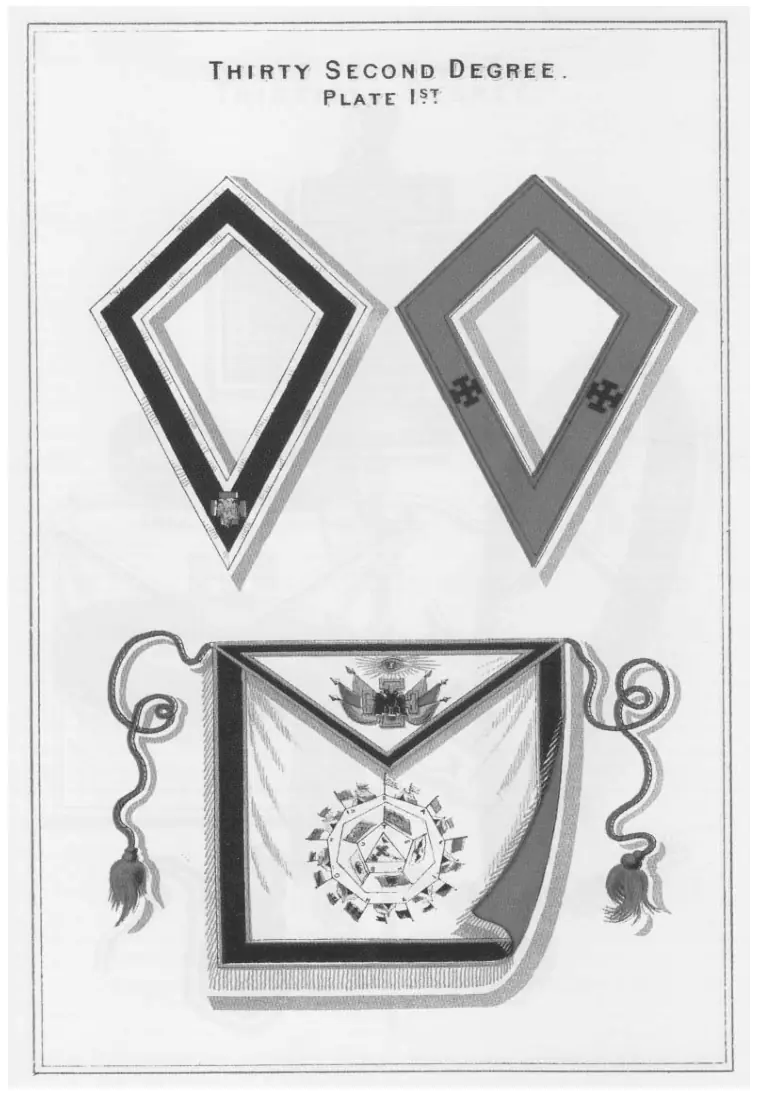
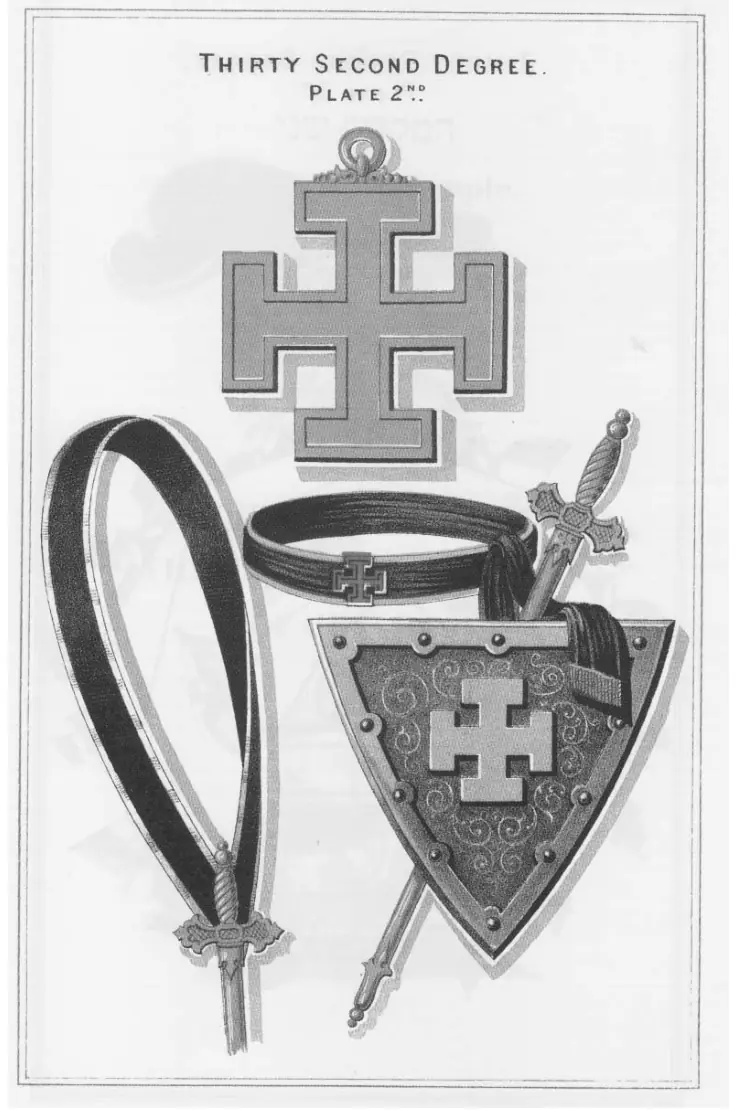
Le Cordon est un large ruban noir, liseré d’argent, et porté en sautoir. Sur la pointe est brodée en rouge, la Croix Teutonique ; et au milieu de la Croix, un aigle éployé, en argent. Le cordon est doublé en ponceau ; avec la Croix Teutonique, en argent. En outre, on porte une ceinture noire, à franges d’argent : avec une Croix rouge, sur le ventre. Le Bijou est une Croix Teutonique, en or.
(1) Ces mots s’écrivent, en hébreu : On donne au 1er., diverses interprétations. Telles sont les suivantes : Tout est expliqué. – Tout est opéré. Nomb. Chap. 23, w. 27. 1088 (2) Ces mots, que l’on écrit, en hébreu, Signifient également,
Tout est dispersé. Lev. chap. 24, w. 12. – Ezech. chap. 34, w. 12. 1089
(3) Ces deux mots que l’on écrit, en hébreu ,sont employés, savoir : Nekam, au Livre des Juges, chap. 16, w. 28 ; et l’autre, à ceux de Genèse chap. 7, v. 4 ; et du Deut. chap. 29, v. 20. 1090 29
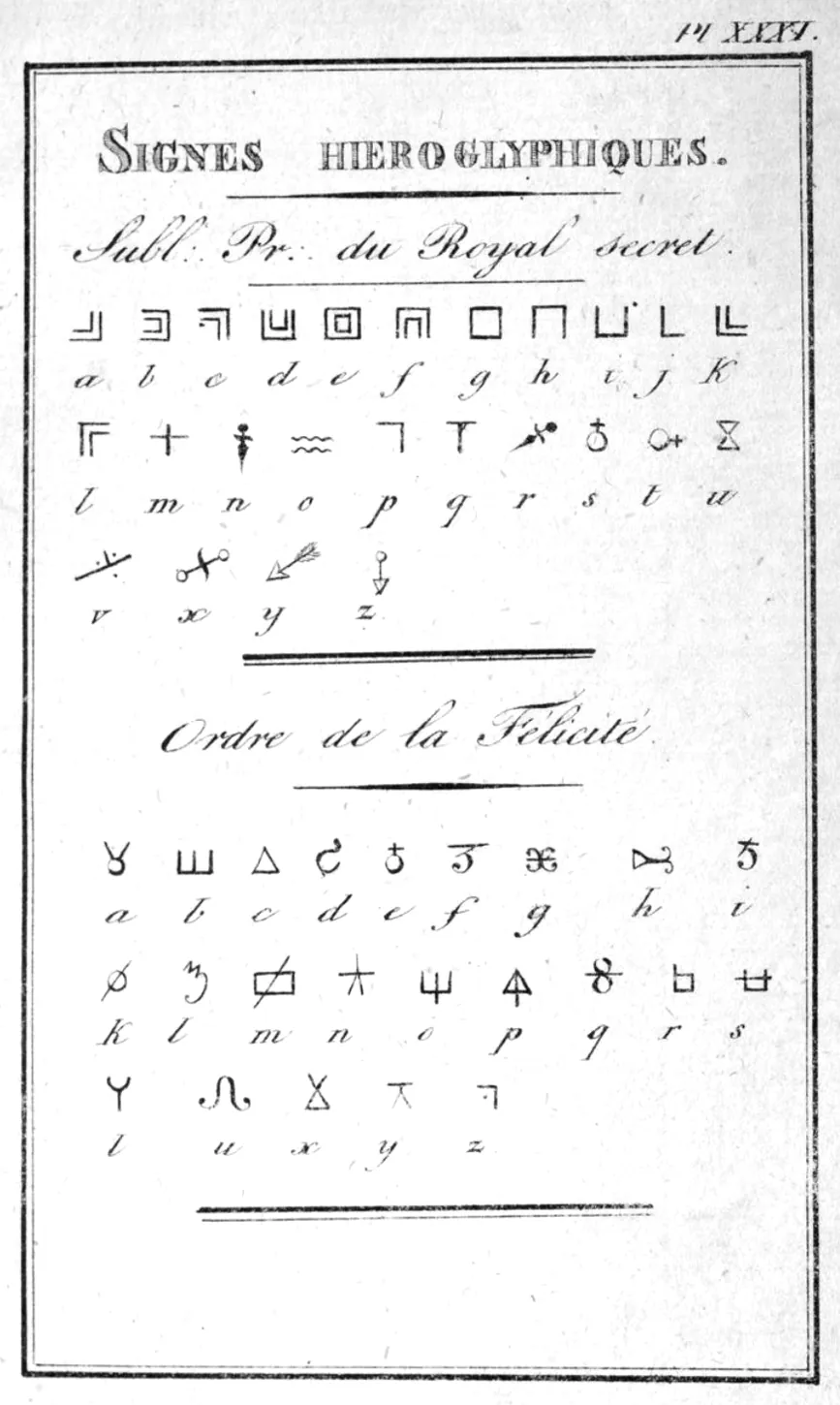
Hiéroglyphes.
A , b , c , d , e , f , g , h , j , k , l , m , , , , , , , , , , , , , n , o , p , p , r , s , t , u , v , x , y , z , , , , , , , , , , , , ,
Après cette explication, le Gd∴ Comm∴ fait conduire le Récipre∴ entre les Lieutenants ; et, après avoir frappé, il dit :
« Sub∴ Lieut s∴, et vous tous Vail∴ Princes, ayez à reconnaître à « l’avenir le le 1091 Prince, en sa nouvelle qualité de Vaillant Prince du « R al∴ Secret, et réunissez-vous à moi, pour applaudir à son « entrée au Consistoire. »
L’annonce faite par les Lieutenants, on applaudit. Le nouveau Prince remercie, et son applaud t∴ est couvert. On le fait placer au-dessous du Chancelier ; et le Ministre d’État reçoit l’ordre de lui donner l’explication du tracé du camp : ce qui se fait en ces termes :
Explication du camp.
Le triangle équilatéral, que vous voyez au milieu du tableau, représente le centre de l’armée. Il désigne la place que doivent occuper les Chevaliers de Malte, admis à nos Mystères ; et réunis aux Inspecteurs-Inquisiteurs, qui, comme eux, partagent avec les Princes de du 1092 Royal Secret, la surveillance du trésor sacré. Le corps que forme cette réunion, est commandé directement par le Souv∴ Gd∴ Commandeur. Entre les angles du pentagone, sont censés campés 5 autres
30
corps d’armée. Chacun d’eux est commandé par un Vail∴ Prince, dont, le drapeau ou pavillon est fixé aux angles du pentagone, et désigné par les lettres suivantes : T.E.N.G.U. (1)
T
1°. le 1 er. drapeau, qui est celui des Chev∴ K∴ H∴ et des Grands Écossais de S t. André, est d’azur, au lion d’or, tenant dans sa gueule une clef d’or ; et ayant un collier d’or, sur lequel est gravé le nombre 525. 1093 On lit au haut : ad majorem dei gloriam.
E
2°. le pavillon suivant est celui des Chevrs∴ du Soleil, des Commrs∴ du Temple, et des Princes de la Mercy. Il est d’argent, au cœur enflammé, soutenu par deux ailes de sable, et couronné de laurier sinople.
N
3°. le pavillon suivant est celui des Chevrs∴ du Serpent d’Airain, des Princes et Chefs du Tabernacle. Il est vert d’eau, à l’Aigle 1094 éployée et couronnée d’or, ayant un collier d’or ; et tenant dans la serre droite, une épée la pointe en bas ; et dans la gueule, un cœur sanglant.
G
4°. le 4 e. pavillon est celui des Chevrs∴ Prussiens, et des P ces du Liban. Il est d’or, au bœuf de sable.
U
5°. le dernier pavillon est celui des M es∴ des , et des Grands Pontifes. Il est de pourpre, à l’Arche d’Alliance accostée de deux flambeaux ardents, et surmontée de deux palmes en cerceau. Au-dessus, est écrit : Laus Deo. (1) On a donné à ces lettres, ainsi qu’aux 9 suivantes, diverses interprétations. Les uns
ont prétendu qu’elles signifiaient : Offrons au noble, loyal et généreux Xerces, notre
trésor sacré ; nous vaincrons infailliblement. D’autres les ont rendus ainsi : Gloire à toi seul, ô Jehovah ! Notre ineffable, notre légitime et vrai Seigneur. Ou : Tibi solo, Jehovah, omnipotenti ; sint amor, gloria, laus, nec non et verae adorationes. 1095
En s’exprimant ainsi, on eût du voir que l’on changeait l’ordre des lettres ; et que l’on s’éloignait de l’usage Maçique∴, qui est de tirer de l’hébreu les Mots Sacrés ou de Passe. Je m’en tiens à l’interprétation que j’ai donnée à la P. 7. notes 1. 2. 3. La voici : Fuis le méchant, il ne cherche qu’à nuire : Recherche le Maçon, il ne peut que t’instruire : De nos frères errants prépare le retour ; Qu’en proie à ses remords, l’intrigue erre à son tour !
31
L’ennéagone que forme que forme 1096 le tracé extérieur du tableau, désigne l’emplacement qu’occupaient les neuf autres corps de l’armée, commandés par des chefs particuliers, qui recevaient les ordres des cinq Princes du pentagone. Ces corps sont désignés par les tentes que vous voyez aux angles de l’ennéagone, et chaque tente a son pavillon particulier, indiqué par l’une
des lettres suivantes : S. a. l. i. S∴ n. o. n. i. S. 1°. la tente S, nommée Malachias, est celle des P ces∴ R∴, des
Chevrs∴ d’Or∴ et d’Occid∴, et des P ces∴ de Jérusalem. Le pavillon qui la désigne, est blanc, légèrement taché de rouge.
a 2°. la flamme ou pavillon vert d’eau, que l’on voit sur le
tente a, nommée Zorobabel, annonce le camp des Chevaliers d’Orient ou de l’Épée.
L 3°. la flamme de la tente L, dite Néhémias, est rouge. C’est
celle des G ds∴ Écossais de la Voûte Sacrée.
. . I 4°. la tente I , appelée Hoben, est celle des G ds∴ Architectes,
et de ceux du Collège de Royal-Arche. Sa flamme est rouge et noire.
S 5°. la tente S, nommée Phaleg, est celle des Élus des 9, des
Élus des 15, et des Sub∴ Chevrs∴ Élus. Sa flamme est noire.
N 6°. la tente N, connue sous le nom de Joiada, désigne le
camp des Intendants des Bâtiments. Sa flamme est losangée de gueule et de sable.
O 7°. la tente O, nommée Abda, est celle des Prévôts et Juges,
et des Secrét∴ Intimes. Sa flamme est partie de gueule et de sinople.
N 8°. la tente N, dite Josué, pavillon ou flamme verte, représente
le camp des M es∴ Parfaits et M es∴ Secrets. 9°. enfin, la tente I, nommée Esdras, est celle des Maîtres symboliques et volontaires. Sa flamme est bleue.
32
Instruction.
D. D’où venez-vous ? R. De l’Ouest. D. Qu’apportez-vous ? R. Silence, tristesse et persévérance. D. Pourquoi ce silence ? R. Par prudence et par devoir. D. Quel est le motif de votre affliction ? R. Le souvenir du passé. D. En quoi persévérez-vous ? R. Dans un espoir fondé sur mes droits. D. Quels sont vos droits ? R. Ceux de la Justice et de l’Équité. D. Comment les avez-vous acquis ? R. En montant l’Échelle Mystérieuse. D. Où allez-vous ? R. À l’Est. D. Pourquoi ? R. Pour rentrer dans l’héritage de mes pères. D. Comment pouvez-vous y rentrer ? R. Par la protection du Dieu des Armées ; et par l’ascendant qu’obtient tôt ou tard une courageuse résistance. D Comment vous-y présentez-vous ? À la tête de loyaux Ch rs R.∴, et commandés par les Vail∴ P∴ du R∴ S∴. D. De combien de corps sera composée votre armée ? R. De quinze. D. Quels sont-ils ? ∴ du R∴ S∴ ; auquel se réuniront les G ds Le 1 er. sera celui des Vail∴ P es R.
33
Insprs∴ - Inquis rs∴, et les Chev rs. de S t. Jean de Jérusalem : Le 2 e., des Chev rs. K∴ H∴, et des G ds. Écossais de S t. André : Le 3 e., des Ch rs. du Soleil, des Com∴ du Temple, et des P ces∴ de Mercy : Le 4 e., des Chrs∴ du Serp∴ d’Airain, des P ces∴ et des Chefs du Tabernacle : Le 5 e., des Chrs∴ Prussiens, et des P ces∴ du Liban : Le 6 e., des M es∴ de Loges, et des G ds∴ Pontifes : Le 7 e., des P ces∴ R∴, des Chrs∴ d’Or∴ et d’Occid∴, et des P es. de Jérusalem : Le 8 e., des Chrs∴ d’Or∴ ou de l’Épée : Le 9 e., des G ds∴ Écossais de la Voûte Sacrée : Le 10 e., des G ds∴ Arch∴ et du Collège de R al∴-Arche : Le 11 e., des Élus des 9. Élus des 15, et Sub∴ Chrs∴ Élus : Le 12 e., des Intendants des Bâtiments : Le 13 e., des Prévôts et Juges, et des Secrét∴ Intimes : Le 14 e., des M es∴ Parfaits et M es∴ Secrets, et Le 15 e., de M es∴ et des volontaires Maçons. D. Quel rang tiendront dans l’armée, ces différents corps ? Le 1 er formera le centre, sous l’enseigne du Souv∴ Gd∴ Comm∴ R. Les cinq suivants, avec leur enseigne particulière, se formeront autour du 1 er., en forme de pentagone. Et les autres neuf se rangeront autour de ceux-ci, en forme d’ennéagone ; et chacun d’eux aura son enseigne et son chef. D. Qui commandera l’armée ? Le Souv∴ Gd∴ Com∴ en personne. Deux Lieutenants recevront directem t. les R. ordres et chacun d’eux les fera exécuter sur l’une des moitiés de l’armée, confiée à ses soins. D. Quels chefs particuliers auront les différents corps ? Le 1 er. sera immédiatem t. commandé par le Souv∴ Gd∴ Commandeur : R. Le 2 e., par Béséléel : (1)
(1) Béséléel, de la tribu de Juda, fut si agréable à Dieu ; qu’il le remplit de son esprit pour travailler à la
construction du Tabernacle. Exode, chap. 31, v. 2. – Ce nom s’écrit, en hébreu et signifie : sous l’ombre de Dieu. 1097 34
Le 3 e., par Ooliab ; Le 9 e., par Néhémias ; (1) (7) Le 4 e., par Machsim ; Le 10 e., par Hoben ; (2) (8) Le 5 e., par Garimont ; (3) Le 11 e., par Phaleg ; (9) Le 6 e., par Amariach ; (4) Le 12 e., par Joiada ; (10) Le 7 e., par Malachias ; (5) Le 13 e., par Abda. (11) Le 8 e., par Zorobabel ; (6) Le 14e., par Josué (12) ; et le 15e., par Esdras (13)
(1) Ooliab, également de la tribu de Juda, fut aussi choisi par Dieu ; pour travailler, avec
Béséléel, aux choses nécessaires au culte divin. Exode, chap. 31 v.2. Ce nom s’écrit, en hébreu : ; et signifie Tabernacle du Père. 1098
(2) Nom que quelques-uns prononcent Mahusim. Il s’écrit et signifie Silencieux. 1099 (3) Garimont, patriarche de Jérusalem, qui réunit les croisés. 1100
(4) Ce nom, qui s’écrit en hébreu , et signifie Élévation du Seigneur, fut celui du 23e. Sacrificateur du Temple de Jérusalem. 1101 (5) Ce nom, qui, en hébreu, s’écrit et signifie Envoyé, fut porté par l’un des douze petits prophètes. 1102 (6) Zorobabel, en hébreu : , c’est-à-dire Étranger à la confusion, fut le libérateur des Israélites ; ainsi qu’on le voit dans le grade de Ch r∴ d’Or∴. Esd. Liv. I, ch. II, v. 5 ; et liv. 2. ch. 7. v. 12 1103. (7) Néhémias c’est à dire Consolation, fut le nom de l’échanson de Xercès ; qui obtint de ce prince la permission de rétablir la ville de Jérusalem. Esdras, Liv. 1, ch. 2, v. 1104
(8) Peut-être conviendrait-il de substituer à ce nom celui d’Obed. Ce mot, qui,
en hébreu s’écrit et signifie Serviteur, fut le nom de l’un des neuf Maîtres choisis après la mort d’Hiram-Abi. 1105 (9) Ce mot s’écrit, en hébreu, et signifie Confusion. Les Chevaliers Prussiens l’ont choisi pour Mot de Passe. Voyez l’instruction de ce grade. 1106 (10) Joiada, en hébreu, c’est-à-dire Science du Seigneur, fut le nom du Gd∴ Prêtre qui sauva la vie à Joas, et le mit sur le trône de Jérusalem. 1107 (11) Ce mot, qui, en hébreu, s’écrit et signifie Serviteur, fut le nom du père d’Adoniram. Il en est parlé au grade de Me∴ Parfait. 1108 (12) Ce nom, qui, en hébreu, s’écrit et signifie Sauver, fut le nom de celui des chefs d’Israël qui fit passer le Jourdain à pied sec à ses troupes ; et qui ensuite arrêta le Soleil. 1109 (13) Ce nom, qui, en hébreu, s’écrit et qui signifie aussi Sauveur, fut celui de l’un des quatre grands prophètes d’Israël. Il obtint d’Artaxercès la permission de rétablir les murs de Jérusalem, et de donner au gouvernemt. son ancienne forme. 1110 35
Que représente l’enseigne du Gd∴ Commandeur ? D. R. Un ennéagone dans lequel est tracé un heptagone, qui lui même renferme un pentagone, dans lequel est un triangle ; et dans celui-ci, un cercle : ce qui donne les nombres mystérieux 1, 3, 5, 7, 9 ; dont l’explication a été donnée dans les grades précédents. D. Que représentent les enseignes des cinq chefs du pentagone ? La 1 ère. , placée à l’angle du pentagone désigné par la lettre T, est R. d’azur au lion d’or, tenant dans sa gueule une clef d’or ; et ayant au col un collier d’or, sur lequel est gravé le nombre 525. Au haut, est écrit :
ad majorem Dei gloriam :
La 2 de. , à l’angle E, est d’argent, au cœur enflammé de gueule, soutenu par deux ailes de sable, avec une couronne de laurier sinople. La 3 e., à l’angle N, est de couleur vert d’eau ; porte un aigle à deux têtes, éployé et couronné d’or, avec un collier également d’or. Il tient dans sa serre droite une épée la pointe en bas ; et dans la gauche, un cœur sanglant. La 4 e., à l’angle G, est d’or, au bœuf de sable. et La 5 e., à l’angle V, est pourpre. On y voit l’Arche d’Alliance, accostée de deux flambeaux ardents ; et surmontée de deux palmes en cerceau, avec l’inscription Laus Deo. D. De quelle couleur sont les flammes de l’ennéagone ? La 1 ère. , désignée par la lettre S, est blanche, tachetée de rouge. R. La 2 de. est vert clair ; et est désignée par la lettre A. Le 3 e. est rouge ; et est indiquée par la lettre L. La 4 e. est moitié rouge et moitié verte ; et est indiquée par la lettre I. La 5 e., noire, est désignée par la lettre S. La 6 e., noire et rouge, avec la lettre N. La 7 e., verte et rouge, indiquée par la lettre O. La 8 e., verte, est indiquée par la lettre N. Enfin, la 9 e., bleue, est désignée par la lettre I.
36
D. Où se réuniront les divers corps de l’armée navale ? R. Cinq ports sont désignés pour être le rendez-vous des forces navales ; savoir : 1°. Naples, 2°. Malte, 3°. Rhodes, 4°. Chypre, et 5°. Jafa. D. Où se rendront-ils ensuite ? R. À Jérusalem, où ils seront joints par les troupes de terre, et par tous les fidèles gardiens. D. À quelle heure partirez-vous ? À la 5 e. heure qui suivra celle du coucher du Soleil. R. D. Quel sera le signal du départ ? R. Cinq coups de canon. D. À quoi vous reconnaîtrez-vous ? R. À des Signes, des Paroles et des Attouchements. D. Combien avez-vous d’espèces de Paroles ? R. Trois ; savoir : 1°. les Mots Sacrés, 2°. ceux d’Ordre ; et 3°.ceux de Passe.
(on les donne) D. Donnez-moi les Paroles Sacrées. (on les donne) D. Donnez-moi les Mots d’Ordre. (on les donne) D. Donnez-moi les Mots de Passe (on le fait) D. Faites le Signe.
Donnez l’Attouchement au Me∴ des Cérém∴. (on le donne) D. D. Que signifient les lettres, par lesquelles vous m’avez désigné les pavillons et les tentes de l’armée ? R. Thara en nebalah ghebul uria, Skakar adilh leos jalak Sabeb nabal obed naki Israel. 1111Qui signifient : Fuis le méchant, il ne songe qu’à nuire : Recherche le Maçon, il ne veut que t’instruire. De nos frères errants prépare le retour ; Qu’en proie à ses remords, l’intrigue erre à son tour. D. Que vous reste-t-il à savoir ? (1) (1) Cette question, ainsi que les 8 suivantes, ne doivent être faites qu’à ceux que l’on destine à
des connaissances d’une autre espèce ; mais auxquels on veut d’avance préparer un P ce de Royal Secret.
37
R. Un point essentiel, qui par la suite sera révélé. D. Pourquoi vous est-il caché ? R. Parce que 9 d’entre nous peuvent seuls le connaître ; et que, trop récemment initié, je ne puis être de ce nombre. D. Vous ne connaissez donc pas tout ce qu’il vous importe de savoir ? R. Il est, sans doute, des choses que j’ignore. Cependant, j’en connais assez d’autres pour marcher vers la Perfection ; et un jour viendra, qu’il me sera permis d’en savoir davantage. D. Sur quoi fondez-vous cet espoir ? R. Sur une apparition. D. Quels objets vous a présenté cette apparition ? R. Trois oiseaux : un corbeau, une colombe et un phénix. D. Qu’annonce le corbeau ? R. La noirceur de ses plumes symbolise la peine, le désordre et la mort. D. Que vous retrace la colombe ? R. Sa blancheur m’annonce la régénération des êtres. D. Que vous rappelle le phénix ? R. Cet oiseau, sortant des flammes pour recommencer une nouvelle vie, est l’emblème de la nature perfectionnée, d’une théorie une universelle, et d’un pouvoir sans bornes. D. Expliquez-moi cela. R. Je ne le puis ; je suis trop jeune encore. D. Quel âge avez-vous ? R. Cinq, sept, neuf, vingt-sept et trente-trois ans ; et l’ensemble donne un nombre parfait. D. Qu’entendez-vous par là ? R. J’entends que, comme Compagnon, je ne puis être trop docile aux représentations de mes chefs : 2°. que, comme Me∴, je dois non seulement agir ; mais encore activer ceux que l’on a confiés à ma surveillance :
38
3°. que, comme Élu, je hais le parjure et la trahison : 4°. que, comme Templier, j’ai contracté l’obligation d’exercer l’hospitalité ; de protéger l’innocence ; et de mourir, plutôt que de trahir mes FF∴ 5°. enfin, qu’ayant atteint l’âge de perfection, il n’est aucune vertu qu’il ne m’importe d’acquérir.
Suite des Travaux.
Après l’instruction, le Gd∴ Ministre d’État adresse au Récipre∴ un discours analogue à la circonstance. (1) Le discours terminé, le Gd∴ Comm∴ fait demander si l’on a quelque chose à proposer pour l’intérêt de l’Ordre, et pour le bien du Consistoire. Il fait passer le Sac des Propositions, puis le Tronc de Bienfaisance. Les Travaux terminés le Gd∴ Comm∴ frappe, et dit :
« Sub∴ et Vaillants Princes ! Le Gd∴ Arch∴ a daigné répandre sur « nous ses bienfaits : il n’a pas permis que les ennemis dont nous « sommes entourés, aient troublé l’activité de nos travaux. Nous ne « devons qu’à sa protection l’empressement qu’ont mis à nous « rejoindre tant de valeureux Chevaliers. Nous lui devons leur heureuse « arrivée en ces lieux ; et la précieuse acquisition de ce brave « compagnon d’armes, dont le zèle et la prudence ne peuvent que « faciliter nos succès. Toutes ces considérations doivent exciter « notre reconnaissance envers Dieu, qui veille à notre conservation. « Que l’encens le plus pur brûle sur son Autel ; et empressons-nous (1) À la fin de cette instruction, est un discours qu’en ce cas on
peut prononcer.
39
« de lui donner, en cette circonstance, une nouvelle preuve de notre « amour et de notre respect. »
Le Souv∴ Gd∴ Comm∴ descend de sa place ; se rend à l’Autel Me∴ des Parfums ; reçoit du des Cérém∴ quelques grains d’encens, qu’il répand sur le feu. Il se découvre ; et dit ce qui suit :
« Que te rendrons-nous, ô Dieu puissant, pour tous « les bienfaits dont tu nous a comblés ! Que pourrions-nous « t’offrir, qui fût digne de toi ! Pardonne à notre « insuffisance ; et contente-toi de l’expression de nos sentiments. « Que notre hommage respectueux s’élève, comme ce « pur encens, jusqu’à ta céleste demeure ! Amen ! Amen ! « Amen ! Amen ! Amen !
Gd∴ Le Souv∴ Comm∴ ayant fait donner lecture de l’esquisse du balustre du jour, et l’ayant fait sanc- Travx∴, tionner ; procède à la clôture des de la manière suivante.
Clôture des Travaux.
Subl∴ et Vail∴ Prince, 1 er. Lieutt∴ ! Que nous reste-t-il à faire ? D. R. Rien ; puisque tout ce que nous pouvions faire aujourd’hui, se trouve être accompli.
Le Gd∴ Comm∴ continue ainsi :
« Puisqu’il ne nous reste plus rien à faire, et que l’œuvre Lieutt∴ ! « du jour est à sa perfection ; Sublime Annoncez « à vos camps respectifs, que je vais fermer le Consistoire « des Vaill∴ Princes du R al∴ Secret. »
L’annonce est faite par les Lieutenants.
40
Le Gd∴ Comm∴ frappe 5 coups ! - ! ! ! !, et dit : Salis.
Le 1er. Lieutt∴ en frappe 5 autres ! - ! ! ! !, et dit : Noni.
Le 2d. Lieutt∴ répète les 5 coups ! - ! ! ! !, et dit : Targu.
Enfin, le Gd∴ Comm∴ fait applaudir par cinq ; et l’on dit trois fois : Laus Dieu. 1113 Il frappe ensuite un coup et dit :
« Le Consistoire est fermé. Retirons-nous en paix Folio supplémentaire XIXFolio 137 recto ; et taisons-nous sur les opérations de ce jour. »
Tous disent : Nous le jurons ; et l’on se retire.
Discours historique.
Vaillant Prince ! Ce grade, le nec plus ultra de la Maç rie∴ de perfec- -tion (1), a été réorganisé par Frédéric II, roi de Prusse, Gd∴ Me∴, Comm r∴ en chef et Souv∴ des Souv∴ de l’Ordre, et ce fut à cette époque, que les M ons Écossais reçurent de ce Prince, des règlements par lesquels ils se gouvernent actuellem t.
(1) Ce Rit, comme on sait, ne se compose que de 25 deg∴ divisés en 7 classes, comme suit }
1°. Apprenti 15°. Chevr∴ de l’Épée 1ère Classe. 2°. Compagnon, 16°. Pce∴ de Jérusalem
20°. Gd∴ Patriarche 8°. Prévôt et Juge, 21°. Gd∴ Me 6e. Classe.∴ de la Clef. 9°. Élu 3e. Classe. 10°. Élu des 15 22°. Ral∴ Ache
} 11°. Chef des 12 Tribus,
} 23°. Prince Adepte
12° Gd∴ Me∴ Archte∴, 24°. Com r∴ de l’Aigle B c 7e. Classe.∴ et N∴ 4e. Classe. 13° Royal Arche 14°. Gd∴ Élu Ancien 25°. Pce∴ du Ral ∴ Secret.
41
Nos réunions sont nommées Consistoires, et ceux qui les composent, ont le titre de Vaillants Princes du Royal Secret, et
Fidèles gardiens du trésor de l’Ordre.
Le lecture de nos Statuts vous fera connaître le surplus de notre organisation ; et je me borne, en ce moment, à vous faire une récapitulation des connaissances de ce grade. Les Sarrasins s’étant emparés de la Terre Sainte, et les Croisés n’ayant pu les chasser, se déterminèrent, avec Godefroy de Bouillon leur chef, à voiler les mystères de la religion qu’ils cherchaient à propager, sous des figures emblématiques, par lesquelles ils pourraient maintenir la piété du soldat et se préserver des incursions de leurs ennemis. Exemple qu’ils trouvèrent dans la Bible, dont, en tant d’endroits, le style est parabolique. Les Chrétiens, ainsi réunis, prirent le nom de FF∴ comme indiquant mieux que les autres l’intimité qu’ils voulaient établir parmi eux, et, comme leur entreprise avait quelque rapport à la construction du Temple de Salomon, seul destiné au culte de l’Éternel, ils prirent le nom de Maçons ; et furent, depuis, connus sous celui d’Architectes, et l’un et l’autre leur convenaient d’autant mieux ; qu’ils saisissaient toujours l’occasion d’offrir leurs bras et le fruit de leurs épargnes, aux princes qui permettraient la construction de quelque nouvelle église. Eux seuls en levaient les plans, et en dirigeaient les travaux. Il en résulte que les mystères de l’Ordre ne se rapportaient alors qu’à la religion. Ces FF∴ eurent soin de n’instruire du secret de leurs emblèmes, que ceux dont la discrétion fut éprouvée Folio 311 recto.
42
Ils inventèrent différents grades, pour mieux apprécier les néophytes qu’ils admettaient ; en ne leur donnant d’abord que des secrets symboliques sans explications, et qui ne servaient qu’à les faire connaître. Pour cet effet, il fut résolu d’employer divers Mots, Signes et Attouchements pour chaque grade ; et au moyen desquels ils pussent être secourus contre les Sarrasins. Les différents grades furent d’abord au nombre de sept ; à l’exemple du Gd∴ Arch∴ de l’Un∴, qui créa le Monde en six jours, et se reposa le septième : ce qui est désigné par les sept points de la réception de Maître. (1) C’est ainsi que Salomon fit la dédicace du Temple, la 7 e. année de sa construction ; et c’est ainsi que les Juifs n’obtinrent de Cyrus la liberté de retourner en leur patrie, que la septième année de leur captivité (1). 1 er. Dans le grade, on remarque trois symboles. 1°. le premier jour de la Création, qui n’offrait alors qu’un chaos, est figuré par le Candidat sortant de la chambre noire, ni nu, ni vêtu, privé de lumière ; et qui, après avoir subi les épreuves de sa Réception et prêté le serment, n’aperçoit, au moyen de la lumière qui lui
(1) Il y a incorrection dans cette phrase, qui devrait être ainsi :
« C’est ainsi qu’Hénoch employa six années à construire une voûte « souterraine, pour y placer la plaque triangulaire dont il avait « fait l’heureuse découverte ; et que, la septième année, y ayant « déposé le trésor sacré, il disparut ; et fut transporté dans le « séjour des bienheureux. 1114 De même, aussi, Salomon employa « six années à la construction de son Temple ; et en fit la dédicace « la 7e., avec toute la solennité due à la divinité. C’est cet édifice sacré « que nous choisissons, pour faire les bases figuratives de la Maçrie∴.
43
est accordée, que les nouveaux FF∴ qu’il vient d’acquérir. Alors, toutes ses facultés sont suspendues : ce qui repré- -sente la création de ce vaste corps lumineux, divisé dans toutes les autres parties de la création, avant d’avoir été extrait des ténèbres et fixé par le Tout-Puissant. Telle est une pierre précieuse, qui, tirée du sein de la Terre où elle était confondue avec les matières les plus viles, n’a d’éclat qu’autant que le lapidaire sait la dégager de l’enveloppe grossière qui la couvrait entièrement. 2°. le Candidat s’approche du Trône ; et, entre les mains du Maître, renonce à tous les vices : il promet de vaincre ses passions ; de s’unir à la vertu ; et de montrer, par la régularité de sa conduite, la sublimité du culte qu’il professe. Cela lui est représenté par les pas qu’il fait en s’approchant de l’Autel ; dont le symbole est la séparation du firmament, de la terre et de l’eau, le second jour de la Création. Me∴ 1ère. 3°. Le donne au candidat la lumière Maçonnique ; et lui explique les symboles ; lui donne les Signes, Mots et Attouchements qui caractérisent un Maçon ; et, au moyen desquels, il se fait reconnaître de ses FF∴. Il y a donc trois symboles ; qui distinguent le premier grade, des autres. 4°., le 4 e. jour, le Sup∴ Arch∴ créa les fruits sur la terre séparée des eaux : ce qui est figuré par la réception du second grade ; séparé de l’Apprenti. Il apprend alors à faire usage de l’équerre, du niveau et de l’à-plomb ; par lesquels, en travaillant, il apprend à étendre les connaissances de la société Folio 312 recto.
44
5°. Le créateur embellit son ouvrage, le 5 e. jour, en remplissant la terre d’animaux, les eaux, de poissons ; et l’air, d’oiseaux : ce qui représente le compagnon employé à couper les pierres, et à leur donner la beauté et le brillant des étoiles. Ce second grade a donc aussi deux symboles qui lui sont appliqués ; et qui, joints aux trois premiers, forment le nombre cinq qui distingue les compagnons. Au 3 e. grade, on ajoute encore deux symboles : ce qui forme le nombre sept, qui est celui des M es∴. 6°. le grade de Me∴ vous a fait passer de l’Équerre au Compas ; pour vous montrer que vous devez passer d’une vertu à l’autre, jusqu’à ce que vous les possédiez toutes. La mort d’Hiram-Abi vous enseigne ce que vous devez faire, ce que vous êtes ; et ce que vous serez : ce qui est comparé au 6 e. jour, que Dieu employa pour former l’homme de la poussière ; à lui donner la vie et une âme ; et à lui prescrire des lois pour se gouverner. 7°. Nous conduisons les Maçons de ces trois grades, et les faisons reposer à l’ombre de la branche d’acacia ; ainsi que le Créateur, qui passa le 7 e. jour en tranquillité ; et le consacra à un usage divin, jusqu’à la dissolution du globe. On vous enseigne, dans les 1 er. et second grades, à travailler, à l’exemple des Maçons qui bâtirent le Temple de Salomon ; pour perfectionner et élever dans votre cœur, un édifice propre à rendre hommage au Créateur de l’Univers, dont vous êtes le Temple vivant, qui ne doit être orné que par la vertu. On vous enseigne à polir la pierre : c’est-àdire, à corriger vos mœurs ; à régler vos actions avec l’équerre
45
et le Compas, pour conduite au bien que tout homme vertueux doit chercher. Les deux Col∴ B et J∴ sont le symbole de la vertu et de la prudence ; et vous annoncent que l’homme est fait pour la société, où il doit déployer ses vertus et se montrer l’honneur de l’humanité. Le troisième pilier qui soutient le Temple, désigne que chaque F∴ devient un soutien essentiel de l’Ordre. Dans le grade de Me∴, l’assassinat d’Hiram, commis par de faux FF∴, vous rappelle le sort d’Adam, occa- -sionné par sa perversité, et sa désobéissance envers le Créateur. Le symbole de la mort d’Hiram vous rappelle celle du Messie. Les trois coups donnés à Hiram aux troix portes du Temple, représentent les trois points de Gd∴ condamnation contre J∴ C∴ par le Prêtre Caïphe, par Hérode et Pilate. Ce fut par ce dernier, qu’il reçut la mort la plus violente et la plus affreuse. Les trois coups de maillet sont aussi le symbole des trois souffrances : des coups sur les oreilles, de la flagellation, et de la couronne d’épines. Les FF∴ assemblés autour du tombeau d’Hiram, représentent les disciples vivement affligés de la mort de J∴ C∴ sur la Croix. Le Mot de Me∴, que l’on dit être perdu, est le même que J∴ C∴ prononça sur la Croix ; et que ses disciples ne comprirent pas : Eli ! Eli ! Lamma Sabacthani ?
Mon Dieu ! Mon Dieu ! Pourquoi m’avez-vous abandonné ? Au lieu de Machbena. 1115Mort de l’architecte ; et lequel lui est maintenant
substitué Folio 313 recto.
46
Icariote (1). 1116 Les faux FF∴ représentent Judas qui vendit J∴ C∴. La branche d’acacia représente la Croix qui fut faite de ce bois. Le cordon de Gd∴ Élu Écossais rappelle, par sa couleur, le souvenir de la perte du sang de J∴ C∴. La captivité des Chevrs∴ d’Or∴ nous montre la persécu- -tion des chrétiens sous les empereurs romains, et leur liberté sous le g d∴ Constantin. Elle nous rappelle encore les souffrances qu’endura Jacques Molay, dans les fers près de sept ans ; à la fin desquels ce digne Gd∴ Me∴ fut brûlé avec ses compagnons, le 18 mars 1314, dans l’île de Paris ; attirant la pitié et les larmes de ceux qui le virent mourir avec une fermeté et une constance héroïques. Dans le grade de Me∴, où vous avez versé des larmes sur le tombeau d’Hiram, et dans quelques autres grades, votre cœur a pu être excité à la vengeance. Serait-il injuste de comparer la conduite des infâmes accusateurs qui 1117 des Templiers, aux scélérats les complices de l’assassin d’Hiram ? Cela n’allume-t-il pas dans votre cœur, une égale aversion ? Les différents lieux où vous avez voyagé, et le temps que vous avez employé à la recherche de ces événements, vous conduisent sans doute à en faire la véritable application ; et, par les
(1) Ce mot signifie, en hébreu, Vir occisionis, Assassin. On le fait dériver aussi de Sachar, , récompense : 1118 parce que Judas ne commit son crime, que par l’attrait de la récompense qui lui fut promise.
47
grades de Me∴ Élu et de K∴ H∴, vous vous êtes disposé à remplir vos engagements. Mais vos ennemis ont perdu le fruit de leur perfidie : les biens qu’ils qu’ils 1119 vous avaient enlevés ravis, leur ont été enlevés : malheureux à leur tour, ils sont assez punis, pour ne pas obtenir de vous un généreux pardon. Ne le leur refusez pas : voyez-les, même avec plaisir, se réunir à nous, dans la noble entreprise qui nous occupe. Vous voyez, Vaillant Prince, comment et par qui la Maçonnerie nous est parvenue : évitons leur sort, en ne faisant que du bien et en nous cachant pour le faire. Imitons l’exemple de notre Gd∴ Me∴, qui préféra la mort au parjure : de Jacques Molay, dont le calme étonna ses bourreaux ; et que l’Être Suprême vengea bientôt, en retirant des grandeurs de ce monde ses plus zélés persécuteurs.
Page imprimée, d’origine inconnue, rajoutée au moment de la reliure Folio supplémentaire LXXVFolio 315 recto.
Delaulnaye 1813
tuileur imprimé · 969 mots
Le « Thuileur des trente-trois degrés de l'Écossisme » de Delaulnaye (Paris, 1813), premier tuileur imprimé du REAA constitué : mots, signes, décors et remarques du grade. Texte relu mot à mot sur le fac-similé, mots hébreux restitués. Pages 229-238 de l'édition originale.
La Loge se tient au second étage d'une maison sise en un lieu élevé. Elle est tendue en satin noir, parsemé de larmes, squelettes, têtes de mort, os en sautoir, le tout en argent. Le trône est élevé de sept degrés. La table seule qui est devant les Surveillants est couverte de satin cramoisi, bordé de noir, sur lequel sont les lettres N. K. M. K. (Nika Maka, ou, plutôt, comme on l'a vu, NEKAM MAKAH).
Titres.
La Loge se nomme Consistoire. Le Maître représente Frédéric III, Roi de Prusse ; il a le titre de Souverain des Souverains, Grand-Prince Illustre Commandeur en chef. Les deux Surveillants sont dits Lieutenants Com- [p. 230] mandeurs ; et l'Orateur, Ministre d'État. Il y a en outre un Grand-Chancelier, un Grand-Secrétaire, et un Grand-Trésorier.
Signe.
Mettre la main droite sur le cœur, la porter en avant, la paume en bas, puis la laisser tomber sur le côté droit.
Batterie.
Cinq Coups (un et quatre).
○——○ ○ ○ ○
Mots Sacrés.
Ceux du Tableau ;
L'un dit Salix ;
L'autre, Noni ;
Tous deux ensemble, Tangu.
Mots de Passe.
Ceux du Kadosch ;
PHAAL KOL, qu'on traduit par séparés ;
[p. 231]
PHARAS KOL, que l'on rend par réunis ;
NAKAM MAKAH, (pour se venger).
On a vu ci dessus la véritable signification de ces différents mots.
SCHADDAI, שָׁדַּי,
(omnipotens).
Trigramme, ou nom de Dieu en trois lettres, emblême du Delta.
Le Souverain des Souverains est armé d'un Bouclier et d'une Épée. Son Sceptre et une Balance sont sur la table.
Les Lieutenants-Commandeurs ont aussi un bouclier et le chapeau en tête.
Au bas des Officiers doivent être placés six Membres du Consistoire, habillés en rouge, sans tablier, mais portant le bijou de l'Ordre à un large ruban noir, en sautoir.
Cordon.
Noir, liseré d'argent, en sautoir. Sur la pointe est brodée en rouge la Croix Teutonique ; le double aigle en argent au milieu de [p. 234] la Croix. Ce cordon est doublé de ponceau, la Croix teutonique en noir.
Ceinture noire, frangée d'argent ; la Croix brodée en rouge sur le ventre.
Bijou.
La Croix Teutonique, en or.
Tablier.
Blanc, doublé et bordé de Rouge. Sur la bavette, une Croix de Malte en Rouge, lisérée d'Argent ; sur le milieu de la Croix est appliqué l'Aigle Noir écartelé, tenant une épée dans ses serres.
La figure que l'on voit représentée planche XIV forme à la fois le Tableau, le Sceau de l'ordre, et la peinture du Tablier. Nous allons la décrire.
Elle se compose d'un Ennéagone, dans lequel est inscrit un Heptagone ; dans celui-ci est un Pentagone, au milieu duquel est un triangle équilatéral, et, dans le triangle, un [p. 235] cercle. Ainsi la figure géométrique présente un emblême des nombres 1, 3, 5, 7, 9.
Entre l'Heptagone et le Pentagone, sur les côtés de celui-ci, sont placés les pavillons ou drapeaux des cinq Portes-Étendard ; lesdits pavillons désignés par les lettres T. E. N. G. U, dont on forme le mot Tengu.
Le pavillon T porte un Lion d'or, tenant dans sa gueule une Clef de même métal, et ayant un Collier, aussi d'or, sur lequel est gravé 515. Le fond est d'azur. Sur le pavillon est écrit ad majorem Dei gloriam.
Sur le pavillon E est un Cœur enflammé, de gueules, avec deux ailes, et surmonté d'une couronne de laurier : le champ est d'argent.
Le pavillon N porte un Aigle à deux têtes, couronné, tenant une épée dans la serre droite, et un cœur sanglant dans la gauche. Champ Verd d'eau.
Au pavillon G, Bœuf de sable sur champ d'or.
[p. 236]
Pavillon U ; l'Arche d'Alliance, avec un chandelier allumé, de chaque côté. Deux palmes vertes environnent le tout ; le champ est Pourpre ; sur l'Arche est écrit : laus Deo.
Sur les côtés de l'ennéagonne sont neuf Tentes, et, sur les Angles, neuf flammes appartenant à ces Tentes. Les flammes sont distinguées par des chiffres ; les Tentes, par les lettres S. A. L. I. X. N. O. N. I., disposées de droite à gauche, et qui forment les deux premiers Mots Sacrés.
Les Tentes désignent les divers grades de la Maçonnerie, ainsi qu'il suit.
Tente S ; flamme blanche, tachée de rouge ; elle s'appelle Malachias, et désigne le Rose-Croix d'Héredom (dit de l'Aigle Blanc ou du Pélican), le Chevalier d'Orient et d'Occident, et le Prince de Jérusalem (18e, 17e et 16e degrés).
Tente A, dite Zorobabel ; flamme Verd clair ; elle représente le Chevalier d'Orient, ou de l'épée (15e degré).
Tente L, dite Nehemias ; flamme Rouge ;
[p. 237]
elle désigne le Grand-Élu, parfait et sublime Maçon (l'Écossois de la Perfection, 14e degré).
Tente I, dite Hobben ; flamme noire ; elle exprime le Sublime Élu, et l'Élu des quinze, (11e et 10e degrés).
Tente X, dite Phaleg ; flamme rouge et noire ; c'est l'Élu des neuf et le Grand-Maître Architecte (9e et 12e degrés).
Tente N, dite Joïada ; flamme noire et rouge, en lozange : Prévôt et Juge (7e degré).
Tente O, dite Ooliab ; flamme rouge et verte. Intendant des Bâtimens et Secrétaire Intime, (8e et 6e degrés).
Tente N, dite Josué, flamme verte. Maître Parfait (5e degré).
Tente I, dite Esdras ; flamme bleue ; Maître, Compagnon, Apprenti (3e, 2e, et 1er degrés).
[p. 238]
Vuillaume 1820
tuileur imprimé · 1 254 mots
Le tuileur de Claude-André Vuillaume, « Manuel maçonnique, ou Tuileur de tous les rites de maçonnerie pratiqués en France » (Paris, Delaunay et Hubert, 1820) : décoration, titres, signes, attouchement, marche, batterie, âge, mots, habillement du grade, avec l'étymologie et l'interprétation des mots hébreux. Texte établi sur le fac-similé et relu mot à mot sur les images : océrisation à 600 dpi du volume numérisé, fusion avec la couche texte de la numérisation Gallica, puis relecture page par page. Orthographe de 1820 conservée, hébreu et grec restitués, batteries rendues comme l'imprimé les note, pagination de l'original. Pages 212 à 219. Les planches gravées du volume, absentes de la numérisation Google, sont reprises de la numérisation Gallica et rapportées au grade qu'elles représentent.
LA loge se tient dans un lieu élevé ; elle est tendue en noir ; la tenture est parsemée de larmes, de squelettes, de têtes de mort, d'os en sautoirs, le tout brodé en argent.
Le trône du président est élevé de sept marches ; il y a un dais au-dessus du siège de chacun des surveillans.
Devant chaque surveillant est une table couverte d'un tapis cramoisi, bordé en noir ; sur le devant de ce tapis sont brodées, aussi en noir, les lettres : N∴ K∴ M∴ K∴
Une balustrade divise la salle en deux parties, est et ouest. En avant de la balustrade, dans la partie de l'ouest, est le tableau du camp des princes (V. Pl. XIX).
[p. 213]
TITRES.
La loge se nomme Consistoire.
Le maître prend le titre de Souverain des souverains, grand Prince, illustre Commandeur en chef ; il représente Frédéric II, roi de Prusse.
Les deux surveillans sont nommés Lieutenans Commandeurs, et l'orateur, Ministre d'état.
Il y a, outre ces officiers, un grand Chancelier, un grand Secrétaire, un grand Trésorier, et un grand Capitaine des gardes.
SIGNE.
Mettre la main droite sur le cœur ; la porter ensuite en avant, la paume tournée vers le bas ; puis la laisser retomber sur le côté.
BATTERIE.
Cinq coups, par un et quatre : ○ — ● ● ● ● !
HEURE DU DÉPART DE L'ARMÉE.
La cinquième heure, après le soleil couché.
HABILLEMENT.
Le souverain des souverains, président, est revêtu du costume royal, à la moderne, en [p. 214] étoffe rouge ; il est armé d'un glaive et d'un bouclier. Son sceptre est sur la table, qui est devant lui, avec une balance.
Les lieutenans-commandeurs ont aussi un glaive et un bouclier, et le chapeau sur la tête.
Les officiers, et six membres au moins, doivent être vêtus en rouge ; ils se tiennent dans la partie de l'est du consistoire.
Les officiers ni les membres en costume ne portent point de tablier ; ils n'ont que le cordon, auquel est suspendu le bijou de l'ordre.
Le cordon est noir, liséré d'argent ; il se porte en sautoir. Sur la pointe, est brodée en rouge, une croix teutonique ; l'aigle à deux têtes, en argent, est placé dans le centre de la croix. Le cordon est doublé en ruban couleur ponceau, et sur la doublure, est brodée en noir, une croix teutonique.
Ceinture noire, avec franges en argent ; une croix est brodée, en rouge, sur le devant.
Le bijou est la croix teutonique en or.
Tablier blanc, doublure et bordure rouge. Sur la bavette, est brodée, en rouge, la croix rehaussée d'argent sur les contours. Au milieu du tablier est tracé le plan du camp des princes.
MOTS D'ORDRE DE L'ARMÉE.
Il y a un mot différent pour chacun des [p. 215] jours de la semaine, le second est donné en réponse du premier.
JOURS. 1er MOT. 2e MOT.
Lundi... DARIUS. Daniel (héb.) דָּנִיאֵל Judicium Dei.
Ensemble : SCHADDAÏ (héb. שַׁדַּי omnipotens). C'est un des noms de Dieu.
[p. 216]
MOTS SACRÉS.
SALIX ; réponse : NONI ; ensemble : TENGU. Ces trois mots sont composés des lettres qui marquent les tentes du camp des princes, et de celles qui sont au-dessus des cinq étendards.
NOMS DES PORTE-ÉTENDARDS.
BESELEEL, pavillon T.
OOLIAB, pavillon E.
MAHUZEM (héb. מַחְשִׁים mahh'schim, hœsitantes). Pavillon N.
GARIMONT, pavillon G.
AMARIAH, pavillon U (1).
DESCRIPTION DU CAMP.
Son contour est un ennéagone, dans lequel est inscrit un heptagone ; dans l'heptagone est un pentagone ; dans ce dernier, un triangle équilatéral ; et enfin, dans le triangle, un cercle ; figures emblématiques des nombres mystiques 1, 3, 5, 7 et 9.
(1) Voyez ce que nous avons remarqué sur les mots Emerek ou Emereh, que l'on trouve quelquefois à la place de Amar-iah, ONZIÈME DEGRÉ, page 105.
[p. 217]
Dans les intervalles qui sont entre l'heptagone et le pentagone, et sur les côtés de cette dernière figure, sont les cinq drapeaux, ou étendards, désignés par les lettres T. E. N. G. U.
L'étendard T est pourpre ; il porte l'arche d'alliance, avec la devise laus Deo.
L'étendard E est azur ; il porte un lion d'or, tenant dans la gueule une clef d'or ; un collier d'or au cou ; devise : ad majorem Dei gloriam.
L'étendard N est argent ; il porte un cœur enflammé et ailé, avec une couronne de laurier.
L'étendard G est vert d'eau ; il porte un aigle à deux têtes, couronné, tenant une épée dans la serre droite, et un cœur sanglant dans la gauche.
L'étendard U est or, portant un bœuf.
Sur les côtés de l'ennéagone, sont neuf tentes, et sur les angles, neuf flammes, aux couleurs des pavillons des tentes qui les précèdent. Les flammes sont marquées par des chiffres, et les tentes sont désignées par des lettres, disposées de droite à gauche, dans l'ordre suivant : I. N. O. N. X. I. L. A. S. et qui, étant lues dans l'ordre inverse, forment les deux premiers mots sacrés.
Ces neuf tentes sont celles de la milice de la maçonnerie, répartie ainsi qu'il suit :
[p. 218]
1°. Tente S, nommée Malachias, pavillon et flamme, n° 1, blanc, tacheté de rouge. C'est la tente des Princes de Rose-croix, des Chevaliers d'Orient et d'Occident, et des Princes de Jérusalem.
2°. Tente A, nommée Zorobabel, pavillon et flamme, n° 2, vert-clair. C'est la tente des Chevaliers de l'Orient, ou de l'épée.
3°. Tente L, nommée Nehemias, pavillon et flamme, n° 3, rouge. C'est la tente des Grands Elus.
4°. Tente I (première), nommée Johaben, pavillon et flamme, n° 4, noir et rouge. C'est la tente du Sublime Élu, et de l'Élu des quinze.
5°. Tente X, nommée Phalegh, pavillon et flamme, n° 5, noir. C'est la tente de l'Elu des neuf et du Grand-maître architecte.
6°. Tente N (première), nommée Joïada (1), pavillon et flamme, n° 6, rouge et noir losangé. C'est la tente du Prévôt et juge.
7°. Tente O, nommée Ooliab, pavillon et flamme, n° 7, rouge et vert. C'est la tente de l'Intendant des bâtimens et du Secrétaire intime.
(1) Héb. יְהוֹיָדָע Domini scientia.
[p. 219]
8°. Tente N (seconde), nommée Josué (1), pavillon et flamme, n° 8, vert. C'est la tente du Maître parfait.
9°. Tente I (seconde), nommée Esdras (2), pavillon et flamme, n° 9, bleu. C'est la tente des Maître, Compagnon et Apprenti.
(1) Héb. יְוֹשׁוּעַ Salvator.
(2) Héb. עֶזְרָא Adjutorum.
Planche XIX. Disposition du Camp des sublimes Princes du Royal secret. Plan du camp des Sublimes Princes du Royal Secret : enceinte en polygones concentriques divisée en secteurs figurant les bannières des tribus, entourée de tentes surmontées d'étendards et de lettres et chiffres repères, avec au centre un triangle contenant une roue rayonnante.Planche XXXI. SIGNES HIEROGLYPHIQUES. Subl∴ Pr∴ du Royal secret — Ordre de la Félicité. Deux alphabets secrets : celui des Sublimes Princes du Royal Secret, composé de figures équerrées et de petits emblèmes, et celui de l'Ordre de la Félicité, formé de signes géométriques et nautiques.
Pike 1857
rituel imprimé · en anglais · 48 843 mots
« The Magnum Opus or Great Work » (1857) : le premier corps complet de rituels révisés par Albert Pike pour la Juridiction Sud des États-Unis. Texte en anglais, établi par reconnaissance optique corrigée : des coquilles subsistent.
D'après la réimpression Kessinger de l'édition de 1857 (numérisation archive.org)
THE CONSISTORY, ITS OFFICERS, ETC.
Bodies of this Degree are styled Coxsisrortrs. They should be held in the open country, or on rising ground, in a building at least two stories high. On the second floor must be three apartments, in which the Consistory is held. The meetings are in the daytime. There should be.one sentinel on the first floor at the front door, and another near the stairs.
The first apartment above stairs is for the Guards; the second for preparing the Candidate; and the third for holding the Consistory. The hangings of the latter are black satin, strewed with tears of silver, skeletons, death's heads and cross-bones. In the East is a throne, under which is a chair of State for the Presiding Officer, or Commander-in-Chief. The throne is elevated by seven steps, and lined with black satin, strewed with fiery flames, without tears. Before the Commander-in-Chief is a table, covered with black satin strewed with tears, on the front of which are painted or embroidered the cross-bones, with a skull on the upper angle, over it the letter J.., and in the lower angle the letter M.-.
The Commander-in-Chief is styled Sovereign Prince. Ile is armed with 9 naked sword, and a shield triangular in shape. On the table before him lie a sceptre and balance; and the books containing the laws and statutes of the Order. Ie is also styled Th.*. Iil.. Gr. Commander, which is preferable.
In the West are two Wardens, styled Lé.°. Commanders. They wear shields like the Commander-in-Chief, and sit covered, like him. The sword cf each lies on a table before him, which is covered with crimson satin bordered with black, and strewed with tears. On the front of each table are embroidered in gold the letters
a> er aa = ea .
P At the right hand of the Sov.°. stands the Minister of Slate, who acts as Orator.
At the left hand of the Sovereign stands the Gr.°. Chancellor.
Next the Minister of State is the Grand Secretary; and next the Gr.*. Chancellor is the Gr.°, Treasurer.
Below, on one side, are the Chief Engineer, the Gr.*. Master Architect, and the Captain of the Guards.
Six members stand below them, dressed in red, without aprons, but all wearing the jewel of the Order on the breast, suspended from a broad black ribbon, making a triangular collar.
The jewel of this Degree is a plain Teutonic cross of pure gold. The apron is of white satin or velvet, bordered with black. On the flap are a double-headed eagle, and flags of three colours ; on the body of the apron, the tracing-board of the degree.
37D
XUN... 2
A broad sash is worn, red on one side and black on the other, heavily fringed with silver, and with the Teutonic cross embroidered upon it; also a girdle fringed.with silver, and of the same colours. The cross on
the sash is black. ~
The battery is || raps, by , and ! ° .
On the cross upon the sash, in the middle of it, is a double-headed eagle embroidered in silver. In front
on the girdle, a red Teutonic cross.
TO OPEN.
[sam When the Th.'. IIL*. addresses a subordinate officer, or such officer addresses the Th. . Of, the officer will rise, and salute with his sword, bringing it to the present, and then dropping the point to the ground, to the right and a little in front of him, the arm fully extended downward; in which position he remains until the colloquy is concluded; and then comes again to the carry].
Th.*. Ill. Princes, the time for the reunion of the Brethren, Companions, Knights, Princes and Commanders of Masonry is at hand, and this Consistory must be called to labour. Valiant Captain of the Guards, see that the Sentinels are stationed, and advise them that we are about to open this Consistory, that they may allow no one to approach who hath not the words and the signs of a Prince of the Royal Secret.
the Capt.'. of the Guards goes out, returns, salutes, and says}:
C.. of G. Tha, Il. Gr.*. Commander, the Sentinels are stationed and duly instructed. We are secure from intrusion.
Th. I. Ul. First Ltr. Commander, who first projected a reunion of the Brethren, Companions, Knights, 'Princes and Commanders of Masonry; and for what purpose?
Ans... Frederic the Second, King of Prussia, Grand Master of Masons, and Noblest Patron of the Craft ; for the purpose of rescuing the IYoly City and Sepulchre from the dominion of the Moslems.
Th.. I. Who was to command the Masonic Army in this new Crusade?
Ans.*. "Frederic himself, as Commander-in-chief of the land and naval forces.
Th. Iil.:. "What were to be the places of rendezvous?
Ans.*. The first, Naples: then Rhodes, Cyprus, Malta and Poppa; whence the army was to march on Jerusalem.
Th... Il.-, What was the hour fixed for sailing, and the signal?
Ans.*, The hour, the 5th after sunset; and the signal, one cannon Dy itself, followed by four in quick succession.
Th., Ill. What does our tracing-board represent?
Ans.*. The plan of the camp of the Masonic Army, as arranged by Frederic the Great, our Grand Master. ,
The. Ill. Why is it peculiarly a Masonic plan?
Ans... Because it embodies the Iloty Cross, and the sacred numbers of Masonry.
Th.. Ill. Whose tents were to be placed upon the Cross in the centre?
dns. Those of the Five Princes who were to command in rotation under the Commander-in-chief, as seconds in command; and whose standards were to be planted on the five angles of the Pontugon.
The. Ele. What represents the number 3?
Ans... The equilateral trraxcLe enclosing the Cross: on the lines of which were to bo the tents of the most illustrious among the Knights and Masons.
The. Ul. What: represents the number 5?
ans... The rextacon encircling the triangle; in the angles of which are the standards of the Five Princes, Lieutenant-Comnianders.
Th. I. What do the different letters of the standards represent? .
Ans.. .*. the Knights Templars, or Knights Kadosch: E.°. the Knights Ecossnis: . . N.*. the Knights of the Sun; because that letter, in many languages enters into the name of the Divinity that represents that
XXNIL .. 3
luminary: as Noum; ON: K Neph: AdoN: AmuN: Helios: OdiN: AnoaoN: SuN: . . G., the German, or Teutonic Knights: .. U., the Union of that Trinity of qualities which should distinguish the Princes of Mercy: Virtue, Vis et Veritas: (Virtue, Energy and Truth).
Th". I, What is represented by the word T E N GU, which these letters constitute ?
ans.. The Thrice-Excellent, Noble and Glorious Union, of Knights and Princes of Masonry.
Th.*. Ti... What represents the number 7 ? .
Ans... The nerracoy, enclosing the Pentagon; on the lines of which are the tents of the Masons from the 19th to the 25th degree, inclusive.
Th, I. What represents the number 9?
Ans.". The xonacon, on the lines of which are the tents and standards of the Masons from the Ist degree to the 18th.
Th.*, Hi... What do the letters, indicating the different tents represent? .
Ans.". The mottoes of the different bodies of Masons who are to encamp under the different flags; which are given in the lecture of this degree, with the symbolic meaning of the words they constitute. :
Th. Il. What does the intended encampment symbolize to us?
Ans.". The union of Masons of all rites and all degrees, into one great, harmonious and mighty army of Reformers, Soldiers. of Virtue, Morality and Truth, to war against Vice, Ignorance, Despotism spiritual and temporal, and Error, in all their forms and everywhere; and so to become the benefactors of the world.
Th.-. i.". Since that is our object, let us proceed to take counsel together! It is my pleasure that this Consistory be now opened for the transaction of business. To prayer, Princes!
[All kneel, and repeat audibly, after the Gr.-. Commander, the Lord's Prayer. Then they rise: the Gr.-, . Commander raps , !—the Ist Lt.. Com.-. the same—the 2d Lt.*. Com.". the same].
Th. Me. 2042 8-. ;
Ast Lt. Come, Seger some,
2d Et. Com. PCA.
Th. I, The Sign, Princes!
[All give the Sign, by laying the t1S@<71 on the 1tCOLY, then holding it 2C32C*"119 ¢$10tth 4% @, and letting it WOtT by the right 29TIC]. .
Th.*, In.. For the advancement of the interests of humanity, and of the cause of virtue, this Consistory
is now open,
RECEPTION.
- [The Candidate is prepared by being dressed in the insignia and jewels of a Knight Kadosch; in which degree he in examined in the ante-chamber by the Gr.'. Master Architect, who acts as Introducer. If satisfied with the examination, the Gr.-. M.", Architect communicates to him the two pass-words, informing him that he will give the first to the 2d Lt... Commander, and the second to the Ist Lt... Commander.]
[The Introducer then raps , ! at the door, and the Captain of the Guards opens it]. Capt.'. of G.. Who comes here?
Intro. A Knight Kadosch, who having been duly elected and examined, desires to receive the crowning
secrets of the Ancient and Accepted Rite of Masonry.
C.. of G.. Hath he well considered and understood the lessons which he has received in the preceding degrees ? °
Intros.*. He has. .
C.. of G.. Is he willing to unite with all his heart in the great cause in which we are engaged?
Intros... Te is. ;
C.. of G.. Does he know that none are wanted here but earnest and sincqro men, unselfish, and whose
philanthropy is not a mere name, but a practical reality ?
Jnirod.*. He does.
Saint... 4
C..0f GG. Its well. Let him await an answer from the Th.°. Ill.*, Gr.*. Commander,
(The Captain of the Guards closes the door and goes to the East; where the same questions are asked and like answers returned as at the door; and the Th.*. Ill'. directs that the Candidate be admitted and conducted to the 2d Lt.:. Commander]. _ .
(The Candidate enters and proceeds to the 2d Lt.*. Commander; where the same questions are asked
and answers returned as at the door. Then the 2d Lt.-. Com.:, asks] : .
1st Zt. Com... Have you the first pass-word ?
Cand.*. I have.
Ist Le, Come, Advance and communicate it! [He does so].
"Ist Li. Como. Ibis right. What does it meant
Cand... I do not know.
lst Lt. Com. Separatep: as Masons have been for many years by intestine dissensions and the
struggles of illegal and illegitimate bodies to exercise usurped powers :—Separated ; as mankind has been for thousands of centuries, by differences in religious beliefs; by the ambition and interest of Kings; by natural lines, as rivers and mountains, or mere imaginary divisions, that have made one people the enemies and haters of another, and filled the world with wars :—Separated, as men have often been from truth and knowledge by the arts and craft of a corrupt and knavish Priesthood ;—Separated ; as man has been from his God, by means of his passions and his vices as well as his ignorance. The word recalls to our memories strife and persecution, torture and bloodshed—the murder of the aged and of infancy, the violation of the matron and the virgin; quivering bodies torn and devoured by wild beasts in the amphitheatre; the Christian girl, in her innocence and beauty, naked, rent limb from limb by the tigers, while among the haman tigers that roared with rapture till Rome rocked with the noise, sat the young pagan girl of her own ago, and felt no sickness at the heart as she saw the re:noiseless bloody butchery. It recalls to us the slaughter of Christians by Christians; the burning and beheading of the Albigenses and Lollarda, the murder of Servetus, the hunting and 'slaughtering of the Covenanters, the hanging of Rapists in Ireland, the extermination of the harmless people of Mexico and Peru, and the continual wars by which men's passions hare made a.gehenna of this earth which God intended.as a Paradise. And it teaches us in 'most persuasive accents that the highest duties of-a man and Mason are toleration and charity of judgment: and that the great mission of Masonry, yet far from:
"being fulfilled, is to labour to put an end to strife, war and persecution among men; to elevate the. masses of mankind, and teach them that their true interests are indissoluble connected with peace and harmony, and that it is always they upon whom the burthens and evils of conflict and dissension fall with the heaviest hand. Go now to the Ist Lt... Commander.
2d Li*. Cum... Have you the 2d Pass-word ?
Cand... I have. ;
2d Li. Com.". Advance and communicate it! [IIe docs eo]. Its right. Know you what it means?
Cand... I do not.
2d Les. Com. Re-onitep, to accomplish. A re-union of all Masons, of all rites and all degrees to accomplish the great objects of Masonry. If you are willing to unite in this great work, think not that you are sailing with the trade-winds, when you may fasten up the rudder and sleep before the wind ; but expect rough seas, rude shucks and contrary blasts, and many crogs-tacks and veering before you arrive at port: fur we sleep in armour in our progress towards virtue, and do not glide downward, but climb upward to it, The long train of our cross-tries is tu be beheld within us, and not without ux, If thou shuuldst be admitted here among us, be careful that thuu recumunendest none that are not fit for the great work; and if thou fellest thyself incapable, retire! Where true fortitude dwells, loyalty, bounty, friendship and fidelity maybe found. One should confide only in persons constituted fur noble ends, who dare do and suffer, and who have a hand to burn, like Sewvola, fur their country or their friend, He will be mistaken who makes choice of a covetous man for a friend, or relies upon the reed of narrow and poltroon friendship. Pitiful things only are to be found in the hovels of such breasts: but bright thoughts, clear deeds, constancy, fidelity, bounty and generous honesty are the gems of noble minds. Let thy oaths be sacred: and thy promises be made upon the altar of thy heart. Make no cobwebs of obligations; for honest men's words are Stygian oaths, and promises inviolable: and let
him only have the key of thy heart, who hath the lock of his own, which no temptation can open. I permit thee to pass on to the Th.°, Ill. Gs.*. Commander.
{The candidate goes to the East; and the Introducer says: "Th.*. Ill.°. Gr.c. Commander, I present to you this Kt... Kadosch, who hath Leen permitted to pass to you, by the Til. Lt.:. Commanders; and who desires to obtain the secrets of this degree''].
Phe. Tt, Uast thou beard and understood the lessons of the Ill. Lt. Commanders?
Cand. Have.
TA. I. Then hear mine, If thou woulds reform men, thou must first win their confidence: and
that thou cants do, only by being thyself worthy of it, Sit not down in the popular forms and common level of virtues. Bo temperate and sober; not merely to preserve your bodily vigour, nor to avoid the infamy of common transgression, and so to expiate or palliate obscure or closer vices, nor to spare your purse, nor simply to enjoy health ; but that thereby you may truly serve God and your fellow-men. THis is 3 poor ambition, who doth not long to do some good that shall outlast human life. Be charitable, before wealth makes thee covetous; and lose not the glory of the widow's mite. If riches increase, let thy mind hold pace with them ; and think it not enough to be liberal, but munificent. Acquaint thyself with the physiognomy of want. Thy good works, and not thy goods, will follow thee. Wealth is an appurtenance of life, and no.dead man is rich, Wherefore by charity It the fruition of things bless the possession of them, and think it more satisfaction to live richly than to die rich.
Make not the consequence of virtue the end thereof. Be not beneficent fur a name or applause: nor exact and just, to gain trust and credit only, which attend the reputation of true and punctual dealing. Limit not thy honesty by the law of thy country; nor think that always good enough which will hold in law. Narrow not the law of charity, equity and mercy. Live by old ethics and the classical rules of honesty. Put no new names or notions on authentic virtues and vices. Think not that morality is ambulatory; that vicesin one age are not vices in another; or that virtues, which are under the everlasting seal of right reason, may be stamped by opinion. And though vicious times invert the opinions of things, and set op new ethics against virtue, hold thou unto old morality; and rather than follow a multitude to do evil, stand like 3 column, conspicuous by thyself, and single in integrity.
Look humbly down, in that state when others look upwards upon thee. Think. not.thine own shadow
longer than that of others, nor delight to take the altitude of thyself.
Let not the Sun, even in the shortest days, go down upon. thy wrath; but write thy wrongs in ashes. Draw the curtain of night upon injuries, and forgetting them let them be as though they had not been.
Think not that mankind liveth but for a few; and that the resfure born to serve those ambitions which make but flies of men, and wildernesses of whole nations. Seek not to use or govern others, bat be satisfied to govern thyself, <Annihilate sot the mercies of God by the oblivion of ingratitude. Fall not into selfadulation, and become not thine own parasite.
If thy vessel be but small on the ocean of this world, forget not those virtues which the Great Disposer of all bids thee to entertain from thy quality and condition: submission, humility, content of mind and industry. To be low, but above contempt, may be high enough to be happy. When thou searches for the imperfections of others, look also for what is laudable in them; for in every nature something may be good ; and some excellency which needs to be explored for, and does not lie upon the surface, may incline the balance in his favour. There in dross and alloy in all natures, for the very reason that there is also pure metal in all. Praise is a debt we owe to the virtues of others; and if we deny it to them, we are their debtors; and still more if we indirectly praise ourselves by pointing out their imperfections. He is best praised, whose own conscience pronounces his eulogy. The chief Masonic virtues are charity, modesty, humility, patience and veracity; and he who knows himself possessed of these, is fitted to engage in the great work of reforming the world. Most thou assent to these truths; and feel that thou coast put these principles in practice?
Cand", Ide. ; .
Th. Nl. Go then to the Holy Altar, and there kneel, to take upon thyself the obligation of this
degree.
Saint... 6
[The Candidate kneels before the altar, with his hands upon the Holy Bible; and repeats after the Th.°. IIL». Gr.*. Commander, the following]
OBLIGATION.
I,d..... B....., of my own free will and accord, in the presence of the Gr.'. Arch.*. of the Universe, and calling him to witness the sincerity of my intentions; and in this Consistory of Sub.°. Princes of the Royal Secret, faithful guardians of the sacred treasure, do hereby and hereon most solemnly and sincerely vow and swear, under all the penalties of my former obligations in Masonry, that I will never reveal or make known, directly or indirectly, by intention or culpable negligence or carelessness, to any person or persons whomsoever, any even the least of the secrets of this royal degree, unless to one duly qualified and entitled to receive them, or in the body of a regular Consistory of this degree, and to such persons or- in such body only as I shall find to be such after strict trial.
I furthermore promise and swear that I will be governed by and in my conduct conform to the Statutes and regulations of this or any other Consistory to which I may belong, and by and to those of the Sup.°. Council of the 33d Degree under whose jurisdiction I may reside, so fur as the same may become known to me.
I furthermore promise and swear that I will cordially, heartily and sincerely unite with the Sub.°. Princes of the R.-. S.*. in their noble project of uniting all Masons of all rites and degrees together all over the earth, for the purpose of producing peace, harmony and concert of action within the Order, and of putting an end to strife, dissension religious and political, war and persecution throughout the world.
I furthermore promise and swear, that, in order to be able to serve the Order and mankind, I will, both in and out of the Consistory, behave and demean myself as a Mason should, worthy of being honoured by being associated in so noble and glorious o work, of making this world a Temple fit for the abiding place of the Gr.. Arch.*. of the Universe; that nothing in my conduct or demeanour may in the least reflect discredit on this Consistory or on Masonry, or tend to destroy or diminish my own capacity and power for doing good.
So help me God; and enable me to keep this row! Amen!
The Candidate is then raised, and receives the Sign, Words and Token of the degree.
Six: ... As already described.
The ordinary grasp in shaking hands, one passing' his t2°YtC You Ct as he ducs
so, between the fO77fC and P&I Wet, CIS of the other. .
[The Candidate is then invested with the clothing and jewel of the Degree: and is informed that the letters J.*. M.'., in front of the table before the Th., Hl.". are the initials of the name of Jacques de Molar, Gr.*. Master of Templars ; that the skull and cross-bones refer to his murder ; and that the letters po: 2" o>
3. 0.%., in front of the Table in the West, are an abbreviation of the words "°C {@Sz.". TOIO&.*., signs-
fying Vengeance, and a blow or calamity.
Then the Tracing-Buard is displayed to him; and the Minister of State reads the following Lecture.]
LECTURE.
Frederic the 2d, or the Great, of Prussia, being'at the head of the Masonic Fraternity on the Continent of Europe, projected a re-union of the Brethren, Companions, Knights, Princes and Commanders of Masonry, for the purpose of rescuing the Ilvly City, and the Sepulchre of the Saviour from the hands of the Turks, by new Crusade, in which it was his intention to command in person: but he was prevented by death from carrying it out.
I¢ was his intention that the Masons of different countries should first rendezvous at Naples, and sail thence to Rhodes, Cyprus, Malta and Poppa, from which place the army was te march upon Jerusalem. The hour for sailing from each port was to be the fifth after sunset, and the signal a single gun, followed by four others in quick succession. ;
If also prepared a plan by which the army was regularly to encamp, which is perpetuated on the tracing board of this Degree. -It is purely Masonic,-because by the equilateral triangle enclosing the Holy Cross, and by the Pentagon, Heptagon and Nonagon, of which it is composed, it expresses the sacred Masonic numbers, 3, 5, 7 and 9.
Upon the Cross in the centre were to be the quarters of the five Princes, who as Lt. Commanders were in rotation to be second in command; and whose standards are seen on our tracing Board planted i in the five
angles of the Pentagon. .
On the sides of the equilateral triangle were to be encamped the Sublime Princes of the Royal Scerét, and
the Gr.*. Inquiring Commanders.
'The standards of the Five Princes, each represented by o letter, and each in one of the angles of thePentagon, are as follows: . T.". azure: a lion couchant or, holding in-his mouth a key or, and collared or, with the figures 525 on the collar. Motto, at the base, Ap Grorrax Det.
Eu. Argent: a flaming heart gules, winged sable, crowned with laurel very.
Nu. Very: an eagle with two heads, displayed, sable, armed or, unsigned with an imperial crown or rest-
'ing on both heads; holding j in his dexter claw a sword, point in base; in his sinister claw a bloody heart.
G.. Or: an ox statant, suble.
U... Purpure: the Ark of the Covenant or, between two palm trees very. Motto at the base Laus Do.
The Standard T.. indicates the encampment of the Knight Templars: E. of the Knights Ecossais: N.-. of the Knights of the Sun, into so many of the names of which luminary that letter enters: G.°. of the German or Teutonic Knights: and U.-. of the Princes of Mercy or Scottish Trinitarians, that letter representing the Trinity of qualities that should distinguish them, Virtes, Vis and Verrtras (Virtue, Energy and Truth »} united in a perfect Union.*
Taken together, these letters make the word T.E.N.G.U., the initials of this sentence: Janice-Exceuszr, Nostz, Grortovs Uston, [of the Ill". Knights and Princes of Masonry.J
On the sides of the Heptagon are to be the camps of The Knights of the Brazen Serpent, The Princes of the Tabernacle, The Chiefs of the Tabernacle, the Knights of the Royal Axe [who are to be the. Engineers], The Noachites, the Grand Masters of Symbolic Lodges, and the Gr.*. Pontiffs; all to receive their orders from the five Princes of the Pentagon.
On the sides of the Nonagon ara to encamp all the Masons of the lower degrees. Each tent represents an entire camp; and the pennons and flags point out the different degrees.
8... Flag or pennon white, lightly sprinkled with red: The tent indicates the camp of the Knights of the Rose >}, and the Knights of the East and West.
A.. Flag and pennon light green: Knights of the East, and Princes of Jerusalem.
XANIIL .. 8
L.*. Flag and and pennon red: Grand Elect, Perfect and Sublime Masons. I... Flag and pennon black and red: Knights of the Ninth Arch. X.'. Flag and pennon black: Gr.*. Master Architects: Sublime Knights Elect, MIL'. Elect of 15, and
Its.°, Elect of 9.
N.. Flag and pennon red and black :' Intendants of the Building.
0... Flag and pennon green and red: Provosts and Judges, and Confidential Secretaries.
NI.°. Flag and pennon green: Perfect and Secret Masters.
8... Flag and pennon blue: Symbolic Masons of all rites, and Volunteers.
These letters together make the two words SALIX NONIS: and the whole encampment symbolizes the
union of all Masons, of all rites and all degrees, into one great, harmonious and mighty army, soldiers of virtue, freedom, morality and knowledge, to war against vice, despotism spiritual and temporal, profligacy and error, in all their Protean shapes and forms, and to be the benefactors of the world.
. With the Knights Templars [or Kadosch] were to encamp all such Knights of Malta as should unite with
them, and prove themselves faithful guardians of the Holy Places.
The mottoes of the different camps of the Nonagon are as follows:
S.. .. Salus Populi, Supreme Lex. |
A... . Acerrimi libertatis et veritatis defensores.
L.*. . . Laborer mangos pro hominum salute late excipere.
I... . In virtue vere gloriamur.
Xu... ccnia utilissina Dei hominibus data, Religioque et Latomia.
N.:.. . Non nobis slum nati sumus ; ortusque nostril parted patria vindicate,
0... . Ora atque labors.
NI... Non vuléus instantiz tyranny justum virus monte quatit sclida.
8... . Summa neo metuere dicm, nec opture.
The watchwords were arranged for every day in the week; and were to be changed only by express order
from the Commander-in-Chief. They were as follows:
. . EZEKIEL.
. » DaNIEL,
. » Waparxur.
. . Zephaniah,
. » Hagaar.:
. . GECUARIAL
. » Manacat.
.. Crrcs . 1. 1 wo
». Darius. 2. . ws
«» MERXES « 2 se 6
. ALEXANDER . .
. » PUILADELPOoUS .. .
.. Teron. . 2. we
» Iezextam. 2 2 we
Sunday . .. .
Monday. . . .
Tuesday. . .
Wednesday. . .
Thursday .. .
. Friday . 2...
Saturday. . . .
Prophets,
Answers for every day.
Protectors of Masonry,
There are also seven other watchwords, one for each day of the week, the initials of which surround the Heptagon, and form the Ineffable Name, as it is spelled in the common version of the Scriptures. They are: Justics,. .. Equrtr,... Hosoor,... Onoven,... Vintvs,... Arvour,... Hoxaniry. These words
distinguish the several camps as follows:
Justice: . . The Noachites, or Prussian Knights. . . Their Banner, IFhize. Equity: .. The Grand Pontiffs. . . Their Banner, Yellow.
YWonour:. . The Grand Masters of all Symbolic Lodges. . . Their Banner, Blue. Onper: ... The Knights of the Royal Axe. . . Their Banner, Black.
Virtue: . . The Chiefs of the Tabernacle. . . Their Banner, Green.
ARDOUR:. . The Princes of the Tabernacle. . . Their Banner, Purple. HUMANITY:. The Knights of the Brazen Serpent. . . Their Banner, Crimson.
AXNIT... 9
Which colours were anciently assigned to the several planets, as follows: White, to the Moon; Yellow, to the Sun; Blue, to Jupiter; Black, to Saturn; Green, to Venus; Purple, to Mercury; and Crimson, to Mars.
The Knights Kadosch are the legitimate successors of the Templars; and this degree was originally a Christian degree of Knighthood. Its of,ject was, for a long time, to re-conquer the Holy Land, and plant the Banner of the Cross once moro on the ruined walls'of Jerusalem. Many of the Knights of the Crusades were Masons, and thus became acquainted with the legend which Masonry had preserved. Jerusalem was finally lost to Christendom in the year 1244, when it was taken and sacked by the Corasins, 140 years after it had been conquered by Tancred and Godefroi de Bouillon, and 15 after the Sultan of Babylon had restored it to * the Emperor Frederic the Second: and in the battle of Tiberius, fought on St. Luke's day soon after the taking of the City, the Christians were entirely overthrown. Of those of the Teutonic order engaged in the battle, three only escaped ; of 200 Templars, only 18; and of 200 THospitallers, only 19.
Efforts were afterwards made, but ineffectually, to re-conquer Jerusalem and Palestine. The surviving Knights spread themselves over Europe, carrying Masonry and the legend of the Master's Degree with them, - and veiling the Christian Mysteries uf the Incarnation, the Crucifixion, the Resurrection, and the Redemption of man, under the allegory of the murder and raising of Iliram Abi. The Mysteries of the Craft thus became to Christian Masons the Mysteries of religion. This important secret they were unwilling to entrust to any whose discretion had not been proved. Then it was that they selected the two Saints John as Patrons of Masonry; John the Baptist, because he was an initiated Essence: and John the Evangelist, it is said, for a still deeper reason, and one that made secrecy indispensable. .
It is said (we do not vouch for the truth of the statement, although it is historical), that the Masons of the Orient had embraced the doctrines taught by St. John, as contradistinguished from those taught by St. Paul and St. Peter, and followed by the Romish Church. They considered St. John as a more accurate and faithful depository of the doctrines of Christ than St.. Peter: they believed in the Gospel of Love; and that faith or mere belief without works was useless; and so believing they denied the spiritual supremacy and infallibility of the Pope, and sowed the secds of opposition to his authority in England, France and Prussia, which afterwards produced such a mighty fruit. ;
'To conceal these dangerous esoteric doctrines, they invented different degrees, in order to unfold their doctrines gradually, to make known the primitive truths, which, first revealed to the Patriarchs, had been 'again taught by the Redeemer, to their initiates, slowly, and after testing them by long privations and the passage through many degrees; that they might prove them thoroughly, before teaching them the doctrine of toleration, and those others, taught by St. John, and so contrary to the corruptions of the Church and Court of Rome; corruptions which had changed the equality and humility of the Church and the early Christians into a vast Hierarchy, built up story upon story, and cemented with the blood of a million of persons slain by the sword, the axe and the fagot of persecution; and over which Hierarchy domineered an absolute Despot, claiming supreme spiritual and temporal authority over all Kings and Emperors, and power to annul laws all over Christendom, and that when he spoke, it was the voice of God himself speaking through his mouth.
Accordingly, it is said, in the early degrees, symbolic secrets only were communicated, without explanations; that the Brethren might have the means of recognizing each other, but not of betraying any dangerous' secret, Signs, words and tokens only were given in each degree, for mutual assistance and protection against
Iowans, Saracens, and the crafty Emissaries of Rome, that eternal and relentless enemy of Masonry. .
Our explanations of Masonry would be incomplete, if we should omit to make known to you those which' these Christian Masons gave of the ceremonies and symbols of the three first degrees. Whether they are correct or incorrect, it is not for us to decide. They have often been given: and though the doors of Masonry, in all the legitimate degrees, and even in that of the Rose >}, and this of the Sublime Princes of the Royal
Secret, open to all who believe ina Wise and Just God and in the immortality of the Soul, yet even those. Masons who are not of the Christian faith, though firm in their own interpretations of the symbols, may well be curious to know those of others, may well give them a respectful attention, and may, perhaps, find something
38p
in them of interest and value. And before we enter upon the final lesson which we hare to give you, we will
delay a few moments to repent to you these Christian interpretations.
In the first degree, they said, there are three symbols to be applied.
lat. Man, after the fall, was left naked and defenceless against the just anger of the Deity. Prone"to evil, the human race staggered blindly onward into the thick darkness of unbelief, bound fast by the strong eable-tow of the natural and sinful will, Moral corruption was followed by physical misery. Want and destitution invaded the earth. War and Famine and Pestilence filled up the measure of evil, and over the sharp flints of misfortune and wretchedness, man toiled with naked and bleeding feet. This condition of blindness, destitution, misery and bondage, from which to save the world the Redeemer came, is symbolized by the condition of the Candidate, when he is brought up for the first time to the door of the Lodge.
2d. Notwithstanding the death of the Redeemer, man can be saved only by faith, repentance and
reformation. To repent, he must feel the sharp sting of conscience and remorse, like a sword piercing his bosom. Ilis confidence in his guide, whom he is told-to follow and fear no danger; his trust. in God, which he is caused to profess; and the point of the sword that is pressed against his naked left breast over the heart, are synibolical of the faith, repentance and reformation necessary to bring him to the light of a life in Christ the Crucified.
3d. Having repented and reformed, and bound himself to the service of God by a firm promise and obligation, the light of Christian hope shines down into the darkness of the heart of the humble penitent, and blazes upon his pathway to Heaven. And this is symbolized by the Candidate's being brought to light after he is obligated, by the Worshipful Master, who in that is a symbol of the Redeemer, and so brings him to light, with the help of the brethren, as Ie taught the Word with the aid of his Apostles,
In the second degree there are two symbols: ' Lo
4th. The Christian assumes new duties towards God and his fellows. Towards God, of lore, gratitude
and veneration, and an anxious desire to serve and glorify him: towards his fellows, of kindness, sympathy "and justice. . And this assumption of duty, this entering upon good works, is symbolized by the Fellow-Craft's obligation ; by which, bound as an apprentice to secrecy merely, and set in the North-East corner of the ~ Lodge, he descends as o Fellow-Craft into the body of the brethren, and assumes the active duties of 2 good Mason.
Sth. The Christian, reconciled to God, secs the world inaner light. Its no longer—this great universe, @ mere machine, wound up and set going six thousand or sixty million years ago, and lefttorun on afterwards 'forever, by virtue of a law of mechanics created at the beginning, without further care or consideration on the "part of the Deity: but it has now become to him a great emanation from God, the product of Lis thought, not a mere dead machine, but a thing of life, over which God watches continually, and every movement of which is immediately produced by his present action, the law of harmony being the essence of the Deity, re-enacted every instant, And this is symbolized by the imperfect instruction given in the Fellow-Craft's degree, in the sciences, and particularly geometry, connected as the latter is with God himself in the mind of o Mason, because the same letter suspended in the East, represents both: and astronomy, or the knowledge of the laws of motion and harmony that govern the spheres, is but a portion of the wider science of geometry. Its so symbolized, because it is here, in the second degree, that the Candidate first receives any other than moral instruction. - There araalso two symbols in the 3d Degree, which, with the 3 in the first, and 2 in the second, make the 7.
6th. The Candidate, after passing through the first part of the ceremony, imagines himself n Master; and is surprised to be informed that as yet he iv not, and that it is uncertain whether be over will be. Io is told of a difficult and dangerous path yet to be travelled, and is advised that upon that journey it depends whether he will become a Master. This is symbolical of that which our Saviour said to Nicodemus, that notwithstanding his morals might be beyond reproach he could not enter the Kingdom of Heaven unless he were born again; symbolically dying, and again entering the world, regenerate, like a spotless infant. Tth, Lhe murder of Hiram Abi, his burial and his being raised again by the Master, are symbols, both of the death, burial and resurrection of the Redeemer; and of the death and burial in sins of the natural man,
and his being raised again to a new life, or born again, by the direct action of the Redeemer; after Morality (symbolized by the Entered Apprentice's grip), and Philosophy (symbolized by the grip of the Fellow-Craft) had failed to raise him. That of the Lion of the House of Judah is the strong grip, never to be broken, with which Christ, of the royal line of that House, has grappled to himself the whole human race, and embraces them in his wide arms as closely and affectionately as brethren embrace each other on the five points of fellowship. ,
As Entered Apprentices and Fellow-Crafts, Masons ore taught to imitate the laudable example of those Masons who laboured at the building of King Solomon's Temple; and to plant firmly and deep in their-hearts those foundation-stones of principle, truth, justice, temperance, fortitude, prudence and charity, on which to erect that Christian character which: all the storms of misfortune and all the powers and temptations of Hell shall not prevail against ; those feelings and noble affections which are the properest homage that can be paid to the Grand Architect and Great Father of the Universe, and which make the heart a living temple builder to him: when the unruly passions are made to submit to rule and measurement, and their excesses are struck off with the gavel of self-restraint; and when every action and every principle is accurately corrected and adjusted
by the square of wisdom, the level of humility and the plumb of justice.
The two columns, Jachin and Boaz, are the symbols of that profound faith and implicit trust in God and
the Redeemer that are the Christian's strength; and of those good works by which alone that faith can be established and made operative and effectual to salvation.
The three pillars that support the Lode are symbols of a Christian's Tore in a future state of happiness; Farrm in the promises and the divine character and mission of the Redeemer ; j; and Coaririanie Jupewenr of other men.
The three murderers of Hiram Abi symbolize Pontius Pilate, Caiaphas the High Priest and Judas Iscariot : and the three blows given him are the betrayal by the last, the refusal of Roman protection by Pilate, and the condemnation by the high Priest, They also symbolize the blow on the car, the scourging and the crown of thorns. The twelve fellow-crafts sent'in search of the body are the twelve disciples, in doubt whether to believe that the Redeemer would rise from' the dead.
The Master's word, supposed to be lost, symbolizes the Christian faith and religion, supposed to have been crushed and destroyed, when the Saviour was crucified, after Iscariot had betrayed him, and Poter deserted him, and when the other disciples doubted whether he would arise from the dead; but which rose from his tomb and flowed rapidly over the civilized world ; and so that which was supposed to be lost was found. It symbolizes also the Saviour himself; the Worp that was in the beginning—that was with God, and that was God; the Word of life, that was made flesh and dwelt among us, and was supposed to be lost, while he Iny in the tomb, for three days, and hig disciples 'as yet knew not the scripture that he must rise again from the dead," and doubted when they heard of it, end were amazed and frightened and still doubted when he appeared among them.
The bush of acacia placed at the head of the grave of Hiram is an emblem of resurrection and immortality.
Such are the explanations of our Christian brethren; entitled, like those of all other Masons, to a respectful consideration.
In the judgment and crucifixion of him who was at least a Great Reformer, all Masons cain see the same three Powers which wrought the death of Jacques de Molay; the despotic Royal power, in the persons of Herod and Pilate; the insolence, cruelty and blood-thirstiness of the Sacerdotal power, in the person of Caiaphas ; and the bitterness of rank, caste and privilege when truth and right seem about to interfere. with and diminish their 'vested rights,' their franchises and immunities, by raising up the people to the dignity of manhood,— in the Scribes, the Elders and the Pharisees, who monopolized the wealth and learning of the Jews.
These three have ever been the enemies of ILumanity, the implacable foes of Human liberty. The pursuit and search for the assassins of Hiram symbolizes the war which Masonry wages, with the arms of reason, and with other arms if need be, against these oppressors of the world, these stifles of free thought, whose chains , have galled the limbs of mankind so many ages. Whether in Pagan or Catholic Rome, the Emperor and the Ifierarchy were the persecutors of opinion ; and in the privileged classes they ever found ready instruments
of their cruelty.
XAXITL .. 12
The Temple, destroyed by the Chaldeans, symbolizes the People, the great suffering masses of Humanity, enslaved, and led in chains by Royal and Sacerdotal Despotism: for universal man, redeemed and digenthralled, free, educated and intelligent, will be, in his majesty, his might and his harmony, the most fitting Temple of the All-Wise, the Just and the Beneficent Creator.
That Temple, in its beautiful and magnificent proportions, Masonry desires to re-build. Civil and religious freedom, emancipation of both the muscles and the mind of all who are fit to be free, education and enlightenment, and the raising up of the oppressed masses of humanity to that level of equality on which they ought to stand ; that is the mission in which Masonry is to co-operate: and to fulfil which it must necessarily labour for the overthrow and extermination of Kingly tyranny and Priestly oppression, as well ag the exclusive Privileges of rank and caste.
This is the meaning of that allegory of implacable hostility to the Knights of Malta. They are to us but the symbol of a class; and here, as everywhere in Masonry, truth is hidden in on allegory, which ill-understood becomes repulsive to the moral sense, and shocks a soul devoted to love and to sympathy, and taught everywhere in Masonry the beauty of mercy and forgiveness.
But the vengeance which Masonry desires to take is not such as is indicated by the cavern, the fountain and the bloody head, All that is but a symbol. It desires to see Despotism dethroned, and Constit:.tonal Government established in its place ; the sacerdotal power become like that which the apostles exercised in the early days of Christianity; the ways to. rank and to civil employment, to office and honour, open to the children of the widow, the masses of the people. It labours unceasingly for that result, for the enfranchisement of the soul as well as for that of the body; for well-regulated liberty, and an universal freedom, controlled and directed by law and order. It represents the great working and producing classes; and it adopted the legend of Hiram Abi, a worker in brass, in order that none might mistake its sympathies, What more thoroughly republican dogma could there be than that which seats by the side of the King of Israel and Judah, and the King of Phoenicia, the humble worker in the metals, like them a Grand-Master, and honoured equally with them by the Craft.
This is Masonry as it has come down tous. Not asrstem of unmeaning, idle ceremonies, or of common-
-place learning and childish forms; nor of pretences to mysterious secrets, that like igney futui ever elude the wearied and disappointed pursuer: but a great system, teaching all the: grand 'truths of morality and 'the primitive revelation, and the mysteries of the primitive faith, first concealed and clothed in: allegories, which 'unfolding by degrees, as clouds break and leave the blue sky smiling behind, leave the truths themselves palpable and prominent in all their grand and majestic proportions.
Of this noble band of co-workers in the great cause of human improvement and human civilization, you are now one, in full fellowship and communion, bound to us to the last moment of your life, by the mystic Cache-Tow of Masonry [its wan, Kuab.eTe, His Prenag, xviii Ezek. 7], which death alone can sever,
and relieve us of the obligations it imposes. It behoves you now to see that you do the cause and the Order no discredit, and that you earn and deserve the proud title, Farrurus and Exuicurexen (the Weoros and Exonrzs of the old Mysteries) :—Faithful, to yourself, the Order, your Country, Humanity, your God: Enlightened, tu see clearly the 'True and the Right; and Energetic, to follow, protect and defend them.
Receive now from the Gr.. Chancellor the last words of the Ancient and Accepted Rite, upon the Ethics and Philosophy of Masonry; which, and not the pronunciation of any given number of letters in a name, are the True Word of a Master Mason.
' CLOSING INSTRUCTION.
My Brother, there is no dogmatism in Masonry. It is not fur us to dictate to any man what he shall believe. We have hitherto, in the instruction of the several degrees, confined ourselves to laying before you the great thoughts that have found expression in the different ages of the world, leaving you to decide for yourself as to the orthodoxy or heterodoxy of each, and what proportion or per-centage of truth, if any, each contained. We shall pursue no other course in this closing instruction of the Ancient and Accepted Rite; in
which wo propose to deal with the highest questions that have ever exercised the human mind,—with the existence and the nature of a God, with the existence and the nature of the human soul, and with the relations of the divine and human spirit with the merely material universe. There can be no questions more important to an intelligent being, none that have fur him a more direct and personal interest; and to this last word of Scottish Masonry we invite your serious and attentive consideration. And, as what we shall now say will bo but the completion and rounding-off of what we have already said in several of the preceding degrees, in regard to the Old Thought and the Ancient Philosophies, wo hope that you have noted and not forgotten our previous lessons, without which this would seem imperfect and fragmentary. .
"In its idea of rewarding a faithful and intelligent workman by conferring upon him a knowledge of the True Word, Masonry has perpetuated a very great truth, because it involves the proposition that the idea which a man forms of God is always the most important element in his speculative theory of the Universe, 'and in his particular practical plan of action for the Church, the State, the Community, the Family, and his own individual life. It will ever make a vast difference in the conduct of a people in war or pence, whether they believe the Supreme God to be a cruel Deity, delighting in sacrifice and blood, or a God of Love; and an individual's speculative theory as to the mode and extent of God's government, and as to the nature and reality of his own free-will and consequent responsibility, will needs have great influence in shaping the course of his life and conversation.
We see every day the vast influence of the popular idea of God. All the great historical civilizations of the race have grown out of the national ideas which were formed of God; or have been intimately connected with those ideas. The popular Theology, which at first is only an abstract idea in the heads of philosophers, by and by shows itself in the laws, and in the punishments for crime, in the churches, the ceremonies and the sacraments, the festivals and the fasts, the weddings, the baptisms and the funerals, in the hospitals, the colleges, the schools and all the social charities, in the relations of husband and wife, parent and child, in the daily work and the daily prayer of every man.
As the world grows in its development, it necessarily outgrows its ancient Ideas of God, which were only temporary and provisional, A man who has a higher conception of God than those about him, and who denies that their conception ts God, is very likely to be called an Atheist, by men who are really far less believers in - a God than he. Thus the Christians, who said the Heathen idols were no Gods, were accounted Atheists by the People, and accordingly put to death; and Jesus of Nazareth was crucified as an unbelieving blasphemer, by the Jews. :
There is a mere formal Atheism, which is a denial of God in terms, but not in reality. A man says, There is no God; that is, no God that is self-originated, or that never originated, but always Was and Ian Beey, who is the cause of existence, who is the Mind and the Providence of the Universe; and so the order, beauty and harmony of the world uf matter and mind do not indicate any plan or purpose of Deity. But, he says, Nature,—meaning by that the whole sum total of existence,—tiaé is powerful, active, wise and good; nature is self-originated, or always was and had been, the cause of its own existence, the mind of the Universe and the Providence of itself. There is obviously a plan and purpose whereby order, beauty and harmony are brought about; but all that is the plan and purpose of nature.
In such cases, the absolute denial of God is only formal and not real. The qualities of God are admitted, and affirmed to be real; and it is a mere change of name to call the possessor of those qualities, nature, and not God. The real question is, whether such Qualities exist, as we call God; and not, by what particular name we shall designate the Qualities. One man may call the sum total of these Qualities, Nature; another, heaven; a third, Universe; a fourth, Matter; a fifth, Spirit; a sixth, God, Thees, Zeus, Alfadir, Allah, or what he pleases. All admit the existence of the Being, Power or Exs, thus diversely named. 'The name is of the smallest consequence.
Real Atheism is the denial of the existence of any God, of the actuality of all possible ideas of God. It denies that there is any Mind, Intelligence or Less, that is the Cause and Providence of the Universe, and of any Thing or any Existence, Soul, Spirit or Being, that intentionally or intelligently produces the Order, Beauty and Harmony thereof, and the constant and regular modes of operation therein. It must necessarily deny that there is any law, order or harmony in existence, or any constant mode of operation in the world; for it
XANIT... 1+
is utterly impossible for any human creature to conceive, however much he may pretend to do so, of either of these, except as a consequence of the action of Intelligence; which is, indeed, that otherwise unknown thing, the existence of which these alone prove; otherwise than as the cause of these, not a thing at all; a mere name for the wholly uncognizable cause of these.
The real atheist must deny the existence of the Qualities of God, deny that there is any mind of or in the universe, any self-conscious Providence, any Providence at all. Ile must deny that there is any Being or Cause of Finite things, that is self-consciously powerful, wise, just, loving, and faithful to itself and its own nature. lie must deny that there is any plan in the universe or any part of it. Le must hold, either that matter is eternal, or that it originated itself, which is absurd, or that it was originated by an Intelligence, or at least by a Cause; and then he admits God. No doubt it is beyond the reach of our faculties to imagine
.how matter originated,—how it began to de, in space where before was nothing, or God only. But it is equally beyond the reach of our faculties to imagine it eternal, and unoriginated. 'To hold it to be eternal, without thought or will; that the specific forms of it, the seed, the rock, the tree, the man, the solar system, all came with no forethought planning or producing them, by 'chance' or 'the fortuitous concourse of atoms' of matter that has no thought or will; and that they indicate no mind, no plan, no purpose, no providence, is absurd. Its not to deny the existence of what we understand by mind, plan, purpose, Providence; but to insist that these words shall have some other meaning than that which the human race has ever attached to them: shall mean some unknown thing, for which the human race has no name, because it has of such
thing no possible idea. Lither there never was any such thing as a" plan," and the word is nonsense, or the universe exists in conformity to plan. 'he word never meant and never can mean, any other thing than that which the universe exhibits. So with the word " purpose ;"' so with the word " Providence.' They mean nothing, or else only what the universe proves.
It was soon found that the denial of a Conscious Power, the cause of man and of his life, of a Providence, of a Mind and Intelligence arranging man in reference to the world, and the world in reference to man, would
not satisfy the instinctive desires of human natures or account for the facts of material nature. It did not long answer to say, if it ever was said, that the universe was drifting in the void inane, and neither it nor any
~mind within or without it knew of its whence, its whither or its whereabouts; that man was drifting in the
"universe, knowing little of his whereabouts, nothing of his whence or whither; that there was no mind, no
Providence, no Power, that knew any better; nothing that guided and directed man in his drifting, or the Universe in the weltering waste of Time. To say to man and woman, "your heroism, your bravery, your self-denial all comes to nothing: your nobleness will do you no good: you will die, and your nobleness will do mankind no service; for there is no plan or order in all these things; everything comes and goes by the fortuitous concourse of atoms;" did not, nor ever will, Jong satisfy the human mind.
True, the theory of Atheism has been uttered. It has been said, Death is the end: this is world without God: you are a body without a soul: there is a Here, but no Hereafter for you; an Earth, but no Heaven. Die, and return to your dust. Man is bones, blood, bowels and brain: mind is matter: there is no soul in the brain, nothing but nerves. (We can see all the way too little star in the nebula of Orion's belt; so distant that it will take light 2 thousand millions of years to come from it to the earth, journeying at the rate of twelve millions of miles a minute. There is no Ifeayen this side of that: you see all the way through: there is not a speck of Heaven; and do you think there in any beyond it; and if so, when would you reach it? There is no Providence. Nature is o fortuitous concourse of atoms; thought iss fortuitous function of matter, a fortuitous result of a fortuitous result, a chanee-shot from the great wind-gun of the Universe, accidentally loaded, pointed at random, and fired off by chance. Things Happen; they are not arranged. There is luck, and there is ill-luck; but there is no Providence. Die you into dust!" Does all this satisfy the human instinct of immortality, that makes us ever long with unutterable longing, to join ourselves again to our dear ones that have gone away before us, and to mankind, for eternal life? Does it satisfy our mighty hungering and thirst for immortality, our anxious longing to come nearer to and to know more of the Eternal
Cause of all things? . ;
Men never could be content to believe that there was no mind that thought for mas, no conscience to enact eternal laws, no heart to love those whom nothing of earth loves or cares for, no willow the universe to mar-
SXXNIT. .. 15
steal the nations in the way of wisdom, justice and love. History is not,—thank God! we Zuow it is not, the fortuitous concourse of events, or Nature thaté of atoms. We cannot believe that there is no plan nor purpose in Nature, to guide our going out and coming in: that there is a mighty going, but it goes nowhere; that all beauty, wisdom. affection, justice, morality in the world, is an accident, and may end to-morrow.
All over the world, there is heroism unrequited, or paid with misery; vice on thrones, corruption in high places, nobleness in poverty or even in chains, the gentle devotion of woman rewarded by brutal neglect or more brutal abuse and-violence; everywhere want, misery, over-work and under-wages. Add to these the Atheist's creed,—a body without a soul, an earth without a Heaven, a world without a God; and what a Pandemonium would we make of this world ! :
The intellect of the Atheist would find matter 'everywhere; but no Causing and Providing Mind: 'his moral sense would find no Equitable Will, no Beauty of Moral Excellence, no Conscience enacting justice into the unchanging law of right, no spiritual Order or spiritual Providence, but only material Fate'and Chance. His affections would find only finite things to love; and to them the dead that were loved and that died yesterday, are like the rainbow that yesterday evening lived 2 moment and then passed away. His soul, flying through the vast Inane, and feeling the darkness with its wings, seeking the Soul of all; which at once is. Reason, Conscience, and the Heart of all that is, would And no God, but a Universe all disorder; no Infinite, no Reason, no Conscience, no heart, no Soul of things; nothing to reverence, to esteem, to love, to worship, to trust in; but only an Ugly Force, alien and foreign to us, that strikes down those we love, and makes us. mere worms on the hot'sand of the world. No voice would speak from the Earth to comfort him. It is o cruel mother, that great Earth, that devours her young,—a Force and nothing more. Out of the sky would smile no kind Providence, in all its thousand starry eyes; and in storms a malignant violence, with its lightning-sword, would stab into the darkness, seeking for men to murder.
" _ No man ever was or ever can be content with that. The evidence of God has been ploughed into Nature so deeply, and so deeply woven into the texture of the human soul, that Atheism has never become a faith, though it has sometimes assumed the shape of theory. Religion is natural to man. Instinctively he turns to God and reverences and relieson Him. In the Mathematics of the Heavens, written in gorgeous diagrams of
- fire, he secs law, order, beauty, harmony without end: in the ethics of the little nations that inhabit the anthills he sees the same; in all. Nature animate and inanimate, he sees the 'evidences of a Design, a Will, an
+ Intelligence and a God,—of a.God beneficent and loving, as well as wise, and merciful and indulgent as. well as powerful. .
To man, surrounded by the material universe, and conscious of the influence that his material environs- .ments 'exercised upon his fortunes and his present destiny ;—to man ever confronted with the splendour of the starry Heavens, the regular march of the-seasons, the phenomena. of sunrise and moonrise, and. all the evidences of intelligence and design that everywhere pressed upon and overwhelmed him, all imaginable. questions as to the nature and cause of these phenomena constantly recurred, demanding to be solved, and. refusing to be sent away unanswered. And Still, after the lapse of ages, press upon the human mind, and, demand solution, the same great questions-—perhaps still demanding it in vain.
Advancing to the period when man had ceased to look upon the separate parts and individual forces of the universe as Gods,—when he had come to look upon it as a whole, this question, among the, earliesté, occurred to him, and insisted on being answered :-—' Is this material universe self-existent, or was it created ? Is it eternal, or did it originate liad
And then in succession came crowding on the human mind these other questions :
"Is this material universe a mere aggregate of fortuitous combinations of matter, or is it the result and, work of intelligence, acting upon 9 plan?
"If there be such an Intelligence, what and where is it? Is the material universe 'itself an Intelligent. being? Is it like man, a body and a soul? Does Nature act upon itself, or is there a Cause beyond it that,
acts upon it?
"Tf there is a personal God, separate from the material universe, that created all things, Himself untreated,
is He corporeal or incorporeal, material or spiritual, the soul of the universe or wholly apart from it? and if He be Spirit, what then is spirit? .
"Was that Supreme Deity active or quiescent before the creation; and if quiescent during a previous eternity, what necessity of His nature moved Him at last to create a world; or was ita mere whim that had no motive? 7 oe
"Was matter co-existent with im, or absolutely created by him out of nothing? Did he create it, or only mould and shape and fashion a chaos already existing, co-existent with himself? .
"Did the Deity directly create matter, or was creation the work of inferior deities, emanations from Himself? .
"Tf he be good and just, whence comes it that, foreknowing everything, he has allowed sorrow and evil to exist; and how to reconcile with His benevolence and wisdom the prosperity of vice and the misfortunes of virtue in this world ?"
And then as to man himself recurred these other questions, as they continue to recur to all of us:
"What is it in us that thinks? Is Thought the mere result of material organization; or is there in us a soul that thinks, separate from and resident in the body? If the latter, is it eternal and untreated; and if not, how created? Is it distinct from God, or an emanation from Him? Is it inherently immortal, or only so by destination, because God has willed it? Is it to return to and be merged in Him, or ever to exist, separately from Him, with its present identity? :
-"T£ God has foreseen and fore-arranged all that occurs, how has man any real free-will, or the least control over circumstances? How can anything be done against the will of Infinite Omnipotence; and if all is done according to that will, how is there any wrong or evil, in what Infinite Wisdom and Infinite Power does not choose to prevent? ; sO
"What is the foundation of the moral law? Did God enact it of his own mere pleasure; and if so, can He not when Ie pleases, repeal it? Who shall assure us Ile will not répeal it, and make tight wrong, and
. virtue vice? Or is the moral law a necessity of His nature; and if so, who enacted it; and does not that assert % power, like the old Necessity, superior to Deity 2" .
And, close-fullowing after these, came the great question of Herearren,.of another Life, of the Soul's Destiny ; and the thousand other collateral and. subordinate questions, as.to matter, spirit, futurity and God, that have produced all the systems of philosophy, all metaphysics and all theology since the world began.
What the old philosophic mind thought upon these great questions, we have already to some extent
'developed. With the Emanation-doctrine of the Gnostics and the Orient, we have endeavoured to make you familiar. We have brought you face to face with the Kabbalists, the Essence and Philo the Jew. We have shown that, and how, much of the old mythology was derived from the daily and yearly recurring phenomena of the Heavens. We have exhibited to you the ancient notions by which they endeavoured to explain to themselves the existence and prevalence of evil; and we have in some degree made known to you their metaphysical ideas as to the nature of the Deity. Much more remains to be done than it is within our power todo. We stand upon the sounding shore of the great ocean of Time. In front of us stretches out the heaving waste of the illimitable Past; and its waves, as they roll up to our feet along the sparkling slope of the yellow sands, bring to us now and then from the depths of that boundless ocean, a shell, a few specimens of algae torn rudely from their stems, a rounded pebble, and thais all, of all the vast treasures of ancient thought that lic buried there, with the mighty anthem of the boundless ocean thundering over them forever and forever.
Let us once more, and fur the last time, along the shore of that great ocean, gather a few more relics of the Past, and listen to its mighty voices, as they come, in fragmentary music, in broken and interrupted rhythm, whispering to us from the great bosom of the Past. ,
Rites, Creeds and legends express directly or symbolically some leading idea, according to which the Mysteries of Being are supposed to be explained in Deity. The intricacies of mythical genealogies are & practical acknowledgment of the mysterious nature of the Omnipotent Deity ; 'displaying in their beautiful but ineffectual imagery the first alerts of the mind to communicate with nature: the flowers which fancy strewed before the youthful steps of Psyche, when she first set out in pursuit of the immortal object of her love. 'Theories and notions in all their varieties of truth and falsehood are a machinery more or less
efficacious, directed to the sameend. Every religion was in its origin an ombry9 philosophy, or an attempt to interpret the unknown by mind; and it was only when philosophy, which is essentially progress, outgrow its first acquisitions, that religion Leeamo a thing apart, cherishing as unalterable dogmas the notions which philosophy had abandoned. Separated from philosophy, it Leenme arrogant and fantastical, professing to have already attained what ics moro authentic representative was over pursuing in vain; and discovering through its initiations and mysteries all that to its contracted view seemed wanting to restore the well-being of mankind, the means of purification and expiation, remedies fur disease, expedients to cure the disorders of the soul, and to propitiate the Gods. ,
Yet man, though ignorant of the eunstitution of the dust on which he treads, ins ventured and still ten-
tures to speculate on the nature of Gud, and to define dogmatically in creeds the subject least within the compass of his faculties; and even to hate and persecute those who will not accept his views as true.
But though a knowledge of the Divine Essence is impossible, the conceptions formed respecting it are interesting, as indications of intellectual development. The history of religion is the history of the human mind ; and the conception formed of Deity is always in exact relation to its moral and intellectual attainments. The one is the index and the measure of the other.
The negative notion of God, which consists in abstracting the inferior and finite, is, according to Philo, the only way in which it is possible for man worthily to apprehend the nature of Gud. After exhausting the varieties of symbolism, we 'contrast the Divine Greatness with human littleness, and employ expressions apparently affirmative, such as "Infinite," " Almighty," ' All-wise," "Omnipotent," "Eternal," and the like; which in reality amount only to denying in regard to God those limits which confine the faculties of man; and thos wo remain content with a name which is a mere conventional sign and confession of our ignorance.
The Hebrew mi and the Greek To ON expressed abstract existence, without outward manifestation or development. Of the same nature are the definitions, "God is a sphere whose centre is everywhere, and whose circumferenvo nowhere :" "God is he who sees all, Himself unseen:" and finally, that of Proclus and Hegel—" the To pz ov—that which has no outward and positive existence." Most of the so-called ideas or definitions of the " Absolute" are only a collection of negations; from which, as they affirm nothing, nothing is learnt.
Gad was first recognized in the heavenly bodies and in the elements. When man's consciousness of his own intollectuality was matured, and he became convinced that the internal faculty of thought was something more subtle than cven the most subtle elements, he transferred that now conception to the object of his worship, and deified a mental principle instead of a physical one. Ie in every case makes God after his own image; for do what wo will, the highest efforts of human thought can conceive nothing higher than the supremacy of intellect; and so he ever comes back to some familiar type of exalted humanity. He at first deifies nature, and afterwards himself.
The eternal aspiration of the religious sentiment in man is to become united with God. In his earliest development, the wish and its fulGlment were simultaneous, through unquestioning belief. In proportion as the conception of Deity was exalted, the notion of his terrestrial presence or proximity was abandoned; and the difficulty of comprehending the Divine Government, together with the glaring superstitious evils arising
out of its misinterpretation, endangered the belief in it altogether. _.
Even the lights of Heaven, which as " bright potentates of the sky," were formerly the vigilant directors
of the economy of earth, now shine dim and distant, and Uriel no more descends upon asunbesm. But the 39D
XXXNIL.. 18
real change has been in the progressive ascent of man's own faculties, and notin the Divine Nature; as the Stars are no more distant now, than when they were supposed to rest on the shoulders of Atlas. And jet ao little sense of disappointment and humiliation attended the first awakening of the soul, when reason, looking upwards towards the Deity, was impressed with a dizzy sense of having fallen.
But hope revives in despondency'; and every nation that ever advanced beyond the most elementary conceptions, felt the necessity of an attempt to fill the chasm, real or imaginary, separating man from God. To do this was the great task cf poetry, philosophy and religion. Hence the personifications of God's attributes, developments and manifestations, as " Powers," 'I ntelligences," "Angels," Emanations;" through which and the oracular faculty in himself, man could place himself in communion with God.
The various ranks and orders of mythical beings imagined by Persians, Indians, Egyptians or Etruriana to preside over the various departments of nature, had each his share in a scheme. to bring man into closer approximation to the Deity; they eventually gave way only before an analogous though less picturesque symbolism; and the Deities and Demons of Greece and Rome were perpetuated with only a change of names, when their offices were transferred to Saints and Martyrs. The attempts by which reason had sometimes endeavoured to span the unknown by a bridge of metaphysics, such os the idealistic systems of Zoroaster, Pythagoras or Plato, were only a more refined form of the poetical illusions which satisfied the vulgar; and — man still looked back with longing to the lost golden age, when his ancestors communed face to face with the Gods ; and hoped that by propitiating Ileaven he might accelerate the renewal of it in the islands of the Far West, under the sceptre of Kronor, or in a centralization of political power at Jerusalem. His eager hope overcame even the terrors of the grave; for the Divine power was as infinite as human expectation, "and the Egyptian duly ensepulchred in the Lybian Catacombs was supposed to be already on his way to the Fortunate Abodes under the guidance of Hermes, there to obtain a perfect association and reunion with his God.
Remembering what we have already said elsewhere in regard to the old ideas concerning the Deity, and repeating it as little as possible, let us once more put ourselves. in communion with the Ancient poetic and philosophic mind, and endeavour to learn of it what it thought, and how it solved the great problems that have ever tortured the human intellect. '
The division of the First and Supreme Cause into two parts, one Active and the other Passive, the Universe Agent and Patient, or the hermaphroditic God-World, is one of the most ancient-and wide-spread dogmas of . philosophy or natural theology. Almost every ancient people gave it a place in their worship, their Mysteries and their ceremonies.
Ocellus Lucanus, who seems to hare lived shortly after Pythagoras opened his School in Italy, five or six hundred years before our era, and in the time of Solon, Thales and the other Sages who had studied in the Schools of Egypt, not only recognizes the eternity of the Universe, and its divine character as an unproduced and indestructible' being, but also the distinction of Active and Passive causes in what he terms the Grand Whole, or the single hermaphroditic Being that comprehends all existences, as well causes as effects ; and which is a system regularly ordered, perfect and complete, of all Natures. Ie well apprehended the dividing. line that' separates existence eternally the same, from that which eternally changes; the nature of celestial from that of terrestrial bodies, that of causes from that of effects, that which 1s from that which only ecougs, —a distinction that naturally struck every thinking man.
We shall not quote his language at full length. The heavenly bodies, be thought, are first and most noble; they move of themselves, and ever revolve, without change of form or essence. Fire, water, earth and air change incessantly and continually, not place, but form. Then, as in the Universe there is generation and cause of generation,—as generation is where there is change awl displacement of parts, and cnuso whore there is stability of nature, evidently it belongs to what is the cause of generation, to move and to act, and to the recipient, to be made and moved. In his view, everything above the Moon was the habitation of the Gods; all below, that of Nature and discord; this operates dissolution of things made; that, production of those that are being made. As the 'world is unproduced and indestructible, as it had no beginning, and will have no - end, necessarily the principle that operates generation in another than itself, and that which operates it in
itself, have co-existed.
The former is all above the moon, and especially the sun: the latter is the sublunary world. Of these
game distinction.
XXAIT .. 19
two parts, one active, the other passive—one divine and always the same, the other mortal and erer changing, all that we call the "world" or " universe' is composed.
These accorded with the principles of the Egyptian philosophy, which held that man and the animals had always existed together with the world; that they were its effects, eternal like itself. The chief divisions of nature, into active and passive causes, its system of generation and destruction, and the concurrence of the two great principles, heaven and earth, uniting to form all things, will, according to Ocellus, always continue to exist. "Enough," he concludes, "as to the universe, the generations and destruction effected in it, the mode in which it now exists, the mode in which it will ever.exist, by the eternal qualities of the two principles, one always moving, the other always moved, one always governing, the other always governed."
Such is a brief summary of the doctrine of this philosopher, whose work is one of the most ancient that have survived to us, "Che subject on which he treated occupied in his time all men's minds: the poets sang of cosmogonies ani theogounies, and the philosophers wrote treatises on the birth of the world and the clements of its composition. The cosmogony of the [Hebrews, attributed to Moses; that of the Phonicians, ascribéd to Sanchoniathon; that of the Greeks, composed by Hesiod; that of the Egyptians, the Atlantes and the Cretins, preserved by Diodurus Siculus; the fragments of the theology of Orpheus, divided among different writers; the books of the Persians, or their Buundesh; those of the Indians; the traditions of the Chinese and the people of Macassar; the cusmogonic chints which Virgil puts in the mouth of Iopas at Carthage ; and those of the old Silents, the first book of the Metamorphoses of Ovid; all testify to the * antiquity and universality of these fictions as to the origin of the world and its causes.
At the head of the causes of nature, heaven and earth were placed, and the most apparent parts of each, the sun, the moon, the fixed stars and planets, and above all the zodiac, among the active causes of generation ; and among the passive, the several elements. These causes were not only classed in the progressive order of their energy, heaven and earth heading the respective lists, but distinct sexes were in some sort assigned to them, and characteristics analogous to the mode in which they concur in universal generation.
The doctrine of Ocellus wag the general doctrine everywhere, it naturally occurring to all to make the The Egyptians did so, in selecting those animals in which they recognized these emblematic
qualities, in order to symbolize the double sex of the universe. Their God Kyern, out of whose mouth issued the Orphic egg, whence the author of the Clementine Recognitions makes s hermaphroditic figure to emerge,
* uniting in itself the two principles whereof heaven and the earth are forms, and which enter into the organization of all beings which the heavens and the earth engender by their concourse, furnishes another emblem
of the double power, active and passive, which the ancients saw in the 'universe, and which they symbolized by the egg. Orpheus, who studied in Egypt, borrowed from the: theologians of that country the mysterious -
'forms under which the science of nature was veiled, and carried into Greece the symbolic eg, with its division
into two parts or causes figured by the hermaphroditic being that issued from it, and whereof heaven and earth are composed.
The Brahmins of India expressed the same cosmogonic idea by a statue, representative of the universe, uniting in itself both sexes. The male sex offered an image of the sun, centre of the active principle, and the female sex that of the moon, at the sphere whereof, proceeding downward, the passive portion of nature begins. The Lingam, unto the present day revered in the Indian temples, being but the conjunction of the organs of generation of the two sexes, was an emblem of the same. The Hindus have ever had the greatest veneration for this symbol of ever-reproductive nature. The Greeks consecrated the same symbols of universal fruitfulness in their Mysteries;.and they were exhibited in the sanctuaries of Eleusis. They appear among the sculptured ornaments of all the Indian temples. Tertullian accuses the Valentinians of having adopted the custom of venerating them; a custom, he says, introduced by Melampus from Egypt into Greece. The
Egyptians consecrated the Phallus in the Mysteries of Osiris and Isis, as we learn from Plutarch and Diodorus Siculus ; and the latter assures us that these emblems were not consecrated by the Egyptians alone, but by every people. They certainly were so among the Persians and Assyrians; and they were regarded everywhere as symbolic of the generative and 'productive powers of all animated beings. In those early ages, the works
of nature and all her agents were sacred like herself.
For the union of Ni azure with herself is a chaste marriage of which the anion of man and woman was a
XAAIT. . . 20
natural image, and their organs were an expressive emblem of the double energy which manifests itself in Heaven and Earth uniting together to produce all beings. ''The Heavens," says Plutarch, "seemed to men . to fulfil the functions of father, and the Earth of mother. The former impregnated the earth with its fertilizing rains, and the earth receiving them became fruitful and brought forth.' Heaven, which covers and embraces the earth everywhere, is her potent spouse, uniting himself to her to make her fruitful, without which she would languish in everlasting sterility, buried in the shades of chaos and of night. Their union is their marriage; their productions or parts are their children. The skies are our Father, and Nature the great Mother of us all.
'This idea was not the dogma of o single sect, but the general opinion of all the Sages. " Nature was divided," says Cicero, "into two parts, one active, and the other that submitted itself to this action, which it received, and which modified it. The former was deemed to be a Force, and the latter the material on which that Force exerted itself." Macrobius repeated almost literally the doctrine of Ocellus. Aristotle termed the earth the fruitful mother, environed on all sides by the air. Above it was [Heaven, the dwelling place of the Gods and the divine stars, its substance ether, or a fire incessantly moving in circles, divine and incorruptible and subject to no change. Below it, nature, and the.elements, mutable and acted on, corruptible and mortal.
" Synesius said that generations were effected in the portions of the universe which we inhabit; while the _ cause of generations resided in the portions above us, whence descend to us the germs of the effects. produced here below. Proclus and Simplicius deemed Heaven the Active Cause and Father, relatively to the earth. The former says that the World or the Whole is a single Animal; what is done in it, is done by it; the same World acts, and acts upon itself. Io divides it into ' heaven" and "Generation." In the furmer, he says, are placed and arranged the conservative causes of generation, superintended by the Genii and Gods. The Earth, or Rhea, associated ever with Saturn in production, is mother of the effects of which Heaven is Father; the womb or bosom that receives the fertilizing energy of the God that engenders ages. The great work of generation is operated, he says,.primarily by the action of the Sun, and secondarily by that of the Moon, so that the Sun is.the primitive source of this energy, as father and chief of the male Gods that form his court, IIe -follows the action of.the male and female principles through all the portions and divisions of nature, attributing to the former the origin of stability and identity, to the latter, that of diversity and mobility. Heaven is to the carth, he says, as the male to the female. It is the movement of the Heavens, that by their revolt- :tions' furnish the seminal incitements and forces, whose emanations-received by the earth make it fruitful, and cause it to.produce animals and plants of every kind.
Philo says that Moses recognized this doctrine of two causes, active and passive; but made the former to reside in the Mind or Intelligence external to matter. * so
The ancient astrologers divided the twelve signs of the Zudine into six male and six female, and assigned them to six male and six female Great Gods, Heaven and Earth, or Ouranos and Ghé were, among most
ancient nations, the first and most ancient Divinities. We find them in the Pheenician history of Sanchoniathon, and in the Grecian Genealogy of the Gods given by Hesiod. Everywhere they marry, and by their union produce the later Gods. "In the beginning," says Apollodorus, **Ouranos or the Heavens was Lord of all the Universe: he took to wife Ghé or the earth, and had by her many children." They were the first Gods of the Cretins, and under other names, of the -\armenians, as we learn from Berosus, and of Pancliaia, an island South of Arabia, as we learn from Euhemerus. Orpheus made the Divinity, or the "Great Whole," male and female, because, he said, it could produce nothing, unless it united in itself the productive force of both sexes. Te called Ieaven Paxcengtor, the Father of all things, most ancient of Beings, beginning and end of all, containing in Himself the incorruptible and unwearying force of Necessity. ss
The same idea obtained in the rude North of Europe. The Seythians made the Earth to be the wife of Jupiter; and the Germans adored her under the name of Herta, The Celts worshipped the Heavens and the Earth, and said that without the former the latter would be sterile, and that their marriage produced all things. The Scandinavians acknowledged Ber or the Heavens, and are Ferrer his son the Earth as a wife. Olaus Rudbeck adda, that their ancestors were persuaded that Heaven intermarried with the Earth, and thus anitiag shis forces with hers, produced animals and"plants, This marriage of Heaven and E ]
Genii famous in the theology of the North. In the theology of the Phrygiaus and Lydian
arth produced the Azes,
s, the Asir were
born of the marriage of the Supreme God with the Earth; and Fermicus informs us that the Phrygians attributed to the Earth supremacy over the other elements, and considered her the Great Mother of all things.
Virgil sings the impregnation of the joyous earth, by the Ether, its spouse, that descends upon its bosom, fertilizing it with rains. Culumelln sings the loves of Nature and her marriage with heaven annually consummated at the sweet Spring-time. If describes the Spirit of Life, the soul that animates the world, fred with the passion of Love, uniting with Nature and itself, itself a part of Nature, and filling its own bosom with new productions, This union of the universe with itself, this mutual action of two sexes, he terms "the great Secrets of Nature," "the Mysteries of the Union of -Iearen with Earth, imaged in the Sacred Mysteries of Ttys and Bacchus." -
Varro tells us that the great Divinities adored at S: amothrace were the Heavens and the Earth, considered as First Causes or Primal Gods, and ag male and female agents, one bearing to the other the relations that the Soul and Principle of Movement bear tu the body or the matter that receives them. These were the Gods revered in the Mysteries of that Island, as they were in the orgies of Phoenicia.
. Everywhere the sacred body of Nature was covered with the veil of allegory, which concealed it from the profane, and allowed it to be seen only by the sage who thought it worthy to bo the object of his study and investigation. She showed herself to those only who loved her in spirit and in truth, and she abandoned the indifferent and careless to error and to ignorance. "The Sages of Greece," says Pausanias, "never wrote otherwise than in an cnigmatical manner, never naturally and directly." ' Nature," says Sallust the Philosopher, "should be sung only in a language that imitates the secrecy of her processes and operations. She is herself an enigma. We see only bodies in movement; the forces and springs that move them are hidden from us." The poets inspired by the Divinity, the wisest philosophers, all the theologians, the chiefs of the initiations and mysteries, even the gods uttering their oracles, have borrowed the figurative language of allegory." "The Egyptians," says Proelus, " preferred that mode of teaching, and spoke of the great secrets of Nature, only in mythological enigmas." The Gymnosophists of India and the Druids of Gaul | lent to science
the same enigmatic language, and in the same style wrote the Hicrophants of Phoenicia. 7
The division of things into the active and the passive cause leads to that of the two Principles of Light and Darkness, connected with and corresponding with it. For Light comes from the ethereal substance that composes the active cause, and darkness from earth or the gross matter which composes the passive cause, In Hesiod, the Earth, by its union with Tartarus, engenders Syphon, Chief of the Powers or Genii of Darkness. But it unites itself with the Ether or Ouranus, when it engenders the Gods of Olympus, or the Stars, children of Starry Ouranos.
Light was the first Divinity worshipped by men. To it they owed the brilliant spectacle of Nature. It seems an enianation from the Creator of all things, making known to our senses the universe which darkness hides from our eyes; and as it were giving it existence. Darkness, as it were, reduces all nature again to nothingness, and almost entirely annihilates man.
Naturally, therefore, two substances of opposite natures were imagined, to each of which the world was in turn subjected, one contributing to its felicity and the other to its misfortune. Light multiplied its enjoyments; Darkness despoiled it of them ; ; the former was its friend, the latter its enemy. 'To one all good was attributed ;.to the other all evil; and thus the words "Light" and "Good' became synonymous, and the words " Darkness" and " Evil' It seeming that Good and Evil could not flow from one and the same source, any more than could Light and Darkness, men naturally imagined two Causes or Principles, of different natures and opposite in their effects, one of which shed Light and Good, and the other Darkness and Evil on the universe. :
This distinction of the two Principles was admitted in all the Theologies, and formed one of the principal bases of all religions. It entered as a primary element into the sacred fables, the cosmogonies and the mysteries of antiquity. ' We are not to suppose," says Plutarch, " that the Principles of the Universe are inanimate bodies, as Democritus and Epicurus thought; nor that a matter devoid of qualities is organized and arranged by a single Reason or Providence, Sovereign over all things, as the Stoics held; for it is not possible that a single Being, good or evil, is the cause of all, inasmuch as God can in nowise be the cause of any evil, The harmony of the universe is a combination of contraries, like the strings of a lyre, or that of a bow, which
alternately is stretched and relaxed." 'The good," says Euripides, "is never separated from the Evil. The two must mingle, that all may go well." And this opinion as to the two Principles, continues Plutarch, "is that of all antiquity. From the Theologians and Legislators it passed to the Poets and Philosophers. Its author is unknown; but the opinion itself is established by the traditions of the whole human race, and consecrated in the mysteries and sacrifices both of the Greeks and Barbarians, wherein was recognized the dogma of opposing principles in nature, which by their contrariety, 'produce the mixture of good and evil. We must admit two contrary causes, two opposing powers, which lead, one to the right and the other to the left, and thus control
our life, as they do the sublunary world, which is therefore subject to so many changes and irregularities of
every kind. For if there can be no effect without a cause, and if the Good cannot be the cause of the Evil, it is absolutely necessary that there should be a cause for the Evil, as there ig one for the Good." This doctrine, he adds, has been generally received among most nations, and especially by those who have bad the greatest reputation for wisdom, All have admitted two gods with different occupations, one making the good, and the other the evil found in nature. 'The former has been styled "God," the latter "Demon." The Persians or
Zoroaster named the former Ormuzd and the latter Ahriman; of whom they said one was of the nature of
Light, the other of that of Darkness. .The Egyptians called the former Osiris, and the latter Syphon, his eternal enemy. .
The Hebrews, at least after their return from the Persian captivity, had their good Deity, and the Devil, a bad and malicious Spirit, ever opposing God, and Chief of the Angels of Darkness, as God was of those of light. . : .
. The Chaldeans, Plutarch says, had their good and evil stars. The Greeks had their Jupiter and Pluto, and their Giants and Titans, to whom were assigned the attributes of the Serpent with which Plato or Serapis was encircled, and the shape whereof was assumed by Syphon, Ahriman and the Satan of the Hebrews. Every people had something equivalent to this. .
The People of Pegu believe in two Principles, one author of Good and the other of Evil, and strive to 'propitiate the latter, while they think it needless to worship the former, na he is incapable of doing evil. The people of Java, of the Moluccas, of the Gold Coast, the Hottentots, the people of Tencrifle and Madagascar and the Savage Tribes of America, all worship and strive to avert the anger.and propitiate the good-will of . the Evil Spirit. . \
But among the Grocks, Egyptians, Chaldeans, Persians and Assyrians, the doctrine of the two Principles formed a complete and regularly arranged theological system. It was the basis of the religion of the magi and of Egypt. 'The author of an ancient work: attributed to Origin says that Pythagoras learned from Zarastha, ft Tagus at Babylon, (the same, perhaps, as Zerdusht or Zoroaster), that there are two principles of all things, whereof one is the father and the other the moéher ; the former, Light, and the latter, Darkness. Pythagoras thought that the Dependencies on Light were warmth, dryness, lightness, swiftness; and those on Darkness, cold, wet, weight and slowness; and that the world derived its existence from these two principles, as from the male and the female. According to Porphyry, he conceived two opposing powers, one good, which he termed Unity, the Light, Right, the Equal, the Stable, the Straight; the other evil, which he termed Binary, Darkness, the Left, the Unequal, the Unstable, the Crooked. These ideas he received from the Orientals, for. he dwelt twelve years at Babylon, studying with the Magi. Varro says he recognized two Principles of all things, —the Finite and the Infinite, Good and Evil, Life and Death, Day and Night. White be thought was of the nature of the Good Principle, and Black of that of the Evil; that Light and Darkness, Heat and Cold, the Dry and the Wet, mingled in equal proportions; that summer was the triumph of heat, and winter of
cold; that their equal combination produced spring and autumn, the former producing verdure and favourable
to health, and the latter, deteriorating everything, giving birth to maladies, lie applied the same idea to the
rising and setting of the sun; and like the Magi, held that God or Ormuzd in the body resembled light, and in the soul, truth. .
Aristotle, like Plato, admitted a principle of Evil, resident in matter and in its eternal imperfection.
The Persians said that Ormuzd, born of the pure Light, and Ahriman, born of darkness, were ever af war. Ormuzd produced six Gods, Beneficence, Truth, Good Order, Wisdom, Riches and Virtuous Joy. These were s0 many emanations from the Good Principle, so many bléssings bestowed by itonmen. Abhriman, in
his turn, produced six Devs, opponents of the six emanations from Ormuzd. Then Ormuzd made himself three times as great as before, ascended as far above the sun as the sun is above the earth, and adorned the Heavens with stars, of which he made Sirius the sentinel or advance-guard: that he then created twenty-four other Deities, and placed them in an egg, where Ahriman also placed twenty-four others, created by him, who broke the egg, and so intermingled Good and Evil. Theopompus adds that, according to the Magi, for two terms of three thousand years each of the two Principles is to be by turns victor and the other vanquished ; then for three thousand more for each they are to contend with each other, each destroying reciprocally the - works of the other; after which Ahriman to perish, and men, wearing transparent bodies, to enjoy unutterable happiness. -
The twelve great Deities of the Persians, the six Amshaspands and six Devs, marshalled, the former under the banner of Light,-and the latter under that of Darkness, are the twelve Zodiacal Signs or Months ; the six supreme signs, or those of Light, or of Spring and Summer, commencing with Aries, and the six in-
_ferior, of Darkness or of Autumn and Winter, commencing with Libra. Limited Time, as contradistinguished from Time without limits, or Eternity, is Time created and measured by the celestial revolutions. It is comprehended in a period divided into twelve parts, each subdivided into a thousand parts, which the Persians termed years. Thus the circle annually traversed by the Sun was divided into 12,000 parts, or each sign into 3,000: and thus, each year, the Principle of Light and Good triumphed for 3,000 years, that of Evil and Darkness for 3,000, and they mutually destroyed each other's labours for 6,000, or 3,000 for each: so that the Zodiac was equally divided between them. And accordingly Ocellus Lucanus, the Disciple of Pythagoras, held that the principal cause of all sublunary effects resided in the Zodiac, and that from it flowed the good or bad influences of the planets that revolved therein.
The twenty-four good, and twenty-four evil Deities, enclosed in the Egg, are the forty-eight constellations of the ancient sphere, equally divided between the realms of Light and Darkness, on the concavity of the celestial sphere which was apportioned among them; and which enclosing the world and planets, was the mystic and sacred egg of the Magi, the Indians and the Egyptians,—the egg that issued from the mouth of the God Kneph, that figured as the Orphic Egg in the Mysteries of Greece, that issued from the God Chumong of the Coresians, and from the Egyptian Osiris and the God Phanes of the Modern Orphics, Principle of, Light,—the egg crushed by the Sacred Bull of the Japanese, and from which the world emerged; that placed by the Greeks at the feet of Bacchus the bull-horned God, and from which Aristophanes makes Love emerge, who with Night organizes Chaos.
Thus the Balance, the Scorpion, the Serpent of Ophiucus and the Dragon of the Hesperides became malevolent Signs and Evil Genii; and entire nature was divided between the two principles, and between the agents or partial causes subordinate to them. Hence Michael and his Archangels, and Satan and his fallen compecrs. Ifenca the wars of Jupiter and the Giants, in which the Gods of Olympus fought on the side of the Light-God, against the dark progeny of earth and Chaos; a war which Proclus regarded as symbolizing the resistance opposed by dark and chaotic matter to the active and beneficent force which gives it organization ; an idea which in part appears in the old theory of two Principles, one innate in the active and luminous substance of Heaven, and the other in the inert and dark substance of mutter that resists the order and the good that [eaven communientes to it,
Osiris conquers Syphon, and Ormuzd, Ahriman, when, at the Vernal Equinox, the creative action of
Heaven and its demiourgic energy is most strongly manifested. Then the principle of Light and Good overcomes that of Darkness and Evil, and the world rejoices, redeemed from cold and wintry darkness by the beneficent Sign into which the Sun then enters triumphant and rejoicing, after his resurrection.
From the doctrine of the two Principles, Active and Passive, grew that of the Universe animated by a Principle of Eternal Life, and by a Universal Soul, from which every isolated and temporary being received at its birth an emanation, which at the death of such being, returned toits source. The life of matter as much belonged to nature as did matter itself; and as life is manifested by movement, the sources of life must needs seem to be placed in those luminous and eternal bodies, and above all in the Heaven in which they revolve, and which whirls them along with itself in that rapid course that is swifter than all other movement. And fire and heat have so great an analogy with life, that could, like absence of movement, seemed the distinctive
XANAIT... 24
characteristic of death, Accordingly the vital Are that blazes in the Sun and produces the beat that vivifies everything, was regarded as the principle of organization and life of all sublunary beings.:
According to this doctrine, the Universe is not to Le regarded in its creative and eternal action, merely as sn immense machine, moved by powerful springs and forced into a continual movement, which, emanating from the circumference extends to the centre,-acts and re-acts in every possible direction, and re-produces in succession all the varied forms which matter receives. So to regard it would be to recognize a cold and purely mechanical action, the energy of which could never produce life.
On the contrary, it was thought, the Universe should be deemed an immense Being, always living, always moved and always moving in an eternal activity inherent in itself, and which, subordinate to no foreign cause, is communicated to all its parts, connects them together, and makes of the world of things a complete and perfect whole. The order and harmony which reign therein seem to belong to and be a part of it, and the design of the various plans of construction of organized beings would seem to be graven in its Supreme Intelligence, source of all the other Intelligences which it communicates together with life toman. Nothing exist ing out of it, it must be regarded as the principle and term of all things. -
Choremon bad no reason for saying that the Ancient Egyptians, inventors of the sacred fables, and adores of the Sun and the other luminaries, saw in the Universe only a machine, without life and without intelligence either in its whole or in its parts; and that their cosmogony was a pure Epicureanism, which required only matter and movement, to organize its world and govern it. Such an opinion would necessarily exclude all religious worship. Wherever we suppose a worship, there we must suppose intelligent Deities who receive it, and are sensible to the homage of their adores ; and no people were so religious as the Egyptians.
Qn the contrary, with them the immense, immutable and Eternal Being, termed " God" or " the Universe," had eminently and in all their plenitude, that life and intelligence which sublunary beings, each an infinitely small and temporary portion of itself, possess in a far inferior degree and in finitely less quantity. It was to them in some sort like the Ocean, whence the springs, brooks and rivers have risen by evaporation and to the bosom whereof they return by a longer or shorter course, and after a longer or shorter separation from the immense mass of its waters. The machine of the Universe was, in their view, like that of man, moved by a Principle of Life which kept it-in eternal activity, and circulated in all its parts. The Universe was a living and animated being, like man and the other.animals; or rather they were so, only because the Universe was essentially eo, and for a few moments.communicated to each an infinitely minute portion of its eternal life, breathed by it into the.inert and gross matter of sublunary bodies. That withdrawn, man or the animal died; and the Universe alone, listing and circulating around the wrecks of their bodies, by its eternal movement, organized and animated new bodies, returning to them the eternal fire and subtle substance which vivifies itself, and which incorporated in its immense mass was its universal soul.
These were the ancient ideas as to this Great Goo, Father of all the Gods, or of the World; of this Berxa, Principle of all things, and of which nothing other than itself is Principle,—tbo Universal cause that was termed God. Soul of the Universe, eternal like it, immense like it, supremely active and potent in its varied operations, penetrating all parts of this vast body, impressing a regular and symmetrical movement on the spheres, making the elements instinct with activity and order, mingling with everything, organizing everything, vivifying and preserving every thing,—this was the Universe-Gop which the Ancients adored as Supreme Cause and God of Gods.
Anchiseg, in the -Encid, taught "Eneag this doctrine of Pythagoras, learned by him from his Masters, the * Egyptians, in regard to the Soul and Intelligence of the Universe, feam which our souls and intelligence, aa
well as our life and that of the animals emanate. heaven, Earth, the Sea, the Mvon and the Stars, he said, are moved by o principle of internal life which perpetuates their existence; grent intelligent soul, that
penetrates every part of the vast holly of the Universe, and mingling with everything, agitates it by an eternal movement. It is the source of life in all living things. The force which animates all, emanates from the
eternal fire that burns in Heaven. In the Georsies, Virgil repeats the nine doctrine; and that at the death of every animal, the life that animated it, part of the universal life, returns to its Principle and to the source
of life that circulates in the sphere of the Stars.
Servius makes God the active Cause that organizes the elements into bodies, the vivifying breath or
XXNIL .. 25
spirit, that, spreading through matter or the elements, produces and engenders all things. The elements compose the substance of our bodies: God composes the souls .that vivify these bodies. From it come the instincts of animals, from it their life, he says: and when they die, that life returns to and re-enters into the Universal Soul, and their bodies into Universal Matter. .
Timaus of Locria and Plato his Commentator wrote of the Soul of the World, developing the doctrine of Pythagoras, who thought, sars Cicero, that God is the Universal Soul, resident everywhere in nature, and of which our Souls are but emanations. ' God is one," says Pythagoras, as cited by Justin Martyr: "He is not, as some think, without the world, but within it, and entire in its entirety. Be sees all that becomes, forms all immortal beings, is the auchor of their powers and performances, the origin of all things, the Light of Heaven, the Father, the Intelligence, the Soul of all beings, the Mover of all spheres." a .
God, in the view of Pythagoras, was Ove, a single substance, whose continuous parts extend through all the Universe, without separation, difference or inequality; like the soul in the human body. Mo denied the doctrine of the spiritualists, who had severed the Divinity from the Universe, moking Slim exist apart from the Universe, which thus became no more than a material work, on which acted the Abstract Cause, a God, isolated from it.. The Ancient Theology did not so separate God from the Universe. This Eusebius attests, in saying that but a small number of wise men, like Moses, had sought for God or the Cause of all, outside of that At; while the Philosophers of Egypt and Phoenicia, real authors of all the old Cosmogonies, had placed the Supreme Cause in the Universe itself, and in its parts, so that in their view the world and all its parts are in God.
The World or Universe was thus compared to man; the Principle of Life that moves it, to that which moves man: the Soul of the World to thatof man. Therefore Pythagoras called man a microcosm or little world, as possessing in miniature all the qualities found on a great scale in the Universe; by his reason and intelligence partaking of the Divine Nature: and by his faculty of changing ailments into other substances, of growing, and reproducing himself, partaking of elementary Nature. Thus he made the Universe a great intelligent Being, like man—an immense Deity, having in itself what man has in himself, movement, life and intelligence, and besides, « perpetuity of existence, which man has not; and, aa having in itself perpetuity of -
"movement and life, therefore the Supreme Cause of all. :
Everywhere extended, this Universal Soul does not, in the view of Pythagoras, act everywhere equally" nor in the same manner. The highest portion of the Universe, being as it were its head, seemed to him its" principal seat, and there was the guiding power of the rest of the world. In the seven concentric spheres is_ resident an eternal order, fruit of the intelligence, the Universal Soul that moves, by a constant and regular 'progression, the immortal bodies that form the harmonious system of the Heavens. *
Manilias says: "I sing the invisible and potent Soul of Nature; that Divine Substance which everywhere inherent in Heaven, Earth and the Waters of the Ocean, forms the bond that holds together and makes one _ all the parts of the vast body of the Universe. It, balancing all Forces, and harmoniously arranging the varied relations of the many members of the world, maintains in it the life and regular movement that agitate it, as o result of the action of the living breath or single spirit that dwells in all its parts, circulates in all the channels of universal nature, flashes with rapidity to all its points, and gives to animated bodies the configurations appropriate to the organization of each .... This eternal Law, this Divine Force, that maintains the harmony of the world, makes use of the Celestial Signs to organize and guide the animated creatures that breathe upon the earth ; and gives to each of them the character and habits most appropriate. By the action of this Force Heaven rules the condition of the Earth and of its fields cultivated by the husbandman: it gives us or takes from us vegetation and harvests: it makes the great ocean overpass its limits at the flow, and retire within them again at the ebbing, of the tide." ;
Thus it is no longer by means of a poetic fiction only that the heavens and the earth become animated and personified, and are deemed living existences, from which other existences proceed. For now they live with their own life, a life eternal like their bodies, each gifted with o life and perhaps a soul, like those of man, & portion of the universal life and universal soul; and the other bodies that they form, and which they contain in their bosoms, live only through them and with their life, as the embryo lives in the bosom of its mother, in consequence and by means of the life communicated to it, and which the mother ever maintains by the active
MXAILI . . 26
power of her own life. Such is the universal life of the world, reproduced in all the beings which its superior portion creates in its inferior portion, that is as it were the matrix of the world, or of the beings that the heavens engender in its bosom.
"The soul of the world," says Macrobius, 'is nature itself" [as the soul of man is man himself], "always acting through the celestial spheres which it stoves, and which but follow the irresistible impulse it impresses on them. The heavens, the san, grent sent of generative power, the signs, the stars and the planets act only with the activity of the soul of the universe. From that soul, through them, come all the variations and changes of sublunary nature, of which the heavens and celestial bodies are but the secondary causes. The zodiac, with its signs, is an existence, immortal and divine, organized by the universal soul, and producing, or gathering in itself, all the varied emanations of the different powers that make up the nature of, the Divinity? .
This doctrine, that gave to the heavens and the spheres living souls, each a portion of the universal soul, was of extreme antiquity. It was held by the old Sabwans. It was taught by Timmus, Plato, Speusippus, Iamblichus, Macrobius, Marcus Aurelius and Pythagoras. When once men had assigned a soul to the universe, containing in itself the plenitude of the animal life of particular beings, and even of the stars, they soon supposed that soul to be essentially intelligent, and the source of intelligence of all intelligent beings. Then the universe became to them not only animated but intelligent, and of that intelligence the different parts of nature partook. Each soul was the vehicle and as it were the envelope of the intelligence that attached itself to it, and could repose nowhere else. Without & soul there could be no intelligence; and as there was a universal soul, source of all souls, the universal soul was gifted with a universal intelligence, source of all particular intelligence. So the soul of the world contained in itself the intelligence of the world, All the agents of nature into which the universal soul entered, received also a portion of its intelligence, and the universe, in its totality and in its parts, was filled with intelligence, that might be regarded as so many
- emanations from the sovereign and universal intelligence. Wherever the divine soul acted a3 a cause, there also was intelligence; and thus heaven, the stars, the elements, and all parts of the universe, became the seats of so many divine intelligence. Every minutest portion of the great soul became a partial intelligence, and the more it was disengaged from gross matter, the more active and intelligent it was, And all the old adores
of nature, the theologians, astrologers and poets, and the most distinguished .philosophers, supposed that the
stars were so many animated and intelligent beings, or eternal bodies, active causes of effects here below,
whom a principle of life animated, and whom an intelligence directed, which was but an emanation from and a portion of the universal life and intelligence of the world.
The universe itself was regarded as a supremely intelligent being. Such was the doctrine of Timus of Locria. The soul of man was part of the intelligent soul of the universe, and therefore itself intelligent. His opinion was that of many other philusphers. Cleanthes, « disciple of Zeno, regarded the universe as God, or as the unproduced and universal cause of all effects produced. He ascribed o soul and intelligence to universal nature, and to this intelligent soul, in his view, divinity belonged. From it the intelligence of man was an emanation, and shared its divinity. Chrysippus, the most subtle of the Stoics, placed in the universal reason that forms the soul and intelligence of nature, that divine force or essence of the Divinity which be assigned to the world moved by the universal soul that pervades its every part. .
An interlocutory in Cicero's work, De Nature Deorunt, formally argues that the universe is necessarily intelligent and wise, because man, an infinitely small portion of it, in soe Cicero makes the game argument in his oration for Milo. The physicists came to the same conclusion as the philosophers. They supposed that movement essentially belonged to the soul, and the direction of regular and ordered movements to the intelligence. And as both movement and order exist in the universe, therefore, they held, there must be in it a soul and an intelligence that rule it, and are not to be distinguished from itself; because the idea of the universe is but the aggregate of all the particular ideas of all things that exist.
The argument was, that the Heavens, and the Stars which make part of them are animated, because they possess a portion of the Universal Soul: they are intelligent beings, because that Universal Soul, part whereof they possess, is supremely intelligent: and they share Divinity with Universal Nature, because Divinity resides in the Universal Soul and Intelligence which move and rule the world, and of each of which they hold a share.
By this process of logic, the interlocutory in Cicero assigned Divinity to the Stars, as animated beings gifted with sensibility and intelligence, and composed of the noblest and purest portion of the ethereal substance, unmixed with matter of an alien nature, and essentially containing light and heat. Renee he concluded them to be so many Gods, of an intelligence superior to that of other Existences, corresponding to the lofty height in which they moved with such perfect regularity and admirable harmony, with a movement spontaneous and free. Hence he made them "Gods," active, eternal and intelligent ' Causes ;" and peopled the realm of Heaven with. a host of Eternal Intelligences, celestial Genii or Angels, sharing the universal Divinity, and associated with it in the administration of the Universe, and the dominion exercised over sablunary nature and man. ;
We make the motive force of the planets to be a mechanical law, which we explain by the combination of two forces, the centripetal and. centrifugal, whose origin we cannot demonstrate, but whose force wa can calculate. The ancients regarded them as moved by an intelligent force that had its origin in the first and universal Intelligence. Is it so certain, after all, that we are any nearer the truth than they were; or that we know what our "centripetal and centrifugal forces'' mean; for what is a force? With us, the entire Deity acts upon and moves each planet, aa [Ie does the sap that circulates in the little blade of gross, and in the particles of blood in the tiny veins of the invisible rotifer. With the Ancients, the Deity of each Star was bata portion of the Universal God, the Soul of Nature. Each Star and Planet, with them, was moved of téseif, and directed by its own special intelligence. And this opinion of Achilles Tatius, Diodorus, Chrysippus, Aristotle, Plato, Wernclides of Pontus, Theophrastus, Simplicius, Macrobius and Proclug, that in each Star there is an immortal Soul and Intelligence,—part of the Universal Soul and Intelligence of the Whole,—this opinion of Orpheus, Plotinus and the Stoics, was in reality that of many Christian philosophers. For Origin held the same opinion; and Augustan held that every visible thing in the world was superintended by an Angelic . Power: and Cosmas the Monk believed that every Star was under the guidance of an Angel; and the author of the Octateuch, written in the time of the Emperor Justin, says that they are moved by the impulse communicated to them by Angels stationed above the firmament. Whether the stars were animated beings, was a question that Christian antiquity did not decide. Many of the Christian doctors believed they were. Saint _ Augustan hesitates, Saint Jerome doubts if Solomon did not assign souls to the Stars. Saint Ambrose does
not doubt they have souls; and Pamphilus says that many of the Church believe they are reasonable beings, while many think otherwise, but that neither one nor the other opinion is heretical.
Thus the Ancient Thought, earnest and sincere, wrought out the idea of a Soul inherent in the Universe and in its several parts. The next step was to separate that Soul from the Universe, and give to it an external and independent existence and personality; still omnipresent, in every inch of space and in every particle of matter, and yet not a part of Nature, but its Cause and its Creator. This is'the middle ground between the two doctrines, of Pantheism (or that all is God, and God is in all and is all), on the one side, and Atheism (or that all is nature, and there is no other God), on the other; which doctrines, after all, when reduced to their
simplest terms, seem to be the same.
We complacently congratulate ourselves on our recognition of a personal God, as being the conception
most suited to human sympathies, and exempt from the mystification of Pantheism. But the Divinity remains still a mystery, notwithstanding all the devices which symbolism, either from the organic or inorganic creation, can supply; and personification is itself a symbol, liable to misapprehension as much as, if not more so than, any other, since it is apt to degenerate into 2 mere reflection of our own infirmities; and hence any affirmative idea or conception that we can in our own minds picture of the Deity must needs be infinitely inadequate.
The spirit.of the Vedas (or sacred Indian Books, of great antiquity), as understood by their earliest ag well as most recent expository, is decidedly a pantheistic-monotheism—ono God, and He all in all; the many divinities, numerous as the prayers addressed to them, being resolvable into the titles and attributes of « few, and ultimately into Tuz One. The machinery of personification was understood to have been unconsciously assumed as a mere expedient to supply the deficiencies of language; and the Mimanso justly considered itself as only interpreting the true meaning of the Mantras, when it proclaimed that, in the beginning, " Nothing was but Mind, the Creative thought of [im which existed alone from the beginning, and breathed without afflation." The idea suggested in the Mantras is dogmatically asserted and developed in the Upanischadas.
XXXIT. . . 28
The Vedanta philosophy, assuming the mystery of the "ONE in waxy" as the fundamental article of faith,
'maintained not only the Divine Unity, but the identity of matter and spirit. The unity which it advocates is that of mind. Mind is the Universal Element, the One God, the Great Soul, Mahaatma. Te is the material as well as efficient cause, and the world is a texture of which he is both the web and the weaver. Ie is the Macrocosmos, the universal organism called Pooroosha, of which Fire, Air, and Sun are only the chief members. His head is light, his eyes the sun and moon, his breath the wind, his voice the opened Vedas. All proceeds from Brahe, like the web from the spider and the grass from the earth.
Yet its only the impossibility of expressing in language the origination of matter from spirit, which gives to Hinda philosophy the appearance of materialism. Formless himself, the Deity is present in all forms. Ills glory is displayed in the universe as the image of the sun in water, which is, yet is not, the luminary itself. All material agency and appearance, the subjective world, are to a great extent phantasms, the notional representations of ignorance. They occupy, however, a middle ground between reality and nonreality ; they are unreal, because nothing exists but Brahe ; yet in some degree real, inasmuch as they constitute an outward manifestation of him. They are a self-induced hypostasis of the Deity, under which he presents to himself the whole of animate and inanimate Nature, the actuality of the moment, the diversified appearances which successively invest the one Pantheistic spirit.
The great aim of reason is to generalize; to discover unity in multiplicity, order in apparent confusion; to separate from the accidental and the transitory, the stable and universal.' In the contemplation of Nature, and the vague, but almost intuitive perception of a general uniformity of plan among endless varieties of
. operation and form, arise those solemn and reverential feelings, which, if accompanied by intellectual activity, may eventually ripen into philosophy. °
Consciousness of self and of personal identity is co-existent with our existence. We cannot conceive of mental existence without it. It is not the work of reflection nor of logic, nor the result of observation, experiment and experience, It ig a gift from God, like instinct; and that consciousness of a thinking soul which is really the person that we are, and other than our body, is the best and most solid proof of the soul's existence, We have the same consciousness of a Power on which we are dependent; which we can define: and form on idea or picture of, as little as we can of the soul, and yet which we feel and therefore knot exists. True and correct ideas of that Power, of the Absolute Existence from which all proceeds, we: cannot trace; ° - if by true and correct we mean adequate ideas; for of such we are not, with our limited faculties, capable. And ideas of His nature, so far correct as we are capable of entertaining, can. only be attained either by direct inspiration or by the investigations of philosophy.
The idea of the universal preceded the recognition of any system for its explanation. It was fellé rather than understood ; and it was long before the grand conception on which all philosophy rests received through deliberate investigation that analytical development which might properly entitle it to the name. The sentiment, when first observed by the self-conscious mind was, says Plato, "a Divine gift communicated to mankind by some Prometheus, or by those ancients who lived nearer to the Gods than our degenerate selves." The mind deduced from its first experiences the notion of a general Cause or Antecedent, to which it shortly gave a name and personified it, This was the statement of a theorem, obscure in proportion to its generality, It explained all things but self. It was a true cause, but an incomprehensible one. Ages had to pass, before the nature of the theorem could be rightly appreciated, and before men, acknowledging the First Cause to be an object of faith rather than science, were contented to confine their researches to those nearer relations of existence and succession, which are really within the reach of their faculties. At first, and for a lung time, the intellect deserted the real for a hastily-formed ideal world, and the imagination usurped the place of reason,
in attempting to put a construction on the most general and inadequate of conceptions, by transmuting its symbols into realities, and by substantializing it under a thousand arbitrary forms.
In poetry, the idea of Divine unity became, as in Nature, obscured by a multifarious symbolism; and the nationalities of transcendental philosophy reposed on views of nature scarcely more profound than those of the carliest symbolises. Yet the idea of unity was rather obscured than extinguished ; and Xenophanes appeared as an enemy of Homer, only because he more emphatically insisted on the monotheistic element ; which in poetry has been comparatively overlooked. The first philosophy re-asserted the unity which poetry
had lost; but being unequal to investigate its nature, it'again resigned it to the world of approximate sensations, and became bewildered in materialism, considering the conceptional whole or First Element as some refinement of matter, unchangeable in its essence, though subject to mutations of quality and form in an eternal succession of seeming decay and regeneration ; comparing it to water, air or fire, as each endeavoured to refine on the doctrine of his predecessor, or was influenced by a different class of theological traditions.
In the philosophical systems, the Divine Activity, divided by the poets and by popular belief among a race of personifications, in whom the idea of descent replaced that of cause, or of pantheistic evolution, was restored without subdivision or reservation to nature as 2 whole; at first as a mechanical force or life; afterwards as an all-pervading soul? or inherent though; and lastly os on external directing Intelligence.
The Ionian revival of pantheism was materialistic. The Moving Force was inseparable from a material
element, a subtle yet visible ingredient. Under the form of air or fire, the principle of life was associated with the most obvious material machinery of nature. Everything, it was said, is alive and full of Gods. The wonders of the volcano, the magnet, the ebb and flow of the tide, were vital indications, the breathing or moving of the Great World-Animal. The imperceptible ether of Anasimenes had no positive quality beyond the atmospheric air with which it was easily confused: and even the "Infinite" of Anaximander, though free of the conditions of quality or quantity, was only on ideal chaos, relieved of its coarseness by negations. It was the illimitable store-house or Pleroma, out of which is evolved the endless circle of phenomenal change. A moving Force was recognized in, but not clearly distinguished from the material. Space, Time, Figure and Number, and other common forms or properties, which exist only as attributes, were treated as substances, or at least as making a substantial connection between the objects to which they belong: and all the conditions of material existence were supposed to have been evolved out of the Pythagorean Gonad.
The Eleatic philosophers treated conceptions not only as entities, but as the only entities, alone possessing the stability and certainty and reality vainly sought among phenomena. The only reality was Thought. "All real existence," they said, "is mental existence ; non-existence being inconceivable is therefore impossible; existence fills up the whole range of thought, and is inseparable from its exercise ; thought and its object are one." :
Xenophanes used ambiguous language, applicable to the material as well as to the mental, and exclusively appropriate to neither. In other words, he availed himself of material imagery to illustrate an indefinite meaning. In announcing the universal being, he appealed to the Heavens as the visible manifestation, calling it spherical, n term borrowed from the material world. Ie said that God was neither moved nor unmoved,
limited nor unlimited. Ie did not even attempt to express clearly what cannot be conceived clearly; admitting, says Simplicius, that such speculations were above physics. Parmenides employed similar expedients, comparing his metaphysical Deity to a sphere, or to heat, an aggregate or a continuity, and so involuntarily withdrawing its nominal attributes.
The Atomic school, dividing the All into Matter and Force, deemed matter unchangeable in its ultimate constitution, though infinitely variable in its resultant forms. They made all variety proceed from the varied combinations of atoms; but they required no mover or director of the atoms external to themselves; no universal Reason; but a Mechanical Eternal Necessity, like that of the Poets. Still it is doubtful whether there ever was a time when reason could be said to be entirely asleep, a stranger to its own existence, notwithstanding this apparent materialism, The earliest contemplation of the external world, which brings it into an imagined association with ourselves, assigns either to its whole or its parts the sensation and volition which belong to our own souls.
Anaxagoras admitted the existence of ultimate elementary particles, as Empedocles did, from the combinations whereof all material phenomena resulted. But he asserted the Moving Force to be Mind; and yet, though he clearly saw the impossibility of advancing by illustration or definition beyond a reasonable faith, or a simple negation of materiality, yet he could not wholly desist from the endeavour to illustrate the nature of this non-matter or mind, by symbols drawn from those physical considerations which decided him in placing it in a separate category. Whether as human reason, or as the regulating Principle in nature, he held it different from all other things in character and effect, and that therefore it must necessarily differ in its essential constitution. It was neither Matter, nor 2 Force conjoined with matter, or homogeneous with it, but
independent and generically distinct, especially in this, that being the source of all motion, separation and cognition, it is something entirely unique, pare and unmissed; and so being unhindered by any interfering influence limiting its independence of individual action, it has Supreme Empire over all things, over the vortex of worlds as well as over all that live in them. It is most penetrating and powerful, mixing with other things, though no other thing mixes with it; exercises universal control and cognition, and includes the Necessity of the Poets, as well as the independent power of thought which we exercise within ourselves. "In short, it is the self-conscious power of thought extended to the universe, and exalted into the Supreme External Mind which sees, knows and directs all things. . .
Thus Pantheism and Materialism were both avoided; and matter, though as infinitely varied as the senses represent it, was held in a bond of unity transferred to a ruling power apart from it, That Power could not be Prime Mover, if it were itself moved; nor All-Governing, if not apart from the things it governs. If the arranging Principle were inherent in matter, it would have been impossible to account for the existence of a chaos: if something exéernal, then the old Ionian doctrine of a " beginning" became more easily conceivable, as being the epoch at which the Arranging Intelligence commenced its operations. .
But this grand ides of on all-governing independent mind involved difficulties which proved insuperable; because it gave to matter in the form of chaos an independent and eternal self-existence, and so introduced a dualism of mind and matter. In the Mind or Intelligence, Anaxagoras included not only life and motion, but the moral principles of the noble and good; and probably used the term on account of the popular misapplication of the word "God," and as being less liable to misconstruction, and more specifically marking his idea. His "Intelligence" principle remained practically liable to many of the same defects as the 'Necessity'? of the poets. It was the presentiment of a great idea, which it was fur the time impossible to explain or follow out. It was not yet intelligible, nor was even the road opened through which it might be approached.
Blind cannot advance in metaphysics beyond self-deification, In attempting to go further, it only enacts the apotheosis of its own subtle conceptions, and so sinks below the simpler ground already taken.- The realities which Plato could not recognize in phenomena, he discovered within his own mind, and as unhesitatingly as the old Theosophists installed its creations among the Gods. He, like most philosophers after Anaxagoras,
. made the Supreme Being to be Intelligence; but in other respects left his nature undefined, or rather indefinite through the variety of definitions, a conception vaguely floating between. Theism and Pantheism.. Though. :deprecating the demoralizing tendencies of poetry, he was too wise to attempt to replace them by other representations of a positive kind. Ie justly says, that spiritual things can be made intelligible only through
. figures; and the forms of allegorical expression which in a rude age had been adopted unconsciously, were resignedly chosen by the philosopher as the most appropriate vehicles for theological ideas.
As the devices of symbolism were gradually stripped away, in order, if possible, to reach the fundamental conception, the religious feeling habitually connected with i¢ seemed to evaporate under the process. And yet the advocates of Monotheism, Xenophanes and Heraclitus, declaimed only against the making of Gods in human form. They did not attempt to strip nature of its divinity, but rather to recall religious contemplation from an exploded symbolism to a purer one. They continued the veneration which in the background of poetry has been maintained for Sun and Stars, the Fire or Ether. Socrates prostrated himself before the rising luminary ; and the eternal spheres which seem to have shared the religious homage of Xenophanes, retained a secondary and qualified Divinity in the Schools of the Peripatetics and Stoics.
The unseen being or beings revealed only to the Intellect became' the theme of philosophy; and their more ancient symbols, if not openly discredited, were passed over with evasive generality, as beings respecting whose problematical existence we must be "content with what has been reported by those ancients, who,
_assuming to be their descendants, must therefore be supposed to have been well acquainted with their own ancestors and family connections." And the Theism of Anaxagoras was still more decidedly subversive, not only of Mythology, but of the whole religion of outward nature; it being an appeal from the world without, to the consciousness of spiritual dignity within man. ;
In the doctrines of Aristotle, the world mores on uniaterruptedly, always changing, yet ever the same, like Time, the Eternal Now, knowing neither repose nor death. There is principle which makes good the failure of identity, by' multiplying resemblances; the destruction of the individual by an eternal renewal of the
Admit .. SL
form in which matter is manifested. This regular eternal movement¢ implies an Eternal Mover; not an inert Eternity, such as the Platonic Fidos, but one always acting, his essence being fo act, for otherwise he might never have acted, and the existence of the world would be an accident; for what should have, in that case, decided Him to act, after long inactivity? Nor can he be partly in act and partly potential, that is, quiescent and undetermined to act or not to act, for even in that case motion would not be eternal, but contingent and precarious. Ie is therefore wholly in act, a pure, untiring activity, and for the same reasons wholly immaterial, Thus Aristotle avoided the idea that God was inactive and self-contemplative for an eternity, and then for some unknown reason, or by some unknown motive commenced to act outwardly and produce; but he
incurred the opposite hazard, of making the result of is action, matter and the Universe, be co-existent with Himself; or, in other words, of denying that there was any time when his outward action commenced,
The First Cause, he said, unmoved, mores all, Acé was first, and the Universe has existed forever; one persistent cause directing its continuity. The unity of the First Mover follows from His. immateriality. If he were not himself unmoved, the series of motions and causes of motion would be infinite. Unmoved, there- - fore, and unchangeable himself, all movement, even that in space, is caused by Him: Ie is necessary; He cannot be otherwise than as Ie is;. and it is only through the necessity of [is being that we can account for those necessary eternal relations which make a science of Being possible. Thus Aristotle leaned to a seemingly personal God; not a Being of parts and passions, like the God of the Hebrews or that of the mass even of educated men in our own day, but a Substantial [Head of all the categories of being, an Individuality of Intelligence, the dogma of Anixazgoras revived out of a more elaborate and profound analysis of Nature; something like that living unambiguous Principle which the old poets, in advance of the materialistic cosmogonists from Night and Chaos had discovered in Ouranos or Zeus. Soon, however, the vision of personality is withdrawn, and we reach that culminating point of thought where the real blends with the ideal; where moral action and objective thought (that is, thought exercised as to anything outside of itself) as well as the material body are excluded; and where the divine action in the world retains its veil of impenetrable mystery, and to the utmost ingenuity of research presents but a contradiction. At this extreme, the series of efficient causes resolves itself into the Final Cause. That which moves, itself unmoved, can only be the immobility of Thought or Form. God is both formal, efficient and final cause; the One Form comprising all forms, the one good including all good, the goal of the longing of the Universe, moving the world as the object of Jove or rational desire moves the individual. Te is the internal or self-realized Final Cause, having no end beyond Himself. He in no moral agent; for if he were, he would be but an instrument for producing something still higher and greater. One sort of act only, activity of mind or thought, can be assigned to him who is at once all act yet all repose. What we call our highest pleasure, which distinguishes wakefulness and sensation, and which gives o reflected charm to hope and memory, in with him perpetual. His existence is unbroken enjoyment of that which is most excellent but only temporary with as. The divine quality of active and yet tranquil self-contemplation characterizing intelligence, is are-eminently possessed by the divine mind; his thought, which is his existence, being unlike ours, unconditional and wholly act. If he can receive any gratification or enjoyment from that which exists beyond himself, he can also be displeased and pained with it, and then be would be an imperfect being. To suppose pleasure experienced by him from anything outward, supposes an insufficient prior enjoyment and happiness, and a sort of dependency. Man's Good is beyond himself; not so God's. The eternal act which produces the world's life is the eternal desire of good. The object of the Absolute Thought is the Absolute Good. Nature is all movement, and Thought all repose. In contemplating that absolute good, the Finality can contemplate only itself; and thus, all material interference being excluded, the distinction of subject and object vanishes in complete identification, and the Divine Thought is "the thinking of thought." The energy of mind is life, and God is that energy in its purity and perfection. He is therefore life itself, eternal and perfect; and this sums up all that is meant by the term " God." And yet, after all this transcendentalism, the very essence of thought consists in its mobility and power of transference from object to object; and we can conceive of no thought, without an object beyond itself, about which to think, or of any activity in mere self-contemplation, without outward act, movement, or manifestation.
Plato endeavours to show how the Divine Principle of Good becomes realized in Nature: Aristotle's
system {!s a vast analogical induction to prove how all Nature tends towards a final good. Plato considered
Soul as a principle of movement, and made his Deity realize, that is, turn into realities, his ideas, as a free intelligent Force. Aristotle, for whom Soul is the motionless centre from which motion radiates, and t2 which it converges, conceives a correspondingly unmoved God, The Deity of Plato creates, superintends, and rejoices in the universal joy of, His creatures. That of Aristotle is the perfection of man's intellectual activity extended to the universe. When he makes the Deity to be an eternal act of self-contemplation, the world is not excluded from his cognizance, for he contemplates it within himself. Apart from and beyond the world, he yet mysteriously intermingles with it. De is universal as well as individual; his agency is necessary and general, yet also makes the real and the good of the particular.
When Plato had given to the unformed world the animal life of the Jonians, and added to that the Anaxagorean Intelligence, overruling the wild principle of Necessity; and when to Intelligence was added Beneficence; and the dread Wardours,-Force and Strength, were made subordinate to Mildness and Goodness, it seemed as if a further advance were impossible, and that the Deity could not be more than The Wise and The Good.
But the contemplation of the Good implies that of its opposite, Evil. When God is held to be "The
Good," its not because Evil is unknown, but because it is resignedly excluded from His attributes. But if Evil be a separate and independent existence, how would it fare with Ilis prerogative of Unity and Supremacy? To meet this dilemma, it remained only to fall back on something more or less akin to the vagueness of antiquity; to make a virtual confession of ignorance, to deny the ultimate reality of evil, like Plato and Aristotle, or with Speusippus, the eternity of its antithetical existence, to surmise that it in only one of those notions which are indeed provisionally indispensable in a condition of finite knowledge, but of which so many hare been already discredited by the advance of philosophy; to revert, in short, to the original conception of "The Absolute," or of a single Being, in whom all mysteries are explained, and before whom the disturbing principle is reduced to a mere turbid spot on the ocean of Eternity, which to the eye of faith may he ssid no longer to exist. : .
But the absolute is nearly allied to the non-existent. Matter and evil obtruded themselves too constantly and convincingly to be confuted or cancelled by subtleties of Logic. It is in vain to-attempt to merge the world in God, while the world of experience exhibits contrariety, imperfection and mutability, instead of the immutability of its source. Philosophy was but another name for uncertainty ; and after. the mind had such- -cessively deified Nature and its own conceptions, without any practical result but toilsome occupation; when the reality it sought, without or within, seemed ever to elude its grasp, the intellect, baffled in its higher flights, sought advantage and repose in aiming at truth of a lower but more applicable kind.
_ The Deity of Plato is a Being proportioned to human sympathies; the Father of the World, as well as its Creator; the author of good only, not of evil. ' Envy," he says, "is far removed from celestial beings, and man, if willing, and braced for the effort, is permitted to aspire to 2 communion with the solemn troops and sweet societies of heaven. God is the Idea or Essence of Goodness, the Good itself [ro ayafoy]: in goodness He created the World, and gave to it the greatest perfection of which it was susceptible; making it, as far as possible, an image of Himself. The sublime type of all excellence is an object not only of veneration but love.' The Sages of old had already intimated in enigmas that God is the Author of Good; that like the Sun in Heaven, or Zisculapius on earth, He is " Healer," 'Saviour' and "Redeemer," the destroyer and arerter of Evil, ever healing the mischicfs inflicted by Ueré, the wanton or irrational power of nature.
Plato only asserts with more distinctness the dogma of antiquity, when he recognizes Lovz as the highest and most beneficent of Gods, who gives to nature the invigorating energy restored by the art of medicine to the body; since Love is emphatically the physician of the universe, the -Esculapius to whom Socrates wished to sacrifice in the hour of his death.
A figurative idea adopted from familiar imagery gave that endearing aspect to the divine connection with the universe which had commanded the earliest assent of the sentiments, until, rising in refinement with the progress of mental cultivation, it ultimately established itself as firmly in the deliberate approbation of the understanding, as it had ever responded to the sympathies. Even the rude Scythians, Bithynians and Scandinavians called God their "Father:" all nations traced their ancestry more or less directly to heaven, The Hyperborcan Olen, one of the oldest symbols of the religious antiquity of Greece, mado Love the First-bora of |
Nature. Who will venture to pronounce at what time God was first worthily and truly honoured, or when man first began to feel aright the mute eloquence of nature? In the obscure physics of the mystical Theologers who preceded Greek philosophy, Love was the Great First Cause and Parent of the Universe. "Zeus," says Proclus, "when entering upon the work of creation, changed Himself into the form of Love; and Ie brought forward Aphrodité, the principle of Unity and Universal Harmony, to display her light to all. In the depths of Ills mysterious being, He contains the principle of love within Himself; in [im creative wisdom and blessed love are united.'' a
"From the first
Of Days on these his love divine he fixed,
Ills admiration; tilling time complete
What be admired and loved, his vital smile
Unfolded into being."
The speculators of the venerable East, who had conceived the idea of an Eternal-Being superior to all affection and change, in his own sufficiency enjoying a plenitude of serene and independent bliss, were led to inquire into the apparently inconsistent fact of the creation of the world. Why, they asked, did He who required nothing external to' [Himself to complete His already existing Perfection, come forth out of Iis unrevenled and perfect existence, and become incorporated in the vicissitudes of nature? The solution of. the difficulty was Love. The Great Being beheld the beauty of his own conception, which dwelt with him alone from the beginning, Main, or Nature's loveliness, at once the germ of passion and the source of worlds. Love became the universal parent, when the Deity, before remote and inscrutable, became ideally separated into the | loving and the beloved.
. And here again recurs the ancient difficulty ;: that, at whatever early period this creation occurred, an eternity had previously elapsed, during which God, dwelling alone in his unimpeached unity, had no object for his love; and that the very word implies to us an existing object towards which the'love is directed ; s0 that we cannot conceive of love in the absence of any object to be loved ; and therefore we again return to this point, that if love is of God's.essence, and he is unchangeable, the same necessity of his nature supposed to have caused creation, 'must 'ever have made his existence without an object to love impossible; and so that . the universe must have been coexistent with himself, .
' This review of the ancient opinions in regard to the Deity would be but incomplete if it omitted any mention of the ideas of His nature and attributes contained in the Hebrew Scriptures; especially as those _ ideas, as entertained by the common people, seem to.have been widely at variance with those of the more intellectual few, and far below those of many of the Grecian philosophers, and of Plato in particular, whose God was a God of Love. .
The words uniformly rendered "Gen" in the authorized version of the Bible include essential differences of form and meaning in the Hebrew; and the translation does not at all give the meaning of the original. Sometimes the noun is singular, sometimes plural ; and when plural, it is sometimes joined with a singular, and sometimes with a plural verb. The plural is usually explained as being like the "" We'? of a royal proclamation, used more distinctly to express the excellence and dignity of God. But where the verb as well as substantive are plural, there it is allowed that the Scriptural Elohim, Alloim or Alhim, is "a term retained from the usages of Polytheism, and may be considered to mean the higher Powers and Intelligences." Abraham, for instance (rx. Gen. 13), says that the Elohim caused (in the plural) him to wander from his father's house: and at Beth-Al, or Au-Bira-At, as Jacob termed it, the Elohim appeared (in the plural) to Jacob [Gen. xxxv. 7]: and there Lr Any said to him, Ast As Sapr—I am An Suent, or the Mighty God.
The Hebrew God ig usually supposed to be attended by a court resembling the divan of an Eastern
monarch, and like Jove in the midst of the divine conclave of the Iliad, to be surrounded by a congregation of saints and mighty ones [xxxii. Ps. 1, xiv. Is. 13], "with all the Host of Heaven at his right hand and at his left'? (1 Kings xxii. 19]. When, therefore, he is represented as deliberating with others, "let us make man after our image," &c., it is reasonable to infer that he addresses the present members of the holy congregation
41p
XXNIL .. 3
included in the plurality of the Elohim, the attendant Armies of Heaven or Sons of God, assembled in oriental state around their King. Invua, as tutelar God of Israel, is distinguished from the general company of Elohim, and emphatically elevated above them, under the title of Inuu-Elohim, or Inen-Tsbauth, God of Hosts, as their supreme presiding chief, who inhabits a dwelling above the starry firmament, and which they arc not permitted to enter [xiv. Is. 13]. But the term " Ifedvenly Hosts" includes not only the counsellors and emissaries of In, but also the celestial luminaries [in. Gen. 1; xxsii. fd. 1, 2; iv. Dent. 19; xvii. id. 3; xxxiii.
Ps. 6]; and the stars, imagined in the East to be animated Intelligences, presiding over human weal and wo,
are identified with the more distinctly impersonated messengers, or angels [xxxii. Gen, 1, 2; xxviii. Job 25],
who execute the divine decrees, and whose predominance in heaven is in mysterious correspondence and rela-
tion with the powers and dominions of the earth [xxiv. Is. 21; xl. id. 26]. In the 148th Psalm, while all the
creatures in heaven and on earth are summoned to do homage to Indus, the Angels and Heavenly Iosts [v. 2,
8] are so closely approximated that it is impossible they can have been very clearly distinguished in the writer's
mind, especially when, in the 8th verse, they assume a correlation with the earthly elements of fire and hail,
snow and vapour, themselves in a subordinate sphere made to act as executors of the divine decrees. Lorre-
spondingly, in Job, the Morning Stars and the Sons of God are identified [xxxviii. Job 7]; they join in the
same chorus of praise to the Almighty; they are both susceptible of joy, they 'walk in brightness" [xxxi. Job
26], and are liable to impurity and imperfection in the sight of God [xv. Job 15; xxv. id.5]. The Potentates
of the Sky, the appropriate types of all earthly authority [xxxvii. Gen. 9; xxiv. Numb. 17; xiv. Is. 12], being
thus indistinguishable from Heavenly Beings, the history of the origin of both is supposed to be sufficiently
explained, when it is said that "God by his word made all the Host of Ileaven [xxxiii. Ps, 6]; and the prohi-
bition to worship the one made it unnecessary to lay any express veto on the deification of the other. Hence
it is, that in the account of creation the sun, moon and stars take precedence of'all other created beings in the
scale of animated nature. They dwell in the first-created light, as appropriate inhabitants of heaven, ag the
birds are fitted for the. atmosphere, the fish for the water, and land-animals fur the earth. . When the person-
ality of intermediate beings became more generally recognized, it was natural that the Exomr and "Sons of the Exoury" should be interpreted to mean angels, as were the Tsna or Tsnsctu, the starry armies. Many
difficulties were thus avoided or explained. It was thus easy to do away with any traces of polytheistic
expression; to account for representations of human characteristics; to 'suppose, fur instance, that:man was
created, not literally "in the image of Incr," but after the similitude of the Elohim. Yet it still remains open
to suppose the collective Elohim to have had an original reference to the Heavenly Tost, comprehending in the
plural form all that congregation of Saints and Holy Ones [xas—Tspa—xv. Job. 15; xxxviii. id. 7], of which
Inun was afterwards recognized as the Creator and King: or, still more probably, that it meant, as in the very
ancient fragment with which Genesis begins, the aggregate of the Creative Forces or Powers, inferior te, but
emanations of, Inc, acting collectively as a unit; that, from long-established habit, the term continued to be
employed as a title of Incu himself, and even warranted the archaism of confounding the personality of these
Angels or Forces with the more peculiar and revered name of Inum: that, in short, ons 4, Lr Annis, the
Alhim or Elohim, was originally a collective name for 'the other Gods" worshipped by the ancestors of the
Israelites (xxiv. Josh. 2; xx. Gen. 13; xxiv. Ps. 7], including not only foreign superstitious forms, but also the' Creative Forces or Subordinate Hierarchy of Powers, and all that "Host of Heaven" which was revealed in
poetry to the shepherds of the desert, now as careering in chariots of fire [2 Kings vi. 17], now as an encamp-'
meat of warriors [xxxii. Gen. 1; xxxiv. Ps. 7], and now as winged messengers, ascending and descending the
vault of heaven, to communicate the will of God to mankind [xxviii. Gen. 13].
The Jews continue to preserve in their traditions obscure memorials of a worship of the Stars, as having preceded the religion of Iuun. 'The Eternal," they said, in the Bereshith Rabbi to Genesis, " called forth Abraham and. his posterity out of the dominion of the Stars. By nature, the Israelite was a Servant of the Stars, and born under their influence, as are the heathen: but by virtue of the Jaw given on Mount Sinai, be became liberated from this degrading servitude.'
The Nomadic Tribes of the interior of Asia were particularly distinguished by the form of religion
called Sabeism. Long before becoming acquainted with the Stellar mythology of the Greeks, the Arab,
abiding in the field by night, rejoicing in the refulgence of Moon and Stars, had amused his fancy by giving |
AAA... 35
names to the more conspicuous astral groups; and names taken from the familiar objects of his life, such as ostrich, camel or tent, continued to be preserved, with others more recently introduced. Each Tribe singled outamong the heavenly bosies its favourite gods, and consulted them as omens of futurity. From their neighbours of Arabia and Chaldea, the Hebrews may probably have adopted the few names for the constellations which they appear to have possessed, and which occur characteristically in the pastoral books of Job and Amos,—the Cluster or Pleiades, the Northern Wain or Bear, and Chesil or Orion.
Jf we had a translation of the [Hebrew writings, in which the names of Deity (including all supposed to be such), were simply the Hebrew names repeated in English letters, we should have a knowledge of the Hebrew ideas of Deity, which our translation systematically conceals from us. The passage in which the Prophet Amos indignantly denies the early existence of a pure Jehovistic religion, proves that the Israelites shared the Star-worship of the Arabs, particularly that of Saturn (or Remphan), to whom the seventh day was immemorial y consecrated. This admission, into which Amos seems to have been led by vehemence of feeling, is one of the most remarkable in those writings, and coupled with other explanatory passages, such as vii. Jeremiah 2°, throws an entirely new light on much of the older r writings, and gives a far different notion of [Hebrew religious antiquity from thar commonly entertained.. Thé Prophet (Amos) is remonstrating on the uselessness of mere ceremonial observances; but he goes further; he declares that these external ceremonies were not in fact offered to the true Jehovah, but to Moloch, or to a Star-God equivalent to Saturn; the same Star, says Jerome, still worshipped by the Saracens. This is the passage in question (¥. Amos 25, 26); " Did ye offer unto Me sacrifices and offerings in the wilderness forty years, O People of Israel? Nay: but ye bore the tabernacle of your Moloch [Menes] and Chiun your images, the Star of your God, which ye made yourselves." And the passage in Jeremiah (which denies much of the teaching called Mosaic to have emanated from Inun), is (vii. Her. 22); 'For I spake not unto your fathers, nor commanded them in the day that I brought them out of the land of Egypt, concerning burnt-offerings or sacrifices."
The Star-God worshipped by the ancient Israelites was not the God of the better religion of the prophets, nor was his law the righteous law of the true Jehovah. And yet, although neither the God Ex or At, nor Jenovan was merely planetary or solar, yet we cannot deny a direct astrological character to the Power who, seated on the pinnacle of the universe, is described asleading forth the Host of Heaven, and telling them 'unerringly by name and number. The Stars of Jehovah are his Sons (xiv. Is. 13; xxxviii. 23.7); and his "eyes, which run through the whole world, keeping watch over men's deeds." The seven eyes of the Lord, engraved on the stone laid before Joshua, evidently refer to the Seven Planets (iii. Tech. 9; iv. id. 10); and they are the same eyes mentioned in 2 Chron. xvi. 9; xv. Prov. 3, and xi. Dent. 12.
The earlier Hebrew names of God are all significant. They are chiefly descriptive of Power. At is com- -monly interpreted The Strong; At Suni, The Micaty; Lat Arrow of Malki-Tsedek, Taz Srnroxe-Exairep; and the Exours or Artur were the Forces or Powers of Deity.
The prevalence of the worship of corner or emblematic stones is also distinctly alluded to in the old Hebrew writings. Inem is often compared to a rock, as in 2 Sam. xxii. 2, 3, 32; xxiii. id. 3: ond Zorn-Smear and Zuri-AL appear to have been common names for the Hebrew Deity i. Numb. 6; in, id. 22], adopted conformably to the custom of the religious East as a family patronymic; from Wy . . TsoR, a rock or stone.
The Patriarchal God of the Hebrews was Au Suenrt (vi. Exod. 3), Au Amur Israu (xxxiii. Gen. 20), or Au Auton, titles compounded of At or Et, " The Mighty," the well-known general designation of the Semitic Nature-God, which enters into the composition of old Israelitish proper names, as the corresponding one of Bew or BAAL does into Babylonian and Phoenician. The peculiar characteristic of Et or Ixus was to devour his own children.
The great rivals of the Hebrew Deity, who most excited his jealousy, were Be (Lord) and Morocn (Metre or King). The symbol of the former was the Sun, and that of the latter, Fire. Both were ultimately the same beings, and their rites and symbols interchangeable. Human victims were offered to both, as they wore toInuz. Moloch is not formally introduced until the timeof Solomon. In earlier times, the old religion into which the Jews were ever relapsing, takes the name of apostasy to Baal, and his colleague Ashtaroth, Astarte or Aschera, There were many separate forms of idols of Baal-worship, as Baal-Peor, Baal-Gad, Baal-Berith,
XXXIT. . . 86
all comprised under the plural Baatry, as different modifications of the worship of Ax were under that of Agi. .
The same acts and the same conceptions applied to Incm as to Be. Self-mutilation was part of the ritual of both; (1 Kings xviii. 28; xli. Her. 5; Ivi. Is. 43 xix. Matt. 12). Both were worshipped upon the same high places (xxii. Numb. 41); and under the same idol forms in Samaria and in Jerusalem (vii. Her. 9, 10, 20; viii. Ezek. 16; xxiii, id. 39; 2 Chron. vi. 13, 14). There is no substantial reason why the great Syrian Deity, seated on the Bull, should not be compared with Incn, riding on a Cherub, or winged bull (xviii. Ps. 10), or figured under the same symbol; especially when we know that the feast-days of Be were the same as Inun's (in. Tlosea, 11, 12, 16,17); and that the Priests of the latter, with the fanatical Jehu at their head, were not only idolaters, but murderers and robbers. "And it shall be at that day, saith the Lord'—this is the language of Hosea (in. 16, 17), "that thou shalt call me Isaz; and shalt call mo no more Baatré for I will take away the names of Baalim out of her mouth, and they shall no more be remembered by their name?
Both Deities were symbolized by the Sua. Incn's continuing help was assured by continuance of day, or arrived with the heat of noon. 'The propitiatory heads were hung up before the Lord against the Sun, and Joshua's Captive Kings remained on the gallows as a thank-offering, until Sun-down. The rites of the Hebrews were in many details identical with those of their neighbours; the obelisks or pillars, erected by a Phoonician Artist in front of the Hebrew Temple were obviously analogous to those of Iierapolis and Tyre; and the ' chariots of the Sun and sacred vessels of Bal first destroyed by Josiah were with strange pertinacity restored by his successor. "It is precisely when the names formed from Ex or Au begin to be re-placed by those formed from Inure, In or Jag, that the name of Moloch enters Hebrew symbolism, usurping the place of Incur even in his own Temple. . ° .
Indeed, the common title of Baum himself is Meres [Jo2 .. MLK . . King, Sovereign, Sultan, &c., the
'identical word which is disguised in the title Motown: and his symbol, like that of the Patriarchal Ex, the - 'Kronor of Babylonian tradition, was the fire, a devouring fire, to which he is repeatedly compared. In the time of the Prophets, better conceptions were struggling to displace the old Mexec or Motown, or Savage Deity - of the Tabernacle. The aspect of this God, Incu, was death, his pass-word, destruction, his breath the con-
fuming fire of Tophet. Ie was emphatically the Terrific God, and even Terror personified. His fire was always threatening to break out and devour; and so blind was its fury, that the very coffer supposed to contain the written command to "do no murder," sacrificed friends and foes indiscriminately. The unfortunate Uzzah was instantly destroyed for preventing the Ark from being upset. -Distrusting his own power of self-control, Incr substituted an angel, lest he should yield to his desire to consume the people, We had the double aspect of all Nature-Gods, exhibiting a bright and a dark side, holding the balance of life and death, and often as profuse and partial in favours, as at other times reckless and indiscriminate in destruction. Even kindness is fearful, when irregular and incomprehensible ; "he will have mercy on whom be will have mercy ;'' but is as often inexplicably severe and unjust. Ie puts a lying spirit into the mouth of his prophets, and so lays a trap for his people which they could not escape. Ie gives quails to destroy them, punishing with excessive cruelty a natural appetite and the ordinary weakness of murmuring and complaining at hardships; and he appoints "Statutes which were not good," in order to cause them to pass their first-born through the fire, and for the express purpose of making them desolate. . .
The notion of blinding or hardening the hearts of men, in order to furnish a conspicuous example of
God's glory by punishing them, is common throughout the old Hebrew writings, and continues even in the New Testament, Pharaoh's heart is hardened for the purpose of affording occasion and excuse for the display of the signs and wonders of an unknown God; and at the end of each plague the same hardening process is repeated, in order to justify the infliction of a new one. A capricious power is always terrific; and terror produces the superstitious desperation which discards humanity and pity. The sanguinary principle Banc - tinned by the example of Abraham, extends through the whole of [Hebrew ritual and practice. The oftenrecurring phrase, the being hung, or "dying before the Lord," evidently means & human sacrifice or religious act of atonement. The wholesale murders of Shittim and Gibeah, like the similar individual acts performed not in reference to a foreign idol, but under the immediate influence of the Spirit of Inure, were strictly sacrifices to a sanguinary God, of the same class with Moloch and Mexitli, whose plagues ceased only on consul-
XAAIT. . . 87
mation of the rite, to whom the smell of human gore was sweeter than the breath of flowers, who.could be
* best brought to give success to the Hebrew arms by the promise of a general butchery of all the people overcome, and who gladly accepted Jephthah's vow to sacrifice to. him with the knife and burn to him with fire, whatever living creature, even his own child, should first meet him on his return. The calf-worship at Horeb was signalized by a sacrificial massacre of three thousand people; but it is a significant fact, that Aaron, far in knowledge above the rude mass uf barbarism that surrounded him, and who made the calf for them, escaped with scarce a reprimand. '" Slay," said Moses on that occasion, every man his brother, and every man his companion and every man his neighbour." For the Levites were authorized by him to be executioners of a Cuerem, the form in which men were allowed and even encouraged to sacrifice themselves or some members of their families by a voluntary vow. Ie said to them (xxxii. Izod. 29) Come to-day with full-hand for Inez, and initiate yourselves in your priestly office by slaying every man his son, his brother, his companion, and_ his neighbour; and so earn a blessing fur yourselves this day.' And the Mosaic law, after fixing the price of redemption or commutation fur things rowed by "a singular vow," or "sanctified" to the Lord, proceeds to make this stringent provision [xxvii. Legit. 23, 20]: "Notwithstanding, no Cherem that a man shall make Cherem unto the Lord, of all he hath, of was or beast or the field in his possession, shall be sold or redeemed; every Cherem is irrevocably consecrated to the Lord. Nu Cherem, whereby men are Cherem shall be redeemed, BOT Shall SURELY BE Put TO Death." That was the kind of vow by which Jephthah purchased victory.
Cruelty thus became a, sacred duty, and zealots were allowed in their outbursts of enthusiasm, to violate
every civil and moral tie. Free scope was given to private enmity and to public aggression ; and as under a perpetual reign of terror, any one might denounce his enemy arrival. Warwas carried on in Inca's name with relentless and savage ferocity. It was'an acceptable sacrifice ; and the exultation with which the Hebrew annalist revels in the description of the utter annihilation of the conquered and accursed cities, and the extermination of all that breathed, man and beast, old and young, feeble age, womanhood and virginity and the tender infant, is frightful and revolting. Rehab and her family only were left alive of all in Jericho; and in the same way Joshua dealt with Makkedah, Libnah, Lachish, Eglon, Hebron, Debir, and all the country of the hills and of the South and of the vale and of the Springs; "he left none remaining, but utterly destroyed all that breathed, as the Lord God of Israel commanded." And we are expressly informed in the 11th'Chapter of Joshua, that he continued this extraordinary process, throughout the whole land which he conquered, and until " the land rested from war." In this he only followed the example set him by Moses, who was even "'wroth'' with his officers, after a battle, because they had not slain in cold blood every woman taken captive, who was not a virgin; and ordered them to kill forthwith "every male among the little ones, and every woman that hath known man by lying with him ;" [xxxi. Numb. 14, 17]; and in dividing the 16,000 captives still left alive, apportioned thirty-two as " the Lord's Tribute," and delivered them to Eleazar the High Priest as "a heave offering," (id. 40,41]. After the age of David, this fearful practice is said to have become less frequent; but the fecling on which it was founded left an indelible impression on the Hebrew language; o thing devoted, or ag it was technically called, " holy,' being synonymous with the " accursed," and doomed to utter destruction. And when there was no longer any immediate prospect of gratifying fanatical animosity, the imagination revelled in a future renewal of the old scenes of carnage, to inaugurate the Messianic Kingdom, which was to be preceded by a "great day of the Lord," in other words, a great sacrificial massacre, or repe-" titian of the eventful day of Median: [in. Joel 11; iii. id. 13; iv. Mic. 13; xxxix. Ezek. 9, 17; ix. Is. 4; xiv. Tech. 11]. "This, this is the day of the Lord God," exclaims Jeremiah, "a day of vengeance, that he may avenge him of his adversaries; and the sword shall devour and shall be satiate and made drunk with their blood ; for the Lord God of Armies hath a sacrifice in the North Country by the River Euphrates :" (xlvi. Her. 10). " Invu's sword is filled with blood and fed with fatness, with the blood of camels and goats, with the fat of the kidneys of rams; for the Lord hath a sacrifice in Bozrah, a great slaughter in the land of Idumea:" [xxxiv. Is. 6]. 'Speak to every bird and to every beast of the field, assemble yourselves and come! Gather yourselves on every side to the sacrifice I prepare fur you, a great sacrifice on the mountains of Israel, that yn may cat flesh and drink blood :" [xxxix. Ezek. 17]. It was such anticipations repeated from age to age, and even fixing the very spot where the corpses of the heathen were to taint the air, that excited the Jews to the frantic violence which afterwards recoiled so heavily on themselves.
XNAIT.. . 88
* The ancient altar was an image of God, or the immediate earnest of his presence. The first altars were called by his name, and were treated as Gods, It was essential that the altar, like the world of which it was a symbol, should be four-square. 'The altar of burnt-offering was a hollow framework overlaid with brass, having at its corners the horns of the calf. or bull-idol, reminding us of those hollow Moloch-images of Phax - nicia, forming furnaces into which the victim was thrown. On it the fit was burned, and the blood which was originally dashed in the face of the idol was sprinkled on its horns or poured out at its foot. The Levite who touched the altar, and much more the common man who did so was to die. Its neighbourhood was as formidable to life as that of the flaming mountain made by the divine presence to "smoke as a furnace,'' and so it was converted into a gigantic Moloch-image, which to approach or touch was death. If superstition may be said to have reached its climax, when, overcoming the most powerful of human feelings, it brought the infatuated mother to kiss the bull-headed instrument of infanticide, it is not astonishing that one despairing Hebrew mother should have ventured to strike the guilty altar with her slipper, saying, ' Wolf! how long wilt thou continue to devour the treasure of Israel's children?"
After a time, it is true, the human victim required to be offered Inum was re-placed by an animal-substitute. But at first he claimed the first-born as a sacrifice, and the household escaped on consideration of yielding a child. After the child was commuted for Iamb or 2 ram, it was natural that, as far as possible, the vestiges of the ancient obnoxious form should be suppressed. But there are sufficient evidences [vi. Mic. 7; i. Is. 15; 2 Sam. xxi. 9] that the immolation of human victims formed part and no unimportant one, of the ritual of Inez. Ezekiel, ins remarkable passage, asserts Moloch-worship to have been authorized by Inur in order to make his people know that he was the Lord, and that thus they immolated their first-born: [xx. Ezek. 25, 26]. The new Passover instituted by the great Reformer Josiah (2 Kings xxiii. 21-22], the like whereof had not been holden "from the days of the Judges that judged Israel, nor in all the days of the Kings of Israel, nor of the Kings of Judah," replaced the old Moloch-rite (which Abraham was entirely
resigned to practise); in which, if analogy may be n basis for conjecture, a man or child was hung or crucified "as an'offering " before the Lord," during the last hours of the departing year, and after being suspended until sunset, was then taken down,.the blood poured out upon unleavened cakes, which, with portions of the flesh, "were eaten by the.communicants, and the remainder burned in the furnace-fire of Moloch or Melec, the still continuing title of Inum in paschal invocations.
"The redemption clause in regard to the human first-born is a subsequent interpolation, as is evident from its making many parts of the Pentateuch unmeaning ; as in xiii. Exod. 12, 13, 15—* Thou shalt set apart unto
- the Lord all that openeth the matrix... the males shall be the Lord's . . . <All the first-born of man among thy children shalt thou redeem... And i¢ came to pass, when Pharaoh would hardly let us go, that the Lord slew all the first-born in the land of Egypt, both the first-born of man and the first-born of beasts: therefore I sacrifice to the Lord all that opencth the matrix, being males; but all the firstborn of my children | T redeem." . .
The edict commanding this redemption proves the commencement of a change, and not its completion.
Human sacrifices still continued. Inveterate habit could not be suddenly effaced. It was to prevent these horrid rites, that the eating of blood in private dwellings was strictly prohibited, and the suspicious rite of the Passover brought under metropolitan surveillance: [iii., Lev. 17; viii. id. 23, 26; xv. Deut. 19, 20, 23; xvi. id. 2, 5]. Under strong excitement, the old and more efficacious expedient was resorted to. Jephthah did not stickle at it, nor deem it illegal to murder his daughter. The killing o man continued to be, in the language of Pliny, "'a most pious act, the eating him a most salubrivas one." The cannibalism denounced by the prophets was no unprecedented evil, nor the denunciation a mere vague menace. Mothers ate their own children, and in a time of terror human blood flowed freely at the mandate of the Priests: (Lam. in. 20; iv. 9,10, 13]. The prohibition of eating blood or raw flesh did not prevent s mother devouring her child, whom she called her sacrifice [Josephus' War, ri. 3, 4]; nor restrain the Jews of Cylicne from tasting the entrails of their fellow-citizens. The bloody immersion recommended by Jews to the Emperor Constantine | as a specific for leprosy was a nostrum of the old law; and the crucifixion of children under Theodosius was but the revival of a practice far less generally revolting and unusual than Josephus would have us suppose. - The Jews still remained semi-barbarous in their hearts. The blood of sacrifice, of circumcision, of the pass- .
XXXIT. . . 89
over still continued the great pledge of the eternal covenant; and the idea of human sacrifice, though rare in practice, still maintained its place in the background a3 a mysterious secret. The story of the man found reserved for sacrifice in the temple, meets in Josephus but feeble contradiction ; and the suspicion which has always attached to the secret Mysteries of the Jews has been kept alive from age to age, by the excesses of enthusiasts. . .
Atonement by blood was ever the great religious idea of the Jews. To spill blood was a specific for all ills. Their God, like' that of the Mexicans, figures with blood-drenched sword and gory garments. Animals 'and enemies were always regarded as economical sacrificial expedients for purchasing divine favour. The Reformers who discarded this horrid worship inconsistently retained the theory on which it was founded, and used sacrificial language in reference to the uncomprehended inequalities of- Providential dealing. Among murderous priests and cruel altars, where men devoid of mercy as of knowledge offered sacrifices which God desired not, the prophet was scouted when protesting against popular abominations he appealed to the plain dictates of humanity.
Such were the ancient ideas of the I[ecbrews in regard to the Deity, His Nature and His Attributes: and it might therefore well be said that they had Most the True Word, and that the knowledge of it was confined to a select few of their learned and intellectual men. We shall hereafter inquire what that True Word was; or, in other words, what is the true definition of the Nature and Attributes of God, embodied in the Ineffable Name; and it will then appear how unspeakably important was the true knowledge of that Word to him who . was so fortunate as to attain it: for surely it is the greatest of evils and misfortunes, to entertain not only insufficient and inadequate, but unjust and injurious opinions in regard to the nature of God.
The questions how and why evil exists in the universe; how its existence is to be reconciled with the admitted wisdom and goodness and omnipotence of God; and how far man is a free agent, or controlled by an inexorable necessity or destiny, have two. sides. On one, they are questions as to the qualities and attributes of God; for we must infer Its moral mature from JIis mode of governing the universe, and they ever' enter into any consideration of Ilis intellectual nature: and on the other, they directly concern the moral - responsibility and therefore the destiny of man, All-important, therefore, in both points of view, they have . been much discussed in all ages of the world, and have no doubt urged men, more than all other questions have, to endeavour to fathom the profound mysteries of the Nature and the mode of Existence and action of - an incomprehensible God.
And with these, still another question also presents itself; whether the Deity governs the Universe by 'fixed and unalterable laws, or by special Providences and interference, so that He may be induced to change -His course and the results of human or material action, by prayer and supplication.
God alone is all-powerful; but the human soul has in all ages asserted its claim to be considered os part of the Divine. "The purity of the spirit,'? says Van Belmont, "is shown through energy and efficaciousness of will. God, by the agency of an infinite will, created the universe, and the same sort of power in an inferior degree, limited more or less by external hindrances, exists in all spiritual beings." The higher we ascend in antiquity, the more does prayer take the form of incantation; and that form it still in a great degree retains, since the rites of public worship are generally considered not merely as an expression of trust or reverence, as real spiritual acts, the effect of which is looked for only within the mind of the worshipper, but as acts from which some direct outward result is anticipated, the attainment of some desired object, of health or wealth, of supernatural gifts for body or soul, of exemption from danger, or vengeance upon enemies. Prayer was able to change the purposes of Heaven, and to make the Deves tremble under the abyss. It exercised a compulsory influence over the Gods. It promoted the magnetic sympathy of spirit with spirit; and the Hindu and Persian liturgies, addressed not only to the Deity himself, but to his diversified manifestations, were considered wholesome and necessary iterations of the living or creative Word which at first effectuated the divine will, and which from instant to instant supports the universal frame by its eternal repetition.
In the narrative of the Fall, we have thé Ifebrew mode of explaining the great moral mystery, the origin of evil and the apparent estrangement from Heaven; and a similar idea, variously modified, obtained in all
the ancient creeds. Everywhere, man had at the beginning been innocent and happy, and had lapsed by temptation and his own weakness from his first estate. Thus was accounted for the presumed connection of increase of knowledge with increase of misery, and, in particular, the great penalty of death was reconciled with Divine justice. Subordinate to these greater points, were the questions, why is the earth covered with thorns and weeds? whence the origin of clothing, of sexual shamo and passion? whence the infliction of labour, and how to justify the degraded condition of woman in the East, or account for the loathing so generally felt towards the Serpent Tribe ?
The hypothesis of a fall, required under some of its modifications in all systems, to account for the apparent imperfection in the work of a Perfect Being, was in Eastern philosophy the unavoidable accompaniment and condition of limited or individual existence; since the Soul, considered as a fragment of the Universal Mind, might be said to have lapsed from its are-eminence when parted from its source, and ceasing to form part of integral perfection. The theory of its reunion was correspondent to the assumed cause of its degradation. To reach its prior condition, its individuality must cease; it must be emancipated by re-absorption into the Infinite, the consummation of all things in God, to be promoted by human effort in spiritual meditation or self-mortification, and completed in the magical transformation of death. .
And as man had fallen, so it was held that the Angels of Evil had, from their first estate, to which, like men, they were in God's good time to be restored, and the reign of evil was then to cease forever. To this great result all the Ancient Theologies point; and thus they all endeavoured to reconcile the existence of Sin and Evil with the perfect and undeniable wisdom and beneficence of God. .
* 'With man's exercise of thought are inseparably connected freedom and responsibility. Man assumes his proper rank as a moral agent, when with a sense of the limitations of his nature arise the consciousness of freedom, and of the obligations accompanying its exercise, the sense of duty and of the capacity to perform it. To suppose that man ever imagined himself not to be a free agent, until he had argued himself into that belief, would be to suppose that he was in that below the brutes: for he like them is conscious of his freedom to act. Experience alone teaches him that this freedom of action is limited and controlled; and when what is outward to him restrains and limits this freedom of action, he instinctively rebels against it as wrong. The rule of duty and the materials, of experience are derived from an acquaintance with the conditions of the external world in which the faculti4s are exerted; ond thus the problem of .man involves those of Nature and. God. Our freedom, we learn by experience, is determined by an agency external to us; our happiness is intimately dependent on the relations of the outward World, and on the moral character of its Ruler.
Then at once arises this problem. The God of Nature must be One, and Ilis character cannot be suspected to be other than good. Whence then came the evil, the consciousness of which must invariably have preceded or accompanied man's moral development? On this subject, human opinion has ebbed and flowed between two contradictory extremes, one of which seems inconsistent with God's Omnipotence and the other with His beneficence. If God, it was said, is perfectly wise and good, evil must arise from some*independent and hostile principle: if, on the other hand, all agencies are Subordinate to One, it is difficult, if evil docs indced exist, if there is any such thing as Evil, to avoid the impiety of making God the Author of it.
The recognition of a moral and physical dualism in nature was adverse to the doctrine of Divine Unity. Many of the Ancients thought it absurd to imagine one Supreme Being, like Momer's Jove, distributing good and evil outof two urns. They therefore substituted, as we hare seen, the doctrine of two distinct and eternal principles; some making the cause of evil to be the inherent imperfection of matter and the flesh, without explaining how God was not the cause of that; while others personified the required agency, and fancifully invented an Evil Principle, the question of whose origin indeed involved all the difficulty of the original problem ; but whose existence, if once taken fur granted, was sufficient as a popular solution of the mystery; the difficulty being supposed no longer to exist, when pushed a step further off, as the difficulty of conceiving the world upheld by an elephant was supposed to be got rid of, when it was said that the elephant was supported by a tortoise. -_
The simpler, and probably the older notion treated the one only Go
the light," says Jehovah, 'and create darkness; Icause prosperity an ;
things." "All mankind," says Maximum Tyrius, "are agreed that there exists one on
das the Author of all things. "I form
d create evil; I, the Lord, do all these
by Universal King and
Father, and that the many Gods are his Children." There is nothing improbable in the supposition that the primitive idea was that there was but one God. A vague sense of Nature's Unity, blended with a dim perception of an all-pervading Spiritual Essence, has been remarked among the earliest manifestations of the Human Mind. Everywhere it was the dim remembrance uncertain and indefinite, of the original truth taught by God to the first men. :
The Deity of the Old Testament is everywhere represented as the direct author of Evil, commissioning evil and lying spirits to men, hardening the heart of Pharaoh, and visiting the iniquity of the individual sinner on the whole people. The rude conception of sternness predominating over mercy in the Deity, can alone account fur the human sacrifices, purposed, if not executed, by Abraham and Jephthah. It has not been uncommon in any age or country of the world, for mon to recognize the existence of one God, without forming any becoming estimate of his dignity. The causes of both good and ill are referred to a mysterious centre, to which each assigns such attributes as correspond with his own intellect and advance in civilization. Hence the assignment to the Deity of the feelings of envy and jealousy. Hence the provocation given by the healing skill of Esculapius and the humane theft of fire by Prometheus. The very spirit of Nature, personified in Orpheus, Tantalus or Phineus was supposed to have been killed, confined or blinded, for having too freely divulged the Divine Mysteries to mankind. This Divine Envy still exists in 9 modified form, and varies according to circumstances. In Iesiud it appears in the lowest type of human malignity. In the God of Moses, it is jealousy of the infringement of the autocratic power, the check to political treason; and even the penalties denounced fur worshipping other Guds often seem dictated rather by a jealous regard for his own greatness in Deity, than by the immorality and degraded nature of the worship itself. In MZerodotus and other writers it assumes a more philosophical shape, as a strict adherence to a moral equilibrium in the government of the world; in the punishment of pride, arrogance and insolent pretension. °
God acts providentially in Nature by regular and universal laws, by constant modes of operation; and so takes care of material things without violating their constitution, acting always according to the nature of the things which he hes made. It is fact of observation that in the material and unconscious world, Ie works by its materiality and unconsciousness, not against them; in the animal world, dy its animality and partial 'consciousness, not against them. Su in the providential government of the world, he acts by regular and universal laws, and constant modes of operation; and so takes care of human things without violating their -constitution, acting always according to the human nature of man, not against it, working in the human world by means of man's consciousness and partial freedom, not against them. °
God acts by general laws for general purposes. -The attraction of gravitation is a good thing, for it keeps 'the world together; and if the tower of Silonm, thereby falling to the ground, slays eighteen men.-of Jerusalem, 'that number is too small to think of, considering the myriad millions who arc upheld by the same law. It could not well Le repealed fur their sake, and to hold up that tower; nor could it remain in force,
and the tower stand,
IE is difficult tu conceive of a Porfeet Witt without confounding it with something like mechanism ; since
language has no name for that combination of the Inexorable with the Moral, which the old poets personified separately in Ananke or Eimarmene and Zeus.- How combine understandingly the Perfect Freedom of the Supreme and All-Sovereign Will of God with the inflexible necessity, as part of His Essence, that Ie should and must continue to be, in all Ilis great attributes, of justice and mercy for example, what He is now and - always has been, and with the impossibility of Ilis changing His nature and becoming unjust, merciless, cruel, fickle, or of his repealing the great moral laws which make crime wrong and the practice of virtue right? .
5 For all that wo familiarly know of Free-Will is that capricious exercise of it, which we experience in ourselves and other men; and therefore the notion of Supreme Will, still guided by Infallible Law, even if that law be'self-imposed, is always in danger of being either stripped of the essential quality of Freedom, or degraded under the ill name of Necessity to something of even less moral and intellectual dignity than the fluctuating course of human operations.
Its not until we elevate the idea of law above that of partiality or tyranny, that we discover that the self-imposed limitations of the Supreme Cause, constituting an array of certain alternatives, regulating moral
42p
choice, are the very sources and safe-guards of human freedom: and the doubt recurs, whether we do not set a law.above God himself; or whether laws self-imposed may not be self-repenled: and if not, what: power prevents it. - .
The Zeus of Homer, like that of Ilesiod, is an array of antitheses, combining strength with weakness, wisdom with fully, universal parentage with narrow family limitation, omnipotent control over events with submission to a superior destiny ;—pestixv, 9 name by means of which the theological problem was east back into the original obscurity out of which the powers of the human mind have proved themselves as incapable of rescuing it, as the efforts of a fly caught in a spider's web to do more than increase its entanglement,
The oldest notion of Deity was rather indefinite than repulsive. The positive degradation was of later growth. The God of nature reflects the changeful character of the seasons, varying from dark to bright. Alternately angry and serene, and lavishing abundance which she again withdraws, nature seems inexplicably" capricious, and though capable of responding to the highest requisitions of the moral sentiment through o general comprehension of her mysteries, more liable by @ partial or hasty view to become darkened into a Siva, a Saturn or a Mesitli, a patron of fierce orgies or blood-stained altars. All the older poetical personifications exhibit traces of this ambiguity. They are neither wholly immoral nor purely beneficent.
No people have ever deliberately made their Deity a malevolent or guilty Being. The simple piety which ascribed the origin of all things to God, took all in good part, trusting and hoping all things. The Supreme Roler was at first looked up to with unquestioning reverence. No startling discords or contradictions had yet raised a doubt as to [lis beneficence, or made men dissatisfied with his government. Fear might cause anxiety, but.could not banish hope, still less inspire aversion. It was only later, when abstract notions began to assume the semblance of realities, and when new or more distinct ideas suggested new words for their expression, that it became necessary to fix a definite barrier between Evil and Good. .
To account for moral evil, it became necessary to devise some new expedient suited both to the piety and self-complacency of the inventor, such as the perversity of woman, or an agent distinct from God, a Syphon or Ahriman, obtained either by dividing the Gods into two classes; or by dethroning the Ancient Divinity, | and changing him into a Deve or Demon, Through 4 similar want, the Orientals devised the inherent corruption of the fleshy and material; the Hebrew transferred to Satan everything illegal and-immoral; and the
' Greek reflection occasionally adopting the older and truer view, retorted upon man the obloquy cast on these creatures of his imagination, and showed how he has to thank himself alone fur his calamities, while his good things are the voluntary gifts, not the plunder of Heaven. Homer had already made Zeus exclaim in the Assembly of Olympus, ' Grievous its to hear these mortals accuse the Gods; they pretend that evils come from us; but they themselves occasion them gratuitously by their own wanton folly." "It is the fault of man," said Solon, in reference to the social evils of his day, "not of Ged, that destruction comes ;" and Euripides, after a formal discussion of the origin of evil, comes to the conclusion that men act wrongly, not from want of natural good sense and feeling, but because knowing what is good, they yet for various reasons neglect to
practise it.
And at Inst reaching the highest truth, Pindar, Hesiod, «<Eschylus, <Esop, and Horace said, " All virtue
is o struggle, life is not a scene of repose, but of energetic action, Suffering is but another name for the teaching of experience, appointed by Zeus himself, the giver of all understanding, to Le the parent of instruction, the schoolmaster of life. IIe indeed put an end to the golden age; he gave venom to serpents and predacity to wolves; he shook the honey from the leaf, and stopped the flow of wine in the rivulets; be concealed the clement of fire, and made the means of life scanty and precarious. But in all this his object was beneficent; it was not to destroy life, but tu improve it. Iowas a blessing to man, not a curse, to be sentenced to earn his dread by the sweat of his brow; for nothing great or excellent is attainable without exertion; safe nod easy virtues are prized neither by Gods nor men; and the parsimoniousness of nature is justified by its powerful effect in rousing the dormant faculties, and forcing on mankind the invention of useful arts by means of jedi-
tation and thought." ;
Ancient religious reformers pronounced the worship of '* idols" to be the root of allevil; and there have
been many iconoclasts in different ages of the world. The maxim: still holds good ; fur the worship of idols, — that is, of fanciful conceits, if not the source of all evil, is still the cause of much ; and it prevails as extra-—
XXNIT. . . 43
lively now as it ever did. Men are ever engaged in worshipping the picturesque fancies of their own imaginations.
Human wisdom must always be limited and incorrect; and even right opinion is only a something intermediate between ignorance and knowledge. The normal condition of man is that of progress. Philosophy is @ kind of journey, ever learning, yet never arriving at the ideal perfection of truth. A Mason should, like the wise Socrates, assume. the modest title of a "lover of wisdom;" for he must ever long after something more excellent than he possesses, something still beyond his reach, which he desires to make eternally his own.
Thus the philosophic sentiment came to be associated with the poetical and the religious, under the comprehensive name of Love. Before the birth of Philosophy, Love had received but scanty and inadequate homage. This mightiest and most ancient of Gods, coeval with the existence of religion and of the world, had been indeed unconsciously felt, but had neither been worthily honoured nor directly celebrated in hymn or penn, In the old days of ignoraney it could scarcely have been recognized. In order that it might exercise its proper influence over religion and philusuphy, it was necessary that the God of Nature should cease to be a God of terrors, a personification of mere Power or arbitrary Will, a pure and stern Intelligence, an inflicted of evil and an unrelenting Judge. The philosophy of Plato, in which this change became forever established, was emphatically a mediation of Love. With him, the inspiration of Love first kindled the light of arts and imparted them to mankind; and nut only the arts of mere existence, but the heavenly art of wisdom, which supports the Universe. It inspires high and generous deeds and noble self-devotion. Without it, neither State nor individual could do anything beautiful or great. Love is our best pilot, confederate, supporter and Saviour; the ornament and governor of all things human and divine; and he with divine harmony forever soothes the minds of men and Gods.
Man is capable of a higher Love, which marrying mind with mind and with the Universe, brings forth all that is noblest in his faculties, and lifts him beyond himself. This higher love is neither mortal nor immortal, but a power intermediate between the human and the Divine, filling up the mighty interval, and binding the Universe together. Ile is chief of those celestial emissaries who carry to the Gods the prayers of men, and bring down to men the gifts of the Gods. "Ie is forever poor, and far from being beautiful as mankind 'imagine, for he is squalid and-withered ; he flies low along the ground, is homeless and unsandalled ; sleeping "without covering before the doors and in the'unsheltered streets, and possessing so far 'his'mother's nature as
- being ever the companion of want. Yet, sharing also that of his father, he is 'forever scheming to obtain 'things good and beautiful; he is fearless, vehement and strong; always devising some new contrivance. ~strictly cautious and full of inventive resource ; a philosopher through his whole existence, a powerful enchanter 'and a subtle sophist." :
'The ideal consummation of Platonic. science is the arrival at the contemplation of that of which earth exhibits no express image or adequate similitude, the Supreme Prototype of all beauty, pure and uncontaminated with human intermixture of flesh or colour, the Divine Original itself. To one so qualified is given the prerogative of bringing forth not mere images and shadows of virtue, but virtue itself, as having been conversant not with shadows, but with the truth; and having so brought forth and nurtured a progeny of virtue, he'becomes the friend of God, and, so far as such a privilege can belong to any human being, immortal.
Socrates believed, like Heraclitus, in a Universal Reason pervading all things and all minds, and consequently revealing itself in ideas. Ie therefore sought truth in general opinion, and perceivéd in the communication of mind with mind one of the greatest prerogatives of syisdom and the most powerful means of advancement. Io believed true wisdom to be an attainable idea, and that the moral convictions of the mind, those eternal instincts of temperance, conscientiousness and justice, implanted in it by the Gods, could not deceive, if rightly interpreted. : .
This metaphysical direction given to philosophy ended in visionary extravagance. Waving assumed truth to be discoverable in thought, it proceeded to treat thoughts as truths. It thus became an idolatry of notions, which it considered either as phantoms exhaled from objects, or as portions of the divine are-existent thought; thus creating a mythology of its own, and escaping from one thraldom only to enslave itself afresh. Theories and notions indiscriminately formed and defended are the false Gods or "idols" of philosophy. For the word idolon means image, and a false miad-picture of God is as much an idol aa a false wooden image of him.
AAXIL .. St
Fearlessly launching into the problem of universal being, the Grat philosophy attempted to supply a compendious and decisive solution of every doubt. To do this, it was obliged to make the most sweeping assumptions; and as poetry had already filled the vast void between the human and the divine, by personifying its
'Deity as man, so philosophy bowed down before the supposed reflection of the divine image in the mind of the enquirer, who in worshipping his own notions had unconsciously deified himself. Nature thus was enslaved to common notions, and notions very often to words. . °
By the clashing of incompatible opinions, philosophy was gradually reduced to the ignominious confession of utter incapacity, and found its check or intellectual fall in scepticism. Kenophanes and Ileraclitus mournfully acknowledged the unsatisfactory result of all the struggles of philosophy, in the admission of o universality of doubt; and the memorable effort of Socrates to rally the discomfited champions of truth, ended in a similar confession.
The worship of abstractions continued the error which personified Evil or deified Fortune; and when mystical philosophy resigned its place to mystical religion, it changed not its nature,-but only its name. The great task remained unperfurmed, of reducing the outward world and its principles to the dominion of the intellect, and of reconciling the conception of the supreme unalterable power asserted by reason, with the requisitions of human sympathies.
; A general idea of purpose and regularity in nature had been suggested by common appearances to the earliest reflection, The ancients perceived a natural order, a divine legislation, from which human institutions | wore supposed to be derived, laws emblazoned in heaven and thence revealed to earth. But the divine law was little more than an analogical inference from human law, taken in the vulgar sense of arbitrary will or partial covenant. It was surmised rather than discovered, and remained unmoral because unintelligible. It mattered little, under the circumstances, whether the universe were said to be governed by chance or by reason, since the latter, if misunderstood, was.virtually one with the furmer. "Detter far,' said Epicurus, "acquiesce in the fables of tradition, than acknowledge the oppressive necessity of the physicists:" and Menander speaks of God, Chance and Intelligence as undistinguishable. Law unacknowledged goes under the name of Chance: perceived, but not understood, it becomes Necessity. The wisdom of the Stoic was a dogged submission to the
"arbitrary behests of one; that of the Epicurean an advantage snatched by more or-less dexterous management from the equal tyranny of the other. . ;
Ignorance sees nothing necessary, and is self-abandoned to a power tyrannical because defined by no rule, and paradoxical because permitting evil, while itself assumed to be-unlimited, all-powerful and perfectly good. A little knowledge, presuming the identification of the Supreme Cause with the inevitable certainty of perfect reason, but omitting the analysis or interpretation of it, leaves the mind chain-bound in the ascetic fatalism of the Stoic. Free-will, coupled with the universal rule of Chance; or Fatalism and Necessity, coupled with Omniscience and fixed and unalterable Law,—these are the alternatives, between which the human mind has eternally vacillated. The Supernaturalist, contemplating a Being acting through impulse, though with superhuman wisdom, and considering the best courtier to be the most favoured subject, combines contradictory expedients, inconsistently mixing the assertion of free action with the enervating service of petition; while he admits, in the words of o learned archbishop, that "if the production of the things we ask fur depend on antecedent, natural and necessary causes, our desires will be answered no less by the omission than the offering of prayers, which, therefore, are a vain thing."
The last stage is thatin which the religion of action is made legitimate through comprehension of its proper objects and conditions, Man becomes morally free, only when Loth notions, that of Chance and that of incomprehensible Necessity, are displaced by thatof Law. Law, as applied to the universe, means that universal, providential are-arrangement, whose conditions can be discerned and discretionally acted on by human intelligence. The sense of freedom arises when the individual independence develops itself according to its own Jaws, without external collision or hindrance; that of constraint, where it is thwarted or confined by other Natures, or where, by 2 combination of external forces the individual force is compelled into a new direction. Moral choice would not exist safely, or even at all, unless it were bounded by conditions deter-_ "mining its preferences. Duty supposes a rule both intelligible and certain, since an uncertain rule would be unintelligible, and if unintelligible, there could be no responsibility. No law that is unknown can be obli-
XXNIL .. 45
gatory; and that Roman Emperor was justly execrated, who pretended to promulgate his penal laws, by patting them up at such a height that none could read them.
Man commands results, only by selecting among the contingent the are-ordained results most suited to his purposes. In regard to absolute or divine morality, meaning the final cause or purpose of those compare-. pensive laws which often seem harsh to the individual, because inflexibly just and impartial to the universal, speculation must take refuge in faith; the immediate and obvious purpose often bearing so small a proportion to a wider and unknown one, as to be relatively absorbed or lost. The rain that, unseasonable to me, ruins my hopes of an abundant crop, does so because it could not otherwise have blessed and prospered the crops of another kind of a whole neighbouring district of country. The obvious purpose of 2 sudden storm of snow, or an unexpected change of wind, exposed to which I lose my life, bears small proportion to the great results which are to flow from that storm or wind over a whole continent. So always, of the good and ill which at first seemed irreconcilable and capriciously distributed, the one holds its ground, the other diminishes by being explained. In a world of a multitude of individuals, a world of action and exertion, a world affording, by the conflict of interests and the clashing of passions, any scope for the exercise of the manly and ~ generous virtues, even Omnipotence cannot make it, that the comfort and convenience of one man alone shall always be consulted. .
Thus the educated mind soon begins to appreciate the moral superiority of 2 system of law over one of capricious interference ; and as the jumble of means and ends is brought into more intelligible perspective, partial or seeming good is cheerfully resigned fur the disinterested and universal. Selfrestraint is found not to imply self-sacrifice, The true meaning of what appeared to be Necessity is found to be, not arbitrary Power, but Strength and Force enlisted in the service of Intelligence. God having made us men, and placed us in a world of change and eternal renovation, with ample capacity and abundant means for rational enjoyment, we learn that it is folly to repine because we are not angels, inhabiting a world in which change and the clashing of interests and the conflicts of passion are unknown. .
'The mystery'of the world remains ; butts'sufficiently cleared up to inspire confidence. We are constrained to admit that if every man would'but do the best in his power to do, and that which he knows he ought to do, . 'wa should need no better world than this. Man, surrounded by necessity is free, not in a dogged determination of isolated will, because though inevitably complying with nature's laws, he is able, proportionately to his knowledge, to modify in regard to himself the conditions of their action, and so to preserve an average uniformity between their forces and his own. .
Such are some of the conflicting opinions of antiquity; and we have to some extent presented to you a picture of the Ancient Thought. Faithful, as far as it goes, it exhibits to us Man's Intellect ever struggling to pass beyond the narrow bounds of the circle in which its limited powers and its short vision confine it; and ever we find it travelling round the circle, like one lost in a wood, to meet the same unavoidable and insoluble difficulties. Science with her many instruments, Astronomy, particularly, with her telescope, Physics with the microscope, and Chemistry with its analyses and combinations, have greatly enlarged our ideas of the Deity, by discovering to us the vast extent of the universe in both directions, its star-systems and its invisible swarms of minutest animal life; by acquainting us with the new and wonderful Force or Substance we call - Electricity, apparently a link between Matter and Spirit: and still the Deity only becomes more incomprehensible to us than ever, and we find that in our speculations we but re-produce over and over again the
Ancient Thought.
»> Where, then, amid all these conflicting opinions, is the True Word of a Mason? ;
My Brother, most of the questions which have thus tortured men's minds, it is not with
grasp of the Human Intellect to understand ; but without understanding, os we have explained to you hereto-
The True Word of a Mason is to be found in the concealed and profound meaning of the Ineffable Name
of Deity, communicated by God to Moses; and which meaning was long lost by the very precautions taken to conceal it. The true pronunciation of that name was in truth o secret, in which, however, was involved the
in the reach and
far more profound secret of its meaning. In that meaning is included all the truth that can be known by as,
in regard to the nature of God.
Long known as AL, Au Senept, Anois and Aponat; as the Chief or Commander of the Heavenly Armies;
as the aggregate of the Forces [Arntu] of Nature; as the Mighty, the Victorious, the Rival of Be and Osiris; as the Soul of Nature, Nature itself, a God that was but Man personified, a God with human passions, the God of the Heathen with but 4 mere change of name, Ie assumes, in [is communications to Moses, the name mn [Snug], and says to Him, was was mms (Agu Amur Anim], ax woarl ax. Let
us examine the esoteric or inner meaning of this Ineffable Name.
vet [him] is the imperfect tense of the verb ro se, of which mm [1m1m] is the present; 'Mx [as being the personal pronoun 'I' affixed] the first person, by apocope; and '1 [rt] the third. The verb has the following forms: . . . Preterite, 3d person, masculine singular, M7 [min], did exist, was: 3d person com. plural, v7 (aic].. - Present, 3d pers. mast. sing. 771° Jira], once xr [reva], by apocope 'ny, "my [amr, ro1] .*. Infinitive, 7°71, V7 (arn, n10] .. . Imperative, 2d pers. mase. sing. mn [nn], fem. Ma [wus] ... Participle, mas¢. sing. (Him [an], ENS . . EXISTING . . Existence. .
This verb is never used, as the mere logical copula or connecting word, is, was, &c. is used with the Greeks, Latins and ourselves. It always implies existence, actuality. The present form also includes the future sense, . . shall or may be or exist.. And mn and in [an and va] Chaldaic forms of the imperfect tense of the verb, are the same as the Hebrew min and n'n [mv and arm], and mean was, existed, became.
Now nw and x7 [Hva and Hra] are the Personal Pronoun, [Masculine and Feminine] Hz, Suz. Thus in iv. Gen. 20 we have the phrase, 7 Ni [Hea um], Iz WAS: and in xxi. Lev. 9, YT IN AR [Are
ang Hira], Her Father. This feminine pronoun, however, is often written xm {TIva], and 7 (Ur4] occurs only eleven times in the Pentateuch. Sometimes the feminine form means Ir; but chat pronoun is generally
in the masculine form.
When either *, 1,7 or 8 [You, Var, Ie, or Aleph] .terminates a word, and has no rowel either mime-
'diately preceding or following it, it is often rejected; as in *2 [G1], for x73 [Gra], a valley.
So wi-nt [Hva-Hra], He-She, could properly be written '7-17 [IIv-IIs] ; or by. transposition of the let- 'ters, common with the Talmudists, m-m [Ig-Un], which is the Tetragraminaton or Ineffable Name.
In i. Gen. 27, it is said, "So the Arniw created man in His image: in the image of Aumix created Ie
him: Mae and Fewazs created He them." . . a"
"Sometimes the word was thus expressed; triangularly:
nm '
nm y nm
n t nm .
And we learn that this designation of the Ineffable Name was, among the Hebrews, a symbol of Crea- _ tion, The mysterious union of God with Lis creatures was in the letter, which they considered to be the Agent of Almighty Power; and to enable the possessor of the Name to work miracles.
The Personal Pronoun wn [Hua], Ilz, is often used By itself/; to express the Deity. Lee saya that in such cases, inun, In or Auury, or some other name of God is understood; but there' is no necessity for that. I¢ means in such eases the Male, Generative, or Creative Principle or Puwer. :
It was 5 common practice with the Talmudists to conceal secret meanings and sounds of words by transposing the letters.
Thus the Ineffable Name not only embodies the Great Philosophiesl Idea, that the Deity is the Exs, the To Ow, the Absolute Existence, that of which the Essence is To Exist, the only Substance of Spinoza, the Berna, that never could not have existed, as contradistinguizbed from that which only becomes, not Nature or the Soul of Nature, but that which created Nature; but also the idea of the Male and Female Principles, in its highest and most profound sense; to wit, that God originally comprehended in himself all thais: that matter was
not co-existent with Him, or independent of Him; that Ie did not merely fashion and shape o are-existing chaos into a universe; but that IIis Thought manifested itself outwardly in thad'universe, which so became, and before was noé, except as comprehended in Slim: that the Generative Power'or Spirit, and productive matter, ever among the ancients deemed the Female, originally were in God; and that Ie was and is all that was, that is, and that shall be.
This was the great Mystery of the Ineffable Name; and this true arrangement of its letters, and of course its true pronunciation and its meaning soon became lost to all except the select few to whom it was confided ; it being concealed from the common people, because,the Deity thus metaphysically named was not that personal and capricious, and as it were tangible God in whom they believed, and who alone was within the reach of their rude capacities. . . .
Diodorus says that the name given by Moses to God, was IAQ. Theodorus says that the Samaritans termed God Are, but the Jews (AQ, Philo Bytlius gives the fuem Fern; and Clemons of Alexandria tAOr. Macrobius says that it way an admitted axiom among the Heathen, that the trilateral LAQ@ was the sacred name of the Supreme God. And the Clarion oracle said: 'Learn thou that IAQ is the great God Supreme, that ruleth over all."
IIenco the frequent expression: "Iam the First, and I am the Last; and besides me there is no other God. Iam A.and Q., the First and the Last. [ am .A. and @., the Beginning and the Ending, which is and was, and is to come; the Omnipotent." For in this we see shadowed forth the same great truth ; that God is all in all—the Cause and the Effect-—the Beginning, or Impulse, or Generative Power; and the Ending, or Result, or that which is produced: that Be is in reality all that is, all that ever was, and all that ever will be: in this sense, that nothing besides Himself has existed eternally, and co-eternally with Him, independent of Tim, and self-existent, or self-originated.
And thus the meaning of the expressions, ALmiu, a plural noun, used in the account of the Creation "with which Genesis commences, with a singular verb, and of the name or title Inun-Anuix, used for the first time in the 4th verse of the 2d chapter of the same book, becomes clear. The Aunry is the aggregate unity of the manifested Creative Forces or Powers of Deity, His Emanations; and Imug-Arnix is the Ansoture Existence, or Essence of these Powers and Forces, of which they are Active Manifestations and Emanations. . ' _ ;
This was the profound truth hidden in the ancient allegory and covered from the general view with a double veil. This wag the esoteric meaning of the generation and production of the Indian, Chaldean and
-Pheenician cosmogonies; of the Active and Passive Powers, of the Male and Fémale Principles; of Heaven and its Luminaries generating, and the Earth producing; all hiding from vulgar view, as above its comprehension, the doctrine that matter is not eternal, but that God was the only original Existence, the Also.utz, from whom everything has proceeded, and to whom all returns; and that& all moral law springs not from the relation of thing, but from His Wisdom and Essential Justice, as the Omnipotent Legislator. And this True Wonro is with entire accuracy said to have been lost; because its meaning was lost, even among the Hebrews, although we still trace the name (its real meaning unsuspected), in the Iv of the Druids and the Fo-Ir of the Chinese.
When we conceive of the Absolute Truth, Beauty, or Good, we cannot stop short at the abstraction of either. We are forced to rofer each to some living and substantial Being,'in which they have their foundations, some being that is the first and last principle of each. mo
Moral Truth, like every other universal and necessary truth, cannot remain a mere abstraction. Abstractions are unrealities. In ourselves, moral truth is merely conceived of. There must be somewhere a Being that not only conceives of, but constitutes it. It has this characteristic; that it is not only, to the eyes of our intelligence, on universal and necessary truth, but one obligatory on our will. It is aw. Je do not establish that law ourselves. It iy imposed on us despite ourselves: its principle must be without us, It supposes a legislator. Ile cannot be the being to whom the law applies; but must be one that possesses in the highest degree all the characteristics of moral truth. The moral law, universal and necessary, necessarily has as its author a necessary being ;—composed of justice and charity, its author must be a being possessing the pleni-
tude of both.
As all beautiful and all érive things refer themselves, these to a Unity which is absolute Thorn, and those to a Unity which is absolute Beaver, so all the moral principles centre ina single principle, which is ras Goon. Thus we arrive at the conception of trae Goon in itself?/, the ABSOLUTE Good, superior to all particular duties, and determinate in those duties. This Absolute Good must necessarily be an attribute of the Absolute Betxa. There cannot be several Absolute Beings; the one in whom are realized Absolute Truth and Absolute Beauty being different from the one in whom is realized Absolute Good. The Absolute necessarily implies absolute Unity. The True, the Beautiful and the Good are not three distinct essences: but they are one and the same essence, considered in its fundamental attributes: the different phases which, in our eyes, the Absolateand Infinite Perfection assumes. Manifested in the World of the Finite and Relative, these three attributes separate from each other, and are distinguished by our minds, which can comprehend nothing except by division, But in the Being from whom they emanate, they are indivisibly united ; and this Being, 2 once triple and one, who sums up in Himself perfect beauty, perfect Truth and the perfect Good, is Gop. :
God is necessarily the principle of Moral Truth, and of personal morality. Man is a moral person, that is to say, one endowed with reason and liberty. He is capable of Virtue: and Virtue has with Him two principal forms, respect for others and love of others; justice and charity.
The creature can possess no real and essential attribute which the Creator does not possess. The effect can draw its reality and existence only from its cause. The cause contains in itself at least what is essential in the effect, The characteristic of the effect is inferiority, short-coming, imperfection. Dependent and derivate, it bears in itself the marks and conditions of dependence; and its imperfection proves the perfection of the cause; or else there would be in the effect something immanent, without 9 cause. . .
God is not a logical Being, whose Nature may be explained by deduction, and by means of algebraic
equations, When, setting out with a primary attribute, the attributes of God are deduced one from the other, after the manner of the Geometricians and Scholastics, we have nothing but abstractions. We must emerge - from this empty dialectic, to arrive at a true and living God. The first notion which we have of God, that of
an Jiyinite Being, is not given us @ priori, independently of all experience. It is our consciousness of yourself, 'as at once a Being and a limited Being, that immediately raises us to the conception of a Being, the principle 7 of our being, and-himself£ without.limits. If the existence that we possess, forces us to recur to a cause pos- "sessing the same 'existence in on infinite degree; all the substantial attributes of existence that we possess 'equally require, each an infinite cause. God, then, ig no longer the Infinite, Abstract, Indeterminate Being, of which reason and the heart cannot lay hold; but a real Being, determinate like ourselves, 2 moral person 'like yourself; and the study of our own souls will conduct us, without resort to hypothesis, to a conception of God, both sublime and having 2 connection with ourselves. '
Tf man be free, God must be so. It would be strange if, while the creature has that marvellous power of disposing of himself, of choosing and willing freely, the Basing that hay made him should be subject to a necessary development, the cause of which, though in Himself, is a sort of abstract, mechanical or metaphysical power, inferior to the personal, voluntary cause which we are, and of which we have the clearest consciousness. "God is free because we are: but he is not free as were. If is at once everything that we are, and nothing that we are. Ile possesses the same attributes as we, hut extended to infinity. If possesses then un infinite liberty, united to an infinite intelligence; and as Ilis intelligence iy infallible, exempt from the uncertainty of deliberation, and perceiving at a glance where the Good is, so his liberty accomplishes it spontaneously and without effort.
As we assign to God that liberty which is the basis of our existence, so also wo transfer to his character, from our own, justice and charity. In man, they are virtues: in God, his attributes. What is in us the laborious conquest of liberty, is in Slim Lis very nature. The idea of the right, and the respect paid to the right, are signs of the dignity of our existence. If respect of rights is the very essence of justice, the Perfect Being must know and respect the rights of the lowest of his creatures; fur Ile assigned them those rights. In God resides a sovereign justice, that renders to every one what is due him, not according to deceitful appearances, but according to the truth of things. And if man, a limited being, has the power to go outof himself, to forget his own person, to lore another like himself, and devote himself to his happiness, dignity and perfection, the Perfect Being must hare, in an infinite degree, that disinterested tenderness, that Charity, the Supreme Virtue
XXNITL . . 49
of the human person. There is in God an infinite tenderness for his creatures; manifested in his giving us existence, which he might have withheld; and every day it appears in innumerable marks of his Divine Providence.
Plato well understood that love of God, and expresses it in these great words: ' Let us speak of the cause which led the Supreme Arranger of the universe to produce and regulate that universe. He was good; and he who is good has no kind of ill-will. Exempt from that, he willed that created things should be, as far as possible, like [Himself." And Christianity in its turn said, " God has so loved men, that he has given them his only Son." - . . : °
I¢ is not correct to affirm, as is often done, that Christianity has in some sort discovered this noble sentiment. We must not lower human nature, to raise Christianity. Antiquity knew, described and practised
charity ; the first feature of which, so touching, and thank God! so common, is goodness, as its loftiest one is heroism. Charity is devotion to another; and it is ridiculously senseless to pretend that there ever was an age of the world, when the human soul was deprived of that part of its heritage, the power of devotion. But it is certain that Christianity has diffused and popularized this virtue, and that before Christ these words were never spoken: " Love oN Another; FOR THAT ISTHE WHOLE Law." Charity presupposes Justice. Te who truly loves his brother respects the rights of his brother; but he does more, he forgets his own. Egoism sells or takes. Love delightsin gicing. In God, love is whacitisin us; butin an infinite degree. God is inexhaustible in his charity, as he in inexhaustible in his essence. That Infinite Omnipotence and infinite charity which by an admirable good-will draws from the bosom of its immense love the favours which it incessantly bestows on the-world and on humanity, teaches us that the more we give, the more we possess.
God being all just and all good, He can will nothing but whats good and just. Being Omnipotent, whatever he wills he can do, and consequently does. The world is the work of God: it is therefore perfectly made. Yet there is disorder in the world, that seems to impugn the justice and goodness of God. ;
A principle indissoluble connected with the very idea of good, tells us that every moral agent deserves reward when he does well, and punishment when he does ill. This principle is universal and necessary. It is absolute. If it does not apply in this world, it is false, or the world is badly ordered.
But good. actions are not always followed by happiness, nor evil ones by misery. Though often this fact js more apparent than real; though virtue, a war against the passions, full of dignity but full of sorrow and
- pain, has the latter as its condition, yet the pains that follow vice are greater; and virtue conduces most to
- health, strength and long life ;—though the peaceful: conscience that accompanies virtue creates internal happiness ; .though- public opinion generally. decides correctly oa 'men's characters, and rewards virtue with
_ esteem: and 'consideration, and vice with contempt and infamy; and though, after all, justice reigns in the world, and the surest road to happiness is still that of virtue, yet there are exceptions. Virtue is not always rewarded, nor vice punished in this life.
The data of this problem are these: Ist. The principle of merit and demerit within ua is absolute: everygood action oughté to be rewarded, every bad one punished: 2d. God is as just as he is all-powerful: 3d. There are in this world particular cases, contradicting the necessary and universal law of merit and demerit. What is the result ?
To reject the two principles, that God in just, and the law of merit and demerit absolute, is to raze to the foundations the whole edifice of human faith. .
To maintain them, is to admit that the present life is to be terminated or continued elsewhere. The moral person that acts well or ill, and awaits reward or punishment, is connected with a body, lives with it, makes use of it, depends upon it in a measure, but is not i. The body is composed of parts, It diminishes or increases, it is divisible even to infinity. But this something which has a consciousness of itself, and says 'I, Mz ;? that feels itself free and responsible, feels too that it is incapable of division, that it is a being one and simple ; that the we cannot be halved, that if a limb is cut off and thrown away, no part of the ue goes with it: that it remains identical with itself under the variety of phenomena which successively manifest it. This identity, indivisibility, and absolute unity of the person, are its spirituality, the very essence of the person. It is not in the least a hypothesis to affirm that the soul differs essentially from the body. By the soul we mean the person, not separated from the consciousness of the attributes which constitute it,—thought and will, The'
43D
Existence without consciousness is an abstract being, and not a person. It is the person, that is identical, one, simple. Its attributes, developing it, do not divide it, Indivisible, it is indissoluble, and may he immortal. If absolute justice requires this immortality, it does not require what is impossible. The spirituality of the soul is the condition and necessary foundation of immortality: the law of merit and demerit the direct demonstration of it. The first is the metaphysical, the second the moral proof. Add to these the tendency of all the powers of the soul towards the Infinite, and the principle of final causes; and the proof of the immortality of the
soul is complete.
God, therefore, in the Masonic creed, is Inrrxive Treta, Inrixire Beauty, Ivrixive Goopyess, Ie is the
Holy of Holies, as Author of the Moral Law, as the PRINCIPLE of Liberty, of Justice and of Charity, Dispenser of Reward and Punishment. Such a God is not an-abstract God; but an intelligent and free person,
who hag made us in [is image, from whom we receive the law that presides over our destiny, and whose
judgment we await. It is Iis love that inspires us in our acts of charity: it is His justice that governs our justice, and that of society and the laws. We continually remind ourselves that He is infinite; because otherwise we should degrade his nature: but Ile would be for us as if he were not, if his infinite nature had not furies inherent in ourselves, the forms of our own reason and soul.
° When we love Truth, Justice and Nobility of Soul, we should know that it is God we love underneath * these special forms, and should unite them all into one great act of total piety. We should feel that we go in and out continually.in the midst of the vast forces of the universe, which are only the Forces vf God; thatin our studies, when we attain a truth, we confront the thought of God; when we learn the right, we learn the will of God laid down as-a rule of conduct for the universe; and when we feel disinterested love, we should know that wo partake the feeling of the Infinite God. Then, when we reverence the mighty cosmic force, it will not be a blind Fate in an Atheistic or Pantheistic world, but the Infinite God, that we shall confront and feel and know. 'hea we shall be mindful of the mind of God, conscious of God's conscience, sensible of His sentiments, and our own existence will be in the infinite being of God. .
The world is a whole, which has its harmony; .for a God who is One, could make none but complete and harmonious work. The harmony of the universe responds to the unity uf God, as 'the indefinite quantity is
the defective sign of the infinitude of God. To say that the universe is God, is to admit the world only,.and .
deny God. Give it what name you please, it is atheism at bottom. On. the-other hand, to suppose that the universe is void of God, and that he is wholly apart from it, is an insupportable and almost impossible abstraction. To distinguish is not to separate. I distinguish, but do not separate myself from my qualities and effects. So God is not the universe, although he is everywhere present in spirit and in truth.
To us, as to Plato, absolute truth is in God. It is God himself under one of his phases. In God, as their original, are the immutable principles of reality and cognizance. In Slim things receive at once their existence and their intelligibility. "It is by participating in the Divine reason that our own reason possesses something of the absolute. Every judgment of reason envelopes a necessary truth, and every necessary truth supposes the necessary Existence. .
Thus, from every direction,—from metaphysics, esthetics, and morality above all, we rise to the same Principle, the common centre, and ultimate foundation of all truth, all beauty, all good. "The True, the Beautiful, the Good, are but diverse revelations of one and the same Being. Thus we reach the threshold of religion; and are in communion with the great philosophies which all proclaim a God; and at the same time with the religions which cover the earth, and all repose on the sacred foundation of natural religion; of that religion which reveals to us the natural light given to all men, without the aid of « particular revelation. So long as philosophy does not arrive at religion, it is below all worships, even the most imperfect; for they at least give man o& Father, a Witness, a Consoler, 2 Judge. By religion, philosophy connects itself with humanity, which, from one end of the world to the other, aspires to God, believes in God, hopes in God. Philosophy contains in itself the common basis of all religious beliefs; it, as it were, borrows from them their principle, and returns it to them surrounded with light, elevated above uncertainty, secure against all attack,
From the necessity of His Nature, the Infinite Being must create and preserve the Finite, and to the,
Finite must, in its forms, give and communicate of lis own kind. We cannot conceive of any finite thing existing without God, the Infinite basis and ground thereof; nor of God existing without something. God is
Await. .. 51
the necessary logical condition of world, its necessitating cause ; a world, the necessary logical condition of God, Its necessitated consequence. It is according to His Infinite Perfection to create, and then to preserve and bless whatever IIc creates. That is the conclusion of modern metaphysical science. The stream of philosophy runs down from Aristotle to [egel, and breaks off with this conclusion: and then again recurs the ancient difficulty. If it be of His nature to create,—if we cannot conceive of His existing alone, without creating, without hating created, then what He created was co-existent with Himself. If lie could exist an instant without creating, If could as well do so for a myriad of eternities.. And so again comes round to us the old
* doctrine of 2 God the Soul of the Universe, and co-existent with it. For what If created had a beginning ; and however long since that creation occurred, an eternity had before elapsed. The difference between a beginning and no beginning is infinite.
But of some things we can be certain. We are conscious of ourselves—of ourselves if not as substances, - at least as Powers to be, to do, to suffer, We are conscious of ourselves not og self-originated at all or as self-sustained alone; but only as dependent, first for existence, ever since for support.
Among the primary ideas of consciousness, that are inseparable from it, the atoms of self-consciousness, we find the idea of God. Carefully examined by the scrutinizing intellect, it is the idea of God as infinite, . perfectly powerful, wise, just, loving, holy; absolute being with no limitation. This made us, made all, sustains us, sustains all; made our body, not by a single act, but by a series of acts extending over a vast succession of years,—for man's body in the resultant of all created things,—made our spirit, our mind, conscience, affections, soul, will, appointed fur each its natural mode of action, set each at its several aim, Thus selfconsciousness leads us to consciousness of God, and at lust to consciousness of an infinite God. That is the highest evidence of our own existence, and it is the highest evidence of His.
If there is a God at all, He must be omnipresent in space. Beyond the last Stars He must be, a3 He is here. There can be no mote that peoples the sunbeams, no little ceil of life that the microscope discovers i in the seed-sporule of a moss, but lie is there.
If must also be omnipresent in time. There was no second of time before the Stars began to burn, but God was io that second. In the most distant nebulous spot in Orion's belt, and in every one of the millions that people a square inch of limestone, God is alike present. He isis the smallest imaginable or even unimaginable portion of time,.and in every second of its moss rast and unimaginable volume;. Lis Here-contermi-
'nous with the All of Space ; His Now coeval with the All of Time. :
Through all this Space, in all this Time, Ilis Being extends, spreads undivided, operates unsent; God in all His infinity, perfectly powerful, wise, just, loving and holy. His being is an infinite activity, a creating, and so a giving of Himself to the World. The World's being is a becoming, o being created and continued. It in so now, and was 80, incalculable and unimaginable millions of ages ago.
AIL this is philosophy, the unavoidable conclusion of the human mind. Ie is not the opinion of Coleridge and Kant, but their science; not what they guess, but what they know.
In virtue of this in-dwelling of God in matter, we say that the world is a revelation of Him, its existence a show of Ilis. He is in his work. The manifold action of the Universe in only his mode of operation, and all material things are in communion with Him. All grow and move and live in Slim, and by moans of Tim, and only so. Let him withdraw from the space occupied by anything, and it ceases to be. Let Ifim withdraw any quality of ills nature from anything, aad it ceases to be. All must partake of Him, We dwelling in each, and yet transcending all,
The failure of fanciful religion to become philosophy, does not preclude philosophy from coinciding with true religion. Philosophy, or rather its object, the divine order of the universe, is the intellectual guide which the religious sentiment needs; while exploring the real relations of the finite, it obtains a constantly improving and self-correcting measure of the perfect law of the Gospel of Love and Liberty, and a means of carrying
into effect the spiritualism of revealed religion, It establishes law, by ascertaining its terms; it guides the spirit to see its way to the amelioration of life and the increase of happiness. While religion was stationary, science could not walk alone; when both are admitted to be progressive, their interests and aims become identified. Aristotle began to show how religion may be founded on an intellectual basis; but the basis he laid was too narrow. Bacob, by giving to philosophy a definite aim and method, gave it at the same time a
safer and self-enlarging basis. Our position is that of intellectual beings surrounded by limitations; and the latter being constant, bare to intelligence the practical value of laws, in whose investigation and application consists that seemingly endless career of intellectual and moral progress which the sentiment of religion inspires and ennobles. The title of Saint has commonly been claimed for those whose boast it has been to ' despise philosophy: yet faith will stumble and sentiment mislead, unless knowledge be present, in amount
and quality sufficient to purify the one and to give beneficial direction to the other. .
* Science consists of those matured inferences from experience which all other experience confirms. It is no fixed system superior to revision, but that progressive mediation between ignorance and wisdom in part' conceived by Plato, whose immediate object is happiness, and its impulse the highest kind of love. Science realizes and unites all that was truly valuable in both the old schemes of mediation; the heroic, or system of action and effort; and the mystical theory of spiritual, contemplative communion. "Listen to me," says Galen, "as to the voice of the Eleusinian Wierophant, and believe that the study of nature is a mystery no less important than theirs, nor less adapted to display the wisdom and power of the Great Creator. Their lessons and demonstrations were obscure, but ours are clear and unmistakable."
To science we owe it thatno man is any longer entitled to consider himself the central point around which the whole universe of life and motion revolves—the immensely important individual for whose convenience and even luxurious ease and indulgence the whole universe was made. On one side it has shown us an infinite universe of stars and suns and worlds at incalculable distances from each other, in whose majestic and awful presence we sink and even our world sinks into insignificance; while, on the other side, the microscope has placed us in communication with new worlds of organized living beings, gifted with senses, nerves, appetites and instincts, in every tear and in every drop of putrid water. . .
Thus science teaches us that we are but an infinitesimal portion of a great whole, that stretches out on every side of us, and above and below us, infinite in its complications, and which infinite wisdom alone can comprehend. Infinite wisdom has arranged the infinite succession of beings, involving the necessity of birth, decay and death, and made the loftiest virtues possible by providing those conflicts, reverses, trials and hardships, without which even their names could never have been invented.
Knowledge is convertible into power, and axioms into rules of utility and duty. Modern science is social and communicative. It is moral as well as intellectual; powerful, yet pacific and disinterested ;. binding. man... to man as well as to the universe; filling up the details of obligation, and cherishing impulses of virtue, ond,: by affording clear proof of the consistency and identity of all interests, substituting co-operation for rivalry, liberality for jealousy, and tending far more powerfully than any other means to realize the spirit of religion, by healing those inveterate disorders which, traced to their real origin, will be found rooted in an ignorant assumption as to the penurious severity of Providence, and the consequent greed of selfish men to confine what seemed as if extorted from it to themselves, or to steal from each other rather than quietly to enjoy their own. ,
Doubt, the essential preliminary of all improvement and discovery, must accompany all the stages of man's onward progress. Ilis intellectual life is a perpetual beginning, a preparation for a birth. The faculty of doubting and questioning, without which those of comparison and judgment would be useless, is itself a divine prerogative of the reason. Knowledge is always imperfect, or complete only in a prospectively bound- . less career, in which discovery multiplies doubt, and doubt leads on to now discovery. The boast of science
is not so much its manifested results, as its admitted imperfection and capacity of unlimited progress. The true religious philosophy of an imperfect being is not a system of creed, but, as Socrates thought, an infinite search or approximation. Finality is hut another name fur bewilderment or defeat. Science gratifies the religious feeling without arresting it, and opens out the unfathomable mystery of the One Supreme into more explicit and manageable Forms, which express not indeed His Essence, which is wholly beyond our reach and higher than our faculties can climb, but His Will, and so feeds an endless enthusiasm by accumulating forever new objects of pursuit. We have long experienced that knowledge is profitable, we are beginning to find out that it is moral, and we shall at last discover it to be religious.
God and truth are inseparable; a knowledge of God is possession of the saving oracles of truth. In proportion as the thought and purpose of the individual are trained to conformity with the rule of right prescribed by Supreme Intelligence, so far is his happiness promoted, and the purpose of his existence fulfilled. In this way a new life arises in him; he is no longer isolated, but « part of the eternal harmonics around him. His erring willis directed by the influence of a higher will, informing and moulding it in the path of his true happiness.
Man's power of apprehending outward truth is a qualified privilege ; the mental, like the physical inspiration passing through a° diluted medium; and yet, even when truth imparted, as it were, by intuition, has been specious or at least imperfect, the intoxication of sudden discovery hag ever claimed it as full, infallible and divine. And while haman weakness needed ever to recur to the pure and perfect source, the revelations once popularly accepted and valued assumed an independent substantiality, perpetuating not themselves only, but the whole mass of derivative forms accidentally connected with them, and legalized in their names. The mists of error thickened under the shadows of prescription, until the free light again broke in upon the night of ages, redeeming the genuine treasure from the superstition which obstinately doted on its accessories.
Even to the Barbarian, Nature reveals 2 mighty power and 3 wondrous wisdom, and continually points to God. It is no wonder that men worshipped the several things of the world. The world of matter is a revelation of fear to the savage in northern climes: he trembles at his deity thrones in ice and snow. The Tight-
- nine, the storm, the earthquake.startle the rude man, and he sees the Divine in the extraordinary.
The grand objects of Nature perpetually constrain men to think of their Author. The Alps are the great - altar of Europe; the nocturnal sky has been to mankind the dome of a temple, starred all over with admonitions to reverence, trust and love. The Scriptures for the human race are writ in earth and heaven, No- "organ or miserere touches the heart like the -sonorous swell of the sea or the ocean wave's immeasurable laugh. Every year the old world pats on new bridal beauty, and celebrates its Whit-Sunday, when in the sweet Spring each bush and tree dons reverently its new glories. Autumn is o long All-Saints day; and 'the harvest is allowmass to Mankind. Before the human race marched down from the slopes of the Himalayas to take possession of Asia, Chablen and Egypt, men marked each annual crisis, the solstices and the equinoxes, and celebrated religious festivals therein ; and oven then, and ever since,, the material was and has
been the element of communion between man and God.
Nature is full of religious lessons to a thoughtful man. Tie dissolves the matter of the Universe, leaving
only its forces; he dissolves away the phenomena of human history, leasing only immortal spirit; he studies the law, the mode of -action of these forces and this spirit, which make up the material and the human world, and cannot fail to be filled with reverence, with trust, with boundless love of , the Infinite God, who devised these Inwa of matter and of mind, and thereby bears up this marvellous universe of things and men. Science has its New Testament; and the beatitudes of Philosophy are profoundly touching. An undevout astronomer is mad. Familiarity with the grass and the trees teaches us deeper lessons of love and trust than we can glean from the writings of Fenelon and Augustine. The great Bible of God is ever open before mankind. The _ eternal flowers of heaven seem to shed sweet influence on the perishable blossoms of the earth. The great sermon of Jesus was preached' on 2 mountain, which preached to him as he did to the people, and his figures
of speech were first natural figures of fact.
If to-morrow I am to perish utterly, then I shall only take counsel for today, and ask for qualities which last no longer. My fathers will be to me only as the ground out of which my bread-corn is grown; dead, they
XNAIT . . St
are but the rotten mould of earth, their memory of small concern to me. Posterity !—I shall care nothing for the future generations of mankind. I am one atom in the trunk of a tree, and care nothing fur the roots below, or the branch above. I shall sow such seed only as will bear harvest to-day, Passion may enact my statutes to-day, and ambition repeal them to-morrow.' I will know no other legislators. Morality will vanish, and expediency take its place. Heroism will be gone; and instead of it there will be the savage ferocity of the he-wolf, the brute cunning of the she-fox, the rapacity of the vulture, and the headlong daring of the wild bull; but no longer the cool, calm courage that, fur truth's sake and for love's sake, looks death firmly in the face, and then wheels into line ready to be slain. Affection, friendship, philanthropy, will be but the wild fancies of the monomaniac, fit subjects for smiles or laughter or. for pity.
But knowing that we shall live forever, and that the Infinite God loves all of us, we can look on all the evils of the world, and see that it is only the hour before sunrise, and that the light is coming; and so we also, even we, may light o little taper, to illuminate the darkness while it lasts, and help until the day-spring come. _ Eternal morning follows the night: a rainbow scarfs the shoulders of every cloud that weeps its rain away to
be flowers on land and pearls at sea: Life rises out of the grave, the soul cannot be held by fettering flesh.. No dawn is hopeless; and disaster is only the threshold of delight.
Beautifully, above the great wide chaos of human errors, shines the calm clear light of natural human religion, revealing to us God as the Infinite Parent of all, perfectly powerful, wise, just, loving, and perfectly holy too. Beautiful around stretches off every way the Universe, the Great Bible of God. Material nature is
- its Old Testament, millions of years old, thick with eternal truths under our feet, glittering with everlasting glories over our heads ; and Human Nature is the New Testament from the Infinite God, every day revealing & new page as Time turns over the Icayes. Immortality stands waiting to give a recompense for every virtue not rewarded, for every tear not wiped away, for every sorrow undeserved, for every prayer, for every pure intention and emotion of the heart. And over the whole, over Nature Material and Human, over this Mortal Life and over the eternal Past and Future, the infinite Loving-kindness of God the Father comes enfolding all -and blessing everything that ever was, that is, that ever shall be.
Everything is thought of the Infinite God. Nature is his Prose, and man his Poetry. There is no°
. Chance, no Fate; but God's Great Providence, enfolding the whole Universe in its bosom, and feeding it with everlasting life. In times past there has been evil which we cannot understand; now there are. evils which
*we cannot solve, nor make square with Cod's perfect goodness by any theory our feeble intellect enables us to
.frame. There are sufferings, follies and sins for all mankind, for every nation, fur every man and every woman. They were all foreseen by the infinite wisdom of God, all provided fur by his infinite power and justice, and all are consistent with his infinite love.- To believe otherwise, would be to believe that he made the world, to amuse his idle hours with the fullies and agonies of mankind, as Domitian was wont to do with the wriggling and contortions of insect agonies. Then indeed we might despairingly unite in that horrible utterance of Heine; " Alas, God's Satire weighs heavily on me! The Great Author of the Universe, the Aristophanes of " Heaven, is bent on demonstrating, with crushing force, to me, the little, earthly, German Aristophanes, how 'ee my wittiest sarcasms are only pitiful attempts at jesting, in comparison with Jlis, and: bow miserably I am beneath him, in humour, in colossal mockery." i
No, no! God is not thus amused with and prodigal of human suffering. The world is neither 4 Here
without a IYereafter, 0 body without a soul, a chaos with no God; nora body blasted by a soul, a Here with a worse hereafter, a world with a God that hates more than half of the creatures he has made. There is no
_ Savage, Revengeful and Evil God: but there is an Infinite God, seen everywhere as Perfect Cause, everywhere as Perfect Providence, transcending all, yet in-«lwelling everywhere, with perfect power, wisdom, justice, holiness and love, providing for the future welfare of each and all, foreseeing and furecuring for every bubble'. that breaks on the great stream of human life and human history.
The end of man and the object of existence in this world, being not only happiness, but happiness in virtue and through virtue, virtue in this world is the condition of happiness in another life, and the condition of virtue in this world is suffering, more or less frequent, briefer or longer continued, more or less intense. Take away suffering, and there is no longer any resignation or humanity, no more self-sacrilive, nd more devotedness, no more 'heroic virtues, no more sublime morality. We are subjected to suffering, both because
XXNIT . . 55
we are sensible, and because we ought to be virtuous. If there were no physical evil, there would be no passible virtue, and the world would be badly adapted to the destiny of man. The apparent disorders of the physical world, and the evils that result from them, are not disorders and evils that occur despite the power and goodness of God. God not only allows, but wills them. It is his will that there shall be in the physical world causes enough of pain for man, to afford him occasions for resignation and courage.
Whatever is favourable to virtue, whatever gives the moral liberty more energy, whatever can serve the greater moral development of the human race, is good. Suffering is not the worst condition of man on earth. The worst condition is the moral bratualization which the absence of physical evil would engender. |
Paternal or internal physical evil connects itself with the object of existence, which is to accomplish the moral law here below, whatever the consequences, with the firm hope that virtue unfortunate will not fail to be rewarded in another life. The moral law has its sanction and its reason in itself. It owes nothing tothat In of merit and demerit that accompanies it, but is not its basis. But, though the principle of merit and demerit ought not to be the determining principle of virtuous action, it powerfully concurs with the moral law, because it offers virtue a legitimate ground of consolation and hope.
Morality is the recognition of duty, as duty, and its accomplishment, whatever the consequences.
Religion is the recognition of duty in its necessary harmony with goodness; a harmony that must have its realization in another life, through the justice and omnipotence-of God.
Religion is as true as morality: for once morality is admitted, its consequences must be admitted.
The whole moral existence is included in these two words, harmonious with each other; bury and zope.
Masonry teaches that God is infinitely good. What motive, what reason, and morally speaking, what
possibility can there be to Infinite Power and Infinite Wisdom, to be anything but good? Our very sorrows proclaiming the loss of objects inexpressible dear to us, demonstrate Ilis goodness. The Being that made us intelligent cannot himself be without intelligence ; and Ile who-has made us 50 to love and to sorrow for what we lore, must number love for the creatures lie has made, among His infinite attributes. Amid all our sorrows, we take refuge in the assurance, that If loves us;. that he does not capriciously, or through indifference, and still less in mere anger, grieve and afflict us; that We chastens us, in order that by Ilis chastisements, which are by His universal law only the consequences of our acts, we may be profited; and that He could not show so much love for His creatures, by leaving them unchastened, untried, undisciplined. We have faith in the Infinite; faith in God's Infinite Love; and it is that fitch that must save us. -
- No dispensations of God's Providence, no suffering or bereavement is a messenger of wrath: none of it its circumstances are indications of God's Anger. Ile is incapable of Anger; higher above any such feelings than the distant stars are above the earth. Bad men do not die because God hates them. They die because it is best fur them that they should do so; and, bad aa they are, it is better for them to be in the hands of the infinitely good God, than anywhere else.
Darkness and gloom lie upon the paths often. They stumble at difficulties, are ensnared by temptations, and perplexed by trouble. They are anxious, and troubled, and fearful. Pain and affliction and sorrow often gather around the steps of their earthly pilgrimage. All this is written indelibly upon the tablets of the human heart. It is-fiot to be erased; but Masonry sees and reads it in a new light. It does not expect these ills and trials and sufferings to be removed from life; but that the great truth will at some time be believed by all men, that they are the means, selected by infinite wisdom, to purify the heart, and to invigorate the soul whose inheritance is immortality, and the world its school.
Masonry propagates no creed except its own most simple and Sublime One; that universal religion, taught by Nature and by Reason. Its Lodges are neither Jewish, Moslem nor Christian Temples. It reiterates the precepts of morality of all religions. It venerates the character and commends the teachings of the great and good of all ages and of all countries. It extracts the good and not the evil, the truth, and not the error, from all creeds; and acknowledges that there is much which i is good and true in all.
Above all the other great teachers of morality and virtue, it reveres the character of the Grent Master who,, submissive to the will' of his and our Father, died upon the Cross, All must admit, that if the world were filled with beings like him, the great ills of society would be at once relieved. For all coercion, injury selfishness. and revenge, and all the wrongs and the greatest sufferings of life, would disappear at once.
These human years would be happy; and the eternal ages would roll on in brightness and beauty; and the still, sad music of Humanity, that sounds through the world, now in the accents of grief, and now in pensive melancholy, would change to anthems, sounding to the March of Time, and bursting out from the heart of the world, . . .
If every man were 4 perfect imitator of that Great, Wise, Good Teacher, clothed with all His faith and all his virtues, how the circle of Life's ills and trials would be narrowed! The sensual passions would assail the heart in vain. Want would no longer successfully tempt men to act wrongly, nor curiosity to do rashly. Ambition, spreading before men its Kingdoms and its Thrones, and offices and honours, would cause none to swerve from their great allegiance. Injury and insult would be shamed by forgiveness. " Father," men would say, " forgive them; for they know not what they do." None would seek to -be enriched at another's loss or expense. Every man would feel that the whole human race were his brothers. All sorrow and pain and anguish would be soothed by a perfect faith and an entire trust in the Infinite Goodness of God. The world around us would be new, and the Heavens above ua; for here and there, and everywhere through all the ample glories and splendour of the universe, all men would recognize and feel the presence and the beneficent care of a loving Father.
However the Mason may believe as to creeds, and churches, and miracles, and missions from Heaven, he must admit that the Life and character of him who taught in Galilee, and fragments of whose teachings have come down to us, are worthy of all imitation. That Lifeé is an undenicd and undeniable Gospel. Its teachings cannot be passed by and discarded. All must admit that it would be happiness to follow, and perfection to imitate him. None ever felt for him a sincere emotion of contempt, nor in anger accused him of sophistry, nor saw immorality lurking in his doctrines; however they may judge of those who succeeded him, and claimed to be his apostles. Divine or human, inspired or only a reforming Essene, it must bo agreed that his teachings are far nobler, far purer, far less alloyed with error and imperfection, far less of the earth earthly, than those of Socrates, Plato, Seneca or Mahomet, or any other of the great moralists and Reformers of the world.
If our aims went as completely as his, beyond personal care and selfish gratification ; if our thoughts and words and actions were as entirely employed upon the great work of benefiting our kind—the true work which we have been placed here to do, as his were; if our nature were as gentle and as tender as his; and if society, country, kindred, friendship and home were as dear to us as they were to him, we'should be at once .relieved of more 'than. half the difficulties and the diseased and painful affections of our lives, Simple obedience to rectitude, instead of self-interest; simple eelf-culture and self-improvement, instead of constant cultivation of the good opinion of others; single-hearten aims and purposes, instead of improper objects, sought and approached by devious and crocked ways, would free our meditations of many disturbing and irritating questions, , ,
Not to renounce the nobler and better affections of our natures, nor happiness, nor our just dues of love and honour from men; not to vilify ourselves, nor to renounce our self-respect, nor a just and reasonable sense of our merits and deserts, nor our own righteousness or virtue, docs Masonry require, nor would our imitation of Him require ; but to renounce our vices, our faults, our passions, our self-flattering delusions; to forego all outward advantages, which are to be gained only through a sacrifice of our inward integrity, or by anxious and petty contrivances and appliances: to choose and keep the better part; to secure that, and let the worst take care of itself; to keep a good conscience, and let opinion come and go as it will; to retain a lofty selfrespect, and let low self-indulgence go; to keep inward happiness, and let outward advantages hold o subordinate place; to renounce our selfishness, and that eternal anxiety as to what we are to have, and what men think of us; and be content with the plenitude of God's great mercies, and so to be happy. For it is the inordinate devotion to self, and consideration of self, that is ever a stumbling-Llock in the way; that spreads questions, snares and difficulties around us, darkens the ways of Providence, and makes the world a far less happy one to us than it might be. :
As he taught, so Masonry teaches, affection to our kindred, tenderness to our friends, gentleness and forbearance towards our inferiors, pity for the suffering, forgiveness of our enemies; and to wear an affectionate nature and gentle disposition as the garment of our life, investing pain, and toil, and agony and even death, ; with a serene and holy beauty. It does not teach us to wrap ourselves in the garments of reserve and pride,
"to care nothing for the world, because it cares nothing for us, to withdraw our thoughts from society, because it does us not justice, and see how patiently we can live within the confines of our own bosonis, or in quiet communion, through books, with the mighty dead. No man ever found peace or light in that way. Every - relation, of bate, scorn or neglect, to mankind, iy full of vexation and torment. There is nothing to do with men but to love them, to admire their virtues, pity and bear with their faults, and forgive their injuries. To hate your adversary will not help you; to kill him will help you still less: nothing within the compass of the universe will help you, but to pity, forgive and lore him. _ °
If we possessed His gentle and affectionate disposition, his love and compassion for all that err and all that offend, how many difficulties, both within and without us, would they relieve! [ow many depressed minds should we console! Ifow many troubles in society should we compose! Low many enmities, soften ! How many a knot of mystery and misunderstanding would be untied by a single word, spoken in simple and confiding truth! Tow many a rough path would be made smooth, and how many a crooked path be made
straight! Very many places, now solitary, would be made glad; very many dark places be filled with light.
Morality has its axioms, like the other sciences; and these axioms are, in all languages, justly termed moral truths. "Moral truths, considered in themselves, are equally as certain as mathematical truths. Given the idea of a deposit, the idea of keeping it faithfully is attached to it as necessarily, as to the idea of a triangle is attached the idea that its three angles are equal toto right angles. You may violate a deposit; but in doing so, do not imagine that you change the nature of things, or make what is in itself a deposit become your own property. The two ideas exclude each other. You have but a false semblance of property: and all the efforts of the passions, all the sophists of interest will not overturn essential differences. Therefore it is that a moral truth is so imperious; because, like all truth, it is what it is, and shapes itself to please no caprice. 'Always the same, and always present, little as we may like it, it inexorably condemns, with 2 voice always heard but not always regarded, the insensate and guilty will which thinks to prevent its existing, by denying or rather by pretending to deny its existence.
The moral truths are distinguished from other truths by this singular characteristic :.so soon as we perceive them, they appear to us-as the rule of our conduct. If it's true that o deposit is made if order to be returned to its legitimate possessor, it must be returned. To the necessity of believing the truth the necessity of practising it is added.
The necessity of practising the moral truths, is obligation. The moral truths, necessary to the eye of renson, are obligatory on the will, The moral obligation, like the moral truth which is its basis, is absolute. As necessary truths are not more or legs necessary, so obligation is not more or less obligatory. There are degrees of importance among different obligations ; but there are no degrees in the obligation itself. One is not nearly obliged, almost obliged: but wholly so, or noé at all, If there be any place of refuge against the obligation, it ceases to exist. :
If the obligation is absolute, it is immutable and universal. For if what is obligation to-day may not be so to-morrow, if what is obligatory fur me may not be so for you, the obligation differing from itself, it would he relative and contingent. This fact of absolute, immutable, universal obligation is certain and manifest. The good is the foundation of obligation. If it he not, obligation has no foundation: and that is impossible. If one act ought to be duna, and another ought not, it must be because evidently there is an essential difference between the two acts. If one be not good and the other bad, the obligation imposed on us is arbitrary.
To make the Good a consequence, of anything whucever, is to annihilate it. It is the first, or it is nothing, When we ask an honest man, why, despite his urgent necessities, he has respected the sanctity of a deposit, he answers, because it was Ais duly. Asked why it was his duty, he answers, because it was righé, was just, was good, Beyond that there is no answer to be made, but there is also no question to be asked. No one permits a duty to be imposed on him, without giving himself a reason for it: but when it is admitted that the duty is commanded by justice, the mind is satisfied; for it has arrived at a Principle, beyond which there is nothing to seek; justice being its own principle. The primary truths inetd their own reason: and justice, the essen-
ial distinction between good 'and evil, is the first truth of morality. ;
tal Justice is not consequence ; because we cannot ascend to any principle above it. Moral truth forces itself on man, and does not emanate from him. It no more becomes subjective, by appearing to us obligatory, than ;
44o
CERT. . . 58
-truth does by appearing to us necessary. It is in the very nature of the true and the good, that we must seek for the reason of necessity and obligation. Obligation is founded on the necessary distinction between the good and the evil; and it is itself€ the foundation of liberty. If man has his duties to perform, he must hare the faculty of accomplishing them, of resisting desire, passion and interest, in order to obey the law. Ie must be free; therefore he is so; or human nature is in contradiction with itself. The certainty of the obligation involves the corresponding certainty of ree will.
It is the will that is free: though sometimes that will may be ineffectual. The power to do must not he confounded with the nower ¢o wril, The former may be limited: the latter is sovereign. The external effects may be prevented: the resolution itself cannot. Of this sovereign power of the will we arc conscious. We feel in ourselves, before it becomes determinate, the force which can determine itself in one -ray_or another. At the same time whoa I will this or that, I am equally conscious that I can will the contrary. I am conscious that I am the master of my resolution: that I may check it, continue it, retake it. When te act hag ceased, the consciousness of the power which produced.it has xoé. That consciousness and the power remain, superior to all the manifestations cf the power. Wherefore free-will is the essential and ever-subsisting attribute of the will itself. . ° -
At the same time that we judge that 1 free agent has done a good or a bad act, we form another judgment, a3 necessary as the first; that if he has done well, he deserves compensation; if ill, punishment. That judgment may be expressed in a manner more or less vivid, according as it is mingled wvitk sentiments more or lesa ardent. Sometimes it will be a merely kiad fecling towards a virtuous agent, and moderately hostile to a guilty one; sometimes enthusiasm or indignation. The judgment of merit and demerit is intimately connected with the judgment of gocd and evil. Merit is the natural right which we have to be rewarded ; demerit, the natural right which others have to punish us. But whether the reward is received, cr the punishment undergone, or not, the merit or demerit eauaily suusixts, Punishment and reward are the satisfaction of merit and demerit, but do nos constitute them, Take away the former, and the latter cuntinuc., 'Take away the Iatéee, and there are no lorger roc! rewards or punishments, When a.bas2 man encompasses our merited honcura, ke has obtained hut the mere appearance of a reward; 2 mere material advantage. 'Che reward is essentially moral; and its value is independent of its form. One of those simple crowns of can with which the early Romans rewarded heroism, was of more real value than all che wealth of the world, when it was the' sign of the gratitude and admiration of u people. Reward accorded to merit is a debt; without merit it is an alms or a theft. . .
The Good is good in itself, and to be accomplished, whatever the consequences. The results of the Good cannot but be fortunate. Happiness, separated from the Good, is but a fact to which no moral idea is attacked. As an effect of the Goud, 3t enters into the moral order, completes and crowns it. .
Virtue without happiness, and crime without' misery, is a contradiction and disorder. If virtue suppose sacrifice (that is, suffering), eternal justice requires that sacrifice generously accepted and courageously borne, shall have for its reward the same happiness that was sacrificed: and it also requires that crime shall be punished with unhappiness, fue the guilty happiness which it attempted to procure. ,
This law that attached pleasure and sorrow to the good and the evil, is, in general, accomplished even here below. Tor order rules in the world; because the world lasts. Is that order sometimes disturbed? Are happiness and sorrow not always distributed in legitimate proportion, to crime and virtue? The absolute judgment of the Good, the absolute judgment of obligation, the absolute judgment cf merit and demerit, continue to subsist, inviolable and iaspreseriptitte ; and we cannot help but believe that lie who has implanted in us the sentiment and idea of order, cannot therein [Himself be wanting; and thas Ue will, sooner or later, re-establish the holy harmony of virtue and happiness, by means belonging to Himself. . _
The Judgment of the Good, the decision that such a thing is good, and thet such another is not,—this is the primitive fact, and. reposes on itself. By its intimate resemblances to the judginent of the true and the beautiful, it shows ug the secret affinities of morality, metaphysics, and aesthetics. The good, so especially united to the true, is distinguished from it, only because it is truth putin practice. The good is obligatory. These are two indivisible, but not identical ideas. The idea of obligation reposes on the idea of the Good. In this intimate alliance, the former Lorro-ra from the latter its universal and absolute character.
AOCXIT .. 59
The obligatory good is the moral law. That is the foundation of all morality. By it we separate ourselves from the morality of interest and the morality of sentiment. We admit the existence of those facts, and their influence; but we do not assign them the same rank.
To the moral law in the reason of man, corresponds liberty in action. Liberty is deduced from obligation, and is a fact irresistibly evident. Man, as free, and subject to obligation, is 2 moral person; and that involves the idea of rights. To these ideas is added that of merit and demerit; which supposes the distinction between good and evil, obligation and liberty ; and creates the idea oi reward and punishment. .
The sentiments play no unimportant part in morality. All the moral judgments are accompanied by
sentiments that respond to them. From the secret sources of enthusiasm the human will draws the mysterious virtue that makes heroes. Truth enlightens and illumines. Sentiment warms and inclines to action. Interest also bears its part; and the hope of happiness is the work of God, and one of the motive powers of human action.
Such is the admirable economy of the moral constitution of man. Iblis Supreme Object, the Good: his - law, Virtue, which often imposes upon him suffering, thus making him to excel all other created beings known tous. But this law is harsh, and in contradiction with the instinctive desire for happiness. Wherefore the Beneficent Author of his being has placed in his soul, by the side of the severe law of duty, the sweet, delightful furee of sentiment. Genera ally he attached happiness to virtue ; and for the exceptions, for such there are, he has placed Hope at the end of the journey to be travelled.
Thus there is a side on which morality touches religion. It is a sublime necessity of Humanity to see in God the Legislator supremely wise, the Witness always present, the infallible Judge of virtue. The human mind, ever climbing up to God, would deem the foundations of morality too unstable, if it did not place in. God the first principle of the moral law. Wishing to give to the moral law a religious character, we run the risk of taking from tits more? character. Wo may refer it so entirely to God, as to make his will an arbitrary decree. But the will of God, whence we deduce morality, in order to give it authority, itself has no moral authority, except as it is just. The Good comes from the will of God alone; but from His will, in so far as it is the expression of Ilis wisdom and justice. The Eternal Justice of God is the sole foundation of Justice, such as Humanity perceives and practises it. The Good, duty, merit and demerit, are referred to God, as everything is referred to Him; but they hare none the less a proper evidence and authority. Religion i is the crown of Morality; not its base. The base of Morality is in itself.
The Moral Cude of Masonry is still more extensive than that developed by philosophy. To the requisitions of the law of Nature and the luv of God, it adds the imperative obligation of a Contract. Upon entering the Order, the Initiate binds to himself every Mason in the world. Once enrolled among the children of Light, every Mason on earth becomes his brother, and owes him the duties, the kindnesses and the sympathies of a brother. Ou every one he may call for assistance in need, protection against danger, sympathy in sorrow, attention in sickness, and decent burial after death. There is not a Mason in the world who is not bound to go to his relief, when he is in danger, if there be a greater probability of saving his life than of losing his own. No Mason can wrong him to the value of anything, knowingly, himself, nor suffer it to be done 'by others, if it be in his power to prevent it. No Mason can speak evil of him, to his face or behind his back. Every Mason must keep his lawful secrets, and aid him in his business, defend his character when unjustly assailed, and protect, counsel and assist his widow and his orphans. What so many thousands owe to him, he owes to each of them. IHé has solemnly bound himself to be ever ready to discharge this sacred debt. If
he fails to do it he is dishonest and forsworn; and it is an unparalleled meanness in him to obtain good offices by also pretences—to receive kindness and service, rendered him under the confident expectation that he will in his turn render the same, and then to disappoint without ample reason that just expectation.
Masonry holds him also, by his solemn promise, to a purer life, 2 nobler generosity, a more perfect charity of opinion and action: to be tolerant, catholic in his love for his race, ardent in his zeal for the interest of mankind, the advancement and progress of humanity.
, Such are, we think, the Philosophy and the Morality, such the Tace Worp of oa Master Mason; and Taz Rovat Secret of this Degree. Ie who does not comply with his Masonic obligation, is ungrateful. If that degenerate vice possesses thee, hide thyself in the shadow of thy shame, and pollute not Masonic society.
Let the characters-of good things stand indelibly in thy mind, and thy thoughts be active on them. Generous gratitude, though only once obliged, without quickening repetitions, or expectation of new favours, haro thankful minds forever: and Masons should write their obligations in marble memories, that wear out only with themselves.
Finally, my Brother, ever imitate the example of ' our Grand Master Jacques pe Molar, who to the end put his trust in God, and in the agony of his Inst moments uttered that noble very of faith and Christian resignation which: thenceforward became the motto of this Degree: .
Sres Mes rx Do gst.
TO CLOSE.
The. lle. Ti. ist Leo. Commander, what is the hour?
1s¢ Lt. Cr. Th.*. TIL, the 5th hour after sunset.
{The Th.*, Ill. raps , | — and the Princes all rise and salute].
Th.". Jil, Princes and brethren, the labours of this Consistory are over, and the signal guns warn us to close. Ill.*. Ist Lt.*. Commander, is anything left undone, that we can now do, in furtherance of the great
objects of our Order?
lsé Lt. Co. Nothing, Th.-. TIL
The, Ie, Ti. 2d Lt. Commander, hath any wurk of charity been overlooked or neglected? Is any
Masonic offence left unreprove, or hare we neglected any erring brother, who may By kindness and fraternal
warning and aires be reformed ?
2d Dt. Cu. None, The. IIL.
Th." te. All:..Minister of State, what: hope: chare-we of the union of all Masons for the good of mankind
and the service of God?
Ms of She. Th. TL, thesunrise yet lingers-below the Orient; but his coming is certain; and the world
shall then be glorious with light.
The. Il, Ti. Chancellor, the two words in which the whole moral existence of a geod Mason, and the whole creed of Masonry.are included ? .
Chan. Very and Iorz. ; a
Th.*. Ill. Prayer is duty. To prayer, my Brethren!
[All kneel, and repeat the Lord's Prayer. Then they rise; the Th.*. Ill. raps , | — each Warden does: the same after him; and then all the other Princes together).
Th. Ills, The sign, my Brethren !
{All give the sign, as in opening
The. Tile, 2Ot9¥-.
1st Lis. Come. STB are a.
2d Lt. Com. CAL S-" .
Th.*. Il. Princes and Brethren, go in peace! Obey all the mandates of Derr, and Lore fur the success of our endeavours here below, and fur a rich reward through the Infinite generosity and merey of God, in
another world! Farewell!
FINIS.
We hope that you have enjoyed this Cornerstone E-Book. For more print and e-Books, please visit our website at: www.lostword.com
Ragon 1861
tuileur imprimé · 1 256 mots
Le « Tuileur général de la Franc-Maçonnerie ou Manuel de l'initié » de Jean-Marie Ragon (Paris, 1861), dernier grand tuileur français du siècle : décoration, titres, ordre, signes, mots, marche, âge, batterie et décors du grade, avec les notes critiques de Ragon sur les mots altérés par la tradition. Pages 174-178 de l'édition originale.
La Loge se tient dans un lieu élevé. Sa tenture est noire, parsemée de larmes, de squelettes, de têtes de mort, d'os en sautoir; le tout brodé en argent.
Le trône du Président est élevé de sept marches; un dais est au-dessus du siége de chaque Surveillant.
La table des Surveillants est couverte d'un tapis cramoisi, bordé en noir. Sur le devant on lit les lettres N∴ K∴ M∴ K∴, brodées en noir.
Une balustrade divise la salle en deux parties : est et ouest. En avant de la balustrade, dans la partie de l'ouest, est le tableau du camp des princes.
Titres.
La Loge se nomme Consistoire.
Le Maître prend le titre de Souverain des souverains, Grand-Prince, Illustre Commandeur en chef; il représente Frédéric II, roi de Prusse.
Les deux Surveillants sont nommés 1er et 2e lieutenants Commandeurs, et l'Orateur ministre d'État.
Il y a, outre ces officiers, un Grand-Chancelier, un Grand-Secrétaire, un Grand-Trésorier et un Grand-Capitaine des gardes.
Historique.
Frédéric II, roi de Prusse, Grand-Maître et Commandeur en chef, Souverain des Souverains, dirige l'armée, qui se compose de Chevaliers-Princes de l'Aigle blanc et noir (Prussiens, Anglais et Français), Princes adeptes du Soleil, Princes du Liban, Princes Rose-Croix ou de Saint-André, Chevaliers d'Orient et d'Occident, Princes de Jérusalem, Grands-Élus, Parfaits et Sublimes Maçons, Chevaliers de Royal-Secret, Chevaliers-Élus, etc, etc.
Mot d'ordre pour chaque jour pendant la semaine :
JOURS : Dimanche. Dem. Cyrus.
Rép. Ézéchiel (fortitudo Dei).
[p. 175]
JOURS : Lundi. Dem. Darius.
Rép. Daniel (judicium Dei).
Mardi. Dem. Xerxès.
Rép. Habacuk (amplector).
Mercredi. Dem. Alexandre.
Rép. Sophonias (scrotum Dei).
Jeudi. Dem. Philadelphe.
Rép. Aggée (fortitus solemnis).
Vendredi. Dem. Hérode.
Rép. Zacharie (memoria Domini).
Samedi. Dem. Ézéchias.
Rép. Malachias (chald. Angelus).
Heures du départ pour l'armée.
La cinquième, après le coucher du soleil.
Description du camp.
Son contour est un ennéagone, dans lequel est inscrit un heptagone qui renferme un pentagone, dans lequel est un triangle équilatéral, et dans ce dernier un cercle, figures emblématiques des nombres mystiques 1, 3, 5, 7 et 9.
Le triangle équilatéral, dans le milieu du tableau, représente le centre de l'armée, et montre où doivent être placés les Chevaliers de Malte admis à nos mystères, et qui en sont les fidèles gardiens; ils doivent être joints aux Chevaliers de l'Aigle blanc et noir.
Le corps du centre est commandé par les cinq Princes, qui prennent ensemble les ordres de commandement du Souverain des Souverains, ou alternativement, suivant leur date d'ancienneté.
Les cinq Princes fixent, dans les 5 angles du pentagone, leurs drapeaux, pavillons ou étendards, désignés par les lettres T. E. N. G. U.
1° Le pavillon T est pourpre; il porte l'Arche d'alliance, avec la devise : Laus Deo.
2° Le pavillon E est azur ; il porte un lion d'or, tenant dans la gueule une clef d'or; un collier d'or au cou; devise : Ad majorem Dei gloriam.
[p. 176]
3° Le pavillon N est argent; il porte un cœur enflammé et ailé, avec une couronne de laurier.
4° Le pavillon G est vert d'eau ; il porte un aigle à deux têtes, couronné, tenant une épée dans la serre droite, et un cœur sanglant dans la gauche.
5° Le pavillon U est or; il porte un bœuf.
Sur les côtés de l'ennéagone sont 9 tentes, et, sur les angles, 9 flammes, aux couleurs des pavillons des tentes qui les précèdent. Les flammes sont marquées par des chiffres, et les tentes sont désignées par des lettres disposées de droite à gauche, dans l'ordre suivant : I. N. O. N. X. I. L. A. S., et qui étant lues dans l'ordre inverse, forment les deux premiers mots sacrés.
Ces 9 tentes du camp sont celles de la milice de la Maçonnerie, répartie ainsi qu'il suit :
Tente S, nommée Malachias, pavillon et flamme n° 1, couleur blanche, tachetée de rouge; c'est la tente des Princes Rose-Croix, des Chevaliers d'Orient et d'Occident, et des Princes de Jérusalem.
Tente A, nommée Zorobabel, pavillon et flamme n° 2, vert clair. C'est la tente des Chevaliers d'Orient ou de l'Épée.
Tente L, nommée Nohemias, pavillon et flamme n° 3 , rouge. C'est la tente des Grands-Élus.
Tente I (première), nommée Johaben, pavillon et flamme n° 4, noire et rouge. C'est la tente des Sublimes-Élus et des Élus des Quinze.
Tente X, nommée Phaleg, pavillon et flamme n° 5, noir. C'est la tente des Élus des Neuf et des Grands-Maîtres Architectes.
Tente N (première), nommée Joiada (Domini scientia), pavillon et flamme n° 6, rouge et noir losangé. C'est la tente des Prévots et Juges.
Tente O, nommée Ooliab, pavillon et flamme n° 7, rouge et vert. C'est la tente des Intendants des bâtiments et des Secrétaires intimes.
Tente N (seconde), nommée Josué (Salvator), pavillon et flamme n° 8, vert. C'est la tente des Maîtres-Parfaits.
[p. 177]
Tente I (seconde), nommée Esdras (adjutorum), pavillon et flamme n° 9, bleu. C'est la tente des Maîtres, Compagnons et Apprentis.
Ordre.
La main sur le cœur.
Signe.
Poser à plat la main droite sur le cœur, la tirer du côté droit, l'élever à la hauteur de l'épaule, la porter ensuite en avant, la paume en bas, puis la laisser tomber sur la cuisse.
Attouchement.
Point.
Âge.
Un siècle et plus.
Marche.
Point.
Mots de passe.
PHAAL-CHOL (séparés), PHARASCH-CHOL (réunis, ils ont, dans le Kadosch, une autre signification, NEKAM-MACCHAH (pour la vengeance).¹ Ensemble SCHADDAÏ (omnipotens), c'est un des noms de Dieu.
Mots sacrés.
SALIX; réponse : NONI; ensemble TENGU (ces trois mots sont composés des lettres qui marquent les tentes du camp des Princes et de celles qui sont au-dessus des cinq étendards.
NOMS DES PORTE-ÉTENDARDS :
Beseleel, pavillon T.
Ooliab, — E.
Mahusem, — N. (En hébreu Mahh'Schim, hœsitantes).
Garimon, — G.
Amariah, — U.
Batterie.
Cinq coups (1+4) : ○ ○ ○ ○ ○!
Décors.
Le Souverain des souverains, Président, est revêtu du costume royal, à la moderne, en étoffe rouge; il est armé d'un glaive et d'un bouclier. Son sceptre est sur la table qui est devant lui, avec une balance.
Les Lieutenants-Commandeurs ont aussi un glaive et un bouclier, et le chapeau sur la tête.
Les Officiers, et six membres au moins, doivent être vêtus en rouge ; ils se tiennent dans la partie de l'est du Consistoire.
Les Officiers et les membres en costume ne portent point de
1 Ces mots, entre parenthèses, sont leur interprétation.
[p. 178]
tablier ; ils n'ont que le cordon auquel est suspendu le bijou de l'ordre.
Tablier.
Blanc, doublure et bordure rouges; au milieu, le tracé ou plan du camp des Princes. Sur la bavette, une croix rouge liserée d'argent¹.
Cordon.
Noir, liseré d'argent, porté en sautoir. Sur la pointe est brodée en rouge une croix teutonique ; l'aigle à deux têtes, en argent, est placé dans le centre de la croix. Le cordon est doublé en ruban couleur ponceau, sur lequel est brodé, en noir, une croix teutonique.
Ceinture.
Noire, avec franges en argent. Une croix rouge est brodée sur le devant.
Bijou.
Croix teutonique en or.
Au lieu de dire : tracer une planche, on dit : dessiner un balustre.
1 Le sceau de Sublime Prince du Royal-Secret est à la fois le sceau, le tableau de la loge et la peinture du tablier du grade.
Nous avons les statuts de ce gr∴ en 32 articles, arrêtés, y est-il dit, au Grand Consistoire écossais, à Paris, le 23e jour du 12e mois 5805.
Pike 1884
rituel définitif · en anglais · 106 936 mots
Le rituel définitif d'Albert Pike tel que pratiqué par la Juridiction Sud des États-Unis (état final des révisions, v. 1884 ; recomposition numérique de 2020). Texte en anglais, établi directement sur la composition d'origine : ligatures rétablies, italiques de l'imprimé conservées, hébreu, phénicien et samaritain rendus dans leur écriture, pagination de l'original. Les partitions musicales, les plans d'atelier et les planches de décors sont reproduits en fac-similé à leur place dans le texte. Pages 1015 à 1141 de l'édition.
Ritual of the Scottish Rite, Supreme Council, S. J. (recomposition 2020), p. 1015-1141
[p. 1015]
Planche [p. 1015]
[p. 1016]
Planche [p. 1016]
[p. 1017]
Planche [p. 1017]
[p. 1018]
Vignette [p. 1018]
Bodies of this Degree are styled Consistories. In the Southern Jurisdiction there are local or particular Consistories; and one Grand Consistory in each of several States, which is the Head and Chief Power of the Rite therein.
From it all charters for inferior Bodies emanate. Formerly, when the Thirty-second Degree was, as the twenty-fifth of the Rite of Perfection, the last and ruling Degree, Consistories were styled Sovereign, and the Master, Sovereign of Sovereigns, Great Prince, etc. These titles are now disused.
The Consistory-Chamber.
The hangings of the Chamber of a Consistory are of purple and gold, on all sides, and in folds, from the ceiling to the floor.
In the East is a Chair of State, to which one ascends by seven steps, having an interval of twice the width of a step, between the third from the floor and the fourth.
In front of the platform in the East, is an Altar of Obligation, covered with a purple cloth, falling to the ground on all sides. On the Eastern side is the letter A; on the Western, %; and on the Southern, m; all in gold.
On this Altar are the Book of Constitutions, open, and lying upon it a Triple Triangle of gilded bars. To the south-westward of the seat of the Venerable Master of the Kadosh is the Altar of Sacrifices. It is four feet in height, and three feet or more square, and it should have on the top a large bowl-like cavity, pierced at bottom with small holes, in which the sacrificial fire is to be kindled. The whole should be of iron, covered with brazen plates, and hollow, and the fire be either of gas or light inflammable fuel. It may, and if practicable, should be, movable on rollers.
Upon it, at a reception, will be small bundles of dry inflammable twigs or strips of wood, the bundles containing, some 3, some 5, some 7, and some 9 pieces or twigs.
In the West are two Chairs of State, seats of the Lieutenant-Commanders, who sit, the First on the right hand, the Second on the left, facing the East.
In front of each is a triangular table, covered with crimson cloth, falling to the floor. On the front of the covering of that on the right is, in silver, the letter v and on the front of the covering of the other, in silver, the letter m. On the table on the right is a white bowl, containing pure water: on the other, a gilded censer, a vessel of alcohol, and one of incense.
All the Chairs of State are covered with cloth; that in the East, of purple, with fringe of gold; those in the West, of crimson, with fringe of silver, all thrown loosely over the Chairs and hanging down to the floor.
Behind the Chair of State in the East is the Seven-pointed Star, the Great Symbol, displaying the three lower and four higher colors into which a prism divides the ray, viz.: red, orange, yellow; and green, blue, indigo, violet; arranged as in the drawing. This Symbol is a transparency, brilliantly lighted from behind at the proper time, until when, a white curtain hangs in front of it.
[p. 1019]
Figure de l’original [p. 1019]
Between the Eastern Platform and Altar of Obligation, are thirty-six lights, forming the Greater Tetractys of Pythagoras, its apex to the East.
In front of the two tables in the West are ten lights, forming the Lesser Tetractys, its apex to the East.
* * * * * * * * * *
At the Altar of Obligation are three large lights, one on the Eastern side, one on the Western, and one on the Southern, thus arranged, and forming a right-angled triangle, the distance between the Eastern and Western lights being four feet, and that between the Western and Southern, three.
On a bracket, in the rear of the seats in the West, and higher than six feet from the floor, is a bust of bronze, with three faces, as is shown below, and of life-size, for which a painting may be substituted, if a bust cannot conveniently be had.
Planche [p. 1019]
[p. 1020]
On the right of the bust or painting is a transparency, displaying the Triple Triangle, white, red, and blue. On the left is a transparency displaying the vermilion-colored five-pointed Star of triangles.
There are large chairs for the other Dignitaries and the Officers, as shown in the following diagram; and between the Altar and the West is the Symbolic Camp.
The ceiling of the Chamber is of the color of the sky; and it has, painted upon it: Toward the East, a brilliant Sun, of golden color: and near and a little above him, Mercury. Toward the West, a crescent Moon, of silver. In the North, the Stars of the Great Bear, and Arcturus. In the South, the three principal Stars of the Constellation Orion; and between them and the East, Aldebaran, the Pleiades and Hyades.
Over the center of the Chamber the twin Stars, Castor and Pollux. A little west of the Sun, the Planet Jupiter, with his Moons; and a little east of the Moon, the Planet Venus. In the West, the Planet Saturn, with his rings, and Mars.
The elective officers of a particular Consistory are: 1. The Commander-in-Chief, styled “Venerable Master of the Kadosh.” 2. The Prior, styled “Brother Prior of the Kadosh.” 3. The Preceptor, styled “Brother Sub-Prior of the Kadosh.” 4. The Chancellor. 5. The Minister of State. 6. The Almoner. 7. The Registrar. 8. The Treasurer. The appointed officers are: 9. The Prelate, styled “Reverend.” 10. The Marshal of Ceremonies. 11. The Expert. 12. The Assistant Expert. 13. The Captain of the Guards. 14. The Tiler. The seats of the officers of Particular Consistories are as shown upon the accompanying diagram. There is a Tiler, and sometimes an Assistant Tiler. The old rituals say there should be one Tiler at the first door, and one near the stair-case. It is not now common to have more than one; and he is stationed like the Tiler of a Lodge, on the outside of the door of the hall.
The old rituals also say that below the principal officers are stationed six members, clothed in scarlet, without aprons, and wearing the jewel of the Order suspended from a broad black ribbon that forms a triangular collar. At a later time the number of these was increased to fourteen, sitting on the right and left, and wearing, respectively, the jewels of the thirtieth, twenty-eighth, twenty-fifth, twenty-first, nineteenth, eighteenth, sixteenth, fourteenth, thirteenth, tenth, eighth, seventh, fifth, and third degrees.
Five of these were said to be “the Standard-bearers of the corps that encamp around the Pentagon; and nine the Commanders of the corps that encamp around the Nonagon.”
No duties are assigned these six members in the old rituals, nor any part in the ceremonial. It is probable that they were or represented the six Provincial Inspectors, who, with the Grand Inspector General, resident at Paris, were provided for by the Constitutions of 1762. By the expression “clothed in scarlet,” we are only to understand that they wore an order or scarf of that color.
There is no warrant for increasing the number to fourteen, or for assigning them the jewels of different degrees. And there being no longer such dignitaries as Inspectors in a Consistory, they are in practice entirely dispensed with.
The Camp.
May be an erection of wood, with the proper tents, flags, and pennons, or a painting, like other Tracing-Boards. In either case, it represents an imaginary Masonic camp.
The lines of the camp form the following figures. In the center is a St. Andrew’s Cross, and then, in succession, one enclosing the other, a Circle, an Equilateral Triangle, a Pentagon, a Heptagon, and a Nonagon.
[p. 1021]
Planche [p. 1021]
On the sides of the Nonagon are nine tents, with a pennon on each, and a flag belonging to each, at the angles. Each tent represents an entire camp; and the sides of the Nonagon are assigned, by our rituals, to the Masons of the several degrees, from the first to the eighteenth, as follows:
S: Flag and pennon white, sprinkled lightly with crimson. The tent indicates the camp of the Knights Rose Croix, Knights of the East and West and Princes of Jerusalem. Commander, Malachi.
A: Flag and pennon light green: Knights of the East. Commander, Zorobbabel. L: Flag and pennon red: Perfect Elus. Commander, Nehemiah. I: Flag and pennon black and red: Masons of the Royal Arch and Master Architects. Commander, Johaben. X: Flag and pennon black: Elus of the Twelve, of the Fifteen and of the Nine. Commander, Phaleg. N: Flag and pennon red and black in lozenges: Intendants of the Building. Commander, Jehoiada. O: Flag and pennon red and green: Provosts and Judges and Intimate Secretaries. Commander, Aholiab. N: Flag and pennon green: Perfect Masters and Secret Masters. Commander, Joshua. IS: Flag and pennon blue: Masters, Fellow-Crafts, and Apprentices, Commander, Ezra. There are discrepancies in the rituals, as to the distribution of these eighteen degrees; and it is also said in all of them, while they assign all these degrees to the Nonagon, that “the Heptagon described on the Tracing-Board designates the camps intended for the Princes of Libanus, of Jerusalem, etc., who are posted there to receive the orders of the five Princes who command the Pentagon.” At present, the Heptagon is left vacant and useless.
On each of the external angles of the Pentagon, is a great Standard, each designated by a letter; and each supposed to indicate the camp of a corps of Masons, occupying a side of the Pentagon. The Standards are described as follows, in the language of Heraldry, and indicate the following degrees:
T: Azure, a Lion, couchant, or, holding in his mouth a key of the second, and collared of the second; on the collar, the figures 525. Motto, at the base, Ad Majorem Dei Gloriam. Around this Standard are encamped the Knights Kadosh and the Scottish Knights of St. Andrew. Standard-bearer, Betselal.
E: Argent, a flaming Heart gules, winged sable, crowned with laurel vert. Motto, Ardens gloriâ surgit. Around this the Knights of the Sun, Commanders of the Temple, and Princes of Mercy. Standard-bearer, Aholiab.
N: Vert, an Eagle, double-headed, displayed sable, armed, and ensigned with an Imperial Crown resting on both heads, or, holding in his dexter claw a sword, point in base; in his sinister claw a bloody heart. Motto, Gorde gladioque potens.
Around this, the Knights of the Brazen Serpent, the Princes of the Tabernacle, and the Chiefs of the Tabernacle. Standard-bearer, Mahuzen.
G: or, an Ox statant sable. Motto, Omnia Tempus alit. Around this the Adepts of Libanus and the Prussian Knights. Standard-bearer, Guarimond.
[p. 1022]
U: Purpure, the Ark of the Covenant or, between two palm trees vert, and two lighted torches of the second. Motto, at the base, Laus Deo.
Around this, the Masters of the Symbolic Lodge and the Pontiffs. Standard-bearer, Amariah. At the angles of and inside the Triangle, it used to be said, are supposed to be encamped the Masters of the Royal Secret and the Inspectors-Inquisitors; with such Knights of Malta as, having proved themselves true and faithful, may have been received among us.
At each of the corners of the Triangle is one of the three birds: a Raven, a Dove and a PhŒnix. On the Cross are the tents of the five Commanders of the Camps of the Pentagon; one at each extremity of the arms, and one at their intersection.
clothing, jewel, etc. The costume is the white tunic, the pantaloons, boots and spurs of a Knight Kadosh, with a long cloak or mantle of crimson velvet, lined with white silk, and a broad-brimmed hat with one plume of red and one of black ostrich feathers.
The cordon, worn from the right shoulder to the left hip, is of watered ribbon, four inches in width, doubled, black edged with white on one side, and crimson on the other. Near the point, on the black or principal side, is embroidered in red a Teutonic Cross, with, on the center of the Cross, an eagle with two heads, in silver. On the crimson side is embroidered, at the height of the heart, a Teutonic Cross in black.
The girdle is like that of the Kadosh, black, with a fringe of silver; and on its front a red Teutonic Cross embroidered.
On the left breast of the tunic and on the left side of the mantle are embroidered Passion Crosses, in black. The Commander-in-Chief may, in the Consistory, wear, instead of the mantle, a robe of crimson silk. In public he will always wear the mantle.
The jewel of the Order is a Teutonic Cross of gold; arms frosted; in the center the numerals xxxii°, surrounded by a green wreath, without other devices or ornamentation.
Each member should regularly be armed with a triangular shield, as well as with the sword; or the shield of each may hang above his seat.
The Commander-in-Chief and the Lieutenant Commanders, alone, wear their hats in the Consistory. The apron of the degree is of white silk or velvet, twelve inches square, edged with two stripes of gold lace, each half an inch wide, and an inch apart, and fringed with gold. Between the stripes of lace is a stripe of black velvet.
On the flap are embroidered six flags, three on each side, the lower one blue, the middle one red, and the upper one gold. On these, in the center, is a Teutonic Cross of gold, and over that an eye of gold, surrounded by rays. On the Cross, a black double-headed eagle, with beak and claws of gold, holding a sword of gold, one claw on the hilt.
On the body of the apron is the Tracing-Board of the Degree, in all the colors. The reverse side of the apron is of crimson silk or velvet; and it is tied by a heavy cord of crimson silk. The apron is not usually worn, except when visiting bodies where an apron is an indispensable part of the costume.
The diploma of a Master of the Royal Secret is styled a “Patent”; and the Charter of a Consistory, “Letters-Patent of Constitution.”
When the Master addresses a subordinate officer, or a member, and when such officer or member addresses the Master, the officer or member will rise and salute with his sword, bringing it to the “carry,” then to the “present,” and then dropping the point to the ground, to the right and a little in front of himself, the arm fully extended downward; in which position he remains until the colloquy is concluded, and then comes again to the “present,” and thence to the “carry.”
To complete the Chamber, there should be separate Stalls for the Masters, each draped with crimson and green, and with the name and shield of each Master above.
[p. 1023]
Plan de l’atelier [p. 1023]
[p. 1024]
To Open.
VMK—• (with mallet) Prior—• Preceptor—• VMK—Brother Captain of the Guards, see the Sentinels stationed, and instruct them to allow no one to approach who is not a Master of the Royal Secret.
The Captain of the Guards goes out, executes the orders of the Venerable Master of the Kadosh, returns, salutes and says, CG—Venerable Master of the Kadosh, the Sentinels are stationed and instructed. We are secure against intrusion.
VMK—Brothers Prior and Preceptor, we must be certain that all present are rightfully here. Let your officers ascertain that no enemy or spy is among us. To which end, array the Masters in front of their Stalls.
Prior—To order! Masters! All rise under the Sign of Order [Presumably, this is the hand on the heart]. The Expert and Assistant Expert pass along the Columns, from West to East, receiving the Pass-word [Hakemah] from all except those sitting in the East. Then they return to the West, where the Assistant Expert gives the Pass-Word to the Expert, he to the Sub-Prior, and he to the Prior, who reports,
Prior—Venerable Master, all present are Masters of the Royal Secret.
VMK—Be seated, Brethren. Brother Prior, what is the mission of the Masters of the Royal Secret?
Prior—Venerable Master, to instruct and enlighten men, and ennoble our own daily lives.
VMK—Wherewith may we do these things?
Prior—By means of the moral teachings of our Rite, and the Holy Doctrine.
VMK—Whence have you that Holy Doctrine?
Prior—From the ancient home of the Âryan race, and the Sacred Books of the kinsmen of our ancestors.
VMK—Where is it concealed and preserved?
Prior—In the Symbols of Free-masonry.
VMK—Brother Preceptor, what are the Great Symbols of the Holy Doctrine? Preceptor—The Right-angled Triangle of Pythagoras; the Triple Triangle; the Lesser and Greater Tetractys; and, above all, the Ineffable Word and Seven-pointed Star.
VMK—Whom do you recognize as an Adept, successor of Zarathustra? Preceptor—One who knows the mystery of the Divine Numbers.
VMK—What are those Numbers? Preceptor—They and their meaning are revealed by our Symbols to him who has the key of the Royal Secret.
VMK—What is that key? Preceptor—The meaning of the Ineffable Word.
VMK—What is the Symbol of that Word? Preceptor—The interlaced Triple Triangle.
VMK—Brother Prior, what does The Word teach you?
Prior—That there are Three in One, and each of the Three is Three.
VMK—And the number Seven?
Prior—That there are Seven Potencies, four male and three female.
VMK—By what formula do you express the Great Truth and Holy Doctrine that are the Royal Secret?
Prior—The Divine Light; the Divine Wisdom in the Divine Light; the Divine Wisdom uttering itself as the Divine Word in Humanity.
VMK—Let us with reverence and awe pronounce the Holy Word. Preceptor—Agni.
Prior—Ushas.
VMK—Mitra. The Fire, the Dawn, the Morning-Star. It is enough. May the Divine Wisdom inspire in us wise thoughts and virtuous resolves, and enable us to teach and enlighten men.
All—So mote it be!
VMK—Brother Prior, what are the truest worship?
Prior—Deeds done for the good of men.
VMK—When should we meet for council and deliberation?
Prior—Before the Dawn; when the Royal VARUṆA is in the West; and Mitra, the Morning-star, with the Twin Horsemen, have risen in the East.
VMK—Brother Preceptor, has that time come? Preceptor—It has. The Dawn draws near.
VMK—What Dawn?
[p. 1025]
Preceptor—That of Truth; of the Light that is the Life of Men and Nations. At this moment five heavy blows, to resemble cannon, are struck on a gong, in the ante-room, one by itself, and after thirty seconds four, at intervals, slowly.
VMK—The coming of the Dawn is announced. If all be ready in your Camps, Brothers Prior and Preceptor, let the lines be formed, and announce to the Masters that we are about to open this Consistory.
Prior—Into line! Masters of the Southern Camp! Preceptor—Into line! Masters of the Northern Camp!
Prior—Masters of both Camps, we are about to open the Consistory. Give heed! Preceptor—••• Prior—•••• VMK—• • • (slowly) The Venerable Master of the Kadosh rises. VMK—To order! Brothers! All rise under the Sign of Order. VMK—Salix.
Prior—Nonis. Preceptor—Tengu. All give the battery, 3×3 with their hands, and then the Sign of Supplication, by three motions, three times, saying with the nine motions,
Deus Salutaris NosterӔ Respice in nosӔ Et miserere nobisӔ The three motions for the Supplication being, right hand, open, on the heart, the same raised perpendicularly the full length of the arm, the same brought down to the side, palm striking the thigh.
All—Amen!
VMK—Brother Captain of the Guards, receive from the Brother Prior the Watchword and Response of the day. The Captain of the Guards advances to the seat of the Preceptor, who rises. The former gives the Sign, the latter replies with it. Then they clasp hands, and the Preceptor gives the Watch-word and response.1 No one can, after this, leave the chamber without obtaining these from the Preceptor.
Prior—Venerable Master of the Kadosh, the Watchword and Response of the day are given.
VMK—Attention, Brethren! Draw swords! Present! Salute! He and all being at the salute. VMK—In Deo Fiducia Nostra. In the name and under the auspices of the Supreme Council, and by virtue of the powers vested in me as Master of the Kadosh, I declare this Consistory to be open and its labors resumed. Recover swords! return swords! With me, Brethren!
All—(with hands) ••• … •••• … • … • … • … ••• ••• •••. (3, 4, 3 slowly, 3×3). VMK—Be seated, Brethren. Brother Registrar, read the record of the last session of the Consistory. Brothers Prior and Preceptor, request the Masters in your respective Camps to listen attentively to the reading of the record of the last session of this Consistory.
Prior—Masters of the South, the Venerable Master requests you to listen to the reading of the record of the last session of this Consistory.
Preceptor—Masters of the North, the Venerable Master requests you to listen to the reading of the record of the last session of this Consistory.
VMK—Brother Registrar, proceed. The record is read. After which, VMK—Brothers Prior and Preceptor, inform the Masters of your Camps that we will hear any remarks they may have to offer in relation to the record which they have heard read.
Prior—Masters of the South, the Consistory will hear any remarks you may desire to make, as to the record that you have heard read.
Preceptor—Masters of the North, the Consistory will hear any remarks you may desire to make, as to the record that you have heard read.
Then, if no remarks are made, or after any made have been acted on, Preceptor—Brother Prior, the record contents the Masters of the North.
Prior—Venerable Master, the record is approved by all the Masters.
VMK—Then let the record as read import absolute verity.
1 For Monday, the Watchword is Darius and the Answer is Daniel. For Tuesday, Xerxes and Habakkuk. For Wednesday, Alexander and Zephaniah. For Thursday, Philadelphus and Haggai. For Friday, Herod and Zechariah. For Saturday, Hezekiah and Malachi. For Sunday, Cyrus and Ezechiel.
[p. 1026]
The record is then presented by the Marshal of Ceremonies to the Master, the Prior and the Preceptor in turn, and signed by each: After which the Master directs the Marshal of Ceremonies to see if there be Visitors desiring admission. He goes out, and returns with the Visitors’ Register, if there be Visitors, and they are admitted in due order, with proper welcome, and the honors to which they are entitled.
Then the Secretary lays before the Master the Order of the Day, which is disposed of as in other Bodies. When the Order of the Day is disposed of, the Pouch of Propositions is passed, if there is to be no Consecration. If there be Brethren in waiting for Consecration, this will be first proceeded with.
Consecration.
When the Consistory is prepared to proceed with the Consecration, a message to that effect is sent by the Assistant Expert to the Marshal of Ceremonies, who is with the Solicitant. The Marshal of Ceremonies then gives the alarm of the 31° at the door (• ••• •••• •).
VMK—Brother Prior, ascertain the cause of the alarm.
Prior—Brother Captain of the Guards, ascertain the cause of the alarm. The Captain of the Guards opens the door. CG—What is the cause of the alarm?
MC—The Marshal of Ceremonies asks admission, with a deserving Inspector-Inquisitor, who desires to know the Royal Secret.
The Captain of the Guards closes the door. [He opens it for each question.] CG—Brother Prior, the alarm is caused by the Marshal of Ceremonies, who asks admission with a deserving Inspector-Inquisitor, who desires to know the Royal Secret.
Prior—Has he governed himself by the lessons which he has received in the preceding degrees?
CG—Has this Solicitant governed himself by the lessons which he has received in the preceding degrees?
MC—His Brethren so testify.
CG—His Brethren so testify.
Prior—Is he willing to co-operate with all his might in the great cause in which we are engaged?
CG—Is he willing to co-operate with all his might in the great cause in which we are engaged?
MC—He so declares.
CG—He so declares.
Prior—Does he know that none ought to come hither but earnest and sincere men, whose philanthropy is not a mere name, but a practical reality; and is he such a Mason?
CG—Does he know that none ought to come hither but earnest and sincere men, whose philanthropy is not a mere name, but a practical reality; and is he such a Mason?
MC—So he declares, and I believe. Therefore I vouch for him. The Captain of the Guards closes the door. CG—So he declares, and the Brother Marshal of Ceremonies, believing him, vouches for him.
Prior—Venerable Master, the alarm is caused by the Marshal of Ceremonies, who asks admission, with a deserving Inspector-Inquisitor, who desires to know the Royal Secret; one who professes to have governed himself by the lessons he has received in the preceding degrees; to be willing to co-operate with all his might in the great cause in which we are engaged; and to know that none ought to come hither but earnest and sincere men, whose philanthropy is not a mere name, but a practical reality. The Marshal of Ceremonies, believing him, vouches that he is in all respects such a Mason.
VMK—We rely with great confidence upon the assurances of our Marshal of Ceremonies, but we must not allow anyone to come among us, without first taking the necessary precautions. Brother Preceptor, proceed to perform your duty!
The Preceptor accompanied by the Marshal of Ceremonies, the Expert, and the Assistant Expert, goes to the ante-room, the Preceptor taking with him the Book of the Confession of Faith. This is a book of letter-paper, bound, on the first page whereof is written this
confession of faith:
“I believe in a Supreme Being, Who is One, an infinite Intelligence, infinitely wise, infinitely beneficent, infinitely merciful, perfectly just and good, the God whom Freemasonry has always revered and worshipped: a personal God, sympathizing with the human creatures to whom He has given being; the Infinite Light, Wisdom, Truth and Good, whose varied action the forces of the universe are, whose laws are not the arbitrary edicts of an Omnipotent
[p. 1027]
Will, but the expressions of an infinite Wisdom, full of Sympathy and Pity: a God, to pray unto Whom is not folly, and in whose protecting and pitying Providence to place our trust is not irrational.
And I believe that the material body and the results of material organization are not all that there is of man: that death is not annihilation of the Intellect; but that for the Very Self of man there is continued existence after this life ends, in which our present life will not be unto us as if it had never been; but we shall see and know again those whom we have loved and lost in this world.”
This will have been signed by all the Masters of the Consistory; and the Preceptor will read it over to the Candidate, and upon his signing it return with it into the chamber. The Experts will then take the Candidate, clothed as a Knight Kadosh, and wearing his sword, and with him between them, follow the Marshal of Ceremonies to the door of the chamber, where the Marshal of Ceremonies will rap • … ••• … •••• … •.
VMK—Who raps?
Prior—Who raps? The Captain of the Guards opens the door. CG—Who raps?
MC—We conduct the Inspector-Inquisitor for whom permission to enter has been asked.
VMK—Let him await patiently the decision of the Consistory. My Brethren, if this Brother be indeed such an one as we are assured by our Marshal of Ceremonies he is, he may without presumption seek to know the Royal Secret, and will prove a worthy Brother of the Light. We cannot have too many coadjutants in our Crusade against the ancient enemies of the human race. Brothers and Masters, does anyone object to his consecration?
If any Brother has objection to make, he rises, advances to the Altar, and there makes his objection and states the reasons for it. The Consistory will then consider the objection. If it should appear that there is enmity, or ill will on account of supposed wrong, between the Solicitant and any Brother of the Consistory, a Committee will be appointed to at once restore brotherly relations between them, until when the Solicitant cannot proceed.
If no objection be made or after any is disposed of, the hall will be prepared for the ceremony. All the symbolic lights will be extinguished, and those overhead or elsewhere, except two or three giving light sufficient barely to enable the officers to read. The white curtain will be dropped in front of the transparency in the East, and a black cloth be thrown over the Bust in the West: and curtains will be dropped in front of the stalls, concealing their occupants.
Then there will be played a strain of slow, solemn
Music.
After which, VMK—Let the Marshal of Ceremonies enter with the Brother who seeks to know the Holy Secret.
Prior—Brother Captain of the Guard, let the Marshal of Ceremonies enter with the Brother who seeks to know the Holy Secret.
The Solicitant enters, between the Experts, and preceded by the Marshal of Ceremonies, and is halted between the Camp and the West, between the Experts.
Prior—Brother Marshal, who is this whom you bring with you?
MC—It is one who loveth wisdom, and coveteth knowledge, that he may therewith be a benefactor of men. He seeks to unite with us in our labors for the instruction and enlightenment, the freedom and happiness of men.
Prior—What has he done hitherto, toward attaining wisdom and knowledge?
MC—He has ascended from the state of an Apprentice to that of Inspector-Inquisitor.
Prior—Alas! too many who do so, learn little or nothing on the way. Most men value only their material interests, and the knowledge that subserves these; and few care to learn the lessons that the symbols of Masonry teach, unless these be so trite as to be worthless.
My Brother, some are Masons out of mere idle curiosity; some, because it may profit them in their affairs of business, or secure them aid in distress and help in danger; some because of its supposed mysteries, its titles, its decorations, and the distinction it is deemed to confer: Many are satisfied with degrees that teach them nothing; some value idle parade and unprofitable display. Few appreciate as they should its exalted morality, making it the law of their daily lives; and fewer care for and value the great truths of its philosophy and religion, and become interested in the study of its ancient symbols. Do you care for these?
The Solicitant answers. Prior—Most men are content to say to themselves occasionally, “There is a God; and I have an immortal soul;” without caring to know what these words truly mean, more than they care to know what science cannot tell as to light and heat and electricity. The great problems of philosophy, which have had the most engrossing interest for the wise men of all ages, as to the Deity and Nature and the human intellect, are valued by only here and there one among many; and except for these few, the meanings of our symbols stir only a vacant curiosity.
[p. 1028]
If the great questions of philosophy as to God and the Universe and yourself are of interest to you; if you are not content with saying, “I am not a mere animal; for that which thinks in me makes me other than they;” but do seek to know how it is, since they think, and remember, and reason, draw conclusions from premises and inferences from facts as you do, dream, and communicate their thoughts to each other, that you are not one of them, only of a higher class, then you are not doing an idle thing in receiving this Degree.
If you care to know what the men of the Âryan race thought, seven thousand years ago, or more, as to the Deity and man’s relations to Him; if you care to learn the true origin, not only of the chief tenets of the religion and philosophy of to-day, of the later Hebraism, and of Christianity, but also of the monstrous faiths of India, and the Grecian and Roman Gods, and how the symbols and figures of the sages and poets became the causes of absurd legends, and an obscene worship and monstrous idolatry; if, in short, you care to study the history of human thought in the earliest age of which any record remains, then you do not do an idle thing in seeking to know the Royal Secret.
For it will be of worth or worthless to you, according to your capacity and the value you set upon these studies. There are no tests here for you to undergo. There are no scenic pomp and stage effect, such as barren intellects resort to, as the only means by which they can make degrees and ceremonies attractive. You are here to think, if you can think; and to learn, if you can learn.
Our Chamber is darkened, not because we mourn, but because the Ancient Ages are here with us, veiled in shadow and holding mutely out to us their venerable and mysterious symbols; and because it was before the Dawn of day, chiefly at the Vernal Equinox, that the Âryan kinsmen of our ancestors assembled in the open air, and kindled the threefold fires, to pour upon each the seven-fold oblation and libation, so worshiping their Deities, by producing the Amṛita, to ascend to the sky and invigorate, replenishing, Indra, the universal Light, and his manifestations, the Planets, and the Stars that had once been men, their ancestors. … Hark! Hear the voices that will speak to you from that and the later ages.
The following sentences are here uttered in sonorous voices, grave and slow, and in tones in some manner muffled. Agni, Indra, VishṆu, The Fire, The Light, and The Energy which causes production, ye are the Supreme Potencies of Nature, the Generators, and therefore Gods; and ye are three in one.
Ahura Mazda is the Creator, born in the infinitely remote Time, the Pure, the Perfect, the Beneficent, the Omnipotent, the Resplendent, the Light. In him is the Beneficent Intellect, Çpĕnta-Mainyu, who utters himself in Humanity as Vohu-manÔ, the Divine Word.
The Supreme Soul is the Light of Lights, the immortal Life, the Ruler and Preserver of all. He is Light and He is everlasting. He is all-knowing, yet known by none, inconceivable by thought, more distant than all distant things, and also near, dwelling here in the heart for him who can behold, the one Ruler and inner Soul of all.
Wisdom came out of the mouth of the Most High, and covered the Earth as a cloud. He created me, the Word, from the beginning before the world. Wisdom is the breath of the Power of God, and a pure influence flowing from the glory of the Almighty.
Pimander was the Thought of the Divine Power. The Word proceeded out of the Voice of the Light. The Word of the Master is the Thought which is God the Father. “This Light is Me,” It said; “I am the Intelligence, I am God.”
The Principle of all things existing is God, and the Intellect, and Nature. The Holy Light broke forth, and the elements were produced.
God is the Universal Mind diffused through all things, Source of all life, Cause of all motion, in Substance similar to Light, in Nature like Truth, the First Principle of the Universe.
All things are the progeny of one Fire. The Father perfected all things, and delivered them over to the Second Mind, whom all nations of men call the First.
The One is First. Self-divided, It generates Two. From this Triad every spirit comes. In its bosom all things are governed, for in the whole universe shines a Triad, over which the One rules.
God is the one Light, that filled all space. In Him were Will, and the Wisdom which, uttered in Humanity, became Intellect. The three chief Sephiroth are Kether, Hakemah, and Bainah, contained in one Nameless Divine Unity.
In the Beginning was the Word, and the Word was with The Theos, and Theos was the Word. In Him was Life, and the Life was the Light of men. He is the image of the invisible God, and in Him all things exist together.
The Divine Light manifests itself by the rays that flow from the Sun; and each has its separate life and individuality and action, yet being a ray of the one Light.
God is the Sole, the Almighty God, and there is no God but He. Unto God belongeth the kingdom of Heaven and Earth, neither have ye any Protector or Helper except God, and Muhammed is but an Apostle.
Here there should be low, soft strains of
Music.
[p. 1029]
Prior—My Brother, the Ancient Âryans whose descendants were the Hindus, inherited from those who were the common ancestors of them and the races of modern Europe, the Worship of Agni, Indra and Vishṇu, Fire, Light and the Energy of Fire which causes production, and of their manifestations in the sky. Chiefly they adored among the Luminaries the Planets, and those Stars which, at the Vernal Equinox, announcing the approach of Spring, rose just before the Sun. Waiting for these to rise, they builded their fires in the open air, and the Poets chaunted hymns to the Three, and to Mitra and Varuṇa, and the Açvinau, or Twin-horsemen, the Stars Castor and Pollux, that became the Dioscuri of the Greeks and Romans. They saw in the groups of the Stars the Sacred Numbers; and these and the First Three, that were One, and the Seven that were four and three, became for them symbols of their faith.
The Âryans whose descendants were the Medes and Persians, ascended the mountains to worship, at the same season, where they could earlier see the coming light, manifestation of Ahura Mazda. To them the same numbers were sacred, and they adored the Rain-Stars, and tied the twigs for their sacrifices in bundles of three, five, seven and nine twigs. The ancient Symbols used by them and borrowed from their descendants by Pythagoras, we possess; they are here, and we hold their ancient and true interpretations, which explain the universally misunderstood notions of that Philosopher as to numbers, make plain the meaning of the Emanations of the Kabalah, show the origin of “The Word” of Plato the Greek, and Philo the Alexandrian Jew, and of notions that have been incorporated into the Religions of all the civilized world. All their faiths have come from the one common root.
The interpretation of these Symbols will reveal the Holy Doctrine. The One Great Idea from which they have all been unfolded is the Royal Secret. Do you still wish to know the Doctrine and the Secret?
If he answers in the affirmative, the light in the chamber will be so increased (without lighting the 36 or the 10 lights), that the Camp shall be plainly seen. Then the Prior says:
Prior—The Dawn appears. Behold in the representation of a Camp behind you, the great, though modern Symbol of the Sacred Numbers. If you would have the veil finally removed that has so long been interposed between you and the True Light, if you would attain the summit of the mountain, up whose slopes you commenced to toil as an Apprentice, you must now commence the study of this and the other Symbols of this Degree. Will the study interest you?
The Solicitant answers. Prior—Hear, then, the words of the Preceptor, who has in charge the more practical instruction of which the Great Symbol continually reminds us.
Preceptor—My Brother, no Doctrine or Faith or Knowledge is of value to a man, except as it bears fruit in action. If what you may learn here should warrant you in setting a higher estimate upon yourself, you should be thereby led to aim at nobler ends.
If you should become a Master of the Royal Secret, you will be tenfold more strongly bound than you now are, faithfully to observe and keep all the obligations that you have assumed in our Degrees. Of these you must first be reminded.
There is a great cause to which you will, as we have done, then devote yourself; and it is a noble one, sanctified by the blood of many martyrs, and to be whose champion may well satisfy the highest ambition. It is the cause of the People,—of the People, because men are what the Holy Doctrine teaches. For if they were not so, to sacrifice one’s self for others would be extremest folly. Their devotion to this cause has made all the great Patriots and Philanthropists of all ages of the world illustrious, and their memories the richest inheritance of the Human Race. It is most honorable in you to seek to follow their example, and so to be the benefactor of your kind. His is a poor ambition, who does not long to do some good that shall last beyond the limits of his own life. Everyone who earnestly desires it, may be useful to his fellow-men, and aid us in this great controversy. But to be eminently useful, as you should desire to be, requires such means as few possess, and as none can procure without long study and profound reflection.
You seek to be invested with almost the highest rank, and to take upon yourself the responsibilities of command. To wear that honor worthily, and perform well the duties it will impose, you must possess intellect and information. When you shall have made yourself familiar with the lessons taught in those Degrees of this Rite through which you have already passed, you will be truly a Master and an Adept. No one is fully invested with any one of the Degrees until he has studied its Lecture: and no one can fully appreciate one Degree until he has mastered all that precede it. As you read and re-read the Rituals, you will continually find in them something of value, new to you, because not observed before. Philosophical teachings are not as easily digested as the primer and catechism for children. Before you can advance farther, we must recall to your recollection, not only what you have learned and understood, but also somewhat of that which has been obscurely hinted at in the preceding degrees. We would again present to your view the eloquent symbols of Masonry, and ask how far you have succeeded in unveiling the secrets which they so carefully conceal; what it is that the shells have said to you, which, gathered along the shore of the great ocean of Time, you have held to your ear, listening to their mysterious music.
[p. 1030]
To the end that your memory may be thus refreshed, we place you in charge of our Brother the Marshal of Ceremonies. He will conduct you to our Camp, and we will remind you of the lessons you have heard and read in the Degrees, through which you have come to the threshold of this. But we shall do no more than remind you of them, recalling them to your memory, without developing and enlarging upon them. Time does not suffice for that, nor would their full development, received by the ear, make sufficient impression on you. To comprehend them thoroughly you must read and study them, and they are therefore severed from the Ritual and printed by themselves. You will receive a copy, and it will be your duty within a week afterward to read it carefully, and re-read it, until you thoroughly comprehend it.
Brother Marshal of the Ceremonies, conduct this Solicitant to the Camp, and visit with him in succession the nine tents upon the Nonagon.
He is conducted to Tent 9, and halted there. Prior—The external lines of the camp form a Nonagon, or a figure of Geometry with nine equal sides. You perceive that on each side of the Nonagon is a Tent, with a flag and pennon; that each flag and its pennon are of a different color from the others, and that each Tent is designated by a letter. The several sides of the Nonagon are thus assigned to the Masons of the different degrees, from the first to the eighteenth.
You are now at the Ninth Tent, the letters of which are IS. Its flag and pennon are blue; and here are said to be encamped the Apprentices, Fellow-Crafts and Masters.
The First Degree shows you man, ignorant and helpless; and a People, blinded by Superstition and defenseless through Ignorance, slave to Despotism and serf of a Church.
As a Fellow-Craft you were taught the value of association, and the necessity of knowledge, by which men become free.
The Third Degree shadowed forth to you the great doctrine of another life and the immortality of the soul. And it also symbolized the people, raised from the Death of Vassalage and Ignorance, to the Life of Freedom and Intelligence.
He is conducted to the Eighth Tent. Preceptor—The Tent which you have now reached is the Eighth; the letter of which is N. Its flag and pennon are green; and here are supposed to be encamped the Secret Masters and Perfect Masters.
In the fourth Degree, you commenced your ascent toward the Heights on which Truth, in Morals, Political Science, Philosophy and Religion sits enthroned. You were reminded that your duty and mission as a Mason were to serve your fellows, your country and mankind; and the way was pointed out by which you might achieve that destiny.
As a Perfect Master, you were taught that the most excellent rewards of human virtue are the approbation of good men, and the regrets for our loss, of those whom we have served and benefited. You were reminded to do that which is right, because it is right, and to regard the gratitude of the people as the most glorious civic crown of virtue.
He is conducted to the Seventh Tent. Prior—The Tent which you have now reached is the Seventh; the letter of which is O. Its flag and pennon are red and green. Here are supposed to be encamped the Intimate or Confidential Secretaries and the Provosts and Judges.
In the sixth Degree you were taught the excellence of disinterestedness and generosity; that the performance should never fall below the justly entertained expectation; and that it is the mission of Masonry, and the duty of every true Mason to heal dissensions and differences, and restore Peace, Concord and Harmony among men.
In the seventh Degree you were especially charged to be just, without which no man is fit to be free; to prevent the commission of wrong, and to punish wrong-doers; to judge impartially and mercifully, and to reverence the law.
He is conducted to the Sixth Tent. Preceptor—The Tent which you have now reached is the sixth; the letter of which is N. Its flag and pennon are red and black, in lozenges. Here are supposed to be encamped the Intendants of the Building.
In this Degree you were taught the rights of the laboring classes, and your duties toward them. It was especially impressed upon you that every laboring man is your Brother, entitled to your regard and assistance.
He is conducted to the Fifth Tent. Prior—The Tent which you have now reached is the fifth; the letter of which is X. Its flag and pennon are black. Here are supposed to be encamped the Elus of the Nine, the Elus of the Fifteen and the Elus of the Twelve.
In these Degrees you became pledged to the cause of true Freedom, of the people, as contradistinguished from the mob and populace; of Free Thought, Free Speech and Free Conscience; you assumed for title “The True Man,” and promised that none should repent relying on your resolves, your word, or your professions.
He is conducted to the Fourth Tent.
[p. 1031]
Preceptor—The Tent which you have now reached is the fourth; the letter of which is I. Its flag and pennon are black and red. Here are supposed to be encamped the Master Architects and the Masons of the Royal Arch.
In the twelfth Degree you were taught, that having ceased to work with the instruments of the Laborer, the Square, the Level, the Plumb and the Trowel, you had assumed those of the Architect and Geometrician; that you had advanced beyond right lines and angles, and reached the mathematics of the heavens and the spheres; and thus you were given to understand that you were about to advance from the realm of Morality into that of true Philosophy, and to deal with spiritual problems, as contradistinguished from those material ones which are represented by the working-tools of the Masonry of the Blue Lodges.
In the thirteenth Degree you were solemnly devoted to Honor and Duty. You descended to the floor of the Ninth Vault, and saw, without knowing it, the True Word, the Great Symbol of Free-masonry; and you were permitted to suppose that its sanctity and mystery consisted in its pronunciation. Like the other symbols it reveals its meaning to the Adepts only. That meaning is connected with the number of the Arches, and with the name Guibulum, which you heard in lieu of another better known to you. You thought that you were about to know all that Masonry had to teach. You have long since learned that you were only to receive so much of the truth as you were then capable of receiving, and that the heights were still far above you.
He is conducted to the Third Tent. Prior—The Tent which you have now reached is the third; the letter of which is L. Its flag and pennon are red. Here are supposed to be encamped the Perfect Elus.
In the fourteenth Degree the profoundest philosophical Truths are announced as axioms, without being discussed, and the Adept is put in possession of the True Word, the Great Symbol of the Rite, but which remains unexplained to him.
He is conducted to the Second Tent. Preceptor—The Tent which you have now reached is the second; the letter of which is A. Its flag and pennon are light green. Here are supposed to be encamped the Knights of the East or of the Sword, and the Princes of Jerusalem.
In the fifteenth Degree you were reminded that not the least among the enemies of human progress is the apathy of men and even of Masons; and you were consecrated to the cause of freedom of thought, speech, and action among men.
In the sixteenth Degree you were again, and more impressively taught how difficult and almost impossible a thing it is to rebuild the Temple of Liberty, when it has been overthrown because of the loss by the people of the True Word, the genuine spirit of manly and virtuous freedom. You were taught the symbolic meaning of rebuilding the Temple, and the purposes of the Scottish Free-masonry, that universal Religion, founded on the great corner-stones of Love and Toleration; that universal Philosophy, which like an arch springing from the two great columns of Faith in one God, and Hope of a future life, spans the abyss between Time and Eternity; that universal Morality which embodies the wisdom of all ages; that universal political Creed, which rests immovable on the three great pillars of Liberty, Equality, and Brotherhood, and places upon its altars the Book of Constitutions, the Square of the Laws, the Compasses of Authority and Order, the Sword of the Soldier subordinate to the Civil Power, and the Scales of an independent Judiciary.
He is conducted to the First Tent. Prior—The Tent which you have now reached is the first; the letter of which is S. Its flag and pennon are white, sprinkled lightly with crimson. Here are supposed to be encamped the Knights of the East and West and the Knights of the Rosy Croix.
In the seventeenth Degree you saw in the remote past the Essenes, whose doctrines John the Baptist preached in the Wilderness, wandering in that Desert in darkness, and waiting anxiously for the promised Light. These symbolized the human soul, weary of unprofitable speculation, a barren and diseased logic, and empty and soulless forms, setting out, like the Candidate on his first journey from the West toward the East, in search of the true light of Masonic Philosophy that shall give it peace.
In the eighteenth Degree it was attempted to point out to you the way by which you might arrive at a solution of the great enigma of the universe, and reconcile the existence of sin and wrong, and pain and suffering, the wretchedness of the good, and the prosperous fortunes of the wicked, with the theory of the unbounded and unwearying beneficence of God.
Prior—You have passed around the Nonagon. Within it is traced a Heptagon, and within that a Pentagon. There are no Camps on the Heptagon. On each of the external angles of the Pentagon is a great Standard, designated by a letter, and supposed to indicate the Camp of a Corps of Masons, occupying externally a side of the Pentagon.
Conduct the Solicitant to the several Standards of the Pentagon.
[p. 1032]
He is conducted to the Fifth. Preceptor—The Letter of the fifth Standard is U. Upon the Standard you see the Ark of the Covenant between two palm-trees and two lighted torches, with a motto that means “Praise be to God!” Here are supposed to be encamped the Pontiffs and the Masters of the Symbolic Lodge.
In the nineteenth Degree you were taught that the Human Race must wait with patience for the coming of the eternal reign of Good, when the feet of Truth, Honor, and Charity shall have crushed the triple-headed serpent of Falsehood, Baseness, and Intolerance.
In the twentieth Degree you were taught how to govern and preside over your Brethren, when it should please them to select you to do so.
He is conducted to the Fourth. Prior—The Standard which you have now reached is the fourth. Its letter is G. You see upon it an Ox standing, and a motto which means “Time gives growth and strength to all things.” Here are supposed to be encamped the Noachites or Prussian Knights and the Knights of the Royal Axe or Adepts of Libanus.
In the twenty-first Degree you were reminded by the ceremonial and legend how indispensable to Human Progress is a free and independent Judiciary.
In the twenty-second Degree you were required to recognize the dignity of labor. Your vows as a Prussian Knight bind you to right the poor man when he is wronged or oppressed, as strongly as they pledge you to protect innocence and virtue: your obligation as an Adept of Libanus makes it one of your highest duties to elevate the people in their own esteem, by teaching them their rights, and their importance as Workers, and Architects of the national fortunes.
He is conducted to the Third. Preceptor—The Standard which you have now reached is the third. Its letter is N. You see upon it an eagle with two heads, wearing an Imperial Crown, and holding a sword and a bloody heart; with a motto that means “Strong of heart and with the sword.” Here are supposed to be encamped the Chiefs of the Tabernacle, the Princes of the Tabernacle and the Knights of the Brazen Serpent.
In these Degrees you learned all that is known of the ancient Mysteries; and the origin and esoteric meaning of the Master’s Degree were explained to you. You heard the ancient doctrines in regard to the origin, nature and destiny of the Human Soul, its fall from its original state of perfection and purity, and the processes of its ultimate return. You were taught the ancient science of the stars, the meanings of many symbols; you heard the mythic utterances of the Kabalistic philosophy of the Hebrews, and were thus put in possession of the keys by which the True Initiate unlocks the secrets of the universe. Whether these words of the Sphynx have meanings for you, depends altogether upon your own intellect and industry. Like all symbols, they conceal the truth, of which every Initiate must be a new discoverer.
He is conducted to the Second. Prior—The Standard which you have now reached is the second. Its letter is E. Upon it you see an inflamed and winged heart, wreathed with laurel; and a motto which means, “Inflamed with glory it ascends.” Here are supposed to be encamped the Princes of Mercy or Scottish Trinitarians, the Commanders of the Temple and the Adepts or Knights of the Sun.
In the twenty-sixth Degree you saw shadowed forth the early Christian Mysteries, and what were the doctrines of the Gnostics and the Kabalah in regard to the Deity and His Emanations, and those of all the ancient nations in regard to the Trinity. And above the uproar of all these discordant doctrines you heard the calm voice of Masonry uttering its simple but sublime truths, which all men of all faiths may assent to.
Becoming the soldier of Truth and Loyalty in the twenty-seventh Degree, as a Commander of the Temple of Solomon, you received further philosophical instruction in the twenty-eighth, and heard the mystic utterances of the Hermeticists and Kabalists.
He is conducted to the First. Preceptor—The Standard which you have now reached is the first. Its letter is T. On it you see a couching Lion, holding in his mouth a key, with the figures 525 on his collar, and a motto which means, “To the greater glory of GodӔ” Here are supposed to be encamped the Knights of St. Andrew of Scotland and the Knights Kadosh.
It is not necessary for us to reiterate the teachings of these degrees, which you have so recently received. Enclosed within the Pentagon you see an Equilateral Triangle. At its angles, it is said, are encamped the Masters of the Royal Secret, and the Inspectors-Inquisitors.
Within the Triangle is a Circle, the Symbol of One or the Unit. On its circumference are said to be the quarters of those Inspectors General or Masons of the thirty-third Degree, who are invested with the powers of Generals of Division.
[p. 1033]
And within the Circle is a St. Andrew’s Cross, at the intersection of the shaft and transverse bar whereof are the quarters of the Grand Commander, and at the four extremities those of four Inspectors General who are invested with the dignity of Marshals. It was formerly said that on this Cross were the quarters of “the five Princes who, as Lieutenant Commanders, were in turn to be second in command, and whose Standards float at the five angles of the Pentagon.”
Brother Marshal of the Ceremonies, let the Solicitant now advance in front of the Camp, and be seated facing the East.
This being done, the Venerable Master of the Kadosh says, VMK—My Brother, it is time that you should pause and reflect. We have briefly passed in review before you the principal features of the Degrees from the first to the thirtieth, in the hope that all the details of their ceremonial and doctrine would thus present themselves freshly and vividly to your mind. It is now well for you to ask yourself whether these Degrees really have, for you, even in part, the value that we claim for them. Have you weighed their value, fairly and fully? Have you qualified yourself to judge of their value? Have you earned the right to say, “They are good,” or “They are no better than the rest”? When you shall have studied them well and thoroughly, you will be prepared to answer these questions.
In each, the Lectures, the Obligations, the incidental explanations, the opening and closing ceremonies, are all in unison, each word carefully weighed, and each meant to have effect. No man can understand them fully, without close and long study, and profound thought. Often the sentence is truly the symbol that hides the meaning, or the hint that puts you upon the track of discovery. The symbolism of Masonry is not only a Sphynx, but a Sphynx nearly buried in the sand, which the envious Centuries have heaped around it.
Sancta Sanctis! the Holy things for the Holy, for the Kadoshim! In the Tracing-Board or Camp of this degree, we offer you a symbol, which, combining the mysterious numbers 1, 3, 5, 7, and 9, with the Cross, that key of the mysteries of India and Egypt, the central point of junction of the angles of four infinite Triangles; also, with the white Dove, the black Raven, and the golden PhŒnix, displays the Lion, the Bull, the Eagle, and the radiant Heart of the Man, of Masonic Symbolism, in conjunction with the Ark of the Covenant, between the Mithriac Palms and Torches; brings us face to face with the splendid images of the Prophet Ezekiel, and the Apocalypse of St. John.
The Oracles have always uttered enigmas, fatal to those who misunderstood them. Nature teaches by symbols, and not by explanations. If the symbols of Masonry have been misinterpreted, the same has happened to those of Nature and of the Religions. The Sage invents or adopts the symbol, and ignorance, conceit and malice interpret it, each after his own manner, until the Truth becomes Folly, and the Sublime, Common-place.
Listen! and perhaps you may hear the Voices of the Past, out of whose words, misunderstood, were born the Myths, the Legends and the Gods of the Mythologies of Greece and Rome, and of the idolatrous faith of ancient India.
A slow, soft strain of
Music.
is now heard, during which the light in the chamber is gradually lessened, until it becomes dim. The Marshal of Ceremonies leads the Solicitant to the East, and seats him at the foot of the steps thereof, on the lower step or a low stool, with his face to the West.
Then there enter into the chamber from the West seven Brethren, the Minister of State at the head, all clad in long white robes, wearing white masks, and with heavy wreaths of ivy or some other evergreen on their heads.
One bears with him the sacred twigs, in bundles of 3, 5, 7, and 9 each, the bareçmas of the Irano-Aryans: one, a silver vessel containing the oblations, which are vegetable oil, perfumed, mingled with benzoin; one, a silver vessel containing alcohol, representative of the Soma of the Indo-Aryan, and Haoma of the Irano-Aryan sacrifices. They pass once, very slowly and noiselessly, round the chamber, and then surround the Altar of Sacrifice, and when they halt, all the lights are extinguished, making the chamber perfectly dark.
Then, after a pause, during which, and until the sacrifice is ended, slow and soft
Music.
continues to be played, the following verses are sung to Oriental airs:
Verse One
O! Triune Agni! Eldest, yet unborn, Bearer of our oblations to the Sky; Shine for us, while we wait here for the Morn; Bring down the Devas from their homes on high.
[p. 1034]
Rend with thy rays the Soul-oppressing gloom, And all the dark depths of the woods illume.
Oblation. The fire is now kindled, and burns faintly upon the Altar; and are sung the second and third verses.
Verse Two
Indra! who dost the sky uphold, The wide Expanse dost, growing, fill, Come in thy car of flaming gold, And drink the Soma we distil. Drink! and invigorated rise, Great Deva! Universal Light! Then turn thy horses toward the skies, And make its radiant eyes more bright.
Oblation.
Verse Three
Stride, VishṆu! through the regions three, To Great Prithivi’s highest bound, And let the Fathers, moved by thee, Be with more fruitful radiance crowned.
Oblation. During the chanting of these two verses, the fire is fed with fuel, and at the end of the first, a little of the oil is thrown into it, and at the end of the second a little alcohol. Then are sung verse four through verse nine.
Verse Four
Come, Açvins! with your triple car, Ye, who the Spring’s bright Heralds are, Nasatyas, Dasras! rise and shine! Let Earth for rain no longer pine.
Oblation.
Verse Five
King Varuṇa, on high, our deeds, as if at hand, espies; He sees the acts that all men do, though these attempt disguise; Whatever is in air or here, whatever in the skies, Before the eyes of Varuṇa, the King, unfolded lies.
Oblation.
Verse Six
Fair Mitra, bounteous Morning-Star! Over the snowy mountains shine! Come from the unknown realms afar, And with thine influence divine, Leaves to the trees long naked bring, Bring the sweet smiles and showers of Spring.
Oblation.
Verse Seven
Thou smilest sweetly, Ushas fair! Revealing all thy girlish grace, Thy bosom bright, thy radiant face, The lustre of thy golden hair. Thou art the life of all that lives, The breath of all that breathes; thy Light.
[p. 1035]
Sends to her lair the sullen Night, And joy to every creature gives.
Oblation.
Verse Eight
Hail! Sûrya! God with flaming hair, Whose chariot seven red horses draw, Mind-coupled, through the realms of air, Obeying thy self-ruling law.
Oblation.
Verse Nine
Far in the West Savitṛi pales, The Adityas haste to seek their friends, The sky the Seven Rishis veils, And Viçvânara’s service ends.
At the end of verse four, the oblation and libation are repeated; and so at the end of every succeeding address to a Deity; making in all seven oblations and seven libations; the fire being all the time made gradually larger and brighter, by being fed with fuel. Then it is let go out; and the officiating Brethren, making the circuit of the chamber, silently withdraw.
VMK—Thou hast heard the words of the Vedic Poets, who sang their Hymns in the land of the Five Rivers of India, when the Açvinau, or Twin Horsemen, the Constellation Gemini, the Dioscuri of the Greeks and Romans, rose a little before the Sun at the Vernal Equinox, five thousand years and more before our Era. Perhaps thou shalt hear others. … Hark! …
After a few minutes have passed, nine Brethren enter silently and arrange themselves round the Altar of Sacrifice. They are clothed in long white robes, and with veils over their faces. Thus surrounding the Altar, they again kindle the fire, and repeat in turn these sentences:
B1—The faith that worships, is the most excellent of all things. Good fortune is for him who is most faithful in his faith. I invoke with praise Ahura Mazda; the Creator, the Supreme Good from whom outflows the Light; Him the Source of Light, inseparable from His revealings; in whom the White Intellect, beneficent, abides.
B2—I invoke with praise Çpĕnta Mainyû, the Beneficent, who, abiding in Ahura, gives to the Pious and Faithful all that is most excellent.
B3—I invoke with praise Vohu-manô, utterance of the Divine Mind, endued with all wisdom, by whom Ahura creates good thoughts, good words, good deeds.
B4—I invoke Asha, by whom Ahura gives Strength and Power; who, visible, is the Fire, the Son of Ahura. O Mazda! I will speak thy praise, in the words of Vohu-manô, and do thy will by the deeds of Asha.
B5—I invoke Khshathra, by whom Ahura rules and gives sovereignty and dominion. May he make us to rule the unbelieving, by the deeds of Ahura and Asha, by the prayers of Vohu-manô. May the four Amĕsha-Çpentas, who are male, be with us always!
B6—I invoke with praise Armaiti, the beneficent, She the Fruitful, who gives all increase, the daughter of Ahura, enthroned with Asha, and giving strength to the body.
B7—I invoke with praise Haurvat, the bright and cheerful Amĕsha Çpĕnta, who brings healing to men, and happiness and rejoicings.
B8—I invoke with praise Amĕrĕtât, who protects us against Death, in whom is all life. To her we burn the Haoma. Prayer for the offering, praise and adoration!
B9—I praise Mithra, who, from the summits of the Mountains overlooks the Aryan land. I praise Çraŏsha, the giver of victory. I praise the Sun, the body of Ahura. I praise Tistrya, shining and majestic, and all the Yazatas of the sky, who shine by their own law.
B1—To Ahura belong Sovereignty and Might and Power. He is the Giver of good. Teach me, Mazda, from out thyself, from the sky, by thy Word through which the world arose.
B2—The immortal Amĕsha-Çpĕntas, four male and three female, are all seven of one mind, of one will, all acting as one, all abiding in Ahura; the good rulers, the Wise.
We adore them by the mysterious numbers of the Bareçma, 3, 5, 7, and 9, when the Dawn draws nigh, and the Stars Vanant and Tistriya shine, and Mithra, with Rashnu the Just, and Arstâṭ the White Wisdom, makes manifest his Ways, turning to the Seven Kareshvarés.
[p. 1036]
B3—Come unto me, O Creator, Ahura Mazda, who art the perfect Excellence, Wisdom and Power, for our protection and joy! To the Devout give Blessing! to the Ruler, Wisdom! To the Âryan land, increase!
At the end of each sentence, except the last, alcohol is poured upon the fire, and perfumes are thrown into it. At the conclusion of the last, the nine Brethren, leaving the fire burning, make silently the circuit of the chamber, and withdraw. Then the Venerable Master of the Kadosh says,
VMK—Thou hast heard the Voices of those who were the disciples of the Bactrian Zarathustra, the remote Predecessors of the Median Magi. In these are contained the Holy Doctrine and the Royal Secret. Brother Marshal of the Ceremonies, let this Brother now retire.
The Marshal of Ceremonies takes the Solicitant by the arm, and retires with him to the ante-room, where he clothes him in a long white flowing robe, and places upon his head a wreath of evergreen leaves, properly those of the pomegranate.
Meanwhile, all the Lights of the chamber, except the symbolic ones and those of the transparencies, will have been lighted, and all the Officers and Brethren, fully clothed, will be in their seats and stalls.
When all is ready, the Expert will be directed by the Venerable Master of the Kadosh to permit the Marshal of Ceremonies to enter with the Solicitant, which he will do, and advance with him toward the East, where they will stand, facing the East, between it and the Altar of Obligation.
VMK—My Brother, the Symbols of Freemasonry conceal, even in the Master’s Lodge, the Holy Doctrine and the Royal Secret. The Wise and the Studious may read them there. You have already seen here the especial Symbol of this degree, the Camp. To read its meaning you must first learn that of certain others.
But Masonry does not reveal the meanings of the Symbols which she has inherited, to anyone without compensation. She exacts faithful and zealous service in return for her inestimable gifts. Her existence is a constant warfare, for she has enemies on all sides to overcome: and before we can disclose to you the Royal Secret, and reveal the meanings of our most ancient Symbols, we must be assured that you will serve faithfully as her soldier all your life and with all your energies.
Brother Marshal of the Ceremonies, take with you this Brother to the Brothers Prior and Preceptor, and let them inform him as to the service in which he is to engage, and receive from him the Five Vows of loyal service.
The Marshal of Ceremonies takes the Solicitant by the arm, leads him to the West, and seats him, facing the West, between it and the Camp.
Prior—My Brother, in the Indo-Aryan creed, as we find it in the Hymns of the Rig Veda, the Sacred Book of the Hindūs, Fire was adored by the name of Agni, and Light by that of Indra. In that creed there was no higher Deity, no Creator. Fire, and Light, Heat and their Generative Energy only; these Universals and their Potencies, and the various manifestations of Light, were worshiped.
These hymns were composed in what is now called the Sanskrit language, but in a very ancient form of it. They were reduced to writing and compiled about 1400 years before our era, when the Sanskrit had become a dead language. Their composers were the Bards, styled Ṛishis, who chanted them at the sacrifices to Agni and Indra, Fire and Light, and their manifestations in the sky. At these sacrifices (the chief of which was had at the Vernal Equinox, and most of them before day), when three fires were kindled, and as the Hymns were chanted, oblations of melted butter, and libations of the juice of the Soma-plant, the first making a great blaze and light, the second supposed to be aphrodisiac, and each seven in number, were poured upon each fire. The triune Amṛita so produced was deemed to ascend to the sky, and to replenish, invigorate, exhilarate, impassion and increase the power to cause production of, Indra and the Luminaries.
Most of the Hymns were composed in the Pañjâb, the Land of the Five Rivers, on the Upper Indus or Sindhu; and the very oldest perhaps before the Indo-Aryans came into that from Kabul, after leaving the country north of the River Oxus. Even the later ones were probably composed four or five thousand years before Christ.
In the Irano-Âryan creed, as we find it in the Gâthâs of the Bactrian soldier and King, Zarathrustra, quite as old as the Vedic Hymns, and forming part of the Zend-Avesta, Ahura Mazda the Creator, long known to us, as to the ancients, by the corrupted name Ormuzd, was the Essential Life and Light. The two names mean “Living, being, existing, a being,” and “bright, brilliance, splendour;” usura in Sanskrit (in Zend, ahura) meaning “a Being” of the Sky, a Luminary, not as shining, but as living. The Irano-Aryans, ancestors of the Medes and Persians, inhabited Bactria, the Land of the Seven Kareshvarés, or divisions formed by rivers; and the faith was even then an old one.
Everywhere in our own Holy Books we find perpetuated the old Light-religion. “God is Light; and in Him is no darkness at all.” “In him was Life, and the Life was the Light of men.”
Darkness is not the opposite, but the absence and negation of Light. Ahura Mazda had no opponent. The notion that Ahriman is the antagonist of Ormuzd, grew up in much later days.
If nothing had ever been, neither God, Spirit, Light, or Matter, there would have been darkness without beginning, and Space and Time infinite. Darkness was not created by Ahura, nor, the old faith held, was Evil. It is simply the absence or negation of Good. The Earth has always carried with it round the Sun its cone of shadow. Take the
[p. 1037]
Light away, and Darkness remains. Light, the Vedic Poets said, creates Reality, Actuality. It is Life. Darkness is Naught and Non-Existence.
To both the Indo-Aryan and Irano-Aryan races, Light and Intellect were one. Masonic Light is wisdom and knowledge. Ignorance is darkness. The Sanskrit verb, vid, “to see,” whence the Latin video, “see,” meant also “to know,” and “to shine.”
On the ceiling of our Chamber, you see depicted many luminaries of the sky. In the East, is the Sun, whom the Vedic Poets adored under the names of SÛra and SÛrya. Toward the West is the Moon, worshiped by them as SavitṚi. In the North are the Stars of the Great Bear, called by them Saptarshi, that is, Saptan Ṛishi, “The Seven Ṛishis,” the Seven Aṅgirasas, Sons of the Ṛishi Aṅgiras, believed to have gone at their death to the sky and become Stars. In the Zend Avesta this Constellation, of Seven Stars, divided by three and four, is called HaptÔ-iriÑga, which means also the Seven Journeyers.
In the South are the principal Stars of the Great Constellation Orion, the three bright Stars in whose belt were probably called by the Vedic Poets Trita, “the Triad;” in the Zend Avesta, Tistrya. Between them and the East are the Pleiades and Hyades; the former called probably, in the Zend-Avesta, Çatavaêça, and the latter, Vanañt.
Over the center of the Chamber are the Twin-Stars of the Constellation Gemini, Castor and Pollux, the Dioscuri of the Greeks and Romans, the Açvinau adored in the Vedic Hymns. Their worship commenced when they rose heliacally, that is, a little before the Sun, at the Vernal Equinox, announcing the coming of the Spring and its fertilizing rains, between 6,500 and 5,000 years before Christ; as the Pleïades so rose 2,500 years before the Christian Era, and being in the Constellation Taurus, made the Bull an object of worship for Egypt and the Assyrians.
A little to the west of the Sun, is the Planet Jupiter, called by the Indo-Aryans, VaruṆa; and a little east of the Moon, the Planet Venus, called by them Mitra. Originally Mitra was the Morning-Star, the Mithra of the IranoAryans, Phosphor of the Greeks, and Lucifer of the Romans; and VaruṆa the Evening-Star, Hesperos of the Greeks, Hesperus and Vesper of the Romans.
In the West are the planets Saturn and Mars, called by the Vedic Poets Amça and Aryaman; and near the Sun and a little above him is the Planet Mercury, called by them Pushan.
The great enemy of Indra, the Light, was VṚittra, the Gloom, Darkness, the absence or want of Light. In the Ninth Degree you vowed to do your utmost to extirpate Ignorance. It was a promise that you would lose no opportunity, nor fail when you could to make opportunities, to diffuse Light.
Light, the ancient Aryans said, flows forth from and reveals God. Man was “made in the image of God,” because man, the origin of our word “man,” is an Aryan verb, that meant “to think,” and manas in that language, and mano and mainyu in the Zend meant “mind, intellect;” and intellect, they said, is the Light of God. The Stars, called in the Veda devas, from div, “to shine,” and dyu, “the sky,” were the intellects of good and great men, which, having ascended to the sky, shone there.
All these luminaries, and the numbers which some of them display, are symbols, and several of them belong to the Blue Lodge, whose Master is Hermes, the Divine Word, clothed in blue and gold.
Symbols are the language of Masonry, as they are the language of God and Nature. There is no word, or sign, or thing in Masonry, however trivial it may seem, that does not have a meaning for the True Initiate.
Light and Truth were synonymous terms in the old Aryan tongue, because Light makes the unreal become real. Ignorance is mental darkness, and it is mental and intellectual bondage. Darkness holds a man in bondage, closing all around him, like the walls of a prison or a shroud of stone.
In the Fourteenth Degree you were symbolically purified by Baptism, and were hailed “Soldier of Truth and of Ahura Mazda.” Even then you became the Soldier of Light. Now you desire to become Priest and King. The Priest is the symbol of the Divine Wisdom, the King is the symbol of the Divine Sovereignty.
The Altar and the Throne were originally the symbols of the instruction of the Sage, and the protection of the People by Heroism. But they afterwards became, and have for many ages been, the representative signs of Spiritual Despotism and Autocratic Tyranny. It is chiefly the ignorance of the masses that sustains both. You must read hereafter part of what we have to say in regard to Ignorance. We cannot now say all that belongs to this Degree.
Science thinks itself the Great Teacher; but most of its teachings are for scholars only, the vast majority of men having neither the time nor the means to become acquainted with them, nor any use for the knowledge when acquired.
It can tell us what effects are produced by light and heat and electricity; but it cannot tell us what these are. What light is, it no more knows, than the Vedic Poets knew. There is not a single one of all the greater or minor mysteries of nature that it can explain. Yet we must not undervalue the sciences; for they make known to us the great phenomena of nature, and much as to ourselves; and God reveals Himself in Nature; and we the more and better know Him, as we know Nature more and better.
[p. 1038]
By this knowledge men become wise; but a vast proportion of what is called knowledge makes men no wiser. One moral lesson put in practice, one philosophical truth learned and appreciated, adds more to a man’s true wisdom than half that the sciences have to teach him. To know how to classify shells and flowers and insects is not wisdom, any more than it is wisdom to know the titles of books.
The great truths of Religion and Philosophy, and to comprehend the grand facts which Astronomy and the general study of Nature teach us, these are of incalculable value. For they teach us what God and Nature are, and what we are, and lift us up into the sphere of intellectual independence. The man who knows these cannot conceive of God as a kind of Oriental Monarch, nor as investing a man or church with infallibility, nor as being vindictive, moved by anger, partial, cruel, unforgiving; nor as sanctioning persecution or approving murder; nor as a mere “Creative Principle” or “Superior Force.” The wise man has outgrown the belief in silly legends and preposterous fables, and makes neither God nor a Devil in his own image.
To teach, you must first learn: to be a Soldier of the Light, you must get Light first for yourself. Are you willing to qualify yourself to teach, and then to endeavor to make those around you and anear you wiser and better, as you can find or make opportunity?
The Solicitant answers in the affirmative. Prior—Come, Brother, then, and assume the first Vow. He is conducted to the table on which the Censer is, and caused to kneel there. Prior—••• My Brethren, unite with me in prayer. The Prelate reads the following prayer, the Brethren all kneeling:
Prayer.
Prelate—Indulgent Father of the great family of Men! Supreme Intelligence, Author of Life and Light! aid us in our efforts to make this world more worthy of Thee! and bless with Thy favor our Brother who desires to restore to light those who have forgotten Thee and thy Truth! For the Infinite Love Thou bearest to thy suffering children, aid him and us in our warfare against Ignorance, and against those who mislead and deceive thy People; and let the light of knowledge shine in all the corners of the Earth! Amen!
Prior—Arise, Brethren. The Solicitant also rises and stands by the Table. The Marshal of Ceremonies hands him the Vessel of Incense, and the Expert lights the fire in the Censer.
Prior—If you are sincere, my Brother, and mean to do what you shall promise, you may now take the first Vow. I warn you that you will be expected to keep the promises you make here; to obey, where you promise to obey; to toil as you promise to toil; to recognize your obligations everywhere, and under all circumstances; to encounter danger and persecution, if necessary; and to know no law higher than those which will be here imposed upon you, and no duty paramount to them. This is no idle ceremonial, and these are no unreal obligations, of which Masonry has by far too many. If, when you take a Vow, you do not fully mean to keep it, you lie, to us and to God. If you do not keep it, you will no longer be entitled to any man’s respect.
If you will take it now, repeat after me:
The First Vow.
I do most solemnly vow and promise that I will faithfully endeavor hereafter, pleading neither want of time, nor business, nor other work, as an excuse, to make some other men wiser and better; and to that end will constantly endeavor to become so myself: that I will not neglect to attend the Bodies of which I am or may be a member, in this Rite of Freemasonry: that I will read and study the books which have been written for instruction in the Rite; and in all this I will ever be a true Soldier of the Light.
Prior—As the kinsmen of our Aryan ancestors sacrificed to Indra and Ahura, sacrifice thou, with the offering of incense, to the God in Whom thou dost put thy trust!
The Solicitant throws incense into the fire. Prior—Repeat now further! And may I, by keeping this vow, keep my own self-respect, the esteem of my Brethren, and the favor of God! Amen!
At this moment, the sound of a cannon is imitated in the ante-room, and the Assistant Expert uncovers the Bust in rear of the West.
Prior—Behold, my Brother, one of our Symbols, which shall be explained to thee when thou becomest entitled to the explanation. Let the Brother be seated again!
This is done.
[p. 1039]
Preceptor—My Brother, the Principle of Evil, by a general Error supposed for ages to have been deemed by the Irano-Âryans, as indeed he was and is by their descendants, the rival and antagonist of Ahura Mazda, was AṅraMainyu, the Evil Mind or Malevolent Intellect, the negation or absence of Beneficence and Benevolence. Expressive at first of this idea, he came to be considered an actual being, contesting with Ahura-Mazda the sovereignty of the Universe, alternately overcoming and overcome. The Devil was Ahriman under another name, the Zendic word “Daeva.”
So the Daevas, the evil passions and vices of men, of which Lust (Aindra), and Rapine, Indolence, Revenge, Cruelty were part, became in later ages veritable Demons.
The Evil Principle, Victorious and Sovereign, Cruel and Malignant, is Despotism. Omnis Potestas à Deo; all power is from God, the Apostle has said. Power bears in itself somewhat of the sacred. When Force becomes Power, were it Tiberius, were it Borgia, were it the Proscription, were it Murder, from that moment when it flings a mantle of purple on its shoulder it is no longer Force, assassination, robbery, Tiberius, Borgia; it is the lieutenancy of God here below, God derivatively, God crowned. We owe it that special adoration which Tertullian somewhere calls the religion of the Second Majesty. But this power for the moment has committed crime; and what matters the crime! Success absolves it, and if, despite the absolution, it experiences some remorse, oh, well! It will take a Chaplain, the Priest will pass his hand over this head troubled by a specter, and with a drop of chrism will efface the stain of the blood shed; and the incense will smoke; Domine fac salvum! ... and Borgia will take rank in the Catechism immediately after the Trinity.
Despotism is the spontaneous growth of the Nation confiscated by the Despot, the Nation absorbed in the Despot, the immense Me of the Despot expanded from one end to the other of the realm, substituted for the Nation, acting, willing, decreeing for the Nation; it is, in a word, the reduction of the life of all to the profit of one, and the invasion of one into the life of all. Life is a law of nature, and power necessarily, fatally, whether it wishes so or not, must, for its own defense, extinguish it, stifle it, compress it, corrupt it, idea by idea, atom by atom, until at last it has realized the fable of Tænarus, and, monarch of death, it reigns over the shadow of humanity in a shadow of a realm.
Free Speech must be proscribed. If every one could freely unburthen his conscience, there would be formed in the chimney-nook and on the marble table of the café a forum on a small scale, where intelligence could continually give lessons to ignorance. Eloquence at the ear would go, would come, from one to the other, would flow, glide, through space and from neighbor to neighbor, would constitute the occult power, the tacit conspiracy of opinion.
Under a Despotism there is no consideration. Consideration is the recompense of opinion. Opinion exists only in a land of freedom. Here everyone lives in broad daylight, under the public gaze. What he does, what he says, all the world knows, all the world hears. If by chance he has done ill, his conduct follows him pitilessly step by step, and calls him at every corner by the name of his action. If, on the contrary, he has lived well, his conduct rests upon him like a dignity. Let a voice from the crowd insult him heedlessly, his entire life, ranked around him like a guard of honor, has but to make a sign, to remove the insult from his path. But Despotism everywhere extinguishes opinion. It puts the finger upon a man’s chest, and leaves a blue or green mark, disguised under an honorable word, and says, “I alone give consideration.”
The moment that Despotism renounces Justice, it appeals from it to Constraint. It reigns by terror, it puts the head of Medusa on its chest; but the terror which it creates around it, strikes into its own heart. It makes silence, and silence alarms it; it makes night, and sees everywhere a phantom.
The limitless authority of the Despot isolates him from the rest of humanity. He may sometimes desire justice, but he has only the power of the will. When he speaks of equity, he speaks to the wind; his word falls dead upon the ground; a mysterious hand has drawn the curtain between him and the Nation, to intercept his thought or smite it with sterility.
If you are willing to unite with us in eternal hostility to Tyranny, in the great cause of Freedom, wherever the flag of Scottish Free-masonry floats, come hither, and assume the Second Vow.
He is conducted to the table on which the Censer is, and stands in front of, and near it. Preceptor—••• My Brethren! hear the Second Vow of this Soldier of the Light, about to become the Soldier of Freedom.
The Marshal of Ceremonies again hands to the Solicitant the vessel of Incense. Preceptor—Again you are to promise only what you intend faithfully to perform. If you will now take the Second Vow, repeat after me!
Second Vow.
I do most solemnly vow and promise, that I will hereafter resist and endeavor to discomfit arbitrary power and rule among men; will strive to curb and repress the domineering insolence of those who subjugate freemen by means of their necessities, passions or follies; and will demand for the people free voice and vote in public af-
[p. 1040]
fairs. And that I may do so, I will myself be free, and remain absolute master of my own voice, vote and opinion, permitting none to dictate to me, in matters where I am responsible for my action and should be no one’s vassal, but following the convictions of my conscience and the judgments of my own intellect. Thus will I ever be the true Soldier of Freedom.
Preceptor—As the kinsmen of our Âryan ancestors sacrificed to Çpĕnta Mainyu, the Divine Wisdom, sacrifice thou, with the offering of incense, to the God in Whom thou dost put thy trust!
The Solicitant throws incense into the fire. Preceptor—Repeat now further! And may I, keeping this vow, be worthy of another life, by being free in this, not permitting to be enslaved the will given to me by God. Amen!
At this moment the sound of a second cannon is imitated in the ante-room, and the Expert lights the lights of the lesser Tetractys, and the Assistant Expert, the transparencies on either side of the Bust.
Preceptor—Behold, my Brother, three other of our Symbols, which shall be explained to thee when thou becomest entitled to the explanations. Let the Brother be seated again!
This is done. Prior—The Irano-Âryans called the antagonist or opposite of Vohu-manÔ (the Divine Reason self-revealed), Ako-manÔ, Unreason. It is the Evil Mind, manifesting itself in Humanity, in ill thought, word, and action.
It is the absence or negation of Reason. It is religious Falsehood and Error, Fanaticism, and Superstition, of which come Spiritual Despotism, subjugation of Consciences, represser and stifler of Free Thought, Father of Intolerance and Persecution. Pretending to hold letters of credence from God, it proclaims itself infallible, and requires that every human heart over which it has dominion shall beat only as it marks the time, and that all intellects shall think and believe as it commands.
Man is a religious being; and religious Despotisms owe to this their being. The religious sentiment is like the finger of God, always pressed upon our soul, to write incessantly, from age to age, the phrase always new of a destiny always renewed. Every religion is simply the word of this first instinctive religion which each of us equally received in the cradle. The intellect, a minute ray of the Divine Intelligence, separated from It like the ray of Sunlight from the Universal Light, retains still a connection with it, and instinctively turns to it, and longs to go back to it, conscious of its origin, conscious even when it does not frame the consciousness into a formulated thought, that there is an Intelligence which protects and rules it.
Hence it adores and worships; and the Indo-Âryan kinsmen of our ancestors personified this sentiment of adoration and worship as Çraddha; and the Irano-Âryans as ÇraŎsha. The only office, at first, of the Priesthood, simple sharer of this sentiment more positively developed, was to give adequate expression to it by words and acts of adoration. The work of increasing and strengthening this religious sentiment among those for whom they officiated, naturally grew out of their office; for upon its sincerity and fervor depended the interest of the People in the Sacrifices, and their liberality in gifts.
The sacrifices themselves were not costly. Three fires of wood in the open air; clarified butter or oil of some kind to produce light, and the Soma (juice of the Asclepias or milkweed), supposed to stimulate sexual desire and increase procreative energy, were all.
With these were supposed to unite and combine the thoughts uttered in hymns; and the Trinity so created, of Light, generative power, and intellect was called a-mṛita, “immortality” (the ambrosia of the Greeks), and sva-dhâ, “essence;” and it fed, replenished with radiance, power to cause production, and thought, Indra, the One Universal Primal Light, the Stars (Devas) that were the intellects of departed Aryans, the Sun, Moon, Planets, Northern Lights, and Ushas, the Dawn; all of which are Indra, manifesting himself limitedly.
The Semitic races appeased and gratified their Gods with the sacrifice of life, not only that of animals, but of children, and with blood, the smell of which they supposed to be sweet in their nostrils. But the idea of so conciliating and appeasing the Deities they adored, never occurred to the ancient Aryan intellect.
The Aryan Priests were the Bards: the other officiators, merely their assistants. Brahman, “prayer,” included both the hymn and the sacrifice. They did not pretend to receive communications from the Devas, to be their interpreters, or to act by their commission. They did not pretend to foretell future events. These were functions usurped long afterwards.
The Hymns were at first imaginative Poems, in which their ideas as to Fire and Light and their manifestations, and the use and effect of sacrifice and praise, were ornamented by personification, figures, fancies, metaphors, similes, tropes, imagery, all the resources of the exhaustless Âryan poetic intellect. The poetry of Wordsworth and Shelley has the same characteristics.
When, in after ages, the Priesthood claimed communion with the Gods, and demanded authority and reverence as their interpreters, men by degrees became the slaves of these new masters. At first there was no mystery in reli-
[p. 1041]
gion, but afterwards the figures, metaphors, and phrases of the old Hymns, understood literally, created a Pantheon of Gods, and a multitude of legends invented and ante-dated to suit or explain them; and absurd, hideous and obscene faiths thus grew out of them, and brutalized the ignorant masses who accepted them as truths. Then religion became mystery, a fruitful capital to be exploited by the self-constituted Legates and Lieutenants of the Gods.
The Irano-Âryans also sacrificed, on the mountain heights, before day, chiefly with the Haŏma (the Zend name of Soma), to Ahura Mazda and his Seven Potencies personified, to Rashnu and Arstât, to Mithra, the Morning Star, to the four chief Constellations, to the Divine Light, in short, and all its visible manifestations. They personified Çraŏsha (worship) as a Deity, and they sung of Çaoshyanç, really an ancient chief who liberated his people from Tatar rule, as a coming Redeemer. Zarathustra put his teachings, or rather recitals of well-known ideas, not needing proof or explanation, into the shape, sometimes, of answers made to him by Ahura Mazda; but he meant and said, and his hearers understood, that Ahura spoke to him by Vohu-Manô, the Utterance, the Word, the Logos, the Divine Intellect, not in the human intellect, but manifested and acting as, and being, it. This was, of course, afterward taken literally; and the Priests who claimed to be his successors, pretended to be inspired, and that in their voices the People heard the Very Voice of the Deity Himself.
Certain numbers became sacred, because they expressed the number of the Potencies or Emanations, and the relations and connection of these with Ahura. After a time these numbers were supposed to possess efficacy and sanctity in themselves; but the Magi still knew their true significance, and taught it to Pythagoras, who made it known to a few only of his disciples, permitting all others to suppose that he taught that abstract numbers, unconnected with things, had inherent potency and sanctity. Then the numbers themselves became a mystery, and the efficacy of a rite or ceremonial was deemed to depend upon the strict observance in it of these numerations.
The Hebrew Priests, at Babylon, learned the significance of these numbers, and the doctrine of Zarathustra; and increasing the number of the Potencies and giving them new names, they made the ten Sephiroth, in lieu of the Amĕsha-Çpentas, which to the Uninitiated became the Seven Archangels, Potencies of Al, or El, “High, Up,” the God of the Hebrews before Yehuah.
Such was the origin of the faiths of the Brahmans and the Parsees, of Greece and Rome, of the Scandinavians, the Sclaves and Germans. Asgard, in the Norse faith, the home of the Aser, was the Sky, from the Âryan word as, “to be,” and as, ash, usk, “to shine,” root of Asura, “living one,” and of the Zendic Ahura. Such were the origins of all their Gods; and such the origin of the notions of Plato, the Greek Philosopher, and Philo, the Alexandrian Jew, as to the Deity, His Emanations, the Wisdom and the Word, and Numbers.
And with the growth of these religions, the Power and Pride and Sanctity of the Priesthood grew, until the Pontifex Maximus became a great officer of the Roman State; and until the teachings of Jesus of Nazareth and of Paul had resulted in the creation of a sect of which Emperors of the Roman Despotism at Constantinople became the heads, dictating what men should believe, and deciding what was orthodox and what heresy; and the Bishopric of Rome grew and became the Papal Sovereignty, the most absolute tyranny over opinion and faith, over consciences and actions, even over kings, that the world has ever seen.
If you are willing to unite with us in the struggle that the Ancient and Accepted Scottish Rite is making in behalf of Free Thought against its ancient enemies, come hither to the lavatory.
He is conducted to the table on which the basin of water is, and stands in front of, and near it. Prior—••• My Brethren, witness the baptism of this Soldier of the Light and of Freedom, about to become the Soldier of the True Religion.
Again thou art to promise only what thou firmly intendest to perform. If thou wilt now take the third vow, repeat after me!
The Third Vow.
I do most solemnly vow and promise, that I will be hereafter until I die the implacable enemy of all Spiritual Tyranny over the souls and consciences of men, resisting all claims of Church, Synagogue or Mosque to outlaw Free Conscience, enslave Thought and Opinions, and compel men to believe what it may prescribe; that, as I may have opportunity, I will combat Superstition with Reason, and with the Truth put Bigotry and Fanaticism to shame; and that I will in all this and more be ever the Soldier of the True Religion.
Prior—As the kinsmen of our Âryan ancestors were sanctified with the Zaothra or consecrated water, and thereby devoted to the service of Ahura, I do, with this pure water, (pouring a little from the hand upon his head,) devote and consecrate thee, purified symbolically, to the service of Religion pure and uncorrupted before God. Repeat now further!
This baptism shall ever be for me a pledge of faithful service; and I will faithfully keep my vow, being a loyal Soldier of the True Religion, that my memory may deserve to be honored among men! Amen!
[p. 1042]
The sound of a cannon is again imitated, and the Assistant Expert lights the three great Lights at the Altar, towards which the Marshal of Ceremonies will have caused the Solicitant to turn.
Prior—Thou seest, my Brother! a familiar Symbol, which has for Blue Masons no significance. It is the Great Symbol of Pythagoras. It will be explained to thee when thou shalt have become entitled to the explanation. Let the Brother be seated again.
This is done. Preceptor—As you have heard, my Brother, Agni, the highest Deity of the Indo-Aryans, was Fire. Asha Vahista, in the Irano-Âryan Creed, taught long before by Vivañhâo, father of Yima, and enforced by the Bactrian Zarathustra, was the third Potency of Ahura Mazda, Fire, and the Divine Might or Strength. Asha, the Fire, the Zend books say, was the Son of Ahura. The fourth Potency was Khshathra Vairya, Heroic Sovereignty, the Divine Sovereignty; and the Antagonists of the two, Andar and Çaurva, are Feebleness and Submissiveness, or Servility.
It was the Âryan idea that all human power, all strength, the strength of armies, was the Divine Might, Asha, manifesting itself in action, in nature and man. It was the Âryan belief that all Sovereignty and Dominion in the world were the Divine Sovereignty displaying itself. It was “heroic” Sovereignty. The Bravest ruled, not the Craftiest. The Hero was King or Chief; and he ruled by true Divine right, his Sovereignty the Sovereignty of God.
Feebleness and submissiveness, cowardice and abjectness are negatives also, the absence of strength and courage, of mastery and independence; and even where there is neither Monarch nor Oligarchy, these may make men slaves, and permit the establishment among them of a degrading vassalage to Demagogues and to Party. There is little of the divine in the feeble, the irresolute, the vacillating, the inconstant, the fickle, the dependent; and in vain men die to win them liberty. It is useless to set a man or nation on its feet, when either cannot stand, and unless held up will fall, limp and nerveless, and grovel on the earth.
Such a man must have a master, such a people a leader; and among such a people great qualities rarely win leadership. Those fit to lead are seldom popular. They repel, rather than attract. The specious, showy, conscienceless Demagogue excludes or supplants them; and among the enemies of human freedom, none are more dangerous than the Demagogues, in all ages the bane and workers of the ruin of Republics; nor will any Republic ever be without them, or fail to trust and honor them.
We need not enlarge upon the despotism of that greedy, ravenous, conscienceless, heartless Tyrant, Party. There is no one who does not know it well. It domineers over individual consciences and convictions, it represses the aspirations of honest independence, it sets service to itself high above service to the country, it patronizes, protects, and uses useful roguery; in its estimate of the value of men, their moral worth is not a factor, in its choice of means to attain ends it displays neither conscience nor shame; it poisons the streams and wells of public justice, it subsidizes the Press and the Pulpit, it debauches public virtue; it pretends Patriotism when it means plunder,
“Wearing the livery of the Court of Heaven, To serve the Devil with;”
and making the bread of men depend upon their servility, it transforms freemen into enervated and trembling slaves.
And it invariably has, at last, the Demagogue for Leader. The people do not so often become the abused instruments of crafty and often vulgar Demagogues through ignorance, as by the blindness caused by passion and that readiness with which men surrender to selected or selfconstituted leaders, the business of thinking and planning for them, and directing their movements. If they cannot find a genuine Hero or a live Prophet, they will still be restless and in commotion until they find a Leader of some sort or other; and then, relieved of the trouble of thinking for themselves, they will follow wherever he leads, until he has had his day and they rid themselves of him, but not of the mischief that he has done.
To eradicate false ideas and gross errors is an education that the people need; but the manliness that will not serve the Demagogue, the sturdy independence that will not blindly follow any Leader, are more essential than education, which, without these, is mischievous.
If you are willing to swear eternal hostility to the incompetent, the unprincipled, and the knavish, who seek or assume to be leaders of the People; and if you will henceforward endeavor to protect the people, always in danger because of their little intellectual strength and independence, come again to the Table of Incense.
He is conducted to the Table, and stands in front of and near it. Preceptor—My Brethren, hear the fourth Vow of this Soldier of the Light, of Freedom, and of the true Religion, who is about to become the Soldier of the People. Again thou art here to promise only what thou intendest faithfully to perform. If thou wilt now take the fourth Vow, repeat after me!
[p. 1043]
The Fourth Vow.
I do most solemnly and sincerely vow and promise, that I will endeavor to thwart the designs and make ineffectual the efforts of all who seek to gain power by unworthy means, the crafty, the unfit and the incompetent; that I will constantly endeavor to incite men to be manly, self-reliant and independent; that I will so far as I can, help to protect them against themselves, and will not despair though all effort may seem to be useless; and their weakness and proclivity to serve and follow to be incurable; and that, in all this, I will ever be the loyal Soldier of the People.
The Preceptor throws much incense upon the fire, and continues: And as the smoke and perfume of this incense, ascending, spread abroad, may our Father who is in Heaven cause the influences of my feeble efforts to be of use to the People to spread at least a little way, not dying at their birth. Amen!
The sound of a cannon is again imitated, and the Solicitant is caused to look to the East, where the Expert lights, with the aid of the Assistant Expert, the 36 Lights of the Greater Tetractys.
Then the following words are spoken, gravely and slowly, from different quarters of the chamber: MS—One is Three, and Three are One;—Agni, Ushas, Mitra.
R—One is Three, and Three are One;—Ahura Mazda, Çpĕnta Mainyu, Vohu-ManÔ.
T—And the Alohim said, “Let Light be!”—and Light became.
A—The Seven are all of one mind: one is their Thought, one their Word, one their Act. Preceptor—The Seven, with Ahura, are Eight; and the four Male and Three Female, which are Seven, are also Five.
Prior—There is no God except the One only God, the Almighty, and Eight Angels uphold his Throne.
VMK—In the Beginning was The Word, and the Word was with God, and God was the Word. In Him was Life, and the Life was the Light of men.
Preceptor—Thou seest, my Brother, the Great Tetractys of Pythagoras, Symbol of all his doctrine. It will be explained to thee when thou shalt have become entitled to the explanation. The Voices that thou hast heard give thee the keys of interpretation. Let the Brother go now to the East.
He is led to the East and seated facing it, on west of the Tetractys. VMK—My Brother, Zarathustra, urging the Âryans of Bactria to unite and organize to resist the Drūkhs, the Tatar horsemen (who, coming across the River Oxus, from the North, called by him the Land of Darkness, had wrested from the Âryan settlers that which was the better portion of the country, marauding at pleasure and levying tribute), said to the Aryan husbandmen and herdsmen, “To work is to worship;” which saying, its real meaning lost, became in Latin laborare est orare, “to labor is to pray,” a saying to which enslaved Poverty, toiling for a pittance, listens with disgust.
The troops which he was engaged in raising, could not be kept in the field without food for themselves and their horses. Devout Faith and worship of Ahura would win victory for them, he said; Çraŏsha, Worship, an armed warrior, would conquer for them, if the husbandmen would cause the land to produce supplies of food; and this, their labor, he said, would be worship.
He who works faithfully to attain a purpose, by the work itself prays to God, if he be not irreligious, to give him success. So you and we must pray for the success of our efforts in Masonry to make men better and wiser, not by prayer spoken alone, but also and much more by work. Laborare est orare is true in the Scottish Free-masonry.
Free-masonry, which for the most part only beats the air, wishing to do somewhat that the world may feel, without knowing what,—Free-masonry, asylum for too many drones and laggards, loungers and listless idlers, who see nothing in Masonry for them to do, but to look on now and then while a Degree is conferred, and are soon weary of that, Free-masonry which hears so many vows and soon records their breaking, too often finds those who have ascended highest laid up in idle inactivity, among the useless and most worthless of all.
Nothing resists so effectually as inaction. One of the Irano-Âryan Daevas was Indolence. Apathy, Indifference, Selfishness,—it is these that make Masonry inefficient, as if, like the Pyramids, it were “doting with age, and had forgotten the memory of its founders.” To obtain a Degree, were it even the hundredth, amounts to little, if when its lessons are half-learned, all interest in the Order ceases, and to attend its meetings becomes irksome.
Against these enemies one cannot be too zealous. The vessel will sail the better if the barnacles are occasionally scraped from the bottom.
Yet we must not expect too much of human nature. We must not expect men to be better than they are. We must look for the good in each, and overlook the evil, or we shall soon come to think all men bad—except ourself. We must not weary of endeavor to overcome indifference and apathy. As well quarrel with the dyspeptic for his want of appetite. We must not expect men not to be selfish. All men are selfish in some things. There are many of our faults that we cannot help or cure. They are part of our nature. Men are ungrateful, because they cannot help it. We
[p. 1044]
despise the coward; but is it his fault that he is not brave? We must take men as God has made and endowed them, and the world as he has made it, and make the best we can of all.
We must be kind, considerate, forbearing, patient, even, with the drones and sluggards. Persuasion goes farther than Force; and a curse attends the forced and reluctant performance of a duty. But as far as we can wisely go, we must go, to incite the lukewarm and apathetic; and then, if all exertions fail, charge them with habitual violation of their obligations by neglect of duty, and cross them offfor unworthiness.
You must be sovereign over yourself, king over your own passions; a true Mason, neither intoxicated by success nor depressed by defeat. You must not usurp, in order to be enabled to punish usurpation; nor must you hate error so much as not to love mankind.
If you are ready to bind yourself to the strict, punctual, unremitting performance, at all points, in every place and at all times, of your duties as Perfect Elu, Prince of Jerusalem, Knight Rose Croix, Knight of the Sun, St. Andrew and Kadosh, and Master of the Royal Secret, as these have been declared to you, go to and stand at the West Side of the Altar of Obligation, facing the East.
The order is complied with. VMK—••• Hear, Brothers! the fifth vow of this Solicitant. The Solicitant lays his left hand on the Book of Constitutions and triple Triangle. VMK—If thou art ready to take thy Fifth Vow, repeat after me!
The Fifth Vow.
I do solemnly vow and promise, that from this time forward I will punctually, faithfully and diligently perform all my duties as a Mason of the Ancient and Accepted Scottish Rite. I will not neglect by non-attendance, without ample excuse, the meetings of any body of the Rite to which I may belong; and when I cannot attend I will not withhold my contribution for the relief of the poor. I will incite to activity and faithful performance of duty the lukewarm, the sluggish and the indifferent, and have always at heart the prosperity of the Bodies to which I may belong, and the advancement and great purposes of the Rite; being, in all this, the loyal Soldier of the Scottish Freemasonry. Amen.
The sound of a cannon is again imitated in the ante-room, and the Venerable Master of the Kadosh says, VMK—Brethren, are you all content that this Brother shall now be made a Master of the Royal Secret? If any Brother objects, let him say “nay.”
If anyone does so, the Solicitant will be conducted to the ante-room, where he will remain until the objection is considered, and be then again placed at the Altar, if it is overruled. Until the final obligation is taken, it is not too late to refuse to permit him to proceed, upon a well-founded objection.
Upon his return, or if no objection is made, VMK—The Brethren consent that thou mayest be made a Master of the Royal Secret. Thou art therefore now to take the final obligation. Kneel at the Altar, and, laying thy left hand on the Book of Constitutions and the Symbol of Deity, listen!
obligation Thou, A.B., does most solemnly vow, and as firmly as by an oath bind thyself, as follows: First. That thou wilt never disclose, to anyone not entitled to know it, any part of the Secret Work of this Degree, or anything in the Ritual contained, concerning the ceremonial.
Second. That, thou wilt not, in any matter Masonic, permit thine action to be influenced by political or religious difference of opinion, or by commotions in the State, revolution or civil war, in that which shall concern a Brother of the Ancient and Accepted Scottish Rite.
Third. That thou wilt not censure or complain of the Supreme Council or Grand Commander, or of a member of the Supreme Council, or of a Grand Consistory under whose jurisdiction thou mayest be, or of a Dignitary of the same, or of any Body of the Rite, or any Dignitary of any such Body, of which thou mayest be a member, in the hearing of the Profane, or in writing or print to be read by them, or in the hearing of Masons not of the Rite, or of Brethren of the Rite of inferior degrees, or in writing or print to be read by them; but always, if thou hast complaint of either to make, or censure to pronounce, wilt make or pronounce it in the proper forum of the Rite.
Repeat now with me: As it hath been repeated to me, so I do solemnly vow: and may our Father who is in Heaven help me to keep unbroken my vow!
VMK—Repeat, then, with me and all the Brethren!
[p. 1045]
Prayer.
All—Our Father, Who art in Heaven! Thou hast heard our solemn Vows and Obligations. We renew them to Thee. Enable us to keep them faithfully! Have pity, Lord, for our weakness and aid us with Thy strength! Let us not yield to temptations and seek to usurp those powers that belong in common to all Thy children, and which we should labor to restore to their hands! Enable us to prevail against the selfishness, apathy, and indifference of those around us, and to overcome the same in our own natures; and do Thou, O our Father! in Thy good time, remove all obstacles to the final triumph of the great Law of Love, and to the universal dominion of the true principles of Masonry. For Thine are the Kingdom, the Victory, and the Glory, in the infinite cycles of succession! Amen.
VMK—Ex Oriente Lux! As the Venerable Master of the Kadosh pronounces the word “Lux,” the great transparency of the Seven-pointed Star will be suddenly uncovered, and at the same moment lighted up: and the choir will sing the
Te Deum Laudamus.
After which, VMK—Brother Marshal of the Ceremonies, make known to this Brother the Signs, Pass-words, Sacred Words, and Token of this Degree.
MC—The Sign is to place the right hand, open, upon the heart; then carry it and the arm, hand still open and palm upward, arm at full length, to the right front, and let it drop by the side.
In some jurisdictions; the Sign is, right hand open on heart, then raised perpendicularly upward at full length, and let fall by the side.
The Distress Sign is to interlace the fingers of the two hands, and place them in front of the forehead, palms outwards; then cross the arms over the breast, leftover right.
The Cry of Distress is “Alai! Alai! Lamah Azbacthanai!” The First Password is Hakemah. The Answering Password is Tsadukah. The Second Password is Talamah: meaning, “what is hidden, a secret, a mystery.” The Answering Password is “Malakoth”: meaning, “Kingly, Royal.” The Sacred Words are Salix, Nonis, Tengu. After which, the examiner asks, “Is there no more?” The response, “The Mystery of the Balance.” The examiner asks, “Have you that?” The response, “I have: Khased.” The examiner asks, “Its opposite?” The response, “Geburah.” The examiner asks, “The Product?” The response, “Tepharat.”
The Token is to seize the sword with the right hand, draw, and carry to the right, the hilt resting on the right hip, the point perpendicularly upward. Place the right foot behind the left, forming a square, leaving a small distance between them. Raise the left arm, hand open and extended forward, as if to repulse an attack, palm to the front and hand turned upward. Then take each other’s left hand, interlacing fingers, draw close to each other and embrace. Then one says, in the ear of the other, Talamah; and the other answers, “Malakoth.”
VMK—The Divine Justice and the Divine Mercy, each infinite, limitless, seem to our short-sighted Reason to exclude each other, and their coexistence to be impossible; for infinite Wisdom seems to exclude infinite, unrestrained Power, which, being without limit, must be without control, and may and can do what is neither just nor right; and, on the other hand, infinite Wisdom seems unreconcilable with infinite Power, restraining it and confining it to the limits of what is right and just and good, and being, like the old Fate, controller of the free will and Power of God.
But the Infinite Omnipotent Will is above all; and His Justice and Mercy, like His Wisdom and Power, are in equilibrium, and the product or result is Harmony, which is Victory, Glory, Stability, and Sovereignty.
Brother Marshal of the Ceremonies, make known now to this Brother the Battery, Hour of Labor, March, Words of the Day, and Counter-Words.
MC—The Battery is five, by one and four. • •••• The Hours of Labor: the Fifth hour after Sunset. The March: Five steps, with right and left foot alternately, bringing the feet together at each step.
VMK—Let the Master be now seated in the South, and give heed to the instruction of the Minister of State. He is seated in front of the Minister of State, who reads the following
Instruction.
My Brother, it is probable that before the last division of the Âryan race in Asia took place, into the Bactro-Âryan and Indo-Âryan races, the former of whom conquered Parthia, Media, and Persia, and became the Irano-Âryans, the Bards of the race had in secret the belief in Ahura-Mazda, a Creator, of whom nothing material was predicated.
[p. 1046]
But nothing of this appears in the Vedic Hymns, composed in that Indo-Aryan dialect which afterwards became the Sanskrit, while the Bactrian dialect was becoming what is known as the Zend.
The Hymns or Sûktas of the Rig-Veda are contained in ten parts called Maṇḍalas, and being in a much older form of the language than the modern Sanskrit, older by two or three thousand years, it has been found very nearly impossible to interpret them. Derivative senses, flowing offfrom the primary meanings on divergent lines, usurped in the modern tongue the places of those meanings of a great number of words; and moreover those of a great number had been lost when the Hymns were compiled, about 1,400 years before Christ, the language having then not for a long time been spoken, but being a dead one, succeeded by one bearing the same relation and likeness to it as the Portuguese bears to the Latin. The ancient language was then heard only when the Hymns, retained in the memory, were recited; and the Brahmans gave such words conjectural meanings, or, as they called it, “explained” them, by other words totally different from them.
Moreover, of what the Vedic Deities were personifications, with the exception of Agni, Fire; Ushas, the Dawn; and Sûrya, the Sun, was totally unknown, as it still continues to be unknown in India and to all the scholars of Europe and America.
Not knowing the meanings of the Deities, or what they were, neither the Brahmans nor the scholars of Europe and America could by possibility translate the Hymns. They did not and do not know the Vedic conceptions and philosophic notions in regard to Fire, Light, Heat and other Potencies of Fire, personified as Deities. They have not the remotest idea what Indra and Vishṇu, Vayu, Rudra, Tvashṭṛi, Varuṇa, Mitra, Aryaman, the Açvins, Yama, Pûshan, and the Maruts were.
They think that Indra was the Firmament; Savitṛi, the Moon, they suppose to have been the Sun. Varuṇa and Mitra they think were the Sun in the day-time and the Sun at night; Vayu they call “the Air”; the Maruts, “the Winds” and “the Storm-gods.”
Utterly ignorant of the Vedic conceptions, the Brahmans also twisted and wrenched and tortured the texts to fit them to their own grotesque Mythology, and were utterly unable to discover the real sense. It may almost be said that their Commentators are never right, as to the sense of any but the plainest texts and commonest words. And the European scholars, though gradually abandoning their interpretations, still adhere to most of their errors.
Veda is “knowledge,” from vid, “to see, to know.” The verb ṛich, arch, means “to shine, praise, honor;” to shine, because fire, flame, and praise were worship. The noun ṛich meant “Worship.” Ṛig, in Ṛig-Veda, is ṛich euphonized.
Agni, Fire, the universal Fire, as Humanity is all mankind, contains in itself Light and Heat. Indra is Light, Tvashtri is Heat; and though Fire is Light and Heat, we conceive of these as each a thing separate and distinct, included in the Fire. The Vedic idea was that these and Vayu the Flame, distinct from each other, were all in Agni.
Agni was the highest Deity. They had no idea of a God, Supreme, the Creator, as we have. Agni was no older than the Sky and Earth. But they attributed to him intelligence and beneficence. The Savage does that, to his God of wood or baked clay.
Indra, the Light, was the next great Deity, and so far as Fire is Light, the same potencies were ascribed to him as to Agni. The Sun, Moon, Planets, Stars, Lightning, Dawn, were Indra. He manifested himself as them.
Vishṇu was the impregnating potency of fire and light; the Generator: Rudra, father of the Maruts (who were the Northern Lights), was the red glow of fire and the sky. We have the same verb rud in our word “ruddy.”
Varuṇa was at first the Evening Star; Mitra, the Morning Star. But in the Vedic times, Varuṇa had become Jupiter, and Mitra, Venus. Aryaman was Mars. The Açvins were the twin Stars, Castor and Pollux; Amça was Saturn.
The Irano-Aryans had made a long stride in advance. Ahura-Mazda, Source of Life and Light, was the Creator, not attempted to be defined, beneficent, wise, a Spirit, the Protector of the Arya (Horsemen or Warriors), the name of our race.
In Him, one of his Potencies, a part of his Self, was Çpĕnta-Mainyu, Beneficent Mind, the Divine Wisdom. It remained in him, but manifested itself in another individuality; it uttered itself as Vohu-manô, Mind-being, the Divine Word, Utterance of the Wisdom, outward expression of it in the Universe, the Logos of Plato, Philo, and the Greeks of Asia Minor, in the days of Christ and the Apostle John.
The conception of Light and Heat in the Fire, and flowing forth from it as distinct from it, the Fire as Light and as Heat, was the source of the conception of the Divine Wisdom abiding in, and being of, the Divine Light, and of this Wisdom uttering itself, flowing forth, as the Divine Word. Ahura was the Wisdom, and He and the Wisdom were the Word, precisely as Light, Indra, is the Star and the Sun, and as they are Indra manifested, with individual being, as his manifestations.
This was the Second Trinity. The first was Agni, the Fire, containing Light, Heat, Flame and other Potencies; Ushas, the Dawn, first Manifestation of Agni and Indra, without limit or form, as a flood or ocean of Light, the outshining of Indra; and Mitra, the Morning Star, herald of the Sun, manifestation and utterance of Indra, as an orb, having form and limitation;—the Divine Light, the Divine Wisdom, the Divine Word.
[p. 1047]
The Divine Wisdom dictated by Vohu-manô all good thoughts, words, prayers and Manthras or Hymns, all wise counsel. It was the Divine Wisdom as the Human Intellect.
Every equilateral triangle is the symbol of this Trinity. So is the triple interlaced triangle. So are all the Triads of the Blue Lodge. These are “the Sun, the Moon, and the Master of the Lodge;” the Power, Wisdom, and Beauty or Harmony, that are represented by the three officers.
The Potencies of Ahura were called Amĕsha-Çpentas. They were seven in number, divided by four and three. Mish meant “to close the eyes, to wink,” and amĕsha, “not closing the eyes.” The two words probably meant the Beneficent ever-acting ones. In later days the name was corrupted into “Amshaspands;” as the Yazatas (Sanskrit Yajata), “Worshipped ones,” a general term for Ahura and his Emanations and all the Luminaries, became a limited number of Izeds.
The third Potency was Asha, “fire, strength,” with the adjective Vahista, which meant either “most great” or “most brilliant.” This Divine Might was all human Strength and Power, the might of armies; again, the Divine manifesting itself in the human.
The fourth was Khshathra, (Sanskrit, Kshatra) (the word corrupted by the Hebrews into Tarshatha, and the original of the Persian Shah and the Russian Czar or Tsar), with the adjective Vairya, “virile, manly, heroic;” the Divine Sovereignty, which, manifested, is human Rule and Dominion, the Divine in the human again.
These four are male, all their names being masculine. By them, that is, Ahura acts directly and immediately on the universe.
The fifth was Çpĕnta Armaiti, Beneficent Productiveness, potency of Ahura acting mediately through Nature. The sixth was Haurvât, Sanskṛit Sarvatât, literally “Wholeness,” integritas, genital Soundness, re-production or procreativeness, generative faculty.
And the seventh was Amĕrĕtât, literally “Undyingness,” Vitality, the Vital Principle. These three were female. The generative potencies of the sky were all male; the productive capacities and energies of the earth, female.
Draw a line of three measures, horizontal, as belonging to earth, and erect a perpendicular line at right angles with it of four measures, one line representing the three female Emanations, the other the four male ones; and connect the extremities of these lines by a third line. It will be five measures in length, and represent Ahura Himself, Source of the Emanations, and the four male Emanations that are in Him and which He is, an idea exactly expressed by the words, “in the beginning was the Word, and the Word was with the God, and God was the Word.” You have in this the right-angled triangle of Pythagoras, the sum of the squares of the base and perpendicular whereof, 9 and 16, equals the square of the hypotenuse, 25. The three-faced head in the West is a symbol of the Trinity of Zarathustra and Pythagoras. The five-pointed Star, with all its lines united, represents Ahura and the same four male Emanations, and every Cross represents these four.
The Lesser Tetractys of Pythagoras, like the right-angled triangle, was one of his great symbols, because it represented Ahura and the four male Emanations. You see it in the West, ten lights, one at the apex, Ahura; two below this, Ahura and Çpĕnta Mainyu; three below this, these and Vohu-manô; and four below this, the four male Emanations, represented also by the four stars on each side.
The Lights are ten in all. The Hebrews, who learned the doctrines of the Magi, inherited by these Sages from Zarathustra, the Bactrian Soldier and King, who composed the ancient Gâthâs of the Zend Avesta, supposing that the number ten also had a special significance, enlarged the number of Emanations to ten, and called them Sephiroth, Kether, the Divine Will, then Hakemah and Bainah, the Divine Wisdom, in the Deity, and as the Human Understanding; then Justice, Mercy, and below them Harmony or Beauty; and below these Victory, Glory, Stability, and Dominion, one flowing out of the other in regular succession, and each being the Manifestation of God by a distinct Potency.
The greater Tetractys of Pythagoras, in the East, consists of 36 Lights. The first, at the summit, is Ahura; the second, he and the Divine Wisdom in Him; the third, these and the Divine Word, Vohu-manô; the fourth, these and the Divine Might, Asha; the fifth, these and the Divine Sovereignty, Khshathra; the sixth, these and Productiveness; the seventh, these and Health, Haurvât; and the eighth, these and Vitality, Amĕrĕtât.
If you divide the lesser Tetractys into Triangles, each equilateral, by lines drawn from point to point, you will have at the top a single triangle, below it 3; below that 5; and in the figure you can see a cube, with 3 faces visible, 4 lines on top forming a square, 3 lines forming two sides, and two lines at the bottom; 4, 3, and 2 lines, or 7 and 9; also at the summit, the triangle with the apex upward, below it 2, and at the bottom 3; and in the middle of the figure three triangles with their apexes downward, one point in the center being common to all. Other lines form a hexagon, a figure with 6 equal sides, the number of the six Potencies that manifest themselves in the universe, the Divine Wisdom being immanent, abiding in, the Deity.
[p. 1048]
In the greater Tetractys are, going downward from the top, 1, 2, 5, 7, and 9 triangles, all equilateral, then 11 and 13; 48 under the one at the summit. Of these, 27 (the number of Members of a Lodge of Perfection) have the apex upward, and 21 have it downward. 27 is 3 × 3 × 3, the cube of 3; and 21 is 7 × 3. There are visible, also, 1, 3, and 5 cubes, and 1, 3 and 5 hexagons; and 1, 3, and 5 triple triangles, each united at one point, each 3 having 9 sides; and the number of cubes, hexagons, and triple triangles being 9 each.
Each Cube and Hexagon, also forms part of an equilateral triangle as in the lesser Tetractys, which contains, besides the cube, 3 smaller equilateral triangles. And in the greater Tetractys, if no line of one cube is allowed to form a line of another, there are 1, 2, and 3 cubes, again the Divine Light, the Creator, the Author, the Source, the Father; The Wisdom, and The Word.
In looking at a cube, 3 faces of it are visible. The cube is a symbol of the Earth, and the three faces, of the three female Potencies. If you set on the cube a pyramid, the square base of which is the upper face of the cube, one face of the united cube and pyramid will be a square, surmounted by a triangle, the base of which is the upper line of the square. The numbers of the square and triangle are 4 and 3; but one line being common to both figures, there are but 6, the number of the Emanations; the Divine Wisdom not flowing forth (the meaning of the Latin e-manare) from, but abiding in the Deity.
This is the Cubical Stone pointed, and the Apprentice’s apron with the flap turned up. The number 7, divided as 4 and 3, derived its symbolic character originally from the Constellation of the Great Bear, Ursa Major, which to our ancestors, as to us, never setting, moved incessantly round the Polar Star.
The Indo-Âryan faith was, that the Intellects of great and good men ascended at their death, to the sky, and became Stars. As if still living men, they were called Narah (“men”); Pitrâyah (“the Fathers”); Ṛishis (“Bards”), and by other class-names which they bore in their lifetimes.
Yama, who led the first emigration southward, was supposed to have become the Star Arcturus. The Indo-Âryans had no idea of any other immortality. Light, life, intellect were three in one to them; and the same idea remains with us. “In him was Life, and the Life was the Light of men.” The Divine Light in the Mind is the Intellect, and knowledge is Masonic Light. We speak of the Light of Reason. The Stars see and know, for us, as they did for them.
This was the origin of the practice of burning the dead. The body, in part becoming light (for what the fire consumed became part of the fire), ascended to the sky and united with the light by which the Fathers shone; and the widow burned herself with her husband, that they might become one light, and ascend to the sky and become one Star, one intellect, to shine there forever. Vishṇu, the generative power personified (literally “the Emitt er of seed”), the Impregnator, became in later ages the Preserver, i.e. the Perpetuator by generation, of all living things, of the Hindu Trimurti or Trinity; and Indra was not only the Light, as radiant, but the Light as causer of production. He was virile, radiant, intelligent; a Trinity.
In the Irano-Âryan sacrifices, the bundles of twigs or sticks of the pomegranate and other wood, contained 3, 5, 7, and 9 sticks; and in the Veda, 3 times 11 Devas are spoken of. The Devas were urged to come down to the sacrifices; and the coming of their light, to mingle and unite with the light of the fires, was their coming.
The aphrodisiac Soma was poetically identified with Indra and the Devas; and the generative Energies of Light, of Indra and his Manifestations, were ascribed to it. It was addressed as a person, and came, like the Devas, to be considered a God. It did whatever the Stars and Indra did, when excited and invigorated by it.
Vṛitt ra, the gloom caused by the heavy thunder-clouds, was pictured as the foe of Indra; for darkness is not only the enemy of Light, but its destroyer. Indra, with the lightning, slaying Vṛitt ra by shattering and dispersing the clouds, the Dasyus, caused them to discharge their rain upon the earth; and this poetical conceit caused this to be considered his chief function. The cloud-peaks (purah) which he dispersed came to be supposed castles and cities of the Dasyus, a dark-skinned, aboriginal race in India; and the epithets applied to the characteristics of the clouds and monsoons became the names of aboriginal chiefs slain by him with the Lightning.
So in the Spring he slew Ahi, Immobility by cold, and set loose the mountain streams, to send down the Spring freshets into the five rivers, and fertilize the land: and thus Vṛitt ra and Ahi became demons, as the Drūkhs or Tūrkhs, Tâtar horsemen from the steppes, did; and men’s evil passions, the Daevas, gave us a name for the fancied rival of God, the fallen angel.
The fire for the Indo-Aryan sacrifices had always to be obtained by the rapid attrition of a pointed stick of wood, held upright upon a flat piece on the ground. This again was said to be generated: and as soon as born, he, consuming, devoured his parents, the two pieces of wood, compared to the male and female organs of generation; and from this came the obscenities of the Lingam-worship in India and that of the Phallus in Syria and at Rome.
Thus it has always been, that simple yet philosophical speculations as to the Deity and His personified Attributes and Potencies, and poetical fancies and figures, have become the prolific mothers of mythology and superstitions and religions; and that by-and-by it becomes an offence, deserving tortures and death, not to believe the creeds,
[p. 1049]
impossible to be believed, impossible to be understood, which have been made by reading these ideas and figures literally.
But the Âryan race were not persecutors. Ahura, as well as Agni, Indra and Vishṇu, were beneficent Deities. They believed in no demons; their books do not revile the Gods of other races. They nowhere preach the Gospel of Murder, the Evangel of Persecution. The Greeks tolerated all religions. So did the Romans, until the Sect of Christians reviled their Gods. They were willing to place Christ in their Pantheon. The persecuting propensities of our race came to us from the Hebrews, with their books.
In the East you see the Great Symbol of this degree, the Star of Seven Points, with the Seven Colors of the Rainbow, the Seven Amĕsha-Çpĕntas radiating from Ahura Mazda, three female and four male. The Hebrews, degrading these Seven Hypostases of the Deity, made them the Seven Archangels, Ministers of AL or EL, their first Sovereign Deity. The Seven Colors are, three primary and four secondary; the Amĕsha-Çpĕntas, four male, three female; the Greek vowels are seven, α, ε, η, ι, ο, ω, υ, and those of the Magyar language, also seven, are three male, a, o, u, and four female, e, i, ö, ü.
The Alohim, whose number is nowhere mentioned in the Hebrew books, may have been seven or three; but, however many or few, were also one, governing a verb in the singular. It seems, from the account of the visit of God to Abraham, when He was three men, who accepted the Patriarch’s hospitality that the Alohim were three in number, and the three, one. Yehuah-Alohim was Yehuah, manifested and acting as Alohim, God acting by His personified Potencies; and the three letters of the Tetragrammaton, initials, probably, of three words, the Yud the creative or generative power, the He the productive power, and the Vav the issue, represented this Trinity.
In the Sacred Monosyllable, A. U. M., of the Hindus, whose origin and meaning no Brahman and no European or American scholar knows, the Great Trinity of the Âryan faiths was symbolized for the Adepts. It is ineffable, not because it may not be pronounced, for it is pronounced continually, as OM, as the Hebrew word was pronounced; but because it is not a word, but the initial letters of three words, and when pronounced as a word means nothing.
We think it was originally the initials (for the people) of the names Agni, Ushas, Mitra;—the Universal Fire and Light; the Dawn, its first general manifestation; the Morning-Star, its utterance in a limited form. We may compare the Triad to the Intellect which thinks, its Thought, and the Word in a definite form as an utterance or outflowing of the Thought.
But it is found also, as A. U. M., in Ah-Ura-Mazda; as A. M. U., in ÇpĕntA MainyU; and as U. M. A. in VohUMAnô, and it is therefore the Sign and Symbol of that Trinity, The Father, the Divine Wisdom, and the Word.
Ahura contains the two other Divine Persons: Çpĕnta Mainyu is contained in him and contains Vohu-manô; and Vohu-manô is in both, and is both. Each is one and each is three; and this is symbolized by the sacred number 9, or 3 times 3.
The Pelican of the Degree of Rose Croix, feeding its seven young with its own blood, is a Symbol of the Supreme Deity Ahura, giving his own life and being to the Seven Potencies and Emanations. They live with his life; they are Himself, in special and limited manner manifested.
In the battery of the Knights Rose Croix you find the same numbers, 6 and 1, the Six Emanations, and the Divine Wisdom abiding in Ahura.
All this doctrine Pythagoras learned at Babylon, and concealed it in his Symbols, letting all but a few of his disciples suppose that these came from Egypt. The Greeks were willing to learn from the Egyptians. The Persians, their own kinsmen, they despised as barbarians, and would have respected nothing that came from them.
And the great Truth and Holy Doctrine which Pythagoras taught, was that which Zarathustra proclaimed, that Ahura Mazda, by his Word Vohu-manÔ, is the Human Intellect: is the author of all good thoughts, words and works; so that every good word and true thought comes from Him. The spirit which is the intellect of man is a ray of the Great Universal Primal Light of Intellect, God in Man, indestructible and immortal. It was the creed of the Hermetic Philosophers who founded Free-masonry, and made it the custodian of the ancient Âryan Symbols.
My Brother, we think ourselves religious, we make long prayers, and are deluged with sermons, and wherever there is a Temple of Mammon we build a church near it and, with operatic music professionally sung for us, seek to propitiate God. How much have we of religion for our daily lives, our politics, and our business? Not much.
When Zarathustra, wealthy in lands and cattle, undertook to incite the Âryan settlers in Eastern Bactria to unite, and expel the Tâtar infidels from the more fertile Western Bactria, the great alluvial plains south of the Oxus, where the city of Balkh afterwards arose, he urged them to do so, putting their trust in Ahura and the Amĕsha-Çpĕntas, and believing that obedience to the tenets of the Mazdayaçnian faith, and pious worship would give victory as their necessary fruit, effect, and consequence. He said to them, “Now I will declare to you what is the most Mighty of all things,—Adoration, with sincere Piety, of the Amĕsha-Çpĕntas, who are manifested. May the Most Beneficent Divine Ahura hear it, He to whom adoration is due by all who are devoutly loyal. May He, through His Divine Wisdom, teach me that which is the best!
[p. 1050]
“Now will I promulgate among you in this land that which is most potent for good, the utterance of the Divine Truth. Mazda, from whom it came forth, the Father of the most excellent efficient spirit, is its essence. His daughter is Ârmaiti, the Beneficent. Ahura, the all-knowing, is not to be deceived.
“The Amĕsha-Çpĕntas are the authors of all that is good. Irreligious doctrine will not again bring calamity upon the Âryan land. Who created the preeminent Wisdom, united with Dominion? Who, by means of his True religion, the love of father for son? To know these things, I address myself to thee, above all, Divine, Beneficent, Creator of all things!
“How shall I maintain uncorrupted, to effect my purposes, the true religious doctrine, which the Lord of the Domain of Wisdom teaches; loyal dominions and zealous service, O Mazda? Thou who by Asha and Vohumano makest homes happy?
“That I will ask thee, tell me rightly, Ahura! Who at the beginning was the Creator and Source of the True Faith? Who besides Thee made for the Sun and Stars their path? Who that the Moon should increase and wane? These things, Mazda! and others, I desire to know.
“Who upholds the Earth and the Unsupported, so that they fall not? Who the Waters and Trees? Who has given movement to the Winds and Clouds? Who, O Mazda! is the Creator of Vohumanô?
“I, Zarathustra, O Ahura! rejoice in the protection of the Divine Emanations, and place my reliance in the Divine Wisdom. May the Âryan people become obedient to the True Faith, and the powers of life be strong! May the Sun look beneficently upon the realm of Armaiti, and may blessings be bestowed for acts of worship inspired by Vohumanô!
“I thought of Thee as the Supreme Intellect, Ahura! when it came to me through Vohu-manô, and imparted to me expressions of Thy Thoughts, comprehensible by the understanding. I deemed Thee to be the Beneficent, O Ahura! when Thy inspiration came to me through Vohumano; when I was first taught, through your Prayer [the Prayer Ahuna Vairya, corrupted afterward into a supposed creative word, Honover], that by the promulgation of the Ahurian doctrine, through me, among the Aryans, the infidel power would be crushed. I will follow that course which I was thus instructed would secure success.
“May Ahura, whose rule is absolute and uncontrolled, create Power and Strength, by the exertion of Thy Will! That I may be able to maintain the true religion, give me, O Ârmaiti! dominion, victory, and the inspiration of Vohumanô!
“Him, Ahura, we will worship with prayers that entitle to blessings. He who, by the observances and words that are the utterances of Vohumano, knows the true religion, hath knowledge of Ahura Mazda Himself. By loyal devotion we will win the favor of Him who made prosperity and adversity serviceable to us. With Him I desire to commune, by means of offerings of the fruits of the earth, to Him who is called by us Ahura Mazda. Unto the man who with sincere faith and loyal singleness of heart proclaims Him the True God, Haurvat and Ameretat will give continually increasing might and strength in the Aryan kingdom.
“When the True Faith prevails among the families and races of those who are of the Aryan blood, by means of the teachings of their kinsmen, that true piety which makes the land to prosper through the productive energy of Ârmaiti, then Ahura Mazda through Vohu-manô abides with them and rules over them, bestowing happiness.”
These are but a little part of his exhortations. He succeeded. He did not intend to fail. He did not become discouraged, nor disgusted by cold replies and repulses. Like Muhammed, he never thought of failure. And he had his reward. He aroused an intensely fervent religious spirit among the Âryan herdsmen and husbandmen, and induced the chiefs Vistâçpa, Jâmâçpa and Frashaŏstra to join him, and with them marched to the bridge, or mountain-pass (which, is not certain), called Chinvat, where he defeated the Tâtars and the native Tribes that were their allies. Afterwards Çaoshyanç, a chief in Eastern Bactria, on the river Kançaoya, also took up arms and joined him, and the Tâtars were driven across the Oxus, and the whole of Bactria became Âryan Territory.
Faith does not count for much now, anywhere. We get at results otherwise than by it,—by bayonets and cannon, by the craft of diplomacy, by votes, by bribes, by fraud and lies, by the gambling called stock-dealing, by overcharges and under-weight and scant measure, and other devices of theft and knavery.
But as Faith carried the Saracens to the walls of Warsaw and the Pyrenees, so it carried the Aryan race all over the world and made it master of all Europe and Southern Asia; and of the Aryan faith, Catholic, Huguenot, Puritan, and Cavalier, came the peopling of America.
When the Free Masons shall have faith in their Creed and Mission, and Men of Faith like Zarathustra and Muhammed to lead them, Masonry will be what it has the right to be, and what, we do believe, God means it shall be, a Mighty and Beneficent Power in every civilized land; its Holy Empire everywhere, the Empire of Intellect, Reason, Philosophy, of wise Morality, and pure Religion.
All—Amen! So mote it be. Here is sung the
[p. 1051]
Magnificat. After which the Solicitant is conducted to the East, and stands in front of the Venerable Master of the Kadosh, who says: VMK—You are now prepared to study the Symbolism of the Camp. We shall not speak of it now. What we have discovered of its meaning is in print, and you may read it.
You know now the Holy Doctrine, and have the Royal Secret. If the Mind, Reason, Intellect, Intelligence of man is part of the Universal and Supreme Mind, Reason, Intellect and Intelligence, he may well have lofty aspirations and a high ambition, for he is capable of great things. His intellectual convictions are revelations, and he needs no other evidence that there is a God, and that he himself is lighted by a ray of the Divine Light, and is a Soul in its nature immortal.
Will he consent to let this ray be darkened by vice and indulgence, by indolence and the passions? perhaps even to be withdrawn before he dies, because it is useless to him? Believing the Holy Doctrine, can he be content to lead the life of a mere animal? Will he continue to prefer ease to exertion; luxury to self-denial for the good of others; wealth in stocks and lands and mines and money to wealth of knowledge and the truth; uselessness to usefulness, and office, place, honors, to the blessed approval of his own conscience? the sensual and material to the spiritual and divine?
Make now your election. You are at the point where the roads diverge. ••• Brothers Prior and Preceptor, assist me to consecrate this Brother. Form the Chain of Union, Brethren of the Consistory.
The Prior and Preceptor place themselves one on either side of the Solicitant; and the Venerable Master of the Kadosh, coming from the East, stands in front of him. He kneels on the right knee, and the Prior and Preceptor lay their swords upon his shoulders. The Venerable Master of the Kadosh holds the silver vessel of oil. All the Brethren, in a circle round these, forming the Chain of Union (that is, the brethren form in one, two, or more circles around the altar, as may be necessary, and then each brother places his left arm on top of the shoulders and around the neck of the brother on his left, and his right arm around the waist of the brother on his right).
VMK—In the name of the Scottish Freemasonry, and by authority of the Supreme Council, I anoint thee (pouring a little of the oil upon his head) a Master of the Royal Secret, and do hereby constitute thee a Priest and Apostle of the Holy Doctrine. May our Father Who is in Heaven keep thy feet always in the right way!
All—Amen! So mote it be.
VMK—Master of the Royal Secret, rise!
The Benedictus.
is now sung; after which, the Prior invests the new Master with the Cordon, saying, Prior—Master of the Royal Secret, the color of this cordon is an emblem of sorrow and mourning for the miseries of Humanity. We wear it because the higher we ascend in Masonry, the more we feel and deplore the miseries of the People.
Preceptor—Receive also and wear this Teutonic Cross of gold, the Jewel of the Order. Deserve it by the services you shall hereafter render to the cause in which you may now, if you will, be a Leader.
VMK—Brother Grand Marshal of the Ceremonies, place this Magus under the Banner of the Order. He is placed by the Marshal of Ceremonies under the Banner in the West, and stands there, facing the Brethren. VMK—Brethren! I proclaim our Illustrious Brother, A. B., a Magus, and Master of the Royal Secret of the Thirtysecond Degree of the Ancient and Accepted Scottish Rite, Apostle of the Holy Doctrine. Receive him among you with hearty welcome! Teach, incite, encourage, defend him, and keep him from evil ways! Assist me in applauding his consecration!
All applaud 1, 2, 3; 1, 4; 4, 3; 3, 3, 3 (• •• •••, • ••••, •••• •••, ••• ••• •••), and then three times, with the sign, at the holding out of the hand, the Zend Word, “Usta!” which means “Hail.”
VMK—Conduct the new Master to his stall. • Be seated, Brethren. After which, and when no more remains to be done, the Consistory is closed.
[p. 1052]
To Close.
VMK—• Prior—• Preceptor—• VMK—Brothers Prior and Preceptor, invite the Masters to offer any remarks they may wish to make in the interest of Free-masonry.
Prior—Masters of the South, you are invited to offer any remarks that you may wish to make in the interest of Free-masonry.
Preceptor—Masters of the North, you are invited to offer any remarks that you may wish to make in the interest of Free-masonry.
If no one speaks, or when nothing more is desired to be said, Preceptor—Brother Prior, there is silence in the North.
Prior—Venerable Master of the Kadosh, there is silence in the South and North.
VMK—Brothers Prior and Preceptor, inform the Brethren that the box of fraternal assistance is about to be presented to them, reminding them of their duty.
Prior—Brethren of the South, no true Mason should return home from the Sanctuary, without having done somewhat to entitle him to someone’s prayers and thanks. The gladness of the poor is a prayer for the generous giver, and God hears it.
Preceptor—Brethren of the North, no true Mason should return home from the Sanctuary, without having done somewhat to entitle him to someone’s prayers and thanks. The gladness of the poor is a prayer for the generous giver, and God hears it.
After the collection: VMK—• Prior—• Preceptor—• VMK—Brothers, let us not, like ungrateful children, be thankless to our Heavenly Father for the many blessings which, in His loving kindness, He has bestowed upon us. The poorest of us enjoys a thousand blessings, and is quit of a thousand calamities, the former of which God could have denied him, and the latter cast upon him. Let Gratitude and Adoration burn brightly toward our Father in Heaven on the altars of our hearts; and as words are powerless to express all that we ought to feel toward Him, let us adopt the expressive symbol of our ancient Brethren, and offer Him the perfumes of the purest incense. To order, Brethren, under arms!
All rise, draw their swords, and carry the right hand, with the sword, to the left, pressing the hand and hilt to the breast, the sword perpendicular. The Venerable Master of the Kadosh passes his sword under his left arm, point to the rear and downward, and goes to the Altar of Incense. The Marshal of Ceremonies presents him with the vessel of incense, from which, taking some grains, he throws them into the fire. All incline the head downward, and remain silent for a few moments. Then the Venerable Master of the Kadosh takes his sword in his right hand, and says:
VMK—Carry swords! Present! Salute! He and all the Brethren being at the salute, he says: VMK—Let us pray!
Prayer.
[Prelate]—Our Father Who art now here among us, teach us to love Thee fervently, to serve Thee worthily, to have faith in Thy Goodness and Wisdom, and hope in the future destiny of Man! May Thy Kingdom of peace and brotherly love in Thy good time come upon this Earth; and while we wait for it, make us patient, and enable us sincerely to say, “Thy will be done on Earth as it is in Heaven!” Give us this day, and all the days of our life, increase of that knowledge and virtue which are the spiritual bread of the Soul; and if any do wrong unto or harm us, enable us to forgive them, that we may without shame ask Thee to forgive us as we forgive our Brethren! Give us courage and patience, and let us not yield to temptation nor fall into despair! Keep us from the doing of wrong and evil; for we are Thy feeble, erring children, ever needing Thy support and Thy forgiveness! Accept the expression of our gratitude and adoration, and continue to protect and bless us! Amen!
The Venerable Master of the Kadosh again passes his sword under his left arm, and again throws incense three times into the fire, saying at the several times:
VMK—(First time) Praised and glorified be The Father! (Second time) Praised and revered be The Divine Wisdom! (Third time) Praised and adored be The Divine Word!
[p. 1053]
All—Amen! Then the Venerable Master of the Kadosh takes his sword again in his right hand, brings it to the carry, and all the Brethren remaining at the salute, returns to the Throne, and facing the West, says:
VMK—Recover swords! Carry swords! Return swords! Be seated, Brethren! Brother Prior, what remains to be done?
Prior—Venerable Master of the Kadosh, the hours of the Future will have their own duties. Those of the present moment are done.
VMK—Let us rest, then, that we may gain strength to perform those of the Future. Brothers Prior and Preceptor, inform the Brethren in your Camp that we are about to close the Consistory.
Prior—Brethren of my Camp, we are about to close the Consistory. Preceptor—Brethren of my Camp, we are about to close the Consistory.
VMK—••• Prior—••• Preceptor—••• The Venerable Master of the Kadosh rises, draws his sword, and comes to the carry. VMK—To order Brethren! All rise and stand under the Sign of Order. VMK—Draw swords! Carry swords! Present! Salute! These commands are obeyed. VMK—Salix.
Prior—Nonis. Preceptor—Tengu.
VMK—Recover swords! Carry swords! Return swords! All obey. The Venerable Master of the Kadosh passes his sword under his left arm. VMK—With me, Brethren! All give the battery, 3×3 with their hands, and then the Sign of Supplication, by three motions, three times, saying with the nine motions,
Deus Salutaris NosterӔ Respice in nosӔ Et miserere nobisӔ The three motions for the Supplication being, right hand, open, on the heart, the same raised perpendicularly the full length of the arm, the same brought down to the side, palm striking the thigh.
All—Amen!
VMK—• In Deo Fiducia Nostra! In the name and under the auspices of the Supreme Council, and by virtue of the powers vested in me as Master of the Kadosh, I proclaim this Consistory closed until ____.
Retire in peace, my Brethren! Obey all the mandates of duty; and hope for the success of our endeavors to benefit Humanity, and for such reward, here and hereafter, as it may please the Infinite Love and Wisdom of God to bestow upon us.
[But before we separate, let each vow not to reveal anything whatever that has here been said or done, that is not proper to be made known.
The Venerable Master of the Kadosh descends from his seat, draws his sword, and holds the hilt out in front of him. The brethren all pass by him, from south to north, each as he passes laying his hand on the hilt of the sword, and saying, “I vow.” Once this is concluded:
VMK—The Consistory is closed. My brethren, depart in peace!]
[p. 1054]
Legenda.
The First Degree shows you Man, such as Nature has made him, with no other resources than his physical strength. But each symbol and ceremony of Masonry has more than one meaning; one, enveloped, as it were, within the other; and all not developed or made known at once. The inmost meaning of the first degree shows you, in the Candidate, neither naked nor clad, barefoot nor shod, blindfolded and in bonds, penniless and destitute, the great dumb, inarticulate masses of the People, blinded by Superstition, and defenseless through Ignorance, the body bound by the chains of Despotism, toiling that it may pay tribute; and the soul in bonds to a church that has become a Hierarchy, and exterminates Heretics in the name of a. God of Mercy and a loving Redeemer. Poor and humiliated, dumb and blind, and yet instinctively longing for Light, the Apprentice knocks timidly at the door of Masonry, is received, sworn to secrecy, and made to stand upright in the northeast corner of the Lodge, as a man—as a man! It is his first lesson. Before then, he was half-naked, and half- clad, neither barefooted nor shod, hail free-man and half serf.
As a Fellow-Craft, you were taught the necessity of knowledge, which alone can constitute man a king over creation and master over himself. So Masonry teaches the people, when once they have learned to stand erect, that there is a God for them, as well as for the noble and the churchman; that by Prudence, Fortitude, Temperance and Justice, not by Rashness or Desperation, Excesses or a wild Revenge, they can become politically and spiritually free ; that in the Lodge there is an exemplar of free government; and that Masonry is the pure and primitive Religion.
The third degree, in its ceremony, and in the very name of Khirum, shadowed forth to you the great doctrine of another life and the immortality of the soul. And it also symbolized the people, raised from the Death of Vassalage and Ignorance, to the Life of Freedom and Intelligence. As a Master Mason, you united yourself in stronger ties of Brotherhood with your fellows. Their lives became dear to you as your own. You could no longer do wrong to or speak evil of your Brother, nor allow private person, priest or potentate to wrong him, if it were in your power to prevent it. A new and stronger bond united you to your race; to the dignity of Manhood, taught in the first degree, was now joined the strength of Brotherhood. There, that the people may fully appreciate the nobility of their own nature, and feel how base it is in them to remain buried in ignorance and spiritual bondage, they are taught by an impressive ceremony and symbolism, that their souls are immortal, and each the peer of every other soul that ever lived, if its equal in virtue and manly excellence. In the character of Khirum living, they are taught the dignity of labor, and that to work is not ignoble. And in Khirum rising from the grave, they see Humanity, the Human race, once supine at the feet of Power Spiritual and Temporal, now rising triumphant from the sordid earth on which it groveled, and standing redeemed, the true and living image of its God.
In the fourth degree, you commenced your ascent toward the Heights on which Truth, in Morals, Philosophy and Political Science, sits enthroned. Going back to the beginning of that instruction, the necessity whereof was indicated in the first degree, and its outlines hinted at in the second, in order to attain the result foreshadowed in the third, you received the first lesson—Secrecy, Obedience and Fidelity. You were reminded that your duty and mission as a. Mason were to serve your fellows, your country and mankind: and the way was pointed out by which you might achieve that destiny. Those who have been long degraded and oppressed, are intoxicated with too large a draught of sudden freedom; and to secure Liberty as a permanent estate, they must advance toward it by degrees, and by proper training be made fit for it, or it will prove an evil and not a blessing. You could only be fitted to receive the truths of Philosophy, by thorough instruction in morality, without which you would have been in great danger of falling into skepticism or sensualism. Masonic Light, like the light of day at the close of the long night in far northern climes, must come, not all in one flash, but by slow and imperceptible degrees.
As a Perfect Master, you were taught by the ceremonies there performed, what is the most excellent reward of human virtue—the approbation of good men, and the regret for our death, of those whom we have served and benefited. You were there reminded to do that which is right, because it is right, and to regard the gratitude of the people as the most glorious civic crown of virtue. You were reminded that the good man makes no one poorer, by himself becoming richer; that he receives nothing from anyone without returning an equivalent, and takes no wages that are not his due; for that, without these virtues and industry and honesty, homely though the latter are, Liberty is naught and independence but a name.
In the sixth degree you were taught the excellence of disinterestedness and generosity: that the performance should never fall below the justly entertained expectation; and that it is the mission of Masonry, and the duty of every true Mason to heal dissensions and differences, and restore Peace, Concord and Harmony among men. For kings both usurp and retain power, by means of hatreds and quarrels between nations and factions; and spiritual despots rest their religious domination most securely on the intolerance which they always assiduously cultivate.
In the seventh degree you were especially charged to be just, without which no man is fit to be free: to prevent the commission of wrong, and to punish wrongdoers; to judge impartially and mercifully, and to reverence the law, without which as a habit, and, as it were, a second nature, no people can long remain free.
[p. 1055]
In the eighth degree you were taught the rights of the laboring classes, and your duties toward them. It was especially impressed upon you that every laboring man is your Brother, entitled to your regard and assistance. Inculcating a generous sympathy for those who toil, and charging you in nowise to defraud the workman of any of his wages, nor to abandon him when the finger of God has stricken him with inability to work, this degree embodies the great and noble creed of Human Brotherhood or Fraternity, without which there can be no genuine government of nations, except that of force and the sword.
If the legends and ceremonies of the ninth and tenth degrees were not symbolic and allegorical, they would be very unfit to constitute a part of Masonry. The dagger and the bloody head, and punishment inflicted by a private person without warrant and against the express mandate of the Ruler or the Law, have nothing in common with the teachings or spirit of Masonry; especially when this barbarous vengeance is taken upon a sleeping man.
But when you learned that the Master, Khirum, was the symbol of rational Liberty, physical, intellectual and spiritual, and that by his assassins were symbolized the Ignorance of the people, ready when misled to cry aloud for the release of a malefactor and the crucifixion of their Wisest and Best; the Despotism of Tyranny, Oligarchy or Party; and the Intolerance of Fanaticism, Hypocrisy and Superstition, Political and Religious; when by the very absurdity of the names assigned to these assassins, the allegorical character of the legend became transparent, then you saw that the raising of Khirum symbolized the irrepressible vigor and force of the spirit of Freedom, which, however often crushed to earth, will still rise again; and that Ignorance in Kingdom or Republic, not want of education, or inability to read, write and cipher, but the not-knowing the Truth and Right, and accepting the error instead, the want of true Wisdom among the people, is a foe that must be extirpated and exterminated, to be overcome; that it can only be dealt with by beheading; while Tyranny and Spiritual Despotism may be fettered so as to be harmless. In these degrees you became pledged to the cause of true Freedom, of the people as contradistinguished from the mob and populace; of Free Thought, Free Speech and Free Conscience; and in the eleventh degree you assumed the title of “A True Man,” and promised that none should repent relying on your resolves, your word, or your professions. In the same sense the people must be true, or free government will become anarchy or usurpation. In veritate et honestate salus Populi.
In the twelfth degree you were taught, that having ceased to work with the instruments of the Laborer, the Square, the Level, the Plumb and the Trowel, you had assumed those of the Architect and Geometrician; that you had advanced beyond right lines and angles; and, both points of the compasses being above the square, had reached the mathematics of the heavens and the spheres; and thus you were given to understand that you were about to advance from the realm of morality into that of true Philosophy, and to deal with spiritual problems, as contradistinguished from those material ones which are represented by the working-tools of the Masonry of the Blue Lodges. You were thus approaching the threshold of the Holy of Holies, having hitherto been in the Middle Chamber only; and were about to begin to know what Masonry really is.
In the Thirteenth degree you were not only solemnly devoted to Honor and Duty, the two pole-stars by which every true Mason must always shape his course; but you saw the True Word of a Master Mason, and began to understand in what its value consists, of which its lost pronunciation is the symbol. You thought that a thin veil only hung between you and the whole Truth and the perfect Light. Such had been the pretensions of the rudimental Masonry, as to the sublimity of its Secrets, that you thought soon to put out your hand and draw aside all impediments that intervened between your eyes and the true solution of the great enigmas of God and Nature, of Good and Evil, of Light and Darkness, of Necessity and Liberty, of Law and Freedom, of Authority and Equality. You have long since learned that you were only to receive so much of the truth as you were then capable of receiving, and that the heights were still far above you.
In the fourteenth degree you were in part rewarded for your labors, by being made to understand the true nature and mission of Masonry as a moral and philosophical Teacher, the true nature of the Deity, and the nature and immortality of the human soul. These were explained to you, not in accordance with the dogmas of a narrow sectarianism, claiming to be alone in possession of all the truth, but in such terms that all upright and intelligent men of every creed may assent to the great truths and splendid ideas embodied in the instruction of the degree. You saw shadowed forth the end of all the old mythic forms of Masonry, in which the ignorance of men had compelled it to envelop the truth, so as to be enabled to teach it. You saw foreshadowed, also, if your sight was keen enough, the future destiny of Masonry, involving the destiny of the Human Race; of man, preparing to enter upon that heritage of Freedom and Fraternity, of Intelligence and Virtue, intended for him by his Heavenly Father, and to recover the True Word, of free constitutional government, so long lost during the universal empire of absolute Rome and the Despotism of the Middle Ages, and of which Anarchy and Atheism are the deadliest enemies. By the degree of Perfection is symbolized the People, redeemed and enlightened, free in its obedience to law, all equal in rights in the presence of the law, all constituting one great Brotherhood, with common interests and common sympathies.
[p. 1056]
In the fifteenth degree you were reminded that not the least among the enemies of human progress was the apathy of men and even of Masons. But still you were taught to look forward with Hope and Faith to the new day about to dawn for mankind; when all the dead dry husks of forms and ceremonial and empty traditions will drop away, to rot, and men will make simple Truth the test of all institutions; and when Reason and Intelligence will fearlessly follow it, to the annihilation of whatever idols and images, and the extinction of whatever vain and unnourishing formulas it may lead. Fidelity to obligation, and Constancy and Perseverance under difficulties and discouragement were especially inculcated; and it is well for you always to remember that it is little to establish free institutions and constitutional government, unless they can be maintained. The price of liberty is not only eternal vigilance, but eternal loyalty to established forms, and eternal perseverance amid whatever discouragements; and no temptation, of fine theories or temporary necessity, must ever induce the leaders of the people to supersede the Constitution or subvert the Law in a given case; since, the dike once cut that holds back the inundation, the breach continually widens, until the whole is swept away.
In the sixteenth degree you were again, and more impressively, taught how difficult and almost impossible a thing it is to build the Temple of Liberty, when it has been overthrown because of the loss by the people of the True Word, the genuine spirit of manly and virtuous freedom. The Temple at Jerusalem was demolished by the Assyrian, because the Hebrews had ceased to reverence the true God, and offered incense to false idols; and this degree teaches us that an edifice so overthrown from turret to foundation-stone, is only to be rebuilt, and constitutional government reestablished, on the three great columns, the Wisdom of the Rulers, the Strength of the People, and the Harmony of all interests; and only when new Architects worshipping the Truth alone, in its simple and sublime majesty, with the Sword of courage and the Trowel of untiring labor, engage in the great work, and thus become the true Princes of the Holy City. So only it is that we can propagate Scottish Masonry, that universal Religion, founded on the great corner-stones of Love and Toleration; that universal Philosophy, which, like an arch springing from the two great columns of Faith in one God, and Hope of a future life, spans the abyss between Time and Eternity; that universal Morality which embodies the wisdom of all ages; that universal political Creed, which rests immovable on the three great pillars, Liberty, Equality and Brotherhood, and places upon its altars the Book of Constitutions, the Square of the Laws, the Compasses of Authority and Order, the Sword of the Soldier subordinate to the Civil Power, and the Scales of an independent Judiciary.
Soldier of Truth, every good Mason must regard himself as a pioneer, preparing the way for greater and better men who are to come after him; and always marching straight onward, he must unfalteringly follow the route which Truth indicates to every loyal man. Death alone must make him pause. Age gives no discharge from this service; and every true Mason may be certain that if he manfully toils and fights in this cause, he will, whether the effect of his labors be seen by his mortal eyes or not, leave to others who come after him a noble heritage, ever to increase as Mason follows Mason in uninterrupted succession, until men shall succeed each other in this world no longer.
In the seventeenth degree you saw in the remote Past the Essenes, whose doctrines John the Baptist preached in the Wilderness, wandering in the Desert in darkness, and waiting anxiously for the promised Light. These symbolized the human soul, weary of unprofitable speculation, a barren and diseased logic, and empty and soulless forms, setting out like the Candidate on his first journey from the West toward the East in search of the true Light or Masonic Philosophy that shall give him peace. The ancient and the modern metaphysics, which, after forty centuries of discussion, at most only admit the real existence of an external world, distinct from ourselves and our thoughts, have often denied it, and have either never believed, or never had the right, according to their own principles, to believe it,—the philosophies of India and Greece, of Alexandria and the schools of Europe, are well symbolized by the desert shores of the Dead Sea, and by the darkness brooding upon its sluggish waters.
In the eighteenth degree it was attempted to point out to you the way by which you might arrive at a solution of the great enigma of the Universe, and reconcile the existence of sin and wrong, and pain and suffering, the wretchedness of the good, and the prosperous fortunes of the wicked, with the theory of the unbounded and unwearying beneficence of God. In it you saw the first glimmerings of the Dawn; and learned at least to believe that this solution was possible. The right of the Deity to make beneficence a duty for us depends upon its being a law of His own Nature. Full as the Universe is of proofs of the Wisdom of God, it is equally full of evidences of His thoughtful care and love for all His creatures, in their adaptation for enjoyment, and in the means of enjoyment profusely supplied.
Recognizing in the new Law of Love the simple and sublime expression of the Divine nature, man no longer trembles when he thinks of God, but looks up to Him with child-like confidence in His infinite Love and infinite Mercy. He no longer believes it to be his duty to persecute his Brethren. He no longer desponds and sits sunken in despair, for the evils that swarm around him; and thus he can no longer be the instrument or the victim of Despotism and Hypocrisy. Faith and Hope have made him strong and self-reliant; and he can become and continue Free.
[p. 1057]
Seeing in Charity that by means of which the whole human family may become a unit, and in Intolerance the ready instrument by which Tyranny has always been enabled to perpetuate its usurped power, he learns civil and religious toleration, and ceases to regard with horror the founders of creeds other than his own. He wakes as from a dream, and looks back with amazement on the errors and prejudices that have so long blinded and bewildered him. Forget not these teachings, my Brother! For every man who endeavors to teach at all has a mission to perform. God tolerates him and allows him to teach, and we may well do the same. After all, the will of God governs, and the Doctrine that is true will prevail; while what is false will rot. What is persecuted grows; but if error be combated with no other weapons than those of Masonry, the total regeneration of Humanity will come in God’s good time. It is right to require of a man that he shall seek for the Truth, but not that he shall find it. We are expressly forbidden to judge; but not to love; and it is not what we believe, but what we become, that is important to a man. When man is no longer a slave, we must appeal to his heart and intellect. There are no other means by which an intelligent man can be convinced, however he may be compelled. Every one must of necessity assent to the falsehood which he takes to be true, and reject the truth which he takes to be a falsehood.
In the nineteenth degree you were taught that the Human Intellect cannot measure the great circles of the designs of God; that with our feeble vision we see only an infinitesimal part of the great harmonious whole; that we hear only a single note of the great anthem whose duration is measured by Eternity. You were thus taught that the Human Race must wait with patience for the coming of the eternal reign of Good, when the feet of Truth, Honor and Charity shall have crushed the triple-headed serpent of Falsehood, Baseness, and Intolerance.
In the twentieth degree you were taught how to govern and preside over your Brethren, when it should please them to select you to do so. And if you are or should be entrusted with civil power, inherited or conferred, the same lessons, if faithfully observed, will crown your memory with honor, and cause your name to be remembered with gratitude.
The true Initiate is both King and Priest over the people. He cannot be deprived of these powers, though the mode of their exercise has changed. To influence men, by the pen or the voice, is to reign over them; to teach and instruct them is to be the real successor of the Hierophants and Magi; and the Adept now rules by means of influence and reason, better than the ancient possessors of regal and pontifical power did by means of terror and superstition. For this it is that Masonry has been called “Tue Royal and Sacerdotal Art;” and its form of government “a Hierarchy.”
In the twenty-first degree you were reminded by the ceremonial and legend how indispensable to Human Progress is a free and independent judiciary. For it is not so much the right to vote, that makes a people free, as the right of free entrance into the Courts of Justice, where even the weakest may prefer his complaint against the most powerful, and demand and receive equal Justice;—as inviolability of the rights of property and of personal liberty, secured by equal laws, and guaranteed by impartial tribunals, their tenure of office dependent neither on the will of Power, nor on the caprice of the Populace, but only upon the Law and the Constitution.
In the twenty-second degree you were required to recognize the dignity of labor. For only when the people at large, and especially the young, recognize it to be true, that to work is not a curse inflicted by an angry God upon unwilling humanity, nor a disgrace, nor a misfortune, but a privilege, a blessing and an honor, will the laboring classes so appreciate their own value as to be capable of self-government, of gaining their freedom, and of maintaining it when gained.
And while your vows as a Prussian Knight bind you to right the poor man when he is wronged or oppressed, as strongly as they pledge you to protect innocence and virtue, your obligation as a Prince of Libanus makes it one of your highest duties to elevate the people in their own esteem, by teaching them their rights, and their importance as Workers and the Architects of the national fortunes.
In the twenty-third, twenty-fourth and twenty-fifth degrees, you learned all that is known of the ancient Mysteries; and the origin and esoteric meaning of the Master’s Degree were explained to you. You heard the ancient doctrines in regard to the origin, nature and destiny of the Human Soul, its fall from its original state of perfection and purity, and the processes of its ultimate return. You were taught the ancient science of the stars, the meaning of many symbols; and that simple faith is wiser than vain philosophy; that the commonest things in the Universe are profound mysteries to us; and that the nature of God, the harmony of His attributes, and the existence and immortality of the Human Soul, are no greater mysteries than those hidden in every blade of grass that grows, and in every needle that constantly points to the North.
You heard the mythic utterances of the Kabalistic philosophy of the Hebrews, and were thus put in possession of the keys by which the true Initiate unlocks the secrets of the Universe. Whether these words of the Sphynx have meanings for you depends altogether upon your own intellect and industry. Like symbols, they conceal the truth, of which every Initiate must be a new discoverer.
[p. 1058]
In any event, you cannot help but understand this—that since we are so incapable of comprehending the great mysteries of material and spiritual nature, the Sectarianism must be idle and absurd which has for basis a difference in men’s catalogues of God’s attributes, and inventories of His persons, or in their notions as to the natures of His different emanations; or the observance or neglect of a particular Egyptian rite, the substitution of the symbol for the thing symbolized, of the ceremony for the spiritual actor change of which it is the emblem and the pledge; and the consequent adoration of the symbol or image, with sanctifying effect ascribed to the mere trivial or silly rite or ceremony.
Thus you were impressively taught the wedded wickedness and folly of Intolerance and Persecution, and the necessity of gathering under one great Standard, upon one broad platform on which all can stand, the virtuous and intelligent of all nations and opinions, who believe in the two great tenets and only Articles of Faith of Masonry; to resist and defeat the constant encroachments of those who make barren theories paramount to the practical virtues, and persecute all who dare to assert their intellectual independence.
In the twenty-sixth degree you saw shadowed forth the early Christian mysteries, and what were the doctrines of the Gnostics and the Kabala in regard to the Deity and His Emanations, and those of all the ancient nations in regard to the Trinity. And above the uproar of all these discordant doctrines you heard the calm voice of Masonry uttering these simple but sublime truths, which all men of all faiths may assent to: that God is Unity; that His Thought, formed in His Intelligence, and uttered in His Word, the Wisdom, expressed, and thus becoming Strength, created the Universe, and preserves it by the eternal Law of Harmony, which is the continued expression of His Will; that the Soul of man is immortal, as his Thoughts are: that he is free to do evil or to choose good, necessity and liberty being perfectly in concord; and that all evil, wrong and suffering are but the discords that mingle with the concords of the Universe, to produce one great harmony.
Becoming the soldier of Truth and Loyalty in the twenty-seventh degree, as a Knight Commander of the Temple of Solomon, you received our final philosophical instruction in the twenty-eighth, and thus advanced yet nearer toward the Light of which that degree especially treats. Whether that instruction is to be of value to you, depends upon yourself. The value of every creed and truth depends upon its being rightly understood; for every one is an enigma. Every creed is a vital truth in its earliest ages; but one becomes obsolete, and another arises. Each veils the Truth, and reveals only glimpses of it. “The letter killeth,” it is said, “but the spirit maketh alive.” We can now see the concealed truth in the old creeds, unknown to those for whom they were enacted, concealed under the letter, and symbolized in the formulas and ceremonies. There never could have been any actual efficacy or value in the burning of meat or incense upon an altar, or in circumcision; nor was there ever any truth in the literal sense of the declaration, “I am a jealous God, visiting the iniquity of the fathers upon the children, unto the third and fourth generation of them that hate me.”
The creeds of the past were the best that the men who then lived were capable of receiving. They were fitting for them; but as the world advanced, they became unfitting, and the new Law came—the new law, which was hardly enunciated before it was misunderstood. The true Adept well knows that to define the object of faith and circumscribe it, is to formulate the unknown. Professions of faith are the formulas of the ignorance and aspirations of man. The man who denies, God, and the man who defines him, with a pretended infallibility, are equally fanatical. The error in all creeds is that they define the Deity by expressing everything that He is not. The Initiate, on the contrary, possessed of the key of analogy, which unlocks to him all the secrets of nature, and is the reason of existence of all revelations, knows that the work of God is the Book of God, and sees in what He has there written, the expression of His Thought, and consequently the manifestation of His Being, since we can conceive of Him no otherwise than as The Supreme Intellect.
The succession of our degrees, and the intermingling or parallelism of those that are chivalric with those that are philosophical, show you that Masonry is practical, and requires that a practical use should be made of its philosophical speculations. None of its lessons are valueless. Everywhere it teaches us that the duties of life are to be done, and that we are to do them, everywhere doing away with the errors that infest the world, and supplying their places with truths radiant from Heaven. It is only thus, by constant labor in the daily walks of life, that we can come to rest in that Eden and New Jerusalem, the domain of Truth and Brotherhood, and see groveling at our feet the many false theories with which a practical Atheism, the exiling of a God of Love from the universe, has for so many ages afflicted the world, teaching men that it is a merit and duty to hate and curse and persecute one another. Thus only can the Knights Kadosh become the true soldiery of the Holy House of the Temple of Solomon, and Scottish Masonry be the Benefactor of mankind.
It is time that you should pause and reflect. We have briefly passed in review before you the principal features of the first thirty degrees of the Ancient and Accepted Rite, in the hope that all the details of their ceremonial and doctrine would thus present themselves freshly and vividly to your mind. It is now well for you to ask yourself whether these degrees really have for you such an intrinsic value as you were led to believe they had while receiv-
[p. 1059]
ing them; or whether you have found, as in some other branches of Masonry, that extravagant pretensions are to be contrasted with the most meagre performance; and that the whole is delusion and deception, insolvency with lying show of wealth.
If you have been thus disappointed, our labor has been in vain. Whether these degrees have for you a real value depends upon your capacity to understand them, and upon the amount of study and the degree of reflection you have bestowed upon them. The wisdom that constitutes true intellectual wealth is not easily acquired. In these degrees, the Lectures, the Obligations, the incidental explanations, the opening and closing ceremonies, are all in unison, each word carefully weighed, and each meant to have effect. No man can understand them fully, without close and long study, and profound thought. Often the sentence is truly the symbol that hides the meaning, or the hint that puts you upon the track of discovery. The symbolism of Masonry is not only a Sphynx, but a Sphynx nearly buried in the sand, which the envious centuries have heaped around it.
To many men there is nothing of value or interest in philosophical speculation; as to many men there is no melody in music. These are natural incapacities that diminish the value neither of music or philosophy.
Of course, if it does not interest one to know what he is and what is to be his future destiny; if the existence of a God, and the great mysteries of God’s omnipresence and of the creation by Him, or outflowing from Him, of all that becomes, are matters of indifference to him, as they are to the animals below him; if he cares not to comprehend the great and distressing enigma of the existence of Evil and Wrong, under the dominion of a God at once infinitely omnipotent and beneficent, or that of the coexistence of free will and necessity, then the interpretations which Philosophy endeavors to give of these will be spoken to him in an unknown tongue.
Every man best knows the worth of his own soul, and whether the questions of its immortality, of his liberty and responsibility, of its nature, origin and connection with God, are of any importance to him. For all to whom they are of none, the Philosophical degrees, of this Rite, will seem foolishness, and their Orphic sayings mere idle jargon. Such is the economy of Providence. A few only are fitted to be the Kings of Thought, the Masters of the Royal Secret, the Overseers over the Work; and these are generally patented by God and not by popular election. A few only, among the many, are gifted with the intellect that can enable them to scale the heights of Science, Philosophy and Political Wisdom; and always and everywhere the Prophets of Baal are more numerous than those of Jehovah.
While Masonry remained in the hands of the select and wise few, it was a science and a religion. But it fell into other hands, and became what it is to the Multitude. Few Masons there now know the profound meanings of their symbols. The Compasses of the Grand Architect, and the Square of Solomon, have in whole countries become the gross and material Level of an unintelligent Jacobinism, expressed and realized by a Triangle of steel.
The Initiations of the ancient Mysteries have ceased; because those fit to be initiated no longer finding Initiators, and the Hierophants or directors of consciences having long since become as ignorant as the masses that listen to their babble, the blind are weary of following the blind, and no one is willing to submit to tests and trials that neither relieve from doubt nor save from despair. For all except a few, the road to the Light is lost.
Ask yourself if you have the key that unlocks the ancient allegories of the oriental books? The creation of the Female from a portion of the Male near his heart; the Garden of Eden, at the source of the four mystic rivers flowing to the four cardinal points of the compass; the Tree of Knowledge, Generator of Good and Evil; the two rivers, one of which waters the Land of Gold, that is, of Light, and another, that of Ethiopia, or of Darkness; the Sphynx or Cherub at the gate of the garden, with the flaming sword, every way revolving, of the Guardians of the symbol; the Serpent, with the gift of language, that persuades Eve to gather and eat the fruit of the Tree of Knowledge; the Alohim who created, and intermarriage of their sons with the daughters of Humanity; the black RAVEN that returns not, and the white DOVE that comes back with the olive-leaf to the Ark—have these any meaning, and are they luminous to you? In other words, are you a true Initiate? and do you hail with enthusiasm and love the perpetuity of the Holy Doctrine and the universality of the same initiation in all the Sanctuaries of the world.
Sancta Sanctis! the Holy things for the Holy, for the Kadoshim! In the Tracing-Board or Camp of this degree, we offer you a symbol, which, combining the mysterious numbers 1, 3, 5, 7 and 9, with the Cross, that key of the mysteries of India and Egypt, the central point of junction of the right angles of four infinite Triangles; also, with the white Dove, the black Raven and the golden PhŒnix, displays the Lion, the Ox or Bull, the Eagle and the radiant heart of the Man, of Masonic Symbolism, in conjunction with the Ark of the Covenant, between the Mithraic palms and torches; and so brings us face to face with the splendid images of the Prophet Ezekiel, and the Apocalypse of Saint John.
The new Temple of Ezekiel, with its Kabalistic measurements, is the type of the labors of the primitive Masonry. Saint John, in his Apocalypse, reproduces the same images and the same numbers, and ideally reconstructs the Edenic world in the new Jerusalem; but at the source of the four rivers, flowing to four cardinal points, and forming the Great Mystic Cross of our Tracing-Board, the Solar Lamb replaces the mysterious Tree. Initiation by toil and
[p. 1060]
blood is accomplished; and there is no longer any Temple, because the Light of Truth is universally diffused, and the Universe itself has become one Temple of Justice.
In the four symbolic animals, the Eagle, the Man, the Ox and the Lion, Ezekiel typified the four Male AmĕshaÇpĕntas of Zarathustra, the Divine Wisdom, the Divine Word, or Wisdom uttering itself as the Human Intellect, the Divine Power, and the Divine Sovereignty.
The Raven of Justice, inflexible Law of Demerit and Punishment, and of Necessity; and the Dove of Mercy, Benignity or Grace, and of Liberty, produce, in God and Nature, the Light, the Immortality and the victorious Glory, of which the PhŒnix is the symbol; and these three, like the three sides of the Triangle of our Camp, are Unity.
To the Lion, the Eagle, the Man and the Bull, correspond, respectively, the four elements of the ancients and the alchemists, Fire, Air, Water, and Earth. Man becomes king of the animals only by subduing them, or by appropriating them. Otherwise he would be their victim or slave. And the animals figure our passions, or the instinctive forces of nature.
The world is a field of battle, which Liberty disputes with the Force of Inertia, by opposing to it Active Force. The physical laws are the mill-stones, of which he who is not the miller will be the grain.
Man is called to be king of the Air, the Water, the Earth and the Fire; but to reign over these four animals of symbolism, he must conquer and enchain them.
He who aspires to be a Sage, to know the great enigma and royal secret of nature, must be the heir and despoiler of the Sphynx. He must have its human head, in order to possess the faculty of speech; the wings of the Eagle, to conquer the heights; the flanks of the Bull, to traverse the depths; and the claws of the Lion, to make way for himself, right and left, before and behind. The Oracles have always uttered enigmas, fatal to those who misunderstood them. Nature teaches by symbols, and not by explanations. If the symbols of Masonry have been misinterpreted, the same has happened to those of nature. The Sage invents or adopts the symbol, and ignorance, conceit and malice interpret it, each after his own manner, until the Truth becomes Folly, and the sublime degenerates into commonplace.
Symbols are the language of Masonry, as they are the language of God and nature. There is no word, or sign, or thing, in Masonry, however trivial it may seem, that does not have a meaning for the true Initiate.
The Altar and the Throne! symbols originally of the instruction of the Sage and the paternal government of the ablest and the bravest; but now the representative signs of intolerance and spiritual bondage, and of despotism unrestrained by constitutional guarantees. But here the ancient symbolism is preserved, and you sit between Instruction and Protection, facing the source of Light.
When the Knights of the Order of the Temple were multiplied until they became armies, that happened which at length comes to pass in all Mysteries, Orders and Rites whatever. The large mass of the Knights, mere soldiers and unlettered men, were unfit to be entrusted with the chief secrets of the Order, and these were confined to only a select few, forming an inner circle in the Order; and pains were taken, while seeming to make all known to all, to conceal them by symbols, by enigmatical expressions, by trivial explanations, which led away from the Truth, instead of toward it. The same thing has occurred in Masonry: not only in that of the Blue degrees, where no symbol receives its true explanation, the formulas have been reduced to the merest forms of words, and the most essential portion of the third degree has been wholly cut away; but also in the higher degrees, where each, intended to be exclusive, has multiplied its members, until a new degree and then again a new one have become necessary, in turn to become worthless and be abandoned to the multitude that soon gained admission.
After a portion of the Templars assumed the title and established the Order of Knights Kadosh, the same evil was not slow to manifest itself, and to compel the creation of a still higher degree, a circle within the circle, to whose members alone the higher secrets were entrusted. Into that degree you now seek to be admitted. In addition to the necessity for concealing the fact that the Kadosh were but the Knights of the Temple of Solomon under another name, for fear of suppression and persecution, the Secret or Holy Doctrine, which had never been entrusted to any save a select few among the Knights of the Temple, was not of a nature to be appreciated or understood by the vast majority of the Brethren.
The same anti-papal spirit, growing out of the natural repugnance of men of intellect to the yoke of a spiritual despotism, that made Reason and Free Thought crimes, and which was hidden under the grotesque mask of Rabelais, behind the jargon of Alchemy and the Hermetic philosophy, in the Roman de la Rose, and in the splendid verse of Dante, ruled in the inner circle of the Order of the Temple, and was carefully concealed in the symbols of the new Orders, which even adopted titles so lofty and high-sounding as to be absurd, for the purpose, by exciting ridicule, of turning aside suspicion.
Born in Palestine, and defending the Cross for two centuries in Syria, the Order of the Temple was reared, as it were, and grew to manhood, in the cradle, not only of the ancient oriental faiths, but of Christianity itself. Around it breathed the influences of the Hindu and Egyptian philosophy, naturalized in Asia Minor by Pythagoras; of the
[p. 1061]
Persian creed, studied by the Hebrews while captives, and intermingled with the mystical enigmas of the Kabalah; of the Grecian and Alexandrian Platonism; of Gnosticism and the doctrines of Manes; and above all, of the teachings of Saint John, whose followers never admitted the spiritual supremacy of Rome, and dissented from many of her doctrines.
Even when the thirty-second degree was created, in order that the profounder doctrine might be confined to a select few, it was deemed necessary to teach it only orally, and to conceal its mysteries by the great symbol of the military Camp, said to be the invention of Frederic the Great, and to give no key to its meaning except by a word or two, intended to appear to be taken at random and without particular motive or object.
In the meantime, the practical purposes of the Order remained the same, and were pursued with untiring assiduity. While by their philosophical tenets they asserted their independence in matters of faith and creed, and denied the infallibility and the right of dictation of any Church, the Knights are believed to have adopted the forms of Masonry, and become the Kadosh, with the intent, by accepting Khirum as their Hero, to teach the doctrines of Equality and Fraternity. The Brotherhood of the human race was taught by Christianity; but it was left to Masonry to preach the doctrine of political Equality. Clement V., and Philip the Fair, who had murdered De Molaï and suppressed and plundered the Great Order, had long since become mere names in history; but the miter of the one and the crown of the other were the symbols, and remain the symbols of the enemies whom it is the purpose of the Order of the Temple of Solomon, of the Holy House, or Hierodom, of Jerusalem, to war against without remission or relaxation. Daily the Pope must submit to see his influence and prerogative narrowed and circumscribed, his temporal power by degrees annulled, and his spiritual supremacy acknowledged only by those countries in Europe whose people are deepest sunken in ignorance and superstition. Daily the Kings must yield to the just demands of their subjects, recognize the people as the only true source of power, and submit to see their prerogatives lessened and their powers restrained by constitutional guarantees of individual freedom.
Such is the decree of destiny. If the people are content with freedom of conscience and constitutional liberty, it will be well. If, going to the other extreme, they plunge into universal doubt and anarchy, let us hope that this may be but a step in the process of spiritual and political regeneration. For us, the only law is, to fulfil our duty.
Blue Masonry neither remembers its duty, nor knows its powers. It can neither prevent political convulsions, nor avert the horrors of civil war. When these rage, its voice is not uplifted to still the storm; but it withdraws into its cells and asyla, hoping to emerge again when the skies are clear once more, to renew its self-glorification, and weary men with its idle vanities.
If you still desire to be received in this degree, you desire to be numbered among the apostles of Human Liberty. You seek neither an easy, nor a safe, nor a profitable task. The crucifixion of Christ was clamorously demanded by the very people whom he sought to serve; and it is the malefactor whose release is most commonly demanded by the multitude. If the history of Christ were not true, it would be none the less instructive as a lesson in human nature.
It is chiefly the Ignorance of the masses, that fits them to be the ready slaves of despotism, and the prey and instruments of the Demagogue. It has, in whole countries, degraded the populace to a level with the beasts of burden, causing them to bow their necks eagerly to the yoke of the King and Priest, and hug the chains that gall their limbs. It is the potent auxiliary of Tyranny and Hypocrisy, by which the souls and bodies of the multitude are kept in bondage, till they regard themselves as an inferior race, born to toil, that Power and Craft may live in luxury, and Rank and Privilege be pensioned by the Public. It fitted the populace of Rome to be slaves to the Cæsars, and howl for bread and the games of the Circus; made the peasantry of France, up to the latter part of the eighteenth century, the peers only of their own oxen; continued serfdom and vassalage for many centuries in England; and has upheld thrones and pontificates in all ages of the world.
In free countries it is quite as dangerous; for it makes the masses the ready instruments of the Demagogue, gives influence to the corrupt, and places in office the base and the unworthy, entrusting to the blind the care of the country’s destinies, because they possess the art of pandering to the passions of the populace, and flattering their vanity and prejudices; until the experiment of governing the country by the basest fails, and all rushes headlong into general ruin.
You may well ask how a whole people is to be educated, and what hope there is for permanent Freedom anywhere, if that education is indispensable ?—A knowledge of books and letters cannot be given to all the individuals of a nation. Even where there are free schools for all, the education of the masses must always be very limited; and a people would be little less ready to be enslaved, because every one could read and write. What the mass thus learns is hardly worthy to be termed knowledge, unless accompanied with other instruction.
Cheap knowledge for the million, and lectures that give a smattering of information in science, physics and other branches of knowledge, go but a little way to fit a people to be free. The Swiss maintained their independence and
[p. 1062]
their freedom for centuries, without popular education; and the philosophers of Athens were the true teachers to whom the Athenians owed their love for liberty.
To educate the people truly, is to teach them their rights as men, and their duties as citizens. The pulpit would be the best teacher, if the priesthood would be content with its old office of instructor, and would teach less error and more truth. To be able to read is but to possess the means of obtaining knowledge; and the knowledge the people need is not of chemistry or geology, astronomy or physics, but of their own nature and dignity in the scale of creation, of the characteristics of true and rational liberty, and of the means by which alone it can be acquired and maintained. To a people already free, the knowledge that will enable them to detect the charlatan and impostor among those who seek their suffrages, and to discover the wise and able man among those who do or do not seek them, is the most valuable of all. To eradicate false ideas and gross errors in regard to religion and government, and replace them with sound and true notions, is the education which the people need and Masonry would fain give them. If this could be achieved, Despotism would be dethroned everywhere, and no more republics suffer shipwreck; and the trade of the Tyrant, the Hypocrite and the Demagogue ceasing, every child of God would possess that share in his inheritance to which his intellect, his virtues and his deeds should entitle him.
Ignorance, indeed, is not only inconsistent with learning, education, scholarship; but it is often found most dense, in association with them. For ignorance in the truest sense of the word, is the not-knowing the Truth and Right. Gross error is gross ignorance, and much learning is often the fosterer of error.
The most ignorant of men, indeed, are those who have a little knowledge, the rudiments of knowledge, what is commonly called ‘education,’ which is, for the most part, a smattering, a slight and superficial knowledge of a few things, a thorough and exhaustive knowledge of nothing.
You cannot war against Ignorance with the sword; but the sword is the symbol of Truth; and wherever you can do so, it has become your duty to enlighten the people and instruct them in their rights and duties. To do so, you must yourself be well informed. Acquire the knowledge of the highest things, scale the heights of philosophy, study the lofty teachings of Masonry, not to communicate its profoundest truths to the people, to whom they would be foolishness; but that, your capacity and intellect enlarging, you may be the better able to teach them that which they are capable of receiving with profit. In this great work, everyone, however limited his sphere, can do something, and it is something, indeed, to refrain from misleading the people, since in that work so many are successfully engaged.
The second formidable enemy against which Masonry has to contend, is Spiritual Tyranny. Ignorance makes it possible at first, and Superstition is its principal supporter; but it is born either of Ambition or of Fanaticism. Nothing so degrades and brutalizes man as Superstition. By it alone, nations once resplendent with civilization, and from which as centers, science and the arts, and all that enlightens and elevates man, flowed abroad into all the countries of the world, are now sunken in stupid somnolence and asphyxia; and this fate has fallen upon them, because they surrendered their souls and consciences to the keeping of an ambitious priesthood, sought for the Truth in fables, and became idolaters, worshiping their own unworthy and groveling conceptions of the Deity as God, and making those conceptions the law of their conduct; instead of listening to the voice that speaks audibly in the soul of every man that lives, if he would but listen; instead of learning God’s nature and attributes and the Law of Love which He has enacted, from the pages of the Great Book of Nature, His primitive Revelation; and from the teachings of the Great Reformers, whom Kings and Priests have always combined to persecute and slay.
It is true that in declaiming against Superstition, there is nothing original or novel, and that the occurrences of the latter part of the eighteenth century in France made it suspicious. It is quite true that it is the common resort of those who pride themselves on an ignorant infidelity, and who by Superstition mean all religion and all reverence for holy timings. It is true that in France the outcry against Superstition led at last to national denial of a God, and to the installation of a Goddess of Reason; as the cry of “Liberty, Equality and Fraternity!” led to the frightful excesses of the Revolution, its murders by the guillotine, its assassination of harmless and truly pious priests, its noyades at Lyon, and finally to a stern military despotism; and thus the world became weary of hearing either; and smiles in derision when the words are uttered.
There is a God; and because HE IS, He has made Religion and Worship a necessity for man. All men must of necessity adore either the True or the False God; either God, or an Idol of the hands or mind. Without a Supreme Intelligence to direct it, the Universe would but whirl and drift helplessly through the immensities of space, if it were possible either that it is self-existent, that is, eternal and without beginning, or that at some remote period it sprang spontaneously into existence from nothing.
No Atheist can be a Mason, nor should any irreligious libertine be permitted to become one. Masonry is of no Church, but it respects all, so far and so long as they only teach and persuade, and allow full freedom of thought and freedom of conscience, and the right of private judgment.
[p. 1063]
Therefore the Scottish Free-masonry owes it to itself to declare that it disowns anarchists in religion as it disowns anarchists in politics. Not deciding upon or discussing the merits of rival and contending creeds, God, Religion and Worship are not for it hateful or even indifferent words; and those who deny all these and audaciously declare an Atheistic independence of all religious faith, cannot be of its household.
To pronounce that God is but a metaphysical and useless hypothesis, and that religious ideas are fatal to the people and contrary to the dignity of humanity, is to announce a creed as hideous as to exclude from the social question the intervention of all authority and government.
To dispense with affirmance of a belief in the being of a God who is a protecting Providence, a Supreme Intelligence, infinitely wise, just and beneficent; or to substitute for the name of God the phrase ‘Une Force Supérieure’ or ‘Principe-Créateur,’ is to return to the Egyptian Paganism; for the ‘Force’ and ‘Principle’ need not be deemed Spiritual or Intellectual, but may be supposed, as they anciently were supposed, to be inherent in Matter: and the Linga and Phallus are as apt symbols of the Creator-Principle, as they anciently were in India, Egypt, Greece and Rome. The Egyptian God Pthah with phallus erect was the Principe-Créateur and styled the Artificer of the World.
Not to Religion, but to Superstition and Spiritual Despotism, Masonry is hostile. Any creed whatever that declares the existence and watchful providence of one God, Supreme Reason and Supreme Intelligence, is to it, compared with the ‘Worship termed Atheism, the negative of a God,’ as Light is to the outer Darkness. One is day and the other night to it. So, equally, are Authority, Law and Government, as opposed to anarchy, misrule and popular tyranny.
Free-masonry cannot in the least interfere with the religious faith, duties and observances of its members. It cannot require them, it never has required them to renounce one or disregard or neglect the others. If it were to require them to agree that they would not receive, upon their deathbeds, the last consolations of religion, it would commit a crime against its own laws, and be guilty of a hideous outrage against the holiest instincts of humanity, by interposing its hand to keep the dying soul from reposing on the bosom of the God of Love.
If ever such a tyranny should be attempted to be established over the soul, in the name of Free-masonry, those who attempt it will have been guilty of treason against the Order. To order its members not to worship God, not to seek the holy consolations of Faith amid Hope upon the bed of sickness and when overshadowed by the dark wings of Azrael, would be an inhuman atrocity not surpassed by the most horrid acts of Despotism, or of the most brutal Superstitions.
It is true that free inquiry always tends and too often leads to irreligion, as freedom and democracy degenerate into license and anarchy, and the cruelties and baseness and corruptions of popular rule; that sects multiply and wander farther and farther away from the truth; that the worship of Reason, as opposed to Faith, in the end becomes more irrational than Paganism; as it is at last but a step from the despotism of the mob and its chiefs to the despotism of Cæsar.
But nevertheless, that is a fearful enemy of humanity, which led the oriental nations to worship not only the sun and stars, but even the lowest animals and stocks and stones, and to support in luxury a cunning, pampered, avaricious priesthood; that which led the Israelites to worship a calf of gold, in the wilderness, and burn their children in fire to the God Moloch; that which made prostitution in open view at the doors of the Temples an act of piety, and the grossest indecencies acts of worship; that which made the people of Greece and Rome worship as Gods and Goddesses, adulterers, thieves and prostitutes, while the Priesthood, thriving by its trade, smiled at the popular delusion, and deemed such a religion necessary as a means of governing the multitude; that which made the Aztec pyramids reek daily with the blood of human victims; exposed Christian virgins, naked, at Rome, to the rage of lions; made Mohammedanism and the Koran a great reform of Arabian idolatry; caused all Christendom to worship the images of Saints and the Virgin Mary; set up dispensations in advance for sale, for crimes, according to a graduated scale of prices; made forged and even indecent relics sacred objects of adoration, and miracles common in all Catholic countries.
Fanaticism erects its own cruel and remorseless nature into a vindictive and persecuting God. It is the active, and Superstition the passive phase of one and the same disease. So long as Superstition rules the masses, Fanaticism will be as savage and as brutal as ever. To make up its character, vanity, self-conceit, selfishness and lust of power are combined. It is the true serpent with many heads. To make proselytes and extirpate dissenters, it has slaughtered millions of human beings and shed rivers of blood. Its spirit still lives, active and vigorous everywhere. It seems to be an essential element of human nature. Even in a Republic where Church and State are divorced, where the Temples are built, and teachers of religion maintained by voluntary contributions, Fanaticism walks boldly in daylight, not paralytic, but stout and strong. Denied the rack, the gallows and the stake, it curses and excommunicates, and teaches those of one sect to hate those of another. It makes political questions out of social and religious ones, turns the pulpit into a tribune, and preaches a new crusade against men of the same race and blood and part of the
[p. 1064]
same People. It exists among all sects; for there is nothing which man is so reluctant to forgive as a religious opinion in rebellion against his own.
To teach and persuade, to direct and guide, those who need instruction, guidance and direction, are the just prerogative and glorious mission of the legitimate Pontiffand real Priest. The founder of the Christian faith, and his immediate disciples claimed for themselves no higher power. These flowers of the sacerdotal prerogative constitute the true Holy Empire. There must be authority and obedience, rule and discipline in the Church as well as in the State; and there also the Wise should make the law for the Ignorant, and the Learned for the Uneducated. But in the Church, as in the State, Power, always impatient of contradiction and intolerant of independent opinion, tends to become despotic; and though the heresy of to-day becomes the orthodoxy of tomorrow, yet in the codes of the newest as well as the oldest creeds it is branded, and has always been persecuted and punished, as a crime. What are now among the most ordinary truths of Science have been long denounced as blasphemous by Churches claiming to be infallible. God has at different periods given men such creeds as they were capable of receiving and as would, most benefit them at the time. Moses did not even teach the doctrine of the immortality of the Soul. The mass of the Hebrews would not have understood it. The gospel of Love, preached centuries afterward in Judæa and sealed with the sacrifice of blood, was to begin to bear fruit and be effectual, only after twenty centuries of persecution. ‘Rather Turk than Papist’ was the motto of Luther; and Protestantism ceased to be persecuted, only to become the Persecutor. It is remarkable that the three religions of civilization, the Hebrew, Christian and Moslem creeds, had their birth in the Orient, among the Abarim and Arabim, the Hebrew and Arabian branches of one race. Each was suited to the period and the people at and among which it initiated reform, and each was an energetic protest against idolatry, in the name of the one Infinite God. The revelation of Divine Truth, to nations and races, as well as to individuals, is in proportion to their enlightenment. It does not shine on all the earth at once or alike. Isis always wears her veil. The naked eye is only dazzled when it looks at the noon-day sun. All religions are, at their origin, more for the future than the present.
As Masons we deny the right of any Church or Pontiffor Council to prescribe to men what they shall believe, on pain of persecution, and to make honest belief or disbelief a crime. Intolerance, and Pontifical Ambition intoxicated with spiritual power have in the past ages drenched the earth with blood, impoverished the nations by wars, created eternal hate between races, and for centuries paralyzed the intellectual energies of the Christian world, until it has almost seemed to men that a God of love was impossible, and that all religion was one curse.
But the Faith that persecutes always prepares for itself calamities. The conquest of opinions by the sword, the axe and the stake is short-lived, and by them no Church has ever been perpetuated in its supremacy. Reason is always engaged in reversing the judgments of Force. Even the Omnipotent Deity has not seen fit to compel all men or a single man to believe aright; and how dare man usurp a power which can of right belong to Infinite and Infallible Wisdom only? If Reason had not revolted against Tyranny over opinions and consciences, what would be, today, the intellectual condition of the Christian world?
Armed with the doctrines of Masonry, we war incessantly against these ancient enemies of the Truth—against Spiritual Tyranny, Intolerance, Fanaticism and Superstition. To possess the Truth ourselves, is not enough. We are to propagate it also, cost what trouble, and expose us to whatsoever persecution it may. Nor must we flatter ourselves that in this age of the world, and especially in this country, Superstition is no longer an enemy to be dreaded. Men are as prone to it as ever; and it may be doubted whether much of that which the vulgar believe at the present day, is not as irrational as the Oriental paganism. The vagaries of ignorance and cunning are readily accepted by abundant followers as inspiration; a new revelation, administered by impudent charlatanism, creates a new religion, founds a State and establishes polygamy; pretenders to supernatural gifts, listened to with awe and wonder, establish new creeds of morals and the schools of a new philosophy; and immense numbers of men, forming powerful sects, idolatrously worship grotesque and hideous images of God, not indeed carved into visible shape in wood and stone, or molded in clay, or cast in brass and iron, but formed and shaped in their own minds, by aggregating, and adding the qualification of infinitude to, their own weaknesses and worst passions. Why not as well express in images their fantastic ideas, and represent the incongruous and repulsive attributes of their God of anger, hatred, cruelty and persecution, by idols with many faces and arms, and features that express the hideous and dreamy indistinctness of their ideas?
The Hierophants of Egypt, the Priesthood of India, China and Persia, were philosophers. The Priests of the Hebrews retained among themselves the little knowledge of their barbarous nation. The Pontiffs of Rome had learning and intellect. The Cardinals, Monks and Friars preserved the treasures of knowledge and the scholastic philosophy through the thick darkness of the middle age: the Jesuits were men of vast learning, acute reasoners, patient and indefatigable teachers of the Christian world and among the Indian aborigines in the remote and unknown West; and the Churchmen of England, .Spain, Germany and Italy, have always been scholars and logicians. But now, to expound the great mysteries of God, Nature and Revelation, to immense numbers of men and women, ignorance
[p. 1065]
profound as night, self-conceited and impudent, and proud of the depth of its want of knowledge and education, fills the pulpits, and undertakes to interpret and mediate between God and man.
Superstition has not ceased to be formidable. It is ineradicable. The wisest and greatest of men are not free from it, and among the masses it will ever remain a component part of Human Nature. To fear and revere the wonderful and unknown is as natural to man, as to seek always for some one to whom to entrust the power of governing him; and the utmost that can be done is to labor to extirpate those worst Superstitions that degrade and debase our nature; that lead men to imitate the God they have fashioned for themselves, by persecuting their brothers; and that make them the ready slaves and instruments of a cunning, crafty and ambitious class, claiming to be the agents and commissioners of the Deity.
In this work you can do good service. That the doctrines of Masonry will ultimately rule the Intellectual world, is certain, though that day is far distant in the Future; and Masonry must in the end conquer, if true to itself, because its only weapons are Truth, Charity and Persuasion, and that Logic of Reason of which the Sword of a Knight is the symbol.
While Despotism, on its ancient Thrones, its title strong by prescription, and guarded by Ignorance, Superstition, Fanaticism, Privilege, Rank and Capital, and by its armies levied of the People itself whom it oppresses, is too formidable to be overthrown by arms, it is, at the same time, timid and cowardly, and therefore merciless and treacherous. For Fear is always cruel. Tyranny forgives no attempt against itself. Even to be near the Throne by blood-relationship, has often been regarded by despots as a crime. The influences that will ultimately annihilate despotic Power among the intellectual nations, must gain strength and ground in secret, by toil and tears, by slow and imperceptible degrees. Everywhere the Tree of Liberty grows watered by the blood of Patriots. Alone, you can do little; nor is it now in the power of Masonry to inaugurate revolutions and by arms establish free Institutions. Still, by means of the multitude of its Lodges, it can do much, as it has done much in the Past. An immense Brotherhood, laboring silently and in secret to inform the people of their rights, and prepare them to overthrow the Thrones whose powers they cannot limit by constitutional guarantees, may wield a mighty power. The first French Revolution was carried onward through seas of blood. The second and the third were almost bloodless, unaccompanied by excesses, and permanently successful Nations leagued together and placed immense armies in the field to replace Louis the Sixteenth on his Throne; but when France dethroned two other monarchs, they retired into obscurity amid the general contempt. When she elected her first Emperor, Europe combined to overthrow him and defeat her will; the second was recognized as a lawful monarch by all the kings of Christendom. The monarch of England became his firm ally, and visited the tomb of the First Napoleon; while the cannon of the two realms, side by side, crushed the Muscovite power that overthrew the Great Soldier.
Thus it is that through the long years and even ages, the silent influences work among the people, and prepare for the great crisis that, coming unexpectedly, changes the fate of an Empire in an instant. A single battle frees Lombardy; a small Italian kingdom becomes a great Power in a day; and Italian Grand Dukes, expunged by their people, sink at once out of sight, the world looking on without care or commiseration.
It is useless to clamor against Ignorance, Superstition, and Tyranny, in our Lodges, and repeat the cry of “Liberty, Equality and Fraternity!” and no more. To widen too much the circle of our exertions is to invite our Initiates to do nothing; because we urge them to what they feel to be impracticable. The object of Masonry is, on the contrary, to effect some practical good, within the limits of that circle, however narrow, in which its influences may be felt. It neither conceals an assault upon religion under its enmity to Superstition, nor a hostility to order and good government under its opposition to Tyranny. We must take care not to make our objects either odious and unwelcome, or unreal and chimerical. The problem whether this or the other form of government be preferable, is not yet solved. It is by no means certain that a republican government can be permanent; the experiment of selecting rulers, legislators and magistrates by popular vote is not as yet successful; and it is not sure that to commit the varied powers of government habitually to the most incompetent and unfit hands, is the best mode to perpetuate the national existence. It may be that it is as much a law of God for nations of men to be governed by a single will as it is for the bees to have one Queen. Masonry in Europe has been the propagation of republicanism; yet Solomon, the first Grand Master, was a King; and in Germany, Sweden, and the Netherlands, emperors and kings are the chiefs of Masonry.
Men and nations will not be free until they are fitted to be so; and the form of government of each must be the expression of its fixed habits of thought and opinion. A great living example of Freedom, in the calm, silent dignity of its strength and peace, governing itself by means of its best and wisest, will be, whenever such an one exists, the mightiest antagonist of Despotism and arbitrary Power; and their best ally is a Republic, governing or misgoverning itself by its punier intellects, and at last plunged into dissension and civil war by incapacity and folly.
Where it is needed, Masonry labors to set limits to arbitrary Power; elsewhere, it may be equally its duty to maintain order in institutions and ideas, and to set limits to excesses in another direction; for the People too may play the tyrant, and crush out individual independence of thought and opinion as ruthlessly as ever an Emperor
[p. 1066]
did; and a Republic may so conduct itself as to disgust other nations with Liberty itself, and make them proud of their own fetters. There is a Despotism even in Republics; and it is ever where men have been most free, and have least felt the weight of government, where universal suffrage prevails, and that bastard Equality that brings all men down to one common level, that the people, in dangerous emergencies, are most ready to submit to military despotism, and tamely allow the sword to dethrone the laws, and the minions of illegitimate Power to usurp the functions of the law-maker and the judiciary. When a great danger impends, such a people ever hastens to become the slave of a single will. History is ever repeating itself; and human nature remains the same through all the ages.
Among the enemies of Freedom, none are more potent than the Demagogues, in all ages the bane, and workers of the ruin, of republics. Advocating dangerous and unsound doctrines, in order to climb to power, they care not by how crooked paths they reach it. To them are owing the diseases that eat out the heart of Republicanism, and make Freedom but a name; to them, popular license and disregard of law, interference with the freedom of elections, and fraud and violence at the polls; to them, the stirring of sectional questions that infuriate one part of a country against the other; fanatical doctrines that distract and divide; crude sophistries that mislead, and mad experiments that impoverish; legislation that disgraces, and the neglect of national defenses that weakens, a country. To them, injustices toward weaker nations, and violations of the general peace, which Providence invariably punishes at last with the ruin of the nation that so sins. To them, the destruction of all that is conservative in government. To them, the victories that ruin, and the revengeful cruelties that dishonor.
To corrupt and demoralize the People; to enthrone Expediency as a national Idol, and make the people deaf to the voice of reason and justice; to make the restraints of wholesome laws odious, and sound political doctrine be regarded as heretical; to put themselves forward as the Tribunes of the People, demanding for them more liberty and less government; to inflame their vanity and inflate their self-esteem; to propose and urge agrarian measures, whose inevitable result is general demoralization and the desolation of ruin; to cast into the hands of the people the election of all officers, even of the Judiciary, so making impartiality and independence on the bench almost impossible; to lead the people to distrust all who are wise and sagacious among them, and banish from the public counsels all who are most fit and competent; to descend to the lowest arts, the crookedest devices and the basest practices, to falsehood and slander and self-degradation, in order to obtain votes—these are the usual and common expedients of the Demagogue, fawning, sycophantic and servile to the people when seeking power, and insolent, vain and incapable when it has been gained.
By these means, the body politic after a time becomes wholly diseased and corrupt. Feuds and dissensions alienate its different sections from each other; the plainest constitutional provisions are evaded or recklessly set at naught; the most unsound and dangerous theories become parts of the national creed; confidence in the honesty of public men is lost, and the velocity of the Nation’s downward progress continually accelerates, until it rushes into swift and sudden ruin.
Sound opinions in Statesmanship are seldom popular; and the people, always short—sighted and unwise, distrusting the Statesman whose vision is keener and more prophetic than their own, will have no leaders but those who stand on their own level of capacity and intellect. No doctrine is so absurd, so dangerous, so demoralizing or so dishonest, that it will not find favor, or that the Demagogue, if he think it likely to advance his prospects for preferment, will not urge it on the people.
He needs neither honesty, nor honor, nor principle, neither intellectual capacity nor statesmanship nor learning; but only a kind of bastard eloquence, plausibility, cunning, and a total disregard for the ultimate consequences to the public of the courses to which he urges it, if only they are likely to result in profit to himself. Demagogues have never been wanting in any Government; and unfortunately there never was a people that was not prone to be deceived and deluded by them. To expose these architects of ruin, whenever it shall be in your power, to diminish their influence, prevent their success, and defeat their attempts to mislead the people, is henceforth for you a sworn and solemn duty; and in this work and warfare no man is wholly powerless. Everywhere and daily, occasions to counteract the poisonous influences of the Demagogue will present themselves; and, however little you may seem to effect, remember that the widow’s mite may in the end be followed by results as great as those that flow from the rich man’s costly offering.
In warring against the enemies you have already met, men often are defiled almost unconsciously, becoming fanatical against Fanaticism, intolerant persecutors of those in error, and despots to overthrow despotism. Such is ever the tendency of human nature. Revolutions against Tyrants produce Liberators, who in their turn become Dictators and Emperors. Reformers, above all men, are intolerant of schisms; liberal opinions wait only to be strong enough before they persecute; and even Atheism itself so hates Superstition as to hate those whom Superstition holds in intellectual bondage.
We must be well assured that you are sovereign over yourself, and a king over your own passions. We must have sufficient guarantees that you are a true Mason; that you will neither be depressed by defeat, nor intoxicated
[p. 1067]
by success; that you will not usurp in order to be enabled to punish usurpation, nor hate error so much as not to love mankind.
Selfishness is the parent of Apathy and Indifference, which flow from it, and are, as it were, its manifestations. This enemy is the more obstinate and almost unconquerable, because it is passive, stationary and inert, impregnable alike against persuasion, reproach and shame. If we could but overcome it, and replace it with zeal, ardor and disinterestedness, the victory over the other Wrongs and Injustices would be certain, however long delayed.
All men have fine sentiments, and many will do great deeds under excitement. But regard for the interest and welfare of self alone; disinclination to active exertion in the cause of humanity and improvement, beyond a small almsgiving; and indifference to, if not open contempt for, everything that looks beyond the boundaries of business and politics, are the besetting sins of the day. Selfishness is king; and never, in any age of the world, were men less inclined to sacrifice themselves for the public good, or to prefer the interests of humanity or their brethren to their own. Hence comes that lustful greed of gain which has made capital and labor enemies, and the laborer in many countries a slave and a machine. Hence it is that in great Empires famine yearly claims its countless victims, children toil in mines, men and women die of hunger, and human labor, less valuable than that of animals, is not worth its food. Hence come carelessness as to the public interest, acquiescence, equivalent to connivance, in public abuses, malfeasance in office, and the general corruption. Hence the entrusting of power to the most unfit and the least competent; hence combinations to defraud, not the Government, but the people who pay what the Government expends by contracts at inordinate prices, schemes of no public utility, expenditures not demanded by the public interest. Hence, in a great measure, the decay of morals, the neglect of education, the increase of vice and pauperism in city and country, and a thousand kindred evils that afflict and at last destroy a country.
Neither let Masons pride themselves that in this they are much superior to other men. It is difficult to rouse the mass of Masons to any energetic action. They take the obligations of Masonry, diligently attend the meetings of the Bodies to which, if to any, they belong, contribute to occasional charities, and with that remain content. It is quite impossible to convince them that there is anything in Masonry, beyond the mere work of the Lodge. There is no great object in view; and hence there are large pretense and meagre performance. Such ought not to be the case with the Scottish Free-masonry; and it is for each of us to see to this, to be faithful to our obligations, zealous in the performance of duty, eager to do more than strict duty requires. If we, too, let selfishness tempt us into an apathetic indifference, woe to our Masonry! for it will then have become but a Pretender and an Impostor.
* * * * * * Separated—as Masons have been for many years, by intestine dissensions, the jealousies of rival Rites and the efforts of illegitimate Bodies to exercise usurped power. Separated—as Mankind has been for ages, by differences of religious belief, by the ambition and interest of kings, by natural lines or mere imaginary boundaries that have made one people haters of another, and kept the world miserable with wars.
Reunited—that Reunion of Masons, of all degrees, of which the Camp is the apt and fitting symbol, to accomplish the great ends of Masonry; to heal all dissensions within, and produce peace and harmony without; to reconcile all Rites and make toleration and charitable judgment universal; to elevate the masses of Mankind, and teach them their true interest; to substitute Equality and Brotherhood in the place of despotic Power and usurped Privilege; to dethrone Anarchy and License, and canonize Law and Order; and in the place of the smoking altars of Fanaticism and Superstition, of Bigotry and Sectarianism, to set up those of true Masonry, garlanded with flowers, and sending up toward Heaven, mingled with the perfumes of their incense, the thanks and gratitude of the Human Race to a Beneficent Father who loveth ALL the children He has made.
That is the Holy City, Jerusalem, of which the Army of Masonry hopes to take possession; the Heritage which our Father intended His children to enjoy; no particular spot on this Earth; but the blessings of Free Thought, Free Conscience and Free Speech everywhere, common as the Light and Air; and everywhere good Government, Education and Order.
The places of rendezvous of the Army are to be, it is said, at Naples, Rhodes, Cyprus, Malta, and Joppa. These are symbolical of the different periods in the world’s progress toward that fortunate and happy state. The revolt of Intellect against forms, under the lead of Luther, was the firing of the first gun; the assertion in America of the principle, proclaimed by the Philosophers of the Eighteenth Century, that all human government derives its authority from the will of the People, was the second; and the proclamation in France of the Doctrines of Liberty, Equality and Fraternity was the third. The others will be heard in God’s good time; and every man may do something to accelerate the coming of the day of final victory and triumph. For nothing that is done in this world is without its result; and every man may effect something in his own sphere and immediate circle. The whole Globe is the field of our labors, but each runs his furrow and sows the good seed in his own little corner of it; and everyone who does a brave deed, or says a wise thing, helps the coming of the great day and final enfranchisement of Humanity. Wherever Masonry is practiced and honored, there let Masons organize for the relief of their less fortunate Brethren. The
[p. 1068]
doctrines of Masonry are on the lips of many, but in the hearts of few. He who would teach it must first practice it, and let his example, his generosity, his charity and his toleration commend it to the consideration of others.
* * * * * * These hymns were composed in what is now called the Sanskṛit language, but in a very ancient form of it. They were reduced to writing and compiled about 1400 years before our era, when the Sanskrit had become a dead language. Their composers were the Bards, styled Ṛishis, who chanted them at the sacrifices to Agni and Indra, Fire and Light, and their manifestations in the sky.
Most of the Hymns were composed in the Pañjâb, the Land of the Five Rivers, on the Upper Indus or Sindhu; and the very oldest perhaps before the Indo-Âryans came into that from Kabūl, after leaving the country north of the River Oxus. Even the later ones were probably composed four or five thousand years before Christ.
In the Irano-Âryan creed, as we find it in the Gâthâs of the Bactrian soldier and King Zarathrustra, quite as old as the Vedic Hymns, and forming part of the Zend-avesta, Ahura Mazda the Creator, long known to us, as to the ancients, by the corrupted name Ormuzd, was the Essential Life and Light. The two names mean ‘Living, being, existing;’ and “Bright,” or “Splendour.” The Irano-Âryans, ancestors of the Medes and Persians, inhabited Bactria, the Land of the Seven Kareshvarés, or divisions formed by rivers, and the faith was even then an old one, having been taught by the father of Yima, who is said to have led that people southward, from the high valleys in which are the sources of the River Oxus, into Bactria.
Everywhere in our own Holy Books we find perpetuated the old Light-religion. “God is Light; and in Him is no darkness at all.” “In him was Life, and the Life was the Light of men.”
Darkness is not the opposite, but the absence and negation of Light. Ahura Mazda had no opponent. The notion that Ahriman is the antagonist of Ormuzd, of the Very God Himself, grew up in much later days.
If nothing had ever been, neither God, Spirit, Light, nor Matter, there would have been Darkness without beginning, and Space and Time infinite. Darkness was not created by Ahura, nor, the old faith held, was Evil. It is simply the absence or negation of Good. The Earth has always carried with it round the Sun its cone of shadow. Take the Light away, and Darkness remains. Light, the Vedic Poets said, creates Reality, Actuality. It is Life. Darkness is Nought and Non-Existence.
To both the Indo-Âryan and Irano-Âryan races, Light and Intellect were spoken of as one. Masonic Light is wisdom and knowledge. Ignorance is darkness. The Sanskṛit verb, vid, “to see,” whence the Latin video, “see,” meant also “to know,” and “to shine.”
On the ceiling of our Chamber, you see depicted many luminaries of the sky. In the East, is the Sun, whom the Vedic Poets adored under the names of SÛra and SÛrya. Toward the West is the Moon, worshipped by them as Savitᕱi: In the North are the Stars of the Great Bear, called by them Saptarshi, that is, Saptan Rishi, ‘The Seven Ṛishis,’ the Seven Aṇgirasas, Sons of the supposed Ṛishi Aṇgiras, believed to have gone at their death to the sky and become Stars. In the Zend-avesta this Constellation, of Seven Stars, divided by three and four, is called HaptÔIriṆga, which means also the Seven Journeyers.
In the South are the principal Stars of the Great Constellation Orion, the three bright Stars in whose belt were probably called by the Vedic Poets Trita, ‘the Triad.’ Unfortunately, not enough is said in regard to Trita, to make this certain. Between them and the East are the Pleïades and Hyades; the former called probably, in the Zendavesta, Catavaêça, and the latter, Vanañt; as the three Stars in the belt of Orion were called Tistrya.
Over the center of the Chamber are the Twin-Stars of the Constellation Gemini, Castor and Pollux, the Dioscuri of the Greeks and Romans, the Açvinau adored in the Vedic Hymns. Their worship commenced when they rose heliacally, that is, a little before the Sun, at the Vernal Equinox, announcing the coming of the Spring and its fertilizing rains, between 6,500 and 5,000 years before Christ; as the Pleïades so rose 2,500 years before the Christian Era, and being in the Constellation Taurus, made the Bull an object of worship for Egypt and the Assyrians.
A little to the west of the Sun, is the Planet Jupiter, called by the Indo-Âryans, VàruṆa; and a little east of the Moon, the Planet Venus, called by them Mitra. Originally Mitra was the Morning-Star, the Mithra of the IranoÂryans, Phōsphōr of the Greeks, and Lucifer of the Romans; and VaruṆa the Evening-Star, Hesperos of the Greeks, Hesperus and Vesper of the Romans.
In the West are the Planets Saturn and Mars, called by the Vedic Poets Amça and Aryaman; and near the Sun and a little above him is the Planet Mercury, called by them Pushan.
The great enemy of Indra, the Light, was VṚitra, the Gloom, Darkness, the absence or want of Light. In the Ninth Degree you vowed to do your utmost to extirpate Ignorance. It was a promise that you would lose no opportunity, nor fail, when you could, to make opportunities, to diffuse Light.
Light, the ancient Âryans said, flows forth from and reveals God. Man was ‘made in the image of God,’ because man, the origin of our word ‘man,’ is an Âryan verb, that meant ‘to think,’ and manas in that language, and mano and mainyu in the Zend meant ‘mind, intellect;’ and intellect, they said, is the Light of God. In the Stars, called in
[p. 1069]
the Veda devas, from div, ‘to shine,’ and dyu, ‘the sky,’ abided the intellects of good and great men, which, having ascended to the sky, were there united with light in immortal unity.
All these luminaries, and the numbers which some of them display, are symbols, and several of them belong to the Blue Lodge, whose Master is Hermes, the Divine Word, clothed in blue and gold.
Symbols are the language of Masonry, as they are the language of God and Nature. There is no word, or sign, or thing in Masonry, however trivial it may seem, that does not have a meaning for the True Initiate.
Light and Truth were synonymous terms in the old Âryan tongue, because Light makes the unreal become real. Ignorance is mental darkness, and it is mental and intellectual bondage. Darkness holds a man in bondage, closing all around him, like the walls of a prison or a shroud of stone.
In the Fourteenth Degree you were symbolically purified by Baptism, and were hailed “Soldier of Truth and of Ahura Mazda.” Even then you became the Soldier of Light. Now you desire to become Priest and King. The Priest is the symbol of the Divine Wisdom, the King is the symbol of the Divine Sovereignty.
The Altar and the Throne were originally the symbols of the instruction of the Sage, and the protection of the People by Heroism. But they afterwards became, and have for many ages been, the representative signs of Spiritual Despotism and Autocratic Tyranny. It is chiefly the ignorance of the masses that sustains both.
You will find in the principal Legenda more of what we have to say in regard to Ignorance. Read and re-read it at your earliest leisure.
Science thinks itself the Great Teacher; but most of its teachings are for scholars only, the vast majority of men having neither the time nor the means to become acquainted with them, nor any use for the knowledge when acquired.
It can tell us what effects are produced by light and heat and electricity; but it cannot tell us what these are. What light is, it no more knows, than the Vedic Poets knew. There is not a single one of all the greater or minor mysteries of nature that it can explain. Yet we must not undervalue the sciences; for they make known to us the great phenomena of nature, and much as to ourselves; and God reveals Himself in Nature; and we the more and better know Him, as we know Nature more and better.
By this knowledge men become wise; but a vast proportion of what is called knowledge makes men no wiser. One moral lesson put in practice, one philosophical truth learned and appreciated, adds more to a man’s true wisdom than half that the sciences have to teach him. To know how to classify shells and flowers and insects is not wisdom, any more than it is wisdom to know the titles of books.
* * * * * * Omnis Potestas à Deo; all power is from God, the Apostle has said. Power bears in itself somewhat of the Sacred. When Force becomes Power, were it Tiberius, were it Borgia, were it the Proscription, were it Murder, from that moment when it flings a mantle of purple on its shoulder, it is no longer Force, Assassination, Robbery, Tiberius, Borgia; it is the Lieutenancy of God here below, God derivatively, God crowned. We owe it that special adoration which Tertullian somewhere calls the religion of the Second Majesty. But this Power for the moment has committed crime; and what matters the crime? Success absolves it; and if, despite the absolution, it still experiences remorse, it will take a Chaplain, the Priest will pass his hand over this head troubled by a specter, and with a drop of chrism will efface the stain of the blood shed; and the incense will smoke; “Domine, fac salvum!” . . . and Borgia will take rank in the Catechism immediately after the Trinity.
Despotism is the spontaneous growth of the Nation confiscated by the Despot, the Nation absorbed in the Despot, the immense Me of the Despot expanded from one end to the other of the realm, substituted for the Nation, acting, willing, decreeing for the Nation; it is, in a word, the reduction of the life of all to the profit of one, and the invasion of one into the life of all. Life is a law of nature, and power necessarily, fatally, whether it wishes so or not, must, for its own defense, extinguish it, stifle it, compress it, corrupt it, idea by idea, atom by atom, until at last it has realized the fable of Tænarus, and, monarch of death, it reigns over the shadow of humanity in a shadow of a realm.
Free Speech must be proscribed. If every one could freely unburthen his conscience, there would be formed in the chimney-nook and on the marble table of the café a forum on a small scale, where intelligence could continually give lessons to ignorance. Words entrusted to the ear would go, would flit, from one to the other, would run, flow, glide, flash, through space and from neighbor to neighbor, would constitute the occult power, the tacit conspiracy of opinion.
Under a Despotism there is no consideration. Consideration is the recompense of opinion. Opinion exists only in a land of freedom. Here every one lives in broad daylight, under the public gaze. What he does, what he says, all the world knows, all the world hears. If by chance he has done ill, his conduct follows him pitilessly step by step, and calls him at every corner by the name of his action. If, on the contrary, he has lived well, it rests upon him like a dignity. Let a voice from the crowd insult him heedlessly, his entire life, its acts ranked around him like a guard of honor, has but to make a sign, to remove the insult from his path. But Despotism everywhere extinguishes opinion.
[p. 1070]
It puts the finger upon a man’s chest, and leaves a blue or green mark, disguised under an honorable word, and says, ‘I alone give consideration.’
The moment that Despotism renounces Justice, it appeals from it to Constraint. It reigns by terror, it puts the head of Medusa on its chest; but the terror which it creates around it strikes into its own heart. It makes silence, and silence alarms it; it makes night, and sees everywhere a phantom.
The limitless authority of the Despot isolates him from the rest of humanity. He may sometimes desire justice, but he has only the power of the will. When he speaks of equity, he speaks to the wind; his word falls dead upon the ground; a mysterious hand has drawn the curtain between him and the Nation, to intercept his thought or smite it with sterility.
* * * * * * Man is a religious being; and religious Despotisms owe to this their being. The religious sentiment is like the finger of God, always pressed upon our soul, writing incessantly, from age to age, the phrase always new of a destiny always renewed. Every religion is simply the word of this first instinctive religion which each of us equally received in the cradle. The intellect, a minute ray of the Divine Intelligence, separated from It like the ray of Sunlight from the Universal Light, retains still a connection with it, and instinctively turns to it, and, conscious of its origin, longs to go back to it; conscious even when it does not frame the consciousness into a formulated thought, that there is an Intelligence which protects and rules it.
Hence it adores and worships; and the Indo-Âryan kinsmen of our ancestors personified this sentiment of adoration and worship as Çraddha; and the Irano-Âryans as Craosha. The only office of the Priesthood, simple sharer at first of this sentiment more positively developed, then was to give expression to this sentiment by words and acts of adoration. The work of increasing and strengthening this religious sentiment among those for whom they officiated, naturally grew out of their office; for upon its sincerity and fervor depended the interest of the People in the Sacrifices, and their liberality in gifts to the Priesthood.
The Sacrifices themselves were not costly, nor were they of the flesh of slaughtered animals, or blood-sacrifices. There were three fires of wood in the open air, upon a mound in a cleared spot in the woods, into each of which were poured seven oblations of ghṛita (‘clarified butter,’ or, more probably, liquidized tallow), and seven libations of soma, supposed to have been the pressed-out juice of a weed, the asclepias virida, a kind of milk-weed; and which, whatever it was, was supposed to possess aphrodisiac virtues, as is apparent from the word itself, soma, i.e., sû, ‘to beget, engender, procreate,’ + ma, the noun so formed meaning ‘generative.’
With these two, sublimated together by the fire, and vaporized, and supposed to furnish light and the desire to cause production, were believed to combine the thoughts, utterances of intellect in the hymns sung or chanted, afterwards compiled as the Ṛig-Veda; and the three formed what was called the Amṛita, i.e., a-mṛi + ta (the verb mṛi, or mar, meaning ‘to die’), literally ‘one not dead,’ life or vitality,’ the ambrosia of the Greeks; and sva-dhâ, ‘selfness, essence,’—it being a veritable Trinity, of radiance, generative vigor and thought.
This, ascending, was supposed to invigorate and impassion Indra, the Light, and all the Luminaries, which were Manifestations and limited outshinings of himself, with the Dawn and the Northern Aurora.
For Indra himself was Light, both as luminous and as causing production and giving life, and he was also Intelligence. And in the Stars, called Devas, from div, ‘the sky’ (whence our word ‘divine’), united with the luminous and generative Light, were the intellects of sages who had died; and these Devas and Indra were said to ‘imbibe’ the soma; and, it has been preposterously supposed by the translators, to become intoxicated by it.
The Semitic races appeased and gratified their Gods with the sacrifice of life, not only that of animals, but of children, and with blood, the smell of which they supposed to be sweet in their nostrils. But the idea of so conciliating and appeasing the Deities they adored, never occurred to the ancient Âryan intellects.
The Âryan Priests were the Bards: the other officiators, merely their assistants. Brahman, ‘prayer,’ included both the hymn and the sacrifice. They did not pretend to receive communications from the Devas, to be their interpreters, or to act by their commission. They did not profess to foretell future events. These were functions usurped long afterwards.
The Hymns were at first imaginative Poems, in which their ideas as to Fire and Light and their manifestations, and the use and effect of sacrifice and praise, were ornamented by personification, figures, fancies, metaphors, similes, tropes, imagery, all the resources of the exhaustless Âryan poetic intellect. The poetry of Wordsworth and Shelley has the same characteristics.
When, in after ages, the Priesthood claimed communion with the Gods, and demanded authority and reverence as their interpreters, men by degrees became the slaves of these new masters. At first there was no mystery in religion, but afterwards the figures, metaphors, and phrases of the old Hymns, understood literally, created a Pantheon of Gods, and a multitude of legends were invented and antedated to suit or explain them; and absurd, hideous and
[p. 1071]
obscene faiths thus grew out of them, and brutalized the ignorant masses who accepted them as truths. Then religion became mystery, a fruitful capital to be exploited by the self-constituted Legates and Lieutenants of the Gods.
The Irano-Âryans also sacrificed, on the mountain heights, before day, chiefly with the Haoma (the Zend name of Soma), to Ahura Mazda and his Seven Potencies personified, to Rashnu and Arstât, to Mithra, the Morning Star, to the four chief Constellations, to the Divine Light, in short, and all its visible manifestations. They personified Çraosha (worship) as a Deity, and they sung of Çaoshyanç, really an ancient chief who liberated his people from Tâtar rule, as a coming Redeemer. Zarathustra put his teachings, or rather recitals of well-known ideas, not needing proof or explanation, into the shape, sometimes, of answers made to him by Ahura Mazda; but he meant and said, and his hearers understood, that Ahura spoke to him by Vohu-Manô, the Utterance, the Word, the Logos, the Divine Intellect, not in the human intellect, but manifested and acting as, and being, it. This was, of course, afterward taken literally; and the Priests who claimed to be his successors, pretended to be inspired, and that in their voices the People heard the Very Voice of the Deity Himself.
Certain numbers became sacred, because they expressed the number of the Potencies or Emanations, and the relations and connection of these with Ahura. After a time these numbers were supposed to possess efficacy and sanctity in themselves; but the Magi still knew their true significance, and taught it to Pythagoras, who made it known to a few only of his disciples, permitting all others to suppose that he taught that abstract numbers, unconnected with things, had inherent potency and sanctity. Then the numbers themselves became a mystery, and the efficacy of a rite or ceremonial was deemed to depend upon the strict observance in it of these enumerations.
The Hebrew Priests, at Babylon, learned the significance of these numbers, and the doctrine of Zarathustra; and increasing the number of the Potencies and giving them new names, they made the ten Sephiroth, in lieu of the Seven Amĕsha-Çpentas, which to the Uninitiated became the Seven Arch-angels, Potencies of Al, or El, ‘High, Up,’ the God of the Hebrews before Yehuah.
Such was the origin of the faiths of the Brahmans and the Parsees, of Greece and Rome, of the Scandinavians, the Sclaves and Germans. Asgard, in the Norse faith, the home of the Aser, was the Sky, from the Aryan word as, ‘to be,’ and as, ask, ush, ‘to shine,’ root of the Sanskrit word Asura, ‘Living,’ or ‘Light-being;’ in the Zend, Ahura. Such were the origins of all their Gods; and such the origin of the notions of Plato, the Greek Philosopher, and Philo, the Alexandrian Jew, as to the Deity, His Emanations,’ the Wisdom and the Word, and Numbers.
* * * * * * We need not enlarge upon the despotism of that greedy, ravenous, conscienceless, heartless Tyrant, Party. There is no one who does not know it well. It domineers over individual consciences and convictions, it represses the aspirations of honest independence, it sets service to itself high above service to the country, it patronizes, protects, and uses useful roguery; in its estimate of the value of men, their moral worth is not a factor, in its choice of means to attain ends it displays neither conscience nor shame; it poisons the streams and wells of public justice, it subsidizes the Press and, the Pulpit, it debauches public virtue; it pretends Patriotism when it means plunder,
“Wearing the livery or the Court of Heaven, To serve the Devil with;”
and making the bread of men depend upon their servility, it transforms freemen into enervated and trembling slaves.
And it invariably has, at last, the Demagogue for Leader. The people do not so often become the abused instruments of crafty and often vulgar Demagogues through ignorance, as by the blindness caused by passion and that readiness with which men surrender to selected or selfconstituted leaders, the business of thinking and planning for them, and directing their movements. If they cannot find a genuine Hero or a live Prophet, they will still be restless and in commotion until they find a leader of some sort or other; and then, relieved of the trouble of thinking for themselves, they will follow wherever he leads, until he has had his day and they rid themselves of him, but not of the mischief that he has done.
* * * * * * Free-masonry, which for the most part only beats the air, wishing to do somewhat that the world may feel, without knowing what,—Free-masonry, asylum for too many drones and laggards, loungers and listless idlers, who see nothing in Masonry for them to do, but to look on now and then while a Degree is conferred, and soon become weary of that,—Free-masonry which hears so many vows and soon records their breaking, too often finds those who have ascended highest laid up in idle inactivity, among the most useless and most worthless of all.
Nothing resists so effectually as inaction. One of the Irano-Âryan Daevas was Indolence. Apathy, Indifference, Selfishness,—it is these that make Masonry inefficient, as if, like the Pyramids, it were ‘doting with age, and had forgotten the memory of its founders.’ To obtain a Degree, were it even the hundredth, amounts to little, if when its lessons are half-learned, all interest in the Order ceases, and even to attend its meetings becomes irksome.
[p. 1072]
Against these enemies one cannot be too zealous. The vessel will sail the better if the barnacles are occasionally scraped from the bottom.
Yet we must not expect too much of human nature. We must not expect men to be better than they are. We must look for the good in each, and overlook the evil, or we shall soon come to think all men bad—except ourself. We must not weary of endeavor to overcome indifference and apathy. As well quarrel with the dyspeptic for his want of appetite. We must not expect men not to be selfish. All men are selfish in some things. There are many of our faults that we cannot help or cure. They are part of our nature. Men are ungrateful, because they cannot help it. We despise the coward; but is it his fault that he is not brave? We must take men as God has made and endowed them, and the world as He has made it, and make the best we can of all.
We must be kind, considerate, forbearing, patient, even, with the drones and sluggards. Persuasion goes farther than Force; and a curse attends the forced and reluctant performance of a duty. But as far as we can wisely go, we must go, to incite the lukewarm and apathetic; and then, if all exertions fail, charge them with habitual violation of their obligations by neglect of duty, and cross them offfor unworthiness.
* * * * * * Derivative senses, flowing offfrom the primary meanings on divergent lines, usurped in the modern tongue the places of those meanings of a great number of words; and moreover those of a great number had been lost when the Hymns were compiled, about 1,400 years before Christ, the language having then not for a long time been spoken, but being a dead one, succeeded by one bearing the same relation and likeness to it as the Portuguese bears to the Latin. The ancient language was then heard only when the Hymns, retained in the memory, were recited; and the Brahmans gave such words conjectural meanings, or, as they called it, ‘explained’ them, by other words totally different from them.
* * * * * * Not knowing the meanings of the Deities, or what they were, neither the Brahmans nor the scholars of Europe and America could by possibility translate the Hymns. They did not and do not know the Vedic conceptions and philosophic notions in regard to Fire, Light, Heat and other Potencies of Fire, personified as Deities. They have not the remotest idea what Indra and Vishṇu, Vâyu, Rudra, Tvashrti, Varuṇa, Mitra, Aryaman, the Açvins, Yama, Pûshan, the Ṛibhus and the Maruts were.
They think that Indra was the Firmament; Savitṛi, the Moon, they suppose to have been the Sun. Varuṇa and Mitra they think were the Sun in the day-time and the Sun at night; Vâyu they call the Air; the Maruts, the Winds, or Storm-gods.
Utterly ignorant of the Vedic conceptions, the Brahmans also twisted and wrenched and tortured the texts to fit them to their own grotesque Mythology, and were utterly unable to discover the real sense. It may almost be said that their Commentators are never right, as to the sense of any but the plainest texts and commonest words. And the European scholars, though gradually abandoning their interpretations, still adhere to most of their errors.
Veda is ‘knowledge,’ from vid, ‘to see, to know.’ The verb ṛich, arch, means ‘to shine, praise, honor;’ to shine, because fire, flame, and praise were worship. The noun ṛich meant ‘worship,’ and ṛig in Ṛig-Veda is ṛich euphonized.
* * * * * * Rudra, father of the Maruts, who were the Northern Lights, was the red glow, of fire and the sky. We have the same verbal root, rud, in our word ‘ruddy.’
Varuṇa was at first the Evening Star; Mitra, the Morning Star. But in the Vedic times, Varuṇa had become Jupiter, and Mitra, Venus. Aryaman was Mars. The Açvins were the twin Stars, Castor and Pollux; Amça was Saturn.
* * * * * * The Lights are ten in all. The Hebrews, who learned the doctrines of the Magi, inherited by these Sages from Zarathustra, the Bactrian Soldier and King, who composed the ancient Gâthâs of the Zend Avesta, supposing that the number ten also had a special significance, enlarged the number of Emanations to ten, and called them Sephiroth, Kether, the Divine Will, then Hakemah and Bainah, the Divine Wisdom, in the Deity, and as the Human Understanding; then Justice, Mercy, and below them Harmony or Beauty; and below these Victory, Glory, Stability, and Dominion, one flowing out of the other in regular succession, and each being the Manifestation of God by a distinct Potency.
The greater Tetractys of Pythagoras, in the East, consists of 36 Lights. The first, at the summit, is Ahura; the second, He and the Divine Wisdom in Him; the third, these and the Divine Word, Vohumanô; the fourth, these and the Divine Might, Asha; the fifth, these and the Divine Sovereignty, Khshathra; the sixth, these and Productiveness, or the Love or Inclination that draws one sex to the other, Çpenta-Armaiti; the seventh, these and Physical Soundness, or Wholeness, Haurvât; and the eighth, these and Vitality, Amĕrĕtât.
The Apostle John or the writer of the Gospel according to John, says of the Word (which he claimed that the Christ was): “The universe of things came into being from (or through) him; and without him what came into being
[p. 1073]
was not.’ The current translation is: “All things were made by him, and without him was not anything made that was made.” Chapter 1, verse 3, and in the same chapter, verses 4, 9, 10, “In him was life, and the life was the Light of mankind. The Light was the true Light, which illuminates every man who comes into the world. It was in the world, and the world was produced from it, and the world did not recognize it.”
The Neo-Platonists called this creative word (Logos, the ‘Utterance,’) the Démiourgos, literally, ‘worker for the people,’ and thence, ‘worker, workman, artisan, maker, creator.’ And Plotinus, of that School of Philosophy, living ages after Zarathustra, taught his doctrine in regard to the Divine Trinity. He regarded the Demiurgus as the God of foresight, thought, essence, and power. Above him was the Deity of ‘pure intellect’ (exactly the meaning of Çpenta-Mainyu), and still above the latter was ‘The One.’ These three were the Persons (Hypostases) of the Trinity.
If you divide the lesser Tetractys into triangles, each equilateral, by lines drawn from point to point, you will have at the top a single triangle, below it 3; below that, 5; and in the figure you can see a Cube, with three faces visible, 4 lines on top forming a square, 3 lines forming two sides, and two lines at the bottom; in all, 4, 3, and 2 lines, or 7 and 9; also at the summit, one triangle with the apex upward, below it 2, and at the bottom 3; and in the middle of the figure three triangles with their apexes downward, one point in the center being common to all. Other lines form a hexagon, a figure with 6 equal sides, the number of the six Potencies that manifest themselves in the universe, the Divine Wisdom being immanent, abiding in, the Deity.
In the greater Tetractys are, going downward from the top, 1, 2, 5, 7, and 9 triangles, all equilateral, then 11 and 13; 48 under the one at the summit. Of these, 27 (the number of Members of a Lodge of Perfection) have the apex upward, and 21 have it downward. 27 is 3×3×3, the cube of 3; and 21 is 7 x 3. There are visible, also, 1, 3, and 5 cubes, and 1, 3 and 5 hexagons; and 1, 3, and 5 triple triangles, each united at one point, each 3 having 9 sides; and the number of cubes, hexagons, and triple triangles being 9 each.
Each Cube and Hexagon also forms part of an equilateral triangle, as in the lesser Tetractys, which contains, besides the cube, 3 smaller equilateral triangles. And in the greater Tetractys, if no line of one cube be allowed to form a line of another, there are 1, 2, and 3 cubes, again the Divine Light, the Creator, the Author, the Source, the Father; The Wisdom, and The Word.
* * * * * * The number 7, divided as 4 and 3, derived its symbolic character originally from the Constellation of the Great Bear, Ursa Major, which to our ancestors, as to us, never setting, moved incessantly round the Polar Star.
The Indo-Âryan faith was, that the Intellects of great and good men ascended at their death, to the sky, and ensouled the Stars. As if still living men, they were called Narah (‘men’); Pitrâyah (‘the Fathers’); Ṛishis (‘Bards’), and by other class-names which they bore in their lifetimes.
Yama, who led the first emigration southward, was supposed to have become the Star Arcturus. The Indo-Âryans had no idea of any other immortality. Light, life, intellect were three in one to them; and the same idea remains with us. ‘In him was Life, and the Life was the Light of men.’ The Divine Light in the Mind is the Intellect, and knowledge is Masonic Light. We speak of the Light of Reason. The Stars see and know, for us, as they did for them.
This was the origin of the practice of burning the dead. The body, in part becoming light (for what the fire consumed became part of the fire), ascended to the sky and united with the light by which the Fathers shone; and the widow burned herself with her husband, that they might become one light, and ascend to the sky and become one Star, one intellect, to shine there forever.
Vishṇu, the generative power personified, the Generator, became in later ages the Preserver, i.e., the Perpetuator by generation, of all living things, of the Hindu Trimûrti or Trinity. And Indra was not only the Light, as radiant, but the Light as causer of production. He was virile, radiant, intelligent.
In the Irano-Âryan sacrifices, the bundles of twigs or sticks of the pomegranate and other wood, contained 3, 5, 7, and 9 sticks; and in the Veda, 3 times 11 Devas are spoken of. The Devas were urged to come down to the sacrifices; and the coming of their light, to mingle and unite with the light of the fires, was their coming.
The aphrodisiac Soma was poetically identified with Indra and the Devas; and the generative Potencies of Light, of Indra and his Manifestations, were ascribed to it. It was addressed as a person, and came, like the Devas, to be considered a God. It did whatever the Stars and Indra did, when excited and invigorated by it.
Vṛitra, the gloom caused by the heavy thunder-clouds, was pictured as the foe of Indra; for darkness is not only the enemy of Light, but its destroyer. Indra, with the lightning, slaying Vṛitra by shattering and dispersing this clouds, the Dasyus, caused them to discharge their rain upon the earth; and this poetical conceit caused this to be considered his chief function. The cloud-peaks (purah) which he dispersed came to be supposed castles and cities of the Dasyus, a dark-skinned, aboriginal race in India; and the epithets applied to the characteristics of the clouds and monsoons became the names of aboriginal chiefs slain by him with the Lightning.
[p. 1074]
So in the Spring he slew Ahi, Immobility, from cold, and set loose the mountain streams, to send down the Spring freshets into the five rivers, and fertilize the land: and thus Vṛitra and Ahi became demons, as the Drūkhs or Tūrkhs, Tâtar horsemen from the steppes, did; and men’s evil passions, the Daevas, gave us a name for the fancied rival of God, the fallen angel.
The fire for the Indo-Âryan sacrifices had always to be obtained by the rapid attrition of a pointed stick of wood, held upright upon a fiat piece on the ground. This, again, was said to be generated: and as soon as born, he, consuming, devoured his parents, the two pieces of wood, compared to the male and female organs of generation; and from this came the obscenities of the Lingam-worship in India and that of the Phallus in Syria and at Rome.
Thus it has always been, that simple yet, philosophical speculations as to the Deity and His personified Attributes and Potencies, and poetical fancies and figures, have become the prolific mothers of mythology and superstitions and religions; and that by-and-by it becomes an offence, deserving tortures and death, not to believe the creeds, impossible to be believed, impossible to be understood, which have been made by reading these ideas and figures literally.
But the Âryan races were not persecutors. Ahura, as well as Agni, Indra, and Vishṇu, was a beneficent Deity. They believed in no demons; their books do not revile the Gods of other races. They nowhere preach the Gospel of Murder, the Evangel of Persecution. The Greeks tolerated all religions. So did the Romans, until the Sect of Christians reviled their Gods. They were willing to place Christ in their Pantheon. The persecuting propensities of our race came to us from the Hebrews, with their books.
* * * * * * The Hebrews, degrading these Seven Hypostases of the Deity, made them the Seven Archangels, Ministers of Al or El, their first Sovereign Deity. The Seven Colors are, three primary and four secondary; the Amĕsha-Çpentas, four male, three female; the Greek vowels are seven, α, ε, η, ι, ο, ω, υ, and those of the Magyar language, also seven, are three male, a, o, u, and four female, e, i, o, u.
The Alohim, whose number is nowhere mentioned in the Hebrew books, may have been seven or three; but, however many or few, were also one, governing a verb in the singular. It seems, from the account of the visit of God to Abraham, when He was three men, who accepted the Patriarch’s hospitality, that the Alohim were three in number, and the three, one. Yehuah-Alohim was Yehuah, manifested and acting as Alohim, God acting by His personified Potencies; and the three letters of the Tetragrammaton, initials, probably, of three words, the Yud the creative or generative power, the He the productive power, and the Vav the issue, represented this Trinity.
* * * * * * He said to them, ‘Now I will declare to you what is the most Mighty of all things,—Adoration, with sincere Piety, of the Amĕsha-Çpentas who are manifested. May the Most Beneficent Divine Ahura hear it, He to whom adoration is due by all who are devoutly loyal. May He, through His Divine Wisdom, teach me that which is the best!
“Now will I promulgate among you in this land that which is most potent for good, the utterance of the Divine Truth. Mazda, from whom it came forth, the Father of the most excellent efficient Spirit, is its essence. His daughter is Ârmaiti, the Beneficent. Ahura, the all-knowing, is not to be deceived.
“The Amĕsha-Çpentas are the authors of all that is good. Irreligious doctrine will not again bring calamity upon the Âryan land. Who created the preëminent Wisdom, united with Dominion? Who, by means of his True religion, the love of father for son? To know these things, I address myself to thee, above all, Divine, Beneficent, Creator of all things!
“How shall I maintain uncorrupted, to effect my purposes, the true religious doctrine, which the Lord of the Domain of Wisdom teaches; loyal dominions and zealous service, O Madza? Thou who by Asha and Vohumanô makest homes happy?
“That I will ask thee, tell me rightly, Ahura! Who at the beginning was the Creator and Source of the True Faith? Who besides Thee made for the Sun and Stars their path? Who that the Moon should increase and wane? These things, Mazda! and others, I desire to know.
“Who upholds the Earth and the Unsupported, so that they fall not? Who the Waters and Trees? Who has given movement to the Winds and Clouds? Who, O Mazda! is the Creator of Vohumanô?
“I, Zarathustra, O Ahura! rejoice in the protection of the Divine Emanations, and place my reliance in the Divine Wisdom. May the Âryan people become obedient to the True Faith, and the powers of life be strong! May the Sun look beneficently upon the realm of Ârmaiti, and may blessings be bestowed for acts of worship inspired by Vohumanô!
“I thought of Thee as the Supreme Intellect, Ahura! When it came to me through Vohumanô, and imparted to me expressions of Thy Thoughts, comprehensible by the understanding. I deemed Thee to be the Beneficent, O Ahura! when Thy inspiration came to me through Vohumanô; when I was first taught, through your Prayer [the Prayer Ahuna Vairya, corrupted afterwards into a supposed creative word, Honover], that by the promulgation of the
[p. 1075]
Ahurian doctrine, through me, among the Âryans, the infidel power would be crushed. I will follow that course which I was thus instructed would secure success.
“May Ahura, whose rule is absolute and uncontrolled, create Power and Strength, by the exertion of Thy Will! That I may be able to maintain the true religion, give me, O Ârmaiti! dominion, victory, and the inspiration of Vohumanô!
“Him, Ahura, we will worship with prayers that entitle to blessings. He who, by the observances and words that are the utterances of Vohumanô, knows the true religion, hath knowledge of Ahura Mazda Himself. By loyal devotion we will win the favor of Him who made prosperity and adversity serviceable to us. With Him I desire to commune, by means of offerings of the fruits of the earth, to Him who is called by us Ahura Mazda. Unto the man who with sincere faith and loyal singleness of heart proclaims Him the True God, Haurvât and Amĕrĕtât will give continually increasing might and strength in the Aryan kingdom.”
[p. 1076]
Readings the Words Kadosh and Hierodom.
The Hebrew words קדש ק, דוש and ק, דישKadūsh and Kadish, meant Holy, Pure, Clean. Yehuah, the Angels, and pious men were called Kadūshim, in the plural. Gesenius reads it Kōdaschim.
With the definite article ה, prefixed, meant the Holy Place or Sanctuary; and ק, דש הקדשיםKadūsh h’Kadushim, meant the Holy of Holies, that is the Most Holy place.
ה, יכלHaikal, means a fine house, a palace or Temple. ה, יכל קדשHaikal Kadūsh, the Holy House or Temple. There is no proof that the Templars who survived the destruction of the Order, were reorganized anywhere as Kadosh. In fact the Degree of that name cannot be traced back to the beginning of the 18th century. But when it was made, it assumed to be a revival of the Order of the Temple, and to conceal this pretension from those to whom it would have been odious if it had appropriated the name of the old Order, it took the name of Kadosh, as indicating its claim to be the successor of that Order.
There is no real foundation, indeed, for the pretense that the Templars ever connected themselves with Freemasonry, which itself had no existence until, at the earliest, the latter part of the 17th century. The Modern Orders called Templar, in France, Great Britain, and America, have not the least claim to be considered the successors or continuations of the ancient Order. And the Kadosh was, at first, probably a Hermetic Degree.
It is said that when the Order of the Temple disappeared as an organization, the Knights in Scotland were received into the bosom of the Order of Saint Andrew of Scotland; and that the Rite in Freemasonry of which the Knighthood of the Temple afterward became a Degree, added the word “Scottish” to its designation, to indicate that the Order of the Temple was thus perpetuated by its union with Masonry and the Scottish Order of Knighthood; and for the same reason Saint John of Scotland was adopted as the Patron Saint of the Rite. In the Grand Constitutions of 1786, the 29th Degree is called “Sovereign Ecossais of Saint Andrew.”
There is no doubt, notwithstanding the account given of the ‘revival’ of Freemasonry in England, that it had its origin in Scotland, some time earlier; and soon after it came to be in vogue in France. Degrees, which together were called Red Masonry, appeared there, some of which were called Ecossais. One of the oldest was the Maitre Ecossais, Scottish Master. This name Ecossais was given to the Degrees, because they were invented by Scottish refugees, partisans of the House of Stuart.
The Rite of Perfection was also sometimes called the Rite of Heredom, Herodom, or Heroden, said to be a mountain in Scotland. One form of the 18th Degree was entitled ‘Rose Croix de Heredom, Herodom, or Heroden.’ As every one knows, there is no such mountain in Scotland; and it is therefore evident that the word had some concealed meaning.
Hierodom (Ἱεροδομ) from the Greek ἱερὸς, holy, and δόμος, house, has been substituted for it conjecturally, upon the theory that the Templars established the Degree of Rose Croix of Heredom, now a Degree of the Royal Order of Scotland, which Order is claimed to have been established by Robert Bruce, after the battle of Bannockburn; and that they used the word, slightly and purposely changed to Heredom, Herodom, and Heroden, as meaning the Holy House of the Temple.
What seems to be certain as to the Kadosh Degree is, that about the year 1766, the Jesuits and other soldiery of the Roman Church had discovered that the Kadosh were the Templars in disguise. The Governments of all Catholic countries were warned of it; and. the Degree of Kadosh was proscribed, prohibited to be worked, reduced to the mere taking of an obligation between the hands of an officer, and called the Knight of the Black and White Eagle.
But what is meant by saying that Heredom was a mountain? Is it, simply, that the Temple was built on the hill or Mount Moriah ( ה, ר המוריהHār h’Mūriah)? Or, as is often the case in Masonry, is the word a symbol that has more than one meaning?
הור or, ה, רhūr or hōr, is, in Hebrew, a Mountain. We find in Isaiah (2:2, 3) these sentences: “But in the last days it will be that the Mountain of the House of Ihuh [ ה, ר בית יהוהHur bith Ihuh], shall be established [ נ, כיןnakin], on the summit of the Mountains [ ב, ראש ההריםb’ras h’hōrim], and it shall be exalted above the hills; and the people shall flow into it.
“And many nations shall come and say, Come and let us go up to the Mountain of Ihuh [ א, ל הר יהוהal har Ihuh], and to the House of Alohi of Yâcōb [ ו, אל בית אלהי יעקבu al bith Alohi Yâcōb], and He will teach us of His ways, and we will walk in His paths, for the Law shall go forth from Tsiūn, and the word of Ihuh from Yarosalam.”
דם or ד, וםdōm, means Blood, and דמה or ד, מיdomah or domi, Silence. דום- ה, וריHoridom, therefore, means the Mountain or Mountains of Blood, and of Silence. If it should be considered that this is merely an accidental coincidence, as probably it is, it may at least serve to chasten the zeal of those who deduce the most fanciful and farfetched conclusions from etymological resemblances, even when these are really only apparent.
What we do not doubt is, that Heredom is called a Mountain, by way of an additional clue to the Secret intended to be concealed in the word; and to make it known to those entitled to know, that the Knights of the Rosy Cross of
[p. 1077]
Hierodom were also of the Holy House of the Temple at Ἱερουσαλήμ. It is barely possible that the word had an allusion to the Mountain of Blood, where Yesus of Nazareth died upon the Cross.
In the same prophetical writings (Isaiah 4:3), we read: “And it shall be that whoso is left in Tsiūn and remains in Yarosalam, shall be called קדוש Kadosh—every one inscribed as living at Yarosalam.
So Zachariah [Zakar-IH] 8:3: “Thus saith Ihuh, I am returned unto Tsiūn, and will dwell in the midst of Yarosalam; and Yarosalam shall be called ע, יר האמתÂir h’Ameth, a City of Truth), and the Mountain of Ihuh Tsabaoth, The Holy Mountain ה, ר הקדשHōr h’ Kadosh).”
These, and other passages in Haggai and Zachariah show the connection between the Holy House of the Temple and the Mountain of the Lord, and perhaps indicate the true meanings of the two words.
The Templar Dogma.
The Ishmaelians, or the Society whose name was corrupted, in the Crusades, into “Assassins,” were a Mohammedan Sect, a military and religious association, like the Templars and Teutonic Knights, having its members scattered over different countries. It is supposed to have been founded about the year 1090, and continued for seven or eight generations. The Chief was called “Sheikh al Jebal,” the Chief or Captain of the Mountain. The word Jebal is the Hebrew גבל Gebal or Gabūl, the city of Gebalim, or Byblos.
The word Assassins was perhaps a corruption of ם, ידשכKasadim [ ב, ת כשדיםBeth Kasadim, Isaiah 47:1], the Chaldæans or inhabitants of Babylon; afterward meaning Astrologers, Magi. Among the Jews, in the time of the Maccabees, and probably from the time of Solomon, “the Khasideans,” as is said by a learned writer, “were a religious fraternity, or an Order of the Knights of the Temple of Jerusalem, who bound themselves to adorn the porches of that structure, and to preserve it from injury and decay. It was composed of the greatest men of Israel, who were distinguished by their charitable and peaceable dispositions, and their ardent zeal for the purity and preservation of the Temple.”
In many striking particulars the Assassins and Templars so much resembled each other, that they might be mistaken for branches of the same Order. Each had a secret doctrine or mystery, guarded with the most anxious care, and by the most sacred oaths. This secret was probably the same in the two Societies.
The Chief of the Association resided in the lofty and inaccessible forests of Lebanon, where the descendants of his followers are now known by the name of Druses, who still retain the ancient learning, and practice the ancient ceremonies.
It is a certain fact that the Templars at one time entered into an agreement with the Assassins or Ishmaelites, by which they were to exchange with them the city of Damascus for that of Tyre. The attempt failed; but it proved the points of identity between them.
There is no doubt that there was something in common between these Mohammedan Sectarians and the Templars; and this must have been a Secret or Holy Doctrine—the same for which the Templars were persecuted and destroyed.
The Templars adopted for their emblem or distinctive badge or symbol, a very peculiar cross, the same as that worn by the Manichæans, and the emblem of the Indian Buddhists. It is red, mounted on a Calvary, and an emblem of the Tree of Life.
The eight-pointed red cross proves the Templars to have had something in common with the oriental philosophical Sects of Buddhists and Manichæans. The latter had a book, called the Treasure, or the Book of Perfection. What is the “Royal Secret,” and why are the Princes of it “the faithful guardians of the Sacred Treasure”? Why, also, was the Beauseant half white and half black, unless it was a philosophical and religious symbol? We know that the disciples of Manes held the doctrine of the two Principles of good and evil, in this respect adopting the dogma of Zarathustra; while, at the same time, as we learn from Saint Augustine, who once belonged to the Sect, they were Trinitarians, believing in the Triune Father, Son, and Holy Spirit. The Master of the Royal Secret understands all this.
There is evidence enough that the Templars possessed the Kabalistic and Gnostic doctrines. It is not even yet known what the idol Baphomet or Bahumid was, which they are said to have worshipped. It was of course some symbol of the anti-papal dogma. No one knows the real meaning of the Cross bearing upon it the Rose, of the Ladder of the Kadosh or of the Camp of the 32d Degree, as no one knows the real meaning of the Columns Yakin and Bâz.
The Templars in England formerly held their Chapters in the crypts of the Churches and Cathedrals, though the Gnostic emblems are not found in those Churches alone with which the Templars were connected. The Templar Churches were round like that of the Holy Sepulcher at Jerusalem, like the House of Solomon or Academy of Instruction built at Cairo about the end of the 11th century. There are now only four of these round Churches in England. Each was, no doubt, an emblem of the universe. Each Chapter consisted of twelve elect, perfect or initiated
[p. 1078]
Past Masters, after the twelve signs, and of seventy-two Initiated, after the Dodecans, the symbols of the Universe. It will not be overlooked by the sages who think, that the Sem-ham-phorash contains seventy-two names of Deity, and that the Hebrew Sanhedrim consisted of seventy-two persons.
“By Wisdom” [Hakemah],it is said in the Proverbs [3:19], “ יהוה has founded [ י, סדyesod], the Earth; by Understanding [ ת, בונה Tabunah], He hath established [ כ, ונןkunan] the Heavens.” So it was Salomoh, the personification of Wisdom, who built the Temple, all the timbers and other materials being previously prepared, and no tool of metal being used in its erection. As Wisdom, revealed as the Logos, the Creative Word, was the Grand Architect of the Universe, Salomoh the Wise was the Grand Architect of the Microcosm of the Temple.
In the Kabalah, the Divine Idea of the Universe assumes the human form. This is “the Word that was made flesh, and dwelt among us.” It is the Macroprosopos, the Adam Kadmon. The ten Divine Sephiroth form this ideal of Humanity. That is to say, it was the ancient doctrine that God did make man after His own image. At first, Adam [h’Adom] was alone, incapable of reproduction. The female is not created for him out of nothing, but he himself divides and becomes male and female. But also he is made after the image of God, in this, that he, himself, of whom the body is but the envelope and instrument, is a spirit with the power of thinking, and of manifesting himself in words and acts that are but the utterance of the Thought. We know God, only as we know ourselves and the very selves or souls of other men.
In brief, the Kabalistic dogma taught, what it borrowed from the Magi, that man was, in his spiritual and intellectual part, divine. From God all souls emanate, and to Him all return. There is the great question that more than all others concerns humanity; and which enters into the consideration of all other questions, even into that of all social and political ones. If the idea that man is in part divine, be but a dream and illusion of inordinate human vanity, man is one of the animals, to be governed as an animal, led, managed, persuaded, compelled as an animal, by appeal to his animal and brutal or selfish instincts. He is wholly the beast of prey that war makes him, when an invader licenses his marauders and murderers to ravage a land inhabited by those of their own color, language, blood, and kin. He is wholly the bird of prey, the hawk, the fishing-eagle and the vulture; or the ape, savage and malicious; or the swine, greedy and rapacious; or the panther, treacherous, cowardly, and cruel; or at best, the man of the world and of business, cold, selfish, artificial, cruel, heartless, or unsympathizing, greedy, and exacting.
The contradictions in human nature are only explainable by the hypothesis of the continually alternating preponderance of the Divine and the human in man. If the Divine is not held to intermingle with the human, the instincts, self-interest, and the hard cold reason of mere intellect are properly all to which governments should appeal, and of which the statesman should seek to avail himself; religion, denaturalized, sinks into a lower atmosphere and grovels on the earth, and the chief encouragements and incentives to virtue, heroism, endurance, and the nobility of forgiveness disappear. Man becomes a dethroned king, and the splendor of the divine no longer irradiates his home or gilds with glory the common actions and toils of life. At once we become disinherited children, for whom there is no longer any kingdom of Heaven.
Philosophy has never yet succeeded, nor ever will succeed in establishing in lieu of this doctrine of Zarathustra, any other doctrine that does not or will not lead to Atheism, and at last end in it. There is no middle ground between it and Atheism.
Born in Palestine, and defending the Cross for two centuries in Syria, the Order of the Temple was reared, as it were, and grew to manhood in the cradle, not only of the ancient oriental faiths, but of Christianity itself. Around it breathed the influences of the Hindu and Egyptian philosophy, naturalized in Asia Minor by Pythagoras; of the Persian creed, studied by the Hebrews while captives, and intermingled with the mystical enigmas of the Kabalah; of the Grecian and Alexandrian Platonism; of Gnosticism and the doctrines of Manes; and above all of the teachings of Saint John, whose followers never admitted the spiritual supremacy of Rome, and dissented from many of her doctrines.
The same anti-papal spirit, growing out of the natural repugnance of men of intellect to the yoke of a spiritual despotism that made Reason and. Free Thought crimes, and which was hidden under the grotesque mask of Rabelais, behind the jargon of the Alchemical and Hermetic philosophy, in the Roman de la Rose, and in the splendid verse of Dante, ruled in the inner circle of the Order of the Temple, carefully concealed; and therefore the Order was destroyed.
The Scottish Masonry makes no war on Catholicism as a Religion. It resists only its claim of right, never abandoned, and in the last quarter of the 19th century re-asserted, to resort to force to compel men to believe what its infallibility decides to be truth in matters incomprehensible. It sees the Inquisitor’s features behind the mask, and has learned in Brazil and elsewhere what Jesuitism and Ultramontanism are. The claws of the tiger are there still, and always will be, though sheathed in velvet. No Bull of excommunication of Freemasons has ever been revoked. It is a war à outrance between Light and Darkness.
[p. 1079]
The De Iside Et Osiride of Plutarch.
The Glory of God is to Conceal the Word: and Wisdom is with those who will keep Secrets. Plutarchos, author of the treatise De Iside et Osiride, as it is usually called, it being in Greek, and its title Περι Ἴσιδος και Ὀσίριδος, was born, it is supposed, A.D. 46. He was the Preceptor of Trajan, afterward Emperor, A.D. 76, and Governor of Illyricum under Trajan, A.D. 105. Iamblichos flourished two hundred and fifty years later, about 300–320 A.D., in the time of Constantine the Great. Pythagoras flourished six hundred years and more before Plutarch, and eight hundred and seven before Iamblichos, about 550 years B.C. Cyrus conquered Babylonia 538 B.C.; and Plato was born 429 B.C.
It may be at once said, that when Plutarch wrote, nothing was known of the ancient history of Egypt, or of the ancient doctrines or Deities of the Egyptians, with any degree of accuracy; and that what has been written as to the celebration of Mysteries in Ancient Egypt, as well as elsewhere, is for the most part sheer fiction.
So, too, it may be at once said, that in the time even of Plutarch, the explanations which Pythagoras possessed, and except from a few concealed, of the Symbols which he used, had been utterly lost. Nothing was known to the writers of the time of Trajan, of the sacred books or doctrines of the Indo-Aryans or the Irano-Aryans, or of the Sanskrit or Zend languages, both long before dead.
Bryant says, in his “Analysis of Antient Mythology”:2 “The Isis and Osiris of Plutarch may be admitted with proper circumspection. It may be said that the whole is still an enigma: and I must confess that it is: but we receive it more copiously exemplified, and more clearly defined; and it must necessarily be more genuine, by being nearer the fountain-head; so that by comparing, and adjusting the various parts, we are more likely to arrive at a solution of the hidden purport.”
One who carefully studies this enigma, this work of Plutarch, De Iside et Osiride, will be struck with many glimpses which it intentionally, and yet in appearance accidentally gives us of the inner secrets of the ancient mysteries; and with the light which it throws upon the obscurest parts of Masonry. It is as though the wind lifted a corner of the impenetrable veil, at intervals, and only for a moment, with which the art and jealousy of the old Hierophants have carefully hidden from the eyes of all of us the esoteric meaning of the Words and Symbols of the Royal and Sacerdotal art.
According to Iamblichos, Pythagoras declared that it was in the Mysteries of Orpheus, celebrated in Thrace, he had learned the unity of the First and Final Cause; or, to make use of his symbolic expressions, he had learned that “the Eternal Substance of Number was the Intelligent Principle of the Universe, of the Heavens, of the earth, and of mixed beings.”3
The Mysteries were in fact not established to teach the unity of a God, and the doctrines of Creation, Providence, and a life to come; but to transmit those great truths, which had been recognized in all times, and had been uttered in the most ancient spoken words.4
Stobæus has preserved in his dictionary a passage from an ancient author, which paints in a very vivid manner the startling spectacle of the Initiations.
“The Soul,” says this author, “experiences at death the same emotions as it feels during initiation; and even the terms respond to each other as the realities do: To die, and to be initiated being expressed by words almost the same,” [Teleudan and Teleisthai, both derived from tel, end. Death is the end of animal life; Initiation is the end of profane life, the death of vice.] “At first, there is nothing but errors and uncertainties, laborious journeys, toilsome and terrific circuits through the thick darkness of night. Arrived at the confines of death and initiation, everything presents itself under a terrible aspect; all is horror, trepidation, dread, alarm. But when these terrifying objects have passed, a miraculous and divine light strikes the eyes, brilliant plains and meadows enameled with flowers are everywhere discovered, and hymns and musical choruses enchant the ears. The sublime doctrines of The Holy Science are the subject of conversation. Sacred and awe-inspiring visions wrap the senses in admiration. Initiated and made perfect, one is afterward free, is no longer subjected to any restraint. Crowned and triumphant, one walks through the regions of the Blessed, converses with holy and virtuous men, and the Sacred Mysteries are celebrated to the utmost of his desire.” Such was what was then called Palingenesis, Regeneration, the New Birth.5
Eusebius and Clement of Alexandria give a fragment of one of those Hymns that were sung at the opening of the Mysteries, and which gives a grand idea of them.
“I am about,” said the Hierophant, “I am about to make known a secret to the Initiates. Let the entrances to these places be closed against the Profane! O, Musæus! thou who didst descend from the brilliant Selēnē hear my words!
2 i. 180 3 Life of Pythagoras, sec. 146. 4 Court de Gebelin, iv. 317. 5 Court de Gebelin, iv. 321.
[p. 1080]
I will announce to thee important truths. Permit not prejudices and prepossessions to deprive thee of the happiness which thou desirest to find in the knowledge of the mysterious truths. Consider Divine Nature; incessantly contemplate her; keep thy mind and heart ever right; and advancing along a safe path, admire the Master of the Universe! He is ONE, Self-Existent; to him all Beings owe their being. He acts in all things and everywhere. Invisible to the eyes of mortals, He Himself sees all things.”6
“Initiated, and made Perfect, one is afterward Free.” Hence it is that in the Ancient and Accepted Rite, we call ourselves “Perfect Freemasons;” that we see the Dead raised; and undergo those tests and trials that are the symbols of those by means of which, according to the ancient faith, the soul was made fit to ascend through the seven spheres to its primal home.
Of this initiation Plutarch enigmatically writes; and it will perhaps not be unprofitable to occupy a little while in endeavoring to extract the meaning of his mystic utterances. The Sphynx, silent and mysterious, was the apt symbol of the old Hierophant; and Plutarch was one of the Initiated.
“To desire and covet after Truth, those Truths, more especially, which respect the Divine Nature, is to aspire to be partakers of that Nature itself and to profess that all our studies and inquiries are devoted to the acquisition of holiness; an employment surely more truly religious than any external purifications or mere service of the temple can be. . . . Isis, according to the Greek interpretation of the word, signifies Knowledge; as the name of her professed adversary Tūpho means Insolence and Pride; a name therefore extremely well adapted to one, who full of ignorance and error, tears in pieces and conceals that Holy Doctrine, which the goddess collects, compiles, and delivers to those who aspire after the most perfect participation of the Divine Nature; a Doctrine which, by commanding a steady perseverance in one uniform and temperate course of life, and an abstinence from particular kinds of food, as well as from all indulgence in venery, restrains the intemperate and voluptuous part within bounds, and at the same time habituates her votaries to undergo those austere and rigid ceremonies which their religion obliges them to observe. The end of all which is, that by these means they may be the better prepared for the attainment of the Knowledge of the First and Supreme Mind, whom the Goddess exhorts them to search after, as dwelling near and constantly residing with her. For this reason, her Temple, in the same language, is called Iseion; alluding to that knowledge of the Eternal and Self-existent Being, which may be there obtained, if it be properly approached, with due purity and sanctity of manners.”7
“Isis. . . being none other, as it is said, than Wisdom pointing out the knowledge of divine truths to her votaries, the true Hierophoroi and Hierostoloi. Now, by the former of these are meant, such who carry about them locked up in their souls as in a chest, the sacred doctrine concerning the Gods, purified from all such superfluities as superstition may have annexed to it; whilst the holy habit, with which the latter of them adorn the Statues of the Deities, partly of a dark and gloomy, and partly of a more bright and shining color, seems aptly enough to represent the notions which this doctrine teaches us to entertain of the Divine Nature itself, partly clear and partly obscure. And forasmuch as the devotees of Isis after their decease are wrapped up in these sacred vestments, is not this intended to signify, that this Holy Doctrine still abides with them, and that this alone accompanies them in another life? … He alone is a true servant or follower of this Goddess, who after he has heard, and been made acquainted in a proper manner with the history of the actions of these Gods, searches into the hidden truths which lie concealed under them, and examines the whole by the dictates of Reason and Philosophy.”8
To desire and covet after Truth, and especially after those truths that respect the Divine Nature; this is the object of Masonry; which is, as we learn at our initiation into the first degree of the lesser or popular mysteries, a Search after Light; after Light, which, we are soon taught to understand, is Truth, “a Divine attribute and the basis of every virtue.” In search of this Truth, which is light, that is, the very substance of the Omnipresent God, the ר, וא the Aor, or Essence of Light, the pure Ether of which the material or physical light is but the out-shining and manifestation—in search of this, we continually advance toward the East; as Pythagoras and many other of the early sages repaired to the Great Orient in search of philosophical Truth; of that knowledge of the Divine Nature, to aspire to which “is to aspire to be partakers of that Nature itself.” In the highest degrees we profess to be, and we hope we are, in the Grand Orient, the very home and shrine of all the Truth in regard to the Divine Nature, of which man can be in possession.
As with the Ancient Hierophoroi, “who carried about them locked up in their souls, as in a chest,”—as in the Ark of the Covenant, hidden in the Soul’s depths, beneath the nine arches, “the Sacred Doctrine,” the ἱερος λογος, concerning the Gods, so with true Masons, all their studies and inquiries are devoted to the acquisition of Holiness, “an employment more truly religious than any external purifications or mere service of the Temple can be.” Holiness, alluded to in lower degrees, where the Sanctum Sanctorum, or Holy of Holies, is spoken of [קדש הקדשים- ב, יתBith
6 Court de Gebelin, iv. 323. 7 Plutarch, De Is. et Os., 2. 8 Id., 3.
[p. 1081]
Kadosh h’ Kadoshim], of the Temple built by Solomon, is that to which the 30th Degree of the Ancient and Accepted Rite is peculiarly devoted.
The especial characteristics, Plutarch says, of the goddess Isis, are Wisdom and Philosophy. Her name in the Greek, derived from ἴσκω or εἴδω, or ἰσημι, scio, video, I see or know, means knowledge, Wisdom, the second Sephirah of the Hebrews, the ח, כמהHakemah or Chochmah, of the Kabalah.
The object of Masons, like that of the aspirants ‘after the most perfect participation of the Divine Nature,’ to whom Isis delivers the ἱερὸν λόγον, the Holy Doctrine, is, “that by these means they may be the better prepared for the attainment of the knowledge [γνωσις, Gnōsis] of the First, the Lordly, the cognizable by the Intellect only”[τοῦ πρώτου καὶ κυρίου καὶ νοητοῦ] the knowledge and cognizance of The Being, [τοῦ ὄντος] that is, of the Very Deity, Ahura Mazda.
Isis [Initiation] is Dikaiosūnē, also; Righteousness or Justice; and Wisdom, Sophia, Hakemah, “pointing out the knowledge of divine things to her votaries.” She is the daughter of Hermes [Khurm, Hiram, or Huram], or of Prometheus; of whom the former is said to have communicated to men the knowledge of Grammar [or Letters], and Music; and the latter to have given them the inestimable boon of Fire [Light, or Truth], or, as Plutarch says, of Wisdom and Foresight [Pronoia, Prudence].
The clothing of the images of the Gods, part black, and part white, symbolical of the Duality of the Divine Nature, is imitated in the clothing of the Kadosh, white bordered with black, and the hilt of his dagger, half ivory, half ebony. In this mystery of Good and Evil we find the Beneficent Mind or Divine Wisdom, and the Malign Mind, its opposite and antagonist, of the creed of Zarathustra; and the investiture of the Isiacs after their death in these two colors, is a symbol showing that this Logos [Word or Doctrine], “still abides with them, and that it alone accompanies them in another life.” This “True and ineffable Word” of the Perfect Elu, the meaning of which is the Royal Secret, is that by means of which the Adepts were enabled to travel into far countries and there to receive the wages of a Master.
And he alone is a Master Mason, or true Follower of Isis, “who searches into the hidden truths that lie concealed” under the common-place interpretations of the legend and symbols of the third degree, “and examines the whole by the dictates of Reason and Philosophy.”
“Nor, indeed, ought such an examination to be looked upon as unnecessary, whilst so many persons are ignorant of the true reason even of the most ordinary rites observed by the Egyptian Priests. . . . Some, indeed, there are, who never trouble themselves to think at all about these matters; whilst others rest satisfied with the most superficial accounts of them.”9
As most Masons do with what are called the explanations of the ceremonies and symbols of Masonry; as, for example, with those of the candidate being “neither barefoot nor shod;” of his being deprived “of all metallic substances;“ of the female at the broken column, with “Time combing out the ringlets of her hair;” of “chalk, charcoal, and clay;” of one and then both points of the compasses being raised above the square; of the reason for investiture with the “cable-tow;” and many other of our ceremonies and symbols.
“When we are told by Hesiod, ‘not to pare our nails, whilst we are present at the festivals of the Gods,’ we ought so to understand him, as if he designed thereby to inculcate that purity with which we ought to come prepared, before we enter upon any religious duty, that we have not to make ourselves clean, whilst we ought to be occupied in attending to the solemnity itself.”10
Q. “Where were you first prepared to be a Mason? A. “In my heart.” And the naked foot, knee, and breast, make personal cleanliness, the symbol, most natural and obvious, of purity of the Soul, indispensable.
“The religious rites and ceremonies of the Egyptians were never instituted upon irrational grounds, never built upon mere fable and superstition, but founded with a view to promote the morality and happiness of those who were to observe them; or at least to preserve the memory of some valuable piece of history, or to represent to us some of the phenomena of nature.”11
“The kings of Egypt were always taken from amongst either the Soldiery or the Priests. … If the choice fell upon a Soldier, he was immediately initiated into the Order of Priests, and by them instructed in their abstruse and hidden philosophy—a philosophy for the most part enwrapped in myths and parables, and exhibiting only dark hints and obscure resemblances of the Truth. And thus much even the Priests themselves hint to us in many instances, particularly in those Sphynxes which they seem designedly to have placed before their Temples, as types of the enigmatical nature of their Theology. To this purpose likewise is that inscription which they have engraved upon the base of the 9 Id., 4. 10 Id., 4. 11 Id., 8.
[p. 1082]
statue of Minerva [Athēnē] (whom also they call Isis) at Saïs; ‘I am all that has become, that Is, and shall be; and no mortal has ever discovered what my veil conceals.’ In like manner the word Amoun [or, in Greek, Ammōn], which is generally regarded as the proper name of the Egyptian Jupiter, is interpreted by Manetho the Sebennite, to signify the hidden, and concealment … their invoking Amoun is the same thing as calling on the Supreme Being, whom they suppose invisible and concealed in the universal Nature, to appear and manifest Himself to them. So cautious and reserved was the Egyptian Wisdom in those things that appertain to religion.”12
It is or seems to be the general notion, that the symbols of Masonry are used and were appropriated or invented as explanations; as a sort of picture-writing, intended to render easy the acquisition of knowledge. Hence the absurd, superficial and common-place interpretations of them, that make one wonder why they should have been used to express such trite, tame and ordinary truths or lessons.
But the real fact is, that they were used to conceal the truth; as a means, not of teaching it to, but of hiding it from, the vulgar. It was never meant that they should be easily interpreted. Like the symbols of the Egyptian Hierophants, every one is a Sphynx (half buried in the sand, moreover,) that only an Œdipus can interpret. The consequence is, that the ordinary interpretations of our symbols and ceremonies are simply absurd.
“None of the Grecian Philosophers seem to have paid a more especial regard to the method of philosophizing of the Priests, than Pythagoras, who has particularly imitated their mysterious and symbolical manner [τὸ συμβολικόν καὶ μυστηριώδες], in his own writings, and like them conveyed his doctrines to the world in enigmas. For many of the Pythagoric precepts come nothing short of the hieroglyphical representations themselves. …
“It is my opinion, that when the Pythagoreans appropriate the names of several of the gods to particular numbers, as that of Apollo to the Unit, of Diana to the Duad, of Minerva to Seven, and of Neptune to the first cube (8), in this they allude to something which the Founder of their Sect saw in the Egyptian Temples, to some ceremonies performed in them, or to some symbols there exhibited.”13
Plutarch supposed that Pythagoras brought his Symbols from Egypt, and concealed in them the religious and mystical notions of the Egyptians. But they are not Egyptian Symbols, nor can they be interpreted by the Egyptian doctrines. They came from the Median Magi.
The Sun and the Moon are two lights of the Lodge. Why they are so, Masons are not now told. They learn, indeed, that these are associated with the Master of the Lodge, another of its Lights, and that the latter is one of the three because it is his business to dispense light there, as the Sun gives light by day and the Moon by night.
The Sun has always been the Symbol of the Generative power. In the Khordah-Avesta, a work of a later age than that of Zarathustra, but much earlier than the Conquest of Babylonia by the Medes and Persians, Mâonh, in modern Persian, Mâh, the Moon, is female, and is praised in the Mâh-Yasht as the producer of cattle, and of vegetation, as bringing greenness, fruits and health. She was the Symbol of the productive Capacity of Nature. In Egypt, the Sun and Moon represented Osiris and Isis.
“A Heart placed in the midst of a flaming censer is made use of by the Egyptians to characterize the Heavens; which by reason of their being eternal, never are consumed or wax old. … For can it be imagined that it is the dog himself that is thus reverenced by them under the name of Hermes? They are the qualities of this animal, his constant vigilance, and his acumen in distinguishing his friends from his foes, which have rendered him, as Plato expresses it, a fit emblem of that God who is the more immediate patron of Reason. …
“If you, therefore, in this manner, O Clea, hear and entertain the story of these Gods, from those who know how to explain it consistently with religion and philosophy, if you will steadfastly continue in the performance of all those Holy Rites which the laws require of you, and are moreover fully persuaded that to possess correct opinions in regard to the Gods is more acceptable to them than any sacrifice or mere external act of worship can be, you will thereby be exempt from any danger of falling into Superstition; an evil no less to be avoided than Atheism itself.”14
So if a Mason hears and entertains the myth (ὁ μῦθος) of the third degree, from those who know how to expound it in accordance with piety and philosophy; and if he at all times observes all the Holy Rites that are prescribed, and seeks, by forming true ideas of the Divine Nature, to find for himself “The True Word,” his progress in Masonry will indeed be an advance toward The Light. The blazing or flaming heart, in the emblazonry of the 32d degree, is an apt emblem of incombustibility, and therefore of immortality.
Isis, “after much pains and difficulty, by means of some dogs that conducted her to the place where it was,” found Anubis, her sister’s child, and bred it up. In the ninth degree, a dog is the means of discovering the hiding place of the chief of the assassins.
“There are other circumstances in the Egyptian ritual, which hint to us the reality upon which this history is grounded, such as their cleaving the trunk of a tree, their wrapping it up in linen, which they tear to pieces for that
12 Id., 9. 13 Id., 10. 14 Id., 11.
[p. 1083]
purpose, and the libations of oil which they afterward pour upon it; but these I do not insist upon, because they are intermixed with such of their mysteries as may not be revealed.”15
“The like may be affirmed also of those other things which are so carefully concealed from the vulgar under the cover of mysteries and initiations.”16
“It is from these things [the senseless and inanimate], that we learn the true nature of the Gods, that they are not different amongst different people, that they are not some of them peculiar to the Greeks, and others to the Barbarians, some of them northern and others southern Deities; but that as the sun and moon, and the heavens and the earth and the sea, though common to all mankind, have different names given them by different people; so may the same likewise be affirmed of that One Supreme Reason who framed this world, and of that One Providence which governs and watches over the whole, and of those subordinate ministering Powers that are set over the Universe; that they are the very same everywhere, though the honors which are paid them, as well as the appellations given them, are different in different places according to the laws of each country; as are likewise those symbols, under which the Mystics endeavor to lead their votaries to the knowledge of Divine Truths; and though some of these are more clear and explicit than others, yet are they not any of them without hazard; for whilst some persons, by wholly mistaking their meaning and application, have plunged into Superstition, others, to avoid so fatal a quagmire, have unawares dashed themselves against the rock of Atheism.”17
“Sarapis is none other than that common name by which all those are called who have thus changed their nature,” [as Osiris did when translated from the order of Genii to that of Gods]; “as is well known by those who are initiated into the Mysteries of Osiris.”18
“Time begets all things out of itself, bearing them with itself, as it were in a womb; but this is one of those secret doctrines which are more fully made known to those who are initiated into the worship of Anubis.”19
“Nor is it Osiris’s dead body only, but those likewise of the other Gods, as many of them as had a beginning and consequently were corruptible, which, the Priests tell us, were after their deaths deposited with them, and carefully preserved, whilst their souls were translated to Heaven, there to shine forth in so many stars. Thus, in particular, was the Soul of Isis translated into what the Greeks call the dog-star and the Egyptians, Sothis, Orus’s into Orion, and Typhon’s into the Bear.”20
“Isis herself, some say, in memory of the great contests and difficulties which she had undergone, and of the wanderings whereunto she had been exposed, unwilling likewise that so much courage and resolution as upon this occasion had been displayed, should be lost in perpetual silence, appointed certain Rites and Mysteries, which were to be as images, representations, or imitations rather of what was then done and suffered; with this further view likewise, that the commemoration of these events might serve as incitements to piety, and as a proper consolation to all those, whether men or women, who might at any time after be in like circumstances of distress.”21
“So again, the histories upon which the most solemn feasts of Bacchus, the Titania and Nuktelia are founded, do they not exactly correspond with what we are told of the cutting in pieces of Osiris, of his rising again, and of his new life? nor does what relates to his burial in any way contradict this notion.”22
“The word Amoun is interpreted by Manetho the Sebennite to signify concealment, or something which is hidden. Hecatæus of Abdera, indeed tells us, that the Egyptians make use of this term when they call out to one another; and if so, then their invoking Amoun is the same thing as calling upon the Supreme Being (whom they suppose hidden and concealed in the Universal Nature) to appear and manifest itself to them.”23
* * * * * * * “They further add that Isis and Osiris, having a mutual affection, enjoyed each other in their mother’s womb, before they were born, and that from this commerce sprang Aroueris, whom the Egyptians likewise call the elder Orus and the Greeks Apollo.”24
“The Egyptians are wont to give Orus the name of Kaimis, by which word they mean ‘Something which may be seen’; for this world is perceptible to the senses, and visible.”25
Plutarch was like a man walking in the dark. The “Something which may be seen” is that which is manifested or revealed, i.e., the Divine Wisdom, Isis, manifesting itself as the Divine Word or Utterance, in Humanity,—Vohumanô.
Isis, he says, was also called Muth (mother), Athyri (that in which Osiris is); and Methuer, Plenitude and Excellence.26
She is to be considered, he says, as one who always participates of the Supreme God and is ever in conjunction with Him. That is, she is the Divine Wisdom, immanent in the Deity; the Deity in so far as he is Wisdom.27
The delineations, forms and Emanations (out-flowings, manifestations, revealings) of the Deity are diffused, he says, throughout the Heavenly bodies. All these, the Vedic Poets said, are the self-manifestations of Indra, the Light.28
Plato asserts, he says, that the old name by which the Ancients expressed the essence of things, was derived from a word of the same import with this of Isis: and then, to hide what he means, “that knowledge, wisdom, understanding, the chief-good, and even virtue itself had their names, in the Greek language, originally taken from this same, or a root of similar signification.”29
“Osiris is supposed to be that common reason, which pervades the superior and inferior regions of the universe,—the universal reason, called by them Anubis, and sometimes likewise Hermanubis.”30
“Isis is frequently called by them Athena, signifying in their language, ‘I proceeded from myself.’”31
“The mind and reason of the Supreme God, which in its own nature is invisible to us, and dwelling in obscurity [hidden], by putting itself into motion proceeds to the production of other beings.”32
“Whatever beings are endued with life, with the faculty of seeing, that have a principle of voluntary motion in them, and that are able to distinguish what belongs to, and is proper for them, and what not, all these are to be regarded as the effluxes, as it were, or as so many portions taken offfrom that Supreme Providential Wisdom, that governs the universe.”33
It is evident, from these extracts, that the principal purpose of the Mysteries was to teach the Initiates “the Secret or Holy Doctrine,” the Theology and Philosophy, which the Priests concealed from the vulgar, as beyond and above their comprehension. Plutarch, it is equally evident, was, like Herodotus, an Initiate; and could therefore give only glimpses of the truth, and hints understandable by the Initiates alone. To much of what he thus disclosed to them only, the key is now lost, but somewhat the well-informed and studious Mason can still understand.
French writers say that the antiquarian, Elias Ashmole, digested and arranged the myth and ceremonial of the Blue degrees. And if we found in Plutarch, or in any other work treating of the Ancient Mysteries, much that is literally reproduced in Masonry, it would be permissible to conclude that the coincidences exist, not because Masonry and those Mysteries are one, or parent and child, but because the modern compiler of Masonry borrowed these from the old ceremonial, in order to give his work the air and aspect of a venerable antiquity.
It is much more satisfactory evidence of identity, when the coincidences are not thus perfect, and when Masonry only draws aside a corner of the curtain that hides, and for many centuries has hidden, those grey and venerable mysteries; for else we should have to ignore and deny the wasting influences of time, and that the memory of ancient things fades away and becomes indistinct.
As in the long succession of generations words in the same language change, and one letter displaces another, until words no longer appear the same; as inflections vary, and particles appear or vanish and are disused, and yet the grammatical forms abundantly prove the identity of the ancient and modern tongues, when in the mere words one seems an alien to the other; so in Masonry, when all the details of the ceremonial have been changed, and even the symbols are no longer in important respects the same, and their present interpretations were never even dreamed of by the ancient Sages, still its identity with the ancient Mysteries is amply proven by the most satisfactory of all evidence, identity of objects, identity of doctrine, and substantial identity of its Myth and that of the Egyptian, Phœnician, Samothracian and Grecian Mysteries.
Plutarch teaches us what that object was. Like that of Masonry, it was Holiness, and purity of life and conversation, and the attainment of religious and philosophical Truth. So, too, he teaches us that the Hieros Logos, the Holy or Sacred Word or Doctrine was the true knowledge of the Nature of the Deity, hidden in myths and parables and
symbols, and that of the immortality of the Soul. The Myth was, in substance, (for the name of the Hero of the legend, and the details of the allegory varied in different countries, and are all unimportant and not of the essence of the Myth), the temporary death of the Personification of the Principle of Good and of Generation, slain by the Evil Principle, and rising again after a brief sojourn in the realms of darkness, to a new life. This was dramatically represented in the Mysteries; and in all of them the Candidate was made to represent the murdered Hero, and so was symbolically born again. In Egypt it was Typhon or Set, who slew Osiris, in Syria, Atys was slain, and in Phœnicia, Tammuz or Adonis.
Those from whom our ceremonial comes replaced these by Hiram, Hurūm, or Khurūm, a Phœnician artisan who worked upon the Temple built by the legendary Hebrew King ה, מלשSalamah or Shelomeh [Peace, Prosperity, Reward, Perfection]. As usual, the name of the Hero is used to conceal and hide from the vulgar, but reveal to the Initiate the meaning and doctrine of the initiation.
The name of this Artisan, or as we are in the habit of styling him, Architect, is given differently in different places in the Hebrew books, thus:
In 2 Chronicles, 2:12, we have חורם אבי Khurm Abi. In 2 Sam. 5:11, and 1 Kings, 5:16, חירם Khirm. In 2 Chron. 4:11, חורם and חירם Khurm and Khirm. In 1 Kings 7:40, חירום Khirom or Khirum. In 2 Chron. 4:16, ח, ורם אביו Khurm Abiu, Abiv or Abif. Gesenius renders ח, ורםKhurm, Khorm, Khoram, Huram, or Hārūm, by Nobilis, Ingenuus; from ח. ר Selig Newman renders ב, ן חרים[ חר Ben Khorim], a Freeman, a Nobleman; supposed to be so called from the white robes they used to wear.
ח, ורKhur, means white, noble, an aperture through which the white light appears, the opening of a window, a cavern, the socket of the eye. ח, רKhr, the root, means free, freeborn; ח, ריKhri, also means white, and an opening, or the people who dwell in caves. חרס and ח, רשKhrs or Khris, means the Sun—Job 9:7, and Judges 8:13; the Orb of the Sun, properly—Judges 14:18, Isaiah 19:18. חרשKhris, also means an artificer, generally a smith, or worker in iron.
ח, רםKhrm, means consecrated or devoted—either to God or destruction. The Persic word Khur is the literal name of the Sun. From Khur, the Sun, comes Chora, a name of lower Egypt. Bryant says, “The Sun was likewise named Kur, Κῦρος.34 Κῦρον γὰρ καλεῖν Πέροας τὸν Ἡλιόν.35 Many places were sacred to this Deity, and called Kura, Kuria, Kuropolis, Kurēnē, Kureschata, Kuresta, Kurestika Begio.”
In the Veda, the Sun is Sûra and Sûrya, Hari and Harit; in. Zend Hvare Khshaeta, in modern Persian Khorshid. In Egypt we find this Trinity; Amun-Ra, the Creator, Osiris-Ra the Giver of Fruits, and Hor-us-Ra, the Giver of Light; the Summer, Autumn, and Spring Sun. [So The Children of the Widow (Isis), (so called because each in initiation had represented her Son, Hor-us), Devotees of Huram, Khurom, Hor-Ra, are ever advancing and journeying in search of Light; and the Sun appears on the ceilings of all their Temples, and is one of their three great Lights.]
Uhlemann says, “On account of the different effects of the Sun in the three Egyptian seasons of the year,” [they had three only, instead of four, the three gates of the Temple], “this Deity appears in three forms, as Amun-Ra, Osiris-Ra, and Horus-Ra.”36
In a papyrus published by Champollion, Aroeris, the Younger Hor-us, is styled “Haroeri, Lord of the Solar Spirits, the beneficent Eye of the Sun:” in which sense he bears some analogy to Apollo, who according to Plato, received his name from the emission of the rays of Light. Hor-Apollo says, “The Egyptians put Lions under the throne of Horus, this being their name for the Sun.”
Other meanings connect themselves with this of the Sun, and illustrate and yet conceal the meaning of the ancient legend. Thus, analyzing the name ח, יראםKhiram, we have ח, יKhi, living: Life.—Leviticus 25:36. ר, אםRam, was, or prophetically, shall be, raised, elevated, lifted up. ם, ורRom, was raised, elevated, lifted up, raised himself.37
Thus ח, י יהוה Khi Ihoh, as Ihoh liveth; ח, י אל Khi Al, as Al liveth. And ר, אםRam, the same as ח, רם א, רם ר, וםRom, Aram, and Hrm, was lofty: whence Aram, for Syria, or Aramæa, as Highland.
So that Khiram may be taken to mean, “Was raised up, living, or to life.” In Arabic, Hirm was an Ox, the symbol in Egypt of Osiris, or of the Sun in Taurus, at the Vernal Equinox. ח, ירה Khirah, meant “nobility, a noble family.”
34 Mythology, i. 48 35 Plutarch in Artaxerxe, 1012 36 Handbuch, part 2, p. 168. 37 Lee, Hebrew Dictionary; Selig Newman, Dictionary, Genesis 7:17; Psalm 46:10 or 11.
[p. 1086]
According to Menander, Hiram first celebrated the resurrection of Hercules in the month Peritius (Berith);38 and Movers says,39 that on the 2d of Peritius, the 25th of December in the Roman calendar, the festival Natalis Solis Invicti, corresponding to the Hercules Tyrius Invictus, was celebrated; and that Hiram of Tyre first performed this ceremony.
א, בי Abi, not only means father, but Progenitor; Abi yosheb ahel, the first that made use of tents—Genesis 4:20; Abi kal tepesh kanor, the first of all such as handled the harp—Genesis 4:21.
The letter ו, Vav, affixed to אבי and so making אביו Abiv or Abiu, means “His,” and the word thus compounded, “His Father;” in 2 Chronicles 4:16.
Plutarch says: “The Thyades, or Priestesses of Bacchus with their hymns endeavor to raise their God, whom they at that time distinguished by the name of Winnower, Λικνίτης;”40 in Hebrew ר, חתrukhet (from the root חורrukh, (or, reversed, khur,) Breath, Spirit), vannus, a winnowing fan; in which, so reversed, the name of the Sun appears again.
Besides the general identity of the legend, there are not wanting in Plutarch coincidences between the Ancient and the Modern Rituals, even in the details.
“When the Egyptians sacrifice to the Sun, they strictly enjoin all those who approach to worship the God, neither to wear any gold about them, nor, etc.”41
“The seal of the Sphragistæ, an order of Priests peculiarly set apart. . . . Their impress, according to Castor, is “a man upon his knees, with his hands tied behind him, and a sword pointed at his throat.”42
When the ark or chest containing the body of Osiris had been carried by the waves of the sea to the coast of Byblos, [a city of the Phœnicians, between Tripoli and Berytus, not far from the sea, on a lofty site, called in Hebrew, ל, בגGebal, the residence of our Giblemites, in Greek Byblos or Biblos,] it there gently lodged in the branches of a bush of Tamarisk [Erica], which in a short time had shot up into a large and beautiful tree, growing round the chest and enclosing it on every side. The King of Byblos, astonished at its unusual size, had it cut down, and made that part of the trunk in which the chest was enclosed, a pillar to support the roof of his house.43 The real sepulcher of Osiris is also said to be in the little island which the Nile makes at Philæ, where his tomb “is overshadowed with the branches of a tamarisk tree, whose bigness exceeds that of an olive.”44
In the sacred dirge or lamentation which the Priests made over Osiris, they “bewailed him who was born on the right side of the world, and who perished on the left.” Perhaps the alternation of right and left in the first two degrees of Masonry, has a concealed allusion to this; and there is perhaps, in “the rough sands of the sea,” an allusion to the fact, that the Egyptian Priests “expressed an abhorrence, both toward the Sea, as well as Salt, calling this latter Typhon’s foam, and amongst their other prohibitions, forbidding it to be ever laid upon their tables.”45
Perhaps there is no symbol in Masonry for whose presence among our emblems it has been found so difficult to account, and which has been so persistently let alone, as the 47th Problem of Euclid, which figures in all our Monitors, as much out of place as an Etruscan cornice-stone in a Roman hovel. We know its meaning now, but Plutarch did not, nor did Iamblichus. It had been lost long before they lived. Pythagoras had too carefully concealed it; and these later writers looked in the wrong direction for it. Plutarch’s explanation, altogether wrong, is as follows.
“Now universal Nature, in its utmost and most perfect extent, may be considered as made up of these three things, of Intelligence, of Matter, and of that which is the result of both these, in the Greek language called Kosmos, a word which equally signifies either Beauty and Order, or the World itself. The first of these is the same with what Plato is wont to call the Idea, the Exemplar and the Father; to the second of them he has given the name of the Mother, the Nurse and the place and receptacle of generation; and to the latter of them that of the offspring and the production.”
“So again, with regard to the Egyptians, there is good reason to conclude, that they were wont to liken the Universal Nature to what they called the most beautiful and perfect Triangle; the same as does Plato himself, in that nuptial diagram, as it is termed, which he has introduced into his Commonwealth. Now in this Triangle, which is rectangular, the perpendicular side is imagined equal to three, the base to four, and the hypotenuse which is equal [whose square is equal] to the [squares of the] other two containing sides, to five. [3 × 3 = 9, 4 × 4 = 16, 5 × 5 = 25, 9 + 16 = 25; which is the 47th Proposition of Euclid.] In this scheme, therefore, we must suppose, that the perpendicular is designed by them to represent the masculine Nature, the base the feminine, and that the hypotenuse is to be looked upon as the offspring of both; and accordingly the first of them will aptly enough represent Osiris or the Prime Cause; the second, Isis, or the receptive Power; the last Orus or the common effect of the other two. For 3 is the first
38 Movers 385; Josephus, Antiq., vii. 5, 3. 39 Id. 386. 40 De Is. et Os., section 35. 41 De Is. et Os., § 30. 42 De Is. et Os., § 31. 43 De Is. et Os., § 15. 44 Id., § 21. 45 De Is. et Os., § 32.
[p. 1087]
number which is composed of both even and odd; and 4 is a square whose side is equal to the first even number 2; but 5, being generated, as it were, out of both the preceding numbers, 2 and 3 may be said to have an equal relation to both of them as to its common parents.”46
Plutarch considers Isis to be “the feminine part of Nature, or that property of Nature which renders her a fit subject for the production of all other beings; for which reason it is that Plato calls her the Nurse and All-Receiver, and that she is vulgarly termed Myrionymus, or the myriad-named Goddess; denoting hereby that capacity, with which she is endued, of receiving and being converted into all manner of forms and species, which it shall please the Supreme Reason to impress upon her.”47
The Temple of Solomon, like every Lodge, is a Symbol of Isis or Universal Nature; and the works of the Supreme Reason are symbolized by the labors of Khirum upon the Temple, and the columns, vessels and fabrics that he produced.
“The Soul of Osiris,” we are told, “is eternal and incorruptible, though his body is often torn to pieces and hidden by Typhon, and as often searched after, found again, and joined together by the wandering Isis. For that Being of whose essence it is to exist” [“ ,]יהוה to be Intelligent, and to be Good, is so far from being corruptible, that He is not obnoxious to the least degree of mutability; though, at the same time, those images, those delineations, forms and likenesses, which the material and passive part of Nature hath taken off , as it were, from him, and received upon herself, those, it must be owned, like the impressions of a seal upon wax, are not permanent and everlasting, but liable to the attacks of that unruly and turbulent Power, who was driven hither from above, and who makes constant war upon Orus, or that visible image of the Intellectual world which was born of Isis.”48
“They further add,” says Plutarch, “that Isis and Osiris, having a mutual affection, enjoyed each other in their mother’s womb before they were born; and that from this commerce sprang Aröeris, whom the Egyptians likewise call the Elder Orus, and the Greeks Apollo.”49 As in the Kabalah, in כ, תר Kether [the first Sephirah, the Will of Deity, yet unexpressed, yet unmanifested outwardly], are as in a matrix, Hakemah and Binah, the Divine Wisdom in the Deity, and the same acting as the Human Understanding, the second and third Sephiroth; and therein, while they are as yet unemanated, the former begets and the latter produces, Daath, or Intellection, the Thinking of men, yet unutt ered in Thought; and wherein are included, again as in a matrix and unevolved, Geburah and Gedulah, or Khased, Justice and Mercy, which, therein uniting, as it were sexually, produce Beauty or Harmony, Tiphareth, the sixth Sephirah. In this again are included, and out of it flow forth Netsach, or Success, Victory, and HŪd, Glory, the seventh and eight Sephiroth; from which proceeds Stability or Permanency, Immutability in the designs of Deity, the ninth Sephirah; and from that results Imperial Dominion and Supreme Control, Malakoth, the tenth Sephirah, of the Deity, over all that is, Evil as well as Good.
Among the Egyptians, the Sun was particularly consecrated to Osiris, and the Lion was worshipped by them, and the doors of their temples ornamented with the gaping jaws of this animal; because the Nile first began to flow whilst the Sun was in the constellation Leo.50 We may, perhaps, find in this a hint to serve as a key to the meaning of “the strong grip of the Lion’s paw.”
It is said that when Pythagoras discovered the 47th Theorem of Euclid, he sacrificed a hecatomb for joy. A ἑκατόμβη was strictly an offering of a hundred oxen; but even in Homer it had lost its etymological signification, and signified only a great public sacrifice. We find in the Iliad mention made of a hecatomb of twelve oxen, and of hecatombs of sheep.
This theorem is, that in every right-angled triangle, the sum of the squares of the lengths of the base and perpendicular is equal to the square of the length of the hypotenuse.
As a mere mathematical theorem or proposition, this is of no especial importance, and has no special significance. Its principal practical use is, that if one erects a perpendicular line upon a base line, making one three measures and the other four, he will have one at an exact right angle with the other, if he connects the ends by a line of five measures. As a theorem it has no philosophical or religious value. To give it such a value, it must be in some manner a symbol. Pythagoras could not have so greatly exulted at discovering, if he did discover, this mere mathematical theorem, however valuable the knowledge of such theorems then may have been. There were fifty others equally as valuable.
He must have discovered in it and in the figure and numbers representing it a new symbol, unknown or unnoticed before, of some ancient and valuable truth or doctrine. To be able to add another symbol to those already known and used by the Sages who possessed the truth or doctrine, was worth a public sacrifice.
46 Id., § 56. 47 De Is. et Os., § 53. 48 De Is. et Os., § 54. 49 De Is. et Os., § 12. 50 De Is. et Os., § 38
[p. 1088]
Plutarch, supposing that Pythagoras brought his doctrine and its symbols from Egypt, wrote the whole treatise Peri Isidos kai Osiridos on that theory. He says that the base, of 3 measures, meant Isis, and the perpendicular, of 4, Osiris. But why these numbers should represent them, it was not in his power to explain, otherwise than by saying that the hypotenuse represented Horus, their issue, and if it measures 5, the other sides must measure 3 and 4.
Why should Horus, the issue, measure 5, excelling by so much his father, Osiris? Certainly, he gives no reason for this, and there could be none. The religious explanation, according to Plutarch’s interpretation, would be, Horus is equal to the squares of Osiris and Isis, added together. According to his explanation, the symbol taught no doctrine whatever, and was not in any sense mysterious. Other and much more apt symbols would represent Father, Mother, and Child or Issue.
Plutarch, like Iamblichos, was utterly ignorant of the meaning of what Pythagoras taught as to numbers. None of the scholars now know what he meant; and they never will, while they look to Egypt or to books written long after his death for the explanation. He did not mean that the Deity created by the instrumentality of abstract numbers.
But this figure was connected with his theories as to numbers, and in fact, its whole meaning consists in the numbers 3, 4 and 5, which the sides of the triangle represent and measure.
The Masters of the Royal Secret know what the symbol and its numbers did mean, to Pythagoras, and do not wonder that he was overjoyed to add it to the existing symbols, which, to those whom he taught to read them, expressed the holy Doctrine. Sancta Sanctis.
No doubt the doctrine taught in the Mysteries, was that of Pythagoras, and that of which the legends of Osiris and Isis, Adonis and the Boar, Khirum and his assassins were the symbols. “It is impossible,” Plutarch thinks, “that any one cause whatever, be it bad or even good (for God cannot be the author of any evil), should be the common Principle of all things.”
“For,” he says, “the harmony of the world, like that of a harp (to use the expression of Heraclitus), is made up of discords, and consists in a mixture of good and evil; or, as Euripides has it, ‘Good and Evil cannot be separated from each other,’ though they are so tempered as that beauty and order are the result. From hence, therefore, arose that very ancient opinion which has been handed down from the Theologists and Legislators to the Poets and Philosophers; an opinion which, though its first author is unknown, has nevertheless gained so firm and established a credit everywhere, as not only to be commonly talked of by both Greeks and Barbarians, but to be even taught by them in their mysteries and in their sacrifices: namely, that the world is neither wholly left to its own motions, without some Mind, some Superior Reason to guide and govern it; nor that it is one such Mind only or Reason, that, as it were with a helm or bridle, steers and directs the whole; but, as there are many things wherein the Good and Evil are equally blended together, or, rather, indeed, as nature produces nothing here below without such mixture, and as it cannot be supposed that one and the same Being is the dispenser of these contrarieties, distributing, as it were from two different vessels, the several distinct portions of Good and Evil—for this reason, I say, was first introduced the opinion, that this mixture which is observed in human life, this inequality and variety which are discerned in the universe, and all those changes which we see in it, at least in these sublunary regions, are owing to two contrary Principles, to two quite different and distinct Powers. … For, if nothing can come into being without cause, and if that which is perfectly Good cannot be the cause of Evil, then must there needs be a distinct Principle in Nature, as well for the production of Evil as of that which is Good.”51
Plutarch proceeds to say that some philosophers term these two Principles two Gods; while others call the Good one, only, God, and the evil one Demon; like Ζωρόαστρις ὁ Μαγος, the Magos Zoroastris, “who is reported to have lived five thousand years before the Trojan War.” “He called the Good Principle Ὡρομαζη (Hōromazē), and the Evil One Ἀρειμάνιος; (Areimanios), adding, moreover, that as of all sensible Beings, the former bore the greatest resemblance to Light, so the latter was most like darkness.”52
The Magian Philosophers, he says, tell us, “that Ormuzd sprang originally from the purest Light, and Ahriman from the most profound darkness. The former created six Gods, and the latter created six, of different natures and operations, to oppose them. Then the former adorned the Heaven with Stars, placing the Sun in front of all the rest; and then each created twenty-four other Gods, which intermingling, Evil and Good became blended. For four terms of 3,000 years each, these Gods are to contend with varied success, each alternately victorious and depressed; at the end of which time Ahriman is to be destroyed, and mankind for the future to live in perfect happiness.”53
The doctrine of the Magi, in his day, was what it is now, a total misapprehension of the original Irano-Aryan creed. Aṅra-Mainyus, the Malign Mind, was not the antagonist of Ahura Mazda, who had no rival, but was the Creator, Supreme over all. This Evil Mind was the negative, and so the opponent, not of the Supreme Deity Himself, the Divine Light and Splendor, but of the Divine Wisdom immanent in him, Çpĕnta-Mainyu, the Beneficent Mind
51 De Is. et Os., § 45. 52 De Is. et Os., § 46. 53 De Is. et Os., § 47.
[p. 1089]
or Intellect. Ahura-Mazda was not the offspring of Zĕrvâna Akarana, the Infinite Time, but was said to have created in the Infinite Time the words spoken by him.
The Chaldæans also had beneficent and evil Planetary Gods; the Greeks had two Jupiters, the Olympian and Pluto, and made Harmonia to be the offspring of Mars and Venus. Heraclitus said that Discord would never exceed the proper bounds allotted to it; for should this ever happen to be the case, the Fates, avengers of what is right, would find it out.” The Pythagoreans had a great number of terms, which they made use of to express the contrary natures of these two Principles; calling the Good One, “The Unit, the Definite, the Fixed, the Straight, the Odd, the Square, the Equal, the Right, and the Light or Lucid;” and the Evil One, “the Duad, the Indefinite, the Mobile, the Crooked, the Even, the Oblong, the Unequal, the Left [Sinister], and the Dark.” Anaxagoras calls the one Intelligence, and the other Infinity.54
“By Osiris we are to understand those faculties of the Universal Soul, such as Intelligence and Reason, which are, as it were, the Supreme Lords and Directors of all that is Good. … On the contrary, those Powers of the Universal Soul, which are subject to the influence of passions, the boisterous, the irrational and the unruly part of it, may be called Typhon.”55
“When the Supreme Reason composed this Universe, He made one harmonious system, even out of the most discordant principles, and did not utterly destroy, though He greatly maimed the Power of the Evil Being.”56
We thus see, and by many other passages, that notwithstanding what Plutarch says elsewhere in regard to the two Principles, he had learned the True Doctrine in regard to the real nature of the Deity, and believed in the ONE, Single, Simple, Supreme GOD; and that, in what he said as to the Two Principles, he meant to hint at the great doctrine, taught in the Mysteries, that Evil is a necessary concomitant of Good; that discords as well as concords concur to produce harmony; that Evil is the occasion and cause of Good; that contraries sympathize, and opposites harmonize; that the universe is a system of equilibria, in which Truth is only evolved by collision and discussion; and the seemingly inconsistent are the most consistent of all things. What more inconsistent, to our minds, than infinite justice and infinite mercy? They seem two parallel lines, that will never even approach each other; if not two, infinitely diverging. But Geburah and Gedulah meet in The Infinite, and harmonize, and are essentially one; and from them flow forth Perfect Harmony in all the Universe, the Success and Glory of God, the Stability of His plans, and the absolute undivided Empire which Evil does not share with Him, over the Universe.
“Upon the whole, however, Osiris, or the Good Principle, has the superiority.”57
“Osiris likewise is a compounded name, being derived from Osion and Hieron; for, as he is supposed to be that common Reason which pervades both the Superior and Inferior regions of the Universe; by the latter of these terms the ancients would denote him in his celestial capacity, as by the former of them they would express his terrestrial and infernal influence.”58
He significantly tells us that “those who have not learned to make use of words in their true sense, will be apt to mistake, likewise, in things themselves.”59
“The Divine Reason,” he tells us, “stands not in speech; but
Marching through still and silent paths Administers the world with Justice.”
“The Mind and Reason of the Supreme God, which in its own nature is invisible to us, and dwelling in obscurity, by putting itself in motion proceeds to the production of other beings. … That one supreme Reason, who framed this world, and that one Providence that governs and watches over the whole. … That God who orders and directs all things. … Whatever Beings are endowed with life, with the faculty of seeing, that have in them a principle of voluntary motion, and that are able to distinguish what belongs to and what is proper for them, and what not, all these are to be regarded as the outflowings” [emanations, effluxes], “as it were, or as so many portions taken offfrom that Supreme Providential Wisdom, that governs the Universe. … As Osiris is a First Principle, prior to all other Beings, and purely intelligent, he must ever remain unmixed and undefiled . . . that First simple and immaterial Being, whom truly to know, and to be able to approach with purity, is, according to both Plato and Aristotle, the highest pitch of Perfection which Philosophy can arrive at.”60
54 De Is. et Os., § 48. 55 Id., § 49. 56 Id., § 55. 57 De Is. et Os., § 59. 58 Id., § 61. 59 Id., § 71. 60 De Is. et Os., §§ 75, 62, 67, 77, 78.
[p. 1090]
And Plutarch thus hints at the Work of the Initiates, and at the results and benefits of the palingenesis, the being born again, of initiation:
“The souls and minds of men are looked upon as the matter” [the Materia, the rough Ashlar or marble in the quarry or block], “of Knowledge and Virtue; and as such are delivered up to Reason to be polished and modeled by it into their due form and shape; thus some philosophers have even called the Mind the place of our ideas, and the workshop” [the usual and favorite name, atelier, of our French Brethren, for their Lodges], “as it were, wherein all our notions are engraved [or impressed], and formed.”61
“There is nothing by which a man approaches nearer the Divinity than by right Reason, especially when it is employed in religious matters; nor anything which is of greater moment to his happiness; wherefore it is, that everyone who intends to consult the oracle, is strictly charged upon the spot, that he take care ‘to have pious thoughts in his heart, and seemly and decent words in his mouth.’”62
“As, therefore, the souls of men are not able to participate of that Divine Nature, whilst they are thus encompassed about with bodies and passions, any further than by those obscure glimmerings, which they may be able to attain unto, as it were in a confused dream, through means of philosophy—so, when they are freed from these impediments, and remove into those purer and unseen regions, which are neither discernible by our present senses nor liable to accidents of any kind, it is then that this God Osiris becomes their Leader and their King; upon him they wholly depend, still beholding without satiety, and still ardently longing after that Beauty, which it is not possible for man to express or conceive.”63
It is but a little while since the first att empt was made to discover the true meaning of the Ceremonies and Symbols of Blue Masonry. No one had, until then, looked in the right direction for these meanings. The Symbols were Sphynxes, whose real meaning no one knew. Perhaps we have not yet learned the meaning of all. The field of study is wide and large, and there are few to work in it.
We know now the real meaning of the Compasses and Square upon the Altar: the two points under the Square at initiation, then one, then both, above it.
We know the true meaning of the three grips, by the last of which the body was raised. We know the meaning of the three blows inflicted on Khirum, at the three gates, and of the implements used. We know the whole meaning of the Mystic Numbers, the Holy Doctrine, and the Royal Secret. We know the meaning of the Eagle, Intellect; of the Man, Thought; of the Ox, Strength; of the Lion, Sovereignty, on the Standards of the four principal tribes of Israël.
But much remains to be discovered yet, and will in time become known. Take the two columns at the Porch of the Temple! Hear these sentences, which we borrow for the occasion, and decide whether they refer to those columns—the Active Force or Energy, and the Passive Stability or Permanence?
“The first Sages who sought for the cause of causes, saw Good and Evil in the world; they observed the Shadow and the Light; they compared Winter with Spring, Old Age with Youth, Life with Death, and said: ‘The First Cause is Beneficent and Cruel; It gives life and destroys.’
“Are there then two contrary Principles, a Good and an Evil?” cried the disciples of Manes. “No! The two Principles of the Universal Equilibrium are not contrary to each other, though in apparent opposition; for it is a Single Wisdom that opposes the one to the other.”
“The Good is on the right; the Evil on the left; but THE SUPREME GOOD is above both, and makes the Evil subserve the triumph of the Good, and the Good serve for the reparation of the Evil.”
Surely the subject of Masonic Symbolism is not yet exhausted. God, Pythagoras said, is the living and absolute Truth clothed in Light: the Word is Number manifested by Form: God is the supreme Music, of which Nature is the Harmony.
There is, he said, a triple Word, for the hierarchical order always manifests itself by three. There are the word simple, the word hieroglyphical, and the word symbolic; in other terms, the word that expresses, the word that conceals, and the word that signifies: all hieratic intelligence is in the perfect knowledge of these three degrees.
Let the Student of Masonic Symbolism ponder on these sayings.
61 De Is. et Os., § 58. 62 Id., § 68. 63 Id., § 79.
[p. 1091]
Of Ineffable Words.
It long since became very evident to us that Masons were like the Arabs who build their huts in part with fragments of the walls of Nimroud and the casings of the Pyramids; that the true secrets and Kabalistic meanings of Masonry are unknown to itself; having been concealed under so many veils as to have become in part undiscoverable; and that the ordinary explanations of its symbols have merely been adopted to mislead the multitude of the initiates, the knowledge of the esoteric meaning having been confined to a few, who long since died, leaving no successors.
There are perhaps few thinking Masons to whom it has not seemed strange that the True Word, promised to every Master Mason, is not given to every one, but only a substitute, of no particular sanctity or significance; not an approximation to the lost Word, but a mere trivial ordinary Pass Word, not even alluding to the Deity.
The Word is the Great Symbol of the true Masonry, as the Words that have come down to us from the ancient Aryans and Hebrews were their great religious symbols. We know that one of these Words embodied a theosophic creed. We suspect that the other, also composed of initials of words, in like manner embodied a creed; but no one has succeeded in discovering its real meaning.
Before the Symbolic Masons lost the Word, it had for them no other significance than it had and has for those who daily repeat it in reading or hear it pronounced. Nor does it seem that anyone ever inquired what was meant by the manner in which it was said to have been lost.
So it is that symbols which once had an intelligible language for the wise become idols; and Religion degenerates into Fetishism.
The Royal Arch degree, as it exists in America, is no part of Ancient Masonry; nor was that degree ever, in its present shape, a part of the Master’s degree. It is impossible that anything that refers to the rebuilding of the Temple could originally have belonged to a degree of which the Master Khirum is the Hero, and which is claimed to have been worked when the first Temple was being built.
It is true, that what is generally understood to be the Word of a Master Mason was at one time given in the Master’s degree; but not as found amid or under the ruins at the rebuilding of the Temple.
Neither is it possible that one should not be struck with the fact that not even that which is generally accepted as the True Ineffable Word, is communicated in the Royal Arch degree. That ordinarily given is of continual recurrence in the Vulgate, and hourly pronounced without scruple by all Christians. That used instead of it in some jurisdictions is a Word of the Ancient and Accepted Scottish Rite, with a final m changed into n, by some careless copyist; in which shape, being no word known to any language, it is ‘explained’ as resolvable into three words, one Hebrew, a name of God, mispronounced; one, the name of an obscene Assyrian and Phœnician Deity; and one the Hebrew name of detestation of an Egyptian City, which never was the name of the Deity in any tongue.
With this the attempt to give the True Word ceases, except in the Ancient and Accepted Rite. But it is to be noted that, as a hint or clue to some hidden secret, the substitute for the Master’s Word, and the Royal Arch Word of which we have spoken last, are each of three syllables.
What is most worth knowing in Masonry is never very openly taught. The symbols are displayed, but they are mute. It is by hints only, and those the least noticeable and apparently insignificant, that the Initiate is put upon the track of the hidden secret. A word seemingly used at random, and as it were by chance, long escapes notice, and at last att racts the attention of some inquiring mind, and gives the clue that leads to new discoveries. Many of these, by the manipulations of improvers of the work, men of audacious mediocrity, such as Preston and Webb, have disappeared forever, and meaningless trivialities have taken their places. Some remain, proofs of the great antiquity of Masonry much more convincing than all the babble of those whose business is to invent and pervert and not to discover. Masonry, tortured out of shape by these interpreters, no longer has a Secret and Holy Doctrine, is no longer the Sanctum Regnum or Holy Empire.
It was never intended that the mass of Masons should know the meaning of the Blue degrees, and no pains were spared to conceal that meaning. The commentators pretend to do what they cannot do and have no right to do. They deceive and delude those who read their works; and their only excuse is that they are blind leaders of the blind.
The most prominent circumstance noticeable in the Blue degrees is the continual recurrence of the number three. Masonry surrounds the Initiate, in these degrees, with her mysterious and multiplied Triads; and not content with silence as to their recondite meaning, permits the utterance of false interpretations, which serve the double purpose of misleading the ignorant, the idle and the indolent, whom it is desirable to lead astray, and of indirectly indicating to the wise and the studious the true way leading toward the Light. For always that which guides the wise misleads the foolish; to conceal the Truth from the latter is to cause them to mistake Falsehood for it; but to hide it from the former is to spur and arouse them to greater exertion, until they track it to, and seize it in, its hiding-places.
There are, among other Triads, three raps, three circuits, three degrees, three greater and three lesser lights, three columns and three officers of the Lodge, three gates of the Temple, three jewels movable, and three immovable,
[p. 1092]
three assassins—everywhere the sacred number three. This, and five, seven, as composed of four and three, and three times three, are the Sacred Numbers of Masonry, as they were of the Aryan Sacrifices and of Pythagoras.
It is the Triangle, the Delta, with its three equal sides, that is the Masonic symbol, as it was the Indian symbol, of Deity, accepted as such in the ante-historic times, in the cradle of the human race in Northern Asia, before any of the great currents of emigration to Northern Europe, Greece, Rome, India, or Media streamed forth from that earliest home of the ruling race of mankind. The symbol of creative unity, the letter Yod, corrupted into a G, hangs in the East. The Master’s Square is but two of the sides of a right-angled triangle, one arm of it measuring 3 and the other 4. The figure of the 47th problem of Euclid, a veritable Sphynx, occupies unexplained its place on the Mason’s Tracing-board. The Master works with the white chalk, the black charcoal, and the crucible of clay. The Sun, the Moon, and the Master of Light and Life, represented by the Triangle of light at the altar, are the great lights of the Lodge.
The Triads of Masonry are identical in meaning with those of the Mysteries, of Hermeticism and of Alchemy, all of which are found in the Kabalah. The non-material part of man, according to the Kabalah, is three-fold, composed of Vitality or the Soul of Life, Spirit and Mind—Psyche, Spiritus and Mens, or Nephesch, Ruach and Neschamah. To the Hermetic Philosophers and the Alchemists, man was composed of Spirit, Soul and Body; as Deity to Orthodox Christians is the Father, the Son and the Holy Spirit; and to the Kabalists the first three Sephiroth are Kether, Hakemah and Binah.
Philo, the learned and philosophic Alexandrian Jew, teaches the doctrine of the triune nature of the Deity, and at the same time says that it is a secret or mystery, not, in all its parts, to be revealed to the vulgar.
To the Hindu Sages, also, the Deity was three in one: Brahma, Vishṇu and Çiva, or the Creating, Preserving and Destroying Potencies. The Spirit, Soul and Body of man corresponded, for the Alchemists, to the three parts that compose the created Universe, the Spirit, the Plastic Mediator and Matter; and they represent each of these Triads by Sulphur, Mercury and Salt. Male, Female and Issue; or Father, Mother and Child—these compose a Divine Trinity, everywhere reproduced. The doctrine of Taou Tsze, the Chinese philosopher, thus formulates it: “Taou or Reason produced One; One produced Two; Two produced Three; and Three produced all things.”
Isis, the Egyptian Goddess, personification in Apuleius of Universal Nature, was represented with three faces; and in the great cavern of Elephanta, in India, the traveler sees, with awe and astonishment, a magnificent bust carved out of the solid rock, composed of three heads united to one body, and adorned with the oldest symbols of the Indian theology, “A Triad of Deity,” say the apocryphal Oracles of the Bactrian Sage, Zarathustra, “shines forth throughout the universe, of which a Monad is the head.” Lycophron calls Buddha, three-headed; and in Egypt he was Hermes Trismegistos. Osiris, Isis and Har-oeri were the Trinity of Egypt.
Many ancient names of the Deity consisted of three letters, as Ihu, Bal, Amn, Atm, Tum, Yav, Mlk, Sdi. In the Tetragrammaton, one of the three is duplicated; and of these three, the Kabalah represents י as male and ה as female. These three—first, the Father, Generator or Source; second, the Son, Logos or Word; and third, the Spirit of the World, were a Trinity of the Oriental philosophy, differing only in name from that of Plato and Philo. Not a single Triad only, nor the same Triad everywhere, was deemed to constitute the Deity. The Will, the Divine Wisdom, and the Utterance of the Divine Wisdom in Humanity, were the first Triad of the Kabalah. Next came the Divine Justice or Severity, and Mercy or Benignity, in equilibrium, and their result, Beauty or Harmony. The Kabalist, Rabbi Schimeon Ben Yochai, says, “Come and see the Mystery of the word Elohim! There are three degrees, and each degree distinct and separate, and by itself alone; and yet, notwithstanding, they are all One, and united together in unity, and not to be distinguished or severed from each other.”
What the Irano-Aryan Trinity was, the Master of the Secret knows. The Indian Trinity is expressed by Kṛishṇa, seated on a lotus, and with three eyes, through each of which the Deity looks forth. Ahura Mazda, in the Bundehesch, says, “My Name is the Principle and the Center of all things. My name is ‘He who Is, who Is All, and who preserves all.’” In Egypt, besides the Trinity of Osiris, Isis and Har-oeri, the Father, Mother and Child, symbolized by the Sun, Moon and Planet Mercury, there was another, like those of India and Persia, composed of Osiris, Typhon the Principle of Evil, and Horus; the latter, like the Sosiosch of the Persians, and Iswara, being the Mediator, Redeemer and Savior. “The Paternal Monad,” the apocryphal Zarathustra said, “amplifies itself, and generates a duality; the second mind, so generated, sits by the side of the Monad, and shining forth with intellectual beams, governs all things. Men commonly take it for the first. Next after these the spirit abides, ensouling all things.”
By the Ternary we ever return to Unity; and the Human is ever interlaced with the Divine; the Triangles of the visible and invisible worlds are always interlaced. Of the three interlaced Triangles of the Highest Masonry, one is white, one blue, and one red.
The same symbolism runs through all nature. The Light, the Rain or Mist, and the Rainbow; Heat, Water, and Vapor, or steam containing both, were familiar to the ancients. Modern Science has only made the analogies more striking. Oxygen, which sustains life, and Nitrogen, which destroys it, combine and form the atmosphere. Oxygen
[p. 1093]
and Hydrogen, burned, produce water; Oxygen, and metals until lately unknown, combine to produce substances long supposed to be simple, as potash, soda, and alumina. An acid and soda, combining, produce salt. In the vegetable kingdom we find the same process of generation as in the animal kingdom.
The first Aryan Trinity was Fire, Light and Heat. It was really a Tri-unity, One containing two and being thus three. Generator, Producer, Issue; or Father, Mother, Child, are a Triad, not a Trinity. The Father or Author, Wisdom, and the Word, i. e. Divine Wisdom revealed and manifested limitedly, are a Trinity; but Osiris, Isis, Horus were merely a Triad.
The Jews have for centuries neither written nor spoken the name Yehuah [the Tetragrammaton], except on the most solemn occasions; and they carried their scruples so far as to continue the name upon the golden plate on the forehead of the High-Priest, in the ancient letter of the Samaritans, in which the Pentateuch was written before the time of Ezra, by whom, it is said, its books were translated into the Chaldaic; and Jerome testifies that in his time Bibles were commonly met with, having the name of Yehuah in this old letter. The Samaritan pronunciation of the Word by the modern Samaritans is Yehueh.
Higgins says, in his Anacalypsis, that the Tetragrammaton could not have been that Sacred Word, the real Sacred Word, which could not be spoken; and he thinks that it was represented to be so, to the people at large, to mislead them, and evade their inquiries. We had long been perplexed in regard to this word of four letters, which does not seem to be pointed to by any of the symbols, all of which that have any reference at all, open or concealed, to The Incommunicable Name, indicate that it is tri-literal, symbolic of the tri-unity of the Deity.
Higgins says, “The Jews could not be taught the Decalogue, nor could they read the Bible in the Synagogue, without violating the very law they were learning, or which Moses was repeating to them, if the Secret Word were ה. והי When Moses asks the Elohim of Israel by what name he shall describe Him to the Hebrews, he is told that he is to describe Him by this supposed forbidden Name.”
How could Moses say to them, “ יהוה hath sent me unto you,” without correctly pronouncing that name? He was surely not to say that Adonai sent him. The ancient Hebrew books nowhere prohibit the speaking or pronouncing of the true name. The commandment is only that it shall not “be taken in vain;” “thou shalt not take the name of יהוה thy Alohim in vain”—i. e., speak it unnecessarily or irreverently. The Hebrews write the Word, placing under it the Masoretic points belonging to Adonai, and pronounce that word instead of it, wherever it occurs; so that, although the Deity directs that He shall be called י, הוה the very people who were ordered so to call Him, designate Him by the name of a Phœnician God instead; and we call him Jehovah, a word of three syllables and seven letters, a name almost as different from the true one as Adonai is.
The Deity is represented, in the English translation of the old Testament, as saying to Moses, in Exodus, that He was not known to Abraham, Isaac and Jacob by His name י, הוה but only by His name Al Shadai. But the text must be in some manner corrupted or mistranslated.
For, when הוהי appeared to Abraham, in Canaan, and promised to give the country to his descendants, he built an altar to הוהי between Bith-Al and Ai, and there “proclaimed the name of [ ”י. הוה Genesis 12:8].
“And Abraham planted a tamarisk grove in Bar-Saba, and there proclaimed the name of יהוה Al Aolam.” And after he had sacrificed a ram instead of his son, a Malak of יהוה called to him from Heaven, and said, “By myself have I sworn, saith [ ”י. הוה Genesis 21:33, 22:16.].
And the angels said to Lot, “the cry about them hath become so great before יהוה that הוהי hath sent us to destroy it.” And Lot said, “ יהוה will destroy this city.” [Genesis 19:13, 14.]
“So Abraham said to his servant, יהוה Alohi h’Shemini spoke to me,” etc. [Genesis 24:7] and the servant prayed to הוהי Alohi Adonai Abraham,” [id. 12], and said, “Blessed be יהוה Alohi Adonai Abraham,” [id. 27]; and repeatedly used the name יהוה afterward, [id. 35, 40, 42, 48, 56;] as Laban did [id. 31, 50, 51]. Abimelech said to Isaac, “ יהוה was with thee: … thou art now the blessed of [ ”י. הוה26:28, 29].
Isaac said, “ יהוה hath made room for us;“ and, building an altar, he proclaimed the name of [ הוהי26:22, 25]. So he said to Esau, “Bring me venison, that I may bless thee before [ ”י, הוה27:7;] and Jacob said to him, “ יהוה Alohik caused me to light upon it.” “The smell, of a field,” Isaac said, “which יהוה hath blessed” [id. 20, 27].
So יהוה stood above the ladder which Jacob saw in his dream, and said, “I am יהוה Alohi Abraham Abik and the Alohi of Isaac;” and Jacob awakening, said, “Verily, יהוה is in this place,” [28:13, 16.] Again, he said, “ יהוה will be my Alohim,” [Id. 21.] Leah said, “ יהוה has looked upon my affliction” … “ יהוה hath heard that I was hated” … “this time I will praise [ ”י, הוה29:32, 33, 35.] Laban said to Jacob, “I perceive that יהוה hath blessed me for thy sake;” and Jacob said to him, יהוה hath blessed thee since my coming” [30:27, 30].
It is evident, therefore, that the name was well known to the old patriarchs and in common use. Noah said, “Blessed be יהוה the Alohi of Shem” [9:26]; and it was in the time of Anos, or Anūsh, son of Sat, we are told, that men began to call God [ יהוה4:26].
[p. 1094]
If it were true that there are no vowels in the Hebrew alphabet, as the common idle notion is, then the word הוהי would consist of more than four letters, when spoken, the vowels being then necessarily supplied.
But there are vowels in the Hebrew alphabet, and the Tetragrammaton is not properly represented in our language by more than four letters; and these, far from being consonants, are all vowels, I’EU’E, each e being aspirated.
There are here only three letters; but there are two syllables, Hua and Hia, or, by the usual elision of the final a, of each, Hu-Hi. This means He-She or Male-Female, and does not represent the Very Deity, but the Deity manifested and acting as Generator and Producer; Osiris and Isis, the Sun and Moon.
It is very certain that this meaning, if really such, as Lanzi thinks it, was a secret one; for no hint of it is given in any of the ancient Hebrew writings, except by the statement in Genesis that God created man male and female, after His own image. But the Kabalah continually represents the manifested and creating Deity as bisexual, and expressly says that הוהי is the name of the Deity as manifested, only—of a single act of Divine Thought, as it were, one of an infinity of units; and that the Very Deity has no name.
The duplication of the ה, in the name, is also due, perhaps, to the same policy of concealing from and misleading the people. The original name was undoubtedly י, הו IEU. We find this, as well as י by itself, and י, ה I and IE, used to signify the Deity.
Kircher says that the first three letters of the name were absolutely applied by the Jews to denote the three superior Sephiroth; and Buxtorf says that the Yod characterizes the Future, the first Hē the Present, and the Vav the Past. Thus the word, in its symbolic applications, is only tri-literal Parkhurst says, that this Divine Name, “ י, הוה I’EU’E, was well known to the heathen there can be no doubt. Diodorus Siculus, lib. 1, speaking of those who attributed the framing of their laws to the Gods, says, Παρὰ τοῖς Ἴουδαιοῖς Μωσην ίστορουσι τὸν ΙΑΩ ἐπικαλούμενον Θεον. “Among the Jews they report that Moses did this to the God called Iao.” Varro, cited by Saint Augustine, says, Deum Judæorum esse Jovem, that Jove was the God of the Jews; and from הוהי the Etruscans seem plainly to have had their Yuve or Yove, and the Romans their Jovis and Jovis-Pater, that is, Father Jove, afterward corrupted into Jupiter. And that the idolaters of several nations, Phœnicians, Greeks, Etruscans, Latins, and Romans, gave the incommunicable name י, הוה with some dialectical variation, to their false Gods, may be seen, etc.”
The “Incommunicable Name” thus seems to have been widely communicated. Nor does it seem probable that any Hebrew word whose letters were commonly known and written, should not have had as certain and fixed a pronunciation as any other word. How could the Word which God gave to Moses in the Burning Bush, a Name, too, by which He had been known to the Chaldæan Abraham, a word used in the Decalogue, and which was so well known that the common people were forbidden to take it in vain, i. e., to use it idly and irreverently—a word constantly recurring in the Psalms written to be sung—how could this Word be lost, in the time of Solomon, the son of the writer of many of the Psalms? If the Jews had really no name for their God, except false ones, (and a name which they did not know how to pronounce, and could only express by repeating its letters, was no name at all to them;) if they must needs call God Adonai, a Phœnician name, or Alohim, a plural word, what wonder they worshiped Baal?
Moreover, the tale that the word was only pronounced once a year, by the High-Priest in the Temple, while a noise of trumpets prevented the people outside from hearing what was whispered within, is evidently absurd if taken literally, and therefore must be allegorical. It was the secret meaning of the word, or the secret purpose of concealment for which it was used, that was then and so communicated. The priests well enough knew that the Very Deity did not talk to Moses with a human voice, or show Himself in human shape. I’EU’E was but the manifested Deity; and the Deity visible would be but a single ray of the Infinite Light.
I do not find anything whatever in the first three degrees that gives any indication whatever that I’EU’E was the True Word of a Master Mason. It seems to me, on the contrary, that everything calls for a tri-literal name. The 47th problem is sufficiently expressive as to this.
In the Bhagavadgitâ, a Brahmanic work, the Deity, in the form of Kṛishṇa, says to Arjuna, “I am the Creator of all things, and all things proceed [flow forth] from me.” … “I am the beginning, the middle and the end of all things. I am time; I am all-embracing Death, and I am the Resurrection; I am the mystic figure OM; I am generation and dissolution.” Arjuna styles him “all in all, infinite in power and glory.”
It was the custom of the Hebrews to describe I’EU’E by three Yods and a cross, in a circle, thus:
The three Yods were also disposed in the form of a Crown, thus:
[p. 1095]
Figure de l’original [p. 1095]
to signify the same; thus symbolizing Kether, (Corona or the Crown), Hakemah and Binah, the first three Emanations and Superior Triad of the Sephiroth.
“I am Alpha and Omega,” the Deity is made to say, in the Kabalistic Apocalypse, “the Beginning and the Ending, saith the Lord, who Is and Was and Will be, the Omnipotent.” We habitually hear and read such sentences, and they have as little meaning for us as the monotonous murmuring song of a sea-shell. “I am A and big O,” [in the Greek, O-mega means Big O]; or, in the Hebrew, A and T; the first and the last lett ers of the alphabet. “I am the Beginning and the Ending.” What do these phrases mean? In Alpha and Omega we find the mysterious tri-literal word. ΙΑΩ, in the Greek is the equivalent of והי and AUM; but A and M are not the first and last lett ers of the alphabet, nor are י and ה or ו. The declaration, “I am the Beginning and the Ending,” is equivalent to an annunciation of the ancient Indian and Kabalistic dogma, that God is the Source, from which flows or emanates all that becomes, and to which, in the end, all returns; and a clue to the meaning of the incommunicable Word may be found in the Kabalistic signification of י as the male, or the Divine Creative or Generative Energy, and of ה as the female, or the Productive Capacity.
AUM or OM is emphatically called, by the Brahmans, the monosyllable. “I AM,” says Kṛishṇa, in the Bhagavadgitâ, “of things transient, the Beginning, the Middle, and the End; I AM the monosyllable among words.”
The word AHU [AUM or OM], says Weber, in his Indian Studies, indicates both the World and its Creator, merely as Existence.
“This word,” says the Râmâyaṇa, “represents the Being of Beings, one Substance in three forms; without mode, without quality, without passion; Immense, Incomprehensible, Infinite, Indivisible, Immutable, Incorporeal, Irresistible.” That is, the Source from which all Existence emanates; the Absolute, of which nothing can be predicated, except that it IS; Unity developed in Trinity, and in nowise acted upon or affected by anything distinct from or out of itself.
This Word was only permitted to be pronounced by the letters; for its pronunciation as one word was said to make earth tremble, and even the angels of Heaven to quake for fear. It was not the word that contained the secret meaning; but the separate letters of the word; as is the case with the Hebrew word AGLA, which is the initials of four words that compose a phrase; and with אביע composed of the initials of the names of the four “Worlds,” Atsiluth, Briah, Yetsirah, Asiah.
Etymological resemblances between words are sure to mislead, if too much depended upon; and the Hindu Omkara, or Sacred Monosyllable, has been found by Godfrey Higgins and others in a great many places, in the syllables om and um, where this certainly was not the word A-U-M. Before we discovered its origin and meaning, we collected a great number of words in which the syllable om is found. Where there can be no certainty of etymological identity, resemblances amount to nothing; and, moreover, the old works which treat of names of the Ancient Deities are full of errors.
OM is termed by Dara Shekoh the Seal by which Secrets or Mysteries are revealed; and in the Oracles ascribed to Zarathustra is a passage which pronounces the Sacred Names used in the Mysteries to be Ineffable, and not to be changed, because revealed by God himself. The mystic syllable AUM, as the Buddhist Triad, is thus interpreted: A, the Vija Mantra, the Seminal Hymn, of the male Buddha or Generative Power; U, the same of the female Dharma or Adhi-Prajñâ, the Supreme Intelligence, the type of productive power; M, the same of Saṅga, the Union of the Essences of both. But all this is merely fanciful, and as worthless as the common explanations of Masonic Symbols.
None of the many volumes written upon the Sacred Monosyllable by the Brahmans give any reliable account of the origin of the Word, or whence the letters composing it were derived. It was quite as much a mystery in the most ancient times of which we have any record as it is now,—to them.
The Hebrew letter Yūd is י; the Phœnician and ; the Samaritan .ࠉM, Phœnician, is 𐤌; Samaritan, .ࠌThe Yud represents a Triad. In the Kabalah it is styled a Point, that cannot be effigured or cognizance had of it. This point was said to represent the Divine Generative Potency, and Creative Wisdom, Hakemah. It is constantly characterized as male, and as the Creative Agent, employed by the Deity to emit light into the circle wherein the Universe was to be created. “God, about to create,” say the Theses Cabalisticæ, “the worlds, drew back His presence on all sides from one point.”
“Whence the space, which is called the Primal Æther [Auir Kadmon].” “In this remained the Vestiges of the Divine Light.”
“Which also are styled the Primal Æther [Auir Kadmah].”
[p. 1096]
“And Highest Splendor [Tehiru Ailah].” “Obedient to the nod of Deity, the final Yūd of the Name descended. “And into the Primal Æther emitted a somewhat grosser light.” ה, He or Ha, is the symbol of Binah, the Female, the Divine Mind as the Human Intellect, that gives birth to the Thought or Idea, to the Universe that is afterward to become, but which is first in the Deity as a Unit and single idea, not yet developed in time and by succession.
YŪd, the Siphra de Zeniutha says, is the Father, and Heth the Mother, and Vav is the Idea of the Universe, invested with form or individuality, within the Divine Intellect. It is the formed Idea, the Unity to be afterward developed in manifoldness. Yūd, the Idra Sûta says, is the beginning and end of all things; all things are contained in it; and therefore it is styled “Generator of all things.”
This Yūd, which, transformed into the English letter G, hangs above the Master in the East of the Lodge, was termed the Word and the Voice, as well as the Reason and Wisdom. The adjuration, ascribed by some to Orpheus and by others to Hermes, contained this sentence: “I adjure thee, the Voice of the Father, which He first spake, when He established the Universe by His Wisdom; the Voice of the Father, which He first utt ered, His Only-begotten Word.” “Wisdom,” says the Book of Ecclesiastes, “was created before all things, and the Understanding of Prudence [Binah], from evermore.” Again it says, “The Word of the Most High God is the Source of Wisdom.” “By Wisdom,” says the Book of Genesis, as correctly rendered by the Jerusalem Targum, Maimonides and St. Augustine, “the Alohim formed the heavenly bodies and the earth.” This is often repeated in the Psalms and later writings.
The coincidences of the Kabalistic, Alexandrian and Indian and Persian philosophies will be evident from the following accurate and clear statement of the common tenets in which they agreed:
“All things are derived by emanation” (raying or flowing forth), “from one Principle. This Principle is Deity. He can only be known by His manifestations, as only we know the human soul. But He is Infinite. This Universe is finite, one only of the utterances, actual or possible, of the Divine Thought. Therefore we can neither know nor conceive of Himself, but only of so much of His Power, Wisdom, and Beneficence as is manifested. Yet it is He who creates, and we know Him as Creator, by His creation and creatures. From Him a substantial Power immediately proceeds, which is an image of Him, or rather Himself, manifested by limitation, as one Thought manifests a Soul. This ‘Second Mind’ is the Source of all Emanations. They are originally included in it. It not only includes them, but is them, the ONE, to become the manifold. By the Emanative Energy, this second Principle sends forth these other Natures. They are more or less perfect, according to their degrees of distance, and the scale of Emanation, from the first Source of Existence, and they constitute different worlds or orders of being, all united to the Eternal Power from which they proceed. The Emanations or Sephiroth are so many rivers, in the sea that flows forth from the wholly unknown and hidden Infinite Source or Fountain. They are the Deity, so flowing forth. The ‘Worlds’ are four: of Emanation, in which the Universe, Spiritual and Material, IS, in the Second Mind, or Creative Energy; of Creation, in which the Universe exists as a Thought yet formless, generated by the Logos; of Formation, in which, in the one thought, are presented all individuality and succession, definite and distinct, yet the whole constituting but one Divine Idea; and of Fabrication, in which this Idea, embodied in form, is expressed in matter.
“Matter is only the most remote manifestation of the emanative energy of the Deity. The material world receives its form from the immediate agency of Powers far beneath the first Source of Being. Evil is the necessary effect of the imperfection of the lower spirits and of matter. The shadow is as necessary as the Light. The Perfect is God alone. Human souls are distant Emanations from Deity, and after they are liberated from their material vehicles, will return through various stages of purification to their source.
This is not the public Romish Orthodoxy, or perhaps any other orthodoxy; because certain persons two hundred years since, used the word ‘create,’ in mistranslating an Oriental book, as the equivalent of a Hebrew word that meant to form, fashion or fabricate, and which was used, in the passage misrendered, in relation to a supposed chaos, already existing. But it will certainly be difficult to prove, by any direct language of the Scriptures, that God created the Universe, and all Souls of men as well as worlds of matter, out of nothing. On the contrary, the Emanation doctrine, that from Him all things proceed, and to Him all things return, is the dogma of the Holy writings. God is there declared to be ‘all in all.’ ‘He that dwelleth in love dwelleth in God, and God dwelleth in him.’ ‘In Him we live, move and have our being; as certain of your own poets have said, for we are his offspring.’ … ‘For of Him, and through Him, and to Him are all things.’
Paul, in his first lett er to the Christians of Corinth, distinctly declares the symbolic and mystical nature of his teachings. Christ, he declares, was the Power and the Wisdom of God [Asha Vahista and Vohumanô, of the Mazdayaçnian creed]. “I utter Wisdom;” he says “among the Perfect; not worldly wisdom, nor that of the Rulers of the World who come to naught; but the Divine Wisdom, mysteriously hidden, which God before the ages preordained for our glory, and which none of the Chiefs of this world have known. … God hath unveiled these things through
[p. 1097]
the Spirit; for the Spirit attains to the cognizance of all things, even of the nature of God. … We have received the Spirit that emanates from God, thereby to know what the Deity freely communicates to us.”
We have already given two of the modes by which the Hebrews expressed the Divine Trinity, and disclosed to the Initiates that the Ineffable Name, the Great Sacred Word of the Mysteries, was tri-literal. They adopted, also the letter Schin, ש, as the Chinese did the Y, and the Indo-Scythians the trident, a mysterious emblem to make known the same. It is worthy of note that the Hebrew י, Yod, or I, was, in the Sanskrit alphabet of the fifth century before Christ, 𑀇, in that of the third, ∵ in that of the second century after Christ, , in that of the fifth, , and in that of the ninth, . In the fifth century before Christ, am was, in the Sanskrit, •, and however the character for these letters afterward changed, the single dot accompanied every one. In the Phœnician, the Yod always offered the triple form, as for example, 𐤉, , ; so also did the Mem, as, , ; and what Oliver calls the Kametz , under the three Yods in a circle, is really the old Phœnician Schin, , the Hebrew form of which, ש, like the Phœnician forms , , , was a symbol of the triune God and the tri-literal Name. The Equilateral Triangle, with a Yūd in the center, was a still more ancient and emphatic symbol of the same; all pointing to a word of three letters only, as the Name Incommunicable except to the Initiates. This too, is part of the concealed meaning of the 47th Problem; and the three officers of the Lodge—its columnar supports as Wisdom, Power, and Harmony—expressly indicate, to him who knows how to read the symbols of the Sages, that the Deity is a Trinity, and His Name tri-literal.
Batterie [p. 1097]
Of course, the Symbols of the Wise became everywhere the Idols of the Vulgus, the people. To these, the philosophic Trinities became three distinct individuals, each a God to be worshipped; and the Aryan Monotheism degenerated in all the countries peopled by the Aryans, into Polytheism and a gross idolatry. Ignorance can have no true Theosophy; and must always find something below God and like man to dread and worship.
The Monad, or the Unity of the Divine Essence, of which, Itself, nothing can be known—the Duad, of Divine Light and Divine Wisdom—and the Triad of these and the Utterance, Manifestation in Humanity, Word, Logos, constituted all of Deity, according to the ancient Idea, and was expressed by the Delta or Triangle. The fourth letter, when added, expressed and symbolized the Thought, uttered as their Universe. This was the second ה of the Tetragrammaton; and the whole word of Four letters expressed God as Manifested Existence, all that Was, Is, or Will be, the Universe is God—i. e., His uttered Thought, which is, to us, the all of God, because it is all of Him that is or can be known to us.
Everywhere, also, the Son and the Father were the same. “The Father is in me, and I am in Him,” said the Savior. Each Kabalistic Sephirah included all that followed it, depended from it, or flowed from it. The Divine Wisdom and the Divine Will were the same. The Father and the Son are one, Source and Outflowing. Eve was taken from the side of Adam, to produce the Trinity of Cain, Abel, and Seth, as Noah was father of the like Trinity of Schem, Ham, and Yapat. The Deity did not will to create, then form within Himself the idea of the Universe enfolding itself in time, and then create according to that pre-formed idea. To will, to plan, to create were one and the same thing. The Universe is the utterance of a single thought, among an infinite possible number. It is the whole human Soul, as it is the whole Divine Soul, that thinks a Thought; but this Thought is not the whole of that Soul, nor does it make that wholly known to us. We know the Soul only so far as it is manifested by the thought, and as Reason, and Analogy, using this thought as a means, make it further known to us. It is like a single ray of light from the Sun, which discloses to us much more than itself.
Often there is more hidden in the ancient names of Deity than we imagine. Har-oeri, Son of Osiris or Usiris and of Isis, Sister and Wife of Usiris, was, equally with his father, symbolized by the Sun; and Isis interchanged attributes with Usiris, the Moon being often treated as masculine, and the Sun as feminine. It is at least a singular coincidence, that יהוה may be read Isis-Horus and Usiris-Horus; and that ו, הי transposed (U or O, H, I), reads Osiris, Horus, Isis.
Hermes was not an Egyptian, but a Grecian name. It is not found on the Egyptian monuments. Ἑρμῆς, the Latin Mercurius, was the son of Zeus, (the oblique cases of Ζεύς being Διός, Διί, Δία) identical with Dyu, Div, Sanskrit, ‘Sky,’ and Maia, Sanskrit Mâya, i. e. Man + ya, ‘Intellect, Wisdom.’ Mercury was the God of Eloquence; the Egyptian Hermes was the inventor of letters, the Divine Word as teacher of men.
It is somewhat noteworthy that the Name of the first person of the Hindu Trimurtt i, Brahman, nominative singular Brahmâ, forms, by transposition, Abrahm. The Patriarch, at first called Abrm [ ]אברם was afterward called Abrhm [ ,]אברהם the reason given for the change being that he was appointed by God to be המון גוים- א, בAb-hamun gavim, ‘the Father of many Nations or Peoples.’ And the name of his wife, before it also was changed, was ש, רי Sri, which is also the name of the consort of Vishṇu, Çri.
The Hebrew People were not only of the same race with the Phœnicians, Chaldæans, and Canaanites; but they spoke the same language. The characters on the Moabite Stone and the inscription found at Marseilles are Phœnician, and the language identical with the Hebrew. Jerusalem, like Troy, was built on the ruins of two or three older
[p. 1098]
cities. The Phœnician King, Khairūm or Khirūm, was the friend and ally of David and Salamah. The grandmother of Salamah (Solomon) was a Moabite woman.
There were close alliances and intermarriages between the royal houses of Israel and Egypt. Moses married the daughter of an Egyptian Priest. Malaki-Tsadūc, a Canaanitish Priest-King, was a Priest of the same God as Abraham; he was the Malak Salam, King of Salam, and Kohan l’Al Aliūn, ‘Priest of Al Aliūn,’ whom Abraham in replying to him called י, הוה אל עליוןIhuh Al Âliun. We find also that Abram and his wife when they first went into Egypt, understood and spoke the language of the Mitz raim, as they did that of the Canaanites, though themselves natives of Aur-Kasidim, a City of Mesopotamia. Khurōsh or Cyrus, the Median monarch, restored the Temple, and was termed Masayah (anointed, consecrated,) by the Hebrew Prophets. Daniel was educated among the Magi; and of course the Sacred Knowledge and the Zarathustrian creed were known to the wiser of the Hebrews. There is reason to believe that the Sacred Monosyllable was known all over the East; and it may have been given to the Eleusinian initiates, by some form of words, said to have been Konx Om Pax; but the guess that this was Kanska Om Paksha is not a happy one, for the phrase means nothing.
The Ineffable Name, the Kabalists said, is not the Name of the Very Deity, Ainsoph, the Most Hidden; but only of Him Manifested and Self-limited as Creator or Source of the Universe. Brahma was the source of Brahmâ, Vishṇu, and Çiva. Above Osiris, Isis, and Har-oeri was Amn. To the Chaldæans, as to all the rest, there was One Single Principle of all things; and He was wholly beneficent. “All things,” the Magian Oracles said, “are the offspring of One Fire;” and it was as a flame that God appeared to Moses in the Burning Bush. “God,” Pythagoras learned of the Magi, “in His body resembles Light; In His Spirit, Truth.” God, the Kabalists said, is that Substance or Essence, of which Light is the manifestation. It is quite evident that a Secret Doctrine was taught in the inner Sanctuary of the Hebrew Priesthood; since the sacred books do not declare the immortality of the Soul or the doctrine of a future life; nor were the people taught a true and philosophical monotheism. They learned both at Babylon.
Mesopotamia and Palestine, if Antiquity could tell it to us, had a history during ages upon ages prior to what we call the historical period. There was much more and more intimate communication among the people of the Oriental Countries than any books tell us of; and the march of Cyrus into Babylonia was not the first invasion of that fertile land by the streams of Aryan emigration. The Secret Doctrine was substantially the same everywhere; and the Secret Word was the Symbol of the Secret Doctrine; and if any such Word was known to the Sages of the different Nations, it could not have been a Hebrew word; for the Hebrews were, compared to the great Nations, only a Tribe of little importance.
To this Sacred and Secret Doctrine there were constant allusions in the varied use of the peculiarly sacred number three. The Trinitarian philosophy of Philo was not heterodoxy. The very mode in which the Tetragrammaton was mystically written,
Batterie [p. 1098]
was meant unmistakably to indicate that the real word was tri-literal. It expressed the mystical numbers 3, the square of 3 (9) ; the cube of 3 (27); and 72, the mystical number of the “Word Expanded,” שם המפרשSem Hamphoresh, containing seventy-two names of Deity, and which was engraved, the Talmudists say, in the Sanctuary of the Living God, on a cubical stone, guarded by two lions of God. Its holy letters explain the potencies of the Incommunicable Name.
The Sem Hamphoresh, or H’Mephoresh, or Great Name of God, is composed of seventy-two words, each of which is composed of three signs or letters. Thence, it is said, is derived the knowledge of seventy-two attributes of God, and of seventy-two angels who surround His throne.
The number 72 is first obtained by means of the Tetractys formed of the ordinary name, adding together the numerical value of its letters:
Figure de l’original [p. 1098]
This great or Expanded name is derived from the 19th, 20th, and 21st verses of the 14th Chapter of Exodus, each of which, in the Hebrew text, consists of seventy-two letters. These three verses are written separately, in three distinct lines; then the 1st letter of the 19th verse, the last of the
[p. 1099]
20th, and the 1st of the 21st being taken, the three designate the attribute of God; and by continuing this process until all the letters are exhausted, seventy-two attributes are obtained, affixing to each of which one of the Divine names, יה or א, ל seventy-two names of angels are obtained, each of three syllables, and each containing the name of God.
Each of these verses is deemed to have a mystical meaning. The first and second speak of the Malak Alohim (Messenger of Alohim), the pillar of Fire, and the Malak Alohim, pillar of Cloud (or darkness), that guided the People of Israel. The third speaks of the strong East Wind that forced back the waters of the Red Sea; and thus the three verses represent God as using the three Elements, Fire, Water (as Cloud or Vapor), and Air, as His Malakhim or Messengers.
The Book Raziel says, “The Great Name of God, in seventy-two names, is composed of the 19th, 20th, and 21st verses of the 14th Chapter of Exodus, always in the sense in which are understood Beginning, Middle and End— three letters to each name. These are the powers of the Supreme Attribute; and by means of them the Sages understand every mystery—that of the celestial and terrestrial world … of the Camp of Israel and the Camp of Egypt, of Light and Darkness, Day and Night.” The Fire and the Cloud were afterward represented by the columns Yakin and Bâz, that stood at the entrance into the Temple; one of which, some say, was black and the other white, but this, I think, is an assertion without any foundation.
We need not look for the secret meanings of Masonry in direct statements of doctrine, nor in dissertations elaborately expounding the symbols. We shall find them in the penetralia of the labyrinth, revealed to us only by hints, and these hints hidden under many veils. Often only a single hint is vouchsafed. If two or three indicia concur, the meaning is established beyond a peradventure. The whole is a writing by shorthand, a species of hieroglyphics where single characters represent things.
We are continually led astray in looking to Egypt for explanations of Hebrew and Masonic Words, Rites, and Symbols. We ought to look chiefly in another direction. There was little in common between the Egyptians and the Hebrews. The Egyptians were as much aliens to the Aryan and Semitic races, as the Chinese. Nothing among the Hebrews resembled the Egyptian hieroglyphics. Hardly half a dozen Egyptian words occur in the old Hebrew books, and the meaning of these is only guessed at. The Hebrew is really a dialect of the much more affluent Arabic. The Jews were long a pastoral and nomadic race, living in tents in their land of deserts, hills, and oases, where everything still remains unchanged. The Tabernacle was an Arab tent; and the prototypes of the Temple and the Kerobim are to be looked for in the Assyrian and Phœnician cities. It was even necessary to resort to Phœnicia for Architects, Masons, and Artificers. The Hebrew retained the Chaldæan and Phœnician and Arabian names of God, Al and Adon; but not the Egyptian Atūm or Amūn.
It is quite certain that the oldest Hebrew writings have meanings that are yet to be discovered. No Hebrew has known for three thousand years or more, what the Alohim were; nor why the word governs a verb in the singular. Yehuah is styled the Alohi of the people of Israel. He directed Moses ( מ, שה Masah) to call him Ahayah ( )אהיה in speaking of him to Pharaoh, but to his own People י; הוה and for three thousand years no Hebrew has known what either word meant. The sexual character ascribed to Yūd and He is a modern conceit; and the writer of the Letter to the Hebrew Christians has told us that even the history of Abraham, Hagar, and Yesmael is allegorical.
The truth is that Masonry inherits nothing of its doctrine or symbolism from the Hebrews; for, although it is the fashion to talk about the Symbolism of the first and second Temples, there is really no symbolic meaning to either; and the multitude of triads in the Lodge, with the absence of the number 4, except as part of 7, shows that the Sacred Word, the Divine Name, was not יהוה unless ו ה, י, were the initials of words now unknown, that concealed a doctrine known only to the Priests. All the Kabalistic notions about these letters, are sheer nonsense; and what there is of sense and philosophy in the Kabalah was borrowed from the Magian creed during the Captivity at Babylon and afterward. Until then, the doctrine of the immortality or future existence of the Soul was as utterly unknown to them as it was to their kinsmen, often their masters, the Philistines; and therefore they could have had no secret doctrine, and consequently no symbol. We do not find in their earlier books even a trace of the great truth that there is in the human anything of the Divine.
The Kabalah discloses nothing as to the ancient faith. The Sohar was certainly not written long before our era; probably long afterward; but it does shed light upon the general oriental doctrine.
The Manava-Dharma-Çâstra, ‘the Book treating of Duty of Manu,’ commonly known as the Laws or Institutes of Manu, says (No. 5), “This was darkness, unperceivable, without any distinctive attribute; neither to be discovered by the reason nor to be revealed, it seemed to be completely asleep.”
(No. 6.) “Then the great Power Self-existing, Himself beyond the reach of the external Senses, making perceivable this world, with the five elements and the other principles, resplendent with the purest light, appeared and dissipated the obscurity.”
[p. 1100]
(No. 7.) “He whom the Intellect alone can perceive, Who eludes the organs of Sense, Who is without visible parts, eternal, the Soul of all beings, Whom no one can comprise, displayed His own splendor.”
(No. 8.) “Having resolved, in His thought, to make emanate from His Substance the different creatures, He produced at first the waters, in which He deposited a germ.
The Îça Upanishad says:
“Whatever exists of this great universe Is all to be regarded as enveloped By the great Lord, as if wrapped in a vesture. There is one only Being who exists Unmoved, yet moving. … Whoever sees All living creatures as in Him, and Him, The Universal Spirit, as in all, Henceforth regards no creature with contempt.”
In the Bhagavad-Gitâ, Kṛishṇa says, “All this universe has been created by me, embodied as the undeveloped Principle. All things exist in me, and in me do not yet exist. I cause this entire system of existing things to emanate in succession, without any power of their own, by the power of the material Essence. . . . The Seven Maharshis, and the four Ancients, and the Manus, partaking of my being, were born by my mind, and from them these inhabitants of the world are sprung.
And Arjuna says to him, “Thou art the Supreme Universal Spirit, the Supreme dwelling:” i. e., that in or within which all the universe exists.
In other words, the Universe, afterward brought into being and made visible and active in space and time, had always previously existed, in developed and defined idea, in the Divine Mind. The Kabalistic theory is the same. This existence in the Divine Mind was real and actual, the very universe there then, which was afterward uttered as the material expression of the Divine Thought. So, to illustrate, the statue hid in the rude block of marble existed in the mind of Phidias, before his will, of which his hands were but the servants, made the idea manifest in form and matter; but the Divine Idea is the Universe, though as yet unmanifested, because the Deity does not embody it in matter, but utters it materially by His mere will—His Thought, thus become a visible Word.
This doctrine, of the Deity generating and producing Thought within Himself, and uttering that Thought as the Universe, by means of the Creative Word or Logos or Reason, containing in itself all Spirits and Worlds, was for a long time not committed to writing, but entrusted to tradition only.
It was the antagonist or opposite of the doctrine that the Universe was made or created out of nothing, by the Divine Power, and so was foreign to and did not flow from the Deity; and still more to that Materialistic Creed which held that matter was also eternal, co-existent with God, the female or productive passivity; and that He only acted upon it and fashioned it into the Universe, or generated the Universe from it, as the Sun, in the spring, with his light and heat, impregnates the earth and causes it to produce.
The notion that the Universe was produced by divine generation is not found in the ancient Aryan compositions. In them the Divine Trinity is, The Very Deity, the Divine Wisdom in Him, and its Utterance, Intellect in Humanity. It creates good Thoughts and good Words only. All the later notions about creation by generation, came from misunderstood texts and expressions of the Veda. The three female Emanations of the Gâthâs of Zarathustra were only so because they were Divine Potencies using Matter as their instrument, by and through which to work. No notion of their impregnation was entertained. The notion of impregnation of female by male in the Deity grew up at a much later day; and after it that of the Word impregnating matter, from its impregnation by Light and Heat.
The union of the symbols of the Male and Female Principles, signified the union of the Generative Energy and the Conceptive and Productive Capacity in the Deity Himself. Everywhere the self-action of the Deity was compared to generation. But those who held that the Deity only acted upon co-existent and independently existent matter, made the Conceptive Capacity, the fruitfulness, to reside in the matter itself. The Word, to them, was but the operative and fabricating or fashioning potency of the Deity. In matter inhered the sexual impulse, as it were, the inclination and desire to conceive, known as Ἔρως, and symbolized by the Dove.
The first Kabalistic Triad consists of Kether or Catar, literally, ‘The Crown, Diadem or Circle,’ ‘The Will of God, because it wills to be manifested and become known,’ which is masculine; Hakemah, ‘Wisdom’ or ‘Intellect,’ which is also masculine; and Binah, the Human Understanding, the Divine Wisdom manifesting and uttering itself in Man and the Universe; which is feminine. The product, Dâth, ‘Thinking,’ is masculine.
The spark which the flint strikes from the steel, is a particle of the Universal Light, severed from it, is the Universal Light, manifesting itself in the Spark, and, as a Spark, having for a brief instant a life and individuality. Even
[p. 1101]
so, the Ancients thought, each human intellect is a ray or spark of the Divine Intellect, of ‘the Light that is the life of men.’
Thought is born of, or flows or rays out from, the human mind; but when we reflect, it does not seem to spring up there spontaneously. A Something, a Force or Energy, seems, from without us, or within us, to act upon the mind and provoke it to produce the Thought; and this thought often seems to come into our mind from abroad. The capacity to think, belonging to the organs, spiritual or material, whose province it is to produce Thought, may exist without being exercised. The Divine Will moves to action the intellectual Energy, is itself the intellectual Energy, which excites and arouses the capacity to think, or the organs that produce Thought.
It is curious that, as Kether and Hakemah are male, and Binah female, so in the Aryan tongue, from man, ‘to think,’ came manas, neuter, ‘Mind, Intellect;’ Manishâ, ‘thinking’ or ‘thought,’ female, and mati, i. e., man + ti, ‘thought, product of thought,’ also feminine. In the original Trinity, of three in one, Fire, Light and Heat, each personification is male; Agni, Indra, Vishnu: but Ushas, the Dawn, is female; while Mitra, the Morning-Star, is male again.
In the Zarathustrian Creed, the Divine Wisdom Unmanifested, Çpĕnta-Mainyu, the white, pure, holy, beneficent Mind, was male; and male also when uttered, manifested as the Human Intellect, Vohu-manô.
This Wisdom uttered became the Logos, ‘Word’ or ‘Utterance’ of Plato and Philo, the Creative Agent, the Firstborn or First-begotten Son of the Father of all.
Kether is the Image or Similitude of the Infinite God, of Ainsoph, the wholly Occult, Unnamed, Unknown, manifested by and as His will to do a single act of Omnipotence, by creating the existing Universe or less than Universal system of Suns and Worlds and living beings. To create it was but to form or generate and produce, within Himself, the idea of that Universe; all its manifoldness and successions, to the remotest ages, being present there in unity; what we term its material reality, to be, afterward, but the utterance and expression outwardly, of that Idea, Thought, and unutt ered Word.
The Universe, according to these antique doctrines, is the utterance of a single Thought of the Supreme Deity, the Πατήρ Ἄγνωστος, the unknown Father, who has no Name, and is beyond the reach even of the Intellect. From Him all has emanated. From him all Souls go forth, and to Him, when purified, they return. With this doctrine agree the dark allusions and mystic expressions of Plato and Philo. We know Him by His Works, as we know the Soul of another man by its Thoughts, which his words and acts reveal. “Whatsoever can be known of God,” Paul said to the Roman Christians, “is manifest in them; for God has revealed it to them. For since the creation of the Universe, the invisible things of God are clearly seen, even the Eternal Power and Divinity, being made known to men by what He has created.”
It is quite true that, before the Christian era, there were a Secret Science and Holy Doctrine among the Hebrews, as there was a Secret Discipline among the early Christians, probably introduced by the more philosophic Essenes and disciples of Philo who came from Alexandria, then the chief seat of Oriental learning and philosophy, and were Christians in doctrine, as we are expressly informed, without having heard of Christ, needing only the mere ceremony of baptism and to acknowledge Christ to be, like Krishna, the Logos, to invest them with the character of Christians. They were like the “certain disciples” at Ephesus, who “had not so much as heard that there was any Holy Spirit,” and had been “baptized only unto John’s baptism.” These, Paul, with a single sentence of no particular cogency, made Christians, by the ceremony of washing them in the name τοῦ Κυρίου Ἰησοῦ, of Yesus Adonai.
We know that this Secret Doctrine and Secret Discipline were carefully concealed from the Common People. But it is not so generally understood that they were also concealed even from the Initiates, except the few to whom, as the Elect, the profounder mysteries were entrusted. Consequently, even the Hebrew books, written only for the few who could read, and no more known to the people at large than they were to the Etruscans and Hindus, only hint, at rare intervals and obscurely, at the doctrine of the immortality of the soul; and do not utter a single word which any one but a Magus or an Elect could understand, as to the triune nature of the manifested Deity.
Those who propagated Christianity in Asia Minor undertook to make the doctrine of the Trinity known to the Common People. These were, of course, unable to comprehend it in its philosophical meaning, and the Father, Son and Holy Ghost at once became to them three personages and individuals, like Zeus, Apollo, and Artemis. To the vulgar, the three Persons of the Trinity must of necessity always be three ‘persons,’ as they understand the word, as distinct from each other as Adam, Eve, and Seth.
It was equally unwise to endeavor to unfold to the vulgar, in the countries of the old world, the philosophic notion of Deity manifested as bi-sexual. This led, as of necessity, to the obscene worship of the Linga and the Phallus. A Soul not conscious that it is a Soul, neither understands nor values philosophical ideas of the Deity.
But always, at last, the doors of the Sanctuaries turn smoothly on their hinges, to admit all comers who can pay the stipulated fee, except the worthy whom the worthless exclude. Degrees higher and higher yet are invented, sometimes that the Elect may endeavor to conceal within them their profound and mysterious secrets; but oftener
[p. 1102]
for the benefit of charlatans and adventurers, who, conferring fifty or sixty degrees by a sentence and a proclamation, pick the pockets of their dupes.
Even into the high Degrees that are not frauds upon the unwary, the Odiosum Vulgus penetrates at last, blind and blundering, the most ignorant often aspiring to be Hierophants. Then a Rite falls into venal and vulgar hands, is manipulated and worked for profit by sharpers and itinerant peddlers of degrees; or if not, is mismanaged by ignorance, while the old rituals, with their trivial commonplaces, conceal from all the vain wearers of sounding titles the truths which it was once not safe for Masonry to utter aloud, and which it never revealed except by hints and to the Sages.
Each Initiate will attach to our speculations in respect to the Sacred Word, such importance as he may think they deserve. It is at least certain that the Tetragrammaton was neither Ineffable nor incommunicable. Everything in the Blue degrees of Masonry combines with other well-authenticated facts to show that the real Word was composed of but three letters; and to this, no doubt, the tradition has allusion, that the Kings of Israel and Tsūr and the Master Khirum had agreed never to communicate the Name unless when all three of them were present. They are the symbols of Wisdom, Power, and Harmony, and these three constitute the Sacred Word.
It is also clear that the Word AUM is the oldest Sacred and Ineffable Word, only to be lettered, of which we have any hint in history or etymology; that it belonged to a language older than any now known to us by any monumental records, and of which the Sanskrit, Zend, Persian, Latin, Greek, German, Norse, Sclavic, and Keltic tongues were dialects; that it was a Sacred Word before the Median and Indian branches of the race separated; and that it was widely known over Asia, if not in Europe.
The Hebrew Sacred books tell us that the first human being born upon our planet committed murder; and it is not strange that even in the earliest days of the race it became necessary to conceal the highest truths from all but a select few. “Cast not your pearls before swine,” the Master said, “lest they turn again and rend you.”
If, finally, the Hindu Sacred Word was not the True Word of Ancient Freemasonry, the Sacred Word of the Master, Magus, Hierophant, and Sage, it is not easy to explain how it comes to be intentionally, as it were, concealed in other words in our Freemasonry, in the very mode which the Adepts always adopted to hide their secrets from all save the Elect.
The Word, if it was such, has been long lost, and is not yet found by the popular Freemasonry. If ever reinstated by it it will be without a meaning, there. What we do now certainly know is, that we are in possession of the ancient Symbols of the creed of Zarathustra, the Magi, and Pythagoras; and that we know what these symbols meant to them. It will be profitable to inquire how they were regarded in later ages, and what influence their doctrine has had in the world of human thought and speculation. It may confirm our conviction that we have indeed the Royal Secret.
“God,” said Kṛishṇa, “is the gift of Charity; God is the Oblation; God is in the fire of the Altar; by God is the sacrifice perfumed; and God is to be obtained by him who maketh God alone the object of his works.”
And again: “I am moisture in the water, Light in the Sun and Moon, human nature in Mankind, the understanding of the wise, the glory of the great, the strength of the powerful.”
In these passages of the Bhagavad Gitâ we find the old Vedic ideas as to Agni, and the Zarathustrian conceptions as to Vohu-manô, Asha-Vahista and Khshathra-Vairya, the Divine Intellect utt ering itself as Word or Reason; the Divine Power, and the Divine Sovereignty, as human power and Rule, in man.
[p. 1103]
Pythagoras: His Life and Doctrine.
Mōs fuit Acadēmicīs occultandī sententiam suam, nec eam cuiquam, nisi quī sēcum ūsque ad senectūtem vīxissent, aperiendī.64 —Cicero, apud Augustīnum.
Præcepta aperta sunt; dēcrēta vērō Sapientiæ in abditō. Sīcut sānctiōra sacrōrum tantum initiātī sciunt, ita, in philosophiā arcāna illa admissīs receptīsque in sacrā ostenduntur; at præcepta, et alia hūjusmodī, profānīs quoque nota sunt.65 —Seneca. Epist. 95.
Spinoza said, “Hence it follows, that the human mind is a part of the infinite intellect of God; and equally, when we say that the human mind perceives this or that, we say nothing else than that God, not in so far as He is infinite, but in so far as He is unfolded through the nature of the human mind, or so far as He has constituted the essence of the human mind, has this or that idea.”66
This Pantheism, Casparis says,67 coming to Pythagoras from India and the Orient, and by him transmitted to the Greeks, infected Alexandria, and so returned to Egypt, its first home, crept into the school of the Eclectic Philosophers, corrupted some few who lived in Egypt, and especially the Kabalists, from whom, as by manual delivery, Spinoza received it. It traversed with continuous march all the Orient, and even now remains among the Indians, fills the Sufic Persian Sect, and has gained foothold in the minds of the Chinese.
Hence it is understood, he says, how Plutarch, or whoever was the author of the work De Placitis Phiosophorum, said, that Pythagoras and Plato therefore only believed the Soul immortal, because after man’s death, it was to be restored to the Soul of the World and the cognate parts. And so Laertius affirms that Pythagoras therefore believed the Soul to be immortal, because that also from which it was drawn is immortal.
Pythagoras is said to have been born at Samos in the 49th Olympiad, i. e., about 580 B.C. But this assumption by Clemens Alexandrinus is not well warranted, and the whole chronology of Pythagoras and of the stories connected with him is very vague. His story, handed down and enlarged by tradition, became to a great extent an historical romance. His biography, says Ritt er, History of Ancient Philosophy, 328, “is enshrouded with a thicker veil of mythical obscurity than that of any other of the earliest philosophers; and the fabulous legends of which he is the subject, are nearly as ancient as history itself.”
What is recounted of him comes, with little exception, from the last days of antiquity. Porphyry wrote his life, as also Iamblichus did, and Diogenes Laertius; but these others, hundreds of years after he lived, told for the most part only what they had received from unreliable tradition. That he lived, and was the founder of a sect, is certain. Herodotus speaks of him, and of a certain secret worship of his disciples, the Pythagorean orgies, and of a holy legend or formulary of this worship. And Ritt er says, “We cannot well doubt that the central point of all the science and knowledge of the Pythagoreans, and of Pythagoras himself, is to be found in the secret worship which he instituted, and which his followers regarded as holier than the public service of the Gods as regulated and established by the State.”
All the writers agree that Pythagoras claimed to have received his theosophic notions from the Egyptians. Plutarch supposed his chief symbol to relate to Osiris, Isis, and Horus. I think that I have proven that the secret doctrine which he taught was that of Zarathustra, and that it was the theosophy of the Magi that he concealed under his symbols. As this annihilated all the Grecian Gods, he necessarily concealed it, even from all but a select number, among his disciples, spoke of it in enigmas, and encouraged the belief that he taught only what he learned in Egypt, whose Gods were considered Grecian Deities under other names.
In Geometry, it was said, his teachers were the Egyptians; in Arithmetic, the Phœnicians; in Astronomy, the Chaldæans; in holy things and Morality, the Magi.68 But Ritt er thinks that there is very slight evidence that he obtained much information from the Egyptians. “A very superficial acquaintance,” he says, “on the part of Pythagoras with Egyptian usages and opinions, is quite sufficient to account for all that is usually referred to that source.” There was, he says, so far as we can judge, a very distant resemblance between the Egyptian and Pythagorean symbolism. And this is truer than Ritt er knew. The symbols of Pythagoras were intended to be intelligible to the Adepts alone. As interpreted by Plutarch and Iamblichus, they concealed nothing that needed concealment, and nothing that was worth concealing. All that we are told by way of explanation of his symbols never was worth remembering; and only a quack-salver would have invested matter so trifling with the veil of mystery, concealed it from the mass of
64 “It was the custom of the academic to hide his opinion, not giving it to anyone except someone who had lived with him until he had reached old age.” 65 “Its tenets are public, but its rationales are hidden in the depths of wisdom; just as only the initiates know the holier rites, so in philosophy its arcane teachings are displayed to those who have been admitted and received into the holy of holies; but the tenets and so forth are known to the profane as well.” 66 Coroll. Propos. ii. Ethices, part ii. p. 5, op. posthum. 67 De triplic. theol. Mysteriisque comm., p. 46. 68 Porphyry 6, Ritt er, i. 332.
[p. 1104]
his disciples, and taught it only to a few Adepts. As interpreted, his symbols concealed no creed, no doctrine whatever. No man can understand his notions as to numbers, as they are given by the writers. They are mere nonsense and jargon; and it is no wonder that men look with contempt upon the whole, wondering only how men could ever have thought that worth listening to, that meant nothing.
Ritt er says: “That his religious views were promulgated in a system of Secret Doctrines, is implied in the very term, orgies, by which Herodotus denominates them; but we are further expressly and credibly informed that the Pythagoreans adopted the maxim, ‘Not unto all should all be made known.’ … He seems to have enjoined a peculiar mode of private life on all who sought his society. … All the probable accounts on this head justify us in seeking the bond and center of the Pythagorean community in some secret religious doctrine. The Association founded by Pythagoras appears to have been a Secret Society. Several traditions refer to this. … There were certain precepts for the direction of the Associates delivered, partly in symbolical aphorisms, the import of which may indeed be guessed at, but cannot be accurately given. … They had also certain peculiar ordinances to be observed in the burial of Adepts. … We confess there is some ground for the assertion that the whole system was concentrated in Mathematics and Music.”
Ritt er confesses that while we are justified in assuming for Pythagoras a certain degree of philosophical development, because it is natural that the religious sentiment falling in with and meeting the desire for scientific stimulus, should give rise to philosophical speculations, yet, “beyond this, we must confess entire ignorance as to what may have been the subject or the result of the philosophical labors of Pythagoras.” And this, because Plato and Aristotle, who, of the ancient writers, were best acquainted with the doctrinal systems of the earlier Philosophers, do not ascribe to him any particular philosophical theory; and the later statements are worthless. The more ancient authorities speak of Pythagorean Mysteries, but not as if they were of a philosophical character; and it is only the later ones that speak of a secret philosophy of the Pythagoreans.
That Pythagoras had a secret theosophy, a philosophical doctrine as to the Deity, is no longer disputable, if I have interpreted his great symbols, the lesser and greater Tetractys and the Mystic Triangle, correctly. That he had any ceremonies of initiation into any Mysteries, there is no evidence, nor any good reason to believe. That he founded a Secret Society in any other sense than that he taught a secret doctrine to part of his disciples, there is as little reason to believe. But we know what his principal symbols were; they of course concealed his secret doctrine; and the only question is what that doctrine was. We have a right to suppose that it consisted of something that made it worth concealing; and it is certain that up to this time no explanation of the symbols has been given embodying any doctrine worth anything. If all the information that we have had, and no more, was given to an intelligent Greek, he must have deemed himself a dupe and gull, and Pythagoras an impostor; and we should have to rank him with Paracelsus, or below him.
He taught mathematics and music, we are told, but all that has come to us of these teachings is his notions about numbers, the peculiar properties of the right-angled triangle, and the relations of the musical intervals with numbers. The Pythagorean doctrine has been transmitted to us in the shape which it had in the works of Philolaus, Eurytus and Archytas. These are mentioned by Aristotle; and Archytas was the teacher of Epaminondas, and contemporary of Plato. The others lived about the same time; and these are the earliest Pythagoreans of whom we have any account possessing the slightest title to the certainty of history. Fragments of Philolaus have come down to us; and Plato and Aristotle had the doctrines of these men and a few others in view, in their statements of the Pythagorean philosophy. And Ritt er says that, “generally speaking, it would appear that the acquaintance possessed by the ancients with this doctrinal system was confined to the writings of Philolaus and Archytas.” “Even of the philosophical doctrines of Philolaus little has been expressly quoted; and of all the Pythagoreans, he alone presents himself before us in any degree of distinct personality. On this account it is perfectly impossible to trace historically the tendencies and advances of the Pythagorean philosophy.”
As to the writers subsequent to the birth of Christ, they exhibit a strange confusion of opposite views, as to the Pythagorean philosophy, being deceived by supposititious works, and confounding the doctrines of the more modern Pythagoreans with the old and genuine ones. Ritt er says this, and adds, that the symbolic mode of indication employed by the Pythagoreans “is capable of being taken in a variety of ways, in consequence of the very imperfect correspondence of the symbol and the object it stood for.” “They employed the same symbol in different senses; and it is far from easy to determine the particular sense they gave it in each formula respectively.” There is a sufficient reason for this in the certain fact that the true meaning of the original symbols had been long forgotten, and the modern explanations of them were conjectural. Plutarch certainly gives an utterly wrong explanation of what we familiarly call the 47th Problem. The base and perpendicular measuring three and four, the hypotenuse measures five. The square of the last is equal to the squares of the first two, added together. But when we are told that the first two represent Osiris and Isis, and the last Horus, we do not see what there is in the figure or numbers to symbolize
[p. 1105]
these three Deities, of whom Osiris and Isis were father and mother, and Horus son. They were not Deities worshiped by Pythagoras. His religion did not consist in the worship of the Egyptian Gods.
The formula in which the Pythagoreans advanced their leading position was, “The number is the Essence (οὐσία, being) or the first principle (ἀρχή) of all things. This, Ritt er says, can only be taken symbolically; and he inquires what they understood by number as the Principle of things? In the fragments of Philolaus, mention constantly occurs of the essence of number. That this should be conceived of as one and the same with number itself, Ritt er says, is natural in their doctrine, number comprises within itself two species, odd and even. It is therefore the unity of these two contraries. It is the odd and the even. Also they said that one or the unit is the odd and the even: and thus we arrive at the result, that one or the unit is the Essence of Number, or Number absolutely.
The key to the meaning of all this is found in this remark: that, “as such, the unit is also the ground of all numbers, and is therefore named the first one, of whose origin nothing further can be said. In this respect the Pythagorean theory of numbers is merely an expression for ‘All is from the original one’—from one Being, to which, also, they gave the name of God; for, in the words of Philolaus, ‘God contains and gives action to all, and is but One.’”
The word οὐσία is identical with the Sanskrit vasu, Zend vohu, and means the very being of what a thing is. When it is said that one or the unit is the οὐσία of number or numbers, the meaning is that it is the life, being, existence of all number and all numbers. Essentia is from esse, ‘to be,’ and St. Augustine says, sicut ab eo quod est sapere, vocatur sapientia; sic ab eo quod est esse, vocatur essentia.69 And Locke says, “Essence may be taken for the very being of anything, whereby it is,” and I should add, “is what it is.”
Now, if the saying of Pythagoras, that one is the being and beginning of number, or of numbers (for it is variously given by the writers), was intended literally and not symbolically, it was nonsense. One does not contain all other numbers, and it is in every other number, yet other numbers are not made up of one, but of ones. Two, three, four, are two, three or four different ones, together. The saying can only be true in one sense, that if there were no one, or unit, there could be no two, three or more; i. e., that every larger number is an aggregate of ones. What significance had all that? Was it worth parading as a discovery or as a pregnant truth?
It seems clear that by the number One, or the Unit, Pythagoras symbolically represented the Divine Unity, the One God; and thus not only taught the pure monotheism of Zarathustra, but also his even greater doctrine, that this Divine Unity, in its Oneness, is the Being, Essence and Principle of existence of all other Divine Hypostases, and of all intellectual beings.
Ritt er says: “There is nothing essential in that the Pythagoreans denominated the primary One as number preeminently; but it did undeniably afford a connecting point whereon much that was essential attached itself.” There was certainly nothing essential in it, if what Pythagoras said of numbers was intended to be understood of mere abstract numbers, or numerical proportions, unconnected with persons or things. Even if he meant that certain numbers continually reappeared in nature, and that they were a law in the creation of things, this fact had no philosophical importance. Intrinsically, one number is no more important or valuable or more fitly a rule of formation or combination than any other number. The constant recurrence of one number would be equally evidence of plan and design, and therefore of a Supreme Intelligence, as another.
In teaching that there was One God, a Divine Unity, Being and Principle of all other Intelligences, Pythagoras struck at the very root of the religion of the State, annihilating the Grecian Gods and Goddesses at a blow. When he lived, this was probably more dangerous than afterward, in the time of Socrates. Therefore he taught it symbolically, in phrases only intelligible to the Adepts, to whom the explanation was privately confided.
Also the Pythagoreans taught that the Decade, or number ten, embraced every number, comprising within itself the natures of all, of the even and the odd, of the moved and unmoved, of the good and evil; and that the work and essence of number must be seen in the energy contained in the Decade. It is great, they said, perfecting all, working all, the Principle and the Director of all life, divine, heavenly, or human. Why, we are only told by a meaningless jargon. Ten is composed of one, two, three, and four, two odds, and two evens; and is embodied in the Tetractys of ten points; which, they said, expressed the essence of number, and was the root of the eternally flowing Nature. So Ritt er translates παγὰν ἀεννάου φύσεως ῥιζωμά τ’ ἔχουσαν. Taylor translates it, ‘Which contains Perennial Nature’s fountain, cause, and root.’ Ῥιζωμά means ‘root, stability, that which makes stable;’ and probably the literal translation is, ‘having the source’ (or spring, fountain) of unending Nature, and that whereby it has stability.’
Now, as the Unit, or One, was spoken of symbolically, Pythagoras meaning by it the Oneness of the Deity, the Divine Unit, the One God; and as this, he said, was the essence or being of all other numbers, or of all number, the others were necessarily symbolical also, of Entities whereof the Divine Unity is the Essence and Being, of His Emanations, Hypostases, Substances, or Manifestations. Ten of these, then, were symbolized by the Decade and lesser Tetractys. Why ten? and what were they? In the Zarathustrian doctrine there were but seven, four male and three
69 Dē cīvitāte Deī contrā pāgānōs, book 12, chapter 2, “For as from sapere comes sapientia, so from esse comes essentia.” Translation by Marcus Dods (1834–1909).
[p. 1106]
female. But the Hebrew Adepts, who also learned their philosophy at Babylon, also had the Tetractys for a Sacred Symbol, representing to them the ten Sephiroth or Divine Emanations, Will, Wisdom, Understanding (the Divine Intellect in Humanity), Justice, Equity (or Rigor and Indulgence), Harmony, Glory, Victory, Stability, and Dominion; and they called these ‘Numerations’ or ‘Numbers.’
Now it is quite possible that this increase of the Emanations from Seven to Ten was made by the Magi, before the Captivity of the Hebrews, or the visit to Babylon of Pythagoras; or he may have obtained the notion of it in Phœnicia. This Tetractys is composed of one, two, three, and four. One, is the Divine Unity; two, the Divine Light and the Immanent Divine Wisdom; three, these and the Divine Word; and four, the four male Amĕsha Çpĕntas.
The greater Tetractys was composed of the first four odd numbers, 1, 3, 5, 7; and the first four even ones, 2, 4, 6, 8, = 36, the square of 6, which is the number of the Amĕsha Çpĕntas below Çpĕnta Mainyu, the Divine Intellect, which does not emanate from the Deity Ahura, but abides immanent in Him, not by His very Self acting outwardly in the Universe of intelligence and matter.
The dual, two, represented the right line and the crooked, Good and Evil, and Light and Darkness, because it symbolized the twins or pair, Çpĕnta Mainyu, the Good or Beneficent Intellect, and its negative, Aṅra Mainyu, the Evil or Maleficent Principle; Good and its negative, Evil; Light, and its negative or the absence of it, Darkness; the right line of Truth, the crooked line of its negative, or the absence of it, Falsehood.
The One, is the limitless, because The Unmanifested Manifestation can be, only by form and limitation. The One is the Source of the Manifold, which flows forth from its Unity of Essence and Being. The right and the left, and the male and female are one and the same, the four male and three female Amĕsha Çpĕntas the Even and the Odd. What are “the Quiescent or Unmoved, and the Moving”? Evidently the One, in the unalterableness and unchangeableness of this Very Self, and His Outflowings or Emanations. The Square and the Oblong of some of the Pythagoreans embodied some fanciful notion not now to be understood. That ‘the work and essence of Number is to be seen in the Energy contained in the Decade,’ clearly means that the action and being of the Divine Unity and Very Self is manifested in that energy of Himself which is developed in and belongs to the Emanations represented by the Lesser Tetractys.
Ritt er expresses the truth, in part and imperfectly, in saying (i. 368): “The Pythagoreans would seem however to have had some deeper import in assigning to the One,—notwithstanding that they regarded it as the principle of all numbers and of all things, to the even-odd,—a place among the secondary principles or elements of things. For they wished, perhaps, to intimate thereby, that the ground and principle of all things itself enters into the contrariety of phenomena, and is in no respect different from that out of which the World, in its multiplicity, is formed; but that the true essence and perfection of things have their persistency in it.” It is truer to say, more briefly, that the whole purpose was to teach the Existence of the Divine Unity, Self-Existent, and the Principle and Being of all things; or, even more briefly, The Manifold is the varied Manifestations of the One.
Philolaus spoke definitely enough, when he said, “The Essence of things, which is Eternal, and is Nature in and of itself, admits of divine, but not of human cognition, unless so far as it would be impossible for any one of the things that are, which are imperfectly known by us, to be so known, unless the Essence (or, rather, the Very Selfness) were contained in the things of which the World consists; of the Limiting and the Unlimited.”
So Philolaus said of the Decade, and of the nature of number, that without it nothing can be known; i. e., that it is only by the Divine Unity manifesting itself by its Emanations, that anything in regard to It can be known; and that it is the Decade which adjusts everything to the Soul; (i. e., brings them within its reach, makes them such that they are within the scope of its cognition), and renders them knowable and cognizable; so that “the nature and energy of Number (the Divinity) may be traced not only in divine and demonic things, but even in human works and words everywhere, and in all works of Art and in Music.” For as the Numbers that are symbolical of the Deity and His Emanations are found in works of Art and in the musical scale, these also are symbolical of the same Divine Unity and manifestations.
“This proves most distinctly,” says Ritt er (i. 369), “that to the mind of the Pythagoreans, the Divine or the First Principle of all things was a something diffused throughout the whole world; but that they also held it to be in itself unknowable, only revealing itself in mundane things as that which reconciles all to friendship, adapts them to each other, and thereby renders them knowable.” This language is sadly inaccurate and unphilosophical. They did not consider the First Principle to be diffused throughout the whole world, as a fluid or a spirit. “As that which reconciles all things to friendship,” should be “as that which causes all things to harmonize together by sympathy.”
“It manifests itself as the Source of all being, and of all truth; for, as Philolaus says, ‘Falsehood has no part in the Number; for it is unfriendly and hostile to its nature; but the truth is akin to and connate with the family of Number.’” For this, ascribed by the translator to Philolaus, read, as his real meaning: “The False is not contained in the Divine; for it is negative, and as such contrary to the essential nature of the Divine; but the True is akin to and emanates with the outflowings of the Divine.”
[p. 1107]
Cicero, De Natura Deorum, i. 11, says, “Pythagoras thought that God was the Mind exerting itself through the entire nature of things, and therein frequenting; from which our minds are taken by severance.”
Ritt er thinks that the Pythagoreans likewise posited a Principle of imperfection in the Limitless, or Infinite, which Philolaus calls also the Irrational and Unintelligent; and says of it that falsehood and envy reside in it. His words, as quoted by Stobæus, are, τᾶς γὰρ ἀπείρω καὶ ἀνόητω καὶ ἀλόγω φύσιος τὸ ψεῦδος καὶ ὁ φθόνος εντι; which seem to me to mean ‘for in the Infinite (Limitless or Indeterminate) and Irrational and Illogical of Nature are the False and Negative.’ I do not think that there is sufficient warrant for saying that we must, according to their mode of representation, look upon the first ground (Principle) of all things as the Source, not only of the perfect, but also of the imperfect; and that not only the perfect, but the imperfect also, were in the First One. Darkness cannot flow out of Light. The outflowing of Light is Light. So Evil cannot flow from the Good. The One does not create nor is the Source of either Darkness or Evil. These are negations, having no Source. If the Deity, being the Essence of Light, had once not existed, there would have been Darkness; for it is merely the absence of Light.
In the ἀνόητω and ἀλόγω we recognize the Akô-Manô, Unreason, Irrationality, of the Zend-Avesta, antagonist of Vohu-Manô the Divine Reason, uttered in Man.
Ritt er endeavors to explain the reasons which the Pythagoreans had for calling the First-Principle ‘The Number, the first, the Even-Odd:’ and their formula, that Numbers are the Principle or Essence of things. Of course, the First Principle was The First. In and of this First Principle, the Being of all, is the Divine Mind or Intellect. It is, therefore, One and Two; and it is Three, because the Divine Intellect, uttering itself, manifesting itself, in the Universe of things and beings, is the Word; and these three are one, and both Even and Odd.
Philolaus begins the exposition of his own doctrine by an attempt to show that all must consist of the limiting, i. e., Ritt er says, of the limit and the limitless. The Pythagoreans said that whatever can be known must be limited, having beginning, middle and end. The beginning and the end are naturally the limiting, i. e., the limits; but the middle the unlimited; which, Ritt er says, they seem also to have inferred from this, that the middle between the limits may be divided ad infinitum. Philolaus speaks of ‘limiting things,’ which, in the corporeal, are ultimately spatial points, called by the Pythagoreans units or monads. Aristotle says, “To some, indeed, the limits of body, such as, the surface, the line, the point, the monad, seem to be realities, indeed more so than the body and the solid.”
Manifestation by form is by means of limitation. If we conceive of the Deity, as all the ancients did, as limitless unmanifested Essence of Light, an orb, which is a manifestation of this light, a body, is so by being limited in form. Conceive of its circumference as a boundary which contains the light that is the orb within it, a band or tire around it, and you have the Kabalistic idea of limitation. They conceived of the limit as a somewhat real, a hoop, band, or tire, but without width, a line extended, confining within itself, by bounding, the light or the matter composing or being the orb or body. God is the limitless. His manifestations are the limited. But I return to Ritt er’s explanation.
“The Pythagoreans held numbers to be the principle of things, because to them the Primary and the Incomposite appeared to be the Principle: now, the Primary of bodies is surfaces; the Primary of a surface, lines; of the line, points, which they called units or monads; which, perfectly incomposite, have nothing antecedent or simpler; but as units are numbers, numbers must necessarily be the principle of things.” This notion is ascribed by the modern Greek writer from whom he quotes it, to Plato as well as Pythagoras.
The Limiting, he thinks, was, to the Pythagoreans, in reference to things corporeal, nothing but a multitude of points, somehow held together in space; and the proposition, ‘All things consist of the numbers existing in them,’ is, in other words, ‘All things are composed of points, or spatial units, which taken together constitute a number.’ … ‘Magnitude first arises from numbers, which signify points. These units are so far from being bodies, that they are not even magnitudes, but merely the limits of magnitude—points.’ And the intermediate space or vacuum between them is the Unlimited. The units are, in themselves, strictly geometrical points, therefore incorporeal. No number of such points conjoined could produce a body or even a line. Therefore extension only becomes possible by the intervention between them of the Unlimited—Space, intervals. Points, put together at certain intervals, produce the line; lines, put together at different intervals, produce the surface; surfaces, put together at different intervals, produce a body extended in three dimensions. And so Aristotle could justly say, in conformity with the Pythagorean doctrine, that corporeal magnitude resulted, in the first instance, from that of the limit or the unit, and out of the unlimited or the interval. He says, also, in express terms, ‘According to the Pythagoreans, the void first separates the numbers, and determines their nature, as likewise it does the place of things.’ Thus the separation of numbers or units is brought about by vacuum, or, what is the same, the numbers are first produced by the vacuum. The void being a Principle of numbers, and numbers being the principles of things, it is clear that the Pythagoreans held vacuum to be a principle of things. The unlimited, Aristotle says, is the Even, and is attracted, drawn in, and bounded by the Limiting. The vacuum (intervals) was the Unlimited. Thus they made the corporeal existence of the world be composed of points and a vacuum.
[p. 1108]
If we could believe that this was the teaching of Pythagoras, we should wonder how he could imagine that it was of any value. The Unit or Point, being unextended, not even so much of space, however minute, is nothing, precisely as the interval is. The line, then, is space, without width, that is, an imaginary line severing two parts of a surface that has no thickness, and therefore is no space; and the point is the ending of this line. Nothing more nonsensical than the whole of this can be conceived of. A point, being nothing, cannot divide a line into intervals; nor can there be intervals between two nothings. Only a body, extended, can break the continuity of space; and one stares in amazement at the notion of a solid, composed of imaginary points and a certain quantity of space bounded by surfaces composed of imaginary lines, in their turn composed of imaginary points, each point and line nothing.
Ritt er admits that ‘at the first view it may appear singular that, according to this doctrine, the Pythagoreans should have conceived the corporeal existence of the world as composed of vacuum;’ but says that ‘when we examine more closely the whole spirit of this doctrine, we shall soon be able to comprehend the mode by which they arrived at it. An ideal tendency in it is not to be mistaken.’ Essentially, he says, it comes to this: the elimination of the matter of the corporeal, and contrariwise the retention of the form as the only true. The points determine the form. The infinity of the indeterminate matter, which only first assumes a form by means of the limiting by the points, ‘is represented as the Negative nothingly in space—the Void.’
But how is matter, never so indeterminate, represented as void space? According to the ‘doctrine,’ it is the space, limited by points, that becomes lines, surfaces and bodies; that is, matter having form. You cannot carve out a piece of space by points, forming lines of surfaces that bound it, and make matter or a body of it; and the idea that it can become matter or a body becomes more absurd when these limitings are expressly stated to be composed of points unextended and intervals of void space between them. Pythagoras never entertained and juggled with notions so idle as these, or rather with words that represented not even a notion. This babble of words was resorted to by men of much later times than his, to explain or develop conceptions clear and distinct and rational to him, but which, concealed in symbolic sayings about numbers, were no longer understood.
Zarathustra had no theory in regard to the origin of the material world, or matter. Ahura Mazda is called by a word that is, with perhaps doubtful propriety, rendered by ‘Creator;’ and the translations make him ‘creator’ of certain regions inhabited by the Aryans; but nothing is said of his creating any countries except those which the Aryans conquered; and the meaning of the phrases used seems rather to be that he established the Aryan people in those lands. At any rate, as to the manner of ‘creating,’ there is not a word. I do not think that Pythagoras had any theory of the origin of the material world. He did not teach, as the Hebrew Book Barasith did, that, at the beginning of the Heavens or Upper regions and the Earth, what is now the Earth was Tahav and Bahav, or Tahu and Bahu, shapeless and chaotic, and that the Rukh Alohayim brooded on the surface of the waters; or, like the later Vedic Hymns, that Virile Potency placed itself upon and impregnated the chaos of matter. He did not teach that, by the energy of the Divine will, matter became where before nothing was; nor that matter was evolved or flowed forth from or was produced by the Deity. He did not ‘eliminate the matter of the corporeal, and retain the form as the alone true;’ or represent Spirit or Force as causing, producing or becoming matter. He certainly did not conceive of The One, limitless, as taking form and manifesting Itself as matter.
Ritt er thinks that the Pythagoreans “had a secret feeling of the weakness of this part of their theory, which they sought to hide from themselves, by concealing their notion of the Infinite behind manifold forced applications.” The ancients have transmitted to us, Stobæus says, a statement that the Pythagoreans taught that the world had not really any origin in time, but only apparently so to human thought.
“The One of the Pythagoreans was supposed primarily to be something perfectly inseparate, a continuous and indivisible Magnitude, in which there was an inherent faculty to dissolve Itself, by the mediation of the separative void space, into a multiplicity of things.”70 It, then, dissolved itself into an infinity of points, each not matter, or a body, or spirit, or having magnitude, dimensions or extension. As each of these was simply nothing, their aggregate was nothing. Did not Deity, then, by dissolving, annihilate Himself?
“The true Entity, the Perfect of things, had in the Limit its sole and only ground. This, on the one hand, they conceived to be Unity; and, on the other hand, the true ground of multiplicity. It represented the self-determined Unity of the World, the all-embracing; and as such the One, as the ground of all things, is celebrated as God, ruling and guiding all, One, Only, and Eternal, persisting and unmoved, without change, life itself, and different from all else.” This last clause is from Philo,71 quoted by him from Philolaus; and is translated by Yonge, “For God,” he says, “is the Ruler (ὁ ἡγεμὼν, Chief, Sovereign) and Lord (ἄρχων, Ruler, Governor) of all things, being one (εἶς ἀεὶ ἐών, One, always being), lasting, (μόνιμος, stable, permanent), immovable (ἀκίνητος, without motion);” which means that He does not manifest His Self out of Himself by Emanation), Himself like to Himself, and different from (ἄτερος, other than) all others.
70 Ritt er, i. 386. 71 De Mundi Opificio (i. 24), 33
[p. 1109]
Philo, Quod Deus immutabilis, 6, calls God ‘the Father, Architect’ or ‘Maker’ (τεχνίτης) and ‘Carer for the things in Heaven and Earth,’ and the Demiourgos of Time, for He is Father of its Father, and the World (Kosmos) is Father of Time; and this World the younger Son of God.
The fundamental doctrine of the Pythagoreans, Ritt er says, was that all issues from One, and is ruled by One Supreme God; for the primary principles are united in the original Unity of God, in the Odd-Even, in the primary Number, since the living development of the whole heaven or world has been from the beginning. Hence the whole Heaven is Number, and Number the Essence (Being) of things; and the Triad comprises the Numbers of The All, since it has within it beginning, middle and end.
In whatever sense this language may have been used by the later Pythagoreans, so much of it as Pythagoras himself used related, not to the world at large, to the material world, but to the One and its Emanations, to the Mind or Intellect, and the Life and Action, of the Universe. The Triad comprises all the Divine Potencies and Energies, whether immediately acting, or mediately through Nature and as Powers of Nature; and this Triad, of the Very God, Essence or Substance of Light and Life, the Divine Wisdom in this Very God, and the Divine Word, this Divine Wisdom uttered and expressed in the Intellect of Man and other beings, is the Beginning, the Middle and the End. And it is this all, which ‘proceeds from the original One or primary Number, or from the plurality (seven or ten) of Units or Numbers’ (Emanations, Amĕsha Çpĕntas or Sephiroth), ‘into which the one, in its life-development, divides itself.’ ‘The Pythagoreans,’ Philo says, before quoting Philolaus, as above, ‘compare the Number Seven to the Ruler of all things. … The only thing that neither moves nor is moved is the Most Ancient Ruler and Chief, of whom the Number Seven may pertinently be called an image’ (εἰκὼν, ‘likeness, semblance, image’).
Diogenes Laertius72 says of the doctrine of Pythagoras, that he taught that the beginning of all things was the Monad; and from the Monad the unlimited Duad, to be sub-posited, as Matter [the principle of material being], perhaps, to the Monad that is its Originator; and from the Monad and unlimited Duad, the Numbers; and from the Numbers, points; from the points, lines; from the lines, surfaces; from the surfaces, figures with sides; and from these, solids. And in § 27, that the Sun and Moon and all the other Stars were Gods (θεού), because Heat, which is the cause of life, rules in them; and that there was community of origin of men with the Gods, on account of man having participation of the heat. Fire, they said, was in the center of the Universal, as well as at its outer limits; and the Fire so in the central place they called the Watcher (φυλακή, out-looker, satellite) of Zeus. Stobæus says: ‘Philolaus said that Fire was in mid-heavens, about the center, and he calls it the focus of the All, and the home of Zeus and Mother of the Deities (Διὸς οικον καὶ μητὲρα Θεὼν) and the basis, connection and mode of Nature; and again the other fire, above, the embracing (or cherishing, sustaining) and the central fire to be by its nature the first.’73
All this is but a reminiscence of the old Aryan doctrine, in which Agni, Fire, was the highest Divinity; and its Source and that of Indra or Aindra, the Light, was deemed to be the Sky or Star-region, whence it diffused itself throughout space, was latent in the world, and generated from it became the cherisher and sustainer of men, as it was the cause of all generation, production, and life.
The student will do well, in reading Ritt er, as translated by Morrison, to compare the original Greek with the translations of it. The meanings of many of the words are given erroneously, and at i. 403, a fragment of Philolaus preserved to us is totally misrepresented. He assumes, it is said there, four degrees of life; “1°, the Existence that comes to all creatures—propagation with their organs; 2°, that of plants, to which a root and growth and the navel as an organ are ascribed; 3°, the life of animals, to whom sensation and a soul and the heart as an organ belongs; and lastly that of man, in whom resides reason, and whose organs are the head and brain.” The passage really reads: “And there are four beginnings of rational life, as Philolaus also in his Book about Nature says; the brain, heart, navel, and genital member (αἰδοῖον); the head, of the intellect (νόω); the heart, of the vital soul and of sense; the navel, of radication and reproduction; the genital member, of deposit of the seed and generation; and the brain is the Principium of man; the heart of what lives; the navel of what grows (the plant); and the virile organ, of all alike.”
But, to return, Ritt er says (i. 406), “As they could not well fail to refer all the appearances of individual Soul-life to the universal ensouling Energy of the world, so it is also placed beyond doubt that all souls were with them merely an outflowing of the Universal Soul.” Plutarch,74 to whom he refers without quoting, says: “Pythagoras and Plato held that the Soul was indestructible, for that going forth (from the body) it returns to the Soul of the Whole, to that which is of the same origin with itself (πρὸς τὸ ὁμογενές).” But the word here rendered Soul is ψυχή, which does not mean the Intellect or Mind, but the Vital Soul, or Life. Cicero, however,75 as we have seen, does tell us that Pythagoras thought that the Mind (animus) was diffused through and traversed all Nature, but he adds, “he did
72 Book 8, Chapter 1, Pythagoras, sec. 19, § 25. 73 Eclec. i. 488. 74 De Placitis Philosoph. i. 7 75 Nat. Deorum, i. 11
[p. 1110]
not see that by the severance of the human Souls God was torn and lacerated, and that when these Souls might be wretched, which chances to many, then part of God would be wretched; which cannot be.”
In Stobæus we find the later formula, “The Soul comes into the body from without;” and Claudian says, “The Soul is placed in the body by Number, and a conformity immortal and incorporeal.” Ritt er thinks “it will at least be in the spirit of the Pythagorean theory, if we consider the Soul to be that numerical relation which forms its body harmonically;” according to which “the Soul would be incorporeal, as also the Pythagorean Numbers are incorporeal as grounds of the corporeal.” The word “ground” and “grounds,” here and elsewhere, is used, not to express definitely what other words fail to express, but to conceal the want of a definite notion.
Thus, according to Ritt er’s view, the Soul became, to the later Pythagoreans, a numerical relation; i. e., as 3 is to 5, that is the Soul. It would be no more absurd to say that they thought the Soul an interval between two points, in that imaginary world where Space is the Limitless and Unlimited when it is limited by points into intervals that are vacua, and points are the Limiting, because they have no dimensions, occupy no space, and are simply nothing.
The doctrine is ascribed to Philolaus, according to Ritt er, that the mathematical intellect is the criterion of truth. He cites Sextus Empiricus, whose works I have not, but I am quite sure that the “mathematical intellect” does not express the sense of the original. “That is,” he adds, “that Number and Harmony are the sources of all truth; and if they were not in things, there would be nothing true to be known. These in perception bring things to the Soul, for the Organic exists only by harmony of numbers; and although we are unable to have knowledge of the Source of all truth, the Eternal Substance and Nature of things, in and by Itself absolutely, we may yet gain a glimpse of it in things, by means of the senses and of reason.”
The latter part of this we may understand. It is precisely what is said by Paul, in his letter to the Roman Christians: “That which may be known of God is manifest in them; for, since the creation of the world, the Invisible of Him is clearly seen, being cognizable by His works; that is, His Eternal Power and Divinity.” But the first portion of it is without definite meaning, if we read it literally. What was meant by its phrases, at the beginning, probably was, that if the Essential Being of the Deity did not enter into things and there were not conformity or fitness between It and the things in which It abides and acts, there would be no reality of which there could be cognition; thus number and conformity, or harmony are the sources of the Real in the world.
It cannot be denied, says Ritt er, that the Pythagoreans were led away by the wildest imagination, and indulged in the most extravagant plays of fancy. In their expositions and intended illustrations of the ideas which Pythagoras taught symbolically by what he said in regard to numbers, they so wandered as often to lose themselves entirely, and it is impossible to interpret their fancies by the original ideas. Regarding numbers as numbers merely, and not as symbols, they indulged in fancies in regard to them as numbers merely, that had no relation at all to the theory which they represented. In Number as a mere relation of units, they deemed the essence of things to lie; and this, taken literally, was simple nonsense. When they referred these back to the first Unit, the Principle of being of Number, they saw indistinctly what Number symbolized, and wandered offagain. This Unit, they said, was the Life-Principle of the world, evolving multiplicity out of itself, and so was the cause of all relations of congruity and harmony; but still seeing in it only Number, only the Unit of Number, and the Divine Unity represented by the Unit of Number, they wandered offinto empty idle speculation, and have left us only jargon, and confusion, worse confounded by those who have endeavored to understand their nonsense; among whom not the least is Dr. Ritt er.
[p. 1111]
Hermes.
“Hermes, the God who presides over language, was formerly very properly considered as common to all Priests; and the Power who presides over the true knowledge concerning the Gods, is one and the same in the whole of things. Hence our ancestors dedicated the inventions of their wisdom to this Deity, inscribing all their own writings with the name of Hermes.”76
“If you should propose any philosophic inquiry, we shall discuss it for you, according to the ancient pillars of Hermes, which Plato and Pythagoras knew before, and from thence constituted their philosophy.”77
“The books which are circulated under the name of Hermes, contain Hermaic opinions, though they frequently employ the language of the philosophers; for they were translated from the Egyptian tongue by men who were not unskilled in philosophy.”78
Hermes is said by Diodorus to have been the Sacred Scribe of Osiris, and Inventor of language, music, letters, the gymnastic art, and astronomy, who accompanied Osiris in his progress over the world, making these inventions known everywhere.
But it must be remembered that Hermes (Ἑρμῆς) is not an Egyptian Name or Word, but Greek. The Greeks gave it to Thoth or Taaut, the Ibis-headed Deity, who, in the judgment-scene in Amenthe, stands beside the Scales, and notes the result of the weighing, by Osiris, Horus, and Anubis, of the moral character of the Dead, in one scale, against the Goddess of Truth in the other. This Thoth or Tat or Thoyth (meaning in Coptic a column or stēlē), is said to have been known to the Phœnicians as Taut, and to have had with them the same character of Inventor of Letters. Cicero calls him the Fifth Mercury. It was the Greeks who made him the inventor of Gymnastics. Plato spoke of him as either a God or a divine man.
The knowledge possessed by the Sacerdotal Caste in Egypt was comprised in forty-two books, ascribed to Thoth. Iamblichus calls Hermes the God who presided over language, and the true knowledge concerning the Gods; and says, “Hence our ancestors dedicated to him the inventions of their wisdom, inscribing all their own commentaries with the name of Hermes.” Scheible says that the Egyptian Priests called Musah (Moses) “Hermes,” on account of his interpretation of the Holy Writings; but this is mere fiction. Borrichius says that it is the teachings of Hermes (the Divine Wisdom) to the Priests, which we reverence in the Mosaic Law. This also is a mere fiction. There is no philosophical or religious doctrine in the Mosaic Law, as there is nothing in it borrowed from Egypt, and as there is no intermixture of Egyptian in the Hebrew language, all the Jewish writings containing hardly half a dozen Egyptian words.
Lactantius says, “I doubt not that Trismegistos reached the truth, who has written much about God the Father, as well as about the Son, which is contained in the Holy Mysteries. . . . Hermes, altho’ a man, yet the oldest and most experienced in all learning, so that the knowledge of many subjects and arts has given him the name ‘Trismegistos’ (Τρισ-μέγιστος, Thrice-Greatest). He has written books, and very many, to be sure, which belong to the knowledge of divine things, in which he confesses the Majesty of the Great and Only God, and calls him by such name as we do, God and Father.”
Porphyry says that Taaut, whom the Egyptians name Thōth, surpassing in wisdom all the Phœnicians, first set in order what pertained to the worship of God, out of the ignorance of the herd, into scientific practical skill. The Thracian Princes worship Hermes most among the Gods; and they swear an oath by him alone, and say that they are born from Hermes. The Pelasgians told a certain sacred story concerning him; the things which in the Samothracian Mysteries are shown forth.
Charas, Cheres, Koras, Kuros and Chamah are said to be names of the Sun. In the Sanskrit, Hari means ‘tawnyyellow, the Sun, a ray of light, fire;’ Kor, Kur, are constantly said to be the Sun; and from it, it is supposed, came the Greek word Kurios, ‘Lord;’ which is also said to be from Kuros, authority. I do not find Kor, Kur, Khor or Khur, with any such meaning, in the Sanskrit. The Kurus, said to have descended from Kuru, supposed to have been a tribe or race of the Indo-Aryans, were “singers, chaunters,” from Kur, “to sound, sing, chaunt.” It is probably the origin of the name Kuros (Cyrus); while Khairom and Khurom are from the root ( חרKhr), “noble,” whence ( חירהKhīrah), “nobility;” ( חורKhur), “white, an opening, a window.” And this is perhaps the Phœnician root of the name Hermes.
————— A book of which the Greek text has been lost, but which existed in the time of St. Thomas Aquinas, is found still in an Arabic translation. It is called “Theology of the Egyptians”; and there is a Latin translation from the Arabic by Patrizi. It purports to have been written by Aristoteles, but evidently belongs to that period of Neo-Platonism when the doctrine of Aristoteles came again into favor. This is in part its doctrine”
God is the Supreme idea of the intelligible world, the Absolute Good, Principle of all good things, Light of Lights, Being of beings (Entitas entium). He is the only true Being, or, rather, He is above Being, being Principle, Substance and End of all being. . . . He is called the Supreme Light, in the impossibility of discovering His Essence (or Essential Nature). If He had not emerged from the profundities of His Essence, nothing but Himself would exist; but He could not remain solitary and impotent. It was necessary that the light which escaped from the divine center should find where to become fixed. The Author of time does not create in time; the act of creation is co-eternal with God; is inseparable from Him as the shadow is from the body which it accompanies. He creates by a system of successive hypostases.
The Active Intelligence is the first creation of God. This is the Divine Word, the image of the pure and absolute Unity, contemplating Its Self. By the Word, God has created. Intelligence is the Very Word of God. This Intelligence contains and preserves the universal essences of things. In this sense it contains all, is all. But it contains all, under the form of the Universal. All that from the world known to the senses reascends into the Intelligence, re-enters into it, only by losing its particularity and retaking its universality.
The Author of the Theology represents the Intelligence, sometimes as the center of a circle, sometimes as the circle entire. As the center, a point indivisible and without dimensions, virtually comprehends all the parts of the circle, angles, sides, surfaces, lines, so the Intelligence, indivisible Unity, ideally contains all things. And as things are only Ideas, realized in time and space, we may say that the Intelligence comprehends all, essentially, and that it is at once the center and the circle.
The first and only immediate production of the Intelligence (Intellectus) is Vitality (Anima). It is, by its essence, inseparable from the Intelligence, but in its operations detaches itself. As all existences under the Intellect are in the Intellect’s Self, through the Reason, so also all animated creatures are universals in the Universal Anima, through Reason. It creates bodies, to make them the seats of its developments, and as God produces the Intellect, and the Intellect under the influence of the first Cause produces the Vital Soul, so the Vital Soul produces Nature, under the double influence of the Intellect and God. Nature is the immediate cause of all individuality in the world known to the senses. So everything emanates directly or indirectly from the First Cause; and Beings form a grand hierarchy of Essences so much less simple and pure as they are farther removed from their Principle. The influence of God is universal, as the light of the Sun; only each being receives it according to its capacity, as each object is lighted according to its degree of visibility.79
————— Prior to beings substantively existing and to Universals (or Universal principles), there is one God, First, and of the First God and King, immovable, and dwelling in the solitude of His own Unity. For neither does intellectuality nor anything else attain unto connection with Him; but He subsists permanently as the model of the Deity who is Father of Himself, is self-begotten, is sole Author, and the Veritable Essential Good. For He is somewhat even greater than and prior to this Deity, is the Source of all things, and the origin of the first form cognizable by the Intellect. And from this Divine Unity, the God Sufficient unto Himself unfolds Himself into Light. For this (selfunfolded) Deity, also, in the Principle and the God of Gods, is a unit (Monad) from the One, prior to Essence, and the Principle of Essence. For from Him both Being and Essence flow, and hence, also, He is denominated the Principle of Intelligibles.
These, therefore, are the most ancient Principles of all things, which Hermes places prior to the Ethereal, Empyrean and Celestial Deities.80
The fire that is with us, imitating the energy of the Divine Fire, consumes everything in the sacrifices, that is material, purifies the oblations, frees them from the impediments of matter, and renders them, by purity of nature (so caused) adapted to be united to the Gods. And it also, in the same manner, frees us from the bonds of generation, assimilates us to the Gods, causes us to be adapted to intimate connection with them, and changes our Material Nature into an immaterial essence.81
Proclus, on the Timæus of Plato, Book V, says that the funeral ceremony “as the Oracles teach, by Divine Fire, obliterates all the defilements produced by generation.” And a so-called Chaldæan Oracle says, “The mortal who is brought into contact with the fire, will have a Light that is from the Divine.” Hercules, Proclus says, “being purified by the funeral ceremony, and sharing its pure effects, procured perfect restoration among the Gods.”
Διά τελέστικης, which I think means the funeral ceremony, by burning with fire, is rendered by Taylor “The telestic art, or the art which operates through mystic ceremonies.” Τελέω and Τελείω mean “bring to an end, finish, perfect, absolve, initiate into sacred things, consecrate;” Τελετὴ, “completion, end, initiation, expiation, ceremonial;” Τέλος, “the end, death, the mysteries.”
79 Vacherot, Histoire critique de l’École d’Alexandre, iii, 86 to 95. 80 Iamblichus, On the Mysteries, sec. 8, ch. 2. 81 Iamblichus, On the Mysteries, sec. 5, ch. 12.
[p. 1113]
In all this we find the old Aryan idea, that the oblation or the corpse, burned with fire, became part of the fire itself which consumed it, was transmuted into light, and ascended to the sky to reunite itself again with Indra (the Light) and the Devas (the Stars).
“The Gods do not receive prayers in themselves, through any corporeal powers or organs, but rather contain in themselves the energies of pious invocations; and especially of such as, through sacred ceremonies (i. e., by sacrifices) do enter into and are united to the Gods. For then, in reality, a divine Nature is present in itself, and does not communicate with the intellectual conceptions in prayer, as different from its own. … Sacred Prayers are sent to men from the Gods themselves, are sure symbols of the Divine Persons, and known to the Gods alone, with whom, in a certain manner, they possess one and the same power. … A supplication of this kind is divine and intellectual. … There is not anything which is in the smallest degree adapted to the Gods, to which the Gods are not immediately present, and with which they are not conjoined. The connection of prayers with the Gods is as with Divine forms, and with the Gods’ Very Selves.”82
What is this Doctrine, but that of the Gâthâs of Zarathustra? Prayers are the “deeds” of Vohu-Manô. They were uttered to man by Ahura Mazda, manifesting Himself as Çpĕnta Mainyu, the Divine Wisdom, in Vohu-Manô, the Divine Word.
Καὶ γάρ τε Λιταί εἰσι Διός κοῦραι μεγάλοιο: “For prayers are the daughters of great Zeus.”83
St. Ephraem says: “Behold the symbols, in the Sun, of the Father; of the Son, in the Light; and of the Holy Ghost, in the heat thereof. Although He is one, yet He shows forth the Trinity; One is Many; One is Three; and Three, One. The Sun is parted from His rays; They are distinct, and yet equal and the same.”84
82 Iamblichus, On the Mysteries, sec. 1, ch. 15. 83 Homer, Iliad, 9. 84 Serm. adv. Scr. 73.
[p. 1114]
The Royal Secret.
Kabud Alohim hasatar debar; the Glory of God is to conceal the Word. (Proverbs 25:2)
Uath tsanavayim Khakamah; and with the Concealers is Wisdom. (Proverbs 11:2)
The Sages of all the ancient races had a Secret and Holy Doctrine which was not made known to the People at large. When these worshiped the Star, the Sages adored that which manifested itself as the Star. When these worshiped the Fire and Light, the Sages worshiped the Invisible Principle from which the Light flowed out.
“They who serve even other Gods with a firm belief,” it is said in a Hindu Sacred Book, “in doing so, involuntarily worship me. I am He who partaketh of all worship, and I am their reward.”
“Unto God ye shall all return, and then He will declare unto you that concerning which ye have disagreed,” it is said in the Koran.
Even in Mohammedanism there was and is a secret doctrine, very probably that of Mohammed himself. It was the doctrine of the Kabalah. On the death of the Prophet, his followers divided into two sects, that of Abubeker and that of Ali; and the faith of the latter became and still continues to be the religion of Persia. This originally contained the esoteric religion of Mohammed, which is still to be found in the sect of the Sophees or Sufis, which from the year 1500 to 1736 ruled Persia. It was abandoned then by Nadir Shah, who compelled his followers and new subjects to change their religion with him. For the Persians were no longer capable of appreciating the refined doctrines of the Sages, which, become too generally promulgated, were of course misunderstood, and represented as heretical by all who adhered to the literal meaning of the Koran. So the Templars were accused of blasphemy; and Socrates of Atheism.
These esoteric doctrines were like those of Plato, Orpheus, the Hindus, and the Kabalah, as to emanation of all fro~.m the undiscoverable Source, the τὸ ὄν or Ainsoph.
Sufism is divided into four stages. The first is that of ritual and ceremonial; the second, that of Power or Force; the third, that of Wisdom ; the fourth, that of Truth. The third of these is Inspiration, the fourth, complete union with the Divinity.
The Sufis hold that God is diffused over all His creation, existing everywhere and in everything. They compare His Emanations, the outflowings from His Essence or Spirit, to the rays of the Sun, continually darted forth and reabsorbed; and they believe that the Soul of Man, and the principle of life which exists throughout all nature, are not from God, but of God.
They have a mode of Initiation, in which the Candidate passes symbolically through these four stages in succession. They involve their tenets in mystery; and in every stage or degree there are secrets which are never revealed to the Profane, to reveal which would be an immense crime.
One of their most learned works teaches that all nature abounds with Divine love. The same faith and sect have flourished for centuries in India. Their principal tenets are, that nothing exists absolutely, but God; that the human soul is an Emanation from His essence, and though for a time divided from its heavenly source, will finally be reunited with it, a reunion which should be man’s sole object and desire. Of course we have hints only of the secret doctrine; but enough is disclosed to reveal its identity with that of the Gnostics and the Kabalah, in their leading principles. A history of Pythagoras would appear to be that of a SufiSaint; and the principal Sufic writings abound with quotations from Plato.
“The Kabalists left these gross symbols to the people; but the learned and the Initiated, piercing through these objects, pretended to aspire to the knowledge and contemplation of the Deity. Egyptian history and religion were known only by ambiguous signs. It was impossible but men must vary in their explication of these signs, and in a long tract of time forget what the ancients meant by them. And thus every one made his own conjectures; and the priests taking advantage of the obscurity of the signs, and ignorance of the people, made the best of their own learning and fancies. Hence necessarily happened two things—one, that religion often changed; the other that the Kabalists were in great esteem, because necessary men.”
The Kabalistic doctrine of creation by generation not only finds its warrant in the language of the Hebrew books, but evidently obtained among all the ancient nations. It remains embodied, in its totality, in the expression “His only-begotten Son,” and in the English name, derived from the Greek, of the first book of the Pentateuch. The generative or procreative, and the productive or parturient powers of nature bore, among the Samothracians, the names of Axiokersos and Axiokersa; were termed by Sanchoniatho, γένος and γένεὰ; and were worshiped by the Carthaginians as Tholad and Tholath. The Babylonians associated with Bal the Goddess Mylitt a, the Aramaic אתדלמ Maladta, ‘the Bringer-forth.’ In the Cosmogonic fragment of Berosus, she is called Omorca, which he translates by the Chaldaic Thalath, the same as the Punic Tholath, ‘the Bringer-forth.’
[p. 1115]
According to the Vedanta school of Hindu philosophy, the one universal essence, called Brahma, not Brahmâ, is to the external world what yarn is to cloth, milk to curds, clay to a jar, gold to a bracelet. This Essence is both creator and citation, actor and act.
In this Essence were comprehended the three Emanations, Brahmâ, Vishṇu and Çiva. With these, and in his eight forms, he appeared at the commencement of each successive World, matter itself being eternal, but subject to endless changes and modifications; no real destruction of any substance taking place, but only transmutations of it. Within this Supreme Person, called in the Upanishads ‘The Indivisible Supreme Spirit,’ and by Kṛishṇa in the Bhagavad Gitâ, ‘The Supreme Universal Spirit,’ ‘the ONE simple and indivisible,’ ‘all existing things,’ it is said by him, ‘exist, and by him all this Universe is caused to emanate.’
He is Eternal, and anything that emanates from Him must also be eternal. All Souls are Emanations from Him, and being such, they exist.
‘Even though I am unborn,’ Kṛishṇa says, ‘of changeless essence, and the Lord also of all which exist, yet, in presiding over Nature, which is mine, I am born of my own Intelligence (Mâyâ).’ This Supreme Spirit was regarded as two-fold, Spirit and Material Essence (Prakriti, ‘what is caused, put forth, uttered’); which latter the Purânas call the ‘wife’ of the Supreme Being. He creates nothing; but all that becomes is emitted by Him or flows forth from Him.
In the later period of the Vedic age, Desire was said to have in the beginning brooded upon the dark chaos of formless matter. Afterward Brahma was said, moved by desire, to have divided Himself into male and female (Mâyâ), and to have begotten the Trimurtt i.
But when Kṛishṇa says, ‘I am born of my own Intelligence (Mâyâ), he repeats the Zarathustrian idea, and declares himself the Utterance (the Word, the Logos), of the Divine Wisdom; only that he makes this Divine Wisdom female, whereas it is, in the Zend-Avesta, male.
The name Brahma (nominative singular of Brahman) is neuter. Brahmâ, first Person of the Trimurtt i, is masculine. Brahma contains in Itself all the three offices of Brahmâ, Vishṇu and Çiva, and is at once the Creator, the Preserver and the Destroyer. It is the primal Generator and Producer, blended together in Unity.
As the Sphynx was half lion and half woman, so Çiva and his wife Pârvati or Durgâ (as Ardha-nari), had, from the head to the feet, the right side of a man, and the left side of a woman. The Statues of this bi-sexual Deity are found at Mahabalipore and Elephanta.
Among the votaries of Buddha we find that Deity self-triplicated, and declared to be the same as the Hindu Trimurtt i. Among the Buddhist sect of the Jainists we have the triple Jaina, in whom the Trimurtt i is similarly declared to be incarnate. Fo, the Chinese Buddha, is mystically multiplied into three persons. Among the Tâtars, who carried the same ancient worship into their northern settlements, we find the figure of the triple God seated on the lotus, as exhibited on a Siberian medal in the Imperial collection at St. Petersburg. The Fakuthi Tâtars in Siberia worship, it is said, a triplicated Deity with three names.
Much that has been written in regard to Triune Deities and Triads is wholly erroneous. The Peruvians had no one God in three and three in one. Mithra was not a triune God. The Zarathustrian Trinity, of the Supreme Light, Creator of all, the Divine Wisdom, and the Utterance of the Divine Wisdom in the Universe and Humanity, had nothing in common with the mere Triads of Gods, such as Zeus, Poseidon and Pluto, or Odin and the other two sons of Bör (Vili and Ve), or the three mighty benevolent Gods, Odin, Hœnir and Lodur. It is doubtful whether the Egyptian Osiris, Isis and Horus were the embodiment of the Zarathustrian conception; for Thoth or Hermes, and not Horus, was the Divine Word, equivalent of Vohu-manô.
And this Zarathustrian conception is only imperfectly reproduced in the Orphic, Pythagorean and Platonic Triads, and in the notions of Philo Judæus. We get no very definite idea of the Triad spoken of by Damascius, ‘shining throughout the Universe, over which a Monad presides.’
The Manava-Dharma-Çastra (Institutes of Manu) say—I translate, not having access to the original, from the French of Pauthier and Deslongchamps—that the Power, Sole and self-existent, himself not discernible, but making visible the Universe, manifested Himself in all the might of His glory, dissipating the darkness; He, the Supreme Essence, the Eternal, the Soul of all beings, having resolved to make issue forth from His substance the various creatures, produced at first the waters, and placed in them a productive seed, which became an egg, brilliant as gold, glittering with a thousand rays, in which His Self was born, in the form of Brahmâ, the Great Origin of all beings, the Divine Generative Potency, the Begett er. After remaining in this egg, a year of Brahmâ (3,110,400,000 of our years), He, Brahmâ, divided the egg, and it became the Heavens and the Earth. ‘From the Supreme Soul He drew forth Mind, existing by its nature, though not perceptible by sense, immaterial; and before Mind or the Reasoning Power, He produced Self-consciousness, the internal Counsellor and Ruler; and the great intellectual Principle, the Soul, or first expansion of the Divine Idea. From His image or visible appearance in Nature, afterward proceeded the great elements, each with its peculiar powers, and Mind with infinitely subtle attributes, exhaustless Cause of all emanated forms.’
[p. 1116]
Nothing can be more profoundly philosophical. Man can have no knowledge or conception of the Infinite Deity. To him the Very Infinite God is as though He were not. We can only say of Him, “He is.” He can make Himself known only by creating. Then, invisible Himself, and Inaccessible to human Thought and Conception and Imagination, as to perception by the human senses, He manifests somewhat of Himself in the visible things of creation. He assumes the personality proper to the Creator of the Universe. Himself “existing everywhere in substance, but not existing to our perception, and neither in time nor space,” He impersonated Himself as Brahmâ, the Divine Generator, Who, the הוהי of the Hebrews, Source or Fountain of intellectual and material existence, received from the Occult Supreme Unknown, the Great Principle, or first expansion into completeness in detail of the Divine Idea of the Universe; then, to this Idea, the Universe as a Thought in the Infinite Divine Intellect, He imparted Consciousness, until then belonging only to the Deity Itself, and in which existence and individuality consist, and the Idea was endowed with an identity of its own; and finally He endowed this idea with the Divine Reason, the Creative Agent or Demiourgos, by the energy whereof the idea was to be uttered or expressed in what is to us actuality, in visible and invisible material and intellectual forms; and the immutable Idea was to be developed as the mutable Universe. Thus not only the human reason, but even the human consciousness is Divine; our consciousness is the highest evidence to us of all whereof we are conscious, as well of the Divine existence as of our own existence; and the instincts of the creatures below man are unerring, because they too are from God; and Faith is as despotic in its own proper domain, as Reason, and Reason is God speaking within us.
Those who ridicule the old philosophies will do well to reflect how else God could have made man after His own image; how, otherwise, anything of the Divine could mingle with the Human; how else we could be entitled to rely implicitly on our consciousness, or to trust at all to our Reason; and whether it is more sensible and philosophical to imagine that consciousness and reason were created out of nothing, or are, like taste and smell, the effects of physical organization, than to suppose them so much of the Divine intermingling with the human.
Each human being, also, is a Microcosm or little Universe, as the Kabalists also held, the Soul consisting of three distinct parts, and yet being but one. Such, also, in later times, was the doctrine of the Hermetic philosophers and the Alchemists.
And therefore, as the Universe is in such manner divine, the Hindus held that so long as Brahmâ is awake, the world or Universe has its full expansion; but when He slumbers, the whole system fades away. Then every soul, as it had emanated from Him, is absorbed into His essence; all things are resolved into their first principles; and the world, His visible image, ceases to exist until He awakes from His placid slumber, and a new order of things commences, exactly similar to that which had preceded it.
Mansell, in his work on the Limits of religious thought, has demonstrated that we can have no conception whatever of the Infinite; and that God, as the Absolute, is but a mere word without meaning to us. This is to demonstrate that the old philosophical ideas are correct, whenever their meaning is penetrated into. Misunderstood, they bred multitudinous errors.
The Hebrew Kabalists divided the ten Sephiroth, Numerations or Emanations of the Very God, thus: I. Kether (Katar), Corona; The Divine Will. II. Chochmah, Binah (Khakemah, Bainah), Sapientia and Intelligentia, Wisdom and Understanding. III. Gedulah, Geburah, Tephereth; Magnificentia, Rigor, Pulchritudo; Magnificence or Benignity (Khased), Severity, Beauty.
And they represented Khakemah and Bainah, the Divine Wisdom in God, and the same Divine Wisdom as the Human Intellect, as forming a Triad with their product Dâth, Thinking, Intellection.
But, indeed, Gedulah means ‘Greatness, Majesty;’ Geburah, ‘Strength, Might, Power;’ and Teparat, ‘Splendor.’ Hūd is Majesty, Splendor, Vigor, Beauty; Netsakh, Splendor, Sincerity, Truth, Faith, Perpetuity, Eternity, Perfection. Yesūd is Foundation, Beginning.
But the whole Kabalistic doctrine is based upon the meanings ascribed to each by the corresponding Latin word. The whole is called the Mystery of the Balance; and the Siphra de Zeniutha, or Book of Occultation, treats of the equilibration of the Balance: of opposites in equilibrium, by means of the Single Wisdom that is above both.
In the Jewish religion, as in all others, there were an esoteric and an exoteric meaning of its legends and dogmas. Most of the ancient Jewish philosophers and Christian fathers regarded the Book of Genesis as symbolic and allegorical. Maimonides says, “Not all things are to be understood and accepted literally, that are contained in the Book Barasith, as the vulgar imagine.” He says that there formerly were among the Hebrews many mysteries of Divine things, which now have perished, either by the effect of time, or of the national calamities, or because it was forbidden to commit the Divine mysteries to writing. It was not permissible to reduce anything to writing, except such
[p. 1117]
things as were digested and set forth in the Sacred Books. Formerly the Talmud was not written, in consequence of the received maxim, “Verba quæ dixi tibi ore, non licet tibi scripto divulgare.”85 The ancient real Kabalah, he says, dealt with the origin and gradation of things, or the mode of production or out-flowing of things from the first Entity, and the degrees and descent of the same things from the highest to the lowest.
The Sacred Book of the Chinese, called Y-King, or the Book of Y, represented the Divine Mystery by that hieroglyphic. Y, it says, has neither body nor figure; and all which have body and figure were made by that which has neither. It is the Great Unity, and comprehends three, the one being three, and the three one. Tao, it informs us, is Existence; the first has produced the second; the two have produced the third; and the three have made all things. He whom the spirit perceiveth, and whom the eye cannot see, is called Y. And Hiu-Chin thus explains this character: “At the first beginning, Reason subsisted in the Unity; that is it, which made and divided the Heaven and the Earth, which changed and perfected all things.” This Reason, at first subsisting in the Unity, was manifested as the Soul or Intellectual Principle of the Universe. It is the First-begotten of the Gnostics, the Word, which was in the beginning with God and was God, and by which everything was created.
So, according to the doctrine of Orpheus, says Cedrenus, from the Christian Chronographer Timotheus, there was, before the beginning of things, a Being incomprehensible, supreme, and self-existent, Creator of all things, the Light, above all things. “His name is Wisdom, Light and Life; but these three powers are one power; the strength of which is the invisible, the incomprehensible God.” … “All things were created by the three Names of the one only God; and He is all things.”
In the Orphic Argonautics the poet sings “the immense necessity of ancient chaos; and Kronos, who produced the vast tracts of ether; and Eros, the parent of eternal night, famed on account of his double nature, whom more recent mortals call Phânēs”—“wise Eros, the most ancient, the Perfecter of the Universe, who produced all things, and separated each from the other.” Here Eros or Phânēs, Love, is declared to be the Divine Demiourgic power.
With him is associated Kronos as the Destroyer. The Orphic Triad, of Eros, Ouranos and Kronos, is declared by Proclus to be the same as the three Demiourgic Intelligences of the Platonist Aurelius, and these as Plato’s three Kings. Kṛishṇa is hṛish + ṇa, ‘erotic pleasure.’
Although the sayings ascribed to Orpheus, like those ascribed to Hermes and those, not in the Zend Avesta, to Zoroaster, are apocryphal, written by Greeks of a much later age, yet they may fairly be supposed to contain very ancient notions, current at the time, and ascribed to Thinkers of a remote past, actual like Zarathustra, or mythic like Orpheus and Hermes.
Τὸ Ὄν, ‘that which is,’ the Source of Emanation, was a Point, the center of a Circle whose circumference was nowhere, and its center everywhere. This was styled the Πατήρ Ἄγνωστος, the Unknown Father or Generator. From Him everything has emanated, and everything will someday return into His bosom. What is the meaning of the phrase in the Book of Luke, “Abraham’s bosom,” in which Lazarus lay after death? Is it the bosom of Brahma, the primal Source of being?
The first and most profound Secret of the Kabalah, the Gnōsis, and the other ancient doctrines, was the Cosmogony or Creation. By what argument shall we prove the essential immortality of the human Soul, if it was created out of nothing, and its existence therefore must needs depend on the good pleasure of the Deity? Only God Himself can be essentially immortal. Of course it is quite impossible to form any idea of the mode in which the Deity brings either mind or matter into existence. The generation or begetting of things is but a symbolic phrase, vainly imagined to explain what is wholly beyond our comprehension. How can it explain the effluence of Thought from the Soul, or the production of Act by the Will? Is Thought a thing or substance that can be or exist? We have not the least conception what it is, as distinct and distinguished from the Soul itself. It is, the Sages said, the gleam or ray of light shot forth or flowing forth from the Soul, and by which alone the Soul is manifested, or any cognizance of it had.
So, the Sages said, the Divine Thought or Idea emanates as the Creative Logos, from the profound abyss in which the Unknown God was, is and ever will be concealed. He is the Essence, of which Light is a manifested attribute.
Language, as well as symbols, was used to conceal the Secret Doctrine as to the First Cause and the Creation. In Philo, passages in direct contradiction to each other may be found, for the evident purpose of concealment. The whole school of Plato used this practice; and Plato himself maintained doctrines in direct antagonism to each other, so that only the Initiated might understand him. The Timæus, particularly, is completely confused. He says that his doctrines are the παλαιοὶ καὶ ἱεροὶ λόγοι, the antique and holy words.
The attributes of the Supreme God or Unknown Father, perhaps in order to mislead the uninitiated, were often ascribed to the second and third Emanations; as they were, in Egypt to Isis, and in Greece to Persephoné. The latter Goddess (daughter of Ceres and wife of Pluto), was styled by Orpheus (in his hymn εἰς Περσεφόνην, Ζωή καὶ Θάνατος, ‘both Life and Death’). He says of her, Φέρεις γὰρ αἰεί καὶ πάντα φονεύεις, ‘thou both producest and destroyest all things.’
85 “The words I speak to you by mouth are not to be divulged to you in writing.”
[p. 1118]
Creation by the formation and, utterance of the Divine Idea of the Universe, originally existent, unexpanded, in the Deity —the Universe itself, unmanifested, but actually existing as an Idea, in the Deity—investment of the Idea with form by the Word, and the Universe the Idea so uttered—this was the Secret doctrine of the Kabalah, of the Institutes of Manu, of Plato, and of Philo. The last everywhere takes for granted the existence of Plato’s ideal World, and represents the Deity as constructing visible nature after a model which He had first formed. Rather, the Idea formed in the infinite Intelligence, was the Universe, as it was to be manifested in time and space—was as really the Universe itself, as the Deity is really the Deity. The Thought is the Word, though as yet unutt ered. By this intelligible and incorporeal Idea, says Philo, God framed, by His Logos, the corporeal World, according to the Pythagorean system of numbers.
The Hebrews had had these doctrines from the most early times. Philo says they were entertained by Moses. We find the same notions ascribed to Orpheus, Hermes and Zoroaster. But Orpheus and Hermes were personifications of the Divine Intellect, and not men, and the writings ascribed to them are neither genuine nor very old; and Zarathustra taught nothing in regard to the creation or origin of things. His doctrine of Emanation did not include matter.
The notion of the incarnation of the Word, Logos or Dēmiourgos was comparatively modern. The Masayah (anointed one) expected by the Hebrews, was not an expected Incarnation of the Deity. The Avatars or incarnations of Vishṇu became a part of the Indian mythology two or three thousand years after the Vedic period; and the expected Savior of the Persians, Sosiosch, was Çaŏshyanç, a Chief who aided Zarathustra to expel the Tâtars (Drūkhs) from Bactria.
Zarathustra taught that Vohumanô, the Divine Wisdom manifesting itself as intellect, was the author of all good thoughts and words; but he taught no other incarnation or inspiration. Yet there is no doubt that all over the Orient, shortly before the beginning of our era, there was a general expectation of another Incarnation, of the advent of a Redeemer and Mediator.
We are not allowed to doubt that the Christian religion, also, originally had a secret and allegorical meaning; since this is clearly acknowledged, again and again, and spoken of as a fact universally admitted, by Justin Martyr, Clemens of Alexandria, Origen, and all the other very early Fathers of the church. Clemens says that this Secret Doctrine was communicated by Jesus to Petros, Iacobos and Ioannēs, at the time of the transfiguration.
Ammonius insisted that all which Christ had in view by coming into the world, was to reinstate and restore to its primitive integrity, the wisdom of the ancients. This Divine Wisdom had been first brought to Light, he insisted, and nurtured among the people of the Orient by Hermes Trismagistos, Zoroaster, and other great and sacred characters; and had been warmly espoused and cherished by Pythagoras and Plato. Therefore he desired to reconcile all the different philosophical sects, produce a harmony of all religions, and prevail on all the wise and good men to lay aside their contentions and quarrels, and unite together as the children of one common mother.
The Divine Wisdom was everywhere personified. It was not an attribute, but a Person, and as it were, a God. It was Khakemah, the second Sephirah of the Kabalah, whose name we meet with in the 32d degree. “By Wisdom,” say the Proverbs, “God founded the Earth; by Understanding He established the Heavens.”
This Divine Wisdom is not an Emanation that once and no more, to create, flowed forth from the Unknown Father. It is immanent in Him, but manifests itself limitedly in the Universe and man as the Word, which continually emanates from Him, and is the Shekinah, that utters its Oracles from the Mercy-Seat in the Sanctuary. Within the Soul of the Seer and the Sage, it is still the Divine Wisdom, the Inspiration of the Deity. Thus God dwells in the human Soul, and the Divine intermingles with the Human, and God is near at hand with His creatures, not afar offand inaccessible, but embracing all with His infinitude of love. The Wise and Good of no age and no religion have been aliens from God and the kingdom of Heaven. And therefore the Secret Doctrine everywhere taught that the soul could by heroic effort, patient endurance, and the practice of the virtues, be enlightened and invigorated, and made to resemble God, whose image it is, so as at last to unite again with Him of whom it is an Emanation. We are the Sons of God, as we are the Sons of Men; and Jesus promised his disciples that they should be one with the Father, even as he himself was.
This is the ‘Light,’ in search of which a Mason journeys, ‘from the high place of Gabaon, to the threshing-floor of Araunah the Jebusite.’ To this end he is taught to practice the principal virtues, by which the body is kept pure and the spirit strengthened and enlightened, and to climb the three, five and seven steps that ascend toward the skies.
The Manichæans believed that their founder, Manes or Mani, was a Masayah, or an Incarnation of the Divine Wisdom. The black and white tesseræ of the Masonic pavement, the black and white Beauseant, and the black and white hilt of the Kadosh dagger, all allude to the ancient doctrine of the Dualism of the manifested Deity, as Creator and Destroyer. Creation is ever effected, in every department of the Universe, by means of Destruction, or rather Dissolution. Creation is but re-combination; destruction, only solution, renovation, new formation. This, as well as the Immortality of the Soul, the resurrection of Khur-Om teaches; and each of his slayers is not only והי but ל. ב So,
[p. 1119]
in other respects, there is equilibrium in the Universe, whence alone can flow Succession, which is Continuance. God sends his golden mercies to us, preceded by iron adversities. By means of the tests and arduous dangers of Initiation we attain Perfection. The valley of the shadow of death, with all its gloomy horrors, fears and agonies, lies between us and the new life. Nations are tempered and seasoned by chastening calamities, into a fitness for sober freedom; and God lets loose vulgar and ignoble tyrants on a subjugated people, when it needs severer lessons than those which with fire and flame have but exasperated it and failed to teach it wisdom; in order that by discipline they may be trained and educated.
When it is night here, it is day at the antipodes. Day and Night, Light and Shadow, incessantly follow each other round the Earth, as Creation or Production, and Dissolution, Life and Death alternate eternally, and revolve in the same eternal circle. Annihilation is a word without a meaning. We cannot conceive that something can cease to be, and become nothing. If we could, we could conceive that God also might cease to exist.
Above all, then, in all the ancient philosophies and religions, was the Incomprehensible, Indefinable, Nameless Deity, whom some of the Gnostics even called Buthos and Σιγή, the Abyss and Silence; whose Eternity is said by Saint Augustine not to be endless Time, Time without beginning or end; and whose Infinity is said to have no relation to space; of whom, it is said, nothing, not even Existence can be predicated.
Yet was this Unknown Father, Ainsoph, never unmanifested, never inactive, never uncreating. Always He determined and limited Himself as active generative energy, and passive productive capacity, or in the figurative language of the old philosophies, as Male and Female. So manifested, or rather self-determined, He was BrahmMaya and ה. והי The result was the Divine Idea of the Universe, and the Creative Agent or Dēmiourgos, the Logos, the Divine Wisdom uttering itself, developing in form, in time and space the Divine Idea.
But the work of Creation is no~ a single act, instantaneously done and ended, a single flash, as it were, of the Divine Will. The Infinite Thought is continuously uttered. The work of Creation never pauses; and the Dēmiourgos is Creator, Continuer or Preserver, and Destroyer; three, and yet one, Brahma, Vishṇu and Çiva. The wiser Greek Philosophy taught that there was still another Trinity, the Father, the Logos, Wisdom, or Son, and the Holy Spirit, Ψυχή, Psūché or Psyché, ‘breath, life, spirit,’ or the Divine Love, the moving cause of the creation and preservation of the Universe.
The ancient philosophical ideas were not absurdities or subtilties. We can no more know the Deity than the Soul, directly, but only by His works. We know the Soul only by the words and acts that express its thoughts. It may even be said that even thus we know only its thoughts and not itself. Do we, then, know the Deity by His works? Only upon the tacit assumption that the Deity is a Spirit, like our Soul, and acting and producing effects as the Soul does. But we are not entitled to assume that. It is true, that if we do not, we can have absolutely no idea of the Deity. But, notwithstanding that consequence, it remains true, that we have no right to predicate any faculty, power or passion of the Deity, because it belongs to us. We have no right and no reason, to say that the Deity possesses intelligence, or that He thinks. For Intelligence is a finite faculty given by Him to the creature; and it is the finite human Soul that thinks. With the same right we might say that He sees, or that He possesses Reason or imagination or fancy, or any other merely human attribute. We have surely no right to predicate sex of Him, to say that He is Male. We cannot even predicate Existence of the Absolute Deity. We can only say that He Is, not that He exists. Created things exist or live. The Deity Is.
We cannot, therefore, argue that the Deity is intelligent, because we see everywhere in the creation that which we call, in the works of man, design. We cannot know God Himself by the Universe. That is to say, we cannot with certainty know that the cause of given effects in the Divine nature is the same as the cause of like effects would be in Human nature. Else we would be warranted in assigning to His anger, jealousy, fickleness, revenge, whatsoever, done by men, would be evidently the fruit of those passions.
God may be what His works, to our human comprehension, prove Him to be; but we cannot say that He is so. He is, therefore, utterly concealed from us, and we can predicate nothing whatever of Him, except that He Is. We cannot say that He is really without intelligence, without emotions, an abyss, silence; but only that we cannot know that He is any more.
But, assuming that He thinks, the Creative Thought, which is the Will and the Act, is but a single one among a possible infinite number. No one thought can disclose to us the whole of a Human Soul. Surely no one Divine Thought can disclose to us the whole Deity. Still, not part of Soul thinks that Thought, but the whole Soul. It is the Deity that thinks; but we know only the Thought, and so much of the Deity as the one Thought among an infinitude unknown to us reveals. We can know Him only as Creator of so much of the Universe as is known to us.
The Universe is finite. The idea of it formed by the Deity is also necessarily finite. A finite thought or idea cannot reveal to us an infinite Deity. Therefore we can only know Him as self-limited to think, as the Logos or Dēmiourgos. We know the Creative Wisdom, the Word, not the Very Deity. We see the electric spark, but it does not reveal to us the great electric sea. Knowing nothing of the nature of the Deity, we cannot know that He does not assume a
[p. 1120]
distinct individuality by self-limitation; that the Logos is not a Person, an Emanation, a ray of the Infinite Ocean of Light. We are even utterly ignorant of the nature of our own Soul. How can we know the Infinite God? We can only know so much of Him as He chooses to reveal to us. Perhaps all electricity is one, a single Agent of God, coextensive with the Universe; and yet the single bolt or flash of lightning may have its individuality, for the limited purposes of its present action. We know God as Creator, Preserver, and Destroyer. We know Him as the Logos or Wisdom, and this, to us, is necessarily the Deity. We know the Dēmiourgos as the Grand Architect of the Universe.
What is a Thought? Is it an Entity, an Existence, or is it the Soul thinking? What is the Will, as a Unit in Action? is it not the Soul willing this or that? The Thought and the Will are the Soul, then; yet neither is the whole or Very Soul; but only the Soul limited and manifested as the Thought, which, uttered, is the Word, that slays or saves, orders or forbids.
After all, what is the Electricity, of which itself we know nothing, and whose effects and manifestations alone we know? Are we entitled to say with positiveness that it is a substance or a force which God has created, and which, having created, He uses; and that it is not God Himself manifested as Electricity, and acting? Is it not possible for Omnipotence to be the particular and limited force which It exerts? Cannot the Omnipotent and the Infinite limit Himself to act, and be the Creative Wisdom or Logos? It was the Alohim, the Powers of the Deity, many, andi yet one in will aud act, that created the world; and yet, according to the same Hebrew books it was Yehueh-Alohim, the source from which the Alohim emanated, that of which they are the powers, that did the same. It does not need the act of an Infinite Will or Wisdom or Power to produce a finite effect; and God must, as it were, make Himself finite and limited, to be in the least comprehended or conceived of by a finite Intellect. With an Infinite God only, the Universe would be, as it were, without a God. Evermore, the Very Deity must remain hidden in the profundity of His Mysterious Being and Essence, Nameless, Inaccessible, Unknown, beyond the reach of the Human Intellect; not materially remote in some far-offdepth of the Universe; because wherever we are, He is; but inaccessible to us, in the depths of His Mysterious Being.
We can have cognizance only of the Deity manifested by self-limitation. Surely it is possible for Omnipotence so to limit or even divide itself, as even to consort with humanity and see that a sparrow fall not to the ground unnecessarily and uselessly. Man must have his household Gods; and it is Christ and the Virgin Mary whom the mass of Catholics worship, as other sects adore Jesus alone and not the Father. Even the Holy Ghost, which is but a name and a myth to the multitude, is worshiped, upon some vague notion that it is possessed of human sympathies. The God of the Hebrews dwelt in the little cubical Holy of Holies of the Temple, on the Mercy-Seat, between the winged bulls called Karobim, and was there styled ש, כינהDeus co-habitans, God residing or dwelling with his people, as one pitches his tent among his neighbors.
Between the Infinite, Absolute, Inaccessible, Unknown Deity and the finite Human Soul, there can be no connection of sympathy. How can man claim to have any tie or sympathy with that Infinite to which he can assign no human passion or emotion, nor even a Reason or Intelligence or Motives analogous to those of the human Soul? Between this Infinite Inaccessible and man there needs a Mediator, that can transmit the human sympathies to the Divinity, and the Divine sympathies with man to Humanity; and God manifests and reveals Himself to us as such Mediator.
Appreciate this idea as we may, it has from the earliest times and universally been accepted by the human race. In the Hermetic Theology, Emeph, as we learn from Iamblichus, was reputed to be the chief of all the Celestial Gods, an Intelligence object of its own thought. But before Emeph was another Intellect denominated Eicton, the first of beings, and to be worshiped only in the silence of deep abstraction. To these two a third was added, who was specially the Creator of the World, and bore the names of Phtha and Amūn. The latter name, ן, ומא means in the Hebrew, ‘Workman,’ Artificer, and in Proverbs 8:30, Wisdom is called Amūn, the Artificer of the world. It means, also ‘Faith, Faithful and Truth.’
The adjuration ascribed by Cyril and Justin Martyr to Orpheus, and by John Malela and the Paschal Chronicle to Hermes, may be corrupted; but it certainly reproduces the ancient doctrine: “I adjure thee, the Voice of the Father, which He first spoke when He established the Universe by His Wisdom; the Voice of the Father which He first utt ered, His only-begotten Word!” So the Oracle replied to an early Egyptian king, who inquired who the Being was that ruled all things: “First, God; then the Word; and the Spirit with them. All these coalesce together, and proceed jointly into that unity, whose Strength is the strength of Ages.”
“We know,” says George Stanley Faber, Rector of Long-Newton, in his work on Pagan Idolatry, dedicated to the Lord Bishop of Durham, “from innumerable passages of Holy Writ that Jehovah the Messenger” [“ ,]מל ְך יהוה through whom alone communication has been kept up, between the worm man and Jehovah the Father, whenever He deigned to converse with His creatures, manifested Himself in a human form. Moses says that Adam and Eve ‘heard the Voice of the Lord God’ [ ק, ול יהוה אלהים Kol-Ihuh Alhim], ‘as he walked in the garden.’ Maimonides says, and Mr. Faber agrees, that it was the Voice or Word that walked. Whether this is corrector not, it is certain that the
[p. 1121]
Word of Jehovah [ ד, בר יהוה Debar-Ihuh] means the Oracle and Messenger of Jehovah; by it the ancient Israelites understood the Great Messenger of the Covenant, said by Malachi to be Lord of the Temple at Jerusalem. The DebarIhuh came unto Abram in a vision, and he addressed it as Adonai-Ihuh.
Hengstenberg [on the genuineness of Daniel], says “that the doctrine of the Angel or Revealer of God, runs through the whole of the Old Testament; who, in a two-fold respect, first, as the highest of all Angels, then as connected with the Hidden God by a oneness of essence, appears as His Revealer.” And in Exodus 32:34, another Angel is associated, standing in the same relation to him as he to the Most High God.
In the Bresohit Rabbah we read, ‘Ubicunque lovorum Michael visus fuit, ibi est gloria ipsius Shekinæ.’ In the Sohar, ‘in omni loco quo invenies Michaelem, qui est caput Angelorum, ibi est Shekina.’ ‘Wherever Michael the Archangel is, there is the Shekinah, the actual presence or revealment of God.’ This is the Debar-Ihuh, the Word of Ihuh, which came to Abram and conversed with him, and brought him forth outside of his tent, and showed him the stars and said, ‘I am Ihuh, who brought thee out of Aur Kasdim;’ and whom Abram called Adonaï-Ihuh.
This is the Malak-Ihuh that met Hagar in the Wilderness, and whom she called a God revealed unto her; the Sem-Ihuh, the Name of Ihuh [Genesis 16:31, which dwelt in the Temple in the House built to the Name of God, ב, ית לשם יהוהBith l’Sem-Ihuh [1 Kings 3:2], the House of the Name of God. י, היה שמי שםihih semi sem; there, [in the Temple] my Name will dwell [1 Kings, 8:29; 2 Kings 23:27].
So Jacob wrestled with ‘a man,’ being in the human form, and learned at dawn that he had contended with Alohim, and called the place אל- פ, ני Peni-Al, [the face or presence of God], ‘for,’ he said, ‘Raiti Alohini penim al penim, I have seen Alohim face to face;’ and Hosea, narrating the incident, says, ‘By his strength he had power over the Malak and overcame’ [Hosea, 12:4, 5]. Again Alohim appeared to him [Genesis 35:9], and said to him, ‘I am א, ל שדי Al Sdi,’ and blessed him, ‘and ascended from him in the place where he had spoken with him.’ And Jacob called the place where Sem-Alohim (the Name of Alohim) spoke with him, Bith-Al.
The finite human Intellect can know nothing and conceive nothing in respect to the Infinite and Absolute. The moment it attempts to conceive of it, it involves itself in a thousand absurdities. And it has in reality no conception whatever of the Deity, except as a human soul, mind, and intellect, indefinitely vast, with a human will of indefinite efficacy and power, a human wisdom immense in its proportions, and the best characteristics of the human moral nature, indefinitely perfect. By this conception only, we attempt to explain to ourselves the Mysteries of Deity and the Universe. Man can have no other God than a God in his own image. The Infinite must limit itself to come within the grasp of the finite human thought.
When God desired to announce to Abraham what He intended to do for him and for his posterity, and what punishment to inflict on perverse and criminal peoples, three human individuals came to make these communications to the Patriarch, who had no misgivings as to the dignity of the Intelligences that animated these human aggregates. There is no ambiguity as to the character of these visitants. Ihuh appeared to him in the terebinth grove of Mamra. Three men were standing near him; אנשים the plural of א, נשAnas, a man, used in the phrase, אנש- בןBen-Anas, the Son of Man, in Daniel. ‘Adonaï,’ Abram said, prostrating himself, ‘do not go by my tent without staying!’ When ‘one of them’ spoke to him, it was Ihuh who spoke. Ihuh said, ‘Shall I conceal from Abraham what I will do?’ Two went away toward Sadam, but Ihuh remained and still talked with Abraham. Yet the bodies of these men were cared for. Their feet were washed; the ordinary means of resting were supplied them; an abundant repast was prepared for them, bread newly baked, and the flesh of a young calf delicately cooked. They ate, and in all manners showed that the human was really united in them to the Divine.
That is, they were Men, in whose Words God spoke, because the Words were true. All truth, like all Light, is from God.
Nemo vir magnus sine aliquo afflatu divino umquam fuit.86
“No great man ever lived without some divine inspiration.”
Vetat dominans ille in nobis Deus.87
“That God who governs in us forbids.”
Qui se ipse nôrit primùm aliquis sentiet se habere divinum.88
“Whoso would know himself, let him first feel that he hath in him somewhat divine.”
86 Cicero, De Nat. Deor. ii. 66. 87 Cicero, Tusc. Quæst. i. 30. 88 Cicero, Legib. i. 22.
[p. 1122]
The Symbolic Camp of the Thirty-Second Degree.
The Ancient and Accepted Scottish Rite is said to have been established by Frederic the Great in 1786. At whatever time it began to be practiced it was preceded by and included the Rite of Perfection, in twenty-five Degrees, which was certainly arranged and worked prior to the year 1762.
In order to study the Tracing-Board, Camp, or Great Symbol of this Degree, it is first necessary to know that it was the same in all its essential features, when there were but twenty-five degrees, that it is now, when there are thirty-three. We are in possession of several Rituals of the Rite of Perfection, older than 1786, in all of which the same TracingBoard is given.
The Degrees of the Rite of Perfection were:
1—Apprentice. 2—Fellow-Craft. 3—Master Mason. 4—Secret Master. 5—Perfect Master. 6—Confidential Secretary. 7—Intendant of the Building. 8—Provost and Judge. 9—Elected Knight of the Nine. 10—Illustrious Elect of the Fifteen. 11—Chief of the Twelve Tribes. 12—Grand Master Architect. 13—Royal Arch. 14—Ancient Grand Elect. 15—Knight of the Sword. 16—Prince of Jerusalem. 17—Knight of the East and West. 18—Knight Rose Croix. 19—Grand Pontiff . 20—Grand Patriarch. 21—Grand Master of the Key. 22—Knight of the Royal Axe. 23—Prince Adept. 24—Commander of the White and Black Eagle. 25—Commander of the Royal Secret. We read in the Rituals of this Degree, that Frederic the Second, or the Great, King of Prussia, being at the head of the Masonic Fraternity on the Continent of Europe, projected a league of union of the Brethren, Companions, Knights, Princes and Commanders of Masonry, for the purpose of rescuing Jerusalem and the Holy Sepulcher from the hands of the Turks, by a new Crusade, in which it was his intention to command in person.
It is said that he prepared a plan by which the army was to encamp; which is the same now presented to you, and which is also perpetuated on the Tracing-Board and Apron of this Degree.
All that is mere nonsense. The whole is a Symbol. It must originally have had a meaning. For it cannot be supposed that a man of intellect ever seriously occupied himself with making a beautiful figure on paper, arranging it as a camp, and adopting arbitrary letters and names, without any deeper meaning than that which you have thus far discovered. It is an elaborate, complicated and intricate symbol. Its meaning was no doubt originally explained only orally; and that alone would be cause sufficient why the meaning should in time be lost. The same cause has lost Masonry the true meaning of many even of its simpler symbols, and substituted strained, unnatural and commonplace interpretations in their places.
The figure is a St. Andrew’s Cross enclosed by a Circle; that by a Triangle, that by a Pentagon, that by a Heptagon, and that by a Nonagon. On the lines of the Nonagon are the camps of the Masons of the first eighteen Degrees; on those of the Pentagon, the camps of those from the nineteenth to the thirtieth, inclusive; on the Triangle, those of the thirty-first and thirty-second Degrees.
It is evident that the distribution of these Degrees is now merely arbitrary. While eighteen Degrees occupy the Nonagon, being double the number of its sides, twelve occupy the Pentagon, and two the Triangle. It is true that Knights of Malta are added, to make three Bodies for the Triangle; but this is evidently a mere make-shift; for they are not Masons, and to introduce them destroys the whole idea at once. The seventeen sides of these three figures
[p. 1123]
in no way suit the present number of the Degrees. Then, again, there are no camps at all on the Heptagon, and so it becomes a perfectly useless part of the figure.
The discrepancies in the Rituals as to the distribution of the first eighteen Degrees, show that the arrangement is arbitrary; and there is no attempt made to connect the letters of the camp or of the standards in any way with the Degrees to which they are assigned. They would seem to have been taken at random, like the names of the Commanding Officers, which offer the most singular and incongruous mixture.
As if further to increase the difficulty, the Rituals differ as to the Standards to which the respective letters T.E.N.G.U. are to be assigned. The devices of these Standards are not apparently connected with the Degrees in either arrangement; nor is any attempt made to explain their meaning, or show whence part of them have come. Then we are told of three Birds, one in each corner of the Triangle, a Raven, a Dove and a Phœnix. No one tells us whence they come, or whence the Palm-trees on each side of the Ark; or the meaning of the inflamed and winged Heart; or that of the Cross in the Circle.
And if any attempt to explain these things has been made, it is painful to a man of intellect to read the miserable and trivial stuffto which sensible men are expected respectfully to listen. The reason for selecting the several geometrical figures is obvious. The Circle is Unity; and it, and the other figures, represent the five sacred Masonic numbers, 1, 3, 5, 7 and 9; making together 25, the number of the Degrees of the Rite of Perfection.
There are hints enough scattered here and there in the writings of the Hermetics and Alchemists, to make it quite certain that the true meanings of the symbols used by Pythagoras, and the doctrines of Zarathustra, had, at least in part, been preserved, and were possessed by a few of the Adepts, by whom they were jealously guarded, and only obscurely and as it were incidentally alluded to. The Zend writings were unknown when part of the Symbols were introduced into Freemasonry, and the Zarathustrian ‘Holy Doctrine’ had long been totally lost even among the Parsees.
The 47th Problem of Euclid was one of these Symbols; and it was placed among the Symbols of the Lodge without any explanation at all. The Master of the Royal Secret knows its real meaning. The theorem is that the sum of the squares of the base and perpendicular of every right-angled triangle is equal to the square of the hypotenuse; but the significance of the symbol to the Adept consists in this, united with the fact that the base, perpendicular and hypotenuse are represented by the numbers 3, 4, 5.
Now, the Nonagon of the Camp is 9, and this is the square of 3, number of the base of the Triangle. The Heptagon of the Camp is 7, and this is the number of the Amĕsha-Çpĕntas, and of the base and perpendicular, 3 + 4 = 7.
The Nonagon and Heptagon are 9 + 7 = 16, and this is the square of 4, the number of the perpendicular of the Triangle.
And 9, the square of 3, number of the base, added to 16, the square of 4, number of the perpendicular, make 25, the number of the Degrees of the Rite of Perfection, and the square of 5, number of the hypotenuse.
The Pentagon is 5, i. e., 1 + 4, the number of the hypotenuse. What 3 + 4 = 7 represent, and what 1 + 4 = 5, and 3 × 3 = 9, the Adept knows.
The Triangle is 3, the number of the base of the Triangle; and this, as the Adept knows, is also 3 × 3. The Circle represents the Deity, as infinite, because every point in it is at an equal distance from the center, and it is infinitely divisible.
The Cross, like every other Cross, represents 5, i. e. the central point, 1, the Unit, the Deity, and the arms radiating from it, 4. It reproduces the number 5 of the hypotenuse, and the One containing in Himself Four.
The first eighteen Degrees were the same in the Rite of Perfection as they now are, one transposition only excepted. Of the higher Degrees, our 19th and 20th were then included in a single one, the 19th; our 21st was the 20th; our 22d was then the 22d; our 28th was then the 23d; our 30th, or a Degree like it, was then the 24th; our 32d was then the 25th, and there were no Degrees above that; and our 23d, 24th, 25th and 26th, as well as the 33d, were not then known.
The 27th was a detached Degree, and the 29th was part of another system. The Regulations and Constitutions said to have been made at Bordeaux, by the Princes of the Royal Secret, in 1762, give the list of these Degrees and require 81 months—9 × 9—by 1, 3, 5 and 7, to be occupied in obtaining them. They are divided into seven classes, of 3, 5, 3, 3, 5, 3, 3, Degrees respectively, the time required for obtaining the Degrees in each class, respectively, being 15 or 3 × 5, 21 or 3 × 7, 7, 5, 9, 9, and 15 or 3 × 5, months.
The Regulations term these the mysterious numbers, and there is in Article II a curious paragraph in regard to them, which we translate:
“All these Degrees, into which one must be initiated in a mysterious number of months, to arrive in succession at each Degree, form the number of 81 months. 8 + 1 make 9, as 8 and 1 express 81, and as 9 times 9 make 81; all of which are perfect numbers, and very different from 1 and 8, which make 9, as 1 and 8 compose 18, and as 2 × 9 make
[p. 1124]
18; for these are imperfect numbers, and this combination is imperfect; but a true Mason who has completed his time, gathers at last the Masonic Rose.”
81 is the square of 9, which is the square of 3. It is also the number of the base; 108 is the number of the perpendicular, and 135 the number of the hypotenuse. That is, they are 27 × 3: 27 × 4: 27 × 5. And, adding the figures of each number together as they stand, 108, i. e. 1 + 8 = 9; and 135, i. e. 1 + 3 + 5 = 9; as 81, i. e. 8 + 1 = 9.
So, the square of 81 is 6,561, which as 6 + 5 + 6 + 1 is 18, which as 1 + 8 = 9. The square of 108 is 11,664; which as 1 + 1 + 6 + 6 + 4 is 18, which as 1 + 8 = 9. And the square of 135 is 18,225, which as 1 + 8 + 2 + 2 + 5 is 18, which as 1 + 8 is 9. And 6,561 + 11,664 is 18,225, the square of the hypotenuse. As the numbers of the different figures in the Camp added together make 25, the correspondence of this with the number of the Degrees of the Rite of Perfection at once suggests the probability that originally the different Degrees were distributed among the different figures, to each according to its number; and that, in some way, perhaps by a rearrangement upon the increase of the number of the Degrees, a new distribution took place, assigning the letters to new places, and one letter to more than one Degree, displacing the standards, and causing the disuse of the Heptagon.
Nothing that throws any light on the symbol has come down to us by tradition. We are left to our own conjectures, aided only by the few hints we shall mention; and it is quite doubtful whether the whole meaning of the Tracing-Board will ever be discovered. The words formed by the letters, the names of the Commanding Officers of the Nonagon and Pentagon, and the watchwords and answers, seem entirely arbitrary, and their symbolic meaning wholly inexplicable.
Resorting first to conjecture, and assuming as a reasonable supposition, that the lower Degrees were originally assigned, as they now are, to the lines of the camp farthest from the center, because that is natural, and because the general idea would, in all probability, not be departed from in the re-arrangement which the increased number of Degrees made necessary, we at once, find that the Nonagon, offering us nine sides, accommodates the first nine Degrees, beginning with the Apprentice and ending with the Elect of Nine; and that the Heptagon, completing with its seven sides the number 16, accommodates those from the tenth to the sixteenth, or Prince of Jerusalem, inclusive; and thus, as the Regulations do, puts these Princes at the head of the Masons of those sixteen Degrees. And this agrees with the Regulations of 1762, which declare them to be “the most valiant Chiefs of the Renovated Masonry,” and give them control over all Lodges of the Royal Perfection and Councils of Knights of the East.
Above these sixteen Degrees, then, by the system of 1762, are the following, which we number as they stand in both scales:
17. Knight of the East and West … 17, 18. Sovereign Prince Rose Croix … 18, 19. Grand Pontiffand Master ad vitam … 19 and 20, 20. Grand Patriarch Noachite … 21, 21. Grand Master of the Key of Masonry … 22. Prince of Libanus or Knight Royal Axe … 22, 23. Sovereign Prince Adept, or Knight of the Sun … 28, 24. Grand Commander of the Black Eagle … 30, 25. Sovereign Prince of the Royal Secret … 32. Now, it is obvious that the five sides of the Pentagon accommodate the five degrees from 17 to 21 inclusive; and if we assign the Princes of the Royal Secret to the Circle, as we must do to make the numbers correspond, we have for the Triangle,
22. Prince of Libanus or Knight Royal Axe, 23. Sovereign Prince Adept, or Knight of the Sun, 24. Grand Commander of the Black Eagle. To have placed an inferior Degree on the Triangle and one of these three on the Pentagon, and thus farther from the center would have been to disarrange and interrupt the regular order and succession of the Degrees, from circumference to center; and this we do not think the inventors of the symbol would have done, even if it required a little forcing to make the emblems correspond; because one irregularity, of that kind, would have destroyed the harmony and symmetry of the whole system and the idea on which it was framed.
Now, to the Triangle three Birds are assigned, apparently, in the present system, without any meaning. The Raven may be the Black Eagle of the 24th Degree, that is, the Kadosh, or Knight of the White and Black Eagle, of which Degree the old Jewel was a Black Eagle.
The Dove was a sacred bird in Syria, and the only one employed for religious purposes among the Hebrews. One was, according to the legend, sent out three several times, with intervals of seven days between each mission, by Noah from the Ark, as well as by Deucalion; and Noah is the first Pass-word of the 22d Degree or Prince of Libanus.
[p. 1125]
Connected with Light, the Sun and Khirum, is that allegorical bird, the PhŒnix. Like other symbols, it was invented to conceal; and its meaning, like that of other symbols, is, of course, not palpable nor obvious.
Herodotus represents the people of Heliopolis (the city of the Sun,) as saying that this bird only visits their country once in 500 years, on the death of its father; when it comes from Arabia, bringing with it its father’s body, enveloped in myrrh, which it buries in the Temple of the Sun.
According to Herodotus and Pliny, it resembles in size and general appearance an Eagle; of a gold color about the neck, its wings part gold, part red, the rest of the body purple, and the tail blue.
In Arabia, it is sacred to the Sun; it lives six hundred years, and then builds a nest with twigs of cassia and frankincense, fills it with aromatics, and dies upon it. A worm is produced from its bones and marrow, which becomes a young bird, carries the nest to the city of the Sun, near Panchæa, and there deposits it on the altar. Manilius says that the Great Year agrees with the life of this bird, in which the seasons and stars return to their first places, beginning at noon on the day when the Sun enters Aries.
The Egyptian Phœnix is represented under the form of a bird, its wings partly raised, seated on its open claws, and raising in front two human arms, side by side, palms to the front, and at the height of the forehead or top of the head, in an attitude of supplication. Sometimes the Phœnix is represented under the form of a man, with wings, in the same supplicatory attitude, with a tuft of feathers on top of the head, and under the arms a five-pointed star.
Ovid says the Assyrians call the bird Phœnix; the same word in Greek [Φοῖνιξ] means also a palm-tree, and the purple color. So Khirum was a Phœnician [Φοῖνικος].
Different writers give differently the number of years for the periodical return of the Phœnix; fixing it variously at 500, 660, 600, 340, 1460, or 1461. The last is the Sothic period; and this was, no doubt, the real Phœnix of Egypt. It was the Great Year of the Egyptians, at the end of which all the planets returned to the same places they occupied at its commencement.
The Egyptian civil Solar year consisted of 365 days. But the true year, called the Sothic, because calculated from the heliacal rising of Sothis in one year, to the same event in the next, was nearly 365¼ days. Accordingly, a day was intercalated every fourth year, and the Solar year lost, every four years, a day of the Sothic year; so that the 1st of Thoth ran through every part of the Solar year, in the space of 1460 Sothic years, before it again coincided with the 1st of Thoth of the Sothic year.
The Phœnix figured in Alchemy, which purported to be a search after the Elixir that was to give immortality. Of course it was peculiarly appropriate to the 23d Degree, now the 28th, of Knight of the Sun or Prince Adept, a Hermetic and Alchemical degree.
The black Raven probably represented Aṅra-Mainyus (Ahriman), the negation or absence of Light and Good, the Principle of Evil, antagonist of Çpĕnta-Mainyu, the white and beneficent Mind, or Divine Wisdom, immanent in the Deity, symbolized by the white Dove, in the shape whereof, ages after Zarathustra lived, the Holy Ghost descended upon Jesus, the Christos.
And the Phœnix represented Ahura Mazda, the Creator, Splendor and Light-Essence, in whom was the Divine Wisdom which uttered itself in Humanity as the Word.
To each angle and side of the Pentagon, as we have seen, is assigned a Standard, designated by a letter and a particular device. The Rituals differ, however, as to the letters belonging to the particular Standards. They give them in these two ways:
T: The Ark and Palm-trees … The Lion and Key, E: The Lion and Key … The Inflamed Heart, N: The Inflamed Heart … The Eagle with two Heads, G: The Eagle with two Heads … The Black Ox, U: The Black Ox … The Ark and Palm-trees. Applying these devices to the five Degrees, 17, 18, 19, 20 and 21, the Lion and Key would seem to be appropriate enough to the 21st Degree, or the Grand Master of the Key of Masonry.
The Ark of the Covenant, of which the High-Priest had the especial charge, to the 19th Degree, or Grand Pontiff and Master ad vitam.
The inflamed Winged Heart, emblematical of the sufferings and glory of Jesus Christ, to the 18th Degree, or Sovereign Prince Rose Croix; and
The Ox, an Egyptian and Jewish symbol, displayed on one of the Standards of the four principal Tribes, to the 17th Degree, or Jewish Knights of the East and West. The Crowned Double-headed Eagle is thus left for the 20th Degree, Noachite or Prussian Knight. But the double-headed Eagle is not Prussian.
The Emperors of the Western Roman Empire used a black Eagle; those of the East a golden one.
[p. 1126]
The two-headed Eagle signifies a double Empire. The Emperors of Austria, who claim to be considered the successors of the Roman Cæsars, use the double-headed Eagle, which is the Eagle of the Eastern Emperors with that of the Western, typifying the Holy Roman Empire, of which the Emperors of Germany (merged in the House of Austria) considered themselves the representatives. Charlemagne was the first to use it; for when he became master of the whole of the German Empire, he added the second head to the Eagle, in the year 802, to denote that the Empires of Rome and Germany were united in him.
The Ancient Persian mysteries were sacred to the God Mithra, Deo Soli Invicto Mithræ; to the Sun-God Mithra, the Invincible, also called the Mediator, the slayer of the Dragon and Evil Spirits. He was worshiped among the Ethiopians and Egyptians, in Greece, and, after the time of Pompey, at Rome. He is represented in the sculptures as a young man mounted on the equinoctial Bull, and plunging into its flank a sword, whose hilt terminates at the upper end in two heads of an Eagle or a Hawk. He is represented as at the mouth of a cavern, with a figure on each side bearing a lighted Torch. He is accompanied by Eorosch, the celestial Raven; and the dying Bull is consoled by a Star, supposed to be Tistrya, the harbinger of his resurrection.
The Bull was regarded as the symbol of the power that produces Vegetation and Life. “He makes,” the Zendavesta said, “the grass to grow abundantly, and gives all fruitfulness to the Earth.” Hence the motto of the Standard on which he figures: Omnia Tempus alit. So in Egypt, Mnevis, the Black Ox of Heliopolis, was dedicated to Osiris, and worshiped; and Ælian says that the Egyptians worshiped a Black Bull, which they called Onuphis.
The Lion, the sign of the summer solstice, and domicile of the Sun, was the symbol of that orb. He figures in the Mithraic monuments; and the second Degree of the Persian Mysteries was called the Degree of the Lion. The Initiates were called Eagles, Hawks and Ravens. In a very curious Roman marble, the drawing of which was published by Gronovius, in his Latin edition of Agostini, representing Mithra with one foot on the body and the other between the horns of a Bull, are seen a Lion’s Head and two Palm-trees, just putt ing out their leaves, a Raven, and an Eagle on a Palm-tree, holding a thunder-bolt in his claws. It is this thunder-bolt which is among our symbols represented by a sword, with a crooked or wavy blade.
Mithra himself was often represented with the head of a Lion. The Palm-tree was not only an emblem of Virtue and Truth, but it was also consecrated to the celestial movements, and above all to the annual revolution of the Sun.
The Raven [in Hebrew, ,]ערבârab, meaning also Blackness, Darkness, the Evening, a noxious fly, any noxious animal, Arabia, the woof of a web, and the willow (salix), is an appropriate emblem of the Evil Principle, typified by Typhon and Aṅra Mainyus; as the white Dove [ ]יונה is of the Good Principle, Light, typified by Çpĕnta Mainyu and Osiris. In this word Ioneh we perhaps have the anagram of Noni; and thus the first two words would mean the Raven and the Dove, or the Good and Evil Principles of Zarathustra, Manes and some of the Gnostic sects. In that case it would remain to connect the third word with these, either as expressing the beam of the balance that produces the equilibrium, or the resulting Harmony.
The black raven and white dove, like the two sphinxes of the chariot of Osiris, and the two gods Serapis, one black, the other white, typify the two forces in the universe which maintain it in equilibrium, attraction and repulsion. These forces exist alike in the physical, moral and intellectual world; and their scientific reality is demonstrated by the phenomena of polarity and the universal law of sympathies and antipathies. The disciples of Zarathustra, misunderstanding the doctrine of their Master, divided the Deity into these two, Light and Darkness, Good and Evil, thus separating the two columns of the temple, and ignoring the number three, by which this dualism again becomes unity, as represented by the Triangle. The principle that so restores unity in the Ternary is the Phœnix of the Tracing-Board of this Degree.
The Phœnix of this Degree, and the Pelican of the Rose Croix, were the symbols, with the Alchemists, of “the Great Work.”
Again, of the colors, black was, with the Alchemists, the symbol of the Earth; white of the Water; and red of the Fire, “wherein, also,” says “The True Mason,” 23d Degree, or 12th of the 5th class, “are involved very great Secrets and Mysteries.” Fire, again, is Sulphur; Water, Mercury; and the Earth, Salt. These three Principles, represented by the Triangle, result from the mixture of the four elements, Fire, Water, Air, and Earth, which are represented by the Cross.
From the three Principles, says the same ritual, result the four Elements duplicated, or the Grand Elements, Mercury, Sulphur, Salt and Glass or Azoth, also represented by the Cross.
Black, again, is putrefaction; and White, sublimation; by the latter of which the ‘Great Work’ is effected; and Scarlet, in part the color of the Phœnix, represents the Philosophal Stone.
Morally, in Alchemy, the three colors, black, white and red, represent the three principal virtues; while the Cross is the symbol of Light; and the Sun, represented by the Phœnix, is the symbol of gold.
[p. 1127]
“Salt,” says Ragon, “is the attribute of the Father; Sulphur, of the Son; and Mercury, of the Holy Spirit. From the action of these three results the Triangle in the Square [the three Principles in the four Elements], and from the seven angles of these, the Decade [10], a perfect number;” represented by the nine sides of the Nonagon, and the point in the center.
Ten, it is said, is the perfect number. It is the number of the Sephiroth. It includes both the unity of God, by whom everything was created, and the chaos from which all outgoings have proceeded. “He who shall be so fortunate as to know what the number ten is in formal arithmetic, and to comprehend the nature of the first spherical number, which is the number 10, shall know,” says Pic de la Mirandola, “the secret of the fifty gates of the understanding, and that of the grand jubilee of the 1000th generation, and the reign of all the ages, which the Kabalists called Ænsoph; and the Divinity itself shall stand revealed to him.”
“It is the duty of the Tiler,” says the Ritual of the Kabalistic Rose Croix, “to see if the Chapter is hermetically sealed; whether the materials are ready, and the elements; whether the black gives place to the white, and the white to the red.”
“When matter is deemed to be dead to the world,” says the same, “it must be revivified, and made to be born again from its ashes; which you will effect by virtue of the vegetation of the Tree of Life represented to us by the branch of cassia. Whoever shall learn to comprehend and execute this great work will know great things, say the Sages of the Work; but whenever you depart from the center of the Square and Compasses you will no longer be able to work with success.” [The Square and Compasses form, on the Masonic Altar, the interlaced triangles, or Seal of Solomon, representing the visible and invisible worlds.]
“A great black Eagle, the king of birds. He alone it is that can fix the Sun, material in its nature, that has no form, and yet by its form develops color. The Black is a complete harbinger of the work; it changes color and assumes a natural form, out whereof will emerge a brilliant Sun.”
The philosophal Mercury, says ‘le Vrai Maçon,’ is a water and spirit which dissolves and sublimates the Sun. The philosophal Sulphur is a fire and a Soul, which mollifies and colors it. The philosophal Salt is an earth and a body, which coagulates and fixes it; and the whole is done in the bosom of the Air.
Thus the Triangle, representing the three principles, and the Spirit, Soul, and Body, which together constitute Man, is again connected with the words dissolve and coagulate, or separate and unite.
With the three principal substances, we may effect the transmutation of metals, says the Kabalistic Rose Croix, by means of the five points of Scottish Mastership.
The first point is to extract the Salt, from rain-water, and then to submit it to a seven-fold purification, which is symbolized by the seven steps of Solomon’s Temple.
The second point is to extract Sulphur from the purest gold, and add to it the purified or celestial Salt. The mixture is to remain a hundred and fifty days, to putrefy. This point is symbolized by the Ark of Noah.
The third point is to multiply the substance thus obtained by adding the animate volatile spirit. This point is symbolized by the Tower of Babel, the connection of Phaleg wherewith is well known to us as Masons.
The fifth point is indicated by the Blazing Star. The work is now to be subjected to the fourth and strongest degree of fire, wherein it must remain three times 27 hours [the 81 months of the Degrees of the Rite of Perfection], until it is thoroughly glowing, by which means it becomes a bright and shining tincture, wherewith the lighter metals may be transmuted.
This number, 27 × 3 or 81, reminds us of the mysterious number of months required by the Regulations of 1762 for conferring the degrees, and the whole passage shows the close connection of Hermeticism and Alchemy with Scottish Masonry.
The Great Work is attained by solution and coagulation. These are embodied in the supposed meanings of the two Pass-words, separated and united. These words, says ‘le Vrai Maçon;’ mean that we must dissolve the body [the Black Raven], and coagulate the Spirit [the White Dove].
To aggregate and separate are the two verbs of Nature. One is effected by putrefaction; the other by sublimation. The Magical Man-Woman has written on the right arm, which is raised toward Heaven, Solve, and on the left, which is extended downward, Coagula. Nature destroys at the same time that she regenerates.
A Hermetic work, entitled ‘A Philosophical Epitaph,’ published at London in 1671, chiefly consisting of incomprehensible jargon, contains the following phrases, the meaning of which is clear:
‘This Epitaph … illustrates all the Planets and their Mercury, and the Universal Spirit and Mercury of the World, and the Specificks of Nature; and no less, the true Mercury of Philosophers for this work … put naked, without garb, or any strange thing into its glass … till it come to the true Sulphur of philosophers.
‘Thus, it may appear double, you see, or one in two, Male and Female, superieur and inferieur, gross and subtil, cœlestial and terrestrial, Sulphur and Mercury, water and earth, corruptible and incorruptible, or spiritual. And so
[p. 1128]
the parts also are three, Body, Sol, & Spirit; Sal, Sulphur, and Mercury; ☉. ☽. & ☿., Calx, Ferment, and Tincture: and the very Mercury may be termed threefold, preparing, prepared, and essential. …
‘Sow the pure grain of gold (not common gold) in its pure Mercurial virgin mother Earth (not common earth) but a white, crude, golden water or essence, brought to them by the help of eagles, or else by the mediation of the doves; and the man in his glittering golden robes, may drink of his nectar in a pure silver cup, three to the Graces, or nine to the Muses, and according to the old mystical law, Drink three or thrice three, which is a mystery; and so the masculine and feminine, or ☉. ☽. & ☿., being in perfect health, and in their prime and sperme, as one thing, willingly embrace, and joyn to spiritualize themselves into a sprout, or living seed, to grow up to the highest degree of the power, energy, and virtue of ☽. and gold, and of the spiritual stone of philosophers.
‘In gold is the seed of gold; and even the same may be said of Lune, when ’tis a masculine. And their Mercury is the ground of both, and contains all three.
‘Some philosophers would have it one thing, and affirm that the Salt of Metals is the Philosopher’s Stone: others say, all’s in Mercury that the wise men seek; and again, others do teach that the whole art depends in any upon the true preparation of their Sulphur, as being the most perfect of the three principles, whose orbs must be thrice turned about; and some would have it one thing, comprising the nature of two, as a Hermophradite or embrio; more-over some would have it absolutely two things, or Male and Female, Fire and Water, or Water and Earth, Sulphur and Mercury, or Heaven and Earth. Some, like wise, would have it consist of three, Salt, Sulphur, and Mercury, ☉. ☽. & ☿., Body, Soul, and Spirit. Others would have it the four elements, and say the conversion of them is the whole work [the Materialists or Atheists]. ‘And some again would have it a fifth essence and quintessential Spiritual body; and say their mastery and mistery consists in these five numbers, 1, 2, 3, 4, and 5.
‘There are four fives used, Natural, against Nature, innatural, and Elemental; all which will at the last make a fifth essence; and so by a perfect ternary quadrate ┌, and quintessential process, from one, two, three, four, and five.89 It returns again into one most perfect Circular Centre, a fixt, fusible, and incorruptible medicine, to make the true elixir of Philosophers; opening and shutting at pleasure, giving the keys of happiness to all that shall enjoy it, to enter to a Kingdom of Health, Wealth, and Honour, and shutting out all ignorant dark bodies and spirits.’
Doctor John Frederick Helvetius, translated by the same writer, says of the Philosopher’s Stone, ‘It is a thing much brighter than Aurora, or a Carbuncle, more splendid than the Sun or gold, and more beautiful than the Moon or silver; insomuch that this most recreating light can never be blotted out of my mind.’
As the Adept knows, the double-headed eagle is a Hermetic Symbol, representing the Divine Generative Potency, and the Productive Capacity of Nature, like the human figure with two heads, one male and the other female,—God and Nature, the Egyptian Osiris and Isis.
The Ark, between the Mithraic palms, representative of the Ark of the Covenant between the Karobim, and of that in which the body of Osiris was committed to the waves, symbolized the hidden and unmanifested Deity uttering His Oracles of Truth in the Universe; the Very Deity, Ahura-Mazda.
The radiant Heart symbolized the Divine Wisdom, always identified with Splendor, Çpĕnta-Mainyu, literally the White or radiant Intellect.
The Eagle with two heads symbolized Vohu-manô, the Divine Intellect manifested, revealed, and abiding, as the Intellect of Humanity, its two heads the Divine Intellect and the Human, which, in the doctrine of Zarathustra, were one.
The Ox was the Symbol of Asha Vahista, the Divine Strength or Power, manifested as all power and strength, and all Forces in the Universe and Man.
And the Lion symbolized Khshathra Vairya, the Divine Sovereignty, manifested and acting as all Rule, Power of Government and Heroic Sovereignty in Humanity.
The figures 525 on the golden collar of the Lion present an enigma to which there is no key. 7 × 3 = 21, and 5 × 5 = 25, and 21 × 25 is 525.
If we could discover the meaning of the three words of five letters each, it might prove the key to the meaning of the whole symbol. I have vainly endeavored for many years, to discover this meaning. I distinctly remember having seen it stated in some work that the willow (Lat. salix), was the original device of the House of Brandenburg, whose Margravate finally became the Kingdom of Prussia. But I have not since been able to find the statement anywhere, and if I could do so, the other words would remain as inexplicable as before.
There is no such letter as X in the Hebrew language, nor is either of the words Hebrew. Useless to look there for them. Salix and Nonis are Latin words, Nonis (ablative plural) being the Nones of the months, the 5th or 7th day. But there is no Latin word like Tengu.
89 Qu. ‘from one, two, three, four, and five, it returns.’
[p. 1129]
In the Greek, X is Ch; and I have thought that Salix was the initials of Σωτηρία Ἀπὸ Λόγου Ἰησου Χρὶστου, Sōteria Apō Lŏgou Iēsou Christou, ‘Salvation by the Word Jesus Christ.’ But I could not find of what other words Nonis and Tengu could be the initials.
Bro. William Reinecke, 33d, of Louisville, sends me this: “I have tried the interpretation, by transposition of letters, of the words
SALIX : NONIS : TENGU; and I find but one result, after a sufficient trial, viz.:
LUX INENS NOS AGIT, “The Inner Light leads us on.” “The present participle of insum, as far as I am aware, is not used in Ciceronian Latin; but like ens itself, may be frequently found in the writings of a later period.”
Lux inens nos agit: The Light that is in us guides us. This is a statement of the doctrine of Zarathustra, which was the doctrine of Pythagoras, the Hermeticists, and the Alchemists, the doctrine expressed by the great Pythagorean symbols possessed by Freemasonry.
Ahura was the Infinite Light, the Very God. The human intellect is the Divine Mind, as Vohu-manÔ, inspiring man; the Divine Word.
This was the doctrine of Cicero, who in his De Amicitiâ, 3, says: Neque assentior iis qui hæc nuper disserere cœperunt, cum corporibus simul animos interire atque omnia morte deleri. Plus apud me antiquorum auctoritas valet, qui dicebant, animos hominum esse divinos, iisque, cum e corpore excessissent, reditum in cœlum patere, optimoque et justissimo cuique expeditissimum.90
“Nor do I concur with those who of late have begun to affirm that souls die at the same time with bodies, and all things are annihilated by death. The opinion of those ancients weighs more with me, who held that the souls of men are divine, and that for these, when they go forth from the body, the way of return to the heaven is open, and that immediate, for every one who is most good and just.”
And, in the Tusculan Questions, v. 13, “Humanus autem animus, decerptus ex mente divinâ, cum alio nullo, nisi cum ipso Deo, si hoc fas est dictu, comparari potest;” “But the human mind, severed from the Divine Intellect, can be compared with nothing else, if this is permissible to be said, than with God Himself.”
The Hermetic Philosophers had these sayings, which they uttered, and left them to explain themselves: Magisterium ex unâ radice procedit, in plures expanditur, in unum revertitur. “The Mastery issues from one root, is expanded into many, returns to the one.”
Natura et anima è cœlo Deum deducunt. “Nature and the Mind bring the Deity down from heaven.” Πάντα πλὴρη Θεῶν, “All things are full of the Gods,” Aristotle says. ‘God,’ says Diogenes Laertius, ‘is the Creator of the Universe, and also the Father of all things, in unison with all, and a part of Him penetrating all things.’
It will be noticed that the seven Watch-words, for the different days of the week, all of them names of persons, correspond with the number of sides of the Heptagon; and that if they were assigned to command there, they would make the number of Commanders complete. These seven names are, curiously enough, those of three Persian Kings, Darius, Xerxes, and Cyrus; the Macedonian Conqueror, Alexander; Ptolemy-Philadelphus, one of his successors; Herod, the Tributary Roman King in Judæa; and a Jewish King, Hezekiah; while all the Answers are the names of Jewish Prophets.
The true Mason is said to be both King and Priest, Ruler and Teacher. Theirs is the ‘Holy Empire’ of Freemasonry. It is the Wisdom of God that rules as His Sovereignty. His Laws are not the enactments of an Arbitrary will, but the axioms of an Infinite Wisdom; and in human affairs it is only the Wise who have a Divine right to be Lawgivers.
The names of the Commanders of the Camps of the Nonagon are, beginning at the Camp of the Blue Degrees,
1. Ezra, 2. Joshua, 3. Aholiab, 4. Jehoiada, 5. Phaleg, 6. Johaben, 7. Nehemiah, 8. Zerubbabel, 9. Malachi. And the Standard-bearers of the Pentagon are,
90 Cicero, Amicit., 3.
[p. 1130]
1. Bezaleel, 2. Aholiab, 3. Mahuzen, 4. Guarimond, 5. Amariah, or Emerek. Of the names of the Commanders of the Nonagon, one, Phaleg, goes back to the building of the Tower of Babel; one, Aholiab, to the building of the first Tabernacle; one, Joshua, is the name of the successor of Moses; one, Johaben (אבן- י, הוLapis-Domini), was the name of no person of note; one, Jehoiada, is that of the Jewish High-Priest who gave the throne to Jehoash; and three, Zerubbabel, Ezra, and Nehemiah, refer to the rebuilding of the Temple, while the remaining one is the name of the last of the accredited Prophets.
Of the names of the five Chiefs of the Standards, two, Bezaleel and Aholiab, were those of the Architects of the Tabernacle in the desert; Mahuzen is not the name of any known person; Amariah was a common Hebrew name; or, if it be Emerek, the meaning is not known; and Guarimond was the Patriarch of Jerusalem, between whose hands the first Templars took their oaths.
We may also observe, that the name Aholiab appears twice, once as a Commander of the Nonagon, and once as a Standard-bearer of the Pentagon.
What significance these names were intended to have, will probably never be known. Among those of the Commanders of the Camp of the Nonagon are three names of Military Chieftains, Joshua, Nehemiah and Zerubbabel; and two of Priests, Ezra and Jehoiada. If Johaben were Johanan there would be three; but Aholiab, Phaleg, and Malachi have nothing in common. The names of the Standard-bearers of the Pentagon defy conjecture.
The places of rendezvous of the Army, it is said in all the Rituals, were to be Naples, Rhodes, Cyprus, Malta, and Joppa. The significance of these names is also lost. All that can be said of them is that they present again the number 5; and that they seem to indicate a new Crusade for the recovery of the Holy Land. It is quite possible that these and the other names are only used to divert the attention of all but the Adepts from the true meaning of the Symbol.
[p. 1131]
lecture (From the Morals and Dogma)
Figure de l’original [p. 1131]
The Occult Science of the Ancient Magi was concealed under the shadows of the Ancient Mysteries: it was imperfectly revealed or rather disfigured by the Gnostics: it is guessed at under the obscurities that cover the pretended crimes of the Templars; and it is found enveloped in enigmas that seem impenetrable, in the Rites of the Highest Masonry.
Magism was the Science of Abraham and Orpheus, of Confucius and Zoroaster. It was the dogmas of this Science that were engraven on the tables of stone by Hanoch and Trismegistus. Moses purified and re-veiled them, for that is the meaning of the word reveal. He covered them with a new veil, when he made of the Holy Kabalah the exclusive heritage of the people of Israel, and the inviolable Secret of its priests. The Mysteries of Thebes and Eleusis preserved among the nations some symbols of it, al-ready altered, and the mysterious key whereof was lost among the instruments of an ever-growing superstition. Jerusalem, the murderess of her prophets, and so often prostituted to the false gods of the Syrians and Babylonians, had at length in its turn lost the Holy Word, when a Prophet announced to the Magi by the consecrated Star of Initiation, came to rend asunder the worn veil of the old Temple, in order to give the Church a new tissue of legends and symbols, that still and ever conceals from the Profane, and ever preserves to the Elect the same truths.
It was the remembrance of this scientific and religious Absolute, of this doctrine that is summed up in a word, of this Word, in fine, alternately lost and found again, that was transmitted to the Elect of all the Ancient Initiations: it was this same remembrance, preserved, or perhaps profaned in the celebrated Order of the Templars, that became for all the secret associations, of the Rose-Croix, of the Illuminati, and of the Hermetic Freemasons, the reason of their strange rites, of their signs more or less conventional, and, above all, of their mutual devotedness and of their power.
The Gnostics caused the Gnosis to be proscribed by the Christians, and the official Sanctuary was closed against the high initiation. Thus the Hierarchy of Knowledge was compromitt ed by the violences of usurping ignorance, and the disorders of the Sanctuary are reproduced in the State; for always, willingly or unwillingly, the King is sustained by the Priest, and it is from the eternal Sanctuary of the Divine instruction that the Powers of the Earth, to insure themselves durability, must receive their consecration and their force.
The Hermetic Science of the early Christian ages, cultivated also by Geber, Alfarabius, and others of the Arabs, studied by the Chiefs of the Templars, and embodied in certain symbols of the higher Degrees of Freemasonry, may be accurately defined as the Kabalah in active realization, or the Magic of Works. It has three analogous Degrees, religious, philosophical, and physical realization.
Its religious realization is the durable foundation of the true Empire and the true Priesthood that rule in the realm of human intellect: its philosophical realization is the establishment of an absolute Doctrine, known in all times as the “Holy Doctrine,” and of which Plutarch, in the Treatise “de Iside et Osiride,” speaks at large but mysteriously; and of a Hierarchical instruction to secure the uninterrupted succession of Adepts among the Initiates:
[p. 1132]
its physical realization is the discovery and application, in the Microcosm, or Little World, of the creative law that incessantly peoples the great Universe.
Measure a corner of the Creation, and multiply that space in proportional progression, and the entire Infinite will multiply its circles filled with universes, which will pass in proportional segments between the ideal and elongating branches of your Compass. Now suppose that from any point whatever of the Infinite above you a hand holds another Compass or a Square, the lines of the Celestial triangle will necessarily meet those of the Compass of Science, to form the Mysterious Star of Solomon.
All hypotheses scientifically probable are the last gleams of the twilight of knowledge, or its last shadows. Faith begins where Reason sinks exhausted. Beyond the human Reason is the Divine Reason, to our feebleness the great Absurdity, the Infinite Absurd, which confounds us and which we believe. For the Master, the Compass of Faith is above the Square of Reason; but both rest upon the Holy Scriptures and combine to form the Blazing Star of Truth.
All eyes do not see alike. Even the visible creation is not, for all who look upon it, of one form and one color. Our brain is a book printed within and without, and the two writings are, with all men, more or less confused.
The primary tradition of the single revelation has been preserved under the name of the “Kabalah,” by the Priesthood of Israel. The Kabalistic doctrine, which was also the dogma of the Magi and of Hermes, is contained in the Sepher Yetsairah, the Sohar, and the Talmud. According to that doctrine, the Absolute is the Being, in which The Word Is, the Word that is the utterance and expression of being and life.
Magic is that which it is; it is by itself, like the mathematics; for it is the exact and absolute science of Nature and its laws.
Magic is the science of the Ancient Magi: and the Christian religion, which has imposed silence on the lying oracles, and put an end to the prestiges of the false Gods, itself reveres those Magi who came from the East, guided by a Star, to adore the Savior of the world in His cradle.
Tradition also gives these Magi the title of “Kings;” because initiation into Magism constitutes a genuine royalty; and because the grand art of the Magi is styled by all the Adepts, “The Royal Art,” or the Holy Realm or Empire, Sanctum Regnum.
The Star which guided them is that same Blazing Star, the image whereof we find in all initiations. To the Alchemists it is the sign of the Quintessence; to the Magists, the Grand Arcanum; to the Kabalists, the Sacred Pentagram. The study of this Pentagram could not but lead the Magi to the knowledge of the New Name which was about to raise itself above all names, and cause all creatures capable of adoration to bend the knee.
Magic unites in one and the same science, whatsoever Philosophy can possess that is most certain, and Religion of the Infallible and the Eternal. It perfectly and incontestably reconciles these two terms that at first blush seem so opposed to each other; faith and reason, science and creed, authority and liberty.
It supplies the human mind with an instrument of philosophical and religious certainty, exact as the mathematics, and accounting for the infallibility of the mathematics themselves.
Thus there is an Absolute, in the matters of the Intelligence and of Faith. The Supreme Reason has not left the gleams of the human understanding to vacillate at hazard. There is an incontestable verity, there is an infallible method of knowing this verity, and by the knowledge of it, those who accept it as a rule may give their will a sovereign power that will make them the masters of all inferior things and of all errant spirits; that is to say, will make them the Arbiters and Kings of the World.
Science has its nights and its dawns, because it gives the intellectual world a life which has its regulated movements and its progressive phases. It is with Truths, as with the luminous rays: nothing of what is concealed is lost; but also, nothing of what is discovered is absolutely new. God has been pleased to give to Science, which is the reflection of His Glory, the Seal of His Eternity.
It is not in the books of the Philosophers, but in the religious symbolism of the Ancients, that we must look for the footprints of Science, and re-discover the Mysteries of Knowledge. The Priests of Egypt knew, better than we do, the laws of movement and of life. They knew how to temper or intensify action by re-action; and readily foresaw the realization of these effects, the causes of which they had determined. The Columns of Seth, Enoch, Solomon, and Hercules have symbolized in the Magian traditions this universal law of the Equilibrium; and the Science of the Equilibrium or balancing of Forces had led the Initiates to that of the universal gravitation around the centres of Life, Heat, and Light.
Thales and Pythagoras learned in the Sanctuaries of Egypt that the Earth revolved around the Sun; but they did not attempt to make this generally known, because to do so it would have been necessary to reveal one of the great Secrets of the Temple, that double law of attraction and radiation or of sympathy and antipathy, of fixedness and movement, which is the principle of Creation, and the perpetual cause of life. This Truth was ridiculed by the Christian Lactantius, as it was long after sought to be proven a falsehood by persecution, by Papal Rome.
[p. 1133]
So the philosophers reasoned, while the Priests, without replying to them or even smiling at their errors, wrote, in those Hieroglyphics that created all dogmas and all poetry, the Secrets of the Truth.
When Truth comes into the world, the Star of Knowledge advises the Magi of it, and they hasten to adore the Infant who creates the Future. It is by means of the Intelligence of the Hierarchy and the practice of obedience, that one obtains Initiation. If the Rulers have the Divine Right to govern, the true Initiate will cheerfully obey.
The orthodox traditions were carried from Chaldea by Abraham. They reigned in Egypt in the time of Joseph, together with the knowledge of the True God. Moses carried Orthodoxy out of Egypt, and in the Secret Traditions of the Kabalah we find a Theology entire, perfect, unique, like that which in Christianity is most grand and best explained by the Fathers and the Doctors, the whole with a consistency and a harmoniousness which it is not as yet given to the world to comprehend. The Sohar, which is the Key of the Holy Books, opens also all the depths and lights, all the obscurities of the Ancient Mythologies and of the Sciences originally concealed in the Sanctuaries. It is true that the Secret of this Key must be known, to enable one to make use of it, and that for even the most penetrating intellects, not initiated in this Secret, the Sohar is absolutely incomprehensible and almost illegible.
The Secret of the Occult Sciences is that of Nature itself, the Secret of the generation of the Angels and Worlds, that of the Omnipotence of God.
“Ye shall be like the Elohim, knowing good and evil,” had the Serpent of Genesis said, and the Tree of Knowledge became the Tree of Death.
For six thousand years the Martyrs of Knowledge toil and die at the foot of this tree, that it may again become the Tree of Life.
The Absolute sought for unsuccessfully by the insensate and found by the Sages, is the Truth, the Reality, and the Reason of the universal equilibrium!
Equilibrium is the Harmony that results from the analogy of Contraries. Until now, Humanity has been endeavoring to stand on one foot; sometimes on one, sometimes on the other. Civilizations have risen and perished, either by the anarchical insanity of Despotism, or by the despotic anarchy of Revolt.
To organize Anarchy, is the problem which the revolutionists have and will eternally have to resolve. It is the rock of Sisyphus that will always fall back upon them. To exist a single instant, they are and always will be by fatality reduced to improvise a despotism without other reason of existence than necessity, and which, consequently, is violent and blind as Necessity. We escape from the harmonious monarchy of Reason, only to fall under the irregular dictatorship of Folly.
Sometimes superstitious enthusiasms, sometimes the miserable calculations of the materialist instinct have led astray the nations, and God at last urges the world on toward believing Reason and reasonable Beliefs.
We have had prophets enough without philosophy, and philosophers without religion; the blind believers and the skeptics resemble each other, and are as far the one as the other from the eternal salvation.
In the chaos of universal doubt and of the conflicts of Reason and Faith, the great men and Seers have been but infirm and morbid artists, seeking the beau-ideal at the risk and peril of their reason and life.
Living only in the hope to be crowned, they are the first to do what Pythagoras in so touching a manner prohibits in his admirable Symbols; they rend crowns, and tread them under foot.
Light is the equilibrium of Shadow and Lucidity. Movement is the equilibrium of Inertia and Activity. Authority is the equilibrium of Liberty and Power. Wisdom is equilibrium in the Thoughts, which are the scintillations and rays of the Intellect. Virtue is equilibrium in the Affections: Beauty is harmonious proportion in Forms. The beautiful lives are the accurate ones, and the magnificences of Nature are an algebra of graces and splendors. Everything just is beautiful; everything beautiful ought to be just.
— There is, in fact, no Nothing, no void Emptiness, in the Universe. From the upper or outer surface of our atmosphere to that of the Sun, and to those of the Planets and remote Stars, in different directions, Science has for hundreds of centuries imagined that there was simple, void, empty Space. Comparing finite knowledge with the Infinite, the Philosophers know little more than the apes! In all that “void” space are the Infinite Forces of God, acting in an infinite variety of directions, back and forth, and never for an instant inactive. In all of it, active through the whole of its Infinity, is the Light that is the Visible Manifestation of God. The earth and every other planet and sphere that is not a Centre of Light, carries its cone of shadow with it as it flies and flashes round in its orbit; but the darkness has no home in the Universe. To illuminate the sphere on one side, is to project a cone of darkness on the other; and Error also is the Shadow of the Truth with which God illuminates the Soul.
[p. 1134]
In all that “Void,” also, is the Mysterious and ever Active Electricity, and Heat, and the Omnipresent Ether. At the will of God the Invisible becomes Visible. Two invisible gases, combined by the action of a Force of God, and compressed, become and remain the water that fills the great basins of the seas, flows in the rivers and rivulets, leaps forth from the rocks or springs, drops upon the earth in rains, or whitens it with snows, and bridges the Danubes with ice, or gathers in vast reservoirs in the earth’s bosom. God manifested fills all the extension that we foolishly call Empty Space and the Void.
And everywhere in the Universe, what we call Life and Movement results from a continual conflict of Forces or Impulses. Whenever that active antagonism ceases, the immobility and inertia, which are Death, result.
If, says the Kabalah, the Justice of God, which is Severity or the Female, alone reigned, creation of imperfect beings such as man would from the beginning have been impossible, because Sin being congenital with Humanity, the Infinite Justice, measuring the Sin by the Infinity of the God offended against, must have annihilated Humanity at the instant of its creation; and not only Humanity but the Angels, since these also, like all created by God and less than perfect, are sinful. Nothing imperfect would have been possible. If, on the other hand, the Mercy or Benignity of God, the Male, were in no wise counteracted, Sin would go unpunished, and the Universe fall into a chaos of corruption.
Let God but repeal a single principle or law of chemical attraction or sympathy, and the antagonistic forces equilibrated in matter, released from constraint, would instantaneously expand all that we term matter into impalpable and invisible gases, such as water or steam is, when, confined in a cylinder and subjected to an immense degree of that mysterious force of the Deity which we call “heat,” it is by its expansion released.
Incessantly the great currents and rivers of air flow and rush and roll from the equator to the frozen polar regions, and back from these to the torrid equatorial realms. Necessarily incident to these great, immense, equilibrated and beneficent movements, caused by the antagonism of equatorial heat and polar cold, are the typhoons, tornadoes, and cyclones that result from conflicts between the rushing currents. These and the benign trade-winds result from the same great law. God is omnipotent; but effects without causes are impossible, and these effects cannot but sometimes be evil. The fire would not warm, if it could not also burn, the human flesh. The most virulent poisons are the most sovereign remedies, when given in due proportion. The Evil is the shadow of the Good, and inseparable from it.
The Divine Wisdom limits by equipoise the Omnipotence of the Divine Will or Power, and the result is Beauty or Harmony. The arch rests not on a single column, but springs from one on either side. So is it also with the Divine Justice and Mercy, and with the Human Reason and Human Faith.
That purely scholastic Theology, issue of the Categories of Aristotle and of the Sentences of Peter Lombard, that logic of the syllogism which argues instead of reasoning, and finds a response to every thing by subtilizing on terms, wholly ignored the Kabalistic dogma and wandered offinto the drear vacuity of darkness. It was less a philosophy or a wisdom than a philosophical automaton, replying by means of springs, and uncoiling its theses like a wheeled movement. It was not the human verb but the monotonous cry of a machine, the inanimate speech of an Android. It was the fatal precision of mechanism, instead of a free application of rational necessities. St. Thomas Aquinas crushed with a single blow all this scaffolding of words built one upon the other, by proclaiming the eternal Empire of Reason, in that magnificent sentence, “A thing is not just because God wills it; but God wills it because it is just.” The proximate consequence of this proposition, arguing from the greater to the less, was this: “A thing is not true because Aristotle has said it; but Aristotle could not reasonably say it unless it was true. Seek then, first of all, the Truth and Justice, and the Science of Aristotle will be given you in addition.”
It is the fine dream of the greatest of the Poets, that Hell, become useless, is to be closed at length, by the aggrandizement of Heaven; that the problem of Evil is to receive its final solution, and Good alone, necessary and triumphant, is to reign in Eternity. So the Persian dogma taught that Ahriman and his subordinate ministers of Evil were at last, by means of a Redeemer and Mediator, to be reconciled with Deity, and all Evil to end. But unfortunately, the philosopher forgets all the laws of equilibrium, and seeks to absorb the Light in a splendor without shadow, and movement in an absolute repose that would be the cessation of life. So long as there shall be a visible light, there will be a shadow proportional to this Light, and whatever is illuminated will cast its cone of shadow. Repose will never be happiness, if it is not balanced by an analogous and contrary movement. This is the immutable law of Nature, the Eternal Will of the Justice which is God.
The same reason necessitates Evil and Sorrow in Humanity, which renders indispensable the bitterness of the waters of the seas. Here also, Harmony can result only from the analogy of contraries, and what is above exists by reason of what is below. It is the depth that determines the height; and if the valleys are filled up, the mountains disappear: so, if the shadows are effaced, the Light is annulled, which is only visible by the graduated contrast of gloom and splendor, and universal obscurity will be produced by an immense dazzling. Even the colors in the Light only exist by the presence of the shadow: it is the threefold alliance of the day and night, the luminous image
[p. 1135]
of the dogma, the Light made Shadow, as the Savior is the Logos made man: and all this reposes on the same law, the primary law of creation, the single and absolute law of Nature, that of the distinction and harmonious ponderation of the contrary forces in the universal equipoise.
The two great columns of the Temple that symbolizes the Universe are Necessity, or the omnipotent Will of God, which nothing can disobey, and Liberty, or the free-will of His creatures. Apparently and to our human reason antagonistic, the same Reason is not incapable of comprehending how they can be in equipoise. The Infinite Power and Wisdom could so plan the Universe and the Infinite Succession of things as to leave man free to act, and, foreseeing what each would at every instant think and do, to make of the free-will and free-action of each an instrument to aid in effecting its general purpose. For even a man, foreseeing that another will do a certain act, and in nowise controlling or even influencing him may use that action as an instrument to effect his own purposes.
The Infinite Wisdom of God foresees what each will do, and uses it as an instrument, by the exertion of His Infinite Power, which yet does not control the Human action so as to annihilate its freedom. The result is Harmony, the third column that up-holds the Lodge. The same Harmony results from the equipoise of Necessity and Liberty. The will of God is not for an instant defeated nor thwarted, and this is the Divine Victory; and yet He does not tempt nor constrain men to do Evil, and thus His Infinite Glory is unimpaired. The result is Stability, Cohesion, and Permanence in the Universe, and undivided Dominion and Autocracy in the Deity. And these, Victory, Glory, Stability, and Dominion, are the last four Sephiroth of the Kabalah.
I Am, God said to Moses, that which Is, Was and Shall forever Be. But the Very God, in His unmanifested Essence, conceived of as not yet having created and as Alone, has no Name. Such was the doctrine of all the ancient Sages, and it is so expressly declared in the Kabalah. הוהי is the Name of the Deity manifested in a single act, that of Creation, and containing within Himself, in idea and actuality, the whole Universe, to be invested with form and be materially developed during the eternal succession of ages. As God never was not, so He never thought not, and the Universe has no more had a beginning than the Divine Thought of which it is the utterance,—no more than the Deity Himself. The duration of the Universe is but a point halfway upon the infinite line of eternity; and God was not inert and uncreative during the eternity that stretches behind that point. The Archetype of the Universe did never not exist in the Divine Mind. The Word was in the Beginning with God, and Was God. And the Ineffable Name is that, not of the Very Essence but of the Absolute, manifested as Being or Existence. For Existence or Being, said the Philosophers, is limitation; and the Very Deity is not limited nor defined, but is all that may possibly be, besides all that is, was, and shall be.
Reversing the letters of the Ineffable Name, and dividing it, it becomes bi-sexual, as the word ה, יYud-He or Jah is, and discloses the meaning of much of the obscure language of the Kabalah, and is The Highest of which the Columns Jachin and Boaz are the symbol. “In the image of Deity,” we are told, “God created the Man; Male and Female created He them:” and the writer, symbolizing the Divine by the Human, then tells us that the woman, at first contained in the man, was taken from his side. So Minerva, Goddess of Wisdom, was born, a woman and in armor, of the brain of Jove; Isis was the sister before she was the wife of Osiris, and within Brahm, the Source of all, the Very God, without sex or name, was developed Maya, the Mother of all that is. The Word is the First and Only-begotten of the Father; and the awe with which the Highest Mysteries were regarded has imposed silence in respect to the Nature of the Holy Spirit. The Word is Light, and the Life of Humanity.
It is for the Adepts to understand the meaning of the Symbols. Return now, with us, to the Degrees of the Blue Masonry, and for your last lesson, receive the explanation of one of their Symbols.
You see upon the altar of those Degrees the Square and the Compass, and you remember how they lay upon the altar in each Degree.
The Square is an instrument adapted for plane surfaces only, and therefore appropriate to Geometry, or measurement of the Earth, which appears to be, and was by the Ancients supposed to be, a plane. The Compass is an instrument that has relation to spheres and spherical surfaces, and is adapted to spherical trigonometry, or that branch of mathematics which deals with the Heavens and the orbits of the planetary bodies.
The Square, therefore, is a natural and appropriate Symbol of this Earth and the things that belong to it, are of it, or concern it. The Compass is an equally natural and appropriate Symbol of the Heavens, and of all celestial things and celestial natures.
You see at the beginning of this reading, an old Hermetic Symbol, copied from the “Materia Prima” of Valentinus, printed at Frankfurt, in 1613, with a treatise entitled “Azoth.” Upon it you see a Triangle upon a Square, both of these contained in a circle; and above this, standing upon a dragon, a human body, with two arms only, but two heads, one male and the other female. By the side of the male head is the Sun, and by that of the female head, the Moon, the crescent within the circle of the full moon. And the hand on the male side holds a Compass, and that on the female side, a Square.
[p. 1136]
The Heavens and the Earth were personified as Deities, even among the Aryan Ancestors of the European nations of the Hindus, Zends, Bactrians, and Persians; and the Rig Veda Sanhita contains hymns addressed to them as gods. They were deified also among the Phœnicians; and among the Greeks Ouranos and Gea, Heaven and Earth, were sung as the most ancient of the Deities, by Hesiod.
It is the great, fertile, beautiful Mother, Earth, that produces, with limitless profusion of beneficence, everything that ministers to the needs, to the comfort, and to the luxury of man. From her teeming and inexhaustible bosom come the fruits, the grain, the flowers, in their season. From it comes all that feeds the animals which serve man as laborers and for food. She, in the fair springtime, is green with abundant grass, and the trees spring from her soil, and from her teeming vitality take their wealth of green leaves. In her womb are found the useful and valuable minerals; hers are the seas the swarm with life; hers the rivers that furnish food and irrigation, and the mountains that send down the streams which swell into these rivers; hers the forests that feed the sacred fires for the sacrifices, and blaze upon the domestic hearths. The Earth, therefore, the great Producer, was always represented as a female, as the Mother,—Great, Bounteous, Beneficent Mother Earth.
On the other hand, it is the light and heat of the Sun in the Heavens, and the rains that seem to come from them, that in the Springtime make fruitful this bountifully-producing Earth, that restore life and warmth to her veins, chilled by Winter, set running free her streams, and beget, as it were, that greenness and that abundance of which she is so prolific. As the procreative and generative agents, the Heavens and the Sun have always been regarded as male; as the generators that fructify the Earth and cause it to produce.
The Hermaphroditic figure is the Symbol of the double nature anciently assigned to the Deity, as Generator and Producer, as Brahm and Maya among the Aryans, Osiris and Isis among the Egyptians. As the Sun was male, so the Moon was female; and Isis was both the sister and the wife of Osiris. The Compass, therefore, is the Hermetic Symbol of the Creative Deity, and the Square of the productive Earth or Universe.
From the Heavens come the spiritual and immortal portion of man; from the Earth his material and mortal portion. The Hebrew Genesis says that Yehouah formed man of the dust of the Earth, and breathed into his nostrils the breath of life. Through the seven planetary spheres, represented by the Mystic Ladder of the Mithriac Initiations, and it by that which Jacob saw in his dream (not with three, but with seven steps), the Souls, emanating from the Deity, descended, to be united to their human bodies; and through those seven spheres they must re-ascend, to return to their origin and home in the bosom of the Deity.
The Compass, therefore, as the Symbol of the Heavens, represents the spiritual, intellectual, and moral portion of this double nature of Humanity; and the Square, as the Symbol of the Earth, its material, sensual, and baser portion.
“Truth and Intelligence,” said one of the Ancient Indian Sects of Philosophers, “are the Eternal attributes of God, not of the individual Soul, which is susceptible both of knowledge and ignorance, of pleasure and pain; therefore God and the individual Soul are distinct:” and this expression of the ancient Nyaya Philosophers, in regard to Truth, has been handed down to us through the long succession of ages, in the lessons of Freemasonry, wherein we read, that “Truth is a Divine Attribute, and the foundation of every virtue.”
“While embodied in matter,” they said, “the Soul is in a state of imprisonment, and is under the influence of evil passions; but having, by intense study, arrived at the knowledge of the elements and principles of Nature, it attains unto the place of The Eternal; in which state of happiness, its individuality does not cease.”
The vitality which animates the mortal frame, the Breath of Life of the Hebrew Genesis, the Hindu Philosophers in general held, perishes with it; but the Soul is divine, an emanation of the Spirit of God, but not a portion of that Spirit. For they compared it to the heat and light sent forth from the Sun, or to a ray of that light, which neither lessens nor divides its own essence.
However created, or invested with separate existence, the Soul, which is but the creature of the Deity, cannot know the mode of its creation, nor comprehend its own individuality. It cannot even comprehend how the being which it and the body constitute, can feel pain, or see, or hear. It has pleased the Universal Creator to set bounds to the scope of our human and finite reason, beyond which it cannot reach; and if we are capable of comprehending the mode and manner of the creation or generation of the Universe of things, He has been pleased to conceal it from us by an impenetrable veil, while the words used to express the act have no other definite meaning than that He caused that Universe to commence to exist.
It is enough for us to know, what Masonry teaches, that we are not all mortal; that the Soul or Spirit, the intellectual and reasoning portion of ourself, is our Very Self, is not subject to decay and dissolution, but is simple and immaterial, survives the death of the body, and is capable of immortality; that it is also capable of improvement and advancement, of increase of knowledge of the things that are divine, of becoming wiser and better, and more and more worthy of immortality; and that to become so, and to help to improve and benefit others and all our race, is the noblest ambition and highest glory that we can entertain and attain unto, in this momentary and imperfect life.
[p. 1137]
In every human being the Divine and the Human are intermingled. In every one there are the Reason and the Moral sense, the passions that prompt to evil, and the sensual appetites. “If ye live after the flesh, ye shall die,” said Paul, writing to the Christians at Rome, “but if ye through the spirit do mortify the deeds of the body, ye shall live. For as many as are led by the Spirit of God, they are the sons of God.” “The flesh lusteth against the spirit, and the spirit against the flesh,” he said, writing to the Christians of Galatia, “and these are contrary the one to the other, so that ye cannot do the things that ye would.” “That which I do, I do not willingly do,” he wrote to the Romans, “for what I wish to do, that I do not do, but that which I hate I do. It is no more I that do it, but sin that dwelleth in me. To will, is present with me; but how to perform that which is good, I find not. For, I do not do the good that I desire to do; and the evil that I do not wish to do, that I do do. I find then a law, that when I desire to do good, evil is present with me; for I delight in the law of God after the inward man, but I see another law in my members, warring against the law of my mind, and bringing me into captivity to the law of sin which is in my members. . . So then, with the mind I myself serve the law of God, but with the flesh the law of sin.”
Life is a battle, and to fight that battle heroically and well is the great purpose of every man’s existence, who is worthy and fit to live at all. To stem the strong currents of adversity, to advance in despite of all obstacles, to snatch victory from the jealous grasp of fortune, to become a chief and a leader among men, to rise to rank and power by eloquence, courage, perseverance, study, energy, activity, discouraged by no reverses, impatient of no delays, deterred by no hazards; to win wealth, to subjugate men by our intellect, the very elements by our audacity, to succeed, to prosper, to thrive;—thus it is, according to the general understanding, that one fights well the battle of life. Even to succeed in business by that boldness which halts for no risks, that audacity which stakes all upon hazardous chances; by the shrewdness of the close dealer, the boldness of the unscrupulous operator, even by the knaveries of the stock-board and the gold-room; to crawl up into place by disreputable means or the votes of brutal ignorance,—these also are deemed to be among the great successes of life.
But that which is the greatest batt le, and in which the truest honor and most real success are to be won, is that which our intellect and reason and moral sense, our spiritual natures, fight against our sensual appetites and evil passions, our earthly and material or animal nature. Therein only are the true glories of heroism to be won, there only the successes that entitle us to triumphs.
In every human life that battle is fought; and those who win elsewhere, often suffer ignominious defeat and disastrous rout, and discomfiture and shameful downfall in this encounter.
You have heard more than one definition of freemasonry. The truest and the most significant you have yet to hear. It is taught to the entered Apprentice, the Fellow-Craft, and the Master, and it is taught in every Degree through which you have advanced to this. It is a definition of what Freemasonry is, of what its purposes and its very essence and spirit are; and it has for every one of us the force and sanctity of a divine law, and imposes on every one of us a solemn obligation.
It is symbolized and taught, to the Apprentice as well as to you, by the Compass and the Square; upon which, as well as upon the Book of your Religion and the Book of the law of the Scottish Freemasonry, you have taken so many obligations. As a Knight, you have been taught it by the Swords, the symbols of Honor and Duty, on which you have taken your vows: it was taught you by the Balance, the symbol of all Equilibrium, and by the Cross, the symbol of devotedness and self-sacrifice; but all that these teach and contain is taught and contained, for Entered Apprentice, Knight, and Prince alike, by the Compass and the Square.
For the Apprentice, the points of the Compass are beneath the Square. For the Fellow-Craft, one is above and one beneath. For the Master, both are dominant, and have rule, control, and empire over the symbol of the earthly and the material.
Freemasonry is the subjugation of the Human that is in man by the Divine; the Conquest of the Appetites and Passions by the Moral Sense and the Reason; a continual effort, struggle, and warfare of the Spiritual against the Material and Sensual. That victory, when it has been achieved and secured, and the conqueror may rest upon his shield and wear the well-earned laurels, is the true Holy Empire.
To achieve it, the Mason must first attain a solid conviction, founded upon reason, that he hath within him a spiritual nature, a soul that is not to die when the body is dissolved, but is to continue to exist and to advance toward perfection through all the ages of eternity, and to see more and more clearly, as it draws nearer unto God, the Light of the Divine Presence. This the Philosophy of the Ancient and Accepted Rite teaches him; and it encourages him to persevere by helping him to believe that his free will is entirely consistent with God’s Omnipotence and Omniscience; that He is not only infinite in power, and of infinite wisdom, but of infinite mercy, and an infinitely tender pity and love for the frail and imperfect creatures that He has made.
Every Degree of the Ancient and Accepted Scottish Rite, from the first to the thirty-second, teaches by its ceremonial as well as by its instruction, that the noblest purpose of life and the highest duty of a man are to strive incessantly and vigorously to win the mastery of everything, of that which in him is spiritual and divine, over that
[p. 1138]
which is material and sensual; so that in him also, as in the Universe which God governs, Harmony and Beauty may be the result of a just equilibrium.
You have been taught this in those Degrees, conferred in the Lodge of Perfection, which inculcate particularly the practical morality of Freemasonry. To be true, under whatever temptation to be false; to be honest in all your dealings, even if great losses should be the consequence; to be charitable, when selfishness would prompt you to close your hand, and deprivation of luxury or comfort must follow the charitable act; to judge justly and impartially, even in your own case, when baser impulses prompt you to do an injustice in order that you may be benefited or justified; to be tolerant, when passion prompts to intolerance and persecution; to do that which is right, when the wrong seems to promise larger profit; and to wrong no man of anything that is his, however easy it may seem so to enrich yourself;—in all these things and others which you promised in those Degrees, your spiritual nature is taught and encouraged to assert its rightful dominion over your appetites and passions.
The philosophical Degrees have taught you the value of knowledge, the excellence of truth, the superiority of intellectual labor, the dignity and value of your soul, the worth of great and noble thoughts; and thus endeavored to assist you to rise above the level of the animal appetites and passions, the pursuits of greed and the miserable struggles of ambition, and to find purer pleasure and nobler prizes and rewards in the acquisition of knowledge, the enlargement of the intellect, the interpretation of the sacred writing of God upon the great pages of the Book of Nature.
And the Chivalric Degrees have led you on the same path, by showing you the excellence of generosity, clemency, forgiveness of injuries, magnanimity, contempt of danger, and the paramount obligations of Duty and Honor. They have taught you to over-come the fear of death, to devote yourself to the great cause of civil and religious Liberty, to be the Soldier of all that is just, right, and true; in the midst of pestilence to deserve your title of Knight Commander of the Temple, and neither there nor Elsewhere to desert your post and flee dastard-like from the foe. In all this, you assert the superiority and right to dominion of that in you which is spiritual and divine. No base fear of danger or death, no sordid ambitions or pitiful greeds or base considerations can tempt a true Scottish Knight to dishonor, and so make his intellect, his reason, his soul, the bond-slave of his appetites, of his passions, of that which is material and animal, selfish and brutish in his nature.
It is not possible to create a true and genuine Brotherhood upon any theory of the baseness of human nature: nor by a community of belief in abstract propositions as to the nature of the Deity, the number of His persons, or other theorems of religious faith: nor by the establishment of a system of association simply for mutual relief, and by which, in consideration of certain payments regularly made, each becomes entitled to a certain stipend in case of sickness, to attention then, and to the ceremonies of burial after death.
There can be no genuine Brotherhood without mutual regard, good opinion and esteem, mutual charity, and mutual allowance for faults and failings. It is those only who learn habitually to think better of each other, to look habitually for the good that is in each other, and expect, allow for, and overlook, the evil, who can be Brethren one of the other, in any true sense of the word. Those who gloat over the failings of one another, who think each other to be naturally base and low, of a nature in which the Evil predominates and excellence is not to be looked for, cannot be even friends, and much less Brethren.
No one can have a right to think meanly of his race, unless he also thinks meanly of himself. If, from a single fault or error, he judges of the character of another, and takes the single act as evidence of the whole nature of the man and of the whole course of his life, he ought to consent to be judged by the same rule, and to admit it to be right that others should thus uncharitably condemn himself. But such judgments will become impossible when he incessantly reminds himself that in every man who lives there is an immortal Soul endeavoring to do that which is right and just; a Ray, however small, and almost inappreciable, from the Great Source of Light and Intelligence, which ever struggles upward amid all the impediments of sense and the obstructions of the passions; and that in every man this ray continually wages war against his evil passions and his unruly appetites, or, if it has succumbed, is never wholly extinguished and annihilated. For he will then see that it is not victory, but the struggle that de-serves honor; since in this as in all else no man can always command success. Amid a cloud of errors, of failure, and shortcomings, he will look for the struggling Soul, for that which is good in every one amid the evil, and, believing that each is better than from his acts and omissions he seems to be, and that God cares for him still, and pities him and loves him, he will feel that even the erring sinner is still his brother, still entitled to his sympathy, and bound to him by the indissoluble ties of fellowship.
If there be nothing of the divine in man, what is he, after all, but a more intelligent animal? He hath no fault nor vice which some beast hath not; and therefore in his vices he is but a beast of a higher order; and he hath hardly any moral excellence, perhaps none, which some animal hath not in as great a degree,—even the more excellent of these, such as generosity, fidelity, and magnanimity.
[p. 1139]
Bardesan, the Syrian Christian, in his Book of the Laws of Countries, says, of men, that “in the things belonging to their bodies, they maintain their nature like animals, and in the things which belong to their minds, they do that which they wish, as being free and with power, and as the likeness of God”; and Meliton, Bishop of Sardis, in his Oration to Antoninus Cæsar, says, “Let Him, the ever-living God, be always present in thy mind; for thy mind itself is His likeness, for it, too, is invisible and impalpable, and without form. . . As He exists forever, so thou also, when thou shalt have put offthis which is visible and corruptible, shalt stand before Him forever, living and endowed with knowledge.”
As a matter far above our comprehension, and in the Hebrew Genesis the words that are used to express the origin of things are of uncertain meaning, and with equal propriety may be translated by the word “generated,” “produced,” “made,” or “created,” we need not dispute nor debate whether the Soul or Spirit of man be a ray that has emanated or flowed forth from the Supreme Intelligence, or whether the Infinite Power hath called each into existence from nothing, by a mere exertion of Its will, and endowed it with immortality, and with intelligence like unto the Divine Intelligence: for, in either case it may be said that in man the Divine is united to the Human. Of this union the equilateral Triangle inscribed within the Square is a Symbol.
We see the Soul, Plato said, as men see the statue of Glaucus, recovered from the sea wherein it had lain many years—which viewing, it was not easy, if possible, to discern what was its original nature, its limbs having been partly broken and partly worn and by defacement changed, by the action of the waves, and shells, weeds, and pebbles adhering to it, so that it more resembled some strange monster than that which it was when it left its Divine Source. Even so, he said, we see the Soul, deformed by innumerable things that have done it harm, have mutilated and defaced it. But the Mason who hath the Royal Secret can also with him argue, from beholding its love of wisdom, its tendency toward association with what is divine and immortal, its larger aspirations, its struggles, though they may have ended in defeat, with the impediments and enthralments of the senses and the passions, that when it shall have been rescued from the material environments that now prove too strong for it, and be freed from the deforming and disfiguring accretions that here adhere to it, it will again be seen in its true nature, and by degrees ascend by the mystic ladder of the Spheres, to its first home and place of origin.
The Royal Secret, of which you are Prince, if you are a true Adept, if knowledge seems to you advisable, and Philosophy is, for you, radiant with a divine beauty, is that which the Sohar terms The Mystery of the Balance. It is the Secret of the Universal Equilibrium:—
—Of that Equilibrium in the Deity, between the Infinite Divine Wisdom and the Infinite Divine POWER, from which result the Stability of the Universe, the unchangeableness of the Divine Law, and the Principles of Truth, Justice, and Right which are a part of it; and the Supreme Obligation of the Divine Law upon all men, as superior to all other law, and forming a part of all the laws of men and nations.
—Of that Equilibrium also, between the Infinite Divine Justice and the Infinite Divine Mercy, the result of which is the Infinite Divine Equity, and the Moral Harmony or Beauty of the Universe. By it the endurance of created and imperfect natures in the presence of a Perfect Deity is made possible; and for Him, also, as for us, to love is better than to hate, and Forgiveness is wiser than Revenge or Punishment.
—Of that Equilibrium between Necessity and Liberty, between the action of the Divine Omnipotence and the Free-will of man, by which vices and base actions, and ungenerous thoughts and words are crimes and wrongs, justly punished by the law of cause and consequence, though nothing in the Universe can happen or be done contrary to the will of God; and without which co-existence of Liberty and Necessity, of Free-will in the creature and Omnipotence in the Creator, there could be no religion, nor any law of right and wrong, or merit and demerit, nor any justice in human punishments or penal laws.
—Of that Equilibrium between Good and Evil, and Light and Darkness in the world, which assures us that all is the work of the Infinite Wisdom and of an Infinite Love; and that there is no rebellious demon of Evil, or Principle of Darkness co-existent and in eternal controversy with God, or the Principle of Light and of Good: by attaining to the knowledge of which equilibrium we can, through Faith, see that the existence of Evil, Sin, Suffering, and Sorrow in the world, is consistent with the Infinite Goodness as well as with the Infinite Wisdom of the Almighty.
Sympathy and Antipathy, Attraction and Repulsion, each a Force of nature, are contraries, in the souls of men and in the Universe of spheres and worlds; and from the action and opposition of each against the other, result Harmony, and that movement which is the Life of the Universe and the Soul alike. They are not antagonists of each other. The force that repels a Planet from the Sun is no more an evil force, than that which attracts the Planet toward the central Luminary; for each is created and exerted by the Deity, and the result is the harmonious movement of the obedient Planets in their elliptic orbits, and the mathematical accuracy and unvarying regularity of their movements.
—Of that Equilibrium between Authority and Individual Action which constitutes Free Government, by settling on immutable foundations Liberty with Obedience to Law, Equality with Subjection to Authority, and Fraternity
[p. 1140]
with Subordination to the Wisest and the Best: and of that Equilibrium between the Active Energy of the Will of the Present, expressed by the Vote of the People, and the Passive Stability and Permanence of the Will of the Past, expressed in constitutions of government, written or unwritten, and in the laws and customs, gray with age and sanctified by time, as precedents and authority; which is represented by the arch resting on the two columns, Jachin and Boaz, that stand at the portals of the Temple builded by Wisdom, on one of which Masonry sets the celestial Globe, symbol of the spiritual part of our composite nature, and on the other the terrestrial Globe, symbol of the material part.
—And, finally, of that Equilibrium, possible in ourselves, and which Masonry incessantly labors to accomplish in its Initiates, and demands of its Adepts and Princes (else unworthy of their titles), between the Spiritual and Divine and the Material and Human in man; between the Intellect, Reason, and Moral Sense on one side, and the Appetites and Passions on the other, from which result the Harmony and Beauty of a well-regulated life.
Which possible Equilibrium proves to us that our Appetites and Senses also are Forces given unto us by God, for purposes of good, and not the fruits of the malignancy of a Devil, to be detested, mortified, and, if possible, rendered inert and dead: that they are given us to be the means by which we shall be strengthened and incited to great and good deeds, and are to be wisely used, and not abused; to be controlled and kept within due bounds by the Reason and the Moral Sense; to be made useful instruments and servants, and not permitted to become the managers and masters, using our intellect and reason as base instruments for their gratification.
And this Equilibrium teaches us, above all, to reverence ourselves as immortal souls, and to have respect and charity for others, who are even such as we are, partakers with us of the Divine Nature, lighted by a ray of the Divine Intelligence, struggling, like us, toward the light; capable, like us, of progress upward toward perfection, and deserving to be loved and pitied, but never to be hated nor despised; to be aided and encouraged in this lifestruggle, and not to be abandoned nor left to wander in the darkness alone, still less to be trampled upon in our own efforts to ascend.
From the mutual action and re-action of each of these pairs of opposites and contraries results that which with them forms the Triangle, to all the Ancient Sages the expressive symbol of the Deity; as from Osiris and Isis, Haroeri, the Master of Light and Life, and the Creative Word. At the angles of one stand, symbolically, the three columns that support the Lodge, itself a symbol of the Universe, Wisdom, Power, and Harmony or Beauty. One of these symbols, found on the Tracing-Board of the Apprentice’s Degree, teaches this last lesson of Freemasonry. It is the right-angled Triangle, representing man, as a union of the spiritual and material, of the divine and human. The base, measured by the number 3, the number of the Triangle, represents the Deity and the Divine; the perpendicular, measured by the number 4, the number of the Square, represents the Earth, the Material, and the Human; and the hypothenuse, measured by 5, represents that nature which is produced by the union of the Divine and Human, the Soul and the Body; the squares, 9 and 16, of the base and perpendicular, added together, producing 25, the square root whereof is 5, the measure of the hypothenuse.
And as in each Triangle of Perfection, one is three and three are one, so man is one, though of a double nature; and he attains the purposes of his being only when the two natures that are in him are in just equilibrium; and his life is a success only when it too is a harmony, and beautiful, like the great Harmonies of God and the Universe.
Such, my Brother, is the True Word of a Master Mason; such the true Royal Secret, which makes possible, and shall at length make real, the Holy Empire of true Masonic Brotherhood.
Gloria Dei est celare verbum. Amen.
Rosen 1886
tuileur imprimé · 219 mots
Le Tuileur des trente-trois grades du Rite Écossais Ancien et Accepté arrêté par le Convent universel de Lausanne et certifié le 1er juillet 1876 par le Suprême Conseil de Suisse, publié en 1886 par Paul Rosen dans sa « Maçonnerie pratique ». Décoration, titres, signes, attouchement, marche, batterie, âge, mots, tablier, cordon et bijou du grade. Les mots y sont imprimés en caractères de convention : leur déchiffrement est ajouté en fin de fiche. Le chiffre est un Vigenère sur un alphabet de vingt-cinq lettres, sans W, avec un mot-clef par groupe de degrés. Pages 403-405 de l'édition originale.
La tenture est noire, parsemée de larmes, de squelettes, de têtes de mort, d'os en sautoir, le [p. 404] tout brodé en argent. Une balustrade partage la salle en deux.
Titres.
La Loge se nomme Consistoire. Le Maître porte le titre d'Illustre Commandeur en Chef. Les Surveillants sont nommés 1er et 2me Lieutenants-Commandeurs, et l'Orateur, Ministre d'État. Il y a en outre un Grand Chancelier, un Grand Secrétaire, un Grand Trésorier et un Grand Capitaine des Gardes.
Signe.
Mettre la main droite sur le cœur, la porter en avant, la paume en bas, puis la laisser retomber sur le côté droit.
Batterie.
Cinq coups : ○ — ○ ○ ○ ○.
Mots Sacrés.
L'un dit : GOYXP, l'autre : BDAX, tous deux ensemble : HSAUN.
Mots de Passe.
Ceux du Kadosch. Ensemble : GQTOVQOU.
Cordon.
Noir, liseré d'argent, en sautoir. Sur la pointe, est brodée en rouge la croix teutonique, avec un double aigle en argent au milieu de la croix. Ce
[p. 405]
cordon est doublé de ponceau et se termine par une croix teutonique en émail rouge, centre bleu, avec le chiffre 32∴.
Bijou.
Aigle noir, à deux têtes, avec bec, ailes, serres et queue dorés, suspendu à un ruban noir, liseré d'or, et passé au cou.