Chaque version du rituel est donnée dans l'état de sa source, de la plus
ancienne à la plus récente. Choisissez une version pour la lire ; sélectionnez-en une
seconde pour les comparer côte à côte. Fiche du grade :
le REAA du 4e au 33e degré.
Les textes issus de numérisations anciennes ont été corrigés automatiquement
(césures, ligatures, mots collés) puis relus : des coquilles peuvent subsister. D'autres
versions inventoriées au corpus (Francken 1783, Pyron 1811, rituels de Charleston ) rejoindront
cette page à mesure de l'établissement de leur texte.
Copie d'un officier du régiment de Foix en garnison à Saint-Domingue : le Rite de Perfection en 25 degrés, tel qu'arrêté au convent de Bordeaux. Cahier « Le grade de chevalier de l'Orient ou de l'épée » (p. 89-110 de la transcription). Le texte suit la transcription d'Aeditimus : son apparat critique est repris ici, ainsi que les repères de folio du manuscrit.
Et de vénérable grand-maître de toutes les loges ou clef maçonnique pour reconnaître un maçon parfait pour un des grands provinciaux, vénérable grand-maître, grand visiteur, & & &
[Page 26v° vierge]
[27r°]
Cérémonial pour une réception
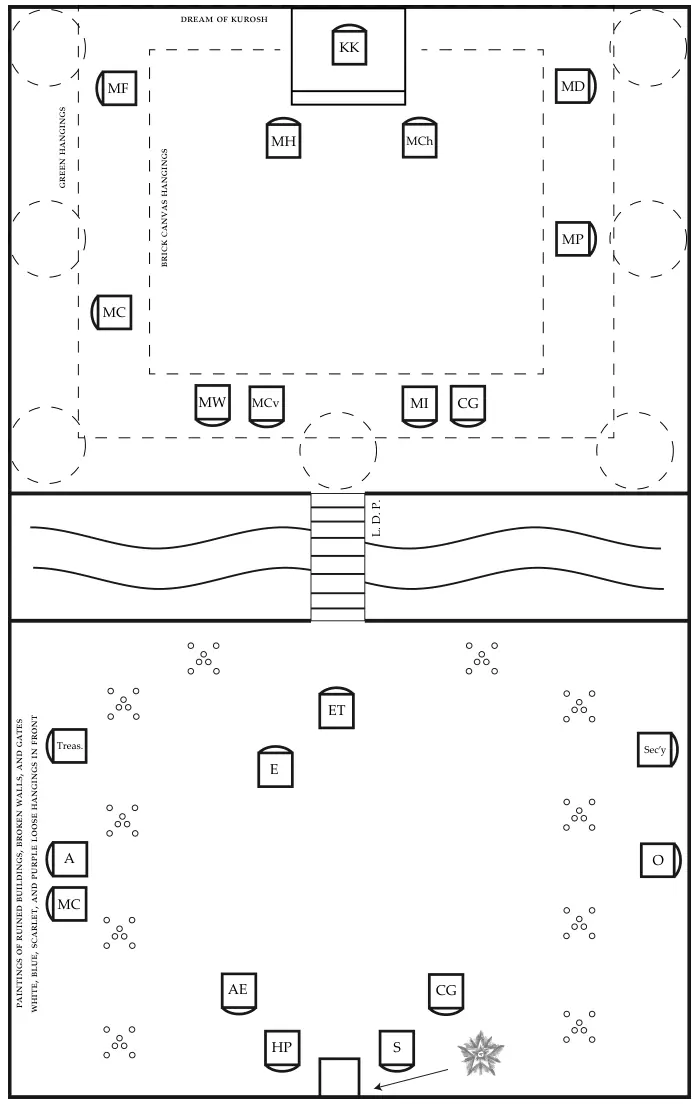
Le lieu où se tient l'assemblée se nomme conseil, la tenture doit être couleur d'eau courante ou verdâtre, en mémoire du fleuve Euphrate dit Stharbuzanaï pour les raisons dont on va donner le détail. Cette tenture doit être mêlée de couleur rouge en mémoire du sang des Assyriens qui rougit les ondes de ce fleuve.
Les lumières, qui doivent éclairer le grand conseil, doivent être au nombre de 72 en mémoire des 72 années qu'a duré la captivité, savoir les deux dernières années du règne de Sedecias qu'a duré le siège de Jérusalem et les 70 ans que les Israélites ont passé en captivité à Babylone, depuis la destruction du temple par Nabuzardan sous le règne de Nabucodonosor, jusqu'à la réédification sous les rois de Perse par le général Matra-Buzanez.
2° par le rapport des 72 qui composent les mots de chevaliers d'Orient, avec ceux des grands élus parfaits maîtres et sublimes écossais, comme il est aisé de le voir : Exemple
Mots des ch. de l'Or. Mots des gr. él. p. m. et s. écos75. Yaveron-ha-maïm…………… 13 Raf. odom │ Rem fœdom…
7 Juda et Benjamin……………. 14 Ebron…………………………
5 Gabaon……………………….
6 Libertas……………………….
8 Tyr……………………………
3 7 Libanus………………………. Jakin………………………….
5 Booz………………………….
4 Total des lettres………………. 72
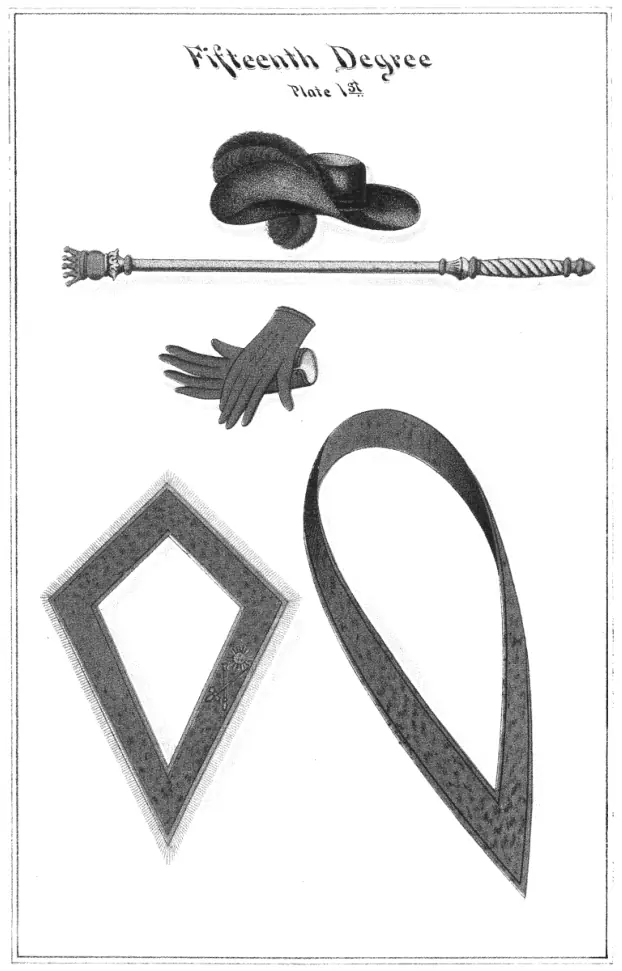
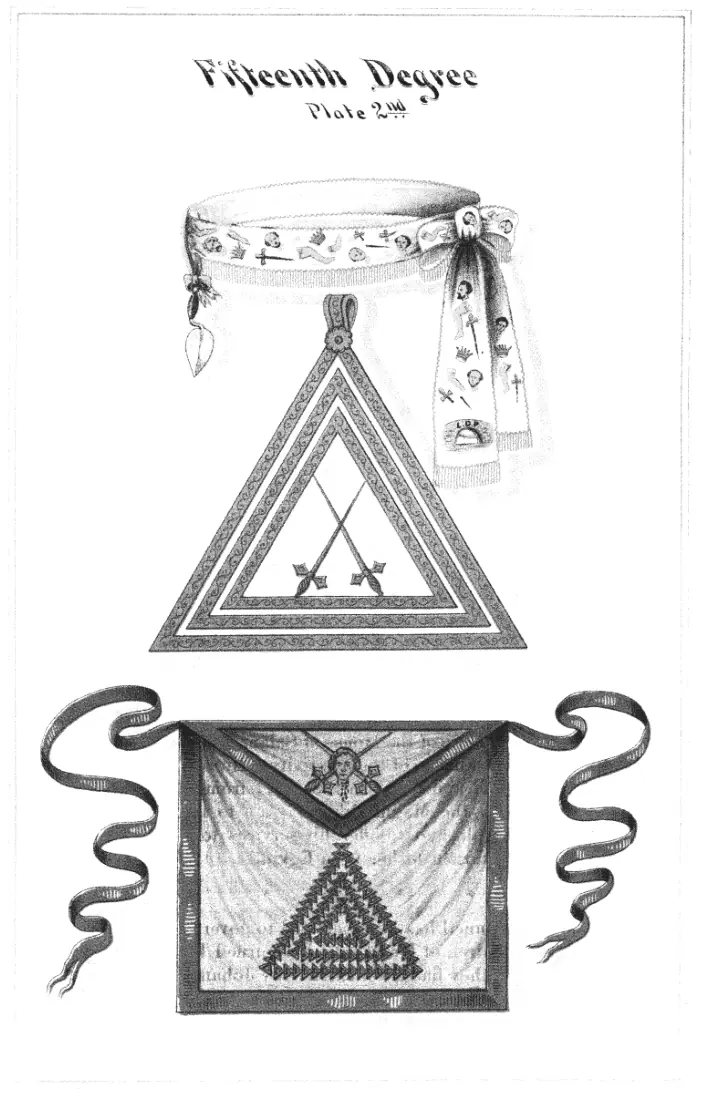
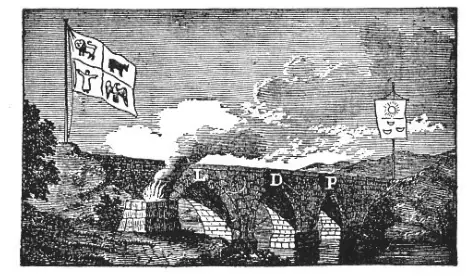
Tous les chevaliers sont décorés d'un cordon ou ruban moiré large commandeur [sic] couleur d'eau courante ou verdâtre fait en serpentant, bordé tout autour d'une lisière d'or. Sur le travers du ruban qui se met sur l'épaule droite il doit y avoir un pont de bois brisé, brodé en soie et couleur de bois mêlé et orné d'or avec les deux lettres en couleur de feu Y. H. lettres initiales de deux mots hébreux qui signifient : Liberté de passage ; il doit être semé non pas de têtes de morts et d'ossements, mais de têtes et de membres de cadavres nouvellement privés de la vie, les têtes posées sur deux épées croisées et quelques-unes éparses à demi rompues, sabre ou autre arme blanche ancienne. Le mot Star-bu-za-naÿ ainsi divisé doit être brodé en or sur le cordon dans le [goût] ci Sthar, sur le premier bout du cordon, qui se met devant le maître, à quelque distance des têtes, bu sur la place du cordon entre la poitrine et l'estomac, proche le côté le plus voisin du part que doit se trouver sur l'épaule, za de l'autre côté du pont, à la même distance que celui avant les autres têtes et cadavres qui doivent se trouver au Berith…………………………
6 Neder…………………………
5 Shelemout…………………….
9 Schibboleth…………………… 11 Elehenam……………………..
8 Mach-mahara-bach…………… 14 Gabahon………………………
7 Maabin………………………..
6 Adonaï…………………………
6 Total des lettres………………. 72
milieu du dos, naÿ au bout du cordon en parallèle avec Sthar. Il doit pendre au cordon une petite épée, attaché à un ruban couleur de feu [27v°]. –
[27v°] Il ne doit point y avoir de têtes de mort décharnées, d'ossements en sautoir, ni de couleur noire. Cela aurait l'air d'une bande de drap mortuaire et en vérité les chevaliers d'Orient ne portent le deuil de personne et de qui pourraient-ils le porter dans la plus heureuse révolution des maçons, où ils n'ont eu de tués dans le combat, dont ils sont sortis vainqueurs, que les scélérats qui s'opposant à leur passage, malgré les ordres précis des deux plus grands rois de Perse. Sa couleur verdâtre ou d'eau du fleuve sur le bord duquel ils ont triomphé. On voit actuellement que cette couleur verdâtre ou d'eau courante, mêlée de têtes et cadavres, nouvellement privés de la vie est la représentation au naturel de ce que se passa sur les bords de l'Euphrate dont les eaux furent teintes de sang des Assyriens vaincus et couvertes de leurs cadavres.
Ce fleuve en langue de chevalier d'Orient se nomme Stharbuzanaÿ, du nom du chef des adversaires qui s'opposaient à la réédification du temple. Ce nom signifie encore en langue hébraïque : Métier retrouvé selon le Talmud, signification qui convient merveilleusement aux chevaliers d'Orient. Ce nom enfin composé de douze lettres ajouté aux autres mots du grade, rend le nombre mystérieux de 81 comme on l'expliquera plus amplement ci-après.
Le tablier doit être de peau blanche, doublé de rouge mêlé de couleur verdâtre. Sur la bavette du côté qu'elle se renverse, une tête de cadavre nouvellement privé de la vie, posée sur deux épées en sautoir, peintes ou brodées en naturel et au milieu dans le plein des chaînes en chaînons triangulaires brisées et séparées en trois tas posés triangulairement et les deux lettres initiales des 2 tribus I. B. sur l'autre revers de la bavette. Description du tableau
1° Au haut de la loge est un aigle droit sur ses deux pieds, les ailes déployées, la tête fièrement élevée, à sa droite un grand J. à sa gauche un grand B., et à une distance égale les deux lettres initiales du mot du grade. Sur la même ligne d'un côté est le Soleil et de l'autre la Lune.
2° Au-dessous est un carré long, qui représente le nouveau temple, bâti selon les dimensions que Cyrus en donna.
3° Dans la partie orientale de ce carré long est le Saint des Saints, où repose l'Arche d'Alliance couverte par deux chérubins qui soutiennent de leurs ailes le Delta qui signifie le nom du Grand Architecte de l'Univers, qui ne se prononce jamais qu'en tremblant.
4° Le Saint des Saints est séparé du reste du temple par un grand voile,
5° Dans ce lieu très saint est l'autel des sacrifices, sur lequel il y a un cœur enflammé avec ces deux lettres R. O. initiale de deux mots qui signifient : Vrai maître ou vrai maçon, tels que ceux qui offrent leur cœur à Dieu et se dévouent au bien général de l'Ordre. Ces deux mots sont : Raf Odom et leurs initiales sont écrites au-dessous de l'autel des sacrifices sur le piédestal qui le soutient.
6° Cet autel est accompagné et environné de tous les instruments nécessaires à la Maçonnerie, dont on se servit pour la construction du nouveau temple.
7° A la porte de l'Occident est le grand escalier à sept marches. Les frères en savent l'explication, ainsi que de tous les instruments du métier.
8° Au-dessous de l'autel des sacrifices est le carré de neuf, qui rend trois fois 27, lesquels additionnés donnent le nombre chéri de 81. En voici une première explication que nous donnerons plus étendue, qui servira à faire connaître pourquoi le nombre 81 est si cher des maçons parfaits. Ce carré de neuf, qui donne trois fois 27 explique la triple essence de la Divinité, marquée par le triple triangle dont voici la figure :
L'explication de ce triangle démontre que neuf vertus attribuées à trois dans un premier triangle donnent 27 lesquelles appliquées à un triple triangle font le nombre de 81 et composent 81 lettres dont voici l'exemple : miséricorde création justice sagesse immensité / 3 vertus beauté / 3 vertus
[28r°] 9° En dehors du temple sur la ligne de l'arche au-dessous du Soleil à droite est le mont Ebron, connu de tous les maçons, figuré par sa lettre initiale et à gauche au-dessous de la Lune est le mont Gabaon, figuré de même par la lettre initiale. On faisait les sacrifices sur ce dernier, avant la construction du nouveau temple.
10° A la porte du Nord est une main armée d'une épée et trois marches ; au-dessous de ces marches est un trophée d'armes pour servir et armer les ouvriers dans une pressante nécessité.
11° Plus bas sont les vases, les urnes et autres ornements sacrés pour décorer le nouveau temple, la mer d'airain, la table des pains de proposition, k chandelier à sept branches, l'autel des parfums placé immédiatement au-dessous des 7 degrés, environné des instruments des sacrificateurs.
12° A la porte du Midi est une main armée d'une truelle et cinq marches ; vis-à-vis ladite porte est une auge pour porter le ciment, au-dessous à droite des cinq marches est un amas de pierres cubiques, prêtes à être employées, et au-dessous à gauche un tas de pierres brutes pour servir à fortifier le bâtiment.
13° Au milieu du tableau sur la même ligne, au-dessous des 7 marches, sont la Bible, une équerre et un compas.
14° Encore au-dessous sur une autre ligne à droite, la pelle, la pince et le marteau taillant et sur une troisième ligne encore à droite un niveau, une perpendiculaire, un cube, un triangle et un carré tellement disposés qu'ils occupent toute la loge du Nord au Sud sur la même ligne.
15° On place encore sur une autre ligne au-dessous, mais triangulairement posés, la règle, le ciseau et le maillet et au milieu dans le vide sur les bords du fleuve le mot Judée.
16° La loge vers le bout de l'Occident est traversée du Nord au Sud parle fleuve Euphrate, nommé en loge de chevalier de l'Orient Stharbuzanaÿ, au milieu duquel est construit un pont de bois pour le passage des maçons libres. Sur ce pont sont gravées les deux lettres Y. H. lettres initiales de Yaveron-hamaÿm, qui signifie : Liberté de passage pour les maçons libres.
17° Le fleuve est couvert de têtes, de cadavres, de corps morts, de couronnes, et de sceptres brisés.
18° Au milieu, dans le vide, sur l'autre bord du fleuve, le mot Syrie et à chaque coin de ce côté-ci un collier de chaînes dont les anneaux sont triangulaires, au milieu de ces chaînes le chandelier à sept branches renversé. 19 ° A droite est la lettre T. représentant les carrières de Tyr, d'où l'on tirait les pierres pour la construction du temple et à gauche la lettre L. représentant le mont Liban, d'où l'on tirait les toute-puissance perfection éternité / 3 vertus
le tombeau de Sédécias, dernier roi de la race de David et au-dessous du T. est un amas de chaînes triangulaires brisées placées en parallèle au tombeau de Sedecias.
20° Au milieu sont les colonnes J. et B., Jakin et Booz, en sautoir et brisées.
21° Tout à fait au bas du tableau est une partie du plan de la ville de Babylone, pillée renversée et ruinée.
Nota. Dessous l'autel des sacrifices est un carré long comme est tel que nous l'avons dit ci- dessus, aux deux colonnes, duquel sont les lettres initiales de Juda et Benjamin.
Chaque article de l'explication de ce tableau renferme un sens mystérieux, dont une partie sera expliquée dans les instructions que l'on donnera ; le reste doit être une énigme jusqu'au moment, où la vérité sera entièrement dévoilée, moment fortuné où les Véritables maçons ne seront plus uniquement attachés qu'aux premiers principes de la Maçonnerie, comme les faits qui peuvent ramener tous les amusements à une fin solide et permanente, mais le nombre des initiés est très petit ; heureux, qui peut mériter de l'être.
Tous les frères sont appelés princes par le souverain ; et entre, eux ils ont le titre d'excellence ; le récipiendaire s'appelle toujours Zorobabel et cède son nom à celui qui vient après lui.
La porte du conseil doit être gardée par les deux chevaliers derniers reçus. Ils seront armés d'un bouclier quand le souverain entre au conseil [28v°]. –
[28v°] L'ordre dans lequel on se place au conseil
1° Vénérable ou souverain représentant Cyrus, Darius, Artaxerces, Longimanus dont il prend le nom, se met à la place du milieu sur le trône, qui lui est préparé sous un dais.
2° Le garde des sceaux qui se nomme Nehemias, se met à la droite du souverain et ne doit jamais quitter sa place, pas même pour les princes visiteurs qui se placent à sa droite au- dessous de lui.
3° Le grand Général qui se nomme +Satra-buzanez se met au bas du conseil en face et vis-à- vis la droite du souverain.
4° Le grand Trésorier qui se nomme +Mithridate se met au bas du conseil en face et vis-à- vis la gauche du souverain.
5° Le grand orateur ou ministre d'état qui se nomme Esdras, se met à la gauche du souverain.
Ces officiers ne se déplacent jamais pour qui que ce soit, les autres frères sont princes et se placent à droite ou à gauche indifféremment Il n'est pas interdit au conseil de nommer cinq frères pour remplir les cinq grands officiers en cas d'absence des uns ou des autres ; mais ces cinq frères ne doivent avoir aucune préséance lorsqu'ils ne sont point en exercice.
Il n'y a point de surveillants, ni grands ni petits, leurs fonctions n'en sont pas moins remplies, les cinq grands officiers n'ont qu'à parcourir les instructions. Ils verront ce qu'ils auront à faire pendant que le conseil se tient. Il n'a point de table devant le souverain, parce que le premier ministre a dans la main le livre de la loi pendant la tenue du conseil.
Ouverture du conseil
Le grand Général d'armée, placé à l'Occident, ouvrira le conseil en disant : Frères80 chevaliers le souverain nous rassemble pour tenir conseil. Le voici qui arrive, soyons attentifs à ce qu'il devra nous proposer.
Le souverain entre tout de suite en traversant l'assemblée et arrivé au trône il frappe un coup de son épée nue en disant : Princes le conseil est ouvert
Il salue tous les frères chevaliers en portant sa main droite sur la partie du cœur, son chapeau ou sa couronne sur la tête ; tous les princes y répondent de même ayant le chapeau à la main gauche et saluant de la droite, qui tient la lance, en portant la main sur le cœur. Ils font une inclination de tête et s'assoient. Introduction du récipiendaire
Le récipiendaire est à la porte du conseil, couvert d'un drap ou crêpe noir sali d'un peu de cendres, suspendu de façon qu'on lui puisse entendre faire quelques soupirs. Un des gardes, l'ayant entendu, entr'ouvre la porte pour voir ce que c'est et ayant vu, que c'est un homme en deuil, il referme la porte et va en avertir Mithridate, grand surveillant, qui se lève aussitôt de sa place sans dire mot, va trouver le récipiendaire, et lui fait les questions suivantes en dehors du conseil. – Nota. Il y a toujours un frère avec le récipiendaire qui le fait agir.
D. Que demandez-vous ?
R. Je demande, s'il m'est possible, que vous me procurez l'honneur de parler au roi.
D. Qui êtes-vous ?
R. Juif de nation, prince de naissance de la troisième lignée81 de Juda, sorti de la famille de David.
D. Quel est votre nom ?
R. Zorobabel.
D. Quel âge avez-vous ?
R. Quatre-vingts un ans (D'autres disent soixante et dix ans).
D. Quel sujet vous amène auprès du roi ?
R. Les larmes et la misère de mes frères. Mithridate dit alors au récipiendaire : Attendez un peu, je vais prier le roi pour qu'il vous soit favorable. Il frappe en même temps un seul coup avec le pied au bas de la porte du conseil, qui lui est ouverte par un des gardes.
Il va au pied du trône, rend compte au souverain de ce qu'il a entendu de Zorobabel et le roi lui ordonne de le faire entrer, la face couverte. Mithridate salue profondément le roi en portant les deux mains sur son visage et va joindre le récipiendaire, à qui il dit : Vous avez trouvé grâce auprès du plus grand roi du monde. Il vous permit de paraître devant lui, la face couverte. Il frappe à la porte du conseil, qui lui est ouverte et il introduit le récipiendaire couvert de son drap. Les gardes ont soin de fouiller Zorobabel et voir s'il n'a pas sur lui quelques armes pour attenter à la vie du souverain et tous les chevaliers doivent avoir l'épée nue à la main, la tête couverte, et les gardes le font avancer par sept pas, en ligne droite et en équerre jusqu'au pied du trône, où il se met à genoux.
Le ministre d'état, orateur du conseil, s'avance, lui découvre le visage et lui fait les questions suivantes, auxquelles un des gardes ou frères fait répondre le candidat [29r°].
[29r°] Questions du ministre d'état à Zorobabel à genoux
D. Quel sujet vous amène au roi ?
R. Je viens implorer sa bonté et sa justice.
D. Pour quel sujet ?
R. Pour lui demander grâce pour mes frères, qui gémissent en captivité depuis 72 ans.
D. Qui êtes-vous ?
R. Zorobabel, prince hébreu, sorti du sang de David.
D. En quoi consiste la grâce que vous demandez ?
R. A mettre la nation juive en liberté, permettre que nous retournions en Judée, y rétablir le temple détruit, faire revivre la loi du Dieu des Armées et les ordonnances de Moïse.
Après cette réponse le souverain fait signe de faire se retirer à Zorobabel Alors les deux gardes le relèvent et l'emmènent hors du conseil. L'un des deux va avec lui et l'autre rentre et ferme la porte, après quoi le souverain adresse la parole à tous les chevaliers princes en ces termes :
Princes, il y a longtemps que j'ai résolu de mettre les Juifs en liberté. Je ne sais, mais je suis pénétré de voir ce peuple dans les fers. Leur Dieu, qu'ils nomment le Dieu fort, m'est apparu en songe. Il me semblait, que ce dieu terrible me menaçait comme un lion rugissant, prêt à fondre sur moi pour me dévorer. Je croyais entendre de sa bouche deux mots et deux paroles, qui traduites en notre langue signifient : Rends mon peuple libre ou tu mourras !
C'est de vous, chers princes, que j'attends les avis sur ce que je dois faire touchant la demande de Zorobabel.
Après que le roi a parlé, tout le conseil garde un profond silence pendant lequel le ministre d Etat va recueillir les voix de chaque chevalier et va ensuite en rendre compte au roi à l'oreille droite (d'autres disent que les chevaliers font chacun à leur tour donner leur voix au ministre).
Alors le roi ordonne à Mithridate de faire rentrer Zorobabel après l'avoir décoré d'une robe blanche et ceint d'un large ruban vert. Dans cet état, il l'introduit aux pieds du trône. S'étant mis à genoux le roi lui dit :
Discours du roi à Zorobabel
Levez-vous. Je vous accorde votre demande, et fais grâce à tout Israël. Je consens, qu'il soit mis en liberté et qu'il lui soit libre de demeurer dans mes états, ou de retourner en Judée rebâtir un nouveau temple où son Dieu soit adoré. Que ce temple soit orné et enrichi des dépouilles de l'ancien, détruit par mes prédécesseurs. En conséquence, j'ordonne que tous ces effets vous soient remis avant le coucher du Soleil. De plus, je vous fais chef de toute la nation. J'entends qu'elle vous obéisse. Je me réserve seulement un tribut de trois agneaux, cinq moutons et sept bœufs toutes les années. Et pour marque authentique de ma bonté à votre égard, je vais vous armer d'une épée terrible que vous porterez pour marque de distinction et de l'autorité que je vous donne sur vos frères. Elle vous servira à combattre vos ennemis et vous faire craindre de ceux de vos frères qui pourraient cabaler contre vous, et pour ce j'ordonne à mon général Jatrabozane[z] de vous instruire dans l'art de la guerre.
Après que le roi a armé Zorobabel d'une épée, on le conduit au général, qui lui dit : Je me réjouis, prince, des grâces que vous venez d'obtenir de notre souverain. Je vais vous instruire dans l'art de la guerre, après que je vous aurai armé chevalier et enseigné la mémoire de vous faire reconnaître. Il lui fait ensuite les questions suivantes, dont les réponses lui sont soufflées :
D. Comment s'appelle votre pays ?
R. La Judée, située au delà du fleuve Euphrate dit Starrbu-zarnay, à l'Occident de la Syrie.
D. Comment appelez-vous le peuple, qui l'habite ?
R. Israël, d'où nous sommes sortis.
D. Quel nom ont ceux qui sont ici captifs ?
R. Ils sont distingués par deux tribus : Juda et Benjamin.
D. Le roi vous a armé d'une épée pour vous défendre contre vos ennemis. Je vais, par le
et vous le porterez de l'épaule droite à la hanche gauche. – Il est couleur d'eau et représente le passage de l'air. Semblable à un vaisseau, sujet au gré des vents, de même nous flottons au gré de nos passions. Heureux celui qui peut en éviter les dangers.
Il lui donne ensuite le tablier, le signe, les mots et l'attouchement.
Le signe se fait en portant la main droite sur l'épaule droite d'où on la descend en serpentant sur la poitrine jusque sur la hanche gauche, où est l'épée que l'on prend et que l'on lève comme pour combattre. On y répond de même.
L'attouchement se donne en s'entrelaçant la main gauche l'un de l'autre, faisant comme si on se repoussait ou que l'on combattait pour se disputer un passage. L'on se présente ensuite réciproquement l'épée sur la poitrine. – on tire l'épée du fourreau de la main droite, pendant que la gauche repousse et l'on se demande mutuellement le mot de passe, qui est Yaueron- hamaïm qui veut dire Libertas, liberté de passage.
Si votre frère vous rend le mot de passe juste, vous l'embrasserez en lui donnant le baiser de paix sur chaque joue et, en le lui donnant, vous lui demanderez de quelle tribu il est. S'il dit Juda, vous lui répondrez Benjamin. S'il dit l'un, vous direz l'autre.
Si vous levez une armée, votre mot de passe sera Yaueron-hamaïm. Pour vous faire connaître au conseil assemblé vous direz le grand mot : Raf-odom, qui veut dire : Vrai maître [29v°].
[29v°] Apres cette cérémonie, Mithridate le fait avancer au pied du trône par sept pas, faits activement en ligne droite, où étant arrivé il se met à genoux pour prêter le serment de fidélité au souverain et à tous les chevaliers qui doivent être debout, l'épée nue à la main. Le livre de la loi est devant le roi et l'épée du récipiendaire doit y être dessus nue.
Obligation
Je N. promets et m'oblige solennellement devant le Grand Architecte de l'Univers et auprès de tous les frères chevaliers de l'Orient ici assemblés, sur ma foi d'honnête homme et de maçon libre, d'être fidèle à ma religion et aux lois de l'état, de ne point révéler les mystères de chevalier d'Orient qui viennent de m'être confiés soit par le moyen de la parole de l'écriture ou autre chose, qui puisse porter caractère, et de ne recevoir ni initier à ce grade éminent aucun frère maçon que conformément aux Anciennes Constitutions, statuts et règlements. Le tout sous peine d'être déshonoré, de perdre le titre de maçon libre et d'être privé des avantages des loges... Ainsi Dieu me maintienne dans la droiture et l'équité. (Il y en a qui y ajoutent des serments mais c'est assez inutile. Ils sont tous à peu près les mêmes.)
[Après l'obligation]
L'obligation prêtée, le roi embrasse le récipiendaire, c'est-à-dire le nouveau chevalier, et le traite de frère. Le second surveillant le conduit ensuite à tous les chevaliers qui l'embrassent et le félicitent. On lui donne ensuite l'explication du tableau des chevaliers de l'Orient, suivant le détail que nous en avons donné plus haut. Quand on a fini, le ministre d'état ou grand-maître donne le précis de l'histoire des chevaliers en ces termes :
Histoire des chevaliers de l'Orient
Le royaume de Juda fut détruit par les Assyriens sous le règne de Sedecias, vingt et unième roi de la race de David, en la personne duquel finit la postérité de son prophète-roi.
Nabucodonosor roi des Assyriens jaloux de la grandeur du prophète de Dieu entreprit de lui faire la guerre et de le détruire. Ce qui s'exécuta ainsi qu'il avait été prédit par les prophètes
en punition des crimes et le tout de l'idolâtrie d'Israël. Il fit le second82 siège de Jérusalem la dix-huitième année de son règne et la onzième de Sedecias. La sainte cité fut attaquée et défendue avec une valeur incroyable, le second83 siège fut très opiniâtre et cruel. Les assiégés souffraient dans les attaques. Les événements les plus affreux tels que la peste et la fièvre et l'ennemi faisait des dégâts partout où il se présentait. Mais la vigilance, l'activité et le zèle des maçons libres qui se trouvaient renfermés dans la ville les réparaient aussitôt, mais il était écrit dans les décrets éternels que Jacob tomberait en servitude, que le culte du vrai Dieu serait interdit et que son temple, la précieuse merveille du monde, serait détruit jusqu'aux fondements.
Cette douloureuse époque arriva l'an du monde 3493 ans, six mois et dix jours depuis la création du monde et 470 ans depuis la fondation du temple. Le roi Salomon en avait posé la première pierre la quatrième année de son règne et le deuxième mois de [Gio]. La cérémonie en fut faite avant le Soleil levé et fut solennisée par des grandes fêtes. Cette pierre était d'agate d'un pied en carré de figure cubique. Le ciment qui y fut employé était composé de lait, de l'huile, du vin et de la farine. On la plaça au milieu de l'endroit, où devait être le Saint des Saints. L'histoire sacrée fait une ample description du saint temple de même que de sa magnificence. Tout zélé chevalier doit, après sa réception, en faire la lecture et se la rendre familière pour qu'il puisse, étant parvenu à ce haut grade, en donner raison dans les occasions.
La sainte cité fut prise d'assaut, après dix-huit mois de siège. Ce fut dans une nuit, que les Babyloniens entrèrent dans la ville par sept endroits différents, où ils s'étaient aperçus, qu'on ne faisait pas bonne garde. Ils coururent sans perdre temps au temple où les principaux de la ville s'étaient réfugiés avec toutes leurs richesses et principalement le roi Sedecias, sa famille et toute sa maison. La désolation, où les ennemis trouvaient la ville les porta à la compassion. Ils ne firent aucun meurtre et se contentèrent du pillage. Mais s'étant approchés du saint temple, ils furent d'abord attaqués et repoussés avec rigueur par les maçons libres qui le défendaient, mais comme leur nombre était de beaucoup inférieur à celui des ennemis, ils furent contraints de céder et de se rendre à discrétion.
Lors de la prise de Jérusalem Nabucodonosor85 était à Babbata ville de l'Assyrie. Lorsqu'il en eut reçu la nouvelle, il envoya Nabazardan, son général, avec ordre de détruire et brûler le temple, après en avoir enlevé tout ce qui pourrait s'y trouver en métaux et autres choses précieuses, de réduire ensuite l'édifice en cendres et de ruiner la ville de fond en comble, de mener captifs à Babylone tous les habitants notables et laisser le menu peuple errant. Nabuzardan exécuta fidèlement les ordres de son maître. Il dépouilla le temple de ses ornements, le détruisit et le brûla, emporta à Babylone tous les vases d'or et d'argent, qui se montaient à deux cents soixante et deux milles sans compter ceux des autres métaux, comme la grande mer d'airain, les autels, les vaisseaux de purification, les deux colonnes et ouvrages faits en or en argent, comme les tables, les chandeliers, etc.
L'Arche d'Alliance et les livres saints furent donnés en garde à Cephan sous condition que sa vie en rendrait compte. Le nombre des captifs, que Nabuzardan emmena à Babylone, était de quatre-vingt et un mille, du nombre des quels était Sedecias, toute la famille royale, les officiers sacrificateurs, et les lévites sans compter un nombre infini de peuple et domestiques. Nabuzardan entra en triomphe à Babylone. Tous les captifs étaient enchaînés sans en compter le roi dont les chaînes étaient d'or.
La figure de ses chaînes était triangulaire avec trois anneaux dont l'un des quels était passé au col avec les poignets dans les deux autres. Les chaînes étaient d'autant plus tristes aux yeux des Israélites que leurs figure représentait l'emblème de la Divinité, dont le saint nom
est représente par le divin Delta. Dieu permit, qu'il [30r°] lui fut toujours présent dans la plus dure captivité pour leur rappeler sa bonté et sa clémence et les porter à obtenir grâce de leurs fautes passées. Nabucodonozor consacra à ses faux dieux les dépouilles du saint temple. Il donna un logement au roi Sedecias et à toute sa famille de même qu'à ses officiers. Le reste des captifs fut mis aux environs de Babylone. Les plus distingués furent confinés dans l'enceinte de la ville, du nombre desquels furent les descendants des maçons libres, qui avaient construit le temple et qui avaient le privilège exclusif de l'entretenir. Il leur était défendu par une loi expresse de Salomon de travailler à d'autres ouvrages sous peine de punition corporelle, ce qui fut observé inviolablement, même pendant la captivité. Car lorsqu'Alexandre voulut faire bâtir un temple à Jupiter, aucun des maçons ne voulut y travailler. Ils aimèrent mieux mourir que d'employer leurs talents à la dévotion de l'idolâtrie.
Telle fut la douleur de ces illustres maçons d'avoir vu détruire un si grand édifice, chef- d'œuvre de la main des hommes conduite par celle du Tout-Puissant, que leurs larmes ne cessèrent de couler qu'au moment que le grand jour arriva, qu'ils furent mis en liberté pour aller bâtir un nouveau temple à la gloire de l'Eternel sur le modèle de l'ancien, non toutefois si beau, ni si riche, mais selon leurs moyens. Trois ans après la captivité en Assyrie le roi Sedecias mourut et en lui finissaient les rois de la race de David après avoir régné sur le peuple de Dieu 458 ans, sept mois, trois jours. En la personne de ce roi finit la Maçonnerie puisqu'elle perdit en lui le chef des maçons-libres, qui étant devenus captifs. Tous les grades, depuis l'apprentif jusqu'au dessus de l'élu parfait, ou grand écossais, sont une peinture de ce qui s'était fait, lors de la construction du temple.
Le grade de chevalier de l'Orient renouvelle aujourd'hui la Maçonnerie. Le but de ces nouveaux maçons est de rebâtir le temple, lorsque l'Eternel voudra leur en procurer les moyens, car la Maçonnerie parmi les chrétiens n'a eu d'autre fin dans son principe que celle de réédifier le saint édifice sur ses anciens fondements.
– Fin de la Maçonnerie ancienne – A présent renouvelée – Suite du discours
Après que les tribus de Juda et de Benjamin eurent passé soixante-dix ans en captivité dans l'Assyrie, Dieu fut touché de leurs larmes et elles trouvèrent grâce devant son trône sacré. Il inspira à Cyrus, roi de Babylone, le dessein de mettre Israël en liberté. Il écouta à cet effet les puissant prêtres et les principaux des Juifs et les sollicitations de Zorobabel, prince de la tribu de Juda, de la famille de David, parent de Nehemias et de Josué ou Jarus fils de Sedecias sacrificateur ses frères et son fils Cedenicas et ses fils les fils de Juda et de Henoab. Satrabuzanez son général l'avait instruit dans l'art de la guerre selon l'ordre qu'il lui en avait donné et il était depuis longtemps à son service. Il lui permit de sortir de l'Assyrie avec tous les Juifs qui voudraient le suivre pour aller en Judée rebâtir le temple du vrai Dieu. Pour cet effet, il fit tirer du trésor royal tout ce qu'il y avait des dépouilles de l'ancien temple lors de sa destruction et les fit livrer à Zorobabel par Mithridate, son grand trésorier. Il ordonna que le nouveau temple aurait [sic] cent vingt coudées de longueur, soixante de largeur et autant de hauteur et que les bois et les pierres nécessaires à sa construction seraient tirés du Liban et des carrières de Tyr.
Il fit à cet effet un édit qui fut publié dans tous ses états, par lequel il ordonna tous ses sujets de laisser sortir librement les Juifs et de ne les troubler en aucune façon mais, au contraire, de leur donner aide et secours, sous peine de mort contre ceux qui enfreindraient ses ordres. Zorobabel, après avoir reçu ce bienfait, se prosterna aux pieds du prince et lui ayant
baisé le bas de sa robe, il le remercia au nom de toute la nation de la grâce singulière, qu'il venait de lui accorder, l'assurant qu'à l'avenir tout Israël ferait des vœux pour la conservation de sa personne et la propriété de ses états.
Zorobabel se retira ensuite pour prendre avec les chefs des familles des tribus les arrangements convenables sur ce qu'il était à propos de faire. Zorobabel et Nehemias proposèrent un projet dans un conseil qu'ils convoquèrent, où les chefs des maçons assistèrent, entre lesquels étaient Bilbe, Macops, Erresque, Vineau, Dirculairepepen, Buce, Tanlerig, Querra, Nigée, Exioncute, Saudistée87. Il fut résolu dans ce conseil que Bilbe, Macops, et Erresque présideraient aux travaux et en conséquence ils furent choisis pour les trois principaux maîtres, qui auraient la direction générale du travail. On leur donna pour adjoints, Nigée, Exioncute, et Saudistée, qui [devaient] avoir la direction des ouvriers et les autres, qui étaient Vineau, Disculairepepen, Buce, Tanlerig, et Querra, [devaient] être les principaux maîtres, destinés à distribuer les dessins aux ouvriers et à les payer.
On travailla ensuite au dénombrement du peuple, qui se trouva monter à 63000 hommes. – Selon d'autres à 42360 seulement, sans compter les esclaves, qui étaient au nombre de 7503. Les trois directeurs firent le dénombrement des maçons libres qui avaient échappé à la fureur des soldats, lors de la destruction du temple. – C'est-à-dire ceux qui étaient descendus de ceux qui avaient bâti l'ancien temple, pour être conservés dans le grade de leurs pères. Ensuite de tous les ouvriers tailleurs de pierre, charpentiers et autres ouvriers nécessaires pour l'édifice, le nombre des premiers n'allait qu'à 7000, lequel nombre joint à celui des ouvriers n'étant pas suffisant pour bâtir l'ouvrage. Zorobabel arma les premiers chevaliers, les unit à la tête du peuple pour combattre ceux, qui voudraient leur disputer ce passage ou le chemin de la Judée, institua les autres dans les grades inférieurs ou grades nouveaux, auxquels il accorda des privilèges. Ces nouveaux maçons furent d'abord regardés comme de simples ouvriers, puis comme ouvriers faits et ensuite comme ouvriers parfaits [30v°].
[30v°] Zorobabel et Nehemias ayant reçu les trésors et les vases du temple (au nombre seulement de 5410 vases [ ?] quelques-uns) des mains de Mithridate, grand Trésorier de Cyrus, fixèrent leur départ au 22 mars suivant notre calcul. Les trois jours qui précédèrent ce départ furent employés en jeûnes et prières et le troisième jour, après le Soleil couché, fut célébrée la même cérémonie qui autrefois fut faite, lorsque le même peuple sortit de la suite d'Egypte. Ensuite tout Israël se mit en marche sous la conduite de Zorobabel, nouveau Moïse. La marche fut de façon que les maçons étaient à la tête pour arriver plutôt et mettre la main à l'œuvre, les tailleurs de pierre et les charpentiers furent ensuite envoyés par bandes dans les carrières de Tyr et de la Judée et les forêts du Liban.
La marche des Hébreux fut des plus heureuse jusqu'au bord du fleuve Sthar-bu-za-nay (l'Euphrate) qui sépare la Judée de l'Assyrie et va se jeter dans la mer Tyberiane. Les maçons y étant arrivés les premiers trouvèrent au bord de ce fleuve des hommes armés qui les attendaient pour leur disputer le passage et les piller. Les chefs des maçons leur montrèrent leurs passeports de Cyrus de même que l'édit, qu'il avait fait publier dans ses états, mais ces barbares furent aveuglés par l'espoir du butin qu'ils pouvaient faire, s'ils parvenaient les vaincre, surtout ayant vu parleurs passeports, qu'ils portaient une grande partie des dépouilles de l'ancien temple. Sans avoir égard à l'édit du roi, ils se jetèrent sur les maçons pour les mas sacrer, mais le Grand Architecte de l'Univers en avait ordonné autrement. Les Assyriens furent tous taillés en pièces et précipités dans le fleuve qui dans l'instant fut teint de leur sang et couvert de leurs corps morts ou noyés au passage du pont.
Après cette victoire Zorobabel fit élever sur le champ de bataille un autel sur lequel il offrit un holocauste au Dieu des Armées qui avait combattu pour Israël et prit pour mot de passe
Yaueron-hamaïm qui veut dire Liberté de passage. Les Israélites traversèrent ensuite le fleuve et se hâtèrent d'arriver à la triste Jérusalem. Leur marche fut d'environ trois mois ; ils y arrivèrent le 22 juin, jour du solstice d'été à trois heures après midi. Après sept jours de repos les trois architectes et leurs adjoints se mirent en état de commencer la construction du nouveau temple. Ils divisèrent les ouvriers par bandes dont chacun avait un chef et deux adjoints. Chaque ordre de bande était payé selon son rang dans le travail et avait chacun son mot particulier. Le mot de la première bande était Juda, elle était payée au pied des colonnes qui étaient à l'entrée du temple. Le mot de la seconde bande était Benjamin et recevait son payement sous le portique. Le mot de la troisième bande était J., le grand nom, ou Yaueron- hamaïm. Elle recevait son salaire au milieu du temple. On observa dans la construction du temple nouveau ce qui avait été pratiqué pour l'ancien. (Selon d'autres) Le nombre de première bande était de 3 fois 7, la seconde de 5 fois 7 et la troisième de 7 fois 7 ouvriers. La première bande avait le nom acacia, leur mot sacré était J. etc. qu'ils étaient obligés de donner à l'architecte sans quoi ils n'étaient pas payés. La seconde avait pour mot de passe Schibboleth et pour mot sacré Booz, la troisième s'appelait Tubalcaïn, et avait pour mot sacré Jakin.
Cet ordre-ci se trouve par inversion du premier en comptant du premier rang au dernier des ouvriers.
Tel fut l'arrangement que l'on prit pour la construction de ce nouveau temple, mais il était écrit qu'Israël souffrirait et que l'Eternel voulait exercer sa patience, car à peine les fondements de ce nouveau temple furent commencés qu'ils eurent à soutenir une guerre contre les Samaritains, peuples sortis des dix tributs qui avaient abandonné le culte du vrai Dieu. Ils tâchèrent par leur chicane d'empêcher ou de retarder l'exécution des travaux du temple, ce qui obligea Zorobabel se tenir sur la défensive. Il ordonna que pendant qu'une partie des ouvriers travailleraient, l'autre combattrait l'ennemi, mais comme les attaques devenaient tous les jours plus fréquentes et plus opiniâtres et que, de ce fait les ouvrages allaient lentement, il fut ordonné qu'on n'irait plus à l'ennemi et qu'on l'affronterait dans les travaux. A cet effet on commit que chaque ouvrier tiendrait d'une main une épée, et de l'autre l'instrument avec lequel il devait travailler.
Etant armés de cette sorte, ils travaillèrent avec assurance, mais non pas avec autant de diligence, que s'ils eussent été tranquilles, car la construction de ce nouveau temple dura quarante et six ans (et selon d'autres quarante ans). Cette merveille du monde fut commencée sous le règne de Cyrus, continuée sous le règne d'Artaxerces, et finie sous le règne de Darius fils d'Hystarpes.
Le temple fini fut sanctifié de la même manière que le premier (nous renvoyons les frères pour cet article à la lecture de la Bible). Les maçons se mirent ensuite à réparer les remparts de la ville et à relever les maisons ruinées et démolies, à faire revenir les lois dans leur pureté, à suivre les ordonnances de Moïse, à sanctifier le temple par des sacrifices, à établir l'ordre militaire, à donner un nouvel arrangement aux tribus de Juda et de Benjamin et à songer à se procurer un roi pour les gouverner aussi sagement que Salomon.
Le second temple ayant été détruit par les Romains, les chevaliers maçons d'aujourd'hui sont censés descendre de ceux qui l'ont bâti. Ainsi ils doivent en instruire les simples et tâcher, sous la conduite d'un nouveau Zorobabel de bâtir un troisième temple au Grand Architecte de l'Univers. ___________________________________________________________________
8. Ceci est le renvoi marqué à la fin des règlements page 8 : Copie tirée de l'original au bas duquel est écrit : Nous grand garde des sceaux de la souveraine et très souveraine loge des princes chevaliers très libres de l'Orient, certifions et attestons que la présente copie est conforme à l'original qui est entre nos mains. A Paris, ce deuxième avril 1749 pour copie. Signé De Valois.
Fin du grade des chevaliers de l'Orient _______________
[31r°] La doctrine des chevaliers de l'Orient
D. Etes-vous chevalier de l'Orient ou de l'épée ?
R. J'en ai reçu le caractère. Mon air, mes habits, mon épée et ma fermeté vous le prouveront.
D. Que renferme le caractère, que vous avez reçu ?
R. Ouvrez-moi la première porte, je vous en ouvrirai une autre.
D. R.
R. M.
D. Quelle porte viens-je d'ouvrir ?
R. La première et moi la dernière. (Continuons : Raf-Odom.)
D. Comment êtes-vous parvenu à ce haut et sublime grade ?
R. Par l'humilité, la patience et les fréquentes sollicitations.
D. A qui vous êtes-vous adressé ?
R. A un roi – c'est Cyrus, qui me l'a communiqué et transmis dans son palais éclairé de 70 lumières qui rendaient un éclat éblouissant et m'ont rappelé les 70 ans de captivité. Hérode le grand ayant fait démolir ce second
D. Quel est votre premier nom ?
R. Zorobabel. temple, il le réédifia avec une somptuosité et une
D. Quelle est votre origine ? vigilance incroyable, car il ne fallut que huit ans ; les
R. Je suis juif de la tribu de Juda de principaux travaux de ce temple, dont l'entrée n'était la famille de David. permise qu'aux sacrificateurs, était le corps du
D. Quel est votre métier ? bâtiment qui avait 100 coudes de long et 120 de haut.
R. La Maçonnerie. Il régnait autour du temple une galerie, qui en était
D. Quels édifices bâtissez-vous ? détachée d'un mur de pierres et quatre colonnes
R. Des temples et des tabernacles. d'ordre corinthien de 9 pieds de diamètre. Chaque
D. Où les construisez-vous (n'ayant soutenait trois différents corridors. Ceux des côtés point de terrains) ? avaient trente pieds de largeur sur 50 pieds de
R. Nous les élevons dans nos cœurs. hauteur et celui du milieu 45 pieds de large et 100 de
D. Quel est le surnom d'un chevalier hauteur. Hérode employa les chevaliers de l'Orient de l'Orient ? pour cet édifice, dix mille ouvriers sous la conduite
R. Celui de maçon très libre. de mille sacrificateurs et le tout fut fini en huit
D. Pourquoi êtes-vous maçon très années, comme je l'ai déjà dit. – libre ?
R. Parce que les maçons qui travaillaient au temple de Salomon furent qualifiés tels et en conséquence déclarés à jamais eux et leurs enfants de mâle en mâle, exemptés de toutes sortes de charges et impôts, même d'aller à la guerre, tant qu'ils travailleraient à l'art royal Leurs familles étaient appelées libres par excellence, mais dans la suite, ayant été subjugués ils n'ont
recouvert leurs droits que par la bonté du roi Cyrus qui le leur confirma, les fit chevaliers maçons et les rendit très libres.
D. Pourquoi le maître s'appelle-t-il souverain ?
R. Parce que Zorobabel était prince et que Cyrus le constitua chef des tribus.
D. Pourquoi Cyrus remit-il les Juifs en liberté ?
R. Pour leur laisser réédifier le temple qui avait été détruit et démoli.
D. L'ancien temple était-il beau ?
R. C'était la première des merveilles du monde par sa beauté de richesse et sa grandeur. Il contenait cent mille personnes dans son parvis.
D. Qui en avait donné le plan ?
R. Dieu lui-même, qui l'avait donné à Moïse.
D. Qui est-ce qui l'a fait construire ?
R. David en avait bien connu le dessein dans le fond de son cœur, mais comme ce prince avait toujours été occupé à faire la guerre, l'honneur de bâtir un temple au Dieu de paix fut réservé à Salomon.
D. Quel a été ce roi Salomon ?
R. Le plus sage des rois de son temps. – son règne a toujours été pacifique, Dieu l'avait doué de toutes les connaissances.
D. Quel architecte eut la conduite de son temple ?
R. Hyram Abiff.
D. Quel était cet Hyram ?
R. Il était fils d'un Tyrien nommé Hur, et selon d'autres d'un Israélite nommé Yo établi depuis longtemps à Tyr, et d'une veuve du village de Dan dans la tribu de Nephtaly.
D. Qui posa la première pierre de cet édifice ?
R. Salomon lui-même.
D. De quelle matière était cette pierre ?
R. Elle était d'agate, sa figure était cubique et d'un pied en carré.
D. A quelle heure Salomon la posa-t-il ?
R. Avant le Soleil levé.
D. Pourquoi cela ?
R. Pour marquer combien il était enflammé de zèle pour la maison du Grand Architecte de l'Univers.
D. Quel exemple trouvons-nous ici ?
R. Celui de la vigilance que nous devons avoir pour faire des bonnes œuvres.
D. De quel ciment se servit-il ?
R. D'un ciment composé de lait, de farine, d'huile et de vin [31v°].
[31v°] D. Que signifie ce ciment ?
R. La bonté, la douceur, la sagesse, la force que Dieu employa dans la création du premier homme, qui devait être son véritable temple.
D. Où Salomon posa-t-il cette pierre ?
R. Dans le milieu de l'endroit, où fut élevé le piédestal qui soutenait le dépôt précieux des élus parfaits maîtres et sublime élus.
D. Combien avait-il de portes ?
R. Trois, l'une à l'Occident, l'autre au Midi et la 3 à l'Orient.
D. Par qui fut détruit ce temple ?
R. Par Nabucodonosor roi des Assyriens, qui avait donné à Nabuzardan le commandement de l'armée, qu'il envoya pour combattre Israël.
D. Combien de temps a duré cet édifice ?
R. 470 ans 6 mois et 10 jours.
D. Que nous enseigne la ville de Jérusalem prise d'assaut par sept endroits différents ?
R. Cela nous fait souvenir que la loge la mieux couverte peut être surprise à moins, qu'on ne soit bien gardé par des frères terribles sur lesquels on puisse compter en toute sécurité.
D. Que signifie la compassion que les Assyriens avaient de la ville et des habitants ?
R. L'excellence de l'Ordre des frères maçons, qui s'attire l'estime et la vénération de ceux, qui en ont reçu juste connaissance.
D. D'où vient que les Assyriens n'emmenèrent que les gens de marque et de distinction et laissèrent le bas peuple errant parmi les ruines de la ville et de la campagne ?
R. Pour marquer le peu de cas que nous devons faire des faux frères et du raisonnement des profanes.
D. Que signifie la résistance que les maçons libres firent, lorsque les Assyriens vinrent attaquer le dehors du temple ?
R. Le soin et la vigilance que tout bon maçon doit avoir pour couvrir leur loge et en défendre l'entrée aux profanes ainsi que les approches, même au péril de leur vie.
D. Que signifie la destruction du temple et le peuple mené en captivité ?
R. La division d'une loge, qui ne s'attachant pas au travail, est forcée tôt ou tard de se disperser avec ses membres.
D. D'où vient que les maçons cédèrent aux Assyriens ?
R. De même que les maçons inférieurs en nombre furent forcés de céder, de même si un maçon ne porte pas toute son attention à s'instruire il pourrait lui arriver d'être surpris et forcé de céder à son ouvrier.
D. Que signifient les deux colonnes brisées ?
R. Quand un maçon transgresse son serment, ou qu'il dévoile quelque chose, il brise les colonnes dont il est l'emblème et se rend odieux à tous ceux qui ont connaissance de sa lâcheté.
D. Que signifie le chandelier à sept branches enlacées ?
R. Un maçon, qui divulguant les secrets de la Maçonnerie, lui enlève la vrai lumière pour la transmettre entre les mains des profanes et obscurcissent par là la vraie lumière de l'Ordre.
D. Que représente Cephan, sacrificateur, qui répond de l'arche, qui lui fut donnée en garde, de même que les livres secrets sous peine de la vie ?
R. Qu'un vrai maçon répond sous peine de mort des secrets, qu'on lui confie sur ses serments et son obligation.
D. Pourquoi Zorobabel se tenait-il prosterné aux pieds du trône de Cyrus ?
R. Parce que l'humilité est la principale vertu avec laquelle on peut fléchir le Seigneur et le glorifier, et pour marquer la majesté des mystères de l'Ordre qu'on ne peut pas percer qu'en méritant cet éminent grade par les soumissions, l'humilité et les prières.
D. Pourquoi après la construction du nouveau temple y priait-on pour la conservation du roi de Babylone ?
R. Pour nous apprendre à prier pour ceux qui protègent l'Ordre.
D. Pourquoi les chaînes des captifs étaient-elles de forme triangulaire ?
R. Parce que ce nombre exprime la triple essence de la divinité, marquée par triple triangle et le carré de 9 et que les Assyriens les firent de même pour les mortifier d'avantage, ayant appris, que c'était l'emblème de Dieu.
D. Pourquoi était il défendu aux maçons libres du temple de travailler à aucun autre édifice ?
R. Pour nous apprendre à être fidèles observateurs des lois de la Maçonnerie et à ne point fréquenter ni travailler dans les loges irrégulières sous peine de perdre le titre de maçon libre.
D. Pourquoi les Hébreux désireraient-ils leur liberté ?
R. Pour retourner en Judée y bâtir un nouveau temple.
R. Que nous devons souhaiter de travailler souvent à former des justes et parfaites loges à la gloire du Grand Architecte de l'Univers.
D. Quelle est la dimension que Cyrus donna pour la construction du nouveau temple ?
R. Il donna qu'il avait cent vingt coudées de longueur, 60 de largeur et 60 de hauteur.
D. Pourquoi ordonna-t-il de tirer les pierres des carrières de Tyr et le bois des forêts du Liban ?
R. Parce que le premier temple avait été bâti des mêmes matériaux.
D. Que nous apprend cette formalité ?
R. Que la Maçonnerie doit être toujours la même, ne pas varier ni changer pour être partout reconnu dans toute sa pureté.
D. Que signifie le combat que donnèrent les maçons sur le bord du fleuve Sthar-bu-zanaÿ ?
R. Que nous devons combattre nos passions, et corriger nos frères au besoin [32r°].
[32r°] D. Que signifie la Pâque que les Hébreux célébrèrent avant leur départ ?
R. Le repas des maçons qui doit être aussi religieux que l'était la Pâque.
D. Que nous représente la ville de Jérusalem ruinée et plongée dans la tristesse ?
R. L'état d'une loge irrégulière, où la cabale et l'intérêt ont plus de part que le bien de la société et de l'Ordre.
D. Que nous représentent les trois mois et les trois jours de marche et l'arrivée à 3 heures après midi ?
R. Qu'il convient de laisser l'intervalle d'un grade à l'autre et ne jamais les conférer qu'à des frères bien instruits.
D. Que signifient les 7 jours de repos que prirent les Hébreux avant de commencer l'ouvrage ?
R. Qu'il faut au moins être sept pour former une loge juste et parfaite.
D. Que signifient les ouvriers payés par bande à la porte de l'escalier et au sanctuaire ?
R. Ils représentent les différents grades auxquels on parvient successivement.
D. Que signifie l'épée que les chevaliers maçons portent au côté droit en travaillant au temple ?
R. De même qu'ils étaient armés pour repousser l'ennemi, tout bon maçon doit être armé d'une épée de silence et du bouclier de la nuit, pour cacher aux profanes le travail de la Maçonnerie.
D. Pourquoi y a-t-il 70 lumières dans notre loge (selon d'autres 72) ?
R. C'est en mémoire des années que dura la captivité.
D. Pourquoi tous les chevaliers sont-ils appelés prince par le souverain ?
R. Parce que les hauts grades, auxquels ils sont parvenus, méritent qu'ils soient distingués des autres maçons et que c'est d'eux qu'on doit tirer les officiers des grades inférieurs.
D. Pourquoi le récipiendaire est-il couvert d'un drap ou crêpe noir saupoudré de cendres ?
R. Pour marquer le respect et la soumission, que l'on doit au maître de la loge.
D. Pourquoi Zorobabel demanda-t-il grâce pour ses frères ?
R. Pour nous apprendre à en user de même pour nos frères.
D. Pourquoi frappe-t-on avec le pied au bas de la porte de la loge ?
R. Pour marquer le respect que l'on doit au souverain conseil.
D. Pourquoi le récipiendaire est-il fouillé par les gardes en entrant en loge ?
R. Pour savoir, si ce ne serait pas un faux frère ou serviteur qui voudrait attenter à l'honneur de l'Ordre.
D. Pourquoi le récipiendaire se couvre-t-il le visage ?
R. Pour marquer que l'on se croit indigne d'approcher le trône du souverain.
D. Pourquoi le souverain fait-il tenir son conseil ?
R. Pour savoir si le récipiendaire est accueilli par tous les chevaliers et s'il est digne d'être
D. Que signifie le tribut de 3 agneaux, 5 moutons et 7 bœufs que Cyrus se réserva ?
R. Que l'agneau est le symbole de la pureté et de l'innocence, qu'il ne change pas de naturel étant devenu bélier de même un maçon doit être toujours le même invariable surtout quand il est question de faire une fausse action.
D. Pourquoi les chevaliers de l'Orient portent-ils un cordon couleur d'eau parsemé de têtes et membres de cadavres ?
R. Pour nous indiquer que nous ne devons pas perdre de vue le combat de nos prédécesseurs sur le bord du fleuve Sthar-bu-zanaÿ. La couleur d'eau représente le fleuve et les membres ceux qui furent tués dans le combat.
D. Pourquoi fait-on amener le récipiendaire par 7 pas précipités en ligne droite ?
R. Pour nous apprendre que pour parvenir au haut et sublime grade de chevalier de l'Orient, il faut aussi passer par tous les autres grades et avoir satisfait à tout, attendu que c'est la fin de la Maçonnerie jusqu'à ce qu'on ait rebâti un troisième temple.
D. Continent s'appelle le premier surveillant ?
R. Satra-buzanez, il se nomme ainsi parce que dans les réceptions il représente le général de Cyrus qui portait le même.
D. Qu'avez-vous rencontré dans votre voyage ?
R. Plusieurs obstacles, qu'il m'a fallu surmonter, les armes à la main. Les ennemis du peuple hébreu, qui s'opposèrent à la construction du nouveau temple (qui sont l'emblème de nos passions, qui s'opposent quelquefois à notre bonheur).
D. Pourquoi les chevaliers de l'Orient portent-ils l'épée et le bouclier ?
R. Parce que Nehemias ordonna à tous les chevaliers maçons de se tenir surin défensive dans leurs travaux.
D. Pourquoi après le conseil tenu habille-t-on le récipiendaire de blanc ?
R. Pour marquer, qu'il est libre et digne d'être admis dans l'Ordre.
D. Pourquoi le nombre de 81 mille est-il sacré parmi les maçons ?
R. Parce que ce nombre exprime la triple essence de la Divinité, marquée par le triple triangle et le carré de 9.
D. Combien la langue hébraïque a-t-elle des mots pour signifier le nom de Dieu ?
R. Treize dont les lettres réunies font le nombre de 81.
D. Sont-ce là les seules lettres qui composent le nombre de 81 ?
R. Non, les mots français des attributs de la Divinité donnent le même nombre ; le nom des ouvriers réédificateurs, les noms de l'histoire des chevaliers de l'Orient, leurs mots et mots de passe, les mots des élus parfaits maîtres et sublime écossais etc. C'est ce qui rend le nombre de 81 si cher aux maçons parfaits. Voici ci-contre94 la preuve et le tableau de ce que je viens de citer : ____________ Fin du ____________ catéchisme [32v°] ____________
[32v°] Exemple des combinaisons des différents mots dont l'assemblage des lettres composent le nombre de 81.
Carré de neuf Mots des élus parfaits n° 1. n° 2. Berith…………..
9 Total…………….. 81 Total…………….. 81 Total…………….. 81 Total…………….. 81 Le nombre de 81 est le résultat de tous les calculs différents que renferme le tableau, tant en qualité de maçon parfait que comme chevalier d'Orient et c'est ce qui rend ce nom célèbre et passé dans l'ancienne et vraie Maçonnerie en mémoire des ouvriers emmenés en captivité à Babylone qui étaient au nombre de 81000 [33r°].
[33r°] Suite de la doctrine
D. Quels sont les devoirs des chevaliers de l'Orient ?
R. Aimer et adorer Dieu, avoir en honneur la médisance, secourir ses frères dans le besoin, les prévenir, faire accueil aux frères étrangers, visiter les malades, les consoler, aider à ensevelir les morts, prier pour ceux qui sont persécutés, aimer les hommes en général, fuir les vicieux, ne jamais fréquenter les lieux de la débauche ni les femmes de mauvaise vie, être requiers observateurs des lois de son prince et de l'état, suivre enfin en tous points les statuts de la Franc-Maçonnerie. Mots des ch. de l'Or. Noms de l'histoire n° 3. n° 4. 13 Cyrus………….
5 Raf-odom.….
7 Nehemias……..
8 13 Satrabuzanez…. 12 Ebron…………
5 Mithridate……. 10 Gabaon……….
6 Esdras…………
6 Libertas……….
8 Zorobabel……..
9 Tyr……………
3 Sedecias………
8 Liban…………
5 Judée………….
5 Jakin………….
5 Syrie…………..
5 Booz………….
4 Nabucodonosor.. 13 Sthar-buza-naÿ. 12 Noms hébreux de la Attributs de la Divinité. n° 7. Divinité. n° 8. Gomez………..
5 Beauté…………
6 Gouin…………
5 Sagesse………..
7 Adonaÿ……….
6 Toute-puissance. 15 Elchad………...
6 Immensité……..
9 Jia-ku[j]………
6 Eternité………..
8 Jadaÿ………….
5 Perfection……... 10 Jakinaÿ………..
8 Justice…………
7 Bemchorin……
9 Miséricorde…… 11 Jaïn……………
4 Création………..
8 Guiblim……….
7 Gabaon………..
6 Jehova………...
6 Elehenam……..
Clôture du conseil
Pour fermer le conseil le souverain se lève et après avoir salué tous les chevaliers, il dit : Princes, le conseil est fini. Il frappe ensuite sept coups de son épée et tous ensembles disent après : Gloire à Dieu, honneur au souverain et prospérité à l'Ordre et aux chevaliers.
Selon d'autres : Après que le souverain a frappé les sept coups de son épée, ils sont répétés par les officiers, qui font fonction de surveillant qui disent aux chevaliers : Princes le travail est fini. Fêtes d'obligation pour les chevaliers de l'Orient
Les très excellents frères chevaliers célébreront la fête de la réédification du temple du Dieu vivant les 22 mars et 22 7aux jours d'équinoxe ou renouvellement des grands et petits jours, en mémoire de ce que le temple a été bâti deux fois, et en mémoire aussi du départ de la captivité de Babylone à l'équinoxe de mars. Exercice et cérémonies de la table
Quand les chevaliers de l'Orient mangent ensemble, leur table doit être de forme ronde et éclairée de sept lumières dont trois seront placées vis-à-vis le souverain. Tous les chevaliers seront décorés de leurs cordons, sans tablier, en observant d'être aussi régulièrement à table qu'en loge. On ne se sert point de maillet pour frapper mais d'une petite épée.
Lorsque l'on porte une santé on ajoute aux cérémonies des maçons ordinaires l'exercice du canon fait deux fois en équerre dans la forme qui suit après avoir dit qu'on porte la santé. On ajoute avec tous les honneurs de la Chevalerie maçonne. Manière de boire
On prend le canon de la main droite tout sur le souverain. On lève le canon comme les maçons ordinaires. L'on boit, après avoir bu, on le porte sur l'épaule droite en raccourcissant le bras, on le baisse rapidement sur la table. On le pousse en avant, en glissant sur la table. On revient par le même chemin. On le relève et on le baisse une seconde fois comme la première, en refaisant l'équerre étant revenu à l'épaule droite. On le rebaisse rapidement sur la table ensemble et d'accord, en deux temps bien marqués, l'œil sur le souverain qui doit conduire l'exercice comme aux maçons ordinaires.
On ne frappe point pour applaudir mais tous ensemble disent en bruissant : Gloire à Dieu, honneur au souverain etc. On porte ensuite la main droite sur la partie du cœur et on salue. Observations nécessaires
Le premier ministre ne pourra se dispenser de faire comme orateur un discours sur l'emblème de l'Ordre et les cérémonies qui s'y observent aux deux fêtes de mars et de septembre aux équinoxes.
Toutes les propositions doivent être faites par le premier ministre au conseil assemblé et si quelque chevalier a quelque affaire à proposer, il en fera part au ministre qui examinera le cas ou telle affaire que ce puisse être pour voir par lui-même si elle est proposable ou non.
On a dit ci dessus que le nombre des vrais initiés était très petit, on doit ajouter qu'il doit l'être et que ce grade ne doit être confié qu'à très peu de frères. Les prérogatives de ceux, qui
en sont pourvus consistent : 1° à être vénérables-nés de toutes les loges ; 2° à interdire celles qui ne sont pas régulières ; 3° ils ont droit de tenir loge dans les endroits où ils se trouvent pour peu toutefois, qu'il n'y en ait pas de légitimement fondées ; 4° ils ont droit d'en former et fonder dans les villes, où il n'y en a point, où ils jugent qu'il serait nécessaire d'en établir même dans les endroits où il n'y en aurait déjà une quoique régulière et, supposé que dans quelques loges quoique légitimement constituées, on voulut s'écarter des règles et des statuts de la Maçonnerie, en ce cas tout chevalier de l'Orient est en droit de les interdire et d'en fonder une autre, mais il en doit donner avis à la grande loge et à toutes celles de sa connaissance afin que toute correspondance leur soit interdite.
Tous les chevaliers de l'Orient comme vénérables-nés de toutes les loges auront le mot de passe de leur Ordre, qui est Stokin. Tout de même que tous les grands élus parfaits maîtres et sublime écossais en qualité de grands surveillants-nés ont celui de l'Ordre qui est Tito.
Le souverain a plein pouvoir d'amender un chevalier qui tombe en faute et il doit subir la peine avec douceur sous peine d'être puni très rigoureusement.
L'Ordre des chevaliers de l'Orient doit avoir des archives dans lesquelles doit être tout ce qui peut s'écrire sans risque d'être vu ni lu par des profanes. Si par malheur on venait à être surpris pour cet effet, il y a un officier à titre de secrétaire ou archiviste qui en aura faire et en sera chargé.
Chaque chevalier doit avoir une copie des devoirs et règlements, signés du souverain, du ministre et du grand Trésorier, à moins qu'elle ne soit du mandement du conseil, par le grand secrétaire garde sceaux [33v°].
[33v°] Règlements et statuts des chevaliers de l'Orient, ou de l'épée Article premier
Art. 1. La grande loge des chevaliers de l'Orient sera composée d'un souverain (Cyrus, Artaxerces, Longue-main100 ou Darius fils d'Histasper), d'un grand garde des sceaux (Nehemias) d'un Général pour premier surveillant (Satrabuzanez ou Nabuzardan) d'un grand Trésorier second surveillant (Mithridate), d'un ministre orateur (Esdras), qui est grand secrétaire.
Art. 2. Les chevaliers de l'Orient, étant princes de la Maçonnerie pour en perpétuer la souveraineté et y faire régner l'harmonie, ils seront tous égaux, c'est pourquoi la place éminente du souverain sera occupée tour à tour par tous les chevaliers d'année en année alternativement.
Art. 3. Il n'en sera pas de même du grand garde des sceaux. Il doit être perpétuel, attendu, qu'il est le seul archiviste des lois anciennes et règlements de la Chevalerie, dépositaire des sceaux, chargé de la correspondance générale de toutes les loges de ce grade. Il fait à toutes les communications toutes les fois, qu'il en sera requis. Cette place sera donnée par élection aux chevaliers domiciliés dans la ville et venant à marquer on y nommera par élection à la pluralité des voix par le scrutin. Le grand garde de sceaux sera placé à la droite du souverain même, avant les ministres.
Art. 4. La place de Général sera alternativement remplie par tous les frères, ainsi qu'il est porté par l'article deuxième ; ce Général en sa qualité de premier surveillant veillera en loge à l'observation des règles et du bon ordre.
Art. 5. Le grand Trésorier y veillera également et sera placé à la gauche du Général au bas de la loge comme 2 surveillant ; il sera dépositaire de tous les fonds et ornements de la
loge. Il rendra compte trois fois l'année en loge assemblée ; il sera toujours procédé à son élection par scrutin à la pluralité des voix. Il pourra être prolongé suivant l'exigence des cas.
Art. 6. La place du premier ministre ou grand orateur sera également remplie par les chevaliers, chacun à leur tour, comme il est porté par les arti[cles] 2 et 4. Cet officier sera placé à la gauche du souverain même avant leurs visiteurs ; comme le talent de la parole est un dû de la nature, les chevaliers pourront refuser cette place lorsqu'ils ne croient pas posséder assez de talent pour le remplir et seront à l'abri de tout reproche.
Art. 7. De même que les grands écossais sont surveillants-nés de toutes les loges de l'univers du monde, tous les chevaliers de l'Orient en sont princes et souverains-nés.
Art. 8. La grande loge des chevaliers de l'Orient connaîtra de tous les différends qui naîtront parmi les maîtres écossais, ainsi qu'il est porté par l'ar[ticle] 9 dans les règlements des grands écossais.
Art. 9. Un chevalier de l'Orient a droit, partout où il voyage, lorsqu'il rencontre un apprentif, compagnon et maître, pourvu qu'il n'y ait point de loge établie des six derniers grades dans le lieu où il se trouve, de lui conférer la lumière de ces derniers en différents temps, bien entendu, qu'il en jugera le [frère] digne et capable. Quoique tous les chevaliers aient pouvoir-né de constituer d'autres loges, ils ne le feront cependant que dans du temps extraordinaire et qu'en faveur des frères qui ne résideraient pas dans une ville où il y aurait des chevaliers de l'Orient, attendu qu'il ne convient pas, que ce grade soit trop multiplié.
Art. 10. Si un chevalier a commis quelque faute grave ou légère, on ne pourra lui infliger des peines qu'après avoir entendu l'accusé et en avoir délibéré en loge assemblée régulièrement. Et cette loge ne pourra être régulière, si tous les frères n'ont pas été expressément convoqués et que le plus grand nombre n'y soit présent. Les fautes et punitions des chevaliers seront cachées aux frères des grades inférieurs sous les plus grandes peines contre les contrevenants. Les loges ordinaires pour délibérer sur le bien et autres affaires de la loge seront de 7 chevaliers.
Art. 11. Lorsqu'il sera question de faire passer un grand écossais à cet éminent grade, il sera proposé un mois d'avance afin de savoir, s'il est acquitté de la surveillance avec zèle et exactitude.
Art. 12. Tout chevalier de l'Orient a droit de commettre tel qu'il voudra pour veiller à la conduite du frère qui aspire à ce grade.
Art. 13. Nul écossais ne pourra parvenir au grade de chevalier de l'Orient qu'au préalable il n'ait au moins été employé pendant l'espace de 7 mois à éclairer et instruire quelques frères. Ce temps pourra cependant être diminué selon les circonstances.
Art. 14. Quoiqu'il soit parlé par les arti[cles] 2, 4 et 6 des présents règlements que les chevaliers de l'Orient ne pourront exercer leurs charges que pendant une année, si aucun chevalier ne se trouvait pour lors en état d'occuper les places vacantes le jour de la fête annuelle le 22 mars, celui qui doit en sortir sera tenu pour obligé de continuer une seconde année pour le bien de l'Ordre.
Art. l5ème. Tous les chevaliers de l'Orient sont exhortés de se mettre chacun d'être en état de remplir les places nécessaires ; c'est pour cette raison, jointe au principe d'égalité et de la bonne harmonie qui doit toujours régner entre eux, que les dignités doivent être possédées par chaque frère chacun à leur rang. En conséquence la grande loge des chevaliers de l'Orient s'assemblera au moins une fois par mois pour s'exercer alternativement dans tous les grades, parce qu'il serait humiliant aux chevaliers parvenus à la sublimité et aux plus hauts grades de l'Ordre de n'être point en état de répondre aux maçons des grades inférieurs.
Art. 16 et dernier. Chaque chevalier de l'Orient aura une copie des présentes collationnée et certifiée notable par le grand garde des sceaux, ensemble une autre copie des règlements écossais et une autre des grades inférieurs de la grande loge, afin d'être en état de
maintenir le bon ordre et la discipline partout et dans toutes les loges régulières, qu'ils visiteront. Renvoyé à la page 8. / Fin du grade des chevaliers de l'Orient ____________________________________________________
Apparat critique de la transcription Aeditimus
75. Grands élus parfaits maîtres et sublimes écossais.
80. Rajout dans l’interligne supérieur : ou excellents.
81. Ce terme corrige dans l’interligne supérieur un autre, écrit primitivement puis barré : famille.
82. Ajout dans l’interligne supérieur.
83. Ajout dans l’interligne supérieur.
85. Dans l’interligne supérieur, on lit : 2ème.
87. Ces noms sont en réalité des anagrammes : cf. tableau en page 32v° du manuscrit.
94. En fait, au verso du présent folio : page 32v° (cf. page suivante).
100. Ce nom est la forme française de Longimanus, qui apparaît au point 1° de la page 28v° du manuscrit.
Bérage 1766
divulgation imprimée · 5 313 mots
Première divulgation imprimée des hauts grades : « Les Plus Secrets Mystères des Hauts Grades de la Maçonnerie dévoilés, ou le vrai Rose-Croix » (« Jérusalem », 1766), attribué à Bérage. Texte établi sur le fac-similé et relu mot à mot sur les images : océrisation à 400 dpi de l'exemplaire numérisé par archive.org, fusionnée avec la couche texte de la numérisation, s longs restitués, puis relecture page par page. L'orthographe de 1766 est conservée telle qu'imprimée (ornemens, Freres, sçavez, très-Sage), coquilles de l'édition comprises. Les repères entre crochets droits donnent la pagination de l'original. Pages 98 à 128 du volume. Le sixième grade du volume porte d'un seul tenant les trois noms de Chevalier de l'Épée, Chevalier de l'Orient et Chevalier Maçon de Rose-Croix : en 1766 le cahier n'est pas encore dédoublé, et l'ouvrage, sous-titré « ou le vrai Rose-Croix », donne sous le nom de Chevalier d'Orient ce que le Rite répartira plus tard entre le 15e et le 18e degré. Le même texte figure donc ici et au Chevalier Rose-Croix.
Ce Grade est nommé Chevalier de l'Epée, & surnommé Chevalier de l'Orient, ou Chevalier Maçon de Rose-Croix, parce que la formule de sa réception est toute militaire ; elle est fondée sur l'Histoire Sacrée, parce que les Juifs ayant été conduits à Babylone en captivité, le Temple ayant été détruit, Jérobabel leur Prince obtint de Cirus, au bout d'un certain temps, la permission de le rebâtir ; mais comme ils étoient environnés d'ennemis de toutes parts, ils travaillerent [p. 99] à reconstruire le Temple & les murs de la Ville de Jérusalem, tenant l'épée d'une main & la Truelle de l'autre ; ce qui a donné lieu de nommer ce Grade Chevalier de l'Epée, ou Chevalier Maçon libre, comme gens choisis pour mettre en sûreté les ouvriers subalternes ; mais qui pour entretenir l'égalité avec leurs Freres, n'étoient pas moins occupés aux travaux communs.
Il se nomme aussi Chevalier de l'Orient, parce que l'institution s'est passée dans cette partie du monde. On les nomme Maçons libres 1°. Parce qu'il se donne à visage découvert. 2°. Parce que parmi les captifs il y avoit une classe de Maçons descendus de la race du Roi Hiram, de Moabon & des premiers Architectes, que Salomon avoit rendus libres de tous impôts & qui furent choisis les premiers par Jérobabel.
On les nomme Jérobabel, parce qu'ils représentent le Prince qui reçoit les ordres de Cirus pour la réédification du Temple.
La Loge doit avoir deux appartemens, & dans chacun un tableau & une décoration.
[p. 100]
PREMIER APPARTEMENT
Il doit représenter l'appartement où se tient la Cour de Cirus, Roi des Assiriens, regnant à Babylone. Il doit être tendu de verd, & éclairé par 70 lumières, pour marquer les 70 années de captivité. Il doit y avoir à l'Orient un Trône pour le Maître, au Midi des siéges pour les Freres, & à l'Occident un autre pour le Surveillant. Le quarré de la Loge doit être fermé par une petite muraille de carton, ou de bois d'un pied & demi de hauteur, peint en carreaux blancs, verds & rouges, pour marquer les murailles de Babylone. Lorsque les Freres sont debout, ils doivent être en-dedans du quarré, & en-dehors lorsqu'ils sont assis. Cette muraille sera garnie de sept tours, trois au Midi, trois au Septentrion & une à l'Occident. Les six tours seront d'un pied & demi au-dessus des murailles ; mais celle du milieu de l'Occident doit avoir sept pieds de haut, & sa circonférence sera proportionnée pour y pouvoir contenir un homme. Elle doit avoir deux portes, l'une en-dedans du quarré, & l'autre en-dehors, & sans passage pour la [p. 101] lumière. La tenture de l'Occident doit joindre exactement dans les côtés de cette partie extérieure, pour qu'on puisse y entrer & en sortir sans rien appercevoir. Cette porte sera gardée par deux Freres, l'épée au côté, & une pique à la main. La Chambre sera ornée d'un Trône qui sera sur la ligne de la muraille de l'Orient, afin qu'ainsi l'on soit dans l'intérieur du quarré ; derrière le Trône il y aura un transparent, représentant le songe de Cirus : sçavoir, un lion furieux & rugissant prêt à se jetter sur lui ; plus haut la Gloire du Grand Architecte sur une nuée lumineuse. Au-dessous seront Nabuchodonosor & Baltazar, prédécesseurs de Cirus, chargés de chaînes. Du centre de la Gloire sortira un aigle, qui portera en son bec ces mots : Rends la liberté aux captifs. Derriere la tour de l'Occident il doit y avoir de l'eau, où on puisse en l'agitant représenter le fleuve Starburzanay ; sur le fleuve sera un pont de bois solide, qui conduira au second appartement.
[p. 102]
SECOND APPARTEMENT
Il représente l'enceinte ou l'espace du terrein dans lequel le deuxiéme Temple a été bâti. Le Temple doit y reparoître avec toute sa splendeur, & la tenture sera rouge. La décoration sera comme celle du Grand Architecte. Tître du premier appartement. Le Maître représente Cirus, & est appellé Souverain Maître. Le premier Surveillant représente Nabuzardin, son premier Général ; le second Surveillant le Général Mitridate ; le Secrétaire, le Chancellier ; le Maître des Cérémonies, Grand Maître ; les Freres Chevaliers Maçons. Tître du second appartement. Le Maître est appellé très-excellent Maître, ou Excellence de l'Ordre ; les Surveillans très Puissans, les Freres très-Vénérables, & le Récipiendaire Jérobabel.
HABILLEMENT DES FRERES dans le premier Appartement.
Le Maître & les Officiers portent au col un large cordon verd moiré, tombant en pointe sur [p. 103] l'estomach sans bijou. Le Maître a un sceptre, & les Freres l'épée à la main. Les Surveillans & les Freres auront un large cordon verd moiré, passant en bandouliere de gauche à droite sans bijou, plus un tablier doublé de taffetas verd, bordé d'un petit ruban de même couleur, sans autre signe, & la bavette basse ; le tablier & le cordon ne pourront se porter que dans les fonctions qui se passent dans le premier appartement, puisque ce sont des marques profanes que Cirus auroit voulu donner aux membres de Salomon, croyant que c'étoit suffisant pour en faire des Maçons. On les porte cependant en ce jour en mémoire de ce que ce Prince & sa Cour accorderent à Jérobabel la permission de réédifier le Temple. Dans le deuxième appartement, en y passant, les Freres quittent le verd, & prennent le rouge, qui est la véritable couleur écossoise. On y distingue cependant les grades par les rosettes qui sont au bas du cordon les unes sur les autres : sçavoir, une bleue pour l'Architecte, une rouge pour le Grand Architecte, une verte pour le Chevalier de l'Orient, une noire pour le Chevalier de l'Aigle. Les Freres ont une écharpe de soie de couleur d'eau bordée d'une frange d'or, parsemée de têtes de morts, d'ossemens en sautoir, de [p. 104] chaînes triangulaires en or, & au milieu traversée par une bande d'or représentant un pont, sur lequel sont trois lettres L. D. P. Cette écharpe se passe autour du corps en ceinture, de façon que les bouts garnis de franges d'or pendent sur les basques de l'habit. Cette écharpe se peut porter partout, excepté dans le premier appartement de cette Loge. Le Maître & les Officiers portent leurs bijoux au col, & les Officiers Freres au bas de leur cordon en écharpe. Le Maître a trois triangles, par gradation l'un dans l'autre : le premier Surveillant porte l'équerre & les deux niveaux : tous les Officiers, leurs bijoux ordinaires, mais renfermés dans un triple triangle. La forme du bijou est celle des Architectes ; mais sur le trophée il doit y avoir deux épées nouées par la lame en sautoir, & les poignées sur le niveau. Tout doit être d'or ou doré.
PRÉPARATION
Le Récipiendaire doit être vêtu de rouge, grand cordon, tablier écossois, les mains enchaînées de chaînes triangulaires ; il faut que cette chaîne soit assez longue, pour qu'il ait les mains libres. On lui apprend qu'il doit s'appeller
[p. 105]
Jérobabel, qu'il doit se présenter d'un air triste & plaintif, qu'il doit se considérer comme captif. Il ne peut avoir aucune arme, aucun ornement, ni bijou. On lui fera mettre ses mains sur son visage, jusqu'à la porte de la tou, où les Gardes le fouillent exactement avant d'être présenté.
OUVERTURE DE LA LOGE
Le Souverain. Mes Freres, aidez-moi à ouvrir la Loge de Chevalier de l'Epée.
Les Généraux répétent. Le Souverain frappe sept coups, avec distance de 5 à 6, & les Généraux en font de même. Le Souverain Général dit :
Premier Surveillant. Quel est le premier soin d'un Maçon ?
Le premier Général. Souverain Maître, c'est de voir si la Loge est bien couverte. Il y voit, après avoir examiné dehors & dedans, & s'être bien assuré des Freres, le second Général dit : « Souverain Maître, la Loge est bien couverte, & tous les Freres ici présens sont Chevaliers de l'Epée ».
[p. 106]
D. Le Souverain premier Général. En quel temps sommes-nous ?
R. Le premier Général. Le jour des 70 années de la captivité est accompli.
Le Souverain. Généraux, Princes, Chevaliers, il y a long temps que j'ai résolu de mettre en liberté les Juifs qui sont captifs. Je suis las de les voir gémir dans les fers ; mais je ne puis les délivrer sans vous consulter sur un songe que j'ai eu cette nuit, & qui exige explication.
« J'ai cru voir un lion rugissant prêt à se jetter sur moi pour me dévorer. Son aspect m'a épouvanté & m'a fait fuir pour chercher un asyle contre sa fureur ; mais à l'instant j'ai apperçu mes prédécesseurs, qui servoient de marche-pied à une Gloire que les Maçons désignent sous le nom de Grand Architecte de l'Univers. Deux paroles se sont fait entendre ; elles sortoient du centre de l'Astre lumineux ; j'ai distingué qu'elles signifioient de rendre la liberté aux Captifs, sinon que ma couronne passeroit en des mains étrangeres ; je suis demeuré interdit & confus, le songe a disparu. »
Depuis cet instant ma tranquillité est perdue ; c'est à vous, Princes, à m'aider de vos avis pour délibérer sur ce que je dois faire. Pendant ce discours [p. 107] les Freres ont tous la tête baissée ; mais à la fin ils regardent le premier Général en l'imitant.
Le premier Général porte la main droite à son épée, la tire, la présente la pointe en haut, le bras tendu devant lui, baisse ensuite la pointe vers la terre, pour donner l'acquiescement à la volonté du Roi, reléve ensuite la pointe en haut pour signifier la liberté, & reste alors en cette position.
Le Souverain. Que la captivité finisse ! Généraux, Princes, Chevaliers, la Loge des Chevaliers de l'Epée est ouverte. Les Généraux répétent chacun de son côté, la même chose. Le Souverain & tous les Freres font les acclamations ordinaires, mais sans applaudissemens.
RÉCEPTION
Quand le Récipiendaire est en état convenable, le Maître des Cérémonies le conduit à la porte de la tour auprès des Gardes, comme on a dit ci-dessus. Les Gardes l'interrogent, il doit répéter ce que le Maître des Cérémonies lui dit.
D. Le Garde. Que demandez-vous ?
R. Je demande, s'il est possible, de parler à votre Souverain.
[p. 108]
D. Le Garde. Qui êtes-vous ?
R. Le premier d'entre mes égaux, Maçon par rang, captif par disgrace.
D. Quel est votre nom ?
R. Jérobabel.
D. Quel est votre âge ?
R. 70.
D. Quel est le sujet qui vous améne ?
R. Les larmes & la misére de mes Freres.
Le Garde. Attendez. Nous tâcherons de faire parvenir vos plaintes au Souverain. L'un des Gardes frappe sept coups à la porte de la tour en Chevalier de l'Epée. Le second Général frappe sept coups sur le maillet du premier, ensuite le Souverain.
Le second Général. Un Garde frappe à la porte de la tour en Chevalier d'Epée.
Le premier Général. Souverain Maître, un Garde frappe à la porte de la tour en Chevalier de l'Epée.
Le Souverain Général. Premier Surveillant, qu'on l'introduise. Gardez-moi avec des précautions extraordinaires dans le trouble où je suis ; il n'est point de petits avis à négliger. Le second Surveillant va à la porte de la tour, frappe, ouvre, ramene le Garde à l'Occident, qui quitte [p. 109] la pique, croise les bras, s'incline, & dit : « Le premier d'entre les égaux des Maçons, âgé de 70, demande à paroître devant vous ».
Le Souverain. Qu'il soit introduit dans la tour du Palais, nous l'interrogerons.
Le Garde fait une autre inclination, se retire & fait entrer le Récipiendaire dans la tour, & la referme. Alors le Souverain demande au Récipiendaire au-travers de la porte, qui doit être fermée.
D. Quel sujet vous amene ici ?
R. Je viens implorer la justice & la bonté du Souverain.
D. Sur quoi ?
R. Demander grace pour mes Freres qui sont en servitude depuis 70 ans.
D. Quel est votre nom ?
R. Jérobabel, le premier entre mes égaux, Maçon par rang, captif par disgrace.
D. Quelle grace avez-vous à me demander ?
R. Que sous la faveur du Grand Architecte de l'Univers, la justice du Roi nous accorde la liberté, & qu'il nous permette d'aller rebâtir le Temple de notre Dieu.
Le Souverain. Puisque d'aussi justes motifs le conduisent ici, que la liberté de paroître devant [p. 110] nous à face découverte lui soit accordée. Aussitôt les Gardes vont ouvrir la porte de la tour, l'amenent à l'Occident, & le font prosterner.
Le Souverain. Jérobabel, j'ai ressenti comme vous le poids de votre captivité. Je suis près de vous en délivrer en vous accordant la liberté à l'instant, si vous voulez me communiquer les secrets de la Maçonnerie, pour lesquels j'ai toujours eu la plus profonde vénération.
R. Souverain Maître, lorsque Salomon nous en donna les premiers principes, il nous apprit que l'égalité devoit être le premier mobile. Elle ne regne point ici. Votre rang, vos titres, votre supériorité & votre Cour ne sont point compatibles avec le séjour où l'on s'instruit des mystères de notre ordre. D'ailleurs nos marques extérieures vous sont inconnues. Mes engagemens sont inviolables, & je ne puis vous révéler nos secrets. Si ma liberté est à ce prix, je préfére la captivité.
Le Souverain. J'admire la discrétion & la vertu de Jérobabel ; il mérite la liberté pour sa fermeté dans ses engagemens.
Les Freres acquiescent tous en baissant la pointe de leur épée & la relevant.
Le Souverain. Général second Surveillant,
[p. 111]
Faites faire à Jérobabel les 70 épreuves, que je réduis à trois : sçavoir, l'épreuve du corps, de l'esprit & de l'ame, qui sont le pectoral, la mémoire & le fer, afin que par-là il puisse mériter la grace qu'il demande, & que sa discrétion m'engage à la lui accorder.
Le second Surveillant lui fait faire trois fois le tour de la Loge. Au premier on tire un pétard. Au second, on lui demande s'il persiste à demander la liberté. Au troisième, on lui fait mettre les deux mains au-dessus du front. De retour, le second Surveillant frappe sept coups, & le premier lui dit :
Premier Surveillant. Que demandez-vous ?
Le second Surveillant. Le Candidat a subi les épreuves avec fermeté & constance.
Le Souverain. Je vous accorde, Jérobabel, la grace que vous me demandez. Je consens que vous soyez mis en liberté.
Le Souverain frappe sept coups, qui servent de signal aux Généraux pour ôter à Jérobabel ses fers, ce qu'ils font à l'instant. Puis le Souverain dit : « Allez en votre pays. Je vous permets de rebâtir le Temple détruit par mes Ancêtres, que vos trésors vous soient remis avant le Soleil couché. Soyez reconnu Chef sur vos [p. 112] égaux. J'ordonnerai qu'on vous obéisse en tout lieu de votre passage, qu'il vous soit donné tout aide & secours comme à moi-même. Je n'exige de vous qu'un simple tribut de trois agneaux, cinq moutons & sept belliers, que j'envoierai recevoir sous le portique du nouveau Temple. Si je le demande, c'est plutôt pour me souvenir de l'amitié que je vous promets que par reconnoissance. Approchez mon ami ». Les Généraux l'aménent au pied du Trône.
« Je vous arme de cette épée pour marque distinctive sur vos égaux. Je suis persuadé que vous ne l'emploierez qu'à leur défense. En conséquence, je vous crée Chevalier de l'Epée ».
En disant ces derniers mots, il lui frappe de son épée sur les épaules & l'embrasse ; ensuite il lui donne le tablier & le cordon verd, qui passe de la gauche à la droite, & lui dit : « Pour vous marquer mon estime, je vous décore d'un tablier & d'un cordon que j'ai adoptés, à l'imitation des Ouvriers de votre Temple. Quoique ces marques ne soient accompagnées d'aucuns mystères, cependant je ne les accorde qu'aux Princes de ma Cour par honneur ; deformais vous [p. 113] jouirez parmi eux des mêmes honneurs. Présentement je vous remets entre les mains de Nabazardin, qui vous donnera des guides pour vous conduire en sûreté auprès de vos Freres, au lieu où vous devez rebâtir le nouveau Temple, ainsi je l'ordonne ».
Le premier Surveillant prend le Récipiendaire, le fait entrer dans la tour, & l'y laisse pendant que les Freres passent en silence dans le second appartement. Sitôt qu'ils sont tous rangés, un Servant vient avertir le Maître des Cérémonies que tout est prêt. Il prend le Récipiendaire, le mene par derriére la tenture à l'endroit où est le Pont qui conduit au second appartement, à l'entrée duquel il trouve des Gardes qui l'arrêtent ; lui ôtent son tablier, son cordon verd, & le veulent empêcher de passer ; mais il les force, les met en fuite, & arrive à la porte du second appartement.
Le Maître des Cérémonies frappe sept coups en Chevalier de l'Epée. Les Freres dans le second appartement ne sont plus de la Cour de Cirus, & quand ils entendent frapper, ils prennent, de la ceinture du tablier, une truelle qui doit y être pendue, tiennent l'épée de la main droite, & la truelle de la gauche. [p. 114]
Le tracé de la Loge est couvert d'un drap rouge ; le second Surveillant frappe sept coups, ensuite le premier, puis le second Surveillant dit : « J'ai entendu frapper à la porte de la Loge en Chevalier de l'Epée ».
Le premier Surveillant. Très-excellent Maître, on frappe à la porte de la Loge en Chevalier de l'Epée.
Le Maître. Très-puissant Frere second Surveilveillant, voyez qui frappe.
Le second Surveillant va à la porte, frappe, ouvre, & demande ce qu'on veut.
R. Je demande à revoir mes Freres, afin de leur donner la nouvelle de ma délivrance de Babylonne & des restes infortunés de la fraternité qui sont échappés de la captivité. Le second Surveillant revient faire sa déposition au premier, qui le dit au Maître. Le Maître dit : « La nouvelle que ce captif rapporte pourroit être fondée. Les 70 années sont expirées, le jour de la réédification du Temple est arrivé. Faites-lui demander son nom, son âge, & de quel pays il est, pour éviter toute surprise ».
Le Second Surveillant frappe ; on lui répond, il ouvre & dit :
D. Quel est votre nom ?
[p. 115]
R. Jérobabel.
D. Où est votre pays ?
R. En-deçà le fleuve Starburzanai, à l'occident de l'Assyrie.
D. Quel est votre âge ?
R. 70 ans.
Le second Surveillant ferme la porte, frappe & répéte ce discours au premier Surveillant. Le premier Surveillant le redit au Maître. Le Maître dit : « Jérobabel de nom, du pays en-deçà le fleuve Starburzanaï, âgé de 70 ans : oui, mes Freres, la captivité cesse, & notre sommeil finit. Ce Captif est justement le Prince de la Tribu souveraine qui doit relever notre Temple, qu'il soit admis parmi nous, & soit reconnu pour guider & soutenir nos travaux ».
Le second Surveillant va frapper, ouvre, reçoit le Captif, & le conduit à l'Occident. Le premier Surveillant dit : « Très-excellent Maître, voici Jérobabel, qui desire être admis au sein de la fraternité ». Le Maître répond : « Jérobabel, faites-nous un récit exact de votre délivrance ». Jérobabel dit : « Cirus m'ayant permis de paroître au pied de son Trône, il fut touché des miseres de la fraternité, il m'arma de ce glaive pour la défense & le [p. 116] secours de mes Freres, & m'honora du titre de Frere à sa compagnie ; ensuite il m'accorda la liberté, & confia mes jours à des sujets zélés, qui m'ont conduit & aidé à triompher de nos Ennemis au passage du fleuve Starburzanay, où cependant, malgré notre victoire, nous avons perdu les marques distinctives que nous avoit données le Roi notre libérateur ».
D. Mes Freres, la perte que vous avez faite nous annonce que la justice de notre fraternité ne peut supporter le triomphe de la pompe & de la grandeur. Cirus, en nous décorant de ces honneurs, n'étoit pas guidé par l'esprit d'égalité qui nous accompagne invariablement. Vous voyez par cette perte, qu'il n'y a que les marques de ce Prince qui ont disparu, & que vous avez conservé celles de la véritable Maçonnerie ; mais avant que je vous en communique les secrets, qui ont été reservés depuis notre captivité dans les restes de notre fraternité, nous exigeons de vous des assurances comme la durée de votre disgrace n'a pas affoibli en vous les sentimens & la parfaite connoissance des mystères de la Maçonnerie.
R. Interrogez-moi, je suis prêt à répondre.
[p. 117]
D. Quel grade avez-vous dans la Maçonnerie ?
R. Celui de Grand Architecte.
D. Donnez-moi les signes.
R. Il les donne.
D. Donnez l'attouchement.
R. Il le donne.
Le Maître. Mes Freres Chevaliers, je crois que Jérobabel est digne d'entrer dans nos nouveaux mystères. Les Freres acquiescent en levant & haussant la pointe de leurs épées.
Le Maître. Très-puissant premier Surveillant, faites avancer le Récipiendaire par trois pas de Maître en avant, & que le dernier le mette au pied du Tribunal du Grand & Souverain Architecte, & qu'il vienne y prendre les engagemens que nous requérons. On le fait mettre à la même manière, que quand il prête les autres obligations.
OBLIGATION
« Oui, je promets, sous les mêmes engagemens que j'ai contractés dans les différens Grades de la Maçonnerie, de ne jamais révéler le secret des Chevaliers de l'Epée ou Maçons libres à aucun Membre d'un Grade in- [p. 118] férieur ou Profane, sous la peine de rester dans la captivité la plus dure, que mes fers ne puissent jamais être brisés. Que mon corps soit exposé à la merci des bêtes féroces, que mes sens soient privés de l'odorat & de l'ouie, que la foudre me réduise en poudre pour servir d'exemple à tous les indiscrets » ! Ainsi soit-il.
Le Maître se léve, & dit en remettant, ainsi que tous les Freres, l'épée dans le fourreau : « Mon Frere, la destruction du Temple ayant assujetti les Maçons à des disgraces si rigoureuses, que nous avons craint que leur captivité ou leur dissipation n'ait aidé à les corrompre dans la fidélité dûe à leurs engagemens ; c'est ce qui nous a contraints, attendant l'instant de la réédification, de nous tenir éloignés dans un lieu secret & particulier, où nous conservions fidelement quelques débris de l'ancien monument ; nous n'introduisons que ceux que nous connoissons pour vrais & légitimes Maçons, non-seulement par signes, parole & attouchement, mais encore par leurs actions & leurs mœurs ; nous leur communiquons alors nos nouveaux secrets avec plaisir, mais nous exigeons qu'ils apportent avec eux pour [p. 119] gage quelque monument de l'ancien Temple. Ceux que Cirus vous a donnés nous suffisent ». Pendant cette dernière partie on découvre le tableau : « Très-puissant Frere premier Surveillant, faites faire au Récipiendaire trois pas de Maître en arrière pour lui apprendre que nous devons tenir pour certain que la parfaite résignation est la vertu des Maçons ».
Le Récipiendaire reste à l'Occident, & le Maître dit : « Mes Freres, le motif de nos travaux, c'est la réédification du Temple du Grand Architecte de l'Univers. Ce sublime ouvrage étoit réservé à Jérobabel. Les engagemens que vous venez de prendre avec nous sous ce titre en ont produit l'exécution ; son éclat & la grandeur dans laquelle il paroît à nos yeux, vous prouvent qu'il n'est en rien diminué, & qu'il ne nous reste qu'à le conserver par l'épée que Cirus nous a donnée pour sa défense ; vous y contribuerez dorénavant, venez donc participer à nos secrets ».
Le signe de Chevalier de l'Epée, mon Frere, est de porter la main droite sur l'épaule gauche, & de la descendre diagonalement jusqu'au côté droit en se coupant le corps.
[p. 120]
Le signe de réponse est de porter la main droite sur la hanche gauche en se traversant le corps jusqu'à la hanche droite.
L'attouchement est de porter la main droite à l'épée pour la tirer comme pour combattre, ensuite faire un mouvement en voltant le corps, le pied droit derrière, & levant la main gauche, en faisant semblant de repousser son ennemi ; de sorte que les deux Freres dans cette position rencontrent les mains gauches l'une entrelacée dans l'autre, & s'embrassent.
Les paroles sont Judas & Benjamin. Le mot de passage est libertas, d'où dérive le nom de Maçon libre. « Allez donner à tous les Freres de cette Loge les signes, les attouchemens & les mots, ensuite vous viendrez me les rendre ». Il le fait par le Nord & revient par le Midi. « Mon Frere, après cette délivrance, le Roi Cirus vous a créé Chevalier Maçon, & moi je vous donne cette truelle, qui servira de symbole perpétuel de votre nouvelle dignité ; c'est-à-dire, que désormais vous ne travaillerez plus que la truelle à la main, & l'épée de l'autre, si jamais le Temple vient à se détruire ; car c'est ainsi que nous avons établi celui-ci.
[p. 121]
EN LUI METTANT L'ECHARPE
Cette Echarpe doit vous accompagner dans toutes les Loges, & vous fera une marque de la vraie Chevalerie que vous avez acquise au fleuve Starburzanaï par la victoire remportée sur ceux qui s'opposoient à votre passage.
EN LUI DONNANT LA ROSETTE VERTE
Comme nous n'admettons dans nos cérémonies aucune des marques dont Cirus vous a décoré, nous voulons cependant bien en conserver quelques monumens par une Rosette de la couleur qu'il avoit choisie, & nous la mettons sous la Rosette des autres Grades au bas du cordon Ecossois, auquel le Bijou est attaché.
EN LUI DONNANT LE BIJOU
Ce Bijou, par l'addition des épées en sautoir, nous annonce le trophée de notre Maçonnerie ; vous ne devez vous servir du vôtre que pour elle, c'est-à-dire, pour l'équité.
EN LUI DONNANT LES GANDS
Nous allons procéder à votre proclamation :
[p. 122]
« Mes Freres Chevaliers Maçons, consentez-vous que Jérobabel regne desormais sur les travaux de la Maçonnerie » ? Ils font tous l'acquiescement en baissant & relevant la pointe de leurs épées ; on le place à la chaise qui lui est destinée, en lui disant : « Passez, mon Frere, au Tribunal des Souverains de nos Loges. Vous servirez de pierre triangulaire à l'édifice, vous regnerez sur les Ouvriers, comme Salomon, Hiram & Moabon y ont regné en commandant sur eux ». Sitôt qu'il est placé, les Freres remettent leurs épées, frappent dans leurs mains trois fois, & crient trois fois Jérobabel, ensuite on commence l'Instruction.
INSTRUCTION
D. Frere premier Surveillant, comment vous a-t-on fait parvenir à l'éminent Grade de Chevalier de l'Epée ?
R. J'y suis parvenu par l'humilité, la patience & les fréquentes sollicitations.
D. A qui vous addressâtes-vous ?
R. Au grand Roi.
D. Quel est votre nom ?
R. Jérobabel.
D. Votre pays ?
[p. 123]
R. La Judée : je suis né de parens Nobles, de la Tribu de Juda.
D. Quel art professez-vous ?
R. La Maçonnerie.
D. Quel édifice bâtissez-vous ?
R. Des Temples & des Tabernacles.
D. Où les construisez-vous ?
R. Faute de terrein, nous les bâtissons dans nos cœurs.
D. Quel est le nom d'un Chevalier Maçon ?
R. Celui d'un Maçon très libre.
D. Pourquoi très-libre ?
R. Parce que les Maçons qui furent choisis par Salomon pour travailler au Temple, furent déclarés libres & exempts de tout impôt pour eux & leurs descendans. Ils eurent aussi le privilége de porter des armes. Lors de la destruction du Temple par Nabuchodonozor, ils furent mis en captivité avec le peuple Juif, mais la bonté du Roi Cirus leur donna la permission de rebâtir un second Temple sous Jérobabel, & les remit en liberte. C'est depuis cette époque que nous portons le nom de Maçons libres.
D. L'ancien Temple étoit-il beau ?
R. C'étoit la premiére merveille du monde en [p. 124] richesse & en grandeur ; car son parvis pouvoit contenir deux cens mille personnes.
D. Quel fut le principal Architecte qui construisit ce grand édifice ?
R. Dieu fut le premier, Saiomon le second, & Hiram le troisième.
D. Qui a posé la premiere pierre ?
R. Salomon.
D. A quelle heure fut elle posée ?
R. Avant le lever du Soleil.
D. Pourquoi ?
R. Pour faire connoître la vigilance que nous devons avoir pour le service de l'Architecte de l'Univers.
D. Quel ciment y employa-t-on ?
R. Un ciment mystique, composé de farine, de lait, d'huile & de vin.
D. Expliquez-moi le sens mystique ?
R. Pour former le premier homme, l'Etre Suprême employa la douceur, la sagesse, la force & la bonté.
D. Où fut posée la premiere pierre ?
R. Au milieu de la Chambre destinée au Sanctuaire.
D. Combien l'ancien Temple avoit-il de parvis ?
[p. 125]
R. Trois, une à l'Occident, une au Midi & une au Nord.
D. Combien de temps subsista le Temple ?
R. 470 ans 6 mois 10 jours.
D. Sous quel Roi d'Israel fut-il détruit ?
R. Sous le régne de Sédécias, dernier de la race de David.
D. Que signifie la Colonne Booz brisée ; le Chandelier à 7 branches enlevé ?
R. La confusion & le mal qu'on commet lorsqu'on reçoit quelqu'un qui n'en est pas digne ; c'est enlever un membre à l'Ordre.
D. Pourquoi le nombre 81 est-il tant en vénération parmi les Maçons ?
R. Parce que ce nombre explique la triple essence de la Divinité, figurée par le triple triangle, par le quarré de neuf & le nombre de trois.
D. Pourquoi les chaînes des Captifs sont-elles triangulaires ?
R. Les Assyriens ayant appris que le triangle étoit chez eux l'emblême du nom de l'Eternel, ils firent figurer les chaînes de cette façon pour faire plus de peine aux Captifs.
D. Pourquoi étoit-il défendu aux Maçons de travailler sur des édifices profanes ?
[p. 126]
R. Pour nous apprendre à ne point fréquenter les Loges irrégulières.
D. Quel étoit le plan que Cirus donna pour le nouveau Temple.
R. 120 coudées de profondeur, 60 de hauteur, & autant de largeur.
D. Pourquoi Cirus ordonna-t-il qu'on coupât les bois des forêts du Liban, & qu'on tirât les pierres des carrieres de Tyr pour la construction du nouveau Temple ?
R. Parce qu'il falloit que le second Temple fût en tout semblable au premier.
D. Donnez-moi le nom du principal Architecte qui eut la direction de ce second Temple ?
R. Bibot est son nom.
D. Pourquoi l'épée que les Ouvriers portent en travaillant ?
R. C'est que pendant qu'ils travaillent d'une main à porter les matériaux & à reconstruire le Temple, comme ils étoient sujets aux incursions de leurs Ennemis, ils tenoient leurs épées toutes prêtes à défendre leur ouvrage & leurs Freres.
D. Pourquoi les 70 lumières dans la Loge ?
R. En mémoire des 70 années de la captivité de Babylonne.
D. Etes-vous Chevalier de l'Epée ?
[p. 127]
R. Regardez-moi, il met l'épée à la main.
D. Donnez-moi le signe.
R. Il le fait.
D. Donnez-moi la parole & celle de passage.
R. Judas, Benjamin, Libertas.
D. Donnez l'attouchement au Frere premier Surveillant.
R. Il le lui donne.
D. Où avez-vous travaillé ?
R. A la réédification du second Temple.
D. Quelle heure est-il ?
R. L'instant de la réédification.
« Mes Freres, puisque nous sommes assez heureux pour avoir rebâti le Temple du Seigneur dans sa splendeur, conservons-en la mémoire & les marques par notre silence : il est temps de nous reposer : Freres premier & second Surveillans, annoncez, tant du côté du Midi, que de celui du Nord, que je vais fermer la Loge des Chevaliers de l'Epée ». Les deux Surveillans annoncent, chacun de son côté, que le Maître va fermer la Loge, puis le très-Excellent frappe sept coups ; les deux Surveillans en font de même, puis le Maître
[p. 128]
dit : « la Loge est fermée, il est permis à chacun de se retirer ». Les Surveillans répétent. On fait les applaudissemens & les acclamations ordinaires.
Fin du sixième Grade.
Manuscrit Quesada 1804 (copie 1813-1821)
manuscrit · BNE Mss 7834 · 3 971 mots
Le manuscrit Quesada (Mss 7834 de la Bibliothèque Nationale d'Espagne) : copie (1813-1821) d'un état du Rite de 1804, voire antérieur, tel que pratiqué dans la mouvance du Suprême Conseil d'Amérique. Les didascalies du manuscrit sont en italique. Le texte est celui de l'édition Latomia, donnée en vis-à-vis du fac-similé du manuscrit : l'apparat critique de cette édition est repris ici, de même que les repères de folio du manuscrit.
Texte intégral sur ce site · transcription C. M. & P. T., Latomia / Chantier de fouilles maçonniques, d'après le Mss 7834 de la BNE
Décorations
La tenture du Conseil doit être rouge en mémoire des événements qui arrivèrent sur le fleuve d’Euphrate, au retour des Israélites de leur captivité dont l’explication sera donnée ci-après cette couleur rouge représente le sang des Assyriens qui teignit le fleuve ce Conseil, est éclairé de 70 lumières qui désignent les 70 années de
( Voyez la planche figure )+ Tous les Chev∴ doivent être décorés
captivité, mais on n’en met ordinairement que 7 grandes et 2 petites.
d’un large ruban vert d’eau, de l’épaule droite à la hanche gauche sur le milieu il doit y avoir un pont qui porte ces lettres Y∴H∴ ce ruban doit être parsemé de têtes de bras de jambes ensanglantées d’épée cassées & a∴ au bout dudit cordon doit pendre un petit sabre attaché à une faveur rouge, le fourreau doit être de couleur de feu il ne doit point y avoir de têtes de morts ni ossements ni aucun autre de couleur de feu autre ni d’une couleur noire rien enfin qui ait l’apparence du deuil.
( Pl∴figure ) les Chev∴ d’Orient ne portent le deuil de qui que
ce soit. La couleur vert d’eau est la seule qui leur soit propre parce qu’elle désigne la couleur de la victoire qu’ils obtinrent, et la couleur de l’eau sur laquelle ils triomphèrent.
Tablier, est de peau blanche bordé de vert, les cordons
rouges sur la bavette une tête ensanglantée avec deux épées en sautoir, dans le milieu du tablier 3 triangles de chaînes dont les
+Il y a une autre chambre antérieure à celle où se tient le Conseil, tendue en étoffe
chaînons sont triangulaires. ( Voyez la planche figure )
de couleur vert d’eau et éclairée d’autant de lumières : ce dans cette pièce que se tient les récipiendaires accompagnés des gardes de l’estérieur.
Tableau, 1o∴ Dans la partie supérieure de l’Est est un
Aigle debout les ailes étendues la tête fièrement levée regardant le Soleil qui est à sa droite, à sa gauche est la Lune, à la droite et sous les pieds de l’Aigle un grand J∴ à la gauche un grand B∴ à égale distance de chaque côté les lettres Y∴H∴ sont aussi à ses pieds. 2o∴ Immédiatement ^édifié les Israélites après l’aigle est un gd∴ carré long qui représente le 2e∴ Temple ^cqu’onforme au retur de sa cativité à ses dimensions. 3o∴ dans la partie de l’Est du carré oblong, est représenté le Saint des Saints ou l’Arche d’Alliance est déposée couverte des ailes des deux chérubins qui soutiennent le Delta. sur lequel est le nom sacré du Gd∴ Archte∴ de L’Univers. 4o∴ le Saint des Saints doit être séparé du reste par un rideau où un voile, 5o∴ dans cette place sacrée doit être l’Autel des Sacrifices au milieu duquel est un cœur enflammé avec les lettres initiales. E∴M∴ qui signifient Francs-Maçons, tels sont ceux qui donnent leur cœur au Seigneur & au bien général de l’Ordre 6o∴ à la porte de l’Ouest, est le gd∴ escalier à 7 marches, 7o∴ L’Autel des Sacrifices dans le carré de 9, qui multiplié par 3 fois 9 donne 27. et multiplié encore, forme le nombre 81, lequel explique la triple essence de la Maçonnerie marquée dans le triple triangle dont la figure est à la fin du grade. 8o∴ A côté du Temple et sous la figure de l’Arche qui répond au Soleil est le Mont Horeb. Connu de tous les Maç∴ désigné par l’initiale. H∴, 9 sous la Lune, du côté gauche est le Mont Moria représenté par la lettre M∴ qui est l’initiale de la montagne où les sacrifices se faisaient, 10 9o∴ à la porte du Sud est une cinc main tenant une truelle, 11 5 mains sont à l’opposé de cette porte sur laquelle est placé un oiseau pour porter le mortier, 12 à côté sont entassées des pierres cubiques, propres à être mise en usage, et plusieurs autres brutes pour fortifier la bâtisse, 103 o∴ à la porte du Nord est une main armée d’un poignard, c’est-à-dire d’une épée à 3 manches sur lesquels est un trophée d’armes pour l’usage de ceux qui bâtissaient en cas de nécessité 11o∴ plus bas sont figurés des vases des urnes et autres ornements du Temple, la Mer d’Airain la Table des Pains de Proposition un chandelier à 7 branches, avec les instructions des sacrifices.
12o∴ Dans le centre du tableau, 7 marches, sur lesquelles sont la
Bible, l’Équerre et le Compas. 13o∴ On voit aussi sur une autre ligne, une pelle une cuve, un marteau très tranchant, sur la 3e∴ ligne du même côté, un poignard, une perpendiculaire, un cube un triangle un quadrangle, déposés de façon qu’ils occupent le tout de la Loge du Nord au Sud, 14o∴ sur une autre
∴∴ ligne est placée une règle ainsi qu’un ciseau, un maillet, et dans le centre sur le bas du fleuve le mot Judas. dont l’initiale est∴J∴, 15o∴ une pierre carrée avec un grand anneau de fer — représentant celle qui scellait les 9 arches d’alliances d’Heuré 16o∴ La L∴ doit être traversée du Nord au Sud par le fleuve de l’Euphrate au milieu duquel est un pont de bois sur lequel sont les
lettres. Y∴ H∴17o∴ L’on voit épars sur les eaux de ce fleuve, des
bras, des jambes des corps, &a∴18o∴ Dans le vide de la partie de l’Ouest du fleuve à l’opposé du pont vous lisez le mot. Siria et à chaque extrémité du fleuve du même côté est représentée une près colonne de chaîne dont les anneaux sont triangulaires au milieu ^sont de ces colonnes ^ 7 chandeliers renversés, 19o∴ à la droite de la montagne un grand T∴ qui désignent les carrières de Tyr d’où furent tirées les pierres pour la construction du Temple à gauche de la montagne la lettre L∴ représentant le Mont Liban, d’où furent tirés tous les bois sous cette. L∴ est un carré oblong avec un petit triangle au centre duquel est représenté le tombeau du dernier roi de la race de David. 20e∴ Dans le centre deux Colonnes croisées et brisées sur les lettres
J∴&B∴21e∴ tout à fait dans le fond est représenté le plan
de Babylonne en ruines. 22e∴ Sous le carré des carrières de Tyr est un monceau de triangles de chaînes cassées, et parallèlement le tombeau de Nébémias. Chacun de ces articles renferme un sens mystérieux qui seront expliqués dans l’instruction.
Titres
Tous les Chev∴ sont appelés Princes par le Souverain Entre eux ils ont le titre d’Excellence le Cand∴ s’appelle Zorobabel La porte du Conseil doit être gardée par les plus jeunes Chev∴ qui ont chacun une pique qu’ils croisent ensemble, tous les Chev∴ doivent être armés de javelots, et quand le Me∴ entre ils forment une voûte sous laquelle ils passent.Le Souv∴ représente Cyrus, il siège au trône avec les habits d’apparat. Le Garde des Sceaux est placé à sa droite il ne quitte jamais sa place pas même pour un Prince de Jérusalem qui ne doit être assis qu’après lui. Le Gd∴ Général est placé à l’Ouest du Conseil à droite le Gd∴ Trésorier est aussi placé à la droite du Grand Gal∴ à droite, le Gd∴ Orateur, ou Ministre d’État se place à la gauche du Souv∴ les autres FF∴ siègent indifférem t∴ sur chaque côté, il est permit au Conseil de nommer les cinq Grands Officiers parmi les FF∴ en cas d’absence des premiers, il n’y a point de Surveillants dans ce Conseil, cette place est remplie par le Gd∴ Général
Ouverture
Le Gd∴ Général de l’armée placé à l’Ouest, ouvre le Conseil en disant : Le Souv a assemblé le Conseil, il vient, soyez attentifs à ce qu’il va vous proposer. Le Souv∴ Me∴ entre et passe sous l’arche pour se rendre au trône, il frappe avec son épée sur la marche & dit :Le Conseil est ouvert, il salue tous les Chev∴ en mettant la main droite sur le cœur et baissant un peu la tête couverte de la couronne. Tous les Chev∴ rendent cette salutation, de la même manière, mais en ôtant leur chapeau de la main gauche et leur poignard de la droite sur le cœur en signe d’obéissance, après quoi chacun prend séance.
Réception
Le Cand∴ est à la porte de l’antichambre, il est couvert d’un large crêpe qui lui pend de la tête jusqu’à l’estomac, il demeure ainsi jusqu’à ce que les Gardes entendent ses sanglots. Dès qu’ils sont entendus par les Gardes de l’intérieur, un d’eux ouvre la porte et va s’informer des gémissements apercevant un homme en deuil, il referme brusquement la porte et va faire part au Gd∴ Général de ce qu’il a vu, le Gd Gal∴ se lève sans dire mot va trouver le Cand∴ à qui il fait les questions suivantes : ( Le Garde de l’extérieur fait les réponses )
D∴ ( D’une voix douce ) Que demandez-vous ?
R∴ Je demande que vous me procuriez l’honneur de parler au roi ?
D∴ Qui êtes-vous ?
R∴ Juif de nation prince du sang de David de la tribu de Judas. Quel est votre nom ? R∴Zorobabel. D∴ Quel âge avez-vous R∴81 ans. D∴
D∴ Quel motif vous a amené ici ? R∴Les larmes et les malheurs de mes FF∴( alors le Général lui dit : Attendez un instant je vais intercéder de suite
Il frappe de son pied, les Gardes ouvrent la porte, reconnaissant le Général ils lui donnent l’entrée, il se rend auprès du trône et rapporte au Souv∴ ce qu’il a entendu ce dernier leur ordonne d’introduire Zorobabel couvert de son crêpe, le Gd∴ Gal∴ fait le signe d’obéissance au roi va trouver Zorobabel à qui il ^la dit : Vous avez trouvé octenu^grâce du plus grand roi de la Terre
il souffre permé que vous paraissiez voilé paraitre en sa présence.
Le Gd∴ Général frappe alors un coup de pied contre la porte laquelle s’ouvre. Il entre il introduit le Cand∴ les Gardes l’entourent, prennent auparavant le plus grand soin d’examiner s’il n’a point d’armes avec lesquelles il puisse attenter à la vie du Souverain. On le fait approcher du trône tous les Chevaliers ont l’épée nue d’une main et la lance de l’autre, le chapeau sur la tête, quand il est parvenu au pied du trône on le fait agenouiller, le Ministre d’État s’approche de lui soulève son voile et lui fait les questions suivantes :
D∴ Qu’est-ce qui vous a amené ici ?
R∴ Je viens implorer la bonté & la justice du roi ?
D∴ Pour quel sujet ?
R∴ Pour demander la grâce de mes FF∴ Maçons en captivité depuis 70 ans
D∴ Qui êtes-vous ?
R∴ Zorobabel prince hébreu du sang de David.
D∴ Quelle grâce demandez-vous ?
R∴ La liberté de mes FF∴ en leur permettant de retourner en Judée y rétablir le Temple, de souffrir que les lois du Dieu des Batailles revivent, ainsi que les ordonnances de Moïse.
Le Souv∴ fait un signal le Général conduit Zorobabel à la porte, le Garde de l’intérieur l’ouvre & le remet entre les mains du Garde de l’extérieur alors le Souv∴ s’adressant aux Chev∴ leur dit :
Princes « il y a longtemps que je médite de donner la liberté aux Maçons qui sont ici captifs, je suis peiné de voir ce peuple dans les fers, leur Dieu qu’ils appellent le Dieu tout puissant, m’a apparu en songe, il ressemblait à un lion rugissant, prêt à me dévorer, j’ai entendu de sa bouche ces paroles qui en notre langue signifient Rends la liberté à mon peuple ou tu mourras. Je vous demande TT∴ CC∴ Chevaliers, votre conseil, et ce que je dois faire à l’égard du peuple de Zorobabel.
Tout le Concert garde le silence le plus profond, & ce dans cet état d’intervalle le Ministre d’Etat recueille les suffrages des Chev∴ d’Orient, et fait son rapport à l’oreille du Souverain lequel dit
Introduisez Zorobabel après l’avoir décoré d’une robe blanche avec une ceinture vert d’eau en cet état il rentre
dans le Conseil parvient au pied du trône & tombe à genoux Le roi lui dit : Relevez-vous, j’accorde ce que
vous demandez je consens qu’Israël soit mis en liberté, je lui promets de retourner dans son pays pour rebâtir le Temple du Dieu tout puissant que les vases et autres ornements de l’ancien Temple lui soient remis pour orner le nouveau. Je fais plus je vous nomme chef de la nation juive et lui ordonne de vous obéir en cette qualité et pour vous donner une marque authentique de ma bonne volonté envers vous, je vous arme de cette épée pour combattre vos ennemis et vous rendre formidable envers les FF∴ qui voudraient cabaler contre vous et j’ordonne à mon général Nabuzardan, de vous instruire dans l’art militaire
Aussitôt qu’il est revêtu de cette épée, le général lui montre la façon de se faire connaître et lui fait les questions suivantes auquel Mithridate le Gd∴ Trésorier répond pour lui.
D∴ Où est situé votre pays ?
R∴ Le long des rives des larivesier de l’Ephrate dans la Syrie, son nom est la Judée.
D∴ Quels sont les noms de ceux qui sont en captivité ?
R∴ Israël divisée en tribus. (Après ces questions le
général lui dit)
Réjouissez-vous de la faveur que vous venez de recevoir Folio 153 recto de notre Souverain par sa bonté votre nation est libre il vous arme de cette épée pour vous défendre contre vos ennemis. Par l’autorité qu’il m’a donnée je vous décore du cordon auquel est suspendu un bijou, vous le porterez de droite
à gauche, il lui donne ensuite les Mots Signes et Attouch∴ comme suit
Signe
Il se fait en portant la main droite à l’épaule gauche. la paume en dehors en la faisant ensuite descendre en serpentant sur la hanche droite, vous tirez ensuite l’épée du fourreau et vous faites semblant de combattre. On répond de la même manière
Attouchement
Vous vous prenez mutuellement la main comme si vous combattre497 un ennemi et obtenir passage portant réciproqt votre épée sur le cœur l’un de l’autre l’un dit : Judas. et l’autre Benjamen Mot de Passe YvéronHammaïm
Mots de Passe qui signifient Ils passèrent les eaux. Grands Mots de Passe Raphodom qui veut dire seigneur de Raplu ville située dans la partie de l’Est d’Écosse. Le Grand Général conduit Zorobabel au pied de l’Autel pour y prêter l’obligation suivante.
Obligation
Je promets & m’engage solennellement en présence du Gd∴ Arch te∴ de l’Un∴ et devant les membres de cette Rble∴ Conseil sous la foi de l’honnête homme, et de Franc Maçon d’être fidèle à ma religion et aux lois de l’État, autant qu’il sera en mon pouvoir de ne jamais révéler les mystères de l’Ordre de Chev∴ d’Orient de ne recevoir ni initier personne à ce grade éminent si ce n’est que conformément aux anciens règlements statuts et constitutions de l’Ordre, sous les peines d’être déshonoré de perdre le titre de Franc Maçon et d’être privé de tous les avantages de cet Ordre, je promets encore de reconnaître partout les Princes de Jérusalem comme chefs de la Maçonnerie, de leur rendre les honneurs dus à leur dignité et grade et de faire tous mes efforts pour mériter ce grade éminent ainsi Dieu me maintienne dans la droiture & la justice Amen.
Discours historique
Les Chev∴ d’Orient tirent leurs origines de la captivité de Babylone, où les Israélites demeurèrent 70 ans, le roi Cyrus lui donna la liberté sur les sollicitations de Zorobabel, prince de la tribu de Judas, descendant de David, Cyrus lui permit de retourner à Jérusalem & y rétablir le Temple il leur fit rendre tous les vases et ornements qui avaient été enlevés à la destruction du Temple de Salomon par Nabuzardan, général de l’armée de Nabuchodonosor, il rendit un édit qui enjoignait à tous les sujets de laisser passer librement tous les Israélites sans les troubler ni les molester sous peine de mort à qui contreviendrait à ses ordres, il ordonna à Nabuzardan son général d’enseigner l’art de la guerre à Zorobabel qu’il arma en Chev∴ et à qui il donna le pouvoir de conférer le même grade à tous les Maç∴ qu’il croirait digne de l’obtenir. Zorobabel assembla tous les Israélites dont le nombre était de 42,360, sans compter les esclaves, et fit choix des Maçons qui avaient échappés à la fureur des soldats lors de la destruction du Temple il en rassembla 7000 les créa Chev∴ et les mit à la tête du peuple pour combattre, s’il se trouvait quelqu’un qui s’opposa à leur passage dans la Judée La marche des Israélites fut heureuse jusqu’au bord de l’Euphrate qui sépare la Judée de la Syrie, les Chev∴ arrivèrent les premiers et trouvèrent une troupe d’hommes armés qui voulurent leur disputer le passage ; à raison des trésors du Temple qu’ils emportèrent avec eux ni les remontrances des Chevaliers, ni l’édit de Cyrus ne purent calmer leur insolence ils attaquèrent les Chevaliers qui les repoussèrent avec tant d’impétuosité qu’ils furent presque tous tués & taillés en pièce au passage du pont. Après cette victoire Zorobabel fit élever sur le champ de bataille un holocauste et prit pour Mot de Passe. Yveron Hammaïm498. Après que les Israélites eurent passé le fleuve et au bout de quatre mois de marche, ils arrivèrent enfin à Jérusalem le 22 mars à sept heures du matin se reposèrent 7 jours au bout desquels leurs trois architectes et les Off∴ commencèrent à jeter les fondements du nouveau Temple ils divisèrent les ouvriers en différente classes chacune desquelles avait un chef et des assistants chaque grade était payé suivant son rang au travail et avaient chacun leur parole respective. La parole de la première classe était
Judas elle était payée à la Colonne qui était à l’entrée
du Temple. La deuxième classe avait le mot Benjamin elle recevait ses salaires sous le portique. La 3 e∴ les recevait dans le milieu du Temple après avoir prononcé Y∴H∴ le même ordre qui avait existé à la construction du premier Temple fut observé à celle du second, mais à peine le travail était-il commencé que les Samaritains jaloux de la gloire qu’allaient acquérir les tribus de Judas et de Benjamen, résolurent de leur faire la guerre et les empêcher de rebâtir le Temple Zorobabel instruit de leur intention, ordonna que tous les ouvriers travailleraient l’épée d’une main, la truelle de l’autre pour être promptement en état de repousser l’ennemi qui viendrait l’attaquer. La construction du nouveau Temple dura quatre ans elle commença sous le règne de Cyrus et finit sous celui d’Artaxerses, il fut bâti sur le même modèle que celui de Salomon, le décalogue et les ordonnances de Moïse furent observés de nouveau un chef fut nommé pour gouverner la nation, il fut choisi parmi les Chevaliers d’Orient parce qu’ils étaient libres, ce second Temple fut détruit par les Romains et les descendants de ceux qui le construisirent furent obligés d’en élever, sous la conduite d’un nouveau Zorobabel, un 3 e∴ à la gloire du Grand Architecte de l’Univers.
Catéchisme
D∴ Etes-vous Chevalier d’Orient ?
R∴ J’ai reçu ce caractère, mon nom mon habillement mon épée et ma fermeté vous en convaincrons.
D∴ Comment avez-vous aspiré à ce haut degré ?
R∴ Par mon humilité, ma patience et une fréquente sollicitation.
D∴ A qui vous êtes-vous adressé.
R∴ Au roi.
D∴ Quel était votre nom ? R∴Zorobabel.
D∴ Quelle est votre origine ?
R∴ Israélite de la tribu de Judas.
D∴ Quelle est votre profession ?
R∴ La Maçonnerie.
D∴ Quel édifice bâtissez-vous ?
R∴ Des temples & des tabernacles.
D∴ Où les construisez-vous ? R∴Dans mon cœur ?
D∴ Quel est le surnom des Chev∴ d’Orient ?
R∴ Celui de Très Franc Maçon.
D∴ Pourquoi êtes-vous Très Franc Maçon ?
R∴ Parce que les Maçons qui travaillent au Temple de Salomon furent ainsi qualifiés et que par la suite leurs descendants furent déclarés exempts de toutes charges et impôts, même d’aller à la guerre et leurs familles furent déclarées libres par excellence et qu’ayant été subjugués ils recouvraient leurs droits que par la bonté du roi Cyrus qui la leur conféra, et ils s’appelèrent encore Maçons Très Libres.
D∴ Pourquoi Cyrus donna-t-il la liberté aux Israélites
R∴ Parce que Dieu lui apparut en songe et lui ordonna de mettre son peuple en liberté pour aller rebâtir le Temple qui avait été démoli
D∴ Quels sont les devoirs des Chevaliers d’Orient.
R∴ D’aimer Dieu & de l’adorer honorer la tradition secourir ses FF∴ dans l’adversité prévenir leurs besoins recevoir avec amitié les FF étrangers visiter les malades & les consoler, aider à enterrer les pauvres, prier pour ceux qui sont sous la persécution d’aimer l’humanité en général, d’éviter les hommes vicieux et les lieux de débauche de fuir les femmes de mauvaise vie, d’être religieux en adorant le Créateur d’être soumis aux lois de son roi, et de l’État enfin de suivre la Maçonnerie dans tous ses points de rendre justice et honneur aux Princes de Jérusalem et de respecter tous les Ordres supérieurs.
D∴ Quel âge avez-vous ?
R∴ Soixante-dix ans.
Clôture
Le Souv∴ dit :
Princes, le Conseil est fini ( Il frappe sept
coups de son sceptre tous les Chev∴ répondent :
Gloire à Dieu, honneur au Souverain, prospérité à l’Ordre
Tous les Chev∴ saluent le souverain en mettant leur main sur le cœur. N a∴ Quand un Chev∴ d’Orient visite une L∴ de Perfection où de Royal Arche il doit être reçu avec les honneurs de la Voûte, et si le Vénérable, n’est point Chev∴ d’Orient, il est obligé de lui offrir le maillet et son siège qu’il peut accepter ou refuser s’il l’accepte ce n’est que pour un moment, si plusieurs Chevaliers visitent ensemble une L∴ le maillet est offert au plus ancien. Les Chev∴ d’Orient célèbrent la fête de la réédification du Temple du Dieu vivant, le 21 mars et le 21 7bre∴ jours d’équinoxe en commémoration du Temple qui a été deux fois bâti par eux
3 Vertus. 3 Vertus. 3 Vertus
Sagesse Création Intelligence Justice Force Perfection Immensité Beauté Éternité
Qui ajoutée ensemble font 9 lesquelles expliquées503 au triple triangle font 27, lesquels forment 81.
9 9
81
9
Apparat critique de l’édition Latomia
497. Erreur du copiste A : les mots exacts sont « ... comme si on voulait combattre ... », cf. Pyron 1812 et Kloss.
498. Déformation des mots hébreux : My!m-<h- VrObi7y_ ( yaʿăvorû hammayim ) que l’on peut effectivement traduire par « ils passèrent les eaux » ( inaccompli duratif dans un récit )
499. Erreur du copiste A : le mot exact est « Rapho », cf. Pyron 1812 et Kloss. Francken indique « true master » ( vrai Maître ) comme signification pour « Rafodom ». Il existe une ville irlandaise portant le nom de Raphoe.
500. Erreur du copiste A : le mot exact est « ce », cf. Pyron 1812 et Kloss.
503. Erreur du copiste A : le mot exact est « appliquées », cf. Francken et Pyron 1812.
504. Les deux premiers rajouts, signalés par un « ^ » sont du copiste B. Le texte d’origine est pourtant identique à celui de Pyron 1812 et Kloss.
Delaulnaye 1813
tuileur imprimé · 356 mots
Le « Thuileur des trente-trois degrés de l'Écossisme » de Delaulnaye (Paris, 1813), premier tuileur imprimé du REAA constitué : mots, signes, décors et remarques du grade. Texte relu mot à mot sur le fac-similé, mots hébreux restitués. Pages 97-101 de l'édition originale.
Deux Appartements ; l'un tendu en Verd, l'autre en Rouge.
Soixante-dix Lumières, par dix groupes de Sept.
Titres.
Le Vénérable (Cyrus) est Souverain ; les Surveillants, Généraux ; le Secrétaire, Chancelier ; le Maître des Cérémonies, Grand-Maître ; et tous les Frères, Chevaliers. Le Néophite représente Zorobabel.
[p. 98]
Signe.
Porter la main droite à l'épaule gauche, et la descendre en serpentant à la hanche droite, pour imiter les ondes du fleuve. Puis tirer le Glaive et le présenter en avant comme pour combattre.
Attouchement.
Se saisir mutuellement la main gauche, le bras levé et tendu, comme pour repousser l'ennemi et se faire un passage ; se porter réciproquement la pointe de l'épée sur le cœur ; l'un dit JUDA, l'autre BENJAMIN.
Batterie.
Sept Coups, par cinq et deux.
○ ○ ○ ○ ○——○ ○
Marche.
Avancer fièrement par Cinq grands pas, l'épée à la main, le bras levé comme pour combattre.
Âge d'un Chevalier d'Orient.
Soixante-dix ans.
[p. 99]
Mot Sacré.
RAPHODON.
Ce mot, qui se retrouve dans le Rose-Croix de Kilwining, est dérivé de Rephidim, רְפִּדִים, nom du lieu où les Israélites firent leur dixième campement après leur sortie d'Égypte. Ce fut dans cet endroit solitaire, peu éloigné d'Horeb, que le manque d'eau les fit révolter contre Moyse. Voy. EXODE, c. 17, v. 1 et suiv.
Mot de Passe.
Ya vaurum hamen ;
Ces mots sont singulièrement altérés ; il faut écrire, en deux mots :
Blanc, doublé et bordé de Verd. Sur la bavette, une Tête ensanglantée, des épées en sautoir ; dans le milieu, trois triangles de Chaînes de mailles triangulaires.
Cordon.
Verd d'eau, de droite à gauche. Sur ce Cordon sont peints des membres épars, des têtes, des couronnes, des épées entières et brisées. Au milieu, un pont, avec les trois lettres L. D. P. (Liberté de Passer).
Bijou.
Un petit sabre.
L'applaudissement des Chevaliers d'Orient est Gloire à Dieu et au Souverain.
[p. 101]
Vuillaume 1820
tuileur imprimé · 469 mots
Le tuileur de Claude-André Vuillaume, « Manuel maçonnique, ou Tuileur de tous les rites de maçonnerie pratiqués en France » (Paris, Delaunay et Hubert, 1820) : décoration, titres, signes, attouchement, marche, batterie, âge, mots, habillement du grade, avec l'étymologie et l'interprétation des mots hébreux. Texte établi sur le fac-similé et relu mot à mot sur les images : océrisation à 600 dpi du volume numérisé, fusion avec la couche texte de la numérisation Gallica, puis relecture page par page. Orthographe de 1820 conservée, hébreu et grec restitués, batteries rendues comme l'imprimé les note, pagination de l'original. Pages 121 à 124.
La Loge se tient dans deux appartemens; l'un est tendu en étoffe de couleur vert-d'eau, et l'autre en rouge.
Chaque appartement est éclairé par soixante-dix lumières, divisées en dix groupes de sept.
TITRES.
Le président représente Cyrus, roi de Perse et de Médie; il prend le titre de souverain; les surveillans prennent celui de généraux de Cyrus; le secrétaire, celui de chancelier; le maître des cérémonies, celui de grand-maître.
[p. 122]
Le récipiendaire est nommé Zorobabel, et représente le roi des Israélites (chald. זְרֻבָּבֶל Zerubbabel, dispersio confusionis). Il était fils de Salathiel (Aggée, chap. 1. v. 1).
SIGNES.
Porter la main droite à l'épaule gauche, et la descendre en serpentant vers la hanche droite, comme pour imiter les ondes d'un fleuve; ensuite, tirer le glaive du fourreau, et le présenter en avant, comme pour le combat.
ATTOUCHEMENT.
Se saisir mutuellement la main gauche, le bras levé et tendu, comme pour repousser une attaque, tandis que de la droite on semble vouloir se frayer un passage; ensuite, se porter réciproquement la pointe de l'épée sur le cœur. Le premier dit : Juda, le second répond : Benjamin (héb. בִנְיָמִין Binjamin dextræ filius, sive ætatum filius). (Gen. chap. 35. verset 18). C'est le nom du dernier des douze enfans de Jacob, et le père de la tribu de Benjamin.
BATTERIE.
Sept coups, par cinq et deux : ● ● ● ● ○ — ● ○!
[p. 123]
MARCHE.
Avancer fièrement, par cinq grands pas, l'épée haute.
AGE.
Soixante-dix ans.
HABILLEMENT.
Tablier blanc, doublure et bordure verte. Sur la bavette est peinte une tête ensanglantée, et deux épées en sautoir. Dans le milieu du tablier sont brodées trois mailles de chaîne, d'une forme triangulaire.
Cordon vert-d'eau, passant de droite à gauche. Sur le cordon, sont peints ou brodés des ossemens et des membres épars, des têtes, des couronnes, des épées entières et d'autres brisées; au milieu est un pont, sur le cintre duquel sont les lettres : L∴ D∴ P∴
Pour bijou, un glaive en forme de sabre.
CRI D'ACCLAMATION.
Gloire à Dieu et au souverain !
MOT DE PASSE.
JAABOROU-HAMMAIM (héb. יַעַבְרוּ הַמַּיִם jagaborou hammaim, aquæ transibunt). On lit dans beaucoup de rituels, Ya vaurum hamen,[p. 124] ce sont évidemment les premiers mots corrompus dans la tradition.
GRANDE PAROLE.
SCHALAL SCHALOM ABI (héb. שָׁלַל שַׁלוֹם אֲבִי diripuit pacem patri) (1).
MOT SACRÉ.
RAPHODON (dérivé de רְפִדִים ou de רְפִידִים rephidim reclinatoria). C'est le nom donné au lieu où les Israélites firent leur dernier campement après la sortie d'Egypte, sous Moïse. (Exod. chap. 17. v. 1. et suivant.)
(1) On trouve dans quelques rituels, Schilo Schalom abi; le premier mot est fautif et insignifiant.
Pike 1857
rituel imprimé · en anglais · 11 748 mots
« The Magnum Opus or Great Work » (1857) : le premier corps complet de rituels révisés par Albert Pike pour la Juridiction Sud des États-Unis. Texte en anglais, établi par reconnaissance optique corrigée : des coquilles subsistent.
D'après la réimpression Kessinger de l'édition de 1857 (numérisation archive.org)
THE LODGE, ITS DECORATIONS, AND FURNITURE.
"This degree requires a preparation room, and two principal apartments, styled "' Hall of the East," and " Hail of the West:'? between which must be an ante-chamber or passage.
. The preparation room is plain, without furniture or ornaments.
'The Hall of the East, or first apartment, represents the Council-Chamber of Cyrus King of Persia, | at Babylon.- It is hung with green, from the ceiling to the floor. On the South, West and North there must he a space of at east six feet between the hangings and the wall. It is brilliantly lighted, by no- particular number or arrangement of lights. In the Enst i is a superb Throne. In the West are two arm-chairs; in the" North and South, seats for the brethren. The Throne is elevated by two steps, and adorned with gold- lace . and fringe. a7
Behind the throne is a transparency representing the dream of Cyrus, to wit: o roaring lion ready to. 'spring upon him: above it « brilliant glory, surrounded with luminous clouds; and in the centre of the glory the Ineffable Name of God, in Hebrew letters. Out of the clouds an eagle emerges, bearing in his beak a pennant, upon which are the words: " 2estore liberty to the captives." Below the luminous clouds are Nebuchadnezzar and Belshazzar, loaded with chains, the former on all fours, eating grass. _ —
Inside of the hangings, with room for the brethren to sié between, must be a wall of canvass, about three
'feet high, painted to represent bricks, commencing on each side of the throne, and going entirely around the North, South and West sides of the room, inclosing within it the two chairs in the West. At each of the four 'corners, and midway the Northern, Southern and Western sides, is a tower, also painted like brick-work: and, except that midway the Western side, five or six feet high. The other must be at least seven feet high, and large enough to contain a man. It must have two doors, one opening on the inside, and the other on the outside of the hangings. At the latter door, in the space between the hangings and the wall, must be two - sentinels, armed with pikes and swords. The hangings must &t closely to the sides of this tower, so that one can pass in and out of the tower, withoutvbeing seen by those within the hangings; and there must be no passage for the light, from one door of the tower to the other:
The wall may extend along the East, behind the Throne. When the Brethren are standing, they are
inside, and when sitting, outside, of the wall.
The door leading into the ante-chamber, should be near the East.
watch-are. The approach to it must be guarded by several armed men, and the further end should reach to the door of the second apartment, The river is representation of the River Jordan, above the Dead Sea,
upon the route from Babylon on the Euphrates to Jerusalem.
The third chamber, called the Chamber or all of the West, or the second apartment, represents the encampment of the Masons among the ruins of Jerusalem. The hangings are crimson. The room is lighted by 70 lights, disposed in 10 groups of T each. One in each group is lighted all the time. The others will be lighted at the proper period of the work. There is no Throne; but simply o sent in the East at the time of reception. . - . :
A curtain at the West end of the Hall conceals a blazing glory and an altar. This curtain will be raised or drawn aside at the time directed: and, at the same time, green hangings will take the place of the crimson, leaving the crimson festoons, and changing only the lower portion of the hangings ; which may be so arranged as to fold over each other. ~ .
The middle of the Hall represents the Temple demolished, and the column Boaz broken; with the working tools of Masonry scattered about in disorder. Along the sides of the hall will be represented, as if in stone-
work, the ruined walls of Jerusalem.
OFFICERS, TITLES, ORNAMENTS, AND JEWELS.
du the First Apartment.
The Sov.*. Master presides, representing Cravs, King of Persia.
The Sen.*, Warden is styled Gr.*. Master of Cavalry, and represents the General highest in rank, named
Sisinwa. -
The Jun.*. Warden is styled Gr.*. Master of Infantry, sud represents.the General second in rank, named. Nanuzaraviy. . '
The Orator is styled Gr.*. V". of the Palace, and represents DANIEL.
The Keeper of the Seals represents Rati, and is styled Gr. Muster of the Chancery.
The Treasurer is styled Gr.". f°. of the Finances, and represents MitaRipates.
The Secretary is styled Gr.°. JL:. of Despatches, and represents Screen,
+ The Gr.*. Muster of Ceremonies represents Anazar.
The other Brothers are styled Knights.
The Sov.*. Master bears a sceptre. The officers wear over the neck, as a collar, a broad, green, watered ribbon, falling upon the stomach, and without any jewel. The Master wears a similar collar, fringed and bordered with gold, and with a small tassel of gold at the bottom; on the breast of which are embroidered, crosswise, 2 sword, and a sceptre surmounted by a small sun; all in gold. '
The Knights wear a broad, green, watered ribbon, as 9 baldrick, from left to right, without jewel.
The apron is white, edged and lined with green, and the flap down. On the flap must be painted or embroidered the knot of Solomon, badly tied; and in the middle of the main apron two sabres crossed. On
the reverse side are the emblems of a Grand Elu Ecossais.
In the Second Apartment,
Here the Master is styled TA.°. Excellent; the Wardens, Excellent; and the other Brothers, Venerable. All wear a scarf of water-colored silk, both edges fringed with gold, It is worn around the body as a girdle; the
ends falling down over the skirts of the coat; and on the ends a bridge embroidered in gold, on which are, upon its arch, the letters x.°, 2.°. v7... The scarf is embroidered throughout, with human heads, mutilated limbs, crowns, and swords whole and broken. The apron is crimson velvet, edged with green. On the flap are embroidered, in gold, a bleeding head; and two swords crossed. In the centre of the main apron, three triangles formed of chains with triangular links. -
The jewel is three triangles, one within the other, diminishing in size, and enclosing two naked swords, crossed, hilts downward, resting on the base of the inner triangle. .
:: Under the swords, within the triangle, the Master wears a square, the Sen.-. Warden a level, the Jun.°. Warden a plumb. The other officers wear in like manner their ordinary jewel of the Symbolic Lodge, within the triangle and under the swords. °
Each Knight wears « silver trowel with an ebony handle, suspended by a red ribbon from his girdle, on his right side. .
> The term Knight will be added to all titles except the Master's; as Exc., Kt. Sen.*. Warden: and the brothers who are not officers will be addressed as Ten.. Kt. A... B..., &e.
The jewels are entirely of gold.
The Battery is £ — by {[ and ?
The Step; to advance boldly, by {| long steps, sword in hand, and the arm raised as if to engage in combat. 'The Age of a Knight of the East is £. years.
{he Plaudit; Glory to God! . Health to our Sovereign Master!
TO OPEN.
. : The Knights being all in their places in the first apartment [the Council Chamber of King Cyrus], except the Sov.'. Master (who does not enter until after he is announced by a stamp of the foot upon the floor, near
'the entrance), the M.°. of Cavalry says: . . ;
"Df. Can. The Sov.*. Master has ordered us to assemble here, to hold a council extraordinary. Be.
attentive, Knights! He approaches! . ; ;
. « [The Sov.:. Master enters, escorted by the two Guards of the Tower, with drawn swords. After he takes his place, they return]. -. . ..
~~. i [The Sov. Master gives one. rap with the hilt of his sword, and salutes the Knights. They, following "the M.-, of Can.-., respond by laying the right hand on the heart, and bowing]. : Sov. Ma. Exe.-. Kt. M.°. of Cay.'., what is the duty of a true Knight? M.'. Can.'. To see to the security of the Council; that none may enter but true Knights, Sovs:M, :Exe.*. Its.. Masters of Can.°. and Inf.'., proceed to make your inspection. [The two Wardens examine both doors of the Tower, see that the Guards are st their posts; return to their own stations; and the Sen.". W.:. reports]:
a. Aa Cat... Th.. Exe.°. Sov.'. M.., the Guards surround the Palace, and the Council may deliberate in safety. - ~- .
Sov. M.". : Does that suffice? . , :
H.. Can... It is necessary to know whether all who ore present are entitled to sit in the Council. Sov.*, AL', ; Assure yourselves of that..
[They do so, by receiving the Pass-word, and the Sen.-, W.*. reports] :
Af. Can... All who are present are Knights good and true. . .
Sov. MM. Whatis the hour?
E:, Can". The end of the ten weeks of the years of captivity.
Sov, IE. Ex.*. Its.*, Masters of Car.*. and Inf.., since that is the hour, announce that the Council i ig about to be opened.
(Each makes the announcement to those om his side of the Lodge: the Sov.-. ML. raps | t ~- and each Warden repents it]. -
Sov.'. ML'. Together, my Brethren!
[All the Knights, simultaneously with the Sov.'. M.*. applaud once, saying; Glory t to God! Tealth to the Sos.*. Master !]:
Sov., M.. This Council of Knights of the East or of the Sword is open, and its labours are resumed.
{The Wardens repeat this. The Sov.-. M.. gives one rap, and says, " Be seated, Sir Its.."].
RECEPTION.
The first part of the reception takes place in the second apartment, which represents the ruins of Jerusalem.
The Junior Deacon prepares the Candidate, who is to be dressed as o Gr.'. El. Per.*. and Subl.:. Mason, and conducts him to the door, where he raps z times by; ; ;
Sen. D.. Most Exc."., there is an alarm at the door.
Af. Eze.", Attend to the alarm, and see who comes there. ;
[The Sen.*. Deacon responds with the same alarm, opens and says, " Who comes here ?"']
Jun. D.. A Mason, who having attained the Degree of Perfection of the Ancient and Accepted Rite, solicits the honour of being created a Knight of the East,
Sens. Da. Is it of his own free will and accord he makes this request?
Jun. Do. It is.
Sen. D.. Is he duly and truly prepared, and worthy and well qualified ?
das., Ile is. .
Qu.*. Iras be made suitable proficiency in the preceding degrees?
Ans. We has.
Qu. By what further means does he expect to obtain the privilege he seeks? -
Ans". By means of the true word of a Perfect Mason.
Qu... Tins he that true word?
" wins. THe has; and with your assistance we will communicate it,
(The three Brothers form three triangles: one with their right feet; one with their left arms and hands; and one with their right arms and hands: and raising the upper one, composed of their right arms and hands, above their heads; whisper under it, alternately... . Cand. RYU: .... Jun. De. &C .... Sen. Do. *O*: «2. Cand... &C. wna].
Sen.. D... Who is this that comes with Tuz Tavz Worp; and whence doth he bring it?
June. D.*, Zerubbabel, a Prince of the House of Judah, and one of the Captivity; who comets from Babylon, from the Court of Cyrus the King, upon a pilgrimage to the ruins of the Temple and the Holy City, bearing with him Tuz Trog Worn received from the High Priest at Babylon
Sen.*. D.*. What is his desire? —
Jun.. D.". To see the ruins of the Temple, and to offer his services to the Council of those of his Brethren who have returned hither from Egypt. :
Sen. Do ae him wait then with patience, until the M.°. Exe.". Master enn be informed of his request.
(The Sen.°. D.*. reports to the M.°. Exe.:.; the same questions being asked and like answers returned as at the door; except that, in answer to the question, if he has the word, the answer is, "Ile has, and with the proper assistance has given it'].
df. Eze. Admit the Noble Prince, and receive him with due honour,
(The Sov'. M.*. raps 3 times. The Brothers all rise. The Jun.-. Deacon enters with the Candidate, who is received by the Sen.*. D.-. and led to the centre of the room, where he halts, facing the M.°. Exe.-.):
M.:. Exe. Most Noble Prince Zerubbabel, this Council has been selected to govern that remnant of the children of Israel which returned hither from Egypt, thereto they bad been carried by Johanna the son of Kareah, after the destruction of the City and Temple by Nebuchadnezzar King'of the Chaldeans. The walls
'of the Holy City remain in ruins, and the grass and weeds still grow over and hide the wreck of the Temple, The hands of the Heathen are against us, and we hardly maintain ourselves against their assaults. We cannot receive you as befits your rank ; for we are distressed and poor and discouraged. Yet we welcome you hither, We rejoice that you have thought of your brethren in their distresses; and we thank you for your offer of 'assistance. .
Sen. Ward, M.*. Exe.*., thus hath the Lord said by his Prophet Jeremiah: 'I will be the God of all the families of Israel, and they shall be my people. Again I will build thee and thou shalt be built, O virgin of Israel! Thou shalt yet plant vines upon the mountain of Samaria. For there shall hea day when the watchmen upon the Mount Ephraim shall cry, Arise ye, and Jet us go up to Zion, unto the Lord our God. He that scattered Israel will gather him, and keep him as a shepherd does his flock: for the Lord hath redeemed Jacob, and ransomed him from the hand that was stronger than his."
_ Sen.., Deac.*,- It is the first year of Cyrus King of Persia; and the Lord hath stirred up his spirit,, and . he hath promised to rebuild the Lord's House in Jerusalem. But the memory of kings is frail and treacherous; and he delayeth, and hath forgotten his promise; until the hearts of your Brethren in Captivity are very heavy ; and I have come hither at their request to pray unto the God of Israel that he will cause Cyrus the Ring to remember his promise, and set free the children of Israel, and rebuild the Temple of the Lord.
Mf. Exc. Let us offer up our prayers, my Brethren!
{All kneel; and the M.-. Exc.-. repeats the following]
PRAYER.
'Remember, O Lord! what is come upon as: consider, and behold our reproach! Our inheritance is given -to strangers, and our homes to aliens. We are orphans and fatherless; our mothers are as widows. . Our 'necks are under the yoke of persecution. We labour and have no rest. We have become bondsmen to the" Egyptians and the Assyrians, to be satisfied with bread. Our fathers have sinned and have gone, and we bear the earthen of their iniquities and of our own. Servants rule over us; and none delivereth us out of their merciless hands. Because of the Swords of the Sons of the Wilderness, we gain our bread with our lives. Our skins became dark because of the terrible famine. They ravished our women in Zion, and our maids in ill the cities of Judah. Our Princes they hanged up by the hands; and they dishonoured the faces of our Elders. , hey made our young men grind their corn; and our children were crushed under heavy burthens of wood. Our elders sit no longer at the gate, and the music of our young men has ceased. The joy of our heart is gone; our dances are turned into mourning. Our crowns have fallen from our heads. Wo unto us, for.we have sinned; and our hearts are faint therefore, and our eyes dim! The mountain of Zion is a desert;- and none disturb the foxes that infest it. Thou, O Lord, remninest forever: thy throne endures beyond all generations! Forget us not forever: for Thou host forsaken us for many years! Turn unto us again, O our Father! .. Incline the heart of the King to remember his promise! Send thine angels to him in his dreams ; that he may perform his vow, airerebuild thy Holy City and Temple! Be no longer angered with Thy Peoples. : bot forgive them, and renew outlays as of old! Amen!
Sens D.. -M.:, Exe.'. Master, after I shall have visited the rains of the Temple and wept over the distresses of our people, I return to Babylon, whence I have come hither by permission of Cyrus the King. Like us, he worships one God. His word has ever been held sacred; and he hath ever been distinguished for his virtue 'and honour. If I can but obtain o henring, I feel assured that be will remember and fulfil his promise; that he will release our captive brethren, and allow us to rebuild the [louse of the Lord. I will embrace the earliest opportunity, even at the risk of his displeasure, to remind him of his promise and urge him to its performance. _M. Exe, Most. noble Prince, we receive your promise with thanks and gratitude. Accept our poor
a.
hospitality, until you are prepared to return; and we will then furnish you with safe escort to the Persian frontier; and follow you with earnest and devout prayers for your safety and success. May God incline the heart of the King to grant your request and perform his promise! Partake with us now of our frugal repast.
fA table is then set with bregd, wine and-meats. The Knights all partake. After it is over, the M.°. Exc.*. says]:
"Me. Exc. Exc.:, Sen.. Warden, take with you an escort of sufficient strength, and after the noble Prince has visited the ruins of the Temple and the city, accompany him to the.Persian frontier. Meanwhile let him be thy guest: and when he departs, watch with thy life over his safety ; 3 for he bears with him the hopes and fortunes of Israel. My Brethren, the Council is adjourned.
[The candidate is now conducted to the preparation room; where he is received by the Master of Ceremonies. He retains the collar and apron of the 14th Degree, but wears no arms, ornament or jewel. He is to be bareheaded, his neck and hands bound with three chains of triangular links, fastened to the three angles of a large link of the same shape; and they must be long enough for him to be able to stretch out his arms at full length. His head is then to be covered with s sack-cloth strewed with ashes. He is then led to the outer door of the tower, with his hands over his face; where the guards search him thoroughly before he enters the Tower.
In the mean time, the Brethren have repaired to the first apartment, representing the Court of King Cyrus, and all ore in their proper places, and properly clothed.
After searching the candidate, the guards interrogate him as follows, the M.°. of Ceremonies replying]:
Qu... What do you desire?
Ans... To know whether it is possible to have speech of your Sovereign.
Qu.*. Who are you?
Ans.*. Zerubbabel, o Prince of the House of Judah: the first among my equals; a Mason by rank; but a captive and slave by misfortune.
Qu.*. What is your age?
Ans... 2C* Cor" hk years,
Qu... Whence came you?
Aas.". From Jerusalem.
Qu.*. What brings you hither?
Ans.. The tears and miseries of my Brethren.
Guard: Wait, then. We will endeavour to hare speech allowed you with the Sovereign. -
{Ono of the Guards raps {J ? at the inner door of the Tower. The M.°. of Inf. gives the same alarm: then the M.-. of Cavalry; and the Sov.*. Mastor gives one rap].
+ Me. Inf. A guard raps at the door of the Tower with the alarm of a Knight of the Sword.
MM. Can. Sov'. M.., a guard gives the alarm of a Knight of the Sword at the door of the Tower.
Sov.*. AC. Let him enter. .
(The M.°. of Inf... goes to the door of the Tower, raps, opens, and conducts the Guard to the West; who, leaving his pike, crossing his arms, and bowing, says: "One who claims to be the first among Masons, his cause and 2C*Cz"h years of age, desires to have speech of the Sovercigg.'}
-. of Can.*. Let him be introduced into the Tower of the Palace. . We wilt interrogate him.
[the Guard again bows, retires, causes the candidate to enter the Tower, shuts him up there, and returns to his post. Then the M.°. of Cavalry questions the candidate through the door, which should remain closed]
Bf. Can.". With what purpose come you hither?
Af... Her.*. I come to ask for justice, and to appeal to the goodness of the Sovereign.
» Df, Can... In what matter?
M.. Her... To implore his mercy for my Brethren of the House of Israel, who have now been captive seventy years.
Qu... Who then are you? {
Ans... A Mason, first among my equals: a Prince by birth; a captive and slave by misfortune : 3 my name
Zerubbabel.
Qu.". What favour would you ask of the Sovereign?
- dns. That which he has promised the Grand Architect of the Universe: that his justice would give us our liberty, and suffer us to return to Jerusalem, and there, with the aid of the remnant of our people, rebuild the City and Temple of the Lord our God.
af. Can. The Soy.*. Master shall be informed of your request.
[The M.-. of Car.. then returns to the West; and says]:
Uf. Can.". Sov.-. Master, one is in the Tower of the Palace, who asks fur justice, and desires to appeal to the goodness of his Sovereign. -
Son. If. In what matter?
Ans., To implore your mercy for his Brethren, the countrymen of the Ex.*. Master of the Palace, the Captive Children of Israel.
Qu.". Who is he?, .
Ans. Zerubbabel, a Mason: first among his equals; a Prince by birth, a captive and slave by misfortune. .
Qu." What boon does he ask of me?
Ans.. That which he says thou midst promise the Grand Architect of the Universe: that thou woulds be just, and restore to his captive Brethren their freedom; suffering them to return to Jerusalem, there to rebuild their City and Temple.
Sov. M. Since motives so praiseworthy have brought him hither, let permission to appear before us with his face uncovered be accorded to him.
(The Guards open the door of the Tower; and the Master of Ceremonies receives the Candidate, conducts him to the East, and causes him to kneel on one knee before the Soy.*. Master}.
Sov., Af-. This is indeed Zerubbabel, who fought by my side against the idolatrous Elymeans, and saved my life at the risk of his own. . Arise, my friend, and fearlessly prefer your request. :
_: dfs. Cerw" Sov.". Master, the tears and lamentations of my fellow Captives and the remnant of our 'people at Jerusalem have compelled me to appeal to your justice and mercy. Those languish here in slavery;
and all pine for the day to arrive when the Holy City and Temple shall be rebuilt: and they_have prayed me ' gnin access to your' Majesty's presence and implore your clemency: that you will be pleased to restore to freedom those who are held here in your dominions in bondage, and permit them to join their countrymen in Jerusalem, there to rebuild the City and Temple of the Lord. .
' + Sov., Hf. Zerubbnbel, I have often heard of your fame as o wise and accomplished "Mason. I have myself a profound veneration for that ancient and honorable Institution, and o sincere desire to become a member thereof, and I will this moment grant your request, or condition that you will reveal to me the secrets: of Masonry, which distinguish the Architects of the Jews from those of all 'other nations. .
Af, Her..- Soy.*. M.*., when our Gr.*. Master, Solomon, King of Israel, first instituted the fraternity" of Free and Accepted Masons, he taught us that Equality lay at the foundation of the whole system. Here that 'does not reign. Your rank, your titles, your superiority and your court are wholly incompatible with the -ceremonies by which our mysteries are taught. Moreover be instructed us, that Truth was a Divine attribute, -and the foundation of every virtue. To be good men and true, and faithfully to keep our secrets, is the first lesson we are taught in Mu&dory. My engagements are sacred and inviolable. If I can obtain your favour only at the expense of my integrity, the Temple mast remain in ruins; and for myself Tam ready to accept -at honourable exile or a glorious death, or still to wear the chains of slavery.
_. Sov, Mr. I admire the fidelity and incorruptible virtue of Zerubbabel. IIe who is so faithful 'to his Masonic engagements cannot but be faithful to his Monarch. Zerubbabel, you are free. My Guards will free you from those chains and that garb of slavery, and clothe you in garments suited to your rank and deserved by your virtues: and may those badges of servitude never again disgrace the hands of a Mason, and more particularly those of a Prince of the House of Judah! [The chains and sackcloth are taken off.] We assign you seat of rank and honour among the Princes and Lords of Persia. :
~ «Hf. Her, Sov.*. Master, permit thy servant to thank thee for thy clemency and thy royal favour. And: be not 'angry with thy servant if he again urges the prayers and entreaties of his countrymen pining in
bondage. Thou midst promise to set them free, and allow them to return to their own land, where their God hath promised that they shall be gathered together, and shall dwell in the midst of Jerusalem, and be his people, and Ie will be their God, in Truth and Righteousness. Wilt thou not hear Ilis voice, and obey His will, that thou mayst reign'long upon the Throne that IIc hath given thee?
Sov,. I. Generals, Princes and Knights, I long since resolved to set free the Hebrews whom we have so many years held in captivity. They, like us, worship one God, and detest idolatry. I weary of seeing them pining in their chains. Other matters of serious import caused me to forget them; but I have been suddenly reminded of my duty as a just and merciful Monarch. Last night I dreamed: that I saw a roaring lion ready to spring upon and devour me. Alarmed at the sight thereof, I endeavoured to escape his jaws by flight, but my feet refused to obey. Then I saw Nebuchadnezzar and Belshazzar the Kings of Babylon prostrate, and loaded with chains, and above them, in a bright glory, the Ineffable Name of the God of the Hebrews: and from the glory and the luminous clouds around it came an Eagle, that seemed to utter words, the meaning of which was, that I should restore the captives to their liberty, or my crown should pass into the hands of strangers. Then, amazed and in terror I awoke.
Excellent Master of the Palace, in whom are light and understanding and wisdom, who midst interpret the dreams of Nebuchadnezzar the King, and read the handwriting that announced to Belshazzar the end of his kingdom, explain to me my dream, and with thy wisdom advise me what I shall do.
AL'. Pal.. Soy.*. Master, thus spoke the Lord by the mouth of Isaiah his Prophet: 'Thus saith the Lord to his Anointed, to Cyrus, whose right hand I have holden, to subdue nations before him: and I will loose the loins of. Kings, to open before him the two-leaved gates, and the gates shall not be shut. I will go before thee and make the crooked places straight. I will break in pieces the gates of brass, and cut in asunder the bars of iron. And I will give thee the treasures of darkness, and hidden riches of secret places; that thou gayest know that I, the Lord, who call thee by thy name, am the God of Israel. For Jacob my servant's sake, and Israel my Elect, I have 'even called thee by thy name. I have surnames thee, though thou halt not known me. I am the Lord; and there is none else, no Ged, besides me. I have surnames thee, though thou has not known me. Woe unto him that striveth. with his Maker!"
Sov.. Master, the voice which you heard in your dream was that of the Gr.-. Architect of the Universe, who long since through his Prophets foretold your coming, and gave you the dominion of the. East. The captives are the children of Israel who were brought hither by Nebuchadnezzar, and hare now.been seventy years in slavery. The Gr.:. Architect commands you to give them freedom and restore them to their homes, to return to them their treasures, and to aid them in rebuilding their City and Mis Luly Temple, in more than its original splendour. The chains upon the kings who reigned here in Babylon before you, warn you of thé fate which will fall upon you, if you disobey his commands. And the lion represents [is anger, that will "swiftly overtake and destroy you if you remain deaf to his warning voice. For that it was that Babylon fell. For thus said the Lord, by his Prophet Jeremiah: " Call together the Archers against Babylon: all ye that bend the bow, camp against it round about: let none escape: recompense her according to her work: according to all that she hath done, do unto her: for sho hath been proud against the Lord, against the [Holy One of Israel. . . The children of Israel and the children of Judah were oppressed together; and all that took them captives held them fast; they refused to let them go. Their Redeemer is strong. .The God of Armies is his name. THe shall thoroughly plead their cause. I will punish Be in Babylon, and her whole lund shall be confounded, and all her slain shall fall in the midst of her; for the spoilers will come unto her from the North; saith the Lord." Even so, O great King, will Ie do unto thee; and more also, if thou obey not his voice. .
Sov.. M.. Wise Master of the Palace, I will obey the roice. Zerubbabel, I give you permission to rebuild your Temple. I here decree and ordain that every captive of Judah and Israel in my dominions is from this. moment free. Gr.°. Master of the Chancery, cause to Le proclaimed throughout all my kingdom, and put in writing, these words: "Thus saith Cyrus King of Persia: The Supreme God hath given mo all the Kingdoms of the Earth; and be hath charged me to build Him an house at Jerusalem, which is in Judah. Who is among you of all his people? [lis God be with him; and It him goup to Jerusalem which is in Judab,.and build the House of the Lord God of Israel [the only God], in Jerusalem. And whosoever remaineth in any
place where he sojourneth, let the'men of his place help him with silver, and with gold, and with goods, and with beasts, besides the free-will offering for the House of God in Jerusalem." Gr.. Master of the Finances, bring forth the vessels of the IIouse of the Lord which Nebuchadnezzar brought forth out of Jerusalem, and put in the House of his Gods; and deliver them unto whomsoever Zerubbabel shall appoint, Let the House be builder, the place where they offered sacrifices, and let the foundations thereof be strongly laid, and let the expenses be given out of the King's House. And let the golden and silver vessels of the House of God be restored, and brought again unto the Temple at Jerusalem, each to its place, and put them in the House of God. Zerubbabel, be thou Chief among thy equals. I will give orders that you be obeyed in every place through which you may pass, and that all supplies and assistance be furnished you, as they would be to myself. Draw near, my friend!
[The candidate is conducted to the foot of the Throne: where the Sov.:. M.:. returns him his sword; saying]: .
- Sov.. Ms. As distinctive mark of your superiority over your people, and of your supreme power and authority next to myself, I arm you with this sword, taken from you by my guards. Iam persuaded that you will never draw it in the cause of injustice and oppression; but only in defence of your Countrymen or other just and virtuous cause.
And as 9 mark of my esteem, I also invest you with this collar and apron, which I have adopted, in imitation of those worn by the Mason-builders of your Temple. They are accompanied by no mysteries; but I confer them only on the Princes of my Court, and as the highest mark of honour and distinction, I now commit you to the charge of Nabuzarndin, my General, who will furnish escorts to conduct you and those who go with you, and your sacred treasures, safely to Jerusalem. So do I decree. .
. [The Gr., Mr. of Cavalry takes the candidate, causes him to enter the Tower, and leaves him there, until the Knights pass silently into the other apartment]. .
CEREMONIES IN THE SECOND APARTMENT.
As soon as the brethren are all arranged, the Master of Ceremonies goes to the Tower, and conducts the candidate along the rear of the hangings, to the bridge, where the Guards stop him, and attempt to prevent 'his passage; but he forces his way and puts them to flight, and so reaches the door of the 2d apartment; losing his collar and apron in the melée.
Here the M.°. of Ceremonies gives the alarm of J}? When it is heard, each brother takes from his girdle the trowel that hangs there, and holds it in bis Jeft hand, and his sword in his right. Then the Jun.°. W.°. gives the alarm of | ? — the Sen.°, W.:. the same, and the Mo. Exc.*. responds with one rap.
Sen. We. M.. Ex.*. Master, there is an alarm at the door of the Lodge.
M:. Exc. Ex.*. Sen.*. W.*., see who makes the alarm, and on what business he comes.
[The Jun.°. W.-. goes to the door, and inquires, " Who comes here, and upon what mission ?""]
_ Bf. Her. Zerubbabel, Prince of the House of Judah, and Commander under Cyrus the King, of all the People of Israel; with other Princes who hare come with him from Babylon, bearing news that the captives are set free, and orders given to rebuild the House of the Lord.
[The Junior Warden reports to the Sen.". Warden, and he to the M.°. Exe.°.] .
- Sov.. M.. My Brethren, Zerubbabel is of right our Prince, and the Ruler of those who are to rebuild the Temple. Let him be admitted, and received with acclamation and due honour.
__ [The brothers rise, and as the candidate enters, they salute him, and any, " Iealth to Zerubbabel, Prince of Judah!" He enters and approaches the East]. .
Sen. We. Mo. Ex.*. Master, behold Zerubbabel, our Prince, who comes to be received into the bosom of. our fraternity. . .
M:, Exc... Zerubbabel, the brethren await anxiously for information of your mission, and how you have succeeded in its objects. . ;
BM. Her. M.*, Exo.*. Master, the King having given me permission to appear at the foot of his Throne,
2a
XY... 10
was touched with the miseries of the captives, and remembered his promise, which in a dream God had ordered him to fulfil, Ie hath set free all the captives, and ordered that the Temple be rebuilt in more than its former Splendour, with the aid of his royal treasury ; and he hath restored to us the holy vessels of silver and gold, carried away by Nebuchadnezzar. Me he hath appointed to rule over the People and direct the work. He armed me with this sword to protect and defend my brethren, honoured me with the title of Brother in the company of his Lords and Princes, and invested me with the insignia of an order established by him in imitation of Masonry. Then his General Nabuzaradin gave me an escort to conduct me hither: but at the crossing of the river Jordan we were assailed by our enemies, whom we overcame, and forced our way across the bridge, I losing in the contest the insignia of the Persian order given me by the King. | .
Af-, Exe.*. My brother, you have lost but the worthless insignia of another order, while you have preserved all that belongs to genuine Masonry. In the place of that which you have lost, we will confer upon you the honours of a new degree in Masonry, composed of those who are to rebuild the Temple; and to which none others can be admitted. But before I can communicate to you its secrets, which have been faithfully preserved since the captivity, we must needs be assured that your long residence in another land, among men of another faith, has not diminished your regard for the tenets, and obscured your knowledge of the mysteries, of Free Masonry.
af.-. Her. Interrogate me, M.°. Exe.*., and I will answer.
Af, Exe." To what degree have you advanced in Masonry?
Ans". To that of Perfection.
Qu.*. Give me the signs of that degree.
(The Cand.:. gives them].}
Qu.*. Give me the grips and words.
{He gives them].
af. Exes. Brother Knights, is it your opinion that the Prince Zerabbabel is entitled to be admitted to the Mysteries of this Degree?
[The Brothers assent, by rising, and elevating the points of their swords].
a. Exc. Ex.*. Sen. Warden, cause the candidate to advance by three steps of a Master, to the front, the last bringing him to the altar; there to enter into such engagements as we shall require.
(The candidate advances, kneels at the altar, and takes the fulluwing obligation]:
OBLIGATION.
I, A....B.... do hereby and hereon solemnly promise and swear, that will never reveal the secrets of this degree to any person of an inferior degree, or to a Profane, nor make them known at any time or in any place, except when duly authorized so to do in conferring this degree, or to one who has received it by due authority.
I furthermore promise and swear that I will not be present at, or aid or assist in, the conferring of this degree on any person who has not regularly received the 14th Degree of the Ancient and Accepted Rite of Free Masonry. ~ 7 "
I furthermore promise and swear that I will obey a summons from a Lodge of this Degree, when delivered to me by the hands of a brother, or by letter, if 1 am within the distance of forty miles; natural infirmities, sickness of my family or friends, and unavoidable accidents alone preventing me.
To all of which I swear, under the penalty of being consigned to a hopeless captivity, my chains being. never broken, and my body buried hopelessly in a dungeon, without light to my eyes, or a human voice to cheer me while I live. So help me God, and keep me steadfast!
[ThE candidate rises; and the M.°. Exc.*. says to him]: .
D:. Exe. My Brother, the destruction of the Temple having subjected Masons to so great misfortunes,
we have feared lest those who were carried away to Babylon, and their descendants, might, in their dispersion, have forgotten their obligations; and ceased to perform the duties, while remembering the words, signs and tokens of Masonry. This has constrained us, while awaiting the time of rebuilding the Temple, to create o new Degree, with secrets known to ourselves alone, in which we preserve the ancient memorials of the Craft. Ilene we allow none to enter save those whom we know to be true and sincere Masons : judging them not merely by their signs, words and tokens, but by their actions and their morals. When these are found to be right and good, we with pleasure accept them among us, and make known to them our mode of recognition. [The curtain is now drawn aside, displaying the-Glory, and the altar furnished with all the implements of Masonry and the Book of the Law. The hangings are also suddenly changed from red to green, and all the lights are lighted). , .
_ Ms. Eze, Behold, niy Brother, the glory of the Second Temple: the Book of the Law, long lost and lately found; and the glorious Light that is an emblem of Masonic Truth. The object of our labours is the rebuilding of the Second Temple. The sword given you by Cyrus the King must be used to defend your Brethren engaged in that labour, and to punish those who may profane our work. Receive now the signs, — tokens and words of this Degree.
'Ten: ... Bring the 3&O="T1 to the they 5 fICt, and thence with a ™ PCL ™OCL motion to the —
$395, imitating the waves of a rivor. .
Answer: ... Place the tH&Q°°TI upon the f1&9 §, and then bring it across the By Ih to the $3&9 §, Toxex: +s. Toke each other by the }CWYPIEOMIT, BOMLCIS CMP Who ft CU, the HORS
raised and extended, as if WYttELLIMOTY on enemy, sod forcing a passage: and then place each the 38 92S of his 29/8 tL against the other's &COTY. In this attitude, one says $ 4 LIQS.". and the other,
TL CH 6 Own... |
Pass-worns: 2's . $27 CtPOD-. EQ*OL2AY-kOBES.-.
Gann Worn: - . ak Riot" QkOTS SE. Ome.
.: Uf, Eze, My brother, after giving you liberty, Cyrus the King conferred upon you an order in imitation of Masonry; and appointed you Prince and Ruler over Israel. In honour of yourself, and that itr ,take the 'place of the honour so conferred upon you, this degree shall be henceforward called Knights of the East, or of the Sword. And as a token of your new dignity, and the peculiar emblem of this degree, I now present you with the Trowel; with which in one hand and the Sword in the other, our enemies compel us to labour in rebuilding the Temple. .
was also present you with the Scarf of the Degree. It is.to be worn by you in all Lodges: as one should
ever be proud to wear the insignia which he has never dishonoured. I also present you with the jewel of the Degree. . The triangles are an emblem of that Justice, Equity and Mercy which go to make the perfect Mason: 2ud the cross-swords teach us that a life of virtue is not o life of ease, but of constant warfare against vice and ignorance, superstition and error. - .
+- * And now my Brother, I proclaim you duly advanced to the degree of Knight of the East or of the Sword, | the Fifteenth Degree of the Ancient and Accepted rite, My Brethren, do you, his equals, ratify the appointment of this our Brother, to be Prince and Ruler over Israel, and to conduct the work of re-building the Temple? If so, give me the sign of assent
(The brethren assent by elevating their swords perpendicularly, and then lowering the points]:
Af, Eze, Its well. Pass, Prince and Brother, to the Throne of the Sovereigns of our Lodges. Serve
as a triangular stone for the edifice, and rule wisely over the workmen, as our former Grand Master did at the
building of the first Temple. . °
(The Brethren all clap their hands 3 times; cry Zerubbabel, 3 times, and all are seated. Then follows
the Lecture]. -
LECTURE.
"Now, in the first year of Cyrus, King of Persia," says the Compiler of the Sacred Book of Chronicles, "(that the word of the Lord by the mouth of Jeremiah might be accomplished,) the Lord stirred up the Spirit of Cyrus, King of Persia, that he made 2 Proclamation throughout all his Kingdom, and also in writing, saying: Thus saith Cyrus, King of Persia: All the kingdoms of the Earth hath the Lord God of Heaven given me: and he hath charged me' to build him an House in Jerusalem, in Judea. Who among you are of his People? The Lord his God be with him, and let him go up." .
The dream which you have heard described in the ceremonies of this Degree, and the earnest solicitations of Zerubbabel, a Prince of the House of Judah, and one of those held in captivity in Persia, (who had served in the Persian wars, and on one occasion had saved the life of Cyrus in his youth, and who had recently returned from a pilgrimage to Jerusalem), coupled with the interpretation of the dream by the Prophet Daniel, the Chief of the Presidents set by Darius over the one hundred and twenty Princes of Persia, who denounced against the King the anger of God, and his own speedy destruction, if he dared to disobey the mandate conveyed to him in his dream, produced this Proclamation—the liberty of the captives and the restoration of the Holy vessels. :
. Ten chiefs of the Hebrews accompanied Zerubbabel to Jerusalem; among whom were Joshua, the son of Jozadak, Nehemiah and Mordecai. And in all there went from Persia and Assyria, at that time, to Jerusalem, forty-two thousand three hundred and sixty Hebrews, besides servants and their maids.
Zerubbabel, with the chiefs who accompanied him, and a large force of the People, reached in safety the river that separates Assyria:from Judea. Ie threw a bridge over it; but was attacked in crossing, by the people who had seized on the larger portion of Judea when the Hebrews were-carried away captive; and a bloody battle ensued, resulting in the defeat of the enemy and the safe passage of the Jews, Zerubbabel lost in the battle the marks of honour which Cyrus bad given him, as badges of his rank and dignity as a Satrap of Persia and Viceroy of Judea. .
After the destruction of the city by Nebuchadnezzar, Nebuzaradin his General left many of the poorer people, who had nothing, in the land of Judah, and assigned them vineyards and fields. The also liberated Jeremiah the Prophet, and gave him permission to remain at Jerusalem, giving him the means whereby to live. Ile made Gedalinh the son of Abikam Governor over the cities of Judah, and placed him over the poorer classes that were not carried away to Babylon. After the Assyrian forces had marched homeward:l, the Jewish troops that had been in the field and at posts at a distance from the city, and all the Jews that had sought refuge from the storm of Assyrian War in Monb, and among the Ammonites, and in Edom, and elsewhere, returned to Judea, and gathered wine and summer fruits, on which to live. an
After Ishmael, of the blood royal, had murdered Gedaliah, after eating bread with him, and had also killed the Assyrian kings that had been left os guards fur the viceroy, and bad then himself fled to the Ammonites, Johanna the son of Kareah succeeded to the command over the people, and removed them near to the frontier of Egypt, fearing the anger of the Assyrian King whose troops bad been treacherously murdered. And soon afterwards, notwithstanding the urgent advice of J jeremiah, who warned them that, if they went into Egypt, they should die by the sword, by the famine and by the pestilence, Jobanan and the other captains led the whole remnant of the People into Egypt. There they embraced the worship of the Goddess Neith, and sacrificed to her. But Nebuchadnezzar invaded Egypt with a great army; and conquered it, and shattered the images and burned the Temples of the Gods, and destroyed most of the Israelites who had fled, A small number escaped, and returning to Judea, settled about Jerusalem, and there remained, wretched and miserable, and exposed to constant attacks from furious enemies on all sides.
There, while Ezekiel was seeing visions and prophesying on the banks of the Chaldean river Chebar, and Daniel was being educated at the Court of Babylon, the few fugitives at Jerusalem increased continually by the arrival of other fugitives; but leaving little record of their suffering, their disasters and their successes, struggled to maintain a national existence. Among them were a few Elect and Perfect Masons, who, recognizing each other, met in secret to lament the misfortunes of their people, and to practise the ceremonies of Masonry. They explored the ruins until they discovered the entrance of the Sacred Vault, entering which, they penetrated aa far as the pedestal, and found the plate of gold under the cubical stone. Determined entirely to prevent a future discovery of the Secret Word by the Profane, they broke up the triangular plate and melted it down, and shattered the cubical Agate into fragments; and thenceforward they and their successors transmitted the mysteries orally. Animated with the hope of one day seeing their labours upon the Temple renewed, they organized a government, by the election of a chief or captain of the People, who exercised the Executive Power. The law of Moses was lost, except so far as it existed in tradition; and such brief laws were enacted by the Elus, as were absolutely indispensable to civil order, and organization for defence. : . .
'When the captivity ended, Ananias was the chief or captain of this unfortunate and poor people. He received Zerubbabel into the fraternity, upon the ruins of the Temple, and surrendered to him, as Viceroy of Cyrus, the Executive power over the remnant of the Jewish nation. a
When the labours upon the Temple were commenced, they were continually harassed by enemies on every side, were compelled to be every moment prepared to defend themselves, and worked at all times with their arms by them: so that they were, by a natural exaggeration, said to labour with the Sword in one hand and the Trowel in the other. -
After the return from the captivity, in the seventh month, Joshua the son of Jozadak and his brethren. the Priests, and Zerubbabel the son of Shealtiel, and his brethren rebuild the Altar of God, and kept the. Feast of the Tabernacles, and offered burnt-offerings, of the new moons and regular feasts, from the first day. of the Seventh Month. They hired masons and carpenters; and employed men from Tyre and Simon in
Phoenicia, as Solomon had done, to bring cedars from Lebanon to Poppa.
In the second year after their return, they laid the foundation of the Second Temple; and set the Priests in order, in their regalia, with trumpets,.and the Levites with cymbals, to praise the Lord ; and sang together, . _praising and thanking the Lord, for his goodness, and his eternal mercy. And all the People shouted with s "great shout when they praised the Lord, because the foundation of the House of the Lord was laid. . And many Priests and Levites, and chiefs of the Fathers who were old men, and had seen the first Temple, wept aloud when they saw the foundation laid, and many of them shouted for joy. 4
_ The Prophets had said: "This is the Word of the Lord unto Zerubbabel, saying, Not by might, nor by
* power, but by my Spirit, saith the God of Armies. Who 'art thou, O great Mountain? Before Zerubbabel, a plain: and be shall bring forth the Keystone, while the people shout, Success, success unto it! The hands of Zerubbabel have laid the foundation of this House: his hands shall finish it also: and ye shall know that the God of Armies hath sent me unto you. . . Be strong, O Zerubbabel ! saith the Lord: Be strong, 0 Joshua, son of Josndak, the High Priest: be strong all ye people of the land, saith the Lord, and work; for I am with you, saith the God of Armies. The glory of this latter House shall be greater than that of the former; and in this place will I give pence. In that day will I take thee, O Zerubbabel, my servant, son of Shealtiel, and will make thee as a signet: for I bare chosen thee, saith the God of Armies. Take silver and gold, and make crowns, and set one upon the head of Joshua the son of Josadak, the High Priest: and say, thus saith the God of Armies; Behold the man whose name is The Branch; be shall grow up out of his place, and build the Temple of the Lord; and he shall bear the glory, and shall sit and rule upon his throne ; and he shall be a Priest upon his Throne. . . Execute true judgment, and show mercy and compassion every man to his brother: and oppress not the widow, nor the fatherless, the stranger nor the poor; and do none of you imagine evil against your brother in your heart. I am returned unto Zion, and will dwell in the midst of Jerusalem: and Jerusalem shall be called a City of Truth; and the Mountain of the God of Armies, our Holy Mountain. There shall yet old men and old women dwell in the streets of Jerusalem, and every man with his staff in his hand for very age. Speak ye every wan the truth to his neighbour: execute the judgment
XY... 14
of truth and pence in your gates. And let none of you imagine evil in his heart against his neighbour: and love no false oath: for all these I hate, saith the Lord."
Notwithstanding these promises, and the endeavours of the people to obey these laws, the people of the Inns weakened the hands of the people of Judah, and troubled them in building, and hired counsellors against them to frustrate their purpose, all the days of Cyrus King of Persia, even until the reign of Darius King of Persia. These troubles and the ultimate success of the enterprise will be more particularly alluded to in the degree which you are next to receive, constituting, indeed, correctly speaking, the second part of one and the
same degree. For the present we pause here in our history. -
This degree, like all others in Masonry, is symbolical. Based upon historical truth and authentic tradi-
tion, its still an allegory. The leading lesson of this degree is Fidelity to obligation, and Constancy and Perseverance under difficulties and discouragement.
Masonry is engaged in her crusade,—against ignorance, intolerance, fanaticism, superstition, uncharitableness and error. She does not sail with the trade-winds upon 3 smooth sea, with a steady free breeze, fair for a welcoming harbor; but meets and must overcome many opposing currents, baffling winds nod dead calms.
The chief obstacles to her success are the apathy and faithlessness of her own selfish children, and the supine indifference of the world. In the roar and crush and hurry of life and business, and the tumult and uproar of politics, the quiet voice of Masonry is unheard and unheeded. The first lesson which one learns, who engages in any great work of reform or beneficence, is, that men are essentially careless, lukewarm and indifferent, as to every thing that does not concern their own personal and immediate welfare. It is to single men, and not to the united efforts of many, that all the great works of man, straggling toward perfection, are owing. The enthusiast, who imagines that he can inspire with his own enthusiasm the multitude that eddies
around him, or even the few who hare associated themselves with him as co-workers, is grievously mistaken; and most often the conviction of his own mistake is followed by discouragement and disgust. To do all, to pay all, and to suffer all, and then, when despite all obstacles and hindrances, success is accomplished, and a great work done, to see those who opposed or looked coldly on it, claim and reap all the praise and reward, is the common and almost universal lot of the benefactor of his kind. ;
He who endeavours to serve, to benefit and improve the world, is like a swimmer, who struggles against | s rapid current, in a river lashed into angry waves by the winds. Often they roar over his. head, often they beat him back and baffle him. -Most men yield to the stress of the current, and float with it to the shore: and only here and there the stout, strong heart and vigorous arms struggle on towards ultimate success.
It is the motionless and stationary that most fret and impede the current of progress; the solid rock or stupid dead tree, rested firmly on the bottom, and around which the river whirls and eddies: the Masons that doubt and hesitate and are discouraged: that disbelieve in the capability of man to improve: that are not disposed to toil and labour for the interest and well-being of general humanity: that expect others to do all, even of that which they do not oppose or ridicule; while they sit, applauding and doing nothing, or - perhaps prognosticating failure. a .
There were many such at the re-building of the Temple. There were prophets of evil sud misfortune— the lukewarm and the indifferent and the apathetic ; those who stood by and sneered ; and those who thought they did God service enough if they now and then faintly applauded. There were ravens croaking ill omen, and murmarers who preached the fully and futility of the attempt. The world is made up of such; and they were as abundant then as they are now. ,
But gloomy and discouraging as was the prospect, with lukewarmaess within and bitter opposition with-
"out, our ancient brethren persevered. Let us leave them engaged in the good work; and whenever to us, as to them, success is uncertain, remote and contingent, let us still remember that the only question for us to ask, as true men and Masons, is, what does duty require; and not what will be the result and our reward if we do our duty.
Masonry teaches that God is a Paternal Being, and has an interest in his creatures, such as is expressed In the title Father; an interest unknown to all the systems of Paganism, untaught in all the theories of philosophy; an interest not only in the glorious beings of other spheres, the Sons of Light, the dwellers in Heavenly
worlds, but in us, poor, ignorant and unworthy; that He has pity for the erring, pardon for the guilty, love for the pure, knowledge for the humble, and promises of immortal life for those who trust in and obey him.
Without a belief in Him, life is miserable, the world is dark, the universe disrobed of its splendour, the intellectual tic to nature broken, the charm of existence dissolved, the great hope of being lost; and the mind, like a star struck from its sphere, wanders through the infinite desert of its conceptions, without attraction, tendency, destiny or end.
Masonry teaches, that, of all the events and actions, that take place in the universe of worlds and the - eternal succession of ages, there is not one, even the minutest, which God did not forever foresee, with all the distinctness of immediate vision.
Tt teaches that the soul of man is formed by Him for a purpose; that, built up in its proportions, and fashions' in every part, by infinite skill, an emanation from His spirit, its nature, necessity and design is virtue. It is so formed, so moulded, so fashioned, so exactly balanced, so exquisitely proportioned in every part, that sin introduced into it is misery; that vicious thoughts fall upon it like drops of poison; and guilty desires, breathing on its delicate fibres, make plague-spots there, deadly a3 those of pestilence upon the body. It is made for virtue, and not for vice; for purity, as its end, rest and happiness. Not more vainly would we attempt,to make the mountain sink to the level of the valley, the waves of the angry sea turn back from its shores and cease to thunder upon the beach, the stars to halt in their swift courses, than to change any one Jaw of our own nature. And one of those laws, uttered by God's voice, and speaking through every nerve and fibre, every power and element, of the moral constitution he has given us, is that we must be virtuous ; that if tempted we must resist: that we must govern our unruly passions. And this is not the dictate of an arbitrary will, nor of some stern and impracticable law; but its part of the great firm law of harmony that bess the universeé together.
~. We know that God is good, and that what He does is right. This known, the works of creation, the changes
if life, the destinies of eternity, are all spread before us, as the dispensations and counsels of infinite love. This Anion, we then know that the love of God is working to issues, like itself, beyond all thought and imagination, 'good and glorious; and that the only reason why we do not understand it, is that it is too glorious for us to 'giderstand. -God's love takes care for all, and nothing is neglected. It watches over all, provides for all, 'makes wise adaptations for all; for age, for infancy, for maturity, for childhood ; in every scene of this or 'shothér world; for want, weakness, joy, sorrow, and even for sin. All is good and well and rights and shall be so forever... Through the eternal ages the light of God's beneficence shall shine hereafter, disclosing all, consummating all, rewarding all that deserve reward. Then we shall see, what now wo can only believe.. The' cloud will be lifted up, the gate of mystery be passed, and the fall light shine forever; the light of which that of the Lodge is a symbol. ° Then that which caused us trial shall yield us triumph; and that which made our heart ache shall fill as with gladness; and we shall then feel that there, as here, the only true happiness is to learn, to advance, and to improve; which could not happen unless we had commenced with error, ignorance and imperfection.
Go, now, my Brother, to the Sen.*. and Jun.°. Wardens, and listen to the Catechism of this Degree...
CATECHISM.
Sen. We. Are you s Knight of the East?
Juns..We. Have knelt before King Cyrus in chains, and gone forth from his presence free and ennobled. "Qu... How did you attain this degree ?,
Ans... By resolution and perseverance, when others were apathetic and discouraged.
Qu.*, What do the Temple and its re-construction signify to us?
ins, The establishment of that universal religion of primitive truth which men call Masonry; and of
AV... 16
that state of toleration, peace, equality and liberty, which will make of this Earth ft Temple for a Gud f mercy and equity.
Qu.. Who first re-built the Temple?
Ana.". Zerubbabel, a Prince of the House of Judah, born i in Persia during the captivity.
Qu... Of what is he the type to us?
Ans... Of the strong swimmer that stems the furious current, and never yields to it, though often beaten back and baffled: of the Leader of Men, who encourages the disheartened, incites the indolent, inspires the lukewarm, and cheers the timid and despondent : who, with his strong will and clear perceptions, forces the stupid, the stationary and the laggard to aid in his great purposes, despite their reluctance; and hurls out of his path all who oppose and thwart him.
Qu... Of what else is he the type? '
Ant.*. Of stern and incorruptible fidelity to his engagements ; since be preferred that the Temple should
remain forever in ruins, rather than degrade and dishonour himself by betraying the secrets of Masonry ; impressively teaching us the lesson that none should ever do evil, even to effect a great and good work.
Qu.. OF what are the ruins of the ancient walls of the City of Jerusalem and the Temple, an emblem tous?
Ans.'. Of the dismembered fragments of the primitive religion, embedded in the different creeds of antiquity, and buried among the follies and fables of which they were composed: and of the condition of the human intellect, degraded by idolatry, superstition, and ignorance.
Qu... ILow did our Masonic Brethren labour at re-building the Temple?
Ant.*. With the Sword in one hand and the Trowel in the other.
Qu.*. What does that typify to us?
Ant... That while the good Mason smites with the edge of the sword the demons of vice, brutality, rapacity and oppression, he builds steadily the walls of the Temple of Truth.and Toleration in which all men may worship who believe in a God.
Qu.*. To what do the 70 lights of the Lodge allude? :
Ant... To the 70 years of the captivity: and the threescore and ten years of 'human life.
Qu.*. What do the green and gold of this degree teach us?
Ans.*, The green, that Masonry, like the soul of man, is immortal,—the old Truth, the old Faith, the old Morality, coeval with time, and known before the flood. The gold, that the honours of Masonry are moro precious than the gifts of kings.
Qu.*. Of what are the chains of the captives, with their triangular links, an emblem?
Ans... Of the three powers that have in all ages imposed fetters on the human intellect, and gyves and manacles on the limbs of the people whom God made free ;—the Kings, Priests and Nobles,—or Treanny, Superstition and Privinece.
Qu.". Of what ore the broken columns and disarranged implements of Masonry an emblem ?
Ans.*. Of the schisms and disturbances that spring up when Brethren contend for offices and honours; when jurisdiction usurps upon jurisdiction, and the dissensions of Masons are exposed to the eyes of the Profane.
Qu.*. Of what is the defeat of those who assailed Zerubbabel and his company at the crossing. o€ the river an emblem ?
Ans.*. Of the disastrous overthrow and discomfiture of all who attack and persecute Masonry, and resist its attempts to pass the frontiers guarded by ignorance and error.
Qu... Of what are the three triangles, one within the other, a symbol?
Ana.*.. Of the three principal infinite Attributes of Deity; Power, Inrzviicence and Goopyzss.
Qu... Of what are the two cross-swords a symbol ?
Ans., Of Terra and Justice: the chief Masonic weapons; armed with which wo need never dread or anticipate defeat. .
Qu.*. What art do you profess?
Ans.. Free-Masonry.
Qu.. What do you build?
Ins, Temples and Tabernacles.
Qu... Where?
dns., In the heart.
Qu... Which-way do you travel?
Ans... From Babylon to Jerusalem; from the darkness of Error to the light of Truth; from the sandy deserts of Ignorance and mental Bondage, to the green hills and fertile plains of Knowledge and intellectual Liberty. .
Qu. What is your age ?
aas.*, Threescore and ten: the full age of man: because he who has faithfully performed all his Masonic duties, has lived the full term of life, though he dies young.
TO CLOSE.
[The M.-. Exc.". gives one rap].
Mf, Eze. Ex.*. Bro.*. Sen.*. Warden, what are you?
Sen. Wo. A Free-Mason and a Knight.
Af, Exe. How do you work?
Sen. We, With the sword in one hand and the trowel in the other.
Af. Exe. Whence come you?
Sen... W.. From the East.
Mo, Exes. What do you bring with you?
Sen. W.7. Permission to work.
Me. Exes. What is your work?
Sen. Wo. To rebuild the true Masonic Temple of the Gr.*. Architect.
H:. Exe', 'What is your age?
Sens... -Threescore and ten years.
Mt . What is the time?
Sen.*, W.. The moment of laying the foundation of the New Temple.
Jf. . Since that time has arrived and we are allowed to work, and since we have now only to execute what we have already determined on, give notice, Bros.*. Sen.*. and Jun.. Wardens, that this Council of Knights of the East or the Sword is about to be closed; and our ordinary labours to be recommenced.
"4 Sen. Wo. Exe. Bro.*. Jun.. Warden, it is the pleasure of the M.-. Exc.. Master that this Council he now closed, and that the Brethren repair to their ordinary labours. This you will please proclaim and make known.
Jun. We. Ten. Brethren and Knights, it is the pleasure of the M.°. Exc.*. Master, that this Council be now closed ; and that each of us repair to his ordinary labours. You will take due notice of this, and act accordingly.
:[The AL.*. Exc.*. raps [2 Each Warden repeats]:
A, Eze". Together, my Brethren!
[All the Knights, guided by the M.*. Exc. give the sign, applaud, and very: Glory to God and the Sovereign |] .
'(The M.-. Exc.*, nya: "The Council is closed." Each Warden repeats: The M.°. Exc.". gives one rap: Each Warden repeats; and the Knights retire in silence.]
FINIS.
Ragon 1861
tuileur imprimé · 613 mots
Le « Tuileur général de la Franc-Maçonnerie ou Manuel de l'initié » de Jean-Marie Ragon (Paris, 1861), dernier grand tuileur français du siècle : décoration, titres, ordre, signes, mots, marche, âge, batterie et décors du grade, avec les notes critiques de Ragon sur les mots altérés par la tradition. Pages 131-133 de l'édition originale.
La Loge se tient dans deux appartements : l'un est tendu en étoffe de couleur vert d'eau, et l'autre en rouge.
Chaque appartement est éclairé par 70 lumières, divisées en 10 groupes de 7.
Titres.
Le président représente Cyrus, roi de Perse et de Médie; il prend le titre de souverain.
A sa droite, est le grand garde des sceaux, nommé Néhémie. Il ne quitte jamais sa place, pas même lorsqu'il se présente des princes Maçons visiteurs; ils se placent à sa droite.
A la gauche du souverain est le Grand-Orateur, nommé Esdras.
Devant le souverain, et faisant les fonctions de premier Surveillant, est le grand général, appelé Strabuzanes.
Également devant le souverain, et remplissant les fonctions de 2e Surveillant, est le Grand-Trésorier, nommé Mithridate.
Tous les frères sont princes, parce que Zorobabel, de la tribu de Juda, était prince, descendant de David.
Au lieu de maillets, les chefs se servent du pommeau de l'épée.
Les deux derniers princes reçus font l'office de gardiens et sont armés de piques ou lances.
Le récipiendaire est nommé Zorobabel, et représente le roi des Israélites. (En chaldéen, Zérubbabel, dispersio confusionis). Il était fils de Salathiel (Aggée, ch. I, v. 1).
Ordre.
Point.
Signe.
Porter la main droite à l'épaule gauche, et la descendre en serpentant vers la hanche droite, comme pour imiter l'ondulation d'un fleuve; ensuite tirer le glaive du fourreau et le présenter en avant, comme pour combattre.
[p. 132]
Attouchement.
Se saisir mutuellement la main gauche, le bras levé et tendu, comme pour repousser une attaque, tandis que de la droite, on semble vouloir se frayer un passage. Puis se porter réciproquement la pointe de l'épée sur le cœur. Le premier dit Juda, le second répond Benjamin (en hébr. Binjamin, dextræ filius, sive ætatum filius. Gen. ch. XXXV, v. 18). C'est le nom du dernier des 12 enfants de Jacob, et le père de la tribu de Benjamin.
Mot de passe.
JAABOROU-HAMMAÏM (en hébr. Jagaboron-hammaïm, aquæ transibunt). Ces mots se trouvent corrompus dans beaucoup de Rituels où on lit : Ya vaurum hamen, que l'on traduit par ils passeront les eaux.
Mot sacré.
RAPHODOM, lieu de repos (en hébr. Rephidim, reclinatoria). C'est le nom donné au lieu où les Israélites firent leur dernier campement après la sortie d'Égypte, sous Moïse. (Exod., ch. XVII, v. 1 et suiv.).
Grande parole.
SCHALAL SCHALOM ABI (diripuit pacem patri¹).
Âge.
Soixante-dix ans.
Marche.
Avancer fièrement, par cinq grands pas, l'épée haute.
Batterie.
Sept coups (5 + 2) ○ ○ ○ ○ ○ ○ ○ !
Acclamation.
Gloire à Dieu et au souverain!
Questions d'ordre.
D. Étes-vous Chevalier d'Orient?
R. Mon air, mes habits, mon épée et ma fermeté vous le prouvent.
D. Comment êtes-vous parvenu à ce grade?
R. Par l'humilité et la patience.
D. Quelle est votre origine?
R. Je suis de la tribu de Juda.
D. Que professez-vous?
R. La Maçonnerie.
D. Votre nom?
R. Zorobabel.
D. Votre surnom?
1 On lit dans quelques rituels : Shilo Shalom Abi. Le premier mot est fautif et insignifiant.
[p. 133]
R. Maçon très-libre.
Décors.
TABLIER. Blanc, doublure et bordure verte. Au milieu sont brodés 3 triangles, ou mieux trois mailles de chaîne de forme triangulaire. Sur la bavette est peinte une tête ensanglantée et deux épées en sautoir.
Cordon.
Ruban vert d'eau, passant de droite à gauche. Sur le cordon sont peints ou brodés des ossements et des membres épars, des têtes, des couronnes, des épées entières et d'autres brisées. Au milieu est un pont, sur le ceintre duquel sont les lettres L∴ D∴ P∴ (liberté de passer, ou de penser).
Bijou.
Un glaive en forme de sabre.
Pike 1884
rituel définitif · en anglais · 16 443 mots
Le rituel définitif d'Albert Pike tel que pratiqué par la Juridiction Sud des États-Unis (état final des révisions, v. 1884 ; recomposition numérique de 2020). Texte en anglais, établi directement sur la composition d'origine : ligatures rétablies, italiques de l'imprimé conservées, hébreu, phénicien et samaritain rendus dans leur écriture, pagination de l'original. Les partitions musicales, les plans d'atelier et les planches de décors sont reproduits en fac-similé à leur place dans le texte. Pages 365 à 387 de l'édition.
Ritual of the Scottish Rite, Supreme Council, S. J. (recomposition 2020), p. 365-387
[p. 365]
Planche [p. 365]
[p. 366]
Planche [p. 366]
[p. 367]
Planche [p. 367]
The Council, its Decorations and Furniture.
Bodies of this degree are styled Councils. The degree requires a Preparation-room, and two principal apartments, styled “Hall of the East,” and “Hall of the West,” between which should be an antechamber or passage.
The Preparation-room is plain, without furniture or ornaments. The Hall of the West, or First Apartment, represents the encampment of the Hebrews, in huts and tents, amid the ruins of Yarosalam. The hangings are so arranged that the room may represent a large tent. They are white, blue, scarlet, and purple. When the room is fully lighted, there are seventy lights, in ten groups of seven each, each seven forming a triangle and a square. One in each group of seven is all the time lighted. The others will be lighted at the proper time in the work.
The Seats in the East and West are plain, without covering of any sort. In the West is a painted scene, representing the ruins and prostrate and broken columns of the Temple in the foreground, and in the rear the shattered walls of the city. This scene is arranged to roll up, and when it does so, it discloses in the West the Altar, with the Candelabrum of seven lights near it. On the Altar are the book of the Law, or roll of the Pentateuch, the Book of Constitutions, a Sword and Trowel, and a pair of Compasses open to sixty degrees; and above the Altar a transparency, being a five-pointed Star, blazing with rays of red and green, and in its center the letter .ࠉ
Along the sides of the Hall are also paintings, representing the broken walls and gates, and ruined buildings, seen through openings in the hangings.
The Hall of the East, or Second Apartment, represents the Council-Chamber of Kurosh, King of Persia, at Babylon. It is hung with green, from the ceiling to the floor. On the South, West, and North, there must be a space of five or six feet between the hangings and the wall.
The room is brilliantly lighted, by no particular number of arrangement of lights. In the East is a superb Throne. In the West are two arm-chairs; on the North and South, seats for the Knights. The Throne is elevated by two steps, and adorned with gold lace and fringe.
Behind the Throne is a transparency representing the dream of Kurosh, to wit, a roaring lion, ready to spring upon him; above it a brilliant glory, surrounded with luminous clouds; and in the center of the glory the word .ࠉࠄࠅࠄOut of the clouds an Eagle emerges, bearing in his beak a pennant, upon which are the words, “Restore Liberty to the Captives.” Below the luminous clouds are two human figures representing Nebuchadnezzar and Belshazzar, loaded with chains, the former on all fours, eating grass.
Inside of the hangings, with room for the Brethren to sit between, should be a wall of canvas, about four feet high, painted to represent brick-work, commencing on each side of the Throne, and going entirely around the
[p. 368]
North, South, and West sides of the room, inclosing within it the two chairs in the West. At each of the four corners, and also midway each of the Northern, Southern, and Western sides, is a round tower, also painted like brick-work, and, except that midway the Western side, six feet high. This last must be at least eight feet high, and large enough to contain a man. It must have two doors, one opening on the inside, and the other on the outside of the hangings. At the former door, in the space between the hangings and the wall, must be two sentinels armed with pikes and swords. The hangings must fit closely to the sides of this tower, so that one can pass in and out of it, behind them, without being seen by any one in the room; and there must be no passage for the light, from one door of the tower to the other.
The wall may extend along the East, behind the Throne: and it may also be higher, and the towers higher and larger, if the hall be spacious enough. When the Brethren stand, they will be inside, and when they sit, outside of the wall.
The door leading into the ante-chamber should be near the East. In the ante-chamber or passage between the two apartments, must be a solid wooden bridge. Under it a representation of a running stream, with bodies and dismembered limbs floating in it. Near it should be a watch-fire. The approach to it must be guarded by several armed men, and one end of it should be near the door of the first apartment. The river represents the river Gadara. On the bridge are the letters L. D. P.
Officers and Titles.
First Apartment.
The Council works in the first apartment, except during a part of the reception of a candidate. In this apartment the Presiding Officer represents, except during a reception, Zorobabel ( ,)לבברז the Governor of Yehudah under Kurosh, and sits in the East. He is styled “Eminent Tarshatha.”
The Senior Warden represents Joshua ( ,)עשוהי the High-Priest, sits in the West, and is styled “Excellent HighPriest.”
The Junior Warden represents the Sagon Nehemiah, the Scribe, sits in the West, on the left, and is styled “Excellent Scribe.”
The Orator sits in the South, and represents the Sagon Seraïah. The Almoner sits in the North, and represents the Sagon Ralaïah. The Secretary represents the Sagon Mordecaï. The Treasurer represents the Sagon Belsân. The Master of Ceremonies represents the Sagon Mespar. The Expert represents the Sagon Bagavaï. The Assistant Expert represents the Sagon Rahum. The Captain of the Guard represents the Sagon Bânah. The word “Sagon” means Noble, Chief or Ruler. The Tiler is styled “Warder.” During the reception, and in the First Apartment, these officers represent the Chiefs of the remnant of the people that had returned from Egypt to Yarosalam, shortly before the beginning of the reign of Kurosh. Here the Master is styled “Worshipful Ruler,” the Senior Warden, “Venerable Priest,” and the Junior Warden, “Venerable Scribe.” The Master of Ceremonies and the Captain of the Guard are the only other officers. The Master represents Hananiah, one of the descendants of Salomah.
Second Apartment.
Here, the Presiding Officer is styled “King of Kings.” He sits in the East, and represents Kurosh. Two brethren, selected therefor, represent Sisinna and Nabuzaradan, the Generals highest and second in rank. They sit in the West, and are styled “Master of Cavalry,” and “Master of Infantry.”
Another is styled “Master of the Palace.” He sits in the South, and represents the Prophet Daniel. Another is styled “Master of the Chancery.” He sits on the left of the Sovereign. Another is styled “Master of Despatches”; and another “Master of the Finances.” The Master of Ceremonies is so styled. The Expert is styled “Master of the Household.” The Assistant Expert, “Master of the Wardrobe.” The Captain of the Guard is styled “Captain of the Guards of the Palace.”
[p. 369]
In the Second Apartment, during a reception, it is desirable that Brethren, other than the regular officers should act as officers. But if the number of members is too small to permit this, the Orator may preside, and the Almoner and Secretary act as Masters of Cavalry and Infantry.
Clothing, Decorations, Jewels, etc.
The Cordon of a Knight of the East is a broad, green, watered ribbon, worn as a baldric, from left to right, without a jewel. The officers wear, instead, a collar of the same over the neck, the point on the stomach. That of the Tarshatha is edged and fringed with gold; and on the left side are embroidered in gold a sword and a scepter, crossed, the latter surmounted by a sun.
All wear a broad sash or girdle of white watered silk, edged on the upper side and fringed on the lower, with gold. It is worn round the body, the ends falling down on the left side, over the hip. On the outer end a bridge is embroidered in gold, on the arch of which are the letters L. D. P. This girdle is embroidered throughout with human heads, mutilated limbs, crowns, and swords whole and broken. Each Knight wears a silver trowel, with an ebony handle, suspended by a red ribbon from the girdle, on the right side.
The Apron is of crimson velvet, edged with green. On the flap are embroidered, in gold, a bleeding head, on two swords crossed. In the center of the main apron, three triangles, one within the other, formed of chains with triangular links.
The Jewel is three triangles, of gold, one within the other, enclosing two naked swords, crossed, hilts downward, the hilts resting on the base of the inner triangle.
Between the swords, below the point of their crossing, there is, in the Master’s jewel, a Square; in the Senior Warden’s, a Level, and in the Junior Warden’s a Plumb. The other officers wear in like manner their ordinary jewel of the Blue Lodge, between the swords. In the Second Apartment, no apron is worn.
The Gloves are of green kid. The Hat, black, broad-brimmed, and the brim turned up on the right side, with a green plume.
The Sword is cross-hilted, the hilt plated with gold, and the scabbard black, with gilt bands. In the Second Apartment, the Sovereign wears royal robes of green and crimson silk, and a crown, and holds a scepter. All the Knights should, in this apartment, wear high Persian caps of black stuff , without brims.
The AGE of the Knight of the East is [threescore and ten years, or] ten weeks [of years]. The term of service is, from the end of the ten weeks of the years of the captivity, to the laying of the foundation of the New Temple; the hours of labor, from the rising of the morning till the stars appear.
The primary meaning of the Hebrew Word ( ק, דים Kedim), East, is Antiquity. The ( בני קדם Beni-Kedim), Filii Orientis, were the people of Arabia Deserta, which stretched from the eastern border of Palestine to the river Euphrates, now called the Syrian Desert. Sometimes it was used as including also Mesopotamia and Babylonia.
( חרב Kharab), Sword, also means Ruin and Desolation. ( פרס Pharas), Eagle, also meant Persia. The more proper word for Eagle is נ, שרNasar.
[p. 370]
Plan de l’atelier [p. 370]
[p. 371]
To Open.
The Council is opened in the First Apartment. When the Knights are assembled, and the hour for opening has arrived, the Eminent Tarshatha assumes his station.
ET—• Brethren, we are assembled to deliberate in respect to the great work which we have on hand, and in which we have been so long hindered and delayed. Be pleased to repair to your respective stations, that we may open the Council.
When all are in their places and seated, the Eminent Tarshatha again raps once, and says, ET—• Noble Brother Bânah, it is our first duty to know that we are secure against intrusion. See that the Warder guards well the entrance to the Tabernacle, and charge him to be upon the alert, while we remain in Council.
The Captain of the Guard, rising, salutes the East with his sword, goes out, remains a little while, returns, salutes the East, and says,
CG—Eminent Tarshatha, the entrance to the Tabernacle of Council is duly guarded.
ET—How, my Brother?
CG—By a valiant and true Brother, one of the Nethinim,1 upon the alert at the entrance to the Tabernacle, armed as a Knight of the East.
ET—What does he understand to be his duty?
CG—To prevent those who do not put their necks to the work of the Lord in rebuilding the Temple, from entering here by force or fraud, and to warn us of the approach of all enemies of the Freedom of Conscience.
ET—My Brother Mespar, let the Sagons Bagavaï and Rahūm, go among these present, and see that no spy or adversary has intruded among us, nor any Profane, that has no portion nor right nor memorial in Yarosalam.
MC—Noble Brethren Bagavaï and Rahūm, go among these present, and assure yourselves that no spy or adversary has intruded among us, nor any Profane, that has no portion nor right nor memorial in Yarosalam. Rise.
The Expert and Assistant Expert, receive the Sacred Word in the ordinary manner from all except the officers. They then repair to the Altar, where the Assistant Expert gives it to the Expert, and he to the Master of Ceremonies, who thereupon says,
MC—Eminent Tarshatha, all present are of those who labor to rebuild the Temple. There are no spies or adversaries among us, nor any Profane.
ET—Excellent High Priest, the Holy House of our Temple is destroyed, Yarosalam lieth waste, and the gates thereof are burned with fire. What shall we do in our distress?
SW—Eminent Tarshatha, let us rise up and build, and strengthen our hands for the good work.
ET—Excellent Scribe, the work is great and large, and we are separated upon the wall, one far from another, and the strength of the bearers of burden is decayed, and there is much rubbish. How shall we be able to build the Temple and the wall?
JW—Eminent Tarshatha, the God of Heaven, He will prosper us; therefore we, his servants, will arise and build.
ET—My Brother Seraïah, the Kings and Pontiffs weaken the hands of the children of the captivity, and trouble them in building, and hire Counsellors against them to frustrate their purpose, and seek by force and power to make the work to cease. How shall we defeat their evil purposes?
O—Eminent Tarshatha, we will make our prayer unto God, and set a watch against them, day and night, because of them; and they that build on the Temple and the wall, every one with one of his hands shall labor on the work, and with the other shall hold a weapon; and God will bring the counsel of our adversaries to naught.
ET—Excellent High-Priest, when the second Temple was about to be rebuilded, Joshua, whose name you bear, stood with his Sons and Brethren, to set forward the workmen in the House of God; and when the builders laid the foundation of the Temple of the Lord, they set the priests in their apparel to praise the Lord. The hand of our God is upon all them for good that seek him. Let us kneel before Him, to seek of Him a right way for us and all the children of the captivity.
All kneel, and the Senior Warden reads this
Prayer.
We beseech Thee, O Lord God of Heaven, the Father ever pitying, that keepest covenant and mercy for them that love Thee and observe Thy commandments; Hear, O Supreme Intelligence, O Infinite Wisdom, O Exhaustless Beneficence, the prayer of Thy servants, which we now pray before Thee in our feebleness and frailty and dependence, confessing our sins which we have sinned against Thee. We have been very ungrateful to Thee, and have not kept the commandments nor the statutes nor the judgments which Thou hast commanded. Help us to turn unto Thee and keep Thy commandments; and permit us not to wander far away from the light, into the paths that lead to the darkness of doubt and unbelief. Make stronger our convictions that Thou dost exist, and reveal Thyself in the
1 Nethinim ( :)נתיניםἹερόδουλοι, Mancipia Templi: Servants of the Temple.
[p. 372]
Universe. Let us not lose faith or hope, or think that Thou art harsh and pitiless, or carest litt le for us. Neither let us live to little purpose, but help us to build again our Holy House, and repair the desolations thereof, so that its latter estate may be more glorious than the first! Amen!
All—So mote it be! Amen! After the prayer, all rise and the Eminent Tarshatha says, be seated. ET—Excellent Scribe, whence and whither have you traveled?
JW—From the West to the East, and from the East to the West again.
ET—How long have you journeyed?
JW—More than seven centuries.
ET—What have you seen in your journeying?
JW—The Temple in its first glory, and afterward in ruins.
ET—What did you lose on your journeys?
JW—A name and a decoration.
ET—What did you find?
JW—Another name and an apron.
ET—For what do you draw the sword?
JW—For that which is meant by the letters L.
D.
P.
ET—To whom do you seek to secure it?
JW—To all men.
ET—What year is it?
JW—The end of the ten weeks of years of the captivity.
ET—What is the hour?
JW—The rising of the morning.
ET—Then it is time to rise up and continue to build the House. ••• To order, Brethren! All rise, and stand under the sign of order, which is, to advance the right foot, and place the right hand, open on the left shoulder.
ET—••••• •• Whatsoever is commanded by the God of Heaven, let it be diligently done for the House of the God of Heaven!
SW—••••• •• May the hand of our God be upon all them for good, that seek him!
JW—••••• •• Think upon us, our God! for good; and let not all the trouble seem little before Thee, that hath come upon us and upon our chiefs, and upon all our people, in the evil days!
ET—With me, my Brethren! All give the battery with their hands; and then with the answer to the sign, the Word Libertas! three times. ET—In the name of the God of Heaven and Earth, whose Servants we are, and whose House we build that was builded these many years ago, and under the auspices of the Supreme Council of the Thirty-Third Degree of the Ancient and Accepted Scottish Rite of Freemasonry for the Southern Jurisdiction of the United States, whose See is in Charleston, in the state of South Carolina, I declare this Council of Knights of the East to be duly opened, and its labors resumed. The glory of this latter house shall be greater than of the former, saith the Lord of Hosts.
SW—And in this place will I give peace, saith the Lord of Hosts.
ET—• All sit down. The business of the Council is then proceeded with.
reception The first portion of the Reception takes place in the first apartment. The Brethren selected to act as officers being in their places, except him who acts as Master of Ceremonies, and is with the Candidate, the ceremony proceeds. The Acting Master of Ceremonies prepares the Candidate, by causing him to be clothed as a Perfect Elu; and conducts him to the door, where he raps 3 × 3.
CG—Worshipful Ruler, there is an alarm at the door of the Council Chamber.
WR—Attend to the alarm, and see who it is that comes, and what his desire is. The Captain of the Guard partly opens the door, and asks, CG—Who makes the alarm, and what is his desire?
Z—It is a Perfect Elu, one of the children of the captivity, who cometh hither from Babylon, who can show his father’s house and his descent that he is of Israel. He desires admission, to commune with his Brethren.
CG—(Closing the door) Worshipful Ruler, it is a Perfect Elu, one of the children of the captivity, who cometh hither from Babylon, who can show his father’s house and his descent that he is of Israel. He desires admission, to commune with his Brethren.
[p. 373]
WR—Inquire of him by what means he expects to obtain entrance here?
CG—(Opening the door) By what means does this Brother expect to gain entrance here?
Z—By means of the True Word which he received of the Magi, and therewith hath earned a Master’s wages beyond the river.
CG—How shall we know he hath it?
Z—As he will know that you have it. He is an Adept. “For the Seers, One is Three and Three are One, and the Three are Three times Three. Two are hidden and one revealed.” As one of three he will give and receive it at once.
CG—(Closing the door) Worshipful Ruler, he who is without expects to gain entrance here by means of the True Word which he hath received of the Magi, and therewith hath earned a Master’s wages beyond the river.
WR—How are we to know that he hath it?
CG—He answers, as he will know that we have it. He is an Adept. “For the Seers, One is Three and Three are One, and the Three are Three times Three. Two are hidden and one revealed.” As one of three he will give and receive it at once.
WR—Brothers, Priest and Scribe, be pleased to receive from this person who desires to enter, the Great Word of a Master, if he hath it.
The Senior Warden and the Junior Warden go out, and with Zorobabel, each under the sign as in the Fourteenth Degree, give and receive the Covered Word of that Degree, as directed therein.
Figure de l’original [p. 373]
*2 . . 3 . . 1 : — 3 . . *1 . . 2: — 1 . . 2 . . *3 *The Father. The Mother. The Son. The Light. *The Dawn. The Morning Star. The Divine Light. The Divine Wisdom. *The Divine Word.
When the Senior Warden and the Junior Warden have received the Word and its explanation, they re-enter the Council with the Candidate between them, and standing in front of the West, Zorobabel gives the Sign of Admiration of a Perfect Elu.
SW—Worshipful Ruler, this Brother and Master hath given and received the True Word.
WR—Who is he that comes with it, and whence doth he bring it?
Z—I am Zorobabel, one of the House of Salomah, and a Prince in Israel, of the children of the captivity. I come from the river Hiddekel, and bring the True Word from the Shrines of Truth among the Magi; being myself an Adept.
WR—What is your desire?
Z—To inspect the ruins of the Temple, and to offer my services to my Brethren who have returned hither from Egypt.
WR—••• All the Brethren rise. WR—The Prince of the captivity is welcome. My Brethren, unite with me in paying due honor to the disciple of the Great Masters of the Orient.
All give, with their hands, the battery, 3, 5, 7, 9, and then with the first sign of the 14th degree, cry three times, “SHALOM! SHALOM! SHALOM!”2
WR—Brother Junior Warden, conduct the Prince Zorobabel to the East. The Junior Warden conducts Zorobabel to the East, where he is placed on the left of the Worshipful Ruler. WR—• All sit down. After a little interval, WR—Most Noble Prince Zorobabel, this Council has been selected to govern that remnant of the children of Israel which returned hither from Egypt, whereto they had been carried by Johanan the son of Kareah, after the destruction of the City and Temple by Nebuchadnezzar, King of the Casidim. The walls of the Holy City remain in ruins, and the grass hides the wreck of the Temple. The hands of the adversaries are against us, and the people of the land weaken the hands of our people, and trouble them in building, and they conspire all of them together 2 Shalom ( :)שלום Health, Hail!
[p. 374]
to come and to fight against Yarosalam, and to hinder it. We cannot receive you as befits your rank; for we are distressed and poor and discouraged. Yet we welcome you. We rejoice that you have thought of your Brethren; and we thank you for your offer of assistance.
SW—Worshipful Ruler, thus hath the Lord said by his Prophet: “I will be the God of all the families of Israel, and they shall be my people. Again I will build thee and thou shalt be built, O virgin of Israel! Thou shalt yet plant vines upon the mountains of Samaria. For there shall be a day when the watchmen upon the Mount Ephraim shall cry, Arise ye, and let us go up to Zion unto the Lord our God. He that scattered Israel will gather him, and keep him as a shepherd does his flock: for the Lord hath redeemed Jacob, and ransomed him from the hand that was stronger than his.”
Z—Worshipful Ruler, it is the first year of Kurosh, King of Persia, who long since promised to rebuild the Lord’s House in Yarosalam. But the memory of kings is treacherous; and he delayeth until the hearts of your brethren of the captivity are very heavy; and I have come hither at their request to pray unto the God of Israel that he will cause the king to remember his promise and set them free.
WR—May we not find means to prefer unto the king our petition, and pray him to perform his promise? Is there no one who can find favor in his sight, and speak unto him for the children of the captivity?
Z—Worshipful Ruler, after I shall have visited the ruins of the Temple and wept over the distresses of our people, I will return to Babylon, whence I have come by permission of the king. Like us, he worships one God; for he also is a Son of the Light, and hath the True Word. He has always kept his vows, and been distinguished by his virtue and honor. If I can obtain a hearing, I hope that he will remember his promise; that he will release our brethren, and allow us to rebuild the House of the Lord, and restore the holy vessels. I will embrace the earliest opportunity, even at the risk of his displeasure, to remind him of his promise and urge its performance.
WR—Most Noble Prince, we receive your promise with thanks. Accept our poor hospitality, until you are prepared to return; and we will then furnish you with safe escort to the Persian frontier. My Brethren, it is the Lord only who can prosper our work. Let us pray unto Him to stir up the spirit of the king to grant our petition and perform our request, and to help us to rebuild the Holy House, and to set up the walls of the city and join the foundations thereof.
All kneel on one knee, and the Scribe reads the following prayer:
Prayer.
JW—Remember, O Lord! What is come upon us: consider, and behold our reproach! Our inheritance is given to strangers, and our homes to aliens, and we are without a name. Out necks are under the yoke of persecution. We labor and have no rest. Our fathers have sinned, and we bear the burden of their injuries. Because of the swords of the Sons of the Wilderness, we gain our bread with our lives. Our elders sit no longer at the gate; the music of our young men has ceased; our crowns are fallen from our heads. We have sinned; and our hearts are faint, and our eyes dim! The mountain of Zion is a desert; yet Thou, 0 Lord, remainest forever; Thy throne endures beyond all generations! Forget us not forever! Turn unto us again! Let Thy good hand be upon us! Incline the heart of the king to remember his promise! Send thine angels to him in his dreams; that he may perform his vow, and rebuild Thy Holy Temple! Be no longer angered with Thy people; but forgive them, and renew our days as of old! Amen!
After the prayer all rise, and the Worshipful Ruler says, WR—My Brethren, a new hope animates us. Let us with joy eat and drink and be refreshed; for the Lord will make us joyful, and turn the heart of the king unto us, to strengthen our hands in the work of the House of God, the God of Israel. Noble Prince Zorobabel, be pleased to partake with us of our frugal repast.
The Brethren will proceed to another room, where will be a table, set with meats, bread, fruits and wine. After the repast, without returning to the First Apartment, the Worshipful Ruler will rise and say,
WR—Brother Captain of the Guard, take with you an escort of sufficient strength, and after the noble Prince has visited the ruins of the Temple and the city, accompany him to the Persian frontier. Meanwhile he is our guest. When he departs, watch with thy life over his safety; for he bears with him the hopes of Israel. My Brethren, the Council is adjourned.
Zorobabel is now conducted by the Captain of the Guard to the Preparation-room, where he is received by the Master of Ceremonies. He retains the collar and apron of the Fourteenth Degree, but wears no arms, ornament, or jewel. He is to be bareheaded, his neck and hands bound with three chains of triangular links, fastened to the three angles of a large link of the same shape; and they must be long enough for him to be able to stretch out his arms at full length. His head is to be covered with a sackcloth strewed with ashes. He is then led to the outer door of the tower, where the guards search him thoroughly.
In the meantime, the Brethren have repaired to the Second Apartment, and all are in their proper places, and properly clothed, except the Captain of the Guard, who goes to the outer door of the tower, and interrogates Zorobabel as follows, Zorobabel replying:
[p. 375]
CG—What do you desire?
Z—To have speech of the King of Kings.
CG—Who are you?
Z—Zorobabel, a Prince of the House of Salomah: the first among my Peers; free-born; but by misfortune a captive.
CG—Whence come you?
Z—From Yarosalam.
CG—What brings you hither?
Z—The tears and miseries of my Brethren.
CG—I will report to the Master of Infantry who you are, and your request. The Captain of the Guard raps ••••• •• on the outside, at the inner door of the Tower, and the Assistant Expert says: AE—Master of the Household, there is an alarm at the door of the Tower.
E—Master of Infantry, there is an alarm at the door of the Tower.
JW—Learn who gives it, and the cause.
E—Master of the Wardrobe, learn who gives it, and the cause. The Assistant Expert goes out and asks the Captain of the Guard, AE—Captain of the Guard of the Palace, who gives the alarm? and for what cause?
CG—One who claims to be a Prince of the House of Salomah, the first among his Peers, free-born, but by misfortune a captive, craves permission to have speech with the King of Kings.
The Assistant Expert returns into the hall, and says, AE—Master of Infantry, one who claims to be a Prince of the House of Salomah, the first among his Peers, freeborn, but by misfortune a captive, craves permission to have speech with the King of Kings.
JW—Master of Cavalry, one who claims to be a Prince of the House of Salomah, the first among his Peers, freeborn, but by misfortune a captive, craves permission to have speech with the King of Kings.
SW—Lord of the Medians and Persians, one who claims to be a Prince of the House of Salomah, the first among his Peers, free-born, but by misfortune a captive, craves permission to have speech with the King of Kings.
KK—Let him enter the Tower of the Palace. Master of Cavalry, go thither, and see if he hath right to come before us.
The Senior Warden goes to the door of the Tower. The Captain of the Guard causes Zorobabel to enter the Tower, shuts him up there, and returns to his post. Then the Senior Warden questions Zorobabel through the door, which he opens a little for the purpose.
SW—With what purpose come you hither?
Z—To demand the performance of a promise, and appeal to the good faith of a king.
SW—In what matter?
Z—In behalf of my Brethren of the House of Israel, who have now been captive seventy years.
SW—Who then are you?
Z—A Prince of the House of Salomah, the first among my Peers; free-born, but by misfortune a captive; my name in Babylon, Sasbatz ar,3 in my own land Zorobabel. I keep the Holy Fire.
SW—What ask you of the Great King?
Z—That he keep his promise made unto his God, Mithra; that he set us free; and suffer us to return to Yarosalam, and to rebuild the city and Temple of Yehuah of the Alohim.
SW—The Great King shall be informed of your request. The Master of Cavalry then returns to the West; and says, SW—King of Kings, one is in the Tower of the Palace, who demands the performance of a promise, and appeals to the good faith of a king.
KK—In what matter?
SW—In behalf of his Brethren, the countrymen of our Master of the Palace, the captives of Israel.
KK—Who is he?
SW—A Prince of the House of Salomah, Zorobabel, the first among his Peers; free-born, but by misfortune a captive. He keeps the Holy Fire.
KK—What does he ask of me?
SW—That thou keep thy promise made unto Mithra, whom we adore: that thou restore to his captive Brethren their freedom; suffering them to return to Yarosalam, there to rebuild their city and Temple.
KK—He hath the right to remind me of my promise, and demand of me performance of it. Let him appear before us with his face uncovered, and we will hear him.
3 Sasbatz ar ( :)ששבצרCultor Ignis: Keeper or Worshiper of the Fire.
[p. 376]
The Guards open the door of the Tower; and the Senior Warden receives Zorobabel, conducts him to the East, and causes him to kneel on one knee before the King of Kings.
KK—This is indeed Zorobabel, who fought by my side against the idolatrous Elymēans, and saved my life at the risk of his own. Arise, my friend, and speak fearlessly and frankly.
Z—O King, the tears and miseries of my people here and at Yarosalam have compelled me to appeal to your justice and good faith. Many languish here in slavery; and all pine for the day when the Holy City and Temple shall be rebuilt; and they have prayed me to gain access to your royal presence and remind you of your promise, that you would restore to freedom those who are here in bondage, and permit them to join their countrymen in Yarosalam, there to rebuild the city and Temple of Yehuah of the Alohim.
KK—Zorobabel, your distinction as an Adept of our Mysteries is known to me. I have heard with interest of an Order instituted by Salomah, your Ancestor, and know you to be of high rank therein; and I will grant your request, upon your imparting to me the secret knowledge of that Order.
Z—O King, when our wise Monarch, Salomah, instituted our Order of Architects, he taught us that Equality was the foundation of the whole system. Here that does not reign. Your rank, your titles, and the subserviency of your Courtiers are incompatible with the principles of our Order. Moreover he instructed us, that a talebearer revealeth secrets, but he that is of faithful spirit concealeth the matter. To be good men and true, and faithfully to keep our secrets, is the first lesson we are taught in our mysteries. My engagements are sacred and inviolable. If I can obtain your favor only at the expense of my integrity, the Temple must remain in ruins; and for myself I am ready to accept exile or death, or still to wear the chains of slavery.
KK—Reflect, my friend, before you finally decide. Your life and the freedom of your people are in my hand. Are you willing that your Temple shall remain in ruins? If you concede what I desire, I will restore liberty to all your people, and deliver to you the holy vessels of the Temple, and give you permission to rebuild the Holy House. Yourself I will make Tarshatha of Yehudah and a Sagon of Persia.
Z—O King, the honors and the rank that are earned by violation of vows, are worthless. My life is always at my country’s service, but even to free my people and rebuild the House of the Lord, I cannot sacrifice my honor. I keep the Holy Fire.
KK—Rash man, what shall save thee from passing through the fire, for thy contumacy?
Z—Thy oath, O soldier of Mithra; and thy honor as a king.
KK—Both, Sasbatz ar. I did not doubt thy fidelity, knowing thee to be a Master of the Light. The lesson will not be lost on others. Thou art free. The hands of Princes shall release thee from those chains and that dress of the prison, and clothe thee in garments suited to thy rank and deserved by thy virtues. Our Masters of Cavalry and Infantry, let not the badges of servitude be longer worn by this Master of the Light, to whom his obligations are inviolable.
The Senior Warden and the Junior Warden take offthe chains and sack-cloth, and clothe him in a purple robe.
KK—We will that Zorobabel be enrolled among the Nobles and Princes of Media and Persia.
Z—O King, thou art worthy to ascend from the sphere of Mars to that of Jupiter; for thou art just; but if thou wouldst reach the highest sphere, and become a Master of the Light, thou must be generous. Grant the prayer of the captives pining in bondage. Thou didst promise to set them free, and allow them to return to their own land, where their God hath promised that they shall be gathered together, and shall dwell in Yarosalam, and be His people, and He will be their God. Hear His He hath given thee!
KK—Princes and Nobles, I long since resolved to set free the Hebrews whom we have so many years held in captivity. They, like us, worship one God, and abhor idolatry. Other matters of serious import caused me to forget them; but I have been reminded of my duty as a just and merciful Monarch. Last night I dreamed that I saw a lion ready to spring upon and devour me. I endeavored to escape by flight, but my feet refused to obey. Then I saw Nebuchadnezzar and Belshazzar the Kings of Babylon, prostrate, and loaded with chains, and above them, in a bright glory, the name of Yehuah, God of the Hebrews; and from the glory and the luminous clouds around it came an Eagle, that seemed to utter words, the meaning of which was, that I should restore the captives to their liberty, or my crown should pass into the hands of strangers. Then, amazed and in terror, I awoke. Do thou, our Master of the Palace, in whom are light and understanding and wisdom, explain to me my dream, and with thy wisdom advise me what I shall do!
O—King of Kings, the voice which thou heardest in thy dream was that of Yehuah our Aliun, who, through his Prophets, foretold thy coming, and gave thee the dominion of the East. The captives are the children of Israel who have now been seventy years in slavery. Their God commands thee to restore them to their homes, return them their holy vessels, and aid them in rebuilding their city and His Holy House. The chains upon the kings betoken thy fate, if thou disobeyest His commands. And the lion represents His anger, that will swiftly destroy thee, if thou remainest deaf to His voice. Even so, O great King, will He do unto thee; and more also if thou dost not obey His will.
[p. 377]
KK—I will obey. Zorobabel, I give thee permission to rebuild your Temple. I do decree that every captive of Yehudah and Israel in my dominions is from this moment liberated. Master of the Chancery, cause this to be proclaimed and cut on stones set up throughout all my kingdom. Master of the Finances, bring forth the vessels of the House of Yehuah of the Alohim, and deliver them unto whomsoever Zorobabel shall appoint. Let the House be builded, and the foundations thereof be strongly laid, and the expenses be given out of our Treasury. And let the golden and silver vessels be restored, and brought again unto the Temple at Yarosalam, each to its place. Zorobabel, thou are the Tarshatha of Yehudah. I order that thou be obeyed in every place through which thou mayest pass, and that all supplies and assistance be furnished thee, as they would be to myself. Draw near, my Brother!
Zorobabel is conducted to the foot of the Throne; where the King of Kings returns him his sword; saying, KK—I return thee thy sword, taken from thee by my guards. I am persuaded that thou wilt never draw it in the cause of injustice and oppression; but only in defense of thy country or other just and holy cause.
He then places upon a finger of his left hand a signet ring, and says, KK—This signet is the evidence of thy Supreme authority and command over thy people, as my representative. Exercise wisely and generously thy great powers, always remembering that the prosperity and happiness of the people should be the constant care of the Ruler; and that Justice and Equity and Clemency are the fit supports of the Throne. As a mark of my esteem, I also invest thee with this collar which wear thou as a Noble of Media and Persia, of whom I make thee one. It is the decoration of an Order of Brotherhood, bearing the great name of Viçtaspa; and is conferred only on the Princes of Persia, and as a high mark of honor. I now commit thee to the charge of Nebuzaraden, who will furnish escort to conduct thee and those who go with thee, and thy treasures, safely to the borders of Yehudah. Farewell!
The Senior Warden takes Zorobabel, causes him to enter the Tower, and leaves him there, until the Brethren pass silently into the other apartment.
The Passage or Antechamber.
When everything is ready in the First Apartment, the Master of Ceremonies goes with three or four other Brethren to the Tower, and says to Zorobabel,
MC—We are ordered to conduct thee safely to the borders of Yehudah. Art thou ready for the journey? They conduct Zorobabel along the rear of the hangings to the bridge, on the opposite side of which will be several brethren, armed. Seeing these, the Master of Ceremonies says,
MC—These are of the Tribes that were brought by Asanapar from the other side of the river into Samaria, and they mean us a mischief. Ho, there! Why do ye stop the way, and menace the officer of Kurosh the king?
One on the other side answers, A—We hold the bridge by order of Rehūm the Chancellor and Semsaï the Scribe. Who are ye, whence come ye, and whither journeying?
MC—We are the officer and men of the king, escorting the Tarshatha of Yehudah to the borders of his Principality. Make way! We have the king’s Signet.
A—Ye have the golden and silver vessels, also, of the House of the Hebrew God. Deliver them to us, and then go whither ye will.
MC—Make way, robbers! In the name of the king, disperse!
A—Our Captain is our king. In the king’s name, deliver the treasure!
MC—Forward, men, and clear the bridge. The Master of Ceremonies and his party, with Zorobabel, advance over the bridge. A conflict ensues, in which the enemy are repulsed and driven from the bridge. In the mêlée, Zorobabel loses the collar given him by the king, which will have been so fastened together at the top, as to be easily pulled off . All cross the bridge, and the Master of Ceremonies says,
MC—Let us return thanks to the God of Light, who hath enabled us to overcome our adversaries. All kneel, and the Master of Ceremonies repeats this prayer.
MC—O God, the One, the Supreme, Intellect and Light and Life, called by many names! Thou hast been our safety and our defense. Thou hast been our help, and in the shadow of Thy wings will we rejoice. Thou makest the outgoings of the morning and evening to be glad. Thou holdest our soul in life; and sufferest not our feet to be moved. Our enemies compassed us about, like a lion greedy of his prey; like a young lion lurking in secret places; but Thou didst disappoint them and cast them down, and gavest them into our hand. Thou has girded us with strength unto the battle; and unto Thee be all honor and glory and thanksgiving, forever and ever! Amen!
All—So mote it be! Amen!
[p. 378]
After the prayer, all rise, and proceed to the door of the First Apartment. Here the Master of Ceremonies gives the alarm of the 14th degree. All arise. When it is heard, each Brother takes from his girdle the trowel that hangs there, and holds it in his left hand, and his sword in his right. Then the Captain of the Guard says,
CG—Worshipful Ruler, there is an alarm at the door of the Council.
WR—Brother Captain of the Guard, see who makes the alarm, and on what business he comes. The Captain of the Guard opens the door, and inquires, CG—Who comes here, and upon what mission?
MC—Zorobabel, Prince of the House of Salomah, and Tarshatha, under Kurosh the King, of all the land of Yehudah, with other Nobles who have come with him from Babylon, bearing news that all the captives are set free, and orders given to rebuild the House of the Lord.
The Captain of the Guard closes the door, and reports to the Worshipful Ruler. CG—Worshipful Ruler, it is Zorobabel, Prince of the House of Salomah, and Tarshatha, under Kurosh the King, of all the land of Yehudah, with other Nobles who have come with him from Babylon, bearing news that all the captives are set free, and orders given to rebuild the House of the Lord.
WR—Let the Tarshatha be admitted, and received with acclamation and due honor. ••• The Brethren rise, and are standing as the candidate enters, they salute him, and cry, “HailӔ HailӔ Zorobabel, Prince of YehudahӔ” He enters and approaches the East.
CG—Worshipful Ruler of the remnant of the children of Israel, behold Zorobabel, the Tarshatha, who comes bearing good tidings from the Court of the King of Persia.
The Worshipful Ruler steps forward to meet Zorobabel and taking him by the hand, conducts him to the East, seats all and seats him on the right. Then he says,
WR—Eminent Tarshatha, the Brethren await anxiously for information of your mission, and how you have succeeded in its objects.
Z—Worshipful Ruler, the king having given me permission to appear at the foot of his Throne, was touched with the miseries of the captives, and remembered his promise, which in a dream God had ordered him to fulfill. He hath set free all the captives, and ordered that the Temple be rebuilt with the aid of his treasury; and he hath restored to us the vessels of silver and gold, carried away by Nebuchadnezzar. Me, he hath appointed to rule over the people and direct the work. He armed me with this sword to protect and defend my Brethren, entrusted me with his Signet, honored me with the title of Brother in the company of his Lords and Princes, and invested me with the collar of an Order established by him. His General gave me an escort to conduct me hither; we journeyed up the Euphrates, to compass the desert, and thence came by the way of Damascus. At the crossing of the river Âhava,4 we were assailed by enemies, whom we overcame, and forced our way across the bridge, I losing in the contest the collar given me by the King. This is the King’s Proclamation of freedom to the children of the captivity.
The Worshipful Ruler takes the Proclamation, and says, WR—Hear, my Brethren, the Proclamation of the King of Persia: “Thus sayeth Kurosh, Malak of Persia: Ahura the Creator hath given me dominion upon the earth; and he hath charged me to build a house at Yarosalam, unto Yehudah. Who is there among you of all his people? His God be with him, and let him go up to Yarosalam, which is in Yehudah, and build the House of Yehuah of the Alohim of Israel, He, the God which is in Yarosalam. And whoever remaineth in any place, where he sojourneth, let the men of his place help him with silver, and with gold, and with goods, and with beasts, besides the free-will offering for the House of the God which is in Yarosalam.”
My Brethren, let us by the Sacred numbers express our joy at the auspicious results of the Master Zorobabel’s mission, and our gratitude to the King.
Rise—With me, my Brethren!
All give the battery, 3, 5, 7, and 3 × 3, and then, with the proper sign of a Perfect Elu, cry Shalom, Shalom, Shalom; and then, “May the Malak and the Tarshatha live forever!” All are seated.
WR—Be seated. We regret, Eminent Tarshatha, that you have lost the decoration of the Order of Nobility conferred upon you by the Monarch, and know not how to replace it.
Z—My Brother, I have lost only that which had for me little value. The rank and honors that are in the gift of Princes, are so commonly undeserved by those who wear them, that a wise man may well look upon them with disdain, or at least with indifference, and bear their loss without grieving. There are dignities much more to be valued, that are not in the gift of kings, and not always even within their reach, to be worn by themselves. Nevertheless, I do not slight or despise the gift bestowed on me by the King, and I wish still to wear the collar of the Persian Order of the Sword. I will, having in the proper place received authority to that end, create here a body of the degree of the Eagle, known only to a select few in the various countries of the Orient, and consecrated to that of which the Eagle, loving the light, and scaling with free flight the heights of the Empyrean, is the symbol. This degree shall be
4 Sanskrit, Âhava, “a battle.”
[p. 379]
known among us as that of Knights of the East; in Persia it shall be that of Knights of the Sword; and elsewhere in the Orient, that of Knights of the Eagle. Of this Order, you, my Brother, Hananiah, and the Brethren who compose your Council, with the Sagons who have come with me from Babylon, shall be the first members; and all shall wear, with the apron of the Builders of the Holy House, the collar of the Persian Knights of the Sword.
WR—Eminent Tarshatha, we rejoice to know that your long residence in other lands and among the Worshipers of other Gods, has not diminished your regard for the tenets, or obscured your knowledge of the mysteries of our Order; and that, although you are now the Representative of an absolute Monarch, and born a Prince of Yehudah, of the royal House of Salomah, you are yet devoted to the principles of Human Liberty, of Equality of Rights, and of universal Brotherhood. •••
All rise. WR—My Brethren, the office of Ruler, to which I was elected by the voices of the remnant of the people who came up out of Egypt, I do now surrender unto the hands of the Tarshatha whom Kurosh the King has been pleased to set over the land of Yehudah; and that we may exchange fraternal salutations with our Brethren who have returned from their captivity beyond the river, I declare the labors of the Council suspended, to be resumed, or it dissolved, at the pleasure of the Eminent Tarshatha. •
He leaves his seat; and the Brethren mingle together, exchanging greetings and conversing. After a little time so passed, the regular Officers of the Council assume their stations and posts, and the Master calls the Brethren to order, rapping •. Then he says:
ET—Place our Brother, the Perfect Elu, who desires to become a Knight of the East, in the center of the Tabernacle.
The Master of Ceremonies conducts the Candidate to the center of the room, places him there, facing the East, and stands by his side.
ET—My Brother, this Council of Knights of the East, of the Sword, or of the Eagle, represents the one first established in Yehudah by Zorobabel, before the foundation of the new Temple was laid at Yarosalam. You see here the representatives of the children of the Province that went up out of the captivity, of those which had been carried away, whom Nebuchadnezzar the King of Babylon had carried away, into Babylon, and who came again unto Yarosalam and Yehudah, every one unto his city; Zorobabel the Tarshatha, and those who came with him; Joshua the High-Priest, and Nehemiah the Scribe; and the Sagons Seraiah, Ralaïah, Mordecaï, Belsan, Mespar, Bagavaï, Rahūm and Bânah.
“And the Tarshatha said unto them, that they should not eat of the most holy things, (the Kadosh h’Kadoshim), until there should stand up a Priest with Aūrim and Themin.”
Excellent High-Priest, what more is needed in our Council?
SW—Light, and the Altar. And when the seventh month was come, and the Beni-Israel were in the cities, the people gathered themselves together as one man, to Yarosalam. Then stood up Joshua, and his Brethren the Priests, and Zorobabel ben Salathiàl, and his Brethren, and builded the Altar of the God of Israel, to offer burnt-offerings thereon, as is written in the law of Mashah, the man of God. And they set the Altar upon his bases; for fear was upon them because of the people of those countries; and they offered burnt-offerings thereon unto Yehuah, even burnt-offerings morning and evening.
By this time, the lights of the candelabrum behind the hangings, and the transparency, will have been lighted. ET—There is a river, the streams whereof shall make glad the city of Yehuah, the Holy place of the Tabernacles of God. Our God is in the midst of her; Adonai Tsâbâōth is with us. O send out Thy Light and Thy Truth; let them lead me, let them bring me unto Thy Holy Hill, and to Thy Tabernacles. Then will I go unto the Altar of Yehuah, and my prayer shall be unto the Source of my life. I will pay my vows unto Yehuah now in the presence of all His people. Yehuah is the God which has revealed Him unto us.
Immediately the seventy lights are lighted; and the scene in the West is rolled up, disclosing the altar, candelabrum, and transparency; and the Eminent Tarshatha says,
ET—Dear Brother Master of Ceremonies, cause this Candidate to advance by five and two steps, to the East, the last bringing him to the Holy Altar, there to enter into such engagements as we shall require.
The Candidate, stepping offthe left foot first, makes five steps; and then, stepping with the right foot first, two more. Then he stands on the West side of the Altar, facing it, his right hand, open, on his left shoulder.
ET—••• Knights of the East, come with me to the Altar, to receive and witness the solemn vows of this Aspirant! All repair to the Altar, and form a semicircle on the West of it, the ends of the semicircle on a line, North and South, with the Altar, and the Eminent Tarshatha in the center, with the Senior Warden on his right and the Junior Warden on his left. The Expert is on the northern extremity, and the Assistant Expert on the southern. All hold their drawn swords upright above their heads, the arms at full length.
[p. 380]
The Candidate kneels on both knees, and lays his left hand, open, on the books and furniture of the Altar, his right hand on his left shoulder. As soon as he pronounces the word “vow,” the Expert and Assistant Expert advance and lay their swords on his head, and all the other Brethren suddenly bring theirs down, to a horizontal position at the height of the shoulder, arm extended, and the sword pointing toward the Candidate. Thus he takes the following vows:
I, A . . . . B. . . . ., do solemnly promise and vow, that I will never reveal the secrets of this degree to any person of an inferior degree, or to a Profane, nor make them known at any time or in any place, except when duly authorized so to do in conferring this degree, or to one who has received it by due authority.
I furthermore promise and vow, that I will not be present at, or countenance the conferring of this degree on any person who has not regularly received the Fourteenth Degree of the Ancient and Accepted Scottish Rite of Freemasonry.
I furthermore promise and vow that I will zealously assist in rebuilding the Holy House of the Symbolic Temple of Freemasonry, and will at all times and everywhere be the Advocate of rational and well-regulated liberty, and the Defender of the rights of conscience against all adversaries.
I furthermore promise and vow, that I will obey a summons from a Council of this degree, when delivered to me by the hands of a Brother, or by letter, if I am within the distance of forty miles; natural infirmities, sickness of my family or friends, or unavoidable accidents alone preventing me.
I furthermore promise and vow, that I will assist, protect and defend every true Knight of the East, by all lawful means consistent with the character of a good Mason; and will even go the distance of forty miles to relieve his distresses or minister to his necessities, if I can do so without injury to those who have a prior claim upon me.
All of which I promise and vow, under the penalty of being consigned to a hopeless captivity, my chains never broken, and my body buried hopelessly in a dungeon, without light to my eyes, or a human voice to cheer me. So help me God, and keep me steadfast!
Upon the conclusion of the Vows, the Candidate is directed to rise. All the Brethren bring their swords to the carry, and remain standing. The Expert and Assistant Expert step back to the extremities of the semicircle; and the Eminent Tarshatha says,
ET—My Brother, after Yarosalam was taken and sacked, its walls broken down, the Holy House of the Temple, builded where once was the threshing-floor of Ornan the Jebusite, demolished, and many of the Priests, Nobles and People put to death, a large part of those who remained were carried by the victors across the river (the Euphrates), into Babylonia and Mesopotamia, and there colonized as subjects of the King of the Casidim or Chaldæans. Most of those who were left at Yarosalam and in Yehudah, soon after fled into Egypt, and remained colonized there until after the overthrow of the Babylonian Empire by the Medians. Among those so expatriated, were many Initiates of the Hebrew and Phœnician mysteries, possessed of the means of making themselves known to the Initiates, not only of Egypt and Chaldæa, but also of Greece, Persia and India. Some of these, men of intelligence and learned in all the learning of the Hebrews at that day, and in that of the Phœnicians, and eager to increase their knowledge, and to drink at the springs of philosophy and the Holy Doctrine, journeyed, as Pythagoras, Plato, Herodotus and Plutarch did, to the Ancient Seats of learning and Shrines of the mysteries, communicating with the Hierophants of the Mitz raim, the Magi of Persia and the Brahmans of India, studied the Holy Books, and received the higher degrees, ancient and modern, of Initiation. As the Phœnician ships visited the ports of Gaul, of Britain, and of Ireland, it is probable that the Hebrew Initiates also communicated with the Druids, and received the degrees of the northern mysteries.
A People subjugated always dreams of regaining its liberties. An Order proscribed, and no longer daring to avow its existence will still continue to exist, wearing the masks, as it were, of other Orders, and under other names. The secret Orders of a conquered people will be always objects of suspicion and fear to their tyrants, of one or many heads, who will always believe that they are plotting to enable the people to reconquer their lost freedom. These Orders will of course apparently cease to exist; but they will borrow the names and ceremonial and formulas of other societies, and thus concealed, toil at their task in silence.
It was known that the spirit of insubordination or independence was strong among the Hebrews. Yarosalam was represented to Artaxerxes as “a rebellious and bad city.” “So shalt thou find in the book of the records,” it was written to him, “and know that this city is a rebellious city, and hurtful unto kings and provinces, and that they have moved sedition within the same of old time; for which cause was this city destroyed.” It had often been guilty, it was alleged, of “insurrection against kings”; and Haman said of the Hebrews to Ahasuerus, “their laws are diverse from all people; neither keep they the king’s laws; wherefore it is not for the king’s profit to suffer them; let it be written that they be destroyed.”
Thus the degrees obtained by those of the Hebrews who traveled with the Master’s Word into foreign countries, there to obtain Master’s wages, carried by them into the Hebrew colonies, were soon naturalized in Yehudah itself. The tendency of all Orders is to multiply too greatly the number of their initiates, until their secrets and purposes are even divulged to the Profane, and then to create new and higher degrees, conferred at first on a small number
[p. 381]
of the Elect, in order to confine to them the knowledge of the Secret or Holy Doctrine, and of the real purposes of the Order. It has been especially so in Freemasonry. Of course, many of the Initiates who were carried as captives to Babylonia, and elsewhere dispersed as colonists or wanderers, forgot their obligations, and ceased to perform the duties, while remembering the Words, Signs and Tokens, of Masonry. For this and the other reasons mentioned, those of the Hebrews who in foreign countries or at Yarosalam awaited the time when they should be allowed to rebuild the Temple, and who in the meantime communicated at irregular intervals with each other, invented or adopted new degrees, into which only a select few were admitted, and in which were preserved the ancient traditions and memorials of the Craft. These degrees were conferred on none except those known to be good and true Masons (in the Hebrew, אמונים Amunim, Architects or Builders, which also means Faithful).
The great purpose of all the Hebrew Initiates was to rebuild the Holy House, Bith-Yehuah, the Haikal Kadosh, and to restore the worship of the True God, in His Temple on the Holy Hill. To this all the idolaters colonized in Samaria were opposed, and by every means in their power hindered the work. You know one symbolical meaning of the Temple. It and its rebuilding have another, which you may perhaps know hereafter. In this degree, Masonry presents itself as the royal and Sacerdotal Art, and the East and the West are in communication. You are surrounded by a new symbolism, and you must define its meaning for yourself.
Receive now the Signs, Tokens and Words of the Degree. The Sign is to bring the right hand to the left shoulder, and then, with a zigzag motion, to the right hip, to imitate the waves of a river.
The Answer is to place the right hand upon the left hip, open, the palm upon the body, and then bring it across the body to the right hip, and drop it by the side.
The Token is to take each other by the left hand, fingers interlaced, and the left arm raised and extended, as if each strove to force the other back; then each places his sword against the other’s heart, and one says Yehudah, the other Benyamin.
The Passwords are Libertas, Yaveron hamaim. The Grand Word is Shalal-shalim-abi. עבר Abar or Avar, a ford or passage of a river; ( י yod) prefixed gives the noun a meaning of continuance; and ון (vau-nun) affixed gives it an intensive meaning. So that י, עברון means a long and arduous passage or crossing.
Shalal ( )שלל means Spoil, prey, plunder. Shalom ( )שלום means Restores, shall restore. Abi ( )אבי means Father, Papa, Pope. The Pope shall restore the spoil: that is, Liberty, Freedom of thought and conscience. Other Passwords of this Degree in the old Rituals were Styr ( )סתיר from ס, תרsatar or star, Hiphil. ה, סתירhastyr, he hid, concealed, veiled: a veil, occultation, arcanum.
A hint to the Initiate to look for some concealed meaning, that could not safely be entrusted to all, under the words of this degree and their pretended explanation.
Gabaon: ג, בעון from ג, בע Gabaa, a hill or anything that stands upright or erect, as a mountain especially when round, as a head or cup. Gabaon was a large city of the tribe of Benyamin, where the ark was until David carried it to Zion. The allusion here is perhaps to the symbolic mountain Heredom or Heroden.
David: ד, וד Daud or David. This Hero, who made himself a King, was first a shepherd boy, and afterwards a rebel, for which reason, probably, his name was selected.
Libanos: ל, בנון Lebanon, a mountain range on the confines of Syria and Palestine, covered with perpetual snow. From ל, בן Laban, white.
Rephadon: ר, פ Reph: Healer, physician, consoler, comforter, paraclete. א: דון Adon, the Phœnician Sun-God Adon, the Healer or Consoler. In the old Rituals this word is written Rafodon. L. D. P., said in the old Rituals to mean Liberté De Passer, Liberty to pass or cross. They are on the bridge. The concealed meaning was Liberté De Penser: Freedom of thought.
The Master of Ceremonies now invests the new Knight with the Apron, Girdle and Collar of the degree. ET—We invest you with the Apron, Girdle and Collar of the degree. The Cordon or Collar represents that conferred by the great Persian Monarch upon the Master Zorobabel; and in the Apron, the color of the Collar and of the Degree of Perfection are combined.
The three concentric triangles, formed of chains of triangular links are symbols of the three great and holy words that constitute the motto of Scottish Freemasonry: Liberty, Equality, Fraternity; and the links are those of our Masonic Brotherhood and obligation.
The severed and bleeding head upon the cross-swords is that of Tyranny, conquered by the swords of freemen and severed from the body by the axe of public justice.
[p. 382]
The Girdle, as you see, alludes by its embroidery to the passage of the bridge by the escort of Zorobabel, and the results of the engagement there. But it also alludes to the defeat of the armies of crowned Despotisms by the armies of Freedom.
The Trowel is a significant symbol in this degree. The hostility and threats of the surrounding colonies and tribes compelled those who toiled in rebuilding the Holy House and the walls of the city to work with one hand and in the other hold a weapon. So the Sword of Knighthood and the Trowel of Masonry met in the same service, as they were again found united in much later days.
On the ends of the girdle you see a representation of a bridge, upon the arch of which are the letters L. D. P., the initials, it is said in the old French Rituals, of the words Liberté de Passer, Liberty of Passage. It was thus that our Brethren anciently concealed the meaning of their symbols, and the purposes and intents of their organizations, when those purposes were deemed treasonable by tyrants, and death was the penalty for belonging to a proscribed, but still, dreaded Order. The words of which these letters are really the Initials are Liberté de Penser, Freedom of Thought, Freedom of the Conscience, Political and Religious Liberty, to which the Knights of the East were of old devoted, and of which the Eagle is the symbol; as the Bridge spanning the bloody stream is a symbol of the passage of an individual or a people from slavery to freedom, from servitude and subjugation to independence and nationality, from spiritual bondage to spiritual liberty.
Neither does this signify an immediate and sudden passage from one state of being to another. Yaveron hamim or h’maim is rendered, “the passage or crossing of the waters”; but the word that means ford, passage or crossing is ע, בר Abar, Aabar or Aavar. The letter ( י I or Y), prefixed, causes the noun to convey the idea of a progressive state or condition, or the repetition of an action; and the affix or termination ו, ן un or on, gives the word the additional meaning of most or great, amplifying the meaning, and expressing greater intensity and force of action. Thus the word Yaveron means a great or most momentous and long-continued passage or crossing. The transition from slavery to liberty, or that from political or religious subservience to freedom of Thought and Conscience is not to be effected instantaneously or even quickly, but only by a great and persistent struggle, in which there are often repulses and reverses, discouragements and apparent defeat. Such is the contest in which the Knights of the East are engaged. Even life is a constant warfare, and a life of virtue is not a life of ease, but of incessant struggle against vice and ignorance, errors and superstition.
This life and this warfare you have voluntarily accepted; and I do now exhort you to do your duty manfully, as a true Knight should. Kneel on the right knee!
He does so, and the Eminent Tarshatha striking him lightly with his sword-blade, three times, on the right shoulder, left shoulder and head, as indicated by the asterisks, says,
ET—By virtue of my authority and prerogative as ____, and in the name of Scottish Freemasonry I do *create, *entitle and *declare you Knight of the East, of the Sword or of the Eagle, and devote you to the holy cause of civil, political and religious freedom.
Rise, Sir A.B., and be armed. The Candidate rises, and the Eminent Tarshatha hands him a sword, saying, ET—I arm you with the weapon of a Knight, the symbol of Honor and of Loyalty. You are not to draw it, for either King or People, in an unjust cause, or in resistance to rightful authority. For the columns Jachin and Boaz of the Holy House are Authority and Liberty in equilibrium, and there is no true Freedom except in implicit obedience to the just laws and rightful magistrates of the State.
I present you with the Jewel of this degree. The three concentric triangles are not only Liberty, Equality and Fraternity, and Liberty civil, political and religious, but also Law, Order and Subordination; and the swords are not only to be used against despots who rule and rob by force or craft, but for the Laws and Civil Institutions of the State against the violences of Anarchy and the usurpations of Military Power, and of popular Assemblies that in the name of necessity and the safety of the People take from the people all the safeguards and securities of Constitutional Liberty.
Go now to the Orator and hear the history of this degree. The Candidate is now seated in front of Orator, who reads the
History.
“Now, in the first year of Kurosh, King of Persia,” says the compiler of the Sacred Book of Chronicles, “(that the word of the Lord by the mouth of Jeremiah might be accomplished), the Lord stirred up the spirit of Kurosh, King of Persia, that he made a Proclamation throughout all his Kingdom, and also in writing, saying: Thus sayeth Kurosh, King of Persia: All the kingdoms of the Earth, hath the Lord God of Heaven given me: and he hath charged me to build him an House in Yarosalam in Yehudah. Who among you are of his people? The Lord his God be with him, and let him go up.”
[p. 383]
The dream which you have heard described in the ceremonies of this degree, and the earnest solicitations of Zorobabel, a Prince of the House of Yehudah, and one of those held in captivity in Persia, (who had served in the Persian wars, and on one occasion had saved the life of Kurosh in his youth, and who had recently returned from a pilgrimage to Yarosalam), coupled with the interpretation of the dream by the Prophet Daniel, the Chief of the Sarakim or Presidents set by Kurosh over the one hundred and twenty Princes of Persia, who denounced against the King the anger of God, and his own speedy destruction, if he dared to disobey the mandate conveyed to him in his dream, produced this Proclamation—the liberation of the captives and the restoration of the Holy Vessels of the Temple.
Ten Chiefs or Sagons of the Hebrews accompanied Zorobabel to Yarosalam; among whom were Joshua, the High-Priest, and Nehemiah, the Scribe. And in all there went from Persia and Assyria, at that time, to Yarosalam, forty-two thousand three hundred and sixty Hebrews, besides servants and their maids.
Zorobabel, with the Sagons who accompanied him, and a large force of the People, ascending the Euphrates to pass around the northern end of the Arabian Desert, and thence journeying by the way of Damascus, reached in safety the river Âhava. Over this he threw a bridge; but was attacked in crossing, by a large force of the Babylonian Colonists of Samaria, and a bloody battle ensued, resulting in the defeat of the enemy and the safe passage of the Hebrews, Zorobabel losing in the battle the decoration which Kurosh had given him, as the badge of his rank and dignity as Satrap of Persia and Viceroy of Yehudah.
After the destruction of the city by Nebuchadnezzar, Nebuzaradan, his General, left many of the poorer people in the land of Yehudah, and assigned them vineyards and fields. He also liberated Jeremiah the Prophet, the zealous partizan of the Assyrians against the Egyptians, and gave him permission to remain at Yarosalam, furnishing him the means whereby to live. He made Gedaliah the son of Ahaikam, Governor over the cities of Yehudah, and placed him over the poor people not carried away to Babylon. After the Assyrian forces had marched homeward, the Jewish troops that had been in the field and at posts distant from the city, and all the Jews that had sought refuge from the storm of Assyrian war in Moab, and among the Amunites, and in Edom, and elsewhere, returned to Yehudah, and gathered grapes and summer-fruits, on which to live.
When Ishmael, of the blood royal, had murdered Gedaliah, after eating bread with him, and had also killed the Assyrian troops that had been left as guards for the Governor, and had then himself fled to the Amunites, Johanan the son of Kareah, succeeded to the command over the people, and removed them near to the frontier of Egypt, fearing the anger of the Assyrian King, whose troops had been treacherously murdered. And soon afterward, notwithstanding the urgent advice of Jeremiah, who warned them that, if they went into Egypt, they should die by the sword, by famine and by the pestilence, Johanan and the other captains led the whole remnant of the people into that country. There they embraced the worship of the Goddess Neith, and sacrificed to her. But Nebuchadnezzar invaded Egypt with a great army; and conquered it, and shattered the images and burned the Temples of the gods, and destroyed most of the expatriated Israelites. A small number escaped, and returning to Yehudah, settled about Yarosalam, and there remained, wretched and miserable, and exposed to constant attacks from relentless enemies on all sides.
There, while Ezekiel was seeing visions and prophesying on the banks of the Chaldean river Chebar, and Daniel was being educated at the Court of Babylon, the few fugitives at Yarosalam, increased continually by the arrival of others, but leaving little record of their suffering, their disasters and their successes, struggled to maintain a national existence. Among them were a few initiates who, recognizing each other, met in secret to practice the ceremonies of Masonry. They explored the ruins until they discovered the entrance to the Secret Vault, entering which they reached the vault, and found the Cubical Stone, and the fragments of the plate, from which the Sacred Word had been erased. The pedestal still stood in its place.
Finding the plate broken up, and no trace of letters upon it, they melted it down, and broke to pieces the cubical stone and pedestal, whose fragments they buried deep in the earth, that no trace of their mysteries might remain. Thenceforward the Word was transmitted orally. Still hoping one day to begin their labors upon the Temple, and to rebuild it, they endeavored to reorganize the body politic of the nation by the election by the people of a Governor, with whom as Councillors they associated Adonikam, a Priest not wearing the Aurim and Themim, and Hatosh a Scribe, with others initiated by them into the Order of Architects, or of the Faithful.
The law and ceremonial prescribed by Mashah were lost, except so far as they were preserved by tradition and the people were governed by these traditions and by such brief statutes as were indispensable to civil order and organization for defense.
When the captivity ended, Hananiah was the Ruler of this unfortunate and poor people. How he was superseded by Zorobabel the Tarshatha, and how the rebuilding of the Holy House was authorized to be begun, is recounted in the Sephir Azra.
[p. 384]
When these labors were commenced, the people and workmen, continually harassed by enemies on every side, were compelled to be every moment prepared to defend themselves, and worked at all times with their arms by them; so that they were, by a natural exaggeration, said to labor with the Sword in one hand and the Trowel in the other.
After the return from the captivity, in the seventh month, Joshua, and his brethren the Priests, and Zorobabel ben Salathial, and his brethren, rebuilded the Altar of God, and kept the Feast of the Tabernacles, and offered burntofferings, of the new moons and regular feasts, from the first day of the seventh month. They hired masons and carpenters; and employed men from Tsur and Tsaidūn, as Salomah had done, to bring cedars from Lebanon to Joppa.
In the second year after their return, they laid the foundation of the Second Temple; and set the Priests in order, in their vestments, with trumpets, and the Levites with cymbals, to praise the Lord; and sang together, praising and thanking the Lord, for His goodness and His eternal mercy. And all the people shouted with a great shout when they praised the Lord, because the foundation of the House of the Lord was laid. And many Priests and Levites, and chiefs of the Fathers who were old men, and had seen the first Temple, wept aloud when they saw the foundation laid, and many of them shouted for joy.
The Prophets had said: This is the word of Yehuah unto Zorobabel, saying, Not by might, nor by power, but by my Spirit, saith Yehuah Tsabaōth. What are thou, O great Mountain? Before Zorobabel, a plain: and he shall bring forth the cornerstone, while the people shout, “Beautiful! beautiful! is it!” The hands of Zorobabel have laid the foundation of this House; his hands shall finish it also; and ye shall know that Yehuah Tsabaōth hath sent me unto you. … Persevere, Zorobabel! saith Yehuah: Persevere, Joshua ben Yutz adōc, the High-Priest. Persevere all ye people of the land, saith Yehuah, and work; for I am with you, saith Yehuah Tsabaoth. The glory of this latter House shall be greater than that of the former; and in this place will I give prosperity. In that day will I take thee, O Zorobabel, my servant, son of Salathial, and will make thee as a signet: for I have chosen thee, saith Yehuah Tsabaōth. Take silver and gold and make crowns, and set one upon the head of Joshua ben Yutz adōc, the High Priest: and say, thus saith Yehuah Tsabaōth; Behold the man whose name is The Germ; he shall grow up out of his place and build the Temple of Yehuah; and he shall bear the glory, and shall sit and rule upon his throne; and he shall be a Priest upon his Throne.
Notwithstanding these promises, the people of the land weakened the hands of the people of Yehudah, and troubled them in building, and hired counsellors against them to frustrate their purpose, all the days of Kurosh King of Persia, even until the reign of Daryush King of Persia. These troubles and the ultimate success of the enterprise will be more particularly spoken of in the degree which you are next to receive, sometimes improperly said to constitute the second part of one degree, of which this is the first part. For the present we pause in our history.
The Orator continues to the
Lecture.
O—This Degree, like all others in Masonry, is symbolical. Based upon historical truth and authentic tradition, it is still an allegory. The leading lesson of this Degree is Fidelity to obligation, and Constancy and Perseverance under difficulties and discouragement.
Masonry is engaged in her crusade, against ignorance, intolerance, fanaticism, superstition, uncharitableness, and error. She does not sail with the trade-winds, upon a smooth sea, with a steady free breeze, fair for a welcoming harbor; but meets and must overcome many opposing currents, baffling winds, and dead calms.
The chief obstacles to her success are the apathy and faithlessness of her own selfish children, and the supine indifference of the world. In the roar and crush and hurry of life and business, and the tumult and uproar of politics, the quiet voice of Masonry is unheard and unheeded. The first lesson which one learns, who engages in any great work of reform or beneficence, is, that men are essentially careless, lukewarm, and indifferent as to everything that does not concern their own personal and immediate welfare. It is to single men, and not to the united efforts of many, that all the great works of man, struggling toward perfection, are owing. The enthusiast, who imagines that he can inspire with his own enthusiasm the multitude that eddies around him, or even the few who have associated themselves with him as co-workers, is grievously mistaken; and most often the conviction of his own mistake is followed by discouragement and disgust. To do all, to pay all, and to suffer all, and then, when despite all obstacles and hindrances, success is accomplished, and a great work done, to see those who opposed or looked coldly on it, claim and reap all the praise and reward, is the common and almost universal lot of the benefactor of his kind.
He who endeavors to serve, to benefit, and improve the world, is like a swimmer, who struggles against a rapid current, in a river lashed into angry waves by the winds. Often they roar over his head, often they beat him back and baffle him. Most men yield to the stress of the current, and float with it to the shore, or are swept over the rapids; and only here and there the stout, strong heart and vigorous arms struggle on toward ultimate success.
[p. 385]
It is the motionless and stationary that most frets and impedes the current of progress; the solid rock or stupid dead tree, rested firmly on the bottom; and around which the river whirls and eddies: the Masons that doubt and hesitate and are discouraged; that disbelieve in the capability of man to improve; that are not disposed to toil and labor for the interest and well-being of general humanity; that expect others to do all, even of that which they do not oppose or ridicule; while they sit, applauding and doing nothing, or perhaps prognosticating failure.
There were many such at the rebuilding of the Temple. There were prophets of evil and misfortune—the lukewarm and the indifferent and the apathetic; those who stood by and sneered; and those who thought they did God service enough if they now and then faintly applauded. There were ravens croaking ill omen, and murmurers who preached the folly and futility of the attempt. The world is made up of such; and they were as abundant then as they are now.
But gloomy and discouraging as was the prospect, with lukewarmness within and bitter opposition without, our ancient brethren persevered. Let us leave them engaged in the good work, and whenever to us, as to them, success is uncertain, remote, and contingent, let us still remember that the only question for us to ask, as true men and Masons, is, what does duty require; and not what will be the result and our reward if we do our duty. Work on, with the Sword in one hand, and the Trowel in the other!
Masonry teaches that God is a Paternal Being, and has an interest in his creatures, such as is expressed in the title Father; an interest unknown to all the systems of Paganism, untaught in all the theories of philosophy; an interest not only in the glorious beings of other spheres, the Sons of Light, the dwellers in Heavenly worlds, but in us, poor, ignorant, and unworthy; that He has pity for the erring, pardon for the guilty, love for the pure, knowledge for the humble, and promises of immortal life for those who trust in and obey Him.
Without a belief in Him, life is miserable, the world is dark, the Universe disrobed of its splendors, the intellectual tie to nature broken, the charm of existence dissolved, the great hope of being lost; and the mind, like a star struck from its sphere, wanders through the infinite desert of its conceptions, without attraction, tendency, destiny, or end.
Masonry teaches, that, of all the events and actions, that take place in the universe of worlds and the eternal succession of ages, there is not one, even the minutest, which God did not forever foresee, with all the distinctness of immediate vision, combining all, so that man’s free will should be His instrument, like all the other forces of nature.
It teaches that the soul of man is formed by Him for a purpose; that, built up in its proportions, and fashioned in every part, by infinite skill, an emanation from His spirit, its nature, necessity, and design are virtue. It is so formed, so molded, so fashioned, so exactly balanced, so exquisitely proportioned in every part, that sin introduced into it is misery; that vicious thoughts fall upon it like drops of poison; and guilty desires, breathing on its delicate fibers, make plague-spots there, deadly as those of pestilence upon the body. It is made for virtue, and not for vice; for purity, as its end, rest, and happiness. Not more vainly would we attempt to make the mountain sink to the level of the valley, the waves of the angry sea turn back from its shores and cease to thunder upon the beach, the stars to halt in their swift courses, than to change any one law of our own nature. And one of those laws, uttered by God’s voice, and speaking through every nerve and fiber, every force and element, of the moral constitution He has given us, is that we must be upright and virtuous; that if tempted we must resist; that we must govern our unruly passions, and hold in hand our sensual appetites. And this is not the dictate of an arbitrary will, nor of some stern and impracticable law; but it is part of the great firm law of harmony that binds the Universe together: not the mere enactment of arbitrary will; but the dictate of Infinite Wisdom.
We know that God is good, and that what He does is right. This known, the works of creation, the changes of life, the destinies of eternity, are all spread before us, as the dispensations and counsels of infinite love. This known, we then know that the love of God is working to issues, like itself, beyond all thought and imagination good and glorious; and that the only reason why we do not understand it, is that it is too glorious for us to understand. God’s love takes care for all, and nothing is neglected. It watches over all, provides for all, makes wise adaptations for all; for age, for infancy, for maturity, for childhood; in every scene of this or another world; for want, weakness, joy, sorrow, and even for sin. All is good and well and right; and shall be so forever. Through the eternal ages the light of God’s beneficence shall shine hereafter, disclosing all, consummating all, rewarding all that deserve reward. Then we shall see, what now we can only believe. The cloud will be lifted up, the gate of mystery be passed, and the full light shine forever; the light of which that of the Lodge is a symbol. Then that which caused us trial shall yield us triumph; and that which made our heart ache shall fill us with gladness; and we shall then feel that there, as here, the only true happiness is to learn, to advance, and to improve; which could not happen unless we had commenced with error, ignorance, and imperfection. We must pass through the darkness, to reach the light.
ET—Go, now, my Brother, to the Excellent High-Priest and Excellent Scribe, and listen to the Catechism of this degree.
[p. 386]
Catechism.
SW—Are you a Knight of the East?
JW—I have knelt in chains before a King, and risen free and ennobled.
SW—How did you attain this degree?
JW—By resolution and perseverance, when others were apathetic and discouraged.
SW—In what work are we engaged in this degree?
JW—In rebuilding the Holy House of the Temple.
SW—What do the Holy House and its reconstruction signify to us?
JW—The restitution to men of the Primitive Truth, of rational and regulated Liberty, of Free Thought and the rights of Conscience; the regeneration of the Nations, and the establishment of that state of Toleration and Peace, which will make Earth a fit Temple for a God of Mercy and Loving-kindness.
SW—Who rebuilt the Holy House?
JW—Zorobabel, a Prince of the House of Yehudah, of the royal race of Salomah.
SW—Of what is he the type to us?
JW—Of the Leader of Men, who perseveres, who encourages the disheartened, incites the indolent, inspires the lukewarm, and cheers the timid and despondent: whose strong will forces the reluctant and apathetic to aid him; and who halts not for menaces and opposition.
SW—Of what else is he the type?
JW—Of incorruptible fidelity.
SW—Of what are the ruins of the walls of the City and the Holy House an emblem to us?
JW—Of a Country that has lost its liberties, and an Order ruined and proscribed.
SW—How did the children of the captivity labor at rebuilding the Temple?
JW—With the Sword in one hand and the Trowel in the other.
SW—What does that signify?
JW—The union of Chivalry and Masonry in the Great Work.
SW—To what do the seventy lights of the Lodge allude?
JW—To the seventy years of Hebrew captivity.
SW—What does the union of the green and red teach us?
JW—The green, that Masonry, like the soul of man, is immortal the old Truth, the old Faith, the old Morality, coeval with time, and known before the flood. The red, that the honors of Masonry are more precious than the gifts of kings.
SW—Do they remind us of no more?
JW—Yes; the greenness of the spring that cometh after winter; and the crimson of the morning that cometh after night; the hope of the day when Yarosalam shall again be called a city of Truth, and the Mountain of Yehuah Tsâbâōth, the Holy Mountain.
SW—Of what are the chains of the captives, with their triangular links, an emblem?
JW—Of the three powers that have in all ages fettered the human intellect, and chained the limbs of the people: the Kings, Priests, and Nobles, or Tyranny, Superstition, and Privilege.
SW—Of what are the broken columns and disarranged implements of Masonry an emblem?
JW—Of an Order disbanded and scattered, and whose very name is lost.
SW—Of what is the passage of the River a symbol?
JW—Of the passage of a People from Servitude to Freedom; of that of a race from degradation and ignorance to civilization and enlightenment; of that of a man from blind faith in spiritual despots to Free Thought and the enjoyment of the rights of Conscience.
SW—Of what are the three triangles, one within the other, a symbol?
JW—Of Liberty, Equality and Fraternity; of Law, Order and Subordination.
SW—Of what are the two cross-swords a symbol?
JW—Of the arms by which men win Freedom; of Truth and Justice, also, the weapons of a Mason.
SW—What art do you profess?
JW—Freemasonry.
SW—What do you build?
JW—Temples and Tabernacles.
SW—Where?
JW—In the souls of men, and among the Nations.
SW—Which way do you travel?
[p. 387]
JW—From Babylon to Yarosalam; from the darkness of Error to the light of Truth; from the sandy deserts of Ignorance and mental Bondage, to the green hills and fertile plains of Knowledge and intellectual Liberty.
SW—What is your age?
JW—Threescore and ten; the full age of man: because the Servant of Truth, who has done his duty, has lived the full term of life, though he die young.
To Close.
[Further business is called for and the box of fraternal assistance is passed around in the usual form.] ET—• Excellent High-Priest, what are you?
SW—A Knight and Free-Mason.
ET—How do you work?
SW—With the Sword in one hand and the Trowel in the other.
ET—Whence come you?
SW—From the East.
ET—What do you bring with you?
SW—Permission to work.
ET—What is your work?
SW—To rebuild the Holy House of the Temple.
ET—What is your age?
SW—Threescore and ten years.
ET—What is the time?
SW—The stars of the Evening appear.
ET—Since evening has arrived and the work advances, it is time to rest. ••• To order, Brethren! All rise, and stand under the sign of order. ET—••••• •• Behold, I will save my people from the East Country and from the West Country, and I will bring them and they shall dwell in the midst of Yarosalam, and they shall be my people and I will be their God, in truth and in righteousness.
SW—••••• •• And I will bring the third part through the fire, and will refine them as silver is refined, and will try them as gold is tried; they shall call on my name and I will hear them.
JW—••••• •• If thou wilt walk in my ways, and if thou wilt keep my charge, then thou shalt also judge my house, and shalt also keep my courts, and I will give thee places to walk in among these that stand by.
ET—With me, my Brethren! All give the battery, the answer to the sign and the plaudit. ET—In the name of the God of Heaven and Earth, whose Servants we are, and whose House we build, and under the auspices of the Mother Supreme Council of the Thirty-Third Degree of the Ancient and Accepted Scottish Rite of Free Masonry, whose See is at Charleston, in the State of South Carolina, and by virtue of the powers in me vested as the Eminent Tarshatha, I declare this Council of Knights of the East closed. May your hands be strong, ye that hear in these days the words of the prophets! Go in peace! But first, before we separate, let each vow not to reveal anything whatever that has here been said or done, that is not proper to be revealed.
The Eminent Tarshatha descends from his seat, draws his sword, and holds the hilt out in front of him. The brethren all pass by him, from north to south, each as he passes laying his hand on the hilt of the sword, and saying, “I vow.” Once this is concluded:
ET—The Council is closed. My brethren, depart in peace!
Rosen 1886
tuileur imprimé · 246 mots
Le Tuileur des trente-trois grades du Rite Écossais Ancien et Accepté arrêté par le Convent universel de Lausanne et certifié le 1er juillet 1876 par le Suprême Conseil de Suisse, publié en 1886 par Paul Rosen dans sa « Maçonnerie pratique ». Décoration, titres, signes, attouchement, marche, batterie, âge, mots, tablier, cordon et bijou du grade. Les mots y sont imprimés en caractères de convention : leur déchiffrement est ajouté en fin de fiche. Le chiffre est un Vigenère sur un alphabet de vingt-cinq lettres, sans W, avec un mot-clef par groupe de degrés. Pages 369-371 de l'édition originale.
Deux appartements, l'un tendu en vert d'eau, l'autre en rouge.
Soixante-dix lumières, par dix groupes de sept.
Titres.
Le Vénérable est appelé Souverain ; les Surveillants, Généraux ; le Secrétaire, Chancelier ; le Maître des Cérémonies, Grand Maître ; et tous les FF∴, Chevaliers.
Signe.
Porter la main droite à l'épaule gauche, et la descendre en serpentant à la hanche droite. Puis
[p. 370]
tirer le glaive et le présenter en avant comme pour combattre.
Attouchement.
Se saisir mutuellement la main gauche, le bras levé et tendu ; se porter réciproquement la pointe de l'épée sur le cœur, l'un dit ZUAP, l'autre QEKZAJYN.
Batterie.
Sept coups, par cinq et deux.
○ ○ ○ ○ ○ — ○ ○
Marche.
Avancer par cinq grands pas, l'épée à la main, le bras levé comme pour combattre.
Age.
Soixante-dix ans.
Mot Sacré.
HAMXOAEN.
Mot de Passe.
YAEPBLHOR XAJCAFC.
Grande Parole.
ICEPLXB ICEPLIEM, PBF.
Tablier.
Blanc, doublé et bordé de vert. Sur la bavette, une tête ensanglantée, des épées en sautoir ; dans [p. 371] le milieu, trois triangles de chaînes à mailles triangulaires.
Cordon.
Vert d'eau, de droite à gauche. Sur ce cordon sont peints des membres épars, des têtes, des couronnes, des épées entières et brisées. Au milieu, un pont, avec les trois lettres L∴ D∴ P∴
Bijou.
Un petit sabre.
Acclamation.
L'Applaudissement des Chevaliers d'Orient est : Gloire à Dieu.