Chaque version du rituel est donnée dans l'état de sa source, de la plus
ancienne à la plus récente. Choisissez une version pour la lire ; sélectionnez-en une
seconde pour les comparer côte à côte. Fiche du grade :
le REAA du 4e au 33e degré.
Les textes issus de numérisations anciennes ont été corrigés automatiquement
(césures, ligatures, mots collés) puis relus : des coquilles peuvent subsister. D'autres
versions inventoriées au corpus (Francken 1783, Pyron 1811, rituels de Charleston ) rejoindront
cette page à mesure de l'établissement de leur texte.
Copie d'un officier du régiment de Foix en garnison à Saint-Domingue : le Rite de Perfection en 25 degrés, tel qu'arrêté au convent de Bordeaux. Cahier « Le grade des chevaliers de l'aigle ou du pélican, dit rose-croix, ou la maçonnerie d'Hérédon » (p. 125-135 de la transcription) ; « Le second grade de Rose-Croix ou la Clavi-Maçonnerie » (p. 142-149 de la transcription). Le texte suit la transcription d'Aeditimus : son apparat critique est repris ici, ainsi que les repères de folio du manuscrit.
Le grade des chevaliers de l'aigle ou du pélican, dit rose-croix, ou la maçonnerie d'Hérédon
[38r°]
Il doit paraître surprenant que la pureté d'un objet aussi parfait que la Maçonnerie soit susceptible d'autant de variations, particulièrement dans les titres de ce grade. La raison en devient sensible aussitôt qu'on apprend que diverses nations ont voulu jouir avec trop d'avidité des connaissances des derniers mystères de l'Ordre sans avoir de la primitive main les instructions, s'en rapportant seulement à des adeptes dont l'ignorance à peine leur permettait d'en remarquer les figures symboliques. C'est sur des tels rapports que les demi- savants de l'Ordre, dans l'éloignement de sa source, en ont fabriqué eux-mêmes chez l'étranger des à-peu-près du sujet, les baptisant même d'un nouveau titre qui, aujourd'hui, produit cette grande variation sur la même matière, traitée un peu plus ou un peu moins loin du vrai.
1°. Il est appelé chevalier de l'Aigle titre qu'on connaît pour être le plus ancien, par conséquent celui qu'on adopte pour son vrai nom. On connaît aussi que son origine est tirée de la Maçonnerie allégorique du Fils du Grand Architecte de l'Univers, qui vint établir sur la terre un travail qui a racheté et sauvé le genre humain des malheurs, où le vice de l'ouvrage l'aurait plongé. Parallèlement le Fils de l'homme étant comparé à la Suprême Puissance du Père Symbolique, l'aigle est l'image et l'égide ce cette Suprême Puissance, le maçon l'adopte comme titre original qui a produit la matière à ce grade.
2°. Il est appelé chevalier du Pélican à cause que le Fils de l'homme est aussi comparé au pélican, qui se perse le flanc pour nourrir ses petits de son sang et que l'image ayant un rapport sensible avec le sacrifice de la croix, il s'est trouvé postérieurement une classe de maçons qui se surnomment de ce titre rapport à la beauté et à la justesse qu'ils trouvèrent dans la comparaison.
3°. Il est appelé chevalier Rose-Croix à cause que les maçons de la grande loge d'Ecosse dans les premiers temps firent frapper des médailles sur lesquelles était l'un des symboles, qui s'est dévoilé à la matière de ce grade consistant en une rose sur une croix, la cause que Jésus- Christ est comparé à la rose de l'Evangile par le dernier exemplaire. Quelques unes de ces médailles par la postérité ayant passé dans les mains d'une loge dont les membres étant ignorants sur leurs principes, ils trouvèrent l'emblème assez beau pour en faire une distinction et adoptèrent le surnom de rose-croix afin que leur société fut connue par un emblème élégant, ce qui a passé à plusieurs âges sans en approfondir l'origine, ce qui induit celui qui n'en est pas éclairé dans la confusion et dans l'erreur. Ils n'obtinrent pas le titre de chevalier, car ils ont conservé le nom de chevaliers de Rose-Croix.
4°. Il est appelé aussi sous le nom de la Maçonnerie d'Hérédon à cause que les premières loges de cette Maçonnerie se tenaient sur le sommet d'une montagne de ce nom située entre l'Ouest et le Nord de l'Ecosse. Cette circonstance a augmenté encore l'écart des maçons de ce nom avec ceux, qui sont sous celui de rose-croix quoi qu'ils aient à-peu-près le même travail et à-peu-près le même formulaire. Il est de ces loges à cause de la différence du nom, qui ne veulent pas se connaître. Les trois quarts des loges populaires en Angleterre ne connaissent qu'Hérédon, l'autre quart rose-croix et ce dernier nom s'est beaucoup multiplié en France et autres lieux. Ce sont ces deux derniers genres de maçons qui ont le plus de rapport ensemble
dans l'administration de leurs mystères. Ils le rapportent assez dans quelques actions en fermeté et ils sont d'accord sur l'esprit de leur sujet. Le voile et la gaze étant trop épais pour cette espèce mystique, ils travaillent tout à découvert. La superstition et les préjugés sont leur [38v°] morale. Ils ne [38v°] connaissent plus cette ancienne allégorie, que les vrais maçons ont longtemps conservé sur la moindre partie de l'Ordre. La raison qui produit cette disgrâce de la Maçonnerie provient de ce que la Maçonnerie de Hérédon et des Rose-Croix a fait des progrès extrêmes dans le peuple de la Grande Bretagne. Les êtres se sont multipliés à tel point que le plus vil mécanique s'y trouve initié : par la multitude et cupidité l'esprit n'en soutient point le fondement et il n'en reste que la matière. C'est la cérémonie religieuse qui s'arrête et les conduit à h profanation par l'ignorance. Les maçons, dans ce pays-là, qui ont conservé le titre de chevalier de l'Aigle est très petit à la vérité, mais on peut dire à leur louange qu'ils n'ont point tombé dans cet abus et qu'ils ont continué leur Maçonnerie sous le titre primitif qui n'instruit que par une morale amusante et allégorique ; ils se sont toujours garanti des esprits fanatiques, qui sont ceux qui ont donné lieu aux profanateurs qui règnent dans les loges connues sous les noms d'Hérédon et de Rose-Croix. –
5°. On appelle ce grade chevalier de Saint André à cause du fanatisme qui en a dénié l'origine en Ecosse. Les maçons, dans le premier temps de leur institution, se multiplièrent plus qu'ailleurs. Il s'établit diverses loges sous le même but, lesquelles se mettaient sous la protection d'une vertu ou du génie qui préside à l'Ordre comme sagesse, prudence etc. Une des dites loges n'en prit point, et comme elle avait adopté la coutume de faire sa grande assemblée annuelle le jour de Saint André, le grand patron du pays, le peuple, ne connaissant point leur désignation semblablement aux autres qui en avaient en ignorant leurs mystères, sachant seulement que leurs mémoires s'appelaient chevaliers maçons, ils les surnommaient vulgairement (lorsque qu'on parlait de cette loge) les chevaliers maçons de la St André, ce qui contribuait d'autant mieux à leur donner ce nom. C'est que le jour de leurs assemblées ils faisaient aux yeux du peuple une procession et une fête si pompeuse qu'elle faisait une impression très forte sur l'esprit des petits gens qui aspiraient dans le cours de l'année avec beaucoup d'ardeur après le prestige du patron pour jouir du plaisir de voir cette célébration ; par la suite, cette même loge ouvrit ses portes facilement à ce peuple de la petite classe qui ne retint que le nom du patron, tant ils étaient accoutumés à la fête et à ce nom. Ce n'est pas qu'ils n'apprissent dans leurs réceptions que le titre du chevalier de l'Aigle était le premier et le vrai nom. Ensuite les bijoux s'étant égarés, ils n'ont pu avoir l'intelligence d'en faire la recherche dans d'autres loges plus éloignées, qui n'avaient pas essuyé de semblables événements, soit esprit d'innovation soit ignorance feinte des formes anciennes. La tranquillité ayant été rétablie ils prirent le modèle sur la croix de Saint André et en formant un bijoux, en y étalant le bon saint couché tout de son long, quoi qu'il n'y ait aucun rapport entre ce bijou et la matière qu'ils travaillaient. II suffisait pour eux que ce fut une croix de Maçonnerie qu'ils ignorent la plupart pourquoi ils la portent et cette grossièreté a passé en Allemagne où quelques voyageurs ont constitué des loges de ce genre. Telle est celle de Cologne qui depuis peu d'années est établie. A cela près elle se gouverne parfaitement bien. Elle a cependant beaucoup d'autres impropriétés dans son instruction, qui ne sont rien d'autre que des innovations qui ont gâté ce grade.
6°. Enfin il est nommé le parfait maçon à cause que les maçons qu'on connaît dans l'univers sous le titre de parfaits maçons en font le plus haut, le plus éminent et le dernier de leurs grades, qui est le septième. Il est des gens en Angleterre qui le donnent souvent à des gens qui ne sont pas maîtres ; ce qui n'est pas dans les loges, qui professent la parfaite Maçonnerie de grade en grade sous le litre de parfaits maçons, car ils ne donnent la connaissance de cette science que par degrés. Ils vous conduisent du premier temple au second, du second au troisième, et ensuite parvenir de l'un à l'autre au septième qui est le
de leur loge, que tout sujet soit chrétien pour être admis dans ce grade. Les six premiers peuvent être communiqués à toutes les conceptions, qui ont connaissance des anciens temples, mais celui-ci ne peut être donné qu'aux hommes soumis à la Nouvelle Loi [39r°].
[39r°] Disposition Cette loge se tient dans deux appartements, le premier représente le Mont Calvaire et le second le tombeau où était le Fils de l'homme, lesquels endroits sont pour rendre allégoriquement ce qui s'est passé de Jésus-Christ et à sa Résurrection.
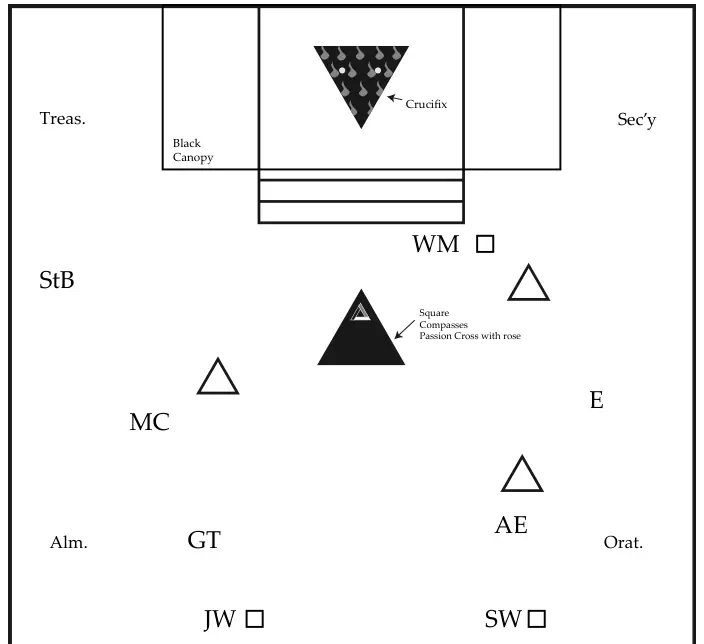
Ce premier appartement sera tendu de noir éclairé par 33 lumières sur trois chandeliers à 11 lumières, dont chaque lumière sera enfermée par une petite boîte de fer blanc, qui ne doit laisser passer du jour que par la circonférence d'un pouce de diamètre sur le côté de la boîte. Les dites 33 lumières sont pour marquer les 33 années du Sauveur.
Dans les trois angles de l'appartement il y aura trois colonnes élevées à hauteur d'homme sur les chapiteaux desquelles il y aura écrit : sur la première Foi, sur la seconde Espérance, sur la troisième Charité. Les dites colonnes seront faites de carton ou de papier si on ne veut pas faire la dépense de les avoir de bois ou de marbre. La première sera posée dans l'angle du Septentrion, la seconde à l'Orient et la troisième dans l'angle du Midi à l'Occident.
Les frères sont tous sur des chaises autour de l'appartement sans distinction dans la figure des chaises, celle de maître semblable aux autres. Le tracé de la loge est un carré long en figure allégorique au Mont Calvaire, les autres outils de Maçonnerie conforme à la description suivante : Description du tableau
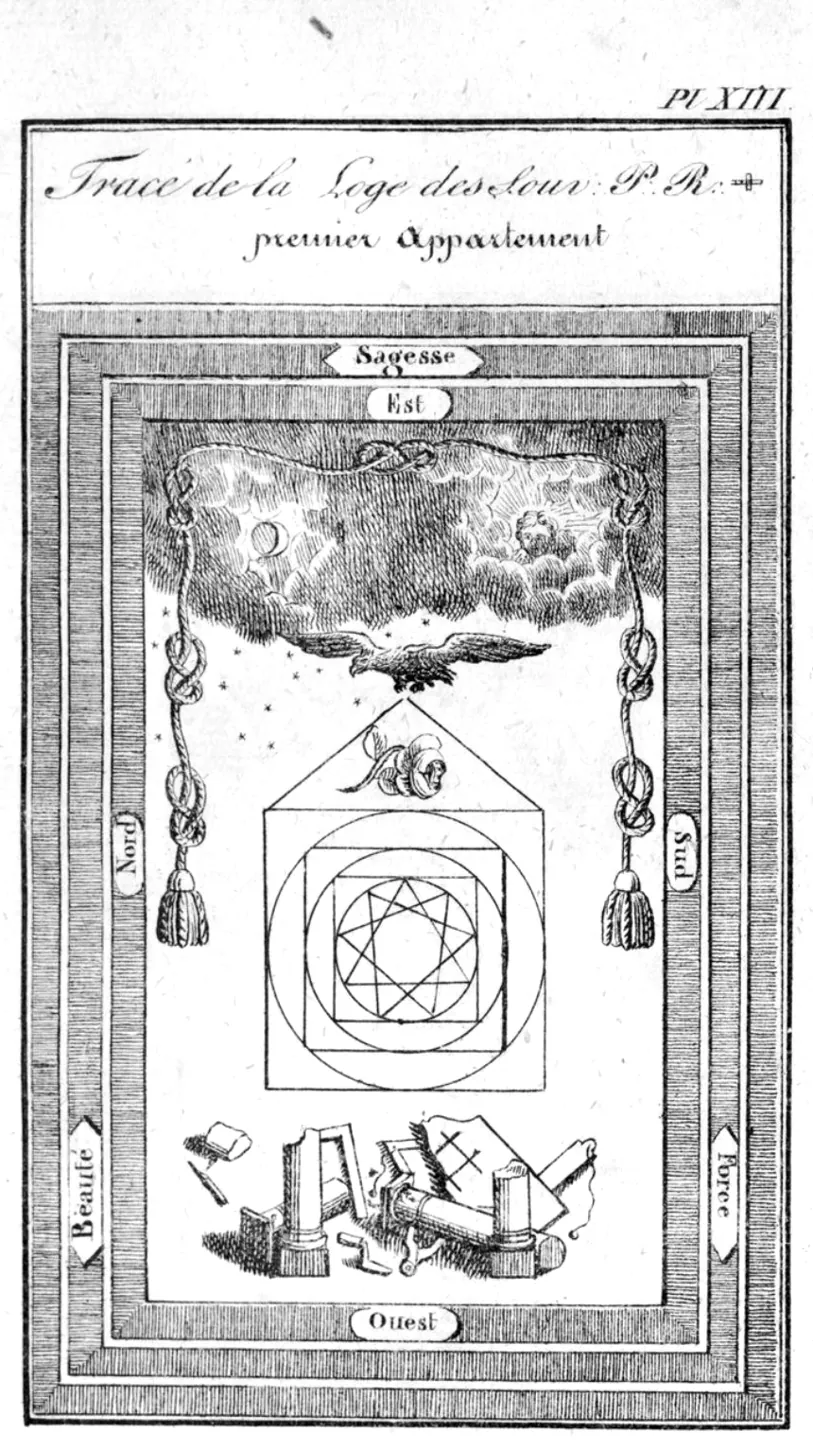
Le tracé de la loge est un carré long par des triples lignes, dans lesquelles sera écrit dans les extérieurs force, sagesse et beauté, dans les intérieurs Orient, Occident, Midi, Septentrion et la houppe dentelée à l'Orient. Dans les angles du Midi et Septentrion, le Soleil et la Lune dans un ciel parsemé d'étoiles, mais dont les nuages sont obscurcis par des ténèbres, dans la première partie de l'Orient un aigle planant les airs, comparée à la Suprême Puissance plus trois carrés sur lesquels sont trois circonférences, sur celles-ci trois triangles pour former le sommet ce qui est allégorique pour représenter le Mont Calvaire. Sur le sommet, une pierre cubique à pointe suant sang et eau pour représenter le Fils de l'homme dans cette situation. Sur la pierre cubique, une rose, qui est comparée à sa douceur et la lettre G dans le milieu qui veut dire Geova [sic] qui est la parole expirante. L'espace qui environne ce carré est rempli de ténèbres, qui arrivèrent au sacrifice, plus bas sont tous les anciens instruments et outils de Maçonnerie et les colonnes, mais brisés et diminués en plusieurs parties pour marquer que toute partie dépendante de l'ouvrage des maçons n'est présente que être mis en cendres à la mort de celui, qui en était le maître.
Tout travail cessa, la division se répandit de toutes parts et tout cessa d'être ; plus bas est le voile d'un temple qui se déchira en deux parties, à l'extérieur de la ligne orientale la colonne et les sept nœuds divins des parfaits maçons. Il y aura devant le maître une petite table éclairée par trois lumières sur laquelle sera [sic] en place de la Bible le livre des Evangiles, le compas, l'équerre et le triangle.
Tous les frères doivent être vêtus de noir, un cordon noir en bandoulière de l'épaule gauche au côté droit, un tablier doublé de noir lequel ne se peut porter que dans les fonctions qui se passent dans le premier appartement. Le maître, les surveillants, et les Officiers auront au col des larges cordons noirs moirés où pendra le bijou suivant.
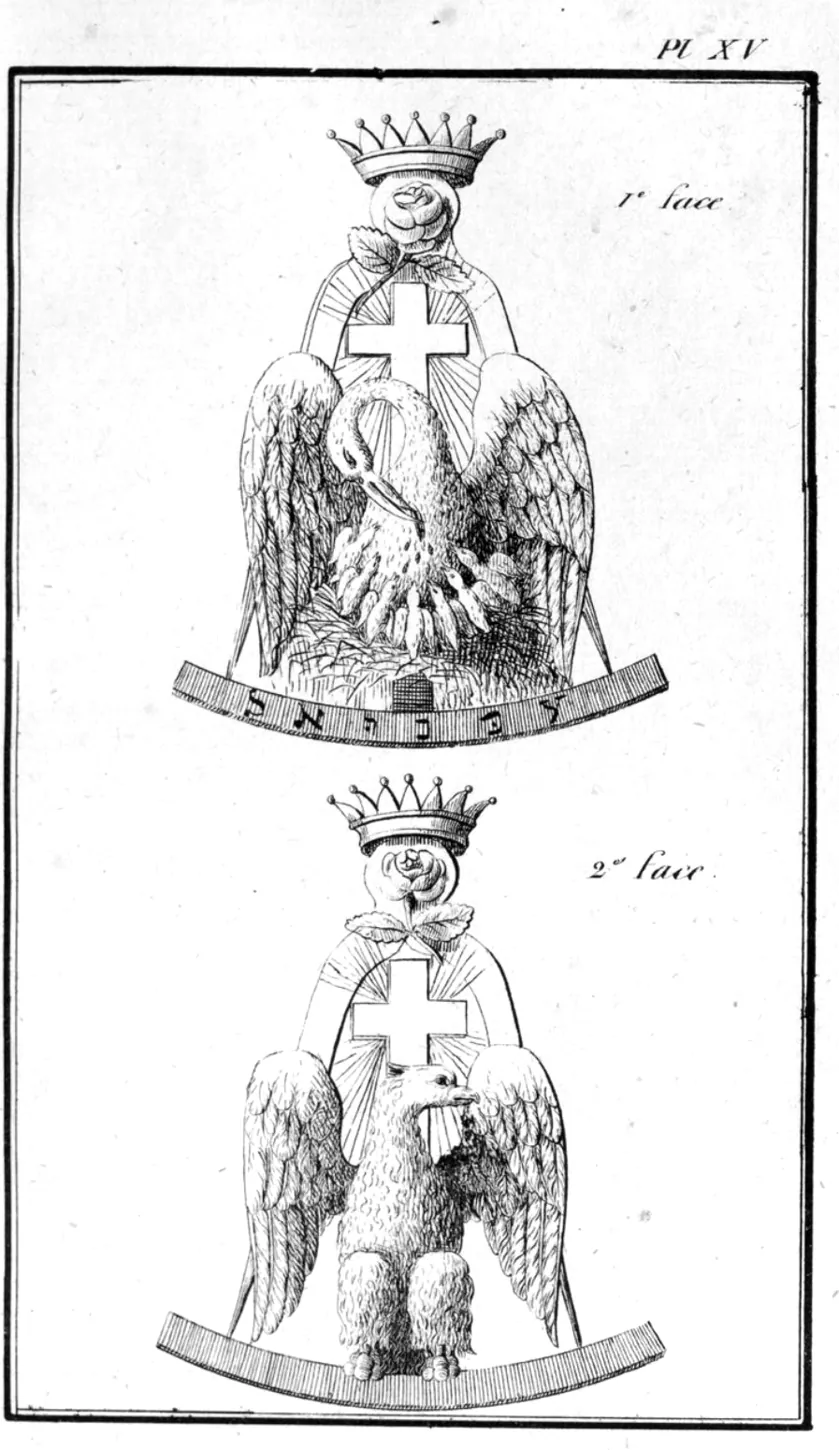
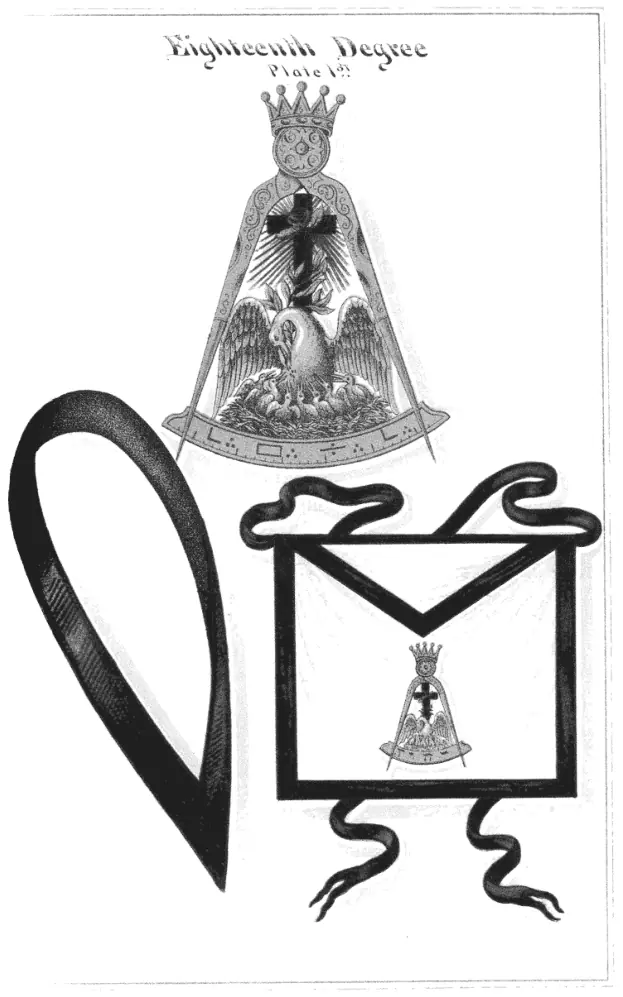
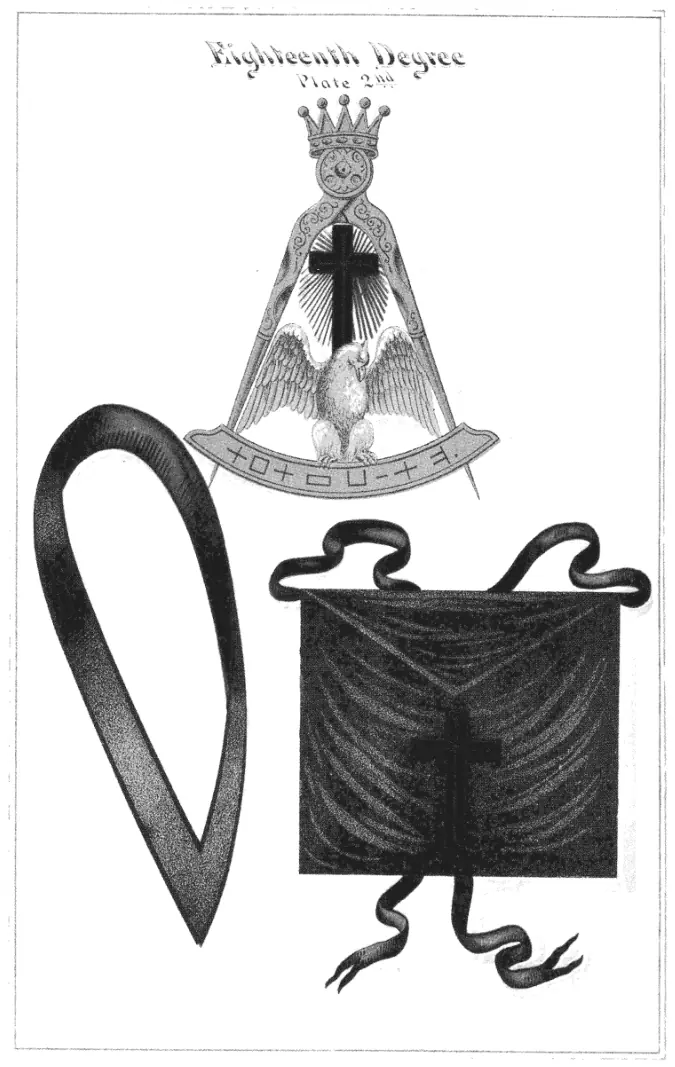
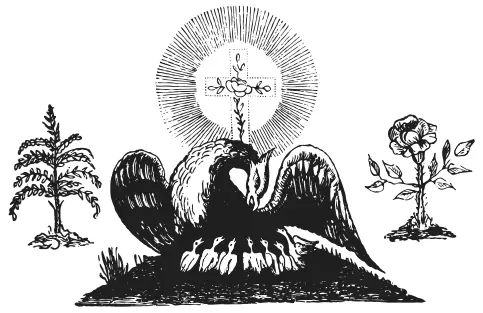
Le maître [porte] une étoile flamboyante à rayons au milieu de laquelle sera la lettre G. Ordinairement cette étoile se fait les rayons en pierre, la monture en métal doré et la lettre G doit être d'or. Le premier surveillant porte le triangle, le second surveillant l'équerre et le compas, les autres Officiers portent leur bijou ordinaire, lesquels sont tous couverts d'un morceau d'étoffe noire ainsi que tous ceux des frères. Le bijou de chaque frère doit être formé par un compas appuyé par les pointes sur un quart de cercle, la tête du compas doit être une rose ouverte, dont la queue vient se perdre dans l'une des pointes. Le milieu de ladite rose renferme la lettre G ladite tête sera surmontée d'une petite couronne. Dans le milieu du compas est une croix dont la première extrémité sortira de la tête du compas ; la seconde, qui sera opposée, touchera le milieu du quart de cercle, la 3 et 4 aboutissant au milieu des pointes du compas. Sur la croix sera un pavé mosaïque or et argent. De chaque côté sur un des revers de la croix sera dans son milieu un aigle adossée les ailes étendues sur les côtés et les pattes resserrées contre son corps, sur l'autre revers un pélican également adossé dans son milieu les ailes étendues, ce ayant autour de ses pattes sept petits qui auront le bec tendu en montant pour recevoir le sang, que le père fait sortir de son sein pour les nourrir. Ledit bijou doit être d'or ou au moins doré, il se porte dans le premier appartement au bas d'un large cordon noir en bandoulière couvert d'un morceau d'étoffe noir et dans le second appartement au bas d'un cordon rouge écossais, sortant d'une petite rosette noire, qui est posée sur les autres, ce qui désigne ce dit grade. Mais le cordon noir ne peut se porter que dans les fonctions qu'on fait pour ce grade dans le premier appartement.
Le second appartement doit représenter l'instant de la Résurrection et doit être tendu d'une tapisserie lumineuse, éclatante et pleine de gloire sans aucune figure humaine. Les trois chandeliers portent 33 lumières qui éclaireront cet appartement excepté qu'elles seront dans les boîtes annoncées ci-devant [39v°].
[39v°] Le maître, les Officiers et les frères reprendront en y entrant les cordons rouges et tablier rouge, les bijoux dits ci-devant à découvert, ils peuvent aussi porter l'écharpe et l'épée comme au grade précédent et ils le doivent même... Le tracé de la loge dans ce grand appartement sera conforme à la description du tableau.
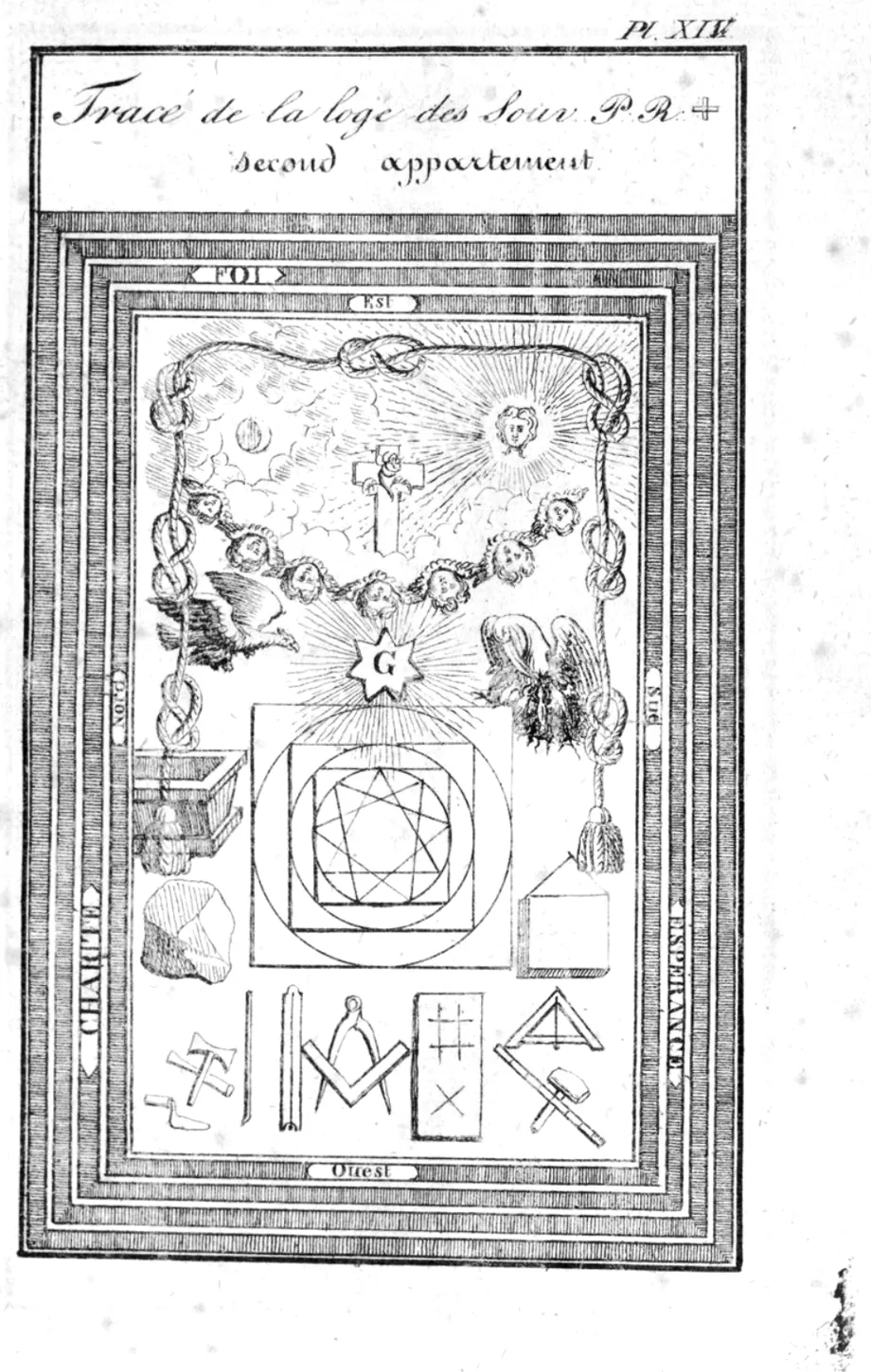
Le tracé sera un carré long par des quadruples lignes dans lesquelles sera écrit dans l'extérieur : tempérance, prudence, justice, fortitude [sic], Orient, Midi, Occident, Septentrion ; la houppe dentelée dans la première partie de l'Orient, une croix entourée d'une gloire et d'un nuage rempli par sept têtes d'ange ; sur la croix une rose épanoui dans le milieu de la quelle sera la lettre G plus bas trois carrés sur lesquels sont trois circonférences, sur celles-ci trois triangles pour former le sommet, ce qui est allégorique au saint mont sur lequel le Fils du Grand Architecte de l'Univers s'expira. Sur ledit sommet une étoile flamboyante à sept branches luisant avec toute splendeur dans le milieu de la quelle sera la lettre G. Ladite étoile représente allégoriquement le Fils de l'homme ressuscité dans toute sa gloire ; sur le coté au Midi un pélican au Midi sur son nid, perçant son sein d'op sortent sept tiges de sang pour nourrir les sept petits qui l'environnent, image de la tendresse paternelle... Au Septentrion un aigle planant les airs, image de la Suprême Puissance ; plus bas est le tombeau dans la partie inférieure dudit carré. Sur la ligne du milieu de l'Orient à l'Occident, le compas, la planche à tracer, la pierre, la truelle et l'équerre. Sur la ligne du Midi, la pierre cubique et son marteau, la règle et le niveau. Sur la ligne septentrionale, la pierre brute et son marteau, le maillet, le ciseau, la ligne d'aplomb ou perpendiculaire. A l'extérieur de la ligne orientale la colombe et sept nœuds d'union du parfait maçon.
Suite de la description pour le deuxième point de réception
Pour la suite au deuxième point de réception on doit préparer un troisième appartement un peu éloigné des autres destiné à être l'image des enfers auquel, pour en représenter les horreurs, il y aura sept chandeliers portant des gros flambeaux ardents allumés dont les bobèches seront des têtes de mort et des os en sautoir Les murailles seront découvertes d'une tapisserie peinte avec des flammes et des figures humaines des damnés. Elle doit représenter ce qu'il y a de plus vif et de plus capable d'inspirer de la crainte et de l'horreur de ce lieu par les flammes, attributs de force et de rage, et des chaînes.
Dans la tenue de cette loge le maître représente la sagesse et la perfection ce qui lui donne le titre de très sage et parfait maître, les surveillants, très excellents et parfaits surveillants, les Officiers, les puissants et parfaits frères avec le nom de leur charge ; les frères respectables et parfaits frères. Dans le premier point de la réception on ne reprend point le titre de parfait ; qui ne sert que dans le second appartement, où il n'est point d'autre table que celle qui sera à la droite du maître, fort petite et de figure triangulaire, n'y ayant dessus que le Livre des Evangiles, des outils de Maçonnerie et trois lumières. Les Officiers et les frères reprendront dans cet appartement les cordons et les tabliers rouges en y joignant les bijoux qu'ils portaient auparavant au bas du cordon noir. Préparation d'un récipiendaire
Le récipiendaire doit être vêtu d'un habit noir, de son cordon et tablier rouge, son épée, son écharpe, les yeux libres… Le terrible lui dit, pour le préparer, que tous les temples des maçons sont démolis, que les outils et les colonnes sont brisés et que la parole est perdue depuis sa dernière Réception ; que malgré la précaution qu'ils avaient prise pour éviter la surprise. Ils sont privés du moyen de se reconnaître et l'Ordre en général est dans la dernière des consternations.
Ouverture de la loge
Les frères assemblés, le maître à l'Orient, les surveillants à l'Occident, le maître ouvre la loge comme suit :
Le très sage : Mes frères aidez-moi à ouvrir la loge.
Les surveillants répètent la même chose.
Le très sage frappe sept coups de maillet dont la distance du sixième à septième est plus longue, ce qui s'appelle frapper en chevalier de l'Aigle.
Les surveillants frappent sept coups semblablement.
D. Très excellent frère, quel est le premier soin d'un maçon ?
R. Très sage et très parfait, c'est de voir si la loge est couverte.
D. Faites-y voir par le très excellent frère second surveillant. Le second surveillant fait son office et vient se remettre en disant : Très excellent parfait frère premier surveillant la loge est couverte [40r°]. –
[40r°] D. Très excellent et parfait frère premier surveillant, quelle heure est-il ?
R. L'instant où le voile du temple se déchire, que les ténèbres et la destruction se répandent sur la terre, que la lumière s'obscurcit, que les outils se brisent, que l'étoile flamboyante disparaît, que la pierre cubique sue sang et eau et que la parole est perdue.
Le très sage : Mes frères, puisque la Maçonnerie éprouve une telle tribulation, employons tous nos soins par des nouveaux travaux à recouvrer la parole, la loge de chevalier de l'Aigle est ouverte.
Les surveillants répètent la même chose, ensuite le très sage et tous les frères crient 3 fois Houzey, restant ensuite dans le silence. Ordre de réception
Quand le récipiendaire est en état d'être introduit, le terrible le conduit à la porte où il frappe sept coups dans l'ordre dit ci-dessus. Le second surveillant frappe sept coups de même sur celui du premier surveillant et celui-ci les rend au second, qui dit : Très excellent frère premier surveillant, on frappe à la loge en chevalier de l'Aigle.
Le très sage dit : Mon frère, faites voir par le second surveillant qui frappe, avec les précautions accoutumées. Le second surveillant ouvre et dit : Que demandez-vous ?
Le terrible : C'est un frère chevalier maçon, errant parmi les bois et les montagnes, qui depuis la destruction du temple a perdu la parole et qui par notre secours désirerait la retrouver.
Le second surveillant ferme la porte, vient à sa place, frappe sept coups de son marteau sur celui du premier surveillant, celui-ci frappe de même sur celui du second qui lui rend la réponse du frère terrible et le premier surveillant la rend au très sage.
Le très sage : Consentez-vous, mes frères, à son introduction ?
Les frères y répondent en étendant la main sur la loge ; tous les frères ici doivent paraître consternés et abattus, étant assis la main droite sur le cœur, la main gauche sur le visage et la tête baissée, le coude sur le genou. Le maître l'aura sur la table.
Le très sage : Frère premier surveillant, introduisez le frère chevalier maçon et le placez à l'Occident pour répondre aux questions qui lui seront faites.
Le premier surveillant donne la parole du très sage au second surveillant qui va à la porte, frappe 7 coups, et fait ces questions ci-dessus, ouvre, reçoit le récipiendaire et le conduit à l'Occident ; frappe encore 7 coups, comme ci-devant et dit : Très excellent frère premier surveillant je vous mène un frère chevalier maçon qui demande la parole.
Le premier surveillant : Très sage voici un frère chevalier maçon qui demande la parole.
Le très sage : Mon frère la corruption s'est glissée dans nos ouvrages, il n'est plus en notre pouvoir de travailler. Vous devez apercevoir à l'aspect de la consternation qui règne ici qu'il se passe dans cet instant un dérangement dans l'univers, le voile du temple est déchiré, les ténèbres se répandent sur la terre, la lumière est obscurcie, nos outils sont brisés, l'étoile flamboyante a disparu, la pierre cubique ruisselle de sang et d'eau et la parole est perdue. Comme vous voyez il n'est pas possible de vous la donner. Cependant notre dessein n'est pas. de rester dans l'oisiveté. Nous cherchons par une loi nouvelle à retrouver cette parole. Etes- vous aussi dans le sentiment de suivre cette loi nouvelle ? Le récipiendaire : Oui, très sage. Le très sage : Faites le voyage, frère second surveillant, l'espace de 33 années par l'Occident, le Midi, l'Orient et le Septentrion, pour qu'il apprenne les beautés de cette loi nouvelle. Le second surveillant le fait voyager 33 fois autour de la loge sans grâce dans ces voyages. II lui fait remarquer au trois parties de la loge les trois colonnes qu'ils rencontrent et à chacune d'elles le second surveillant lui dit les noms savoir Foi, Espérance, et Charité, et lui recommande de bien retenir ces noms, parce qu'ils doivent le guider. Ensuite il le ramène à l'Occident, où il frappe à l'ordinaire sur le maillet du premier surveillant et dit que le voyage mystérieux maçonnique est fini. Celui-ci le dit au très sage, qui lui dit : Le très sage : Mon frère, qu'avez-vous appris dans ces voyages ? Le récipiendaire : Toutes vertus pour me guider désormais la foi, l'espérance et la charité. Enseignez-moi s'il en est d'autres à suivre.
Le très sage : Mon frère ce sont positivement les principes de notre nouveau mystère. Approchez et venez prendre avec nous les engagements que nous requérons [40v°].
[40v°] Le premier surveillant le fait approcher de la table, le fait mettre sur le genou droit, la main sur l'Evangile et il fait le serment suivant : Oui, je promets sur les mêmes obligations que j'ai prêtées dans les précédents grades de la Maçonnerie, de ne jamais révéler les secrets des chevaliers de l'Aigle à aucun chevalier maçon, grand architecte, maître, compagnon et apprentif, maître chevalier de Rose-Croix, comme aucun profane pour les peines d'être privé à jamais de la vraie parole et d'être éternellement dans les ténèbres ; qu'un ruisseau de sang et d'eau sortent continuellement de mon corps, de souffrir les angoisses de l'âme ; que le fiel et le vinaigre me servent de breuvage ; que les épines les plus piquantes me servent de chevet et que le supplice de la croix termine mon sort. Que le Grand Architecte me soit favorable.
Le très sage aux frères (Tout est consommé). A ces mots tous les frères se lèvent de leurs sièges, paraissant toujours tristes, le visage dans les deux mains. Le très sage fait passer le récipiendaire à sa droite, il prend le tablier noir et l'en revêt en lui disant : Mon frère, ce tablier est la marque de tous les maçons qui n'ont pas participé aux causes de tous nos malheurs ; mais il doit nous être représenté comme leur image douloureuse et nous servir pour reconnaître ceux qui d'entre nous cherchent à recouvrir la vraie parole et à s'éclaircir dans les mystères nouveaux par une parfaite humilité et en prenant le cordon et lui passant de la gauche à la droite. Ce cordon vous désigne le symbole de notre tristesse sur la perte de la parole. Il doit vous servir de marque de deuil jusqu'à ce qu'elle soit recouverte. Passez à l'Occident vous nous aiderez à la recouvrir... Le récipiendaire va entre les 2 surveillants.
Le très sage frappe 7 coups. Les surveillants y répondent par chacun 7 coups… Tous les frères portent les deux mains sur les mamelles, lèvent la tête et paraissent moins tristes. Le très sage dit : Quel est le motif qui nous rassemble frère premier surveillant ? Il répond : La pierre cubique à pointe [ruisselant] sang et eau pour le relâchement des maçons dans leurs ouvrages et pour les erreurs de la Maçonnerie exposée sur le sommet d'une montagne taillée en pointe de diamant.
Le très sage : Que signifie ce mystère ?
R. La perte de la parole maçonne et que par votre aide nous espérons de retrouver.
Le très sage : Que faut-il faire pour y parvenir ?
Le premier surveillant répond : Embrasser la Nouvelle Loi et être pleinement convaincu que les 3 mots qui sont les colonnes en sont la base et le principe.
D. Quelles sont-elles ?
R. La Foi, l'Espérance et la Charité.
D. Comment trouverons-nous ces trois colonnes ?
R. En voyageant et errant dans l'obscurité la plus profonde.
D. Quelle durée ?
R. L'espace de trois jours.
Le très sage : Voyageons mes frères, de l'Orient au Septentrion, du Septentrion à l'Occident et de l'Occident au Midi et tâchons de ne point perdre de vue les sentiments qui nous guident.
Tous les frères voyagent en silence et font 33 fois le tour de la loge qu'on réduit à sept tours. Au septième le maître passe de cet appartement à un autre où ils quittent les cordons et les tabliers noirs pour prendre les rouges. Il est suivi par tous les frères qui en font autant, ensuite ils s'acheminent vers la porte du deuxième appartement qui est préparé exprès pour le second point de réception à la porte duquel il frappe 7 coups à égale distance, ce qui s'appelle frapper en parfait maçon. La porte leur est ouverte par un servant, qui est placé là exprès, à qui chacun donne le mot de passe, qui est Emmanuel, ce qui est continué jusqu'au récipiendaire qui doit être le dernier que le frère servant ne doit pas laisser passer, parce que
n'ayant pas frappé qu'en chevalier de l'Aigle, qui est six coups avec un même intervalle, un plus long du 6 au 7, ne doit point avoir l'entrée des parfaits maçons.
Le servant lui ouvre la porte, lui demande la parole de passe qu'il ne peut donner ni la sait pas. Le récipiendaire dit qu'il est un des frères qui la cherchent par le secours de la Nouvelle Loi et de trois colonnes de la Maçonnerie. Le servant qui doit le reconnaître à cette réponse pour un récipiendaire lui arrache son cordon et son tablier noir en lui disant que les marques qui le décorent ne sont pas assez humiliantes pour être en état de la retrouver et qu'il doit passer par des épreuves bien plus rigoureuses auparavant. Aussitôt il le couvre d'un grand drap noir couvert de taches cendrées [41r°] de sorte qu'il ne puisse y voir, en lui disant qu'il va le conduire aux lieux les plus ténébreux d'où la parole doit sortir triomphante à la gloire et à l'avantage de la Maçonnerie, qu'il doit laisser sa confiance en lui. Ce frère servant doit conduire le récipiendaire dans les appartements en montant et descendant le plus souvent répété qu'il est possible. Après quoi il le conduit à la porte ouverte de l'appartement où les figures de l'enfer sont représentées et sur le seuil de cette porte il lui relâche le devant de son drap noir pour lui en faire apercevoir les objets ; ensuite lui en fait faire trois fois le tour en silence en mémoire du voyage mystique dans les lieux ténébreux qui dura trois jours, et le ramène au seuil de cet appartement sur lequel il lui rabaisse son drap noir sur la vue en lui disant : Les horreurs que vous venez d'apercevoir, ne sont rien en comparaison de ce que vous allez souffrir, si malheureusement vous n'avez pas toute la fermeté requise. Ensuite il le ramène à la porte du second appartement des parfaits à laquelle il frappe 7 fois en parfait maçon, c'est-à-dire avec égal intervalle en attendant qu'on vienne ouvrir. Il l'instruit de ce qui suit disant : Souvenez-vous de répondre aux questions qui vous seront faites, que vous venez de la Judée, que vous avez passé par Nazareth, que mon nom est Raphaël et que vous êtes de la tribu de Juda, sans quoi vous ne pouvez vous garantir des plus grands malheurs.
Le second surveillant ayant entendu frapper 7 coups en parfait maçon et frappe 7 semblables sur le maillet du premier surveillant et le premier surveillant sur celui-ci qui lui dit : Très excellent premier surveillant, on frappe à la loge en parfait maçon.
Le premier surveillant : Très sage et très parfait on frappe en maçon.
Le très sage : Mon frère, faites voir par le très excellent second surveillant qui frappe à la loge avec les précautions accoutumées… Le très excellent second surveillant va à la porte, frappe 7 coups et le frère terrible 7 coups et le très sage 7 autres coups. Le second surveillant ouvre et dit : Que demandez vous ?
Le terrible dit : C'est un frère chevalier de l'Aigle, qui après avoir parcouru les espaces les plus profondes, espère de vous procurer, parle fruit de ses recherches, la parole.
Le premier surveillant ferme la porte, revient à sa place, frappe 7 coups sur le maillet du premier surveillant et le second surveillant rend la réponse du frère terrible. Le premier surveillant la porte au très sage.
Le très sage dit : Qu'il soit introduit à l'Occident, nous l'interrogerons. Le premier surveillant le dit au second et celui-ci ouvre la porte de la précédente manière, reçoit le récipiendaire et le conduit à l'Occident, frappe à la même manière, et dit : Très excellent et parfait frère premier surveillant, voici le frère chevalier de l'Aigle qui par son secours espère retrouver la parole perdue et devenir parfait maçon. Le premier surveillant la porte au très sage qui dit au récipiendaire :
D. D'où venez-vous ?
R. De la Judée.
D. Par quelle ville avez-vous passé ?
R. Par Nazareth.
D. Quel est le nom de notre conducteur ?
R. Raphaël.
R. De Juda.
D. Donnez-moi les lettres initiales de ces quatre mots.
R. J. N. R. J121.
D. Rassemblez ces quatre lettres ensemble.
R. Inri [sic].
Le très sage : Mes frères, la parole est recouverte, que la lumière lui soit rendue. Les surveillants lui ôtent promptement le drap noir et tous les frères ensemble au signal du maître, frappent trois fois dans leurs mains, criant : Houzaÿ, houzaÿ, houzaÿ.
Le très sage lui dit : Approchez mon frère, que je vous communique les derniers mystères de la Maçonnerie… Le premier surveillant le conduit auprès du maître, qui lui donne les signes, paroles et attouchement, et lui dit : Mon frère, je vous félicite sur la découverte de notre parole, qui vous acquiert le grade de parfait maçon [41v°].
Nos signes pour nous reconnaître consistent le premier à lever les yeux au ciel [41v°] de croiser les mains et les doigts en haut et les laisser tomber sur le ventre. Il s'appelle signe d'admiration… Le second qui est la réponse est de lever la main droite et de faire signe avec l'index vers le ciel, le reste des autres doigts serrés, qui signifie qu'il n'y a qu'un seul et [ ?] qui est la source de pure vérité. L'attouchement est de croiser les bras et les mains sur les mamelles, celui qui attaque posera sa main droite ou la gauche sur la mamelle opposée et celui qui répondra doit répondre également, la main opposée à l'attaquant. Si c'est par la gauche la droite pour répondre ensuite le premier portera l'autre main sur l'autre mamelle et le second de même. Cet attouchement s'appelle le Bon Pasteur… La parole est Inri et le mot de passe Emmanuel… Répétez ces mêmes paroles, signes et attouchement aux frères parfaits maçons de cette loge. Ensuite vous viendrez me les rendre.
Le surveillant le conduit à tous les frères et le ramène à la droite du maître, qui lui fait exécuter signes, attouchements et paroles. Il lui donne ensuite la rosette et le bijou de chevalier de l'Aigle parfait maçon, en lui attachant au bas de son cordon rouge écossais. Il lui dit : Mon frère, cette rosette est pour vous remémorer la perte de la parole et ce bijou vous fait connaître, que la Maçonnerie par son allégorie renferme un mystère, qui n'est développé qu'aux parfaits maçons. La croix de notre bijou doit vous en faire connaître plus que mon explication et j'espère, que vous n'en perdrez jamais le souvenir.
Discours de l'orateur sur l'excellence de l'Ordre, pour instruire les frères de ce grade
Les maçons depuis la réédification du temple ayant négligé les travaux abandonnèrent aux rigueurs et vicissitudes des temps le précieux édifice, qu'ils avaient relevé avec tant de peine. Leurs ouvrages n'étaient plus que des œuvres de corruption. La sagesse l'ouvrit, la force des matériaux et la beauté de l'architecture firent place au désordre, à la confusion et au vice. Le Grand Architecte de l'Univers détermina, pour manifester sa gloire, d'abandonner le reste d'appui du temple matériel pour en élever un spirituel par sa sublime et supérieure géométrie dont le système serait inattaquable aux puissances humaines et dont la durée subsisterait dans une éternité de siècles. C'est par cette résolution puissante, que les hommes ont vu le phénomène miraculeux, le prodige des prodiges, la pierre cubique à pointe suant sang et eau et souffrir les angoisses de l'âme. Ce fut alors que la pierre de l'angle de l'édifice fut arrachée par les ouvriers des fondements du temple pour être rejetée dans les décombres du bâtiment et que la rose mystique fut sacrifiée sur une croix plantée sur le sommet du pentagone, qui s'élève de dessus sa surface vers le globe céleste par trois carrés, trois circonférences et trois triangles taillés en pointes de diamant. La Maçonnerie humaine s'obscurcit, les outils de la
Maçonnerie se brisèrent, l'étoile flamboyante disparut et la parole fut perdue. On doit juger aisément quelle était l'étendue des maux que chaque maçon devait supporter en pareil instant, un abattement inconcevable et une consternation des plus grandes étaient les moindres qui en puisse venir. Ils furent obligés d'errer dans l'obscurité la plus profonde, l'espace de trois jours incertains si la vie devait leur être prolongée, ou si quelque accident nouveau ne les en priverait pas de sorte qu'ils ne pouvaient avoir une plus grande perplexité dans le cœur de tous les êtres pensants, qui existaient là sur la terre. La volonté de celui qui conduit tous les mouvements et événements, ayant donné un terme à cet étonnement universel, fit reparaître la lumière au bout de trois jours mais ce ne fut pas sans témoignage de surprise ni de phénomènes nouveaux. Les outils des maçons brisés reprirent leur forme, l'étoile flamboyante se fit revoir dans un plus grand éclat qu'auparavant et la parole fut recouvrée. Ce bonheur n'arriva qu'aux maçons qui sortirent l'endurcissement de la négligence que l'oisiveté leur avait donnée. Quelqu'un d'entre eux ayant voyagé l'espace de 33 ans dans la recherche de la parole apprit aux autres qu'il fallait connaître les trois colonnes Foi, Espérance et Charité ainsi qu'embrasser la Nouvelle Loi pour espérer de rentrer dans les travaux mystiques de l'Ordre.
Cc ne fut que par des nouveaux principes que la Maçonnerie reparut aux yeux des hommes mais sous des règles théoriques qui les conduisirent allégoriquement à la pratique dans leurs actions. Depuis ce temps-là les maçons ne bâtirent plus des édifices matériels, les spirituels [42r°] sont leur ouvrage. [42r°] Ils renforcent leurs travaux par la tempérance, prudence, justice et fortitude et ne craignent plus les vicissitudes des temps.
Que ces colonnes, mes frères, ne puissent jamais vous manquer et que le Grand Architecte de l'Univers vous soit en aide.
Le très sage frappe sept coups, les surveillants chacun sept.
Le très sage dit : Très excellent et parfait frère premier surveillant, quelle heure est-il ?
R. L'heure du parfait maçon.
D. Quelle est l'heure d'un parfait maçon ?
R. Le moment, où la parole fut recouvrée, que la pierre cubique fut changée en rose mystique, que l'étoile flamboyante reparut avec plus de splendeur, que nos outils ont repris leur forme, que la lumière est rendue dans son état à nos yeux, que les ténèbres sont dissipées et que la Nouvelle Loi doit régner désormais parmi les travaux maçonniques.
Le très sage dit : Suivons donc cette loi, mes frères puisqu'elle est la suite de toutes les merveilles qui ont frappé nos yeux.
Les surveillants répètent la même chose ; le très sage et tous les frères frappent trois fois trois coups dans leurs mains en criant trois fois : Houzay.
- Fin -
[Signature]
[Figure en bas de la page 42v°]
Le second grade de Rose-Croix ou la Clavi-Maçonnerie
Attribution « apparenté » Ce cahier n'est pas donné par le manuscrit sous le titre du degré : son rattachement au 18e degré résulte de l'analyse du corpus.
[44v°]
La décoration des voûtes ; la réception des trois grades, la doctrine de postulant et les statuts et les règlements du très respectable Ordre de l'horlogerie, ou le franc-horloger. Décoration des voûtes
A une extrémité de la voûte, vis-à-vis le très formidable, est un horizon, le Soleil et la Lune qui réfléchissent leur lumière sur elle. En bas sont les sept pyramides d'Egypte, à l'autre extrémité un trône et des fleurs en argent sur des stèles d'or. Les attributs de la Philosophie et de l'Horlogerie sont au milieu de la voûte à côté du très formidable. Le haut et les côtés sont parsemés d'étoiles avec un Soleil et des différents tableaux sur les côtés un côté est celui de la paix et le lieu du silence, celui de la déesse Tacita Pelantra est un homme tenant d'une main une roue et de l'autre un compas.
Réception du premier grade. Ouverture de la voûte
Le formidable frappe le lever du Soleil, puis dit : Mes frères, le Soleil paraît, adressons notre intention au Seigneur et travaillons. Et il ouvre la voûte en frappant quatre coups sur une poêle ou timbre de fer blanc. On fait le signe de postulant et il prononce les paroles qui suivent.
Le maître de cérémonies, tenant à la main un bâton garni d'ivoire, introduit dans la voûte le récipiendaire, un bandeau sur les yeux. Après avoir frappé quatre coups à la porte avant de le faire entrer, on lui demande son nom, son surnom, son âge, son pays natal, ses qualités ou sa profession, et l'on prie les frères de dire s'il en ait quelqu'un, qui s'oppose à sa réception. Puis on le fait entrer et le frère député va le prendre et le mène devant le trône. Les frères ont leurs épées en croix pendant toute la réception. Alors le très formidable donne quatre coups sur le timbre et lui dit : Que demandez-vous, mon frère ? Il répond : La faveur d'entrer et d'être admis dans l'Ordre de Rose-Croix. Ne serait-ce point, mon frère, dans le dessein de nous trahir et de révéler les secrets de cet Ordre. Il y répond : Non. Puisque ce n'est pour aucun de ces motifs, qu'on commence à faire parcourir le globe à ce frère. Pendant lequel temps il frappe quatre coups sut le timbre. Le très formidable lui dit : Réfléchissez mon frère, tandis que vous êtes en chemin, lorsque vous serez arrivé au lieu de votre destinée, vous serez obligé de vous soumettre à tout. Au second tour, il lui demande : Mon frère, persistez-vous à vouloir être initié dans notre Ordre ? Le récipiendaire répond : Oui. Puisque vous persistez à vouloir entrer parmi nous, que l'on continue à lui faire parcourir le globe. Et pendant ce temps le très formidable frappe quatre coups sur le timbre et dit : Vous feriez bien, étant maître, de refuser d'entrer dans cette société. Vous allez vous-même prononcer votre arrêt. Persistez-vous, mon frère ? Oui, très formidable. L'arrêt est porté aux frères, qu'on l'entraîne et que l'on continue encore à lui faire parcourir le globe. Et pendant, qu'il fait le troisième tour, le très formidable frappe quatre autres coups et dit : Etant arrivé au moment, auquel vous allez jouir d'un grand bonheur, quels avantages n'en retirerez-vous pas ? Etes-vous bien dans le dessein de vous conformer à tous nos statuts et règlements ? Oui, très formidable. Puisque vous êtes véritablement dans ce dessein, qu'on continue de lui faire parcourir le gobe. Il fait le quatrième tour. Après, le très formidable frappe quatre coups. On fait avancer le récipiendaire jusqu'avant de lui où il récite son obligation en ces termes :
Obligation
Je jure solennellement en présence de Dieu, du très formidable et de toute la [ ?] d'être fidèle à mon roi, d'être attaché à tous mes frères, de les secourir, tenir aux sages statuts et règlements de cet Ordre. Je jure solennellement par le premier Père de la lumière de ne point révéler les secrets, qui me sont confiés. Je consens, si je viole la présente obligation sur le moindre point, à être exclu pour jamais de cette société, à être déshonoré et me voir privé de tous mes frères et subir les peines et châtiments prévus à un frère qui aurait le malheur de succomber. Ainsi Dieu me protège.
[Après l'obligation]
Le très formidable demande : Consentez-vous, mes frères, que ce frère voie la lumière ? Tous répondent : Qu'il meure ! Faites-lui grâce, mes frères. Tous répondent : Tobie. Le formidable dit : Vous ne craignez rien, mes frères. Faites lui voir la lumière. On lui ôte le bandeau et le formidable lui adresse par ces paroles : Mon frère, le bonheur, dont vous jouissez et puisque vous vous en goûtez les délices, faites voir combien vous y êtes sensible, reconnaissez, car c'est de nos lois que vous tirez ce bonheur. Vous êtes proche de savoir que cette chaîne vous démontre que pour devenir sage, il faut vous enchaîner aux mêmes. Telle est notre condition, nos passions veulent des liens, nos désirs injustes et téméraires ont besoin d'un frère. Nous avons parmi nous, pour nous reconnaître, des signes, des mots et des attouchements.
Le signe est la tête appuyée sur le bras gauche.
Le mot est Greda, ceci est pour le grade de postulant. Nous ne pouvons pour le présent vous en communiquer davantage. Quand vous aurez marqué par votre assiduité et votre bonne conduite que vous êtes tout à fait reconnaissant de la faveur que vous venez de recevoir, nous vous instruirons de tous nos secrets. Puis, s'adressant au frère député, ou maître de cérémonies, il lui dit : Mon frère, faites rendre à chacun des frères le signe et le mot, et faites embrasser. Après quoi, s'adressant au récipiendaire, il lui dit : Mon frère, le frère orateur va vous faire un discours. Ayez la bonté d'y faire l'attention qu'il mérite. On vous fera après lecture de nos statuts et règlements auxquels nous vous ferons obliger de vous conformer.
Le discours fini, le très formidable fait faire la lecture des statuts et règlements.
Les frères ont toujours leurs épées en croix, pendant toute la cérémonie. Après on s'assied pour traiter des affaires de la société.
Réception de vainqueur. Second grade
Le postulant, qui veut aussi le grade de vainqueur, frappe quatre coups et le maître des cérémonies va à lui demander ce qu'il veut. Il répond : Je demande le suffrage de tous mes frères pour acquérir le second grade. Alors le député se tourne du côté du très formidable et lui dit : Très formidable, c'est un postulant qui demande la grâce de lui accorder le second grade.
D. A-t-il fini, mon frère, le temps prescrit par nos règlements ?
R. Oui, très formidable. – Faites entrer le frère. Puis il lui dit : Vous allez, mon frère, recevoir le grade de vainqueur sur les mêmes engagements que vous avez reçu celui de postulant. Il est juste qu'après avoir donné des marques d'une vraie obéissance et d'une parfaite soumission à tous nos statuts et règlements, on vous en accorde la récompense.
Le très formidable prend la chaîne et la jette par-dessus la tête du récipiendaire. Tous les frères disent : Il est venu. Le député maître de cérémonies fait repasser la chaîne par-dessus la
devant la figure du silence, puis devant la figure qui est à l'autre côté du trône et lui expliquent pour quel but ces figures sont représentées. On bande les yeux au récipiendaire et on met le timbre devant lui. Le très formidable commence à frapper un coup sur la boîte. Les frères en font autant à leur tour, après quoi chacun a repris sa place. Le député fait voir le frère et après quoi il frappe quatre coups sur la boîte, l'ouvre et en tire une couronne qu'il présente au très formidable qui la place sur la tête du postulant et lui dit : Vous avez vaincu, vous avez mérité le second grade. Nous vous l'accordons. Le très formidable le fait mettre à genoux, et lui fait répéter son obligation en y ajoutant qu'il jure de ne pas souffrir en la voûte de vainqueurs aucun profane. Après quoi il lui dit : Nous avons dans ce grade un mot et un signe différents du premier. Le mot est roze, le signe est la tête baissée et reposée. Le député fait rendre le signe et le mot à tous les frères et fait embrasser. L'orateur prononce un discours au récipiendaire sur son nouveau grade.
Nota que lorsque le très formidable a posé la couronne sur la tête du vainqueur, chaque frère bat des mains pour applaudir et à chaque cérémonie de ce grade et à chaque tour ainsi que dans le premier grade, on bat sur le timbre.
Réception de formidable. Dernier grade
Le vainqueur s'annonce pour recevoir le grade, comme au second. Il entre, la couronne sur la tête, l'épée au côté, la tête appuyée sur le bras gauche, tronçon de l'autre main. Il y a un frère assis vis-à-vis le très formidable dans la même situation. On lui fait répéter solennellement son obligation et lui fait l'histoire du tombeau où la Rose-Croix était inhumée.
Nota. On sonne le timbre lorsque le vainqueur entre, avant, après sa promesse et après qu'on lui a bandé les yeux et lorsqu'il est dans la mer.
Histoire abrégée du tombeau de la R.-C.
Il n y a personne, qui ne sache, que le philosophe de Rose-Croix avait fondé la secte des grades de son nom, que ses disciples prétendaient toujours de nouvelles découvertes qu'ils étaient commis de ne jamais communiquer en règle du genre humain [45r°].
[45r°] Une certaine personne, qui eut occasion de creuser un peu profondément à l'endroit où ce philosophe était inhumé, et trouva une petite porte, bordée d'une muraille à droite et à gauche. La curiosité matérielle et l'espérance de quelque étranger caché l'obligèrent bientôt à enfoncer la porte, surpris d'un coup par un éclat de lumière, il découvrit une très belle voûte au fond de la quelle il y avait les signes d'un homme assis auprès d'une boîte, où il s'appuyait, la tête sur le bras gauche. Il avait un tronçon de la main droite, et il y avait une lampe ardente devant lui. Dès que notre curieux eut mis le pied dans la voûte, la statue se leva et se tint debout ; lorsqu'il eut fait un autre pas, elle leva la main droite qui tenait le tronçon et lorsqu'elle eut fait le troisième pas, elle frappa un coup terrible sur la lampe qui se brisa en mille morceaux de sorte que le curieux fut laissé dans les ténèbres.
Au récit de cette aventure, le peuple se rendit au tombeau avec des lanternes et de torches allumées et l'on découvrit, que la statue était de bronze, si artistement travaillée, remplie de machines et de mouvements semblables à celles de l'horlogerie et que le pavé était formé de planches mobiles en dessous desquelles étaient divers ressorts disposés de façon que dès qu'on marchait sur le pavé, il produirait naturellement tous les effets, qui s'en étaient d'abord suivis, c'est-à-dire faisaient lever la figure de bronze au premier pas, lui faisait lever le bras au second et le faisait retomber au troisième pour briser la lampe comme elle avait fait.
Les disciples de la Rose-Croix rapportent qu'il avait mis cette machine au lieu où il voulait être inhumé pour faire voir à la postérité, qu'il avait trouvé le secret des lampes inextinguibles
et pour empêcher qu'un autre en profitât. Cette découverte est tout à fait véritable, il n'est pas permis d'en douter après toutes les preuves, qu'on en a eues.
Les différents signes de chaque grade sont tirés de chaque mouvement de cette statue. Faites un pas, dit le très formidable au récipiendaire. Le frère qui représente la statue, se lève, un autre pas, il lève le bras, un troisième pas il jette le bras droit au bout duquel il tient un tronçon. Tous les frères annoncent le vainqueur, le prennent, le couchent le visage contre terre, et on le couvre d'une toile, qui représente la mer. Le très formidable demande : Où est le frère ? On répond : Il est noyé. Qu'avez-vous fait, mes frères ? Nous nous sommes vengés de son peu de crédulité pour la vérité qu'il vient d'entendre. Peut-être respire-t-il encore. Les frères lui demandent : Si vous êtes vivant, répondez-nous je vis et je crois, c'est ma devise. Puisqu'il croît, dit le très formidable, qu'on le sauve et qu'on le mette sur le rivage.
Les frères, avant de le tourner, tirent l'épée et la lui présentent dès qu'il est tourné. Alors le très formidable lui présente l'image de la mort et lui demande : Où est la Rose-Croix ? II est mort, répond-il. Révélerez-vous les secrets qui vous ont été confiés ? Je vois la mort devant moi, je m'en garderai bien. Que demandez-vous, mon frère ? Le grade de formidable. Qu'on lui bande les yeux et qu'on le fasse mettre à genoux. Alors le très formidable et chaque frère donne un coup sur la boîte, le maître de cérémonies quatre et en tire une jarretière. Alors, on lui fait voir la clarté.
Le très formidable lui dit : Tous nos secrets vous sont confiés, mon très cher frère, soyez- nous toujours discret, fidèle et sincère. Reconnaissez les bienfaits que vous avez reçus de cette voûte sacrée. Le signe est de lever la main droite et de la laisser tomber. Le mot est Croix. On doit rendre le signe et le mot à tous les frères et ils s'embrassent.
Pour lors on traite des affaires de la société où l'on instruit le nouveau formidable de l'origine de l'Ordre, suivant ce que l'on a pu en recevoir par les traditions qui nous apprennent que l'Ordre de la Rose-Croix se forma dans le troisième siècle. Elles rapportent que Pithagore, grand philosophe, curieux d'entrer dans cette société, alla en Egypte. Il passa vingt et deux ans parmi ces philosophes et y apprit à fond la science des Egyptiens. Cambyse, roi de Perse, le fit prisonnier et l'envoya à Babylone où il fréquenta les voûtes des sages et des savants outre les juifs. On prétend que c'est là où il trouva la quarante et septième proposition d'Euclide lui [ ?] qui étant bien observée est le fondement de l'horlogerie tant sacrée que civile et militaire de la Caldée, il retourna à Samos, sa patrie, et fixa son séjour dans la grande Grèce, où il fonda plusieurs voûtes et communiqua les secrets de la Franc-Horlogerie à ceux d'entre les Grecs qu'il trouva les mieux disposés à les apprendre. Le profond silence qu'ils gardaient dans le public sur la doctrine de leur grand-maître fit dire qu'il les avait condamnés à se taire pendant les sept premières années de leur noviciat et en même temps il donna lieu à la calomnie de la [populace].
On publia malignement que des assemblées si mystérieuses et choisies avec tant de soin ne pouvaient tendre, qu'à renverser l'état ou renier la religion et corrompre les mœurs. Il n'en fallut pas davantage pour soulever la populace légère et crédule. Elle se jeta sur les Rose- Croix, en brûla quelques-uns dans la grande voûte, en tua plusieurs qui prenaient la fuite, dispersa les autres et massacra Pithagore et la Rose-Croix lui-même [sic]. Cependant les ignorants furieux ayant reconnu leur erreur leur élevèrent un temple à Metapont, leur rendirent des honneurs divins. Les voûtes se rouvrirent avec l'approbation publique on y accourait de tous côtés et il s'y forma un nombre de Rose-Croix fameux dans l'histoire.
Lysis communiqua les mystères à Epaminomdas et Apelonidas, ceux-ci en firent partie Philippe, roi de Macédoine et père d'Alexandre. Socrate, le plus sage des sages, s'instruit dans la même école. Il forma une voûte composée d'Alcibiade, de Xenophon et d'autres disciples du même maître. Il ne leur enseigna que la mécanique, l'horlogerie et la morale à
l'exemple des pythagoriciens ou de la secte italique, comme on les appelait pour les distinguer des franc-horlogers de l'Asie Mineure, qu'on appelait la secte ionique. Le savoir et la vertu de cette société offensèrent les sophistes dont le crédit diminuait autant que le sien augmentait. Ils le représentèrent comme un ennemi de la religion dominante. Le peuple superstitieux les crût sans examiner l'avantage, les juges eux-mêmes devinrent semblables au peuple et Socrate fut condamné à s'empoisonner.
Ces nouveaux exemples des fureurs de l'ignorance et de la superstition ne produisirent pas l'effet que les sophistes avaient espéré. Les Athéniens furent affligés peu de temps après d'une perte, qu'ils regardèrent comme une punition divine de leur injuste fureur contre Socrate. Ils persistèrent, que les voûtes se rouvrirent. Les Rose-Croix, sous le nom de philosophes, se multiplièrent dans la grâce. Aristote fonda une voûte à la cour [ ?] Macédoine et nous apprenons que Philippe et Alexandre en furent successivement les très formidables. On en éleva d'autres à Athènes, à Mégare, à Corinthe et à Alexandrie. Les anciennes voûtes de la Grèce, quoique soutenues par la faveur des rois, ayant cependant présent le triste sort de Pithagore et de Socrate pour s'en garantir introduisirent d'enseigner deux sortes de doctrine, dont ils appelaient l'une exotérique, qui en pouvait communiquer aux étrangers et l'autre ésotérique, ou secrète, qui était réservée aux membres des voûtes. C'est ainsi à peu près que les Rose-Croix [de] l'Egypte pour ne pas profaner leur savoir en l'abandonnant à la curiosité du vulgaire l'avait [sic] caché sous des hiéroglyphes, qui ne s'expliquaient que dans leurs assemblées régulières. Pitagore lui-même avait imaginé des symboles intelligibles à ses disciples seulement.
Romulus, pour peupler la ville qu'il venait de fonder, usa d'un stratagème assez connu. Il établit une voûte dans un petit bois qui n'était pas éloigné. Un grand nombre de ceux du pays latin se fit recevoir et de la Toscane aussi plusieurs d'entre les Phrygiens y avaient suivi. Et d'autres, les Acadiens, qui s'étaient attachés à Enandra, ne tardèrent pas à s'y rendre aussi de pays tous au-delà de la mer. Les statuts et règlements de la société inspirèrent à ces nouveaux venus les sentiments de probité et toutes les qualités nécessaires à former et à affermir un état. Si malgré la décadence de l'Empire romain, la beauté et la splendeur de cet Ordre ont existé dans tout son lustre et subsistent encore, ce n'est, il n'en faut pas douter, que par la solidité de ses sages règlements et statuts. –
[45v°]
Instructions pour les trois grades de postulant, de vainqueur et de formidable qu'il faut savoir pour l'ouverture et la clôture de voûtes
1 grade
D. Qui vous a admis ici ?
R. Ma probité.
D. Comment avez-vous été reçu ?
R. L'épée au côté.
D. Qui vous a introduit ?
R. Le maître de cérémonies.
D. Qui vous a conduit au tour du globe ?
R. Le député.
D. Où vous avez-vous été reçu ?
R. Sous une voûte d'or et d'azur.
D. Comment était-elle décorée ?
R. Rien ne saurait en exprimer l'éclat et la beauté.
D. Par qui est-elle composée ?
R. Par les sept pyramides et les vingt et quatre heures.
D. Qu'avez-vous aperçu après avoir été reçu ?
R. Le silence, la sagesse et la science.
D. Quel est l'instituteur ?
R. Il n'est pas encore connu.
D. Que signifie l'épée que les frères tiennent ?
R. Nos ardeurs pour servir le roi et la patrie.
D. Qui êtes-vous ?
R. Je ne le sais pas encore.
D. Pourquoi vous a-t-on demandé votre nom, votre âge, votre pays et votre profession ?
R. Pour se conformer aux règlements.
D. Comment ferme-t-on la voûte ?
R. Comme on l'ouvre, en suivant le lever et le coucher du Soleil.
D. Que signifie le drapeau que tient le député ?
R. On s'en sert dans les voûtes pour rétablir l'honneur d'un frère qui a été exclus pour faute commise.
D. Comment sont les frères lorsqu'un récipiendaire prononce sa promesse ?
R. Debout et leurs épées en croix.
D. Que signifie le globe ?
R Comme un globe renferme tout l'univers, de même cette voûte renferme toute la sagesse et l'équité.
D. Pourquoi vous a-t-on fait faire quatre tours autour du globe, les yeux bandés ?
R. Pour éprouver mon obéissance future par ma soumission présente.
D. Où êtes-vous ?
R. Sur la mer dans un vaisseau.
D. Qui en est le pilote ?
R. Ma raison.
D. Où prétendez-vous aller ?
D. Pourquoi lorsque le très formidable prononce : Qu'il vive, les frères répondent : Qu'il meurt ?
R. C'est l'exposition que les frères font à l'intention d'un présent.
D. Pourquoi un glaive suspendu sur la tête du récipiendaire ?
R Il signifie la mort qui serait le fruit de son indiscrétion.
D. Pourquoi fait on voir au récipiendaire la clarté du Soleil et de la Lune ?
R. C'est pour lui apprendre qu'il doit être en garde jour et nuit sur son secret.
D. Que désignent les coups frappés sur le timbre par le formidable ?
R. Il annonce aux frères une récompense.
D. Où est la fraternité ?
R. Dans le cœur. (C'est pourquoi on s'appelle frères dans l'Ordre)
D. Comment est vêtu le formidable ?
R Avec une seule partie de ses vêtements.
D. Comment doit se comporter le formidable en voûte et comment donne-t-on le cordon au frère ?
R. Les frères, qui reçoivent les cordons, donnent une bourse avec cinq pièces d'argent et les frères tiennent leur épée sur leur tête.
D. Quel est le devoir d'un postulant ?
R. D'obéir, travailler et se taire.
Instruction pour le second grade
D. Que signifient les coups que les frères frappent sur le timbre ?
R. Le consentement unanime des frères pour que le postulant soit couronné vainqueur.
D. Pourquoi, lorsque la voûte est ouverte, s'annonce-t-on par le signe et le mot de vainqueur ?
R. C'est pour indiquer que les postulants en sont initiés.
D. Qu'indique le mot de vainqueur ?
R. Qu'on a accordé une récompense à celui qui est revêtu de ce grade, qui est une [ ?].
D. Pourquoi le très formidable fait-il passer une chaîne sur la tête du postulant ?
R. Pour lui répéter qu'il doit mettre un frein à ses passions.
D. Où est votre voûte ?
R. Elle repose sur le bras gauche.
D. Pourquoi le tenez-vous ainsi ?
R. Tobie.
D. Pourquoi dites-vous Tobie ?
R. C'est que je suis encore aveugle et que je n'ai pas encore pénétré les secrets.
D. Faut-il un miracle ?
R. Non, j'attends tout de ma sagesse, ma conduite et ma soumission.
D. Que signifient les sept pyramides d'Egypte ?
R. Les sept officiers de la voûte.
D. D'où venez-vous ?
R. De la mer.
D. Où allez-vous ?
R. En Egypte.
D. Que faites-vous ?
R. Je creuse par l'impatience de pénétrer le secret.
D. Comment êtes-vous entré en voûte ?
R. Par des ressorts d'horlogerie et par les secrets de la philosophie.
D. Que signifient les attributs d'horlogerie et de philosophie ?
Instruction pour les formidables. Troisième grade
D. Quelle est la devise du formidable ?
R. Je vis et je crois.
D. D'où venez-vous ?
R. D'Egypte.
D. Avez-vous vu le tombeau, où la Rose-Croix est inhumée ?
[Pas de réponse]
D. Qu'êtes-vous maintenant ?
R. Frère rose-croix ou franc-horloger qui forment la véritable école de la vérité.
D. Que signifie la jarretière que vous portez à la jambe droite ?
R. Que je suis attaché à l'Ordre et en dois garder le secret.
D. Quel est le mot du troisième grade ?
R. Croix, et le signe de lever et baisser la main droite, comme pour briser quelque chose.
D. Que signifie cette lampe qui éclaire la voûte ?
R. Le secret des lampes m'est inintelligible.
D. Pourquoi le Rose-Croix avait-il enfermé dans une voûte cette statue automatique et cette lampe ?
R. Pour en réserver la connaissance au pur.
D. Quel est le devoir d'un formidable ?
R. C'est de suivre l'Evangile de ce grand homme, renfermer dans son cœur ses connaissances et se taire.
D. Comment cette statue pouvait-elle avoir divers mouvements ?
R. Par des ressorts cachés sous les planches qui la faisaient se mouvoir.
D. Avez-vous tous les grades ?
R. Interrogez-moi et vous en jugerez.
D. Qu'avez-vous été ?
R. Submergé, mais ma crédulité m'a sauvé.
D. Qu'avez-vous vu sur le rivage ?
R. La mort et le secret, que je garderai inviolablement, prouvera que je le redoute pour cela.
D. Etes-vous content de notre sort ?
R. Oui, je le suis, et je suis prêt à faire serment en présence de l'Etre Suprême, que je vais dire.
On fait en Angleterre beaucoup de réjouissances, lorsqu'on s'assemble pour la fête etc.
[Signature]
Apparat critique de la transcription Aeditimus
121. Soit, évidemment : I. N. R. I.
Bérage 1766
divulgation imprimée · 5 313 mots
Première divulgation imprimée des hauts grades : « Les Plus Secrets Mystères des Hauts Grades de la Maçonnerie dévoilés, ou le vrai Rose-Croix » (« Jérusalem », 1766), attribué à Bérage. Texte établi sur le fac-similé et relu mot à mot sur les images : océrisation à 400 dpi de l'exemplaire numérisé par archive.org, fusionnée avec la couche texte de la numérisation, s longs restitués, puis relecture page par page. L'orthographe de 1766 est conservée telle qu'imprimée (ornemens, Freres, sçavez, très-Sage), coquilles de l'édition comprises. Les repères entre crochets droits donnent la pagination de l'original. Pages 98 à 128 du volume. Le sixième grade du volume porte d'un seul tenant les trois noms de Chevalier de l'Épée, Chevalier de l'Orient et Chevalier Maçon de Rose-Croix. L'ouvrage, sous-titré « ou le vrai Rose-Croix », donne sous le nom de Chevalier d'Orient le grade que le Rite dédoublera ensuite en 15e et 18e degré : le second appartement, la chambre tendue de rouge, la rosette et le mot sacré appartiennent déjà au Rose-Croix. Le même texte figure donc ici et au Chevalier d'Orient ou de l'Épée.
Ce Grade est nommé Chevalier de l'Epée, & surnommé Chevalier de l'Orient, ou Chevalier Maçon de Rose-Croix, parce que la formule de sa réception est toute militaire ; elle est fondée sur l'Histoire Sacrée, parce que les Juifs ayant été conduits à Babylone en captivité, le Temple ayant été détruit, Jérobabel leur Prince obtint de Cirus, au bout d'un certain temps, la permission de le rebâtir ; mais comme ils étoient environnés d'ennemis de toutes parts, ils travaillerent [p. 99] à reconstruire le Temple & les murs de la Ville de Jérusalem, tenant l'épée d'une main & la Truelle de l'autre ; ce qui a donné lieu de nommer ce Grade Chevalier de l'Epée, ou Chevalier Maçon libre, comme gens choisis pour mettre en sûreté les ouvriers subalternes ; mais qui pour entretenir l'égalité avec leurs Freres, n'étoient pas moins occupés aux travaux communs.
Il se nomme aussi Chevalier de l'Orient, parce que l'institution s'est passée dans cette partie du monde. On les nomme Maçons libres 1°. Parce qu'il se donne à visage découvert. 2°. Parce que parmi les captifs il y avoit une classe de Maçons descendus de la race du Roi Hiram, de Moabon & des premiers Architectes, que Salomon avoit rendus libres de tous impôts & qui furent choisis les premiers par Jérobabel.
On les nomme Jérobabel, parce qu'ils représentent le Prince qui reçoit les ordres de Cirus pour la réédification du Temple.
La Loge doit avoir deux appartemens, & dans chacun un tableau & une décoration.
[p. 100]
PREMIER APPARTEMENT
Il doit représenter l'appartement où se tient la Cour de Cirus, Roi des Assiriens, regnant à Babylone. Il doit être tendu de verd, & éclairé par 70 lumières, pour marquer les 70 années de captivité. Il doit y avoir à l'Orient un Trône pour le Maître, au Midi des siéges pour les Freres, & à l'Occident un autre pour le Surveillant. Le quarré de la Loge doit être fermé par une petite muraille de carton, ou de bois d'un pied & demi de hauteur, peint en carreaux blancs, verds & rouges, pour marquer les murailles de Babylone. Lorsque les Freres sont debout, ils doivent être en-dedans du quarré, & en-dehors lorsqu'ils sont assis. Cette muraille sera garnie de sept tours, trois au Midi, trois au Septentrion & une à l'Occident. Les six tours seront d'un pied & demi au-dessus des murailles ; mais celle du milieu de l'Occident doit avoir sept pieds de haut, & sa circonférence sera proportionnée pour y pouvoir contenir un homme. Elle doit avoir deux portes, l'une en-dedans du quarré, & l'autre en-dehors, & sans passage pour la [p. 101] lumière. La tenture de l'Occident doit joindre exactement dans les côtés de cette partie extérieure, pour qu'on puisse y entrer & en sortir sans rien appercevoir. Cette porte sera gardée par deux Freres, l'épée au côté, & une pique à la main. La Chambre sera ornée d'un Trône qui sera sur la ligne de la muraille de l'Orient, afin qu'ainsi l'on soit dans l'intérieur du quarré ; derrière le Trône il y aura un transparent, représentant le songe de Cirus : sçavoir, un lion furieux & rugissant prêt à se jetter sur lui ; plus haut la Gloire du Grand Architecte sur une nuée lumineuse. Au-dessous seront Nabuchodonosor & Baltazar, prédécesseurs de Cirus, chargés de chaînes. Du centre de la Gloire sortira un aigle, qui portera en son bec ces mots : Rends la liberté aux captifs. Derriere la tour de l'Occident il doit y avoir de l'eau, où on puisse en l'agitant représenter le fleuve Starburzanay ; sur le fleuve sera un pont de bois solide, qui conduira au second appartement.
[p. 102]
SECOND APPARTEMENT
Il représente l'enceinte ou l'espace du terrein dans lequel le deuxiéme Temple a été bâti. Le Temple doit y reparoître avec toute sa splendeur, & la tenture sera rouge. La décoration sera comme celle du Grand Architecte. Tître du premier appartement. Le Maître représente Cirus, & est appellé Souverain Maître. Le premier Surveillant représente Nabuzardin, son premier Général ; le second Surveillant le Général Mitridate ; le Secrétaire, le Chancellier ; le Maître des Cérémonies, Grand Maître ; les Freres Chevaliers Maçons. Tître du second appartement. Le Maître est appellé très-excellent Maître, ou Excellence de l'Ordre ; les Surveillans très Puissans, les Freres très-Vénérables, & le Récipiendaire Jérobabel.
HABILLEMENT DES FRERES dans le premier Appartement.
Le Maître & les Officiers portent au col un large cordon verd moiré, tombant en pointe sur [p. 103] l'estomach sans bijou. Le Maître a un sceptre, & les Freres l'épée à la main. Les Surveillans & les Freres auront un large cordon verd moiré, passant en bandouliere de gauche à droite sans bijou, plus un tablier doublé de taffetas verd, bordé d'un petit ruban de même couleur, sans autre signe, & la bavette basse ; le tablier & le cordon ne pourront se porter que dans les fonctions qui se passent dans le premier appartement, puisque ce sont des marques profanes que Cirus auroit voulu donner aux membres de Salomon, croyant que c'étoit suffisant pour en faire des Maçons. On les porte cependant en ce jour en mémoire de ce que ce Prince & sa Cour accorderent à Jérobabel la permission de réédifier le Temple. Dans le deuxième appartement, en y passant, les Freres quittent le verd, & prennent le rouge, qui est la véritable couleur écossoise. On y distingue cependant les grades par les rosettes qui sont au bas du cordon les unes sur les autres : sçavoir, une bleue pour l'Architecte, une rouge pour le Grand Architecte, une verte pour le Chevalier de l'Orient, une noire pour le Chevalier de l'Aigle. Les Freres ont une écharpe de soie de couleur d'eau bordée d'une frange d'or, parsemée de têtes de morts, d'ossemens en sautoir, de [p. 104] chaînes triangulaires en or, & au milieu traversée par une bande d'or représentant un pont, sur lequel sont trois lettres L. D. P. Cette écharpe se passe autour du corps en ceinture, de façon que les bouts garnis de franges d'or pendent sur les basques de l'habit. Cette écharpe se peut porter partout, excepté dans le premier appartement de cette Loge. Le Maître & les Officiers portent leurs bijoux au col, & les Officiers Freres au bas de leur cordon en écharpe. Le Maître a trois triangles, par gradation l'un dans l'autre : le premier Surveillant porte l'équerre & les deux niveaux : tous les Officiers, leurs bijoux ordinaires, mais renfermés dans un triple triangle. La forme du bijou est celle des Architectes ; mais sur le trophée il doit y avoir deux épées nouées par la lame en sautoir, & les poignées sur le niveau. Tout doit être d'or ou doré.
PRÉPARATION
Le Récipiendaire doit être vêtu de rouge, grand cordon, tablier écossois, les mains enchaînées de chaînes triangulaires ; il faut que cette chaîne soit assez longue, pour qu'il ait les mains libres. On lui apprend qu'il doit s'appeller
[p. 105]
Jérobabel, qu'il doit se présenter d'un air triste & plaintif, qu'il doit se considérer comme captif. Il ne peut avoir aucune arme, aucun ornement, ni bijou. On lui fera mettre ses mains sur son visage, jusqu'à la porte de la tou, où les Gardes le fouillent exactement avant d'être présenté.
OUVERTURE DE LA LOGE
Le Souverain. Mes Freres, aidez-moi à ouvrir la Loge de Chevalier de l'Epée.
Les Généraux répétent. Le Souverain frappe sept coups, avec distance de 5 à 6, & les Généraux en font de même. Le Souverain Général dit :
Premier Surveillant. Quel est le premier soin d'un Maçon ?
Le premier Général. Souverain Maître, c'est de voir si la Loge est bien couverte. Il y voit, après avoir examiné dehors & dedans, & s'être bien assuré des Freres, le second Général dit : « Souverain Maître, la Loge est bien couverte, & tous les Freres ici présens sont Chevaliers de l'Epée ».
[p. 106]
D. Le Souverain premier Général. En quel temps sommes-nous ?
R. Le premier Général. Le jour des 70 années de la captivité est accompli.
Le Souverain. Généraux, Princes, Chevaliers, il y a long temps que j'ai résolu de mettre en liberté les Juifs qui sont captifs. Je suis las de les voir gémir dans les fers ; mais je ne puis les délivrer sans vous consulter sur un songe que j'ai eu cette nuit, & qui exige explication.
« J'ai cru voir un lion rugissant prêt à se jetter sur moi pour me dévorer. Son aspect m'a épouvanté & m'a fait fuir pour chercher un asyle contre sa fureur ; mais à l'instant j'ai apperçu mes prédécesseurs, qui servoient de marche-pied à une Gloire que les Maçons désignent sous le nom de Grand Architecte de l'Univers. Deux paroles se sont fait entendre ; elles sortoient du centre de l'Astre lumineux ; j'ai distingué qu'elles signifioient de rendre la liberté aux Captifs, sinon que ma couronne passeroit en des mains étrangeres ; je suis demeuré interdit & confus, le songe a disparu. »
Depuis cet instant ma tranquillité est perdue ; c'est à vous, Princes, à m'aider de vos avis pour délibérer sur ce que je dois faire. Pendant ce discours [p. 107] les Freres ont tous la tête baissée ; mais à la fin ils regardent le premier Général en l'imitant.
Le premier Général porte la main droite à son épée, la tire, la présente la pointe en haut, le bras tendu devant lui, baisse ensuite la pointe vers la terre, pour donner l'acquiescement à la volonté du Roi, reléve ensuite la pointe en haut pour signifier la liberté, & reste alors en cette position.
Le Souverain. Que la captivité finisse ! Généraux, Princes, Chevaliers, la Loge des Chevaliers de l'Epée est ouverte. Les Généraux répétent chacun de son côté, la même chose. Le Souverain & tous les Freres font les acclamations ordinaires, mais sans applaudissemens.
RÉCEPTION
Quand le Récipiendaire est en état convenable, le Maître des Cérémonies le conduit à la porte de la tour auprès des Gardes, comme on a dit ci-dessus. Les Gardes l'interrogent, il doit répéter ce que le Maître des Cérémonies lui dit.
D. Le Garde. Que demandez-vous ?
R. Je demande, s'il est possible, de parler à votre Souverain.
[p. 108]
D. Le Garde. Qui êtes-vous ?
R. Le premier d'entre mes égaux, Maçon par rang, captif par disgrace.
D. Quel est votre nom ?
R. Jérobabel.
D. Quel est votre âge ?
R. 70.
D. Quel est le sujet qui vous améne ?
R. Les larmes & la misére de mes Freres.
Le Garde. Attendez. Nous tâcherons de faire parvenir vos plaintes au Souverain. L'un des Gardes frappe sept coups à la porte de la tour en Chevalier de l'Epée. Le second Général frappe sept coups sur le maillet du premier, ensuite le Souverain.
Le second Général. Un Garde frappe à la porte de la tour en Chevalier d'Epée.
Le premier Général. Souverain Maître, un Garde frappe à la porte de la tour en Chevalier de l'Epée.
Le Souverain Général. Premier Surveillant, qu'on l'introduise. Gardez-moi avec des précautions extraordinaires dans le trouble où je suis ; il n'est point de petits avis à négliger. Le second Surveillant va à la porte de la tour, frappe, ouvre, ramene le Garde à l'Occident, qui quitte [p. 109] la pique, croise les bras, s'incline, & dit : « Le premier d'entre les égaux des Maçons, âgé de 70, demande à paroître devant vous ».
Le Souverain. Qu'il soit introduit dans la tour du Palais, nous l'interrogerons.
Le Garde fait une autre inclination, se retire & fait entrer le Récipiendaire dans la tour, & la referme. Alors le Souverain demande au Récipiendaire au-travers de la porte, qui doit être fermée.
D. Quel sujet vous amene ici ?
R. Je viens implorer la justice & la bonté du Souverain.
D. Sur quoi ?
R. Demander grace pour mes Freres qui sont en servitude depuis 70 ans.
D. Quel est votre nom ?
R. Jérobabel, le premier entre mes égaux, Maçon par rang, captif par disgrace.
D. Quelle grace avez-vous à me demander ?
R. Que sous la faveur du Grand Architecte de l'Univers, la justice du Roi nous accorde la liberté, & qu'il nous permette d'aller rebâtir le Temple de notre Dieu.
Le Souverain. Puisque d'aussi justes motifs le conduisent ici, que la liberté de paroître devant [p. 110] nous à face découverte lui soit accordée. Aussitôt les Gardes vont ouvrir la porte de la tour, l'amenent à l'Occident, & le font prosterner.
Le Souverain. Jérobabel, j'ai ressenti comme vous le poids de votre captivité. Je suis près de vous en délivrer en vous accordant la liberté à l'instant, si vous voulez me communiquer les secrets de la Maçonnerie, pour lesquels j'ai toujours eu la plus profonde vénération.
R. Souverain Maître, lorsque Salomon nous en donna les premiers principes, il nous apprit que l'égalité devoit être le premier mobile. Elle ne regne point ici. Votre rang, vos titres, votre supériorité & votre Cour ne sont point compatibles avec le séjour où l'on s'instruit des mystères de notre ordre. D'ailleurs nos marques extérieures vous sont inconnues. Mes engagemens sont inviolables, & je ne puis vous révéler nos secrets. Si ma liberté est à ce prix, je préfére la captivité.
Le Souverain. J'admire la discrétion & la vertu de Jérobabel ; il mérite la liberté pour sa fermeté dans ses engagemens.
Les Freres acquiescent tous en baissant la pointe de leur épée & la relevant.
Le Souverain. Général second Surveillant,
[p. 111]
Faites faire à Jérobabel les 70 épreuves, que je réduis à trois : sçavoir, l'épreuve du corps, de l'esprit & de l'ame, qui sont le pectoral, la mémoire & le fer, afin que par-là il puisse mériter la grace qu'il demande, & que sa discrétion m'engage à la lui accorder.
Le second Surveillant lui fait faire trois fois le tour de la Loge. Au premier on tire un pétard. Au second, on lui demande s'il persiste à demander la liberté. Au troisième, on lui fait mettre les deux mains au-dessus du front. De retour, le second Surveillant frappe sept coups, & le premier lui dit :
Premier Surveillant. Que demandez-vous ?
Le second Surveillant. Le Candidat a subi les épreuves avec fermeté & constance.
Le Souverain. Je vous accorde, Jérobabel, la grace que vous me demandez. Je consens que vous soyez mis en liberté.
Le Souverain frappe sept coups, qui servent de signal aux Généraux pour ôter à Jérobabel ses fers, ce qu'ils font à l'instant. Puis le Souverain dit : « Allez en votre pays. Je vous permets de rebâtir le Temple détruit par mes Ancêtres, que vos trésors vous soient remis avant le Soleil couché. Soyez reconnu Chef sur vos [p. 112] égaux. J'ordonnerai qu'on vous obéisse en tout lieu de votre passage, qu'il vous soit donné tout aide & secours comme à moi-même. Je n'exige de vous qu'un simple tribut de trois agneaux, cinq moutons & sept belliers, que j'envoierai recevoir sous le portique du nouveau Temple. Si je le demande, c'est plutôt pour me souvenir de l'amitié que je vous promets que par reconnoissance. Approchez mon ami ». Les Généraux l'aménent au pied du Trône.
« Je vous arme de cette épée pour marque distinctive sur vos égaux. Je suis persuadé que vous ne l'emploierez qu'à leur défense. En conséquence, je vous crée Chevalier de l'Epée ».
En disant ces derniers mots, il lui frappe de son épée sur les épaules & l'embrasse ; ensuite il lui donne le tablier & le cordon verd, qui passe de la gauche à la droite, & lui dit : « Pour vous marquer mon estime, je vous décore d'un tablier & d'un cordon que j'ai adoptés, à l'imitation des Ouvriers de votre Temple. Quoique ces marques ne soient accompagnées d'aucuns mystères, cependant je ne les accorde qu'aux Princes de ma Cour par honneur ; deformais vous [p. 113] jouirez parmi eux des mêmes honneurs. Présentement je vous remets entre les mains de Nabazardin, qui vous donnera des guides pour vous conduire en sûreté auprès de vos Freres, au lieu où vous devez rebâtir le nouveau Temple, ainsi je l'ordonne ».
Le premier Surveillant prend le Récipiendaire, le fait entrer dans la tour, & l'y laisse pendant que les Freres passent en silence dans le second appartement. Sitôt qu'ils sont tous rangés, un Servant vient avertir le Maître des Cérémonies que tout est prêt. Il prend le Récipiendaire, le mene par derriére la tenture à l'endroit où est le Pont qui conduit au second appartement, à l'entrée duquel il trouve des Gardes qui l'arrêtent ; lui ôtent son tablier, son cordon verd, & le veulent empêcher de passer ; mais il les force, les met en fuite, & arrive à la porte du second appartement.
Le Maître des Cérémonies frappe sept coups en Chevalier de l'Epée. Les Freres dans le second appartement ne sont plus de la Cour de Cirus, & quand ils entendent frapper, ils prennent, de la ceinture du tablier, une truelle qui doit y être pendue, tiennent l'épée de la main droite, & la truelle de la gauche. [p. 114]
Le tracé de la Loge est couvert d'un drap rouge ; le second Surveillant frappe sept coups, ensuite le premier, puis le second Surveillant dit : « J'ai entendu frapper à la porte de la Loge en Chevalier de l'Epée ».
Le premier Surveillant. Très-excellent Maître, on frappe à la porte de la Loge en Chevalier de l'Epée.
Le Maître. Très-puissant Frere second Surveilveillant, voyez qui frappe.
Le second Surveillant va à la porte, frappe, ouvre, & demande ce qu'on veut.
R. Je demande à revoir mes Freres, afin de leur donner la nouvelle de ma délivrance de Babylonne & des restes infortunés de la fraternité qui sont échappés de la captivité. Le second Surveillant revient faire sa déposition au premier, qui le dit au Maître. Le Maître dit : « La nouvelle que ce captif rapporte pourroit être fondée. Les 70 années sont expirées, le jour de la réédification du Temple est arrivé. Faites-lui demander son nom, son âge, & de quel pays il est, pour éviter toute surprise ».
Le Second Surveillant frappe ; on lui répond, il ouvre & dit :
D. Quel est votre nom ?
[p. 115]
R. Jérobabel.
D. Où est votre pays ?
R. En-deçà le fleuve Starburzanai, à l'occident de l'Assyrie.
D. Quel est votre âge ?
R. 70 ans.
Le second Surveillant ferme la porte, frappe & répéte ce discours au premier Surveillant. Le premier Surveillant le redit au Maître. Le Maître dit : « Jérobabel de nom, du pays en-deçà le fleuve Starburzanaï, âgé de 70 ans : oui, mes Freres, la captivité cesse, & notre sommeil finit. Ce Captif est justement le Prince de la Tribu souveraine qui doit relever notre Temple, qu'il soit admis parmi nous, & soit reconnu pour guider & soutenir nos travaux ».
Le second Surveillant va frapper, ouvre, reçoit le Captif, & le conduit à l'Occident. Le premier Surveillant dit : « Très-excellent Maître, voici Jérobabel, qui desire être admis au sein de la fraternité ». Le Maître répond : « Jérobabel, faites-nous un récit exact de votre délivrance ». Jérobabel dit : « Cirus m'ayant permis de paroître au pied de son Trône, il fut touché des miseres de la fraternité, il m'arma de ce glaive pour la défense & le [p. 116] secours de mes Freres, & m'honora du titre de Frere à sa compagnie ; ensuite il m'accorda la liberté, & confia mes jours à des sujets zélés, qui m'ont conduit & aidé à triompher de nos Ennemis au passage du fleuve Starburzanay, où cependant, malgré notre victoire, nous avons perdu les marques distinctives que nous avoit données le Roi notre libérateur ».
D. Mes Freres, la perte que vous avez faite nous annonce que la justice de notre fraternité ne peut supporter le triomphe de la pompe & de la grandeur. Cirus, en nous décorant de ces honneurs, n'étoit pas guidé par l'esprit d'égalité qui nous accompagne invariablement. Vous voyez par cette perte, qu'il n'y a que les marques de ce Prince qui ont disparu, & que vous avez conservé celles de la véritable Maçonnerie ; mais avant que je vous en communique les secrets, qui ont été reservés depuis notre captivité dans les restes de notre fraternité, nous exigeons de vous des assurances comme la durée de votre disgrace n'a pas affoibli en vous les sentimens & la parfaite connoissance des mystères de la Maçonnerie.
R. Interrogez-moi, je suis prêt à répondre.
[p. 117]
D. Quel grade avez-vous dans la Maçonnerie ?
R. Celui de Grand Architecte.
D. Donnez-moi les signes.
R. Il les donne.
D. Donnez l'attouchement.
R. Il le donne.
Le Maître. Mes Freres Chevaliers, je crois que Jérobabel est digne d'entrer dans nos nouveaux mystères. Les Freres acquiescent en levant & haussant la pointe de leurs épées.
Le Maître. Très-puissant premier Surveillant, faites avancer le Récipiendaire par trois pas de Maître en avant, & que le dernier le mette au pied du Tribunal du Grand & Souverain Architecte, & qu'il vienne y prendre les engagemens que nous requérons. On le fait mettre à la même manière, que quand il prête les autres obligations.
OBLIGATION
« Oui, je promets, sous les mêmes engagemens que j'ai contractés dans les différens Grades de la Maçonnerie, de ne jamais révéler le secret des Chevaliers de l'Epée ou Maçons libres à aucun Membre d'un Grade in- [p. 118] férieur ou Profane, sous la peine de rester dans la captivité la plus dure, que mes fers ne puissent jamais être brisés. Que mon corps soit exposé à la merci des bêtes féroces, que mes sens soient privés de l'odorat & de l'ouie, que la foudre me réduise en poudre pour servir d'exemple à tous les indiscrets » ! Ainsi soit-il.
Le Maître se léve, & dit en remettant, ainsi que tous les Freres, l'épée dans le fourreau : « Mon Frere, la destruction du Temple ayant assujetti les Maçons à des disgraces si rigoureuses, que nous avons craint que leur captivité ou leur dissipation n'ait aidé à les corrompre dans la fidélité dûe à leurs engagemens ; c'est ce qui nous a contraints, attendant l'instant de la réédification, de nous tenir éloignés dans un lieu secret & particulier, où nous conservions fidelement quelques débris de l'ancien monument ; nous n'introduisons que ceux que nous connoissons pour vrais & légitimes Maçons, non-seulement par signes, parole & attouchement, mais encore par leurs actions & leurs mœurs ; nous leur communiquons alors nos nouveaux secrets avec plaisir, mais nous exigeons qu'ils apportent avec eux pour [p. 119] gage quelque monument de l'ancien Temple. Ceux que Cirus vous a donnés nous suffisent ». Pendant cette dernière partie on découvre le tableau : « Très-puissant Frere premier Surveillant, faites faire au Récipiendaire trois pas de Maître en arrière pour lui apprendre que nous devons tenir pour certain que la parfaite résignation est la vertu des Maçons ».
Le Récipiendaire reste à l'Occident, & le Maître dit : « Mes Freres, le motif de nos travaux, c'est la réédification du Temple du Grand Architecte de l'Univers. Ce sublime ouvrage étoit réservé à Jérobabel. Les engagemens que vous venez de prendre avec nous sous ce titre en ont produit l'exécution ; son éclat & la grandeur dans laquelle il paroît à nos yeux, vous prouvent qu'il n'est en rien diminué, & qu'il ne nous reste qu'à le conserver par l'épée que Cirus nous a donnée pour sa défense ; vous y contribuerez dorénavant, venez donc participer à nos secrets ».
Le signe de Chevalier de l'Epée, mon Frere, est de porter la main droite sur l'épaule gauche, & de la descendre diagonalement jusqu'au côté droit en se coupant le corps.
[p. 120]
Le signe de réponse est de porter la main droite sur la hanche gauche en se traversant le corps jusqu'à la hanche droite.
L'attouchement est de porter la main droite à l'épée pour la tirer comme pour combattre, ensuite faire un mouvement en voltant le corps, le pied droit derrière, & levant la main gauche, en faisant semblant de repousser son ennemi ; de sorte que les deux Freres dans cette position rencontrent les mains gauches l'une entrelacée dans l'autre, & s'embrassent.
Les paroles sont Judas & Benjamin. Le mot de passage est libertas, d'où dérive le nom de Maçon libre. « Allez donner à tous les Freres de cette Loge les signes, les attouchemens & les mots, ensuite vous viendrez me les rendre ». Il le fait par le Nord & revient par le Midi. « Mon Frere, après cette délivrance, le Roi Cirus vous a créé Chevalier Maçon, & moi je vous donne cette truelle, qui servira de symbole perpétuel de votre nouvelle dignité ; c'est-à-dire, que désormais vous ne travaillerez plus que la truelle à la main, & l'épée de l'autre, si jamais le Temple vient à se détruire ; car c'est ainsi que nous avons établi celui-ci.
[p. 121]
EN LUI METTANT L'ECHARPE
Cette Echarpe doit vous accompagner dans toutes les Loges, & vous fera une marque de la vraie Chevalerie que vous avez acquise au fleuve Starburzanaï par la victoire remportée sur ceux qui s'opposoient à votre passage.
EN LUI DONNANT LA ROSETTE VERTE
Comme nous n'admettons dans nos cérémonies aucune des marques dont Cirus vous a décoré, nous voulons cependant bien en conserver quelques monumens par une Rosette de la couleur qu'il avoit choisie, & nous la mettons sous la Rosette des autres Grades au bas du cordon Ecossois, auquel le Bijou est attaché.
EN LUI DONNANT LE BIJOU
Ce Bijou, par l'addition des épées en sautoir, nous annonce le trophée de notre Maçonnerie ; vous ne devez vous servir du vôtre que pour elle, c'est-à-dire, pour l'équité.
EN LUI DONNANT LES GANDS
Nous allons procéder à votre proclamation :
[p. 122]
« Mes Freres Chevaliers Maçons, consentez-vous que Jérobabel regne desormais sur les travaux de la Maçonnerie » ? Ils font tous l'acquiescement en baissant & relevant la pointe de leurs épées ; on le place à la chaise qui lui est destinée, en lui disant : « Passez, mon Frere, au Tribunal des Souverains de nos Loges. Vous servirez de pierre triangulaire à l'édifice, vous regnerez sur les Ouvriers, comme Salomon, Hiram & Moabon y ont regné en commandant sur eux ». Sitôt qu'il est placé, les Freres remettent leurs épées, frappent dans leurs mains trois fois, & crient trois fois Jérobabel, ensuite on commence l'Instruction.
INSTRUCTION
D. Frere premier Surveillant, comment vous a-t-on fait parvenir à l'éminent Grade de Chevalier de l'Epée ?
R. J'y suis parvenu par l'humilité, la patience & les fréquentes sollicitations.
D. A qui vous addressâtes-vous ?
R. Au grand Roi.
D. Quel est votre nom ?
R. Jérobabel.
D. Votre pays ?
[p. 123]
R. La Judée : je suis né de parens Nobles, de la Tribu de Juda.
D. Quel art professez-vous ?
R. La Maçonnerie.
D. Quel édifice bâtissez-vous ?
R. Des Temples & des Tabernacles.
D. Où les construisez-vous ?
R. Faute de terrein, nous les bâtissons dans nos cœurs.
D. Quel est le nom d'un Chevalier Maçon ?
R. Celui d'un Maçon très libre.
D. Pourquoi très-libre ?
R. Parce que les Maçons qui furent choisis par Salomon pour travailler au Temple, furent déclarés libres & exempts de tout impôt pour eux & leurs descendans. Ils eurent aussi le privilége de porter des armes. Lors de la destruction du Temple par Nabuchodonozor, ils furent mis en captivité avec le peuple Juif, mais la bonté du Roi Cirus leur donna la permission de rebâtir un second Temple sous Jérobabel, & les remit en liberte. C'est depuis cette époque que nous portons le nom de Maçons libres.
D. L'ancien Temple étoit-il beau ?
R. C'étoit la premiére merveille du monde en [p. 124] richesse & en grandeur ; car son parvis pouvoit contenir deux cens mille personnes.
D. Quel fut le principal Architecte qui construisit ce grand édifice ?
R. Dieu fut le premier, Saiomon le second, & Hiram le troisième.
D. Qui a posé la premiere pierre ?
R. Salomon.
D. A quelle heure fut elle posée ?
R. Avant le lever du Soleil.
D. Pourquoi ?
R. Pour faire connoître la vigilance que nous devons avoir pour le service de l'Architecte de l'Univers.
D. Quel ciment y employa-t-on ?
R. Un ciment mystique, composé de farine, de lait, d'huile & de vin.
D. Expliquez-moi le sens mystique ?
R. Pour former le premier homme, l'Etre Suprême employa la douceur, la sagesse, la force & la bonté.
D. Où fut posée la premiere pierre ?
R. Au milieu de la Chambre destinée au Sanctuaire.
D. Combien l'ancien Temple avoit-il de parvis ?
[p. 125]
R. Trois, une à l'Occident, une au Midi & une au Nord.
D. Combien de temps subsista le Temple ?
R. 470 ans 6 mois 10 jours.
D. Sous quel Roi d'Israel fut-il détruit ?
R. Sous le régne de Sédécias, dernier de la race de David.
D. Que signifie la Colonne Booz brisée ; le Chandelier à 7 branches enlevé ?
R. La confusion & le mal qu'on commet lorsqu'on reçoit quelqu'un qui n'en est pas digne ; c'est enlever un membre à l'Ordre.
D. Pourquoi le nombre 81 est-il tant en vénération parmi les Maçons ?
R. Parce que ce nombre explique la triple essence de la Divinité, figurée par le triple triangle, par le quarré de neuf & le nombre de trois.
D. Pourquoi les chaînes des Captifs sont-elles triangulaires ?
R. Les Assyriens ayant appris que le triangle étoit chez eux l'emblême du nom de l'Eternel, ils firent figurer les chaînes de cette façon pour faire plus de peine aux Captifs.
D. Pourquoi étoit-il défendu aux Maçons de travailler sur des édifices profanes ?
[p. 126]
R. Pour nous apprendre à ne point fréquenter les Loges irrégulières.
D. Quel étoit le plan que Cirus donna pour le nouveau Temple.
R. 120 coudées de profondeur, 60 de hauteur, & autant de largeur.
D. Pourquoi Cirus ordonna-t-il qu'on coupât les bois des forêts du Liban, & qu'on tirât les pierres des carrieres de Tyr pour la construction du nouveau Temple ?
R. Parce qu'il falloit que le second Temple fût en tout semblable au premier.
D. Donnez-moi le nom du principal Architecte qui eut la direction de ce second Temple ?
R. Bibot est son nom.
D. Pourquoi l'épée que les Ouvriers portent en travaillant ?
R. C'est que pendant qu'ils travaillent d'une main à porter les matériaux & à reconstruire le Temple, comme ils étoient sujets aux incursions de leurs Ennemis, ils tenoient leurs épées toutes prêtes à défendre leur ouvrage & leurs Freres.
D. Pourquoi les 70 lumières dans la Loge ?
R. En mémoire des 70 années de la captivité de Babylonne.
D. Etes-vous Chevalier de l'Epée ?
[p. 127]
R. Regardez-moi, il met l'épée à la main.
D. Donnez-moi le signe.
R. Il le fait.
D. Donnez-moi la parole & celle de passage.
R. Judas, Benjamin, Libertas.
D. Donnez l'attouchement au Frere premier Surveillant.
R. Il le lui donne.
D. Où avez-vous travaillé ?
R. A la réédification du second Temple.
D. Quelle heure est-il ?
R. L'instant de la réédification.
« Mes Freres, puisque nous sommes assez heureux pour avoir rebâti le Temple du Seigneur dans sa splendeur, conservons-en la mémoire & les marques par notre silence : il est temps de nous reposer : Freres premier & second Surveillans, annoncez, tant du côté du Midi, que de celui du Nord, que je vais fermer la Loge des Chevaliers de l'Epée ». Les deux Surveillans annoncent, chacun de son côté, que le Maître va fermer la Loge, puis le très-Excellent frappe sept coups ; les deux Surveillans en font de même, puis le Maître
[p. 128]
dit : « la Loge est fermée, il est permis à chacun de se retirer ». Les Surveillans répétent. On fait les applaudissemens & les acclamations ordinaires.
Fin du sixième Grade.
Manuscrit Quesada 1804 (copie 1813-1821)
manuscrit · BNE Mss 7834 · 20 154 mots
Le manuscrit Quesada (Mss 7834 de la Bibliothèque Nationale d'Espagne) : copie (1813-1821) d'un état du Rite de 1804, voire antérieur, tel que pratiqué dans la mouvance du Suprême Conseil d'Amérique. Les didascalies du manuscrit sont en italique. Le texte est celui de l'édition Latomia, donnée en vis-à-vis du fac-similé du manuscrit : l'apparat critique de cette édition est repris ici, de même que les repères de folio du manuscrit.
Texte intégral sur ce site · transcription C. M. & P. T., Latomia / Chantier de fouilles maçonniques, d'après le Mss 7834 de la BNE
18 e. degré du Rit Écossais, Ancien et Accepté.
Souv∴ Prince Rose Croix.
Décorations.
Pour conférer ce grade avec exactitude, il faut avoir 4 cambres à sa disposition. La 1ère. est celle de préparation ; La 2de, celle du 1er. point de la réception ; La 3e., celle d’épreuve et la 4e., le Temple proprement dit.
Chambre de préparation.
Cette chambre est tendue comme une salle ordinaire. Elle sert à préparer le Récipre∴, qui doit, autant que faire se peut, être habillé en noir, et revêtu des décorations du grade précédent. Cette chambre peut être remplacée par le Cabinet de Réflexion.
Seconde chambre.
Cette pièce est tendue en noir, parsemé de larmes blanches. Un pavé mosaïque régnera par toute la chambre, en carreaux noirs et blancs. Elle sera éclairée par 33 lumières portées sur 3 chandeliers à onze branches. Chaque lumière sera renfermée dans une petite boîte en fer blanc ; qui ne doit laisser de jour, que par l’espace d’une petite circonférence d’un pouce de diamètre sur le côté de la boîte. Ces 33 lumières sont allégoriques aux 33 années de la vie du Sauveur Les étoiles placées devant le T∴ S∴ et les Surv∴, seront en cire jaune. Dans trois angles de la salle, seront placées trois Colonnes de hauteur d’homme. Sur chacune sera écrit en gros caractère transparent, savoir :
Foi. Sur celle d’Orient, côté du Secrétaire, Espérance. Sur celle du Midi, devant le 2e. Surv∴, Charité. Sur celle du Nord, devant le 1er. Surv∴,
Ces Col∴ peuvent servir de chandelier. Dans le fond de la salle, sera un Autel élevé de 3 marches. Cet Autel doit être paré en noir, et parsemé de larmes blanches. Sur le dessus, paraîtra un tableau figurant 3 Croix. Celle du centre offrira, au ^couronne milieu, l’aspect de la Rose Mystique, entourée d’une ^ d’épines; et devant chacune des deux autres, sera une bougie jaune, et le tout sera caché par deux rideaux noirs. Au bas des marches, à droite, sera une petite table couverte d’un tapis noir ; sur laquelle on placera le Livre de la Sagesse, un Compas, une Équerre et un Triangle, un cordon noir et l’habit du Récipre∴ Le tracé de la L∴ est un carré long par de triples lignes, dans lesquelles sera écrit aux extrémités : Sagesse. Force. Beauté ; dans les les intérieures : Orient. Occident. Septentrion. Midi. La houppe est dentelée. À l’Or∴, la voûte céleste, parsemée d’étoiles ; avec le Soleil et la Lune, obscurcis par des nuages. Dans la 1ère. partie de l’Or∴, un aigle planant, symbolisant la suprême puissance. Au milieu de la L∴ seront 3 carrés, sur lesquels seront 3 circonférences et 3 triangles : ce qui est allégorique, pour représenter le Mont du Calvaire. Sur le sommet, une pierre cubique ; une Rose, emblème de la douceur, et la lettre J. dans le milieu de la Rose, pour exprimer Jehova, qui est la parole expirante. L’espace qui environne les carrés, est rempli de ténèbres. Plus bas sont tous les anciens instruments et outils de la Maçonnerie ; les Colonnes brisées, en plusieurs parties. A l’extérieur de la ligne orientale, est une colonne qui représente les sept nœuds du Parfait Maçon.
Décoration des Chevrs∴ dans la 2 de. chambre.
L’habillement des Chevrs∴ sera d’une étoffe de soie fond blanc ; bordé, tout autour, d’un ruban noir de la largeur de deux doigts. Il doit être fait en forme de chasuble très courte. Au milieu, il doit y avoir une Croix de ruban couleur ponceau, de même largeur que le noir. Elle doit régner du haut en bas ; et en travers, elle sera doublée de blanc (1).
(1) Les tuniques ne sont point un costume particulier aux Chevrs∴ de Rose . Dans un ouvrage ancien sur la Maçonnerie, on remarque que les Maçons anglais portaient, dans leurs travx∴ symboliques, de petits manteaux de taffetas jaune, faits en forme de tunique. Dans le grade du Zodiaque, ou des 12 maisons du Soleil, les tuniques ou dalmatiques sont de couleur aurore. Dans plusieurs grades, hermétiques, les adeptes portent le même costume. Les R∴ l’ont conservé, quoique les travaux ne soient plus les mêmes que dans l’origine. Cette tunique est faite ainsi qu’on le verra ci-dessous, n°. 1. On en voit aussi qui ont, de chaque côté, une espèce de couvre-épaulettes, avec une croix grecque. Dans plusieurs Chapitres, et spécialement au Chap∴ Métropolitain, le Récipiendaire porte seul cette chasuble. Il suffit, alors, que les autres FF∴ soient vêtus en noir.
Le cordon, dans cette chambre, doit être noir, large au moins de trois doigts ; porté en camail. Il doit y avoir sur le milieu de ce cordon, une croix de ruban rouge. Au-dessous, vers la pointe, sera une rosette de couleur ponceau. (1) Le tablier doit être de peau blanche, bordé de noir ; au milieu duquel seront 3 rosettes noires : sur la bavette, une tête de mort, avec deux os en sautoir : sur la poche, il y aura un grand J. Au milieu du tablier, sera un globe représentant le monde. Ce globe sera entortillé d’un serpent. Le Me∴, ou T∴ S∴, doit porter une Étoile Flamboyante sur le cœur, au milieu duquel sera la lettre G ; et autour des pointes, les lettres F∴ E∴ C∴ Le prédécesseur du T∴ S∴ a le titre de Grand-Prieur. Le 1er. Gd∴ Surv∴ porte le Triangle ; et le 2e. Gd∴ Surv∴, l’Équerre et le Compas en sautoir : le tout, couvert d’un crêpe. Le Bijou de ce grade est un Compas, dont les pointes sont posées sur un quart de cercle. La tête du Compas est une Rose ouverte, dont la queue vient se perdre dans une des pointes du Compas. Dans le milieu de ce Compas est une Croix rayonnée, dont le pied pose sur un quart de cercle, et le haut touche à la tête du Compas. D’un côté, entre les pointes du Compas et sur le quart du cercle, est un Aigle dont les ailes sont déployées, et la tête baissée. De l’autre côté et dans la même position, est un Pélican qui se perce le sein pour nourrir ses petits, figurés sous lui dans un nid. Entre l’Aigle et le Pélican, s’élève une branche d’Acacia. Sur la tête du Compas, qui forme une Rose, il y a une Couronne antique à deux sens. Sur le quart de cercle est gravé, d’un côté, le Mot Sacré ; et, de l’autre,
(1) Le cordon noir, porté en camail, est pour dispenser de celui porté en bandoulière ; ayant pareillement une croix couleur ponceau sur la poitrine, brodée sur le cordon.
Le Mot de Passe, en caractères hiéroglyphiques du Grade. Ce bijou doit être d’or ou doré : le Pélican, l’Aigle et la Rose, en argent. Lorsque le Récipre∴, que nous avons laissé dans la 1ère. chambre dite de préparation, doit être reçu le jour même où le Conseil l’a admis au sublime grade de Chevr. R∴. Il présentera une requête conçue en ces termes.
Requête.
Supplie très humblement le F∴ Maçon Écossais et Chevalier d’Or∴, que, vu son désir ardent de parvenir au Sub∴ grade et point parfait de la Maçonnerie, il plaise au Souv∴ Chapitre des Chevrs∴ de l’Aigle, Princes de R∴ C∴ maintenant assemblé, de l’admettre au nombre des Chevrs∴, s’il en est jugé digne par eux. Le suppliant ne cessera de faire des vœux au ciel, pour la prospérité de l’Ordre et la Santé de tous les Chevrs∴. À . . . . . . ce . . . . . . l’an . . . . . . ( il signe ). Le Récipiendaire étant à genoux à la porte du Chapitre, remettra la requête ci-dessus. Il se relèvera ensuite ; et attendra, à la porte, qu’on y ait répondu. La requête lue, les FF∴ consultés, et la réponse mise au bas, un F∴ ouvrira la porte ; jettera la requête aux pieds du Récipre∴, qui la lira ; et y trouvera le jour indiqué pour sa Réception, ainsi que le nom du Chevr∴ Introducteur et tout ce qui sera nécessaire qu’il sache : 1°. Le Chevr∴ nommé pour l’introduire, lui fera donner 3 paires de gants pour celui qui le recevra ; et 2 bâtons de cire d’Espagne, et une paire de gants, pour chacun des Chevaliers. 2°. Il fera une offrande au moins de 12 francs, et cela avant la Réception ; et l’on disposera de cette somme en faveur des pauvres. (1) 3°. Il fera présent de 3 bougies jaunes, ou, à défaut, de blanches pour le Me∴, et de 2 pour chaque F∴ avant de passer au troisième appartement. 4°. Il s’engagera sur parole d’honneur, de ne jamais révéler le lieu où il aura été reçu ; encore moins ceux qui l’ont reçu ; ni les cérémonies qui y auront été observées, pas même à un autre Maçon Chevr∴ de l’Aigle. C’est cet article qui a rendu jusqu’à ce jour ce grade si rare parmi les Maçons, jusqu’au milieu du 18e. siècle : parce qu’il était si strictement observé par les Chevrs∴, qu’on n’y parvenait que très difficilement ; et que ce grade était inconnu a beaucoup de LL∴. 5°. Il promettra de se conformer aux ordonnances du Chapitre. 6°. Il reconnaitra son Me∴ en tout temps, et ne pourra conférer ce grade sa sa permission ; et, même, il devra répondre de la probité de ceux qu’il présentera. 7°. Il sera très scrupuleux à accorder ce grade, afin de ne point le multiplier inutilement. Pendant que toutes ces instructions se donneront au Récipiendaire, le T∴ S∴ fera reprendre les Travx∴(2).
(1) Cette somme de 12f. était autrefois envoyée à la Mère-Loge d’Hérédon par tous les Chap∴ qu’elle avait fondés en France. Mais depuis l’éta- -blissement d’une Mère-L∴ dans ce dernier royaume, on a cessé d’en faire l’envoi. (2) La plupart des Chapitres, et surtout ceux du Rit Moderne régi par le le G∴ O∴ de France, font l’ouverture et ensuite la clôture des Trav∴ de ce grade. Cet usage est contraire à ce qui se pratiquait autrefois, et se pratique encore dans les Rites Philosophiques et Hermétiques. ( Suite au bas de l’autre page )
Reprise des Travaux
Le Me∴ est nommé Très-Sage et Parfait Maître ( ) ; Les Surveillants, .... Très Excellents et Parfaits ; Les Officiers, ..... Très-Puissants et Parfaits ; Les Chevaliers, .... Très-Respectables et Parfaits. La L∴ prend le titre de Souverain Chapitre. Le T∴ S∴ prend sa place devant la petite table. Tous les FF∴ sont assis indistinctement. Comme ils sont censés être assis à terre, l’on aura soin d’avoir des banquettes de six pouces de hauteur, placées autour de la salle, sur lesquelles ils siégeront. Les Surv∴, pareillement assis, seront placés comme dans les grades précédents ; mais sans table devant eux. Ils seront assis assez près l’un de l’autre, pour pouvoir frapper sur leurs maillets respectifs sans se déranger de leurs places, ni intercepter le passage qui doit exister entr’eux deux. Lorsque le T∴ S∴ se dispose à faire une annonce dans le 1er. point de la réception, il frappe un coup de maillet sur la petite table. Les Surv∴ en frappent aussi un sur les maillets l’un de l’autre, avant de répéter ; et vice versa. Le T∴ S∴, voulant reprendre les Travx∴ de ce grade, frappe un coup de maillet, répété par les Surv∴ sur les maillets l’un de l’autre. Alors, il dit :
« T∴ Resp∴ et Parfaits FF∴ Chevrs∴, aidez-moi à reprendre les Trav∴. »
Les Surv∴ répètent ; et le T∴ S∴ continue en disant :
« T∴ Exct∴ et Parfait F∴ 1 er. Surv∴ ! Quel est votre soin ? D∴
R∴ T∴ S∴ ! C’est de voir si le Chap∴ est bien couvert ; et s’assurer si tous les FF∴ ici présents, sont Chev∴ R∴. TT∴ Exc s∴ et Parf∴ 1 er. et 2 e. Gd s∴ Surv∴ ! Assurez-vous en, je vous prie. D∴
Le 1er. Surv∴ prend les Signes, Mots et Attoucs∴ du Me∴ des Cérémonies ; puis il dit :
Voyez, T∴ Puis∴ et Parfaits F∴, si le Chap∴ de R∴ est bien couvert.
Le Me∴ des Cérém∴ sort pour remplir son office, et, quand il est rentré, il en rend compte au F∴ 2e. Gd∴ Surv∴. En même temps, les deux Surv∴ chacun sur leurs Colonnes, vont prendre de chaque F∴, les Signes, Mots et Attouchs∴ du grade. De retour à leurs places, le Me∴ des Cérém∴ étant rentré, et ayant, comme on l’a dit, rendu compte de sa mission au Second Surv∴, celui-ci frappe un coup de maillet sur celui du 1er. Surv∴ ; et lui dit :
« T∴ Excelt∴ et Parfait F∴ 1 er. Surv∴ ! Le Souv∴ Chap∴ est bien « couvert ; et les FF∴ de ma Col∴ sont Chev∴ R∴.
Le 1er. Surv∴ frappe un coup sur le maillet du 2e. Surveil∴, et le T∴ S∴ y ayant répondu, il lui fait connaître que les Trav∴ sont bien couverts, et que tous les FF∴ présents sont
élevés au 18e. degré. = Alors le T∴ S∴ dit
T∴ Exct∴ et Parf∴ F∴ 1 er. Surv∴ ! Quelle heure est-il ? D∴
R∴ L’instant où le voile du Temple fut déchiré. Que les ténèbres se répandirent sur toute la terre. Que la Lumière fut obscurcie : que les Colonnes et les outils de la Maç rie∴ furent brisés : que l’Étoile Flamboyante disparut : que la Pierre Cubique sua sang et eau ; et que la Parole fut Folio 166 recto perdue.
Le T∴ S∴ dit :
« Puisque la Maç rie∴ éprouve une telle tribulation, employons toutes « nos forces en de nouveaux Trav x∴, et afin d’y parvenir, reprenons « ceux du Souv∴ Chap∴ de R∴.
Les deux Gds∴ Surv∴, chacun sur leurs Col∴, répètent successivement l’annonce suivante :
TT∴ RR∴ FF∴ Chevrs∴ ! Le T∴ S∴ va reprendre les Trav x∴ du Souv∴ Chap∴ ; joignez-vous à lui.
Le T∴ S∴ frappe sept coups : six, et un. !!!!!!_!.
Les Surv∴ répètent la Batterie ; et le T∴ S∴ dit :
« Faisons notre devoir. »
Le T∴ S∴ fait le signe de demande ( voyez page ) ; et tous les FF∴, celui de réponse. Le T∴ S∴ fait ensuite le contre-signe ; auquel les Chevrs∴ répondent ensemble par le signe. Les Chevrs∴, guidés par le T∴ S∴, exécutent la Batterie par six et un. Puis ils mettent le glaive à la main droite ; et se placent au Signe de Bon Pasteur : de sorte que le glaive se trouve contre le bras gauche, la pointe haute. Les FF∴ à l’exemple du T∴ S∴, se tournent vers l’Or∴ ; font une génuflexion ; et se mettent à leurs places. Le T∴ S∴ dit alors :
« Les Trav∴ du Souv∴ Chap∴de ..... sont repris. »
Les Surv∴ répètent. Le T∴ S∴ frappe un coup de maillet, répété par les Surv∴ ; et dit :
« Prenez place, Chevaliers ! »
A cet ordre, tous les FF∴ s’asseyent sur des bancs de la hauteur d’un marchepied. Tous conservent leurs chapeaux pendant le 1er. point de la Réception, et pendant la Cène.
On ne doit jamais entrer ni sortir, sans faire une génuflexion ; et c’est ce qu’on appelle, faire le devoir.
La reprise des Trav∴ ayant été faite ainsi qu’il vient d’être dit, on donne lecture de la Colonne (1) des précédents Travaux. Les Chevrs∴ sont invités à faire part des observations dont elle pourrait être susceptible. On les entend : on y fait droit ; et ensuite la Col∴ est sanctionnée.
Assemblée ordinaire du Chapitre.
Quand il n’y a point de réception dans ce grade, la reprise des Travx∴ a lieu comme il vient d’être dit ; mais dans le Temple même ou 4e. Chambre, dont la description se trouve à la page Le T∴ S∴ et les Surv∴ sont à leurs places ordinaires. Les Chevrs∴ sont habillés ainsi dit page 3. Le T∴ S∴, après avoir fait lire et sanctionner la Col∴ des précédents Travx∴, s’occupe des affaires du Conseil, en commençant par celles qui se trouvent à l’ordre du jour. Si le temps le permet, il communique aux Chevrs∴ quelques unes des instructions de ce grade. Le Gd∴ Orateur peut donner l’historique du grade, page On fait ensuite les questions et réponses du catéchisme, p ; et après quoi, la Cène, page On passe au réfectoire, p ; et le T∴ S∴ suspend les Trav∴, conformément à ce qui est prescrit, page
(1) On appelle ainsi le procès-verbal qui constate les délibérations de la précédente séance. Et l’on se sert de l’expression : graver une Colonne. Ces Col∴ sont datées de la naissance du Christ, et de la forme qui sera indiquée page 61
Premier point de la Réception
Lorsque le Conseil est assemblé pour admettre des Candidats ; comme on ne doit pas les recevoir par communication ; on y procède de la manière suivante. Le T∴ S∴ prend la parole ; et dit :
« T∴ Exct∴ et Parf∴ F∴ 1er. Surv∴ ! Quel sujet nous rassemble ? » D∴
R∴ T∴ S∴ La propagation de l’Ordre ; et la réception d’un Chev∴ d’Or∴, qui demande à être admis parmi nous.
Le T∴ S∴ fait lecture de la requête que le Récipre∴ a dû présenter, ainsi qu’il a été dit p. 5 ; et l’on délibère sur le jour de son admission. S’il doit être admis ce même jour, le M∴ des Cérém∴ ( qui a dû se tenir avec le candidat, et attendre avec lui que la requête soit répondue ) le prépare ;
ainsi qu’il a été dit page 5 et 6. = Lorsqu’il entend ouvrir la porte, il
fait mettre le Récipre∴ à genoux ; pour recevoir la réponse ; qu’un Chevr∴ auquel le T∴ S∴ l’aura remise, jette à terre, aux pieds du Candidat. La porte refermée, ce dernier y trouvera le jour et l’heure indiqués pour
sa réception. = Le Me∴ des Cérém∴ rentre. = S’il y a des Candts∴
dont la réception soit arrêtée pour l’assemblée tenante, le T∴ S∴ dit :
« T∴ Exct∴ F∴ 1er. Survt∴ ! Dites au Me∴ des Cérém∴ d’aller préparer le Récipre∴. »
Le Me∴ reçoit l’ordre ; et va trouver le Candt∴ dans la Chambre des Réflexions : il le salue ; le fait décorer en Chevr∴ d’Or∴ ; et lui dit :
Tous nos Temples sont démolis : nos outils, nos colonnes sont brisées : la Parole Sacrée est perdue ; et, malgré toutes nos perquisitions, nous ignorons les moyens de la retrouver. L’Ordre en général est dans la dernière consternation : voulez-vous nous aider à la chercher ?
Le Récipre∴ y ayant consenti ; il dit : Suivez-moi.(1) Il le conduit à la porte du Chap∴, la tête découverte : il y frappe en Chevr∴
d’Orient !!!!! – !! .
Le 1er. Surv∴ dit au T∴ S∴
T∴ S∴ ! On frappe à la porte en Chev r∴ d’Or∴.
Le T∴ S∴ dit :
« Voyez qui frappe. »
Les Surv∴ font exécuter cet ordre par le F∴ Gd∴ Expert de l’intérieur. Celui-ci entre-ouvre la porte ; et dit au Me∴ :
Que demandez-vous ?
Le Me∴ des Cérém∴ répond :
C’est un Chev r∴ d’Or∴, errant par les bois et les montagnes, qui a perdu la Parole à la seconde destruction du Temple ; et qui désirerait, avec votre secours, la retrouver.
Cette réponse parvient au T∴ S∴ par l’intermédiaire des Survs∴; et le T∴ S∴ dit :
« Que l’entrée lui soit donnée. »
Les portes s’ouvrent. Tous les Chevrs∴, assis comme il a été dit p. 7, ont la main droite sur le visage, et la gauche sur le cou ; le coude appuyé sur le genou droit ; la tête baissée ; et leurs jambes croisées. Le Récipre∴ placé entre les Survs∴, ayant le Me∴ des Cérém∴ à ses côtés ; Le 1er. Survt∴ frappe un coup qui est répété par le 2e. Surv∴ ; et par le T∴ S∴, auquel il dit :
T∴ S∴ ! Je vous présente un Chev r∴ d’Or∴, qui cherche la Parole.
Le T∴ S∴ fait les questions suivantes au Récipre∴, sur le grade de Chevr∴ d’Orient :
(1) Tandis que le Récipre∴ est préparé et instruit par le Me∴ des Cérém∴, les Chevrs. gardent le silence dans le Chap∴ ; et passent leurs tuniques et leurs décorations. Dans plusieurs Chap∴, les Chevrs∴ R∴ ne se revêtissent de leurs tuniques, qu’au second point de la réception.
D∴ Comment vous appelez-vous ? Sorobabel.
R∴ Etes-vous Chev r∴ ? D∴
R∴ J’en ai reçu le caractère
D∴ Faites-vous mieux connaître.
R∴ Commencez ; et je finirai.
D∴ Judas.
R∴ Benjamin.
D∴ À quoi servent les noms de ces deux tribus ?
R∴ À constituer la Parole Sacrée.
D∴ Pourquoi ?
R∴ Parce qu’elles seules eurent la gloire de défendre la ville de Jérusalem, lors du siège qu’en fit Nabuchodonosor.
D∴ Donnez-moi le Mot de Passe.
Jaha borou hammaïm(qu’improprement on prononce ya yaurou hammen).
R∴
D∴ Que signifient ces mots hébreux ?
R∴ Ils passent les eaux.
D∴ N’avez-vous pas un autre Mot de Passe ?
R∴ Oui, T∴ S∴∴. On substitue souvent à celui-ci, le mot Litertas ou Liberté.
D∴ Pourquoi cette substitution ?
R∴ En mémoire de la Liberté qui mit fin à la captivité de Babylone. Quelle est la marche des Chevrs∴ d’Orient ? D∴ Elle se fait par 7 pas : 3 pas de Me∴ en avant ; 3 pas de Me∴ en arrière ; et un R∴ seul pas ordinaire en avant.
D∴ Quelle est la Batterie de votre grade ?
R∴ On l’exécute par 7 coups, savoir : cinq coups égaux et lents, séparés des deux autres,
_
qui doivent être précipités de cette manière Folio 204 recto .
D. Quel âge avez-vous Folio supplémentaire XXXIXFolio supplémentaire XLIFolio 197 recto ? R. Dix semaines d’années. D. Expliquez ce calcul. R. La semaine est prise, ici, par allusion au nombre sept ; ou bien aux 7 jours dont elle est composée : ce qui, alors, fait dix fois sept ans, ou 70 années, temps que la captivité a duré.
Le T∴ S∴ ajoute :
« Mon F∴ ! Depuis cette époque dont j’ai à m’entretenir avec vous, de nouveaux « malheurs nous ont accablés. La confusion s’est glissée dans nos ouvrages : « il n’est plus en notre pouvoir de travailler ; vous devez vous en apercevoir « à la consternation qui règne ici. Il se passe, en ce moment, un déran- « gement affreux sur la surface de la Terre ; le voile du Temple se déchire. »
À ces mots, on tire le rideau noir qui cache l’Autel du fond ; on renverse brusquement les Col∴. On peut faire briller des éclairs ; gronder le tonnerre, et faire entendre la grêle : tout cela doit s’exécuter en un instant ; le T∴ S∴, sans s’interrompre continue ainsi :
« Les ténèbres sont répandues sur la Terre : la lumière est obscurcie : les « outils et les Col∴ sont brisés : l’Étoile Flam te∴ a disparu : la Pierre Cubique « sue sang et eau ; la Parole est perdue. « Vous voyez qu’il ne nous est pas possible de vous la donner. Cependant notre « dessein n’est pas de demeurer oisifs : nous cherchons à la retrouver par une « loi nouvelle ; êtes-vous dans les sentiments de nous suivre ? »
Le Récipiendaire répond : oui. Le T∴ S∴ dit au Me∴ des Cérém∴ :
« T∴ Puist∴ F∴ Me∴ des Cérém∴ ! Faites voyager ce F∴ pendant l’espace de 33 « années, afin qu’il apprenne à connaître les beautés de la nouvelle loi. »
Ces voyages se réduisent à 7 tours. = Le Me∴ des Cérém∴ le fait partir par
le septentrion, et à chaque fois que le Candt∴ passe devant l’Autel, son conducteur lui fait faire une génuflexion. Après qu’ils ont fait 7 fois le tour du Chap∴ ( toujours en partant par le Nord, puis, passant à l’Est, et de là, au Midi et à l’Occidt∴∴), et qu’au 7e. et dr. tour le Me∴ des Cérém∴ a montré au Récipre∴ les 3 Col∴, et lui a fait répéter le nom de chacune en passant devant elles ; il le fait se tenir à l’Occidt∴, entre les Survs∴. Le Me∴ des Cérém∴ annonce au 1er. Surv∴, et celui-ci au T∴ S∴, que le Récipiendaire a terminé ses voyages. Le T∴ S∴ adressant la parole au Récipre∴, lui dit :
« Mon F∴ ! Qu’avez-vous appris dans cette route ? »
Le Gd∴ Me∴ des Cérém∴ dicte la réponse suivante au Candidat :
T∴ S∴ ! Les noms des 3 vertus, qui doivent me guider dorénavant : Foi,
Espérance, Charité. Enseignez-moi s’il en est d’autres à suivre.
Le T∴ S∴ dit :
« Non, mon F∴. Ce sont positivement ces Col∴, qui sont les nouveaux « symboles de notre Ordre et de nos mystères. Approchez ; et veuillez prendre, « avec nous, les engagements de ne jamais vous éloigner de cette loi. »
Le Me∴ des Cérém∴ conduit le Récipre∴ à l’Autel, où il le fait mettre à genoux. Il lui fait ôter ses gants ; et mettre les mains sur le Livre de la Sagesse, sur lequel est posé un glaive. Il lui fait baisser la tête ; et, en cet état, le Candt∴ montre le plus grand recueillement Le T∴ S∴ lui pose son maillet sur les mains ; et lui fait prêter l’obligation suivante :
Obligation
« Je promets ma parole d’honneur, sous les mêmes obligations que « j’ai prêtées dans les grades précédents, de ne jamais révéler les secrets des « Chevrs∴ de l’Aigle, sous le nom de Souv∴ P ce∴ R∴∴, à aucun F∴ de grade « inférieur ; sous peine d’être à jamais privé de la Parole, d’être perpétu- « ellement dans les ténèbres. Qu’un ruisseau de sang coule sans cesse de mon « corps : que je souffre les plus rudes angoisses de l’âme : que les épines « les plus piquantes me servent de chevet : que le fiel et le vinaigre me « servent de breuvage : que le supplice de la Croix termine mon sort ; si jamais « je contreviens aux lois qui vont m’être prescrites. « Je promets aussi de ne jamais révéler le lieu où l’on m’aura reçu, ni « par qui ce grade m’aura été conféré. « Que le Gd∴ Arch∴ de l’Univers me soit en aide ! Ainsi soit-il Folio 205 recto !
Après l’obligation, le T∴ S∴ dit : Tout est consommé. Puis, il dit au Récipiendaire : Levez-vous, mon F∴. Tous les Chevrs∴ se couvrent le visage ; et s’asseyent. Le Me∴ des Cérém∴ ôte au Récipre∴ son habit de Chevr∴ d’Orient ; Et le T∴ S∴ lui passe une tunique, en disant :
« Cet habit vous dénote notre croyance : il doit vous rappeler, par ses « ornements, ce qui fait le point principal de nos mystères. Nos ancêtres « le portaient dans les combats : il retrace à votre souvenir, que nous ne « devons nous illustrer, comme eux, par le courage, la prudence et la discrétion. (1)
Le T∴ S∴ lui met son tablier, en disant :
« Ce tablier de peau blanche, bordé de noir, et garni de 3 rosettes noires, est la marque du sincère repentir des maux qui ont causé tous nos malheurs : il doit vous servir à reconnaitre ceux de nous qui cherchent à recouvrer la Parole Perdue... (2)
Le T∴ S∴ lui passe un cordon noir en bandoulière ; sur lequel on a brodé une Croix couleur ponceau, à l’endroit de la poitrine (3) ; et lui dit :
« Ce cordon doit vous servir de marque de deuil, jusqu’à ce que la « Parole soit retrouvée. Passez à l’Occidt∴ ; et vous nous aiderez à la chercher. »
Le T∴ S∴ frappe 7 coups !!!!!!_!, répétés par les Surv∴. Tous les
FF∴ se lèvent ; et se mettent au Signe de Bon Pasteur, tenant le glaive
de la main droite. = Alors, le T∴ S∴ fait les questions suivantes :
D∴ « Quel motif nous rassemble ?
R∴ T∴ S∴ ! La Pierre Cubique ruisselle sang et eau, par le relâchement des maçons dans leurs ouvrages ; et pour le succès de la Maçonnerie, exposée sur le sommet d’une haute montagne.
(1) Voyez ce qui est dit de cette tunique, note page 3. (2) Voyez la description de ce tablier, page 4. (3) Au lieu de ce cordon porté en bandoulière, on préfère mettre à l’envers le cordon ordinaire du grade, qui, en ce sens, est noir, avec une croix rouge vers le bas. Il se porte en sautoir.
D∴ « Que signifie ce mystère ?
R∴ La perte de la Parole, qu’avec votre aide nous espérons retrouver.
D∴ « Que faut-il pour y parvenir ? Embrasser la loi nouvelle. Être pleinem t. convaincu des trois vertus qui en sont R∴ la base et les principes
D∴ « Quelles sont-elles ?
Foi, Espérance, Charité. R∴
D∴ « Comment trouverons-nous ces trois Colonnes ?
R∴ En voyageant et errant dans l’obscurité la plus profonde.
Le T∴ S∴ dit alors :
« Voyageons, mes FF∴, de l’Occidt∴ au Septentrion ; de l’Or∴ au Midi ; et ne perdons point de vue les sentiments qui nous guident.
Tous les FF∴ voyagent en silence suivant leurs rangs ; et font sept fois le tour du Chap∴, le T∴ S∴ à la tête : ensuite, les Surveillants, les Offrs∴ et les membres du Chap∴. Le Récipre∴ et le Me∴ des Cérém∴ terminent la marche
Au 3e. tour, le T∴ S∴ passe dans la Chambre Rouge : = au 4e., les
Surv∴ ; = au 5e., les Offrs∴ ; = au 6e., tous les FF∴ ; excepté le Récipre∴ et
le Me∴ des Cérém∴, qui seuls font le 7e. voyage.
3 e. Chambre, dite des Épreuves.
Cet appartement doit représenter un lieu de réprobation, de peines et de souffrances. Les objets que l’on y figurera, seront transparents ou peints. On aura soin d’y pratiquer des élévations montantes et descendantes, répétées le plus souvent qu’il sera possible. Cette chambre est destinée à recevoir le Récipre∴, après le 1er. point de sa Réception ; comme il sera dit plus bas, page Dans plusieurs Chap∴, cette 3e. Chambre n’existe pas : elle se trouve naturellemt. remplacée par la 1ère. , dont l’aspect lugubre représente à peu près les mêmes sujets de méditation Folio 206 recto.
4 e. Chambre, ou le Temple. (1)
La 4e. Chambre est tendue en rouge ; elle doit être décorée avec le plus d’éclat possible. Les chandeliers portant 33 lumières, y sont apportés et placés dans le même ordre qu’auparavant, mais sans les boîtes de fer blanc. Sous le dais, il y aura une Gloire éclatante, dont le milieu représentera l’Étoile Flambte∴, au centre de laquelle sera l’Iod des hébreux (2) ; et au-dessous de cette Étoile, paraîtra un tombeau ouvert. Le tracé de la L∴ est un carré long par de quadruples lignes, dans
lesquelles seront écrits ces mots : Foi, Espérance, Charité, Or∴, Septentrion, Occt∴ et Midi. Dans l’intérieur et vers la partie supérieure, seront
le Soleil et la Lune, dans un ciel parsemé d’étoiles. Dans la 1ère. partie de l’Or∴, on verra une Croix entourée d’une Gloire, et un nuage rempli de sept têtes d’ange. Sur la Croix, sera une Rose épanouie, sur laquelle sera la lettre G. Plus bas, seront trois carrés ; sur lesquels seront 3 circonférences et trois angles, pour former le sommet : ce qui est allégorique au Mont Calvaire, sur lequel expira le Fils du Gd∴ Arch∴ de l’Un∴. Sur ce sommet, on verra une Étoile Flambte∴, à sept rayons, luisant avec toute sa splendeur ; et dans le milieu de laquelle sera la lettre G. Cette lettre représente le Fils de Dieu, ressuscité dans toute sa gloire. Sur les côtés du Midi, sera un Pélican sur son nid. De son sein, sortent 7 tiges de sang ; pour nourrir sept petits qui l’environnent : image de la tendresse paternelle. (1) Mikdasch, en hébreu, signifie Sanctuarium, Sanctuaire. Le Tabernacle que Moïse fit construire dans le désert par ordre du Seigneur, est nommé, en hébreu, Mischkan, habitaculum. (2) Ce caractère est le monogramme du nom de Dieu. C’est par erreur que, dans plusieurs Chap∴, on lui donne la forme d’un S : lettre qui, ainsi employée, n’a aucune signification convenable. Cette figure doit-être tracée ainsi .
Au Septentrion, sera un aigle planant dans les airs : image de la suprême puissance. Plus bas, on remarque un tombeau. Dans la partie inférieure du carré, sur la ligne du milieu de l’Or∴ à l’Occident, seront représentés le Compas, la Planche à Tracer, la Pince, la Truelle et l’Équerre : sur la ligne du Midi, la Pierre Cubique, le Marteau, la Règle et le Niveau : sur la ligne du Septentrion, la Pierre Brute, le Marteau à pointe, le Maillet, le Ciseau, la Ligne d’à Plomb, ou la Perpendiculaire : à l’intérieur de la ligne Orientale, la Col∴ et les sept nœuds du Parfait Maçon. Toutes les bougies sont blanches ; les tapis et les meubles sont rouges, galonnés d’or ou de jaune.
Décorations des Chevrs∴ de la 4 e. Chambre.
Le Bijou se porte à découvert. Il est attaché au cou à un ruban ponceau moiré, et large au moins de trois doigts. On le porte en sautoir. Sur la pointe de ce cordon, est une rosette noire ; au bas de laquelle pend le Bijou. Ce cordon peut-être à double face : l’une pour le second appartement ; et l’autre, pour le 4e. . Le tablier doit être blanc, bordé et doublé de couleur ponceau ; ainsi que la bavette, au milieu de laquelle est un triangle, où se trouvent 3 carrés, 3 cercles et un J. Dans le centre, et au milieu du tablier, sera peint ou brodé le Bijou en or. On peut disposer ce tablier de manière que, d’un côté, il puisse être porté dans le second appartement ; et, de l’autre, dans le 4e. . Les Chevrs∴ gardent leurs tuniques ; et les titres sont les mêmes que dans les autres Chambres Folio 207 recto.
Second point de la Réception.
Le Me∴ des Cérém∴ et le Récipre∴ ayant terminé le 7e. voyage dans la seconde Chambre, comme il est dit p. 17, se rendent ensemble à la porte du Chap∴ assemblé dans le 4e. appartement.
Le Me∴ des Cérém∴ frappe en Chevr∴ R∴ !!!!!!_!.
Le F∴ Expert du porche intérieur ouvre la porte ; et appercevant le Récipre∴ qui veut entrer, il lui dit :
Vous ne pouvez pas entrer, que vous ne donniez le mot.
Le Récipre∴ répond :
Je suis un F∴ qui cherche la Parole, par le secours de la loi nouvelle et des trois Colonnes de la Maç rie∴.
A ces mots, le F∴ Expert lui dit :
Tachez donc de trouver ce que vous devez chercher ; et vous viendrez ensuite.
Il ferme la porte. Le Me∴ des Cérém∴ le dépouille de son habit ; et lui dit :
Je vais vous conduire dans le lieu le plus ténébreux, d’où la Parole doit sortir triomphante, à la gloire et à l’avantage de la Maç rie∴.
Il lui couvre la tête et les épaules, d’un drap noir ; et lui dit :
Mettez votre confiance en moi.
Il le conduit ensuite dans la 3e. Chambre ( voyez p. 17 ), où ils montent et descendent les inégalités qui y sont préparées. Il soulève le coin du drap qui couvre le Récipre∴, pour lui faire entrevoir des scènes de peines et de souffrances qui y sont préparées ; et lui dit :
Les horreurs que vous venez d’apercevoir, ne sont rien en compa- -raison de ce que vous souffririez ; si, malheureusement, vous n’observiez pas notre loi.
Il le conduit ensuite à la porte du Souv∴ Chap∴, et lui dit :
Souvenez-vous de répondre aux questions qui vous seront faites ; sans quoi, vous ne pouvez parvenir au grand564 que vous demandez. Voici ces questions ; et les réponses que vous devez y faire. D. D’où venez-vous ? R. De la Judée. D. Par quelle ville avez-vous passé ? R. Par Nazareth. D. Qui vous a conduit ? R. Raphaël. D. De quelle tribu êtes-vous ? R. De celle de Judas.
Le Me∴ des Cérém∴ fait frapper au Récipre∴ sept coups !!!!!!_!.
Le 2e. Surv∴ frappe un coup de maillet répété par le 1er. Survt∴ ; et lui dit :
On frappe à la porte du Temple, en Chev r∴ Rose !
Le 1er. Surv∴ frappe un coup répété par le T∴ S∴ ; et lui dit :
T∴ S∴ ! On frappe à la porte du Temple, en Ch r∴ R∴ !
Le T∴ S∴ dit : « Voyez qui frappe ! » Après s’en être assuré suivant l’usage, le Me∴ des Cérém∴ répond au F∴ Expert qui entr’ouvre la porte :
C’est un Chev r∴ qui, après avoir parcouru les espaces les plus profonds, espère vous procurer la Parole, pour fruit de ses recherches.
Le F∴ Expert en fait l’annonce au Second Survt∴ qui frappe un coup et dit :
F∴ 1er. Surv∴ ! C’est un Chev r∴ qui après avoir parcouru & c.
Le 1er. Surv∴ rend cette annonce au T∴ S∴, qui dit :
« Qu’il soit introduit à l’Occidt∴ ; et nous l’interrogeront. »
Les Surv∴ répètent. Cet ordre parvient au F∴ Expert, qui ouvre les portes ; et le Récipre∴ est introduit à l’Occident. Le 2e. Survt∴ frappe : il dit au 1er. Survt∴, et celui-ci au T∴ S∴ :
T∴ S∴ ! Voici un Chev r∴ qui vient nous aider à retrouver la Parole Perdue ; et qui désire devenir Maçon Parfait.
Le T∴ S∴ fait alors les questions suivantes Folio 208 recto.
D. D’où venez-vous ? R. De la Judée. D. Par quelle ville avez-vous passé ? R. Par Nazareth. D. Qui vous a conduit ? R. Raphaël. (1) D. De quelle tribu êtes-vous ? R. De Judas. (2) D. Donnez-moi les lettres initiales de ces quatre mots. R. Commencez ; et je finirai. D. I. R. N. D. R. R. I. (3)
Le T∴ S∴ dit :
« Mes FF∴ ! La Parole est retrouvée. Que la Lumière lui soit rendue !
Les Surv∴ lui ôtent promptemt le voile noir ; et le T∴ S∴ dit :
« À moi, mes FF∴ !
On applaudit par sept, en disant autant de fois Osée ! Le T∴ S∴ dit ensuite :
« Je vous félicite, mon F∴, de ce que vous avez retrouvé la Parole qui « vous fait acquérir le grade de Parfait Maçon. Ce n’est pas assez de « l’avoir mérité ; il faut être toujours digne de le conserver. Puissiez-vous « en jouir longtemps parmi nous, mon F∴ ; et en obtenir, par une vie « digne d’un Chev r∴ R∴, la récompense que le Gd∴ Arch∴ accorde à « ceux qui ont marché dans les sentiers de la Vérité. Approchez, mon « F∴ : que je vous communique les mystères de la Parfaite Maç rie∴.
(1) Ce mot est hébreuMedicina Dei. (2) Ce nom se dit, en hébreu, Jehoudah; et signifie Laudatio, louange. (3) Jésus de Nazareth se dit, en hébreu, Jeschu Nazeri Le Me∴ des Cérém∴ conduit le Récipre∴ à l’Or∴∴. Le T∴ S∴, laissant au Candidat sa tunique, lui donne les Mots, Signes et Attouchements du grade : en disant :
« Nous avons, en Chap∴, comme dans les Loges inférieures, des Signes, Mots et Attouchements, pour nous reconnaître. »
Signes.
« Il y a deux signes : l’un de demande, et l’autre de réponse. « Le 1er. , que l’on nomme Signe d’Admiration, est de lever les yeux au « ciel ; croiser et entrelacer en même temps les doigts ; lever ainsi les mains « à la hauteur du front, pour les laisser tomber sur le ventre. Le 2 e., que l’on nomme le Contre-Signe, et par lequel on répond au « premier, se fait en levant la main droite à la hauteur du front, les doigts « fermés à l’exception de l’index, pour montrer le ciel ; et faire connaître « qu’il n’y a qu’un Être souverain de toutes choses.
en fait
« Outre ces deux Signes, on encore un autre lorsqu’on se trouve en danger : « et c’est pour cela qu’on le nomme Signe de Secours. Il se fait en croisant la « jambe droite derrière la gauche, et on y répond, en croisant la jambe gauche « derrière la droite.
Ordre.
« L’Ordre est d’avoir les 2 mains sur la poitrine. Cela s’appelle Signe du Bon Pasteur. (1)
∴ hermétique, tels que et (1) Dans les traités sur la Maçrie autres, on représente les adeptes au Signe du Bon Pasteur ; lorsque, rangés autour de leur cornue ou matras, ils attendent en silence la création du Gd∴ Œuvre. Cet Ordre indique encore le recueillemt. et le respect. Dans l’éducation que reçoivent les Itoh-Oglans, ou pages du Gd∴Seigneur en Turquie, on leur apprend à être constamt. silencieux ; à tenir la tête baissée ; et surtout, à porter les mains en croix sur la poitrine.
Mots.
« Le Mot Sacré est I∴ N∴ R∴ I∴, en hébreu, Il se donne en « s’interrogeant, comme il a été dit page 22. (1) « Le Mot de Passe est Emmanuel. (2)
Attouchement.
« L’Attouchement se donne en croisant sur la poitrine l’un de l’autre, les mains, « que l’on place successivement l’une après l’autre. « Celui qui demande, pose la main droite sur la mamelle droite de l’autre. Celui « qui répond, pose la main gauche sur la mamelle gauche de celui qui demande.
(1) Ceux qui, par suite des circonstances, embrassèrent le christianisme ; trouvèrent, dans la réunion de ces lettre initiales, les mots latins : Jesus Nazarenus, Rex Judeorum. Jésus de Nazareth, roi des juifs. Les autres Maçons qui ont conservé leur religion primitive, ou qui ont approfondi avec plus de soin nos mystères, expliquent ces 4 lettres par les mots suivants :
Igne Natura Renovatur Integra ; La nature est entièrement renouvelée par le
feu, ou Ignem Natura Regenerando Integrat. = Les philosophes hermétiques leur
donnent cette interprétation : Igne Nitrum Roris Invenitur. Enfin, en substituant aux lettres I∴ N∴ R∴ I∴ leurs correspondantes hébraïques, on peut trouver le rapprochement suivant : ( maria, pluriel de Mare – meriam )
Ce qui indique les quatre éléments. (2) Emmanuel, Himmanoul, signifie Deus nobiscum – Le Seigneur est avec nous. Vocabitur nomen ejus Emmanuel. Isaïe ch. 7. v. 14.
Page supplémentaire. Notes afférentes aux folios 208 verso et 209 recto « Ensuite, celui qui demande, entrelace le bras droit ; et pose la main droite sur « la mamelle droite578. Le second en fait autant. Ainsi, par degré, on vient à se « reconnaître.
Batterie.
« La Batterie se fait par sept coups : six de suite, et un séparé !!!!!!_! ; et
« l’on dit autant de fois Osché, que l’on prononce vulgairement Ozé. (1) « Osché a la même racine que Jesuah, Jésus, Josué, Isaïe ; et « plusieurs autres moins connus dans l’Ancien Testament.
Le T∴ S∴ dit ensuite :
« Allez maintenant, mon F∴, vous faire reconnaître aux FF∴ Surv s∴ ; et vous « viendrez ensuite auprès de moi.
Cela fait, le Me∴ des Cérém∴ ramène le Récipre∴ à l’Or∴ ; tous les Frères l’entourent. Il se met à genoux ; et le T∴ S∴ lui passe au cou le cordon couleur ponceau, où pend le Bijou, en lui disant :
« Par les pouvoirs que j’ai reçus en personne de ce Souv∴ Chap∴, je vous « crée et constitue Chev r∴de l’Aigle, Parfait Maçon libre sous le titre de Souv∴ « Prince de R∴ ; pour jouir, dès à présent, et à toujours, des privilèges attachés « à ce sublime grade. « Ne déshonorez jamais ce cordon ; qu’un Parfait Maçon doit porter partout « où les Chevrs∴ se réunissent.
(1) C’est une erreur, car la véritable traduction littérale de ce mot est Hoschea, impératif de la conjugaison Hiphil, du verbe579 (Serrare580 – Sauver). Jérémie Chap. 31, V. 7. Salva Domine. – Hoschea s’écrit en hébreu Dans quelques Chapitres, on prononce Houzé, que l’on prétend tenir des anglais ; chez lesquels Huzza signifie Vive le roi. Quant au mot Hoschea ; voyez le dictionnaire de Trévoux, au mot
Hosanna582Folio 210 recto.
« La rosette noire qui est au bas, vous rappelle la perte de la Parole. Le « Bijou suspendu à votre cordon, vous retracera, par les symboles, que la Maçrie « allégorique renferme des vérités qui ne sont que du ressort du Parfait Maçon. « Le Bijou est un Compas ouvert et couronné, dont les pointes s’appuyent sur un « quart de cercle ; et qui renferme la Croix, l’Aigle et le Pélican (1).
Le T∴ S∴ porte la lame de son glaive sur l’épaule droite du Candidat, puis sur l’épaule gauche ; le relève et l’embrasse, en disant :
« Il ne m’est pas permis, mon F∴, de pousser plus loin l’interprétation des « hiéroglyphes du grade sublime que vous venez de recevoir. Si fodieris invenies : « fouillez avec ardeur la terre vierge dont l’exploitation vous est permise ; et vous « y trouverez les matériaux des plus profondes méditations. Bientôt, les soupçons « et les incertitudes qui vous agitent, se dissiperont comme une vapeur légère. « Alors, vous apprécierez à leur juste valeur les opinions des hommes, et les « préjugés qui les enchaînent : alors la Vérité, but unique de nos recherches, « en brillant à vos yeux, embellira votre existence. « Que le Gd∴ Arch∴ de l’Univ∴ vous accorde des jours longs et heureux ! « T∴ Puis∴ et Parfait Me∴ des Cérémonies ! Conduisez le T∴ C∴ F∴ Chevalier « entre les deux Surv∴∴.
Cela fait, le T∴ S∴ dit :
« TT∴ Excel∴ et Parfaits Surv s∴ ! Annoncez à tous les Resp∴ et Parfaits « Chevrs∴, qu’ils aient à reconnaître à l’avenir le F∴ N..... pour Chevalier « de l’Aigle, Parfait Maçon Libre, sous le titre de Souv∴ Prince R∴, « et membre de ce Souv∴ Chap∴∴.
Les Surv∴ répètent successivemt ces paroles sur leurs Col∴, et le T∴ S∴ dit :
« Applaudissons, mes FF∴ !
Tous les Chevrs∴ font, avec le T∴ S∴, la Batterie par 6 et 1 ; et disent autant de fois Osée ! Le Récipiendaire demande à remercier : sa demande est accordée ; et ses applaudissements sont couverts. Le T∴ S∴ dit ensuite au Récipiendaire :
(1) Voyez la description de ce Bijou, page 4.
« Mon F∴ ! Prenez place parmi nous.
Le Me∴ des Cérém∴ le fait placer sur la Col∴ du Sud ; et l’invite à prêter attention au discours que va prononcer le F∴ Orateur.
Discours historique. (1)
« Les Maçons, depuis la réédification du Temple, ayant négligé leurs travaux, abandonnés aux rigueurs et aux vicissitudes des temps ; leurs ouvrages n’étant plus que des œuvres de corruption ; la sagesse de l’ouvrier, la solidité des matériaux et la beauté de l’architecture firent place au désordre, à la confusion et au vice. « Ce fut alors que le Gd∴ Arch∴ abandonna l’édification des temples matériels à l’ignorance et à la témérité des mortels ; pour en construire, par sa sublime intelligence, de spirituels dont l’existence ne cessera jamais. Ce fut alors que la véritable Maçonnerie fut presque anéantie parmi les humains. Les outils furent brisés ; la Lumière s’obscurcit ; l’Étoile Flamboyante disparut ; et la Parole fut perdue. « Cependant, la volonté de celui qui dirige toute chose, mis un terme à cet événement malheux584. La Lumière fut rendue ; les outils reprirent leur forme ; l’Étoile Flamboyante reparut dans un plus grand éclat ; la Parole fut retrouvée. « Cette importante révolution ne fut appréciée à sa juste valeur, que par les vrais Maçons : eux seuls connurent les trois Col∴ fondamentales. Tenant à leurs principes, ils continuèrent à couvrir du voile de l’emblème, les connaissances qu’ils ne devaient point prodiguer au commun des hommes et ce sont ces emblèmes et ces connaissances dont la Maç rie∴ est dépositaire, qu’elle transmet d’âge en âge dans ses cérémonies, dans ses paroles et ses caractères, aux sujets qui s’en rendent dignes.
(1) Ce discours est celui que l’Orateur des Chap∴ des Rites Modernes, prononce à la réception d’un Chevr∴ R∴. On fera bien de le remplacer par le suivant Folio 211 recto.
« Les Maçons imparfaits, c’est-à-dire, les philosophes modernes, ayant perdu de vue les vrais principes constitutifs de cet Univers ; ou plutôt, n’ayant jamais été initiés aux augustes mystères de la nature, ont établi des systèmes faux, contradictoires avec les principes. Zoroastre, Trimégiste, Salomon, Pythagore, Platon et tant d’autres, sont pour eux des énigmes. « Les vrais disciples de ces hommes célèbres regarderont toujours en pitié cette troupe d’aveugles, errant autour du Temple de la Vérité, sans sans pouvoir en découvrir l’entrée. « Trois buts principaux déterminent l’immensité des connaissances Maçonniques : de la réunion de ces buts, nait ce que tout vrai Maçon cherche ; la Vérité. « Ces buts sont la métaphysique, la morale et la physique. Les éléments de toutes les connaissances sublimes sont renfermées dans nos trois grades, dénommés symboliques ; ainsi que ceux de toutes les connaissances qui en dérivent. « Dans le 1er. grade, tout s’opère par trois ; parce que tout a rapport à trois principes : la naissance, l’existence et la mort ; l’agent, le quotient et le produit. « Dans le 2 e. grade, l’on a commencé à détailler les premières conséquences de ces trois principes, sous l’emblème cinq ; parce que tout y a rapport avec les cinq sciences ou connaissances : la métaphysique, la morale, l’astronomie, l’agriculture et l’architecture. Ces trois dernières sciences sont une avec la physique, dont l’étude des propriétés des diverses productions de la nature et du mystère de ses opérations, détermine la connaissance. « L’ordre immuable du mouvement des corps célestes, aussi admirable qu’inconcevable, fut l’échelle qui porta l’esprit humain jusqu’à l’intelligence suprême, en élevant l’âme des observateurs au-dessus de toute matière créée : ainsi naquit la métaphysique. « L’aspect de ces merveilles qui semblent suspendues sur nos têtes, détermina les observations d’un petit nombre : la série des observations transmises d’âge en âge, forma l’astronomie. Un heureux génie, inspiré par le Gd∴ Arch∴ et déterminé par la nécessité, développa ce sentiment inné de cultiver le sol que l’on habite ; et découvrit le trésor inépuisable de l’agriculture. « L’agriculture, perfectionnée et assurée par le secours de l’astronomie, devint la base et le principe fécond des sociétés politiques, dont l’existence nécessita les lois et le développement de la morale. « L’intempérie des saisons, la voracité des animaux, la nécessité de mettre à l’abri le fruit des labeurs de l’homme, força son génie à élever un édifice quelconque. L’art de construire des bâtiments, éclairé des observations du génie et du goût, donna lieu à la théorie des lignes et des surfaces de l’architecture. « Ces connaissances diverses appartinrent nécessairement à un petit nombre d’individus qui, pendant bien des siècles, s’en assurèrent la possession exclusive, en se servant d’un voile impénétrable. C’est ce qui donna lieu à ces institutions célèbres, dont les Sabéens et les Brames587 sont les restes sublimes. Les mages, les hiérophantes , les druides, furent autant de branches de ces mêmes initiés, que l’amour et l’étude des sciences et des lettres avaient réunis, et que la faux meurtrière du temps à anéantis. « L’on ne peut mettre en doute, que les hiérophantes n’aient porté au plus haut degré ces différentes sciences. C’est par eux, c’est par ces célèbres philosophes, que nous ont été transmis, par une tradition morale et constante, les symboles de nos mystères. « L’architecture, portée chez les Égyptiens à un degré de sublimité qui étonne encore l’univers, appartenait à leurs prêtres ; aux hiérophantes. « La nécessité d’étendre plus ou moins les connaissances suivant le mérite des sujets, détermina la division des classes : en enseignants, en instruits, et en étudiants. Leurs initiation comprenait trois parties : la purification du corps, laquelle consistait dans les austérités ; la purification de l’âme, qui consistait en deux parties : l’invocation et l’instruction. L’une obligeait à assister aux sacrifices ; et l’autre, aux conférences ; et la manifestation, qui était moins un Folio 212 recto exercice, que la récompense de de ceux qui avaient précédé. Pendant douze révolutions, le Candidat examinait tout ; et prenait des connaissances, qu’il pouvait étendre par la suite. « Pythagore, à l’exemple des Égyptiens chez lesquels il avait puisé ses connaissances et sa doctrine, n’admettait à ses travaux, que ceux dont il s’assurait par des épreuves au-dessus des forces communes et ordinaires. Il donna à ses disciples les règles des prêtres égyptiens. Les philosophes juifs, appelés Esséens, se conduisaient par les mêmes règles, à peu de différence. Pythagore assujettissait ses disciples à un silence de 5 ans, pendant lesquels ils ne devaient qu’écouter, sans jamais oser faire la moindre question : on les appelait écoutants. Au bout de ce temps, s’ils en étaient jugés dignes, ils avaient la faculté de proposer leurs doutes : on les nommait alors initiés aux sciences. C’étaient les seuls qu’il reconnaissait pour disciples : il les faisait entrer dans le secret de ses raisons ; et leur expliquait les causes de tout ce qu’il leur enseignait. Au physique, on donnait connaissance du nom de chaque chose, son emploi et ses propriétés ; au moral, on formait à la vertu. Les noms et les propriétés des matériaux devenaient, dans les mains de ces philosophes, autant d’emblèmes propres à rappeler continuellement à la mémoire des élèves, les leçons qui leur avaient été données : tout était allégorique. « De la 1ère. classe, on passait dans la seconde. Alors, on avait les éléments de la science des calculs, des lignes et des surfaces. L’on y joignait, avec discrétion et précaution, la communication des découvertes et des pratiques secrètes : cela dépendait du mérite et du génie du sujet, dont le caractère était l’objet de l’étude et de l’observation continuelle des Maîtres. « La certitude des résultats géométriques et des calculs, devint le principe riche et fécond de l’allégorie sublime, par laquelle on élevait les âmes au-dessus d’elles-mêmes, en leur faisant prendre l’essor vers leur véritable patrie ; et en les transportant au sein du vrai absolu, au sein de la vérité.
« La 3 e. classe était, comme elle l’est encore, la réunion des deux 1ères. , avec la faculté d’en faire l’application. Le Maître est celui qui peut enseigner. Il n’est de Maître, que celui qui connait parfaitement le Delta et toutes les propriétés : qui connaît la création, l’accroissement, la perfection ; l’unité des temps, de substance, de nature ; dont le produit est le Delta, principe de toutes vérités. « Toutes les connaissances Maçiques∴et l’application qu’on peut en faire, sont donc renfermées dans les 3 grades appelés symboliques, mais il a été nécessaire, pour faciliter le travail de ceux qui aspirent à la découverte de la vérité, d’établir des classes dans lesquelles on peut donner une espèce de développement aux emblèmes qui s’offrent de toutes parts dans les 1ers. grades, sans cependant tirer le voile tout entier. « Le grade de R∴∴, tel qu’on le confère généralement, est une preuve convaincante des vérités que nous avons établies. Dans ce grade, tout est sensible ; tout parle aux yeux, tout paraît découvert : eh bien ! ose-t-on se figurer que l’emblème cesse d’exister ? Non. Les anciens Maçons, soit par prudence, soit par d’autres raisons, nous ont caché le point le plus important sous les types hiéroglyphiques, qui semblent n’annoncer aujourd’hui que des énigmes. Celui qui, par son travail et ses recherches, découvrira le secret des sublimes vérités qu’il renferme, sera parfaitement satisfait : il sera assuré d’avoir trouvé la félicité où tout mortel aspire : ses jours seront heureux : ses mains seront pures ; l’indigence et l’infirmité auront peu d’emprise sur lui. « Prenons donc courage : redoublons d’efforts et travaillons avec zèle, constance et patience. Il existe une classe privilégiée de Maçons philosophes, dignes de ce titre par l’étendue et la sublimité de leurs connaissances. Soyons convaincus que ce n’est pas sans motifs que les professeurs de l’art des sages, les vrais Maîtres, adoptent pour chef celui qui, doué d’un don céleste, eut la science et la sagesse en partage ; et que ce n’est pas aussi sans raison, que les philosophes établirent leurs travaux sur le plan Folio 213 recto du Temple céleste, élevé à la gloire du Très-Haut, par le plus sage des mortels, Salomon. Cette persuasion doit soutenir le zèle de tous les Maçons ; en songeant que l’art qu’ils professent, doit les conduire dans le sanctuaire de la Vérité, par la pratique des vertus et l’étude constante et suivie de la nature et des merveilles du Gd∴ Arch∴ de l’Univers.
Autre discours.
« Les Sarrazins s’étant emparé des Lieux Saints, et les chrétiens s’y trouvant entourés d’ennemis, déterminèrent Godefroy de Bouillon, leur chef, à cacher les mystères de la religion sous des figures emblématiques, qui, maintenant le soldat dans la piété, les mit à l’abri de ceux parmi lesquels ils étaient confondus et forcés de vivre. A l’exemple de l’Évangile, dont le style est parabolique, les chrétiens choisirent le Temple de Salomon, qui a tant de rapport avec l’Église chrétienne, pour emblème de cette Église. Ils se donnèrent depuis sous le nom d’Architectes, parce qu’ils s’occupaient à édifier la foi. « Les mystères de la Maç ie∴ ne sont autre chose que ceux de la religion. On a été très scrupuleux à ne confier ce secret important, qu’à ceux dont la probité et la discrétion étaient éprouvées. C’est pourquoi, on a imaginé différents grades, pour éprouver ceux à qui on voulait le confier ; et auxquels on ne donnait que les connaissances symboliques, pour qu’il ne fût point trahi, et afin de se reconnaître entre soi. Il fut résolu qu’on se servirait de Signes, Paroles et Attouchements pour chaque grade ; afin de distinguer, non seulement les profanes sarrazins ; mais pour marquer les différents grades, dont les principaux sont au nombre de sept : ce qui symbolise les six jours que le G d. Arch∴ employa à la création de l’Univers ; et le septième, qu’il consacra au repos. L’on employa de même six années à la création du Temple de Salomon ; et la dédicace en fut faite la 7 e. année, et c’est ce même Temple que l’on a choisi pour base de la Maç ie∴ figurative. « Le 1er. grade représente le 1er. jour de la création du monde, qui, n’étant qu’un chaos, est figuré par le Récipre∴ sortant de la chambre noire, ni nu, ni vêtu ; et privé de Lumière, même après son obligation, ne voyant rien qu’il puisse comprendre. Ainsi, Dieu créa un grand corps lumineux, qui n’était pas distingué, ni extrait des ténèbres. Le Me∴ fait approcher le Récipre∴ à ses pieds ; le fait renoncer aux profanes. Par ce moyen, il le sépare des passions et l’unit aux vertus, en lui prescrivant une règle de vie conforme à l’homme vertueux : ce qui est signifié par les différentes Équerres qu’il lui fait faire en marchant : ce qui a un rapport symbolique avec la séparation du firmament, d’avec la terre et les eaux... ouvrage du second jour. « Le 3 e., Dieu sépara la Lumière des Ténèbres : de même, le Maître donne les Signes par lesquels un Maçon se fait connaître par ses FF∴ « A l’égard du 4 e. jour, Dieu fit produire ses fruits à la terre, qui avait été séparée des eaux. C’est après que le nouveau Maçon s’est fait connaître, qu’on lui donne l’explication des emblèmes exposés à ses yeux. « En effet, quoi qu’il ne puisse encore saisir la véritable allégorie des cérémonies de sa Réception, il en recueille le 1er. fruit, puisqu’il a commencé à comprendre les 4 éléments de la vraie Maç ie∴∴. « On apprend, dans le 2 e. grade, à se servir de l’Équerre, du Niveau et de la Perpendiculaire, par le moyen desquels le nouveau Maçon se rend utile et habile à édifier la société, à l’exemple de Dieu qui embellit son ouvrage ; remplissant la terre de toute espèce Folio 214 recto — d’animaux ; les eaux, de poissons ; les airs, de volatiles : ce qui fut l’ouvrage du 5 e. jour. « Au 3 e. grade, qui est la Maîtrise ; on apprend aux Maçons, en les faisant passer de l’Équerre au Compas, à se conduire. On leur enseigne ce qu’ils doivent faire ; ce qu’ils ont été ; ce qu’ils sont et ce qu’ils seront, en les faisant passer sur le tombeau d’Iram : ce qui est conforme au 6 e. jour, que Dieu créa l’homme ; lui donna la loi ; et lui prescrivit sa destination. « Ce sont les trois grades, auxquels on s’est contenté d’élever la généralité des Maçons. On les laisse ensuite reposer à l’ombre de l’Acacia, arbre heureux ; pour goûter dans le repos les fruits de la Mac ie∴ ; à l’exemple du Me∴ des Maîtres, qui passa le 7 e. jour dans la tranquillité jusqu’à la fin des siècles. « On nous apprend, dans les 1er. et 2 e. grades, à travailler, à l’exemple des Maçons qui bâtirent le Temple de Salomon, afin de nous perfectionner ; et faire en nous un édifice convenable, pour rendre hommage à la divinité. On nous a fait servir de l’Équerre pour diriger cet ouvrage, et le porter à l’exactitude, dont l’homme vertueux ne doit jamais s’écarter. « Vous avez vu les 2 Colonnes J et B, comme le symbole de la vertu et de la prudence. Les ornements du Temple vous démontrent que l’homme est fait pour la société, où les vertus doivent briller et en faire l’ornement. Les trois Colonnes qui soutiennent le Temple, désignent la règle que tout homme doit avoir devant les yeux. « Dans la maîtrise, on vous représente Hiram massacré par les faux FF∴ : ce qui figure l’assoupissement où fut plongé Adam, après la perte de son innocence dans le jardin d’Eden, ayant succombé aux passions et désobéi à son créateur. « Il s’agit maintenant, mon F∴, de vous donner l’explication des mystères symboliques de la mort d’Hiram, et vous faire voir le rapport qu’elle a avec celle du Messie. « Par les trois coups qui firent mourir Hiram aux trois portes du Temple, on figure les trois condamnations de l’homme divin, chez Anne, Caïphe et Pilate : ce fut après cette dernière condamnation, qu’il fut condamné et conduit à mort. Les trois coups sont aussi les souffrances qu’il endure chez Pilate ; le soufflet, la flagellation, et le couronnement d’épines. « Les FF∴ autour du tombeau, sont l’image des disciples pleurant la mort de J∴ C∴ sur la Croix. Le mot de Me∴, qu’on dit être perdu par la mort d’Hiram, est celui que J∴ C∴ prononça sur la Croix, et que les juifs ne comprirent point : Eli ! Eli ! Lama sabchtani589 ? Ce qui signifie : Mon Dieu ! Mon Dieu ! Pourquoi m’avez-vous abandonné ? Et les nouveaux mots que l’on a adoptés, indiquent la perte que l’on a faite du guide suprême de la Maçonnerie. « Les faux FF∴ représentent Judas Iscariote qui livre J∴ C∴∴. « La couleur rouge des écossais vous rappelle la perte du sang de J∴ C∴∴. La branche d’Acacia est la figure de la Croix : ce fut, en effet, de ce bois que fut fait celle du Sauveur. « Hiram couché sur un monceau de pierres, signifie Jésus dans le sépulcre. Le tablier blanc désigne le linceul dans lequel il fut enseveli. Les FF∴ députés pour chercher Hiram, sont les disciples qui vinrent chercher le corps de J∴ C∴ pour l’embaumer, et la douleur qu’ils montrent en le trouvant assassiné, les projets de vengeance qu’ils forment dans les grades suivants, et la mort que se donne l’un des traîtres, figurent le chagrin des Apôtres, à la mort de leur divin Me∴ ; leur résolution de combattre les passions ; et le remord qui ronge le cœur du perfide. « La levée du Récipre∴, du tombeau, est en mémoire de la résurrection de J∴ C∴ ; et le signe d’horreur que l’on fait alors, rappelle la frayeur qu’eurent les gardes, à l’aspect de cette résurrection.
« Les Maçons répandus sur la surface du globe, sont les figures des disciples qui ont prêché la foi par toute la terre, et les divers Ordres de l’Église sont désignés par les différents grades de la M ie∴∴. « Le chandelier à 7 branches désigne les 7 sacrements. La mer d’airain, soutenue par 12 bœufs, est l’emblème du baptême porté par toute la Terre, par les 12 Apôtres. Les 10 cuves sont la figure des dix commandements de Dieu. La captivité des Maîtres Écossais représente les perfections de l’Église sous les empereurs romains ; et la liberté accordée par Darius, nous rappelle le triomphe de l’Église sous Constantin. I « Il n’y a aucun de nos mystères et emblèmes, qui n’aient rapport à la religion, soit au cérémonial, soit aux images de l’Église chrétienne, que les profanes ignorent. « Les Maçons sont tous égaux, et se donnent mutuellement le nom de FF∴ ; parce que tout chrétien l’est en J∴ C∴∴. Toutes les Loges répandues sur la surface de la Terre, forment la G de∴ L∴ de l’Univers ; ainsi que toutes les Églises forment l’Église Universelle. ∴ est sur la montagne d’Herodom « La 1ère. Loge de la Maç ie en Écosse. C’est la 1ère. L∴ Écossaise, qui ait tenu dans l’Univers. Elle est appelée la Mère de toutes les LL∴, de même que l’Église de Rome l’est des autres Églises. « Vous voyez, mon F∴, par ce que je viens de vous expliquer en abrégé, que les mystères de la Mac ie∴ ne sont autre chose que ceux de la vraie religion, cachés sous des emblèmes allégoriques. « Le grade que vous venez de recevoir, vous élève au suprême degré de P ce∴ Souv∴ de tous les Maçons qui n’ont pas cet avantage. Vous pouvez recevoir un profane, pourvu que vous lui connaissiez les qualités requises ; et les Loges sont obligées de le reconnaître. « Ayez donc, pour tous nos mystères, une respectueuse vénération digne de la grandeur de leur objet. Amen.
Suspension des travaux.(1)
Le T∴ S∴ frappe sept coups !!!!!!_!, répétés par les Surv∴(2)
Tous les FF∴ se lèvent, et se mettent au Signe de Bon Pasteur. Le T∴ S∴ fait les questions suivantes :
T∴ Exct∴ et Parfait F∴ 1er. Survt∴ ! Quelle heure est-il ? D∴
R∴ L’heure du Parfait Maçon.
D∴ Quelle est l’heure du Parfait Maçon ? Le moment où la Parole est couvrée592 ; que la Pierre Cubique s’est
R∴ changée en Rose mystique ; que l’Étoile Flamb te∴ a reparu dans toute sa splendeur ; que nos outils ont repris leur forme ; que la Lumière est rendue, dans tout son éclat, à nos yeux ; que les ténèbres sont dissipées ; et que la nouvelle loi doit désormais diriger nos Travaux
Le T∴ S∴ fait ensuite circuler le Tronc de Bienfaisance et le Sac des Propositions ; et fait demander, par les Surv∴, si l’on a quelque chose à proposer pour le bien de l’Ordre, ou pour l’intérêt du Chap∴ (3) Puis il dit :
« Mes TT∴ CC∴ F∴ ! Je vous invite à suivre le point parfait de « toutes les lumières qui ont frappé nos yeux : c’est dans cet espoir « que je vous avertis que le Souv∴ Chap∴ des Parfaits Maçons, « régulièrement constitué dans la Vallée de ....., va être fermé (4)
(1) Voyez, p. 6, note 2, ce que l’on a dit à l’égard de la suspension des Travx∴ de ce grade. (2) Dans quelques Chap∴, on frappe onze coups !!!!!!!!!! _ !. (3) Dans la plupart des Chap∴, on a l’habitude de faire circuler le Tronc de Bienfaisance et Sac des Propositions, immédt. après le discours d’instruction. (4) Au lieu d’énoncer ou de prononcer la fermeture du Souv∴ Chap∴,
il convient de dire : Les Trav x∴ du Souv∴ Chap∴ &c. vont être suspendus,
où sont suspendus Folio 216 recto.
« TT∴ Exc∴ et Parfaits Frères 1er. et 2 d. Surv∴ ! Veuillez-en répéter l’annonce.
Les Surv∴ l’ayant répété, le T∴ S∴ continue ainsi :
« Mes FF∴ ! Faisons notre devoir en frappant des mains, et « en faisant nos acclamations en action de grâces. Puis, nous « irons prendre la réfection que nos Trav x∴ ont méritée ; et nous nous « retirerons en paix. »
Si les Travx∴ du Chap∴ ne devaient être suivis du banquet ; le T∴ S∴, au lieu des paroles précédentes, adresserait les suivantes aux Surveillants :
« Suivons donc cette loi : puisqu’elle est la suite de toutes les « merveilles qui ont frappé nos yeux. « TT∴ Exc∴ FF∴ 1er. et 2 d. Surv∴ ! Annoncez que le Souv∴ « Chap∴ de Parfaits Maçons, régul t∴ constitué à la Vallée de …., « est fermé. (.)
Les Surv∴ répètent l’annonce. Tous les Chevrs∴ remettent leur glaive. Le T∴ S∴ sort de sa place, tenant son maillet à la main : fait une génuflexion à l’Autel ; et se place en tête de la Col∴ du
Midi. = Tous les Chevrs. en font autant ; et se rangent sur la même
Colonne. Le T∴ S∴ les embrasse tous, en commençant par celui de sa droite ; et disant à chacun, après lui avoir donné l’Attouchement :
« Paix profonde.
Le T∴ S∴, après les avoir embrassés tous, se place à la fin de la
Colonne. = Tous en ayant fait autant ; le T∴ S∴, qui, ainsi,
se retrouve être le 1er. de la Col∴, les salue de son maillet ; et dit :
« Mes FF∴ ! Le Souv∴ Chap∴ est fermé ; faisons notre devoir. »
Tous les FF∴, guidés par le T∴ S∴, font le Signe de Réponse, tant qu’il fait celui de Demande. Ce Signe est suivi d’une génuflexion, et, après avoir applaudi par 6 et 1, on se retire en paix.
Instruction.
D∴ Êtes-vous R∴∴ ? T∴ S∴ et Puist∴ Me∴ ! J’ai ce bonheur. R∴
D∴ Où avez-vous été reçu ?
R∴ Dans un Chap∴ où régnaient la décence et l’humanité.
D∴ Qui vous a reçu ?
R∴ Le plus humble de tous.
D∴ Qu’entendez-vous par ces paroles ?
R∴ Que, dans nos assemblées, nous ne nous distinguons que par l’humilité et l’obéissance
D∴ Comment avez-vous été reçu ?
R∴ Avec toutes les formalités requises pour un si grand sujet.
D∴ Comment avez-vous été présenté au Chap∴ ?
R∴ Libre de mes sens et de ma volonté.
D∴ Qu’avez-vous vu en entrant ?
R∴ Mon âme a été ravie, à la vue de nos mystères. Ce que j’ai aperçu, le silence, la situation des Chevrs∴ ; tout m’a fait concevoir une grande idée de ce que j’allais apprendre.
D∴ Qu’a-t-on fait de vous, après votre introduction ?
R∴ On m’a fait voyager.
D∴ Qu’avez-vous aperçu dans vos voyages ?
R∴ J’ai aperçu trois soutiens de notre édifice. On m’a appris leurs noms, que j’ai répétés ; et que j’ai gravés, pour toujours, dans mon cœur.
D∴ Quels sont ces noms ?
R∴ Foi, Espérance, Charité. Les voyages finis, vos Trav x∴ ont-ils été parfaits ? D∴
R∴ … Non, T∴ S∴∴. On a ordonné qu’on me conduisit aux pieds de celui devant qui tout fléchit, pour y prêter mon obligation.
D∴ Comment l’avez-vous prêtée ?
R∴ Dans l’état le plus respectueux ; le cœur pénétré de ce que je disais ; et avec une ferme résolution d’observer rég t∴ tout ce que j’ai promis.
D∴ Qu’a-t-on fait de vous ensuite ?
R∴ L’on m’a revêtu des marques de douleur et de repentir ; et l’on m’a appris ce que signifiait chaque chose, et en mémoire de quoi je les faisais. Ensuite, tous les Chevrs∴ ont fait un voyage commémoratif, qui nous a fait passer de la tristesse à la joie ; après avoir parcouru des chemins obscurs, ténébreux, et remplis d’horreurs. Mais la fermeté avec laquelle chacun a soutenu les fatigues, nous a acquis la récompense que nous désirions.
D∴ Que cherchiez-vous dans ces voyages ? La vrai Parole, perdue par le relachent des FF∴∴.
R∴
D∴ Qui vous l’a donnée.
R∴ Il n’est permis à qui que ce soit, de vous la donner, mais ayant réfléchi à ce que j’avais vu et entendu ; je l’ai trouvée de moi-même, à l’aide de celui qui en est l’auteur.
D∴ Donnez-la moi.
R∴ Je ne le puis. Interrogez-moi sur mes voyages, mon nom, mon pays ; et tâchez de faire comme moi.
D∴ D’où venez-vous ?
R∴ De la Judée.
D∴ Par quelle ville avez-vous passé ?
R∴ Par Nazareth.
D∴ Qui vous a conduit ?
R∴ Raphaël.
D∴ De quelle tribu êtes-vous ?
R∴ De Judas.
D∴ Je n’en suis pas plus instruit, mon Frère.
R∴ Faites ainsi que moi : rassemblez les lettres initiales de chaque mot ; et vous trouverez le sujet de nos voyages et de nos mystères.
D∴ INRI.
R∴ Elle est juste, T∴ S∴∴.
D∴ Vous a-t-on donné rien de plus ? Le Mot de Passe, qui est Emmanuel ; des Signes et un Attouch nt R∴ pour me faire reconnaitre.
D∴ Donnez-moi le Signe.
R∴ Le voici. ( on le fait )
D∴ Faites la réponse.
R∴ La voilà. ( on la fait ) Donnez l’Attouch t∴ au F∴ N…. D∴
On le donne ; et celui qui l’a reçu, fait la
R∴ Il est juste, T∴ S∴∴.
D∴ Quel est l’ordre du grade ?
R∴ Le Bon Pasteur.
D∴ Qu’a-t-on fait de vous, après vous avoir donné les moyens de vous faire connaître ? Le T∴ S∴, du consentement de tous les Chev rs R∴∴, m’a constitué Chev r∴ Parfait, Maçon Libre. Sous le titre de R∴ ; et m’a décoré du cordon et du Bijou. Après m’être fait re- -connaître à tous les Chevrs∴, j’ai pris place au Chap∴∴.
D∴ Qu’a-t-on fait ensuite ?
R∴ Le T∴ S∴ nous a fait une instruction ; a traité des affaires du Chap∴ en la manière accoutumée ; et tous les Chev∴ se sont retirés en paix Folio 218 recto.
Célébration de la Fête Pascale.
La Fête Pascale est, ainsi que la Cène, une cérémonie d’obligation annuelle pour les Chev∴ R∴∴. Elle a lieu dans le courant de la nouvelle lune de mars, correspondant aux mois que les hébreux nomment Nisan ou Abid ; c’est-à-dire, vert ;et les grecs d’Attique, La manière de la célébrer, est, à quelques nuances près, dans tous les Chap∴ ; ainsi qu’on va l’expliquer. On se réunit en banquet, dont le 1er. service est en maigre ; et l’on sert au second un agneau rôti, que l’on accompagne d’autres viandes. Une formule aussi exacte ne rappelle qu’imparfaitement le but de l’institution. Nous allons essayer de le ramener à sa pureté primitive. Il faut, pour cet objet, trois appartements. Le 1er. est nommé Réfectoire. Le second sert au lavement des pieds. Le 3e., dit Cénacle, est celui où se fait la Pâque.
1er. appartement ou Réfectoire.
L’heure fixée pour la célébration de la fête ; l’ordonnateur prépare, dans une salle tendue en noir, une table longue, recouverte d’une nappe grise ; et sur laquelle il déposera. 1°. trois bougies jaunes ; 2°. deux plats de terre contenant des racines cuites à l’eau, et légéremt. assaisonnées d’huile et de vinaigre ; 3°. deux fourchettes en bois, sur un plateau de terre ; 4°. des tranches de pain dans deux corbeilles ; 5°. deux cruches d’eau et deux vases de terre, pour boire. Pendant ce temps, les Chev∴ réunis dans un conseil, se déchaussent entièrement ; passent leurs tuniques, et retroussent leurs chapeaux.
Le Me∴ des Cérém∴ leur distribue des bâtons blanc ; et, précédés du T∴ S∴, ils se rendent deux à deux, et au Signe du Bon Pasteur et en silence, dans la salle du réfectoire : où étant arrivés, ils font 3 fois le tour de la table, dans le même ordre qu’ils sont entrés. Chacun ayant pris place autour de la table, le F∴ Orateur fait l’invocation suivante :
« Souv∴ Arch∴ de l’Univ∴ ! Ternaire sacré ! Être divin, nécessaire à tous les êtres, dont les décrets portent le caractère de l’amour et de la justice ! Source de toutes les puissances ! Germe de toutes les actions ! Centre universel, d’où réfléchit l’ardeur de toutes les affections de la vie ! Ô toi, qui t’es peint dans tes merveilles, et particulièrement dans l’homme ! Chiffre universel de ton immensité ! Nous implorons de ton divin amour les secours qui nous sont nécessaires pour travailler efficacement au Grand Œuvre dont l’objet nous rassemble sur ce carré. Répands donc sur nous ton onction salutaire ; et bénis les Trav x∴ que nous allons entreprendre pour ta plus grande gloire et notre satisfaction. (1)
Le T∴ S∴ distribue de droite et de gauche, les mets dont les Chev∴ sont tenus de faire usage. Pendant cette réfection, le F∴ Orateur prononce un morceau
d’instruction, analogue à la nature des Travx∴. = Et le T∴ S∴ la
termine par la batterie !!!!!!_!.
Les Chevrs∴ défilent ensuite, l’un après l’autre sans bruit,
dans le second appartement. = Et le T∴ S∴ termine la marche.
En disant :
« Allons nous préparer à célébrer dignement la fête de notre « délivrance. »
(1) Au lieu de cette invocation, on fait quelquefois celle-ci : « Gd∴ A∴ de l’Un∴, qui pourvois aux besoins de tous les êtres, bénis la « nourriture que nous allons prendre. Qu’elle soit pour ta plus grande « gloire et notre satisfaction ! »
Second appartement. Lavement des pieds.
Cette pièce sera tendue en couleur grise, comme la précédente. L’ordonnateur y dispose des banquettes sur la même ligne, des vases remplis d’eau tiède, et des serviettes. Les Chevrs∴ se placent sur les banquettes, à mesure qu’ils entrent,
les Survs∴ sont à la tête ; = et le T∴ S∴ fait à chacun la Cérémonie
du lavement des pieds. Cette Cérém∴ doit être faite dans le plus grand silence.
Lorsqu’elle est terminée, et que les Chevrs∴ sont prêts à partir ; =
le T∴ S∴, qui alors doit se trouver dans la partie de la salle opposée à la porte d’entrée, dit :
« Courage, mes FF∴, achevons la course avec sécurité : le terme « de notre affliction approche.
Le T∴ S∴ précédé du Me∴ des Cérém∴, ouvre la marche. = Les
Chevrs∴ suivent deux à deux ; le bâton à la main, sans se mettre à l’Ordre ; et ils arrivent, avec joie et liberté, dans le 3e. appartement.
3 e. appartement.
C’est dans cet appartement nommé le Cénacle, qu’est mangé l’Agneau Pascal. Il doit être tendu en blanc, avec des guirlandes de fleurs ; et, surtout, être très éclairé. L’ordonnateur des banquets fera mettre des nappes sur les tables, sans outils ni matériaux que les suivants, placés devant le Présidt. savoir : 1°. un agneau rôti, dont on a retiré les pieds et la tête, lors de la cuisson ; et qu’on a replacés ensuite, à l’aide de brochettes d’argent,
après les avoir lavés et séchés. = On met sur le même plat, un
œuf cuit sous la cendre. 2°. des deux côtés de l’agneau, deux plats chauds, composés de légumes légèrement amers 3°. une compote de fruits. 4°. du vinaigre dans une saucière. 5°. deux fourchettes et le couteau du sacrifice, sur un plat d’argent. 6°. deux corbeilles de pain azyme ; fabriqué à l’instar de celui des Hébreux. 7°. deux coupes d’argent ou de cristal. 8°. deux aiguières pleines de vin. 9°. quelques plats vides. Le service étant fait, les Chevrs∴ entrent au son des instruments ;
et prennent leur place autour de la table. = Tous s’accoudent sur
le côté gauche, pour figurer l’ancienne liberté dont ils jouissent
dans leurs Travaux ; = et le Président dit :
« Je vous dois une courte et simple instruction sur la cérémonie qui « nous rassemble en ce moment ; parce que, si les Maçons ont adopté les « rites et usages de leurs pères, ils doivent également connaître les « causes qui ont donné naissance à ces institutions. « La fête dont nous retraçons ici l’usage, s’appelait Pesach, qui « signifie le Passage du Seigneur. Elle avait lieu le 14 e. jour de Nisan, « à la nouvelle lune de mars, 1er. mois de l’année Maçonnique. « Le Pesach était la plus solennelle des fêtes anciennes. Elle l’est encore « aujourd’hui, dans plusieurs cultes religieux, qui se partagent l’empire de « l’opinion parmi les hommes. « On jeunait la vieille du Pesach ; pour se préparer, par le silence, le « recueillement et la mortification des sens, à la solennité du lendemain. « Voilà pourquoi vous avez participé à un repas aussi frugal qu’austère « dans sa composition. « Le service de la fête Pascale consistait en 5 plats différents. « Le 1er. plat contenait l’agneau rôti, et un œuf cuit sous la cendre : « Le 2 e., des pains azymes, c’est-à-dire, sans levain ; et qu’on nommait « simourin. « Le 3 e., des laitues sauvages, du céleri, et de la chicorée sauvage : « Le 4 e., du charossel. C’était une sauce épaisse, faite de dattes, de Folio 220 recto « figues et autres fruits semblables, qu’on écrasait ; qu’on arrosait de vinaigre ; « et qu’on mêlait avec des drogues différentes. Maïmonides dit que « cette sauce représentait la terre grasse, dont les Israélites avaient fait « des briques en Égypte. « Le 5 e., du vinaigre ou du jus de citron ; et, à défaut, de l’eau et « du sel. « Ces différents mets, et leur assaisonnement, étaient destinés à perpétuer « la mémoire de ceux dont les anciens Maçons avaient fait usage pendant « la captivité, et les tributions qu’ils y avaient essuyées.
L’instruction terminée, les Chev∴, sur l’invitation du T∴ S∴,
consomment les mets qui sont préparés. = Le T∴ S∴ prend ensuite
le couteau ; sépare les extrémités de l’agneau ; et le dépose sur un plat vide, en disant au Me∴ des Banquets :
« F∴ Lévite ! Jetez au dehors ces parties impures de l’agneau ; et « qu’avec elles, sortent de cette enceinte consacrée à l’amitié, les « affections vicieuses qui troubleraient notre repos. »
Un F∴ Servt∴ s’empare du plat ; et jette réellement, par une des fenêtres de l’Occidt., la tête et les pieds de l’agneau. On apporte une jatte d’eau et une serviette ; = et le T∴ S∴ se lave les mains, puis, il dit :
« Béni soit le Gd∴ Arch∴ de l’Un∴, qui nous a séparés des Profanes ; « et qui nous a élevé au-dessus d’eux, par la connaissance de ses mystères !
Tous les FF∴ s’écrient : Osché ! Osché ! Osché ! Le T∴ S∴ dit ensuite :
« Béni soit le Souv∴ qui nous a donné les fêtes, pour nous livrer à « l’allégresse.
Tous les FF∴ s’écrient : Houzzé ! Houzzé ! Houzzé ! Le T∴ S∴ rompt l’un des pains azymes ; et en distribue les fragments à ses côtés, en disant :
« Voici le pain dont les ancêtres se nourrissaient dans des contrées « éloignées. C’est à sa fraction, que les vrais Maçons se reconnaissent
« dans tous les climats. = Distribuons le pain hospitalier à ceux
« qui en manquent : c’est le devoir que nous impose la fraternité ; « et nos jours seront purs et sereins !
Les corbeilles circulent sur les Col∴ ; et le F∴ qui a dépecé l’agneau, en met les morceaux sur les deux plats restés vides. Le T∴ S∴ prend un morceau d’agneau : il le mange, et dit :
« Béni soit le Gd∴ A∴ de l’Un∴, qui fait éclore les productions de ma « terre ; et qui veux bien les consacrer à notre subsistance ! « Usons, avec sagesse, mes FF∴, des dons qu’il nous prodigue ; et nous « prolongerons aussi loin que nos aïeux, les bornes de la vie ! »
Pendant ce temps, les débris de l’agneau circulent sur les Col∴ : chaque F∴ en prend un morceau, à l’aide de la fourchette qu’il laisse sur le plateau. Le T∴ S∴ met du vin dans les deux coupes ; et dit :
« Béni soit le Dieu des Nations, le Roi des Rois, qui a créé la « vigne ! Puisons, mes FF∴, dans cette coupe sacrée, l’oubli des maux, « et le désir de rester longtemps unis ! Souvenons-nous que la vigne « produit trois fruits : la joie, l’ivresse, et le repentir.
Les coupes circulent sur les tables ; et, lorsque les Chev∴ ont participé au banquet, le T∴ S∴ continue ainsi :
« La fête que nous célébrons, mes FF∴, renferme des allégories « qu’il est important que vous connaissiez. « Le jeûne que vous avez pratiqué dans le silence et le recueill t., « est l’image de la nature plongée dans l’engourdissement des « frimas, depuis le solstice d’hiver. Obéissant au mouvement de « sa propre conservation, elle rétrograde alors vers le Soleil, tout en « continuant sa marche circulaire ; mais cette marche, progressive et « lente, s’opposait naturellement à l’influence du Dieu de la Lumière sur « notre horizon. Aujourd’hui, les obstacles sont vaincus : de nouveau, « l’astre vivifiant a dissipé les ténèbres : la résurrection de la nature s’est « opérée, le 14 du mois de Nisan, dans le passage du Soleil sous « l’agneau céleste. C’est la fête du Pesach, qui succède naturellement « au deuil dans lequel nous étions plongés. Livrons-nous, ô mes amis ! « à tous les sentiments de la joie, de l’amour et de l’admiration, en voyant « la terre rendue à la vie active, et nous préparant les matériaux les « plus abondants de subsistances ! « Entonnons des chants d’allégresse ! Et toi, Père de toutes
« les créatures ! ( à ces mots, tous les FF∴ se lèvent ; et se mettent à
« l’Ordre Écossais ) Souverain Me∴ de toutes les productions de la « nature ! Reçois nos actions de grâce : préserve-nous des « infirmités ; et ramène-nous chaque année dans cette enceinte, « pour y célébrer tes bienfaits. « À moi ! Grands Élus ! Par les Signes et Batteries qui nous « sont connus !
On exécute le Signe et le Contre-Signe Écossais ; et ensuite la Batterie, par 3. 5. 7. 9. Le T∴ S∴ met les Travx∴ en récréation, pendant laquelle on doit chanter des cantiques d’allégresse, et spécialement ceux qui ont été composés sur l’air d’alléluia ! Le T∴ S∴ fait circuler le Tronc de Bienfaisance ; dont le produit est distribué de suite aux Maçons indigents, que le Chap∴ à l’habitude de secourir. Le T∴ S∴ fait ensuite circuler le Baiser de Paix, que l’un des Lévites rapporte, et les Travx∴ sont fermés, comme il est prescrit pour la suspension des Trav∴ ordinaires. Si le banquet succède à la fête du Pesach, le T∴ S∴, aussitôt après l’invocation, commande la Batterie Écossaise ; et dit :
« Chevr s∴ ! L’amitié fraternelle nous attend encore au banquet ; marchons « avec joie !
Alors les FF∴ se rendent deux à deux, précédés, de l’harmonie, dans le 4e. appartement que l’on a disposé pour cette Cérémonie.
Cène mystique.
La multiplicité des Travx∴, et le petit nombre des Chevrs∴, ne permettant pas toujours que l’on fasse un banquet ; on se contente de terminer les réunions, par une cérém∴ commémorative du dernier repas que le Christ prit avec ses disciples. Les Chevrs∴ R∴∴ne doivent se quitter, après une tenue de Chap∴, sans avoir célébré cette Cène mystique, et, dans le cas où ils se trouveraient trop éloignés d’un Chape∴ pour assister à la fête qui, chaque année, doit y être donnée le jeudi Saint, ils sont tenus de se réunir à ceux des Chevrs∴ qui se trouvent à leur proximité ; et, dans tous les cas où ils ils602 n’en connaissent pas, ils doivent, séparemt. et en secret, s’acquitter, autant qu’il est en leur pouvoir, de cette partie de leurs obligations. La salle où doit se faire la Cène mystique, sera la même que celle du 1er. point de la Réception. Le dernier reçu ( car il faut éviter d’employer des FF∴ Serv∴ en cette circonstance ) fait apprêter ce qui est nécessaire pour la Cène ; savoir : une table recouverte d’une nappe blanche ; un pain, une coupe de vin ; trois bougies ; et un réchaud de feu. Cela fait ; le F∴ Préparateur vient avertir que tout est prêt. Il présente au T∴ S∴ et à chacun des Chevrs∴, une baguette blanche de six pieds de longueur, et tous les FF∴, précédés du T∴ S∴, se rendent dans la salle, deux à deux, en silence, le chapeau sur la tête ; et, rangés autour de la table, le T∴ S∴ fait l’invocation suivante :
« Gd∴ Arch∴ de l’Un∴ ! Toi, qui pourvois aux besoins de tous les « êtres, bénis la nourriture que nous allons prendre. Qu’elle soit pour « ta plus grande gloire, et notre satisfaction !
Il prend ensuite le pain ; en rompant un morceau au Chevr∴ qui est à sa droite, pour en faire autant : il fait le Signe de l’index, et mange.
Le T∴ S∴ prend ensuite la coupe pleine de vin ; fait le Signe, et boit. Puis, il la présente au Chevr. qui est à sa droite. Le Chevr∴ qui reçoit le pain ou la coupe, fait le Contre-Signe, en même temps que celui qui lui donne l’un ou l’autre, fait le signe de l’index. La coupe et le pain ayant, de la même manière, fait le tour de la table, et étant revenus au T∴ S∴ ; _ celui-ci jette le reste du pain et du vin dans le feu, en disant :
« Tout est consommé. Ou Consommatum est.
Tous les Chevrs∴, étant à l’Ordre et guidés par le T∴ S∴, font
le Signe. = Le T∴ S∴ donne le baiser de paix, en disant :
« La paix soit avec nous ! »
Ensuite, on se retire en silence. Après la Cène, les derniers reçus ôtent la table.
Banquet des Chevrs∴ R∴∴.
Quand le banquet a lieu le même jour que celui que le Chap∴ a fixé pour la célébration du Pesach ; on a soin de préparer, à cet effet, une salle particulière (1) La Cérém∴ s’ouvre par celle du réfectoire ; et a lieu dans le 1er. appartement, ainsi qu’on l’a dit au commencement de cette instruction. On passe ensuite dans la 2de. pièce, où se fait le lavement des pieds. Cette seconde Cérém∴ terminée on se rend dans le Cénacle ou 3e. appartement ; où l’on mange l’agneau pascal, ainsi qu’on l’a indiqué. Les Travx. de cet appartement terminés par la Batterie Écossaise 3. 5. 7. 9, le T∴ S∴ dit :
(1) Quel que soit le nombre des convives, il ne peut être mis sur la table moins de 12 couverts ; en mémoire des 12 apôtres, avec lesquels le Christ fit la Cène, la veille de sa mort.
« Chevrs∴ ! L’amitié fraternelle nous attend encore au banquet. « Marchons avec joie !
Alors tous les Chevrs∴ se rendent, deux à deux et en silence, dans le 4e. appartement ; où les Travx∴ des Souv∴ Pces∴ R∴ sont remis en vigueur.
Banquet.
Ce banquet, qu’il faut distinguer de la Cène mystique que l’on pratique dans la plupart des Chap∴, et de la célébration de la Fête Pascale dont on a donné les détails, ne paraîtra pas moins essentielle, par la teinte religieuse et mélancolique qu’il présente. La table est disposée, si l’emplacement le permet, comme une croix grecque, dont les 4 côtés sont égaux . Le T∴ S∴ occupe la branche supérieure : les FF∴ Orateur et Secrétaire, les deux extrémités latérales ; et les Survs∴, la partie inférieure. Lorsque tous les Chevrs∴ sont rassemblés autour de la table, debout et à l’Ordre du Bon Pasteur ; le F∴ Orat∴ prend la parole ; et fait l’invocation que ses lumières où son admiration peuvent lui suggérer. Dans le cas où il ne voudrait pas l’improviser, il fera la suivante.
Invocation.
« Souv∴ Arch∴ de l’Un∴ ! Ternaire sacré et divin, nécessaire à tous les êtres dont les décrets portent le caractère de l’amour et de la justice ! Source de toutes les jouissances ! Germe de toutes les actions ! Centre universel, d’où réfléchit l’ardeur de toutes les affections de la vie ! Ô toi, qui t’es peint dans tes merveilles, et particulièremt. dans l’homme !
Chiffre universel de ton immensité ! Nous implorons de ton divin amour, les secours qui sont nécessaires pour travailler efficacement au grand œuvre dont l’objet nous rassemble sur ce carré . Répands sur nous ton onction salutaire ; et bénis les Trav∴ que nous allons entreprendre pour ta plus grande gloire et notre satisfaction.
L’invocation terminée, le T∴ S∴ dit :
« En place, Chevrs∴ ! Prenez votre réfection. ( Chacun prend place )
Lorsqu’il s’agit de porter des santés, le T∴ S∴ les commande dans l’ordre suivant : 1°. celle du Chef de l’État et de sa famille, en Chevr∴ d’Orient. 2°. celle du Sup∴ Conseil, du G∴ O∴ de France et des Rits étrangers ; en Cher∴ R∴. 3°. celle du T∴ S∴ et du Gd∴ Prieur, en Chevr∴ Gd∴ Élu Ecossais. 4°. celle des Survs∴, en Élu. 5°. celle des Chevrs∴ visitrs∴, en Chevr∴ R∴. 6°. celle des Offrs∴ du Chap∴, des Chap∴ affiliés, et des Candid∴, en Cher∴ Gd∴_ _Élu Écossais. 7°. celle des Chrs∴ voyageurs, dans la prospérité ou dans le malheur, répandus sur les deux hémisphères, en Chevr∴ d’Orient. Le nombre de ces santés n’étant pas déterminé par les règlements, on peut les réduire à cinq où à trois. L’instant paraissant favorable, le Chap∴ couvert et les Travx∴ en vigueur, le T∴ S∴ frappe et dit :
« Exc s∴ et Parfaits FF∴ Surv s∴ ! Engagez les Chevrs∴ à se disposer à remplir « et aligner leurs calices, pour une santé que j’aurai la faveur de proposer.
L’annonce est faite par les Survs∴. Le T∴ S∴ les invite ensuite à faire remplir et aligner les calices. L’ordre exécuté par eux. Puis, ils lui annoncent que les calices sont remplis et alignés (1) Alors, le T∴ S∴ dit :
« Debout, Chevrs∴ ! Drapeaux en sautoir ! »
(1) Un ruban rouge, régnant sur les côtés, indique leur alignement.
« Main au calice ! « Haut, le calice ! ( on le lève à la hauteur de front. ) « Videz le calice en 3 temps ! « Calice à l’épaule gauche ! ( on le porte à la hauteur de cette épaule. )
« Calice à l’épaule droite ! ( on le ramène à la hautr. de cette épaule. )
« Haut le calice ! ( on le reporte à la hauteur du front. ) « Posez le calice ! « Attention, Chevrs∴ ! 1. 2. 3 ! ( Ces temps se forment perpendiculairemt. ;
et chacun pose son calice, au 3e. temps, sur la table. ) Les Signes qu’on exécute avec la coupe, figurent le Thau. égyptien, devenu la croix ; cet emblème mystérieux qui, dans toutes les religions, à toujours signifié la Force, la Puissance et la Vie. Le T∴ S∴ continue ainsi :
« À moi, Chevrs∴ ! Par la Batterie !
On exécute la Batterie, par 6 et 1. !!!!!!_!. Puis, on dit
trois fois, Osché. ( Vulgairement, Ozée. ) Le T∴ S∴ dit ensuite :
« En place, Chevrs∴ ! Continuez votre réfection.
Lorsque le moment de suspendre entièrement les Travx∴ est arrivé ( car on ne les ferme jamais dans ce grade ), le T∴ S∴ donne l’Attoucht∴ aux deux Chevrs∴ qui sont à ses côtés ; les embrasse une seule fois ; et leur dit : « Pax Vobis. » Ce mot lui est rapporté par le Me∴ des Cérém∴ et l’on se retire en silence.
Observations.
Pendant la durée du banquet on chante des cantiques philosophiques. Le suivant semble, surtout, convenir à la circonstance Folio 224 recto.
Puissant fils du Très-Haut, divin sauveur des mondes ; quel bien n’as-tu pas fait, en nous donnant tes lois ! C’est en communiquant ta sagesse profonde, Que tu remplis le cœur des Roses-Croix.
Orné d’un signe salutaire Parmi les vertus magnanimes, Qui fut si rigoureux pour toi, Aimons surtout la charité : Dans ces lieux sacrés, chaque F∴ Sans doute, en suivant leurs maximes, Te jure une éternelle foi : L’homme fait preuve de bonté. Aussi, plein d’assurance Il chérit ses semblables, En tes divines lois, Il compatit pour eux ; Il a sa récompense ; Mais les cœurs charitables La Rose est sur la Croix. Servent les malheureux.
Puissant fils du Très-Haut & c. Puissant fils du Très-Haut & c.
Gand Dieu ! Comment le reconnaître ? Consommons cette auguste fête, Notre emblème est le Pélican. Par le signal de l’amitié. À ses petits il donne l’être ; Que chacun, l’âme satisfaite, Et pour eux il verse son sang Par lui soit à jamais lié. Que la reconnaissance Que trois fois il répète, Guide toujours nos pas ; En élevant sa voix : La froide indifférence Félicité parfaite N’appartient qu’aux ingrats. À tous les Roses-Croix !
Puissant fils du Très-Haut & c. Puissant fils du Très-Haut & c.
On peut chanter une hymne pour les Hauts Grades ayant des chœurs ; et une romance, ayant pour titre la Rose et la Croix : l’une et l’autre, avec accompagnement de divers instruments.
Instructions particulières.
Différents grades Maçques∴ sont désignés sous le titre de R∴ : tels sont les suivants. 1°. Le Chevr∴ R∴ de Kilwining. 5°. Le vrai R∴d’Allemagne 2°. Le Prince R∴, Chevr∴ de l’Épée. 6°. Le F∴ Sublime Chevr∴ R∴. 3°. Le Prince de l’Aigle, ou du Pélican. 7°. Le F∴ de la R∴, ou Adepte. 8°. Le R∴ Me∴ des Mes∴ Ve. 4°. Le R∴ de la Lampe Inextinguible. Nous ne nous occuperons ici, que du R∴, à la fois adopté par les
rites Ancien et de France. = Le Maçon qui a le bonheur de
parvenir à ce grade, est désigné par divers noms qui se rapportent tous à la même fin. 1°. On l’appelle Rose-Croix : c’est le nom qui lui convient mieux ; parce qu’il rappelle à notre esprit la Croix qui a été l’instrument de notre rédemption ; et notre divin sauveur, dont la Rose est l’emblème. 2°. Chevr. de l’Aigle ; pour montrer que l’Aigle est de tous les oiseaux, celui dont le vol est le plus hardi : de même, la Maçie∴ nous élève au plus haut degré de perfection que peut atteindre l’esprit humain. 3°. Chevr∴ du Pélican ; par comparaison du Fils de Dieu, qui versa son sang pour nous ; et pour nous apprendre qu’à son exemple, nous devons entièrement nous dévouer au soulagement de nos FF∴. 4°. Maçon libre d’Hérédom ; parce que le 1er. Chap∴ de ce grade s’est tenu sur la montagne de ce nom, située entre le Nord et l’Ouest de l’Écosse ; où est encore aujourd’hui la Maîtresse Loge et le siège du Souv∴ Gd∴ Me∴, dans un château appartenant au Chevrs∴ de ce grade : ce Folio 225 recto qui fut la cause que les trois quarts de l’Angleterre prennent ce surnom, tandis que les autres se contentent du titre de R∴. 5°., Chevrs∴ de St. André : 1°. parce que les 1ers. Maçon d’Écosse faisaient chaque année une procession, le jour de la fête de ce saint ; 2°. par la raison que ce jour fut celui de leur constitution régulière ; et, 3°., parce qu’après la persécution et les troubles du pays, la forme du Bijou ayant été perdue, on y suppléa par une croix de St. André ; malgré que la Cérém∴ n’ait aucun rapport avec cette nouvelle décoration, que l’on porte encore à la L∴ de Cologne, attachée à un ruban ponceau ; et à celle de Berlin, attachée à un ruban vert. 6°. Parfait Maçon, comme possédant le dernier grade de la Maçie∴. 7°. Enfin, Franc et Libre ; pour désigner la pureté qui caractérise l’âme des Maçons ; et la liberté qu’ils conservent, même dans les troubles et les persécutions.
Devoirs des Chevrs∴ R∴∴.
Si les privilèges des Chevrs∴ R∴. sont grands, les devoirs le sont encore davantage ; et il est de leur gloire de les remplir avec la plus scrupuleuse exactitude ; par cette conduite, ils mériteront l’estime de leurs FF∴ ; et commanderont le respect aux Maçons des grades inférieurs. 1°. Il leur est enjoint, lorsqu’ils signent quelqu’acte Maçique∴, de joindre à leur nom l’indication du grade qu’ils possèdent : ce qu’ils exprimeront par les signes suivants :∴∴, où R∴ C∴, où R∴, ou S∴ P∴ R∴∴. 2°. Ils ne doivent jamais se présenter dans une L∴, sans être décorés de leur cordon et Bijou de R∴ ; et lorsqu’ils vont visiter un Chape∴, ils saluent le Me∴, les Survts∴, et ensuite ils se placent derrière les derniers ; parce que tous les Maçons sont égaux ; et pour ne point déranger les Travaux du Chape∴ 3°. Quand il y a un Chap∴ dans la ville où ils ont leur domicile, ils sont obligés de s’y trouver, au moins 5 fois dans l’année ; savoir, à l’époque des 4 fêtes annuelles, et le jeudi St. ; pour faire la Pâque ou le Pesach. Ce devoir ne les dispense pas de l’obligation où ils sont de faire les deux St. Jean avec les Maçons inférieurs ; ni en Angleterre, de s’assembler le jour de St. André, pour assister à la procession générale et publique. Ils ne peuvent jamais se quitter après une tenue de Chape∴, sans avoir célébré la Cène dans le réfectoire : ce qui doit être observé rigoureusement. 4°. Si un Chevr∴, demeurant à plus de dix lieues d’une ville ou village où se tient un Chape∴, apprend qu’il y a un autre Chevr∴ R∴ à trois lieues de son domicile, il doit l’aller trouver quelques jours avant le jeudi Saint ; et l’inviter à se joindre à lui, pour célébrer la Pâque. Alors, chacun d’eux, pour cette Cérém∴, fait la moitié du chemin ; et ils ne se séparent, qu’après avoir rempli leur devoir. Dans le cas où un Chevr∴ n’en connaîtrait aucun autre dans un rayon de 10 lieues ; il doit, en secret, célébrer la Pâque en son particulier. 5°. Dans les temps plus reculés, les Chev∴ R∴ C∴ étaient obligés d’ensevelir les morts, et d’aider à les inhumer. Maintenant cela n’est exigible, que lorsque le mort était Cher. du St. Sépulcre. 6°. Il leur est expressément défendu, sous quelque prétexte que ce puisse être, de se battre contre un ou plusieurs Chevrs∴. 7°. La charité est un de leurs devoirs les plus sacrés : non seulement, ils doivent l’exercer envers les Maçons, et les autres hommes qui sont plongés dans le malheur ; mais il sont obligés de visiter les prisonniers, et de leur offrir les consolations et secours de toute espèce, selon leur pouvoir Folio 226 recto.
8°. Lorsqu’un Chevr∴ appartenant à un Chap∴, est décédé ; celui qui le remplace doit porter son deuil pendant la tenue du Chap∴ c’est-à-dire, que son Bijou sera recouvert d’un crêpe.
Privilèges des Chevrs∴ R∴∴.
Les privilèges des Chev∴ R∴ C∴ sont considérables ; et prouvent la vénération que les membres de l’Art Royal, ont pour les FF∴ élevés à cet éminent grade. 1°. Dans toutes les LL∴ dont le Vén∴ n’est pas Chevr∴ R∴ C∴, ils ont le droit de tenir le 1er. maillet, et, s’ils refusent de faire usage de ce droit, le Me∴ les fait passer à sa droite, sous le dais, avant aucun des Officiers. Si le Me∴ de la L∴ qu’ils visitent ne leur fait pas rendre les honneurs qui leur sont dus, ils se rangent aux dernières places de la L∴, et, par humilité, au lieu de prendre séance auprès des autres FF∴, ils vont s’asseoir par terre derrière la Col∴ du Nord, à la suite des Apprentis. (1) 2°. Lorsqu’ils se présentent dans une L∴ dont le Me∴ possède le même grade, celui-ci députe vers eux le Me∴ des Cérém∴, suivi de trois FF∴ d’entre les plus élevés en grade, munis de glaives et d’étoiles : ils sont introduits, maillets battants et sous la voûte d’acier, tout le monde debout, à l’Ordre, et le glaive en main. Les Chevrs∴ visiteurs parviennent ainsi au Trône ; et le Vén∴ leur flatteur adresse verbalement un compliment au nom de la L∴ ; et fait applaudir à leur entrée. 3°. Ils ont le droit de faire et parfaire, seul, des Maçons, jusqu’au
(1) C’est par erreur qu’on place ici le R∴ C∴ à la Col∴ du Nord : les l’on ordonnances que trouvera à la page , portent qu’ils prendront, en ce cas, séance derrière à la dernière place de la Col∴ du Midi.
grade de Chevr∴ de l’Épée ou d’Or∴, dans les villes où il n’y a pas de Loges, ou pour cause extraordinaire : ce dont ils sont tenus de rendre compte au Souv∴ Chap∴ duquel ils dépendent. 4°. Ils ont voix délibérative, dans toutes les discussions qui ont en vue le bien gal. de l’Ordre. Mais, lorsqu’il s’agit des intérêts particuliers de la L∴ qu’ils visitent, ils doivent s’abstenir de faire connaître leur opinion, à moins qu’elle ne leur soit demandée.
Hiéroglyphes.
La nécessité où se trouvaient nos aïeux de dérober aux regards des profanes la connaissance de leurs mystères, leur a fait imaginer un alphabet à l’usage des initiés aux 3 grades symb∴. Pareilles précautions ont été prises par les Chrs∴ R∴, envers les Mons∴ des grades inférieurs. L’alphabet des Hauts Grades est aussi figuré603.
a, b, c, d, e, f, g, h, i, k, l, m, n, o,
p, q, r, s
Chiffres.
1. 2 3. 4 5 6. 7. 8. 9
10 20 30 40 50 60 70 80 90.
100 200 300 400 500 600 700 800 900
1000 2000 3000 4000 5000 6000 7000 8000 9000.
Des dates.
Les Chrs∴ R∴∴ divisent l’espace du temps écoulé depuis la naissance de J∴ C∴, en périodes de 3 années604, nombre de celles de la vie du divin sauveur ; et chacune de ces périodes est censée être la durée de la vie des autres Gds∴ Mes∴ qui lui ont succédé : aussi, l’année 1815 a été la dernière du 55e. Gd∴ Me∴ ; et 1816, la 1ère. du 56e. Les mois retiennent les noms qu’ils avaient chez les hébreux605. 1°. Mars est nommé ...... Nisan. 2°. Avril ….................... Zil ou Zio. 3°. Mai …..................... Sivan. 4°. Juin …..................... Tammuz. 5°. Juillet ….................. Ab. 6°. Août ….................... Elul. 7°. Septembre …........... Ethanim ou Tisri. 8°. Octobre ….............. Bul. 9°. Novembre …........... Kislet ou Kisleu. 10°. Décembre …........... Tebet ou Tebeth. 11°. Janvier …................ Schevat. 12°. Février …................ Adar.
Pour dater, on met d’abord le n°. du Gd∴ Me∴, puis, le mot qui Ab, qui signifie Père ; l’année et l’exercice du Gd∴ Me∴ ; le nom du mois, en hébreu ; le quantième de ce mois ; et, enfin, le nom de la Vallée que l’on habite. Ainsi, au lieu d’écrire : Paris, le 15 mars 1819 ; On écrit : nisan∴ Paris Folio 228 recto
Explication du timbre ci-dessus.
Inspice, et fac secundum exemplar quod tibi in monte monstratum est. Pone me ut signaculum super cor tuum. Cant. Canticorum, c. 8., v. 6. Cet emblème est, comme vous le voyez, orné de plusieurs peintures, dont les unes sont claires et faciles à reconnaître : les autres sont obscures. L’inscription est prise du Tabernacle de Moïse, transportée à celui de
J∴ C∴= Quoi de plus clair et de mieux que la Croix ; ce
signe redoutable aux ennemis de notre salut, et si consolant pour nous ? Dans le Cantique des Cantiques, J∴ C∴ ordonne à son épouse de porter sur son cœur cet ornement sacré ; et le v. 6, chap. 8, vous donne l’intelligence des mots gravés sur la Croix. Au-dessous de la Croix, vous voyez des arbres et des animaux qui méprisent les hommes déchus de l’état parfait dans lequel ils ont été crées. La Croix est donc l’unique asile qui nous reste. À la droite de la Croix, s’élève un palmier qui en est la figure, comme le cerf est la figure de J∴ C∴, et de même que le palmier, courbé sous le poids, se relève ; ainsi, la Croix brille d’un plus grand éclat dans l’adversité, et de même que le cerf met en fuite les serpents, ainsi J∴ C∴ chasse les mauvais esprits. Auprès du palmier, est le cèdre qui croit sur le Liban. Ses branches sont écartées les unes des autres ; et J∴ C∴ est figuré par l’oiseau qui repose. C’est sous son ombre que nous croissons ; que nous sommes nourris ; et que nous sommes exercés à la vertu. C’est à lui que s’appliquent ces paroles d’Ézéchiel, ch. 17. vv. 3 et 44 :
Je prendrai de la moelle de cèdre609.
Le 3e. arbre est l’heureux olivier ; image sensible de la Croix, sous lequel vous voyez l’innocence, qui ne craint point les embuches du Diable. À la gauche de la Croix, il y a aussi 3 arbres dignes d’être remarqués. Le 1er. est une figure informe de la Croix. C’est cet arbre malheureux, ou le pieu, supplice en usage chez les mahométans. Pour le reconnaître, voyez le bélier qu’Abraham surprit dans un buisson, embarrassé par ses cornes, et qu’il immola à Dieu. Sur cet arbre, sont 8 étoiles qui forment une balance. Deux de ces étoiles font le fléau ; et trois de chaque côté, forment les bassins : ce qui dénote véritablement, que la peine est proportionnée au crime, et l’innocent a été puni par le coupable. Le second est le cyprès, arbre funeste, emblème de la Croix. Une colombe figure J∴ C∴ innocent : elle est au sommet de l’arbre. L’enfant de perdition est figuré au pied, par un quadrupède informe. Le dernier arbre est le platane, qui repousse les rayons du Soleil pendant l’été ; et les laisse passer, lorsque l’hiver l’a dépouillé de ses feuilles. Sous cet arbre, vous voyez un cheval couché, qui est l’emblème de nos désirs effrénés. Au-dessous de la Croix, est un quadrupède. Quoique des torrents impétueux viennent fondre sur lui, il n’en est point ébranlé ; tout est ferme et inébranlable, le triangle mystérieux qui le soutient : image sensible de la toute puissance de la divine Trinité, et de même que le grenadier, suivant l’observation de Pline, renait de ses racines ; ainsi, la Croix, presque abattue, se relève plus resplendissante que jamais. À la droite du triangle, sept lampes sur un chandelier à 7 branches, nous représente les sept dons du St. Esprit, que nous révérecevons par les mérites de J∴ C∴, car le seul le seul sacrifice du divin sauveur, a aboli tous les autres holocaustes. Les autres emblèmes qui sont dans le pourtour, demandent toute notre vénération : ils n’ont pas besoin de sagacité pour être dévoilés. L’Eucharistie, désignée par l’Agneau, est la nourriture de nos âmes. Par les ciseaux, J∴ C∴ nous dépouille de nos péchés, pour nous inviter à ses sacrés mystères. Les 2 colombes annoncent que nous devons être unis par les liens de la charité. Par cette image de la mort, il nous défend contre nos ennemis. De l’autre côté, la figure du vétéran nous indique qu’il brise un cœur qui résiste à sa Ste. volonté, comme on foule les étoffes dans le moulin. Son huile sainte console le cœur contrit et repentant. Enfin, par la grâce de son esprit, il nous lave de nos souillures, en nous arrosant de son sang mystérieux.
Bref d’un Chev r∴ de l’Aigle, Souv∴ R∴ C∴.
De l’Or∴ de l’Univ∴ et d’un lieu très-saint de la métropole d’Écosse, par le nombre 77. Salut. L’an ......, le ....., Midi plein, le Souv∴ Chap∴ de R∴ C∴, assemblé en notre nom et sous notre autorité et pleine puissance ; nous, ayant vu le zèle et l’empressement pour parvenir au dernier grade et point parfait de la Maçrie∴ du T∴ Exct∴ et Parfait F∴ ……, membre de la L∴ de St. Jean, sous le titre de …. ; Loge reconnue et dument constituée ; après avoir jugé de sa capacité ; et un scrupuleux examen de sa conduite, vie et mœurs, tant en L∴ que hors de L∴, nous ayant convaincu qu’il a satisfait à tous les devoirs des vrais Maçons, qui sont exigibles en pareil cas ; Nous, accompagnés de nos CC∴ FF∴ Mes∴ Adjudants, lui avons fait prêter son obligation ; l’avons reçu, admis et constitué, à présent et pour toujours, Chev∴ Prince de l’Aigle et Parfait Maçon libre d’Hérodom, sous le titre de Chevr∴ Prince de l’Aigle Souv∴ de R∴ C∴ ; pour, par lui, jouir des titres et prérogatives de Prince Maç∴ Parf∴ par toute la Terre, où il y aura des Maçons : avec pouvoir de tenir le siège dans les assemblées régulièrement ; de convoquer des et parfaire des Maçons, jusqu’au grade de Chevr∴ de l’Épée, dit aussi de l’Orient ; sans avoir besoin de notre autorité, que nous ne nous réservons que pour le seul grade de R∴. Mandons à tous les Mons∴ qui habitent la surface de la Terre, de le reconnaître, honorer et respecter comme tel ; d’ajouter foi au présent bref que nous lui avons fait délivrer, pour servir et valoir où besoin sera : lequel nous avons signé de notre main, et à icelui fait apposer le sceau de nos armes ; et contresigné par notre Secrétaire. Lui avons aussi fait mettre sa signature, pour éviter toute surprise, en cas que le présent bref tombe en des mains profanes. Béni soit qui lui fera bon accueil et lui sera utile. Que leurs noms soient à jamais honorés de tous les Maçons. Qu’ils reçoivent, pour moi et en mon nom, tous les honneurs dus par les nombres Folio 230 recto à nous connus. Fait, passé et délivré à ....., le ..... &c. Par mandement du Souv∴ Gd∴ Me∴ de R∴ C∴
( Signature du Secrét∴∴)
Ordonnances.
1°. Les FF∴ R∴ sont nommés Chevaliers Princes. Leur métropole Loge est située sur la montagne d’Hérodom, dans un château antique, où s’est tenue la 1ère. L∴ de ce grade. Il existe encore actuellement, quoiqu’il ait perdu de sa splendeur. Néanmoins c’est le siège du Souv∴ Gd∴ Me∴, et le Chap∴ s’y tient toujours. Il est situé entre l’Ouest et le Nord de l’Écosse, à 6 milles d’Édimbourg, siège du Gd∴ Me∴ Écossais, qui très souvent est aussi à Hérodom, où se tient le registre exact des Chev∴ R∴ reçus et constitués régulièremt. 2°. Les Chev∴ R∴ ont la prérogative de tenir le maillet dans toutes les ; et, s’ils le refusent, ils se mettent à côté du Me∴, immédiatement sous le dais, avant aucun Officier. Mais si le Me∴ de la L∴ qu’ils vont visiter, ne leur fait pas cette politesse, faute de connaître leur rang et leurs privilèges, les Chevrs∴ R∴ C∴ se mettent les derniers de la L∴ après tous les FF∴ du côté du Midi, et cela par humilité. 3°. Ils ne doivent jamais se présenter en L∴, sans leur cordon ou leur Bijou ; et lorsqu’ils vont visiter quelques Chap∴, ils saluent le Me∴ et les Survs∴. Ensuite ils vont se mettre les derniers, étant tous égaux en ce grade, et par respect, pour ne déranger aucun F∴ du Chap∴∴. 4°. Ils ne doivent jamais rien signer des affaires de la Maçrie∴, sans signer leur qualité. Ils sont obligés, lorsqu’il y a un Chap∴ régulier dans la ville, de s’assembler au moins neuf fois par année.
5°. Les 4 fêtes annuelles sont le Jeudi Saint, la Pentecôte, la St. Michel et Noël ; sans qu’ils puissent cependant de faire les deux St. Jean avec les FF∴ de grades inférieurs. 6°. En Angleterre, ils fêtent la St. André ; jour où ils font leur procession annuelle, générale et publique. On ne pourra jamais se quitter, sans faire le banquet ordonné. Si un Chevr∴ apprend qu’il en a un autre à trois lieues à la ronde, il est obligé d’aller le visiter ; et cela, à la tenue du Jeudi Saint. Pour lors, ils font chacun la moitié du chemin. 7°. Un Chap∴ constitué sera au moins de trois ( tres faciunt capitulum ), savoir : un Souv∴ Me∴ ; et deux Surv∴, dont l’un fera l’office de Secrétaire, jusqu’à ce que le Chap∴ soit plus nombreux. 8°. Un Chevr∴ R∴ a le droit de faire des Maçons, seul ; s’il ne ne se trouve point de L∴ dans la ville, ou pour cause extraordinaire, jusqu’au grade de Chev∴ de l’Épée, dit de l’Orient, mais il ne peut faire de R∴, sans la permission de son Souv∴ Me∴, ainsi qu’il est intimé dans son bref. ( Voyez p. 66. ) 9°. On est obligé à la charité envers tous les malheureux ; surtout, de visiter les prisonniers ; et de les secourir de tout son pouvoir. Le devoir d’un Chevr∴ est, dans sa primitive institution, d’ensevelir les morts, et d’aider à les enterrer, mais on n’exige point main- -tenant cet article ; à moins que ce ne soit le corps d’un Chevalier privé de sa sépulture. 10°. Il est défendu, sous quelque prétexte que ce soit, à un Chevr∴, de se battre contre un autre Chevr∴. En outre, il ne peut s’exempter de se trouver au Chap∴, lorsqu’il est convoqué, que pour cause de maladie. Nulle affaire n’est préférée, mais il pourra, s’étant présenté, exposer ses affaires et demander à se retirer. 11°. Le Chapitre sera éclairé qu’en bougies ou huile d’olive. L’on ne tiendra point de Chap∴, sans faire l’annonce. 12°. – 13°. – 14°. – On sera obligé de faire, à son tour, un discours pour l’édification des Chevaliers. L’on sera fort circonspect à donner le grade ; et on ne l’accordera qu’après un examen rigoureux, et à la tenue de trois scrutins. Un Chevr∴ n’est pas plus qu’un autre : tous sont égaux. 15°. Le Me∴, les Surv∴, ainsi que les Offrs∴, seront exacts à la tenue du 1er. Chap∴ du Jeudi Saint. Ils entrent en exercice ; et les anciens Officiers doivent être prêts à rendre leurs comptes, ce jour là, à ceux qui leur succèdent. 16°. Il ne sera jamais tenu de Chap∴ ; sans que la délibéra- -tion soit inscrite, et signée de trois membres. Avant de fermer le Chap∴, on délibérera sur la tenue suivante. 17°. Si un Chevr∴ tombe malade, il sera visité par tous les autres Chevrs∴ ; et l’on aura attention qu’il ne lui manque rien. S’il en meurt, tous seront obligés d’aller à son convoi, avec leurs cordons sous leurs habits ; et ils auront grand soin qu’il soit enterré avec son bijou au col : ils feront faire pour le défunt un service ; auquel ils doivent assister, revêtus de l’habit du 1er. appartement, s’ils le peuvent sans causer de scandale aux profanes. Après le service, ils tiendront Chap∴ ; et l’un des FF∴ prononcera l’oraison funèbre du défunt. 18°. Celui qui remplacera un F∴ défunt, sera tenu de porter son deuil pendant le Chap∴ : c’est-à-dire, un crêpe, dans lequel sera renfermé le Bijou ; et au bout de l’année, il sera fait un service. 19°. Le nom du défunt ne sera point effacé du livre du Chap∴. Il y aura seulement, au bout de ce nom, une tête de mort ; et deux os en sautoir, au-dessous.
Apparat critique de l’édition Latomia
564. Erreur du copiste B : le mot exact est « grade ».
568. Mangetti (Jo. Jacobi) - Bibliotheca chemica curiosa, seu rerum ad alchemiam pertinentium thesaurus instructissimus : quo non tantum artis auriferae... verum etiam tractatus omnes virorum... ad quorum omnium illustrationem additae sunt quamplurimae figurae aeneae. 2 tomes, 1702.
569. Lire « Itch-Oglans », ou « Ichoglan ». « Les Ichoglans sont de jeunes gens qu’on élève dans le serrail, non seulement pour servir auprès du prince, mais aussi pour remplir dans la suite les principales places de l’empire. » ( Encyclopédie de Diderot et d’Alembert, 1751 )
578. Voir page supplémentaire précédente.
579. Voir page supplémentaire précédente.
580. Voir page supplémentaire précédente.
581. Voir page supplémentaire précédente.
582. Voir page supplémentaire précédente.
584. Erreur du copiste B : mis pour « malheureux ».
587. Sabéens (ou Mandéens) et Brames (ou Brahmanes) sont déjà cités par Voltaire au xviiie siècle.
589. Probable erreur du copiste B ; le mot exact est « sabachthani », mot araméen écrit en caractères grecs dans le Nouveau Testament : « sabacqavni » ( Mathieu, 27:46 ).
592. Erreur du copiste B : le mot exact est « recouvrée ».
595. À lier avec la ligne suivante ( R. ) : on lit alors « ...celui qui l’a reçu fait la R.[éponse] »
598. La transcription moderne ( fautive... ) est habituellement « Pessah ». Celle de ce manuscrit est complètement conforme au mot hébreu originel : cs-p3< = pẹsaḥ, nom masculin, sans lettres redoublées, dont le Heth final doit plutôt se transcrire en caractères latins par « ch ».
599. Il s’agit probablement du pain azyme « shamour » c’est-à-dire « surveillé » appelé « matsa shemoura » ( hr=VmDR hx=m- = maẕạ̈ s̆ĕmûrạ̈ ) utilisé par les Juifs les plus orthodoxes pendant la fête de Pessah, car il est encore plus surveillé, avant même la récolte.
602. Erreur du copiste B : doublon.
603. Cet alphabet est identique à celui publié par Vuillaume, dans la seconde édition de son « tuileur » en 1830 ( planche XXVII ), mais absent de l’édition de 1820. Il est par contre différent de celui de la Loge de Metz ( Latomia 192-t-f ), vers 1760, de celui de Mirecourt ( Latomia 79/2-t-f,d ), vers 1768, ou encore de celui de la Mère Loge de Marseille, copié vers 1812.
604. Erreur du copiste B : il s’agit de 33 années et non pas 3, ainsi que le démontre le calcul qui suit ( 1815 / 33 = 55 ).
605. Ce comput maçonnique est différent de celui transcrit au folio 30 verso par le copiste A pour les grades symboliques : l’ordre est le même, mais « mars » de ce folio 227 recto correspond au mois de « septembre » du folio 30 verso. L’explication est la suivante : le copiste A faisait correspondre l’année maçonnique, commençant en mars, au calendrier civil juif, commençant en septembre ( mars devenait ainsi fautivement « tishri » ). Ici la correspondance est faite avec le calendrier religieux juif qui commence en mars ( nisan ).
609. Erreur du copiste B : il s’agit des versets 3 et 4. L’exégèse de ce chapitre d’Ézéchiel par les chrétiens fait aussi très souvent référence aux versets 22 et 23, pour la même expression de « moelle de cèdre ». La traduction comme « moelle », utilisée ici, est directement dérivée de la Vulgate Clémentine ; « et tulit medullam cedri. » alors que le mot hébreu utilisé dans la Bible est tr3m3<x- = ẕammẹrẹṯ = littéralement « la laine de l’arbre », c’est-à-dire son feuillage ou sa cîme, d’où les traductions modernes différentes pour ce passage.
611. Erreur du copiste B ? Il manque apparemment le mot « Prince ».
612. Erreur du copiste B ? Il semble manquer ici un mot : « négliger », « se dispenser » ?
613. Après le Rose-Croix, rédigé par le copiste B, les manuscrits suivants sont de la main du copiste A. Par contre, cette ligne a été rajoutée par le copiste B.
614. Erreur du copiste A : le mot exact est « étoile », cf. Kloss et Pyron 1812.
615. Oubli probable des autres portes : « 3 de chaque côté » selon Pyron 1812.
619. Erreur du copiste A. Les mots exacts sont « Sublime Grand Pontife ». cf. Francken, Kloss et Pyron 1812.
Delaulnaye 1813
tuileur imprimé · 4 412 mots
Le « Thuileur des trente-trois degrés de l'Écossisme » de Delaulnaye (Paris, 1813), premier tuileur imprimé du REAA constitué : mots, signes, décors et remarques du grade. Texte relu mot à mot sur le fac-similé, mots hébreux restitués. Pages 115-146 de l'édition originale.
Ce grade est celui dont les Écossois font le plus de cas, et auquel, pour ainsi dire, ils réduisent toute la Maçonnerie. Ils le regardent comme le dépôt de la Science universelle, pour celui qui sait en pénétrer les mystères. La grande Loge d'Édimbourg distribue, pour ce grade, une instruction dont nous allons donner un extrait détaillé.
Chaque Frère, à sa réception, doit adopter un Caractéristique quelconque, dont on lui laisse le choix, tel que Prudence, Valeur, etc. Cependant, ceux du Président, des deux Surveillants, et du Frère Terrible, ne varient ja-
(1) D'autres écrivent Herodom, et font dériver ce nom du mot Harodim, dont nous avons donné l'interprétation au 7e degré. Mais les Maçons les plus instruits pensent qu'il faut écrire Rose-Croix HEREDUM (des Héritiers), parce que les Écossois se regardent comme les seuls légitimes Héritiers des vrais et anciens Maçons.
[p. 116]
mais ; ce sont Sagesse, Force et Beauté, Alarme. De plus, en écrivant son propre nom, on doit le réduire aux seules consonnes, en ayant soin qu'elles soient en nombre impair. Ainsi, par exemple, Cumberland s'écrira C. B. R. L. D ; Cagliostro, C. G. L. T. R., ainsi des autres. On retrouve des usages semblables chez les Illuminés d'Allemagne.
Le Signe d'abréviation, en écrivant, est ∴∴, au lieu de ∴, comme dans les premiers grades.
Au lieu de dire : Tracer une Planche, on dit : Graver une Colonne.
Les Colonnes portent pour inscription : Au nom de la sainte et indivisible Trinité ; pour souscription, Soit éternel salut en Dieu ; et, pour finale, Nous avons la faveur d'être dans l'unité paisible des Nombres sacrés, etc. Elles se datent de l'Orient d'Heredom, en ajoutant les degrés de latitude et de longitude, ou sous la voûte du Zénith, etc.
[p. 117]
Titres.
Le Très-Sage est appelé Athersata ;
Il faut écrire THIRSCHATHA, תִרְשָׁתָא
Ce mot se trouve dans la Bible, au premier livre d'Esdras, c. 2, v. 63. Après avoir énuméré tous les enfants d'Israël qui, emmenés captifs à Babylone, revinrent à Jérusalem, l'historien sacré ajoute : Et dixit THIRSCHATHA eis ut non comederent de Sancto Sanctorum, donec surgeret sacerdos doctus et perfectus.
Quelques auteurs regardent ce mot comme un nom propre ; on a même cru qu'il désignoit Néhémie (Voyez Esdras, liv. 2, c. 10, v. 1). Pour nous, nous partageons l'opinion de ceux qui le croyent un nom d'office ou de dignité, ce que prouve l'article préfixe ה, qui précède ce mot ; et comme Néhémie fut échanson du roi Artaxercès, nous pensons que Thirschatha, dérivé du verbe שתה, désigne spécialement l'office d'Échanson. Il est donc à remarquer que le chef des Rose-Croix de
[p. 118]
Kilwining est qualifié d'Echanson, ce qui se rapporte très-bien à ces paroles sacramentelles de l'Agneau : VENEZ ET BUVEZ.
Les deux Surveillants sont dits Gardiens de la Tour.
Le Rose-Croix de Kilwining se divise en trois points, 1°, Chevalier d'Hérédom ; 2°, Chevalier ou Garde de la Tour ; 3°, Rose-Croix, proprement dit : chacun de ces points exige un appartement particulier.
Parole.
La Parole générale de l'ordre est RAPHODON (Voyez ci-dessus, pag. 99).
On y joint Salathiel ;
en hébreu, SCHEALTHIEL, שְׁאַלְתִּיאֵל
(dei postulatus).
Nom du père de Zorobabel, suivant S. Matthieu.
Parole particulière.
INRI.
Les Juifs considèrent ordinairement cette parole comme formée des initiales des mots
[p. 119]
Iesus Nazarenus Rex Iudæorum, placés ironiquement sur la croix du Rédempteur.
Les Franc-Maçons la tirent de ceux-ci, Iudée, Nazareth, Raphaël, Iuda, en disant :
D'où venez-vous ? .............de la IUDÉE.
Par quelle Ville avez-vous passé ?...par NAZARETH.
Qui vous a conduit ? ................RAPHAEL.
De quelle Tribu êtes-vous ? ........de IUDA.
Les Philosophes Hermétiques en forment l'aphorisme suivant :
Ignem Natura Regenerando Integrat ;
ou, Igne Natura Renovatur Integra.
Meilleur encore est cet autre, dans lequel sont spécifiés les trois Principes de l'œuvre, Sel, Soufre, Mercure :
Igne Nitrum Roris Invenitur.
Enfin, en substituant aux lettres I, N, R, I, leurs correspondantes hébraïques, י, נ, ר, י, on peut rapprocher les quatre mots :
On peut aisément former d'autres combinaisons du même genre.
Mot de Passe.
Emmanuel, en hébreu
HIMMANOUEL עִמָּנוּאֵל.
( deus nobiscum ).
C'est le nom que St.-Matthieu donne à Jésus, c. 1, v. 23. Ecce virgo in utero habebit, et pariet filium : et vocabunt nomen ejus Emmanuel, quod est interpretatum NOBISCUM DEUS. Un passage à peu près analogue se trouve dans Isaïe, c. 7, v. 14. Nos théologiens expliquent ce nobiscum Deus par le Dieu Homme, ou composé Théandrique. Isaïe, disent-ils, a voulu exprimer par là la double nature, l'union hypostatique du Verbe, fils de Dieu à la nature humaine, c'est-à-dire, au fils mortel de Marie.
Batterie générale de l'Ordre.
Trois Coups égaux.
○ ○ ○
L'instruction générale présente une récapi-
[p. 121]
tulation de toute la maçonnerie, et se divise en quinze sections, dont voici l'analyse.
PREMIÈRE SECTION.
Elle a trait à la Maîtrise ; on y fait les questions suivantes :
D. En quel lieu l'ordre fut-il établi ?
R. D'abord à Icolmkill, ensuite à Kilwining (Killinen), où le roi d'Écosse présida en personne, comme Grand-Maître.
D. Pourquoi fut-il établi ?
R. Pour réformer les erreurs et corriger les abus qui s'étoient introduits chez les Frères des trois premiers grades.
D. Quelles sont les qualités requises pour être admis dans l'Ordre ?
R. Patience, Prudence, Fermeté, Justice.
On fait ensuite le Signe de Maître ; on en donne la Parole, qui est MAKBENA, et qui signifie Mort de l'Architecte.
D. Donnez-moi votre nom et votre titre
R. GIBLIM est mon titre ; ACACIA est mon nom.
[p. 122]
Ce mot Giblim sert de mot de Passe dans le Maître du rit françois. Il s'écrit en hébreu GHEBOLIM, גְבֹלִים, qui signifie Termini. Par l'adoption de ce mot, on veut exprimer que la Maîtrise est le Terme, la Fin de la vraie Maçonnerie.
Quelques auteurs veulent que l'on écrive GHIBLIM, גִבְלִים (les Gibléens), parce que ce peuple fut employé par Salomon à la construction du Temple ; d'où (Malach. 2, 12, 12 de la BIBL. Chald.) les Tailleurs de pierre sont appelés אַרְגּוּבְלֹיָא : mais nous préférons la première interprétation.
A la fin de cette section, l'on prête l'obligation ; puis on se met à voyager pour retrouver la Parole perdue.
SECONDE SECTION.
Elle contient un exercice sur les nombres 9, 7, 5, 3, dans le genre des Traités de Bongo et d'Oncieu ; mais cet exercice est très-superficiel, et ne sauroit faire connoître au Récipiendaire la véritable et symbolique signification des [p. 123] nombres (1), signification que les Instituteurs des grades ont tous ignorée, ou du moins né-
(1) Attribuer une vertu particulière à des nombres, c'est-à-dire à des signes abstraits, seroit le comble de l'absurdité : aussi telle ne fut point l'intention des Anciens, ni des Prêtres de Memphis, ni des Maîtres de l'École d'Alexandrie, ni de Pythagore lui-même, dont on n'a pas saisi les vrais principes. Les nombres ne furent jamais, pour les Anciens, que des symboles, des signes, des pensées, des mots, je dirois presque des phrases hiéroglyphiques. Je m'explique. Les peuples de l'Antiquité se sont accordés, par exemple, à reconnoître une Cause première et unique de l'existence de l'univers (matérielle ou spirituelle) : de là, la Monade, ou Unité est devenue le symbole de la Divinité suprême ; on s'en est servi pour exprimer, pour représenter Dieu ; mais le nombre Un n'a et ne sauroit avoir par lui-même aucune vertu divine ou surnaturelle. Le Binaire est le symbole naturel de l'union des deux principes générateurs, le mâle et la femelle, l'Agent et le Patient ; c'est dans ce sens que l'on a dit que Deux étoit le nombre du Mariage ; mais ce nombre n'a en lui-même aucune vertu génératrice, parce que, je le répète, il n'y a que les corps qui puissent avoir quelque vertu, et qu'un nombre est une abstraction. Il en est ainsi de tous les autres.
[p. 124]
gligée dans la détermination de leurs rits, et qui, pourtant, devoit en faire la base.
TROISIÈME SECTION.
Le Fils de l'homme y est symbolisé par la Pierre Angulaire (Perpend-aster), celle qui, rejetée par ceux qui bâtissoient, a été placée à l'Angle de l'édifice (1), et est le modèle le plus parfait des Ouvriers pour y essayer leurs bijoux moraux. Trois grands points la distinguent : Amour fraternel, Secours, Vérité. Son nom est Heleanam, ou plutôt, comme on l'a vu ci-dessus, EL CHANAN. Ces deux mots signifient Grâce de Dieu, et non pas, comme on le dit dans l'instruction, Dieu est avec nous :
(1) Cette Pierre Angulaire rappelle singulièrement la Pierre Noire de la Caabba, appelée Barktan, placée, comme la première, à l'un des Angles de l'édifice, et objet d'une vénération toute particulière chez les Musulmans ; tant il est vrai que les mêmes idées ont servi de base à toutes les allégories que l'on a revêtues du titre pompeux d'Histoires Sacrées.
[p. 125]
c'est Emmanuel qui a cette dernière signification.
QUATRIÈME SECTION.
On y traite de l'Arche de Noé, des huit (1) personnes sauvées par ce Patriarche, des sept Merveilles du Monde, qui se trouvent là on ne sait trop pourquoi, et des trois Élus de Dieu.
Ces trois Élus sont :
1. CYRUS, roi de Perse, qui mérita apparemment cette faveur insigne pour avoir rendu la liberté aux Juifs.
2 Beseleel (en hébreu BETSALEL, בְּצַלְאֵל), fils
( in umbra dei ),
d'Uri et de Marie, sœur de Moyse. Il fut l'un
(1) Les deux fois quatre Éléments mâles et femelles, qui, confondus et comme absorbés dans le cloaque de la Putréfaction, s'en dégagent avec la semence, et survivent à la disgrégation du Mixte, pour donner l'être à de nouvelles aggrégations du même genre. Voilà un exemple du véritable symbolisme des nombres, qui eût dû servir de règle constante aux allégories des Maçons.
[p. 126]
des ouvriers du Tabernacle, et rempli de l'esprit de Dieu. Voyez EXOD. c. 31, v. 2 et suiv.
3. Maharsul, fils de Prophète, et cité par Isaïe.
On feuilleteroit en vain toutes les prophéties d'Isaïe, sans y trouver un nom semblable ; il faut écrire :
MAHER SCHALAL CHASCH BAZ,
מַהֵר שָׁלָל חָשׁ בַּז
(Prædam accelerans spolium festinans).
C'est le nom d'un fils, vrai ou supposé, d'Isaïe. Voyez ISAÏE, c. 8, v. 3.
Deux autres Élus sont toujours vivants ; ce sont Énoch et Élie.
Énoch (en hébreu CHANOK, חֲנֹךְ), pour
(dedicatus)
conserver les principes des sciences, les grava, comme Hermès, sur deux colonnes, l'une de pierre, l'autre de brique.
Élie (en hébreu HELIIAH, אֵלִיָה), fut en-
(deus fortis)
levé au Ciel dans un char de feu.
On sait que ces deux personnages ne sont qu'allégoriques.
[p. 127]
Trois événements majeurs doivent fixer l'attention du Rose-Croix : la Création du monde, (GÉNÉRATION), le Déluge de Noé (DESTRUCTION), et la Rédemption du genre humain (RÉGÉNÉRATION). Cette triple considération devroit en effet être sans cesse présente à l'esprit de tout Franc-Maçon, puisque l'Art-Royal n'a, comme les anciens mystères, d'autre but que la connoissance de la Nature, où tout naît, tout se détruit et tout se régénère.
CINQUIÈME SECTION.
On y commémore deux Montagnes Salvatrices ; le Moria (en hébreu MORIIAH, מֹרִיָה, (Myrrha Domini), et le Calvaire.
Sur la première, furent faits trois sacrifices célèbres ; celui d'Abraham, celui de David pour la peste, et celui de Salomon pour la dédicace du Temple.
On connoît tout le mérite de la seconde montagne aux yeux des Chrétiens.
Le plus grand honneur qu'aient pu recevoir les Maçons Juifs fut l'apparition du SCHEKINAH
[p. 128]
(שְׁכִינָה Majestas, seu præsentia Dei, c'est-à-dire, l'Esprit-Saint), lequel descendit deux fois du Ciel, l'une, lors de l'onction du Tabernacle ; l'autre, à la dédicace du Temple. Il se fixa alors sur le propitiatoire, entre les aîles des Chérubins, où il rendit des oracles pendant quatorze ans ; puis il disparut par l'infidélité des Juifs.
SIXIÈME SECTION.
Elle offre une allégorie morale sur les Outils Maçonniques. Trois Vertus étoient requises du Maçon pour être admis dans la Chambre du Milieu ; la Fidélité, le Silence, l'Hospitalité. On trouvoit dans cette chambre le Pavé Mosaïque, image de la Loi donnée à Moïse sur le mont Sinaï, l'Étoile flamboyante, emblème de la Majesté de Dieu sur cette montagne, et la Houppe dentelée qui exprime (assez mal) les Ornements d'une vie vertueuse.
Il est une autre Chambre du Milieu, où les Maçons doivent ambitionner une place, c'est le Corps Angélique du Temple de Jésus-Christ,
[p. 129]
où l'on ne peut être admis que par la Foi, l'Espérance, et la Charité. On y trouvera la Planche à tracer sur le Pavé Mosaïque (la voie du Salut écrite dans la Loi) ; la Pierre Angulaire sur l'Étoile flamboyante, c'est-à-dire Jésus-Christ, le roi de Jericho, le Lys de la Vallée, le Grand-Architecte de l'Église, dans toute sa Majesté : enfin le Broaching-Turnal, ou Marteau à pointe est sur la Houppe dentelée. Ce Marteau est l'emblème de la Grâce divine, qui s'insinue dans nos cœurs comme le marteau dans la pierre (1).
SEPTIÈME SECTION.
Elle traite des vertus civiles qu'on exige du Rose-Croix. Il doit vivre avec humilité, content de son sort, marchant dans la voie du Seigneur, et se conformant à ce précepte
(1) On ne doit pas perdre de vue que toutes ces explications morales, souvent assez peu naturelles, ne sont qu'un prisme brillant mis devant les yeux du Néophite, mais incapable d'éblouir celui qui sut sonder la profondeur des mystères anciens et modernes.
[p. 130]
sublime : Alteri ne feceris quod tibi fieri non vis. Il faut, en outre, qu'il s'arme de l'Épée de Justice, du Boclier d'Équité et du Casque du Salut, pour combattre les ennemis de son Dieu, de sa patrie et de son roi.
HUITIÈME SECTION.
Ici commence le Garde de la Tour.
Parvenu au pied de la Tour, où il a fait déposer son nom, le candidat demande aux Gardes des nouvelles de Sion.
R. La Beauté vient de périr, assassinée par trois scélérats.
CAIN.
HAKAN, עָכָן
(conterens)
Heni, ou plutôt,
HUNNI, עָנִי
( miserabilis )
D. des Gardes. Ne seriez-vous pas un des Trois ?
R. du Récipiendaire. Eprouvez-moi, et désapprouvez-moi, si vous le pouvez, sinon aimez-moi.
[p. 131]
NEUVIÈME SECTION.
Elle contient des questions d'épreuve.
D. Que signifie le Soleil, lançant au loin ses rayons ?
R. La lumière céleste de la Révélation, qui dissipe les ténèbres de l'ignorance.
D. Que signifie la Lune, dont la lumière n'est que réfléchie ?
R. La Loi de Nature, infiniment moins parfaite que celle de Dieu.
Les autres demandes sont du même genre.
DIXIÈME SECTION.
D. Où avez-vous été ?
R. Dans la Tour du Rafraîchissement.
D. Comment y êtes-vous monté ?
R. Par un escalier en forme de vis, qui se ferme par Sept, Cinq, Trois.
Ici se fait l'exercice d'Apprenti, de Compagnon, et de Maître, dont le Récipiendaire doit répéter les Signes, Attouchements et Pa- [p. 132] roles. Il donne ensuite le premier Mot et le premier Signe d'Heredom.
Mot Sacré.
Zorobabel, en hébreu,
ZERUBBABEL, זְרֻבָּבֶל
( dispersio confusionis )
Signe.
Porter la main droite sur l'épaule gauche, et la main gauche à plat sur le côté.
ONZIÈME SECTION.
D. Où avez-vous été ?
R. Dans le Pied d'Estal.
D. Qu'y avez-vous trouvé ?
R. Trois jeunes hommes.
D. Que vous ont-ils demandé ?
R. Lequel est le plus fort ; à quoi j'ai répondu : le Vin, en premier ; la Femme, ensuite ; et en troisième lieu le Roi.
Ce gryphe est celui que Josephe, au 11e
[p. 133]
livre de son histoire, dit avoir été proposé par Darius à ses officiers. Il fut résolu par Zorobabel en faveur de la Femme ; mais il mettoit au-dessus la Vérité, qui étoit un quatrième sujet indiqué.
D. Qu'avez-vous trouvé de plus au Pied-d'Estal ?
R. Zorobabel.
Signe du Pied-d'Estal.
Porter le pouce de la main droite au front, les autres doigts étendus, la main renversée contre le front.
Parole.
SALATHIEL.
D. Qu'a fait de vous Zorobabel ?
R. Il m'a fait monter du Pied-d'Estal au Chapiteau, par le fust de la colonne.
D. Comment avez-vous monté ce fust ?
R. Par un escalier en forme de vis qui se monte par neuf fois neuf.
D. Comment s'appelle le faîte de la colonne ?
R. Sagesse.
[p. 134]
D. Et le Chapiteau ?
R. Beauté.
Signe du Chapiteau.
Les deux mains étendues contre le front.
D. Qu'avez-vous trouvé sur le Chapiteau ?
R. Une Loge en tablature.
D. Quoi dans cette Loge ?
R. Une Sphère représentant l'Univers.
D. Quoi sur la Sphère ?
R. Un Livre ouvert.
D. Quoi dans ce Livre ?
R. Une Parole, désignée par l'Équerre, la Perpendiculaire et le Niveau. Au-dessus, le Compas ouvert en équerre.
Signe.
Le Gardien de la Tour et le Récipiendaire se placent en regard, et se mettent réciproquement les mains sur les hanches l'un de l'autre
[p. 135]
Seconde Parole.
MOABON, HIRAM, IEHOVAH.
D. Quelle est la chose la plus forte ?
R. La Vérité.
(Voy. ci-dessus, page 133).
DOUZIÈME SECTION.
D. Où avez-vous été ?
R. Voyageant dans le monde.
D. Que cherchiez-vous ?
R. Le Saint-Rocher, et le Mont-Aimant.
D. Qu'y avez-vous vu ?
R. Une Fontaine jaillissante.
D. Qu'y avez-vous entendu ?
R. La voix de l'Agneau.
D. Que disoit-elle ?
R. Venez et Buvez.
D. Qu'avez-vous vu de plus sur le Rocher ?
R. Une grande Église, dans une grande Ville.
D. Où étoit cette Église ?
R. Au Centre.
[p. 136]
D. Quelle forme avoit-elle ?
R. Celle d'une Croix régulière.
D. Quelle longueur ?
R. de l'Orient à l'Occident.
D. Quelle largeur ?
R. Immense.
D. Quelle profondeur ?
R. Sans fin.
D. Quel étoit le nom de cette ville ?
R. Dieu soit loué (c'est la Jérusalem céleste).
D. Quelle en étoit la base ?
R. Ni le sang, ni l'iniquité, mais la justice et la vérité.
Suivent plusieurs autres questions du même genre.
TREIZIÈME SECTION.
D. Où avez-vous été ?
R. Dans la Chambre du Milieu.
D. Qu'y avez-vous vu ?
R. Trois grandes Lumières, la Loi de Nature, la Loi Mosaïque et la Loi Chrétienne.
Suivent de nouvelles allégories morales sur les outils et bijoux maçonniques.
[p. 137]
D. Qu'avez-vous rencontré dans la Chambre du Milieu ?
R. Trois Signes.
D. Où vous ont-ils conduit ?
R. Au Cabinet de Sagesse.
D. Comment nommez-vous ce cabinet ?
R. Une Étable à Bœufs.
D. Qu'y avez-vous trouvé ?
R. Un loyal Chevalier, avec la sainte Épouse, et la Parole sacrée.
D. Nommez-les.
R. MARIA, JOSEPH, JÉSUS.
QUATORZIÈME SECTION.
D. Qu'a-t-on fait depuis l'ouverture du Chapitre ?
R. On a cherché la Parole perdue (le Verbe), et nous l'avons retrouvée par votre assistance.
D. Quand l'a-t-on perdue ?
R. Les Enfants des hommes la perdirent lorsque leur esprit descendit dans la Caverne Infernale.
[p. 138]
D. Quand l'ont-ils retrouvée ?
R. Quand leur esprit s'éleva triomphant sur le péché et la mort des ennemis éternels.
D. Qu'a fait pour nous la Parole ?
R. Elle a vécu trente-trois ans et plus sur la terre, en nous donnant un grand exemple à suivre. Elle est morte, pour notre salut, d'une mort honteuse, sur la Croix ; et, montant ensuite à la Lumière céleste, elle y a intercédé pour nous auprès du Père, et conjointement avec le Saint-Esprit, etc.
QUINZIÈME et dernière SECTION.
Clôture.
D. Quels furent les derniers mots de la Parole ?
R. Consummatum est.
A ces mots, le Thirschatha, le premier et le second Gardiens de la Tour frappent successivement trois coups de maillet ; on fait le Signe, et le Chapitre est fermé sans autre cérémonie.
Ce long cathéchisme, par les métaphores dont il est rempli, devient susceptible des [p. 139] diverses interprétations que l'enthousiasme, l'imagination et le genre des études peuvent inspirer à chaque Maçon. Quant au fond, il présente une exacte récapitulation des grades antérieurs, c'est-à-dire de l'Apprenti, du Compagnon, du Maître, de l'Écossois, et du Chevalier d'Orient.
Cordons et Bijoux.
Pour ce grade il faut deux cordons ; l'un Rouge Cramoisi (l'Écossois), non moiré, placé de droite à gauche. Au bout est une rosette Bleue qui soutient un Compas d'or, dont les deux pointes s'appuyent sur deux angles d'un Triangle. L'autre Cordon est Verd (Chevalier d'Orient), également non moiré : il se porte de gauche à droite ; au bas est une rosette Rouge portant un Compas dont les deux pointes embrassent deux angles d'un triple Triangle, au centre duquel est une Croix. Sur l'habit, à la place du cœur, doit être brodée en or fin une Étoile. Les chevaliers portent chapeau en [p. 140] tête, l'épée au côté, et une jarretière brodée avec cette devise : Virtute et Silentio.
Tablier.
De Satin Blanc, doublé et bordé de Cramoisi. Sur cette bordure, une faveur Bleue et une Verte. Bavette Rouge à franges Vertes. La plupart des Chevaliers portent ce Tablier tout uni. On peut y faire broder un triple Triangle dans le milieu duquel est une Croix.
Sceau de l'Ordre.
Ce Sceau représente une Tour carrée et crénelée, flanquée de quatre tourelles ; le pont levis baissé, la herse levée. A droite est un Soleil ; aux deux côtés de la Tour, la devise Virtute et Silentio.
Dans le Rose-Croix de France, le nombre des Lumières est de Trente-trois, la Batterie est de Sept Coups, le Signe de danger et de se- [p. 141] cours est de croiser la jambe droite derrière la gauche, à la hauteur du mollet, à quoi l'on répond en faisant la même chose de la jambe gauche (1) ; les mots de l'Attouchement sont Emmanuel, pax vobis ou paix profonde, le mot Sacré est INRI, celui de Passe EMMANUEL, et le mot d'Applaudissement, Osée, qu'il faut écrire HOSCHEAH, הוֹשֵׁעַ
( salvator ).
(1) On sait que le signe général de danger des Francs-Maçons est de croiser les deux mains, c'est-à-dire de s'entrelacer les doigts, et de les renverser sur le sommet de la tête, la paume en l'air, en criant : à moi les Enfants de la Veuve.
[p. 142]
REFECTION
DU ROSE-CROIX DE FRANCE.
On ne doit pas confondre ce Banquet avec la Cène Mystique.
Les Verres s'appellent Calices.
Commandement.
Drapeau en sautoir.
Main droite au Calice. — Haut le Calice. — Videz en trois temps.
Calice à l'Épaule gauche.
Horizontalement à l'épaule droite.
Au front.
Descendez perpendiculairement, et posez en trois temps ;
Ce qui forme une Croix.
La Batterie ;
Puis le mot d'Applaudissement, Osée.
Le Chevalier de Saint-Martin n'a point [p. 143] admis le Rose-Croix dans son Écossisme réformé, parceque ce grade n'a aucun rapport au but qu'il se proposoit. Il a introduit à la place, entre le Prince de Jérusalem et le Kadosch, le Chevalier de la Palestine, qui, par sa légende, a du rapport avec le 17e degré du Rit ancien, et que l'on peut en outre regarder comme le premier point du Kadosch, puisqu'on y célèbre l'institution de l'ordre des Templiers.
Ce grade est censé tirer son origine des Croisades ; le Maître représente Godefroy de Bouillon. On y commémore, comme dans le Chevalier d'Orient et d'Occident, quatre vingt-un Maçons, qui, sous la conduite de Garimont, prétendu Patriarche de Jérusalem, passèrent en Europe, vers 1150, et se rendirent en Suède, auprès de l'Archevêque d'Upsal (1), qui les
(1) Il est à remarquer qu'à Upsal fut jadis un des plus fameux temples d'Odin. On n'a point assez réfléchi sur cet établissement (supposé) de la Maçonnerie en Suède. Les Suédois prétendent que c'est de leur pays que nous vient le Kadosch ; toujours est-il certain qu'on n'a pu, [p. 144] accueillit avec empressement. Il reçut d'eux le dépôt sacré des connoissances maçonniques, 'enferma dans une tombe de marbre scellée de quatre sceaux, et descendit cette tombe, à l'aide des Frères, dans un caveau de la Tour des quatre Couronnes, trésor ordinaire des rois de Suède. Dans les temps postérieurs, cette tombe fut retirée du caveau avec la même corde qui avoit servi à la descendre (application moderne du Royal-Arche). Ce furent ces quatre vingt-un Maçons qui établirent la Franc-Maçonnerie en Europe, de même que neuf d'entr'eux avoient institué l'ordre des Templiers.
La tenture est Verte, la Batterie de neuf Coups, l'âge d'un Chevalier quatre vingt-un ans ; le mot Sacré est Sion, en hébreu
TSIION, צִיוֹן
(monumentum)
le mot de Passe, Dieu le veut, cri de guerre des Templiers.
sans une erreur grossière, en attribuer l'origine à Ramsay, car ce grade est plus ancien que l'auteur Écossois.
[p. 145]
Les Nathinéens (נְתִינִים), dont il est question
(donati)
dans Esdras et dans les Paralipomènes, furent, suivant l'instruction du grade, appelés Paulkal Pharat-Kados, ce qui signifie, ajoute-t-on, séparés par la sainteté de leurs mœurs.
Il faut écrire : PHOHAL PHERED KADOSCH,
פֹעַל פֶּרֶד קַדוֹשׁ
(sanctum separavit opus)
L'Etendard des chevaliers est Blanc, avec une Croix Verte (la croix primitive des Templiers), environnée de palmes et de lauriers. De l'autre côté, est une Mitre d'évêque, celle de l'évêque d'Upsal. La fête de l'ordre est fixée à celle de S. Jean l'aumonier, patron des Chevaliers de S. Jean de Jérusalem ; mais c'est à tort qu'on la célèbre le 10 mars, puisque le patriarche d'Alexandrie mourut le 11 Novembre (616). Ce fut S. Jean de Dieu qui mourut le 8 mars (1550), le même jour que celui de sa naissance
[p. 146]
VI.e CLASSE.
Vuillaume 1820
tuileur imprimé · 1 532 mots
Le tuileur de Claude-André Vuillaume, « Manuel maçonnique, ou Tuileur de tous les rites de maçonnerie pratiqués en France » (Paris, Delaunay et Hubert, 1820) : décoration, titres, signes, attouchement, marche, batterie, âge, mots, habillement du grade, avec l'étymologie et l'interprétation des mots hébreux. Texte établi sur le fac-similé et relu mot à mot sur les images : océrisation à 600 dpi du volume numérisé, fusion avec la couche texte de la numérisation Gallica, puis relecture page par page. Orthographe de 1820 conservée, hébreu et grec restitués, batteries rendues comme l'imprimé les note, pagination de l'original. Pages 133 à 141. Les planches gravées du volume, absentes de la numérisation Google, sont reprises de la numérisation Gallica et rapportées au grade qu'elles représentent.
Le premier, qui est celui où se fait l'ouverture des travaux pour les réceptions, est tendu en étoffe noire parsemée de larmes blanches; il y a trente-trois lumières en cire jaune, en trois groupes de onze chacun, et qui sont masquées jusqu'aux moment indiqué dans le rituel.
A l'est, au sud et au nord, sont trois colonnes, sur le fût desquelles on lit : Foi, Espérance, Charité.
Le dais et l'autel sont également en noir, à franges blanches. Au fond de la salle est un tableau sur lequel sont peintes trois croix; celle du milieu porte la rose mystique, placée au centre de la croisée, entourée d'une cou- [p. 134] ronne d'épines. Les deux autres croix portent chacune une tête de mort décharnée et deux os en sautoir.
L'autel, ainsi que ce tableau, est caché par un rideau noir qui se lève dans le cours de la réception.
Au devant de ce rideau, et au bas des marches de l'autel, est une table couverte d'un tapis noir, sur laquelle est posé le livre de la sagesse, un compas, une équerre, un triangle, un cordon noir, et un habit de rose-croix destiné au récipiendaire.
Lorsqu'il y a réception, le président se place entre cette table et l'autel qui est derrière le rideau, sur les marches duquel il s'assied; tous les autres membres sont à demi-couchés par terre, sur le côté.
Au milieu de la salle, est le tracé de la loge. (Planche XIII.)
La seconde chambre représente un lieu de réprobation.
La troisième est tendue en rouge; elle est éclairée par trente-trois lumières groupées comme dans la première.
Sous le dais, il y a une gloire éclatante; au milieu de la gloire est l'étoile flamboyante, et dans le centre de l'étoile est un jod (י), initiale [p. 135] du nom de Dieu. Au dessous, est un tombeau vide et ouvert (1).
Sur le pavé, est le tracé de la loge (Pl. XIV).
TITRES.
La loge prend le titre de souverain chapitre de Rose-croix.
On le nomme aussi de l'Aigle noir, du Pélican, d'Heredom, ou de saint André d'Écosse, et ces titres sont retracés dans le bijou attribué au grade.
Le maître, ou président, est nommé très-sage Athirsatha ou Athersatha (héb. הָתִרְשָׁתָא Hathir'schatha contemplans annum, vel tempus. C'est le nom du fils d'Achelaï, Esd. 2, chap. 2, v. 1; chap. 10, v. 1; et chap. 7. v. 65.)(2). Les
(1) Selon quelques rituels, on place dans le centre de l'étoile flamboyante la lettre G, qui est aussi un emblême du nom de Dieu en maçonnerie. Selon d'autres, c'est une S∴ ce qui paraîtrait une erreur, causée par la ressemblance du jod avec une S. Au surplus, la lettre S pourrait également convenir ici, en l'interprétant ainsi : Soli Deo, ou seulement Solus.
(2) Et dixit Athersatha eis, ut non comederent de sancto sanctorum, donec surgeret sacerdos doctus atque perfectus (Esd. 1, chap. 2, ℣. 63). Quelques personnes ont pensé qu'Athersatha étoit un nom propre; mais on voit par ce que nous venons de citer que c'est un titre, ou
[p. 136]
surveillans sont nommés très-excellens et parfaits maîtres, et les chevaliers, très-puissans et parfaits maîtres. Dans le premier point de la réception, on n'emploie pas le titre de parfait.
Les pièces d'écriture sont des colonnes gravées.
SIGNES.
Signe de l'ordre. — Les bras croisés sur la poitrine, les mains étendues, les yeux élevés vers le ciel. Ce signe se nomme aussi du bon pasteur.
Signe de reconnaissance. — Elever la main droite, en montrant le ciel, avec l'index levé; en réponse, montrer la terre du même doigt, faire alternativement ces deux signes.
Il y a des rituels d'après lesquels on fait en place de celui qui précède, le signe suivant : étant au signe d'ordre, élever les mains vers
une qualité. D'où l'on a pensé que ce titre avoit été donné au prophète Néhémie, parce qu'il avait exercé l'office d'échanson près d'Artaxercès (Esd. 2, chap. 2, ℣. 1), en faisant dériver ce nom de שתה ou שתא bibit, potavit. Mais ce mot veut dire aussi annus. N'est-il pas plus naturel de suivre la première interprétation que nous avons donnée, et qui pouvait convenir au prophète, soit qu'il prédît par l'aspect des cieux, soit qu'il se livrât à l'étude des astres ?
[p. 137]
le ciel, les bras restant croisés, la paume des mains tournée en dehors; pour réponse, on montre le ciel avec l'index de la main droite; ces deux signes se font aussi alternativement.
Signe de secours. — Croiser les jambes en passant la droite derrière la gauche. Si l'on est compris, le frère à qui on a fait le signe y répond par le même mouvement de la jambe gauche.
ATTOUCHEMENT.
Etant au signe du bon pasteur, se placer l'un en face de l'autre; s'incliner pour le salut; ensuite se poser réciproquement les deux mains sur la poitrine, sans décroiser les bras, et dans cette position, se donner le baiser fraternel, en prononçant le mot de passe.
BATTERIE.
Sept coups, par six et un : ● ● ● ● ● ○ — ●!
AGE.
Trente-trois ans.
HEURES DU CHAPITRE.
Les travaux sont censés être toujours en activité, et lorsque l'on entre en chapitre, comme après un repos, c'est la reprise des travaux.
[p. 138]
Les travaux recommencent à l'instant que la parole fut perdue.
Et on les suspend au moment où la parole est retrouvée.
HABILLEMENT.
Les princes de Rose-croix portent, par-dessus l'habit de ville, qui doit être noir, une dalmatique de laine blanche, bordée en noir, ayant une croix latine, en étoffe rouge, sur le devant et sur le derrière.
Tablier de satin blanc, doublure noire, bordure rouge. Sur la doublure est une croix rouge; sur le devant est peint ou brodé l'un des côtés du bijou.
Un cordon porté en sautoir, rouge d'un côté et noir de l'autre; au bas du cordon est suspendu le bijou, qui est un compas couronné, posé sur un quart de cercle; entre les branches du compas, d'un côté est un pélican, de l'autre un aigle; entre ces deux emblêmes s'élève une croix sur laquelle est une rose (V. Pl. XV, fig. 1 et 2).
Dans le premier point de la réception, le bijou est voilé; le cordon et le tablier sont tournés du côté qui est en noir.
[p. 139]
MOT DE PASSE.
EMMANUEL (héb. עִמָּנוּאֵל Gimmanouel, Deus nobiscum, S.-Math., chap. 1, v. 23). En réponse : Pax vobis, ou paix profonde.
MOT SACRÉ.
J. N. R. I. Il ne se prononce pas; on nomme l'une après l'autre, chacune de ces quatre lettres, dans l'ordre de leur inscription.
CRI D'ACCLAMATION.
HOSCHEA ou HOSCHEE (héb. הוֹשִׁיעַ hoscheag, Salvator).
Il ne faut pas confondre cette parole avec le cri de huzza, ou houzzai; ce sont deux mots tout-à-fait différens.
[p. 140]
USAGES DES BANQUETS.
DES SOUVERAINS PRINCES ROSE-CROIX.
Il ne faut pas confondre les banquets dont nous allons donner les usages, avec la cène mystique dont les cérémonies sont décrites au long dans les rituels.
Il y avait, dans l'origine, ce que l'on appelait des réfectoires, où l'on ne mangeait que debout, et où l'on ne servait que des légumes; nous en avons une description sous les yeux, que nous n'insèrerons pas ici pour ne pas grossir cet ouvrage que nous voudrions rendre portatif. Nous ne traiterons donc que des banquets ordinaires.
Lorsque le local le permet, on donne à la table la forme d'une croix grecque.
Les verres sont nommés calices, la table est un autel, le surplus des ustensiles a le même nom que dans les premiers degrés.
[p. 141]
Commandemens pour les santés.
Debout, chevaliers! Le drapeau en sautoir! La main au calice! Haut le calice!
On l'élève à la hauteur du front.
Vidons le calice en trois tems! Le calice à l'épaule gauche! Le calice à l'épaule droite! Haut le calice! Posons le calice! A moi, pour la batterie!
Planche XIII. Tracé de la Loge des Souv∴ P∴ R∴ ✠ premier Appartement. Tableau du premier appartement de la loge des Souverains Princes Rose-Croix : ciel nuageux avec lune et soleil, aigle éployé, houppe dentelée à glands, delta contenant cercles, carrés et étoile entrelacée, colonnes renversées et outils brisés au bas ; cartouches Sagesse, Force, Beauté et points cardinaux.Planche XIV. Tracé de la loge des Souv. P. R. ✠ second appartement. Tableau du second appartement de la loge des Souverains Princes Rose-Croix : croix rayonnante, soleil et lune, guirlande de têtes ailées, aigle et pélican, étoile flamboyante au G, figure géométrique aux triangles entrelacés, pierre brute, arche et outils ; cartouches Foi, Espérance, Charité.Planche XV. 1re face — 2e face. Les deux faces du bijou de Rose-Croix : un compas ouvert surmonté d'une couronne et d'une rose, portant une croix rayonnante, avec le pélican nourrissant ses petits à l'avers et l'aigle éployé au revers, le segment inférieur portant une inscription hébraïque.
Pike 1857
rituel imprimé · en anglais · 21 053 mots
« The Magnum Opus or Great Work » (1857) : le premier corps complet de rituels révisés par Albert Pike pour la Juridiction Sud des États-Unis. Texte en anglais, établi par reconnaissance optique corrigée : des coquilles subsistent.
D'après la réimpression Kessinger de l'édition de 1857 (numérisation archive.org)
THE CHAPTER, ITS ROOMS, DECORATIONS, ETC.
Bodies in this degree are styled CHAPTERS. There must be four rooms.
The first is a mere ordinary reception room, of small size, where the Candidate is first received.
The second, in which the ceremonies of reception commence, is hung with black sprinkled with white tears; and paved in Mosaic, of black and white squares. It is lighted by 33 lights, upon 3 candlesticks, each with eleven branches, Each light is to be enclosed in a small tin box, with a hole in the side, not more than an inch in diameter, shaped like a star, through which alone the light shines.
In the East, South and North corners of this Room are three columns, one in each, from 5 feet 8 inches to 6 feet in height. Upon them must appear, in large transparent characters, the following words: on that in the East, Farra: on that in the South, fore: and on that in the North, Carrrr.
In the eastern extremity of the room must be an altar, to which one ascends by three:steps.. It is covered with a black cloth, strewed with white ames. Above the altar must be a large transparency, on which are -pninted three very large crosses, on the centre one of which, about midway its length, is the mystic rose, -enclosed in & crown of thorns. Upon the altar are two large candles of yellow wax. Two large black curtains conceal the altar, which, parting in the middle, are drawn aside at the proper time during the
'ceremony of reception. : .
At the foot of the steps, on the right, should be a small table, covered with a black cloth; and upon it the Holy Bible, square and compasses, a triangle, a black collar and a habit for the candidate.
-The Very Wise Master sits in front of this table. The Senior and Junior Wardens are in the West, the former on the North and the latter on the South side. There is no table before them. The Secretary sits in the East, at the foot of the steps on the south side, the lower step serving him fora table. All the other .officers and members are seated where they please, indiscriminately around the room; and, as every one, even the Master, is supposed to sit upon the ground, the benches on which they sit must not be more than six inches high. .
Upon the altar, between the two lights, is a skull.
The altar, the table and the three columns should all be of a triangular shape.
The third chamber represents Hell. All the punishments and tortures described by Dante are seen there, in the midst of fire, painted on a transparency that covers all the walls; besides which there is no light. On each side of the door, on the inside, is a human skeleton, holding an arrow in its right hand.
The fourth chamber is hung with crimson, and brilliantly decorated. The three candlesticks with the 33 lights [the boxes removed] are placed there, in the same relative positions, and arranged, as in the second
apartment. Under the canopy, in the East, is a serpent forming a circle, with » Crux Ansata in the centre, on which is inscribed in letters of Gold, the Word I°. N.. Rw I. In the West, over the Wardens ao resplendent Glory, with a blazing star in the centre, and in the star the Hebrew Word ...... mi.
, The altar should be splendidly decorated, and illuminated with transparent lights, with an open Bible, the Square and Compasses, and a Crux Ansata of Gold upon it. .
In front of the Master are two triangular columns, of pure white. On the one upon the right in inscribed in large letters of Gold, the Word INFINITY: and on the one upon the left, IMMORTALITY. "In front of the Wardens are two similar columns. On the one upon the right is inscribed REASON: and on that upon the left, NATURE. :
In the South is an Organ.
DRESS, ORNAMENTS, AND JEWELS.
In the Second Apartment.
The Knights are all dressed in black, and should wear [though that may be dispensed with], o very short Chasuble of silk stuff, edged all round with black silk or velvet two inches wide. On the breast is o crimson cross, upright, and two inches wide. ,
The Cordon is plain black, at least three inches wide. Upon one side of it a crimson cross, and a crimson rosette at the bottom. It is wornosacollar. Or, if worn across the body, there must be a crimson cross on the breast. ~
The Apron is of black silk or velvet, plain, and with a large crimson cross in the centre.
The Master wears a blazing star over his heart, in the centre of which is the letter son; and at the five points the letters F., (Fatrm], ZZ, [ove], C., (Cuarity], 4, (Vinrez], and 7, [Tretu]. The Sen.. Warden wears the Triangle, and the Jun.*. W.'. the Square and the Compasses, crosswise. All these jewels are covered with crape. The principal jewel of the degree is not worn in this apartment.
All the Knights wear swords.
The Battery of the Degree is£ by [:,]. The Age; ; years: The.Cry of Acclamation Moscuzan—not to be confounded with Zuzza,
In the Fourth Apartment.
The Cordon is of crimson silk or velvet, worn across the body, and at least three inches wide. There may also be o, Collar of ribbon of the same color, at the bottom of which is a black rosette, on which the jewel of the degree reposes. The Apron is of white silk or velvet, with the jewel of the degree painted or embroidered on it. It should be edged with red. so
The Jewel is a compass, the points resting on 2 segment of one-fourth of a circle. On the upper part of it is a rose, in bloom. Lower down is a crimson cross, showing on both sides. At the bottom, on one side, an eagle, with his wings extended and head depressed, and on the other a pelican, piercing its breast to feedits young, who are in a nest below it. Between the eagle and pelican springs a branch of Acacia. On the summit of the Compass is an antique crown. On the segment of the circle, on one side, is the Word, and on the other the Pass-word, in the hieroglyphics of the degree. .
The Jewel should be of gold. The Pelican, the Eagle, and the Rose of silver.
The Jewels of the Master and Wardens are uncovered.
All the Knights wear Swords and Chapeau.
Each Brother, at his reception, adopts as his own, some characteristic, the choice of which is left to himself, as Prudence, Vulour, &c. Those of the three first officers and M.°. of Ceremonies are always the same; Wisdom, Strength, Beauty, and Alarm. A Kt. Rose rh, in writing his name should write the consonants only, and an unequal number, if there are more than two. 'The date is, "from the Orient of Heroden, adding the degree of latitude and longitude, or, under the vault of the zenith, &c.
OFFICERS.
The Officers of a Chapter of Knights Rose )J, are twelve in number; but only the three first are indispensable. . They are The Very Wise Muster, the Very Exc. Sen.". and Jun. Wardens, the Chancellor, the Grand Orator, the Kt". Hospitaller or Almoner, the Secretary, styled Vaster of Dispatches, the Treasurer, styled Comptroller, the Standard-bearer, the J... of Ceremonies, the Pursuicant...... and the Guardian of the Temple.
The Master is in the East; the Wardens in the West; the Chancellor on the right and the Hospitaller on the left of the Master, the Gr.*. Orator in the South; the Pursuivant on the inside, and the Guardian of the Temple on the outside of the door; the Comptroller on the right, in front, and the Master of Dispatches on the left in front of the Master: the Standard-bearer on the right of the Wardens, and the Master of Ceremonies on the left of the Wardens.
TITLES.
The Presiding Officer is styled Very Wise and Perfect Master:
The Wardens, Very Excellent and Perfect:
The other Officers, Very Potent and Perfect:
And the Knights, Very Worshipful and Perfect.
In the Second apartment, the Word Perfect is omitted in all the titles.
The Chapter is opened in the second apartment; and closed in the fourth.
DERAUGUTS, OB TRACING BOARDS.
Of the Second Apartment: . .-An oblong square surrounded by triple lines equidistant from each other.
Upon the three lines on énch side are the words Wisdom, Strength, Beauty, on the outer, middle and inner lines respectively, and between each the denticulated tassel. Within the lines, the whole Eastern portion represents the Celestial Vault sprinkled with stars, but the sua and moon obscured with clouds. In the extreme East, among the clouds, an eagle hovers. In the centre of the plan is the representation of a mountain, on the summit of which is.a cubical stone, and on it a rose, with the letter jod in the centre. Around the mountain, clouds and darkness hang, and further to the West are all the ancient tools and implements of
Masonry, with the two columns prostrate, and broken in several pieces.
Of the Fourth Apartment: An oblong square surrounded by four lines, equidistant from each other. On the lines are written Faith, Hope, Charity, Truth. In the body of the plan, the whole East represents the sun and moon shining in o sky that glitters with stars. In the extreme East is seen in the sky a cross surrounded by a glory, and o bright cloud in which appear the heads of seven angels. On the cross a rose in full bloom, and in its centre the letter jud. In the centre of the plan a representation of a mountain, on the summit of which is a blazing star with seven luminous points, and in the centre of that the letter jod. In
the body of the draught, in the South, a pelican on her nest, from whose breast flow seven streams of blood, with which she feeds seven young that surround her. In the North an eagle hovering in the air, and on the Western side of the mountain an open tomb, Between the lines on the North are the compasses, the tracing-board, the crow-bar, the trowel and the square: between the lines on the South, the cubical stone, the gavel, the rule and the level; and between those on the West, the rough ashlar, the stone-hammer,
the mallet, the chisel and the plumb-liae or perpendicular.
TO OPEN.
The Master is seated on the third step of the altar, his head leaning on his hand. We gives one rap on the little table by his side, which the Wardens repent; and says:
Vi. We. It is time to commence our labours. Very Excellent Senior and Junior Wardens, request ali the Very Worshipful Knights to be pleased to assist me in opening this Sovereign Chapter of Rose Croix. {Each Warden says, on his side]: "Very Worshipful Brethren and Its.*., be pleased to assist our Very Wise Master in opening the Chapter. To order, Knights and Brethren !
. [The Knights rise and align themselves in two ranks, bareheaded and with swords drawn]. V.. We. Very Excellent Sen.*. and Jun.. Wardens, are all the brethren in order?
Both: .. They are. .
Vo. We. Very Excellent Brother Senior Warden, what is your present duty?
'8. We. To see that the Chapter is well tyled, and whether all the Brethren hero present are Knights of the Rose Croix. ' ;
V.. We. Very Excellent Brethren Sen.*. and Jun.*. Wardens, assure yourselves of that. [The Sen.°. W.*. receives the signs, grips, ward and password from the Master of Ceremonies, and thea says to him]: ; _ 0
Sen. Wr. Very Potent Brother, see whether the Chapter is well tyled.
[The M.+. of Ceremonies goes out to do so, and when he returns, he reports to.the Jun.". W.. Immediately the two Wardens, each on his side, proceed to receive from each brother the signs, words and grips of the degree, and report to the Master. Then returning to their stations, and the M.°. of Ceremonies having reported
the Chapter well tyled, the Jun.*. W.-. gives a rap on the table of the Sen.. W.', and says to him]:
June. We. Very Excellent Brother Sen.*. W."., this Chapter is well tyled.
['The Sen.-. W.*. raps one; and the Master responding, the Sen.°. W.*. says to him]:
Sen. W.". Very Wise Master, the Chapter is well tyled.
V.. W.*. Very Excellent Brother Sen.*, W.*., what is the hour?
Sen. WV. The instant when the veil of the Temple was rent asunder; when darkness overspread the
face of the earth; when the light of the stars was obscured; when the columns and working tools of Masonry were broken; when the blazing star disappeared, the cubical stone sweater blood and water, and the Word was lost.
¥.. WW. Since Masonry is in so exceeding great tribulation, let us employ all our energies, my brethren, in new labours to recover the lost Word; and to that end let us open our Chapter. ;
[The Wardens, each at his column, say]: .
WV... Very Potent and Worshipful Brethren, the Very Wise Master is about to open the Chapter. Be pleased to unite with him in doing so.
[The V.*. Wise strikes £ raps. The Wardens each repeat].
V..We. Very Ex.*. Sen.. and Jun.*, Wardens, what is the first duty that we should perform?
W. We. To respect the decrees and mandates of the Most lligh; to pay to Slim the profoundest homage,
and tu humble ourselves unceasingly before Him.
Vs. We. "Let us perform our duties.
(The V.*. Wise gives the questioning sign: and all the brothers the response. Then they take each his
sword in his yight hand, and give the sign of the Good Shepherd, so that the sword of each rests on his left arm, point upwards].
V.. W... My brethren, let us bend the knee devoutly to him who hath given u us being!
[Saying this, he rises, and all the knights follow his example. All turn to the East, give the sign, and' kneel on one knee. After a moment the V.°. Wise rises, and the others do so likewise. Then all clap their hands £ times, and any three times, [oscheah! Hoscheah! Hoscheah !}.
V.. Ws. Very Excellent, Potent, and Worshipful Knights, this Chapter in duly opened.
RECEPTION.
A Kt. of the E., and W.*. who desires this degree must present a petition in the following form. ,
"To the Very Wise Master, Wardens and Knights of Chapter of Rose »E4.*. .
Bro. A.... B...., who is a Knight of the East, Prince of Jerusalem, and Kt.°. of the East and West, earnestly desires to receive the degree of Rose Croix in your Sovereign Chapter. If it shall please you to admit him among you, he faithfully promises ever to obey your laws and statutes, to lire and demean himself as becomes a Kt.-. of that IIL. - Degree, and ever to have at heart the interest and good of the order, performing faithfully and diligently whatever service of charity and good works may be required of him. not
. Aw... Bo."
This petition being received, if the candidate is unanimously elected, a day is appointed on which he shall
receive the degree, and he is notified of it.
" When the reception commences, the Chapter occupies the second apartment. The candidate should bo
dressed in black, with the regalia and jewel of a Kt.°. of the East and West, or Gr.-., El.-., Perf.-. and Sub.°.
Mason; with a sword by-his side, a chapeau on his head, and his eyes uncovered. The Master of Ceremonies
finds him in the reception room, which is the first apartment, hung with black, with no furniture but a small
table. and a chair, and on the table a Bible and several human bones. The light is only from one candle set i in
# hainan skull. He is left there alone for some minutes, and then the M.*. of C.°. enters, and saystohim: - M.:..Her. My Brother, there are several questions that you must answer sincerely and truly, before I
can attempt to introduce you into this Sovereign Chapter of Knights of Rose Croix. .
1st. . What is your religious belief?
'Od. "Do you respect the character of every Reformer that has in the different periods of the world's history, appeared on earth to teach men virtue and morality?
3d.'. Do you regard with toleration the religious opinions of other men ?
'4th. Are you willing to meet in the Masonic Temple, and to recognize og Brothers, all good Masons who believe in one God and the Immortality of the Soul, whether they have received that belief from the teachings of Moses, of Zoroaster, of Bouddha, of Mahomet, or of the founder of the Christian religion?
_ 5th. Do you recognize the fact that all the emblems, forms and ceremonies of Masonry are aymbolical of 'certain great primitive truths, which each one is at liberty to interpret in accordance with his own faith? 6th... Are you willing to unite in ceremonies which those of another faith may regard as peculiarly applicable to the events recorded in their own sacred books, they leaving to you the perfect right to apply the same ceremonies to your own, or to give them 3 more general or more narrow interpretation as you may. choose? | :
fir these questions are all answered in the affirmative, the M.°. of Ceremonies proceeds. If any 'one is answered in the negative, he informs the candidate that it is not possible for him to receive this degree, and Permits him to retire. If all are answered in the affirmative, he says}:
. Mi, Her. My Brother, if such be your views, you may unite with us in o degree in which the Christian. sees manifest allusions to a Divine Teacher, perhaps the Deity Himself, or the Son of Deity, that became man and suffered the pains of death to redeem the world; the Follower of the teachings of Moses, to 2 Messiah yet to come; and others of other creeds, to that Saviour of the world whom all Nations in all ages have expected, in whose supposed advent ninny Nations have rejoiced, and for whom many still continue to look. |
** My Brother, all our Temples are demolished, our working tools are broken, and our columns cast down and shattered. Notwithstanding all our precautions, the Sacred Word is again lost. We labour day and night; but in vain: for we know not how to re-discover the Word, nor the means of recognizing each other. Our order is in the greatest consternation, and we hare no hope except in the mercy and goodness of Him of whom the whole universe of worlds is but one.Thought. If you are willing to aid us in this emergency, and to assist in recovering the lost Word, you will follow me. . ad
[He then conducts him to the door of the second apartment, and gives the alarm of a Kt. Rose Croix. The Sen.*. Warden opens the door and asks, "Who comes here, and what is your desire ?""]
At:, Her... A Mason, Knight of the East and West, long lost, and wandering alone through thick forests and among the mountains; and who, having lost the Word st the destruction of the Temple, with your assistance seeks to recover it. ' a
(The door is then closed: the Jun.*. W.". questioned by the Sen.-. W.*. makes the same answers as are made at the door: and he reports in the same words to the Very Wise, who inquires] : aa
V.. We. My Brethren, do you consent that this Knight of the East and West shall be permitted to enter?
. [The Knights all give their assent by stretching forth their right hand: and immediately sent themselves on the 'floor, as if in gloomy meditation, each with his right hand on his neck, his bead bent down, and his left hand covering his face, his elbows resting on his knees]. . ;
Ve. We. Very Exe.*. Bro.. Jun.*. Warden, the Brethren consent that the candidate shall be introduced. Receive him, therefore, and place him in the West. . . 7 .
[The Sen.-. Warden goes to the door and receives the candidate, saying to him: " Enter, my Brother, into this place where melancholy and sadness reign and all the brethren.are in lamentation." _ He conducts him to the West, places him, standing, between himself and the Jun.*. Warden, and gives the alarm of a Rose
. Croix. The Very Wise responds with the same alarm]. . .
Sen. W.. Very Wise Master, a worthy Knight of the East and West presents himself to this Sovereign Chapter, to obtain the favour of admittance to the sublime degree of Rose Croix.
°V.. We. Of whom and where was he born? .
Sen. W.. Of noble parents, and in the Tribe of Judah.
Vo. We. What is his country?
Sens. Wi. Judea.
vu. W.'. What art does he profess?
Sens. Wo. Masonry. . :
V.. We. Worthy Knight, you find us overwhelmed with sorrow: and from the consternation that
prevails here you may judge what confusion reigns upon the Earth. All is changed, and the chief support of Masonry is no more. Our work has become corrupted and we find it no longer possible to labour. The Veil of the Temple is rent in twain; {at this moment the curtain is drawn aside from before the: altar]; the stars have disappeared, the light of the sun and moon is obscured, and darkness has fallen upon the face of the whole Earth. The Blazing Star is seen no more, the Cubical Stone sweats blood and
_ water, and the Sacred Word is again lost: so that it is not in our power to communicate it to you. Nevertheless we will not remain idle and inactive. We will with all our energies endeavour to recover the Word, that light may shine once more, and Masonry revive. ~ Is it your desire to assist us?
Cand.*," It is.
Vi. W.. Very Potent Master of Ceremonies, inform this Brother of the nature of the task which he is
about to undertake.
M:. Her... My Brother, you are still engaged, as 4 Mason, in the search for Light and Truth; of which search the many journeys that you have made in the different degrees are symbolical. But your search is not for the truth of any particular creed or religion. That search would be in vain; for what is truth to ono man is not truth to another. Not often by argument and evidence, but almost always by the accidents of birth, education and circumstance our religious belief is formed; and argument and testimony strike the mind of
man, when aimed at his religious creed and faith, only to glance off and leave no impression, They never penetrate the atmosphere of repulsion that surrounds it, but roll over it, as quicksilver over glass.
"It is the great primitive Truths, revealed by God to the first men, that we seek to find. Mutilated and disfigured, mingled with a thousand errors, misunderstood and perverted ouly, hive they come down to the world at large. Masonry has preserved them, and teaches them under symbols and ceremonies, concerning herself exclusively with the great, lending, cardinal, indispensable truths, which all Masons of whatever creed may admit and receive; and leaving each free to make such further and particular application of her symbols as shall best suit the faith, that he professes. -° .
" The object of Masonry was not in any time merely to preserve the true pronunciation of the name of the Deity; in finding which you have been so long, and perhaps unsuccessfully engaged. That, itself, is bat a symbol. By what name the Great Creator is called, it is not essential to know. The time has long since passed, when it was believed that the possession of that name conferred peculiar and wondrous powers upon the fortunate men to whom it had been revealed.
"Our symbols and ceremonies envelop the great primitive truths, known to the first men thatlived. With whatever particular meaning they may hare, peculiar or believed to be peculiar to particular creeds, and differing as the faith differs of those who receive them, we hare nothing to do.
"The great enigma of all ages to the human mind has been the existence of Sin and Evil. The antagonism of the Good and Evil principles, and the necessity and certainty of the coming, at some time, of a Warrior, a Hero, a Saviour or & Redeemer, who should conquer and destroy the Genius, the Demon, the Giant, the Principle of Evil, has been an article in all creeds, from the earliest ages of the world.
"Tt is the great problem of human existence,—this, whether any Power of Good hns already commenced or will hereafter commence that combat with the Principle and Power of Evil that is ultimately to destroy it;—- whether sin and sorrow, and calamity and pain are hereafter to disappear from the universe, and all be thenceforward light and joy and happiness and content ;—whether there is another life, in which the power sind influence of the Demon of Evil will be unfelt, and where reparation will be made for the sufferings of virtue and the calamities of the good in this life: for it is the great.problem whether there be any light; whether there is a Great, Good, Fatherly, Beneficent Deity, who will in his own good time connect together all the thousand links of circumstance into one good and excellent result, and by divine patent and commission arm, if. If has not already armed, the Power and Principle of Good with authority to take captive, disarm
and slay outright the Power and Principle of Evil. . .
: "We are about to conduct you through certain forms and ceremonies—to display to you certain symbols
and emblems. Woe do not give you in-advance their interpretation; bat only indicate to you their general tendency. * We place the thread in your 'hands, that will guide you through the labyrinth. It is for you to apply and interpret the symbols and ceremonies of the degree in such manner as may seem to you truest and most appropriate. , . .
.. "A vast multitude of men believe that the Redeemer, before whom Evil is ultimately to recede and fall prostrate, has already appeared upon the earth. Many believe he was & man, many, the Son of God, andmany, the Deity incarnate. A vaster multitude still wait for the Redeemer. Each will apply our symbols and ceremonies according to his faith. But to us as Masons, is it not the most important inquiry, not whether the Redeemer has appeared, but whether, in the combat to be waged, the Principle of Good is ultimately to 'prevail, the Principle of Evil to be prostrated, and another world to exist, both for those who have died, and for those that are yet to be born, in which sin and shame, and pain and sorrow shall be known no more forever? .. ;
..." "Kneel with us, then, my Brother, and unite with us in imploring the assistance, protection and support of Him to whom we owe our Being; and who alone can make Darkness Light, and bring the tyranny of Evil
to an end.
PRAYER.
Great and Dread Being, Father, who west, when beside Thee there were Time and Space alone; 2 single Thought of whom shaped itself into an Universe of Suns and Worlds, and infinite myriads upon myriads of
living creatures; Eternal as Time, and Infinite as Space; to whom all the Pasr and all the Furore now 1s, and ever will be PRESENT: Thou who most uphold, sustain and govern the Universe by the Jaw of harmony that Thou has made its instinct: and by whom no creature that lives is forgotten or unregarded: look with favour upon us and upon this our Dear Brother! Deign to bless him, to protect him, and to make his labours fortunate! Watch over him that he may do nothing to displease Thee, or that may make him unworthy of the rank in Masonry to which he now aspires! Illuminate his mind with wisdom, that he may understand our symbols; and teach him to trust in Thy beneficence, and the final overthrow of Evil, Wrong and Misery,
in. Thine own appointed Time! Amen. :
Vo. We. Very Excellent Jun.*. Warden, cause this Brother to travel for 33 years; and let him learn how to count them in such sense as he may think most consistent with Truth.
(The Junior Warden takes the Candidate by the hand, and causes him slowly to make the Circuit of the Room three times. At each time he kneels before the altar, and inclines his head; and on each Circuit he is made to halt before each of the columns, and is addressed by the Junior W.*. as follows]:
On the tst Circuit:
Jun.. W.. [At.the lot Column]: My Brother, what word do you read upon this Column?
Cand.*. Farra.
Juns. Wr. Faith in God: that He is good and wise and merciful: that He is not a tyrant, but a Father;
that under His direction and guidance, all the Universe is one harmonious Whole, governed by one wise and loving law of harmony, to work out a great result; to which, unseen by us, all Sin, all Pain, all Evil, all Wrong, and all Violence tend. .
Jun. W.. [At the 2d Column]: My Brother, what word do you read upon this column? °
Cand.. Hore. .
Jun., W. Hope: in the ultimate fulfilment of human expectation in all ages: Hope in the final victory of a Redeemer, already come or yet to appear, God, Demi-God or Man, representative of the Principle of Good; who shall overthrow the Principle of Evil, and vindicate the Infinite Justice, Truth and Goodness of
God.
Jun., W. [At the 3d Column]: My Brother, what word do you rend upon this column?
Cand... Caanity.
Jun. We. Charity: taught us by Faith and Hope: Charity for those who differ with us in opinion ;
whether we or they believe that the Redeemer, the Saviour, the Word, the Principle of Light and Good, the Christ or the Messiah, who is to dethrone the Principle of Evil, is yet to appear or has already come upon the earth. Charity for them, and for their faith; and even for their errors: for they have equal right with us, to hold their own opinions true and ours erroneous: since what any man believes, is Truth, to Ain: and none can say with certainty that he hath the same possession of Truth as of s chattel.
- Jun. Wi. On the 2d Circuit:
[At the let Column]: My Brother, what read you still upon this Column?
Cand.. Fata. ; .
Jun.. W.. Faith in human nature: Confidence in our own kind; in the honesty of men's purposes and
intentions; in man's capability for improvement and advancement: the same faith in others that we would have them place in us; and to withhold which from us, we feel to be a wrong.
Jun,, We, [At the 2d column]: My Brother, what read you still upon this column?
Cand... Yor. . ;
Jun.. W.. Hope, in the continual advancement towards perfection of the human race: in the ultimate
triumph of Masonry, that shall make of all men one family and household: hope in the cessation of war and bloodshed; in the advent of peace and liberty; in the disappearance of error, wrong and crime; and in the final enfranchisement of the human heart and intellect in every clime and country of the world.
Jun. Ws. [At the 3d column]; My Brother, what read you still on this column?
Cand.. Caanity.
Jun.*. We. That charity which relieves the distresses of other men; feeds the hungry, clothes the naked,
protects the widow and orphan, nurses the sick, and gives decent sepulture to the dead.
On the 3d Circuit:
Jun... W.. [At the lst column]: My Brother, what read you still on this column?
. Cand. Farta." .
Jun. Wr, Faith in Ourselves: in our power to do good, and to exert a beneficial influence upon our fellow-men: faith, that if we are but right and true and honest, we can become immortal in our good influences living after us; and strike a hard blow at wrong and ignorance and error:—that noble and modest confidence in ourselves, which is the secret of all success, and the parent of all great and noble actions.
Jun. We. [At the 2d column]: My Brother, what read you still on this column?
Cand.. Hore.
Jun., We. Tope in a Hereafter; where man, immortal, shall be happy: where we shall see and understand the perfect symmetry, proportion and harmony of all God's works; and comprehend the great mystery of Ills government of the world.
Jun. Wi. [At the 3d column]: My Brother, what read you still on this column?
Cand. Cuariry.
Jun., W.+, Charity for the faults and shortcomings of our Brethren: that merciful judgment upon the acts of others, that we pass upon our own; believing that they are better than they seem, a3 we are conscious that we ourselves deserve not the world's harsh judgment: and that love which teaches us to do unto all men that only which we should desire them to do unto us.
{The candidate is then conducted to the East, where the Master says to him, " My Brother, what have you seen and learned on your journey ?"]
Jun:, W:, The triangular columns, and three virtues, Faith, Hope and Charity.
Vo. W.. Is it your purpose hereafter to practise these virtues more zealously, and thus become (as thus atone you can become) a true and perfect Mason?
and... It is.
V.. Wo. My Brother, the Temple erected to the glory of the Gr.*. Architect of the Universe has been destroyed. The Spirit of Evil has invaded and possessed the fair world which God made fit to be his Temple and Church, its every mountain an altar, and all men and every living thing His worshippers. In the rebuilding of that Temple we and all good Masons are engaged. The columns which you have seen are the bases on which we desire to found it. If you wish to unite with us in this great work, you must first bind yourself 'to us by a solemn obligation, as we are all bound to each other. Are you willing to do so? .
Cand... Tam.
Vv... W.. Kneel then nt the altar and assume it. ,
,. [The candidate kneels at the altar, The Master raps once, and the Brethren all rise. The hands of the candidate are placed upon the Holy Bible, and he takes the fullowing}
OBLIGATION.
T,4..2..B..... . do, by the most sacred and solemn form of oath known to me, most solemnly and sincerely swear, never, either directly or indirectly to reveal the mysteries of this Degree of Sovereign Prince of Rose Croix, to any Brother of an Inferior degree, or to any other person in the 'world, who shall not be justly and lawfully entitled to the same: under the penalty of being forever deprived of the True Word, and "remaining perpetually in darkness, my blood running constantly from my body, and I suffering without inter- 'mission the most cruel pangs of remorse ; the bitterest gall, mingled with vinegar, being my constant drink, the 'sharpest thorns my pillow, and death upon the cross completing my punishment.
I furthermore promise and swear that I will observe and obey all the rules and laws of this order of 'Knights of the Rose Croix, and the decrees and mandates that may be transmitted to me by the Soy.*. Inspectors Gen.*. in Sup.*. Council of the 33d Degree in whose jurisdiction I may reside: that I will never reveal the place where I have been received, nor by whom, nor the ceremonies used at my reception, to any person in the world, except to a lawful Knight of the Rose Croix; and that I will never initiate, or assist at the initiation of any person in this degree, except under a lawful patent obtained for that purpose from the proper authority. So help me God, and keep me steadfast to perform and keep this my solemn obligation! Amen!
Vo. We. Aut 1s accoxprisaen ! .
[At these words, the Brethren all rise, and resume their former position on the floor, except the Wardens, who continue with the Master and the Candidate. "The Master and Wardens divest him of his sword, apron, vm] and jewel. Then the Master puts upon him the chasuble, and the black collar and apron, saying to
im:
vo. We. This new habit, symbol of the mingled good and evil in the world and in human nature,
reminds us, and must remind you, of the duties we owe and the virtues we are to practise. Its black bordering, also a symbol of darkness, itself a type of Evil and Death, indicates our sorrow at the loss of the True Word, and at the continued dominion of the Principle of Darkness, Evil and Death in this fair world. The black collar and apron are emblems of sorrow and repentance, ft for one who knows his own weakness and frailties, and who laments the sad condition and untoward fate of his fellows.
My Brother, you have undertaken to aid us in our Search for the Sacred Word. Return therefore to the West, and prepare to follow us. .
{When the Wardens and Candidate reach the West, the Master says] :
Vo. Wo. Very.. Exc.'. Wardens, how may we again find the Sacred Word ?
Sen. W.. By travelling three days in darkness.
v.. W.*. Travel thea, my Brethren, from the East to the West, and from the North to the South.
[All arise, and travel in silence seven times around the Chapter; each making, at each circuit, a genu-
fAlcction before the altar.] .
At the 3d Circuit, the V.*. Wise passes into the 4th apartment: at the 4th Circuit, the two Wardens: at
the 5th, all the other officers: at the 6th, all the Knights. . .
At the 7th Circuit, the M.°. of Ceremonies, finding himself alone with the Candidate, approaches the door leading into the 4th apartment, but stops short, and says, " You cannot enter here, my Brother, unless you can give the Sentinel the True Word. Have you found it? .
Cand.°. I have not.
[Immediately the door of the 4th apartment, which was partly open, is closed with a loud noise: and the
Knights in that apartment proceed to change their dress, &c., and invest themselves in the full regalia and decorations for that apartment]. .
If'. Her... My Brother, you must pass through other trials, and humble yourself still more, before you can attain to the True Word. I must deprive you of your insignia as a Mason, and invest you in sackcloth and ashes ; for thus only, by humility and penitence, cnn fallen and sinful man recover the favour of Deity.
[He takes off his collar, apron and chasuble, and covers him with a black cloth, strewed with tears, or sprinkled with ashes, so that he can see nothing, and says to him] : ;
BL-. Her... Iam now about to conduct you into a place of darkness and gloomy horror. Only by obscure and intricate paths can we arrive there; but thence and thence alone shall the Word triumphantly emerge at the appointed time, to give glory to Masonry and light and life to the World. ' .f
[Ele then leads him, by roundabout ways, and in silence, to the third apartment, where he restores him to sight, and leads him several times around the room, saying to him]: :
f°. Her.*.' Behold, my Brother, that which to many is the actual representation, and to others but the symbol, of the fate reserved for those who offend against God's laws and mock at His power and justice. Whatever your creed, profoundly reflect upon the lesson it teaches you. The justice of God is certain, and punishment, here or hereafter, is the inevitable result and effect of sin and wrong. In what shape to bo inflicted, it is not material to us to know. It is sufficient to be certain that by the inflexible law, crime and error must be followed by pain and sorrow and remorse, the fires that torture the soul; if not by that flame here represented, that tortures the body. ere too are symbolized those passions that make the heart of man a hell;—ambition, avarice, lust, anger, envy, hatred, revenge; against~which Masonry wages war. Are you willing to become the soldier of Faith, Hope and Charity, (fur such is every true Knight of the Rose Croix), and enlist in this new crusade against the powers of evil, and all the wrongs that vex and afflict humanity? -
Cand.". Iam.
BG. Her.. T shall then re-conduct you to the place from whence we came hither, and endeavour to
gain admission into the sacred place of light, where what you desire to learn will be made known. Be careful to remember the instruction which I am about to give you, for I can render you no further assistance.
(The BL.. of C.. then repeats to him the four first questions which he will be asked, and the answers, covers his eyes again with the cloth, lends his back into the second apartment, and gives the alarm of a Kt.
Rose >{t at the door of the 4th apartment. , The Jaa.*. Warden responds with the same, and reports an alarm to the Sen.*.. W."., who reports to the Master :] °
¥.. W.. Be.*. Son.*. Warden, send and see who mgkes the alarm.
fee Sea.'. Warden gives the order to the Jun.*. Warden, who goes to the door, opens it a little, and asks]:
Jun... Who comes here?
BM. Her, A Bro.-. Knight of the East and West, who, having journeyed through the darkest and most difficult places in search of the True Word, and seen the place of punishment beyond the grave, hopes by the aid of your labour and instruction to gain that ample reward of his exertions and toils.
[The Jun.-. W.-. closes the door, and reports the. answer to the Sen.. W.°., who reports it in the same words to the Master].
Ye. We. Let the Knight be admitted and placed in the West.
[The candidate is then introduced, and placed, standing, between the Wardens, still being covered with the cloth].
rr Sir Knight of the East and West, what read you on the column on my right? Ie is in darkness, Sie Knight M.°. of Her. Let him read with your eyes.
Cand.". Invimity, [lle is prompted in these answers, by the 3I.°. of Her.°.].
¥.. We. [Giving the sign, to which all the Knights respond]: Tax Inrixity or Gop! Of His Dbwer, His Wisdom, Wis Knowledge, His Justice, His Mercy and His Lore. To Him be all Honour and Glory forever!
Sen, Wa. Sir Knight of the East and West, what read you on the column on any Ici?
Cand... Narvnzz.
Ve. We. Batons, tz Visrstz Taovanr or Gov! Beneficent Nature, Great Mother of udall; through which we know God, and adore Him in [is works: the great book written by Him, in which we may read. His Wisdom and Goodness; the Universal harmony of all.that is!
Jun., W. Sir Knight of the East and West, what rend you on the column upon my right?
Cand*. Reason.
Y. We. Reason! exe Soraesz anv Ivrinrre Inreceicexcs or rae Divrerty: the Worp by which Ie created the Universe; the Spirit of God that moved upon the face of the Waters: Reason, breathed by Him into man, and whereby man became a living soul.
Sir Knight of the East and West, what read you on the column on my left?
Cand. Iyxortauitr.
Vu. Wi. Tre Iuwonrariry ov rae Sout or Max; his lofty destiny and correspondent duties; 9 from and settled Faith in which is the Corner Stone of Masonry. 1€iCOY, Sir Knight, 9<-i P&C JOO%C 79 {OCHEPSCEQATO PF IPOD of the YY 4 LF I/Y {1S you have $CIC OY CH.
[He does so}.
Y.. W.. [Giving three raps; at which all the Knights rise and give the sign]: Give thanks to Ged, my Brethren! The Jord is recovered. Let our Brother therefore be restored to light.
[The eyes of the Candidate are uncovered. As soon as that is done, all the Brothers give the Rose *« battery with their hands, and seven times cry Ioscuzau !].
Vo. W.. Cry Hosanna in the Highest! Peace on earth, and good-will towards men! The cubical stone is changed into the Mystic Rose; the blazing Star reappears in all its splendour; the columns of the Temple are replaced, and the working tools of Masonry are restored: the Stars again shine forth; the True Light that lighteth every one that comets into the world bath dispelled the Darkness; and the New Law begins to rule upon earth |
[The music immediately plays the following anthem, which is sung by all the Knights] ...-+
Grateful notes and numbers bring,
While the praise of God we sing:
Holy, Holy, Holy Lord!
Be thy glorious name 'adored!
Chorus: ... Men on earth, and snints above!
Sing the great Redeemer's love!
Lord! thy mercies never fail! |
Hail, Celestial Goodness, hail!
While on earth ordained to stay,
Guide our footsteps in thy way!
Mortals! raise your voices high,
Till they reach the echoing sky!
Chorus: . .. Men on earth, &c.
Ve. We Very Exc... Wardens, you will please conduct the Candidate to the East, that he may receive
his reward.
[Both Wardens conduct him to the East.] V.:. W... My Brother, from a place of Horror and Darkness, emblematic of the condition of the world
'under the dominion of the Principle of Evil, you have passed into this Temple, an emblem.of what that world shall be, in the day for which men in all ages and every clime have looked and longed; when Syphon, Ahriman, the Serpent, the Principle of Evil "shall be overcome and destroyed. That victory is the True 'Masonic Light, of which we have so many symbols. Hoping that you will hereafter steadily practice those -virtues by which alone you can aid in hastening the coming of that day, I shall-now proceed to communicate -
to you the secrets of this Degree.
By the signs, words, and grips you will be enabled to:make yourself known, and to know your Brethren.
Finer Siow: ... Lift the eyes to Heaven; gap chores atthe same time the 13 Qc06).C $< of the &OAttIs {OPC them to the W¥tC&COL, turn the §Ofgs=. upwards, and let them HOt} upon the
m With. .
Ayswar: . + Raise the Hesse as high as the we t¢c&COOH, the P&S SEM IOAN ¥ malts, (except the WO tory? mUCt), 2t9 se CII: the meaning of which is, that there is'but one God, Sovereign and Eternal,
' Stan oF Diareess: eee ryan the TCQA, the leftm C&OM. The answer is the same. Toren: ... S$Y2% the &Qse1S on the mi COL, left uppermost.
V.. W.. Go now, my Brother, and make yourself known to all the Brethren of this Sovereign Chapter: and then return to me.
[The goes round, and whispers the Pass-word to each: ond then returning, kneels before the altar. All the Knights place their right hands upon him. The Master invests him with the collar and jewel; and then lays his naked sword upon his head, and says]:
Vv... Wo. By virtue of the power which I have received from this Sovereign Chapter, and by the consent of these Knights, my Brothers and Equals, I do admit, receive and constitute you, to be now and forever Knight, Prince of the Eagle and of the Pelican, Perfect Freemason of Heredon, under the title of Sovereign of Rose Croix: to enjoy all titles and prerogatives of Prince and Perfect Mason, wheresoever in the world there are Masons. Virtue and humility are the foundations of this Degree. Henceforward be you, therefore, virtuous, modest and unpresuming; and so live that you may not disgrace or dishonour the name that you have earned, and the jewel that you are now entitled to wear.
The Sovereign Master then raises the Candidate, and gives him the grip; which is, each $4 "Pz his to) &- °F7&OQceLI on the other's tC SP ]o2534 tO Cf, and his ¢ on the other's fJS¥ 5 fICt; and in that position one J 9s C= the other's Rotc&COn, and says C5O="h Cf.. and the other says-2OWi¥¥ m PL.
The Acolyte is then placed in the South, and the following lecture is read to him:
LECTURE.
. My Brother, each of us makes such application to his own faith and creed, of the symbols and ceremonies of this degree, as seems to him proper. With these special interpretations we have here nothing to do. Like the legend of our Grand Master Hiram, in which some see figured the condemnation and sufferings of Christ ; others those of the unfortunate Grand Master of the Templars; others those of the first Charles, King of Eng- 'land; and others still the annual descent of the Sun at the winter Solstice to the regions of darkness, the basis of 'many an ancient legend; so the ceremonies of this degree receive different explanations ; each interpreting 'them for himself, and being offended at the interpretation of no other.
In no other way could Masonry possess its character of Universality: that character which has ever been peculiar to it from its origin; and which enabled two Kings, worshippers of different Deities, to sit together as Grand Masters, while the walls of the first temple arose; and the men of Gebsal, bowing down to the Pheenician Gods, to work by the side of the Hebrews to whom those Gods were abomination; and sit with them in
the same Lodge as brethren.
You have already learned that these ceremonies have one general significance, to every one, of every -
faith, who believes in God, and the soul's immortality.
The primitive men met in no Temples made with human hands. "God," said Stephen, the first Martyr, " dwelleth not in Temples made with hands.' In the open air, under the overarching mysterious sky, in the great World-Temple, they uttered their vows and thanksgivings, and adored the God of Light; of that Light that was to them the type of Good, as darkness was the type of 'Evil.
., All antiquity solved the enigma of the existence of Evil, by supposing the existence of a Principle of Evil, of Demons, fallen Angels, an Ahriman, a Syphon, a Siva, 3 Lok ora Satan, that, first falling themselves, and plunged in misery and darkness, tempted man to his fall, and brought sin into the world. All believed in 'a future life, to be attained by purification and trials: in a State or Successive States of reward and punishment; and in a Mediator or Redeemer, by whom the Evil Principle was to be overcome, and the Supreme Deity reconciled to his creatures. The belief was general, that he was to be born.of a Virgin, and suffer a painful death. The Indians called him Chrishoa; the Chinese, Kioun-the; the Persians, Sosiosch; the Chaldeans, Dhouvanai; the Egyptians, Horus; Plato, Love; and the Scandinavians, Balder.
_Chrishna, the Hindoo Redeemer, was cradled and educated among Shepherds. A Tyrant, at the time of his birth, ordered all the male children to be slain. Ie performed miracles, any his legends, even raising the dead. Ile washed the feet of the Brahmins, and was meek and lowly of spirit. He was born of a Virgin;
descended to Hell, rose again, ascended to Heaven, charged his disciples to teach his doctrines, and gave them the gift of miracles.
The first Masonic Legislator whose memory is preserved to us by history, was Bouddha, who, about a thousand years before the Christian era, reformed the religion of Manous. Ie called to the Priesthood all men, without distinction of caste, who felt themselves inspired by God to instruct men, Those who so associated themselves formed a Society of Prophets under the name of Samaneans. They recognized the existence of single uncrented God, in whose bosom everything grows, is developed and transformed. The worship of this God reposed upon the obedience of all the beings he created. His feasts were: those of the Solstices. The doctrines of Bouddha pervaded India, China, and Japan. The Priests of Brahma, professing a dark and bloody creed, brutalized by Superstition, united together against Bouddhism, and with the aid of Despotism, exterminated its followers. But their blood fertilized the new doctrine which produced a new Society under the name of Gymnosophists: and a large number, fleeing to Ireland, planted their doctrines there, and there erected the round towers, which were their temples, and some of which still stand, solid and unshaven as at first, visible monuments of the remotest ages.
The Phocnician Cosmogony, like all others in Asia, was the Word of God, written in astral characters, by the planetary Divinities, and communicated by the Demi-gods, as a profound mystery, to the brighter
intelligence of Humanity, to be propagated by them among men. Their doctrines resembled the Ancient Sabeism, and being the faith of Hiram the King and his namesake the Artist, are of interest to all Masons. With them, the First Principle was half material, half spiritual, o dark sir, animated and impregnated by the spirit; and a disordered chaos, covered with thick darkness. From this camé the WORD, and thence creation and generation; and thence a race of men, children of light, who adored Heaven and its Stars as the Supreme Being; and whose different Gods were but incarnations of the Sun, the Moon, the Stars and the Ether. Chrysor was the great igneous power of Nature, and Baal and Melkarth representations of the Sun. "
Man had fallen, but not by the tempting of the serpent. For, with the Phornicians, the Serpent was deemed to partake of the Divine Nature, and was sacred, as he was in Egypt. Iowas deemed to bo immortal, unless slain by violence, becoming young again in his old age, by entering into and consuming himself. Thence the Serpent in a circle, holding his tail in his mouth, was an emblem of Eternity. . With the head of a hawk he was of a Divine Nature, and a symbol of the sun. Hence one Sect of the Gnostics: took him for. their good genius, and hence the. brazen serpent reared by Moses in the Desert, on-which the Israclites looked and lived.
* Before the chaos, that preceded the birth of Heaven and Earth," said the Chinese Lao-Tseu, "a single Being existed, immense and silent, immutable and always acting; the mother of the universe. I know not the name of that Being, but I designate it by the word Reason. Man has his model in the earth, the earth in Heaven, heaven in Reason, and Reason in itself."'
"Tam," says Isis, " N: azure ; parent of all things, the sovereign of the Elements, the primitive progeny of Time, the most exalted of the Deities, the first of the Heavenly Gods and Goddesses, the Queen of the Shades, - the uniform countenance; who dispose with my rod the numerous lights of Heaven, the salubrious breezes of the sea, and the mournful silence of the dead; whose single Divinity the whole world venerates in many forms, with various rites and by many names. The Egyptians, skilled in ancient lore, worship me with proper ceremonies, and call me by my true name, Isis the Queen." - ;
The Hindu Vedas thus define the Deity:
" If who surpasses speech, and through whose power speech is expressed, know thou that He is Brahma; and not these perishable things that man adores.
* "He whom Intelligence cannot comprehend, and If alone, say the sages, through whoseé Power the nature of Intelligence can be understood, know 'thou that He is Brahma; and not these perishable things that man adores,
"JTe who cannot be seen by the organ of sight, and through whose power the organ of seeing sees, know thou that Ie is Brahma; and not these perishable things that man adores." .
"The who cannot be heard by the organ of hearing, and through whose power the organ of hearing hears, know thou that He is Brahma; and not these perishable things that man adores.
"He who cannot be perceived by the organ of smelling, and through whose power the organ of smelling smells, know thou that ire is Brahma; and not these perishable things that man adores."
" When God resolved to create the human race," said Aris, "He made a Being that [Te called The Worn, The Son, Wisdom, to the end that this Being might give existence to men." This Worn is the Ormusd of Zoroaster, the Ensoph of the Kabbala, the Novs of Plato and Philo, the Wisdom or Demiourgos of the Gnostics.
That is the True Word, the knowledge of which our ancient brethren sought as the priceless reward of their labours on the Holy Temple: the Word of Life, the Divine Reason, in whom was Life, and that Life the Light of men; which long shone in darkness, and the darkness comprehended it not; the Infinite Reason that is the Soul of Nature, immortal, of which the Word of this degree reminds us; and to believe wherein and revere it is the peculiar duty of every Mason.
"+ "In the beginning," says the extract from some older work, with which John commences his Gospel, "was the Word, and the Word was with God, and the Word was God. All things were made by Him, and without Him was not anything made that was made. In Him was Life, and the life was the Light of man; and the light shineth in darkness, and the darkness did not contain it."
It is an old tradition that this passage was from an older work. And Philostorgius and Nicephoras state, that when the Emperor Julian undertook to rebuild the Temple, a stone was taken up, that covered the mouth of a deep square cave, into which one of the labourers being let down by a rope, he found in the centre of the floor a cubical pillar, on which lay a roll or book, wrapped in a fine linen cloth, in which, in capital letters, was the foregoing passage.
However this may have been, it is plain that John's Gospel is 1 polemic against the Guostics; and, stating at the outset the current doctrine in regard to the creation by the Word, he thea addresses himself to show and urge that this Word was Jesus Christ. :
777 And the first sentence, fully rendered into our language, would read thus: When the process of emanation,
.of creation or evolution of existences inferior to the Supreme God began, the Word came into existence and was: 'and this Word was [expos cov Orov] near to God; i.e. the immediate or first emanation from God: and it 'was God Himself, developed or manifested in that particular mode, and in action. And by that Word everything that is was created. - And thus Tertullian says that God made the World out of: 'nothing, by means of His Word, Wisdom or Power. .
sti To Philo the Jew, as to the Gnostics, the Supreme Being was the Primitive Light, or Archetype of Light, Source whence the rays emanate that illuminate Souls. He is the Soul of the World, and as such acts everywhere. : He himself fills and bounds his whole existence, and his forces fill and penetrate everything. His Image in the WORD [Logos], a form more brilliant than fire, which is not pure light. This Worn dwells in God; for it is within His Intelligence that the Supreme Being frames for Himself the Types of Ideas of all that is to assume reality in the Universe. The WORD is the Vehicle by which God acts on the Universe, the World of Ideas, by means whereof God has created visible things, the more Ancient God, as compared with the Material World, Chief and General Representative of all Intelligences, the Archangel, type and representative of all spirits, even those of Mortals, the type of Man, the primitive man himself. These ideas' are borrowed from Plato. And this WORD is not only the Creator, {ty Him was everything made that was: made], but acts in the place of God; and through him act all the Powers and Attributes of God. And also, as first representative of the human race, he is the protector of Men and their Shepherd.
-; «The actual condition of Man is not his primitive condition, that in which he was the image of the Word. His unruly passions have caused him to fall from his original lofty estate. But be may rise again, by following the teachings of Heatenly Wisdom, and the Angels whom God commissions to aid him in escaping from the entanglements of the body, and by fighting bravely against Evil, the existence of which God has allowed solely to furnish him with the means of exercising his free will.
- --The Supreme Being of the Egyptians was Amun, a secret and concealed God, the Unknown Father of the'
Gnostics, the Source of Divine Life, and of all force, the Plenitude of all, comprehending all things in Himself,
the original Light. He creates nothing; but everything emanates from Him: and all other Gods are but his
Manifestations. From Him, by the utterance of a Word, emanated Keith, the Divine Mother of all things,' 6s . . ,
AVHI .. 16
the Primitive Taouvcnt, the Force that puts everything in movement, the Srinsr everywhere extended, the Deity of Light and Mother of the Sun. . - 8
Of this Supreme Being, Osiris was the image, Source of all Good in the moral and physical world, and constant foe of Syphon, the Genius of Evil, the Satan of Gnosticism, brute matter, deemed to-be always at feud with the spirit that flowed from the Deity: and over whom Horns, the Redeemer, Son of Isis and Osiris, is finally to prevail. . ms,
To the Zend-Avesta of the Persians, the Supreme Being is Time without limit, Zexvanz Axurrexz.—No origin could be assigned to im; for He was enveloped in His own Glory, and His Nature and Attributes were so inaccessible to human Intelligence, that He was but the object of a silent veneration, The commencement of Creation was by emanation from Him. The first emanation was the Primitive Light, and from this Light emerged Ormucd, the King of Light, who, by the Worn, created the World in its purity, is its Preserver and Judge, a Holy and Sacred Being, Intelligence and Knowledge, Himself Time without limit, and wielding all the powers of the Supreme Being.
In this Persian faith, as taught many centuries before our era, and embodied in the Zend-Avests, there was in man & pure Principle, proceeding from the Supreme Being, produced by the Will and Word of Ormuzd. To that was united an impure principle, proceeding from a foreign influence, that of Ahriman, the Dragon, or principle of Evil. 'Tempted by Ahriman, the first man and woman had fallen; and for twelve thousand. years there was to be war between Ormuzd and the Good Spirits created by him, and Ahriman and the Evil .. Ones whom he bad called into existence.
But pure Souls are assisted by the Good Spirits, the triumph of the Good Principle is determined upon
. in the decrees of the Supreme Being, and the period of that triumph will infallibly arrive. At the moment when the earth shall be most affected with the evils brought upon it by the Spirits of perdition, three Prophets will appear to bring assistance to mortals. Sosiosch, Chief of the Three, will regenerate the world, and restore | to it its primitive Beauty, Strength and Purity. He will judge the good and the wicked. After the universal resurrection of the Good, the pure Spirits will conduct them to an abode of eternal happiness, Ahriman, bis . evil Demons, and ali the world, will be purified in a torrent of liquid burning metal. The Law of Ormuzd. will rule everywhere: all men will be happy: all, enjoying on uoniternble 'bliss, will unite with Sosiosch in' singing the praises of the Supreme Being. '
These doctrines, with some modifications, were adopted by the .Kabbalists and afterwards by the
Goostics. : °
Apollonius of Tyana says: "We shall render the most appropriate worship to the Deity, when to that God whom we call the First, who is One, and separate from all, and after whom we recognize the others, we present no offerings whatever, kindle to Him no fire, dedicate to Him no sensible thing; for he needs nothing, even of all that natures more exalted than ours could give, The earth produces no plant, the air nourishes no animal, there is in short nothing, which would not be impure in his sight. In addressing ourselves to Him, we must use only the higher word, that, I mean, which is not expressed by the mouth,—the silent inner word ° of the spirit. . . . From the most Glorious of all Beings, we must seek for blessings, by that which is most glorious in ourselves; and that is the spirit, which needs no organ."
Strabo says: "This one Supreme Essence is that which embraces us all, the water and the land, that which we call the Heavens, the World, the Nature of things. This Highest Being should be worshipped, without any visible image, in sacred groves. In such retreats the devout should lay themselves down to sleep, and expect signs from God in dreams." .
Aristotle says: "It has been banded down in a mythical form, from the earliest times to posterity, that there are Gods, and that The Divine compasses entire nature. All besides this has been added, after the mythical style, fur the purpose of persuading the multitude, and for the interest of the laws and the advantage of the State. 'hus men have given to the Gods human forms, and have even represented them under the figure of other beings, in the train of which fictions followed many more of the same sort. But if, from all this, we separate the original principle, and consider it alone, namely, that the first Essences are Gods, we shall find that this has been divinely said; and since it is probable that philosophy and the arts hare been several
times, so far as that is possible, found and lost, such: doctrines may have been preserved to our times as the remains of ancient wisdom."
Porphyry says: " By images addressed to sense, the ancients represented God and his powers—by the
visible they typified the invisible for those who had learned to rend, in these types, as in a bouk, 4 treatise on the Gods, We need not wonder if the ignorant consider the images to be nothing more than wood or stone ; for just so, they who are ignorant of writing see nothing in monuments but stone, nothing in tablets bat wood, and in books but o tissue of papyrus."
Apollonius of Tyna held, that birth and death are only in appearance: that which separates itself from the one substance, (the one Divine essence), and is caught up by matter, seems to be born; that, again, which releases itself from the bonds of matter, and is reunited with the one Divine Essence, seems to die. There is, at most, an alternation between becoming visible and becoming invisible. In all there is, properly speaking, bat the one essence, which alone acts and suffers, by becoming all things to all; the Eternal God, whom men wrong, when they deprive him of what properly can be attributed to him only, and transfer it to other names and persons.
The New Platonists substituted the idea of the Absolute, for the Supreme Essence itself;—as the first, simplest principle, anterior to all existence; of which nothing determinate can be predicated; to which no consciousness, no self-contemplation can be ascribed; inasmuch as to do so, would immediately imply a quality, a distinction of subject and object. This Supreme Entity can be known only by an intellectual intuition of the Spirit, transcending itself, and emancipating itself from its own limits. +++ This mere logical tendency, by means of which men thought to arrive of the conception of such an absolute, the dy, was united with a certain mysticism, which, by a transcendent state of feeling, communicated, 'as it were, to this abstraction what the mind would receive a8 a reality. The absorption of the Spirit into that superexiatence (1d inixewa rs edotas), 80 as to be entirely identified with it, or such a revelation of the latter to the spirit raised above itself, was regarded as the highest end which the spiritual life could reach.
The New Platonists' idea of God, was that of One Simple Original Essence, exalted above all plurality and all becoming: the only true Being; unchangenble, eternal [Els Sv iw ¥6 vir vo dei xercarpans zal pdvoy lore vd xara tovror Syrus Sv]: from whom all Existence in its several gradations has emanated—the world of Gods, as nearest akin to Himself, being first, and at the-head, of all. In these Gods, that perfection, which in thé Supreme Essence was enclosed and unevolved, is expanded and becomes knowable.- They serve to exhibit in different forms the image of that Supremeé Essence, to which no soul can rise, except by the loftiest flight of contemplation; and after it has rid itself from all that pertains to sense—from all manifoldness. They a are the mediators between man (amazed and stupefied by manifoldness), and the Supreme Unity.
Philo says: "He who disbelieves the miraculous, simply os the miraculous, neither knows God, nor has he ever sought after him; for otherwise he would have understood, by-locking at that truly great and avweinspiring sight, the miracle of the universe, that these miracles (in God's providential! guidance of his people) are but child's play for the Divine Power. But the truly miraculous has become despised through familiarity. The universal, on the contrary, although in itself insignificant, yet, through our love of novelty, transports ag with amazement."
In opposition to the anthropopathism of the Jewish Scriptures, the Alexandrian Jews endeavoured to purify the idea of God from all admixture of the Human. By the exclusion of every human passion, the idea of God was sublimated to a something devoid of all attributes, and wholly transcendental; and the mere Being [iv], the Good, in and by itself, the Absolute of Platonism, was substituted for the personal Deity [Fi] of the Old Testament, By soaring upward, beyond all created existence, the mind, dieengeging itéelf from the Sensible, attains to the intellectual intuition of this Absolute Being; of whom, however, it can predicate nothing but existence, and sets aside all other determinations as not answering to thé exalted nature of the Supreme Essence.
Thus Philo makes o distinction between those who are in the proper sense Sons of God, having by
means of contemplation raised themselves to the highest Being, or attained to a knowledge of Him, in His immediate self-manifestation, and those who know God only i in his mediate revelation through his opération—such as He'declares Himself in creation—in the revelation still'veiled in the letter of Scripture—
those, in short, who attach themselves simply to the Logos, and consider this to be the Supreme God; who are the sons of the Logos, rather than of the True Being, (ar). Do
"God," says Pythagoras, "is neither the object of sense, nor subject to passion, but invisible, only intelligible, and supremely intelligent. In his body he is like the light, and in his soul he resembles truth. He is the universal spirité that pervades and difuseth itself over all nature. All beings receive their life from him. There is but one only God, who is not, as some are apt to imagine, seated above the world, beyond the orb of the universe; but being himself all in all, he sees all the beings that fill his immensity; the only Principle, the Light of Heaven, the Father of all. He produces everything; He orders and disposes everything ;
Be is the rEason, the ture, and the NOTION of all being." .
"Tam the tcnt of the world; he that followeth me shall not walk in parxxzss, but shall have the LicHT
of urz." So said the Founder of the Christian Religion, as his words are reported by John the Apostle.
God, say the sacred writings of the Jews, appeared to Moses in a FLAME of FIRE, in the midst of a bush, which was not consumed. If descended upon Mount Sinai, as the smoke of o furnace: We went before the children of Israel, by day, in a pillar of cloud, and, by night, in a pillar of fire, to give them light. "Call you on the name of your Gods," said Elijah the Prophet to the Priests of Baal, "and I will call upon the name of ADONAI; and the God that answereth by are, let him be God." .
According to the Kabbala, as according to the doctrines of Zoroaster, everything that exists has emanated from a source of infinite light. Before all things, existed the Primitive Being, tHe ANCIENT oF Days, the Ancient King of Light; 9 title the more remarkable, because it is frequently given to the Creator in the Zend-Avesta, and in the Code of the Sabeans, and occurs in the Jewish Scriptures. To this idea the Kabbala united the pantheism of India. The King of Light, mux Anctznt, is everything that ts, He is not only the real cause of existences:, If is infinite [Ensoph]. He is Hiusxr: [1 ax taar worcw I axj: there is nothing in Him that can be called Thou. He cannot be known. Ile is a closed eye: the unknown FATHER. And his different names represent his attributes. The Kabbalists termed his wisdom, Jem; his providence, Jenovan; his magnificence, Ex; his severity, Exouru; his victory and glory, Zasaota; and his dominion, Aponar: and another of his attributes was Vicar, [Our], from the Hebrew word Wx. The world was Ilis Revelation, God revealed, and subsisted only in Him. His attributes were there reproduced with various modifications and in different degrees; so that the universe was his Holy Splendour, his Mantle. Ile was to be adored in silence; and perfection consisted in a nearer approach to Him. .
Before the creation of worlds, the Prisirive Lica filled all space, so that there was no void. When the Supreme Being, existing in this Light, resolved to display his perfections, or manifest them in worlds, he withdrew within Himself, formed around him a void space, and shot forth his first emanation, a ray of light; the cause and principle of everything that exists, uniting both the generative and conceptive power, which penetrates everything, and without which nothing could subsist for an instant. Represented by the two first letters of the word I. I. U.I1., from it emanated the firstborn of God, the Archetype of the Persians and _ Platonists, the universal form from which all existences are evolved; the Creative Agent, Preserver and. Animating Principle of the world; the Light of Light; possessed of the three Primitive Forces of Divinity, Light, Spirit and Life; the du, Tvevyo and Zuq of the Guostics.
Man fell, seduced by the Evil Spirits most remote from the Great King of Light, those of the fourth world of spirits, Asiah, whose chief was Belial. They wage incessant war against the pure Intelligences of the other worlds, who, like the Amshaspands, Izeds and Ferouers of the Persians are the tutelary guardians of man. In the beginning, all was unison and harmony; full of the same divine light and perfect purity. The Seven Kings of Evil fell, and the Universe was troubled. Then the Creator took from the Seven Kings the principles of Good and of Light, and divided them among the four worlds of Spirits, giving to the three first the Pure Intelligences, united in love and harmony, while to the fourth were vouchsafed only some feeble glimmerings of light. .
. When the strife between these and the good angels shall hare continued the appointed time, and these Spirits enveloped in darkness shall long and in vain have endeavoured to absorb the Divine light and life, then will the Eternal Himself come to correct them. Ie will deliver them from the groes envelopes of matter that hold
.them captive, will reanimate and strengthen the ray of light or spiritual nature which they have preserved, and re-establish throughout the Universe that primitive Harmony which was its bliss. .
Marcion, the Gnostic, said, The Soul of the True Christian, adopted as a child by the Supreme Being, to whom it has long been a stranger, receives from Slim the Spirit and Divine Life. It is led and confirmed, by this gift, in s pure and holy life, like that of God; and if it so completes its earthly career, in charity, chastity, and sanctity, it will one day be disengaged from its material envelope, as the ripe grain is detached from the straw, and as the young bird escapes from its shell. Like the angels, it will share in the bliss of the Good and Perfect Father, re-clothed in an aerial body or organ,-and made like unto the Angels in Heaven."
'You see, my Brother, what is the meaning of Masonic Light. You see why the East of the Lodge, where the initial letter of the Name of the Deity overhangs the Master, is the place of Light. Light, as contradistinguished from darkness, is Good, as contradistinguished from Evil: and it is that Light, the true knowledge of Deity, the Eternal Good, for which Masons in all ages have sought. Still Masonry marches steadily onward towards that Light that shines in the great distance, the Light of that day when Evil, overcome and vanquished, shall fade away and disappear forever, and Life and Light be the one law of the Universe, and its eternal Harmony. .
_. The degree of Rose yf, teaches but three things;—the unity, immutability and goodness of God; the immortality of the Soul; and the ultimate defeat and extinction of evil and wrong and sorrow, by a Redeemer or Messiah, yet to come, if he has not already appeared.
_. . It replaces the three pillars of the old Temple, with three that have been already explained to you,— Faith (in God, mankind, and man's self]; Hope, [in the victory over evil, the advancement of Humanity, and in a hereafter], and Charity [relieving the wants, and tolerant of the errors and faults of others]. To be trustful, to be. hopeful, to be indulgent; these, in an age of selfishness, of ill opinion of human nature, of harsh and bitter judgment, are the most important Masonic Virtues, and the true supports of every Masonic Temple. And they are the old pillars of the Temple under different names. For he only is wise who judges others charitably; he only is strong who is hopeful; and there is no beauty like a firm faith in God, our fellows 'and yourself.-
'The second apartment, clothed in motioning, the columns of the Temple shattered and prostrate, and the brethren bowed down in the deepest dejection, represent the world under the tyranny of the Principle of Evil; where virtue is persecuted and vice rewarded; where the righteous starve for bread, and the wicked live sumptuously and dress in purple and fine linen; where insolent ignorance rules, and learning and genius serve; where King and Priest trample on liberty and the rights of conscience; where Freedom hides in caves and mountains, and sycophancy and servility fawn and thrive; where the cry of the 'widow and the orphan starving for want of food, and shivering with keen cold, ever climbs up to heaven from a million miserable - hovels; where men, willing to labour, and starving, they and their children and the wives of their bosom, beg plaintively for work, when the pampered capitalist stops his mills; where the law punishes her who starving steals a loaf, and lets the seducer go free; where the success of a party justifies murder, and violence and rapine go unpunished; and he who with many years' cheating and grinding the faces of the poor grows rich, receives office and honour in life, and after death brave funeral and o splendid mausoleum ;—this world, . where, since its making, war has never ceased, nor man paused in the sad task of torturing and murdering hid brother; and of which ambition, avarice, envy, hatred, lust, and the rest of Ahriman's and Syphon's army 'make a Pandemonium: this world, sunk in sin, reeking with baseness, clamorous with 'sorrow and misery, | If any see in it also a type of the sorrow of the Craft for the death of Hiram, the grief of the Jews at the fail of Jerusalem, the misery of the Templars at the ruin of their order and the death of De Molay, or the world's agony and pangs of wo at the death of the Redeemer, it is the right of each to do so. .
, The third apartment represents the consequences of sin and vice, and the hell made of the human heart by its fiery passions. If any see in it also a type of the Hades of the Greeks, the Gehenna of the Hebrews, the Tartarus of the Romans or the Hell of the Christians, or only of the agonies of remorse and the tortures of an-upbraiding conscience, it is the right of each to do so. :
he insolent dominion and tyranny of the
The fourth apartment represents the universe, freed from t
Principle of Evil, and brilliant with the true Light that flows from the Supreme Deity ; when sin and wrong,
and pain and sorrow, remorse and misery shall be no more forever; when the great plans of Infinite Eternal Wisdom shall be fully developed ; and all Gud's creatures, seeing that all apparent evil and individual suffering and wrong were but the drops that went to swell the great river of infinite goodness, shall know that vast as is the power of Deity, his goodness and beneficence are infinite as his power. If any see in ita type of the peculiar mysteries of any faith or creed, or an allusion te any past occurrence, it is their right to "do so. Let each apply its symbols as he pleases. To all of us they typify the universal rule of Masonry,—of its three chief virtues, Faith, Hope and Charity, of brotherly love and universal benevolence. We labour here to no other end. These symbols need no other interpretation.
. The obligations of our Ancient Brethren of the Rose + were, to fulfil all the duties of friendship, cheerfulness, charity, peace, liberality, temperance and chastity: and scrupulously to avoid impurity, haughtiness, hatred, anger, and every other kind of vice. They took their philosophy from the old Theology of the Egyptians, as Moses and Solomon had done, and borrowed its hieroglyphics and the cyphers of the Hebrews. Their principal rules were, to exercise the profession of medicine charitably and without fee, to advance the cause of virtue, enlarge the sciences, and induce men to live as in the primitive times of the world. .
When this degree had its origin, it is not important to inquire; nor with what different rites it has been practised in different countries and at various times. Even today its ceremonies differ with the degrees of latitude and longitude, and it receives variant interpretations. If wo were to examine all the different ceremonials, their emblems, and their formulas, we should see that all that belongs to the primitive and essential elements of the order, is respected in every sanctuary. All alike practise virtue, that it may produce fruit. All labour, like us, for the extirpation of vice, the purification of man, the development of the arts and sciences, and the relief of humanity.
None admit an adept to their lofty philosophical knowledge, and mysterious sciences, until -he has been purified at the altar of the symbolic degrees. Of what importance are differences of opinion as to the age and genealogy of the degree, or variances in the practice, ceremonial and liturgy, or the shade of colour of the banner under which each tribe of Israel marched, if all revere the Holy Arch of, the symbolic degrees, first and unalterable 'source of Free-Masonry; if all revere our conservative principles, and are with us in the great purposes of our organization?
If, anywhere, brethren of a particular religious belief have been excluded from this degree, it merely shows how gravely the purposes and plan of Masonry may be misunderstood. For whenever the door of any degree is closed against him who believes in one God and the soul's immortality, on account of the other tenets of . his faith, that degree is Masonry no longer. No Mason has the right to interpret the symbols of this degree fue another, or to refuse him its mysteries, if he will not take them with the explanation and commentary
superadded.
Listen, my Brother, to our explanation of the symbols of the degree, and then give them such farther
interpretation as you think fit.
The~Cross has been a-sacred symbol from the earliest Antiquity. It is found upon all the enduring mon- . uments of the world, in Egypt, in Assyria, in Hindustan, in Persia, and on the Bouddhist towers of Ireland. Bouddha was said to have died upon it. The Druids cut an oak into its shape and held it sacred, and built * their temples in that form. Pointing to the four quarters of the world, it was the symbol of universal nature, It was on a cruciform tree that Chrishna was said to have expired, pierced with arrows. It was revered i in Mexico.
But its peculiar meaning in this degree, i is that given to it by the Ancient Egyptians. Thoth or Phtha$ is represented on the oldest monuments carrying in his hand the Cruz Ansata, or Ankh, [s Tou cross, with a ring or circle over it]. Ie is go seen on the double tablet of Khufu, and Noh Khufu, builders of the greatest 'of the Pyramids, 'at Wady Meghara, in the peninsula of Sinai. It was the hieroglyphic for lie, and with a triangle prefixed meant life-giving. To us therefore it isn symbol of Life—of that life that emanated from the Deity, and of that Eternal Life for which we all hope, through our faith in God's infinite goodness. The Rose was anciently sacred to Aurora and the Sun. It is a symbol of Dawn, of the resurrection of Light and the renewal of life, and therefore of the dawn of the first day, and moro particularly of the cesar-
section; and the Cross and Rose together ara therefore hieroglyphically to be read, the Dawn of Eternal Life "which all Nations have hoped for by the advent of a Redeemer.
_ The Pelican feeding her young is an emblem of the largo and bountiful beneficence of Nature, of the
Redeemer of fallen man, and of that humanity and charity that ought to distinguish a Knight of this degree.
The Eagle was the living Symbol of the Egyptian God Mendes or Menthra, whom Sesostris-Ramses made
one with Amun-Ze, the-God of Thebes and Upper Egypt, and the representative of the Sun, the word Re meaning Sun or King.
The Compasses surmounted with 2 crown signify that notwithstanding the high rank attained in Masonry
by a Knight of the Rose Croix, equity and impartiality are invariably to govern his conduct,
., . Tithe word Inri, inscribed on the Crux Ansata over the Master's Seat, many meanings have been assigned. The Christian Initiate reverentially sees in it the initials of the inscription upon the cross on which Christ suffered—Jesus Nazarenus Rex Judeorum. The sages of Antiquity connected it with one of the greatest secrets of Nature, that of universal regeneration. They interpreted it thus, Inge Nature renovator integral; (entire nature is renovated by fire]: The Alchemical or Hermetic Masons framed for it this aphorism, Inge nifrum roris invenitur, And the Jesuits are charged with having applied to it this odious axiom, Justum necare reges impos. The four letters are the initials of the Hebrew words that represent the four elements—Jamming, the seas or water; Nour, fire; Iouach, the air, and Iebeschah, the dry earth. .
To us it has this general meaning: In the hieroglyphic language of Egypt, the Crux dnsala meant life, and it formed part of the character that represented the word Exa—iicing. Re, was the Sun, or King: and Enu-ng, the living King or Gov or LIGHT. Thus it represents to us the Eternal Deity, who is Lire and Lian; and unites the two great Symbols, the Cross, and the Circle with a Point in the centre—Erernat Lirz, Gop, and Narvrs. .
.. The Cruz Ansata surrounded by a Serpent in a Circle, is a Symbol of Eternity and immortality.
_,, The battery alludes to the six days or periods in which God created the world, and to the day or period
of rest... | .
The 33 lights, disposed by elevens, represent the Sacred numbers3 and 5. For 33 is equal to3-+3+5x3.
The solemn feast of this degree, which.is held on Holy Thursday, commemorates the feast of the Passover observed by the Jews; thus ordered : ; ;
"On the tenth of this month [the first Jewish month-in the year], they shall take to them every man 2 lamb,... a lamb for an house ; and if the household be too little for the lamb, let him and his neighbour next unto his house take it, according fo the number of the souls. Your lamb shall be without blemish, 1 male of. the first year... And ye shall keep it up until the fourteenth day of the same month, and the whole assembly of the congregation of Israel shall kill it in the evening ... and they shall eat the flesh in that night, roasted with fire...and ye shall let nothing of it remain until the morning; nor break any bone of it; and that which remaineth of it until the morning ye shall burn with fire. And thus shall ye eat it; with your loins girded, your shoes on your feet, and your staff in your hand; and ye shall eat it.in haste ; it is the Lord's Passover. And this day shall be unto you for a memorial, and ye shall keep it as a feast to the Lord through-. out your generations, a Yeast by an.ordinance forever." ,
_,. This feast, and the bread and wine of which we partake at every assembly, are to us symbols of fraternity, and brotherly affection; and 'of that perfect union that must ever subsist among Brother Knights of the Rose yf, . . -
. Thus the Degree of Rose 4 is devoted to and symbolizes the final triumph of truth over falsehood, of liberty over slavery, of light over darkness, of life over death, and of good over evil. The great truth it inculcates is, that notwithstanding the existence of Evil, God is infinitely wise, just and good: that though the affairs of the world proceed by no rule of right and wrong known to us in the narrowness of our views, yet all is right, for it is the work of God; and all evils, all miseries, all misfortunes, are but as drops in the vast current that is sweeping onward, guided by Him, to a great and magnificent result; that, at the appointed time, He will redeem and regenerate the world, and the Principle, the Power and the existence of Evil will then cease ; that this will be brought about by such means and instruments as IIo chooses to employ; whether
by the merits of a Redeemer that has already appeared, or a Messiah that is yet waited for; by an incarnation of Himself, or by an inspired prophet, it does not belong to us as Masons to decide. Let each judge and believe for himself. ,
In the mean time, we labour to hasten the coming of that day. The morals of antiquity, of the law of 'Moses and of Christianity are ours. We recognize every teacher of Morality, every Reformer, as a Brother in this great work. The Eagle is to us the symbol of Liberty, the Compasses of Equality, the Pelican of Humanity, and our Order of Fraternity. Labouring for these, with Faith, Hope and Charity as our armor, we will wait with patience for the Baal triumph of Good and the complete manifestation of the Word of God.
No one Mason has the right to measure for another, within the walls of a Masonic Temple, the degree of veneration which he shall feel for any Reformer, or the Founder of any Religion. We teach a belief in no particular creed, as we teach unbelief in none. Whatever higher attributes the Founder of the Christian Faith may, in our belief, have had or not have had, none can deny that he taught and practised s pure and elevated morality, even at the risk and to the ultimate loss of his life. He was not only the benefactor of a disinherited people, but a model for mankind. Devotedly he loved the children of Israel. To them he came, and to them alone he preached that Gospel which his disciples afterwards carried among foreigners. He would fain have freed the chosen People from their spiritual bondage of ignorance and degradation. As a lover of all mankind, laying down his life for the emancipation of his Brethren, he should be to all, to Christian, to Jew and to Mahometan, an object of unceasing gratitude and veneration. . .
The Roman world felt the pangs of approaching dissolution. Paganism, its Temples shattered by Socrates and Cicero, had spoken its last word. The God of the Hebrews was unknown beyond the limits of Palestine. The old religions had failed to give happiness and peace to the world. The babbling and wrangling philosophers had confounded all men's ideas, until they doubted of everything and had faith in nothing: neither
_in God nor in his goodness and mercy, nor in the virtue of man, nor in themselves. Mankind was divided into two great classes,—the master and the slave; the powerful and the abject, the high and the low, the tyrants and the mob; and even the former were satiated with the servility of the latter, sunken by lassitude and despair to the lowest depths of degradation.
When, lo, a-voice, in the inconsiderable Roman Province of Judea proclaims a new Gospel—a new God's word, to crushed, suffering, bleeding humanity. -Liberty of Thought, Equality of all men in the eye of God, . universal Fraternity! a new doctrine, a new religion; the old Primitive Truth uttered once again! .
Man is once more taught to look upward to his God. No longer to a God hid in impenetrable mystery, and infinitely remote from human sympathy, emerging only at intervals from the darkness to smite and crush humanity: but a God, good, kind, beneficent and merciful: a father, loving the creatures be has made, with a love immeasurable and exhaustless; who feels fur us, and sympathizes with us, and sends us pain and want and disaster only that they may serve to develops in us the virtues and excellencies that befit us to live with Him hereafter. °
Jesus of Nazareth, the Deity incarnate, or the Son of God, or an inspired prophet, or pure, noblehearted wise man, (whichever according to your faith and mine he may have been), is the expounded of the new Law of Love. LHe calls to him the humble, the poor, the Pariahs of the world. The first sentence that he pronounces blesses the world, and announces the new gospel: " Blessed are they that mourn, for they shall be comforted." He pours the oil of comfort upon every crushed and bleeding heart. Every sufferer is his proselyte. Hv shares our sorrows, and sympathizes with all our afflictions.
. He raises up the sinner and teaches him to hope for forgiveness. Je pardons the woman taken in adultery. He selects his disciples not among the Pharisees or the Philosophers, but among the low and * humble, even of the fishermen of Galilee. He heals the sick and feeds the poor. Ile lives among the destitute and the friendless. "Suffer little children," he said, 'to come unto mo; for of such is the kingdom of Heaven. Blessed are the humble-minded, for theirs is the kingdom of Heaven; the meek, for they shall inherit the Earth; the merciful, for they shall obtain mercy; the pure in heart, for they shall see God; the peace-makers, for they shall be called the children of God. First be reconciled to thy brother, and then come and offer thy gift at the altar. Give to him that asketh thee, and from him that would borrow of thee turn not away, Love your enemies: bless them that curse you: do good to them that hate you; and pray for
them which despitefully use you and persecute you. All things whatsoever yo would that men should do to you, do ye also unto them; fur this is the law and the Prophets. Ie that taketh not his cross, and fulloweth after me, is not worthy of me. A new commandment I give unto you, that ye love one another: as I have loved you, that ye also love one another: by this shall all know that ye are my disciples. Greater love hath no man than this, that a man lay down his life for his friends."
That Gospel of Love be sealed with his life. The cruelty of the Jewish Priesthood, and the Roman
indifference to barbarian blood, nailed him to the cross, and be expired uttering blessings upon humanity. Dying thus, he bequeathed his teachings to man as'an inestimable inheritance. Perverted and corrupted, they have served as a basis for many creeds, and been even made the warrant for intolerance and persecution, We here teach them in their purity. They areour Masonry; for to them good men of all creeds can subscribe. That God is good and merciful, and loves and sympathizes with the creatures he has made; that his finger is visible in all the movements of the moral, intellectual and material universe ; that we are his children, the objects of his paternal 'care and regard; that all men are our brothers, whose wants we are to supply, their errors to pardon, their opinions to tolerate, their injuries to forgive; that man has an immortal soul, a free will, a right to freedom of thought and action; that all men are equal in God's sight; that we best serve God by humility, meekness, gentleness, kindness, and the other virtues which the lowly can practise as well as the lofty; this is the new Law, the Word, for which the world had waited and pined so long: and every true Knight of the Rose >} will revere the memory of Him who taught it, and look indulgently even on those who assign to him o character far above his own conceptions or belief, even to the extent of deeming him Divine. Hear Philo, the Greek Jew. "The contemplative soul, unequally guided, sometimes towards abundance and sometimes towards barrenness, though ever advancing, is illuminated by the primitive ideas, the rays that 'emanate from the Divine Intelligence, whenever it ascends towards the Sublime Treasures. When, on the contrary, it descends, and is barren, it falls within the domain of those Intelligences that are termed Angels one for, when the soul is deprived of the light of God, which leads it to the knowledge of things, it no longer enjoys more than a feeble and secondary light, which gives it, not the understanding of things, but that of words only, asin this baser world. ...
: {Let the narrow-souled withdraw, having their ears sealed up! We communicate the divine mysteries co those only who have received the sacred initiation, to those who practise true piety, and who are not enslaved by the empty pomp of words, or the doctrines of the pagans. . . « . i
..O, ye Initiates, ye whose ears are purified, receive this in your souls, ad a mystery never to be lost! Reveal it to no Profane! Keep and contain it within yourselves, as an incorruptible treasure, not like gold or silver, but more precious than everything beside; for it is the knowledge of the Great Cause, of Nature, and of that which is born of both, And if you meet an Initiate, besiege him with your prayers, that he conceal from you no new mysteries that he may know, and rest not until you have obtained them! For me, although I was initiated in the Great Mysteries by Moses, the Friend of God, yet, having seen Jeremiah, I recognized him not only as an Initiate, but as a Hierophant; and I follow his school." a
We, like him, recognize all-Initiates as our Brothers. We belong to no one creed or school. In all religions there is a basis of Truth; in all there is pure Morality. All that teach the cardinal tenets of Masonry we respect; all teachers and reformers of mankind we admire and revere.
_ Masonry has too her mission to perform. With her traditions reaching to the earliest times, and her symbols dating further back than even the monumental history of Egypt extends, she invites al] men of all religions to enlist under, her banners and to war against evil, ignorance and wrong. You are now her knight, and to her service your sword is consecrated. May you prove a worthy soldier in a worthy cause!
TO CLOSE.
The Master raps three times. Each Warden repeats, and the Knights all rise.
Ve. W.. Very Ex.*. and Porf.'. Sen.*. Warden, the name of the first column?
Sen. W.". Infinity.
Tb:
Vi. Wi. OF the second?
Senw. Wr. Nature.
Yo. We. OF the third?
Sen.*. Wer. Reason.
Vo. W.. OF the fourth ?
Sens. 17.". Immortality.
Ve. We. What word do the initials of these four disclose to us? Sen. Wes T cannot pronounce it without your assistance. ve. We. Of
Sen. Wee Now
Vo. We. Re
Sen. Were In.
Vo. Wi. What does it signify ?
Sen.*. We. The Infinite God of Light and Life.
¥.. W.-. How did you arrive at the knowledge of this Sacred Word ? Sen.". Wi. By the practice of the three Divine Virtues, Faith, Hope and Charity. V.. W.. Do you know the Pelican?
' Sen. We. Do, Very Wise and Perfect Master.
Vi. We. Of what in it the symbol?
S.. W.. Of the mercy of God, the mediation of a Redeemer, and the humanity of a true Mason. V.. W.. Of what is the Eagle, hovering in the East, a symbol? ' Sens. Wor. OF the Deity; and of that Liberty and Free Thought to which He has given mankind the right.
Vi. We. OF what are the Compasses 2 symbol?
S.. W.. Equality and impartial Justice.
Vo. We. What do the Cross and Rose signify to us?
S.. W.. The approaching dawn of the reign of good; eternal life, and the immortality of the soul. They also. teach us humility and modesty.
Vi. Wr. What are we taught in this degree?
Sen.*. Wer. That God, our F other, is infinitely wise and good: that everything i in the universe is ordered by Him for wise and good purposes, consistent with Ills nature and divine attributes: that sin and wrong and suffering are parts of his plan, and work together in ways unknown to us, to evolve that great result: that the reign of evil is but temporary, and at the appointed time the Evil Principle will be overcome and annihilated, and Good thenceforward rule forever: and that there is another and an eternal life of happiness, to which we may attain by the beneficence of God, and a strict performance of our duties.
Vv... W.. What, then, are the duties of a Knight of the Rose Croix?
Sen.. W... To have faith in God, his fellows and himself; to hope for the end of evil, the redemption of
"the world, and life everlasting; to be charitable in act, word and opinion; to aid his brethren in their distresses, and comfort them in their affliction ; to be modest and humble; to be true, upright, frank and sincere; to labour for the improvement of mankind, and to perform all the other duties of a good Mason,
VY. We. Very Es.*. and Perf.*, Sen.'. Warden, what is the hour?
Sen... W.. The moment when'the Word was recovered; when the cubical stone was changed into a mystical rose; when the blazing Star reappeared in all its splendour; when the columns of the Témple were replaced, and the working tools of Masonry restored; when the Stars again shone forth, the True Light dispelled the darkness, and the New Law began to rule upon the Earth.
V.. Wo. Since that is the hour, we may close this Chapter and retire in peace. Very Ex.". and Perk
Sen.*. and Jun.*. Wardens, give notice to the Knights accordingly.
(The Wardens in succession, announce that the Very W.:.and Perf.'. Master is about to close the Chapter: and all the Knights return their Swords, and arrange themselves ina line in the South, the Wardens on the east of the line. he Master leaves his place, and embraces all the Knights, commencing on the east, and
NVI... 25
saying to each, Peace be unto you: and they all salute in like manner in return. Then the Master returns to
his place, and says]:
V.. Wet. Very Worshipful and Perf... Knights, the labours of this Sovereign Chapter are ended. Let
us perform our last duty |
[All the Knights, looking at him, give the sign, be also giving it. Then, still imitating him, all give the
battery with their hands, and cry £ times, THosenzau {].
Yo. We. This Soy.*. Chapter is closed.
THE SOLEMN BANQUET.
- When this ceremony is to be performed, the V.*. W.'. does not close the Chapter, but merely suspends, after asking the hour and receiving the answer, in the closing ceremony. Then he and all the Knights put on their shoes slip-shod, take each a white rod or reed, and proceed to the place where the banquet is prepared.
In the middle of the room is a round table, covered with a white cloth. On it is a loaf of bread in a plate, and a large cup of wine; and in the middle of the table three yellow candles, All the Brethren arrange themselves round this table with their heads bare.
The Y.*. Wise makes the following prayer, which all the brethren repeat after him.
Sovereign Creator of all things, and Source of Life and Light, who provident for all our necessities, bless the nourishment for the body which we are about to take; and make it to give us strength to labour for Thy Glory and for the advancement of all the great interests of humanity—Amen !
The.V.. W.. takes the bread, breaks off a piece, and passes it to the Brother on his right." All do the. same in tarn, ond they eat in silence. Then the V.*. W.-. takes the wine in his left hand, makes the sign with his right, drinks, and passes the cup to the Brother on his right: and go all drink in succession. . °
- The Very W.-. then carefully takes all the remnants and crumbs, and, accompanied by all the Brethren, goes and casts them in the fire, kneeling on one knee, by way of offering. Then all rise, and the V.. W.. gives the kiss of peace to the Bro.-. on his right, saying, Peace be unto you. This is done in turn by each, until the kiss is returned to the Master, each one responding.
The last Knight admitted performs the duties of Servitor. During the repast, the most profound silence
is maintained.
_ The Grand Feast day of the order is Holy Thursday—[the Thursday of Holy Week]. That feast is indispensable to a Rose }{,, even if be be alone. He must, in spirit at least, feast that day with his Brethren.
A young lamb, roasted, is to be eaten at the feast. It must be white, and without spot or blemish. One of the Brethren must prepare it; and the head and feet must be cut off and burned as an offering. He must
be killed with a single blow of a knife.
ORDERS AT THE BANQUET.
_ {These are used only at the regular feast, or other banquet of the Knights; and not when they partake of be bread and wine].
ORDERS.
Flag across!
Right hand to the Chalice!
Raise Chalice !
Draw in three times!
Chalice to the left shoulder!
Horizontally to the right shoulder!
To the front!
Perpendicularly down, and deposits in three times !
[Which forms a Cross].
The battery [followed by the word of applause, Ioscheah 1].
CALLING TO Refresh MENT.
V.. W.. To the glory of the Gr.". Architect of the Universe, in the name and under the auspices of the Gr.". Consistory of Sub.-. Princes of the Royal Secret 32d Degree of the Ancient and Accepted Rite, for the State of ; under the Jurisdiction of the Supreme Council of Soy.. Gr'. Insp.-. of the 33d Degree for the Southern Jurisdiction of the United States of America; and by virtue of the power conferred on me by this Sovereign Chapter of Kis.:. of the Rose x, I call this meeting from labour to refreshment. Join me, my Brethren !
"The V.*. Wa". gives the sign of recognition, The Its.*. return the sign of answer: then. all strike with their hands : , — and say three times, Iloscheah!
vo. Wo. This Chapter is now called to refreshment. Before we part, let us eat together the bread earned
, by our labours, and thank our Heavenly Father fur furnishing us with the means of sustaining life. Bro.°, MML.°. of Ceremonies, visit the.avenues, and see if there be any brother or even any Profane, who suffers from hunger or-thirst; and if there be, bring him in, for, whoever he may be, he is'our Brother, and wo will gladly divide with him our bread and wine.
. The M.. of Ceres.-. goes out, visits the a arennes, returns and reports. Then the Its.*, take their places gt the, Tahle prepared fur the ceremony of the Sapper
CEREMONY OF THE TABLE, OR SUPPER.
In the middle of the Lodge, in front of the Wardens, a Table is prepared, covered with a white cloth. On it is a plate containing a loaf of white bread. The plato isis the centre of a triangle formed by three candlesticks, in which must be candles of white or yellow wax. Near the plate is a decanter filled with white wine, and a goblet: and also a paper on which is written in capital letters, the Word. The"poper is triangular in shape. A pan of burning coals is near.
"All the Knights take their places round the Table; the V.°. W.°. facing the West, with the Chancellor on Rig riglié and the Orator on his left, Opposite the V.*. W.*. are the W anions, with the Initiate between them,
When the Circle is formed, the V.°. W.°. takes a piece of bread, eats it, and passes the plate to the Chancellor, saying, "' Take and cat, and give to the hungry!" The Music plays as ne » plate passes round, and each: Kt.*, takes and eats a piece of the bread. When the plate returns to the V.. W.°. he Plaees it it on the Table, and the Music stops.
Then the V.*. W... fills the goblet with wine, drinks, and passes it to the Chancellor; saying, 'Take and drink, 'and give to the thirsty." + - . ' mo
As the Goblet passes round, the music plays. When it returns to the V.. W.-, he throws what wine is
left into the fire, and then burns the paper, saying, 9.°. <-'. Je. 9°.— after which—" Order, my brethren !"" The music plays, and the Its.-. place themselves under the sign of the Good Shepherd, and face the West.
Then the V.:. W.:. taps gently on the shoulder of the Chancellor, who faces him. The V.°. W.*, gives the sign of recognition, and the Chancellor returns the answering sign: and vice versa.
The V.-. W.:. gives the token, and they pronounce the Sacred Word in the usual manner.
The Chancellor performs the same ceremony with the Kt.'. on his right ; and so on, until the Word returns to the V.*. W.".* The music stops, and the V.°. W.°. says:
My Brethren, we may now retire: But first I must-require your oath not to reveal any of this day's proceedings. [Music plays].
'Then the Y.-. W.r. presents the hilt of his sword. The Orator passes before him, places his right hand on the hilt of the sword, and says, "I swear." All the Knights follow in turn, and do the same, until they arrive again at their respective places.
. Then the music ceases. The V.°. W.*. says: "Peace be unto you!" all answer §O4% *8monuf5o5.-. and retire in silence.
CEREMONY OF EXTINGUISHING THE SEVEN LIGHTS.
This ceremony invariably takes place on every Thursday before Easter, after the ceremony of the Table, at the moment when the Word is returned to the V.*. Wise, and when all have resumed their positions, and the music ceases.
'For that purpose a candlestick is set at the west end of the Table, with seven branches of unequal size, 80" 'a8 to form a triangle; the middle one being uppermost, and forming the summit of the triangle.
"AM the Its., surround the Table, and at a sign from the V.°. W.°., the ML-. of Despatches proceeds towards the candlestick, on which bern seven wax' candles, and says:
MM ~ Desp.*. He came to regenerate Humanity ; but they knew him not, and put him to death.
He 'then extinguishes the lowest light on the left, and returns to his place.
'The Ke. Hospitaller follows, and says:
Kit. Hosp... He desired that all mon should be brethren ; but his brethren knew him not; and put him 'to'death, .
The Kt-. Hospitaller then extinguishes the lowest light on the right, and retires to his place.
The Orator follows, and says:
,Orator:_. . Tis sublime teachings were - 'intended to insure happiness to mankind ; 'but they knew him not, and put hinr to death.
He extinguishes the second light on the left, and retires to his place.
The Chancellor follows, and says:
_ Chan." He came to put Truth in the place of Error, and Love in the place of Hatred; but those whom he loved knew him not, and put him to death.
" He -extinguishes the second light on the right, and retires to his place.
The Jun.'. Warden follows and says:
Jun. Wo. The taught that every man should do that only unto his Brother which he would wish his Brother to do unto him; but they understood him not, and put him to death.
' He extinguishes the third light on the left, and retires to his place.
The Sen,°. W.-. follows and says:
: Sen:*. W.. Ha endeavoured to relieve his brethren from 'the bonds of Tyranny, to protect the weak and feeble, and to bring back to the paths of duty the oppressors of Humanity; but they listened not unto him, and nailed him on a cross. oy
2, He extinguishes the third light on the right, and retires to his place.
v.. W.. Yes, my Brethren, the Apostle of Liberty, Equality and Fraternity fell a victim to priestly
arrogance and despotic power. Fanaticism, sided by Ignorance and Superstition, inflicted the punishment of a slave and malefactor upon the Emancipator of Mankind, the Friend of the Poor and the Destitute, the Comforter, who, sheltering with his love the lowest of the low, opened to them that home of eternal happiness, prepared for them by the 'Father from all Eternity.
Guests of one day, and shelterless the next! Your Friend is dead! Your Benefactor is nomore! Mourn! Lament! and very Wo unto us! For Error triumphs, Truth disappears, and Ignorance has extinguished the Light of Philosophy |!
Then the V.-. W.°. extinguishes the last light, and says:
Yo. We. Yet, my Brethren, be of good cheer! Let us go in search of the Word, the Word of regent-.
cation and immortal life! We shall recover it; and then, disciples of a crucified Master, let us proclaim it, as he did, at the peril of our lives! Redeemed from mental and moral bondage by his teachings, let us labour to deserve his munificent gift, by labouring, as he did, for the progress and advancement of Humanity!
Work, henceforward, as those who know the responsibility that rests upon them! And he who died for you and for all men shall be your witness, and will aid and assist you in the hour of difficulty and peril. His hand will support and sustain you, and make you to triumph in the great contest with those enemies that assailed him as they have always assailed the truth, and hated him as they have always hated the light.
Pence be with you! Be ye blessed! The peace of our Master be with you always!
My Brethren, we may now retire; but I must first require your oath, [&c., as in closing the Table cere-
many].
TIONOTRS.
When o Kt.°. Rose > is announced at the door of a Lodge, the Master 'sends 3 stars and 3 swords to meet .and introduce him. These mean 3 brethren, bearing each a light in one hand and a sword in the other, ~ 'When the Chapter is in mourning, instead of striking with their hands and saying Hoscheah, the Kits.. strike 6 — 1 — with the right hand on the forearm, and say 3 times " Wo unto us!"
A Kt. K—IL, is entitled to § stars and 5 swords.
A &.°. P.-. Ru. &.°. to T stars and 7 swords.
The Gr... Commander of the Gr.*. Consistory to 9 stars and 9 swords.
A Soy.*. Gr.*, Ins.*. Gen.*. to 11 stars and 11 swords.
~ When a S.-. P.. Ro. S.*. or Soy.*. Gr.*, Insp.*. Gen.°. is introduced, the gavels of the three officers niust beat:
or his special delegate, are also entitled to the steel vault.
'Statutes and Regulations for the Sob' Chapters of Anights of the Base x
THE JURISDICTION OF THE SUP.. COUNCIL, 33°.
AT CHARLESTON, IN SOUTH CAROLINA.
TO THE GLORY OF THE MOLY OF HOLIES, AND TO ALL WHO ENOW THE BRILLIANT LIGHT.
STATUTES AND REGULATIONS.
CHAPTER I.
"ART. I.
A Knight of the Rose Kis "qualified | to take the mallet in any symbolic Lodge or Lodge of Perfection, or Council of Princes of Jerusalem, if it is offered to him. If, as is courteous, he declines to take it, he is entitled to seat himself by the Presiding officer, without waiting for an invitation. .
ART. I.
A Knight of Rose > must not present himself in his Chapter, or in any inferior body, without being
fully clothed as a Knight, and wearing his cordon and jewel. If he present himself otherwise in a Chapter he must be refused admission; and if in an inferior body, he is not to be recognized as a Knight,
ART. III.
- When a Knight enters o Chapter, after having performed his first devours to the East, he will salute the 'Master, and then take the lowest place, so as to interfere with no one, and come to order like the other
-Knights. - .
ART. IV.
. A Knight Rose >] must never sign any paper connected with Masonry, without adding his rank; nor do anything contrary to rule, or which may infringe upon the prerogatives of the Supreme Council.
; ART. ¥.
'When, in any City or place there is a Chapter well and regularly established, all the Knights who compose it must assemble at least five times a year; to wit: on each of the four annual Feasts, and on Holy -Thursday; and they must in no wise omit celebrating the Feasts of St. John with the inferior brethren.
ART, VI.
If a Knight learns that there is another Knight within two leagues of his residence, and there in no Chapter established in the place where he resides, he must go and visit such Knight, and invite him to unite with him in the Feast of holy Thursday; and in such case they will meet halfway. :
ART. VII.
If a Knight finds himself alone i in his Degree, he must hold by himself the regular feast of holy Thursday, uniting in the spirit with his Brother Knights: and this, even if be be on o journey; that feast being indispensable. :
ART. VII.
A Knight cannot excuse himself from attending the Chapter when he has information of an assembly, except on account of sickness of himself or his family or friend: but be must attend and present his excuse in. every other case, and then retire; or, if the distance be too great for him to attend, he must send the excuse in writing. .
ART. IX.
If a Knight is three times absent from his Chapter, in succession, without offering a legitimate excuse for his absence ; or if he attends another Chapter in preference to his own, his Chapter may omit to notify him to attend for the future, and regard him as a mere visitor.
"ART. x.
A Knight Rose >] visiting o Symbolic Lodge or Lodge of Perfection is entitled to the regular honours. If they are not paid him, he will seat 'himself on the floor near the Jun.-, Warden; in which case all work
must cease until he is Properly received.
ART. XI.
If a Knight falls sick, he is to be visited by all the Knights, nod especially.by the Kt. Hospitaller, Kt. . Comptroller and Kt', Chancellor: who shall take great care that he shall want for nothing.
ART. XII.
If a Knight dies, all the Its.*. must attend his funeral, wearing their dress and jewel. Ilis jewel is to be buried with him, upon his breast, unless he leave a son or near relative worthy to be received a Knight, in which case the Chapter will retain the jewel, and give it to such son or relative, at his reception.
ART. XIII.
The Knight who takes the place of the deceased must wear mourning for him for the space of three months, by shrouding the jewel with crape.
ART, XIV.
At the first meeting after o funeral, a Kt.*. appointed fur that. -purpose must deliver a funeral oration in regard to the deceased; or a special annual meeting may be held, 'gt a regular fixed time in each year, at which orations must be delivered in honour of the aiemory fall 'Knights who hore died during the preceding year.
ART. XT."
The names of deceased Knights will never be erased from the roll on which they have been inscribed;
bat below or opposite their names will be drawn o death's head and cross-bones.
ART. XVI.
Every Knight who dies in want of means, must be buried at the expense of the Order.
XVITIL. . . 31
CHAPTER IL.
ART. I.
A Chapter can be constituted by three Knights, at its commencement, for want of a larger number; to wit, the Very Wise and the two Wardens; in which case the Junior Warden will perform the duties of Secretary until the number of members is increased.
ART. IT.
A Chapter should regularly consist of not less than 12 nor more than 24 members. But this rule is not peremptory.
ART. III.
The Master, Wardens and other officers will be elected annually, at the assembly on Holy Thursday.
ART. IV.
The officers elected shall immediately enter on the discharge of their duties.
ART. V.
.. As we are all obliged, according to our means, to aid and assist all needy Masons, a Chapter must never he held without taking a contribution for charitable purposes; and a discourse must always be pronounced for the edification of the Brethren.
ART. VI.
All Chapters must be exceedingly circumspect not to give to any one whatever the degree of Knight Rose >H4, until after strict examination and inquiry into his life and morals. He must be a Knight of the East and West, and 33 years of age, both which facts must be stated in his petition: and he must be balloted 'for at two successive meetings, receiving each time an unanimous vote.
ART. It.
ff s Chapter becomes too numerous, it may be divided into two or more classes, by vote of the Chapter; which two or more classes or chambers shall-thenceforward have three officers in common,—a President, a Grand Chancellor, and a Secretary General; who, whenever the good of the Chapter requires, may convene the two chambers in single assembly.
aT, VIII.
he officers of each Chamber must be elected by the whole Chapter.
ART. IX.
Fue?Chapter when convoked on the regular days, must never close without the banquet.
"ART. x.
In all assemblies, each Kt.:, has an equal vote, except the Presiding Officer, who has the casting vote.
Ragon 1861
tuileur imprimé · 388 mots
Le « Tuileur général » de Jean-Marie Ragon (Paris, 1861). Ragon ne redonne pas ici le rituel du Rose-Croix : il renvoie à celui du rite français (p. 46-50 de son volume) et n'indique que les variantes écossaises, suivies de sa longue note sur les appartements du rituel dit jésuitique. Pages 138-139 de l'édition originale.
1 On le nomme aussi de l'Aigle Noir, du Pélican, d'Hérédom ou de Saint-André d'Écosse. Une partie de ces titres est retracée dans le bijou attribué au grade.
[p. 139]
ments¹, comme à l'ancien rite français, p. 31 de notre Rituel. Ce qui va suivre indique les variantes.
Titres.
Le président se nomme Athirsatha ou Athersatha²; les autres officiers, comme au rite français, non pratiqué aujourd'hui.
1 Ces appartements, dans les premiers rituels attribués aux jésuites, représentaient :
Le 1er, la mort et la passion de J.-C., ou le calvaire, pour symboliser une loge dans la consternation d'avoir été trahie par de faux frères.
Sur une table, des attributs de mort, pour rappeler celle des frères suppliciés innocemment.
Sur une autre table, sont une croix avec l'inscription I N. R. I., un livre ouvert et une bougie allumée qui signifient la vertu et le zèle des frères morts pour la foi ; 33 lumières, emblème de l'âge prétendu de J.-C., de ses souffrances et de celles de l'ordre jésuitique.
Le 2e représentait l'enfer où se trouvaient précipités trois hommes souffrant, dans les flammes, la peine du crime affreux qu'ils ont commis contre notre respectable ordre (celui des jésuites), et de leurs faux préjugés contre nos premiers frères, morts innocents.
Le 3e représentait l'ascension de Jésus-Christ frappant d'étonnement ses gardiens. « Il nous montre, dit l'explication, l'espérance que nous devons avoir du rétablissement de notre ordre, en rentrant en possession de notre premier bonheur et de son nouveau lustre qui saisira d'étonnement tous nos ennemis, en sortant de l'assoupissement où nous sommes ensevelis depuis si longtemps. » (Est-ce clair) ?
Un 4e tableau représentait à une table trois personnages : l'un est souverain, les deux autres ont leur bâton de pèlerin et paraissent ne point s'entendre pour symboliser l'égalité des frères et leur zèle à s'éviter, en parcourant le monde jusqu'à l'entière consommation des siècles.
2 En hébreu, Hathis'schatha, contemplant Tempus. C'est le nom du fils d'Achelaï, Esd. II, c. II, v. 1 ; c. X, v. 1 ; et c. 7, v. 66. C'est un titre donné au prophète Néhémie, parce qu'il avait exercé l'office d'échanson près d'Artaxercès.
Pike 1884
rituel définitif · en anglais · 49 323 mots
Le rituel définitif d'Albert Pike tel que pratiqué par la Juridiction Sud des États-Unis (état final des révisions, v. 1884 ; recomposition numérique de 2020). Texte en anglais, établi directement sur la composition d'origine : ligatures rétablies, italiques de l'imprimé conservées, hébreu, phénicien et samaritain rendus dans leur écriture, pagination de l'original. Les partitions musicales, les plans d'atelier et les planches de décors sont reproduits en fac-similé à leur place dans le texte. Pages 456 à 529 de l'édition.
Ritual of the Scottish Rite, Supreme Council, S. J. (recomposition 2020), p. 456-529
[p. 456]
Planche [p. 456]
[p. 457]
Planche [p. 457]
[p. 458]
Figure de l’original [p. 458]
The Chapter, its Decorations, etc.
Bodies of this degree are styled Chapters. Formerly they were styled “Sovereign Chapters,” as the Degree was styled “Sovereign Prince Rose Croix;” but the word “Sovereign” is now entirely inappropriate, and directed to be disused.
The first apartment, of sufficient size for all the Knights of the Chapter to be seated in it, is entirely hung with black, and the ceiling black. These hangings are strewed with white tears. The floor ought to be of mosaic work, of black and white squares or lozenges.
This apartment is styled “The Dark Chamber.” On the floor are to be strewed broken columns, and fragments of the working-tools of Symbolic Masonry.
There are here three triangular columns, entirely white, six feet in height. On each is a triangular transparency, on one side of which is a word. The transparency is of white linen, inside of which, on that side, is a sheet of tin, with the word cut in it; and the letters are also painted on the linen, over the same in the tin.
One column is set in the South, toward the West; one in the South, toward the East; and one in the North, toward the West. On the first is the word Faith, in violet; on the second, the word Hope, in scarlet; on the third, the word Charity, in sky-blue. Each transparency is twelve inches high, and is so set on a pivot that it can be readily turned, so as to display or conceal the word. Inside of each is a light.
At the east end of the hall is an altar, to which one ascends by three steps. It is covered with a black cloth, strewed with flames. On it stands a crucifix of ebony, with a human figure crucified upon it.
On each side of the cross is a candle of yellow wax. The Altar and canopy are hung with black tapestry, fringed with white. In front of both concealing them, is a black curtain, reaching to the ceiling, and from that to the floor, and so made and arranged as to open in the middle and be drawn aside each way at the proper period in the reception.
In front of this curtain, and close to the lower step of the altar is a small table, covered with a black cloth, on which are a Square, the Compasses, a Triangle, and a Passion-Cross, with a red rose upon it. The three sides of the Triangle are, respectively, white, red, and black, and the cross is of ebony.
There are also on the altar a black collar and a black apron, on the latter of which is a large red passion-cross, painted or embroidered. These are for the Aspirant.
The Altar and the table are triangular in shape. The Master sits between the altar and the table on the lowest step of the altar; the Wardens sit in the West, on low seats; and all the other Knights sit indiscriminately on the floor.
[p. 459]
The Second Apartment represents the infernal regions. The punishments and terrors depicted by Milton and Dante are painted there, on transparencies that cover the walls. These are lighted from behind, and there is no other light. The room is small and square. On each side of the door on the inside, is a human skeleton, holding an arrow in his right hand.
This apartment is generally hung with black, and without paintings. This is permissible, where proper paintings cannot be had, and it may even be dispensed with altogether, where space is wanting.
The Third Apartment is the principal hall of the Chapter, in which it ordinarily works. It is hung throughout with crimson tapestry, and illuminated by 33 lights in 3 candlesticks of 11 lights each, in the East, West, and South.
Under the canopy in the East is a resplendent glory, in the center of which is a five-pointed blazing star, and in the center of that the letter .ࠉBeneath this is a transparency representing an open and empty sepulcher.
Against the wall, on the left hand of the Master, stands the Banner of the Order. This is a piece of white satin, thirty inches square, fringed with gold. On this, in the center is embroidered or painted, in gold, that side of the jewel which displays the Pelican. Above this are the words, also in the gold, “Lux e Tenebris”; and, in a semicircle below, the words ΠΙΣΤΙΣ,-ἘΛΠΙΣ,-ἈΓΑΠΗ.
On the right of the Master hangs a painting, representing three crosses, the middle one taller than the others, and having on the intersection of its arms the mystic Rose, surrounded by a coronal of thorns. On each of the others are a skull and crossbones.
On the days of Reception, this apartment is garlanded with flowers and foliage. The Altar is hung with white and crimson, fringed with gold. On it are the Book of Constitutions, a Square, and Compasses, and a Crux ansata, of gold. On the Crux ansata are, in white and black, alternately, the letters iK nK rK iK
A little in front of the Master, on his right and left, are two square white columns, each seven feet in height. On each is a triangular transparency, on one side of each of which is a word. This word, on the column on his right, is INFINITY; on that on his left, IMMORTALITY. In the West, a little in front of the Wardens, and on the right and left, are two similar columns, each surmounted by its transparency, and on each transparency a word. This word, on that upon the right is REASON, and on that upon the left, NATURE. Each transparency turns on a pivot, so that the word, until then concealed, may be displayed at the proper moment.
In this apartment, in the South, there should be an organ.
Officers, Titles, etc.
The Officers of a Chapter are thirteen in number, and a Chapter should not be constituted without that number of members. These officers are:—
1. The Wise Master 2. The Venerable Senior Warden 3. The Venerable Junior Warden 4. The Orator 5. The Almoner or Hospitaller 6. The Secretary 7. The Treasurer 8. The Master of Ceremonies 9. The Expert 10. The Assistant Expert 11. The Standard Bearer 12. The Guardian of the Temple 13. The Tiler All written documents, the minutes, records, etc., are styled “Engraved Columns.” The Diploma of a Knight Rose Croix is styled a “Brief.”
Hours of the Chapter.
The labors are supposed never to close; and when a Chapter opens, we say, as after refreshment, “The labors are resumed.”
The labors are resumed when the Word is lost; and they are suspended, or the Chapter called off , when the Word is recovered.
[p. 460]
Obligatory Meetings.
These are fixed by the Statutes of the Supreme Council. The meetings on Maundy Thursday and Easter Sunday are indispensable. Even if a Knight Rose Croix be alone in a place, he must, in spirit at least, feast on the former day with his brethren. A young lamb, or a part of one, roasted, is to be eaten at this feast. It must be white, and without spot or blemish, and killed with a single blow of a knife. One of the brethren must prepare it; and the head and feet must be cut off , and burned as an offering. At the repast, each must eat a piece. If a brother be traveling, and meet another brother on the road, they are obliged to go to some convenient place to perform this duty. If two Knights live within twenty miles of each other, they must meet and celebrate The Mystic Banquet.
Clothing.
All the Knights are dressed in black, with black kid gloves, and wearing swords. In the first apartment they should wear short chasubles of white silk, edged all round with black silk, two inches wide. On the chasuble, over the heart, is a crimson cross, upright, the vertical shaft measuring four inches, and the horizontal bar, two.
The Apron of the Degree is, on one side, white satin, bordered with crimson; on the other, black velvet. On the white side is painted or embroidered the pelican side of the jewel. On the black side is a large red passion-cross.
The Collar or Cordon is of velvet or silk, crimson on one side and black on the other; plain, without device or embroidery on the crimson side, and with a red passion-cross on the black side, over the heart.
The Jewel is suspended from a short collar of narrow, crimson, watered ribbon, on the breast. It is a compass, the points open to sixty degrees, and resting on the segment of a circle, graduated. On the lower part, on one side is an Eagle, with his wings extended and head depressed; and on the other a Pelican, piercing its breast to feed its young, which are in a nest under it, and seven in number. Between the Eagle and Pelican springs a branch of acacia, enameled in green. Above is a crimson cross, showing on both sides, and on it, at the intersection of its arms, on the pelican side, a crimson rose in bloom. On the summit of the compass is an antique crown. On the segment of the circle, on the pelican side, is the Word, in the cipher of the degree; and on the other side, the Pass-Word in the same cipher.
The Jewel is of gold; the Pelican and Eagle upon it of silver. In the first part of the reception, the jewel is not worn, and the black side of the cordon and apron is turned outward. The other side of each is displayed in the second part.
Places of Officers in the Third Apartment.
The Wise Master is in the East, the Wardens in the West, the Orator on the right and the Almoner on the left of the Wise Master; the Secretary on the right, in front, and the Treasurer on the left, in front of the Wise Master; the Master of Ceremonies in front of the Wise Master, near the Altar, facing the South; the Expert in front of the Wise Master, a little to the right; the Assistant Expert in front of the Senior Warden, a little to the right; the Standard Bearer in front of the Junior Warden, a little to the left; the Guardian of the Temple at the door on the inside, and the Tiler at the door on the outside.
Battery, Age, etc.
The Battery of the Degree is 6 + 1 (•••••• •). The Age is 33. The Cry of Acclamation is Hoscheah! Each Brother, at his admission, adopts as his own some characteristic, the choice of which is left to himself, as Prudence, Valor, etc., expressed in Latin thus: Eques â Prudentia, Eques â Fortitudine, (Knight of Prudence, Knight of Valor,) etc. Those of the three first officers and Master of Ceremonies are always the same … Eques â Sapientia, Eques â Robore, Eques â Pulchritudine, Eques â Bellico (Knight of Wisdom, of Strength, of Beauty, of Alarm).
A Knight Rose Croix, in writing his name, should write the consonants only, and an unequal number, if there be more than two. To his name should be appended this mark, in red ink.
His date is “From the Orient of Hierodom,” adding, “under the CK CK of that Zenith which answers unto __°__’” (the latitude of the place) “NK (or SK) LatK”; and designates the day as “the ____ day of the Hebrew Month ____, AK MK ____, which answers unto the ____ day of ____ ____ VK EK.
Drafts, Paintings, or Tracing-Boards.
Of the First Apartment—This is hung up and lighted as a transparency. It is a parallelogram, surrounded by triple lines, equidistant from each other, and parallel. On the outer, middle, and inner lines, respectively, on each of
[p. 461]
the four sides, are the words “Wisdom,” “Power,” “Harmony.” Between each two lines is a continuous denticulation. Within the enclosure, the whole eastern portion represents the heavens, with a few stars, the sun absent, and the moon obscured with clouds. In the extreme East, among the clouds, an Eagle hovers. In the center of the plan is the representation of a mountain, on the summit of which is a cubical stone, and on that a rose, with a Greek Cross in the center. Around the mountain, below, hang dark, gloomy clouds; and further to the West, at its base, are all the ancient working-tools of Freemasonry, in fragments, with the two mystic columns prostrate and broken in two.
Of the Third Apartment—This Tracing-Board is also a parallelogram, formed by four lines, equidistant from and parallel to each other. On the four lines respectively, beginning with the outer one, on each of the four sides, are the words “Faith,” “Hope,” “Charity,” “Truth.” In the body of the plan, the whole East represents a clear sky glittering with stars, and low down the glow of the coming sunrise. In the West, the full moon is shining. High in the East, among the stars of the constellation Orion, is a cross in the sky, surrounded by a glory, and that by a bright cloud, in which appear the heads of seven angels. On the cross is a bright crimson rose in full bloom, and in its center a Greek cross. In the Center of the plan is a mountain, on the summit of which is a blazing star, with seven luminous points, and in the center of that the same cross. In the South is a pelican on her nest, from whose breast, (which she seems pecking,) flow seven streams of blood, feeding seven young around her in the nest. In the North is an eagle, hovering in the air; and on the western side of the mountain an open tomb. Between the lines, on the North side, are the Square, Compasses, and Trowel; between those on the South side, the Gavel, Rule, and Level; between those on the West side, the Plumb, Chisel, and Mallet; and between those on the East side, the Rough Ashlar, Stone Hammer, and Cubical Stone.
Conditions of Admission.
No one can be admitted to receive this Degree who has not previously received, from competent legal authority, all the preceding Degrees of the Ancient and Accepted Scottish Rite, and become familiar with their work and teachings; nor unless he continues to be a Master Mason in good standing; nor unless it is known that he is a person of respectable understanding and education, without which, good character alone is not sufficient.
Honors.
Honors will be given in accordance with the rules that precede the Ineffable Degrees. When the Chapter is in mourning, instead of striking with their hands, and crying the acclamation, the Knights strike the battery with the right hand on the forearm, and cry WOE UNTO US!
Duties and Privileges of the Knights Rose Croix.
(According to the Ancient Regulations)
The Knights Rose Croix, H—m (Ἰερου Δομον), are bound to give charity to the poor, whether Masonic or profane, to visit those in prison, and the sick, and to give them aid in their necessities, each according to his means.
They are thoroughly to know the work and understand the instruction of the preceding Degrees and the symbolism of the Blue Degrees, especially, that they ay give light to the ill-informed Brethren. Hermes is their Master, to be obeyed and imitated. They should know what was meant by the gold of the Alchemist, and the true philosophical stone.
When a Knight Rose Croix dies, the Knights, his Brethren, shall bury him with his collar. All in or near the place must att end the burial, wearing their insignia openly, unless it be dangerous to do so, in which case they must wear their jewels concealed. A funeral service must be performed in the Chapter, and then or afterward an oration delivered in memory of the deceased.
Only sickness will excuse a Knight Rose Croix for non-attendance at meetings of the Chapter, when these are stated or he has been duly notified.
A Knight Rose Croix is not to be tiled, when presenting himself for admission into a Blue Lodge, Lodge of Perfection, or Council of Princes of Jerusalem, as a visitor. Therefore he must have a special brief, evidencing his rank, and wear his insignia and jewel.
The Knights Rose Croix are entitled to take the Mallet in any Symbolic Lodge in which they are present, if the Master or officer presiding be not also a Knight.
In any case, they are entitled, in a Blue Lodge, Lodge of Perfection, or Council of Princes of Jerusalem, to sit by the side of the officer presiding; and if that honor is not offered them, they may seat themselves on the floor in the Northeast of the Lodge, in token of humility. Upon that, the works will at once cease.
[p. 462]
Plan de l’atelier [p. 462]
FIRST APARTMENT
Plan de l’atelier [p. 462]
[p. 463]
Plan de l’atelier [p. 463]
[p. 464]
To Resume Labor.
Labor is resumed in the third apartment. WM—Knights, it is my intention that this Chapter of Rose Croix shall presently resume its labors for the disposal of such business as may lawfully come before it. I invite you to be clothed, and the Officers to assume their respective stations.
When this is done: WM—•• Brothers Senior and Junior Warden, request the Knights who grace your respective Valleys to assist me in renewing the labors of the Chapter.
SW—• Knights who grace my Valley, the Wise Master requests you to assist him in renewing the labors of the Chapter.
JW—• Knights who grace my Valley, the Wise Master requests you to assist him in renewing the labors of the Chapter. (To the Senior Warden) Brother Senior Warden, the orders of the Wise Master are made known to my Valley.
SW—Wise Master, your orders are made known in both Valleys.
WM—•••••• • (with gavel). SW—•••••• • (with gavel). JW—•••••• • (with gavel). WM—Brother Senior Warden, what is your first care when labor is to be resumed in your Chapter?
SW—To know that the Chapter is perfectly tiled.
WM—Be pleased to assure yourself that it is so, my Brother, by the usual means.
SW—Brother Guardian of the Temple, be pleased to ascertain whether the Chapter is perfectly tiled. The Guardian of the Temple opens the door, sees that the Tiler is at his post, informs him that the Chapter is about to resume labor, and directs him to tile with vigilance. He closes the door and reports:
GT—Brother Senior Warden, the Chapter is perfectly tiled.
SW—Wise Master, the Chapter is perfectly tiled.
WM—What is your second duty, my Brother?
SW—To know all present are Knights Rose Croix.
WM—Brothers Senior and Junior Warden, please assure yourselves after the ancient manner, that all are such.
SW—Rise, and to order, Knights! To the East, face! All rise, face east and stand under the sign of the Good Shepherd. Then the Senior Warden and Junior Warden, each on his proper side, and each beginning in the West, claps in succession each Knight on the right shoulder. The Knight faces about and gives the Sign of Recognition (raise right hand with forefinger pointing upward), to which the Warden gives the Answer (point downward with forefinger of right hand), and then the Knight gives the Token (place right hand on others’ right breast and left hand on other’s left breast) and Password (whisper password EMMANUEL by syllables, alternating with each other). Then he again faces the East. When all are tiled, the Junior Warden reports in an undertone to Senior Warden and returns to his station, and the Senior Warden to his.
SW—• Wise Master, all present are Knights Rose Croix.
WM—As such, on your assurance, I welcome all. The peace of God, that passeth understanding, be and remain with all! Be seated, Knights.
All are seated. WM—Brother Senior Warden, what is the hour?
SW—Wise Master, it is the hour when the veil of the Temple was rent in twain, when the darkness reigned and consternation oppressed all the earth; when the flaming star was eclipsed and the shadow overcame the light; when the columns and working tools of the old Masonry were shattered, and when the Cubical Stone sweated water and blood; the instant the Word was lost.
WM—Since Masonry, my Brother, is in so great distress, let us, with all our might, engage in new labors to recover the lost Word; and to that end let us resume work in this Chapter.
The Senior and Junior Wardens rise. SW—Knights and Brethren of the Rose Croix in the Valley of the North, let us assist the Wise Master to resume work in this Chapter and re-discover the lost Word.
JW—Knights and Brethren of the Rose Croix in the Valley of the South, let us assist the Wise Master to resume work in this Chapter and re-discover the lost Word.
WM—•••••• • (with gavel).
SW—•••••• • (with gavel).
JW—•••••• • (with gavel). The Wise Master rises. WM—Rise, Sir Knights, and to order!
[p. 465]
All rise and stand under the sign of the Good Shepherd. WM—Brother Junior Warden, to whom are we taught to look for assistance and support in the darkness of adversity, and when the hand of calamity is heavy upon us?
JW—Wise Master, to our Father in Heaven, who loves and pities all; even his erring and guilty children.
WM—Brother Senior Warden, what is our first duty in this misfortune that has come upon us?
SW—To submit without murmuring to the dispensations of the Most High; to pay him the profoundest homage, knowing that all He wills is infinitely wise and just; and to trust implicitly to His inexhaustible mercy.
WM—So submitting, worshipping and trusting, let us bend the knee, and bow the head in humble adoration to the Divine Author of the law of love.
The Wise Master lays aside his sword and kneels on one knee under the Sign of the Good Shepherd, then repeats the following prayer, all kneeling under the sign:
O Thou who art the Creator, the Preserver, and the Father, beneficent and merciful, of all mankind, have us in Thy holy keeping, and guide our footsteps, that we may not stray away from Thy truth into the paths of error! If we in our hearts desire of Thee anything whatsoever that it is not good for us to have, deny it unto us! If we fail to ask for anything that we ought to ask at Thy hands, give it unto us, we beseech Thee, out of Thy exceeding goodness. Chasten us for our sins, that we may by Thy discipline learn wisdom. Make us useful unto others and content with the lot which Thou assignest unto us; and may we so labor here and elsewhere as to deserve Thy favor, and benefit our fellows. Amen.
All—So Mote it Be! Amen! The prayer ended, all rise and stand under the sign of the Good Shepherd. Then this Chaunt or a hymn is sung:
All ye works of the Lord, bless the Lord! Praise and exalt Him above all, forever! O ye Angels of the Lord, bless the Lord! O ye Heavens, bless the Lord! Let Israel bless the Lord: let them praise and exalt him above all forever! O ye priests of the Lord: bless the Lord: O ye servants of the Lord, bless the Lord. O ye spirits and souls of the just, bless the Lord: O ye holy and humble of heart, bless the Lord! Blessed art thou, O Lord, in the firmament of Heaven; and praiseworthy, and glorious, and super-exalted above
all forever. Bless the Lord all ye His Elect: spend days of joy and confess to Him. Holy and terrible is His Name; the fear of the Lord is the beginning of wisdom. Blessed be the Name of the Lord,
from henceforth, now and forever. Amen.
Or in Latin:
Benedicite omnia opera Domini Domino: laudate et superexaltate eum in sæcula. Benedicite Angeli Domini Domino: Benedicite cœli Domino. Benedicat Israel Dominum: laudet et superexaltet eum in sæcula. Benedicite Sacerdotes Domini Domino: benedicite servi Domini Domino. Benedicite spiritus et animæ justorum Domino: benedicite Sancti et humile corde Domino. Benedictus es Domine in firmament cœli: et laudabilis, et gloriosus, et superexaltatus in sæcula. Benedicite Dominum omnes Electi Ejus; agite dies lætitiæ, et confitemini illi. Sanctum et terribile Domen Ejus: initium sapientiæ timor Domini. Sit Nomen Domini benedictum, ex hoc nunc, et usque in sæculum. Amen.
SW—Brethren, let us acknowledge our duties, and renew our obligations to God and the Order.
Each—Upon my pledge of honor as a true Knight and good Mason, I promise and vow that I will labor without wearying to effect the purposes and enforce the principles of Scottish Masonry, and especially to convince men of the great truths of which the word of a Knight Rose Croix is the key and the symbol; and that I will never abandon the cause of freedom of action, speech and conscience, or that of the Brotherhood of the Holy House. So help me God!
WM—May no Knight ever prove disloyal or forsworn!
All—Amen. So mote it be! The Wise Master now gives the Sign of Recognition, and all the Brethren return the Answer. Then the Wise Master resumes his sword, and holds it at the carry.
WM—Draw swords! To order, under arms! All Knights draw, come to carry, and then to the Sign of the Good Shepherd, the hilt of the sword against the left fore-arm, the blade perpendicular.
[p. 466]
WM—Present Swords! Salute! All, including the Wise Master, present swords, the hilt on the level with the chin, point upward, inclined toward the front; and then salute by bringing down the sword toward the ground, a little to the right front, the arm extended along the side, and thus standing.
WM—To the glory of the great Source and Author of all that is, and under the auspices of the Supreme Council of the Thirty-Third Degree of the Ancient and Accepted Scottish Rite of Freemasonry for the Southern Jurisdiction of the United States, whose See is in Charleston, in the state of South Carolina, and by virtue of the powers in me vested as Wise Master of the ____ Chapter of Rose Croix, I declare its labors for the good of humanity and the benefit of the order of Freemasonry of Hierodom to be now resumed and in activity. God save the Supreme Council! Carry Swords. Return Swords.
All—•••••• • (with hands). All then give the sign three times, each time crying “HOSCHEAH!” WM—Be seated, my Brethren. Brother Secretary, are the records of our last labors engraved and ready? The Secretary answers. If the response is in the affirmative, the Wise Master says, WM—Be pleased to read them, my brother. The Secretary reads the minutes; after which: WM—Brothers Senior and Junior Warden, please inform the Knights who grace your respective valleys, that if they have any suggestions to make with regard to the records engraved and read by our Brother Secretary, the floor is offered them.
SW—Knights who grace my valley, the Wise Master offers you the floor, if you have any suggestions to make in regard to the records engraved and read by our Brother Secretary.
JW—Knights who grace my valley, the Wise Master offers you the floor, if you have any suggestions to make in regard to the records engraved and read by our Brother Secretary.
If no remarks are made, or after any suggestions are heard and disposed of, each Warden says, in succession, JW—Brother Senior Warden, all is in silence in my valley.
SW—Wise Master, silence prevails in both valleys.
WM—The engraved records of our last labors are approved. Brother Master of Ceremonies, be pleased to procure to the same the signatures of the officers.
The Master of Ceremonies receives the record from the Secretary, and presents it to the Wise Master, Senior Warden, Junior Warden, and Orator, in succession; all of whom sign it. He then returns it to the Secretary and resumes his position.
WM—Brother Master of Ceremonies, be pleased to inquire whether any visitors do us the honor to seek admission.
The Master of Ceremonies goes to the door, and inquires of the Tiler whether any visitors are in waiting. If there are any, he receives from the Tiler the book containing their names and dignities, and then, closing the door, reports:
MC—Wise Master, there is [or are] a brother [or brethren] desirous of visiting this Chapter—[stating his or their names and dignities, as entered on the book].
WM—My Brother, you will proceed to the ante-chamber where the brethren are in waiting, and assure yourself, in the usual manner, that they are such as they represent themselves to be; and, when you have done so, introduce them in the proper order of their rank, calling to your aid such number of Knights as the statutes require.
The Master of Ceremonies withdraws, and examines the briefs or patents of the visitors, or otherwise assures himself of their identity and dignities, and then introduces them in order, beginning with the lowest in rank, and introducing all who are entitled to the same honors at once; for which purpose he directs the Tiler to demand of the Guardian of the Temple the proper number of stars and swords. If the visitors are merely Knights Rose Croix, he at once proceeds with them to the door, and, in either case, he gives the alarm by the battery of the degree. On hearing the alarm, the Guardian of the Temple says:
GT—Brother Junior Warden, a Knight Rose Croix knocks at the door of the Temple.
JW—Brother Senior Warden, a Knight Rose Croix knocks at the door of the Temple.
SW—Wise Master, a Knight Rose Croix knocks at the door of the Temple.
WM—Learn who it is that knocks, my Brother.
SW—Brother Junior Warden, learn who it is that knocks.
JW—Brother Guardian of the Temple, see who it is that knocks.
GT—(Opening the door) Who is it that knocks?
MC—The Master of Ceremonies, accompanying [here give the name or names, the title or titles, of the brother or brethren who are with him.] who does [or do] us the honor to desire to visit this Chapter.
GT—Brother Junior Warden, it is the Master of Ceremonies, accompanying [here give the name or names, the title or titles, of the brother or brethren who are with him.] who does [or do] us the honor to desire to visit this Chapter.
[p. 467]
JW—Brother Senior Warden, it is the Master of Ceremonies, accompanying [here give the name or names, the title or titles, of the brother or brethren who are with him.] who does [or do] us the honor to desire to visit this Chapter.
SW—Wise Master, it is the Master of Ceremonies, accompanying [here give the name or names, the title or titles, of the brother or brethren who are with him.] who does [or do] us the honor to desire to visit this Chapter.
WM—[If the visitors are above the rank of Rose Croix, and in the given case entitled to be received with honors.] Let the doors be opened wide, and the illustrious [or other title, as may be proper] brother [or brethren, describing him or them by name or rank] be admitted, welcomed, and received with due honors. [If not entitled to the honors:] Open the door and introduce our brother [or brethren].
In the former case, the doors are thrown wide open, and the visitor or visitors enters or enter, with the appropriate honors. If no one among them is entitled to take the mallet from the Wise Master, he welcomes them in brief terms, and invites them to be seated in the East. If any one among them is entitled to have the mallet offered to him, the Wise Master descend the steps of the throne, returns him thanks for visiting the Chapter, and offers him the mallet, requesting him to preside; which he either accepts or rejects with a few appropriate remarks, and the labors proceed.
In the latter case, the brethren rise under the Sign of the Good Shepherd, under arms; and the Master of Ceremonies, entering with the visitors, who have their swords drawn and at the carry, says:
MC—Wise Master, I have the honor of introducing to you the knights visitors ____ [giving their names, rank, and the Chapters or higher bodies from which they hail.]
The visitors salute with the sword, the Wise Master, Senior Warden, and Junior Warden, in succession, face the East again, and return their swords; and then give the sign of recognition to each of the same officers; face the East again, and stand under the sign of the Good Shepherd.
WM—My Brethren of the Chapter, present swords! Salute! Brethren and Knights, this Chapter salutes and welcomes you, and greatly rejoices to see you come to aid us in our apostolate. We are glad to know that you, like us, have devoted yourselves to the great cause which bears inscribed upon its immortal banners the holy and inspiring words, Faith, Hope, and Charity.
Here we welcome all good men, if intellectual and well-informed, of whatever country and creed. Whatever your birthplace, your language, or your religion, you are surrounded by those who are indeed your brethren. One language you speak in common with us, that of Scottish Freemasonry—which, not uttered wholly by the lips, speaks directly to the heart; and in that language we will give you hearty welcome. Brethren of the Chapter, recover swords! Return swords! With me, my Brethren!
The Brethren of the Chapter, with the Wise Master, obey his orders, and give the plaudit with their hands; and with the sign, the usual acclamation, while the visitors remain under the sign of the Good Shepherd. Then one of them may, if he pleases, in a few words, respond to the address of the Wise Master. They will, through respect, decline repeating the plaudit. Before the Brethren are seated again, the Wise Master orders the Master of Ceremonies to conduct to their seats in the East such visitors as are entitled to that honor, if they are clothed in the insignia of their rank. If brethren of different ranks are introduced, the address of the Wise Master is not made until all have been admitted. After all is over, the Wise Master gives one rap, and says,
WM—Be seated, my brethren. The Chapter then proceeds to the order of the day, as is done in the symbolic Lodge; or, when there is to be a reception, the order of the day may, at the pleasure of the Wise Master, be postponed until after the reception.
Reception.
Note. The following instructions are to be interpreted in the light of, and in harmony with the provisions of the Statutes of the Supreme Council.
A Knight of the East and West, desiring this Degree, must present a petition in the following form:
“To the Wise Master, the Senior and Junior Wardens, and the other Officers and Knights of ____ Chapter, of Rose Croix. “The Brother A. B., who is a Master Mason in good standing, Perfect Elu, Knight of the East, Prince of Jerusalem, and Knight of the East and West, desires to receive the degree of Knight Rose Croix in your Chapter. If it shall please you to grant his request, and receive him among you, he faithfully promises ever to obey, in good faith and in their spirit, your laws and statutes; to demean himself as shall become a Knight of your illustrious order, and to have at heart its interests, faithfully and diligently performing whatever service of charity and good works may be lawfully required of him.
A. B.”
The petition must in every case, be entirely written and signed by the candidate himself. No one can be received who cannot write. Two members of the Chapter must also sign this endorsement on it, as Knights Rose Croix:
[p. 468]
“We, the undersigned, do, upon our knightly honor, certify that we well know the petitioning brother, A.B., and that he is an upright, honest, liberal, and tolerant man, of such intelligence and information as the Order requires in its members; and we recommend his reception.”
This petition being received, it is in the power of the Chapter to consider it at once, without referring it to a committee of inquiry, if the applicant be well known to and approved by the Brethren, but if any one Brother demands that it shall lie over for inquiry, it must be referred to a committee of three, and a time designated when they shall report. If the committee report unfavorably, no further action shall be taken, but the Candidate shall be informed that the Chapter declines to receive him. If no committee is ordered, or if the committee report favorably, unanimously, or by two against one, and the Chapter is prepared for the question, the vote will be taken by secret ballot. If the candidate is elected, in accordance with the Constitutions and Statutes of the Supreme Council, he will be at once received, if present; and if not present, then, when being notified, he appears, and is prepared to proceed. If the Candidate is not received at the same meeting at which he was elected, the Wise Master on being informed that he is in waiting, will say:
WM—Knights and Brethren, Brother A. B., a Knight of the East and West, who was elected by this Chapter on the ____, to receive the degree Knight Rose Croix, is in waiting, and desires to receive the degree. Brother Secretary, you will please read the petition of the Candidate, and the report of the committee thereon, for the information of the Knights.
The Secretary reads as directed. WM—Brothers Senior and Junior Warden, request the Knights in your respective valley to make known their objections, if any they have, against the reception of this Candidate, or else, ever hereafter, they must hold their peace.
SW—Knights in my valley, the Wise Master requests you now to make known your objections, if any you have, to the present reception of this Candidate, or else, ever hereafter you must hold your peace.
JW— Knights in my valley, the Wise Master requests you now to make known your objections, if any you have, to the present reception of this Candidate, or else, ever hereafter you must hold your peace.
If there is no objection: JW—Wise Master, there is no objection in my valley.
SW—Wise Master, there is no objection in my valley. If any objection be made, the reasons must be stated; but if the party making them, after they have been discussed, adhered to his objection, the Candidate must be informed that the Chapter declines to receive him. If no objection is made, or if, being made, the objection is withdrawn, the reception proceeds as follows:
WM—Brother Master of Ceremonies, the Knights consent to receive this Candidate if he make satisfactory answers to the indispensable questions, in sincerity and truth. Proceed, therefore, to perform your duty in that respect, while we await you here.
The Candidate being dressed in black, with the regalia and jewel of a Knight of the East and West, a sword by his side, a chapeau on his head, and his eyes uncovered, is taken by the Master of Ceremonies into the reception room, which is a small apartment entirely hung with black, with no furniture but a small table and a chair, and on the table a human skull and several bones. The Master of Ceremonies leaves him alone there for at least five minutes, while all is perfectly silent, and then enters again with a paper containing the questions which he is to answer, below each of which room is left for the answer. This paper should be printed. The Master of Ceremonies lays it on the table before the Candidate and places a pen and ink by it.
MC—My Brother, I place before you certain questions, which you must answer in writing before I can attempt to introduce you into a Chapter of Rose Croix. These, with your answers, will be placed in our archives, there to remain in perpetual memory, for or against you as the case may be. I shall repeat the questions, and before answering either, you will read all of them carefully over, by yourself, being sure that you perfectly understand them, in order that you may knowingly, deliberately and sincerely answer them; for they are not merely formal, but require of you reflection, and the utmost good faith.
the questions 1st. What is your religious belief? (By which is meant whether you are a Christian, Mohammedan, or Hebrew, or of what other faith.)
2d. Do you respect the character and memory of every good man who has endeavored to eradicate idolatry, inculcate the worship of one God, and reform men, by elevating the standard of morality and virtue, of whatever age and country he may have been, of whatever creed the Apostle and the Founder?
3d. Are you willing to meet and recognize as Brethren in the Temple of Scottish Freemasonry, all good men of whatever creed, who believe in one God, the Creator and Source of all that is, and in a future life of the human soul?
4th. Are you willing to agree and maintain that it is the office of Freemasonry to teach those great truths that do not belong exclusively to any one religion; that to those truths all the symbols that have a religious sense may be referred; and that if you interpret any of these symbols as having a special reference to your own particular faith, you have no right to insist that others shall accept your interpretation?
[p. 469]
5th. Are you willing to unite in ceremonies, as a Mason, which others may regard as relating to another faith than your own, you being at liberty to interpret them as applying to your own, or to consider them as symbolical of the general truths of Masonry?
6th. Will you always respect and maintain freedom of speech, thought and conscience in matters political and religious? MC—Write your answers to these questions, and at the end sign your name, and place the date. If these questions are well answered in the affirmative, the Master of Ceremonies proceeds. If any are answered in the negative, he informs the Candidate that he can neither now, nor at any future time, while such continue to be his opinions, receive the degree; and so conducts him from the room, allows him to retire, and reports to the Chapter, laying before it the answers given, which are preserved in the archives. But if all are answered in the affirmative, he says,
MC—My Brother, your answers are such as sound reason and an enlightened intellect require, and such as befit one who desires to become a Knight of the Rose Croix. These being your views, you may, without offense to your conscience, unite with us in a degree in which the Christian Knight sees manifest allusions to a Divine Redeemer, the Son of Deity, or even the Deity incarnate, who died to atone for the sins of part or the whole of mankind; in which the follower of Moses may see represented the career of a Messiah yet to come; while others, of other creeds, see symbolized only the general belief, embodied in the creeds of all nations, in a Savior of the World, in anticipation of whose supposed advent many nations have rejoiced, and for whom many still continue to look.
My Brother, all our Temples are demolished, our working-tools are broken, and our columns cast down and shattered. Notwithstanding all our precautions, the Sacred Word is again lost. We labor day and night, but in vain; for we know not how to re-discover The Word, nor the true means of recognizing each other. Our Order is in the greatest confusion and consternation, and we have no hope, save in the Mercy, Goodness, and Love of Him, of whom the Universe of Worlds and Living Souls is but one Thought. Are you willing to aid us in this enterprise, and to assist in recovering the Lost Word?
C—I am. The Master of Ceremonies covers the head of the Candidate with a black veil, through which he can see dimly, and says to him, “Follow me.” He conducts him to the door of the First Apartment, into which, by this time, all the Brethren will have passed. At the door he gives the alarm of the Seventeenth Degree: • •• ••• •.
GT—Brother Junior Warden, a Knight of the East and West knocks at the door of the Dark Chamber.
JW—Brother Senior Warden, a Knight of the East and West knocks at the door of the Dark Chamber.
SW—Wise Master, a Knight of the East and West knocks at the door of the Dark Chamber.
WM—Brother Senior Warden, cause it to be ascertained who comes to disturb us in our sorrow.
SW—Brother Junior Warden, cause it to be ascertained who comes to disturb us in our sorrow.
JW—Brother Guardian of the Temple, cause it to be ascertained who comes to disturb us in our sorrow.
GT—(Opening the door a little way) Who is it that comes hither to disturb us in our sorrow?
MC—It is a Mason, a Knight of the East and West, long lost in the mists of darkness, error, and false philosophy, and wandering, bewildered and confused, among the wrecks of the old systems of thought, and along the dreary shores of the black sea of despairing unbelief; and who, in the darkness, having lost The Word, with our assistance seeks to rediscover it.
GT—It is the Master of Ceremonies, with a Mason, a Knight of the East and West, long lost in the mists of darkness, error, and false philosophy, and wandering, bewildered and confused, among the wrecks of the old systems of thought, and along the dreary shores of the black sea of despairing unbelief; and who, in the darkness, having lost The Word, with our assistance seeks to rediscover it.
JW—It is the Master of Ceremonies, with a Mason, a Knight of the East and West, long lost in the mists of darkness, error, and false philosophy, and wandering, bewildered and confused, among the wrecks of the old systems of thought, and along the dreary shores of the black sea of despairing unbelief; and who, in the darkness, having lost The Word, with our assistance seeks to rediscover it.
SW—It is the Master of Ceremonies, with a Mason, a Knight of the East and West, long lost in the mists of darkness, error, and false philosophy, and wandering, bewildered and confused, among the wrecks of the old systems of thought, and along the dreary shores of the black sea of despairing unbelief; and who, in the darkness, having lost The Word, with our assistance seeks to rediscover it.
WM—Hath he answered all the indispensable questions propounded to him by the Master of Ceremonies?
SW—Hath he answered all the indispensable questions propounded to him by the Master of Ceremonies?
JW—Hath he answered all the indispensable questions propounded to him by the Master of Ceremonies?
GT—Hath he answered all the indispensable questions propounded to him by the Master of Ceremonies?
MC—He hath.
GT—He hath.
JW—He hath.
[p. 470]
SW—He hath.
WM—Then let him be allowed to enter this place, where melancholy reigns, and all the brethren are overcome with sorrow.
SW—Let him be allowed to enter this place, where melancholy reigns, and all the brethren are overcome with sorrow.
JW—Let him be allowed to enter this place, where melancholy reigns, and all the brethren are overcome with sorrow.
GT—It is ordered that the Brother be allowed to enter this place, where melancholy reigns, and all the brethren are overcome with sorrow.
The Wise Master now sits upon the lower step of the Altar, and all the Brethren on the floor, or on low stools. Each has his right leg over his left, his right elbow on his right knee, his head bowed down and resting on the palm of the right hand, the left hand on the left knee.
Slow, soft and sad Music
The Guardian of the Temple opens the door softly, the Master of Ceremonies enters with the Candidate, and places him between the Senior and Junior Wardens.
Music ceases.
JW—• SW—• WM—• SW—Wise Master, a worthy Knight of the East and West presents himself to you, praying to be allowed to assist us in seeking for and recovering the Lost Word.
WM—My Brother, you find us overwhelmed with sorrow. Confusion has come upon our works, and we find it no longer possible to labor. All is changed, and the chief support of Masonry is no more. From the consternation which prevails here, you may judge what disorder reigns upon the earth. The Blazing Star of Truth is eclipsed, the Light of Philosophy is obscured, and the darkness of error and false doctrine of doubt and despairing skepticism, spreads over the face of the whole earth. The Cubical Stone sweats blood and water, the veil of the Temple is rent in twain,
At this moment, the curtain is drawn aside. WM—And you here see a sad and impressive example of the manner in which an ungrateful world is wont to reward those who strive to make known to it the Truth, and devote their lives to its service. The Word is lost! But we will not remain idle and inactive. We will arouse from the stupor of our sorrow, and with all our energies, endeavor to recover the Word, that light may shine once more, and Masonry revive. Do you still desire to assist us?
C—I do. The Orator, Junior Warden, and Senior Warden read as follows, slowly, and in low, grave tones, each being as far as possible from the other:
O—Everywhere upon this earth, by the law ordained of God, one creature lives by taking the lives of others. Everywhere the innocent and harmless are the prey of the cruel and rapacious. The smallest bird lives by the death of the worm and insect; and man not only butchers and devours that he may live, but in mere wantonness or passion daily takes from other creatures, sometimes by thousands, the lives given unto them by God. To inflict pain and shed blood is the destiny of almost every living thing that God has made; and His inflexible law makes mercy from one creature to another impossible. Thousands must die that one may live.
JW—The whole world was never yet at peace. War seems the normal state of man; to kill, his pleasure, and to persecute, his luxury. The gods that loved human sacrifices were his most appropriate deities. To the civilized, as to the savage man, to the Christian as to the heathen, the smell of fresh blood is grateful. Men prey upon each other, as beast preys on beast; over the bodies of the dead, ambition always marches toward power; and everywhere and always man is man’s victim, and the hideous gospel of hate and murder is preached at the altars of Christian churches, and religion is deemed to consist of persecution and torture. Man has made not only God, but the Devil, in his own image.
SW—Even as God exterminated the races of reptiles and fishes that lived before Adam, smiting a whole species with one instantaneous death, so He deals with man. Plague and pestilence, in their mysterious marches, silent and awful, belt the earth with broad zones of death, returning again and again with the same periodical regularity as the pestilential comets. Earthquakes bury, in the drawing of a breath, the populations of great cities. The lava-rivers of volcanoes overflow and erase villages; and their rain of ashes buries cities out of sight for centuries. The tornado
[p. 471]
strews the sea-shore with the wrecks of shattered navies; and before it, the breath of an angry and savage God, cities reel, and the habitations of men become their tombs. What unto God the Destroyer is the life of man more than the life of the insect? And why should we in our vanity imagine that He has for us any peculiar care?
O—It is the destiny of nineteen-twentieths of the human race to be always mere beasts of burden, children of penury and toil, barbarous and brutal, their conceptions of the Deity truly expressed by grotesque and hideous images; with no God, but only the incoherent and monstrous idea of a brutal and blood-thirsty tyrant, domineering over a universe of abject, crouching slaves; with no light of reason, no intellectual pleasures, no other than a merely animal life.
JW—Save only here and there a bright spot of fleeting civilization, like ever-shifting spots of sunshine, far apart upon the surface of a great plain, the world is dark! Everywhere are gigantic wrongs, and merciless outrages, and monstrous iniquities. Night frowns and lowers everywhere. Unscrupulous wickedness prospers, and honesty and virtue toil in rags, and starve; the base rule, and the brave and good are miserable, and serve; the hell of brutality stamps upon the face of prostrate excellence, and the world builds monuments to its scoundrels, and canonizes its knaves.
SW—Even in the oases of civilization, the supply of human labor far exceeds the demand, and willingness to work no longer entitles men to bread; so that singly, or in bands like wolves, they howl and starve. Famine depopulates kingdoms; vice swarms and kennels in cities; and pauperism eats into the resources of nations. The selfish tyrant rivets fetters on the human body, and a pampered and ambitious priesthood on the human soul.
O—Man struggles in vain to comprehend these mysteries; and empty systems of philosophy come and go, like shadows upon the water.
JW—Despair, and doubt, and stupid fatalism, and blind faith in the infallibility of jargon, settle like dark clouds down upon all the earth.
SW—The old philosophies are seen afar offlike shadows; and the religions of the world clash together in continual conflict, which results in nothing but hatred and persecution.
O—Where shall we look for the firm foundation of the law of justice, when man everywhere hates his brother, and wrong succeeds and prospers, and right is cast down and in adversity; when the reward in this world is for vice and the unprincipled, and punishment for virtue and the upright; and when for nation and individual, and every living creature, injustice seems the universal law, enacted by the Deity Himself?
JW—Where shall we look for the eternal bases of the law of mercy and love, when the useless, venomous reptile stings and slays the happy and harmless bird that sings its orisons to God who made the serpent? When the pagan amphitheater howls with delight at the dying pangs of the Christian gladiator, or of the Christian virgin in the Numidian lion’s jaws? When the Gospel of Love is the patent of an Inquisitor, and the Sermon on the Mount a warrant for murder?
SW—How can there be a just, a merciful, and a loving God if He, omnipotent, allows these gigantic wrongs, and has made them the law of the universe? Or, is He not omnipotent, but reigning with Him a demon that divides with Him the sovereignty, and contests, with varied success, the supremacy over that universe?
WM—Thus it is, my Brother, that consternation has come upon the earth—that the stars, and the sun and moon of Philosophy and Reason have disappeared; that the soul of man, doubting and despairing, suffers that mortal agony symbolized by the Cubical Stone sweating blood and water; and that the True Word, the solution of this mighty problem, infinitely more important to man than all others, is lost. In the search for this Word, the Key to this terrible labyrinth, you profess to be ready to aid us. Darkness, my brother, material and mental, is all around us, and presses close upon us. When that of night is all around the mariner on the pathless ocean, or the lost traveler wandering in circles in a great forest, each longs and hopes for the stars of heaven to shine once more, to show him how to shape his course, that he may reach in safety his haven or his home. Halt, then, no longer, my brother, but set forth upon your search! It may be that to you also the heavenly constellations will appear, and, smiling, show you the true path out of this wilderness of doubt, dismay, and despair. If they do so, pronounce aloud their names, that we may rejoice at your success.
The music plays softly and plaintively while the Candidate is traveling, and stops when he halts before each column. The Master of Ceremonies takes him by the hand, and leads him very slowly, three times around the room. When he reaches the column of Faith, he is halted, and the transparency is turned so as to show him the word.
MC—My Brother, the clouds open, and the first constellation shines upon us. In its letters of light, what word do you read?
C—Faith.
WM—FAITH—in ourselves; in our power to do good, and to exert a beneficial influence, by precept, and yet more by example, upon our fellow-men.
Faith—that if we are but in the right, and resolute, true and honest, dangers and difficulties will melt away before us, we shall strike a mighty blow at ignorance, wrong, and error, and
[p. 472]
become immortal in our influences, that shall live after us; that Faith in ourselves, a modest and unassuming confidence, which is the secret of all true success, and the parent of all great and noble actions.
FAITH—in our fellow-men and in human nature; confidence in the honesty of men’s purposes and intentions; and in man’s capability for improvement.
FAITH—in GOD; that He is infinitely wise and good, and merciful and loving; that He is not a tyrant, but a father; that under His direction, all the Universe is one harmonious whole, governed by one great, wise, loving law of harmony, to work out a great result, unto which, unseen and uncomprehended by us, all sin, all evil, all wrong, and all violence tend.
They again make the circuit three times, and halt before the column of Hope. The transparency is turned so as to show the word.
MC—Behold my Brother, the second constellation. In its letters of light, what word do you read?
C—Hope.
WM—HOPE—in the ultimate victory of civilization over barbarism; in the continued advancement toward perfection of the human race; in the ultimate triumph of Masonry; that shall make of all men one family and household; in the cessation of war and bloodshed, and the downfall of all tyranny, temporal or spiritual; in the advent everywhere of peace and liberty; and in the final enfranchisement of the human heart and intellect in every country of the world.
HOPE—in the final victory of the Redeemer, already come, or yet to appear, representation or reality of the Divine Principle of Good; who shall overthrow or annihilate the Principle of Evil, and vindicate the infinite justice, wisdom, and goodness of God.
HOPE—in a Hereafter, where man, immortal, shall be happy; where we shall see and understand the perfect symmetry, proportion, and harmony of all the works of God; and comprehend the great mystery of His government of the world.
They again make the circuit three times, and halt before the column of Charity. The transparency is so turned as to show the word.
MC—Behold, my brother, the third constellation. In its luminous letters, what word do you read?
C—Charity.
WM—CHARITY—which relieves the distresses of our brethren with a liberal hand; which feeds the hungry, clothes the naked, protects the widow, supports and educates the orphan, and gives decent sepulture to the dead.
CHARITY—taught us by Faith and Hope: Charity for the faults and injustices of our brethren; that merciful judgment upon the acts of others that we pass upon our own—believing that they are better than they seem, as we believe that we often deserve not the harsh judgment rendered by the world; and that Charity which teaches us to do unto other men that only which we should feel it right and merciful for them to do unto us. Charity for those who differ from us in opinion; for their faith, and their unfaith, and their errors; since no error is greater than hatred and intolerance, and it is always possible that what we think error may indeed be truth.
CHARITY—in its highest and noblest sense of Affection and Love; that infinite, unchanging, inconceivable Love, that dwells in the Deity, and moved Him to create the universe, with all its mighty and majestic harmonies, and all its myriads upon myriads of living creatures, all capable of happiness and enjoyment, and by Him bountifully supplied with the means of such happiness and enjoyment; that Love which He, our Father, has for all His children, err they ever so much and often, and wander they ever so far from the Light; His Love, which is the Law, the Beauty, and the Harmony of the universe.
The Candidate is now placed between the Senior Warden and the Junior Warden. JW—• Brother Senior Warden, the Candidate has returned from his journey in search of the lost Word.
SW—• Wise Master, the Candidate has returned from his journey in search of the lost Word.
WM—My Brother, have you discovered that in search of which you journeyed?
C—Wise Master, I have not.
WM—Have any stars appeared to dispel the darkness?
MC—Wise Master, he has seen in luminous letters the three constellations, Faith, Hope, and Charity.
WM—Rejoice with me, my Brethren; the three great constellations have appeared in the darkness, pointing out the way by which to recover the lost Word. Charity, my brother, shone upon you last, and we name it last, because it is the noblest of the three. It is, indeed, the other two in action; for one may have Faith and Hope in all their senses, and yet do nothing to make Faith result in realization, and Hope in fruition. But Charity is action, that labors to bring about the result believed in, and hoped for. We name it last, as that which is most noble, most dear, and most valuable. It is the chief virtue and first law of a Mason, for Masonry is work and action.
Faith has a meaning elsewhere that we do not give it—the belief in particular tenets, doctrinal or metaphysical. With Faith, in that sense, Masonry has nothing to do. It inculcates a belief in certain great cardinal principles,
[p. 473]
without which there could be no other Faith, nor any Hope, nor any inducement for Charity. Beyond these, it undertakes to decide nothing.
Faith and Hope are mere states of the mind, involuntary, and children of circumstances. Each is an incentive to the exercise of Charity; each cheers and encourages, and enables men to do good and achieve greatness. They are like sight, which is not a merit nor a virtue, but still the efficient instrument by which man becomes useful to himself and his fellows. To be without Faith and Hope, like being deprived of a sense, is not a sin to be punished, but a deprivation to be pitied and lamented.
But Charity, in all its senses, is a virtue. It leads us to love and aid our fellow-creatures, and is wholly an act of the will. It has a higher and better meaning than is conveyed by the somewhat odious and humiliating term “alms.” Its principal meanings are affection, kindness, and love. It teaches us to love all men, of whatever faith, and to be useful, kind, and indulgent to all; with that active, genial, efficient love that is to the moral world what the sunshine is to the material world.
We seek to recover the Lost Word. By the aid of these great lights we shall do so. Let us, because of our Faith and Hope, love one another, and that Charity will confirm our Faith in the ultimate success of the principles of Masonry, and our Hope in the regeneration of humanity—the ultimate marshaling of all mankind under that great banner on which blaze these three great words, the Banner of Scottish Masonry.
Enough, my brother, for the present! Notwithstanding the consternation that reigns here, the brethren in affliction, and the working-tools of Masonry shattered, have you Faith and Hope in that Masonic sense?
C—I have.
WM—Is it your firm determination hereafter to make Charity, in all its senses, the ruling principle of yourself?
C—It is.
WM—Then, since it is your determination hereafter to follow the New Law, the Law of Love, which by whomsoever proclaimed, was first writt en upon the pages of the great Book of Nature to him who understood God’s hieroglyphs—that Law which is the same in every country, and consistent with every religion; arise, approach the altar, and solemnly bind yourself by the vow of the Order, never to deviate from it!
The Master of Ceremonies conducts the Candidate to the Altar, where he kneels on both knees, and places his hands, crossed, on the Sword.
WM—To order, my Brethren! All rise and place themselves under the Sign of the Good Shepherd. The Wise Master lays his mallet on the hands of the Candidate, and places his right hand on his head, and causes him to repeat this
Obligation.
I, A. B., in the presence of our Father who is in Heaven, and these Brethren of the Rose Croix, do promise and vow, by the most sacred and solemn form of pledge known to me, never to reveal the secrets of this degree to any one, whether Mason or Profane, who shall not be lawfully entitled to receive the same, nor unless I am, then, there and in that manner authorized to communicate them.
That I will never consent to receive in this degree any aspirant who is not a Knight of the East and West, a Master Mason in good standing, and a person of information, intelligence, and good breeding.
That I will be tolerant and of charitable opinion towards all Brethren, of all countries, and all political and religious creeds; that I will hold the Scottish Masonry to be above all controversies of churches, parties, states, or nations, and will never countenance persecutions, or the reviling of others on account of their political, philosophical or religious opinions.
That I will labor to extend and propagate the Ancient and Accepted Scottish Rite, and diffuse its doctrines and principles among men; and will countenance no changes of its ancient usages, traditions and landmarks, as the same may be expounded by the Supreme Authority of the Rite.
That I will always bear true faith and allegiance to the Supreme Council of the Thirty-Third and Last Degree (Mother Council of the world) of the Inspectors General for the Southern Jurisdiction of the United States of America, as the Supreme Power of the Rite within all its jurisdiction; and will faithfully obey its Constitutions, Statutes, Decrees, and Edicts, and the orders of the Grand Commander.
That I will duly obey and respect the statutes and regulations of any Chapter of Rose Croix of which I may be a member, and do my duty as a good Knight should.
And unto all of this I do solemnly bind myself, under the penalty of being forever deprived of the True Word, and imprisoned in darkness; of being expelled from the Order and despised by the Brethren, the thorns of regret being ever after my pillow, and the cross of infamy my living death, if I should willfully violate this my solemn vow. So help me God! Amen.
WM—My Brother, lay your forehead upon the sword, and say further:
[p. 474]
The sword shall always be to me the symbol of knightly honor, and of the protection which I owe to the feeble and oppressed, and to those persecuted for opinion’s sake, as also, and more especially, of my duty to the Order of Hierodom and its chiefs.
The Wise Master now raises the Candidate and says, WM—My Brethren, all is finished; be seated. All again sit upon low stools. The Master of Ceremonies divests the Candidate of the insignia of a Knight of the East and West, and invests him with the chasuble and the black cordon and apron.
MC—This new habit, symbolical of the mingled good and evil in the world, and in human nature, and in which yet, the white, type of good, largely predominates, reminds us, and must remind you, of the duties we have assumed and the virtues we are to practice. Its black binding, symbolical of that darkness, which is itself a type of sin and evil, indicates our sorrow at the loss of the True Word, and the continued presence in this world of the principle of darkness, death, and evil. The black collar and apron are emblems of the same, and of the sorrow and repentance that are fitting for one who knows his own weakness and frailties, and laments the sad condition and untoward fate of his fellows.
The transparencies turn and the words disappear. WM—My brother, the constellations have again disappeared, and darkness settles around us. Thus it is that faith and distrust, and hope and doubt, ever alternate, like day and night, and summer and winter. Wherefore the ancients believed that there was no single omnipotent God of goodness and love, but two, one the principle and power of Good, and the other that of Evil, each in eternal alternation conquering and overcome: and that so it would be forever. We will not believe so, nor despair, but together will search for the Lost Word. Return to the West, my Brother, and prepare to set forth with us in fulfillment of your obligation.
The Master of Ceremonies conducts the Candidate to the West. JW—•••••• • SW—•••••• • WM—•••••• • Brother Senior Warden. What do the Brethren now desire?
SW—Wise Master, to set forth in search of the Lost Word, which, with the assistance of our newly obligated brother, they hope to recover.
WM—How do they propose to search for it?
SW—By following the direction indicated by the three great constellations, Faith, Hope, and Charity, which lately shone upon us; and making them the law and immutable principles of their conduct and of the Order.
WM—How long shall we travel, my brother, in this thick darkness, before we again assemble?
SW—Three days, Wise Master; since after that time the sun at the winter solstice begins again to ascend; and after so many days Osiris and Khirum were restored to life.
WM—(Rising) Arise, then, my brethren, and let us all travel in silence, from the East to the South, and from the West to the North!
Music.
All rise and travel in silence seven times around the room, the officers leading; visitors, if any, immediately after the officers; the Master of Ceremonies and Candidate in the rear. The third circuit ended, the Wise Master passes silently into the Third Apartment; at the end of the fourth the Senior Warden and Junior Warden do the same; at the end of the fifth the other officers and the visitors; at the end of the sixth all the remaining Knights, leaving only the Master of Ceremonies and the Candidate, who make the seventh circuit alone. At the end of it, they halt at the door leading to the Third Apartment, which is partly open, but care is to be taken that no light shall shine through.
MC—You cannot enter here, my Brother, until you can give the Sentinel the True Word. Those who failed to solve the problem of the Sphinx died for their temerity in attempting it. Have you found the True Word?
C—I have not. The door is immediately closed with violence and a loud noise, and the Knights in the Third Apartment proceed to change their clothing, investing themselves with crimson aprons and collars.
MC—Many have mistaken the presumption of vanity, the frequent companion of incapacity, for the modest confidence of truth, and thus have fallen. Perhaps you are self-conceited and over-confident, supposing that you already know all that Masonry can teach. If you would learn how little you know, you must consent to be divested of your insignia, too often the trappings of vanity and ignorance, and to be clothed in sackcloth and ashes, in token of your modesty, humility, and penitence, qualities by which alone we can deserve the compassion and favor of our Father in Heaven. Do you consent?
C—I do.
[p. 475]
Partition musicale [p. 475]Partition musicale [p. 475]Partition musicale [p. 475]
[p. 476]
Partition musicale [p. 476]
[p. 477]
Partition musicale [p. 477]
[p. 478]
The Master of Ceremonies takes offthe chasuble, cordon and apron of the Candidate, places a sackcloth over his shoulders, and girds it about his waist with a leathern belt, sprinkles ashes on it, and throws over his head a coarse grey veil, lined, so that he can see nothing.
MC—I must now lead you to a place of darkness and horror. Only by dark and intricate ways can we arrive there; but through it only can we attain the path that will lead us to the lost Word.
He then leads him by roundabout ways and in perfect silence to the Second Apartment, where he removes the veil. [If there be no paintings, then, MC—Here, my Brother, according to an ancient custom, which circumstances compel us to dispense with, should be represented in glowing colors the infernal regions as described by Dante, which to many is…
If there be paintings, then, MC—Behold, my Brother, that which to many is the actual representation, and to others but the symbol of the fate and punishment reserved for those who offend against God’s laws, and mock at His power and justice, and wrong their fellow-men. Whatever your creed, it teaches you a solemn lesson. The justice of God is certain; and the consequences of crime, which men call its punishment, are inevitable. It is the cause, and they are the effect; and the law of cause and effect is not repealable. Here or hereafter, wrong and crime bear their appointed fruit of evil consequence, in loss, in pain, in suffering, or remorse. In what shape or when inflicted, we cannot know, nor is it material for us to know. The word once spoken, the act once done, is spoken or done forever; and its consequences, good or evil, are immortal. Every uttered word that ever stirred the atmosphere makes its impression there, and is manifest to God in its vibrations forever. The law by which crime and error must produce their consequences is equally universal, and if they are not punished by flames that torture the body, they are by the fires of remorse that torture the soul. To all of us these flames symbolize the passions that infest the hearts of men—ambition, avarice, lust, anger, envy, hatred, malevolence, intolerance, revenge—against which Masonry has always warred. It is a mighty conflict, in which we must first gain the mastery over ourselves, and be vigilant lest our own unruly passions and many frailties overcome us. Do you feel that in this contest we need aid and support from on high, and that man, knowing his own weakness and proneness to err, ought to be modest and not presumptuous, penitent, and not haughty and vainglorious?
C—I do.
MC—Then let us again set forth in search of the True Word, the key which shall unlock to you the gates of the Temple of True Philosophy, and explain the mighty enigma of existence.
Leaving the sackcloth over his shoulders, and putting a black veil over his face, he conducts him to the door of the Third Apartment, and gives the Rose Croix alarm.
Third Apartment.
When the alarm is given, GT—Brother Junior Warden, an alarm is given at the door.
JW—Brother Senior Warden, an alarm is given at the door.
SW—Wise Master, an alarm is given at the door.
WM—Brother Senior Warden, let it be ascertained who makes the alarm.
SW—Brother Junior Warden, let it be ascertained who makes the alarm.
JW—Brother Guardian of the Temple, ascertain who makes the alarm.
GT—(Opening the door a little way) Who is it that makes the alarm?
MC—It is a Brother, a Knight of the East and West, who has taken his vow in the Dark Chamber; has journeyed three days in darkness; has traveled by intricate and difficult ways in search of the lost Word; has, in the proper place, been taught humility and penitence, and now hopes, with our aid and instruction, to win that ample reward of his faith and toil.
GT—(Closing the door) It is a Brother, a Knight of the East and West, who has taken his vow in the Dark Chamber; has journeyed three days in darkness; has traveled by intricate and difficult ways in search of the lost Word; has, in the proper place, been taught humility and penitence, and now hopes, with our aid and instruction, to win that ample reward of his faith and toil.
JW—Brother Senior Warden, it is a Brother, a Knight of the East and West, who has taken his vow in the Dark Chamber; has journeyed three days in darkness; has traveled by intricate and difficult ways in search of the lost Word; has, in the proper place, been taught humility and penitence, and now hopes, with our aid and instruction, to win that ample reward of his faith and toil.
SW—Wise Master, it is a Brother, a Knight of the East and West, who has taken his vow in the Dark Chamber; has journeyed three days in darkness; has traveled by intricate and difficult ways in search of the lost Word; has,
[p. 479]
in the proper place, been taught humility and penitence, and now hopes, with our aid and instruction, to win that ample reward of his faith and toil.
WM—Permit him to enter and stand in the West.
SW—Let the Guardian of the Temple permit him to enter and stand in the West.
JW—Brother Guardian of the Temple, let the Knight of the East and West enter and stand in the West.
GT—(Opening the door) Enter with the Knight of the East and West, and place him in the West. The Master of Ceremonies enters with the Candidate, and places him between the Senior Warden and the Junior Warden. JW—• Brother Senior Warden, here stands a good Knight of the East and West, who desires to assist us in recovering the lost Word.
SW—Wise Master, here stands in the West a good Knight of the East and West, who desires to assist us in recovering the lost Word.
WM—As the long night wanes, the watcher in the desert looks anxiously to the East, to see the first gleams of the coming Dawn. Look to the East, my Brother!
The transparency, on which appears the Word Infinity, is turned so that the Word faces the Candidate. WM—What word, my Brother, is luminous in the East?
C—Infinity.
WM—When the shadows of the evening fall heavy on the heart of nature, the husbandman’s soul is gladdened if in the West the crescent moon sits smiling, with promise of fair skies and seasonable weather. Look to the West, my Brother!
The Candidate turns to the West. The transparency, on which is the word Nature, is turned so that the Word faces him. WM—What word, my Brother, is luminous in the West?
C—Nature.
WM—First of all the stars, when at evening the moon lingered behind the eastern hills, Venus, the Star of Love, shone centuries ago on the Chaldean plains, and the solitary shepherd bent low toward the West, and worshiped her as a Goddess. Look to the West again, my Brother!
The transparency, on which is the Word Reason, is turned so that it faces the Candidate. WM—What other word, my Brother is luminous in the West?
C—Reason.
WM—After a day of storm, the sailor’s heart is cheered, if in the East, at sunset, he sees spanning the heavens, the Rainbow, presage of fair weather, emblem of everlasting life, and witness of the Covenant made by God with man. Look yet again to the East, my Brother!
The Candidate turns to the East. The transparency, on which is the word Immortality, is turned so that the Word faces him.
WM—What other Word, my Brother, is luminous in the East?
C—Immortality.
WM—Take the initials of the four Words you have read, in the same order, and pronounce the word which they form.
C—I, N, R, I.
INRI.
WM—INRI: Nature and Reason unite in demonstrating the Infinity of God and the Immortality of the Soul. ••• The Wise Master uncovers and rises. All the Brethren also rise and stand under the Sign of the Good Shepherd. WM—Let us rejoice, my Brethren. The True Word, long lost, is found again, by the aid of this good Knight. Remove from his eyes the veil, symbol of those prejudices and superstitions, those mists of error and illusion, of self-conceit and pride of opinion, that blind the mental vision. Remove, also, the sackcloth, symbol of sorrow and humiliation.
The veil and sackcloth are removed. WM—Join me, my Brethren, in the appropriate expression of our gratitude and joy. The Wise Master and all the Knights, except the Master of Ceremonies and the Candidate, give the battery with their hands, and the plaudit with the Sign. While the Wise Master says the following, the thirty-three lights are lighted, at once, if possible, the Words still left shining.
WM—We congratulate you, my Brother, on the possession of the True Word, which completes your title to this degree of Freemasonry. The Cubical Stone is changed unto the Mystic Rose. The Flaming Star reappears in all its original splendor. The columns of the Temple are restored, and the working-tools of Masonry renewed; the Stars shine again; the True Light which lighteth every one that cometh into the world, who knoweth how to seek it, hath dispelled the darkness; and the New Law begins to reign on earth. Be seated.
When he concludes, the music plays a triumphant march. After which, this anthem.
[p. 480]
Partition musicale [p. 480]
The music plays another exulting strain.
[p. 481]
Partition musicale [p. 481]
[p. 482]
Partition musicale [p. 482]
[p. 483]
Partition musicale [p. 483]
[p. 484]
After which the Wise Master says, WM—• My Brother, it is now proper that you should receive certain explanations. Again, as heretofore, you have been engaged in the search for Light and Truth, which are one and the same. Truth is the Light that emanates from God. Of that search, the journeys which you have made in the different degrees of Masonry have all been emblematical. Your search has never been for the Truth of any particular creed or religion. That search would be in vain; for in matters of doctrine, what is truth to one man is not truth to another. Our particular religious belief, beyond the great cardinal truths on which all religions rest, is not often the result of our judgment upon the sufficiency of evidence, or conviction produced by impartial weighing of arguments; but we receive it involuntarily from the accidents of birthplace, education, and circumstance. The same proof that amply satisfies one man, leaves another wholly unconvinced. The same arguments that carry conviction to one honest, truth-seeking, and intelligent mind, seem merely sophistical and unsound to another, equally as impartial.
To seek, therefore, to inculcate the truth of any particular creed, would be to make Masonry a realm of strife. It is the great primitive Truths revealed by God to the first men, and embodied in the old and often misunderstood symbols of the Orient, that we seek to find. Mutilated and disfigured, mingled with a thousand errors, misunderstood and perverted only, they have come down to the world at large. Masonry has preserved them by symbols and ceremonies, concerning herself exclusively with the great leading, cardinal, indispensable truths, which all Masons, of whatever creed, may admit and receive; and leaving each free to make such further and particular applications of her symbols as shall best suit the faith he professes. With these particular applications Masonry has nothing to do.
The great enigma that has in all ages tortured the human intellect, is the existence of sin, and evil, and wrong, and pain, and sorrow in the world. Ever since the first philosophy commenced, man, looking at the evils which confront him everywhere, and a little part whereof you heard depicted while you were in the Dark Chamber, has been asking himself these questions: “If God be omnipotent, He could have prevented the existence of these evils; why does He allow them to exist? If without them such a world as ours could not in the nature of things exist, He is omniscient, and knew before He framed it what it would be, and how evil would reign in it; why, then, if He be good and wise, did He create it at all? How are the existence of wickedness and misery, the prosperity of the bad, and the suffering and servitude of the good, to be reconciled with His infinite mercy and love? Is He not infinitely merciful and loving? Has He made this world and us, to amuse Himself with our pitiful strifes and wars, our hangings, and burnings, and torturings, our contortions and writhings in agony—the broad farce we are always playing in the presence of His Angels?”
“We can judge,” he has said, “of God’s motive in creating the universe, solely from the things that exist, and those that are done, in that universe. He intended and desired all that takes place in it. He meant to make a world of sin and misery, and pain and sorrow and shame. Virtue is not rewarded in it, nor vice punished, because it pleases Him that it should be so.”
Wherefore, in order to escape from the conclusion that either malevolence or mere indifference was his motive, and unable to comprehend how He could be the author of evil, and seeing darkness ever contending and alternating with the light, and evil with good, everywhere in the world and in every soul that lives, he said: “There are two distinct powers in the universe, one of evil and one of good, ever warring against each other with varied fortunes.”
To the Oriental imagination, the proofs of this were seen everywhere,—in the alternations of day and night, in the declination and ascension of the sun, in the constant conflict in every man’s own bosom between his moral sense and appetites, his reason and his passions, his spiritual and his earthly nature. Light, summer, the sun, the constellations which the sun entered from March until September, all became types and symbols of the Principle of Good; and darkness, winter, and the other constellations led by the Serpent and Scorpion, became types and symbols of the Principle of Evil. The ever-varying fortunes of the sun, his descent in winter to the Tropic of Capricorn, allegorically called his death, and his annual ascension from that point after remaining stationary for three days, were personified in legends, whose heroes differed with the different nations that received them. Hence the myths of Osiris, Atys, Adonis, Cama, Hu, Dionusos and khirum.
“Is this alternation to be eternal? Is evil always, during all eternity, thus to divide in equal balance the sovereignty of the universe with good? Is it ultimately to prevail? Is the regeneration of the human race impossible? Must wrong, and vice, and crime always prosper, and right and virtue always be depressed?”
Out of these questions, chiefly, grew the old philosophies and the old religions. Men could not believe that evil was ultimately to conquer, for then it would be God; and the will of God, they said, is the only foundation of the Moral Law; and so with that victory vice would become a duty, and the virtues crimes; nor that the alternating fortunes of light and darkness, good and evil, are to be eternal: for then, they said, “God is either not omnipotent, because He cannot end the reign of evil, or He does not desire to do so, and then He is not infinitely good and wise.”
Thus the antagonism of the good and evil principles, and the necessity and certainty of the coming, at some time, of a Warrior, a Hero, a Messiah, Savior, or a Redeemer, who should conquer and destroy the principle of evil,
[p. 485]
Typhon, Ahriman, Iswara, Satan, with his daevas, demons, and fallen angels, have been articles in all creeds from the earliest ages of the world.
This has ever been the great problem that, more than all others, has vexed the human mind—whether any power of good has already commenced, or will hereafter commence, that combat with the principle and power of evil, in which this is ultimately to be overcome and destroyed; whether sin and sorrow and calamity and pain are hereafter to disappear from the universe, and all thenceforward be light and happiness and joy; whether there is for man another life, in which compensation will be made for the sufferings of virtue, and the calamities of the good, in this life. For it is the great problem, whether the world is dark or light; whether philosophy is not mere jargon, and religion an empty word; whether we shall act more wisely by serving and thanking God, or by attempting to propitiate the devil; whether there be in reality any God, any great, good, beneficent, Fatherly Deity, who loves all His children, and cares from them, and will in His own good time connect together all the thousand links of circumstances into one good and excellent result, and annihilate the Principle and Power of evil and all his works.
A vast multitude of men believe that the Redeemer, before whom evil is ultimately to disappear, has already appeared on earth, and laid down his life to atone for the sins of men. Many believe he was a man, many a Being of Divine Nature, the Son of God, and many the Deity incarnate. A vast multitude still wait for that Redeemer to appear; while others hold that the idea of a Savior is but an allegory, personifying the annual death and resurrection of the Sun, who, turning northward after the Winter Solstice, drives before him the discomfited Powers of Cold and Darkness, and restores to the Earth, chilled by winter, the blessings of Light and Warmth, breathes into it new life, and adorns it with new vegetation.
Each of these will apply our symbols and ceremonies as he pleases, and according to his faith. We do not say that these questions are not important, but only that they are not for Masonry to settle; and that it is a most important question to us and all men, whether in the long process of time the principle of good is to prevail, and that of evil to disappear; whether this world is one great harmony, or a mere aggregate of confused discords; whether the cycles of good and evil are eternal, as God and time are; or whether all is the fruit of one great harmonious plan, perfect, as God Himself is perfect, and dictated by an infinite beneficence and infinite love.
You have seen in this degree certain symbols and pictorial representations, that, to our Christian Brethren, recall and represent the sufferings and death of the Great and Good Teacher who appeared among the children of Israel near two thousand years ago, to reform their religion, and teach them to observe its spirit, and not alone its letter.
These symbols and representations have caused this to be sometimes regarded as a Christian degree, and one which no one could receive who did not believe in the Divine Mission of that Reformer. But it is not so. All the degrees of Scottish Masonry can be received by good men of every race and every religious faith; and any Degree that cannot be so received, that is exclusively confined to men of any one creed, is not Masonry, which is universal, but some other thing, that is exclusive and therefore intolerant. All our degrees have, in that, one object. Each inculcates toleration, and the union of men of all faiths; and each erects a platform on which the Mohammedan, the Israelite, and the Christian may stand side by side and hand in hand, as true brethren.
To every Mason, these symbols and representations represent the reward that has in all ages been too often bestowed on the Apostles of Freedom, and those who have endeavored to reform the world. To every Mason they are an impressive lesson against prejudice, intolerance, and religious dissensions. For, even if they are to be taken as referring to Jesus of Nazareth, he was at least a Great, Wise, and Good person who had done nothing deserving of death, and whom the apathetic and indolent Roman Governor himself endeavored to save from the rage of an ignorant and cruel populace, prompted by fanatical and malignant Priests. Hereafter we shall more fully explain in what light He is regarded by us, and why in this degree representations occur which relate to Him. Be assured, in the mean time, that, whatever may be your faith, you will find nothing in what we shall say, respecting Him, from which you or any other good man can dissent.
The Word of this Degree is ordinarily derived from the Latin inscription said to have been placed above Jesus in mockery when He was crucified—to wit: “Jesus Nazarenus, Rex Iudæorum”—”Jesus of Nazareth, King of the Jews.” But this, appropriating Him exclusively to one nation, and assigning to Him a character which He never claimed, is not the interpretation which we give these letters, though it is in one sense correct. Inconsistent with His dignity and disinterestedness, it would be equally inconsistent with our claim that this degree is open to Hebrew and Christian alike. We do not assert that Jesus was “The Word that was in the beginning with God, and was God,” and as little do we deny it. That is a question to be settled elsewhere.
Others interpret these initials by the phrase “Igne Natura Renovatur Integra:”—”Entire Nature is Renovated by Fire,” or Electricity; by which the Sages of Antiquity connected it with the Greatest Secret of Nature, that of Universal Regeneration.
The Alchemical or Hermetic Masons framed for it this aphorism: Igne Nitrum Roris Invenitur:—By Fire the Nitre of the Drew is Extracted.
[p. 486]
The Jesuits, always the bitter and uncompromising enemies of Masonry, framed it for their infamous phrase, “Iustum Necare Reges Impios”—”It is Lawful to Slay Irreligious Kings,” than which nothing could be more detestable to every Mason and every good man. And others have derived it from the four Hebrew words that represent the four elements,— םימי Iamayim, the Seas or Waters; רונ Nor, Fire; חור Ruakh, Air; and השׁבי Iabashah, the Dry Earth.
As you have seen, we derive the word in a manner differing from all these. The first word which you read in the East was Infinity. We mean by that the Infinity of God. What is the meaning, to us, of that word? If the Deity can be infinite, nothing that is finite or limited can be predicated of Him. He is not only infinite in existence and infinite in extension, coexistent with eternity and co-extensive with space, but every other of His attributes must be also infinite; for if we do not so conceive of any one of them, for example, His Love, then, as we can conceive of some other being that possesses it in greater perfection, our idea is not the true idea of God; and we do not conceive the idea of Him, but of some inferior being.
He must possess Love as one of His attributes, or else we can imagine a being who, possessing it, would be more perfect than He. And that Love, being one of His attributes, must be Infinite—without limits, embracing everything, caring for everything: and accordingly this Universe is the work of Infinite Love—of Love infinitely perfect—that knows no ebb or flow, no diminution or variation.
Nature teaches us this, by showing how everything is arranged for the enjoyment of God’s creatures—how they themselves are all adapted and designed for enjoyment; suffering being the incident and not the purpose. It is because the nerves were made to convey sensations of delight, that they are a necessarily capable of conveying those of pain.
If there were no evils and wrongs, nothing to bear, to suffer, or forgive, there would be no positive virtues. If all men were good and happy, there would be no occasion for disinterestedness, no philanthropists, and no martyrs for liberty. The opportunity for excellence to display itself in the Good, is in exact proportion with the prevalence and obstinacy of evil in the Bad. Admit that there must be some barbarism, some baseness, some success for crime and vice, and we may surely acknowledge that God better knows the just proportion and duration of these evils than we, and during how many generations it is reasonable for the degradation of a race or the brutality of a continent to endure.
Reason thus comes to our assistance, both in expounding the mysterious meanings of Nature, and in showing that Love is one of the attributes of God, and Infinite. By it we interpret God’s hieroglyphs, written in the Great Book of Nature. The words we write are not our thoughts, nor do they resemble our thoughts, passions, or feelings, any more than any other marks made at random upon paper would. They are conventional symbols, which, by agreement and understanding, represent and stand for ideas; and to one who knows how to read them, they give true information of what we who write them think and are. God writes down His thoughts, and communicates them to us in all the varied things and all the varied operations of nature. They are the language and the hieroglyphs in which He makes known to us what He thinks and Is; and the blue sky, the green leaves, the sweet flowers, sunshine, showers, the delicious atmosphere, the running waters, music, and perfumes, all sights, all sounds, all objects, that minister to the enjoyment of man, bird, beast, or other living creature, are “The Sacred Writing” in which God expresses His love and care for everything that He has made.
Hence it is that insight into Nature, acquaintance and familiarity with all her aspects, a knowledge of her wondrous operations, is the most valuable of all knowledge. The Chemist, the Astronomer, the Student observing with the Microscope, is a Champollion, deciphering the Hieroglyphs of the Almighty, and reading His Thoughts written in the Book of Nature.
All men, of course, read the Great Book imperfectly, and many in a sense entirely erroneous. Hence false Philosophies and Skepticism and despairing creeds, and the Sensualism of Epicurus; and some see written in the Universe no thoughts of love, and affectionate care and indulgence for error, but those of unrelenting sternness, of pitiless necessity, of harsh judgment, and cruel anger at frailty and feebleness. Not so does Masonry read the Book of Nature, but sees it written there, as plainly as the Christian sees it written in his Gospel, that “God is Love.”
Nature, by our instinct and consciousness, the best and only evidence of the fact, as they are of our identity, tells us that the Soul is not the body, nor a mere result of organization, but an Existence, perfect in itself, immaterial, and immortal. What other knowledge, we may reverently ask, can the Deity have that He is immortal, than His own consciousness of the fact? And Reason again comes in aid of Nature, and tells us that from the fact that the Soul is distinct from the body, and immaterial, it necessarily results that it is immortal: because we have no knowledge or experience that authorizes us to predicate decomposition or destruction of anything except matter. We know of no law of decay to which we can prove spirit to be subject. Thoughts are immaterial, and they are immortal; the thoughts of Homer and Demosthenes are as fresh and perfect now as when one sung and the other spoke them to admiring Greece. We know, indeed, of no such thing as annihilation. We do not know that the absolute reduction of any thing to nothing is possible. No particle of matter, so far as we know, can be annihilated. None ever has been, so
[p. 487]
far as human experience goes. Every elementary particle must in its nature be immortal; and must require an exertion of Omnipotence to annul it. The process of resolution and recombination goes on continuously. Our bodies, for example, do not consist of the identically same particles of matter, two seconds in succession. The elementary particles, whatever they are, come and go, combine and recombine; but none are ever lost. That is a word which has no meaning to us. A body decays, is resolved into its particles; but in them there is no decay. We cannot predicate decay of them. There is, for them, only separation from each other. Dissolution severs their connection, destroys their cohesion, but they themselves remain perfect as ever. Compound bodies, therefore, are alone liable to decay. The Soul, we are conscious, is a unit, a simple body, and the law of material decay cannot apply to it. Once created, it, like a simple particle of matter, continues to exist, necessarily, until the exercise of Omnipotent Power annuls it again. Only by first establishing that matter was created and not self-existent, can we prove that any particle of it can ever be annulled.
We do not undertake to exhaust the argument: we only make suggestions for you to follow up at your leisure. Listen to one more!
If we could conceive how a simple particle of matter could, by any inherent law of its nature, and without the exercise of Omnipotence upon it, absolutely cease to exist, could disappear and be annulled, and blank nothing remain in its place, we could equally conceive how the Deity could also be annulled, with everything else that exists, leaving in all empty space, simple, absolute Nothing. We cannot conceive of that any more than we can conceive it possible that, if there had at first been absolute nothing, before any thing, God or matter, was, anything spiritual or material could ever have commenced to exist. You cannot conceive it possible that out of absolute nothing, infinite and eternal, empty, without forces, merely void, anything could ever have sprung into existence. That is simply impossible. Then Existence always was, and for the same reason can never cease to be; so that Existence involves continuity of existence, and that is Immortality.
These are not empty speculations, my brother, nor the unsubstantial niceties of metaphysics. No subject is so really important to a man as this, for it involves the solution of this question: whether he is, after all, but an animal, of no more real importance in the universe than the ants; his ambitions and rivalries, and plots and wars, and civil polity and statesmanship, as unimportant as theirs; with no soul, but merely a succession of phenomena, the results of organization; deceiving and deluding himself with the idea that he is something, and his doings of some importance, when he is a mere puppet, dancing, strutting, fretting, and fuming in his laughable self-conceit, the butt for the cynical mirth of a sarcastic Omnipotence; or the sport of an ugly, blind Necessity, or the product of an incomprehensible Chance. It is the question whether we are any thing, or life is any thing. We need little learning from books to enable us to deal with these questions. Jesus of Nazareth had never read the philosophers. He quotes from none of them. “He had no learning.” He meddles with no metaphysics. Not that a groveling or barren intellect can comprehend the truth which He taught: but only that the learning which enables one to do that, may come from elsewhere than from books. The first philosophers that lived read no books. They made the first books. Socrates did not stuffhis discourses with quotations.
The true wisdom, the alchemy that turns the deprivations and distresses and sorrows into golden mercies and the elixir of immortality, are Faith, Hope and Loving Kindness. They are “that heart-knowledge of God’s teaching, which is true wealth,” which one may have without being wise in antique learning or familiar with many books, but which men really ignorant, not of books, but of true spiritual knowledge—men of low and vulgar conceptions, can never have. “The student, spectacled, and gray with wisdom, and stuffed with lumbered lore, may be merely childish, and sadly ignorant of that knowledge, beside some unread pupil of Nature, the browned hunter or thoughtful husbandman, whose study the woods and fields, all life and all nature, are; and who, with the lens of his experience and reflection, brings down the orbs of truth, and beholds, through his faith and his humility, things of which the white-haired scholar never dreamed.” He reads aright the Book of Nature, of which his own mind and soul are a part. God has given him the faculty to decipher its hieroglyphs correctly. The mere student often wants that faculty, and reads the mysterious ciphers, both within and without himself, a-wrong. The ignorant, low, impudent pretender and charlatan, self-constituted God’s Interpreter, is as innocent of all knowledge of their meaning as the half-naked Arab is of the meaning of the hieroglyphics of Karnac, of Luxor, or of Nimroud.
We do reverentially believe that we read these characters, imperfectly and partially, to be sure, but not in a sense opposite to the Truth. We believe that we have the thread that, held firmly and followed trustingly, will lead us out of the labyrinth of doubt and uncertainty. We do not understand all God’s economy; nay, only a small part of it: but we are sure that some time we shall understand it, could understand it now if we could but see far enough; and especially that great enigma of the existence of Evil.
You cannot point to a single great, noble, heroic, generous action that ever was done by man, which could by any possibility have been done, if there had been no wrong, oppression, ingratitude, vice, or degradation in the world; no wars, persecutions, pestilences, savage revenges. Without these there would have been no Marathon or Thermo-
[p. 488]
pylæ. Without them, the philosophic resignation of Socrates, the lofty virtue of Hampden, the disinterested patriotism of Washington, the patient endurance of the heroic missionary, the angelic ministrations of women among the victims of war in hospitals, and in cities horrid with plague and pestilence, the philanthropy of Howard, the self-immolation of Winkelried upon the Burgundian spears,—all would have been impossible; nothing that lives in history, to prove the nobility and excellence of human nature, could ever have been done, acted, or suffered; and all over the firmament of life the thousand glittering, starry examples would be blotted out, that now shine, brilliant and immortal, to show hesitating, selfish man and timid woman the broad path of Duty.
Happiness and misery, pleasure and pain, good and evil, joy and sorrow, are like light and shadow, like the positive and negative electricity. We can see the beneficial purpose of so much that seems sad and pitiful, that we may well take upon trust that the purpose whereof is beyond our vision. You can point to few misfortunes, however great, few evils, however appalling, that ever befall a man, short of death, out of which he cannot, if he will, derive profit and advantage. The rose extracts its beauty and perfume from the same earth, air, dew, and sunshine, from which the malignant chemistry of other plants extract their deadly poisons; and so, from sickness and misfortunes one heart draws patience, resignation, and amendment, and another only fretfulness, misanthropy, and despair.
“A man’s life,” it has been beautifully said, “is laid in the loom of time, to a pattern which he does not see, but God does; and his heart is a shuttle. On one side of the loom is sorrow, and on the other joy; and the shuttle, struck alternately by each, flies back and forth, carrying the thread, which is white or black, as the pattern needs; and in the end, when God shall lift up the finished garment, and all its changing hues shall glance out, it will then appear that the deep and dark colors were as needful to beauty as the bright and high colors.”
Thus, my brother, Reason and Nature demonstrate that God is Infinity, and his attributes each Infinite in Perfection; and that the soul of man is Immortal. To this key to the great enigma of the universe, Faith, Hope, and Charity, all teaching us to look on the bright side of the world and of human nature, point the way. The Infinity of God! Nature, the written Thoughts of God! Reason, the Supreme and Infinite Intelligence! The Immortality of the Soul of Man! Behold the True Word!
Even when the human mind, rising above the notions, at first familiar to it, of a multitude of local limited gods, had attained to the idea of one single Supreme Deity, or to Monotheism, it was still only on the high road to the Truth. It yet remained for it to learn and comprehend, as far as the human intellect is capable of doing so, the true nature of the Deity.
It is simply absurd to say that we can have no knowledge whatever of The Absolute Itself, of The Very God, but only of His attributes and manifestations. We have no other knowledge than that of the human soul, so much as he can learn or infer from what I say and do. We cannot dissect or analyze the soul. We know it only by its attributes and manifestations. That is “knowledge,” and it is merely a trick to use the word as meaning something else. Precisely as one knows the nature, impulses, emotions, thoughts, of the soul of another, so we may know the Deity, not wholly, but correctly, as far as that knowledge goes. We have no other meaning for the word “knowledge.” To ask for more is not to ask for knowledge, but for something else, for which we have no name.
The first idea, perhaps, which the human intellect formed of the one God, was that He was the cause of all that is—The First Great Cause. It instinctively inferred His existence from the unmistakable evidences of design, adaptation, and contrivance that met it at every step it took in the investigation of nature, from the great harmonies of the spheres, in the mathematical exactitude of their movements, to the minutest details and economies of all the organisms. And thus it conceived of God as an infinitely skillful Artificer or Architect, who had made the universe by the exercise of a mechanical faculty, the same in kind as our own, only infinite; as a man makes a watch, and once having wound it up and set it going, lets it run on, governed by certain laws imposed on it at the beginning. What would become of the machine, if the existence of the God were to end, and whether the “laws” would still keep it running on, was not inquired.
This idea of God, of a God of infinite skill, power, and wisdom, is embodied in the Masonic formula, “The Grand Architect of the Universe,” which ought to be exchanged for another, in the Ancient and Accepted Scottish Rite. It not only excluded all idea of Him as a moral Being, with sympathies and affections, but was entirely consistent with the idea that matter had always co-existed with Him, though “without form, and voice,” a chaos; and that he only molded it, and fashioned it, and gave it form; which is indeed the sense of the cosmogony contained in the Book Barasith. Evidently this idea was most inadequate and incorrect, though it was the early Hebrew idea, as it was that of many of the early philosophers; and to this alludes the “Substitute” for the Master’s Word, and its meaning of “That which was the Architect.” It was but the substitute for the Master’s Word.
The first names of the Hebrew Deity, when he was to be a God who could be seen by men, and who sat upon a throne among the clouds, rode on the lightning, and came down upon earth to be enabled to see what passed there—when He was only more powerful than the Gods of the neighboring nations—were Al or El, High; Alhim or Elohim, Powers or Potent ones; Al, Lord; Malek, King; or El Shadai, The Mighty or The Destroyer; all correspond-
[p. 489]
ing with the ideas then entertained of Him, as a potent and mighty Deity in human form and with human senses, passions, and attributes; the particular God of the Hebrews.
The True Word of the Hebrew Sages was concealed in the Tetragrammaton. That, to lead the profane away from the truth, was ineffable, that is, no Hebrew was allowed to or dare pronounce it. That word, itself, mysteriously including in itself the sexes, leads us to the secret doctrine of the ancient Sages, concealed under the images of the organs of generation, and which doctrine, afterward so grossly misunderstood, in reality taught that all that is was originally in God, and that from Him the universe emanated or flowed forth; and that so He is the source and spring of all life; the active and the passive; the generative principle or power, and the productive faculty; Nature in God, and evolved out of God; all that IS, that WAS, and that SHALL BE,—all that becomes.
This New Name, which you received in the fourteenth degree, and which was formerly received, as the True Word, by Master Masons, in the third degree, never was the True Word, because it never expressed or involved any of the attributes of the Deity, except continuity of existence. Certainly it uttered a mighty and important truth, and was a vast advance upon the previous crude and imperfect ideas entertained of God and embodied in His names.
Still it was but the Το Ὀν [To On] of Plato—that which exists, IS, does not become. It was entirely consistent with that idea of many Philosophers and Gnostics, that the Deity could have no passions, because He was too remote and inaccessible for any thing out of Himself to give occasion to them, and that, especially, before any thing existed out of Himself; so that they took away all His attributes, and left nothing but mere passionless, immovable Existence, absorbed in self-contemplation, and to which some of them gave the name of “Buthos,” abyss.
The New Platonists went even farther, and substituted the idea of The Absolute for that of the Supreme Essence itself, as the first, simplest principle, anterior to all existence, of which nothing determinate can be predicated, to which no consciousness or self-contemplation can be ascribed, inasmuch as that would immediately imply a quality, a distinction of subject and object, of the thing that thinks and the thing thought of. This was a mere logical formula. It was to argue the Deity away, and leave in His place a blank.
Pythagoras came near the truth when he said, “God is neither the object of sense, nor subject to passion, but invisible, only intelligible, and supremely intelligent. In His body he is like the Light, and in his soul He resembles Truth. He is the Universal Spirit that pervades and diffuses itself over all nature. All beings receive their life from Him. There is but one only God, who is not, as some are apt to imagine, seated above the world, beyond the orb of the universe, but being Himself all in all, He sees all the beings that fill His immensity: the only Principle, the Light of Heaven, the Father of all. He produces everything, He orders and disposes everything; He is the Reason, the Life, and the Motion of all Being!”
We shall not lead you into the chaotic confusion of the old philosophies. Most of them were founded on false logic alone, and so ended in nothing but abstractions. We apply Reason to the writing on the pages of the Book of Nature, and find there the great truth, written in letters of light, that there is a living and personal God, an Intelligence, Infinite in wisdom, justice, and beneficence, who existed before any thing else was,—a Father; and that the great law which governs the universe, from the stars flashing in their orbits, to the little rotifer, invisible in a drop of water, is not a law of mechanics and balancing forces, but one great law of Harmony, the Will of the Almighty God, always acting, as the expression of His infinite and inconceivable Love. The Forces of Nature are the varied actions of God.
And, arriving at this result by applying Reason to the decipherment of the characters on the great pages of the Book of Nature, we read the sacred Initials thus:
Insignia Naturæ Ratio Illustrat. Reason makes legible the characters of Nature. Or, Reason describes Nature’s Hieroglyphics. Which sentence you will be exceedingly careful never to repeat, except when you know the person who hears it to be a genuine and lawful Knight Rose Croix.
Having thus, my brother, made you acquainted with the meaning and import of the True Word, we postpone for the present our concluding instruction. You have attained the True Masonic Light, and are entitled to know the other secrets of this degree. Brother Master of Ceremonies please conduct the Candidate to the East there to be constituted, and to receive a name, with the Words, Signs, Token, and Insignia of this eminent degree. To order, Knights!
The Knights all rise, under the sign of the “Good Shepherd.” The Master of Ceremonies conducts the Candidate to the East. WM—My brother, on entering this order, each Knight selects a name, one of the attributes of a Knight and Mason as, for example, “Prudence,” “Courage,” “Devotion,” “Fidelity,” “Loyalty,” “Sincerity,” “Truth,” “Patience,” “Constancy,” “Firmness,” “Equanimity,” “Benevolence “ “Frankness “ “Compassion “ “Valor,” or the like by which he is ever afterward to be known. You will now select your name, using your own pleasure and discretion in doing so.
The Candidate selects his name, taking, if possible, one not already assumed by any member of the Chapter; to ascertain which, reference is had to the “Register of Characteristics,” which each Chapter must keep, and in which the Secretary registers
[p. 490]
the name and characteristic of the Candidate, as soon as he selects the latter. If he desires to select a name which some other Knight already bears, an adjective should be added to distinguish him; as, if there be already a brother styled Eques â Sinceritate, or ab Excellentia, the new Knight should be called Eques â Sinceritate vera, or ab Excellentiâ eximiâ, etc.
When the Candidate has selected his characteristic, the Wise Master descends from the Throne, with his sword in his left hand and the gavel in his right: the Wise Master kneels on both knees; and the Wise Master says, laying the blade of his sword on the Candidate’s head:
WM—A.B., Eques â (or ab when the noun that follows begins with a vowel.) ______! To the glory of the Great Author of the Universe, in the name and under the auspices of the Supreme Council of the 33d Degree (Mother Council of the World) of the Inspectors General for the Southern Jurisdiction of the United States of America, and by virtue of the powers vested in me by the Statutes and Regulations of the Order, as Master of ____ Chapter of Rose Croix, I do receive and constitute you Knight of the Eagle and Pelican, and Rose Croix of Hierodom, and an active member of this Chapter, to enjoy all the titles and prerogatives of Knight and Perfect Mason, wherever in the World there are Masons; and by the mystic Number 7, I devote you to the seven principal knightly attributes.
The Wise Master then strikes with his gavel six and one times (•••••• •) on the blade of the sword, over the head of the Candidate; then sheathes his sword, raises the Candidate, and grasps him cordially by the hand. He then returns to his seat, sits down, and says:
WM—Be seated, my brethren. All resume their seats, except the Candidate and the Master of Ceremonies. WM—My brother, in this degree, as in every other, we have Words, Signs, and a Token, with all which we will now, with the aid of the Master of Ceremonies, proceed to invest you.
The First Sign is called the Sign of Order, or of The Good Shepherd. It is to cross the arms on the breast, the left outward, hands open, eyes raised to Heaven.
The Second Sign is called the Sign of Recognition. It is to raise the right hand, the forefinger pointing upward. The Answer to this is, to point to the ground with the forefinger of the right hand. The Token is to face each other under the sign of The Good Shepherd, and bow; give, one the sign of Recognition, and the other the Answer. Place each the right hand on the other’s right shoulder, and the left hand on the left shoulder. In this position give the fraternal kiss, and pronounce, by syllables, alternating with each other, the Password.
The Password is Emmanuel. The Answer, then given, is Pax vobiscum, or, Peace be with you. The Sacred Word has already been given. The Age of a Knight Rose Croix is 33 years. The Acclamation is the Hebrew word ע: שוהHushang or Hoshang, but written and pronounced Hoscheah. It means Deliverance, Freedom, Safety, Salvation.
In the old French Rituals, the Second Sign is thus given: Raise the eyes to Heaven; interlace, at the same time, the fingers of the hands, raise them to the forehead, the thumbs and fingers, except the forefinger of the right hand, clinched; meaning the Unity of God.
A General Word is also given: Reph-Adon, from the Hebrew Words פ, רReph, a Healer, Physician, Redeemer or Savior; and ן, דאAdon, Lord.
The Token, also, is thus given: Each places himself under the Sign of Order; and then the one who demands the sign puts his left hand on the right breast of the other, without removing his arms.
The Master of Ceremonies now invests the Candidate, first with the collar and then with the apron, the Wise Master saying: WM—Receive, my brother, the insignia of this degree. The Jewel of the Order, suspended from the collar, represents on one side a Pelican, tearing its breast to nourish its young, and on the other an Eagle. The former symbolizes every philanthropist and reformer who has offered up his life for the benefit of humanity; and so teaches us an exhaustless munificence toward all men, and especially toward the needy and defenseless. The latter was, among the ancient Egyptians, the emblem of a wise man, because his wings bear him above the clouds, into the purer atmosphere and nearer to the source of Light, and with that light his eyes are not dazzled. Thus the two are symbols to us of Perfect Wisdom and Perfect Devotedness.
The Pelican also represents the large and bountiful beneficence of Nature, from whose exhaustless bosom all created things draw their sustenance; and the Eagle was, in Egypt, the living symbol of the God Mendes or Menthra, whom Sesostris-Ramses made one with Amun-Ra, the God of Thebes and Upper Egypt, and the representative of the Sun, itself a type of the infinite Supreme Reason or Intelligence.
The Cross, pointing to the four cardinal points, and whose arms, infinitely extended, would never meet, is an emblem of Space or Infinity.
[p. 491]
The Rose was anciently sacred to Aurora and the Sun. It was a symbol of Dawn, of the resurrection of Light and the renewal of Life, and therefore of Immortality. The Cross also was a symbol of Life; and the two symbols, united, mean Immortality won by suffering and sorrow.
The colors of your collar and apron, white and crimson, are symbols of light and the dawn of day: as those which you wore in the first chamber were of night and darkness. These represent Faith, Hope, and Charity, as those represented Discouragement, Despair, and Misanthropy.
Do not, my brother, fall into the common error, that the Cross is necessarily a Christian symbol. It is far older than Christianity, and has been a sacred symbol from the earliest antiquity. It is found upon all the enduring monuments of the world—in Egypt, Assyria, India, and Persia. Buddha was said to have died upon one. The Druids cut an oak into its shape, and held it sacred, and built their temples in that form. Krishna is said to have expired, pierced with arrows, on a cruciform tree.
The Tau Cross, in the form of the capital letter T, with a ring or circle over it, (called the Crux Ansata,) occurs everywhere on the Egyptian monuments. With a triangle prefixed, it meant life-giving. The posts set up along the banks of the Nile, indicated by their transverse beams the height to which the waters of the river might be expected to rise, and so became emblems of good fortune, safety, and plenty. The Cross also forms a part of the character representing each of the planets, Mars, Venus, Mercury, Saturn, and Jupiter.
You are, therefore, not asked here to venerate it as a Christian Emblem, or to regard it as possessed of any peculiar sanctity. To all of us it is an emblem of Nature and of Eternal Life. Whether of them only, let each say for himself. Even as the instrument of ignominious death, appropriated by the Romans to the execution of slaves and foreigners, it may well be deemed to have been purified and sanctified by the blood of an innocent man, and so may remind all true Masons, of every faith, that they should be ever ready to hazard their lives for the sacred cause of Truth.
The Compasses, surmounted by a crown signifies that the Mason highest in rank or degree is still but the highest or chief among his equals; and it also signifies the sovereignty of the people, and their right to govern themselves.
The Paintings or Tracing-Boards of the two apartments are now spread side by side on the floor; the Candidate is conducted to them, and the Wise Master continues,
WM—My brother, you see before you the paintings or Tracing-boards of the two apartments of this degree; and with a few brief hints to guide you, I shall leave you to study them carefully for yourself hereafter.
On that of the Dark Chamber you see three lines on each side of the figure, and the words “Wisdom,” “Power,” and “Harmony;” on that of this apartment, four lines, and the words “Faith,” “Hope,” “Charity” and “Truth.” The three former express the Old Law and Philosophy, and the latter the New. In the former a few stars dimly glimmer, emblematical of the old and misty philosophical speculations; but the Sun and Moon, symbols of Reason and Nature, give no light. Human Intellect, symbolized by the Eagle, struggles among the clouds, and beats his wings in vain, finding no solid foothold. The Cubical Stone of Truth, on which reposes the Mystic Rose of Immortality, rests on the summit of an inaccessible mountain, round which hang clouds and darkness; and the prostrate columns and broken working-tools of Masonry show the old systems and creeds shattered and exploded, leaving in their places only fragments of the Truth, over which the gloom of doubt and skepticism settles.
In the second painting all is changed. You already understand most that you see there—the Sun, the Moon, the Cross, the Rose, the Eagle, and the working-tools perfect and unbroken. The heads of seven angels appear; the Blazing Star has seven luminous points; from the breast of the Pelican flow seven streams of blood, feeding her seven young; and, connecting these with the Battery of the Degree, which is six and one (•••••• •), you are ready to ask, What is the peculiar significance of the number seven?
Seven Angels were assigned by the Hebrews to the seven planets; the Sun in the center, with Mars, Jupiter, and Saturn on one side, and Venus, Mercury, and the Moon on the other. These were represented by the mystic candelabrum, with seven lamps, in the Tabernacle of Moses and the Temple of Solomon. With this hint, investigate for yourself the other applications of that sacred number,—six, and one in the center,—on the Tracing-board of the Third Apartment, as well as the meaning of the Eagle, hovering in the clear atmosphere and bright sunshine; and that of the open, empty tomb. Remember that in this life the Mystic Rose of Knowledge is ever surrounded by the thorns of difficulty; and that our Ancient Masters, the Egyptians, to exercise the intellects of their Initiates, displayed to them the Symbols, but left it to them to discover their meaning. The Symbol conceals.
• Brother Master of Ceremonies, please to proclaim in the West, as I do in the East, our beloved brother A. B., Eques â ____ to be a Knight of the Eagle or Pelican, and Rose Croix of Hierodom, and an active member of ____ Chapter of Rose Croix.
The Master of Ceremonies conducts the Candidate between the Senior Warden and the Junior Warden, and there proclaims him three times.
[p. 492]
[MC—Knights of the Chapter, I do now proclaim our beloved brother, A. B., Eques â ____ to be a Knight of the Eagle or Pelican, and Rose Croix of Hierodom, and an active member of ____ Chapter of Rose Croix.
Knights of the Chapter, I do now proclaim our beloved brother, A. B., Eques â ____ to be a Knight of the Eagle or Pelican, and Rose Croix of Hierodom, and an active member of ____ Chapter of Rose Croix.
Knights of the Chapter, I do now proclaim our beloved brother, A. B., Eques â ____ to be a Knight of the Eagle or Pelican, and Rose Croix of Hierodom, and an active member of ____ Chapter of Rose Croix.]
WM—• SW—• JW—• WM—Venerable Senior and Junior Wardens, please invite the Knights, in your respective valleys, to assist me in congratulating our beloved Brother on his reception among us.
SW—Knights in my valley, the Master invites you to assist him in congratulating our beloved Brother on his reception among us.
JW—Knights in my valley, the Master invites you to assist him in congratulating our beloved Brother on his reception among us.
WM—• (He rises) Order, my brethren! All rise, and stand under the Sign of Order, while the Wise Master congratulates the new Knight, which he may do in his own language, or, if he pleases, as fallows:
WM—My Brother, in the name of this Chapter of Rose Croix, I sincerely congratulate you on your admission among us, which is the more to be valued because it has been obtained by your merit and deserts alone. Virtue and Humility are the foundations of this Degree. Be you, therefore, virtuous, modest, and unassuming, and let your good conduct, zeal, loyalty, and discretion justify and approve the high honor which the Order has this day done you. May your life and health long be preserved, to enable you to become a useful and creditable member of our Association; and may you never belie the name that you have assumed, or dishonor the title of Knight which you are henceforward entitled to wear. With me, my brethren!
The Wise Master gives the Sign of Recognition, and all the Knights, except the Master of Ceremonies and Candidate, answer it in the usual manner; after which, the Wise Master and all the Knights, with the same exceptions, give the battery and plaudit. Then the Candidate may return his acknowledgements, but as a mark of respect does not return the battery and plaudit. The Wise Master then seats himself and says,
WM—Be seated, my brethren! Brother Master of Ceremonies, be pleased to conduct our Brother to the East, and let him be seated among us.
The Candidate takes a seat in the East. Music.
Partition musicale [p. 492]
[p. 493]
Partition musicale [p. 493]
When the Wise Master thinks proper to stop the music, WM—• Brother Orator, be pleased to perform the duties of your office. The following Discourse may be now read by the Orator, or he may make such remarks as occur to him, instead. As the ceremonies will be perhaps too long, if it is read during the reception, it will, at least generally, be better briefly to inform the Initiate of its subject and tenor, and permit him to read it subsequently for himself. Or it may be read on some other evening.
Discourse.
O—My Brother, you have already been informed that each of us makes such application to his own faith and creed, of the symbols and ceremonies of this Degree, as seems to him proper. With these special interpretations we have here nothing to do. Like the legend of the Master Khirum, in which some see figured the condemnation and sufferings of Jesus of Nazareth, and His resurrection, others the judicial murder of the unfortunate Grand Master of the Templars, others the execution of Charles I., King of England, and others the annual descent of the Sun, at the winter solstice, to the regions of darkness, and his subsequent ascension, which became the basis of many an ancient legend; so the ceremonies of this degree receive different explanations, each interpreting them for himself, and taking no offense at different interpretations by others.
In no other way could Masonry preserve its character of universality, which has always been peculiar to it from its origin; and which enabled two kings, worshiping the Deity under different names, to sit together as Grand Masters, while the walls of the first Temple arose; and the men of Gebal, who adored the Phœnician Gods, to work by the side of the Hebrews, to whom those Gods were an abomination, and sit with them in the same Lodge as Brethren.
You have already learned that these ceremonies have one general signification to every one of every Faith, who believes in a God of Love and in the Immortality of the Soul. The first lesson which they teach is Toleration.
Masonry has never shed one drop of blood. It has made no widows and orphans, held no Autos da fe, lighted the torch to exterminate no heresies, baptized no nations in blood, invented no tortures to punish unbelief. It has had no weapons except those of Charity and Persuasion. Often persecuted, and sometimes Martyrs, its children have suffered in silence, forgiving, in death, those who had persecuted them, and in life lamenting and pitying their errors and infatuation, hoping for happier times, seizing every opportunity to do good, laboring to enlighten mankind, and undismayed by the maledictions of sectaries and bigots.
[p. 494]
In its incidents, its forms, and its ceremonies, it has varied among different nations. It has advanced and retrograded, improved and deteriorated, with civilization, and has itself been the best criterion of the degree of civilization attained by each nation. The Egyptians, Greeks, and Romans had each a Masonry, as we have ours, varying in degrees of perfection, but essentially the same.
There is and can be, indeed, but one Masonry, as God is one, and Truth one, and God and Truth one and the same.
And the object of that Masonry is, to teach man first his duties, and then his rights; what he owes to God, to society, to individuals, and what he and others owe to himself. Its mission is to aid in establishing on earth the reign of Peace, Harmony, and Brotherly Love, of Liberty, Equality, and Brotherhood, and to oppose by all rightful means the oppression of oppressors, and the tyranny of tyrants, whether political or religious, over the body or over the soul. It discountenances the intolerance of sects and the injustice of governments, and so far deals with the lofty questions of religion and politics. But in doing this it does not engage in polemics and doctrinal controversies, or become the adherent of any political cabal. Still it is untrue that it has nothing whatever to do with religion or with politics.
The first condition required of a candidate who comes to the door of Masonry, is, that he shall believe in the existence of Deity. It is not enough that he believe in the existence of a something, a Power, a Fatality, a blind Necessity. He who has a false idea of God, worships a mental idol or image; and to him there is really no God.
Masonry must explain, to a certain extent, according to Reason and Philosophy, the essential nature of that God, His infinite attributes, and the relations existing between Him and man; and that is a part, and the most important part, of religion.
So it cannot labor to enfranchise the minds and souls of men, unless it can endeavor to disabuse them of errors and gross superstitions, which degrade those enchained by them, and make them ready slaves and instruments of fanatics and charlatans. It can force its philosophy on no one; but it was instituted as an auxiliary of Truth; and if it did not war against errors, it would be worthless to humanity. It does not, that it may live at peace, contract an alliance, or even effect an armistice with Falsehood and Error, but it wages against them an uncompromising war.
But that warfare is against the error, and not against the man who is in error; its weapons are those of reason and logic alone; and the truths which it endeavors to enforce are those only which the wise, the great, and the good, of all religions, in all ages, have believed and taught; without a belief in which life is dark and the world a desert.
From mistaken ideas of the Deity come, of course, mistaken views as to His laws, and as to the duties of man to man and to society, that are created by those laws. The nation that believes God to be a cruel, capricious, vindictive, sanguinary being, will have cruel, vindictive, and sanguinary laws; and national iniquities will be perpetrated in the name and by the supposed sanction of the Deity. From wrong ideas of God and His nature came the unspeakable atrocities of the Hebrews, the horrible vices and savage cruelties of the Orientals, Greeks, and Romans, the murderous persecutions of sects and churches; and the practice of human sacrifices in Mexico. Every nation, like every man, will copy in its conduct the characteristics which it assigns to Deity.
The man who has a low, unworthy, groveling, or monstrous idea of the Deity, is equally the worshiper of an idol, whether he retains his false, exaggerated, distorted, grotesque, or horrid caricature of God within his own mind, and contemplates and worships it there; or whether, in order the better to express to himself his idea, he embodies it in a monstrous image, with a hundred heads or arms, composed of portions of different animals, the image of an angry tyrant hurling his thunderbolts, of a licentious debauchee, or remorseless warrior, or a drunken reveler.
To mistake the symbol for the thing intended to be symbolized, is as common now as when the Egyptians, because the Bull, being the constellation in which the sun was found at the Vernal Equinox, had become the symbol of the generative power supposed to reside in the sun, worshiped as an actual deity, first the constellation Taurus, and then an actual living bull, even as the Israelites did in the desert.
It is true that men do not now actually worship crocodiles and cats, nor regard onions as sacred, because they seem to typify the concentric circles of the spheres; but they continually endeavor to express their idea of the Deity and His attributes by symbols, and mistake these symbols for definitions. Chiefly they make the symbol itself sacred or effectual in matters of ceremonial; in which, adopted as representing and expressing the purification of the soul, or some other great intellectual truth, it comes to be regarded as itself an efficient agent, and an indispensable means of salvation.
Religion, it is very true, is a matter between man and his God; and so are erroneous opinions on every other important subject. But that is no reason why Masonry should not, in an affectionate and loving spirit, endeavor to instruct her disciples, whose opinions are thus erroneous; when those opinions are unworthy of a man, and when from them flow erroneous views of duty and obligation. If it finds that an initiate entertains low and unworthy conceptions of the Deity, and is really worshiping a fetish or an image, mental or material; if he ascribes to the Deity the most odious and ungenerous passions of the human heart, and thus makes him a God in a bad man’s image,
[p. 495]
should not Masonry and every Mason do their best to prove to the deluded brother that such conceptions are erroneous, degrading to himself, and an insult to God? Should they not read to him the teachings of Divine Wisdom and Truth from the Great Book of Nature, illuminated by Reason; from the golden words of Philosophy, from the writings of Zoroaster, Confucius, Plato, the Prophets, and Jesus of Nazareth? Should they not teach him that God Loves his children with a love that never varies and cannot be exhausted; pities them when they hate and persecute; and is pleased when they love, cherish, and assist, each other; in order to teach him that his own duty is to love his Maker, and exercise loving-kindness, compassion, forbearance, and charity toward his brethren; because he thus imitates God, and does what is pleasing to Him? Thus only can they prove to him that all men, of whatever origin or creed, are God’s beloved children, and form but one great family. Thus only can he understand God’s right to require him to do that, and only that, unto others which he would wish them to do unto him: a right which could be possessed, a precept which could be enacted into a law, only by a God, Himself merciful and loving as well as just. Thus only can they teach him that the condition of reciprocity, being absolute in the premises, constitutes his rights the rights of man.
The duties and rights of man are the Alpha and Omega of every Government. The divine law applies as fully in Government as elsewhere. Every man who is fit to be free has a right to be free; and wherever a people are capable of governing themselves they have the right to do so. In every enlightened and civilized nation the sovereignty resides in the people. They are the source of power. In every nation, civilized or uncivilized, the only proper end and object of Government is to benefit the people. Now here have any men the right to govern for their own interest and benefit; for every man who holds power, holds it as the Trustee of God, to be exercised as He exercises it, for the benefit and not the oppression of the people governed.
These principles, represented by the Crowned Compass, Masonry has always taught; and therefore it must always continue to insist, as it always has insisted, that the only just government is that in which the interest of the people alone is consulted, where the offices are filled by the worthiest and the wisest, every man having such a voice in public affairs as his virtues and capacity warrant; and where such restraints only are imposed on Liberty, as are for the benefit and in the interest of the people themselves. For this flows directly from the duty of every man that lives, to love his neighbor as himself.
Thus far does Masonry properly concern itself with religion and politics. But with creeds and sects, and parties and factions, it has and can have nothing to do.
It is a philosophical and moral institution; inquiring into religions and political truth only so far as is necessary to ascertain, and teach its Initiates, what duties they owe to God, to society, to their individual fellow-men, and to themselves. From it men should receive good examples and sound doctrines, and therefore it should lead and not lag behind civilization. Identified with the welfare of mankind, and itself the Mother of Progress, it cannot remain stationary.
It is the successor of the ancient Initiations, and teaches the same great truths; but it also teaches more. It is the successor of that Phœnician and Hebrew Masonry to which the idolaters of Tyre and the followers of Jehovah alike belonged; but it teaches far more than was taught there. For, to mention nothing else, the discoveries of astronomy and the microscope have enlarged ten-thousand-fold our conceptions of the Power, Majesty, Wisdom, and Love of the Creator; we have ideas of Him ten thousand times as adequate as those entertained by the wisest and profoundest philosophers of antiquity; and our conceptions of His moral nature are a thousand times better and truer than those of any of the ancient nations; to all of whom He was a jealous God, an angry God, an impatient God, whose vengeance was like a devouring fire, and who commissioned His servants to exterminate whole nations and races. We do not know that Toleration was taught in ancient Masonry. The New Law, taught by Jesus, and adopted in Masonry, the Law of Love, has made it different from the Masonry of Egypt and Solomon.
Whatever the faith of our brother, we cannot, therefore, hate or persecute him. The more widely we think he errs, the more he is to be pitied and loved. We will show him that tender affection which a mother shows an erring child; will bring him gently, if we can, to the right path; will cling to him and follow him, even to the grave; so that, err as he may, should he ever utter a cry for assistance, he shall find by his side helpers and friends. The Mason, loving and charitable, should never be angry, or become weary, with error, infatuation, or even obstinacy.
There is a futurity for us all, when we shall be nearer to the Love of God. If it be true that we are not to fear Him, but to reverence and love Him, and that His love for us is infinite, let us follow His law through love alone, and believe that no man so seriously offends against that law as he who hates and persecutes his brother.
In the East of every Lodge, over the Master, hangs the initial letter, or the whole, of the Name of Deity; and you early learned to call the East the Place of Light. Light, as contradistinguished from Darkness, is Good, as contradistinguished from Evil; and the true knowledge of the nature of the Deity, of the Eternal and Perfect Good, is that Light for which Masons in all ages have sought. Still Masonry marches steadily onward toward that Light and Knowledge, and sees in the dim distance the coming of that day when Evil, overcome and vanquished, shall fade
[p. 496]
away forever, and Life, and Light, and Love be recognized to be the one great law of the universe and its eternal harmony.
Thus the degree of Rose Croix teaches but three things: The Unity, Immutability, Infinity, and Perfect Love and Tenderness and Beneficence of God; the Immortality of the Soul; and the ultimate extinction and disappearance of Evil and Wrong and Sorrow, by or without the advent of a Redeemer or Messiah.
It replaces the three pillars of the Old Temple—Wisdom, Strength, and Beauty or Symmetry with three of a yet loftier Excellence—Faith, Hope, and Charity. To be Trustful, to be Hopeful, to be Indulgent—these, in an age of selfishness, of doubt, of ill-opinion of human nature, are the most important Masonic virtues and the true supports of the Masonic Temple. And in the better sense of the words, they are the old pillars under different names; for he only is wise who has a firm Faith in God’s Providence, in the inherent excellence of Human Nature, in his own capacity and power to do somewhat that is good. He only is strong, who is Hopeful and not despondent; and there is no Beauty and Symmetry like that affectionate Charity and Regard and Forbearance for others, that make Society harmonious and the world one loving family.
You learned, while in the Dark Chamber, what its gloom and despondency were intended to represent. Clothed in the habiliments of mourning, the columns of the Temple shattered and prostrate, and the Brethren bowed down in the deepest dejection, represent the world under the tyranny of the Principle of Evil; where Virtue is persecuted and Vice rewarded; where the righteous starve for bread and the wicked live sumptuously and dress in purple and fine linen; where insolent Ignorance rules, and Learning and Genius serve; where King and Priest trample on Liberty and the rights of Conscience; where National prosperity is obtained by National robbery; where wrong and outrage find advocates in Senates, and the Ermine is contaminated with bribes; where the Spirit of Independence hides in caves or flees to the desert, and Sycophancy and Servility fawn and thrive; where the cry of the widow and the orphan, wailing for want of food, and shivering with bitter cold, ascends to heaven from whole acres of miserable hovels; where men, willing to labor and yet starving, beg for food, when the pampered capitalist stops his mills; where the law punishes her, who, hungering, steals a loaf, and society fawns upon and feasts the seducer; where partisan juries justify murder, and assassins are canonized; where those who, with many years’ cheating and grinding the faces of the poor have grown rich, receive office and honor in life, and after death brave funeral and a splendid mausoleum;—this world, upon which, since its making, war has never ceased, nor man paused in the sad task of torturing and murdering his brother; and of which Ambition, Envy, Hatred, Intolerance, Brutality, and their multitudinous kindred, have made a pandemonium; this world, steeped to the lips in sin, reeking with baseness, clamorous with loud-tongued wrongs and wailing agonies.
If any also see in it a type of the sorrow of the Craft for the death of Khirum, or that of the Templars for the murder of De Molay and his brethren, or of the world’s agony and pangs of woe at the death of Jesus of Nazareth, it is the right of each to do so.
The third apartment represents the Universe, seen in the light of a firm faith in the perfect and infinite Love of God;—in which Evil is but temporary, and not eternal;—the Universe, as it will be when free from the insolent dominion and tyranny of the Principle of Evil, and brilliant with the True Light that flows from the Supreme Deity; when Sin and Wrong and Pain and Sorrow and Remorse and Misery shall be no more forever; when the great plans of Infinite and Perfect Wisdom and Love shall be fully developed, and all God’s creatures, seeing that all evil and individual suffering were but the inseparable results of a capacity for good and for enjoyment, the drops that went to swell the great river of Infinite Goodness, as light could not exist to bless the Earth without also injuring the eye that was rash enough to gaze too steadily at its fountain, nor the nerves thrill with pleasure, if not sensitive to pain; shall know, that vast as is the Power of God, His Wisdom, Justice, Beneficence, and Love are Infinite as His Power. If any see in it a type of the peculiar mysteries of any faith or creed, or an allusion to any past occurrence, it is their right to do so. Let each apply its symbols as he pleases. To all of us they typify the universal rule of Masonry, when Brotherly Love and Universal Benevolence shall be the Law by which all men shall live. To that we can all agree, and no Mason or number of Masons has the right to interpret this degree for another, or to refuse him its mysteries, if he will not take them with a Christian or Hebrew interpretation and commentary superadded.
The great Truth which the degree inculcates is, that notwithstanding the existence of Evil, God is infinitely wise, just, and loving; that though the affairs of the world proceed by no rule of right and wrong known to us in the narrowness of our views and the limited range of our mental vision, yet all is right, for it is the work of God; and all evils, all miseries, all misfortunes, concur, with every thing else in the Universe, to lead to a great and magnificent result; that at the appointed time He will regenerate the world; and Evil, having performed the part which His infinite Wisdom has assigned it, will then cease to exist.
In the meantime, believing in the possibility of human improvement and progress, we labor to hasten the coming of that day. The morals of antiquity, of the Law of Moses, and of Christianity are ours. We recognize every Teacher of Morality, every Reformer, as a brother in this great work. The Eagle is to us the symbol of Liberty, the
[p. 497]
Compass of Equality, the Pelican of Devotedness, and our Order of Fraternity. Laboring for these, with Faith, Hope, and Charity for our armor, we will wait with patience for the final triumph of Good and the complete manifestation of the Word of God.
No one Mason has the right to measure for another the degree of veneration which he shall feel for any Reformer, or the Founder of any Religion. We teach a belief in no particular creed, as we teach unbelief in none.
Every reformer is a legislator, and enacts for the people to whom he is sent, not laws that are perfect, but such as they are capable of receiving. The moral laws enacted by Moses for the Jews were far from perfect; and yet they were, perhaps, better suited to that people, and more effectual, than if they had been perfect. So too, with the moral codes of Confucius, Zoroaster, and Mahomet. To each the human race is deeply indebted; and the influences of each still live, and are mighty in the hearts of men and on the destinies of nations.
Masonry has much in common with their codes; but if it had no more, it would not be what it is. That wherein they were deficient it found in the New Law of Love, preached by Jesus of Nazareth, and which he sealed with his blood. Whatever higher attributes he may, in our private belief, have had or not have had, none can deny that he taught a pure and elevated morality, even at the risk and to the ultimate loss of his life. If we speak of him in terms which are appropriate when applied to a mere man let no one who thinks him more, imagine that we are irreverent. We regard him as our Master, and use such terms only as none can dissent from, to prove with how much propriety we so regard him. He was not only the benefactor of a disinherited people, but a model for mankind. Devotedly he loved the children of Israel. To them he came, and to them alone he preached the Gospel which his disciples and others afterward carried among foreigners. He would fain have freed the chosen people from their spiritual bondage to the priesthood, and to the letter and ceremonial of the law. As a lover of all men, who never did harm to human being, but perfectly obeyed the Law of Love, whose teachings in their pure and sublime excellence as perfectly suit the intellectual nineteenth [or twenty-first] century as they did the times of the Cæsars, and who finally lost his life by his disinterested exertions to serve and reform an ungrateful people, he should be venerated by every good man of every faith and nation.
To no human eye did he ever bring a tear, except of pity for his sufferings. No weapon did he ever use but those of charity and persuasion. If, indeed, he was but a man, he was surely “the possibility of the race made real.”
No word that he ever uttered warranted persecution, or the assumption of Imperial power over the conscience, by the successors of his Disciples. He taught, not doctrines but morals. He conducted no polemic against speculative opinions. He came the Apostle of Peace and Love, pitying the errors and sufferings of Humanity, and his heart yearning to make all men happy.
His followers have perpetrated many crimes in his name; but for none of them is he responsible. Even in the bitter agonies of death, almost his last word was a prayer for those who howled at and hated and tortured him. “Father, forgive them,” he said, “for they know not what they do.”
But those who claim to be the expounders of his teachings, and who call themselves by his name, have erected Persecution into a virtue and made Toleration to be complicity in crime. Even Masons have arrogated to themselves the right to introduce sectarian proscription into the Temple of the Universal Religion of Love, and have excluded the descendants of the Children of Israel, of the People of Solomon, from a degree which adopts in their simplicity and purity the moral teachings of Jesus of Nazareth.
In the name of him who came to preach to the children of Israel the doctrine of Fraternal Love, they repudiate their brethren of that race.
In the name of him who said “I am the Way, the Truth, and the Life,” they close against their brethren the Temple of Truth, and so endeavor to consign them to ignorance and error.
In the name of him who said “Love thy neighbor as thyself,” they entertain and encourage feelings of alienation and hatred.
Music. After a few minutes, WM—• Music stops.
[p. 498]
Partition musicale [p. 498]Partition musicale [p. 498]Partition musicale [p. 498]Partition musicale [p. 498]
[p. 499]
Partition musicale [p. 499]Partition musicale [p. 499]Partition musicale [p. 499]Partition musicale [p. 499]
[p. 500]
O—The Roman world felt the pangs of approaching dissolution. Paganism, its Temples shattered by Socrates and Cicero, had spoken its last word. The God of the Hebrews was known but a little way beyond the limits of Palestine. The old religions had failed to give peace and happiness to the world; and it sought in every direction for new Deities, to whom to build Temples. The babbling and wrangling philosophers had confounded all men’s ideas; until they doubted of everything, and had faith in nothing: neither in God and in his Goodness and Mercy, nor in mankind, nor in themselves. Mankind was divided into two great classes, the Master and the Slave, the Powerful and the Abject, the High and the Low, the Tyrants and the Mob; and the former were satiated with the servility of the latter, sunken by lassitude and despair to the lowest depths of degradation.
When, lo! a Voice, in the inconsiderable Roman Province of Judea, proclaims a new Law, a new God’s Word, to crushed, suffering, bleeding Humanity; Liberty of Thought, Equality of all men in the eye of God, universal Fraternity,—the old Primitive Truth uttered once again.
Man is once more taught to look upward to his God. No longer to a God hid in impenetrable mystery, and, infinitely remote from human sympathy, emerging only at intervals from the darkness to smite and crush humanity; but a God, good, kind, beneficent, and merciful; a Father, loving the creatures He has made, poor, imperfect, and erring as they are, with a love unwearying, immeasurable, and exhaustless; who watches over us, feels for us, sympathizes with us, and sends us pain, and want, and sorrows and disasters, only that they may serve to develop in us the virtues and excellencies that shall befit us to live with Him hereafter;—a God near to men, in contact with them, and they with Him; a God gentle and loving to every creature, sitting effulgent in heaven, not for a favored few, but for the universe of Life: no creature so poor, or so low, that he may not look up with child-like confidence, and say, “My Father! Thou carest for and comfortest me!”—all His attributes but as so many arms, stretched abroad through the universe, to gather and press to His bosom those whom He loves.
He chooses as the expounder of His doctrine, no learned philosopher of Greece or Alexandria, no High Priest ministering to Him with soulless, dead forms daily in the Temple; but Jesus of Nazareth, who, whatever according to your faith or mine he may have been, must have appeared to those to whom he was sent or came to teach, as only an humble man, unlearned and of obscure parentage, wearing the wayfarer’s cloak and sandals, consorting with the low, the poor, and the outcasts. He calls around Him the Pariahs of the earth, and teaches them in language that a child can understand. The first sentence that he pronounces blesses the world, annuls the old law, and announces the New Gospel. “They that are afflicted are fortunate and blessed, for they shall be comforted.” He pours the oil of consolation upon every crushed and bleeding heart; and thickly, indeed, all over the earth, in those days, lay such hearts palpitating under the brutal feet of Power. Every sufferer is his proselyte. He shares the sorrows of every man, and sympathizes with all his afflictions.
He raises up the sinner, and teaches him to hope for forgiveness. He pardons the woman taken in adultery. He selects his disciples, not among the Pharisees or philosophers, but among the low and humble, even of the fishermen of Galilee. He heals the sick and feeds the poor. He lives among the destitute and friendless, and teaches them to look up to God as their friend and father.
“Love your enemies,” he says; “bless them that curse you, do good to them that hate you, and pray for them which despitefully use you and persecute you.” And why? “That ye may be the children of your Father which is in Heaven,” that ye may be like Him, resembling Him, as a child resembles its Father “for he maketh His Sun to rise on the Evil and the Good, on the just and the unjust. For if ye love only those who love you, what reward do ye deserve? Do not even the Publicans, the rapacious, pitiless Roman Tax-Collectors, do the same? Be ye therefore perfect, even as your Father in Heaven is perfect.” Thus he taught them the Infinite Perfection and the Exhaustless abundance of the love of God for his creatures.
“Forgive us our debts,” he taught them to pray, “as we forgive our debtors. Forgive us our sins, for we also forgive every one that is indebted to us.” “When ye stand praying, forgive, if ye have aught against any; that your Father also, which is in Heaven, may forgive you your trespasses.” “Therefore,” he said to them, “all things whatsoever ye would that men should do to you, do ye even so to them; for this is the Law and the Prophets.”
“Suffer little children,” he said, “and forbid them not to come unto me; for of such is the Kingdom of Heaven. Except ye be converted, and become as little children, ye shall not enter into the Kingdom of Heaven .... Take heed that ye despise not one of these little ones; for I say unto you, that in Heaven their angels do always behold the face of my Father which is in Heaven.”
“Thou shalt love the Lord thy God with all thy heart,” he said, to one who asked him what he should do that he might inherit eternal life, “and with all thy soul, and with all thy might; this is the first and great commandment. And the second is like unto it; Thou shalt love thy neighbor as thyself. On these two commandments depend all the Law and the Prophets. This do, and thou shalt live.”
“Blessed are the humble-minded,” he said, “for theirs is the Kingdom of Heaven; the meek, for they shall inherit the earth; the merciful, for they shall obtain mercy; the pure in heart, for they shall see God; the peace-makers, for
[p. 501]
they shall be called the children of God. First be reconciled to thy brother, and then come and offer thy gift at the altar. Give to him that asketh thee, and from him that would borrow of thee turn not away. A new commandment I give unto you, that ye love one another; as I have loved you, that ye also love one another; by this shall all know that ye are my disciples. Greater love hath no man than this, that a man lay down his life for his friends.”
He lived the life of the poor and the friendless, with no other wealth than his Word, receiving his daily bread from those whom he nourished with the new Bread of Life, the knowledge that God was their Father, who loved them, the bread of brotherly love. To his disciples he prescribes his own voluntary and disinterested poverty. He forbids them the very temptation of property. He apportions to them no benefices, nor glebes, nor livings; no pontifical revenues, no miters, no croziers: “You shall,” he says, “have neither staves nor scrip, neither bread nor money.”
And at last he sealed his Gospel of Love with his life. The cruelty of the Jewish priesthood, the ignorant ferocity of the mob sparing the notorious felon, and howling for the life of their loving benefactor, united with the Roman indifference to barbarian blood, nailed him to the Cross, and he expired uttering blessings on humanity; not apathetically, or stoically, but in mortal agony, clinging to life and reluctant to die, and yet willing, if it were the pleasure of the Father, in whose great love he so trusted. He was exceeding sorrowful, even unto death, when his life drew to its close. “O my Father,” he prayed, in the Garden of Gethsemane, “if it be possible, let this cup pass from me! All things are possible unto Thee. Take away this cup from me! Nevertheless, if it may not pass from me, then let not my will, but Thine be done.”
Thus dying, he bequeathed his teachings to mankind as an inestimable inheritance. Not many years elapsed, until they fell into the hands of weak and ignorant interpreters. The religion that bore his name became a political power, and the Christians a party in the Roman state. All the princes of the world, all the tyrants that trampled on man and his rights, all the oppressors whom history has doomed to an immortality of infamy, unable to crush the new faith, possessed themselves of it, and perverted and corrupted it. It became the warrant of persecutions before unheard of, and produced a hierarchy more insolent and domineering, clothed with more pomp and splendor; further from the sublime simplicity of Jesus and his Hebrew disciples, than that of imperial, pagan Rome.
Thus, again, the old tragedy was enacted, and another type of the Principle of Good was murdered by Ignorance and Brutality; instruments, blind and unreasoning as they have always been, of cruel selfishness and remorseless fanaticism. Darkness again recovers its dominion, and ignorance, superstition, and servitude once more settle upon the bleeding heart of the world.
But the True Word has nevertheless been discovered, never again to be lost. Amid all the storms of persecution and the corruptions and perversions of success, always there are a few brethren who adhere to the simple and pure teachings of the Master, and keep ever burning in their hearts the flame of love and truth, which this greater than Prometheus, dying, left to the world. Masonry became the high-priest of the truth, and has preserved in their purity, and ever inculcated, the sublime doctrines which constitute the New Law.
This New Law, of Love, is the True Word, for which the world had waited and pined so long; and he who taught it may well be called Master, by every knight of the Rose Croix, of whatever faith.
We are to propagate that Law and make known that Word. Faith, Hope, Charity, and Union are the means with which we are to work. Before them all obstacles will at last vanish; for Truth, and not Error, is immortal. Union is strength, and Tyranny must at last cease to domineer, before the united energies of the Wise and Good. Over us floats the great banner of Charity, that most beautiful word in all the languages; Caritas, love, affection—men dear to us, and we and all dear to God our common Father. God is no longer far offfrom man, but near at hand, present at all his labors, pitying him in all his distresses; by him on land, at sea, in seed-time and harvest, in all his troubles, his tears and prayers, wherever he acts, thinks, worships, loves, hopes, suffers, and works.
It is for us to imitate the profusion of God’s love for his children, the same profusion that gives the trees in Spring not here and there a blossom, but myriads, that burst gladly forth as if He knew not how to give enough: “of leaves so many suits that they can throw them away to the winds all summer long;” that gives us as the means of enjoyment, not one sense only, but many, and food for those senses everywhere, abundant as His own love.
It is for us to unite to ourselves as many good and true men as possible, gathering thus an army of upright and educated Masons, to labor incessantly for the overthrow of Tyranny, Imposition, and Fanaticism, those archenemies of human happiness.
And yet, let us be careful that we do not open our doors indiscriminately to all comers, and admit with too lavish a hospitality the ignorant, the selfish, and the indifferent. No member of an Order is ever merely useless. Every one is either beneficial or injurious; either aids its progress or retards it. When, in any Order, men are numerous who do not comply with their obligations, do neither understand nor appreciate the sublime truths it teaches, and only value it as it inures to their personal benefit; when niggardliness takes the part of a generous charity, narrow-
[p. 502]
mindedness, of liberal doctrine; and bigoted adherence to old absurdities, that of intellectual improvement, the Order is only a name, and its God a word without meaning.
We may always profitably repeat the words of Philo, the Hellenist Jew of Alexandria: “When the soul is deprived of the Light of God, which leads it to the knowledge of things, it no longer enjoys more than a feeble and secondary light, which gives it, not the understanding of things, but that of words only … Let the narrow-souled withdraw, with sealed ears! We communicate the Divine Mysteries to those only who have received the sacred initiation, to those who practice true piety, and who are not enslaved by the empty pomp of words, or the doctrines of Pagans.
“O, ye Initiates, ye whose ears are purified, receive this in your souls, as a mystery never to be lost! Reveal it to no Profane! Keep and contain it within yourselves, as an incorruptible treasure, not like gold or silver, but more precious than everything beside. For it is the knowledge of The Great CAUSE, of Nature, and of that which is born of both. And if you meet an Initiate, besiege him with your prayers, that he conceal from you no new mysteries that he may know; and rest not until you have obtained them. For me, although I was initiated in the great mysteries of Moses, the friend of God, yet, having seen Jeremiah, I recognize him not only as an Initiate, but as a Hierophant, and follow his school.”
We, like Philo, recognize all the Initiates as our brethren. We belong to no one creed or school. In all religions there is a basis of Truth: in all there is much pure morality. Men disagree only as to speculative doctrines, and chiefly as to those about which it is least possible to know any thing. All there we carefully avoid; but all in every religion that teaches the cardinal tenets of Masonry, we respect and admire; all Teachers and Reformers of mankind we revere.
Thus only can Masonry be true to her mission. With her traditions reaching to the earliest times, and her symbols dating even farther back than the monumental History of Egypt extends, she invites all good men, of all religions, to enlist under her Banner of Charity, in the campaign against Ignorance, Wrong, and Evil. You are now her Knight, and to you, in common with all of us, the defense of that Banner is entrusted, and the honor of the Order committed. In the name of the Order I welcome you among us.
When the Orator has concluded his discourse, WM—• SW—• JW—• WM—(Rising) Order, my brethren! All rise under the sign of the Good Shepherd, and the Wise Master says to the Orator, WM—You are entitled to our thanks, my brother, for the interesting and impressive discourse which you have delivered. It will no doubt produce good fruit. Let us hope that it may incite every one to reflect upon the topics with which it has dealt; to inquire of himself whether he has really any definite conception of the Deity, any solid basis for the moral laws that govern him, any firm and well-founded hope for his own future and that of Humanity; and may it also incite others of our brethren to devote a small share of their time to the fulfillment of a Mason’s most sacred duty, which is, to prove his love for his brethren by informing and instructing them.
Then the Wise Master resumes his seat, saying, WM—Be seated, my brethren. Venerable Senior and Junior Wardens, be pleased to inform the Knights in your respective Valleys, that we invite them to speak, if they have any thing to offer for the good of the Order in general, or of this Chapter in particular.
SW—Knights in my Valley, the Wise Master invites you to speak, if you have any thing to offer for the good of the Order in general, or of this Chapter in particular.
JW—Knights in my Valley, the Wise Master invites you to speak, if you have any thing to offer for the good of the Order in general, or of this Chapter in particular.
The Knights offer what they think proper. If no one wishes to address the Chapter, the officers so report, thus: JW—Venerable Senior Warden, all is silent in my Valley.
SW—Wise Master, silence prevails in both Valleys.
WM—Venerable Senior and Junior Wardens, be pleased to inform the Knights in your respective Valleys that the Box of Fraternal Assistance is about to be presented to them.
SW—Knights in my Valley, the Wise Master informs you that the Box of Fraternal Assistance is about to be presented to you.
JW—Knights in my Valley, the Wise Master informs you that the Box of Fraternal Assistance is about to be presented to you.
The Master of Ceremonies then presents the box to each brother, beginning with the Wise Master, then the Senior Warden, Junior Warden, Orator, and other officers, and then the brethren. When the box is returned to the Wise Master, he sums up the contents and sends them by the Master of Ceremonies to the Treasurer.
[p. 503]
To Call Off to Refreshment.
WM—•••••• • SW—•••••• • JW—•••••• • WM—Venerable Senior Warden, what is the earliest and most general revelation of the Deity to man?
SW—The Book of Nature.
WM—Venerable Junior Warden, by what light are we to read the Great Book of Nature?
JW—By the light of Reason.
WM—Venerable Senior Warden, what great truths, so read, does the first teach us?
SW—That God is Infinite, and His attributes Infinite in Perfection; and that one among them is Immeasurable and Exhaustless Love for all His creatures.
WM—Venerable Junior Warden, what is the second great truth it teaches?
JW—The Immortality of the Human Soul.
WM—What virtue do the Knights of the Rose Croix chiefly practice, Venerable Senior Warden?
SW—Charity, in all its senses.
WM—From what do they derive strength to labor in the cause of Humanity?
SW—From Faith and Hope.
WM—Of what is the Pelican a symbol to us?
SW—Of the Mercy of God, and the Devotedness of a true Mason.
WM—Of what is the Eagle a symbol?
SW—Of Liberty and Free Thought.
WM—The Crowned Compass?
SW—Of Equality, Self-Government, and Impartial Justice.
WM—The Cross and Rose?
SW—Of Fraternity, each sharing the other’s sorrows, and rejoicing at his joys.
WM—What is the hour?
SW—The moment when the Word was recovered; when the Cubical Stone was changed into the Mystic Rose; when the Blazing Star reappeared in all its splendor, the columns of the Temple were reestablished, and the working-tools of Masonry restored; when the True Light dispelled the Darkness, and the New Law began to rule upon the Earth.
WM—Let us then follow that Law, my brethren, since through it alone man can attain to happiness; and as we claim to be the expounders of the doctrines of our Master, let us be careful to set examples of Charity, Kindness, and Forbearance. Venerable Senior and Junior Wardens, be pleased to inform the Knights in your respective Valleys that it is my intention to call offthis Chapter to refreshment.
SW—Knights in my Valley, the Wise Master informs you that it is now his intention to call offthis Chapter to refreshment.
JW—Knights in my Valley, the Wise Master informs you that it is now his intention to call offthis Chapter to refreshment.
WM—•••••• • (He rises) To order, my Brethren! All rise, under the Sign of the Good Shepherd. WM—Let us pray!
Prayer.
Infinite and Eternal Father, Creator, Preserver, and Benefactor, make us Thy instruments to do good. Inspire with Thy Spirit Humanity, Thy perpetual Genesis! Teach the wavering to be good, and the good to be better! Bind together in mutual friendship the sons of all countries! Incline all hearts to love and sympathy! Let insult on every tongue give place to kindness. Make impotent the wrath of despots and fanatics. Return the murderous steel to the furnace, to be forged into the peaceful implements of the arts! Place Thy hand between man and the cannon’s mouth. Make known to all mankind that Thy munificence of Love suffices for all nations, and that all Thy children are beloved by Thee, and shall cherish each other in Thy love. Impart unto us the power of persuasion, that our words, always kind and gentle, may convince misled men of the excellence of the Truth. Free us from the influences of those daughters of the Night, Anger, Vanity, Temerity, and Pride of Opinion; so that those whose nature it is to scoffand sneer, may not say, seeing our shortcomings, that we have no part nor lot with Thee.
[p. 504]
Let Thy Peace be and abide on Earth! Let Thy Holy Kingdom truly come! Rebuild Thy Holy House of the Temple! Avenge the Martyrs of the Faith! Reward and console the persecuted! And let Thy Holy Word be in all things recovered, and no more be lost to Humanity. AmenӔ AmenӔ AmenӔ
After the prayer, swords being drawn and all at the salute, To the Greater Glory of the Source of All that is, in the name and under the auspices of the Supreme Council of the 33d Degree (Mother Council of the World) of the Inspectors General for the Southern Jurisdiction of the United States of America, and by virtue of the powers vested in me, as Master of ____ Chapter of Rose Croix, I declare this Chapter called from labor to refreshment, until ____. Join me, my brethren!
All give the sign, answer, battery, and plaudit. WM—The Chapter is called off ; but before we part, let us eat together the Bread and drink the Wine to which the performance of our duty entitles us; being ever grateful to our Father for supplying us with the food needful to our existence.
Brother Master of Ceremonies, be pleased to visit the precincts of our Council-Chamber, and ascertain whether there be any Brother, or even any Profane, suffering with hunger or thirst. If there be any, bring him in, and he shall be welcome, for, whosoever he may be, he is our Brother, and we shall be happy to share with him our frugal repast.
Music. The Master of Ceremonies withdraws, and in a few minutes returns, and makes his report in due form. When he knocks at the door on his return, Music stops.
Partition musicale [p. 504]
[p. 505]
Partition musicale [p. 505]
[p. 506]
Partition musicale [p. 506]Partition musicale [p. 506]
[p. 507]
Partition musicale [p. 507]
During the music, the Officers and Knights take their places round the Table prepared for the ceremony of the Supper. In the middle of the hall, a little behind the two Wardens, a table is set, covered with a white cloth. On it are a plate, containing a loaf of white bread, a decanter of white wine, and one goblet; also a triangular paper, on which is written the Sacred Word. On the floor, near the Table, is a pan of coals. On the west end of the Table is the candelabrum with seven branches, in which are seven candles of different colors, of the 17th degree.
Each Knight has a white reed, about six feet in length. All the Knights place themselves round the Table. The Wise Master faces the West, having the Orator on his right, and the Secretary on his left. Opposite, and facing him, in the West, stand the Senior Warden and the Junior Warden, with the newlyadmitt ed Knight, if there be one, between them.
When the circle is thus formed, the Wise Master repeats this
Prayer.
Sovereign Creator of all things, and Source of Life and Light, who providest for all our necessities, bless the nourishment for the body which we are about to take; and make it give us strength to labor for Thy Glory and the advancement of the great interests of humanity. Amen!
After the prayer, the Wise Master takes the plate of bread, breaks a piece, and eats it.
Music Stops.
He then passes the plate to the Orator; thus the Wise Master places his right hand on the Orator’s shoulder, (he, like all the officers and Brethren, facing the table.) The latter faces him; each bow; one gives the sign and the other the answer, and the Wise Master hands the plate, saying, “Take; eat, and give to the hungry!” There is music (Aria).
Partition musicale [p. 507]
[p. 508]
Partition musicale [p. 508]
The plate of bread thus passes round the circle, each Knight taking and eating a piece; when it returns to the Wise Master, he sets it on the table. Once this is done, the music stops.
He then fills the goblet with wine, and passes it in the same manner to the Orator, saying, “Take; drink and give to the thirsty.” There is music (Thema). The goblet thus passes round, each drinking from it in turn. When it returns to the Wise Master, he throws into the fire what wine remains in it. The music stops.
Partition musicale [p. 508]
WM—Order, my brethren! The Music plays (Dussek). All the Knights place themselves under the Sign of the Good Shepherd, and turn, some to the West, some to the South, some to the East, so as to form a circle; and so that, beginning with the Wise Master, and going by the North to the West, and thence by the South to the East, the Orator shall have his back to the Wise Master, and so on round the circle. The Wise Master taps gently on the shoulder of the Orator, who turns and faces him. The Wise Master gives the Sign of Recognition, and the Orator returns the answer. Then the Sign and answer are given again vice versa. Then the Token is given, and the Wise Master gives the Orator the Sacred Word in the usual manner, or by the phrase, Insignia Naturæ Ratio Illustrat. The Orator repeats the same ceremony with the Brother next him, and he with the next, and so on round the circle, until the Word is given to the Wise Master, when all resume their places and stations. The music stops.
[At this moment, on the Thursday before Easter, the ceremony of extinguishing the lights begins, and on Easter Sunday, that of relighting them.]
[p. 509]
Partition musicale [p. 509]
The Wise Master now burns the triangular paper, on which is written the Sacred Word, saying “Consummatum est”; after which,
WM—My brethren, we may now retire in peace, first binding ourselves not to reveal any of the transactions of this day which may not properly be known to the Profane.
The vow of secrecy is taken as in other Bodies before the Knights separate. There is music (Pinto). WM—Peace be with you; my Brethren and remain with you always! Remember that it is better to love than to hate; that your duty is, not to be better than your Brethren, but to be better than yourselves; and that the more you have, the more you owe to those who need assistance. The Peace of our Master be with you always!
All—Pax vobiscum. All retire in silence.
[p. 510]
Partition musicale [p. 510]
[p. 511]
Ceremony of Extinguishing the Lights.
This ceremony invariably takes place on the Thursday before Easter, after the ceremony of the Supper, and begins at the moment when the word has returned to the Wise Master, when all have resumed their positions and the music has stopped.
The seven candles are set upon the table in one line, the highest one in the middle. These being lighted, and the Knights at the table, the Master of Ceremonies, at a sign from the Wise Master, advances to the table, and says,
MC—Those whom God has sent to regenerate Humanity, men blinded by ignorance and misled by craft have put to death.
He extinguishes the last light on the left, and returns to his post. The Treasurer follows, and says, T—One came to persuade all men to become one family of Brethren; but they knew him not, and put him to death.
He extinguishes the last light on the right, and returns to his post. The Secretary follows, and says, S—His pure and lofty lessons were intended to insure the happiness of mankind; but those whom he would fain have served knew him not, and put him to death.
He extinguishes the next light on the left, and returns to his place. The Orator follows, and says, O—He came to set Truth in the place of Error, and Loving-kindness in the place of Hatred and Persecution; but those whom he loved knew him not, and put him to death.
He extinguishes the next light on the right, and returns to his place. The Junior Warden follows, and says, JW—He taught that every man should do that only unto his Brother which he would wish his Brother to do unto him; but they understood him not, and put him to death.
He extinguishes the next light on the left, and returns to his place. The Senior Warden follows, and says, SW—He endeavored to deliver his Brethren from the bonds of Tyranny, to protect the weak and feeble, and to bring back to the paths of duty the oppressors of Humanity; but they listened not unto him, and nailed him to the cross.
He extinguishes the third light on the right, and returns to his place. Then the Wise Master approaches the table and says, WM—Yes, my brethren the Apostle of Liberty, Equality, and Fraternity fell a victim to Ignorance, Fanaticism, and the indifference to life of a despotic power. The punishment of a slave and malefactor was inflicted upon him who longed to emancipate all mankind, who was the friend of the poor and destitute, who, covering with the mantle of his love the lowest of the low, opened to them the halls of immortality, the homes of eternal happiness, prepared for them from all eternity by the Father; by teaching them the immensity of God’s love for them, inspiring them with hope, and making known to them how they might become worthy of that love.
Guest of one day, and shelterless the next! Your Friend is dead; your Benefactor is no more! Mourn, lament, and cry “Woe unto us!” For Falsehood triumphs, Truth disappears and Ignorance extinguishes the light of Philosophy!
He extinguishes the last light, and says, WM—My brethren, we meet this day to commemorate the martyrdom of our Most Wise and Perfect Master; not as inspired or divine, for that is not for us here to decide, but as at least the greatest among the Apostles of Humanity. Armed only with an exhaustless love for his countrymen, he braved the great Roman despotism and the fanaticism and bigotry of the priesthood. He strove to elevate and ennoble the people, proclaiming that mankind constituted but one family, and that the poor and oppressed were not disinherited by God.
Today is the anniversary of the last Supper of which he partook with his humble disciples, after which he was betrayed and crucified. Who, of any creed, can picture to himself unmoved that noble and sweet countenance, which never looked on any thing in anger, pale with agony, and streaming with tears, his flesh torn with the scourge, his forehead pierced with the crown of thorns, the torture of his thirst increased by the cup of vinegar and gall; until it seemed even to him that his God and Father had forsaken him? And yet, loving and forgiving, he utters no word to show how bitterer than all others was the pang he felt, when, of the twelve whom he had loved, and taught and trusted, one betrayed and one deserted him.
If he were indeed but a man, then should all men love and revere his memory above that of all other heroes and martyrs, for none so gentle, true, patient, and heroic ever lived. If he were indeed but a man, so much the more beautiful and precious the lesson, and so much the more should we thank God, and congratulate ourselves that human nature, so much decried and undervalued, is capable of such heroism and devotion.
Let us, my brethren, proclaim as he did, at whatever hazard, the doctrines that are to regenerate Humanity, the New Word and New Law bequeathed by him to the world. Redeemed by them and by his teachings from mental and moral bondage, let us endeavor to deserve his munificent gift, deserve to meet him hereafter face to face, by laboring as he did for the progress and advancement of Humanity.
Work henceforward as those should who know the responsibility that rests upon them! His influences and his teachings, surviving him, are mighty and immortal, and shall aid, sustain, and comfort you, and give you victory
[p. 512]
in the contest with those enemies that assailed him as they have always assailed the Truth, and hated him as they have always hated the Light.
Peace be with you! Be ye blessed! The peace of our Master be with you always! My brethren, we may now retire, etc., [as in closing the table ceremony]
Ceremony of Relighting the Lights on Easter Sunday.
This ceremony invariably takes place annually on Easter Sunday, immediately after the ceremony of the Supper. As in the ceremony of extinguishing the lights, it begins as soon as the word has been returned to the Wise Master, and when each Knight is at his post.
The table is arranged as in the other ceremony, but the candles must have remained unlighted since the previous Thursday. The Knights being round the table, the Wise Master gives the signal. The Master of Ceremonies approaches the table, and says,
MC—The doctrine of him who died for the regeneration of Humanity has become the living Sun of Truth. He lights the last candle on the left, and returns to his place. The Treasurer approaches and says, T—The doctrine of him who lost his life for having proclaimed that all men, children of a common Father, were Brethren, shines upon us from the awful night of the Past.
He lights the last candle on the right, and retires to his place. The Secretary approaches, and says, S—The doctrine that the love of God for his children is infinite, and that true religion is to love our Brother, rises, like the blessed Sun, triumphantly from the darkness.
He lights the second candle on the left, and retires to his place. The Orator approaches, and says, O—The doctrine of him who suffered an ignominious death for endeavoring to substitute Truth for Error, and Love for Hatred and Persecution, has gone round the world, and prevails against Ignorance and Superstition.
He lights the second candle on the right, and retires to his place. The Junior Warden approaches, and says, JW—The doctrine of him who said, “Do unto others that which you would that others should do unto you; Suffer little children to come unto me, and forbid them not, for of such is the Kingdom of Heaven; Love God with all thy might, and heart, and soul, and thy neighbor as thyself, and thou shalt live,” has become the light and life of all intelligent minds, of every creed.
He lights the third candle on the right, and returns to his place. The Senior Warden approaches, and says, SW—The doctrine of him who gave up his life to insure forever the liberty of the oppressed, the rights of the weak, and the overthrow of tyranny over mind and body, has become the supreme law of regenerated Humanity.
He lights the third candle on the right, and retires to his place. Then the Wise Master approaches, and says, WM—Yes, my brethren, the ultimate disappearance of political and religious despotism, though perhaps remote, is certain. The causes that must inevitably effect that glorious result are in operation. The index of the dial of progress can no more be set backward. The result is certain as the lapse of time. Liberty, Equality, and Fraternity, baptized in the blood of him who died on Calvary, henceforward march steadily onward toward certain and complete victory over Ignorance, Fanaticism and Despotic Power. The ignoble Cross, on which was nailed the friend of the wretched and destitute, itself often since desecrated by being made the ensign of superstition, rapine, and persecution, shall henceforth be for us the symbol of regeneration. Man shall at last stand erect and disenthralled, and under that symbol the legions of Freedom shall march to victory. Thanks, love, and gratitude to our Father for the Word and the New Law! Truth reappears, and Love and Liberty illumine Philosophy.
He lights the central candle, and continues, WM—The Word of Life and Regeneration is recovered, and the Law of Love lives. We are to proclaim and enforce it, my brethren, to live by it and practice it, and so prove ourselves worthy of it, or we shall set at naught and disregard the obligations we have assumed in this degree. The Law of Love has not repealed the Law which makes the consequences of an act eternal. Each man is still responsible for his own actions, and must account to our Father for all the talent, the capacity, the varied means given him in trust to be used for the benefit of that Humanity of which he is a fraction; for God is infinitely just as well as loving; and superior intellect and superior knowledge only impose higher duties, and require of us more unwearied exertion. Before us, close to us, lies the great, illimitable realm of Eternity. What there is to be our fate and fortune depends upon ourselves.
Close as in the ceremony of the table.
[p. 513]
Appendix.
The following remarks upon the symbolism of this Degree are to be read to every newly-received Knight, at some time not long after his reception. The Chapter in Morals and Dogma is also to be read.
Lecture—the Tetractys.
Our ancient Masters, the Egyptian Hierophants, displayed their symbols, and let them speak for themselves, leaving the Initiates to study out their meanings. This they did upon the principle, that what is learned easily is not valued; and that little care is taken to remember an explanation which one can at any time have repeated to him.
There was much in this, it must be confessed, and to some extent we act upon it. But on the other hand was this evil, that men, left to guess for themselves at the solution of the enigmas enveloped in the symbols, sometimes guessed wrong through ignorance, sometimes from haste, and gave false explanations, which often repeated came to be regarded as true, and displaced the true ones; so that many of these are now lost. As you no doubt are aware, there are many instances of this in Symbolic Masonry, upon which we are not now particularly concerned to remark.
Permit us, however, for a few moments, to engage your attention, and to give you certain hints which may tend to interest you in the study of our symbols.
When the Officers of the Chapter take the oath of office, they are so placed as to form the celebrated and little understood Tetractys of Pythagoras, the father, at least in Greece, of the philosophy of numbers. That figure is composed of ten dots commas or yods and it was used by the Hebrews as a mystic mode of writing the name of Deity, having reference to the ten Sephiroth or Emanations of the Deity so much spoken of in the Kabala.
, , , , , , , , , ,
י י ה י ה ו י ה ו ה
ה ו ה ה ו ה י ה ו ה
I commend you, my brethren, to the study of this figure, intimately connected with the “Mysterious Numbers” of which so many Masons speak without knowing what they mean; and with the symbols of this Degree and of Symbolic Masonry. Forming an Equilateral Triangle, it represented to Pythagoras Universal Nature; and the point in the center, equidistant from each angle and side of the triangle, represented God, the only Unity, in the center of the Universe; the point within the circle of our brethren of the Symbolic Degrees. Taking each side of the Triangle as the radius of a circle, each is the chord of an arc of sixty degrees, or the sixth part of a circle, and we have the origin of the Compass of our jewel, extended to sixty degrees.
Vignette [p. 513]
[p. 514]
The Triangle itself gives us the number Three, and at its angles we find the three great columns, Faith, Hope, and Charity. Connecting the points by lines, we have within the triangle nine smaller equilateral triangles, or three times three, each capable of a like subdivision ad infinitum, emblem of the infinite divisibility of matter; the Triple Triangle,
Vignette [p. 514]
In the six angles of the Hexagon, and the point in the center, being seven points in all, we obtain the battery of this degree, and the number of letters in the Password.
Vignette [p. 514]
By the aid of the same lines, also, the cube or Cubical Stone, a solid body, becomes singularly visible on the plane surface within the Triangle, and has a mysterious reference to the Deity, the simple absolute Existence of the Hebrews, the Soul of the Universe, separate and distinct from it, unseen by mortal eye, and yet whom the spirit can discern in His works, as the eye discerns the solid cube in the plane surface.
Vignette [p. 514]
With its three sides visible to us, and three invisible or concealed, each side having four angles, we have the Persian division of the year into 24 equal parts, 12 under the dominion of Good, and 12 of Evil spirits. In the seven visible points of the cube, we have again the battery of the degree, and the six days labor and one of rest, and the number of the young of the Pelican, and the seven planets with the sun in the center. The three visible faces of the cube give us the three different letters found in the Old Word, which alone is known to the Masons of Perfection; while the three invisible faces give us the three different letters found in the New Word, concealed from them, but known to us. The four angles of each face of the cube, and the four extremities of the St. Andrew’s Cross formed by the lines of the figure, give us the four great columns and the Words upon them.
Thus, my brethren, the Ancient Secrets and meaning of the Order are to be sought for in its symbols: not in such explanations of them as are now given in our symbolic Lodges, where all the ancient learning and Philosophy are forgotten; where the two parallel lines are made to represent the two Saints John, the Equinoxes are ignored, and the solstices celebrated solely because they are assigned to those Saints; where the third light is made to represent the Master of the Lodge, and Time figures, combing out the ringlets of some unknown female’s hair; where the True Word is not pretended to be given, and its significance is not even alluded to; and where the true meaning of the numbers 3, 5, 7, and 9 is wholly lost.
[p. 515]
The Lecture from Morals and Dogma is not included in this ritual, but should be read after the fact.
Lecture.
Each of us makes such applications to his own faith and creed, of the symbols and ceremonies of this Degree, as seems to him proper. With these special interpretations we have here nothing to do. Like the legend of the Master Khūrūm, in which some see figured the condemnation and sufferings of Christ; others those of the unfortunate Grand Master of the Templars; others those of the first Charles, King of England; and others still the annual descent of the Sun at the winter Solstice to the regions of darkness, the basis of many an ancient legend; so the ceremonies of this Degree receive different explanations; each interpreting them for himself, and being offended at the interpretation of no other.
In no other way could Masonry possess its character of Universality; that character which has ever been peculiar to it from its origin; and which enables two Kings, worshippers of different Deities, to sit together as Masters, while the walls of the first temple arose; and the men of Gebal, bowing down to the Phœnician Gods, to work by the side of the Hebrews to whom those Gods were abomination; and to sit with them in the same Lodge as brethren.
You have already learned that these ceremonies have one general significance, to every one, of every faith, who believes in God, and the soul’s immortality.
The primitive men met in no Temples made with human hands. “God,” said Stephen, the first Martyr, “dwelleth not in Temples made with hands.” In the open air, under the overarching mysterious sky, in the great WorldTemple, they uttered their vows and thanksgivings, and adored the God of Light; of that Light that was to them the type of Good, as darkness was the type of Evil.
All antiquity solved the enigma of the existence of Evil, by supposing the existence of a Principle of Evil, of Demons, fallen Angels, an Ahriman, a Typhon, a Siva, a Lok, or a Satan, that, first falling themselves, and plunged in misery and darkness, tempted man to his fall, and brought sin into the world. All believed in a future life, to be attained by purification and trials; in a state or successive states of reward and punishment; and in a Mediator or Redeemer, by whom the Evil Principle was to be overcome, and the Supreme Deity reconciled to His creatures. The belief was general, that He was to be born of a Virgin, and suffer a painful death. The Indians called him Chrishna; the Chinese, Kioun-tse; the Persians, Sosiosch; the Chaldeans, Dhouvanai; the Egyptians, Har-Oeri; Plato, Love; and the Scandinavians, Balder.
Chrishna, the Hindoo Redeemer, was cradled and educated among Shepherds. A Tyrant, at the time of his birth, ordered all the male children to be slain. He performed miracles, say his legends, even raising the dead. He washed the feet of the Brahmins, and was meek and lowly of spirit. He was born of a Virgin; descended to Hell, rose again, ascended to Heaven, charged his disciples to teach his doctrines, and gave them the gift of miracles.
The first Masonic Legislator whose memory is preserved to us by history, was Buddha, who, about a thousand years before the Christian era, reformed the religion of Manous. He called to the Priesthood all men, without distinction of caste, who felt themselves inspired by God to instruct men. Those who so associated themselves formed a Society of Prophets under the name of Samaneans. They recognized the existence of a single uncreated God, in whose bosom everything grows, is developed and transformed. The worship of this God reposed upon the obedience of all the beings He created. His feasts were those of the Solstices. The doctrines of Buddha pervaded India, China, and Japan. The Priests of Brahma, professing a dark and bloody creed, brutalized by Superstition, united together against Buddhism, and with the aid of Despotism, exterminated its followers. But their blood fertilized the new doctrine, which produced a new Society under the name of Gymnosophists; and a large number, fleeing to Ireland, planted their doctrines there, and there erected the round towers, some of which still stand, solid and unshaken as at first, visible monuments of the remotest ages.
The Phœnician Cosmogony, like all others in Asia, was the Word of God, written in astral characters, by the planetary Divinities, and communicated by the Demi-gods, as a profound mystery, to the brighter intelligences of Humanity, to be propagated by them among men. Their doctrines resembled the Ancient Sabeism, and being the faith of Hiram the King and his namesake the Artist, are of interest to all Masons. With them, the First Principle was half material, half spiritual, a dark air, animated and impregnated by the spirit; and a disordered chaos, covered with thick darkness. From this came the WORD, and thence creation and generation; and thence a race of men, children of light, who adored Heaven and its Stars as the Supreme Being; and whose different gods were but incarnations of the Sun, the Moon, the Stars, and the Ether. Chrysor was the great igneous power of Nature, and Baal and Malakarth representations of the Sun and Moon, the latter word, in Hebrew, meaning Queen.
Man had fallen, but not by the tempting of the serpent. For, with the Phœnicians, the serpent was deemed to partake of the Divine Nature, and was sacred, as he was in Egypt. He was deemed to be immortal, unless slain by violence, becoming young again in his old age, by entering into and consuming himself. Hence the Serpent in a circle, holding his tail in his mouth, was an emblem of eternity. With the head of a hawk he was of a Divine Nature,
[p. 516]
and a symbol of the sun. Hence one Sect of the Gnostics took him for their good genius, and hence the brazen serpent reared by Moses in the Desert, on which the Israelites looked and lived.
“Before the chaos, that preceded the birth of Heaven and Earth,” said the Chinese Lao-Tseu, “a single Being existed, immense and silent, immutable and always acting; the mother of the Universe. I know not the name of that Being, but I designate it by the word Reason. Man has his model in the earth, the earth in Heaven, Heaven in Reason, and Reason in itself.”
“I am,” says Isis, “Nature; parent of all things, the sovereign of the Elements, the primitive progeny of Time, the most exalted of the Deities, the first of the Heavenly Gods and Goddesses, the Queen of the Shades, the uniform countenance; who dispose with my rod the numerous lights of Heaven, the salubrious breezes of the sea, and the mournful silence of the dead; whose single Divinity the whole world venerates in many forms, with various rites and by many names. The Egyptians, skilled in ancient lore, worship me with proper ceremonies, and call me by my true name, Isis the Queen.”
The Hindu Vedas thus define the Deity: “He who surpasses speech, and through whose power speech is expressed, know thou that He is Brahma; and not these perish-able things that man adores.
“He whom Intelligence cannot comprehend, and He alone, say the sages, through whose Power the nature of Intelligence can be understood, know thou that He is Brahma; and not these perish-able things that man adores.
“He who cannot be seen by the organ of sight, and through whose power the organ of seeing sees, know thou that He is Brahma; and not these perishable things that man adores.
“He who cannot be heard by the organ of hearing, and through whose power the organ of hearing hears, know thou that He is Brahma; and not these perishable things that man adores.
“He who cannot be perceived by the organ of smelling, and through whose power the organ of smelling smells, know thou that He is Brahma; and not these perishable things that man adores.”
“When God resolved to create the human race,” said Arius, “He made a Being that He called The Word, The Son, Wisdom, to the end that this Being might give existence to men.” This Word is the Ormuzd of Zoroaster, the Ainsoph of the Kabalah, the Νοῦς of Plato and Philo, the Wisdom or Demiourgos of the Gnostics.
That is the True Word, the knowledge of which our ancient brethren sought as the priceless reward of their labors on the Holy Temple: the Word of Life, the Divine Reason, “in whom was Life, and that Life the Light of men”; “which long shone in darkness, and the darkness comprehended it not;” the Infinite Reason that is the Soul of Nature, immortal, of which the Word of this Degree reminds us; and to believe wherein and revere it, is the peculiar duty of every Mason.
“In the beginning,” says the extract from some older work, with which John commences his Gospel, “was the Word, and the Word was near to God, and the Word was God. All things were made by Him, and without Him was not anything made that was made. In Him was Life, and the life was the Light of man; and the light shineth in darkness, and the darkness did not contain it.”
It is an old tradition that this passage was from an older work. And Philostorgius and Nicephorus state, that when the Emperor Julian undertook to rebuild the Temple, a stone was taken up, that covered the mouth of a deep square cave, into which one of the laborers, being let down by a rope, found in the center of the floor a cubical pillar, on which lay a roll or book, wrapped in a fine linen cloth, in which, in capital letters, was the foregoing passage.
However this may have been, it is plain that John’s Gospel is a polemic against the Gnostics; and, stating at the outset the current doctrine in regard to the creation by the Word, he then addresses himself to show and urge that this Word was Jesus Christ.
And the first sentence, fully-rendered into our language, would read thus: “When the process of emanation, of creation or evolution of existences inferior to the Supreme God began, the Word came into existence and was: and this word was [τρος τον Θεον] near to God; i.e. the immediate or first emanation from God: and it was God Himself, developed or manifested in that particular mode, and in action. And by that Word everything that is was created.”—And thus Tertullian says that God made the World out of nothing, by means of His Word, Wisdom, or Power.
To Philo the Jew, as to the Gnostics, the Supreme Being was the Primitive Light, or Archetype of Light,—Source whence the rays emanate that illuminate Souls. He is the Soul of the World, and as such acts everywhere. He himself fills and bounds his whole existence, and his forces fill and penetrate everything. His Image is the Word [Logos], a form more brilliant than fire, which is not pure light. This Word dwells in God; for it is within His Intelligence that the Supreme Being frames for Himself the Types of Ideas of all that is to assume reality in the Universe. The Word is the Vehicle by which God acts on the Universe; the World of Ideas by means whereof God has created visible things; the more Ancient God, as compared with the Material World; Chief and General Representative of all Intelligences; the Arch-angel, type and representative of all spirits, even those of Mortals; the type of Man; the
[p. 517]
primitive man himself. These ideas are borrowed from Plato. And this Word is not only the Creator [“by Him was everything made that was made”], but acts in the place of God; and through him act all the Powers and Attributes of God. And also, as first representative of the human race, he is the protector of Men and their Shepherd, the “Ben H’Adam,” or Son of Man.
The actual condition of Man is not his primitive condition, that in which he was the image of the Word. His unruly passions have caused him to fall from his original lofty estate. But he may rise again, by following the teachings of Heavenly Wisdom, and the Angels whom God commissions to aid him in escaping from the entanglements of the body; and by fighting bravely against Evil, the existence of which God has allowed solely to furnish him with the means of exercising his free will.
The Supreme Being of the Egyptians was Amūn, a secret and concealed God, the Unknown Father of the Gnostics, the Source of Divine Life, and of all force, the Plenitude of all, comprehending all things in Himself, the original Light. He creates nothing; but everything emanates from Him: and all other Gods are but his manifestations. From Him, by the utterance of a Word, emanated Neith, the Divine Mother of all things, the Primitive Thought, the Force that puts everything in movement, the Spirit everywhere extended, the Deity of Light and Mother of the Sun.
Of this Supreme Being, Osiris was the image, Source of all Good in the moral and physical world, and constant foe of Typhon, the Genius of Evil, the Satan of Gnosticism, brute matter, deemed to be always at feud with the spirit that flowed from the Deity; and over whom Har-Oeri, the Redeemer, Son of Isis and Osiris, is finally to prevail.
In the Zend-Avesta of the Persians the Supreme Being is Time without limit, Zeruane Akherene.—No origin could be assigned to Him; for He was enveloped in His own Glory, and His Nature and Attributes were so inaccessible to human Intelligence, that He was but the object of a silent veneration. The commencement of Creation was by emanation from Him. The first emanation was the Primitive Light, and from this Light emerged Ormuzd, the King of Light, who, by the Word, created the World in its purity, is its Preserver and Judge, a Holy and Sacred Being, Intelligence and Knowledge, Himself Time without limit, and wielding all the powers of the Supreme Being.
In this Persian faith, as taught many centuries before our era, and embodied in the Zend-Avesta, there was in man a pure Principle, proceeding from the Supreme Being, produced by the Will and Word of Ormuzd. To that was united an impure principle, proceeding from a foreign influence, that of Ahriman, the Dragon, or principle of Evil. Tempted by Ahriman, the first man and woman had fallen; and for twelve thousand years there was to be war between Ormuzd and the Good Spirits created by him, and Ahriman and the Evil ones whom he had called into existence.
But pure souls are assisted by the Good Spirits, the Triumph of the Good Principle is determined upon in the decrees of the Supreme Being, and the period of that triumph will infallibly arrive. At the moment when the earth shall be most afflicted with the evils brought upon it by the Spirits of perdition, three Prophets will appear to bring assistance to mortals. Sosiosch, Chief of the Three, will regenerate the world, and restore to it its primitive Beauty, Strength, and Purity. He will judge the good and the wicked. After the universal resurrection of the Good, the pure Spirits will conduct them to an abode of eternal happiness. Ahriman, his evil Demons, and all the world, will be purified in a torrent of liquid burning metal. The Law of Ormuzd will rule everywhere: all men will be happy: all, enjoying an unalterable bliss, will unite with Sosiosch in singing the praises of the Supreme Being.
These doctrines, with some modifications, were adopted by the Kabalists and afterward by the Gnostics. Apollonius of Tyana says: “We shall render the most appropriate worship to the Deity, when to that God whom we call the First, who is One, and separate from all, and after whom we recognize the others, we present no offerings whatever, kindle to Him no fire, dedicate to Him no sensible thing; for he needs nothing, even of all that natures more exalted than ours could give. The earth produces no plant, the air nourishes no animal, there is in short nothing, which would not be impure in his sight. In ad-dressing ourselves to Him, we must use only the higher word, that, I mean, which is not expressed by the mouth, the silent inner word of the spirit From the most Glorious of all Beings, we must seek for blessings, by that which is most glorious in ourselves; and that is the spirit, which needs no organ.”
Strabo says: “This one Supreme Essence is that which embraces us all, the water and the land, that which we call the Heavens, the World, the Nature of things. This Highest Being should be worshipped, without any visible image, in sacred groves. In such retreats the devout should lay themselves down to sleep, and expect signs from God in dreams.”
Aristotle says: “It has been handed down in a mythical form, from the earliest times to posterity, that there are Gods, and that The Divine compasses entire nature. All besides this has been added, after the mythical style, for the purpose of persuading the multitude, and for the interest of the laws and the advantage of the State. Thus men have given to the Gods human forms, and have even represented them under the figure of other beings, in the train of which fictions followed many more of the same sort. But if, from all this, we separate the original principle, and consider it alone, namely, that the first Essences are Gods, we shall find that this has been divinely said; and since
[p. 518]
it is probable that philosophy and the arts have been several times, so far as that is possible, found and lost, such doctrines may have been preserved to our times as the remains of ancient wisdom.”
Porphyry says: “By images addressed to sense, the ancients represented God and his powers—by the visible they typified the invisible for those who had learned to read, in these types, as in a book, a treatise on the Gods. We need not wonder if the ignorant consider the images to be nothing more than wood or stone; for just so, they who are ignorant of writing see nothing in monuments but stone, nothing in tablets but wood, and in books but a tissue of papyrus.”
Apollonius of Tyana held, that birth and death are only in appearance; that which separates itself from the one substance (the one Divine essence), and is caught up by matter, seems to be born; that, again, which releases itself from the bonds of matter, and is reunited with the one Divine Essence, seems to die. There is, at most, an alteration between becoming visible and becoming invisible. In all there is, properly speaking, but the one essence, which alone acts and suffers, by becoming all things to all; the Eternal God, whom men wrong, when they deprive Him of what properly can be attributed to Him only, and transfer it to other names and persons.
The New Platonists substituted the idea of the Absolute, for the Supreme Essence itself;—as the first, simplest principle, anterior to all existence; of which nothing determinate can be predicated; to which no consciousness, no self-contemplation can be ascribed; inasmuch as to do so, would immediately imply a quality, a distinction of subject and object. This Supreme Entity can be known only by an intellectual intuition of the Spirit, transcending itself, and emancipating itself from its own limits.
This mere logical tendency, by means of which men thought to arrive at the conception of such an absolute, the ὄν, was united with a certain mysticism, which, by a transcendent state of feeling, communicated, as it were, to this abstraction what the mind would receive as a reality. The absorption of the Spirit into that superexistence (τὸ ἐπέκεινα τῆς οὐσίας), so as to be entirely identified with it, or such a revelation of the latter to the spirit raised above itself, was regarded as the highest end which the spiritual life could reach.
The New Platonists’ idea of God, was that of One Simple Original Essence, exalted above all plurality and all becoming; the only true Being; unchangeable, eternal [Ἑις ὤν ἑνὶ τῷ νῦν τὸ ἀεὶ πεπλήρωκε καὶ μόνον ἐστι τὸ κατὰ τοῦτον ὄντως ὣν.]: from whom all Existence in its several gradations has emanated—the world of Gods, as nearest akin to Himself, being first, and at the head of all. In these Gods, that perfection, which in the Supreme Essence was inclosed and unevolved, is expanded and becomes knowable. They serve to exhibit in different forms the image of that Supreme Essence, to which no soul can rise, except by the loftiest flight of contemplation; and after it has rid itself from all that pertains to sense—from all manifoldness. They are the mediators between man (amazed and stupefied by manifoldness) and the Supreme Unity.
Philo says: “He who disbelieves the miraculous, simply as the miraculous, neither knows God, nor has he ever sought after Him; for otherwise he would have understood, by looking at that truly great and awe-inspiring sight, the miracle of the Universe, that these miracles (in God’s providential guidance of His people) are but child’s play for the Divine Power. But the truly miraculous has become despised through familiarity. The universal, on the contrary, although in itself insignificant, yet, through our love of novelty, transports us with amazement.”
In opposition to the anthropopathism of the Jewish Scriptures, the Alexandrian Jews endeavored to purify the idea of God from all admixture of the Human. By the exclusion of every human passion, it was sublimated to a something devoid of all attributes, and wholly transcendental; and the mere Being [ὄν], the Good, in and by itself, the Absolute of Platonism, was substituted for the personal Deity [הוהי] of the Old Testament. By soaring upward, beyond all created existence, the mind, disengaging itself from the Sensible, attains to the intellectual intuition of this Absolute Being; of whom, however, it can predicate nothing but existence, and sets aside all other determinations as not answering to the exalted nature of the Supreme Essence.
Thus Philo makes a distinction between those who are in the proper sense Sons of God, having by means of contemplation raised themselves to the highest Being, or attained to a knowledge of Him, in His immediate selfmanifestation, and those who know God only in his mediate revelation through his operation—such as He declares Himself in creation—in the revelation still veiled in the letter of Scripture—those, in short, who attach themselves simply to the Logos, and consider this to be the Supreme God; who are the sons of the Logos, rather than of the True Being, ὄν.
“God,” says Pythagoras, “is neither the object of sense, nor subject to passion, but invisible, only intelligible, and supremely intelligent. In His body He is like the light, and in His soul He resembles truth. He is the universal spirit that pervades and diffuseth itself over all nature. All beings receive their life from Him. There is but one only God, who is not, as some are apt to imagine, seated above the world, beyond the orb of the Universe; but being Himself all in all, He sees all the beings that fill His immensity; the only Principle, the Light of Heaven, the Father of all. He produces everything; He orders and disposes everything; He is the Reason, the Life, and the Motion of all being.”
[p. 519]
“I am the Light of the world; he that followeth Me shall not walk in Darkness, but shall have the Light of Life.” So said the Founder of the Christian Religion, as His words are reported by John the Apostle.
God, say the sacred writings of the Jews, appeared to Moses in a Flame of Fire, in the midst of a bush, which was not consumed. He descended upon Mount Sinai, as the smoke of a furnace; He went before the children of Israel, by day, in a pillar of cloud, and, by night, in a pillar of fire, to give them light. “Call you on the name of your Gods,” said Elijah the Prophet to the Priests of Baal, “and I will call upon the name of Adonai; and the God that answereth by fire, let him be God.”
According to the Kabalah, as according to the doctrines of Zoroaster, everything that exists has emanated from a source of infinite light. Before all things, existed the Primitive Being, the Ancient of Days, the Ancient King of Light; a title the more remarkable, because it is frequently given to the Creator in the Zend-Avesta, and in the Code of the Sabeans, and occurs in the Jewish Scriptures.
The world was His Revelation, God revealed; and subsisted only in Him. His attributes were there reproduced with various modifications and in different degrees; so that the Universe was His Holy Splendor, His Mantle. He was to be adored in silence; and perfection consisted in a nearer approach to Him.
Before the creation of worlds, the Primitive Light filled all space, so that there was no void. When the Supreme Being, existing in this Light, resolved to display His perfections, or manifest them in worlds, He withdrew within Himself, formed around Him a void space, and shot forth His first emanation, a ray of light; the cause and principle of everything that exists, uniting both the generative and conceptive power, which penetrates everything, and without which nothing could subsist for an instant.
Man fell, seduced by the Evil Spirits most remote from the Great King of Light; those of the fourth world of spirits, Asiah, whose chief was Belial. They wage incessant war against the pure Intelligences of the other worlds, who, like the Amshaspands. Izeds, and Ferouers of the Persians are the tutelary guardians of man. In the beginning, all was unison and harmony; full of the same divine light and perfect purity. The Seven Kings of Evil fell, and the Universe was troubled. Then the Creator took from the Seven Kings the principles of Good and of Light, and divided them among the four worlds of Spirits, giving to the first three the Pure Intelligences, united in love and harmony, while to the fourth were vouchsafed only some feeble glimmerings of light.
When the strife between these and the good angels shall have continued the appointed time, and these Spirits enveloped in darkness shall long and in vain have endeavored to absorb the Divine light and life, then will the Eternal Himself come to correct them. He will deliver them from the gross envelopes of matter that hold them captive, will re-animate and strengthen the ray of light or spiritual nature which they have preserved, and re-establish throughout the Universe that primitive Harmony which was its bliss.
Marcion, the Gnostic, said, “The Soul of the True Christian, adopted as a child by the Supreme Being, to whom it has long been a stranger, receives from Him the Spirit and Divine life. It is led and confirmed, by this gift, in a pure and holy life, like that of God; and if it so completes its earthly career, in charity, chastity, and sanctity, it will one day be disengaged from its material envelope, as the ripe grain is detached from the straw, and as the young bird escapes from its shell. Like the angels, it will share in the bliss of the Good and Perfect Father, re-clothed in an aerial body or organ, and made like unto the Angels in Heaven.”
You see, my brother, what is the meaning of Masonic “Light.” You see why the EAST of the Lodge, where the initial letter of the Name of the Deity overhangs the Master, is the place of Light. Light, as contradistinguished from darkness, is Good, as contradistinguished from Evil: and it is that Light, the true knowledge of Deity, the Eternal Good, for which Masons in all ages have sought. Still Masonry marches steadily onward toward that Light that shines in the great distance, the Light of that day when Evil, overcome and vanquished, shall fade away and disappear forever, and Life and Light be the one law of the Universe, and its eternal Harmony.
The Degree of Rose ✠ teaches three things;—the unity, immutability and goodness of God; the immortality of the Soul; and the ultimate defeat and extinction of evil and wrong and sorrow, by a Redeemer or Messiah, yet to come, if he has not already appeared.
It replaces the three pillars of the old Temple, with three that have already been explained to you,—Faith [in God, mankind, and man’s self], Hope [in the victory over evil, the advancement of Humanity, and a hereafter], and Charity [relieving the wants. and tolerant of the errors and faults of others]. To be trustful, to be hopeful, to be indulgent; these, in an age of selfishness, of it opinion of human nature, of harsh and bitter judgment, are the most important Masonic Virtues, and the true supports of every Masonic Temple. And they are the old pillars of the Temple under different names. For he only is wise who judges others charitably; he only is strong who is hopeful; and there is no beauty like a firm faith in God, our fellows and ourself.
The second apartment, clothed in mourning, the columns of the Temple shattered and prostrate, and the brethren bowed down in the deepest dejection, represents the world under the tyranny of the Principle of Evil; where virtue is persecuted and vice rewarded; where the righteous starve for bread, and the wicked live sumptuously and
[p. 520]
dress in purple and fine linen; where insolent ignorance rules, and learning and genius serve; where King and Priest trample on liberty and the rights of conscience; where freedom hides in caves and mountains, and sycophancy and servility fawn and thrive; where the cry of the widow and the orphan starving for want of food, and shivering with cold, rises ever to Heaven, from a million miserable hovels; where men, willing to labor, and starving, they and their children and the wives of their bosoms, beg plaintively for work, when the pampered capitalist stops his mills; where the law punishes her who, starving, steals a loaf, and lets the seducer go free; where the success of a party justifies murder, and violence and rapine go unpunished; and where he who with many years’ cheating and grinding the faces of the poor grows rich, receives office and honor in life, and after death brave funeral and a splendid mausoleum:—this world, where, since its making, war has never ceased, nor man paused in the sad task of torturing and murdering his brother; and of which ambition, avarice, envy, hatred, lust, and the rest of Ahriman’s and Typhon’s army make a Pandemonium: this world, sunk in sin, reeking with baseness, clamorous with sorrow and misery. If any see in it also a type of the sorrow of the Craft for the death of Hiram, the grief of the Jews at the fall of Jerusalem, the misery of the Templars at the ruin of their order and the death of De Molay, or the world’s agony and pangs of woe at the death of the Redeemer, it is the right of each to do so.
The third apartment represents the consequences of sin and vice, and the hell made of the human heart, by its fiery passions. If any see in it also a type of the Hades of the Greeks, the Gehenna of the Hebrews, the Tartarus of the Romans, or the Hell of the Christians, or only of the agonies of remorse and the tortures of an upbraiding conscience, it is the right of each to do so.
The fourth apartment represents the Universe, freed from the insolent dominion and tyranny of the Principle of Evil, and brilliant with the true Light that flows from the Supreme Deity; when sin and wrong, and pain and sorrow, remorse and misery shall be no more forever; when the great plans of Infinite Eternal Wisdom shall be fully developed; and all God’s creatures, seeing that all apparent evil and individual suffering and wrong were but the drops that went to swell the great river of infinite goodness, shall know that vast as is the power of Deity, His goodness and beneficence are infinite as His power. If any see in it a type of the peculiar mysteries of any faith or creed, or an allusion to any past occurrences, it is their right to do so. Let each apply its symbols as he pleases. To all of us they typify the universal rule of Masonry,—of its three chief virtues, Faith, Hope and Charity; of brotherly love and universal benevolence. We labor here to no other end. These symbols need no other interpretation.
The obligations of our Ancient Brethren of the Rose ✠ were to fulfill all the duties of friendship, cheerfulness, charity, peace, liberality, temperance and chastity: and scrupulously to avoid impurity, haughtiness, hatred, anger, and every other kind of vice. They took their philosophy from the old Theology of the Egyptians, as Moses and Solomon had done, and borrowed its hieroglyphics and the ciphers of the Hebrews. Their principal rules were, to exercise the profession of medicine charitably and without fee, to advance the cause of virtue, enlarge the sciences, and induce men to live as in the primitive times of the world.
When this Degree had its origin, it is not important to inquire; nor with what different rites it has been practised in different countries and at various times. It is of very high antiquity. Its ceremonies differ with the degrees of latitude and longitude, and it receives variant interpretations. If we were to examine all the different ceremonials, their emblems, and their formulas, we should see that all that belongs to the primitive and essential elements of the order, is respected in every sanctuary. All alike practise virtue, that it may produce fruit. All labor, like us, for the extirpation of vice, the purification of man, the development of the arts and sciences, and the relief of humanity.
None admit an adept to their lofty philosophical knowledge, and mysterious sciences, until he has been purified at the altar of the symbolic Degrees. Of what importance are differences of opinion as to the age and genealogy of the Degree, or variance in the practice, ceremonial and liturgy, or the shade of color of the banner under which each tribe of Israel marched, if all revere the Holy Arch of the symbolic Degrees, first and unalterable source of Free-Masonry; if all revere our conservative principles, and are with us in the great purposes of our organization?
If, anywhere, brethren of a particular religious belief have been excluded from this Degree, it merely shows how gravely the purposes and plan of Masonry may be misunderstood. For whenever the door of any Degree is closed against him who believes in one God and the soul’s immortality, on account of the other tenets of his faith, that Degree is Masonry no longer. No Mason has the right to interpret the symbols of this Degree for another, or to refuse him its mysteries, if he will not take them with the explanation and commentary superadded.
Listen, my brother, to our explanation of the symbols of the Degree, and then give them such further interpretation as you think fit.
The Cross has been a sacred symbol from the earliest Antiquity. It is found upon all the enduring monuments of the world, in Egypt, in Assyria, in Hindostan, in Persia, and on the Buddhist towers of Ireland. Buddha was said to have died upon it. The Druids cut an oak into its shape and held it sacred, and built their temples in that form. Pointing to the four quarters of the world, it was the symbol of universal nature. It was on a cruciform tree, that Chrishna was said to have expired, pierced with arrows. It was revered in Mexico.
[p. 521]
But its peculiar meaning in this Degree, is that given to it by the Ancient Egyptians. Thoth or Phtha is represented on the oldest monuments carrying in his hand the Crux Ansata, or Ankh, [a Tau cross, with a ring or circle over it]. He is so seen on the double tablet of Shufu and Noh Shufu, builders of the greatest of the Pyramids, at Wady Meghara, in the peninsula of Sinai. It was the hieroglyphic for life, and with a triangle prefixed meant life-giving. To us therefore it is the symbol of Life—of that life that emanated from the Deity, and of that Eternal Life for which we all hope; through our faith in God’s infinite goodness.
The Rose, was anciently sacred to Aurora and the Sun. It is a symbol of Dawn, of the resurrection of Light and the renewal of life, and therefore of the dawn of the first day, and more particularly of the resurrection: and the Cross and Rose together are therefore hieroglyphically to be read, the Dawn of Eternal Life which all Nations have hoped for by the advent of a Redeemer.
The Pelican feeding her young is an emblem of the large and bountiful beneficence of Nature, of the Redeemer of fallen man, and of that humanity and charity that ought to distinguish a Knight of this Degree.
The Eagle was the living Symbol of the Egyptian God Mendes or Menthra, whom Sesostris-Ramses made one with Amun-Re, the God of Thebes and Upper Egypt, and the representative of the Sun, the word RE meaning Sun or King.
The Compass surmounted with a crown signifies that notwithstanding the high rank attained in Masonry by a Knight of the Rose Croix, equity and impartiality are invariably to govern his conduct.
To the word INRI, inscribed on the Crux Ansata over the Master’s Seat, many meanings have been assigned. The Christian Initiate reverentially sees in it the initials of the inscription upon the cross on which Christ suffered—Jesus Nazarenus Rex Iudæorum. The sages of Antiquity connected it with one of the greatest secrets of Nature, that of universal regeneration. They interpreted it thus, Igne Natura renovator integra; [entire nature is renovated by fire]: The Alchemical or Hermetic Masons framed for it this aphorism, Igne nitrum roris invenitur. And the Jesuits are charged with having applied to it this odious axiom, Justum necare reges impios. The four letters are the initials of the Hebrew words that represent the four elements—Iammim, the seas or water; Nour, fire; Rouach, the air, and Iebeschah, the dry earth. How we read it, I need not repeat to you.
The Cross, ×, was the Sign of the Creative Wisdom or Logos, the Son of God. Plato says, “He expressed him upon the Universe in the figure of the letter X. The next Power to the Supreme God was decussated or figured in the shape of a Cross on the Universe.” Mithras signed his soldiers on the forehead with a Cross. is the mark of 600, the mysterious cycle of the Incarnations.
Vignette [p. 521]
The Egyptians used as a Sign of their God Canobus, a
or a
indifferently. The Vaishnavas of India have also the same Sacred Tau, which they also mark with Crosses, thus
, and with Triangles, Thus,.
. The vestments of the priests of Horns were covered with these Crosses ✠. So was the dress of the Lama of Thibet. The Sectarian marks of the Jains are
. The distinctive badge of the Sect of Xac Japonicus is
. It is the Sign of Fo, identical with the Cross of Christ.
On the ruins of Mandore, in India, among other mystic emblems, are the mystic triangle, and the interlaced triangle,
, This is also found on ancient coins and medals, excavated from the ruins of Oojein and other ancient cities of India.
You entered here amid gloom and into shadow, and are clad in the apparel of sorrow. Lament, with us, the sad condition of the Human race, in this vale of tears! the calamities of men and the agonies of nations! the darkness of the bewildered soul, oppressed by doubt and apprehension!
There is no human soul that is not sad at times. There is no thoughtful soul that does not at times despair. There is perhaps none, of all that think at all of anything beyond the needs and interests of the body, that is not at times startled and terrified by the awful questions which, feeling as though it were a guilty thing for doing so, it whispers to itself in its inmost depths. Some Demon seems to torture it with doubts, and to crush it with despair, asking whether, after all, it is certain that its convictions are true, and its faith well founded: whether it is indeed sure that a God of Infinite Love and Beneficence rules the Universe, or only some great remorseless Fate and iron Necessity, hid in impenetrable gloom, and to which men and their sufferings and sorrows, their hopes and joys, their ambitions and deeds, are of no more interest or importance than the motes that dance in the sunshine; or a Being that amuses Himself with the incredible vanity and folly, the writhings and contortions of the insignificant insects that compose Humanity, and idly imagine that they resemble the Omnipotent. “What are we,” the Tempter asks, “but puppets in a show-box? O Omnipotent destiny, pull our strings gently! Dance us mercifully offour miserable little stage!”
[p. 522]
“Is it not,” the Demon whispers, “merely the inordinate vanity of man that causes him now to pretend to himself that he is like unto God in intellect, sympathies and passions, as it was that which, at the beginning, made him believe that he was, in his bodily shape and organs, the very image of the Deity? Is not his God merely his own shadow, projected in gigantic outlines upon the clouds? Does he not create for himself a God out of himself, by merely adding indefinite extension to his own faculties, powers, and passions?”
“Who,” the Voice that will not be always silent whispers, “has ever thoroughly satisfied himself with his own arguments in respect to his own nature? Who ever demonstrated to himself, with a conclusiveness that elevated the belief to certainty, that he was an immortal spirit, dwelling only temporarily in the house and envelope of the body, and to live on forever after that shall have decayed? Who ever has demonstrated or ever can demonstrate that the intellect of Man differs from that of the wiser animals, otherwise than in degree? Who has ever done more than to utter nonsense and incoherencies in regard to the difference between the instincts of the dog and the reason of Man? The horse, the dog, the elephant, are as conscious of their identity as we are. They think, dream, remember, argue with themselves, devise, plan, and reason. What is the intellect and intelligence of the man but the intellect of the animal in a higher degree or larger quantity?” In the real explanation of a single thought of a dog, all metaphysics will be condensed.
And with still more terrible significance, the Voice asks, in what respect the masses of men, the vast swarms of the human race, have proven themselves either wiser or better than the animals in whose eyes a higher intelligence shines than in their dull, unintellectual orbs; in what respect they have proven themselves worthy of or suited for an immortal life. Would that be a prize of any value to the vast majority? Do they show, here upon earth, any capacity to improve, any fitness for a state of existence in which they could not crouch to power, like hounds dreading the lash, or tyrannize over defenceless weakness; in which they could not hate, and persecute, and torture, and exterminate; in which they could not trade, and speculate, and over-reach, and entrap the unwary and cheat the confiding and gamble and thrive, and sniffwith self-righteousness at the short-comings of others, and thank God that they were not like other men? What, to immense numbers of men, would be the value of a Heaven where they could not lie and libel, and ply base avocations for profitable returns?
Sadly we look around us, and read the gloomy and dreary records of the old dead and rotten ages. More than eighteen centuries have staggered away into the spectral realm of the Past, since Christ, teaching the Religion of Love, was crucified, that it might become a Religion of Hate; and His Doctrines are not yet even nominally accepted as true by a fourth of mankind. Since His death, what incalculable swarms of human beings have lived and died in total unbelief of all that we deem essential to Salvation! What multitudinous myriads of souls, since the darkness of idolatrous superstition settled down, thick and impenetrable, upon the earth, have flocked up toward the eternal Throne of God, to receive His judgment?
The Religion of Love proved to be, for seventeen long centuries, as much the Religion of Elate, and infinitely more the Religion of Persecution, than Mahometanism, its unconquerable rival. Heresies grew up before the Apostles died; and God hated the Nicolaitans, while John, at Patmos, proclaimed His coming wrath. Sects wrangled, and each, as it gained the power, persecuted the other, until the soil of the whole Christian world was watered with the blood, and fattened on the flesh, and whitened with the bones, of martyrs, and human ingenuity, was taxed to its utmost to invent new modes by which tortures and agonies could be pro-longed and made more exquisite.
“By what right,” whispers the Voice, ‘“does this savage, merciless, persecuting animal, to which the sufferings and writhings of others of its wretched kind furnish the most pleasurable sensations, and the mass of which care only to eat, sleep, be clothed, and wallow in sensual pleasures, and the best of which wrangle, hate, envy, and, with few exceptions, regard their own interests alone,—with what right does it endeavor to delude itself into the conviction that it is not an animal, as the wolf, the hyena, and the tiger are, but a somewhat nobler, a spirit destined to be immortal, a spark of the essential Light, Fire and Reason, which are God? What other immortality than one of selfishness could this creature enjoy? Of what other is it capable? Must not immortality commence here and is not life a part of it? How shall death change the base nature of the base soul? Why have not those other animals that only faintly imitate the wanton, savage, human cruelty and thirst for blood, the same right as man has, to expect a resurrection and an Eternity of existence, or a Heaven of Love?
The world improves. Man ceases to persecute,—when the persecuted become too numerous and strong, longer to submit to it. That source of pleasure closed, men exercise the ingenuities of their cruelty on the animals and other living things below them. To deprive other creatures of the life which God gave them, and this not only that we may eat their flesh for food, but out of mere savage wantonness, is the agreeable employment and amusement of man, who prides himself on being the Lord of Creation, and a little lower than the Angels. If he can no longer use the rack, the gibbet, the pincers, and the stake, he can hate, and slander, and delight in the thought that he will, hereafter, luxuriously enjoying the sensual beatitudes of Heaven, see with pleasure the writhing agonies of those
[p. 523]
justly damned for daring to hold opinions contrary to his own, upon subjects totally beyond the comprehension both of them and him.
Where the armies of the despots cease to slay and ravage, the armies of “Freedom” take their place, and, the black and white commingled, slaughter and burn and ravish. Each age re-enacts the crimes as well as the follies of its predecessors, and still war licenses outrage and turns fruitful lands into deserts, and God is thanked in the Churches for bloody butcheries, and the remorseless devastators, even when swollen by plunder, are crowned with laurels and receive ovations.
Of the whole of mankind, not one in ten thousand has any aspirations beyond the daily needs of the gross animal life. In this age and in all others, all men except a few, in most countries, are born to be mere beasts of burden, co-laborers with the horse and the ox. Profoundly ignorant, even in “civilized” lands, they think and reason like the animals by the side of which they toil. For them, God, Soul, Spirit, immortality, are mere words, without any real meaning. The God of nineteen-twentieths of the Christian world is only Bel, Moloch, Zeus, or at best Osiris, Mithras, or Adonaï, under another name, worshipped with the old Pagan ceremonies and ritualistic formulas. it is the Statue of Olympian Jove, worshipped as the Father, in the Christian Church that was a Pagan Temple; it is the Statue of Venus, become the Virgin Mary. For the most part, men do not in their hearts believe that God is either just or merciful. They fear and shrink from His lightnings and dread his wrath. For the most part, they only think they believe that there is another life, a judgment, and a punishment for sin. Yet they will none the less persecute as Infidels and Atheists those who do not believe what they themselves imagine they believe, and which yet they do not believe, because it is incomprehensible to them in their ignorance and want of intellect. To the vast majority of mankind, God is but the reflected image, in infinite space, of the earthly Tyrant on his Throne, only more powerful, more inscrutable, and more implacable. To curse Humanity, the Despot need only be, what the popular mind has, in every age, imagined God.
In the great cities, the lower strata of the populace are equally without faith and without hope. The others have, for the most part, a mere blind faith, imposed by education and circumstances, and not as productive of moral excellence or even common honesty as Mohammedanism. “Your property will be safe here,” said the Moslem; “There are no Christians here.” The philosophical and scientific world becomes daily more and more unbelieving. Faith and Reason are not opposites, in equilibrium; but antagonistic and hostile to each other; the result being the darkness and despair of scepticism, avowed, or half-veiled as rationalism.
Over more than three-fourths of the habitable globe, humanity still kneels, like the camels, to take upon itself the burthens to be tamely borne for its tyrants. If a Republic occasionally rises like a Star, it hastens with all speed to set in blood. The kings need not make war upon it, to crush it out of their way. It is only necessary to let it alone, and it soon lays violent hands upon itself. And when a people long enslaved shake offits fetters, it may well be incredulously asked,
Shall the braggart shout For some blind glimpse of Freedom, link itself, Through madness, hated by the wise, to law, System and Empire? Everywhere in the world labor is, in some shape, the slave of capital; generally, a slave to be fed only so long as he can work; or, rather, only so long as his work is profitable to the owner of the human chattel. There are famines in Ireland, strikes and starvation in England, pauperism and tenement-dens in New York, misery, squalor, ignorance, destitution, the brutality of vice and the insensibility to shame, of despairing beggary, in all the human cesspools and sewers everywhere. Here, a sewing-woman famishes and freezes; there, mothers murder their children, that those spared may live upon the bread purchased with the burial allowances of the dead starveling; and at the next door young girls prostitute themselves for food.
Moreover, the Voice says, this besotted race is not satisfied with seeing its multitudes swept away by the great epidemics whose causes are unknown, and of the justice or wisdom of which the human mind cannot conceive. It must also be ever at war. There has not been a moment since men divided into Tribes, when all the world was at peace. Always men have been engaged in murdering each other somewhere. Always the armies have lived by the toil of the husbandman, and war has exhausted the resources, wasted the energies, and ended the prosperity of Nations. Now it loads unborn posterity with crushing debt, mortgages all estates, and brings upon States the shame and infamy of dishonest repudiation.
At times, the baleful fires of war light up half a Continent at once; as when all the Thrones unite to compel a people to receive again a hated and detestable dynasty, or States deny States the right to dissolve an irksome union and create for themselves a separate government. Then again the flames flicker and die away, and the fire smoulders in its ashes, to break out again, after a time, with renewed and a more concentrated fury. At times, the storm, revolving, howls over small areas only; at times its lights are seen, like the old beacon-fires on the hills, belting the
[p. 524]
whole globe. No sea, but hears the roar of cannon; no river, but runs red with blood; no plain, but shakes, trampled by the hoofs of charging squadrons; no field, but is fertilized by the blood of the dead; and everywhere man slays, the vulture gorges, and the wolf howls in the ear of the dying soldier. No city is not tortured by shot and shell; and no people fail to enact the horrid blasphemy of thanking a God of Love for victories and carnage. Te Deums are still sung for the Eve of St. Bartholomew and the Sicilian Vespers. Man’s ingenuity is racked, and all his inventive powers are tasked, to fabricate the infernal enginery of destruction, by which human bodies may be the more expeditiously and effectually crushed, shattered, torn, and mangled; and yet hypocritical Humanity, drunk with blood and drenched with gore, shrieks to Heaven at a single murder, perpetrated to gratify a revenge not more unchristian, or to satisfy a cupidity not more ignoble, than those which are the promptings of the Devil in the souls of Nations.
When we have fondly dreamed of Utopia and the Millennium, when we have begun almost to believe that man is not, after all, a tiger half tamed, and that the smell of blood will not wake the savage within him, we are of a sudden startled from the delusive dream, to find the thin mask of civilization rent in twain and thrown contemptuously away. We lie down to sleep, like the peasant on the lava-slopes of Vesuvius. The mountain has been so long inert, that we believe its fires extinguished. Round us hang the clustering grapes, and the green leaves of the olive tremble in the soft night-air over us. Above us shine the peaceful, patient stars. The crash of a new eruption wakes us, the roar of the subterranean thunders, the stabs of the volcanic lightning into the shrouded bosom of the sky; and we see, aghast, the tortured Titan hurling up its fires among the pale stars, its great tree of smoke and cloud, the red torrents pouring down its sides. The roar and the shriekings of Civil War are all around us: the land is a pandemonium: man is again a Savage. The great armies roll along their hideous waves, and leave behind them smoking and depopulated deserts. The pillager is in every house, plucking even the morsel of bread from the lips of the starving child. Gray hairs are dabbled in blood, and innocent girlhood shrieks in vain to Lust for mercy. Laws, Courts, Constitutions, Christianity, Mercy, Pity, disappear. God seems to have abdicated, and Moloch to reign in His stead; while Press and Pulpit alike exult at universal murder, and urge the extermination of the Conquered, by the sword and the flaming torch; and to plunder and murder entitles the human beasts of prey to the thanks of Christian Senates.
Commercial greed deadens the nerves of sympathy of Nations, and makes them deaf to the demands of honor, the impulses of generosity, the appeals of those who suffer under injustice. Elsewhere, the universal pursuit of wealth dethrones God and pays divine honors to Mammon and Baalzebub. Selfishness rules supreme: to win wealth becomes the whole business of life. The villanies of legalized gaming and speculation become epidemic; treachery is but evidence of shrewdness; office becomes the prey of successful faction; the Country, like Actæon, is torn by its own hounds, and the villains it has carefully educated to their trade, most greedily plunder it, when it is in extremis.
By what right, the Voice demands, does a creature always engaged in the work of mutual robbery and slaughter, and who makes his own interest his God, claim to be of a nature superior to the savage beasts of which he is the prototype?
Then the shadows of a horrible doubt fall upon the soul that would fain love, trust and believe; a darkness, of which this that surrounded you was a symbol. It doubts the truth of Revelation, its own spirituality, the very existence of a beneficent God. It asks itself if it is not idle to hope for any great progress of Humanity toward perfection, and whether, when it advances in one respect, it does not retrogress in some other, by way of compensation: whether advance in civilization is not increase of selfishness: whether freedom does not necessarily lead to license and anarchy: whether the destitution and debasement of the masses does not inevitably follow increase of population and commercial and manufacturing prosperity. It asks itself whether man is not the sport of a blind, merciless Fate: whether all philosophies are not delusions, and all religions the fantastic creations of human vanity and selfconceit; and, above all, whether, when Reason is abandoned as a guide, the faith of Buddhist and Brahmin has not the same claims to sovereignty and implicit, unreasoning credence, as any other.
He asks himself whether it is not, after all, the evident and palpable injustices of this life, the success and prosperity of the Bad, the calamities, oppressions, and miseries of the Good, that are the bases of all beliefs in a future state of existence? Doubting man’s capacity for indefinite progress here, he doubts the possibility of it anywhere; and if he does not doubt whether God exists, and is just and beneficent, he at least cannot silence the constantly recurring whisper, that the miseries and calamities of men, their lives and deaths, their pains and sorrows, their extermination by war and epidemics, are phenomena of no higher dignity, significance, and importance, in the eye of God, than what things of the same nature occur to other organisms of matter; and that the fish of the ancient seas, destroyed by myriads to make room for other species, the contorted shapes in which they are found as fossils testifying to their agonies; the coral insects, the animals and birds and vermin slain by man, have as much right as
[p. 525]
he to clamor at the injustice of the dispensations of God, and to demand an immortality of life in a new universe, as compensation for their pains and sufferings and untimely death in this world.
This is not a picture painted by the imagination. Many a thoughtful mind has so doubted and despaired. How many of us can say that our own faith is so well grounded and complete that we never hear those painful whisperings within the soul? Thrice blessed are they who never doubt, who ruminate in patient contentment like the kine, or doze under the opiate of a blind faith; on whose souls never rests that Awful Shadow which is the absence of the Divine Light.
To explain to themselves the existence of Evil and Suffering, the Ancient Persians imagined that there were two Principles or Deities in the Universe, the one of Good and the other of Evil, constantly in conflict with each other in struggle for the mastery, and alternately overcoming and overcome. Over both, for the Sages, was the One Supreme; and for them Light was in the end to prevail over Darkness, the Good over the Evil, and even Ahriman and his Demons to part with their wicked and vicious natures and share the universal Salvation. It did not occur to them that the existence of the Evil Principle, by the consent of the Omnipotent Supreme, presented the same difficulty, and left the existence of Evil as unexplained as before. The human mind is always content, if it can remove a difficulty a step further off . It cannot believe that the world rests on nothing, but is devoutly content when taught that it is borne on the back of an immense elephant, who himself stands on the back of a tortoise. Given the tortoise, Faith is always satisfied; and it has been a great source of happiness to multitudes that they could believe in a Devil who could relieve God of the odium of being the Author of Sin.
But not to all is Faith sufficient to overcome this great difficulty. They say, with the Suppliant, “Lord! I believe!”—but like him they are constrained to add, “Help Thou my unbelief!”—Reason must, for these, co-operate and coincide with Faith, or they remain still in the darkness of doubt,—most miserable of all conditions of the human mind.
Those, only, who care for nothing beyond the interests and pursuits of this life, are uninterested in these great Problems. The animals, also, do not consider them. It is the characteristic of an immortal Soul, that it should seek to satisfy itself of its immortality, and to understand this great enigma, the Universe. If the Hottentot and the Papuan are not troubled and tortured by these doubts and speculations, they are not, for that, to be regarded as either wise or fortunate. The swine, also, are indifferent to the great riddles of the Universe, and are happy in being wholly unaware that it is the vast Revelation and Manifestation, in Time and Space, of a Single Thought of the Infinite God.
Exalt and magnify Faith as we will, and say that it begins where Reason ends, it must, after all, have a foundation, either in Reason, Analogy, the Consciousness, or human testimony. The worshipper of Brahma also has implicit Faith in what seems to us palpably false and absurd. His faith rests neither in Reason, Analogy, or the Consciousness, but on the testimony of his Spiritual teachers, and of the Holy Books. The Moslem also believes, on the positive testimony of the Prophet; and the Mormon also can say, “I believe this, because it is impossible.” No faith, however absurd or degrading, has ever wanted these foundations, testimony, and the books. Miracles, proven by unimpeachable testimony have been used as a foundation for Faith, in every age; and the modern miracles are better authenticated, a hundred times, than the ancient ones.
So that, after all, Faith must flow out from some source within us, when the evidence of that which we are to believe is not presented to our senses, or it will in no case be the assurance of the truth of what is believed.
The Consciousness, or inhering and innate conviction, or the instinct divinely implanted, of the verity of things, is the highest possible evidence, if not the only real proof, of the verity of certain things, but only of truths of a limited class.
What we call the Reason, that is, our imperfect human reason, not only may, but assuredly will, lead us away from the Truth in regard to things invisible and especially those of the Infinite, if we determine to believe nothing but that which it can demonstrate. or not to believe that which it can by its processes of logic prove to be contradictory, unreasonable, or absurd. Its tape-line cannot measure the arcs of Infinity. For example, to the Human reason, an Infinite Justice and an Infinite Mercy or Love, in the same Being, are inconsistent and impossible. One, it can demonstrate, necessarily excludes the other. So it can demonstrate that as the Creation had a beginning, it necessarily follows that an Eternity had elapsed before the Deity began to create, during which He was inactive.
When we gaze, of a moonless clear night, on the Heavens glittering with stars, and know that each fixed star of all the myriads is a Sun, and each probably possessing its retinue of worlds, all peopled with living beings, we sensibly feel our own unimportance in the scale of Creation, and at once reflect that much of what has in different ages been religious faith, could never have been believed, if the nature, size, and distance of those Suns, and of our own Sun, Moon, and Planets, had been known to the Ancients as they are to us.
To them, all the lights of the firmament were created only to give light to the earth, as its lamps or candles hung above it. The earth was supposed to be the only inhabited portion of the Universe. The world and the Universe were synonymous terms. Of the immense size and distance of the heavenly bodies, men had no conception. The Sages
[p. 526]
had, in Chaldæa, Egypt, India, China, and in Persia, and therefore the sages always had, an esoteric creed, taught only in the mysteries and unknown to the vulgar. No Sage, in either country, or in Greece or Rome, believed the popular creed. To them the Gods and the Idols of the Gods were symbols, and symbols of great and mysterious truths.
The Vulgar imagined the attention of the Gods to be continually centred upon the earth and man. The Grecian Divinities inhabited Olympus, an insignificant mountain of the Earth. There was the Court of Zeus, to which Neptune came from the Sea, and Pluto and Persephoné from the glooms of Tartarus in the unfathomable depths of the Earth’s bosom. God came down from Heaven and on Sinai dictated laws for the Hebrews to His servant Moses. The Stars were the guardians of mortals whose fates and fortunes were to be read in their movements, conjunctions, and oppositions. The Moon was the Bride and Sister of the Sun, at the same distance above the Earth, and, like the Sun, made for the service of mankind alone.
If, with the great telescope of Lord Rosse, we examine the vast nebula of Hercules, Orion, and Androméda, and find them resolvable into Stars more numerous than the sands on the seashore; if we reflect that each of these Stars is a Sun, like and even many times larger than ours,—each, beyond a doubt, with its retinue of worlds swarming with life;—if we go further in imagination, and endeavor to conceive of all the infinities of space, filled with similar suns and worlds, we seem at once to shrink into an incredible insignificance.
The Universe, which is the uttered Word of God, is infinite in extent. There is no empty space beyond creation on any side. The Universe, which is the Thought of God pronounced, never was not, since God never was inert; nor was, without thinking and creating. The forms of creation change, the suns and worlds live and die like the leaves and the insects, but the Universe itself is infinite and eternal, because God Is, Was, and Will forever Be, and never did not think and create.
Reason is fain to admit that a Supreme Intelligence, infinitely powerful and wise, must have created this boundless Universe; but it also tells us that we are as unimportant in it as the zoöphytes and entozoa, or as the invisible particles of animated life that float upon the air or swarm in the water-drop.
The foundations of our faith, resting upon the imagined interest of God in our race, an interest easily supposable when man believed himself the only intelligent created being, and therefore eminently worthy the especial care and watchful anxiety of a God who had only this earth to look after, and its house-keeping alone to superintend, and who was content to create, in all the infinite Universe, only one single being, possessing a soul, and not a mere animal, are rudely shaken as the Universe broadens and expands for us; and the darkness of doubt and distrust sett les heavy upon the Soul.
The modes in which it is ordinarily endeavored to satisfy our doubts, only increase them. To demonstrate the necessity for a cause of the creation, is equally to demonstrate the necessity of a cause for that cause. The argument from plan and design only removes the difficulty a step further off . We rest the world on the elephant, and the elephant on the tortoise, and the tortoise on—nothing.
To tell us that the animals possess instinct only and that Reason belongs to us alone, in no way tends to satisfy us of the radical difference between us and them. For if the mental phenomena exhibited by animals that think, dream, remember, argue from cause to effect, plan, devise, combine, and communicate their thoughts to each other, so as to act rationally in concert, if their love, hate, and revenge, can be conceived of as results of the organization of matter, like color and perfume, the resort to the hypothesis of an immaterial Soul to explain phenomena of the same kind, only more perfect, manifested by the human being, is supremely absurd. That organized matter can think or even feel, at all, is the great insoluble mystery. “Instinct” is but a word without a meaning, or else it means inspiration. It is either the animal itself, or God in the animal, that thinks, remembers, and reasons; and instinct, according to the common acceptation of the term, would be the greatest and most wonderful of mysteries,—no less a thing than the direct, immediate, and continual promptings of the Deity,—for the animals are not machines, or automata moved by springs, and the ape is but a dumb Australian.
Must we always remain in this darkness of uncertainty, of doubt? Is there no mode of escaping from the labyrinth except by means of a blind faith, which explains nothing, and in many creeds, ancient and modern, sets Reason at defiance, and leads to the belief either in a God without a Universe, a Universe without a God, or a Universe which is itself a God?
We read in the Hebrew Chronicles that Schlomoh the wise King caused to be placed in front of the entrance to the Temple two huge columns of bronze, one of which was called Yakayin and the other Bahaz; and these words are rendered in our version Strength and Establishment. The Masonry of the Blue Lodges gives no explanation of these symbolic columns; nor do the Hebrew Books advise us that they were symbolic. If not so intended as symbols, they were subsequently understood to be such.
[p. 527]
But as we are certain that everything within the Temple was symbolic, and that the whole structure was intended to represent the Universe, we may reasonably conclude that the columns of the portico also had a symbolic signification. It would be tedious to repeat all the interpretations which fancy or dullness has found for them.
The key to their true meaning is not undiscoverable. The perfect and eternal distinction of the two primitive terms of the creative syllogism, in order to attain to the demonstration of their harmony by the analogy of contraries, is the second grand principle of that occult philosophy veiled under the name “Kabalah,” and indicated by all the sacred hieroglyphs of the Ancient Sanctuaries, and of the rites, so little understood by the mass of the Initiates, of the Ancient and Modern Free-Masonry.
The Sohar declares that everything in the Universe proceeds by the mystery of “the Balance,” that is, of Equilibrium. Of the Sephiroth, or Divine Emanations, Wisdom and Understanding, Severity and Benignity, or Justice and Mercy, and Victory and Glory, constitute pairs.
Wisdom, or the Intellectual Generative Energy, and Understanding, or the Capacity to be impregnated by the Active Energy and produce intellection or thought, are represented symbolically in the Kabalah as male and female. So also are Justice and Mercy. Strength is the intellectual Energy or Activity; Establishment or Stability is the intellectual Capacity to produce, a passivity. They are the Power of generation and the Capacity of production. By Wisdom, it is said, God creates, and by Understanding establishes. These are the two Columns of the Temple, contraries like the Man and Woman, like Reason and Faith, Omnipotence and Liberty, Infinite Justice and Infinite Mercy, Absolute Power or Strength to do even what is most unjust and unwise, and Absolute Wisdom that makes it impossible to do it; Right and Duty. They were the columns of the intellectual and moral world, the monumental hieroglyph of the antinomy necessary to the grand law of creation.
There must be for every Force a Resistance to support it, to every light a shadow, for every Royalty a Realm to govern, for every affirmative a negative.
For the Kabalists, Light represents the Active Principle, and Darkness or Shadow is analogous to the Passive Principle. Therefore it was that they made of the Sun and Moon emblems of the two Divine Sexes and the two creative forces; therefore, that they ascribed to woman the Temptation and the first sin, and then the first labor, the maternal labor of the redemption, because it is from the bosom of the darkness itself that we see the Light born again. The Void attracts the Full; and so it is that the abyss of poverty and misery, the Seeming Evil, the seeming empty nothingness of life, the temporary rebellion of the creatures, eternally attracts the overflowing ocean of being, of riches, of pity, and of love. Christ completed the Atonement on the Cross by descending into Hell.
Justice and Mercy are contraries. If each be infinite, their co-existence seems impossible, and being equal, one cannot even annihilate the other and reign alone. The mysteries of the Divine Nature are beyond our finite comprehension; but so indeed are the mysteries of our own finite nature; and it is certain that in all nature harmony and movement are the result of the equilibrium of opposing or contrary forces.
The analogy of contraries gives the solution of the most interesting and most difficult problem of modern philosophy,—the definite and permanent accord of Reason and Faith, of Authority and Liberty of examination, of Science and Belief, of Perfection in God and Imperfection in Man. If science or knowledge is the Sun, Belief is the Man; it is a reflection of the day in the night. Faith is the veiled Isis, the Supplement of Reason, in the shadows which precede or follow Reason. It emanates from the Reason, but can never confound it nor be confounded with it. The encroachments of Reason upon Faith, or of Faith on Reason, are eclipses of the Sun or Moon; when they occur, they make useless both the Source of Light and its reflection, at once.
Science perishes by systems that are nothing but beliefs; and Faith succumbs to reasoning. For the two Columns of the Temple to uphold the edifice, they must remain separated and be parallel to each other. As soon as it is attempted by violence to bring them together, as Samson did, they are overturned, and the whole edifice falls upon the head of the rash blind man or the revolutionist whore personal or national resentments have in advance devoted to death.
Harmony is the result of an alternating preponderance of forces. Whenever this is wanting in government, government is a failure, because it is either Despotism or Anarchy. All theoretical governments, however plausible the theory, end in one or the other. Governments that are to endure are not made in the closet of Locke or Shaftesbury, or in a Congress or a Convention. In a Republic, forces that seem contraries, that indeed are contraries, alone give movement and life. The Spheres are held in their orbits and made to revolve harmoniously and unerringly, by the concurrence, which seems to be the opposition, of two contrary forces. If the centripetal force should overcome the centrifugal, and the equilibrium of forces cease, the rush of the Spheres to the Central Sun would annihilate the system. Instead of consolidation, the whole would be shattered into fragments.
Man is a free agent, though Omnipotence is above and all around him. To be free to do good, he must be free to do evil. The Light necessitates. the Shadow. A State is free like an individual in any government worthy of the name. The State is less potent than the Deity, and therefore the freedom of the individual citizen is consistent with
[p. 528]
its Sovereignty. These are opposites, but not antagonistic. So, in a union of States, the freedom of the States is consistent with the Supremacy of the Nation. When either obtains the permanent mastery over the other, and they cease to be in equilibrio, the encroachment continues with a velocity that is accelerated like that of a falling body, until the feebler is annihilated, and then, there being no resistance to support the stronger, it rushes into ruin.
So, when the equipoise of Reason and Faith, in the individual or the Nation, and the alternating preponderance cease, the result is, according as one or the other is permanent victor, Atheism or Superstition, disbelief or blind credulity; and the Priests either of Unfaith or of Faith become despotic.
“Whomsoever God loveth, him he chasteneth,” is an expression that formulates a whole dogma. The trials of life are the blessings of life, to the individual or the Nation, if either has a Soul that is truly worthy of salvation. “Light and darkness,” said Zoroaster, “are the world’s eternal ways.” The Light and the Shadow are everywhere and always in proportion; the Light being the reason of being of the Shadow. It is by trials only, by the agonies of sorrow and the sharp discipline of adversities, that men and Nations attain initiation. The agonies of the garden of Gethsemane and those of the Cross on Calvary preceded the Resurrection and were the means of Redemption. It is with prosperity that God afflicts Humanity.
The Degree of Rose ✠ is devoted to and symbolizes the final triumph of truth over falsehood, of liberty over slavery, of light over darkness, of life over death, and of good over evil. The great truth it inculcates is, that notwithstanding the existence of Evil, God is infinitely wise, just, and good: that though the affairs of the world proceed by no rule of right and wrong known to us in the narrowness of our views, yet all is right, for it is the work of God; and all evils, all miseries, all misfortunes, are but as drops in the vast current that is sweeping onward, guided by Him, to a great and magnificent result: that, at the appointed time, He will redeem and regenerate the world, and the Principle, the Power, and the existence of Evil will then cease; that this will be brought about by such means and instruments as He chooses to employ; whether by the merits of a Redeemer that has already appeared, or a Messiah that is yet waited for, by an incarnation of Himself, or by an inspired prophet, it does not belong to us as Masons to decide. Let each judge and believe for himself.
In the mean time, we labor to hasten the coming of that day. The morals of antiquity, of the law of Moses and of Christianity, are ours. We recognize every teacher of Morality, every Reformer, as a brother in this great work. The Eagle is to us the symbol of Liberty, the Compasses of Equality, the Pelican of Humanity, and our order of Fraternity. Laboring for these, with Faith, Hope, and Charity as our armor, we will wait with patience for the final triumph of Good and the complete manifestation of the Word of God.
No one Mason has the right to measure for another, within the walls of a Masonic Temple, the degree of veneration which he shall feel for any Reformer, or the Founder of any Religion. We teach a belief in no particular creed, as we teach unbelief in none. Whatever higher attributes the Founder of the Christian Faith may, in our belief, have had or not have had, none can deny that He taught and practised a pure and elevated morality, even at the risk and to the ultimate loss of His life. He was not only the benefactor of a disinherited people, but a model for mankind. Devotedly He loved the children of Israel. To them He came, and to them alone He preached that Gospel which His disciples afterward carried among foreigners. He would fain have freed the chosen People from their spiritual bondage of ignorance and degradation. As a lover of all mankind, laying down His life for the emancipation of His Brethren, He should be to all, to Christian, to Jew, and to Mahometan, an object of gratitude and veneration.
The Roman world felt the pangs of approaching dissolution. Paganism, its Temples shattered by Socrates and Cicero, had spoken its last word. The God of the Hebrews was unknown beyond the limits of Palestine. The old religions had failed to give happiness and peace to the world. The babbling and wrangling philosophers had confounded all men’s ideas, until they doubted of everything and had faith in nothing: neither in God nor in his goodness and mercy, nor in the virtue of man, nor in themselves. Mankind was divided into two great classes, the master and the slave; the powerful and the abject, the high and the low, the tyrants and the mob; and even the former were satiated with the servility of the latter, sunken by lassitude and despair to the lowest depths of degradation.
When, lo, a voice, in the inconsiderable Roman Province of Judea proclaims a new Gospel—a new “God’s Word,” to crushed, suffering, bleeding humanity. Liberty of Thought, Equality of all men in the eye of God, universal Fraternity! a new doctrine, a new religion; the old Primitive Truth uttered once again!
Man is once more taught to look upward to his God. No longer to a God hid in impenetrable mystery, and infinitely remote from human sympathy, emerging only at intervals from the darkness to smite and crush humanity: but a God, good, kind, beneficent, and merciful: a rather, loving the creatures He has made, with a love immeasurable and exhaustless; Who feels for us, and sympathizes with us, and sends us pain and want and disaster only that they may serve to develop in us the virtues and excellences that befit us to live with Him hereafter.
Jesus of Nazareth, the “Son of man,” is the expounder of the new Law of Love. He calls to Him the humble, the poor, the Pariahs of the world. The first sentence that He pronounces blesses the world, and announces the new gospel: “Blessed are they that mourn for they shall be comforted.” He pours the oil of consolation and peace upon
[p. 529]
every crushed and bleeding heart. Every sufferer is His proselyte. He shares their sorrows, and sympathizes with all their afflictions.
He raises up the sinner and the Samaritan woman, and teaches them to hope for forgiveness. He pardons the woman taken in adultery. He selects his disciples not among the Pharisees or the Philosophers, but among the low and humble, even of the fishermen of Galilee. He heals the sick and feeds the poor. He lives among the destitute and the friendless. “Suffer little children,” He said, “to come unto me; for of such is the kingdom of Heaven! Blessed are the humble-minded, for theirs is the kingdom of Heaven; the meek, for they shall inherit the Earth; the merciful, for they shall obtain mercy; the pure in heart, for they shall see God; the peace-maker, for they shall be called the children of God! First be reconciled to they brother, and then come and offer thy gift at the altar. Give to him that asketh thee, and from him that would borrow of thee turn not away! Love your enemies; bless them that curse you; do good to them that hate you; and pray for them which despitefully use you and persecute you! All things whatsoever ye would that men should do to you, do ye also unto them; for this is the law and the Prophets! He that taketh not his cross, and followeth after Me, is not worthy of Me. A new commandment I give unto you, that ye love one another: as I have loved you, that ye also love one another: by this shall all know that ye are My disciples. Greater love hath no man than this, that a man lay down his life for his friend.”
The Gospel of Love He sealed with His life. The cruelty of the Jewish Priesthood, the ignorant ferocity of the mob, and the Roman indifference to barbarian blood, nailed Him to the cross, and He expired uttering blessings upon humanity.
Dying thus, He bequeathed His teachings to man as an inestimable inheritance. Perverted and corrupted, they have served as a basis for many creeds, and been even made the warrant for in-tolerance and persecution. We here teach them in their purity. They are our Masonry; for to them good men of all creeds can subscribe.
That God is good and merciful, and loves and sympathizes with the creatures He has made; that His finger is visible in all the movements of the moral, intellectual, and material universe; that we are His children, the objects of His paternal care and regard; that all men are our brothers, whose wants we are to supply, their errors to pardon, their opinions to tolerate, their injuries to forgive; that man has an immortal soul, a free will, a right to freedom of thought and action; that all men are equal in God’s sight; that we best serve God by humility, meekness, gentleness, kindness, and the other virtues which the lowly can practise as well as the lofty; this is “the new Law,” the “Word,” for which the world had waited and pined so long; and every true Knight of the Rose ✠ will revere the memory of Him who taught it, and look indulgently even on those who assign to Him a character far above his own conceptions or belief, even to the extent of deeming Him Divine.
Hear Philo, the Greek Jew. “The contemplative soul, unequally guided, sometimes toward abundance and sometimes toward barrenness, though ever advancing, is illuminated by the primitive ideas, the rays that emanate from the Divine Intelligence, whenever it ascends toward the Sublime Treasures. When, on the contrary, it descends, and is barren, it falls within the domain of those Intelligences that are termed Angels. . . for, when the soul is deprived of the light of God, which leads it to the knowledge of things, it no longer enjoys more than a feeble and secondary light, which gives it, not the understanding of things, but that of words only, as in this baser world…”
“. . . Let the narrow-souled withdraw, having their ears sealed up! We communicate the divine mysteries to those only who have received the sacred initiation, to those who practise true piety, and who are not enslaved by the empty pomp of words, or the doctrines of the pagans. . . .
“. . . O, ye Initiates, ye whose ears are purified, receive this in your souls, as a mystery never to be lost! Reveal it to no Profane! Keep and contain it within yourselves, as an incorruptible treasure, not like gold or silver, but more precious than everything besides; for it is the knowledge of the Great Cause, of Nature, and of that which is born of both. And if you meet an Initiate, be-siege him with your prayers, that he conceal from you no new mysteries that he may know, and rest not until you have obtained them! For me, although I was initiated in the Great Mysteries by Moses, the Friend of God, yet, having seen Jeremiah, I recognized him not only as an Initiate, but as a Hierophant; and I follow his school.”
We, like him, recognize all Initiates as our Brothers. We belong to no one creed or school. In all religions there is a basis of Truth; in all there is pure Morality. All that teach the cardinal tenets of Masonry we respect; all teachers and reformers of mankind we admire and revere.
Masonry also has her mission to perform. With her traditions reaching back to the earliest times, and her symbols dating further back than even the monumental history of Egypt extends, she invites all men of all religions to enlist under her banners and to war against evil, ignorance, and wrong. You are now her knight, and to her service your sword is consecrated. May you prove a worthy soldier in a worthy cause!
Rosen 1886
tuileur imprimé · 432 mots
Le Tuileur des trente-trois grades du Rite Écossais Ancien et Accepté arrêté par le Convent universel de Lausanne et certifié le 1er juillet 1876 par le Suprême Conseil de Suisse, publié en 1886 par Paul Rosen dans sa « Maçonnerie pratique ». Décoration, titres, signes, attouchement, marche, batterie, âge, mots, tablier, cordon et bijou du grade. Les mots y sont imprimés en caractères de convention : leur déchiffrement est ajouté en fin de fiche. Le chiffre est un Vigenère sur un alphabet de vingt-cinq lettres, sans W, avec un mot-clef par groupe de degrés. Pages 375-377 de l'édition originale.
Dans le premier, tenture noire, parsemée de larmes blanches. Trente-trois lumières, par trois groupes de onze.
A l'Orient, au Midi et au Nord, sont trois colonnes, sur lesquelles on lit : Foi, Espérance, Charité.
Le dais et l'autel sont noirs, avec des franges blanches. Au fond de la salle est un tableau qui représente trois croix.
La seconde chambre représente un lieu de réprobation.
Dans la troisième, tenture rouge.
Trente-trois lumières groupées comme dans la première.
Titres.
La Loge est dite Souverain Chapitre.
Le Très Sage est appelé Thrischatha. Les deux Surveillants sont dits Très Excellents et Parfaits Maîtres, et tous les Chev∴ Très Puissants et Parfaits Maîtres.
[p. 376]
Signe dit du Bon-Pasteur.
Croiser les bras sur la poitrine, les mains étendues, les yeux levés vers le ciel. Ce signe constitue l'ordre.
Signe de Reconnaissance.
Lever la main droite, l'index séparé, et montrer le ciel.
Réponse. Montrer la terre du même doigt.
Signe de Secours.
Croiser la jambe droite derrière la gauche.
Réponse. Croiser la jambe gauche derrière la droite.
Attouchement.
Faire le signe du Bon-Pasteur, en se plaçant vis-à-vis l'un de l'autre ; se saluer, se poser réciproquement les deux mains sur la poitrine, sans décroiser les bras, et se donner le baiser fraternel en prononçant le mot de passe.
Batterie.
Sept coups, six et un.
○ ○ ○ ○ ○ ○ — ○
Age.
Trente-trois ans.
Mot Sacré.
YNOY.
[p. 377]
Mot de Passe.
TMJPNRTL.
Réponse. FATLOYYSZKM.
Acclamation.
XOPRHBP.
Tablier.
De satin blanc, doublé de noir, bordé de rouge. Sur le satin est peint ou brodé le bijou. Sur la doublure, une croix rouge.
Cordon.
Rouge, doublé de noir, en sautoir.
Bijou.
Un compas ouvert sur un quart de cercle. La tête du compas est surmontée d'une couronne. Entre les deux branches du compas, une croix rayonnée, dont le pied s'appuie sur le quart de cercle. Au milieu de la croix, une rose dont la tige part de l'une des pointes et la fleur s'appuie sur la tête du compas. Au bas de la croix, d'un côté, un aigle aux ailes déployées, de l'autre, un pélican, nourrissant ses petits. Entre les deux oiseaux, une branche d'acacia. Le Mot Sacré est gravé d'un côté du bijou en caractères hiéroglyphiques ; de l'autre est le Mot de Passe. La couronne, la rose et les deux oiseaux sont en argent ; tout le reste est en or. Des nuages d'argent environnent la partie supérieure du bijou.