THE LODGE, ITS DECORATIONS, ETC.
Bodies in this degree are styled Chapters.
The hangings are white, strewed with crimson flames.
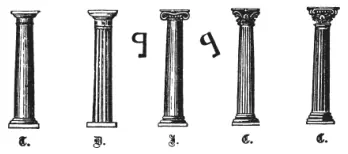
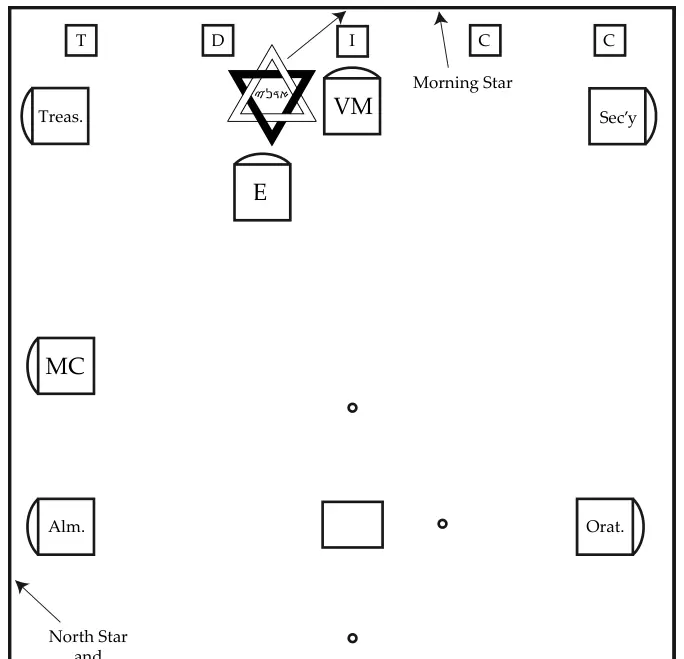
Behind the Master, in the East, are five columns, each of a different order of Architecture—Tuscan, Dorie, Ionic, Corinthian and Composite.
. In the North is painted the North Star, and a little below it the Seven Stars of the Great Bear. In the East, behind the columns, is s luminous Star, representing Jupiter, rising in the East as the Morning Star.
'Upon the Altar, which is in the centre of the room, are the Holy Bible, and on it all the instruments contained i in a case of mathematical instruments.
The Chapter is lighted by three Great Lights, one in the East, one in the West, 'and one in the South.
Over the Columns, in the East, hangs a Triangle, enclosing the word 'nk [Adoni].
OFFICERS, TITLES, ETC.
The Master is styled Th.*. IIL. Gr.c. Master.
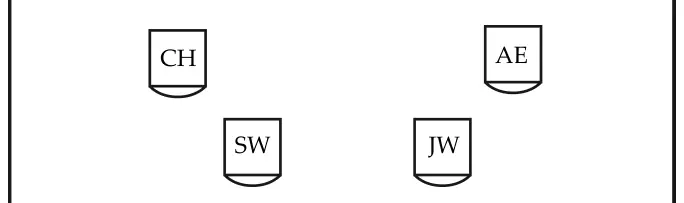
The Wardens, Ill.*. Sen.*. and Jun.-. Gr.. Wardens. They sit in the West. The Gr.°. Orator sits in the South.
The Deacons are styled Ill.-. Sen.*. and Jan.*. Gr.*. Experts.
There is also a Gr.:. Master of Ceremonies.
CLOTHING, ORNAMENTS, 4ND JEWEL.
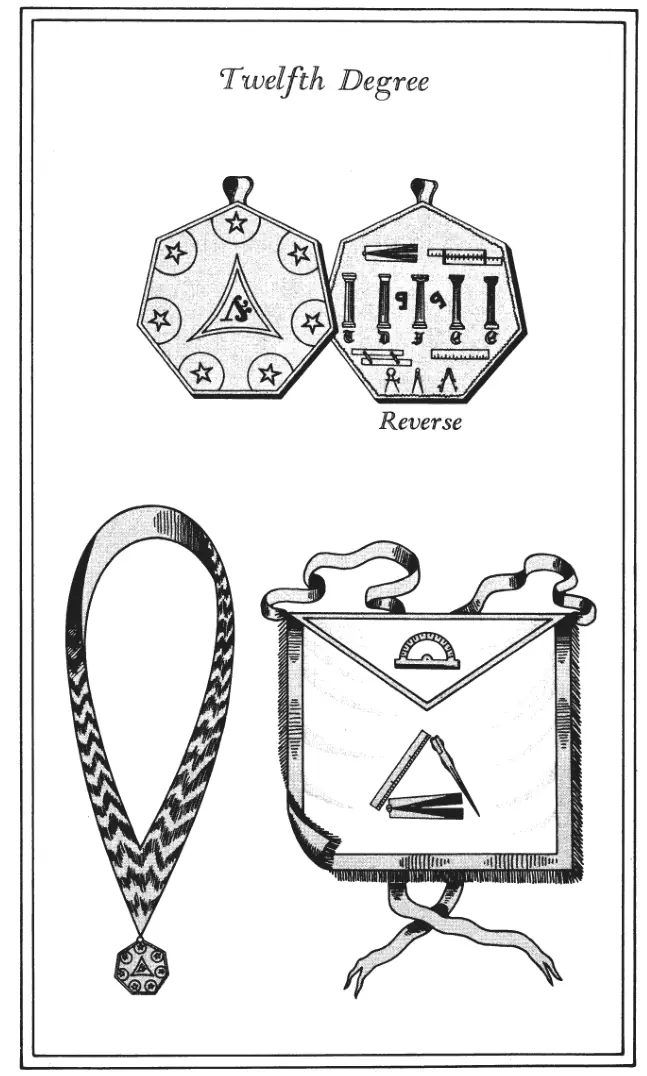
.s The apron is white, lined and bordered with blue, and fringed with gold. On it are painted or embroidered,.« protractor on the flap, and in the middle a plain scale, a sector and the compasses, so arranged as to form a triangle.
The cordon is a broad blue watered ribbon, worn from the left shoulder to the right hip.
The jewel is o. heptngonal medal of gold. In each angle, on one side, is a star, enclosed by a semicircle. In the centre, on the same side, is an equilateral triangle, formed by arcs of circles, in the centre of which in the letter A.. On the reverse side are five columns, of the different orders of architecture, with the initial
NIL. . 2
letter of the proper order below each, in old English letters, arranged from left to right: . . Tuscan . . Dorie » - Tonic . . Corinthian . . Composite. Above these columns are a sector and a slide rule: below them, the three kinds of OINDASSCS the plain scale, and parallel ruler; and between the 2d and 3d and 3d and 4th
columns are the letters.... 3. ... (Reo. Bo.
To front of each Brother i is a small table; and on it a case of instruments, with paper, and other articles
for drafting.
The Battery is |{ ?
The age of a Gr.*. M.*. Architect is the square of ; x || —or! [| years.
TO OPEN.
The Gr.. Master, giving one rap, and then two together, says :
The, Tit. Brethren, Iam about to open this Chapter of Gr.*. Master Architects in this place, that we
may proceed with our labours. Bro.*. Sen.*. Gr.*. Warden, see that all presentare Gr.*. Master Architects, by causing the Bre.". Gr.". Experts to receive the Sacred Word from each Bro.*. and bring it up to you in the
West.
. So. Gs. We. Bre. Sen.. and Jun. Gr. Experts, receive the Sacred Word on the North and on the
South, beginning in the East, and bring it up to me in the West.
- [The "Experts receive the word from each Brother os directed. Then the Jan. "Are - Expert gives it to the Sen.*. Gr.*, Expert, and he to the Sen.*. Gr.*, W."., who thereupon says]:
S.. Ge.We. Th.:. UL*. Ge.*. Master, all present are Gr.*. Master Architects; for the word has come up aright to me in the West.
Th. Ws. Thanks, my Brother. Bro.*.Jun.*. Gr.*. Expert, our first care is to see that we are duly tyled, and secure against intrusion. Attend to that duty, and inform the Gr.°. Tyler, that we are about to open this Chapter of Gr.:. *, Master Architects for the despatch of business, and direct him to tyle accordingly.
(The Jun'. Gr.:. Expert goes out, returns, raps fj ? which is answered from without, and reports] :
J. Gs. Eepe. Th, Ub. Are. Master, we are duly tyled.
The. Ml. Uow?
J.,G.. Faps. By a Bro. Gr.*. Master Architect without, armed and resolute.
Th. It. Wis duty there?
J.. G.. Exp-. To guard us against intrusion, and see that none enter here who are not entitled to do so,
and with your permission.
Th. I, Thanks, my Brother. Brethren, assume your stations. Bro.:, Sen.". Gr.-. Warden, are you o
Gr.°. Master Architect?
S-. Go. We. have studied mathematics, and am familiar with the instruments used by a Gr.". Master Architect.
Qu... What are those instruments?
Ans.". The plain compasses, the bow compasses, the drawing compasses, the drawing pen, the parallel ruler, the protractor, the plain scale, the sector, and the slide rule.
Qu.". For what purposes does a Gr.*. Master Architect uso the different compasses ?
Ans... To bi-sect lines and angles, to draw and erect perpendiculars, make angles equal to given angles,
describe circles, construct triangles and rectangles, and project ellipses and ovals. .
Qu.*. What lesson do they teach us in this degree?
Ans.. That our life and all Time are but a point in the centre of Eternity; while the diameter of the
circle of God's attributes is infinite: and that we, as Ilis finite creatures, should be patient, submissive,
moderate in our desires, and contented with our fortunes.
Qu.. For what purposes does a Gr.*. Master Architect use the parallel ruler?
Did... 3
Ans... To draw parallel lines, to make angles equal to given angles, to find proportionals to lines, to inscribe squares in triangles, and to reduce plane figures to others of equal area.
Qu. What lesson dues it teach us in this degree?
das. That wo should be consistent, firm, unwavering, and of that equanimity of mind and temper which befits a Mason.
Qu... For what purposes ducs a Grand Master Architect use the Protractor?
Ans." To measure and lay down angles, draw parallel lines, erect and let fill perpendiculars, divide angles, inscribe circles in triangles, and polygons on circles, construct polygons on lines, and describe circles within and without polygons. ~*
Qu... What lesson docs it teach us in this degree?
Ans'. That wo should be upright and sincere, frank in all our dealings, reliable, moderate in our professions, and exact and punctual in performance.
Qu. For what purpose does a Gr.*. M.*. Architect use the Plain Scale ?
Ans", To lay off distances, serve the purposes of the Protractor, apportion the areas of circles, and determine the diameters of circles of given areas.
Qu. What lesson docs it teach us in this degree t
Ans. That we should not live only or chiefly for ourselves, but partly and even largely for others; apportioning our time, oar labour, our acquirement and our intellect, so as in just and proper measure to serve ourselves, our families, our friends, our neighbours and our country.
Qu... For what purposes does the Gr.*. M.°. Architect use the Sector?
Ans, To divide lines into equal parts, to find proportionals to numbers, to multiply and divide numbers, to square and cube them, and extract the square and cube roots, to make and measure angles, to find and measure chords, sines, tangents, and secants of given angles, to construct polygons, and measure heights and distances by means of. the- angles, horizontal, of depression and of elevation.
Qu.*. What lesson does it teach us in this degree? .
'Ans.*. 'That we should multiply our good deeds, divide that which we can spare of our substance among those who need it moro than wo, extract the good that is intended to benefit and bless us, from the reverses, 'the unhappiness and the calamities of life; and, from the data which God has given us in his works, endeavour 'to approximate to an appreciation of Ilis jnBnite Wisdom, Beneficence, and Bounty.
Qu.'. For what purposes does a Gr.°. M.*. Architect use the slide-rale?
Ans." To servo the purposes of the Sector, to measure the surfaces of quadrilaterals, triangles, parabolas, circles, cycloids, ellipses, prisms, cylinders, pyramids, cones and spheres; to duplicate cubes and globes, by determination of their diameter and side, to measure the contents of vessels and the weight of solids.
Qu.' What lesson does it teach us in this degree?
Ins., That we should strive to grasp and solve the great problems presented by the Universe, and involved in our existence; te know and understand the lofty truths of Philosophy; and to communicate freely of our knowledge unto others, not hiding our talents in the earth like sordid miser, but diffusing light and 'information among the ignorant and uninformed.
Qu... Where were you received and made a Gr.*. Master Architect?
Ans... Ina place representing the Chamber of Designs, assigned to our Gr.-, Master Hiram Abi, in King
Solomon's Temple.
Qu... At what hour?
-Ans.*.. When the day-star had risen in the East, and the North Star looked down upon the Seven that ever circle round him and point him out to the mariner.
Qu.'. Of what is the North Star a symbol to the Mason?
Ana.". Of Truth and Right, the Pole-Stars that guide Masons over the stormy Seas of Time.
Qu.-. -OF what are the Seven Stars the symbol ?
Ans... Of a Mason's Loyalty to Truth and Right, to his Order, and to hig Country.
Qu.. What do the Five Columns in the East teach us?
Ans... That Masonry, in all its orders and degrees, like architecture, is one; the same in all countries and in all ages.
Qu... What does the Star signify, rizing in the East, behind the Columns?
Ans., That the day-light of Perfection approaches,
Qu.*. What is the hour?
Ans... That Star has risen.
Qu... What is the age of a Gr. Master Architect?
Ans. Two"*C times the square of ; — or ! |] years.
Th. Hi. The hour of work has arrived. Give notice to the Gr.*, Masters, that Iam about to open this Chapter of Gr.*, Master Architects, that they may aid me in so doing.
J. Gs. We. Brethren in the South, the Th.*. IL*.Gr.°. Master is about to open this Chapter of Gr.*. M.*. Architects, and desires your assistance ; since the hour of work has arrived.
Sv. Go. Wo. Brethren in the North, &c. &e.
Th. Ill. The Sign, my Brethren.
[All give the sign. Then the Gr.*. Master and the Sen. and Jun.-. Gr.*. Wardens rap in succession j?~ sud all the Brethren the same with their hands; and the Gr.*. Master says]:
Th. Ill. I therefore declare this Chapter duly opened.
RECEPTION.
- The Candidate, in the clothing and with the jewel of the 11th Degree is received in the ante-room by the -Gr.*. Master,of Ceremonies, who examines him in the work of that Degree, and .in its principles; and if he: finds him well informed, conducts him to the door of the Chapter, and raps[?]. The Jun.-. Gr. Expest opens the door, and asks:
J. G.. Eep.. Who comes here, and what is his desire t
il, Her. Av... BL..." Prince Emeth, and Sublime Elu of Twelve, who desires to. receive the degree of Gr.°. Master Architect. ;
Jo. G., Exp. Does he well understand and has he been true to, the pledges which as a Knight Elu of Nine, IlL°. Elu of Fifteen, and Sublime Elu of Twelve, he has made to his brethren?
ML'. Her. He dues, and has.
J... G.. Exp... Why does he desire to receive the Degree of Gr.*. Master Architect ?
Af, Her, That be may increase in knowledge, and be the better fitted to discharge the duties of a good Mason.
J. G, Exp. Isis well; let him wait with patience until the Th.-. IIL'. Gr.*. Master is informed of his request, and his answer returned.
[The Jun.:. Gr.*. Expert closes the door and advances to the East ; and the same questions are there asked, and like answers returned, as at the door]. .
Th... Then let him enter and be received in due form.
[The door is opened, and the candidate enters, conducted by the Gr.*. M.*. of Her... and is led 3 times around the chapter; while the Jun. Gr., Warden reads as follows]:
«1st Cirenit: . . He that rojecteth wisdom and discipline is unhappy; and their hope is vain, and their labours without fruit, and their works unprofitable. The fruit of good labours is glorious; and the root of wisdom never faileth. Wisdom is better than strength, and a wise man than a strong man. Wisdom is glorious, and never fadeth away, and is easily seen by them that love her, and is found by them that seek her.
2d Circuit: . . . She preventeth them that covet her, so that she first showeth herself unto them. The that awaketh early to seek her shall not labour: for he shall find her sitting at his door, To think upon her is perfect understanding; and he that watcheth fur her shall quickly be secure. For she goeth about seeking such as are worthy of her; and she showeth herself to them cheerfully in the ways, and meeteth them with all Providence. '
8d Cirentt: . . . Tha multiplied brood of the wicked shall not thrive; and bastard slips shall not take deep root nor any fast foundation. And if they flourish in branches for a time, yet, standing not fast, they shall be shaken with the w'nd; and through the force of the winds they shall be rooted out. For the branches, not being perfect, shall be broken; and their fruits shall be unprofitable, and sour to eat and fit for nothing.
[At the end of the 3d Circuit, the candidate is halted in front of the Jun.*. Gr.*. Warden, who asks]:
Jo. G. Wo. Whom bring you with you, Bro.-. Gr.. Master of Ceremonies?
He. Ceres, Aw... B...., 9% Prince Emeth, who desires to obtain the Degree of Gr.°. Master Architect. .
J. Gs. We. Why does he desire to receive that Degree?
Mf. Her... That he may increase in knowledge, and be the better fitted to discharge the duties of a good Mason. -
Jc. Gs, We. My Bro.:., most thou well remember thy pledges to thy Brethren, made by thee as o Knight Elu of Nine?
Card.. I do.
J. G. Wr. Repeat them.
[The Candidate must repent these pledges, as made in opening and closing in the 9th Degree. If he cannot do so, he must be withdrawn, and his reception postponed until he can do it. Therefore, in the preparation room, the M.°. of Her.°. mast see that he can repeat them, before he asks for his admission].
_ G.. W.. East thou endeavoured faithfully to fulfil these pledges?
*, Cand., Have.
" J. Go. We. Then thou bast my permission to pass on for further examination: and may thy search for wisdom prove successful !
_ [The Candidate is then conducted twice more around the room; while the Sen.°. Gr. . Warden reads ag follows] :
4th Circuit: .. . I wished, and understanding was given me: and I called upon God, and the spirit of Jviadom' 'came upon me: and I preferred her before Kingdoms and Thrones, and 'esteemed riches nothing i in
comparison toher. Neither did I compare unto her any precious stones: for all gold, in comparison of her in-& little sand; and silver, in respect to her, is to be counted as clay. I loved her above health and beauty: and "chord to have her instead of light; for her light cannot be put out.
bth: Cireutt: .....- She is an infinite treasure to men; which they that use become the friends of God. 'In her ris the spirit of understanding; holy, one, manifold, subtile, eloquent, active, undefined, sure, sweet, loving that which is good, quick, which nothing hindereth, beneficent, gentle, kind, steadfast, assured, secure, having © all power, overseeing all things and containing all spirits: flowing from the power of God, and a pure emanation of the Glory of the Almighty God, unalloyed with anything base ; the brightness of Eternal Light, 'the unspotted mirror of God's Majesty, and the image of Ilis Goodness.
(At the end of the 5th Circuit, the Candidate is halted in front of the Sen.°. Gr.-. Warden, who asks];
8.. Gs... Whom bring you hither, who.*. Gr.*. Master of Ceremonies?
Me. Her. Aces s B. «o-oo & Prince Emeth, who desires to obtain the Degree of Gr.' Master Architect; and being examined by the Jun.'. Gr.*. Warden, hath by him been suffered to pass, and come hithér for further examination.
S'. &.- We. Why does he desire to receive this degree?
M... Her.' oy, That he may increase in knowledge, and be the better fitted to discharge the duties of a good Mason, -
BEG Wee My Bro.*., most thou well remember thy pledges to thy Brethren, made by thee as an IIl.°. Elu-of Fifteen? .
'Cand. I do.
S.. G. Wo. Repeat them.
[The Candidate does so, or must be withdrawn.]
It... 6
So. @. Wo. ast thou endeavoured faithfully to fulfil these pledges?
Cand.. I have.
S.. G. We. Then thou has my permission to pass on for further examination: and may thy search for wisdom prove successful! ° ,
(The Candidate is then conducted twice more around the room; while the Th. IIL. reads]:
Gth Circuit: . . . No evilcan overcome wisdom. She glorifieth her Nobility by being conversant with God: and the Lord of all things loveth her. Fur it is she that teacheth the knowledge of God, and in the expounded of Ilis works. If a man love justice, her labours have great virtues ; for she tencheth temperance and prudence, and justice and fortitude; which are such things os man can have nothing more profitable in life. ,
Tth Circuit: ... She knoweth things past, and judgeth of things to come: she knoweth the subtilties of speeches, and the solutions of arguments: she knoweth signs and wonders before they be done; and the events of times and ages. She will communicate to us of her good things, and be a comfort in our cares and grief. By means of her we shall have immortality, and shall leave behind us an everlasting memory to them that come after us.
[At the end of the 7th Circuit, the Candidate is halted in front of the Th.*. IIL.:., who asks]:
Th. Its. Whom bring you hither, Bro.. Gr.. M.*. of Ceremonies?
MC. Gers. A... 3B... & Prince Emeth, who desires to obtain the degree of Gr.*. Master Architect; and being examined by the Jun.*. and Sen.. Gr.*. Wardens, hath by them been suffered to pass, and to come. hither for further examination. . -
Th.. It. Why does he desire to receive this degree?
_ Bf. Cers. To increase in knowledge, and be the better fitted to discharge the duties of 1 good Mason.
Th. Il. My Bro.*., dolt thou well remember thy pledges to thy Brethren, made by thee as a Prince
Emeth?
Cand... I do.
Th.*. It.". Repeat them.
(If docs so ; or is withdrawn.]
The. Ui. Ibis well. Of what art thou in search?
Caged... OF wisdom.
Th. Ill. Its the true Masonic Light. Io who obeys the Masonic In shall find it The degree .
which you now seek was first conferred upon Adonhiram the Son of Aida, when he was appointed Chief _ Architect of the Temple, and as such, the successor of the Gr.*. Master Iliram, after having been for a time the chief of the five Intendants of the building: and after his skill and science as an architect had been
thoroughly tested, and he found to be superior to the other four Intendants.. .
It was but the ceremony of his investiture with that office. Afterwards it became an honorary degree, conferred first upon the other Intendants, and then upon the Elu, as a mark of honor and distinction, As he advanced, the Ancient Freemason ceased to work with the instruments of the labourer, the Square, the Level, the Plumb and the Trowel: and assumed those of the Architect and Geometrician. As he advanced, also, he passed from that branch of Geometry and Mathematics which occupies itself with the Earth! its surface, and the things that belong to it, with right lines and angles and all the figures formed thereby, to the mathematics of the heavens and the spheres. .
We no longer occupy ourselves with geometry and mathematics as sciences, nor expect of our initiates a knowledge of their problems, or even of their terms. To us the instruments of the Gcometrivian, and all the figures, plain and spherical, drawn by these instruments, have a eymbolical meaning. By means of the morality of Masonry, we advance towards its philosophy; and every degree is n atep in that direction, If you would succeed to the rank held by Adonhiram, you must assume the obligation which it imposes. Are you willing to do so?
Cand... Iam.
Th. Ill. Bro.. Sen.*. Gr.*. Expert, you will conduct this brother to the Altar of Masonry, and place
him in proper position to assume the obligation of a Gr. Master Architect.
NIT... 7
[The candidate in conducted to the Altar, and made to kneel on both knees, with his hands upon the holy Bible and the instruments which are upon it; in which position he repeats the fullewing]
OBLIGATION.
'T, A.... B...., in the presence of the Gr.*, Architect of the Universe and of this Chapter of Gr.°. Master Architects, do hereby and herein most solemnly and sincerely promise and swear, that I will never reveal the secrets of this degree te any person in the world, unless it Le in a place where, and of a time when, the same may lawfully be done, and to a person duly authorized to receive them, and when I am legally
authorized and empowered to communicate them.
I furthermore promise and swear that during all the rest of my life, within the Lodge and Chapter
and without, I will earnestly endeavour to conduct and behave myself in a manner suitable to the character of one, who assumes to be the successor and representative of those men, illustrious for their virtues and
excellencies, who were the chief architects of the Temple built by Solomon.
I furthermore promise and swear that I will hereafter strive to practise all the virtues of which the
instruments before me are the symbols in this degree, as they shall be hereafter explained to me, to the end of
my life, and so fur as human frailty and infirmity will allow.
To all of which I do most solemnly and sincerely promise and swear, binding myself under the penalty of being deserted and abandoned by my friends and denounced and hunted down by my enemies, and of forfeiting all claim to assistance in danger, comfort in calamity and support in difficulty from any Mason in the world; if I should ever be guilty of wilfully and intentionally violating this my solemn obligation of a Gr., Master Architect. So help me God; and keep me steadfast in the due performance of the same!
Th.. TU... By the authority in mo vested, as successor of Adonhiram the son of Aida and Hiram Abi our Gr.*, Master, I declare you to be duly elevated to the degree of Gr.-, Master Architect. Arise, and receive . -the Sign, Token and Words of this Degree.
Stow: 'Lay the t99L&PIkO°1T in the middle of the fC. Pause o moment; and then S{¥A: the
VOL Cie: of the $1&O<r0, and with the Are gsm, seem to trace a plan or figure in the palm of the fcHVr; Jooking at the Gr.-. Master, as if receiving directions from him.
Toxen: O2°° CIOL C the Whom cia: of the H&OSTIO, and placo each his other &OSSTI on
his & 2%. -
Past-sworn: tOm-m, Cm 9-0...
Sacer Worn: OUYO?9...
T invest you with the apron, collar and jewel of this Degree. Their colours, white and blue, will remind you of what is commonly styled Symbolic Masonry, or the Blue Degrees; the foundation, but not, as many pretend, the completion and perfection of Masonry. Upon the apron and jewel you see the five orders of -architecture, and the instruments of a Grand Master Architect; the symbolic meaning of which you hare yet
to learn. ©
T now present you with the instruments with which a Grand Master Architect works. Listen, and
you shall learn their uses, and of what they are the symbols to us in this Degree. Bro.-. Sen.*. Gr. Warden,
' what ore the instruments used by a Gr.°, Master Architect.
{The Th.*, Ill. and the Sen., Gr. Warden repeat the questions and answers, in the opening ceremony,
in regard to the purposes fur which the several instruments are used, and the lessons which ore taught by _them in this degree, from the compasses to the slide-rule inclusive].
XIE. . §
Th... Ti.. Such are the uses of the instruments of a Gr.*. Master Architect, and such the lessons which they teach us. Forget not that you have solemnly sworn to practise all the virtuca which they symbolically teach, for thus only can you deserve, how proudly solver you may wear, the title of Gr.*. Master Architect.
——Go now to the Gr.*. Orator, and sitting at his feet receive the Lecture of this Degree.
LECTURE.
My Brother, the history of this Degree is brief, as ts ceremonies are simple. After the murderers of our Gr.*. Master Hiram Abi had been discovered, apprehended, tried and punished ; his monument and mausoleum completed by the Board of Intendants of the Building; and the matters which concerned the revenue of the realm provided for, King Solomon, to assure uniformity in the work, and vigour in its prosecution, and to reward the superior and eminent science and skill of Adonhiram the son of Aida, appointed him to be Chief Architect of the Temple, with the title of Gr.. Master Architect, and invésted him with that office, as sole successor and representative of the deceased Grand Master Hiram Abi; and of the same time made him Gr.°. Master of Masons, and the Masonic Peer of himself and King Hiram of Tyre. Afterwards the title was conferred upon other Princes of the Jewish Court as an honorarium, and thus the degree became established.
You have heard what are the lessons taught by the working instruments of a Grand Master Architect ; and I shall not now enlarge upon those lessons, The great duties which they inculcate, demanding so mach of us, and taking for granted the capacity to perform them faithfully and fully, bring us at once to reflect upon the dignity of human nature, and the vast powers and capacities of the human soul; and to that theme we invite your attention in this degree.
Evermore the human soul struggles towards the light, towards God and the Infinite. It is especially 50 in its afflictions. Words go but little way into the depths of sorrow. The thoughts that writhe there in silence, that go into the silence of Infinitude and Eternity, have no emblems. Thoughts enough come there, such as no tongue ever uttered. They do not so much want human sympathy, as higher help. There is a -Loneliness in deep sorrow which the Deity alone can relieve. Alone, the mind wrestles with the great problem of calamity, and seeks the solution from the Infinite Providence of Heaven, and thus is led directly to God.
There are many things in us of which wa are not distinctly conscious. To waken that slumbering consciousness into life, and so to lend the soul up to the Light, is one office of every great ministration to human nature, whether its vehicle be the pen, the pencil, or the tongue. We are unconscious of the intensity and awfulness of the life within us. Health and sickness, joy and sorrow, success and disappointment, life and death, are familiar words upon our lips; and we do not know to what depths they point within us.
'We seem never to know what any thing means until we have lost it. Many an organ, nerve, and fibre in our bodily frame performs its silent part for years, and we are quite unconscious of its value. It is not until it is injured that we discover that value, and find how essential it was to our happiness and comfort. We never know the full significance of the words, property, ease and health; the wealth of meaning in the fond epithets, parent, child and friend, until the thing or the person is taken away; until, in place of the bright, risible being, comes the awful and desolate shadow, where nothing is: where we stretch out our hands in vain, and strain our eyes upon dark and dismal vacuity. Yet, in that vacuity, we do not lose the object that we loved. It becomes only the more real to us. Our blessings not only brighten when they depart, but are fixed in enduring reality ; and friendship receives its everlasting seal under the cold impress of death,
A dim consciousness of infinite mystery and grandeur lies beneath six the common-place of life. There is an awfulness and a majesty around us, in all our, little worldliness. The rude peasant from the Apennines, asleep at the foot of o pillar in a majestic Roman church, seems not to hear or see, but te dream only of the herd he feeds or the ground he tills in the mountains. But the choral symphonies fall softly upon his car, and the gilded arches are dimly seen through his half-slumbering eyelids.
So the soul, however given up to the occupations of daily life, cannot quite lose the sense of where it is, and of what is above it and around it. The scene of its actual engagements may be small; the path of
NIT... 9
ita steps, beaten and familiar; the objects it handles, easily spanned, and quite worn out with daily uses. So it may be, and amidst such things, that we all live. Su we live our little life; but Heaven is above us; and Eternity is before us and behind us; and suns and stars are silent witnesses and watchers over us. We are enfolded by Infinity. Infinite Powers and Infinite apaces Jie all around us. The dread arch of Mystery spreads over us, and no voice ever pierced it. Eternity is enthroned amid Heaven's myriad starry heights; and no utterance or word ever came from those fur-off and silent spaces. Above, is that awful majesty; around us, every where, it stretches of into infinity: and beneath it is this little struggle of life, this poor day's conflict, this busy ant-hill of Time. ;
- But from that ant-hill, not only the talk of the streets, the sounds of music and revelling, the stir and tread of a multitude, the shout of joy and the shriek of agony go up into the silent and all-surrounding Infinitude ; but also, amidst the stir and noise uf visible life, from the inmost bosom of the visible man, there goes up an imploring call, a beseeching very, an asking, unuttered and unutterable, fur revelation, wailingly and in almost speechless agony praying the dread arch of mystery to break, and the stars that roll above the waves of mortal trouble, to speak; the enthroned majesty of those awful heights to find a voice; the mysterious and reserved heavens to come near; and all to tell us what they alone know; to give us information of the loved and lost; to make known tu us what we are, and whither we are going.
Man is encompassed with a dome of incomprehensible wonders. In him and about him is that which
should fill his life with majesty and sacredness. Something uf sublimity and sanctity has thus flashed down from heaven into the heart of every one that lives. There is no being so base and abandoned but hath some traits of that sacredness left upon him; something, so much perhaps in discordance with his general repute, that he hides it from all around him: some sanctuary in his soul, where no one may enter; some sacred enclosure, where the memory of a child is, or the image of a venerated parent, or the echo of some word. of kindness once spoken to him; an echo that will never die away.
. Life is no negative, or superficial or worldly existence. Our steps are evermore haunted with thoughts, far beyond their own range, which some have regarded as the reminiscences of o are-existent state. So it is with us all, in the beaten and worn track of this worldly pilgrimage. There is more here, than the world we live in. - Ht is not all of life, to live. An unseen and infinite presence is here; a sense of something greater than-we possess; s seeking, through all the void wastes of life, for a good beyond it;.a crying out of the
. heart for interpretation; a memory of the dead, touching continually some vibrating thread in this great tissue of mystery.
. We all not only have better intimations, but are capable of better things than we know. The pressure of some great emergency would develops in us powers, beyond the worldly bias of our spirits; and Heaven | so deals with us, from time to time, as to call forth those better things. There is hardly o family so selfish in the world, but that, if one in it were doomed to die—one, to be selected by the others,—it would be utterly impossible for its members, parents and children, to choose out that victim; but that each would say, '1 will die ; but I cannot choose." And in how many, if that dire extremity had come, would one and another step forth, freed from the vile meshes of ordinary selfishness, and say, like the Roman father and son, "let the blow fell on me!" There are greater and better things im us all, than the world takes account of, or than tre take note of; if we would but find them out, And it is one part of our Masonic culture to find these traits of power and sublime devotion, to revive these faded impressions of generosity and self-sacrifice, the almost squandered bequests of God's love and kindness to our souls; and to induce us to yield ourselves to their guidance and control.
Upon all conditions of men presses down one impartial Jaw. To all situations, to all fortunes, high or low, the mind gives their character. They are, in effect, not what they are in themselves, but what they are to the feeling of their possessors. The King may be mean, degraded, miserable; the slave of ambition, fear, voluptuousness, and every low passion. The Peasant may be the real Monarch, the moral master of his fate, a free and lofty being, more than a Prince in happiness, more than a King in honour.
Man is no bubble upon the sea of his fortunes, helpless and irresponsible upon the tide of events. Out of the same circumstances, different men bring totally different results. The same difficulty, distress, poverty, or misfortune, that breaks down one man, builds up another and makes hin strong. It is the very attribute
and glory of a man, that be can bend the circumstances of his condition to the intellectual and moral purposes of his nature; and the power and mastery of his will chiefly distinguish him from the brute.
The faculty of moral will, developed in the child, is a new element of his nature. It is a new power brought upon the scene, and a ruling power, delegated from Heaven. Never was a human being sunk so low that he had not, by Gad's gift, the power to rise. , Because God commands him to rise, it is certain that he can rise. Every man has the power, and should use it, to make all situations, trials and temptations instru-
_ments to promote his virtue and happiness; and is so far from being the creature of circumstances, that he creates and controls éhem, making them to be all that they are, of evil or of good, to him as a moral being.
Life is what we make it, and the world is what we make it. -The eyes of the cheerful and of the melancholy man are fixed upon the same creation ; but very different are the aspects which it bears to them. To the one, it is all beauty and gladness; the wares of ocean roll in light, and the mountains ara covered with day. Life, to him, dashes, rejoicing, upon every flower and every tree that trembles in the breeze. There is more to him, everywhere, than the eye sees; a presence of profound joy, on hill and valley and bright, dancing water, The other idly or mournfully gazes at the same scene, and everything wears a dull, dim and sickly aspect. The murmuring of the brooks is a discord to him, the great roar of the sea hit's an angry and threatening emphasis, the solemn music of the pines sings the requiem of his departed happiness, the cheerful light shines garishly upon his eyes and offends him. The great train of the seasons passes before him like a funeral procession; and he sighs, and turns impatiently away. The eye makes that which it looks upon; the oar makes its own melodies and discords; the world without reflects the world within.
Let the Mason never forgot that life and the world are what we make them by our social character; by our adaptation, or want of adaptation to the social conditions, relationships and pursuits of the world. To the selfish, the cold and the insensible, to the haughty and presuming, to the proud, who demand more than they are likely to receive, to the jealous ever afraid they shall not receive enough, to those who are unreasonably sensitive about the good or ill opinions of others, to all violators of the social Jaws, the rude, the violent, the dishonest and the sensual,—to all these, the social condition, from its very nature, will present annoyances, disappointments, and pains, appropriate to their several characters. The benevolent affections will not revolve around selfishness; the cold-hearten must expect to meet coldness; the proud, haughtiness; the passionate, anger; and the violent, rudeness. Those who forget the rights of others,.must.not-be-surprised if their own . are forgotten; and those who stoop to the lowest embraces of sense must not woniler, if others are not.concerned to find their prostrate. hunour, and lift it up to the remembrance and respect of the world. .
To the gentle, many will be gentle: to the kind, many will be kind. .A good man will find that there is
goodness in the world: an honest man will find that there is honesty in the world; and a man of principle will find principle and integrity in the hearts of others. .
There are no blessings which the mind may not convert into the bitterest of evils; and no trials which it may not transform into the noblest and divinest blessings. There are no temptations, from which assailed virtue may not gain strength, instead of falling before them, vanquished and subdued. It is true that temptations have & great power, and virtue often falls: but the might of these temptations lies not in themselves, but in the feebleness of our own virtue, and the weakness of our own hearts. We rely too much on the strength of our ramparts and bastions, and allow the enemy to make his approaches, by trench and parallel, at his leisure. The offer of dishonest gain and guilty pleasure makes the honest man more honest, and the pure man more pure. They raise his virtue to the height of towering indignation. The fair occasion, the safe opportunity, the tempting chance become the defeat and disgrace of the tempter. The honest and upright man docs not wait until temptation has made its approaches sand mounted its batteries on the Inst parallel,
But to the impure, the dishonest, the false-hearten, the corrupt and the sensual,occasions come every day, and in every scene, and through every avenue of thought and imagination. Ile is prepared to capitulate before the first approach is commenced; and sends out the white fag when the enemy's advance comes in sight of his walls. Ie makes occasions; or, if opportunities come not, evil thoughts come, and he throws wide open the gates of his heart and welcomes those bad visitors, and entertains them with a lavish hospitality.
The business of the world absorbs, corrupts and degrades one mind, while in another it feeds and nurses the noblest independence, integrity and generosity. Plcusure is 2 poison to some, and a healthful refreshment
to others. To one, the world is'a great harmony, like 2 noble strain of music with infinite modulations: to another, it is huge factory, the clash and clang of whose machinery jars upon his cars and frets him to madness. Life is substantially the same thing to all who partake of its lot. Yet some rise to virtue and glory; while others, undergoing the same discipline, and enjoying the same privileges, sink to shame and perdition. . ,
Thorough, faithful and honest endeavour to improve, is always successful, and the highest happiness. To sigh sentimentally over human misfortune, is ft only for the mind's childhood; and the mind's misery in chiefly its own fault; and appointed, under the good Providence of God, as the punisher and corrector of its fault. In the long run, the mind will be happy, just in proportion to its fidelity and wisdom. When it is miserable, it has planted the thorns in its own path: it grasps them, and cries out in loud complaint; and that complaint is but the Jonder confeysivn that the thorns which grew there, i planted.
A certain kind and degree of spirituality enter into the largest part of even the most ordinary life. You can carry on no business, without some faith in man. You cannot even dig in the ground, without a reliance on the unseen result. You cannot think or reason or even step, without confiding in the inward, spiritual principles.of your nature. All the affections and bonds, and hopes and interests of life centre in the spiritual ; and you know that if that central bond were broken, the world would rush to chaos.
Believe that there is a God; that He is our Father; that If has a paternal interest in our welfare and improvement; that he has given us powers by means of which we may escape from sin and ruin; that he has destined us to a future life of endless progression towards perfection and a knowledge of himself ;—believe this, as every Mason should, and you can live calmly, endure patiently, labour resolutely, deny yourselves cheerfully, hope steadfastly, and be conquerors in the great struggle of life. Take away any one of these principles, and what remains for us. Say that there is no God; or no way opened for hope and reformation and triumph, no heaven to'come, no rest fur the weary, no home in God's bosom fur the afflicted and disconsolate soul; and we are but the sport of chance, and the victims of despair ; hapless wanderers upon the face of a desolate and forsaken earth; surrounded by darkness, struggling with obstacles, toiling for barren results and empty purposes, distracted with doubts, and misled by false gleams of light; wanderers with no
'Way, no prospect, no home; doomed and deserted mariners on & dark and stormy sea, without compass or 'course, to whom no stars appear, 'tossing helpless upon the crashing waves, with no haven in the distance to invite us to its welcome rest.
_ The religious faith thus taught by Masonry is indispensable to the attainment of the great ends of life ; yd most therefore have been designed to be a part of it. We are made for this faith; and there must be something, somewhere, fur us to believe in. We cannot grow healthfully, nor live happily, without it. It is therefore true. If we could cut off from any soul all the principles taught by Masonry, the faith in a God, in immortality, in virtue, in essential rectitude, that soul would sink into sin, misery, darkness and rain. If wo
-could cut off all sense of these truths, the man would sink ut once to the grade of the animal. = -
Society, in its great relations, isas much the creation of Heaven, as is the system of the Universe. If
that bond of gravitation that holds all worlds and systems together, were suddenly severed, the universe
~ would fly into wild and boundless chaos. And if we were to sever all the moral bonds that hold society together; if wo could cut off from it every conviction of Truth and Integrity, of an authority above it, and of a conscience within it, it would immediately rush to disorder and frightful anarchy and ruin. The religion we tencli is therefore as really 9 principle of things, and as certain and true, as gravitation.
Faith in moral principles, in virtue and in God, is as necessary fur the guidance of « man, as instinct is for the guidance of an animal, And therefore this faith, as a principle of man's nature, has a mission as truly authentic in God's Providence, as the principle of instinct. 'The pleasures of the soul, too, must depend on certain principles. They must recognize o soul, its properties and responsibilities, a conscience, and the sense of an authority above us: and these are the principles of faith. No man can suffer and be patient, can struggle and conquer, can improve and be happy, without conscience, without hope, without a reliance on a just, wise and beneficent God. We must of necessity embrace the great truths taught by Masonry, and live by them, to live happily. Every thing in the universe has fixed and certain laws and principles for its action ;—the star in its orbit, the animal in its activity, the physical man in his functions. And he has
likewise fixed and certain laws and principles as a spiritual being. THis soul does not die for want of ailment or guidance. For the rational soul there is ample provision. From the lofty pine, rocked in the darkening tempest, the cry of the young raven is heard, and it would be most strange if there were no answer for the cry and call of the soul, tortured by want and sorrow and agony. The total rejection of all moral and religious belief would strike out a principle from human nature, as essential to it as gravitation to the stars, instinct to animal life, the circulation of the blood to the human body.
God has ordained that life shall be a social condition. We are members of a civil community. The life of that community depends upon its moral condition. Public spirit, intelligence, uprightness, temperance, kindness, domestic purity, 'ill make it a happy community, and give it prosperity and continuance. Widespread selfishness, dishonesty, intemperance, libertinism, corruption and crime, will make it miserable, and bring about dissolution and speedy ruin. A whole people lives one life: one mighty heart heaves in its bosom; it is one great pulse of existence that throbs there. One stream of life flows there, with ten thousand intermingled branches and channels, through all the homes of human love. One sound as of many waters, a rapturous jubilee or a mournful sighing comes up from the congregated dwellings of a whole nation.
The Public is no vague abstraction; nor should that which is done against that Public, against public interest, law or virtue, press but lightly on the conscience. It is but n vast expansion of individual life; an ocean of tears, an atmosphere of sighs, or a great whole of joy and gladness. It suffers with the suffering of millions: it rejoices with the joy of millions. What a vast crime does he commit,—private man or public man, agent or contractor, legislator or magistrate, Secretary or President, who dares, with indignity and wrong, to strike the bosom of the Public Welfare, to encourage venality and corruption and shameful sale of the elective franchise, to sow dissension, and to weaken the bonds of amity that bind the Nation together! . What a huge iniquity, he who, with vices like the daggers of a parricide, dares to pierce that mighty heart, in which the ocean of existence is flowing!
What an unequalled interest lies in the virtue of every one whom we love! In his virtue, nowhere but in his virtue, is garnered up the incomparable treasure, What care we for brother, husband or friend, compared with what we care for his honour, his fidelity, his reputation, his kindness? low venerable is the rectitude of parent! Low sacred his reputation! No blight that can fall upon a child, is like his parent's dishonour. Heathen or Christian, every:parent would have his child do well; and pours out upon him all the fulness of parental love, in the one desire that he may do well; that he may be worthy of his: cares, and his freely Lestuwed paina; that he may walk in the way of honour and happiness. In that way he cannot walk ono step without virtue. Such is life, in its relationships. A thousand tics embrace it, like the fine nerves of a delicate organization ; like the strings of an instrument capable of sweet melodies, but easily wounded, lacerated and broken, by rudeness, anger, and guilty indulgence.
If life could, by any process, be made insensible to pain and pleasure; if the haman heart were hard as adamant, then avarice, ambition and sensuality might channel out their paths in it, and make it their beaten way; and none would wonder or protest. If we could be patient under the Jond of a mere worldly Jifo; if we could bear that burthen as the beasts bear it; then, like beasts, we might bend all our thoughts to the earth; and no call from the great Heavens above us would startle us from our plodding and earthly course.
But we are not insensible brutes, who can refuse the call of reason and conscience. The soul is capable - of remorse. When the great dispensation of life presses down upon us, we weep, and suffer and sorrow. And sorrow and agony desire other companionship than worldliness and irreligion. We ore not willing to boar those burthens of the heart, fear, anxiety, disappointment and trouble, without any object or ug. "We are not willing to suffer, to be sick and afflicted, to have our days and months lost to comfort and joy, and overshadowed with calamity and grief, without advantage or compensation: to barter away the dearest treasures, the very sufferings, of the heart; to sell the life-blood from failing frame and fading check, our tears of bitterness and groans of anguish, fur nothing. Human nature, frail, feeling, sensitive and sorrowing, cannot afford to suffer for nothing.
Every where, human life {so great and solemn dispensation, Man, suffering, enjoying, loving, hating, hoping and fearing ; now soaring to Heaven and exploring the far recesses of the universe, and now sinking to the grave, is ever the creature of a high and stupendous destiny. In his bosom is wrapped up 2 momentous
AIT... 18
and vast experience, to be unfolded in ages and worlds unknown. Around this great action of existence the curtains of Time are drawn; but there are openings through them which give us glimpses of Eternity. God from on high looks down upon this scene of human probation. The wise and the good in all ages, and above all the Great Master, have interposed for it, with their teachings and their blood. Every thing that exists around us, eve.y movement in Nature, every counsel of Providence, every interposition of God, centres upon one point,—the fidelity of man. .
And though the ghosts of the departed and the remembered should come at midnight through the barred doors of our dwellings; though the sliceted dead should glide through the aisles of our churches, and people our Masonic Temples, their teachings would be no more powerful than the dread realities of Life; than those memories of mis-spent years, those ghosts of departed opportunities, that, pointing to our consciences and to Eternity, ever cry in our ears, "' Work while the day lasts, for the night of death comets, in which no man can work."
There are no tokens of public mourning for the calamity of the soul, Men weep when the body dies;
and when it is borne to its last rest, they follow it with sad and mournful procession. But for the dying soul, there is no upon Indentation ; for the lost soul there are no obsequies.
And yet the mind and soul of man have a value which nothing else has. They are worth a care which
nothing else is worth ; and to the single, solitary individual, they ought to possess an interest which nothing else possesses. The stored treasures of the heart, the unfathomable mines that are in the soul to be wrought, the broad and boundless realms of Thought, the freighted argosy of man's hopes and' best affections, are brighter than gold and dearer than treasure. ;
And yet the mind is in reality little known orconsidered. It is all which man permanently is, his inward being, his divine energy, his immortal thought, his boundless capacity, his infinite aspiration ; and nevertheless, few value it for what it is worth. Few see a brother-mind in others, through the rags with which poverty has clothed it, beneath the crushing burthens of life, amidst the close pressure of worldly troubles, wants and sorrows. Few acknowledge and cheer it in: that humble lot, and feel that the nobility of earth, and the "commencing glory of Heaven is there. ,
: ~*Men-do not feel the worth of their own souls. They are proud of their mental powers: but the intrinsic, Honer, infinite worth of their own minds they do not perceive. The poor man, admitted to a-palace, feels, lofty and.immortal being as he is, like a mere ordinary thing amid the splendour that surround him. He sees the | carriage of wealth roll by him, and forgets the intrinsic and eternal dignity of his own mind, in s poor and degrading envy, and feels as an humbler creature, because others are above him, not in mind, but in mensutation. - Men respect themselves, according as they are more wealthy, higher in rank or office, loftier in the world's opinion.
'. The difference among men is not so much in their nature and intrinsic power, as in the faculty of comma- 'nleation, Some have the capacity of uttering and embodying in words their thoughts. All men, more or less, feel those thoughts. The glory of genius and the rapture of virtue, when rightly revealed, are diffused and shared among unnumbered minds. When eloquence and poetry speak; when those glorious arts, statuary, painting and music, take audible or visible shape ; when patriotism, charity and virtue speak with a thrilling 'power, the hearts of thousands glow with a kindred joy and ecstasy. If it were not so, there would be no eloquence ; for eloquence is that to which other hearts respond ; it is the faculty and power of making other hearts respond. No one is so low or degraded, as not sometimes to be touched with the beauty of goodness. No heart is made of materials so base, ag not sometimes to respond, through every chord of it, to the call of honour, patriotism, generosity and virtue. The poor African Slave will die for the master or mistress, or in defence of the children, whom he loves; and such love in him is common. The poor, abandoned, outcast woman will, without expectation of reward, nurse those who are dying on every hand, utter strangers to her, with s contagious and horrid pestilence. The pickpocket will scale burning walls to rescue child or woman, unknown to him, from the ravenous flames. ;
Most glorious is this capacity! A power to commune with God and IIis Angels; a reflection of the
Unerented Light ; a mirror that can collect and concentrate upon itself all the moral splendour of the Universe. It is the soul! alone that gives any value to the things of this world; and it is only by raising the soul to its
NIL... it
just elevation above all other things, that we can look rightly upon the purposes of this earth. No sceptre nor throne, nor structure of ages, nor broad empire, can compare with the wonders and grandeur of a single thought. That alone, of all things that have been made, comprehends the Maker of all. That alone is the key, which unlocks all the treasures of the Universe; the power that reigns over Space, Time and Eternity. That, under God, is the Sovereign Dispenser to man of all the blessings and glories that lic within the compass of possession, or the range of possibility. Virtue, Heaven and Immortality exist not, nor ever will exist for us, except as they exist and will exist, in the perception, feeling and thought of the glorious mind.
Return now, my Brother, to the Th.-. Il.. Gr. . Master, and receive from him the final instruction of
this Degree.
CLOSING INSTRUCTION.
Th. fl, My Brother, in the hope that you have listened to and understood the Instruction and Lecture of this degree, and that you feel the dignity of your own nature and the vast capacities of your own soul fur good or evil, I proceed briefly to communicate ty you the remaining instruction of this Degree.
The Hebrew word suspended in the East, over the five columns, is Atonal, one of the names of God, usually translated Lord; and which, in reading, the Jews always substitute fur Lis True. Name, which they are forbidden to pronounce.
The five columns, in the five different orders of architecture, are emblomatical to us of the five different divisions of the Ancient and Accepted Rite:
The Tuscan; of the three Blue Degrees, or the primitive Masonry.
The Doric; of the Ineffable Degrees, from the 4th to the 14th inclusive.
The Ionic; of the 15th and 16th, or the Council Degrees.
The Corinthian; of the 17th and 18th, or the Chapter Degrees.
The Composite; of the High Degrees, from the 19th to the 32d inclusive.
and they also symbolize to us the five principal Rites of Masonry: The Tuscan, the York Rite; the Doric, the It Moderns, or French Rite; the Ionic, the Rite of Jisraim ; the Corinthian, the Rite of Perfection; and . the Composite, the Ancient and Accepted or Scotch Rite, uniting the excellencies and rejecting the defects uf . the others.
The North Slar represents the point within the circle, or the Deity in the centre of the Universe.
The Seven Stars that circle around it, are symbols of the seven living, selfsubsistent, ever active, hypostatized Powers or Emanations, which were held by Dasilides to have been evolved from one unrevealed God: viz: the four Intellectual Powers; Novas, the Mind ; Locos, the Reason; Punonests, the Thinking Lower ; and Sornra, Wisdom: the Operative Power, Dunasus, Afight, accomplishing the purposes of Wisdom: and the Moral Attributes; Dixatosunz, Moral Perfection; and E:rens, Inward Tranquillity: which seven Powers, with the Primal Grand one, out of which they were evolved, constituted in his system the rims Oopoape, or Octave, the Root of all Existence; from which were evolved other gradations of spiritual existence, each lower one the impression and ante-type of the immediate higher one; and in all, 365 in number, represented by the my-
tidal word Anraxas. .
The Morning Star, rising in the East, isan emblem to us of the ever-approaching dawn of Perfection
and Masonic Light.
The three Great Lights of the Lodge, are symbols to us of the Power, Wispox and Beneficence of the
Deity.
For the present, my Brother, let this suffice. We welcome you among us, to this peaceful retreat of
Virtue, to a participation in our privileges, to a share in our joys and our sorrows: and we invite you to be seated with us as a member of this Chapter.
NIL... 15
TO CLOSE.
Th... W.", [Giving one rap, and then two]: Bro.*. Sen.*. Gr.*. Warden, what is the hour?
S.. G. W.. The Sun has set, and the Evening Star has risen.
The. TU. The hour for rest has arrived: Give notice to the Gr.°. Masters that I am about to close this Chapter of Gr.°, Master Architects, that they may aid me in so doing.
J. G.. Wi. Brethren in the South, the Th.-. Ill, Gr.*, Master is about to close this Chapter of Gr.°.
' M.°. Architects, and desires your assistance, since the hour of rest has arrived. .
S.. G., W.. Brethren in the North, &c.
Th, Iii. The sign, my Brethren!
{All give the sign. Then the Gr.*. Master and the Sen.*. and Jun.'. Gr.*. Wardens rap in succession ff — and all the Brethren the same with their hands, and the Gr.*. Master says]:
Th. I'. This Chapter is duly closed.
FINIS.