Chaque version du rituel est donnée dans l'état de sa source, de la plus
ancienne à la plus récente. Choisissez une version pour la lire ; sélectionnez-en une
seconde pour les comparer côte à côte. Fiche du grade :
le REAA du 4e au 33e degré.
Les textes issus de numérisations anciennes ont été corrigés automatiquement
(césures, ligatures, mots collés) puis relus : des coquilles peuvent subsister. D'autres
versions inventoriées au corpus (Francken 1783, Pyron 1811, rituels de Charleston ) rejoindront
cette page à mesure de l'établissement de leur texte.
Copie d'un officier du régiment de Foix en garnison à Saint-Domingue : le Rite de Perfection en 25 degrés, tel qu'arrêté au convent de Bordeaux. Cahier « Maître élu apocryphe dit de Pérignan » (p. 5-8 de la transcription) ; « Le maître élu de quinze » (p. 56-60 de la transcription). Le texte suit la transcription d'Aeditimus : son apparat critique est repris ici, ainsi que les repères de folio du manuscrit.
Attribution « apparenté » Ce cahier n'est pas donné par le manuscrit sous le titre du degré : son rattachement au 10e degré résulte de l'analyse du corpus.
[2r°]
Ouverture de la loge
D. Connaissez-vous d'autres mystères, que ceux des lettres J. et N. ?
R. Je connais la lettre [P].
D. Que signifie cette lettre ?
R. La lettre initiale du nom de l'inconnu.
D. A quelle heure s'ouvre la loge du 2 grade d'élu ?
R. A l'entrée de la nuit.
D. Quelle heure est-il ?
R. Le jour est fini. –
Le vénérable grand-maître frappe 27 coups en trois différents termes, fait le signe du 2e grade d'élu, qui est de porter la main demi fermée sur la bouche et de feindre de s'arracher la langue. Tous les vénérables maîtres répondent à ce signe à lui en étendant les deux bras, comme des gens surpris, après quoi le très respectable maître dit : Respectables maîtres, 1 et 2 surveillants, avertissez les vénérables maîtres, que la loge du 2 grade d'élu est ouverte. Le très vénérable maître dit aux frères de demander aux vénérables maîtres, s'ils n'ont rien à proposer. Pour lors, le maître de cérémonies, après avoir dit la parole, dit qu'il y a dans la chambre de réflexion un vénérable maître élu qui désire être admis au 2 grade. Le très respectable lui demande s'il est véritablement élu et, sur sa réponse, il lui dit de l'introduire. Le maître de cérémonies introduit le récipiendaire dans la loge et le place entre les deux surveillants.
Le très respectable lui demande alors ce qu'il demande, à quoi il répond qu'il désire d'être admis au 2 grade de maître élu. Le très respectable dit au 1 surveillant de le faire voyager. Celui-ci le prend par la main et lui fait faire sept tours de cette manière : 2 en montant et en descendant du côté du Midi, deux autres de même du coté du Septentrion, 2 autres de même du coté de l'Occident et le 7 et dernier en passant le milieu de la loge pour se mettre à deux genoux au pied du trône du très respectable maître, où il prête son obligation.
Serment d'obligation
Je promets et m'engage de garder et observer les mystères du 2 grade de maître élu, qui va m'être confié, tant envers les profanes, qu'envers les maîtres élus du 1er grade, et ce sous les mêmes obligations que j'ai déjà contractées en entrant dans cet Ordre respectable. Et, en tant de plus, d'avoir la langue arrachée comme un parjure, si je contreviens au moindre de mes engagements. Ainsi Dieu me soit en aide.
[Après le serment]
L'obligation ainsi prêtée, le très respectable maître lui donne le signe, le mot et les attouchements et le vénérable maître orateur lui fait le discours, qui suit. – Vous êtes enfin parvenu à ce second grade, que vous avez tant paru désirer et que vos travaux et votre
assiduité vous ont fait maître. Nous vous l'avons conféré d'autant plus volontiers, que cette faveur a dû sans doute redoubler votre zèle et ranimer vos efforts afin de vous rendre digne d'entrer dans la connaissance des sublimes mystères qui nous reste encore à vous dévoiler. – Vous venez d'apprendre, qu'il fut le sort des deux compagnons, malheureux complices de la mort de notre respectable maître Hyram, et comment après avoir longtemps vécu, et porté partout le remords du crime, qui les suivait jours après jours. Dieu permit enfin qu'ils périssent dans le pays de Capulle, où ils s'étaient réfugiés, juste effet de la vengeance divine qui ne laisse jamais ce crime impuni et qui poursuit le criminel jusqu'à ce qu'il lui ait fait subir la peine qu'il a méritée.
Toute l'allégorie, que renferme ce nouveau grade que l'on vient de vous conférer est bien aisée et encore d'autant qu'elle est poursuite de celle, que nous vous avons expliqué dans le premier. Vous la trouverez d'ailleurs toute tracée dans le tableau qui est ici exposé à vos yeux et dont le principal et le plus frappant objet est la tête du malheureux Abyram, plantée au haut d'une pique pour être exposée aux regards de tous les compagnons continuant la construction du temple, que Salomon avait ordonnée et qui servait à inspirer le cœur et l'épouvante à quiconque aurait pu former un projet aussi noir et aussi abominable que celle d'Abyram et qu'il n'avait que trop bien exécuté. – Tous les mystères qui se célèbrent dans ce second grade, ont tous un rapport aussi moral, que ceux, que vous connaissez déjà. – Le signe par lequel nous appelons est tiré de l'obligation que vous venez de contracter. Il marque non seulement comment grande doit être votre discrétion, mais elle se termine à vous faire voir que la peine due aux indiscrets est d'être totalement privés de la langue, qui a été le malheureux instrument de votre indiscrétion. La réponse que nous faisons à cette figure en étendant les bras et les levant au ciel vous désigne l'état d'un homme surpris, interdit, stupéfait d'un événement frappant, que le ciel vient d'opérer et le mot sacré que nous proposons en le faisant, marque notre résignation à sa volonté souveraine et à la juste satisfaction que vous devez, que le crime qui a été commis contre lui, reçoive la punition qui lui est due.
Ce grade au surplus n'est qu'un grade préparatoire qui vous amène à la sublimité de celui vous connaîtrez un jour les profonds mystères, si votre zèle ne se devient pas si votre service ne s'est contredit et, si vous ne dérogez jamais aux qualités éminentes qui doivent les activer, en qui en est revêtu [2v°]. –
[2v°] Je dois vous avertir, vénérable maître, de la part de cette respectable loge, qui m'honore de son pouvoir à cet égard, que la moindre indiscrétion, la plus petite tiédeur et la seule ombre de relâchement privent à jamais de ce grade ceux que nous en trouvons atteints. Nous espérons, que vous ne nous fournirez jamais des justes motifs pour vous en priver et que raffermis de plus en plus dans vos devoirs et vos obligations, vous nous procurerez le plaisir et la joie de pouvoir partager avec vous les avantages et les prérogatives, dont jouit le sublime et parfait élu.
Catéchisme
D. Connaissez-vous d'autres mystères, que ceux des lettres J. et N. ?
R. Je connais la lettre G.
D. Que signifie cette lettre ?
R. C'est la lettre initiale du nom de l'inconnu qui apprit à Salomon où était la retraite d'Abyram.
D. Que signifient les 3 grandes lumières, qui sont en entrant ?
R. Les trois compagnons, qui assassinèrent notre respectable maître Hyram.
D. Comment se nomment les trois scélérats ?
R. L'un se nommait Kunkel, l'autre Gravelot, et l'autre Abyram Akirop.
R. Kunkel était placé à la porte de l'Occident et ce fut celui qui le frappa d'un coup de règle, Gravelot était placé à la porte du Midi et lui donna un grand coup d'équerre. Abyram était à la porte de l'Orient et lui donna un grand coup de maillet, qui le fit tomber mort.
D. Quel fut le sort de Kunkel et de Gravelot ?
R. Salomon apprit qu'ils étaient réfugiés dans le pays de Capulle où ils périrent misérablement.
D. Comment l'inconnu put-il savoir qu'Abyram s'était réfugié dans une caverne ?
R. Comme cet inconnu travaillait auprès du buisson, où était située cette caverne, il en vit rester un homme tout effarouché et la curiosité l'ayant porté à savoir qui c'était, il aperçut Abyram, qui se voyant découvert, se jeta à ses pieds, lui confia son secret et le pria de ne pouvoir le trahir et de l'assister.
D. Pourquoi l'inconnu informa-t-il Salomon de sa retraite ?
R. Pour satisfaire à l'édit, que Salomon avait fait publier à ce sujet et jouir de la récompense, que ce roi avait promis à celui, qui découvrait l'assassin du vénérable maître Hyram.
D. L'inconnu indiqua-t-il à Salomon la retraite d'Abyram aussitôt qu'il l'eut découverte ?
R. Ce ne fut que 7 jours après pendant lesquels l'inconnu fournit à Abyram de quoi subsister à ses besoins.
D. Pourquoi l'inconnu n'informa-t-il Salomon de cette découverte, que sept jours après ?
R. Parce que ce ne fut que le 7 jour qu'il apprit la nouvelle de l'édit de Salomon.
D. Quel est votre nom comme maître élu du 2 grade ?
R. Pérignan.
D. Quel est votre mot ?
R. Mohabon.
D. Que veut dire ce mot ?
R. Dieu soit loué, rendons lui grâces, le parricide est puni.
D. Quel est votre mot de passe ?
R. Abyram Akirop.
D. Que fit Salomon de la tête d'Abyram après que Joabert la lui eut remise ?
R. Il le fit mettre au bout d'une pique, qu'il fit planter au dessus de la porte du Septentrion, afin qu'elle fut exposée aux yeux des apprentifs et des compagnons et qu'elle y restât comme une marque de la punition du crime d'Abyram et comme une preuve que rien n'échappait à sa sagesse.
D. Combien de temps cette tête resta-t-elle exposée ?
R. Pendant tout le temps de la construction du temple.
D. Que signifient les 27 coups, que vous frappez à la loge ?
R. Ils désignent mon âge en qualité de maître du vénérable grade, qui est de 27 ans.
D. Quel est votre signe en cette qualité ?
R. C'est de porter ma main à demi fermée sur la bouche et feindre de vouloir m'arracher la langue.
D. Quelle est la réponse à ce signe ?
R. C'est de lever et étendre les bras, comme un homme surpris, en disant : Loué soit Dieu, le parricide est puni.
D. D'où sont tirés le signe et la réponse qu'on y fait ?
R. L'un de mon obligation par laquelle je consens d'avoir la langue arrachée, si je révèle le moindre des secrets, qui me sont confiés et l'autre de la surprise, où fut Abyram, quand il se vit découvert par l'inconnu.
D. Que signifient les 7 tours qu'on vous a fait faire avant de prononcer votre obligation ?
R. Ils se rapportent aux 7 jours, que l'inconnu laissa passer avant d'instruire Salomon de la retraite d'Abyram.
D. Quel est votre attouchement ?
R. C'est de se représenter réciproquement le dessus de la main droite et la baiser.
D. Que signifie-t-il ?
R. Le baiser, qu'Abyram fit sur la main de l'inconnu en recevant [ ?] la promesse qu'il lui fit de ne point trahir son secret. –
Le maître élu de quinze
[17v°]
Le chapitre doit être tendu de noir, parsemé de larmes rouges et blanches. A l'Orient il doit y avoir un squelette, qui représente Abyram Akiroff, suivant l'élu de Neuf, dont le vrai nom est Hobben. A l'Occident un autre représentant Jubello Gyps et un troisième au Midi, représentant Jubellum Gravelot. Chacun de ces squelettes armés de l'instrument fatal avec lequel ils frappèrent et assassinèrent notre respectable maître Hyram Abiff, tel qu'il est enseigné dans la Maîtrise.
Le chapitre s'ouvre par cinq coups répétés trois fois. Le très respectable maître frappe cinq coups, après lesquels on allume cinq lumières, qu'on place à l'Orient. Le premier surveillant frappe aussi cinq coups qui font allumer cinq autres lumières. Le second surveillant frappe les cinq derniers coups et on place cinq autres lumières devant lui. Par conséquent dans ce grade la loge est éclairée de quinze lumières, posées sur trois chandeliers à cinq branches. On allume avant l'ouverture de la loge trois lustres, qui doivent avoir le même nombre de lumières.
Lorsqu'il y a réception il ne peut se trouver en loge que 15 maîtres. S'il s'en trouva d'avantage, les derniers reçus sortirent aussitôt ou se placeraient sur des bancs à l'Occident de la loge pour ne point faire nombre pour se remettre ensuite, quand ils en seraient avertis. Tout étant disposé, le très respectable maître demande :
D. Vénérable premier surveillant, quelle heure est-il ?
R. Il est cinq heures, très illustre respectable maître.
Il est donc temps de commencer l'ouvrage, mes très chers frères. Le chapitre est ouvert. On frappe 3 fois 5 coups des mains. + Lorsque le récipiendaire est introduit, le très respectable dit au premier surveillant Que demandez-vous ? A quoi il répond : La réception d'un maître élu de Neuf qui désire ardemment de connaître les deux autres assassins d'Hyram Abiff et de parvenir au grade de maître élu de Quinze. Avant d'introduire le récipiendaire, il doit être en maître Eu de Neuf, avec deux têtes de mort, une à chaque main et le poignard à la droite, traversé sous le menton. Alors le très respectable maître dit au premier surveillant Faites-le entrer par quinze pas triangulaires pour parvenir au pied de l'autel, où il doit rester debout, tenant toujours les têtes du cadavre, jusqu'à ce qu'il en soit ordonné autrement. Le très respectable et tous les maîtres élus tiennent leur poignard à la main, pendant que le récipiendaire est arrêté et livré à ses réflexions après quoi, laissant tomber leur poignard, ils mettent leurs mains entrelacées sur le front à l'envers et dans cette attitude demandent grâce pour le récipiendaire. Le respectable demande pour quoi. On répond, que le récipiendaire n'est point coupable. Pourquoi me demandez-vous donc grâce pour lui ? Les surveillants répondent La grâce, que nous vous demandons pour lui, est de le recevoir grand-maître élu de 15. Le très respectable demande : En est-il digne ? Oui, très respectable, répondent les surveillants. Alors le très respectable dit au récipiendaire, qui est au pied du trône. Les grands élus demandent de vous rendre leur semblable. Vous sentez-vous disposé et capable de garder inviolablement le secret et voulez- vous y obliger à la manière accoutumée. Oui, très respectable, répond le récipiendaire.
L'obligation
Je promets et m'oblige sur le Saint Evangile de ne déclarer ni confier à personne où j'ai été reçu, ni qui a assisté à ma réception et de ne recevoir, qui que ce puisse être, sans en avoir obtenu un pouvoir exprès, et en cas d'infraction, je consens d'avoir le corps ouvert et la tête coupée pour être remise au respectable qui m'a reçu. Ainsi Dieu me soit en aide. Amen.
[Après l'obligation] Quand le récipiendaire a prêté son obligation, le très respectable lui récite l'histoire des deux derniers meurtriers d'Hyram en ces termes :
Mon très cher frère, vous avez appris dans le grade de maître élu de 9 où vous avez passé qu'Abyram tué dans la caverne près du buisson ardent était un des meurtriers d'Hyram Abiff. Ce nom, qui ne veut dire autre chose qu'assassin, n'est pas son véritable nom. Il s'appelait Hobben. C'est lui qui était à la porte de l'Orient, armé du levier, qui assomma Hyram, duquel Salomon avait fait embaumer la tête, afin de la conserver pour être exposée en public avec celles de ses complices. Lorsqu'on les avait découvert, ce qui ne tarda pas d'arriver puisque six mois après l'assassinat Bengabar l'un des intendants du roi Salomon, par les recherches exactes qu'il fit, apprit que Jubello Gyps et Jubellum Gravelot les deux autres assassins s'étaient retirés dans le pays de Getk ou de Capulle qui était tributaire de Salomon, croyant y être en sûreté.
Salomon ayant appris cette nouvelle, écrivit sans pardon de temps à Maacha roi de Getk, pour le prier le livrer ces deux criminels aux personnes de sa confiance qu'il envoyait dans son pays pour les prendre et les conduire à Jérusalem, où ils recevraient le châtiment de leur crime.
En conséquence Salomon choisit le même jour et nomma quinze maîtres des plus capables et des plus zélés du nombre desquels étaient les neuf, qui avaient été à la recherche d'Hobben et leur donna des troupes suffisants pour les escorter.
Ils se mirent en marche le 15 du mois de juin et remirent la lettre de Salomon au roi Maacha qui frissonna en le lisant, ordonna qu'on fit au même instant une recherche exacte de ces deux scélérats et qu'on les livrât sans retard aux Israélites, témoignant qu'il se trouvait heureux que ses états fussent purgés de deux monstres semblables. Après une vigilante recherche, on les trouva dans la carrière de Bindecar le cinquième jour de la perquisition. Zermol et Alcham45 maîtres élus furent les premiers qui les découvrirent. On les saisit et on leur mit des chaînes, sur lesquelles était gravé le genre de sujet qu'ils devaient souffrir, afin qu'ils eussent continuellement leurs yeux et leur crime et le genre de mort par lequel ils devaient l'expier.
Ils arrivèrent à Jérusalem le 15 du mois suivant. On présenta aussitôt les coupables à Salomon qui les accabla de reproches les plus sensibles, leur fit sentir la noirceur de leur crime et ordonna de les transférer dans le cachot d'une tour nommée Haÿzar pour leur faire subir le lendemain la mort la plus cruelle. Voici le genre de leur supplice.
Le lendemain, à dix heures du matin, ils furent attachés nus à deux poteaux par les pieds, le col et les bras. Il arriva que dans cette attitude, on leur ouvrit le corps, depuis la poitrine jusqu'à la ceinture, et on les laissa ainsi exposés à l'ardeur du Soleil pendant huit heures. Les mouches et insectes venaient s'abreuver de leur sang et se repaître de leur chair encore vivante, ce qui leur ferait souffrir les plus horribles tourments. Leurs cris étaient si lamentables, que les bourreaux même en furent touchés et abrégèrent leur supplice en leur
tranchant la tête. Leur corps fut jeté par dessus les murs à la voirie, pour être la pâture des corbeaux [18r°]. –
[18r°] [ ?] ordonna ensuite qu'on remit au bourreau la tête d'Hobben afin que toutes les trois fussent exposées aux portes de la ville, sur des pieux, de la même manière que ces meurtriers s'étaient placés aux portes du temple pour assassiner Hyram Abiff. En conséquence la tête de Jubello Gyps fut à la porte du Midi, celle de Jubellum Gravelot à l'Occident et celle d'Hobben à l'Orient Ces trois têtes ont longtemps servi d'exemple aux sujets de Salomon et particulièrement aux ouvriers maçons.
Voilà en abrégé, mon cher frère, la fin de l'histoire déplorable d'Hyram Abiff et sa mort vengée sur celle de ses assassins. Nous allons actuellement vous remettre le cordon de ce grade et vous en donner les signes, mots et attouchements. Le premier signe est de fermer la main droite, le pouce élevé, comme si on tenait un poignard. Se la porter ainsi sous le menton et la descendre le long du corps ensuite comme on voulait s'ouvrir.
Le second signe pour répondre au premier est d'étendre la main et de passer le pouce sur le col, faisant la démonstration de le couper.
Le mot sacré est Zelma et la réponse Alcham. Ce dernier est aussi le mot de passe pour entrer en loge.
Le premier attouchement est de donner un petit coup de l'index droit sur la jointure du petit doigt, ce qui annonce que l'on a découvert les trois traîtres. Le second est de prendre de la main droite l'épaule de l'examinateur et lui donner trois petits coups avec les cinq doigts, ce qui signifie trois fois 5, ou le nombre quinze.
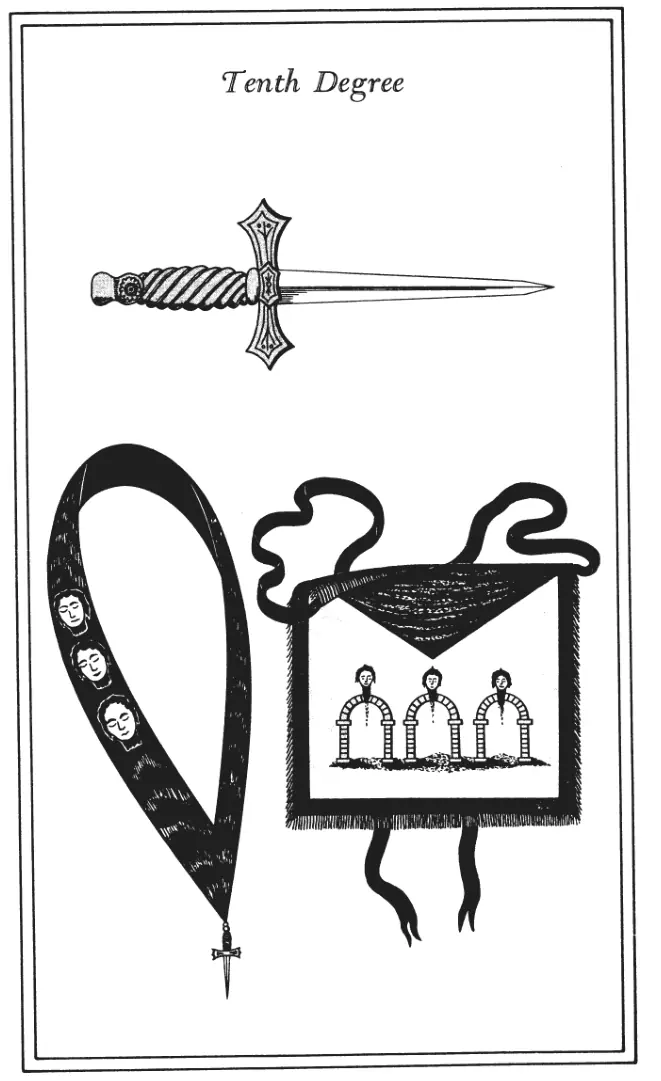
Le cordon de ce grade est noir, de la plus grande largeur, et avec trois bouts de ruban ponceau au bout desquels sont attachés trois têtes de mort. Dessus le cordon il doit y avoir quinze larmes, brodées en argent. Les têtes doivent être d'ivoire.
Le tablier est de peau blanche, bordée de noir, au milieu une tour, brodée en argent, trois rosettes de ruban noir, une au-dessous46 des coins, la troisième sur la bavette renversée, ce qui désigne la place des assassins, et au-dessus des rosettes doivent être brodées les trois lettres H. G. G., Hobben, Gyps, Gravelot, sous-entendant le premier nom de chacun, Jubella, Jubello, Jubellum, d'autres nomment, mais mal, les deux derniers Stelke et Oterfut qui ne doivent être [dénommés] qu'en loge. Il n'y a que le surnom de Kunwal donné au second des meurtriers, qui soit bon et satisfaisant.
Lorsqu'il n'y a point de réception le grand chapitre se ferme de la même manière excepté qu'à la demande quelle heure est-il, on répond cinq heures [ce] soir parce que c'est à cette heure que les deux derniers meurtriers de notre respectable Hyram furent découverts et arrêtés pour être conduits à Jérusalem.
Alors le très respectable dit : Puisque les deux derniers meurtriers d'Hyram sont découverts, mettons-nous en devoir de les connaître et montrons notre zèle ardent. A neuf [ ?] la loge et [ ?] on frappe ensuite des mains comme il est indiqué. On s'assoit et on peut se couvrir.
Doctrine
D. Etes-vous grand-maître élu ?
R. Mon zèle et mon travail m'ont passé à ce grade avec l'approbation de mes amis et frères, et l'estime de mes supérieurs.
D. Où avez-vous été reçu ?
R. Dans le cabinet de Salomon. * et à la rosette droite K. à la gauche G. et au-dessus de la rosette d'autres mettent ces initiales H. A. K. _____________________________
D. Quand vous reçut-il ?
R. Lorsqu'il m'envoya avec mes co-élus à la recherche des deux assassins d'Hyram.
D. Vous y avez donc été vous-même ?
R. Oui, très sage, et si je n'avais pas été nommé, mon zèle m'y aurait conduit tout. J'avais encore de contribuer à ce que la mort d'Hyram fut vengée.
D. Vous ressentîtes donc une grande joie lorsqu'ils furent pris ?
R. Les trois têtes que j'ai à mon cœur en sont h preuve, car elles désignent les trois meurtriers punis et que j'ai participé.
D. Comment avez-vous trois têtes à votre cordon, puisque vous n'avez été à la recherche que de deux assassins ?
R. Le troisième avait déjà été arrêté et puni.
D. Où les trouvâtes-vous ?
R. Dans une carrière appelée Bindecar.
D. Salomon n'avait-il pas un intendant de ce nom ?
R. Oui, il en avait un qui épousa une de ses filles.
D. Comment découvrîtes-vous ces assassins ?
R. Par le moyen d'un berger, nommé Perignan, qui nous enseigna leur retraite.
D. Quels sont les maîtres, qui les aperçurent les premiers ?
R. Zermol et Alcham, après cinq jours de recherche, qui les firent charger de chaînes pour les conduire à Jérusalem.
D. Comment étaient faites leurs chaînes d'équerre ?
R. En forme de règle et de maillet où était gravé le genre du supplice, qu'ils devaient subir.
D. Quels sont les noms des trois assassins ?
R. Le premier Hobben, est celui qui dans l'élu de neuf porte le nom d'Abyram Akiroff ou Jubellum Akiroff, le second Jubello Kunwal, ou Guips, nommé ailleurs Stelk[as] et le troisième Jubello Gravelot.
D. Quels sont nos mots sacrés ou Zerbal Benaya et le mot Elkano est la réponse ou Alcan48.
R. Zermol et Alcham. D'autres disent au premier Zelma.
D. Quelle heure est-il ?
R. Six heures du soir : parce que cette heure les deux derniers meurtriers d'Hyram [ ?] et vengèrent sa mort. Le très respectable maître dit alors : Puisque la mort de notre respectable maître [67v°] Hyram est vengée par la punition de ces deux derniers assassins, nous devons nous reposer. Ainsi le chapitre est fermé. On frappe trois fois cinq coups et on se retire.
[Signature] Omissions + Le récipiendaire sera dans l'antichambre un d'eux frappera cinq coups à la porte de la loge et un des frères du dedans, par ordre du premier surveillant entre-ouvrira la porte et verra qui frappe. Celui de dehors dira que c'est un maître élu qui désire ardemment de connaître les deux autres assassins d'Hyram Abiff notre [maître] et de parvenir au grade de grand-maître élu de Quinze. Le second surveillant rendra au premier, ce qu'il a entendu à la porte et le premier l'annonce au très respectable maître, qui ordonne de l'introduire habillé en maître élu de Neuf. ++ D. Quel jour arrivâtes-vous à Jérusalem ?
R. Le 15 du mois de… qui répond à notre mois de juillet.
D. Combien de temps restâtes-vous dans le voyage ?
R. Un mois, étant partis de Jérusalem le 15 du mois de… qui répond à juin.
D. Combien Salomon employa-t-il de maîtres à cette recherche ?
R. Quinze de nombre, desquels j'étais par mon zèle.
D. N'y avait-il pas d'autres personnes avec vous ?
R. Salomon avait donné de troupes pour nous escorter pour rendre les assassins à Salomon.
D. Qu'ordonna Salomon ?
R. Après leur avoir reproché au vivement l'énormité de leur crime, il ordonna à Haÿzar, grand-maître de sa maison, à les faire conduire dans la tour, qui portait son nom, et de les faire mourir le lendemain matin à dix heures.
D. Pourquoi disposa-t-on les trois têtes aux trois portes du temple ?
R. On les distribua de même pour faire connaître leur position aux portes du temple lorsqu'ils assassinèrent notre père Hyram Abiff, puisque Jubello Kunwal était à la porte de Midi, armé d'une règle de 24 pouces de longueur, Jubelle Gravelot à celle d'Occident, armé d'une équerre et Hobben Akiroff à celle de l'Orient armé d'un levier avec lequel il assassina et renversa mort par terre Hyram Abiff. --- Fin ---
Apparat critique de la transcription Aeditimus
45. On peut encore lire : Elcham. L’initiale est incertaine. Cependant, ailleurs, notre première version semble attestée maintes fois.
46. Ajout dans l’interligne supérieur qui semble remplacer dessus ( ?), non biffé cependant.
47. Ce fragment se trouve en marge droite sur le manuscrit, après la précédente section. Il se rapporte aux lettres du tablier (cf. * dans le texte).
48. Ou Elcan ?
Bérage 1766
divulgation imprimée · 2 956 mots
Première divulgation imprimée des hauts grades : « Les Plus Secrets Mystères des Hauts Grades de la Maçonnerie dévoilés, ou le vrai Rose-Croix » (« Jérusalem », 1766), attribué à Bérage. Texte établi sur le fac-similé et relu mot à mot sur les images : océrisation à 400 dpi de l'exemplaire numérisé par archive.org, fusionnée avec la couche texte de la numérisation, s longs restitués, puis relecture page par page. L'orthographe de 1766 est conservée telle qu'imprimée (ornemens, Freres, sçavez, très-Sage), coquilles de l'édition comprises. Les repères entre crochets droits donnent la pagination de l'original. Pages 37 à 54 du volume.
La Loge doit être tendue de noir, & parsemée de larmes rouges & blanches. A l'Orient il doit y avoir un squelette, qui représente le traître Abiram, suivant le grade d'Elu des neuf, dont le vrai nom est Hoben. A l'Occident du côté du Nord il y a un autre squelette représentant Oterfut ; à l'Orient du côté du Midi un autre squelette représentant Sterkin, chacun desquels doit être armé de l'instrument fatal avec lequel les meurtriers frapperent notre respectable Maître.
La Loge s'ouvre par cinq coups répétés par [p. 38] trois fois : le Maître ayant frappé, on allume les cinq lumieres qui sont placées à l'Orient à la gauche. Ensuite le premier Surveillant frappe de même ; on allume les cinq autres, & le second Surveillant ayant frappé, on allume les cinq restantes sur trois chandeliers à cinq branches. Il doit y avoir aussi trois lustres au plancher posés triangulairement, où il y aura de même cinq lumieres à chacun, qui s'allument avant que d'entrer en Loge. Lorsqu'il y a réception, on ne peut être que quinze. Quand les quinze coups sont frappés, & que la Loge est entierement éclairée, le Maître demande au Surveillant : « Quelle heure est - il » ? il répond : « Il est cinq heures ».
Le Maître dit alors : « Il est donc temps de travailler, & de commencer l'ouvrage, mes très-chers Freres, la Loge de Grand Elu est ouverte ». Après quoi chaque Frere frappe cinq coups dans la main. Lorsqu'il y a réception, on dit : « Voici un Maître Elu des neuf qui desire ardemment de connoître les deux autres assassins d'Hiram, & parvenir au grade de Maître Elu des quinze ». Avant d'instruire le Récipiendaire, on doit observer qu'il soit habillé en Maître Elu des neuf, avec deux [p. 39] têtes de mort, une de chaque main, & un poignard à la tête de la main droite, traversé sous la mâchoire ; après quoi le Maître dit au premier Surveillant : « Faites - le entrer par quinze pas triangulaires, pour parvenir au pied de l'autel », où il reste environ un quart-d'heure debout, en tenant toujours les têtes de mort.
Le Maître & tous les Freres tirent leur poignard, & mettent les mains entrelacées sur le front à l'envers, en demandant grace pour lui au Grand - Maître, & répondant qu'il n'est pas coupable. « S'il n'est pas coupable, dit le Grand-Maître, pourquoi donc me demandez-vous grace » ?
Le premier Surveillant prend seul la parole : « La seule grace que je demande, c'est celle de recevoir ce Frere Maître Elu ».
D. En est-il digne ?
Tous répondent : « Oui, très-respectable Maître. Faites - le avancer, dit le Grand-Maître, auprès du Trône ». Cela fait il lui dit : « Les quinze Maîtres Elus des quinze m'ont demandé la grace de vous recevoir Maître Elu des quinze, & de vous rendre leur semblable. Vous sentez-vous capable de garder un secret, qui doit être inviolable ? Vou- [p. 40] lez-vous vous y obliger à la maniere accoutumée » ? Il répond : Oui, & répéte l'obligation.
OBLIGATION
« Moi, N., je m'oblige, sur le S. Evangile, de ne déclarer ni confier où j'ai été reçu, ni qui a assisté à ma réception, ni de recevoir qui que ce puisse être, à moins que je n'en aie reçu le pouvoir exprès. En cas d'indiscrétion, je consens d'avoir le corps ouvert, la tête coupée, pour qu'elle soit représentée au Respectable qui m'a reçu. Dieu me soit en aide. »
Après l'obligation, on raconte l'histoire des autres meurtriers d'Hiram. Mon très-cher Frere, vous avez appris dans le grade de Maître Elu des neuf par lequel vous avez passé, qu'Abiram tué dans la caverne au - dessous du buisson ardent, étoit un meurtrier d'Hiram. Il est bien vrai que cet homme fut un de ses assassins. Son nom est Hoben. C'est lui qui étoit à la porte de l'Orient, armé d'un levier, qui assomma votre Maître, & dont Salomon fit embaumer la tête, pour qu'elle pût se conserver, & être exposée en public avec celles de ses complices, lorsqu'on les [p. 41] auroit découverts. Ce qui ne tarda pas, puisque six mois après, Bengalet, l'un des Intendans de Salomon, par les recherches qu'il fit faire aux environs du pays de Geth, qui étoit tributaire de Salomon ; Bengalin, dis-je, apprit que Sterkin & Oterfut, les autres assassins d'Hiram, s'y étoient réfugiés, dans l'espérance d'y être en sûreté. Salomon ayant appris cette nouvelle, écrivit sur le champ à Maaca, Roi de Geth, pour le prier de livrer ces assassins aux personnes de confiance qu'il envoyoit pour les emmener à Jérusalem, y recevoir le châtiment dû à leur crime.
En conséquence Salomon arma le même jour quinze Maîtres des plus zélés, du nombre desquels étoient les neuf qui avoient été à la recherche d'Hoben. Il leur donna des troupes suffisantes pour les escorter. Ils se mirent en marche le 15 du mois, qui répond à notre mois de Juin, & arriverent au pays de Geth le 28 du même mois. Ils rendirent la lettre de Salomon au Roi Maaca, qui frissonnant à cette nouvelle, ordonna à l'instant qu'on fît une recherche exacte de ces deux meurtriers, & qu'on les livrât sans retard aux Israëlites ; de plus qu'il se trouvoit heureux que ses Etats fussent purgés de deux monstres [p. 42] semblables. On fit donc une recherche exacte, & on les trouva dans une carriere nommée Bendeca, le quinzième jour de la recherche. Zéomet & Eléham furent les premiers qui les découvrirent. On les saisit, & on leur mit des chaînes, où le genre du supplice qu'ils avoient à souffrir étoit gravé dessus. Ils arriverent le 15 du mois suivant, & furent conduits aussi-tôt à Salomon, qui, après les avoir accablés de reproches, ordonna qu'on les mît dans les cachots d'une tour nommée Haizac, pour les faire mourir le lendemain de la mort la plus cruelle. Ce qui fut exécuté à dix heures du matin. Ils furent attachés à deux poteaux par les pieds, le col & les bras liés derriere. On leur ouvrit le corps depuis la poitrine jusqu'aux parties honteuses, & on les laissa de cette façon à l'ardeur du soleil l'espace de huit heures. Les mouches & les autres insectes s'abreuverent de leur sang. Ils faisoient des plaintes si lamentables, qu'ils émeurent leurs bourreaux de compassion ; ce qui les obligea à leur couper la tête. Leurs corps furent jettés hors de Jérusalem, pour être exposés aux bêtes féroces. Salomon ordonna ensuite qu'on remît la tête d'Hoben, afin que toutes les trois fussent exposées hors de la ville sur des pieux [p. 43] dans le même ordre que ces meurtriers s'étoient placés dans le Temple pour assassiner Hiram, afin de donner un exemple à tous ses sujets, & particulierement aux ouvriers Maçons. En conséquence la tête de Sterkin fut mise à la porte du Midi, celle d'Oterfut à celle d'Occident, & celle d'Hoben à celle d'Orient. Voilà la fin de l'abrégé de l'histoire des assassins d'Hiram, que Salomon vengea par leur mort. Je prie le grand Architecte de l'Univers de nous préserver d'un semblable malheur. Ensuite il donne au Récipiendaire les signes, le mot & l'attouchement, après l'avoir revêtu du Cordon.
SIGNES
Le premier est de fermer la main droite, le pouce élevé comme tenant un poignard, se le porter sous le menton, le descendre le long du corps, comme voulant se l'ouvrir. Le second, qui est la réponse de l'Examinateur, est d'étendre la main, en faisant semblant de se couper le col avec le pouce.
Le mot sacré est ZÉOMET ; & la réponse ELÉHAM, qui servira aussi de passage pour entrer au Temple.
Le premier attouchement est de se donner deux [p. 44] petits coups de l'index sur la jointure du petit doigt, ce qui fait allusion aux deux traîtres découverts. Le second est de prendre la main droite de l'Examinateur avec les cinq doigts de la main droite étendus ; ce qui signifie trois fois cinq, & par conséquent le nombre des quinze Elus.
Le cordon du Grand-Maître Elu est de ruban noir de la plus grande largeur, avec trois bouts de ruban ponceau, au bout desquels on attachera une tête de mort : le dessus du cordon sera brodé de quinze larmes en argent.
MANIERE D'INTRODUIRE LE RÉCIPIENDAIRE
Il doit être habillé en Elu des neuf, & tenir deux têtes de mort, comme il est dit ci-devant. Lorsqu'il n'y a pas de réception, la Loge s'ouvre comme ci-après, à la réserve que quand les quinze lumieres sont éclairées, le Grand-Maître dit : « Aidez-moi à ouvrir la Loge » ; ensuite tous les Freres debout, & la tête découverte, font le même signe.
D. Quelle heure est-il ?
R. Cinq heures du soir.
D. Pourquoi ?
R. Parce que c'est à cette heure que les meur- [p. 45] triers d'Hiram furent découverts & saisis, pour être conduits à Jérusalem.
D. Ont-ils été découverts ?
R. Oui, très-Respectable, ils l'ont été & présentés à Salomon.
« Mes Freres, dit le Grand - Maître, puisque ces deux meurtriers ont été découverts & arrêtés, mettons-nous en devoir de les faire punir, & sçavoir qui ils sont, afin de montrer notre zèle pour venger la mort d'Hiram. »
Tous les Freres frappent trois fois cinq coups dans leurs mains, s'asséyent & se découvrent.
INSTRUCTION
D. Etes-vous Grand-Maître Elu ?
R. Oui : mon zèle & mon travail m'ont procuré ce grade avec l'estime de mes Supérieurs.
D. Où avez-vous été reçu ?
R. Dans le cabinet de Salomon.
D. Quand vous a-t-il reçu ?
R. Lorsqu'il m'envoya avec mes Freres chercher les deux derniers assassins d'Hiram.
D. Vous avez donc été vous-même à la recherche ?
R. Oui, très-Respectable.
[p. 46]
D. Ressentîtes-vous une grande joie, lorsque les assassins furent punis ?
R. Les trois têtes qui sont à mon cordon en font la preuve.
D. Que signifient ces trois têtes ?
R. Celles des trois assassins d'Hiram.
D. Vous dites que vous avez été à la recherche de deux.
R. Cela est vrai ; mais le troisième avoit déjà été puni.
D. Comment s'appelloient les deux que vous conduisîtes à Jérusalem ?
R. Sterkin & Oterfut.
D. Comment furent-ils découverts ?
R. Par la perquisition qu'en fit Bengalet.
D. Comment fit Salomon pour les avoir ?
R. Il écrivit une lettre à Maaca, pour l'engager à en faire la recherche.
D. Qui rendit cette lettre ?
R. Zéomel.
D. Le Roi Maaca ne fit-il aucune difficulté ?
R. Non ; au contraire, il nous donna des guides & des escortes.
D. Où les trouvâtes-vous ?
R. Dans une carriere de Bendicat.
D. Qui étoit Bendicat ?
[p. 47]
R. Un des Intendans de Salomon & son gendre.
D. Quels sont les Maîtres qui les prirent les premiers ?
R. Zéomet & Eléham, après quinze jours de recherches.
D. Comment les avez-vous conduits à Jérusalem ?
R. Ils étoient enchaînés par les deux mains.
D. Comment étoient faites leurs chaînes ?
R. En forme de régle & de maillet, où étoit gravé le genre du supplice qu'ils devoient souffrir.
D. Quel jour arrivâtes-vous à Jérusalem ?
R. Le 15 du mois, qui répond au mois de Juillet.
D. Combien restâtes-vous dans ce voyage ?
R. Un mois.
D. Combien de Maîtres Salomon élut-il pour cette recherche ?
R. Quinze, dont j'étois du nombre.
D. Qu'ordonna Salomon ?
R. Après les avoir accablés de reproches, il donna ordre à Hézar, Grand-Maître de sa maison, de les faire conduire dans la Tour qui porte son nom, & de les faire mourir le lendemain à dix heures du matin.
[p. 48]
D. De quel genre de mort furent-ils punis ?
R. Ils furent attachés nuds à des poteaux par les pieds, les bras & le col. On leur ouvrit le corps depuis la poitrine jusqu'aux parties honteuses.
D. Resterent-ils long-temps en cet état ?
R. Huit heures exposés au soleil, harcelés par les mouches, & autres insectes. Leurs lamentables cris émurent leurs bourreaux, qui leur couperent la tête, & leurs corps furent jettés hors de la Ville, pour être la pâture des corbeaux.
D. Que fit-on de leurs têtes ?
R. Elles furent exposées à deux portes de la Ville, ainsi que celle du premier assassin, suivant l'Elu des neuf.
D. Comment se nommoit-il ?
R. Abiram. Ce nom étoit un emblême, & ne signifioit qu'un meurtrier.
D. Quel étoit son vrai nom ?
R. Hoben.
D. Comment nommez-vous les trois portes où les trois têtes furent mises ?
R. Celles du Midi, de l'Occident & de l'Orient.
D. Quelle fut la tête exposée au Midi ?
R. Celle de Sterkin.
[p. 49]
D. A la porte d'Occident ?
R. Celle d'Oterfut.
D. A la porte d'Orient ?
R. Celle d'Hoben.
D. Pourquoi exposa-t-on ces trois têtes à trois portes ?
R. Pour faire connoître leur posture lorsqu'ils assassinerent Hiram.
D. Quel est le mot sacré du Grand - Maître Elu ?
R. Zéomet.
D. Quel est le mot de passe ?
R. Eléham.
D. Quelle heure est-il ?
R. Six heures du soir.
D. Pourquoi six heures du soir ?
R. Parce que c'est à cette heure que les meurtriers eurent la tête tranchée.
« Mes Freres, dit le Grand-Maître, puisque la mort de notre Grand-Maître Hiram a été vengée par celle de ses assassins, nous devons être satisfaits ». La Loge est fermée ; on frappe trois fois cinq coups.
[p. 50]
FAÇON DU TABLIER
Il est de peau blanche, bordée d'un ruban noir. Au milieu il doit y avoir une tour brodée en argent, trois rosettes de ruban noir, une à chaque coin, & une sur la bavette, qui signifient les trois têtes ; au - dessous de la bavette sera mis H ; au-dessous de la rosette à gauche O, & à la droite S.
CATÉCHISME DE L'ELU PARFAIT
D. Etes-vous Elu ?
R. Je le suis.
D. Quel est l'ouvrage de l'Elu parfait ?
R. De rectifier les mœurs.
D. Où voyagent les Elus parfaits ?
R. A la voûte Souveraine.
D. Par où avez-vous passé ?
R. Par un long corridor éclairé par 3, 5, 7, & 9.
D. Que signifie le nombre 3 ?
[p. 51]
R. Les trois principales colonnes F. S. B. âge d'un apprentif.
D. Que signifie le nombre 5 ?
R. Les cinq ordres d'Architecture, l'Ionique, le Dorique, le Toscan, le Corinthien & le Composite, âge d'un Compagnon.
D. Que signifie le nombre 9 ?
R. Les neuf Maîtres, âge d'un parfait Maçon.
D. Qu'avez - vous trouvé avant le Corridor ?
R. Un respectable Elu, qui m'a demandé le mot de passe.
D. Comment lui avez-vous donné ?
R. CHIBOT par trois fois.
D. Que renferme la voûte sacrée ?
R. La parole.
D. Quelle est cette parole ?
R. Celle qui fut perdue dans les ruines du Temple.
D. A qui donna-t-on cette parole en premier lieu ?
R. A Moïse dans un buisson ardent.
D. A qui fut-elle transmise ?
R. Aux seuls Elus parfaits.
D. A quoi servoit cette parole ?
[p. 52]
R. A ceux qui cherchoient les meurtriers d'Hiram.
D. Donnez-la-moi.
R. Je ne le puis, très-Respectable.
D. Avez-vous trouvé le meurtrier ?
R. Je l'ai puni.
D. Où l'avez-vous trouvé ?
R. Dans la caverne obscure, près la fontaine de Siloé.
D. Dans quelle posture étoit-il ?
R. Dans celle-ci, très-Respectable, (en la faisant).
D. Que signifie cette posture ?
R. Le remords & la tristesse.
D. Comment s'appelloit-il ?
R. Abiram.
D. Quels sont les outils de l'Elu parfait ?
R. Le marteau, la pelle, la pince.
D. Donnez-moi l'attouchement.
R. J'obéis, en disant N. N. M. qu'il prononce.
D. Donnez-moi l'explication de N. N. M.
R. Parfait.
D. Donnez-moi le mot de vengeance.
R. Sterkin.
D. Quel âge avez-vous ?
[p. 53]
R. Neuf ans, très-Respectable.
D. Les rayons du Soleil luisent-ils sur nous ?
R. Notre respectable Maître est vengé.
D. Quel est le mot de passe ?
R. Bérit-neder Aliam.
D. Quel est le signe ?
R. En se donnant la main, la renverser deux fois.
DISCOURS DU MAÎTRE
« Vous sçavez tous, mes Freres, que notre respectable Maître Hiram a été massacré par la scélératesse de trois Compagnons ; que l'un d'eux lui a porté le coup de la mort, & que nous devons tous nous employer pour en trouver le meurtrier, & le punir de son crime. Nos Maîtres se détacherent donc pour aller à sa recherche. L'un deux, après avoir traversé avec des peines incroyables, les montagnes les plus escarpées, les chemins les moins frayés, accablé de fatigue, fut se retirer sur le bord d'une fontaine appellée la Civi.... Il apperçut de loin une caverne obscure. La curiosité le porta à y aller. Lorsqu'il fut à l'entrée, il vit dans l'enfon- [p. 54] cement une foible lumière, à la lueur de laquelle il découvrit un homme couché dans la même posture où vous me voyez. (Il fait la posture d'un homme accablé de remords). Il lui demanda son nom ; il lui répondit qu'il s'appelloit Abdacam, & qu'il fuyoit les poursuites qu'on pouvoit faire contre lui ; qu'il étoit le meurtrier d'Hiram, & que depuis ce temps, il ne trouvoit aucun asyle contre le remords dont il étoit dévoré. A ces mots le Maître transporté de colere, s'avança, & lui plongea un poignard dans le sein, en disant Sterkin, qui signifie vengeance. Voilà, mes Freres, l'institut de la Classe des Maîtres Elus, qui est une suite juste de la Maçonnerie, & le sujet pour lequel la respectable Loge s'est assemblée aujourd'hui. »
Fin du troisième Grade.
Manuscrit Quesada 1804 (copie 1813-1821)
manuscrit · BNE Mss 7834 · 2 397 mots
Le manuscrit Quesada (Mss 7834 de la Bibliothèque Nationale d'Espagne) : copie (1813-1821) d'un état du Rite de 1804, voire antérieur, tel que pratiqué dans la mouvance du Suprême Conseil d'Amérique. Les didascalies du manuscrit sont en italique. Le texte est celui de l'édition Latomia, donnée en vis-à-vis du fac-similé du manuscrit : l'apparat critique de cette édition est repris ici, de même que les repères de folio du manuscrit.
Texte intégral sur ce site · transcription C. M. & P. T., Latomia / Chantier de fouilles maçonniques, d'après le Mss 7834 de la BNE
Décorations
La salle doit être tendue de noir parsemée de larmes blanches & rouges. A l’Or∴ un squelette représentant Abiram ^au sud Akiroph à l’Occ∴ un autre squelette ^ représentant314 et et Oterfut, qui sont les 3 qui répandirent le sang & qui sont armés de l’instrument qui leur servit à commettre leur crime horrible
Ouverture
Le T∴ Ill∴ Me∴ frappe cinq coups égaux, & on place 5 Lumières à l’Or∴ à sa gauche l’Inspr∴ ou le F∴ 1er∴ Survt∴ frappe également 5 coups & on place 5 Lumières devant lui Le T∴ Ill∴ dit∴:
D∴ F∴ Insp∴ quelle heure est-il∴?
R∴ T∴ Ill∴ il est cinq heures.
D∴ F∴ 2 e∴ Survt∴ à quelle heure s’ouvrent les travaux du Chaptre∴ de l’Ill∴ Élu des 15∴?
R∴ A cinq heures Folio 146 recto.
Le T∴ Ill∴ Me∴ dit : puisqu’il est 5 heures, mes
TT∴ CC∴ FF∴ il est temps de commencer l’ouvrage je vous préviens que le Chap∴ de Me∴ Élu des 15 est ouvert. Les Survt∴ répètent.
Le T∴ Ill∴ Me∴ frappe un coup & dit : A l’ordre mes FF∴, tous à l’invitation du T∴ Ill∴ F∴ font le signe, puis l’applaudissement & disent 3 fois Houzé. Le F∴ Secrétaire donne lecture des derniers travaux lesquels doivent recevoir la sanction d’usage & tous prennent place.
Réception
Il ne doit y avoir que 15 Mes∴ Élus dans le Chaptre lorsqu’il y a Réception les plus anciens y assistent et les autres se retirent. Alors le F∴ Expert conduit le Cand∴ à la porte du Chap∴ à laquelle il frappe neuf coups. L’Insp∴ frappe un coup & dit :
T∴ Ill∴ Me∴ on frappe à la porte du Chap∴ en Me∴ Ill∴ des Élu 9. Le T∴ Ill∴ Me∴ dit : F∴ Insp∴ faites voir qui frappe ainsi.
L’Insp∴ donne ordre aux Gardes de l’intérieur d’aller voir qui frappe. Celui-ci ouvre la porte & l’informe :
D∴ Qui frappe ainsi ?
R∴ Le F∴ Expert répond : C’est un Me∴ Élu de 9 qui désire connaître les deux autres scélérats, meurtriers de notre Rble∴ Me∴ Hiram Abif et qui voudrait parvenir au grade de Me∴ Élu des 15.
Le Grade de l’intérieur ferme la porte et rend la réponse au F∴ 2e∴ Survt∴ qui dit au F∴ Insp∴
C’est un Me∴ Élu des 9 qui & a∴ & a∴
Le T∴ Ill∴ Me∴ dit :
Que l’entrée lui soit accordée. Le Récipiend entre en
faisant 15 pas triangulaires avance vers l’Autel tenant de la main gauche une tête & de la droite il reste à l’ordre d’Élu des 9 tous les FF∴ sont debout à l’ordre tenant leurs poignards prêts à frapper le Cand∴ arrive au pied de l’Autel tous les FF∴ laissent tomber leurs poignards entrelacent leurs mains et demandent pardon pour le Cand∴ Le T∴ Ill∴ Me∴ dit :
D∴ Pourquoi me demandez-vous pardon pour le Cand∴ ?
R∴ Tous les FF∴ répondent : parce qu’il n’est pas coupable
D∴ Puisqu’il n’est pas coupable pourquoi me demandez
vous son pardon. L’Insp∴ répond :
R∴ Nous demandons seulement par grâce qu’il soit admis au grade d’Élu des 15.
D∴ A-t-il les qualités requises ?
R∴ Tous les FF∴ disent : Nous répondons de lui.
Le T∴ Ill∴ Me∴ dit : si cela est ainsi qu’il se mette à genoux. Le T∴ Ill∴ Me∴ lui adresse ces mots :
Les Ill∴ Élus des 15 ici présents demandent que je vous admette au G de∴ de Me∴ Élu des 15 et que vous deveniez leur égal, vous sentez-vous capable de garder les secrets de ce grade et d’en prêter solennellement l’obligation ? Il répond :Oui.
Alors l’Insp∴ et le 2e∴ Survt∴ lui ôtent la tête lui posent la main droite sur la Bible, & il prête
l’obligation suivante :Obligation
Je N…. jure & promet sur la Sainte Bible de ne jamais révéler où j’ai reçu le présent grade de ne jamais dire qui a assisté à une Réception, je promets de ne recevoir jamais personne dans ce grade Folio 147 recto sans en avoir obtenu le plein pouvoir de mes supérieurs de n’assister à aucune réception à moins que ce ne soit dans une L∴ Régulière de ce grade & de garder exactement dans mon cœur tous les secrets qui me seront révélés après mon obligation je consens si j’y manque à avoir mon corps ouvert perpend t∴ pour être exposé pendant huit jours en plein air pour que mes entrailles deviennent la pâture des mouches et autres insectes je consens que ma tête soit coupée & exposée sur le lieu le plus élevé de la Terre & d’infliger la même punition à ceux qui dévoileraient ce grade et fausseraient leur serment sur ce, Dieu veuille me maintenir Amen.
Le Cand∴ se lève le T∴ Ill∴ lui donne
les Mots Signes & Attoucht∴Signe
Il y en a deux, le premier est de prendre le poignard de le porter sous le menton et de le descendre sur le ventre, comme si on voulait se l’ouvrir. La réponse, est de se porter réciproqt. la main à la gorge faire le signe d’App∴ la main fermée
et le pouce tendu.Attouchement
Il se donne en se portant réciproqt∴ le pouce sur le ventre comme
si on voulait se l’ouvrirMot Sacré
Zerbal répond : Bendecar
L’autre
Mot de Passe
Helehanam
Discours historique
Vous avez appris mon T∴ Ch∴ F∴ dans le grade d’Élu des 9. par lequel vous avez passé, qu’Habiram, l’un des meurtriers fut tué dans une caverne, le squelette que vous voyez à l’Orient est le sien, il tient en main le même instrument avec lequel il frappa Hiram Abif. Salomon fit embaumer sa tête pour qu’elle put se conserver et être exposée avec celle des deux autres assassins quand on les trouverait. Six mois après la mort d’Habiram, Akiroph. Bengabel, l’un des Intendants de Salomon faisait des perquisitions dans le pays de Jeth, tributaire de Salomon, après que Sterkin & Oterfut, les deux autres assassins d’Hiram s’y étaient retirés & se croyant en sureté, Salomon l’ayant appris écrivit immédiatement à Moacha roi de Geth, il lui marqua le désir qu’il avait de découvrir les coupables & de leur faire infliger la peine due à leur crime en conséquence, Salomon choisit 15 des plus dignes FF∴ et des plus zélés M es∴ dans le nombre desquels il comprit les 9 qui avaient été à la recherche d’Habiram. Ils partirent le 15 du mois de juin de notre ère & arrivèrent le 28 du mois dito320 dans le pays de Geth, ils remirent la lettre de Salomon à Maacha qui épouvanté de cette nouvelle donna sur le champ des ordres pour que l’on fit les recherches les plus exactes des deux coupables et qu’ils fussent livrés aux Israélites, se trouvant heureux de délivrer ses États de pareils monstres on employa cinq jours à faire des perquisitions les plus exactes, Zerbal & Hélenam furent les premiers qui les découvrirent dans une carrière nommée Bendicat Folio 148 recto Ils furent enchaînés ensemble & chargés de fers sur lesquels on grava leur crime & le genre de punition, qui leur était réservée. Ils arrivèrent à Jérusalem le 15 du mois Ab∴ & furent conduits à Salomon qui leur reprocha le noir forfait dont ils s’étaient rendus coupables il ordonna de les conduire dans la tour d’Achizar jusqu’au moment de leur exécution, le lendemain à dix heures du matin ils furent attachés à deux poteaux par le col et les pieds et les bras liés derrière le dos ils furent crucialement ouverts, depuis la poitrine jusqu’à l’os pubis, ils demeurèrent dans cet état pendant huit heures les mouches & autres insectes vinrent se repaître de leur sang et de leurs entrailles. Leurs cris & leurs gémissements étaient si lamentables qu’ils touchèrent le cœur même de leurs bourreaux qui leurs coupèrent la tête et jetèrent leurs corps par-dessus les murs de Jérusalem pour servir de pâture aux corbeaux & autres bêtes féroces.
Instruction
D∴ F∴ G∴ Insp∴ êtes-vous Ill∴ Élu des 15 ?
R∴ Mon zèle & mon travail, m’ont procuré ce grade.
D∴ Où avez-vous été reçu ?
R∴ Par Salomon lui-même dans la salle d’audience.
D∴ Pourquoi et à quelle occasion vous a-t-il élevé à ce grade ?
R∴ Parce que je fus du nombre de ceux qui furent à la recherche des deux scélérats
D∴ Avez-vous pris vous-même les informations ?
R∴ Oui T∴ Rble∴ Me∴ & si je n’avais pas été nommé par Salomon je serais parti à mes dépens pour venger la mort d’Hiram.
D∴ Avez-vous eu beaucoup de joie en voyant exécuter les coupables.
R∴ Leurs têtes que je porte sur mon ruban en est la preuve.
D∴ Que signifient ces 3 têtes ?
R∴ Celles des assassins d’Hiram Abif.
D∴ Pourquoi faites-vous mention des 3 têtes puisque vous ne fûtes à la recherche que de deux.
R∴ Parce que le 1 er∴ avait déjà souffert la mort.
D∴ Quels sont les noms des deux que vous avez conduits à Jérusalem
R∴ L’un s’appelait Sterkin & l’autre Oterfut.
D∴ Comment furent-ils découverts ?
R∴ Par la diligence de Bengaber l’un des Intend∴ de Salomon dans le pays de Geth.
D∴ Quelles mesures prit Salomon ?
R∴ il écrivit à Maacha roi de Geth pour lui témoigner le désir qu’il avait que l’on fit d’eux les recherches les plus exactes
D∴ Qui porta la lettre pour Maacha de Salomon ?
R∴ Zerbal Cape des Gardes. Le roi Maacha réussit-il322 à accorder la demande de Salomon ?
D∴
R∴ Non il donna au contraire des guides aux gardes.
D∴ Où furent trouvés les coupables ?
R∴ Dans une carrière.
D∴ Qui était Bengaber ?
R∴ L’un des Intendants de Salomon & son gendre.
D∴ Comment les deux scélérats furent-ils découverts ?
R∴ Par l’ami d’un berger.
D∴ Quels furent ceux qui les aperçurent les premiers ?
R∴ Zerbal, & Heleanam après cinq jours de perquisition.
D∴ De quoi furent faites les chaînes ?
R∴ De morceaux de fer en forme de règles carrées sur lesquels étaient gravé le crime qu’ils avaient commis & les peines qu’ils devaient souffrir selon les ordres de Salomon ?
D∴ Quel jour arrivèrent-ils à Jérusalem ?
R∴ Le 15 du mois Ab∴ qui répond au mois de juillet.
D∴ Combien Salomon choisit-il de Me∴ pour cette expédition
R∴ 15 dont je fus du nombre.
D∴ N’avait-il pas d’autres personnes avec vous ?
R∴ Le roi Salomon nous donna des troupes pour nous escorter.
D∴ Que fîtes-vous des 2 criminels à votre arrivée à Jérusalem ?
R∴ Nous les conduisimes directement à Salomon.
D∴ Quel ordre donna-t-il ? Après les avoir reproché amèrement l’énormité de
R∴ leur crime il ordonna à Achizar Gd∴ Mtre∴ de sa maison de les enfermer dans la tour qui portait son nom pour qu’ils fussent exécutés le lendemain à 10 heures du matin.
D∴ De quel genre de mort furent-ils punis ?
R∴ Ils furent attachés nus par le col & les pieds à deux poteaux les bras liés par derrière & leurs corps furent ouverts depuis la poitrine jusqu’à l’os pubis.
D∴ Ils furent de cette manière exposés à la plus forte
R∴ chaleur du soleil pour que les mouches & autres insectes dévorassent leur chair, ils firent en cet état des cris si lamentables qu’ils touchèrent le cœur de leurs bourreaux qui leurs coupèrent la tête & jetèrent leurs corps par-dessus les murailles pour servir de pâture aux bêtes féroces.
D∴ Que fit-on de leur tête ?
R∴ Elles furent placées par ordre de Salomon au bout de pieux pour être exposées en public sur des portes de Jérusalem.
D∴ Quel était le nom du meurtrier ?
R∴ Selon l’Élu des 9 il s’appelait Abiram Akiroph.
mais le nom était emblématique son véritable nom était Hoben, il était l’aîné de sept frères.
D∴ Comment furent exposées leurs têtes ?
R∴ Au Sud à l’Est et à l’Ouest.
D∴ Pourquoi furent-elles exposées ainsi ?
R∴ Parce que chacun d’eux avait commis leurs violences aux 3 portes du Temple au Sud, à l’Est et à l’Ouest, ce fût à l’Est qu’Abiram acheva de tuer notre Rble∴ Me∴
D∴ Quelle est la parole de Me∴ Élu des 15 ?
Zerbal, Bendecar R∴
D∴ Quel est le mot de passe ?
Heleham.
R∴
D∴ Quels sont les signes ?
R∴ ( Il les donne )
D∴ Quel est votre attouchem t∴∴?
R∴ Il le donne en disant : Répondez-moi ?
Clôture
D∴ F∴ Insp∴ quelle heure est-il ?
R∴ Six heures du soir :
D∴ Pourquoi six heures du soir ?
R∴ Parce que c’est à cette heure qu’expirèrent les deux assassins & que la vengeance fut accomplie.
Le T∴ Ill∴ Me∴ dit : puisque la mort de
notre Rble∴ et Cher M e. Hiram Abif est vengée par le cruel supplice de ces deux meurtriers nous devons être satisfaits & nous reposer.
Il frappe 5 coups égaux L’Insp∴ & le 2e∴ Survt∴ en font autant, après on fait les signes et la batterie suivi du triple Houzé.
Le tablier est blanc doublé & bordé de noir au milieu est représentée la ville de Jérusalem & les 3 têtes exposées sur des pieux aux trois portes. Le cordon est noir avec trois têtes au bas peintes ou brodées il se porte en écharpe de l’épaule gauche à la hanche droite. Le bijou est un poignard placé au bas du cordon, le manche d’ivoire et lame d’argent.
Apparat critique de l’édition Latomia
314. Trois rajouts correctif du copiste A, mais encore fautifs, car il a en réalité sauté une ligne (soulignée ci-après) en faisant sa copie. La description exacte est : « A l’Orient un squelette représentant Abiram-Akiroph, à l’Occident un autre squelette représentant Sterkin, au midi un autre squelette représentant Oterfut, qui ... [etc.] », cf. Pyron 1812 et Kloss.
318. La ponctuation utilisée ici est trompeuse ; « Akiroph » est bien l’autre nom utilisé pour désigner « Abiram » (ici écrit à tort avec un « h » initial), cf. Pyron 1812 et Kloss.
319. Mis pour « Geth » qui est lui-même une déformation de « Gath ».
320. Forme vénitienne, provenant du latin « dicere », signifiant « déjà dit ». Les rituels écrivent habituellement ici « même mois », cf. Pyron 1812 et Kloss. Typique des inventaires notariés.
322. Erreur du copiste A. Le terme exact est « résista-t-il », cf. Pyron 1812 et Kloss.
326. Dans d’autres versions, sept a été remplacé (à tort ?) par « ses », cf. Pyron 1812 et Kloss.
Delaulnaye 1813
tuileur imprimé · 794 mots
Le « Thuileur des trente-trois degrés de l'Écossisme » de Delaulnaye (Paris, 1813), premier tuileur imprimé du REAA constitué : mots, signes, décors et remarques du grade. Texte relu mot à mot sur le fac-similé, mots hébreux restitués. Pages 62-70 de l'édition originale.
Tenture Noire, parsemée de larmes Rouges et Blanches.
(1) Le Grand-Orient de France a, comme on le sait, substitué le seul Élu Secret, aux trois Élus de la Maçonnerie adonhiramite, aux trois du Rit ancien, qui présentoient, dans leur légende, une série non interrompue d'événements. La substitution, ou plutôt la refonte, n'a pas toujours été heureuse. Par exemple, dans l'Élu Secret, l'assassin d'Hiram s'étant poignardé lui-même, le cri Necum devient ridicule, puisque, par la mort du traître, la vengeance se trouve accomplie. De même, on ne peut que sourire au vaillant exploit de Joaben, qui coupe bravement la tête à un homme mort. Ces inconvénients et quelques autres n'ont point lieu en divisant en trois scènes le mythe de la mort d'Hiram. Dans l'Écossisme réformé de Saint Martin, il n'y a pareillement qu'un seul Élu, dont les mots Sacrés sont Nekam, Moabon.
[p. 63]
Quinze Lumières, savoir : cinq à l'Orient et cinq devant chaque Surveillant.
Titres.
Le Vénérable se nomme Très-Illustre Maître ; deux Surveillants, dont le premier est appelé Inspecteur. Pour une réception, il ne peut y avoir plus de quinze Frères.
Signe.
Se porter le Poignard sous le menton, et le descendre le long du ventre, comme pour se l'ouvrir.
Réponse. Le Signe d'Apprenti, que l'on exécute les mains fermées le pouce tendu.
Attouchement.
S'entrelacer les mains droites.
Batterie.
Cinq Coups égaux :
○ ○ ○ ○ ○
[p. 64]
Marche.
Quinze pas triangulaires.
Mots Sacrés.
ZERBAL.
On répond BENAIAH, בְנָיָה
(filius domini)
C'est le nom du meurtrier de Joab. Voyez ROIS, l. 2, c. 23, v. 20, et liv. 3. c. 2, v. 29 et 34.
D'autres répondent BENHAKAR, בֶנעָקָר
(sterilitatis filius)
Nom de la caverne où se cacha le meurtrier d'Hiram.
D'autres, enfin, disent BENDAKA, בֶנדַכָא
(contritionis filius)
Nom de la carrière.
Mot de Passe.
Heleham qu'il faut écrire ELIHAM, אֱלִיעָם
(Deus populi)
Heure.
Pour ouvrir ; Cinq heures du Matin.
Pour fermer ; Six heures du Soir.
[p. 65]
Ces nombres (du moins le second) ne sont point en concordance avec le reste du Rituel.
Tablier.
Blanc, doublé et bordé de Noir. Au milieu, la Ville de Jérusalem, et les trois Têtes des coupables posées sur des piquets, aux portes de l'Est, de l'Ouest et du Sud.
Cordon.
Noir, de gauche à droite ; trois Têtes brodées au bas.
Bijou.
Un Poignard d'or, à lame d'argent.
Dans l'Élu Secret de France, le mot Sacré est NEKAM ; le mot de Passe, Abibalc, nom supposé du meurtrier d'Hiram. Au lieu de
[p. 66]
Abibalc, il faut écrire, en deux mots, ABI BALAH, אֲבִי בָלַע,
(destruens patrem)
le Meurtrier du Père.
Ailleurs, on appelle ce dernier Abiram, mot formé de ABI RAMAH, אֲבִי רָמָה
(dejiciens patrem)
Le nom du premier des neuf Maîtres (1) envoyés à la recherche du meurtrier est Joaben.
Il y a lieu de croire que, au lieu de ce mot, il faut dire IABIN, ou HABIN, הָבִין ou יָבִין, qui signifient Intelligent, rac. בין.
A moins que l'on n'ait voulu faire allusion à l'intrépidité de Joab, fils de Sarvia, que son oncle David chargeoit des expéditions les plus périlleuses, avant que l'ambition eût porté ce
(1) La plus grande confusion règne dans les noms donnés aux trois principaux Élus. Ce sont tantôt Sterkin, Zeomet, Eleham ; tantôt Jocabert, Élechior, Tercy ; tantôt Toffet, Tabaor, Edom, etc. Dans ce dernier cas, il faudroit écrire THOPHEL תֹפֶל (ruina), TEBACH טֶבַח (occisio), EDOM אֱדֹם (sanguineus).
[p. 67]
général à s'écarter de son devoir. Voy. les ROIS, l. 2, c. 2 ; et les PARALIP., l. 1, c. 18.
L'intendant de Salomon s'appelle
BEN-GHEBER, בֶן גֶבֶר (filius fortis) ;
le roi de Tyr, MAHAKAH, מָעְכָה, (compressus) ;
la Tour, HEZER, עֶזֶר, (de secours).
[p. 68]
BANQUET.
D'ÉLU SECRET.
Les Verres s'appellent Urnes.
Les Couteaux, Poignards.
Commandement.
Drapeau tortillé autour du bras gauche, les deux bouts dans la main.
Main droite au Poignard.
Poignard appuyé en long contre le cœur, le pouce sur le manche.
Poignard à la main gauche, la pointe en bas.
Main droite à l'Urne.
Haut l'Urne.
Videz l'Urne en trois temps, 1, 2, 3.
En avant l'Urne.
Plongez le Poignard trois fois dans l'Urne en disant Nekam, Nekam, 1, 2, 3.
L'Urne sur le cœur.
[p. 69]
1, 2, 3, (posez sur la table en trois temps).
Cela fait en tout quinze temps, par allusion aux quinze Élus.
Ensuite
Poignard à la main droite.
Haut le Poignard.
Poignard en avant, comme pour frapper.
Poignard sur l'Urne, transversalement.
La Batterie.
Puis on répète Nekam, Nekam
[p. 70]
Vuillaume 1820
tuileur imprimé · 429 mots
Le tuileur de Claude-André Vuillaume, « Manuel maçonnique, ou Tuileur de tous les rites de maçonnerie pratiqués en France » (Paris, Delaunay et Hubert, 1820) : décoration, titres, signes, attouchement, marche, batterie, âge, mots, habillement du grade, avec l'étymologie et l'interprétation des mots hébreux. Texte établi sur le fac-similé et relu mot à mot sur les images : océrisation à 600 dpi du volume numérisé, fusion avec la couche texte de la numérisation Gallica, puis relecture page par page. Orthographe de 1820 conservée, hébreu et grec restitués, batteries rendues comme l'imprimé les note, pagination de l'original. Pages 100 à 102. Les planches gravées du volume, absentes de la numérisation Google, sont reprises de la numérisation Gallica et rapportées au grade qu'elles représentent.
TENTURE noire, parsemée de larmes rouges et blanches.
Quinze lumières éclairent la salle : cinq devant le président à l'est, et cinq devant chacun des surveillans.
TITRES.
L'assemblée se nomme Chapitre.
Le président est nommé Très-illustre Maître; le premier surveillant se nomme Inspecteur, et le second surveillant, Introducteur.
Il ne peut y avoir plus de quinze élus dans le chapitre pour les réceptions, le surplus se tient en dehors.
SIGNES.
Se porter le poignard sous le menton, et le faire descendre le long du corps, comme si l'on voulait s'ouvrir le ventre.
[p. 101]
En réponse, on fait le signe d'apprenti, ayant le poing fermé et le pouce levé.
ATTOUCHEMENT.
S'entrelacer réciproquement les doigts de la main droite.
BATTERIE.
Cinq coups égaux : ● ● ● ● ●
MARCHE.
Quinze pas triangulaires.
HABILLEMENT.
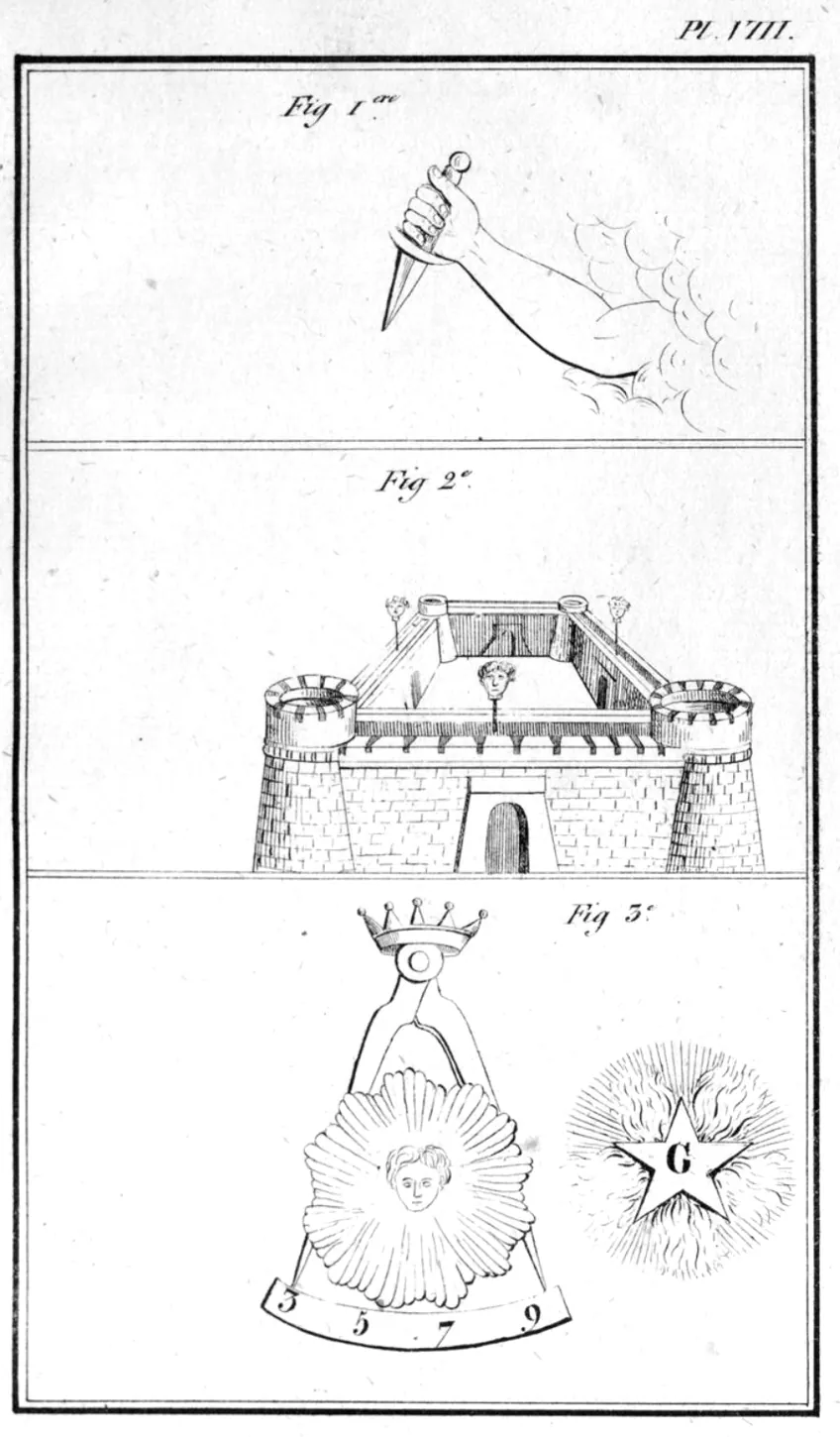
Tablier blanc, doublure et bordure noire; au milieu du tablier est peinte une ville carrée, représentant la ville de Jérusalem, dont on voit trois portes en perspective, sur chacune desquelles est une tête plantée sur un pal (Pl. VIII, fig. 2.)
Cordon noir, passant de gauche à droite; trois têtes sont brodées ou peintes sur le devant.
Pour bijou, un poignard d'or à lame d'argent, que l'on porte suspendu au bas du cordon.
TEMS DU TRAVAIL.
De cinq heures du matin à six heures du soir.
[p. 102]
MOT DE PASSE.
ELIGAM ou ELIAM (héb. אֱלִיעָם eligam, populus Dei).
MOTS SACRÉS.
ZERBAL; en réponse : BEN-IAH (héb. בֶּן־יָה filius Dei). Il était fils de Joïada (Rois 3, chapitre 1, vers. 8). Ce Ben-iah ou Benaïas devint, dans la suite, général de l'armée de Salomon, après la mort de Joab. (Rois 3, chapitre 2, vers. 25.)
Il y a des régulateurs où l'on trouve pour second mot sacré, BEN-AKAR (héb. בֶּן־עָקָר ben-gakar, filius sterilis); nom que l'on donne à la caverne où s'était réfugié l'un des meurtriers de Hiram.
Dans d'autres, on lit : BENDAKA (héb. בֶּן־דַכָא Ben-dacha, filius contritus). C'est le nom de l'intendant de Salomon, dans Maccès. (Rois 3, chap. 4, vers. 9.)
L'usage le plus général nous a fait adopter le premier mot, Ben-iah ou Benaïas, qui est le même nom.
Planche VIII. Emblèmes des grades de vengeance : un bras sortant d'une nuée et brandissant un poignard (fig. 1), une enceinte fortifiée à tours crénelées d'où émerge une tête (fig. 2), et un bijou couronné à soleil rayonnant accompagné de l'étoile flamboyante au G et des nombres 3, 5, 7, 9 (fig. 3). fig. 1 à 3.
Pike 1857
rituel imprimé · en anglais · 8 386 mots
« The Magnum Opus or Great Work » (1857) : le premier corps complet de rituels révisés par Albert Pike pour la Juridiction Sud des États-Unis. Texte en anglais, établi par reconnaissance optique corrigée : des coquilles subsistent.
D'après la réimpression Kessinger de l'édition de 1857 (numérisation archive.org)
THE LODGE, ITS DECORATIONS, ETC.
The hangings are black, sprinkled with red and white tears, There are fifteen lights, five in the east, and five before each Warden.
OFFICERS, TITLES, ETC.
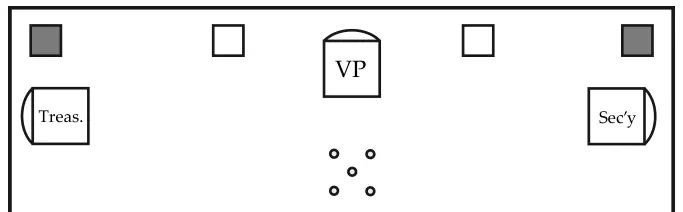
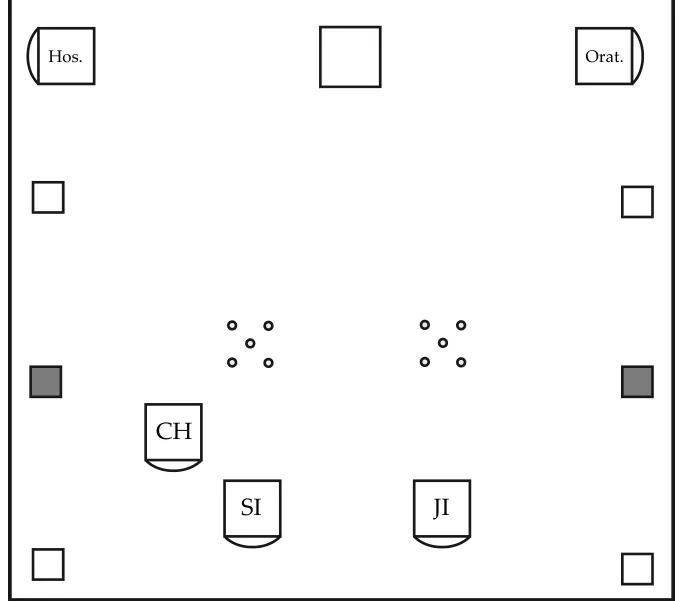
The officers are the same as in the 9th Degree; and represent the same persons during the reception. The number of members is regularly fifteen and no more.
ORNAMENTS AND JEWELS.
The apron is white, lined, edged and fringed with black, and the flap black. In the middle are painted or embroidered three gates, and over each gate s hend.
The cordon is a black ribbon or sash, worn from right to left, on the front of which are painted or embroidered three heads, -
The jewel is a dagger, its hilt gold, and its blade silver, hanging at the end of the sash. . - Daring a Reception, the President, Sen.*. Inspector and Secretary are dressed as in the 9th Degree.
The battery is || raps at equal distances.
"The age | times | or ? [| years.
The hour for opening is the 6th hour of the night: that for closing, the 6th hour of the day.
TO OPEN.
[The 15 Lights are not burning. The President gives one rap, and says]: Pres", Brethren, I am about to open this Chapter of Illustrious Elusof 15. If there be any one present, who has not attained that degree, he is requested to withdraw.
[He raps twice, and the Hospitaller rises] :
Pres... Bro.*. Hospitaller, see that the entrance to the Chapter i is duly guarded, that we may not be disturbed in our deliberations.
[The Iospitaller goes out, returns, raps 5 equal raps, which is answered from without, returns to his place, and says] :
Hosp... Th.°. Ill.*, President, the entrances to the Chapter are duly guarded, and wo are secure.
Pres... TIL. Bro.. Sen.". Inspector, you will see that all present are Ill.-, Elus of Fifteen, by receiving, with the aid of the IL'. Bro.. Jun.*, Inspector, the Pasa-word from each.
[The two Inspectors go round, one by the north and the other by the south, receive the Pass-word from ae Bro.'., and the Jun.*. Insp.*. then communicates it to the Sen., Insp.*., who returns to his place and says]:
Sen. Ins." All present are Ill.. Elus of Fifteen, Th.°. IIL.
Pres, UL. Bro.*. Sen.*. Inspector, how did you become an Iil.*, Elu of Fifteen?
Sen. Ins". My zeal and indefatigable exertions procured me that great honour, far above my deserts.
Qu.'. Where were you received as such?
Ans". In the Audience Chamber of King Solomon, and by himself, in the presence of his Court.
Qu... How many Elus were at first received ?
Ans... Fifteen, including Joabert, whom I afterwards represented.
Qu.*. On what occasion were they received ?
Ana. When King Solomon despatched them to search for and apprehend the two murderers of our Gr.°. Master Hiram Abi, who still remained at large.
Qu... Whither were they despatched?
Ans... To the country near Oath, a city of the Philistines, where they bad taken refuge, after they fled from the mountains cast of Poppa when Abiram was taken.
» Qu. By whom was it discovered that they had taken refuge there?
Ans.*. By Bendecar, one of the Nine Elus, and afterwards appointed Viceroy over that portion of Palestine.
Qu. What steps did King Solomon take to have them apprehefided ?
Ans... We sent thither the Fifteen Elus, bearing a letter to Maacha, tributary King of Oath, with a.suff-. cient escort.
Qu.*. To whom was the letter committed ?
Ans... To Zerbal, Captain of the Guard and one of the Nine Elus. -
Qu.*. Did the Fifteen succeed in apprehending the murderers?
Ana... They did, with the assistance furnished them by Mnacha.
Qu.". Where did they discover them ?
Ana... In a quarry between Gath and Saphir, in which they had taken refuge.
Qu... By whom were they discovered ?
Ana... By Joabert and Zerbal, two of the Elus of Fifteen.
Qu.". What was done with the murderers?
Ana... They were taken to Jerusalem, and together with Abiram tried, condemned and executed.
Qu.. Of what are the two murderers, Nero and Zabud the types, to the IIL'. Elus of Fifteen ?
Ans... Of Fanaticism and Ignorance.
Qu.*. What do the three heads upon the apron and collar represent?
Ana, Tyranny, Fanaticism and Ignorance: the three enslaves of mankind, smitten by the sword of Freedom.
Qu... What is the cause to which the IIL°. Elus of Fifteen are now devoted ?
Ana... That of the oppressed against the oppressor, of Toleration against Fanaticism, of Knowledge against Ignorance, and of Civilization against brutal Barbariam.
Qu.. When did the Fifteen Elus depart from Jerusalem ?
Ans., On the 15th day of the month Tammuz, answering to the month of Juno.
Qu... When did they arrive at Gath ?
Ans.*, On the 18th day of the same month.
Qu... What is your age?
* Ans. {| times || — or? {| years complete.
Qu.. Whatis the hour?
Ans. The sixth hour of the night.
Qu:*. Cause then the Brethren to assemble around the altar, that, renewing our pledges to one another, we may open this Chapter of IIl.*. Elus of Fifteen.
Sen.. Insp... [Rapping 3]: Brethren, you will please assemble around the altar, that this Chapter may be opened in due and ancient form.
[The Brethren all assemble around the altar in a circle, including the President and ail the officers, with their swords drawn. They raise their swords and place the points together in the centre, at an angle of 45 degrees ; and repeat as follows]:
Hlosp.*. To the cause of every People that struggles against Oppression and Tyranny, and is fit to be free!
Sec'y.. To the cause of all who defend Right and Justice and Free Thought against the tyranny of popular opinion | .
Treas.". To the cause of the labourer, asking fair wages for his fair day's work!
Jun.. Ins'. To the cause of Patriotism, warring against the Tyranny of Party!
Orator.'. To the cause of Toleration against Fanaticism.,
Sen, Ins... To the cause of civilization, instruction and enlightenment against Barbarism, Error and Ignorance !
Press. To the cause of Free Thought, Free Conscience and Free Speech !
All. We prvore Ourselves, OUR HANDS, OUR HEARTS, OUR INTELLECTS.
. Bres.,, Now, HENCEFORWARD AND FOREVER.
'Ally. AMEN!
_sfAll return to their places. The President gives the sign, and all the Brethren the answer. Then the President raps || — and o Brother lights the five lights in the East; the President saying] :
Pres: - Aa these lights shine in this Chapter, so shall the great light of Freedom blaze in the world !
[The Sen.*. Insp.*. raps |] —and a brother lights the five lights in front of him; the Sen.. Insp.-. saying]:
Sen, Ins... Ag my lights shine in this Chapter, ao shall the light of religious and political Toleration rise upon the world.
[The Jun.°, Insp.°. raps || — and a Brother lights the 5 lights in front of him; the Jun.*. Insp.-. saying]:
Jun.*. Insp... As my lights shine in this Chapter, so shall the light of Education and Intelligence yet shine in all the corners of the Earth. '
Pres. So mote it be! My Brethren, this Chapter is duly opened in due and ancient form.
RECEPTION.
'The officers being properly clothed and seated, the candidate, clothed as an Elu of Nine, is received in the Preparation room, and carefully examined by the Hospitaller, in the work and principles of the 9th Degree. If the examination be satisfactory, he is conducted into the Chapter, and directed to take a seat.
Pres... My Brethren, we still lament the death of our IIL'. Gr.*. Master Hiram Abi; and the demands of justice remain unsatisfied. Excellent Sadoc, what sayeth the law as to him who slayeth his Brother?
- See. , Whose sheddeth man's blood, by man shall his blood be shed; for in the image of God made he 'man. "At the hand of every man's Brother will I require the life of man. If any man hate his neighbour, 'and lie in wait for him, and rise up against him, and smite him mortally, that he die, then thine eye shall not pity him, but his blood shall purify the land of that innocent blood that he hath shed. Io is accursed that smiteth his neighbour secretly, or taketh reward to slay on innocent person.
"Xo.
Pres. Such is the law; and the land of Israel is not yet purified of the innocent blood of our Brother, shed upon the floor of the Temple, and the stains whereof still remain to bear witness against his murderers. One in his dungeon awaits his trial and the swift punishment that shall follow it; but two remain at large, nor have they yet been traced from their retreat in the mountains east of Poppa. Samaria and Galilee have been searched in vain, and all the land of Dan and Judah, and the country upon both shores of the Dead Sea, without success; and I fear they have escaped by sea to Egypt, or into Syria or the mountains of Phoenicia, and are beyond our rench.
See", Most Potent King, doubt not that the Lord will at length give them into thy hand, even as he did Abiram, when thou midst despair of discovering his retreat.
Pres. The Nine Elus have even now returned from Galilee and the confines of Phoenicia, and found no trace whatever of the fugitives; Ben-hesed and Ben-abinadab, from the shores of the Dead Sen; Bana and Achimaas from Samaria, and Ben-gaber and Jusaphat from Idumea. I know not what further steps to take.
[The M.-. of Ceremonies, who represents Bendecar, one of the Elua of Nine, raps |f at the door}.
Hosp... Th.*. Potent King Solomon, there is an alarm at the entrance of the audience chamber.
Pres.", See who applies to enter, my Brother, and what his errand is; and if it bo not urgent, let him
depart.
[The Hospitaller goes to the door, opens it, and asks]:.
Hosp.". Who is it that applies to enter here?
DE. Her». Bendecar, one of the Nine Knights Elect, who desires to have speech with our Lord the King.
Hosp.". Our Lord the King hatf& said, "See who applies to enter, and what his errand is; and if it be not urgent, let him depart."
Af. Her. My errand is urgent; and I bring tidings that will gladden the heart of our Lord the King. I crave permission to approach him.
Hosp... Wait, then, my Brother, while I inform him of thy request.
[Ile closes the door and approaches the East].
Pres... Who is it, Abisar, that applies to enter?
Hosp... Bendecar, one of the Nine Knights Elu, who desires to have speech with thee, and craves permission to approach thy footstool.
Pres... "What is his errand?
Hosp,'. Ue saith not, but declares that it is urgent; and that he bears tidings which will gladden thy
heart.
Pres, Then It him enter and make known his tidings.
[The TWospitaller opens the door, and the M.°. of Car., enters, approaches the East, kneels, rises, and stands with his hands folded across his breast].
Pres... What is thine errand, my Brother, and the tidings that thou briniest?
Al'. Her... Th.*. Potent King Solomon, returning from Galilee with my companions, and while they explored the river Jordan from the Sen of Tiberius to Naarath near the Dend Sen, J, leaving them at Zarthan, traversed the mountains to Ekron, and thence to Ascalon upon the Great Sen, and returned hither by the way of Gath-Rimmon, Gibeah and Bethlehem. At Ekron and again at Ashdod I came upon the track of the fugitives, finding those who had seen and could describe them. I traced them unto Saphir; but beyond that could hear nought of them, in Gath or in its suburbs; and having no means to procure assistance in the search, nor being accredited to Maacha, King of Gath, I was perforce compelled to return hither, to inform my Lord the King that the fugitives have taken refuge in the land of Gath.
Pres. Thou thinkest so?
BL. Her. I feel assured that they have taken refuge there. I could not trace them further, They cannot
escape by sen; ond the large rewards offered fur their apprehension bare closed against them all the outlets
leading into Idumea and towards the sea that covers Sodom. .
- Pres, Bendecar, thou has done well; and thy reward shall not be wanting. I will forthwith send
messengers to my servant Manchu, with letters requiring his assistance in searching out and capturing the fugitives. Let Josaphat our Chancellor write such letters, and the Nine Knights Elu prepare to set forth
with sufficient escort. Athd lest their number be too small, let six others go forth with them, selected by lot from among our servants, making fifteen in all. Place thou in an urn, my Brother Adonhiram, the names of all our Perfect Masters, other than the Nine Elu, and It Sadve the [high Priest draw forth six names; and let those so drawn, with the Nine, go forth upon this expedition.
[The Sen.-. Insp.-. places several names in an urn, upon slips of paper, and the Secretary draws forth six in succession, reading as he does so, the following names: . . Ben-hesed... Ben-abinadab ... Achimaas ... Bana... Josaphat the son of Pharue ... Benyaber].
Pres... Let the Nine Knights Elu, and the six Brethren named advance.
{The candidate and fourteen Brothers, including the M.*. of Her.., advance to the East, and the President says to them]:
Pres... My Brethren, it devolves on you to perform an important duty. I place you under the command:
of Zerbal, who shall bear our letters to Manchu our servant, King of Gath. Go thither speedily, and aided by the King our servant, search his dominions fur these murderers, even the whole country between the Salt Lake of Sodom and the Great Sen, and into Idumea, If you discover the assassins, take them alive, and bring them hither to be tried and punished ; for justice clamor' for its due. If you succeed, Le sure you shall be rewarded, and your names, as the Fifteen Elus, be glorious. Go and refresh yourselves, and prepare to set furth at mid-day.
{The Candidate and several brothers retire to the ante-room, and Jay aside their Masonic clothing and jewels, and each arms himself with a sword. In the mean time all the furniture of the Lodge room is removed, except the lights. A Brother who represents Zerbal then enters, conducting the Candidate, and the other brothers follow. They make several times the circuit of the room, while the lights behind the Candidate as he travels, are put out by degrees, until the room is dark. Obstacles are then placed in his way, and several more circuits ara made, and then he is conducted to the ante-room, where Zerbal says]:
_Zerb.. My Brethren, we are now near the City of Gath. Remain here, while I enter the city and present to King Maacha the letters of hie Sovereign Lord the King.
' -[He then goes out, and remains some time; then returns and says]:
erb:, Be of good cheer, my Brethren! The King of Gath has received with reverence the letters of our Lord the King, and hath sent out his guards to scour the country in all directions, in search of the fugitives. they may have taken refuge in the quarries between Gath and Saphir. Let us proceed thither.
[They again enter the Chapter room, end makes several circuits as before. Then Zerbal says]:
Zerb.. Here is the entrance to a quarry. I will explore it with Joabert and Stolkin, while the rest keep watch without, and guard the other outlets, if there be any.
[The Candidate with the Brothers who represent Zerbal and Stolkin then pass through a narrow passage, so low as to compel thém to stoop; and emerge into a small room, representing a quarry in the rocks, lighted by two or three dim lamps, and in which ore two men, roughly dressed, and with miners' tools in their hands] :
Zerb.*, Behold the murderers!
The Two: We are lost! :
[The two men throw down their tools, draw their daggers, and rush upon the three Brothers. Zerbal and
the Candidate seize one, be submits, and they take his dagger from him. The other is seized by Stolkin, but breaks away and escapes through the passage, and is taken by the brothers without. Zerbal, Stolkin and the Candidate then return through the passage, rejoin the others, and all proceed to the ante-room, where they deliver the two prisoners to the Guards. In the mean time the Chapter room is lighted, and the officers seated as before. The M.. of Her.*. now raps {| at the door, which is answered by the Ifuspitaller within, who opens the door and aska]:
Hosp... Who apply to enter here? :
M.. Her. The fifteen Knights Elect, who were sent to the land of Gath in search of the murderers of our deceased Gr.*, Master.
Hosp... The King hath ordered that upon your return, you at once appear before him. Enter.
[The Candidate and the other Brothers enter, advance to the East, kneel, rise, cross their arms upon their
breasts and stand in silence].
Pres... Speak, Zerbal! Has thou succeeded?
Zerd., My liege, we have. We journeyed hence with all speed, and by the shortest route, to the City of Gath, where, my brethren remaining without the walls, I entered the city, obtained immediate audience of the King, and laid before him thy letters. He received them with all reverence, and most courteously entreated me, and forthwith despatched his guards in every direction, to seek and apprehend the fugitives. Returning to my companions, we hastened to the quarries between Gath and Saphir, where I suspected the murderers were concealed ; and coming to the entrance of one, I, with Joabert and Stolkin entered, and found two men at work, whom I recognized as the murderers. We sprang upon them, Joabert and I upon one, and Stolkin upon the other. They defended themselves with their daggers, bat one we overpowered and bound, while the other, breaking away, fled through the entrance, and was taken by our comrades who remained without. Then, having sent this information and our thanks to King Maacha, we forthwith returned, and have delivered the two fugitives to thy Guards. °
Pres... Thanks be to God, who hath delivered these wretches into the hands of justice. Let them be chained, and consigned to separate dungeons till the morrow. And let our Royal Warrant issue, constituting Adonhiram the son of Aida, Ahisar, Governor of the House, Zabud the son of Nathan, Azarias the son of Nathan, Azarias the son of Sadie, and Elihoreph and Ahia the Scribes, a High Court, in which Joaaphat our
, Chancellor shall preside, to try these prisoners, and determine on their guilt or innocence. Let them hare fair trial, be confronted with the witnesses against them, have opportunity to produce evidence in their own behalf, and be heard in their own defence. If innocent, or if it be doubtful whether they are guilty, let them go free; but if, after fair trial and on due deliberation, they are found guilty, then let them be forthwith hanged, and afterwards beheaded, and their heads set upon the East, West and South gates of the city as o terror to all evil-doers. And let the Court convene at the third hour of the day to-morrow, and proceed speedily with the trial. Have I said well, my Brother?
Sen. Insp.".. Most well and wisely, my Brother.
Pres... So will the land be purified of innocent blood, crime punished, and justice satisfied, and severity still be tempered with humanity. Zerbal, I will reward you and your companions as you deserve. I make you the members of a new order of nobility, and a new degree in Masonry, to he styled the Illustrious Elu of Fifteen, of which I and my Brother Ifiram will! deem ita high honour to be elected members; and which none shall receive hereafter by our gift, but only by your unanimous vote. Place yourselves around the altar, my Brethren, and assume an obligation appropriate to the new degree.
[The 15 Brothers stand around the altar in a circle, placing their Ieft lnnds on the cross swords and cross-daggers which are upon it. The other Brothers encircle them and form the roof of steel over them. In this position the Brothers repeat the following obligation:
OBLIGATION.
ILA....B.... in the presence of the Grand Architect of the Universe, and under these swords, drawn to protect or punish, do hereby and hereon most solemnly and sincerely promise and swear, that I will never reveal the secrets of this degree of Ill. Ela of Fifteen to any person in the world, unless it be at o time when, and in a place where, it may be lawfully done, and to a person duly authorized to receive them, and when I am duly authorized to communicate them.
. I furthermore promise and swear that I will evermore keep and punctually observe my obligation as Knight Elu of Nine; and again to the same causes as by my obligation in that degree I did, and to the cause of Toleration and Liberality against Fanaticism and Persecution political and religious, and to that of Education, Instruction and Enlightenment against Error, Barbarism, and Ignorance, I hereby irrevocably and forever devote my hand, my heart and my intellect; under the same penalty which I invoked in that degree. So help me God; and keep me steadfast in the due performance of the same!
(The swords are lowered, and one Inid on the head of each of the Brothers; and the President says):
Pres... I therefore declare you to be duly invested with the rank and dignity of Ill. Elu.*. of Fifteen: which degree I declare to be devoted, now and always hereafter, to Toleration, Liberality and Enlightenment; and I invest you with its collar, apron and jewel, which need no explanation.
Receive now, my brethren, the signs, words and, token of this degree:
Stow: .. . Make the motion of bringing a 2¥ 227 2Q@tIL up under the & 94%, SO¢y upwards, and
strike perpendicularly IT ¥ you Of, aa if opening your Emily mC.
Answer; ... Make the O2/f Ce 2 ¢ Cx sign, with the Wf 2-9) Ctx closed and the "7& 4 San raised. Token: .. . Close the W79 20) Cia and raise the 2&4 Fem of the LO: Then, with that p& 5 Fm,
close to the | $I of the other, make a transverse motion as if cutting across his Q@m ITY ICA. Ie does the same to you. As you do it, you say MCIMOF.. «As he does it, he says Of-JSOQOS
Pass-worD: .... ™CimOf.*.
Sacrepv Worn: .... Of-TLOROM
Go now, my Brethren, to the orator; and receive the lecture of this degree.
LECTURE.
This Degree, my Brother, as you have learned by your obligation, is devoted to the same objects as those of the Elu of Nine; and also to the cause of Toleration and Liberality against Fanaticism and Persecution, political and religious ; and to that of Education, Instruction and Enlightenment against Error, Barbarism and Ignorance. To these objects you have irrevocably and forever devoted your hand, your heart and your intellect; and whenever in your presence & Chapter of this Degree is opened, you will be most solemnly 'reminded of your solemn vows here taken at the altar.
~ 'Toleration, holding that every other man has the same right to his opinion and faith that we hare to 'ours: and Liberality, holding that as no haman being can say with certainty, in the clash and conflict of -hostile faiths and creeds, what is Truth, or that he is surely in possession thereof, so every one should feel that it is quite possible that another, equally honest and sincere with himself, and yet holding the contrary opinion, may himself be in possession of the Truth; and that whatever one firmly and conscientiously believes, is truth to him; are the mortal enemies of that Fanaticism which persecutes fur opinion's sake; and initiates crusades against whatever it, in its imaginary holiness, deems to be contrary to the law
of. God. . ,
'And Education, Instruction and Enlightenment are the most certain means by which Fanaticism and
Intolerance can be rendered powerless.
. . No true Mason scoffs at honest convictions, and an ardent zeal in the cause of Truth and Justice. But "he absolutely denies the right of any man to assume the prerogative of Deity, and condemn his Brother's faith 'and opinions as heretical and deserving to be punished. Nor dues he approve the course of those who endanger the peace of great nations and the best interests of their own race by indulging in a chimerical and visionary philanthropy ; a luxury which they can only enjoy by drawing their robes around them to avoid contact with their' fellows, and proclaiming themselves holier than they.
For ha knows that intolerance and bigotry hare been infinitely greater curses to mankind than ignorance and error. Better any error than persecution! Better any belief or opinion than the thumbscrew, the rack 'and the stake! And he knows also how unspeakably absurd it is, fur a creature to whom he himself and every thing around and within him are mysteries, to torture and kill others, because they do not think us be 'does in regard to the profoundest of those mysteries; which it is utterly beyond the comprehension of either _
'to understand.
We may well be tolerant of each other's creed; for in every faith there are excellent moral precepts. Far in the South of Asia, Zoroaster taught this doctrine: On commencing a journey, the Faithful should turn his thoughts towards Ormuzd, and confess him, in the purity of his heart, to be King of the World; be should love Him, do him homage, and serve him. Ve must be upright and charitable, despise the pleasures of the body, and avoid pride and haughtiness, and rice in all its forms, and especially falsehood, one of the basest sins of which man can he guilty. He must forget injuries and not avenge himself. Ie must honour the memory of his parents and relatives. At night, before retiring to sleep, he should rigorously examine his conscience, and repent of the faults which weakness or ill-fortune had caused him to commit, If was required to pray fur strength to persevere in the Good, and to obtain forgiveness fur his errors. It was his duty to confess his faults to a tagus, or to a layman renowned for his virtues, or to the sun. Fasting and maceration were prohibited: and, on the contrary, it was his duty suitably to nourish the body and to maintain its vigour, that his soul might be strong to resist the Genius of Darkness; that he might more attentively read the Divine Word, and have more courage to perform noble deeds.
and in the North of Europe the Druids taught devotion to friends, indulgence for reciprocal wrongs, love of deserved praise, prudence, humanity, hospitality, respect fer old age, disregard of the future, temperance, contempt of death, and a chivalrous deference to woman. Listen to these maxims from the Iara Maal, or Sublime Book of Odin:
"Tf thou bast a friend, visit him often: the path will grow over with grass, and the trees soon cover it, if thou most not constantly walk upon it, Ile is a faithful friend, who, having but two loaves, gives his friend one: Be never first to break with thy friend: sorrow: wrings the heart of him, who has no one save himself, with whom to take counsel. There is no virtuous man who has not some vice, no bad man who has not some virtue. Happy he who obtains the praise and good-will of men; for all that depends on the will of another is hazardous and uncertain. Riches flit away in the twinkling of an eye: they are the most inconstar 5 of friends:
flocks and herds perish, parents die, friends are not immortal, thou thyself dicst: 1 know but one thing that doth not die, the judgment that is passed upon the dead. Be humane towards those whom thou meekest on the road. If the guest that comets to thy house is a-cold, give him fire: the man who has journeyed over the mountains needs food-and dry garments, Mock not at the aged ; for words full of sense.come often from the wrinkles of age. Be moderately wise, and not over prudent. Let no one seek to' know his destiny, if-he would sleep tranquilly. There is no malady more cruel than to be discontented with our Int, Riso early, if thon woulds become rich, or overcome an enemy: the wolf that sleeps takes no prey; the man that sleeps gains no victory. The glutton eats his own death; and the wise nian Laughs at the fool's greediness. Nothing is more injurious to the young than excessive drinking: the more one drinks, the more he loses his reason; the bird of forgetfulness sings before those who intoxicate themselves, and wiles away their souls. Man devoid of sense "believes he will live always if he avoids war; but, if the lances spare him, old age will give him no quarter, Batter live well than live long. When a man lights o fire in his house, death comes before it goes out.'
And thus said the Indian books: "Honour thy father and mother. Never forget the benefits thou bast received. Learn while thou art young. Be submissive to the laws of thy country. Seek the company of virtuous men. Speak not of God but with respect. Live on good terms with thy fellow-citizens. Remain in thy proper place. Speak illof no one. Mock at the bodily infirmities of none. Pursue not unrelentingly conquered enemy. Strive to acquire a good reputation. The best bread is that for which one is indebted to his own labour. Take counsel with wise men. The more one learns, the more he acquires the faculty of learning. Knowledge is the most permanent wealth, As well bedumbasignorant. The true use of knowledge is to distinguish good from evil, Be not subject of shame to thy parents. What one learns in youth endures like the engraving upon a rock. Le is wise who knows himself. Let thy books be thy best friends. When thou attuinest an hundred years, cease to learn. Wisdom is solidly planted, even on the shifting ocean. Deceive no one, not even thine enemy. Wisdom is a treasure that every where commands its value. Modesty is the most beautiful ornament of a woman. One is nowhere well lodged but in his own house. Speak mildly, even to the poor. It is sweeter to forgive than to take vengeance. Concord is the finest ornament of a family. First procure the wagon, and then set thyself about finding the oxen. Gaming and quarrels lend to misery: There is no true merit without the practice of virtue. To honour our mother is the most fitting homage we
ean pay the Divinity. There is no tranquil sleep without a clear conscience. One cannot always have milk to drink: we must conform ourselves to circumstances. He badly understands his interest who breaks his word."
Twenty-four centuries ago, this was the Chinese Ethics. ;
"The Philusopber said, 'San! my doctrine is simple, and easy to be understood.' Thseng-Tseu replied, 'that is certain" he Vhilusopher having gone out, the disciples asked what their master had meant to say. Thseng-T'seu responded, 'The doctrine of our Master consists solely in being upright of heart, and loving our neighbour a3 we love yourself."
About a century later, the Hebrew law said, "If any man hate his neighbour... then shall ye do unto him, as he had thought to du unto his brother... Better is a neighbour that is near, than a brother afar off ++. Thou shalt love thy neighbour as thyself."
In the same fifth century before Christ, Socrates the Grecian said, "Thou shalt love thy neighbour os thyself" '
Three generations earlier, Zoroaster had said to the Persians: "Offer up thy: grateful prayers to the Lord, the most just and pure Ormuzd, the supreme and adorable God, who thus declared to his Prophet Zerdusht: * Ifold i¢ not meet to do unto others what thua woulds not desire done unto thyself: do that unto the people, which, when done to thyself, is not disagreeable unto thee.' "
The same doctrine had been long taught in the schools of Babylon and Jerusalem. A Pagan declared to the Pharisee ITillel that be was ready to embrace the Jewish religion, if he could make known to him in a few words o summary of the whole law of Muses. " That which thou likest nut done to thyself, said ITillel, do it not unto thy neighbour. Therein is all the law: the rest is nothing but the commentary upon it."
" Nothing is more natural," said Confucius, "nothing more simple, than the principles of that morality which I endeavour, by salutary maxims, to inculcate in you... Its humanity; which is to say, that universal. charity among all of our species, without distinction. It is uprightness; that is, that rectitude of spirit and of heart, which makes one seek for truth in every thing, and desire it, without deceiving one's self or others. It is finally sincerity or good faith; which is to say, that frankness, that openness of heart, tempered by selfreliance, which excludes all feints and all disguising, as much in speech as in action."
« Yo diffuse useful information, to further intellectual refinement, sure forerunner of moral improvement, 'to hasten the coming of the great day, when the dawn of general knowledge shall chase away the lazy, linger- "ing mists, eveu from the base of the great social pyramid, is indeed a high calling, in which the most splendid 'talents and consummate virtue may well press onward, eager to bear a part. From the Masonic ranks ought to go forth those whose genius and not their ancestry ennoble them, to open toall ranks the temple of science, and by their own example to make the humblest men emulous to climb atepa-no longer inaccessible, and enter the unfolded gates burning in the sun.
The highest intellectual cultivation is perfectly compatible with the daily cares and toils of working men. A keen relish for the most sublime truths of science belongs alike to every class of mankind. And, as philosophy was taught in the sacred groves of Athens, and under. the Portico, and in the old Temples of Egypt and India, so in our Lodges ought Knowledge to be dispensed, the Sciences taught, and the Lectures become like
"the teachings of Socrates and Plato, of "Agassiz and Cousin.
-Real knowledge never permitted either turbulence or unbelief ; but its progress is the forerunner of liberality and enlightened toleration. Whose dreads these may well tremble; fur he may be well assured that their day is at length come, and must put to speedy flight the evil spirits of tyranny and persecution, which haunted the long night now gone down the sky. And it is to be hoped that the time will soon arrive, when, as men will no longer suffer themselves to be led blindfold in ignorance, so will they n0 more yield to the vile principle of judging and treating their fellow-creatures, not according to the intrinsic merit of their actions, but according to the accidental and involuntary coincidence of their opinions.
Whenever we come to trent with entire respect those who conscientiously differ from ourselves, the only practical effect of a difference will be, to make us enlighten the ignorance on one side or the other, from which it springs, by instructing them, if it be theirs; ourselves, if it be our own; to the end that the only kind of unanimity may be produced which is desirable among rational beings,—the agreement proceeding from full conviction after the freest discussion.
The Knight Elu of Fifteen ought therefore to take the lead of his fellow-citizens, not in frivolous amusements, not in the degrading pursuits of the ambitious vulgar; but in the truly noble task of enlightening the mass of his countrymen, and of leaving his own name encircled, not with barbaric splendor, or attached to courtly gewgaws, but illustrated By the honors most worthy of our rational nature ; coupled with the diffusion of knowledge, and gratefully pronounced by a few, at least, whom his wise beneficence has rescued from ignorance and vice. :
We say to him, in the words of the great Roman: "Men in no respect so nearly approach to the Deity, as when they confer benefits on men. 'Tu serve and do good to as many as possible,—there is nothing greater in your fortune than that you should be able, and nothing finer in your nature, than that you should be desirous to do this." This is the true mark fur the aim of every nan and Mason who either prizes the enjoyment of pure happiness, or sets a right value upon a high and unsullied renown. And if the benefactors uf mankind, when they rest from their noble labours, shall be permitted to enjoy hereafter, as an appropriate reward of their virtue, the privilege of looking down upon the blessings with which their exertions and charities, and perhaps their toils and sufferings have clothed the scene of their furmer existence, it will not, in a state of exalted purity and wisdom, be the founders of mighty dynasties, the conquerors of new empires, the Caesars, Alexanders and Tamerlines; nor the mere Kings and Counsellors, Presidents and Senators, rho have lived for their party chiefly, and for their country only incidentally, often sacrificing tu their own aggrandizement or that of their faction the good of their fellow-creatures ;—it will not be they who will be gratified by contemplating the monuments of their inglorious fume; but those will enjoy that delight and march in that triumph, who can trace the remote effects of their enlightened benevolence in the improved condition of their species, and exult in the reflection, that the change which they at last, perhaps after many years, survey, with eyes that age and sorrow enn inake dim no more,—of Knowledge become Power,—Virtue sharing that Empire— Superstition dethroned, and Tyranny exiled, is, if even only in some small and very slight degree, yet still in some degree, the fruit, precious if costly, and though late repaid yet long enduring. of their own self-denial and strenuous excrtivn, of their own mite of charity and aid to education wisely bestowed, and of the hardships and hazards which they encountered here below.
But Masonry requires of its initiates and votaries nothing that is impracticable. It does not demand that they should undertake to climb to those lofty and sublime peaks of a theoretical and imaginary unpractical virtue, high and cold and remote as the eternal snows that wrap the shoulders of Chimborazo, and at least quite as inaccessible as they, It asks that alone to be dune, which is easy to be dune. It overtasks no one's strength, and asks no one to go beyond his means or his capacities. It docs not expect one whose business or profession yields him little more than the wants of himself and his family require, and whose time is necessarily occupied by his daily avocations, to abandon or neglect the avocation by which be and his children live, and devote himself and his means to the diffusion of knowledge among men. It does not expect him to publish books for the people, or to lecture t» the injury of his business, or to found academies and colleges, build up libraries and entitle himself to statues. -
But it docs require and expect every man of us to do something, within and according to his means: and there is no Mason who cannot do something; if not alone, then by combination and association. If all the Masons of a State choose, they may, by a moderate but permanent annual contribution levied upon themselves, furnish annually a sum equivalent to the interest on a large capital, and therewith build and endow a college, Lodges can unite and aid in the erection and establishment of a school or an academy: and it is the saddest of all Masonic sights when the Brethren of a jurisdiction rebel against a contribution for those purposes, imposed by themselves through their constituted and accredited representatives; and thus make known to a scoffing world what is éheir deliberate opinion of the value of Masonry. . .
And if a Lodge'cannot aid in founding a school or an academy, it can still do something. It can educate one boy or girl, at least, the child of some pour or departed rather, And let it never be forgotten that in the poorest unregarded child that seems abandoned to ignorance and vice, may Plumber the virtues of a Socrates, the intellect of a Bacon, the genius of a Shakspeare, the capacity to dy good to mankind of a W achington 5 and that, in rescuing him from the mire in which he ix plungel, and giving bint the means of education and development, the Lodge that dues it may be the direct and immediate menns of cuuferring upon the world as
xX..." Il
grent a blessing as that given it by John Faust the boy of Mentz, by Fulton, or Arkwright or Morse; may perpetuate the liberties of our own country, and change the destinies of nations, and write a new Chapter in the History of the World.
For we never know the importance of the act wedo. The Daughter of Pharaoh little thought what she
wag during for the human race, and the vast, unimaginable consequences that depended on her charitable act, when she draw the little child uf a Hebrew woman from among the rushes that grew along the bank of the Nile, and determined to rear it as her own.
How often has an act of charity, costing the doer little; given to the world a great painter, a great musician, a great inventor! Ilow often has such an act developed the ragged boy into the great benefactor of his race | On what small and apparently unimportant circumstances have turned and hinged the fates of the world's great conquerors, the Napoleons and Cromwells. There is no law that limits the returns that shall be reaped from a single good decd. The widow's mite may not only be as acceptable to God, but may produce as great results as the rich man's costly offering. The poorest boy, helped by benevolence, may come to lead armies, to decide on peace and war, to control Senates, to dictate to Cabinets; and exercise influences as vast as those of England's great Statesmen, past and present, as the Great Commoner of our own Country, who was once the mill-boy of the Slashes of Hanover, and the mighty Orator and Statesman, once the son of a poor farmer of New Hampshire, but whose magnificent thoughts and noble words will be law many years hereafter to millions of men yet unborn.
But the opportunity to effect 2 great good does not often occur to any one. It is worse than folly for one to lie idle and inert, and expect the accident to befall him, by which his influences shall live forever. ire can expect that to happen, only in consequence of one or many or all of a long series of acts. IIe can expect to benefit the world only as men attain other results; by continuance, by persistence, by a steady and uniform habit of labouring for the enlightenment of the world, to the extent of his means and capacity.
For it is, in all instances, by dint of steady labour, by giving enough of application to our work, and having enough of time for the doing of it, by regular pains-taking, and the plying of constant assiduities, and not by any process of legerdemain, | that we secure the strength and the staple of real excellence. It was thus 'that Demosthenes, clause after clause, and sentence after sentence, elaborated to the uttermost his immortal ,orations. Jt was thus that Newton pioneered his way, by the steps of an ascending geometry, to the meghan-. ism of the Ienrens.
'Jt is a most erroneous opinion that those who have left the most stupendous monuments of intellect behind them, were not differently exercised from the rest of the species, butonly differently gifted: that they signalized themselves only by their talent, and hardly ever by their industry: for it is in truth to the most strenuous application of those common place faculties which are diffused among all, that they are indebted for the glories which now encircle their remembrance and their name.
Wo must not imagine it to be a vulgarizing of genius, that it should be lighted up in any other way than by a direct inspiration from Heaven; nor overlook the steadfastness of purpose, the devotion to some single bat great object, the unwenriedness of labour that is given, not in convulsive and preternatural throes, bat by little and little as the strength of the mind may bear it; the accumulation of many small efforts, instead 'of a few grand and gigantic, but perhaps irregular movements, on the part of energies that are marvellous; by which former alone the great results are brought out that write their enduring records on the face of the earth and in the history of nations and of man. .
'We must not overlook these elements, to which genius owes the best and proudest of her achievements ; nor imagine that qualities so generally possessed as patience and pains-taking, and resolute industry, have no | share in upholding a distinction so illustrious as that of the benefactor of his kind.
We must not forget that great results are most ordinarily produced by an aggregate of many contributions and exertions: as it is the invisible particles of vapour, each separate and distinct from the other, that, rising from the Atlantic and its bays and gulfs, and from wide morasses and overflowed plains, float away in clouds, and distil upon the earth in dew, and fallen showers and rains upon the broad prairies and rude mountains, and make the great navigable rivers that are the arteries along which flows the life-blood of our country,
And so Masonry can do much, if each Mason be content to do his share, and if their united efforts are
directed by wise counsels to common purpose. A man would wonder at the mighty things which have Leen done by degrees and gentle augmentations. Diligence and moderation are the Lest steps whereby to climb to any excellency; and it is rare if there be any other way. The Heavens send not down their rain in foods, but by drops and dewy distillations. A man is neither good, nor wise, nor rich at once; yet, softly creeping up these hills, he shall every day better his prospect, until at Inst he gains the summit. It is for God and fur Omnipotence to do mighty things in o moment; but by degrees to grow to greatness is the course that he hath left for man. ; .
If Masonry will but bo true to her mission, and Masons to their promises and obligations ;—if, reentering vigorously upon a career of beneficence, she and they will but pursue it earnestly and unfulteringly, remembering that our contributions to the cause of charity and education then deserve the greatest credit when it costs us something, the curtailing of a comfort or the relinquishment of a luxury to make them: if we will but give aid to Masonry's great schemes for human improvement, not fitfully and spasmodically, but regularly and incessantly, as the vapours rise, and the springs run, and as the sun rises and the stars come up into the heavens, then wo may be sure that great results will be attained and a great work done. And then it will most surely be seen that Masonry is not effete or impotent. It will betoken it not degenerated, nor drooping to a fatal decay; but casting off the old and wrinkled skin of routine and inertia, to wax young again, entering the glorious ways of Truth and prosperous Virtue, destined to become great and honorable in these latter ages. And foreseeing this glad result, we may see in our minds our noble and puissant Order rousing herself like o strong man after sleep, and shaking her invincible locks; may see her as an eagle mewing her mighty youth, and kindling her undazzled eyes at the full mid-day beam; purging and unsealing her long-abused sight of the fountain itself of heavenly radiance; while the whole noise of timorous and flocking birds, with those also that love the twilight, flutter about, amazed at what she means, and in their envious gabble would prognosticate disastrous failure and ignominious downfall; unstirred by which and untroubled, she wings her strong way towards the stars, and bathes leisurely in the broad light of Divine Truth and ever-increasing
knowledge.
TO CLOSE.
Pres, Bro.*. Sen.*. Inspector, what is the hour?
Sen. Insp. Th,*. Il', the hour when the Fifteen Elus returned to Jerusalem.
Pres. The hour of rest has come. Cause the Brethren to assemble round the altar, that, renewing our pledges to one another, we may close this Chapter of Ill". Elu of Fifteen.
Sen. Insp... [Rapping 3]: Brethren, you will please assemble around the altar, that this Chapter may be closed in due and ancient form.
{The Brethren assemble round the altar; and the same ceremonies are performed as in opening. Then all return to their places. The President gives the sign; and all the Brethren the answer. Then the President rops {J and the lights in front of him ore extinguished; the Sen.*. Inspector || and the lights in front of him are extinguished; the Jun.*. Insp.*. {J and the lights in front of him are extinguished ; and the Pres.*. says]: :
Pres... This Chapter of IIL*, Elu of Fifteen is closed.
FINIS.
Ragon 1861
tuileur imprimé · 421 mots
Le « Tuileur général de la Franc-Maçonnerie ou Manuel de l'initié » de Jean-Marie Ragon (Paris, 1861), dernier grand tuileur français du siècle : décoration, titres, ordre, signes, mots, marche, âge, batterie et décors du grade, avec les notes critiques de Ragon sur les mots altérés par la tradition. Pages 115-117 de l'édition originale.
Tenture noire, parsemée de larmes rouges et blanches.
[p. 116]
Quinze lumières éclairent la salle : 5 devant le Président, à l'est, et 5 devant chacun des Surveillants.
Titres.
L'assemblée se nomme Chapitre.
Le Président est nommé Très-Illustre Maître.
Le premier Surveillant se nomme Inspecteur, et le second Surveillant Introducteur.
Il ne peut y avoir plus de 15 élus dans le Chapitre pour les réceptions, le surplus se tient en dehors.
Ordre.
Point.
Signe.
Se porter le poignard sous le menton et le faire descendre le long du corps, comme si l'on voulait s'ouvrir le ventre. En réponse, on fait le signe d'apprenti, ayant le poing fermé et le pouce levé.
Attouchement.
S'entrelacer réciproquement les doigts de la main droite, les pouces du côté du ventre, comme pour se l'ouvrir.
Mot de passe.
ELIGAM (populus dei), ou ELIAM.
Mots sacrés.
ZERBAEL, fils de Jaïada, dit par erreur le Sanctuaire. Réponse : BEN-IAH (filius Dei). Ce Ben-iah, ou Benaïas, était fils de Joïada (Rois, III, ch. I, v. 8), et devint général de l'armée de Salomon après la mort de Joab, tué par lui par ordre de Salomon (Rois, III, ch. II, v. 25)¹.
Âge.
Point.
Marche.
15 pas triangulaires.
Batterie.
5 coups égaux : ○ ○ ○ ○ ○ !
Temps du travail.
De 5 heures du matin à 6 heures du soir.
Questions d'ordre.
D. Etes-vous élu des Quinze ?
R. Mon travail et mon zèle m'ont mérité ce grade.
D. Où avez-vous été reçu ?
R. Dans la salle d'audience de Salomon, et par lui-même.
1 Quelques régulateurs indiquent pour second mot sacré : Ben-Akar (en hébreu Ben-gakar, filius sterilis), nom donné à la caverne où s'était réfugié l'un des meurtriers d'Hiram.
Dans d'autres, on lit : Ben-daka (en hébreu Ben-dacha, filius contritus), c'est le nom de l'intendant de Salomon, dans Maccès. (Rois 3, ch. IV, v. 9.)
[p. 117]
D. Quelle heure est-il ?
R. Cinq heures du matin.
D. A quelle heure devons-nous nous retirer ?
R. A six heures du soir.
Décors.
TABLIER. Blanc, doublure et bordure noire. Au milieu est peinte une ville carrée représentant la ville de Jérusalem, et à trois de ses portes, sur des pieux, sont les têtes des assassins d'Hiram.
Cordon.
Noir, passant de gauche à droite. Les mêmes têtes y sont brodées ou peintes, et représentent les trois assassins d'Hiram.
Bijou.
Poignard d'or à lame d'argent, suspendu au bas du cordon.
Banquet.
Mêmes usages qu'au grade d'Élu, p. 34.
Pike 1884
rituel définitif · en anglais · 11 112 mots
Le rituel définitif d'Albert Pike tel que pratiqué par la Juridiction Sud des États-Unis (état final des révisions, v. 1884 ; recomposition numérique de 2020). Texte en anglais, établi directement sur la composition d'origine : ligatures rétablies, italiques de l'imprimé conservées, hébreu, phénicien et samaritain rendus dans leur écriture, pagination de l'original. Les partitions musicales, les plans d'atelier et les planches de décors sont reproduits en fac-similé à leur place dans le texte. Pages 265 à 279 de l'édition.
Ritual of the Scottish Rite, Supreme Council, S. J. (recomposition 2020), p. 265-279
[p. 265]
Planche [p. 265]
[p. 266]
Vignette [p. 266]
ࠄࠁࠇࠉࠓ࠰ࠍࠔࠀ࠰ࠄࠇࠌࠔࠄ࠰ࠏࠔࠓ
The Lodge—its Decorations, etc.
Bodies of this degree are styled “Chapters.” The hangings are black, sprinkled with red and silver tears. There are fifteen lights, five in the east and five before each Warden; each five forming a square, with one in the center; all of yellow wax.
The altar is covered with black, strewed with silver tears. On it are the Book of Constitutions, the Hebrew Pentateuch, two swords crossed, and two daggers crossed.
Officers, Titles, etc.
The officers are the same as in the ninth degree, and represent the same persons during the reception. The Master is styled “Venerable President.”
The AGE of an Élu of the Fifteen is 17 years.
Decorations.
The Apron is white, lined, edged and fringed with black, and the flap black. In the center are painted or embroidered three gates, and over each gate a head impaled on a spike.
The Cordon is a broad watered black ribbon, worn from right to left, on the front of which are painted or embroidered three heads.
The Jewel is a dagger, its hilt gold and its blade silver, hanging at the end of the cordon. During a reception, the Venerable President, Senior Inspector, and Secretary are dressed as in the ninth degree. The hour of opening is the sixth hour of the night; that for closing, the sixth hour of the day.
[p. 267]
Figure de l’original [p. 267]
MC
Plan de l’atelier [p. 267]
[p. 268]
To Open.
The fifteen lights are not burning. VP—• Brethren, I am about to open this Chapter of Élu of the Fifteen. Brother Senior Inspector, assure yourself that all present have attained that rank.
The Senior Inspector satisfies himself and reports: SI—Venerable, all present are Élus of the Fifteen.
VP—• The Captain of the Host rises. VP—Brother Captain of the Host, see that the entrance to the Chapter is duly guarded, that we may not be disturbed in our deliberations.
The Captain of the Host goes out, returns, raps •••••, which is answered from without, returns to his place, and says: CH—Venerable, the entrances to the Chapter are duly guarded, and we are secure.
VP—Brother Senior Inspector, how did you become an Élu of the Fifteen?
SI—My zeal and indefatigable exertions procured me that honor, above my deserts.
VP—Where were you received such?
SI—In the Audience-Chamber of King Solomon, and by himself, in the presence of his Court.
VP—How many Élus were at first received?
SI—Fifteen, including Yehū-aber, whom I afterward represented.
VP—On what occasion were they received?
SI—When King Solomon dispatched them to search for and apprehend the two murderers of the Master Khirum, who still remained at large.
VP—Whither were they dispatched?
SI—To the country near Găth, a city of the Philistines, where they had taken refuge, after they fled from the mountains east of Yapū, when Abairam was taken.
VP—By whom was it discovered that they had taken refuge there?
SI—By Ben-Dekar, one of the Nine Élus, afterward appointed Viceroy over that portion of Palestine.
VP—What steps did King Solomon take to have them apprehended?
SI—He sent thither the Fifteen Élus, bearing a letter to Mâkah, tributary King of Găth, with a sufficient escort.
VP—To whom was the letter committed?
SI—To Zerbal, Captain of the Guard and one of the Nine Élus.
VP—Did the Fifteen succeed in apprehending the murderers?
SI—They did, with the assistance furnished them by Mâkah.
VP—Where did they discover them?
SI—In a quarry between Găth and Sâphir, in which they had taken refuge.
VP—By whom were they discovered?
SI—By Yehu-aber and Zerbal, two of the Élus of the Fifteen.
VP—What was done with the murderers?
SI—They were taken to Jerusalem, and there tried, condemned, and executed.
VP—Of what are these two murderers the types, to the Élu of the Fifteen?
SI—Of Ambition, Father of Tyranny; and Fanaticism, Mother of Intolerance.
VP—What do the three heads upon the apron and collar represent?
SI—Ignorance, Tyranny, and Fanaticism; the three enslavers of mankind, smitten by the sword of Freedom.
VP—What is the cause to which the Élus of the Fifteen are now devoted?
SI—That of the Oppressed against the Oppressor, and of Toleration against Intolerance.
VP—When did the Fifteen Élus depart from Jerusalem?
SI—On the fifteenth day of the month Tamuz.
VP—When did they arrive at Găth?
SI—On the eighteenth day of the same month.
VP—What is your age?
SI—17 years.
VP—What is the hour?
SI—The sixth hour of the night.
VP—Cause then the Brethren to assemble around the altar, that, renewing our pledges to one another, we may open this Chapter of Élu of the Fifteen!
SI—••• Brethren, you will please assemble round the Altar, that this Chapter may be opened in due and ancient form!
[p. 269]
The Brethren assemble round the altar, in a circle enclosing the Venerable President and all the officers, with their swords drawn. They raise their swords at an angle of 45 degrees, all the points meeting in the center; and repeat as follows:
O—To the cause of every People that struggles against OppressionӔ JI—To the cause of all who defend Right and Justice against Tyranny!
SI—To the cause of toleration against intolerance and persecution!
VP—To the cause of Free Thought, Free Speech, Free Conscience!
All—We devote ourselves, our Hands, our Hearts, and Intellects!
VP—Now, henceforward, and forever!
All—Amen! All return to their places. VP—(Gives the sign, which is make the motion of bringing a poniard up under the chin, hilt upward, and strike perpendicularly downward, as if opening your abdomen.)
All others—(Give the answer, which is to make the Apprentice’s sign, with the fingers closed, and the thumb raised.) VP—••••• A brother lights the five lights in the East while the Venerable President says: VP—As these Lights shine in this Chapter, so shall the Light of Freedom illuminate the World.
SI—••••• A Brother lights the five lights in front of him, while the Senior Inspector says: SI—As my Lights shine in this Chapter, so shall the Light of Religious and Political Toleration rise upon the World.
JI—••••• A Brother lights the five lights in front of him, while the Junior Inspector says: JI—As my Lights shine in this Chapter, so shall the Light of Education and Intelligence yet shine in all the Corners of the Earth.
VP—So mote it be!—My brethren, this Chapter is duly opened in due and ancient form. • All are seated.
Reception.
The officers being properly clothed and seated, the Aspirant, clothed as an Élu of the Nine, is received into the Preparation room, and carefully examined by the Hospitaller in the work and principles of the Ninth Degree. If the examination be satisfactory, he is conducted into the Chapter, and directed to take a seat.
VP—My brethren, we still lament the death of our Illustrious Brother Khirum, and the demands of justice remain unsatisfied. Tsadōc, the High Priest, what sayeth the law as to him who slayeth his brother?
Sec—If any man hate his neighbor, and lie in wait for him, and rise up against him, and smite him mortally that he die, and fleeth into one of the Cities of Refuge, then the Elders of his city shall send and fetch him thence, and deliver him into the hand of the Avenger of Blood, that he may die. Thine eye shall not pity him, but thou shalt put away the guilt of innocent blood from Israel, that it may go well with thee.
VP—Such is the law; and the land of Israel is not yet purified of the innocent blood of our brother, shed upon the floor of the temple. One of his assassins has suffered swift punishment, but two remain at large, nor have yet been traced from their retreat in the mountains east of Yapū. I fear they have escaped by sea, and are beyond our reach.
Sec—O Wise King, doubt not that the Lord will at length give them into thy hand, even as he did Abairam, when thou didst despair of discovering his retreat.
VP—The Nine Élus have even now returned from Galilee and the confines of Phœnicia, and found no trace whatever of the fugitives. I know not what further steps to take.
The Master of Ceremonies, who represents Ben-Dekar, one of the Élus of the Nine, raps ••••• at the door. CH—Wise King Solomon, there is an alarm at the entrance of the audience-chamber.
VP—See who applies to enter, and what his errand is. The Captain of the Host goes to the door, opens it, and asks: CH—Who is it that applies to enter here?
MC—Ben-Dekar, one of the Nine Knights Élu, who desires to have speech with our Lord the King.
CH—Wait, then, my Brother, while I inform him of thy request. He closes the door and approaches the East. VP—Who is it, Banaias, that applies to enter?
CH—Ben-Dekar, one of the Nine Knights Élu, who desires to have speech with thee, and craves permission to approach thy footstool.
[p. 270]
VP—Let him enter and make known his tidings. The Captain of the Host opens the door, and the Master of Ceremonies enters, approaches the East, kneels, rises, and stands with his hands folded across his breast.
VP—What is thine errand, and the tidings that thou bringest?
MC—Wise King Solomon, returning from Galilee with my companions, and leaving them at Zarthan, I traversed the mountains to Akron and Askalon. At Akron and at Ashdod I came upon the track of the fugitives, and have returned hither to inform my Lord the King that they have taken refuge in the land of Găth.
VP—Ben-Dekar, thou hast done well. I will forthwith send messengers to my servant Mâkah, with letters requiring his assistance in searching out and capturing the fugitives. Let Yosaphat our Chancellor write such letters, and the Nine Knights Élus prepare to set forth with sufficient escort. And lest their number be too small, let six others go forth with them, selected by lot from among our servants, making fifteen in all. Place thou in an urn, my Brother Adoniram, the names of all our Perfect Masters other than the Nine Elect, and let Tsadōc the High Priest draw forth six names, and let those so drawn, with the Nine, go forth upon this expedition.
The Junior Inspector places several names in an urn upon slips of paper, and the Secretary draws forth six in succession, reading as he does so the following names:
Sec—Bâna ben Ahilud … Omri ben Zabdiel … Ahinadab ben Iddo … Kemuel ben Zichri … Shimei ben Elah … Yūel ben Helez.
VP—Let the Élus of the Nine, and the six brethren now chosen, come to the foot of the throne. The Aspirant and fourteen Brothers, including the Master of Ceremonies, advance to the East, and the Venerable President says to them:
VP—My Brethren, it devolves on you to perform an important duty. I place you under the command of Zerbal, who shall bear our letters to Mâkah our servant, King of Găth. Go thither speedily, and aided by the King, search his dominions for these murderers. If you discover them, take them alive, and bring them here to be tried and punished. Prepare to set forth at midday.
The Aspirant and several Brethren retire to the anteroom and lay aside their Masonic clothing and jewels, and each arms himself with a sword. In the meantime, all the furniture of the Lodge room is removed, except the lights. The Master of Ceremonies, representing Zerbal, then enters, conducting the Aspirant, and the other Brethren follow. They make several times the circuit of the room, while the lights behind the Aspirant as he travels are put out by degrees, until the room is dark. Obstacles are then placed in his way, and several more circuits are made, and then he is conducted to the anteroom, where the Master of Ceremonies says:
MC—My Brethren, we are now near the City of Găth. Remain here, while I enter the city and present to King Mâkah the letters of our Lord the King.
He goes out, remains some time, returns and says: MC—Be of good cheer, my brethren! The King of Găth has received with reverence the letters of our Lord the King, and hath sent out his guards to scour the country in all directions in search of the fugitives. They may have taken refuge in the quarries. Let us proceed thither.
They again enter the Chapter room, and make several circuits as before. Then the Master of Ceremonies says: MC—Here is the entrance to a quarry. I will explore it with Yehu-aber and Satolkin, while the rest keep watch without.
The Aspirant, with the Master of Ceremonies and a Brother, who represents Satolkin, now pass through a narrow passage, so low as to compel them to stoop, and emerge into a small room, representing a quarry in the rocks, lighted by two or three dim lamps, and in which are two men roughly dressed, and with miners’ tools in their hands.
MC—Behold the assassins!
The Two—We are lost! The two men throw down their tools, draw their daggers, and rush upon the three Brethren. The Master of Ceremonies and the Aspirant seize one, who submits, and they take his dagger from him. The other is seized by Satolkin. The Master of Ceremonies, Satolkin, and the Aspirant then return through the passage, rejoin the others, and all proceed to the anteroom, where they deliver the two prisoners to the Guards. In the meantime, the Chapter room is lighted, and the officers seated as before. The Master of Ceremonies now raps ••••• at the door, which is answered by the Captain of the Host, who opens the door and asks:
CH—Who apply to enter here?
MC—The fifteen Brethren who were sent to the land of Găth in search of the assassins of our deceased Master.
CH—The King hath ordered that upon your return you at once appear before him. Enter! The Aspirant and the other Brethren enter, advance to the East, kneel, rise, cross their arms upon their breasts, and stand in silence.
VP—Speak, Zerbal, hast thou succeeded?
[p. 271]
MC—My liege, we have. We journeyed hence with all speed, and by the shortest route, to the city of Găth, where, my brethren remaining without the walls, I entered the city, obtained immediate audience of the king, and laid before him thy letters. He received them with all reverence, and forthwith dispatched his guards in all directions to seek the fugitives. Returning to my fellows, we hastened to the quarries between Găth and Sâphir, where I suspected the murderers were concealed; and coming to the mouth of one, I, with Yehu-aber and Satolkin, entered, and found two men at work, whom I recognized as the assassins. We sprang upon them: they defended themselves with their daggers, but we overpowered and bound them, and having sent this information to King Mâkah, we returned, and have delivered the two fugitives to thy guards.
VP—Let them be chained, and consigned to separate dungeons till the morrow. If, after fair trial, they are found guilty, then let them be forthwith hanged, and afterward beheaded, and their heads, and that of Abairam, set upon the East, West, and South gates of the city as a terror to all evildoers. Have I said well, my Brother?
SI—Most well and wisely.
VP—Zerbal, I will reward you and your companions as you deserve. I make you the members of a new Order, and a higher degree in the Mysteries, to be styled The Élu of the Fifteen, which only those of eminent merit shall receive hereafter. Place yourselves around the Altar, my Brethren, and assume an obligation appropriate to the new Degree.
[The Master raps ••• and the Brethren rise.] The fifteen brethren stand around the altar in a circle, placing their hands on the cross-swords and cross-daggers which are upon it. The other brethren encircle them and form the roof of steel over them. In this position the Fifteen repeat the following
Obligation.
I, A. B., in the presence of the Grand Architect of the Universe, and under these swords, drawn to protector punish, do most solemnly vow, that I will never reveal the secrets of this Degree to any person in the world, unless it be to one duly authorized to receive them, and when I am duly authorized to communicate them to him.
I furthermore promise and vow, that I will always punctually observe my obligation as an Élu of the Nine; and again to the same causes as by my obligation in that Degree I did, and to the cause of the Oppressed against the Oppressor everywhere, and of Toleration against Fanaticism and Persecution, I irrevocably devote my hand, heart, and intellect, under the same penalty which I invoked in that Degree. So help me God! and keep me steadfast in the due performance of the same.
The swords are lowered, and the blade of one laid on the head of the Aspirant, and the Venerable President says: VP—I pronounce thee, my Brother, to be duly invested with the rank and dignity of Élu of the Fifteen, which Degree I declare to be devoted, now and always hereafter, to Liberty and Toleration; and I invest you with its Collar, Apron, and Jewel, which need no explanation.
Receive now, my Brother, the Signs, Words, and Token of this Degree. The Sign is to make the motion of bringing a poniard up under the chin, hilt upward, and strike perpendicularly downward, as if opening your abdomen.
The Answer is to make the Apprentice’s sign, with the Fingers closed, and the thumb raised. The Token is to close the fingers and raise the thumb of the right hand: then, with that thumb close to the body of the other, make a transverse motion as if cutting across his abdomen. He does the same to you. As you do it, you say “Zerbal.” As he does it, he says “Elehan.”
The Password is “Zerbal.” The Sacred Word is “Al-Khanan”: God the Merciful, and Alah-Ham: God of the people. After these are made known, the Venerable President reads the Legend of the Degree.
History.
VP—About six months, it is said, after the execution of the eldest assassin, as is related in the Degree of Élu of the Nine, Ben-Dekar, afterwards appointed Viceroy over the country of Găth, which was tributary to him, caused diligent inquiry to be made if any persons had lately taken shelter in that region, who might be supposed to have fled from Jerusalem; and published at the same time an accurate description of the two miscreants who had made their escape. Shortly afterward he received information that two persons answering the description had lately arrived there, and, believing themselves to be perfectly secure, had remained in the mountain country not far from the city.
As soon as Solomon was made acquainted with this circumstance, he wrote to Mâkah, the King of Găth, to assist in apprehending them, and to cause them to be delivered to persons he should appoint to secure them, and bring them to Jerusalem to suffer the punishment due to their crime.
[p. 272]
Fifteen Masters, including the Nine Élus, were sent with an escort of troops in quest of the villains. Five days were spent in the search, when Zerbal, who bore Solomon’s letter to King Mâkah, with Yehu-aber and Satolkin, discovered them cutting stone in a quarry, afterward known as that of Ben-Dekar. They immediately seized them, and binding them, conducted them to Jerusalem. On their arrival, they were imprisoned in the Tower of Akhizar, and the next day were tried, convicted, and received the punishment which their crimes deserved.
This Degree, my Brother, as you learned by your reception and obligation, is devoted to the same objects as those of the Élus of the Nine, and also to the cause of the Oppressed against the Oppressor, and of Toleration against Intolerance; that is, to the cause of Human Freedom, corporeal and mental, against tyranny exercised over the soul or body.
The two assassins of the Master Khirum (who is to us the symbol of that Freedom), whose capture and execution are recounted in this degree, are the symbols of those special enemies of freedom, Ambition, of which Tyranny or Despotism is born, and Fanaticism, from which spring Intolerance and Persecution.
To the objects of this Degree you have irrevocably consecrated yourself; and whenever, in your presence, a Chapter of the degree is opened, you will be most impressively reminded of your solemn vows here taken at our altar.
Go now to the Brother Orator, and receive his instruction. The Aspirant is conducted to and seated in front of the Orator [who reads to him, from the Liturgy, portions of the Lecture].
Lecture.
O—This Degree is devoted to the same objects as those of the Élu of Nine; and also to the cause of Toleration and Liberality against Fanaticism and Persecution, political and religious; and to that of Education, Instruction, and Enlightenment against Error, Barbarism, and Ignorance. To these objects you have irrevocably and forever devoted your hand, your heart, and your intellect; and whenever in your presence a Chapter of this Degree is opened, you will be most solemnly reminded of your vows here taken at the altar.
Toleration, holding that every other man has the same right to his opinion and faith that we have to ours; and liberality, holding that as no human being can with certainty say, in the clash and conflict of hostile faiths and creeds, what is truth, or that he is surely in possession of it, so every one should feel that it is quite possible that another equally honest and sincere with himself, and yet holding the contrary opinion, may himself be in possession of the truth, and that whatever one firmly and conscientiously believes, is truth, to him—these are the mortal enemies of that fanaticism which persecutes for opinion’s sake, and initiates crusades against whatever it, in its imaginary holiness, deems to be contrary to the law of God or verity of dogma. And education, instruction, and enlightenment are the most certain means by which fanaticism and intolerance can be rendered powerless.
No true Mason scoffs at honest convictions and an ardent zeal in the cause of what one believes to be truth and justice. But he does absolutely deny the right of any man to assume the prerogative of Deity, and condemn another’s faith and opinions as deserving to be punished because heretical. Nor does he approve the course of those who endanger the peace and quiet of great nations, and the best interest of their own race by indulging in a chimerical and visionary philanthropy—a luxury which chiefly consists in drawing their robes around them to avoid contact with their fellows, and proclaiming themselves holier than they.
For he knows that such follies are often more calamitous than the ambition of kings; and that intolerance and bigotry have been infinitely greater curses to mankind than ignorance and error. Better any error than persecution! Better any opinion than the thumb-screw, the rack, and the stake! And he knows also how unspeakably absurd it is, for a creature to whom himself and everything around him are mysteries, to torture and slay others, because they cannot think as he does in regard to the profoundest of those mysteries, to understand which is utterly beyond the comprehension of either the persecutor or the persecuted.
Masonry is not a religion. He who makes of it a religious belief, falsifies and denaturalizes it. The Brahmin, the Jew, the Muhammadan, the Catholic, the Protestant, each professing his peculiar religion, sanctioned by the laws, by time, and by climate, must needs retain it, and cannot have two religions; for the social and sacred laws adapted to the usages, manners, and prejudices of particular countries, are the work of men.
But Masonry teaches, and has preserved in their purity, the cardinal tenets of the old primitive faith, which underlie and are the foundation of all religions. All that ever existed have had a basis of truth; and all have overlaid that truth with errors. The primitive truths taught by the Redeemer were sooner corrupted, and intermingled and alloyed with fictions than when taught to the first of our race. Masonry is the universal morality which is suitable to the inhabitants of every clime, to the man of every creed. It has taught no doctrines, except those truths that tend directly to the well-being of man; and those who have attempted to direct it toward useless vengeance, political ends, and Jesuitism, have merely perverted it to purposes foreign to its pure spirit and real nature.
[p. 273]
Mankind outgrows the sacrifices and the mythologies of the childhood of the world. Yet it is easy for human indolence to linger near these helps, and refuse to pass further on. So the unadventurous Nomad in the Tartarian wild keeps his flock in the same close-cropped circle where they first learned to browse, while the progressive man roves ever forth “to fresh fields and pastures new.”
The latter is the true Mason; and the best and indeed the only good Mason is he who with the power of business does the work of life; the upright mechanic, merchant, or farmer, the man with the power of thought, of justice, or of love, he whose whole life is one great act of performance of Masonic duty. The natural use of the strength of a strong man or the wisdom of a wise one, is to do the work of a strong man or a wise one. The natural work of Masonry is practical life; the use of all the faculties in their proper spheres, and for their natural function. Love of Truth, justice, and generosity as attributes of God, must appear in a life marked by these qualities; that is the only effectual ordinance of Masonry. A profession of one’s convictions, joining the Order, assuming the obligations, assisting at the ceremonies, are of the same value in science as in Masonry; the natural form of Masonry is goodness, morality, living a true, just, affectionate, self-faithful life, from the motive of a good man. It is loyal obedience to God’s law.
The good Mason does the good thing which comes in his way, and because it comes in his way; from a love of duty, and not merely because a law, enacted by man or God, commands his will to do it. He is true to his mind, his conscience, heart, and soul, and feels small temptation to do to others what he would not wish to receive from them. He will deny himself for the sake of his brother near at hand. His desire attracts in the line of his duty, both being in conjunction. Not in vain does the poor or the oppressed look up to him. You find such men in all Christian sects, Protestant and Catholic, in all the great religious parties of the civilized world, among Buddhists, Muhammadans, and Jews. They are kind fathers, generous citizens, unimpeachable in their business, beautiful in their daily lives. You see their Masonry in their work and in their play. It appears in all the forms of their activity, individual, domestic, social, ecclesiastical, or political. True Masonry within must be morality without. It must become eminent morality, which is philanthropy. The true Mason loves not only his kindred and his country, but all mankind; not only the good, but also the evil, among his brethren. He has more goodness than the channels of his daily life will hold. It runs over the banks, to water and to feed a thousand thirsty plants. Not content with the duty that lies along his track, he goes out to seek it; not only willing, he has a salient longing to do good, to spread his truth, his justice, his generosity, his Masonry over all the world. His daily life is a profession of his Masonry, published in perpetual goodwill to men. He cannot be a persecutor.
Not more naturally does the beaver build or the mockingbird sing his own wild, gushing melody, than the true Mason lives in this beautiful outward life. So from the perennial spring swells forth the stream, to quicken the meadow with new access of green, and perfect beauty bursting into bloom. Thus Masonry does the work it was meant to do. The Mason does not sigh and weep, and make grimaces. He lives right on. If his life is, as whose is not, marked with errors, and with sins, he ploughs over the barren spot with his remorse, sows with new seed, and the old desert blossoms like a rose. He is not confined to set forms of thought, of action, or of feeling. He accepts what his mind regards as true, what his conscience decides is right, what his heart deems generous and noble; and all else he puts far from him. Though the ancient and the honorable of the Earth bid him bow down to them, his stubborn knees bend only at the bidding of his manly soul. His Masonry is his freedom before God, not his bondage unto men. His mind acts after the universal law of the intellect, his conscience according to the universal moral law, his affections and his soul after the universal law of each, and so he is strong with the strength of God, in this four-fold way communicating with Him.
The old theologies, the philosophies of religion of ancient times, will not suffice us now. The duties of life are to be done; we are to do them, consciously obedient to the law of God, not atheistically, loving only our selfish gain. There are sins of trade to be corrected. Everywhere morality and philanthropy are needed. There are errors to be made way with, and their place supplied with new truths, radiant with the glories of Heaven. There are great wrongs and evils, in Church and State, in domestic, social, and public life, to be righted and outgrown. Masonry cannot in our age forsake the broad way of life. She must journey on in the open street, appear in the crowded square, and teach men by her deeds, her life more eloquent than any lips.
This Degree is chiefly devoted to Toleration; and it inculcates in the strongest manner that great leading idea of the Ancient Art, that a belief in the one True God, and a moral and virtuous life, constitute the only religious requisites needed to enable a man to be a Mason.
Masonry has ever the most vivid remembrance of the terrible and artificial torments that were used to put down new forms of religion or extinguish the old. It sees with the eye of memory the ruthless extermination of all the people of all sexes and ages, because it was their misfortune not to know the God of the Hebrews, or to worship Him under the wrong name, by the savage troops of Moses and Joshua. It sees the thumb-screws and the racks, the whip, the gallows, and the stake, the victims of Diocletian and Alva, the miserable Covenanters, the Non-Conformists, Servetus burned, and the unoffending Quaker hung. It sees Cranmer hold his arm, now no longer erring, in the
[p. 274]
flame until the hand drops offin the consuming heat. It sees the persecutions of Peter and Paul, the martyrdom of Stephen, the trials of Ignatius, Polycarp, Justin, and Irenæus; and then in turn the sufferings of the wretched Pagans under the Christian Emperors, as of the Papists in Ireland and under Elizabeth and the bloated Henry. The Roman Virgin naked before the hungry lions; young Margaret Graham tied to a stake at low-water mark, and there left to drown, singing hymns to God until the savage waters broke over her head; and all that in all ages have suffered by hunger and nakedness, peril and prison, the rack, the stake, and the sword,—it sees them all, and shudders at the long roll of human atrocities. And it sees also the oppression still practiced in the name of religion—men shot in a Christian jail in Christian Italy for reading the Christian Bible; in almost every Christian State, laws forbidding freedom of speech on matters relating to Christianity; and the gallows reaching its arm over the pulpit.
The fires of Moloch in Syria, the harsh mutilations in the name of Astarte, Cybele, Jehovah; the barbarities of imperial Pagan Torturers; the still grosser torments which Roman-Gothic Christians in Italy and Spain heaped on their brother-men; the fiendish cruelties to which Switz erland, France, the Netherlands, England, Scotland, Ireland, America, have been witnesses, are none too powerful to warn man of the unspeakable evils which follow from mistakes and errors in the matter of religion, and especially from investing the God of Love with the cruel and vindictive passions of erring humanity, and making blood to have a sweet savor in his nostrils, and groans of agony to be delicious to his ears.
Man never had the right to usurp the unexercised prerogative of God, and condemn and punish another for his belief. Born in a Protestant land, we are of that faith. If we had opened our eyes to the light under the shadows of St. Peter’s at Rome, we should have been devout Catholics; born in the Jewish quarter of Aleppo, we should have contemned Christ as an imposter; in Constantinople, we should have cried “Allah il Allah, God is great and Muhammad is his prophet!” Birth, place, and education give us our faith. Few believe in any religion because they have examined the evidences of its authenticity, and made up a formal judgment, upon weighing the testimony. Not one man in ten thousand knows anything about the proofs of his faith. We believe what we are taught; and those are most fanatical who know least of the evidences on which their creed is based. Facts and testimony are not, except in very rare instances, the groundwork of faith. It is an imperative law of God’s Economy, unyielding and inflexible as Himself, that man shall accept without question the belief of those among whom he is born and reared; the faith so made a part of his nature resists all evidence to the contrary; and he will disbelieve even the evidence of his own senses, rather than yield up the religious belief which has grown up in him, flesh of his flesh and bone of his bone.
What is truth to me is not truth to another. The same arguments and evidences that convince one mind make no impression on another. This difference is in men at their birth. No man is entitled positively to assert that he is right, where other men, equally intelligent and equally well-informed, hold directly the opposite opinion. Each thinks it impossible for the other to be sincere, and each, as to that, is equally in error. “What is truth?” was a profound question, the most suggestive one ever put to man. Many beliefs of former and present times seem incomprehensible. They startle us with a new glimpse into the human soul, that mysterious thing, more mysterious the more we note its workings. Here is a man superior to myself in intellect and learning; and yet he sincerely believes what seems to me too absurd to merit confutation; and I cannot conceive, and sincerely do not believe, that he is both sane and honest. And yet he is both. His reason is as perfect as mine, and he is as honest as I.
The fancies of a lunatic are realities, to him. Our dreams are realities while they last, and, in the Past, no more unreal than what we have acted in our waking hours. No man can say that he hath as sure possession of the truth as of a chattel. When men entertain opinions diametrically opposed to each other, and each is honest, who shall decide which hath the Truth; and how can either say with certainty that he hath it? We know not what is the truth. That we ourselves believe and feel absolutely certain that our own belief is true, is in reality not the slightest proof of the fact, seem it never so certain and incapable of doubt to us. No man is responsible for the rightness of his faith; but only for the uprightness of it.
Therefore no man hath or ever had a right to persecute another for his belief; for there cannot be two antagonistic rights; and if one can persecute another, because he himself is satisfied that the belief of that other is erroneous, the other has, for the same reason, equally as certain a right to persecute him.
The truth comes to us tinged and colored with our prejudices and our preconceptions, which are as old as ourselves, and strong with a divine force. It comes to us as the image of a rod comes to us through the water, bent and distorted. An argument sinks into and convinces the mind of one man, while from that of another it rebounds like a ball of ivory dropped on marble. It is no merit in a man to have a particular faith, excellent and sound and philosophic as it may be, when he imbibed it with his mother’s milk. It is no more a merit than his prejudices and his passions.
The sincere Moslem has as much right to persecute us, as we to persecute him; and therefore Masonry wisely requires no more than a belief in One Great All-Powerful Deity, the Father and Preserver of the Universe. Therefore
[p. 275]
it is she teaches her votaries that toleration is one of the chief duties of every good Mason, a component part of that charity without which we are mere hollow images of true Masons, mere sounding brass and tinkling cymbals.
No evil hath so afflicted the world as intolerance of religious opinion. The human beings it has slain in various ways, if once and together brought to life, would make a nation of people; left to live and increase, would have doubled the population of the civilized portion of the globe; among which civilized portion it chiefly is that religious wars are waged. The treasure and the human labor thus lost would have made the earth a garden, in which, but for his evil passions, man might now be as happy as in Eden.
No man truly obeys the Masonic law who merely tolerates those whose religious opinions are opposed to his own. Every man’s opinions are his own private property, and the rights of all men to maintain each his own are perfectly equal. Merely to tolerate, to bear with an opposing opinion, is to assume it to be heretical; and assert the right to persecute, if we would; and claim our toleration of it as a merit. The Mason’s creed goes further than that. No man, it holds, has any right in any way to interfere with the religious belief of another. It holds that each man is absolutely sovereign as to his own belief, and that belief is a matter absolutely foreign to all who do not entertain the same belief; and that, if there were any right of persecution at all, it would in all cases be a mutual right; because one party has the same right as the other to sit as judge in his own case; and God is the only magistrate that can rightfully decide between them. To that great Judge, Masonry refers the matter; and opening wide its portals, it invites to enter there and live in peace and harmony, the Protestant, the Catholic, the Jew, the Moslem; every man who will lead a truly virtuous and moral life, love his brethren, minister to the sick and distressed, and believe in the One, All-Powerful, All-Wise, everywhere-Present God, Architect, Creator, and Preserver of all things, by whose universal law of Harmony ever rolls on this universe, the great, vast, infinite circle of successive Death and Life:—to whose Ineffable Name let all true Masons pay profoundest homage! for whose thousand blessings poured upon us, let us feel the sincerest gratitude, now, henceforth, and forever!
We may well be tolerant of each other’s creed; for in every faith there are excellent moral precepts. Far in the South of Asia, Zoroaster taught this doctrine: “On commencing a journey, the Faithful should turn his thoughts toward Ormuzd, and confess him, in the purity of his heart, to be King of the World; he should love him, do him homage, and serve him. He must be upright and charitable, despise the pleasures of the body, and avoid pride and haughtiness, and vice in all its forms, and especially falsehood, one of the basest sins of which man can be guilty. He must forget injuries and not avenge himself. He must honor the memory of his parents and relatives. At night, before retiring to sleep, he should rigorously examine his conscience, and repent of the faults which weakness or ill-fortune had caused him to commit.” He was required to pray for strength to persevere in the Good, and to obtain forgiveness for his errors. It was his duty to confess his faults to a Magus, or to a layman renowned for his virtues, or to the Sun. Fasting and maceration were prohibited; and, on the contrary, it was his duty suitably to nourish the body and to maintain its vigor, that his soul might be strong to resist the Genius of Darkness; that he might more attentively read the Divine Word, and have more courage to perform noble deeds.
And in the North of Europe the Druids taught devotion to friends, indulgence for reciprocal wrongs, love of deserved praise, prudence, humanity, hospitality, respect for old age, disregard of the future, temperance, contempt of death, and a chivalrous deference to woman. Listen to these maxims from the Hava Maal, or Sublime Book of Odin:
“If thou hast a friend, visit him often; the path will grow over with grass, and the trees soon cover it, if thou dost not constantly walk upon it. He is a faithful friend, who, having but two loaves, gives his friend one. Be never first to break with thy friend; sorrow wrings the heart of him who has no one save himself with whom to take counsel. There is no virtuous man who has not some vice, no bad man who has not some virtue. Happy he who obtains the praise and good-will of men; for all that depends on the will of another is hazardous and uncertain. Riches flit away in the twinkling of an eye; they are the most inconstant of friends; flocks and herds perish, parents die, friends are not immortal, thou thyself diest; I know but one thing that doth not die, the judgment that is passed upon the dead. Be humane toward those whom thou meetest on the road. If the guest that cometh to thy house is a-cold, give him fire; the man who has journeyed over the mountains needs food and dry garments. Mock not at the aged; for words full of sense come often from the wrinkles of age. Be moderately wise, and not over-prudent. Let no one seek to know his destiny, if he would sleep tranquilly. There is no malady more cruel than to be discontented with our lot. The glutton eats his own death; and the wise man laughs at the fool’s greediness. Nothing is more injurious to the young than excessive drinking; the more one drinks the more he loses his reason; the bird of forgetfulness sings before those who intoxicate themselves, and wiles away their souls. Man devoid of sense believes he will live always if he avoids war; but, if the lances spare him, old age will give him no quarter. Better live well than live long. When a man lights a fire in his house, death comes before it goes out.”
And thus said the Indian books: “Honor thy father and mother. Never forget the benefits thou hast received. Learn while thou art young. Be submissive to the laws of thy country. Seek the company of virtuous men. Speak
[p. 276]
not of God but with respect. Live on good terms with thy fellow-citizens. Remain in thy proper place. Speak ill of no one. Mock at the bodily infirmities of none. Pursue not unrelentingly a conquered enemy. Strive to acquire a good reputation. Take counsel with wise men. The more one learns, the more he acquires the faculty of learning. Knowledge is the most permanent wealth. As well be dumb as ignorant. The true use of knowledge is to distinguish good from evil. Be not a subject of shame to thy parents. What one learns in youth endures like the engraving upon a rock. He is wise who knows himself. Let thy books be thy best friends. When thou att ainest an hundred years, cease to learn. Wisdom is solidly planted, even on the shifting ocean. Deceive no one, not even thine enemy. Wisdom is a treasure that everywhere commands its value. Speak mildly, even to the poor. It is sweeter to forgive than to take vengeance. Gaming and quarrels lead to misery. There is no true merit without the practice of virtue. To honor our mother is the most fitt ing homage we can pay the Divinity. There is no tranquil sleep without a clear conscience. He badly understands his interest who breaks his word.”
Twenty-four centuries ago these were the Chinese Ethics: “The Philosopher [Confucius] said, ‘SAN! my doctrine is simple, and easy to be understood.’ Thseng-Tseu replied, ‘that is certain.’ The Philosopher having gone out, the disciples asked what their master had meant to say. Thseng-Tseu responded, ‘The doctrine of our Master consists solely in being upright of heart, and loving our neighbor as we love ourself.’”
About a century later, the Hebrew law said, “If any man hate his neighbor . . . then shall ye do unto him, as he had thought to do unto his brother ... Better is a neighbor that is near, than a brother afar off ... Thou shalt love thy neighbor as thyself.”
In the same fifth century before Christ, Socrates the Grecian said, “Thou shalt love thy neighbor as thyself.” Three generations earlier, Zoroaster had said to the Persians: “Offer up thy grateful prayers to the Lord, the most just and pure Ormuzd, the supreme and adorable God, who thus declared to his Prophet Zerdusht: ‘Hold it not meet to do unto others what thou wouldst not desire done unto thyself; do that unto the people, which, when done to thyself, is not disagreeable unto thee.’”
The same doctrine had been long taught in the schools of Babylon, Alexandria, and Jerusalem. A Pagan declared to the Pharisee Hillel, that he was ready to embrace the Jewish religion, if he could make known to him in a few words a summary of the whole law of Moses. “That which thou likest not done to thyself,” said Hillel, “do it not unto thy neighbor. Therein is all the law: the rest is nothing but the commentary upon it.”
“Nothing is more natural,” said Confucius, “nothing more simple, than the principles of that morality which I endeavor, by salutary maxims, to inculcate in you . . . It is humanity; which is to say, that universal charity among all of our species, without distinction. It is uprightness; that is, that rectitude of spirit and of heart, which makes one seek for truth in everything, and desire it, without deceiving one’s self or others. It is, finally, sincerity or good faith; which is to say, that frankness, that openness of heart, tempered by self-reliance, which excludes all feints and all disguising, as much in speech as in action.”
To diffuse useful information, to further intellectual refinement, sure forerunner of moral improvement, to hasten the coming of the great day, when the dawn of general knowledge shall chase away the lazy, lingering mists of ignorance and error, even from the base of the great social pyramid, is indeed a high calling, in which the most splendid talents and consummate virtue may well press onward, eager to bear a part. From the Masonic ranks ought to go forth those whose genius and not their ancestry ennoble them, to open to all ranks the temple of science, and by their own example to make the humblest men emulous to climb steps no longer inaccessible, and enter the unfolded gates burning in the sun.
The highest intellectual cultivation is perfectly compatible with the daily cares and toils of working-men. A keen relish for the most sublime truths of science belongs alike to every class of mankind. And, as philosophy was taught in the sacred groves of Athens, and under the Portico, and in the old Temples of Egypt and India, so in our Lodges ought Knowledge to be dispensed, the Sciences taught, and the Lectures become like the teachings of Socrates and Plato, of Agassiz and Cousin.
Real knowledge never permitted either turbulence or unbelief; but its progress is the forerunner of liberality and enlightened toleration. Whoso dreads these may well tremble; for he may be well assured that their day is at length come, and must put to speedy flight the evil spirits of tyranny and persecution, which haunted the long night now gone down the sky. And it is to be hoped that the time will soon arrive, when, as men will no longer suffer themselves to be led blindfolded in ignorance, so will they no more yield to the vile principle of judging and treating their fellow-creatures, not according to the intrinsic merit of their actions, but according to the accidental and involuntary coincidence of their opinions.
Whenever we come to treat with entire respect those who conscientiously differ from ourselves, the only practical effect of a difference will be, to make us enlighten the ignorance on one side or the other, from which it springs, by instructing them, if it be theirs; ourselves, if it be our own; to the end that the only kind of unanimity may be
[p. 277]
produced which is desirable among rational beings,—the agreement proceeding from full conviction after the freest discussion.
The Élu of Fifteen ought therefore to take the lead of his fellow-citizen, not in frivolous amusements, not in the degrading pursuits of the ambitious vulgar; but in the truly noble task of enlightening the mass of his countrymen, and of leaving his own name encircled, not with barbaric splendor, or attached to courtly gewgaws, but illustrated by the honors most worthy of our rational nature; coupled with the diffusion of knowledge, and gratefully pronounced by a few, at least, whom his wise beneficence has rescued from ignorance and vice.
We say to him, in the words of the great Roman: “Men in no respect so nearly approach to the Deity, as when they confer benefits on men. To serve and do good to as many as possible, there is nothing greater in your fortune than that you should be able, and nothing finer in your nature, than that you should be desirous to do this.” This is the true mark for the aim of every man and Mason who either prizes the enjoyment of pure happiness, or sets a right value upon a high and unsullied renown. And if the benefactors of mankind, when they rest from their noble labors, shall be permitted to enjoy hereafter, as an appropriate reward of their virtue, the privilege of looking down upon the blessings with which their exertions and charities, and perhaps their toils and sufferings have clothed the scene of their former existence, it will not, in a state of exalted purity and wisdom, be the founders of mighty dynasties, the conquerors of new empires, the Cæsars, Alexanders, and Tamerlanes; nor the mere Kings and Counsellors, Presidents and Senators, who have lived for their party chiefly, and for their country only incidentally, often sacrificing to their own aggrandizement or that of their faction the good of their fellow-creatures;—it will not be they who will be gratified by contemplating the monuments of their inglorious fame; but those will enjoy that delight and march in that triumph, who can trace the remote effects of their enlightened benevolence in the improved condition of their species, and exult in the reflection, that the change which they at last, perhaps after many years, survey, with eyes that age and sorrow can make dim no more,—of Knowledge become Power,—Virtue sharing that Empire,—Superstition dethroned, and Tyranny exiled, is, if even only in some small and very slight degree, yet still in some degree, the fruit, precious if costly, and though late repaid yet long enduring, of their own self-denial and strenuous exertion, of their own mite of charity and aid to education wisely bestowed, and of the hard-ships and hazards which they encountered here below.
Masonry requires of its Initiates and votaries nothing that is impracticable. It does not demand that they should undertake to climb to those lofty and sublime peaks of a theoretical and imaginary unpractical virtue, high and cold and remote as the eternal snows that wrap the shoulders of Chimborazo, and at least as inaccessible as they. It asks that alone to be done which is easy to be done. It overtasks no one’s strength, and asks no one to go beyond his means and capacities. It does not expect one whose business or profession yields him little more than the wants of himself and his family require, and whose time is necessarily occupied by his daily vocations, to abandon or neglect the business by which he and his children live, and devote himself and his means to the diffusion of knowledge among men. It does not expect him to publish books for the people, or to lecture, to the ruin of his private affairs, or to found academies and colleges, build up libraries, and entitle himself to statues.
But it does require and expect every man of us to do something, within and according to his means; and there is no Mason who cannot do something, if not alone, then by combination and association.
If a Lodge cannot aid in founding a school or an academy it can still do something. It can educate one boy or girl, at least, the child of some poor or departed brother. And it should never be forgotten, that in the poorest unregarded child that seems abandoned to ignorance and vice may slumber the virtues of a Socrates, the intellect of a Bacon or a Bossuet, the genius of a Shakespeare, the capacity to benefit mankind of a Washington; and that in rescuing him from the mire in which he is plunged, and giving him the means of education and development, the Lodge that does it may be the direct and immediate means of conferring upon the world as great a boon as that given it by John Faust the boy of Mentz ; may perpetuate the liberties of a country and change the destinies of nations, and write a new chapter in the history of the world.
For we never know the importance of the act we do. The daughter of Pharaoh little thought what she was doing for the human race, and the vast unimaginable consequences that depended on her charitable act, when she drew the little child of a Hebrew woman from among the rushes that grew along the bank of the Nile, and determined to rear it as if it were her own.
How often has an act of charity, costing the doer little, given to the world a great painter, a great musician, a great inventor! How often has such an act developed the ragged boy into the benefactor of his race! On what small and apparently unimportant circumstances have turned and hinged the fates of the world’s great conquerors. There is no law that limits the returns that shall be reaped from a single good deed. The widow’s mite may not only be as acceptable to God, but may produce as great results as the rich man’s costly offering. The poorest boy, helped by benevolence, may come to lead armies, to control senates, to decide on peace and war, to dictate to cabinets; and his magnificent thoughts and noble words may be law many years hereafter to millions of men yet unborn.
[p. 278]
But the opportunity to effect a great good does not often occur to anyone. It is worse than folly for one to lie idle and inert, and expect the accident to befall him, by which his influences shall live forever. He can expect that to happen, only in consequence of one or many or all of a long series of acts. He can expect to benefit the world only as men attain other results; by continuance, by persistence, by a steady and uniform habit of laboring for the enlightenment of the world, to the extent of his means and capacity.
For it is, in all instances, by steady labor, by giving enough of application to our work, and having enough of time for the doing of it, by regular pains taking, and the plying of constant assiduities, and not by any process of legerdemain, that we secure the strength and the staple of real excellence. It was thus that Demosthenes, clause after clause, and sentence after sentence, elaborated to the uttermost his immortal orations. It was thus that Newton pioneered his way, by the steps of an ascending geometry, to the mechanism of the Heavens, and Le Verrier added a planet to our Solar System.
It is a most erroneous opinion that those who have left the most stupendous monuments of intellect behind them, were not differently exercised from the rest of the species, but only differently gifted; that they signalized themselves only by their talent, and hardly ever by their industry; for it is in truth to the most strenuous application of those commonplace faculties which are diffused among all, that they are indebted for the glories which now encircle their remembrance and their name.
We must not imagine it to be a vulgarizing of genius, that it should be lighted up in any other way than by a direct inspiration from Heaven; nor overlook the steadfastness of purpose, the devotion to some single but great object, the unweariedness of labor that is given, not in convulsive and preternatural throes, but by little and little as the strength of the mind may bear it; the accumulation of many small efforts, instead of a few grand and gigantic, but perhaps irregular movements, on the part of energies that are marvelous; by which former alone the great results are brought out that write their enduring records on the face of the earth and in the history of nations and of man.
We must not overlook these elements, to which genius owes the best and proudest of her achievements; nor imagine that qualities so generally possessed as patience and pains-taking, and resolute industry, have no share in upholding a distinction so illustrious as that of the benefactor of his kind.
We must not forget that great results are most ordinarily produced by an aggregate of many contributions and exertions; as it is the invisible particles of vapor, each separate and distinct from the other, that, rising from the oceans and their bays and gulfs, from lakes and rivers, and wide morasses and overflowed plains, float away as clouds, and distill upon the earth in dews, and fall in showers and rain and snows upon the broad plains and rude mountains, and make the great navigable streams that are the arteries along which flows the life-blood of a country.
And so Masonry can do much, if each Mason be content to do his share, and if their united efforts are directed by wise counsels to a common purpose. “It is for God and for Omnipotency to do mighty things in a moment; but by degrees to grow to greatness is the course that He hath left for man.”
If Masonry will but be true to her mission, and Masons to their promises and obligations—if, re-entering vigorously upon a career of beneficence, she and they will but pursue it earnestly and unfalteringly, remembering that our contributions to the cause of charity and education then deserve the greatest credit when it costs us something, the curtailing of a comfort or the relinquishment of a luxury, to make them—if we will but give aid to what were once Masonry’s great schemes for human improvement, not fitfully and spasmodically, but regularly and incessantly, as the vapors rise and the springs run, and as the sun rises and the stars come up into the heavens, then we may be sure that great results will be attained and a great work done. And then it will most surely be seen that Masonry is not effete or impotent, nor degenerated nor drooping to a fatal decay.
To Close.
VP—• Brother Senior Inspector, have you anything to offer or propose to this Chapter of Élus of the Fifteen, for the benefit of the Ancient and Accepted Scottish Rite or of this Chapter? If so, the floor is yours.
SI—(Rising and bowing, he addresses the Venerable President, offering or proposing what he desires; or if he has nothing, says:) Nothing, Venerable President.
VP—Brother Junior Inspector, have you anything to offer or propose to this Chapter of Élus of the Fifteen, for the benefit of the Ancient and Accepted Scottish Rite or of this Chapter? If so, the floor is yours.
JI—(Rising and bowing, he addresses the Venerable President, offering or proposing what he desires; or if he has nothing, says:) Nothing, Venerable President.
VP—Brethren Senior and Junior Inspectors, please inform the Élus of the Fifteen in your respective valleys, that if anyone desires to offer or propose anything in the Chapter, for the benefit of the Ancient and Accepted Scottish Rite or of this Chapter, the floor is his.
[p. 279]
SI—Brethren Élus of the Fifteen of my valley, the Venerable President informs you, that if anyone desires to offer or propose anything in the Chapter, for the benefit of the Ancient and Accepted Scottish Rite or of this Chapter, the floor is his.
JI—Brethren Élus of the Fifteen of my valley, the Venerable President informs you, that if anyone desires to offer or propose anything in the Chapter, for the benefit of the Ancient and Accepted Scottish Rite or of this Chapter, the floor is his.
JI—(When no one desires to speak or everything is disposed of) Brother Senior Inspector, silence prevails in my valley.
SI—Venerable President, silence prevails in both valleys.
VP—Brethren Senior and Junior Inspectors, inform the brethren in both valleys that the Box of Fraternal Assistance is about to be presented to them.
SI—Brethren Élus of the Fifteen in my valley, the Venerable President informs you that the Box of Fraternal Assistance is about to be presented to you.
JI—Brethren Élus of the Fifteen in my valley, the Venerable President informs you that the Box of Fraternal Assistance is about to be presented to you.
VP—Brother Master of Ceremonies, present the Box of Fraternal Assistance to all. It is passed around; the Venerable President saying, as the Master of Ceremonies presents it to the first brother, “He that giveth to the poor, lendeth to the Lord.” After the collection, the Venerable President says:
VP—Brother Senior Inspector, what is the hour?
SI—Venerable President, the hour when the Fifteen Élus returned to Jerusalem.
VP—The hour of rest has come. Cause the Brethren to assemble round the altar, that, renewing our pledges to one another, we may close this Chapter of Élu of the Fifteen.
SI—••• Brethren, you will please assemble around the altar, that this Chapter may be closed in due and ancient form.
The Brethren assemble round the altar, in a circle enclosing the Venerable President, and all with drawn swords. They raise their swords at an angle of 45 degrees, all the points meeting in the center; and repeat as follows:
O—To the cause of every People that struggles against OppressionӔ JI—To the cause of all who defend Right and Justice against Tyranny!
SI—To the cause of toleration against intolerance and persecution!
VP—To the cause of Free Thought, Free Speech, Free Conscience!
All—We devote ourselves, our Hands, our Hearts, and Intellects!
VP—Now, henceforward, and forever!
All—Amen! All return to their places. VP—(Gives the sign, which is make the motion of bringing a poniard up under the chin, hilt upward, and strike perpendicularly downward, as if opening your abdomen.)
All others—(Give the answer, which is to make the Apprentice’s sign, with the fingers closed, and the thumb raised.) VP—••••• The lights in front of him are extinguished. SI—••••• The lights in front of him are extinguished. JI—••••• The lights in front of him are extinguished. VP—This Chapter of Élus of the Fifteen is closed. Go in peace! But before we separate, let each vow not to reveal anything whatever that has here been said or done.
The Venerable President descends from his seat, draws his sword, and holds the hilt out in front of him. The brethren all pass by him, from north to south, each as he passes laying his hand on the hilt of the sword, and saying, “I vow.” Once this is concluded:
VP—This Chapter is closed. My brethren, depart in peace!
Rosen 1886
tuileur imprimé · 169 mots
Le Tuileur des trente-trois grades du Rite Écossais Ancien et Accepté arrêté par le Convent universel de Lausanne et certifié le 1er juillet 1876 par le Suprême Conseil de Suisse, publié en 1886 par Paul Rosen dans sa « Maçonnerie pratique ». Décoration, titres, signes, attouchement, marche, batterie, âge, mots, tablier, cordon et bijou du grade. Les mots y sont imprimés en caractères de convention : leur déchiffrement est ajouté en fin de fiche. Le chiffre est un Vigenère sur un alphabet de vingt-cinq lettres, sans W, avec un mot-clef par groupe de degrés. Pages 359-360 de l'édition originale.
Tenture noire, parsemée de larmes rouges et blanches.
Quinze lumières, savoir : cinq à l'Orient et cinq devant chaque Surveillant.
Titres.
Le Vénérable se nomme Très Illustre Maître ; il y a deux Surveillants, dont le premier est appelé : Inspecteur, l'autre : Introducteur.
Signe.
Se porter le poignard sous le menton, et le descendre le long du ventre, comme pour se l'ouvrir.
[p. 360]
Réponse. Le signe d'Apprenti, que l'on exécute les mains fermées, le pouce tendu.
Attouchement.
S'entrelacer les mains droites.
Batterie.
Cinq coups égaux :
○ ○ ○ ○ ○
Marche.
Quinze pas triangulaires.
Mots Sacrés.
LSJTMA, auquel on répond : NSEBMV.
Mot de Passe.
QAAAMB.
Tablier.
Blanc, doublé et bordé de noir. Au milieu, la ville de Jérusalem et les trois tètes des coupables, posées sur des piquets, aux portes de l'Est, de l'Ouest et du Sud.
Cordon.
Noir, de gauche à droite ; trois tètes brodées au bas.