Chaque version du rituel est donnée dans l'état de sa source, de la plus
ancienne à la plus récente. Choisissez une version pour la lire ; sélectionnez-en une
seconde pour les comparer côte à côte. Fiche du grade :
le REAA du 4e au 33e degré.
Les textes issus de numérisations anciennes ont été corrigés automatiquement
(césures, ligatures, mots collés) puis relus : des coquilles peuvent subsister. D'autres
versions inventoriées au corpus (Francken 1783, Pyron 1811, rituels de Charleston ) rejoindront
cette page à mesure de l'établissement de leur texte.
Copie d'un officier du régiment de Foix en garnison à Saint-Domingue : le Rite de Perfection en 25 degrés, tel qu'arrêté au convent de Bordeaux. Cahier « Maître élu apocryphe dit de Pérignan » (p. 5-8 de la transcription) ; « Le grade du maître élu, dit le petit élu » (p. 47-55 de la transcription). Le texte suit la transcription d'Aeditimus : son apparat critique est repris ici, ainsi que les repères de folio du manuscrit.
Attribution « apparenté » Ce cahier n'est pas donné par le manuscrit sous le titre du degré : son rattachement au 9e degré résulte de l'analyse du corpus.
[2r°]
Ouverture de la loge
D. Connaissez-vous d'autres mystères, que ceux des lettres J. et N. ?
R. Je connais la lettre [P].
D. Que signifie cette lettre ?
R. La lettre initiale du nom de l'inconnu.
D. A quelle heure s'ouvre la loge du 2 grade d'élu ?
R. A l'entrée de la nuit.
D. Quelle heure est-il ?
R. Le jour est fini. –
Le vénérable grand-maître frappe 27 coups en trois différents termes, fait le signe du 2e grade d'élu, qui est de porter la main demi fermée sur la bouche et de feindre de s'arracher la langue. Tous les vénérables maîtres répondent à ce signe à lui en étendant les deux bras, comme des gens surpris, après quoi le très respectable maître dit : Respectables maîtres, 1 et 2 surveillants, avertissez les vénérables maîtres, que la loge du 2 grade d'élu est ouverte. Le très vénérable maître dit aux frères de demander aux vénérables maîtres, s'ils n'ont rien à proposer. Pour lors, le maître de cérémonies, après avoir dit la parole, dit qu'il y a dans la chambre de réflexion un vénérable maître élu qui désire être admis au 2 grade. Le très respectable lui demande s'il est véritablement élu et, sur sa réponse, il lui dit de l'introduire. Le maître de cérémonies introduit le récipiendaire dans la loge et le place entre les deux surveillants.
Le très respectable lui demande alors ce qu'il demande, à quoi il répond qu'il désire d'être admis au 2 grade de maître élu. Le très respectable dit au 1 surveillant de le faire voyager. Celui-ci le prend par la main et lui fait faire sept tours de cette manière : 2 en montant et en descendant du côté du Midi, deux autres de même du coté du Septentrion, 2 autres de même du coté de l'Occident et le 7 et dernier en passant le milieu de la loge pour se mettre à deux genoux au pied du trône du très respectable maître, où il prête son obligation.
Serment d'obligation
Je promets et m'engage de garder et observer les mystères du 2 grade de maître élu, qui va m'être confié, tant envers les profanes, qu'envers les maîtres élus du 1er grade, et ce sous les mêmes obligations que j'ai déjà contractées en entrant dans cet Ordre respectable. Et, en tant de plus, d'avoir la langue arrachée comme un parjure, si je contreviens au moindre de mes engagements. Ainsi Dieu me soit en aide.
[Après le serment]
L'obligation ainsi prêtée, le très respectable maître lui donne le signe, le mot et les attouchements et le vénérable maître orateur lui fait le discours, qui suit. – Vous êtes enfin parvenu à ce second grade, que vous avez tant paru désirer et que vos travaux et votre
assiduité vous ont fait maître. Nous vous l'avons conféré d'autant plus volontiers, que cette faveur a dû sans doute redoubler votre zèle et ranimer vos efforts afin de vous rendre digne d'entrer dans la connaissance des sublimes mystères qui nous reste encore à vous dévoiler. – Vous venez d'apprendre, qu'il fut le sort des deux compagnons, malheureux complices de la mort de notre respectable maître Hyram, et comment après avoir longtemps vécu, et porté partout le remords du crime, qui les suivait jours après jours. Dieu permit enfin qu'ils périssent dans le pays de Capulle, où ils s'étaient réfugiés, juste effet de la vengeance divine qui ne laisse jamais ce crime impuni et qui poursuit le criminel jusqu'à ce qu'il lui ait fait subir la peine qu'il a méritée.
Toute l'allégorie, que renferme ce nouveau grade que l'on vient de vous conférer est bien aisée et encore d'autant qu'elle est poursuite de celle, que nous vous avons expliqué dans le premier. Vous la trouverez d'ailleurs toute tracée dans le tableau qui est ici exposé à vos yeux et dont le principal et le plus frappant objet est la tête du malheureux Abyram, plantée au haut d'une pique pour être exposée aux regards de tous les compagnons continuant la construction du temple, que Salomon avait ordonnée et qui servait à inspirer le cœur et l'épouvante à quiconque aurait pu former un projet aussi noir et aussi abominable que celle d'Abyram et qu'il n'avait que trop bien exécuté. – Tous les mystères qui se célèbrent dans ce second grade, ont tous un rapport aussi moral, que ceux, que vous connaissez déjà. – Le signe par lequel nous appelons est tiré de l'obligation que vous venez de contracter. Il marque non seulement comment grande doit être votre discrétion, mais elle se termine à vous faire voir que la peine due aux indiscrets est d'être totalement privés de la langue, qui a été le malheureux instrument de votre indiscrétion. La réponse que nous faisons à cette figure en étendant les bras et les levant au ciel vous désigne l'état d'un homme surpris, interdit, stupéfait d'un événement frappant, que le ciel vient d'opérer et le mot sacré que nous proposons en le faisant, marque notre résignation à sa volonté souveraine et à la juste satisfaction que vous devez, que le crime qui a été commis contre lui, reçoive la punition qui lui est due.
Ce grade au surplus n'est qu'un grade préparatoire qui vous amène à la sublimité de celui vous connaîtrez un jour les profonds mystères, si votre zèle ne se devient pas si votre service ne s'est contredit et, si vous ne dérogez jamais aux qualités éminentes qui doivent les activer, en qui en est revêtu [2v°]. –
[2v°] Je dois vous avertir, vénérable maître, de la part de cette respectable loge, qui m'honore de son pouvoir à cet égard, que la moindre indiscrétion, la plus petite tiédeur et la seule ombre de relâchement privent à jamais de ce grade ceux que nous en trouvons atteints. Nous espérons, que vous ne nous fournirez jamais des justes motifs pour vous en priver et que raffermis de plus en plus dans vos devoirs et vos obligations, vous nous procurerez le plaisir et la joie de pouvoir partager avec vous les avantages et les prérogatives, dont jouit le sublime et parfait élu.
Catéchisme
D. Connaissez-vous d'autres mystères, que ceux des lettres J. et N. ?
R. Je connais la lettre G.
D. Que signifie cette lettre ?
R. C'est la lettre initiale du nom de l'inconnu qui apprit à Salomon où était la retraite d'Abyram.
D. Que signifient les 3 grandes lumières, qui sont en entrant ?
R. Les trois compagnons, qui assassinèrent notre respectable maître Hyram.
D. Comment se nomment les trois scélérats ?
R. L'un se nommait Kunkel, l'autre Gravelot, et l'autre Abyram Akirop.
R. Kunkel était placé à la porte de l'Occident et ce fut celui qui le frappa d'un coup de règle, Gravelot était placé à la porte du Midi et lui donna un grand coup d'équerre. Abyram était à la porte de l'Orient et lui donna un grand coup de maillet, qui le fit tomber mort.
D. Quel fut le sort de Kunkel et de Gravelot ?
R. Salomon apprit qu'ils étaient réfugiés dans le pays de Capulle où ils périrent misérablement.
D. Comment l'inconnu put-il savoir qu'Abyram s'était réfugié dans une caverne ?
R. Comme cet inconnu travaillait auprès du buisson, où était située cette caverne, il en vit rester un homme tout effarouché et la curiosité l'ayant porté à savoir qui c'était, il aperçut Abyram, qui se voyant découvert, se jeta à ses pieds, lui confia son secret et le pria de ne pouvoir le trahir et de l'assister.
D. Pourquoi l'inconnu informa-t-il Salomon de sa retraite ?
R. Pour satisfaire à l'édit, que Salomon avait fait publier à ce sujet et jouir de la récompense, que ce roi avait promis à celui, qui découvrait l'assassin du vénérable maître Hyram.
D. L'inconnu indiqua-t-il à Salomon la retraite d'Abyram aussitôt qu'il l'eut découverte ?
R. Ce ne fut que 7 jours après pendant lesquels l'inconnu fournit à Abyram de quoi subsister à ses besoins.
D. Pourquoi l'inconnu n'informa-t-il Salomon de cette découverte, que sept jours après ?
R. Parce que ce ne fut que le 7 jour qu'il apprit la nouvelle de l'édit de Salomon.
D. Quel est votre nom comme maître élu du 2 grade ?
R. Pérignan.
D. Quel est votre mot ?
R. Mohabon9.
D. Que veut dire ce mot ?
R. Dieu soit loué, rendons lui grâces, le parricide est puni.
D. Quel est votre mot de passe ?
R. Abyram Akirop.
D. Que fit Salomon de la tête d'Abyram après que Joabert la lui eut remise ?
R. Il le fit mettre au bout d'une pique, qu'il fit planter au dessus de la porte du Septentrion, afin qu'elle fut exposée aux yeux des apprentifs et des compagnons et qu'elle y restât comme une marque de la punition du crime d'Abyram et comme une preuve que rien n'échappait à sa sagesse.
D. Combien de temps cette tête resta-t-elle exposée ?
R. Pendant tout le temps de la construction du temple.
D. Que signifient les 27 coups, que vous frappez à la loge ?
R. Ils désignent mon âge en qualité de maître du vénérable grade, qui est de 27 ans.
D. Quel est votre signe en cette qualité ?
R. C'est de porter ma main à demi fermée sur la bouche et feindre de vouloir m'arracher la langue.
D. Quelle est la réponse à ce signe ?
R. C'est de lever et étendre les bras, comme un homme surpris, en disant : Loué soit Dieu, le parricide est puni.
D. D'où sont tirés le signe et la réponse qu'on y fait ?
R. L'un de mon obligation par laquelle je consens d'avoir la langue arrachée, si je révèle le moindre des secrets, qui me sont confiés et l'autre de la surprise, où fut Abyram, quand il se vit découvert par l'inconnu.
D. Que signifient les 7 tours qu'on vous a fait faire avant de prononcer votre obligation ?
R. Ils se rapportent aux 7 jours, que l'inconnu laissa passer avant d'instruire Salomon de la retraite d'Abyram.
D. Quel est votre attouchement ?
R. C'est de se représenter réciproquement le dessus de la main droite et la baiser.
D. Que signifie-t-il ?
R. Le baiser, qu'Abyram fit sur la main de l'inconnu en recevant [ ?] la promesse qu'il lui fit de ne point trahir son secret. –
Le grade du maître élu, dit le petit élu
[15r°]
Ouverture du chapitre L'appartement où se tient le chapitre représente une des chambres du palais de Salomon. La tenture est mêlée de colonnes rouges et blanches, parsemées de flammes rouges et blanches, le tout entremêlé.
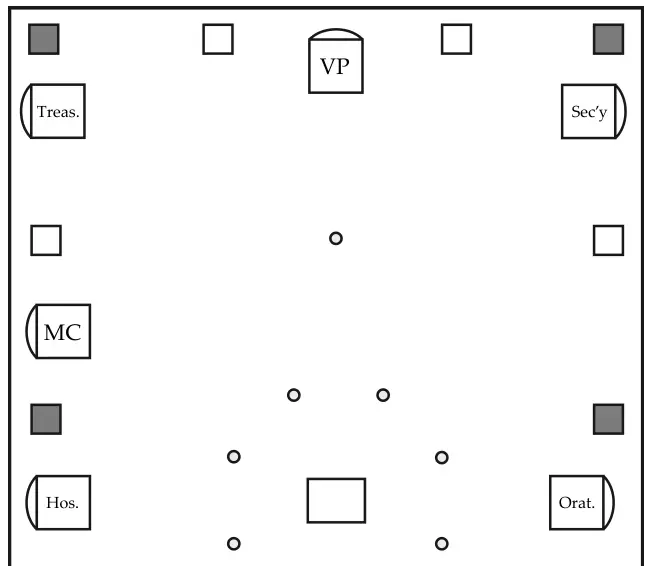
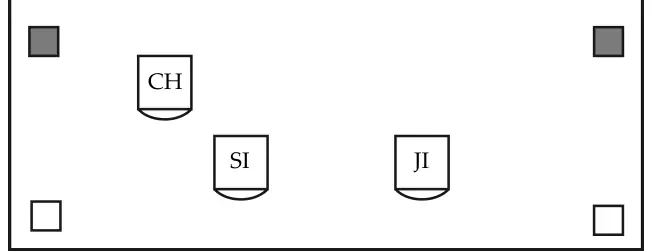
Le maître de la loge, qui représente Salomon s'appelle très souverain, ou le puissant placé à l'Orient. Il n'y a qu'un surveillant, qui est ordinairement placé à l'Occident de la loge. Tous les frères, qui se nomment très respectables, revêtus de manteaux noirs, tous placés du même côté et du côté opposé, ou indistinctement. Opposées sont les bougies qui doivent éclairer la loge au nombre neuf, 8 en peloton et la neuvième séparée des autres. Il y en a deux sur l'autel devant le souverain, une allumée, l'autre point allumée, neuve.
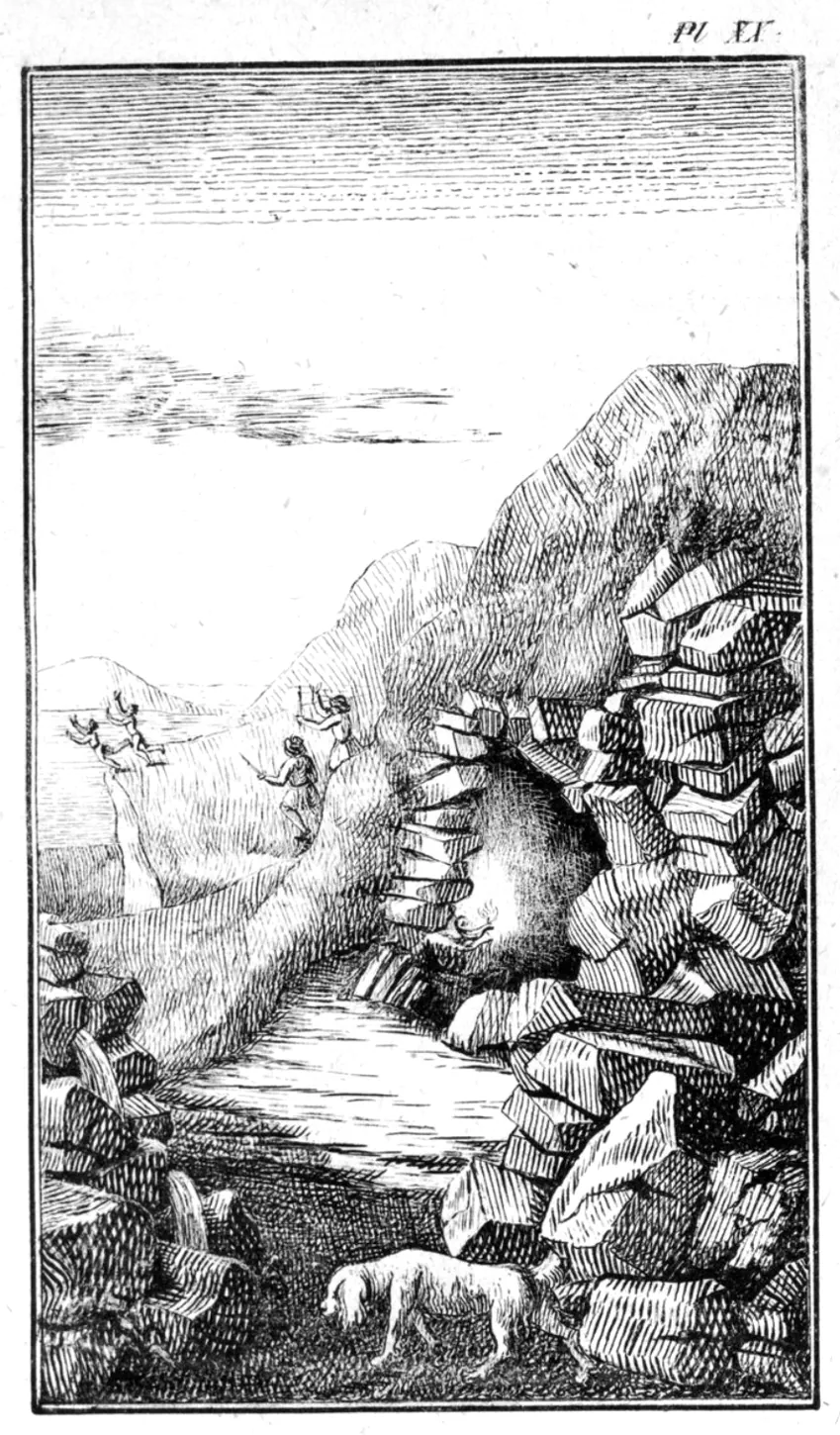
Le plan de la loge est un carré long, qui s'étend de l'Orient à l'Occident et du Midi au Septentrion en [ ?] de la loge à droite une Lune en son croissant et à gauche une étoile flamboyante et, plus bas, est un bras, armé d'un poignard, formant une équerre blanche teintée de sang, au haut duquel à droite est figurée la ville de Jérusalem et de l'autre côté le Soleil couchant. Au milieu du carré est figuré un buisson ardent et au-dessous une caverne, dans laquelle on aperçoit un homme dormant, la tête appuyée sur une pierre. On y voit aussi une lampe, un poignard, une fontaine, un vase. Sur la même place, on voit aussi tracé un chemin plein de détours qui conduit de la ville de Jérusalem au buisson ardent. Sur ce chemin, on voit un inconnu, figuré par un chien.
Dans un petit endroit à côté de la chambre où se tient la loge est pratiquée une espèce de caverne, tendue entièrement en noir dans laquelle est une table, aussi couverte d'un tapis noir ; à droite sur cette table est une tête de mort, un poignard, à gauche est un vase pleine d'eau salée, en face est un écriteau où on lit en gros caractères Vengeance. Il y a devant la table une chaise pour y placer le récipiendaire et une lampe suspendue, qui doit faiblement éclairer la grotte. Le trône du souverain est un fauteuil élevé, couvert d'un tapis pareil à la tenture. Il y a devant lui une table couverte d'un tapis couleur de feu, sur laquelle est la Bible, un sceptre et un poignard. On ne se sert point de maillet, le très souverain frappe avec son sceptre et le surveillant, qui se nomme Stolkin, frappe avec son poignard, et tous les élus se tiennent la jambe droite sur le genou gauche, qu'ils tiennent de la main gauche et la joue appuyée sur la main droite, comme pour dormir. Le chapitre
Le très puissant ouvre le chapitre par neuf coups, le dernier détaché. Tous les frères se mettent à l'ordre en croisant une jambe sur l'autre et appuyant la tête sur une main, soutenue sur les jambes croisées en manière convenable et ont leurs épées nues par terre pour marquer leur exposition à venger la mort du vénérable maître Hyram.
On annonce alors et on introduit ensuite le récipiendaire, qui a les yeux bandés et pied nus et en veste pour pouvoir franchir plus aisément et sans bruit les obstacles qui présentent à se trouver à son passage. Lorsqu'il est entré, on lui demande ce qu'il veut. Il répond qu'il demande à être admis au grade d'élu. On lui demande par où il se flatte d'avoir
mérité cette faveur et sans lui donner le temps de répondre, après que l'on a fait dire au récipiendaire diverses réflexions, on lui dit que c'est moins pour le recevoir au grade d'élu qu'il a été introduit en loge que pour s'assurer de la fermeté et de son courage et combien il est attaché aux obligations qu'il a contractées jusqu'alors. On lui rappelle les différentes circonstances des grades par où il a passé et on lui remet sous les yeux la morale qu'a dû lui faire le vénérable, lorsqu'on lui a donné la lumière et qu'il a vu les bras de chaque frère armé lui prouvant qu'ils étaient pour sa défense, s'il se trouvait jamais en aucun danger, mais qu'ils étaient pareillement pour l'immoler et venger la Maçonnerie en la lui plongeant dans le sein, s'il était jamais été malheureux de violer son serment et ses obligations, en révélant le secret des maçons et de la Maçonnerie. On lui ajoute que malgré la sainteté de nos obligations et les peines, que nous nous sommes imposés, en cas que jamais nous fussions vers d'autres, il y en a eu d'assez malheureux pour violer leur serment et s'exposer à tous les châtiments qu'ils ont prononcés contre eux-mêmes à leur réception, que la loge en tient un de renfermé qui gémit de sa faute, et attend l'instant où il doit rendre compte et être livré à toute la vigueur des peines qu'il doit subir pour venger la Maçonnerie. On continue en lui disant que la loge, ne doutant point de son zèle et étant disposée à lui accorder des grades supérieurs, lui a déféré l'avantage de porter le premier coup au coupable. On lui demande, s'il s'y sent disposé. On le prévient que ce pourrait être une de ses connaissances, peut-être même un de ses amis les plus intimes, mais que tout autre sentiment que celui de la vengeance doit être étouffée en pareil cas, on le rassure alors sur les suites, que pourrait avoir l'action qu'on lui propose et on lui ajoute que ce n'est que par là qu'il peut signaler son zèle et être admis au grade où il aspire.
Lorsque le récipiendaire s'est décidé, on lui dit de se laisser conduire dans l'endroit où le coupable est retenu. Alors le frère terrible le conduit dans la grotte préparée et l'assied devant la table.
Derrière la tenture est un frère, qui remuant des chaînes, fait entendre une voix plaintive où on devine les remords et la crainte des châtiments. Le frère terrible interroge le récipiendaire et lui dit en le quittant après l'avoir ôté la vue, placé devant la table, la tête appuyée sur la main gauche et la main droite sur la tête de mort. Avant de vous quitter, vous me donnez votre parole de maçon que quelque bruit que vous entendrez autour de vous, vous resterez dans l'attitude où je vous laisse. Il y va de vos jours, faites bien attention, vous me promettez de plus d'exécuter à la lettre ce que je vais vous prescrire :
1° Aussitôt que vous entendrez frapper en maçon, vous vous débanderez les veux et examinerez avec attention le lieu où vous êtes et ce qui vous environne [15v°].
[15v°] 2° Quand on frappera une seconde fois en maçon vous viderez ce que vous trouverez dans un vase à votre gauche sans en répandre, ni en laisser et la troisième fois que l'on frappera, vous prendrez en main le poignard, que vous trouverez sur une table et vous accomplirez de point en point ce qui vous sera prescrit par une voix que vous entendrez. Quoique je vous laisse seul, croyez que la loge a les yeux ouverts sur vous et ne manquez pas d'exécuter ce que je vous prescris. Adieu, je vous laisse.
Aussitôt il ferme avec vivacité la porte de la caverne où est le récipiendaire, que l'on livre un instant à ses réflexions. Puis le frère terrible frappe comme le récipiendaire en était prévenu et à la troisième fois il lui dit : Prenez ce poignard et cette tête et suivez-moi. Le récipiendaire exécute ce que lui dit le frère terrible et ils arrivent ensemble à la porte de la loge où il frappe neuf coups et le dernier détaché. On ouvre pour demander ce que l'on veut, et le frère terrible répond que c'est Joabert qui a fait la découverte du traître Abyram et qu'il a vengé la mort de notre respectable maître en coupant la tête du meurtrier et qu'il vient la présenter à Salomon.
On le fait entrer et marcher avec précipitation jusqu'au pied du trône en portant la tête
Malheureux, qu'avez vous fait ? J'avais ordonné, qu'on m'amenât le traître et non point qu'on le tuât ; pour votre désobéissance vous mourrez. Tous les frères, en l'instant, mettent un genou en terre et demandent grâce au très souverain en disant que c'est un excès de zèle et d'amour pour notre respectable maître Hyram qui a conduit la main de Joabert, son vengeur. On fait alors prêter l'obligation au récipiendaire, qui pose ensuite la tête et la laisse au pied du trône.
Le très souverain alors donne les signes, paroles et attouchements au récipiendaire, le remet du cordon et le tablier de l'Ordre, l'embrasse quatre fois sur chaque joue et une fois sur le front, le fait asseoir et lui tient le discours suivant :
Discours du maître au r[écipiendaire]
Très respectable frère élu, l'unanimité de cette respectable loge à demander votre grâce a trouvé notre cœur bien disposé à vous l'accorder. Votre zèle seul avait fait votre crime et vous avez en cela imité Joabert, comme vous allez l'apprendre... Vous êtes déjà parfaitement instruit de l'exécrable projet que les trois frères compagnons scélérats avaient formé et que sur le refus qu'il fit de les satisfaire, ils s'armèrent contre lui leurs fureurs et leur rage, et le massacrèrent cruellement dans ce même temple que Salomon ferait construite pour être consacré à l'Eternel et dont le respectable Hyram avait la conduite et la direction.
Il est temps de vous développer les mystères qui jusqu'à ce jour vous ont été inconnus et de vous instruire de la juste vengeance que Salomon tira de la mort de ce respectable maître. Ce roi, dont la sagesse ne s'est jamais démentie et dont les jugements ont toujours été dictés par l'esprit divin, après avoir été informé, comme vous le savez, après le respectable maître Hyram ne venait plus à son ordinaire visiter les travaux du temple et qu'on ne savait même pas ce qu'il était devenu, ordonna ensuite que le temple resterait fermé pendant neuf jours et que tous les travaux en seraient suspendus. Il envoya ensuite neuf maîtres à sa recherche qui lui apprirent aleur retour la déplorable nouvelle de sa mort. Ce fut Stolkin qui le trouva assassiné et enterré sous un acacia. Ce triste bonheur rendit Stolkin fort agréable au roi et lui valût la plus intime confiance auprès du prince, qui ne se bornant pas à rendre à cet excellent maître les honneurs funèbres les plus distingués, voulut encore lui assurer une vengeance authentique.
Il fit publier un édit par lequel il promettait une grande récompense à celui qui lui découvrirait la retraite du meurtrier de ce grand homme, déclarant même à celui qui avait connu ce crime qu'il lui ferait grâce, s'il venait s'accuser lui-même en déclarant ses complices dont le sang expirerait le plus grand des forfaits.
Il ne douta pas qu'il n'eut été commis par quelque compagnon, avide du salaire de maître, qui, ayant voulu arracher du respectable frère maître le mot et l'attouchement qui les distinguaient, n'eut porté sur lui ses mains criminelles, confirmé dans cette idée que sans doute le ciel lui avait suggéré pour que le crime du meurtrier ne restât pas impuni. Il fit assembler tous les ouvriers, qui travaillaient au temple et ayant fait faire l'appel et trouvé, que trois compagnons avaient disparu, il rendit un édit par lequel il assignait une récompense considérable à celui qui pourrait le découvrir.
Cet édit fut longtemps sans aucun effet. Un jour enfin, que Salomon s'entretenait dans sa salle avec son nombre de 3 fois 2 respectables maîtres et même plus, tous officiers de l'Ordre, le capitaine des gardes vint annoncer un inconnu qui demandait à révéler à Salomon un secret de la plus grande importance. Les frères furent alarmés de la facilité avec laquelle Salomon accorda l'audience particulière qu'on lui demandait. Cette audience ne fut pas longue et Salomon revint bientôt rassurer les frères en leur apprenant que cet inconnu savait où se retirait l'assassin du maître des maîtres et offrait d'y conduire ceux qui voudraient
et s'offrirent à suivre l'inconnu. Le roi, touché de leur zèle, déclara que le sort seul déciderait en faveur de ceux qui seraient envoyés pour lui amener l'audacieux individu digne de la plus juste vengeance. Il en fixa le nombre à neuf et fit mettre tous les noms des frères présents dans une urne. Les neuf premiers qui en sortirent furent ceux que Salomon chargea de suivre l'inconnu et de lui amener vif le traître Abyram Akiroff pour en faire un exemple à jamais mémorable. La plus grande joie éclata alors dans les yeux de ceux que le sort venait de nommer. Salomon leur ordonna de suivre l'inconnu et de l'accompagner dans l'antre qui servait de retraite au traître. Les neuf élus se mirent en marche de compagnie à l'entrée de la nuit, mais un d'entre eux, nommé Joabert, dont vous occupez aujourd'hui la place, mon cher frère, trouvant la marche trop lente pour son ardeur, laissa ses huit camarades suivi de l'inconnu et, arrivé le premier à l'antre qui servait de retraite au monstre, il y entra en frémissant, l'aperçut à la faveur d'une lampe, courbé sur le dos et dormant. Il l'examina attentivement et après s'être assuré que c'était le misérable Abyram lui-même, il se saisit d'un poignard, qu'il trouva à ses pieds, en frappa un grand coup sur la tête du meurtrier, qui se leva furieux et tomba mort sur-le-champ en disant Necum. Joabert lui coupa aussitôt la tête et [16r°] sortit de la caverne pour aller joindre les autres maîtres qu'il [16r°] croyait trouver dehors avec l'inconnu, mais n'ayant vu personne il rentra dans la caverne, où il se sentit dévoré par une ardente soif, et ayant heureusement trouvé une source, il s'y désaltéra et se disposait à aller rejoindre ses camarades qui arrivèrent sur ces entrefaites et voyant Abyram mort, firent connaître à Joabert la faute que son zèle lui avait fait commettre en immolant un traître, que son trop d'ardeur dérobait au supplice que Salomon lui avait destiné. Ils lui firent envisager le châtiment où son imprudence l'avait exposé, promirent de solliciter sa grâce et d'implorer pour lui la clémence de Salomon à qui ils portèrent la tête du traître Abyram.
Salomon les voyant revenir, se préparait à ordonner le supplice lorsqu'il aperçut Joabert, la tête d'Abyram Akiroff à la main. Il ne put retenir le premier mouvement de son indignation et le condamna à la mort qu'il aurait subie si tous les frères, à l'exemple de ceux qui composent ce respectable chapitre, ne se furent unis pour solliciter sa grâce que Salomon lui accorda et ordonna que tous les travaux fussent continués dans le temple.
Il n'ya point de bonne instruction, que vous ne puissiez tirer de toutes ces circonstances.
1° Vous voyez dans la mort, que subit Abyram, que tôt ou tard le crime est puni.
2° Dans le danger, que court l'impétueux Joabert, qu'il est souvent dangereux de passer les ordres qu'on a reçu et que l'obéissance aux ordres du souverain, ou des supérieurs, doit être littérale.
3° Dans la grâce, que cet élu trop ardent obtint, qu'il y a de grandes ressources dans le cœur des bons princes et qu'il est très utile d'avoir partout des amis, qui s'intéressent à nous dans les occasions critiques.
Voilà vénérable maître, de quelle manière fut vengée la mort du vénérable Hyram. Salomon satisfait de l'ardeur qu'avaient témoignée tous les maîtres pour aller à la recherche du coupable et de l'heureux succès qu'avait eu leur mission et voulant les récompenser augmenta de beaucoup leur salaire, leur donna des signes, des attouchements et des mots, afin qu'ils puissent se reconnaître entre eux. Je vais vous les donner, pour que vous jouissiez de la même récompense, qu'ont méritée jusqu'à présent votre zèle et votre attachement pour tous nos respectables mystères, après que nous aurons applaudi à votre réception pour huit et un… Applaudissons chers frères. Exercice des signes Le signe est de présenter le poing fermé, le pouce haut comme si on voulait frapper quelqu'un en disant : Le mot est… Necum ou Nicak.
On répond à ce signe en portant la main sur le front, comme si on y eut reçu un coup et on prononce le mot de passe qui est… Vengeance…
L'attouchement se donne en présentant le poing fermé, le pouce haut, l'autre prenant également la main, prend dans la sienne le pouce de celui qui lui présente l'attouchement et lui demande combien en tirer neuf. On répond huit et la réplique est huit et moi un, ce qui compose le nombre de neuf, dont le dernier est détaché. La parole de passe est Baülkall, qui veut dire chef de la bande. Attributs
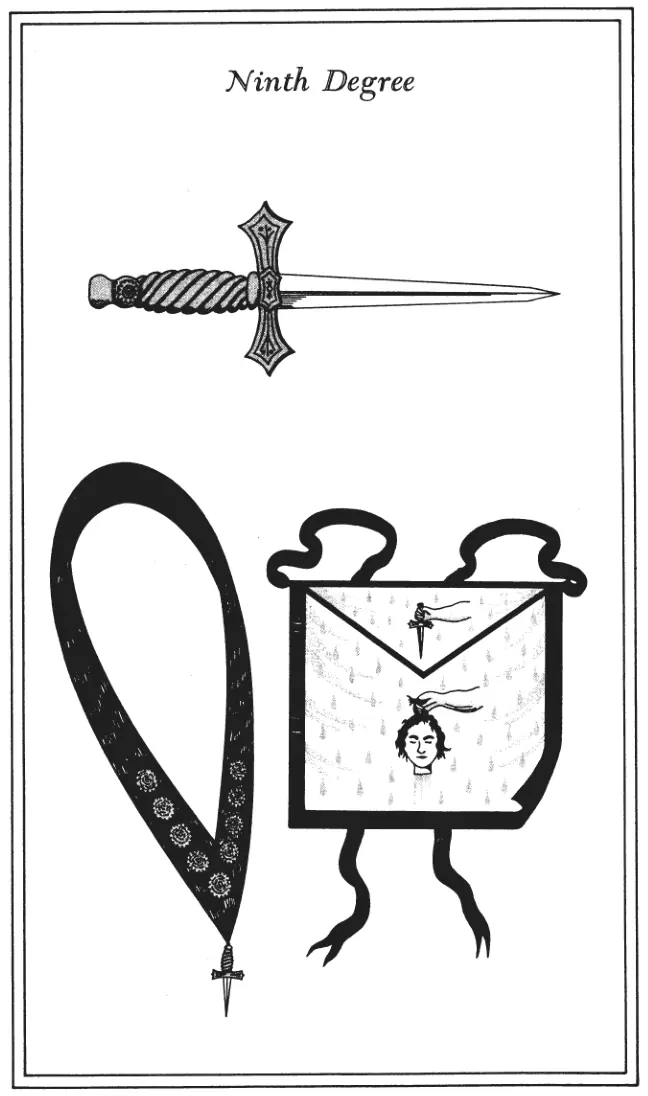
Tous les officiers et autres sont décorés d'un ruban noir moiré, large comme la main, qui se passe sur l'épaule gauche et tombe sur la hanche droite, où pend un petit poignard d'acier sans fil. Il doit y être attaché une rosette rouge de neuf boucles, dont huit ensemble et une séparée où pend le poignard
Le tablier est de peau blanche, semé de gouttes de sang, et doublé de noir, sur la pointe de la bavette, au revers est peint un petit poignard rouge, la pointe en bas. Les gants sont blancs semés de gouttes de sang, et doublés de noir.
Discours du frère orateur
Vénérable maître, la consternation générale que vous voyez répandue sur nos visages, le silence profond qui règne dans ce lieu de douleur et de tristesse, ces lugubres ornements dont vous nous voyez décorés, tout vous retrace ici la mort du respectable Hyram et la vengeance que nous en avons tirée.
Vous devez avoir pressenti, après avoir reçu le grade de maître qui vous fut conféré, qu'il vous manquait encore quelque chose pour vous perfectionner dans l'état de maçon que vous avez embrassé. Vous avez même peut-être aperçu que la mort d'Hyram devait être vengée et que Salomon ne pouvait remettre qu'à nous le soin de punir le scélérat qui en était l'auteur.
Vous recevez aujourd'hui la récompense qu'a méritée votre ferveur. Le sublime titre d'élu, dont nous venons de vous conférer le premier grade, est un titre que vous devez regarder toujours comme une faveur singulière qui doit animer votre zèle, redoubler votre attachement et éterniser votre reconnaissance.
Vous êtes élu, c'est-à-dire choisi parmi les autres maîtres pour aller à la recherche du malheureux qui trempa ses mains sacrilèges et parricides dans le sang du respectable Hyram. Ce poignard, dont vous nous voyez armé et que vous devez porter comme une marque distinctive de notre état présent, doit vous rappeler sans cesse le pouvoir de ce respectable maître. Vous devez lire en même temps dans la sage allégorie qu'il renferme tous nos devoirs et toutes nos obligations, c'est-à-dire que vous devez avoir toujours ce poignard levé pour en frapper celui qui, comme un autre Abyram Akiroff, serait capable de se porter aux criminels excès où ce malheureux se porta. Cette utile allégorie vous impose encore la loi de devenir l'appui, le secours et le défenseur de nos frères, de vous tenir continuellement en garde contre l'artifice, la trahison et la perfidie et d'opposer sans cesse le courage et la fermeté aux pressantes attaques du prestige et de la séduction.
Le terrible mot Vengeance, que nous proférons souvent, est non seulement pour nous rappeler celle que nous tirâmes de l'assassin de notre respectable maître, mais il renferme encore un sens mystique qu'il vous est bien aisé de pénétrer, si vous avez considéré que les passions étant les plus dangereuses ennemies du repos de l'humanité, nous devons sans cesse les combattre et nous venger pour ainsi dire des victoires qu'elles ont remporté sur
nous en les soumettant impérieusement aux équitables lois que la Divinité nous impose.
Cette grotte, dans laquelle vous est représenté le malheureux Abyram, éloigné du commerce des hommes et enseveli dans un profond sommeil, que vous ne devez regarder que comme la figure de son abandon et la marque certaine de sa réprobation, ne sont ce par là autant de infamantes images de l'homme criminel, absorbé dans ses cruelles réflexions, entièrement livré à l'horreur de ses remords, épouvanté par la crainte du plus terrible châtiment, accablé sous le poids de l'affreuse idée que lui offre sans cesse la noirceur de ses forfaits et frappé enfin du glaive vengeur qui l'avait si souvent menacé [16v°].
[16v°] Le buisson ardent qui se trouve presque à l'entrée de la grotte, triste refuge d'Abyram, est une image de cette lumière divine qui veille toujours sur le crime, qui suit de près le criminel et dont les rayons lumineux semblent miraculeusement servir à découvrir et à indiquer le lieu de sa retraite quelque cachée et quelque retirée qu'il ait pu la choisir.
La soif dont Joabert se sentit dévoré après avoir immolé l'assassin du vénérable Hyram, vous représente l'homme qui, après s'être laissé emporter par les transports d'un premier mouvement, réfléchit sur l'action qu'il vient de faire, en pose les motifs et voit bien qu'elle ne saurait être entièrement justifiée. Salomon avait ordonné qu'on lui amenât le coupable en vie. Joabert reconnaît qu'il n'a pas exécuté cet ordre et le cuisant repentir qu'il en a ne peut- être mieux figuré que par la soif ardente qu'il ressent comme la première punition de sa désobéissance.
La fontaine que trouva enfin Joabert et dont les eaux salutaires servirent à le désaltérer, doit être regardée dans le vrai sens allégorique, comme un doux et flatteur espoir qu'il sentit naître dans son cœur que Salomon lui pardonnerait en faveur du zèle qu'il avait montré à servir la justice et à se dévouer pour être l'instrument de sa vengeance.
Voilà très vénérable maître, les seuls tableaux que je puis vous offrir aujourd'hui et qui regardent le grade, que nous venons de vous confier. Nous nous flattons que vous travaillerez efficacement à mériter la connaissance des autres mystères qu'il nous reste à vous dévoiler. Soyez persuadé qu'il n'en est aucun auquel vous ne puissiez faire une avantageuse application et qui ne doive vous servir à perfectionner les vertus, dont vous avez appris la pratique dans les loges ordinaires que vous fréquentez.
Vous trouverez ici mais dans un degré bien plus éminent le siège de la sagesse, l'école des bonnes mœurs, l'asile du silence, de la candeur, de la probité, de l'ordre et de la discipline à appliquer, parce que vous serez dans la nouvelle carrière qui vient de vous être ouverte. Vous trouverez de nouveaux objets et vous découvrirez de plus vives lumières qui combleront votre attente et feront votre indignation et notre respect.
Nous vous confions des secrets qui vous garantissent l'idée favorable que nous avons de votre discrétion. Nous vous croyons incapable de démentir notre confiance et vous devez savoir que nous regarderions parmi nous celui qui oserait révéler le moindre de nos mystères comme un traître qui mériterait la même vengeance qui fut exercée 'contre le meurtrier de notre respectable maître Hyram.
N'oubliez donc jamais que nos devoirs étant aujourd'hui bien plus grands et plus essentiels, vous devez par conséquent employer des soins plus actifs et plus efficaces pour les remplir avec la dignité qu'ils exigent de vous. Ayez toujours en vue et pour unique objet la sage et fructueuse morale que vous pouvez retirer de nos sublimes travaux, gravez-les profondément dans votre cœur et dans votre esprit. Chérissez-en les sacrés caractères et regardez-les comme une règle sûre sur laquelle vous devez sans cesse diriger vos actions, vos démarches et votre conduite. Souvenez-vous, enfin, que vous êtes élu et, qu'étant une fois revêtu de cet état respectable, vous devez toujours le soutenir avec dignité et donner des marques constantes de votre zèle et de votre attachement qui, servant à tous nos frères de modèle et d'exemple, puissent en même temps justifier votre élection.
Clôture de la loge
Le très respectable maître demande à Stolkin s'il n'a rien de plus à proposer pour le bien du chapitre et le ferme par ces questions. Le très souverain dit : Renouvelons notre obligation, mes frères. Après cette cérémonie, on se donne les signes, paroles et attouchements, le très souverain frappe 8 coups et un séparé et dit très respectable Stolkin, respectables frères élus, le chapitre est fermé. Le frère Stolkin répète et tous applaudissent par 8 et un. La doctrine du maître élu
D. Etes-vous élu ?
R Une caverne m'est connue et le sort seul en a décidé.
D. Qu'avez-vous vu dans cette caverne ?
R. Une lumière, un poignard, une fontaine et une tête de mort.
D. A quoi vous ont servi toutes ces choses ?
R La lumière à m'éclairer, le poignard à venger la mort de notre respectable maître et la fontaine à me désaltérer.
D. Où avez-vous été reçu élu ?
R. Dans la salle de Salomon.
D. Combien fûtes-vous choisis de maîtres pour l'être ?
R. Neuf, moi compris.
D. Dans quel nombre furent choisis les neuf élus ?
R. Dans celui de 90 maîtres.
D. Qui vous a porté à vous faire recevoir élu ?
R. Le désir de venger la mort d'Hyram en exterminant son assassin que l'on nomme le traître Abyram-Akiroff ou Judeus.
D. Où l'avez-vous trouvé ?
R. Au fond d'une caverne située au pied du buisson ardent.
D. Qui vous y a conduit ?
R. Un inconnu.
D. Par où vous y a-t-il mené ?
R. Par des routes obscures et difficiles à pratiquer.
D. Que fîtes-vous quand vous fûtes arrivé dans la caverne ?
R. Je me saisis d'un poignard, que je trouvai et en frappai un coup si violent sur la tête du traître Abyram, qu'il en mourut sur-le-champ.
D. N'a-t-il rien dit en mourant ?
R. Il n'a proféré qu'une seule parole.
D. La savez-vous mon frère ?
R. Oui très souverain. Donnez-moi la première, je vous donnerai la dernière.
D. N.
R. M. Ensemble Necum qui veut dire Vengeance [17r°].
[17r°] D. Comment avez-vous consommé votre élection ?
R. Par la vengeance, la désobéissance, la clémence et par 8 et un.
D. Expliquez-moi cela.
R. Par la vengeance en immolant le meurtrier, par la désobéissance en passant les ordres du roi, par la clémence en obtenant une grâce à la prière de mes frères et par 8 et un parce qu'en tout nous n'étions que neuf.
D. Que fîtes-vous après avoir tué Abyram ?
R. Je lui coupai la tête, je me désaltérai à la source d'eau et excédé de fatigue, je m'endormis
D. Comment vous reçut Salomon, quand vous lui présentâtes la tête du traître ?
R. Avec indignation, parce qu'il s'était réservé la punition de cet abominable assassin, mais il me pardonna ensuite en faveur de mon zèle.
D. Que représente la chambre noire ?
R. L'entrée ou la retraite du meurtrier.
D. Pourquoi vous y a-t-on hissé les yeux bandés ?
R. Pour me rappeler le sommeil du traître, ou l'oubli de soi-même, quand on a commis le crime.
D. Comment marchent les élus ?
R. L'obscurité les oblige à mettre les mains devant la tête par peur de se heurter, comme aussi la difficulté du chemin oblige de croiser les pieds, l'un sur l'autre, en marchant C'est pourquoi les élus font en chapitre les pieds croisés et la jambe droite sur le genou gauche.
D. Que représente le chien que l'on voit sur la route ?
R. L'inconnu qui conduisait les élus.
D. Que représente le bras nu armé et ensanglanté ?
R. Que la vengeance est toujours préparée pour le crime.
D. Que signifie le cordon noir, armé d'un poignard ?
R. La douleur, que nous cause la perte d'Hiram quoi qu'elle ait été vengée.
D. Comment exprimez-vous le nombre des neuf élus ?
R Par neuf rosettes de ruban rouge, dont une où pend le poignard, par 9 lumières, par 9 coups et par 9 baisers.
D. Comme est tendu votre chapitre ou votre loge ?
R D'une tenture rouge et blanche, mêlée de flammes rouges et blanches, pour marquer du sang, qui fut répandu et de la pureté des élus.
D. Pourquoi n'y a-t-il qu'un surveillant en loge ?
R. Parce qu'elle se tient dans l'appartement de Salomon où tout se passe entre lui et son favori.
D. Que vous reste-t-il à faire maintenant ?
R. Rien, puisque tout est accompli et Hyram vengé.
D. Quelle heure était-il, quand vous partîtes pour la caverne ?
R. L'entrée de la nuit.
D. Et lorsque vous en revîntes ?
R. L'aube du jour.
D. Quel âge avez-vous ?
R. Neuf ans. ---- Fin ---- Le très respectable frappe 8 et un coups et dit : Très respectable Stolkin le chapitre d'élu est fermé. Ce qui est répété par Stolkin. On applaudit par 8 et un coups. Omissions
D. A quoi l'eau de la citerne vous a-t-elle servi ?
R. A me désaltérer.
D. Pourquoi l'eau de la citerne était-elle salée ?
R. Parce qu'elle était située au bord de la mer.
D. Qui vous a conduit en la caverne ?
R. Un inconnu représenté en chapitre par un chien, symbole de la fidélité, dit Pérignan.
R. Stolkin et selon d'autres Joabert.
Le nom du maître de cérémonies dans l'élu ou le frère terrible s'appelle Alcidony.
D. Comment étaient les chemins de la caverne ?
R. Raboteux, rempli de roches et de difficiles accès.
D. Comment marchent les élus ?
R. L'obscurité les oblige à mettre les mains devant la tête, de peur de se heurter, comme aussi la difficulté du chemin oblige de croiser les pieds, l'un après l'autre en marchant, c'est pourquoi les maîtres élus sont en chapitre les pieds croisés, ou la jambe droite sur le genou gauche. Observation
La réponse ci-dessus doit faire renier que la faute qui s'est glissé dans l'instruction à la demande, quelle heure était-il quand vous parûtes pour la caverne, on a confondu la réponse du retour avec celle du départ.
Car les neuf élus, pour surprendre plus aisément le traître Abyram, partirent à l'entrée de la nuit et revinrent au point du jour, comme on ouvrait les portes de Jérusalem, on peut encore juger de la justesse de cette réponse par le sommeil qui s'empara de Joabert, après avoir coupé la tête du traître. La recherche, qu'on en fit, fut pendant le silence de la nuit et se rend à l'aube du jour, figurée par la Lune à son croissant et le lever du Soleil, d'ailleurs quel besoin avait Abyram d'une lampe pendant le jour ? C'est assez prouver l'observation. –
[Signature]
Apparat critique de la transcription Aeditimus
7. A chaque thème, correspondant à un grade, nous avons procédé à un changement de page, même quand cela n’était pas le cas dans le manuscrit. Ce faisant, la clarté de l’ensemble s’en trouve renforcée.
8. Dans le manuscrit, les demandes (D.) et réponses (R.) sont données à la suite, sans alinéas. Nous les séparons ici, afin de rendre l’ensemble plus clair. Nous ferons de même par la suite, pour tous les catéchismes du présent document.
9. Nous mettrons systématiquement une majuscule aux divers noms ou mots de passe, de degré, etc. donnés dans le manuscrit, et ce afin de les distinguer. Le manuscrit n’en fait pas usage (ou rarement).
16. Ce passage, semble destiné à apporter une précision à l’histoire du grade.
17. Au bas de cette section, ce qui semble être un paraphe. Il peut cependant s’agir de la mention Fin. Deux remarques toutefois : - 1° La forme même invite à pencher pour la première lecture. - 2° On trouve en plusieurs endroits cette même « marque », accompagnée de la mention explicite Fin. Aussi retiendrons-nous ici la première lecture, faisant de même chaque fois que le cas se reproduira dans le manuscrit.
19. Rappelons que l’alphabet latin ne distingue pas, à l’origine, le I du J.
20. Cf. supra : note 17, page 22 de la présente transcription (page 8v° du manuscrit). A noter la même « marque » au centre de l’alphabet reproduit ci-après.
21. Cette mention semble avoir été rajoutée secondairement.
22. Dans le manuscrit, chaque nombre associé à chacun des vices est associé à sa représentation symbolique. Nous ne l’avons pas reproduite ici ; on se reportera sur ce point à la reproduction du document.
23. Ici, une série de parenthèses non fermées qui ne semblent pas s’imposer ; nous ne les figurons pas, nous contentant de les remplacer par un simple tiret de séparation.
24. Ou Ya ?
25. Précisément : L’arithmétique arabesque et algébrique. Nous avons abrégé, faute de place.
26. Cf. supra : note 17, page 22 de la présente transcription (page 8v° du manuscrit).
27. Rajout, dans l’interligne inférieur.
Bérage 1766
divulgation imprimée · 6 168 mots
Première divulgation imprimée des hauts grades : « Les Plus Secrets Mystères des Hauts Grades de la Maçonnerie dévoilés, ou le vrai Rose-Croix » (« Jérusalem », 1766), attribué à Bérage. Texte établi sur le fac-similé et relu mot à mot sur les images : océrisation à 400 dpi de l'exemplaire numérisé par archive.org, fusionnée avec la couche texte de la numérisation, s longs restitués, puis relecture page par page. L'orthographe de 1766 est conservée telle qu'imprimée (ornemens, Freres, sçavez, très-Sage), coquilles de l'édition comprises. Les repères entre crochets droits donnent la pagination de l'original. Pages 1 à 36 du volume. Le volume donne sous ce numéro deux cahiers successifs : le Parfait Maçon Élu, « qui a conservé la formule originaire de la Maçonnerie », et l'Élu de Pérignan, tous deux versés au 9e degré du Rite.
La Loge qui représente le Cabinet de Salomon, doit être proprement décorée. La tapisserie peut être de plusieurs couleurs. L'orient doit être assez large pour contenir deux fauteuils dessous. Sur la même ligne au pied du trône à la droite, on placera un petit autel couvert d'un tapis qui portera trois bougies de cire jaune placées en équerre, & le Livre de la Sagesse. La Loge doit être éclairée [p. 2] par neuf bougies jaunes suspendues dans un lustre, ou placées indistinctement dans des flambeaux à terre; mais il faut qu'il y en ait une séparée des autres au moins d'un pied. Si on veut l'éclairer davantage, on peut représenter le Buisson ardent avec des feuilles & des branches d'arbres qu'on éclairera par des lampions. La Loge doit être craïonnée sur le carreau de la salle, comme elle est représentée ci-après. Tout autour seront des siéges sur lesquels s'asseoient les Freres. Cette Loge étant le conseil des neuf, on ne peut absolument la tenir qu'on ne soit neuf, dont les deux premiers sont Salomon & Hiram Roi de Tyr, qui tous deux occupent le Trône; mais Salomon préside à la droite. Ces deux Rois doivent avoir la couronne en tête. Celle de Salomon est enrichie de pierreries; il n'y en aura point à celle du Roi de Tyr; il portera seulement un sceptre bleu doré à filets & surmonté d'un triangle lumineux, emblême de la Sagesse & de la perfection. Le Roi de Tyr tiendra en main un grand poignard. Le reste de l'habillement sera semblable à celui des Freres, excepté que Salomon aura des gands garnis d'une frange, & le tablier bordé d'une dentelle d'argent. Tous les Freres seront vêtus de noir & porteront un petit plastron sur le côté gauche, [p. 3] sur lequel sera brodée une tête de mort avec un os & un poignard en sautoir en argent; le tout entouré de la devise, vaincre ou mourir. Ils auront un grand cordon noir-moiré large de quatre doigts pendant de droite à gauche, portant sur le devant cette devise, vaincre ou mourir; brodée en argent. Au bas du cordon il doit y avoir une rosette de ruban blanc au bout de laquelle pend un petit poignard dans son fourreau. Le tablier doit être de peau blanche doublée de noir; sur la bavette sera brodée une tête de mort avec un os & une épée en sautoir, soumise à une équerre brodée en or. Sur la poche du tablier sera une grosse larme, au bas & sur les côtés huit autres larmes plus petites; au bout de la poche une branche d'acacia. Les gands seront doublés de taffetas noir & bordés de même.
TITRES
Le Maître se nomme très-Sage, le Roi de Tyr très-Puissant, & les Freres très-Respectables. Il n'y a point de Surveillant; mais le très-Sage, aussi-tôt qu'il est monté au trône, nomme un Frere, qu'on appelle l'Intime du Conseil.
[p. 4]
COMMENCEMENT DU TRAVAIL
Le très-Sage, la couronne en tête, étant assis, dit au Roi de Tyr, qui se présente au pied du trône : « Très-puissant Roi de Tyr, que venez-vous faire ici ? » Le Roi de Tyr répond : « Très-Sage, je viens vous demander vengeance de la mort de l'Architecte du Temple, laquelle jusqu'à ce jour est restée impunie ». Le très-Sage dit : « Prenez place, mon Frere, & soyez témoin des recherches que je vais ordonner de faire du meurtrier ». Le Roi de Tyr monte au trône & se place. Salomon nomme un frere, qui, à l'instant, vient mettre un genou en terre au pied du trône. Salomon prend son sceptre, & le lui pose sur la tête, en lui disant : « Frere, je vous constitue l'Ancien du Conseil, pour veiller à la sûreté de la loge; commencez vos fonctions par vous assûrer des qualités des Freres ici présens ». Le Frere se leve, salue les deux Rois, puis va prendre le signe, l'attouchement & la parole de chaque Frere; de retour au pied du trône, il dit en s'inclinant très-profondément : « Très-Sage, le Conseil n'a que des sujets fideles ».
[p. 5]
Salomon se leve, & dit : « Mes Freres, que le grand Architecte nous éclaire, que l'équité nous dirige, & que la vérité prononce. Frere ancien, écartez tous les Profanes, & souvenez-vous que sous ce nom nous comprenons les Maçons qui ne sont pas honorés du nom de Maître élu ».
Le Frere ancien va visiter tous les environs, place un Frere en sentinelle en-dedans de la porte, l'épée à la main, & revient au pied du trône, où s'étant incliné, il dit : « Tout est couvert : les gardes environnent les portes du Palais, & nul Profane ne peut pénétrer nos mystères ». Salomon fait signe au Frere ancien d'aller aux extrémités des ouvrages. Sitôt qu'il y est arrivé, le très-Sage dit : Quelle heure est-il ? La pointe, ou le commencement du jour ? Salomon frappe sept coups égaux & deux précipités, en disant N. N. M. qui signifie vengeance. Les Freres répétent de même N. N. M. & frappent neuf coups dans leurs mains. Après quoi Salomon dit : Mes très-respectables Freres, la Loge est ouverte. Il fait le signe de demande, & les Freres celui de réponse; puis il continue : « Vous savez avec quelle douleur j'ai appris la perte du grand homme que j'avois commis à la direc- [p. 6] tion de nos ouvrages; en vain j'ai tout mis en œuvre pour découvrir les malheureux qui ont commis ce crime détestable, tout doit nous porter à sa vengeance, le Roi de Tyr vient ici la reclamer; je lui laisse le soin de vous inspirer de justes sentimens qui vous animent pour venger la mort funeste d'un homme qui étoit si digne de ma confiance ».
Le Roi de Tyr descend du trône, vient sur le tableau, tire son épée, & montre avec la pointe le fils d'Hiram, qui y est représenté, & dit : « Voilà, mes Freres, le gage sacré que vous a laissé ce grand homme. Il doit s'attendre que si sa mémoire vous est chere, les cris de cet enfant, ses larmes & ses prieres vous toucheront. Il vous demande vengeance de la mort de son pere, qui étoit votre compagnon & votre ami. Unissons donc nos efforts pour découvrir l'assassin. Qu'il éprouve ce qu'il mérite ». Alors tous les Freres mettent la main sur leur poignard, le tirent, & s'écrient N. N. M. Le Roi de Tyr remonte au trône, & comme Salomon se leve pour recueillir les voix, l'on entend un grand bruit à la porte, qui se termine par neuf coups que frappe le Récipiendaire, averti par un coup qu'a donné en dedans le Frere
[p. 7]
sentinelle : Salomon paroît s'en indigner, & dit avec colere : « Frere Intime, voyez qui occasionne ce bruit, & comment mes ordres sont exécutés ». Le Frere sort, & rentrant tout-à-coup d'un air surpris dit : Très-Sage, le Conseil est trahi. Tous les Freres mettent l'épée à la main, & disent N. N. M. Salomon en impose en disant, le sceptre levé : « Que notre indignation céde un instant à la nécessité d'entendre le Frere Intime en son rapport. Dites-nous, Frere Intime, qui a causé cette rumeur, & qui a eu l'audace de troubler notre auguste Conseil ? » Le Frere ancien au signe de réponse dit : « Je viens de voir avec surprise qu'un Frere s'est glissé clandestinement dans l'extérieur de cet appartement. Il est à craindre qu'il n'ait entendu les secrets du Conseil. Je dirai même en tremblant qu'il est à présumer qu'il est souillé de quelque grand crime : ses mains sont teintes de sang, & le glaive tranchant qu'il tient dépose contre lui, & tout excite mes soupçons ».
Salomon leve son poignard, & dit, qu'il soit sacrifié aux mânes d'Hiram. Le Roi de Tyr se léve, & dit : « Mon Frere, écoutez votre sagesse ordinaire, & ne précipitons rien. Si j'en crois mes soupçons & mon cœur, cet homme est [p. 8] le meurtrier que nous cherchons, ou du moins pourra-t-il nous en donner quelques nouvelles. Mon avis seroit qu'il fût désarmé & introduit, le col, le corps & les mains liés, les yeux couverts d'un bandeau, afin que dans cet état il répondît aux interrogations que votre sagesse vous inspirera ». Salomon levant son sceptre dit : « Mes très-respectables Freres, vous avez entendu les motifs de confiance du très-puissant Roi de Tyr, les précautions que sa sagesse & sa prudence lui suggérent; êtes-vous d'avis qu'on suive son sentiment ? »
Tous les Freres qui veulent consentir étendent la main à la maniere accoutumée; ensuite Salomon dit : « Frere ancien, vous avez entendu ce que le Conseil vient de décider. Allez trouver le téméraire, inspirez-lui de la confiance & de la terreur; amenez-le au pied de notre trône dans l'état dit ». Le Frere Intime sort pour aller chercher le Candidat.
PRÉPARATION DU RÉCIPIENDAIRE
Le Frere Ancien en arrivant se saisit de son épée, la lui ôte, & l'envoie à la Loge par un Frere qu'il a eu soin d'emmener avec lui. Ce
[p. 9]
Frere en le présentant au très-Sage, lui dit, il est desarmé. Le Frere Ancien le mene au bout de la Loge, il lui passe un cordon ou ruban rouge pardessus le col, avec lequel on lui attache les mains, & dans lequel on lui enferme le corps. Après on lui fait ôter tout-à-fait ses souliers, on lui met un bandeau fort épais sur les yeux, & des gands ensanglantés dans les mains, ayant son chapeau ôté & son tablier mis en Maçon. Quand il est en état, le Frere Ancien lui dit : « Sondez votre cœur, mon Frere, on vous soupçonne d'un grand crime digne d'un châtiment capable d'épouvanter le cœur le plus féroce. Vous pouvez cependant espérer de l'indulgence, si la sincérité guide vos paroles. Si vous êtes innocent, suivez-moi avec confiance ». Ensuite le Frere Ancien met son poignard sur le cœur du Récipiendaire, le mene à la porte de la Loge, il en doit avoir la clef, il ouvre, il introduit le Candidat, & le met à l'occident. Lorsqu'il y est, & que tous les Freres sont assis, Salomon dit au Récipiendaire : Que cherches-tu ? Le Frere Ancien lui dicte ses réponse : La récompense qu'il m'est dûe.
D. Crois-tu que les Maçons autorisent le crime & le meurtre ? Tremble plutôt du [p. 10] juste châtiment qui t'est réservé ! Qui es-tu ?
R. Le meilleur des Maçons, le plus zélé de tous les Freres, ou du moins le plus digne de ce titre.
D. Vil assassin ! qu'oses-tu dire quand tu te présentes dans ce lieu sacré, les mains teintes d'un sang sans doute innocent ? Tout dépose contre toi, tout annonce le meurtre.
R. Je me soumets à tout, si je suis coupable.
Le Roi de Tyr dit : Hiram Abif soit vengé.
Tous les Freres disent N. N. M.
Mes Freres, soyez contens, le meurtrier d'Hiram est découvert.
D. L'imposture est trop grossiere, il est déjà coupable, puisqu'il cherche à nous tromper; que réponds-tu ?
R. Que c'est à tort qu'on me soupçonne du meurtre d'un Maître dont je respecte la mémoire; je ne viens qu'à dessein de vous en donner des nouvelles, par les découvertes que j'ai faites.
D. Quelles sont donc ces nouvelles ?
R. Une caverne, un buisson ardent, une fontaine jaillissante, un chien pour guide, m'ont indiqué le lieu de sa retraite.
D. Quels en sont les garants ?
[p. 11]
R. Mes mains trempées dans le sang de trois animaux, le lion, le tigre & l'ours, qu'il avoit apprivoisés pour garder l'entrée de sa caverne, & que j'ai détruits pour y parvenir.
D. Que viens-tu demander ?
R. Me jetter aux pieds du Roi pour prendre ses ordres, & s'il veut que je lui livre Abiram mort ou vif.
D. Quelle preuve donnes-tu de ta foi ?
R. Les promesses les plus sacrées seront le garant de mon innocence, & les supplices les plus rigoureux auxquels je consens d'être exposé, si je suis reconnu criminel.
Frere Intime, puisque ce Frere commence à calmer nos soupçons, faites-le avancer par neuf pas, trois d'Apprentif, trois de Compagnon & trois de Maître, jusqu'au trône, pour y venir prêter son obligation entre nos mains.
Le Frere Intime fait avancer le Récipiendaire ainsi qu'il est ordonné, jusqu'au trône, où étant arrivé, il met le genou droit à terre, la main droite nue sur le livre de la Sagesse, lequel tenant de la gauche le compas qui embrasse un maillet, Salomon lui pose son poignard sur le front, & le Frere Intime lui met une épée nue sur le dos; puis le très-Sage en frappant un coup de son [p. 12] sceptre sur l'autel, pour que tous les Freres se lévent, il lui dit : « Prenez garde à ce que vous allez faire. Le moment est critique. Si vous cherchez à nous tromper, notre indulgence augmentera la rigueur des supplices qui la suivront. Si vous êtes sincere, prononcez avec nous.
OBLIGATION
« Je promets foi d'honnête homme, & devant cette auguste assemblée, au pied de la plus haute puissance de la Maçonnerie, de ne jamais révéler à aucun homme qui n'ait pas fait ce que j'ai fait, les secrets qui font parvenir & donnent le titre sublime de Maître Elu. Je promets d'en remplir scrupuleusement les obligations au péril de mon sang, en telle rencontre que ce puisse être, de sacrifier aux mânes d'Hiram les parjures qui pourroient révéler quelqu'un de nos secrets aux Profanes. Je tiendrai mes engagemens; ou que la mort la plus affreuse soit l'expiation de mon parjure; après que mes yeux auront été privés de la lumiere par le fer rouge, que mon corps devienne la proie des vautours, que ma mémoire soit en exécration aux enfans de la veuve par toute la terre. Ainsi soit-il ».
[p. 13]
Salomon dit N. N. M. ce que tous les Freres répétent ensemble. Ensuite il dit : « Mes respectables Freres, vous avez entendu, jugez-vous à propos que ce Frere achéve maintenant la vengeance ? » Tous les Freres marquent leur acquiescement par le signe de réponse.
Alors Salomon reléve le Récipiendaire, & dit : « Frere Intime, faites retourner le Frere à l'extrémité de la Loge, comme il est venu au Trône en arriere, pour lui apprendre qu'on n'a rien sans peine, & qu'il ne doit jamais s'offenser des mortifications ordonnées par le jugement de la Loge, l'humilité étant le véritable chemin de la perfection maçonne ». Ensuite le très-Sage adresse la parole au Roi de Tyr en lui disant : Très-puissant Monarque, êtes-vous satisfait ?
R. Je le ferai lorsque l'Inconnu aura rempli ses obligations, en nous livrant Abiram mort ou vif.
Salomon dit : « Frere Intime, déliez les mains à l'Inconnu, armez-le de son glaive, & le mettez en état d'aller effectuer ses promesses ». Après qu'il est délié, que le Frere Intime lui a remis son chapeau & son épée, Salomon lui dit : « Consomme ton ouvrage à la faveur des ténébres, & te rends digne du choix que nous [p. 14]
avons bien voulu faire de toi pour faire expirer sous tes coups le meurtrier d'Hiram ; mais tâche de nous le livrer vivant ».
Le Frere Intime prenant le Récipiendaire par les mains, le fait voyager par sept tours lents & deux précipités ; au neuvieme on ouvre la porte de la Loge doucement, & on le conduit, s'il se peut, sans qu'il s'en apperçoive, à la chambre obscure, qui doit être ainsi disposée.
[p. 15]
CHAMBRE OBSCURE
Cette Chambre doit être tendue de noir. Au fond d'un côté doit être une espèce d'antre ou caverne couverte de branches d'arbre. L'entrée ni le fond n'en doivent pas être éclairés. Dans la caverne doit être un phantôme assis dans les branches ; la tête doit être garnie de cheveux, & seulement posée sur le reste du corps. On la met dans une attitude convenable dans la Chambre tendue de noir ; il doit y avoir une table & un tabouret devant ; en face doit être un tableau en transparent, représentant un bras tenant un poignard, & ce mot écrit, vengeance. Sur la table doit être un gobelet ; à terre doivent être un grand poignard & une lampe qui puisse se prendre à la main, & qui fasse une foible lumière. A l'autre côté doit être une fontaine avec de l'eau, & quelque chose dessous pour la recevoir, parce qu'il faut la laisser couler.
Lorsque tout est ainsi disposé, & que le Frere Intime a conduit le Récipiendaire dans cet appartement, il le place sur le tabouret devant la [p. 16] table, sa tête appuyée sur un de ses poignets ; en cet état, il lui dit : « Ne bougez pas, mon Frere, de cette situation, que vous n'entendiez frapper trois coups, qui vous serviront de signal pour vous découvrir les yeux. Suivez exactement ce que je vous prescris, sans cela vous ne pourriez jamais être admis dans l'auguste Loge de Maître Elu ».
Le Frere Intime après ce discours sort, ferme la porte avec force, on abandonne le Récipiendaire quelques instans à ses réflexions ; puis on frappe trois coups, & on lui donne le temps d'examiner ce qui est autour de lui. Ensuite le Frere Intime rentre avec un air très-sérieux, & lui dit : « Courage, mon Frere, voyez-vous cette fontaine ? Prenez ce gobelet, puisez de l'eau & buvez ; car il vous reste bien de l'ouvrage à faire ».
Quand le Récipiendaire a bû : « Prenez, lui dit Frere Intime, cette lampe ; armez-vous de ce poignard, entrez au fond de cette caverne, & frappez tout ce que vous trouverez qui vous résistera. Défendez-vous, vengez votre Maître, rendez-vous digne d'être élu ».
Le Récipiendaire entre le poignard levé, la lampe de la main gauche. Le Frere Intime le suit [p. 17] en lui montrant le phantôme ou la tête, il lui crie : « Frappez, vengez Hiram ; voilà son assassin ». Le Récipiendaire frappe de son poignard, ensuite le Frere Intime lui dit : « Quittez cette lampe, prenez cette tête par les cheveux, levez votre poignard, & suivez-moi ».
Nota. On a soin d'avoir du sang ou quelque drogue rouge dont le Frere Ancien teint le poignard & les mains du Récipiendaire avant de sortir de la caverne ; puis il le conduit à la Loge, où le Frere Intime entre le premier ; le Récipiendaire le suit, & est présenté à tous les Freres qui sont debout, & font le signe lorsqu'il passe devant eux.
Aussi-tôt qu'il est en Loge, le très-Sage met sa main sur son poignard, le léve au signe, & dit N. N. M. Le Frere Intime fait avancer le Récipiendaire à l'autel par trois grands pas précipités. Au troisième, il s'incline, met un genou en terre, pose la tête & le poignard sur l'autel & reste à genoux. Salomon lui dit : Malheureux, qu'avez vous fait ? je ne vous avois pas dit de le tuer. Tous les Elus mettent à l'instant un genou en terre, & disent : Grace, très sage Roi, c'est le zèle qui l'a emporté, grace, grace, grace. Salomon répond : « Qu'elle lui soit accordée comme vous [p. 18] le desirez, mes Freres ; levez-vous & concourez avec moi à récompenser le zèle & la fermeté de ce Frere ; & vous, mon Frere, levez-vous, venez & apprenez que tout ce que vous venez de faire est une image des obligations que vous contractez aujourd'hui. Vous allez remplacer un des neuf Maîtres que Salomon jugea assez parfaits pour leur confier la poursuite d'Hiram, quoique tous fussent animés d'une même ardeur que Nistokin, qui avoit déjà découvert le corps du Respectable ; néanmoins aucun des Maîtres n'auroit pu le trouver, ni la retraite de ce malheureux, si un inconnu ne l'eût indiquée à Salomon, qui y envoya aussi-tôt neuf zélés Maîtres ; mais un d'eux étant entré précipitamment dans la caverne qui lui servoit d'asile, ne vit pas plutôt Abiram, qu'il lui porta un furieux coup de poignard dont il tomba mort sur le champ ».
Venez maintenant, mon Frere, recevoir la récompense dûe à votre constance.
EN LUI DONNANT LE TABLIER
« Ce Tablier marque le deuil que portent tous [p. 19] les Elus de la mort d'Hiram, & vous fait connoître le chagrin qu'en doit avoir tout bon Maçon ».
EN LUI DONNANT LES GANDS
« Ces gands vous apprennent que l'innocence seule a du chagrin sans remords ».
Nous avons en ce grade, comme dans tous les autres, un signe, une parole & un attouchement.
Le signe se fait par celui qui le demande, en tirant son poignard de la main droite, & le levant comme pour frapper au front.
Celui qui répond ferme la main droite, & le poing ainsi fermé le léve, & puis le renverse.
L'attouchement pour celui qui le demande est, après avoir fermé la main droite, d'en lever le pouce, & de le présenter à celui à qui on le demande. Il doit répondre en saisissant de la même main le pouce à pleine main ; ensuite le Demandant répete la même chose, & le Répondant le fait encore une fois.
Le mot est N. N. M.
« Allez maintenant vous faire reconnoître à tous les Freres, en leur donnant le signe, [p. 20] l'attouchement & la parole que vous leur donnerez, comme vous les avez reçus, ce que vous me reviendrez ensuite rendre » : Il va à tous les Freres, ensuite au Maître.
Mes Freres, dit Salomon, aidez-moi à faire un Elu. Les Freres tendent tous les mains du côté du Récipiendaire ; puis le très-Sage lui dit en le touchant de son sceptre : « Mon respectable Frere, je vous fais Maître Elu du consentement de la très-auguste Loge, & vous remets ce poignard ».
EN LUI PASSANT LE CORDON
« Mais souvenez-vous qu'il n'est fait que pour punir le crime, secourir vos Freres, & châtier le meurtre. C'est dans cette vûe que nous vous en ornons, & que vous devez le garder. Prenez séance parmi les Freres, les anciens de notre Conseil ; suivez leur exemple, & pour vous instruire, prêtez une oreille attentive à l'instruction qui va être faire. Elle vous éclairera sur ce qui paroît à vos yeux, & dont vous n'avez pu jusqu'à présent avoir l'intelligence ».
[p. 21]
CATÉCHISME
D. Etes-vous Maître Elu ?
R. Oui, très-Sage, je le suis.
D. A quoi le connoîtrai-je ?
R. Au signe, à l'attouchement, à la parole.
D. Donnez-les.
R. Il les donne.
D. Où avez-vous été reçu Maître Elu ?
R. Dans la Salle de Salomon.
D. Quel motif vous a porté à solliciter ce titre ?
R. Le desir de venger la mort d'Hiram.
D. Qui fut l'homicide d'Hiram.
R. Abiram, dont le nom signifie meurtrier ou assassin.
D. Par où êtes-vous parvenu au lieu de la vengeance ?
R. Par des chemins obscurs & inconnus.
D. Qui vous y a conduit ?
R. Un inconnu.
D. Où étoit situé le lieu de la vengeance ?
R. Au pied d'un buisson ardent dans un antre obscur.
[p. 22]
D. Que trouvâtes-vous dans cette caverne ?
R. Le traître Abiram, une lumiere, une fontaine & un poignard.
D. Quel étoit l'usage de tout cela ?
R. La lumiére m'a éclairé, la fontaine m'a désaltéré, le poignard étoit réservé pour venger la mort d'Hiram par le coup que reçut Abiram, qui le fit tomber mort sur la place.
D. Ce malheureux dit-il quelque parole ?
R. Oui, une parole, mais que je ne puis proférer à haute voix.
D. Donnez-moi la premiere lettre, je vous dirai la derniere.
R. Nekar, nekam.
D. Que fîtes-vous du corps d'Abiram ?
R. Je lui coupai la tête, que je portai à Salomon, pour lui apprendre que la vengeance étoit accomplie.
D. Quelle heure étoit-il quand vous êtes arrivé ?
R. La pointe du jour.
D. Combien y avoit-il de Maîtres Elus pour cette vengeance ?
R. Neuf.
D. Que vous reste-t-il à faire ?
R. Rien, puisque tout est accompli.
[p. 23]
D. Quelle heure est-il ?
R. L'entrée de la nuit, l'heure à laquelle je suis sorti de la caverne.
D. Quel est le mot de passage ?
R. STOKIN.
Mes Freres, qu'une heure si mémorable nous soit toûjours présente à l'esprit, & nous rappelle sans cesse le zèle des neuf Maîtres pour les imiter.
Salomon frappe sept coups égaux sur l'autel, & Hiram frappe les deux derniers précipités, après lesquels le très-Sage dit : « Mes Freres, la vengeance est accomplie ; le Conseil peut se retirer, la Loge des Maîtres Elus est fermée ». Tous les Freres frappent neuf coups dans leurs mains, sept égaux, deux précipités, & on fait les acclamations.
Nota. Lorsque la Loge s'assemble, que tous les Freres sont habillés, à l'exception du cordon qu'ils doivent passer sur le bras gauche, le très-Sage se met au bas de l'autel, & passe le cordon noir à tous les Freres l'un après l'autre, observant de le faire baiser à tous les Freres, à chacun en particulier, avant de le passer au col.
Les Maîtres Elus ne doivent jamais se trouver en aucune Loge soit inférieure, soit supé- [p. 24] rieure, sans porter leur cordon noir & leur poignard, quoiqu'ils ne doivent se servir du dernier qu'aux Loges d'Elus.
LOGE DE TABLE
La Loge de table se tient comme les autres, à l'exception qu'il n'y a point de Surveillant ; mais le Frere Ancien, placé en face des deux Rois, en fait la fonction. On ouvre la Loge par neuf coups, puis on fait quelques demandes du catéchisme, & on annonce que la Loge d'Elu est ouverte. Quand on tire les santés, les Freres tirent leur poignard, le mettent en travers sur leur canon ; on le retire, & on le met à côté du canon. L'on tire à l'ordinaire, & on met tout de suite le poignard sur le canon en trois temps sans bruit. Celui qui commande la santé fait le signe de demande, & tous les Freres celui de réponse, de même lorsqu'on veut demander la parole. Les couteaux se nomment poignards.
Lorsqu'on tient Loge d'Elu, & qu'il y a quelque réception, l'on ouvre en Maître. Le Récipiendaire y assiste. Lorsque la Loge est ouverte, le
[p. 25]
Respectable fait asseoir le Récipiendaire au pied de l'autel. Tous les Freres s'asseoient sur des siéges qu'on apporte derriere eux, puis le Respectable les exhorte à prêter une oreille attentive au discours qu'on va leur faire, & qui concerne leur réception. Le discours fini, on fait lever les Récipiendaires, on les envoie à la chambre de réflexion ; on ferme la Loge de Maître, & on ouvre celle d'Elu, comme il est décrit au commencement de ce traité.
Fin du premier Grade.
Second grade · Élu de Pérignan
[p. 26]
Le très-respectable Grand-Maître frappe un grand coup & demande au second Surveillant.
D. Quel est votre devoir ?
R. C'est de voir si nous sommes couverts.
Dites à un Frere Maître Elu d'y voir, & de nous en informer, dit le très Respectable. Cet ordre s'exécute, & on avertit le Maître que tout est en régle, & il fait tout de suite les demandes suivantes avant d'ouvrir la Loge.
D. Vénérable premier Surveillant, sçavez-vous, en qualité d'Elu, d'autres mysteres que ceux des lettres N. N. M. ?
[p. 27]
R. Oui, je connois la lettre P.
D. Que signifie cette lettre ?
R. C'est l'initiale du nom de l'Inconnu qui avertit Salomon de la retraite d'Abiram, & qui s'offrit d'y conduire les neuf Maîtres Elus.
D. A quelle heure s'ouvre la Loge de ce grade ?
R. A l'entrée de la nuit, ou au declin du jour.
D. Quelle heure est-il ?
R. Le jour est fini.
Le très-Respectable frappe alors vingt-sept coups par trois fois neuf, fait le signe & dit : « Vénérable premier Surveillant, faites votre devoir, en avertissant sur vos colonnes, que la Loge du second Elu est ouverte » ; ce qu'il exécute. Après quoi on fait les acclamations ordinaires. Ensuite le très-Respectable dit : « Vénérables premier & second Surveillans, informez-vous sur vos colonnes si quelque Elu auroit quelque chose à proposer », & ils le font.
Alors le Maître des Cérémonies se léve, & dit : « Qu'il y a un Maître Elu du premier grade qui souhaiteroit connoître les mystères du second ». Le très-Respectable demande : « Si
[p. 28]
le scrutin lui a été favorable à la précédente assemblée », & pour lors il ordonne au Maître des cérémonies de l'introduire, après l'avoir examiné sur les grades qu'il posséde, & sur-tout sur le premier Elu. Cet examen fait, il conduit le Récipiendaire avec tous ses habits, & son Cordon, & le place entre les deux Surveillans. Le très-Respectable lui demande ce qu'il desire ; à quoi il répond : « Connoître le second grade d'Elu. »
D. Mes Freres, l'en croyez vous digne ?
R. Le second Surveillant & le Maître des Cérémonies répondent oui. Le Récipiendaire parcourt les quatre points cardinaux par deux fois, c'est-à dire, que partant de l'occident où il se trouve, il monte à l'orient par le midi, & redescend à l'occident par la même voie. Là il parcourt deux fois l'occident, allant & venant. Il en fait de même à l'orient, ensuite au septentrion, & revient après se remettre à sa place, d'où il traverse la Loge pour aller prêter son obligation. Cette traverse fait les neuf voyages. Il faut combiner qu'en les faisant, on salue neuf fois le trône.
[p. 29]
OBLIGATION
« Je jure & promets, parole d'honneur, foi d'honnête homme, en présence du Grand Architecte de l'Univers, & devant cette Assemblée, de garder & observer les mystères du second grade d'Elu qu'on va me confier, non-seulement vis-à-vis les Profanes, mais encore envers les Freres qui sont dans les grades inférieurs à celui-ci ; le tout sous les peines portées par ma premiere obligation ; consentant de plus d'avoir la langue arrachée, & de passer pour un infâme, dont Dieu veuille me préserver, & me soit en aide. Amen. »
[p. 30]
CATÉCHISME
D. Connoissez-vous d'autre Elu que celui des lettres N. N. M. ?
R. Oui, je connois la lettre P.
D. Que signifie cette lettre ?
R. C'est l'initiale du nom de l'Inconnu qui vint découvrir à Salomon la retraite d'Abiram.
D. Prononcez son nom entier.
R. Pérignan, dont ce grade porte le nom.
D. Comment avez-vous été introduit en Loge ?
R. Par vingt-sept coups frappés en différens temps de neuf en neuf.
D. Que signifient ces coups ainsi répétés ?
R. Trois choses : la premiere, que j'étois un des neuf Elus qui furent à la recherche de l'assassin, ou du moins que je desirois d'en être. La seconde, les neuf Maîtres qui furent à la recherche du cadavre de notre cher Maître Hiram. La troisiéme, les coups qui furent portés aux trois portes par les trois faux Freres.
D. Que signifient ces trois lettres R. G. A. qui sont dans le tracé de la Loge ?
[p. 31]
R. Le nom des assassins du Maître Hiram.
D. Nommez-les.
R. Romvel, Gravelot, Abiram.
D. Comment s'étoient placés ces trois misérables pour exécuter leur détestable crime ?
R. Romvel, à la porte d'occident, armé d'une régle, Gravelot à celle du nord, armé d'un maillet, & Abiram à celle du midi, armé d'un levier. Ce fut lui qui le renversa par terre, & le laissa mort.
D. Quel fut le sort de Romvel & de Gravelot ? Notre premier Elu ne nous apprend que celui d'Abiram ?
R. Salomon découvrit qu'ils avoient péri misérablement dans le pays Cabule, où il s'étoient réfugiés.
D. Comment Pérignan, cet inconnu du premier grade, sçut-il qu'Abiram s'étoit réfugié dans sa caverne ?
R. Pérignan travaillant à un buisson, au pied duquel étoit la caverne, son chien se mit à aboyer, il regarde & voit entrer un homme tout effarouché. Sa curiosité le porta à sçavoir qui il étoit. Abiram se voyant découvert par cet Inconnu se jetta à ses pieds, lui confia son secret, en le priant de ne le point révéler à Solomon,
[p. 32]
lui baisa les mains pour l'attendrir, & le pria de le secourir dans la pressante faim qui le dévoroit.
D. Pourquoi l'Inconnu avertit-il Salomon ?
R. Pour satisfaire à l'Edit porté par ce sage Roi, & en obtenir la récompense.
D. Combien Pérignan nourrit-il Abiram avant de le découvrir à Salomon ?
R. Sept jours entiers.
D. Pourquoi tarda-t-il tant à le déclarer ?
R. Parce qu'il n'apprit l'Edit du Roi que sept jours après la découverte, allant à la ville chercher des vivres pour lui & pour Abiram.
D. Quel est le mot sacré de ce grade ?
R. Mocbon.
D. Que signifie ce mot ?
R. Loué soit Dieu de ce que le crime & le criminel sont punis.
D. Quel est le signe de ce grade ?
R. C'est de faire semblant de s'arracher la langue, en étendant les mains.
D. Quelle est la réponse de ce signe ?
R. C'est de lever les mains & les yeux au Ciel, comme pour implorer miséricorde.
D. D'où tirez-vous ce signe ?
R. Partie de mon obligation, partie de la [p. 33] surprise où fut Abiram se voyant découvert.
D. Quel est votre attouchement ?
R. De présenter la main à celui qu'on veut reconnoître, lequel doit la prendre & la baiser.
D. A quoi cet attouchement est-il relatif ?
R. Au baiser de main qu'Abiram fit à Pérignan pour le porter à se taire.
D. Quel est le mot de passe ?
R. ABIRAM, qui signifie meurtrier ou assassin.
D. Que devint la tête de ce malheureux ?
R. Elle fut embaumée, & Salomon la fit mettre au bout d'une pique avec un poignard au-dessous en sautoir, & exposée au septentrion du Temple, pour faire voir que le crime ne reste pas impuni.
D. Que signifient les neuf tours que vous avez faits dans votre voyage, avant de prêter votre obligation ?
R. Les neuf jours qu'Abiram resta caché dans la caverne.
DISCOURS
Vous voilà enfin parvenu au grade de second Elu, vénérable Maître, à ce grade qui faisoit, depuis long-temps, l'objet de vos [p. 34] desirs, que votre zèle & vos travaux vous ont procuré ; permettez que je vous en félicite : Nous vous l'avons confié de bon cœur, & d'autant plus volontiers, que cette faveur va sans doute vous rendre digne, par vos efforts, de mériter les sublimes mystères qui nous restent à vous découvrir. Vous avez appris dans le premier Grade d'Elu le sort du perfide Abiram ; & le second vous instruit de la fin funeste des deux autres scélérats, Romvel & Gravelot, qui, après avoir long-temps erré de province en province, traînant partout le remords de leur crime, périrent misérablement. Juste effet de la vengeance divine, qui ne laisse jamais le crime sans punition. Toute l'allégorie que renferme ce nouveau Grade, est bien aisée à développer. Vous la trouverez toute tracée dans ce tableau qui s'offre à vos yeux, & dont le principal & le plus frappant objet d'horreur & d'épouvante à tous ceux qui continuent de travailler au Temple, est de leur apprendre que quiconque trahit ses Freres, ses Maîtres & ses Amis, mérite un pareil sort. Tous les mystères de ce Grade d'Elu ont un rapport moral, comme ceux des autres Grades que vous possédez. Le signe de celui-ci, en faisant semblant de s'arracher la langue, nous apprend par [p. 35] là combien grande doit être notre discrétion, & la peine dûe aux indiscrets. La réponse à ce signe en levant les mains & les yeux au Ciel, nous désigne l'état d'un homme surpris & interdit à l'aspect d'un événement frappant que la Providence a ménagé pour le ramener à son devoir, ou pour le punir. Le mot sacré que nous prononçons, marque notre résignation aux volontés de l'Etre Suprême, & la satisfaction que nous ressentons de voir le crime & le criminel puni.
Au reste ce Grade, tout éminent qu'il est, n'est, pour ainsi dire, que préparatoire au troisième Grade dont il annonce la sublimité, & dont vous connoîtrez un jour le profond mystère, si votre zèle, votre discrétion, & vos autres bonnes qualités ne se démentent point.
[p. 36]
MANIERE DE FERMER LA LOGE
D. Connoissez-vous, en qualité d'Elu, d'autres lettres que celles de N. N. M. ?
R. Oui : je connois la lettre P.
D. A quelle heure se ferme la Loge ?
R. A la pointe du jour.
D. Quelle heure est-il ?
R. Le jour va paroître.
Puisqu'il est jour, & que nos travaux sont finis, vénérables premier & second Surveillans, annoncez sur vos colonnes que la Loge est fermée. Ce qu'ils exécutent ; après on fait les applaudissemens & les acclamations ordinaires.
Manuscrit Quesada 1804 (copie 1813-1821)
manuscrit · BNE Mss 7834 · 3 915 mots
Le manuscrit Quesada (Mss 7834 de la Bibliothèque Nationale d'Espagne) : copie (1813-1821) d'un état du Rite de 1804, voire antérieur, tel que pratiqué dans la mouvance du Suprême Conseil d'Amérique. Les didascalies du manuscrit sont en italique. Le texte est celui de l'édition Latomia, donnée en vis-à-vis du fac-similé du manuscrit : l'apparat critique de cette édition est repris ici, de même que les repères de folio du manuscrit.
Texte intégral sur ce site · transcription C. M. & P. T., Latomia / Chantier de fouilles maçonniques, d'après le Mss 7834 de la BNE
Décoration
La chambre dans laquelle se situe le Chapitre ^est noire et il y a quelques représente un des appartements de Salomon la tapisserie^ des301 Colonnes rouges & blanches entremêlées & parsemées de flammes, le Vble302 ∴ représente Salomon, il Le Vble s’appelle T∴ Souv∴. Il n’y a qu’un Survt∴ placé à l’Occ∴ Il représente Stolkin & a le titre d’Insp∴ Tous les FF∴ doivent être vêtus de noir et placés tant au Midi qu’au Septentrion. Les Lumières dans ce Chapitre sont placées huit ensemble et une séparée, quand il y a une réception, tous les FF∴ doivent être en deuil chapeau en tête, le genou droit croisé par-dessus le gauche la tête inclinée et appuyée sur le bras droit d’un air triste & affligé. Tablier blanc doublé & brodé de noir taché de rouge, sur la bavette un bras ensanglanté armé d’un poignard. Cordon noir de l’épaule gauche à la hanche droite au bout duquel est suspendu un poignard et neuf rosettes rouges 4 de chaque côté et une au milieu Long q303 Le Tableau est un carré long qui est placé l’Occ∴ à droite est peinte la ville de Jérusalem & à gauche une caverne du côté de la mer près Joppé, laquelle est environnée de rochers là on découvre un homme, la tête appuyée contre un Folio 138 recto rocher, à ses côtés est une lampe ainsi qu’un poignard un ruisseau d’eau vive près duquel est une tasse au milieu du Tableau est un buisson qui parait en feu ce qui est occasionné par la réflexion de l’arc-en-ciel une brillante étoile est au-dessus de l’arc-en-ciel et de la caverne, on voit aussi sur le chemin de Joppé, sur cette route on aperçoit un chien suivi à quelque distance d’un homme et sur cette même route plusieurs autres personnes marchant sans ordre. À côté de la chambre où se tient le Chapitre doit être un cabinet avec une chambre artificielle, une large pierre sur laquelle doit s’asseoir le Cand∴ une petite table et une lampe devant, sur laquelle est un écritoire sur lequel on lit le mot Vengeance, un poignard est sur la table il doit y avoir aussi une fontaine qui découle peu à peu une tasse pour boire et l’effigie d’un homme endormi. Le T∴ Souv∴ est sous un dais noir son fauteuil est un peu élevé et également noir ainsi qu’une table couverte de même couleur, sur laquelle est un petit coussin couleur de feu sur lequel est une Bible un sceptre & un poignard. Salomon frappe un coup de son sceptre l’Inspr∴ Stolkin répète avec son poignard qu’il tient continuellement en main comme le signal de vengeance.
Ouverture
D∴ Etes-vous Chev r∴ Élu ?
R∴ Une caverne m’a reçu une lampe m’a éclairé une source m’a désaltéré.
D∴ Quelle heure est-il ?
R∴ Le point du jour
Le Très Souv∴ frappe avec son sceptre huit coups précipités & un lent. Stolkin répète avec son poignard, tous les FF∴ font de même avec leurs mains, le T∴ Souv∴ dit alors
Le Chaptre∴ est ouvert, que les FF∴ se tiennent dans l’attitude
requise
Réception
Le Me∴ des Cérémonies amène la Cand∴ à la porte, il frappe 9 coups qui sont répétés par les Survts∴ alors l’Insp∴ se lève va recevoir le Cand∴ au milieu du Chap∴ où il le conduit en face du T∴ Souv∴ lequel après un moment de silence lui dit :
D∴ Que voulez-vous ?
R∴ Je suis venu solliciter la faveur d’être initié au grade d’Élu des 9.
D∴ Quels motifs peuvent vous faire croire qu’on vous admette à un tel honneur.
R∴ Mon zèle, ma ferveur, ma constance qui redoubleront sans doute, sont les seuls motifs de ma demande. Sachez mon F∴ que vous devez votre admission dans ce Chap∴ moins au désir de vous conférer ce grade qu’à celui que nous avons d’éprouver votre conduite et votre courage que de connaître si vous avez rempli vos obligations que vous vous êtes imposés dans les grades précédents, vous devez vous rappeler mon F∴ que lorsque vous avez été reçu Me∴, la Lumière vous a été donnée vous avez vu tous304 FF∴ armés de glaives, ils étaient pour votre défense et vous sauver de tous dangers, mais en même temps ils étaient prêts à vous punir et à les plonger dans votre sein pour venger la Maçonnerie, si vous étiez assez perfide pour violer Folio 139 recto les obligations solennelles que vous avez prêtées et enfreindre vos serments en divulguant les secrets qui vont vous être confiés, croyez-vous après cela qu’il puisse exister des personnes qui aient faussé leurs serments et qui se soient exposées elles-mêmes à éprouver les tortures quelles s’étaient imposées & bien, sachez qu’à cet instant nous avons à notre pouvoir un de ces scélérats, meurtriers de notre Me∴ Hiram qui gémit de l’énormité de son crime, et qui à chaque instant, attend les supplices que mérite sa scélératesse et qui servira à tous d’exemple. J’ai appris d’un étranger qui s’offre à servir de conducteur vers le lieu où s’est réfugié le traitre Abiram, le Chapitre est convaincu de votre zèle, il est très disposé à vous accorder le grade que vous sollicitez et le moyen de le mériter se présente, il faut venger l’Ordre et amener le coupable pour qu’il subisse une punition qui égale son forfait avez-vous le courage de venger l’Art Royal et de sacrifier le traitre à la maçonnerie ? Répondez-moi ?
R∴ Je suis prêt d’exécuter la vengeance sur tous les traitres à la Maçonnerie.
Le Très Souv∴ continue : je dois vous
informer que cet homme est peut-être votre ami, que des liens très étroits peuvent vous unir, vous devez étouffer tous sentiments de sensibilité pour ne conserver que celui de la vengeance, voici l’exécution qui se présente de montrer votre zèle, c’est la seule chose qui puisse vous procurer le grade que vous désirez. Êtes-vous déterminé ?
R∴ Je le suis. Laissez-vous conduire et suivez l’étranger qui vous mènera aux lieux où est le criminel.
On lui bande les yeux & on le conduit dans la caverne où on le fait asseoir sur une pierre, vis-à-vis le meurtrier endormi. Le F∴ Terrible lui dit :
Mon F∴ n’ayez point peur je vais vous laisser pour quelques instants (Il sort). Pendant ce temps les F∴ secouent des chaînes soupirent et gémissent de
l’attente du supplice. Le F∴ Terrible rentre & place le Cand∴ à gauche de la table sur laquelle il le fait s’appuyer en se soutenant la tête de la main droite, & lui dit :
M∴ Ch∴ F∴ je vais encore vous quitter pour quelques instants, promettez-moi sur votre parole d’honneur que vous demeurerez dans cette position, quelque bruit que vous entendiez, quelques terreur que vous éprouviez, faites attention à ce que je vous dis il y va de votre vie que répondez-vous ?
R∴ Je le promets. Mon F∴ dès que vous entendrez quelqu’un frapper, vous ôterez votre bandeau et vous examinerez tout ce qui vous environne, quand vous entendrez frapper un second coup en Maçon buvez l’eau de la tasse qui est à votre gauche à la 3 e∴ fois que l’on frappera vous ferez ce que vous dictera une voix, profitez de ce que je vous dit et sachez que le Chaptre∴ a les yeux sur vous pour voir si vous exécutez ponctuellement ce que je vous communique. Adieu je vous quitte.
Le F∴ Terrible se retire en fermant brusquement la porte et laisse le Cand∴ livré aux réflexions pendant quelques minutes, il frappe alors 3 coups d’App∴ le Récipiendre∴ ôte son bandeau, il en frappe trois autres Il boit la tasse d’eau, aux 3es∴ coups la voix s’élève & lui crie :
Prends le poignard, frappe le scélérat à la tête Folio 140 recto et suis-moi :
Le Cand∴ exécute ce qui lui est prescrit de la main droite prend le poignard de l’autre la tête et suis le Condr∴ à la porte du Temple où il frappe 9 coups Un F∴ ouvre la porte en demandant qui est là ?
Le Conducteur répond : C’est le F∴ Joaber qui à découvert la retraite du traitre Abiram qui a vengé la mort de notre Rble∴ Me∴ Hiram et vient apporter sa tête aux pieds de Salomon.
La porte s’ouvre, le Cand∴ traverse rapidement la salle & jette la tête & le poignard sur le Trône
en, disant Vengeance Vengeance
Le roi le regarde avec indignation & lui dit :
Malheureux qu’avez-vous fait, mes ordres étaient qu’on s’emparât du traitre, qu’il me fut amené, mais non qu’il fut mis à mort, votre désobéissance vous coûtera la vie, F∴ Stolkin, faites prendre cet homme.
Tous les FF∴ se mettent à genoux
sollicitent son pardon en disant : T∴ Gd∴ Roi la désobéissance de Johaber est un effet de son zèle & du désir de venger la mort d’Hiram.
Pendant que les FF∴ intercèdent l’Insp∴ Stolkin est à côté du Récipiendre∴ tenant de la main droite sa tête & de l’autre un glaive prêt à exécuter les ordres du Souv∴ qui se laissant toucher par les prières des FF∴ accorde le pardon on retire la tête et le poignard & le Cand∴ répète son obligation.
Obligation
Je N…. promets solennellement en présence du G∴ Arch∴ de l’Un∴ & des FF∴ R bles∴ ici présents de ne jamais révéler les secrets du grade qui va m’être communiqué et confier, qu’à un F∴ de même grade, je promets de venger la Maçonnerie an g al∴ & en particulier, je m’engage en outre à être un des soutiens de l’Ordre à aider de tout mon pouvoir & de tout mon crédit mes FF∴ à obéir au Gd∴ Conseil des Princes de Jérusalem et autres si je manque à aucun des engagements je me soumets à périr par le même instrument qui m’a été donné pour accomplir la vengeance, comme une marque honorable de cet Ordre et une récompense de mon zèle fervent et constant
Après cette obligation le T∴ Souv∴ fait lever le Cand∴ & lui dit : Je te revêts du tablier et du cordon
de l’Ordre. Il l’embrasse 4 fois sur chaque joue, une
sur le front & lui remet le poignard dont il doit se servir quand on lui donnera l’ordre, puis il lui donne les Signes, Mots & Attouchements.
Premier Signe
Il se fait en feignant de le frapper au front avec le poignard, celui à qui on le demande répond en y portant la main comme pour voir s’il y a du sang
Second Signe
Il se fait comme si on plongeait un poignard dans le sein d’un F∴ en lui prononçant Nekam∴ l’autre répond en mettant la main sur le front et sur son cœur Nekam. en répétant Mot hébreu qui signifie
vengeance. Attouchement
Il se donne en fermant la main le pouce levé l’autre serre le pouce dans la sienne on relève également son pouce ce qui marque les 9 Élus Folio 141 recto.
Discours historique
T∴ Rble∴ F∴ Élu, l’empressement l’unanimité de cette Rble∴ assemblée pour obtenir votre pardon a disposé notre cœur à vous l’accorder spécialement, instruit que le zèle seul était la cause de votre crime, en cela vous n’avez fait qu’imiter Johaber favori de Salomon ainsi que je vais vous l’apprendre. Vous devez vous rappeler la triste catastrophe de notre Me∴ Hiram Abif, vous savez que sa mort est le sujet constant, de nos regrets & de nos larmes & qu’en cela nous ne faisons que suivre l’exemple du plus sage des rois qui ne cessa de gémir sur cette mort vous avez appris que Salomon instruit que l’on ne le trouvait par fit tout à coup suspendre les travaux, fit tout à coup suspendre les travaux & jura que personne ne serait payé de ses salaires jusqu’à ce qu’il fut retrouvé mort ou vif, vous devez vous rappeler aussi que tous les FF∴ furent à sa rencontre et que Stolkin le trouva assassiné & enterré sous une branche d’Acacia le bonheur de Stolkin dans cette déplorable recherche le rendit cher à son roi & lui procura sa plus intime confiance. Salomon ne se contenta pas de célébrer avec pompe & magnificence les obsèques de ce grand homme se détermina à faire exécuter d’une manière publique la punition des scélérats qui l’avaient assassinés, il fit publier un édit portant qu’il accorderait une récompense considérable à quiconque découvrirait le lieu qui les recélait, déclarant qu’il pardonnerait même à l’assassin pourvu qu’il vint en sa présence y déclarer ses complices, afin qu’il put leur infliger les peines dues à leur forfait.
Cet édit resta pendant longtemps sans effet & ne procura aucune connaissance, mais un jour que Salomon était occupé dans la salle à donner audience à plus de 90 Maîtres et à plusieurs Officiers, Zerbal Capne∴ des Gardes, entra et l’informa qu’un inconnu désirait lui parler en particulier qu’il avait à lui communiquer quelque chose de la plus haute importance les M tres furent étonnés de la précipitation avec laquelle le roi consentit à lui donner, ils craignirent pour lui quelque danger, mais ils furent bientôt rassurés par le prompt retour de Salomon qui les instruisit de ce que l’inconnu lui avait annoncé qu’il connaissait la retraite du meurtrier d’Hiram que pour donner plus de certitude à la vérité il annoncerait307 il s’offrait pour s’assurer du fait, tous les FF∴ s’empressèrent en cette occasion de témoigner leur zèle en offrant leurs services, le roi fut extrêmement satisfait de leur ardeur, mais il leur dit qu’il ne pouvait se déterminer à faire un choix parmi un aussi grand nombre de vertueux FF∴ en conséquence il déclara que les noms de tous ceux présents seraient mis dans une urne pour être tirés au sort et que les 9 premiers qui sortiraient seraient ceux qui accompagneraient l’inconnu, ceux que le sort favoriseraa309 firent éclater leur joie, le roi leur ordonna de suivre l’inconnu jusqu’à la caverne & s’emparer du traitre ils le promirent tous, l’un d’eux nommé Johaber animé d’une ardeur peu commune pour son roi précipita ses pas et arriva seul à la caverne, elle était située près de Joppé au bord de la mer, à côté paraissait un Buisson Enflammé & une Étoile qui l’avait éclairé pendant son voyage, sembla se fixer là Johaber enflammé de la plus vive ardeur pénètre dans la caverne et avec le secours d’une lampe qui s’y trouvait suspendue il vit le scélérat endormi couché sur le dos et un poignard à ses pieds, Johaber s’en saisit aussitôt il l’en frappa à la tête & au cœur l’assassin se releva avec furie, mais il tomba immédiatement mort en prononçant
Necam. le mot Joaber lui coupa la tête
et alla soulager sa soif à un petit ruisseau qui coulait dans la caverne en sortant il trouva ses camarades qui venaient le joindre, ils aperçurent la tête du meurtrier & ne purent s’empêcher de lui représenter qu’il avait passé son zèle trop loin, qu’il avait transgressé les ordres de Salomon qui sans doute ne laisserait point impunie cette désobéissance, que cependant ils joindraient leurs prières pour obtenir son pardon, ils satisfirent tous à leur soif & Johaber s’étant emparé de la tête ils reprirent tous ensemble le chemin de Jérusalem. Quand ils arrivèrent Salomon donnait des ordres pour faire préparer le plus cruel supplice, quelle fût sa colère et son désespoir quand il aperçut la tête d’Abiram entre les mains de Johaber, tous les FF∴ se jetèrent à genoux pour implorer sa clémence de la même manière que vous l’avez vu à votre réception il se laissa toucher vous sentez mon F∴ de quelle instruction sont les circonstances d’une pareille histoire. 1°∴ Par la mort d’Habiram vous voyez que le crime ne reste jamais impuni & que tôt ou tard on éprouve les châtiments que l’on a mérité. 2°∴ Vous apercevez par le danger qu’à couru Johaber, ce que l’on doit craindre quand on outre passe les ordres qui nous sont donnés & combien nous devons être attentifs à suivre strictement ceux qui nous sont transmis par nos supérieurs. 3°∴ Par le pardon qu’obtint Joaber vous voyez combien aisément le cœur d’un bon roi se laisse toucher & combien un tel cœur est clément & indulgent, vous apprenez enfin combien il est essentiel d’avoir de vrais amis qui sachent nous défendre avec chaleur dans les occasions les plus critiques. F∴ Insp∴ engagez je vous prie les FF∴ ici présents à se joindre311 et à vous pour applaudir à la réception du T∴ C∴ F∴ N∴ & de le reconnaitre à l’avenir en sa qualité de Me∴ Élu de ce Chap∴
L’Insp∴ répète. Tous les FF∴ font la batterie.
Catéchisme
D∴ Êtes-vous Me∴ Élu ?
R∴ Le sort seul en a décidé et la caverne m’est connue.
D∴ Qu’avez-vous vu dans cette caverne ?
R∴ Une lampe, une fontaine un poignard & le traitre Abiram.
D∴ De quel usage vous ont été toutes ces choses ?
R∴ La lampe a chassé l’obscurité du lieu, le poignard a servi à venger la mort d’Hiram et la fontaine à me désaltérer
D∴ Où avez-vous été reçu ?
R∴ Dans la salle d’audience de Salomon.
D∴ Combien d’Intend∴ des Bâtiments furent élus en même temps ?
R∴ Neuf dont je fus du nombre.
D∴ Dans quel nombre furent choisis ces 9 ?
R∴ Dans environ 90 presque tous Intendants des Bâtiments.
D∴ Quel motif vous engagea à désirer parvenir au Me∴ Élu ?
R∴ Le désir de venger la mort d’Hiram Abif.
D∴ Où avez-vous trouvé son meurtrier ?
R∴ Au fond d’une caverne au pied d’une montagne près d’un buisson dans le voisinage de Joppé.
D∴ Qui vous a montré le chemin Folio 143 recto ?
R∴ Un inconnu.
D∴ Par quelle route avez-vous passé ?
R∴ Dans l’obscurité par des chemins inaccessibles.
D∴ Que fîtes-vous en arrivant dans la caverne ?
R∴ Je ramassai un poignard que je trouvai après quoi j’en frappai avec violence à la tête et au cœur le scélérat qui expira aussitôt.
D∴ Que dit-il avant d’expirer ?
R∴ Je ne puis le répéter
D∴ Donnez-moi une lettre de la 1re∴ syllabe ?
Je vous donnerai la 2 de∴ N… K∴
R∴
D∴ Que signifient ces deux lettres ?
Nekam qui en hébreu signifie vengeance R∴
D∴ Comment a-t-on consommé votre élection ?
R∴ Par vengeance, clémence de la désobéissance et par 8 & 1.
D∴ Expliquez-moi cela ?
R∴ Par vengeance en détruisant le traitre par désobéissance en outrepassant les ordres de Salomon par clémence parce que l’intercession de mes FF∴ obtint mon pardon et enfin par 8 & 1 parce que nous sommes 9 choisis pour cette entreprise
D∴ Que fîtes-vous après avoir tué ce traitre ?
R∴ Je coupai sa tête, j’apaisais ma soif, fatigué je m’endormis jusqu’à l’arrivée de mes FF∴ qui entrèrent en criant vengeance.
D∴ Comment vous reçut Salomon ?
R∴ Avec indignation parce qu’il se proposait de faire lui même punir le traitre, il me condamna à mort & je ne dut la vie qu’à la considération de mon zèle
D∴ Que représente la chambre obscure où vous avez été mis avant votre réception ?
R∴ Elle représente la caverne où je découvris le traitre.
D∴ Pourquoi vous a-t-on bandé les yeux en vous y conduisant
R∴ Pour rappeler à ma mémoire le traitre endormi et combien peu l’on doit se croire en sureté après avoir commis un crime.
D∴ Comment travaillent les Élus ?
R∴ L’obscurité les oblige de mettre leurs mains devant leur tête pour éviter de se heurter contre quelque chose et comme les routes étaient mauvaises ils furent obligés de se croiser les jambes, ce qui fait qu’étant assis dans le Chaptre∴ ils sont toujours dans cette position.
D∴ Que représente le chien que l’on voit dans le tableau et qui suit de près celui qui va à la caverne ?
R∴ L’inconnu qui conduit l’Élu.
D∴ Que signifie le bras nu armé d’un poignard ?
R∴ Que la vengeance suit toujours le coupable.
D∴ Que signifie le ruban noir & le poignard.
R∴ La douleur qu’ont les bons Maçons de la mort d’Hiram Abif, & pour garder le souvenir de la punition.
D∴ Par quel emblème figurez-vous les 9 Élus
R∴ Par 9 rosettes rouges au milieu des marques de l’ordre qui sont noires, par 9 Lumières dans le Chapitre par 9 coups dans la Batterie par 9 baisers & le nombre 9 est l’emblème du sang répandu dans le Temple dont 9 gouttes restèrent jusqu’à l’accomplissement de la vengeance
D∴ Comment portez-vous votre ruban noir ?
R∴ De l’épaule gauche à la hanche droite avec un poignard suspendu au bas.
D∴ De quelle couleur est votre tablier ?
R∴ De peau blanche bordé & doublé de noir taché de rouge sur la bavette un bras ensanglanté qui tient un poignard plein de sang.
D∴ De quelle couleur est tendue le Chaptre= des Élus.
R∴ De rouge et de blanc sur le rouge des larmes blanches et sur le blanc des larmes rouges, ces deux couleurs représentent, l’une le sang qui a été répandu, l’autre l’ardeur & la pureté des chefs.
D∴ Pourquoi n’avez-vous qu’un Survt∴
R∴ Parce que le Chaptre∴ se tenait dans le palais de Salomon et qu’il n’y avait que son favori qui veillait à ce qui se passait.
D∴ Qu’y avait-il à faire ?
R∴ Tout était achevé et Hiram Abif vengé.
D∴ Donnez-moi le Mot de Passe ?
R∴ ( Il le donne )
D∴ N’y en a-t-il pas encore d’autres
R∴ Deux par lesquels on peut se reconnaitre ces mots sont
Le T∴ Souv∴ frappe & fait le signe en mettant la main sur le front & dit :
Faisons connaître nos obligations tous les
FF∴ font ensemble le signe avec le poignard en frappant au front et ensuite au cœur. Alors le T∴ Souv∴ frappe 8 & 1 répétés par l’Insp∴ Stolkin & le Chapitre est fermé Folio supplémentaire LFolio 241 recto.
Apparat critique de l’édition Latomia
301. Rature et rajout du copiste B, alors que le texte du copiste A était correct (élision du 2e « représente »), cf. Pyron 1812 et Kloss.
302. Erreur du copiste A ( doublon ).
303. Erreur du copiste A, qui a rectifié.
304. Oubli du copiste A : il manque le mot « les », cf. Pyron 1812 et Kloss.
307. C’est plutôt « qu’il avançait » cf. Pyron 1812 et Kloss.
308. Portion de phrase sautée par le copiste A : « d’être le conducteur de la personne qu’on choisirait » cf. Pyron 1812 et Kloss.
309. Rature et correction du copiste A.
311. Oubli du copiste A : « à moi » cf. Pyron 1812 et Kloss.
312. Partie absente du manuscrit Kloss ; elle porte le titre « Instruction » dans le manuscrit Pyron 1812.
Delaulnaye 1813
tuileur imprimé · 535 mots
Le « Thuileur des trente-trois degrés de l'Écossisme » de Delaulnaye (Paris, 1813), premier tuileur imprimé du REAA constitué : mots, signes, décors et remarques du grade. Texte relu mot à mot sur le fac-similé, mots hébreux restitués. Pages 57-62 de l'édition originale.
Il est censé se tenir dans un appartement du palais de Salomon. Cet appartement est décoré de colonnes Rouges et Blanches, parsemées de flammes.
Neuf Lumières, savoir, huit ensemble et une séparée.
Titres.
Le Vénérable représente Salomon, et est qualifié de Très-Souverain. Il n'y a, comme dans la Maçonnerie Adonhiramite, qu'un seul Surveillant, sous le titre d'Inspecteur ; il représente Stolkin.
[p. 58]
Premier Signe.
Faire semblant de frapper au front, avec un poignard, celui qu'on thuile. Il doit répondre en portant les mains au front, comme pour voir s'il n'est point ensanglanté.
Second Signe.
Faire semblant de plonger un poignard dans le cœur du Frère, en disant Necum, ou plutôt NEKAM, נְקַם, (Vengeance) (1). Il répond en
(1) Si le troisième grade de la Maçonnerie, celui de Maître, nous offre le tableau de la mort d'Hiram, dit l'Architecte du Temple, ou plutôt de celle d'Osiris, de Pan, de Thammuz, Grand-Architecte de la Nature, avec le premier Élu s'échappe le premier cri de vengeance, celle qu'Horus exerça contre les meurtriers de son père, Jupiter contre Saturne, etc. Ce grand et permanent système de vengeance, qui se retrouve plus ou moins clairement exprimé dans une foule de grades, et notamment dans le Kadosch, remonte aux temps les plus reculés. Indépendamment de l'interprétation que l'on peut lui trouver dans les opérations même de la [p. 59] portant la main droite au cœur, et disant Necar, ou plutôt NIKAR, נִקַר,
(perforavit).
Attouchement.
Fermer la main droite, le pouce levé ; l'autre Frère saisit ce pouce avec la main droite, et lève aussi le sien. Par ce moyen, l'on aperçoit huit doigts fermés et un levé, ce qui représente les neuf Élus.
Nature, qui présentent une suite de combats et de réactions entre le principe générateur et le principe destructeur (*), il appartient surtout à la Théocratie, le plus ancien des gouvernements. Suivant les différentes circonstances où se sont trouvés les fondateurs des Sociétés secrettes, et suivant l'esprit particulier qui les animoit, ils ont fait l'application de cette vengeance à telle ou telle légende, à tel ou tel fait historique ; de-là la différence des Rits ; mais les principes fondamentaux sont toujours les mêmes.
(*) Vetus hæc opinio Græciam opplevit insectum Cœlum à filio Saturno, Vinctum autem Saturnum ipsum a filio Jove : PHYSICA RATIO NON INELEGANS INCLUSA EST IN IMPIAS FABULAS.
Cic. de Nat. Deor.
[p. 60]
Batterie.
Neuf Coups (huit et un),
○ ○ ○ ○ ○ ○ ○ ○——○
Mots Sacrés.
Ce sont ceux du second signe.
Mot de Passe.
Bagulkal, nom du chef du Tabernacle, ami et favori de Salomon.
Ce nom ne se trouve point dans la Bible, et n'a point de racines hébraïques ; aussi doit-il être rejeté, et l'on doit dire BEGOHAL KOL, dont on trouvera la signification au 30e degré.
Quelques-uns ajoutent à ce mot Jocabert, Choumer, Nééman ; ces deux derniers sont insignifiants.
Tablier.
Blanc, tacheté de Rouge, doublé et bordé [p. 61] de Noir. Sur la bavette, un bras ensanglanté tenant un Poignard.
Cordon.
Large ruban Noir, placé de gauche à droite. Neuf rosettes Rouges au bas du cordon.
Bijou.
Un Poignard d'or, à lame d'argent.
[p. 62]
Vuillaume 1820
tuileur imprimé · 510 mots
Le tuileur de Claude-André Vuillaume, « Manuel maçonnique, ou Tuileur de tous les rites de maçonnerie pratiqués en France » (Paris, Delaunay et Hubert, 1820) : décoration, titres, signes, attouchement, marche, batterie, âge, mots, habillement du grade, avec l'étymologie et l'interprétation des mots hébreux. Texte établi sur le fac-similé et relu mot à mot sur les images : océrisation à 600 dpi du volume numérisé, fusion avec la couche texte de la numérisation Gallica, puis relecture page par page. Orthographe de 1820 conservée, hébreu et grec restitués, batteries rendues comme l'imprimé les note, pagination de l'original. Pages 96 à 99. Les planches gravées du volume, absentes de la numérisation Google, sont reprises de la numérisation Gallica et rapportées au grade qu'elles représentent.
Le lieu d'assemblée est un des appartemens du palais de Salomon; il est tendu en noir, la tenture parsemée de flammes; de distance en distance, sont des colonnes alternativement rouges et blanches.
L'appartement est éclairé par neuf lumières, huit dans un seul groupe, et une séparée.
TITRES.
La loge prend le titre de Chapitre.
Le président représente Salomon, il prend le titre de Très-souverain.
Il n'y a qu'un seul surveillant, qui est nommé Inspecteur; il représente Stolkin.
Le récipiendaire représente Johaben, chef [p. 97] des neuf élus envoyés à la recherche des assassins de Hiram; ce fut celui qui tua de sa main l'un des meurtriers, qui s'était réfugié dans une caverne située au bord de la mer, près de Joppé (1).
SIGNES.
1°. Faire le mouvement de frapper au front le Tuileur, avec un poignard; la réponse est de porter la main au front, comme pour s'assurer s'il ne serait point ensanglanté.
2°. Lever le bras, et frapper au cœur, comme si l'on tenait un poignard, celui dont on veut se faire connaître, en disant : Nekam ! (héb. נְקָם ultio, vengeance ! et non nekum ou necum, comme on le voit dans quelques cahiers ou régulateurs). En réponse, on porte la main droite sur le cœur, en disant : NECHAH ! (prononcez, NEKAH). On devrait dire Hichah, ou
(1) Héb. יָפוֹ Japho, pulchritudo (Jos. chap. 19, ℣. 46), aujourd'hui, Jaffa. C'est dans ce port qu'abordaient les vaisseaux que le roi de Tyr envoyait à Salomon, chargés des matériaux destinés à la construction du Temple (Paral. 2, chap. 2, ℣. 16).
Selon la fable, c'est près de Japho qu'était le rocher où Andromède était attachée, lorsque Persée vint la délivrer.
[p. 98]
Hikah (héb. הִכָּה percussit), mais l'usage contraire a prévalu. Il y a des loges où l'on dit Nekar; c'est une faute.
ATTOUCHEMENT.
Fermer la main droite, le pouce levé, et le présenter au Tuileur; en réponse, celui-ci saisit le pouce qu'on lui présente, avec la main droite, en tenant aussi le pouce levé.
AGE.
Huit et un an accomplis.
BATTERIE.
Neuf coups par huit et un : ● ● ● ● ● ● ● ○ — ●
HABILLEMENT.
Tablier blanc tacheté de rouge, doublé et bordé en noir. Sur la bavette est peint un bras ensanglanté, tenant un poignard à la main (Pl. VIII, fig. 1).
Le cordon est un large ruban noir, passant de gauche à droite, ayant vers le bas neuf rosettes rouges, quatre par devant, quatre par derrière, et la neuvième servant d'attache au bijou, qui est un poignard à poignée d'or et lame d'argent.
[p. 99]
MOT DE PASSE.
BEGOGAL-CHOL, ou BEGOAL-CHOL (héb. בִּגֹעַל־כֹל in abominatione omnium). Dans un grand nombre de cahiers on lit : Bagulkal; le mot est mal transmis.
MOTS SACRÉS.
NEKAM; réponse : NECHAH !
Planche XX. Paysage rocheux figurant l'antre des assassins : un ravin encaissé de blocs éboulés menant à une caverne éclairée d'une lampe, des personnages fuyant sur la hauteur et un chien flairant la piste au premier plan.
Pike 1857
rituel imprimé · en anglais · 9 021 mots
« The Magnum Opus or Great Work » (1857) : le premier corps complet de rituels révisés par Albert Pike pour la Juridiction Sud des États-Unis. Texte en anglais, établi par reconnaissance optique corrigée : des coquilles subsistent.
D'après la réimpression Kessinger de l'édition de 1857 (numérisation archive.org)
Bodies of this Degree are called Chapters. The hangings are black, strewed with flames, with red and white columns at intervals. There are nine great lights, eight forming an octagon around the altar, which is in the centre; and one placed half way between the altar and the east. .
The altar is covered with black, and on it are two awards crossed, and a dagger.
OFFICERS, TITLES, ETC.
, The Chapter consists regularly of nine members, who represent the first Nine Knights Elu, appointed by King Solomon. The officers are:
~ The President, who is styled Wustrious, and sits in the East: The Sen.*, and Jun.*. Inspectors, styled Excellent, who sit i in the West: 'The Orator, in the North:
'The Secretary and Treasurer, on the right and left of the President: The Hospitaller, on the right of the Inspectors:
The Standard-bearer, on their left; -
The Master of Ceremonies, in front of the President, on the right.
During a reception these officers are arranged as follows:
The President represents King Solomon, and sits in the East.
The Sen.*. Inspector represents King Hiram, and sits on his right.
The Jun.*. Inspector, in the West, represents Adonhiram the Son of Aida.
The Orator represents Zabud, the King's friend, and sits in the North.
The Secretary represents Sadoc the Priest, and sits on the right of the two Kings:
'The Treasurer represents Josaphat, Son of Ahilud, the Chancellor, and sits on their left.
The Hospitaller represents Ahkisar, Governor of the House.
The Standard bearer represents Bananas, Son of Joiada, Commander in Chief of the Army. . The Master of Ceremonies represents the Stranger who gave information of the hiding place of Abiram
the murderer.
'The battery is [5 ; ; J.
The age is ; times £—or ? , complete.
CLOTHING, ORNAMENTS AND JEWELS.
The apron is white, spotted with red, and lined and bordered with black. On the dap is painted or embroidered an arm holding a dagger; and in the middle of the apron an arm holding a bloody head by
the hair. ..
The cordon is a broad black watered ribbon, worn from the right shoulder to the left hip, At the lower
end of this are nine red rosettes, four on each side and one at the bottom; and from the end of the cordon
bangs the jewel, which is a dagger, its hilt of gold, and its blade of silver, During a reception, the President and Sen.-. Inspector wear royal robes, with crown and'sceptre; and the
Secretary wears the robes and mitre of the High Priest.
TO OPEN.
The President raps once, and says:
Pres... Brethren, 1am about to open this Chapter of Kn knights Elu of 9. If there be any one present who has not attained that degree, he ig requested to withdraw.
[ie raps twice, and the Hospitaller rises]:
Hosp.'. Bro.*. Hospitaller, see that the entrance to the Chapter is duly guarded, that we may not be
disturbed in our deliberations.
{The Wospitaller goes. out, returns, raps [; ; ;] which is answered from without, returns to his place, and
soya):
Hosp." Il.*. President, the entrances to the Chapter are duly guarded, and we ore secure. fres., Thanks, my Brother. Bro.°. Sen.°. Inspector, are you » Knight Elu ? Sen'. Ins.*. IL. Pres... a cavern received me, o lamp gave me light, and a fountain refreshed me. Qu... What saw you in the cavern, besides?
Ans... A murderer sleeping, grasping a dagger.
Qu... Where were you received a Knight Elu?
Ans... In the Audience Chamber of King Solomon, in the presence of all his Court. Qu... Ilow many Elus were first received?
Ans.*. . Nine, including Joabert, whom I afterwards represented. Qu." What was the first duty assigned you?
Ans., To search for and apprehend the murderers of our Gr.*, Master Hiram Abi, that they might be tried and punished.
Qu.*. Did you find them?
Ans.*. One of them only; Abiram, their Chief and leader. Qu.*. Where found you him?
Ans... In the Mountains east of Poppa, in a cavern whose mouth was overgrown with bashes, Qu... Who conducted you?
Ans... A stranger.
Qu... By what route?
Ans... By a difficult and dangerous path over the mountains. Qu... So men attain freedom. Did you succeed ?
Ans... We took the murderer alive, and delivered him to King Solomon.
Qu.*, Did he resist? .
Ans... With desperation, knowing his life was forfeit; like a wild beast hemmed in his lair, crying at
every blow Necum.
Qu.. What did that mean?
Ans... Revenge: the signal agreed upon between him and his companions, who had taken the alarm and
fled.
Qu. Of what is Abiram the type, to the Knights Elu?
Ans... Of Tyranny, chief assassin of Free Thought.
Qu.". What does the Stranger represent?
Ana., The Genius of Civilization, that points out the way to the brave hearts that assail Despotism in its strong-holds.
Qu... What does the arm grasping the dagger represent ?
Ans... The arm of Tyranny threatening prostrate Freedom; and that of Brutus the avenger.
Qu... What does the band holding the bloody head represent?
Ans... The punishment by law and after fair trial of those that trample on human liberty; which better suits the People's Majesty than the dagger of Brutus.
Qu.. What is the cause to which the Knights Elu are now devoted ?
Ant... That of the oppressed against the oppressor every where.
Qu... At what hour did the Nine Elus set forth upon their search ?
Ans.*, At the first hour of the night.
Qu.*, At what hour did they return?
Any., At the 12th hour of the night.
Qu.:. What is your age?
Ans. ; times £—or? , years complete.
Qu.. What is the hour?
Ans.*. The hour of the departure of the Nine Elect upon their journey. Pres. Cause then the brethren to assemble round the altar; that, renewing our pledges to each other, we
may open this Chapter of Knights Elu of Nine.
Sen.. Insp... [Rapping ; ]: Brethren and Knights, you will please assemble round the alter, that this
Chapter may be opened in due and ancient form.
[The Brethren assemble round the altar, in a circle, including the President and all the officers; and all" with drawn swords. They raise their swords at an angle of 45 degrees, all the points meeting in the centre;
and repeat as follows:
Hospit.. To the cause of all who defend Right and 'Justice against the tyranny of Kings or the despotism of
Popular Opinion!
Jun.:; Insp... To the cause of Patriotism, warring against corruption and the tyranny of Party! Sen.*. Insp... To the cause of Toleration against proscription for opinion's sake | Presid... To the cause of every man and every people that protest against any usurpation of Power ! All: . . We devote ourselves, our hands, our hearts, our intellects ! Presid. Now, henceforward AND FOREVER !
All: ,. AMEN |
(All return to their places: The President gives the sign, and all the Brethren the answer. Then the
President raps [ ; }—the Senior Inspector [ ; ]—and the Junior Inspector [ ; ]—and the President says] : ; Presid... This Chapter of Knights Elu of Nine is open.
RECEPTION.
The officers being properly clothed and seated, the candidate is received in the Preparation Room, clothed nas a Perfect Master; and carefully examined by the Ifospitaller in the work and principles of the 8th Degree. If the examination be satisfactory, he is conducted into the Chapter, and directed to take his seat,in the same attitude as the Brethren; all of whom sit with the right elbow on the right knee, their heads resting on their right hands; their hats pressed over their eyes; and the black side of the apron outwards. The nine lights no also extinguished.
Presid... My Brethren, we still lament the death of our Excellent Gr.:, Master Hiram Abi; and the demands of justice are still unsatisfied. The most strenuous exertions have been made without effect, to
discover the murderers; and we fear that they have found means to esenpo beyond the limits of the kingdom; and that so justice will be defrauded, and the blood of our Brother cry aloud in vain to heaven.
Sec'y... Most Potent King Solomon, wherever the murderers go, their consciences bear them company and torture them. God is wise and just, and will most surely punish them; fur the murderer cannot hide from Slim, nor escape from his own remorse. If it be the will of God, that others, and not we, shall be his instruments to punish them, let us submit to His will and be content.
Sen.". Insp... My Brother, something tells me that the murderers have not escaped, but will yet be discovered; and that wa shall be the instruments of Heaven to punish them ne they deserve. For murder will not be hid, and Providence ever makes the murderer's efforts to conceal himself, the very means of his detection. .
[The M.*. of Ceremonies, without, dressed as a traveller, and without Masonic clothing or jewel, raps [333 ] at the door.)
Hosp... M.. Potent King Solomon, there is an alarm at the door of the Audience Chamber.
Tres. Attend to that alarm, and see what rash man dares te disturb us while in Council.
[The Iospitaller goes to the door, opens it, and asks]:
Zlosp.".. Who rashly ventures to disturb the Council in its deliberations?
Af. Her. A stranger, just now arrived from Poppa, who has important information to communicate to the King his Lord.
Hosp... What is that information ?
Af. Her. He will make that known to no one, save in the presence of the King.
Hasp-. Let him wait, then, until his request is communicated to the King, and his will ascertained.
(The Hospitaller closes the door, and goes to the East, where the same questions are asked by King Solomon, and like answers returned, as at the door]:
Pres... Then let this Stranger come before us: but let him sec to it, that his information be sufficiently important to warrant his intrusion.
(The Hospitaller opens the door, and says]:
Jiosp.*._ It is the pleasure of the Most Potent King that the Stranger enter: but let him see to it that his information be sufficiently important to warrant his intrusion, lest the anger.of.our Lord the King :consume. him.
[The Bf.°. of Ceres.*. enters, advances to the East, kneels in front of King Solomon, rises again, and stands with his arms crossed on his breast]:
Pres... Who and whence art thou ?
Af'. Her.*. Pharos, the Son of Miamis, a poor herdsman of Poppa.
Pres.". What is the information that thou bast to give us?
BL. Her.*.. Most Potent King, my herds feed on the mountains east of Jopps. " Three days ago, searching for one that had strayed, I penetrated by paths before unknown into the deepest recesses of the hills. I found in a narrow valley the slain carcass of the animal I sought; and following the track of him who had killed it, I came upon a cavern in the steep side of s mountain, its mouth overgrown with bushes; and hiding myself near it, among the rocks, I saw at nightfall three persons enter, coming from the valley. Then I crept near, and listened, and from their conversation learned that they were the murderers of the Chief Architect of the Temple, of whom thy officers had been in search. Having heard this, I cautiously withdrew, and came
hither with all speed on foot, to give the information.
Sen.. Insp.". Said I not, my Brother, that the murderers would be discovered? Had they not slain this
poor man's nine, they might have escaped the search of human justice.
Pres. Its the Will of Providence that I should be the instrument to punish them. Pharos, Son of Miamis, cants thou conduct my officers to the cavern in which these wretches have taken refuge?
dM. Her.' « Ocean, Oh King; for I noted well the way by which I enme.
Pres. Go then and refresh thyself, that thou gayest be ready to depart nt nightfall. Abizar, see that food and 3 wine be set before this stranger, and let him sleep and be refreshed after his journey until evening.
Sen.". Jusp... Whom wilt thou send, my Brother, to apprehend the murderers?
Pres... Most of my guards are already absent on the search. I will send such as freely offer to go, My Brethren, who among you, fur the love of his deceased Gr.*. Master, will voluntarily go to arrest his murderers ?°
[The Brethren all rise, each erying: "J will go").
Pres... Will send but nine. And since all offer, and I would make no invidious distinction, they shall be chosen by lot. Bro.*. Adonhiram, place in an urn the names of all the Brethren who are Perfect Masters, and let the High Priest Sadie draw forth in succession the names of nine; and they so drawn shall go upon this expedition.
(The Sen.-. Inspector places several strips of paper ir in an urn, and the Secretary draws forth nine in succession, rending as he does so the following names: ... Joabert... Stolkin... Zerbal ... Benkur.,, Ahinadab... Bendecar ... Raana... Semet... Guber).
Pres, Let the Brethren who have been named, advance.
(The candidate and eight brethren advance to the East, and the President says to them]:
Pres, My Brethren, the but has fallen on you to undertake this service. Accompany the stranger by the way he came, to the place where he discovered the murderers. Let not the lawanda justice be defrauded of their due ; but taking the assassins alive, bring them hither to be tried, and punished according to their deserts. If you succeed, you shall receive new honours, and your names, as the Nine Elect, be magnified in Israel. Go and refresh yourselves, and prepare to set forth at night-fall.
[The candidate and the eight brethren retire to 'the preparation room, and the lights in the chapter are put out. In the preparation room, the nine lay aside their Masonic clothing and jewels, and each is armed with aaword. Then, preceded by the M.:. of Ceremonies, they enter the Chapter-room, and make the circuit of it several times, the candidate being led by the M.°, of Her.*. and meeting many obstacles. After some time he is led through a narrow winding passage, at the end of which is a light, and a representation of a cavern, being 1 room, the door of which is covered with branches of trees. In sight of this, the SL.-. of Her.-. halts, and says]: -
_ Ms. Her. Arewe alone? Your companions must have lost us in the darkness. The cavern is in sight. Shall we go forward, or wait for our companions?
'(De waits o while. Shouts are heard in the distance, and he says]:
Mf, Her... They must have found the murderers, Let us press onward to the cavern, and if there be
no one there, return to our companions. .
-. [They go on, and enter the room, which is lighted only by a single lamp set on the floor, by the side of a bed of leaves, on which lies a brother representing Abiram, sleeping, and grasping 2 dagger in his right hand. The room is so arranged and painted as to represent a cave; and in one corner is a basin into which water is dripping as from a fountain. After hesitating a moment, the M.°. of Ceremonies says] :
af. Her. The is asleep. Let usspring upon him and bind him.
[The M.*. of Her. steps forward quickly, stumbles over the branches at the entrance, and falls. The Brother on the bed springs up, brandishing the dagger, darts towards the candidate, erying " Befrayed," and strikes at him with the dagger, crying at each blow " Nekum." The candidate grapples with him, and the Brother gives back to the bed, and allows himself to be pressed down upon it. The Master of Ceremonies, rising, rushes forward, and seizes upon him, and he and the candidate bind him. :
The other brethren then approach and enter; and one of them, who represents Stolkin, says]:
"Stol.,. Joabert has been more fortunate than we. He has captured one of the assassins.
Af, Her. We should have taken him sleeping; but my foot caught in the bushes, and os I fell, I
awoke him.
Std... Did he resist?
" BM. Her. Desperately ; exclaiming that he was betrayed, and striking fiercely with his dagger: erying
aloud, as if for a signal, at every blow, 'Nekum.
Stol.. No doubt a signal. We came upon two others, and pursued them ; but knowing the mountain
better than we, they escaped; and guided by the light wo came hither. y
MMf.. Her. It is useless to pursue them, among these rocks and mountains.
Stolk.". Then we had best return. [By this time the M.°. of Her.*. has poured a liquid representing
Ik... 6
blood over the garments of the candidate, and upon the dagger, a9 well as upon the hands of the Brother who represents Abiram]. But Joabert is wounded. Slay the miscreant who has shed his blood.
Another: old, my Brother. Remember the command of our Lord the King, that we should by no
means slay the murderers, but take them to him alive, that they may be tried and punished. We should ourselves do murder to slay him here. Joabert is bit slightly wounded. Let us drink at the fountain and return.
{All drink at the basin; and return by the way they came, to the Preparation room, leading Abiram, whom they there deliver to the Guards, and give the alarm of [ ; ; ;] at the door; which is opened by the Hospitaller, who says] : ,
Hosp... .Who desire admission to the Council?
IL. Her, The Nine Elect who went in search of the murderers of our Gr.*. Master Ilirnm.
[The Hospitaller closes the door, and reports. The President orders them to be admitted, and they enter. The Chapter is now lighted, and still represents the Court of Solomon; but the nine lights remain extinguished. The left arm of Joabert has been placed in a sling, and he enters, holding the bloody dagger of Abiram in his right hand, As they approach the East, King S.°. says]:
Tres... What mean the bloody dagger, and the stains upon your garments? Have you dared, Joabert, to usurp the law's prerogative and that of God, and slay the murderer, whom you were ordered to bring before me alive ?
Stolk... Not so, my Liege. We followed the stranger through the most difficult and dangerous ways, until we came near the cavern, in the mountains East of Poppa; and there, in, the darkness, we lost sight of him and Joabert. Soon after, we saw tivo men prowling among the rocks, and pursued, but could not overtake them; for, knowing the mountains well, they outran us and escaped. In the mean time we heard, higher up the mountain, a loud voice cry several times Nekum, as if by way of signal; and guided by the voice, and afterwards by a glimmering light, we found the cavern, which the Stranger and Joabert had already entered, and discovered Abiram, the leader of the murderers, asleep. But the Stranger stumbling over the bushes at the entrance, and so falling, ALiram awoke, and springing to his feet fought desperately, crying as he struck at Joabert with his dagger, Nekum, as a signal to his comrades whom we had chased. Le wounded Joabert, who, notwithstanding, seized and overpowered him, took from him his bloody dagger, 'and with the Stranger's aid - bound him hand and foot. Finding it useless to pursue the others, and without waiting to rest, we returned the way wo came, bringing with us Abiram, whom we have delivered to thy Guards ; though we were sorely tempted to slay him on the spot, fur his now attempt to murder; when we saw .the blood of Joabert on his dagger. °
"Pres. It is well yo did not; for he who slays without commission from the law, is himself o murderer; and ye had none, but order to the contrary. Whither, think you, have the other two escaped ? ,
Stolk. My Lord, we know not. They must still lurk among the mountains.
Pres... God will yet give them into our hands. Baanias, give order to your Guards that their Prisoner be loaded with chains and committed to the deepest dungeon; and there It him remain until his accomplices are taken, They shall then be tried, and punished as they deserve. Josaphat, give to the Stranger a talent of gold, and let him return to his family in Poppa; and whatever other favour he asks of us, it shall be granted him. My brother Hiram, how shall wo reward these Brethren, and especially Joabert, fur their courage, fidelity and obedience?
Sen.*, Insp.*,. I know not how to answer, my Brother. Let them decide. If they will have wealth, let my exchequer furnish it. If honours, let us jointly confer them. What sayest thou, Joabert, and thy companions? Will ye choose wealth or honour?
Stolk., Honour, my Lord the King: Thy good opinion, and that of our Lord King Solomon.
Sens. Insp.*.. Then let us make the Knight Elu of Nine s Hebrew and Phoenician Order of Nobility, and a new Degree in Masonry, of which thou and And these nine shall be the first members; and which shall hereafter he conferred as high reward fur distinguished services done our respective realms.
Pres... It pleases me well. Let such new order be created, and patents thereof issued to these nine, Joabert being the first President: and let it be denoted to bravery, devotedacss and patriotism. Advance, my
Brethren, and stand around the Altar, raising your right hands to Heaven, to assume an obligation appropriate to this new degree. Brethren, assemble around these Brethren, and form over them the roof of steel.
[The nine Brethren stand around the altar in a circle, laying their left hands on the cross-swords, and the dagger which Joabert is directed to place upon the swords, and raising their right hands towards Heaven. All the other Brethren, and all the officers place the points of their swords together over them; and they repeat
the following obligation]:
OBLIGATION.
I, A.... B....., in the presence of the Grand Architect of the Universe, and under this roof of steel, raised to protect or punish, do most solemnly and sincerely promise and swear, that I will never reveal the secrets of this degree uf Knights Elu of Nine to any person in the world, unless it be at a proper time and in a proper place, to one legally authorized to receive them, and when I am duly and legally authorized to communicate them.
I furthermore promise and swear that I will ever maintain the cause of the oppressed against the oppressor; of every people that struggles against Tyranny, and is fit to be free; of all who defend Right and Justice and -Free Thought against the Despotism of Popular Opinion; of Patriotism, warring against the tyranny of Party ; of Toleration against Proscription for opinion's sake; of every Man and every People that protest against any Usurpation of Power; of Free Thought, Free Conscience and Free Speech: and will thereto devote my hand, my heart and my intellect. ;
" I furthermore promise and swear that I will not hesitate to shed my blood, if necessary, in defence of my country, its rights, its honour, its laws and its institutions; nor ever fail to obey the dictates of a profound devotion to her welfare, and an unselfish Patriotism. ,
"+ All which I do most solemnly and sincerely promise and swear; under no less penalty than that of being expelled in disgrace from this order, denounced in every country on earth as forsworn and dishonourable, and held unworthy of the friendship of man or love of woman, if I should ever, under any temptation, bow great hoover, be guilty of wilfully violating this my solemn obligation. So help me God, and keep me steadfast in 'the due performance of the same! . .
. [The swords are now lowered, and their blades laid upon the heads of the nine brethren: and the President says): ;
_ Presid... I pronounce you, my brethren, to be duly invested with the Honourable Degree and rank of Knights Ela of Nine. Ever remembering its motto, may you be always brave, devoted and patriotic! Light how, my Brethren, the Nine Great Lights of this Chapter; and as you do so, remind these our newly made Brethren of the knightly virtues which those lights represent to us, and by which their feet are to be hereafter guided. And do you, my Brethren, listen and remember!
[The nine lights are accordingly lighted, by the nine officers; each as he lights one pronouncing a single word, as follows}:
1st Light... ML. of Cero... . DistnrerestepNess!
Od 'Light... Standard Bearer . . Very!
3d Light... Hospitailer .... .. Devotion!
4th Light... Treasurer ...... Firuxess!
5th Light... Secretary ...... FRANKNESS!
6th Light... Orator ....... Sixcenity!
Tth Light... Jun. Inspector... Sete-prxtar!
8th Light . . . Sen.°. Inspector. . . Werorsu!
9th (the single) Light: President. . Parniotisu! . . . And may it and all these knightly virtues evér
animate and inspire us all, to perform whatever duties Masonry and our country require !
All: . . So mote it be! Amen!
Pres... . Receive sow the signs, words and Token of this Degree.
Sion: . . . Strike with the right hand, as if with a OOQG Cz, first at the Wy +C& COD, and then at
the &COty 'of the other; saying CJ $5.".
Answer: ... Pass the right hand over the Be tC& COO, as if to see if it is bloody; and then place it
on the &COtn, and say CIOS...
Toxen: ... Close the Worg Ct Steve CikOrn, and present it to the other, with the
PS % gM raised. Me takes the ~&4$ EN in his t}&Q=20, closing his own WOstQ, Cte, and raising his y&sggasm. There are thus 8 W926. Cie closed, and a &% ssn raised, representing thez Cf%.*.
Pass-worps ... Ono says oc@94%95.".— the other answers, & ¥ OmCty..—Then the first says
ON? 1O23..—the other answers, Of 9 t ¥ 2."
Sacred Worn: .. UCmEt(I&E fe.
The President then invests the candidate with the apron, collar and jewel, saying::
Tiniest you with the apron of this degree. Its color, white spotted with red, lined and bordered with Ulnek, is an emblem of Masonry and Truth | sprinkled with the blood of those who have been persecuted for the eke of both; and of the darkness of ignorance and error and intolerance therewith the world is shrouded, and through which Masonry moves like a star, dispensing light and knowledge and toleration.
The arm holding a dagger, embroidered on the flap, while it reminds us of that of Tyranny, ever raised to strike at prostrate and struggling freedom; also reminds us of that of Brutus the avenger, who struck at the despotism that oppressed Rome in the person of Ca:sar.
The hand holding the bloody kead represents the punishment by due course of law and after fair trial before the regular Tribunal, of those that trample on Human Liberty; which better comports with the People's Majesty, than doth the dagger of Brutus,
Tiniest you with the cordon of this Degree. Its color reminds us ever to lament the prevalence in the world of oppression, usurpation, proscription and uncharitable opinion; and to strive to overcome them by means of the nine excellent qualities of a Knight Elu, of which the nine rosettes, like the nine great lights, are emblems.
The jewel, suspended to the cordon, with its hilt of gold and its blade of silver, is no emblem of the poniard of the assassin, but of the weapons of legitimate warfare which 2 Knight Ela mny Idwfally use; and especially of the two-edged sword of Truth, with which every Mason should be armed. .
My Brother, may you wear these insignia as worthily as they were worn by Joabert whom you hare represented, Go now to the Orator, and receive the Lecture of this Degree.
LECTURE.
_ My Brother, the ceremonies of this Degree need no explanation. Its History is fully told in the incidents of your reception. Originally created to reward the fidelity, obedience and devotion of Joabert and his eight companions, it was consecrated to bravery, devotedness and patriotism: and your obligation has made known to you the duties which you have assumed. They are summed upon the simple mandate; Protect the oppressed: ngninst the oppressor; and devote yourself to the honour and interests of your Country.
Masonry is not speculative, but experimental; not sentimental, but practical. It requires self-renunciation and self-control. It wears a stern face towards men's vices, and interferes with many of our pursuits and our fancied pleasures. It penetrates beyond the regions of vague sentiment; beyond the regions where moralizes and philosophers have woren their fine theories, and elaborated their beautiful maxims; to the
very depths of the heart, rebuking our littlenesses and meannesses, arraigning our prejudices and passions, and warring against the armies of our vices.
It wars against the passions that spring out of the bosom of a world of Goce sentiments, a world of admirable sayings and foul practices, of good maxims and bad deeds; whose darker passions are not only restrained by custom and ceremony, but hidden even from itself by a veil of beautiful sentiments. This terrible solecism has existed in alleges. MRumish sentimentalism has often covered infidelity and vice: Protestant straightness often lauds spirituality and faith, and neglects homely truth, candor and generosity; and ultra-liberal refine. ment soars to heaven in its dreams, and wallows in the mire of earth in its deeds.
There may be a world of Masonic sentiment; and yet a world of little or no Masonry. In many minds
there is a vague and general sentiment of Masonic charity, generosity and religious reverence, but no particular virtue, nor habitual kindness, veneration or liberality. Masonry plays about them like the cold though brilliant lights that flash and eddy over Northern skies. There are occasional flashes of generous and reverential feeling, transitory splendour and momentary gleams of just and noble thought, and transient coruseations, that light the Heaven of their imagination ; but there is no vital warmth in the heart; and it remains as cold and sterile as the regions of the Northern Pole. They do nothing: they gain no victories over themselves; they make no progress; they are still in the North East corner of the Lodge, as when they first stood there os apprentices; and they do not cultivate Masonry, with a cultivation, determined, resolute and regular, like their cultivation of their estate, profession or knowledge. Their Masonry takes its chance in general and inefficient sentiment, mournfully barren of results.
Most men have sentiments, but not principles. The former are temporary impressions, the latter permanent and controlling impressions of goodness and virtue. The former are general and involuntary, and do not rise to the character of virtue. Every one feels them. They flash up spontaneously in every heart. The latter are rules of action, and shape and control our conduct; and it is they that Masonry insists upon.
.We approve the right; but pursue the wrong. It is the old story of human deficiency. No one abets or deifies injustice, fraud, oppression, covetousness, revenge, envy or slander; and yet how many who condemn these things, are themselves guilty of them. It is no rare thing, for him whose indignation is kindled at a tale of wicked injustice, cruel oppression, base slander, or misery inflicted by unbridled indulgence; whose anger flames in behalf of the injured and ruined victims of wrong; to be in some relation unjust, or oppressive, or envious, or self-indulgent, or a careless talker of others. How wonderfully indignant the penurious man often in, at the stinginess or want of public spirit of another!
.. A great Preacher well said, "Therefore thou art inexcusable, 0 Man, whosoever thou art, that judges: for wherein thou judges another, thou condemnest thyself; for thou that judges, does the same things." It is amazing to see how men can talk of virtue and honour, whose life denies both. It is curious to see with what 4 marvellous facility many bad men quote Scripture. It seems to comfort their evil consciences, to uso good words; and to gloze over bad deeds with holy texts, wrested to their purpose. Often, the more man talks about Charity and Toleration, the less he has of either; the more he talks about virtue, the smaller stock he has of it. The mouth speaks out of the abundance of the heart; but often the very reverse of what the man practises. And the vicious and sensual often express, and ino sense feel, strong disgust at vice and . sensuality.
- Here, in the Lodge, virtue and vice are matters of reflection and feeling only. There is little opportunity here, for the practice of either; and Masons yield to the argument here, with facility and readiness; because 'nothing is to follow. It is easy and safe, here, to feel upon these matters. But to-morrow, when they breathe the atmosphere of worldly gains and competitions, and the passions are again stirred at the opportunities of unlawful pleasure, all their fine emotions about virtue, al all their generous abhorrence of selfishness and sensuality, melt away like o morning cloud. , oe
For the time, their emotions and sentiments are sincere and real. Men may be really in o certain way, - interested in Masonry, while fatally deficient in virtue. It is not always hypocrisy. Men pray most fervently and sincerely ; and yet are constantly guilty of acts so bad and base, so ungenerous and unrighteous, that the crimes that crowd the dockets of our courts are scarcely worse.
A man may be # good sort of man in general, and yet a very bad man in particular: good in the Lodge
and bad in the world; good in public, and bad in his family; good at home, and bad on a journey or in a strange city. Many a man earnestly desires to be a good Mason. We says so, and is sincere. But if you require him to resist a certain passion, to sacrifice a certain indulgence, to control his appetite at o particular feast, or to keep his temper in a dispute, you will fiud that he docs not wish to be a good Mason, in that particular case. .
The duties of life are more than life. The law imposeth it upon every citizen, that be prefer the urgent service of his country before the safety of his life. If a man be commanded, saith a great writer, to bring ordnance or munition to relieve any of the King's towns that are distressed, then he cannot for any danger of tempest justify the throwing of them overboard; for there it holdeth which was spoken by the Roman, when the same necessity of weather was alleged to hold him from embarking: Necesse est ut eam, non ut vivas: it needs that I go: that I live it doth not need. .
Tlow ungratefully he slinks away, that dies, and does nothing to reflect a glory to Heaven? Iow barren a tree he is, that lives, and spreads, and cumbers the ground, yet leaves not one seed, not one good work to generate another after him. All cannot leave alike; yet all may Jenve something, answering their proportion and their kinds. Those are dead and withered grains of corn, out of which there will not one ear spring. Le will hardly find the way to Heaven, that desires to go thither alone. .
Industry is never wholly unfruitful. If it bring not joy with the incoming profit, it will yet banish mischief from thy busied gates. There is a kind of good angel waiting upon Diligence that ever carries a laurel in his hand to crown her. How unworthy was that man of the world that never did aught, but only lived and died! That we have liberty to do anything, we should account it 0 gift from the favouring Heavens: that we have minds sometimes inclining us to use that liberty well, is o great bounty of the Deity.
~ Masonry is action, and not inertness. It requires its initiates to work, actively and earnestly, for the benefit of their brethren, their country and mankind. It is the patron of the oppressed, as it is the comforter and consoler of the unfortunate and wretched. It seems to it a worthier honour to be the instrument of advancement and reform, than to enjoy all that rank and office and lofty titles can bestow. It is the advocate of the common people in those things which concern the best interests of mankind. It hates insolent power and impudent usurpation. It pities the poor, the sorrowing, the disconsolate ;.it would raise and improve. the ignorant, the sunken and the degraded. .
Its fidelity to its mission will be accurately evidenced, by the extent of the efforts it employs, and the menus it sets on foot, to improve the people at large and to better their condition ; chiefest of which, within its reach, is to aid in the education of the children of the poor. An intelligent people, informed of its rights, will soon come to know its power, and cannot long be oppressed: and if there be not sound and virtuous populace, the elaborate ornaments at the top of the pyramid of society will be a wretched compensation for the want of solidity at the base. It is never safe for a nation to repose on the In of ignorance: and if there ever was a time when public tranquillity was ensured by the absence of knowledge, that season in past. Unthinking stupidity cannot sleep, without being appalled by phantoms and shaken by terrors. The improvement of the mass of the people is the grand security for popular liberty; in the neglect of which, the politeness, refinement and knowledge accumulated in the higher orders and wealthier classes will some day perish like dry grass in the hot fire of popular fury.
Bat it is not the mission of Masonry to engage in plots and conspiracies against the Civil Government. It is not the fanatical propagandist of any creed or theory; nor dues it proclaim itself the enemy of Kings, nor the Apostle of political liberty, fraternity and equality. It is no more the High Priest of Republicanism than of Monarchy. It contracts no entangling alliances with any sect of theorists, dreamers or philosophers. It sits apart from all, in its own calm dignity and simplicity, the same in ao Republic as uudera King; the same in Turkey as at the Ruck of Plymouth; the same now, os when it laid the foundations of the first Temple at Jerusalem. ,
It gives no countenance to anarchy and licentiousness; and no illusion of glory or extravagant emulation of the Ancients inflames it with a thirst fur ideal liberty. It teaches that in rectitude of life and sobriety of habits is the only true and safe road to real liberty; and it is chiefly the soldier of the sanctity of the laws
and the rights of conscience.
It recognizes the truth of the proposition, that necessity, as well as abstract right, plays a part in the making of laws, the administration of government, and the regulation of relations in Society. It secs, indeed, that it rules in all the affairs of men. It knows that where any man, or number or race of mien, are so degraded, so imbecile of intellect, so incapable of self-control, a3 to ba unfit to be free, and as that it would be injurious to themselves or dangerous to the peace of the community or country for them to be free, the great law of necessity requires that they remain under the control of those of larger intellect and superior wisdom. It trusts and believes that God will, in Ilis own good time, work out [is own great and wise purposes; and is willing to wait, where it does not see its own way clear fo do some certain good.
It hopes and longs for the day when, like other evils that afflict the earth, pauperism and bondage, of hireling and slave, shall cease and disappear; and all men, become fit to be free, shall be so, from voluntary or involuntary servitude. But it does not preach sedition; nor encourage rebellion by workman or servant, which can only end in disaster and defeat; or, if successful, in bloodshed and barbarism, followed by a more degrading bondage. .
But wherever a people is fit to be free, and generously strives to be so, there go all its sympathies. It hates and detests the Tyrant, the lawless oppressor, and him who abuses a lawful Power. It frowns upon cruelty and wanton disregard of the rights of Humanity. It abhors the ferocious master and the selfish employer: and it exerts its influence to lighten the chains which the interest of society forbid should bo broken, and to foster that humanity and kindness which man owes to his brother, even when that brother is his slave.
It can never be employed, in any country under Heaven, to teach a toleration for cruelty, to weaken moral hatred for guilt, or to deprave and brutalize the human mind. The dread of punishment will never make a Mason an accomplice in so corrupting his countrymen, and a teacher of depravity and barbarity. If, any where, as has heretofore happened, a Tyrant should send a Satirist on his tyranny to be convicted and punished as a libeller, in a court of justice, 1 Mason, if a juror in such a case, though in sight of the scaffold streaming with the blood of the innocent, and within hearing of the clash of the bayonets meant to overawe the court, would rescue the intrepid Satirist from the Tyrant's fangs, and send his officers out from the court with defeat and disgrace.
'Even if all law and liberty were trampled under the feet of o military banditti, and great crimes were -perpetrated with a high hand against all who were deservedly the objects of public veneration: if the People, 'overthrowing Jaw, roared like s sea round the courts of justice, and demanded the blood of those who, during its temporary fit of insanity and drunken delirium had chanced to become odious to it, for true words frankly spoken, the Masonic juror, gnawed alike by the single or the many-headed Tyrant, would consult the dictates of duty alone, and stand with « noble firmness between the human tiger and his prey.
The Mason would much rather pass his life hidden in the recesses of the deepest obscurity, feeding his mind even with the visions and imaginations of good deeds and noble actions, than to be placed on the most splendid throne of the universe, tantalized with a denial of the practice of all which can make the greatest situation any other than the greatest curse. And if he has been enabled to lend the slightest step to any great and laudable designs; if he has had any share in any measure giving quiet to private property and to private conscience, making lighter the yoke of poverty and dependence, or relieving deserving men from oppression ; if he has aided in securing to his countrymen the Lest possession, peace; if he has joined in reconciling the different sections of his own country to each other, and the people tithe government of their own creating; and in teaching the citizen to look for his protection to the laws of his country, and for his "comfort to the good-will of his countrymen; if he has thus taken his part with the best of men in the best of their actions, he may well shut the book, even if he might wish to read a pogo or two more. Its enough for his measure. He has not lived in vain.
_ ' Masonry teaches that all power is delegated for the good, and not for the injury of the People; and that, when it is perverted from the original purpose, the compact is broken, and the right ought to be resumed : that resistance to power usurped is not merely a duty which man owes to himself and to his neighbour, but a duty which he owes to his God, in asserting and maintaining the rank which He gave him in the creation. This principle neither the rudeness of ignorance can stifle nor the enervation of refinement extinguish. It
makes it base for a man to suffer when he ought to act; and, tending to preserve to him the original destinations of Providence, spurns at the arrogant assumptions of Tyrants and vindicates the independent quality of the race of which we are a part.
The wise and well-informed Mason will not fail to be the votary of Liberty and Justice, Ie will be ready to exert himself in their defence, wherever they exist. It cannot be a matter of indifference to him when his own liberty and that of other men, with whose merits and capacities he is acquainted, are involved in the event of the struggle to be made; but his attachment will be to the cause, as the cause of man; and not merely to the country. Wherever there is a people that understands the value of political justice, and is prepared to assert it, that is his country; wherever he ean most contribute to the diffusion of these principles and the real happiness of mankind, that is his country. Nor does he desire for any country any other benefit than justice.
The true Mason identifies the honour of his country with his own. Nothing more conduces to the beauty and glory of one's country than the preservation against all enemies of its civil and religious liberty. The world will never willingly let die the names of those patriots who in her different ages have received upon their own breasts the blows aimed by insolent enemies at the bosom of their country. Evermore will men remember Leonidas who with his three hundred held Thermopylae against the Persian Myriads; Unnnibal, who for Carthage defied the power of Rome; Cincinnatus, who left his plough to put on the purple and command Rome's armies; and the thousand patriots who in every age have held their lives to be their country's property, and of small account compared with her interest or honour.
But also it conduces, and in no small measure, to the beauty and glory of one's country, that justice should be always administered there to all alike, and neither denied, sold, or delayed to any one; that the interest of the poor should be looked to, and none starve, nor be houseless, nor clamour in vain for work ; that the child and the feeble woman should not be overworked, nor the slave of an inferior race, unfit to be free, be stinted of food, or overtasked, or unmercifully scourged by brutal master or overseer; and that God's great Laws, of Mercy, Humanity and Compassion should be every where enforced, not only by the laws, but also by the power of public opinion, And he who labours, often against reproach and obloquy, and oftener against indifference and apathy, to bring about that fortunate condition of things, when that great Code of Divine Law shall be every where and punctually obeyed, is no less 4 patriot than.hesho bares his bosom to. the hostile steel in the ranks of his Country's Suldiery.
For fortitude is seen resplendent, not only in the field of battle and amid the clash of arms, but displays its energy under every difficulty and against every assailant, He who wars against cruelty, oppression and hoary abuses, fights for his country's honour, which those things soil; and her honour is as important as her existence. Often, indeed, the warfare against those abuses which disgrace one's country is quite as hazardous and more discouraging than that against her enemies in the field; and merits equal, if not greater reward.
For those Greeks and Romans who are the objects of our admiration employed hardly any other virtue in the extirpation of tyrants, than that love of liberty, which made them prompt in seizing the sword, and gave them strength to use it, With facility they accomplished the undertaking, amid the general shout of praise and joy; nor did they engage in the attempt so much as an enterprise of perilous and doubtful issue, a3 in a contest the most glorious in which virtue could be signalized; which infallibly led to present recompense; which bound their brows with wreaths of laurel, and consigned their memories to immortal faine.
But he who assails hoary abuses, regarded perhaps with a superstitious reverence, and around which old laws stand as ramparts and bastions to defend them; who denounces acts of cruelty and outrage on humanity which make every perpetrator thereof his personal enemy, and perhaps make him looked upon with suspicion by the people among whom he lives, as the assailant of an established order of things of which be assails only the abuses, and of laws of which he attacks only the violations,—he can scarcely look fur present recompense, nor that pis living brows will be wreathed with Iaarcl. And if, contending against a dark array of long-received opinions, superstitions, obloquy and fears, which most men dread more than they do an army terrible with banners, the Mason overcomes and emerges from the contest victorious ; or if he does not conquer, but is borne down and swept away by the mighty current of prejudice, passion and interest, in either case, the loftiness of spirit which he displays merits fur him more than a medicerity of fame,
He has already lived too long, who has survived the ruin of his country ; and he who can enjoy life after such an event, deserves not to have lived at all. Nor does he any more deserve to live, who looks contentedly upon abuses that disgrace, and cruelties that dishonour, and scenes of misery and destitution and brutalization that disfigure his country, and makes no effort to remedy or to prevent either.
Not often is a country at war; nor can every one be allowed the privilege of offering his heart to the enemy's bullets. But in these patriotic labours of peace, in preventing, remedying and reforming evils, oppression, wrongs, cruelties and outrages, every Mason can unite: and every one can effect something, and share the honour and glory of the result.
For the cardinal names in the history of the human mind are few and easily to be counted up: but thousands and tens of thousands spend their days in the preparations which are to speed the predestined change, in gathering and amassing the materials which are to kindle and give light and warmth, when the fire from heaven shall have descended on them. Numberless are the butlers and pioneers, the engineers and artisans, who attend the march of intellect. Many move forward in detachments, and level the way over which the chariot is to pass, and cut dawn the obstacles that would impede its progress; and these too have their reward. If they labour diligently and faithfully in their calling, not only will they enjoy that calm contentment which diligence in the lowliest task never fails to win; not only will the sweat of their brows be sweet, and the sweetener of the rest that follows; but, when the victory is at last achieved, they will come in for a share in the glory; even as the meanest soldier who fought at Marathon or at King's Mountain became a sharer in the glory of those saving days; and within his own household circle, the approbation of which approaches the nearest to that of an approving conscience, was looked upon as the representative of all his brother heroes ; and could tell such tales as made the tear glisten on the cheek of his wife, and lit up his boy's eyes with an unwonted sparkling eagerness. Or, if he fell in the fight, and his place by the fireside and at the table at home was thereafter vacant, that place was sacred; and be was often talked of there in the long winter evenings; and his family was deemed fortunate in the neighbourhood, because it had had a hero in it, who had fallen in defence of his country.
. Remember, my Brother, that life's length is not measured by its hours 'and days, but by that which we have done therein for our country and our kind. An useless life is short, if it last a century: bat that of Hannibal was long as the life of oaks, though he died at the age of thirty-five. We may do much in a few years; and we may do nothing in a life-time. If we but eat and drink and sleep, and let every thing go on around us as it pleases; or if we live but to amass wealth, or gain offices, or wear titles, we might as well not have lived at all.
Forget not, therefore, to what you have devoted yourself in this Degree : defend weakness against strength, the friendless against the Great, the oppressed against the oppressor : and be ever vigilant and watchful of the interests and honour of your country: and may the Gr.°. Architect of the Universe give you that strength and wisdom which shall enable you well and faithfully to perform these high duties!
"70 CLOSE.
[The President raps once, and says]: °
Pres... Bro.. Sen.°. Inspector, what is the hour?
Sen.*. Ins... The hour of the return of the Knights Ela of Nine with the murderer Abiram; since which
time the nine lights burn in our Chapter.
Pres... The hour of rest has come. Cause the Brethren to assemble round the altar, that, renewing our
pledges to one another, we may close this Chapter of Knights Elu of Nine.
Sen. Insp... [Rapping;]: Brethren, you will please assemble around the altad, that this Chapter may
be closed in due and ancient form.
Ragon 1861
tuileur imprimé · 515 mots
Le « Tuileur général de la Franc-Maçonnerie ou Manuel de l'initié » de Jean-Marie Ragon (Paris, 1861), dernier grand tuileur français du siècle : décoration, titres, ordre, signes, mots, marche, âge, batterie et décors du grade, avec les notes critiques de Ragon sur les mots altérés par la tradition. Pages 114-115 de l'édition originale.
Le lieu d'assemblée est un des appartements du palais de Salomon. La tenture est noire, parsemée de flammes ; de distance en distance, sont des colonnes alternativement rouges et blanches. Les maillets sont remplacés par des poignards.
L'appartement est éclairé par 9 lumières, 8 dans un seul groupe et 1 séparée.
Titres.
La Loge prend le titre de Chapitre.
Le Président représente Salomon et se nomme Très-Souverain.
Il n'y a qu'un Surveillant, nommé Inspecteur ; il représente Stolkin. Un Maître des cérémonies remplace le second Surveillant.
Le récipiendaire représente Johaben, chef des 9 élus envoyés à la recherche des assassins d'Hiram ; ce fut celui qui tua de sa main l'un des meurtriers qui s'était réfugié dans une caverne située au bord de la mer, près de Joppé¹.
Ordre.
Point.
Signes.
1° Faire le mouvement de frapper l'adversaire au front, avec un poignard ; on répond en portant la main au front, comme pour s'assurer si on y est blessé.
2° Lever le bras comme si on tenait un poignard, et feindre de frapper au cœur celui dont on veut se faire connaître, en disant : Nekam! mot hébr. ultio, vengeance ; ne pas dire Nekum, ainsi que l'indiquent quelques cahiers ou régulateurs). En réponse, on porte la main droite sur le cœur, en disant : Nekah! (nechah). On devrait dire hikah ! (hichah) qui, en hébreu, signifie
1 En hébreu Japho, pulchritudo (Jos., ch. XIX, v. 46), aujourd'hui, Jaffa. C'est dans ce port qu'abordaient les vaisseaux que le roi de Tyr envoyait à Salomon, chargés des matériaux destinés à la construction du temple. (Paralip. 2, ch. II, v. 16). Selon la fable, c'est près de Japho qu'était le rocher où était attachée Andromède, lorsque Persée vint la délivrer.
[p. 115]
percussit ; mais l'usage contraire a prévalu. C'est une faute de dire Nekar.
Attouchement.
Fermer la main droite, le pouce levé, et la présenter. En réponse, on saisit le pouce avec la main droite, en tenant aussi le pouce levé, pour indiquer le nombre neuf.
Mot de passe.
BEGOGAL-CHOL, ou BEGOAL-CHOL qui, en hébr. signifie in abominatione omnium. (Le mot Bagulkal, qu'on lit dans beaucoup de cahiers, est mal transmis. Dans la série adonhiramite, le mot de passe est Sterkin, qui devrait être remplacé par Schoulkain (franche de possession).
Mots sacrés.
NEKAM ! réponse : NEKAH !
Âge.
Huit et un ans accomplis.
Marche.
Point, ou 3 pas d'App∴, 3 de Comp∴, 3 de M∴.
Batterie.
Neuf coups (8 + 1) ○ ○ ○ ○ ○ ○ ○ ○ ○ !
Travaux.
Ils s'ouvrent au point du jour, et se ferment à l'entrée de la nuit
Questions d'ordre.
D. Êtes-vous chevalier-élu?
R. Une caverne m'a reçu, une lampe m'a éclairé, une source m'a désaltéré.
D. Quel âge avez-vous?
R. Huit et un ans accomplis.
Décors.
TABLIER. Blanc, tacheté de rouge, doublé et bordé en noir. Sur la bavette est peint un bras tenant un poignard ensanglanté.
Cordon.
Noir moiré, passant de gauche à droite, ayant au bas 9 rosettes rouges.
Bijou.
Un poignard à lame d'argent, monture en or, suspendu à la pointe du cordon, cinquième rosette.
Pike 1884
rituel définitif · en anglais · 10 119 mots
Le rituel définitif d'Albert Pike tel que pratiqué par la Juridiction Sud des États-Unis (état final des révisions, v. 1884 ; recomposition numérique de 2020). Texte en anglais, établi directement sur la composition d'origine : ligatures rétablies, italiques de l'imprimé conservées, hébreu, phénicien et samaritain rendus dans leur écriture, pagination de l'original. Les partitions musicales, les plans d'atelier et les planches de décors sont reproduits en fac-similé à leur place dans le texte. Pages 251 à 264 de l'édition.
Ritual of the Scottish Rite, Supreme Council, S. J. (recomposition 2020), p. 251-264
[p. 251]
Planche [p. 251]
[p. 252]
Planche [p. 252]
ࠄࠁࠇࠉࠓ࠰ࠄࠕࠔࠏ
Bodies of this degree are called Chapters. The hangings are black, strewed with silver tears, with red and white columns at intervals. There are nine great lights, eight forming an octagon around the altar, which is in the center; and one placed halfway between the altar and the East. They must be of yellow wax.
The altar is covered with black, strewed with silver tears. On it are the Pentateuch, the Book of Constitutions, two swords crossed, and a dagger.
A Chapter anciently consisted of nine members only; and this is still so in theory, though long since abandoned in practice. That number was adopted, or perhaps only said to have been originally adopted, to perpetuate the tradition of a connection with the suppressed Order of the Temple, which at its origin consisting of eight members, acquired another soon afterward, and has always been said to have been at first composed of nine. Élu, in French, means “elect, chosen, selected;” and the Élu of the nine were formerly called “Knights Élu” or “Elected Knights,” on account of the same tradition.
Officers, Titles, Decorations.
The Dignitaries and Officers of a Chapter are: The President, who is styled “Venerable.” The Senior and Junior Inspectors, sit in the West; The Orator, who sits in the South; The Hospitaller, or Almoner, who sits in the North; The Secretary and the Treasurer; The Master of Ceremonies; The Captain of the Host. During a reception the Master represents King Solomon; the Senior Inspector, King Khirum, sitting on the Master’s right; the Junior Inspector, in the West, Adoniram; the Orator, Zabūd; the Hospitaller, Ahishar; the Secretary, Tsadōc the priest; the Treasurer Yosaphat, son of Ahilud the Chancellor; the Captain of the Host, Banaias, son of Joiada, commander-in-chief of the army; and the Master of Ceremonies; the Stranger who gave information of the hiding-place of Abairâm, Abaibâl, Akirōp or Jūbelūm, the assassin.
The AGE of an Elu of the Nine is 16 years. The motto of the Order is, Pro Patria et Populo (translated, “For Country and People.”)
Clothing, Ornaments, and Jewels.
The Apron is of white lambskin, spotted with red, and lined and bordered with black. On the flap is painted or embroidered an arm holding a dagger; and in the middle of the apron an arm holding a bloody head by the hair.
The Cordon is a broad black watered ribbon, worn from the right shoulder to the left hip. At the lower end of this are nine red rosettes, four on each side and one at the bottom; and from the end of the cordon hangs the Jewel, which is a dagger, its hilt of gold and its blade of silver.
[p. 253]
During a reception, the Venerable President and Senior Inspector wear royal robes, with crown and scepter; and the Secretary wears the robes and oriental miter of the High Priest.
The hours of work are from the first to the twelfth hour of the night.
Plan de l’atelier [p. 253]Figure de l’original [p. 253]
[p. 254]
To Open.
VP—• Brethren, I am about to open this Chapter of Élu of the Nine. If there be any one present who has not attained that degree, he is requested to withdraw. •
The Captain of the Host rises. VP—Brother Captain of the Host, see that the entrances to the Chapter are duly guarded, that we may not be disturbed in our deliberations.
The Captain of the Host goes out, returns, raps ••• ••• •••, which is answered from without, returns to his place, and says: CH—Venerable President, the entrances to the Chapter are duly guarded, and we are secure.
VP—• Brother Senior Inspector, are you an Élu of the Nine?
SI—Venerable President, a cavern received me, a lamp gave me light, and a fountain refreshed me.
VP—Of what is Khirum the Artificer a symbol?
SI—Of Freedom of the body and the soul, of the People, and of the Worker who earns the bread he eats, and is no master’s slave.
VP—Of what Abairam?
SI—Of Intellectual Darkness, Ignorance, the Slavery of the Intellect, the want of knowledge of the Truth.
VP—The lamp, feebly lighting the cavern?
SI—The poor, pale light that Spiritual Despotism substitutes in the soul for that of day; Truth’s counterfeit in creed and dogma.
VP—The stranger who conducted you?
SI—The Press; by means of which Ignorance is followed even into his strongholds by Liberty and Knowledge.
VP—What does the arm grasping the dagger represent?
SI—The execution of the sentence registered in Heaven against Ignorance and Error.
VP—What is the cause to which the Élus of the Nine are consecrated?
SI—To that of Education and Enlightenment.
VP—At what hour did the Nine Élus set forth upon their search?
SI—At the first hour of the night.
VP—At what hour did they return?
SI—At the twelfth hour of the night.
VP—What is your age?
SI—The age of a Master, increased by three plus four.
VP—What is the hour?
SI—The hour of the departure of the Nine Élus upon their journey.
VP—Cause then the Brethren to assemble round the altar; that, renewing our pledges to each other, we may open this Chapter of Élu of the Nine.
SI—••• Brethren and Élus, you will please assemble round the altar, that this Chapter may be opened in due and ancient form.
The Brethren assemble round the altar, in a circle enclosing the Venerable President, and all with drawn swords. They raise their swords at an angle of 45 degrees, all the points meeting in the center; and repeat as follows:
JI—To the cause of Progress and Enlightenment, against the Degradation of the People!
SI—To the cause of all who sit in Darkness, and have not known the Light!
VP—To the cause of Education, in its warfare against Ignorance and Mis-instruction!
All—We devote ourselves, now, henceforward and forever! Amen! All return to their places. VP—(Gives the sign, which is to strike with the right hand, as if with a dagger, first at the forehead, and then at the heart of the other; saying “Nekum.”)
All others—(Give the answer, which is to pass the right hand over the forehead, and then look at it, as if to see if it is bloody; then place it on the heart, and say “Nekah.”)
VP—••• SI—••• JI—••• VP—This Chapter of Élu of the Nine is open. [VP—• All are seated.]
[p. 255]
Reception.
The officers being properly clothed and seated, the Aspirant is received in the preparation room, clothed as a Perfect Master; and carefully examined by the Hospitaller in the work and principles of the Eighth Degree. If the examination be satisfactory, he is conducted into the Chapter, and directed to take his seat in the same attitude as the Brethren; all of whom sit with the right elbow on the right knee, their heads resting on their right hands; their hats pressed over their eyes; and the black side of the apron outwards. The Nine Lights are also extinguished.
VP—My Brethren, we still lament the death of our devoted Brother Khirum, and the demands of justice are still unsatisfied. The most strenuous exertions have been made without effect, to discover the assassins. We fear that they have found means to escape beyond the limits of the Kingdom; and that so Justice will be defrauded, and the blood of our Brother cry aloud in vain to heaven.
Sec—Wise King Solomon, wherever the assassins go, their consciences bear them company. God is wise and just, and will most surely punish them; for the murderers cannot hide from Him, nor escape from their own remorse.
SI—My Brother, it is not possible that the Murderers have escaped. They will be discovered; and we shall be the instruments of Heaven to punish them as they deserve.
The Master of Ceremonies, dressed as a traveler, and without Masonic clothing or jewel, now knocks at the door •••. CH—Brother Adoniram, there is an alarm at the door of the audience chamber.
JI—Attend to that alarm, and see who dares disturb us while in council.
CH—(Opening the door a little) Who makes the alarm? Who dares disturb the Council of the two Kings?
MC—A stranger, presently from Yâpū, who has important information to communicate to the Wise King Solomon.
CH—What is that information?
MC—He will communicate it to the king.
CH—Let him wait, then, until his request is made known, and the pleasure of the King ascertained. The Captain of the Host closes the door and faces the Junior Inspector. JI—Who makes the alarm? Who dares disturb the council of the two kings?
CH—A stranger, presently from Yâpū, who has important information to communicate to the Wise King Solomon.
JI—What is that information?
CH—He will communicate it to the king.
JI—Let him wait, then, until his request is made known, and the pleasure of the King ascertained. The Junior Inspector rises and faces the Venerable President. JI—Wise King Solomon, it is a stranger, presently from Yâpū, who has important information to communicate to you.
VP—What is that information?
JI—He will communicate it to the king.
VP—Then let this stranger come before us; but let him see to it that his information be sufficiently important to warrant his intrusion.
The Captain of the Host opens the door. CH—It is the pleasure of the Wise King of Israel that the stranger enter; but let him see to it that his information be sufficiently important to warrant his intrusion, lest the anger of our Lord the King consume him.
The Master of Ceremonies enters, advances to the East, kneels in front of King Solomon, rises again, and stands with his arms crossed on his breast.
VP—Who and whence art thou?
MC—Pharos, the son of Miamin, a poor herdsman of Yâpū.
VP—What is the information that thou hast to give us?
MC—Wise King, my herds feed on the rugged mountains east of Yâpū. Three days ago, searching for one that had strayed, I penetrated into the deepest recesses of the hills. I found in a narrow valley the slain carcass of the animal I sought; and following the track of him who had killed it, I came upon a cavern in the steep side of a mountain, its mouth overgrown with bushes; and hiding myself near it, among the rocks, I saw at nightfall three persons enter, coming from the valley. Then I crept near, and listening, learned that they were the assassins of the Chief Builder of the Temple, of whom thy officers had been in search. Then cautiously withdrawing, I came hither with all speed on foot, to give the King information.
VP—Canst thou conduct my officers to the cavern in which these wretches have taken refuge?
MC—I can, O King; for I noted well the way by which I came.
VP—It is well: we accept thy offer of service. Ahishar, let food and wine be set before this herdsman! Go and repose thyself, and be ready to depart at nightfall!
[p. 256]
The Captain of the Host, the Hospitaller, and the Master of Ceremonies retire with Ahishar. SI—Whom wilt thou send, my Brother, to capture the assassins?
VP—I will send such as freely offer to go. My Brethren, who among you, for the love of his deceased Master, will voluntarily go to arrest his assassins?
The Brethren all rise, each crying, “I will go.” VP—I will send but nine. And since all offer, and I would make no invidious distinction, they shall be chosen by lot. Adoniram, place in an urn the names of all the Brethren who are Perfect Masters, and let the High Priest Tsâdōc draw forth in succession the names of nine; and they so drawn shall go upon this expedition.
The Junior Inspector places several strips of paper in an urn, and the Secretary draws forth nine in succession, reading as he does so the following names:
Sec—Yehu-aber ben Hūr … Satolkin ben Hesed … Zerbâl ben Abinadab … Ben-Dekar … Geber ben Uri … Yosaphat ben Paruah … Bânah ben Hushai … Abner ben Geber … Ahimâz (the Aspirant).
VP—Let the Brethren who have been named, come to the foot of the throne. The Aspirant and eight Brethren advance to the East. VP—My Brethren, the lot has fallen on you to undertake this service. Accompany the stranger by the way he came, to the place where he discovered the murderers. Let not the law and justice be defrauded of their due; but taking the assassins alive, bring them hither to be tried, and punished according to their deserts. If you succeed, you shall receive new honors, and your names, as the Nine Elect, be magnified in Israel. Go, and prepare to set forth at nightfall!
The Aspirant and the eight Brethren retire to the preparation room, and the lights in the Chapter are put out. In the preparation room, the nine lay aside their Masonic clothing and jewels, and each is armed with a sword and dagger. Then, preceded by the Master of Ceremonies, they enter the Chapter room, and make the circuit of it nine times, the Aspirant being led by the Master of Ceremonies, and meeting many obstacles. After some time he is led through a narrow winding passage, at the end of which are a light, and a room, the door of which is covered with branches of trees. In sight of this, the Master of Ceremonies halts.
MC—Are we alone? Your companions must have lost us in the darkness. The cavern is in sight. Shall we go forward or wait for our fellows?
He waits a while. Shouts are heard in the distance. MC—Our comrades have lost each other in the darkness, or have found the Murderers. Let us go on to the cavern; and if we find no one there, we will rejoin our friends.
They go on, to the entrance into the room which represents the cavern. In one corner of it is a basin, into which water is falling as from a fountain. It is lighted by a single lamp, set on the floor, by the side of a pile of straw, covered with a blanket, on which a Brother representing Abairam is lying, as if asleep. At the entrance they stop, and the Master of Ceremonies, looking into the room, in a whisper says:
MC—A man, unclean and ill-favored, lies asleep here. Let us take him by surprise, and bind him, that we may see if he be one of the Murderers. Have your dagger ready. He may wake and resist. No doubt he is armed. If we cannot take him alive, we must slay or be slain. Therefore, if he make fight, strike at his head and heart.
Each with a dagger in his right hand, they push the bushes aside, and enter. The Master of Ceremonies stumbles, and falls, and the reclining Brother, seeming to awake, springs up, dagger in hand, and precipitates himself upon the Aspirant, who will have advanced in front of the Master of Ceremonies. A combat ensues, blows being given and parried. The Master of Ceremonies, rising, joins the Aspirant, exclaiming “Nākūm!” and the Brother staggers back, putting his left hand to his forehead and then looking at it, and then upon his heart, and falls upon the couch, where he seems to die. Then the Master of Ceremonies says to the Aspirant:
MC—This must be one of the miscreants. But to be sure of this, we must take his head to Jerusalem. Go you outside, and cry “hola!” to bring our Brethren hither, and wait for them there, while I sever the head from the body.
The Aspirant goes out of the room and cries to the other Brethren, as directed. They soon come up, and the Master of Ceremonies, coming out of the cavern with a figure of a head which he carries by the hair, joins them, and says:
MC—We found a man sleeping here, unclean and ill-favored, and believing him to be one of the Murderers, entered to seize him. But I stumbled and fell, dropping my dagger, and the miscreant, wakened by the noise I made, sprang up and rushed on Yehu-aber, striking him with his dagger. But before I could give help, Yehu-aber struck him in the head and heart, and as I cried “Nākūm!” he staggered back and fell, and briefly struggling and groaning, died. That we may surely know whether he is one of the Murderers of the Master, we will take his head to Jerusalem. Did you find the others?
Brother—No. We heard them at a distance calling to each other, but could not follow them.
MC—Then let us return, and make report.
[p. 257]
The Master of Ceremonies resumes his attire, and then they go by a roundabout way to the door of the Chapter-room (which is now lighted, but the Nine Lights remaining extinguished), and give the alarm of the Eighth Degree at the door. It is opened by the Captain of the Host.
CH—Who ask to enter?
MC—The Brethren sent to arrest the Murderers of the Master. [The Captain of the Host closes the door, and reports.] CH—Wise King, the Brethren sent to arrest the Murderers have returned, and desire admission to your presence.
VP—Let them enter. They enter; the Aspirant carrying the head in his right hand, by the hair. As they approach the East, the Venerable President says:
VP—What mean this bloody head, and the stains upon thy garments? Hast thou dared, Yehu-aber, to disobey my orders, which were, to take the miscreants alive and bring them hither? If it be so, thou hadst bett er never been born.
MC—O Wise King, be not hasty in thy judgment, swift to condemn the innocent. We followed Pharos, the son of Miamin, far into the mountains, where, in the night, Yehu-aber and myself became separated from our comrades and the guide, who followed but could not overtake two of the Murderers, while we, cautiously advancing in the direction indicated by Pharos, came upon the cavern in the side of the mountain, and I, looking into it, saw a fountain pouring a slender rill of water into a basin, a lighted lamp upon the ground, and an unclean, ill-favored knave sleeping upon a pile of straw. We entered, meaning to seize and bind him as he slept, but I, stumbling, fell, dropping my dagger, and the sleeping man awoke, and springing up rushed, dagger in hand, upon Yehu-aber, who, forced to defend himself, fought manfully. As I, having regained my weapon, rose, and in my anger crying “Nākūm,” sprang forward to aid Yehu-aber, his antagonist, staggering backward, clapped his hand upon his forehead, looked at it and saw it bloody, and pressing it upon his heart, fell upon the straw, and after struggling and groaning a little while, gave up the ghost. Not certain that he was one of the Murderers of the Master, I severed the head from the body, to bring it here unto thee, in Jerusalem, where the Fellow-Crafts who knew the three miscreants might tell thee whether it be the head of one of them.
Two or three Brethren, coming forward and looking at it, say: Brother—It is indeed. It is the head of the oldest and worst of the three Brothers, Abairam, called also Jūbelūm, Abai-Bâl, and Akirop.
VP—I was indeed over-hasty, judging from appearances, and rashly censuring where I should have waited to hear. My Brother Khirum, how shall we reward Yehu-aber and his companions for the service they have rendered?
SI—Let us advance these Brethren in the ancient mysteries, and create the Order of the Nugah-Aur, with fitting jewel and decorations, to be composed at first of these Brethren, and into which those Abarim and Phœnicians only shall hereafter be admitted who shall have deserved it by brave deeds and distinguished services.
VP—So let it be! Let Yehu-aber be Chief of the New Order, consecrated to the service of the Light. Let Abairam be hereafter the Symbol of Ignorance, which is Darkness. If these Brethren are willing to devote themselves to that service, and to aid in diffusing knowledge of the Truth among men, enlightening the people and freeing them from superstitious fears and servile subserviency, let them stand around the altar, and take the vows that I shall dictate. Let one of the Guards take out the miscreant’s head. [•••
All rise.] The nine brethren go to and stand around the altar. VP—The drama is ended. Brethren of the Chapter, stand around these Brethren, and raise over them the roof of steel. Let the Aspirant lift up the right hand, and lay the left upon the cross-swords and dagger, and so take his vows. Repeat now after me!
vows I, A. B., do unto God the All-Father, most solemnly and sincerely promise and vow, that I will never reveal the secrets of this Degree of Élu of the Nine to any person in the world, unless it be to one legally authorized to receive them, and when I am duly and legally authorized to communicate them.
I furthermore promise and vow, that I will henceforward aid, so far as it may be in my power, without neglecting other paramount duties, in instructing and enlightening the people; that I will to that cause always cheerfully give my vote, and contribute of my means; and in every way strive to extirpate error and disseminate truth.
All of which I vow; under no less penalty than that of being expelled in disgrace from the Order and denounced in every country on earth as forsworn and dishonorable, if I should ever willfully violate these vows. So help me God, and keep me steadfast in the due performance of the same! Amen!
[p. 258]
[The Master raps once and the Brethren are seated.] The swords are now lowered, and the blade of one laid upon the head of the Aspirant.
VP—I do pronounce thee, my Brother, to be lawfully invested with the honorable degree and rank of Élu of the Nine. Ever remembering its motto, mayest thou be always brave, devoted, and patriotic. Light now, my Brethren, the Nine Great Lights of this Chapter; and as you do so, remind this our newly made Brother of the knightly virtues which those lights represent to us, and by which his feet are to be hereafter guided. And do thou, my brother, listen and remember!
The nine lights are accordingly lighted by the nine officers, each as he lights one pronouncing a single word. CH—(Lights the first light) Disinterestedness!
MC—(Lights the second light) Courtesy!
Hos—(Lights the third light) Devotion!
Treas—(Lights the fourth light) Firmness!
Sec—(Lights the fifth light) Frankness!
O—(Lights the sixth light) Generosity!
JI—(Lights the seventh light) Self-Denial!
SI—(Lights the eighth light) Heroism!
VP—(Lights the ninth light, the single light) Patriotism! And may it and all these knightly virtues ever animate and inspire us all, to perform whatever duties Masonry and our country may require!
All—So mote it be. Amen!
VP—Receive now the Signs, Words, and Token of this Degree. The Sign is to strike with the right hand, as if with a dagger, first at the forehead, and then at the heart of the other; saying “Nākūm.”
The Answer is to pass the right hand over the forehead, and then look at it, as if to see if it is bloody; then place it on the heart, and say “Nakah.”
The Token is to close the fingers of the right hand, and present it to the other, with the thumb raised. He takes the thumb in his right hand, closing his own fingers, and raising his thumb. There are thus eight fingers closed, and one thumb raised, representing the nine Élus.
The Passwords: One says NākŪm—the other answers Yehu-aber. Then the first says Abairam—the other answers Akairop.
The Sacred Word is Bagulkol. Nekum ( )םקנ means “Vengeance.” Nekah ( )נכה means “struck with calamity; beaten down; injured; afflicted.” Makah ( )מכה is a blow, wound, calamity, misfortune. The two words mean “afflicted or ruined by misfortune,” and allude to the Order of the Temple, as typified by Khirum; or, perhaps, to the adherents of the Stuarts and to Charles I.
Bagulkol comes from Gulh ( ,)גולה which means revealed, manifested. B prefixed means “as, by, with,” and so forth. Kol ( )לוק means voice, sound, word, Logos. Kol ( )כול means all, the whole, the universe. So that Bagul-kol (כול- בגול or קול- )בגול means “The voice or word, as manifested or revealed,” alluding to Khur-Om; or to the Universe, as revealed, or as the revelation or manifestation of God.
Khai is restored. Khai ( )חי is Life, living, also, a name of Deity. L’Chai ( )לחי means “The Living,” to which translators add “God.”
The Venerable President then invests the Aspirant with the Apron, Cordon, and Jewel, saying: VP—I invest you with the Apron of this Degree. Its color, white, spotted with red, lined and bordered with black, is an emblem of Masonry and Truth, sprinkled with the blood of those who have been persecuted for the sake of both; and of the darkness of ignorance and error and intolerance wherewith the world is shrouded, and through which Masonry moves like a star, dispensing light and Knowledge and Toleration.
The Arm holding a Dagger, embroidered on the flap, reminds us of the execution of the sentence registered in Heaven against Ignorance and Error.
The Hand holding the bloody Head, represents the punishment of those who degrade and brutalize the human soul by hiding from it the light of knowledge.
I invest you with the Cordon of this Degree. Its color reminds us ever to lament the prevalence in the world of ignorance, credulity, and misteaching; and to strive to overcome them by means of the nine excellent qualities of a Knight Élu, of which the nine rosettes, like the nine great Lights, are emblems.
The Jewel, suspended to the cordon, with its hilt of gold and its blade of silver, is no emblem of the poniard of the bravo, but of the weapons of legitimate warfare which a Knight Élu may lawfully use; and especially of the twoedged Sword of Truth, with which every Mason should be armed.
May you wear these insignia as worthily as they were worn by Yehu-aber whom you have represented.
[p. 259]
My Brother, the ceremonies of this degree need no explanation. Its history is fully told in the incidents of your reception. Supposed to have been originally created to reward the fidelity and zeal of Yehu-aber (or Yehū-aben) and his eight fellows, it was consecrated to disinterested patriotism and the cause of education and enlightenment; and your obligation has made known to you the duties you have assumed. They are summed up in the simple mandate: “Labor to instruct, inform, and enlighten the people, and devote yourself to the honor and interests of your country.”
If the decapitation of the assassin in the cavern were not symbolical, the incident would have no place in Masonry; any more than the dagger and the odious word “Vengeance.” Yet the knife or dagger was in the Middle Ages part of the armor of a Knight; and when the Christian Knights sacked Jerusalem, they smote the miserable Muslims with the heavy sword in one hand and the broad-bladed dagger in the other. And with it, in the combats à outrance, the coup de grâce was given to a prostrate foe.
Our Master Khirum is, to the Knights Élus, the symbol of Liberty or Freedom, physical or corporeal, mental or intellectual, moral, political, and spiritual. Spiritual freedom is freedom from prepossessions, prejudices, and errors. It is the independence of the soul, that equipoise which no Brennus or Benedict disturbs by flinging his sword or crosier into the scale, and dictating what shall be done or believed. It is, therefore, the undisturbed and allodial possession of truth: and without it, there can be no genuine freedom of the intellect, or even of the body. Over an ignorant people tyrants, temporal and spiritual, will inevitably domineer; usurpation, civil or military, will use its ignorance as an instrument and weapon; and it will be enslaved by ambition and by fanaticism or hypocrisy.
Ignorance, therefore, symbolized by the chief assassin, Jūbelūm, Abairam, Abaibâl, or Akirop, is the principal enemy of Human Freedom. It is an outlaw, to be everywhere smitten with the sword and dagger of Truth. The decapitation is the symbol of that utter extirpation which is the fit doom of that Ignorance that takes the soul captive, and has struck down liberty in every age of the world, and caused the populace to demand the crucifixion of every Messiah of the race, and the release of malefactors. It, at least, is entitled to no quarter. The Cavern is a symbol of the imprisonment in which Ignorance and Credulity, Superstition and slavish Deference to the authority of Craft and Cunning and Deceit and Fraud confine the human Soul and Intellect. The Lamp, feebly lighting the cavern, of the poor pale light that Spiritual Despotism substitutes in the soul for that of the day,—the counterfeit of Truth in Creed and Dogma. The Fountain, of Tradition, a slender stream flowing from the Past into the Present, having for its sources Ignorance and Fraud and Falsehood, fed by the inventions of the Priesthood until the mixture of original truth in it is no longer discernible; the convenient and inexhaustible resource of Imposture, wherewith to delude and enslave Credulity.
Go now to the Brother Orator, and hear his instruction. The Aspirant is conducted to and seated in front of the Orator. [He reads to him from the Liturgy portions of the Lecture.]
Lecture.
O—Originally created to reward fidelity, obedience, and devotion, this Degree was consecrated to bravery, devotedness, and patriotism; and your obligation has made known to you the duties which you have assumed. They are summed up in the simple mandate, “Protect the oppressed against the oppressor; and devote yourself to the honor and interests of your Country.”
Masonry is not “speculative,” nor theoretical, but experimental; not sentimental, but practical. It requires selfrenunciation and self-control. It wears a stern face toward men’s vices, and interferes with many of our pursuits and our fancied pleasures. It penetrates beyond the region of vague sentiment; beyond the regions where moralizers and philosophers have woven their fine theories and elaborated their beautiful maxims, to the very depths of the heart, rebuking our litt lenesses and meannesses, arraigning our prejudices and passions, and warring against the armies of our vices.
It wars against the passions that spring out of the bosom of a world of fine sentiments, a world of admirable sayings and foul practices, of good maxims and bad deeds; whose darker passions are not only restrained by custom and ceremony, but hidden even from itself by a veil of beautiful sentiments. This terrible solecism has existed in all ages. Romish sentimentalism has often covered infidelity and vice; Protestant straightness often lauds spirituality and faith, and neglects homely truth, candor, and generosity; and ultra-liberal Rationalistic refinement sometimes soars to heaven in its dreams, and wallows in the mire of earth in its deeds.
There may be a world of Masonic sentiment; and yet a world of little or no Masonry. In many minds there is a vague and general sentiment of Masonic charity, generosity, and disinterestedness, but no practical, active virtue, nor habitual kindness, self-sacrifice, or liberality. Masonry plays about them like the cold though brilliant lights that flush and eddy over Northern skies. There are occasional flashes of generous and manly feeling, transitory splendors, and momentary gleams of just and noble thought, and transient coruscations, that light the Heaven of their imagination; but there is no vital warmth in the heart; and it remains as cold and sterile as the Arctic or Antarctic
[p. 260]
regions. They do nothing; they gain no victories over themselves; they make no progress; they are still in the Northeast corner of the Lodge, as when they first stood there as Apprentices; and they do not cultivate Masonry, with a cultivation, determined, resolute, and regular, like their cultivation of their estate, profession, or knowledge. Their Masonry takes its chance in general and inefficient sentiment, mournfully barren of results; in words and formulas and fine professions.
Most men have sentiments, but not principles. The former are temporary sensations, the latter permanent and controlling impressions of goodness and virtue. The former are general and involuntary, and do not rise to the character of virtue. Everyone feels them. They flash up spontaneously in every heart. The latter are rules of action, and shape and control our conduct; and it is these that Masonry insists upon.
We approve the right; but pursue the wrong. It is the old story of human deficiency. No one abets or praises injustice, fraud, oppression, covetousness, revenge, envy, or slander; and yet how many who condemn these things, are themselves guilty of them. It is no rare thing for him whose indignation is kindled at a tale of wicked injustice, cruel oppression, base slander, or misery inflicted by unbridled indulgence; whose anger flames in behalf of the injured and ruined victims of wrong; to be in some relation unjust, or oppressive, or envious, or self-indulgent, or a careless talker of others. How wonderfully indignant the penurious man often is, at the avarice or want of public spirit of another!
A great Preacher well said, “Therefore thou art inexcusable. O Man, whosoever thou art, that judgest; for wherein thou judgest another, thou condemnest thyself: for thou that judgest, doest the same things.” It is amazing to see how men can talk of virtue and honor, whose life denies both. It is curious to see with what a marvelous facility many bad men quote Scripture. It seems to comfort their evil consciences, to use good words; and to gloze over bad deeds with holy texts, wrested to their purpose. Often, the more a man talks about Charity and Toleration, the less he has of either; the more he talks about Virtue, the smaller stock he has of it. The mouth speaks out of the abundance of the heart; but often the very reverse of what the man practices. And the vicious and sensual often express, and in a sense feel, strong disgust at vice and sensuality. Hypocrisy is not so common as is imagined.
Here, in the Lodge, virtue and vice are matters of reflection and feeling only. There is little opportunity here, for the practice of either; and Masons yield to the argument here, with facility and readiness; because nothing is to follow. It is easy, and safe, here, to feel upon these matters. But tomorrow, when they breathe the atmosphere of worldly gains and competitions, and the passions are again stirred at the opportunities of unlawful pleasure, all their fine emotions about virtue, all their generous abhorrence of selfishness and sensuality, melt away like a morning cloud.
For the time, their emotions and sentiments are sincere and real. Men may be really, in a certain way, interested in Masonry, while fatally deficient in virtue. It is not always hypocrisy. Men pray most fervently and sincerely, and yet are constantly guilty of acts so bad and base, so ungenerous and unrighteous, that the crimes that crowd the dockets of our courts are scarcely worse.
A man may be a good sort of man in general, and yet a very bad man in particular: good in the Lodge and bad in the world; good in public, and bad in his family; good at home, and bad on a journey or in a strange city. Many a man earnestly desires to be a good Mason. He says so, and is sincere. But if you require him to resist a certain passion, to sacrifice a certain indulgence, to control his appetite at a particular feast, or to keep his temper in a dispute, you will find that he does not wish to be a good Mason, in that particular case; or, wishing, is not able to resist his worse impulses.
[The duties of life are more than life. The law imposeth it upon every citizen, that he prefer the urgent service of his country before the safety of his life. If a man be commanded, saith a great writer, to bring ordnance or munition to relieve any of the King’s towns that are distressed, then he cannot for any danger of tempest justify the throwing of them overboard; for there it holdeth which was spoken by the Roman, when the same necessity of weather was alleged to hold him from embarking: “Necesse est ut eam, non ut vivam:” it needs that I go: it is not necessary I should live.
How ungratefully he slinks away, who dies, and does nothing to reflect a glory to Heaven! How barren a tree he is, who lives, and spreads, and cumbers the ground, yet leaves not one seed, not one good work to generate another after him! All cannot leave alike; yet all may leave something, answering their proportions and their kinds. Those are dead and withered grains of corn, out of which there will not one ear spring. He will hardly find the way to Heaven, who desires to go thither alone.]
Industry is never wholly unfruitful. If it bring not joy with the incoming profit, it will yet banish mischief from thy busied gates. There is a kind of good angel waiting upon Diligence that ever carries a laurel in his hand to crown her. How unworthy was that man of the world who never did aught, but only lived and died! That we have liberty to do anything, we should account it a gift from the favoring Heavens; that we have minds sometimes inclining us to use that liberty well, is a great bounty of the Deity.
[p. 261]
[Masonry is action, and not inertness. It requires its Initiates to WORK, actively and earnestly, for the benefit of their brethren, their country, and mankind. It is the patron of the oppressed, as it is the comforter and consoler of the unfortunate and wretched. It seems to it a worthier honor to be the instrument of advancement and reform, than to enjoy all that rank and office and lofty titles can bestow. It is the advocate of the common people in those things which concern the best interests of mankind. It hates insolent power and impudent usurpation. It pities the poor, the sorrowing, the disconsolate; it endeavors to raise and improve the ignorant, the sunken, and the degraded.]
Its fidelity to its mission will be accurately evidenced, by the extent of the efforts it employs, and the means it sets on foot, to improve the people at large and to better their condition; chiefest of which, within its reach, is to aid in the education of the children of the poor. An intelligent people, informed of its rights, will soon come to know its power, and cannot long be oppressed; but if there be not a sound and virtuous populace, the elaborate ornaments at the top of the pyramid of society will be a wretched compensation for the want of solidity at the base. It is never safe for a nation to repose on the lap of ignorance: and if there ever was a time when public tranquility was insured by the absence of knowledge, that season is past. Unthinking stupidity cannot sleep, without being appalled by phantoms and shaken by terrors. The improvement of the mass of the people is the grand security for popular liberty; in the neglect of which, the politeness, refinement, and knowledge accumulated in the higher orders and wealthier classes will someday perish like dry grass in the hot fire of popular fury.
[It is not the mission of Masonry to engage in plots and conspiracies against the civil government. It is not the fanatical propagandist of any creed or theory; nor does it proclaim itself the enemy of kings. It is the apostle of liberty, equality, and fraternity; but it is no more the high priest of republicanism than of constitutional monarchy. It contracts no entangling alliances with any sect of theorists, dreamers, or philosophers. It does not know those as its Initiates who assail the civil order and all lawful authority, at the same time that they propose to deprive the dying of the consolations of religion. It sits apart from all sects and creeds, in its own calm and simple dignity, the same under every government. It is still that which it was in the cradle of the human race, when no human foot had trodden the soil of Assyria and Egypt, and no colonies had crossed the Himalayas into Southern India, Media, or Etruria.
It gives no countenance to anarchy and licentiousness; and no illusion of glory, or extravagant emulation of the ancients inflames it with an unnatural thirst for ideal and Utopian liberty. It teaches that in rectitude of life and sobriety of habits is the only sure guarantee for the continuance of political freedom; and it is chiefly the soldier of the sanctity of the laws and the rights of conscience.
It recognizes it as a truth, that necessity, as well as abstract right and ideal justice, must have its part in the making of laws, the administration of affairs, and the regulation of relations in society. It sees, indeed, that necessity rules in all the affairs of man. It knows that where any man, or any number or race of men, are so imbecile of intellect, so degraded, so incapable of self-control, so inferior in the scale of humanity, as to be unfit to be entrusted with the highest prerogatives of citizenship, the great law of necessity, for the peace and safety of the community and country, requires them to remain under the control of those of larger intellect and superior wisdom. It trusts and believes that God will, in his own good time, work out his own great and wise purposes; and it is willing to wait, where it does not see its own way clear to some certain good.
It hopes and longs for the day when all the races of men, even the lowest, will be elevated, and become fitted for political freedom; when, like all other evils that afflict the earth, pauperism, and bondage or abject dependence, shall cease and disappear. But it does not preach revolution to those who are fond of kings, nor rebellion that can end only in disaster and defeat, or in substituting one tyrant for another, or a multitude of despots for one.
Wherever a people is fit to be free and to govern itself, and generously strives to be so, there go all its sympathies. It detests the tyrant, the lawless oppressor, the military usurper, and him who abuses a lawful power. It frowns upon cruelty, and a wanton disregard of the rights of humanity. It abhors the selfish employer, and exerts its influence to lighten the burdens which want and dependence impose upon the workman, and to foster that humanity and kindness which man owes to even the poorest and most unfortunate brother.
It can never be employed, in any country under Heaven, to teach a toleration for cruelty, to weaken moral hatred for guilt, or to deprave and brutalize the human mind. The dread of punishment will never make a Mason an accomplice in so corrupting his countrymen, and a teacher of depravity and barbarity. If anywhere, as has heretofore happened, a tyrant should send a satirist on his tyranny to be convicted and punished as a libeler, in a court of justice, a Mason, if a juror in such a case, though in sight of the scaffold streaming with the blood of the innocent, and within hearing of the clash of the bayonets meant to overawe the court, would rescue the intrepid satirist from the tyrant’s fangs, and send his officers out from the court with defeat and disgrace.
Even if all law and liberty were trampled under the feet of Jacobinical demagogues or a military banditti, and great crimes were perpetrated with a high hand against all who were deservedly the objects of public veneration; if the people, overthrowing law, roared like a sea around the courts of justice, and demanded the blood of those who,
[p. 262]
during the temporary fit of insanity and drunken delirium, had chanced to become odious to it, for true words manfully spoken, or unpopular acts bravely done, the Masonic juror, unawed alike by the single or the many-headed tyrant, would consult the dictates of duty alone, and stand with a noble firmness between the human tigers and their coveted prey.]
The Mason would much rather pass his life hidden in the recesses of the deepest obscurity, feeding his mind even with the visions and imaginations of good deeds and noble actions, than to be placed on the most splendid throne of the universe, tantalized with a denial of the practice of all which can make the greatest situation any other than the greatest curse. And if he has been enabled to lend the slightest step to any great and laudable designs; if he has had any share in any measure giving quiet to private property and to private conscience, making lighter the yoke of poverty and dependence, or relieving deserving men from oppression; if he has aided in securing to his countrymen that best possession, peace; if he has joined in reconciling the different sections of his own country to each other, and the people to the government of their own creating; and in teaching the citizen to look for his protection to the laws of his country, and for his comfort to the goodwill of his countrymen; if he has thus taken his part with the best of men in the best of their actions, he may well shut the book, even if he might wish to read a page or two more. It is enough for his measure. He has not lived in vain.
Masonry teaches that all power is delegated for the good, and not for the injury of the People; and that, when it is perverted from the original purpose, the compact is broken, and the right ought to be resumed; that resistance to power usurped is not merely a duty which man owes to himself and to his neighbor, but a duty which he owes to his God, in asserting and maintaining the rank which He gave him in the creation. This principle neither the rudeness of ignorance can stifle nor the enervation of refinement extinguish. It makes it base for a man to suffer when he ought to act; and, tending to preserve to him the original destinations of Providence, spurns at the arrogant assumptions of Tyrants and vindicates the independent quality of the race of which we are a part.
The wise and well-informed Mason will not fail to be the votary of Liberty and Justice. He will be ready to exert himself in their defense, wherever they exist. It cannot be a matter of indifference to him when his own liberty and that of other men, with whose merits and capacities he is acquainted, are involved in the event of the struggle to be made; but his attachment will be to the cause, as the cause of man; and not merely to the country. Wherever there is a people that understands the value of political justice, and is prepared to assert it, that is his country; wherever he can most contribute to the diffusion of these principles and the real happiness of mankind, that is his country. Nor does he desire for any country any other benefit than justice.
[The true Mason identifies the honor of his country with his own. Nothing more conduces to the beauty and glory of one’s country than the preservation against all enemies of its civil and religious liberty. The world will never willingly let die the names of those patriots who in her different ages have received upon their own breasts the blows aimed by insolent enemies at the bosom of their country.
But also it conduces, and in no small measure, to the beauty and glory of one’s country, that justice should always be administered there to all alike, and neither denied, sold, nor delayed to any one; that the interest of the poor should be looked to, and none starve or be houseless, or clamor in vain for work; that the child and the feeble woman should not be overworked, or even the apprentice or slave be stinted of food or overtasked or mercilessly scourged; and that God’s great laws of mercy, humanity, and compassion should be everywhere enforced, not only by the statutes, but also by the power of public opinion. And he who labors, often against reproach and obloquy, and oftener against indifference and apathy, to bring about that fortunate condition of things when that great code of divine law shall be everywhere and punctually obeyed, is no less a patriot than he who bares his bosom to the hostile steel in the ranks of his country’s soldiery.]
For fortitude is not only seen resplendent on the field of battle and amid the clash of arms, but he displays its energy under every difficulty and against every assailant. He who wars against cruelty, oppression, and hoary abuses, fights for his country’s honor, which these things soil; and her honor is as important as her existence. Often, indeed, the warfare against those abuses which disgrace one’s country is quite as hazardous and more discouraging than that against her enemies in the field; and merits equal, if not greater reward.
For those Greeks and Romans who are the objects of our admiration employed hardly any other virtue in the extirpation of tyrants, than that love of liberty, which made them prompt in seizing the sword, and gave them strength to use it. With facility they accomplish the undertaking, amid the general shout of praise and joy; nor did they engage in the attempt so much as an enterprise of perilous and doubtful issue, as a contest the most glorious in which virtue could be signalized; which infallibly led to present recompense; which bound their brows with wreaths of laurel, and consigned their memories to immortal fame.
But he who assails hoary abuses, regarded perhaps with a superstitious reverence, and around which old laws stand as ramparts and bastions to defend them; who denounces acts of cruelty and outrage on humanity which make every perpetrator thereof his personal enemy, and perhaps make him looked upon with suspicion by the
[p. 263]
people among whom he lives, as the assailant of an established order of things of which he assails only the abuses, and of laws of which he attacks only the violations,—he can scarcely look for present recompense, nor that his living brows will be wreathed with laurel. And if, contending against a dark array of long-received opinions, superstitions, obloquy, and fears, which most men dread more than they do an army terrible with banners, the Mason overcomes, and emerges from the contest victorious; or if he does not conquer, but is borne down and swept away by the mighty current of prejudice, passion, and interest; in either case, the loftiness of spirit which he displays merits for him more than a mediocrity of fame.
[He has already lived too long who has survived the ruin of his country; and he who can enjoy life after such an event deserves not to have lived at all. Nor does he any more deserve to live who looks contentedly upon abuses that disgrace, and cruelties that dishonor, and scenes of misery and destitution and brutalization that disfigure his country; or sordid meanness and ignoble revenges that make her a by-word and a scoffamong all generous nations; and does not endeavor to remedy or prevent either.]
Not often is a country at war; nor can everyone be allowed the privilege of offering his heart to the enemy’s bullets. But in these patriotic labors of peace, in preventing, remedying, and reforming evils, oppressions, wrongs, cruelties, and outrages, every Mason can unite; and everyone can effect something, and share the honor and glory of the result.
For the cardinal names in the history of the human mind are few and easily to be counted up; but thousands and tens of thousands spend their days in the preparations which are to speed the predestined change, in gathering and amassing the materials which are to kindle and give light and warmth, when the fire from heaven shall have descended on them. Numberless are the sutlers and pioneers, the engineers and artisans, who attend the march of intellect. Many move forward in detachments, and level the way over which the chariot is to pass, and cut down the obstacles that would impede its progress; and these too have their reward. If they labor diligently and faithfully in their calling, not only will they enjoy that calm contentment which diligence in the lowliest task never fails to win; not only will the sweat of their brows be sweet, and the sweetener of the rest that follows; but, when the victory is at last achieved, they will come in for a share in the glory; even as the meanest soldier who fought at Marathon or at King’s Mountain became a sharer in the glory of those saving days; and within his own household circle, the approbation of which approaches the nearest to that of an approving conscience, was looked upon as the representative of all his brother-heroes; and could tell such tales as made the tear glisten on the cheek of his wife, and lit up his boy’s eyes with an unwonted sparkling eagerness. Or, if he fell in the fight, and his place by the fireside and at the table at home was thereafter vacant, that place was sacred; and he was often talked of there in the long winter evenings; and his family was deemed fortunate in the neighborhood, because it had had a hero in it, who had fallen in defense of his country.
[Remember that life’s length is not measured by its hours and days, but by that which we have done therein for our country and kind. A useless life is short, if it last a century; but that of Alexander was long as the life of the oak, though he died at thirty-five. We may do much in a few years, and we may do nothing in a lifetime. If we but eat and drink and sleep, and let everything go on around us as it pleases; or if we live but to amass wealth or gain office or wear titles, we might as well not have lived at all;] nor have we any right to expect immortality.
Forget not, therefore, to what you have devoted yourself in this Degree: defend weakness against strength, the friendless against the great, the oppressed against the oppressor! Be ever vigilant and watchful of the interests and honor of your country! and may the Grand Architect of the Universe give you that strength and wisdom which shall enable you well and faithfully to perform these high duties!
To Close.
VP—• Brother Senior Inspector, have you anything to offer or propose to this Chapter of Élu of the Nine, for the benefit of the Ancient and Accepted Scottish Rite or of this Chapter? If so, the floor is yours.
SI—(Rising and bowing, he addresses the Venerable President, offering or proposing what he desires; or if he has nothing, says:) Nothing, Venerable President.
VP—Brother Junior Inspector, have you anything to offer or propose to this Chapter of Élu of the Nine, for the benefit of the Ancient and Accepted Scottish Rite or of this Chapter? If so, the floor is yours.
JI—(Rising and bowing, he addresses the Venerable President, offering or proposing what he desires; or if he has nothing, says:) Nothing, Venerable President.
VP—Brethren Senior and Junior Inspectors, please inform the Élu of the Nine in your respective valleys, that if anyone desires to offer or propose anything in the Chapter, for the benefit of the Ancient and Accepted Scottish Rite or of this Chapter, the floor is his.
[p. 264]
SI—Brethren Élu of the Nine of my valley, the Venerable President informs you, that if anyone desires to offer or propose anything in the Chapter, for the benefit of the Ancient and Accepted Scottish Rite or of this Chapter, the floor is his.
JI—Brethren Élu of the Nine of my valley, the Venerable President informs you, that if anyone desires to offer or propose anything in the Chapter, for the benefit of the Ancient and Accepted Scottish Rite or of this Chapter, the floor is his.
JI—(When no one desires to speak or everything is disposed of) Brother Senior Inspector, silence prevails in my valley.
SI—Venerable President, silence prevails in both valleys.
VP—Brethren Senior and Junior Inspectors, inform the brethren in both valleys that the Box of Fraternal Assistance is about to be presented to them.
SI—Brethren Élu of the Nine in my valley, the Venerable President informs you that the Box of Fraternal Assistance is about to be presented to you.
JI—Brethren Élu of the Nine in my valley, the Venerable President informs you that the Box of Fraternal Assistance is about to be presented to you.
VP—Brother Master of Ceremonies, present the Box of Fraternal Assistance to all. It is passed around; the Venerable President saying, as the Master of Ceremonies presents it to the first brother, “He that giveth to the poor, lendeth to the Lord.” After the collection, the Venerable President says:
VP—• Brother Senior Inspector, what is the hour?
SI—The hour of the return of the first Élus of the Nine with the head of the murderer Abairam; since which time the nine lights burn in our Chapter.
VP—The hour of rest has come. Cause the Brethren to assemble round the altar, that, renewing our pledges to one another, we may close this Chapter of Élus of the Nine.
SI—••• Brethren, you will please assemble around the altar, that this Chapter may be closed in due and ancient form.
The Brethren assemble round the altar, in a circle enclosing the Venerable President, and all with drawn swords. They raise their swords at an angle of 45 degrees, all the points meeting in the center; and repeat as follows:
JI—To the cause of Progress and Enlightenment, against the Degradation of the People!
SI—To the cause of all who sit in Darkness, and have not known the Light!
VP—To the cause of Education, in its warfare against Ignorance and Mis-instruction!
All—We devote ourselves, now, henceforward and forever! Amen! All return to their places. VP—(Gives the sign, which is to strike with the right hand, as if with a dagger, first at the forehead, and then at the heart of the other; saying “Nākūm.”)
All others—(Give the answer, which is to pass the right hand over the forehead, and then look at it, as if to see if it is bloody; then place it on the heart, and say “Nekah.”)
VP—••• SI—••• JI—••• VP—This Chapter of Élu of the Nine is closed. Go in peace, my Brethren! But before we separate, let each vow not to reveal anything whatever that has here been said or done.
The Venerable President descends from his seat, draws his sword, and holds the hilt out in front of him. The brethren all pass by him, from north to south, each as he passes laying his hand on the hilt of the sword, and saying, “I vow.” Once this is concluded:
VP—This Chapter is closed. My brethren, depart in peace!
Rosen 1886
tuileur imprimé · 210 mots
Le Tuileur des trente-trois grades du Rite Écossais Ancien et Accepté arrêté par le Convent universel de Lausanne et certifié le 1er juillet 1876 par le Suprême Conseil de Suisse, publié en 1886 par Paul Rosen dans sa « Maçonnerie pratique ». Décoration, titres, signes, attouchement, marche, batterie, âge, mots, tablier, cordon et bijou du grade. Les mots y sont imprimés en caractères de convention : leur déchiffrement est ajouté en fin de fiche. Le chiffre est un Vigenère sur un alphabet de vingt-cinq lettres, sans W, avec un mot-clef par groupe de degrés. Pages 357-359 de l'édition originale.
Tenture noire, parsemée de flammes et décorée de colonnes rouges et blanches.
Neuf lumières, huit réunies et une séparée.
[p. 358]
Titres.
La Loge est dite Chapitre.
Le Vénérable est qualifié de Très Souverain. Il n'y a qu'un seul Surveillant qui porte le titre d'Inspecteur.
Premier Signe.
Faire semblant de frapper au front avec un poignard celui qu'on tuile. Il doit répondre en portant les mains à son front.
Second Signe.
Faire semblant de plonger un poignard dans le cœur du F∴ en disant : NXCDBGVMT.
Il répond en portant la main droite au cœur et disant ASCST.
Attouchement.
Fermer la main droite, le pouce levé ; l'autre F∴ saisit ce pouce avec la main et lève aussi le sien.
Batterie.
Neuf coups (huit et un.)
○ ○ ○ ○ ○ ○ ○ ○ — ○
Mots Sacrés.
Ceux du Second Signe.
Mot de Passe.
NSYHTOD-DBA.
[p. 359]
Tablier.
Blanc, tacheté de rouge, doublé et bordé de noir. Sur la bavette, un bras ensanglanté tenant un poignard.
Cordon.
Large ruban noir, placé de gauche à droite. Neuf rosettes rouges, au bas du cordon, quatre devant, quatre derrière, et la neuvième servant d'attache au Bijou.