Chaque version du rituel est donnée dans l'état de sa source, de la plus
ancienne à la plus récente. Choisissez une version pour la lire ; sélectionnez-en une
seconde pour les comparer côte à côte. Fiche du grade :
le REAA du 4e au 33e degré.
Les textes issus de numérisations anciennes ont été corrigés automatiquement
(césures, ligatures, mots collés) puis relus : des coquilles peuvent subsister. D'autres
versions inventoriées au corpus (Francken 1783, Pyron 1811, rituels de Charleston ) rejoindront
cette page à mesure de l'établissement de leur texte.
Copie d'un officier du régiment de Foix en garnison à Saint-Domingue : le Rite de Perfection en 25 degrés, tel qu'arrêté au convent de Bordeaux. Cahier « Le grade de chevalier nöachite ou noëtien, ou le chevalier prussien » (p. 136-141 de la transcription). Le texte suit la transcription d'Aeditimus : son apparat critique est repris ici, ainsi que les repères de folio du manuscrit.
Le très ancien Ordre des noëbites, nöachites, ou noëtiens, connu sous le nom de chevalier prussien, nous fut porté de l'Allemagne par le frère Bérage, chevalier d'éloquence, autrement dit orateur de la loge du frère de Saint Gelais, chevalier, commandeur lieutenant inspecteur général des loges prussiennes ou noäbites en France, l'an de l'Ordre (style maçonnique) 4658, selon d'autres 4664.
Le grand-maître général de l'Ordre, que l'on nomme chevalier grand commandeur, est le très illustre Frédéric de Brunswik, roi de Prusse. Ses ancêtres depuis 300 ans sont les protecteurs de cet Ordre dans lequel les chevaliers prussiens célèbrent la mémoire de la tour de Babel, et des descendants de Noé.
Les païens les connaissaient sous le nom des titans, qui voulurent escalader les cieux pour détruire Jupiter, mais les chevaliers prussiens, qui ne connaissent point d'autre Dieu que le Grand Architecte de l'Univers, font consister leur bonheur à le glorifier et célèbrent tous les ans, pendant la nuit de la pleine lune de mars, la confusion des langues, et la destruction des ouvriers de la tour de Babel, qui est une grande merveille du Créateur, parce que c'est l'époque des jours de la vengeance ; c'est aussi pour cela qu'ils s'attendent dans un lieu retiré, la nuit de la pleine Lune de mars pour la célébration, et chaque mois, le jour de la pleine lune pour l'instruction, tenir loge et recevoir les prosélytes, cérémonie qui ne peut se faire qu'au clair de la Lune.
Le grand-maître de l'Ordre se nomme commandeur lieutenant, les dignitaires sont les 1 le chevalier d'office, le 2 le chevalier d'office introducteur, le 3 le chevalier d'éloquence (ou orateur), le 4 chevalier de garde, le 5 chevalier de la chancellerie et le 6 le chevalier des Finances. Les autres chevaliers de la loge s'appellent maçons prussiens ou noëtiens.
La loge doit être composée de trois chevaliers, savoir le chevalier commandeur lieutenant et les deux chevaliers d'office, mais ce n'est que dans le cas qu'il y ait disette de chevaliers. On pourrait alors se passer des autres. Le commandeur lieutenant peut faire l'orateur, et le premier chevalier d'office le chevalier de garde.
Les noächites, nommés aujourd'hui chevaliers prussiens, sont descendants de Phaleg, grand architecte de la tour de Babel. Ainsi leur Ordre tire son origine de plus loin que celle des maçons d'Hiram. C'est, tout le monde sait, que la tour de Babel fut bâti plusieurs siècles avant le temple de Salomon, et l'on n'exigeait pas autrefois que le sujet qui se proposait pour être reçu fût maçon. Mais au temps des croisades où les chevaliers de divers Ordres de l'Europe furent invités par les princes chrétiens de se lier ensemble pour conquérir les saints lieux annexés par les infidèles de ce temps-là, se firent recevoir et les chevaliers, pressés par reconnaissance, savaient ne pas pouvoir mieux placer leur affection et confier leurs mystères qu'aux maçons descendants d'Hiram et, depuis ce temps là, l'Ordre des chevaliers prussiens exigea que tous leurs récipiendaires fussent reçus maîtres de cet Ordre, sans que l'on puisse en admettre d'autres comme il parait par les statuts de l'Ordre qui sont dans les archives du roi de Prusse, par lesquelles il est expressément défendu à tous d'admettre aucun récipiendaire qu'il n'ait auparavant donné des preuves de sa capacité et de son zèle dans l'Ordre des maîtres et maçons. Il faut de plus, qu'il prouve avoir fait les fonctions d'officier dans une loge constituée et régulière.
Pour une réception
La loge doit être éclairée au moins par une grande fenêtre tournée de façon qu'elle puisse recevoir la faible lumière de la Lune. Il est défendu suivant l'usage de recevoir les rayons du Soleil ni d'aucune lumière officielle… Le chevalier commandeur ouvre la loge par trois coups, frappés tous lentement à égale distance. Le premier chevalier d'office répond par un seul coup, qu'il frappe sur le pommeau de son épée. Après le commandeur lieutenant dit : A l'ordre chevaliers, en levant les bras étendus vers le ciel et les mains ouvertes, le visage tourné du côté de l'Orient, qui est le lieu où se lève la Lune. Les chevaliers prussiens font la même chose, et le commandeur lieutenant, après avoir fait quelques actions du catéchisme, dit au chevalier d'office : Annoncez à tous les chevaliers que la loge est éclairée à tous. Tous les chevaliers reprennent une attitude naturelle.
Le tracé de la loge est le firmament. Les chevaliers regardent la Lune et les étoiles jusqu'à ce que le récipiendaire soit arrivé à la porte de la loge en dehors. Il doit être introduit sans épée, tête nue, et avec ses vêtements ordinaires, et avoir tablier et gants blancs, tels que les portent les maîtres maçons. Le 2 chevalier d'office introducteur, qui sert de protecteur au récipiendaire, frappe 3 coups lentement et à égale distance. Le chevalier [43r°] de garde répond par un seul coup. Alors le chevalier de garde, dont le soin est d'inspecter l'entrée à aucun homme, qu'il ne se soit fait connaître chevalier. Il ouvre la porte par l'ordre du commandeur lieutenant et demande tout bas au chevalier introducteur le signe, l'attouchement, la parole et le mot de passe. Ensuite il referme la porte et va dire à voix basse au premier chevalier d'office, que le chevalier introducteur a très bien répondu et qu'il demande à être en loge. Le premier chevalier d'office annonce tout haut la même chose au commandeur lieutenant qui répond, lui disant : Allez dire au second chevalier d'office que s'il est seul, il peut entrer. Celui-ci lui répond, qu'il est accompagné d'un maître, qui a des gants et un tablier blancs. En ce cas, dit le chevalier commandeur, 1 chevalier d'office demandez- lui ce que veut ce maçon descendant d'Hiram Abif. Le premier chevalier d'office va à la porte, frappe 1 coup auquel le chevalier introducteur répond par trois lents. Le chevalier de garde ouvre la porte et le premier chevalier d'office demande au second chevalier ce qu'il veut. Il répond c'est un maître descendant d'Hiram qui pour le bon plaisir du commandeur lieutenant désire être reçu maître prussien. Le premier chevalier d'office vient rendre compte au commandeur lieutenant. Pendant ce temps-là le chevalier de garde tient le récipiendaire et l'empêche d'entrer jusqu'à ce que le commandeur lieutenant ordonne de le faire entrer en maître maçon. Après qu'on lui aura demandé le mot de passe de maître, le chevalier introducteur le fait entrer en loge par trois pas de maître et le reconduit à la porte en dedans. Alors, le commandeur lieutenant dit au chevalier introducteur. Me répondez-vous du maître que vous me présentez ? J'en réponds comme de moi-même. Le commandeur lieutenant quitte sa place, va demander au récipiendaire le mot de maître [9v°] maçon. Celui-ci donne l'accolade accoutumée, ensuite le commandeur lieutenant dit aux chevaliers : Je vous annonce un maître maçon qui demande à être reçu chevalier maître prussien. Y consentez-vous ? Aussitôt les chevaliers mettent l'épée à la main, sans dire mot et en présentent la pointe au corps du récipiendaire qui répond par l'organe du chevalier introducteur, qu'il persiste dans le même sentiment, si c'est le bon plaisir du commandeur lieutenant et de tous les chevaliers de la loge. Le commandeur lieutenant répond au nom de la loge et dit : Tous les chevaliers et moi y consentent pourvu que vous renoncez à tout orgueil pendant la reste de votre vie. Il répond : J'y renonce. Le chevalier commandeur lui dit Commencez donc par faire une acte d'humilité. Alors le chevalier introducteur, assisté du premier chevalier d'office, conduit le récipiendaire aux pieds du commandeur lieutenant par trois grandes génuflexions qu'il fait du
genou gauche. Y étant arrivé, il se prosterne devant lui, qui lui ordonne de baiser le pommeau de son épée. Ensuite le chevalier d'éloquence prononce un discours sur l'orgueil des enfants de Noé et sur l'humilité de celui qui reconnut sa faute. Le récipiendaire se tient toujours à genou pendant ce discours et, lors qu'il se relève, tous les chevaliers, l'épée à la main, font le signe de maître maçon. Alors le chevalier commandeur lieutenant dit Promettez vous, foi de maître maçon, de garder les secrets [19r°], que je vais vous confier sous trois conditions. Le récipiendaire répond : Oui. Il lui dit ensuite : 1° que vous ne révélerez jamais à aucun enfant d'Adam les mystères de notre Ordre à moins que vous ne les connaissez pour maître prussiens ; 2° que vous serez officier pour tous les chevaliers, et compatissant pour ceux de notre Ordre ; 3° que vous n'entreprendrez jamais, même au péril de votre vie, qu'aucun homme porte le bijou de notre Ordre à moins qu'il ne se fasse reconnaître à vous pour chevalier maçon prussien. Le récipiendaire répond : Je le jure et m'y engage sous les conditions que vous me prescrivez. Alors, le commandeur lieutenant lui fait un discours sur l'origine de l'Ordre à peu près comme suit :
Discours sur l'Ordre des chevaliers maçons prussiens
Les descendants de Noé nonobstant l'essentiel, qui était le signe de réconciliation que le Seigneur avait donné aux hommes par lequel il les assurait de ne se plus venger sur eux par déluge universel, résolurent de construire une tour assez élevée pour se mettre à l'abri de la vengeance divine. Ils choisirent pour cela une pleine nommée Sennaar dans l'Asie. Dix ans après qu'ils eurent jeté les fondements de cet édifice, le Seigneur (dit l'Ecriture) jeta les yeux sur la terre pour confondre son projet téméraire et mit la confusion des langues parmi les ouvriers. C'est pourquoi on appelle cette tour Babel, qui signifie confusion [43v°].
Quelque temps après Nim-roth qui a été le premier à établir des distinctions parmi [43v°] les hommes, qui a vengé le droit et le culte dû à la divinité, y fonda une ville qui pour cela fut appelée Babylone, c'est-à-dire enceinte de confusion. Ce fut la nuit de la pleine lune de mars que le Seigneur opéra cette merveille. C'est en mémoire de cela que les chevaliers noächites font leur grande assemblée tous les ans au même jour. Les assemblées d'instruction se font tous les mois le jour de la pleine lune et au clair de la Lune et les loges ne doivent recevoir aucune lumière que d'elle.
Les ouvriers, ne s'entendant pas, furent obligés de se séparer, chacun prit son parti ; Phaleg, qui avait donné l'idée de ce bâtiment et qui en était le directeur et le plus coupable, se condamna à une pénitence. Il se retira dans le Nord de l'Allemagne où il arriva après bien de peines et de saline, qu'il essaya dans divers pays déserts où il ne trouva pour toute nourriture que des racines et des fèves sauvages. Dans cette partie qu'on appelle la Prusse, il y construisit quelques cabanes pour se mettre en abri du temps et bâtit à l'aide de ses compagnons un temple en forme de triangle, où il s'enfermait pour implorer la miséricorde de Dieu et obtenir la rémission de son péché.
En fouillant dans des mines de sel de Prusse, parmi les décombres, à quinze coudées de profondeur l'an 553. L'on trouva une forme de bâtiment triangulaire dans lequel était une colonne de marbre blanc sur la base de laquelle toute l'histoire était écrite en hébreu. A côté de cette colonne l'on trouva un tombeau de craie où l'on aperçut de la poussière et une pierre d'agate sur laquelle était l'épitaphe suivante… Ici reposent les cendres de notre grand architecte de la tour de Babel. Le Seigneur eut pitié de lui parce qu'il devint humble....
Tous les monuments sont chez le roi de Prusse, l'épitaphe ne dit point que Phaleg était architecte de la tour de Babel, mais l'histoire, qui est sur le base de cette colonne nous instruit que Phaleg était fils de Sem, fils aîné de Noë.
Voilà, chevalier, le grand secret de notre Ordre, qui n'est connu d'aucun enfant d'Adam. Je viens de vous le confier avec plaisir. Malheur à vous, si vous êtes assez téméraire d'être indiscret Pratiquez l'humilité à l'exemple de notre grand architecte.
Le discours fini, tous les chevaliers remettent leur épée et le commandeur lieutenant fait rendre celle du récipiendaire qu'il avait quitté avant d'entrer ; lui attache ensuite à la troisième boutonnière de sa veste, avec un ruban noir moiré, le bijou de l'Ordre.
Ce bijou est un équilatérale [sic] traversé par une flèche perpendiculaire, la pointe en bas. Il doit être en or pour les Officiers, suspendu à un cordon noir moiré de commandeur Passé en sautoir autour du col, et en argent pendu à la couture de la veste avec un ruban noir pour les simples chevaliers… Les gants et les tabliers seront jaunes pour les Officiers et blanc pour les simples chevaliers.
Le chevalier introducteur avertit ensuite le récipiendaire, après qu'on le fait laisser l'habit des enfants d'Adam pour prendre celui de l'Ordre, d'offrir des gants au commandeur lieutenant qui lui donne après le signe, l'attouchement, la parole, et le mot de passe, qu'il va rendre à tous les chevaliers en leur donnant à chacun une paire de gants.
Le signe se fait en levant les deux bras les mains ouvertes à la hauteur des oreilles en se présentant. Dans la loge on fait trois génuflexions en s'annonçant au siège.
Il y a deux attouchements. Le premier est de présenter les deux doigts index et médium à celui à qui on veut se faire connaître, l'autre y répondant en serrant de sa main droite le premier par trois mouvements lents. Le premier dit : Sem, Cam, Japhet, le second répond de même. L'autre attouchement d'entrée est se prendre réciproquement la main droite. Le premier la renverse au second en disant : Frédéric le second la renverse au premier en disant le mot de passe qui est trios fois Noë. La parole est Phaleg. Les mots sacrés sont Sem, Cam, Japhet. Clôture de la loge
Il est défendu par les statuts de l'Ordre de tenir loge de table ; comme l'on ne peut instruire le nouveau récipiendaire qu'à la faveur de quelque lumière, le chevalier commandeur lieutenant, qui est le seul dépositaire du catéchisme, peut, pour l'instruction tenir loge de table de compagnon d'Hiram, à laquelle on peut rien servir ce qui fait envie, c'est-à-dire, que ce doit être une collation frugale.
Le chevalier commandeur lieutenant est placé à l'opposition de la Lune, les quatre chevaliers Officiers en avant pour être mieux à portée d'entendre les ordres, sans place fixe pour marquer qu'un chevalier prussien ayant renoncé à tout orgueil se fait gloire de pratiquer l'humilité en tout temps [44r°].
[44r°] Comme l'on ouvre la loge par trois coups, on la ferme de même. Le commandeur lieutenant les frappe lentement, le premier chevalier d'office y répond par un seul coup et après le chevalier commandeur lieutenant dit au premier et second chevalier d'office : Annoncez à tous les chevaliers ici présents que la loge est obscurcie et qu'il est temps de se retirer. Tous les chevaliers étant à l'ordre, disent trois fois d'un ton lugubre : Phaleg.
Doctrine des chevaliers prussiens
D. Qui êtes-vous ?
R. Dites-moi qui vous êtes, je vous dirai qui je suis.
D. Connaissez-vous les enfants de Noë ?
R. J'en connais trois.
D. Qui sont-ils ?
D. Dites-moi le mot ?
R. Commencez, je vous répondrai...
D. Sem.
R. Kam [sic].
D. Japhet. – On n'en dit que les lettres initiales, on demande l'attouchement qui se donne, le signe qui se fait et la parole qui est Phaleg.
D. Connaissez-vous le grand architecte de la tour de Babel ?
R. Phaleg est son nom.
D. Qui vous a appris son histoire ?
R. Le chevalier commandeur lieutenant des chevaliers prussiens.
D. En quel lieu vous l'a-t-il appris ?
R. Dans une loge, dont la clarté ne parait que de la Lune.
D. N'aurait-on pas pu avoir d'autres lumières ?
R. Non.
D. Cet édifice était-il louable ?
R. Non, sa perfection était impossible.
D. Pourquoi ?
R. C'est que l'orgueil en était le premier fondement.
D. Est-ce pour imiter les enfants de Noë, que vous en conservez la mémoire ?
R. Non, c'est pour avoir leur faute toujours devant les yeux.
D. Où repose le corps de Phaleg ?
R. Dans un tombeau de pierre de craie.
D. A-t-il été retrouvé ?
R. Non, la pierre d'agate dit que Dieu eut pitié de lui parce qu'il devint humble.
D. Comment avez-vous été reçu chevalier prussien ?
R. Par trois génuflexions, après avoir baisé le pommeau de l'épée.
D. Pour quoi vous a-t-on fait faire trois génuflexions ?
R. Pour me faire ressouvenir que je dois pratiquer toute ma vie l'humilité.
D. Pourquoi les chevaliers portent-ils un triangle ?
R. C'est en mémoire du temple.
D. Pourquoi la flèche renversée ?
R. En mémoire de ce qui arriva à la tour de Babel… Le tablier et les gants sont en mémoire de tous les ouvriers de la tour de Babel, le cordon noir est une marque de tristesse.
D. Les ouvriers travaillaient-ils jour et nuit ?
R. Oui, le jour à la faveur du Soleil et la nuit à la faveur de la Lune. – Fin –
Fin _______________ Le bijou de chevalier prussien est un triangle d'or, au milieu une flèche, la pointe en bas. D'un coté sont a chaque angle les trois lettres en émail rouge S. C. J. et de l'autre au sommet A. L. et aux deux angles de base P.H. E.G. etc.
Bérage 1766
divulgation imprimée · 2 986 mots
Première divulgation imprimée des hauts grades : « Les Plus Secrets Mystères des Hauts Grades de la Maçonnerie dévoilés, ou le vrai Rose-Croix » (« Jérusalem », 1766), attribué à Bérage. Texte établi sur le fac-similé et relu mot à mot sur les images : océrisation à 400 dpi de l'exemplaire numérisé par archive.org, fusionnée avec la couche texte de la numérisation, s longs restitués, puis relecture page par page. L'orthographe de 1766 est conservée telle qu'imprimée (ornemens, Freres, sçavez, très-Sage), coquilles de l'édition comprises. Les repères entre crochets droits donnent la pagination de l'original. Pages 129 à 146 du volume. Cahier traduit de l'allemand par M. de Bérage. Les trois gravures sur bois du volume (armoirie, chiffre du grade, bijou) sont reproduites à leur place.
Le très-ancien Ordre des Noachites, connus sous le nom de Chevaliers Prussiens, traduit de l'Allemand par M. de Berage, Chevalier de l'Eloquence de la Loge de M. de Saint-Gellair, Chevalier Commandeur Lieutenant, Inspecteur Général des Loges Prussiennes en France, l'an de l'Ordre 4658.
LE Grand-Maître Général de l'Ordre, que l'on nomme Chevalier Grand-Commandeur,
[p. 130]
est le très-illustre Frere Frédéric de Brunswich, Roi de Prusse. Ses Ancêtres depuis 300 ans, sont protecteurs de cet Ordre, dont les Chevaliers célébrent la mémoire de la destruction de la Tour de Babel. Autrefois ils étoient connus sous le nom de Noachites, c'est-à-dire, descendans de Noé. Les Payens les connoissent sous le nom de Titans, qui voulurent escalader le Ciel pour détrôner Jupiter. Mais les Prussiens, qui ne connoissent point d'autre Dieu que le Grand Architecte de l'Univers, font consister leur bonheur à le glorifier, & à célébrer tous les ans, pendant la nuit de la pleine Lune de Mars, la confusion des langues, & la désunion des Ouvriers de la Tour de Babel, qui est une des grandes merveilles du Créateur, parce que c'est l'époque de ce jour de vengeance. C'est aussi pour cela qu'ils s'assemblent dans un lieu retiré, la nuit de la pleine Lune de chaque mois, pour tenir Loge, & qu'ils ne peuvent recevoir de prosélites qu'au clair de la Lune.
Le Grand-Maître Général de l'Ordre se nomme Chevalier-Commandeur-Lieutenant : les Dignitaires sont le premier Chevalier d'office ; le second Chevalier d'office Introducteur ; le troisième Chevalier de l'Eloquence ; le quatrième Chevalier
[p. 131]
de Garde ; le cinquième Chevalier de la Chancellerie ; le sixième Chevalier des Finances. Les autres Maîtres de la Loge s'appellent Chevaliers Maçons Prussiens. La Loge doit être au moins composée des trois premiers Chevaliers ; mais ce n'est que dans le cas qu'il y ait disette de Chevaliers M. P. dans la Ville où l'on tient la Loge ; on pourroit alors se passer des autres.
Les Noachites, nommés aujourd'hui Chevaliers Prussiens, descendent de Phaleg, Grand Architecte de la Tour de Babel ; ainsi leur Ordre tire son origine de plus loin que les Maçons descendans d'Hiram ; car la Tour de Babel fut bâtie plusieurs siécles avant le Temple de Salomon, & l'on n'exigeoit point autrefois que les sujets qui se proposoient pour être reçus, fussent Maçons descendans d'Hiram. Mais du temps des Croisades, où tous les Chevaliers des différens Ordres de l'Europe furent initiés par les Princes Chrétiens & Confédérés pour conquérir la Palestine, les Maçons descendans d'Hiram ( que nous nommerons Hiramites dans la suite ), par respect pour l'Ordre des Noachites, qui étoit en grande vénération dans ce temps-là, se firent recevoir. Les Chevaliers Prussiens, par reconnoissance, ne croyant pas pouvoir mieux confier [p. 132] leurs mystères qu'aux descendans d'Hiram, ont exigé depuis, que tous les Récipiendaires fussent reçus Maîtres de cet Ordre, sans que l'on puisse en admettre d'autres, comme il parut dans les Statuts de l'Ordre, qui sont dans les Archives du Roi de Prusse, par lesquels il est expressément défendu à un Chevalier Maçon Prussien de recevoir aucun Candidat, qu'il n'ait avant donné des preuves de son zèle & de sa capacité dans l'Ordre des Maîtres descendans d'Hiram. Il faut qu'il prouve avoir fait les fonctions d'Officier Dignitaire dans une Loge complette & régulière.
MANIÉRE DE RECEVOIR L'ORDRE
LA Salle de Réception doit être éclairée au moins par une grande fenêtre, tournée de façon qu'elle puisse recevoir la foible lumière de la Lune. Il est défendu, suivant les Statuts de l'Ordre, de recevoir les rayons du Soleil, ni d'aucunes lumières artificielles ; le Chevalier Commandeur Lieutenant ouvre la Loge par trois coups [p. 133] frappés très-lentement, à distance égale. Le premier Chevalier d'office répond par un seul coup, qu'il frappe sur le pommeau de son épée ; après le Commandeur Lieutenant dit : A l'ordre, Chevaliers, en levant les bras étendus vers le Ciel, le visage tourné du côté de l'Orient, qui est le lieu où se leve la Lune ; les Chevaliers Maçons Prussiens font la même chose ; & le Chevalier Commandeur Lieutenant, après avoir fait quelques questions du Catéchisme aux Chevaliers d'office, leur dit : « Annoncez à tous les Chevaliers que la Loge est éclairée ». Alors tous les Chevaliers reprennent leur attitude naturelle ; le dessein de la Loge est le firmament. Les Chevaliers regardent la Lune & les Etoiles, jusqu'à ce que le Candidat soit arrivé à la porte de la Loge en-dehors ; il doit être introduit sans épée & nue tête, avec ses vêtemens ordinaires, & avoir un tablier & des gands de peau blanche, tels que les portent les Maîtres descendans d'Hiram. Le second Chevalier d'office Introducteur, qui sert de protecteur au Candidat, frappe trois coups très-lentement, à distance égale ; le Chevalier de garde répond par un seul coup ; alors le Chevalier de garde, dont le soin est d'empêcher d'entrer aucun homme, à moins qu'il ne se soit [p. 134] fait connoître Chevalier Maçon Prussien, ouvre la porte par l'ordre du Chevalier Commandeur Lieutenant, & demande, bas à l'oreille, au Chevalier Introducteur le signe, l'attouchement, la parole, & le mot de passe de l'ordre ; ensuite il referme la porte, & va dire, à basse voix, au premier Chevalier d'office, que le Chevalier Introducteur a très-bien répondu, & qu'il demande à entrer en Loge. Le premier Chevalier d'office annonce tout haut la même chose au Chevalier Commandeur Lieutenant, qui lui dit d'aller dire au second Chevalier d'office Introducteur, que s'il est seul, il peut entrer ; il répond : qu'il est accompagné d'un Maître descendant d'Hiram, qui a des gands blancs, & un tablier blanc. En ce cas, premier Chevalier d'office, demandez au Chevalier Introducteur ce que veut ce Maçon descendant d'Hiram. Le premier Chevalier d'office va à la porte, frappe un coup auquel le Chevalier Introducteur répond par trois coups très-lentement. Le Chevalier de garde ouvre, & le premier Chevalier d'office demande au second ce qu'il veut ; celui-ci lui répond, que c'est un Maître descendant d'Hiram, qui, sous le bon plaisir du Chevalier Commandeur Lieutenant, desire être reçu Maître Prussien. Le premier Chevalier
[p. 135]
vient rendre compte au Commandeur Lieutenant, qui ordonne de le faire entrer en Maître, après qu'on lui aura demandé le mot de passe de Maître. Le Chevalier Introducteur le mene dans la Loge, en lui faisant faire trois pas de Maître, & le reconduit à la porte au-dedans de la Loge ; alors le Chevalier Commandeur Lieutenant dit au Chevalier Introducteur ; « Chevalier, me répondez-vous du Maître que vous me présentez ? J'en réponds comme de moi. Il est Maître & descendant d'Hiram ». Le Chev. Commandant Lieutenant quitte sa place, va demander au Candidat le mot de Maître ; celui-ci donne l'accolade à la manière accoutumée ; ensuite le Chevalier Commandeur Lieutenant adresse la parole aux Chevaliers. « Je vous annonce un Maître Maçon descendant d'Hiram, qui demande à être reçu Chevalier Maître Prussien, y consentez-vous » ? Aussi-tôt les Chevaliers mettent l'épée à la main, sans dire mot, & en présentent la pointe au corps du Candidat, qui répond par l'organe du Chevalier Introducteur, qu'il persiste dans les mêmes sentimens, si c'est le bon plaisir du Chevalier Commandeur Lieutenant, & de tous les Chevaliers de la Loge.
Le Chevalier Commandant Lieutenant dit [p. 136] au nom de toute la Loge : « Mes braves Chevaliers & moi y consentons, pourvu que vous renonciez à tout orgueil pendant le restant de votre vie ». Il répond : « J'y renoncerai. Commencez donc par faire un acte d'humilité ». Alors le Chevalier Introducteur, assisté du premier Chevalier d'office, conduit le Récipiendaire aux pieds du Chevalier Commandeur Lieutenant par trois grandes génuflexions qu'il fait du genou gauche ; y étant arrivé, il se prosterne devant le Chevalier Commandeur Lieutenant, qui lui ordonne de baiser le pommeau de son épée ; ensuite le Chevalier d'Eloquence prononce un discours sur l'orgueil des Enfans de Noé, & sur l'humilité de celui qui reconnut sa faute.
Le Candidat est toujours à genoux ; lorsqu'il se releve, tous les Freres, l'épée à la main, font le signe de Maître Maçon descendant d'Hiram, avec le Chevalier Commandeur Lieutenant, qui lui dit : « Promettez-vous, foi de Maître Maçon descendant d'Hiram, de garder les secrets que je vais vous confier, sous trois conditions ; la première, que vous ne révélerez jamais à aucun des Enfans d'Adam les mystères de notre Ordre, à moins que vous [p. 137] ne le reconnoissiez pour Maçon : la seconde, que vous serez officieux & compatissant pour tous les Chevaliers de notre Ordre : la troisième, que vous ne souffrirez jamais, même au péril de votre vie, qu'aucun homme porte le Bijou de notre Ordre, à moins qu'il ne se fasse reconnoître à vous pour Chevalier Maître Prussien ».
Il répond : « Je le jure & m'y engage sous les conditions que vous me prescrivez ». Ensuite le Chevalier Commandeur Lieutenant lui conte l'histoire de l'Ordre, & lui dit à la fin : « Voilà, Chevalier, le grand secret de notre Ordre, qui n'est connu d'aucun enfant d'Adam ; je viens de vous le confier avec plaisir ; malheur à vous si vous êtes assez téméraire pour être indiscret ; soyez bien circonspect, & dans l'occasion pratiquez l'humilité, à l'exemple de notre Grand Architecte ». Tous les Chevaliers remettent leurs épées, & le Chevalier Commandeur fait rendre celle du Récipiendaire ; il lui attache à la troisième boutonniere de la veste avec un ruban noir, le bijou de l'ordre, qui est d'argent, & lui dit de quitter les habillement des Maîtres descendans d'Hiram, lui donne ceux de l'Ordre ; l'on porte le tablier comme les Compagnons ;
[p. 138]
le Chevalier Introducteur avertit le Candidat d'offrir des gands au Commandeur, qui lui donne, après qu'il les a reçus, le signe, l'attouchement, la parole & le mot, qu'il rend à tous les Freres ; en leur présentant les gands.
Il est défendu par les Statuts de l'Ordre de tenir Loge de table. Comme l'on ne peut instruire les nouveaux reçus qu'à la faveur de quelque lumière, le Chevalier Commandeur, qui est le seul dépositaire du Catéchisme, peut, pour l'instruction, tenir la Loge de table de Compagnons d'Hiram, à laquelle l'on ne peut rien servir qui ait eu vie, c'est-à-dire, que ce doit être une colation frugale.
Comme l'on ouvre la Loge par trois coups, on la ferme de même ; le premier Chevalier d'office y répond par un seul coup, & le Chevalier Commandeur Lieutenant dit au premier & au second Chevaliers d'office : « Annoncez à tous les Chevaliers ici présens que la Loge est obscurcie, & qu'il est temps de se retirer ». Tous les Chevaliers étant à l'ordre, disent trois fois, d'un ton lugubre, PHALEG.
Les gands & le tablier sont jaunes ; le Bijou est un équilatéral traversé par une flèche, la pointe en bas ; il doit être en or, à un grand [p. 139] cordon noir, de l'épaule droite à la gauche ; à moins que l'on ne le porte à la boutonniere de la veste ; alors il est d'argent.
EXPLICATION DE L'ARMOIRIE
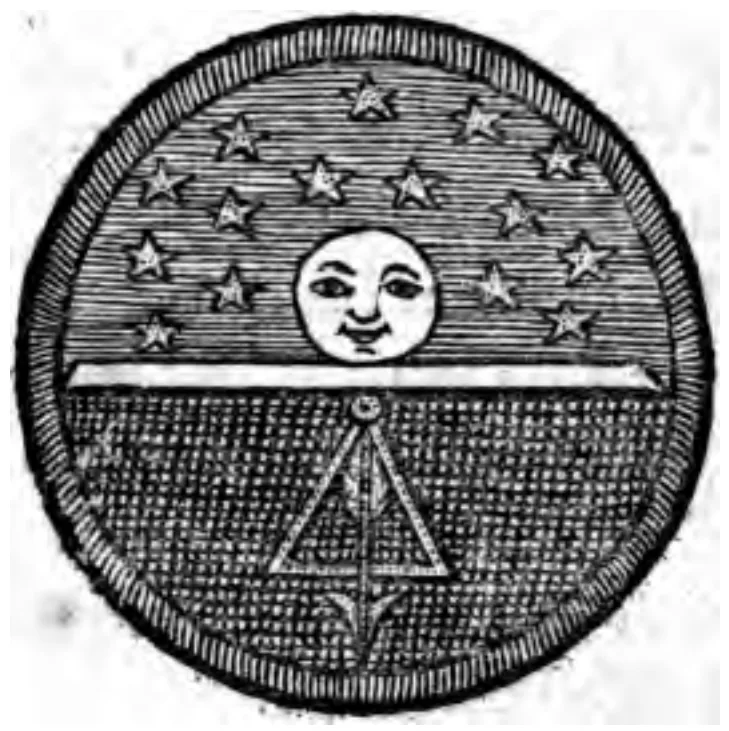
Au premier, azur, Lune d'argent, Etoiles d'or. Au second, sable, Triangle & Flèche d'or.
Explication de l'armoirie. Armoirie de l'Ordre des Noachites, page 139 : au premier, azur, Lune d'argent et Étoiles d'or ; au second, sable, Triangle et Flèche d'or.
[p. 140]
CATÉCHISME
D. QUI êtes-vous ?
R. Dites-moi qui vous êtes, je vous dirai qui je suis.
D. Connoissez-vous les Enfans de Noé ?
R. J'en connois trois.
D. Qui sont-ils ?
R. Je le dirai par tous les mots de S C J.
D. Dites-moi le mot.
R. Commencez, & je vous répondrai. ( On donne les trois noms S. C. J. )
D. Que signifient ces mots ?
R. Les lettres initiales sont le mot sacré.
D. Donnez-moi l'attouchement.
R. Le voici.... en serrant trois fois, &c.
D. Faites-moi le signe. ( On le fait. )
R. J'y satisferai.
D. Dites-moi le mot de passe.
R. PHALEG.
D. Connoissez-vous le Grand Architecte de la Tour de Babel ?
R. Phaleg est son nom.
[p. 141]
D. Qui vous a appris son histoire ?
R. Le Chevalier Commandeur Lieutenant des Chevaliers Maîtres Prussiens.
D. En quelle Loge ?
R. Dans une Loge où la Lune donnoit la lumière.
D. N'auroit-on pas pu avoir d'autre lumière ?
R. Non.
D. Cet édifice étoit-il louable ?
R. Non, sa perfection étoit impossible.
D. Pourquoi étoit-elle impossible ?
D. C'est que l'orgueil en étoit le premier fondement.
D. Est-ce pour imiter les Enfans de Noé que vous en gardez la mémoire ?
R. Non, c'est pour avoir leurs fautes devant les yeux.
D. Où repose le corps de Phaleg ?
R. Dans un tombeau.
D. A-t-il été réprouvé ?
R. Non, la pierre d'agathe dit que Dieu a eu pitié de lui, parce qu'il est devenu humble.
D. Comment avez-vous été reçu Chevalier Prussien ?
R. Par trois génuflexions, après avoir baisé le pommeau de l'épée du Chevalier Commandeur Lieutenant.
[p. 142]
D. Pourquoi vous a-t-il fait faire des génuflexions ?
R. Pour me faire ressouvenir que pendant toute ma vie je dois pratiquer l'humilité.
D. Pourquoi les Chevaliers portent-ils un triangle.
R. En mémoire du Temple de Phaleg.
D. Pourquoi la flèche renversée ?
R. En mémoire de ce qui arriva à la Tour de Babel. Le tablier & les gands sont en mémoire de tous les ouvriers de la Tour. Le cordon noir est une marque de tristesse.
D. Les ouvriers travaillent-ils jour & nuit ?
R. Oui : le jour à la faveur des rayons du Soleil, & la nuit à la faveur de la Lune.
Le Chevalier Commandeur-Lieutenant est placé à l'opposé de la Lune ; les quatre Chevaliers en avant, pour être mieux à portée d'entendre les ordres, sans avoir de place fixe, pour faire voir qu'un Chevalier ayant renoncé à l'orgueil, se fait gloire de pratiquer l'humilité en tout temps.
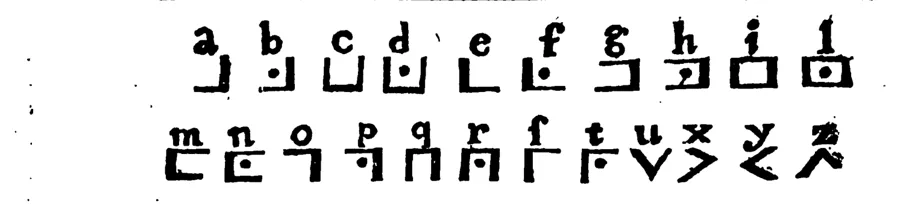
Alphabet des Chevaliers Prussiens. Chiffre du grade, page 142 : les vingt-deux caracteres substitués aux lettres de a à z, gravés sur bois au bas de la page.
[p. 143]
HISTOIRE DES NOACHITES OU CHEVALIERS PRUSSIENS
LES descendans de Noé, nonobstant l'arc-en-Ciel, qui étoit le signe de réconciliation que le Seigneur avoit donné aux hommes, par lequel il les assuroit qu'il ne se vengeroit plus d'eux par un déluge universel, résolurent de construire une Tour assez élevée, pour se mettre à l'abri de la vengeance divine. Ils choisirent pour cela une plaine nommée Sennart dans l'Asie ; dix ans après qu'ils eurent jetté les fondemens de cet édifice, le Seigneur ( dit l'Ecriture ) jetta les yeux sur la terre, apperçut l'orgueil des enfans des hommes, & descendit sur la terre pour confondre leurs projets téméraires, & mit la confusion des [p. 144] langues parmi les ouvriers ; c'est pourquoi on appelle cette Tour Babel, qui signifie confusion. Quelque temps après Nemrod, qui a été le premier qui ait établi des distinctions entre les hommes ; qui a vengé même les droits & le culte dûe à la Divinité, y fonda une ville, qui pour cela fut appellée Babylonne, c'est-à-dire, enceinte de confusion. Ce fut la nuit de la pleine Lune de Mars que le Seigneur opéra cette merveille ; c'est en mémoire de cela que les Chevaliers Noachites font leur grande assemblée tous les ans dans la pleine Lune de Mars. Leurs Assemblées d'instruction se font tous les mois le jour du plein, & au clair de la Lune, ne pouvant avoir en Loge d'autre lumière que la Lune. Les ouvriers ne s'entendant plus, furent obligés de se séparer, chacun prit son parti. Phaleg, qui avoit donné l'idée de ce bâtiment, & qui en étoit le directeur, étoit le plus coupable ; il se condamna à une pénitence rigoureuse ; il se retira dans le Nord de l'Allemagne, où il arriva, après bien des peines & des fatigues, qu'il essuya dans des pays deserts, où il ne trouvoit pour toute nourriture, que des racines & des fruits sauvages.
[p. 145]
Dans cette partie, que l'on appelle la Prusse, il y construisit quelques cabanes, pour se mettre à l'abri des injures du temps & de l'air ; & un Temple en forme de triangle, où il s'enfermoit pour implorer la miséricorde de Dieu, & la remission de son péché.
Dans des décombres, en fouillant dans des mines de sel de Prusse à quinze coudées de profondeur, l'an 553, l'on trouva une forme de bâtiment triangulaire, dans lequel étoit une colonne de marbre blanc, sur la base de laquelle toute l'histoire étoit écrite en hébreu. A côté de cette colonne l'on trouva un tombeau de pierre de grès, où l'on apperçut de la poussière & une pierre d'Agate, sur laquelle étoit l'épitaphe suivante :
Ici reposent les cendres de notre G. A. de la Tour de Babel ; le Seigneur eut pitié de lui, parce qu'il est devenu humble.
Tous ces monumens sont chez le Roi de Prusse. L'épitaphe ne dit point que Phaleg étoit Architecte de la Tour de Babel ; mais l'histoire qui est sur la base de cette colonne, nous instruit que Phaleg étoit fils d'Héber, dont le [p. 146] pere étoit fils d'Arphaxad, qui étoit fils de Sem, fils aîné de Noé. Mot de passe PHALEG, mot sacré S. C. J., qui signifient Sem, Cham, & Japhet.
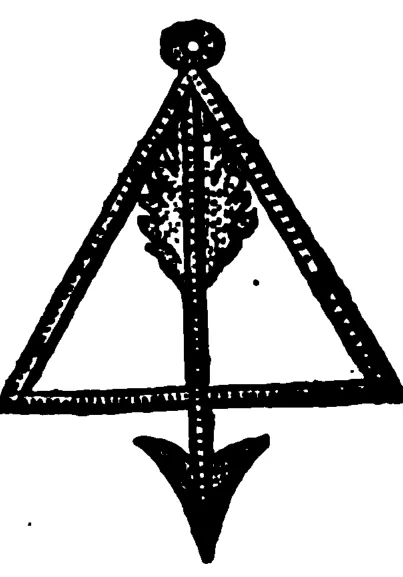
BIJOU
Bijou du grade. Bijou des Chevaliers Prussiens, page 146 : le triangle équilatéral traversé d'une flèche la pointe en bas.
Manuscrit Quesada 1804 (copie 1813-1821)
manuscrit · BNE Mss 7834 · 3 150 mots
Le manuscrit Quesada (Mss 7834 de la Bibliothèque Nationale d'Espagne) : copie (1813-1821) d'un état du Rite de 1804, voire antérieur, tel que pratiqué dans la mouvance du Suprême Conseil d'Amérique. Les didascalies du manuscrit sont en italique. Le texte est celui de l'édition Latomia, donnée en vis-à-vis du fac-similé du manuscrit : l'apparat critique de cette édition est repris ici, de même que les repères de folio du manuscrit.
Texte intégral sur ce site · transcription C. M. & P. T., Latomia / Chantier de fouilles maçonniques, d'après le Mss 7834 de la BNE
Folio 237 recto
Origine & Dignités
Le Gd∴ Me∴ Général de l’Ordre que l’on nomme Chev∴ Gd∴ Commandr est le T∴ Ill∴ F∴ Frederick Guillaume roi de Prusse ses ancêtres depuis 300 ans sont protecteurs de l’Ordre dont les Chevaliers célèbrent la mémoire dans la destruction de la tour de Babel, autrefois il était connu sous le nom de Noachite, c’est-à-dire descendant de Noé ; les païens les conduisaient653 653 sous le nom de Titans, qui voulurent escalader654 654 pour détrôner Jupiter mais les Prussiens qui ne connaissaient pas d’autre dieu que le Gd∴ Archte∴ de l’Un∴ font consister leur bonheur à glorifier et à célébrer tous les ans dans la nuit de la pleine lune de mars, la confusion de langues et la désunion des ouvriers de la tour de Babel qui est une des grandes merveilles du Créateur parce que c’est l’époque de ce jour de vengeance c’est aussi pour cela qu’ils s’assemblent dans un lieu retiré la nuit de la pleine lune de chaque mois pour tenir la L∴ et qu’ils ne peuvent recevoir de prosélytes qu’au clair de la lune.
Titres
Le GdMeCommand de l’Ordre se nomme.GdCommandr∴∴∴L’Orateur Chevr∴ d’Éloquence Le 1r∴ Survt∴Gd∴ Inspecteur Le Secrétaire Gd∴ Chancelier. Le 2e∴ Survt∴Gd∴ Introducteur Le Trésorier Gd∴ Trésorier.
Les autres membres de la L∴ s’appellent Chevaliers Maçons Prussiens. Les Noachites nommés aujourd’hui Maçons Prussiens descendirent de Phaleg Gd∴ Arche∴ de la tour de Babel, ainsi leur Ordre tire leur origine de plus loin que les Maçons du Temple de Salomon, car la Tour de Babel fut bâtie plusieurs siècles avant le Temple, l’on n’exigeait point autrefois que Folio 237 verso
les sujets qui se proposaient fussent Maçons descendant d’Adoniram mais du temps des croisades, où tous les Chev∴ des différents grades de l’Europe furent initiés par les Princes chrétiens et considérés 655 pour conquérir la Terre Sainte, les Maçons descendant du Temple de Salomon par respect pour l’Ordre Noachite qui était en grande vénération dans ce temps-là, se firent recevoir, les Chev∴ Prussiens par reconnaissance ne croyant pas pouvoir mieux placer leur mystère qu’aux Maç∴ ont exigé depuis que tous les Récipiendaires fussent reçus Mes∴ de cet Ordre sans que l’on puisse en admettre d’autres comme il parait dans les Statuts de l’Ordre qui sont dans les Statuts de l’Ordre qui sont dans les 656 archives du roi de Prusse par lesquels il est expressément défendu à un Chev∴ Maç∴ Prussien de recevoir aucun Cand∴ qu’il n’ait prouvé avoir rempli les fonctions d’Officier dignitaire dans une L∴ complète & régulière.
Ouverture
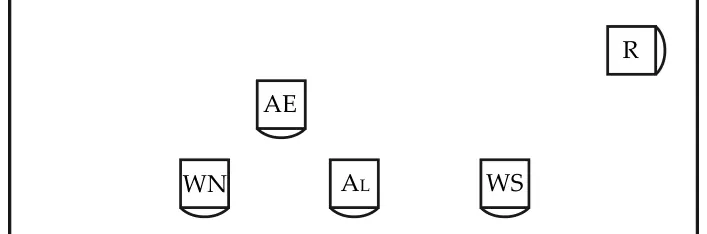
Le Gd∴ Commandeur est placé à l’opposé de la lune les autres Chev∴ en avant pour être mieux à portée d’entendre ses ordres. Ils n’ont point de place fixe pour faire voir qu’un Chev∴ ayant renoncé à l’orgueil se fait gloire de pratiquer l’humilité en tous temps. La salle doit être éclairée au moins par une grande lumière provenant d’une fenêtre tournée de façon qu’elle puisse recevoir la faible lumière de la lune Il est défendu suivant les Statuts de l’Ordre, de recevoir les rayons du Soleil, ni d’aucune lumière artificielle. Le Gd∴ Command r∴ frappe 3 coups égaux. Le Gd∴ Insp∴ 657 par un coup de son maillet sur le pommeau de son glaive.Le Gd∴ Command dit :
A l’Ordre mes FF∴( Voyez la Pl∴fig∴). Tous les Chev∴ se lèvent
tendent les mains vers le ciel les doigts étendus du côté où la lune se lève et le Gd∴ Command∴ fait les demandes suivantes & le Grand Insp∴ y répond :
Gd∴ Insp. qui êtes-vous ? D∴
R∴ Si vous êtes curieux de savoir qui je suis dites-moi qui vous êtes.
D∴ Connaissez-vous les fils de Noé R∴J’en connais trois.
D∴ Qui sont-ils. R∴Je vous le dirai dans notre manière d’épeler.
D∴ Ecoutons donc R∴Commencez et je répondrais. Le Command rS∴R∴L’inspecteur, C∴
D∴ Le Command r∴J∴D∴Bien, que signifient ces trois lettres ?
D∴ Les initiales de Sem. Cham, & Japhet.
R∴
D∴ Donnez-moi le Signe. (Il le donne).
Le Gd∴ Command r∴ frappe 3 coups et dit : FF∴ Insp et Introd∴ annoncez que le Chap∴ est éclairé, alors tous les Chev∴ reprennent leur attitude naturelle. Le dessin de la L∴ est le firmament Les Chevrs∴ regardent la lune et les étoiles jusqu’à ce que le Cand∴ soit arrivé à la porte du Chap∴ en dehors.
Folio 238 recto
Réception
Le Récipiendre∴ est introduit sans épée et tête nue avec ses vêtements ordinaires il a un tablier et des gants de peau blanche, tels que les portent les Me∴ Maç∴ au 3e∴ Gde∴ Symbolique. Le Gd∴ Introd∴ qui sert de protecteur au Cand∴ frappe 3 coups à distance égale, le Capne∴ des Gardes répond : par un seul et dit : au Cand∴ : Qui êtes-vous. Le Gd∴ Insp r∴ fait les réponses. D∴
Je suis un Chev∴ qui demande l’entrée ( puis il donne au R∴
Capne∴ les Signes Attouchts∴ la Parole & le Mot de Passe de l’Ordre, le Capne referme la porte & dit :
Gd∴ Commandeur un Cand∴ M e ∴ Maç∴ demande la faveur de participer à nos Travaux. D∴En répondez-vous ?
R∴ Comme de moi-même. Introduisez-le, On l’introduit.
Le Gd∴ Command∴ lui dit : Mon F∴ le désir de pouvoir escalader le ciel
nous a fait trouver658 658 les moyens d’y parvenir, nous promettez-vous d’y travailler de tout votre pouvoir. Le Cand∴ répond :Oui.(Gd∴ Introd∴ mettez-le en ouvrage & R∴
On lui donne une truelle et on le fait travailler dirigez-le. On fait entendre dans le 2e∴ Appart∴ un bruit qui avec les autres Chev∴ imite le soleil659 659 tonnerre alors toutes les truelles tombent à la fois des mains des Chev∴ qui se mettent aussitôt à l’Ordre & chaque F∴ Le Gd∴ Commandeur dit : se remet à sa place.
Gd∴ Introducteur conduisez cet orgueilleux dont l’ostentation 660 à un projet qui ne tend rien moins qu’à défaire le Gd∴ Arch te∴ de l’Un∴, conduisez le dis-je au Nord qu’il y pleure sa faute qu’il traverse pour y parvenir les déserts les plus affreux.
Le Gd∴ Introdr∴ lui fait faire le tour du Chaptre∴ & l’amène dans la grotte & lui fait manger des végétaux & boire un verre d’eau, le fait ensuite coucher dans le cercueil qui est dans la grotte. Pendant ce temps les FF∴ passent dans le 2e Appartement Le Gd∴ Command r∴ dit :
F∴ Gd∴ Insp r∴ qu’est devenu Phaleg ? D∴
R∴ il est dans le désert cherchant par sa pénitence à épuiser la colère divine du ciel. Patriarches, mes FF∴ allons à sa recherche espérons que la miséricorde divine lui aura accordé son pardon
Le Gd∴ Command suivi de tout le cortège fait le tour de la L∴ Au 2ème∴ tour il entre dans la grotte & se tournant ainsi que les FF Folio 239 recto∴ Folio 238 verso
qui l’accompagnent vers l’Occid∴ ils font le Signe d’Ordre après Le Gd∴ Commandeur ramasse le Bijou avoir regardé le cercueil. qui doit paraître à travers les dessins des décombres Le Gd∴ Insp∴ ramasse le Bijou triangulaire, le Gd∴ Commandeur dit : au Cand∴ en le levant et le mettant entre les mains du Gd∴ Insp r∴
Mon F∴ mettez votre confiance en la bonté du Gd∴ Arch te∴ de l’Un∴ fiez-vous en lui il vous conduira par des voies
Le Gd∴ Command∴ se rend à sa place suivi du cortège sûres où vous aspirez. Le Gd∴ F∴ Introd∴ frappe 3 coups on répond de même. Le Gd∴ Commandr∴ dit :
D∴ Voyez qui frappe ainsi ?
R∴ C’est un enfant de Noé Parfait Maçon qui après avoir fait pénitence demande la faveur d’être admis parmi les Patriarches Noachites
( Il entre ) Le Gd∴ Command∴ lui adresse Donnez-lui l’entrée.
ces paroles.D∴Consentez-vous mon F∴ à vous dépouiller de ce monde 661 et pour toujours, de toute ostentation & orgueil.
R∴ Je le promets D∴Que demandez-vous ? R∴La faveur d’être introduit parmi vous. D∴Mes FF∴ y consentez-vous ?
Tous les Patriarches tirent leur épée la pointe dirigée sur le Cand∴ en signe de consentement. Cap∴ des Gardes faites approcher le Cand∴ de l’Autel. Le Cond∴ lui fait faire trois génuflexions du genou gauche. Le Gd Command r∴ lui fait baiser 3 fois le pommeau de son épée en disant :
Mon F∴ commencez par un acte d’humanité. 662
On le fait mettre à genoux.
Obligation
Je N..... promets sous les pointes de l’épée et les peines portées en mes premières obligations de ne jamais révéler les secrets des Noachites où Chev∴ Prussiens à aucun F∴ de grade inf r∴ ni profane et à me soumettre à tous les Statuts et Règlements du Chaptre appelant la vengeance divine, si j’y manque, ce dont me préserve le Gd∴ Arche∴ de l’Un∴.
Le Gd∴ Command r∴ lui pose la truelle sur la tête & lui dit :
La 663 vertu des pouvoirs dont je suis revêtu et au nom du Subl∴ Conseil, des Chev∴ Prussiens, je vous reçois Chev∴ Noachite, n’oubliez jamais que si vous étiez assez malheureux pour offenser le Gd∴ Ach te∴ de l’Univers vous ne devez pas douter de sa miséricorde.
Il le relève l’embrasse & lui donne les Mots Signes & Attouchts∴
Signes
Porter les mains hautes les doigts étendus vers le ciel les
Folio 239 recto
pouces appuyés vers les oreilles en faisant trois génuflexions du genou gauche. Le Signe d’Entrée est de frapper 3 coups égaux et avant d’entrer, on allonge les 3 premiers doigts en disant :Noé. La réponse est de prendre les trois doigts dans la main en disant :Noé, Noé
Attouchement= Celui qui demande présente les deux
premiers doigts tendus, celui qui répond prend les deux doigts avec son pouce et des deux doigts qui suivent les presse en disant Sem, Cham, et l’autre répond : Japhet.
Mot de P∴Phaleg
Le Gd∴ Commandr∴ dit : ensuite au Cand∴ : promettez-vous, foi
de M e Maçon de garder les secrets que je vous ai confiés sous 3 conditions La 1 re∴ que vous ne révélerez jamais à aucun des enfants d’Adam les mystères de notre Ordre à moins que vous ne le connaissiez pour Maç∴ La 2 e∴ que vous serez officieux et compatissant pour tous les Chev∴ de notre Ordre, la 3 e∴ que vous ne souffrirez jamais même au péril de votre vie qu’aucun homme porte le Bijou de notre Ordre à moins qu’il ne se fasse reconnaître à vous pour Chev∴ Prussien. Le Cand∴ répond :Je le jure & m’y engage sous les conditions que vous me prescrivez. Allez mon F∴ donnez les Mots Signes et Attouchements664 664 sont justes. Le Capne∴ des Gardes le prend par la main et le fait asseoir
à ses côtés entre les Gds∴ Insp∴ et Introducteur.
Discours historique
Les descendants de Noé nonobstant l’arc en ciel qui était le signe de réconciliation que le Seigneur avait donné aux hommes pour les assurer qu’il ne se vengerait plus d’eux par un déluge universel, résolurent de construire une tour assez élevée pour se mettre au dessus de la vengeance céleste, il choisirent pour cela une plaine nommée Sonnaar665 665 dans l’Asie, dix ans après qu’ils eurent jeté les fondements de cet édifice, le Seigneur, (dit l’Écriture) jette les yeux sur la Terre apercevant l’orgueil des hommes et pour la confondre mit la confusion dans les langues, c’est pourquoi on appelle cette tour Babel qui signifie confusion. Quelque temps après Nembrod666 666 qui a été 667 a établir des distinctions parmi les hommes et à venger eux668 668 même les droits de la divinité et du culte, y fonda une ville qui pour cela fut appelée Babylone. C’est-à-dire enceinte de confusion, ce fut la nuit de la pleine lune de mars que le Folio 240 recto
Folio 239 verso
Seigneur opéra cette merveille c’est en mémoire de cela que les Chev∴ Noachites font tous les ans leur assemblée dans la pleine lune de mars et celle d’instruction se fait tous les mois le jour de la pleine lune et au clair de la lune ne pouvant avoir d’autre lumière en L∴ les ouvriers ne s’entendant plus furent obligés de se séparer chacun prit son parti Phaleg qui avait donné l’idée de ce bâtiment et qui en était le directr 669 était le plus coupable il se condamna à une pénitence rigoureuse il se retira dans le nord de l’Allemagne 670 dans des déserts où il ne trouvait pour toute nourriture que des racines & fruits sauvages : dans cette partie qu’on appelle la Prusse il y construisit quelques cabanes pour se mettre à l’abri des injures du temps il y éleva un Temple en forme de triangle où il s’enfermait pour obtenir la rémission de ses péchés. L’an 553 on trouva en fouillant un bâtiment triangulaire dans lequel était un marbre blanc sur lequel était gravé et écrit toute cette histoire en hébreu à côté était un tombeau de pierre, degré 671 où l’on aperçut de la poussière & une pierre d’agate où était l’épitaphe suivante.
Ici reposent les cendres de notre Gd∴ Arche∴ de la Tour de Babel, le Seigneur eut pitié de lui parce qu’il est devenu humble. Tous ces monuments
sont chez le roi de Prusse, l’épitaphe de 672 dit point que Phaleg était architecte de la Tour de Babel. Le Seigneur eut pitié de lui parce qu’il ... & a∴ mais l’histoire qui est sur le marbre nous apprend que Phaleg était fils d’Hober 673, dont le père était fils d’Arphoxad 674 fils de Sem fils aîné Le Gd∴ Command reprend voilà mon cher F∴ le g d secret de Noé. de notre Ordre qui n’est connu d’aucun enfant d’Adam je viens de vous le confier avec plaisir malheur à vous si vous êtes indiscret, soyez bien circonspect & dans l’occasion pratiquez l’humilité à l’exemple de notre Gd∴ Arch te.
Tous les Chev∴ remettent leur épée & le Chevr∴ Gd∴ Command∴ fait rendre celle du Récipiend∴ puis il lui attache à la 3e∴ boutonnière de la veste avec un ruban noir le Bijou
de l’Ordre qui est d’argent & lui dit : Quittez mon F∴ les ornements de Me∴ M o∴
portez le tablier comme le Comp∴Le Chev∴ Introd∴ avertit d’offrir des gants
au Cand∴ 675 les gants et le tablier sont jaunes. ( Pl∴fig∴) Le Bijou est un
équilatéral traversé par une flèche la pointe en bas et en or attaché à un grand cordon noir qui se porte de l’épaule droite à la hanche gauche
à moins qu’on ne le porte à la boutonnière de la veste alors il est d’argent( Pl∴fig∴)
Instruction
D∴ Qui êtes-vous ? R∴Dites-moi qui vous êtes je vous dirai qui je suis.
D∴ Connaissez-vous les enfants de Noé. R∴j’en connais 3.
D∴ Qui sont-ils ? R∴Je ne dirai pas tous les mots.
Folio 240 recto
on donne les 3 lettres. J∴ C∴ S∴D∴Que signifient ces mots ? Les initiales du Mot Sacré. D∴Donnez-moi l’Attouch t∴ ? R∴
R∴ Le voici ( En serrant 3 f∴ la main )D∴Faites-moi le signe ?
R∴ J’y satisferai D∴Donnez-moi le Mot de Passe ? Phaleg. D∴Connaissez-vous le Gd∴ Arch te∴ de la Tour de Babel ? R∴
R∴ Phaleg est son nom D∴Qui vous a appris son histoire ?
R∴ Le Chev∴ d’Éloquence du Chap des Chev∴ NoachitesD∴En quelle L∴ ?
R∴ Dans une que la Lune éclairaitD∴N’avez-vous pas d’autre lumière ?
R∴ Non D∴Cet édifice était-il louable ?
R∴ Non la perfection était impossible D∴Pourquoi ?
R∴ Parce que l’orgueil en était le fondement.
D∴ Est-ce pour les enfants de Noé que vous en gardez la mémoire ?
R∴ Non c’est pour avoir devant les yeux leurs fautes.D∴Où repose le corps de Phaleg ?
R∴ Dans un tombeauD∴ A-t-il été retrouvé.R∴ Non la pierre d’agate dit que Dieu a eu pitié de lui parce qu’il est devenu humble.
D∴ Comment avez-vous été reçu Chev∴ Prussien Par 3 génuflexions après avoir baisé le pommeau de l’épée du Gd∴ Command R∴
D∴ Pourquoi vous a-t-il fait faire des génuflexions ?
R∴ Pour me faire souvenir que dans toute ma vie je dois pratiquer l’humilité
D∴ Pourquoi tous les Chev∴ portent-ils un triangleR∴En mémoire du Temple de Phaleg.
D∴ Pourquoi la flèche renversée.R∴ En mémoire de ce qu’il arriva à la Tour de Babel, le tablier et les gants sont en mémoire de tous les ouvriers le cordon noir est marque de tristesse.
D∴ Les ouvriers travaillent-ils jour & nuit ?
R∴ Oui le jour à la faveur des rayons du Soleil et la nuit à la faveur de la Lune.
Clôture
Le Gd∴ Commandr∴ frappe un coup et dit :
Quelle heure est-il F∴ Gd∴ Insp∴ ? D∴
R∴ L’heure du repentir le Soleil est levé. Puisque le Soleil est levé Chev∴ Prussiens il est temps de nous retirer surtout n’oublions pas la pratique des vertus à l’exemple de Phaleg.
Il frappe 3 coups . Lesquels sont répétés. Il fait le signe & dit, mes FF∴ le Chapitre est fermé Folio supplémentaire LFolio 241 recto.
Folio supplémentaire L Folio supplémentaire LI Folio supplémentaire LII
Apparat critique de l’édition Latomia
653. Erreur du copiste A. Le mot exact est « connaissaient ». Cf. Kloss et Pyron 1812.
654. Oubli du copiste A. Il manque les mots « le ciel ». Cf. Kloss et Pyron 1812.
658. Erreur du copiste A ? Au même endroit, Pyron 1812 écrit « tenter ».
659. Erreur du copiste A. Mot en trop. Cf. Pyron 1812.
660. Erreur du copiste A ? Il semble manquer un verbe. Pyron 1812 indique ici : « dont l’ostention a porté à un projet »
664. Oubli du copiste A. Il a sauté les phrases suivantes : « ... aux Frères Inspecteur et Introducteur. Lesquels les ayant reçus, le Grand Inspecteur dit : Grand Commandeur, les mots, signes et attouchements ... ». Cf. Pyron 1812.
665. Déformation du mot hébreu « shinar » ri=n$DQ ( s̆inʿạr ). Gen 11:2.
666. Il s’agit bien sûr de « Nemrod ». Indice de plus du manque de culture historique du copiste A.
667. Oubli du copiste A. Il manque les mots « le premier ». Cf. Pyron 1812.
668. Erreur du copiste A. Mot excédentaire. Cf. Pyron 1812.
676. Ce rituel est pratiquement identique au Pyron 1812 (mais semble utiliser un texte plus ancien) avec une vraie cérémonie. Il est par contre très différent du Kloss qui est directement dérivé du Francken où ce n’est qu’un texte de communication du degré. Il y manque la description des lettres sur la hache, présentes dans Francken et Kloss, et rajoutées après coup dans Pyron 1812.
Delaulnaye 1813
tuileur imprimé · 347 mots
Le « Thuileur des trente-trois degrés de l'Écossisme » de Delaulnaye (Paris, 1813), premier tuileur imprimé du REAA constitué : mots, signes, décors et remarques du grade. Texte relu mot à mot sur le fac-similé, mots hébreux restitués. Pages 158-162 de l'édition originale.
Ce doit être une grande pièce, dans un lieu retiré, ayant une grande fenêtre disposée de manière à recevoir en plein la lumière de la pleine-lune ; car l'assemblée ne se tient que la nuit du pleni-lunium, et l'on ne peut pas y admettre d'autre lumière que celle de l'astre.
Titres.
La Loge a le titre de Chapitre ; le Maître se nomme Chevalier-Commandeur-Lieutenant : Il représente Frédéric de Brunswick, roi de Prusse, fondateur de l'Ordre. Il y a six Chevaliers d'office, un Inspecteur, un Introducteur, un Chevalier d'éloquence (orateur), un
[p. 159]
Garde, un Chancellier, un Financier (trésorier). Tous les Frères sont dits Chevaliers-Maçons Prussiens.
Signe.
Montrer trois doigts de la main droite : le Frère en fait autant ; puis il prend les doigts du premier, et dit : Frédéric Trois. Le premier Frère répond, en prenant les doigts de l'autre, Noé.
Ordre.
Lever les bras vers le ciel, le visage tourné du côté de l'Orient, où se lève la Lune.
Attouchement.
Prendre, entre le pouce et l'index, le premier doigt du Frère, et le presser en disant Sem ; le second, faisant la même chose, dit Cham, le premier recommence et dit Japhet.
Marche.
Trois pas de Maître.
[p. 160]
Batterie.
Trois Coups lents.
○ ○ ○
Mots Sacrés.
SEM, CHAM, JAPHETH, שֵׁם חָם יָפֶת.
Mot de Passe.
PHALEG, פָּלֶג.
(divisio seu confusio)
On le répète trois fois d'un ton lugubre.
Cordon.
Noir, de droite à gauche.
Bijou.
Quand on le porte à la troisième boutonnière de la veste, c'est une Lune d'argent.
Quand il est suspendu au Cordon, c'est un Équilatéral d'or, traversé par une Fléche, la pointe en bas.
[p. 161]
Tablier.
Tablier et gants jaunes.
Le Tablier se porte en Compagnon.
Armes de l'Ordre.
Au premier d'Azur, à la Lune d'argent entourée d'étoiles d'or.
Au second de sable, à l'Équilatéral et à la Flêche d'or.
Il est défendu par les Statuts de tenir Loge de Table.
[p. 162]
Vuillaume 1820
tuileur imprimé · 392 mots
Le tuileur de Claude-André Vuillaume, « Manuel maçonnique, ou Tuileur de tous les rites de maçonnerie pratiqués en France » (Paris, Delaunay et Hubert, 1820) : décoration, titres, signes, attouchement, marche, batterie, âge, mots, habillement du grade, avec l'étymologie et l'interprétation des mots hébreux. Texte établi sur le fac-similé et relu mot à mot sur les images : océrisation à 600 dpi du volume numérisé, fusion avec la couche texte de la numérisation Gallica, puis relecture page par page. Orthographe de 1820 conservée, hébreu et grec restitués, batteries rendues comme l'imprimé les note, pagination de l'original. Pages 151 à 154.
L'assemblée se tient dans un lieu retiré ; la salle est disposée de manière à ce qu'elle reçoive la lumière de la lune, par une seule fenêtre ; c'est la seule lumière qui doive l'éclairer. C'est pourquoi la loge ne se réunit que dans la pleine lune.
TITRES.
La loge prend le nom de Chapitre.
Le maître se nomme Chevalier Commandeur Lieutenant ; il représente Frédéric II, roi de Prusse, fondateur de l'ordre.
Il y a six chevaliers d'office.
[p. 152]
SAVOIR :
Un Inspecteur ;
Un Introducteur ;
Un Chevalier d'éloquence (orateur) ;
Un Garde ;
Un Chancelier ;
Un Financier (trésorier).
Tous les membres sont nommés Chevaliers Prussiens.
ARMOIRIES DE L'ORDRE.
Au premier, d'azur, à la lune d'argent, entouré d'étoiles d'or ; au second, de sable, à l'équilatéral et à la flèche d'or.
Il est défendu par les statuts d'avoir loge de table.
SIGNES.
D'ordre. — Lever les bras vers le ciel, le visage tourné vers le côté de l'est, où se lève la lune.
D'introduction. — Montrer trois doigts levés de la main droite. Le Tuileur prend les doigts, avec la main droite, et dit : Frédéric II ; il présente à son tour les trois doigts, on les saisit également, en disant : Noé (héb. נֹחַ
[p. 153]
noahh, requies. Il était fils de Lamech, Gen., chap. 5, vers. 29).
2e ATTOUCHEMENT.
Prendre l'index de la main droite du Tuileur, et le presser avec le pouce et l'index, en disant : Sem ; le Tuileur fait le même attouchement, en disant : Cham ; répéter l'attouchement en prononçant Japheth.
Héb. שֵׁם Schem, fama ; חָם hham, calidus vel niger ; יֶפֶת Japheth, pulcher. C'est le nom des trois fils de Noé. (Gen., chap. 5, vers. 31, et chap. 9, vers. 18.)
BATTERIE.
Trois coups lents : ○ — ○ — ○
MARCHE.
Trois pas de maître.
HABILLEMENT.
Cordon noir, porté de droite à gauche, auquel pend, pour bijou, un triangle équilatéral en or, traversé par une flèche ayant la pointe tournée vers le bas.
On peut aussi porter à la boutonnière le bijou de l'ordre, qui est une lune d'argent.
Tablier et gants jaunes.
[p. 154]
MOT DE PASSE.
PHALEGH, que l'on répète par trois fois d'un ton lugubre. ( Héb. פֶּלֶג divisio ; il était fils de Héber. Gen., ch. 10, v. 25. )
MOTS SACRÉS.
SEM, CHAM, JAPHETH.
Pike 1857
rituel imprimé · en anglais · 6 334 mots
« The Magnum Opus or Great Work » (1857) : le premier corps complet de rituels révisés par Albert Pike pour la Juridiction Sud des États-Unis. Texte en anglais, établi par reconnaissance optique corrigée : des coquilles subsistent.
D'après la réimpression Kessinger de l'édition de 1857 (numérisation archive.org)
THE CHAPTER: ITS DECORATIONS, ETC.
Orders of this Degree are styled Grand Chapters.
A Gr.°. Chapter must be held in a retired place, on the night of the full moon, in each lunar month. The pinea is lighted by a large window or opening, so arranged as to admit the rays of the moon, the only light allowed, at as early an hour of the night as practicable.
The presiding officer sits facing the moonlight, and the Knights in front of him and on either hand, in no
"particular place or order.
The officers are... a Knight Lieutenant Commander, Knight Official, Knight Introducer, Knight Orator, Knight of the Chancery, Knight of the Finances, and Knight Warden. The other members are styled
Knight Masons.
The dress i is entirely black, except the gloves and apron; with swords, spurs, and black masks. -
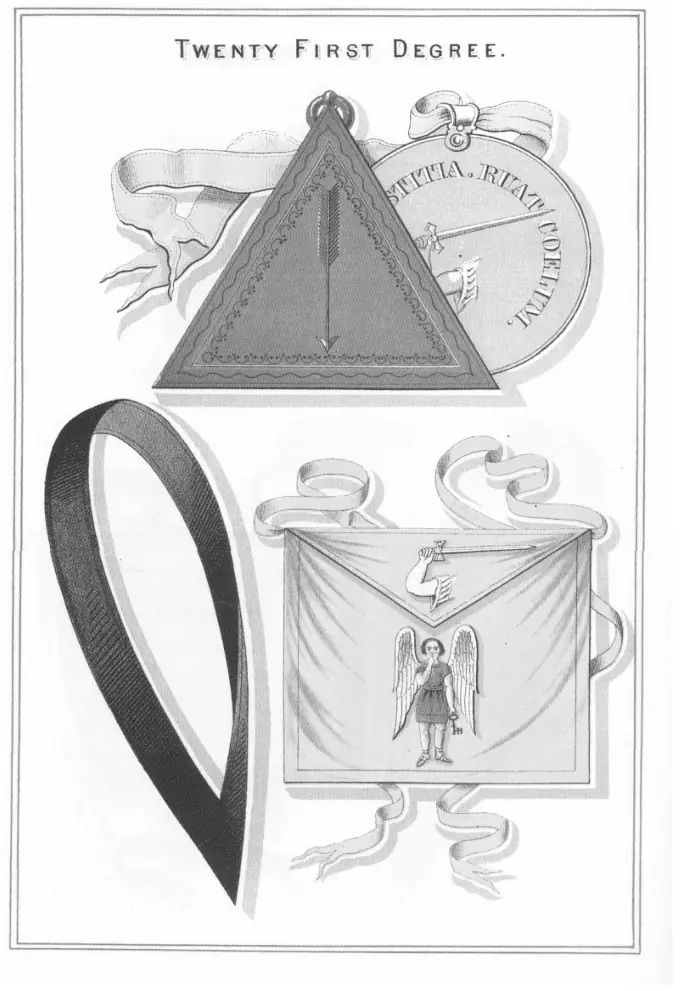
The order is o broad black ribbon, worn from right to left; and the jewel in a silver full moon, suspended from the third button-hole of the-vest, or a golden triangle traversed by an arrow, point downward, suspended" from the collar. On the jewel is an arm upraised, holding a naked sword, and around it the motto, Frat Jos-_ 'tiara, Roar Coztcy. The apron and gloves are yellow. ,
On the upper part of the apron is an arm, naked and upraised, holding o naked sword; and under it a human figure, erect, with wings, with the forefinger of his right hand on his lips, and the other arm hanging by his side, holding a key in the left hand; being the Egyptian figure of Silence.
The battery is; raps, at equal intervals.
TO OPEN.
[The Lieutenant Commander gives; raps, and says}:
. Lt, Com. Kt.*. Official, the full moon is halfway between the horizon and the zenith. The hour for
this Gr. Chapter to convene has arrived. Let the Kt.°. Warden post the Sentinels and Patrols, that no 0 SPY
may gain admission among us.
Ki. Of. Kt°. Warden, post the Sentinels, and send forth the Patrols on all the approaches to , this
Holy Place, that no spy may witness our deliberations.
(The Kt.*, Warden goes out, remains a short time, returns, and reports: " Sir Official, the Sentinels are
at their posts, and the Patrols occupy all the avenues of the forest."}
Eu. Oficial. TIL'. Lt. Commander, the Sentinels and Patrols are properly disposed; and we are in security. . . :
Lt. Com... Sir Official, you will then examine every person present, and receive from each the Password, that we may know we have no spy or.traitor among us.
(The Official receives the Pass-word from each, and reports: "TIIL-. Li. Commander, none but true Knights are present."]. ,
Li. Com., Sir Official, are you a Prussian Knight?
Of. Tam.
Lt... Com.*. How were you received a Prussian Knight?
Off:. By the light of the full moon, like our ancient brethren, initiated in the Temple of Belus.
Li. Com.*, Whence come we to-night? ,
Off. From the four quarters of the globe.
Lt.*. Com... What come we here to do? .
Off'... To hear and consider the complaints of the oppressed, who cry out fur justice 'upon their tyrants: to judge those denounced to us for crime: to devise measures for the relief of struggling humanity.
Li. Com.*. Knights and Brethren, if these be your objects, give me the Token. .
[All rise, draw their swords, and clash them together once].
Lt. Com.". Sir Introducer, whence come you?
Ki.*. Intros.*. From the shores of Europe.
Lt. Com.. What left you there? . .
Et-. Into.. Want and distress: Women that wail for bread, and men for work: the hovel peopled with
stolid misery, under the shadows of the palace tenanted by Luxury: Starvation and Despair in Cities and in the Country; and by their side Affluence and Pomp. :
Lt. Com.*. What come you here judo?
Et.-. Inér... To aid in remedying these evils.
Li. Com.'. Sir Orator, whence come you?
Ke.*. Orai.".. From the plains of Chaldea and the banks of the Nile.
Lt. Com... What left you there? a
Kt.*. Orat... Ignorance, barbarity, slavery, and superstition.
Lt. Com.".. What come you here to do?
Ei. Orator.. To punish crime, to rebuke intolerance, and to labour for the good of men.
Lis. Com.*. Sir Warden, whence come you?
Ward.". From the forests of the New World.
Lt.*. Com.*. What left you there?
Ward.. Liberty and Free Thought.
Lt.. Com.*. What come you here to do? .
Ward.". To labour to make them common to all, as the air and light of Heaven.
Lt.. Com.*. Knights and Brethren, if these be your objects, give me the token.
[All rise, and clash their swords together twice]. .
Li. Com.. Sic Almoner, what of the Treasury?
All.. Til. Le. Commander, it is rich to overflowing with the grateful tears of widows, the thanks of orphans, and the blessings of the poor, the distressed and the destitute. .
Kt. Lt, C.". Amen! So mote it be forever!
[The Knights all clash their swords together thrice].
Lt.. Com.". Such being our duties, let this Chapter be opened. Brethren, the Sign!
[All the Knights raise their arms towards Heaven, the Sword in the right hand, and turn towards the Moon: then, they dropping their arms, and facing the Lt.". Commander, he says: "This Grand Chapter is open in due form. Sir Warden, make Proclamation that all who demand justice may draw near." } :
Kit.'. Ward. Whosoever hath been wronged by the great or oppressed by the powerful ; whosoever bath
At... 38
been unjustly accused or his household outraged: whosoever hath fallen into the hands of corrupt judges: whosoever bath suffered by bribery or extortion ; let him come freely forward and prefer his complaint; and right shall be done him by this Grand Chapter of Prussian Knights, from whose judgment there is no appeal.
RECEPTION.
The Candidate is brought to the door of the Chapter,.without a sword or collar, with his head bare, in ordinary garments, wearing 2 plain white apron and white gloves. The Knight Introducer, who is with him, gives ; distinct, slow knocks upon the door. The Warden on the inside answers by 4 single rap, opens the door, and asks '* Who desire to enter this Grand Chapter?" The Introducer answers, "The Knight Introducer, having the signs, words and grips; with a Master Mason, descended from Adoniram, and who has received the 20th Degree."
(The Warden receives the signs, words and grips, and says, " Remain, my Brother, until I learn the will of the Ill.-. Lt.-, Commander ;"" and closes the door. Le goes to the Kt.°. Official, and whispers in his ear that - the Kt.*. Introducer, with a Master descended from Adoniram, and who has attained the degree of Grand Master of all Symbolic Lodges, desires to enter].
~ The Kt.°. Official says aloud, "Ill.-. Lt.:. Commander, the Kt.*. Introducer, with a Master Mason, descendant of Adoniram, and Grand Master of all Symbolic Lodges, clothed in s white apron and white gloves, desires to enter"
- Khe Nm: . Demand of the Kt. Introducer what this Mason, descendant of Adoniram the Son of Abds, desires. °
_ [The Kt. Official goes to the door, and gives one rap. The Kt... Introducer answers with ; slow. The Kt+. Warden opens the door].
Eis OF. What is the desire of our Brother, descendant of Adoniram, and Grand "Master of all Symbolic Ledges?
Ki. Our, He comes to demand justice.
Of". Against whom?
Into";- He will make that known to the IIL'. Lt. Commander.
Of... : Upon what charge?
Inri.s. Oppression and injustice,
Of. Do you vouch for the sincerity and good faith of the Brother?
dntrs. Do.
"Of. Isis well. Wait again with patience until I learn the will of the IiL-. Lt.-, Commander.
'[The Kt. Official returns near the Lt.-. Commander].
Zt-.'C.. Sir Official, what does the brother demand?
Kt. Of". Justice.
'Ti, O.. *On whom?
E.*. 0.*. 'He will make that- known only to you.
Lt. .. 'Upon what charge?
X..-0.°. Injustice and oppression.
"Lt, Com... Against such demands, the doors of our 7 Chapter are never closed, Hasten to admit the Ke'. Introducer and the Brother!
Fie. Of... Sir Warden, admit the Kt Introducer and the Brother!
[They enter, and advance to the Lt.*. Commander, and the candidate kneels before him. The Introducer, speaking for him, says]: 'Most Noble and Ill.-. Lt.°. Commander Noachite, I demand doom and judgment of Count Reinfred of Loegria and the Bishop of Vienna; who, the one falsely claiming, and the other corruptly judging, have taken from me niy inheritance, and after divided the same between themselves: to the Count half, and half to the Church."
- Lt. Com, Arise, my Brother! Thou neediest not kneel for justice; to which the humblest man hath
3p
At... 4
aright as he hath to air; and which, like air, in neither to be bought nor sold. Who art the most thou offer that thy charge is true? . .
Cand... I am known as Adolf the Saxon,'a man of humble birth, a Master Mason and Knight of the Rose Croix; and I have fought for the Cross in the Holy Land. My patrimony lay between the domain of 'the Count Reinfred and the estates of the Church; and the Bishop and the Count coveted them. So while I was absent in the Holy Land, they had 2 monk who was a cunning penman to forge a deed, and my own seal thereto, by which, fur moneys (it was said) loaned me by the Count on my departure, I did convey unto him all my patrimony. Then the Count, before the Bishop's Court, preferred his claim, the which was speedily determined in his favour; and I afterwards returning, find my patrimony shared between the Count and Church, one half to each; and all appeal or other way of redress denied me. To this I pledge my Masonic word: and moreover, Th.". Ill... let but the Count produce the parchment, and I will find the means
to prove it false. .
Lt. Com.'. The Count is here, a Mason and a Nonwhite. Stand forth, Sir Count, Knight and Mason,
and answer!
[A brother rises, comes forward and says, "On my Masonic word, the charge is false''}. Lt.. Com... Has thou the parchment?
Reins. Its here. [Ue hands a roll of parchment to the Lt.*, Com.*.]. Lt. Com.. Adolf the Saxon, it is Ais Masonic word against thine awn. What other proof bast thou
u, and what proof
to offer?
Cand.. Command, Th.'. Ill, Lt. Commander, the Count Reinfred to make me answer to three ques- . tions, and no more. :
Lt... Com.. Count Reinfred, answer; and truly, remembering that thou art a Mason Cand.". Upon what day, and in what year hath this conveyance date?
Reins.:, Of the nativity of St. John the Baptist, in the year 1187. . Cand.*. That day was I at Mayence, with the Emperor Frederic Barbarossa. What witnesses attest that
-I did seal it?
Reins... John of Seis, and Theobald, the Bishop's almoner,
Cand... And in what place did I seal the same and they attest it?
Reins.:. Even in my audience-chamber, at the castle.
Cand... That day, I say, was I at Mayence. Sir Knight Introducer, is it not so? Kt. Into.. It is; I saw thee there.
Cand.*, That day the Almoner lay sick at Marburg. A Knight here knoweth it. Kt. Orat.:. 'Tis true, I found him there and gave him aid.
. Cand. And on the parchment is the vender's private mark; a key, in the upper right hand corner. It is the mark of Isaac the Jew of Vienna: and he adopted it after Frederic the Emperor died; having before then stamped his parchment with a crown,
Kt.". of Chan.. It is most true. I know the Jew, these many years. . -It.. Com.. The mark is here. Count Reinfred, what has thou to answer? ..- Ire standeth mate, Brethren, yourjudgment. Is this Knight innocent or guilty?
[All answer, " guilty, upon our words."].
Lt, Com., Most guilty and most wicked! Forsworn and perjured Knight and Mason! J banish thee
forever from this Order. Dare never more to enter Lodge or Chapter. Put off thy Knightly badges; and go forth, condemned, disgraced, degraded. Within three days restore this brother his possessions ; or look thou to thy head. And for thy use thereof, pay him forthwith an hundred marks! Goand obey! Brethren, is this your judgment? ° . . , co
- {All the Knights clash their swords.
in silence]. .
Lt. Com., And for the haughty Bishop, see, Sir Chancellor, that with all speed the arrow and the
writing summon him to make restitution or prepare to abide the judgment of this Grand Chapter. For none .
The sentenced Knight puts off his order and jewel, and goes forth
shall Le so high or haughty that he shall plunder and oppress the feeble with impunity. Adolf the Saxon, art thou satisfied?
Cand.*, "Most amply, Th.*. TL.
Intros.", Th.*. TIL. iat. Com.:., the place of Count Reinfred in our Grand Chapter is vacant, IT have served with the good Knight Adolf under Frederick the Emperor and Richard of England. Good Knight and true is he, and faithful Mason, and I propose him to the brethren for their suffrage.
Lt. Com.*. Adolf, is thin thine own desire?
Cared... It is my most earnest wish.
- Lt. Com.. Brother Knights, if it be your pleasure that Adolf the Saxon shall fill the place in this Grand Chapter, made vacant by the degradation of Count Reinfred, give me the token.
{All clash their swords}.
Lt, Com." Adolf, the Brethren consent to receive you into this Grand Chapter; but I am yet requiréd
to exact of you certain pledges. Most thou agree and promise that thou wilt be just and righteous, and in all things strive to emulate and equal that Patriarch from whom we take the name of Noachites ; who alone, with his family, was found worthy to be saved, when God destroyed mankind with the Deluge?
Cand.*. 'I do.
Lt. Com... Most thou promise to avoid idleness, to live honestly, to deal fairly by all men, and to dis courage strife and contention ?
Cand.. I do.
Lt. Com. Most thou promise that thou wilt be neither haughty nor vain-glorious; nor obsequious to the great, nor insolent to thy inferiors ?
Cand... Do. |.
Lt, Com.". Most thou promise that thou wilt be humble and contrite before the Deity; and ever bear in mind the fate of Phaleg and his followers, who endeavoured to build a tower whereby they might climb beyond
the reach of another Deluge, and defy the Omnipotence of God?
Card.*.. "I do.
_ Dh, Com.*. - Most thou | promise, as a member 'of this Tribunal, to give righteous judgment only, against
all persons whatsoever; to be impartial between the high and the low-; to be cautious and "slow. to determine, . and prompt to execute; to smite the oppressor and the wrong-doer, and protect the widow, the orphan, the poor and the helpless; to be swayed neither by bribe nor fear, nor favour nor affection; and still to temper 'justice with mercy ; remembering that there is no man who doth not err and sin ?
Cand... I do.
It, Com.*. Kneel then, and assume the solemn obligation of a Patriarch Noachite, or Prussian Knight.
"[The Candidate kneels on both knees, grasping with both hands the hilt of a sword, handed him by a brother, which hilt must be in the shape of a cross, and the sword held perpendicularly, the point upon the'
'floor. "In this attitude he repeats the following obligation] :
OBLIGATION.
I,A.... B...., upon the sacred word of a Master Mason, and Knight of the Rose Croix, do most solemnly promise and vow, that 1 will faithfully keep the secrets of this degree, and will reveal them to no person in the world, unless to one who shall be legally authorized to receive them.
si 1. furthermore promise and vow that I will evermore give just and upright judgment, to the best of my knowledge and ability ; looking upon men's deeds with charity, and condemning no one unheard: that I will listen patiently to his defence, weigh impartially his statements, and decide for innocence in case of doubt.
:+ I furthermore promise and vow, that I will aid in executing the judgments of this Grand Chapter; and if myself accused, will promptly and cheerfully submit to its jurisdiction.
.i, I furthermore promise and vow to be merciful and compassionate; and ever to remember that Tom «
man, and that all. men are my brothers. And furthermore, that I will be humble and modest in all my
conduct, and carefully avoid all haughtiness and insolence in my demeanour and conversation. So help me God and keep me steadfast to perform faithfully this my vow!
The Lt. Commander directs him to bow three times to the ground, in token of his-humility; and then raises him, and communicates the Signs, Words and Tokens.
.Sron: 2. . Raise 1 YV&]SOAO =e with the Wor It C¥YY CHU CEL, the P&S opposite
the COIS: and st the same time make ; (UC E WIC TPO Yee with the FHC C.
Pass-woap: 3&QtC\.*. pronounced ; times, slowly and in a melancholy tons.
Sacrzp Worn: ... 2&C(25.... T&CS... You V&-.; given only thus: . ..
Toney: ... One brother takes the WYTCWESsS_ Ct of a Brother between his own Pk Trio=u0
IS ICWOML Ci and HCOOCA it; saying 2& Cs: the other responds by like 4¢COO4{C of the
WStCVOxUC tof the first brother, saying 1& C2s.". and the firstagain {3 COOCS the WETCU9eQC? of the second, saying ROUCP&.". .
To enter a Chapter, a brother &¥ fhe WOSCL Cia. The Sentinel or Guardian does the same.
The Brother then gives the sign, takes the ; 179 =), Ci:of the Sentinel or Guardian, and says— WTCIUCI?o sf
MOtMLOLY2+O. The other responds ; times —"You&.". and the first says ; times, 2kOTC3...
[The Kt. Commander then invests the Candidate with the apron, collar and jewel of the Degree, and directs him to kneel on both knees; when he strikes him lightly with his sword on the right and left shoulder and-on the head, saying: "By virtue of the authority vested in me by this Grand Chapter, I.do.constitute and create you a Mason Nonwhite, and Prussian Knight, and I do devote you, henceforward forever, to the cause of every one who hath been wronged by the great or oppressed by the powerful; of every one who bath been Unjustly accused or his household outraged: of every one who hath fallen into the hands of corrupt judges: of every one who hath suffered by bribery or extortion; of the oppressed, the widow, the orphan, the poor, the distressed and the destitute. Arise, Knight and Soldier of Struggling and Suffering Humanity, and be armed fur the combats that await you !] .
(He rises, and the Kt.'. Official buckles on his spurs, and the Kt.:. Commander bands him a sword; and the latter says]: oe :
Kt. Com.. You are now prepared to do the duties of a True Knight: and the Kt. Orator will, on the first convenient occasion, make known to you the history and final instruction of this Degree. [This the Kt.
Orator may do out of the Chapter, in private].
HISTORY.
* The Knights of this Order originally united themselves together in the times of the Crusades; when, in consequence of the general disorder that prevailed all over Europe, and the multitude of Estates and Titles loft to be disputed, wrung and violence went unrebuked, and hecame superior to the law. Composed at first of n few Masons, who had learned the rules of justice from the teachings of the Order, they exerted only a moral influence, owing to the purity of their lives, and the justice of their opinions. They called themselves
At... 7
Nonwhite Masons; because they strove to imitate the primeval justice and purity of the beloved Patriarch, Finding that where their influence was most needed, mere advice and exhortation, addressed to the rude Barons and haughty rapacious Priesthood, had no effect, they assumed the power to enforce performance of their judgments; and through the common people and a multitude of the poorer Knights who had found the benefit of their protection, and who revered their justice, they found a ready means of compelling obedience, and inflicting punishment. Their number was limited, and their persons unknown. They met always at night, when the moon was full; and the more perfectly to remain unknown, allowed no light bat hers.
Lest their own members should become haughty and-vain-glorious on account of the mysterious power they possessed, they inculcated humility, and incessantly reminded each other of that haughtiness and pride which led the descendants of Noah to erect the Tower of Babel ; and of the miseries of Phaleg, who suggested the idea of its building; and who thercfur condemned himself to & rigorous penitence, and buried himself in the vast solitude of Northern Germany, in what is now the kingdom of Prussia, whore he is said to have builder a temple in the shape of a Delta, and therein to hare passed his life imploring the mercy of God.
The Order, in several parts of Germany, was popularly known as the Holy Vehme: and even kings
trembled at its judgments. It continued to exercise its vast powers, until law and civilization rendered them ~ no longer necessary ; but the Order still continued to exist, deciding Masonic controversies only; ; and inflicting no other than Masonic punishments. As it continued more particularly to flourish in Prussia, whore Frederic of Brunswick, King of Prussia, became the Grand Master General of the Order, the members took the name of Prussian Knights, out of gratitude to that Monarch, whose ancestors were fur three hundred years its Patrons.
The Chapters of this Degree are no longer Tribunals to try and punish for offences committed without the limits of Masonry. They claim no jurisdiction except between their own members, and exerciseé none between those of the inferior degrees, except by their consent. And in all their judgments it is their rule and duty to judge of other men's motives and actions by the same rules by which they judge their own; to believe others equally os honest in their views as themselves; and to find for the conduct of others the same excuses that they find for their own; for this alone is justice. And they prove their humility by their tolerance ; which causes them to believe that their opinions are as likely to be erroneous as the opinions of others to the contrary, and that the Deity alone knows what is truth.
They meet only on the nights of the full moon; and allow no other light than hers; because such was . the ancient custom of the order, derived from the mysteries of Ceres and the old worship of Isis. In the heavenly host they admire the work of the Supreme Creator, and the universal laws of harmony and motion, the two first laws that emanated from God.
You are especially charged i in this Degree to be modest and humble, and not vain-glorious nor filled with self conceit, Be not wiser in your own opinion than the Deity, nor find fault with his works, nor endeavour to improve upon what he hos done. Be modest also in your intercourse with your fellows, and slow to entertain evil thoughts of them, and reluctant to ascribe to them evil intentions. A thousand presses, flooding the country with their evanescent leaves, are busily and incessantly engaged in maligning the motives and conduct of men and parties, and in making one man think worse of another; while, alas, scarcely one is found that ever, even accidentally, labours to make man think better of his fellow.
Slander and the Spirit of Lies never stalked as boldly over any country in open daylight, as they do at this day over ours. The most retiring disposition, the most unobtrusive demeanour, is no shield against the arrows of these demons. 'The most eminent public service only makes the hounds of vituperation and invective more eager and more unscrupulous, when he who has done such service presents himself as a candidate for the People's Suffrages.
"The evil is widespread and universal. No man, no woman, no household is sacred, or safe from this "new Inquisition. No act is so pure or so praiseworthy, that the unscrupulous vender of lies who lives by his lies and by pandering to a corrupt and morbid public appetite will not proclaim it as a crime. No motive fs no innocent or so laudable, that he will not hold it up as villainy. Journalism sneaks about and pries into the interior of private houses, gloats over the details of domestic tragedies of sin and shame, and deliberately
XXAI... 8
invents and industriously circulates the most unmitigated and baseless falsehoods, to coin money for those who pursue it as a trade, or to effect a temporary result in the wars of faction.
We need not enlarge upon these evils. They are apparent to us all: and it is the duty of a Mason to do all that may be in his power to lessen, if not to remove them. With the errors and even sins of other men, that do not personally affect us or ours, and need not our condemnation to be odious, we have nothing to do: and the journalist has no patent that makes him the Censor of Morals. There is no obligation resting on us to trumpet forth our disapproval of every wrongful or injudicious or improper act that every other man commits.
One ought, in truth, to write or speak against no other one in this world. Each man in it has enough to do, to watch and keep guard over himself. Each of us is.sick enough in this great Lozaretto: and journalism and polemical writing constantly remind us of a scene once witnessed in a little hospital; where it was horrible to hear how the patients mockingly reproached each other with their disorders and infirmities: how one, who was wasted by consumption, jeered at another who was bloated by dropsy: how one laughed at another's cancer of the face; and this one again at his neighbour's locked-jaw or squint; until at last the delirious fever-patient sprang out of his bed, and tore away the coverings from the wounded bodies of his companions; and nothing was to be seen but hideous misery and mutilation. Such is the revolting work in which journalism and political partisanship, and all the world outside of Masonry, are engaged.
Very generally, the censure bestowed upon men's acts, by those who have appointed and commissioned | themselves Custodes Forum, Keepers of the Public Morals, is undeserved. Often it is not only undeserved, but praise is deserved instead of censure, and, when the latter i is not undeserved, it is always extravagant, and therefore unjust.
A Mason will wonder what spirit they are endowed withal, that can basely libel at a man, even, that is fallen. If they had any nobility of soul, they would with him condole his disasters, and drop some tears in pity of his folly and wretchedness: and if they were merely human and not brutal, Nature did grievous 'wrong to a human body, to curse it with a soul so cruel as to strive to add to a wretchedness already intolerable. When a Mason hears of any man that hath fallen into public disgrace,-he should have mind to com- .
~miserste his mishap, and not to make him more disconsolate. To envenom a name by libels, that already is "openly tainted, is to add stripes with an iron rod to one that is flayed: with whipping;.and to every well . tempered mind will seem most inhuman and diabolical.
-Not-most diabolical, nevertheless: because there is a lower deep, into which journalism and partisanship daily plunge, and seem refreshed as one might be who indulges in the, luxury of a cool and perfumed bath, Even the man who does wrong and commits errors often has 9 quiet home, a fireside of his own, a gentle loving wife and innocent children, who perhaps do not know of hia pnst errors and lapses—past and long repented of; or if they do, do love him the better, because, being mortal, he hath erred, and being in the image of God, he hath repented, That every blow at this husband and father strikes full upon the pure and tender bosoms of that wife and those daughters, is a consideration that doth not concern or stay the hand of the base and brutal journalist and partisan: but he strikes home at the shuddering, shrinking, quivering, innocent, tender bosom ; amd then goes out upon the great arteries of cities, where the current of life pulsates, and holds his head erect, and, calls on his fellows to laud him and admire him for the noble, generous, manly act he hath done, in striking his Malay dagger through one heart into another tender and trusting one.
If you seek for high and strained carriages, you shall, fur the most part, meet with them in low men. -Arrogance is s weed whatever grows on a dunghill. It is from the rankness of that soil that she bath her height and spreading. To be modest and unaffected with our superiors is duty; with our equals, courtesy; with our inferiors, nobleness. There is no arrogance so great as the proclaiming of other men's errors and faults, by those who understand nothing but the dregs of actions, and who make it their business to besmear deserving fames. Public reproof is like striking deer in the herd. It not only wounds him, to the loss of 'blood, but betrays him to the hound, his enemy.
The occupation of the spy hath been ever held dishonourable; and it is none the less so, now that, with rare exceptions, every editor and every partisan has become a perpetual spy upon the actions of other men. Their malice makes them nimble-eyed, apt to note a fault and publish it, and, with a strained construction,
XXIT..9
to deprave those things that the doer's intents have told his soul were honest. Like the crocodile, they slime the way of others, to make them fall; and when that has happened, they feed their insulting envy on the lifeblood of the prostrate. They set the vices of other men on high, fur the gaze of the world, and place their virtues under ground, that none may note them. If they cannot wound upon proofs, they will do it upon likelihoods: and if not upon them, they manufacture lies, as God created the world, out of nothing; and so corrupt the fair temper of men's reputations ; knowing that the multitude will believe them, because affirmations are apter to win belief, than negatives to uncredit them; and that a lie travels faster than an eagle flies, while the contradiction lags after it at a snail's pace, and, halting, never overtakes it. Nay, it is contrary to the morality of journalism, to allow a lie tobe contradicted in the journal that spawned it. And even if that great favour is ever conceded, a slander once raised will scarce ever die, or fail of finding many that will allow it both a harbour and trust.
This ie, beyond any other, the age of falsehood. Once, to be suspected of equivocation was enough to soil a gentleman's escutcheon; but now it has become a strange merit in a partisan or public man, always and scrupulously to tell the truth. Lies are part of the regular ammunition of all campaigns and controversies, valued according os they are profitable and effective; and are stored up and have a market price, like saltpetre and sulphur.
My brother, if men weighed the imperfections of humanity, they would breathe less condemnation.
Ignorance gives disparagement a louder tongue than knowledge does. Wise men had rather know, than tell. Frequent dispraises are but the faults of uncharitable wit: and it is from where there is no judgment, that the heaviest judgment comes; for self-examination would make all judgments charitable. If we even do know vices in men, wa can scarce show ourselves in a nobler virtue, than in the charity of concealing them ; if that be not a flattery, persuading to continuance. And it is the basest office man can full into, to make his tongue 'the defamer of the worthy man. .
. . There is but one rule for the Mason in this matter. If there be virtues, and he is called upon to speak of him that owns them, let him tell them fourth impartially. And if there be vices mixed with them, let him be "content the world shall know them by some other tongue than his. For if the evil-doer deserves no pity, his "wife, his parents or his children, or other innocent persons who love him may: and the bravo's trade, practised "by him who stabs the defenceless for a price paid by individual or party, is really no more. respectable now than it was a hundred years ago, in Venice. Where we want experience, Charity bids us think the best, and leave what we know not to the Searcher of Hearts: for mistakes, suspicions and envy often injure a clear 'fame; and there is least danger in a charitable construction.
And, finally, the Mason should-be humble and modest towards the Grand Architect of the Universe, and not impugn his Wisdom, nor set up his own imperfect sense of Right against His Providence and Dispensations, nor attempt too rashly to explore the Mysteries of God's Infinite Essence and inscrutable plans, and of that Great Nature which we are not made capable to understand.
From all those rain philosophies let him steer far away, which endeavour to account for all that i is, without 'admitting that there is a God, separate and apart from the Universe which is his work: that erect Universal 'Nature into a God, and worship it alone: that annihilate Spirit, and believe no testimony except that of the bodily senses: that by logical formulas and dextrous collocation of words make the actual, living, guiding and
- protecting God fade into the dim mistiness of a mere abstraction and unreality, itself a mere logical formula.
Nor let him have any alliance with those theorists who chide the delays of Providence and busy themselves 'to hasten tha slow march which it has imposed upon events: who neglect the practical, to struggle after impossibilities: who are wiser than Heaven; know the aims and purposes of the Deity, and can see a shorter "and more direct means of attaining them, than it pleases Him to employ: who would have no discords in the great harmony of the Universe of things; but equal distribution of property, no subjection of one man to the will of another, no compulsory labour, and still no starvation nor destitution nor pauperism.
Let him not spend his life, as they do, in building a new tower of Babel; in attempting to change that which is fixed by an inflexible In of God's enactment: but let him, yielding to the Superior Wisdom of Providence, content to believe that the march of events is rightly ordered by an Infinite Wisdom, and leads, thongh wo cannot see it, to grentand perfect result,—let him, my Brother, be satisfied to follow the path
pointed out by that Providence, and to labour for the good of the human race in that mode in which God has chosen to enact that that good shall be effected: and above all, let him build no Tower of Babel, under the belief that, by ascending he will mount so high that God will disappear or bo superseded by a great monstrous aggregate of material forces, or s mere glittering logical formula: but, evermore, standing humbly and reverently upon the earth and looking with awe and confidence towards heaven, let him be satisfied that there is a real God, n person, and not a formala, » Father and a Protector, who loves and sympathizes, and compassionate; and that the eternal ways by which Ie rules the world are infinitely wise, no matter how far they
may be above the feeble comprehension and limited vision of man,
The blazonry of this degree is: . . Ist. Azure, a Moon Argent, surrounded with stars or. . . 2d. Sable, an equilateral triangle traversed by an arrow or.
The Statutes of the Order forbid holding a Table Lodge.
TO CLOSE.
[The Lt.-. Com.' gives ; raps, and says]:
Lt. Com.*. Sir Official, the Moon is passing from us. The hour for this Gr.". Chapter to close has arrived.
Give notice to the Knights that our labours are about to end.
[The Kt.-. Official gives one rap, and says}:
Et... Of. Brethren and Knights, prepare to close this Gr.*. Chapter. The light by which we work is about to be obscured. .
Ki. Com.*. Sir Official, we have heard the complaints of the oppressed ; we have judged those denounced. to us as criminals; we have administered Justice and regarded Mercy. What more.remains to be done?
Et. Of. To go forth and labour in the cause of struggling humanity: to imitate in our conduct and conversation the righteous Patriarch; and thus to become true Noachites.
Ki. Com... And is there no more?
Kt. Orators. Phaleg! Phaleg! Phaleg! .
Ks. Of. True! To remember the fate of Phaleg; and warned thereby, to be modest and humble, and
not boastful, vain-glorious, or wise in our own conceit.
Kt. Com.. Its well. Go forth, my Brethren, and perform these duties. Sir Official, give notice to the
Knights that this Grand Chapter is darkened.
Of-> Knights and Brethren, this Gr.*. Chapter is darkened, and its labours end. The Sign and Word,
my Brethren!
[All the Brethren give the Sign and repeat the Pass-word, as directed].
Kt. Com.*. The light has departed. Farewell!
FINIS.
Ragon 1861
tuileur imprimé · 442 mots
Le « Tuileur général de la Franc-Maçonnerie ou Manuel de l'initié » de Jean-Marie Ragon (Paris, 1861), dernier grand tuileur français du siècle : décoration, titres, ordre, signes, mots, marche, âge, batterie et décors du grade, avec les notes critiques de Ragon sur les mots altérés par la tradition. Pages 143-145 de l'édition originale.
L'assemblée se tient dans un lieu retiré ; la salle est disposée de manière à ce qu'elle reçoive la [p. 144] lumière de la lune par une seule fenêtre ; c'est la seule lumière qui doive l'éclairer. C'est pourquoi la Loge ne se réunit que dans la pleine lune.
Titres.
La Loge prend le nom de Chapitre.
Le président se nomme Grand-Commandeur ; il représente Frédéric II, roi de Prusse, fondateur de l'ordre, dit le rituel.
Il y a six chevaliers d'office :
Un Inspecteur (c'est le seul Surveillant).
Un Introducteur.
Un Chevalier d'éloquence (Orateur).
Un Garde.
Un Chancelier.
Un Financier (Trésorier).
Tous les membres sont nommés Chevaliers prussiens.
Armoiries de l'ordre.
Au premier, d'azur, à la lune d'argent, entouré d'étoiles d'or ; au second, de sable, à l'équilatéral et à la flèche d'or.
Ordre.
Tourner le visage à l'est (où se lève la lune), et lever les bras vers le ciel.
Signe.
Montrer les trois premiers doigts levés de la main droite ; le Tuileur les prend de la même main, et dit : Frédéric II ; il présente à son tour les trois doigts, on les saisit également, en disant : Noé. (En hébr. Noahh, requies. Il était fils de Lamech, Gen., ch. V, v. 29.) Ce signe est au premier attouchement.
Attouchement.
Prendre l'index de la main droite du Tuileur et le presser avec le pouce et l'index, en disant : Sem (renommée) ; le Tuileur fait le même attouchement, en disant : Cham (chaud ou noir) ; répéter l'attouchement, en prononçant : Japheth (beau), noms des trois fils de Noé (en hébreu : Schem, fama ; kham, calidus vel niger ; Japheth, pulcher. Gen., ch. V, v. XXXI, et ch. IX, v. 18.)
Mot de passe.
PHALEGH, prononcé trois fois d'un ton lugubre et lent (ce mot en hébreu signifie divisio ; il était fils de Héber. Gen., ch. XX, v. 25.)
Mots sacrés.
SEM, CHAM, JAPHETH.
Âge.
Point.
[p. 145]
Marche.
Trois pas de Maître.
Batterie.
Trois coups lents : ○ ○ ○ !
Il est défendu, par les statuts, de tenir Loge de table.
Questions d'ordre.
D. Qui êtes-vous ?
R. Dites-moi qui vous êtes, et je vous dirai qui je suis.
D. Connaissez-vous les enfants de Noé ?
R. Je n'en connais que trois.
Décors.
TABLIER. Jaune. Gants jaunes.
Cordon.
Noir, porté de droite à gauche.
Bijou.
Triangle d'or, traversé par une flèche d'argent ayant la pointe tournée vers le bas. On l'attache à la pointe du cordon.
Bijou de l'ordre.
Une lune d'argent qu'on peut porter à la boutonnière.
Ce grade fut introduit en France en 1757.
Pike 1884
rituel définitif · en anglais · 11 281 mots
Le rituel définitif d'Albert Pike tel que pratiqué par la Juridiction Sud des États-Unis (état final des révisions, v. 1884 ; recomposition numérique de 2020). Texte en anglais, établi directement sur la composition d'origine : ligatures rétablies, italiques de l'imprimé conservées, hébreu, phénicien et samaritain rendus dans leur écriture, pagination de l'original. Les partitions musicales, les plans d'atelier et les planches de décors sont reproduits en fac-similé à leur place dans le texte. Pages 560 à 575 de l'édition.
Ritual of the Scottish Rite, Supreme Council, S. J. (recomposition 2020), p. 560-575
[p. 560]
Planche [p. 560]
[p. 561]
The Lodge—its Decorations, etc.
Bodies of this degree are styled TRIBUNALS. A Tribunal must sit in a retired place, on the night of the full moon, in each lunar month. The place is lighted by a large window or opening so arranged as to admit the rays of the moon, the only light allowed, at as early an hour of the night as practicable.
If this cannot be had, there must be a light representing the full moon, and no other light whatever. The presiding officer sits facing the moonlight. He is styled “Lieutenant Commander.” The Commander is unknown to the members. The other officers are, the Warden of the North, the Warden of the South, the Orator, styled “The Accuser,” the Secretary, styled “The Recorder,” the Treasurer, styled “The Fiscal,” the Master of Ceremonies, styled “Marshal,” the Warder, who acts as Captain of the Guard, and the Standard Bearer, who stands at the right hand of the Lieutenant Commander. The Knights are addressed as “Brothers.”
The dress is entirely black, except the gloves and apron; with sword, spurs, and black mask. The Order is a broad black ribbon, worn from right to left; and the Jewel is a silver full moon; suspended from the third button-hole of the vest, or a golden triangle traversed by an arrow, point downward, suspended from the collar. On the jewel is an arm upraised, holding a naked sword, and around it the motto, “Fiat Justitia, Ruat CŒlum,” The apron and gloves are yellow.
On the upper part of the apron is an arm, naked and upraised, holding a naked sword; and under it a human figure, erect, with wings, the forefinger of his right hand on his lips, and the other arm hanging by his side, holding a key in the left hand; being the Egyptian figure of Silence.
The blazonry of this degree is: 1st. Azure, a Moon argent, surrounded with stars or … 2d. Sable, an equilateral triangle traversed by an arrow or.
The Statutes of the Order forbid holding a Table Lodge.
[p. 562]
SB
LC
F
E
M
AC
Plan de l’atelier [p. 562]
W
[p. 563]
To Open.
The Lieutenant Commander gives three raps, and says: LC—••• Brother Warden of the South, the full moon is midway between the horizon and the zenith. Let the Warder post the Sentinels and Patrols!
WS—Brother Warder, post the Sentinels, and send forth the Patrols! The Warder goes out, remains a short time, returns and reports: W—Brother Warden of the South, the Sentinels are at their posts, and the Patrols occupy all the avenues of the forest.
WS—Venerable Lieutenant Commander, the Sentinels and Patrols are posted.
LC—Brothers, Wardens of the North and South, receive from each Brother present the Pass-word. They do so, and the Warden of the North reports: WN—Venerable Lieutenant Commander, none but true Prussian Knights are present.
LC—Brother Warden of the North, are you a Prussian Knight?
WN—I am one.
LC—How were you received such?
WN—By the light of the full moon, like our Brethren in the temple of Belus.
LC—Whence come we?
WN—From the North and South, the East and West.
LC—To what end?
WN—To hear the complaints of the oppressed, judge the guilty, and teach men how to be free.
LC—Brother Recorder, whence come you?
R—From the North.
LC—What are in the North?
R—The palace and the hovel: affluence and starvation: the purple and rags.
LC—Brother Accuser, whence come you?
A—From the South.
LC—What are in the South?
A—Slavery and superstition, barbarity and ignorance.
LC—Brother Warden of the South, whence come you?
WS—From the East.
LC—What are in the East?
WS—Ancient wrongs, prerogative, and armies that uphold thrones.
LC—Brother Warden of the North, whence come you?
WN—From the West.
LC—What is in the West?
WN—Liberty.
LC—Brother Fiscal, what of the Treasury?
F—It overflows with the thanks and blessings of the poor.
LC—So may it be forever! Prussian Knight-Masons, since it is our mission to punish crime and protect innocence, let this Tribunal be opened! Give me the sign!
All the Knights raise their arms toward heaven, the Sword in the right hand, and turn toward the Moon; then, they dropping their arms, and facing the Lieutenant Commander, he says:
LC—This Tribunal is open in due form. Warder, make proclamation that all who demand justice may draw near.
W—Whosoever hath been wronged by the great or oppressed by the powerful; whosoever hath been unjustly accused or his household outraged; whosoever hath fallen into the hands of corrupt judges; whosoever hath suffered by bribery and extortion; let him come, freely forward and prefer his complaint; and right shall be done him by this Tribunal of Prussian Knights; from whose judgment there is no appeal.
Reception.
The Candidate is brought to the door of the Tribunal, without a sword or collar, with his head bare, in ordinary garments, wearing an apron of brown leather, and without gloves. The Marshal, who conducts him, raps •••, slowly, and the Warder replies by •, opens the door, and asks:
W—Who desires to enter?
M—The Marshal of the Tribunal, with one whom I find to be of the Brotherhood of the Faithful, Disciple of Hermes, who hath appeal to the Judges as of right.
[p. 564]
W—Wait, my Brother, until I learn the will of the Lieutenant Commander. He closes the door, goes to the Warden of the North, and whispers to him that the Marshal desires to enter, with one whom he finds to be of the Brotherhood of the Faithful, Disciple of Hermes, having appeal to the Judges as of right.
WN—Venerable Lieutenant Commander, the Marshal desires to enter, with one whom he finds to be of the Brotherhood of the Faithful, Disciple of Hermes, having appeal to the Judges here, as of right.
LC—Ask the Marshal what this person who comes with him desires. The Warden of the North goes to the door, and raps •: the Marshal replies with • • • slow, the Warder opens the door. WN—Brother Marshal, what does this person who accompanies thee, desire?
M—He comes to demand Justice.
WN—Against whom?
M—He will make that known only to the Lieutenant Commander.
WN—Upon what charge?
M—Oppression and injustice.
WN—Do you vouch for the sincerity and good faith of the Brother?
M—I do.
WN—It is well. Wait again with patience until I learn the will of the Lieutenant Commander. The Warden of the North returns to his post. LC—Brother Warden of the North, what does the person demand?
WN—Justice.
LC—On whom?
WN—He will make that known only to you.
LC—Upon what charge?
WN—Injustice and oppression.
LC—To such demands, the doors of our Tribunal are always open. Hasten to admit the Marshal and the Appellant.
WN—Warder, admit the Marshal and the Appellant. They enter and advance to the Lieutenant Commander, and the Candidate kneels before him on one knee. The Marshal, speaking for him, says:
M—Most Noble and Venerable Lieutenant Commander Noachite, I demand doom and judgment of Count Reinfred of Loëgria and the Bishop of Vienne; who have taken from me my inheritance, and divided the same between themselves.
LC—Arise, my Brother! Thou needest not kneel for justice; to which the humblest man hath a right as he hath to air; and which, like air, is neither to be bought nor sold. Who art thou, and what proof dost thou offer that thy charge is true?
M—I am known as Adolf the Saxon, a Brother and an Adept of the Rosy Cross; and I have fought for the Cross in the Holy Land. My patrimony lay between the domain of the Count Reinfred and the estates of the Church; and the Bishop and the Count coveted them. So while I was absent in the Holy Land, they had a monk, who was a cunning penman, to forge a deed, and my own seal thereto, by which, for moneys (it was said) loaned me by the Count on my departure, I did convey unto him all my patrimony. Then the Count, before the Bishop’s Court, preferred his claim, which was speedily determined in his favor; and I afterward returning, find my patrimony shared between the Count and Church, one half to each; and all appeal or other way of redress denied me. To this I pledge my Knightly word. Let the Count produce the parchment, and I will find the means to prove it false.
LC—The Count is here. Let him stand forth and answer this grave charge. A Brother rises and says: Brother—Upon my word, as Knight and Noble, the charge is basely false.
LC—Hast thou the parchment, Count? Reinfred—I have it near at hand, in my chamber at the inn.
LC—Go thou with speed and bring it. Let the Accuser sit and await the Count’s return. Reinfred goes out, and at the end of ten minutes returns, bringing with him a roll of parchment, which he hands to the Lieutenant Commander.
LC—Adolf, his word and thine are equal. Thou must prove the charge, or suffer the penalty our laws inflict upon the false accuser.
M—Venerable Lieutenant Commander, my trust is still in God. Command the Count to answer me three questions, and no more. I ask no other witness than himself.
LC—’Tis well. Count Reinfred, answer!
M—Upon what day and in what year hath my conveyance date?
[p. 565]
Reinfred—Of the nativity of St. John the Baptist, in the year 1187.
M—That day I was at Mayence, with the Emperor Frederic Barbarossa. Reinfred—Wast thou indeed? Who says he saw thee there?
M—What witnesses were present when I sealed it? Reinfred—John of Sëis, and Theobald, the Bishop’s Almoner.
M—That day the Almoner lay sick at Marburg. Reinfred—Did he, indeed? Who testifies that, here? Oh! that the Almoner were living still, to face thee here, and give thy charge the lie!
M—And in what place did I so seal the same? Reinfred—Even in my audience-chamber, at the Castle.
M—How bold is guilt! Into thy audience-chamber I never entered. Reinfred—Excellent! Why! how this knave convicts me without witnesses! Wilt thou not question further? Shall I bear further outrage? I demand judgment against this forsworn Accuser.
M—Only the judgment of God is infallible. The Marshal places his right hand, open, under the left arm, where it joins the body, the thumb on the outside in front and erect, the left arm hanging down, and the thumb and fore and middle fingers extended downward together, the other two fingers closed on the palm.
M—I am a Freischöffe, made by the Emperor himself, on the Red Earth, in his Superior Court. I prove myself by stock and stein, by gras and grein, and demand the trial by Oath and the three-fold Ordeal.
LC—The trial by Oath is thy right, Brother. Bring hither the sword and cord. The Expert brings and hands to the Lieutenant Commander a long sword, its handle in the shape of a cross, and lays upon the table before him a coil of rope, sign of right over life and death. Then the Lieutenant Commander holds out the hilt of the sword to the Candidate, who lays his right hand upon it and the Marshal says:
M—Unto God the All-Father who is in Heaven I do solemnly swear that the charge which I have made is true.
LC—Count, wilt thou take the legal oath of purification? Reinfred—I will. He advances, lays his right hand upon the hilt, and says: Reinfred—Unto God the All-Father I do solemnly swear that the charge here made against me is wholly false, and I am innocent.
M—I offer to submit to the three-fold Ordeal, of the rod that the fire consumes for the guilty, of the flame and smoke of the incense, and of the water: and I demand that Count Reinfred do the same.
Reinfred—It is an appeal to sorcery. This Saxon charges me with the crime of forgery, and would now convict me of perjury by infernal magic. He hath made no proof, and it is my right, upon my oath of purification, to have judgment.
He throws a penny on the floor in front of the Lieutenant Commander, and continues: Reinfred—I throw at the feet of the Court a farthing-piece, and demand to be allowed, as is my right to turn round and go my way.
LC—Adolf, trial before the Vehmgericht, as thou, if thou art a Freischöffe, knowest, is by oath and witnesses. By three witnesses thou mayest oppose and destroy the validity of the purifying oath of Reinfred. Appeal not to the elements, but produce thy witnesses. The conveyance of thy demesne bears thy name, and thine own oath cannot suffice to prove it forged, especially when thy charge is repelled by the purifying oath.
The Marshal grasps his chin with his right hand, places his left hand, open, on the wrist of the right, and says: M—I have no witnesses to prove the conveyance forged. In such a case, by the ancient law, which is not abrogated by long disuse, it is my right to demand the trial by ordeal, wherein God the All-Father judges between guilt and innocence.
WN—The Brother Adolf sayeth truly; the trial by ordeal is not obsolete.
WS—It hath been had within my memory, at Dortmund, when the Emperor Conrad sat with the Initiated.
O—It is the lawful right of a complainant here to appeal to the wager of battle or to the ordeal. Each is an appeal to God, who protects the Innocent and punishes the Guilty.
Reinfred—I will have naught to do with sorcery and practices of magic. Let this Saxon demand wager of battle, and I will make good my oath on foot or on horseback, with sword or lance or battle-axe.
LC—Adolf, thou art a Knight and hast been a Soldier of the Cross. Appeal rather unto God by wager of battle!
M—After the ordeal.
LC—After the ordeal, if thou failest in it, thy right to wager of battle will be lost. Thou wilt have been proven false accuser and perjurer, and be condemned to death by the cord.
M—So be it. If I show not Reinfred guilty, I will pay the penalty. I demand the ordeal.
[p. 566]
Reinfred—It is sorcery he seeks to practice. There is no warrant for it in the law. WN, WS, O—It is his right.
LC—If thou shouldest be convict by the ordeal, thou mayest aver it to be sorcery, and demand wager of battle. Reinfred—I demand it now.
LC—Thou canst not. Adolf, what demandest thou for the ordeal?
M—Three rods of brass, a censer with incense, and a basin of clear water from the spring.
LC—Where, then, are we to find the rods?
F—Venerable Lieutenant-Commander, there have always been three rods of brass, for uses unknown to me, among the effects in my charge, which I received from my predecessor, and he from his; with a censer and basin and an antique lamp.
LC—Let the Warder bring them to us. The Fiscal and the Warder go out and after a time return, bringing the articles mentioned. The lamp, an old Roman one, is lighted. It, and the basin and censer are set upon a table near the Lieutenant Commander, and the incense in the censer is lighted, and the basin filled with pure water. The rods are hollow, of brass, and two feet in length. Around rod No. 1, in the middle of it, is a ring; around No. 2, two rings, and around No. 3, three; by which each can be distinguished from the others in the dark. On one end of each tube is a knob or button; with a hole through it, screwed on to the tube, and below it and at the other end a slit some two inches long, and an eighth of an inch wide. A cork is pushed up in each tube, at the lower end, to a point above where the slit ends, and one is pushed down in No. 2 to a point below the slit.
The upper (or button) end of No. 1 is empty: the lower end is filled with prepared cotton, and it is lengthened by a short paper tube at the end, also filled with prepared cotton, and made inflammable by oil.
In the upper end of No. 2 is a composition that will ignite quickly, and burn with a brilliant white flame; in the lower end a composition that will ignite quickly, and burn with a brilliant red flame.
The upper end of No. 3 is empty. In the lower end is cotton saturated with cochineal. LC—Proceed with the first test! The Marshal takes rod No. 1 by the middle, and says: M—May the consuming fire devour this rod of brass if the charge I have preferred against Count Reinfred be not true!
He thrusts the upper end of rod No. 1 into the flame of the lamp. Of course it does not ignite. Reinfred—So! because a brazen rod will not burn in the fire, thy charge is true!
M—If it also do not burn in thy hands, it will prove thee innocent. Reinfred snatches the rod out of the Marshal’s hand, and puts the lower end into the flame of the lamp. Of course the cotton ignites and the paper portion of the tube burns; and he flings it upon the floor, saying angrily (while there are movement and a murmur as of surprise among the Brethren),
Reinfred—A malison upon all sorcerers, children of Sathánas, and their tricks! I will not be longer juggled with.
M—It is not sorcery. It is thy guilt the fire declares. Reinfred makes a movement as if to strike the Marshal, but his arm is arrested by the Lieutenant Commander; and the Lieutenant sternly and coldly says:
LC—If any man strike another in the presence of the Court, hang him instantly before the castle-gates! Proceed with the second test!
The Marshal takes up rod No. 2, and says: M—If the conveyance which the Count Reinfred holds be not false and forged, let the incense, disturbed by me, blaze with a fierce red flame, token of the wrath of God!
He stirs the incense with the upper end of Rod No. 2, and a clear white flame rises from it. Reinfred instantly snatches at the rod, seizing it by the middle, and thrusts the lower end into the incense. A fierce red flame and thick smoke immediately rise, and he dashes the rod down upon the floor, and while there are again a stir and murmur among the Brethren, cries, throwing his right arm above his head, with his fist clenched:
Reinfred—O that I had my good sword in my good right hand and this miscreant in front of me!
M—Thou wilt draw sword no more among Christian Knights; and the Paynims do not welcome Christian felons. Reinfred—Thou hast learned sorcery in the East. Get thee behind me, Sathánas!
LC—Proceed with the third test! The Marshal takes rod No. 3 and says: M—If the lands claimed by the Bishop of Vienne and the Count Reinfred be not mine, may this clear water from the spring, stirred by me, become blood!
He stirs the water in the basin with the upper end of rod No. 3. It remains clear. Reinfred—O wondrous miracle, the water does not turn to blood, and my land is therefore not mine own!
M—Let the land be thine forever, if the water remain colorless for thee.
[p. 567]
Reinfred seizes the rod by the middle, and stirs the water with the lower end. The Orator lifts up the lamp and says: O—The water hath become blood. Several Brethren—God hath given judgment. Reinfred—It is rank sorcery. Will you condemn, not me alone, but a holy man, an anointed Bishop of the Church, upon such jugglery as this? Bring the Bishop hither as a witness, or give me opportunity to prove my innocence by wager of battle.
M—How bold, I said, is guilt! Reinfred—Thou hast no witness, and thy sorcery is naught. I demand trial by wager of battle.
LC—It is thy right, if Adolf has no witnesses.
M—I have no witnesses but God and this false Knight’s conscience. May it please the GraffLieutenant Commander, to let me look a moment at the conveyance which it is said I signed?
It is handed to him by the Lieutenant Commander. He inspects it carefully, and says, returning it to the Lieutenant Commander.
M—Thou didst say upon thine oath, Count Reinfred, that I did sign this parchment in the year eleven hundred and eighty-seven.
Reinfred—I did, and I swore truly.
M—How bold, I said, is guilt! And how God taketh it in its own snare, and maketh manifest the truth! Thy parchment is my witness. Let it speak, my lord! Saint John the Baptist’s day, in the year eleven hundred and eightyseven! Upon the parchment is the vendor’s private mark, a key, in the upper right-hand corner. Is it not so, my lord?
LC—It is. The key is here.
M—It is the mark of Isaac, the Jew of Vienna; and he adopted it after Frederick Barbarossa died; having before then stamped his parchment with a crown. Wherefore the deed is manifestly forged.
S—It is most true. I knew the Hebrew well. The forgery is evident.
LC—Count Reinfred, what answer canst thou make to this mute witness? … None. He standeth mute. Adolf, thou didst trust in God; and thy trust was well founded. Brethren, I demand your judgment. Upon your oaths, is this Knight innocent or guilty of the charge?
All—Guilty.
LC—Reinfred, Count of the Empire, hath been prosecuted and adjudged before us. He hath obeyed neither honor nor justice, and hath committed forgery and taken the profit thereof, and perjury in our presence, to continue to have that profit. We deprive him, as outcast and expelled, of all the peace, justice and freedom he has ever enjoyed since he was baptized, and we deprive him henceforward of the enjoyment of the four elements, which God made and gave as a consolation to man, and denounce him as without right, without law, without peace, without honor, without security. We declare him condemned and lost, so that any man may act towards him as with any other banished criminal. And he shall henceforward be considered unworthy, and shall enjoy neither law nor justice, nor have either freedom in or guidance to any castles or cities, excepting consecrated places. And we herewith curse his flesh and his blood; and adjudge his neck to the rope, and his body, never to receive burial, but to be devoured by the wild birds of prey and beasts of the air and land; but his soul we commend to our dear Lord God, if He will receive it; because he sought by perjury, without shame or conscience, here before the Vehmgericht to compass the death of Adolf the Saxon. Cast forth the cord beyond the walls of the Court!
The Marshal takes it out of the hall. LC—Begone, Convict, Outcast, Outlaw! Let his name be inscribed in the Book of Blood! The knight representing Reinfred goes out, all shrinking away from him. LC—Let Adolf be restored to his lands, and the forged conveyance torn in two and burned; and out of the effects of the Count Reinfred let him be paid, for the use of his lands, five hundred marks.
We command all Kings, Princes, Lords, Knights, and Squires, all free Grafen, and all Vehmschöppen, and all others who belong to the Holy Empire, that they shall help with all their power to fulfil this sentence upon this banished criminal, as is but just to the Secret Tribunal of the Holy Empire. And nothing shall cause them to withhold from so doing, neither love nor affection, relationship, friendship, nor anything else whatever in this world.
Summon the Bishop of Vienne to appear and answer the complaint of Adolf the Saxon, or he shall be considered as having confessed his crime, or as despising justice and peace, and so be beyond the pale of either.
This is the sentence of the Vehmgericht.
WS—Venerable Lieutenant Commander, Adolf the Saxon hath proven himself to be a Freischöffe, made such on the Red Land by the Emperor. Why may he not take the place of Reinfred in the Tribunal?
LC—Adolf, is this thine own desire?
C—It is.
LC—Knights, if it be your pleasure that Adolf the Saxon shall fill the place in this Tribunal, made vacant by the death of Count Reinfred, give me the token.
[p. 568]
All clash their swords. LC—Adolf, the Brethren consent to receive thee into this Tribunal; but I am yet required to exact of thee certain pledges. Dost thou agree and promise that thou wilt be just and righteous, and in all things strive to emulate that Patriarch from whom we take the name of Noachites; who alone, with his family, was found worthy to be saved, when God destroyed mankind with the Deluge?
C—I do.
LC—Dost thou promise that thou wilt be neither haughty nor vain-glorious; nor obsequious to the great, nor insolent to thy inferiors?
C—I do.
LC—Dost thou promise that thou wilt be humble and contrite before the Deity; and ever bear in mind the fate of Phaleg and his followers, who endeavored to build a tower whereby they might climb beyond the reach of another Deluge, and defy the omnipotence of God?
C—I do.
LC—Dost thou promise, as a member of this Tribunal, to give righteous judgment only, against all persons whomsoever; to be impartial between the high and the low; to be cautious and slow to determine, and prompt to execute; to smite the oppressor and the wrong-doer, and protect the widow, the orphan, the poor and the helpless; to be swayed neither by bribe nor fear, nor favor nor affection; and still to temper justice with mercy; remembering that there is no man who doth not err and sin?
C—I do.
LC—Kneel, then, and take the solemn Vows of a Patriarch Noachite, or Prussian Knight. The Candidate kneels on both knees, grasping with both hands the hilt of a sword, handed him by a Brother, which hilt must be in the shape of a cross, and the sword held perpendicularly, the point upon the floor. In this attitude he repeats the following vows.
I, A. B., upon the sacred word of a Master Mason and Knight Rose Croix, do most solemnly promise and vow that I will faithfully keep the secrets of this degree, and will reveal them to no person in the world, unless to one who shall be legally authorized to receive them.
I furthermore promise and vow that I will keep punctually, and in both spirit and letter, all the promises I have here made.
I furthermore promise and vow that I will aid in executing the judgments of this Tribunal; and if myself accused, will promptly and cheerfully submit to its jurisdiction.
I furthermore promise and vow to be merciful and compassionate; and ever to remember that I am a man, and that all men are my brethren. And furthermore, that I will be humble and modest in all my conduct, and carefully avoid all haughtiness and insolence in my demeanor and conversation. So help me God, and keep me steadfast to perform faithfully this my vow!
The Lieutenant Commander directs him to bow three times to the ground, in token of his humility; and then raises him, and communicates the Signs, Words and Tokens.
The Sign is to raise both hands with the fingers extended, the thumbs opposite the ears: and at the same time make three genuflections with the left knee.
The Pass-word is Phaleg, pronounced three times, slowly and in a melancholy tone. The Sacred Word is Shem, Kham, Yaphet, given only thus: To give the Token, one Brother takes the forefinger of the right hand of a Brother between his own thumb and forefinger and presses it, saying Shem. The other responds by like pressure of the forefinger of the first Brother, saying Kham. And the first again presses the forefinger of the second, saying Yaphet.
Nakh or Noakh or Navakh: The Patriarch, ordinarily called Noah. The word means, ‘rest, quiet.’ Phaleg means ‘Divided, division; a river, creek, canal: separated, set apart, consecrated.’ In Psalm 55:10, Phaleg Lasunim, “Divide their tongue,’ that is, ‘cause them to quarrel.’
Shem or Sem means ‘a name, glory, memory, monument.’ Shem-Yahveh is ‘the Name of Yehuah.’ Khem is ‘hot, heat.’ Khem was the second of the eight Egyptian gods of the First Order, the Generative God of Nature.
Japhet or Yapet, from patah, ‘spread, opened, enlarged.’ ‘Yapet Alohim Yapet’ means, ‘May the Alohim enlarge Yaphet,’ in Genesis 4:27.
The March is the three steps of a Master Mason. To enter a Chapter, a Brother holds up three fingers of the right hand. The Sentinel or Warder does the same. The Brother then gives the sign, takes the three fingers of the Sentinel or Warder, and says, “Frederick Barbarossa.” The other responds three times, Noah; and the first says three times Phaleg.
The Lieutenant Commander then invests the Candidate with the apron, collar and jewel of the degree, and directs him to kneel on both knees; when he strikes him lightly with his sword on the right and left shoulder and on the head, saying:
[p. 569]
LC—By virtue of the authority vested in me by this Tribunal, I do constitute and create thee a Mason Noachite, and Prussian Knight, and I do devote thee, henceforward forever, to the cause of everyone who hath been wronged by the great or oppressed by the powerful; of everyone who hath been unjustly accused or his household outraged: of everyone who hath fallen into the hands of corrupt judges: of every one who hath suffered by bribery or extortion; of the oppressed, the widow, the orphan, the distressed and the destitute. Arise, Knight of suffering humanity, and be armed for the combats that await thee!
He rises, and the Marshal buckles on his spurs, and the Lieutenant Commander hands him a sword; saying: LC—Thou shalt not have honor as a Knight, unless thou earnest it by desert. Know that sloth is ignoble, and inactivity shameful. Be thou ever alert, seeking opportunities to win honor by the doing of good deeds. Be loyal in word and deed. Keep thy promises. Succor poor widows and orphans, and God will reward thee. Be bountiful of the goods that He doth give thee, to the poor and needy; for to give for his honor’s sake never made any man poor; and thou shalt, by generous giving, greatly profit both thy body and soul. Let not thy tongue make mischief between other men, nor be harmful to thyself as the flatterer’s is, and the tale-bearer’s. Count it always certain that the truth will always win, and the right prevail, in the end; and be not impatient when God, for a time, lets falsehood and the wrong prosper and overcome; for their day shall never be long, however they may think themselves out of the reach of the hand of God. Be seated, now, among the Brethren.
To Close.
The Lieutenant Commander gives ••• raps, and says: LC—Brother Warden of the North, the moon is passing from us. The hour for this Tribunal to close has arrived. Give notice to the Knights that our labors are about to end.
The Warden of the North gives one rap, and says: WN—• Brethren, prepare to close this Tribunal. The light by which we work is about to be obscured.
LC—Brother Warden of the North, we have heard the complaints of the oppressed; we have judged those denounced to us as criminals; we have administered Justice and regarded Mercy. What more remains to be done?
WN—To go forth and labor in the cause of struggling humanity; to imitate in our conduct and conversation the righteous Patriarch; and thus to become true Noachites.
LC—And is there no more?
O—Phaleg! Phaleg! Phaleg!
WN—True! To remember the fate of Phaleg; and, warned thereby, to be modest and humble, and not boastful, vainglorious, or wise in our own conceit.
LC—It is well. Go forth, my Brethren, and perform these duties. Brother Warden of the North, give notice to the Brethren that this Tribunal is darkened.
WN—Brethren, this Tribunal is darkened, and its labors end. Give me the Sign and Word! All the Brethren give the sign and repeat the pass-word, as directed. LC—The light has departed. Farewell!
Lecture.
(To be read afterward by the new initiate) You are especially charged in this Degree to be modest and humble, and not vainglorious nor filled with selfconceit. Be not wiser in your own opinion than the Deity, nor find fault with His works, nor endeavor to improve upon what He has done. Be modest also in your intercourse with your fellows, and slow to entertain evil thoughts of them, and reluctant to ascribe to them evil intentions. A thousand presses, flooding the country with their evanescent leaves, are busily and incessantly engaged in maligning the motives and conduct of men and parties, and in making one man think worse of another; while, alas, scarcely one is found that ever, even accidentally, labors to make man think better of his fellow.
Slander and calumny were never so insolently licentious in any country as they are this day in ours. The most retiring disposition, the most unobtrusive demeanor, is no shield against their poisoned arrows. The most eminent public service only makes their vituperation and invective more eager and more unscrupulous, when he who has done such service presents himself as a candidate for the people’s suffrages.
The evil is wide-spread and universal. No man, no woman, no household, is sacred or safe from this new Inquisition. No act is so pure or so praiseworthy, that the unscrupulous vender of lies who lives by pandering to a corrupt and morbid public appetite will not proclaim it as a crime. No motive is so innocent or so laudable, that he will not hold it up as villainy. Journalism pries into the interior of private houses, gloats over the details of domestic
[p. 570]
tragedies of sin and shame, and deliberately invents and industriously circulates the most unmitigated and baseless falsehoods, to coin money for those who pursue it as a trade, or to effect a temporary result in the wars of faction.
We need not enlarge upon these evils. They are apparent to all and lamented over by all, and it is the duty of a Mason to do all in his power to lessen, if not to remove them. With the errors and even sins of other men, that do not personally affect us or ours, and need not our condemnation to be odious, we have nothing to do; and the journalist has no patent that makes him the Censor of Morals. There is no obligation resting on us to trumpet forth our disapproval of every wrongful or injudicious or improper act that every other man commits. One would be ashamed to stand on the street corners and retail them orally for pennies.
One ought, in truth, to write or speak against no other one in this world. Each man in it has enough to do, to watch and keep guard over himself. Each of us is sick enough in this great Lazarett o: and journalism and polemical writing constantly remind us of a scene once witnessed in a little hospital; where it was horrible to hear how the patients mockingly reproached each other with their disorders and infirmities: how one, who was wasted by consumption, jeered at another who was bloated by dropsy: how one laughed at another’s cancer of the face; and this one again at his neighbor’s lock-jaw or squint; until at last the delirious fever-patient sprang out of his bed, and tore away the coverings from the wounded bodies of his companions, and nothing was to be seen but hideous misery and mutilation. Such is the revolting work in which journalism and political partisanship, and half the world outside of Masonry, are engaged.
Very generally, the censure bestowed upon men’s acts, by those who have appointed and commissioned themselves Keepers of the Public Morals, is undeserved. Often it is not only undeserved, but praise is deserved instead of censure, and, when the latter is not undeserved, it is always extravagant, and therefore unjust.
A Mason will wonder what spirit they are endowed withal, that can basely libel at a man, even, that is fallen. If they had any nobility of soul, they would with him condole his disasters, and drop some tears in pity of his folly and wretchedness: and if they were merely human and not brutal, Nature did grievous wrong to human bodies, to curse them with souls so cruel as to strive to add to a wretchedness already intolerable. When a Mason hears of any man that hath fallen into public disgrace, he should have a mind to commiserate his mishap, and not to make him more disconsolate. To envenom a name by libels, that already is openly tainted, is to add stripes with an iron rod to one that is flayed with whipping; and to every well-tempered mind will seem most inhuman and unmanly.
Even the man who does wrong and commits errors often has a quiet home, a fireside of his own, a gentle, loving wife and innocent children, who perhaps do not know of his past errors and lapses—past and long repented of; or if they do, they love him the better, because, being mortal, he hath erred, and being in the image of God, he hath repented. That every blow at this husband and father lacerates the pure and tender bosoms of that wife and those daughters, is a consideration that doth not stay the hand of the brutal journalist and partisan: but he strikes home at these shrinking, quivering, innocent, tender bosoms; and then goes out upon the great arteries of cities, where the current of life pulsates, and holds his head erect, and calls on his fellows to laud him and admire him, for the chivalric act he hath done, in striking his dagger through one heart into another tender and trusting one.
If you seek for high and strained carriages, you shall, for the most part, meet with them in low men. Arrogance is a weed that ever grows on a dunghill. It is from the rankness of that soil that she hath her height and spreadings. To be modest and unaffected with our superiors is duty; with our equals, courtesy; with our inferiors, nobleness. There is no arrogance so great as the proclaiming of other men’s errors and faults, by those who understand nothing but the dregs of actions, and who make it their business to besmear deserving fames. Public reproof is like striking a deer in the herd: it not only wounds him, to the loss of blood, but betrays him to the hound, his enemy.
The occupation of the spy hath ever been held dishonorable, and it is none the less so, now that with rare exceptions editors and partisans have become perpetual spies upon the actions of other men. Their malice makes them nimble-eyed, apt to note a fault and publish it, and, with a strained construction, to deprave even those things in which the doer’s intents were honest. Like the crocodile, they slime the way of others, to make them fall; and when that has happened, they feed their insulting envy on the life-blood of the prostrate. They set the vices of other men on high, for the gaze of the world, and place their virtues under-ground, that none may note them. If they cannot wound upon proofs, they will do it upon likelihoods: and if not upon them, they manufacture lies, as God created the world, out of nothing; and so corrupt the fair tempter of men’s reputations; knowing that the multitude will believe them, because affirmations are apter to win belief, than negatives to uncredit them; and that a lie travels faster than an eagle flies, while the contradiction limps after it at a snail’s pace, and, halting, never overtakes it. Nay, it is contrary to the morality of journalism, to allow a lie to be contradicted in the place that spawned it. And even if that great favor is conceded, a slander once raised will scarce ever die, or fail of finding many that will allow it both a harbor and trust.
This is, beyond any other, the age of falsehood. Once, to be suspected of equivocation was enough to soil a gentleman’s escutcheon; but now it has become a strange merit in a partisan or statesman, always and scrupulously
[p. 571]
to tell the truth. Lies are part of the regular ammunition of all campaigns and controversies, valued according as they are profitable and effective; and are stored up and have a market price, like saltpeter and sulfur; being even more deadly than they.
If men weighed the imperfections of humanity, they would breathe less condemnation. Ignorance gives disparagement a louder tongue than knowledge does. Wise men had rather know, than tell. Frequent dispraises are but the faults of uncharitable wit: and it is from where there is no judgment, that the heaviest judgment comes; for self-examination would make all judgments charitable. If we even do know vices in men, we can scarce show ourselves in a nobler virtue than in the charity of concealing them: if that be not a flattery persuading to continuance. And it is the basest office man can fall into, to make his tongue the defamer of the worthy man.
There is but one rule for the Mason in this matter. If there be virtues, and he is called upon to speak of him who owns them, let him tell them forth impartially. And if there be vices mixed with them, let him be content the world shall know them by some other tongue than his. For if the evil-doer deserve no pity, his wife, his parents, or his children, or other innocent persons who love him may; and the bravo’s trade, practiced by him who stabs the defenseless for a price paid by individual or party, is really no more respectable now than it was a hundred years ago, in Venice. Where we want experience, Charity bids us think the best, and leave what we know not to the Searcher of Hearts; for mistakes, suspicions, and envy often injure a clear fame; and there is least danger in a charitable construction.
And, finally, the Mason should be humble and modest toward the Grand Architect of the Universe, and not impugn His Wisdom, nor set up his own imperfect sense of Right against His Providence and dispensations, nor attempt too rashly to explore the Mysteries of God’s Infinite Essence and inscrutable plans, and of that Great Nature which we are not made capable to understand.
Let him steer far away from all those vain philosophies, which endeavor to account for all that is, without admitting that there is a God, separate and apart from the Universe which is his work: which erect Universal Nature into a God, and worship it alone: which annihilate Spirit, and believe no testimony except that of the bodily senses: which, by logical formulas and dexterous collocation of words, make the actual, living, guiding, and protecting God fade into the dim mistiness of a mere abstraction and unreality, itself a mere logical formula.
Nor let him have any alliance with those theorists who chide the delays of Providence and busy themselves to hasten the slow march which it has imposed upon events: who neglect the practical, to struggle after impossibilities: who are wiser than Heaven; know the aims and purposes of the Deity, and can see a short and more direct means of attaining them, than it pleases Him to employ: who would have no discords in the great harmony of the Universe of things; but equal distribution of property, no subjection of one man to the will of another, no compulsory labor, and still no starvation, nor destitution, nor pauperism.
Let him not spend his life, as they do, in building a new Tower of Babel; in attempting to change that which is fixed by an in-flexible law of God’s enactment: but let him, yielding to the Superior Wisdom of Providence, content to believe that the march of events is rightly ordered by an Infinite Wisdom, and leads, though we cannot see it, to a great and perfect result,—let him be satisfied to follow the path pointed out by that Providence, and to labor for the good of the human race in that mode in which God has chosen to enact that that good shall be effected: and above all, let him build no Tower of Babel, under the belief that by ascending he will mount so high that God will disappear or be superseded by a great monstrous aggregate of material forces, or mere glittering, logical formula; but, evermore, standing humbly and reverently upon the earth and looking with awe and confidence toward Heaven, let him be satisfied that there is a real God; a person, and not a formula; a Father and a protector, who loves, and sympathizes, and compassionates; and that the eternal ways by which He rules the world are infinitely wise, no matter how far they may be above the feeble comprehension and limited vision of man.
history of the vehm-gericht (From Kohlrausch’s A History of Germany)
Before we conclude our description of the state of judicial affairs in the middle-ages, we will contemplate one of its most remarkable institutions, namely, that of the Vehm or Fehmgericht (secret executive tribunal), which formed itself in Westphalia, and which gives us a profound view of the spirit of that period. But, for the sake of connection, we must previously enter upon and anticipate the limits of the immediate succeeding period.
In Westphalia the jurisdiction of the princes and nobles was wholly founded upon the Gogerichte or Centgraviates. The ancient tribunal, however, of the Graf or Count had also maintained itself, although much diminished in authority, as the supreme and royal court. The high nobility and the families comprising the original free-land proprietors, who had continued free from fiefs and had never become the vassals of the dominant lords, could alone be chosen as Schöfen or ministers in this court, they being called on that account Freischöffen, or free ministers and judges, and the court was styled a free court or tribunal.
[p. 572]
Again, as the rights of the free tribunals were attached to the primitive rights of the ancient jurisdiction of the counties, so also those of the Stuhlherr were connected with the Freistuhls or free courts; for the term Stuhlherr was applied to every prince, noble and knight, who as judicial lord possessed a jurisdiction which did not depend upon the Emperor. The Stuhlherr was appointed to watch especially that justice was done. For this purpose he created a Freigraf or Free Count, who was invested with authority by the Emperors, or Dukes; and after the fall of Henry the Lion, he was appointed by the Archbishop of Cologne as inheritor of the Duchy of Westphalia. The Free Count stood in the same affinity to the Stuhlherr as the judge or judicial lord; the Freischöffen, however, were not servants of the judge, but they represented the ancient community or jury, and the Free Count was only the president or foreman who maintained order in the assembly. All the Freischöffen present possessed the right to participate in pronouncing judgment; a less number than seven members could not form a court, and if there were too many to enable all to take an immediate part in the proceedings, the remainder formed the audience, of whom, in the later and more splendid periods of this tribunal, there were assembled hundreds and even thousands. Besides this, every Free Count had his clerks, who were called Fronboten and were appointed to serve him especially, taking no share in the decisions of the court.
The superior Freistuhl or tribunal was at Dortmund, that city being a free city of the empire and acknowledging no Stuhlherr or judicial lord, owing, perhaps, to the antiquity and celebrity of its tribunal, as well as the aboriginal privileges it had acquired in the time of Charlemagne. In Dortmund all the Free Counts assembled every year to meet a general Chapter, where they founded Weisthümer, or principles of law, examined the judgments of the free courts, and confirmed or put them aside when an appeal was entered.
As these tribunals drew their origin from those of the ancient county courts, it will be readily perceived that they exercised a jurisdiction over ordinary legal disputes, which we call civil actions, as also over penal cases, which presuppose a crime. But this last division of their office, at that time so important, became still more so in the course of time, in order to enable them to exercise their whole power in suppressing as much as possible the savage spirit existing so universally and among all classes to commit the most serious crimes against life, honour and property. And as they adjudged in the name of the Emperor and by the law of life and death, they thought that in all criminal affairs they could extend their jurisdiction beyond the limits of Westphalia, more especially as not another tribunal existed throughout the empire so authorized, from which to obtain justice against criminals. In fact, such influence did this tribunal command that at length no cases of contention, nor even purely civil disputes, arose which could not be brought before them for decision, if the defendant refused to do justice and honour to the plaintiff ; for thence the crime became one absolutely confirmed against the sanctity of the law.
Thus in the fourteenth and fifteeth centuries the power of the Freigerichte extended over all parts of Germany, as far as Prussia and Livonia, while all complaints, even from the most distant districts, were obliged to be brought before a Westphalian superior tribunal, and it was upon Westphalian ground (styled in the judicial language the red earth) that the cited person was forced to appear. Beyond Westphalia no such Freistuhl could exist, and when the Emperor Wenceslas endeavored to introduce one in Bohemia, the Free Counts declared that any one participating in such a Freistuhl incurred the penalty of death. Thus originally it was Westphalians alone, and of these only the ancient free born schöffen or Stuhlfreien, that could be constituted judges in the tribunal; but in the thirteenth century it was the custom to receive also other free, irreproachable, and honourable men as Schöffen, and when the court itself extended its jurisdiction beyond the boundaries of Westphalia, every free German could become a Freischöffe; and princes, counts, knights and citizens strove to attain the honour of participating in the privileges of Freischöffen. A Freischöffe could be cited only before a Freigericht or free tribunal, and great weight was laid upon his word and oath. But they were very careful and strict in their election of a Freischöffe; he was obliged to prove that he was free born, of a good family, not suspected of any misdeeds, and was in the enjoyment of all his rights; and finally two Freischöffen were obliged to become his security. The reception could take place only in Westphalia. Even the Emperor himself could make Freischöffen only upon the so-called red earth, in this superior court. They had among them a very ancient, secret sign and peculiar greeting whereby they recognized each other, whence, or perhaps from their knowledge of the laws, they were called the initiated, and in order to make any one knowing or wise implied receiving him among the Schöffen of the superior tribunal; even Emperors were subjected to this reception, for in the year 1429 the Emperor Sigismund was solemnly received among the initiated at the Freistuhl of Dortmund. We may consider these courts of justice in Westphalia, at this brilliant moment of their existence, when almost all the princes, nobles, and knights became Freischöffen, as an absolute and important association which, in all its ramifications, spread over the whole of Germany and which, at a time when all the other courts had lost their power, acted as a substitute and constituted a barrier against the rude and brutal force of crime. A solemn oath held all the members united, and not even in the confessional were they suffered to reveal a secret of the Vehm tribunal; neither were the clergy themselves admitted into it. Originally the non-initiated were not taken at once before the secret tribunal but before the ancient tribunal of the community or jury court (the Echte Ding), but that was formed
[p. 573]
by the same individuals; the forms only were less severe, and likewise there everyone could be present. But if the cited individual did not appear, he was then taken before the closed or secret court, so called because only those initiated could be present, and any non-initiated one venturing to introduce himself was immediately hanged. The term secret here, therefore, implied closed court and does not indicate those terrible mysteries which dared not be exhibited before the light of day.
It is equally as fabulous that these tribunals were held at night in woods, caverns and subterranean vaults, although in later times, when this court had become degenerated, it may have occurred in isolated cases. But the place of meeting was the ancient palace-court of the Grafs or Counts, generally upon a mountain or hill, whence the eye could command a view of the entire country around, under the shade of lime-trees and by the light of the sun. The Free Graf or Count ascended and presided on the seat of justice; before him lay the sword, the symbol of supreme justice, at the same time representing, in the form of its handle, the cross of Christ, and the next to it the Wyd or cord, as a sign of right over life and death. The Count then opened and closed the court; that is, he called the Schöffen around him and assigned to them their places. They were obliged to appear bareheaded and without arms or armour. Upon the Judge’s declaration that the court was opened, peace was commanded for the first, second and third time. From that moment the deepest silence reigned throughout the assembly; no one ventured to argue or converse, for by so doing he transgressed against the solemn decreed peace of the tribunal. The cited person, who was also obliged to appear without arms, stepped forward, accompanied by his two sureties or bail, if he had any. The complaint made against him was stated to him by the judge, and if he swore upon the cross of the sword the legal oath of purification, he was free. “He shall then take Kreuzpfennig or farthing-piece,” says an ancient work on jurisprudence, “throw it at the feet of the court, turn round and go his way. Whoever attacks or touches him, has then, which all freemen know, broken the king’s peace.” Such was the ancient proceeding with the genuine Freischöffen, who enjoyed particular privileges, and who were presumed to have a strict love for truth and honour. In later times, that simple, straightforward way seems to have become quite changed, for we read in other ancient codes that the plaintiffwas entitled to oppose and destroy the validity of the purifying oath of the defendant by three witnesses, which, however, the latter could again oppose with six; if the accuser appeared with fourteen, the defendant could swear himself free with twenty-one, which was the highest testimony. If the defendant acknowledged the crime, or if the plaintiffconvicted him by oath and witnesses, the Schöffen then gave judgment. If the criminal received sentence of death, he was executed immediately and hanged on the next tree; the minor punishments were exile and fine.
But if the defendant did not appear upon the third citation and could produce no satisfactory cause of absence within a stipulated period, he was considered as having confessed his crime, or as one despising justice and peace, and, therefore, having placed himself beyond the pale of either, the sentence of the Vehm, which was equivalent to condemnation, was pronounced against him; and thence these courts received the name Vehmgerichte.
The sentence pronounced by the Court was dreadful: “As now N. has been cited, prosecuted, and adjudged before me, and whom, on account of his misdeeds, I summoned before me, and who is so hardened in evil that he will obey neither honour nor justice and despises the highest tribunal of the holy empire, I verfeme, or denounce him here, by all the royal power and force, as is but just, and as is commanded by the Königsbann, [the royal ban]. I deprive him, as outcast and expelled, of all the peace, justice and freedom he has ever enjoyed since he was baptized; and I deprive him, henceforward, of the enjoyment of the four elements which God made and gave as a consolation to man, and denounce him as without right, without law, without peace, without honour, without security; I declare him condemned and lost, so that any man may act toward him as with any other banished criminal. And he shall henceforward be considered unworthy and shall enjoy neither law nor justice, nor have either freedom in or guidance to any castles or cities, excepting consecrated places. And I herewith curse his flesh and his blood; and may his body never receive burial, but may it be borne away by the wind, and may the ravens and crows and wild birds of prey consume and destroy him. And I adjudge his neck to the rope, and his body to be devoured by the birds and beasts of the air, sea and land; but his soul I commend to our dear Lord God, if He will receive it.”
According to some customs, after he had cast forth the rope beyond the walls of the court, the Count was obliged to pronounce these words three times, and every time to spit on the earth with the collective Schöffen, as was the usage when any one was actually executed. The name of the condemned criminal was then inserted in the book of blood, and the Count then concluded the sentence as follows: “I command all kings, princes, lords, knights and squires, all free counts and all free, true Schöffen, and all those who belong to the holy empire, that they shall help with all their power to fulfill this sentence upon this banished criminal, as is but just to the secret tribunal of the holy empire. And nothing shall cause them to withhold from so doing, neither love nor affection, relationship, friendship, nor anything whatever in this world.”
[p. 574]
The banished man was now in the condition of the criminal condemned to death, over whom execution lowered. Whosoever received or even warned him was also taken before the tribunal of the Free Count. The assisting members of the court were bound by a terrible oath, and by a heavy sentence of death, to conceal the judgment which had been passed against any one, that is to say, to make it known to nobody but one initiated, and even if the condemned man was a brother or father, the member durst not warn him thereof. Besides which each initiated one to whom the sentence was authentically conveyed was bound to help to put it in execution. Generally a letter of outlawry was given to the plaintiff , with the seal of the Free Court and seven Schöffen, that he might pursue the guilty party; the oath of three Freischöffen sufficed to confirm the sentence. Wherever the Verfemte, or banished man, was found, whether in a house, in the open street, on the high road, or in the forest, he was hanged to the next tree or post, if the servants of the secret court could obtain possession of him. As a sign that he was put to death in execution of the holy Vehm and was not murdered by robbers, they left him all that he bore about him, and stuck a knife in the ground close beside him. Beside this, the Schöffen of this secret court possessed the privilege of hanging without a trial every criminal taken in the fact, if, faithful to the laws of honour, they took nothing from him which they found about him and left behind the sign of the Vehm.
We are astonished when we contemplate this terrific and mighty power of the Schöffen alliance and can at the same time easily comprehend how the most extraordinary traditions of this Vehmgericht, or secret tribunal, based upon their nocturnal assemblies, their mysterious customs, their initiations and course of justice, together with their condemnation and execution of the criminal, have been preserved in the mouths of the people, for even the plain historical descriptions thereof are sufficiently striking. An association of several thousand men spread throughout the whole of Germany, from the highest to the lowest class (for we find examples of common freemen, mechanics, and citizens being clothed with the dignity of a Free Count, and that even princes and knights did not disdain to assist as Schöffen under their presidency), such a society whose members recognized each other by secret signs, and by a solemn oath were bound to support each other, who adjudged and punished in the name of the Emperor and the Empire, who reached the criminal even after an elapsing of years and in whatever corner he might seek refuge, and finally who were not subjected to give any account for what they did, if only the terrific knife was present as evidence: what power, we repeat, did not this alliance command against the evil-minded, and what a powerful support and guarantee might it not have been for the peace and justice of the empire? The prince or knight who easily escaped the judgment of the imperial court, and from behind his fortified walls defied even the Emperor himself, trembled when in the silence of the night he heard the voice of the Freischöffen at the gate of his castle, and when the Free Count summoned him to appear at the ancient malplatz or plain, under the lime tree, or on the bank of a rivulet upon that dreaded soil, the Westphalian or red ground.1 And that the power of these Free Counts was not exaggerated by the mere imagination, excited by terror, nor in reality by any means insignificant, is proved by a hundred undeniable examples, supported by records and testimonies, that numerous princes, counts, knights, and wealthy citizens were seized by these Schöffen of the secret tribunal and in execution of its sentence perished by their hands.
Such power placed in human hands without the protecting check of publicity and responsibility could not long exist without misuse. In the great development and extension of the association, it could not be avoided but that unworthy individuals should be received as members who used the power confided to them for the sole satisfaction of their revengeful and baser passions. At the end of the fifteenth century many complaints arose in several parts of the empire, and particularly on the part of the clergy, against these free courts; and we find that the whole spirit of modern times began to work against them far more than these charges upon isolated events. The power of the lords of the soil had now become increased and confirmed; they could not endure that their subjects should be judged by a strange although originally imperial tribunal. Thence arose alliances of princes, nobles, knights, and cities against the Westphalian courts; and when the law for the lasting peace of the land, the new imperial chamber of justice, and a new criminal court were introduced, the study of law and jurisprudence became substituted for a knowledge of the ancient customs; and when crimes against the peace of the land and against obedience to the authorities ceased, then did the power of the secret tribunal evaporate of itself without any formal abrogation, so that it is equally difficult to trace the last as it is to fix the first year of its existence.
In the sixteenth century, the association contended for its rights and privileges, and the struggle still continued in the seventeenth century, although much weakened and the scene confined to Westphalia. In the eighteenth
1 We must add here, that the summons was executed by two Schöffen, who were the bearers of the free court’s letters. If they did not succeed in finding the accused, because he was living either in a city of a fortress where they could not safely enter, they were authorized to execute the summons in the night. They stuck the letter, enclosing a farthing-piece, in the panel of the gate of the castle, and cut offthree chips from the same gate, which they handed to the Free count as a testimony that they had delivered the summons, having, when leaving the gate, cried out to the sentinel on the walls that they had deposited there a letter for his lord. If the accused was a man without any regular place of residence, and if he could not be met with, he was summoned at four different cross roads, wherein at each point, the east, west, north and south, they attached the summons, enclosing in each the royal petty coin.
[p. 575]
century there were left only a few traces, the ruins of the past; its recollections and its signs, however, still continued to exist among the peasants of certain provinces in Westphalia. At Gehmen in Munster the secret tribunal was only extinguished entirely by the French legislation in 1811; and even to the present day some of the free peasants who have taken the oath of the Schöffen, meet annually at a particular spot around the Freistuhl, and it has been impossible to extract from them the secret oath. The principal signs are indicated by the letters S.S.G.G., which signify Stock (stick), Stein (stone), Gras (grass), Grein (tears); but we cannot trace the mysterious meaning these words convey in connection with the Vehmgericht.
Rosen 1886
tuileur imprimé · 266 mots
Le Tuileur des trente-trois grades du Rite Écossais Ancien et Accepté arrêté par le Convent universel de Lausanne et certifié le 1er juillet 1876 par le Suprême Conseil de Suisse, publié en 1886 par Paul Rosen dans sa « Maçonnerie pratique ». Décoration, titres, signes, attouchement, marche, batterie, âge, mots, tablier, cordon et bijou du grade. Les mots y sont imprimés en caractères de convention : leur déchiffrement est ajouté en fin de fiche. Le chiffre est un Vigenère sur un alphabet de vingt-cinq lettres, sans W, avec un mot-clef par groupe de degrés. Pages 381-383 de l'édition originale.
Un appartement disposé de manière à recevoir la lumière de la pleine lune. Il n'y a pas d'autre lumière que celle de cet astre.
Titres.
La Loge a le titre de Chapitre ; le Maître se nomme Chevalier Commandeur Lieutenant. Il y a six Chevaliers d'office : un Inspecteur, un Introducteur, un Chevalier d'Éloquence, un Garde, un Chancelier, un Financier. Tous les FF∴ sont dits Chevaliers-Maçons.
Signes.
Montrer trois doigts de la main droite, le F∴ en fait autant ; puis il prend les doigts du premier et dit, RNBXKA, l'autre répond en prenant les doigts du premier : TCS.
[p. 382]
Ordre.
Lever les bras au ciel, le visage tourné du côté de l'Orient.
Attouchement.
Prendre, entre le pouce et l'index, le premier doigt du F∴, et le presser en disant, ZRB ; le second, faisant la même chose, dit IUOF ; le premier recommence et dit, PNEAMM.
Marche.
Trois pas de Maître.
Batterie.
Trois coups lents : ○ — ○ — ○.
Mots Sacrés.
ZRB, IUOF, PNEAMM.
Mot de Passe.
VUOEMZ.
Cordon.
Noir, de droite à gauche.
Bijou.
Quand on le porte à l'habit, c'est une lune d'argent ; suspendu au cordon, c'est un équilatéral d'or, traversé par une flèche, la pointe en bas.
[p. 383]
Tablier.
Tablier et gants jaunes. Le tablier se porte en Compagnon.
Armes de l'Ordre.
Au premier d'azur à la lune d'argent, entourée d'étoiles d'or. Au second, de sable, à l'équilatéral et à la flèche d'or.